

Bienheureuse Jeanne-Marie
de Maillé
Tertiaire franciscaine,
pénitente à Tours (+ 1414)
Ses parents l'engagèrent
dans le mariage alors que son cœur était pour la virginité. Les jeunes époux
prirent les commandements de Dieu comme règle de conduite et ces châtelains
adoptèrent trois enfants pauvres. La maladie frappa Jeanne-Marie. Leur château
fut pris d'assaut par les Anglais après la défaite de Poitiers en 1356. Son
époux mourut après seize années de bonheur conjugal. Refusant de se remarier,
sainte Jeanne-Marie se retira à Tours, se préoccupa des malades, des indigents,
des mendiants. Elle donna tous ses biens, ses terres et seigneuries au
monastère du Liget. Repoussée par les riches comme insensée, elle se fit humble
servante à l'hôpital de Saint Martin. C'est là qu'elle connut de nombreuses
grâces mystiques. Peu à peu, sa sainteté fut reconnue. Elle pria et œuvra
pour l'extinction du grand Schisme d'Occident. Tertiaire de Saint François,
elle vint habiter près du couvent des Cordeliers de Tours et, de cette pauvre
demeure terrestre, elle s'en fut vers la Cité céleste.
"Jeanne de Maillé
était née à Luynes en 1332 et fut enterrée à Tours en 1414. Elle a vécu à
Tours, Sillé le Guillaume et en Anjou. Elle fut tertiaire franciscaine. Elle
vécut, dit-on, dans la prière et la charité envers les pauvres."
La paroisse Bienheureuse
Jeanne-Marie de Maillé du diocèse de Tours en fait mémoire.
Un vitrail datant de 1883
dans la Collégiale Notre Dame de l'Assomption à Sillé le Guillaume retrace la
vie de Jeanne-Marie de Maillé, baronne de Sillé de 1347 à 1414. (Conseil
général de la Sarthe)
À Tours, en 1414, la
bienheureuse Jeanne-Marie de Maillé, veuve. Son mari mort à la guerre, sa
famille la rendit responsable de la perte de leurs biens; elle fut expulsée du
château de Sillé, réduite à la misère, repoussée des siens, et vécut à peu près
recluse dans une cellule près du couvent des Mineurs, mendiant son pain, mais
mettant toute sa confiance en Dieu seul.
Martyrologe romain
SOURCE : http://nominis.cef.fr/contenus/saint/878/Bienheureuse-Jeanne-Marie-de-Maille.html
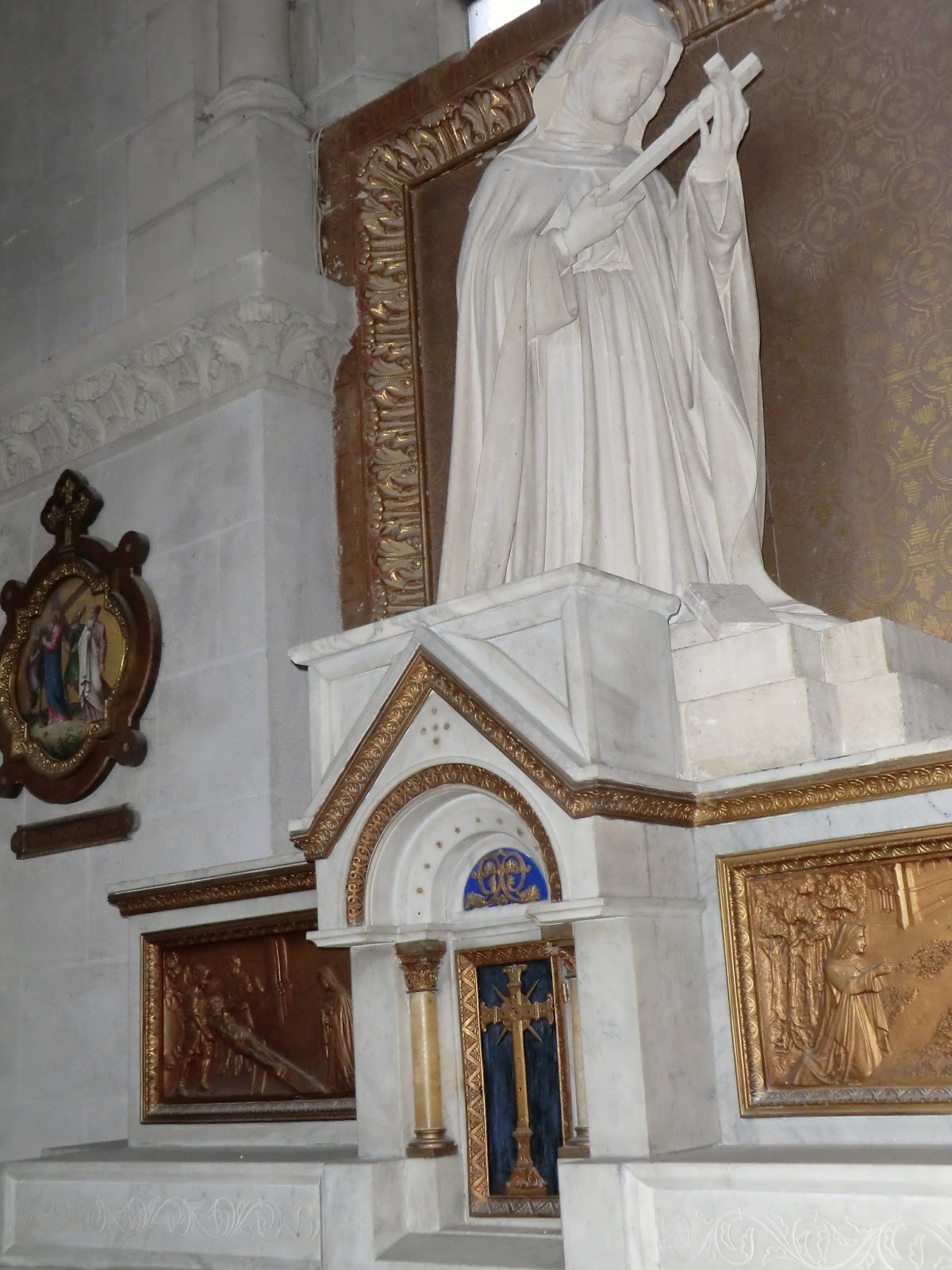
Église
Saint-Laud d'Angers (Maine-et-Loire, France) : autel secondaire de Jeanne
de Maillé
Saint
Laud church of Angers (Maine-et-Loire, France) : Jeanne de Maillé
secondary altar
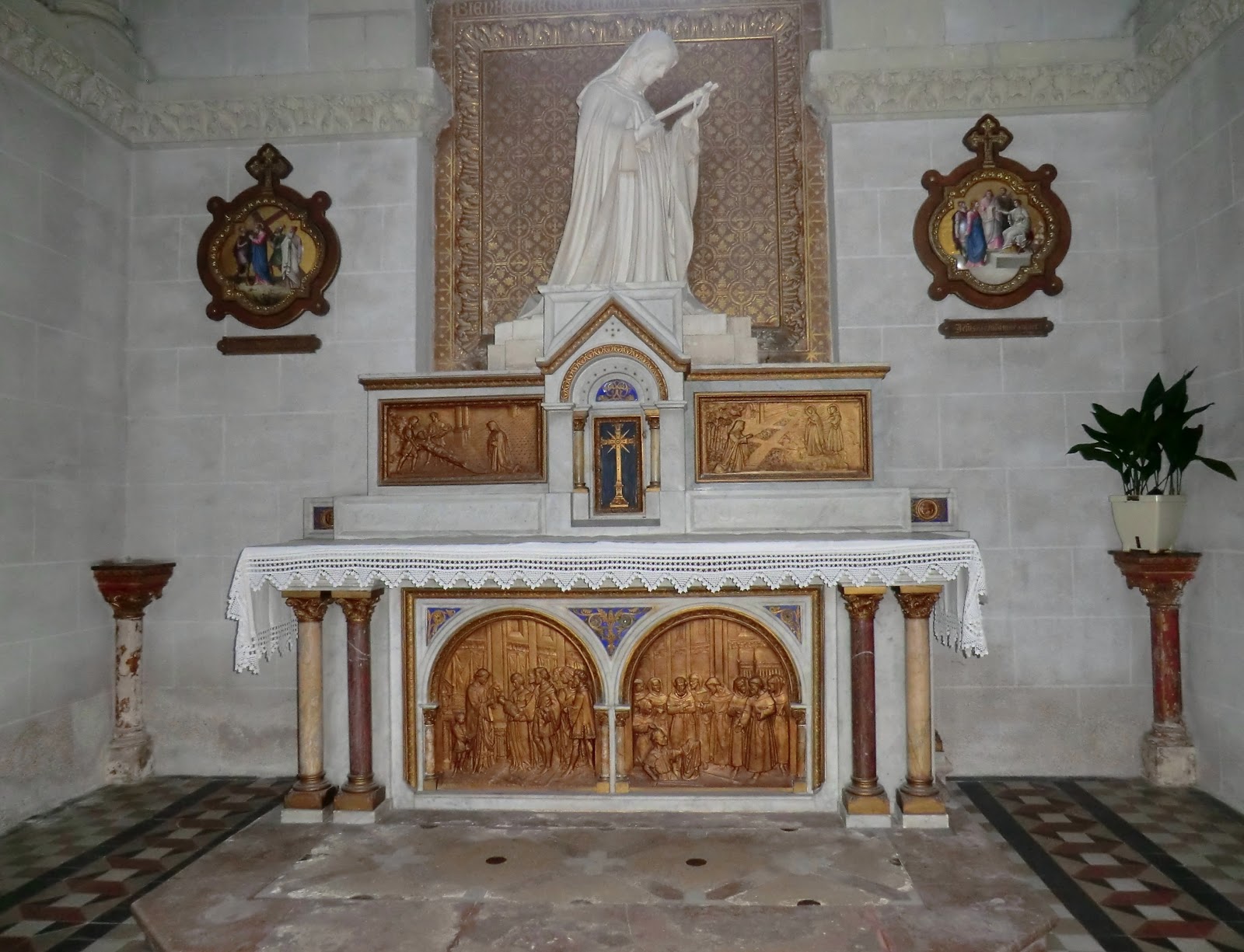
Église
Saint-Laud d'Angers (Maine-et-Loire, France) : autel secondaire de Jeanne
de Maillé
Saint
Laud church of Angers (Maine-et-Loire, France) : Jeanne de Maillé
secondary altar
Bienheureuse Jeanne-Marie
de Maillé
Ses parents l'engagèrent
dans le mariage alors que son cœur s’était donné à Dieu. Elle vécut avec son
époux dans la fidélité à la loi de Dieu. Ils adoptèrent trois enfants pauvres.
Les épreuves ne manquèrent pas : maladie, perte du domaine envahi par les
Anglais après la défaite de Poitiers en 1356, mort de son époux après seize
années de bonheur conjugal. Refusant de se remarier, Jeanne-Marie donna tous ses
biens à l’Eglise et se mit, comme Tertiaire de saint François, au service de
l’hôpital Saint-Martin à Tours, se préoccupant des pauvres et méprisant le
jugement des puissants. Elle y fut récompensée de grâces mystiques et y mourut
en 1414.
Jeanne-Marie de Maillé
Veuve, Franciscaine, Bienheureuse
1332-1414
Jeanne-Marie de Maillé naquit en 1332, au château de La Roche (Luynes, près de Saint-Quentin de Touraine), de très noble famille : son père Hardoin était baron de Maillé, sa mère Jeanne, fille des ducs de Montbazon. Dès le plus jeune âge elle se faisait remarquer par sa piété, surtout envers Marie qui lui apparut tenant dans ses bras l’enfant Jésus. Sa mère lui recommanda comme confesseur un frère franciscain du couvent de Tours. Bien qu’elle désirât garder la continence, elle fut mariée, malgré elle, au jeune baron Robert de Silly qui était lui aussi pieux et respectueux des engagements de son épouse. Tous deux menèrent une vie vertueuse et soucieuse de partage avec les pauvres.
Devenue veuve, après seize ans de mariage, Jeanne-Marie fut chassée du château de Silly par la famille de son mari qui lui reprochait de dilapider la fortune. Elle se réfugia au château paternel, elle y continua plus que jamais sa vie de charité et de prières. Elle bénéficia de plusieurs apparitions, de la Vierge Marie, puis de saint François et de saint Yves qui lui recommandèrent d’adhérer au Tiers-Ordre de saint François. Elle renonça à tous ses biens et s’en alla vivre dans une cabane adossée au couvent des Frères mineurs de Tours, où elle mena une vie de pénitence, de contemplation continuelle et de pauvreté, jusqu’à mendier son pain.
Beaucoup de personnes, y
compris des nobles de sa parenté, recourraient à ses conseils et à son
intercession. Ainsi le roi de France, Charles VI, de passage à Tours, vint
consulter la célèbre pénitente qui l’invita à libérer certains prisonniers, à
accorder aux autres les secours d’un aumônier. En 1395, elle vint à Paris où
elle rencontra à nouveau le roi de France, Charles VI, et son épouse Isabeau de
Bavière ; elle en profita pour reprocher à la cour le luxe et les modes
licencieuses des courtisans. À Paris, elle visita la sainte Chapelle pour y
vénérer les reliques de la Passion du Christ. Revenue à Tours, elle y décéda à
l’âge de 82 ans, le 28 mars 1414, et fût inhumée dans l’église des Cordeliers.
Mais son tombeau fût profané par les Calvinistes, lors des guerres de religion.
Son culte immémorial fut approuvé par le pape Pie IX, en 1871.
SOURCE : http://nouvl.evangelisation.free.fr/jeanne_marie_de_maille.htm
Bienheureuse Jeanne-Marie
de Maillé
Jeanne-Marie est née en 1332 au château des Roches, dans lequel elle a passé
son enfance. Sa famille est propriétaire de plusieurs châteaux en Touraine. Dès
son plus jeune âge, Jeanne-Marie montre une grande attention envers les plus
pauvres et une forte dévotion pour la Sainte Vierge. Le souhait de Jeanne-Marie
est de garder sa virginité.
A 16 ans, ses parents la
marient avec Robert de Sillé, ami d'enfance de Jeanne-Marie ayant une grande
piété. Une fois mariés, Jeanne-Marie et son époux abritent et nourrissent de
nombreux pauvres dans la maison qu'ils occupent. Après la mort de son époux,
Jeanne-Marie se consacre entièrement aux pauvres, les visitant, les soignants
et leur distribuant sa fortune. Jeanne-Marie a également une grande dévotion
pour Saint Martin, sur le tombeau duquel elle prie énormément. Devenue pauvre
parmi les pauvres, Jeanne-Marie est rejetée par sa belle famille.
Après 20 ans de cette
existence, Jeanne-Marie décide de s'installer dans un abri, près d'une chapelle
dédiée à Marie située dans une forêt proche de Tours. Elle se met alors à
s'habiller avec une étoffe grossière semblable à celle de Saint François
d'Assise. Cette existence retirée durera 2 ans.
Lorsqu'elle a 45 ans,
Jeanne-Marie se réinstalle à Tours. Elle devient à nouveau très populaire
auprès des pauvres, mais aussi auprès des nobles et des bourgeois qui viennent
lui demander conseil.
Jeanne-Marie de Maillé
meurt à Tours en 1414, à près de 82 ans. Cette femme avait obtenu tant de guérisons,
aidé tant de gens, pauvres ou non, que ses funérailles furent un vrai triomphe.
En avril 1872, à la demande de l'évêque de Tours, l'Église la proclama
"Bienheureuse".
SOURCE : http://www.maisonsaintjean.com/index.php?page=jeanne-marie-de-maille

Blessed Jeanne Marie
de Maille
Also
known as
Jane Mary de Maille
27
April on some calendars
Profile
Married for
sixteen years to the Baron de Silly, but remained chaste. The Baron was captured in
battle; Jeanne sold everything to raise his ransom, but before she could pay
it, the Baron escaped with the help of the Virgin Mary. Widowed,
she fell into complete homeless poverty, praying by
day, sleeping with dogs by
night. Franciscan tertiary,
at age 57 she moved into a tiny room in a church at Tours, France.
Her humility and holiness attracted visitors, many of whom she helped convert,
and who were witness to healing miracles.
Born
14
April 1331 at
the castle of La Roche, France
28
March 1414 at Tours, France of
natural causes
1871 by Pope Blessed Pius
IX (cultus
confirmed)
people
ridiculed for their piety
Additional
Information
Saints
of the Day, by Katherine Rabenstein
books
Our Sunday Visitor’s Encyclopedia of Saints
other
sites in english
images
video
sitios
en español
Martirologio Romano, 2001 edición
sites
en français
fonti
in italiano
MLA
Citation
‘Blessed Jeanne Marie de
Maille‘. CatholicSaints.Info. 10 June 2023. Web. 23 March 2026.
<https://catholicsaints.info/blessed-jeanne-marie-de-maille/>
SOURCE : https://catholicsaints.info/blessed-jeanne-marie-de-maille/
Blessed Jane Mary de
Maillé, OFM Tert. V (AC)
Born 1331; died 1414;
cultus confirmed in 1871. The daughter of the baron de Maillé, Jeanne-Marie
married the baron de Silly, with whom she lived in virginity for 16 years.
After his death in 1362, she joined the Franciscan tertiaries and retired to
Tours, where she spent the rest of her life in poverty and privation due to the
persecution of her husband's relatives (Benedictines)
SOURCE : http://www.saintpatrickdc.org/ss/0329.shtml
Blessed Jane Mary of
Maille
(Jeanne-Marie de Maille)
Feast Day – March 29
Jane, the daughter of the
wealthy baron of Maille, was born at the chateau of her father near St Quentin
in France. Because she possessed from her earliest youth a tender devotion and
love for the Blessed Virgin Mary, she was given the additional name of Mary at
confirmation, and from then on she always used it with her baptismal name.
Under the direction of a Franciscan, who conducted the divine services at the
chateau, she strove earnestly to attain perfection. Self-denial, mortification,
prayer, and works of charity towards her neighbor were the special means she
employed.
Blessed Jane Mary of
Maille was scarcely fifteen years old when her father died. Jane Mary was
placed under the guardianship of her grandfather, who was already quite
advanced in years, and who therefore believed it his duty to see his grandchild
settled in life as soon as possible. He chose as her husband Baron Robert of
Silly, a man who was noble both by birth and by virtue. On the evening of their
wedding day the grandfather died suddenly. This made such an impression on the
pious husband that he readily yielded to the wish of his young wife to live in
virginity.
The young couple’s first
concern was to order their household in a Christian fashion. Only virtuous and
God-fearing persons were admitted as their servants; all had to observe the
commandments of God and of the Church faithfully; frivolous conversations,
cursing and swearing, as well as games of chance, were not tolerated. In
everything their master and mistress set the best example. Jane Mary interested
herself also in all the needs of her people, and never sent a needy person away
from her door without giving him assistance.
But the cross is the real
test of all true fidelity towards God; and it was not to be wanting in this
house either. A terrible war broke out between England and France. The Baron of
Silly and his vassals took the field in defense of their country, but the war
was disastrous for France.
Mortally wounded, the
baron was brought to his chateau; but hardly had he arrived there, when the
English took possession of it and led him away as a prisoner. Through the
efforts of his faithful wife, he obtained his freedom; but he died not long
afterwards.
Now Blessed Jane Mary of
Maille withdrew entirely from the world. She left her vast possessions in the
hands of relatives, while she moved to a little house near the Franciscan
church in Tours. Dressed in the ash-grey habit of the Third Order, she went out
to nurse the sick and the poor; the remaining time she spent in prayer.
Jane Mary of Maille
prayed especially that God might bless the labors of priests, particularly
those who preached the divine word. She prayed most of all for the universal
Church, which at that time had to endure one of its severest trials.
Christendom was divided into two groups – one pope resided in Italy, another in
France, and even saintly people did not know which one was the rightful head of
the Church. Confusion and many scandals were the inevitable results. Had the
Church been the work of human hands, it must certainly have gone to ruin. In
answer to the prayers of many pious souls, God came to the assistance of the
Church, and Jane Mary had the consolation before her death of seeing the Church
again united under one head.
Blessed Jane Mary of
Maille died in the year 1414, at the age of eighty-two years. When her remains,
clothed in the habit of the Third Order, were brought into the church, the body
appeared to have the freshness of youth. The veneration paid to her since her
death was approved by Pope Pius IX.
from The Franciscan
Book of Saints, edited by Marion Habig, OFM
SOURCE : http://www.roman-catholic-saints.com/jane-mary-of-maille.html
_%C3%89glise_Saint-Pierre_-_Int%C3%A9rieur_-_Autel_de_la_bienheureuse_Jeanne_Marie_de_Maill%C3%A9.jpg)
Autel
de la bienheureuse Jeanne Marie de Maillé en l'église Saint-Pierre de La
Jumellière (49).
Blessed Jane
of Maille of the Third Order
Article
Blessed Jane Mary, the
daughter of of the wealthy Baron of Maille, was born 1331, in the castle of La
Roche, near the town of Saint Quentin, in France. She was called Jane in Baptism;
and, on account of her great devotion to the Mother of God, she took the name
of Mary in Confirmation. As a child, she delighted in saying the Hail Mary and
in weaving garlands of flowers to adorn the statue of our Lady.
Under the prudent
guidance of a son of Saint Francis, who held the position of chaplain of the
castle, Jane rapidly advanced in perfection by the practice of self-denial,
mortification, prayer, and works of mercy. She made herself an oratory in a
retired part of the castle and there prostrate before a crucifix, she spent
many hours in fervent converse with God. It was her delight to read the lives
of the saints, and incited by their heroic virtues to grow in the spirit of
self-sacrifice, she resolved to consecrate her virginity to God.
When Jane was fifteen
years of age, her father died, and she was placed under the guardianship of her
grandfather, who made it one of his first cares to provide for the future of
his ward. He chose as husband for her the virtuous Robert, Baron of Silly. At
this news, Jane, desirous of belonging to God alone, was appalled. She
redoubled her prayers and austerities to obtain the help of God in this
difficulty. In a heavenly vision she was reassured, however, that the union was
pleasing to God, and that her virtue would receive the reward she so ardently
desired. The marriage ceremonies were celebrated with great pomp; but the
wedding day was turned into a day of mourning, for in the evening, Jane’s
grandfather departed this life. This sad and unexpected event made a deep
impression on all, and induced the young Baron of Silly to yield to the desires
of his bride to lead a life of virginity.
This chaste union, which
lasted thirteen years, was sanctified by the practice of sublime virtues. The
holy couple made it their first care to regulate their household according to
the will of God. Only virtuous and God-fearing persons were engaged as
servants. Everyone in the castle was bound to fulfill faithfully the duties of
religion; games of chance, quarrels, frivolous language, and cursing were
strictly prohibited. These wise and pious regulations were enforced by the
example of Jane and her husband. The poor always received a hearty welcome, and
they never left the castle without being consoled and assisted in their need.
Thus, for about ten
years, the virtuous couple had led a truly happy life; for no joy is so pure as
that which springs from virtue. But human life, especially in the case of the
saints, is a continual alternation of consolations and trials. God was now about
to demand of Blessed Jane a great sacrifice. At that time, the Hundred Years’
War was raging in France. The English, after devastating the southern
provinces, were advancing toward the center of the kingdom. Summoned by his
king, Robert of Silly armed his men and marched out to the defence of his
country, and after distinguishing himself by his bravery, fell seriously
wounded. He had scarcely recovered from his wounds, when his castle was stormed
by the English and he was carried off a prisoner. During this severe trial,
Blessed Jane, far from murmuring against Divine Providence, blessed the hand of
God which weighed heavily upon her, and came forth from the visitation purified
and more detached from earthly things. Through her efforts, her husband was at
length restored to liberty, and together they henceforth vied with each other
in the performance of works of piety and charity.
After the death of her
husband, in 1362, Blessed Jane was bitterly persecuted by his family, but even
when she was cruelly deprived of a large part of her property and obliged to
beg for shelter in the cottage of a poor woman, she did not lose her peace of
heart, but, like Saint Elizabeth, thanked God and deemed herself happy in
having no other possessions than Jesus Crucified. With a view of serving God
with greater freedom, she went to Tours and took up her abode in a poor lodging
near the Church of Saint Martin. Here she entered the Third Order of Saint
Francis, and henceforth always wore the habit outwardly, in spite of the ridicule
she met with. She now devoted herself with renewed zeal to works of charity, in
which she spent all her time not given to prayer. She visited the poor and the
sick, rendered every charitable service to the lepers, and by her prayers and
prudent zeal effected the conversion of many who had given themselves up to a
life, of sin. To these acts of charity, she joined the practice of the greatest
self-denial and mortification. She spent the greater part of the night in
prayer, sleeping for a short time on the bare ground. Besides the fasts
prescribed by the Church and the Rule of the Third Order, she kept four Lents
during the year, and fasted on bread and water on four days of every week. In
her love for holy poverty, she divested herself of all her possessions,
renounced any property that might eventually devolve on her, and lived on alms.
It might be supposed that
the example of so many virtues would have attracted the respect and veneration
of men; but God permitted it to be otherwise. Jane was treated as foolish and
mad, and persecuted with ridicule and insults to such an extent that she was
obliged several times to change her abode. She at length found an asylum in a
poor dwelling near the church of the Franciscans in Tours. In this humble
retreat, Blessed Jane was to spend the last twenty-seven years of her life and
to exercise a holy influence which was to be felt even at the royal court. She
begged her daily bread, practiced the greatest austerities, and spent many
hours of the day and night before the tabernacle in contemplation. By her
prayers and exhortations, she obtained the conversion of many sinners. She
visited the prisoners, provided for their needs, and in many cases procured
their release. Needy churches were also the object of her pious solicitude; by
her help and example, many were repaired and provided with the things necessary
to celebrate the divine mysteries with due reverence.
In 1395, Blessed Jane
visited Paris, where she had several audiences with King Charles VI. The
influence of these interviews was soon felt in a number of royal statutes in
favor of the people and the prisoners and in the removal of abuses existing at
the court.
Her influence was also
exercised in a most salutary manner during the Great Schism, which caused so
much confusion in the Church of God. Like the other Saints who lived at the
time, Blessed Jane not only unceasingly implored God to hasten the end of the
scandal which afflicted the Church to the detriment of numerous souls, but she
instituted for this purpose processions and public prayers, and as a reward,
she received a revelation making known the coming peace of the Church.
After laboring for the
honor of God and the salvation of souls by a life of voluntary poverty,
humility, mortification, and prayer, Blessed Jane was at length called to her
eternal reward. She passed away on March 28, 1414, in the eighty-second year of
her age. She was entombed in the church of the Friars Minor at Tours. Pope Pius
IX, in 1871, confirmed the veneration shown her from time immemorial.
MLA
Citation
Franciscan
Herald, April 1917. CatholicSaints.Info.
8 October 2022. Web. 23 March 2026.
<https://catholicsaints.info/blessed-jane-of-maille-of-the-third-order/>
SOURCE : https://catholicsaints.info/blessed-jane-of-maille-of-the-third-order/

Église
Notre-Dame la Neuve de Chemillé-Melay (49). Baie 14. Verrière de la
bienheureuse Jeanne Marie de Maillé.
Beata Giovanna Maria
de Maillé Vedova
Festa: 28 marzo
Castello di La Roche,
Francia, 14 aprile 1331 - Tours, Francia, 28 marzo 1414
Nata nel 1331, nobildonna
di animo pio, visse una vita ricca di avversità e di eroiche virtù. Costretta a
un matrimonio combinato, visse castamente con il marito, dedicandosi alla
carità. Rimasta vedova, fu cacciata di casa e visse in povertà, dedicandosi ai
bisognosi. Famosa per la sua santità e le sue opere di carità, morì nel 1414.
Beatificata nel 1871, è un esempio di fede, speranza e amore cristiano.
Etimologia: Giovanna
= il Signore è benefico, dono del Signore, dall'ebraico
Martirologio
Romano: A Tours in Francia, beata Giovanna Maria de Maillé, che, dopo aver
perso il marito in guerra, ridotta in povertà e scacciata di casa dai suoi,
abbandonata da tutti, visse quasi reclusa in una piccola cella presso il
convento dei Minori, mendicando il pane, ma piena di fiducia nel Signore.
Sposa controvoglia a 16
anni, vedova a poco più di 30, cacciata di casa e rifiutata dai parenti del
marito, per i restanti 50 anni della sua vita costretta a vivere senza fissa
dimora: così tante disavventure sono concentrate nella vita della Beata Giovanna
Maria de Maillè, nata fortunata, ricca e coccolata nel castello di La Roche,
nei pressi di Saint-Quentin de Touraine. il 14 aprile 1331. Nel panorama
generalmente religioso e devozionale della famiglia spicca particolarmente lei,
che cresce con l’accompagnamento spirituale di un francescano, dimostrando una
particolare devozione mariana, tanto che al castello si sussurra di vere o
presunte apparizioni della Madonna, di estasi, di preghiere prolungate, di
precoci voti di verginità. Al compimento dei sedici anni si affaccia sulla
scena della sua vita un parente da parte di mamma che diventa suo tutore, il
che fa presumere che i genitori siano prematuramente morti. In questa veste
combina, secondo l’uso del tempo, il matrimonio di Giovanna con il barone Roberto
di Silly, un bravo ragazzo, poco più grande di lei, suo compagno di giochi fin
da bambino. E tutto questo malgrado sia a conoscenza dell’inclinazione di
Giovanna per la vita religiosa e del suo voto di verginità: un matrimonio
forzato, dunque. Destino vuole che il tutore muoia improvvisamente proprio la
mattina del giorno delle nozze e l’impressione sullo sposo è tale che propone a
Giovanna di vivere in perfetta continenza, cioè come fratello e sorella. Ovvio
il di lei consenso, a ciò già predisposta dal suo precoce voto di verginità..
Malgrado le premesse il matrimonio funziona, e anche bene: come base hanno
messo il vangelo, da vivere in tutta la sua integralità, e lo traducono in
tante opere di bene, che allora come oggi non mancano: “adottano” alcuni bimbi
abbandonati, sfamano e curano i poveri, assistono gli appestati, insomma si
danno un sacco da fare. Mai si è visto tanto movimento nel loro castello, da
quando si è sparsa la voce che i due sposi tanto ricchi sono anche tanto
caritatevoli. E pensare che i problemi anche a loro non mancano, come quando
Roberto va in guerra (siamo all’epoca della guerra dei Cent’anni), resta ferito
e viene imprigionato dagli Inglesi. Per liberarlo Giovanna deve pagare un forte
riscatto che intacca pesantemente il loro patrimonio. Eppure non perdono né
slancio né fede e, una volta sistemate le cose, marito e moglie sono ancora
fianco a fianco, prima per curare i contagiati dalla peste nera e poi i
lebbrosi. Roberto muore nel 1362 e Giovanna, vedova poco più che trentenne, si
trova contro gli suoceri e tutto il casato di suo marito. L’accusano
principalmente di aver sprecato il patrimonio di famiglia e la cacciano senza
tanti complimenti. Si trova così senza una casa, senza uno spicciolo, costretta
a vivere di carità ma perfino per strada i ricchi parenti continuano a
perseguitarla, e mandano i servi a lanciare insulti al suo passaggio, perché
loro non vogliono abbassarsi al punto da farlo personalmente. Giovanna soffre e
trangugia, con una carità senza limiti che non le lascia neppure
un’incrostazione di risentimento. E per sapere dove trova tanta forza e tanta
bontà, basta vedere le sue lunghe ore di preghiera, la sua tanta penitenza, i
suoi sacrifici. Per vestito si è scelta una tunica grossolana e ruvida, tanto
simile al saio dei suoi amati Francescani, di cui vive intensamente la
spiritualità fino al giorno in cui diventerà terziaria. Continua a far carità
ad ammalati, prigionieri, condannati a morte: se non più con i soldi, che non
ha, sicuramente con la sua persona e i suoi umili servizi, consolandoli quando
non può far di meglio, intercedendo per la loro liberazione quando la sua
popolarità ha raggiunto l’apice e può spenderla a loro vantaggio. Perché la sua
fama di donna di Dio si è estesa da Tours a gran parte della Francia. sono in
molti a consultarla per avere consigli e suggerimenti e tra quelli che si
mettono in fila alla sua porta ci sono anche alcuni di quelli che l’avevano a
suo tempo insultata, che lei accoglie come gli altri, con carità e pazienza
infinite. Malgrado la salute malandata e i disagi della sua vita di senzatetto,
arriva fino alla soglia degli 82 anni e muore il 28 marzo 1414, circondata da
una solida fama di santità che fa concludere in appena dodici mesi il processo
diocesano informativo per la sua canonizzazione. Ma anche dopo morte Giovanna
deve attendere, e fino al 1871, quando Pio IX la proclama beata.
Autore: Gianpiero
Pettiti
Quante disavventure deve sopportare Giovanna. E con quanta forza riesce a superare ogni ostacolo. Giovanna Maria de Maillè nasce nel 1331 in una nobile famiglia, nel Castello di La Roche (Saint-Quentin de Touraine), in Francia. La sua famiglia, religiosa, affida l’educazione di Giovanna a un francescano. Giovanna, pur essendo una bambina, prega molto e si dice che abbia delle visioni della Madonna.
La fanciulla all’età di sedici anni si presume che resti orfana perché un tutore combina il suo matrimonio con un barone, Roberto di Silly, amico d’infanzia di Giovanna. La mattina del matrimonio un evento sconvolge il giovane Roberto: il tutore di Giovanna improvvisamente muore. Roberto rimane impressionato e promette a Giovanna, che accetta di buon grado, di vivere il matrimonio come se fossero fratello e sorella, in castità. I due giovani si vogliono bene e sono d’accordo su tutto. Essi hanno fede in Gesù e mettono in pratica il Vangelo: aprono le porte del castello e adottano bambini abbandonati, sfamano i poveri, curano gli ammalati. Roberto, però, parte per la “Guerra dei cent’anni” e viene fatto prigioniero dagli inglesi. Giovanna, per pagare la sua liberazione, deve intaccare quasi tutto il loro patrimonio. La coppia non si perde d’animo. Giovanna e Roberto continuano a curare gli ammalati di peste e aiutano le famiglie cadute in rovina, spendendo ancora denaro.
Purtroppo Roberto muore e Giovanna rimane vedova a trent’anni. I parenti del marito la cacciano via, senza nemmeno uno spicciolo, accusandola di essere stata una scialacquona. Giovanna girovaga senza dimora ed elemosina il pane per sopravvivere. Prega sempre, non serba rancore contro chi l’ha messa sulla strada e la fa seguire addirittura dai servi per farla insultare pubblicamente. La donna indossa un ruvido saio e si rifugia a Tours, in un ospizio. Non ha denaro, ma cura gli ammalati di lebbra con le sue mani. Si stabilisce, poi, vicino al Convento francescano di Tours dove conduce una vita ritirata.
Giovanna Maria diventa famosa in tutta la Francia. Tantissimi la vanno a
trovare per chiedere consiglio; in taluni casi perché interceda presso il re di
Francia Carlo VI per far liberare prigionieri o condannati a morte. E chi prima
l’aveva resa mendicante e insultata per la strada, adesso si mette in coda
davanti alla sua porta e lei accoglie tutti con infinita bontà. Beata Giovanna
Maria de Maillè muore a Tours nel 1414 a 82 anni.
Autore: Mariella Lentini

Église
Saint-Aubin de Brandivy (Morbihan, France) : statue de Jeanne-Marie de
Maillé
Saint
Albinus church of Brandivy (Morbihan, France) : statue of Jeanne-Marie de
Maillé
La sua vita attraversa uno dei peggiori momenti della storia francese ed europea, dalla guerra franco-inglese dei Cent’anni alla grande peste di metà secolo, alla rivolta popolare di Parigi e all’insurrezione contadina (Jacquerie) nel Nord della Francia.
Giovanna Maria è di casato nobile. Nasce in un castello della regione di Tours e riceve l’istruzione religiosa da un francescano, confessore della famiglia. Deve però aver perduto presto i genitori, perché a sedici anni la troviamo già maritata (da un tutore, contro la sua volontà) al nobile Roberto de Sillé (o Silly): un matrimonio combinato per interesse sulla testa dei due sposi, i quali decidono di convivere in castità.
Il marito poi va in guerra, e nella sanguinosa battaglia di Crécy viene ferito e fatto prigioniero dai vincitori inglesi. Giovanna Maria riesce a farlo liberare secondo l’uso del tempo, ossia pagando un riscatto, che intacca gravemente il loro patrimonio. Al tempo della peste nera, poi, marito e moglie assistono i malati e soccorrono le famiglie in miseria, spendendo ancora i loro beni. Cessata l’epidemia, si dedicano ai lebbrosi. E quando nel 1362 Roberto muore, i suoi parenti scacciano Giovanna Maria, con l’accusa di avere sperperato il patrimonio di famiglia.
Lei si va a stabilire a Tours, nell’ospizio cittadino, dove assiste i malati e vive come una religiosa: ha fatto voto di castità perpetua nelle mani dell’arcivescovo locale. Ma incontra nuove ostilità e diffidenze e cerca allora di trovare pace dedicandosi alla vita eremitica, in solitudine. Una soluzione ideale per lei, se non fosse per la salute molto fragile: nel 1386, infatti, eccola di ritorno a Tours. Qui va a stabilirsi vicino al convento dei Francescani (che il popolo chiama abitualmente Cordiglieri) e prende come direttore spirituale uno di loro, padre Martin de Bois-Gaultier. Forse si fa anche terziaria, ma la cosa non è sicura.
Intraprende comunque una vita quasi da reclusa, che durerà ventisette anni. In città nessuno la vede, ma sono sempre più numerosi quelli che la vanno a cercare. E’ sorprendente l’autorevolezza di questa donna, che un po’ tutti si erano divertiti a umiliare: dal tutore ai suoceri, ai maldicenti di Tours. Ora, invece, la gente accorre a chiederle consiglio. Anche per liberare prigionieri o per salvare un condannato a morte si ricorre a lei: vada, corra a corte, convinca lei alla clemenza il re Carlo VI, che è pure malato di mente...
La sua fama di santità è così diffusa, che a un anno appena dalla morte (1414)
il procedimento per canonizzarla è già concluso in diocesi, e i fedeli la
venerano spontaneamente. Ma per le vicende della Chiesa prima e della Francia
poi, si arriverà alla sua beatificazione con grande ritardo: solo nel 1871, per
opera di papa Pio IX.
Autore: Domenico Agasso

_%C3%89glise_Notre-Dame_-_Int%C3%A9rieur_-_Vitrail_-_20.jpg)
_%C3%89glise_Notre-Dame_-_Int%C3%A9rieur_-_Vitrail_-_19.jpg)

_%C3%89glise_Notre-Dame_la_Neuve_Int%C3%A9rieur_Baie_14-1.jpg)
