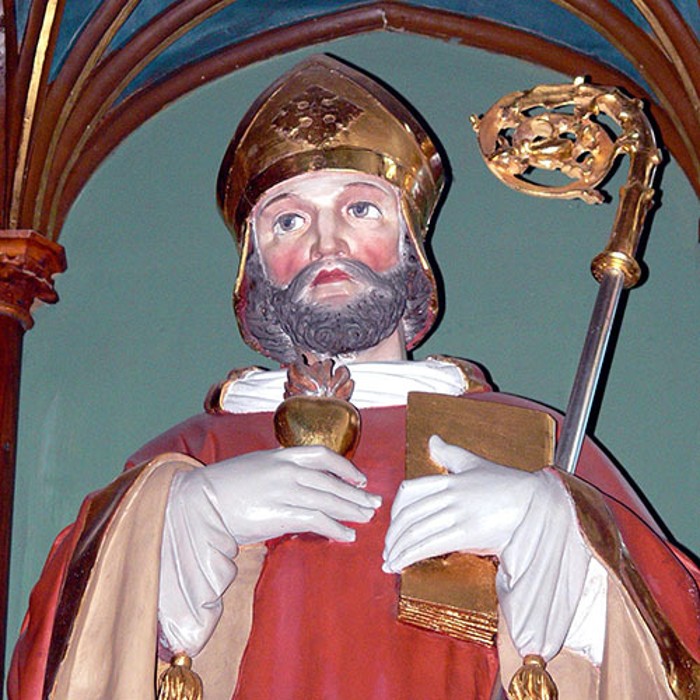
Oswald
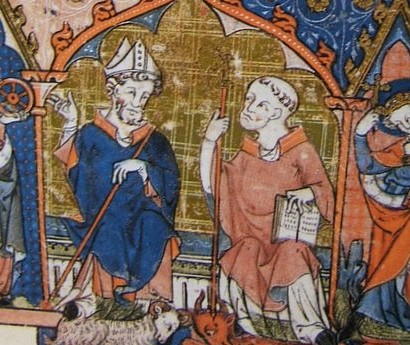
et l'abbé Eadnoth de Ramsey dans le psautier de Ramsey (Pierpont Morgan Library, XIIIe siècle).
Detalle
de San Osvaldo sobre un carnero, y un abad sobre un toro. Pierpont Morgan
Library, Nueva York.
Saint Oswald
Évêque de Worcester puis
d'York (+ 992)
Il servit le Christ comme
chanoine de Winchester, puis comme moine de Saint Benoît à Fleury-sur-Loire et
revint à Winchester comme évêque puis archevêque d'York.
À Worcester en
Angleterre, l’an 992, saint Oswald, évêque. D’abord chanoine de Winchester,
puis moine à Fleury, il fut placé ensuite sur le siège de Worcester, et,
quelque temps après, il eut encore à diriger l’Église d’York. Il établit la
Règle de saint Benoît dans de nombreux monastères et fut un maître affable,
joyeux et savant. (éloge le 28 février omis les années bissextiles)
Martyrologe romain
SOURCE : http://nominis.cef.fr/contenus/saint/720/Saint-Oswald.html
Saint Oswald
Archevêque d’York
(† 992)
Saint Oswald naquit en
Angleterre, d’une noble famille du Danemark qui s’y était établie au temps des
conquêtes danoises. Son éducation fut confiée à un oncle paternel, saint Odon,
archevêque de Cantorbéry. Oswald répondit heureusement à ses soins.
Devenu chanoine de
Winchester et doyen du Chapitre, malgré sa jeunesse, il remplit ses fonctions
avec la prudence et la gravité d’un vieillard.
Bientôt pourtant, son
attrait pour la solitude le porta à se démettre de sa charge. Il passa en
France et prit l’habit monastique à l’abbaye de Fleury-sur-Loire, où il se fit
remarquer par de grandes austérités.
Confiant dans la
réputation de vertu de son neveu, saint Odon, affaibli par l’âge, souhaita de
l’avoir auprès de lui. Le vieillard était mort depuis trois mois quand Oswald
arriva à Cantorbéry. Le mérite éminent du jeune moine le fit désigner en 960
pour le siège de Worcester qu’il unit, douze ans plus tard, à celui d’York.
Toujours animé du désir
de la solitude, Oswald allait passer dans un monastère de Bénédictins tous les
moments qu’il pouvait dérober aux fonctions de sa charge. Après une longue vie
toute de charité, de prière et de pénitence, il tomba malade à Worcester. Dieu
lui fit connaître l’heure de sa récompense la veille du jour où il devait la
recevoir. Il s’y prépara dès le soir par la réception des derniers sacrements,
et passa la nuit en oraison. Le lendemain matin, il lava les pieds aux pauvres,
selon sa coutume, et chanta encore les quinze psaumes qui accompagnaient cette
humble fonction. Il expira en achevant la doxologie «Gloire au Père, au Fils et
an Saint-Esprit», aux pieds du dernier de ceux qu'il assistait.
C’était le 29 février de
l’année bissextile 992, après un épiscopat de plus de trente années.
Vie des Saints pour
chaque jour de l'année, à l'usage des Frères des écoles chrétiennes, Paris,
Procure Générale, 1932
SOURCE : https://sanctoral.com/fr/saints/saint_oswald.html

28
February (non-leap years)
29
February (in leap years)
Profile
Oswald’s parents came
from Denmark to England before
his birth. The boy was educated by
his uncle, Saint Odo
the Good. Priest in
the diocese of Winchester, England. Benedictine monk at
Fleury-sur-Loire, France. Bishop of Worcester, England in 962.
Worked with Saint Dunstan and Saint Ethelwold to
revive monastic and
ecclesiastical discipline in England.
Founded the abbey at
Ramsey, and the monastery at
Winchester. Archbishop of York in 972. Wrote theological treatises,
and worked for the improved theological training
of his clergy.
Daily washed the feet of poor people.
29
February 992 of
natural causes
in England
Additional
Information
Book
of Saints, by the Monks of
Ramsgate
Lives
of the Saints, by Father Alban
Butler
Saints
of the Order of Saint Benedict, by Father Aegedius
Ranbeck, O.S.B.
Short
Lives of the Saints, by Eleanor Cecilia Donnelly
books
Our Sunday Visitor’s Encyclopedia of Saints
Saints
and Their Attributes, by Helen Roeder
other
sites in english
images
video
sitios
en español
Martirologio Romano, 2001 edición
fonti
in italiano
spletne
strani v slovenšcini
MLA
Citation
“Saint Oswald of
Worcester“. CatholicSaints.Info. 24 February 2024. Web. 25 May 2026.
<https://catholicsaints.info/saint-oswald-of-worcester/>
SOURCE : https://catholicsaints.info/saint-oswald-of-worcester/
Book of Saints
– Oswald – 28 February
(Saint) Bishop (February
28) (10th
century) The nephew of Saint Odo, Archbishop of Canterbury.
He became a monk at
Fleury on the Loire, and was later, through the wise advice of Saint Dunstan,
made Bishop of Worcester,
whence he was promoted to the Archbishopric of York.
He accomplished murh for the revival of religious discipline in
Anglo-Saxon England.
He passed away A.D. 992,
at Worcester,
where his relics were enshrined.
MLA
Citation
Monks of Ramsgate.
“Oswald”. Book of Saints, 1921. CatholicSaints.Info.
18 May 2016. Web. 25 May 2026.
<https://catholicsaints.info/book-of-saints-oswald-28-february/>
SOURCE : https://catholicsaints.info/book-of-saints-oswald-28-february/
SAINT OSWALD
In the 10th century in England,
Oswald was born into a family with strong military ties but found his calling
elsewhere, under the guidance of his uncle, the Archbishop of Canterbury. This
early influence steered him towards a life of scholarship and piety. Oswald
furthered his education in France, where he embraced the Benedictine monastic
life.
His ecclesiastical career
saw him ascend to the positions of Bishop of Worcester and later, Archbishop of
York. In these roles, he was instrumental in founding monasteries and
spearheading reforms that would leave a lasting impact on the Church’s approach
to scholarship and education. He invited eminent scholars in fields like
mathematics and astronomy to the abbeys he founded, fostering an environment of
learning and intellectual growth.
Oswald was renowned for
his deep piety and his profound love for the impoverished. His final days were
spent in the Worcester Cathedral, a place he dearly loved. In the winter of
992, during Lent, he resumed his tradition of washing the feet of 12 poor men daily.
On Leap Year Day, February 29, after performing this act of humility for the
last time, he passed away, leaving a legacy of sanctity and compassion.
The city mourned his
death deeply, and soon after, miracles were reported at his funeral and near his
tomb, enhancing his reputation for holiness. A decade later, his remains were
moved within the cathedral. His legacy is commemorated annually on February 28,
or on February 29 in leap years, marking a life dedicated to faith, learning,
and charity.
SOURCE : https://ucatholic.com/saints/oswald/
New Catholic
Dictionary – Saint Oswald
Confessor; archbishop of
York, England; born England; died Worcester, England, 992. Nephew of Saint Odo,
Archbishop of Canterbury, he became a Benedictine monk at Fleury, France. Saint
Dunstan appointed him Bishop of Worcester (962), and Archbishop of York (974).
Administering both sees, together with Saint Ethelwold and Saint Dunstan, he
restored ecclesiastical discipline in England, and founded Ramsey monastery. He
received the pallium from Pope John XIII at Rome; died 29 February while
washing the feet of the poor. Patron of York. Emblems: dove, demon,
church, stone, ship. Relics at York. Feasts, 28
February and 15
October.
MLA
Citation
“Saint Oswald”. New Catholic Dictionary. CatholicSaints.Info.
27 February 2013. Web. 25 May 2026.
<https://catholicsaints.info/new-catholic-dictionary-saint-oswald/>
SOURCE : https://catholicsaints.info/new-catholic-dictionary-saint-oswald/
St. Oswald
Feastday: February 28
A Dane by birth, St. Oswald studied
in the household of his uncle, Archbishop Odo
of Fleury, France, where he was ordained. Returning to England in 959, he was
later made Bishop of
Worcester (962), by St. Dunstan. In this office, he worked hard to eliminate
abuses and built many monasteries, including the famous abbey of
Ramsey in Huntingdonshire. In 972, St. Oswald became Archbishop of
York, although he also retained the See of Worcester in order to promote his
monastic reforms which were under attack by Elfhere, King of Mercia. In
addition to striving to improve the morals of his clergy, this holy man also
labored to increase their theological knowledge -
he himself wrote two treatises and several synodal decrees. St. Oswald was
associated for most of his public life with St. Dunstan and St. Ethelwold and
when he died in 992 popular veneration joined his name to theirs. He has been
revered ever since as one of the three saints who revived English monasticism.
SOURCE : https://www.catholic.org/saints/saint.php?saint_id=798
St. Oswald
Archbishop of York,
d. on 29 February, 992. Of Danish parentage, Oswald was
brought up by his uncle Odo, Archbishop of Canterbury,
and instructed by Fridegode. For some time he was dean of the house
of the secular canons at Winchester,
but led by the desire of a stricter life he entered the Benedictine Monastery
of Fleury, where Odo himself had received
the monastic habit. He was ordained there
and in 959 returned to England betaking himself
to his kinsman Oskytel, then Archbishop of York.
He took an active part in ecclesiastical affairs
at York until St.
Dunstan procured his appointment to the See
of Worcester. He was consecrated by St.
Dunstan in 962. Oswald was an ardent supporter of Dunstan in
his efforts to purify the Church from
abuses, and aided by King Edgar he carried out his policy of replacing by
communities the canons who held monastic possessions. Edgar
gave the monasteries of St.
Albans, Ely,
and Benfleet to Oswald, who established monks at Westbury (983), Pershore (984),
at Winchelcumbe (985), and at Worcester,
and re-established Ripon. But his most famous foundation was that
of Ramsey in Huntingdonshire, the church of which
was dedicated in 974, and again after an accident in 991.
In 972 by the joint action of St.
Dunstan and Edgar, Oswald was made Archbishop of York,
and journeyed to Rome to
receive the pallium from John
XIII. He retained, however, with the sanction of the pope, jurisdiction over
the diocese of Worcester where
he frequently resided in order to foster
his monastic reforms (Eadmer, 203). On Edgar's death
in 975, his work, hitherto so successful, received a severe check at the hands
of Elfhere, King of Mercia, who broke up many communities. Ramsey,
however, was spared, owing to the powerful patronage of Ethelwin,
Earl of East Anglia. Whilst Archbishop of York, Oswald collected
from the ruins of Ripon the relics of
the saints,
some of which were conveyed to Worcester.
He died in the act of washing
the feet of the poor,
as was his daily custom during Lent,
and was buried in the Church of St. Mary at Worcester. Oswald used
a gentler policy than his colleague Ethelwold and
always refrained from violent measures. He greatly valued and promoted
learning amongst the clergy and
induced many scholars to come from Fleury. He wrote two treatises and
some synodal decrees. His feast is
celebrated on 28 February.
Sources
Historians of York in
Rolls Series, 3 vols.; see Introductions by RAINE. The anonymous and
contemporary life of the monk of Ramsey, I, 399-475, and EADMER, Life and
Miracles, II, 1-59 (also in P.L., CLIX) are the best authorities; the lives by
SENATUS and two others in vol. II are of little value; Acta SS., Feb.,
III, 752; Acta O.S.B. (Venice, 1733), saec. v, 728; WRIGHT, Biog. Lit.,
I (London, 1846), 462; TYNEMOUTH and CAPGRAVE, ed. HORSTMAN, II (Oxford, 1901),
252; HUNT, Hist. of the English Church from 597-1066 (London, 1899);
IDEM in Dict. of Nat. Biog., s.v.; LINGARD, Anglo-Saxon Church (London,
1845).
Parker, Anselm. "St.
Oswald." The Catholic Encyclopedia. Vol. 11. New York: Robert Appleton
Company, 1911. 29 Feb. 2016 <http://www.newadvent.org/cathen/11348b.htm>.
Transcription. This
article was transcribed for New Advent by Herman F. Holbrook. Saint Oswald, and
all ye holy Bishops and Confessors, pray for us.
Ecclesiastical
approbation. Nihil Obstat. February 1, 1911. Remy Lafort, S.T.D.,
Censor. Imprimatur. +John Cardinal Farley, Archbishop of New York.
Copyright © 2026 by New Advent LLC.
Dedicated to the Immaculate Heart of Mary.
SOURCE
: http://www.newadvent.org/cathen/11348b.htm

St. Oswald, Bishop of
Worcester and Archbishop of York
From his life, written by
Eadmer; also from Florence of Worcester, William of Malmesbury, and, above all,
the elegant and accurate author of the History of Ramsey, published by the
learned Mr. Gale, p. 385. The life of this saint, written by Folcard, abbot of
Thorney, in 1068, Wharton thinks not extant. Mabillon doubts whether it be not
that which we have in Capgrave and Surius. See also Portiforium S. Oswaldi
Archiep. Eborac. Codex MS. crassus in 8vo. exaratus circa annum 1064, in Bennet
College, Cambridge, mentioned by Waneley, Catal. p. 110.
A.D. 992
ST. OSWALD was nephew of
St. Odo, archbishop of Canterbury, and to Oskitell, bishop first of Dorcester,
afterwards of York. He was educated by St. Odo, and made dean of Winchester;
but passing into France, took the monastic habit at Fleury. Being recalled to
serve the church, he succeeded St. Dunstan in the see of Worcester about the
year 959. He shone as a bright star in this dignity, and established a
monastery of monks at Westberry, a village in his diocess. He was employed by
duke Aylwin in superintending his foundation of the great monastery of Ramsey,
in an island formed by marshes and the River Ouse in Huntingdonshire, in 972.
St. Oswald was made archbishop of York in 974, and he dedicated the church of
Ramsey under the names of the Blessed Virgin, St. Benedict, and all holy
virgins. Nothing of this rich mitered abbey remains standing except an old
gate-house, and a neglected statue of the founder, Aylwin, with keys and a
ragged staff in his hand to denote his office; for he was cousin to the
glorious king Edgar, the valiant general of his armies, and the chief judge and
magistrate of the kingdom, with the title of alderman of England, and half
king, as the historian of Ramsey usually styles him. 1 St.
Oswald was almost always occupied in visiting his diocess, preaching without
intermission, and reforming abuses. He was a great encourager of learning and
learned men. St. Dunstan obliged him to retain the see of Worcester with that
of York. Whatever intermission his function allowed him he spent at St. Mary’s,
a church and monastery of Benedictins, which he had built at Worcester, where
he joined with the monks in their monastic exercises. This church from that
time became the cathedral. The saint, to nourish in his heart the sentiments of
humility and charity, had everywhere twelve poor persons at his table, whom he
served, and also washed and kissed their feet. After having sat thirty-three
years he fell sick at St. Mary’s in Worcester, and having received the
Extreme-unction and Viaticum, continued in prayer, repeating often, “Glory be
to the Father,” &c., with which words he expired amidst his monks, on the
29th of February, 992. His body was taken up ten years after and enshrined by
Adulph his successor, and was illustrated by miracles. It was afterwards translated
to York on the 15th of October, which day was appointed his principal festival.
St. Oswald made quick
progress in the path of perfect virtue, because he studied with the utmost
earnestness to deny himself and his own will, listening attentively to that fundamental
maxim of the Eternal Truth which St. Bennet, of whose holy order he became a
bright light, repeats with great energy. This holy founder declares in the
close of his rule, that, He who desires to give himself up to God, must trample
all earthly things under his feet, renounce everything that is not God, and die
to all earthly affections, so as to attain to a perfect disengagement and
nakedness of heart, that God may fill and entirely possess it, in order to
establish therein the kingdom of his grace and pure love for ever. And in his
prologue he cries out aloud, that he addresses himself only to him who is
firmly resolved in all things to deny his own will, and to hasten with all
diligence to arrive at his heavenly kingdom.
Note 1. The titles
of honour amongst our Saxon ancestors were, Etheling, prince of the blood:
chancellor, assistant to the king in giving judgments: alderman, or ealderman,
(not earldorman, as Rapin Thoyras writes this word in his first edition,)
governor or viceroy. It is derived from the word Ald or old, like senator in
Latin. Provinces, cities, and sometimes wapentakes, had their alderman to
govern them, determine law-suits, judge criminals, &c. This office gave
place to the title of earl, which was merely Danish, and introduced by Canute.
Sheriffe or she-reeve, was the deputy of the alderman, chosen by him, sat judge
in some courts, and saw sentence executed; hence he was called vicecomes.
Heartoghan signified, among our Saxon ancestors, generals of armies, or dukes.
Hengist, in the Saxon chronicle, is heartogh, such were the dukes appointed by
Constantine the Great, to command the forces in the different provinces of the
Roman Empire. These titles began to become hereditary with the offices or
command annexed under Pepin and Charlemagne, and grew more frequent by the
successors of these princes granting many hereditary fiefs to noblemen, to
which they annexed titular dignities. Fiefs were an establishment of the
Lombards, from whom the emperors of Germany, and the kings of France, borrowed
this custom, and with it the feodal laws, of which no mention is found in the
Roman code. Titles began frequently to become merely honorary about the time of
Otho I. in Germany.
Reeve among the English Saxons was a steward. The bishop’s reeve
was a bishop’s steward for secular affairs, attending in his court.
Thanes, i. e. servants, were officers of the crown whom the king
recompensed with lands, sometimes to descend to their posterity, but always to
be held of him with some obligation of service, homage, or acknowledgment.
There were other lords of lands and vassals, who enjoyed the title of thanes,
and were distinguished from the king’s thanes. The ealdermen and dukes were all
king’s thanes, and all others who held lands of the king by knight’s service in
chief, and were immediate great tenants of the king’s estates. These were the
greater thanes, and were succeeded by the barons, which title was brought in by
the Normans, and is rarely found before the Conqueror. Mass thanes were those
who held lands in fee of the church. Middle thanes were such as held very small
estates of the king, or parcels of lands of the king’s greater thanes. They
were called by the Normans vavassors, and their lands vavassories. They who
held lands of these, were thanes of the lowest class, and did not rank as
gentlemen. All thanes disposed of the lands which they held (and which were
called Blockland) to their heirs, but with the obligations due to those of whom
they were held. Ceorle (whence our word churl) was a countryman or artizan, who
was a freeman. Those ceorles who held lands in leases, were called sockmen, and
their lands sockland, of which they could not dispose, being barely tenants.
Those ceorles who acquired possession of five hides of land with a large house,
court, and bell to call together their servants, were raised to the rank of
thanes of the lowest class. An hide of land was as much as one plough could
till. The villains or slaves in the country were labourers, bound to the
service of particular persons; were all capable of possessing money in
property, consequently were not strictly slaves in the sense of the Roman law.
Witan or Wites, (i. e. wisemen,) were the magistrates and
lawyers. Burghwitten signified the magistrates of cities. Some shires (or
counties) are mentioned before king Alfred; and Asserius speaks of earls (or
counts) of Somerset, and Devonshire, in the reign of Ethelwolph. But Alfred
first divided the whole kingdom into shires, the shires into tithings, lathes,
or wapentacks, the tithings into hundreds, and the hundreds into tenths. Each
division had a court subordinate to those that were superior, the highest in
each shire being the shire-gemot, or folck-mote, which was held twice a year,
and in which the bishop or his deputy, and the ealderman, or his vicegerent the
sheriff, presided. See Seldon on the Titles of Honour; Spelman’s Glossary, ed
noviss. Squires on the Government of the English Saxons. Dr. William Howel, in
his learned General History, t. 5. p. 273, &c. N. B. The titles of earle
and hersen were first given by Ifwar Widfame, king of Sweden, to two ministers
of state, in 824; on which see many remarks of Olof Delin, in his excellent new
history of Sweden, c. 5. t. 1. p. 334. [back]
Rev. Alban
Butler (1711–73). Volume II: February. The Lives of the
Saints. 1866.
SOURCE : http://www.bartleby.com/210/2/291.html
Feb 28 – St
Oswald (912-992) English monk & bishop
There are two saints
called Oswald in England: one was a king, the other a monk.
The king lived in
the 7th century in Northumbria: he brought St Aidan to Lindisfarne and his
feast is on 5th August.
The monk, of danish
origin, lived in the 10th century and became bishop of
Worcester, and later archbishop of York; his feast is on 28th February. It is
about the latter that Patrick Duffy writes here.
A monk of Danish
family
Oswald was of a Danish
family and was brought up by his uncle Oda, who sent him to the Benedictine
abbey of Fleury-sur-Loire to become a monk.
Bishop of Worcester
When Oswald returned
to England as a priest in 958/9, he worked for another Danish patron,
Oskytel, who had recently become archbishop of York. His
activity for Oskytel attracted the notice of Saint Dunstan, then bishop of
Worcester and in the process of moving to become archbishop of Canterbury.
Dunstan persuaded King Edgar to appoint Oswald bishop of Worcester in
his place in 961.
Founding monasteries
Oswald founded a number
of monasteries at Westbury-on-Trym (near Bristol), at Ramsey (in
Cambridgeshire) in collaboration with Ethelwold, bishop of Winchester and
Pershore and Evesham (in Worcestershire). He also succeeded in gradually
changing the cathedral chapter in Worcester from priests to monks, supposedly
because the clergy would not give up their wives.
Archbishop of York
In 972 Oswald became
archbishop of York, and was able to bring Abbo and other monks of Fleury to
York to teach for a number of years.
Death and memory
But Oswald also held on
to the diocese of Worcester, presiding over both dioceses. And it was at Worcester
that on 29th February 992 he died, while he was washing the feet of the
poor, a practice that had become his daily custom during Lent. He was buried in
the Church of St Mary at Worcester. His feast is celebrated on 28th
February. He is closely associated with other monks who became bishops
– like St Dunstan (909-988) and St Ethelwold (908-984) – in restoring
monasticism in England.
SOURCE : http://www.catholicireland.net/saintoftheday/st-oswald-912-992-english-monk-bishop/oswald-2-2/
Saints
of the Order of Saint Benedict – Saint Oswald, Bishop
Saint Oswald was the
nephew of Saint Odo, Archbishop of Canterbury, and was brought up under his
care. The Primate saw that his nephew was taught rhetoric, philosophy, and the
Sacred Scriptures; but he laid especial stress on the cultivation of virtue.
After his education was finished, Oswald was appointed one of the Canons of
Winchester. The dignity of his character, the regularity of his life, and the
fervour of his piety won for him the affection of all. Accordingly it was not
long till he was placed over his colleagues as Dean. The careless and loose
living of the other members of the Chapter was a source of constant disquietude
to the Dean, and at length, fearing for himself the wrath of Heaven, he laid
the matter before Odo, and told him how he was minded to embrace the life of a
Religious. The Primate approved of his resolution, and gave him a letter of
recommendation to the Monastery of Fleury, then one of the most famous houses in
France, and honoured besides by the possession of some of the relics of Saint
Benedict. Being admitted to this house, it was wonderful to see how he, who
lately was surrounded by attendants, performed most scrupulously all the duties
of a lowly monk.
The fame of Oswald’s
sanctity spread throughout France, and at last reached England. Odo was
desirous that he should return and give his services to his native land. The
Monks of Fleury, though very reluctant to part with Oswald, could not refuse
the prayers of the mighty Archbishop; so our Saint returned to England, but
arrived too late to close his uncle’s eyes. Saint Dunstan, who succeeded S.
Odo, received Oswald most graciously, and used his influence with King Edgar to
have him made Bishop of Worcester. At this time the lives led by the secular
clergy were exceedingly lax. To enforce celibacy, the new Bishop erected seven
monasteries, into which the best of the clergy were drafted, and to them were
entrusted all parochial duties. He even turned into a monastery the palace in
which the Bishops of Worcester had hitherto dwelt, and there, among his monks,
the Bishop led the solitary life as often as his pastoral cares permitted.
A miracle showed how
pleasing to Heaven, and how distasteful to the Evil One, were the reforms of
Saint Oswald. A square block of stone, required for one of the monasteries
which the Bishop was building, resisted the efforts of all the workmen (some
say there were eighty of them) to move it. They tried again and again, to no
purpose. In their amazement at not being able to stir the stone, which ten men,
they thought, could easily lift, they had recourse to the Bishop. Falling on
his knees in prayer before the stone, Oswald saw seated on it a devil, who
mocked at all the exertions of the workmen. The sight of the Cross drove the
demon away, and the stone was then, without any difficulty, placed in its
proper position.
So successful were the
zeal and energy of Saint Oswald, that King Edgar, on the suggestion of Saint
Dunstan, obliged him to undertake the charge of the Archiepiscopal See of York
also. Both these dioceses he governed to the lasting benefit of both Church and
State.
On one occasion, when the
Bishop happened to be walking on the bank of the Severn, the monks of his
Cathedral at Worcester embarked on board a boat, being about to proceed on some
journey. Before the boat had gone far, it sprung a leak, and began to settle
down in the waters. The monks shouted to their Superior for help, and he,
pitying their danger, held out his crucifix towards the sinking vessel, when
lo! it returned to shore without the loss of a single life.
So carefully did Divine
Providence keep watch over our Saint, that he had a premonition of his death.
Thereupon, having called together his monks, he told them what was at hand, and
having taken to his bed, he received the Sacraments of Extreme Unction and of
the Blessed Eucharist. Meanwhile day grew on to evening, and evening to
midnight, when the Monastery resounded with the voices of the monks singing in
choir. The dying Bishop rose from his sick pallet and took his place among them
– the Almighty allowing this intermission of his illness in order that he
should spend the rest of the night in prayer. At dawn, according to his daily
custom, he washed the feet of twelve beggars, and then, while reciting the
Gloria Patri, etc., with which he usually concluded the washing, he fell
lifeless at their feet, A.D. 992.
– text and illustration
taken from Saints
of the Order of Saint Benedict by Father Aegedius
Ranbeck, O.S.B.
SOURCE : https://catholicsaints.info/saints-of-the-order-of-saint-benedict-saint-oswald-bishop/
Saint Oswald
Archbishop of York
(† 992)
Oswald was of a noble
Saxon family; he was endowed with a very rare and handsome appearance and with
a singular piety of soul. Brought up by his uncle, Saint Odo, Archbishop of
Canterbury, he was chosen, while still young, as dean of the secular canons of Winchester,
at that time very lax. His attempt to reform them was a failure, and he saw,
with that infallible instinct which so often guides the Saints in critical
times, that the true remedy for the corruption of the clergy was the
restoration of monastic life.
He therefore went to
France and took the habit of Saint Benedict. When he returned to England it was
to receive the news of Odo's death. He found, however, a new patron in Saint
Dunstan, Archbishop of Canterbury, through whose influence he was nominated to
the see of Worcester. To these two Saints, together with Ethelwold of
Winchester, the monastic revival of the tenth century is mainly due.
Oswald's first care was
to deprive of their benefices all disorderly secular clerics, whom he replaced as
far as possible by religious priests. He himself founded seven religious
houses. Considering that in the hearts of the secular canons of Winchester
there were yet some sparks of virtue, he would not at once dismiss them, but
rather reformed them through a holy artifice. Adjoining their cathedral church
he built a chapel in honor of the Mother of God, causing it to be served by a
body of strict religious. He himself assisted at the divine Office there, and
his example was followed by the people. The canons, finding themselves isolated
and the church deserted, chose rather to embrace the religious life than
continue to injure their own souls, and be also a mockery to their people,
through the contrast offered by their worldliness and the regularity of their
religious brethren.
Later, as Archbishop of
York, Saint Oswald met a like success in his efforts. God manifested His
approval of his zeal by discovering to him the relics of his great predecessor
at Worcester, Saint Wilfrid, which he reverently translated to the church of
that city. He died while washing the feet of the poor, as he did daily during
Lent, on February 29, 992.
Reflection. A soul
without discipline is like a ship without a helm: it must inevitably strike
unawares upon the rocks, founder on the shoals, or float unawares into the
harbor of the enemy.
Little Pictorial Lives of
the Saints, a compilation based on Butler's Lives of the Saints and
other sources by John Gilmary Shea (Benziger Brothers: New York, 1894)
*On leap years, the feast
day of this Saint is celebrated on February 29.
SOURCE : https://magnificat.ca/cal/en/saints/saint_oswald.html
Saint of the Day – 28
February – Saint Oswald of Worcester (c912-992) Bishop
Posted on February
28, 2023
Saint of the Day – 28
February – Saint Oswald of Worcester (c912-992) Monk, Archbishop of York from
972-992, as well as simultaneously being the Bishop of Worcester and a leading
figure in the reform of the Anglo-Saxon Church which took place in the second
half of the tenth Century. He died on 29 February in 992 of natural causes, a
leap year, therefore, his Feast is celebrated on the 28th. Also known as
– Oswald of York.
Oswald, Bishop of
Worcester, was of a Danish family and was brought up by his uncle Oda. Under
his uncle’s patronage, young Oswald was educated at the Abbey of
Fleury-sur-Loire (a great centre of learning, which at the time had the largest
library in Europe) and learned there the Benedictine ideals he would later
bring to England.
When Oswald returned to
England as a Priest in 958/9, he worked with another related Danish patron,
Oskytel, who had recently become the Archbishop of York. His aepiscopal labours
in York attracted the attention of St Dunstan, then the Bishop of Worcester.
This was in 961 when St Dunstan was in the process of moving, to take up his
new Episcopal position as the Archbishop of Canterbury. He thus recommended
that King Edgar appoint Oswald as the Bishop of Worcester in his place .
Oswald founded a number
of Monasteries at Westbury-on-Trym (near Bristol), at Ramsey (in
Cambridgeshire) in collaboration with St Ethelwold, the Bishop of Winchester.
Oswald reformed another seven Monasteries in the surrounding counties, imposing
the Benedictine Rules and order of life and reforming the existing monastic
practices. He also succeeded in gradually changing the Cathedral chapter in
Worcester from secular Canons to Monks, imposing the Benedictine Rule and order
of life.
In 972 Oswald was
appointed as the Archbishop of York, at the same time retaining his See at
Worcester. As Bishop and simultaneously as Archbishop, Oswald was able to bring
the Scholar Abbo of Fleury, to Ramsey Abbey to teach for a number of years.
On 29 February 992 Oswald
died, while he was washing the feet of the poor, a practice that had become his
daily custom during Lent.
He was buried at
Worcester and was quickly regarded as a Saint. Within a few years of his death,
a Vita Oswaldi was written by the scholar and scientist Byrhtferth, a Monk
belonging to Oswald’s foundation at Ramsey. Oswald was admired as Bishop of
Worcester, St Wulfstan, who wept publicly when he found himself tearing down
the Church which Oswald had built. Later Saints Oswald and Wulfstan were
regarded as the two chief Saints of Worcester and you can see them together, for
instance, flanking the tomb of King John before the High Hltar of the Cathedral
at York.
He is closely associated
with various Monks who became Bishops – particularly St Dunstan (909-988) and
St Ethelwold (908-984) – in reforming Monasticism in England, which would last
and remain powerful and influential within the life of the Church and of the
country, for around 600 years before being disolved by Henry VIII.
NOTE: There are two Saints called Oswald – one was a Martyr King, the other today’s Saint. The Saintly King lived in the 7th Century in Northumbria. St Oswald of Northumbria (604-642) Martyr and King.
Biography:
Author: AnaStpaul
Passionate Catholic.
Being a Catholic is a way of life - a love affair "Religion must be like
the air we breathe..."- St John Bosco Prayer is what the world needs
combined with the example of our lives which testify to the Light of Christ.
This site, which is now using the Traditional Calendar, will mainly concentrate
on Daily Prayers, Novenas and the Memorials and Feast Days of our friends in
Heaven, the Saints who went before us and the great blessings the Church
provides in our Catholic Monthly Devotions. This Site is placed under the
Patronage of my many favourite Saints and especially, St Paul. "For the
Saints are sent to us by God as so many sermons. We do not use them, it is they
who move us and lead us, to where we had not expected to go.” Charles Cardinal
Journet (1891-1975) This site adheres to the pre-Vatican II Catholic Church and
all her teachings. . PLEASE ADVISE ME OF ANY GLARING TYPOS etc - In June 2021 I
lost 100% sight in my left eye and sometimes miss errors. Thank you and I pray
all those who visit here will be abundantly blessed. Pax et bonum! View All Posts
SOURCE : https://anastpaul.com/author/anastpaul/

Sant' Osvaldo di
Worcester Vescovo
Festa: 28 febbraio (negli anni bisestili: 29
febbraio)
Figlio di genitori danesi, divenne monaco benedettino a Fleury in Francia e ritornò prete in Inghilterra nel 959. Su raccomandazione di san Dunstano di cui Osvaldo condivideva gli ideali monastici fu nominato nel 961 vescovo di Worcester, dove trasformò il Capitolo in una comunità monastica; fondò anche due monasteri a Westbury-on-Trym presso Bristol e quello più influente di Ramsey per il quale ottenne in prestito da Fleury s. Abbone, quale maestro.
Quando fu nominato arcivescovo di York, gli fu concesso di tenere anche la Diocesi di Worcester. Nella reazione antimonastica che seguì la morte di s. Edoardo martire, le comunità monastiche furono temporaneamente disperse. Ebbe come caratteristica personale la gentilezza, la cortesia e gioiosità che lo fecero molto amare dal popolo.
Morì a Worcester il 28 febbraio 992 dopo aver lavato i piedi a dodici poveri ed
essersi seduto con loro a tavola. Il suo corpo fu traslato in un nuovo sepolcro
da s. Wulfstano anch’egli vescovo di Worcester dal 1062 al 1095.
Etimologia: Osvaldo
= difensore della casa, dal sassone
Emblema: Bastone
pastorale
Martirologio
Romano: A Worcester in Inghilterra, sant’Osvaldo, vescovo, che, dapprima
canonico, divenuto poi monaco, fu infine posto a capo delle Chiese di York e di
Worcester e, maestro affabile, gioioso e dotto, introdusse in molti monasteri
la regola di san Benedetto.
Nel X secolo l’Europa è flagellata dalla guerra. Dopo la caduta dell’Impero romano, dal Sud arrivano le invasioni degli Arabi, dall’Est imperversano gli Unni e dal Nord orde di Vichinghi assediano i villaggi. Pochi sanno leggere e scrivere e la miseria è dilagante. In questo contesto nasce Osvaldo, di origini danesi. La sua famiglia si stabilisce in Inghilterra e con l’appoggio di uno zio, arcivescovo di Canterbury, Osvaldo compie gli studi e segue la sua vocazione religiosa. Nel 959 diventa sacerdote. Avrebbe a disposizione una brillante carriera nella Chiesa, ma Osvaldo preferisce indossare un umile saio ed entrare in un convento di benedettini in Francia, a Fleury.
Osvaldo conduce una vita scandita dalla preghiera e dal lavoro manuale rispettando tre regole: non possedere nulla, non sposarsi, obbedire sempre all’abate del monastero. I monaci, soprattutto, coltivano la terra per poter raccogliere i cereali e preparare il pane per se stessi e per i poveri. Essi insegnano anche a leggere e a scrivere ai bambini e a far fruttificare i campi agli abitanti del luogo. Accolgono i pellegrini in viaggio, parlano a tutti di Gesù e del Vangelo, aiutano i bisognosi e curano gli ammalati con le erbe mediche preparate in convento. Nei monasteri si conservano anche i grandi libri di pergamena che vengono ricopiati minuziosamente, per diffonderli e tramandarli fino ai giorni nostri: la Bibbia, la vita dei santi, preghiere, poesie, antichi testi di scienze.
Alla morte dello zio vescovo, l’umile monaco benedettino Osvaldo rientra in
Inghilterra e qui, per le sue qualità, viene incaricato di collaborare con il
vescovo di York. Osvaldo è intelligente, ha un carattere dolce e buono, è
caritatevole. Egli desidera anche portare un po’ di ordine nell’ambiente della
Chiesa, in grave crisi per la corruzione e il lassismo. Viene nominato vescovo di
Worcester e arcivescovo di York. Osvaldo si distingue per la sua efficace opera
evangelica, fonda monasteri e intensifica con generosità il servizio
assistenziale ai bisognosi. Egli stesso conduce una vita molto umile per dare
il buon esempio. Infatti, la morte lo sorprende il 29 febbraio 992, proprio
mentre sta lavando i piedi ai poveri. Negli anni bisestili viene festeggiato il
29 febbraio, gli altri anni il 28 febbraio.
Autore: Mariella Lentini
SOURCE : https://www.santiebeati.it/dettaglio/43200

Osvaldo de Worchester,
Santo
Obispo, 28 (29) de
febrero
Fuente: santiebeati.it
Martirologio Romano: En Worchester, en Inglaterra, san Osvaldo, obispo, que fue primero canónigo y después monje, presidió las sedes de Worchester y de York, introdujo en muchos monasterios la Regla de san Benito, siendo un maestro benigno, alegre y docto (992).
En los años bisiestos se
celebra el día 29 en lugar del 28.
Breve Biografía
Hijo de padres daneses,
se hizo monje benedictino en el monasterio de Fleury, en Francia, y
posteriormente recibió la ordenación sacerdotal en Inglaterra en el año 959.
Por recomendación de san Dunstan, con quien san Osvaldo compartía los ideales
monásticos, fue nombrado obispo de Worcester en el año 961, donde convirtió el
cabildo de la iglesia catedral en una comunidad monástica, fundó también otros
dos monasterios en Westbury-on-Trym, cerca de Bristol, y el más influyente de
Ramsey, para el cual obtuvo que el monastero de Fleury le “prestara” a san
Abón, como maestro.
Cuando fue nombrado arzobispo de York, se le permitió mantener también la
diócesis de Worcester. En la reacción anti monástica que siguió a la muerte de
san Eduardo mártir, las comunidades monásticas se dispersaron temporalmente.
Tenía como características personales la amabilidad, la cortesía y la alegría,
que lo hicieron ser muy amado por el pueblo.
Murió en Worcester el 28 de febrero del 992 después de lavar los pies a doce
pobres y de sentarse con ellos a la mesa. Su cuerpo fue trasladado a un
sepulcro nuevo por san Wulfstano, también obispo de Worcester desde 1062 hasta
1095.
responsable de la
traducción: Xavier Villalta
SOURCE : https://es.catholic.net/op/articulos/36755/osvaldo-de-worchester-santo.html#modal
San Osvaldo de Worcester y York, arzobispo. 29 de febrero y 15 de octubre (traslación de las reliquias a York).
Fue danés de origen, y nació de padres nobles. San Odo de Canterbury (4 de julio) y Oskyt, arzobispo de York fueron parientes suyos. El primero lo envió a estudiar con los canónigos seculares de la catedral, pero insatisfecho con la educación que recibía, lo llevó él mismo al continente, para que se formase y tomara los hábitos en la célebre abadía de Fleury. Allí Osvaldo fue, además, ordenado presbítero.
En 958 murió Odo y Osvaldo regresó a Inglaterra para comenzar su carrera eclesiástica según deseo de su familia. Oskyt, le pidió le acompañara a Roma, de sonde regresaron decididos a acometer la reforma de la Iglesia y los monasterios de sus territorios. Ambos reintrodujeron la Regla de San Benito, suprimiendo a los canónigos seculares, y por lo cual en 961 San Dunstan de Canterbury (19 de mayo) le premió con la sede de Worcester. En esta diócesis fundó un monasterio de monjes en Westberry, supervisó la fundación del gran monasterio de Ramsey, y reformó todas las casas religiosas, imponiendo la Regla benedictina, vigilando y embelleciendo el culto. Además, influyó en la reforma de los monasterios de Ely y San Albano. En 971 fue nombrado arzobispo de York, aunque continuó administrando Worcester, en cuya catedral estableció una comunidad monástica a la que gustaba visitar frecuentemente y retirarse por días. En su nueva sede igualmente se dedicó a la reforma, santificación y revitalización de la Iglesia.
Era piadoso, caritativo
con los pobres, de los que sentaba a doce a su mesa, cada día de Cuaresma .
Predicaba la paz evangélica, la conversión y la urgencia de la caridad.
Promovió el saber y la educación en los monasterios que fundaba. Murió el 29 de
febrero de 992. en Santa María de Worcester, mientras repetía el "Gloria
Patri". Fue enterrado en allí mismo, y a los diez años Adolfo, su sucesor,
elevó sus reliquias, que serían trasladadas a York. Junto a San Wulfstan fue
nombrad patrono de Worcester, y tuvo una iglesia dedicada a su memoria, que fue
destruida con la persecución de Enrique VIII. Su memoria litúrgica es a 29 de
febrero cada cuatro años, los años no bisiestos, se traslada a 28 de diciembre,
salvo en York, donde se le celebra a 15 de octubre, memoria de la traslación.
Fuente:
-"Vidas de los
Santos". Tomo II. Alban Butler. REV. S. BARING-GOULD. 1914.