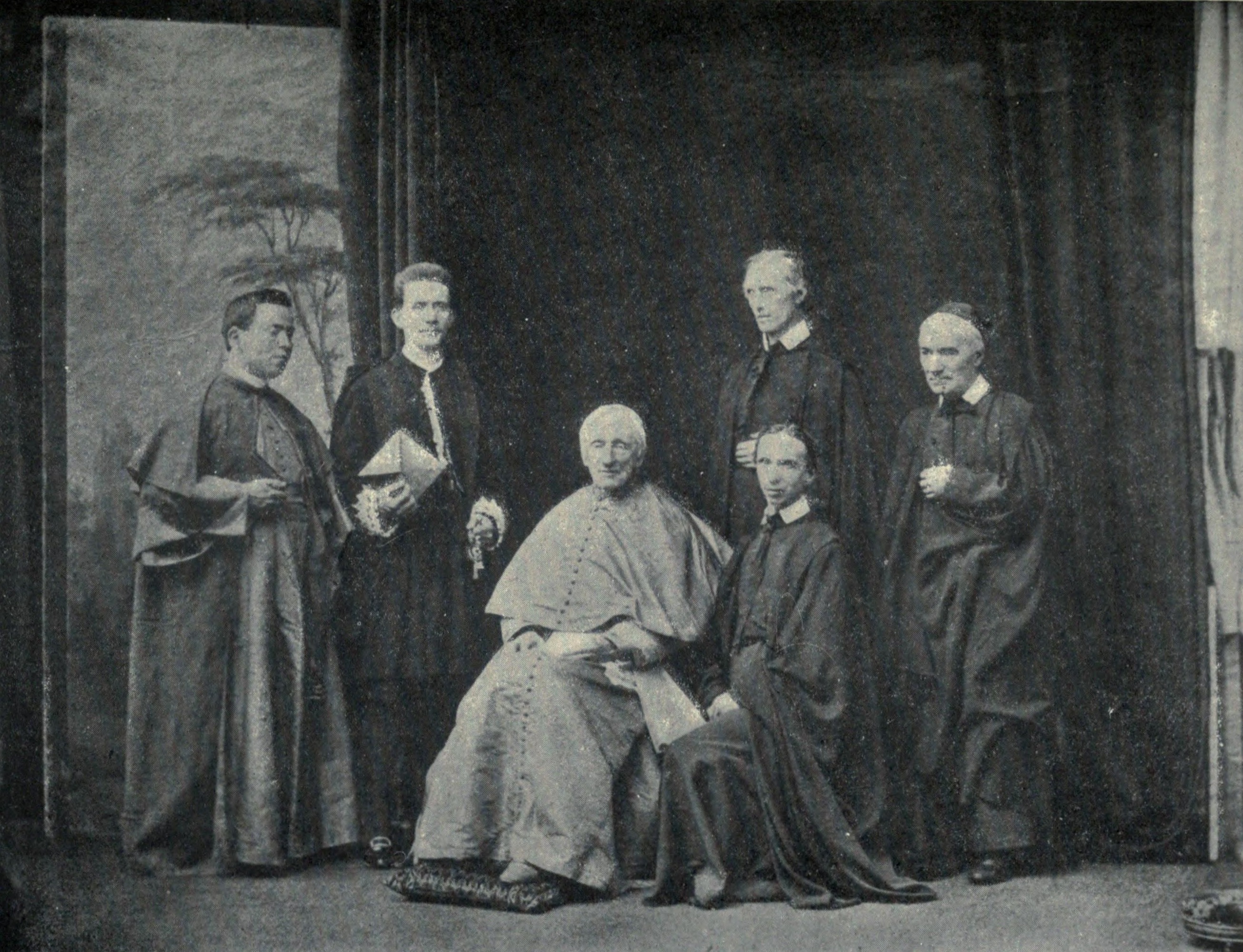
Portrait
photographique de John Henry Newman, 1887
Bienheureux John Henry
Newman
Cardinal (+ 1890)
Né le 21 février 1801 à
Londres, mort le 11 août 1890 à Birmingham, ordonné prêtre anglican, John Henry
Newman s'est converti au catholicisme en 1845 - Le 9 octobre 1845, Newman est
reçu dans l’Église catholique romaine par le frère Dominique
Barberi, théologien italien et membre de la congrégation des
Passionistes. Il a été créé cardinal en 1879. Il a été béatifié le 19 septembre
2010.
Né à Londres en 1801,
John Henry Newman fut un des grands intellectuels chrétiens du XIXe siècle. En
recherche de spiritualité depuis l'adolescence, il étudia la théologie à
l'Université d'Oxford, où il enseigna aussi un certain temps et devint pasteur
anglican. Il dirigea le Mouvement d'Oxford qui cherchait les racines
catholiques de la foi en Angleterre. En 1842, alors qu'il écrivait son Essai
sur le développement de la Doctrine chrétienne, il mûrit sa conversion au
catholicisme. Il fut admis dans l'Église catholique en 1845 et y fut ordonné
prêtre le 1er juin 1847 à Rome. Après son ordination, encouragé par Pie IX, il
fonda le premier oratoire de saint Philippe Neri en Angleterre. En 1851, il fut
nommé Recteur de l'Université catholique de Dublin, charge qu'il exerça
jusqu'en 1854. Léon XIII le créa Cardinal en 1879 et il mourut en 1890 à
l'oratoire de Edgbaston. (VIS 20100919)
Birmingham, le 19
septembre 2010, messe et béatification du Vénérable Cardinal John Henry
Newman, Homélie
de Benoît XVI
John Henry Newman
(1801-1890) - qui
est cet homme qui écrivait dans son Journal: "La sainteté, voilà le grand
but. C'est un combat et une épreuve"?
"...c'est un grand
enseignant, un grand auteur. Newman est certainement un saint mais ce qui est
particulier dans son cas, c'est qu'il est aussi un penseur, un écrivain."
(Newman,
un guide spirituel pour notre temps)
"Théologien,
historien, philosophe, prédicateur, romancier, poète, accompagnateur et guide
spirituel, Newman est l’auteur de plus d’une quarantaine d’ouvrages et d’une
vaste correspondance d’un grand intérêt."
Association
Française des Amis de Newman
"En béatifiant
Newman, l'Église catholique donne une place d'honneur à celui qui, baptisé dans
l'anglicanisme, demeura toute sa vie marqué par le patrimoine liturgique et
spirituel de l'Église de son baptême."
La
passion d'un 'converti' - Éditorial par le frère Franck Lemaître,
directeur du service national pour l'unité des chrétiens.
John
Henry Newman (1801 – 1890) - site de la paroisse Saint-Bonaventure – Cœur de
Lyon
Religieux, éducateur,
mais aussi historien, philosophe, poète et romancier, curé de paroisse et
accompagnateur spirituel, Newman a été tout cela, au long de sa longue vie,
passée pour moitié dans l’Anglicanisme, surtout dans la ville universitaire
d’Oxford, et pour moitié dans l’Église catholique, essentiellement à
Birmingham. Infatigable chercheur de Dieu, il n’a jamais voulu se présenter
comme théologien, mais comme un chrétien qui, en scrutant son expérience et
l’histoire de l’Église, y repère des traces du passage de Dieu, et en tire une
certaine idée de la manière de se laisser conduire par sa Providence. Newman a
été un prédicateur, et peut-être un prédicateur avant tout... Serviteur de la
Révélation pour ses frères, Newman l’a été dans l’Angleterre victorienne, il
l’est encore aujourd’hui pour l’Église universelle qui l’accueille comme un
vrai témoin du Seigneur.
P. Martin Charcosset,
aumônier de jeunes à Villefranche-sur-Saône
- John Henry Newman
(1801-1890) Le 19 septembre 2010, Benoît XVI préside la béatification du
cardinal Newman, à Birmingham, tout près du lieu même où, devenu catholique
trois ans plutôt, celui-ci avait fondé l'Oratoire en 1848 et où il vécut jusqu'à
sa mort. Mais qui est cet homme qui écrivait dans son Journal: "La
sainteté, voilà le grand but. C'est un combat et une épreuve"?
Témoins
- site de l'Église catholique en France
Nous pouvons nous confier
à sa prière avec les mots de la collecte de sa fête: «Dieu qui as donné au
Bienheureux John Henry Newman la grâce de suivre ta douce lumière et de trouver
la paix dans ton Église, accorde-nous, par son intercession et à son exemple,
de nous laisser conduire, au-delà des ombres et des images, jusqu’en la
plénitude de ta vérité.»
SOURCE : http://nominis.cef.fr/contenus/saint/12243/Bienheureux-John-Henry-Newman.html

George Richmond (1809–1896), John Henry Newman, 1844, https://archive.org/stream/newmanfran00barruoft#page/48/mode/2up
La meilleure préparation pour aimer le monde dans son entier, et l’aimer de manière sage et bonne, consiste à entretenir une amitié confiante et une véritable affection à l’égard de ceux qui partagent notre vie.
John-Henry Newman
La pensée du jour | publié
le 22/02/20
Tu m’aimes ? Suis-moi.
Les brebis ont été
dispersées parce qu’il n’y avait point de berger. Ainsi en était-il par tout
l’univers lorsque le Christ vint dans son infinie miséricorde pour
rassembler en un seul troupeau les enfants de Dieu qui étaient
dispersés (Jn 11, 52). Et si pour un moment ils furent à nouveau laissés
sans guide, lorsque dans sa lutte contre l’ennemi lehttps://fr.aleteia.org/2020/02/22/la-meilleure-preparation-pour-aimer-le-monde-dans-son-entier-et-laimer-de-maniere-sage-et-bonne-consiste-a-entretenir-une-amitie-confiante-et-une-veritable-affection-a-legard-de-ceux-qui-partage/
bon Berger eut donné Sa vie pour Ses brebis
(selon la prophétie : Frappez le Berger, et les brebis seront
dispersées, Za 13, 7), bientôt cependant II ressuscita d’entre les morts
pour vivre à jamais, selon cette autre prophétie qui dit : Celui qui
a dispersé Israël le rassemblera comme un berger fait son troupeau (Jr 31,
10). Et comme II le dit Lui-même, « Il appelle ses propres brebis par
leur nom et les mène dehors, et II marche devant elles, et les brebis le
suivent car elles connaissent sa voix » (Jn 10, 3-4). Ainsi, le jour
de Sa résurrection, comme Marie pleurait, Il l’appela par son nom (cf. Jn
20, 16), et elle se retourna et reconnut par l’oreille Celui qu’elle n’avait
pas reconnu par la vue. De même II dit à Simon : « Simon, fils
de Jonas, M’aimes-tu ? » Et II
ajouta : « Suis-moi. » Et de même lui et son Ange
dirent aux femmes : « Voici qu’il s’en va devant vous en
Galilée… Allez dire à mes frères qu’ils s’en aillent en Galilée, et là ils me
verront » (Mt 28, 7.10).
St John Henry Newman
John Henry Newman (†
1890) fut le principal acteur du mouvement d’Oxford. / Douze sermons sur
le Christ, Paris, Seuil, 1954, p. 45.
SOURCE : https://fr.aleteia.org/daily-prayer/vendredi-26-mai-2/meditation-de-ce-jour-1/
Parler sans crainte
Les saints et les Pères
que nous vénérons ont été de grands docteurs, non pas seulement des philosophes
ou des hommes de lettres, mais de nobles esprits qui gouvernaient l’Église, et
aussi des prédicateurs, des missionnaires, des anachorètes, des confesseurs et
des martyrs. C’est la gloire de l’Église que de parler, d’agir et de souffrir
avec le bénéfice de cette grâce que le Christ apporta et répandit par le monde.
Et cette grâce a ruisselé jusqu’au bas de sa robe. Non seulement ses membres
les plus éminents, mais tous ses enfants, du haut en bas de l’échelle, pourvu
qu’ils se montrent dignes d’elle et de son divin Maître, seront eux-mêmes des
images de notre Seigneur. Nous sommes tous tenus, dans la mesure de notre
pouvoir, en premier lieu, d’apprendre la vérité, mais en second lieu, de
départir à autrui notre savoir, et en troisième lieu, de porter témoignage à la
vérité. Ne redoutons pas les regards irrités du monde, ni ses moqueries ;
si nous y sommes en butte, souffrons volontiers pour la vérité. Car c’est là
cette chose nouvelle que le Christ a apportée dans le monde : une doctrine
céleste, un système de vérités saintes et surnaturelles que nous devons
recevoir et transmettre, parce qu’il est notre Prophète ; maintenir jusque
dans la souffrance selon son modèle, parce qu’il est notre Prêtre ; et
observer docilement, parce qu’il est notre Roi.
St John Henry Newman
John Henry Newman (†
1890) fut le principal acteur du mouvement d’Oxford. Son étude des Pères de
l’Église l’a conduit au catholicisme en 1845. Il a fondé l’Oratoire
d’Angleterre en 1848 et a été créé cardinal par Léon XIII en 1879. Il a été
canonisé en 2019. / 12 sermons sur le Christ, Paris, Seuil, 1954, p.
69-70.
SOURCE : https://fr.aleteia.org/daily-prayer/samedi-10-juillet/meditation-de-ce-jour-1/
Esprit Paraclet, je
t’adore
Mon Dieu, éternel
Paraclet, je t’adore, Lumière et Vie. Tu aurais pu te contenter de m’envoyer du
dehors de bonnes pensées, la grâce qui les inspire et les accomplit ; tu
aurais pu me conduire ainsi dans la vie, me purifiant seulement par ton action
tout intérieure au moment de mon passage dans l’autre monde. Mais, dans ta
compassion infinie, tu es entré dans mon âme, dès le commencement, tu en
as pris possession, tu en as fait ton temple. Par ta grâce, tu habites en moi
d’une manière ineffable, tu m’unis à toi et à toute l’assemblée des anges et
des saints. Plus encore, tu es personnellement présent en moi, non seulement
par ta grâce, mais par ton être même, comme si, tout en gardant ma
personnalité, j’étais en quelque sorte absorbé en toi, dès cette vie. Et comme
tu as pris possession de mon corps lui-même dans sa faiblesse, il est donc
aussi ton temple. Vérité étonnante et redoutable ! Ô mon Dieu, je le
crois, je le sais ! Puis-je pécher quand tu es si intimement avec
moi ? Puis-je oublier qui est avec moi, qui est en moi ? Puis-je
chasser l’hôte divin par ce qu’il abhorre plus que tout, la seule chose au
monde entier qui l’offense, la seule réalité qui ne soit pas sienne ? Mon
Dieu, j’ai une double sécurité contre le péché : d’abord, la crainte d’une
telle profanation, en ta présence, de tout ce que tu es en moi ; et
ensuite, la confiance que cette présence même me gardera du mal. Dans les
épreuves et la tentation, je t’appellerai ! Grâce à toi-même, je ne
t’abandonnerai jamais ! Ainsi soit-il.
St John Henry Newman
John Henry Newman (†
1890) fut le principal acteur du mouvement d’Oxford. Son étude des Pères de
l’Église l’a conduit au catholicisme en 1845. Il a fondé l’Oratoire d’Angleterre
en 1848 et a été créé cardinal par Léon XIII en 1879. Il a été canonisé en
2019. / Méditations et prières, 14, 3, Paris, Lecoffre, 1925.
SOURCE : https://fr.aleteia.org/daily-prayer/mardi-24-mai/meditation-de-ce-jour-1/
Discerner ce qui est
juste
Quand nos compatriotes
invoquent les droits de la conscience, ils ne songent plus ni aux droits du
Créateur ni aux devoirs des créatures envers lui dans leurs pensées et dans
leurs actes ; ils songent au droit de parler, d’écrire et d’agir selon
leur avis ou leur humeur sans se soucier le moins du monde de Dieu. Si la
conscience a des droits, c’est parce qu’elle implique des devoirs. Mais de nos
jours, dans l’esprit du grand nombre, les droits et la liberté de conscience ne
servent qu’à dispenser de la conscience. On voudrait ignorer le Législateur et
Juge, on voudrait se libérer de toute obligation intérieure ; on voudrait
pouvoir embrasser n’importe quelle religion ou ne pas en avoir ; ou bien
pouvoir en embrasser une et ensuite la laisser tomber. Ce n’est pas l’intérêt,
ni le profit, ni le bonheur du grand nombre, ni le bien de l’État, ni
l’honnêteté, ni l’harmonie, ni la beauté qui règlent et mesurent nos actes. La
conscience n’est pas un égoïsme calculé, ni une logique de soi-même. Elle est
la messagère de Celui qui, dans le monde de la nature comme dans celui de la
grâce, nous parle à travers le voile, nous instruit et nous gouverne, par ses
représentants. La conscience est le vicaire le plus originel du Christ. Elle
est le prophète qui nous révèle la vérité, le roi qui nous impose ses ordres,
le prêtre qui nous anathématise et nous bénit. Même si le sacerdoce éternel de
l’Église venait à disparaître, le principe sacerdotal survivrait à cette ruine
et se poursuivrait, incarné dans la conscience.
St John Henry Newman
John Henry Newman (†
1890) fut le principal acteur du mouvement d’Oxford. Son étude des Pères de
l’Église l’a conduit au catholicisme en 1845. Il a fondé l’Oratoire
d’Angleterre en 1848 et a été créé cardinal par Léon XIII en 1879. Il a été
canonisé en 2019. / Lettre au duc de Norfolk, Paris, Desclée de Brouwer,
1970.
SOURCE : https://fr.aleteia.org/daily-prayer/vendredi-2-septembre/meditation-de-ce-jour-1/
Suivre Jésus sur la route
Ô mon Dieu, toi seul sais
ce qui me convient le mieux.
Je crois que tu le sais
parfaitement.
Je crois que tu m’aimes
mieux que je ne m’aime moi-même, que tu es très sage dans ta providence, et
tout-puissant dans ta protection. Je te remercie de tout mon cœur de m’avoir
retiré le gouvernement de moi-même, tâche trop lourde pour moi, et d’en assumer
toi-même la charge.
Je ne peux rien demander
de mieux que d’être à ta charge et non à la mienne.
Avec le secours de ta
grâce, ô mon Dieu, je veux te suivre, partout où tu iras et où tu me conduiras.
J’attendrai que tu me
conduises, et quand tu viendras me chercher, je te suivrai docilement sans
crainte.
Je te promets de ne pas me montrer impatient, si parfois tu me laisses dans la perplexité et l’obscurité ; ni de jamais me plaindre ou m’irriter si je suis dans l’anxiété ou le malheur.
Amen.
St John Henry Newman
John Henry Newman (†
1890) fut le principal acteur du mouvement d’Oxford. Son étude des Pères de
l’Église l’a conduit au catholicisme en 1845. Il a fondé l’Oratoire
d’Angleterre en 1848 et a été créé cardinal par Léon XIII en 1879. Il a été
canonisé en 2019. / Youcat prière, Paris, Cerf, 2012, p. 48.
SOURCE : https://fr.aleteia.org/daily-prayer/jeudi-27-octobre/meditation-de-ce-jour-1/

Henry Alfred Pegram (1862–1937), Cardinal
Newman, pour le Oriel College
https://archive.org/stream/picturesof1912pa00lond#page/126/mode/2up
À mon vénérable frère George Patrick Dwyer,
Archevêque de Birmingham,
Président de la Conférence épiscopale d’Angleterre et du Pays de Galles.
En esprit de communion
spirituelle et de sollicitude pastorale, je suis heureux de répondre à votre
invitation de célébrer avec l’Église, dans toute l’Angleterre, le centenaire de
l’élévation au cardinalat de l’un de ses illustres fils et témoins de la foi :
John Henry Newman, créé cardinal de la Sainte Église romaine par mon vénérable
prédécesseur Léon
XIII, le 12 mai 1879, avec le titre de saint Georges in Velabro.
L’élévation de Newman au
cardinalat, de même que sa conversion à l’Église catholique, est un événement
qui transcende le simple fait historique aussi bien que l’importance qu’elle a
eue pour son propre pays. Ces deux événements font depuis longtemps
profondément partie de la vie de l’Église bien au-delà des rivages de
l’Angleterre. Leur signification providentielle et leur importance pour
l’Église tout entière ont été plus clairement aperçues en notre siècle. Newman
lui-même, dans une vision presque prophétique, était convaincu qu’il
travaillait et souffrait pour la défense et l’affirmation de la cause de la
religion et de l’Église, non seulement en son temps, mais aussi dans l’avenir.
Son influence stimulante de grand maître de la foi et de guide spirituel a été
mieux perçue de nos jours, comme le faisait remarquer Paul VI dans son
allocution au Symposium académique sur le cardinal Newman, qui s’est tenu en
l’Année sainte 1975 : « Lui (Newman) qui a voulu être fidèle par toute sa vie
et dont le cœur était tout entier tourné vers la lumière de la vérité, devient
aujourd’hui un phare de plus en plus lumineux pour tous ceux qui veulent être
orientés avec compétence et guidés d’une façon sûre au milieu des incertitudes
du monde moderne — ce monde qu’il avait prophétiquement entrevu. » (Allocution
du 7 avril 1975)
En élevant John Henry
Newman au cardinalat, Léon XIII avait
voulu défendre et honorer son activité et sa mission dans l’Église. En
répondant à l’ardent désir manifesté par des laïcs anglais, ayant à leur tête
le duc de Norfolk, le Pape avait voulu rendre hommage au génie de Newman et
manifester publiquement son estime personnelle pour ses mérites. Il a voulu
reconnaître la valeur des nombreux écrits de Newman consacrés à la défense de
Dieu et de l’Église. Par là, le Pape Léon XIII a
soutenu et encouragé tous ceux qui — dans l’Église catholique ou en dehors
d’elle — ont vu en Newman un maître spirituel et un guide sur le chemin de la
sainteté. Newman a lui-même ainsi commenté la pensée du Pape : « Il a pensé
qu’en me donnant une certaine marque d’estime, il ferait plaisir aux
catholiques anglais et même à l’Angleterre protestante. » (Allocution prononcée
en recevant le « Biglietto », le 12 mai 1879.)
La pensée philosophique
et théologique et la spiritualité du cardinal Newman, si profondément nourries
de la Sainte Écriture et de l’enseignement des Pères, gardent toujours leur
originalité et leur valeur particulières. Figure maîtresse du Mouvement
d’Oxford et plus tard d’un authentique renouveau de l’Église catholique, Newman
apparaît comme ayant une vocation œcuménique spéciale non seulement pour son
pays, mais pour toute l’Église. En disant que « l’Église doit être préparée
pour les convertis, de même que les convertis doivent être préparés pour
l’Église », (J. H. Newman Autobiographical Writings, Ed. H. Tristam), sa vaste
vision théologique anticipait déjà, dans une certaine mesure, l’un des thèmes
fondamentaux du IIe Concile
du Vatican et l’une des orientations de l’Église après le Concile.
Dans l’esprit de mes
prédécesseurs sur la chaire de saint Pierre, j’exprime l’espoir que sous cet
aspect très important, et sous d’autres aspects non moins importants, la figure
et l’enseignement du grand cardinal continueront à être source d’inspiration
pour un exercice toujours plus efficace de la mission de l’Église dans le monde
moderne, et qu’ils contribueront au renouveau de la vie spirituelle de ses
membres et à hâter la restauration de l’unité entre tous les chrétiens.
J’espère que ce
centenaire sera pour nous tous l’occasion d’étudier plus attentivement la
pensée stimulante du génie de Newman, qui nous parle de profonde honnêteté
intellectuelle, de fidélité à la conscience et à la grâce, de piété et de zèle
spirituel, de dévotion à l’Église du Christ et d’amour de sa doctrine, de
confiance sans réserve dans la divine providence et d’obéissance absolue à la
volonté de Dieu. Le procès de béatification Je voudrais aussi dire l’intérêt
personnel que je porte au procès de béatification de ce « bon et fidèle
serviteur » (cf. Mt 25, 21) du Christ et de l’Église. Je suivrai très
attentivement tous les progrès qui pourront être faits sur ce point. En honorant
sa mémoire et sa contribution à l’Église de Dieu, j’envoie ma bénédiction
apostolique spéciale à vous et à tous les fidèles d’Angleterre, en particulier
aux membres de la congrégation anglaise de l’Oratoire de
Saint-Philippe-de-Néri, dont John Henry Newman est le fondateur, ainsi qu’à
tous ceux qui le révèrent dans le monde.
Donné au Vatican, le 7
avril 1979.
IOANNES PAULUS PP II
© Copyright 1979 Libreria
Editrice Vaticana
Copyright © Dicastère
pour la Communication

VOYAGE
APOSTOLIQUE AU ROYAUME-UNI
MESSE ET
BÉATIFICATION
DU VÉNÉRABLE CARDINAL
JOHN HENRY NEWMAN
HOMÉLIE DU PAPE BENOÎT
XVI
Cofton Park de Rednal -
Birmingham
Dimanche 19 septembre
2010
Chers Frères et Sœurs
dans le Christ,
Ce jour qui nous
rassemble ici à Birmingham est un jour particulièrement béni. D’abord, parce
que c’est le Jour du Seigneur, dimanche, jour où notre Seigneur Jésus Christ
est sorti vivant d’entre les morts et a changé pour toujours le cours de
l’histoire humaine, offrant une vie et une espérance nouvelles à tous ceux qui
vivent dans les ténèbres et l’ombre de la mort. C’est pourquoi les chrétiens
dans le monde entier se réunissent ce jour-là pour rendre gloire à Dieu et le
remercier de toutes les merveilles qu’il a accomplies pour nous. Ce dimanche-ci
évoque en outre un moment significatif de la vie de la nation britannique, car
c’est le jour choisi pour commémorer le soixante-dixième anniversaire de la
«Bataille d’Angleterre». Pour moi, qui ai vécu et subi les souffrances liées
aux jours sombres du régime nazi en Allemagne, il est très émouvant de me
trouver ici parmi vous en cette occasion et de faire mémoire de vos si nombreux
concitoyens qui ont sacrifié leur vie, résistant courageusement contre les
forces de cette terrible idéologie. Ma pensée rejoint d’une manière spéciale la
ville voisine de Coventry qui fut frappée au cours du mois de novembre 1940 par
des bombardements massifs et de lourdes pertes en vies humaines. Soixante-dix
ans plus tard, nous nous souvenons avec des sentiments de honte et d’horreur de
l’effrayant coût en vies humaines et en destructions que la guerre entraîne, et
nous renouvelons notre résolution de travailler pour la paix et la
réconciliation là où pèse la menace de conflits. Toutefois, un autre motif,
plus joyeux, fait de ce jour un moment particulièrement porteur de promesses
pour la Grande-Bretagne, pour les Midlands, pour Birmingham. Car c’est le jour
qui voit le Cardinal John Henry Newman officiellement élevé aux honneurs des autels
et proclamé Bienheureux.
Je remercie Monseigneur
Bernard Longley pour ses paroles de bienvenue au début de cette Messe. Et
j’exprime mon appréciation à tous ceux qui ont travaillé fermement au long de
nombreuses années pour promouvoir la Cause du Cardinal Newman, en particulier
les Pères de l’Oratoire de Birmingham que les membres de la Famille
spirituelle Das Werk (l’Œuvre). Je salue toutes les personnes
présentes ici, de Grande-Bretagne, d’Irlande et d’ailleurs; je vous remercie
d’être venus à cette célébration où nous rendons gloire et louange à Dieu pour
la vertu héroïque d’un saint Anglais.
L’Angleterre a une longue
tradition de saints martyrs, dont le témoignage courageux a soutenu et inspiré
la communauté catholique durant des siècles ici. Mais il est également juste et
bon de reconnaître aujourd’hui la sainteté d’un confesseur, un fils de cette
nation qui, bien qu’il n’ait pas été appelé à répandre son sang pour le
Seigneur, lui a cependant rendu un témoignage éloquent durant une longue vie
consacrée au ministère sacerdotal, et spécialement en prêchant, en enseignant
et en écrivant. Il mérite bien de prendre place dans une longue lignée de
saints et d’érudits de ces Iles, saint Bède, sainte Hilda, saint Aelred, le
bienheureux Dun Scott, pour n’en nommer que quelques-uns. Dans la personne du
bienheureux John Henry, cette tradition d’élégante érudition, de profonde
sagesse humaine et d’ardent amour du Seigneur a porté des fruits abondants,
signe de la présence pleine d’amour de l’Esprit Saint dans les profondeurs du
cœur du peuple de Dieu, faisant mûrir d’abondants dons de sainteté.
La devise du Cardinal
Newman, Cor ad cor loquitur, ou «le cœur parle au cœur» nous donne une
indication sur la manière dont il comprenait la vie chrétienne: un appel à la
sainteté, expérimenté comme le désir profond du cœur humain d’entrer dans une
intime communion avec le Cœur de Dieu. Il nous rappelle que la fidélité à la
prière nous transforme progressivement à la ressemblance de Dieu. Comme il
l’écrivait dans l’un de ses nombreux et beaux sermons, «pour la pratique qui
consiste à se tourner vers Dieu et le monde invisible en toute saison, en tout
lieu, en toute situation d’urgence, la prière, donc, a ce qu’on peut appeler un
effet naturel, en ce qu’elle élève et spiritualise l’âme. L’homme n’est plus ce
qu’il était auparavant: progressivement, il s’est imprégné de tout un nouvel
ensemble d’idées, il a assimilé de nouveaux principes» (Sermons paroissiaux, IV,
p. 203, Le paradoxe chrétien, Cerf, 1986). L’Évangile d’aujourd’hui nous
enseigne que personne ne peut servir deux maîtres (Lc 16,13), et
l’enseignement du bienheureux John Henry sur la prière montre comment le fidèle
chrétien est définitivement pris pour le service du seul véritable Maître, le
seul qui puisse prétendre recevoir une dévotion sans conditions à son service
(cf. Mt 23,10). Newman nous aide à comprendre ce que cela signifie
dans notre vie quotidienne: il nous dit que notre divin Maître a donné à chacun
de nous une tâche spécifique à accomplir, «un service précis» demandé de
manière unique et à chaque personne individuellement: «J’ai une mission»,
écrivait-il, «Je suis un chaînon, un lien entre des personnes. Il ne m’a pas
créé pour rien. Je ferai le bien, j’exécuterai la tâche qu’il m’a confié; je
serai un ange de paix, je prêcherai la vérité à la place où je suis… si
j’observe ses commandements et le sers à la place qui est la mienne )»
(Méditations sur la doctrine chrétienne, Ad Solem, Genève 2000, pp. 28-29).
Le service particulier
auquel le bienheureux John Henry a été appelé consistait à appliquer son
intelligence fine et sa plume féconde sur les nombreuses et urgentes «questions
du jour». Ses intuitions sur le rapport entre foi et raison, sur la place vitale
de la religion révélée dans la société civilisée, et sur la nécessité d’une
approche de l’éducation qui soit ample en ses fondements et ouverte à de larges
perspectives ne furent pas seulement d’une importance capitale pour
l’Angleterre de l’époque victorienne, mais elles continuent à inspirer et à
éclairer bien des personnes de par le monde. Je voudrais rendre un hommage
particulier à sa conception de l’éducation, qui a eu une grande influence pour
former l’éthos, force motrice qui soutient les écoles et les collèges
catholiques d’aujourd’hui. Fermement opposé à toute approche réductrice ou
utilitaire, il s’est efforcé de mettre en place un environnement éducationnel
où l’exercice intellectuel, la discipline morale et l’engagement religieux
pourraient progresser ensemble. Le projet de fonder une Université catholique
en Irlande lui donna la possibilité de développer ses idées à ce sujet, et
l’ensemble des discours qu’il a publiés sur «L’idée d’une Université» met en
évidence un idéal dont tous ceux qui sont engagés dans la formation académique
peuvent continuer à s’inspirer. En effet, quel meilleur objectif pourraient
avoir des professeurs de religion que celui que le bienheureux John Henry a
présenté dans son célèbre appel en faveur d’un laïcat intelligent et bien
formé: «Je désire un laïcat qui ne soit pas arrogant, ni âpre dans son langage,
ni prompt à la dispute, mais des personnes qui connaissent leur religion, qui
pénètrent en ses profondeurs, qui savent précisément où ils sont, qui savent ce
qu’ils ont et ce qu’ils n’ont pas, qui connaissent si bien leur foi qu’ils
peuvent en rendre compte, qui connaissent assez leur histoire pour pouvoir la
défendre» (The Present position of Catholics in England, IX, 390). En ce
jour où l’auteur de ces lignes est élevé à l’honneur des autels, je prie pour
que, par son intercession et son exemple, tous ceux qui sont engagés dans
l’enseignement et la catéchèse se sentent poussés par la conception qu’il a si
clairement exposée devant nous à entreprendre de nouveaux efforts.
S’il est bien
compréhensible que l’héritage intellectuel de John Henry Newman ait été l’objet
d’une large attention dans la vaste littérature qui illustre sa vie et son
œuvre, je préfère, en ce jour, conclure par une brève réflexion sur sa vie de
prêtre, de pasteur des âmes. La chaleur et l’humanité qui marquent son
appréciation du ministère pastoral sont magnifiquement mises en évidence dans
un autre de ses célèbres sermons: «Si des anges avaient été vos prêtres, mes
frères, ils n’auraient pas pu souffrir avec vous, avoir de la sympathie pour
vous, éprouver de la compassion pour vous, sentir de la tendresse envers vous
et se montrer indulgents avec vous, comme nous; ils n’auraient pas pu être vos
modèles et vos guides, et n’auraient pas pu vous amener à sortir de vous-mêmes
pour entrer dans une vie nouvelle, comme le peuvent ceux qui viennent du milieu
de vous» («Hommes, non pas Anges: les prêtres de l’Évangile», Discourses
to Mixed Congregations, 3). Il a vécu à fond cette vision profondément humaine
du ministère sacerdotal dans l’attention délicate avec laquelle il s’est dévoué
au service du peuple de Birmingham au long des années qu’il a passées à
l’Oratoire, fondé par lui, visitant les malades et les pauvres, réconfortant
les affligés, s’occupant des prisonniers. Il n’est pas étonnant qu’à sa mort,
des milliers de personnes s’alignaient dans les rues avoisinantes tandis que
son corps était transporté vers sa sépulture à moins d’un kilomètre d’ici. Cent
vingt ans plus tard, de grandes foules se sont rassemblées à nouveau pour se
réjouir de la reconnaissance solennelle de l’Église pour l’exceptionnelle
sainteté de ce père des âmes très aimé. Comment pourrions-nous mieux exprimer
la joie de ce moment, sinon en nous tournant vers notre Père des cieux dans une
vibrante action de grâce, et en priant avec les paroles mêmes que le
bienheureux John Henry a mises sur les lèvres du chœur des anges dans le ciel:
Loué soit le Très Saint
dans les hauteurs
Et loué soit-Il dans les
profondeurs;
Très admirable en toutes
Ses paroles;
Infaillible en toutes Ses
voies!
(Le songe de Gerontius).
© Copyright 2010 - Libreria Editrice Vaticana
HOMÉLIE DU SAINT-PÈRE
FRANÇOIS
« Ta foi t’a
sauvé » (Lc 17, 19). C’est le point d’arrivée de l’Evangile de ce
jour qui nous montre le chemin de la foi. Dans ce parcours de foi nous
voyons trois étapes, indiquées par les lépreux qui ont été guéris et qui invoquent, marchent et remercient.
D’abord, invoquer.
Les lépreux se trouvent dans une condition terrible, non seulement en raison de
la maladie qui, répandue encore aujourd’hui, doit être combattue à tout prix,
mais aussi en raison de l’exclusion sociale. Au temps de Jésus, ils étaient
considérés comme impurs et, comme tels, ils devaient être maintenus à l’écart,
isolés (cf. Lv 17, 12). En effet, nous voyons que, lorsqu’ils vont
vers Jésus, “ils s’arrêtent à distance” (cf. Lv 17, 12). Mais, bien
que leur condition les mette à part, ils invoquent Jésus “à haute voix” (v.
13), dit l’Evangile. Ils ne se laissent pas paralyser par les exclusions des
hommes et ils crient vers Dieu qui n’exclut personne. Voilà comment les
distances se réduisent, comment on sort de la solitude : non pas en se
renfermant en soi-même et dans ses regrets, non pas en pensant aux jugements
des autres, mais en invoquant le Seigneur, car le Seigneur écoute le cri de
celui qui est seul.
Comme ces lépreux, nous
aussi, nous avons tous besoin de guérison. Nous avons besoin d’être guéris du
manque de confiance en nous-mêmes, en la vie, en l’avenir ; guéris de tant
de peurs ; des vices dont nous sommes les esclaves ; de tant de
fermetures, dépendances et attachements aux jeux, à l’argent, à la télévision,
au téléphone portable, au jugement des autres. Le Seigneur libère et guérit le
cœur, si nous l’invoquons, si nous lui disons : “Seigneur, je crois
que tu peux me guérir ; guéris-moi de mes fermetures, libère-moi du mal et
de la peur, Jésus”. Les lépreux sont les premiers, dans cet Evangile, à
invoquer le nom de Jésus. Ensuite, un aveugle et un malfaiteur sur la croix le
feront aussi. Les personnes qui sont dans le besoin invoquent le nom de Jésus
qui signifie Dieu sauve. Elles appellent Dieu par son nom, directement,
spontanément. Appeler quelqu’un par son nom est un signe de confiance, et cela
plaît au Seigneur. La foi grandit ainsi, par l’invocation confiante, apportant
à Jésus ce que nous sommes, à cœur ouvert, sans cacher nos misères. Invoquons
avec confiance, chaque jour, le nom de Jésus : Dieu sauve.
Répétons-le : c’est prier, dire “Jésus” c’est prier. La prière est la
porte de la foi, la prière est la médecine du cœur.
La seconde parole est marcher.
C’est la seconde étape. Dans le court Evangile de ce jour, figure une dizaine
de verbes de mouvement. Mais ce qui frappe c’est surtout le fait que les
lépreux ne sont pas guéris lorsqu’ils se tiennent devant Jésus, mais après,
lorsqu’ils marchent : « En cours de route, ils furent purifiés », dit
l’Evangile (v. 14). Ils sont guéris en allant à Jérusalem, c’est-à-dire alors
qu’ils affrontent un chemin qui monte. C’est sur le chemin de la vie que l’on
est purifié, un chemin qui est souvent en montée, parce qu’il conduit en haut.
La foi exige un cheminement, une sortie, elle fait des miracles si nous sortons
de nos certitudes commodes, si nous quittons nos ports rassurants, nos nids
confortables. La foi grandit avec le don et croît avec le risque. La foi
progresse quand nous allons de l’avant, forts de la confiance en Dieu. La foi
devient une route avec des pas humbles et concrets, comme humbles et concrets
ont été la marche des lépreux et le bain de Naaman dans le Jourdain (cf. 2R 5,
14-17). Il en est de même pour nous : nous avançons dans la foi par
l’amour humble et concret, par la patience quotidienne, en invoquant Jésus et
en allant de l’avant.
Il y a un autre aspect
intéressant dans le cheminement des lépreux : ils se déplacent ensemble.
« Ils furent purifiés » dit l’Evangile (v. 14), toujours au
pluriel : croire c’est aussi marcher ensemble, jamais seul. Mais, une fois
guéris, neuf s’en vont pour leur propre compte et un seul retourne remercier. Jésus
exprime alors toute son amertume : « Les autres, où
sont-ils ? » (v. 17). Il semble demander compte des neuf autres au
seul qui est retourné. Certes, c’est notre devoir – à nous qui sommes ici à
“faire Eucharistie”, c’est-à-dire à remercier - c’est notre devoir de
prendre soin de celui qui a cessé de marcher, de celui qui perdu la
route : nous sommes les gardiens des frères qui sont loin, nous
tous !. Nous sommes des intercesseurs en leur faveur, nous sommes
responsables à leur égard, c’est-à-dire appelés à répondre d’eux, à nous
soucier d’eux. Tu veux grandir dans la foi ? Toi qui es ici aujourd’hui,
veux-tu grandir dans la foi ? Prends soin d’un frère qui est loin, d’une
sœur qui est loin.
Invoquer, marcher
et remercier : c’est la dernière étape. Jésus dit : « Ta
foi t’a sauvé » (v. 19) uniquement à celui qui le remercie. Il n’est pas
seulement guéri, il est aussi sauvé. Cela nous dit que le point d’arrivée, ce
n’est pas la santé, ce n’est pas le fait d’être bien, mais c’est la rencontre
avec Jésus. Le salut, ce n’est pas boire un verre d’eau pour être en forme,
c’est aller à la source, qui est Jésus. Lui seul libère du mal et guérit le
cœur, seule la rencontre avec lui sauve, rend la vie pleine et belle. Quand on
rencontre Jésus, le “merci” nait spontanément, car on découvre la chose la plus
importante de la vie : non pas recevoir une grâce ou résoudre un problème,
mais embrasser le Seigneur de la vie. Et ceci est la chose plus importante de
la vie : embrasser le Seigneur de la vie.
Il est beau de voir que
cet homme guéri, qui était un samaritain, exprime sa joie de tout son
être : il loue Dieu à grande voix, il se prosterne, il remercie (cf. vv.
15-16). Le sommet du chemin de foi, c’est de vivre en rendant grâce. Nous
pouvons nous demander : nous qui avons la foi, vivons-nous les journées
comme un poids à subir ou comme une louange à offrir ? Restons-nous
centrés sur nous-mêmes en attendant de demander la prochaine grâce ou bien
trouvons-nous notre joie dans l’action de grâce ? Quand nous remercions,
le Père est ému et répand sur nous l’Esprit Saint.
Remercier, ce n’est pas
une question de politesse, de bienséance, c’est une question de foi. Un cœur
qui remercie reste jeune. Dire : “Merci Seigneur” au réveil, pendant la
journée, avant de se coucher, c’est l’antidote au vieillissement du cœur parce
que le cœur vieillit et s’habitue au mal. De même en famille, entre les
époux : se rappeler de dire merci. Merci est le mot le plus simple et le
plus bénéfique.
Invoquer, marcher,
remercier. Aujourd’hui, remercions le Seigneur pour les nouveaux Saints qui ont
marché dans la foi et que nous invoquons maintenant comme intercesseurs. Trois
d’entre eux sont Sœurs et elles nous montrent que la vie religieuse est un
chemin d’amour dans les périphéries existentielles du monde. Sainte Marguerite
Bays, en revanche, était une couturière et elle montre combien la prière simple
est puissante, de même que la patiente endurance, le don de soi
silencieux : à travers ces choses, le Seigneur a fait revivre en elle,
dans son humilité, la splendeur de Pâques. C’est la sainteté dans le quotidien
dont parle le saint Cardinal Newman qui a dit : « Le chrétien possède
une paix profonde, silencieuse, cachée, que le monde ne voit pas. […] Le
chrétien est joyeux, tranquille, bon, aimable, poli, innocent, modeste ;
il n’a pas de prétentions, […] son comportement est tellement éloigné de
l’ostentation et de la sophistication qu’à première vue on peut facilement le
prendre pour une personne ordinaire » (Parochial and Plain Sermons, V,5).
Demandons d’être ainsi, de “douces lumières” dans les obscurités du monde.
Jésus, « reste avec nous et nous commencerons à briller comme tu brilles,
à briller de manière à être une lumière pour les autres » (Meditations
on Christian Doctrine, VII,3).
Amen !
Copyright ©
Dicastère pour la Communication
HOMÉLIE DU PAPE LÉON XIV
En cette solennité de la
Toussaint, c'est une grande joie d'inscrire saint John Henry Newman parmi les
docteurs de l'Église et, en même temps, à l'occasion du Jubilé
du monde éducatif, de le nommer co-patron, avec saint Thomas d'Aquin, de
tous ceux qui participent au processus éducatif. L'imposante stature culturelle
et spirituelle de Newman servira d'inspiration aux nouvelles générations au
cœur assoiffé d'infini, disposées à réaliser, par la recherche et la
connaissance, ce voyage qui, comme le disaient les anciens, nous fait
passer per aspera ad astra, c'est-à-dire à travers les difficultés
jusqu'aux étoiles.
La vie des saints nous
témoigne, en effet, qu'il est possible de vivre avec passion au milieu de la
complexité du présent, sans laisser de côté le mandat apostolique : « Brillez
comme des étoiles dans le monde » (Phil 2, 15). En cette occasion
solennelle, je souhaite répéter aux éducateurs et aux institutions éducatives :
« Brillez aujourd'hui comme des étoiles dans le monde », grâce à l'authenticité
de votre engagement dans la recherche commune de la vérité, dans son partage
cohérent et généreux à travers le service aux jeunes, en particulier aux
pauvres, et dans l'expérience quotidienne que « l'amour chrétien est
prophétique ; il accomplit des miracles » (cf. Exhort. apost. Dilexi
te, 120).
Le Jubilé est un
pèlerinage dans l'espérance et vous tous, dans le vaste domaine de l'éducation,
vous savez bien à quel point l'espérance est une semence indispensable ! Quand
je pense aux écoles et aux universités, je les considère comme des laboratoires
de prophétie, où l'espérance est vécue, continuellement racontée et reproposée.
C'est aussi le sens de
l'Évangile des Béatitudes proclamé aujourd'hui. Les Béatitudes apportent une
nouvelle interprétation de la réalité. Elles sont le chemin et le message de
Jésus éducateur. À première vue, il semble impossible de déclarer bienheureux
les pauvres, ceux qui ont faim et soif de justice, les persécutés ou les
artisans de paix. Mais ce qui semble inconcevable dans la grammaire du monde
prend tout son sens et toute sa lumière dans la proximité du Royaume de Dieu.
Chez les saints, nous voyons ce royaume s'approcher et se réaliser parmi nous.
Saint Matthieu présente à juste titre les Béatitudes comme un enseignement,
représentant Jésus comme un Maître qui transmet une nouvelle vision des choses
et dont la perspective coïncide avec son cheminement. Les Béatitudes,
toutefois, ne sont pas un enseignement parmi d'autres : elles sont
l'enseignement par excellence. De la même manière, le Seigneur Jésus n'est pas
un maître parmi tant d'autres, il est le Maître par excellence. Plus encore, il
est l'Éducateur par excellence. Nous, ses disciples, nous sommes à son école,
en apprenant à découvrir dans sa vie, c'est-à-dire dans le chemin qu'il a
parcouru, un horizon de sens capable d'illuminer toutes les formes de
connaissance. Puissent nos écoles et nos universités être toujours des lieux
d'écoute et de pratique de l'Évangile !
Les défis actuels parfois
semblent dépasser nos capacités, mais ce n'est pas le cas. Ne permettons pas au
pessimisme de nous vaincre ! Je me souviens de ce que mon bien-aimé
prédécesseur, le pape
François, a souligné dans son discours
à la Première Assemblée plénière du Dicastère pour la Culture et l'Éducation :
c'est à dire que nous devons travailler ensemble pour libérer l'humanité de
l'obscurité du nihilisme qui l'entoure, lequel est sans doute le mal le plus
dangereux de la culture contemporaine, car il menace « de faire disparaître »
l'espérance [1]. La référence à l'obscurité qui nous
entoure nous renvoie à l’un des textes les plus connus de Saint John Henry,
l'hymne Lead, kindly light (« Guide-moi, douce lumière »). Dans cette
très belle prière, nous nous rendons compte que nous sommes loin de la maison,
que nos pas sont chancelants, que nous ne parvenons pas à distinguer clairement
l'horizon. Mais rien de tout cela ne nous arrête parce que nous avons trouvé le
Guide : « Guide-moi, douce Lumière, dans les ténèbres qui m’enveloppent,
guide-moi ! – Lead, kindly Light. The night is dark and I am far from
home. Lead Thou me on! ».
C'est le rôle de
l'éducation d'offrir cette Douce Lumière à ceux qui, sans cela,
pourraient rester prisonniers des ombres particulièrement insidieuses du
pessimisme et de la peur. C'est pourquoi je voudrais vous dire : désarmons les
fausses raisons de la résignation et de l'impuissance, et faisons circuler dans
le monde contemporain les grandes raisons de l'espérance. Contemplons et
indiquons les constellations qui transmettent lumière et repères dans ce
présent obscurci par tant d'injustices et d'incertitudes. C'est pourquoi je
vous encourage à faire des écoles, des universités et de toutes les réalités
éducatives, y compris informelles et de terrain, autant de seuils d'une
civilisation de dialogue et de paix. À travers vos vies, laissez transparaître
cette « multitude immense », dont nous parle aujourd'hui dans la liturgie le
Livre de l'Apocalypse, une multitude « que personne ne pouvait compter, de
toutes nations, tribus, peuples et langues », et qui « se tenait debout devant
l'Agneau » (7,9).
Dans le texte biblique,
un ancien, observant la multitude, demande : « Ceux-ci, […] qui sont-ils et
d'où viennent-ils ? » (Ap 7,13). À ce propos, dans le domaine éducatif, le
regard chrétien se pose également sur « ceux qui viennent de la grande
tribulation » (v. 14) et y reconnaît les visages de tant de frères et
sœurs de toutes langues et de toutes cultures qui, par la porte étroite de
Jésus, sont entrés dans la vie en plénitude. Alors, une fois encore, nous
devons nous demander : « les moins pourvus ne sont-ils pas des personnes
humaines ? Les faibles n’ont-ils pas la même dignité que nous ? Ceux qui sont
nés avec moins de possibilités ont-ils moins de valeur en tant qu’êtres
humains, doivent-ils se contenter de survivre ? La réponse que nous apportons à
ces questions détermine la valeur de nos sociétés et donc notre avenir. »
(Exhort. apost. Dilexi
te, 95). Et ajoutons que la qualité évangélique de notre éducation
dépend également de cette réponse.
Parmi les héritages
durables de saint John Henry, on trouve, à ce propos, quelques contributions
très significatives à la théorie et à la pratique de l'éducation. « Dieu,
écrivait-il, m'a créé pour lui rendre un service précis. Il m'a confié une
tâche qu'il n'a confiée à personne d'autre. J'ai une mission : peut-être ne la
connaîtrai-je pas dans cette vie, mais elle me sera révélée dans la prochaine »
(Meditations and Devotions, III, I, 2). Ces mots expriment magnifiquement le
mystère de la dignité de chaque personne humaine et celui de la diversité des
dons distribués par Dieu.
La vie ne s'illumine pas
parce que nous sommes riches, beaux ou puissants. Elle s'illumine lorsque nous
découvrons en nous cette vérité : je suis appelé par Dieu, j'ai une
vocation, j'ai une mission, ma vie sert à quelque chose de plus grand que moi !
Chaque créature a un rôle à jouer. La contribution que chacun a à offrir est
unique, et la tâche des communautés éducatives est d'encourager et de valoriser
cette contribution. N'oublions pas : au centre des parcours éducatifs, il ne
doit pas y avoir des individus abstraits, mais des personnes en chair et en os,
en particulier celles qui semblent ne pas être en mesure de rendre, selon les
paramètres d'une économie qui exclut et tue. Nous sommes appelés à former des
personnes, afin qu'elles brillent comme des étoiles dans leur pleine dignité.
Nous pouvons donc dire
que l'éducation, dans la perspective chrétienne, aide chacun à devenir saint.
Rien de moins. Lors de son
voyage apostolique en Grande-Bretagne en septembre 2010, au cours duquel
il a
béatifié John Henry Newman, le Pape Benoît XVI a invité
les jeunes à devenir saints en ces termes : « Ce que Dieu désire plus
que tout pour chacun d'entre vous, c'est que vous deveniez saints. Il vous aime
bien plus que vous ne pouvez l'imaginer et il veut le meilleur pour vous [2] ». C'est l'appel universel à la
sainteté que le Concile
Vatican II a inscrit comme élément essentiel de son message (cf. Lumen
gentium, chap. V). Et la sainteté est proposée à tous, sans exception,
comme un cheminement personnel et communautaire tracé par les Béatitudes.
Je prie pour que
l'éducation catholique aide chacun à découvrir sa vocation à la sainteté. Saint
Augustin, que saint John Henry Newman appréciait tant, a dit un jour que nous
sommes des compagnons d'étude qui n'avons qu'un seul Maître, dont l'école est
sur terre et la chaire au ciel (cf. Sermon 292,1).
[1] François, Discours
aux participants à la première Assemblée plénière du Dicastère pour la Culture
et l'Éducation (21 novembre 2024).
[2] Benoît
XVI, Discours
aux élèves, Twickenham – Royaume-Uni, 17 septembre 2010.
Copyright © Dicastère
pour la Communication - Libreria Editrice Vaticana
Toussaint: Saint John
Henry Newman, proclamé 38e docteur de l'Église
«Je prie pour que l'éducation
catholique aide chacun à découvrir sa vocation à la sainteté». Tel est le
souhait exprimé par le Pape ce 1er novembre lors de la messe au cours de
laquelle il a proclamé John Henry Newman docteur de l’Église. Le cardinal
britannique était dévoué à l’éducation. S’appuyant sur les paroles de saint
Augustin, le Pape a souligné que «nous sommes des compagnons d'étude qui
n'avons qu'un seul Maître, dont l'école est sur terre et la chaire au ciel».
Myriam Sandouno – Cité du
Vatican
En la solennité de la
Toussaint et à l’occasion du Jubilé du monde éducatif, le Pape Léon XIV a
proclamé «saint John Henry Newman, docteur de l'Église», au cours de la messe
qu’il a présidée place Saint-Pierre, et où étaient rassemblés 50 000 fidèles.
Lors du rite consacré à cette proclamation, le cardinal Marcello Semeraro,
préfet du dicastère des Causes des Saints a présenté au Saint-Père, la
biographie du cardinal britannique. En tant que pasteur et théologien anglican,
il fut un «ardent défenseur du principe dogmatique».
«Lorsque de nombreux
ecclésiastiques anglicans, pour la plupart membres du Mouvement d'Oxford, se
convertirent au catholicisme, John Henry Newman traversa une crise religieuse
qui le conduisit lui aussi à adhérer au catholicisme en 1845». La même année, a
poursuivi le préfet, il publia son «ouvrage, Essai sur le développement de la
doctrine chrétienne, considéré par beaucoup comme le point culminant de sa
recherche sur le sens de l'histoire, de l'homme et de sa relation avec Dieu.
Son choix eut un grand retentissement dans toute l'Angleterre». Il voulut
s'éloigner d'Oxford et s'installa à Birmingham. Puis le 30 mai 1847, dans
la chapelle de Propaganda Fide à Rome, il fut ordonné prêtre. Fasciné par le
charisme de saint Philippe Néri, il fonda la Congrégation de l'Oratoire en
Angleterre.
Saint John Henry Newman,
docteur de l'Église
Aujourd’hui, l’Église se
souvient encore de John Henry Newman. Le Pape Léon XIV l’a nommé co-patron,
avec saint Thomas d'Aquin, de toutes ces personnes qui participent au processus
éducatif. Une décision du Souverain pontife accueillie avec joie dans
l’assemblée, parmi laquelle se trouvaient la délégation de l'Église
d'Angleterre conduite par l'archevêque anglican d'York Stephen Cottrell, des
participants au Jubilé du monde éducatif: élèves, étudiants et éducateurs venus
du monde entier. Mais aussi des jeunes de la «Course des Saints».
Des étoiles dans le monde
«L'imposante stature
culturelle et spirituelle de Newman, estime le Pape, servira d'inspiration
aux nouvelles générations au cœur assoiffé d'infini, disposées à réaliser, par
la recherche et la connaissance, ce voyage qui, comme le disaient les anciens,
nous fait passer "per aspera ad astra", c'est-à-dire à travers les
difficultés jusqu'aux étoiles», a dit le Pape. Léon XIV a ainsi invité les
éducateurs et institutions éducatives à «briller comme des étoiles dans le
monde, grâce à l'authenticité de leur engagement dans la recherche commune
de la vérité». En effet, la vie des saints, comme celle de John Henry Newman «témoigne
qu'il est possible de vivre avec passion au milieu de la complexité du présent,
sans laisser de côté le mandat apostolique», a noté le Souverain pontife.
Une mission pour Dieu
Né le 21 février 1801 à
Londres et aîné de 6 enfants, le cardinal britannique a été baptisé dans
l’Église anglicane. Converti au catholicisme, ses contributions significatives
à la théorie et à la pratique de l'éducation, marquent encore les esprits. «Dieu,
écrivait-il, m'a créé pour lui rendre un service précis. Il m'a confié une
tâche qu'il n'a confiée à personne d'autre. J'ai une mission: peut-être ne
la connaîtrai-je pas dans cette vie, mais elle me sera révélée dans la
prochaine». Des mots, estime le Pape, qui expriment «magnifiquement le mystère
de la dignité de chaque personne humaine et celui de la diversité des dons
distribués par Dieu».
“Saint Augustin, que
saint John Henry Newman appréciait tant, a dit un jour que nous sommes des
compagnons d'étude qui n'avons qu'un seul Maître, dont l'école est sur terre et
la chaire au ciel.”
Léon XIV a fait
comprendre que «la vie ne s'illumine pas parce que nous sommes riches, beaux ou
puissants». «Elle s'illumine lorsque nous découvrons en nous cette vérité: je
suis appelé par Dieu, j'ai une vocation, j'ai une mission, ma vie sert à
quelque chose de plus grand que moi! Chaque créature a un rôle à jouer», a
rappelé le Saint-Père. La contribution de chacun est unique, et la tâche
des communautés éducatives est d'encourager et de valoriser cette contribution,
a-t-il poursuivi. Le Successeur de Pierre conseille de «former des personnes,
afin qu'elles brillent comme des étoiles dans leur pleine dignité».
Des seuils d’espérance,
de civilisation et de paix
Un message d’espérance, «semence
indispensable», a ensuite été communiqué aux fidèles et pèlerins, lors de cette
messe. Le Pape a dit considérer les écoles et universités, «comme des
laboratoires de prophétie, où l'espérance est vécue, continuellement racontée
et reproposée». L'éducation a un rôle fondamental à jouer, celui d'offrir cette
«Douce Lumière» évoquée dans l’un des textes les plus connus de saint John
Henry Newman, l'hymne Lead, kindly light («Guide-moi, douce lumière»).
“Guide-moi, douce
Lumière, à travers l’obscurité qui m’entoure, que ce soit Toi qui me
conduises!”
«Une Douce Lumière à ceux
qui, sans cela, pourraient rester prisonniers des ombres particulièrement
insidieuses du pessimisme et de la peur». L'évêque de Rome a invité à «désarmer
les fausses raisons de la résignation et de l'impuissance», et à «faire
circuler dans le monde contemporain les grandes raisons de l'espérance». Il a
encouragé à faire des écoles, des universités et de toutes les réalités
éducatives, y compris informelles et de terrain, «autant de seuils d'une
civilisation de dialogue et de paix».
11/03/2026
John Henry Newman, 38e
docteur de l'Église
John Henry Newman sera
proclamé docteur de l’Église le 1er novembre par le Pape Léon XIV. Le cardinal
britannique deviendra aux côtés de sain
Le domaine éducatif a
besoin d’un regard chrétien qui se pose également sur «ceux qui viennent de la
grande tribulation», qui «reconnaît les visages de tant de frères et sœurs de
toutes langues et de toutes cultures qui, par la porte étroite de Jésus, sont
entrés dans la vie en plénitude». Pour le Pape, il y a lieu de s’interroger
dans ce sens: «Les moins pourvus ne sont-ils pas des personnes humaines? Les
faibles n’ont-ils pas la même dignité que nous? Ceux qui sont nés avec moins de
possibilités ont-ils moins de valeur en tant qu’êtres humains, doivent-ils se
contenter de survivre?» «La réponse que nous apportons à ces questions, a-t-il
déclaré, détermine la valeur de nos sociétés et donc notre avenir.»
Les béatitudes, le
message de Jésus éducateur
Léon XIV a ensuite
mentionné le Pape François qui, lors de la première assemblée plénière du
dicastère pour la Culture et l'Éducation, encourageait à «travailler ensemble
pour libérer l'humanité de l'obscurité du nihilisme qui l'entoure, lequel est
sans doute le mal le plus dangereux de la culture contemporaine, car il menace
‘‘de faire disparaître’’ l'espérance». S’arrêtant sur le sens de
l'Évangile des Béatitudes proclamé ce 1er novembre, le Souverain pontife
note qu’elles sont «le chemin et le message de Jésus éducateur», et «l'enseignement
par excellence». Puis de préciser: «De la même manière, le Seigneur Jésus n'est
pas un maître parmi tant d'autres, il est le Maître par excellence. Plus
encore, il est l'Éducateur par excellence». En tant que disciples, «nous sommes
à son école, en apprenant à découvrir dans sa vie», c'est-à-dire dans «le
chemin qu'il a parcouru, un horizon de sens capable d'illuminer toutes les
formes de connaissance».
“Je prie pour que
l'éducation catholique aide chacun à découvrir sa vocation à la sainteté. Saint
Augustin, que saint John Henry Newman appréciait tant, a dit un jour que nous
sommes des compagnons d'étude qui n'avons qu'un seul Maître, dont l'école est
sur terre et la chaire au ciel (cf. Sermon 292,1).”
L’appel à la sainteté du
Concile Vatican II
Léon XIV a ensuite
souhaité que les écoles et universités soient toujours des lieux d'écoute et de
pratique de l'Évangile, tout en exhortant chacun à devenir saint, comme le
demandait le Pape Benoît XVI aux jeunes lors de son voyage apostolique en
Grande-Bretagne en septembre 2010. Au cours duquel il avait béatifié le
cardinal John Henry Newman: «Ce que Dieu désire plus que tout pour chacun
d'entre vous, c'est que vous deveniez saints. Il vous aime bien plus que vous
ne pouvez l'imaginer et il veut le meilleur pour vous». «C'est l'appel
universel à la sainteté que le Concile Vatican II a inscrit comme élément
essentiel de son message (cf. Lumen gentium, chap. V). Et la sainteté est
proposée à tous, sans exception, comme un cheminement personnel et
communautaire tracé par les Béatitudes», a dit le Pape.
Béatifié par Benoît XVI
le 19 septembre 2010, puis canonisé par François le 13 octobre 2019, le
théologien et écrivain britannique, saint John Henry Newman (1801-1890)
proclamé ce samedi «docteur de l’Église», rejoint ce cercle réduit de saints
dont font partie notamment sainte Thérèse de Lisieux, saint Grégoire de Narek
ou sainte Hildegarde de Bingen.
Merci d'avoir lu cet
article. Si vous souhaitez rester informé, inscrivez-vous à la lettre
d’information en cliquant ici
Pourquoi l’Église fait du cardinal Newman un de ses docteurs
Jean Robert
Armogathe - publié le 04/08/25
En avance sur son temps,
le cardinal Newman a marqué la théologie du XXe siècle. Membre de l’Institut,
auteur de "Newman, la sainteté de l’intelligence" (Parole et
Silence), le père Jean-Robert Armogathe explique pourquoi ce maître dans la
recherche de la vérité est honoré par le titre de "docteur de
l’Église".
Le 31 juillet
2025, un communiqué de presse du Saint-Siège annonce que le titre de docteur de l'Église sera
prochainement conféré à saint John Henry Newman après
avis favorable du pape Léon XIV. Être proclamé "docteur"
n’ajoute pas un galon de plus à la sainteté du cardinal Newman, canonisé par le
pape François le 16 octobre 2016. C’est plutôt la confirmation du rôle
capital que sa pensée a tenu dans les développements les plus récents de la
théologie.
Un maître de la pensée
catholique
Né en 1801, prêtre de
l’Église anglicane en 1825, John Henry Newman "franchit le Tibre" en
devenant catholique romain en 1844, puis prêtre en 1847 : la conversion de
ce brillant universitaire entraîna celle de plusieurs de ses compagnons dans le
"mouvement d’Oxford". Mais dans la Grande-Bretagne victorienne, sa
vie ne fut pas un long fleuve tranquille (il meurt en 1890) : apostat pour
les anglicans, il était suspect chez les catholiques — dont la hiérarchie n’a
pas toujours su employer avec pertinence ses immenses talents. Plus que ses
œuvres (l’Oratoire anglais en 1848, l’Université de Dublin en 1854), ce sont
ses livres qui en font un maître de la pensée catholique (Jean Guitton disait de lui :
"ce fut le penseur invisible de Vatican II").
La présence du Christ
dans l’Église assure la fonction prophétique des fidèles laïcs.
En soulignant le
caractère organique de la foi, il affirmait que la certitude qu’elle confère
est tout aussi forte, mais d’une autre nature, que celle qu’accorde la raison.
L’autre enseignement capital porte sur l’Église : c’est cette réflexion
qui l’a conduit de l’anglicanisme vers Rome. La présence du Christ dans
l’Église assure la fonction prophétique des fidèles laïcs. Newman, en avance
sur son temps, a reconnu l’éminente dignité de tous les baptisés. Par ailleurs,
la Tradition vivante, dans un développement organique, assure l’inerrance de
l’Église. Enfin, sa réflexion sur l’Université revient à lui confier le rôle
"de rendre à l’intellect ce qui lui est dû" : transmettre des
connaissances, certes, mais aussi éduquer l’intelligence à la recherche de la vérité.
L’unicité de la vérité
Les trente-huit docteurs
vénérés par l’Église constituent un groupe très disparate : leur
proclamation a souvent correspondu à un besoin de renforcement (ou
d’éclaircissement) doctrinal, Thomas d’Aquin et Bonaventure au XVIe siècle,
François de Sales au XIXe et les quatre femmes (Thérèse d’Avila, Catherine de
Sienne, Thérèse de Lisieux, Hildegarde de Bingen) entre 1970 et 2012.
Leurs écrits (ou leur vie) servent de repères précis dans un environnement
opaque au christianisme. Proposer au XXIe siècle de relire l’enseignement
de Newman revient à affirmer l’unicité de la vérité. Newman prophète ? Il
ne l’aurait pas voulu. Mais plutôt analyste clinicien des pièges du langage et
du brouillard des idées. N'est-ce pas le besoin le plus nécessaire et le plus
urgent d’un monde corrompu par les fausses nouvelles et les "vérités
alternatives" ?
Pratique
Beaucoup de traductions
de Newman ont été publiées aux Éditions Ad Solem. Une précieuse anthologie est
parue chez Artège. Une introduction : Newman. La
sainteté de l’intelligence, Études réunies par J.-R. Armogathe, Parole et
Silence, coll. "Communio", 2019. Condor Pictures (qui a déjà produit
sur Newman The Unseen World) prépare pour l’automne un documentaire (sous-titré
en cinq langues) sur saint John Henry Newman.
Lire aussi :Le
cardinal Newman, le saint le plus “branché” de notre époque ?
Lire aussi :Newman,
un saint pour la France ?
Lire aussi :L’hommage
appuyé du prince Charles à un saint britannique
SOURCE : https://fr.aleteia.org/2025/08/04/pourquoi-leglise-fait-du-cardinal-newman-un-de-ses-docteurs/
John Henry Newman:
l'harmonie de la différence
Voici l’éditorial écrit
par le prince Charles de Galles à l’occasion de la canonisation du cardinal
John Henry Newman, et publié dans l’édition de ce 13 octobre de L’Osservatore
Romano. Le prince Charles sera présent à la messe de canonisation célébrée par
le Pape François place Saint-Pierre ce dimanche.
Son Altesse Royale le
prince de Galles - L'Osservatore Romano
Lorsque le Pape François
canonisera demain le cardinal John Henry Newman, le premier Britannique à être
déclaré saint depuis plus de quarante ans, ce sera un motif de célébration non
seulement pour le Royaume-Uni, et non seulement pour les catholiques, mais
aussi pour tous ceux qui chérissent les valeurs par lesquelles il a été
inspiré.
À l'époque où il vivait,
Newman défendait la vie de l'esprit contre les forces qui avilissaient la
dignité humaine et la destinée humaine. En cette époque où il parvient à la
sainteté, son exemple est plus nécessaire que jamais, pour la manière dont, à
son meilleur, il pouvait plaider sans émettre d'accusation, être en désaccord
sans manquer de respect et, peut-être par-dessus tout, voir les différences
comme des lieux de rencontre plutôt que d'exclusion.
John Newman,
poète et prophète du catholicisme britannique
Le
cardinal Newman bientôt canonisé
À une époque où la foi
était remise en question comme jamais auparavant, Newman, l'un des plus grands
théologiens du XIXe siècle, a employé son intelligence à l'une des questions
les plus instantes de notre époque : quel rapport devrait entretenir la foi
avec une époque sceptique et laïque ? Son engagement dans la théologie
anglicane d'abord, puis, après sa conversion, dans la théologie catholique, a
impressionné même ses adversaires par son honnêteté intrépide, sa rigueur sans
faille et son originalité de pensée.
Quelles que soient nos
propres croyances, et quelle que soit notre propre tradition, nous ne pouvons
que remercier Newman pour les dons, enracinés dans sa foi catholique, qu'il a
partagés avec la société toute entière: son autobiographie spirituelle intense
et émouvante, et sa profonde poésie dans “Le Songe de Gérontius” qui,
mis en musique par Sir Edward Elgar - un autre catholique dont tous les
Britanniques peuvent être fiers - a donné au monde musical l'un des
chefs-d'œuvre choraux les plus durables qui soient.
À l’acmé du “Songe
de Gérontius”, l'âme, s'approchant du ciel, perçoit quelque chose de la vision
divine :
«une harmonie mystérieuse,
Elle me submerge,
pareille au bruit grave
Et solennel de nombreux
cours d'eaux».
L'harmonie exige la
différence. Le concept se trouve au cœur même de la théologie chrétienne dans
le concept de la Trinité. Dans le même poème, Gérontius dit :
«Je crois vraiment et
fermement
Que Dieu est Trois, et
que Dieu est Un»
En tant que telle, la
différence n'est pas à craindre. Newman l'a prouvé non seulement dans sa
théologie et l'a illustré dans sa poésie, mais il l'a également démontré dans
sa vie. Sous sa direction, les catholiques s'intégrèrent pleinement dans la
société, qui devint elle-même d'autant plus riche en tant que communauté de
communautés.
Newman s'est engagé non
seulement avec l'Église, mais avec le monde. Tout en s'engageant de tout son
cœur dans l'Église pour laquelle il a traversé tant d'épreuves intellectuelles
et spirituelles, il a lancé un débat ouvert entre catholiques et autres
chrétiens, ouvrant ainsi la voie à d’ultérieurs dialogues œcuméniques.
Lors de son accession au
cardinalat en 1879, il prit pour devise “Cor ad cor loquitor” (“le
cœur parle au cœur”), et ses conversations au-delà des clivages confessionnels,
culturels, sociaux et économiques, étaient enracinées dans cette amitié intime
avec Dieu.
Sa foi était vraiment
catholique en ce sens qu'elle embrassait tous les aspects de la vie. C'est dans
ce même esprit que nous, catholiques ou non, nous pouvons, dans la tradition de
l'Église chrétienne à travers les âges, embrasser la perspective unique, la
sagesse et la perspicacité particulières apportées à notre expérience
universelle par cette seule âme individuelle. Nous pouvons nous inspirer
de ses écrits et de sa vie même si nous reconnaissons que, comme toute vie
humaine, elle était inévitablement imparfaite. Newman lui-même était conscient
de ses défauts, tels que l'orgueil et l'attitude défensive qui ne
correspondaient pas à ses propres idéaux, mais qui, en fin de compte, ne l'ont
rendu que plus reconnaissant envers la miséricorde de Dieu.
Son influence était
immense. En tant que théologien, son travail sur le développement de la
doctrine a montré que notre compréhension de Dieu peut grandir avec le temps,
et il a eu un impact profond sur les penseurs ultérieurs. Les chrétiens
ont vu leur dévotion personnelle remise en question et renforcée par
l'importance qu'il accordait à la voix de la conscience. Ceux de toutes
les traditions qui ont cherché à définir et à défendre le christianisme se sont
montrés reconnaissants pour la manière dont il a réconcilié foi et raison. Ceux
qui recherchent le divin dans ce qui peut sembler être un environnement
intellectuel de plus en plus hostile trouvent en lui un allié puissant qui a
défendu la conscience individuelle contre un relativisme écrasant.
Et ce qui est peut-être
le plus pertinent de nos jours, alors que nous avons été témoins d'un trop
grand nombre de graves attaques commises par les forces de l'intolérance contre
des communautés et des individus, incluant de nombreux catholiques, en raison
de leurs croyances, c'est qu'il s'agit d'une personne ayant défendu ses
convictions malgré les inconvénients de l'appartenance à une religion dont on
refusait la pleine participation des fidèles à la vie publique. Tout au long du
processus d'émancipation catholique et de restauration de la hiérarchie de
l'Église catholique, il a été le chef dont son peuple, son Église et son époque
avaient besoin. Sa capacité de chaude cordialité personnelle et d'amitié
généreuse se manifeste dans sa correspondance. Il existe plus de 30 volumes de
ses lettres, dont beaucoup, ce qui est révélateur, ne s'adressent pas aux
autres intellectuels et à d'éminents dirigeants, mais à sa famille, à des amis
et aux paroissiens qui ont cherché sa sagesse.
Son exemple a laissé un
héritage durable. En tant qu'éducateur, son travail a eu une profonde
influence à Oxford, Dublin et au-delà, tandis que son traité, L'Idée
d'université, demeure un texte déterminant à ce jour. Ses travaux - souvent
négligés - à propos de l'éducation des enfants témoignent de son engagement à
faire en sorte que les jeunes de tous milieux bénéficient des opportunités qu'offre
l'apprentissage. En tant qu'anglican, il a guidé cette Église vers ses racines
catholiques et, en tant que catholique, il était prêt à apprendre de la
tradition anglicane, par exemple en faisant la promotion du rôle des
laïcs. Il a redonné confiance à l'Église catholique alors qu'elle se
rétablissait sur une terre d'où elle avait été autrefois déracinée. La
communauté catholique de Grande-Bretagne doit aujourd'hui une dette
incalculable à son travail inlassable, de même que la société britannique a des
raisons de remercier cette communauté pour sa contribution incommensurablement
précieuse à la vie de notre pays.
Cette confiance
s'exprimait dans son amour pour les paysages anglais et la culture de son pays
natal, à laquelle il a apporté une contribution si remarquable. Dans
l'Oratoire qu'il a fondé à Birmingham, et qui abrite aujourd'hui un musée dédié
à sa mémoire ainsi qu'une communauté active de fidèles, nous voyons la
réalisation en Angleterre d'une vision qu'il a tirée de Rome, qu'il décrivait
comme «le plus bel endroit sur Terre». En amenant la Congrégation
des Oratoriens de l'Italie jusqu'en Angleterre, Newman a cherché à partager son
charisme d'éducation et de service.
Il aimait Oxford,
ajoutant à sa grâce non seulement par des sermons passionnés et érudits, mais
aussi par la belle église anglicane de Littlemore, créée après une visite
d'études à Rome où, cherchant des conseils pour son chemin spirituel à venir et
réfléchissant sur sa relation avec l'Église d'Angleterre et le catholicisme, il
a écrit son hymne bien-aimé, “Lead Kindly Light” (“Conduis-moi, douce
lumière”). Lorsqu'il a finalement décidé de quitter l'Église d'Angleterre, son
dernier sermon d'adieu à Littlemore a laissé la congrégation en larmes. Il
s'intitulait “La séparation des amis”.
Alors que nous célébrons
la vie de ce grand Britannique, de ce grand homme d'Église et, nous pouvons
désormais le dire, de ce grand saint, qui comble les clivages existant entre
les traditions, il est tout à fait juste que nous rendions grâce pour l'amitié
qui, malgré la séparation, n'a pas seulement duré, mais s'est renforcée.
Dans l'image de
l'harmonie divine que Newman a exprimée avec tant d'éloquence, nous pouvons
voir comment, en fin de compte, en suivant avec sincérité et courage les
différents chemins auxquels la conscience nous appelle, toutes nos divisions
peuvent mener à une meilleure compréhension et toutes nos manières d'être
peuvent trouver un foyer commun.

Rebecca Dulcibella Orpen (1830–1923),
Cardinal John Henry Newman (1801-1890), 1883, 235.9 x
114.3, National Trust
Saint John Henry Newman,
cardinal et docteur de l'Église
Découvrez la vie, la
conversion et les intuitions théologiques majeures de saint John Henry Newman,
figure clé du catholicisme.
Publié le
5/12/25
Figure majeure du XIXᵉ
siècle britannique, saint John Henry Newman (1801-1890) s’est formé
et affirmé dans une période marquée par de profondes mutations économiques et
sociales, mais aussi par des débats religieux et intellectuels d’une rare
intensité. Au sein d’une Église anglicane en crise, cherchant à s’affranchir de
l’emprise de l’État, Newman évolue dans un paysage théologique traversé par des
courants parfois opposés.
D’un côté, le courant
du réveil évangélique, d’inspiration calviniste et très influent, tend
selon plusieurs observateurs à privilégier une « religion du cœur » centrée sur
l’émotion et l’expérience personnelle, au risque d’un affaiblissement
doctrinal. Défenseur d’une lecture strictement biblique de la doctrine
chrétienne, ce mouvement nourrit également de forts préjugés anticatholiques.
De l’autre, le libéralisme, héritier de l’empirisme philosophique de
Locke, Hume ou John Stuart Mill, remet en cause l’ordre ecclésial et social en
soumettant les vérités révélées au seul jugement de la raison humaine. Ce
rationalisme fragilise alors la notion même de foi en Dieu.
Dans cette
Grande-Bretagne où le catholicisme était souvent perçu comme archaïque ou
intellectuellement pauvre, John Henry Newman, d’abord anglican puis converti au
catholicisme, développe une œuvre en réaction à ces tensions. En cherchant à
réaffirmer l’autorité de la Tradition et de la foi face au scepticisme ambiant,
il s’attache à éclairer le chemin de la vérité au sein d’un monde traversé par
de profondes polarisations religieuses et intellectuelles.
Devenu cardinal, John
Henry Newman est aujourd’hui une figure importante de l’Église catholique tant
pour sa vie de foi que pour son apport en matière de théologie. Il est ainsi
béatifié en 2010 par le Pape Benoît XVI, canonisé en 2019 par le Pape
François et reconnu docteur de l’Église en 2025 par le Pape Léon XIV.
Dans cet article, nous
vous proposons de retracer la vie de saint John Henry Newman et de vous donner
quelques clés de compréhension de ses conceptions théologiques.
Vie et conversion de John
Henry Newman
Origine et jeunesse de
John Henry Newman
John Henry Newman, né à
Londres le 21 février 1801, est donc une figure majeure du catholicisme
britannique. C’est un homme aux multiples facettes : théologien, philosophe,
cardinal, essayiste et poète. Aîné d'une famille de six enfants, il descend
d'une lignée anglaise, mais possède également des racines françaises huguenotes
du côté de sa mère, Jemima Fourdrinier. Son père, John Newman, un
banquier, sombre dans la ruine financière en 1816 à la suite des guerres
napoléoniennes, ce qui marque profondément la jeunesse de son fils. Cette
période difficile contribue à forger son caractère, elle influencera la
réflexion spirituelle de John Henry Newman.
À l’âge de quinze ans, en
1816, Newman vît un fort moment de conversion. Inscrit à l’école privée de
George Nicholas à Ealing, il fait une expérience spirituelle profonde qui le
conduit à l’évangélisme et au calvinisme. Il dira plus tard que son âme doit
presque tout à Thomas Scott et à son livre Force de la vérité, qui fut un
catalyseur important dans sa quête de sens. Ce moment marque le début de son
engagement religieux, bien que son parcours spirituel prendra des tournants
alors inattendus par la suite.
Années de formation
Après sa conversion,
Newman poursuit ses études à l'Université d'Oxford, où il est admis au Trinity
College en décembre 1816. Il obtient son diplôme en 1821, puis
devient fellow (membre) d'Oriel College en 1822, un lieu
intellectuel de renom à Oxford. C’est durant cette période qu’il commence à se
forger une réputation de penseur et qu'il s'engage pleinement dans le ministère
religieux. Ordonné diacre en 1824, puis prêtre anglican en 1825, Newman
entame sa carrière ecclésiastique, tout en devenant tuteur à Oriel College à
partir de 1826. Là, il rencontre des figures importantes comme Richard Hurrell
Froude et John Keble, deux hommes qui auront une influence considérable sur son
cheminement spirituel et intellectuel.
Au début des années 1830,
Newman s’éloigne de la tendance Low Church de l’Église anglicane
(courant mettant l'accent sur la simplicité liturgique), un changement qui se
manifeste par sa démission de la Church Missionary Society et de la
Société biblique. En 1833, après un sermon prononcé par John Keble contre
l’intervention du gouvernement dans l’épiscopat irlandais, Newman devient
l'un des principaux acteurs du Mouvement d’Oxford. Ce mouvement visait à
redéfinir et à renforcer l’identité de l’Église anglicane sur des bases
doctrinales solides. C’est ainsi qu’il participe activement à la rédaction
des Tracts for the Times, des pamphlets dans lesquels il défend
l'autonomie de l’anglicanisme et la succession apostolique (dite Via media de
l’anglicanisme), rapprochant ainsi l'anglicanisme du catholicisme.
Newman rejoint l'Église
catholique
Cependant, à mesure que
Newman approfondit son étude des Pères
de l'Église, il commence à douter de la validité de la voie médiane de
l'anglicanisme. Il écrit le Tract 90 en 1841, dans lequel il défend
la compatibilité des Trente-neuf articles de l’Église anglicane avec
les dogmes catholiques. Ce tract suscite un véritable scandale à Oxford et met
fin à la publication des Tracts for the Times. C’est un moment décisif
dans sa vie, car il se sent alors presque "sur son lit de mort"
concernant son appartenance à l’Église anglicane. En 1842, il se retire dans la
petite ville de Littlemore pour une période de réflexion et de
prière.
Ce retrait marque un
point de rupture. Après plusieurs années de méditation, John Henry Newman est
reçu dans la pleine communion de l’Église catholique (il se
« convertit » au catholicisme) le 9 octobre 1845, sous la
direction du père Dominique Barberi. Cette décision, prise après un long
parcours spirituel, est un changement radical qui ne manque pas de susciter des
controverses, tant au sein de l’Église anglicane que parmi ses proches. Après
sa conversion, Newman quitte Oxford en 1846 pour se rendre à Rome, où il se
prépare à la prêtrise catholique. Il est ordonné prêtre catholique en 1847. À
son retour en Angleterre, il fonde la Congrégation de l'Oratoire à
Birmingham en 1848, marquant ainsi la naissance du premier oratoire
d'Angleterre.
Envie de se former en
théologie sans être à Paris ? Découvrez le Campus
des Bernardins !
Le cardinal Newman, une
figure catholique incontournable
Dans les années qui
suivent, Newman devient une figure incontournable de la pensée catholique
en Angleterre. Il est sollicité pour fonder la Catholic University of
Ireland à Dublin, un projet ambitieux visant à offrir une éducation
catholique dans le pays. À cette occasion, il prononce une série de conférences
réunies dans son ouvrage L'Idée d'université (1858), une réflexion
sur le rôle de l’université dans la formation intellectuelle et morale des
étudiants. Cependant, ses relations avec les évêques irlandais se tendent
rapidement, et il démissionne de son poste de recteur en 1857, confronté à la
méfiance de certains membres du clergé.
L’une des œuvres les plus
célèbres de Newman, Apologia Pro Vita Sua (1864), constitue une
réponse personnelle et théologique aux accusations qui lui sont portées à la
suite de sa conversion. Cette autobiographie spirituelle, qui défend son choix
de se tourner vers le catholicisme, devient un immense succès et renforce sa
stature parmi les catholiques, tout en suscitant un renouveau du dialogue avec
ses anciens compagnons anglicans. Il poursuit également sa réflexion
théologique avec des ouvrages comme La Grammaire de l'assentiment (1870)
et La Lettre au duc de Norfolk (1875), dans laquelle il défend la
doctrine catholique de l’infaillibilité pontificale face aux critiques du
Premier ministre Gladstone.
En 1879, le pape
Léon XIII le nomme cardinal, une distinction qui souligne l'importance de son
œuvre et de sa pensée. Sa devise, Cor ad cor loquitur (« Le cœur
parle au cœur »), reflète sa manière d’aborder la foi et la vérité. Après une
vie dédiée à la recherche de la vérité et à la défense de la foi, John Henry
Newman meurt le 11 août 1890 à l'Oratoire d’Edgbaston, à l'âge de 89 ans. Son
épitaphe, qu'il avait lui-même choisie, Ex umbris et imaginibus in veritatem (« Des
ombres et des images vers la vérité »), résume finalement son parcours
spirituel.
Trois grands thèmes
théologiques du cardinal Newman
La théorie de
l'assentiment et de la certitude
« Tous les hommes ont une
raison, mais tous ne peuvent donner une raison » - John Henry Newman
La théorie de
l'assentiment et de la certitude occupe une place centrale dans l'œuvre majeure
de John Henry Newman, La Grammaire de l'Assentiment (An Essay in Aid
of a Grammar of Assent), publiée en 1870. Cet essai, fruit de nombreuses années
de réflexion, constitue une défense philosophique de la foi catholique
face à l'essor du rationalisme et de l'empirisme au XIXe siècle. À
travers cet ouvrage, Newman cherche à éclairer les mécanismes par lesquels
l'esprit humain atteint la certitude, en explorant les aspects psychologiques
et rationnels de l'adhésion aux croyances.
Newman distingue deux
formes d'assentiment fondamentales :
L'assentiment notionnel :
Il correspond à l'adhésion intellectuelle aux idées, aux concepts et aux
principes logiques. Cet assentiment se fonde sur la raison pure, sur des
notions abstraites, telles que les lois scientifiques, sans nécessairement
avoir de lien direct avec la réalité vécue. Il représente un acte
essentiellement intellectuel.
L'assentiment réel:
Celui-ci est ancré dans l'expérience concrète et personnelle. Il repose sur
l'unité entre le sujet et les faits, une adhésion qui naît de la perception
vécue et de l'expérience directe. La foi religieuse, selon Newman, relève de ce
type d'assentiment réel, car elle implique un acte de l'intelligence qui
conduit à la connaissance de la vérité.
Pour Newman, l'assentiment
réel mène à la certitude, un état d'adhésion irréversible, qui résulte de
l'engagement vécu avec l'objet de la croyance. Ce processus repose sur le sens
illatif, une faculté de raisonnement permettant de relier des éléments
disparates en un tout cohérent, apportant une clarté nouvelle. La théorie de
Newman valorise ainsi l'intuition morale et la pensée spontanée, justifiant
l'acte de foi, même chez ceux dépourvus d'une éducation formelle.
Envie d'approfondir votre
connaissance de John Henry Newman ? Découvrez le cours
du Père Jean Rencki !
La tradition chrétienne
et le développement du dogme
La théorie de la
tradition chrétienne et du développement du dogme est un autre élément
essentiel de la pensée de John Henry Newman, notamment dans l'une de ses œuvres
majeures, L'Essai sur le développement de la doctrine chrétienne (1845).
À travers cette réflexion, Newman explore la fidélité de la doctrine
chrétienne à la Révélation originelle du dépôt de la foi apostolique tout
au long de l'histoire de l'Église (autrement, la constance de la doctrine
chrétienne entre les premiers chrétiens et aujourd'hui).
Pour Newman, la doctrine
chrétienne ne se résume pas à un ensemble figé de vérités, mais se déploie
comme une « idée » ou un « germe », un principe interne en constante évolution.
Cette idée, transmise aux apôtres sous forme d’un tout à travers la vie, la
mort et la résurrection du Christ, se développe progressivement au fil du
temps. Ce développement reflète la manière dont l'esprit humain assimile les
grandes vérités, et il représente, selon Newman, un signe de la présence
continue du Saint-Esprit au sein de l'Église.
L’évolution de la
doctrine chrétienne se manifeste particulièrement lorsque l'Église se confronte
à des hérésies, comme l'arianisme. Ces confrontations forcent l'Église à
expliciter et clarifier des vérités qui étaient jusque-là implicites dans le
dépôt initial. Newman définit des critères pour distinguer un véritable développement
d'une simple corruption, tels que la préservation de l’essence(ou des
caractéristiques fondamentales), la continuité des principes sous-jacents et la
vigueur du processus.
Newman distingue deux
formes de Tradition indissociables : la « Tradition épiscopale », qui
englobe les documents officiels, la hiérarchie et les credo, et la
« Tradition prophétique », qui inclut la liturgie, les rites, la vie
chrétienne quotidienne et les écrits des docteurs. Ensemble, ces deux aspects
révèlent une Tradition vivante, où l'autorité apostolique, en constante
évolution, protège et transmet la foi tout en étant enracinée dans la vie
spirituelle des fidèles.
La primauté de la
conscience
La doctrine de la
primauté de la conscience et de l'autorité est un troisième axe central de la
pensée théologique de John Henry Newman, particulièrement développée dans
sa Lettre au duc de Norfolk (1875). Cet ouvrage répondait aux
critiques du Premier ministre britannique William Gladstone, qui mettait en
doute la loyauté des catholiques britanniques envers l'État après la
proclamation de l'infaillibilité pontificale par le concile Vatican I.
Pour John Henry Newman,
la conscience ne se limite pas à un simple sens moral, mais constitue un « sens
du devoir et de l’obligation », une voix intérieure qui évoque un Souverain
Gouverneur ou un Juge. Cette expérience de la conscience est, selon lui, le «
principe créateur de la religion ». À travers cette réflexion, Newman met en
avant l'idée que la personne doit toujours obéir à sa conscience, même avant
l'autorité pontificale. Cela ne signifie pas un rejet de l'autorité papale,
mais plutôt une reconnaissance que la conscience représente un principe
fondamental de l'action humaine. La raison d’être du Pape étant précisément de
défendre ce principe.
La conscience, pour
Newman, est décrite comme le « premier de tous les vicaires du Christ »,
c'est-à-dire qu'elle permet à la personne de s'ouvrir à l'autorité spirituelle.
Toutefois, il précise que cette conscience est faillible et nécessite une formation
adéquate par l'éducation et l'expérience. Sans cette formation, la conscience
peut devenir déformée et dangereuse, risquant de conduire à des choix erronés,
surtout en l'absence d'un véritable désir du bien.
L'impact de la pensée de
Newman est considérable. Ses idées ont été reprises par l'Église catholique
lors du Concile Vatican II, notamment dans le document Dignitatis
humanae, et sont citées dans le Catéchisme de l'Église catholique, soulignant
l'importance de la notion de conscience dans la vie chrétienne.
Découvrez les cours de
théologie du Collège des
Bernardins, sur
place ou en
ligne !
Conclusion
En définitive, il est
possible de résumer le parcours de saint John Henry Newman comme une recherche
constante de la vérité intérieure, marquée par une profonde quête spirituelle
et intellectuelle. De sa formation à Oxford jusqu’à sa conversion au
catholicisme, Newman s’est imposé comme une figure majeure capable d’unir foi et
raison.
Ses apports théologiques
— l’assentiment, le développement du dogme et la primauté de la conscience —
ont profondément renouvelé la compréhension de la foi chrétienne. Il
montre que la foi engage la personne dans sa totalité, que la doctrine catholique
évolue de manière vivante, tout en restant fidèle à son origine, et que la
conscience demeure le lieu premier du discernement moral.
L’influence de Newman
dépasse largement son époque : son intuition a inspiré le Concile Vatican II et
continue d’éclairer la réflexion contemporaine sur la Tradition, la liberté
intérieure et l’acte de croire. Sa devise Cor ad cor loquitur résume
bien l’héritage qu’il laisse : une pensée où la vérité s’adresse au cœur autant
qu’à l’intelligence.
John Henry Newman,
docteur de l’Église : son influence sur Henri de Lubac
Nouvelles théologiques |
01/09/2025 | toutes
les Nouvelles théologiques
À l’occasion de la
proclamation prochaine de John Henry Newman comme docteur de l’Église, la
réception de sa pensée par Henri de Lubac est mise en lumière. Ce dernier y
puise une source d’inspiration décisive, notamment sur l’organicité de la foi
et le développement du dogme. Les parallèles biographiques entre les deux
figures – incompréhensions, réhabilitations, cardinalat tardif – nourrissent
une lecture spirituelle dense. Newman, à travers Lubac, contribue à préparer le
renouveau théologique du concile Vatican II. Une filiation intellectuelle
marquée par la fidélité ecclésiale.
Par décision du pape Léon
XIV, annoncée le 31 juillet 2025, le saint britannique John Henry Newman
(1801-1890) sera prochainement proclamé docteur de l’Église. Ce titre, attribué
à ce jour à trente-huit saints seulement, distingue non seulement la sainteté
de vie, mais l’apport décisif d’une doctrine pour l’intelligence de la foi. Cet
événement fait écho à un autre geste, posé un siècle et demi plus tôt. En 1879,
le pape Léon XIII avait créé cardinal celui qui, longtemps, avait été suspecté
et incompris. Cette élévation n’était pas un honneur mondain, mais une
réhabilitation et une reconnaissance. Par ce geste, le pape reconnaissait déjà
la stature doctrinale de Newman, converti de l’anglicanisme et oratorien, et
préfigurait la proclamation que l’Église universelle consacre aujourd’hui.
Pour comprendre cette
décision, peut-être est-il intéressant de faire un pas de côté :
on peut en effet mettre en lumière la manière dont un autre géant de la
théologie, Henri de Lubac, a lu et compris Newman1.
En rapprochant Newman d’Henri de Lubac, on découvre combien leur destin et leur
doctrine se répondent. Tous deux furent soupçonnés puis réhabilités, tous deux
trouvèrent dans l’Église leur vocation de témoins fidèles. Tous deux ont
surtout transmis une intelligence de la foi marquée par l’organicité du mystère
: la révélation comme un tout vivant, le dogme comme son expression
progressive, et l’Église comme lieu de cette croissance. Lubac, en lisant
Newman, trouva une source d’inspiration et de réconfort ; Newman, à travers
Lubac, a préparé la théologie du XXe siècle et l’élan de Vatican II.
I Les
premières affinités : Newman au cœur de la formation de Lubac
Henri de Lubac a plongé
dans l’œuvre de Newman (et dans son anglais) à l’époque du Juvénat, en même
temps, semble-il, que dans une lecture continue de l’Écriture et des Pères de
l’Église2.
Premier contact programmatique car, comme il l’écrira dans son premier
maître-ouvrage – lui-même programmatique on le sait –, Newman
avait perçu « la question de l’Écriture et de son intelligence
spirituelle » dans son « lien essentiel à l’orthodoxie3 ».
Ce lien « indissoluble » entre l’Évangile et l’Église constitue
« la plénitude catholique4 ».
Il allait ainsi, à la suite de l’ancien anglican, être saisi par la beauté de
l’Église au contact de ses Pères5.
Plus tard, se souvenant
de sa prise de conscience progressive « de la nature capitale » de
l’articulation « des deux Testaments l’un sur l’autre », il la
voyait, écrivait-il, « de mieux en mieux dominant toute l’histoire et
toute la doctrine de l’Église, du premier siècle à nos jours ; je
vérifiais par maints exemples le mot de Newman, disant qu’“il y a quelque chose
de magnifique dans cet agencement6” ».
Initié, grâce à
l’intelligence de ses formateurs, aux grandes pensées de son temps qui
renouvellent la théologie, il n’est pas surprenant qu’il se soit intéressé
précisément à ce théologien qui a traversé et fait traverser une Église moderne
en crise7.
N’en sera-t-il pas un peu de même pour le P. de Lubac, autour du Concile ?
À la veille de la Seconde Guerre Mondiale, il « relit » pour le
plaisir l’Apologia8 sans
se douter qu’elle sera pour lui une véritable source d’inspiration et de
soutien lorsque, quelques années plus tard, il aura, lui aussi, à défendre
l’honneur de sa foi contre des accusations calomnieuses. Dans ses notes privées
relatives à « l’Affaire de Fourvière », on trouve parfois une mention
du cardinal Newman semée au milieu de ses propres tribulations. Ainsi ce bref
propos qui résume à lui seul toute l’affaire : « N’avoir pas été
compris : c’est bien là le fait9 »,
écrivait Newman, que Lubac cite dans ses notes personnelles en mai 1955 avant
de commenter :
En tout petit, ainsi pour
moi. Depuis très longtemps j’ai senti les malentendus, sans avoir jamais
rencontré l’homme ou la circonstance qui m’eût permis de m’expliquer. Maintes
fois on m’a supposé (et bien plus que je ne m’en doutais) des actes, des pensées,
des intentions, des attitudes, des sous-entendus, qui n’étaient pas les miens.
II Parallèles de
destin : incompréhensions et réhabilitation
Ses proches ne semblent
pas pouvoir s’empêcher d’opérer quelques rapprochements. Ainsi Pierre Teilhard
de Chardin qui, le 10 janvier 1953, suggère à son ami d’écrire son Apologia
pro vita sua. Mais la seule idée d’écrire une apologie paraissait bien ridicule
au P. de Lubac qui ne s’attribuait « pas assez d’importance pour cela10 ».
L’ultime ressemblance
perçue entre les deux hommes, jusqu’ici du moins, apparaît au moment où le P.
de Lubac est élevé au cardinalat. Son ami Hans Urs von Balthasar, également
appelé à recevoir la barrette cardinalice, fait immédiatement le
rapprochement : « on va vous comparer à Newman, ce qui honorera
celui-ci11 ».
De fait, on ne manqua pas de le faire, ainsi l’académicien Jean Guitton qui, en
rendant hommage à son confrère, appelait Henri de Lubac « le Newman
français » :
Sans cesse, depuis sa
jeunesse, il m’a fait penser à Newman. Et cette semaine, plus encore. Newman,
converti de l’anglicanisme, longtemps suspect sous le pontificat de Pie IX et que
Léon XIII devait créer cardinal, alors qu’il allait atteindre quatre-vingts
ans. Paul VI tenait Newman pour l’inspirateur de Vatican II comme l’avait été
saint Thomas au concile de Trente. Un jour où je lui avais dit ma surprise d’un
“chapeau” si tardif, il m’avait répondu : “Léon XIII a voulu mettre le sceau de
l’Église sur un homme qui l’avait illustrée. Il était bon d’attendre le grand
âge, où les œuvres sont presque complètes”. J’imagine que le père de Lubac a
souri, quand il a su cette promotion surprenante. Il se souvenait de la
première partie de sa vie, avant le concile, où il était dénoncé comme
dangereux progressiste et de la seconde, après le concile, où il était désigné
comme un conservateur très dépassé. Il était resté lui-même12.
Se laissait-il ainsi
comparer à l’un des hommes qu’il admirait le plus ? Certainement
pas : « vous avez tort d’évoquer à mon propos le grand nom de Newman ; il
n’y a qu’un point sur lequel j’accepte la comparaison, et sur ce point c’est
moi qui l’emporte : quand il fut fait cardinal, il avait 78 ans13 ».
Vers la fin de l’année
1989, suite à une mauvaise chute, le cardinal de Lubac est placé chez les
Petites Sœurs des Pauvres. Fortement diminué, le jésuite ne saura pratiquement
plus écrire et, bien que parfaitement conscient, souffrira d’aphasie. « Un
détail matériel a frappé les visiteurs du Père de Lubac à la fin de son existence :
Newman lui a été présent sous la forme inattendue d’une photographie14 ! »,
« la seule qu’il ait ainsi conservée jusqu’au bout15 ».
Il gardait toujours sous les yeux le portrait du saint cardinal John Henry
Newman16,
avec qui donc, jusqu’à un point que nous ne saurons peut-être jamais dire, il a
vécu cet ultime don de lui-même, pour l’amour du Christ et de l’Église.
III Une même
vision organique de la foi
Dans cet amour d’ailleurs
réside, sans aucun doute, la plus grande ressemblance entre les deux prêtres.
Un amour qui fait sentir et goûter l’organicité du développement dogmatique.
Impressionné par les Sermons universitaires de l’ecclésiastique
londonien dont il admirait aussi « la générosité d’esprit17 »,
Henri de Lubac en cite cet extrait dans son ouvrage sur La Foi
chrétienne :
Les croyances et les
dogmes sont vivants dans l’Idée réelle qu’ils ont pour fin d’exprimer et qui
seule existe en soi ; ils ne sont nécessaires que parce que l’esprit
humain ne peut porter sa réflexion sur une telle Idée que de façon partielle et
qu’il est incapable de la saisir dans son unité et sa plénitude, sans la
répartir en une série d’aspects et de relations… Ils ne sont en somme que les
symboles d’un Fait divin qui, loin d’être entièrement embrassé par cette série
de propositions, ne serait ni épuisé ni sondé dans ses profondeurs par des
milliers d’autres18.
Newman exprime ici une
idée essentielle à laquelle le P. de Lubac revient quelques pages plus
loin : « ce grand “Fait divin” dont parlait Newman, ce grand Fait
dont les différents dogmes ne sont qu’“une sorte de projection”, […] “ne serait
ni épuisé ni sondé dans ses profondeurs par des milliers d’autres19” ».
Pour désigner ce « Fait divin », ce que Newman indique aussi en
parlant de « la plénitude catholique20 »,
Henri de Lubac, tout au long de ses écrits également marqués par cette unité
organique de la doctrine de la foi, parle aussi bien du « Dogme », du
« Tout du dogme », du « Fait du Christ », du
« Mystère ».
Celui-ci est le
« Mystère du Christ », selon l’expression paulienne (Eph 3, 4), et à
travers lui, le « Mystère de Dieu ». Le développement dogmatique
reçoit de ce « Fait divin » son organicité en vertu de laquelle il
lui est possible de progresser à l’intérieur de la plénitude de la Révélation
close à la mort du dernier Apôtre. Dans cette intelligence de la foi,
l’oratorien renverse les perspectives en embrassant la question dogmatique à
partir du Mystère divin auquel les propositions dogmatiques renvoient et en
assurant ainsi leur unité. Dans une lettre du 29 août 1963 au P. Stern, Henri
de Lubac souligne cet apport essentiel de la doctrine newmanienne du
développement, « pour permettre d’échapper à une difficulté dont bien des
théologiens ne peuvent pas sortir, parce qu’ils ne voient pas l’unité de
l’Objet révélé, ou même parce qu’ils la nient positivement21 ».
Pas plus que le
« converti d’Oxford », Henri de Lubac n’a voulu être un
« théologien », s’il fallait entendre par là quelqu’un qui prétend
avoir saisi le Mystère de Dieu, plutôt que de se reconnaître saisi par Celui
qui demeure insaisissable22.
Ce « renversement de
perspective » qu’a opéré Newman dans sa manière de considérer le
développement dogmatique à partir de son Endroit divin, a inspiré les propres
réflexions du P. de Lubac dans sa théologie du dogme. Même si ce n’est pas vers
les écrits newmaniens qu’il se tourne quand il est amené à y consacrer un
article en 194823,
il dit bien plus tard au sujet de cet article que, « pour le fond »,
il se situait « dans la ligne de Newman24 ».
Histoire et Esprit, de
1950, cite d’ailleurs généreusement l’auteur de l’Essay on the Development qui,
précisément dans cet ouvrage, constate que « l’usage de l’Écriture en son
sens spirituel est une des caractéristiques principales de l’enseignement dans
l’Église25 ».
Tant et si bien que « le sort de l’interprétation mystique et celui de
l’orthodoxie sont liés26 ».
Newman, qui appréciait également Origène, avait compris qu’« on ne saurait
faire, pour ainsi dire, la carte de l’Écriture ». Tout ce que nous croyons
savoir de l’Écriture nous assure plutôt qu’« au terme de notre vie »,
celle-ci sera encore une forêt vierge27.
C’est néanmoins dans
la Méditation sur l’Église qu’on trouvera le plus grand nombre
d’allusions à John Henry Newman, toujours « grand » à ses yeux, lui
qui se tourna vers l’Église catholique en raison de ce qu’elle est, et non pas
en raison d’un quelconque attrait pour les hommes qui la composent. Il savait
bien qu’au milieu d’eux, il ne pourrait jamais être qu’un « paria ».
Au plan strictement humain donc, « c’est absolument vers le désert »
qu’il se tournait en se convertissant au catholicisme. Et le P. de Lubac de
commenter : « encore ne prévoyait-il pas toutes les épines qui
devaient le meurtrir dans la traversée de ce long désert28 ! ».
Si petitement comparable à Newman qu’il pouvait se sentir, le P. de Lubac
trouvait certainement auprès de cet oratorien éprouvé un réconfort spirituel
d’envergure. Et c’est « à la célèbre péroraison du Sermon de Saint-Mary, dans
lequel Newman présentait ses tristes adieux à l’Église anglicane », que
Lubac faisait allusion, mais d’une façon « retournée », lorsqu’il
exprimait son « humble et confiante supplication » à l’Église sa Mère
en ces termes :
Mère clairvoyante,
quelles que soient les ombres que l’Adversaire s’acharne à répandre, elle ne
peut pas ne pas reconnaître un jour pour siens les enfants qu’elle a engendrés,
elle aura la force de se réjouir de leur amour, et eux, ils trouveront sécurité
entre ses bras29.
Marie-Gabrielle Lemaire
1 Ce
texte reprend en substance l’article de l’A. publié en 2019 dans le Bulletin
de l'Association de Lubac.
2 Georges
Chantraine, Henri de Lubac, t. II, Les années de formation
(1919-1929), p. 102. Il ne se rendra à Oxford qu’en 1974. Il en visite les
magnifiques collèges universitaires, rempli du souvenir de John Henry Newman
(CAECHL 679).
3 H.
de Lubac, Catholicisme (1938), OC VII (désormais C), p.
XII, où Newman, comme ailleurs dans l’œuvre lubacienne, est cité avec Moehler
[...], C, p. 442.
4 C,
p. 433.
5 Cf. H.
de Lubac, Méditation sur l’Église (1952), OC VIII, Paris,
Éd. du Cerf, 2003 (désormais ME), p. 213.
6 Mémoire
sur l’occasion de mes écrits (1989), OC XXXIII, Paris, Éd. du
Cerf, 2006 (désormais MOÉ), p. 149.
7 On
sait par exemple que le P. Rousselot a été un inspirateur décisif pour le P. de
Lubac […].
8 CAÉCHL
69955 H-G 23.06.39 ; « il y a là des pages qu’on ne se lasse jamais de
relire ».
9 Propos
que tient Newman, le 8 janvier 1860 […], Cahiers de Fourvière, p. 571.
10 Pierre
Teilhard de Chardin, Lettres intimes […], Paris, Aubier-Montaigne,
1974 […].
11 Lettre
du 5 janvier 1983, CAÉCHL 5708.
12 Le
Figaro du 17 septembre 1983 ; Henri de Lubac, t. IV, p. 687.
13 CAÉCHL
633 (H – l’abbé Germain Mac’Hadour 11.02.83). Henri de Lubac, t. IV, p.
675-676. Lubac, lui, fêtait le 21 février 1983 ses 89 ans, l’âge auquel Newman
décéda.
14 Pierre
Clavel, président de l’Association française des Amis de John Henry
Newman, Études newmaniennes n°9 (1993), p. 5.
15 Témoignage
du P. Joseph Paramelle, dans les Études newmaniennes n°9, p. 5.
16 Voir
notamment le témoignage du P. Marcel Audras, Henri de Lubac, t. IV, p.
730.
17 H.
de Lubac, Les Églises particulières dans l’Église universelle, suivi de
« La Maternité de l’Église » (1971), OC X, Paris, Éd. du
Cerf, 2019, p. 116 et 321.
18 Discours
universitaire du 2 février 1843, cité dans H. de Lubac, La Foi chrétienne.
Essai sur le Symbole des Apôtres (1970), OC V, Paris, Éd. du
Cerf, 2008, p. 275.
19 H.
de Lubac, La Foi chrétienne, p. 283. En vertu de cet unique Fait divin,
« tout dogme, quelle que soit son importance relative, s’impose
absolument », commente le P. de Lubac.
20 C,
p. 393-395 publie un texte de Newman sous le titre « La plénitude
catholique ». On retrouve l’expression dans H. de Lubac, Le Mystère
du surnaturel (1965), OC XII, Paris, Éd. du Cerf, 2000, p. 211.
21 Jean
Stern, « Souvenirs d’un disciple », Études newmaniennes n°9 (1993),
p. 9.
22 Le
P. de Lubac recopiait une phrase latine de Newman, le 10 mai 1965 : « Cum
bene mihi sim semper conscius me non esse theologum… » ; « Comme je suis
toujours bien conscient de ne pas être théologien ». Il commentait : « C’est
par ce genre de “non-théologiens” que la théologie reçoit les greffes les plus
vivifiantes », MOÉ, 174 ; CAÉCHL 58503 ; Henri de Lubac, t. IV, p. 412.
23 H.
de Lubac, « Le problème du développement du dogme », RSR 35 (1948/1),
p. 130-160, qui ne cite Newman qu’au début et incidemment.
24 MOÉ,
p. 64. Jean Stern fera sous la direction du P. de Lubac une thèse doctorale
sur Bible et Tradition chez Newman. Aux origines de la théorie du
développement, Paris, Aubier, 1967, coll. « Théologie » n° 72. Il témoigne dans
le numéro des Études newmaniennes déjà évoqué.
25 H.
de Lubac, Histoire et Esprit. L’intelligence de l’Écriture d’après Origène (1950), OC XVI,
Paris, Éd. du Cerf, 2002 (désormais HE), p. 38.
26 HE,
p. 104, faisant référence à « la remarque de Newman ». […] « en allégorisant
les textes bibliques, les Pères reprenaient un usage dont l’Écriture elle-même
a donné l’exemple », HE, 403 (90).
27 Cf. HE,
p. 329 (218) et 433 (209), citant Newman, Développement du dogme chrétien,
c. 2, sect. I, n. 14.
28 ME,
p. 269, citant la lettre de Newman à Kebbe (21 nov. 1844). Voir aussi ME, p.
273-274.
29 MOÉ,
p. 308 ; ME, p. 238.
Les Nouvelles
théologiques sont en lecture gratuite. Mais nous avons besoin que vous
souteniez la NRT en vous abonnant ou en abonnant un proche !
Merci de votre fidélité !
Je m'abonne ou j'abonne
un proche
Newman. Le Docteur de
l’unité
Le 1er novembre le Pape
Léon XIV proclame « Docteur de l’Église » le cardinal anglais
canonisé en 2019. Il enrichit le magistère de l’Église en dépassant le dualisme
de la modernité, au-delà de l’opposition entre raison et foi, autorité et
conscience, loi morale et pardon
12.11.2025
MICHAEL KONRAD Prêtre de
la Fraternité San Carlo et spécialiste de John Henry Newman
La tenture avec le visage
de Newman sur la façade de Saint Pierre le jour de la canonisation, 10 octobre
2019 (©Catholic Press Photo)
Le pape Léon XIV a décidé
de proclamer saint John Henry Newman docteur de l’Église. Newman est ainsi
inclus dans le cercle exclusif des 37 saints comme saint Augustin, saint Thomas
d’Aquin ou sainte Thérèse de Lisieux que l’Église vénère déjà comme Docteurs de
l’Église. Chaque saint reflète un aspect particulier de la vie et de l’enseignement
de Jésus et chacun d’eux peut enseigner quelque chose aux fidèles à travers son
témoignage de vie et de foi ; en raison de la valeur remarquable de leur
doctrine certains d’entre eux reçoivent le titre honorifique de Docteur de
l’Église.
John Henry Newman est né
à Londres en 1801. Il y est élevé dans la foi anglicane. En tant que prêtre
anglican il accomplit son devoir pastoral avec un sens aigu de sa
responsabilité et enseigne à l’Université d’Oxford. Il fonde avec quelques amis
Le Mouvement d’Oxford afin de renouveler l’Église anglicane en rédigeant des
textes qui s’inspiraient de l’enseignement de la Sainte Écriture et des Pères
de l’Église : Dans les années trente du 19ème siècle, on le considère
comme l’intellectuel anglican le plus important de son temps.
Mais plus il approfondit
la doctrine anglicane, plus les doutes l’assaillent et en 1845 Newman arrive à
la certitude que la pleine vérité se trouve seulement dans l’Église catholique.
Il se convertit, reçoit l’ordination sacerdotale et fonde le premier Oratoire
de saint Philippe Neri en Angleterre. On ne peut comprendre l’esprit de Newman
sans tenir compte de la compagnie à laquelle il appartenait : de saint
Philippe il apprend que pour un membre de l’Oratoire, le lieu de la
sanctification est surtout la vie commune, qu’il ne s’agit pas tant de suivre
une règle abstraite que d’aimer des personnes concrètes avec tous leurs
défauts.
Des décennies plus tard
de très nombreux catholiques anglais ont eu du mal à faire confiance à ce
converti jusqu’au moment où Newman écrit, en 1863, la Apologia pro vita
sua (Apologie de sa propre vie ndt) pour défendre la sincérité de sa
conversion et de celle des prêtres catholiques en général. En 1879 le Pape Léon
XIII le nomme cardinal. Á son enterrement, en 1890, une foule immense, qu’on
estime à vingt mille personnes dont un grand nombre de pauvres, suit son
cercueil.
Nombre de grands penseurs
du 20ème siècle comme Romano Guardini, Erich Przywara, Edith Stein, Henri de
Lubac ou Yves Congar ont reconnu l’importance de sa pensée. Don Giussani
lui-même a lu quelques-uns de ses principaux textes quand il était au
séminaire. Przywara voyait en Newman un nouveau Docteur de l’Église potentiel
dans la mesure où il était capable de donner une réponse de foi aux défis de l’homme
moderne et contemporain plutôt qu’à ceux de l’homme du Moyen-Âge ou de
l’antiquité. D’après le jésuite polonais le cardinal Newman a réussi à dépasser
la scission typiquement moderne entre le domaine de l’objectivité- illustré par
les sciences naturelles- et celui de la subjectivité, illustré par la vision
protestante de la foi. Je désire illustrer cette intuition de Przywara
concernant ces trois domaines.
Conscience morale et
autorité ont besoin l’une de l’autre. La tâche principale de la conscience
personnelle est de reconnaître l’autorité à suivre
Une première scission
qu’a dépassée Newman est celle qui oppose raison et vérité. Dans les
derniers Sermons universitaires, Newman encore alors anglican
commence à combattre la conviction rationaliste selon laquelle la différence
entre la raison et la foi repose sur le fait que la première s’appuie sur des
preuves solides tandis que la seconde s’appuie sur des preuves faibles. D’après
lui, la raison consiste au contraire dans la faculté d’avancer en partant des
choses qui sont perçues pour aller vers celles qui ne le sont pas, exactement
comme le fait la foi. La foi utilise la méthode de la raison, par conséquent
elle est raisonnable. Une fois définie ainsi, la raison ne peut plus prétendre
à l’infaillibilité. Newman, alors, repère des voies qui peuvent la renforcer et
l’élargir. En premier lieu, il affirme que des affections adéquates rendent la
raison plus saine : une personne qui aime se trompera moins dans son
enquête sur la personne aimée. En second lieu, il insiste sur le besoin d’avoir
une vision synthétique de la réalité : celui qui perçoit le sens des
phénomènes ponctuels et des connexions qui existent entre eux, les connaît plus
en profondeur. « Un type de pensée philosophique » écrit-il « (…)
implique une conception de l’ancien reliée à celle du nouveau ; une
intuition des relations et de l’influence de chaque partie sur l’autre, sans
laquelle il n’y a pas de totalité, et il ne pourrait pas y avoir de centre ».
Enfin, Newman affirme que
la connaissance est un phénomène dynamique : une personne qui,
devenue adulte, refait les choses comme on les lui a apprises quand il était
enfant, autrement dit une personne qui ne continue pas à apprendre sans cesse à
partir de ce qui lui arrive, n’est pas en contact avec la réalité. Dans son
ouvrage Essai sur le développement de la doctrine
chrétienne il applique cette idée à l’Église elle-même qui, avec le temps,
comprend de mieux en mieux les vérités qu’elle a confessées depuis toujours. Un
dernier facteur qui renforce la raison et sur lequel Newman insiste
particulièrement dans l’Idée d’université, c’est la communion :
la vérité se reconnaît dans le dialogue avec les amis.
Comme on peut le déduire
de ce qui a été dit, Newman ne considère pas la raison de manière abstraite,
mais il la voit comme une faculté incarnée, étroitement liée à chaque personne
et à son histoire. Malgré le fait que ce concept de raison soit subjectif, sa
tâche est de reconnaître la vérité objective. Newman croit fermement dans
l’existence du dogme, d’une vérité immuable mais que chacun doit essayer de
comprendre comme il peut. Bien qu’il s’efforce de connaître les affirmations de
l’Église avec le plus d’exactitude possible, il ne les accepte jamais sans les
repenser entièrement à partir de sa propre expérience et de ses premiers
principes personnels.
Pour le philosophe de
l’Antiquité, la mesure de la moralité c’est lui-même. Pour le saint chrétien
c’est le Christ : Si elle se compare à Lui, même la personne la plus
sainte doit admettre qu’elle est bien loin de la perfection
Un second domaine dans
lequel Newman dépasse la scission entre objectivité et subjectivité concerne le
rapport entre la conscience morale personnelle et l’autorité. Là aussi il évite
les visions fondamentalistes et unilatérales. D’après lui, conscience et
autorité ont besoin l’une de l’autre. En tant qu’anglican, Newman a tenté
d’approfondir la thèse protestante selon laquelle une personne, normalement, se
convertit en méditant seule l’Écriture. Scrutant les textes sacrés pour voir
comment les hommes se convertissaient dans les récits bibliques, il est
particulièrement frappé par un épisode particulier : la rencontre entre
l’apôtre Philippe et le ministre éthiopien. Ce dernier était en train de
méditer le Cantique du Serviteur souffrant d’Isaïe. Comme
Philippe lui demandait s’il comprenait ce qu’il lisait, le ministre lui répond :
« Et comment le pourrais-je, puisque personne ne m’instruit ? »
(At 8,31) Newman interprète cette réponse comme le fait que le chrétien ne
doit pas tant s’efforcer de comprendre tout seul l’Écriture que de chercher
quelqu’un qui soit capable de la lui expliquer : un maître. Le principal
devoir de la conscience personnelle est donc de reconnaître l’autorité à
suivre.
Quelques années plus
tard, Newman fait un pas en avant et se demande quelle devrait être la qualité
de l’autorité qui prétend expliquer le sens des Écritures. Il y répond :
Un maître qui veut expliquer la Révélation doit avoir la prétention d’être
infaillible, autrement cela ne vaut même pas la peine de l’écouter. Celui qui
cherche la vérité sur Dieu ne cherche pas d’opinions personnelles, mais la voix
de l’Église, c’est-à-dire la voix du Christ. Une fois formulée cette intuition,
Newman demande d’être accueilli dans l’Église catholique, pas du tout par
opportunisme, mais poussé par sa conscience.
Vingt-cinq années après
sa conversion, le Concile Vatican I proclame le dogme de l’infaillibilité
papale et Newman se retrouve confronté à un nouveau problème. Certains
catholiques ultramontanistes avaient interprété le dogme au point de considérer
le Pape infaillible dans toutes ses affirmations. Newman réaffirme une fois de
plus l’importance de l’infaillibilité, mais sans oublier l’autre plateau de la
balance, c’est-à-dire la conscience morale de l’individu. Sans nier le moins du
monde que l’Église ait le pouvoir d’enseigner avec autorité sur les questions
de foi et de morale, le Cardinal affirme : « Si j’étais tenu
d’introduire la religion dans les toasts portés lors d’un repas (chose qui ne
me semble pas des plus opportunes) je lèverais mon verre au Pape, soit !
Mais, en y repensant, ce serait d’abord à la conscience et ensuite au Pape ».
Pour Newman, conscience
morale et autorité ne s’excluent pas l’une l’autre mais se requièrent
réciproquement. Une personne qui cherche sincèrement le bien et se rend compte
de ses limites ne peut que désirer trouver une autorité capable de la guider
dans sa propre recherche. En revanche, une autorité comme celle de l’Église,
qui n’a pas à sa disposition de moyens de coercition physique, ne peut que
faire appel à la conscience de l’individu en espérant que celui-ci puisse
reconnaître la vérité. L’Église et la conscience morale sont, pour Newman, deux
vicaires du Christ, leur tâche consiste à assister l’individu dans sa recherche
de la volonté de Dieu.
Une troisième tension que
Newman surmonte c’est celle qui oppose les « moralistes » et les « laxistes ».
Les « moralistes », en vertu du commun appel à la sainteté,
rappellent les croyants à l’observance de la loi morale tandis que les « laxistes »
justifient leurs fautes du fait que tous les hommes sont pécheurs et que Dieu
est miséricordieux. Newman se demande quelle différence il y a entre l’homme
vertueux de l’antiquité et le saint chrétien. Il répond ainsi à cette
interrogation : le vertueux antique, comme par exemple le philosophe grec
Aristote, accomplit un chemin d’ascèse louable qui le fait devenir toujours
meilleur, toujours plus parfait. Mais le résultat de ce chemin c’est qu’avec le
temps il commence à mépriser de plus en plus ses frères qui n’ont pas choisi la
même voie et sont restés empêtrés dans le péché.
En revanche le saint
chrétien, qui progresse sur la voie de la foi, de l’espérance et de la charité,
au fur et à mesure qu’il avance se reconnaît de plus en plus pécheur. Il ne
peut mépriser les pécheurs considérant qu’il en est un. Au contraire il ira
jusqu’à admettre qu’il est le plus grand pécheur de tous car il s’estime
responsable des fautes de ses frères. Pour le philosophe antique, la mesure de la
moralité c’est lui-même tandis que pour le saint chrétien, la mesure de la
moralité c’est le Christ. Et la personne la plus sainte, si elle compare sa
propre vie à celle du Christ, est obligée d’admettre qu’elle se trouve encore
fort éloignée de la perfection.
Avec la sainteté, avec la
proximité de Dieu, grandit la repentance, la souffrance pour les fautes
commises. « Seuls les saints catholiques s’avouent pécheurs parce que eux
seuls voient Dieu (…) C’est la vision de Dieu donnée par la foi qui nous rend humbles
à nos propres yeux en nous faisant sentir la disproportion qui existe entre
nous et le Dieu sur qui il nous est donné de fixer le regard ».
SOURCE : https://www.clonline.org/fr/actualite/articles/newman-docteur-eglise

John Everett Millais (1829–1896), John Henry Newman, 1881, oil
on canvas, 121.3 x 95.3, National Portrait Gallery, Central
London.
Profile
Educated at
Ealing and Trinity College, Oxford. Chosen a fellow of Oriel College. Ordained
an Anglican priest
in 1824.
Curate of Saint Clement’s, Oxford for two years. As he continued his studies he
began to be influenced by Catholic writers.
Vicar of Saint Mary’s in 1828.
Resigned his position in 1832.
Helped found and guide the Tractarian Movement beginning in 1833.
His writings grew
more and more in sympathy with Catholicism,
and he was forced to resign his position at Saint Mary’s. He claimed that
his philosophy was
a via media (middle way) between Catholicism and
Luthero–Calvinism,
but he came to see that this idea was just a repetition of old heresies.
In 1841 he
lived in seclusion with friends at Littlemore, reading, studying, and praying.
In 1845 he
joined the Catholic
Church.
Ordained in Rome, Italy in 1846.
Joined the Oratorians.
Returned to England in 1847 where
he lived in Maryvale, Cheadle, Saint Ann’s, Birminghan, and finally Edgbaston
where he lived the bulk of his remaining 40 years. Founded the London Oratory.
Influential writer on
matters of theology, philosophy,
and apologetics bringing
hundreds into the Church;
noted poet.
Made an honorary fellow of Trinity College in 1878.
Created cardinal in 1879 by Pope Leo
XIII.
Born
21
February 1801 at London, England
11 August 1890 at
Edgbaston, Birmingham,
West Midlands, England of pneumonia
Venerated
22
January 1991 by Pope John
Paul II (decree of heroic
virtues)
Sunday 19
September 2010 by Pope Benedict
XVI
recognition celebrated at an outdoor Mass in
Coventry, Diocese of Birmingham, England
13
October 2019 by Pope Francis at Saint
Peter’s Basilica, Rome, Italy
the canonization miracle involved
the healing of
a pregnant American woman from
an life-threatening condition hemorrhage and blood-clot
Personal
Ordinariate of Our Lady of Walsingham
Additional Information
Cardinal
Newman, Scholar of Oxford, by Father John
Anthony O’Brien
Catholic
Tradition in English Literature, by George Carver
Dictionary
of National Biography
Illustrated
Catholic Family Annual
John
Henry, Cardinal Newman, by Father William
Barry
Newman,
Life and Thought, by Father Peter
J Elliott
Saints
of the Day, by Katherine Rabenstein
The
Conversion of Cardinal Newman, by Father Luke
Rivington, D.D.
Apologia pro Vita Sua, by Saint John Henry Newman
read online
Apostle of the Second Spring, by Kenan Carey, C.P.
Conversion of Augustine,
by Saint John
Henry Newman
Loss and Gain – The Story of a Convert, by Saint John
Henry Newman
Meditations for the Month of May, by Saint John
Henry Newman
Meditations on the Stations of the Cross, by Saint John
Henry Newman
The Dream of Gerontius, by Saint John
Henry Newman
Articles by Saint John
Henry Newman on this site
A
Legend of Saint Bettelin, Hermit, and Patron of Stafford
A
Legend of Saint Gundleus, Hermit in Wales
In
the World, But Not of the World
Intellect,
the Instrument of Religious Training
Lives
of the English Saints – Saint Walburga
Memorandum
on the Immaculate Conception
Order,
the Witness and Instrument of Unity
Prayer
for the Faithful Departed
Saint
Paul’s Characteristic Gift
Short
Meditations on the Stations of the Cross
The
Mission of Saint Philip Neri
The
Religion of the Pharisee, the Religion of Mankind
The
Secret Power of Divine Grace
Thoughts
on the Ministerial Commission, Respectfully Addressed to the Clergy
Twelve
Meditations and Intercessions for Good Friday
Poetry by Saint John
Henry Newman on this site
My
Lady Nature and Her Daughters
other sites in english
Bishop
B C Butler: Newman and the Second Vatican Council
Father Dwight Longenecker: Newman’s Notes on the
Development of Doctrine
Father Richard Gennaro Cipolla
Pope Benedict XVI: On the Occassion of the Centenary of His
Death
Pope Benedict XVI: Beatification Homily
Samuel Gregg: John Henry Newman’s long war on liberalism
Short Biographical Dictionary of English Literature
Stephanie Mann: Newman’s “Second Spring”
images
audio
Curious Catholic: John Henry Newman on Catholics and Other
Christians, with Dr David Deavel
Curious Catholic: The Personalism of John Henry Newman,
with Katie and Jules van Schaijik
Curious Catholic: John Henry Newman on the Development of
Doctrine with Dr Bud Marr
videos
YouTube PlayList of videos about Saint John
Henry Newman
Sermons, by Saint John
Henry Newman
Apologia Pro Vita Sua, by Saint John
Henry Newman (audiobook)
An Essay on the Development of Christian Doctrine, by Saint John
Henry Newman (audiobook)
The Dream of Gerontius, by Saint John
Henry Newman (audio play)
ebooks by cardinal newman on
other sites
Articles
and Letters, 1879 to 1890
Certain
Difficulties felt by Anglicans in Catholic Teachings, volume #1
Certain
Difficulties felt by Anglicans in Catholic Teachings, volume #2
Correspondence
of John Henry Newman with John Keble and Others
Letters
and Correspondence, volume 1
Letters
and Correspondence, volume 2
On the Development of Christian Doctrine
Reply to
Mr Gladstone’s pamphlet
Select
essays of John Henry cardinal Newman
Selections
from the Prose and Poetry of John Henry Newman
ebooks about cardinal newman
on other sites
Another
Look at Newman, by Richard Sartino
Cardinal Newman, by Richard H Hutton
Cardinal
Newman, by Wilfrid Meynell
Cardinal
Newman, by John Oldcastle
Cardinal
Newman and His Contemporaries, by Wilfrid Meynell
Cardinal Newman as a Musician by Edward Bellasis
Conversion
of Cardinal Newman, by Luke Rivington
Dr Newman
on Anglican Orders, by Charles Hastings Collette
Edinburgh
Review, by Sydney Feen Smith
Index
to the Workds of John Henry Cardinal Newman, by Joseph Rickaby, SJ
John
Henry Cardinal Newman, by Alfred Rayney Waller and G H S Burrow
John
Henry Newman, by James Munro Cameron
John
Henry Newman, Founder of Modern Anglicanism and a Cardinal of the Roman
Church, by Wilfrid Meynell
Life
of Cardinal Newman, by Father Thomas C McGoldrick
Life
of John Henry Cardinal Newman, by Wilfrid Ward
Mystery
of Newman, by Henri Bremond
Newman,
by William Barry
Newman
Memorial Sermons, by Father Joseph Rickaby and Father Canon McIntyre
Newman’s
“Gentleman”, by Charles L O’Donnell
Newman’s
Relation to Modernism, by Syndney Fenn Smith
Newman’s
Theory of Christian Doctrine, from Brownson’s Quarterly Review
Outline
of the Life of John Henry, Cardinal Newman, by William Francis Barry
Personal
Reminiscences of Cardinal Newman, by Arthur Wollaston Hutton
Twixt
the Old and the New, by Father W Escott Bloss
fonti in italiano
Dicastero delle Cause dei Santi
Readings
I have a place in God’s counsels, in God’s world,
which no one else has;
whether I be rich or poor, despised or esteemed by man,
God knows me and calls me by my name.
God has created me to do Him some definite service;
He has committed some work to me which He has not committed to another.
I have my mission–I never may know it in this life, but I shall be told it in
the next.
Somehow I am necessary for His purposes,
as necessary in my place as an Archangel in his
–if, indeed, I fail, He can raise another, as He could make the stones children
of Abraham. Yet I have a part in this great work;
I am a link in a chain, a bond of connexion between persons.
He has not created me for naught.
I shall do good, I shall do His work;
I shall be an angel of peace,
a preacher of truth in my own place, while not intending it,
if I do but keep His commandments and serve Him in my calling.
Therefore I will trust Him.
Whatever, wherever I am, I can never be thrown away.
If I am in sickness, my sickness may serve Him;
in perplexity, my perplexity may serve Him;
if I am in sorrow, my sorrow may serve Him.
My sickness, or perplexity, or sorrow may be necessary causes of some great
end,
which is quite beyond us.
He does nothing in vain; He may prolong my life, He may shorten it;
He knows what He is about.
He may take away my friends,
He may throw me among strangers,
He may make me feel desolate,
make my spirits sink, hide the future from me
–still He knows what He is about.
– Blessed John
Henry Newman
MLA Citation
‘Saint John Henry Newman‘. CatholicSaints.Info. 5
August 2024. Web. 10 March 2026.
<https://catholicsaints.info/saint-john-henry-newman/>
SOURCE : https://catholicsaints.info/saint-john-henry-newman/

Emmeline Deane (1858–1944), John Henry
Newman, 1889, National
Portrait Gallery
To my Venerable Brother George Patrick Dwyer
Archbishop of Birmingham
President of the Bishops’ Conference of England and Wales
IN SPIRITUAL COMMUNION
and with pastoral solicitude I gladly respond to your invitation to celebrate
together with the Church throughout England the centenary of the elevation to
the Cardinalate of one of her great sons and witnesses of the faith, John Henry
Newman, created Cardinal of the Holy Roman Church by my venerable predecessor
Leo XIII on 12 May 1879, with the title of Saint George in Velabro.
The elevation of Newman
to the Cardinalate, like his conversion to the Catholic Church, is an event
that transcends the simple historical fact, as well as the importance it had
for his own country. The two events have long since been deeply inscribed in
ecclesial life far beyond the shores of England. The providential meaning and
importance of these events for the Church at large have been seen more clearly
in the course of our own century. Newman himself, with almost prophetic vision,
was convinced that he was working and suffering for the defence and affirmation
of the cause of religion and of the Church not only in his own time but also in
the future. His inspiring influence as a great teacher of the faith and as a
spiritual guide is being ever more clearly perceived in our own day, as was
pointed out by Paul VI in his address to the Cardinal Newman Academic Symposium
during the Holy Year 1975: He (Newman) who was convinced of being faithful
throughout his life, with all his heart devoted to the light of truth today
becomes an ever brighter beacon for all who are seeking an informed orientation
and sure guidance amid the uncertainties of the modem world – a world which he
himself prophetically foresaw.
In raising John Henry
Newman to the Cardinalate, Leo XIII wished to defend and honour his activity
and mission in the Church. Acceding to the earnest desire expressed by members
of the English laity under the leadership of the Duke of Norfolk, the Pope meant
to pay tribute to the genius of Newman and to give public expression to his own
personal appreciation of Newman’s merits. He intended to recognize the value of
Newman’s many writings in defence of God and the Church. In this way Pope Leo
upheld and encouraged all those – inside and outside the Catholic Church – who
regarded Newman as their spiritual teacher and guide in the way of holiness.
Newman himself made this comment on the Pope’s intentions: He judged it would
give pleasure to English Catholics, and even to Protestant England, if I
received some mark of his favour.
The philosophical and
theological thought and the spirituality of Cardinal Newman, so deeply rooted
in and enriched by Sacred Scripture and the teachings of the Fathers, still
retain their particular originality and value. As a leading figure of the
Oxford Movement, and laser as a promoter of authentic renewal in the Catholic
Church, Newman is seen to have a special ecumenical vocation not only for his
own country but also for the whole Church. By insisting that the Church must be
prepared for converts, as well as converts prepared for the Church , he
already in a certain measure anticipated in his broad theological vision one of
the main aims and orientations of the Second Vatican Council and the Church in
the post-conciliar period. In the spirit of my predecessors in the See of
Peter, I express the hope that under this very important aspect, and under
other aspects no less important, the figure and teaching of the great Cardinal
will continue to inspire an ever more effective fulfilment of the Church’s
mission in the modem world, and that it will help to renew the spiritual life
of her members and hasten the restoration of unity among all Christians.
It is my hope that this
centenary will be for all of us an opportunity for studying more closely the
inspiring thought of Newman’s genius, which speaks to us of deep intellectual
honesty, fidelity to conscience and grace, piety and priestly zeal, devotion to
Christ’s Church and love of her doctrine, unconditional trust in divine
providence and absolute obedience to the will of God.
I also wish to express my
personal interest in the process for beatification of this good and faithful
servant of Christ and the Church. I shall follow with close attention
whatever progress may be made in this regard.
In extolling his memory
and his contribution to the Church of God I send my special Apostolic Blessing
to you and to all the faithful of England, and in particular to the members of
the English Congregation of the Oratory of Saint Philip Neri, of which John
Henry Newman was the founder, as well as to all those who revere him throughout
the world.
From the Vatican, 7 April
1979.
IOANNES PAULUS PP.
II
Copyright © Dicastery for
Communication
PRESENTATION BY HIS EMINENCE CARD. JOSEPH RATZINGER ON THE OCCASION OF THE FIRST CENTENARY OF THE DEATHOF CARD. JOHN HENRY NEWMAN
Rome, 28 April 1990
I do not feel competent
to speak on Newman's figure or work, but perhaps it is meaningful if I tell a
little about my own way to Newman, in which indeed something is reflected of
the presence of this great English theologian in the intellectual and spiritual
struggle of our time.
In January 1946, when I
began my study of theology in the Seminary in Freising which had finally
reopened after the confusion of the war, an older student was assigned as
prefect to our group, who had begun to work on a dissertation on Newman's
theology of conscience even before the beginning of the war. In all the years
of his military service he had not lost sight of this theme, which he now
turned to with new enthusiasm and energy.
We were soon bonded by a
personal friendship, wholly centred on the great problems of philosophy and
theology. Of course, Newman was always present. Alfred Läpple - the name of the
above-mentioned prefect - published his dissertation in 1952 with the
title: Der Einzelne in der Kirche (The Individual in the Church).
For us at that time,
Newman's teaching on conscience became an important foundation for theological
personalism, which was drawing us all in its sway. Our image of the human being
as well as our image of the Church was permeated by this point of departure.
We had experienced the
claim of a totalitarian party, which understood itself as the fulfilment of
history and which negated the conscience of the individual. One of its leaders
had said: "I have no conscience. My conscience is Adolf Hitler". The
appalling devastation of humanity that followed was before our eyes.
So it was liberating and essential for us to know that the "we" of the Church does not rest on a cancellation of conscience, but that, exactly the opposite, it can only develop from conscience.
Precisely because Newman interpreted the existence of the human being from
conscience, that is, from the relationship between God and the soul, was it
clear that this personalism is not individualism, and that being bound by
conscience does not mean being free to make random choices - the exact opposite
is the case.
It was from Newman that
we learned to understand the primacy of the Pope. Freedom of conscience, Newman
told us, is not identical with the right "to dispense with conscience, to
ignore a Lawgiver and Judge, to be independent of unseen obligations".
Thus, conscience in its
true sense is the bedrock of Papal authority; its power comes from revelation
that completes natural conscience, which is imperfectly enlightened, and
"the championship of the Moral Law and of conscience is its raison d'être".
I certainly need not
explicitly mention that this teaching on conscience has become ever more
important for me in the continued development of the Church and the world. Ever
more I see how it first opens in the context of the biography of the Cardinal,
which is only to be understood in connection with the drama of his century and
so speaks to us.
Newman had become a
convert as a man of conscience; it was his conscience that led him out of the
old ties and securities into the world of Catholicism, which was difficult and
strange for him. But this way of conscience is everything except a way of
self-sufficient subjectivity: it is a way of obedience to objective truth.
The second step in
Newman's lifelong journey of conversion was overcoming the subjective evangelical
position in favour of an understanding of Christendom based on the objectivity
of dogma. In this connection I find a formulation from one of his early sermons
to be especially significant today:
"True Christendom is
shown... in obedience and not through a state of consciousness. Thus, the whole
duty and work of a Christian is made up of these two parts, Faith and
Obedience; "looking unto Jesus' (Heb 2: 9)... and acting according to His
will.... I conceive that we are in danger, in this day, of insisting on neither
of these as we ought; regarding all true and careful consideration of the
Object of faith as barren orthodoxy, technical subtlety... and... making the
test of our being religious to consist in our having what is called a spiritual
state of heart...".
In this context some
sentences from The Arians of the Fourth Century, which may sound
rather astonishing at first, seem important to me: "...to detect and to
approve the principle on which... peace is grounded in Scripture; to submit to
the dictation of truth, as such, as a primary authority in matters of political
and private conduct; to understand... zeal to be prior in the succession of
Christian graces to benevolence".
For me it is always
fascinating to see and consider how in just this way and only in this way,
through commitment to the truth, to God, conscience receives its rank, dignity
and strength.
I would like in this
context to add but one sentence from the Apologia, which shows the realism
in this idea of person and Church: "Living movements do not come of
committees".
Very briefly I would like
to return to the autobiographical thread. When I continued my studies in Munich
in 1947, I found a well read and enthusiastic follower of Newman in the
fundamental theologian, Gottlieb Söhngen, who was my true teacher in theology.
He opened up the Grammar of Assent to us and in doing so, the special
manner and form of certainty in religious knowledge.
Even deeper for me was
the contribution which Heinrich Fries published in connection with the Jubilee
of Chalcedon. Here I found access to Newman's teaching on the development of
doctrine, which I regard along with his doctrine on conscience as his decisive
contribution to the renewal of theology.
With this he had placed
the key in our hand to build historical thought into theology, or much more, he
taught us to think historically in theology and so to recognize the identity of
faith in all developments.
Here I have to refrain
from deepening these ideas further. It seems to me that Newman's starting
point, also in modern theology, has not yet been fully evaluated. Fruitful
possibilities awaiting development are still hidden in it.
At this point I would only like to refer again to the biographical background of this concept.
It is known how Newman's insight into the ideas of development influenced his
way to Catholicism. But it is not just a matter of an unfolding of ideas. In
the concept of development, Newman's own life plays a role. That seems to
become visible to me in his well-known words: "...to live is to change,
and to be perfect is to have changed often".
Throughout his entire
life, Newman was a person converting, a person being transformed, and thus he
always remained and became ever more himself.
Here the figure of St
Augustine comes to my mind, with whom Newman was so associated. When Augustine
was converted in the garden at Cassiciacum he understood conversion according
to the system of the revered master Plotin and the Neo-Platonic philosophers.
He thought that his past sinful life would now be definitively cast off; from
now on the convert would be someone wholly new and different, and his further
journey would be a steady climb to the ever purer heights of closeness to God.
It was something like
that which Gregory of Nyssa described in his Ascent of Moses: "Just
as bodies, after having received the first push downwards, fall effortlessly
into the depths with ever greater speed, so, on the contrary, the soul which
has loosed itself from earthly passion rises up in a rapid upward movement...
constantly overcoming itself in a steady upward flight".
Augustine's actual
experience was a different one. He had to learn that being a Christian is
always a difficult journey with all its heights and depths.
The image of ascensus is
exchanged for that of iter, whose tiring weight is lightened and borne up
by moments of light which we may receive now and then. Conversion is the iter -
the roadway of a whole lifetime. And faith is always "development",
and precisely in this manner it is the maturation of the soul to truth, to God,
who is more intimate to us than we are to ourselves.
In the idea of
"development" Newman had written his own experience of a never
finished conversion and interpreted for us, not only the way of Christian
doctrine, but that of the Christian life.
The characteristic of the
great Doctor of the Church, it seems to me, is that he teaches not only through
his thought and speech but also by his life, because within him, thought and
life are interpenetrated and defined. If this is so, then Newman belongs to the
great teachers of the Church, because he both touches our hearts and enlightens
our thinking.
HOMILY OF HIS HOLINESS
BENEDICT XVI
Dear Brothers and Sisters
in Christ,
This day that has brought
us together here in Birmingham is a most auspicious one. In the first place, it
is the Lord’s day, Sunday, the day when our Lord Jesus Christ rose from the
dead and changed the course of human history for ever, offering new life and
hope to all who live in darkness and in the shadow of death. That is why
Christians all over the world come together on this day to give praise and
thanks to God for the great marvels he has worked for us. This particular
Sunday also marks a significant moment in the life of the British nation, as it
is the day chosen to commemorate the seventieth anniversary of the Battle of
Britain. For me as one who lived and suffered through the dark days of the Nazi
regime in Germany, it is deeply moving to be here with you on this occasion,
and to recall how many of your fellow citizens sacrificed their lives,
courageously resisting the forces of that evil ideology. My thoughts go in
particular to nearby Coventry, which suffered such heavy bombardment and
massive loss of life in November 1940. Seventy years later, we recall with
shame and horror the dreadful toll of death and destruction that war brings in
its wake, and we renew our resolve to work for peace and reconciliation wherever
the threat of conflict looms. Yet there is another, more joyful reason why this
is an auspicious day for Great Britain, for the Midlands, for Birmingham. It is
the day that sees Cardinal John Henry Newman formally raised to the altars and
declared Blessed.
I thank Archbishop
Bernard Longley for his gracious welcome at the start of Mass this morning. I
pay tribute to all who have worked so hard over many years to promote the cause
of Cardinal Newman, including the Fathers of the Birmingham Oratory and the
members of the Spiritual Family Das Werk. And I greet everyone here from
Great Britain, Ireland, and further afield; I thank you for your presence at
this celebration, in which we give glory and praise to God for the heroic
virtue of a saintly Englishman.
England has a long
tradition of martyr saints, whose courageous witness has sustained and inspired
the Catholic community here for centuries. Yet it is right and fitting that we
should recognize today the holiness of a confessor, a son of this nation who,
while not called to shed his blood for the Lord, nevertheless bore eloquent
witness to him in the course of a long life devoted to the priestly ministry,
and especially to preaching, teaching, and writing. He is worthy to take his
place in a long line of saints and scholars from these islands, Saint Bede,
Saint Hilda, Saint Aelred, Blessed Duns Scotus, to name but a few. In Blessed
John Henry, that tradition of gentle scholarship, deep human wisdom and
profound love for the Lord has borne rich fruit, as a sign of the abiding
presence of the Holy Spirit deep within the heart of God’s people, bringing
forth abundant gifts of holiness.
Cardinal Newman’s
motto, Cor ad cor loquitur, or “Heart speaks unto heart”, gives us an
insight into his understanding of the Christian life as a call to holiness,
experienced as the profound desire of the human heart to enter into intimate
communion with the Heart of God. He reminds us that faithfulness to prayer
gradually transforms us into the divine likeness. As he wrote in one of his
many fine sermons, “a habit of prayer, the practice of turning to God and the
unseen world in every season, in every place, in every emergency – prayer, I
say, has what may be called a natural effect in spiritualizing and elevating the
soul. A man is no longer what he was before; gradually … he has imbibed a new
set of ideas, and become imbued with fresh principles” (Parochial and Plain
Sermons, iv, 230-231). Today’s Gospel tells us that no one can be the servant
of two masters (cf. Lk 16:13), and Blessed John Henry’s teaching on prayer
explains how the faithful Christian is definitively taken into the service of
the one true Master, who alone has a claim to our unconditional devotion (cf.
Mt 23:10). Newman helps us to understand what this means for our daily lives:
he tells us that our divine Master has assigned a specific task to each one of
us, a “definite service”, committed uniquely to every single person: “I have my
mission”, he wrote, “I am a link in a chain, a bond of connexion between
persons. He has not created me for naught. I shall do good, I shall do his
work; I shall be an angel of peace, a preacher of truth in my own place … if I
do but keep his commandments and serve him in my calling” (Meditations and
Devotions, 301-2).
The definite service to
which Blessed John Henry was called involved applying his keen intellect and
his prolific pen to many of the most pressing “subjects of the day”. His
insights into the relationship between faith and reason, into the vital place
of revealed religion in civilized society, and into the need for a
broadly-based and wide-ranging approach to education were not only of profound
importance for Victorian England, but continue today to inspire and enlighten
many all over the world. I would like to pay particular tribute to his vision
for education, which has done so much to shape the ethos that is the driving
force behind Catholic schools and colleges today. Firmly opposed to any
reductive or utilitarian approach, he sought to achieve an educational
environment in which intellectual training, moral discipline and religious
commitment would come together. The project to found a Catholic University in
Ireland provided him with an opportunity to develop his ideas on the subject,
and the collection of discourses that he published as The Idea of a
University holds up an ideal from which all those engaged in academic
formation can continue to learn. And indeed, what better goal could teachers of
religion set themselves than Blessed John Henry’s famous appeal for an
intelligent, well-instructed laity: “I want a laity, not arrogant, not rash in
speech, not disputatious, but men who know their religion, who enter into it,
who know just where they stand, who know what they hold and what they do not,
who know their creed so well that they can give an account of it, who know so
much of history that they can defend it” (The Present Position of Catholics in
England, ix, 390). On this day when the author of those words is raised to the
altars, I pray that, through his intercession and example, all who are engaged
in the task of teaching and catechesis will be inspired to greater effort by
the vision he so clearly sets before us.
While it is John Henry
Newman’s intellectual legacy that has understandably received most attention in
the vast literature devoted to his life and work, I prefer on this occasion to
conclude with a brief reflection on his life as a priest, a pastor of souls.
The warmth and humanity underlying his appreciation of the pastoral ministry is
beautifully expressed in another of his famous sermons: “Had Angels been your
priests, my brethren, they could not have condoled with you, sympathized with
you, have had compassion on you, felt tenderly for you, and made allowances for
you, as we can; they could not have been your patterns and guides, and have led
you on from your old selves into a new life, as they can who come from the
midst of you” (“Men, not Angels: the Priests of the Gospel”, Discourses to
Mixed Congregations, 3). He lived out that profoundly human vision of priestly
ministry in his devoted care for the people of Birmingham during the years that
he spent at the Oratory he founded, visiting the sick and the poor, comforting
the bereaved, caring for those in prison. No wonder that on his death so many
thousands of people lined the local streets as his body was taken to its place
of burial not half a mile from here. One hundred and twenty years later, great
crowds have assembled once again to rejoice in the Church’s solemn recognition
of the outstanding holiness of this much-loved father of souls. What better way
to express the joy of this moment than by turning to our heavenly Father in
heartfelt thanksgiving, praying in the words that Blessed John Henry Newman
placed on the lips of the choirs of angels in heaven:
© Copyright 2010 -
Libreria Editrice Vaticana

Icone
de Saint John Henry Newman peinte par Jacques Bihin en 2022
Icon
of Saint John Henry Newman painted by Jacques Bihin in 2022
HOMILY OF HIS HOLINESS
POPE FRANCIS
“Your faith has saved
you” (Lk 17:19). This is the climax of today’s Gospel, which
reflects the journey of faith. There are three steps in this journey of
faith. We see them in the actions of the lepers whom Jesus heals. They cry
out, they walk and they give thanks.
First, they cry out.
The lepers were in a dreadful situation, not only because of a disease that,
widespread even today, needs to be battled with unremitting effort, but also
because of their exclusion from society. At the time of Jesus, lepers were
considered unclean and, as such, had to be isolated and kept apart (cf. Lev 13:46).
We see that when they approach Jesus, they “kept their distance” (Lk 17:12).
Even though their condition kept them apart, the Gospel tells us that they
“called out” (v. 13) and pleaded with Jesus. They did not let themselves be
paralyzed because they were shunned by society; they cried out to God, who
excludes no one. We see how distances are shortened, how loneliness is
overcome: by not closing in on ourselves and our own problems, by not thinking
about how others judge us, but rather by crying out to the Lord, for the Lord
hears the cry of those who find themselves alone.
Like those lepers, we too
need healing, each one of us. We need to be healed of our lack of confidence in
ourselves, in life, in the future; we need to be healed of our fears and the
vices that enslave us, of our introversion, our addictions and our attachment
to games, money, television, mobile phones, to what other people think. The
Lord sets our hearts free and heals them if only we ask him, only if we
say to him: “Lord, I believe you can heal me. Dear Jesus, heal me from being
caught up in myself. Free me from evil and fear”. The lepers are the first
people, in this Gospel, who called on the name of Jesus. Later, a blind man and
a crucified thief would do so: all of them needy people calling on the name of
Jesus, which means: “God saves”. They call God by name, directly and
spontaneously. To call someone by name is a sign of confidence, and it pleases
the Lord. That is how faith grows, through confident, trusting prayer. Prayer
in which we bring to Jesus who we really are, with open hearts, without
attempting to mask our sufferings. Each day, let us invoke with confidence the
name of Jesus: “God saves”. Let us repeat it: that is prayer, to say “Jesus“ is
to pray. And prayer is essential! Indeed, prayer is the door of faith; prayer
is medicine for the heart.
The second word is
to walk. It is the second stage. In today’s brief Gospel, there are
several verbs of motion. It is quite striking that the lepers are not healed as
they stand before Jesus; it is only afterwards, as they were walking. The
Gospel tells us that: “As they went, they were made clean” (v. 14). They were
healed by going up to Jerusalem, that is, while walking uphill. On the journey
of life, purification takes place along the way, a way that is often uphill
since it leads to the heights. Faith calls for journey, a “going out” from
ourselves, and it can work wonders if we abandon our comforting certainties, if
we leave our safe harbours and our cosy nests. Faith increases by giving, and
grows by taking risks. Faith advances when we make our way equipped with trust
in God. Faith advances with humble and practical steps, like the steps of the
lepers or those of Naaman who went down to bathe in the river Jordan (cf. 2
Kings 5:14-17). The same is true for us. We advance in faith by showing
humble and practical love, exercising patience each day, and praying constantly
to Jesus as we keep pressing forward on our way.
There is a further
interesting aspect to the journey of the lepers: they move together. The
Gospel tells us that, “as they went, they were made clean” (v. 14). The verbs
are in the plural. Faith means also walking together, never alone. Once healed,
however, nine of them go off on their own way, and only one turns back to offer
thanks. Jesus then expresses his astonishment: “The others, where are they?”
(v. 17). It is as if he asks the only one who returned to account for the other
nine. It is the task of us, who celebrate the Eucharist as an act
of thanksgiving, to take care of those who have stopped walking, those who
have lost their way. We are called to be guardians of our distant brothers and
sisters, all of us! We are to intercede for them; we are responsible for them,
to account for them, to keep them close to heart. Do you want to grow in faith?
You, who are here today, do you want to grow in faith? Then take care of a
distant brother, a faraway sister.
To cry out. To walk. And
to give thanks. This is the final step. Only to the one who thanked him
did Jesus say: “Your faith has saved you” (v. 19). It made you both safe, and
sound. We see from this that the ultimate goal is not health or wellness, but
the encounter with Jesus. Salvation is not drinking a glass of water to keep
fit; it is going to the source, which is Jesus. He alone frees us from evil and
heals our hearts. Only an encounter with him can save, can make life full and
beautiful. Whenever we meet Jesus, the word “thanks” comes immediately to our
lips, because we have discovered the most important thing in life, which is not
to receive a grace or resolve a problem, but to embrace the Lord of life. And this
is the most important thing in life: to embrace the Lord of life.
It is impressive to see
how the man who was healed, a Samaritan, expresses his joy with his entire
being: he praises God in a loud voice, he prostrates himself, and he gives
thanks (cf. vv. 15-16). The culmination of the journey of faith is to live a
life of continual thanksgiving. Let us ask ourselves: do we, as people of
faith, live each day as a burden, or as an act of praise? Are we closed in on
ourselves, waiting to ask another blessing, or do we find our joy in giving
thanks? When we express our gratitude, the Father’s heart is moved and he pours
out the Holy Spirit upon us. To give thanks is not a question of good manners
or etiquette; it is a question of faith. A grateful heart is one that remains
young. To say “Thank you, Lord” when we wake up, throughout the day and before
going to bed: that is the best way to keep our hearts young, because hearts can
grow old and be spoilt. This also holds true for families, and between spouses.
Remember to say thank you. Those words are the simplest and most effective of
all.
To cry out. To walk. To
give thanks. Today we give thanks to the Lord for our new Saints. They walked
by faith and now we invoke their intercession. Three of them were religious
women; they show us that the consecrated life is a journey of love at the
existential peripheries of the world. Saint Marguerite Bays, on the other hand,
was a seamstress; she speaks to us of the power of simple prayer, enduring
patience and silent self-giving. That is how the Lord made the splendour of
Easter radiate in her life, in her humbleness. Such is the holiness of daily
life, which Saint John Henry Newman described in these words: “The Christian
has a deep, silent, hidden peace, which the world sees not... The Christian is
cheerful, easy, kind, gentle, courteous, candid, unassuming; has no pretence...
with so little that is unusual or striking in his bearing, that he may easily
be taken at first sight for an ordinary man” (Parochial and Plain Sermons, V,
5).
Let us ask to be like
that, “kindly lights” amid the encircling gloom. Jesus, “stay with me, and then
I shall begin to shine as Thou shinest: so to shine as to be a light to others”
(Meditations on Christian Doctrine, VII, 3). Amen.
*Bulletin
of the Holy See Press Office, 13 October 2019
Copyright © Dicastery for
Communication
JUBILEE
OF THE WORLD OF EDUCATION
HOMILY OF POPE LEO XIV
On this Solemnity of All
Saints, it is a great joy to include Saint John Henry Newman among the Doctors
of the Church, and, at the same time, on the occasion of the Jubilee
of the World of Education, to name him, together with Saint Thomas Aquinas,
as co-Patron of the Church’s educational mission. Newman’s impressive spiritual
and cultural stature will surely serve as an inspiration to new generations
whose hearts thirst for the infinite, and who, through research and knowledge,
are willing to undertake that journey which, as the ancients said, takes
us per aspera ad astra, through difficulties to the stars.
The lives of the saints
teach us that it is possible to live passionately amidst the complexity of the
present, without neglecting the apostolic mandate to “shine like stars in the
world” (Phil 2:15). On this solemn occasion, I wish to say to teachers and
educational institutions: “Shine today like stars in the world” through your
authentic commitment to the collective search for truth and to sharing it with
generosity and integrity. Indeed, you do so through your service to young
people, especially the poor, and your daily witness to the fact that “Christian
love is prophetic: it works miracles” (Apostolic Exhortation Dilexi
Te, 120).
The Jubilee is a
pilgrimage of hope, and all of you, in the great field of education, know well
how much hope is an indispensable seed! When I reflect on schools and
universities, I think of them as laboratories of prophecy, where hope is lived,
and constantly discussed and encouraged.
This is also the meaning
of the Beatitudes proclaimed in today’s Gospel. The Beatitudes bring with them
a new interpretation of reality. They are both the path and the message of
Jesus the Teacher. At first glance, it seems impossible to declare as blessed
those who are poor, or those who hunger and thirst for justice, the persecuted
or the peacemakers. Yet, that which seems inconceivable in the world’s thinking
is filled with meaning and light when brought into contact with the Kingdom of
God. In the saints, we see this kingdom approaching and becoming present among us.
Saint Matthew rightly presents the Beatitudes as a teaching, depicting Jesus as
a Master, who transmits a new perspective on things, which is reflected in his
own journey. The Beatitudes, however, are not just another teaching; they are
the teaching par excellence. In the same way, the Lord Jesus is not just
one of many teachers, he is the Master par excellence. Moreover, he is the
Educator par excellence. We are his disciples and are in his “school.” We
learn how to discover in his life, namely in the path he has travelled, a
horizon of meaning capable of shining a light on all forms of knowledge. May
our schools and universities always be places of listening to the Gospel and
putting it into practice!
Responding to today’s
challenges may sometimes seem beyond our capabilities, but this is not the
case. Let us not allow pessimism to defeat us! I recall what my beloved
predecessor Pope
Francis emphasized in his Address
to the First Plenary Assembly of the Dicastery for Culture and Education:
that we must work together to set humanity free from the encircling gloom of
nihilism, which is perhaps the most dangerous malady of contemporary culture,
since it threatens to “cancel” hope. [1] This
reference to the darkness that surrounds us echoes one of Saint John Henry
Newman’s best-known texts, the hymn “Lead, Kindly Light.” In that beautiful
prayer, we come to realize that we are far from home, our feet are unsteady, we
cannot interpret clearly the way ahead. Yet none of this impedes us, since we
have found our Guide: “Lead, Kindly Light, amid th’encircling gloom, Lead Thou
me on;” “Lead, Kindly Light, The night is dark, and I am far from home, Lead
Thou me on.”
The task of education is
precisely to offer this Kindly Light to those who might otherwise
remain imprisoned by the particularly insidious shadows of pessimism and fear.
For this reason, I would like to say to you: let us disarm the false reasons
for resignation and powerlessness, and let us share the great reasons for hope
in today’s world. Let us reflect upon and point out to others those
“constellations” that transmit light and guidance at this present time, which
is darkened by so much injustice and uncertainty. I thus encourage you to
ensure that schools, universities and every educational context, even those
that are informal or street-based, are always gateways to a civilization of
dialogue and peace. Through your lives, let the “great multitude” shine forth,
of which the Book of Revelation speaks in today’s liturgy, and which “no one
could number, from every nation, from all tribes and peoples and languages,”
and which stood “before the Lamb” (7:9).
In the biblical text, one
of the elders observing the multitude asks: “Who are these… and from where have
they come” (Rev 7:13). In this regard, in the field of education too, the
Christian gaze rests on those who have come “out of the great tribulation” (v.
14) and recognizes in them the faces of so many brothers and sisters of every
language and culture who, through the narrow gate of Jesus, have entered into
the fullness of life. And so, once again, we must ask ourselves: “Does this
mean that the less gifted are not human beings? Or that the weak do not have
the same dignity as ourselves? Are those born with fewer opportunities of
lesser value as human beings? Should they limit themselves merely to surviving?
The worth of our societies, and our own future, depends on the answers we give
to these questions” (Apostolic Exhortation Dilexi
Te, 95). We can say, too, that the evangelical value of our education also
depends on the answers we give.
The lasting legacy of
Saint John Henry Newman includes some very significant contributions to the
theory and practice of education. He wrote, “God has created me to do Him some
definite service; He has committed some work to me which He has not committed
to another. I have my mission—I never may know it in this life, but I shall be
told it in the next” (Meditations and Devotions, III, I, 2). In these words, we
find beautifully expressed the mystery of the dignity of every human person,
and also the variety of gifts distributed by God.
Life shines brightly not
because we are rich, beautiful or powerful. Instead, it shines when we discover
within ourselves the truth that we are called by God, have a vocation, have a
mission, that our lives serve something greater than ourselves. Every single
creature has a role to play. The contribution that each person can make is
uniquely valuable, and the task of educational communities is to encourage and cherish
that contribution. Let us not forget that at the heart of the educational
journey we do not find abstract individuals but real people, especially those
who seem to be underperforming according to the parameters of economies that
exclude or even kill them. We are called to form people, so that they may shine
like stars in their full dignity.
We can say, then, that
from a Christian perspective education helps everyone to become saints. Nothing
less will do. Pope
Benedict XVI, on his Apostolic
Journey to Great Britain in September 2010, during which he
beatified John Henry Newman, invited young
people to become saints with these words: “What God wants most of all for
each one of you is that you should become holy. He loves you much more than you
could ever begin to imagine.” [2] This
is the universal call to holiness that the Second
Vatican Council made an essential part of its message (cf. Lumen
Gentium, Chapter V). And holiness is intended for everyone, without
exception, as a personal and communal journey marked out by the Beatitudes.
I pray that Catholic
education will help each person to discover their own call to holiness. Saint
Augustine, whom Saint John Henry Newman greatly admired, once said that we are
fellow students who have one Teacher, whose school is on earth and whose chair
is in heaven (cf. Serm. 292,1).
[1] Cf.
FRANCIS, Address
to the Participants of the Plenary Assembly of the Dicastery for Culture and
Education (21 November 2024).
[2] BENEDICT
XVI, Address
to Pupils (17 September 2010).
Copyright © Dicastery for
Communication - Libreria Editrice Vaticana

Cardinal Newman Museum, Littlemore
St. John Henry Cardinal Newman
John Henry Newman, one of the great Christian intellectuals of the nineteenth
century, was born in London in 1801. His spiritual quest having begun in
adolescence, he later went on to study theology at Oxford University.
Subsequently, he became an Anglican pastor, a fellow of Oriel College, and
leader of the Oxford Movement which studied the Catholic roots of the faith in
England. In 1842, while writing his "Essay on the Development of Christian
Doctrine", he began to mature his conversion to Catholicism. He was
admitted into the Catholic Church in 1845 and ordained a Catholic priest in
Rome on 1 June 1847. Following his ordination, and with the encouragement of
Pope Pius IX, he founded the first Oratory of St. Philip Neri in England. In
1852 he was appointed rector of the Catholic University of Dublin, Ireland, a
post he held until 1854. Pope Leo XIII made him a cardinal in 1879 and he died
in 1890 at the Oratory of Edgbaston. The process for his beatification began in
1958. Newman's miraculous intercession in the cure of Dean Jack Sullivan, who
suffered a serious complaint of the spinal column, was officially recognized
and approved by Benedict XVI in July 2009 and beatified on September 19, 2010.
Pope Francis canonized John Henry Newman on October 13, 2019.
Highlights and Things to
Do:
Listen to the Catholic
Culture podcasts on St. John Henry Newman and audiobooks of his writings.
Episode 22: Newman’s Idea of a University—Paul Shrimpton
Ep. 73—St. John Henry Newman’s Aesthetics—Fr. Guy Nicholls,
Cong. Orat.
Listen to the episodes on
Catholic Culture's Way of the Fathers Podcasts by Dr. James Papandrea:
5.25 St. John Henry Newman: The Doctor of Friendship
5.23 St. John Henry Newman: The Convert Doctor
There are 42 Audiobooks of St. John read by James Majeski,
including Idea of a University:
Trailer: Newman on the Fathers
Duties of Catholics Towards the Protestant View
Knowledge of God’s Will without Obedience
Mental Sufferings of Our Lord in His Passion
Moral Consequences of Single Sins
On the Fitness of the Glories of Mary
Shrinking from Christ’s Coming
The Cross of Christ the Measure of the World
The Glories of Mary for the Sake of Her Son
The Idea of a University
Preface
Introductory
Theology a Branch of Knowledge
Bearing of Theology on Other Branches of Knowledge
Bearing of Other Branches of Knowledge on Theology
Knowledge Its Own End
The Patristical Idea of
Antichrist
Pt. 1: The Times of Antichrist
Pt. 2: The Religion of Antichrist
Pt. 3: The City of Antichrist
Pt. 4: The Persecution of Antichrist
The Reverence Due to the Virgin Mary
The Salvation of the Hearer the Motive of the Preacher
The Special Charm of Christmas
Worship, a Preparation for Christ’s Coming Seasons
Read Pope Benedict XVI's
Addresses and Homilies on St. John Henry Newman:
Address at Prayer Vigil on the Eve of Cardinal Newman's
Beatification
Benedict XVI Homily at Beatification Mass of Cardinal Newman
On the Centenary of the Death of Cardinal Newman
Read more about St. John
Henry Cardinal Newman:
Read some of his works
at The National
Institute for Newman Studies or The Newman Reader.
Purchase a copy of Heart to Heart: A Cardinal Newman Prayer Book.
Read this book for
children published by Scepter, Brave Leader, Big Heart: St. John Henry Newman's Adventures by
Fr. Juan R. Velez.
Find out more about
the Cardinal
Newman Society whose mission is to promote and defend faithful Catholic
education.
Many of the secular
colleges in the US have a Newman
Center for Catholic support on campus.
SOURCE : https://www.catholicculture.org/culture/liturgicalyear/calendar/day.cfm?date=2014-10-09
St John Henry Newman, St
Denys
Celebrated
on October 9th
Saint John Henry Newman
was a priest, theologian, writer and preacher. His life spanned most of the
19th century. He was an Anglican for the first half of his life and became a
Catholic in the second half.
Born in London in 1801, Newman studied at Oxford's Trinity College, was a tutor
at Oriel College and for 17 years vicar of the university church, St Mary the
Virgin. He published eight volumes of Parochial and Plain Sermons as well as
two novels. His poem, the Dream of Gerontius, was set to music by Sir Edward
Elgar.
After 1833, Newman was a prominent member of the Oxford Movement, which
emphasized the Church's debt to the Church Fathers and challenged any tendency
to consider truth as completely subjective.
Historical research made Newman suspect that the Roman Catholic Church was in
closest continuity with the Church that Jesus established. In 1845, he was
received into full communion as a Catholic. Two years later he was ordained a
Catholic priest in Rome and joined the Congregation of the Oratory, founded
three centuries earlier by St Philip Neri. Returning to England, Newman founded
Oratory houses in Birmingham and London and for seven years served as rector of
the Catholic University of Ireland.
Before Newman, Catholic theology tended to ignore history, preferring instead
to draw deductions from first principles. After Newman, the lived experience of
believers was recognized as a key part of theological reflection.
Newman eventually wrote 40 books and 21,000 letters that survive. Most famous
are his book-length Essay on the Development of Christian Doctrine, On
Consulting the Faithful in Matters of Doctrine, Apologia Pro Vita Sua (his
spiritual autobiography up to 1864) and Essay on the Grammar of Assent. He
accepted Vatican I's teaching on papal infallibility while noting its limits,
which many people who favoured that definition were reluctant to do.
When Newman was named a cardinal in 1879, he took as his motto 'Cor ad cor
loquitur' (Heart speaks to heart). Newman died in 1890. He was buried in Rednal
(near Birmingham) 11 years later. After his grave was exhumed in 2008, a new
tomb was prepared at the Oratory church in Birmingham.
Pope Benedict XVI beatified John Henry Newman on 19 September 2010, at Crofton
Park, near Birmingham. The Pope noted Newman's emphasis on the vital place of
revealed religion in civilised society but also praised his pastoral zeal for
the sick, the poor, the bereaved and those in prison.
Blessed John Henry Newman was canonized by Pope Francis in Rome, on Sunday, 13 October 2019.
Watch the Canonization Mass on the Vatican Youtube channel here: www.youtube.com/watch?v=8J2rBdoi3cM
SOURCE : https://www.indcatholicnews.com/saint/382

John Henry Newman: 'A
Mind Alive'
At a Consistory of
cardinals on July 1, Pope Francis formally approved Blessed John Henry Newman’s
canonisation which will take place on Sunday, 13 October. A 2008 book by author
and Newman scholar, Monsignor Roderick Strange provides an historical overview
of Newman's life, highlighting the various influences that shaped the man, his
theology and his writing.
By Veronica
Scarisbrick and Linda Bordoni
Cardinal John Henry
Newman is close to becoming Britain's first new saint since St. John
Ogilvie was canonized by Pope Saint Paul VI in 1976.
The last English saints,
40 martyrs of the Reformation, were canonised in 1970.
Read also
01/07/2019
Pope to canonize
Newman and four others on 13 October
Cardinal Newman, who was beatified by Pope Benedict XVI in 2010, was born in 1801. He was ordained as a Church of England priest and went on to found the Oxford Movement but converted to Catholicism in 1845.
He was later made a cardinal and, after he died at the age of 89, more than
15,000 people lined the streets for his funeral.
The cause for his
sainthood was opened in 1958 and he was declared Venerable by Pope Saint John
Paul II in 1991 after his life of ‘heroic virtue’ was recognised.
Immediately after his
beatification, Monsignor Roderick Strange, a Newman scholar and author of a
book entitled “John Henry Newman, A Mind Alive” spoke to Veronica Scarisbrick
about the British cardinal whom he describes as one of the most significant
figures of the 19th century.
Listen to the interview
with Monsignor Roderick Strange
“The mind was alive not
because he was some icy intellectual locked in a tower, but because he didn’t
want to move minds without touching hearts” explains Mons. Roderick Strange,
who in an amicable and intimate chat with Veronica Scarisbrick, talks about Newman:
“the thinker, the friend, the priest”.
First of all, he says,
Newman “would be an example (and an inspiration) for people who struggle, whose
lives are a bit complicated, a bit messy at times”, because, just as we can see
in Newman’s life “that’s alright… it’s really about how we handled the
mess rather than have things perfect all the while.”
The friend
Strange goes on to
describe a man with a complex personality: “somebody who was in many ways quite
solitary, quite happy in his own company, but also a man who had a great
capacity for friendship”.
He got on well with all
sorts of people, he says, “including many women friends, aristocratic ladies,
his sisters, some nuns… he had a great capacity for engaging with people”.
The scholar
Remembered for being a
great scholar, Strange points out that Newman’s “scholarship was always
‘occasional’- not that he just did it from time to time - but in the sense that
it was provoked and prompted by particular occasions and needs. There was
always something very practical and immediately pastoral about what he was
concerned with”.
This salient aspect of
Newman’s personality and teachings, was deeply connected, Strange explains,
to his “not wanting to touch peoples’ minds without moving their hearts”
meaning that his theology and his spiritual guidance “had to be real, to touch
people where problems existed”.
All in all, Strange says,
he was very complete man: “he was human, he was saintly, he was a theologian,
he was literary figure, he was a musician (he played the violin) and he was a
good parish priest.
Newman and Manning
Strange contests the
parallels and contrasts that, he says, are too often made with his
contemporary, Henry Edward Manning, the Archbishop of Westminster who was also
a convert.
He agrees there are all
sorts of parallels in the lives of the two men, but he says superficial
caricatures are not really fair to either of them.
So many stories have been
told about Cardinal Newman, and parallels and contrasts have been drawn with
his contemporaries, but Strange reiterates at the core of his life was a strong
pastoral drive that shaped everything that he did: “He wasn’t a remote
academic”.
Legacy
Monsignor Strange also
reflects on Newman’s legacy and on how he can help us understand questions we
may puzzle over, such as questions of authority, the significance of Our Lady
in ecumenical discussion, the place of the laity in the Church, as well, of
course, our attitudes to spirituality and his example of faithfulness when
things are difficult.
He talks at length about
Newman’s friendship with Edward Pusey, who was also part of the Oxford
Movement, a movement that aimed to help the Church of England retain and
develop its Catholic tradition.
Strange says that Newman
became a Catholic while Pusey remained an Anglican, but they remained good
friends and always kept in contact. At one point, he notes, they became
involved in a doctrinal controversy: “although they were holding on one hand a
public debate, they were also writing to each other privately: a wonderful
example of how to handle a dispute in the most constructive fashion”.
“That personal trust is a
vital feature in all ecumenical – and human – relationships”, Strange says,
underlining yet again, how Newman exemplified this truth and how he is still so
relevant regarding so many matters that are still crucial in the Church today:
“He’s not just some figure from the distant past but somebody who really
does have something that is significant for us, still today”.
Thank you for reading our
article. You can keep up-to-date by subscribing to our daily newsletter. Just click here
SOURCE : https://www.vaticannews.va/en/pope/news/2019-02/pope-francis-decree-sainthood-cardinal-newman.html
New
Catholic Dictionary – Venerable John Henry Newman
Article
Cardinal, convert,
and leader of the Tractarian Movement; born London, England, 21
February 1801; died Edgbaston, Birmingham, West Midlands, England, 11
August 1890.
He was educated at Ealing, and at 15 “converted” to the necessity or dogma and
an Apostolic Church. In 1816 he matriculated at Trinity College, Oxford, and
in 1818 won
a scholarship tenable for nine years. Despite a breakdown, which lowered his
scholastic rank, he was elected fellow of Oriel. He was ordained, 1824,
becoming curate of Saint Clement’s, Oxford, where he remained two years. During
this formative period he acquired knowledge of Catholic doctrine from various
Oxford clergymen, notably Whately and Hawkins. He was made vicar of Saint
Mary’s, 1828.
After quarreling with Hawkins, he resigned his tutorship, 1832, and took a
Mediterranean cruise with Froude. Upon his return to England, the Tractarian
Movement, of which he was the philosopher and the guide, began with Keble’s
Assize sermon on “National Apostacy,” 14
July 1833. To bring about a restoration of the primitive Church,
Newman undertook to write “Tracts for the Times,” from which the Tractarian
Movement takes its name, until “Tract 90” (distinguishing the corruptions
assailed in the Anglican Thirty-nine Articles from the acceptable doctrines of
the Council of Trent), forced him, because of its Roman leanings, to resign his
living at Saint Mary’s. He then designated his position the via
media (middle way), maintaining from 1833 that England lay midway between
Rome and Geneva, Catholicism and Luthero–Calvinism. From 1839 the via media appeared, as
he read history, a mere repetition of the subterfuges of past heresies. After
1841 he lived with friends at Littlemore in monastic seclusion, and Father
Dominic, a Passionist, received him into the Catholic
Church, 1845. Ordained at Rome, 1846, he returned to England,
near the close of 1847, as an Oratorian, residing successively at Maryvale, Saint
Wilfrid’s College, Cheadle, Saint Ann’s, Birmingham, and finally at Edgbaston
where, but for four years in Ireland, when he wrote “Idea
of a University,” he lived for 40 years. Early in his priesthood
he established the London Oratory. The “scientific” history, cultivated by the
“Rambler,” the proposed Oxford oratory, and the pope’s temporal power, then in
the balance, were questions which brought him into confiict with other
prominent Catholics,
but his position was justified by his greater perspicacity and foresight.
Opportunity to clear all mistrust came, 1858, with Kingsley’s careless attack,
precipitating the “Apologia pro vita sua,”
a “religious autobiography of unsurpassed interest,” revolutionizing “the
popular estimate of its author.” Trinity made him honorary fellow, 1878. Pope
Leo XIII elevated the aged Oratorian to the cardinalate in 1879.
His infiuence in the Anglican as well as the Catholic communion was profound,
inducing many hundreds to follow him. Universally considered one of the great
masters of prose style in the realm of poetry, e.g., his “Dream of Gerontius,”
he ranks next to Dante in expressing the Catholic penetration of eternity.
Among his works, the best
of which were written after his conversion, are
Callista
Cathedra
Sempiterna
Christianity
and Scientific Investigation
Grammar
of Assent
Lectures
Letters
and Correspondence
Loss
and Gain
Meditations
and Devotions
On
Consulting the Laity in Matters of Doctrine
Sermons
to Mixed Congregations
The
Second Spring
MLA
Citation
“Venerable John Henry
Newman”. New Catholic Dictionary. CatholicSaints.Info.
24 November 2018. Web. 11 March 2026.
<https://catholicsaints.info/new-catholic-dictionary-venerable-john-henry-newman/>
SOURCE : https://catholicsaints.info/new-catholic-dictionary-venerable-john-henry-newman/
Venerable John Henry
Newman
Born in London, 1801;
died 1890. (I'm having trouble finding information to verify his feast day and
status, so I would say this is very unofficial.) Newman was what all Christians
should be--a pilgrim in a foreign land. By the influence and magnetism of his
strangely mystic personality, he cast a spell over his generation. In his day,
he was the best-known figure of the English Church, to which, beginning as an
evangelical, he brought new inspiration and vitality, and from which, in the
agony of his spirit and to the discomfiture of his friends, he turned to Rome.
John Newman was a man of
authentic sanctity and of excessive sensibility, touched with genius, and
bearing about him such grace and light as to seem almost of anohter world, so
that to his contemporaries, as one of them declared, in him it was almost as
though some Ambrose or Augustine of older times had reappeared.
He was the son of a
banker, and at 15 declared himself to God. At Oxford, like Wesley before him,
though in a more conventional way, he strove against religious indifference. As
vicar of Saint Mary's he preached his famous University Sermons, which
circulated widely, provoked lively controversy, and led to an Anglican revival.
Later he resigned his
post nad retired to Littlemore, a small parish near Oxford, where for a time he
gathered his followers around him. Here in the quiet countryside was the
nucleus of a spiritual fellowship, the influence of which penetrated far and
wide. Here in withdrawal and retreat the hearts of many were refreshed. Three
years later, however, he was received into the Roman Catholic Church. In 1879
he was made a cardinal, but though he reached such high preferment, never again
was his influence so great as in those golden Oxford days with all their hope
and promise.
It was on an orange boat
bound from Palermo to Marseilles that he wrote his lovely him, Lead, Kindly
Light. He had been ill with malaria, alone in Sicily, for weeks waiting for a
boat, and its words reflect his mood of homesickness and depression. Indeed, we
may read into its wistful lines the story of his life. But though the night was
dark and he was far from home, from within burned an unearthly light and God
was the only substance in this world of shadows.
There is a pathetic story
of how in later years, as an old man, he revisited Littlemore, the scene of his
lonely vigils. He came unknown, poorly dressed, the collar of his shabby
overcoat turned up, his hat pulled down over his eyes as if to hide his
features, and as he leaned over the lych-gate of the church he was weeping. The
curate recognized him and offered help, but the old man said there was nothing
he needed, and as he turned to go the tears streamed down his face. That
picture is in character with so much of Newman's life and sensitive spirit for
he found no rest in this world, ever tasting the agony of intense spiritual
struggle, but always also reflecting the grace and glory of a saintly life
(Gill).
SOURCE : http://www.saintpatrickdc.org/ss/0221.shtml

Jane
Fortescue Seymour (–1878), Portrait drawing of the very Rev. John
Henry Newman, later Cardinal Newman], Cardinal
Newman, Very Rev. John Henry Newman, D.D., 1875 or earlier, 73 x 51, published in 1913] or
earlier. Royal Academy summer exhibition, Burlington House, 1875,
cat. no. 1069, as Very Rev. John Henry Newman, D.D. -
(original drawing)
John Henry Newman
(1801-1890)
Cardinal-Deacon of
St. George in Velabro, divine, philosopher,
man of letters, leader of the Tractarian
Movement, and the most illustrious of English converts to the Church.
Born in the City
of London, 21 February, 1801, the eldest of six children, three boys and
three girls; died at Edgbaston, Birmingham,
11 August, 1890. Over his descent there has been some discussion as regards the
paternal side. His father was John Newman, a banker, his mother Jemima
Fourdrinier, of a Huguenot family settled
in London as
engravers and paper-makers. It is stated that the name was at one time
spelt Newmann; it is certain that
many Jews,
English or foreign, have borne it; and the suggestion has been thrown out that
he was of Jewish descent. But no documentary evidence has been found to confirm
the suggestion. His French pedigree is undoubted. It accounts for his religious
training, a modified Calvinism,
which he received at his mother's knees; and perhaps it helped towards the
"lucid concision" of his phrase when dealing with abstruse subjects.
His brother Francis William, also a writer, but wanting in literary charm,
turned from the English Church to Deism;
Charles Robert, the second son, was very erratic, and professed Atheism.
One sister, Mary, died young; Jemima has a place in the cardinal's biography
during the crisis of his Anglican career;
and to a daughter of Harriet, Anne Mozley, we are indebted for his
"Letters and Correspondence" down to 1845, which contains a sequel
from his own hand to the "Apologia."
A classic from the day it
was completed, the "Apologia" will ever be the chief authority for
Newman's early thoughts, and for his judgment on the great religious revival
known as the Oxford
Movement, of which he was the guide, the philosopher,
and the martyr.
His immense correspondence, the larger portion of which still awaits
publication, cannot essentially change our estimate of one who, though subtle
to a degree bordering on refinement, was also impulsive and open with his
friends, as well as bold in his confidences to the public. From all that is
thus known of him we may infer that Newman's greatness consisted in the union
of originality, amounting to genius of the first rank, with a deep spiritual
temper, the whole manifesting itself in language of perfect poise and rhythm,
in energy such as often has created sects or
Churches, and in a personality no
less winning than sensitive. Among the literary stars of his time Newman is
distinguished by the pure Christian radiance
that shines in his life and writings. He is the one Englishman of that era who
upheld the ancient creed with a knowledge that
only theologians possess,
a Shakespearean force
of style, and a fervour worthy of the saints.
It is this unique combination that raises him above lay preachers de
vanitate mundi like Thackeray, and which gives him a place apart from
Tennyson and Browning. In comparison with him Keble is a light of the sixth
magnitude, Pusey but
a devout professor, Liddon a less eloquent Lacordaire.
Newman occupies in the nineteenth century a position recalling that of Bishop
Butler in the eighteenth. As Butler was the Christian champion
against Deism,
so Newman is the Catholic apologist in
an epoch of Agnosticism,
and amid the theories of evolution. He is, moreover, a poet, and his
"Dream of Gerontius" far excels the meditative verse of modern
singers by its happy shadowing
forth in symbol and dramatic scenes of the world behind the veil.
He was brought up from a
child to take great delight in reading the Bible;
but he had no formed religious convictions until he was fifteen. He used to
wish the Arabian tales were true;
his mind ran on unknown influences; he thought life possibly a dream, himself
an angel,
and that his fellow-angels might be deceiving him with the semblance of a
material world. He was "very superstitious"
and would cross himself on going into the dark. At fifteen he underwent "conversion",
though not quite as Evangelicals practise it; from works of the school of Calvin he
gained definite dogmatic ideas;
and as he rested "in the thought of two and two only absolute and
luminously self-evident beings, myself and my Creator." In other
words, personality became
the primal truth in
his philosophy; not matter, law,
reason, or the experience of the senses. Henceforth, Newman was a Christian mystic,
and such he remained. From the writings of Thomas Scott of Aston Sandford,
"to whom, humanly speaking", he says, "I almost owe my
soul", he learned the doctrine of
the Trinity,
supporting each verse of the Athanasian
Creed with texts from Scripture. Scott's aphorisms were constantly on
his lips for years, "Holiness rather than peace", and "Growth is
the only evidence of life." Law's "Serious Call" had on the
youth a Catholic or
ascetic influence; he was born to be a missionary; thought it was God's will
that he should lead a single life; was enamoured of quotations from the Fathers
given in Milner's "Church
History", and, reading Newton on the Prophecies, felt convinced that
the pope was Antichrist.
He had been at school at
Ealing near London from
the age of seven. Always thoughtful, shy, and affectionate, he took no part in
boys' games, began to exercise his pen early, read the Waverley Novels,
imitated Gibbon and Johnson, matriculated at Trinity
College, Oxford,
December, 1816, and in 1818 won a scholarship of 60 pounds tenable for nine
years. In 1819 his father's bank
suspended payment, but soon discharged its liabilities in full. Working too
hard for his degree, Newman broke down, and gained in 1821 only third-class
honors. But his powers could not be hidden. Oriel was then first in reputation
and intellect among
the Oxford Colleges, and of Oriel he was elected a fellow, 12 April, 1822. He
ever felt this to be "the turning point in his life, and of all days most
memorable."
In 1821 he had given up
the intention of studying for the Bar, and resolved to take orders. As tutor of
Oriel, he considered that he had a cure
of souls; he was ordained on
13 June, 1824; and at Pusey's suggestion
became curate of
St. Clement's, Oxford,
where he spent two years in parochial activity.
And here the views in which he had been brought up disappointed him; Calvinism was
not a key to the phenomena of human nature as
they occur in the world. It would not work. He wrote articles on Cicero, etc.,
and his first "Essay on Miracles", which takes a strictly Protestant attitude,
to the prejudice of those alleged outside Scripture. But he also fell under the
influence of Whateley, afterwards Anglican Archbishop of Dublin,
who, in 1825, made him his vice-principal at St. Mary's Hall. Whateley
stimulated him by discussion, taught him the notion of Christianity as
a social and sovereign organism distinct from the State, but led him in the
direction of "liberal" ideas and
nominalistic logic.
To Whateley's once famous book on that subject Newman contributed. From
Hawkins, whom his casting vote made Provost of Oriel, he gained the Catholic
doctrines of tradition and baptismal regeneration,
as well as a certain precision of terms which, long afterwards, gave rise to
Kingsley's misunderstanding of Newman's methods in writing. By another
Oxford clergyman he
was taught to believe in
the Apostolic
succession. And Butler's "Analogy", read in 1823, made an era in
his religious opinions. It is probably not too much to say that this deep and
searching book became Newman's guide in life, and gave rise not only to the
"Essay on Development" but to the "Grammar of Assent." In
particular it offered a rejective account of ethics and conscience which
confirmed his earliest beliefs in
a lawgiver and judge intimately present to the soul.
On another line it suggested the sacramental system, or the
"Economy", of which the Alexandrians Clement and St.
Athanasius are exponents. To sum up, at this formative period the
sources whence Newman derived his principles as well as his doctrines
were Anglican and
Greek, not Roman or German. His Calvinism dropped
away; in time he withdrew from the Bible Society.
He was growing fiercely anti-Erastian; and Whateley saw the elements of a fresh
party in the Church gathering
round one whom Oriel had chosen for his intellectual promise,
but whom Oxford was to know as
a critic and antagonist of the "March of Mind."
His college in 1828 made
him Vicar of St. Mary's (which was also the university church),
and in its pulpit he
delivered the "Parochial Sermons", without eloquence or gesture, for
he had no popular gifts, but with a thrilling earnestness and a knowledge of human nature seldom
equalled. When published, it was said of them that they "beat all other
sermons out of the market as Scott's tales beat all other stories." They
were not controversial; and there is little in them to which Catholic theology would
object. Their chastened style, fertility of illustration, and short sharp
energy, have lost nothing by age. In tone they are severe and often melancholy,
as if the utterance of an isolated spirit. Though gracious and even
tenderhearted, Newman's peculiar temper included deep reserve. He had not in
his composition, as he says, a grain of conviviality. He was always the Oxford
scholar, no democrat, suspicious of popular movements; but keenly interested in
political studies as bearing on the fortunes of the Church.
This disposition was intensified by his friendship with Keble, whose
"Christian Year" came out in 1827, and with R. Hurrell Froude, a man
of impetuous thought and self-denying practice. In 1832 he quarrelled with Dr.
Hawkins, who would not endure the pastoral idea which
Newman cherished of his college work. He resigned his tutorship, went on a long
voyage round the Mediterranean with Froude, and came back to Oxford,
where on 14 July, 1833, Keble preached the Assize sermon on "National
Apostasy." That day, the anniversary of the French
Revolution, gave birth to the Oxford
Movement.
Newman's voyage to the
coasts of North Africa, Italy,
Western Greece, and Sicily (December,
1832-July, 1833) was a romantic episode, of which his diaries have preserved
the incidents and the colour. In Rome he
saw Wiseman at
the English
College; the city, as mother of religion to his native land, laid a spell
on him never more to be undone. He felt called to some high mission; and when
fever took him at Leonforte in Sicily (where
he was wandering alone) he cried out, "I shall not die, I have not sinned against
the light." Off Cape Ortegal, 11 December, 1832, he had composed the first
of a series of poems, condensed, passionate, and original which prophesied that
the Church would
yet reign as in her youth. Becalmed in the Straits of Bonifacio, he sought
guidance through the tender verses, "Lead, Kindly Light", deservedly
treasured by all the English-speaking races. They have been called the marching
song of the Tractarian host. But during the earlier stages of that journey it
was not clear, even to the leader himself, in what direction they were moving —
away from the Revolution,
certainly. Reform was in the air; ten Irish bishoprics had
been suppressed; disestablishment might not be far off. There was need of
resistance to the enemies without, and of a second, but a Catholic,
reformation within. The primitive Church must somehow be restored in England.
Others met in committee and sent up an address to Canterbury; Newman began the
"Tracts for the Times", as he tells us with a smile, "out of his
own head." To him Achilles always seemed more than the host of the Achans.
He took his motto from the Iliad: "They shall know the
difference now." Achilles went down into battle, fought for eight years,
won victory upon victory, but was defeated by his own weapons when "Tract
90" appeared, and retired to his tent at Littlemore, a broken champion.
Nevertheless, he had done a lasting work, greater than Laud's and likely to
overthrow Cranmer's in the end. He had resuscitated the Fathers, brought into
relief the sacramental system, paved the way for an astonishing revival of
long-forgotten ritual, and given the clergy a
hold upon thousands at the moment when Erastian principles were on the eve of
triumph. "It was soon after 1830", says Pattison grimly, "that
the Tracts desolated Oxford life." Newman's position was designated the
Via Media. The English Church, he maintained, lay at an equal distance
from Rome and Geneva.
It was Catholic in
origin and doctrine;
it anathematized as heresies the
peculiar tenets whether of Calvin or Luther;
it could not but protest against "Roman corruptions", which were
excrescences on primitive truth.
Hence England stood
by the Fathers, whose teaching the Prayer Book
handed down; it appealed to antiquity, and its norm was the undivided Church.
"Charles", said Newman, "is the king, Laud the prelate,
Oxford the sacred city, of this principle." Patristic study became the
order of the day. Newman's first volume, "The Arians of the Fourth
Century", is an undigested, but valuable and characteristic, treatise,
wholly Alexandrian in tone, dealing with creeds and sects on
the lines of the "Economy." As a history it fails; the manner is
confused, the style a contrast to his later intensity and directness of
expression. But as a thinker Newman never travelled much beyond the
"Arians" (published 1833). It implies a mystic philosophy controlled
by Christian
dogma, as the Church expounds
it. In the "Apologia" we find this key to his mental development
dropped by Newman, not undesignedly. He says,
I understood . . . that
the exterior world, physical and historical, was but the manifestation to our
senses of realities greater than itself. Nature was a parable, Scripture was
an allegory; pagan literature, philosophy,
and mythology, properly understood, were but a preparation for the Gospel. The
Greek poets and sages were in a sense prophets.
There had been a
"dispensation" of the Gentiles as
well as of the Jews.
Both had outwardly come to nought; from and through each had the
evangelical doctrine been
made manifest. Thus room was granted for the anticipation of deeper
disclosures, of truths still
under the veil of the letter. Holy Church "will remain after all but a
symbol of those heavenly facts which fill eternity.
Her mysteries are but the expression in human language of truths to
which the human mind is
unequal" ("Apol." ed. 1895, p. 27). Such was the teaching that
"came like music" to his inward ear, from Athens and
Alexandria. Newman's life was devoted, first, to applying this magnificent
scheme to the Church
of England; and then, when it would not suit those insular dimensions, to
the Church of
the centre, to Rome.
But its wide implications even this far-glancing vision did not take in.
However, it substituted a dynamic and progressive principle in Christianity for
one merely static. But the Anglican position
was supposed to rely on Vincent of Lérins's Quod ubique, admitting of no
real developments; its divines urged against Boussuet the
"variations" of Catholicism.
From 1833 to 1839 the Tractarian leader held this line of defence without a
misgiving. Suddenly it gave way, and the Via Media disappeared.
Meanwhile, Oxford was
shaken like Medicean Florence by a new Savonarola,
who made disciples on every hand; who stirred up sleepy Conservatives when
Hampden, a commonplace don, subjected Christian verities
to the dissolving influence of Nominalism;
and who multiplied books and lectures dealing with all religious parties at
once. "The Prophetic Office" was a formal apology of the Laudian
type; the obscure, but often beautiful "Treatise on Justification"
made an effort "to show that there is little difference but what is verbal
in the various views, found whether among Catholic or Protestant divines"
on this subject. Döllinger called
it "the greatest masterpiece in theology that England had
produced in a hundred years", and it contains the true answer
to Puritanism.
The "University Sermons", profound as their theme, aimed at
determining the powers and limits of reason, the methods of revelation, the
possibilities of a real theology.
Newman wrote so much that his hand almost failed him. Among a crowd of admirers
only one perhaps, Hurrell Froude, could meet him in thought on fairly equal
terms, and Froude passed away at Dartington in 1836. The pioneer went his road
alone. He made a bad party-leader, being liable to sudden gusts and personal
resolutions which ended in catastrophe. But from 1839, when he reigned at
Oxford without a rival, he was already faltering. In his own language, he had
seen a ghost — the shadow of Rome overclouding
his Anglican compromise.
Two names are associated
with a change so momentous — Wiseman and Ward.
The "Apologia" does full justice to Wiseman;
it scarcely mentions Ward (see OXFORD
MOVEMENT). Those who were looking on might have predicted a collision
between the Tractarians and Protestant England,
which had forgotten the Caroline divines. This came about on occasion of
"Tract 90" — in itself the least interesting of all Newman's
publications. The tract was intended to keep stragglers from Rome by
distinguishing the corruptions against which the Thirty-Nine Articles were
directed, from the doctrines of Trent which
they did not assail. A furious and universal agitation broke out in consequence
(Feb., 1841), Newman was denounced as a traitor, a Guy Fawkes at Oxford;
the University intervened with academic maladroitness and called the tract
"an evasion." Dr. Bagot, Bishop of Oxford,
mildly censured it, but required that the tracts should cease. For three years
condemnations from the bench of bishops were
scattered broadcast. To a mind constituted like Newman's, imbued with
Ignatian ideas of episcopacy,
and unwilling to perceive that they did not avail in the English Establishment,
this was an ex cathedra judgment against him. He stopped the tracts,
resigned his editorship of "The British Critic", by and by gave up St.
Mary's, and retired at Littlemore into lay communion. Nothing is clearer than
that, if he had held on quietly, he would have won the day. "Tract
90" does not go so far as many Anglican attempts
at reconciliation have gone since. The bishops did
not dream of coercing him into submission. But he had lost faith in
himself. Reading church
history he saw that the Via Media was no new thing. It had been the
refuge of the Semiarians,
without whom Arianism could
never have flourished. It made the fortune of the Monophysites,
thanks to whom the Church
of Alexandria had sunk into heresy and
fallen a prey to Mohammed's legions.
The analogy which Newman had observed with dismay was enforced from another
side by Wiseman,
writing on the Donatists in
"The Dublin Review." Wiseman quoted St.
Augustine, "Securus judicat orbis terrarum", which may be
interpreted "Catholic consent is the judge of controversy." Not
antiquity studied in books, not the bare succession of bishops,
but the living Church now broke upon him as alone peremptory and infallible.
It ever had been so; it must be so still. Nicæa, Ephesus, and Chalcedon thus
bore witness to Rome.
Add to this the grotesque affair of the Jerusalem bishopric,
the fruit of an alliance with Lutheran Prussia,
and the Anglican theory
was disproved by facts.
From 1841 Newman was on
his death-bed as regarded the Anglican
Church. He and some friends lived together at Littlemore in monastic
seclusion, under a hard rule which did not improve his delicate health. In February,
1843, he retracted in a local newspaper his severe language towards Rome;
in September he resigned his living. With immense labour he composed the
"Essay on the Development of Christian Doctrine", in which the
apparent variations of dogma,
formerly objected by him against the Catholic Church,
were explained on a theory of evolution, curiously anticipating on certain
points the great work of Darwin. It has many most original passages, but
remains a fragment. On 9 October, 1845, during a period of excited action
at Oxford,
Newman was received into the Church by Father
Dominic, an Italian Passionist,
three days after Renan had broken with Saint-Sulpice and Catholicism.
The event, although long in prospect, irritated and distressed his countrymen,
who did not forgive it until many years had gone by. Its importance was felt;
its causes were not known. Hence an estrangement which only the exquisite
candour of Newman's self-delineation in the "Apologia" could entirely
heal.
His conversion divides a
life of almost ninety years into equal parts — the first more dramatic and its
perspective ascertained; the second as yet imperfectly told, but spent for a
quarter of a century sub luce maligna, under suspicion from one side or
another, his plans thwarted, his motives misconstrued. Called by Wiseman to
Oscott, near Birmingham,
in 1846, he proceeded in October to Rome,
and was there ordained by
Cardinal Fransoni. The pope approved
of his scheme for establishing in England the Oratory
of St. Philip Neri; in 1847 he came back, and, besides setting up the London house,
took mission work in Birmingham.
Thence he moved out to Edgbaston, where the community still resides. A
large school was
added in 1859. The spacious Renaissance church, consecrated in
1909, is a memorial of the forty years during which Newman made his home in
that place. After his "Sermons to Mixed Congregations", which exceed
in vigour and irony all other published by him, the Oratorian recluse did
not strive to gain a footing in the capital of the Midlands. He always felt
"paucorum hominum sum"; his charm was not for the multitude. As
a Catholic he
began enthusiastically. His "Lectures on Anglican Difficulties" were
heard in London by
large audiences; "Loss and Gain", though not much of a story, abounds
in happy strokes
and personal touches; "Callista" recalls his voyage in the
Mediterranean by many delightful pages; the sermon at the Synod of Oscott
entitled "The Second Spring" has a rare an delicate beauty. It is
said that Macaulay knew it
by heart. "When Newman made up his mind to join the Church of Rome",
observes R. H. Hutton, "his genius bloomed out with a force and freedom
such as it never displayed in the Anglican
communion." And again, "In irony, in humour, in eloquence,
in imaginative force,
the writings of the later and, as we may call it, emancipated portion of his
career far surpass the writings of his theological apprenticeship."
But English Catholic literature
also gained a persuasive voice and a classic dignity of which hitherto there
had been no example.
His own secession,
preceded by that of Ward (amid
conflicts of the angriest kind
at Oxford), and followed by many others, had alarmed Englishmen. In 1850 came
the "Papal Aggression", by which the country was divided into Catholic sees,
and a Roman
cardinal announced from the Flaminian Gate his commission to
"govern" Westminster. The nation went mad with excitement. Newman
delivered in the Corn Exchange, Birmingham,
his Lectures on the Position of Catholics (he
was seldom felicitous in titles of books), and, to George Eliot's amazement,
they revealed him as a master of humorous, almost too lively sketches, witty
and scornful of the great Protestant tradition.
An apostate Italian priest,
Achilli, was haranguing against the Church.
Prompted by Wiseman,
the Oratorian gave particulars of this man's infamous career,
and Achilli brought a charge of libel.
Newman, at enormous expense, collected evidence which fully justified the
accusations he had made. But a no-popery jury convicted him. He was fined 100
pounds; on appeal, the verdict was quashed; and "The Times" admitted
that a miscarriage of justice had
taken place when Newman was declared guilty. Catholics all
the world over came to his relief. His thanks are on record in the dedication
of his Dublin "Lectures." But he always remembered that to Wiseman's haste
and carelessness he owed this trial.
There was much more
trouble awaiting him. The years from 1851 to 1870 brought disaster to a series
of noble projects in which he aimed at serving religion and culture. In Ireland the bishops had
been compelled, after rejecting the "Godless" colleges in 1847, to
undertake a university of
their own. Neither men nor ideas were
forthcoming; the State would not sanction degrees conferred by a private body;
nevertheless, an attempt could be made; and Newman was appointed rector,
November, 1851. Three years passed as in a dream; in 1854 he took the oaths.
But he had, in 1852, addressed Ireland on
the "Idea of a University" with such a largeness and liberality of
view as Oxford, if we may believe Pattison, had never taught him. The
"Lectures" end abruptly; they gave him less satisfaction than any
other of his works; yet, in conjunction with his brilliant short papers in the
"University Magazine", and academic dissertations to the various
"Schools", they exhibit a range of thought, an urbanity of style, and
a pregnant wit, such as no living professor could have rivalled. They are the
best defence of Catholic educational theories
in any language; a critic perhaps would describe them as the Via Media between
an obscurantism which tramples on the rights of knowledge and Free-Thought which
will not hear of the rights of
revelation. Incidentally, they defended the teaching of the classics against
a French Puritan clique
led by the Abbé
Gaume. This was pretty much all that Newman achieved during the seven years
of his "Campaign in Ireland."
Only a few native or English students attended the house in St. Stephen's Green.
The bishops were
divided, and Archbishop
MacHale opposed a severe non possumus to the rector's plans.
In administration difficulties sprang up; and though Newman won the friendship
of Archbishop
Cullen and Bishop
Moriarty, he was not always treated with due regard. The status of titular bishop had
been promised him; for reasons which he never learnt, the promise fell through.
His feeling towards Ireland was
warm and generous; but in Nov., 1858, he retired from the rectorship. Its
labours and anxieties had told upon him. Another large enterprise, to
which Cardinal
Wiseman invited him only to balk his efforts, was likewise a failure —
the revision of the English Catholic Bible.
Newman had selected a company of revisors and had begun to accumulate
materials, but some small publishers' interests were pleaded on the other side,
and Wiseman,
whose intentions were good, but evanescent, allowed them to wreck this unique
opportunity.
During the interval
between 1854 and 1860 Newman had passed from the convert's golden fervours into
a state which resembled criticism of prevailing methods in church government
and education.
His friends included some of a type known to history as "Liberal Catholics."
Of Montalembert and Lacordaire he
wrote in 1864: "In their general line of thought and conduct I
enthusiastically concur and consider them to be before their age." He
speaks of "the unselfish aims, the thwarted projects, the unrequited
toils, the grand and tender resignation of Lacordaire."
That moving description might be applied to Newman himself. He was intent on
the problems of the time and not alarmed at Darwin's "Origin of
Species." He had been made aware by German scholars, like Acton, of the
views entertained at Munich;
and he was keenly sensitive to the difference between North and South in
debatable questions of policy or discipline. He looked beyond the immediate
future; in a lecture at Dublin on
"A Form of Infidelity of the Day" he seems to have anticipated what
is now termed "Modernism",
condemning it as the ruin of dogma.
It is distressing to imagine what Newman's horror would have been, had
his intuition availed
to tell him that, in little more than half a century, a "form of infidelity"
so much like what he had predicted would claim him as its originator; on the
other hand, he would surely have taken comfort, could he also have foreseen
that the soundness of his faith was
to be so vindicated as it has been by Bishop O'Dwyer, of Limerick,
and above all, the vindication so approved and confirmed as it is in Pius
X's letter of 10 March, 1908, to that bishop.
In another lecture, on "Christianity and Scientific Investigation",
he provides for a concordat which would spare the world a second case of Galileo.
He held that Christian theology was
a deductive science,
but physics and the like were inductive;
therefore collision between them need not, and in fact did not really occur. He
resisted in principle the notion that historical evidence could do away with
the necessity of faith as
regarded creeds and definitions. He deprecated the intrusions of amateurs into
divinity; but he was anxious that laymen should
take their part in the movement of intellect.
This led him to encourage J. M. Capes in founding the "Rambler",
and H.
Wilberforce in editing the "Weekly Register." But likewise
it brought him face to face with a strong reaction from the earlier liberal
policy of Pius
IX. This new movement, powerful especially in France,
was eagerly taken up by Ward and Manning,
who now influenced Wiseman as
he sank under a fatal disease. Their quarrel with J.H.N. (as he was familiarly
called) did not break out in open war;
but much embittered correspondence is left which proves that,
while no point of faith divided
the parties, their dissensions threw back English Catholic education for
thirty years.
These misunderstandings
turned on three topics:
the
"scientific" history which was cultivated by the "Rambler",
with Newman's partial concurrence;
the proposed oratory at Oxford;
and
the temporal power, then
at the crisis of its fate.
Newman's editorship of
the "Rambler", accepted, on request of Wiseman,
by way of compromise, lasted only two months (May-July, 1859). His article,
"On Consulting the Laity in Matters of Doctrine", was denounced
at Rome by
Bishop Brown of Newport and Menevia.
Leave was given for an Oratorian house at Oxford,
provided Newman did not go thither himself, which defeated the whole plan. A
sharp review of Manning's "Lectures
on the Temporal Power" was attributed to Newman, who neither wrote nor
inspired it; and these two illustrious Catholics were
never friends again. Newman foresaw the total loss of the temporal power; his
fears were justified; but prevision and the politics of the day could not well
be united. Of all Christians then
living this great genius had the deepest insight into the future; but to his
own generation he became as Jeremiah announcing the fall of Jerusalem.
Despondency was his prevailing mood when, in January, 1864, from an unexpected
quarter, the chance of his life was given him.
Charles Kingsley, a bold,
picturesque, but fiercely anti-Catholic writer, dealing, in "Macmillan's
Magazine", with J. A. Froude's "History of England," let fall
the remark that
Truth, for its own sake,
had never been a virtue with the Roman clergy.
Father Newman informs us that it need not, and on the whole ought not to be;
that cunning is the weapon which heaven has
given to the Saints wherewith to withstand the brute male force of the wicked
world which marries and is given in marriage. Whether his notion be doctrinally
correct or not, it is at least historically so.
These assertions had no
foundation whatever in fact. Newman demanded proof;
a correspondence ensued in which Kingsley referred to one of the Oxford Anglican sermons
generally; he withdrew his charge in terms that left its injustice unreproved;
and thus he brought on himself, in the pamphlet which his adversary published,
one of the most cutting replies, ironical and pitiless, known to literature. He
returned to the assault. "What then does Dr. Newman mean?" was his
question. The answer came in the shape of an "Apologia pro Vita sua",
which, while pulverizing enemies of the Kingsley stamp, lifted Newman to a
height above all his detractors,
and added a unique specimen of religious autobiography to our language. Issued
in seven parts between 21 April and 2 June, 1864, the original work was a
marvel of swift and cogent writing. Materials in expectation of some such
opportunity had been collecting since 1862. But the duel which led up to an
account of Newman's most intimate feelings exhibited sword-play the like of
which can be scarcely found outside Pascal's "Provincial
Letters" and Lessing's "Anti-Goeze." It annihilated the opponent
and his charge. Not that Newman cherished a personal animosity against
Kingsley, whom he had never met. His tone was determined by a sense of what he
owed to his own honour and
the Catholic priesthood.
"Away with you, Mr. Kingsley, and fly into space", were his parting
words to a man whose real gifts did not serve him in this wild encounter. Then
the old Tractarian hero told the story of his life. He looked upon it with the
eye of an artist, with self-knowledge like that of Hamlet, with candour, and
pathos, and awe; for he felt a guiding power throughout which had brought him
home. The handling was unaffected, the portraits of Oxford celebrities true and
yet kind; the drama which ended in his renunciation of place and power at St.
Mary's moved on with a tragic interest. His brief prologues are among the
jewels of English prose. A word from St.
Augustine converted him, and its poignant effects could not be
surpassed in the "Confessions" of the saint himself.
The soliloquy, as we may term it, which describes Newman's attitude since 1845,
presents in a lofty view his apology, which is not a surrender, to those Catholics who
mistrusted him. Though he never would discuss the primary problems of
Theism ex professo, he has dwelt on the apparent chaos of history, goodness defeated
and moral efforts futile, with a piercing eloquence which reminds us of some
lament in "schylus." He met Kingsley's accusations of double-dealing
proudly and in detail. But by the time he reached them, Englishmen — who had
read the successive chapters with breathless admiration — were completely brought
round. No finer triumph of talent in the service of conscience has
been put on record. From that day the Catholic religion
may date its reentrance into the national literature. Instead of arid polemics
and technical arguments, a living soul had
revealed its journey towards the old faith wherein
lay the charm that drew it on. Reality became more fascinating that romance; the
problem which staggered Protestants and
modern minds — how to reconcile individual genius with tradition, private
judgment with authority — was resolved in Newman's great example.
Amid acclamations
from Catholics,
echoing the "aves vehement" of the world outside, he turned to the
philosophy which would justify his action. He began the "Grammar of
Assent." Still, Manning,
now archbishop,
Talbot, chamberlain of Pius
IX, Ward,
editor of the "Dublin Review", were not to be pacified. Manning thought
he was transplanting the "Oxford tone into the Church";
Talbot described him as "the most dangerous man in England"; Ward used
even harder terms. In 1867 an attack by a Roman correspondent on Newman led to
a counter-move, when two hundred distinguished laymen told
him, "Every blow that touches you inflicts a wound upon the Catholic Church in
this country." His discriminating answer on the cultus
of Our Lady to Pusey's "Eirenicon"
had been taken ill in some quarters. One of his Oratorians,
H.I.D. Ryder, was bold enough to cross swords with the editor of the
"Dublin", who inflicted on friend and foe views concerning the extent
of papal
infallibility which the Roman authorities did not sanction; and Newman
rejoiced in the assault. In 1870 the "Grammar" was published. But its
appearance, coinciding with the Vatican
Council, roused less attention than the author's suspected dislike for the
aims and conduct of the majority at Rome.
Years before he had proclaimed his belief in
the infallible
pope. His "Cathedra Sempiterna" rivals in fervour and excels in
genuine rhetoric the passage with which de
Maistre concluded his "Du Pape", which became a text for
"ultramontane" apologetics.
Yet he shrank from the perils which hung over men less stable than himself, should
the definition be carried. He would have healed the breach between Rome and Munich.
Under these impressions he sent to his bishop, W.B.
Ullathorne, a confidential letter in which he branded, not the Fathers of
the Council, but the journalists and other partisans outside who were abounding
in violent language, as "an insolent and aggressive faction." The letter
was surreptitiously made public; a heated controversy ensued; but Newman took
no further part in the conciliar proceedings.
Of course he accepted the dogmatic definitions; and in 1874 he defended
the Church against
Gladstone's charge that "Vaticanism" was equivalent to the latest
fashions in religion (see his "Letter to the Duke of Norfolk").
Newman's demeanour
towards authority was ever one of submission; but, as he wrote to Phillips
de Lisle in 1848, "it is no new thing with me to feel little
sympathy with parties, or extreme opinions of any kind." In recommending
the Creed he would employ "a wise and gentle minimism", not
extenuating what was true but
setting down nought in malice. The "Grammar of Assent" illustrates
and defends this method, in which human nature is
not left out of account. It is curiously Baconian,
for it eschews abstractions and metaphysics,
being directed to the problem of concrete affirmation, its motives in fact, and
its relation to the personality of
the individual. This hitherto unexplored province of apologetics lay
dark, while the objective reasons for assent had engrossed attention; we might
term it the casuistry of belief.
Newman brought to the solution a profound acquaintance with the human heart,
which was his own; a resolve to stand by experience; and a subtlety of
expression corresponding to his fine analysis. He believed in
"implicit" logic,
varied and converging proofs,
indirect demonstration (ex impossibili or ex absurdo); assent, in short,
in not a mechanical echo of the syllogism but a vital act, distinct and
determined. The will, sacrificed in many schools to
formal intellect,
recovers its power; genius and common sense are justified. Not that pure logic loses
its rights,
or truth is
merely "that which each man troweth"; but the moral being furnishes
an indispensable premise to arguments bearing on life, and all that is meant by
a "pious disposition" towards faith is
marvellously drawn out. As a sequel and crown to the "Development"
this often touching volume (which reminds us of Pascal)
completed the author's philosophy. Some portions of it he is said to have
written ten times, the last chapter many times more. Yet that chapter is
already in part antiquated. The general description, however, of concrete
assent appears likely to survive all objections. How far it bears on Kant's "Practical
Reason" or the philosophy of the will as developed by Schopenhauer, has
yet to be considered. But we must not torture it into the
"pragmatism" of a later day. As Newman held by dogma in
revelation, so he would never have denied that the mind enjoys a vision
of truth founded
on reality. He was a mystic, not a sceptic. To him the reason by which men
guided themselves was "implicit" rather than "explicit",
but reason nevertheless. Abstractions do not exist; but the world is a fact;
our own personality cannot
be called in question; the will is a true cause;
and God reveals
Himself in conscience.
Apologetics, to be persuasive, should address the individual; for real assents,
however multiplied, are each single and sui generis. Even a universal
creed becomes in this way a private acquisition. As the "Development"
affords a counterpart to Bossuet's "Variations",
so the "Grammar" may be said to have reduced the "personal
equation" in controversy to a working hypothesis, whereas in Protestant hands
it had served the purposes of anarchy.
For twenty years Newman
lay under imputations at Rome,
which misconstrued his teaching and his character. This, which has been called
the ostracism of a saintly genius, undoubtedly was due to his former
friends, Ward and Manning.
In February, 1878, Pius
IX died; and, by a strange conjuncture, in that same month Newman
returned to Oxford as Honorary Fellow of Trinity College, "dear to him
from undergraduate days." The event provoked Catholics to
emulation. Moreover, the new pope, Leo
XIII, had also lived in exile from the Curia since
1846, and the Virgilian sentiment, "Haud ignara mali", would come
home to him. The Duke of Norfolk and other English peers approached Cardinal
Manning, who submitted their strong representation to the Holy
See. Pope Leo, it is alleged, was already considering how he might
distinguish the aged Oratorian. He intimated, accordingly, in February, 1879,
his intention of bestowing on Newman the cardinal's hat.
The message affected him to tears, and he exclaimed that the cloud was lifted
from him forever. By singular ill-fortune, Manning understood
certain delicate phrases in Newman's reply as declining the purple; he allowed
that statement to appear in "The Times", much to everyone's
confusion. However, the end was come. After a hazardous journey, and in broken
health, Newman arrived in Rome.
He was created Cardinal-Deacon of
the Title of St. George, on 12 May, 1879. His biglietto speech, equal
to the occasion in grace and wisdom, declared that he had been the life-long
enemy of Liberalism,
or "the doctrine that there is no truth in religion, but that one creed is
as good as another", and that Christianity is
"but a sentiment and a taste, not an objective fact, not miraculous."
Hitherto, in modern
times, no simple priest,
without duties in
the Roman
Curia, had been raised to the Sacred
College. Newman's elevation, hailed by the English nation and by Catholics everywhere
with unexampled enthusiasm, was rightly compared to that of Bessarion after
the Council
of Florence. It broke down the wall of partition between Rome and England.
To the many addresses which poured in upon him the cardinal replied
with such point and felicity as
often made his words gems of literature. He had revised all his writings, the
last of which dealt somewhat tentatively with Scripture problems. Now his hand
would serve him no more, but his mind kept its clearness always. In "The
Dream of Gerontius" (1865), which had been nearly a lost masterpiece, he anticipated
his dying hours, threw into concentrated, almost Dantean,
verse and imagery his own beliefs as
suggested by the Offices of Requiem, and looked forward to his final pilgrimage,
"alone with the Alone." Death came with little suffering, on 11
August, 1890. His funeral was a great public event. He lies in the same grave
with Ambrose
St. John, whom he called his "life under God for
thirty-two years." His device as cardinal,
taken from St.
Francis de Sales, was Cor ad cor loquitor (Heart speaketh to
heart); it reveals the secret of his eloquence, unaffected, graceful, tender,
and penetrating. On his epitaph we read: Ex umbris et imaginibus in
veritatem (From shadows and symbols goes the truth);
it is the doctrine of
the Economy, which goes back to Plato's "Republic"
(bk. VII) and which passed thence by way of Christian
Alexandria into the philosophy of St.
Thomas Aquinas, the poetry of the Florentine, and the schools of
Oxford. John Henry Newman thus continues in modern literature the Catholic
tradition of East and West, sealing it with a martyr's faith and
suffering, steadfast in loyalty to the truth,
while discerning with a prophet's vision
the task of the future.
As a writer of English
prose Newman stands for the perfect embodiment of Oxford, deriving from Cicero
the lucid and leisurely art of exposition, from the Greek tragedians a
thoughtful refinement, from the Fathers a preference for personal above
scientific teaching, from Shakespeare,
Hooker, and that older school the
use of idiom at its best. He refused to acquire German; he was unacquainted
with Goethe as with Hegel;
he took some principles from Coleridge, perhaps indirectly; and, on the whole,
he never went beyond Aristotle in
his general views of education.
From the Puritan narrowness
of his first twenty years he was delivered when he came to know the Church as
essential to Christianity.
Then he enlarged that conception until it became Catholic and
Roman, an historical idea realized.
He made no attempt, however, to widen the Oxford basis of learning, dated 1830,
which remained his position, despite continual reading and study. The Scholastic
theology, except on its Alexandrian side, he left untouched; there is none
of it in his "Lectures", none in the "Grammar of Assent."
He wrote forcibly against the shallow enlightenment of Brougham; he printed no
word concerning Darwin, or Huxley, or even Colenso. He lamented the fall
of Döllinger;
but he could not acquiesce in the German idea by
which, as it was in fact applied, the private judgment of historians overruled
the Church's dogmas. Conscience to
him was the inward revelation of God, Catholicism the
outward and objective. This twofold force he opposed to the agnostic,
the rationalist,
the mere worldling. But he seems to have thought men premature who undertook a
positive reconciliation between faith and science,
or who attempted by a vaster synthesis to heal the modern conflicts with Rome.
He left that duty to
a later generation; and, though by the principle of development and the
philosophy of concrete assent providing room for it, he did not contribute
towards its fulfillment in detail. He will perhaps be known hereafter as
the Catholic Bishop
Butler, who extended the "Analogy" drawn from experience to the
historical Church, proving it thus to be in agreement with the nature of
things, however greatly transcending the visible scheme by its message,
institutions and purpose, which are alike supernatural.
Barry,
William. "John Henry Newman." The Catholic Encyclopedia. Vol.
10. New York: Robert Appleton Company, 1911. 21 Feb.
2016 <http://www.newadvent.org/cathen/10794a.htm>.
Transcription. This
article was transcribed for New Advent by Ann Waterman.
Ecclesiastical
approbation. Nihil Obstat. October 1, 1911. Remy Lafort, S.T.D.,
Censor. Imprimatur. +John Cardinal Farley, Archbishop of New York.
Copyright © 2023 by Kevin Knight.
Dedicated to the Immaculate Heart of Mary.
SOURCE : http://www.newadvent.org/cathen/10794a.htm

San Giovanni Enrico
Newman Sacerdote e Dottore della Chiesa
Festa: 9 ottobre (11 agosto) -
Memoria Facoltativa
Londra, Regno Unito, 21
febbraio 1801 – Birmingham, Regno Unito, 11 agosto 1890
John Henry Newman nacque
a Londra il 21 febbraio 1801, da madre ugonotta e padre di orientamento
religioso molto tollerante. Le sue idee in fatto di religione cominciarono a
deviare gradualmente da quelle della Chiesa Evangelica d’Inghilterra, di cui
era membro, finché non si convertì definitivamente al Cattolicesimo nel 1845;
subito dopo, venne ordinato sacerdote nella Congregazione dell’Oratorio di San
Filippo Neri. Nel 1879 fu creato cardinale da papa Leone XIII. Morì l’11 agosto
1890 a Edgbaston, sede dell’Oratorio di Birmingham, a causa di una polmonite. È
stato beatificato a Birmingham il 19 settembre 2010 da papa Benedetto XVI e
canonizzato il 13 ottobre 2019 da papa Francesco in piazza San Pietro a Roma.
La sua memoria liturgica cade il 9 ottobre, data della sua recezione nella
Chiesa Cattolica. Papa Leone XIV lo ha dichiarato Dottore della Chiesa durante
il Giubileo della Speranza, sabato 1° novembre 2025, e ha icritto la sua
memoria facoltativa al 9 ottobre nel Calendario Romano. I suoi resti mortali,
in seguito alla ricognizione canonica precedente alla beatificazione, sono
stati trovati completamente decomposti.
Patronato: Missione
educativa della Chiesa, Pontificia Università Urbaniana, Ordinariato Personale
di Nostra Signora di Walsingham
Emblema: Abito
cardinalizio
Martirologio
Romano: Sancti Ioánnis Henríci Newman, doctóris Ecclésiæ, qui, ex Anglia
oriúndus, æque philósophus et theólogus dignus laude, in confessióne Anglicána
natus, públice intrávit cathólicam Ecclésiam auxílio étiam beáti Domínici a
Matre Dei e Congregatióne Passiónis, tum présbyter factus, óperam Oratoriórum
Sancti Philíppi Neri in natióne sua cepit atque promóvit, paulo post Cardinális
Sanctæ Ecclésiæ Románæ a Leóne papa Décimo Tértio creátus, prædicatióne et
scriptis super veritáte Christi náviter emínuit.
Era un ragazzo alto e magro, gli occhi profondi grigio-scuri, intelligentissimo e immancabilmente spettinato. A 10 anni, aveva già la certezza di essere chiamato a “servire la gloria di Dio”. A 15, aveva incontrato Dio, “non come una nozione, ma come una persona che gli disse «Tu»”. Aveva già un fascino segreto. Si chiamava John Henry Newman ed era nato a Londra il 21 febbraio 1801, figlio di un banchiere anglicano e di madre discendente dagli ugonotti francesi.
La sua carriera fu rapida e brillantissima: entrato all’“Oriel College” nel 1822, 21 anni di età, fu promosso “fellow”. Due anni dopo, era ordinato prete anglicano e diventava “tutor”, cioè professore assistente. A 27 anni, era nominato “vicar”, cioè parroco di S. Maria di Oxford, conservando le sue funzioni di docente universitario. E insieme pubblicava studi di patrologia e di storia della Chiesa.
Oxford era un centro di pensiero straordinariamente vivo. Vi si davano convegno
i cervelli più fini dell’anglicanesimo. John Henry era tra questi, ma non era
soddisfatto: cercava la sua strada. Predicava al suo popolo: ascoltatissimo.
Insegnava ai giovani di Oxford: affascinava. Eppure, un tormento segreto lo
rodeva dentro: questa Chiesa anglicana, iniziata da un re adultero e omicida,
come poteva essere la vera Chiesa di Cristo?
Viaggio in Italia
John Henry era un giovane uomo appassionato, dal temperamento schietto fino all’imprudenza. Il denaro non lo interessava. Il prestigio lo lasciava insensibile, ma solo la Verità –
la ricerca della Verità – lo dominava tutto. Fiaccato dall’intenso lavoro intellettuale, nel luglio 1833, compì un lungo viaggio in Italia.
A Roma sentì agitarsi dentro di sé le antiche avversioni degli anglicani contro il Papa, ma sentì pure il fascino della Sede Apostolica, la Roccia che è Pietro, su cui poggia la Chiesa, indefettibile e infallibile. Lì incontrò Nicola Wiseman, giovane rettore del Collegio inglese, prete, professore di ebraico e siriaco, desiderosissimo di far qualcosa per ridare dignità ai fratelli cattolici d’Inghilterra, che da tre secoli ormai erano i reietti della sua terra.
Proseguì, John Henry, il suo viaggio fino in Sicilia, dove cadde ammalato e si trovò, presto, sospeso tra la vita e la morte, senza medici e senza cure. Il suo domestico lo invitò a esprimere le sue ultime volontà. Ma egli rispose: “Non morirò: non ho mai peccato contro la Luce. Ho un lavoro da compiere in Inghilterra”. Infatti, inaspettatamente guarì e riprese la via del ritorno.
Durante il viaggio, pregò Dio in modo struggente: “Guidami, Luce gentile; tra le tenebre, guidami Tu. Nera è la notte, lontana la casa: guidami Tu. Amavo scegliere la mia strada, ma ora guidami Tu. Sempre mi benedisse la tua potenza; ancora oggi mi guiderà per paludi e brughiere, finché svanisca la notte e l’alba sorrida sul mio cammino”. Rientrato a Oxford, si stabilì, attorno a lui, un gruppo di anglicani che trattavano problemi spinosi: la vera natura della Chiesa, il suo rapporto con la Tradizione dei primi secoli, la sua autorità...
Diventarono autorevoli e ascoltati: i gravi “churchmen” (= i capi) della Chiesa anglicana non poterono più affermare che erano solo dei monelli... Così il 5 maggio 1836, votarono un atto solenne di biasimo contro quei giovani ribelli riuniti intorno a Newman. Giunse allora addosso l’insulto più grave: “Papisti”. Non si arresero. John Henry era affascinato dai Padri della Chiesa del tempo in cui i cristiani non erano ancora divisi: che cosa aveva di comune l’anglicanesimo con quei Padri? Il dibattito continuò: la ricerca appassionata, densa di preghiera – la preghiera a Dio-Luce – si fece in lui ancora più ardente. Le tenebre dovevano essere fugate, la Luce doveva risplendere.
Ora egli aveva attorno a sé la gioventù migliore della Chiesa anglicana. Ai piedi del suo pulpito si accalcavano sempre più numerosi i fratelli in ascolto. Avrebbe potuto, se non fosse stato così retto, fondare la “sua” Chiesa, ma egli intuiva che la Chiesa può solo essere una, come uno è Cristo. Perseguitato dalla Verità, si sentì su un letto di agonia. Si ritirò a Littlemore, sconfessato dai vescovi anglicani, perché – lo si vedeva – era sempre più vicino al Cattolicesimo. Il 24 settembre 1843, salì per l’ultima volta il pulpito della sua parrocchia: rivolse i rimproveri più dolorosi e severi alla Chiesa anglicana, chiese ai suoi amici di pregare per lui affinché potesse sempre compiere la volontà di Dio. Disceso dal pulpito, si tolse di dosso i paramenti e li gettò sulla balaustra ad indicare che tra lui e l’anglicanesimo non c’era più nulla.
Non era ancora cattolico, ma certamente non era più anglicano.
“Sono entrato nel porto”
Nel silenzio, meditò ancora a lungo e trovò risposta alla domanda che si poneva: la Chiesa Cattolica di oggi è proprio quella degli antichi Padri dei primi secoli, Ignazio, Ireneo, Ambrogio e Agostino? Come mai nella Chiesa Cattolica ci sono realtà che sembrano non esserci nella teologia dei Padri? La luce venne a grandi ondate: la Chiesa Cattolica è quella uscita dal Cuore di Cristo, la medesima dei martiri e dei Padri antichi, ma è come un albero che, crescendo, si è sviluppato, restando tuttavia il medesimo da Cristo fino ad oggi. Lo scrisse nel suo Saggio sullo sviluppo del dogma (1845), poi chiese di essere ammesso alla Chiesa Cattolica.
L’8 ottobre 1845, nella pace di Littlemore, John Henry Newman, nelle mani del Padre Domenico Barberi della Madre di Dio, religioso passionista, pronunciò l’abiura dell’anglicanesimo e diventò cattolico, apostolico, romano. Scrisse: “Fu per me come l’entrare in un porto, dopo una crociera burrascosa. La mia felicità è senza interruzione”. Gladstone, primo ministro britannico, commentò: “Mai la Chiesa Romana, dopo la riforma protestante, ha riportato una vittoria più grande!”.
La conversione di Newman fu un avvenimento. Parecchi suoi intimi lo imitarono immediatamente. Alcuni, anzi, lo avevano preceduto di qualche giorno. Altri lo seguiranno come Faber che diventerà un grande maestro di vita cristiana. In meno di un anno, si susseguirono oltre trecento conversioni, tutte di intellettuali, professori, teologi. La Chiesa anglicana si sentì scossa. Di fronte alla tempesta scatenata da Newman, cercò un uomo capace di rispondergli e di confutare il “deplorevole” Saggio sullo sviluppo del dogma: Henry Manning, pastore zelante, che dopo la morte della moglie, viveva come un eremita, ascetico e influente. Ma Manning, partito per confutare, rimase confutato: il 6 aprile 1851, anche lui entrava nella Chiesa Cattolica. Presto sarebbe diventato prete e Vescovo.
Intanto John Henry era stato inviato a Roma, da Mons. Wiseman, ora Vescovo dei cattolici inglesi. Al Collegio di Propaganda Fide, completò i suoi studi teologici e ricevette, il 26 maggio 1847, l’ordinazione sacerdotale. Poi, incoraggiato da Papa Pio IX – che proprio in quei giorni pensava a ristabilire il Cattolicesimo nella sua pienezza in Inghilterra, tornò nella sua patria a fondarvi l’“Oratorio di San Filippo Neri”. Ormai cinquantenne, viveva la stagione più bella della sua vita: sicuro di aver raggiunto la Verità, di essere in comunione con il Papa di Roma, cioè con Gesù Cristo fondò le case dell’“Oratorio” a Maryvale, a Birmingham, a Londra, a Edgbaston... Nel 1850, Mons. Wiseman era nominato arcivescovo di Westminster e Cardinale.
Davvero era tempo di lavorare per il trionfo della Chiesa Cattolica.
La Croce risplende di luce
Tutto all’inizio fu bello e facile. Poi venne un periodo di grandi prove. Pose mano a grandi opere: la fondazione dell’Università a Dublino, la traduzione inglese della Bibbia, la direzione di una rivista, la fondazione di un Oratorio a Oxford per i giovani cattolici che frequentavano l’Università, sembravano fallire tutte tra le sue mani. Padre Newman si trovò solo, incompreso, considerato quasi pericoloso... Ma nulla lo scoraggiò. Fedelissimo alla Chiesa Cattolica, compì la difesa della Verità con i suoi poderosi volumi che guadagnarono al Cattolicesimo la simpatia degli anglicani e l’ammirazione degli avversari. Lui, da parte sua, non si sentiva rivale di nessuno, rispondeva con il perdono, la preghiera, il servizio ai giovani.
Nell’Oratorio di Birmingham, dove viveva, si occupava dell’educazione intellettuale, morale, integrale dei ragazzi, con uno stile di bontà e di amorevolezza, sulla scia di San Filippo Neri e come sarebbe piaciuto a un umile grandissimo contemporaneo, Don Bosco (che per la conversione degli anglicani aveva pure pregato, sofferto e operato presso Pio IX...). Ma sembrava essere un dimenticato: brillavano ora quei convertiti – Faber, Manning, Ward – cui egli aveva aperto la strada. Nel 1864, però, capitò che il dott. Kingsley, in un opuscolo, tacciò i cattolici di ipocrisia, aggiungendo che i preti cattolici sono dei bugiardi...
Padre Newman insorse con la forza del suo genio, spiegando tutti i motivi della sua conversione al Cattolicesimo. Nacque il suo capolavoro: l’Apologia pro vita sua, in cui scriveva: “Nella Chiesa Cattolica, riconobbi immediatamente una realtà nuovissima per me. Sentii che non ero io a costruirmi una Chiesa con lo sforzo del mio pensiero. Il mio spirito allora si quietò in se stesso. La contemplavo – la Chiesa – come un fatto obiettivo, di incontrovertibile evidenza”. Fu un grande trionfo che fece risuonare per tutta l’Inghilterra il nome di John Henry Newman: non era più possibile accusarlo di doppiezza e di slealtà.
Nel 1879, Papa Leone XIII lo creò Cardinale. Quando gli fu portata la notizia inattesa, pianse di gioia e disse: “Le nubi sono cadute per sempre”. Era la gioia di chi, dopo tante lotte per la Verità, vedeva che la Verità si era fatta strada ed illuminava il cammino di molti. Visse ancora undici anni nel suo romitaggio di Birmingham, in due stanze colme di libri, pregando, irradiando luce, guidando le anime alla Verità, la sua unica passione fin dall’infanzia. I suoi libri, le sue conferenze, la sua opera di educatore, rivelarono dovunque il suo genio interamente posseduto da Cristo.
L’undici agosto 1890, il Cardinal John Henry Newman, diradata ogni tenebra, andava incontro al suo Dio, “la Luce gentile” che aveva guidato sempre i suoi passi. Sulla sua tomba volle scritto solo il suo nome e la rapida sintesi della sua esistenza: “Ex umbris et imaginibus in Veritatem”, “Dalle ombre e dalle figure alla Verità”.
Autore: Paolo Risso
Note: Per approfondire: Cristina Siccardi “Nello specchio del Cardinale
Newman. Un santo contro la religione del mondo” Fede & Cultura
SOURCE : https://www.santiebeati.it/dettaglio/92649
Al Venerabile Fratello George Patrick Dwyer Arcivescovo di Birmingham,
Presidente della Conferenza Episcopale d’Inghilterra e Galles.
In comunione spirituale e
pastorale sollecitudine, rispondo con gioia al Suo invito di celebrare insieme
con tutta la Chiesa sparsa nell’Inghilterra, il centenario dell’elevazione alla
porpora cardinalizia di uno dei suoi grandi figli e testimoni della fede, John
Henry Newman, creato cardinale di Santa Romana Chiesa, dal mio venerabile
predecessore Leone XIII il 12 maggio 1879, con il titolo di San Giorgio in
Velabro.
L’elevazione di Newman a
cardinale, come la sua conversione alla Chiesa Cattolica, è un avvenimento che
trascende il semplice fatto storico, e l’importanza che ciò ha avuto per il suo
stesso paese. I due eventi in seguito sono stati incisi profondamente nella
vita della Chiesa, molto al di là dei confini dell’Inghilterra. Il significato
provvidenziale e l’importanza di questi eventi per la Chiesa in generale, sono
stati più chiaramente compresi nel corso di questo nostro secolo. Lo stesso
Newman, con visione quasi profetica, era convinto che egli stava lavorando e
soffrendo per la difesa e l’affermazione della causa della religione e della
Chiesa non solo nel periodo a lui contemporaneo ma anche per quello futuro. La
sua influenza ispiratrice di grande maestro della fede e di guida spirituale
viene percepita sempre più chiaramente proprio nei nostri giorni, come è stato
indicato dal Sommo Pontefice Paolo VI nel suo messaggio rivolto al simposio
Accademico del Cardinale Newman durante l’Anno Santo 1975. “Egli che era
convinto di essere fedele in tutta la sua vita e con tutto il suo cuore votato
alla luce della verità, diventa oggi un faro sempre più luminoso per tutti
quelli che sono alla ricerca di un preciso orientamento e di una direzione
sicura attraverso le incertezze del mondo moderno, un mondo che egli stesso
profeticamente aveva preveduto” (Paolo VI, Allocutio, 7 aprile 1975).
Nell’elevare John Henry
Newman alla porpora cardinalizia, Leone XIII ha inteso difendere ed onorare la
sua attività e la sua missione in seno alla Chiesa. Venendo incontro al
desiderio ardente manifestato da membri del laicato inglese, sotto la direzione
del Duca di Nodolk, il Papa ha voluto rendere omaggio al genio di Newman ed
esternare pubblicamente il suo personale apprezzamento per i meriti di Newman.
Egli ha inteso riconoscere il valore dei molti scritti di Newman in difesa di
Dio e della Chiesa. In questo senso Papa Leone XIII sostenne e incoraggiò tutti
coloro che – dentro e fuori la Chiesa Cattolica – hanno guardato a Newman come
al loro maestro spirituale e guida nel cammino verso la santità. Newman stesso
commentò il pensiero del Papa: “Egli ha pensato che un certo riconoscimento
datomi da parte sua avrebbe fatto piacere ai cattolici inglesi, e alla stessa
Inghilterra protestante” (Discorso al ricevimento del “biglietto”, 12 maggio
1879).
Il pensiero filosofico e
teologico e la spiritualità del Cardinale Newman, così profondamente radicati
ed arricchiti dalla Sacra Scrittura e dall’insegnamento dei Padri continuano a
conservare la loro particolare originalità e valore. Come figura trainante del
Movimento di Oxford e più tardi come promotore di un autentico rinnovamento
nella Chiesa Cattolica, Newman sembra avere una speciale vocazione ecumenica
non solo per il proprio paese, ma anche per l’intera Chiesa. Insistendo “che la
Chiesa deve essere preparata per i convertiti così come i convertiti preparati
per la Chiesa” (J. H. Newman, Autobiographical Writings), egli ha già
anticipato in una certa misura nella sua vasta visione teologica uno dei temi
fondamentali e degli orientamenti del Concilio Vaticano II, come pure della
Chiesa del periodo postconciliare. Nello spirito dei miei Predecessori sulla
Cattedra di Pietro, voglio esprimere la speranza che sotto questo
importantissimo aspetto e sotto altri aspetti non meno importanti, la figura e
l’insegnamento del grande Cardinale possano continuare ad essere fonte di
ispirazione per un sempre più efficace compimento della missione della Chiesa
nel mondo moderno, e che ciò possa contribuire a un rinnovamento di vita
spirituale dei suoi membri, e affrettare la restaurazione dell’unità fra tutti
i Cristiani.
Ho la speranza che questo
centenario sia per tutti noi un’occasione opportuna di studiare più da vicino
il pensiero ispiratore del genio di Newman caratterizzato da profonda onestà
intellettuale, fedeltà alla coscienza e alla grazia, pietà e zelo sacerdotale, devozione
alla Chiesa di Cristo e amore per la sua dottrina, incondizionata fiducia nella
divina Provvidenza ed assoluta obbedienza al volere di Dio.
Desidero inoltre
manifestare il mio personale interessamento al processo di beatificazione di
questo “servo buono e fedele” (cf. Mt 25,21), di Cristo e della
Chiesa. Seguirò con viva attenzione qualunque progresso possa ottenersi a
questo riguardo.
Nell’esaltare la sua
memoria e il contributo da lui dato alla Chiesa di Dio, invio la mia speciale
Apostolica Benedizione a lei e a tutti i fedeli dell’Inghilterra, e in
particolare ai membri della Congregazione Inglese dell’Oratorio di San Filippo
Neri, di cui J. H. Newman è stato il fondatore, così come a tutti quelli che lo
venerano nel mondo intero.
Dal Vaticano, 7 aprile
1979.
IOANNES PAULUS PP. II
Copyright © Dicastero per
la Comunicazione
DISCORSO DI SUA EMINENZA
IL CARD. JOSEPH RATZINGER IN OCCASIONE DEL CENTENARIO DELLA MORTE DEL CARD. JOHN HENRY NEWMAN
Roma, 28 aprile 1990
Io non mi sento
competente per parlare della figura o dell'opera di John Henry Newman, ma forse
può essere interessante che mi soffermi un po' sul mio personale approccio a
Newman, nel quale si riflette anche qualcosa dell'attualità di questo grande
teologo inglese nelle controversie spirituali del nostro tempo.
Quando nel gennaio 1946
potei iniziare il mio studio della teologia nel seminario della Diocesi di
Frisinga, finalmente riaperto dopo gli sconvolgimenti della guerra, si provvide
che al nostro gruppo fosse assegnato come prefetto uno studente più anziano, il
quale già prima che iniziasse la guerra aveva cominciato a lavorare ad una
dissertazione sulla teologia della coscienza di Newman. Durante tutti gli anni
del suo impegno in guerra egli non aveva lasciato cadere dai suoi occhi questo
tema, che ora riprendeva con nuovo entusiasmo e nuova energia. Fin dall'inizio
ci legò un'amicizia personale, che si concentrava tutta attorno ai grandi
problemi della filosofia e della teologia. Va da sé che Newman fosse sempre
presente in questo scambio. Alfred Läpple, era lui infatti il prefetto
summenzionato, pubblicò poi nel 1952 la sua dissertazione, col titolo Il
singolo nella Chiesa. La dottrina di Newman sulla coscienza divenne allora
per noi il fondamento di quel personalismo teologico, che ci attrasse tutti col
suo fascino. La nostra immagine dell'uomo, così come la nostra concezione della
Chiesa, furono segnate da questo punto di partenza. Avevamo sperimentato la
pretesa di un partito totalitario, che si concepiva come la pienezza della
storia e che negava la coscienza del singolo. Hermann Goering aveva detto del
suo capo: "Io non ho nessuna coscienza! La mia coscienza è Adolf
Hitler". L'immensa rovina dell'uomo che ne derivò, ci stava davanti agli
occhi.
Perciò era un fatto per
noi liberante ed essenziale da sapere, che il "noi" della Chiesa non
si fondava sull'eliminazione della coscienza, ma poteva svilupparsi solo a partire
dalla coscienza. Tuttavia proprio perché Newman spiegava l'esistenza dell'uomo
a partire dalla coscienza, ossia nella relazione tra Dio e l'anima, era anche
chiaro che questo personalismo non rappresentava nessun cedimento
all'individualismo, e che il legame alla coscienza non significava nessuna
concessione all'arbitrarietà - anzi che si trattava proprio del contrario. Da
Newman abbiamo imparato a comprendere il primato del Papa: la libertà di
coscienza - così ci insegnava Newman con la Lettera al Duca di Norfolk -
non si identifica affatto col diritto di "dispensarsi dalla
coscienza, di ignorare il Legislatore e il Giudice, e di essere indipendenti da
doveri invisibili". In tal modo la coscienza, nel suo significato
autentico, è il vero fondamento dell'autorità del Papa. Infatti la sua forza
viene dalla Rivelazione, che completa la coscienza naturale illuminata in modo
solo incompleto, e "la sua raison d'être è quella di essere il
campione della legge morale e della coscienza".
Questa dottrina sulla coscienza
è diventata per me sempre più importante nello sviluppo successivo della Chiesa
e del mondo. Mi accorgo sempre di più che essa si dischiude in modo completo
solo in riferimento alla biografia del Cardinale, la quale suppone tutto il
dramma spirituale del suo secolo.
Newman, in quanto uomo
della coscienza, era divenuto un convertito; fu la sua coscienza che lo
condusse dagli antichi legami e dalle antiche certezze dentro il mondo per lui
difficile e inconsueto del cattolicesimo. Tuttavia, proprio questa via della
coscienza è tutt'altro che una via della soggettività che afferma se stessa: è
invece una via dell'obbedienza alla verità oggettiva. Il secondo passo del
cammino di conversione che dura tutta la vita di Newman fu infatti il
superamento della posizione del soggettivismo evangelico, in favore d'una
concezione del Cristianesimo fondata sull'oggettività del dogma. A questo
proposito trovo sempre grandemente significativa, ma particolarmente oggi, una
formulazione tratta da una delle sue prediche dell'epoca anglicana. Il vero
Cristianesimo si dimostra nell'obbedienza, e non in uno stato di
coscienza. "Così tutto il compito e il lavoro di un cristiano si
organizza attorno a questi due elementi: la fede e l'obbedienza; "egli
guarda a Gesù" (Eb 2, 9)... e agisce secondo la sua volontà. Mi sembra che
oggi corriamo il pericolo di non dare il peso che dovremmo a nessuno dei due.
Consideriamo qualsiasi vera e accurata riflessione sul contenuto della fede
come sterile ortodossia, come astruseria tecnica. Di conseguenza facciamo
consistere il criterio della nostra pietà nel possesso di una cosiddetta
disposizione d'animo spirituale".
A questo riguardo sono
diventate per me importanti alcune frasi prese dal libro Gli Ariani del IV
secolo, che invece a prima vista mi erano sembrate piuttosto sorprendenti: il
principio posto dalla Scrittura a fondamento della pace è "riconoscere
che la verità in quanto tale deve guidare tanto la condotta politica che quella
privata... e che lo zelo, nella scala delle grazie cristiane, aveva la priorità
sulla benevolenza". È per me sempre di nuovo affascinante accorgermi e
riflettere come proprio così e solo così, attraverso il legame alla verità, a
Dio, la coscienza riceve valore, dignità e forza. In questo contesto vorrei
aggiungere solo un'altra espressione tratta dall'Apologia pro vita sua, che
dimostra viceversa il realismo di questa concezione della persona e della
Chiesa: "I movimenti vivi non nascono da comitati".
Vorrei ancora una volta
ritornare brevemente al filo autobiografico. Quando nel 1947 proseguii a Monaco
i miei studi, trovai nel professore di teologia fondamentale, Gottlieb Söhngen,
il mio vero maestro in teologia, un colto e appassionato seguace di Newman.
Egli ci dischiuse la Grammatica dell'Assenso e con essa la modalità
specifica e la forma di certezza propria della conoscenza religiosa. Ancora più
profondamente agì su me il contributo che Heinrich Fries pubblicò in occasione
del Giubileo di Calcedonia: qui trovai l'accesso alla dottrina di Newman sullo
sviluppo del dogma, che ritengo essere, accanto alla dottrina sulla coscienza,
il suo contributo decisivo per il rinnovamento della teologia. Con ciò egli
mise nelle nostre mani la chiave per inserire nella teologia un pensiero
storico, o piuttosto: egli ci insegnò a pensare storicamente la teologia, e
proprio in tal modo a riconoscere l'identità della fede in tutti i mutamenti.
Sono costretto ad astenermi dall'approfondire, in questo contesto, tale idea.
Mi sembra che il contributo di Newman non sia stato ancora del tutto utilizzato
nelle teologie moderne. Esso contiene in sé ancora possibilità fruttuose, che
attendono di essere sviluppate. In questa sede vorrei solo rimandare ancora una
volta allo sfondo biografico di questa concezione. È noto come la concezione di
Newman sull'idea dello sviluppo ha segnato il suo cammino verso il
cattolicesimo. Tuttavia non si tratta qui solo d'uno svolgimento coerente di
idee. Nel concetto di sviluppo è in gioco la stessa vita personale di Newman.
Ciò mi sembra che diventi evidente nella sua nota affermazione, contenuta nel
famoso saggio su Lo sviluppo della dottrina cristiana: "qui sulla
terra vivere è cambiare, e la perfezione è il risultato di molte
trasformazioni". Newman è stato lungo tutta la sua vita uno che si è
convertito, uno che si è trasformato, e in tal modo è sempre rimasto lo stesso,
ed è sempre di più diventato se stesso.
Mi viene in mente qui la
figura di sant'Agostino, così affine alla figura di Newman. Quando si convertì
nel giardino presso Cassiciaco, Agostino aveva compreso la conversione ancora
secondo lo schema del venerato maestro Plotino e dei filosofi neoplatonici.
Pensava che la vita passata di peccato era adesso definitivamente superata; il
convertito sarebbe stato d'ora in poi una persona completamente nuova e
diversa, e il suo cammino successivo sarebbe consistito in una continua salita
verso le altezze sempre più pure della vicinanza di Dio, qualcosa come ciò che
ha descritto Gregorio di Nissa in De vita Moysis: "Proprio come
i corpi, non appena hanno ricevuto il primo impulso verso il basso, anche senza
ulteriori spinte, da se stessi sprofondano..., così ma in senso contrario,
l'anima che si è liberata dalle passioni terrene, si eleva costantemente al di
sopra di sé con un veloce movimento ascensionale... in un volo che punta sempre
verso l'alto". Ma la reale esperienza di Agostino era un'altra: egli
dovette imparare che essere cristiani significa piuttosto percorrere un cammino
sempre più faticoso con tutti i suoi alti e bassi. L'immagine dell'ascensione
venne sostituita con quella di un iter, un cammino, dalle cui
faticose asperità ci consolano e sostengono i momenti di luce, che noi di tanto
in tanto possiamo ricevere. La conversione è un cammino, una strada che dura
tutta una vita. Per questo la fede è sempre sviluppo, e proprio così
maturazione dell'anima verso la Verità, che "ci è più intima di quanta noi
lo siamo a noi stessi".
Newman ha esposto
nell'idea dello sviluppo la propria esperienza personale d'una conversione mai
conclusa, e così ci ha offerto l'interpretazione non solo del cammino della
dottrina cristiana, ma anche della vita cristiana. Il segno caratteristico del
grande dottore nella Chiesa mi sembra essere quello che egli non insegna solo
con il suo pensiero e i suoi discorsi, ma anche con la sua vita, poiché in lui
pensiero e vita si compenetrano e si determinano reciprocamente. Se ciò è vero,
allora davvero Newman appartiene ai grandi dottori della Chiesa, perché egli
nello stesso tempo tocca il nostro cuore e illumina il nostro pensiero.

John
Henry Newman Statue, Ryland Quad, Newman University
Tim Tolkien ; Statues of John Henry Newman
; Birmingham Newman University
OMELIA DEL SANTO PADRE
BENEDETTO XVI
Cari Fratelli e Sorelle
in Cristo,
la giornata odierna che
ci ha portati qui insieme a Birmingham è di grande auspicio. In primo luogo, è
il giorno del Signore, domenica, il giorno in cui nostro Signore Gesù Cristo
risuscitò dai morti e cambiò per sempre il corso della storia umana, offrendo vita
e speranza nuove a quanti vivevano nelle tenebre e nell’ombra della morte.
Questa è la ragione per cui i cristiani in tutto il mondo si riuniscono insieme
in questo giorno per dar lode e ringraziare Dio per le grandi meraviglie da lui
operate per noi. Questa domenica particolare, inoltre, segna un momento
significativo nella vita della nazione britannica, poiché è il giorno prescelto
per commemorare il 70mo anniversario della “Battle of Britain”. Per me,
che ho vissuto e sofferto lungo i tenebrosi giorni del regime nazista in
Germania, è profondamente commovente essere qui con voi in tale occasione, e
ricordare quanti dei vostri concittadini hanno sacrificato la propria vita,
resistendo coraggiosamente alle forze di quella ideologia maligna. Il mio pensiero
va in particolare alla vicina Coventry, che ebbe a soffrire un così pesante
bombardamento e una grave perdita di vite umane nel novembre del 1940.
Settant’anni dopo, ricordiamo con vergogna ed orrore la spaventosa quantità di
morte e distruzione che la guerra porta con sé al suo destarsi, e rinnoviamo il
nostro proposito di agire per la pace e la riconciliazione in qualunque luogo
in cui sorga la minaccia di conflitti. Ma vi è un ulteriore, più gioiosa
ragione del perché questo è un giorno fausto per la Gran Bretagna, per le
Midlands e per Birmingham. E’ il giorno che vede il Cardinale John Henry Newman
formalmente elevato agli altari e dichiarato Beato.
Ringrazio l’Arcivescovo
Bernard Longley per il cortese benvenuto rivoltomi questa mattina, all’inizio della
Messa. Rendo omaggio a tutti coloro che hanno lavorato così intensamente per
molti anni per promuovere la causa del Cardinale Newman, inclusi i Padri
dell’Oratorio di Birmingham e i membri della Famiglia spirituale Das Werk.
E saluto tutti coloro che sono qui venuti dall’intera Gran Bretagna,
dall’Irlanda e da altrove; vi ringrazio per la vostra presenza a questa
celebrazione, durante la quale rendiamo gloria e lode a Dio per le virtù
eroiche di questo sant’uomo inglese.
L’Inghilterra ha una
grande tradizione di Santi martiri, la cui coraggiosa testimonianza ha
sostenuto ed ispirato la comunità cattolica locale per secoli. E tuttavia è
giusto e conveniente che riconosciamo oggi la santità di un confessore, un
figlio di questa Nazione che, pur non essendo chiamato a versare il proprio
sangue per il Signore, gli ha tuttavia dato testimonianza eloquente nel corso
di una vita lunga dedicata al ministero sacerdotale, specialmente alla
predicazione, all’insegnamento e agli scritti. E’ degno di prendere il proprio
posto in una lunga scia di Santi e Maestri di queste isole, san Beda,
sant’Hilda, san Aelredo, il beato Duns Scoto solo per nominarne alcuni. Nel
beato John Henry quella gentile tradizione di insegnamento, di profonda
saggezza umana e di intenso amore per il Signore ha dato ricchi frutti quale
segno della continua presenza dello Spirito Santo nel profondo del cuore del
Popolo di Dio, facendo emergere abbondanti doni di santità.
Il motto del Cardinale
Newman, Cor ad cor loquitur, “il cuore parla al cuore”, ci permette di
penetrare nella sua comprensione della vita cristiana come chiamata alla
santità, sperimentata come l’intenso desiderio del cuore umano di entrare in
intima comunione con il Cuore di Dio. Egli ci rammenta che la fedeltà alla
preghiera ci trasforma gradualmente nell’immagine divina. Come scrisse in uno
dei suoi forbiti sermoni: “l’abitudine alla preghiera, che è pratica di
rivolgersi a Dio e al mondo invisibile in ogni stagione, in ogni luogo, in ogni
emergenza, la preghiera, dico, ha ciò che può essere chiamato un effetto
naturale nello spiritualizzare ed elevare l’anima. Un uomo non è più ciò che
era prima; gradualmente… ha interiorizzato un nuovo sistema di idee ed è
divenuto impregnato di freschi principi” (Parochial and plain sermons, IV,
230-231). Il Vangelo odierno ci dice che nessuno può essere servo di due
padroni (cfr Lc 16,13), e l’insegnamento del Beato John Henry sulla
preghiera spiega come il fedele cristiano si sia posto in maniera definitiva al
servizio dell’unico vero Maestro, il quale soltanto ha il diritto alla nostra
devozione incondizionata (cfr Mt 23,10). Newman ci aiuta a
comprendere cosa significhi questo nella nostra vita quotidiana: ci dice che il
nostro divino Maestro ha assegnato un compito specifico a ciascuno di noi, un
“servizio ben definito”, affidato unicamente ad ogni singolo: “io ho la mia
missione – scrisse – sono un anello in una catena, un vincolo di connessione
fra persone. Egli non mi ha creato per niente. Farò il bene, compirò la sua
opera; sarò un angelo di pace, un predicatore di verità proprio nel mio posto…
se lo faccio obbedirò ai suoi comandamenti e lo servirò nella mia vocazione” (Meditations
and devotions, 301-2).
Lo specifico servizio al
quale il Beato John Henry Newman fu chiamato comportò l’applicazione del suo
sottile intelletto e della sua prolifica penna a molti dei più urgenti
“problemi del giorno”. Le sue intuizioni sulla relazione fra fede e ragione,
sullo spazio vitale della religione rivelata nella società civilizzata, e sulla
necessità di un approccio all’educazione ampiamente fondato e a lungo raggio,
non furono soltanto di importanza profonda per l’Inghilterra vittoriana, ma
continuano ancor oggi ad ispirare e ad illuminare molti in tutto il mondo.
Desidero rendere onore alla sua visione dell’educazione, che ha fatto così
tanto per plasmare l’”ethos” che è la forza sottostante alle scuole ed agli
istituti universitari cattolici di oggi. Fermamente contrario ad ogni approccio
riduttivo o utilitaristico, egli cercò di raggiungere un ambiente educativo nel
quale la formazione intellettuale, la disciplina morale e l’impegno religioso
procedessero assieme. Il progetto di fondare un’università cattolica in Irlanda
gli diede l’opportunità di sviluppare le proprie idee su tale argomento e la raccolta
di discorsi da lui pubblicati come The Idea of a University contiene
un ideale dal quale possono imparare quanti sono impegnati nella formazione
accademica. Ed in verità, quale meta migliore potrebbero proporsi gli
insegnanti di religione se non quel famoso appello del Beato John Henry per un
laicato intelligente e ben istruito: “Voglio un laicato non arrogante, non
precipitoso nei discorsi, non polemico, ma uomini che conoscono la propria
religione, che in essa vi entrino, che sappiano bene dove si ergono, che sanno
cosa credono e cosa non credono, che conoscono il proprio credo così bene da
dare conto di esso, che conoscono così bene la storia da poterlo difendere” (The
Present Position of Catholics in England, IX, 390). Oggi quando l’autore di
queste parole viene innalzato sugli altari, prego che, mediante la sua
intercessione ed il suo esempio, quanti sono impegnati nel compito
dell’insegnamento e della catechesi siano ispirati ad un più grande sforzo
dalla sua visione, che così chiaramente pone davanti a noi.
Mentre il testamento
intellettuale di John Henry Newman è stato quello che comprensibilmente ha
ricevuto le maggiori attenzioni nella vasta pubblicistica sulla sua vita e la
sua opera, preferisco in questa occasione, concludere con una breve riflessione
sulla sua vita di sacerdote e di pastore d’anime. Il calore e l’umanità che
sottostanno al suo apprezzamento del ministero pastorale vengono magnificamente
espressi da un altro dei suoi famosi discorsi: “Se gli angeli fossero stati i
vostri sacerdoti, cari fratelli, non avrebbero potuto partecipare alle vostre
sofferenze, né compatirvi, né aver compassione per voi, né provare tenerezza
nei vostri confronti e trovare motivi per giustificarvi, come possiamo noi; non
avrebbero potuto essere modelli e guide per voi, ed avervi condotto dal vostro
uomo vecchio a vita nuova, come lo possono quanti vengono dal vostro stesso
ambiente (“Men, not Angels: the Priests of the Gospel”, Discourses to
mixed congregations, 3). Egli visse quella visione profondamente umana del
ministero sacerdotale nella devota cura per la gente di Birmingham durante gli
anni spesi nell’Oratorio da lui fondato, visitando i malati ed i poveri,
confortando i derelitti, prendendosi cura di quanti erano in prigione. Non
meraviglia che alla sua morte molte migliaia di persone si posero in fila per
le strade del luogo mentre il suo corpo veniva portato alla sepoltura a mezzo
miglio da qui. Cento vent’anni dopo, grandi folle si sono nuovamente qui
riunite per rallegrarsi del solenne riconoscimento della Chiesa per
l’eccezionale santità di questo amatissimo padre di anime. Quale modo migliore
per esprimere la gioia di questo momento se non quella di rivolgerci al nostro
Padre celeste in cordiale ringraziamento, pregando con le parole poste dal Beato
John Henry Newman sulle labbra dei cori degli angeli in cielo:
© Copyright 2010 -
Libreria Editrice Vaticana
Copyright © Dicastero per
la Comunicazione
OMELIA DEL SANTO PADRE
FRANCESCO
«La tua fede ti ha salvato» (Lc 17,19). È
il punto di arrivo del Vangelo odierno, che ci mostra il cammino della
fede. In questo percorso di fede vediamo tre tappe, segnalate dai lebbrosi
guariti, i quali invocano, camminano e ringraziano.
Anzitutto, invocare.
I lebbrosi si trovavano in una condizione terribile, non solo per la malattia
che, diffusa ancora oggi, va combattuta con tutti gli sforzi, ma per
l’esclusione sociale. Al tempo di Gesù erano ritenuti immondi e in quanto tali
dovevano stare isolati, in disparte (cfr Lv 13,46). Vediamo infatti
che, quando vanno da Gesù, “si fermano a distanza” (cfr Lc 17,12).
Però, anche se la loro condizione li mette da parte, invocano Gesù, dice il
Vangelo, «ad alta voce» (v. 13). Non si lasciano paralizzare dalle esclusioni
degli uomini e gridano a Dio, che non esclude nessuno. Ecco come si accorciano
le distanze, come ci si rialza dalla solitudine: non chiudendosi in sé stessi e
nei propri rimpianti, non pensando ai giudizi degli altri, ma invocando il
Signore, perché il Signore ascolta il grido di chi è solo.
Come quei lebbrosi, anche
noi abbiamo bisogno di guarigione, tutti. Abbiamo bisogno di essere risanati
dalla sfiducia in noi stessi, nella vita, nel futuro; da molte paure; dai vizi
di cui siamo schiavi; da tante chiusure, dipendenze e attaccamenti: al gioco,
ai soldi, alla televisione, al cellulare, al giudizio degli altri. Il Signore
libera e guarisce il cuore, se lo invochiamo, se gli diciamo: “Signore, io
credo che puoi risanarmi; guariscimi dalle mie chiusure, liberami dal male e
dalla paura, Gesù”. I lebbrosi sono i primi, in questo Vangelo, a invocare il
nome di Gesù. Poi lo faranno anche un cieco e un malfattore sulla croce: gente
bisognosa invoca il nome di Gesù, che significa Dio salva. Chiamano Dio
per nome, in modo diretto, spontaneo. Chiamare per nome è segno di confidenza,
e al Signore piace. La fede cresce così, con l’invocazione fiduciosa, portando
a Gesù quel che siamo, a cuore aperto, senza nascondere le nostre miserie.
Invochiamo con fiducia ogni giorno il nome di Gesù: Dio salva. Ripetiamolo: è
pregare, dire “Gesù” è pregare. La preghiera è la porta della fede, la
preghiera è la medicina del cuore.
La seconda parola è camminare. È
la seconda tappa. Nel breve Vangelo di oggi compaiono una decina di verbi di
movimento. Ma a colpire è soprattutto il fatto che i lebbrosi non vengono
guariti quando stanno fermi davanti a Gesù, ma dopo, mentre camminano: «Mentre
essi andavano furono purificati», dice il Vangelo (v. 14). Vengono guariti
andando a Gerusalemme, cioè mentre affrontano un cammino in salita. È nel
cammino della vita che si viene purificati, un cammino che è spesso in salita,
perché conduce verso l’alto. La fede richiede un cammino, un’uscita, fa miracoli
se usciamo dalle nostre certezze accomodanti, se lasciamo i nostri porti
rassicuranti, i nostri nidi confortevoli. La fede aumenta col dono e cresce col
rischio. La fede procede quando andiamo avanti equipaggiati di fiducia in Dio.
La fede si fa strada attraverso passi umili e concreti, come umili e concreti
furono il cammino dei lebbrosi e il bagno nel fiume Giordano di Naaman
(cfr 2 Re 5,14-17). È così anche per noi: avanziamo nella fede con
l’amore umile e concreto, con la pazienza quotidiana, invocando Gesù e andando
avanti.
C’è un altro aspetto
interessante nel cammino dei lebbrosi: si muovono insieme. «Andavano» e
«furono purificati», dice il Vangelo (v. 14), sempre al plurale: la fede è
anche camminare insieme, mai da soli. Però, una volta guariti, nove vanno per
conto loro e solo uno torna a ringraziare. Gesù allora esprime tutta la sua
amarezza: «E gli altri dove sono?» (v. 17). Sembra quasi che chieda conto degli
altri nove all’unico che è tornato. È vero, è compito nostro – di noi che siamo
qui a “fare Eucaristia”, cioè a ringraziare –, è compito nostro
prenderci cura di chi ha smesso di camminare, di chi ha perso la strada: siamo
custodi dei fratelli lontani, tutti noi! Siamo intercessori per loro, siamo
responsabili per loro, chiamati cioè a rispondere di loro, a prenderli a cuore.
Vuoi crescere nella fede? Tu, che sei oggi qui, vuoi crescere nella fede?
Prenditi cura di un fratello lontano, di una sorella lontana.
Invocare, camminare e ringraziare:
è l’ultima tappa. Solo a quello che ringrazia Gesù dice: «La tua fede ti
ha salvato» (v. 19). Non è solo sano, è anche salvo. Questo ci dice che il
punto di arrivo non è la salute, non è lo stare bene, ma l’incontro con Gesù.
La salvezza non è bere un bicchiere d’acqua per stare in forma, è andare alla
sorgente, che è Gesù. Solo Lui libera dal male, e guarisce il cuore, solo
l’incontro con Lui salva, rende la vita piena e bella. Quando s’incontra Gesù
nasce spontaneo il “grazie”, perché si scopre la cosa più importante della
vita: non ricevere una grazia o risolvere un guaio, ma abbracciare il Signore
della vita. E questa è la cosa più importante della vita: abbracciare il
Signore della vita.
È bello vedere che
quell’uomo guarito, che era un samaritano, esprime la gioia con tutto sé
stesso: loda Dio a gran voce, si prostra, ringrazia (cfr vv. 15-16). Il culmine
del cammino di fede è vivere rendendo grazie. Possiamo domandarci: noi che
abbiamo fede, viviamo le giornate come un peso da subire o come una lode da
offrire? Rimaniamo centrati su noi stessi in attesa di chiedere la prossima
grazia o troviamo la nostra gioia nel rendere grazie? Quando ringraziamo, il
Padre si commuove e riversa su di noi lo Spirito Santo. Ringraziare non è
questione di cortesia, di galateo, è questione di fede. Un cuore che ringrazia
rimane giovane. Dire: “Grazie, Signore” al risveglio, durante la giornata,
prima di coricarsi è l’antidoto all’invecchiamento del cuore, perché il cuore
invecchia e si abitua male. Così anche in famiglia, tra sposi: ricordarsi di
dire grazie. Grazie è la parola più semplice e benefica.
Invocare, camminare,
ringraziare. Oggi ringraziamo il Signore per i nuovi Santi, che hanno camminato
nella fede e che ora invochiamo come intercessori. Tre di loro sono suore e ci
mostrano che la vita religiosa è un cammino d’amore nelle periferie esistenziali
del mondo. Santa Marguerite Bays, invece, era una sarta e ci rivela quant’è
potente la preghiera semplice, la sopportazione paziente, la donazione
silenziosa: attraverso queste cose il Signore ha fatto rivivere in lei, nella
sua umiltà, lo splendore della Pasqua. È la santità del quotidiano, di cui
parla il santo Cardinale Newman, che disse: «Il cristiano possiede una pace
profonda, silenziosa, nascosta, che il mondo non vede. […] Il cristiano è
gioioso, tranquillo, buono, amabile, cortese, ingenuo, modesto; non accampa
pretese, […] il suo comportamento è talmente lontano dall’ostentazione e dalla
ricercatezza che a prima vista si può facilmente prenderlo per una persona
ordinaria» (Parochial and Plain Sermons, V,5). Chiediamo di essere così, “luci
gentili” tra le oscurità del mondo. Gesù, «resta con noi e noi cominceremo a
brillare come Tu brilli, a brillare in modo da essere una luce per gli altri» (Meditations
on Christian Doctrine, VII,3). Amen.Copyright © Dicastero per la Comunicazione
CAPPELLA PAPALE
OMELIA DEL SANTO PADRE
LEONE XIV
In questa Solennità di
Tutti i Santi, è una grande gioia inscrivere San
John Henry Newman fra i Dottori della Chiesa e, al tempo stesso, in
occasione del Giubileo
del Mondo Educativo, nominarlo co-patrono, insieme a San Tommaso d’Aquino,
di tutti i soggetti che partecipano al processo educativo. L’imponente statura
culturale e spirituale di Newman servirà d’ispirazione a nuove generazioni dal
cuore assetato d’infinito, disponibili per realizzare, tramite la ricerca e la
conoscenza, quel viaggio che, come dicevano gli antichi, ci fa passare per
aspera ad astra, cioè attraverso le difficoltà fino alle stelle.
La vita dei santi ci
testimonia, infatti, che è possibile vivere appassionatamente in mezzo alla
complessità del presente, senza lasciare da parte il mandato apostolico:
«Risplendete come astri nel mondo» (Fil 2,15). In questa occasione
solenne, desidero ripetere agli educatori e alle istituzioni educative:
“Risplendete oggi come astri nel mondo”, grazie all’autenticità del vostro
impegno nella ricerca corale della verità, nella sua coerente e generosa
condivisione, attraverso il servizio ai giovani, in particolare ai poveri, e
nella quotidiana esperienza che «l’amore cristiano è profetico, compie
miracoli» (cfr Esort. ap. Dilexi
te, 120).
Il Giubileo è un
pellegrinaggio nella speranza e voi tutti, nel grande campo dell’educazione,
sapete bene quanto la speranza sia una semente indispensabile! Quando penso
alle scuole e alle università, le penso come laboratori di profezia, dove la
speranza viene vissuta e continuamente raccontata e riproposta.
Questo è anche il senso
del Vangelo delle Beatitudini oggi proclamato. Le Beatitudini portano in sé una
nuova interpretazione della realtà. Sono il cammino e il messaggio di Gesù
educatore. A una prima impressione, pare impossibile dichiarare beati i poveri,
quelli che hanno fame e sete di giustizia, i perseguitati o gli operatori di
pace. Ma quello che sembra inconcepibile nella grammatica del mondo, si riempie
di senso e di luce nella vicinanza del Regno di Dio. Nei santi noi vediamo
questo regno approssimarsi e rendersi attuale fra noi. San Matteo, giustamente,
presenta le Beatitudini come un insegnamento, raffigurando Gesù come Maestro
che trasmette una visione nuova delle cose e la cui prospettiva coincide col
suo cammino. Le Beatitudini, però, non sono un insegnamento in più: sono
l’insegnamento per eccellenza. Allo stesso modo, il Signore Gesù non è uno dei
tanti maestri, è il Maestro per eccellenza. Di più, è l’Educatore per
eccellenza. Noi, suoi discepoli, siamo alla sua scuola, imparando a scoprire
nella sua vita, cioè nella via da Lui percorsa, un orizzonte di senso capace
d’illuminare tutte le forme di conoscenza. Possano le nostre scuole e
università essere sempre luoghi di ascolto e di pratica del Vangelo!
Le sfide attuali, a
volte, possono sembrare superiori alle nostre possibilità, ma non è così. Non
permettiamo al pessimismo di sconfiggerci! Ricordo quanto ha sottolineato il
mio amato Predecessore, Papa Francesco, nel
suo discorso
alla Prima Assemblea Plenaria del Dicastero per la Cultura e l’Educazione:
che cioè dobbiamo lavorare insieme per liberare l’umanità dall’oscurità del
nichilismo che la circonda, che è forse la malattia più pericolosa della
cultura contemporanea, poiché minaccia di “cancellare” la speranza. [1] Il riferimento all’oscurità che ci
circonda ci richiama uno dei testi più noti di San John Henry, l’inno Lead,
kindly light (“Guidami, luce gentile”). In quella bellissima preghiera, ci
accorgiamo di essere lontani da casa, di avere i piedi vacillanti, di non
riuscire a decifrare con chiarezza l’orizzonte. Ma niente di tutto questo ci
blocca, perché abbiamo trovato la Guida: «Guidami Tu, Luce gentile, attraverso
il buio che mi circonda, sii Tu a condurmi! – Lead, kindly Light. The
night is dark and I am far from home. Lead Thou me on!».
È compito dell’educazione
offrire questa Luce Gentile a coloro che altrimenti potrebbero
rimanere imprigionati dalle ombre particolarmente insidiose del pessimismo e
della paura. Per questo vorrei dirvi: disarmiamo le false ragioni della
rassegnazione e dell’impotenza, e facciamo circolare nel mondo contemporaneo le
grandi ragioni della speranza. Contempliamo e indichiamo costellazioni che
trasmettano luce e orientamento in questo presente oscurato da tante
ingiustizie e incertezze. Perciò vi incoraggio a fare delle scuole, delle
università e di ogni realtà educativa, anche informale e di strada, come le
soglie di una civiltà di dialogo e di pace. Attraverso le vostre vite, lasciate
trasparire quella «moltitudine immensa», di cui ci parla nella liturgia odierna
il Libro dell’Apocalisse, «che nessuno poteva contare, di ogni nazione, tribù,
popolo e lingua» e che stava «in piedi davanti all’Agnello» (7,9).
Nel testo biblico un
anziano, osservando la moltitudine, domanda: «Questi, […] chi sono e da dove
vengono?» (Ap 7,13). A tale proposito, anche in ambito educativo, lo
sguardo cristiano si posa su «quelli che vengono dalla grande tribolazione» (v.
14) e vi riconosce i volti di tanti fratelli e sorelle di ogni lingua e
cultura, che attraverso la porta stretta di Gesù sono entrati nella vita piena.
E allora, ancora una volta, dobbiamo domandarci: «I meno dotati non sono
persone umane? I deboli non hanno la stessa nostra dignità? Quelli che sono
nati con meno possibilità valgono meno come esseri umani, devono solo limitarsi
a sopravvivere? Dalla risposta che diamo a queste domande dipende il valore
delle nostre società e da essa dipende pure il nostro futuro» (Esort. ap. Dilexi
te, 95). E aggiungiamo: da questa risposta dipende anche la qualità
evangelica della nostra educazione.
Tra le eredità durature
di San John Henry vi sono, in tal senso, alcuni contributi molto significativi
alla teoria e alla pratica dell’educazione. «Dio – scriveva – mi ha creato per
rendergli un servizio preciso. Mi ha affidato un compito che non ha affidato ad
altri. Ho una missione: forse non la conoscerò in questa vita, ma mi sarà
rivelata nella prossima» (Meditations and Devotions, III, I, 2). In queste
parole troviamo espresso in modo splendido il mistero della dignità di ogni
persona umana e anche quello della varietà dei doni distribuiti da Dio.
La vita si illumina non
perché siamo ricchi o belli o potenti. Si illumina quando uno scopre dentro di
sé questa verità: sono chiamato da Dio, ho una vocazione, ho una missione, la
mia vita serve a qualcosa più grande di me stesso! Ogni singola creatura ha un
ruolo da svolgere. Il contributo che ciascuno ha da offrire è di valore unico,
e il compito delle comunità educative è quello di incoraggiare e valorizzare
tale contributo. Non dimentichiamolo: al centro dei percorsi educativi devono
esserci non individui astratti, ma le persone in carne ed ossa, specialmente
coloro che sembrano non rendere, secondo i parametri di un’economia che esclude
e uccide. Siamo chiamati a formare persone, perché brillino come stelle nella
loro piena dignità.
Possiamo dire pertanto
che l’educazione, nella prospettiva cristiana, aiuta tutti a diventare santi.
Niente di meno. P Papa Benedetto XVI,
in occasione del Viaggio
Apostolico in Gran Bretagna, nel settembre 2010, durante il quale beatificò
John Henry Newman, invitò
i giovani a diventare santi, con queste parole: «Ciò che Dio desidera più
di ogni altra cosa per ciascuno di voi è che diventiate santi. Egli vi ama
molto più di quanto possiate immaginare e vuole il meglio per voi». [2] Questa è la chiamata universale alla
santità che il Concilio
Vaticano II ha reso parte essenziale del suo messaggio (cfr Lumen
gentium, capitolo V). E la santità viene proposta a tutti, senza eccezione,
come un cammino personale e comunitario tracciato dalle Beatitudini.
Prego che
l’educazione cattolica aiuti ciascuno a scoprire la propria chiamata alla
santità. Sant’Agostino, che San
John Henry Newman apprezzava tanto, disse una volta che noi siamo
compagni di studio che hanno un solo Maestro, la cui scuola è sulla terra e la
cui cattedra è in cielo (cfr Sermo 292,1).
[1] Francesco, Discorso
ai partecipanti alla prima Assemblea Plenaria del Dicastero per la Cultura e
l’Educazione (21 novembre 2024).
[2] Benedetto
XVI, Discorso
agli alunni, Twickenham – Regno Unito, 17 settembre 2010.
Copyright © Dicastero per
la Comunicazione - Libreria Editrice Vaticana
John Henry Newman Dottore
della Chiesa
(1801 - 1890)
Beatificazione:
- 19 settembre 2010
- Papa Benedetto
XVI
Canonizzazione:
- 13 ottobre 2019
- Papa Francesco
- Piazza San Pietro
Memoria Liturgica:
- 9 ottobre
Decreto iscrizione nel Calendario Romano Generale
Omelia nella Messa di ringraziamento
Genio complesso, poeta e mistico
Cardinale, teologo e
filosofo inglese. Già presbitero anglicano, entrato a far parte del Movimento
di Oxford, ne divenne uno degli animatori, fondò inoltre l’Oratorio di S.
Filippo Neri in Inghilterra
«Dio mi ha creato per
rendergli un servizio preciso. Io ho una parte in questa grande opera; sono un
anello di una catena, un legame di connessione tra le persone. Egli non mi ha
creato per nulla»
VITA E OPERE
John Henry Newman nacque
a Londra il 21 febbraio 1801 da una famiglia anglicana: la madre era ugonotta
ed il padre di orientamento religioso molto tollerante. Era il primo dei sei
figli di John, banchiere, e di Jemina Fourdrinier. Nel 1808 entra nella Great
Ealing School, nell’allora estrema periferia di Londra, dove riceve
un’educazione elevata e si fa notare per le doti di intelligenza. Nel 1816,
anno in cui conclude gli studi ad Ealing ed assiste contemporaneamente al
fallimento della banca del padre, matura l’adesione ai principi più radicali
del Calvinismo: arriva a credere che il Papa sia l’anticristo. Nel 1817 entra
nel Trinity College di Oxford, dove consegue il Baccellierato “of Arts”. Nel
1822 viene eletto Fellow dell’Oriel College, dove nasce la sua amicizia con
Edward Bouverie Pusey. Il 13 giugno 1824 viene ordinato diacono nella Chiesa
Anglicana, divenendo coadiutore della parrocchia di St. Clement di Oxford. Il
29 maggio 1825 viene ordinato Presbitero Anglicano.
John Henry Newman dal
1826 al 1832 è Tutor all’Oriel College dove si occupa della formazione
culturale di molti studenti universitari; qui è in stretto contatto con Edward
Bouverie Pusey, John Keble e Richard Hurrel Froude. Il 14 marzo 1828 è nominato
parroco della chiesa universitaria di St. Mary, svolgendovi una ricca attività
pastorale e di predicazione che lo rende molto celebre. Nel 1832 accompagna il
presbitero Froude nel suo viaggio nell’Europa meridionale: visita Roma, Malta,
Corfù e la Sicilia.
Nel Collegio Inglese di
Roma, il incontra per la prima volta Don Nicholas Wiseman, futuro Arcivescovo
cattolico di Westminster. Scrive il poema (poi pubblicato nel 1834) Lyra
Apostolica ed il poemetto Lead, Kindly, Light, esprimendo
il suo pieno abbandono alla Provvidenza, che gli indicherà e gli farà
realizzare la sua specifica missione. Il 14 luglio 1833, ad Oxford, ascolta il
sermone di Keble National Apostasy: nasce l’Oxford Movement che vede in
Newman la figura di spicco. Tra il 1833 ed il 1841 Newman, Froude, Keble, Pusey
e William Palmer pubblicano Tracts for the Times; su 90 saggi pubblicati
Newman è l’autore di ben 26, incluso l’ultimo, il Tract 90 (Remarks
on certain passeges in Thirty-Nine Articles) nel quale egli cercò di
interpretare i 39 articoli della Chiesa Anglicana in un’ottica cattolica. Le
proteste suscitate spingono il Vescovo di Oxford a sospendere la pubblicazione
dei Tracts. Condannato dall’Hebdomedal Board dell’Università di
Oxford e sconfessato da 42 vescovi, rinuncia alla parrocchia universitaria. Il
9 aprile 1842 si ritira con alcuni amici a Littlemore per stendere con loro il
celebre Essay development of christian Doctrine; qui giunge a maturazione
la sua “conversione” al cattolicesimo.
Nel 1846 si reca a Roma
con alcuni compagni anglicani passati al cattolicesimo, senza progetti
definitivi. Nel Memorandum del 1848 scrive di prendere in
considerazione la possibilità di entrare tra i Redentoristi, ma poi sceglie di
far parte dell’Oratorio di San Filippo Neri; frequenterà infatti a Roma la
Chiesa Nuova ed i sacerdoti di quella comunità. Ordinato presbitero il 30
maggio 1847, riceve calorosi incoraggiamenti dal Beato Pio IX (Magna Nobis
semper, del 26 novembre 1847).
Risoluto a diventare
Oratoriano, Newman chiede al Papa di poter fondare un Oratorio a Birmingham,
così da adeguare le costituzioni dell’Oratorio Romano alle necessità del luogo.
Il nuovo Oratorio prende l’avvio nel 1847, quando egli, con sei compagni,
inizia il noviziato in un’ala dell’Abbazia di Santa Croce, messa a loro
disposizione. Dopo alcuni trasferimenti, la prima vera sede è posta ad
Edgbaston, nella periferia di Birmingham. Intanto nel 1848 un gruppo di
Oratoriani, guidati da Padre Frederick William Faber, si trasferisce a Londra,
dove nascerà la seconda Congregazione Filippina Inglese. Nel 1854 Padre Newman
è nominato rettore dell’Università Cattolica di Dublino, rimanendo in carica
per quattro anni. Nel 1864 pubblica l’Apologia pro vita sua e nel 1878
il Trinity College di Oxford lo elegge suo First Honorary
Fellow.
Papa Leone XIII, su uno
spunto di Monsignor William Bernard Ullathorne, Vescovo di Birmingham, il 12
maggio 1879 crea Newman Cardinale del titolo di San Giorgio al Velabro; il
motto scelto recita: cor ad cor loquitur (San Francesco di Sales).
Dal 1889 si assiste ad un declino fisico crescente del quasi novantenne
Cardinale; il giorno di Natale celebra la sua ultima Santa Messa in pubblico e
l’11 agosto 1890 muore nella sua camera ad Edgbaston. Sulla sua tomba vuole che
si scriva: Ex umbris et imaginibus in veritatem.
"ITER" DELLA
CAUSA
In vista della
beatificazione
La Causa di
beatificazione e canonizzazione di John Henry Newman è stata iniziata sotto la
normativa stabilita dal Codex Iuris Canonici del 1917. Il primo
processo, canonicamente detto informativo ed ordinario, volto a provare
la fama sanctitatis vitae, virtutum atque miraculis in genere, si è
aperto a Birmingham il 17 giugno 1958. Mentre quello apostolico, teso a
dimostrare l’esistenza delle virtù in specie, ha avuto una durata di
soli due anni: dal 20 febbraio 1984 al 19 giugno 1986.
Trasferiti gli atti a
Roma e sottoposta ad esame la loro validità giuridica, la Congregazione delle
Cause dei Santi ha risposto positivamente, per cui il 20 febbraio 1989 ha
emanato il relativo decreto.
Preparata in tempi brevi
la Positio, questa ha avuto un esame favorevole da parte del Congresso
Storico il 12 dicembre 1989; ed a seguire un altrettanto fausto risultato da
parte dei Consultori teologi il 20 aprile 1990.
L’8 gennaio 1991 si è
tenuta la Congregazione Ordinaria degli Em.mi Cardinali ed Ecc.mi Vescovi. Il
S. Padre Giovanni Paolo II, il 22 gennaio 1991, ha promulgato il Decretum
super heroicitate virtutum.
Anche l’iter del
processo del miracolo, che porterà il Cardinale John Henry Newman al titolo di
Beato, ha avuto un felice e rapido esito: l’Inchiesta diocesana si è svolta a
Boston dal 25 giugno 2005 al 9 novembre 2006; il Congresso Peculiare dei
Consultori teologi si è tenuto positivamente il 20 dicembre 2008, a cui ha
fatto seguito il 2 giugno 2009 la Sessione Ordinaria dei Cardinali e
Vescovi. Il Decretum super miro reca la data del 3 luglio 2009.
Il Santo Padre Benedetto
XVI ha proclamato Beato il Venerabile Newman la domenica 19 settembre 2010, nel
corso della celebrazione da lui stesso presieduta nel Cofton Park di Rednal, a
Birmingham.
In vista della
canonizzazione
Per questa successiva
fase è stata presa in esame la presunta guarigione miracolosa di una mamma di
famiglia di Chicago, la quale era affetta da giorni da una copiosa emorragia
addominale con sospetto travaglio abortivo. Nel momento più drammatico ebbe
solo la forza di dire “Cardinale Newman aiutami”, cui seguì, in modo istantaneo
e scientificamente inspiegabile, il definito arresto dell’emorragia. Era il
15 maggio 2013.
L’Inchiesta diocesana si
è svolta dal 22 giugno al 26 ottobre 2015.
La Consulta Medica del
Dicastero, nella riunione del 1° marzo 2018, ha espresso parere favorevole
circa la guarigione esaminata, che è stata ritenuta istantanea, perfetta e
duratura, non spiegabile scientificamente.
Nel Congresso Peculiare,
riunito l’11 ottobre 2018, i Consultori teologi si sono unanimemente espressi
con voto affermativo. Identico parere è stato manifestato dai padri Cardinali e
Vescovi, nella Sessione Ordinaria del 15 gennaio 2019.
Il 12 febbraio successivo
il Santo Padre Francesco ha autorizzato la Congregazione delle Cause dei Santi
a promulgare il decreto super miraculo.
In vista del titolo di
Dottore della Chiesa Universale
Dopo la canonizzazione di
Newman, avvenuta il 13 ottobre 2019, sono state presentate molte richieste per
concedergli il titolo di Dottore della Chiesa universale. La sua riflessione ha
notevolmente influito sulla teologia del XX secolo, specialmente sul Concilio
Vaticano II. Alcuni Papi, da Leone XIII a Francesco, hanno attinto al suo
autorevole insegnamento nel loro magistero pontificio.
La richiesta ufficiale
per la concessione del titolo è stata presentata dalla Conferenza Episcopale di
Inghilterra e Galles il 22 febbraio 2021. Ad essa si sono unite la Conferenza
Episcopale di Scozia, la Conferenza Episcopale d’Irlanda, la Famiglia di vita
consacrata “Das Werk” e la Confederazione dell’Oratorio di San Filippo Neri,
nonché le Conferenze Episcopali di: Australia, Austria, Brasile, Canada, Spagna,
Ungheria, India, Corea, Messico, Paesi Bassi, Filippine, Perù, Polonia,
Slovacchia, Svizzera, Stati Uniti d’America e Zimbabwe. Sono pervenute
anche le lettere postulatorie del Centro Internazionale degli Amici di Newman,
della Hochschule Heiligenkreuze (Austria), delle Suore della Congregazione
Immaculate Heart of Mary Reparatrix IHMR (Uganda), del Lumen Christi Institute
(USA), del Mercy College of Iowa (USA) del National Institute for Newman
Studies of Pittsburgh (USA) dell’Università di Oxford, dell’Oriel College e del
Trinity College di Oxford. A tali molteplici istanze
è significativo unire anche il parere favorevole delle due sedi
primaziali della Chiesa Anglicana.
Venendo incontro a tali
richieste il Santo Padre Francesco il 23 maggio 2024 ha autorizzato l’iter per
la concessione del titolo di Dottore della Chiesa universale a San John Henry
Newman. Interpellato da questo Dicastero, il 17 settembre 2024 il Dicastero per
la Dottrina della Fede ha risposto che non vi erano dubbi sull’eccellenza e
sulle qualità degli scritti del Santo, esprimendo un giudizio completamente
positivo sulla sua eminens doctrina. I Consultori teologi, riuniti
nel Congresso Peculiare il 1° aprile 2025, hanno pure espresso all’unanimità
parere affermativo.
Durante la Sessione
Plenaria del Dicastero delle Cause dei Santi, tenuta il 1° luglio 2025, l’Em.
mo Ponente, dopo aver richiamato le petizioni giunte in favore della
concessione del Dottorato, ha tratteggiato il profilo biografico di San John
Henry Newman nel contesto storico e teologico in cui è vissuto, mettendo
successivamente in rilievo l’originalità della sua eminens doctrina.
Ha rilevato come tale
“eminenza” deve intendersi in senso qualitativo, prima che quantitativo. La
dottrina deve aver contribuito significativamente al progresso della scienza
sacra e al perfezionamento della vita spirituale. Ha messo poi in evidenza, nel
caso specifico, anche l’importanza ecumenica di un eventuale titolo di dottore
attribuibile a San Newman. Ricordando come nella prassi della Chiesa non è
possibile separare l’eccellenza e l’ortodossia della dottrina dalla santità
della vita, ha richiamato la riflessione manifestata nel 1990 dall’allora Card.
Ratzinger che riconosceva a Newman di avere insegnato non solo con il suo pensiero
e i suoi discorsi, ma anche con la sua vita, ritenendolo “modello per i teologi
e gli intellettuali di tutti i tempi”.
Molti pontefici nel
secolo XX hanno espresso apprezzamento per il pensiero di Newman. In una
Lettera del 1908 al vescovo di Limerick, San Pio X scrisse di ritenerne le
opere in perfetta armonia con la sua enciclica Pascendi, aggiungendo che
sarebbe stato molto utile imparare “multa praeclara e tali magistro”. Papa Pio
XII sottolineò la caratteristica newmaniana della ricerca della verità come suo
principale titolo di fama, confidando al filosofo francese Jean Guitton di
esser certo che un giorno Newman sarebbe diventato Dottore della Chiesa.
Fu soprattutto San Paolo VI, profondo conoscitore del Cardinale inglese e suo
estimatore sin dai suoi anni giovanili, a riferirsi al pensiero newmaniano
riprendendolo in molti discorsi pronunciati non solo durante il pontificato, ma
anche nel periodo del suo episcopato milanese.
Proprio alla vigilia del
Concilio Vaticano II, tenendo a Milano una conferenza su “I Concili e la
Chiesa” il cardinale Montini paragonò il Concilio che stava per iniziare alla
“seconda primavera” che San Newman intravide nella Chiesa cattolica in un
Sermone del 1852, cogliendone il segno della sua vitalità divina. Paolo VI,
inoltre, confidò a Jean Guitton di ritenere che il pensiero newmaniano fosse
stato un ispiratore del Concilio. Tale opinione fu condivisa da San Giovanni
Paolo II che, nel 1979, in una Lettera al vescovo di Birmingham, definì l’ampia
visione teologica di Newman come anticipatrice del Concilio Vaticano II.
Benedetto XVI fece continui riferimenti a Newman nel corso del suo pontificato,
durante il quale il Cardinale inglese venne beatificato a Birmingham.
Anche Papa Francesco nella sua prima enciclica Lumen Fidei ha
sottolineato l’importanza della dottrina newmaniana sullo sviluppo del dogma.
Riguardo all’influenza
del pensiero di Newman sul magistero del Concilio, è possibile rilevare degli
ambiti nei quali il cardinale inglese aveva anticipato alcuni temi
fondamentali. Nella sua opera su Lo sviluppo della dottrina cristiana egli
l’aveva presentata come una realtà viva che si approfondisce nel tempo e nella
Chiesa intesa quale “corpo di Cristo, dimora dello Spirito Santo e comunità
vivente di tutti i fedeli”. Il processo descritto da Newman, che è stato
ripreso e approfondito da vari teologi del XX secolo, può essere inoltre
descritto come una inculturazione del Vangelo in cui gli insegnamenti di Gesù
sono fatti crescere in ambienti differenti e in culture diverse senza
modificare la loro origine essenziale. Nel 1859 San Newman pubblicò sulla
rivista “The Rambler” un articolo sull’importanza del contributo dei fedeli
laici nella Chiesa e sul significato del consensus fidelium che
sarebbe in grado di compensare le eventuali carenze delle testimonianze
patristiche su singoli punti della dottrina cattolica.
Nello scritto quasi
precorre l’insegnamento della Lumen gentium circa la missione dei
fedeli laici, anche se il consensus fidelium è interpretato solo come
un indicium, un instrumentum di valutazione della Chiesa, che è
infallibile. Lungo tutto il corso della vita San Newman ha pure richiamato
l’importanza della coscienza, da lui intesa come la capacità dell’uomo di
riconoscere la verità. Nella sua Lettera al Duca di Norfolk egli la
concepì come l’eco della voce di Dio, che genera un’intrinseca apertura a
Cristo. Tale riflessione troverà il suo perfezionamento nella descrizione della
coscienza nella Costituzione pastorale conciliare Gaudium et Spes (n.16).
In questo contesto si può far anche riferimento al riconoscimento di alcuni
aspetti positivi riscontrabili nelle altre religioni, pur senza mettere in
dubbio l’importanza fondamentale dell’annuncio di Gesù Cristo, unico Salvatore
del mondo.
Dopo aver ricordato il
tema dell’università come luogo di formazione integrale in cui la religione può
interagire con le altre scienze, il Ponente ha infine rimarcato come la
principale ragione per cui Newman può essere proclamato Dottore della Chiesa è
che il suo pensiero non è rimasto chiuso nelle biblioteche o nelle università,
ma continua a parlare all’uomo di oggi e il suo insegnamento resta una bussola
sicura per chiunque voglia vivere una fede autentica, radicata nella verità e
in grado di rispondere alle domande del nostro tempo.
Al termine della
Relazione, l’Em.mo Ponente ha concluso riconoscendo che in San John Henry
Newman sono presenti tutte le condizioni per il conferimento del titolo di
dottore della Chiesa universale. Gli Em.mi ed Ecc.mi Padri, pertanto, hanno
risposto unanimemente al dubbio con parere affermativo.
SOURCE : https://www.causesanti.va/it/santi-e-beati/john-henry-newman.html

Interno
della chiesa di san Filippo Neri in Eurosia a Roma, nel quartiere Ostiense, in
via delle Sette Chiese. Quadro di John Henry Newman.
Newman, John Henry (1801
- 1890)
Anno di redazione : 2002
I. Vita e opere - II.
Fede e ragione - III. L’Università luogo d’incontro tra scienza e fede - IV. Il
ruolo delle scienze, della teologia e della fede - V. Fede e scienza tra
conflittualità e dialogo - VI. Fede cristiana e teoria dell’evoluzione.
I. Vita e opere
Newman nasce il 21
febbraio 1801 nella città di Londra e il 9 aprile dello stesso anno viene
battezzato nella chiesa di St. Bennet Fink. Suo padre era banchiere, sua
madre apparteneva ad una famiglia protestante francese, rifugiata in
Inghilterra in occasione della revoca dell'editto di Nantes. Nel 1808 Newman
entra nella scuola di Ealing restandovi fino al 1817, anno in cui accede a Oxford
nel Trinity College. Qui, a soli 21 anni, entra a far parte della più
prestigiosa fellowship di Oxford, quella del collegio di Oriel. Nel
1824 è consacrato diacono della Chiesa anglicana e l'anno successivo
presbitero, decidendo di scegliere il celibato come via più consona per servire
il Signore. In questi anni Newman supera l'influsso dell'Evangelicalism, di
matrice calvinista, ma entra nell'orbita del razionalismo tipico del clima
intellettuale oxfordiano rimanendovi fino al 1828, anno in cui una grave
malattia e la morte della sorella Mary lo ridestano dal sogno del liberalismo
dei Noetici della evidential school.
Nello stesso anno gli
viene affidata la cura pastorale della parrocchia universitaria di St.
Mary, che lo rende popolare per i suoi sermoni domenicali, ascoltati sia dalla
semplice gente di campagna che dagli studenti e professori universitari. Nel
1832, dopo aver ultimato la sua prima opera Gli Ariani del IV secolo,
nella quale muove il suo primo attacco al liberalismo razionalistico, intraprende
un viaggio nel Mediterraneo. In Sicilia cade gravemente ammalato e in questa
circostanza Newman intuisce una chiamata particolare di Dio a rinnovare la sua
Chiesa d'Inghilterra.
Nel 1833, prendendo le
mosse da un famoso discorso di John Keble, On National Apostasy, in
cui si denunciava il distacco della nazione inglese dalla pratica della fede e
l'asservimento della Chiesa allo Stato, espressa nellaReform Bill, con
alcuni amici che condividevano gli stessi ideali (Keble, Froude, Pusey), fonda
il “Movimento di Oxford”. L’intento è di ritornare alla Chiesa indivisa dei
Padri, attraverso una riforma spirituale, dogmatica e liturgica della Chiesa
anglicana, lontana dalla Riforma luterana, ma, per alcuni versi, simpatizzante
della grande tradizione della Chiesa di Roma. Il Movimento, con la
pubblicazione periodica dei Tracts for the times, si proponeva di
penetrare nella coscienza degli ecclesiastici come dei semplici fedeli, posta
tra due fuochi estremi: il sentimentalismo evangelical da una parte e
il razionalismo dall’altra. In questi anni Newman si propone di fondare
teologicamente la pretesa teoria anglicana di essere «Via Media» tra gli
eccessi del “romanismo” e del protestantesimo. È uno studio rivolto in più
direzioni. Ma il filo conduttore che dà consistenza a questo progetto è la
ricerca della verità, espressa nella santità di vita, la quale una volta
trovata reclama l'assenso e l'ossequio dell'intelligenza.
Sono anni di una febbrile
attività intellettuale. Nel marzo del 1834 pubblica il primo degli otto volumi
dei Parochial and Plain Sermons, e nello stesso anno inizia una serie
di conferenze su questioni di ecclesiologia, di teologia della grazia, del
rapporto tra fede e ragione, pubblicati successivamente e rispettivamente con i
seguenti titoli: Lectures on the Prophetical Office of the Church viewed
relatively to Romanism and Popular Protestantism, ripubblicato nel primo volume
di The Via Media of the Anglican Church (1837); Lectures on The
Doctrine of Justification (1838); Sermons preached before the
University of Oxford (1843).
Il Saggio
sull’ufficio profetico della Chiesa, in particolare, intendeva essere un
contributo alla formazione della teologia ufficiale anglicana, per prendere le
distanze dal sistema romano, fondando l'argomentazione sulla Tradizione e sulla
dottrina della Chiesa primitiva. Ma lo studio successivo svolto sui Padri e
sulla controversia monofisita del V secolo, porta progressivamente a
polverizzare tale teoria teologica. Un articolo del sacerdote cattolico Wiseman
(poi eletto Cardinale) sul Dublin Review scuote profondamente Newman.
La frase securus judicat orbem terrarum, citata da s. Agostino, lo mette
sull'avviso che probabilmente il suo lavoro lo avrebbe condotto in tutt'altra
direzione. La frase di s. Agostino apriva inequivocabilmente la strada a
riconoscere l'argomento, non solo dell'apostolicità, ma soprattutto della
cattolicità a favore della sede di Roma. Newman si sarebbe lucidamente accorto
che la vera Chiesa, durante i secoli, era rimasta quella di Roma, l’unica a suo
avviso fedele allo spirito del Vangelo, pur nello sviluppo della dottrina di
fede, considerato, al contrario, dai protestanti quale espressione di
degenerazione della purezza della fede.
In questa linea, nel 1841
Newman, nel Tract 90, propone un'interpretazione “cattolica”, ma non
romana, dei 39 Articoli di Fede dell'anglicanesimo. Ma viene condannato dall’Hebdomadal
Board dell’Università e poi dai vescovi. Fedele al principio di ossequiare
la verità, Newman decide di rinunciare all'insegnamento universitario per
ritirasi nella residenza di Littlemore. Qui tra la preghiera e lo studio,
inizia a tirare le fila di una riflessione che lo accompagna esistenzialmente e
intellettualmente da anni: se la Chiesa cattolica romana è nella continuità
apostolica, come giustificare quelle dottrine che sembrano non avere un
immediato riscontro nel Nuovo testamento e nel cristianesimo primitivo? Newman
elabora così il principio dello sviluppo autentico della fede che permette di
individuare nella crescita della dottrina credente della Chiesa romana la
legittima depositaria dell’insegnamento apostolico. Già i dogmi dei primi
secoli sono i segnali chiari di uno sviluppo interno a quell’organismo vivente
e vitale che è la Chiesa di Cristo.
E così, mentre sta
completando uno dei suoi capolavori, il Saggio sullo sviluppo della
dottrina cristiana (1845), approdo teologico della sua leale ricerca,
non senza sofferenza per l’abbandono della Chiesa in cui era cresciuto, decide
di diventare membro della Chiesa Cattolica, nella quale sarà ricevuto il 9
ottobre del 1845. È un passo che fece scalpore nell'Inghilterra protestante
antiromana, per la statura culturale e morale del neo-convertito.
Dopo qualche mese di
studi svolti a Roma, Newman viene ordinato sacerdote il 30 maggio 1847. Inizia
così il secondo periodo della sua vita, non meno facile del precedente, anche
se ora, il futuro cardinale, aveva trovato nella Chiesa cattolica la pace nella
sua ricerca della verità. Ritornato in Inghilterra, fonda a Birmingham (1848)
il primo Oratorio inglese di s. Filippo Neri. Nel 1849 pubblica Discourses
to mixed congregations, nel 1850 le Lectures on Anglican difficultes,
e l’anno dopo a Birmingham inizia le Lectures on the present position of
catholics. Nello stesso anno accoglie l’invito dell’arcivescovo Cullen di
erigere la prima Università cattolica irlandese. Dopo cinque anni di permanenza
a Dublino come rettore dell’Università, deve rassegnare le dimissioni essendo i
suoi vasti orizzonti culturali fraintesi e invisi ai vescovi. Da quest’esperienza
nasce un’altra opera significativa del suo genio: L’idea di una università (The
idea of university defined and illustrated, 1852). Nello stesso anno in cui
lascia l’Università accetta la direzione del Rambler dove scrive un
saggio sul ruolo dei laici nella Chiesa: Sulla consultazione dei fedeli in
materia di dottrina (1859). L’articolo, in cui si evidenzia il consensus
fidelium come parte integrante dell'indefettibilità della Chiesa, suona
eretico alle orecchie degli ultamontani inglesi e viene denunciato a Roma, dove
l’ortodossia di Newman rimane sospetta fino al 1867.
Inizia per Newman un
periodo difficile di diffidenza da parte cattolica e, per alcuni versi, di
calunnia da parte anglicana. Qui si mette in dubbio la sua buona fede nel
passaggio alla Chiesa cattolica. Dopo un attacco, mosso in tal senso da
Kingsley, il quale metteva in discussione la sincerità del clero cattolico e in
particolare quella dell’Oratoriano, Newman risponde con la famosa Apologia
pro vita sua (1864), un classico della letteratura autobiografica,
paragonata alle Confessioni di s. Agostino, e scritta in soli tre
mesi.
Con l’Apologia Newman
riacquista lentamente la popolarità e il rispetto da parte cattolica come da
quella anglicana. Nel 1870 pubblica il Saggio per una grammatica
dell’assenso,esito di un cammino iniziato teologicamente con iSermoni
Universitari, e risolto nella possibilità razionale di giustificare la fede dei
semplici nel loro assenso alle verità rivelate: la mente umana può giungere
alla certezza in materia di fede, contro ogni riduzionismo razionalistico o
fideistico. Nel 1874 l’ex primo ministro Gladstone critica negativamente i
decreti del Concilio Vaticano I (1870), ritenendoli inconciliabili con la
lealtà dei cittadini cattolici nei confronti dello Stato. Sollecitato dal duca
di Norfolk a prendere posizione in difesa dei cattolici inglesi, Newman
risponde con la Lettera al Duca di Norfolk (A letter addressed to his
grace the Duke of Norfolk, on occasion of Mr. Glastone’s recent expostulation,
1875), un classico di riferimento per il delicato tema della coscienza morale.
Nel 1879 Newman viene elevato da Leone XIII alla porpora cardinalizia e, dopo
un’intera vita spesa in favore della verità, lascia questo mondo per la casa
del Padre, il giorno 11 agosto del 1890.
L'opera teologica
newmaniana è indissolubilmente legata alla sua avventura umano-religiosa e,
nello stesso tempo, non può essere scissa dall'ambiente religioso, politico e
sociale dell'età vittoriana segnato dal romanticismo e dall'evangelicalismo da
una parte, e dal liberalismo razionalista dall'altra. È un periodo segnato da
un frenetico sviluppo industriale ed economico che produce un clima sociale
dominato — con espressione di G.K. Chesterton — dal «freddo razionalismo
mercantile» e dal «volgare ottimismo utilitario». Una contingenza particolare
che imprime alla cultura un’esuberanza difficilmente riscontrabile in altre
epoche. Una cultura che si trova in una fase di passaggio e che è alla ricerca
di nuove sintesi e sistemi di pensiero. È il periodo dello sviluppo delle
scienze naturali e fisiche che offriranno nuove grandi sfide alla credibilità
della fede. In questo tempo pensatori come Charles Darwin (1809-1882) e John
Stuart Mill (1806-1873) esprimono il meglio della loro produzione. Di
quest'ultimo Newman ha attentamente studiato, dopo il 1857, il Sistema di
Logica (1843), preparandosi indirettamente a stendere la suaGrammatica
dell’assenso, così come si è interessato al pensiero di filosofi scozzesi
contemporanei, quali Hamilton e Mansel. Newman riconosce nell’anima inglese
l’influsso morale esercitato da David Hume (1711-1776) e da Jeremy Bentham
(1748-1832), infiltratosi prepotentemente nella stessa Chiesa anglicana, fino a
produrre quel liberalismo religioso di stampo razionalista e utilitarista
contro cui egli ha lottato per tutta la vita. Ma, nello stesso tempo, e sul
versante opposto, a uomini della corrente romantica, quali Scott, Coleridge,
Wordsworth, Newman riconosce un influsso benefico esercitato sulla nascita del
Movimento di Oxford.
In questo crogiolo di
tensioni culturali non manca la corrente evangelical, che si rivela
una grande benedizione contro l’utilitarismo del tempo, come “religione del
cuore, senza ortodossia di dottrina”, ma che, pur trovandosi agli antipodi del
razionalismo, si dimostrava poi ad esso affine nel rifiutare ogni oggettività
della fede.
Come teologo, rispetto a
contemporanei quali Rosmini (1797-1855) o Möhler (1796-1838) — di quest’ultimo
Newman conosce e apprezza la Simbolica (1832) —, all’oxoniano manca
quel bagaglio filosofico, inteso in modo classico e di ampio raggio, che gli
assicuri la struttura concettuale sistematica tipica della teologia. Tra gli
autori antichi emerge l'Aristotele dell'etica e della poetica, di rigore negli
studi ad Oxford. La sua riluttanza nei confronti dell’universale, quale
fondamento dell’essere e della conoscenza, lo legano alla tipica tradizione
inglese di F. Bacone, Locke e Hume, studiati sistematicamente e presenti
criticamente in alcune sue opere. Più forte è il legame culturale-filosofico
con il vescovo Joseph Butler (1692-1752) il quale, con la sua opera L’analogia
della religione, naturale e rivelata (1736), è stato punto di
riferimento per Newman nella critica allo scetticismo di Hume, soprattutto in
relazione alla Rivelazione.
II. Fede e ragione
Per contestualizzare il
pensiero di Newman in relazione al rapporto tra fede e scienza, è necessario
situarlo brevemente all’interno della sua analisi sulla natura della ragione in
relazione alla fede cristiana, in dialogo polemico con l’ambiente razionalista
secondo cui solo il metodo scientifico, fondato su una concezione della ragione
intesa in senso illuminista-empirico, può pervenire alla verità delle cose, se
mai ve ne sia una.
Il rapporto fede-ragione
in Newman viene colto all’interno della relazione salvifica che si instaura tra
Dio e la sua creatura (God and myself), rapporto che trova la sua dimensione
pratica nella coscienza morale del singolo e si dispiega in tutta l’esistenza
personale il cui cuore, come motivo ultimo che dà consistenza alla stessa
riflessione teologica, è la santità (Holyness first). Praticare una teoria
della conoscenza al di fuori di questo tessuto esistenziale e di grazia che
lega l’uomo a Dio è fuorviante e inconcludente.
Newman sviluppa lo studio
sull'atto di fede come atto del credente, non sopra la ragione, ma dentro
l'esperienza razionale della fede. Egli si colloca sul versante della
composizione, non tattica ma esistenziale, del rapporto fede-ragione, in forza
della logica stessa della Rivelazione. Dai Padri della Chiesa Newman ha attinto
l'equilibrio del giudizio che si risolve nella dialettica dell'et-et mutuata
dal nucleo centrale della fede cristiana: l'incarnazione del Verbo. Lo schema
dualistico, tipico delle grandi eresie, combattuto energicamente dai Padri, non
poteva non riverberarsi, a livello più strettamente teoretico, nell'aut-aut tra
fede e ragione, naturale e soprannaturale, religione e rivelazione, minando al
cuore la novità del cristianesimo. Con la stessa energia, dunque, Newman
combatte sia il fideismo degli evangelicals e l’ultramontanismo
cattolico, sia il razionalismo del liberalismo religioso.
Pertanto, Newman rifiuta
la nozione di ragione così com’era praticata nella tradizione inglese, situata
tra il razionalismo cartesiano e l’empirismo di Locke che pretende di bollare
come irrazionali tutte quelle “credenze scontate” che in realtà stanno alla
base della vita quotidiana e non possono essere provate con i cosiddetti metodi
“scientifici”. In tale via svanirebbe tutta l’esperienza umana accumulata e
assimilata nel tempo e vissuta in modo “irriflesso”.
Newman vive e respira il
clima dell’empirismo inglese e in qualche misura ne è debitore per alcune
analisi fenomenologiche, come si evince dalla terminologia utilizzata nei Sermoni
Universitari e nella Grammatica dell’assenso. Ma non ne rimane
circoscritto al loro interno: se l’analisi della conoscenza parte
dall’esperienza, essa approda ad una visione che è capace di interpretare il
reale con una ragionevolezza, propria dello spirito umano, più ampia ed estesa
del termine “ragione” attribuito dall’illuminismo o dall’empirismo. La ragione
va colta nella concretezza dell’esperienza umana dei singoli, fatta di
relazioni, di immaginazione, di sentimenti, di puntuali e limitate contingenze
storiche. Questa preziosa facoltà umana possiede una sua dinamica che tende
inesorabilmente alla verità, «è fatta per la verità e trova base nella verità
[...], la può raggiungere e una volta raggiunta la può tenere; la può conoscere
e le può conservare il suo riconoscimento» (Grammatica, p. 135). Ora,
questa tensione è incomprensibile al di fuori dell’atto creativo di Dio il
quale costituisce l’uomo come spirito incarnato; perciò la complessità
dell’uomo non può essere ridotta alla capacità di raccogliere dati sensibili e
di catalogarli secondo lo schema razionalistico. A Locke, Newman rimprovera:
«gli stessi modi di ragionare e convincimenti che per me sono naturali e
legittimi per lui sono irrazionali, emotivi, spuri ed immorali; e ciò, credo,
perché egli si richiama ad un suo ideale di come la mente dovrebbe agire,
anziché indagare la natura reale della mente umana» (ibidem, p. 99).
Da qui emerge quella
filosofia della scienza che, pur riconoscendo una sua dignità alla religione,
relega quest’ultima nell’ambito del sentimento privato che non ha valore in
termini di conoscenza certa. Se poi a sostegno della fede religiosa si
riconoscono argomentazioni razionali, queste restano comunque circoscritte alla
sfera della coscienza del singolo, non attribuendogli credito in campo
scientifico. A ben vedere l’ambito della ragione empirica è, tutto sommato,
ristretto rispetto all’intera realtà che non è riducibile né mossa da questa
“ragione”, ma da altre ragioni non meno reali. In fondo la stessa tradizione
empirica ammette dei limiti alla ragione: è il buon senso dello “spirito
filosofico” che con umiltà cerca di interpretare i fatti secondo la lezione
iniziata da Bacone. Nel rispetto di tali limiti si può giungere a risultati
validi nel campo della conoscenza.
In questa via Newman
difende la fede come atto intellettuale dell’uomo che nella sua interezza si
apre al mondo. Confortato dalla Sacra Scrittura, Newman ribadisce: «è
chiaramente impossibile che la fede sia indipendente dalla ragione, che sia un
nuovo modo di raggiungere la verità: il Vangelo non altera la costituzione
della nostra natura, non fa che integrarla e perfezionarla; ogni conoscenza
comincia con la vista e si completa con l’esercizio della ragione […tuttavia]
la ragione non è necessariamente l’origine della fede quale essa esiste nel
credente, per quanto la controlli e la verifichi» (Sermoni Universitari, pp.
600-601). Fede e ragione non sono dunque due atteggiamenti opposti dello
spirito umano, ma non possono confondersi: ogni confusione conduce o al
razionalismo o al fideismo. La fede è sostanzialmente «influenzata in modo
preponderante da considerazioni antecedenti [...] la ragione dà una prova
diretta e precisa [...]. La fede è un principio d’azione [...] mentre la
ragione si basa sulla dimostrazione, la fede è sotto l’influsso delle
aspettative (essa) nasce nello spirito non tanto dai fatti quanto dalle
probabilità» (ibidem, pp. 605 e 607), intese secondo l’Analogia della religione di
Butler. La fede, pertanto, come esercizio della ragione aiuta a ricomprendere
questa facoltà umana in un senso più ampio e complesso di quanto propone il
razionalismo e l’empirismo che «vede la fede come un semplice atto morale,
subordinato ad un previo processo di chiara e prudente ragione» (ibidem, p.
618).
Nell’analisi
fenomenologica della ragione, Newman evidenzia una multiforme varietà di
processi mentali che sorreggono le azioni quotidiane più comuni ma che non sono
rigorizzabili secondo metodi scientifici. Ed è in questa dinamica che si
formano le personali convinzioni, che sono le ragioni implicite dell’azione ma
che nella prassi non si presentano chiaramente dotate di evidenza razionale.
Eppure queste sostengono l’esistenza creando certezze. Si può allora ragionare
senza dover “dimostrare” nel senso illuminista del termine. Avere ottime
ragioni per credere non corrisponde necessariamente a mostrare tali ragioni.
Per cui, se un semplice credente non argomenta sufficientemente la sua fede
questo non equivale a un atteggiamento irrazionale: le “probabilità” del suo
credere possiedono ragioni sufficienti, anche se non esplicitate razionalmente.
Alla persona incolta, ma
credente, Newman dedica la sua Grammatica dell’Assenso, dove si sviluppa
una vera e propria teoria della conoscenza di fede: l’atto di fede non è
dissimile da una situazione analoga che si sviluppa in ogni altro tipo di scelta
umana dove tutte le facoltà dell’uomo sono impegnate ed investite. In
quest'opera troverà spazio la riflessione sul «senso illativo» (illative sense)
che consente alla ragione di dirigersi verso l’atto di fede tenendo conto di
tutte le fonti di conoscenza che essa possiede: anche se alcune di esse non
potranno venire espresse in termini rigorosi, tutte, nel loro insieme, sono
sufficienti a generare l'assenso; come una corda intrecciata da deboli fili può
offrire, grazie alla forza della trama, quella sicurezza che il singolo filo
non sarebbe in grado di dare.
III. L’Università luogo
d’incontro tra scienza e fede
Se «la fede implica una
fiducia nella mente dell’uomo» (Sermoni Cattolici, p. 150) va riconosciuta,
pertanto, nell’uomo un’apertura ontologica alla verità, a tutta la verità, e se
la scienza è ricerca di verità allora un possibile conflitto tra scienza e fede
o è frutto di equivoci, o è una conseguenza della perdita dell’orizzonte
veritativo dell’annuncio cristiano, il cui principio ermeneutico si trova nel
Verbo Incarnato. Solo l’arroganza della ragione o la miopia di una fede
arroccata possono creare quel terreno di ostilità o di contrapposizione che non
poche volte ha caratterizzato, almeno dopo l’illuminismo, i rapporti tra le
scienze naturali e il cristianesimo. Scrive puntualmente Newman: «il
cristianesimo è stato descritto come un sistema che sbarra la via al progresso,
in campo politico come in campo educativo o scientifico [...]. Il sentire
sospetto e mostrare timidezza (da parte dei cristiani), nell’assistere
all’ampliamento del sapere scientifico, equivale a riconoscere che tra esso e
la rivelazione possa sussistere qualche contraddizione» (Sermoni Universitari,
pp. 464-465).
Una tale affermazione,
all’inizio della sua attività accademica e pastorale, dà la misura della
statura del pensatore e del credente. Certo, qui, non si parla di una sorta di
concordismo, ma di un bisogno di chiarimento, nei confronti dei credenti e/o
degli scettici, dell’ampio raggio della fede, il cui spazio d’azione non è al
di fuori dell’esperienza umana, ma all’interno, comprendendola tutta. In questa
via, la capacità intellettuale di Newman di ripensare in modo originale la
proposta cristiana, in un clima non certamente favorevole posto tra il
razionalismo e il sentimentalismo/fideismo, si evidenzia in quella larghezza di
orizzonte che permette di elevare la fede dalle sterili difese tipiche di un
certo manualismo accademico, presenti sia nell'anglicanesimo che in certa
teologia cattolica del tempo, a riflessione critica della fede che non teme il
dialogo e il confronto con la cultura letteraria, filosofica e scientifica,
anzi la ritiene necessaria per la natura stessa della Rivelazione cristiana che
investe, provoca ed eleva tutto l’umano.
Nell’opera di Newman, tuttavia,
non troviamo una trattazione sistematica sul rapporto tra fede e scienza.
Spunti e riferimenti significativi sono presenti nelle sue innumerevoli
lettere, nei Sermoni Universitari, nella Grammatica, e in una serie
di sette brevi saggi apparsi sul The Times nel 1841 con lo pseudonimo
Catholicus (The Tamworth Reading Room). Per tale motivo ci riferiremo
particolarmente alla sua opera L’idea di una università, dove il tema
viene affrontato in modo coerente in alcuni dei Discorsi tenuti al pubblico di
Dublino.
Contro la Queen’s
University of Ireland fatta erigere dallo Stato anglicano per i cattolici
irlandesi, ma il cui insegnamento era ispirato da un freddo agnosticismo
religioso, l’Arcivescovo di Dublino Cullen, dopo aver vietato ai cattolici
l’iscrizione all’Università, aveva chiesto a Newman di erigere un’università
cattolica, la prima del Regno Unito. Ma le vedute e le attese di Cullen e di
altri vescovi non potevano reggere il confronto con gli orizzonti culturali di
Newman, il quale sarà costretto dopo appena cinque anni a dimettersi.
L’esperienza universitaria oxoniana, prima del suo passaggio alla Chiesa
cattolica, aveva inciso profondamente sullo spirito di Newman, il quale non
poteva accettare di istituire un’università sulla falsariga di un seminario
maggiore, aperto unicamente ai cattolici. C’era, inoltre, l’esigenza di
ripensare l’università attrezzata culturalmente per non cadere nelle trappole
di un bieco dogmatismo religioso o di uno scientismo razionalistico riduttivo,
propri dello spirito del tempo. Da qui, l’università non è intesa come luogo di
propaganda religiosa, quanto di formazione intellettuale “universale”, dove la
religione è di casa come la scienza e la filosofia. In questa linea Newman si
attivò subito per aprirvi le Facoltà di Filosofia, Lettere e Medicina. Altre
Facoltà scientifiche avrebbero visto la luce se Newman non fosse stato
allontanato.
Nei nove Discorsi pensati
per la fondazione dell’Università e pubblicati nel 1852, e in altri dieci
Argomenti scritti in occasioni diverse e pubblicati insieme ai primi nel 1873,
Newman definisce i compiti dell’istituzione universitaria, che va considerata
come istituzione umanistica, dove i cattolici non sono blindati in un mondo a
sé stante, ma aperti ad ogni persona che ricerchi la verità, che ami la verità,
secondo la tradizionale cultura filosofica. Il sapere di cui tratta qui Newman
non è sottoposto a fini utilitaristici e trova il suo ambiente nell’Università
come luogo dove si viene educati alla libertà del sapere, una conoscenza del
sapere disinteressato “liberale” per cui: «si forma un abito mentale che dura
tutta la vita [...] cioè quanto in un discorso precedente mi sono arrischiato a
chiamare abito filosofico» (Idea di Università, p. 835). Questo habitus assapora
la conoscenza come “sapere” e offre la possibilità di unificare le altre
conoscenze per darle significato. Le singole scienze, interessate ad un
particolare oggetto di ricerca, risultano in se stesse incomplete e bisognose
le une delle altre, cosicché: «vero arricchimento mentale è soltanto quello che
consiste nella capacità di considerare un insieme di molte cose come un tutto,
di riferirle una per una al loro posto nel sistema generale» (ibidem, p. 864).
In realtà il soggetto conoscente è uno, come una è la verità, pur nella
molteplicità del suo concedersi alla ricerca dell’uomo.
Maturando in questo abito
filosofico sarebbe assurdo per gli studiosi sopprimere qualche insegnamento,
come si tentava di fare nelle università inglesi nei confronti della teologia.
Siamo di fronte all’abuso e all’arroganza di quella “ragione” operata dal
liberalismo che Newman aveva combattuto fin dai primi tempi di Oxford. C’è una
ragione scientifica che pretende di essere l’unica capace di interpretare il
reale con dichiarati metodi obiettivi e di offrire conoscenza, mentre la
religione, che non può offrire condizioni di obiettività scientifica, relegata
nell’ambito del privato e del sentimento, non può avere accesso
all’insegnamento universitario. Contro questa pretesa assurda derivante dallo
scetticismo di stampo empiristico, Newman ribadisce: «la dottrina religiosa è
conoscenza in senso altrettanto pieno in cui lo è la dottrina di Newton. […] La
teologia è sicuramente un settore del sapere» (ibidem, pp. 783 e 764).
In questo senso, il rapporto
tra fede e scienza colto al di fuori dello spazio del sapere universale è
fuorviante. L’universalità del sapere viene intesa come unità del sapere dove
si costituisce spazio per i molti, per il diverso, per l’altro. Ma la diversità
viene accolta solo nel grembo dell’unità, di una sapienza, cioè, che sta a
monte e che permette di far interagire le scienze, non in un modo estrinseco di
stampo positivistico, secondo cui l’unità è un assemblaggio di parti diverse
con la conseguente frantumazione del sapere nelle varie specializzazioni della
scienza. Crediamo che, in questa prospettiva newmaniana, giochi molto il
principio dell’Incarnazione per cui la diversità della natura umana e divina
trova unità nella Persona del Verbo, senza confusione, senza alterazione.
Nell’unità le diverse parti trovano la loro autonomia e identità. Un’unità del
sapere che trova, dunque, la sua scaturigine nella fede stessa.
Non a caso Newman dedica
quattro Discorsi dell’Idea alla teologia per l’importanza che essa riveste
all’interno del sapere umano, o meglio della conoscenza della persona umana la
cui tensione positiva verso la verità si esprime nell’esigenza di riconoscere
una reductio ad unum del sapere, quale sapienza e habitus filosofico
che offre la capacità di pervenire ad una visione unitaria della realtà, pur
nelle rispettive autonomie delle varie conoscenze offerte dalle differenti
discipline scientifiche. Ora, questa larghezza di vedute è frutto di quella
fiducia nella mente umana che si coniuga con la chiara consapevolezza dei
propri limiti creaturali e che Newman chiamaimperial intellect (cfr. Idea,
p. 1130). Con tale espressione egli intende la «capacità di riferire ogni cosa
al posto che le spetta nel sistema generale, di comprendere i diversi aspetti
di ciascuna delle sue parti, di afferrare l’esatto valore di ciascuna, di far
risalire ciascuna al suo principio, e di proiettarla verso il fine che le è
proprio [...]. Essa fa sì che ogni cosa conduca ad ogni altra cosa [...] come
la parola “creazione” rimanda ad un “Creatore”» (Sermoni Universitari, pp.
682-683). In tal senso ogni scienza possiede un suo ambito proprio di ricerca
della verità sempre necessaria di ulteriore cammino e di umile e inevitabile
connessione con le altre scienze.
La presenza della
teologia, perciò, non va legittimata in relazione ad una possibile università
cattolica o cristiana, ma essa si colloca come scienza tra le altre scienze del
sapere umano (cfr. Idea, Discorsi V e X) e, in quanto è frutto di
un’educazione “liberale” (cfr. ibidem, Discorso VII, 1), non
necessariamente deve portare il timbro di “cristiana”. La fede possiede una sua
ragionevolezza, espressa nella riflessione critica, propria del pensare umano.
In questa visione “universale” del sapere umano, aperto ed articolato, Newman
fa interagire la teologia, scienza della fede, con le altre scienze del sapere
umano. Il suo carattere scientifico viene ribadito contro ogni sua riduzione a
sentimento (evangelical) o ad etica, come nel razionalismo di Kant.
Se «il sapere viene
definito come scienza, o come filosofia, quando subisce l’azione della ragione,
quando ne è informato e per così dire imbevuto» (Idea, p. 843), la
teologia non è estranea a questo processo, anzi «la retta ragione, cioè la
ragione rettamente esercitata, conduce la mente alla fede cattolica» (Idea, p.
904). Questa pretesa trova il suo fondamento nel principio dell’Incarnazione
che permette ad ogni uomo di essere aperto alla Rivelazione per cui «quando la
Provvidenza si rivela, non inizia da capo, ma si serve dell’ordine esistente» (Essay
critical, vol. II, p. 194), come capita nell’intimo della coscienza umana,
maestro interiore e tramite tra il Creatore e la sua creatura. In questa via
l’uso della ragione all’interno dell’atto di fede o dell’esplicazione riflessa
propria della teologia non può essere diverso (pur cambiando la metodologia)
dal procedere “razionale” delle scienze: l’uomo che pensa e crede è sempre la
medesima persona. E se la «verità è il principio guida della teologia» (inteso
qui propriamente come Rivelazione) così come lo è per le scienze, «lo strumento
della teologia è la ragione» (Via Media, I, XLI). Certo la teologia, rispetto
alle scienze, si interessa di quel giudizio intellettuale della fede dipendente
dalla testimonianza altrui o anche del giudizio pratico insito nel dinamismo
proprio della volontà e libertà personale, per cui le verità della fede non
sono suscettibili di dimostrazione formale. In tal senso la via della
riflessione teologica possiede un carattere personalistico che mal sopporta i
percorsi dell’apologetica razionale del XVIII secolo o di autori come William
Paley; l’oggetto formale della fede non si identifica sic et sempliciter con
la veracità di Dio. E tuttavia: «la struttura intellettuale della teologia è
precisa e coerente […] elaborata con metodo razionale che porta a risultati
necessari e immutabili» (Idea, p. 804). Questo suo procedere sistematico e
rigoroso permette alla scienza della fede di assidersi allo stesso convito
delle scienze con pari dignità, anzi con uno sguardo sulla realtà molto più
ampio delle ultime. Perciò, conclude Newman, «per teologia intendo la scienza
di Dio, […] proprio come abbiamo una scienza delle stelle che chiamiamo
astronomia, o della crosta terrestre che chiamiamo geologia» (ibidem, p. 799).
IV. Il ruolo delle
scienze, della teologia e della fede
L’approccio ad ogni
scienza, compresa quella teologica, va quindi nella stessa direzione e richiede
un pensare in modo preciso e logicamente coerente. Ora, le scienze prendono in
considerazione determinati elementi della realtà e, anche se a precise domande
esse dovrebbero poter fornire risposte altrettanto precise, si tratta sempre di
conoscenze parziali rispetto alla totalità del reale. Ignorare questo comporta
assolutizzare il “relativo”. L’esercizio della filosofia (imperial intellect) quale
“sapere del sapere”, esercita una funzione regolativa nei confronti di tutte le
scienze e nei confronti della stessa teologia, salvaguardandole dagli
sconfinamenti epistemologici operati dagli uomini di scienza in campi d’azione
non propri.
Il procedere delle
scienze in campi d’azione autonomi, secondo criteri e metodologie proprie,
dovrebbe impedire di travalicare indebitamente il proprio terreno di ricerca.
Se la fisica stabilisce le leggi intra-mondane che rendono conto dei fenomeni
naturali, tale spiegazione prescinde da una finalità soprannaturale, o quanto
meno, non rimanda immediatamente ad un’Intelligenza creatrice (cfr. Sermoni
universitari, p. 610).
Tra le ipotesi
esplicative delle scienze fisiche e un interesse per le prove cosmologiche
dell’esistenza di Dio non esiste una consequenzialità. Newman non intende
negare la possibilità di un’analogia entis, quanto evidenziare la
dimensione spirituale della sua “partenza” circa la presenza di una Potenza
creatrice. L’invisibile, sperimentabile nella profondità della coscienza,
possiede più “consistenza” del visibile ed è come più “reale”. Le scienze che
si occupano del visibile non possono rendere conto dell’invisibile, cioè di
quella conoscenza religiosa che apre l’uomo all’Assoluto e lo pone nella
condizione di agire rettamente. Perciò, di fronte ad una scienza sicura di sé
nell’offrire all’uomo conoscenze sempre più precise sulle realtà create, aperte
ad un progresso e benessere illimitato, quasi fosse una nuova religione, Newman
ricorda che la morale non si insegna con le scienze naturali.
Nel 1841 egli aveva già
avuto modo di esprimere le sue riserve nei confronti di una fiducia
incondizionata nel progresso nelle The Tamworth Reading Room (cfr. Discussion
and Arguments, pp. 254-305, riprese in Grammatica, pp. 56-58) in cui tocca
il tema del rapporto tra la scienza la morale e la religione. Gli ideali
utilitaristici-scientifici, sotto l’influsso di Jeremy Bentham, quale via per
il progresso dell’umanità, non sono in sé errati. Il problema emerge quando la
scienza pretende di dar vita a quelle virtù morali che elevano l’uomo
affrancandolo da ataviche schiavitù. Sostituendosi alla religione nel suo
aspetto sociale, la scienza, inesorabilmente, la relega nell’ambito privato
della coscienza e del sentimento. Se la cultura tecnica è la nuova religione,
il messaggio cristiano è irrilevante per il destino e per l’oggi degli umani, è
al massimo un devoto esercizio di estetica.
Ora chi propone
l’equazione fra crescita scientifica e crescita etica è fuori dal sano realismo
cristiano, per il semplice motivo che la conoscenza profonda dell’uomo non è
appannaggio della scienza. La conoscenza in sé, per quanto vasta, non assicura
all’uomo una maturità morale, poiché punta a modificare esternamente le
condizioni umane di vita che, per quanto lodevoli, non cambiano gli uomini dal
di dentro. Qui bisogna lavorare per la vera crescita morale, senza misconoscere
l’apporto che possono dare le scienze. Sarebbe un inganno pensare che l’uomo
cambi con una nuova invenzione che faccia sperare, ad esempio, in una illusione
di immortalità: non si può sottomettere «l’ira, la passione, il dolore allo
studio di conchiglie e di erbe, alla classificazione di rocce o a calcoli
matematici. Se la virtù controlla la mente e il suo fine è l’azione, se la sua
perfezione è l’ordine interiore, l’equilibrio e la pace, dobbiamo cercarla in
luoghi più seri e santi di una biblioteca o di una sala di lettura» (Discussion
and Arguments, p. 268). Non necessariamente le scienze aprono alla
crescita morale dell’uomo, specie quando non sono normate da princìpi etici che
solo la religione può assicurare.
La società viene
rigenerata dal Vangelo della Grazia, poiché, come ci insegna la fisica, il
fiume non scorre più in alto della sua sorgente. Chi riconosce questa verità
riconosce nel cristianesimo la capacità di innalzare l’uomo dalla sua
condizione di fragilità estrema a mete più alte del possibile progresso
tecnologico. In sostanza l’uomo non può salvarsi da se stesso ed è questo il
punto cruciale di ogni vera conoscenza: la scienza fa crescere l’uomo se
riconosce il suo stesso limite e rimane nel suo campo di ricerca. Al fondamento
di ogni insegnamento va posta la verità annunciata dal cristianesimo: in
questo, ricorda Newman, la fede precede ed orienta la conoscenza, e così la
coscienza precede la scienza, come la grazia fonda la natura. Per quanto nobili
e meritevoli siano i lavori scientifici, per l’indiscusso benessere apportato
all’umanità, questi non possono essere considerati come «strumento di
formazione etica; la fisica non fornisce la base, ma solo del materiale al
sentimento religioso e [...] l’invisibile è l’unico principio conosciuto capace
di vincere il male morale, di educare il popolo e di formare la società» (Discussion
and Arguments, p. 304). Ora, se le scienze naturali non hanno bisogno di Dio
come ipotesi sperimentale, queste non possono insegnare all’uomo il suo dovere
morale, poiché se la fisica insegnasse all’uomo la morale, cesserebbe di essere
fisica (cfr. ibidem, pp. 229 e 303). Ma «la scienza che necessariamente
prescinde dall’idea di male morale» (Idea, p. 944) può condurre nella
prassi a conseguenze disastrose per la civiltà.
La scienza, cioè, deve convincersi
che l’uomo non è solo fisicità, ma soprattutto coscienza, anima. Ciò che, per
esempio, afferma la medicina nel suo campo risponde certamente alla dinamica
della fisiologia umana. Perciò, per guarire dalla malattia bisogna seguire il
percorso offerto da questa scienza. Ma in ultima istanza è la coscienza della
singola persona a decidere se esista un principio che normi la verità offerta
della scienza. Una religiosa infermiera che contrae una malattia assistendo gli
ammalati, preferendo disobbedire alla legge della autoconservazione fisica per
obbedire al principio dell’amore sopra ogni cosa, sarà censurata dalla scienza
il cui errore consiste «nel non comprendere che v’erano altre verità più
elevate della propria» (ibidem, p. 1171). Nel conflitto appena menzionato è in
gioco il seguente principio: quale scienza è superiore all’altra? La scienza
teologica-morale o quella medica? Ora, tutto ciò che è “scientificamente” vero
nella propria scienza, non è sempre lecito nella prassi.
La scienza si fonda sui
sensi e sull’evidenza, non altrettanto la religione e la morale che si fondano
sui fenomeni che sono i dettami della coscienza e della fede: pur non potendo
negare la presenza della coscienza, i suoi segni si presentano deboli come le
montagne oscurate dalla foschia. Perciò, la coscienza, la ragione, le
tradizioni della fede «non possono come fondamenti di scienza rivaleggiare con
i duri palpabili fatti materiali che costituiscono la provincia della fisica».
In questa condizione di debolezza, il sussurro dell’invisibile legge morale
presente nella coscienza dei singoli, impercettibile agli strumenti
scientifici, viene garantito unicamente dalla visibilità della Chiesa,
testimone dell’invisibile, eppure reale, verità della fede. La Chiesa
garantendo la coscienza in un mondo che si presenta come «un aspro antagonista
della verità spirituale» (ibidem, pp. 1174-1775) è la sola che, nello stesso
tempo, può salvaguardare la scienza dalla deriva utilitaristica.
La pretesa della teologia
di far parte integrante a pieno titolo del sapere universale, in quanto
costituisce un ramo della conoscenza (a branch of knowledge),risulta, dunque,
condizione necessaria per moderare la scienza, per evitare che, debordando
l’ambito della sua ricerca, questa perda il senso stesso della sua
scientificità, utilizzando, in campi non suoi, strumenti di conoscenza
inadeguati, fuorvianti la verità. In tal senso, secondo Newman, non giova
insistere sul carattere scientifico della conoscenza di Dio, così come avveniva
nel razionalismo teologico del suo tempo, poiché ci si pone sul piano di quella
“razionalità” praticata dalle scienze naturali e da uomini che si considerano
credenti. In realtà il Dio da loro professato non è diverso dal Fato dei
pagani, provvidenza generale che si confonde con le leggi dell’universo. In tal
caso, la riflessione teologica così concepita, semplice «poesia del pensiero» o
«produzione parassitaria» della filosofia e della scienza (cfr. ibidem, p.
780), non potrebbe pretendere un posto tra le altre scienze nelle Università.
V. Fede e scienza tra
conflittualità e dialogo
Ora, se il presupposto è
che le scienze e la teologia possiedono lo stesso oggetto di ricerca (la
verità) e lo stesso livello di conoscenza a partire dal medesimo intelletto, è
possibile che la contrapposizione sia inevitabile, e ci si debba chiedere chi
dei due abbia ragione, come accadrebbe ad esempio nel caso dell’evoluzionismo.
Ma se l’oggetto e i contenuti sono considerati così diversi tra loro, ci
troviamo di fronte al caso contrario: non esiste possibilità alcuna di scontro
né di incontro. Contro questi due estremi Newman propone un modello dialogico
di relazione tra le scienze che tiene conto dei rispettivi metodi e competenze
in forza del carattere unitario della conoscenza e del sapere: una sorta di
tessuto dove una parte non può essere isolata, ma interagisce necessariamente
con le altre. Le scienze si accostano all’unico oggetto da varie angolazioni,
sono come il «riflesso soggettivo della verità oggettiva» (Idea di Università,
p. 787), per cui nessuna scienza può venire tralasciata senza arrecare danno
all’intero sistema delle conoscenze umane. La stessa teologia, in quanto
«scienza della religione», non può fare a meno delle altre scienze poiché
anch’essa partecipa di quella legge «cui è sottoposta ogni attività mentale,
cioè all’imperfezione ineliminabile dall’astratto, quanto questo tenta di
determinare il concreto»; pertanto a chi pretende che la teologia sia posta a
margine delle altre scienze, Newman risponde: «Quando Newton potrà fare a meno
del metafisico, allora potrete fare a meno di noi» (ibidem, pp. 791-792).
E così «nessuna scienza al mondo, per quanto ampia possa essere, potrà evitare
di incorrere in gravi errori, se viene elevata a unica interprete di tutte le
cose che esistono in cielo e in terra» (ibidem, p. 811).
Nessuno, tuttavia, può
negare il dato della conflittualità tra la scienza e la fede. Newman nota che
la base del conflitto si situa tra il carattere essenzialmente non progressivo
delle materie umanistiche, compresa la teologia, e il progresso continuo delle
scienze che consiste in un processo di accumulazione. Ne deriva un differente
linguaggio che produce non poche incomprensioni. Il linguaggio della scienza è
analitico, rispetto a quello della fede, atto più a definire che a descrivere.
Il significato di un termine scientifico non è fissato una volta per tutte, ma
cambia con le nuove acquisizioni della singola scienza e la frammentazione
delle scienze apre ad altri linguaggi sempre più specialistici. Al di fuori di
una concezione unitaria del sapere, venendo a mancare un linguaggio comune o
quantomeno integrabile, il dialogo tra le scienze sarà caratterizzato da
inevitabili incomprensioni e sovrapposizioni indebite. Nel conflitto tra fede e
scienza, così come preannunciano i tempi futuri segnati da uno scientismo
sempre più spavaldo, Newman propone un atteggiamento costruttivo. La scienza è
uno strumento di conoscenza che può arrecare un gran bene all’umanità se viene
aiutata a servire la verità, anche se dovesse procurare errori. Esperto della
storia del cristianesimo e della dinamica del cammino della Chiesa verso la
Verità, nonostante le tante eresie, Newman, è ottimista circa il sano progresso
delle scienze: «L’errore può prosperare per un certo tempo, ma alla fine la
verità prevarrà. In ultima analisi l’unico effetto dell’errore è quello di far
progredire la verità. [...] Gli errori di certe menti nella ricerca scientifica
sono più fecondi della verità di altri» (Idea, p. 1145).
Pertanto i cultori della
teologia, se intendono aiutare le scienze, devono imparare il loro linguaggio e
il loro metodo, instaurando con esse un dialogo critico così come hanno
insegnato i Padri e i teologi della scolastica. Anzi, proprio nel periodo della
scolastica, considerato “oscuro” dall’illuminismo, la Chiesa ha espresso il
massimo della sua “liberalità” nei confronti della ricerca filosofica.
Quest’attitudine intellettuale alla ricerca opportunamente utilizzata, d’altra
parte, avrebbe impedito tensioni e disagi nelle menti di tanti cattolici di
fronte ai casi di Copernico e Galileo, nei confronti dei quali, ricorda Newman,
la Chiesa non si è mai pronunciata formalmente pro o contro le loro teorie
(cfr. ibidem, pp. 1135-1138).
L’autonomia del pensiero
scientifico, riconosciuta nello specifico dei metodi propri delle varie
scienze, va perciò salvaguardata: da qui inizia ogni possibile collaborazione e
leale dialogo critico. Il teologo, di conseguenza, non può presumere di
determinare l’orbita di Giove basandosi sul Pentateuco, né lo scienziato può
offrire una riflessione teologica sulle basi delle sue ricerche astronomiche
(cfr. ibidem, p. 831). La fede, in sostanza, non può dissertare in materie
che non le competono, né è pensabile che un credente apporti conoscenze
scientifiche migliori di un miscredente, perciò: «non c’è nessun bisogno
impellente di un Euclide o di un Newton cattolico» (ibidem, p. 996).
Se dunque si accetta che
ogni scienza ha per oggetto la verità, va da sé che la verità non può
contraddire la verità: il presunto antagonismo tra la fede e la scienza viene
qui destituito di ogni fondamento. Precisa Newman: se «la teologia è la
filosofia del mondo soprannaturale e la scienza la filosofia del mondo
naturale, teologia e scienza sia nel concetto che nella realtà dei campi che
occupano sono distinte, incapaci di urtarsi; esse al più hanno bisogno di
essere collegate, non di essere riconciliate» (ibidem, p. 1106).
VI. Fede cristiana e
teoria dell’evoluzione
Alcuni anni dopo la
pubblicazione di L’idea di una università, viene divulgata la teoria
darwiniana dell’evoluzione, esasperata successivamente da scienziati
dichiaratamente agnostici — come T.H. Huxley, segretario di Darwin — secondo i
quali la “scoperta” di Darwin metteva in discussione e in crisi l’idea di un
Creatore. L’uomo, quale risultato del processo evolutivo, non sarebbe distinto
dal mondo animale in virtù della dimensione spirituale, ma resterebbe legato ad
esso nella linea della continuità biologica. Il racconto della Genesi, poi,
sarebbe ridicolo se confrontato con i dati della scienza, e la possibilità di
una tensione teleologica all’interno della natura sarebbe soppiantata da
processi meccanici casuali, o varianti fortuite, derivanti dalle circostanze e
dal tempo. Per Newman, tuttavia, le obiezioni più insidiose hanno rafforzato la
riflessione critica della fede. Non c’è motivo di sopravvalutare la portata
ateistica della teoria evoluzionista, anzi la sfida portata alla fede dalla
nuova ipotesi scientifica dovrebbe indurre la Chiesa a riflettere in modo più
appropriato sul contenuto della Rivelazione (> Scienze naturali, utilizzo in
teologia), per non confondere il piano salvifico con improbabili indicazioni di
carattere scientifico, com’è accaduto nel caso di Galileo, il quale a sua volta
si è intromesso nel campo dell’esegesi che non era di sua competenza
(cfr. Idea, pp. 936 e 1139).
Dopo la pubblicazione
dell’opera di Darwin L’origine delle specie (1859), Newman, in alcune
sue corrispondenze, sostiene di non vedervi un’insanabile contraddizione tra la
nuova teoria e il racconto della Genesi, a meno che non si intenda la Sacra
Scrittura in senso letterale come nel caso dell’orbita solare intorno alla terra.
Secondo Newman è possibile ipotizzare un uomo “pre-adamitico” che possieda la
facoltà della ragione ma non la coscienza di essere aperto a Dio. L’atto della
creazione dell’uomo va colto nel momento in cui Dio si comunica alla sua
creatura rendendolo capace di “una naturale conoscenza” della Sua presenza e
successivamente di una Sua piena rivelazione. In questo Darwin, sostiene
Newman, non sembra opporsi alla religione (cfr. The Letters and Diaries XXV,
pp. 74 e 137-138; XXI, pp. 394-396).
Secondo Stanley Jaki,
Newman non ha valutato appieno, almeno in un primo momento, la teoria di
Darwin, probabilmente perché non conoscendo e non possedendo direttamente il
testo lo ha considerato poco attendibile sul piano logico (cfr. Jaki, 1991, p.
24). In realtà, per Newman, la riconciliazione tra le scoperte e le teorie
scientifiche con la Scrittura non era un problema insormontabile per la Chiesa:
la questione dell’ispirazione della Scrittura non riguarda direttamente le
questioni scientifiche: il caso Galileo, ricorda Newman in una corrispondenza,
ha reso più prudente la Chiesa nel ritenere che, ad esempio, la Genesi sia una
racconto scientifico (cfr. Ker, 1988, p. 735). Anzi, per Newman un conflitto
insanabile tra l’autorità religiosa e la scienza, in realtà «non esiste, dato
che le scienze laiche, come esistono oggi, sono una novità nel mondo, e non c’è
ancora stato tempo per una storia dei rapporti fra la teologia e metodi
scientifici; si può dire che la Chiesa vi è rimasta estranea, come prova il
sempre citato caso di Galileo» (Apologia, p. 232).
Ora, se esiste
generalmente un progresso nel campo della conoscenza umana, questa legge non
può essere considerata uniforme per tutte le scienze. Lasciato alla sola
ragione l’uomo contemporaneo non avrà né più né meno prove per conoscere il suo
destino dopo la morte di un uomo dei primi secoli del cristianesimo. In tal
senso «nella teologia non può esistere un progresso analogo a quello che
costantemente avviene in farmacia [...], nessuna di queste scoperte ha
rilevanza sulla questione se l’uomo sia giustificato per la sola fede» (Idea, p.
1111). Da qui, poiché la proposta credente tocca i temi che riguardano il
destino ultimo dell’uomo, la fede non sarà turbata dalle nuove scoperte
scientifiche. Per cui, in questa via, sostiene Newman, non necessariamente la
teoria dell’evoluzione deve contrastare con la dottrina della creazione (cfr.
Ker 1988, p. 624).
In realtà il problema
posto dal darwinismo più che sul versante strettamente scientifico, cosa che
non interessa direttamente la fede, provoca la riflessione teologica sul
versante del pensiero filosofico. In una sua nota del 1861 richiamandosi alla
teoria evoluzionista, Newman scrive: «A mio modo di vedere è sorprendente che
uomini abili diano per scontato che la nozione delle leggi fisse sia una nuova
idea dei tempi moderni che sta rimpiazzando e deve rimpiazzare la vecchia idea
di una Provvidenza [...]. È la vecchia idea di Fato o di Destino che troviamo
in Omero […]. Tra le filosofie della Provvidenza e del Fato c’è stata però
competizione fin dall’inizio. Forse il Fato ha ora argomenti nuovi e migliori,
ma la Provvidenza ha saputo controbatterlo per 3000 anni, e non v’è motivo
alcuno per non continuare a mantenere le sue posizioni, nonostante la filosofia
del Fato potrà continuare ad avere sostenitori» (Ward, 1913, vol. II, pp.
342-343).
Con «fato» qui Newman
intende il caso secondo l’interpretazione meccanicistica dell’evoluzione.
D’altra parte a Newman non è estraneo il termine «evoluzione»: anche
all’interno della Chiesa esiste uno sviluppo dogmatico (cfr.Apologia, pp.
107-109; Lo sviluppo della dottrina cristiana, p. 169). Contro il
protestantesimo, che vedeva nella “novità” dei dogmi cattolici la
falsificazione della verità evangelica, Newman trova nei dogmi i segnali concreti
della vitalità della verità rivelata, consegnata una volta per tutte (depositum
fidei) da Cristo alla sua Chiesa. Ma l’idea filosofica di casualità insita
nella teoria dell’evoluzione darwiniana è ben altra cosa rispetto alla
categoria teologica newmaniana dello sviluppo della dottrina cristiana: qui si
confessa nel Verbo Incarnato la verità escatologica dell’uomo già rivelata e
apparsa definitamente nella storia. Nel darwinismo la verità, soggetta al caso,
si trasforma, nel senso che non si parte da alcunché di certo né si perviene ad
una verità indiscussa, per cui la fede cristiana che in Cristo confessa l’Alfa
e l’Omega del creato, nello schema evoluzionistico, sarebbe semplicemente un
mito. In tal senso il pensiero di Newman è ben distante dal darwinismo; il suo
impegno è stato precisamente quello di salvaguardare la scienza dal divorzio
kantiano tra ragione e volontà, così come andava esprimendosi nel liberalismo
razionalistico, influenzato dalla filosofia di Hume, da lui ostinatamente
combattuto per tutta la sua esistenza. In questo clima culturale con molta
disinvoltura la scienza fisica veniva utilizzata contro la Scrittura, la cui
interpretazione proposta dalla Chiesa era intesa come una sfida a quella
scienza positivista che aveva ormai messo tra parentesi la categoria di
creazione (cfr. Ker, 1988, p. 669). Questo è uno dei motivi per cui, aveva
notato Newman da anglicano, gli scienziati generalmente sono inclini
all’incredulità (cfr. Sermoni Universitari, p. 610).
Ora, se l’evoluzione
degli organismi è casuale per il darwinismo, ricorda Newman, non lo è certo per
Dio (cfr. The Letters and Diaries, XXVI, 77). Come cattolico, d’altra
parte, Newman ritiene che la mera probabilità di un fatto scientifico non
autorizza ad esprimersi contro un’interpretazione della Scrittura diffusa nella
Chiesa. In fondo ciò che è probabile rimane tale finché non è provato il
contrario. L’evoluzione della vita vegetale e animale rimaneva perciò, nel
contesto della sua epoca, una probabilità che non doveva impensierire la fede
(cfr. ibidem, XXX, 69-70).
In realtà il vero nodo è
ancora sul versante filosofico: quale dialogo è possibile, scrive Newman
qualche anno dopo la pubblicazione del testo darwiniano La discendenza
dell’uomo (1871), tra cristiani ed evoluzionisti se questi ultimi
deridono i primi sulla possibilità dei miracoli in relazione alla resurrezione
di Cristo? (cfr. ibidem, XXX, p. 359; cfr. anche Jaki, 1991, p. 31).
Newman, tuttavia, secondo Jaki, non offre a Darwin una chiara risposta critica
per una sua mancanza di pensiero metafisico. A noi pare che, se la posizione di
Newman nei confronti dell’evoluzionismo è tutto sommato defilata e meno
preoccupata di altri intellettuali credenti del suo tempo, questo lo si deve
alla sua particolare visione dinamica della realtà che tende inesorabilmente
alla verità, la quale prima o poi si imporrà, poiché: «la verità non può
mutare» (Grammatica, p. 135).
Documenti della Chiesa Cattolica correlati:
Giovanni Paolo II: Lettera all’arcivescovo di Birmingham nel centenario
dell’elevazione di Newman al cardinalato, 7.4.1979, Insegnamenti II,1 (1979), pp. 1117-1118; Lettera all’arcivescovo di Birmingham nel centenario della
morte di Newman, 18.6.1990, Insegnamenti XII,1 (1990), pp. 1623-1627; Messaggio in occasione del II° centenario della nascita di
Newman, 22.1.2001, 0R 28.2.2001, p. 5. Fides et ratio, 74.
Bibliografia
Dell'opera di Newman pubblicata (37 voll.) da vari editori, è reperibile una ristampa anastatica (28 voll.) a cura della casa editrice Christians Classic - Westminster Maryland. Il catalogo bibliografico completo è stato curato da V.F. Blehl, John Henry Newman. A Bibliographical Catalogue of His Writings, Univ. Press of Virginia, Charlottsville 1978. Ulteriori orientamenti bibliografici in C.S. DESSAIN, Newman. Man and Humanist e M.J. SLAVIC, Newman's Philosophy and Theology, in D.J.DE LAURA(a cura di), Victorian Prose. A guide to research, The Modern Language Association of America, New York 1973, pp. 115-165 e 166-184. Per un approccio tematico ragionato: J. RICKABY,Index to the works of John Henry Newman, Longmans, London 1914; J. ARTZ, Newman Lexikon, Matthias-Grunewald Verlag, Mainz 1975.
Edizioni delle opere di Newman citate nel testo: The Via Media of the Anglican Church, Longmans, Green and Co., London 1888; Essay Critical and Historical, Longmans, Green and Co., London 1897; Discussion and Arguments on various subjects, Longmans, Green and Co., London 1911; The Letters and Diaries of J.H. Newman, edited at Birmingham oratory, I-XXII, Nelson, London 1961-1972; XXIII –XXXI, Clarendon Press, Oxford 1973-1977; Lo sviluppo della dottrina cristiana, a cura di A. Prandi, Il Mulino - EDB, Bologna 1967; Apologia pro vita sua, a cura di M. Giudacci e G. Velocci, Vallecchi, Firenze 1970; Grammatica dell’assenso, Jaca Book - Morcelliana, Milano 1980; Sermoni cattolici, Jaca Book - Morcelliana, Milano 1983; Sermoni Universitari e Idea di Università in J.H.NEWMAN, Opere, a cura di A. Bosi, Utet, Torino 1988. Altre opere di Newman in lingua italiana: Gli Ariani del IV secolo, Jaca Book - Morcelliana, Milano 1981; Sermoni Anglicani,Jaca Book - Morcelliana, Milano 1981; Sulla consultazione dei fedeli in materia di dottrina, a cura di P. SPINUCCI, Morcelliana, Brescia 1991; Che cosa ci salva, Corso sulla dottrina della giustificazione, a cura di F. Morrone, Jaca Book, Milano 1994; Lettera al Duca di Norfolk. Coscienza e libertà, a cura di V. Gamba, Paoline, Milano 1999.
Alcuni fra i principali studi su J.H. Newman: W.WARD, The life of J.H. Cardinal Newman, 2 voll., Longmans, Green and Co., London 1913; P.J. MCLAUGHLIN, Newman and science, in “A tribute to Newman. Essay on aspects of his life and thought” a cura di M. Tierney,Browne and Nolan Limted, Dublin 1945, pp. 307-336; H. FRIES, Die Religionphilosophie Newmans, Stuttgart Schwabenverl 1948; A.J. BOEKRAAD, The personal Conquest of Truth according to J.H. Newman, Nauwelaerts, Leuven 1955; J.H. WALGRAVE, Newman. Le dévelopment du dogme, Casterman, Tournai-Paris 1957; D. ZENO, Our way to Certidude, Brill,Leiden 1957; L. BOUYER, Newman. His life and his spirituality, Burn and Oates, London 1958; L. OBERTELLO, Conoscenza e persona nel pensiero di J.H. Newman, Università degli studi, Trieste 1964; A.M. ALLCHIN, J. Coulson (a cura di), The rediscovery of Newman. An Oxford Symposium, Sheed and Ward, London 1967; J. STERN, Bible et tradition. Aux origines de la théorie du dévelopment, Aubier Montaigne, Lyon 1967; J. COULSON, John Henry Newman and Common Tradition, Clarendon Press, London 1970; S.D. FEMIANO, L’infallibilità dei Laici. L’eredità di Newman, IPL, Milano 1970; John Henry Newman Theologian and Cardinal, Urbaniana Univ. Press - Paideia, Brescia 1981; J. HONORE', Itinerario spirituale di Newman, Morcelliana, Brescia 1981; L. CHITARIN, Fede e Teologia nella conversione di John Henry Newman “Studia Patavina”3 (1984), pp. 565-600; I. KER, J.H. Newman. A Biography, Clarendon Press, Oxford 1988; S.A. GRAVE, Coscience in Newman's Thought, Clarendon Press, Oxford 1989; G. ANGELINIi, La coscienza nel pensiero di J.H. Newman, “Teologia” 3 (1990), pp. 243-263; F. MORRONE, Il Figlio di Dio fatto uomo. L'incarnazione del Verbo nel pensiero cristologico di J.H.Newman, Jaca Book, Milano 1990; S.L. JAKI, Newman and evolution, “The Dowside Review” (1991), n. 1, pp. 16-34; O. Grassi (a cura di), J.H. Newman. L’idea di Ragione, Jaca Book, Milano 1992; S.L. JAKI (a cura di), Newman oggi, LEV, Città del Vaticano 1992; G. MORRA (a cura di), L’eredità di Newman, Istituto per la storia della Chiesa di Bologna, Bologna 1992; J. PELIKAN, The Idea of The University. A reexamination, Yale Univ. Press, New York 1992; I. KER, Newman. La fede, Paoline, Milano 1993; E. BASTIANON, La grammatica dell’assenso e la razionalità del credere in J.H. Newman, “Filosofia e Teologia” 8 (1994), n. 1, pp. 101-117; F.M. TURNER, The Idea of University. J.H. Newman, Yale Univ. Press, New York 1996; J MORALES, J.H. Newman. La Vita (1801-1890),Jaca Book, Milano 1998; P. HODGSON, Newman and science, “Sapientia” 54 (1999), pp. 395-408; J. MORALES, Teología, experiencia, educación. Estudios newmanianos, Eunsa, Pamplona 1999. Opere di Newman e informazioni di interesse disponibili in rete presso l’indirizzo http://www.newmanreader.org.
Vedi
Documentazione Interdisciplinare
di Scienza e Fede
SOURCE : https://disf.org/John-Newman

The
Life of John Henry Cardinal Newman, May 1879 : "From right to left: Father Thomas Pope, Father William Neville, Father
Paul Eaglesim, Cardinal Newman, the Cardinal's 'Gentiluomo', the 'Caudatario',
or Trainbearer."
https://archive.org/stream/a612281202warduoft#page/458/mode/2up.
PREDIGT VON PAPST
BENEDIKT XVI.
Liebe Brüder und
Schwestern in Christus!
Dieser Tag, der uns hier
in Birmingham zusammengeführt hat, ist ein äußerst verheißungsvoller Tag. An
erster Stelle ist es der Tag des Herrn, der Sonntag, der Tag, an dem unser Herr
Jesus Christus vom Tod erstand und den Lauf der menschlichen Geschichte für
immer veränderte, indem er allen, die in Finsternis und im Schatten des Todes
leben, neues Leben und neue Hoffnung schenkte. Das ist der Grund, warum sich
Christen in aller Welt an diesem Tag versammeln, um Gott zu loben und zu danken
für die großen Wunder, die er für uns vollbracht hat. Dieser besondere Sonntag
markiert auch einen bedeutsamen Moment im Leben der Britischen Nation, weil er
als der Tag gewählt wurde, der dem Gedenken der Luftschlacht um Großbritannien
vor genau siebzig Jahren gewidmet ist. Für mich als jemanden, der in den
dunklen Tagen des Nazi-Regimes in Deutschland gelebt und gelitten hat, ist es
sehr bewegend, bei diesem Anlaß hier mit euch zusammenzusein und daran zu
erinnern, wie viele eurer Mitbürger ihr Leben hingegeben haben, indem sie sich
mutig den Kräften jener üblen Ideologie widersetzten. Meine Gedanken gehen
besonders zum nahe gelegenen Coventry, das im November 1940 ein so schweres
Bombardement erlitt und einen enormen Verlust an Menschenleben zu beklagen
hatte. Siebzig Jahre danach erinnern wir uns beschämt und entsetzt an den
furchtbaren Preis von Tod und Zerstörung, den der Krieg fordert, und wir
erneuern unseren Entschluß, für Frieden und Versöhnung zu arbeiten, wo immer
die Gefahr eines Krieges sich bedrohlich abzeichnet. Aber es gibt noch einen
anderen, erfreulicheren Grund, warum dies ein verheißungsvoller Tag für
Großbritannien, für Mittelengland, für Birmingham ist. Es ist der Tag, an dem
Kardinal John Henry Newman offiziell zur Ehre der Altäre erhoben und selig gesprochen
wird.
Ich danke Erzbischof
Bernard Longley für seinen liebenswürdigen Willkommensgruß zu Beginn der Messe
an diesem Morgen. Ich spreche allen, die jahrelang hart an der Förderung
der Causa von Kardinal Newman gearbeitet haben, meine Anerkennung
aus, einschließlich der Väter des Oratoriums von Birmingham und der Mitglieder
der geistlichen Familie Das Werk. Und ich begrüße alle hier aus
Großbritannien, aus Irland und alle, die von weiter her gekommen sind; ich
danke euch für eure Anwesenheit bei dieser Feier, in der wir Gott verherrlichen
und preisen für die heroischen Tugenden eines heiligen Engländers.
England hat eine lange
Tradition heiliger Märtyrer, deren mutiges Zeugnis der katholischen
Gemeinschaft hier über Jahrhunderte hin Halt und Ansporn gewesen ist. Doch es
ist recht und angemessen, daß wir heute die Heiligkeit eines Bekenners
anerkennen, eines Sohnes dieser Nation, der zwar nicht berufen war, sein Blut
für den Herrn zu vergießen, der aber trotzdem im Laufe eines langen, dem
priesterlichen Dienst und besonders der Verkündigung, der Lehre und dem
Schreiben gewidmeten Lebens ein beredtes Zeugnis für ihn abgelegt hat. Er ist
würdig, in einer langen Reihe von Heiligen und Gelehrten dieser Inseln seinen
Platz einzunehmen – neben dem heiligen Beda, der heiligen Hilda, dem heiligen
Aelred, dem seligen Duns Scotus, um nur einige wenige zu nennen. Im seligen
John Henry hat diese Tradition einer edlen Gelehrsamkeit, einer tiefgründigen
menschlichen Weisheit und einer tiefempfundenen Liebe zum Herrn reiche Frucht
getragen als ein Zeichen der beständigen Gegenwart des Heiligen Geistes
zuinnerst im Herzen des Volkes Gottes, eine Gegenwart, die ein Übermaß an Gaben
der Heiligkeit hervorbringt.
Das Motto von Kardinal
Newman „cor ad cor loquitur – das Herz spricht zum Herzen“ gibt uns einen
Einblick in sein Verständnis des christlichen Lebens als Berufung zur
Heiligkeit, die als der sehnliche Wunsch des menschlichen Herzens erfahren
wird, in innige Gemeinschaft mit dem Herzen Gottes zu gelangen. Der Kardinal erinnert
uns daran, daß die Treue zum Gebet uns allmählich verwandelt und Gott ähnlich
werden läßt. In einer seiner vielen schönen Predigten schrieb er: „So hat die
Gewohnheit des Betens, die Übung, sich Gott und der unsichtbaren Welt zu jeder
Zeit, an jedem Ort und bei jedem Anlaß zuzuwenden, … sozusagen eine natürliche
Wirkung, indem es die Seele vergeistigt und emporhebt. Der Mensch ist dann
nicht mehr, was er zuvor war; allmählich … hat er eine neue Ideenwelt
eingesogen und ist von neuen Grundsätzen durchdrungen“ (Parochial and Plain
Sermons, IV, 230-231). Das heutige Evangelium sagt uns, daß niemand zwei Herren
dienen kann (vgl. Lk 16,13), und die Lehre des seligen John Henry
über das Gebet erklärt, wie der treue Christ endgültig in den Dienst des einen
wahren Meisters genommen wird, der allein Anspruch auf unsere bedingungslose
Hingabe hat (vgl. Mt 23,10). Newman hilft uns zu verstehen, was das
für unser tägliches Leben bedeutet: Er sagt uns, daß unser göttlicher Lehrer
jedem von uns eine spezielle Aufgabe zugewiesen hat, einen „bestimmten Dienst“,
der jedem einzelnen Menschen ganz persönlich anvertraut ist: „Ich habe meine
Sendung“, schrieb er, „ich bin ein Glied in einer Kette, ein verbindendes
Element zwischen Personen. Gott hat mich nicht umsonst erschaffen. Ich soll
Gutes tun und sein Werk vollbringen. Ich soll auf meinem Posten ein Engel des
Friedens, ein Prediger der Wahrheit sein … wenn ich nur seine Gebote halte und
ihm in meiner Berufung diene“ (Meditations and Devotions, 301-302).
Der bestimmte Dienst, zu
dem der selige John Henry berufen war, beanspruchte seinen scharfen Verstand
und seine produktive Feder und lenkte sie auf viele der dringenden
„Tagesthemen“. Seine Einsichten in die Beziehung von Glaube und Vernunft, in
den wichtigen Stellenwert der Offenbarungsreligion in der Zivilgesellschaft und
in die Notwendigkeit einer breit fundierten und weit gefächerten Ausrichtung
der Erziehung waren nicht nur bedeutend für das viktorianische England, sondern
inspirieren und erleuchten heute noch viele Menschen in aller Welt. Ich möchte
besonders seine Sicht der Erziehung würdigen, die so sehr dazu beigetragen hat,
den Ethos zu prägen, der heute als treibende Kraft hinter den katholischen
Schulen und Colleges steht. Als ein entschiedener Gegner jedes reduktiven und
utilitaristischen Ansatzes suchte er ein pädagogisches Umfeld zu schaffen, in
dem intellektuelle Übung, moralische Disziplin und religiöses Engagement
miteinander verbunden sein sollten. Der Plan, in Irland eine katholische
Universität zu gründen, gab ihm die Gelegenheit, seine Ideen zu dem Thema zu
entwickeln, und die Sammlung der Reden, die er unter dem Titel The Idea of
a University veröffentlichte, stellt ein Ideal auf, von dem alle in der
akademischen Bildung Beschäftigten weiterhin lernen können. Und in der Tat:
Welches Ziel könnten Religionslehrer sich setzen, das besser wäre als der
berühmte Appell des seligen John Henry für einen intelligenten, gut
unterrichteten Laien: „Ich wünsche mir Laien, nicht arrogant, nicht vorlaut,
nicht streitsüchtig, sondern Menschen, die ihre Religion kennen, die sich auf
sie einlassen, die ihren eigenen Standpunkt kennen, die wissen, woran sie
festhalten und was sie unterlassen, die ihr Glaubensbekenntnis so gut kennen,
daß sie darüber Rechenschaft ablegen können, die über so viel geschichtliches
Wissen verfügen, daß sie ihre Religion zu verteidigen wissen“ (The Present
Position of Catholics in England, IX, 390). An diesem Tag, da der Autor jener
Worte zur Ehre der Altäre erhoben worden ist, bete ich darum, daß auf seine
Fürsprache hin und durch sein Vorbild alle, die in Unterricht und Katechese
beschäftigt sind, von der Sicht, die er uns so klar vor Augen hält, zu größerem
Einsatz angespornt werden.
Während es
verständlicherweise das intellektuelle Vermächtnis von John Henry Newman ist,
das in der umfangreichen, seinem Leben und seinem Werk gewidmeten Literatur die
meiste Aufmerksamkeit erhalten hat, ziehe ich es bei dieser Gelegenheit vor,
mit ein paar kurzen Gedanken über sein Leben als Priester und Seelsorger zu
schließen. Die Wärme und Menschlichkeit, die seinem Verständnis des pastoralen
Dienstes zugrunde liegt, ist wundervoll ausgedrückt in einer anderen seiner
berühmten Predigten: „Wären Engel eure Priester gewesen, meine Brüder, dann
hätten sie nicht trauern können mit euch, keine Sympathie für euch und kein
Mitleid mit euch empfinden, nicht herzlich mitfühlen und Nachsicht haben mit
euch, wie wir es können. Sie hätten nicht eure Vorbilder und Führer sein
können, noch euch aus dem alten Sein ins neue Leben geleiten können, wie die es
vermögen, die aus eurer Mitte kommen“ („Men, not Angels: the Priests of the
Gospel“, Discourses to Mixed Congregations, 3). Er lebte diese zutiefst
menschliche Sicht des priesterlichen Dienstes in seiner treuen Fürsorge für die
Menschen von Birmingham während der Jahre, die er in dem von ihm gegründeten
Oratorium verbrachte, indem er die Kranken und die Armen besuchte, die
Hinterbliebenen tröstete und sich um die Gefangenen kümmerte. Kein Wunder, daß
nach seinem Tode so viele Tausend Menschen die örtlichen Straßen säumten, als
sein Leichnam zu seiner Begräbnisstätte gebracht wurde, die weniger als eine halbe
Meile von hier entfernt ist. Einhundertundzwanzig Jahre danach haben sich
wieder große Menschenmengen versammelt, um in Freude die feierliche kirchliche
Anerkennung der außergewöhnlichen Heiligkeit dieses vielgeliebten Seelenvaters
zu begehen. Wie könnten wir die Freude dieses Augenblicks besser ausdrücken als
indem wir uns in herzlichem Dank an unseren himmlischen Vater wenden und mit
den Worten beten, die der selige John Henry den Chören der Engel im Himmel in
den Mund legte:
© Copyright 2010 -
Libreria Editrice Vaticana
Copyright © Dikasterium
für Kommunikation
HOMILIE VON PAPST
FRANZISKUS
»Dein Glaube hat dich
gerettet« (Lk 17,19). Das ist der Zielpunkt des heutigen Evangeliums, das
uns den Weg des Glaubens zeigt. Auf diesem Pfad des Glaubens erkennen
wir drei Etappen, die durch die geheilten Aussätzigen gekennzeichnet werden:
sie rufen, gehen und danken.
Zuallererst rufen.
Die Aussätzigen befinden sich in einer schrecklichen Lage, nicht nur aufgrund
der Krankheit, die auch heute noch verbreitet ist und mit allen Kräften
bekämpft werden muss, sondern auch aufgrund des sozialen Ausschlusses. Zur Zeit
Jesu galten sie als unrein und als solche mussten sie isoliert, abgesondert
bleiben (vgl. Lev 13,46). Wir sehen nämlich, dass sie, als sie zu
Jesus gehen, »in der Ferne stehen bleiben« (vgl. Lk 17,12). Auch wenn
ihr Zustand sie ins Abseits stellt, rufen sie doch zu Jesus mit lauter Stimme
(vgl. V. 13), so sagt das Evangelium. Sie lassen sich nicht von der menschlichen
Ausgrenzung lähmen und schreien zu Gott, der niemanden ausschließt. So verkürzt
man die Abstände, so steht man von der Einsamkeit wieder auf: nicht indem man
sich in sich selbst und das eigene Selbstmitleid verschließt, nicht indem man
an die Urteile der anderen denkt, sondern indem man zum Herrn ruft, weil der
Herr den Ruf dessen erhört, der allein ist.
Wie diese Aussätzigen
bedürfen auch wir der Heilung, wir alle. Es ist notwendig, dass wir vom
Misstrauen gegenüber uns selbst, gegenüber dem Leben, der Zukunft geheilt
werden; von vielen Ängsten; von den Lastern, die uns versklaven; von vielen
Abschottungen, von Abhängigkeit und Anhänglichkeit: an das Spielen, das Geld,
das Fernsehen, das Handy, das Urteil der anderen. Der Herr befreit und heilt
das Herz, wenn wir zu ihm rufen, wenn wir ihm sagen: „Herr, ich glaube,
dass du mich gesund machen kannst; heile mich von meinen Abschottungen, Jesus,
befreie mich vom Bösen und von der Angst.“ Die Aussätzigen sind die Ersten in
diesem Evangelium, die den Namen Jesu anrufen. Dann werden es auch ein Blinder
und ein Übeltäter am Kreuz tun: Menschen in Not rufen den Namen Jesu an,
der Gott rettet bedeutet. Sie rufen Gott mit seinem Namen an,
unmittelbar und spontan. Jemanden mit Namen zu rufen ist Zeichen des Vertrauens,
und dem Herrn gefällt das. So wächst der Glaube durch das zuversichtliche
Rufen, wenn wir Jesus das, was wir sind, mit offenem Herzen bringen, ohne unser
Elend zu verbergen. Rufen wir jeden Tag vertrauensvoll den Namen Jesu an: Gott
rettet. Sprechen wir ihn immer wieder aus: das ist Beten; „Jesus“ sagen ist
beten. Das Gebet ist die Tür des Glaubens, das Gebet ist die Medizin des
Herzens.
Das zweite Wort ist gehen.
Das ist die zweite Etappe. Im kurzen Evangelium von heute kommen ungefähr zehn
Verben der Bewegung vor. Was aber vor allem beeindruckt, ist die Tatsache, dass
die Aussätzigen nicht geheilt werden, als sie still vor Jesus stehen, sondern
nachher beim Gehen. »Und es geschah, während sie hingingen, wurden sie rein«,
sagt das Evangelium (V. 14). Sie werden auf ihrem Weg nach Jerusalem geheilt,
also auf einem bergaufgehenden Weg. Auf dem Weg des Lebens wird man rein, auf
einem Weg, der oft bergauf geht, weil er in die Höhe führt. Der Glaube verlangt
einen Weg, einen Aufbruch, wirkt Wunder, wenn wir aus unseren bequemen
Gewissheiten hinausgehen, wenn wir unsere beruhigenden Häfen, unsere
gemütlichen Nester verlassen. Der Glaube nimmt mit der Hingabe zu und wächst
mit dem Risiko. Der Glaube schreitet voran, wenn wir mit Gottvertrauen
ausgerüstet weitergehen. Der Glaube bahnt sich durch demütige und konkrete
Schritte seinen Weg, wie auch das Gehen der Aussätzigen und Naamans Bad im
Jordan (vgl. 2 Kön 5,14-17) demütig und konkret waren. Und das
gilt auch für uns: Schreiten wir im Glauben mit der demütigen und konkreten
Liebe, mit der Geduld im Alltag voran; rufen wir dabei Jesus an und gehen
weiter.
Es gibt einen weiteren
interessanten Aspekt auf dem Weg der Aussätzigen: Sie gehen gemeinsam.
»Während sie hingingen, wurden sie rein«, sagt das Evangelium (V. 14), immer im
Plural: Der Glaube heißt auch gemeinsam gehen, niemals allein. Aber nachdem sie
geheilt wurden, gehen neun ihre eigenen Wege und nur einer kehrt zurück, um zu
danken. Da bringt Jesus seine ganze Verbitterung darüber zum Ausdruck: »Wo sind
die neun?« (V. 17). Es scheint fast, als würde er von dem einen, der
zurückgekehrt ist, Rechenschaft für die anderen neun verlangen. Es stimmt, es
ist unsere Aufgabe – die wir hier sind, um „Eucharistie zu feiern“, also
zu danken –, uns um den zu kümmern, der aufgehört hat zu gehen, der
vom Weg abgekommen ist: Wir sind Hüter der Brüder und Schwestern, die
fernstehen, wir alle. Wir sind für sie Fürsprecher, wir sind für sie
verantwortlich, das heißt gerufen, uns für sie zu verantworten, sie uns zu
Herzen zu nehmen. Willst du im Glauben wachsen? Willst du, der du heute hier
bist, im Glauben wachsen? Dann nimm dich eines fernstehenden Bruders, einer
fernstehenden Schwester an.
Rufen, gehen und danken:
Das ist die letzte Etappe. Nur zu dem, der dankt, sagt Jesus: »Dein Glaube
hat dich gerettet« (V. 19). Er ist nicht nur gesund, er ist gerettet. Dies
sagt uns, dass der Zielpunkt nicht die Gesundheit, nicht das Wohlbefinden ist,
sondern die Begegnung mit Jesus. Das Heil bedeutet nicht, ein Glas Wasser zu
trinken, um in Form zu bleiben, es bedeutet, zur Quelle zu gehen, die Jesus
ist. Nur er befreit vom Bösen und heilt das Herz, nur die Begegnung mit ihm
rettet und gibt dem Leben Fülle und Schönheit. Wenn man Jesus begegnet, kommt
das „Danke“ spontan, weil man das Wichtigste im Leben entdeckt: nicht eine
Gnade empfangen oder eine Schwierigkeit lösen, sondern den Herrn des Lebens
liebend zu umfassen. Und das ist das Wichtigste im Leben: den Herrn des Lebens
liebend umfassen.
Es ist schön zu sehen,
dass jener geheilte Mann, ein Samariter, die Freude mit seinem ganzen Selbst
zum Ausdruck bringt: Er lobt Gott mit lauter Stimme, er wirft sich vor Jesus
nieder, er dankt (vgl. VV. 15-16). Der Höhepunkt des Glaubensweges ist, in
Danksagung zu leben. Wir können uns fragen: Wir, die wir glauben, leben wir die
Tage als eine zu tragende Last oder als einen darzubringenden Lobpreis? Bleiben
wir auf uns selbst fixiert und warten darauf, um die nächste Gnade zu bitten,
oder finden wir unsere Freude in der Danksagung? Wenn wir danken, wird der
Vater innerlich angerührt und gießt den Heiligen Geist über uns aus.
Danken ist nicht eine
Frage der Höflichkeit, der Etikette, es ist eine Frage des Glaubens. Ein Herz,
das dankt, bleibt jung. Beim Erwachen, während des Tages, vor dem Schlafengehen
zu sagen: „Danke, Herr!“ ist das Gegenmittel gegen das Altern des Herzens. Denn
das Herz wird alt und träge. Das gilt auch in der Familie, unter Eheleuten:
sich daran erinnern, danke zu sagen. Danke ist das einfachste und wohltuendste
Wort.
Rufen, gehen, danken.
Heute danken wir dem Herrn für die neuen Heiligen, die den Weg des Glaubens
gegangen sind und die wir nun als Fürsprecher anrufen. Drei von ihnen sind
Ordensschwestern und zeigen uns, dass das Ordensleben ein Weg der Liebe an den
existentiellen Rändern der Welt ist. Die heilige Marguerite Bays hingegen war
eine Schneiderin und legt uns offen, wie mächtig das schlichte Gebet, das
geduldige Ertragen, die stille Hingabe sind: Hierdurch hat der Herr in ihrem
Leben, in ihrer Demut den Glanz von Ostern neu aufstrahlen lassen. Es ist die
Heiligkeit des Alltags, von der der heilige Kardinal Newman spricht: »Der
Christ besitzt einen tiefen, stillen, verborgenen Frieden, den die Welt nicht
sieht […] Der Christ ist heiter, zugänglich, freundlich, sanft, zuvorkommend,
lauter, anspruchslos; er kennt keine Verstellung, […] er ist […] dabei aber so
wenig ungewöhnlich oder auffallend in seinem Benehmen, dass er auf den ersten
Blick leicht als ein gewöhnlicher Mensch angesehen werden mag« (Parochial and
Plain Sermons, V,5). Bitten wir darum, so zu sein, „liebes Licht“ inmitten der
Finsternisse der Welt. Jesus, »bleibe bei mir! Dann werde ich selber auch
leuchten, wie du geleuchtet hast, werde andern ein Licht sein« (Meditations on
Christian Doctrine, VII,3). Amen.
Copyright © Dikasterium
für Kommunikation
HOMILIE VON PAPST LEO
XIV.
Am heutigen Hochfest
Allerheiligen ist es eine große Freude, den heiligen John Henry Newman in den
Kreis der Kirchenlehrer aufzunehmen und ihn anlässlich der Heilig-Jahr-Feier
des Bildungswesens zusammen mit dem heiligen Thomas von Aquin zum
Mit-Patron all jener zu ernennen, die am Bildungsprozess teilhaben. Die
beeindruckende kulturelle und geistliche Größe Newmans wird inspirierend sein für
kommende Generationen, deren Herzen sich nach Unendlichkeit sehnen und die
bereit sind, mittels Forschung und Erkenntnis jene Reise unternehmen, die uns,
wie die Alten sagten, per aspera ad astra, also durch Mühen zum Erfolg
führt.
Das Leben der Heiligen
bezeugt uns nämlich, dass es möglich ist, in der Komplexität unserer Zeit
begeistert leben, ohne den apostolischen Auftrag zu vernachlässigen, „als
Lichter in der Welt zu leuchten“ (vgl. Phil 2,15). Bei dieser
feierlichen Gelegenheit möchte ich den Lehrern bzw. Erziehern und den
Bildungseinrichtungen erneut sagen: „Leuchtet heute als Lichter in der Welt“,
durch die Authentizität eures Engagements bei der gemeinsamen Suche nach der
Wahrheit, bei deren glaubwürdigen und großherzigen Weitervermittlung durch
euren Dienst an den jungen Menschen, insbesondere den Armen, und bei der
täglichen Erfahrung, dass „die christliche Liebe ihrem Wesen nach prophetisch
ist, dass sie Wunder vollbringt“ (vgl. Apostolische Exhortation Dilexi
te, 120).
Das Heilige Jahr ist eine
Pilgerreise der Hoffnung, und ihr alle, die ihr im weiten Feld der Bildung und
Erziehung tätig seid, wisst gut, wie unverzichtbar die Saat der Hoffnung ist.
Wenn ich an Schulen und Universitäten denke, dann stelle ich sie mir als Werkstätten
der Prophetie vor, wo die Hoffnung gelebt, beständig weitererzählt und immer
neu angeboten wird.
Das ist auch die
Bedeutung des heute verkündeten Evangeliums von den Seligpreisungen. Die
Seligpreisungen enthalten eine Neuinterpretation der Wirklichkeit. Sie sind der
Weg und die Botschaft Jesu, des Lehrers und Erziehers. Auf den ersten Blick
scheint es unmöglich, die Armen, jene, die nach Gerechtigkeit hungern und
dürsten, die Verfolgten oder jene, die Frieden stiften, für selig zu erklären.
Doch was in der Grammatik der Welt unvorstellbar erscheint, erscheint
angesichts der Nähe des Reiches Gottes sinnvoll und einleuchtend. In den
Heiligen sehen wir dieses Reich näherkommen und unter uns gegenwärtig werden.
Der heilige Matthäus stellt die Seligpreisungen zu Recht als eine Lehre dar und
Jesus als den Lehrmeister, der eine neue Sicht der Dinge vermittelt und dessen
Sichtweise in Einklang mit seinem Weg steht. Die Seligpreisungen sind jedoch
nicht bloß eine weitere Lehre: Sie sind die Lehre schlechthin. Zugleich ist
Jesus, der Herr, nicht einer von vielen Lehrern: Er ist der Lehrer schlechthin.
Mehr noch, er ist der Erzieher schlechthin. Wir, seine Jünger, sind bei ihm in
der Schule und lernen, in seinem Leben, also auf dem Weg, den er gegangen ist,
einen Sinnhorizont zu entdecken, der alle Formen der Erkenntnis erleuchten
kann. Mögen unsere Schulen und Universitäten immer Orte sein, an denen das
Evangelium gehört und gelebt wird!
Die gegenwärtigen
Herausforderungen scheinen manchmal unsere Möglichkeiten zu übersteigen, aber
so ist es nicht. Lassen wir uns nicht vom Pessimismus überwältigen! Ich
erinnere an das, was mein geschätzter Vorgänger, Papst Franziskus,
in seiner Ansprache
an die erste Vollversammlung des Dikasteriums für die Kultur und die Bildung betont
hat, nämlich dass wir gemeinsam daran arbeiten müssen, die Menschheit aus dem
Dunkel des Nihilismus zu befreien, der sie umgibt und vielleicht die
gefährlichste Krankheit der gegenwärtigen Kultur ist, da er die Hoffnung
„auszulöschen“ droht. [1] Der Hinweis auf die Dunkelheit, die
uns umgibt, erinnert uns an einen der bekanntesten Texte des heiligen John
Henry, an den Hymnus Lead, kindly light („Führ, freundlich Licht”).
In diesem wunderbaren Gebet erkennen wir, dass wir weit von zu Hause entfernt
sind, dass unsere Füße wanken und dass wir den Horizont nicht klar ausmachen
können. Doch nichts davon hält uns auf, denn wir haben unseren Wegweiser
gefunden: »Führ freundlich Licht, im Ring der Dunkelheit führ du mich
an!– Lead, kindly Light. The night is dark and I am far from home. Lead
Thou me on!«.
Es ist Aufgabe der
Bildung, dieses freundliche Licht denen weiterzugeben, die sonst in
den besonders heimtückischen Schatten des Pessimismus und der Angst gefangen
bleiben könnten. Deshalb möchte ich euch sagen: Entkräften wir die falschen
Gründe für Resignation und Ohnmacht und machen wir in der Welt von heute die
starken Gründe für die Hoffnung bekannt. Betrachten und zeigen wir
Zusammenhänge auf, die Licht und Orientierung in unserer von so vielen
Ungerechtigkeiten und Unsicherheiten verdunkelten Gegenwart vermitteln. Deshalb
ermutige ich euch, aus Schulen, Universitäten und allen Stätten der Bildung und
Erziehung, auch den informellen und denen „der Straße“, Orte des Übergangs in
eine Zivilisation des Dialogs und des Friedens zu machen. Macht mit eurem Leben
etwas von jener »großen Schar« sichtbar, von der uns das Buch der
Offenbarung des Johannes in der heutigen Liturgie spricht, und die »aus allen
Nationen und Stämmen, Völkern und Sprachen [kam]; niemand konnte sie zählen.
Sie standen […] vor dem Lamm« (7,9).
Im biblischen Text fragt
ein Ältester beim Anblick der Menge: »Wer sind diese, […], und woher sind sie
gekommen?« (Offb 7,13). Ebenso richtet sich auch im Bildungsbereich der
christliche Blick auf »jene, die aus der großen Bedrängnis kommen« (V. 14) und
erkennt in ihnen die Gesichter vieler Brüder und Schwestern aus allen Sprachen
und Kulturen, die durch die enge Pforte Jesu zum Leben in Fülle gelangt sind.
Und deshalb müssen wir uns noch einmal fragen: »Sind die weniger Begabten keine
Menschen? Haben die Schwachen nicht die gleiche Würde wie wir? Sind diejenigen,
die mit weniger Möglichkeiten geboren wurden, als Menschen weniger wert und
müssen sich damit begnügen, bloß zu überleben? Von der Antwort, die wir auf
diese Fragen geben, hängt der Wert unserer Gesellschaften ab, und von ihr hängt
auch unsere Zukunft ab« (Apostolische Exhortation Dilexi
te, 95). Wir fügen hinzu: Von dieser Antwort hängt auch ab, wie sehr unsere
Bildung dem Evangelium entspricht.
Zum bleibenden
Vermächtnis des heiligen John Henry gehören in diesem Sinne einige sehr
bedeutende Beiträge zur Theorie und Praxis der Bildung. So schrieb er: »Gott
hat mich geschaffen, damit ich ihm einen bestimmten Dienst erweise; er hat mir
eine Aufgabe übertragen, die er keinem anderen übertragen hat. Ich habe meinen
Auftrag – den ich in diesem Leben möglicherweise nie erfahren werde, aber im
nächsten Leben wird er mir offenbart werden.« (Meditations and Devotions, III,
I, 2). In diesen Worten kommt auf wunderbare Weise das Geheimnis der Würde
eines jeden Menschen und auch das der Vielfalt der von Gott verteilten Gaben
zum Ausdruck.
Das Leben wird nicht
dadurch hell, dass wir reich, schön oder mächtig sind. Es wird hell, wenn einer
in sich diese Wahrheit entdeckt: Ich bin von Gott gerufen, ich habe eine
Berufung, ich habe eine Mission, mein Leben dient etwas, das größer ist als
ich! Jedes einzelne Geschöpf hat eine Rolle zu übernehmen. Der Beitrag, den ein
jeder zu bieten hat, ist von einzigartigem Wert, und die Aufgabe der
Bildungsgemeinschaften besteht darin, diesen Beitrag zu fördern und zu Geltung
zu bringen. Vergessen wir nicht: Im Mittelpunkt der Bildungswege stehen keine
abstrakten Individuen, sondern Menschen aus Fleisch und Blut, insbesondere
diejenigen, die nach den Maßstäben einer Wirtschaft, die ausgrenzt und tötet,
scheinbar wenig leisten. Wir sind dazu aufgerufen, Menschen zu bilden, damit
sie in ihrer vollen Würde wie Sterne leuchten.
Wir können daher sagen,
dass die Bildung und Erziehung aus christlicher Sicht allen hilft, heilig zu
werden. Nichts weniger. Papst Benedikt XVI. lud
während seiner Apostolischen
Reise nach Großbritannien im September 2010, bei
der er John Henry Newman seligsprach, die
Jugendlichen mit folgenden Worten ein, heilig zu werden: »Was Gott am
meisten von einem jeden von euch wünscht, ist, dass ihr heilig werden sollt. Er
liebt euch viel mehr, als ihr euch je vorstellen könnt, und er will das
allerbeste für euch.« [2] Das ist der universale Ruf zur
Heiligkeit, den das Zweite
Vatikanische Konzil zu einem wesentlichen Bestandteil seiner Botschaft
gemacht hat (vgl. Lumen
gentium, Kapitel V). Und die Heiligkeit wird allen ohne Ausnahme als ein
persönlicher und gemeinschaftlicher Weg, den die Seligpreisungen markieren, ans
Herz gelegt.
Ich bete dafür, dass die
katholische Bildung und Erziehung allen hilft, ihre persönliche Berufung zur
Heiligkeit zu entdecken. Der heilige Augustinus, den der heilige John Henry
Newman sehr schätzte, sagte einmal, dass wir Studienkollegen sind, die nur
einen einzigen Lehrer haben, dessen Schule sich auf Erden und dessen Lehrstuhl
sich im Himmel befindet (vgl. Sermo 292,1).
[1] Franziskus, Ansprache
an die Teilnehmer an der Vollversammlung des Dikasteriums für die Kultur und
die Bildung (21. November 2024).
[2] Benedikt
XVI., Ansprache
an die Schüler, Twickenham – Vereinigtes Königreich, 17. September 2010.
Copyright © Dikasterium
für Kommunikation - Libreria Editrice Vaticana

John Henry Newman reading a book, Sermon
Notes of John Henry Cardinal Newman, circa 1890 - https://archive.org/stream/a678633800newmuoft#page/n7/mode/2up
Mons. George Patrick Dwyer,
arzobispo de Birmingham
y Presidente de la Conferencia Episcopal de Inglaterra y Gales.
Venerable hermano:
En comunión espiritual y
solicitud pastoral, respondo con alegría a su invitación de celebrar en unión
de toda la Iglesia esparcida en Inglaterra, el centenario de la elevación a la
púrpura cardenalicia de uno de sus grandes hijos y testigo de la fe, John Henry
Newman, creado cardenal de la Santa Iglesia Romana por mi venerable predecesor
León XIII, el 12 de mayo de 1879, con el título de San Jorge "in
Velabro".
La elevación de Newman a
cardenal, como su conversión a la Iglesia católica, es un acontecimiento que
trasciende el simple hecho histórico, y la importancia que tuvo para su mismo
país. Los dos hechos, en lo sucesivo, incidieron profundamente en la vida de la
Iglesia, mucho más allá de los confines de Inglaterra. El significado
providencial y la importancia de estos sucesos para la Iglesia en general, han
sido comprendidos más claramente en el curso de este siglo nuestro. El mismo
Newman, con visión casi profética, estaba convencido de que trabajaba y sufría
por la defensa y la afirmación de la causa de la religión y de la Iglesia, no
sólo en el período contemporáneo a él, sino también para el futuro. Su
influencia inspiradora de gran maestro de la fe y de guía espiritual se percibe
cada vez con mayor claridad precisamente en nuestros días, como indicó el Sumo
Pontífice Pablo VI en su mensaje dirigido al simposio académico del cardenal
Newman durante el Año Santo 1975. «El (Newman), que estaba convencido de ser
fiel en toda su vida y con todo su corazón consagrado a la luz de la verdad, se
convierte hoy en faro cada vez más luminoso para todos los que están en
búsqueda de una orientación precisa y de una dirección segura a través de las
incertidumbres del mundo moderno, un mundo que él mismo había previsto
proféticamente» (Mensaje del 7 de abril de 1975).
Al elevar a John Henry
Newman a la púrpura cardenalicia, León XIII quiso defender y honrar su
actividad y su misión en el seno de la Iglesia. Accediendo al deseo ardiente
manifestado por miembros del laicado inglés, bajo la dirección del Duque de
Norfolk, el Papa quiso rendir homenaje al genio de Newman y exteriorizar
públicamente su aprecio personal por los méritos de Newman.
Quiso reconocer el valor
de muchos escritos de Newman en defensa de Dios y de la Iglesia. En este
sentido, el Papa León XIII sostuvo y estimuló a todos los que —dentro y fuera
de la Iglesia católica— han mirado a Newman como a su maestro espiritual y guía
en el camino hacia la santidad. Newman mismo comentó el pensamiento del Papa:
"Su Santidad ha pensado que un cierto reconocimiento por parte suya agradaría
a los católicos ingleses y a la misma Inglaterra protestante" (Discurso
con ocasión de la entrega del nombramiento, 12 de mayo de 1879).
El pensamiento filosófico
y teológico y la espiritualidad del cardenal Newman, tan profundamente
arraigados y enriquecidos por la Sagrada Escritura y por la doctrina de los
Padres, siguen conservando su particular originalidad y valor. Como figura
señera del Movimiento de Oxford y más tarde como promotor de una auténtica
renovación en la Iglesia católica, Newman parece tener una especial vocación
ecuménica, no sólo para su propio país, sino también para toda la Iglesia.
Insistiendo en "que la Iglesia debe estar preparada para los convertidos,
así como los convertidos para la Iglesia" (J. H. Newman, Autohiographical
Writings, ed. H. Tristram), él anticipó ya, en cierta medida, con su amplia
visión teológica, uno de los temas fundamentales y de las orientaciones del
Concilio Vaticano II, como también de la Iglesia del período postconciliar. En
el espíritu de mis predecesores en la Cátedra de Pedro, quiero expresar la
esperanza de que bajo este aspecto importantísimo y bajo otros aspectos no
menos importantes, la figura y la enseñanza del gran cardenal puedan continuar
siendo fuente de inspiración para una realización cada vez más eficaz de la
misión de la Iglesia en el mundo moderno, y que esto pueda contribuir a una
renovación de la vida espiritual de sus miembros, y apresurar la restauración
de la unidad entre todos los cristianos.
Tengo la esperanza de que
este centenario sea para todos una ocasión oportuna para estudiar más de cerca
el pensamiento inspirador del genio de Newman. caracterizado por profunda
honestidad intelectual, fidelidad a la conciencia y a la gracia, piedad y celo
sacerdotal, devoción a la Iglesia de Cristo y amor a su doctrina, confianza
incondicional en la divina Providencia y absoluta obediencia a la voluntad de
Dios.
Deseo además manifestar
mi interés personal por el proceso de beatificación de este "siervo bueno
y fiel" (cf. Mt 25, 21) de Cristo y de la Iglesia. Seguiré con
viva atención cualquier progreso que pueda lograrse a este respecto.
Al exaltar su memoria y
la aportación que dio a la Iglesia de Dios, envío mi especial bendición
apostólica a usted y a todos los fieles de Inglaterra, y en particular a los
miembros de la congregación inglesa del Oratorio de San Felipe Neri, fundado
por J. H. Newman, así como a todos los que lo veneran en el mundo entero.
Vaticano, 7 de abril de
1979.
IOANNES PAULUS PP. II
Copyright © Dicasterio
para la Comunicación
HOMILÍA DEL SANTO PADRE
BENEDICTO XVI
Queridos hermanos y
hermanas en Cristo:
Nos encontramos aquí en
Birmingham en un día realmente feliz. En primer lugar, porque es el día del
Señor, el Domingo, el día en que el Señor Jesucristo resucitó de entre los
muertos y cambió para siempre el curso de la historia humana, ofreciendo nueva
vida y esperanza a todos los que viven en la oscuridad y en sombras de muerte.
Es la razón por la que los cristianos de todo el mundo se reúnen en este día
para alabar y dar gracias a Dios por las maravillas que ha hecho por nosotros.
Este domingo en particular representa también un momento significativo en la
vida de la nación británica, al ser el día elegido para conmemorar el setenta
aniversario de la Batalla de Bretaña. Para mí, que estuve entre quienes
vivieron y sufrieron los oscuros días del régimen nazi en Alemania, es
profundamente conmovedor estar con vosotros en esta ocasión, y poder recordar a
tantos conciudadanos vuestros que sacrificaron sus vidas, resistiendo con tesón
a las fuerzas de esta ideología demoníaca. Pienso en particular en la vecina
Coventry, que sufrió durísimos bombardeos, con numerosas víctimas en noviembre
de 1940. Setenta años después recordamos con vergüenza y horror el espantoso
precio de muerte y destrucción que la guerra trae consigo, y renovamos nuestra
determinación de trabajar por la paz y la reconciliación, donde quiera que
amenace un conflicto. Pero existe otra razón, más alegre, por la cual este día
es especial para Gran Bretaña, para el centro de Inglaterra, para Birmingham.
Éste es el día en que formalmente el Cardenal John Henry Newman ha sido elevado
a los altares y declarado beato.
Agradezco al Arzobispo
Bernard Longley su amable acogida al comenzar la Misa en esta mañana. Agradezco
a cuantos habéis trabajado tan duramente durante tantos años en la promoción de
la causa del Cardenal Newman, incluyendo a los Padres del Oratorio de Birminghan
y a los miembros de la Familia Espiritual Das Werk. Y os saludo a
todos los que habéis venido desde diversas partes de Gran Bretaña, Irlanda y
otros puntos más lejanos; gracias por vuestra presencia en esta celebración, en
la que alabamos y damos gloria a Dios por las virtudes heroicas de este santo
inglés.
Inglaterra tiene un larga
tradición de santos mártires, cuyo valiente testimonio ha sostenido e inspirado
a la comunidad católica local durante siglos. Es justo y conveniente reconocer
hoy la santidad de un confesor, un hijo de esta nación que, si bien no fue
llamado a derramar la sangre por el Señor, jamás se cansó de dar un testimonio
elocuente de Él a lo largo de una vida entregada al ministerio sacerdotal, y
especialmente a predicar, enseñar y escribir. Es digno de formar parte de la
larga hilera de santos y eruditos de estas islas, San Beda, Santa Hilda, San
Aelred, el Beato Duns Scoto, por nombrar sólo a algunos. En el Beato John
Newman, esta tradición de delicada erudición, profunda sabiduría humana y amor
intenso por el Señor ha dado grandes frutos, como signo de la presencia
constante del Espíritu Santo en el corazón del Pueblo de Dios, suscitando
copiosos dones de santidad.
El lema del Cardenal
Newman, cor ad cor loquitur, “el corazón habla al corazón”, nos da la
perspectiva de su comprensión de la vida cristiana como una llamada a la
santidad, experimentada como el deseo profundo del corazón humano de entrar en
comunión íntima con el Corazón de Dios. Nos recuerda que la fidelidad a la oración
nos va transformando gradualmente a semejanza de Dios. Como escribió en uno de
sus muchos hermosos sermones, «el hábito de oración, la práctica de buscar a
Dios y el mundo invisible en cada momento, en cada lugar, en cada emergencia
–os digo que la oración tiene lo que se puede llamar un efecto natural en el
alma, espiritualizándola y elevándola. Un hombre ya no es lo que era antes;
gradualmente... se ve imbuido de una serie de ideas nuevas, y se ve impregnado
de principios diferentes» (Sermones Parroquiales y Comunes, IV, 230-231). El
Evangelio de hoy afirma que nadie puede servir a dos señores (cf. Lc 16,13),
y el Beato John Henry, en sus enseñanzas sobre la oración, aclara cómo el fiel
cristiano toma partido por servir a su único y verdadero Maestro, que pide sólo
para sí nuestra devoción incondicional (cf. Mt 23,10). Newman nos
ayuda a entender en qué consiste esto para nuestra vida cotidiana: nos dice que
nuestro divino Maestro nos ha asignado una tarea específica a cada uno de
nosotros, un “servicio concreto”, confiado de manera única a cada persona
concreta: «Tengo mi misión», escribe, «soy un eslabón en una cadena, un vínculo
de unión entre personas. No me ha creado para la nada. Haré el bien, haré su
trabajo; seré un ángel de paz, un predicador de la verdad en el lugar que me es
propio... si lo hago, me mantendré en sus mandamientos y le serviré a Él en mis
quehaceres» (Meditación y Devoción, 301-2).
El servicio concreto al
que fue llamado el Beato John Henry incluía la aplicación entusiasta de su
inteligencia y su prolífica pluma a muchas de las más urgentes “cuestiones del
día”. Sus intuiciones sobre la relación entre fe y razón, sobre el lugar vital
de la religión revelada en la sociedad civilizada, y sobre la necesidad de un
educación esmerada y amplia fueron de gran importancia, no sólo para la
Inglaterra victoriana. Hoy también siguen inspirando e iluminando a muchos en
todo el mundo. Me gustaría rendir especial homenaje a su visión de la
educación, que ha hecho tanto por formar el ethos que es la fuerza motriz de
las escuelas y facultades católicas actuales. Firmemente contrario a cualquier
enfoque reductivo o utilitarista, buscó lograr unas condiciones educativas en
las que se unificara el esfuerzo intelectual, la disciplina moral y el compromiso
religioso. El proyecto de fundar una Universidad Católica en Irlanda le brindó
la oportunidad de desarrollar sus ideas al respecto, y la colección de
discursos que publicó con el título La Idea de una Universidad sostiene
un ideal mediante el cual todos los que están inmersos en la formación
académica pueden seguir aprendiendo. Más aún, qué mejor meta pueden fijarse los
profesores de religión que la famosa llamada del Beato John Henry por unos
laicos inteligentes y bien formados: «Quiero un laicado que no sea arrogante ni
imprudente a la hora de hablar, ni alborotador, sino hombres que conozcan bien
su religión, que profundicen en ella, que sepan bien dónde están, que sepan qué
tienen y qué no tienen, que conozcan su credo a tal punto que puedan dar cuentas
de él, que conozcan tan bien la historia que puedan defenderla» (La Posición
Actual de los Católicos en Inglaterra, IX, 390). Hoy, cuando el autor de
estas palabras ha sido elevado a los altares, pido para que, a través de su
intercesión y ejemplo, todos los que trabajan en el campo de la enseñanza y de
la catequesis se inspiren con mayor ardor en la visión tan clara que el nos
dejó.
Aunque la extensa
producción literaria sobre su vida y obras ha prestado comprensiblemente mayor
atención al legado intelectual de John Henry Newman, en esta ocasión prefiero
concluir con una breve reflexión sobre su vida sacerdotal, como pastor de
almas. Su visión del ministerio pastoral bajo el prisma de la calidez y la
humanidad está expresado de manera maravillosa en otro de sus famosos sermones:
«Si vuestros sacerdotes fueran ángeles, hermanos míos, ellos no podrían
compartir con vosotros el dolor, sintonizar con vosotros, no podrían haber
tenido compasión de vosotros, sentir ternura por vosotros y ser indulgentes con
vosotros, como nosotros podemos; ellos no podrían ser ni modelos ni guías, y no
te habrían llevado de tu hombre viejo a la vida nueva, como ellos, que vienen
de entre nosotros (“Hombres, no ángeles: los Sacerdotes del evangelio”, Discursos
a las Congregaciones Mixtas, 3). Él vivió profundamente esta visión tan
humana del ministerio sacerdotal en sus desvelos pastoral por el pueblo de
Birmingham, durante los años dedicados al Oratorio que él mismo fundó,
visitando a los enfermos y a los pobres, consolando al triste, o atendiendo a
los encarcelados. No sorprende que a su muerte, tantos miles de personas se
agolparan en las calles mientras su cuerpo era trasladado al lugar de su
sepultura, a no más de media milla de aquí. Ciento veinte años después, una
gran multitud se ha congregado de nuevo para celebrar el solemne reconocimiento
eclesial de la excepcional santidad de este padre de almas tan amado. Qué mejor
que expresar nuestra alegría de este momento que dirigiéndonos a nuestro Padre
del cielo con sincera gratitud, rezando con las mismas palabras que el Beato
John Henry Newman puso en labios del coro celestial de los ángeles:
Copyright © Dicasterio para la Comunicación
OMELIA DEL SANTO PADRE
FRANCESCO
«La tua fede ti ha salvato» (Lc 17,19). È
il punto di arrivo del Vangelo odierno, che ci mostra il cammino della
fede. In questo percorso di fede vediamo tre tappe, segnalate dai lebbrosi
guariti, i quali invocano, camminano e ringraziano.
Anzitutto, invocare.
I lebbrosi si trovavano in una condizione terribile, non solo per la malattia
che, diffusa ancora oggi, va combattuta con tutti gli sforzi, ma per
l’esclusione sociale. Al tempo di Gesù erano ritenuti immondi e in quanto tali
dovevano stare isolati, in disparte (cfr Lv 13,46). Vediamo infatti
che, quando vanno da Gesù, “si fermano a distanza” (cfr Lc 17,12).
Però, anche se la loro condizione li mette da parte, invocano Gesù, dice il
Vangelo, «ad alta voce» (v. 13). Non si lasciano paralizzare dalle esclusioni
degli uomini e gridano a Dio, che non esclude nessuno. Ecco come si accorciano
le distanze, come ci si rialza dalla solitudine: non chiudendosi in sé stessi e
nei propri rimpianti, non pensando ai giudizi degli altri, ma invocando il
Signore, perché il Signore ascolta il grido di chi è solo.
Come quei lebbrosi, anche
noi abbiamo bisogno di guarigione, tutti. Abbiamo bisogno di essere risanati
dalla sfiducia in noi stessi, nella vita, nel futuro; da molte paure; dai vizi
di cui siamo schiavi; da tante chiusure, dipendenze e attaccamenti: al gioco,
ai soldi, alla televisione, al cellulare, al giudizio degli altri. Il Signore
libera e guarisce il cuore, se lo invochiamo, se gli diciamo: “Signore, io
credo che puoi risanarmi; guariscimi dalle mie chiusure, liberami dal male e
dalla paura, Gesù”. I lebbrosi sono i primi, in questo Vangelo, a invocare il
nome di Gesù. Poi lo faranno anche un cieco e un malfattore sulla croce: gente
bisognosa invoca il nome di Gesù, che significa Dio salva. Chiamano Dio
per nome, in modo diretto, spontaneo. Chiamare per nome è segno di confidenza,
e al Signore piace. La fede cresce così, con l’invocazione fiduciosa, portando
a Gesù quel che siamo, a cuore aperto, senza nascondere le nostre miserie.
Invochiamo con fiducia ogni giorno il nome di Gesù: Dio salva. Ripetiamolo: è
pregare, dire “Gesù” è pregare. La preghiera è la porta della fede, la
preghiera è la medicina del cuore.
La seconda parola è camminare. È
la seconda tappa. Nel breve Vangelo di oggi compaiono una decina di verbi di
movimento. Ma a colpire è soprattutto il fatto che i lebbrosi non vengono
guariti quando stanno fermi davanti a Gesù, ma dopo, mentre camminano: «Mentre
essi andavano furono purificati», dice il Vangelo (v. 14). Vengono guariti
andando a Gerusalemme, cioè mentre affrontano un cammino in salita. È nel
cammino della vita che si viene purificati, un cammino che è spesso in salita,
perché conduce verso l’alto. La fede richiede un cammino, un’uscita, fa miracoli
se usciamo dalle nostre certezze accomodanti, se lasciamo i nostri porti
rassicuranti, i nostri nidi confortevoli. La fede aumenta col dono e cresce col
rischio. La fede procede quando andiamo avanti equipaggiati di fiducia in Dio.
La fede si fa strada attraverso passi umili e concreti, come umili e concreti
furono il cammino dei lebbrosi e il bagno nel fiume Giordano di Naaman
(cfr 2 Re 5,14-17). È così anche per noi: avanziamo nella fede con
l’amore umile e concreto, con la pazienza quotidiana, invocando Gesù e andando
avanti.
C’è un altro aspetto
interessante nel cammino dei lebbrosi: si muovono insieme. «Andavano» e
«furono purificati», dice il Vangelo (v. 14), sempre al plurale: la fede è
anche camminare insieme, mai da soli. Però, una volta guariti, nove vanno per
conto loro e solo uno torna a ringraziare. Gesù allora esprime tutta la sua
amarezza: «E gli altri dove sono?» (v. 17). Sembra quasi che chieda conto degli
altri nove all’unico che è tornato. È vero, è compito nostro – di noi che siamo
qui a “fare Eucaristia”, cioè a ringraziare –, è compito nostro
prenderci cura di chi ha smesso di camminare, di chi ha perso la strada: siamo
custodi dei fratelli lontani, tutti noi! Siamo intercessori per loro, siamo
responsabili per loro, chiamati cioè a rispondere di loro, a prenderli a cuore.
Vuoi crescere nella fede? Tu, che sei oggi qui, vuoi crescere nella fede?
Prenditi cura di un fratello lontano, di una sorella lontana.
Invocare, camminare e ringraziare:
è l’ultima tappa. Solo a quello che ringrazia Gesù dice: «La tua fede ti
ha salvato» (v. 19). Non è solo sano, è anche salvo. Questo ci dice che il
punto di arrivo non è la salute, non è lo stare bene, ma l’incontro con Gesù.
La salvezza non è bere un bicchiere d’acqua per stare in forma, è andare alla
sorgente, che è Gesù. Solo Lui libera dal male, e guarisce il cuore, solo
l’incontro con Lui salva, rende la vita piena e bella. Quando s’incontra Gesù
nasce spontaneo il “grazie”, perché si scopre la cosa più importante della
vita: non ricevere una grazia o risolvere un guaio, ma abbracciare il Signore
della vita. E questa è la cosa più importante della vita: abbracciare il
Signore della vita.
È bello vedere che
quell’uomo guarito, che era un samaritano, esprime la gioia con tutto sé
stesso: loda Dio a gran voce, si prostra, ringrazia (cfr vv. 15-16). Il culmine
del cammino di fede è vivere rendendo grazie. Possiamo domandarci: noi che
abbiamo fede, viviamo le giornate come un peso da subire o come una lode da
offrire? Rimaniamo centrati su noi stessi in attesa di chiedere la prossima
grazia o troviamo la nostra gioia nel rendere grazie? Quando ringraziamo, il
Padre si commuove e riversa su di noi lo Spirito Santo. Ringraziare non è
questione di cortesia, di galateo, è questione di fede. Un cuore che ringrazia
rimane giovane. Dire: “Grazie, Signore” al risveglio, durante la giornata,
prima di coricarsi è l’antidoto all’invecchiamento del cuore, perché il cuore
invecchia e si abitua male. Così anche in famiglia, tra sposi: ricordarsi di
dire grazie. Grazie è la parola più semplice e benefica.
Invocare, camminare,
ringraziare. Oggi ringraziamo il Signore per i nuovi Santi, che hanno camminato
nella fede e che ora invochiamo come intercessori. Tre di loro sono suore e ci
mostrano che la vita religiosa è un cammino d’amore nelle periferie
esistenziali del mondo. Santa Marguerite Bays, invece, era una sarta e ci
rivela quant’è potente la preghiera semplice, la sopportazione paziente, la
donazione silenziosa: attraverso queste cose il Signore ha fatto rivivere in
lei, nella sua umiltà, lo splendore della Pasqua. È la santità del quotidiano,
di cui parla il santo Cardinale Newman, che disse: «Il cristiano possiede una
pace profonda, silenziosa, nascosta, che il mondo non vede. […] Il cristiano è
gioioso, tranquillo, buono, amabile, cortese, ingenuo, modesto; non accampa
pretese, […] il suo comportamento è talmente lontano dall’ostentazione e dalla
ricercatezza che a prima vista si può facilmente prenderlo per una persona
ordinaria» (Parochial and Plain Sermons, V,5). Chiediamo di essere così, “luci
gentili” tra le oscurità del mondo. Gesù, «resta con noi e noi cominceremo a
brillare come Tu brilli, a brillare in modo da essere una luce per gli altri» (Meditations
on Christian Doctrine, VII,3). Amen.
Copyright © Dicastero per
la Comunicazione
SANTA
MISA Y PROCLAMACIÓN A «DOCTOR DE LA IGLESIA» DE SAN JOHN HENRY NEWMAN
HOMILÍA DEL SANTO PADRE
LEÓN XIV
Plaza de San Pedro
Solemnidad de Todos los Santos - Sábado, 1 de noviembre de 2025
En esta solemnidad de
Todos los Santos, es una gran alegría inscribir a san John Henry Newman entre
los doctores de la Iglesia y, al mismo tiempo, con motivo del Jubileo
del Mundo Educativo, nombrarlo compatrono, junto con santo Tomás de Aquino,
de todas las personas que forman parte del proceso educativo. La imponente
estatura cultural y espiritual de Newman servirá de inspiración a las nuevas
generaciones, con un corazón sediento de infinito, dispuestas a realizar, por
medio de la investigación y del conocimiento, aquel viaje que, como decían los
antiguos, nos hace pasar per aspera ad astra, es decir, a través de las
dificultades, hasta las estrellas.
De hecho, la vida de los
santos nos da testimonio de que es posible vivir apasionadamente en medio de la
complejidad del presente, sin dejar de lado el mandato apostólico: «brillen
como haces de luz en el mundo» (Flp 2,15). En esta solemne
ocasión, deseo repetir a los educadores y a las instituciones educativas:
“brillen hoy como haces de luz en el mundo”, gracias a la autenticidad de su
compromiso en la investigación coral de la verdad, a su coherente y generoso
compartir, a través del servicio a los jóvenes, particularmente a los pobres, y
en la experiencia cotidiana de que «el amor cristiano es profético, hace
milagros» (cf. Exhort. ap. Dilexi
te, 120).
El Jubileo es una
peregrinación en la esperanza y todos ustedes, en el gran campo de la
educación, saben bien cuánto la esperanza sea una semilla indispensable. Cuando
pienso en las escuelas y en las universidades, las considero como laboratorios
de profecía, en donde la esperanza se vive, se manifiesta y se propone
continuamente.
Este es también el
sentido del Evangelio de las Bienaventuranzas proclamado hoy. Las
Bienventuranzas traen consigo una nueva interpretación de la realidad. Son el
camino y el mensaje de Jesús educador. A primera vista, parece imposible
declarar bienaventurados a los pobres, a aquellos que tienen hambre y sed de
justicia, a los perseguidos o a los trabajan por la paz. Pero, aquello que
parece inconcebible en la gramática del mundo, se llena de sentido y de luz en
la cercanía del Reino de Dios. En los santos vemos cómo ese Reino se acerca y
se hace presente en medio de nosotros. San Mateo, acertadamente, presenta las
Bienaventuranzas como una enseñanza, proponiendo a Jesús como Maestro que
transmite una nueva visión de las cosas y cuya perspectiva coincide con su
camino. Las Bienaventuranzas, sin embargo, no son una enseñanza más, son la
enseñanza por excelencia. Del mismo modo, el Señor Jesús no es uno entre tantos
maestros, sino el Maestro por excelencia. Más aún, es el Educador por
excelencia. Nosotros, sus discípulos, estamos en su escuela, aprendiendo a
descubrir en su vida, es decir, en el camino que Él recorrió, un horizonte de
sentido capaz de iluminar todas las formas de conocimiento. ¡Ojalá que nuestras
escuelas y universidades sean siempre lugares de escucha y de práctica del
Evangelio!
A veces, los retos
actuales pueden parecer superiores a nuestras posibilidades, pero no es así.
¡No permitamos que el pesimismo nos venza! Recuerdo lo que mi querido
predecesor, el Papa
Francisco, subrayó en su discurso
ante la Primera Asamblea Plenaria del Dicasterio para la Cultura y la Educación,
que debemos trabajar juntos «para liberar al ser humano de la sombra del
nihilismo, que es quizás la plaga más peligrosa de la cultura actual, porque es
la que pretende borrar la esperanza». [1] La referencia a la oscuridad que nos
rodea nos remite a uno de los textos más conocidos de san John Henry, el
himno Lead, kindly light («Guíame, Luz amable»). En esa hermosa
oración, nos damos cuenta de que estamos lejos de casa, que nuestros pies
vacilan, que no logramos descifrar con claridad el horizonte. Pero nada de esto
nos detiene, porque hemos encontrado la Guía: «Guíame, oh Luz amable, entre las
tinieblas que me rodean. ¡Guíame tú!– Lead, kindly Light. The night is
dark and I am far from home. Lead Thou me on!»
Es tarea de la educación
ofrecer esta Luz amable a aquellos que, de otro modo, podrían
quedarse prisioneros de las sombras particularmente insidiosas del pesimismo y
el miedo. Por eso me gustaría decirles: desarmemos las falsas razones de la
resignación y la impotencia, y difundamos en el mundo contemporáneo las grandes
razones de la esperanza. Contemplemos y señalemos esas constelaciones que
transmiten luz y orientación en nuestro presente oscurecido por tantas
injusticias e incertidumbres. Por eso los animo a hacer de las escuelas, las
universidades y toda realidad educativa, incluso informal y callejera, los
umbrales de una civilización del diálogo y la paz. A través de sus vidas, dejen
que trasluzca esa «enorme muchedumbre», de la que nos habla en la liturgia de
hoy el libro del Apocalipsis, «[…] imposible de contar, formada por gente de
todas las naciones, familias, pueblos y lenguas». Y que «estaban de pie ante el
trono y delante del Cordero» (7,9).
En el texto bíblico un
anciano, observando la muchedumbre, pregunta: «¿Quiénes son y de dónde vienen
[…]?» (Ap 7,13). En este sentido, también en el ámbito educativo, la
mirada cristiana se posa sobre «estos […] que vienen de la gran tribulación»
(v. 14) y reconoce en ellos los rostros de tantos hermanos y hermanas de todas
las lenguas y culturas, que, a través de la puerta estrecha de Jesús, han
entrado en la vida plena. Y entonces, una vez más, debemos preguntarnos:
«¿los menos dotados no son personas humanas? ¿Los débiles no tienen nuestra
misma dignidad? ¿Los que nacieron con menos posibilidades valen menos como
seres humanos, y sólo deben limitarse a sobrevivir? De nuestra respuesta a
estos interrogantes depende el valor de nuestras sociedades y también nuestro
futuro» (Exhort. ap. Dilexi
te, 95). Y agregamos: de esta respuesta depende también la calidad
evangélica de nuestra educación.
Entre el legado
perdurable de san John Henry se encuentran, en este sentido, algunas
contribuciones muy significativas a la teoría y la práctica de la educación.
«Dios —escribía—me ha creado para hacerle algún servicio definido. Me ha
encomendado alguna obra que no ha dado a otro. Tengo mi misión. Nunca podré
conocerla en esta vida, pero me será revelada en la otra» (Meditaciones y
devociones, Madrid 2007, 225). En estas palabras encontramos expresado de
manera espléndida el misterio de la dignidad de cada persona humana y también
el de la variedad de los dones distribuidos por Dios.
La vida se ilumina no
porque seamos ricos, bellos o poderosos. Se ilumina cuando uno descubre en su
interior esta verdad: Dios me ha llamado, tengo una vocación, tengo una misión,
mi vida sirve para algo más grande que yo mismo. Cada criatura tiene un papel
que desempeñar. La contribución que cada uno tiene para ofrecer es de un valor
único, y la tarea de las comunidades educativas es alentar y valorar esa
contribución. No lo olvidemos: en el centro de los itinerarios educativos no
deben estar individuos abstractos, sino personas de carne y hueso,
especialmente aquellas que parecen no producir, según los parámetros de una
economía que excluye y mata. Estamos llamados a formar personas, para que
brillen como estrellas en su plena dignidad.
Por lo tanto, podemos
decir que la educación, desde la perspectiva cristiana, ayuda a todos a ser
santos. Nada menos. El Papa Benedicto XVI,
con motivo de su viaje
apostólico a Gran Bretaña en septiembre de 2010, durante el cual beatificó
a John Henry Newman, invitó
a los jóvenes a ser santos con estas palabras: «Lo que Dios desea más que
nada para cada uno de vosotros es que os convirtáis en santos. Él os ama mucho
más de lo que podéis imaginar y quiere lo mejor para vosotros». [2] Esta es la llamada universal a la
santidad que el Concilio
Vaticano II convirtió en parte esencial de su mensaje (cf. Lumen
gentium, capítulo V). Y la santidad se propone a todos, sin excepción, como
un camino personal y comunitario trazado por las Bienaventuranzas.
Rezo para que la
educación católica ayude a cada uno a descubrir su vocación a la santidad. San
Agustín, a quien san John Henry Newman apreciaba tanto, dijo una vez que somos
compañeros de escuela que tienen un sólo maestro, cuya escuela y cátedra están
en la tierra y en el cielo respectivamente (cf. Sermón 292,1).
[1] Francisco, Discurso
para la Sesión Plenaria del Dicasterio para la Cultura y la Educación, Sala
Clementina (21 noviembre 2024).
[2] Benedicto
XVI, Saludo
a los alumnos, Twickenham – Reino Unido (17 septiembre 2010).
Copyright © Dicasterio
para la Comunicación - Libreria Editrice Vaticana

Herbert Rose Barraud (1845–1896), Portrait
photographique de John Henry Newman, circa 1885
Ao Venerável Irmão
GEORGE PATRICK DWYER
Arcebispo de Birmingham
Presidente da Conferência Episcopal da Inglaterra e de Gales
Em comunhão espiritual e
com pastoral solicitude, respondo com alegria ao vosso convite para
celebrarmos, com toda a Igreja que se encontra na Inglaterra, o centenário da
elevarão, à púrpura cardinalícia dum dos seus maiores filhos e testemunhas da
fé, John Henry Newman, criado Cardeal da Santa Igreja Romana pelo meu venerável
Predecessor Leão XIII a 12 de Maio de 1879, com o título de São Jorge in
Velabro.
A elevação de Newman a
Cardeal, como a sua conversão à Igreja Católica, é acontecimento que transcende
o simples facto histórico e a importância que ambas as coisas tiveram para o
seu próprio país. Os dois acontecimentos ficaram gravados profundamente na vida
da Igreja, muito além dos confins da Inglaterra. O significado providencial e a
importância deles, para a Igreja em geral, foram mais claramente entendidos no
decurso deste nosso século. O mesmo Newman, com visão quase profética, estava
convencido de estar a trabalhar e a sofrer para defesa e afirmação da causa da
religião e da Igreja, não só no período que lhe era contemporâneo mas também no
futuro. A sua influência inspiradora, de grande mestre da fé e de guia
espiritual, vai sendo compreendida cada vez com maior exactidão precisamente
nos nossos dias, como foi indicado pelo Sumo Pontífice Paulo VI na sua Mensagem
dirigida ao Simpósio Académico do Cardeal Newman durante o Ano Santo de 1975.
"Ele (Newman), que estava convencido de ser fiel em toda a sua vida, e
dedicado com todo o coração à luz da verdade, torna-se hoje farol cada vez mais
luminoso para todos os que andam à procura duma orientação precisa e duma
direcção segura em meio das incertezas do mundo moderno — mundo que ele mesmo
profeticamente previra" (Paulo VI, Mensagem ao Simpósio Académico do
Cardeal Newman, 27 de Abril de 1975).
Ao elevar John Henry à
púrpura cardinalícia, Leão XIII quis defender e honrar a sua actividade e
missão dentro da Igreja. Satisfazendo o desejo ardente, manifestado por membros
do laicado inglês sob a direcção do Duque de Norfolk, quis o Papa prestar
homenagem ao génio de Newman e mostrar publicamente o seu apreço pessoal pelos
méritos de Newman. Desejou reconhecer o valor dos muitos escritos de Newman em
defesa de Deus e da Igreja. Neste sentido o Papa Leão XIII apoiou e animou
todos quantos — dentro e fora da Igreja Católica — olharam para Newman, como
seu mestre espiritual e guia, no caminho para a santidade. O próprio Newman
assim comentou o pensamento do Papa: "Pensou que dando-me certo
reconhecimento da Sua parte agradaria aos católicos ingleses e até mesmo à
Inglaterra protestante" (Card. Newman, Discurso por ocasião da
entrega do Bilhete de anúncio, 12 de Maio de 1879.).
O pensamento filosófico e
teológico, e a espiritualidade do Cardeal Newman, tão profundamente radicados
na Sagrada Escritura e por ela enriquecidos, como também pelos ensinamentos dos
Santos Padres, continuam a conservar a sua especial originalidade e valor. Como
figura fascinadora do Movimento de Oxford, e mais tarde como promotor duma
renovação autêntica na Igreja Católica, Newman parece ter especial vocação
ecuménica não só para o próprio país mas até para a Igreja inteira. Insistindo
em "que a Igreja deve estar preparada para os convertidos, assim como os
convertidos para a Igreja" (J. H. Newman, Autobiographical Writings,
ed. Tristram), já ele antecipou em certa medida, na sua vasta visão teológica,
um dos temas fundamentais e das orientações do Concílio Vaticano II, como
também da Igreja do período pós-conciliar. No espírito dos meus Predecessores
na Cátedra de Pedro, quero exprimir a esperança de que, sob este
importantíssimo aspecto e sob outros não menos importantes, a figura e o
ensinamento do grande Cardeal continuem a ser fonte de inspiração, para cada
vez mais eficaz cumprimento da missão da Igreja no mundo moderno, e que tal
coisa contribua para uma renovação de vida espiritual dos seus membros, e
apresse a restauração da unidade entre todos os cristãos.
Tenho esperança de que
este centenário seja, para todos nós, ocasião oportuna para estudarmos mais de
perto o pensamento inspirador do génio de Newman, caracterizado por honestidade
intelectual profunda, fidelidade à consciência e à graça, piedade e zelo sacerdotal,
devoção à Igreja de Cristo e amor pela sua doutrina, confiança incondicionada
na Providência divina e absoluta obediência à vontade de Deus.
Desejo, além disso,
manifestar o meu interesse pessoal pelo processo de beatificação deste
"servo bom e fiel" (Cfr. Mt 25, 21) de Cristo e da Igreja.
Com toda a atenção seguirei qualquer progresso que se obtenha neste campo.
Ao exaltar a sua memória
e o contributo por ele dado à Igreja de Deus, envio a minha especial Bênção
Apostólica a Vós e a todos os fiéis da Inglaterra, em especial aos membros da
Congregação Inglesa do Oratório de São Filipe Néri, do qual J. H. Newman foi
fundador, assim como a todos os que o veneram no mundo inteiro.
Do Vaticano, 7 de Abril
de 1979
JOÃO PAULO PP. II
© Copyright 1979 -
Libreria Editrice Vaticana
Copyright © Dicastério
para a Comunicação
HOMILIA DO SANTO PADRE
Queridos irmãos e irmãs
em Cristo!
O dia de hoje que nos
reuniu aqui em Birmingham é de grande auspício. Em primeiro lugar, é o dia do
Senhor, domingo, o dia em que Nosso Senhor Jesus Cristo ressuscitou dos mortos
e mudou para sempre o curso da história humana, oferecendo vida e esperança novas
a quantos viviam nas trevas e na penumbra da morte. Esta é a razão pela qual os
cristãos em todo o mundo se reúnem neste dia para louvar e agradecer a Deus as
grandes maravilhas por Ele realizadas para nós. Além disso, este domingo
particular marca um momento significativo na vida da nação britânica, porque é
o dia escolhido para comemorar o 70º aniversário da «Battle of Britain». Para
mim, que vivi e sofri durante os dias tenebrosos do regime nazista na Alemanha,
é profundamente comovedor estar aqui convosco nesta ocasião, e recordar todos
os vossos concidadãos que sacrificaram a própria vida, resistindo corajosamente
às forças daquela ideologia maligna. O meu pensamento dirige-se em particular
para a vizinha Coventry, que sofreu um intenso bombardeamento e uma grave perda
de vidas humanas em Novembro de 1940. Setenta anos mais tarde, recordamos com
vergonha e horror a assustadora quantidade de mortes e destruições que a guerra
traz consigo quando começa, e renovamos o nosso propósito de agir pela paz e
pela reconciliação em qualquer lugar que se apresente a ameaça de conflitos.
Mas há outra razão, mais jubilosa, pela qual este é um dia feliz para a
Grã-Bretanha, para as Midlands e para Birmingham. É o dia que vê o Cardeal John
Henry Newman formalmente elevado às honras dos altares e declarado Beato.
Agradeço ao Arcebispo
Bernard Longley as gentis boas-vindas que me dirigiu esta manhã, no início da
Missa. Presto homenagem a quantos trabalharam tão intensamente por muitos anos
a fim de promover a causa do Cardeal Newman, inclusive os Padres do Oratório de
Birmingham e os membros da Família espiritual Das Werk. E saúdo quantos
vieram aqui de toda a Grã-Bretanha, da Irlanda e de outras partes; agradeço-vos
a vossa presença nesta celebração, durante a qual prestamos louvor e glória a
Deus pelas virtudes heróicas deste santo homem inglês.
A Inglaterra tem uma
grande tradição de Santos mártires, cujo testemunho corajoso apoiou e inspirou
a comunidade católica local durante séculos. E contudo é justo e conveniente
que reconheçamos hoje a santidade de um confessor, um filho desta Nação que,
apesar de não ter sido chamado a derramar o próprio sangue pelo Senhor, contudo
deu dele um testemunho eloquente durante uma vida longa dedicada ao ministério
sacerdotal, especialmente à pregação, ao ensinamento e aos escritos. É digno de
tomar o seu lugar numa longa esteira de Santos e Mestres destas ilhas, São
Beda, Santa Hilda, Santo Aelredo, o Beato Duns Escoto, citando apenas alguns.
No Beato John Henry aquela gentil tradição de ensinamento, de profunda
sabedoria humana e de intenso amor ao Senhor deu frutos ricos como sinal da
presença contínua do Espírito Santo no profundo do coração do Povo de Deus,
fazendo sobressair abundantes dons de santidade.
O mote do Cardeal
Newman, Cor ad cor loquitur, «o coração fala ao coração», permite-nos
penetrar na sua compreensão da vida cristã como chamada à santidade,
experimentada como o intenso desejo do coração humano de entrar em íntima
comunhão com o Coração de Deus. Ele recorda-nos que a fidelidade à oração nos
transforma gradualmente na imagem divina. Como escreveu num dos seus lindos
sermões: «O hábito da oração, que é a prática de se dirigir a Deus e ao mundo
invisível em cada época, em todos os lugares, em qualquer emergência, a oração,
digo, possui aquilo que pode ser chamado um efeito natural no espiritualizar e
elevar a alma. Um homem já não é o que era antes; gradualmente... interiorizou
um novo sistema de ideias e tornou-se impregnado de princípios límpidos» (Parochial
and plain sermons, IV, 230-231). O Evangelho de hoje diz-nos que ninguém pode
ser servo de dois senhores (cf. Lc 16, 13), e o ensinamento do Beato
John Henry sobre a oração explica como o fiel cristão se colocou de modo
definitivo ao serviço do único verdadeiro Mestre, e só Ele tem o direito à
nossa devoção incondicionada (cf. Mt 23, 10). Newman ajuda-nos a
compreender o que isto significa na nossa vida quotidiana: diz-nos que o nosso
Mestre divino atribuiu uma tarefa específica a cada um de nós, um «serviço bem
definido», confiado unicamente a cada indivíduo: «Eu tenho a minha missão —
escrevia — sou um elo numa corrente, um vínculo de ligação entre as pessoas.
Ele não me criou para nada. Praticarei o bem, realizarei a sua obra; serei um
anjo de paz, um pregador de verdade precisamente no meu lugar... se o fizer
obedecerei aos seus mandamentos e servi-lo-ei na minha vocação» (Meditations
and devotions, 301-2).
O serviço específico ao
qual o Beato John Henry Newman foi chamado exigiu a aplicação da sua
inteligência subtil e da sua obra fecunda a favor de muitos dos mais urgentes
«problemas do dia». As suas intuições sobre a relação entre fé e razão, sobre o
espaço vital da religião revelada na sociedade civilizada, e sobre a
necessidade de uma abordagem da educação vastamente fundada e a amplo raio, não
foram apenas de profunda importância para a Inglaterra vitoriana, mas continuam
ainda hoje a inspirar e a iluminar muitos em todo o mundo. Desejo prestar
homenagem à sua visão sobre a educação, que tanto fez para plasmar o «ethos», a
força que está na base das escolas e dos institutos universitários católicos de
hoje. Firmemente contrário a qualquer abordagem redutiva ou utilitarista, ele
procurou alcançar um ambiente educativo no qual a formação intelectual, a
disciplina moral e o empenho religioso produzissem juntos. O projecto de fundar
uma universidade católica na Irlanda proporcionou-lhe a ocasião de desenvolver
as suas ideias sobre este argumento e a colectânea de discursos por ele
publicados como The Idea of a University contém um ideal do qual
podem aprender todos os que estão comprometidos na formação académica. E na
realidade, qual meta melhor poderiam propor-se os professores de religião, do
que aquele famoso apelo do Beato John Henry para um laicado inteligente e bem
instruído: «Quero um laicado não arrogante nem polémico, mas homens que
conheçam a própria religião, que entrem nela, que saibam bem onde se erigem,
que saibam o que crêem e não crêem, que conheçam de tal modo o próprio credo
que dele prestem contas, que conheçam bem a própria história para a poder
defender» (The Present Position of Catholics in England, IX, 390). Hoje, quando
o autor destas palavras é elevado aos altares, rezo a fim de que, mediante a
sua intercessão e o seu exemplo, quantos estão comprometidos na tarefa do
ensino e da catequese sejam inspirados pela sua visão a um esforço maior, que
está diante de nós de modo tão claro.
Enquanto o testamento
intelectual de John Newman foi o que compreensivelmente recebeu maiores
atenções na vasta publicidade sobre a sua vida e obra, prefiro nesta ocasião
concluir com uma breve reflexão sobre a sua vida de sacerdote e de pastor de
almas. O vigor e a humanidade que estão na base do seu apreço pelo ministério
pastoral são magnificamente expressos por outro dos seus famosos discursos: «Se
os anjos tivessem sido os vossos sacerdotes, queridos irmãos, não teriam podido
participar nos vossos sofrimentos, nem ser indulgentes, nem ter compaixão por
vós, nem sentir ternura em relação a vós, nem encontrar motivos para vos
justificar, como nós podemos; não teriam podido ser modelos nem guias para vós,
nem teriam-vos conduzido do vosso homem velho para uma vida nova, como o podem
fazer todos os que provêm do vosso mesmo ambiente» («Men, not Angels: the
Priests of the Gospel», Discourses to mixed congregations, 3). Ele viveu
aquela visão profundamente humana do ministério sacerdotal na devota solicitude
pela população de Birmingham durante os anos dedicados ao Oratório por ele
fundado, visitando os doentes e os pobres, confortando os esquecidos,
ocupando-se de quantos estavam na prisão. Não admira que quando ele morreu
milhares de pessoas se puseram em fila pelas ruas do lugar enquanto o seu corpo
era levado à sepultura a meia légua daqui. Cento e vinte anos depois, grandes
multidões se reuniram de novo aqui para se alegrar pelo solene reconhecimento
da Igreja pela excepcional santidade deste amadíssimo pai de almas. Não há modo
melhor para expressar a alegria deste momento do que dirigir-nos ao nosso Pai
celeste numa acção de graças cordial, rezando com as palavras colocadas pelo
Beato John Henry Newman nos lábios dos coros dos anjos no céu:
(The dream of Gerontius).
Copyright © Dicastério
para a Comunicação
HOMILIA DO PAPA FRANCISCO
«A tua fé te salvou» (Lc 17, 19). É o
ponto de chegada do Evangelho de hoje, que nos mostra o caminho da fé. Neste
percurso de fé, vemos três etapas, vincadas pelos leprosos curados, que invocam,
caminham e agradecem.
Primeiro, invocar.
Os leprosos encontravam-se numa condição terrível não só pela doença em si,
ainda hoje difusa e devendo ser combatida com todos os esforços possíveis, mas
pela exclusão social. No tempo de Jesus, eram considerados impuros e, como
tais, deviam estar isolados, separados (cf. Lv 13, 46). De facto,
quando vão ter com Jesus, vemos que «se mantêm à distância» (Lc 17, 12).
Embora a sua condição os coloque de lado, todavia diz o Evangelho que invocam
Jesus «gritando» (17, 13) em voz alta. Não se deixam paralisar pelas exclusões
dos homens e gritam a Deus, que não exclui ninguém. Assim se reduzem as
distâncias, e a pessoa sai da solidão: não se fechando em auto lamentações, nem
olhando aos juízos dos outros, mas invocando o Senhor, porque o Senhor ouve o
grito de quem está abandonado.
Também nós – todos nós –
necessitamos de cura, como aqueles leprosos. Precisamos de ser curados da pouca
confiança em nós mesmos, na vida, no futuro; curados de muitos medos; dos
vícios de que somos escravos; de tantos fechamentos, dependências e apegos: ao
jogo, ao dinheiro, à televisão, ao telemóvel, à opinião dos outros. O Senhor
liberta e cura o coração, se O invocarmos, se lhe dissermos: «Senhor, eu
creio que me podeis curar; curai-me dos meus fechamentos, livrai-me do mal e do
medo, Jesus». No Evangelho de Lucas, os primeiros a invocar o nome de Jesus são
os leprosos. Depois fá-lo-ão também um cego e um dos ladrões na cruz: pessoas
carentes invocam o nome de Jesus, que significa Deus salva. De modo direto
e espontâneo chamam Deus pelo seu nome. Chamar pelo nome é sinal de
confidência, e o Senhor gosta disso. A fé cresce assim, com a invocação
confiante, levando a Jesus aquilo que somos, com franqueza, sem esconder as
nossas misérias. Invoquemos diariamente, com confiança, o nome de Jesus: Deus
salva. Repitamo-lo: é oração. Dizer «Jesus» é rezar. A oração é a porta da fé,
a oração é o remédio do coração.
A segunda palavra é caminhar.
É a segunda etapa. Neste breve Evangelho de hoje, aparece uma dezena de verbos
de movimento. Mas o mais impressionante é sobretudo o facto de os leprosos
serem curados, não quando estão diante de Jesus, mas depois enquanto caminham, como
diz o Evangelho: «Enquanto iam a caminho, ficaram purificados» (17, 14). São
curados enquanto vão para Jerusalém, isto é, palmilhando uma estrada a subir. É
no caminho da vida que a pessoa é purificada, um caminho frequentemente a
subir, porque leva para o alto. A fé requer um caminho, uma saída; faz
milagres, se sairmos das nossas cómodas certezas, se deixarmos os nossos portos
serenos, os nossos ninhos confortáveis. A fé aumenta com o dom, e cresce com o
risco. A fé atua, quando avançamos equipados com a confiança em Deus. A fé abre
caminho através de passos humildes e concretos, como humildes e concretos foram
o caminho dos leprosos e o banho de Naaman no rio Jordão (cf. 2 Re 5,
14-17). O mesmo se passa connosco: avançamos na fé com o amor humilde e concreto,
com a paciência diária, invocando Jesus e prosseguindo para diante.
Outro aspeto interessante
no caminho dos leprosos é que se movem juntos. Refere o Evangelho, sempre
no plural, que «iam a caminho» e «ficaram purificados» (Lc 17, 14): a fé é
também caminhar juntos, jamais sozinhos. Mas, uma vez curados, nove continuam
pela sua estrada e apenas um regressa para agradecer. E Jesus desabafa a sua
mágoa assim: «Onde estão os outros?» (17, 17). Quase parece perguntar pelos
outros nove, ao único que voltou. É verdade! Constitui tarefa nossa – de nós
que estamos aqui a «fazer Eucaristia», isto é, a agradecer –,
constitui nossa tarefa ocuparmo-nos de quem deixou de caminhar, de quem se
extraviou: todos nós somos guardiões dos irmãos distantes. Somos intercessores
por eles, somos responsáveis por eles, isto é, chamados a responder por eles, a
tê-los a peito. Queres crescer na fé? Tu que estás aqui hoje, queres crescer na
fé? Ocupa-te dum irmão distante, duma irmã distante.
Invocar, caminhar
e… agradecer: esta é a última etapa. Só àquele que agradece é que Jesus
diz: «A tua fé te salvou» (17, 19). Não se encontra apenas curado; também está
salvo. Isto diz-nos que o ponto de chegada não é a saúde, não é o estar bem,
mas o encontro com Jesus. A salvação não é beber um copo de água para estar em
forma; mas é ir à fonte, que é Jesus. Só Ele livra do mal e cura o coração; só
o encontro com Ele é que salva, torna plena e bela a vida. Quando se encontra
Jesus, brota espontaneamente o «obrigado», porque se descobre a coisa mais
importante da vida: não o receber uma graça nem o resolver um problema, mas
abraçar o Senhor da vida. E isto é a coisa mais importante da vida: abraçar o
Senhor da vida.
É encantador ver como
aquele homem curado, que era um samaritano, manifesta a alegria com todo o seu
ser: louva a Deus em voz alta, prostra-se, agradece (cf. 17, 15-16). O ponto
culminante do caminho de fé é viver dando graças. Podemos perguntar-nos: Nós,
que temos fé, vivemos os dias como um peso a suportar ou como um louvor a oferecer?
Ficamos centrados em nós mesmos à espera de pedir a próxima graça, ou
encontramos a nossa alegria em dar graças? Quando agradecemos, o Pai deixa-Se
comover e derrama sobre nós o Espírito Santo. Agradecer não é questão de
cortesia, de etiqueta, mas questão de fé. Um coração que agradece, permanece
jovem. Dizer «obrigado, Senhor», ao acordar, durante o dia, antes de deitar, é
antídoto ao envelhecimento do coração, porque o coração envelhece e cria maus
hábitos. E o mesmo se diga em família, entre os esposos: lembrem-se de dizer
obrigado. Obrigado é a palavra mais simples e benfazeja.
Invocar, caminhar,
agradecer. Hoje, agradecemos ao Senhor pelos novos Santos, que caminharam na fé
e agora invocamos como intercessores. Três deles são freiras e mostram-nos que
a vida religiosa é um caminho de amor nas periferias existenciais do mundo. Ao
passo que Santa Margarida Bays era uma costureira e revela-nos quão poderosa é
a oração simples, a suportação com paciência, a doação silenciosa: através
destas coisas, o Senhor fez reviver nela, na sua humildade, o esplendor da
Páscoa. Da santidade do dia a dia, fala o Santo Cardeal Newman quando diz: «O
cristão possui uma paz profunda, silenciosa, oculta, que o mundo não vê. (...)
O cristão é alegre, calmo, bom, amável, educado, simples, modesto; não tem
pretensões, (...) o seu comportamento está tão longe da ostentação e do
requinte que facilmente se pode, à primeira vista, tomá-lo por uma pessoa
comum» (Parochial and Plain Sermons, V, 5). Peçamos para ser, assim, «luzes
gentis» no meio das trevas do mundo. Jesus, «ficai connosco e começaremos a
brilhar como brilhais Vós, a brilhar de tal modo que sejamos uma luz para os
outros» (Meditations on Christian Doctrine, VII, 3). Amen.
Copyright © Dicastério
para a Comunicação
HOMILIA DO PAPA LEÃO XIV
Nesta solenidade de Todos
os Santos, é uma grande alegria inscrever São John Henry Newman entre os
Doutores da Igreja e, ao mesmo tempo, por ocasião do Jubileu
do Mundo Educativo, nomeá-lo co-padroeiro, com Santo Tomás de Aquino, de
todos os agentes que participam no processo educativo. A imponente estatura
cultural e espiritual de Newman servirá de inspiração para as novas gerações
com o coração sedento de infinito, disponíveis a realizar, através da pesquisa
e do conhecimento, aquela viagem que, como diziam os antigos, nos faz
passar per aspera ad astra, ou seja, através das asperezas até aos astros.
Com efeito, a vida dos
santos testemunha-nos que é possível viver com paixão no meio da complexidade
do tempo presente, sem deixar de lado o mandato apostólico: brilhar «como
astros no mundo» (Fl 2, 15). Nesta solene ocasião, desejo repetir aos
educadores e às instituições educativas: “Brilhai hoje como astros no mundo”,
graças à autenticidade do vosso empenho na busca conjunta da verdade, na sua
partilha coerente e generosa, através do serviço aos jovens, em particular aos
pobres, e na experiência quotidiana de que «o amor cristão é profético, realiza
milagres» (Exort. ap. Dilexi
te, 120).
O Jubileu é uma
peregrinação na esperança e todos vós, no vasto campo da educação, sabeis bem o
quanto a esperança é uma semente indispensável! Quando penso nas escolas e nas
universidades, penso nelas como laboratórios de profecia, onde a esperança é vivida
e continuamente narrada e reproposta.
Este é também o sentido
do Evangelho das Bem-aventuranças hoje proclamado. As Bem-aventuranças trazem
consigo uma nova interpretação da realidade. São o caminho e a mensagem de
Jesus educador. À primeira vista, parece impossível declarar bem-aventurados os
pobres, aqueles que têm fome e sede de justiça, os perseguidos ou os que
promovem a paz. Mas o que parece inconcebível na gramática do mundo, enche-se
de sentido e luz na proximidade do Reino de Deus. Nos santos, constatamos este
reino a aproximar-se e a tornar-se atual entre nós. Com razão, São Mateus
apresenta as Bem-aventuranças como um ensinamento, representando Jesus como
Mestre que transmite uma nova visão das coisas e cuja perspectiva coincide com
o seu caminho. Porém, as Bem-aventuranças não são um ensinamento entre tantos:
são o ensinamento por excelência. Da mesma forma, o Senhor Jesus não é um entre
tantos mestres, é o Mestre por excelência. Mais ainda, é o Educador por
excelência. Nós, seus discípulos, encontramo-nos na sua escola, aprendendo a
descobrir na sua vida, ou seja, no caminho por Ele percorrido, um horizonte de
sentido capaz de iluminar todas as formas de conhecimento. Possam sempre as
nossas escolas e universidades ser lugares da escuta e da prática do Evangelho!
Os desafios atuais podem
parecer, por vezes, superiores às nossas forças, mas não é assim. Não
permitamos que o pessimismo nos vença! Recordo o que sublinhou o meu amado
predecessor, Papa
Francisco, no seu discurso
à Primeira Plenária do Dicastério para a Cultura e a Educação: devemos
trabalhar juntos para libertar a humanidade da escuridão do niilismo que a
rodeia e que é, talvez, a doença mais perigosa da cultura contemporânea, pois
ameaça «anular» a esperança (Discurso
aos participantes na Plenária, 21 de novembro de 2024). A referência à
noite que nos rodeia recorda-nos um dos textos mais conhecidos de São John
Henry, o hino Lead, kindly light (“Luz terna, suave, leva-me mais
longe”). Nessa linda oração, percebemos que estamos longe de casa, que temos
pés vacilantes, que não conseguimos decifrar claramente o horizonte. Mas nada
disso nos detém, porque encontrámos o nosso Guia: «Conduze-me, terna Luz […] a noite
é escura e estou distante de casa, conduze-me tu, sempre mais avante» - «Lead,
kindly Light. The night is dark and I am far from home. Lead Thou me on!».
É tarefa da educação
oferecer esta Luz Terna àqueles que, de outra forma, poderiam
permanecer aprisionados pelas particularmente insidiosas sombras do pessimismo
e do medo. Por isso, gostaria de vos dizer: desarmemos as falsas razões da
resignação e da impotência e façamos circular no mundo contemporâneo as grandes
razões da esperança. Contemplemos e apontemos constelações que transmitam luz e
orientação neste tempo presente obscurecido por tantas injustiças e incertezas.
Portanto, encorajo-vos a fazer das escolas, das universidades e de todas as realidades
educativas, mesmo informais e de rua, limiares de uma civilização de diálogo e
paz. Através das vossas vidas, deixai transparecer aquela «multidão enorme» –
da qual nos fala o Livro do Apocalipse na liturgia de hoje – «que ninguém podia
contar, de todas as nações, tribos, povos e línguas» e que estava «de pé […]
diante do Cordeiro» (7, 9).
No texto bíblico, um dos
seres viventes, observando a multidão, pergunta: «Estes, [...] quem são e donde
vieram?» (Ap 7, 13). A tal respeito, também no âmbito educativo, o olhar
cristão se fixa naqueles «que vêm da grande tribulação» (v. 14), reconhecendo
neles os rostos de tantos irmãos e irmãs de todas as línguas e culturas, que
através da porta estreita de Jesus entraram na vida em plenitude. Devemos,
então, perguntar-nos de novo: «Os menos dotados não são seres humanos? Os mais
fracos não têm a nossa mesma dignidade? Aqueles que nasceram com menos
possibilidades valem menos como seres humanos e devem limitar-se apenas a
sobreviver? A resposta que damos a estas perguntas determina o valor das nossas
sociedades e dela também depende o nosso futuro» (Exort. ap. Dilexi
te, 95). Desta resposta – acrescentemos – depende também a qualidade
evangélica da nossa educação.
Neste sentido, entre a
duradoura herança de São John Henry encontram-se alguns contributos muito
significativos para a teoria e a prática da educação. «Deus – escreveu ele –
criou-me para lhe prestar um serviço específico. Confiou-me uma tarefa que não
confiou a outros. Tenho uma missão: talvez não a chegue a conhecer nesta vida,
mas ela ser-me-á revelada na vida futura» (Meditations and Devotions, III, I, 2).
Nestas palavras, encontramos expresso, de um modo esplêndido, o mistério da
dignidade de cada pessoa humana e também o da variedade dos dons distribuídos
por Deus.
A vida ilumina-se não
porque somos ricos, bonitos ou poderosos. Ela ilumina-se quando uma pessoa
descobre dentro de si esta verdade: sou chamado por Deus, tenho uma vocação,
tenho uma missão, a minha vida serve para algo maior que eu próprio! Cada
criatura tem uma função a desempenhar. O contributo que cada um tem para
oferecer é de um valor único, e a tarefa das comunidades educativas é encorajar
e valorizar este contributo. Não o esqueçamos: no centro dos percursos
educativos não devem estar indivíduos abstratos, mas pessoas de carne e osso,
especialmente aquelas que parecem não render, segundo os parâmetros de uma
economia que exclui e mata. Somos chamados a formar pessoas, para que brilhem
como astros em toda a sua dignidade.
Portanto, podemos afirmar
que a educação, na perspectiva cristã, ajuda todos a tornarem-se santos. Nada
menos do que isso. O Papa Bento XVI,
por ocasião da sua Viagem
Apostólica à Grã-Bretanha, em setembro de 2010, durante a qual beatificou
John Henry Newman, convidou os jovens a tornarem-se santos, com estas
palavras: «O que Deus mais deseja para cada um de vós é que vos torneis santos.
Ele ama-vos muito mais do que podeis imaginar, e deseja o máximo para vós» (Discurso
aos alunos, 17 de setembro de 2010). Trata-se do chamamento universal à
santidade que o Concílio
Vaticano II fez parte essencial da sua mensagem (cf. Lumen
gentium, capítulo V). A santidade é proposta a todos, sem exceção, como um
caminho pessoal e comunitário delineado pelas Bem-aventuranças.
Rezo para que a educação
católica ajude cada um a descobrir a sua vocação à santidade. Santo Agostinho,
que São John Henry Newman tanto apreciava, disse uma vez que todos nós somos
companheiros de estudo com um único Mestre, cuja escola se encontra na terra,
mas cuja cátedra está no céu (cf. Sermão 292,1).
Copyright © Dicastério
para a Comunicação - Libreria Editrice Vaticana

Proclamation de saint
John Henry Newman docteur de l'Église le 1er novembre par le pape Léon XIV. Publié
le 01/11/2025 : https://www.ktotv.com/article/proclamation-de-saint-john-henry-newman-docteur-de-leglise-le-1er-novembre-par-le-pape-leon-xiv
Tne National Institute
for Newman Studies : https://www.newmanreader.org/
Cardinal Newman - In our
Cardinal Newman section, you can read his biography, look at key teachings and
reflect on Deacon Jack Sullivan's miracle cure from a serious spinal disorder :
https://thepapalvisit.org.uk/Cardinal-Newman
Decreto sull’iscrizione della celebrazione di san Giovanni Enrico Newman, presbitero e dottore della Chiesa, nel Calendario Romano Generale, 03.02.2026 : https://press.vatican.va/content/salastampa/it/bollettino/pubblico/2026/02/03/0095/00182.html#itadec


_-_Cardinal_John_Henry_Newman_(1801%E2%80%931890)_-_343177_-_National_Trust.jpg)


![]](https://commons.wikimedia.org/wiki/File:Jane_Fortescue_Seymour_Portrait_drawing_of_the_very_Rev._John_Henry_Newman.jpg#cite_note-artnet-1)
![]](https://commons.wikimedia.org/wiki/File:Jane_Fortescue_Seymour_Portrait_drawing_of_the_very_Rev._John_Henry_Newman.jpg#cite_note-memories-2)


_-_S._Filippo_Neri_in_Eurosia_-_Interno_07.JPG)