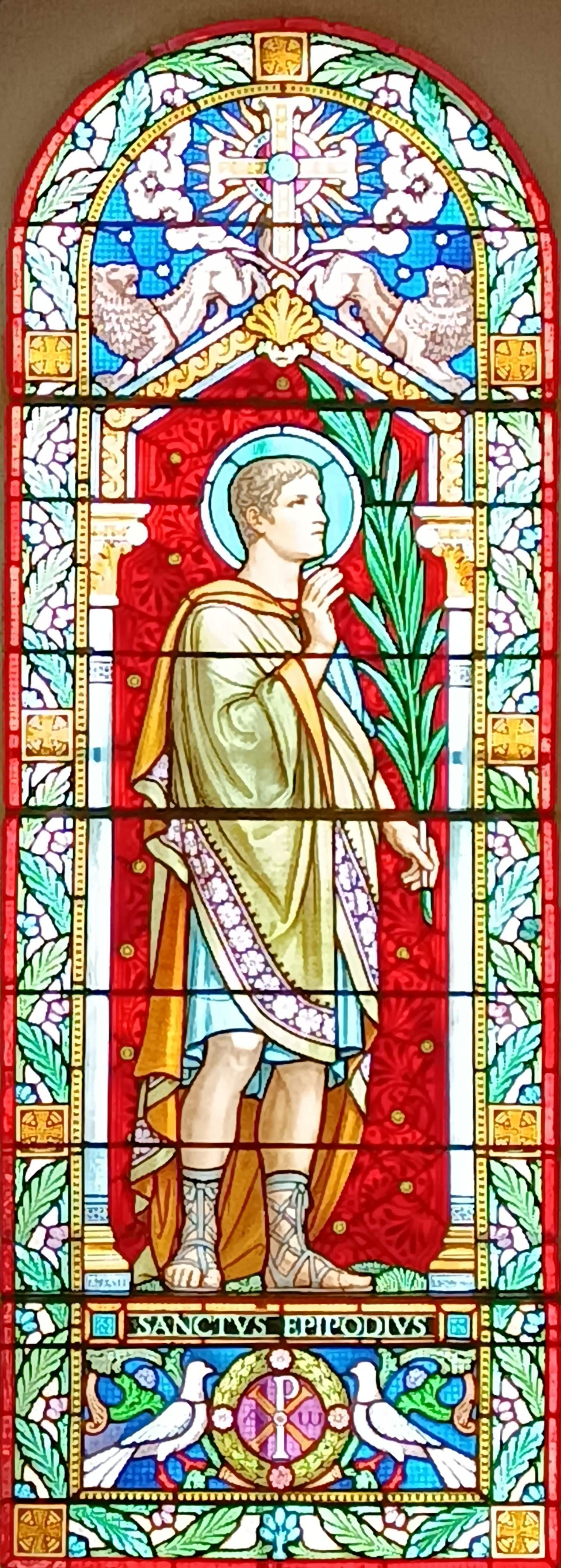
Saint Epipode
Martyr à
Lyon (+ 177)
Martyr à Lyon avec Alexandre.
Deux jeunes chrétiens qui
avaient échappé au carnage dont fut victime saint Pothin, leur évêque. Saint
Epipode fut décapité et saint Alexandre crucifié.
À Lyon, en 178, saint
Épipode, qui, après les combats glorieux des quarante-huit martyrs, l’année
précédente, fut arrêté avec son ami très cher Alexandre, torturé sur le
chevalet et eut enfin la tête tranchée, terminant ainsi son martyre.
Martyrologe romain
SOURCE : http://nominis.cef.fr/contenus/saint/1018/Saint-Epipode.html
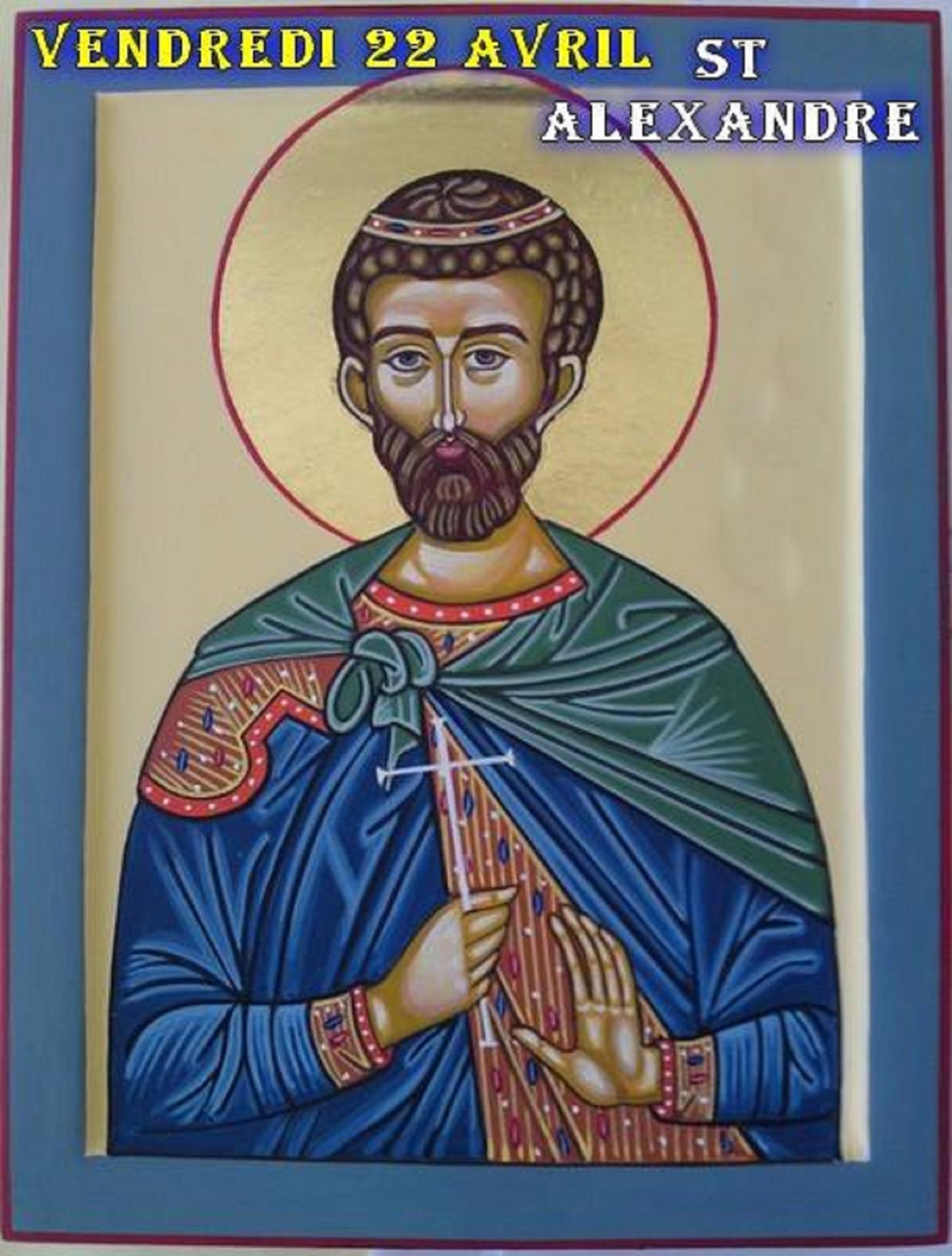
Saint Alexandre
Martyr à
Lyon (+ 177)
Martyr à Lyon avec
Epipode.
Deux jeunes chrétiens qui
avaient échappé au carnage dont fut victime saint
Pothin, leur évêque. Saint
Epipode fut décapité et saint Alexandre crucifié.
À Lyon, en 178, saint
Alexandre, martyr. Deux jours après la passion de son ami saint Épipode, il fut
retiré de sa prison, déchiré sur tout le corps et enfin attaché en croix, où il
rendit l’esprit.
Martyrologe romain
SOURCE : http://nominis.cef.fr/contenus/saint/1016/Saint-Alexandre.html
LE
MARTYRE DE SAINT ÉPIPODE ET DE SAINT ALEXANDRE
Lucius Verus et
Marc-Aurèle régnaient depuis dix-sept ans, lorsque la fureur des gentils se
répandit dans toutes les provinces, particulièrement dans la ville de Lyon, et
les traces qu'elle y laissa furent d'autant plus sanglantes et plus nombreuses,
que cette Cité comptait un plus grand nombre de fidèles. Les noms de
quelques-uns des martyrs ont été conservés avec les circonstances de leur mort
; mais il y en a beaucoup plus qui, pour avoir fini leurs jours dans
l'obscurité, ne sont écrits que dans le Livre de la vie bienheureuse. Car après
cet horrible carnage des chrétiens dont le sang remplit la ville de Lyon, et
fit changer de couleur les eaux du Rhône, les païens crurent avoir entièrement
éteint le nom et la religion de Jésus-Christ. Ce fut alors qu'Épipode et
Alexandre, qui en faisaient profession secrètement, furent dénoncés au
gouverneur. Ce magistrat donna des ordres très précis pour les faire arrêter,
s'imaginant pouvoir enfin achever d'abolir en leur personne une religion qui
lui était si odieuse.
Mais avant d'en venir aux
particularités de la mort de ces saints, il faut dire un mot de leur vie.
Alexandre était Grec, mais Épipode était natif de Lyon; tous deux unis par les
mêmes études, mais plus unis encore dans la suite par les liens d'une véritable
charité.
Ils étaient dans la fleur
de leur jeunesse et n'étaient pas mariés. Dès qu'ils virent la persécution, ils
songèrent à suivre le conseil de l'Évangile; mais ne pouvant pas fuir d'une
ville à une autre, ils se contentèrent de chercher une retraite où ils pussent
demeurer cachés et servir Dieu en secret. Ils la trouvèrent dans un faubourg de
Lyon, près de Pierre-Encise, et ce fut la maisonnette d'une veuve chrétienne
qui les cacha. Ils y furent quelque temps inconnus , par la fidélité que leur
garda leur sainte hôtesse, et par le peu d'apparence qu'avait leur asile, mais
enfin ils furent découverts. Ils furent arrêtés au passage étroit d'une petite
chambre, au moment où ils s'échappaient; ils étaient si éperdus lorsqu'ils
virent les gardes, qu'Epipode oublia un de ses souliers que sa charitable
hôtesse retrouva, et qu'elle conserva comme un riche trésor.
Ils furent mis en prison
préventive, le nom seul de chrétien portant avec soi la conviction manifeste
des plus grands crimes. Trois jours après, ils furent conduits, ayant les mains
attachées derrière le dos, au pied du tribunal du gouverneur, qui leur demanda
leur nom et leur profession. Une multitude innombrable de peuple remplissait
l'audience, et l'on voyait sur le visage de chacun l'expression d'une haine
farouche. Les accusés dirent leur nom, et se confessèrent chrétiens. A cet
aveu, le juge et l'assemblée se récrient, s'emportent, frémissent. « Quoi! deux
téméraires oseront braver les immortels 1 les saintes ordonnances de nos
princes seront foulées aux pieds ! Mais de crainte qu'ils ne s'encouragent
l'un l'autre, et qu'ils ne s'animent à souffrir par paroles ou par signes,
qu'on les sépare; qu'on fasse retirer Alexandre, qui paraît le plus vigoureux,
et qu'on torture Epipode. »
Suivant les traces de
l'ancien serpent, le gouverneur commença par employer la persuasion. « Tu es
jeune, et il est fâcheux que tu périsses pour la défense d'une mauvaise cause.
Nous avons une religion et des dieux à qui nous et nos augustes princes sommes
les premiers à rendre hommage. »
Épipode répondit : « La
grâce de Jésus-Christ mon maître, et la foi catholique que je professe, ne me
laisseront jamais prendre à la douceur empoisonnée de tes paroles. Tu feins
d'être sensible aux maux que je me prépare; mais sache-le bien, je ne regarde
cette fausse compassion que comme une véritable cruauté. La vie que tu me
proposes est pour moi une éternelle mort ; et la mort dont tu me menaces n'est
qu'un passage à une vie qui ne finira jamais. »
Le gouverneur commanda
qu'on frappât à coups de poing la bouche d'Épipode. La douleur du saint martyr
ne fit qu'affermir sa constance; et malgré le sang qui sortait de sa bouche
avec ses dents, il ne laissa pas de proférer ces paroles : « Je confesse que
Jésus-Christ est un seul Dieu avec le Père et le Saint-Esprit, et il est juste
que je lui rende mon âme, à lui, Mon Créateur et mon Rédempteur. Ainsi la vie
ne m'est point ôtée, elle n'est que changée en une plus heureuse ; et il
m'importe peu de quelle manière mon corps cesse de vivre, pourvu que l'esprit
qui l'anime retourne à Celui qui lui a donné l'être. » A peine le bienheureux
Épipode eut-il fini ces derniers mots, que le juge le fit élever sur le
chevalet, et placer des bourreaux à droite et à gauche, qui lui déchirèrent les
côtes avec des ongles de fer. Mais tout à coup on entend un bruit formidable :
tout le peuple demande le martyr; il veut qu'on le lui abandonne. Les uns
ramassent des pierres pour l'en accabler; les autres, plus furieux, s'offrent à
le mettre en pièces, tous enfin trouvent la cruauté du gouverneur trop lente à
leur gré; il n'est plus lui-même en sûreté. Surpris de cette violence inopinée,
et craignant qu'on ne viole le respect dû à son caractère, il supprime l'objet
de l'émeute; il fait enlever le martyr et le fait tuer d'un coup d'épée.
Le gouverneur était
impatient de tremper dans le sang d'Alexandre ses mains encore fumantes de
celui d'Épipode. Il l'avait laissé un jour en prison, et remettant son
interrogatoire au jour suivant, il se le fit amener.
« Tu es encore, lui
dit-il, maître de ta destinée, profite du délai qu'on te donne, et de l'exemple
de ceux qu'un fol entêtement a fait périr. Nous axons fait une si bonne guerre
aux sectateurs du Christ, que tu es presque le seul qui soit resté de ces
misérables ; car ton compagnon d'impiété ne vit plus. Ainsi réfléchis et
sacrifie. »
« — C'est à mon Dieu que
je dois toute ma reconnaissance, que son nom adorable soit béni à jamais. »
Ces paroles irritèrent le
gouverneur, qui fit étendre le saint martyr les jambes écartées, et trois
bourreaux le frappaient sans relâche. Mais ce tourment ne l'ébranla pas, il ne
s'adressa jamais qu'à Dieu pour implorer le secours. Comme son courage ne se
démentait pas, et qu'il commençait à lasser les bourreaux qui s'étaient déjà
relayés plusieurs fois, le gouverneur lui demanda s'il persistait dans sa première
confession :
« — Oui, car tes dieux ne
sont que de mauvais démons ; Dieu tout-puissant, éternel et invisible me
gardera dans ma foi. » Le gouverneur dit alors : « La fureur des chrétiens est
montée à un tel point, qu'ils mettent toute leur gloire dans la durée de leurs
souffrances ; et ils croient par là avoir remporté une victoire signalée .sur
ceux qu'ils nomment leurs persécuteurs. » Puis il prononça cette sentence : «
Cet entêtement étant d'un fâcheux exemple, Alexandre sera mis en croix jusqu'à
ce que mort s'ensuive. » Les bourreaux prirent aussitôt le saint, et le lièrent
à ce bois qui est devenu le signe de notre salut. Il n'y demeura pas longtemps
sans expirer ; car son corps avait été si fort déchiré dans cette cruelle
flagellation, que les côtes décharnées laissaient voir à découvert les
entrailles. Ayant donc son âme unie au Christ, il la lui rendit en invoquant
son saint nom.
LES MARTYRS. Recueil
de pièces authentiques sur les martyrs depuis les origines du Christianisme
jusqu'au XXe siècle, traduites et publiées Par le R. P. Dom H. LECLERCQ,
Moine bénédictin de Saint-Michel de Farnborough. TOME
I Les
Temps Néroniens et Le
Deuxième Siècle. Précédé d'une introduction. Quatrième édition.
Imprimi potest. FR. Ferdinandus Cabrol, Prior Sancti Michaelis
Farnborough. Die 4 Maii 1903. Imprimatur. Turonibus, die 18 Octobris
1920. P. Bataille, vic. gén. ANIMULAE NECTAREAE EORGINAE FRANCISCAE STUART
SOURCE : http://www.abbaye-saint-benoit.ch/martyrs/martyrs0001.htm
5) Les dévotions de
l’Église à Lyon
a) Les martyrs de 177
Lors des persécutions de
l’empereur Marc-Aurèle, quarante-huit chrétiens furent martyrisés à Lyon. Parmi
eux : Sacerdoce, Sanctus 611, Maturus 612, Ponticus 613, Attale 614 , Blandine, Vettiu s615, Biblis 616, Julie, Epagathe, Pontique, Épipode (parfois appelé
Pipoy) 617 et Alexandre 618, Pothin. Saint Pothin, premier évêque de Lyon, très
âgé en 177, ne supporta pas l’emprisonnement et décéda vraisemblablement des
mauvais traitements et d’épuisement dans son cachot.
Ces saints 619 demeurent très peu, voire jamais
représentés ; cependant, étant des saints lyonnais, leur iconographie
typique est à remarquer. Saint Pothin 620 et sainte Blandine sont un peu plus
représentés, surtout à partir du XIXe siècle. Dans leur ville, des églises
leur sont respectivement consacrées. L’église Saint-Pothin a certainement perdu
ses statues lorsque le transept et le chœur furent réaménagés, il nous est
impossible de savoir si l’église a possédé une statue du saint évêque. L’église
Sainte-Blandine en possédait deux exemplaires : le tympan du porche et la
statue disparue de l’autel qui lui est consacré (p. 308).
De plus, il existe
un Saint Pothin à l’église Saint-Nizier (cat. 721), mais il fut
réalisé en 1799 par Joseph Chinard. Le saint évêque de Lyon, premier de la
Gaule envoyé par saint Polycarpe, est majestueusement représenté dans d’amples
vêtements sacerdotaux, avec la mitre et la crosse. Sa large barbe soignée
contribue à lui donner une allure très respectable. À ses côtés, une statuette
de la Vierge à l’Enfant est installée sur une colonnette. D’un geste auguste, il
lève sa main gauche et la tient suspendue au-dessus de la tête de la statuette
qui se trouve ainsi entourée des retombées de sa large manche. Dans cette œuvre
peut-être un peu froide, il n’y a aucune mièvrerie mais de la solennité et de
la puissance.
Enfin, l’église
Saint-Bernard possède une petite statuette industrielle polychrome
de Sainte Blandine, posée provisoirement sur l’autel de la chapelle
Sainte-Madeleine (cat. 472). La jeune sainte est habillée simplement d’une
tunique blanche, les bras ouverts, adossée contre un piquet de bois, un lion
couché à ses pieds. Cette statuette de dévotion commémore l’épisode où Blandine
fut attachée à un poteau élevé au milieu de l’arène, soutenant ses compagnons
qui subissaient diverses tortures et jetés aux bêtes, alors qu’elle-même,
aucune ne la toucha.
Une statue rarissime
de Saint Épipode (cat. 761) existe à l’église Saint-Paul. Il s’agit
d’une œuvre tardive, due à Louis Prost en 1931. Le jeune homme est enveloppé
dans une tunique et une toge, dans un mouvement vers l’avant, il joint les
mains et regarde le ciel. La modernité de cette statue reste discrète, elle
réside avant tout dans ce mouvement général qui avance le corps du saint en une
légère diagonale, ainsi que dans la stylisation épurée et ferme des modelés.
Notes
611. Diacre de Vienne.
612. nouveau baptisé
613. un jeune garçon de
15 ans
614. « qui était la
colonne et l’appui de notre Église » et citoyen romain
615. qui prenant leur
défense aux premières arrestations est à son tour condamné.
616. qui revint de son
reniement
617. Une chapelle lui
était consacrée vers Pierre-Scize. La crypte de l’église subsiste dans les
restes de l’Abbaye de l’Île-Barbe sur la Saône. Enseveli à côté de saint
Irénée.
618. Les jeunes Épipode
et Alexandre avaient échappé au premier carnage, mais ils moururent après leur
évêque saint Pothin : Saint Épipode fut décapité et saint Alexandre
crucifié.
619. Vus ensemble sur la
mosaïque de L’arrivée à Lyon de saint Pothin, par Lameire ; peinture
murale de l’église de Couzon-au-Monts-d’Or (Rhône), par Ch. Franchet ( ?).
620. F. Biard, Saint
Pothin apportant une image de la Vierge en Gaule, 1827, archevêché, Lyon ;
L. Jamnot, 1846, Antiquaille, Lyon ; H. Flandrin, 1853, église
Saint-Vincent-de-Paul, Paris ; Ch. Lameire, basilique de Fourvière, 1910,
mosaïque, Lyon.
SOURCE : http://theses.univ-lyon2.fr/documents/getpart.php?id=lyon2.2008.penlou_s&part=153437
Anonyme (Ve siècle)
Les Actes des saints
Épipode et Alexandre
traduction de Jean-Baptiste
Drouet de Maupertuy (1732)
Si l’histoire prend soin
de conserver la mémoire des hommes illustres, et de consacrer par des éloges
les actions généreuses de ceux qui ont donné leur vie, ou pour défendre leur
liberté, ou pour l’intérêt de leur patrie, ou seulement pour acquérir une
gloire vaine et stérile : si leurs vertus, quoique fausses et purement
naturelles ont été laissées à la postérité pour lui servir d’exemple ; de
quelles louanges ne doit-on pas relever la mort des Martyrs, puisqu’elle
renferme comme en un abrégé, des exemples admirables d’une foi vive et d’une
piété sincère, et que leur sang est un germe précieux d’où l’on voit éclore la
sainteté et la vie ? Ils ont combattu, non pour un roi de la terre et pour
un prince mortel, mais pour le Roi du ciel, et pour un prince dont la puissance
est infinie, et la durée éternelle. Si on les a vu courir au trépas, ce n’est
pas en faveur d’une patrie où l’on reçoit une vie qu’on perd aussitôt, mais
pour la patrie céleste, pour la véritable patrie, dont les Saints sont les
fondateurs, et dont les habitants sont immortels ; où l’on jouit d’une
liberté que l’enfer avec toute sa violence ne peut jamais ravir, où l’on est
comblé d’une gloire toute divine. Mais quoiqu’on ne puisse avoir qu’une idée
grossière de celle dont Dieu récompense les travaux des Martyrs, parce qu’il
n’est pas moins impossible de la comprendre que de la mériter, il n’est rien
toutefois qui soit plus digne de passer jusqu’aux siècles à venir, que les
combats et les triomphes des Saints ; rien qui soit plus propre à faire
naître dans le cœur des fidèles une noble ardeur qui les porte à embrasser une
vie pure, et qui soit une imitation du martyre par une continuelle mortification
des passions et des sens. C’est dans ce dessein que nous avons entrepris de
rapporter la glorieuse victoire que les bienheureux Epipode et Alexandre ont
obtenue sous les auspices de J.C. et par le secours de sa grâce, afin que leur
exemple augmente, fortifie et anime la foi des chrétiens.
Il y avait dix-sept ans
que Lucius-Verus et Marc-Aurèle étaient assis sur le trône des Césars, lorsque
la fureur des Gentils se répandit comme un torrent impétueux dans toutes les
provinces de l’empire contre l’église. Mais ce fut particulièrement dans la
province de Lyon qu’elle causa de plus grands ravages ; et les traces
qu’elle y laissa furent d’autant plus funestes et en plus grand nombre, qu’elle
la trouva peuplée d’un plus grand nombre de fidèles. Les magistrats et les
officiers d’armée, les soldats et le peuple travaillaient de concert, et avec
une égale animosité, à détruire la religion, en employant contre elle toute
sorte de tourments, et persécutant sans relâche tout ce qui portait le nom de
chrétien, sans faire de distinction, ni d’âge, ni de sexe. Les noms de
quelques-uns ont été conservés avec les circonstances de leur mort ; mais
il y en a beaucoup plus, qui, pour avoir fini leurs jours dans les chaînes et
dans l’obscurité d’une prison, ou ayant péri dans quelque émotion populaire,
ont été confondus dans la foule, et ne sont écrits que dans le livre de la vie
bienheureuse. Car après cet horrible carnage des chrétiens dont le sang remplit
la ville de Lyon, et fit changer de couleur aux eaux du Rhône, les païens
crurent avoir entièrement éteint le nom de la religion de J.C. Ce fut pour lors
qu’Epipode et Alexandre, qui en faisaient une profession secrète, furent
dénoncés au gouverneur par leurs propres domestiques. Ce magistrat, en colère
de ce que deux chrétiens avoient échappé à l’exacte recherche qu’il croyait en
avoir faite, donna des ordres très-précis de les arrêter, s’imaginant pouvoir
enfin achever d’abolir en leur personne une religion qui lui était si odieuse.
Mais avant que de venir
aux particularités de la mort de ces Saints, il faut dire un mot de leur vie.
Alexandre était Grec, Epipode était natif de Lyon ; tous deux unis dès
leur plus tendre enfance, par les mêmes études et les mêmes exercices, mais
plus unis encore dans la suite par les liens d’une véritable charité. Leur
amitié croissait avec leurs lumières, et augmentait à mesure qu’ils faisaient
de nouveaux progrès dans les sciences. Leur union devint enfin si intime, et
leurs sentiments se trouvèrent si conformes en toutes choses, que quoiqu’ils
eussent reçu de ceux qui leur avoient donné la naissance une éducation
très-sainte, ils ne cessaient cependant de s’exciter l’un et l’autre par de
réciproques et de continuelles exhortations à tendre à une plus haute
perfection. Ils y réussirent si bien, que s’exerçant avec une attention toute
particulière à la tempérance, à la pauvreté, à la foi, à la chasteté, aux
œuvres de miséricorde, et généralement à toutes les vertus les plus excellentes
du christianisme, ils se rendirent des victimes dignes d’être immolées à
Dieu ; et ils eurent par une heureuse anticipation, tout le mérite du
martyre avant que d’en souffrir la peine. Ils étaient dans la fleur de leur
jeunesse, et ils n’avoient point voulu engager leur liberté, ni se charger du
joug du mariage. Dès qu’ils eurent aperçu les premiers feux de la persécution,
ils songèrent à suivre le conseil de l’évangile ; car ne pouvant pas fuir
de ville en ville, ils se contentèrent de chercher une retraite, où ils pussent
demeurer cachés, et y servir Dieu en secret. Ils la trouvèrent dans un faubourg
de Lyon, proche Pierre-Scize, et ce fut le petit logis d’une veuve chrétienne
et d’une singulière piété qui les mit d’abord à couvert de la première enquête
des persécuteurs. Ils y furent quelque temps inconnus, par la fidélité que leur
garda leur sainte hôtesse, et par le peu d’apparence qu’avait leur asyle. Mais
enfin ils furent découverts, et ils ne purent échapper à l’importune et trop
curieuse recherche d’un officier du président. Ils furent arrêtés au passage
étroit d’une petite chambre dans le moment qu’ils se sauvaient, et ils
demeurèrent si éperdus lorsqu’ils se virent entre les mains cruelles des gardes
du gouverneur, qu’Epipode perdit un de ses souliers que sa charitable hôtesse
trouva, et qu’elle conserva comme un riche trésor.
Ils furent d’abord mis en
prison, et avant même que d’avoir été interrogés : le seul nom de chrétien
portant avec soi une conviction manifeste des plus grands crimes. Trois jours
après, ils furent conduits, ayant les mains attachées derrière le dos, au pied
du tribunal du gouverneur. Cet homme cruel leur demanda leur nom, et quelle
était leur profession ; une multitude innombrable de peuple remplissait
l’audience, et l’on voyait sur le visage de chacun la haine peinte avec les plus
noires couleurs. Les accusés dirent leur nom, et confessèrent naïvement qu’ils
étaient chrétiens. A cet aveu, et le juge et l’assemblée se récrient,
s’emportent, frémissent de rage. Toute une ville est en mouvement pour perdre
deux innocents. Quoi, dit le gouverneur d’un ton que la fureur rendait
terrible, d’eux jeunes téméraires oseront braver les immortels ? Les
saintes ordonnances de nos princes seront foulées aux pieds ? A quoi ont
donc servi tant de supplices ? C’est donc en vain qu’on a dressé des
croix, qu’on a mis en usage le fer et le feu ; en vain les bêtes se sont
rassasiées des corps de ces impies : où sont les chevalets, les lames de
cuivre ardentes ? Où sont les tourments les plus affreux, prolongés même
jusqu’au-delà du trépas ? Quoi, tout cela a été inutile ; les hommes
ne sont plus, leurs os ont été réduits en cendre ; à peine trouve-t-on la
place où furent leurs tombeaux ; et le nom de Christ retentit encore à nos
oreilles : des bouches sacrilèges font encore entendre ce nom odieux à la
vue des autels, devant les images sacrées des Césars ? Non, non,
n’attendez pas que cette audace criminelle demeure impunie. Le ciel et la terre
demandent votre supplice, il est juste de les satisfaire. Mais de crainte
qu’ils ne s’encouragent l’un l’autre, et qu’ils ne s’animent à souffrir par des
paroles ou par des signes, comme on sait assez que c’est la coutume de ces
gens-ci ; qu’on les sépare ; qu’on fasse retirer Alexandre qui parait
le plus vigoureux, et qu’on applique Epipode à la question. Le gouverneur crut
qu’il pourrait tirer quelque avantage de la conjoncture où se trouvait ce
pauvre jeune homme, privé du secours de son ami, abandonné à sa propre
faiblesse, et laissant présumer que dans une si grande jeunesse on ne devait
pas craindre une résistance trop opiniâtre. Suivant donc les traces de l’ancien
serpent, il commença par employer là douce persuasion, et à faire glisser dans
son âme le poison mortel de la flatterie. Ah ! C’est dommage, lui dit-il,
qu’un si aimable jeune homme périsse pour la défense d’une mauvaise
cause ; je sais que vous avez de la piété, que votre âme est remplie de
tendres sentiments de religion : mais nous croyez-vous des impies ?
N’avons-nous pas une religion et des dieux, et la piété est-elle bannie de nos
temples ? Toute la terre adore les mêmes divinités que nous, et nos
augustes princes sont les premiers à leur rendre leurs hommages. Au reste, nos
dieux aiment la joie : c’est au milieu des banquets somptueux qu’on leur
adresse des prières ; et les vœux qu’on leur fait ne sont jamais mieux
exaucés,, que lorsqu’on les accompagne de jeux, de danses et de charmants
concerts. Que vous dirai-je enfin, l’amour et les plaisirs, la bonne chère et
les vins délicieux, la magnificence des spectacles, les agréables intrigues du
théâtre ; en un mot, les plus doux passe-temps de la vie font la plus
grande partie de leur culte. Mais pour vous, vous avez une religion sombre et
chagrine : vous adorez un homme qui a été cloué à une croix ; qui ne
peut souffrir qu’on jouisse de tous ces plaisirs, qui condamne la joie, qui se
plaît a avoir des adorateurs exténués par les jeûnes ; enfin, qui
conseille une chasteté triste et inféconde. Mais après tout, quel appui peut-on
attendre de ce Dieu, quel bien peut-il faire à ceux qui s’attachent à son service,
lui qui n’a pu garantir sa vie de l’attentat formé contre elle par les derniers
des hommes ? J’ai bien voulu vous représenter toutes ces choses, afin que,
renonçant à cette religion farouche et sauvage, vous ne songiez plus qu’à
passer votre jeunesse parmi les doux et tendres amusements de cet âge destiné
par la nature à la jouissance de tous les contentements que le monde offre à
ceux qui en savent faire un bon usage.
Le bienheureux Epipode
répondit au gouverneur en ces termes : La grâce de J. C. mon Maître, et la
foi catholique que je professe, ne me laisseront jamais surprendre à la douceur
empoisonnée de vos paroles. Vous feignez d être sensible aux maux que je me
prépare ; mais sachez que je ne regarde cette fausse compassion que comme
une véritable cruauté. La vie que vous me proposez est pour moi une éternelle
mort ; et la mort dont vous me menacez n’est qu’un passage à une vie qui
ne finira jamais ; il est glorieux de mourir d’une main comme la vôtre,
accoutumée à répandre le sang de ceux qui refusent d’abandonner le parti de la
vertu. Au reste, ce Dieu que nous adorons, ce souverain Seigneur de tout
l’univers ; en un mot, ce Jésus que vous dites avoir souffert. le supplice
de la croix, savez-vous qu’il est ressuscité : qu’Homme et Dieu tout ensemble
il s’est élevé dans le Ciel par sa propre vertu, traçant lui-même à ses
serviteurs un chemin à l’immortalité, et leur préparant là-haut des trônes tout
brillants de gloire. Mais, je m’aperçois que ces choses sont trop relevées pour
vous, je veux bien me rabaisser en votre faveur, et vous parler le langage des
hommes. Les ténèbres dont votre esprit est couvert sont-elles si épaisses,
qu’elles ne vous laissent pas voir que tout homme est composé de deux
différentes substances, l’âme et le corps ? Chez nous l’âme commande et le
corps obéit ; ces plaisirs infâmes que vous me vantez tant, et qui
plaisent si fort à vos dieux, flattent agréablement le corps, mais ils donnent
la mort à l’âme. Pour nous, nous prenons le parti de notre âme contre notre corps,
et nous la défendons des vices qui l’attaquent. Ne nous vantez point tant votre
piété envers vos dieux immortels : le premier et le plus grand de vos
dieux, c’est votre ventre ; vous lui sacrifiez la plus noble partie de
vous-même ; et vous rabaissant jusqu’à la nature des bêtes, après avoir
vécu comme elles, vous n’attendez, qu’une fin pareille à la leur. Mais lorsque
nous périssons par vos ordres, que font vos tourments, sinon de nous faire
passer, du temps à l’éternité, et des misères d’une vie mortelle au bonheur
d’une vie qui n’est plus sujette à la mort ?
Le gouverneur ne put
refuser son admiration à un discours si rempli de sagesse et de générosité, il
en fut touché : mais ce sentiment ne dura pas long-temps, et la honte, le
dépit et la rage lui succédèrent bientôt, avec toutes les horreurs qui les
accompagnent. Ne pouvant donc résister à ces trois furies, il commanda qu’on
frappât à coups de poing cette bouche qui avait parlé avec tant d’éloquence. La
douleur que ressentit le S. Martyr ne fit qu’affermir sa constance ; et
malgré le sang qui sortait de sa bouche avec une partie de ses dents, il ne
laissa pas de proférer ces paroles : Je confesse que Jésus-Christ est un
seul Dieu, avec le Père et le Saint-Esprit, il est juste que je lui rende une
âme qui est sortie de ses mains, et qu’il a rachetée de son sang. Ainsi la vie
ne m’est point ôtée, elle n’est que changée en une plus heureuse ; et il
m’importe peu de quelle manière ce corps cesse de vivre, pourvu que l’esprit
qui l’anime retourne à celui qui lui a donné l’être. A peine S. Epipode eut
fini ces derniers mots, que le juge le fit élever sur le chevalet, et placer
des bourreaux à droite et à gauche, qui lui déchirèrent les côtes avec des
ongles de fer. Mais voilà que tout à coup on entend un bruit effroyable :
tout le peuple demande le Martyr ; il veut qu’on le lui abandonne :
les uns ramassent des pierres pour l’en accabler ; les autres, plus
furieux, s’offrent à le mettre en pièces ; tous enfin trouvent la cruauté
du gouverneur trop lente à leur gré. Il n’est pas lui-même en sûreté :
surpris de cette violence inopinée, il craint qu’on ne viole le respect dû à
son caractère ; et désirant assoupir dès sa naissance ce commencement de
sédition, il fait enlever le Martyr, et sans donner le temps aux mutins de
poursuivre leur attentat, il le fait tuer d’un coup d’épée. Ainsi, par une
disposition favorable de la Providence, l’emportement des ennemis de S. Epipode
ne fit que hâter la fin de son martyre ; Jésus-Christ se hâtant
lui-même-de couronner son serviteur.
Cependant le gouverneur
brillait d’impatience de tremper dans le sang d’Alexandre ses mains encore
fumantes de celui de son cher Epipode. Il l’avait laissé un jour en prison, et
remettant son interrogatoire au jour suivant, il se le fit amener dans le
dessein de pouvoir, par son supplice, rassasier sa fureur et celle de tout le
peuple. Il fit toutefois un effort sur lui-même, et retenant avec peine les
mouvements impétueux d’un courroux aveugle, il voulut bien tenter la voie de la
douceur, avant que de prendre celle des tourments. Vous voilà, lui dit-il,
encore le maître de votre destinée, profitez du délai qu’on vous donne, et de
l’exemple de ceux qu’un fol entêtement a fait périr. Grâces aux dieux
immortels, nous avons fait une si bonne guerre aux sectateurs du Christ, que
vous êtes presque le seul qui soit resté de ces misérables : car enfin
apprenez que le compagnon de votre impiété ne vit plus : cessez donc de
vous promettre l’impunité, si vous persévérez dans votre crime ; ayez pitié
de vous-même, et venez remercier les dieux d’une vie qu’ils ont la bonté de
vous conserver.
C’est à mon Dieu que je
dois toute ma reconnaissance, répondit Alexandre, que son nom adorable soit
béni à jamais. Vous croyez m’épouvanter par le souvenir que vous rappelez dans
ma mémoire des tourments que tant de Martyrs ont endurés ; mais sachez que
vous ne faites qu’enflammer davantage l’ardeur que j’ai de les suivre, en
retraçant à mes yeux leurs triomphes. Pensez-vous avoir fait périr ces âmes
bienheureuses que vous avez chassé de leurs corps à force de supplices ?
Désabusez-vous, elles sont dans le Ciel, où elles règnent : mais le
croirez-vous, ce sont les persécuteurs eux-mêmes qui ont péri en cette
rencontre. Que j’ai pitié de l’erreur où je vous vois ; ce nom sacré que vous
vous imaginez pouvoir éteindre dans les flots de sang que vous versez, n’en est
que plus éclatant. Cette religion que vous prétendez renverser par vos faibles
efforts, c’est Dieu qui en a jeté les fondement, ils sont inébranlables ;
la vie pure et sainte des chrétiens soutient l’édifice, et leur mort précieuse
l’augmente et l’embellit. C’est ce même Dieu qui a fait le Ciel, il est le
maître de la terre, et il règne par sa justice dans les enfers. Apprenez que
les âmes auxquelles vous croyez donner la mort s’échappent de vos mains, et
prennent leur essor vers le ciel, où un royaume les attend ; au lieu que
vous descendrez dans l’enfer avec vos dieux. En faisant mourir mon cher frère,
vous avez assuré son bonheur, et je meurs d’impatience de le partager avec lui.
Qu’attendez-vous donc ? Je suis chrétien, je l’ai toujours été, je ne
cesserai jamais de l’être. Vous pouvez cependant tourmenter ce corps, qui étant
formé de terre est sujet aux puissances de la terre : mais mon âme d’une
nature toute céleste, ne reconnaît point votre pouvoir ; et celui qui l’a
créée saura bien la garantir de votre cruauté.
Ce discours ne fit
qu’augmenter dans l’âme du gouverneur la honte et la colère. Il fit étendre le
S. Martyr les jambes écartées, et trois bourreaux le frappaient sans relâche.
Ce tourment ne diminua rien de la sainte fierté de ce généreux athlète, et il
ne s’adressa jamais qu’à Dieu pour implorer son secours. Comme son courage ne
se démentait point, et qu’il commençait à lasser les bourreaux, qui s’étaient
déjà relayés plusieurs fois, le gouverneur lui demanda s’il persistait toujours
dans sa première confession : Oui, répondit-il d’un ton d’autorité, et qui
témoignait la grandeur de sa foi : car vos Dieux ne sont que de mauvais
démons ; mais le Dieu que j’adore, et qui seul est tout-puissant et
éternel, me donnera la force de le confesser jusqu’au dernier soupir : il
sera le conservateur et le gardien de ma foi. Le gouverneur dit alors : Je
vois la pensée de ces misérables, leur fureur insensée est montée à un tel
point ; qu’ils mettent toute leur gloire dans la durée de leurs
souffrances ; et ils croient par là avoir remporté une victoire signalée
sur ceux qu’ils nomment leurs persécuteurs ; mais il faut les guérir de
cette folle présomption. Puis s’efforçant de prendre un ton plus grave et plus
modéré, il prononça cette sentence : Etant une chose contraire au bon
exemple, et au respect dû à la religion des dieux, et à la dignité de notre
siège, de souffrir plus long-temps l’opiniâtreté impie du nommé Alexandre, convaincu
de christianisme ; et comme ce serait en quelque sorte s’en rendre
complice, que d’en différer la punition, nous ordonnons qu’il sera attaché à
une croix pour y expier son crime par sa mort. Les bourreaux prirent aussitôt
ce Saint, et le lièrent à ce bois qui est devenu le signe de notre salut. Il
n’y demeura pas beaucoup sans y expirer : car son corps avait été si fort
déchiré dans cette cruelle flagellation, que les côtes décharnées laissaient
voir à découvert les entrailles. Ayant donc son âme unie à J. C., il la lui
rendit en invoquant son saint Nom.
Le tombeau réunit deux
amis, que la mort seule avait pu séparer durant quelques moments ; les
fidèles ayant enlevé secrètement leurs corps, allèrent cacher ce pieux larcin
dans un endroit inconnu aux infidèles. Il y avait sur le penchant d’une des
colline de la ville, un enfoncement couvert d’arbres épais ; là, parmi des
broussailles on trouvait une espèce dé grotte : la chute des eaux l’avait
insensiblement creusée, et leur humidité féconde avait fait naître à l'entour
des ronces et des épines, qui en dérobaient la vue à ceux que le hasard
conduisait en ces lieux écartés. Ce fut cette caverne qui fut choisie pour être
la dépositaire des sacrées dépouilles de nos Martyrs, et qui les mit à couvert
d’une seconde persécution des païens, qui par une inhumanité inconnue aux
peuples les plus barbares refusaient aux morts le repos de la sépulture. Ce
lieu est devenu dans la suite célèbre par les miracles qui s’y opèrent tous les
jours, et qui y attirent la dévotion du peuple. Et voici ce qui commença à le
mettre en réputation.
Une maladie contagieuse
ravageant toute la ville de Lyon, un jeune homme de condition consumé des
ardeurs d’une fièvre maligne, fut averti en songe d’avoir recours aux remèdes
que lui donnerait une certaine femme qui lui fut nommée. C’était celle-là même
qui avait le soulier de saint Epipode. Elle fut fort surprise de la prière
qu’on lui faisAit de vouloir s’employer à la guérison de ce jeune
gentilhomme ; elle dit ingénument qu’elle n’avait aucune connaissance de
la médecine, qu’à la vérité elle avAit guéri plusieurs maladies par le moyen du
soulier qui avAit servi à un saint Martyr, et que Dieu avAit fait tomber entre
ses mains, pour la récompenser de l’hospitalité qu’elle avAit exercée envers
ses serviteurs. En même-temps Lucie (c’est ainsi que se nommAit cette
charitable veuve) fit la bénédiction sur un verre d’eau qu’elle présenta au
malade ; il ne l’eut pas plutôt pris, que le feu de sa fièvre s’éteignit,
non par un effet naturel, mais par un miracle de la toute-puissance divine. Le
bruit de cette merveille se répand par toute la ville ; la foi chrétienne
est exaltée, le pouvoir des Saints est reconnu. Une multitude de peuple court
en foule au tombeau des Martyrs, demande la santé, la reçoit, et avec la santé
la grâce du Ciel et la lumière de l’évangile : on ne cherche que la
guérison du corps, et on obtient encore celle de l’âme. Les miracles se
multiplient ; et à l’aspect de cette sainte caverne, les démons sortent
des corps, les maladies prennent la fuite, tous les maux disparAissent, et il
s’y passe de si grandes choses, que l’incrédulité est obligée de se rendre
malgré elle à l’évidence des faits. Gardons-nous donc d’être incrédules ;
la puissance de Dieu aime à se découvrir aux esprits dociles, elle les
favorise, elle les aime ; mais elle se réserve pour ceux qui doutent, et
elle ne daigne rien opérer en leur faveur.
SOURCE : https://fr.wikisource.org/wiki/Actes_des_saints_%C3%89pipode_et_Alexandre
SAINT-ÉPIPODE
Il vient d’être question
à plusieurs reprises de la Recluserie Saint-Épipoy ; voici l’origine de
cette appellation et l’histoire de sa chapelle.
Parmi les confesseurs de
la foi des premiers siècles lyonnais, deux se rattachent plus intimement à la
paroisse Saint-Paul, saint Épipode ou Épipoy et saint Alexandre, martyrisés en
178. Une étroite amitié les liait ainsi qu’une commune origine grecque. Durant
la persécution de 177, ils se réfugièrent chez une pauvre veuve, du nom de
Lucie, à peu de distance de la porte de Pierre-Scize. Après un an, ils
furent découverts et conduits au supplice : Épipode était
vraisemblablement citoyen romain, car on lui trancha la tête ; Alexandre
mourut sur la croix. Dans un premier mouvement, son ami avait tenté de
fuir ; courant le long d’un réservoir qui retenait, auprès de la demeure
de Lucie, les eaux d’une source, il y laissa choir sa sandale. Dès lors, la
piété des fidèles attribua à ce réservoir des vertus curatives miraculeuses. Un
oratoire fut élevé sur le lieu qu’avait occupé la maison de Lucie, et saint
Eucher y mit un religieux pour le desservir. La chapelle Saint-Épipoy dépendit
d’abord des chanoines de Saint-Jean ; elle passa, en 1489, à l’administration
du chapitre de Saint-Paul qui y entretint un gardien. Le clergé de la
cathédrale se rendait en procession à l’église Saint-Paul la veille de
Saint-Épipode, nom que le peuple prononçait plus volontiers Épipoy ; il
allait à l’église Saint-Irénée, les jours de Saint-Irénée et de Saint-Épipode.
Le chapitre de Saint-Paul se rendait, lui aussi, processionnellement vers la
recluserie, la veille de Saint-Épipode : le reclus devait donner au
céroféraire un cierge d’un quarteron. De la chapelle Saint-Épipode, il ne reste
hélas ! plus que le souvenir ; il est heureux du moins que les
anciens plans de Lyon nous aient conservé et l’indication de son emplacement
exact et une silhouette sommaire qui permet de restituer la forme de cet
édifice.
SOURCE : https://fr.wikisource.org/wiki/Histoire_des_%C3%A9glises_et_chapelles_de_Lyon/Saint-%C3%89pipode
Martyre de St
Pothin et de ses compagnons, Alexandre et Epipode
Sous la persécution de
Marc-Aurèle, quand les païens crurent avoir fait disparaître de Lyon tous les
Chrétiens en vue après le martyre de St
Pothin et de ses compagnons, Alexandre et Epipode, qui étaient liés
depuis leur enfance d'une étroite amitié spirituelle, s'étaient enfuis de la
ville et avaient trouvé refuge, dans un faubourg, chez une veuve chrétienne.
Mais ils furent finalement découverts et jetés en prison avant d'être emmenés
au tribunal. Quand ils se déclarèrent Chrétiens, la foule poussa de grands cris
et le magistrat, saisi d'une violente colère en constatant que tant de sang
répandu n'avait pas réussi à éliminer les disciples du Christ, ordonna de les
séparer et de soumettre Epipode à la torture., puis le fit décapter. Son
compagnon Alexandre fut crucifié le lendemain.
De pieux Chrétiens
vinrent ensuite dérober les corps des deux Martyrs et les cachèrent dans une
grotte, aux environs de Lyon, qui devint célèbre par les miracles qui s'y
accomplissaient.
SOURCE : http://www.peintre-icones.fr/PAGES/CALENDRIER/Avril/22.html
Le 22 avril, mémoire des
Saints Martyrs EPIPODE et ALEXANDRE de LYON
Sous la persécution de
Marc-Aurèle (177), quand les païens crurent avoir fait disparaître de Lyon tous
les Chrétiens en vue après le martyre de Saint Pothin et de ses compagnons (cf.
2 juin), Alexandre et Epipode, qui étaient liés depuis leur enfance d'une étroite
amitié spirituelle, s'étaient enfuis de la ville et avaient trouvé refuge, dans
un faubourg, chez une veuve chrétienne. Mais ils furent finalement découverts
et jetés en prison avant d'être emmenés au tribunal. Quand ils se déclarèrent
Chrétiens, la foule poussa de grands cris et le magistrat, saisi d'une violente
colère en constatant que tant de sang répandu n'avait pas réussi à éliminer les
disciples du Christ, ordonna de les séparer et de soumettre Epipode à la
torture.
Aux paroles doucereuses
du juge qui tentait de vaincre sa résolution, Epipode répliqua : «La vie que tu
me proposes est pour moi une éternelle mort; et la mort dont tu me menaces est
un passage à une vie qui ne finira jamais ! Lorsque nous périssons par vos
ordres, vos tourments nous font passer du temps à l'éternité, des misères d'une
vie mortelle au bonheur d'une vie qui n'est plus sujette à la mort.» Après
avoir fait frapper la bouche qui avait proféré ces paroles, le juge le fit
élever sur le chevalet et les bourreaux lui déchirèrent les côtes avec des
ongles de fer. Le peuple, avide de sang, se souleva soudain, réclamant qu'on
lui livrât ce Chrétien. Par crainte d'une sédition, le juge fit alors décapiter
sans retard Saint Epipode.
Le lendemain, il fit
comparaître Alexandre et essaya de l'effrayer en lui rappelant les supplices
endurés par les Martyrs. Alexandre répondit : «Tu crois m'épouvanter par le
souvenir des tourments que tant de Martyrs ont endurés ? Sache bien que tu
enflammes ainsi mon ardeur de les suivre. Le nom de Chrétien que tu prétends
éteindre en devient, par là, plus éclatant !» Le juge le fit frapper sans
relâche par trois bourreaux, puis désespérant de le vaincre, il le condamna à
être crucifié.
De pieux Chrétiens
vinrent ensuite dérober les corps des deux Martyrs et les cachèrent dans une
grotte, aux environs de Lyon, qui devint célèbre par les miracles qui s'y
accomplissaient.
SOURCE : http://calendrier.egliseorthodoxe.com/sts/stsavril/avril22.html

Profile
Friend of and worker
with Saint Alexander
of Lyon. Imprisoned, tortured,
and martyred during
the persecutions of Marcus
Aurelius. Though he never joined an order, Epipodius was a confirmed celibate bachelor,
devoting his time to work with and for God. Betrayed to
imperial authorities by a servant. Martyr.
Born
2nd
century at Lyon, France
relics at
the church of Saint Irenaeus at Lyon, France
miracles reported
at the tomb
Additional
Information
Acts
of the Early Martyrs, by Father James
A M Fastré, S.J.
Book
of Saints, by the Monks of
Ramsgate
Lives
of the Saints, by Father Alban
Butler
Roman
Martyrology, 1914 edition
Saints
of the Day, by Katherine Rabenstein
Short
Lives of the Saints, by Eleanor Cecilia Donnelly
books
Our Sunday Visitor’s Encyclopedia of Saints
other
sites in english
video
webseiten
auf deutsch
Vollständiges
Heiligen-Lexikon
sitios
en español
Martirologio Romano, 2001 edición
sites
en français
fonti
in italiano
Martirologio Romano, 2005 edition
MLA
Citation
‘Saint Epipodius of
Lyon‘. CatholicSaints.Info. 22 April 2024. Web. 31 March 2026.
<https://catholicsaints.info/saint-epipodius-of-lyon/>
SOURCE : https://catholicsaints.info/saint-epipodius-of-lyon/

Profile
Friend and worker with Saint Epipodius
of Lyon. Imprisoned, scourged until
his ribs showed, and executed with
34 companions during the persecutions of Marcus
Aurelius.
Born
Additional Information
Acts
of the Early Martyrs, by Father James
A M Fastré, S.J.
Book
of Saints, by the Monks of
Ramsgate
Lives
of the Saints, by Father Alban
Butler
Roman
Martyrology, 1914 edition
Saints
of the Day, by Katherine Rabenstein
Saints
of the Day, by Katherine Rabenstein
Short
Lives of the Saints, by Eleanor Cecilia Donnelly
books
Our Sunday Visitor’s Encyclopedia of Saints
other sites in english
webseiten auf deutsch
Vollständiges
Heiligen-Lexikon
sitios en español
Martirologio Romano, 2001 edición
sites en français
fonti in italiano
Martirologio Romano, 2005 edition
MLA Citation
‘Saint Alexander of Lyon‘. CatholicSaints.Info.
22 April 2024. Web. 31 March 2026.
<https://catholicsaints.info/saint-alexander-of-lyon/>
SOURCE : https://catholicsaints.info/saint-alexander-of-lyon/
Book of Saints
– Alexander and Others
Article
ALEXANDER and OTHERS
(Saints) Martyrs (April 24) (2nd century) A Greek by birth, and the friend and
companion of Saint Epipodius of Lyons. He was arrested as a Christian, put to
the torture and, in the end, crucified (A.D. 177). Thirty-four other Christians
of Lyons perished at the same time.
MLA
Citation
Monks of Ramsgate.
“Alexander and Others”. Book of Saints, 1921. CatholicSaints.Info. 24
May 2012.
Web. 31 March 2026.
<http://catholicsaints.info/book-of-saints-alexander-and-others/>
SOURCE : https://catholicsaints.info/book-of-saints-alexander-and-others/
Article
EPIPODIUS (Saint) Martyr
(April 22) (2nd century) A young Christian of Lyons, who with his friend
Alexander was discovered in the hiding-place in which they had concealed
themselves, put to the torture and beheaded on account of their religion under
the Emperor Marcus Aurelius, A.D. 178.
MLA
Citation
Monks of Ramsgate.
“Epipodius”. Book of Saints, 1921. CatholicSaints.Info.
29 December 2012. Web. 31 March 2026. <https://catholicsaints.info/book-of-saints-epipodius/>
SOURCE : https://catholicsaints.info/book-of-saints-epipodius/
Epipodius and Alexander
MM (RM)
Died 178. Epipodius and
Alexander were young, unmarried men, friends of long standing. They lived at
Lyons, France, as good Christians and tried to avoid capture by the pagans
during the persecution of Marcus Aurelius by hiding with a widow who lived just
outside the city. When they were captured, the judge mocked Epipodius, saying:
"We worship the gods
with revels and jollity and festivity. You people follow a somber and sorrowful
religion: you worship a man who was nailed to a cross, who could not endure
that one enjoy all of life's pleasures, who condemns joy and is pleased to have
worshippers exhausted by fastings. After all, what can one expect from a God
who could not guarantee his own life.
"Too bad that a
young man like you should perish for the defense of a bad cause. Do you take us
for atheists? Do we not also have a religion and gods? Our gods love joy,
banquets, the succulent pleasures of life form part of their cult."
The crowd cried out.
Epipodius said nothing in reply, and the judge order him to be killed by the
sword. Two days later his friend Alexander was flogged and then crucified
(Attwater2, Benedictines, Bentley, Encyclopedia).
Source : http://www.saintpatrickdc.org/ss/0422.shtml
SS. Epipodius and
Alexander, Martyrs at Lyons
THEY were two gentlemen
of that city, though the latter a Grecian by birth, both in the flower of their
age, and from the time of their first studies together in the same school,
linked by the bands of the strictest friendship, which grew up with them, and
was strengthened and spiritualized by their mutual profession of Christianity.
This happy union occasioned a mutual assistance and encouragement of each other
in piety and all Christian virtues; especially purity, sobriety, and the love
of God and their neighbour, by which they prepared themselves for martyrdom.
They were both in their prime, but neither of them married when the persecution
begun, in the seventeenth year of Marcus Aurelius, and 177th of Jesus Christ,
which, raging at Lyons, had already swept off St. Pothinus and his companions.
Pursuant to our Saviour’s advice, they endeavoured to hide themselves. They
accordingly went secretly out of the city by themselves, to a neighbouring
town, where they lay concealed for some time in the house of a poor Christian widow.
The woman’s fidelity and the meanness of the place secured them for a while;
but at length they were so diligently sought after, that they were discovered,
and, in endeavouring to escape once more, Epipodius lost one of his shoes,
which was found by a Christian woman, who, as the acts say, kept it as a
treasure. They were no sooner apprehended, than, contrary to the custom of the
Romans, they were, without any previous examination, sent to prison. Three days
after, they were brought, with their hands tied behind them, before the
governor’s tribunal; where having owned themselves Christians, the people made
a great outcry, and the judge in a passion said: “What purpose have all the
preceding tortures and executions served, if there still remain any who dare
profess the name of Christ?” To prevent their mutual encouragement of each
other by signs, he caused them to be separated. And calling first for
Epipodius, the younger of the two, whom he had looked upon as the weaker on
this account, he endeavoured to conquer his resolution by caresses, promises,
and motives of pleasure. Epipodius replied: “I shall not suffer myself to be
prevailed upon by this pretended and cruel compassion. Are you so ignorant as
not to know that man is composed of two substances, a soul and a body? With us
the soul commands, and the body obeys. The abominations you are guilty of in
honour of your pretended deities, afford pleasure to the body, but kill the
soul. We are engaged in a war against the body for the advantage of the soul. You,
after having defiled yourselves with pleasures like brute beasts, find nothing
at last but a sorrowful death; whereas we, when you destroy us, enter into
eternal life.” The judge, being exasperated at this modest reply, caused him to
be struck on the mouth. The martyr, though his teeth were all over blood,
continued to proclaim his faith, saying: “I confess that Jesus Christ is God,
together with the Father and the Holy Spirit. It is but reasonable that I
should resign my soul to him who has created me and redeemed me. This is not
losing my life, but changing it into a better.” Whilst he spake thus, the
governor ordered him to be stretched on the rack, and his sides to be torn with
iron hooks. The people were so enraged to see the courage and tranquillity with
which he suffered all these torments, that they required to have him given up
to them to be crushed to death or torn in pieces: for the judge seemed not to
proceed fast enough for them. Afraid, therefore, lest they should come to any
open sedition, he gave orders that his head should be immediately struck off,
which was accordingly done.
Two days after, he called
Alexander to the bar, and laid before him the torments of Epipodius and of
other Christians, hoping to terrify him into compliance. The martyr answered by
thanking God for setting before his eyes such glorious examples for his
encouragement, and expressing his desire of joining his dear Epipodius. The
judge, no longer containing his rage, caused his legs to be extended wide, and
ordered him to be beaten by three executioners, who succeeded each other by
turns. This torment lasted a long time; yet the martyr never let fall the least
word of complaint. At length the judge asked him if he still persisted in his
profession of Christianity. “I do,” says Alexander, “for the idols of the
Gentiles are devils; and the God whom I adore, and who alone is the almighty
and eternal God, I trust will give me grace to confess him to my last breath,
as the guardian of my faith and resolution.” The governor, finding him
immoveable, and envying him the glory of a longer trial, sentenced him to be
crucified. The instrument of his death was immediately made ready, and no
sooner was the martyr fastened on it than he gave up his soul to Christ, whom
he invoked with the last efforts of his voice. For by his torments he had been
already quite exhausted; his entrails were visible through his uncovered ribs,
and his bones hung as if they were all broken or dislocated. The Christians
privately carried off the bodies of these two saints, and buried them on a hill
near the city; which place became famous afterwards for the piety of the
faithful, and venerable by a great number of miracles, which were wrought
there, according to the author of their acts in Ruinart, who lived in the
fourth century, and attests several of these miracles as an eye-witness. He
relates, that the city of Lyons being visited by a pestilence, a young man of
quality who was seized with it, recovered his health by a draught to which the
devout poor widow had given a benediction with the martyr’s shoe. Upon the
report of which miracle, innumerable other persons were cured by the like
means, and many brought to the light of faith. At their tomb the devils were
cast out and the sick restored to their health, in so evident and miraculous a
manner, that incredulity itself could not refuse its assent, as the author of
these acts moreover testifies. Their tomb was without the walls of the city
when he wrote, but enclosed within them in the middle of the fifth century,
when St. Eucherius, archbishop of Lyons, wrote the panegyric of these saints,
in which he says, that the dust of their tomb was distributed over the whole
country for the benefit of the sick. St. Gregory of Tours writes, 1 that
this dust did many miracles. He says, that their bodies, in the sixth century,
lay deposited with that of St. Irenæus, in the church of St. John, now called
of St. Irenæus, under the altar, where the relics of these two holy martyrs
were found, and respectfully translated in 1410. See Ruinart, p. 61
Note 1. L. de Gloriâ
Mart. c. 50. [back]
Rev. Alban
Butler (1711–73). Volume IV: April. The Lives of the
Saints. 1866.
SOURCE : http://www.bartleby.com/210/4/224.html
Short
Lives of the Saints – Saints Alexander and Epipodius, Martyrs
Entry
These two saints were united
from their early youth in the purest and closest friendship; and studying under
the same master, they manifested a holy emulation in all good and noble deeds.
During the persecution of Lucius Verus, Alexander and Epipodius were cast into
chains and subjected to various tortures. As they suffered the ordeal bravely
together, the judge had them separated, and then tried to work upon the very
love they bore each other in order to effect their destruction. He represented
to one of them that his friend had already apostatized, and that he, in his
turn, would also do well to renounce Christianity. But the noble sufferers
could not be deceived by these falsehoods, and persevered with unwavering
fidelity. Finally, about the year 165, Epipodius was beheaded, and Alexander
expired on the cross.
So love springs up in
noble breasts, and there
Has its appointed space,
As heat in the bright flame finds its allotted place.
– from the Italian of Guido Guinicelli
Favorite Practice – To
remember that friendship is only faithful in so far as it is Christian.
MLA
Citation
Eleanor Cecilia Donnelly.
“Saints Alexander and Epipodius, Martyrs”. Short
Lives of the Saints, 1910. CatholicSaints.Info.
14 April 2021. Web. 22 April 2021.
<https://catholicsaints.info/short-lives-of-the-saints-saints-alexander-and-epipodius-martyrs/>
SOURCE : https://catholicsaints.info/short-lives-of-the-saints-saints-alexander-and-epipodius-martyrs/
The
Acts of the Early Martyrs – Alexander and Epipodius
Article
At the time when the
persecution was raging at Lyons, very many of the Christians followed the
counsel given us by our Lord: “When they shall persecute you in this city, flee
ye into another.” They who dwelt in the city thought it proper to avoid appearing
in public, until the excitement had to a great extent abated. Hence it
happened, that the Pagans, seeing the result of their inhuman proceedings
against the followers of Christ, boasted that they had exterminated not only
the Christians, but the very name of their Religion. “However, the Gentiles may
rage, and the people devise vain things; the kings of the earth may rise up,
and princes meet together against the Lord and His Anointed: all their attempts
shall at last prove useless.
At that time, there lived
in Lyons two youthful friends, Epipodius and Alexander by name. The former was
a native of the city, the latter was, by birth, a Greek. Both of illustrious
families, they were even more distinguished by their virtues and innocence of
life. From their tenderest years the ties of genuine friendship had bound them
together. The same studies and literary pursuits had united them still more
closely. As they advanced in years and knowledge, their intimacy grew also
stronger, because they learned to encourage each other in the practice of the
greatest virtues and the highest perfection. Nor was their success less than
the zeal with which they applied themselves to holiness of life. Temperance,
poverty, chastity, faith, every work of mercy, made them beforehand victims
worthy to be immolated one day on the altar of Religion: yea, by anticipation,
they appeared to enjoy all the merit of Martyrdom before wearing its crown.
Free from all worldly ties, as their hearts so their outward behavior had ever
continued wholly unsullied. So simple and unobtrusive had been their manner of
living, that none of the Pagans seemed to suspect that they were professors of
a Religion which the malice of Satan had rendered odious in their eyes. For, it
was nothing unusual, even in those days, that young persons of wealth and
distinction should not engage in public affairs, but devote themselves to
science and philosophy. Yet, when the hour of trial came, the two youths were
betrayed to the authorities by those to whom they had ever shown the greatest
kindness – their own domestics.
The Governor of the
Province, indignant because two persons so well known had been enabled to elude
his grasp, ordered them to be seized without delay. But Alexander and
Epipodius, aware of their danger, succeeded in making their escape. They
concealed themselves near the city, in the cottage of a Christian widow of
great piety and fidelity. Here they lived for some time in perfect security;
for none suspected that a dwelling of so lowly an appearance could be the
hiding-place of the two young men. Here they served God with thankfulness for
His present protection, and, by prayer and penitential exercises, prepared
themselves for whatsoever destiny His providence might have reserved for them
thereafter. At last, however, a spy discovered their place of concealment, and
soon returned with a band of the Governor’s guards to arrest them. They
endeavored once more to make their escape, and in his flight Epipodius lost one
of his shoes, which was afterwards found by their kind hostess, who preserved
it as a most precious treasure – and so, indeed, it proved to be.
No sooner were they
arrested, than, contrary to the Roman laws, without a previous interrogatory,
they were thrown into prison; because the very name of Christian seemed a crime
sufficiently great to warrant such a treatment.
Three days after, the
noble youths were led as prisoners before the tribunal of the Governor. A vast
multitude of people filled the Pretorium, all eager to hear the condemnation of
the two Confessors of the Faith, and to see them put to the torture. The
magistrate, assuming a look of the utmost severity, and with a voice that
betrayed his inward wrath, asked them:
“Who are ye, young men?
what is your name and your profession?”
They, without exhibiting
the least emotion of fear, answered:
“Our names are Alexander
and Epipodius; by profession we are Christians.”
“What!” said the
Governor, foaming with rage, “know ye not, that I have sworn to exterminate the
very name of that odious Religion?”
“We know not what you
have sworn,” they modestly replied, “but this we know, that we are Christians,
and faithful subjects of the Empire.”
“Faithful subjects,
indeed,” he exclaimed with a sneer. “Impudent young men, who dare to insult the
immortal gods themselves! who set at naught the sacred ordinances of our
princes! Is it then to no purpose that I have used the rack, the cross, the
sword, the wild beasts of the amphitheatre, the torments of fire – protracted
even beyond death? Whence such rashness? whence such insolence?”
“We are neither rash nor
insolent,” they said; “we are dutiful to our rulers, in whatever things wherein
they have a right to command. But as Christians, we know that the Supreme Ruler
of all things has the first claim on our obedience.”
“Dare ye still utter that
hated name of Christian! Unless ye do forthwith renounce your unholy
profession, and adore the gods of Caesar, ye shall suffer the severest
penalties of the laws.”
“We are willing to
undergo our torments,” they answered, “but we cannot do that which is contrary
to the dictates of our reason and conscience.”
Thereupon the Governor
gave orders, that the two friends should be separated, lest by words and signs
they might encourage each other to fight bravely for the Faith. Wherefore,
Alexander, who was the eldest, was hurried away to a dungeon, and Epipodius
left alone to face the struggle.
The Governor, imagining
that it would not be difficult to overcome the opposition of the youth, now
that he had not the presence and example of his more experienced friend to
cheer him on, resolved to try the effect of blandishment. Using the artful
cunning of the serpent of old, he endeavored to instill into his mind the
secret poison by means of soft words – which are so frequently effective where
harshness is wont to fail.
“I see,” said he, “that
thou art a youth of good sense, and of an amiable disposition. What a pity it
would be, wert thou to persevere and perish in defense of so wretched a cause.
I know, that the virtues of piety and religion animate thy heart; but thou needest
not forsake these. Thinkest thou that we, and our august Emperors, are devoid
of similar sentiments? Have we not a religion and temples and gods? All nations
worship our deities, and herein do but follow the example of our pious
sovereigns. It is true, our gods love to see their worshippers happy and
joyful: we honor them amidst banquets, and songs, and games, and pleasures of
every sort that can delight the senses. Man is born for happiness, and,
faithful to our destiny, we endeavor to realize it whilst we live. But the
Christians follow a Religion of pain and cheerlessness. They adore a man who
was nailed to a cross, who condemns all men that enjoy the good things of this
life, who commands his worshippers to pass their days in fasting and penance,
who counsels a chastity which is selfish and profitless. And, after all, of
what assistance to any one can that God be, who was unable to defend Himself
against the persecution of the vilest of wretches? Be then reasonable; follow
my advice, worship the mighty gods of the Empire. Prompted by the kindest
feelings, and through sympathy for thy youth and inexperience, I say these
things. If thou art wise, do not rush headlong to destruction, but seize the
opportunity now offered thee of enjoying the life of a prudent and noble
youth.”
To this insidious speech
of the Governor, Epipodius answered:
“The grace of Jesus
Christ, and the teaching of the Catholic Faith, have not left me so unguarded
and inexperienced as to be moved by your pretended kindness toward me. Your
apparent compassion is real cruelty. The life which you hold out to me, as an
inducement to forsake the Religion which I profess, would be for me a certain
pledge of everlasting death: the destruction wherewith you threaten me, is a
transition from danger and misery to a bliss that knows no ending. To perish by
your hands, accustomed to shed the blood of the innocent, and to seal the truth
with my blood, is the object of my highest aspirations. Moreover, this God,
whom you mention, and whom we adore as the true and only Sovereign Lord of the
universe, do you know, that by His own power, He rose again from among the
dead? For, being both God and man, by an unutterable mystery, He opened for His
servants the way to immortality, and prepared for them thrones of glory in the
everlasting kingdom of His Father. But I perceive that these sublime truths are
altogether beyond the reach of your unenlightened understanding: I will, for
your sake, make use of the ordinary language of men. Is your mind so blind as not
to know, that man consists of a two fold substance – spirit and matter – a body
and a soul? Among us Christians the soul commands; the body obeys. The infamous
pleasures wherein ye indulge, to serve your gods – as you say – may perhaps
delight the body, but they kill the soul. What sort of a life, then, can that
be which gratifies the meaner part and brings destruction to that which is the
nobler? We Christians, we wage an unceasing war, for the sake of the soul,
against the evil inclinations of the body: her we defend against every assault,
whencesoever it may come, that would sully her purity. Do not boast to me of
your piety and religion. I know, that your God is your belly: to that one ye
offer your sacrifices. Your life is like that of the irrational animals; and
with your death you imagine there is an end of all things. But we, when we die
by your torments and persecutions, are certain that, from a temporary and
transitory existence, we pass into a life of unending blissfulness.”
The Governor could not
withhold an expression of astonishment, when he heard so youthful a person
discoursing in this manner. His admiration, however, did not continue long.
“Tell me,” he said to
Epipodius, “dost thou really believe all these pretty fables, whereon thy hopes
of the hereafter are founded?”
“The things which I have
uttered,” replied the youth, “are not fables but truths, which I do not only
believe, but of which I am certain.”
“Men of sense, however,
deem them absurd and ridiculous,” said the Governor.
“All men of good sense,”
replied Epipodius, “your own philosophers included, have ever, at least
substantially, believed and taught the same things.”
“Ah! I see. Thou art not
only well-taught thyself, but art able to teach even us.”
“What we know well,” said
Epipodius, “it is not difficult to communicate to others: neither is it
unbecoming in youth to make known the truth to the aged, who are ignorant
thereof.”
“Such freedom and
insolence,” said the Governor, growing angry, “must not be tolerated. Young
man, if reason cannot subdue thee, I will see what blows can effect.” Whereupon
he ordered him to be struck on the mouth. The pain caused by this blow did by
no means depress the spirits of the holy youth. As he spit from his mouth the
blood and several of his teeth, he said:
“I confess, that Jesus
Christ is one God, together with the Father and the Holy Ghost. I deem it meet
that I should restore to Him my soul, which He not only gave me, but also
ransomed with His own Sacred Blood. For I know, that, by dying, life is not
taken away from me, but my present existence is changed into one immeasurably
better. Then, it matters little in what manner this earthly dwelling of my soul
is destroyed, provided my spirit freed from this body, be admitted into the
everlasting joys of heaven.”
No sooner had the
youthful Confessor uttered these words than the Governor, unable to contain his
anger at the holy freedom of the servant of Christ, ordered him to be stretched
upon the rack. Whilst he was thus placed in a helpless position, the
executioners tore his sides with iron hooks. However, this cruel torture did
not satisfy the savage brutality of the mob. They cried out, that the Martyr
should be delivered up to them. “If he can endure your torments,” they said to
the Governor, “let us see whether he will not yield to the punishment which we
know how to inflict.”
On this they began to
pick up stones to hurl them at the bleeding victim of their fury: others begged
to be allowed to tear him to pieces.
Meanwhile, Epipodius,
calm and resigned, and apparently unconscious of the excitement of which he was
the innocent cause, held inward communion with his Saviour, the meditation on
whose sufferings gave him strength and courage to suffer all things. The
Governor, perceiving the evil disposition of the people, and fearing lest he
himself might become the object of their hatred, ordered the Martyr to be taken
from the rack. Then he had him secretly conveyed to a distance, and, before the
mob seemed aware of what was going on, Epipodius was beheaded. Thus, by the
providence of God, what promised to be the beginning of a long series of
torments was, in reality, a sudden ending of the young Martyr’s suffering.
Two days after the
Martyrdom of his companion, the blessed Alexander was summoned before the
tribunal. The Governor thought by this delay to gratify his own malice against
the prisoner, and to satisfy the desire of the people, who continued to show
signs of sedition, on account of their previous disappointment. Yet, in spite
of his inclination to proceed at once to extreme measures, when Alexander was
brought before him, he pretended to be animated with the kindest feelings.
Wherefore, addressing the young champion of the Faith, he said to him:
“Alexander, that which
thou hast already endured, and the example of thy brethren, ought to be a
sufficient warning to thee, not to despise our threats.”
“He that fears God,”
replied the youth, “needs not fear the threats of man.”
“Remember,” continued the
Governor, “that thy destiny is in thy own hands. Thou mayest yet secure for
thyself a life of happiness. Do not by thy obstinacy bring upon thyself the
greatest miseries.”
“I have no other desire,”
said Alexander, “than to secure for myself the greatest happiness. This I can
obtain by confessing the name of Christ before men – even as my brethren have
done. If I am judged worthy to do this, I shall soon enjoy the blessed
companionship of my friends, who now rejoice in a blissful immortality.”
“As to thy friends, I
know that they have perished like miserable wretches. We have waged such a war
against them, that, I dare say, thou art the only one who canst boast of having
escaped. Be wise, therefore, forsake thy impiety; offer incense to the immortal
gods, that they may protect thee against the fate of thy late companion.”
Then the blessed Martyr
lifted up his eyes toward heaven, and said:
“I return thanks to my
God, who gives me grace to rejoice, when I hear of the torments which my
brethren have undergone before me. I thank Him, because He enabled them to triumph
for His glory over the powers of darkness. Do not imagine that your threats
affright me; I long to suffer even as they have suffered. Do you think that
those souls, whom, by your cruelty, you have set free from their bodies, are
not now living? Be not mistaken: they possess the glory of heaven; but their
persecutors have drawn destruction upon themselves. How I pity your blindness!
The Christian name, which you flatter yourself to extinguish amidst streams of
blood, is one that is imperishable: God himself is its author. The life of
those who bear it guards and adorns it; their death makes it known everywhere.
Our God dwells in the heavens, which Himself hath created; the earth is His
possession; by His justice He reigns even in hell. Remember that the souls,
whom you think to destroy, together with the bodies, are taken up by Him into
the kingdom of heaven. But yourselves, together with your gods, who are demons,
shall go down to hell. By putting to death my beloved brother, you have secured
for him that supreme bliss which I am anxious to share with him. I am a
Christian, such I have always been, and I am resolved to persevere in my Faith.
You may torment my body, which, formed as it is out of the earth, is subject to
the infirmities of earthly things; but my soul, which is beyond the reach of
your power, will be preserved and received by Him who gave the same unto me.”
The words of the generous
youth enraged the Governor to such a degree that, unable to contain his pent-up
feelings, he burst forth into the most violent expressions. Then, as it were
ashamed of owning his defeat, he said:
“What is the use of
bandying words? Young man, prepare thyself to submit at once to the law of the
Empire, or suffer its vengence.”
“If I am required to do
what my God forbids, I repeat it, I can never consent to defile my soul, for
the sake of pleasing men.”
“Thinkest thou, that this
God of thine can save thee from our hands?”
“If it so pleases Him, He
can and He will. But this I do not ask. I rather beg, that He give me strength
and grace to confess His holy name before men, and to bear witness to the
truths He has made known to us.”
“If words cannot persuade
thee,” said the Governor, “let us try the effect of deeds.”
Thereupon, he ordered him
to be stripped, and to be stretched out at full length. Then three
executioners, succeeding each other, scourged the youthful athlete, until they
were themselves worn down with fatigue. The heroic Alexander, however, as he
lay bruised and bleeding, uttered not a groan, nor a word of complaint, only he
would, now and then, raise his heart to God and say:
“God, my Saviour, grant
me strength!”
His tormentors seemed at
a loss what to do; for they began to be convinced, that no efforts of their
cruelty should be able to break the spirit of the noble sufferer.
At last, the Governor,
concealing his vexation, said to the Martyr:
“Tell me now, Alexander,
dost thou still persist in thy profession of Christianity?”
“Yes, thanks to my God, I
do,” replied the youth, with an accent of voice that bespoke the unshaken
firmness of his Faith.
“Dost thou not think,
that the God of the Christians is powerless against our gods, and that it is in
vain thou hast trusted in Him?” asked the Governor.
“The gods of the
Gentiles,” replied Alexander, “are wicked demons; but the All-powerful,
Invisible, Eternal God, whom I adore, will give me strength to confess Him,
even to my latest breath: He will guard my Faith in Him, and crown my
perseverance.”
Then the Governor said:
“I understand the meaning of all this: these Christians have reached such a
degree of madness, that they glory in the length of their sufferings, provided
they can, by this means, defy those whom they call their persecutors. But they
shall not long out-brave me.” After which he added, in a more moderate and
solemn tone: “As it is contrary to the good example which we owe to others, and
to the respect due to the immortal gods, that Alexander, who is guilty of being
a Christian, should be seen and heard doing and saying things unbecoming a
loyal subject of the Empire, therefore we order that said Alexander be fastened
to a cross, until, by his death, he atone for his crime.”
When the Martyr heard
this sentence, he could not contain his joy; because, although unworthy, he was
condemned to die upon a cross, even as his Redeemer had died for the expiation
of the sins of men.
The executioners
forthwith seized the courageous Confessor of the Faith, and fastening him to
the cross, raised him up in the sight of the vast multitude. His torments did
not last long, for the scourging had so torn his body and exhausted his
strength, that his broken and dislocated limbs soon left his triumphant spirit
free. His last words were: “Jesus, my Saviour, into Thy hands I commend my
spirit!” His struggle was over: the joys of his everlasting triumph began.
The tomb united again the
two noble and loving friends, whom the cruelty of the enemies of the Christian
name had for a while separated. The Faithful, ever watchful to secure the
remains of the champions of Religion, came during the following night, and were
successful in secretly carrying off the bodies of Alexander and Epipodius. On
the declivity of one of the hills near the city was a recess, overhung with
shady trees; further on was a cave, hidden from sight by the brushwood, the
thorns and thistles, which the dripping of the water had caused to spring up
all around. Here the Christians religiously deposited the bodies of the two
Martyrs. The solitariness of the place sheltered them from a second persecution
of the Pagans, who, by a ferocity uncommon even among barbarians, would not
have suffered that their innocent victims should enjoy the sacred repose of the
tomb. In course of time, this lonely spot became celebrated as a place of
pilgrimage, where the pious devotion of the Faithful, and the merits of the
servants of God, obtained signal favors from heaven.
A contagious disease was
raging among the inhabitants of Lyons. A young nobleman was attacked and soon
brought to death’s door. When he had given up all hope of recovery, he was
warned in a dream, or rather a vision, to have recourse to a certain woman,
Lucia by name, who had in her possession a remedy that would infallibly restore
him to health, The woman was sent for without delay. When the charitable Lucia
came to the dying youth, she at first protested that she had no knowledge of
medicine; but, being informed of the vision, she candidly confessed, that she
kept a treasure – the shoe of the blessed Martyr Epipodius. Thereupon, she
blessed with the shoe a cup of water, and gave it to the dying man. No sooner
had he drunk the water, than, immediately, the burning fever left him, and,
through the merits of the Martyr, he was restored to life and perfect health.
When the circumstances of this miracle became known in the City, not only were
the hearts of the Faithful cheered up, but the Pagans themselves, forgetting
their ancient animosity against their Christian fellow-citizens, rushed in
crowds to the tomb of the Martyrs. Here, new miracles testified the power and
clemency of the God, whose worshippers had hitherto been an object of hatred
and persecution. The Christian name was exalted, and the virtues of them who
had died in its defense were publicly proclaimed everywhere. Together with the
health of the body, very many obtained the health of the soul; for their eyes
were opened to the truths of the Gospel; and the more violent they had been in
persecuting its professors, the more zealous they became in acknowledging its
heavenly teachings, and conforming their lives to its holy precepts. Miracles
daily multiplied at the tomb of the servants of God: demons left the bodies of
the possessed, inveterate diseases were healed, the ailments of the soul as
well as those of the body found a prompt remedy. Incredulity yielded, in spite
of itself, to the evidence of facts. Thus did the Lord, who had given strength
and perseverance to the two youthful friends of Lyons, glorify them before men,
and thus did He force the Evil One to bow before the majesty of their
innocence, for the consolation of their fellow-sufferers, and the salvation of
their persecutors.
MLA
Citation
Father James A M Fastré,
S.J. “Alexander and Epipodius”. The Acts of the
Early Martyrs, 1871. CatholicSaints.Info.
14 July 2022. Web. 31 March 2026.
<https://catholicsaints.info/the-acts-of-the-early-martyrs-alexander-and-epipodius/>
SOURCE : https://catholicsaints.info/the-acts-of-the-early-martyrs-alexander-and-epipodius/
Sts. Epipodius and
Alexander
These two young men,
living in Lyons, became friends through the love of God they shared. Alexander
was Grecian by birth. Both young men studied together in the same school, and
encouraged each other in their acts of spirituality. Neither married, deciding
to live their lives devoted to God. It was during this time, in the prime of
their lives, that the persecution of Christians began under reign of Marcus
Aurelius.
They were aware of the
Savior’s words that when the tribulations come to flee to the hills, so they
endeavored to hide themselves. Leaving the city, they went to a neighboring
town where, for a time, a Christian widow gave them shelter. However, knowing
their persecutors were pursuing them, they fled from her house to seek another
place to hide. While fleeing, one of the young men lost his shoe which was
picked up by a Christian woman who kept it. But they were soon captured and
imprisoned. Three days later they were brought before the governor’s tribunal
with their hands bound behind their backs. When they professed their Christian
faith, there was a great outcry from the people. The judge then announced,
“What purpose have all the preceding tortures and executions served, if there
still remain any who dare profess the name of Christ?” He then separated the
two friends.
He called Epipodius, the
younger of the two and the one he felt was the weakest, to be brought alone
before him. Pretending to be compassionate and understanding, he proceeded to
try to get the young man to deny his faith, but Epipodius did not waiver in his
resolve. Instead he answered that he could not be fooled by the judge’s
pretended and cruel compassion. “Are you so ignorant as not to know that man is
composed of two substances, a soul and a body? With us the soul commands, and
the body obeys. The abominations you are guilty of in honor of your pretended
deities, afford pleasure to the body, but kill the soul. We are engaged in a
war against the body for the advantage of the soul. You, after having defiled
yourselves with pleasures like brute beasts, find nothing at last but a
sorrowful death; whereas we, when you destroy us, enter into eternal life.”
Upon hearing these words, the judge had Epipodius struck in the mouth causing
him to lose teeth. But through bleeding lips he continued to proclaim his faith
saying, “I confess that Jesus Christ is God, together with the Father and the
Holy Spirit. It is but reasonable that I should resign my soul to Him who has
created me and redeemed me. This is not losing my life, but changing it into a
better.”
While he was still
speaking, the judge ordered him to be stretched on the rack and his sides to be
torn with iron hooks. The people watching were so enraged at his tranquility,
that they pleaded for him to be handed over to them to crush him to death or
tear him to pieces. The crowd became so frenzied, that the judge feared for his
own life so he gave orders for the head of Epipodius to be immediately lopped
off, which was done.
After two days, the judge
had Alexander brought to the bar. He proceeded to tell him what had happened to
his friend and others like him in hopes of frightening him into compliance.
Instead, Alexander thanked the Lord for giving him the courageous examples of
his friend and other Christians and then expressed to the judge his own desire
to be put to death as well. The judge, truly enraged now, had the young man’s
legs stretched as far apart as possible and then ordered him beaten by three
executioners. This torture went on for quite a while but Alexander never
uttered a word of complaint. He was then asked again if he still wanted to
persist in his profession of Christianity to which he replied, “I do.”
The judge ordered
Alexander to be crucified. He was already so horribly beaten that his entrails
visible through his uncovered ribs and so as soon as he was nailed to the
cross, he expired.
Lessons
Christians privately
carried the bodies of Alexander and Epipodius to a hillside outside the city
where they buried them. The place of their burial soon became famous and many
miracles were said to have taken place there. St. Gregory of Tours later wrote
that their bodies were deposited with that of St. Irenaeus in the sixth century
in the Church of St. John which is now called St. Irenaeus.
Prayer
Dear Lord, may the lives
of Your saints and martyrs never be forgotten by us. Strengthen us in our
weaknesses, Lord, that we may not only live our lives in accordance with Your
Will but be strong in the face of evil. Amen.
SOURCE : http://catholicexchange.com/sts-epipodius-and-alexander
Two Inseparable Friends
THE example of two
Christians who lived in the second century will help us to perceive the value
of a truly Christian friendship. One was called Epipodius, the other Alexander.
They had been close friends since childhood. Epipodius was born in Lyon. Alexander
was of Greek origin. But they had grown up together, studied together, and
known, loved and served our Lord Jesus Christ together. Their relatives were
among the most powerful people in the Empire; but the two friends had resolved
to live their lives in poverty, chastity, and devotion to relieving all the
misery of their fellow-men. They had therefore refused to marry or to accept
the fine positions offered to them.
In 177, in the reign of
Marcus Aurelius, persecution flared up again. In Lyon, such a great slaughter
of Christians was carried out that the waters of the Rhone were colored with
their blood. Epipodius and Alexander, in order to keep the precepts of Jesus
Christ, first hid in a town near Lyon, at the house of a good Christian widow.
They lived there unknown for some time. But finally they were discovered and
arrested just as they were about to escape through a narrow passage. In his
hurried flight, Epipodius even lost one of his shoes, which the saintly widow
picked up and kept as a rich treasure, and indeed, God used it to work several
miracles.
After spending three days
in prison, Epipodius and Alexander were brought before the tribunal of the
governor. They were asked their names, and they replied that they were
Christians. This brave affirmation of their faith made all the people filling
the hall seethe with anger. The governor, renowned for his cruelty, told them
that they would not defy the majesty of the gods and the regulations of the
emperors with impunity. He reminded them of the crosses that had been set up,
the animals that had been satiated with Christians, the racks, the blades
reddened in the fire, and stakes that had devoured everything to the bones.
"And after so much torture," he exclaimed furiously, "the odious
name of this Christ still resounds in our ears in front of the sacred images of
the Caesar! Separate them! Withdraw Alexander, who seems to be stronger, and
submit Epipodius to torture."
However, before having
him tortured, he tried to take him by kindness. He said to Epipodius with false
compassion: "It is a great pity that such a likeable young man should
perish in such a bad cause. I know that you have piety; but do you take us for
impious people? Have we not gods that all the world worships with us? Gods to
whom the princes governing us are the first to pay homage? These gods are not
strict. They have to be honored with feasts, concerts and dances. They command
us to live joyfully and to seek the pleasures of the flesh, delicious wines,
spectacles in which the beauty of the body is presented in all its seduction,
while you Christians worship a man nailed to a cross who speaks of temperance,
penitence and fasts, and even advises chastity! What, then, can you expect from
a God who is not able to defend his life against the least of men? Renounce
your grim, wild religion, and enjoy all the pleasures that your youth promises
you!"
"The grace of my
Master Jesus Christ," replied Epipodius quietly, "will not allow me
to be deceived by the poisoned sweet-ness of your words. Your compassion is for
me only one of cruelty. The tiny life that you offer me soon ends in death and
leads to hell. The death that you threaten me with is the triumphant door
leading to eternal life. You must understand, with a little logic, that my
choice is made. And then, this God whom we worship, this sovereign Lord of the
universe, this Jesus who has suffered the torture of the cross—know that after
being raised from the dead he ascended to Heaven; he has opened the way to it
for us. He has prepared a splendid place for us. Are the shadows that cover
your spirit so dense that they prevent you from seeing that in a man there are
two substances, a soul and a body? With us, the soul commands and the body
obeys. These pleasures which you extol to me intoxicate the body, but give
death to the soul. That is why we take the side of our soul against our body,
preserving it from the vices that defile it. As for you, do not boast so much
of your piety towards the gods, for the first and greatest of all is your belly.
You sacrifice to it the most noble part of yourselves by living like beasts,
and await only an end similar to theirs: a frightening reality will make your
illusions fall. As for us, in exchange for time, your tortures give us
eternity, and in exchange for a miserable life, happiness that will never
end."
The enraged governor
immediately ordered that this eloquent mouth which had just covered him with
shame should be closed. The executioners broke the Christian's jaw. His blood
flowed freely, but the martyr did not cease repeating in a loud voice that
Jesus Christ is the only God, with the Father and the Holy Spirit, that it was
just that he give back his soul, created and redeemed by him.
Carried away by his fury,
the governor had Epipodius stretched on the rack and torn with iron nails. The
people themselves, mixing with the executioners, gave howls and picked up rocks
to stone the martyr. But the governor had him killed with a sword stroke, so as
to quiet the sedition and not allow "the majesty of justice" to be
violated.
Two days later, Alexander
was taken to the tribunal. "Thanks to the immortal gods," said the
governor, "you are almost the last one remaining of the miserable
followers of Christ. Your companion in impiety is dead. Think of yourself, and
come and thank the gods who have preserved your life."
"I owe recognition
only to God," replied Alexander. "You think to frighten me by
reminding me of the tortures of the martyrs, but you only increase the desire
that I have to follow them. Those blessed souls, that you have chased from
their bodies by means of torture, have not perished: they live in heaven. The
Sacred Name that you believe you have extinguished in rivers of blood, is more
resplendent than ever. The religion that you are trying to overthrow is
unshakable. It is God who has laid its foundations. The pure and holy life of
Christians protects it, their death enlarges and affirms it. It is the same God
who made Heaven; he is Maser on earth; he reigns through his justice in hell.
The souls that you believe you have destroyed have in Heaven a Kingdom that
awaits them, while you will go to the everlasting fire with your gods, who are
devils. By killing my very dear brother, you have ensured his happiness, and I
am dying of impatience to share with him that eternal felicity. What are you
waiting for? I am a Christian."
Immediately the martyr
was stretched out and all his limbs extended. The executioners who hit him with
all their strength became tired, and they had to be relieved several times.
Alexander remained firm and fearless, asking for help only from God.
"Are you still
alive?" asked the governor finally.
"Yes," replied
the martyr, your gods are only images of Satan. But the God whom I worship is
all-powerful and eternal. He will give me the strength to affirm my faith until
my last breath."
"Fix him to the
cross," shouted the governor. They did so, but almost immediately he
expired; for the flagellation had been so cruel that his entrails showed
through his ribs, which were denuded of flesh. The Christians managed to take
away the bodies of the two martyrs and bury them together.
In the 6th century
the relics of St. Epipodius and St. Alexander were placed together with those
of St. Irenaeus, under the altar of St. John's Cathedral in Lyon.
Everlasting Happiness and
Joy
For 18 centuries these
two souls have enjoyed, and for ever and ever will enjoy, infinite happiness,
always new; there is nothing lacking to their perfect joy. There, nothing can
displease them, but everything that can be pleasant for them. In this world, we
see God only through his creatures, through dust, as in a mirror (1
Cor. 13, 12). In heaven, detached from the shadows, we shall see this
happiness, so sought after, so desired, face to face, as he is (1 Jn.
3, 2). We shall see God, infinite kindness, infinite beauty, infinite
knowledge, infinite love; to express the infinite Reality, all the words on
earth are but as a few ashes on our lips of stone.
Let us ask the saints to
put a little of their joy into our hearts, while we wait to join them for ever,
in the heavenly Jerusalem, the glorious city of God, where the elect praise him
for ever and ever.
SOURCE : https://avalon44.tripod.com/fr/ae.htm

Saint-Épipode en 1550. Jean-Baptiste Martin. Histoire des églises et chapelles de Lyon, 1908. H. Lardanchet, 1908, tome I, p. 185-186
Santi Epipodio e
Alessandro Martiri di Lione
Festa: 22 aprile
† Lione, 22 aprile 178
Furono due giovani amici
martirizzati a Lione nel 177 durante la persecuzione di Marco Aurelio. L'omelia
attribuita a Eucherio di Lione li paragona agli apostoli Pietro e Paolo,
sottolineando la venerazione dei fedeli per la polvere dei loro sepolcri, considerata
miracolosa. San Gregorio di Tours testimonia la loro presenza nella cripta
della basilica di San Giovanni a Lione, mentre la passio narra la loro fuga
durante la persecuzione, il nascondiglio presso una vedova e il loro martirio:
Epipodio decapitato il 22 aprile e Alessandro crocifisso due giorni dopo. La
passio, pur non essendo una fonte agiografica di primaria genuinità, offre uno
spaccato suggestivo sulla loro vita e morte, seppur con qualche incertezza,
come la possibile presenza di altri compagni di martirio non menzionati in
altri testi.
Martirologio
Romano: A Lione in Francia, sant’Epipodio, che dopo i quarantotto gloriosi
martiri di questa città, fu arrestato insieme al diletto amico Alessandro e
concluse il suo martirio con la decapitazione.
Sono commemorati nei martirologi (Geronimiano e Romano) rispettivamente il 22 ed il 24 aprile, ma poiché morirono nella stessa occasione e le fonti letterarie li ricordano insieme, anche noi ne parliamo sotto la stessa «voce».
Il più antico documento che tratta di loro è un’omelia attribuita ad Eusebio di Emesa, ma che probabilmente appartiene ad Eucherio di Lione, poiché appare recitata a Lione, città che custodiva i sepolcri dei due martiri. In essa i due santi sono paragonati agli Apostoli Pietro e Paolo e si afferma che la polvere dei loro sepolcri era molto ricercata dai fedeli, perché miracolosa. Più tardi, san Gregorio di Tours attesta che i corpi di Epipodio e Alessandro si trovavano nella cripta della basilica di san Giovanni a Lione, ai lati dell’altare in cui era sepolto san Ireneo. Evidentemente, prima di san Gregorio era stata operata una traslazione poiché la passio, più antica, riferisce che subito dopo il martirio i corpi dei due furono nascosti e sepolti in una grotta sita in un colle fuori la città. Una conferma di questa traslazione si ha dalla notizia del Martirologio Geronimiano, in cui, al 24 aprile, si legge «et dedicatio criptae ubi corpora eorum requiescunt». Veramente questa frase nel contesto del Geronimiano sembra appartenere al gruppo dei XXXIV martiri che sarebbero periti con Alessandro, ma quel gruppo era di Alessandria di Egitto: infatti, nella passio non si parla assolutamente di compagni di Epipodio e Alessandro.
Questo scritto, sebbene non possa annoverarsi tra le fonti più genuine dell’agiografia, tuttavia per certe sue caratteristiche di semplicità, per la sua sincerità di esposizione, almeno nelle cose essenziali, e per la sua alta antichità (fu scritto probabilmente nel secolo V) è degno di considerazione e, del resto, è l’unica fonte che ci dia notizie sulla vita e la morte dei due santi.
Epipodio e Alessandro erano due giovani amici che fin dall’infanzia avevano studiato insieme ed insieme erano cresciuti nella virtù. Durante la famosa persecuzione che sconvolse la Chiesa di Lione nel 177, per timore fuggirono e si nascosero nella casa di una vedova, che abitava fuori la città, dove vissero per qualche tempo. Traditi da un domestico, furono arrestati e condotti al tribunale del governatore. Per primo fu interrogato Epipodio che, essendo il più giovane dei due, si pensava avrebbe ceduto più facilmente; ma il martire resistette impavido alle lusinghe e alle torture e fu decapitato il 22 aprile 178. Due giorni dopo anche Alessandro fu condotto al tribunale e dopo essere stato flagellato, fu condannato ad essere crocifisso. I cristiani poterono recuperare i loro corpi e li seppellirono in una grotta. In seguito ad un miracolo, il loro culto si divulgò e più tardi le reliquie furono trasferite nella chiesa di San Giovanni. Nel 1562, quando Lione fu occupata dai calvinisti le tombe furono violate e le reliquie bruciate; furono salvate soltanto alcune parti che si conservano nella chiesa di san Giusto a Lione.
Autore: Agostino Amore
SOURCE : https://www.santiebeati.it/dettaglio/50310
Sant' Alessandro di
Lione Martire
Festa: 24 aprile
cesi toni encomiastici,
si staglia sullo sfondo della persecuzione anticristiana scatenata
dall'imperatore Marco Aurelio. Arrestato insieme al suo amico Epipodio,
Alessandro subisce un duro interrogatorio e torture atroci, che affronta con
stoica fermezza. La sua resistenza, alimentata da una fede incrollabile, lo
rende un esempio di eroismo cristiano. La sua agonia sulla croce, durata tre
giorni, culmina con la sua morte il 24 aprile 178 d.C., evento che suggella il
suo martirio e la sua definitiva ascesa al rango di santo. La venerazione della
sua memoria, testimoniata dalla presenza del suo nome nel Martirologio Romano e
dalla celebrazione della sua festa liturgica.
Etimologia: Alessandro
= protettore di uomini, dal greco
Martirologio
Romano: A Lione in Francia, sant’Alessandro, martire, che, tre giorni dopo
la passione di sant’Epipodio, trascinato fuori dal carcere, fu dapprima
torturato, poi, appeso a una croce, esalò il suo spirito.
Secondo la tradizione, Alessandro era un giovane cristiano di Lione, in Francia. All'epoca, l'imperatore Marco Aurelio scatenò una feroce persecuzione contro i cristiani, che colpì duramente anche la comunità di Lione. Nel 178 d.C., Alessandro fu arrestato insieme al suo amico e compagno di fede, Sant'Epipodio.
I due amici furono sottoposti a un duro interrogatorio dal prefetto romano Claudio. Rifiutarono di abiurare la loro fede e, per questo motivo, furono sottoposti a crudeli torture. Alessandro, in particolare, fu flagellato e poi appeso a una croce. Sopportò con stoica fermezza tutte le sofferenze, mostrando una fede incrollabile.
Dopo tre giorni di agonia, Alessandro spirò sulla croce, il 24 aprile 178 d.C. Il suo corpo fu recuperato dai cristiani e sepolto in una grotta fuori città.
La memoria di Sant'Alessandro di Lione fu subito venerata dalla comunità cristiana di Lione. Il suo nome è presente nel Martirologio Romano e la sua festa liturgica si celebra il 24 aprile.
Autore: Franco Dieghi