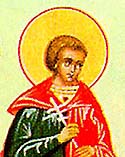
Saint Amphien
Martyr à Césarée de
Palestine (+ 305)
Apphien ou Apphianos et son frère Edèse.
Martyrs à Césarée de Palestine. Les connaissances de saint Amphien étaient aussi étendues qu'étaient grandes ses vertus. Quand on l'interrogeait sur sa condition, ses origines, son domicile, il répondait imperturbablement: "Serviteur du Christ." Le juge le fit suspendre en l'air, par les poignets et envelopper les pieds et les jambes avec des linges imbibés d'huile. Transformé ainsi en torche vivante, il résista à la mort. Il fut alors jeté à la mer avec des pierres attachées aux pieds. Son frère fut condamné aux mines de cuivre de Palestine, travail particulièrement pénible qui équivalait à une lente condamnation à mort.
À Césarée de Palestine, en 306, saint Apphien, martyr. Sous l'empereur Maximin
Daia, les habitants étaient contraints de sacrifier aux dieux. Intrépide,
Apphien arriva jusqu'au préfet Urbain et lui saisit le bras droit, l'obligeant
à interrompre le rite. Les soldats lui enveloppèrent les pieds dans un linge
imbibé d'huile, auquel ils mirent le feu, puis le jetèrent, encore vivant, dans
la mer.
Martyrologe romain
SOURCE : https://nominis.cef.fr/contenus/saint/6385/Saint-Amphien.html
Le Saint Patron de la
Commune : SANT’APPIANU
La vie de Saint Appien
est peu connue et diffère selon les historiens.
« Appien est né en Lycie
de parents riches et nobles qui l’envoyèrent à Bérite en Phénicie dans des
écoles de philosophie et de droit romain.
De retour dans sa patrie,
il travailla à la conversion de ses parents, qui étaient toujours idolâtres. La
douleur qu’il eut de les voir persister opiniâtrement dans les superstitions du
paganisme, lui fit pendre le parti de s’éloigner de leur maison. Il se retira à
Césarée en Palestine, n’étant âgé que de dix-huit ans, et augmenta le nombre
des disciples de Saint Pamphile, qui expliquait l’Ecriture Sainte dans cette
ville.
Tandis qu’il fréquentait
l’école de Saint Pamphile, l’empereur Galère-Maximien ralluma le feu de la
persécution. Ce dernier envoya des lettres au gouverneur de Césarée qui lui
ordonnaient d’obliger tous les sujets de l’Empire de se trouver aux sacrifices.
Appien, qu’un pareil ordre toucha d’une vive douleur, n’attendit point qu’on le
cherchât pour déclarer ses sentiments. Il alla au temple et s’approcha du
gouverneur. Lorsqu’il le vit lever la main pour offrir le sacrifice, il le
saisit par le bras et l’arrêta en lui disant qu’on ne devait adorer que le vrai
Dieu et que le culte rendu aux idoles était sacrilège.
Appien fut arrêté et mis
au cachot. Le gouverneur le fit torturer. On tenta de le faire abjurer, en
vain. Le gouverneur ordonna alors qu’il fût jeté dans la mer. On vit alors un
prodige. Le Martyr ne fut pas plus tôt tombé dans l’eau, qu’il s’éleva une
grande tempête et qu’on sentit dans la ville les secousses d’un violent
tremblement de terre. La mer rejeta le corps du Saint. Saint Appien reçut la
couronne du martyr le 02 avril 306. » (D’après « la vie des Saints, Pères et
martyrs »)
« En Corse, Saint Appien,
évêque et martyr (époque indécise). Appien fut titulaire de l’église cathédrale
de Sagone, l’un des cinq évêché de l’île avant 1789. Nulle trace ne subsiste ni
de l’église ni de la légende du Saint, qui jouit cependant d’un culte local ».
(D’après « Vie des Saints, Index général »).
« Dans le diocèse de
Mariana, l’église piévane de Borgo lui est dédiée ; c’est l’ancienne plebania
dont les ruines sont visibles dans l’actuel cimetière (IXème et Xème s.) ; dans
l’église paroissiale placée sous le vocable de l’Annonciation, sa
représentation en évêque figure dans deux tableaux et un reliquaire.
Il n’est pas exclu
qu’Appiano ait pu venir en personne à Mariana où se trouvait Parteo, – donc son
souvenir s’y était maintenu ? – , mais il est aussi vraisemblable que ces
différents sanctuaires, en plaine ou en montagne, avaient bénéficié à leur
origine de quelques reliques du saint évêque de Sagone, diffusées entre le
VIème et le Xème s.
[…] On célèbre encore de
nos jours à Borgo, chaque 13 novembre, la fête de Saint Appien, alors que la
fête, dans le diocèse de Sagone était autrefois célébrée le 19 janvier. A en
juger par les tableaux précités, il doit s’agir du même évêque ; d’ailleurs
c’est bien celui de Sagone que l’on honore à Borgo » (D’après « Corsica Sacra »
de Madeleine Moracchini-Mazel).
SOURCE : http://penta-acquatella.fr/?page_id=45
MARTYRE DE SAINT APPIEN,
À CÉSARÉE
(Sous Maximin, l'an 306)
fêté le 2 avril
À peine monté sur le
trône, le farouche Maximin, comme s'il eût voulu déclarer la guerre à Dieu
lui-même, rendit des édits plus sanglants qu'aucun de ses prédécesseurs, et
telle fut la rigueur de la persécution, qu'un grand nombre de chrétiens, pour
se dérober aux supplices, fuyaient et se cachaient dans les déserts.
Tandis que tout tremblait
devant le tyran farouche, un jeune homme distingué par sa naissance (qui pourra
dire quelle dut être l'ardeur de son amour ? ), un jeune homme à peine âgé de
vingt ans, renonçant à tous les biens du siècle et à tous les charmes de la
vie, alla se livrer comme une proie aux persécuteurs.
Né en Lycie d'une famille
puissante et riche, Appien avait été envoyé à Béryte pour faire ses études; il
y fit en peu de temps des progrès incroyables dans les sciences profanes. Mais
à quoi bon lui donner cet éloge ? La gloire de son martyre va tout éclipser.
Toutefois disons à sa louange qu'il traversa le temps difficile de la jeunesse,
cet âge de l'inexpérience et des erreurs, sans porter la moindre atteinte à la
pureté de son âme, et que dans une ville corrompue, au milieu d'une jeunesse
immonde, il évita jusqu'à l'apparence du mal; à la maturité de son jugement et
à la gravité de ses mœurs, on eût dit un vieillard. Ainsi jeta-t-il dans son
âme les fondements d'une vertu solide et à l'épreuve de toutes les attaques.
Après avoir achevé le
cours de ses études, il revint dans son pays natal. Il trouva dans sa famille
des mœurs bien différentes des siennes, et résolut de la quitter. Il s'enfuit
donc de la maison paternelle secrètement et sans ressources, mettant en Dieu sa
confiance, et il arriva ainsi à Césarée, Dieu le conduisant, pour ainsi dire,
par la main; c'est là que l'attendait la glorieuse couronne du martyre. Nous
eûmes le bonheur de vivre avec lui, et d'être témoins de ses constants efforts
pour s'avancer de plus en plus dans la divine sagesse, et pour imiter les
vertus du saint martyr Pamphile, son maître. C'est ainsi qu'il se préparait à
ce martyre héroïque qui frappa de stupeur tous ceux qui en furent témoins, et
dont on ne pourra entendre le récit sans admirer la constance sublime de ce
jeune homme, sa sagesse étonnante dans ses réponses au juge, et par-dessus tout
l'ardeur de sa foi et la force de son amour.
La persécution sévissait
déjà depuis trois ans, quand arrivèrent à Césarée des lettres de l'impie
Maximin, enjoignant aux magistrats d'amener tous les habitants aux autels des
dieux pour sacrifier. Aussitôt les crieurs publics proclamèrent par toute la
ville les ordres de l'empereur; des chiliarques et des centurions allèrent par
les rues et par les maisons, ordonnant à chacun nommément de se présenter aux
temples. L'effroi fut universel parmi les chrétiens. Alors Appien, glorieux
martyr de la vérité, sans communiquer ses desseins à personne, pas même à nous
qui habitions sous le même toit, s'en va trouver le préfet Urbain, au milieu
même d'un sacrifice. Il traverse courageusement les rangs des soldats qui
formaient sa garde, pénètre jusqu'à lui, et, le prenant par la main, l'entraîne
et lui fait interrompre son honteux sacrifice. Alors, avec le calme et la
dignité qui convenaient à un vengeur de la gloire divine, il lui parle de
l'absurdité de ses croyances, et lui démontre combien il est indigne d'un homme
raisonnable de refuser son culte au Dieu unique et véritable, et de sacrifier à
de vaines idoles, à des démons.
Telle fut l'action
courageuse que la grâce puissance de Jésus Christ notre Sauveur inspira à
Appien, afin de confondre l'impiété d'un persécuteur par l'héroïsme d'un jeune
homme, et de faire connaître au monde entier que les disciples de Jésus, loin
de craindre les supplices et la mort même, ont le cœur assez haut et l'âme
assez grande pour oser, à la face même des tyrans, confondre l'erreur et
proclamer la divinité de Jésus-Christ, sauveur des hommes.
Les ministres du démon
qui entouraient le préfet, transportés d'une fureur extrême, se jettent sur le
saint martyr, frappent au visage le saint jeune homme, le renversent et le
foulent indignement aux pieds. Après cela, ils le font conduire en prison, où on
lui tint les pieds douloureusement écartés dans des entraves; le lendemain il
fut cité devant le juge, et on essaya sur lui neuf tourments terribles.
Et d'abord, le tyran
ordonna de lui déchirer les côtes jusqu'à lui découvrir les os et les
entrailles; puis il le fit frapper de verges à la tête et sur le visage, d'une
façon si cruelle, que ses amis mêmes auraient eu de la peine à le reconnaître.
Appien, soutenu par la
grâce divine, supportait ces tortures avec tant de courage qu'on eût dit qu'il
avait un cœur d'airain; il triompha également des autres supplices qu'inventa
la rage du tyran; au milieu des tourments, il n'avait que ces deux mots à la
bouche : «Je suis chrétien !» À toutes les questions qu'on lui faisait, il ne
répondait que ces deux mots : «Je suis chrétien !» Le juge en frémissait de
rage; à la fin il ordonna aux bourreaux de lui envelopper les pieds d'un linge
trempé d'huile, et d'y mettre le feu. Les bourreaux les saisissent et le
relèvent : quel spectacle ! Sa poitrine, déchirée par les ongles de fer, et ses
côtes par les fouets garnis de plomb, laissaient voir l'intérieur de son corps.
Cependant ses pieds brûlaient et fondaient comme de la cire; enfin, les chairs
étant consumées, la flamme pénétra jusqu'aux os et le dévora comme une paille
sèche. Ce supplice affreux ne put triompher du martyr : Dieu, qui habitait dans
son cœur, soutenait son courage, et il ne cessait de glorifier Dieu et de
rendre témoignage au Christ; le Christ aussi rendait témoignage au martyr en
lui inspirant cette constance héroïque et cette force invincible qui
remplissaient d'admiration les témoins de son glorieux combat.
Les bourreaux, se voyant
vaincus par cette héroïque constance, grinçaient des dents et frémissaient; ils
lui demandaient son nom, sa patrie, son emploi; ils le pressaient de sacrifier
aux idoles. Le martyr ne daignait pas leur répondre; il les regardait d'un œil
calme et dédaigneux, qui semblait leur dire : «Vous êtes vaincus !» et il ne
répétait que ces deux mots : «J'adore le Christ, seul Dieu avec son Père !»
Enfin, fatigués et vaincus, les bourreaux reconduisirent à la prison le soldat
de Jésus Christ.
Le lendemain il comparut
de nouveau devant le juge, et comme il persistait à confesser Jésus Christ, il
fut jeté à la mer.
L'événement miraculeux
qui suivit immédiatement la mort du saint martyr paraîtra incroyable à ceux qui
ne veulent croire que ce qu'ils voient de leurs yeux; cependant puisque la
ville de Césarée tout entière en a été témoin, et l'atteste, je le raconterai
avec confiance à la postérité. A peine le corps du jeune martyr eut-il été jeté
à la mer, que tout à coup un bruit terrible se fit entendre, un mouvement
tumultueux souleva les eaux, une secousse violente ébranla la terre, et tous
les habitants, consternés, levèrent les mains au ciel, croyant que leur ville
allait les engloutir sous ses ruines. Et voilà qu'au milieu de cette confusion
des trois éléments, on vit les flots soutenir le corps du martyr, et, comme
s'il leur eût été impossible de le garder, le déposer doucement aux portes de
la cité. À la nouvelle de cet événement, les hommes, les femmes, les enfants,
les vieillards, accourent en foule pour être témoins du prodige, et tous
rendaient gloire au Dieu des chrétiens, et confessaient le nom de Jésus Christ.
Telle fut la fin glorieuse de l'héroïque Appien, dont on célèbre la mémoire le
second jour du mois d'avril.
SOURCE : http://orthodoxievco.net/ecrits/vies/martyrs/avril/appien.htm
Les saints
martyrs Amphianus et Edesius
Les saints
martyrs Amphianus et Edesius étaient frères. Ils
vivaient dans la ville de Patara (Province de Lycie) dans
la famille du gouverneur païen. Ils sont allés à la ville
de Beyrouth pour étudier les sciences païennes. Là,
ils sont devenus d'ardents disciples du Christ.
Les saints frères ont quitté leurs parents païens et se
rendirent à Alexandrie et Césarée, où ils ont trouvé un
instructeur, St Pamphile (16 Février), et sous sa
direction, ils sont devenus accompli dans la vie
Spirituelle, passent leur temps dans la Prière et l'étude des livres sacrés.
Par décret de l'Empereur Maximien (305-313), un
persécuteur païen et cruel avec zèle des
chrétiens, tous les habitants de Césarée devaient offrir un
sacrifice public. Beaucoup de chrétiens, y
compris Sts Amphianus et Edesius, ont dû se
cacher pour éviter de sacrifier aux idoles.
Quand la ville préfet de Césarée était sur le point de
sacrifier aux idoles, St Amphianus allé hardiment
dans le temple, prit la main du
préfet, et lui a demandé d'abandonner son erreur
et croire en Christ.
Par ordre du gouverneur, des soldats ont
saisi St Amphianus, farouchement battu puis jeté en
prison. Deux jours plus tard, ils l'ont conduit à un
procès, où ils l'ont frappé avec des barres de fer et
brûlé son corps avec des ballots de lin trempées dans
l'huile.
Le brave garçon, confessant fermement sa foi en
Jésus-Christ, a ensuite été jeté à la mer avec une
pierre au cou. Soudain, une tempête se leva, et les
vagues réalisée le corps du martyr de la côte, où il a
été enterré par les chrétiens.
Also
known as
Affianus
Amphian
Amphianus
Anphian
Aphian
Aphianus
Apian
Apphian
Apphianos
Profile
Born to wealthy,
prominent and non-Christian family. Brother of Saint Aedesius
of Alexandria. Well educated, studying rhetoric, philosophy and civil
law in Beirut, Lebanon. Convert to Christianity.
Friend of Eusebius of Caesarea; the pair made a pilgrimage to Palestine. Studied under Saint Pamphilus.
In May 305, Emperor
Maximinus declared that everyone should take part in public sacrifices
in celebration of his coronation. When it came time for the sacrifices in his
city, Appian went to the temple and stopped the official, Urbanus, from
offering incense to an idol,
explaining that it was impious to worship an idol instead
of the true God, and
berating the judge for doing it. Appian was beaten, imprisoned,
his flesh torn off with iron claws, and roasted over a slow fire. He was then
ordered to sacrifice to the Roman gods; he declined. Martyr.
Born
c.287 in
Gagae, Asia
Minor
drowned in
April 306 in
Caesarea, Palestine by
having stones tied him and then being thrown into the sea
an earthquake immediately
struck the area and Appian’s body, stones and all, immediately washed back up
onto the beach
Additional
Information
Lives
of the Saints, by Father Alban
Butler
Saints
of the Day, by Katherine Rabenstein
books
Our Sunday Visitor’s Encyclopedia of Saints
other
sites in english
Prologue from Ochrid, by Bishop Nikolai Velimirovic
webseiten
auf deutsch
sitios
en español
Martirologio Romano, 2001 edición
sites
en français
fonti
in italiano
Martirologio Romano, 2005 edition
websites
in nederlandse
nettsteder
i norsk
strony
w jezyku polskim
Reading
I confess Christ, the
one God,
and the same God with
the Father. – Saint Appian
to the court when ordered to sacrifice to idols
MLA
Citation
“Saint Appian of
Caesarea“. CatholicSaints.Info. 12 April 2023. Web. 24 March 2026.
<https://catholicsaints.info/saint-appian-of-caesarea/>
SOURCE : https://catholicsaints.info/saint-appian-of-caesarea/
St. Amphianus
Feastday: April 2
Death: 305
Martyr, also called
Appian and Apian. He was a young man of Christian faith in
Lycia, Turkey. He intruded upon a Roman governor's pagan sacrifices
in the official residence. Arrested for being a Christian, Amphianus continued
his charges of vain idolatry to
the governor. For this he was tortured to death.
SOURCE : https://www.catholic.org/saints/saint.php?saint_id=1342
St. Appian
Feastday: April 2
Death: 306
Martyr of Phoenicia, now
Lebanon. He was born in Lycia, circa 286, and studied at Berytus, modern
Beirut. From there he went to Caesarea, with Eusebius. When an imperial order
demanded public sacrifice to
the gods of Rome, Appian protested to the local governor. He was arrested and
thrown into the sea with weights on his feet. Tradition states that an
earthquake followed his execution, bringing the body back on shore. In some
lists he is called Apphian.
SOURCE ; https://www.catholic.org/saints/saint.php?saint_id=1505
Amphianus of Lycia M (RM)
(also known as Aphian,
Amphian, Appian, Apian)
Died April 2, c. 305.
Amphianus was a young Christian of Lycia, Asia Minor, whose parents gave him
the best education possible in rhetoric, law, and philosophy in the famous
schools of Berytus, Phoenicia. While he was away at school, he became a
Christian. Upon completing his studies, he returned home but was disturbed by
the idolatry of his parents. Thus, at the age of 18, he retired to Caesarea,
Palestine. There he became a disciple of Saint Pamphilius, who was teaching
Scripture.
In May 305, Galerius
Maximianus, the chief proponent of the Diocletian persecutions, was declared
emperor of the East, which Maximinus Daia governed under him, as Caesar.
Letters came to Caesarea from Maximinus Daia ordering the governor to compel
everyone to attend public, solemn sacrifices to the civic gods.
The Church historian
Eusebius (De Martyr. Palaest., c. 4), with whom Amphianus lived, tells us that,
without saying anything to anyone, Amphianus entered the governor's palace and
stopped the latter on the point of offering sacrifices to idols. Amphianus,
with youthful boldness, reproached him for his crime of idolatry. He was
forthwith beaten, arrested and thrown into a dungeon, where he was kept in
stocks for two days. As he was flayed, his only answer to all questions was:
"I am a servant of Christ." Next the executioners were ordered to set
his feet aflame. As his flesh melted like wax, he remained resolute, which
struck his persecutors with astonishment.
He was thrown back into
prison for three days. During his trial, he persisted: "I confess Christ
the only God, and the same God with the Father." Although he was already
half-dead, the judge ordered that he be thrown into the sea. Eusebius records
that at his execution, the sea and the city were shaken by an earthquake
accompanied by a dreadful noise. He writes that it was as if the sea were not
able to endure the corpse of the martyr, and threw it up before the gates of
the city: all the inhabitants went out to see this prodigy, and gave glory to
the God of the Christians, confessing aloud the name of Jesus Christ
(Benedictines, Encyclopedia, Husenbeth).
SOURCE : http://www.saintpatrickdc.org/ss/0402.shtml
St. Aphian
St. Aphian (or Apian), an
illustrious martyr,
under the Emperor
Maximian, c. 306. He was only eighteen when he entered the temple at
Cæsarea, where the prefect Urbanus was offering sacrifice. Seizing the
outstretched hand that was presenting the incense,
he reproached the magistrate with the idolatrous act.
The guards fell upon him furiously and, after cruelly torturing him, flung him
into a dungeon. The next day he was brought before the Prefect, torn with iron
claws, beaten with clubs, and burned over a slow fire, and then sent back to
confinement. After three days he was again taken from prison and
thrown into the sea with stones tied to his feet. Eusebius,
an eyewitness, declares that an earthquake simultaneously shook the city, and
that the sea flung up his corpse on the shore. He belonged to Lycia, but had
withdrawn to Cappadocia because his parents,
who were both distinguished and rich, resisted his efforts to convert them
to Christianity.
St. Pamphilus was at Cæsarea at the time, expounding Holy
Scripture, and the young Aphian was one of his disciples. He lived at the
house of Eusebius,
but gave no intimation of his purpose to make the public protest which ended in
his martyrdom.
The Greeks refer to him as the brother of St. Ædisius. In the old martyrologies his
feast was on the fifth, but the Bollandists pronounce
for the second of April as the correct date.
Campbell,
Thomas. "St. Aphian." The Catholic Encyclopedia. Vol.
1. New York: Robert Appleton Company, 1907. 2 Apr.
2016 <http://www.newadvent.org/cathen/01593b.htm>.
Transcription. This
article was transcribed for New Advent by Frank O'Leary. In Memoriam,
Francis McGrath.
Ecclesiastical
approbation. Nihil Obstat. March 1, 1907. Remy Lafort, S.T.D.,
Censor. Imprimatur. +John Cardinal Farley, Archbishop of New York.
Copyright © 2023 by Kevin Knight.
Dedicated to the Immaculate Heart of Mary.
SOURCE : http://www.newadvent.org/cathen/01593b.htm
April 2
St. Apian, Martyr
CALLED by the Greeks and
Latins Aphian, and sometimes Amphian. He was born of rich and illustrious
parents in Lycia, and by them sent in his youth to study eloquence, philosophy,
and the Roman laws, in the famous schools of Berytus, in Phœnicia. He made a
most rapid progress in learning: but it was his greatest happiness that, having
embraced the Christian faith, he, by the means of prayer and retirement,
preserved his innocence and virtue untainted in the midst of vice and lewdness.
Returning home after his studies, he found his parents yet idolaters; and
therefore withdrew to Cæsarea in Palestine, being at that time eighteen years
of age. St. Pamphilus there expounded the holy scriptures with great piety and
learning, and Apian became one of his auditors. Such was his conduct in that school
of martyrs, as prepared him to take the lead among them, and set the rest an
example. Dioclesian having abdicated the empire at Nicomedia, on the 1st of
May, in 305, Galerius Maximianus, the chief promoter of his bloody persecution,
was declared Emperor of the East, which Maximinus Daia governed under him, as
Cæsar. There came letters to Cæsarea from the last-mentioned, containing orders
to the governor to compel all persons whatever to attend the public solemn
sacrifices. Then Apian, without having communicated his design to any person,
“not even to us,” says the historian Eusebius, with whom he dwelt, went to find
out the governor Urbanus, as he was sacrificing, and came near to him without
being perceived by the guards that surrounded him; and taking hold of his right
hand, with which he was performing the ceremony, stopped him, saying, it was an
impious thing to neglect the worship of the true God, and to sacrifice to idols
and demons. God inspired this generous youth, not yet twenty years of age, by
this daring and extraordinary action, to confound the impiety of the
persecutors, and to show them the courage of his servants. The guards instantly
fell upon him, like so many wild beasts, cruelly buffetted his face, beat him
down to the ground, kicked him unmercifully, hideously tore his mouth and lips,
and wounded him in every part of his body. He was then thrown into a dark
dungeon, where he remained a day and a night with his feet stretched very wide
in the stocks. The next day he was brought before the governor, who commanded
he should suffer the most exquisite tortures. He had his sides torn so that his
bones and entrails appeared: and his face was so swoln with the blows he had
received, that he could not be known by his most intimate acquaintance. His
only answer to all questions was: “I am a servant of Christ.” His constancy
having thrown the tyrant into a transport of rage, he ordered the executioners
to apply to his feet lighted matches of flax dipped in oil. The fire burned up
his flesh and penetrated even to the very bones, and the juice of his body
dropped from him like melted wax, but he still continued resolute. His patience
struck the persecutors with astonishment: and when pressed by his tormentors to
sacrifice and obey the judge, fixing his eyes upon them, he only replied: “I
confess Christ the only God, and the same God with the Father.” He was then
remanded to prison, where he continued three days. Being then brought before
the judge, he persisted in his confession, and, though half-dead, was by his
order cast into the sea. A prodigy ensued, of which there were as many
witnesses, says Eusebius, as citizens of Cæsarea. He was no sooner thrown into
the water, with stones tied to his feet, but both the sea and the city were
shook with an earthquake, accompanied with a dreadful noise, and the sea, as if
it was not able to endure the corpse of the martyr, threw it up before the
gates of the city: all the inhabitants went out to see this prodigy, and gave
glory to the God of the Christians, confessing aloud the name of Jesus Christ.
The triumph of St. Apian happened on the 2nd of April, 306, in the nineteenth
year of his age. See Eusebius, an eye-witness, De Martyr. Palæst. c. 4, and his
genuine acts in Chaldaic, given to the public by Stephen Assemani, t. 2. p.
188.
Rev. Alban
Butler (1711–73). Volume IV: April. The Lives of the
Saints. 1866.
SOURCE : http://www.bartleby.com/210/4/022.html
Sant' Appiano Martire
Festa: 2 aprile
† 306
Nella Palestina del 306
d.C., i cristiani erano perseguitati. Sant'Appiano, uomo di profonda fede, non
si piegò alle ingiustizie. Di fronte al governatore che officiava un rito
idolatrico, Appiano afferrò la sua mano impedendogli di compiere il sacrificio.
Sottoposto a torture, con i piedi avvolti in panni di lino intrisi di olio e
dati alle fiamme, Appiano venne gettato in mare ancora vivo.
Martirologio
Romano: A Cesarea in Palestina, sant’Appiano, martire, che, sotto
l’imperatore Massimino, poiché il popolo era costretto a sacrificare
pubblicamente agli dèi, accostatosi con coraggio al governatore Urbano, gli
afferrò la mano destra, obbligandolo a sospendere il rito e per questo, con i
piedi avvolti da un panno di lino intinto nell’olio e dato alle fiamme, fu
precipitato ancora vivo in mare dai soldati.
Nelle terre della Palestina, sotto il dominio ferreo dell'imperatore Massimino, fiorì la fede di un uomo dal cuore intrepido: Sant'Appiano. La sua storia, narrata tra le pagine del Martirologio Romano, risuona come un inno al coraggio e alla dedizione a Dio.
Correva l'anno 306 d.C. quando la tirannia di Massimino si accanì contro i cristiani, costringendoli a sacrificare agli dei pagani. Sant'Appiano, testimone silenzioso di tanta ingiustizia, non poteva rimanere inerte. Il suo animo ardeva di fede e il suo amore per Dio era una fiamma inestinguibile.
Con passo sicuro e cuore ardente, si avvicinò al governatore Urbano, l'artefice di questa persecuzione. Con un gesto audace, afferrò la mano destra del tiranno, fermando il rito idolatrico in corso. Un atto di ribellione non violento, ma carico di una forza interiore incontrastabile.
La furia di Urbano si abbatté su Appiano con tutta la sua brutalità. I suoi piedi furono avvolti in un panno di lino intriso d'olio e dati alle fiamme. Un dolore atroce, ma il volto di Appiano non tradì mai la sua fede. Anzi, una luce di serena speranza brillava nei suoi occhi.
Come un'ultima, vile offesa, i soldati lo gettarono ancora vivo in mare. Ma la sua anima, libera dalle catene terrene, salì al cielo, dove la sua fede trovò la sua più alta ricompensa.
Autore: Franco Dieghi
SOURCE : https://www.santiebeati.it/dettaglio/48210
Aphianus
auch: Aphian, Apian,
Apphianus, Amphianos
Gedenktag katholisch: 2.
April
Gedenktag orthodox: 2.
April
Gedenktag armenisch: 2.
April
Gedenktag
syrisch-orthodox: 2. April
Name bedeutet: der
Freigelassene (griech. - latein.)
Märtyrer
* um 285 in Gagae, heute Ruinen bei Kumluca in der Türkei
† 2. April 306 in Cäsarea in
Israel
Aphianus, der Bruder
von Aedesius,
stammte aus einer wohlhabenden heidnischen Familie, studierte an der berühmten
Schule der Rechte in Berytus - dem heutigen Beirut -,
und fand dort zum christlichen Glauben. Die Überlieferung erzählt, dass er vor
seiner Familie um des Glaubens willen floh, nach Cäsarea kam
und Schüler des Exegeten Pamphilus wurde,
in dessen Haus er asketisch lebte; einer seiner Mitschüler war Eusebius
von Cäsarea. Im Zuge der Verfolgungen unter Kaiser Maximinus Daia ging er
zum Statthalter Urbanus, der eben ein öffentliches Trankopfer darbrachte,
fasste ihn unerschrocken bei der rechten Hand und wollte ihn am Opfern hindern,
deshalb wurde er gefangen genommen, vor den Richter geführt, geschlagen,
gefoltert und schließlich nach drei Tagen im Hafen der Stadt ins Meer versenkt.
Eusebius war Augenzeuge, er berichtet von einem Seebeben, das in diesem Moment
auch die ganze Stadt erschütterte und Aphianus' Leichnam wundersamer Weise an
Land spülte.
Die Informationen
über Aedesius und
Aphianus stammen aus Eusebius' Werk
über die Märtyrer in Palästina.
Über das Leben und
Martyrium von Aphianus berichtete Eusebius
von Cäsarea im 4.
Kapitel Über die Märtyrer in Palästina, zu finden auf Deutsch in der
Bibliothek der Kirchenväter der Université
Fribourg.
Seite zum
Ausdruck optimiertUnser Reise-Blog:
Reisen zu den Orten, an denen die
Heiligen lebten und verehrt werden.
Empfehlung an
Freunde senden
Artikel
kommentieren / Fehler melden
Fragen? -
unsere FAQs antworten!
Impressum - Datenschutzerklärung
Schauen Sie sich zufällige Biografien an:
Nikolaus
Barre
Meinhard
Matthäus
Autor: Joachim
Schäfer - zuletzt aktualisiert am 25.08.2023
Quellen:
• Ekkart Sauser. In: Friedrich-Wilhelm Bautz †, Traugott Bautz (Hg.): Biographisch-Bibliographisches Kirchenlexikon, Bd. XV, Herzberg 1999
• https://www.newadvent.org/cathen/01593b.htm - abgerufen am 19.07.2023
• Lexikon für Theologie und Kirche, begr. von Michael Buchberger. Hrsg. von
Walter Kasper, 3., völlig neu bearb. Aufl., Bd. 1. Herder, Freiburg im Breisgau
1993
korrekt zitieren: Joachim Schäfer: Artikel Aphianus, aus dem Ökumenischen Heiligenlexikon - https://www.heiligenlexikon.de/BiographienA/Aphianus.htm, abgerufen am 24. 3. 2026
Die Deutsche Nationalbibliothek verzeichnet das Ökumenische
Heiligenlexikon in der Deutschen Nationalbibliografie; detaillierte
bibliografische Daten sind im Internet über https://d-nb.info/1175439177 und https://d-nb.info/969828497 abrufbar.
SOURCE : https://www.heiligenlexikon.de/BiographienA/Aphianus.htm
Den hellige Appian av
Caesarea (~287-306)
Minnedag:
2. april
Den hellige Appian
(Apphian, Apian, Anphian, Amphianus, Aphianus, Apphianos) er kjent gjennom
skriftene til den berømte kirkehistorikeren Eusebius av
Caesarea (ca 260-340). I sitt verk «Martyrer i Palestina» (De
martyribus Palestinae) forteller Eusebius om forfølgelsene under keiserne
Diokletian (284-305), hans medregent i vest, Maximian Herkules (286-305) og
Maximian Galerius (305-11), som pågikk fra 303 til 310. Eusebius var vitne til
mange av henrettelsene og kjente flere av martyrene personlig, inkludert
Appian.
Appian ble født rundt 287
i Gagae ved det nåværende Finike i Lykia i Lilleasia. Hans foreldre var både
rike og fremstående. Grekerne og det førkonsiliære Martyrologium Romanum sier
at han var bror av den hellige Edesius, som
led martyrdøden ca 306 i Alexandria i Egypt. Foreldrene ga ham den best mulige
utdannelsen i retorikk, jus og filosofi ved den berømte juridiske skolen i
Berytus i Fønikia (i dag Beirut i Libanon). Der fant han også den kristne tro,
og deretter prøvde han å omvende foreldrene, men de motsto hans forsøk. Da han
var atten år gammel, dro han sammen med Eusebius til Caesarea i Palestina. Der
var han elev av den hellige Pamfilus, som
på den tiden var i Caesarea og utla den hellige skrift.
I mai 305 ble Maximian
Galerius, hovedansvarlig for forfølgelsene under Diokletian, erklært keiser i
øst med Maximinus Daia under seg som medkeiser (caesar). I den anledning
ble det utstedt en generell ordre om at alle skulle være til stede ved de
offentlige ofringene. Appian fulgte ordren og gikk inn i tempelet, hvor
magistraten Urbanus var i ferd med å gjennomføre ofringen. Appian grep Urbanus'
utstrakte hånd som presenterte røkelsen og hindret ham i å ofre. Han
irettesatte magistraten og erklærte at det var en ugudelig handling å dyrke
gudebilder i stedet for den sanne Gud.
De rasende vaktene kastet
seg over ham, og etter at de hadde torturert ham på det grusomste, kastet de
ham i fangehullet. Neste dag ble han brakt for prefekten, men han nektet å
oppgi sin tro. Da han ble oppfordret til å ofre til de romerske gudene,
erklærte han: «Jeg bekjenner Kristus, den ene Gud, og den samme Gud med Faderen».
Han ble da revet opp med jernklør, slått med køller og brent over langsom ild
før han ble sendt tilbake til fengselet.
Tre dager senere ble han
dømt til døden og henrettet ved å bli kastet i sjøen. Det skjedde den 2. april
306 i Caesarea i Palestina. Eusebius forteller at et jordskjelv straks rystet
området og at martyrens lik ble kastet opp på stranden, selv om det var bundet
fast til steiner.
Hans minnedag er 2.
april. Samme dag minnes den hellige Theodosia, som
led martyrdøden i Caesarea nøyaktig ett år senere, den 2. april 307.
Kilder:
Attwater/Cumming, Butler (IV), Benedictines, Bunson, KIR, CE, CSO, Infocatho, Heiligenlexikon -
Kompilasjon og oversettelse: p. Per Einar Odden -
Sist oppdatert: 2006-07-27 11:33
SOURCE : https://www.katolsk.no/biografier/historisk/appcaesa
Amfianus (ook Apfianus, Apianus of Appianus) van
Cesarea, Palestina (of van Lycië); priester & martelaar met zijn
broer Aedesius (ook Edesius); † 306.
Feest 2 & 5
& 8 (Aedisius) & 9 april
Hij was een jonge heiden,
afkomstig uit Lydda; bekeerde zich tot Christus en studeerde bij Pamfilus in
Cesarea († 309/310; feest 1 juni). Toen hij eens het huis betrad van de
plaatselijke gouverneur stond deze juist op het punt een offer te brengen aan de
Romeinse goden. Hij wees de hoogwaardigheidsbekleder daarover scherp terecht.
Op staande voet werd hij gearresteerd en gruwelijk gemarteld tot de dood erop
volgde.
Een andere weergave van
de feiten vertelt dat hij op de dag van zijn priesterwijding, 2 april 306, werd
gearresteerd en gruwelijk om het leven gebracht.
Met hem wordt ook genoemd
zijn broer Aedesius die echter in Alexandrië de marteldood zou hebben
ondergaan.
[100:04.09» praetermissi; 101a; 107; 141; Dries van den Akker s.j./1999.06.30]
© A. van den Akker
s.j. / A.W. Gerritsen
SOURCE : https://heiligen-3s.nl/heiligen/04/02/04-02-0306-amfianus.php
San Apiano o Apfiano
San Apiano o Apfiano.
Sufrió el martirio en Cesarea de Palestina el año 306, siendo emperador
Maximiano. Cuando en una de las ocasiones el pueblo fue obligado a sacrificar
públicamente a los dioses, él se acercó con coraje al gobernador Urbano, lo
agarró de la mano derecha y lo obligó a suspender el rito; por esto le
envolvieron los pies con un paño de lino empapado de aceite y le prendieron
fuego, y todavía vivo lo arrojaron al mar los soldados.
SOURCE : https://www.franciscanos.org/agnofranciscano/m04/dia0402.html
San Affiano. M.
c. 303.
(Amfiano, Anfiano, Apfiano, Apiano).
Martirologio Romano: En Cesarea de Palestina, san Affiano o Anfiano,
mártir, que, viendo cómo en tiempo del emperador Maximino se obligaba al pueblo
a sacrificar públicamente a los dioses, se acercó intrépido al prefecto Urbano
y, asiéndole por el brazo, quiso impedir el rito, por lo cual, con los pies
envueltos en lino empapado con aceite, le prendieron fuego y, aún vivo, fue
arrojado al mar por los soldados.
Nos cuenta Eusebio de
Cesarea que nacido en Gagas de Licia en el seno de una familia rica. Se educó
en Berito e hizo consagración de su castidad. Rehusó a puestos de poder. Tenía
17 años cuando marchó a Cesarea de Palestina en el momento de la persecución de
Maximino; entró en la casa del gobernador en el momento que éste sacrificaba a
los ídolos y le criticó su idolatría, es apresado y un cristiano apóstata,
llamado Urbano, le conminó a abjurar, él se negó hasta que fue salvajmente
torturado hasta morir ahogado en el mar. Hermano de san Edesio.
SOURCE : https://hagiopedia.blogspot.com/2013/04/otros-santos-del-dia_2.html
The Holy Martyrs
Amphianus and Aedesius
(April 2) : https://web.archive.org/web/20080111151710/http://www.serbianorthodoxchurch.net/cgi-bin/saints.cgi?view=590386197258