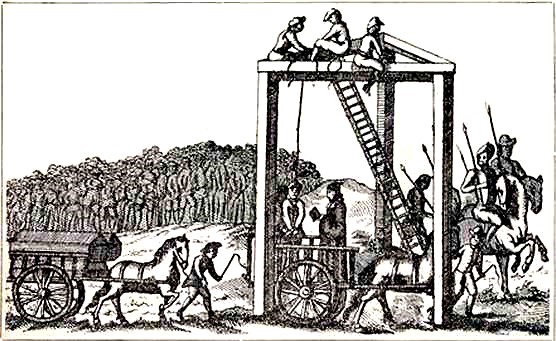
« The
Tyburn Tree » (L'arbre de Tyburn, gravure, 1680), appelé ainsi car le
triple gibet en bois s'y dressa jusqu'en 1759. En 1571 fut érigé le premier gibet permanent, de forme triangulaire,
sur lequel vingt-quatre personnes pouvaient être pendues à la fois
Bienheureux Jacques
(James) Duckett
Martyr à Tyburn (+ 1602)
Béatifié en 1929.
Protestant devenu catholique,
marié et libraire, il fut dénoncé pour avoir vendu des livres catholiques.
Après neuf ans passés en prison, il fut condamné à mort, sous la reine
Élisabeth Ière, et soumis au supplice de la pendaison à Tyburn, avec son
accusateur, qu’en mourant il invita à une mort catholique.
Martyrologe romain
SOURCE : http://nominis.cef.fr/contenus/saint/10836/Bienheureux-Jacques-(James)-Duckett.html
Bienheureux Jacques
Duckett, martyr
Marié, Jacques Duckett
fut arrêté à Londres pour avoir vendu des livres catholiques. Il fut détenu
neuf années durant dans les geôles d'Elisabeth Ière avant d'être pendu en 1602
en confessant sa foi.
James Duckett
1601
Né à Gilfortrigs
(Skelsmergh, Westmoreland, Angleterre), James grandit dans le protestantisme.
Son parrain fut James Leybourbe de Skelsmergh, qui fut martyrisé lui aussi.
Il semble que James ait
trouvé la foi catholique durant les années où il fut apprenti à Londres,
après la lecture de livres catholiques.
Avant-même d’être reçu
dans l’Eglise, il subit la prison par deux fois, pour n’avoir pas assisté aux
offices protestants. Il fut contraint de transiger pour son apprentissage : son
employeur (chez lequel il avait trouvé les livres en question) intercéda à chaque
fois pour obtenir sa libération, mais le pria ensuite de changer d’employeur.
Il put enfin entrer dans
l’Eglise catholique, grâce à un vénérable prêtre nommé Weekes, lui aussi en
prison à Gatehouse (Westminster).
Deux ou trois ans après,
vers 1590, James épousa une veuve catholique mais, des douze années que dura
cette vie conjugale, il en passa pas moins de neuf en prison, à cause de son
zèle pour propager la littérature catholique, tant il était convaincu dans sa
nouvelle foi.
C’est son fils John,
devenu chartreux, qui put raconter plus tard ce qu’il savait de son père.
Sa dernière arrestation
fut le résultat d’une trahison : Peter Bullock, un relieur mis en prison, avait
donné son nom pour obtenir sa propre libération. Le 4 mars 1601, la maison de
James fut fouillée, on y trouva des livres catholiques, et James fut
immédiatement transféré à Newgate.
Durant le procès, Bullock
témoigna qu’il avait relié des livres catholiques pour James, qui reconnut le
fait. Le barreau ne jugeait pas coupable James, mais le Juge fit remarquer que
James Duckett avait fait relier un livre particulièrement odieux aux Anglicans
pour son contenu virulent. Le jury modifia alors son verdict, déclara James
coupable de crime et le condamna à mort.
En même temps, on
condamna trois prêtres : Francis Page, Thomas Tichborne, Robert Watkinson, qui
furent exécutés le lendemain.
Le traître Bullock ne
sauva pas sa peau pour autant : il fut emmené dans la même charrette à Tyburn.
En chemin, on tendit un verre de vin à James, qui le but et le tendit à son
épouse en lui demandant de boire aussi pour Bullock, en lui pardonnant.
L’épouse refusait, mais James la «gronda» gentiment, jusqu’à ce qu’elle
acceptât.
Parvenus à la potence,
James pensait toujours à son traître : il l’embrassa et le conjura de mourir
dans la foi catholique. Malheureusement, il ne semble pas que Bullock ait
consenti.
C’était le 19 avril 1601.
James Duckett fut
béatifié en 1929.
SOURCE : http://www.samuelephrem.eu/article-04-19-116073703.html

Detail
of a stained glass window in Tyburn Convent by Margaret Agnes Rope - https://www.tyburnconvent.org.uk/
Profile
London bookseller. Convert to Catholicism. Married and father of
one son. Arrested several
times for printing and selling Catholic books before
finally being executed for
the crime. Martyr.
Born
at Gilfortrigs,
Skelsmergh, Westmorland, England
hanged on 19 April 1602 at
Tyburn, London, England
8 December 1929 by Pope Pius XI (decree
of martyrdom)
15
December 1929 by Pope Pius XI
Additional
Information
Saints
of the Day, by Katherine Rabenstein
The
One Hundred and Five Martyrs of Tyburn
books
Our Sunday Visitor’s Encyclopedia of Saints
other
sites in english
sitios
en español
Martirologio Romano, 2001 edición
fonti
in italiano
Martirologio Romano, 2005 edition
MLA
Citation
“Blessed James
Duckett“. CatholicSaints.Info. 19 April 2024. Web. 30 March 2026. <https://catholicsaints.info/blessed-james-duckett/>
SOURCE : https://catholicsaints.info/blessed-james-duckett/
Bl. James Duckett
Feastday: April 19
Patron: of Booksellers, Publishers
Death: 1601
Martyr of England, hanged
at Tybum. James was
born in Gilfortriggs, Westmoreland, England. After being drawn to Catholicism,
he refused to attend Protestant services and passed two terms in prison. He
then took instructions and was baptized. James went to
London, where he spent more time in
prison and distributed Catholic materials.
Arrested for his faith, he was imprisoned for nine years before his execution
at Tyburn. He was beatified in
1929.
SOURCE : https://www.catholic.org/saints/saint.php?saint_id=3889
Blessed James Duckett M
(AC)
Born at Gilfortrigs,
Skelsmergh, Westmorland, England; died at Tyburn, England, in 1602; beatified
in 1929. James converted to Catholicism and settled in London as a bookseller.
After being imprisoned several times (totalling nine years incarceration) for printing
and selling Catholic books, James was martyred by hanging (Benedictines).
SOURCE : http://www.saintpatrickdc.org/ss/0419.shtml
Ven. James Duckett
Martyr,
b. at Gilfortrigs in the parish of
Skelsmergh in Westmoreland, England, date uncertain,
of an ancient family of
that county; d. 9 April, 1601. He was a bookseller and publisher in London.
His godfather was the well-known martyr James
Leybourbe of Skelsmergh. He seems, however, to have been brought up a Protestant,
for he was converted while
an apprentice in London by
reading a Catholic book
lent him by a friend. Before he could be received into the Church,
he was twice imprisoned for
not attending the Protestant service,
and was obliged to
compound for his apprenticeship and leave his master. He was finally reconciled
by a venerable priest named
Weekes who was imprisoned in
the Gatehouse at Westminster.
After two or three years he married a Catholic widow,
but out of his twelve years of married life, no less than nine were spent
in prison,
owing to his zeal in
propagating Catholic literature
and his wonderful constancy in his new-found faith.
His last apprehension was brought about by Peter Bullock, a bookbinder, who
betrayed him in order to obtain his own release from prison.
His house was searched on 4 March, 1601, Catholic books
were found there, and Duckett was at once thrown into Newgate. At his trial,
Bullock testified that he had bound various Catholic books
for Duckett, which the martyr acknowledged
to be true.
The jury found him not guilty, but Judge Popham at once stood up and bade them
consider well what they did, for Duckett had had bound for him Bristowe's
"motives", a controversial work peculiarly odious to Anglicans on
account of its learning and cogency. The jury thereupon reversed its verdict
and brought in the prisoner guilty
of felony. At the same time three priests,
Page, Tichborne,
and Watkinson were condemned to death.
Bullock did not save himself by his treachery, for he was conveyed in the same
cart as Duckett to Tyburn, where both were executed, 19 April, 1601. There is
an account, written by his son, the Prior of
the English Carthusians at
Nieuport (Flanders) of James Duckett's martyrdom.
On the way to Tyburn he was given a cup of wine;
he drank, and desired his wife to drink to Peter Bullock, and freely to forgive
him. At the gallows, his last thoughts were for his betrayer. He kissed him
and implored him to die in the Catholic Faith.
Camm, Bede. "Ven.
James Duckett." The Catholic Encyclopedia. Vol. 5. New York: Robert
Appleton Company, 1909. 18 Apr. 2015
<http://www.newadvent.org/cathen/05182b.htm>.
Ecclesiastical
approbation. Nihil Obstat. May 1, 1909. Remy Lafort, Censor. Imprimatur. +John
M. Farley, Archbishop of New York.
Copyright © 2023 by Kevin Knight.
Dedicated to the Immaculate Heart of Mary.
SOURCE : http://www.newadvent.org/cathen/05182b.htm
Menology
of England and Wales – Venerable James Duckett
Article
The Venerable James
Duckett was born in Westmoreland, and after finishing his schooling was sent to
London and bound apprentice to a tradesman. He was brought up a Protestant, and
was very zealous in the cause, till one day a friend lent him a book,
entitled The Foundation of the Catholic Religion. The perusal of this work
made a great impression on his mind, and after a time he became convinced of
the falsehood of his former belief and ceased to attend the church. This change
was noticed by some of his acquaintance, who went to inform the minister of the
parish of it. This man sent for Duckett, and endeavoured, but in vain, to
reclaim him to his own flock; and on his refusal he was committed to Bridewell.
His master procured his release, as also from a second imprisonment in the
Compter, but, seeing that these proceedings were likely to involve him trouble,
agreed to break the articles of his apprenticeship, and left him free. Duckett
then sought how to obtain instruction in the Catholic doctrine, and within two
months was reconciled by Mr. Weeks, a venerable priest, then a prisoner in the
Gatehouse. His life was ever most exemplary and devout, and after about three
years he married a good Catholic widow, with whom he lived the rest of his
days, as far as his frequent imprisonments allowed. Mr. Duckett maintained
himself principally by dealing in books, with which he contrived to supply many
Catholics, to their great spiritual benefit. This exposed him to many
prosecutions and penalties, and it is said that, out of the twelve years of his
married life, nine were spent in gaol. At length a certain bookbinder, who had
been employed by him, and was now condemned to death for some offence against
the laws, informed against him, in hope, it is supposed, of receiving his own
pardon. Justice Popham thereupon ordered Duckett’s house to be searched, and
the result was the discovery of certain religious books. The charge against him
was that of felony, but the jury at first acquitted him, until Popham insisted
that they should reconsider the verdict, which they did, and reluctantly
brought him in guilty. Before his execution, the Martyr spoke to his wife in the
most pious and touching manner, and exhorted her to thank God for the grace
conferred on him of being reckoned among thieves, as his Lord and Master had
been. It so happened, that the wretched man who had informed against him, so
far from receiving his own pardon, was sentenced to die at the same time with
his victim. They were taken to Tyburn in the same cart, and Duckett not only
freely forgave him, but expressed his perfect charity, and exhorted him to die
a Catholic. Even when the ropes were about their necks, he gave him a cordial
embrace, and with this heroic act submitted to his sentence.
MLA
Citation
Father Richard Stanton.
“Venerable James Duckett”. Menology of England and
Wales, 1887. CatholicSaints.Info.
13 April 2015. Web. 30 March 2026.
<https://catholicsaints.info/menology-of-england-and-wales-venerable-james-duckett/>
SOURCE : https://catholicsaints.info/menology-of-england-and-wales-venerable-james-duckett/
The
One Hundred and Five Martyrs of Tyburn – 19 April 1602
Article
Venerable James
Duckett, layman
His boyhood was spent
among the Westmoreland hills, where he was brought up in the new religion.
After his school-days he was bound apprentice to a merchant in London,
and there became convinced of the truth of Catholicism, which he embraced after
many trials and difficulties. He chose the trade of a bookseller, and supplied
books to Catholics, and this was the cause of his spending much of his married
life in prison. He was betrayed by a bookbinder, who being condemned to death
thus sought to save his own life, but lost it, together with his honour. The
Martyr met him again in the same cart that was to take them to Tyburn. As they
stood beneath the gibbet, with ropes round their necks, James Duckett said:
“Peter, the cause of my coming hither God and thyself knowest, for which I from
my heart forgive thee.” Then he bent and kissed him, saying: “Thy life and mine
are not long; wilt thou promise me one thing? If thou wilt, speak. Wilt thou
die as I die, a Catholic?”
“I will die as a
Christian should die,” was the answer.
MLA
Citation
The Nuns of the Convent
of Tyburn. “19 April 1602”. The
One Hundred and Five Martyrs of Tyburn, 1917. CatholicSaints.Info.
22 January 2020. Web. 30 March 2026.
<https://catholicsaints.info/the-one-hundred-and-five-martyrs-of-tyburn-19-april-1602/>
SOURCE : https://catholicsaints.info/the-one-hundred-and-five-martyrs-of-tyburn-19-april-1602/
Blessed James Duckett,
Layman Martyred for His Faith
James
Duckett was an English Catholic layman and martyr (died 1601).
Born at Gilfortrigs in
the parish of Skelsmergh in Westmorland at an unknown date, he became a
bookseller and publisher in London. Brought up a Protestant, he was lent a
Catholic book by a friend when serving his apprenticeship in London and decided
to become a Catholic. Earlier he had twice been imprisoned for not attending
the Protestant services, and was obliged to compound for his apprenticeship and
leave his master.
He was received into the
Catholic Church by an old priest named Weekes who was imprisoned in the Gatehouse
at Westminster. Two or three years later, about 1590, he married a Catholic
widow, but out of his twelve years of married life, nine were spent in prison
for his new faith.
He was active in
propagating Catholic literature. He was finally betrayed by Peter Bullock, a
bookbinder, who acted in order to obtain his own release from prison. Duckett's
house was searched on 4 March 1601 and Catholic books found. For this he was at
once thrown into Newgate.
At the trial, Bullock
testified that he had bound various Catholic books for Duckett and he admitted
this, but denied other false accusations in a self-possessed manner. The jury
found him not guilty; but the judge, Sir John Popham, the Lord Chief Justice,
browbeat the jury, which reversed its verdict and Duckett was found guilty of
felony. Despite the betrayal of Duckett, Bullock was taken to his death at
Tyburn in the same cart as Duckett on 19 April 1601.
James Duckett's son was
the John Duckett who later became Prior of the English Carthusians at
Nieuwpoort in Flanders. He related that on the way to Tyburn his father was
handed a cup of wine, which he drank, and told his wife to drink to Peter
Bullock and to forgive him. When she declined, he chided her gently until she
did. On arrival at Tyburn Tree James kissed and embraced Bullock, beseeching
him to die in the Catholic faith, without success.
At the same trial three
priests, Thomas Tichborne, Robert Watkinson, and Francis Page, were condemned
to death. For some reason their execution was remanded to the following day.
James Duckett was
beatified by Pope Pius XI on 15 December 1929.
From the accounts I've
read, it's not completely clear what he was charged with and found guilty
of--was it his conversion (which was an act of treason)? did he have some Papal
documents? Catholic books were not in themselves illegal, but pointed to his being
Catholic, probably attending Mass illegally, especially since he did not attend
Church of England services. He was hung because he was a Catholic, not because
of anything he did, at least anything produced as evidence in a court of law.
That's why the judge had to browbeat the jury to find Blessed James Duckett
guilty of a felony. What happened to Duckett's Catholic wife? She was now
twice-widowed and might have been rounded up for recusancy. At least two other
lay martyr's I've posted about (St. Swithun Wells, for example) left wives who
endured grave troubles with the law because of their recusany. Mrs. Wells (her
first name is unknown) died in prison after her death sentence was commuted.
More on the three
priests--and several others--tomorrow. April 20 is a big day for executions and
martyrs in Tudor England.
SOURCE : http://supremacyandsurvival.blogspot.ca/2012/04/blessed-james-duckett-layman-martyred.html
APRIL 19
BLESSED JAMES DUCKETT
James Duckett was an
Englishman who lived during the reign of Queen Elizabeth I. As a young man he
became an apprentice printer in London. This is how he came across a book
called The Firm Foundation of the Catholic Religion. He studied it carefully
and believed that the Catholic Church was the true Church. In those days,
Catholics were persecuted in England. James decided that he wanted to be a
Catholic anyway and would face the consequences. The clergyman at his former
church came to look for him because James had been a steady church goer. He
would not come back. Twice he served short prison terms for his stubbornness.
Both times his employer interceded and got him freed. But then the employer
asked James to find a job elsewhere.
James Duckett knew there
was no turning back. He sought out a disguised Catholic priest in the Gatehouse
prison. The old priest, "Mr. Weekes," instructed him. Duckett was
received into the Catholic Church. He married a Catholic widow and their son
became a Carthusian monk. He recorded much of what we know about his father.
Blessed Duckett never
forgot that it was a book that had started him on the road to the Church. He
considered it his responsibility to provide his neighbors with Catholic books.
He knew these books encouraged and instructed them. So dangerous was this
"occupation" that he was in prison for nine out of twelve years of
his married life. He was finally brought to trial and condemned to death on the
testimony of one man, Peter Bullock, a book binder. He testified that he had
bound Catholic books for Blessed Duckett, a "grave offense." Bullock
turned traitor because he was in prison for unrelated matters and hoped to be
freed.
Both men were condemned
to die on the same day. On the scaffold at Tyburn, Blessed Duckett assured
Bullock of his forgiveness. He kept encouraging the man as they were dying to
accept the Catholic faith. Then the ropes were placed around their necks. Blessed
Duckett was martyred in 1602.
We pray today for all
those who work in the media of social communication-journalists, TV producers,
screenwriters, movie artists, disc jockeys, and webmasters.
SOURCE : http://www.paulines.ph/services/saints_ofthemonth.htm
Blessed James Duckett,
19th April
Blessed James Duckett was
a layman who was hanged at Tyburn, London, in the penultimate year of the reign
of Queen Elizabeth I for felony charges in connection with possessing,
publishing and distributing Catholic books and literature.
He was a devoted husband
who spent nine of the 12 years his married life in various prisons for helping
to spread the Catholic faith by the dissemination of books and he was a father:
his Acts were recorded principally by his son, John, who became Prior to the
English Carthusians at Nieuwpoort, Flanders.
Blessed James grew up in
Gilfortriggs in Westmoreland as a Protestant, although his godfather, James
Leyburn, Lord of Skelsmergh (after whom he was named), was hanged, drawn and
quartered in 1583 for denying Queen Elizabeth’s supremacy over the English
Church.
Not long after James was
apprenticed to a printer in London, a fellow northerner called Peter Mauson
gave him a book called “The Foundation of the Catholic Religion”, shattering
his belief in the reformed Church of England. He ceased going to Protestant
services at which he had been a regular attendant and was consequently pursued
by the vicar of St Edmund’s Church, Lombard Street. When asked why he had
stopped going to the services, James told the minister that he would never
return the church until he was convinced by Protestantism.
As a result he was
imprisoned at Bridewell but later bailed by his employer. He still refused to
go to Protestant services and was again jailed, this time in the Compter. His
employer paid for his freedom a second time but, fearing further controversy,
ended the contract between them.
James responded to his
new freedom by entering the Catholic Church at the hands of an aged priest
called Mr Weekes, a prisoner in the Gatehouse. He then married a Catholic widow
and began to make a living from dealing in books, particularly Catholic books,
a risky enterprise for which he was often imprisoned.
The episode that led to
his final arrest, trial and execution began when a bookbinder called Peter
Bullock tried to obtain a pardon from a capital punishment he had incurred by
accusing James Duckett of publishing 25 copies of “Supplications to the Queen”
by St
Robert Southwell. His house was searched and no copies of the books
were found, although the authorities found other Catholic books in his
possession.
In early March 1602 he
was brought into a court presided over by Lord Chief Justice John Popham, a
brutal anti-Catholic who had presided over the trial of St Robert Southwell and
who had been also involved in the trial of Mary, Queen of Scots. Also in the
room was Robert Watkinson, a priest from Yorkshire. Blessed James, seeing the
priest was pale, thought he was afraid (he was in fact sick) and he encouraged
him in his faith within earshot of Popham who rounded on him angrily, ordering
him to “now speak for thyself”.
The trial ensued and
Bullock was brought into the room to accuse Blessed James in front of the
court. But the jury refused to convict him. Then Popham urged them to
reconsider their verdict and sent the jurors out of the room a second time.
When they came back they returned a verdict of guilty for an act of felony and
the death sentence was passed against Blessed James. Also sentenced to death
were Watkinson and two other priests, Francis Page and Thomas Tichburn.
On Monday April 19, the
day of Blessed James’s execution, Mrs Duckett was allowed to visit her husband
in his cell but was unable to bring herself to speak to him because she was so
distraught, weeping profusely. James told her that he did not fear death. “Keep
yourself God’s servant and in the unity of God’s Church,” he told her, “and I
shall be able to do you more good, being now to go to the King of kings”.
Bullock, his accuser, had
failed in his ruse to escape punishment and the pair were taken to Tyburn
together in the same cart.
Upon their arrival at
Tyburn, Mrs Duckett brought James a pint of wine and he used it to toast
Bullock, telling the crowd he had forgiven him (and urging his wife to do the
same), and he also kissed him once the ropes were around their necks. Finally,
he urged Bullock to become a Catholic with the words: “Thy life and mine are
not long. Wilt thou promise me one thing? If thou wilt, speak: wilt thou die,
as I die, a Catholic?”
Bullock replied that he
would die “as a Christian should do”. Then the cart was pulled from underneath
them.
The three priests
convicted with Blessed James Duckett were hanged, drawn and quartered at Tyburn
the following day for coming into the country in violation of the Elizabethan
statutes.
Blessed James was
beatified in December 1929 by Pope Pius XI.
(Sources: Memoirs of
Missionary Priests by Bishop Richard Challoner and Butler’s Lives of the
Saints)
SOURCE : http://www.dioceseofshrewsbury.org/weekly_digests/blessed-james-duckett-19th-april
Written by Sherry
Consider the moving story
of Blessed James Duckett.
(d. 1602)
Thursday, 01 November
2007 08:28
Raised as a Protestant
and apprenticed to a printer. After reading a book "The Firm Foundation of
the Catholic Religion, James stopped attended Anglican services and was
sentenced to prison twice. Finally, his employer revoked his contract for apprenticeship
upon which James asked a priest, imprisoned in London, to instruct him in the
faith and receive him into the Church.
After that, James made
his living by printing and deal in Catholic books. He was arrested so often for
this daring activity that he spent nine of his twelve years of married life in
prison. Betrayed by a fellow Catholic, and sentenced to death for binding a
book of Catholic apologetics, James was driven to his execution in the same
cart as his accuser, whom he publicly forgave. After the rope was placed around
their necks, James kissed his betrayer in a final gesture of forgiveness.
Forty two years later, a
Fr. John Duckett, a relative of James, was betrayed at this spot near
Wolsingham, and was hanged, drawn and quartered at Tyburn.
SOURCE : http://www.siena.org/November-2007/blessed-james-duckett
Beato Giacomo Duckett Martire
† Tyburn, Inghilterra, 19
aprile 1602
Nasce a Gilfortrigs in
Inghilterra e cresce nella fede protestante. Da giovane diventa apprendista
stampatore a Londra e venendo a contatto con il libro «Il fondamento della
religione cattolica», che lo porta alla conversione. Affrontando con coraggio
tutte le difficoltà viene mandato in prigione per due volte ed entrambe le
volte lo stampatore presso cui lavora lo aiuta ad uscire, ma alla fine gli
chiede di trovarsi un altro lavoro. Dopo essere stato accolto dalla Chiesa
cattolica sposa una vedova. Dal matrimonio nascerà un figlio che si farà
monaco. James si impegna a fondo per la diffusione della stampa cattolica. A
causa di questa attività passa nove, dei suoi dodici anni di matrimonio, in
prigione. Alla fine viene condannato a morte a causa di un testimone che
dichiara di aver procurato libri cattolici a Duckett. Ma la testimonianza
costerà la vita a entrambi: James Duckett venne impiccato nel 1602. (Avvenire)
Martirologio
Romano: A Londra in Inghilterra, beato Giacomo Duckett, martire, che, uomo
sposato, tradíto perché vendeva testi cattolici nella sua bottega libraria, fu
tenuto per nove anni in carcere e infine impiccato a Tyburn sotto la regina
Elisabetta I insieme al suo delatore, che egli ormai in punto di morte invitò a
morire da cattolico.
James Duckett nacque a Gilfortrigs in Inghilterra da una famiglia protestante, nella cui fede fu allevato. In giovane età divenne apprendista stampatore a Londra ed in tale ambiente venne provvidenzialmente a contatto con il libro “Il fondamento della religione cattolica”, che lo portò ben presto a maturare la decisione di convertirsi al cattolicesimo. Affrontò con coraggio qualsiasi difficoltà potesse comportare tale scelta, per la quale venne imprigionato per due volte consecutive. Entrambe le volte il suo datore di lavoro lo aiutò ad uscire, ma alla fine gli chiede di trovarsi un’altra occupazione, visti i numerosi problemi che gli aveva causato.
Dopo essere stato accolto in seno alla Chiesa cattolica, convolò a nozze con una vedova e da questo matrimonio nascque poi un figlio che si sarebbe fatto monaco. James continuò ad impegnarsi a fondo per la diffusione della stampa cattolica, ma a causa di questa attività trascorse ben nove dei suoi dodici anni di matrimonio in condizione di prigionia. Fu infine condannato a morte in base alla testimonianza di un conoscente che affermò di aver procurato dei libri cattolici al signor Duckett. Ma tale ambigua testimonianza costò la vita ad entrambi: James Duckett venne impiccato presso Tyburn il 19 aprile 1602.
Nell’anniversario del suo glorioso martirio ancora oggi James Duckett è commemorato dal Martyrologium Romanum, nel quale fu inserito dopo la beatificazione avvenuta il 15 dicembre 1929 da parte del pontefice Pio XI, unitamente ad un folto gruppo di martiri inglesi e gallesi capeggiati dal sacerdote Thomas Hemmerford.
Autore: Fabio Arduino
SOURCE : http://www.santiebeati.it/dettaglio/92881
Blessed James Duckett :
https://web.archive.org/web/20160701135520/http://faith.nd.edu/s/1210/faith/interior.aspx?sid=1210&gid=609&pgid=14308&cid=29664&ecid=29664&crid=0
~ Martyrs of England and Wales († 1535-1680) ~ (III) : http://newsaints.faithweb.com/martyrs/England03.htm