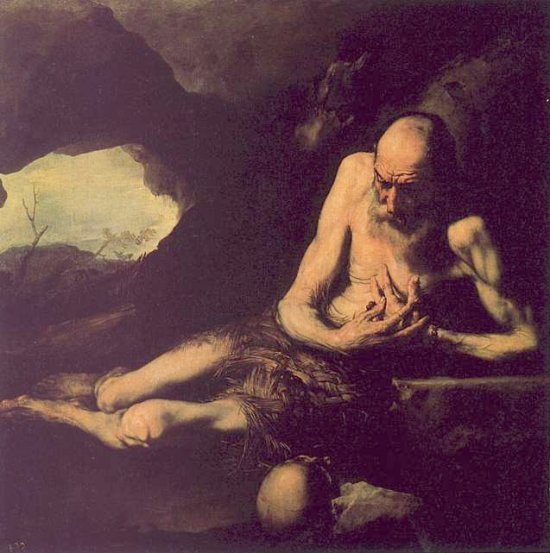
Jusepe de Ribera (1591–1652), Saint Paul of Thebes, 1640, 143 x 143, Museo del Prado, Madrid.
Saint Paul l'Ermite
Ermite en
Thébaïde (+ 345)
On l'appelle aussi le
premier ermite, car il serait plus ancien que saint Antoine,
le père des moines. C'est du moins ce qu'affirme son biographe, saint Jérôme.
Issu d'une famille de notables égyptiens, il reçut une éducation soignée, à la
différence du fruste paysan qu'était saint Antoine. Orphelin à seize ans, il se
retrouve à la tête d'une belle fortune. Mais il est chrétien et l'empereur Dèce
déclenche une persécution. Paul fuit au désert et c'est là qu'il rencontre Dieu
dans la solitude d'une grotte où il restera pendant quatre-vingt-dix ans. Agé
de 113 ans, il reçoit la visite de saint Antoine et ils conversent tous deux
toute la nuit. Au petit matin, saint Paul meurt. Antoine l'enveloppe dans le
manteau que lui avait donné saint Athanase
d'Alexandrie. Des gestes qui sont tout un symbole de la tradition de
l'Église.
En Thébaïde, au IVe
siècle, saint Paul, ermite, un des premiers à mener la vie monastique.
Martyrologe romain
SOURCE : https://nominis.cef.fr/contenus/saint/437/Saint-Paul-l-Ermite.html
Saint Paul
Premier Ermite
(229-342)
La gloire de ce grand
Saint est d'avoir frayé la voie du désert à d'innombrables générations de
solitaires et de n'avoir été surpassé par personne dans la pratique de la
prière et de la pénitence. Il naquit dans la Basse-Thébaïde, en Égypte.
Orphelin dès l'âge de quinze ans et possesseur d'un très riche patrimoine, il
abandonna tout pour obéir à l'impulsion divine. S'enfonçant dans la solitude,
il arriva à une caverne creusée dans les flancs d'une montagne, et dans
laquelle coulait une source limpide. Il prit ce lieu en affection et résolut
d'y passer sa vie. Un palmier voisin lui fournissait son repas et son vêtement;
l'eau claire de la fontaine était son unique boisson.
Paul avait vingt-deux ans
quand il se retira du monde; il vécut dans le désert jusqu'à l'âge de cent
treize ans; il passa donc quatre-vingt-onze ans sous le regard de Dieu et loin
de la vue des hommes, et nul ne pourra jamais nous dire ni les merveilles de
vertu qu'il a accomplies, ni les ineffables douceurs de sa vie pénitente et
contemplative. Deux faits cependant nous sont connus.
Paul avait quarante-trois
ans quand Dieu se chargea de le nourrir lui-même en lui envoyant
miraculeusement chaque jour, par un corbeau, la moitié d'un pain. A l'âge de
cent treize ans, il reçut la visite du saint solitaire Antoine.
Antoine, âgé de
quatre-vingt-dix ans, avait été éprouvé par une tentation de vaine gloire, le
démon essayant de lui suggérer qu'il était le plus parfait des solitaires. Mais
Dieu lui avait ordonné en songe d'aller plus avant dans le désert, à la
rencontre d'un solitaire bien plus parfait que lui. Après deux jours et une
nuit de marche, Antoine suivit la trace d'une louve qui le conduisit jusqu'à la
grotte où habitait Paul. Ce fut à grand peine que le Saint voulut ouvrir sa
porte au voyageur inconnu. Il ouvrit enfin; les deux vieillards s'embrassèrent
en s'appelant par leur nom et passèrent de longues heures à bénir Dieu.
Ce jour-là, le corbeau
leur apporta un pain entier; ils rendirent grâces au Seigneur, et s'assirent au
bord de la fontaine pour prendre leur frugal repas. Antoine, de retour dans sa
solitude, disait à ses disciples: "Malheur à moi, pécheur, qui suis indigne
d'être appelé serviteur de Dieu! J'ai vu Élie, j'ai vu Jean dans le désert; en
un mot, j'ai vu Paul dans le Paradis." Paul mourut cette même année, et sa
fosse fut creusée par deux lions du désert. Sa vie parfaitement authentique,
fut écrite par saint Jérôme.
Abbé L. Jaud, Vie
des Saints pour tous les jours de l'année, Tours, Mame, 1950
SOURCE : http://magnificat.ca/cal/fr/saints/saint_paul_ermite.html
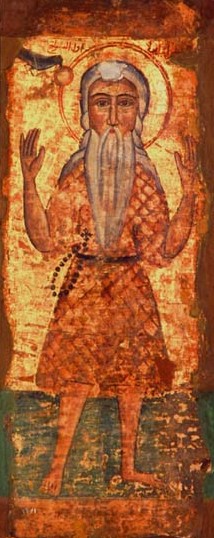
Icône
copte de Saint-Paul. XVII-XVIII s.
Icons of Paul of Thebes ; Coptic icons ; Cilice in icons
Saint Paul l'ermite
Il naquit en haute Egypte
près de la ville de Thèbes (Louxor), sous le règne de l'empereur Alexandre
Sévère, vers l'an 230. Ses parents chrétiens lui donnèrent une solide éducation
religieuse. Il maitrisait la langue grecque et égyptienne. A l'âge de 16 ans il
perdit sa mère puis son père. Il ne lui restait plus qu'une soeur marié avec un
beau frère qui voulait s'accaparer de l'héritage du jeune garçon. Vers l'an 248,
Décius un militaire romain se révolte contre l'empereur Philippe l'Arabe, qui,
d'après Eusèbe, s'était converti au christianisme et l'assassine. En 249 après
la bataille de Vérone où Philippe l'Arabe est tué, Décius prend sa succession,
et lance une nouvelle persécution contre les chrétiens de l'empire. La
persécution fut si féroce, que les bourreaux ne tuaient pas les pauvres
victimes mais essayaient de les faire souffrir le plus longtemps possible avant
de les achever.
Les églises d'Egypte
furent abandonnées. Paul qui n'était qu'un adolescent préféra se cacher dans
une cabane, dans les champs de ses parents, restant à l'écart de ces évènements
mais son beau-fère le dénonça en pensant profiter de cette occasion pour se
débarrasser de lui et prendre tout l'héritage. Mais sa soeur pu le prévenir à
temps et il s'enfonça seul dans le désert. Au début, il ne s'éloigna pas
beaucoup, car il espérait revenir quand la persécution aurait cessée pour
réclamer son dû à son beau-frère.
Mais face à la faim, la
soif, le froid, la fièvre et à son désir de vengeance qui le rongeait, il cria
du fond de sa détresse et appela Jésus à son secours. Egaré dans cet immense
désert et à bout de force, il se croyait perdu quand il arriva devant une
colline où se trouvait une caverne dont l'entrée était caché par un palmier. A
côté de cette tanière se trouvait aussi une source d'eau limpide. Il put enfin
étancher sa soif et se rassasier des dattes qui murissaient sur le palmier. Il
trouva dans cet endroit une paix profonde et passa toute la nuit en prière pour
remercier Dieu de sa sollicitude. Plus le temps passait plus, il se sentait
heureux dans cette solidude qui le raprochait de Dieu. Quand ses habits furent
usés, il se fit une tunique de feuilles de palmier. Trouvant dans ce lieu tout
le nécessaire pour vivre, il ne désira rien de plus, et tourna toute son
attention au salut de son âme et le rachat de ses fautes. Ainsi caché au regard
des hommes, il passa 90 ans dans ce désert. C'est déjà l'époque où les
Chrétiens connaissent une paix relative dans l'empire romain et le début des
hérésies. Dieu voulu révéler à son église et au monde la vie cachée de ce saint
égyptien pour qu'il sert d'exemple aux générations suivantes. C'est à Saint
Antoine le Grand que fut confié cette tâche et jusqu'à ce jour cette tradition,
l'ermite du désert, est toujours vivante parmi les moines coptes.
SOURCE : http://orient.chretien.free.fr/PaulErmite.htm

Sassetta (1392–1450),
The meeting of Saint Anthony the Great and Saint Paul the Anchorite, circa
1445, tempera on wood, 47.5 x
34.5, National Gallery of Art, Washington,
D.C.,
SAINT PAUL
Plusieurs ont douté quel
a été celui d'entre tous les solitaires qui a le premier habité les déserts; et
il y en a qui, remontant bien loin jusque dans les siècles passés, veulent que
les premiers auteurs d'une si sainte retraite soient le bienheureux Hélie et
saint Jean-Baptiste ; dont l'un me semble devoir plutôt être considéré comme un
prophète que comme un solitaire, et l'autre a commencé à prophétiser avant même
que de naître. D'autres assurent, et c'est la commune opinion, que saint Antoine
doit être considéré comme le maître de ce projet; ce qui est vrai en partie
puisque, bien qu'il n'ait pas été le premier de tous les solitaires qui en
fuyant le monde ait passé dans le désert, il a été le premier qui par son
exemple a montré le chemin et excité l'ardeur de tous ceux qui se sont portés à
embrasser une vie si sainte; car Amatas et Macaire, deux de ses disciples dont
le premier l'a mis en terre, nous assurent encore aujourd'hui qu'un nommé Paul
Thébéen a été celui qui a commencé à vivre de cette sorte, en quoi je suis bien
de leur avis. Il y en a aussi d'autres qui, feignant sur cela tout ce qui leur
vient en fantaisie, voudraient nous faire croire que Paul vivait dans un antre
souterrain, et que les cheveux lui tombaient jusque sur les talons; à quoi ils
ajoutent d'autres semblables contes faits à plaisir, et que je n'estime pas
devoir prendre la peine de réfuter, puisque ce sont des mensonges ridicules et
sans apparence.
Or, d'autant que l'on a
écrit très exactement, tant en grec qu'en latin, la vie de saint Antoine, j'ai
résolu de dire quelque chose du commencement et de la fin de celle de saint
Paul, plutôt à cause que personne ne l'a fait jusqu'ici que par la créance d'y
pouvoir bien réussir; car quant à ce qui s'est passé depuis sa jeunesse jusqu'à
sa vieillesse, et aux tentations du diable qu'il a soutenues et surmontées,
personne n'en a connaissance.
Du temps de la
persécution de Decius et de Valérien, lorsque le pape Corneille à Rome et saint
Cyprien à Carthage répandirent leur sang bienheureux, cette cruelle tempête
dépeupla plusieurs Eglises dans l'Egypte et dans la Thébaïde. Le plus grand
souhait des chrétiens était alors d'avoir la tête tranchée pour la confession
du nom de Jésus-Christ. Mais la malice de leur ennemi le rendait ingénieux à
inventer des supplices qui leur donnassent une longue mort, parce que son
dessein était de tuer leurs âmes et non pas leurs corps; ainsi que saint
Cyprien, qui l'a éprouvé en sa propre personne, le témoigne lui-même par ces
paroles: « On refusait de donner la mort à ceux qui la désiraient.» Et afin de
faire connaître jusqu'à quel excès allait cette cruauté, j'en veux rapporter
ici deux exemples pour en conserver la mémoire.
Un magistrat païen,
voyant un martyr demeurer ferme et triompher des tourments au milieu des
chevalets et des lames de fer sortant de la fournaise, commanda qu'on lui
frottât tout le corps de miel, et qu'après lui avoir lié les mains derrière le
dos on le mit à la renverse, et qu'on l'exposât ainsi aux plus ardents rayons du
soleil, afin que celui qui avait surmonté tant d'autres douleurs cédât à celles
que lui feraient sentir les aiguillons d'une infinité de mouches.
Il ordonna que l'on menât
un autre qui était en la fleur de son âge dans un jardin très délicieux, et que
là, au milieu des lis et des roses, et le long d'un petit ruisseau qui avec un
doux murmure serpentait à l'entour de ces fleurs, et où le vent en soufflant
agréablement agitait un peu les feuilles des arbres, on le couchât sur un lit,
et qu'après l'y avoir attaché doucement avec des rubans de soie pour lui ôter
tout moyen d'en sortir, on le laissât seul. Chacun s'étant retiré, il fit venir
une fort belle courtisane qui se jetta à son cou avec des embrassements
lascifs, et, ce qui est horrible seulement à dire, porta ses mains en des lieux
que la pudeur ne permet pas de nommer, afin qu'après avoir excité en lui le
désir d'un plaisir criminel, son impudence victorieuse triomphât de sa
chasteté. Ce généreux soldat de Jésus-Christ ne savait en cet état ni que faire
ni à quoi se résoudre, car se fût-il laissé vaincre par les délices après avoir
résisté à tant de tourments ? Enfin par une inspiration divine il se coupa la
langue avec les dents, et en la crachant au visage de cette, effrontée qui le
baisait il éteignit, par l'extrême douleur qu'il se fit à lui-même, les
sentiments de volupté qui eussent pu s'allumer dans sa chair fragile.
Au temps que ces choses
se passaient Paul, n'étant âgé que de quinze ans et n'ayant plus ni père ni
mère mais seulement une soeur déjà mariée, se trouva maître d'une grande
succession en la basse Thébaïde. Il était fort savant dans les lettres grecques
et égyptiennes, de fort douce humeur et plein d'un grand amour de Dieu. La
tempête de cette persécution éclatant de tous, côtés, il se retira en une
maison des champs assez éloignée et assez à l'écart.
Son beau-frère se résolut
de découvrir celui qu'il était si obligé de cacher, sans que les larmes de sa
femme, les devoirs d’une si étroite alliance ni la crainte de Dieu, qui du haut
du ciel regarde toutes nos actions, fussent capables de le détourner d’un si
grand crime; et la cruauté qui le portait à cela se couvrait même d'un prétexte
de religion.
Ce jeune garçon qui était
très sage, ayant appris ce dessein et se résolvant à faire volontairement ce
qu'il était obligé de faire par force, s'enfuit dans les déserts des montagnes
pour y attendre que la persécution fût cessée ; et en s'y avançant peu à peu,
et puis encore davantage, et continuant souvent à faire la même chose, enfin il
trouva une montagne pierreuse au pied de laquelle était une grande caverne dont
l'entrée était fermée avec une pierre, qu'il retira; et, regardant
attentivement de tous côtés par cet instinct naturel qui porte l'homme à
désirer de connaître les choses cachées, il aperçut au-dedans , comme un grand
vestibule qu'un vieux palmier avait formé de ses branches en les étendant et
les entrelaçant les unes dans les autres, et qui n'avait rien que le ciel
au-dessus de soi. Il y avait là une fontaine très claire d'où il sortait un
ruisseau, qui à peine commençait à couler qu'on le voyait se perdre dans un
petit trou, et être englouti par la même terre qui le produisait. Il y avait
aussi aux endroits de la montagne les plus difficiles à aborder diverses
petites maisonnettes où l'on voyait encore des burins, des enclumes et des
marteaux dont on s'était autrefois servi pour faire de la monnaie ; et quelques
mémoires égyptiens portent que c'avait été une fabrique de fausse monnaie,
durant le temps des amours d'Antoine et de Cléopâtre.
Notre saint, concevant de
l'attrait pour cette demeure qu'il considérait comme lui ayant été présentée de
la main de Dieu, y passa toute sa vie en oraisons et en solitude ; et le
palmier dont ,j'ai parlé lui fournissait tout ce qui,lui était nécessaire pour
sa nourriture et son vêlement; ce qui ne doit pas passer pour impossible,
puisque je prends à témoin Jésus-Christ et ses anges que, dans cette partie du
désert qui en joignant la Syrie tient aux terres des Arabes, j'ai vu parmi des
solitaires un frère qui, étant reclus, il y avait trente ans, ne vivait que de
pain d'orge et d'eau bourbeuse, et un autre qui, étant enfermé dans une vieille
citerne, vivait de cinq figues par jour. Je ne doute pas néanmoins que cela ne
semble incroyable aux personnes qui manquent de foi, parce « qu'il n'y a que
ceux qui croient, à qui telles, choses soient possibles. »
Mais pour retourner à ce
que j'avais commencé de dire, il y avait déjà cent treize axis que le
bienheureux Paul menait sur la terre, une vie toute céleste; et Antoine, âgé de
quatre-vingt-dix ans ( comme il l'assurait souvent ), demeurant dans, une autre
solitude, il lui vint en pensée que nul autre que lui n'avait passé dans le
désert la vie d'un parlait et véritable solitaire; mais lorsqu'il dormait il
lui fut, la nuit, révélé en songe qu'à y en avait un autre, plus, avant dans le
désert, meilleur que lui, et qu'il se devait hâter d'aller voir.
Dès la pointe du jour ce
vénérable vieillard, soutenant son corps faible et exténué avec mi bâton qui
lui servait aussi à se conduire, commença à marcher sans savoir où il allait;
et déjà le, soleil, arrivé à son midi, avait échauffé l'air de telle sorte
qu'il paraissait tout enflammé, sans que néanmoins il se pût résoudre à
différer son voyage, disant en lui-même:
« Je me confie en mon
Dieu, et ne doute point qu'il ne me fasse voir son serviteur ainsi qu'il me l'a
promis.» Comme il achevait ces paroles il vit un Homme qui avait en partie le
corps d'un cheval, et était comme ceux que les poètes nomment Hippocentaures.
Aussitôt qu'il l'eut aperçu il arma son front du signe salutaire de la croix et
lui cria: « Holà! En quel lieu demeure ici le serviteur de Dieu ?» Alors ce
monstre, marmottant je ne sais quoi de barbare et entrecoupant plutôt ses
paroles qu'il ne les proférait distinctement, s'efforça de faire sortir une
voix douce de ses lèvres toutes hérissées de poil, et, étendant sa main droite,
lui montra le chemin tant désiré; puis en fuyant il traversa avec une
incroyable vitesse toute une grande campagne, et s'évanouit devant les yeux de
celui qu'il avait rempli d'étonnement. Quant à savoir si le diable pour
épouvanter le saint avait pris cette figure, ou si ces déserts si fertiles en
monstres avaient produit celui-ci, je ne saurais en rien assurer.
Antoine, pensant tout
étonné à ce qu'il venait de voir, ne laissa pas de continuer son chemin ; et à
peine avait-il commencé à marcher qu'il aperçut dans un vallon pierreux un fort
petit homme qui avait les narines crochues, des cornes au front et des pieds de
chèvre. Ce nouveau spectacle ayant augmenté son admiration, il eut recours,
comme un vaillant soldat de Jésus-Christ, aux armes de la foi et de
l'espérance; mais cet animal, pour gage de son affection, lui offrit des dattes
pour le nourrir durant son voyage. Le saint s'arrêta et lui demanda qui il
était. Il répondit : « Je suis mortel et l'un des habitants des déserts que les
païens, qui se laissent emporter à tant de diverses erreurs, adorent sous le
nom de Faunes, de Satyres et d'Incubes. Je suis envoyé vers vous comme
ambassadeur par ceux de mon espèce, et nous Vous supplions tous de prier pour
nous celui qui est également notre Dieu, lequel nous avons su être venu pour le
salut du monde, et dont le nom et la réputation se sont répandus par toute la terre.
»
A ces paroles ce sage
vieillard et cet heureux pèlerin trempa son visage des larmes que l’excès de sa
joie lui faisait répandre, en abondance, et qui étaient des marques évidentes
de ce qui se passait dans son coeur; car il se réjouissait de la gloire de
Jésus-Christ et de la destruction de celle du diable, et admirait en même temps
comment il avait pu entendre le langage de cet animal et être entendu de lui.
En cet état, frappant la terre de son bâton, il disait: « Malheur à toi,
Alexandrie, qui adores des monstres en qualité de dieux ! Malheur à toi, ville
adultère qui es devenue la retraite des démons répandus en toutes les parties
du monde. De quelle sorte t'excuseras-tu maintenant? Les bêtes parlent des
grandeurs de Jésus-Christ, et tu rends à des bêtes les honneurs et les hommages
qui ne sont dus qu'à Dieu seul! » A peine avait-il achevé ces paroles, que cet
animal si léger s'enfuit avec autant de vitesse que s'il avait eu des ailes. Et
s'il se trouve quelqu'un à qui cela semple si incroyable qu'il fasse difficulté
d'y ajouter foi, il en pourra voir un exemple dont tout le monde a été témoin
et qui est arrivé sous le règne de Constance; car un homme de cette sorte,
ayant été mené vivant à Alexandrie, l'ut vu avec admiration de tout le peuple ;
et, étant mort, son corps, après avoir été salé de crainte que la chaleur de
l'été ne le corrompit, fut porté à Antioche pour le faire voir à l'empereur.
Mais, pour revenir à mon
discours, Antoine, continuant à marcher dans le chemin où il s'était engagé, ne
considérai autre chose que la piste des bêtes sauvages et la vaste solitude de
ce désert, sans savoir ce qu'il devait faire ni de quel côté il devait tourner.
Déjà le second jour était
passé depuis qu'il était parti, et il en restait encore un troisième afin qu'il
acquit par cette épreuve une entière confiance de ne pouvoir être abandonné de
Jésus-Christ. Il employa toute cette seconde nuit en oraisons, et à peine le
jour commençait à poindre qu'il aperçut de loin une louve qui, toute haletante
de soif, se coulait le long du pied de la montagne. Il la suivit des yeux et,
lorsqu'elle fut fort éloignée, s'étant approché de la caverne et voulant
regarder dedans, sa curiosité lui fut inutile, à cause due son obscurité était
si grande que ses yeux ne la pouvaient pénétrer; mais, comme dit l'Écriture, «
le parfait amour bannissant la crainte, » après s’être un peu arrêté et avoir
repris Baleine, ce saint et habile espion entra dans cet antre en s'avançant
peu à peu et s'arrêtant souvent pour écouter s'il n'entendrait point de bruit.
Enfin, à travers l'horreur de ces épaisses ténèbres, il aperçut de la lumière
assez loin de là. Alors, redoublant ses pas et marchant sur des cailloux, il
fit du bruit. Paul l'ayant entendu, il tira sur lui sa porte qui était ouverte,
et la ferma au verrou.
Antoine, se jetant contre
terre sur le seuil de la porte, y demeura jusqu'à l'heure de Sexte et
davantage, le conjurant toujours de lui ouvrir et lui disant : « Vous savez qui
je suis, d'où je viens, et le sujet qui m'amène. J'avoue que je ne suis pas
digne de vous voir, mais je ne partirai néanmoins jamais d'ici jusqu'à ce due
j'aie revu ce bonheur. Est-il possible que, ne refusant pas aux bêtes l'entrée
de votre caverne, vous la refusiez aux hommes? Je vous ai cherché, je vous ai
trouvé; et,je frappe à votre porte afin qu'elle me soit ouverte : que si je ne
puis obtenir cette grâce, je suis résolu de mourir en la demandant; et j'espère
qu'au moins vous aurez assez de charité pour m'ensevelir. »
« Personne ne supplie en
menaçant et ne mêle des injures avec des larmes, » lui répondit Paul « vous
étonnez-vous donc si je ne veux pas vous recevoir, puisque vous dites n'être
venu ici que pour mourir?» Ainsi Paul en souriant lui ouvrit la porte; et
alors, s'étant embrassés à diverses fois, ils se saluèrent et se nommèrent tous
deux par leurs propres noms. Ils rendirent ensemble grâces à Dieu; et, après
s'être donné le saint baiser, Paul, s'étant assis auprès d'Antoine, lui parla
en cette sorte :
« Voici celui que vous
avez cherché avec tant de peine, et dont le corps flétri de vieillesse est
couvert par des cheveux blancs tout pleins de crasse; voici cet homme qui est
sur le point d'être réduit en poussière; mais, puisque la charité ne trouve
rien de difficile, dites-moi, je vous supplie, comment va le monde : fait-on de
nouveaux bâtiments dans les anciennes villes? qui est celui qui règne
aujourd'hui ? et se trouve-t-il encore des hommes si aveuglés d'erreur que
d'adorer les démons? »
Comme ils s'entretenaient
de la sorte ils virent un corbeau qui, après s'être reposé sur une branche
d'arbre, vint de là, en volant tout doucement, apporter à terre devant eux un
pain tout entier. Aussitôt qu'il fut parti Paul commença à dire : « Voyez, je
vous supplie, comme Dieu, véritablement tout bon et tout miséricordieux, nous a
envoyé à dîner. Il y a déjà soixante ans que je reçois chaque jour de cette
sorte une moitié de pain; mais depuis que vous êtes arrivé Jésus-Christ a
redoublé ma portion, pour faire voir par là le soin qu'il daigne prendre de
ceux qui, en qualité de ses soldats, combattent pour son service. »
Ensuite, ayant tous deux
rendu grâces à Dieu, ils s'assirent sur le bord d'une fontaine aussi claire que
du cristal, et voulant se déférer l'un à l'autre l'honneur de rompre le pain,
cette dispute dura quasi jusqu'à vêpres, Paul insistant sur ce que
l'hospitalité et la coutume l'obligeaient à cette civilité, et Antoine la
refusant à cause de l'avantage que l'âge de Paul lui donnait sur lui. Enfin ils
résolurent que chacun de son côté, prenant le pain et le tirant à soi, en
retiendrait la portion qui lui demeurerait entre les mains. Après, en se
baissant sur la fontaine et mettant leur bouche sur l'eau, ils en burent chacun
un peu, et puis, offrant à Dieu un sacrifice de louanges, ils passèrent toute
la nuit en prières.
Le jour étant venu, Paul
parla ainsi à Antoine : « Il y a longtemps, mon frère, que je savais votre
séjour en ce désert; il y a longtemps que Dieu m'avait promis que vous
emploieriez comme moi votre vie à son service; mais parce que l'heure de mon
heureux sommeil est arrivé, et qu'ayant toujours désiré avec ardeur d'être
délivré de ce corps mortel pour m'unir à Jésus-Christ, il ne me reste plus,
après avoir achevé ma course, que de recevoir la couronne de justice, notre
Seigneur vous a envoyé pour couvrir de terre ce pauvre corps, ou, pour mieux
dire, pour rendre la terre à la terre. »
A ces paroles Antoine,
fondant en pleurs et jetant mille soupirs, le conjurait de ne le point
abandonner et de demander à Dieu qu'il lui tint compagnie en ce voyage; à quoi
il lui répondit : «Vous ne devez pas désirer ce qui vous est plus avantageux,
mais ce qui est plus utile à votre prochain : il n'y a point de doute que ce ne
vous fût un extrême bonheur d'être déchargé du fardeau ennuyeux de cette chair
pour suivre l'agneau sans tache, mais il importe au bien de vos frères d'être
encore instruits par votre exemple. Ainsi, si ce ne vous est point trop
d'incommodité, je vous supplie d'aller quérir le manteau que l'évêque Athanase
vous donna, et de me l'apporter pour m'ensevelir. » Or si le bienheureux Paul
lui faisait cette prière, ce n'est pas qu'il se souciât beaucoup que son corps
fût plutôt enseveli que de demeurer nu, puisqu'il devait être réduit en
pourriture, lui qui depuis tant d'années n'était revêtu que de feuilles de
palmier entrelacées, mais afin que, Antoine étant éloigné de lui, il ressentit
avec moins de violence l'extrême douleur qu'il recevrait de sa mort.
Antoine fut rempli d'un
merveilleux étonnement de ce qu'il lui venait de dire de saint Athanase et du
manteau qu'il lui avait donné; et, comme s'il eût vu Jésus-Christ dans Paul et
adorant Dieu résidant dans son coeur, il n'osa plus lui rien répliquer; mais,
pleurant sans dire une seule parole, après lui avoir baisé les yeux et les
mains il partit pour s'en retourner à son monastère, qui fut depuis occupé par
les Arabes; et, bien que son esprit fit faire à son corps affaibli de jeûnes et
cassé de vieillesse une diligence beaucoup plus grande que son âge ne le
pouvait permettre, il s'accusait néanmoins de marcher trop lentement. Enfin
après avoir achevé ce long chemin, il arriva tout fatigué et tout hors
d'haleine à son monastère.
Deux de ses disciples qui
le servaient depuis plusieurs années ayant couru au-devant de lui et lui disant
: « Mon père, où avez-vous demeuré si longtemps?» il leur répondit : «Malheur à
moi, misérable pécheur, qui porte si indignement le nom de solitaire! J'ai vu
Hélie, j'ai vu Jean dans le désert, et, pour parler selon la vérité, j'ai vu
Paul dans un paradis. »Sans en dire davantage et en se frappant la poitrine il
tira le manteau de sa cellule; et ses disciples le suppliant de les informer
plus particulièrement de ce que c'était, il leur répondit : « Il y a temps de
parler et temps de se taire ; » et, sortant ainsi de la maison sans prendre
aucune nourriture, il s'en retourna par le même chemin qu'il était venu, ayant
le coeur tout rempli de Paul, brûlant d'ardeur de le voir et l'ayant toujours
devant les yeux et dans l'esprit, parce qu'il craignait, ainsi qu'il arriva,
qu'il ne rendit son âme à Dieu durant son absence.
Le lendemain au point du
jour, lorsqu'il y avait déjà trois heures qu'il était en chemin, il vit au
milieu des troupes des anges et entre les chœurs des prophètes et des apôtres
Paul, tout éclatant d'une blancheur pure et lumineuse, monter dans le ciel.
Soudain, se jetant le visage contre terre, il se couvrit la tête de sable et s'écria
en pleurant : « Paul, pourquoi m'abandonnez-vous ainsi? Pourquoi partez-vous
sans me donner le loisir de vous dire adieu? Vous ayant connu si tard, faut-il
que vous me quittiez si tôt? »
Le bienheureux Antoine
contait, depuis, qu'il acheva avec tant de vitesse ce qui lui restait de chemin
qu'il semblait qu'il eût des ailes, et non sans sujet puisque, étant entré dans
la caverne, il y vit le corps mort du saint qui avait les genoux en terre, la
tête levée et les mains étendues vers le ciel. Il crut d'abord qu'il était
vivant et qu'il priait, et se mit de son côté en prières; mais, ne l'entendant
point soupirer ainsi qu'il avait coutume de le faire en priant, il s'alla jeter
à son cou pour lui donner un triste baiser, et reconnut que par une posture si dévote
le corps de ce saint homme, tout mort qu'il était, priait encore Dieu auquel
toutes choses sont vivantes.
Ayant roulé et tiré ce
corps dehors, et chanté des hymnes et des psaumes selon la tradition de
l'Eglise catholique, il était fort fâché de n'avoir rien pour fouiller la
terre, et pensant et repensant à cela avec inquiétude d'esprit, il disait : «
Si je retourne au monastère il me faut trois jours pour revenir, et si je
demeure ici, je n'avancerai rien : il vaut donc beaucoup mieux que je meure et
que, suivant votre vaillant soldat, ô Jésus-Christ, mon cher maître, je rende
auprès de lui les derniers soupirs. »
Comme il parlait ainsi en
lui-même, voici deux lions qui, sortant en courant dis fond du désert,
faisaient flotter leurs longs crins dessus le cou. Ils lui donnèrent d'abord de
la frayeur, mais, élevant son esprit à Dieu, il demeura aussi, tranquille que s'ils
eussent été dés colombes, lis vinrent droit au corps du bienheureux vieillard,
et, s'arrêtant là et le flattant avec leurs queues, ils se couchèrent à ses
pieds, puis jetèrent de grands rugissements pour lui témoigner qu'ils le
pleuraient en la manière qu'ils le pouvaient. Ils commencèrent ensuite à
gratter la terre avec leurs ongles, en un lieu assez proche de là, et, jetant,
à l'envi le sable. de côté et d'autre, firent une fosse capable de recevoir le
corps d'un homme; et aussitôt après, comme s'ils eussent demandé récompense de
leur travail, ils vinrent, en remuant les oreilles et la tête basse, vers
Antoine, et lui léchaient les pieds et les mains. Il reconnut qu'ils lui
demandaient sa bénédiction, et soudain, rendant des louanges infinies à Jésus-Christ
de ce que même les animaux irraisonnables avaient quelque sentiment de la
divinité, il dit : « Seigneur, sans la volonté duquel il ne tombe pas même une
seule feuille des arbres ai le moindre oiseau ne perd la vie, donnez à ces
lions ce que vous savez leur être nécessaire ; » et après, leur faisant signe
de la main, il leur commanda de s'en aller.
Lorsqu'ils furent partis
il courba ses épaules affaiblies par la vieillesse sous le fardeau de ce saint
corps, et, l'ayant porté dans la fosse, jeta du sable dessus pour l'enterrer
selon la coutume de l’Eglise. Le jour suivant étant venu, ce pieux héritier, ne
voulant, rien perdre de la succession de celui qui était mort sans faire de
testament, prit pour soi la tunique qu'il avait tissue de ses propres mains
avec des feuilles de palmier, en la même sorte qu'on l'ait des paniers d'osier,
et retournant ainsi à son monastère, il conta particulièrement à ses disciples
tout ce qui lui était arrivé; et aux jours solennels de Pâques et de la
Pentecôte il se revêtait toujours de la tunique du bienheureux Paul.
Je ne saurais m'empocher,
sur la fin de cette histoire, de demander à ceux qui ont tant de biens qu'ils
n'en savent pas le compte, qui bâtissent des palais de marbre, qui enferment
dans un seul collier de diamants ou de perles le prix, de plusieurs riches
héritages, ce qui a jamais manqué à ce, vieillard tout nu. Vous buvez dans des
coupes de pierres précieuses; et lui avec le creux de sa main satisfaisait, au
besoin de la nature; vous vous parez, avec des robes tissues d'or, et lui n'a
pas eu le plus vil habit qu'eût pu porter le moindre de vos esclaves; mais, par
un changement étrange, le paradis a été ouvert à cet homme si pauvre, et vous,
avec votre magnificence, serez précipités dans les flammes éternelles; tout nu
qu'il était, il a conservé cette robe blanche dont Jésus-Christ l'avait revêtu
au baptême, et vous, avec ces habits somptueux, vous l'avez perdue; Paul,
n'étant couvert que d'une vile poussière, se relèvera un jour pour ressusciter
en gloire, et ces tombeaux si élaborés et si superbes qui vous enferment
aujourd'hui ne vous empêcheront pas de braver misérablement avec toutes vos
richesses. Ayez pitié de vous-mêmes, je vous prie, et épargnez au moins ces
biens que vous aimez tant. Pourquoi ensevelissez-vous vos morts dans des draps
d'or et de soie? Pourquoi votre vanité ne cesse-t-elle pas même au milieu de
vos soupirs et de vos larmes? Est-ce que vous croyez que les corps des riches
ne sauraient pourrir que dans des étoffes précieuses?
Qui que vous soyez qui
lirez ceci, je vous conjure de vous souvenir du pécheur Jérôme, lequel, si Dieu
lui en avait donné le choix, aimerait incomparablement mieux la tunique de Paul
avec ses mérites due la pourpre des rois avec toute leur puissance.
Saint Jérôme. Vies de
quelques Pères du désert. Vie de Saint Paul ermite. : http://www.abbaye-saint-benoit.ch/saints/jerome/mystiques/019.htm
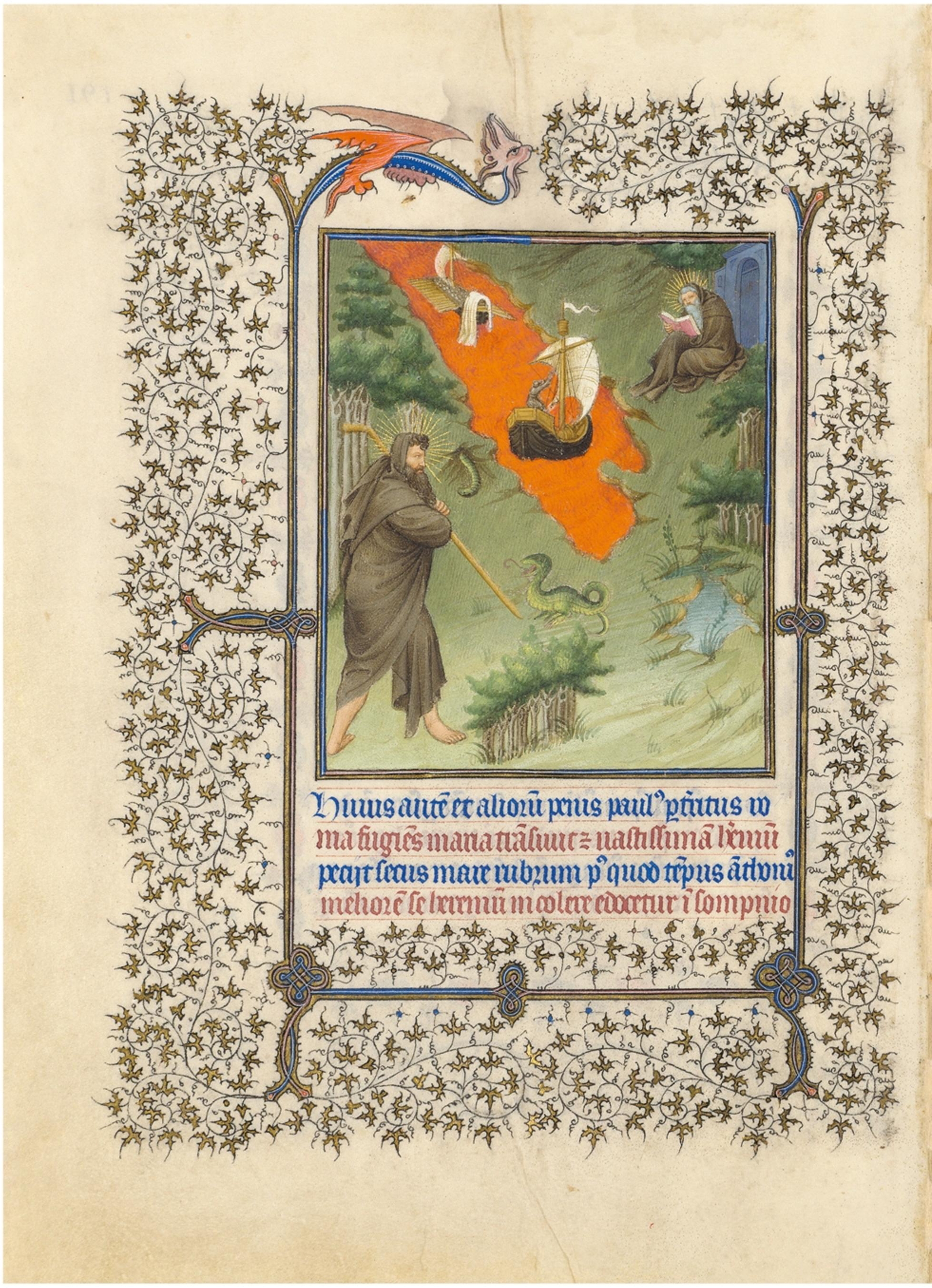
Illumination
depicting the Story of Saints Anthony and Paul the Hermit from the Belles
Heures of Jean de France, Duc de Berry, XVth century
SAINT PAUL, ERMITE *
Paul, premier ermite, au
témoignage de saint Jérôme qui a écrit sa vie, se retira, pendant la
persécution violente de Dèce, dans un vaste désert où il demeura 60 ans, au
fond d'une caverne, tout à fait inconnue des hommes. Ce Dèce, qui eut, deux
noms, pourrait bien être Gallien qui commença à régner l’an du Seigneur 256.
Saint Paul voyant donc les chrétiens en butte à toutes sortes de supplices,
s'enfuit au désert. A la même époque, en effet, deux jeunes chrétiens sont
pris, l’un d'eux a tout le corps enduit de miel et est exposé sous l’ardeur du
soleil aux piqûres des mouches, des insectes et des guêpes ; l’autre est mis
sur un lit des plus mollets, placé dans un jardin charmant, où une douce
température, le murmure des ruisseaux, le chant des oiseaux, l’odeur des fleurs
étaient enivrants. Le jeune homme est attaché avec des cordes tissées de la
couleur des fleurs, de sorte qu'il ne pouvait s'aider ni des mains, ni des
pieds. Vient une jouvencelle d'une exquise beauté, mais impudique, qui caresse
impudiquement le jeune homme rempli de l’amour de Dieu. Or, comme il sentait
dans sa chair des mouvements contraires à la raison, mais qu'il était privé
d'armes, pour se soustraire à son ennemi, il se coupa la langue avec les dents
et la cracha au visage de cette courtisane : il vainquit ainsi la tentation par
la douleur, et mérita un trophée digne de louanges. Saint Paul effrayé par de
pareils tourments et par d'autres encore, alla au désert. Antoine se croyait
alors le premier des moines qui vécût en ermite; mais averti en songe qu'il y
en a un meilleur que lui de beaucoup, lequel vivait dans un ermitage, il se mit
à le chercher à travers les forêts; il rencontra un hippocentaure cet être
moitié homme, moitié cheval, lui indiqua qu'il fallait prendre à droite.
Bientôt après, il rencontra un animal portant des fruits de palmier, dont la
partie supérieure du corps avait la figure d'un homme et la partie inférieure,
la forme d'une chèvre. Antoine le conjura de la part de Dieu de lui dire qui il
était; l’animal répondit qu'il était un satyre, le Dieu des bois, d'après la
croyance erronée des gentils. Enfin il rencontra un loup qui le conduisit à la
cellule de saint Paul. Mais celui-ci ayant deviné que c'était Antoine qui
venait, ferma sa porte. Alors Antoine le prie de lui ouvrir, l’assurant qu'il
ire s'en ira pas de là, mais qu'il y mourra plutôt. Paul cède et lui ouvre, et
aussitôt ils se jetèrent dans les bras l’un de l’autre en s'embrassant. Quand
l’heure du repas fut arrivée, un corbeau apporta une double ration de pain : or,
comme Antoine était dans l’admiration, Paul répondit que Dieu le servait tous
les jours de la sorte, mais qu'il avait doublé la pitance en faveur de son
hôte. Il y eut un pieux débat entre eux pour savoir qui était le plus digne de
rompre ce pain : saint Paul voulait déférer cet honneur à son hôte et saint
Antoine à son ancien. Enfin ils tiennent. le pain chacun d'une main et le
partagent égaleraient en deux. Saint Antoine, à son retour, était déjà près de
sa cellule, quand il vit des anges portant l’âme de Paul, il s'empressa de
revenir, et trouva le corps de Paul droit sur ses genoux fléchis, comme s'il
priait; en sorte qu'il le pensait vivant ; mais s'étant assuré qu'il était
mort, il dit : « O sainte âme, tu as montré par ta mort ce que tu étais dans ta
vie. » Or, comme Antoine était dépourvu de ce qui était nécessaire pour creuser
une fosse, voici venir deux lions qui en creusèrent une, puis s'en retournèrent
à la forêt, après l’inhumation. Antoine prit à Paul sa tunique tissue avec da
palmier, et il s'en revêtit dans la suite aux jours de solennité. Il mourut
environ l’an 287.
* Tiré de saint Jérôme.
La Légende dorée de
Jacques de Voragine nouvellement traduite en français avec introduction,
notices, notes et recherches sur les sources par l'abbé J.-B. M. Roze, chanoine
honoraire de la Cathédrale d'Amiens, Édouard Rouveyre, éditeur, 76, rue de
Seine, 76, Paris mdccccii
SOURCE : http://www.abbaye-saint-benoit.ch/voragine/tome01/018.htm

Leçons des Matines avant 1960
AU DEUXIÈME NOCTURNE.
Quatrième leçon. Paul, l’instituteur et le maître des Ermites, naquit dans la basse Thébaïde ; il n’avait que quinze ans lorsqu’il perdit son père et sa mère. Quelque temps après, pour fuir la persécution de Dèce et de Valérien et pour servir Dieu avec plus de liberté, il se retira dans une caverne du désert. C’est là qu’un palmier lui fournissant de quoi se nourrir et se vêtir, il vécut jusqu’à l’âge de cent treize ans : alors saint Antoine, qui en avait quatre-vingt-dix, le visita, d’après un avertissement de Dieu. Ils se saluèrent de leurs propres noms, bien qu’ils ne se connussent point auparavant, et pendant qu’ils se complaisaient à s’entretenir du royaume de Dieu, un corbeau, qui jusqu’alors avait toujours apporté à Paul la moitié d’un pain, en déposa un tout entier auprès d’eux.
Cinquième leçon. Après le départ du corbeau : « Voyez, dit Paul, comment le Seigneur vraiment bon, vraiment miséricordieux, nous a envoyé notre repas. Il y a déjà soixante ans que je reçois chaque jour la moitié d’un pain, et maintenant, à votre arrivée, Jésus-Christ a donné une ration double pour ses soldats. » Ils prirent donc leur nourriture avec action de grâces, au bord d’une fontaine ; ayant ainsi réparé leurs forces et rendu de nouveau grâces à Dieu, selon la coutume, ils passèrent la nuit dans les louanges divines. Au point du jour, Paul, sachant que sa mort était proche, en avertit Antoine, et le pria d’aller chercher, pour ensevelir son corps, le manteau qu’il avait reçu de saint Athanase. Antoine, étant en route pour revenir, vit l’âme de Paul monter au ciel parmi les chœurs des Anges et dans la compagnie des Prophètes et des Apôtres.
Sixième leçon. Quand il
fut arrivé à la cellule de Paul, il le trouva à genoux, la tête levée, les
mains étendues vers le ciel et le corps inanimé. Il l’enveloppa du manteau et
chanta des hymnes et des Psaumes, selon la tradition chrétienne. Comme il n’avait
pas d’instrument pour creuser la terre, deux lions accoururent du fond du
désert et s’arrêtèrent près du corps du bienheureux vieillard, donnant à
entendre qu’ils le pleuraient à leur manière. Ils creusèrent la terre avec
leurs griffes à l’envi l’un de l’autre et firent une fosse capable de contenir
un homme. Lorsqu’ils furent partis, Antoine déposa le saint corps en ce lieu,
et le couvrant de terre, il lui dressa un tombeau à la manière des chrétiens.
Quant à la tunique de Paul, qu’il avait tissue de feuilles de palmier comme on
fait les corbeilles, il l’emporta avec lui, et tant qu’il vécut, il se servit
de ce vêtement aux jours solennels de Pâques et de la Pentecôte.
Dom Guéranger, l’Année Liturgique
L’Église honore aujourd’hui la mémoire d’un des hommes le plus spécialement choisis pour représenter la pensée de ce détachement sublime que l’exemple du Fils de Dieu, né dans une grotte, à Bethlehem, révéla au monde. L’ermite Paul a tant estimé la pauvreté de Jésus-Christ, qu’il s’est enfui au désert, loin de toute possession humaine et de toute convoitise. Une caverne pour habitation, un palmier pour sa nourriture et son vêtement, une fontaine pour y désaltérer sa soif, un pain journellement apporté du ciel par un corbeau pour prolonger cette vie merveilleuse : c’est ainsi que Paul servit, pendant soixante ans, étranger aux hommes, Celui qui n’avait pas trouvé de place dans la demeure des hommes, et qui fut contraint d’aller naître dans une étable abandonnée.
Mais Paul habitait avec Dieu dans sa grotte ; et en lui commence la race sublime des Anachorètes, qui, pour converser avec le Seigneur, ont renoncé à la société et même à la vue des hommes : anges terrestres dans lesquels a éclaté, pour l’instruction des siècles suivants, la puissance et la richesse du Dieu qui suffit lui seul aux besoins de sa créature. Admirons un tel prodige ; et considérons, avec reconnaissance, à quelle hauteur le mystère d’un Dieu incarné a pu élever la nature humaine tombée dans la servitude des sens, et tout enivrée de l’amour des biens terrestres.
N’allons pas croire cependant que cette vie de soixante ans passée au désert, cette contemplation surhumaine de l’objet de la béatitude éternelle, eussent désintéressé Paul de l’Église et de ses luttes glorieuses. Nul n’est assuré d’être dans la voie qui conduit à la vision et à la possession de Dieu, qu’autant qu’il se tient uni à l’Épouse que le Christ s’est choisie, et qu’il a établie pour être la colonne et le soutien de la vérité [1]. Or, parmi les enfants de l’Église, ceux qui doivent le plus étroitement se presser contre son sein maternel, sont les contemplatifs ; car ils parcourent des voies sublimes et ardues, où plusieurs ont rencontré le péril Du fond de sa grotte, Paul, éclairé d’une lumière supérieure, suivait les luttes de l’Église contre l’arianisme ; il se tenait uni aux défenseurs du Verbe consubstantiel au Père : et afin de montrer sa sympathie pour saint Athanase, le vaillant athlète de la foi, il pria saint Antoine, à qui il laissait sa tunique de feuilles de palmier, de l’ensevelir dans un manteau dont l’illustre patriarche d’Alexandrie, qui aimait tendrement le saint abbé, lui avait fait présent.
Le nom de Paul, père des Anachorètes, est donc enchaîné à celui d’Antoine, père des Cénobites ; les races fondées par ces deux apôtres de la solitude sont sœurs ; toutes deux émanent de Bethlehem comme d’une source commune. La même période du Cycle réunit, à un jour d’intervalle, les deux fidèles disciples de la crèche du Sauveur.
Nous donnons ici les trois strophes suivantes, consacrées par l’Église Grecque, dans ses Menées, à la louange du premier des Ermites :
Quand, par l’inspiration divine, tu as abandonné avec sagesse, ô Père, les sollicitudes de la vie pour embrasser les travaux de l’ascèse ; alors, enflammé de l’amour du Seigneur , plein de joie, tu t’es emparé du désert, laissant derrière toi les passions de l’homme , et poursuivant avec persévérance ce qu’il y a de meilleur, semblable à un Ange, tu as accompli ta vie.
Séparé volontairement de
toute société humaine, dès ton adolescence, ô Paul, notre Père, tu as, le
premier de tous, embrassé la complète solitude , dépassant tous les autres
solitaires, et tu as été inconnu pendant toute ta vie : c’est pourquoi Antoine,
par un mouvement divin, t’a découvert, toi qui étais comme caché, et il t’a
manifesté à l’univers.
Livré, ô Paul, à un genre
de vie inaccoutumé sur la terre, tu as habité avec les bêtes, assisté du
ministère d’un oiseau, par la volonté divine ; à cette vue, le grand Antoine
stupéfait, au jour où il te découvrit, te célébra sans relâche, comme le
Prophète et le Maître de tous comme un être divin.
Vous contemplez
maintenant dans sa gloire, ô prince des Anachorètes, le Dieu dont vous avez
médité, durant soixante années, la faiblesse et les abaissements volontaires ;
votre conversation avec lui est éternelle. Pour cette caverne, qui fut le
théâtre de votre pénitence, vous avez l’immensité des cieux ; pour cette
tunique de feuilles de palmier, un vêtement de lumière ; pour ce pain matériel,
l’éternel Pain de vie ; pour cette humble fontaine, la source de ces eaux qui
jaillissent jusque dans l’éternité. Dans votre isolement sublime, vous imitiez
le silence du Fils de Dieu en Bethlehem ; maintenant, votre langue est déliée,
et la louange s’échappe à jamais de votre bouche avec le cri de la félicité.
Souvenez-vous cependant de cette terre dont vous n’avez connu que les déserts ;
rappelez à l’Emmanuel qu’il ne l’a visitée que dans son amour, et faites
descendre sur nous ses bénédictions. Obtenez-nous la grâce d’un parfait
détachement des choses périssables, l’estime de la pauvreté, l’amour de la
prière, et une continuelle aspiration vers la patrie céleste.
[1] II Tim. III, 15.
Bhx Cardinal
Schuster, Liber Sacramentorum
La fête de ce patriarche
de l’ascèse monastique orientale est entrée très tard dans le calendrier
romain, puisque ce fut seulement sous l’influence d’une Congrégation religieuse
portant son nom, et qui, après le XIVe siècle, avait pris en Occident un développement
considérable, qu’Innocent XIII éleva la fête de saint Paul au rite double pour
l’Église universelle. Rome elle-même avait, au XVIe siècle, sur le mont
Viminal, un temple en l’honneur de cet admirable fils du désert. Aujour d’hui
cet édifice a été confisqué et profané.
L’insigne des Ermites de
Saint-Paul était le palmier. De là viennent, dans la messe, les gracieuses et
fréquentes allusions à cet arbre providentiel qui fournit à notre saint la
nourriture et le vêtement, et qui, par l’extension de ses branches, symbolise si
bien dans les Écritures l’activité surnaturelle des justes.
L’histoire de saint Paul,
premier ermite, fut écrite vers 376 par saint Jérôme. Son identité avec le
moine Paul, que les deux prêtres lucifériens Marcellin et Faustin dans une
lettre aux empereurs Valentinien, Théodose et Arcadius (entre 383 et 384), nous
décrivent comme un invincible champion de l’orthodoxie de Nicée à Oxyrhynque,
n’est pas entièrement démontrée. Si le Paul de ce deuxième document était le
même que celui dont saint Jérôme fit l’éloge, le premier ermite nous serait
montré sous un jour tout à fait nouveau. Les besoins de la foi l’eussent
temporairement transformé en un courageux apôtre. Le document en question
ajoute que la fête de saint Paul était dès lors célébrée chaque année par le
peuple d’Oxyrhynque [2].
La messe, sauf un verset
d’Osée, n’a aucun élément propre, mais emprunte ses diverses parties aux messes
du Commun des simples confesseurs.
L’introït est tiré du
psaume 91 : « Le juste fleurira comme le palmier et croîtra comme le cèdre sur
le Liban. Il sera transplanté dans la maison de Dieu, dans les cours du temple
de Yahweh. » — Au juste est promise la fécondité et la force, parce qu’il agit,
non par lui-même, mais en Dieu, unique principe de vie. Voilà le secret du succès
des œuvres des saints.
La collecte est la
suivante : « O Dieu qui réjouissez ce jour par la solennité de votre
bienheureux confesseur Paul ; de grâce, accordez-nous d’imiter les œuvres de
celui dont nous célébrons la naissance à la vie éternelle. »
La lecture est tirée de
l’épître aux Philippiens (III, 7-12) où l’Apôtre rappelle à ses correspondants
que, pour gagner le Christ et sa croix, il a abdiqué ces avantages que lui
promettait sa situation sociale antérieure vis-à-vis de la Synagogue ; lui, de
la tribu de Benjamin, pharisien, disciple de rabbi Gamaliel, zélé gardien de la
Thora, jusqu’à devenir persécuteur des chrétiens. Toutes ces circonstances dont
se seraient tant glorifiés les émules de l’Apôtre, furent par lui comptées pour
rien, et il n’ambitionna plus d’autre gloire que celle de porter en lui-même
l’empreinte du Crucifié. C’est seulement à cette condition que Paul se promet
d’avoir part avec le Christ à la gloire de la résurrection.
Le graduel est presque
semblable à l’introït. Le second verset est le suivant : « Pour célébrer de bon
matin votre bonté, et votre vérité au cœur de la nuit. »
Le verset alléluiatique
s’inspire du prophète Osée (xiv, 6) : « Le Juste fleurira comme le lis, et sans
fin il germera devant le Seigneur. »
Après la Septuagésime, on
omet le verset alléluiatique et l’on récite à sa place le psaume tractus, qui,
à l’origine, suivait, aux jours de fête, la deuxième lecture de l’Écriture.
Quand, au moyen âge, l’on perdit la notion historique de l’origine du tractus,
les liturgistes y découvrirent un chant lugubre de pénitence. Au contraire, le
Missel n’assigne le tractus qu’aux dimanches de la Septuagésime pascale, à
quelques fériés quadragésimales solennelles, et aux fêtes des saints que l’on
célèbre durant cette période de préparation à la fête de Pâques. Tous les
autres jours de la semaine qui sont sanctifiés par le jeûne n’ont point le
tractus — le psaume Domine, non secundum, récité trois fois par semaine en
Carême, est d’introduction tardive — précisément parce que le tractus
représente encore dans le Missel actuel l’ancien psaume in directum.
Celui-ci, les jours
festifs, suivait la seconde lecture, régulièrement tirée du Nouveau Testament —
en général des épîtres de saint Paul — mais il disparut quand saint Grégoire le
Grand prescrivit, aux messes dominicales en dehors du Carême, le chant de
l’Alléluia, jusqu’alors réservé à Rome au seul temps pascal.
Saint Grégoire voulut
ainsi égaler le dimanche à la solennité pascale dont il est vraiment, depuis
l’antiquité, la commémoration hebdomadaire. Il ne prévit pas, toutefois, toutes
les conséquences de cette mesure. Les fêtes des martyrs commencèrent à être
placées sur le même plan que le dimanche ; vinrent ensuite celles des
confesseurs et des vierges, et il arriva ceci, que ce qui était à l’origine le
chant pascal par excellence et que saint Jean, dans l’Apocalypse, met sur les
lèvres des bienheureux dans le ciel, devint le chant quotidien du chœur.
L’alléluia perdit ainsi toute cette éclatante beauté qu’il avait pour les
anciens, lesquels l’entonnaient à l’aube de la nuit de Pâques, quand, avec le
Christ triomphateur de la mort, la blanche armée des néophytes sortait
processionnellement du baptistère, pour s’approcher pour la première fois de
l’autel eucharistique du Seigneur. Le trait est tiré du psaume 111, qui célèbre
l’éloge du Juste : « Bienheureux l’homme qui craint Yahweh, et qui trouve son
bonheur dans l’observance de ses préceptes. Sa postérité sera puissante sur la
terre, parce que la descendance des justes est en bénédiction. La gloire et les
richesses sont dans sa maison, et sa justice demeurera à travers tous les
siècles. » C’est l’éloge messianique du Juste par excellence, c’est-à-dire du
Christ, à qui les saints ont tâché de se conformer.
La lecture évangélique
est prise en saint Matthieu (XI, 25-30). Jésus exulte et, rendant grâces au
Père, il entonne le chant de l’humilité : Je te remercie, ô Père, parce que tu
as caché tes mystères aux sages et aux puissants de ce monde pour révéler au
contraire l’Évangile du Royaume, la joyeuse nouvelle, aux pauvres. Venez, vous
tous, ô pauvres, vous qui travaillez et êtes fatigués, et je vous dédommagerai
de vos peines. Le monde proclame bienheureux ceux qui jouissent ; bienheureux,
an contraire, ceux qui, d’eux-mêmes, mettent sur leur cou mon joug, joug
d’humilité, de douceur, joug suave, qui est gage de vraie liberté d’esprit et
qui contient le secret de la joie intime du cœur.
L’antienne pour
l’oblation est tirée du psaume 20 : « Seigneur, par votre puissance le juste
exulte et se délecte dans votre salut qu’il reconnaît bien venir de vous. Vous
avez rempli le vœu de son cœur. » Voilà comment la louange catholique des
saints n’enlève rien à l’adoration que tous nous devons à Dieu ; car si
l’Église magnifie la vertu de ses membres de choix, elle en attribue néanmoins
toute la gloire, toute la louange et toutes les grâces au Seigneur, devant le
trône duquel les saints de l’Apocalypse déposent avec respect leurs couronnes.
La secrète est la
suivante : « Seigneur, nous vous offrons ce sacrifice de louange en la fête de
vos saints, le cœur plein de confiance qu’il nous servira à échapper aux maux
présents et à éviter les périls futurs. »
Le verset pour la
communion est tiré du psaume 63. « Le Juste se réjouira parce qu’il met dans le
Seigneur son espérance. Tous ceux qui ont le cœur droit seront loués. » Voici
donc comment la source de la joie, de la justice et de la gloire est la céleste
confiance en Dieu. Se fier à Dieu et faire en sorte que Dieu se fie à nous, la
sainteté est toute en cela.
La prière d’action de
grâces est la suivante : « Rassasiés par une nourriture et un breuvage divins,
nous vous demandons que toujours nous protègent les prières de celui en
l’honneur duquel nous avons participé au céleste Sacrifice. »
Un auteur sacré donne une
belle définition d’un saint. Un saint, dit-il, est un chrétien qui prend au
sérieux les obligations de son baptême et la nature des relations existant
entre le Créateur et la créature. Ainsi s’explique-t-on que saint Paul ermite,
par exemple, ait pu soutenir près d’un siècle de vie solitaire et pénitente,
croyant encore donner trop peu pour conquérir le paradis et Dieu.
[2] Cf. H.
DELEHAYE, La personnalité historique de saint Paul de Thèbes (Analect.
Bolland, t. XLIV, pp. 64-69).
Dom Pius Parsch, le Guide
dans l’année liturgique
Le silence et
l’obéissance sont des conditions préalables pour la bonne tenue liturgique.
Nos maîtres de vertu. —
Les saints veulent être nos guides vers le ciel. L’Église déroule devant nos
yeux la vie des saints, elle exalte leurs vertus et les propose à notre
imitation. Considérons les moyens que l’Église emploie pour cela. Aux Matines,
nous lisons avec attention la vie du saint, parfois même, l’Église nous fait
lire quelques passages de ses écrits. A l’Oraison, il n’est pas rare que
l’Église insiste sur sa vertu préférée. Dans les deux lectures de la messe (Ép.,
Év.) le saint est caractérisé par des paroles de l’Écriture, afin de nous
exciter à l’imiter. Il y a même des messes où les chants psalmodiques sont
empruntés à la vie du saint. L’Église brosse ainsi un portrait brillant du
saint, elle nous invite à le contempler toute la journée et à en reproduire les
traits en nous. C’est là le côté éducateur du culte des saints. Les deux saints
d’aujourd’hui nous enseignent l’amour de la solitude, le silence et
l’obéissance. La solitude et le silence sont la clôture de l’âme. « Pendant que
le silence enveloppait la terre », le Fils de Dieu est descendu ici-bas ; c’est
ainsi qu’il descend dans notre âme, qu’il aime environner de silence et de
solitude. Dans l’agitation du monde, la voix de Dieu ne se fait pas entendre.
L’obéissance est une condition préalable pour devenir enfants de Dieu. La
désobéissance a introduit le péché sur la terre. L’obéissance du Fils de Dieu,
portée jusqu’à la mort, nous a valu la Rédemption et le ciel.
Saint Paul : jour de mort
(d’après le martyrologe) : 15 janvier 347, à l’âge de 113 ans. Tombeau :
reliques insignes à Rome (Saint Pierre et Sainte Marie du Capitole). Image : On
le représente en ermite, vêtu de feuilles de palmier, et avec un corbeau. Sa
vie : Paul « le premier ermite » (il est rare que le Missel et le Bréviaire
fassent une mention particulière comme celle-ci) est le porte-étendard de ces
hommes courageux qui, par amour pour le Christ, quittèrent le monde et
peuplèrent le désert où ils s’adonnèrent à la contemplation, au milieu de
toutes sortes de privations. Les ermites furent les grands suppliants dans ces
jours terribles où l’Église devait, dans des combats violents, se défendre
contre les hérésies. Pendant des siècles, leur exemple fut l’école de la
perfection chrétienne. Ils furent les précurseurs de la vie monastique et
religieuse dans l’Église. Le bréviaire raconte cette légende édifiante au sujet
de saint Paul : Un jour, saint Antoine, un vieillard de quatre-vingt dix ans,
vint le visiter sur l’ordre de Dieu. Bien qu’ils ne se connussent pas, ils se
saluèrent cependant par leurs noms et s’entretinrent de conversations
spirituelles ; alors le corbeau qui avait coutume d’apporter à Paul. un
demi-pain, apporta un pain entier. Quand le corbeau se fut éloigné, Paul dit :
« Vois, le Seigneur qui est vraiment bon et bienveillant, nous a envoyé de la
nourriture. Il y a déjà soixante ans que je reçois,. tous les jours un
demi-pain, mais, à ton arrivée, le Christ a doublé la ration de ses soldats. »
Ils prirent donc, en remerciant Dieu, leur nourriture auprès d’une source, et,
après avoir pris un peu de repos, ils offrirent de nouveau leurs actions de
grâces au Seigneur, comme ils avaient toujours coutume de le faire, et
passèrent toute la nuit dans les louanges de Dieu. Le lendemain, de bonne
heure, Paul révéla à Antoine sa mort imminente et le pria de lui apporter le
manteau qu’il avait reçu de saint Athanase, pour l’ensevelir dedans. Lorsque
Antoine revint de ce voyage, il vit l’âme de Paul, entourée d’anges et au
milieu du chœur des Prophètes et des Apôtres, s’envoler au ciel. — Saint Jérôme
écrivit, en 376, la vie du premier ermite.
La messe (Justus ut
palma). — La messe reflète d’une manière très belle la vie de saint Paul.
Quand, à l’Introït, on le compare à un palmier, nous nous souvenons de sa vie
dans le désert où le palmier lui fournissait vêtement et nourriture (de même le
Graduel). L’Épître est très belle, c’est un des plus sublimes passages de saint
Paul. « Ce qui était pour moi un gain, je l’ai regardé à cause du Christ comme
une perte... tout me semble une ordure, afin que je gagne le Christ... en lui
devenant semblable dans la mort pour parvenir à la résurrection. » L’Évangile
aussi est une des plus belles pages de la Sainte Écriture. Le Christ y trace
son propre portrait. D’une part il est Dieu, d’autre part il est le Sauveur
miséricordieux, dans son humilité et sa douceur. « Venez tous à moi, vous qui
êtes fatigués... et je vous soulagerai. » Cela se réalise au Saint-Sacrifice,
mais nous devons, par contre, réaliser à l’Offrande cette parole : « Prenez mon
joug sur vous. » Considérons qu’à l’Épître c’est notre saint qui parle ; à
l’Évangile, c’est Notre-Seigneur. Tous les deux se sont caractérisés d’une
manière merveilleuse. Avec les sentiments de l’Épître, approchons-nous, au
Saint-Sacrifice, du Seigneur et du Sauveur de l’Évangile.
SOURCE : http://www.introibo.fr/15-01-St-Paul-premier-ermite-et
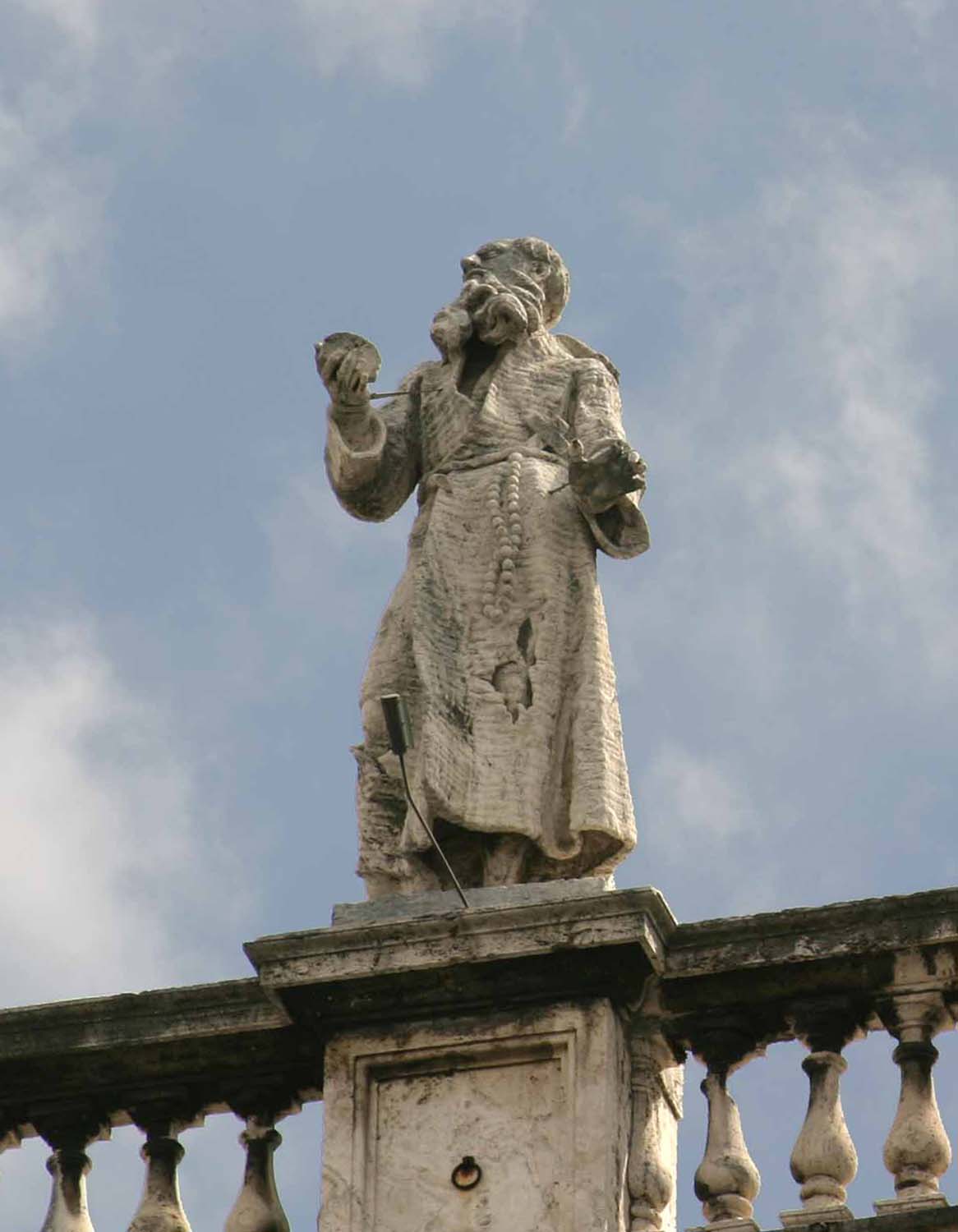
129.
St. Paul-First Hermit. The 140 Saints of the Colonnade. St. Paul-First Hermit
Born - c.228. Died - c.343 Egypt. Feastday - 10 January. Statue created -
c.1672
It's part of a group of 16 installed between August 1670 and March 1673.. Sculptor
- Lazzaro Morelli
Payment was made to Morelli in June 1672 for 80 scudi.. Height - 3.1 m. (10ft
4in) travertine
The old venerable saint is dressed in woven palm leaves. He holds the
bread, which according to legend, a raven brought every day to his cave. The
face is similar to the St Athanasius on the Chair of St Peter, where Morelli
had worked with Bernini from 1661 to 1663. He is regarded as the first
Christian hermit. The Life of St Paul the First Hermit was written by St
Jerome.
Also
known as
Paul the First Hermit
Paul of Thebes
Paul the Anchorite
Pavly
Pavlos
Anba Bola
Paolo di Tebe
15 January (Eastern
calendar)
Profile
Paul grew up in an
upper-class, Christian family.
He was well educated,
fluent in Greek and Egyptian.
His parents died when
the boy was 15. When the persecutions of Decius began
a few years later, Paul fled into the desert to escape both them, and the
machinations of his brother Peter and other family members who wanted his
property. He lived as a desert hermit in
a cave the remainder of his 113 year life, surviving off fruit and water,
wearing leaves or nothing, spending his time in prayer;
legend says a raven kept
him supplied with bread. Late in life he came to know, and was buried by Saint Anthony
the Abbot. His biography was written by Saint Jerome.
Born
5 January 342 of
natural causes
grave reported to have
been dug by desert lions near
his cave who guarded the body
buried by Saint Anthony
the Abbot
–
Order
of Saint Paul the First Hermit
dead man
whose grave is
being dug by a lion
man being brought food by
a bird
man clad in rough
garments made of leaves or skins
old man,
clothed with palm-leaves, and seated under a palm-tree, near which are a river
and loaf of bread
with Saint Anthony
the Abbot
Additional
Information
An
Old English Martyrology, by George Herzfeld
Book
of Saints, by the Monks of
Ramsgate
Character
Calendar, by Sister Mary Fidelis and Sister Mary Charitas, S.S.N.D
First
of the Hermits, by Mrs Lang
Golden
Legend, by Jacobus
de Voragine
Life
of Paulus, the First Hermit, by Saint Jerome
Lives
of the Saints, by Father Alban
Butler
Lives
of the Saints, by Sabine Baring-Gould
Roman
Martyrology, 1914 edition
Roman
Martyrology, 1914 edition
Saints
in Art, by Margaret E Tabor
Saints
of Italy, by Ella Noyes
Saints
of the Day, by Katherine Rabenstein
Short
Lives of the Saints, by Eleanor Cecilia Donnelly
Three
Saints for the Incredulous, by Father Robert
Emmett Holland
books
1001 Patron Saints and Their Feast Days, by Australian
Catholic Truth Society
Our Sunday Visitor’s Encyclopedia of Saints
other
sites in english
images
video
sitios
en español
Martirologio Romano, 2001 edición
sites
en français
fonti
in italiano
websites
in nederlandse
nettsteder
i norsk
spletne
strani v slovenšcini
MLA
Citation
“Saint Paul the
Hermit“. CatholicSaints.Info. 17 May 2024. Web. 20 January 2026.
<https://catholicsaints.info/saint-paul-the-hermit/>
SOURCE : https://catholicsaints.info/saint-paul-the-hermit/
Book of Saints – Paul
the First
Article
hermit (Saint)
(January
10) (4th
century) The Life of this Saint,
written by Saint Jerome,
tells us that he was an Egyptian of
good birth and well educated.
Still a youth, he fled into the desert country about Thebes to escape the persecution then
raging. Delighted and helped by solitude he persevered in the Eremitical life
even after the Peace of the Church, and is said to have passed ninety years in
the Desert, where he died A.D. 342,
comforted at the end by a visit from Saint Antony,
the Father of Monks.
MLA
Citation
Monks of Ramsgate. “Paul
the First”. Book of Saints, 1921. CatholicSaints.Info.
10 September 2016. Web. 21 January 2026.
<https://catholicsaints.info/book-of-saints-paul-the-first/>
SOURCE : https://catholicsaints.info/book-of-saints-paul-the-first/
New
Catholic Dictionary – Saint Paul, the First Hermit
Article
Confessor; born Thebes,
Egypt, 230; died 342. Escaping from the persecution of Decius, he took refuge
in a mountain desert, where he lived in a cave for ninety years, in
mortification and prayer; he was visited there by Saint Anthony. Patron of
weavers. Relics at Budapest. Feast, Roman Calendar, 15 January.
MLA
Citation
“Saint Paul, the First
Hermit”. People of the Faith. CatholicSaints.Info. 17
October 2010.
Web. 21 January 2026.
<http://catholicsaints.info/new-catholic-dictionary-saint-paul-the-first-hermit/>
SOURCE : https://catholicsaints.info/new-catholic-dictionary-saint-paul-the-first-hermit/
St. Paul the Hermit
Feastday: January 15
Patron: of San Pablo City, Philippines
Birth: 229
Death: 342
Also known as Paul the
First Hermit and Paul of Thebes, an Egyptian hermit and friend of St. Jerome.
Born in Lower The baid, Egypt, he was left an orphan at about the age of
fifteen and hid during the persecution of
the Church under Emperor Traj anus Decius. At the age of twenty two he went to
the desert to
circumvent a planned effort by his brother in law to
report him to authorities as a Christian and
thereby gain control of his property. Paul soon found that the eremitical life was
much to his personal taste, and so remained in a desert cave
for the rest of his reportedly very long life. His contemplative existence was
disturbed by St. Anthony, who visited the aged Paul. Anthony also buried Paul,
supposedly wrapping him in a cloak that had been given to Anthony by St.
Athanasius. According to legend, two lions assisted Anthony in digging the
grave. While there is little doubt that
Paul lived, the only source for details on his life are
found in the Vita Pauli written by St. Jerome and
preserved in both Latin and Greek versions.
SOURCE : https://www.catholic.org/saints/saint.php?saint_id=5280
St. Paul the Hermit
St. Paul the Hermit was
reportedly born in Egypt, where he was orphaned by age 15. He was also a
learned and devout young man. During the persecution of Decius in Egypt in the
year 250, Paul was forced to hide in the home of a friend. Fearing a
brother-in-law would betray him, he fled in a cave in the desert. His plan was
to return once the persecution ended, but the sweetness of solitude and
heavenly contemplation convinced him to stay.
He went on to live in
that cave for the next 90 years. A nearby spring gave him drink, a palm tree
furnished him clothing and nourishment. After 21 years of solitude a bird began
bringing him half of a loaf of bread each day. Without knowing what was
happening in the world, Paul prayed that the world would become a better place.
St. Anthony attests to
his holy life and death. Tempted by the thought that no one had served God in
the wilderness longer than he, Anthony was led by God to find Paul and
acknowledge him as a man more perfect than himself. The raven that day brought
a whole loaf of bread instead of the usual half. As Paul predicted, Anthony
would return to bury his new friend.
Thought to have been
about 112 when he died, Paul is known as the “First Hermit.” His feast day is
celebrated in the East; he is also commemorated in the Coptic and Armenian
rites of the Mass.
SOURCE : http://www.ucatholic.com/saints/saint-paul-the-hermit/
Paul the First Hermit (RM)
(also known as Paul of Thebes)
Born in Thebaid, Egypt c. 230; died c. 342; feast day in the West was January
10 until the cultus was suppressed in 1969; Eastern feast day is either January
5 or 15.
Saint Paul was from the
lower Thebaid in Egypt and lived during a period in which Christians were
hunted down like criminals for endangering the safety of the state. Paul,
orphaned at 15, had a property inheritance; and his pagan brother-in-law saw a
double opportunity in betraying him to the officers of Emperor Decius: first to
get the reward promised to those who turned in Christians, and second to obtain
for himself the inherited property.
The 22-year-old Paul,
already in hiding in a remote village, was warned by his sister and fled into
the desert, not so much as a permanent place to live as much as a refuge
because he feared that his faith may not be strong enough to endure
persecution. Later, however, the thought of returning to his home left him, and
the vastness of the desert surged up before him as the place where he would
find God. (Remember that this is part of our Judaic heritage. The Israelites
"found" God in the desert, where He led them as a pillar of fire.)
Silence and solitude
frighten most of us; we are afraid to be really alone. That was the first fruit
of the life in the desert for Paul: he was strengthened in spirit, he learned
to consecrate his soul to God alone, and to be alone with the alone. All masks
fall away in such a solitary place; God's voice is no longer choked.
Second, Paul learned in
the desert to trust in God to supply all his needs. Having renounced all
things, Paul needed very little: a palm tree to clothe him and perhaps to
protect him from the sun, bread to nourish his body, and water to slake his
thirst. The palm tree also provided his only food until he was 43 (about 21
years). Then, it is said that, like Elias, he was fed miraculously each day; a
raven descended carrying just the right amount of bread for the day. Whether we
trust such stories or not, life must have been difficult enough and it must
have taken an enormous simplicity and trust in God for Paul to survive.
The story of Paul is full
of the comings and goings of a 'rival' hermit of the desert: Saint Antony. How
they overcome their singular rivalry; how they sit down to eat their miraculous
banquets together; how they pray and fast in a combat of spirituality: these
are the tales biographers give us. They also suggest the profound friendship
that must have existed at the deepest possible level for these two men of
identical, yet altogether unusual, vocations.
It is said that God first
revealed Paul's existence to Antony, because he was tempted to vanity at the
thought that he had served God longest in the desert. After the revelation,
Antony searched three days to find Paul (here Jerome's narrative becomes a
little bizarre with centaurs and satyrs, etc.). Finally, he followed a thirsty
she-wolf into a cave thinking to find water for himself, and found Paul, too.
They knew each other at once and praised God.
While they were talking,
a raven flew towards them, and dropped a loaf of bread before them. Upon which
Paul said, "Our good God has sent us dinner. In this manner I have
received half a loaf every day these 60 years past; now you are come to see me,
Christ has doubled his provision for his servants."
On that first meeting, it
seemed that they would never eat. Paul insisted that his guest must have the
privilege of breaking the bread, whereas the 90-year-old youngster Antony
wanted to defer to the elder Paul. The stalemate was broken before the bread
grew too stale--they acted simultaneously.
Paul predicted to Antony
the time of his death, and asked him to wrap and bury his body in a cloak given
to Antony by Athanasius, bishop of Alexandria. Rushing to obtain the cloak,
Antony saw Paul's body in a vision carried up to heaven attended by angels,
prophets, and apostles. He found Paul's body kneeling in prayer with his arms
stretched out, as was the custom. For the rest of his own life, Saint Antony
cherished Paul's palm-leaf clothing, and wore it himself on important church
feasts.
According to Saint Jerome
who was one of the hermit's biographers, Paul died in 342 at age 113, having
spent about 90 years in the desert. It is said that two lions came and dug his
grave.
He is called Paul the
First Hermit, not because he was the first desert solitary--though he may have
been the first who was Christian, but in order to distinguish him from other
hermits named Paul. Saint Jerome's Life of Paul, based on a Greek original, is
almost the only source for the details of the hermit's life, but it is a
mixture of fact and fantasy (Attwater, Benedictines, Bentley, Butler, Delaney,
Encyclopedia, Farmer, Waddell).
In art Saint Paul can be
identified as an old man in plaited palm leaves breaking bread with Saint
Antony (). At times (1) a raven brings them bread, (2) he is naked with only a
girdle of palms leaves (not to be confused with Onuphrius) (3) with a hind by
him, or (4) buried by Saint Antony with two lions nearby (Roeder). Scenes from
Paul's life, especially the meeting with Antony, are depicted on the Ruthwell
cross (c. 700) and on some Irish crosses. He also appears on the 15th-century
rood-screen of Wolborough (Devon) with other monastic saints (Farmer).
SOURCE : http://www.saintpatrickdc.org/ss/0115.shtml

Jusepe de Ribera (1591–1652), Saint Paul of Thebes, circa 1630, 197 x 153, Louvre
Museum, Paris
St. Paul the Hermit
There are three important
versions of the Life of St. Paul: (1) the Latin version (H)
of St.
Jerome; (2) a Greek version (b), much shorter than
the Latin; (3) a Greek version (a), which is either a
translation of H or an amplification of b by means of H.
The question is whether H or b is the original. Both a and b were
published for the first time by Bidez in 1900 ("Deux versions
grecques inédites de la vie des s. Paul de
Thébes", Ghent). Bidez maintains that H was the
original Life. This view has been attacked by Nau, who makes b the
original in the "Analect. Bolland." of 1901 (XX, 121-157).
The Life, minor details excepted, is the same in other versions.
When a young man of sixteen Paul fled into the desert of
the Thebaid during
the Decian persecution.
He lived in a cave in the mountain-side till he was one-hundred-and-thirteen.
The mountain, adds St.
Jerome, was honeycombed with caves.
When he was ninety St. Anthony was tempted to vain-glory,
thinking he was the first to dwell in the desert.
In obedience to a vision he set forth to find his
predecessor. On his road he met with a demon in the form of a
centaur. Later on he spied a tiny old man with horns on his head. "Who are
you?" asked Antony. "I am a corpse, one of those whom the heathen call
satyrs, and by them were snared into idolatry."
This is the Greek story (b) which makes both centaur
and satyr unmistakably demons, one of which tries to terrify
the saint,
while the other acknowledges the overthrow of the gods. With St.
Jerome the centaur may have been a demon; and may also have been
"one of those monsters of which the desert is
so prolific." At all events he tries to show the saint the
way. As for the satyr he is a harmless little mortal deputed by his
brethren to ask the saint's blessing.
One asks, on the supposition that the Greek is the original,
why St.
Jerome changes devils into centaurs and satyrs. It is not
surprising that stories of St. Anthony meeting
fabulous beasts in his mysterious journey should spring up
among people with whom belief in
such creatures lingered on, as belief in
fairies does to the present day. The stories of the meeting
of St. Paul and St. Anthony, the raven who brought them
bread, St. Anthony being sent to fetch the cloak given him by
"Athanasius the bishop"
to bury St. Paul's body in, St. Paul's death before he
returned, the grave dug by lions, are among the familiar legends of
the Life. It only remains to add that belief in
the existence of St. Paul seems to
have existed quite independently of the Life.
Sources
Besides the writings of
BIDEZ and NAU, see BUTLER, Lausiac Hist., etc., pt. i, p. 285, where he
critices Amélineau's view that the Coptic version published by him was the
original (Amélineau's view seems to have found no supporters), and maintains
the claim of the Latin. In Journ. of Theolog. Studies, III, 152, there is
a notice concerning Bidez where Amélineau again expresses the same opinion;
later in a notice concerning Nau (ibid., V, 151), while still inclining to his
old opinion, he says that after reading Nau he is "unable to arrive at a
decision." The BOLLANDISTS (I, Jan., 602) gave a Latin translation of a
Greek version (the original will be found in Anact. Bol., XI, 563),
maintaining it was the original. FUHRMANN in 1750 (Acta Sincera S. Pauli, etc.)
published, as the original, another Greek version.
Bacchus, Francis Joseph. "St.
Paul the Hermit." The Catholic Encyclopedia. Vol. 11. New
York: Robert Appleton Company,1911. 7 Dec. 2015 <http://www.newadvent.org/cathen/11590b.htm>.
Transcription. This
article was transcribed for New Advent by WGKofron. With thanks to St.
Mary's Church, Akron, Ohio.
Ecclesiastical
approbation. Nihil Obstat. February 1, 1911. Remy Lafort, S.T.D.,
Censor. Imprimatur. +John Cardinal Farley, Archbishop of New York.
Copyright © 2023 by Kevin Knight.
Dedicated to the Immaculate Heart of Mary.
SOURCE : http://www.newadvent.org/cathen/11590b.htm
The Life of Paulus the
First Hermit
The Life of Paulus was
written in the year 374 or 375 during Jerome's stay in the desert of Syria,
as is seen from c. 6, and
was dedicated to Paulus of Concordia as stated
in Jerome's Epistle x. c. 3.
1. It has been a subject of wide-spread and frequent discussion what monk was
the first to give a signal example of the hermit life. For some going back too
far have found a beginning in those holy men Elias and John,
of whom the former seems to have been more than a monk and
the latter to have begun to prophesy before his birth. Others, and
their opinion is that commonly received, maintain that Antony was the
originator of this mode of life, which view is partly true. Partly I
say, for the fact is not so much that he preceded the rest as that they all
derived from him the necessary stimulus. But it is asserted even at
the present day by Amathas and Macarius, two of Antony's disciples,
the former of whom laid his master in the grave, that
a certain Paul of Thebes was the leader in the
movement, though not the first to bear the name, and this opinion has my
approval also. Some as they think fit circulate stories such as this— that he
was a man living in an underground cave with flowing hair down to his feet, and
invent many incredible tales which it would be useless to detail. Nor does the
opinion of men who lie without any sense of shame seem
worthy of refutation. So then inasmuch as
both Greek and Roman writers have handed down careful
accounts of Antony, I have determined to write a short history of Paul's early
and latter days, more because the thing has been passed over than from
confidence in my own ability. What his middle life was like, and what snares
of Satan he
experienced, no man, it is thought, has yet discovered.
2. During the persecutions of Decius and Valerian, when Cornelius at Rome and Cyprian at Carthage shed
their blood in blessed martyrdom,
many churches in Egypt and
the Thebaid were laid waste by the fury of the storm. At
that time the Christians would
often pray that
they might be smitten with the sword for the name of Christ.
But the desire of the crafty foe was to slay the soul,
not the body; and this he did by searching diligently for slow but deadly
tortures. In the words of Cyprian himself who suffered at his hands:
they who wished to die were not suffered to be slain. We give two
illustrations, both as specially noteworthy and to make the cruelty of the
enemy better known.
3. A martyr,
steadfast in faith,
who stood fast as a conqueror amidst the racks and burning plates,
was ordered by him to be smeared with honey and to be made
to lie under a blazing sun with his hands tied behind his back, so
that he who had already surmounted the heat of the frying-pan might be
vanquished by the stings of flies. Another who was in the bloom of youth was
taken by his command to some delightful pleasure gardens, and there amid white
lilies and blushing roses, close by a gently murmuring stream,
while overhead the soft whisper of the wind played among the leaves
of the trees, was laid upon a deep luxurious feather-bed, bound with
fetters of sweet garlands to prevent his escape. When all had withdrawn from
him a harlot of great beauty drew near and began with voluptuous embrace to
throw her arms around his neck, and, wicked even
to relate! To handle his person, so that when once the lusts of
the flesh were roused, she might accomplish her licentious purpose. What to do,
and whither to turn, the soldier of Christ knew not. Unconquered
by tortures he was being overcome by pleasure. At last with
an inspiration from heaven he bit off the end of his tongue
and spat it in her face as she kissed him. Thus the sensations
of lust were
subdued by the intense pain which followed.
4. While such enormities were being perpetrated in the lower part of
the Thebaid, Paul and
his newly married sister were bereaved of both their parents,
he being about sixteen years of age. He was heir to
a rich inheritance, highly skilled in both Greek and Egyptian learning, gifted with
a gentle disposition and a deep love for God. Amid the
thunders of persecution he
retired to a house at a considerable distance and in a more secluded spot. But
to what crimes does not the accursed thirst for gold impel
the human heart?
His brother-in-law conceived the thought of betraying the youth whom
he was bound to conceal. Neither a wife's tears which so often prevail, nor the
ties of blood, nor the all-seeing eye of God above him could turn the
traitor from his wickedness. He came,
he was urgent, he acted with cruelty while seeming only to press the
claims of affection.
5. The young man had the tact to understand this, and, conforming
his will to the necessity, fled to the mountain wilds to
wait for the end of the persecution.
He began with easy stages, and repeated halts, to advance into the desert.
At length he found a rocky mountain, at the foot of which, closed by a stone,
was a cave of no great size. He removed the stone (so eager
are men to learn what is hidden), made eager search, and saw within a
large hall, open to the sky, but shaded by the wide-spread branches of an
ancient palm. The tree, however, did not conceal a fountain of transparent
clearness, the waters whereof no sooner gushed forth than the stream was
swallowed up in a small opening of the same ground which gave it birth. There
were besides in the mountain, which was full of cavities, many habitable
places, in which were seen, now rough with rust, anvils and hammers
for stamping money. The place, Egyptian writers
relate, was a secret mint at the time of Antony's union
with Cleopatra.
6. Accordingly, regarding his abode as a gift from God,
he fell in love with
it, and there in prayer and
solitude spent all the rest of his life. The palm afforded him food and
clothing. And, that no one may deem this impossible, I call to witness Jesus and
His holy angels that
I have seen and still see in that part of the desert which lies between Syria and
the Saracens' country, monks of
whom one was shut up for thirty years and lived on barley bread and muddy
water, while another in an old cistern (called in the country dialect of Syria Gubba)
kept himself alive on five dried figs a day. What I relate then is so strange
that it will appear incredible to those who do not believe the
words that all things are possible to him that believes.
7. But to return to the point at which I digressed. The blessed
Paul had already lived on earth the life of heaven for a
hundred and thirteen years, and Antony at the age of ninety was
dwelling in another place of solitude (as he himself was wont to declare), when
the thought occurred to the latter, that no monk more perfect than
himself had settled in the desert.
However, in the stillness of the night it was revealed to him that
there was farther in the desert a
much better man than he, and that he ought to go and visit him. So then at
break of day the venerable old man, supporting and guiding his weak limbs with
a staff, started to go: but what direction to choose he knew not. Scorching noontide came,
with a broiling sun overhead, but still he did not suffer himself to
be turned from the journey he had begun. Said he, I believe in
my God: some time or other He will show me the fellow-servant
whom He promised me. He said no more. All at once he beholds a creature of
mingled shape, half horse half man, called by the poets Hippocentaur. At
the sight of this he arms himself by making on his forehead the sign of salvation,
and then exclaims, Holloa! Where in these parts is a servant
of God living? The monster after gnashing out some kind
of outlandish utterance, in words broken rather than spoken through
his bristling lips, at length finds a friendly mode of communication,
and extending his right hand points out the way desired. Then with swift flight
he crosses the spreading plain and vanishes from the sight of his wondering
companion. But whether the devil took
this shape to terrify him, or whether it be that the desert which
is known to
abound in monstrous animals engenders that kind of creature also, we
cannot decide.
8. Antony was amazed, and thinking over what he had seen went on his
way. Before long in a small rocky valley shut in on all sides he sees
a mannikin with hooked snout, horned forehead, and
extremities like goats' feet. When he saw this, Antony like
a good soldier seized the shield of faith and
the helmet of hope: the creature none the less began to offer to
him the fruit of the palm-trees to support him on his journey and as it were
pledges of peace. Antony perceiving this stopped and asked who he
was. The answer he received from him was this: I am a mortal being and one
of those inhabitants of the desert whom
the Gentiles deluded
by various forms of error worship under
the names of Fauns, Satyrs, and Incubi. I am sent to represent my
tribe. We pray you
in our behalf to entreat the favour of your Lord and ours, who, we
have learned, came once to save the world, and 'whose sound has gone
forth into all the earth.' As he uttered such words as these, the
aged traveller's cheeks streamed with tears, the marks of his deep
feeling, which he shed in the fullness of his joy.
He rejoiced over the Glory of Christ and the destruction
of Satan,
and marvelling all the while that he could understand the Satyr's
language, and striking the ground with his staff, he said, Woe to
you, Alexandria, who instead of God worshippest monsters!
Woe to you, harlot city, into which have flowed together the demons of
the whole world! What will you say now? Beasts speak of Christ,
and you instead of God worship monsters. He had not finished
speaking when, as if on wings, the wild creature fled away. Let no
one scruple to believe this
incident; its truth is supported
by what took place when Constantine was on the throne,
a matter of which the whole world was witness.
For a man of that kind was brought alive to Alexandria and
shown as a wonderful sight to the people. Afterwards his lifeless
body, to prevent its decay through the summer heat, was preserved in salt and
brought to Antioch that
the Emperor might see it.
9. To pursue my proposed story. Antony traversed the region on which
he had entered, seeing only the traces of wild beasts, and the wide waste of
the desert.
What to do, whither to wend his way, he knew not.
Another day had now passed. One thing alone was left him, his
confident belief that he could not be forsaken by Christ. The
darkness of the second night he wore away in prayer.
While it was still twilight, he saw not far away a she-wolf gasping with
parching thirst and creeping to the foot of the mountain. He followed it with
his eyes; and after the beast had disappeared in a cave he drew near and began
to look within. His curiosity profited nothing: the darkness
hindered vision. But, as the Scripture says, perfect love casts
out fear.
With halting step and bated breath he entered, carefully feeling his way;
he advanced little by little and repeatedly listened for the sound. At length
through the fearful midnight darkness a light appeared in the
distance. In his eager haste he struck his foot against a stone and roused
the echoes; whereupon the blessed
Paul closed the open door and made it fast with a bar.
Then Antony sank to the ground at the entrance and until the sixth
hour or later craved admission, saying, Who I am, whence, and
why I have come, you know.
I know I
am not worthy to look upon you: yet unless I see you I will not go away. You
welcome beasts: why not a man? I asked and I have found: I knock that it may be
opened to me. But if I do not succeed, I will die here on your threshold.
You will surely bury me when I am dead.
Such was his constant cry: unmoved he stood.
To whom the hero thus brief answer made
Prayers like these do not mean threats; there is no trickery in tears. Are you
surprised at my not welcoming you when you have come here to die? Thus
with smiles Paul gave
him access, and, the door being opened, they threw themselves into each other's
arms, greeted one another by name, and joined in thanksgiving to God.
10. After the sacred kiss Paul sat
down and thus began to address Antony. Behold the man whom you have
sought with so much toil, his limbs decayed with age, his gray
hairs unkempt. You see before you a man who ere long will be dust.
But love endures
all things. Tell me therefore, I pray you,
how fares the human
race? Are new homes springing up in the ancient cities? What government
directs the world? Are there still some remaining for the demons to
carry away by their delusions? Thus conversing they noticed with wonder a raven
which had settled on the bough of a tree, and was then flying gently down till
it came and laid a whole loaf of bread before them. They were astonished, and
when it had gone, See, said Paul, the Lord truly loving, truly merciful,
has sent us a meal. For the last sixty years I have always received half a
loaf: but at your coming Christ has doubled his
soldier's rations.
11. Accordingly, having returned thanks to the Lord, they sat down
together on the brink of the glassy spring. At this point a dispute
arose as to who should break the bread, and nearly the whole day until eventide
was spent in the discussion. Paul urged
in support of his view the rites of
hospitality, Antony pleaded age. At length it was arranged that each
should seize the loaf on the side nearest to himself, pull towards him, and
keep for his own the part left in his hands. Then on hands and knees they drank
a little water from the spring,
and offering to God the sacrifice of
praise passed the night in vigil. At the return of day the blessed
Paul thus spoke to Antony: I knew long
since, brother, that you were dwelling in those parts: long ago God promised
you to me for a fellow-servant; but the time of my falling asleep now
draws near; I have always longed to be dissolved and to be with Christ; my
course is finished, and there remains for me a crown of righteousness. Therefore
you have been sent by
the Lord to lay my poor body in the ground, yea
to return earth to earth.
12. On hearing this Antony with tears and groans began to pray that
he would not desert him, but would take him for a companion on that journey.
His friend replied: You ought not to seek your own, but
another man's good. It is expedient for you to lay aside
the burden of the flesh and to follow the Lamb; but it is expedient for
the rest of the brethren to be trained by your example. Wherefore be
so good as to go and fetch the
cloak Bishop Athanasius gave you, to wrap my poor body
in. The blessed
Paul asked this favour not because he cared much whether his corpse
when it decayed were clothed or naked (why should he indeed, when he had so
long worn a garment of palm-leaves stitched together?); but that
he might soften his friend's regrets at his decease. Antony was
astonished to find Paul had
heard of Athanasius and his cloak; and, seeing as it
were Christ Himself in him, he
mentally worshipped God without venturing to add a single word;
then silently weeping he once more kissed his eyes and hands, and set
out on his return to the monastery which
was afterwards seized by the Saracens. His steps lagged behind
his will. Yet, exhausted as he was with fasting and
broken by age, his courage proved victorious
over his years.
13. At last wearied and panting for breath he completed his journey and reached
his little dwelling. Here he was met by two disciples who
had begun to wait upon him in his advanced age. Said they, Where have you
stayed so long, father? He replied, Woe to me a sinner! I do not
deserve the name of monk.
I have seen Elias, I have seen John in the desert,
and I have really seen Paul in Paradise.
He then closed his lips, beat upon his breast, and brought out the cloak from
his cell. When his disciples asked
him to explain the matter somewhat more fully he said, There is
a time to keep silence, and a time to speak. Ecclesiastes 3:7
14. He then went out, and without taking so much as a morsel of food returned
the same way he came, longing for him alone, thirsting to see him, having eyes
and thought for none but him. For he was afraid, and the event proved his anticipations correct,
that in his absence his friend might yield up his spirit to Christ.
And now another day had dawned and a three hours' journey still
remained, when he saw Paul in
robes of snowy white ascending on high among the bands
of angels,
and the choirs of prophets and apostles.
Immediately he fell on his face, and threw the coarse sand upon his head,
weeping and wailing as he cried, Why do you cast me from you, Paul?
Why go without one farewell? Have you made yourself known so
late only to depart so soon?
15. The blessed Antony used afterwards to relate that he
traversed the rest of the distance at such speed that he flew along like a bird;
and not without reason: for on entering the cave he saw the lifeless body
in a kneeling attitude, with head erect and hands uplifted. The first
thing he did, supposing him to be alive, was to pray by
his side. But when he did not hear the sighs which usually come from one
in prayer,
he fell to kisses and tears, and he then understood that even the
dead body of the saint with duteous gestures was praying to God unto
whom all things live.
16. Then having wrapped up the body and carried it forth, all the
while chanting hymns and psalms according
to the Christian tradition, Antony began
to lament that he had no implement for digging the ground. So in a surging sea
of thought and pondering many plans he said: If I return to the monastery,
there is a four days' journey: if I stay here I shall do no good. I will
die then, as is fitting, beside Your warrior, O Christ,
and will quickly breathe my last breath. While he turned these things
over in his mind,
behold, two lions from the recesses of the desert with
manes flying on their necks came rushing along. At first he was horrified at
the sight, but again turning his thoughts to God,
he waited without alarm, as though they were doves that he saw. They came
straight to the corpse of the blessed old man and there
stopped, fawned upon it and lay down at its feet, roaring aloud as if
to make it known that
they were mourning in the only way possible to them. Then they began
to paw the ground close by, and vie with one another
in excavating the sand, until they dug out a
place just large enough to hold a man.
And immediately, as if demanding a reward for their work, pricking up
their ears while they lowered their heads, they came to Antony and
began to lick his hands and feet. He perceived that they were begging
a blessing from him, and at once with an outburst of praise
to Christ that even dumb animals felt His divinity, he
said, Lord, without whose command not a leaf drops from the tree, not a
sparrow falls to the ground, grant them what you know to be best. Then
he waved his hand and bade them depart. When they had gone he bent
his aged shoulders beneath the burden of the saint's body, laid it in
the grave, covered it with the excavated soil, and raised over
it the customary mound. Another day dawned, and then, that the affectionate
heir might not be without something belonging to the intestate dead, he
took for himself the tunic which after the manner of wicker-work the
saint had woven out of palm-leaves. And so returning to the monastery he
unfolded everything in order to his disciples,
and on the feast-days of Easter and Pentecost he
always wore Paul's tunic.
17. I may be permitted at the end of this little treatise to ask those who do
not know the
extent of their possessions, who adorn their homes with marble, who string
house to house and field to field, what did this old man in his nakedness ever
lack? Your drinking vessels are of precious stones; he satisfied his
thirst with the hollow of his hand. Your tunics are of wrought gold;
he had not the raiment of the meanest of your slaves. But on the other
hand, poor though he was, Paradise is open to him; you with
all your gold will be received into Gehenna. He though naked yet kept the
robe of Christ; you, clad in your silks, have lost the vesture
of Christ. Paul lies covered
with worthless dust, but will rise again to glory;
over you are raised costly tombs, but both you and your wealth are
doomed to the burning. Have a care, I pray you,
at least have a care for the riches you love.
Why are even the grave-clothes of your dead made of gold? Why does not your
vaunting cease even amid mourning and tears? Cannot the carcasses
of rich men decay except in silk?
18. I beseech you, reader, whoever you may be, to
remember Jerome the sinner. He, if God would give him
his choice, would much sooner take Paul's tunic with
his merits, than the purple of kings with their punishment.
Translated by W.H.
Fremantle, G. Lewis and W.G. Martley. From Nicene and Post-Nicene
Fathers, Second Series, Vol. 6. Edited by Philip Schaff and Henry
Wace. (Buffalo, NY: Christian Literature Publishing Co., 1893.) Revised
and edited for New Advent by Kevin
Knight. <http://www.newadvent.org/fathers/3008.htm>.
SOURCE : http://www.newadvent.org/fathers/3008.htm
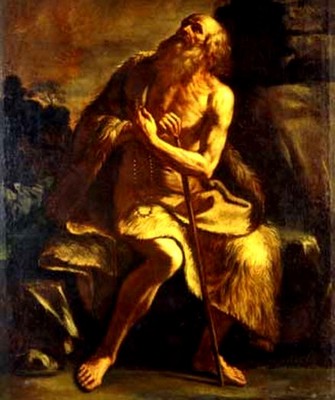
St. Paul, the First
Hermit
From his life, compiled
by St. Jerom, in 365. Pope Gelasius I. in his learned Roman council, in 494,
commends this authentic history. St. Paul is also mentioned by Cassian, St.
Fulgentius, Sulpitius Severus, Sidonius, Paulinus, in the life of St. Ambrose, &c.
St. Jerom received this account from two disciples of St. Antony, Amathas and
Macarius. St. Athanasius says, that he only wrote what he had heard from St.
Antony’s own mouth, or from his disciples, and desires others to add what they
knew concerning his actions. On the various readings and MS. copies of this
life, see the disquisition of F. Jer. de Prato, an oratorian of Verona, in his
new edition of the works of Sulpitius Severus, t. 1. app. 2. p. 403. The Greek
history of Saint Paul the hermit, which Bollandus imagines Saint Jerom to have
followed, is evidently posterior; and borrows from him, as Jos. Assemani shows.
Comm. in Calend. Univ. t. 6. p. 82. See Gudij Epistolæ, p. 278.
A.D. 342.
ELIAS and St. John the
baptist sanctified the deserts, and Jesus Christ himself was a model of the
eremitical state during his forty day’s fast in the wilderness; neither is it
to be questioned that the Holy Ghost conducted the saint of this day, though
young, into the desert, and was to him an instructor there: but it is no less
certain, that an entire solitude and total sequestration of one’s self from
human society, is one of those extraordinary ways by which God leads souls to
himself, and is more worthy of our admiration, than calculated for imitation
and practice; it is a state which ought only to be embraced by such as are
already well experienced in the practices of virtue and contemplation, and who
can resist sloth and other temptations, lest instead of being a help, it prove
a snare and stumbling-block in their way to heaven.
This saint was a native
of the Lower Thebais in Egypt, and had lost both his parents when he was but
fifteen years of age: nevertheless he was a great proficient in Greek and
Egyptian learning, was mild and modest, and feared God from his earliest youth.
The bloody persecution of Decius disturbed the peace of the church in 250; gad
what was most dreadful, Satan by his ministers, sought not so much to kill the
bodies, as by subtle artifices and tedious tortures to destroy the souls of men.
Two instances are sufficient to show his malice in this respect: A soldier of
Christ, who had already triumphed over the racks and tortures, had his whole
body rubbed over with honey, and was then laid on his back in the sun, with his
hands tied behind him, that the flies and wasps, which are quite intolerable in
hot countries, might torment and gall him with their stings. Another was bound
with silk cords on a bed of down, in a delightful garden, where a lascivious
woman was employed to entice him to sin; the martyr, sensible of his danger,
bit off part of his tongue and spit it in her face, that the horror of such an
action might put her to flight, and the smart occasioned by it be a means to
prevent, in his own heart, any manner of consent to carnal pleasure. During
these times of danger, Paul kept himself concealed in the house of another; but
finding that a brother-in-law was inclined to betray him, that he might enjoy
his estate, he fled into the deserts. There he found many spacious caverns in a
rock, which were said to have been the retreat of money-coiners in the days of
Cleopatra, queen of Egypt. He chose for his dwelling a cave in this place, near
which were a palm-tree 1 and
a clear spring; the former by its leaves furnished him with raiment, and by its
fruit with food; and the latter supplied him with water for his drink.
Paul was twenty-two years
old when he entered the desert. His first intention was to enjoy the liberty of
serving God till the persecution should cease; but relishing the sweets of
heavenly contemplation and penance, and learning the spiritual advantages of
holy solitude, he resolved to return no more among men, or concern himself in
the least with human affairs, and what passed in the world: it was enough for
him to know that there was a world, and to pray that it might be improved in goodness.
The saint lived on the fruit of his tree till he was forty-three years of age,
and from that time till his death, like Elias, he was miraculously fed with
bread brought him every day by a raven. His method of life, and what he did in
this place during ninety years, is unknown to us: but God was pleased to make
his servant known a little before his death.
The great St. Antony, who
was then ninety years of age, was tempted to vanity, as if no one had served
God so long in the wilderness as he had done, imagining himself also to be the
first example of a life so recluse from human conversation: but the contrary
was discovered to him in a dream, the night following, and the saint was at the
same time commanded, by Almighty God, to set out forthwith in quest of a
perfect servant of his, concealed in the more remote parts of those deserts.
The holy old man set out the next morning in search of the unknown hermit. St.
Jerom relates from his authors, that he met a centaur, or creature not with the
nature and properties, but with something of the mixed shape of man and horse, 2 and
that this monster, or phantom of the devil, (St. Jerom pretends not to
determine which it was,) upon his making the sign of the cross, fled away,
after having pointed out the way to the saint. Our author adds, that St. Antony
soon after met a satyr, 3 who
gave him to understand that he was an inhabitant of those deserts, and one of
that sort whom the deluded Gentiles adored for gods. Saint Antony, after two
days and a night spent in the search, discovered the saint’s abode by a light
that was in it, which he made up to. Having long begged admittance at the door
of his cell, St. Paul at last opened it with a smile: they embraced, called
each other by their names, which they knew by divine revelation. St. Paul then
inquired whether idolatry still reigned in the world? While they were
discoursing together, a raven flew towards them, and dropped a loaf of bread
before them. Upon which St. Paul said, “Our good God has sent us a dinner. In
this manner have I received half a loaf every day these sixty years past; now
you are come to see me, Christ has doubled his provision for his servants.”
Having given thanks to God, they both sat down by the fountain; but a little
contest arose between them who should break the bread; St. Antony alleged St.
Paul’s greater age, and St. Paul pleaded that Antony was the stranger; both
agreed at last to take up their parts together. Having refreshed themselves at
the spring, they spent the night in prayer. The next morning St. Paul told his
guest that the time of his death approached, and that he was sent to bury him,
adding, “Go and fetch the cloak given you by St. Athanasius, bishop of
Alexandria, in which I desire you to wrap my body.” This he might say with the
intent of being left alone in prayer, whilst he expected to be called out of
this world; as also that he might testify his veneration for St. Athanasius,
and his high regard for the faith and communion of the Catholic church, on
account of which that holy bishop was then a great sufferer. St. Antony was
surprised to hear him mention the cloak, which he could not have known but by
divine revelation. Whatever was his motive for desiring to be buried in it, St.
Antony acquiesced to what was asked of him: so, after mutual embraces, he
hastened to his monastery to comply with St. Paul’s request. He told his monks
that he, a sinner, falsely bore the name of a servant of God; but that he had
seen Elias and John the Baptist in the wilderness, even Paul in Paradise.
Having taken the cloak, he returned with it in all haste, fearing lest the holy
hermit might be dead, as it happened. Whilst on his road, he saw his happy soul
carried up to heaven, attended by choirs of angels, prophets, and apostles. St.
Antony, though he rejoiced on St. Paul’s account, could not help lamenting on
his own, for having lost a treasure so lately discovered. As soon as his sorrow
would permit, he arose, pursued his journey, and came to the cave. Going in, he
found the body kneeling, and the hands stretched out. Full of joy, and
supposing him yet alive, he knelt down to pray with him, but by his silence
soon perceived he was dead. Having paid his last respects to the holy corpse,
he carried it out of the cave. Whilst he stood perplexed how to dig a grave,
two lions came up quietly, and as it were mourning; and tearing up the ground,
made a hole large enough for the reception of a human body. St. Antony then
buried the corpse, singing hymns and psalms, according to what was usual and
appointed by the church on that occasion. After this he returned home praising
God, and related to his monks what he had seen and done. He always kept as a
great treasure, and wore himself on great festivals, the garment of St. Paul,
of palm-tree leaves patched together. St. Paul died in the year of our Lord,
342, the hundred and thirteenth year of his age, and the ninetieth of his
solitude, and is usually called the first hermit, to distinguish him from
others of that name. The body of this saint is said to have been conveyed to
Constantinople, by the emperor Michael Comnenus, in the twelfth century, and
from thence to Venice in 1240. 4 Lewis
I. King of Hungary, procured it from that republic, and deposited it at Buda,
where a congregation of hermits under his name, which still subsists in
Hungary, Poland, and Austria, was instituted by blessed Eusebius of Strigonium,
a nobleman, who, having distributed his whole estate among the poor, retired
into the forests; and being followed by others, built the monastery of Pisilia,
under the rule of the regular canons of St. Austin. He died in that house,
January the 20th, 1270.
St. Paul, the hermit, is
commemorated in several ancient western Martyrologies on the 10th of January,
but in the Roman on the 15th, on which he is honoured in the anthologium of the
Greeks.
An eminent contemplative
draws the following portraiture of this great model of an eremitical life; 5 St.
Paul, the hermit, not being called by God to the external duties of an active
life, remained alone, conversing only with God, in a vast wilderness, for the
space of nearly a hundred years, ignorant of all that passed in the world, both
the progress of sciences, the establishment of religion, and the revolutions of
states and empires; indifferent even as to those things without which he could
not live, as the air which he breathed, the water he drank, and the miraculous
bread with which he supported life. What did he do? say the inhabitants of this
busy world, who think they could not live without being in a perpetual hurry of
restless projects; what was his employment all this while? Alas! ought we not
rather to put this question to them; what are you doing whilst you are not
taken up in doing the will of God, which occupies the heavens and the earth in
all their motions? Do you call that doing nothing which is the great end God
proposed to himself in giving us a being, that is, to be employed in
contemplating, adoring, and praising him? Is it to be idle and useless in the
world, to be entirely taken up in that which is the eternal occupation of God
himself, and of the blessed inhabitants of heaven? What employment is better,
more just, more sublime, or more advantageous than this, when done in suitable
circumstances? To be employed in any thing else, how great or noble soever it
may appear in the eyes of men, unless it be referred to God, and be the
accomplishment of his holy will, who in all our actions demands our heart more
than our hand, what is it, but to turn ourselves away from our end, to lose our
time, and voluntarily to return again to that state of nothing out of which we
were formed, or rather into a far worse state?
Note 1. Pliny
recounts thirty-nine different sorts of Palm-trees, and says that the best grow
in Egypt, which are ever green, have leaves thick enough to make ropes, and a
fruit which serves in some places to make bread. [back]
Note 2. Pliny, l. 7.
c. 3. and others, assure us that such monsters have been seen. Consult the
note of Rosweide. [back]
Note 3. The heathens
might feign their gods of the woods, from certain monsters sometimes seen.
Plutarch, in his life of Sylla, says, that a satyr was brought to that general
at Athens; and St. Jerom tells us, that one was shown alive at Alexandria, and
after its death was salted and embalmed, and sent to Antioch, that Constantine
the Great might see it. [back]
Note 4. See the
whole history of this translation, published from an original MS. by F. Gamans,
a Jesuit, inserted by Bollandus in his collection. [back]
Note 5. F. Ambrose
de Lombez, Capuchin, Tr. de la Paix Intérieure (Paris, 1758.) p. 372. [back]
Rev. Alban
Butler (1711–73). Volume I: January. The Lives of the
Saints. 1866.
SOURCE : http://www.bartleby.com/210/1/151.html
Golden
Legend – Life of Saint Paul the first Hermit
Article
Here followeth, the Life
of Saint Paul the first Hermit.
Saint Paul which was the
first hermit as Saint Jerome writeth, was in the time of Decius and Valerianus,
emperors, the year of the incarnation of our Lord two hundred and fifty-six.
This holy man, Saint Paul, saw men for christian faith cruelly tormented,
wherefore he fled into the desert. Among whom he saw two cruelly tormented. The
first for that he abode firmly in his faith, the judge did do anoint all his
body with honey and did do bind his hands behind him on his back, and so did
him be set in the heat of the sun for to be bitten and stung of flies and
wasps; that other that was young he made him to be in a right soft bed between
two sheets, among flowers and delectable roses and herbs sweet smelling, and
therein he was bounden so that he might not move him. After, he made an harlot,
a ribald, come to him alone for to touch his members and his body, to move to
lechery. Finally, when the voluptuosity of his flesh surmounted him, and he
might not defend himself ne his members, he bit off a piece of his tongue and
spit it in her visage, which always enticed him to lechery by touching and by
kissings, and so he voided the temptation fleshly, and the ribauld also, and
deserved to have laud and victory. In this time Saint Paul, tofore said, was
young, about sixteen years of age, and dwelt in Thebaid which is a part of
Egypt, with his sister Maurice. And when he saw the persecutions of christian
men, he departed and became an hermit so long and so many years, that he was
old one hundred and thirteen years. In this time Saint Anthony was a hermit in
another desert and was then ninety years of age. And on a time he thought in
himself that in the world was none so good ne so great an hermit as he was
himself. Hereupon came to him a revelation as he slept that, beneath all, low
down in that desert was an hermit better than he, a all. And whiles they were
thus talking a crow came flying and brought to them two loaves of bread ; and
when the crow was gone Saint Paul said: Be thou glad and joyful, for our Lord
is debonair and merciful, he hath sent us bread for to eat. It is forty years
passed that every day he hath sent me half a loaf, but now at thy coming he
hath sent two whole loaves, and double provender. And they had question
together until evensong time which of them both should entame or begin to take
of the bread. At the last the bread departed even between their hands, and then
they ate, and drank of the well or fountain. After graces said they had all that
night collation together. On the morn said Saint Paul: Brother, it is
long sith that I knew that thou dwelledst in
this region and in this country, and God had promised to me thy company, I
shall now shortly die and shall go to Jesu Christ for to receive the crown to
me promised, thou art come hither for to bury my body. When Saint Anthony heard
that, anon he began tenderly to weep, and wailed, praying that he might die
with him and go in his company. Saint Paul said: It is need yet that thou live
for thy brethren, to the end that they by the ensample of thee be made firm and
taught; wherefore I pray thee return to thine abbey and bring to me the mantle
which Athanasius the bishop gave to thee for to wrap in my body. Then Saint
Anthony marvelled of this, that he knew of this bishop and of this mantle, and
after durst nothing say, but did to him reverence, like as God had spoken to
him, and weeping kissed his feet and his hands and came again to his abbey with
great travail and labour, for he had from that one part to that other many
journeys and foul way, through hayes and hedges, woods, stones, hills and
valleys, and Saint Anthony of great age and feeble of fasting, and not strong
ne mighty.
When he was come to his
abbey, two of his disciples, to him most secret, demanded of him saying: Fair
father, where have ye been so long? And he answered: Alas! I, wretched sinner,
which bear falsely the name to be a monk, I have seen Eli the prophet, I have
seen John the Baptist in desert, and certes I have seen Saint Paul in Paradise.
Thus speaking and beating his breast he brought the mantle out of his cell, and
all stilly without more words, he went again the long way all alone through the
desert unto Saint Paul the hermit, having great desire to see him, for he was
afeard lest he should die ere he might come again to him. It happed in the
second journey, where Saint Anthony went through the desert the third hour of
the day, he saw the soul of Saint Paul, shining, ascend into heaven among a
great company of angels, of prophets, and also of apostles, and anon he fell
down to the earth weeping and wailing, and crying with a high voice: Alas,
Paul! wherefore leavest thou me so soon, which have so little seen thee? Then
he had so great desire to see the corpse or body that he passed all the remnant
of his way as soon as a bird flying, like as he was wont to tell and rehearse,
and when he came to the cell of Saint Paul he found that the body was right up
on his knees and the visage and hands addressed towards heaven and supposed he
had been alive and had made his prayers, but when he had advised it, he knew
well that he was passed out of this world. What weepings and what wailings he
made upon the body it were a piteous thing to hear; among all other he said: O
holy soul, thy body showeth in death this that thou didst in thy life. After
this he was much abashed how he should bury the body, for he had no instrument
to make his sepulchre; then came two lions which much debonairly made a pit
after the quantity of his body, and Saint Anthony buried his body therein. And
he took with him the coat of Saint Paul which was made and and afterward, for
great reverence, Saint Anthony ware this coat and clad him withal in great and
solemn feasts. Thus this holy man Saint Paul died in the year of the
incarnation of our Lord two hundred and eighty-eight. Let us then pray to him
that he impetre and get us remission of our sins, that after this life we may
come to everlasting joy and bliss in heaven. Amen.
SOURCE : https://catholicsaints.info/golden-legend-life-of-saint-paul-the-first-hermit/
Pictorial
Lives of the Saints – Saint Paul, The First Hermit
Saint
Paul was born in Upper Egypt, about the year 230, and became an orphan at the
age of fifteen, being very rich and highly educated. Fearing lest the tortures
of a terrible persecution might endanger his perseverance, he retired into a
remote village. But his pagan brother-in-law denounced him, and Saint Paul, rather
than remain where his faith was in danger, entered the barren desert, trusting
that God would supply his wants. And his confidence was rewarded; for in the
spot to which Providence led him he found the fruit of the palm-tree for food,
and its leaves for clothing, and the water of the spring for drink. His first
design was to return to the world when the persecution was over, but tasting
great delights in prayer and penance, he remained the rest of his life, ninety
years, in penance, prayer, and contemplation. God revealed his existence to
Saint Antony, who sought him for three days. Seeing a thirsty she-wolf run
through an opening in the rocks, Antony followed her to look for water, and
found Paul. They knew each other at once, and praised God together. When Saint
Antony visited him, a raven brought him a loaf, and Saint Paul said, ” See how
good God is! For sixty years this bird has brought me half a loaf every day;
now thou art come, Christ has doubled the provision for His servants.” Having
passed the night in prayer, at dawn of day Paul told Antony he was about to
die, and asked to be buried in the cloak given to Antony by Saint Athanasius.
Antony hastened to fetch it, and on his way back saw Paul rise to heaven in
glory. He found his dead body kneeling as if in prayer, and two lions came and
dug his grave. Paul died in his one hundred and thirteenth year.
Reflection – We shall
never repent of having trusted in God, for he cannot fail those who lean on
him; nor shall we ever trust in ourselves without being deceived.
SOURCE : https://catholicsaints.info/pictorial-lives-of-the-saints-saint-paul-the-first-hermit/

Koptische
icoon van Paulus van Thebe (links) met Sint Antonius
Saint Anthony and Saint Paul
; Icons of Saint Anthony the
Great ; Icons of Paul of Thebes ; Coptic icons ; Cilice in icons
Saints
in Art – Saint Anthony and Saint Paul the Hermits
Article
Born at Alexandria, in
the third century, he was early left an orphan, with an only sister. He divided
his inheritance with her, sold his portion, and went to live among hermits.
According to the legend he was tormented grievously by demons, who tempted him
with every worldly delight, rich clothing, delicious viands, and beautiful
women appeared before him, but by prayer he overcame them. Then they assumed
the hideous shapes of monsters, serpents, and every kind of poisonous animal,
and these tormented him, but Christ comforted him. He fled to a more secluded
cavern, where he lived for twenty years, without human intercourse of any kind.
Then he came out of his solitude, and preached and taught, performing miracles,
and persuaded many to become his disciples. When he had lived for seventy-five
years in the desert, he was told in a vision of Saint Paul, the hermit, who had
been living in penance for ninety years, and he at once resolved to go to see
him. So he set out across the desert. After journeying several days, and
meeting on the way a centaur and a satyr, he came at last to a cave in the
rocks, where Saint Paul dwelt, beside a stream and a palm-tree. The two men
embraced, and Saint Paul inquired of the world since he had left it. While they
talked, a raven came, bringing a loaf of bread in its beak. Saint Paul said
that it had come every day for sixty years, but that to-day the portion was
doubled. He then told Saint Anthony to go back to his monastery, and fetch a
cloak that had been given him by Saint Athanasius, the bishop, for he was about
to die, and wished to be buried in it. So Saint Anthony set out, and as he was
returning with the cloak he saw a vision of Saint Paul ascending to heaven, and
on his arrival at the cave he found his body, dead, in the attitude of prayer.
He had no strength left to dig a grave, but two lions came and dug it with
their paws, and Saint Anthony wrapped the body in the cloak and buried it. He
died fourteen years later, and was buried secretly, according to his wish.
He is represented as very
old, in his monk’s habit (as the founder of monachism), often with a crutch,
and aspergilly or a hell (to exorcise evil spirits), and a pigy to represent
sensuality and gluttony overcome by him.
Saint Paul is very old,
with long white hair, half naked, his only garment of matted palm leaves,
sometimes with a raven and a stream.
MLA
Citation
Margaret E Tabor. “Saint
Anthony the Hermit and Saint Paul”. The Saints in
Art, with Their Attributes and Symbols, 1913. CatholicSaints.Info.
24 April 2020. Web. 21 January 2026.
<https://catholicsaints.info/saints-in-art-saint-anthony-and-saint-paul-the-hermits/>
SOURCE : https://catholicsaints.info/saints-in-art-saint-anthony-and-saint-paul-the-hermits/
+c.jpg)
Carlo
Dolci (1616–1686), Saint Paul of Thebes, circa 1648, 168.5 x 132, National Museum in Warsaw, Warsaw
San Paolo di Tebe Primo
eremita
Festa: 10 gennaio
Egitto, III-IV sec.
Primo degli eremiti
cristiani, di Paolo si sa pochissimo. Vissuto in Egitto tra il III e il IV
secolo, nobile, fugge nel deserto per scampare alle persecuzioni di Decio.
Secondo la tradizione c’è una sua cella in un santuario di fronte al Sinai.
Muore vecchissimo dopo 60 anni di vita solitaria.
Etimologia: Paolo =
piccolo di statura, dal latino
Emblema: Corvo
Martirologio
Romano: Nella Tebaide, in Egitto, san Paolo, eremita, cultore della vita
monastica fin dai suoi inizi.
Vive fino a 113 anni
tutto solo, in mezzo al deserto: è la volontà di Dio poiché questo santo
sopravvive per lungo tempo grazie a un corvo che, tutti i giorni, gli porta un
pezzo di pane per sfamarsi. Questa è la storia di Paolo, nato nel 228 a Tebe
(Egitto), il primo eremita cristiano. La sua famiglia è benestante: il piccolo
Paolo conduce una vita agiata e può permettersi di studiare. Alla morte dei
genitori Paolo ha solo ventidue anni. Eredita grandi ricchezze che deve
dividere con sua sorella. Purtroppo suo cognato, avido e malvagio, per
impossessarsi della sua parte di eredità, lo denuncia alle autorità come
cristiano (a quell’epoca i credenti come lui venivano perseguitati). Paolo
scappa, si rifugia in un luogo deserto dove trova una grotta scavata nella
roccia. Vicino scorre un piccolo ruscello e riesce a togliersi la sete. Una
palma gli permette di cibarsi dei suoi frutti e tutti i giorni, in maniera
prodigiosa, un corvo gli porta un tozzo di pane. Grazie a questo volatile tutto
nero Paolo sopravvive. Nel frattempo Paolo scopre di avere molta fede in Dio e
sente che quella è la vita scelta per lui dal Cielo. Decide, così, di condurre
la sua esistenza isolato dal resto del mondo per percorrere il suo cammino
verso il Signore e la pace interiore, pregando e meditando. Si fa crescere una
lunga barba che, con il tempo, diventa completamente bianca e non si sposta mai
dalla sua grotta. Nel 341, Sant’Antonio abate, novantenne, anche lui eremita in
un’altra grotta e a capo dei monaci eremiti (chiamati “Padri del deserto”), un
giorno lo va a trovare. Mentre Sant’Antonio percorre la via che lo riporta sui
suoi passi, avverte il forte desiderio di ritornare da Paolo che è diventato
molto anziano ed ha compiuto 113 anni. Arrivato di nuovo presso la grotta di
Paolo, Antonio lo trova riverso per terra privo di vita. Sant’Antonio dà
sepoltura all’amico in una fossa scavata, secondo la leggenda, da due leoni.
Attualmente vicino alla grotta dove visse Paolo, nel deserto orientale
egiziano, esiste un monastero di eremiti che conducono l’esistenza come San
Paolo, da soli e pregando, per stare più vicini a Dio.
Autore: Mariella Lentini
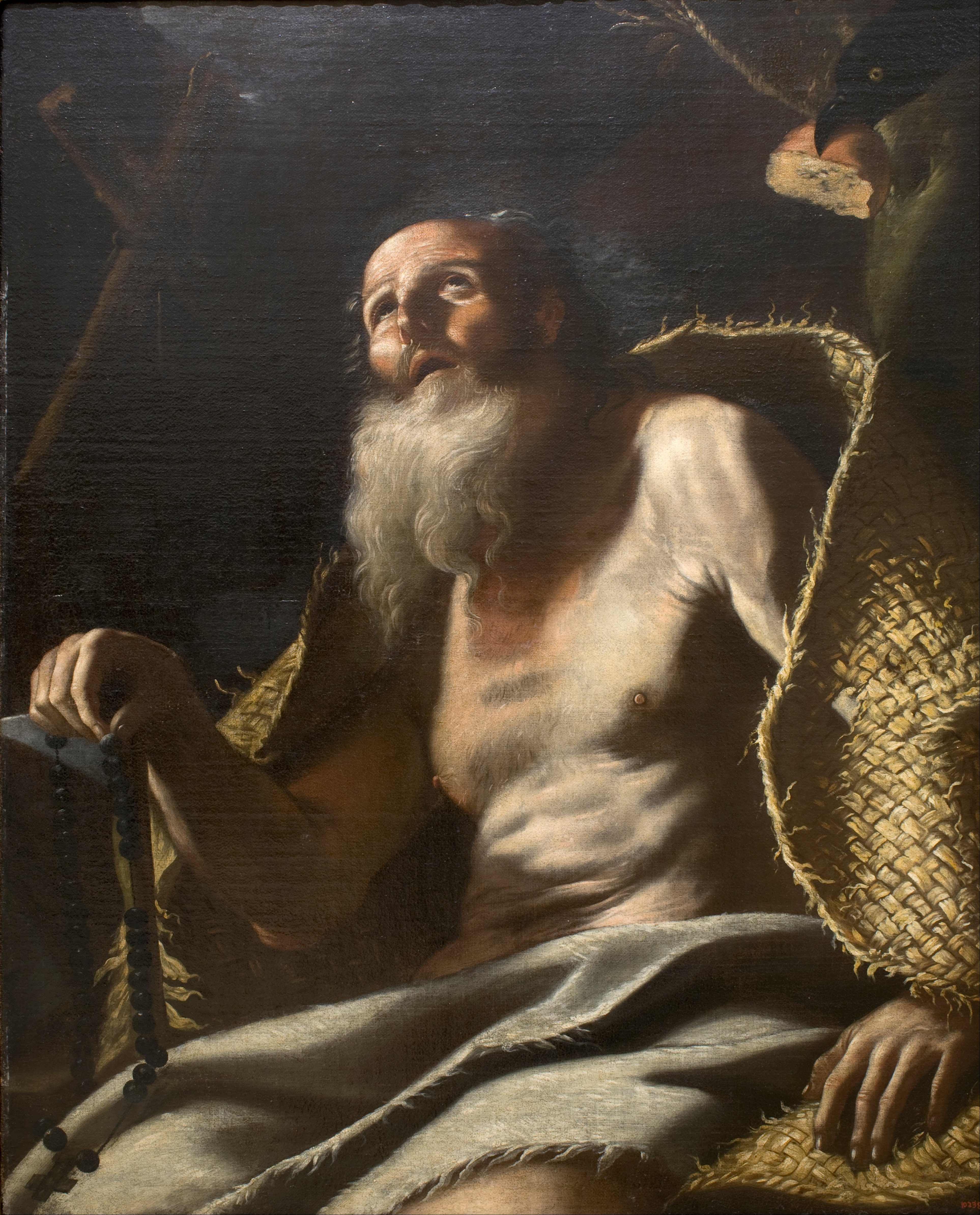
Attributed
to Mattia Preti (1613–1699), San Paolo
eremita, 1656-1660), olio su tela, National Museum of Ancient Art
Incomincia e finisce da solo. Non fa neppure un discepolo. Nemmeno ci pensa. Sarà considerato il primo degli eremiti cristiani, forse, ma non gli importa che ce ne sia un secondo. Avvolto nel mistero e affascinante, questo Paolo: non ha lasciato scritti o parole memorabili, morendo all’insaputa di tutti in un posto sconosciuto a moltissimi. E poi accade che, a otto secoli circa dalla sua morte, nasca una comunità religiosa col nome di “Ordine di San Paolo Primo Eremita” o “Eremiti di San Paolo”: una comunità che, allo spirare del XX secolo, sarà ancora viva e conosciutissima, avendo la sua casa generalizia in Polonia, presso il santuario mariano di Czestochowa, a contatto con milioni di pellegrini.
Però è da vedere se questo Paolo corra dalla città al deserto già con quell’idea di vivere in solitudine e preghiera fino alla morte. Sappiamo che è di famiglia egiziana nobile, già cristiano. E che fugge verso il deserto inizialmente per salvare insieme la fede e la vita. E’ cominciata infatti la persecuzione ordinata dall’imperatore Decio a metà del III secolo, nel tentativo di ridare unità al mondo romano attorno alle antiche divinità pagane. Una persecuzione breve, ma dura e capillare, perché si chiede a ognuno di partecipare personalmente a riti pagani, come segno di lealtà allo Stato. Chi accetta può vivere tranquillo, ricevendo una sorta di certificato di buona condotta. E molti cristiani difatti accettano, in modo più o meno convinto, per salvare la vita. Paolo non rende omaggio agli dèi; si salva con la fuga.
Presto l’imperatore Decio muore combattendo in Tracia contro i Goti (anno 251) e la persecuzione cessa. Ma Paolo non ritorna. Non lo si vede più: il deserto e la solitudine lo hanno conquistato. Lo appagano, lo fanno sentire realizzato e mai più bisognoso di tornare indietro verso la città, la famiglia, i beni. Un luogo montagnoso con nascondigli propizi; una fontana, e quindi degli alberi, dei frutti: questo diventa per lui il migliore dei mondi. Ci resterà per sessant’anni, morendo vecchissimo. San Gerolamo (ca. 347-420) scriverà su di lui un libro ricco di avventure entusiasmanti, ma sprovvisto di notizie certe.
Un santo bizzarro: senza data sicura della morte, senza che una sola parola sua ci sia pervenuta. C’è in Egitto un monastero, di fronte al Sinai (eretto forse nel VI secolo da Giustiniano), che, secondo la tradizione, conserva la sua cella. Niente altro abbiamo che ci colleghi materialmente a quest’uomo del silenzio. Tuttavia la Chiesa ne conserva il ricordo, con questa aureola di isolamento radicale. Sappiamo che Antonio abate, maestro di monaci, andò a visitarlo da vecchio. E che, tornando dopo alcuni anni, non l’ha più trovato vivo. Anche all’incontro con la morte Paolo l’egiziano è andato da solo. Nessuno ha saputo quando e come.
Autore: Domenico Agasso
SOURCE : https://www.santiebeati.it/dettaglio/37750

Diego Velázquez, Sant'Antonio abate e San Paolo di Tebe /
Saint Anthony the Great and Saint Paul the
Anchorite, 1635 ca.,
261 x 192.5, Museo del Prado, Madrid.

Diego Velázquez, Sant'Antonio abate e San Paolo di Tebe /
Saint Anthony the Great and Saint Paul the
Anchorite, 1635 ca., Museo del Prado, Madrid.
Den hellige Paulus av
Teben (~229-342)
Minnedag:
10. januar
Den hellige Paulus (gr:
Paulos, Παύλος) ble født rundt år 229 i en rik, kristen familie i den egyptiske
byen Teben (nå Luxor; arab: Al Uqsur) i Nedre Thebais (Øvre Egypt). Etter en
uskyldsren og from barndom mistet han og hans gifte søster rundt 244 begge sine
foreldre og arvet deres store formue. Paulus var da femten år gammel. Han
elsket sitt hjemlands kultur og hadde også kjennskap til gresk. På den tiden
raste keiser Decius’ (249-51) grusomme kristenforfølgelser. En hedensk venn
gjemte Paulus i sitt hus, men en svoger som både ville ha den statlige
belønningen for å angi kristne samt Paulus’ rikdommer, anga ham til
myndighetene som kristen.
Paulus var da rundt 22 år
gammel. Han ble advart og flyktet ut i ørkenen, og planla å vende tilbake når
forfølgelsen var over. Men slik ble det ikke; Guds kall var sterkere enn hans
egne planer. Han ble i sin fjellhule i Den tebanske ørken i nitti år og tjente
Gud med faste og bønn uten noensinne å bli oppdaget. Han kledde seg i en drakt
av palmeblader, og til han var 43 år gammel levde han bare av palmenes frukter.
Men fra da av begynte en tam ravn å bringe ham et halvt brød hver morgen.
Paulus’ liv blir
beskrevet av ingen ringere enn den hellige Hieronymus (331-420),
trolig i 375/76, bare noen tiår etter Paulus’ død. Han skal ha hørt historien
fra to disipler av den hellige Antonius den store (ca
251-356), Amathas og Makarius.
Biografien Vita
Pauli (Vita Pauli primi eremitae) er basert på en gresk original og
er vår eneste kilde. Etter våre begreper er det ingen vanlig biografi, men en
hyllest av eneboerlivet i en forvirrende blanding av fakta og fantasi. Det er
brukt bilder fra eldre og samtidig reise- og legendelitteratur, også profan og
hedensk. Det er mulig at hele biografien bare er en oversettelse av en gresk
folkelig legende. Det er mulig at den er skrevet som et supplement til den
hellige Athanasius
av Alexandrias (ca 296-373) biografi om Antonius, med det mål å gi Paulus
noe av æren som ble gitt Antonius gjennom populariteten til Athanasius’
biografi, som fikk stor utbredelse. Alle senere greske, syriske, koptiske og
etiopiske biografier bygger på Hieronymus’ verk. Paulus nevnes også av de
hellige Johannes
Kassian (ca 360-433) (Collationes XVIII.6), Fulgentius av Ruspe (ca
468-533), Sulpicius Severus (Dialogi I.17), Sidonius
Apollinaris (ca 432-ca 482), Paulinus av Nola (353-431)
og i biografien om den hellige Ambrosius av Milano (ca
339-97), men alle bygger på Hieronymus.
De egyptiske
ørkenfedrenes patriark var uten tvil Antonius, men han hadde en forgjenger i
Paulus, som derfor kalles «den første eremitt» – i alle fall sier Paulus’
biograf Hieronymus at han var eldre enn Antonius. En natt rundt år 340 hadde
Antonius en drøm. Åpenbaringen gjorde det klart at det allerede før ham var en
annen hellig mann som hadde valgt ørkenen som sted for å tjene Gud. Det sies at
Gud avslørte dette for Antonius fordi han var fristet til forfengelighet ved
tanken på at han hadde tjent Gud lengst i ørkenen.
Antonius ble svært
overrasket, og tross sine nitti år ga han seg straks i vei for å vise den
ukjente eremitten sin aktelse. I tre dager lette han etter Paulus, og ifølge
Hieronymus’ biografi møtte han på veien en demon i form av en kentaur (gresk
sagnskikkelse, et demonisk vesen med halvt menneskekropp og halvt hestekropp).
Senere fikk han øye på en knøttliten gammel mann med horn på hodet. «Hvem er
du?» spurte Antonius. «Jeg er et lik, et av dem som hedningene kaller satyrer,
og av dem ble lokket inn i avgudsdyrkelse».
Da morgenen kom, fortalte
Paulus at han nå kjente døden nærme seg, og ba sin gjest om å hente den kappen
Antonius hadde fått av den hellige patriark Athanasius, for i den ville han
begraves. Antonius hentet kappen, men da han kom tilbake, fikk han se hvordan
Paulus’ sjel steg opp til himmelen, omgitt av en hærskare av engler og
lovsyngende apostler og profeter. Han fant Paulus’ legeme knelende med armene
utstrakt. Antonius svøpte det utmagrede legemet i patriarkens kappe og gravla
ham i en grop som på Antonius’ befaling hadde blitt gravd av to løver. Deretter
velsignet han løvene, tok med seg Paulus’ drakt av palmeblader og dro tilbake
til sitt kloster, mens løvene dro ut i ørkenen.
Dette skjedde ifølge
Hieronymus rundt år 342, ifølge tradisjonen den 5. januar 342. Paulus skal ha
blitt hele 113 år gammel; de siste nitti år hadde han tilbrakt i sin grotte.
Resten av livet passet Antonius på Paulus’ drakt av palmeblader som en
relikvie, og han bar den selv to ganger i året, påskedag og pinsedag. Den skal
ha blitt oppbevart som relikvie i kirken Sant’Antonio
abate all’Esquilino i Roma. Paulus selv hadde den lille kirken San Paolo
Primo Eremita i Roma, som tidligere ble betjent av eremitter fra
ordenen som bærer hans navn, men som nå er dekonsekrert.
Paulus’ festdag i vesten
er 10. januar, og den står fortsatt i den nyeste utgaven av Martyrologium
Romanum (2004). Men ved kalenderrevisjonen i 1969 ble den strøket i Kirkens generalkalender
og henvist til lokale eller spesielle kalendere. Paulus ble feiret den 5. eller
15. januar i øst. Hans armenske minnedag er 6. desember med en liturgisk
feiring på torsdag etter andre søndag i advent, og han minnes i den armenske
anafora (eukaristisk bønn). Hans koptiske minnedag er 27. januar, og den
syrisk-ortodokse minnedagen er den 15. januar, og han minnes i Basilios’
anafora. 9. februar nevnes også som minnedag. Han kalles Paulus av Teben eller
Paulus Eremitten, noen ganger «Paulus den første eremitten» (Sanctus
Paulus Primus Eremita) for å skjelne ham fra andre eremitter ved navn
Paulus.
Klosteret St Paulus
(koptisk: Deir Anba Boula) sør for Galala-fjellene, fire mil vest for
Rødehavet, er bygd over hans hule. Paulus fremstilles ofte i kunsten i en drakt
av palmegrener, gjerne med en ravn, som brakte ham det daglige brød, eller med
to løver, som gravde hans grav. Vi kan også ofte se palmetreet som sørget for
mat og ly i hans lange liv som eremitt, og det er vanlig å se Paulus avbildet
sammen med Antonius. Hans attributter er krykke, palme, ravn og to løver. Han
må ikke blandes sammen med den hellige Paulus den enkle (d.
ca 339), som var en disippel av Antonius den store.
På 1100-tallet ble
Paulus’ angivelige relikvier gjenfunnet, og de ble overført til Konstantinopel
og plassert i klosteret Theotókos Peribleptos etter ordre fra
keiser Manuel I Komnenos (1143-80). Derfra ble de i 1240 ført til San Giuliano
i Venezia. Kong Lajos I av Ungarn (1342-82) fikk dem i 1381 fra republikken
Venezia, og derfra ble de brakt til Buda i Ungarn (i dag en del av Budapest) av
paulinerne (Ordo Fratrum Sancti Pauli Primi Eremita – OSPPE)
(ung: Szent Pál Első Remete Szerzeteseinek Rendje), den eneste ungarske
eremittkongregasjonen, grunnlagt rundt 1250. Den eksisterer fortsatt og er godt
kjent, og den har sitt moderhus i det sørlige Polen, ved Mariahelligdommen
Czestochowa. Deler av hans hodeskalle og hans hode befinner seg i Peterskirken i
Vatikanet og i kirken Santa Maria
in Aracoeli på Capitol.
Kilder:
Attwater/John, Attwater/Cumming, Farmer, Bentley, Butler (I), Benedictines,
Delaney, Bunson, Engelhart, Schauber/Schindler, Gorys, Dammer/Adam, LThK,
MR2004, KIR, CE, CSO, CatholicSaints.Info, Infocatho, Bautz, Heiligenlexikon,
santiebeati.it, en.wikipedia.org, oca.org, Butler 1866, zeno.org,
heiligen-3s.nl, Claremont Coptic Encyclopedia (claremont.edu),
paulinerorden.de, nominis.cef.fr - Kompilasjon og oversettelse: p. Per Einar Odden
Opprettet: 1.
februar 2000
SOURCE : https://www.katolsk.no/biografier/historisk/ptheben
Paulus van Thebe (ook Eremiet, Kluizenaar of Woestijnvader),
Egypte; kluizenaar & woestijnvader; † 342.
Feest † 10
& 15 januari.
Hij moet rond 228 geboren zijn in de landstreek Thebaïs in Opper-Egypte.
Toen er ten tijde van keizer Decius (249-251) in heel het Romeinse Rijk christenvervolgingen uitbraken, vluchtte hij de woestijn in om zich daar verborgen te houden. Hij trok dieper nog de eenzaamheid in, toen een neef zijn schuilplaats bekend maakte. Deze was hem komen opzoeken om te melden, dat zijn ouders overleden waren. Bij terugkomst in de bewoonde wereld, kon hij zijn mond niet houden over wat hij gezien had, en vestigde aldus de aandacht op de ondergedoken Paulus.
Door deze omstandigheden werd Paulus bij toeval de uitvinder van het kluizenaarsleven. Al was hij het kwaad, dat van buiten kwam, ontvlucht, in de eenzaamheid van de woestijn ontdekte hij, dat er een kwaad bestreden moest worden, dat van binnen kwam: krachten, verlangens en bekoringen die in de eigen persoon scholen en die de onbaatzuchtige liefde tot God en de naaste in de weg stonden.
Daarmee deed hij precies dezelfde ontdekking als het Joodse volk, toen het door de woestijn trok, en als Jezus, toen deze veertig dagen aan een stuk in de woestijn had gevast (Lukas 04,01-13). Negentig jaar lang leefde hij zo in volstrekte afzondering.
Op zijn oude dag werd hij ontdekt door de jonge Antonius († ca 356; feest 17
januari). Deze was 35 jaar geleden de woestijn ingetrokken, nadat hij in de
kerk Jezus' woord had horen voorlezen: "Als je volmaakt wilt zijn,
verkoop dan alles wat je bezit en volg Mij" (Matteus 19,21). Hij was
diep getroffen geweest door die uitspraak en had de indruk gehad, dat ze voor
hem persoonlijk bedoeld was. Nu had hij zich dieper in de eenzaamheid willen
terugtrekken en stootte op Paulus. Over die ontmoeting bestaat een mooie
legende.
Negentig jaar lang had Sint Paulus de Woestijnvader in de eenzaamheid van de woestijn doorgebracht. Zijn enige bezigheid was bidden. Zijn enige gezelschap werd gevormd door zijn raaf die hem al zestig jaar lang elke dag een halfje brood bracht, en door de wilde dieren die hun schuilplaats met hem deelden. Toen hoorde hij opeens iemand van buiten zijn grot vragen om binnen te mogen komen voor een gesprek. Dat was Antonius. Hij was erachter gekomen dat er nog een ander in de woestijn leefde, die daar zelfs al eerder mee begonnen was dan hij. Sint Paulus was een nederig man. Hij maakte allerlei bezwaren, omdat hij zich niet waardig achtte om met zo'n groot man als Antonius om te gaan. Na een langdurige omhelzing, zetten zij zich toch neer om over God te praten en om samen zijn lof te zingen.
Op het uur van de maaltijd zagen de twee Paulus' trouwe raaf aan komen vliegen. Maar deze keer had hij bij wijze van uitzondering een heel brood in de bek. "Moet je kijken, broeder”, riep Paulus uit,” wat worden we toch goed door God verzorgd, want Hij is het natuurlijk die ons deze maaltijd toestuurt. Al zestig jaar lang brengt deze raaf mij een half brood, en dat was meer dan genoeg voor mij. Maar nu de Heer u naar mij toe heeft gezonden, heeft Hij ter ere van u meteen het rantsoen verdubbeld!"
Na God gedankt te hebben gingen de beide heilige mannen bij de bron zitten voor
hun eenvoudige maaltijd. Elk van beiden stond erop dat de ander de eer toekwam
het brood te breken. Toen ze zo niet verder kwamen, besloten ze dat elk
voorzichtig aan een kant van het brood zou trekken...
Eens kwam Vader Paulus bij Antonius op bezoek, toen deze juist bezig was aan drie monniken les te geven over een zeer moeilijke kwestie uit het geloof. Paulus trok zich in een hoekje terug en wachtte stil tot vader Antonius klaar zou zijn.
Antonius vroeg aan de jongste van de drie monniken hoe hij over de kwestie dacht. De jongeman ging er onmiddellijk op in; wat aan zijn kennis ontbrak, vulde hij aan met zijn vuur en enthousiasme. Toen hij uitgesproken was, bleef vader Antonius enige tijd stil, en zei toen: "Het juiste antwoord heb je nog niet gevonden."
Toen kreeg de tweede het woord. Hij was al wat ouder, had al wat boeken gelezen en ervaring opgedaan. Hij koos geleerde woorden en formuleerde voorzichtiger. Toen hij uitgesproken was, zei vader Antonius: "Ook jij hebt het juiste antwoord nog niet gevonden."
Tenslotte mocht de oudste van de drie een antwoord geven. Hij liet lange stiltes vallen, sprak bedachtzaam en je kon merken dat hij al veel boeken had gelezen en een lange gebedservaring achter de rug had. Toen hij was uitgesproken, merkte vader Antonius op: "Toch heb je het juiste antwoord nog niet gevonden."
Op het moment, dat hij zijn mond opendeed om zelf iets over de zeer moeilijke
geloofskwestie te zeggen, bedacht hij dat vader Paulus nog altijd in zijn
hoekje zat. Hij wendde zich tot de oude abt en vroeg: "Vader Paulus, zou u
er misschien iets over kunnen zeggen?" Nu bleef het geruime tijd stil.
Tenslotte zei vader Paulus: "Ik weet het niet..."Vader Antonius
wendde zich tot zijn drie leerlingen en met opgestoken vinger zei hij: "Vader
Paulus heeft het juiste antwoord gevonden."
Bij een van die
ontmoetingen had Antonius beloofd, dat hij de oude Paulus na zijn dood zou
begraven. Toen Paulus inderdaad overleden was, trof Antonius hem nog aan in een
biddende houding. Het lijk werd bewaakt door twee leeuwen, die alle roofdieren
van de heilige afhielden. Op Antonius' aanwijzing groeven zij het graf en zagen
toe, hoe Antonius de man begroef. Nadat ze van hem de zegen hadden ontvangen,
verdwenen ze weer in de woestijn.
Hier wordt de vrome lezer
herinnerd aan een tekst van de profeet Jesaja, waarin de Messiaanse tijd wordt
aangekondigd: "De wolf en het lam wonen samen; de panter vlijt zich
neer naast het bokje; het kalf en de leeuw weiden samen: een kleine jongen kan
ze hoeden. De koe en de berin sluiten vriendschap; hun jongen liggen bijeen. De
leeuw eet haksel als het rund. De zuigeling speelt bij het hol van de adder;
het kind strekt zijn hand uit naar het nest van de slang" (Jesaja
11,06-08). Het lijkt wel, of die tijd in het leven van de woestijnvaders
werkelijkheid is geworden. Zij sluiten vriendschap met wilde dieren. Zij maken
van de woestijn een leefbare plek, een paradijs! Beroemd is de legende van Sint
Hiëronymus († 420; feest 30 september), die in zijn bijbelstudie wordt gestoord
door een leeuw met een doorn in zijn poot. Hiëronymus verzorgt de wond, en
vanaf dat moment gedraagt het dier zich als een mak huisdier. Overigens heeft
Hiëronymus deze legende postuum overgenomen van Gerasimus van Palestina († ca
475; feest 5 maart).
Verering & Cultuur
Bij Paulus' graf ontstond het Paulusklooster (Koptisch: Amba Bolos). Rond 375 stelde een van zijn latere navolgers, de kerkvader Hiëronymus van Betlehem († 420; feest 30 september) een levensbeschrijving van hem samen. De weinige gegevens waarover hij beschikte, vulde hij aan met zijn eigen vrome gedachten en verlangens en de theologische reflectie daarop.
De relieken van Vader Paulus werden in de 12e eeuw overgebracht naar
Constantinopel, van hier in 1240 naar de San-Giulianokerk in Venetië; sinds
1381 zouden ze zich bevinden in Boedapest.
Het klooster in de Poolse Mariabedevaartplaats Czestochowa is naar hem genoemd.
Hij is patroon van kluizenaars en van de beroepen, die zij vanouds uitoefenen:
manden- en mattenvlechters.
Afgebeeld
Hij wordt afgebeeld als kluizenaar, gekleed in palmbladeren; palmbladeren
vlechtend om er kleren van te maken; met een (witte) raaf, die hem van voedsel
voorzag; met twee leeuwen (zij bewaakten zijn lijk); met Sint Antonius; met
krukstaf.
[000»jrb; 109p:36(†Ant); 111p:36; 122; 123p:117.118(†Ant); 127»Paul-Thèbes;
141; 149/1p:81.105; 165p:6; 166p:31.32(†Ant.-abt).35(door-2-leeuwen-bewaakt;
200/1»01.10; 240nr:vi; 241p:92; 245p:107.108.110(door-duif-gevoed).111(ziel-door-engel-gedragen);
293p:16; 300p:337; 500; Dries van den Akker s.j./2010.02.25]
© A. van den Akker
s.j. / A.W. Gerritsen
SOURCE : https://heiligen-3s.nl/heiligen/01/15/01-15-0342-paulus.php
Saint Paul the Hermit: The Iconography : https://www.christianiconography.info/paulHermit.html
