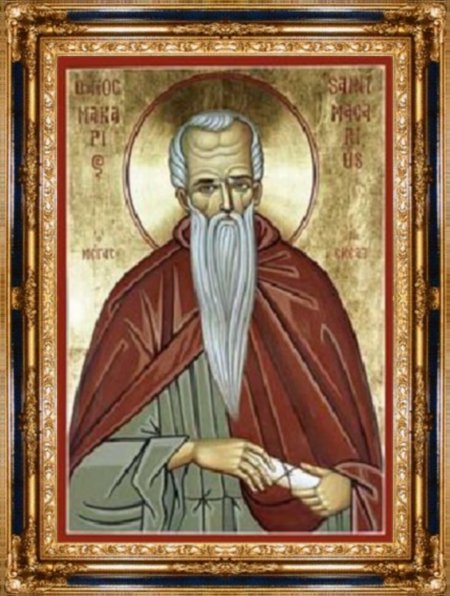
Saint Macaire
Ermite en
Egypte (+ 395)
Marchand de fruits à Alexandrie, il se retira au désert à l'âge de 40 ans, en Basse-Égypte. Ordonné prêtre, il exerça un grand rayonnement sur les anachorètes qui se réunissaient chaque dimanche pour la liturgie et qui, à cette occasion, entendaient ses paroles pleines de sagesse et de spiritualité.
Dans le désert des Cellules en Égypte, vers 408, saint Macaire, surnommé
l'Alexandrin, prêtre et anachorète, célèbre pour ses austérités extraordinaires
et ses exploits ascétiques.
Martyrologe romain
SOURCE : https://nominis.cef.fr/contenus/saint/357/Saint-Macaire.html
Saint Macaire
d'Alexandrie, abbé
Souvent confondu avec son homonyme, Macaire le Grand, il naquit vers 293 et vendait des fruits et des sucreries à Alexandrie quand, à l'âge de 40 ans, il reçut le baptême et choisit de devenir moine au désert, il se rendit auprès de saint Antoine. C'est des mains d'Antoine qu'il reçut l'habit monastique. Après quelques années, il se rendit au désert de Scété, puis de Nitrie. Comme d'autres moines de la première génération, Macaire n'était nullement confiné à un seul lieu. Il disposait de quatre cellules, une à Nitrie, une à Kellia, une à Scété et une autre « au Sud-Ouest ». Il fut un des premiers moines de Nitrie à être ordonné prêtre. Son zèle de néophyte le rendit avide d'égaler, voire de dépasser, tous les autres moines en ascèse. Ayant appris que les moines de Tabennèse ne mangeaient rien de cuit durant le Carême, il passa sept ans à ne manger que des légumes crus et des lentilles trempées. La rigueur de son ascèse le fit reconnaître, et Pacôme lui demanda de partir « pour ne pas décourager les autres moines ». Il vécut une soixantaine d'années au désert et mourut en 393, centenaire.
Saint Macaire
d’Alexandrie, (« le Jeune »)
Anachorète
(† 394)
Plusieurs Saints de
l’Église d’Orient ont porté le nom de Macaire qui, en grec, signifie heureux ;
mais il en est deux plus renommés, disciples de saint Antoine, et unis par les
liens d’une tendre amitié.
Saint Macaire
d’Alexandrie, (« le Jeune ») natif de cette ville où il pratiquait le négoce,
avait dépassé la quarantaine quand il reçut le Baptême. S’étant retiré dans la
solitude, il atteignit bientôt une si haute excellence que saint Antoine dit à
son sujet que « le Saint-Esprit s’était reposé sur lui ».
Il vécut, à ce qu’on
croit, dans le désert de Nitria, qui, d’après le nombre des ascètes, fut appelé
les Cellules, et visita probablement d’autres parties de la Libye. Ami de saint
Macaire l’Ancien dit l’Égyptien ; éxilé pour la cause de l’orthodoxie de la Foi
; bien qu’il eût un talent extraordinaire pour la conduite des religieux, il se
déroba à cet honneur et, sur la fin de sa vie, alla s’offrir comme novice au
monastère de Tabenne, que venait de fonder saint Pacôme. Il mourut, dit-on,
centenaire, vers 394.
Saint Macaire le Jeune
naquit à Alexandrie au commencement du IVe siècle. Le trait suivant prouve
qu’il passa son enfance dans une grande pureté de cœur : menant paître son
troupeau avec d’autres enfants de son âge, il ramassa par terre une figue volée
par ses compagnons. Réfléchissant ensuite sur cette action, il la pleura
longtemps avec une profonde douleur.
Cette âme d’élite n’était
point faite pour le monde, et Dieu fit naître en elle la noble passion de
marcher sur les traces des Antoine, des Pacôme et de tant d’illustres Saints
qui, vivant dans la solitude des déserts, au milieu des plus effrayantes pénitences,
étaient la gloire de l’Église et l’admiration du monde.
Sa ferveur le fit
tellement avancer, dès sa jeunesse, en la perfection évangélique, qu’on le
regardait à bon droit comme un maître dont les essais égalaient déjà les
merveilles de vertus des vieux solitaires. Son recueillement était continuel ;
saint Macaire ne parlait qu’à Dieu. Ses austérités dépassaient toute
imagination ; après avoir vécu plusieurs années ne mangeant que des herbes
crues, il en vint bientôt à ne manger qu’une fois par semaine.
Non moins admirable était
son détachement : un jour il présenta lui-même au voleur qui venait de
dévaliser sa propre cellule, un instrument de travail que le malheureux n’avait
pas aperçu. L’âme de toutes ces héroïques vertus, c’étaient la contemplation et
la prière ; il y passait ses jours et ses nuits ; « Allons, mon âme, disait-il,
montez au Ciel et méprisez toutes les vanités de la terre. Vous y trouverez un
Dieu, Créateur de l’univers, que les Anges adorent ; à Lui seul il faut vous
attacher. »
Est-il étonnant que saint
Macaire soit devenu la terreur des démons ? Nulle puissance infernale ne
saurait nuire à celui qui s’est complètement vaincu lui-même. Il joignit à tant
de gloires celle d’être persécuté par les hérétiques ariens, et s’endormit dans
la paix du Seigneur, après plus de soixante ans passés dans la solitude.
C’était vers l’an 394, saint Sirice étant pape, Théodose empereur d’Orient et
Eugène en Italie.
De tels exemples ne
sont-ils point une éloquente condamnation du monde, de ses passions et de ses
vices ? Le bonheur n’est pas où la plupart des hommes le cherchent ; il est
dans la pratique de l’Évangile et dans la fermeté constante à se vaincre
soi-même.
C’est bien en lisant la
vie d’un Saint si mortifié et si détaché de la terre qu’on saisit toute la
lumineuse vérité de ces paroles de la Sainte Écriture : « Vanité des vanités,
tout est vanité, hors aimer Dieu et Le servir… Que sert à l’homme de gagner
l’univers, s’il vient à perdre son âme ?… Bienheureux ceux qui pleurent… Bienheureux
ceux qui souffrent !… »
Abbé L. Jaud, Vie
des Saints pour tous les jours de l'année, Tours, Mame, 1950.
SAINT MACHAIRE *
Machaire vient de macha,
génie, et ares, vertu, ou de macha, percussion et rio, maître. Il fut en effet
ingénieux contre les tromperies du démon, vertueux dans sa vie; il frappa son
corps pour le dompter, et il fut maître dans l’exercice de la prélature.
L'abbé Machaire descendit
à travers la solitude du désert et entra pour dormir dans un monument où
étaient ensevelis des corps de païens; il en prit ail qu'il mit sous sa tête en
guise d'oreiller. Or, les démons, voulant l’effrayer, l’appelaient comme on
fait à, une femme, en disant : « Levez-vous et venez au bain avec nous.» Et un
autre, démon qui était sous lui comme s'il élit été dans le corps mort, disait:
« J'ai un étranger sur moi, je lie puis venir. » Machaire ne fut pas effrayé,
mais il battait le cadavre en disant : « Lève-toi et va-t-en, si tu peux. » Et
les démons, en entendant ces paroles, s'enfuirent en criant à haute voix: «
Vous nous avez vaincus, Seigneur ! » Un jour l’abbé Machaire, traversant un
marais pour aller à sa cellule, rencontra le diable qui portait une faux de
moissonneur et qui voulait le frapper, sans pouvoir en venir à bout. Et il lui
dit: « Machaire, tu me fais bien du mal, parce que je ne puis l’emporter sur
toi. Et cependant vois, tout ce que tu fais, je le fais aussi tu jeûnes et je
ne mange absolument rien; tu veilles, et moi je ne dors jamais. Il n'y a qu'une
chose en laquelle tu me surpasses. » « En quoi? lui dit l’abbé. » « C'est en
humilité, répondit le diable; elle fait que je ne puis rien contre toi. » Comme
les tentations venaient l’assaillir, il alla prendre un grand sac qu'il emplit
de sable, le mit sur ses épaules et le porta ainsi nombre de jours à travers le
désert. Théosèbe l’ayant rencontré, lui dit: « Père, pourquoi portez-vous un si
lourd fardeau ? » Il lui répondit : « Je tourmente celui qui me tourmente.»
L'abbé Machaire vit Satan passer sous la figure d'un homme couvert de vêtements
de lin tout déchirés, et de chacun des trous, pendaient des bouteilles; et il
lui dit: « Où vas-tu? » «Je vais, répondit-il, faire boire les frères. »
Machaire lui dit : « Pourquoi portes-tu tant de bouteilles? » II répondit: « Je
les porte pour les donner à goûter aux frères. Si l’une ne leur plaît pas, j'en
offre une autre, voire une troisième, et ainsi de suite, jusqu'à ce qu'il tombe
à la bonne. » Et quand le diable revint, Machaire lui dit : « Qu'as-tu fait. »
Il répondit : « Ils sont tous des saints; personne d'eux n'a voulu m’écouter,
si ce n'est un seul qui s'appelle Théotite. ». Machaire se leva aussitôt, et
alla trouver le frère qui s'était laissé tenter,, et le convertit par son
exhortation. Après quoi, Machaire rencontrant encore le diable lui dit: « Où
vas-tu ? » « Chez les frères, répondit-il.' » A sou retour le vieillard, le
voyant venir: « Que font-ils, les frères, dit-il? » Le diable: « Mal. » « Et
pourquoi, dit Machaire? » « Parce que ce sont tous des saints, et le plus grand
mal encore, c'est que le seul que j'avais, je l’ai perdu et c'est le plus saint
de tous. » En entendant cela, le vieillard rendit grâces à Dieu. — Un jour,
saint Machaire: trouva une tête de mort et, après qu'il eut prié, il lui demanda,
de qui était la tête. Elle répondit, qu'il avait été païen. Et Machaire lui
dit: « Où est ton âme? » Elle répondit: « Dans l’enfer. » Comme il demandait
s'il était beaucoup profond: Elle répondit que sa profondeur était égale à la
distance qu'il y a de la terre au ciel. Machaire continua: « Y en a-t-il qui
soient plus avant que toi ? » « Oui, dit-il, les juifs. » Machaire: « Et
au-dessous des juifs, y en a-t-il? » Le diable: « Les plus enfoncés de tous
sont les faux chrétiens, qui, rachetés par le sang de J.-C., estiment comme
rien une . si. précieuse rançon. » Comme il traversait une solitude profonde; à
chaque mille, il fichait un roseau en terré, pour savoir par où revenir. Or,
ayant cheminé pendant neuf jours, comme il se reposait, le diable ramassa tous
les roseaux, et les plaça auprès de sa tête; aussi eut-il beaucoup de peine
pour rentrer.
Un frère était
singulièrement tourmenté par ses pensées, il se disait, par exemple, qu'il
était inutile dans sa cellule, au lieu que s'il habitait parmi les hommes, il
pourrait être utile à bien du monde.
Ayant manifesté ces
pensées à Machaire, celui-ci lui dit : « Mon fils, réponds-leur; : « Voici ce
que « je fais, je garde les murailles de cette cellule pour «l’amour de J.-C. »
Un jour, avec la main, il tua un moucheron qui l’avait piqué; et beaucoup de
sang sortait de la piqûre; il se reprocha d'avoir vengé sa propre injure, et
resta tout nu six mois dans le désert, d'où il sortit entièrement couvert de
plaies que lui avaient occasionnées les insectes. Après quoi, il mourut en paix
et devint illustre par beaucoup de miracles.
* Tiré des Vies des
Pères du désert.
La Légende dorée de
Jacques de Voragine nouvellement traduite en français avec introduction,
notices, notes et recherches sur les sources par l'abbé J.-B. M. Roze, chanoine
honoraire de la Cathédrale d'Amiens, Édouard Rouveyre, éditeur, 76, rue de
Seine, 76, Paris mdccccii
SOURCE : http://www.abbaye-saint-benoit.ch/voragine/tome01/021.htm
Saint Macaire
d’Alexandrie, (« le Jeune »)
Saint Macaire
d'Alexandrie est appelé le Jeune, pour le distinguer de saint Macaire d'Egypte,
surnommé l’Ancien. Il était originaire d'Alexandrie, où sa profession fut
d'abord de vendre des dragées et des fruits ce qui n'a pas empêché qu'on ne lui
ait aussi donné le titre de bourgeois de cette ville. Il n'y demeura pas
longtemps car le grand amour qu'il avait pour la solitude le porta à se rendre
près de saint Antoine, qu'il choisit pour son guide dans les premières années
de sa retraite. Ce Saint lui donna l'habit monastique et lui prédit ce qui
arriverait dans le cours de sa vie. En effet, Dieu manifesta dès lors au saint
abbé, par une merveille évidente, qu'il destinait Macaire à de grandes choses.
Saint Antoine avait fait dans une occasion un grand amas de rameaux de palmier
pour faire des nattes. Comme ils étaient parfaitement beaux, Macaire le pria de
lui en donner quelques-uns. Il lui répondit : « Il est écrit Vous ne désirerez
point le bien de votre prochain ». Mais à peine eut-il achevé ces paroles, que
les rameaux devinrent aussi secs que si le feu y eût passé. Saint Antoine,
étonné de ce prodige, lui dit : « Je comprends que le Saint-Esprit repose sur
vous. Je vous considérerai désormais comme l'héritier des grâces dont Dieu a
daigné me favoriser ». Il se trouva quelque temps après dans sa solitude
extrêmement affaibli, sans doute par ses grandes austérités, et le démon,
faisant allusion à ces paroles de saint Antoine, lui dit « Puisque tu as reçu
la grâce d'Antoine, que n'en uses-tu pour obtenir de Dieu de la nourriture et
des forces, afin que tu puisses marcher dans le chemin que tu as à faire ».
Mais il le repoussa par ces paroles « Le Seigneur est ma force et ma gloire, et
quant à toi, n'entreprends pas de tenter son serviteur n. Cela n'empêcha pas
que cet esprit de malice ne vînt de nouveau lui tendre un piège. Il prit la
figure d'un chameau chargé de vivres, et vint s'arrêter auprès de lui. Macaire
soupçonna sans peine que c'était une illusion de sa part. Il se mit en prière,
et aussitôt la terre s'ouvrit et engloutit l'animal fantastique.
On rapporte aux premières
années de sa profession monastique ce qu'on dit de lui, que pendant quatre mois
il alla tous les jours visiter un frère, sans pouvoir lui parler, parce qu'il
le trouvait toujours en oraison. Ce qui lui fit dire dans un sentiment
d'admiration « Voilà véritablement un ange de la terre ».
Ses différentes cellules
Après avoir reçu et mis à
profit les instructions de saint Antoine, il quitta la Thébaïde et vint au
désert de Scété. Il fut le premier qui y bâtit un monastère. Il est certain
qu'il avait là une cellule et qu'il s'y rencontra souvent avec saint Macaire d'Egypte.
Il en eut une aussi en Libye et une autre à Nitrie mais son principal séjour
fut au désert des Cellules, où il exerça les fonctions du sacerdoce, ayant été
fait prêtre peu de temps après l'autre saint Macaire.
Ces différentes cellules
étaient plus propres à satisfaire son amour pour la pénitence, qu'à le garantir
des injures de l'air; car les unes étaient sans fenêtres, et il y passait tout
le carême assis dans l'obscurité. Une autre était si étroite qu'il ne pouvait
s'y étendre de tout son long. Celle de Nitrie était la plus spacieuse, parce
qu'il n'y allait que pour recevoir et instruire les étrangers.
Quoique son amour pour le
recueillement l'eût fixé davantage au désert des Cellules, il ne se passait
rien d'extraordinaire dans les déserts voisins, surtout dans celui de Nitrie,
où on ne l'appelât pour déterminer ce qu'on devait faire les anciens de ces
déserts agissant tous de concert pour l'avantage spirituel des solitaires de
leur dépendance.
Saint Macaire se
distingua principalement par sa pénitence, par son attrait pour la solitude et
pour l'oraison, et par le pouvoir que Dieu lui donna sur les esprits de
ténèbres, et d'autres prodiges qu'il opéra, attestés par ses historiens en leur
qualité de témoins oculaires.
Ses mortifications
Nous avons vu que les
différentes cellules qu'il avait, étaient des séjours de mortification plutôt
que des logements commodes. Il n'était point d'austérités si grandes,
pratiquées par les autres, qu'il ne tentât de les imiter et même de les
surpasser. Ayant appris qu'un solitaire ne mangeait qu'une livre de pain par
jour, il eut la pensée, pour mieux mortifier son appétit, de rompre son pain en
petits morceaux, qu'il mit dans une bouteille de terre, et de ne manger que ce
qu'il en pouvait prendre avec les doigts, ce qu'il pratiqua l'espace de trois
ans, non sans en souffrir beaucoup car, outre la peine qu'il avait à retirer
ces petits morceaux, il ne mangeait tout au plus que cinq onces de pain par
jour, et ne buvait de l'eau qu'à proportion.
On remarque encore que
durant toute une année il ne consuma qu'une petite cruche d'huile. Il passait
aussi quelquefois le jour sans prendre aucune nourriture, quoiqu'il travaillât
beaucoup.
Il se rend à Tabennes
On lui dit qu'à Tabennes
les disciples de saint Pacôme ne mangeaient rien de cuit pendant le Carême, et
il voulut faire la même chose durant sept ans, ne se nourrissant que d'herbes
crues ou de légumes trempés seulement dans l'eau froide. Mais sa ferveur le
porta à aller reconnaître par lui-même la discipline de Tabennes, soit pour
mieux s'instruire et s'édifier, soit pour y vivre confondu parmi tant
d'austères religieux, et se dérober par là à la vénération qu'on avait pour lui
à Nitrie et aux Cellules.
Le trajet de là à
Tabennes était très-long. Il fallait traverser des déserts fort vastes, non
sans souffrir extrêmement. Mais cette difficulté ne l'arrêta pas. Il quitta son
habit pour n'être pas connu et prit un costume d'artisan. Il marcha pendant
quinze jours dans ces solitudes affreuses jusque dans la Haute-Thébaïde, où il
se présenta à la porte du monastère de saint Pacôme, qu'il pria humblement de
le recevoir au nombre de ses religieux. Le saint abbé, à qui Dieu ne le fit pas
connaître alors, quoiqu'il l'éclairât dans beaucoup d'autres rencontres d'une lumière
prophétique, bien loin d'acquiescer à sa demande, lui dit qu'il était trop âgé
pour soutenir le poids des austérités de sa règle qu'il fallait y être exercé
de bonne heure et que s'il l'entreprenait, il serait tenté d'impatience dans
les travaux dont on le surchargerait, ce qui le porterait au murmure, et
qu'enfin, au lieu de persévérer, il quitterait tout, mécontent du monastère, et
l'irait décrier ailleurs. Ce refus ne le rebuta pas. Il persévéra pendant sept
jours dans la même demande, quoiqu'il ne reçût du Saint que la même réponse, et
fut tout ce temps-là sans manger. Enfin il lui dit K Je vous conjure, mon Père,
de me recevoir, et si je ne jeûne pas et ne fais pas la même chose que les
autres, je consens que vous me renvoyiez ». Saint Pacôme, touché de sa
persévérance, en parla aux autres frères, qui, selon Pallade, étaient au nombre
de mille quatre cents, et qui conclurent à l'admettre.
Ceci arriva peu de temps
avant le Carême, et saint Macaire, attentif à tout ce qui se pratiquait pour le
faire servir à son avancement spirituel, remarqua que les religieux, suivant
chacun l'ardeur qu'ils avaient pour la pénitence, s'étaient proposé, les uns de
ne manger que le soir durant la sainte quarantaine, les autres une fois en deux
jours, et les autres après cinq jours. Il observa encore que quelques-uns,
après être demeurés assis tout le jour occupés à leur travail, passaient toute
la nuit debout.
Ces exemples de
mortification animèrent tellement sa ferveur, qu'il fit tremper une grande
quantité de feuilles de palmier pour son travail et se retira dans un coin où
il se tint debout tout le Carême, sans jamais s'asseoir ni même s'appuyer, sans
prendre un morceau de pain, mais seulement le dimanche quelques feuilles de
choux toutes crues, et en si petite quantité, qu'il les mangeait plutôt pour
éviter la tentation de vanité que pour se nourrir. Il garda pendant tout ce
temps un rigoureux silence, et lorsqu'il était contraint de sortir, il
retournait aussitôt à son travail, conservant toujours son esprit et son cœur
élevés vers Dieu.
Dieu le fait connaître à
saint Pacôme
Saint Pacôme, occupé au
gouvernement général de l'Ordre, ne s'était pas aperçu de la façon dont il
avait vécu. Mais les autres religieux, et surtout ceux qui étaient les plus
austères, y avaient pris garde, et ils en furent si frappés, qu'ils en portèrent
leurs plaintes à leur abbé, disant qu'il avait amené un homme qui vivait comme
s'il n'était qu'un pur esprit, sans chair et sans os, et qui semblait n'être
venu chez eux que pour les condamner. Ils le prièrent en conséquence de le
congédier, et avouèrent que s'il demeurait davantage, ils ne pouvaient plus
eux-mêmes y tenir.
Le saint abbé s'informa
sur ces plaintes du détail de sa conduite. Il en fut tout étonné il comprit
qu'il y avait quelque chose d'extraordinaire dans cet inconnu et qu'il n'en
était pas à commencer les travaux de la vie religieuse. Il ne leur en dit
pourtant rien mais il eut recours à la prière, pour obtenir de Dieu qu'il le
lui fît connaître. Il lui fut révélé que c'était Macaire, dont la réputation
était répandue dans tous les déserts. Après qu'il eut fini son oraison, il alla
droit à lui, le prit par la main, le conduisit à la chapelle où était l'autel,
et l'embrassant tendrement, il lui parla ainsi a C'est donc vous, ô vénérable
vieillard? Vous êtes Macaire, et vous me l'avez caché. II y a longtemps que
j'ai entendu parler de vous et que je désirais vous voir. Je vous dois des
actions de grâces d'avoir humilié mes enfants. Vous leur avez ôté par votre
exemple tout sujet de s'enfler de vanité et d'avoir des sentiments trop
avantageux d'eux-mêmes à cause de leurs austérités. Retournez, je vous supplie,
à votre solitude, et priez pour nous ».
Il redouble ses
mortifications
Cet homme insatiable de
pénitences se proposa un jour de combattre le sommeil, pour éprouver s'il
pourrait le surmonter. Il le racontait depuis à Pallade, et lui disait « Je
passai pour cela vingt jours et autant de nuits à découvert; étant brûlé durant
le jour par la chaleur, et transi par le froid durant-la nuit. Mais au bout de
ce temps je fus obligé de me jeter promptement dans une cellule, où je
m'endormis, sans quoi je serais tombé en défaillance. »
L'ennemi du salut lui
donna, dans une autre rencontre, 'par des tentations contre la pureté dont il
l'assiégea, l'occasion de pratiquer une mortification terrible. Il alla au
marais de Scété s'exposer nu aux moucherons, dont les aiguillons dans cet
endroit sont si pénétrants, que la peau même des sangliers n'est pas à
l'épreuve de leurs piqûres. Il pratiqua cette pénitence durant six mois, et ces
insectes couvrirent son corps de tant de pustules et d'ampoules, que quand il
revint à sa cellule on ne put le reconnaître qu'au son de sa voix, et que
plusieurs crurent qu'il avait la lèpre.
Un autre acte de
mortification, bien moindre que celui-là, et que Pallade rapporte, nous fait
connaître en même temps combien les religieux qu'il avait sous sa discipline
étaient fidèles à sacrifier à Dieu les satisfactions des sens. C'est ici un
exemple des plus édifiants et qui mérite d'être rapporté, quoiqu'il soit commun
au Père et aux disciples.
Saint Macaire eut l'envie
une fois de manger des raisins. Il le fit connaître, et on lui en apporta
aussitôt une grappe toute fraîche mais, quand il la vit, il voulut s'en priver,
et joignant la charité à J'abstinence, il la fit porter à un frère qu'il
croyait en avoir plus besoin que lui, parce qu'il ne jouissait pas d'une grande
santé. Celui-ci témoigna d'abord de la joie de ce présent, qui lui était envoyé
par un si saint homme mais quoiqu'il eût bien désiré d'en manger, il en fit le
sacrifice à Dieu, à qui il rendit des actions de grâces, et la porta à un
autre, qui également mortifié et charitable n'y toucha point, et la porta aussi
à un troisième qui en fit de même. Enfin cette grappe de raisin fut ainsi
portée de main en main dans toutes les cellules du désert, qui étaient en grand
nombre et assez éloignées les unes des autres, jusqu'à ce que le dernier à qui
elle fut offerte, l'envoya à saint Macaire comme un présent qui lui serait
agréable, ignorant qu'il l'avait reçu avant tous les autres.
Le Saint reconnut d'abord
la grappe, mais il voulut mieux s'en assurer et quand il apprit qu'elle avait
passé par toutes les cellules sans qu'aucun frère y eût touché, il conçut une
grande joie et remercia Dieu de voir tant de mortification et de charité dans
ces saints solitaires. Il ne voulut pas non plus la manger, et cela lui servit
de motif de pratiquer les exercices de la vie spirituelle avec une ardeur
nouvelle.
Ses oraisons
Cet homme de pénitence
était aussi un grand homme d'oraison, l'une conduisant à l'autre. Mais l'ordre
qu'il gardait dans ses exercices était très propre à lui en obtenir de Dieu le
précieux don. Il distribuait la journée en trois temps, dont l'un était employé
à différentes heures, à la prière et à la contemplation, et il ne faisait pas
moins de cent oraisons par jour. Il passait l'autre partie du temps au travail
des mains, et la troisième à exercer la charité envers les frères, leur donnant
les avis et les instructions dont ils avaient besoin.
En partageant le temps
entre ces différents exercices, on peut dire qu'il ne perdait point Dieu de
vue, soit qu'il priât, soit qu'il agît, conservant dans une grande paix la
pureté de son âme par la pureté d'intention qui sanctifiait ses œuvres, et
ayant toujours le cœur élevé vers Dieu, quelque chose qu'il fît. Il y avait
d'autres solitaires qui faisaient un plus grand nombre d'oraisons que lui. Les
uns en faisaient trois cents, d'autres en faisaient jusqu'à sept cents. Pour
lui, il suivait l'attrait que Dieu lui avait donné, en mêlant la vie active
avec la contemplative, et il n'était point jaloux que d'autres fissent plus
d'oraisons que lui. On peut même dire, avec un savant historien, que la ferveur
des siennes compensait bien ce défaut.
Visite du démon
C'était dans des oraisons
sublimes que ce Saint puisait des lumières extraordinaires, soit pour
distinguer les véritables révélations des illusions du démon soit pour pénétrer
dans les secrets des consciences des frères, et de ceux qui s'adressaient à
lui. Le démon vint une fois frapper à la porte de sa cellule et lui dit «
Levez-vous, abbé Macaire, et allons avec les frères faire la prière de la
nuit)). Mais, dit Rufin qui rapporte ceci, « le Saint, qui était rempli de
Dieu, connut aussitôt l'artifice du démon et lui répondit : Ô esprit de
mensonge et ennemi de toute vérité, qu'y a-t-il de commun entre toi et cette
assemblée de Saints ? » « Tu ignores donc, 6 Macaire, lui répondit le démon,
que jamais les solitaires ne s'assemblent pour la prière, sans que nous nous y
trouvions ? Viens-y seulement, et tu verras nos œuvres ». ― « Esprit impur,
répliqua le Saint, Dieu veuille réprimer ta malice et dompter ta puissance ? »
Il se mit ensuite en
oraison et pria le Seigneur de lui faire connaître si ce dont le démon se
vantait était véritable. Puis il s'en alla à l'assemblée où les frères
faisaient l'office durant la nuit, et renouvela la même prière à Dieu. Alors il
vit comme de petits enfants éthiopiens extrêmement laids, répandus dans toute
l'église, qui couraient de tous côtés, et avec tant de vitesse qu'on eût dit
qu'ils avaient des ailes.
Une vision
Or, c'était la coutume
des solitaires que dans la prière, tous les frères étant assis, il y en avait
un qui récitait un psaume et les autres qui l'écoutaient et répondaient à
chaque verset. Ces petits éthiopiens courant deçà et delà, faisaient diverses
malices à ceux qui étaient assis. Ils fermaient les paupières aux uns, qui
s'endormaient aussitôt; ils en faisaient bâiller d'autres en leur mettant le
doigt dans la bouche. Ensuite, lorsque le psaume était achevé, les frères se
prosternant à terre, selon l'usage, pour faire oraison, ils couraient à
l'entour d'eux, paraissant à l'un sous la figure d'une femme, à un autre comme
bâtissant quelque maison ou portant quelque chose, et enfin à d'autres en
d'autres manières; ce qui faisait que ces solitaires roulaient dans leur esprit
tout ce que les démons leur représentaient en se jouant.
Mais ils ne réussissaient
pas de même envers tous; car voulant s'approcher de quelques-uns, ils en
étaient si vivement repoussés, qu'ils tombaient par terre, et ne pouvaient
après cela ni demeurer debout, ni repasser auprès d'eux; au lieu qu'ils
marchaient sur la tête et sur le dos de quelques autres frères dont la dévotion
était faible, et se moquaient d'eux parce qu'ils n'étaient pas attentifs à leur
oraison.
Saint Macaire voyant
cela, jeta un profond soupir, et dit à Dieu en répandant beaucoup de larmes H
Considérez, Seigneur, comme le démon nous tend des pièges. Faites-lui entendre
votre voix puissante, et les effets de votre colère. Levez-vous, afin que vos
ennemis soient dissipés et s'enfuient devant votre face, puisque vous voyez
comment ils remplissent nos âmes d'illusions ».
Cependant la prière étant
achevée, le Saint voulut approfondir davantage la vérité, et appela en
particulier les uns après les autres ceux des frères à qui il avait remarqué
que les démons avaient apparu sous diverses formes, et il leur demanda si
pendant la prière ils n'avaient pas pensé à des bâtiments, à des voyages ou à
d'autres choses semblables. Ils lui en firent l'aveu, et il connut alors que
les vaines pensées qui nous viennent à l'esprit dans l'oraison, sont, la plupart
du temps, causées par l'illusion des démons, repoussés par ceux qui veillent
avec soin sur eux-mêmes; « parce que, ajoute Rufin une âme qui est unie à Dieu
et qui dans le temps de l'oraison a une attention particulière vers lui, ne
peut souffrir que rien d'étranger ni rien d'inutile entre dans elle pour l'en
détourner ».
Si saint Macaire fut
grand par l'éminence de ses oraisons et de ses lumières surnaturelles, il ne le
fut pas moins par le don des miracles, et il ne le céda pas en cela au célèbre
Macaire d'Egypte, que les historiens nous représentent comme le thaumaturge de
son temps. Nous avons dit quel était le pouvoir que Dieu lui avait donné sur
les démons. II délivra un si grand nombre d'énergumènes par sa parole
accompagnée d'une foi vive, que l'historien de sa vie dit qu'il serait bien
difficile de les compter.
Enfin, saint Macaire
d'Alexandrie, après avoir passé au moins soixante ans dans la solitude, termina
par sa mort (394 ou 395 d'après Tillemont), une vie de sainteté et de prodiges,
et laissa après lui, avec le souvenir de ses vertus, la mémoire d'un des plus
célèbres solitaires qui ait sanctifié les déserts par son amour pour Dieu et
par la pratique d'une sévère pénitence.
P. Giry : Les petits
Bollandistes : vies des saints. T. I. Source http://gallica.bnf.fr/
Bibliothèque nationale de
France.
SOURCE : http://nouvl.evangelisation.free.fr/macaire_dalexandrie.htm

Also
known as
Macarius of Alexandria
Macarius the Alexandrian
Macarius the Hermit
2
January (Roman Catholic)
19
January (Orthodox; Armenian)
1 May (Coptic
calendar)
13 July (Syrian
Orthodox)
Profile
Successful merchant in
fruits, candies, and pastries in Alexandria, Egypt. Converting to Christianity,
Macarius gave up his business in 335 to
become a monk and hermit in
the Thebaid, Upper Egypt.
For a while he lived near and was a friend of Saint Anthony
the Abbot. Macarius was a poet, healer,
and friend to wild animals.
He was exiled by heretic Arians with Saint Macarius
the Elder and other monks to
an island in the Nile because of his orthodoxy, but he was later allowed to
return. In later life he travelled to
Lower Egypt,
and was ordained,
and lived in a desert cell with
other monks.
He wrote a
constitution for the monastery at
Nitria named after him, and some of its rules were adopted by Saint Jerome for
his monastery.
Amazing stories grew up
his practice of severe austerities, some of which reached the proportion of
legend.
For seven years he lived
on raw vegetables dipped in water with a few crumbs of bread, moistened with
drops of oil on feast days.
He once spent 20 days and
20 nights without sleep, burnt by the sun in the day, frozen by bitter desert
cold cold at night. “My mind dried up because of lack of sleep, and I had a kind
of delirium,” the hermit admitted. “So I gave in to nature and returned to
my cell.”
Trying to get further
from the world, and closer to God,
Macarius moved to the desert of Nitria in Lower Egypt in 373.
The journey was through a harsh land, at when Macarius was at the end of his
strength, the devil appeared and asked, “Why not ask God for the food and
strength to continue your journey?” Macarius answered, “The Lord is my strength
and glory. Do not tempt a servant of God.” The devil then gave him a vision of
a camel laden with food. Macarius was about to eat, but suspected a trap, and
so prayed over the camel; it vanished.
He spent six months naked
in the marshes, beset constantly by viscious blood-sucking flies and
mosquitoes, in the hope of destroying his last bit of sexual desire. The
terrible conditions and attacking insects left him so deformed that when he
returned to the monks, they could recognize him only by his voice.
A young brother once
offered Macarius some very fine grapes. The old fruit dealer was about to eat
when he decided to sent them to a brother who was ill. This brother passed them
to one he considered more in need; that one did the same, and on and on until
the grapes made the rounds of all the cells and returned to Macarius.
Macarius returned to
Skete and began to work on his worst vice – his love of travel. The devil
appeared and suggested Macarius go to Rome and chase out the demons there. Torn
between travelling for such a good cause, but wishing to fight his vice,
Macarius filled a large basket with sand, put it on his back, and set out. When
someone offered to help him, he said, “Leave me alone! I am punishing my
tormenter. He wishes to lead me, old and weak as I am, on a distant and vain
voyage.” He then returned to his cell, body broken with fatigue, but cured of
his temptation.
In old age Macarius
journeyed to a monastery where 1,400 hermits lived under the rigid rule of
Saint Pachomius. Macarius was refused admittance. “You are too old to survive
the great rigor we have here,” Pachomius told him. “One should be trained in it
from childhood, or else one cannot stand it. Your health would fail and you
would curse us for harming you.” Macarius then stood at the abbey gate for
seven days and nights – without sleep, without food, without saying a word.
Finally, the monks relented and he let him in. Macarius stood in a corner of
the monastery in complete silence for all of Lent, living on a few cabbage
leaves each Sunday “more to avoid ostentation, than from any real need.” The
monks became so jealous of this new brother that they took their complaint to
Pachomius, who asked God for illumination. When he learned that the old man was
Macarius, he went to him and said, “My brother, I thank you for the lesson you
have given my sons. It will prevent their boasting about their modest
mortifications. You have edified us sufficiently. Return to your own monastery,
and pray for us each day.”
Born
early 4th
century at Alexandria, Egypt
c.401 in Alexandria, Egypt of
natural causes
flies stinging
a desert hermit
hermit leaning
on a crutch in
the form of a tau
staff while conversing with a skull
monk with a bag of sand
on the shoulders
monk with a lantern
monk with grapes
monk with wild animals
around him
Additional
Information
Book
of Saints, by the Monks of
Ramsgate
Lives
of the Saints, by Father Alban
Butler
Lives
of the Saints, by Sabine Baring-Gould
Pictorial
Half Hours with the Saints
Saints
of the Day, by Katherine Rabenstein
Short
Lives of the Saints, by E C Donnelly
books
Our Sunday Visitor’s Encyclopedia of Saints
Saints
and Their Attributes, by Helen Roeder
other
sites in english
video
webseiten
auf deutsch
sites
en français
fonti
in italiano
websites
in nederlandse
nettsteder
i norsk
spletne
strani v slovenšcini
MLA
Citation
“Saint Macarius the
Younger“. CatholicSaints.Info. 1 December 2023. Web. 8 January 2026.
<https://catholicsaints.info/saint-macarius-the-younger/>
SOURCE : https://catholicsaints.info/saint-macarius-the-younger/
Book of Saints
– Macarius the Younger
Article
(Saint)
(January
2) (4th
century) Sometimes styled “the Younger,” sometimes “of Alexandria,” to
distinguish him from another Saint Macarius who was also a hermit in Egypt. He
is said to have abandoned the trade of a fruiterer to consecrate himself to God
in the Thebaid in Upper Egypt, about A.D. 335. Thence passing into Lower Egypt,
he took up his abode in the Desert of Nitria. Here he was ordained priest and
surpassed the other hermits in the practice of austerities. He became renowned
for his gifts of prophecy and miracle working. Lucius, the intruded Arian
Patriarch of Alexandria banished him on account of his unflinching Orthodoxy.
He died, according to Palladius, about A.D. 395, at an advanced age. He is
alleged to have written a Rule for Monks and some Discourses on spiritual
subjects.
MLA
Citation
Monks of Ramsgate.
“Macarius the Younger”. Book of Saints, 1921. CatholicSaints.Info.
11 November 2014. Web. 8 January 2026.
<https://catholicsaints.info/book-of-saints-macarius-the-younger/>
SOURCE : https://catholicsaints.info/book-of-saints-macarius-the-younger/
Saints
of the Day – Macarius of Alexandria, Hermit
Article
(also known as Macarius
the Younger)
Died c. 394-408. Often
confused with Macarius the Elder, this one was also a desert monk in the same
neighborhood as his fellow. Saint Macarius was a successful businessman (confectioner
or fruit merchant) in Alexandria, Egypt, who was converted to the faith and
baptized.
He gave up his business
about 335 to become a monk in the Thebaid, Upper Egypt, and spent the remaining
years of his life as a hermit in penance and contemplation. At first he lived
near Saint Antony, the famous hermit of the Thebaid. Stories are told of the
association of Antony and Macarius, some of which stretch credulity.
One day, the story goes,
Macarius saw some palm branches that Antony had made into wreathes, and he
asked to be given some of them. “It is written,” Antony replied, “though shall
not covet thy neighbor’s goods.” With that the branches dried up immediately,
as if a violent fire had scorched them. From this Macarius learned that he, who
lived in almost absolute rigor and austerity, was called to even greater
poverty of spirit. Struck by the miracle, Antony placed his hands upon Macarius
and said: “The spirit of God has reposed on you in a special way, Macarius. You
are called to do great things.”
Aiming at still greater
perfection, in 373, Macarius moved to the desert of Nitria in Lower Egypt. En
route under a scorching sun and at the end of his strength, the devil appeared
to him and said, “Since you have the virtue of Antony, why not ask God for the
food and strength necessary to continue your journey?” “The Lord is my strength
and glory,” Macarius responded. “Do not try to tempt a servant of God.”
Making a new attempt to
test the virtue of Macarius, the devil set before his eyes the vision of a
camel laden with all kinds of appetizing food. Macarius was delighted with the
vision and prepared to satisfy his hunger. Nevertheless, he suspected a trap
and first rose to pray. Immediately, the camel disappeared as if swallowed up
in the desert.
Stories like these abound
in the only records we have of this great hermit’s life. His brothers filled
the profound silences of the desert with tales of his virtuous exploits, with
embroiderings on his rigors, and the way he encouraged all to make themselves
over into vessels of charity and kindness.
Arriving in Lower Egypt,
he was ordained a priest, lived a life of great austerity, and was known for
his miracles. He built cells in the deserts of Skete and Nitria, but spent most
of his time in the area called the Cells. The brothers lived in separate cells
completely devoid of any comforts or conveniences so that no distraction might
interrupt their contemplation.
From the stories related
of life there, the monks seem to have competed with one another in their
austerities, and, of course, Macarius excelled. For seven years he lived only
on raw vegetables dipped in water with a few crumbs of bread, though on
important feast days, he moistened this scant food with drops of oil.
Having conquered hunger,
Macarius next undertook to conquer sleep. He himself told his biographer,
Palladius, how he once spent 20 days and 20 nights without entering his cell
for sleep, by day burnt by the hot sun and at night frozen by the bitter cold.
“My mind dried up because of lack of sleep, and I had a kind of delirium,” the
hermit admitted. “So I gave in to nature and then returned to my cell.”
Uneasy about his
chastity, Macarius called upon heroic courage to conquer his temptations. He
condemned himself to spend six months naked in the marshes. The mosquitoes of
the place, said the narratives of the event, were as big as bees, had such a
penetrating force that they pierced even the skin of wild boars. But Macarius
is said to have abandoned his body to them, with the result that when he later
returned to his brothers, they recognized him only by the sound of his voice.
Records state how the
most perfect charity prevailed among the cenobites. On one occasion a young
brother offered Macarius some very fine grapes. The old fruit dealer was
getting ready to taste them when, wishing to mortify himself, he sent them to
one of his brothers who was ill. The latter, for the same reason, passed them
on to another brother and the grapes thus made the rounds of all the cells of
the desert until they were returned to Macarius. He, reflecting on the great
virtue of his monks, would not touch the grapes until he first knelt down to
praise God for their charity.
In his old age Macarius
made a long journey to visit a famous monastery where 1,400 hermits lived under
the rigid rule of the famous Saint Pachomius. Not recognized upon his arrival,
Macarius was refused admittance. “You are very old,” Pachomius said, “for such
great rigor as we have here. One should be trained in it from childhood, or
else one cannot stand it. At your age your health would quickly fail and you
would curse us for harming you.” Undisturbed by his failure to gain entry,
Macarius stood at the gate of the abbey for seven days and nights– without
sleep, without food, without saying a word.
Finally, the monks
relented and he was received. It so happened that it was Lent–a time when the
rules did not prescribe any limit to mortification and each monk had complete
liberty in this matter. Macarius noted how his new brothers lived: some ate
only during the evening, some every other day, the best trained could wait for
five days. Certain monks spent the night standing, in prayer. He decided to
surpass them all. He took himself to a remote corner of the monastery and stood
there in complete silence for the entire period of Lent, living only upon a few
cabbage leaves each Sunday “more to avoid ostentation,” says his biographer,
“than because of any real need.”
Unfortunately, the monks
became so jealous of the prodigious austerity of their new brother and finally
went to Pachomius with their complaint. “From where did this man come to us?”
they asked him, “this man without flesh. He is a shame and a reproach. Have him
leave here or else all of us will leave.”
Pachomius then asked God
to reveal to him who this old man was. When he learned that it was Macarius, he
went to see him and said: “My brother, I have wanted to meet you for many
years. I thank you for the lesson you have given my sons. It will prevent their
boasting about their modest mortifications. But you have edified us
sufficiently. Return to your own monastery and pray for us each day.” (By the
way, it’s unlikely that Pachomius and Macarius met– Pachomius died in 348 and
Macarius, at the earliest estimate, in 394.)
Macarius went back to
Skete and set about correcting what he regarded as his worst vice: his craze to
travel. Soon the devil suggested that he depart for Rome to chase out the
demons there. Disturbed by the need to make such a voyage on behalf of the
Church, yet not willing to succumb to his vice again, Macarius filled a large
basket with sand, put it on his back and set out across the desert. When
someone offered to help him, he said, “Leave me alone. In this way I punish the
one who torments me. Does he not wish to lead me, old and weak as I am, on a
distant and vain voyage?” With that, he returned to his cell, his body broken
with fatigue but cured of his temptation.
Toward the end of his
life, however, Macarius had to make one more trip in spite of his resolution.
He was banished for a time with Macarius the Elder and other monks to an island
in the Nile for his unswerving fidelity to orthodoxy by Lucius, the intruded
Arian Patriarch of Jerusalem, but was later allowed to return. Marcarius wrote
a constitution for the monastery at Nitria named after him, and some of its
rules were adopted by Saint Jerome for his monastery (Attwater, Benedictines,
Delaney, Encyclopedia, Gill).
Saint Macarius’s emblem
in art are flies which sting the hermit in the desert. Sometimes he is shown
with a lamp or lantern, or leaning on a crutch (tau staff) conversing with a
skull. There is much confusion between the Younger and Elder Macarius (Roeder).
Because Macarius was a confectioner, he is the patron of pastry chefs (Roeder).
MLA
Citation
Katherine I
Rabenstein. Saints of the Day, 1998. CatholicSaints.Info.
13 May 2020. Web. 8 January 2026.
<https://catholicsaints.info/saints-of-the-day-macarius-of-alexandria-hermit/>
SOURCE : https://catholicsaints.info/saints-of-the-day-macarius-of-alexandria-hermit/
Macarius the Alexandrian
Also called ho
politikos either in reference to his city birth or polished manners; died
about 405. He was a younger contemporary of Macarius the Egyptian, but there is
no reason for confounding or identifying him with his older namesake. More than
any of the hermits of
the time he exemplified the spirit of emulation characteristic of this stage of
monasticism. He would be excelled by none in his austerities. Palladius asserts
"if he ever heard of any one having performed a work of asceticism, he was
all on fire to do the same". Because the monks of Tabennisi
eschewed cooked food in Lent he abstained
for seven years. Once, in expiation of a fault, he lay for six months in a
morass, exposed to the attacks of the African gnats, whose sting can pierce
even the hide of a wild boar. When he returned to his companions he was so much
disfigured that he could be recognized only by his voice. He is credited with
the composition of a rule for monks, though his
authorship is now generally denied.
Sources
Hist. Lausiaca, xvii;
Hist. monachorum, xxviii; a Coptic Life was edited by AMELINEAU in Monuments
pour servir à l'histoire de l'Egypte chrétienne au IVe, Ve, VIe et VIIe siecles
(Paris, 1895), Syriac tr. by BEDJAN in Acta sanctorum et martyrum syriace, V,
1895; BUTLER, The Lausiac History of Palladius, II, 193; ZOCKLER, Askese u.
Monchthum (Frankfurt, 1897), 226. For the homilies ascribed to MACARIUS see
P.L., XXXIV, 409 sqq.; cf. BARDENHEWER, Patrology, tr. SHAHAN (St. Louis,
1908), 266 sqq.
Healy,
Patrick. "Macarius." The Catholic Encyclopedia. Vol.
16 (Index). New York: The Encyclopedia
Press, 1914. <http://www.newadvent.org/cathen/16056d.htm>.
Transcription. This
article was transcribed for New Advent by Herman F. Holbrook. For Dom
Julian Stead, O.S.B., of Portsmouth Abbey, Rhode Island.
Ecclesiastical
approbation. Nihil Obstat. March 1, 1914. Remy Lafort, S.T.D.,
Censor. Imprimatur. +John Cardinal Farley, Archbishop of New York.
Copyright © 2023 by Kevin Knight.
Dedicated to the Immaculate Heart of Mary.
SOURCE : https://www.newadvent.org/cathen/16056d.htm
St. Macarius, of
Alexandria, Anchoret
From Palladius, bishop of
Helenopolis, who had been his disciple, c. 20. Rufin, Socrates, and others in
Rosweide, D’Audilly, Cotelier, and Bollandus, p. 85. See Tillemont, T. 8. p.
626. Bulteau, Hist. Mon. d’Orient, l. 1. c. 9. p. 128.
A.D. 394.
ST. MACARIUS the younger,
a citizen of Alexandria, followed the business of a confectioner. Desirous to
serve God with his whole heart, he forsook the world in the flower of his age,
and spent upwards of sixty years in the deserts in the exercise of fervent
penance and contemplation. He first retired into Thebais, or Upper Egypt, about
the year 335. 1 Having
learned the maxims and being versed in the practice of the most perfect virtue,
under masters renowned for their sanctity; still aiming, if possible, at
greater perfection, he quitted the Upper Egypt, and came to the Lower, before
the year 373. In this part were three deserts almost adjoining to each other;
that of Scété, so called from a town of the same name on the borders of Lybia;
that of the Cells, contiguous to the former, this name being given to it on account
of the multitude of hermit-cells with which it abounded; and a third, which
reached to the western branch of the Nile, called from a great mountain, the
desert of Nitria. St. Macarius had a cell in each of these deserts. When he
dwelt in that of Nitria, it was his custom to give advice to strangers, but his
chief residence was in that of the Cells. Each anchoret had here his separate
cell, which he made his continued abode, except on Saturday and Sunday, when
all assembled in one church to celebrate the divine mysteries, and partake of
the holy communion. If any one was absent, he was concluded to be sick, and was
visited by the rest. When a stranger came to live among them, every one offered
him his cell, and was ready to build another for himself. Their cells were not
within sight of each other. Their manual labour, which was that of making
baskets or mats, did not interrupt the prayer of the heart. A profound silence
reigned throughout the whole desert. Our saint received here the dignity of
priesthood, and shone as a bright sun influencing this holy company, whilst St.
Macarius the elder lived no less eminent in the wilderness of Scété, forty
miles distant. Palladius has recorded 2 a
memorable instance of the great self-denial professed and observed by these
holy hermits. A present was made of a newly gathered bunch of grapes to St.
Macarius: the holy man carried it to a neighbouring monk who was sick; he sent
it to another: it passed in like manner to all the cells in the desert, and was
brought back to Macarius, who was exceedingly rejoiced to perceive the
abstinence of his brethren, but would not eat of the grapes himself.
The austerities of all
the inhabitants of that desert were extraordinary; but St. Macarius in this
regard far surpasses the rest. For seven years together he lived only on raw
herbs and pulse, and for the three following years contented himself with four
or five ounces of bread a day, and consumed only one little vessel of oil in a
year; as Palladius assures us. His watchings were not less surprising, as the
same author informs us. God had given him a body capable of bearing the
greatest rigours; and his fervour was so intense, that whatever spiritual
exercise he heard of, or saw practised by others, he resolved to copy the same.
The reputation of the monastery of Tabenna, under St. Pachomius, drew him to
this place in disguise, some time before the year 349. St. Pachomius told him
that he seemed too far advanced in years to begin to accustom himself to their
fastings and watchings; but at length admitted him, on condition he would
observe all the rules and mortifications of the house. Lent approaching soon
after, the monks were assiduous in preparations to pass that holy time in
austerities, each according to his strength and fervour; some by fasting one,
others two, three, or four days, without any kind of nourishment; some standing
all day, others only sitting at their work. Macarius took some palm-tree leaves
steeped in water, as materials for his work, and standing in a private corner,
passed the whole time without eating, except a few green cabbage leaves on
Sundays. His hands were employed in almost continual labour, and his heart
conversed with God by prayer. If he left his station on any pressing occasion,
he never stayed one moment longer than necessity required. Such a prodigy
astonished the monks, who even remonstrated to the abbot at Easter, against a
singularity of this nature, which, if tolerated, might on several accounts be
prejudicial to their community. St. Pachomius entreated God to know who this
stranger was; and learning by revelation that he was the great Macarius,
embraced him, thanked him for his edifying visit, and desired him to return to
his desert, and there offer up his prayers for them. 3 Our
saint happened one day inadvertently to kill a gnat that was biting him in his
cell; reflecting that he had lost the opportunity of suffering that mortification,
he hastened from his cell to the marshes of Scété, which abound with great
flies, whose stings pierce even wild boars. There he continued six months
exposed to those ravaging insects; and to such a degree was his whole body
disfigured by them with sores and swellings, that when he returned he was only
to be known by his voice. 4 Some
authors relate 5 that
he did this to overcome a temptation of the flesh.
The virtue of this great
saint was often exercised with temptations. One was a suggestion to quit his
desert and go to Rome, to serve the sick in the hospitals; which by due
reflection, he discovered to be a secret artifice of vain-glory inciting him to
attract the eyes and esteem of the world. True humility alone could discover
the snare which lurked under the specious gloss of holy charity. Finding this
enemy extremely importunate, he threw himself on the ground in his cell, and
cried out to the fiends: “Drag me hence, if you can, by force, for I will not
stir.” Thus he lay till night, and by this vigorous resistance they were quite
disarmed. 6 As
soon as he arose they renewed the assault; and he, to stand firm against them,
filled two great baskets with sand, and laying them on his shoulders, travelled
along the wilderness. A person of his acquaintance meeting him, asked him what
he meant, and made an offer of easing him of his burden; but the saint made no
other reply than this—“I am tormenting my tormentor.” He returned home in the
evening, much fatigued in body, but freed from the temptation. Palladius
informs us, that St. Macarius, desiring to enjoy more perfectly the sweets of
heavenly contemplation, at least for five days without interruption, immured
himself within his cell for this purpose, and said to his soul—“Having taken up
thy abode in heaven, where thou hast God and his holy angels to converse with,
see that thou descend not thence: regard not earthly things.” The two first
days his heart overflowed with divine delights; but on the third he met with so
violent a disturbance from the devil, that he was obliged to stop short of his
design, and return to his usual manner of life. Contemplative souls often
desire, in times of heavenly consolation, never to be interrupted in the
glorious employment of love and praise: but the functions of Martha, the
frailty and necessities of the human frame, and the temptations of the devil,
force them, though reluctant, from their beloved object. Nay, God oftentimes
withdraws himself, as the saint observed on this occasion, to make them
sensible of their own weakness, and that this life is a state of trial. St.
Macarius once saw in a vision, devils closing the eyes of the monks to
drowsiness, and tempting them by diverse methods to distractions, during the
time of public prayer. Some, as often as they approached, chased them away by a
secret supernatural force, whilst others were in dalliance with their
suggestions. The saint burst into sighs and tears; and, when prayer was ended,
admonished every one of his distractions, and of the snares of the enemy, with
an earnest exhortation to employ, in that sacred duty, a more than ordinary
watchfulness against his attacks. 7 St.
Jerom 8 and
others relate, that a certain anchoret in Nitria, having left one hundred
crowns at his death which he had acquired by weaving cloth, the monks of that
desert met to deliberate what should be done with that money. Some were for
having it given to the poor, others to the church; but Macarius, Pambo,
Isidore, and others, who were called the fathers, ordained that the one hundred
crowns should be thrown into the grave and buried with the corpse of the
deceased, and that at the same time the following words should be
pronounced: May thy money be with thee to perdition. 9 This
example struck such a terror into all the monks, that no one durst lay up any
money by him.
Palladius, who, from 391,
lived three years under our saint, was eye-witness to several miracles wrought
by him. He relates, that a certain priest, whose head, in a manner shocking to
behold, was consumed by a cancerous sore, came to his cell, but was refused
admittance; nay, the saint at first would not even speak to him. Palladius, by
earnest entreaties, strove to prevail upon him to give at least some answer to
so great an object of compassion. Macarius, on the contrary, urged that he was
unworthy, and that God, to punish him for a sin of the flesh he was addicted
to, had afflicted him with this disorder: however, that upon his sincere
repentance, and promise never more during his life to presume to celebrate the
divine mysteries, he would intercede for his cure. The priest confessed his
sin, with a promise, pursuant to the ancient canonical discipline, never after
to perform any priestly function. The saint thereupon absolved him by the
imposition of hands; and a few days after the priest came back perfectly
healed, glorifying God, and giving thanks to his servant. Palladius found
himself tempted to sadness, on a suggestion from the devil, that he made no
progress in virtue, and that it was to no purpose for him to remain in the
desert. He consulted his master, who bade him persevere with fervour, never
dwell on the temptation, and always answer instantly the fiend: “My love for
Jesus Christ will not suffer me to quit my cell, where I am determined to abide
in order to please and serve him agreeably to his will.”
The two saints of the
name of Macarius happened one day to cross the Nile together in a boat, when
certain tribunes, or principal officers, who were there with their numerous
trains, could not help observing to each other, that those men, from the
cheerfulness of their aspect, must be exceeding happy in their poverty.
Macarius of Alexandria, alluding to their name, which in Greek signifies happy, made
this answer—“You have reason to call us happy, for this is our name. But if we
are happy in despising the world, are not you miserable who live slaves to it?”
These words, uttered with a tone of voice expressive of an interior conviction
of their truth, had such an effect on the tribune who first spoke, that
hastening home, he distributed his fortune among the poor, and embraced an
eremitical life. In 375, both these saints were banished for the Catholic
faith, at the instigation of Lucius, the Arian patriarch of Alexandria. Our
saint died in the year 394, as Tillemont shows from Palladius. The Latins
commemorate him on the 2nd, the Greeks with the elder Macarius, on the 19th of
January.
In the desert of Nitria
there subsists at this day a monastery which bears the name of St. Macarius.
The monastic rule, called St. Macarius’s, in the code of rules, is ascribed to
this of Alexandria. St. Jerom seems to have copied some things from it in his
letter to Rusticus. The concord or collection of rules, gives us another, under
the names of the two SS. Macariuses; Serapion (of Arsinoe, or the other of
Nitria); Paphnutius (of Becbale, priest of Scété); and thirty-four other
abbots. 10 It
was probably collected from their discipline, or regulations and example.
According to this latter, the monks fasted the whole year, except on Sundays,
and the time from Easter to Whitsuntide; they observed the strictest poverty,
and divided the day between manual labour and hours of prayer; hospitality was
much recommended in this rule, but, for the sake of recollection, it was
strictly forbid for any monk, except one who was deputed to entertain guests,
ever to speak to any stranger without particular leave. 11 The
definition of a monk or anchoret, given by the Abbot Rancè of la Trappe, is a
lively portraiture of the great Macarius in the desert; when, says he, a soul
relishes God in solitude, she thinks no more of any thing but heaven, and
forgets the earth, which has nothing in it that can now please her; she burns
with the fire of divine love, and sighs only after God, regarding death as her
greatest advantage: nevertheless, they will find themselves much mistaken, who,
leaving the world, imagine they shall go to God by straight paths, by roads
sown with lilies and roses, in which they will have no difficulties to conquer,
but that the hand of God will turn aside whatever could raise any in their way,
or disturb the tranquillity of their retreat; on the contrary, they must be
persuaded that temptations will every where follow them, that there is neither
state nor place in which they can be exempt, that the peace which God promises
is procured amidst tribulations, as the rose buds amidst thorns: God has not
promised his servants that they shall not meet with trials, but that with the
temptation, he will give them grace to be able to bear it. 12 Heaven
is offered to us on no other conditions; it is a kingdom of conquest, the prize
of victory—but, O God, what a prize!
Note 1. Some
confound our saint with Macarius of Pisper, or the disciple of St. Antony. But
the best critics distinguish them. The latter, with his fellow-disciple
Amathas, buried St. Antony, who left him his staff, as Cronius, the priest of
Nitria, related to Palladius. To this Macarius of Pisper St. Antony committed the
government of almost five thousand monks, as appears from the life of St.
Posthumian. [back]
Note 2. Hist.
Lausiac, c. 20. [back]
Note 3. Pallad.
Laus. c. 20. [back]
Note 4. Ib. [back]
Note 5. Rosweide, b.
8. c. 20. p. 722. [back]
Note 6. Pallad.
Laus. c. 20. [back]
Note 7. Rosweide,
Vit. Patr. l. 2. c. 29. p. 481. [back]
Note 8. S. Hier. ep.
18. (ol. 22.) ad Eustoch, T. 4. par. 2. p. 44. ed. Ben. et Rosw. Vit.
Patr. l. 3. c. 319. [back]
Note 10. Concordia
Regularum, autore S. Benedicto Ananiæ Abbate, edita ab Hugone Menardo, O. S. B.
in 4to. Parisiis, 1638. Item, Codex Regularum collectus à S. Benedicto Ananiæ,
actus à Luca Holstenio, two vols. 4to. Romæ. 1661. [back]
Note 11. C. 60. p.
809. edit. Menardi. [back]
Rev. Alban
Butler (1711–73). Volume I: January. The Lives of the
Saints. 1866.
Baring-Gould’s
Lives of the Saints – Saint Macarius of Alexandria, Abbot
Article
(a.d. 394)
[There were two Macarii.
Both are commemorated together by the Greeks, on January 19th; but the Latins
commemorate Saint Macarius of Alexandria, on January 2nd; and Saint Macarius
the Egyptian, on January 15th. The history of this Saint Macarius is perfectly
authentic, having been written by Saint Palladius (born 368) in the year 421;
the writer knew Saint Macarius personally, having been nine years in “the
cells,” of which Saint Macarius was priest. Three of these years Macarius and
Palladius lived together; so that, as the author says, he had every opportunity
of judging of his manner of life and actions.]
Saint Macarius the
younger was born in Alexandria, of poor parents, and followed the trade of
confectioner. Desirous of serving God with his whole heart, he forsook the
world in the flower of his age, and spent upwards of sixty years in the
deserts, in the exercise of fervent penance and prayer. He first retired into
the Thebaid, or Upper Egypt, about the year 335; then, aiming at greater
disengagement, he descended to Lower Egypt, in or about the year 373. Here
there were three deserts almost adjoining each other; that of Scété; that of
the Cells, so called because of the multitude of cells wherewith its rocks were
honey-combed; and a third, which reached the western bank of the Nile, called
the Nitrian desert. Saint Macarius had a cell in each of these deserts. When he
was in Nitria he gave advice to those who sought him. But his chief residence
was in the desert of the Cells. There each hermit lived separate, assembling
only on Saturday and Sunday, in the church, to celebrate the divine mysteries,
and to partake of the Holy Communion. All the brothers were employed at some
handicraft, generally they platted baskets or mats. All in the burning desert
was still; in their cells the hermits worked, and prayed, and cooked their
scanty victuals, till the red ball of the sun went down behind the sandy plain
to the west; then from all that region rose a hum of voices, the rise and fall
of song, as the evening psalms and hymns were being chanted by that great
multitude of solitaries in dens and caves of the earth.
Palladius has recorded an
instance of the great self-denial observed by these hermits. A present was made
to Saint Macarius of a bunch of grapes, newly gathered. The holy man carried it
to a neighbouring solitary who was sick; he sent it to another, and each
wishing that some dear brother should enjoy the fruit rather than himself,
passed it on to another; and thus the bunch of grapes made the circuit of the
cells, and was brought back to Macarius.
The severity of life
practised by these hermits was great. For seven years together Saint Macarius
lived on raw herbs and pulse, and for the three following years contented
himself with four or five ounces of bread a day. His watchings were not less
surprising. He told Palladius that it had been his great desire to fix his mind
on God alone for five days and nights continuously. And when he supposed he was
in the proper mood, he closed his cell, and stood up, and said, “Now thou hast
angels and archangels, and all the heavenly host in company with thee. Be in
heaven, and forget earthly things.” And so he continued for two nights and
days, wrapped in heavenly contemplations, but then his hut seemed to flame
about him, even the mat on which he stood, and his mind was diverted to earth.
“But it was as well,” said he; “for I might have fallen into pride.”
The reputation of the
monastery of Tabenna, under Saint Pachomius, drew him to it in disguise. Saint
Pachomius told him he seemed too far advanced in years to begin to practise the
austerities undergone by himself and his monks; nevertheless, on his earnest
entreaty, he admitted him. Then Lent drew on, and the aged Macarius saw the
monks fasting, some two whole days, others five, some standing all night, and
sitting at their work during the day. Then he, having soaked some palm leaves,
as material for his work, went apart into a corner, and till Easter came, he
neither ate nor drank, nor sat down, nor bowed his knee, nor lay down, and
sustained life on a few raw cabbage leaves which he ate on Sundays; and when he
went forth for any need he returned silently to his work, and occupied his
hands in platting, and his heart in prayer. But when the others saw this, they
were astonished, and remonstrated with Saint Pachomius, saying, “Why hast thou
brought this fleshless man here to confound us with his austerities. Send him
away, or we will desert this place.” Then the abbot went to Macarius, and asked
him who he was, and when he told his name, Pachomius was glad, and cried, “Many
years have I desired to see thee. I thank thee that thou hast humbled my sons;
but now, go thy way, sufficiently hast thou edified us; go, and pray for us.”
Macarius, on one occasion, to subdue his flesh, filled two great baskets with
sand, and laying them on his shoulders, walked over the hot desert, bowed
beneath them. A friend meeting him, offered to ease him of his burden, but
“No,” said the old hermit, “I have to torment my tormentor;” meaning his body.
One day, a gnat stung him
in his cell, and he killed it. Then, ashamed that he had allowed himself to be
irritated by the petty insect, and to have lost an opportunity of enduring
mortification with equanimity, he went to the marshes of Scété, and stayed
there six months, suffering greatly from the stings of the insects. When he
returned, he was so disfigured by their bites, that he was only recognized by
his voice.
The terrible severity
with which these Egyptian hermits punished themselves is perhaps startling, but
it was something needed at a time when the civilized world was sunk in luxury,
profligacy, and indifference. That was a time which called for a startling and
vivid contrast to lead minds into self-inspection. “Private profligacy among
all ranks was such as cannot be described in any modern pages. The clergy of
the cities, though not of profligate lives, and for the most part unmarried,
were able to make no stand against the general corruption of the age,
because—at least if we are to trust such writers as Jerome and Chrysostom—they
were giving themselves up to ambition and avarice, intrigue and party spirit.
No wonder if, in such a state of things, the minds of men were stirred by a
passion akin to despair. It would have ended often, but for Christianity, in
such an actual despair as that which had led, in past ages, more than one noble
Roman to slay himself, when he lost all hope for the Republic. Christianity
taught those who despaired of society, of the world—in one word, of the Roman
empire, and all that it had done for men—to hope at last for a Kingdom of God
after death. It taught those, who, had they been heathens and brave enough,
would have slain themselves to escape out of a world which was no place for
honest men, that the body must be kept alive, at least, for the sake of the
immortal soul, doomed, according to its works, to endless bliss or endless
torment. But that the world—such, at least, as they saw it then—was doomed,
Scripture and their own reason taught them. They did not merely believe, but
see, in the misery and confusion, the desolation, and degradation around them,
that all that was in the world, the lust of the flesh, the lust of the eye, and
the pride of life, was not of the Father, but of the world; that the world was
passing away, and the lust thereof, and that only he who did the will of God
could abide for ever. They did not merely believe, but saw, that the wrath of
God was revealed from heaven against all unrighteousness of men; and that the
world in general was treasuring up to themselves wrath, tribulation, and
anguish, against a day of wrath and revelation of the righteous judgment of
God, who would render to every man according to his works. That they were
correct in their judgment of the world about them, contemporary history proves
abundantly. That they were correct, likewise, in believing that some fearful
judgment was about to fall on man, is proved by the fact that it did fall; that
the first half of the fifth century saw, not only the sack of Rome, but the
conquest and desolation of the greater part of the civilized world, amid
bloodshed, misery, and misrule, which seemed to turn Europe into a chaos, which
would have turned it into a chaos, had there not been a few men left who still
felt it possible and necessary to believe in God, and to work righteousness.
Under these terrible forebodings, men began to flee from a doomed world, and
try to be alone with God, if by any means they might save each man his own soul
in that dread day.”
Saint Macarius, of
Alexandria, and his namesake, the Egyptian, lived much together. They were both
exiled in 375, at the instigation of the Arian patriarch of Alexandria, who
dreaded their influence over the people, and zeal for the orthodox faith. They crossed
the Nile together in a ferryboat, when they encountered two military tribunes,
accompanied by a great array of horses, with decorated bridles, of equipages,
soldiers, and pages covered with ornaments. The officers looked long at the two
monks in their old dresses, humbly seated in a corner of the bark. They might
well look at them, for in that bark two worlds stood face to face; old Rome,
degraded by the emperors, and the new Christian republic, of which the monks
were the precursors. As they approached the shore, one of the tribunes said to
the cenobites, “You are happy, for you despise the world.” “It is true,”
answered the Alexandrine, “we despise the world, and the world despises you.
You have spoken more truly than you intended; we are happy in fact, and happy
in name, for we are called Macarius, which means in Greek happy.”
The tribune made no
answer, but, returning to his house, renounced all his wealth and rank, and
went to seek happiness in solitude.
In art, Saint Macarius is
represented with wallets of sand on his shoulders; sometimes with a hyæna and
its young, because the story is told that one day a hyæna brought her young one
and laid it at the feet of the hermit. He looked at the animal, and saw that it
was blind, therefore he pitied the poor whelp, and prayed to God; then he
touched the eyes of the young hyæna, and it saw plain. Next day, the mother
brought a sheepskin and laid it at his feet, and this the hermit wore
continually afterwards, till he gave it to Saint Melania.
MLA
Citation
Sabine Baring-Gould.
“Saint Macarius of Alexandria, Abbot”. Lives
of the Saints, 1872. CatholicSaints.Info.
17 December 2023. Web. 8 January 2026. <https://catholicsaints.info/baring-goulds-lives-of-the-saints-saint-macarius-of-alexandria-abbot/>
SOURCE : https://catholicsaints.info/baring-goulds-lives-of-the-saints-saint-macarius-of-alexandria-abbot/
Pictorial
Half Hours with the Saints – Saint Macarius
Saint Macarius was born
at Alexandria, in 306, of poor pagan parents, and only received the grace of
baptism when he had reached his thirtieth year. Having retired shortly after
into the deserts of the Thebaid, then peopled with a multitude of coenobites,
he learned in their school how to practice the rigours of a penitent life, and
lived in the practice thereof to the age of ninety-nine. God permitted the
fiend of darkness to put the virtue of the saint to a multitude of trials.
Discouragement took possession of his soul; the pleasures of the world Hashed
before his eyes like alluring shadows; the vivacity of his disposition inclined
him to frequent outbreaks of impatience; but he knew how to quell the
temptation, or to chastise his body whenever he thought he had given way. What
is related of his austerities almost surpasses belief. Having become a priest,
he had the honour to suffer persecution for the Faith, and to become one of its
fervent apostles. The blessed Saviour appeared to him and conferred on him the
gift of miracles.
Moral Reflection
Never let us be cast down
or conquered by temptations; let us look upon them as trials which hollow
virtue, bearing ever in mind that the Saviour has promised salvation to all who
persevere. “He that shall persevere unto the end, he shall be saved.” –
Matthew 24:13
– from Pictorial
Half Hours with the Saints, by Father Auguste
François Lecanu, 1865
SOURCE : https://catholicsaints.info/pictorial-half-hours-with-the-saints-saint-macarius/
Pictorial
Lives of the Saints – Saint Macarius of Alexandria
Macarius
when a youth left his fruit stall at Alexandria to join the great Saint Antony.
The Patriarch, warned by a miracle of his disciple’s sanctity, named him the
heir of his virtues. His life was one long conflict with self. “I am tormenting
my tormentor,” replied he to one who met him bent double with a basket of sand
in the heat of the day. “Whenever I am slothful and idle, I am pestered by
desires for distant travel.” When he was quite worn out he returned to his
cell. Since sleep at times overpowered him, he kept watch for twenty days and
nights; being about to faint, he entered his cell and slept, but henceforth
slept only at will. A gnat stung him, he killed it. In revenge for this
softness he remained naked in a marsh till his body was covered with noxious
bites, and he was recognized only by his voice. Once when thirsty he received a
present of grapes, but passed them untouched to a hermit who was toiling in the
heat. This one gave them to a third, who handed them to a fourth; thus the
grapes went the round of the desert, and returned to Macarius, who thanked God
for his brethren’s abstinence. Macarius saw demons assailing the hermits at
prayer. They put their fingers into the mouths of some, and made them yawn.
They closed the eyes of others, and walked upon them when asleep. They placed
vain and sensual images before many of the brethren, and then mocked those who
were captivated by them. None vanquished the devils effectually save those who
by constant vigilance repelled them at once. Macarius visited one hermit daily
for four months, but never could speak to him, as he was always in prayer; so
he called him an “angel on earth.” After being many years Superior, Macarius
fled in disguise to Saint Pachomius, to begin again as his novice; but Saint
Pachomius, instructed by a vision, bade him return to his brethren, who loved
him as their father. In his old age, thinking nature tamed, he determined to
spend five days alone in prayer. On the third day the cell seemed on fire, and
Macarius came forth. God permitted this delusion, he said, lest he be ensnared
by pride. At the age of seventy-three he was driven into exile, and brutally
outraged by the Arian heretics. He died in 394
Reflection – Prayer is
the breath of the soul. But Saint Macarius teaches us that mind and body must
be brought to subjection before the soul is free to pray.
SOURCE : https://catholicsaints.info/pictorial-lives-of-the-saints-saint-macarius-of-alexandria/
San Macario
l'Alessandrino Monaco
Festa: 19 gennaio
† 395
Monaco cristiano egiziano
che visse nel IV secolo. Nacque ad Alessandria d'Egitto e, dopo un'esperienza
mistica, si ritirò nel deserto per dedicarsi alla vita monastica. Si stabilì
nella regione di Nitria, in Egitto, dove fondò una comunità di anacoreti. La
sua vita fu caratterizzata da una grande austerità e da una profonda ricerca
spirituale. Trascorreva le sue giornate in preghiera, meditazione e lavoro
manuale. Macario fu un maestro spirituale molto influente. I suoi insegnamenti,
raccolti nel "Diatessaron", sottolineano l'importanza della
preghiera, della meditazione e della carità. Macario morì nel 395, all'età di
95 anni. È considerato uno dei padri del monachesimo cristiano.
Martirologio
Romano: Commemorazione di san Macario, detto Alessandrino, sacerdote e
abate presso il monte Scete in Egitto.
San Macario l'Alessandrino, celebrato il 19 gennaio, è stato un monaco cristiano egiziano che visse nel IV secolo. Nacque ad Alessandria d'Egitto intorno al 300 e, fino all'età di 40 anni, fu un commerciante di frutta e dolciumi. A seguito di un'esperienza mistica, decise di abbandonare tutto e di ritirarsi nel deserto per dedicarsi alla vita monastica.
Macario si stabilì nella regione di Nitria, in Egitto, dove si unì a una comunità di anacoreti. La sua vita fu caratterizzata da una grande austerità e da una profonda ricerca spirituale. Trascorreva le sue giornate in preghiera, meditazione e lavoro manuale. Era solito trascorrere lunghe ore in solitudine, ma si incontrava regolarmente con i suoi confratelli per celebrare l'Eucaristia e condividere la sua esperienza spirituale.
Macario fu un maestro spirituale molto influente. I suoi insegnamenti sono raccolti in un'opera intitolata "Diatessaron", che è una raccolta di discorsi e dialoghi che egli ebbe con i suoi discepoli. In questi insegnamenti, Macario sottolinea l'importanza della preghiera, della meditazione e della carità.
Macario morì nel 395, all'età di 95 anni. È considerato uno dei padri del monachesimo cristiano e la sua figura è venerata dalla Chiesa cattolica, dalla Chiesa ortodossa e dalla Chiesa copta.
Autore: Franco Dieghi
SOURCE : https://www.santiebeati.it/dettaglio/38290
Den hellige Makarios den
Yngre (av Alexandria) ( -~394)
Minnedag:
2. januar
Skytshelgen for
konditorer
Den hellige Makarios
(lat: Macarius) av Alexandria (Alexandrinus) kalles også Makarios den
Yngre for å skjelne ham fra den hellige Makarios den Eldre (av
Egypt; den Store). Trolig har det fra de tidligste tider vært forvirring mellom
historier som blir fortalt om dem.
Det blir sagt at Makarios
var en suksessfull forretningsmann i Alexandria i Egypt, men ga opp sitt yrke
som frukthandler for å bli eremitt i den tebanske ørkenen i Øvre Egypt omkring
år 335. Først levde han i nærheten av den hellige Antonius den Store (Abbeden)
(ca 251-356), den berømte eremitten i Theben. Det fortelles historier om
forbindelsen mellom Antonius og Makarios, men noen av dem strekkes vel langt
til å være troverdige.
Legenden forteller at
Makarios en dag så noen palmegreiner som Antonius hadde flettet kranser av, og
han ba om å få noen av dem. Antonius svarte: «Det står skrevet at du ikke skal
begjære din nestes eiendom». I det samme tørket greinene inn, som om en kraftig
ild hadde brent dem opp. Av dette lærte Makarios at han, som levde i nesten
absolutt strenghet og askese, var kalt til en enda større ånd av fattigdom.
Antonius, som var slått av miraklet, la sine hender på Makarios og sa: «Guds
ånd hviler over deg på en spesiell måte, Makarios. Du er kalt til å gjøre store
ting».
Makarios lengtet etter en
enda større perfeksjon, så derfor dro han i 373 til Nedre Egypt, hvor han slo
seg ned i den nitriske ørken ved Alexandria.
Legenden forteller at
underveis holdt Makarios' krefter på å ta slutt under den brennende solen. Da
viste djevelen seg for ham og sa: «Siden du har Antonius' dyder, hvorfor ber du
ikke Gud om mat og nødvendig styrke til å fortsette din reise?» «Herren er min
styrke og lovsang (Sal 118 (V117), 14). Forsøk ikke å friste en Guds tjener».
Djevelen gjorde et nytt
forsøk på å teste Makarios' dyder, så han ga ham en visjon av en kamel lastet
med all slags appetittlig mat. Makarios var henrykt over visjonen og forberedte
seg på å stille sin sult. Men likevel hadde han en mistanke om at det var en
felle, så først reiste han seg for å be. Straks forvant kamelen som om den var
slukt av ørkenen.
Historier som denne
opptrer i de eneste beskrivelsene vi har av denne store eremittens liv. Hans
brødre fylte ørkenens dype stillhet med fabler om hans magiske bedrifter, med
utbroderinger av hans strenghet, og måten han oppmuntret alle til å gjøre seg selv
til redskaper for nestekjærlighet og vennlighet. Da han kom til Nedre Egypt,
ble han viet til prest, levde et liv i streng askese og var kjent for sine
mirakler. Han klarte å fordrive sykdommer og demoner og fikk derfor ofte besøk
i sin celle. Han bygde celler i ørkenene i Wadi Natrun (Sketis), sørvest for
Nil-deltaet, og Nitria, men tilbrakte det meste av tiden i «Cellene», et
ørkenområde som var kjent for sine eneboerhytter. Brødrene bodde i separate
celler fullstendig rensket for all slags komfort eller bekvemmeligheter, slik
at ingen distraksjoner skulle avbryte deres kontemplasjon. Cellene var ute av
syns- og hørevidde av hverandre, men de samlet seg i kirken på lørdager og
søndager for gudstjeneste. De kombinerte kontinuerlig bønn med manuelt arbeid,
vanligvis fletting av kurver eller matter. Gjestfriheten var stor inntil det
ekstreme: Nykommere ble tilbudt en eksisterende celle mens den forrige beboeren
dro av sted for å bygge seg en ny.
Av historiene som er
bevart fra livet der, ser det ut til at munkene konkurrerte med hverandre i
askese, og selvfølgelig utmerket Makarios seg. I syv år levde han bare av rå
grønnsaker dyppet i vann og noen brødsmuler, men på viktige festdager fuktet
han denne skrinne maten med noen dråper olje. Etter å ha bekjempet sulten,
bestemte Makarios seg for å bekjempe søvnen. Han fortalte sin biograf hvordan
han en gang tilbrakte 20 dager og 20 netter uten å gå inn i sin celle for å
sove - om dagen brent av solen og om natten dypt frossen av den bitre
kulden. «Sinnet tørket inn av mangel på søvn, og jeg fikk en slags delirium, Så
jeg ga etter for naturen og vendte tilbake til min celle», innrømmet eremitten.
Makarios var usikker på
sin kyskhet, så han utviste heroisk mot for å bekjempe sine fristelser. Han
dømte seg selv til å tilbringe seks måneder naken i sumpene. De som forteller
om hendelsen, sier at myggen der var så store som bier, og brodden deres var så
kraftig at den til og med trengte gjennom skinnet til villsvin. Men Makarios
skal ha overgitt kroppen sin til dem, med det resultat at da han senere vendte
tilbake til sine brødre, gjenkjente de ham bare på lyden av stemmen hans.
Fortellingene viser også
hvordan den perfekte nestekjærlighet hersket blant munkene. Ved en anledning
tilbød en ung broder Makarios noen svært fine druer. Den gamle frukthandleren
gjorde seg klar til å smake på dem da han som en botsøvelse sendte dem til en
av brødrene som var syk. Men han sendte dem videre til en annen broder av samme
grunn, og slik gikk druene hele runden gjennom alle cellene i ørkenen inntil de
kom tilbake til Makarios. Han reflekterte over sine munkers store dyd og ville
ikke røre druene før han først hadde knelt ned for å prise Gud for deres
nestekjærlighet.
I høy alder foretok
Makarios en lang reise for å besøke et berømt kloster hvor 1.400 eremitter
levde under den strenge regelen til den berømte hellige Pakhomios.
Makarios ble ikke gjenkjent da han kom, så han ble nektet adgang. Pakhomios sa:
«Du er alt for gammel for det strenge livet vi fører her. Man må trenes i det
fra barndommen, ellers kan man ikke holde det ut. I din alder ville din helse
raskt svikte, og du ville forbanne oss for å ha skadet deg». Makarios brydde
seg ikke om at han mislyktes i å slippe inn, så han sto ved klosterets port i
syv dager og syv netter uten mat, uten søvn og uten å si et ord.
Til slutt ga munkene
etter og han ble sluppet inn. Tilfeldigvis var det i fastetiden, en tid da
regelen ikke foreskrev noen grenser for botsøvelser, og hver munk hadde full
frihet på det området. Makarios merket seg hvordan hans nye brødre levde: Noen
spiste bare om kvelden, noen bare annenhver dag, mens de best trenede kunne
vente i fem dager. Visse munker tilbrakte natten stående i bønn. Han bestemte seg
for å overgå dem alle sammen. Han fant seg et fjernt hjørne i klosteret og sto
der i fullstendig taushet i hele fastetiden, mens han bare spiste noen
kålblader hver søndag, «mest for å unngå skryt enn av noe egentlig behov»,
forteller hans biograf.
Dessverre ble munkene
svært misunnelige på sin nye brors forbløffende askese, og til slutt gikk de
til Pakhomios med sine klager. De spurte ham: «Hvor kom denne mannen til oss
fra, denne mannen uten kjød. Han er en skam og en skjensel. Få ham til å reise
herfra, ellers så drar alle vi andre». Da ba Pakhomios Gud om å avsløre hvem
denne gamle mannen var. Da han skjønte at det var Makarios, gikk han til ham og
sa: «Min bror, jeg har i mange år ønsket å møte deg. Jeg takker deg for den
leksen du har lært mine sønner. Det vil hindre dem i å skryte av sine beskjedne
botsøvelser. Men du har vært tilstrekkelig oppbyggelig. Vend tilbake til ditt
eget kloster og be for oss hver dag».
Det er forresten
usannsynlig at Pakhomios og Makarios noen gang møttes. Pakhomios døde i 348 og
Makarios tidligst i 394.
Makarios dro tilbake til
Sketis og satte seg fore å få bukt med det han så på som sin verste last: Hans
mani for å reise. Snart foreslo djevelen at han reiste til Roma for å jage bort
demonene der. Uroet over behovet for å foreta en slik reise på vegne av Kirken,
men ikke villig til å gi etter for sin last igjen, fylte Makarios en stor kurv
med sand, tok den på ryggen og la ut i ørkenen. Når noen tilbød seg å hjelpe
ham, sa han: «La meg være. På denne måten straffer jeg ham som plager meg.
Ønsker han ikke å lede meg, gammel og svak som jeg er, på en lang og nytteløs
reise?» Deretter vendte han tilbake til sin celle, med utslitt kropp, men
helbredet for sin fristelse.
Under de arianske
forfølgelsene under keiser Valens (364-78) var Makarios mellom 373 og 375
forvist til en liten øy i Nilen på grunn av sin ubøyelige ortodoksi av den
arianske patriark Lucius av Alexandria, den hellige Athanasius' etterfølger. I
sitt eksil var han sammen med Makarios den Eldre og andre munker, og de to
sluttet et nært vennskap. Etter 375 kunne han vende tilbake. Han skrev en
konstitusjon for klostret i Nitria som fikk navn etter ham. Noen av
bestemmelsene ble adaptert av den hellige Hieronymus for
sitt kloster, og konstitusjonen tjente som en monastisk modell for senere
utvikling. Han døde ca 394.
Palladius, senere biskop
av Helenopolis, var Makarios' disippel en tid og har skrevet om hans liv og
forteller om hans askese og undergjerninger i sin historie om det tidligste
munkevesenet, «Historia Lausiaca». Palladius forteller at Makarios' lære var
like streng som hans liv. Da en eneboer i Nitria døde, fant de at han etterlot
seg hundre kroner, og det ble en debatt om man skulle gi pengene til de fattige
eller til kirkens kasse, men Makarios ga ordre om at de skulle gravlegges
sammen med ham, «til fortapelse», som en leksjon mot det ondet å samle i lader.
Makarios nevnes i den
koptiske messens «anafora». Hans minnedag er 2. januar, mens østkirkene minnes
ham den 19. januar sammen med Makarios den Eldre. Hans navn står i
Martyrologium Romanum. I kunsten fremstilles han som eneboer med en lykt og
vindruer, omgitt av ville dyr. Hans emblem er fluer eller mygg som stikker
eremitten i ørkenen. På noen avbildninger lener han seg mot en T-formet stav
mens han konverserer med en hodeskalle. Han er skytshelgen for konditorer.
Kilder:
Attwater/John, Attwater/Cumming, Butler (I), Benedictines, Bunson, Delaney,
Schauber/Schindler, Melchers, Gorys, KIR, CE, Patron Saints SQPN -
Kompilasjon og oversettelse: p. Per Einar Odden -
Sist oppdatert: 2001-02-17 13:42
SOURCE : https://www.katolsk.no/biografier/historisk/makalexa
Makarios von Alexandria
auch: der Jüngere
koptischer Name Ⲙⲁⲕⲁⲣⲓⲟⲥ ⲡⲓⲣⲉⲙⲢⲁⲕⲟϯ
- Makarios pi-rem-Rakoti = Makarius der von Alexandria
Gedenktag katholisch: 19.
Januar
Januar
Gedenktag orthodox: 19.
Januar
Gedenktag armenisch: 19.
Januar
liturgische Feier am Donnerstag nach dem 2. Adventssonntag
Gedenktag koptisch: 1. Mai, 8. Juli
Tag der Rückkehr aus dem Exil: 9. März
bedacht in der Basilius-Anaphora
Gedenktag äthiopisch-orthodox: 1. Mai
Erinnerung an die Verfolgung: 9. März
Gedenktag
syrisch-orthodox: 20. März, 21. März, 13. Juli
Name bedeutet: der
Selige (griech.)
Priester, Einsiedler, Abt in der Sketischen Wüste
* in Alexandria in Ägypten
† um 394 daselbst
Makarios stammt aus Alexandria,
der damals blühenden ägyptischen Hafen- und Weltstadt, in der Luxus und
Reichtum, Kultur und Wissenschaft koexistierten mit Armut, Slums und
Kriminalität. In dieser Welt lebte Makarios, vermutlich als Händler. Etwa mit
dreißig Jahren wurde er Priester, wandte er sich dem klösterlichen Leben zu und
lebte in strengster Askese; sieben Jahre lang aß er der Überlieferung nach nur
Rohkost. Antonius erkannte
in ihm einen begnadeten Menschen und ernannte ihn zum Erben seiner Tugenden.
Später zog Makarios in
die sketische Wüste, wo er als Priester für die Siedlungen der Einsiedler
wirkte und unter denen er bis zu seinem Lebensende wohnte. Ihn zeichnete ein
intensives und glühendes Gebetsleben aus; viele Wundertaten sollen sich seinem
Gebet verdanken: Anlässlich eines Besuches im Kloster Tavenna sah er, wie
Mönche auch in der Passionszeit nicht
fasteten; er stellte sich ihnen zum Vorbild, indem er die ganzen Wochen
hindurch ohne jede Pause arbeitete und die ganze Zeit nichts aß mit Ausnahme
von einigen Kohl-Abfällen an Sonntagen. Als es ihm in den Sinn kam, nach Rom zu
gehen um sich segnen zu lassen, legte er sich mit gespreizten Beinen auf den
Boden und überließ es dem Heiligen Geist, ihn dorthin zu bringen. In einer
Situation der Anfechtung kasteite er sich, indem er sich für sechs Monate in
einen Sumpf stellte; die Moskitos traktierten ihn derart am ganzen Körper, dass
er bei der Rückkehr wie ein Aussätziger aussah und nur noch an seiner Stimme
erkannt wurde. Er heilte das blinde Junge eines Wildschweins, einen
enthaupteten Priester, eine besessene Jungfrau aus Thessaloniki,
ein krankes Mädchen, viele Besessene. Er begegnete dem leibhaftigen Teufel und
betrat schadlos den Friedhof der Magier des Pharaos.
Unter dem arianischen Kaisers
Valens wurden Makarios und Makarius
der Ägypter von den Anhängern des arianischen Bischofs Lucius
verfolgt. Beide wurden ergriffen und per Schiff auf eine Insel geschickt, auf
der nur Heiden lebten. Durch die Gebete der Heiligen wurde dort die Tochter
eines heidnischen Priesters von einem bösen Geist befreit, danach ließen sich
der heidnische Priester und alle Bewohner der Insel taufen. Als er davon
vernahm, befürchtete Bischof Lucius einen Aufstand und erlaubte den beiden, in
ihre Klöster zurückzukehren.
Makarios' Grab ist im
Kloster Abu Makar in
der sketischen Wüste.
Bauernregel (für 2.
Januar): Wie das Wetter an Makarius war, / so wird der September: trüb
oder klar.
Makarius das Wetter prophezeit / für die ganze Erntezeit.
Stadlers
Vollständiges Heiligenlexikon
Der Mönch,
Schriftsteller und Bischof von Helenopolis - dem heutigen Hersek -
Palladius berichtete in seiner Historia Lausiaca über Makarius
von Alexandrien. Theodoret
von Kyrrhos erzählte in seiner Kirchengeschichte über die Verbannung
im Kapitel über den Arianer
Lucius. Beide Schriften gibt es in der Bibliothek der Kirchenväter
der Université
Fribourg auf Deutsch.
Seite
zum Ausdruck optimiertUnser Reise-Blog:
Reisen zu den Orten, an denen die
Heiligen lebten und verehrt werden.
Empfehlung an
Freunde senden
Artikel
kommentieren / Fehler melden
Fragen? -
unsere FAQs antworten!
Impressum - Datenschutzerklärung
Schauen Sie sich zufällige Biografien an:
Gentilis
von Ravenna
Johannes
Akatzios
Mary
Maria Ward
Autor: Joachim
Schäfer - zuletzt aktualisiert am 05.02.2025
Quellen:
• Vera Schauber, Hanns Michael Schindler: Heilige und Patrone im Jahreslauf. Pattloch, München 2001
• http://ocafs.oca.org/FeastSaintsViewer.asp?FSID=100227
• Charlotte Bretscher-Gisinger, Thomas Meier (Hg.): Lexikon des Mittelalters. CD-ROM-Ausgabe. J.B. Metzler, Stuttgart / Weimar 2000
• https://www.garteln.com/bauernregeln-jaenner - abgerufen am 16.02.2022
korrekt zitieren: Joachim Schäfer: Artikel Makarios von Alexandria, aus dem Ökumenischen Heiligenlexikon - https://www.heiligenlexikon.de/BiographienM/Makarios_von_Alexandria_der_Juengere.htm, abgerufen am 8. 1. 2026
Die Deutsche Nationalbibliothek verzeichnet das Ökumenische
Heiligenlexikon in der Deutschen Nationalbibliografie; detaillierte
bibliografische Daten sind im Internet über https://d-nb.info/1175439177 und https://d-nb.info/969828497 abrufbar.
SOURCE : https://www.heiligenlexikon.de/BiographienM/Makarios_von_Alexandria_der_Juengere.htm
Macarius van Alexandrië de
Jongere (ook Alexandrijn, Politikos [= Stedeling]), Egypte;
kluizenaar; † ca 395.
Feest 2 & 19
(oosterse kerk met Macarius de Grote) januari.
Hij was afkomstig uit de
Egyptische stad Alexandrië, waar hij het beroep van groente- en fruithandelaar
uitoefende. Op veertigjarige leeftijd trad hij toe tot de christenen en liet
hij zich dopen. Onmiddellijk daarna trok hij zich terug in de woestijn om het
kluizenaarsleven te leiden. Tegelijk met zijn naamgenoot Macarius de Grote (†
390; feest 15 januari) was hij leerling bij Antonius de Grote († 356; feest 17 januari).
Later verhuisde hij naar de Nitrische woestijn, waar hij priester werd gewijd
en als abt fungeerde van de daar levende kluizenaars. Hij is o.a. bekend om
zijn eerbied voor de dieren. Zo genas hij eens een hyenajong van blindheid; het
dier kwam hem kort daarop een schapenvacht brengen. De vacht gaf hij later aan
zijn leerling Pafnutius van Heraclea († 380; feest 29 november).
Legende van de hyena
De hoogheilige Pafnutius vertelde ooit hoe op een dag een hyena haar blinde jong in de bek nam en het naar zijn leermeester, de heilige Macarius, bracht. Zij stootte met haar kop zijn deur open, ging naar binnen en liet het jong voor de voeten van de heilige man op de grond vallen. Hij nam het op, spuwde het in de ogen en deed een gebed. De hyena zoogde het, nam het op en liep ermee weg. De volgende dag bracht zij hem een groot schapenvel. Toen de heilige dat vel zag, sprak hij tot de hyena: “Waar heb je dat vel vandaan? Het kan niet anders of je hebt het schaap opgevreten dat aan een mens toebehoorde, misschien was het wel van een arme. Dan is het onrechtmatig verkregen bezit en dat neem ik niet van je aan.” Maar zij boog haar kop naar de grond, nam een smeekhouding aan en legde het vel voor zijn voeten. Maar hij sprak tot haar: “Ik heb je toch gezegd dat ik het niet aanneem? Of je moest nu beloven dat je nooit meer de armen verdriet zult doen door hun vee op te vreten.” Door haar kop te buigen gaf ze te kennen dat ze ermee instemde, en dat ze zou doen wat hij van haar vroeg. Pas toen nam hij het vel van de grond op.
[Fre.1964p:114]
Net als alle andere
woestijnvaders werd hij geplaagd door aanvechtingen en verleidingen: in
Macarius’ geval was dat vooral tot machtswellust. Hij vocht er onophoudelijk
tegen door onafgebroken te bidden en door de meest nederige werkjes te
verrichten die je maar denken kon. Eens zag een broeder hem tegen een heuvel
oplopen met een mand gevuld met zand. Boven aan de heuvel gooide hij de mand
leeg. Op zijn vraag waarom hij dat deed, antwoordde Macarius: "Ik ben
bezig diegene weg te smijten die mij probeert weg te smijten." Daarmee
bedoelde hij de duivel, voegt de verteller van deze anekdote voor alle
zekerheid toe.
Onafgebroken streed hij
tegen de slaap, omdat Jezus daar immers tegen gewaarschuwd had: "Blijf
waakzaam. Zorg dat de Heer je bij zijn komst wakend vindt" (vgl. Matteus
24,44). Zo stond hij wekenlang buiten in de brandende zon overdag en in de vrieskou
's nachts. Zijn schamele hompen brood bewaarde hij in een vaas met zo'n smalle
hals dat hij er zijn vuist niet doorheen kon steken. Op die manier kon hij er
telkens maar kleine stukjes uit krijgen: dat moest hem behoeden voor
gulzigheid. Toen hij eens gedachteloos een mug doodsloeg die hem stak, begaf
hij zich naar een moeras waar hele zwermen muggen zich in wolken op hem
stortten. Bij terugkomst onder zijn broeders was hij onherkenbaar.
Toen hij al heel oud was,
vernam hij dat vader Pachomius († 347; feest 14 mei) een eind verderop in de
woestijn een nieuwe broedergemeenschap was begonnen. Hij meldde zich bij
Pachomius aan om er volkomen anoniem zijn godgewijde leven te lijden. Maar hij
deed aan zulke extreme vormen van gebed, boete en ascese, dat hij de jonge monniken
die pas begonnen waren aan hun leven, angst aanjoeg. Daarop verzocht vader
Pachomius hem vriendelijk toch maar weer zijn gemeenschap te verlaten.
Hoewel hij ouder was dan
zijn naamgenoot en vriend Macarius de Grote wordt hij 'de Jongere' genoemd, omdat
hij later aan het woestijnleven is begonnen, en wellicht omdat hij zijn vriend
ongeveer vijf jaar overleefde. Bij zijn dood was hij ongeveer honderd jaar oud.
Verering & Cultuur
Zijn leven werd beschreven door Palladius van Helenopolis († vóór 431; feest 27
november) in diens 'Historia Lausiaca' (= 'Geschiedenis van de
Broedergemeenschappen in de Woestijn').
Hij is patroon van banketbakkers.
Afgebeeld
Hij wordt afgebeeld met (verfomfaaid) monnikskleed en baard; met een zak of tas
met zand op de schouders; met lantaarn; met druiventros (die gaf hij van de ene
aan de andere monnik door om op te eten en eindigde als volle tros bij de
gever); met wilde dieren om zich heen.
[000; 014; 016; 101; 101a; 102; 105; 106; 107; 122; Fre.1964p:114.123-124; 127;
139/1p:76; 140/1p:80; 141»01.19; 149/1p:10; 163p:52.229; 165; 166p:49; 200/1»01.02;
500; Dries van den Akker s.j./2010.02.20]
© A. van den Akker
s.j. / A.W. Gerritsen
SOURCE : https://heiligen-3s.nl/heiligen/01/02/01-02-0395-macarius.php
