
Saint Servule
Infirme et
mendiant (+ 570)
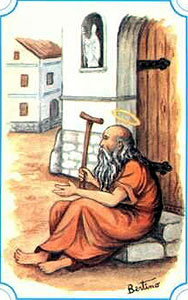
Depuis sa jeunesse et jusqu'à la fin de sa vie, il demeura couché sous un porche, paralytique et mendiant, devant l'église Saint-Clément de Rome, tout ce qu’il recevait en aumônes, il le donnait à de plus pauvres que lui. Saint Grégoire le Grand écrit de lui que des anges accompagnèrent sa mort d'une harmonie céleste.
Un internaute nous communique:
Saint Servule fut un parfait modèle de soumission à la Volonté divine; il serait difficile d'en présenter un plus consolant aux personnes affligées par la pauvreté, les maladies et les autres misères de la vie. C'est saint Grégoire le Grand qui nous raconte son édifiante histoire:
"Nous avons vu, dit-il, sous le portique qui mène à l'église Saint-Clément, un pauvre homme nommé Servule, que tout le monde à Rome a connu comme nous. Il était privé de tous les biens de ce monde; une longue maladie l'avait réduit à un état pitoyable: depuis sa jeunesse, il était paralysé de tous ses membres. Non seulement il ne pouvait se tenir debout, mais il était incapable de se soulever de son lit; il ne pouvait ni s'asseoir, ni se tourner d'un côté ou d'un autre, ni porter la main à sa bouche. Rien en lui n'était sain que les yeux, les oreilles, la langue, l'estomac et les entrailles.
"Cet infortuné, instruit des mystères de la religion, méditait sans cesse sur les souffrances du Sauveur; aussi ne se plaignait-il jamais. Il était environné des soins de sa mère et de son frère. Ni la mère, ni les enfants n'avaient jamais fait aucune étude; cependant le paralytique s'était fait acheter des livres pieux, en particulier les Psaumes et les saints Évangiles, et il demandait aux religieux qui venaient le visiter sur son grabat de lui en faire des lectures. Il apprit ainsi ces livres par cœur; il passait les jours et une partie des nuits à les chanter, à les réciter, à les méditer, et sans cesse il remerciait le Seigneur de l'avoir pris pour une victime associée aux douleurs et aux souffrances de Jésus-Christ.
"Beaucoup d'aumônes affluaient à la cabane du paralytique, en sorte qu'il se trouvait véritablement riche en sa pauvreté; après avoir prélevé ce qui était nécessaire à sa subsistance et à celle de sa mère, il donnait tout le reste aux indigents, qui se rassemblaient souvent près de lui pour s'édifier de sa parole et de ses vertus. Son lit de douleur était une chaire de prédication d'où il convertissait les âmes. Quand le temps fixé par Dieu pour récompenser sa patience et mettre un terme à sa douloureuse vie fut arrivé, Servule sentit la paralysie attaquer les parties vitales de son corps, et il se prépara à la mort.
"Au dernier moment, il pria les assistants de réciter les psaumes avec lui. Tout à coup il poussa un grand cri: "Ah! n'entendez-vous pas cette mélodie, qui résonne dans le Ciel!" A ce moment son âme s'échappa de son corps, lequel répandit, jusqu'à sa sépulture, une odeur merveilleuse."
(Abbé L. Jaud, Vie des Saints pour tous les jours de l'année, Tours, Mame, 1950.)
À Rome, commémoraison de saint Servule qui mourut en 590. Dès son plus jeune
âge, il demeura paralytique, étendu sous un portique près de l’église de
Saint-Clément. Dans la douleur, il s’appliqua à rendre toujours grâce à Dieu,
comme l’écrit le pape saint Grégoire le Grand, et tout ce qu’il recevait en
aumônes, il le donnait à de plus pauvres que lui.
Martyrologe romain
SOURCE : https://nominis.cef.fr/contenus/saint/9776/Saint-Servule.html
Saint Servule
Infirme et Mendiant
(† 670)
Saint Servule fut un
parfait modèle de soumission à la Volonté divine; il serait difficile d'en
présenter un plus consolant aux personnes affligées par la pauvreté, les
maladies et les autres misères de la vie. C'est saint Grégoire le Grand qui
nous raconte son édifiante histoire:
"Nous avons vu,
dit-il, sous le portique qui mène à l'église Saint-Clément, un pauvre homme nommé
Servule, que tout le monde à Rome a connu comme nous. Il était privé de tous
les biens de ce monde; une longue maladie l'avait réduit à un état pitoyable:
depuis sa jeunesse, il était paralysé de tous ses membres. Non seulement il ne
pouvait se tenir debout, mais il était incapable de se soulever de son lit; il
ne pouvait ni s'asseoir, ni se tourner d'un côté ou d'un autre, ni porter la
main à sa bouche. Rien en lui n'était sain que les yeux, les oreilles, la
langue, l'estomac et les entrailles.
"Cet infortuné, instruit des mystères de la religion, méditait sans cesse sur les souffrances du Sauveur; aussi ne se plaignait-il jamais. Il était environné des soins de sa mère et de son frère. Ni la mère, ni les enfants n'avaient jamais fait aucune étude; cependant le paralytique s'était fait acheter des livres pieux, en particulier les Psaumes et les saints Évangiles, et il demandait aux religieux qui venaient le visiter sur son grabat de lui en faire des lectures. Il apprit ainsi ces livres par coeur; il passait les jours et une partie des nuits à les chanter, à les réciter, à les méditer, et sans cesse il remerciait le Seigneur de l'avoir pris pour une victime associée aux douleurs et aux souffrances de Jésus-Christ.
"Beaucoup d'aumônes
affluaient à la cabane du paralytique, en sorte qu'il se trouvait véritablement
riche en sa pauvreté; après avoir prélevé ce qui était nécessaire à sa
subsistance et à celle de sa mère, il donnait tout le reste aux indigents, qui
se rassemblaient souvent près de lui pour s'édifier de sa parole et de ses
vertus. Son lit de douleur était une chaire de prédication d'où il
convertissait les âmes. Quand le temps fixé par Dieu pour récompenser sa
patience et mettre un terme à sa douloureuse vie fut arrivé, Servule sentit la
paralysie attaquer les parties vitales de son corps, et il se prépara à la
mort.
"Au dernier moment,
il pria les assistants de réciter les psaumes avec lui. Tout à coup il poussa
un grand cri: "Ah! n'entendez-vous pas cette mélodie, qui résonne dans le
Ciel!" A ce moment son âme s'échappa de son corps, lequel répandit,
jusqu'à sa sépulture, une odeur merveilleuse."
Abbé L. Jaud, Vie
des Saints pour tous les jours de l'année, Tours, Mame, 1950
SOURCE : http://magnificat.ca/cal/fr/saints/saint_servule.html
SERVULUS DE ROME
Mendiant, Paralytique, Saint
† 590
Servulus était un
mendiant, paralysé dès son enfance. Il ne pouvait rester assis ni debout, ni
porter la main à sa bouche, ni enfin se tourner dans son lit. Il était assisté
par sa mère et son frère, qui le portaient tous lesjours dans le portique de
l'église de Saint-Clément à Rome. Quoiqu'il n'eût pour vivre que les aumônes
qu'il recevait des passants, il épargnait encore de quoi fournir aux besoins de
plusieurs pauvres. Ses souffrances et ses humiliations devinrent pour lui une
source de mérites, par le saint usage qu'il en fit.
On l'admirait comme un
modèle de patience, de résignation et de douceur. Il priait quelques personnes
de lui lire les livres saints, et il les écoutait avec tant d'attention, qu'il
parvint à les apprendre par cœur. Son temps était consacré à chanter les
louanges du Seigneur, et ses peines, loin de le distraire, ne faisaient
qu'exciter sa ferveur. Servulus sentant, que son mal gagnait les parties
vitales, ne put douter qu'il n'approchât de sa fin. Dans ses derniers moments,
il conjura les pauvres et les pèlerins qu'il était dans l'usage d'assister, de
prier et de réciter des psaumes autour de lui, et il joignit sa voix mourante à
celle des autres.
Pendant la psalmodie, il
s'écria tout à coup : « Faites silence, n'entendez-vous pas cette douce
mélodie qui résonne dans les cieux ? » A peine eut-il achevé ces
paroles, qu'il expira. On met sa mort vers l'an 590. Saint Grégoire-le-Grand,
qui donna son histoire dans un de ses sermons, observe que toute sa conduite
est la condamnation de ceux qui, jouissant d'une bonne santé et d'une fortune
considérable, ne font point de bonnes œuvres, et ne peuvent supporter avec
patience la croix la plus légère.
SOURCE : Alban
Butler : Vie des Pères, Martyrs et autres principaux Saints… – Traduction :
Jean-François Godes, card.
SOURCE : http://alexandrina.balasar.free.fr/servulus_de_rome.htm
6. siècle
Servulus («le petit esclave») était paralytique, probablement de naissance.
Il vivait à Rome avec sa mère et son frère, qui l’assistaient à tout moment.
On le déposait sous le portique de la basilique Saint-Clément, où il sollicitait la générosité des fidèles. Mais les aumônes qu’il recevait, il les repassait à plus pauvres que lui.
Il ne savait pas lire, mais s’était procuré des manuscrits de la Sainte
Écriture, qu’il se faisait lire par les bonnes personnes qui prenaient un peu
de temps avec lui. Il finit par connaître très bien l’Ecriture.
L’offrande à Dieu de ses souffrances, était sa prière constante.
Servulus sentit arriver sa dernière heure. Il pria ceux qu’il put de l’aider à se maintenir sur ses jambes pour chanter la bonté divine ; il invita ses assistants à s’associer à son chant.
A un moment donné, il leur imposa le silence : Vous n’entendez pas toutes ces voix qui viennent du ciel ? Evidemment, personne n’entendait, mais Servulus était ravi, et mourut en cet état.
Ces détails nous viennent du pape Grégoire le Grand (v. 3 sept.), dont Servulus était contemporain.
Le Martyrologe Romain mentionne saint Servulus de Rome au 23 décembre.
SOURCE : http://www.samuelephrem.eu/2017/12/servulus-de-rome.html
Also
known as
Servolo il paralitico
Servolo the Paralysed
Profile
Afflicted from birth with
a severe palsy that prevented him from ever standing or even sitting unaided.
His family carried him to the door of Saint Clement’s church in Rome, Italy so
he could beg for alms. He
kept enough for the most meagre existence, giving the rest to beggars he
considered poorer than
himself, and buying Scriptural works that he would beg people to read to
him. Saint Gregory
the Great wrote about
him.
Born
6th
century in Rome, Italy
c.590 of
natural causes
buried at
Saint Clement’s church, Rome, Italy
Additional
Information
Book
of Saints, by the Monks of
Ramsgate
Lives
of the Saints, by Father Alban
Butler
Lives
of the Saints, by Father Francis
Xavier Weninger
Saints
of the Day, by Katherine Rabenstein
books
Our Sunday Visitor’s Encyclopedia of Saints
other
sites in english
video
sitios
en español
Martirologio Romano, 2001 edición
fonti
in italiano
MLA
Citation
“Saint Servulus of Rome“. CatholicSaints.Info.
14 December 2025. Web. 4 January 2026.
<https://catholicsaints.info/saint-servulus-of-rome/>
SOURCE : https://catholicsaints.info/saint-servulus-of-rome/
Article
(Saint) (December
23) (6th
century) A holy man who, paralysed all his life long, passed his days
in prayer in
the porch of the church of Saint Clement
in Rome.
When the hour of his death arrived
he bade those surrounding him to cease from their chant of Psalms, as he
already heard their words taken up by the Angels in
Heaven. Saint Gregory
the Great describes the scene in one of his Homilies, and seems to
have known Saint Servulus
personally.
MLA
Citation
Monks of Ramsgate.
“Servulus”. Book of Saints, 1921. CatholicSaints.Info.
15 December 2016. Web. 4 January 2026. <https://catholicsaints.info/book-of-saints-
SOURCE : https://catholicsaints.info/book-of-saints-servulus/
St. Servulus
Feastday: December 23
According to St. Gregory
the Great, Servulus was a beggar in Rome, afflicted with palsy since infancy,
who lived on alms he solicited from people passing St. Clement's Church. He
spent his lifetime giving thanks to God for
His goodness, despite the squalor and pain of his life. His feast day is December
23rd.
SOURCE : https://www.catholic.org/saints/saint.php?saint_id=19
Saints of the
Day – Servulus of Rome
Article
Died c.590. Like Saint
Benedict Joseph Labre, the crippled Servulus shared the alms he received at
Saint Clement’s church door in Rome with those less fortunate than himself.
Saint Gregory the Great beautifully describes the scene of his death (Benedictines).
MLA
Citation
Katherine I
Rabenstein. Saints of the Day, 1998. CatholicSaints.Info.
[php] echo the_modified_date(); [/php]. Web. [php] echo date(‘j F Y’);[/php].
<https://catholicsaints.info/saints-of-the-day-servulus-of-rome/>
SOURCE : https://catholicsaints.info/saints-of-the-day-servulus-of-rome/
December 23
St. Servulus, Confessor
From St. Gregory, Hom.
25, in Evangel. and Dial. l. 4, c. 14
A.D. 590.
IN this saint was
exemplified what our divine Redeemer has taught us of Lazarus, the poor man
full of sores, who lay before the gate of the rich man’s house. Servulus was a
beggar, and had been afflicted with the palsy from his infancy; so that he was
never able to stand, sit upright, lift his hand to his mouth, or turn himself
from one side to another. His mother and brother carried him into the porch of
St. Clement’s church at Rome, where he lived on the alms of those that passed
by. Whatever he could spare from his own subsistence he distributed among other
needy persons. The sufferings and humiliation of his condition were a means of
which he made the most excellent use for the sanctification of his own soul, by
the constant exercise of humility patience, meekness, resignation, and penance.
He used to entreat devout persons to read the holy scriptures, and he heard
them with such attention, as to learn them by heart. His time he consecrated by
assiduously singing hymns of praise and thanksgiving to God, and his continual
pains were so far from dejecting or distracting him, that they proved a most
pressing motive for raising his mind to God with greater ardour. After several
years thus spent, his distemper having seized his vitals, he perceived his end
to draw near. In his last moments he desired the poor and pilgrims, who had
often shared in his charity, to sing sacred hymns and psalms by him. Whilst he
joined his voice with theirs, he on a sudden cried out: “Silence; do you not
hear the sweet melody and praises which resound in the heavens!” Soon after he
had spoken those words he expired, and his soul was carried by angels into
everlasting bliss, about the year 590. The body of St. Servulus was buried in
St. Clement’s church, and honoured with miracles, according to the Roman
Martyrology.
St. Gregory the Great
concludes the account he gives of him in a sermon to his people, by observing
that the whole behaviour of this poor sick beggar loudly condemns those who,
when blessed with good health and a plentiful fortune, neither do good works,
nor suffer the least cross with tolerable patience.
Rev. Alban Butler (1711–73). Volume XII: December. The Lives of the Saints. 1866.
SOURCE : http://www.bartleby.com/210/12/231.html
Saint Servulus of Rome
Invalid and Beggar
(† 670)
Saint Servulus was a
perfect model of submission to the divine Will; it would be difficult to offer
a more consoling example to persons afflicted by poverty, illnesses and the
other miseries of life. It is Saint Gregory the Great who narrates for us his edifying
story:
We have seen under the
portico of the Church of Saint Clement, a poor man named Servulus, who is known
to all the people of Rome as to Us. He was deprived of all the goods of this
world; a long illness had reduced him to a pitiful state. From his youth he was
paralyzed in all his members. Not only could he not stand up, but he was unable
to rise from his bed; he could neither sit down nor turn himself from one side
to the other, nor bring his hand to his mouth. Nothing in him was sound except his
eyes, ears, tongue, stomach and entrails.
This unfortunate man, who
had learned the mysteries of religion, meditated unceasingly on the sufferings
of the Saviour, and never did he complain. He was surrounded by the loving care
of his mother and brother. Neither the mother nor the children had ever
studied, yet the paralytic had pious books bought for himself, in particular
the Psalms and the Holy Gospels, and he would ask the religious who came to
visit him on his cot to read from them to him. In this way he learned these
books by heart; he spent days and part of the nights in singing or reciting
them, and meditating them, and he constantly thanked the Lord for having taken
him to be a victim associated with the pains and sufferings of Jesus Christ.
Many alms came to the
little house of the paralytic, to such an extent that he became rich in his
poverty. After having taken from these what was necessary for his subsistence
and that of his mother, he gave the rest to the indigent, who often assembled
around him to be edified by his words and his virtues. His bed of pain was a
pulpit of preaching, from which he converted souls.
When the time came which
was decreed by God to reward his patience and put an end to his painful life,
Servulus felt the paralysis spreading to the vital parts of his body, and he
prepared for death. At the final moment, he asked those in attendance to recite
Psalms with him. Suddenly he cried out:Ah! Don't you hear that melody
resounding in heaven?' At that moment his soul escaped from his body,
which until his burial gave forth a marvelous fragrance.
Vie des Saints pour tous
les jours de l'année, by Abbé L. Jaud (Mame: Tours, 1950).
SOURCE : https://sanctoral.com/en/saints/saint_servulus_of_rome.html
Pictorial
Lives of the Saints – Saint Servulus
Article
Servulus was a beggar,
and had been so afflicted with palsy from his infancy that he was never able to
stand, sit upright, lift his hand to his mouth, or turn himself from one side
to another. His mother and brother carried him into the porch of Saint
Clement’s church at Rome, where he lived on the alms of those that passed by.
He used to entreat devout persons to read the Holy Scriptures to him, which he
heard with such attention as to learn them by heart. His time he consecrated by
assiduously singing hymns of praise and thanksgiving to God. After several
years thus spent, his distemper having seized his vitals, he felt his end was
drawing nigh. In his last moments he desired the poor and pilgrims, who had
often shared in his charity, to sing sacred hymns and psalms for him. Whilst he
joined his voice with theirs, he on a sudden cried out: “Silence; do you not
hear the sweet melody and praise which resound in the heavens?” Soon after he
spoke these words he expired, and his soul was carried by angels into
everlasting bliss, about the year 590.
Reflection – The
whole behavior of this poor sick beggar loudly condemns those who, when blessed
with good health and a plentiful fortune, neither do good works nor suffer the
least cross with tolerable patience.
MLA
Citation
John Dawson Gilmary Shea.
“Saint Servulus”. Pictorial Lives of the Saints, 1922. CatholicSaints.Info.
15 December 2018. Web. 4 January 2026. <https://catholicsaints.info/pictorial-lives-of-the-saints-saint-servulus/>
SOURCE : https://catholicsaints.info/pictorial-lives-of-the-saints-saint-servulus/
Weninger’s
Lives of the Saints – Saint Servulus, Confessor
Article
At the time of Saint
Gregory the Great, there was at Rome a poor beggar, named Servulus, of whose
virtue and holiness, this great Pope and Doctor of the church gives the
following testimony. Servulus was a beggar, who was daily carried into the
vestibule of Saint Clement’s Church to receive alms from those who passed by.
From his earliest infancy he had been so crippled, that he could neither walk
nor stand, nor sit upright, but remained continually lying, without being able
to turn from one side to the other. He could not lift his hand to his mouth,
and his mother and brother fed him like an infant. To this was added the
poverty of his mother, who could maintain herself and her son only by alms. But
notwithstanding this misery, there never escaped from the lips of this poor
beggar a single word of complaint, either for his misery, or the violence, or
long duration of his suffering. Much less was he heard to murmur against God or
His holy will, but on the contrary, he edified all by his submission to divine
Providence, encouraging himself with verses of Holy Writ and never ceasing to
praise the Most High. His most agreeable occupation consisted in praying and
singing psalms, or listening to pious reading. His patience was inexhaustible,
even during his greatest agony, and no pain was so great as to cause him to
cease giving thanks to the Lord. He had great compassion on other poor, and
therefore caused his mother and brother to give to them what he did not need of
the alms he had received. Although the house, in which he lived with his mother
and brother, was small and poor, yet many poor religious who came to Rome found
a welcome there, when they could not find other lodgings. Servulus profited by
their presence by humbly begging them to read to him out of some devout book.
He himself could not read, and yet he knew almost the entire Scriptures by
heart; for, out of the alms he received, he had bought a copy of Holy Writ, as
well as other devout books, from which sometimes one, sometimes another would
read to him. When he had no one to do this act of kindness, he paid some poor
person to read to him, either at his house or at the place where he used to
receive alms. By this he gained great knowledge of the lives of the Saints, and
preserved his heroic patience until his death. For many years the Almighty gave
a great example of virtue to the Christian world in His faithful servant,
Servulus, until at length He called him to heaven to receive his eternal
reward. When the holy man perceived that his end was near, although he had
daily prepared himself for death, he redoubled his zeal in order to die well.
Having done all that a pious Christian can do in such circumstances, he, one
night, suddenly called the religious, who were just then lodging with men, and
begged them to sing some psalms with him, as death was approaching. He began to
sing although his voice was already half broken. Suddenly pausing, he
exclaimed: “Hush, hush! Do you not hear the angels sing? Do you not hear how
beautifully they exalt and praise God?” and, turning his eyes upward as though
he saw the angels, he breathed his last; while, at the same moment, his holy
body exhaled so sweet an odor that those around were filled with astonishment
and joy. There was not one who did not believe that the holy soul of Servulus
had gone immediately to heaven, accompanied by the angels, to sing with them
the hymns of eternal bliss, since he had lived so holy and innocent a life, had
borne his wearisome disease with such heroic patience and resignation to the
divine will, and had been honored, in death, with angelic music.
Practical Considerations
• You have read how
severely Saint Servulus suffered from the first year of his life until his end,
and also in what manner he bore his sufferings. Are you not ashamed to lose
your patience and complain in your suffering and sickness, which is not a shadow
of what Saint Servulus endured? You perhaps say or think, that there is no one
on earth that suffers as you do; that you have to bear every cross. But you are
mistaken. Saint Servulus suffered much more; and many others have suffered much
more: and there are at this moment a great many persons living, who bear
infinitely more than you. But supposing that you have in reality more to suffer
than any one else, does it give you any reason to complain or murmur against
God? Do you think God unjust, or that He does you wrong by giving you so much
to suffer? Have you not deserved even more? Perhaps you say: “Why do I suffer
so much and others not?” Saint Servulus spoke not thus. Do you require that the
Almighty should give you His reason, for what He does? How dreadful a
presumption! Suffer what God lays upon you and leave others alone. God is your
Lord, and it does not become you to question why He does this or that. The
thought that all He does is for your good, ought to satisfy you. Who can know
whether, had Saint Servulus possessed health and straight limbs, he would not
have made use of them to his own damnation? And who knows what you would do, if
you were free from sickness, troubles and crosses? “To many persons health is
hurtful,” says Saint Augustine. Just so is continual prosperity hurtful to
them, while adversity, sickness and crosses are useful to their salvation.
Think of this truth if you suffer innocently like Saint Servulus. But if your
conscience tells you, that you have sinned, then say not a word; suffer and be
silent; for. you have deserved more than you have suffered. “No matter how much
we may suffer,” says Saint Salvianus, “we always suffer less than we deserve.
Why then do we complain that God is hard? We arouse the wrath of God by our
sins, and so to say, force Him to punish us.”
• How ingenious is the
desire to learn something good! As Saint Servulus was not able to read and yet
anxious to learn how to live piously, he made others read aloud to him from
devout books. If no one was there to do him this kindness, he took from the
alms which had been given him and paid some one to read to him. This pious
practice was the source from which he drew the wonderful patience and strength
of mind with which he bore his great pains, and which made him so great a
Saint. I have, during the year, several times advised you, that besides going
to Church on Sunday and holidays, you should employ some time in reading a
devout book, as the profit you would derive from it is much greater than you
imagine. I repeat my advice and assure you that as, in our time, the greatest
harm is done to our holy religion and to Christian morals, by the reading of
heretical and immoral books, so also hardly anything is more necessary for the
preservation of the true religion and the fear of God, as well as for sincere
repentance and conversion, than the reading of devout books, besides listening
to the word of God in sermons. As you value your holy religion and your
salvation, do not neglect reading pious books or cause them to be read for you
as did Servulus.
In order to contribute as
much as I could to this important object, I have published myself, a series of
instructive books, and wish them to be read in every family. These books are:
Catholicity, Protestantism and Infidelity, or the book for the conversion of
Americans; The Manual of the Catholic Doctrine; The Sacred Heart Mission Book;
The Book on the Infallibility of the Pope; Easter in Heaven; The Lives of the
Saints with Practical Considerations; Photographic Views; and three Catechisms
of Christian Doctrine. Try to get all these books and see that they are read by
your children, especially these Lives of the Saints, every evening, and I will
remember you at Mass every day of my life and pray for you after my death.
MLA
Citation
Father Francis Xavier
Weninger, DD, SJ. “Saint Servulus, Confessor”. Lives
of the Saints, 1876. CatholicSaints.Info.
3 June 2018. Web. 4 January 2026.
<https://catholicsaints.info/weningers-lives-of-the-saints-saint-servulus-confessor/>
SOURCE : https://catholicsaints.info/weningers-lives-of-the-saints-saint-servulus-confessor/
St. Servulus of Rome
DECEMBER 23, 2017
(Feast Day ~
December 23)
At this time of year, the
world is obsessed with gifts – gift-giving, gift-receiving, and especially
gift-purchasing. Surrounded by the commercial frenzy, it is often difficult for
Christians to remain focused on proper gift-giving – on the spirit of charity
and generosity and on preparing to receive again in our hearts the most
important gift of all, the Christ child, the Savior.
To help us in our
efforts, the Church offers the saints, who will both intercede for us and also
serve as examples of true generosity.
We learn from our patron,
St. Gregory the Great, about a saint of his day, Servulus of Rome. Servulus was
a most pitiable man. He suffered from a paralysis that prevented him from
standing, sitting, feeding himself or turning himself over. His family was too
poor to afford his care, so each day, his mother and brother carried him to the
door of St. Clement’s Church in Rome, where he lay so that passersby who took
pity on him could place coins on his pallet. Servulus endured this life of
begging with patience and humility. He never considered himself so poor that he
couldn’t share the offerings given to him with others who were hungry or in
need.
Servulus kept his good
spirit by asking those who came to pray in the church to read passages of
Scripture (which he memorized) to him, and he endured his physical pain by
singing hymns of praise and thanksgiving to God.
On December 23, 590, as
he felt himself nearing death, Servulus called for others to join him in
praying, singing and reciting the Psalms. Soon he declared that he could hear
the angels singing, and he breathed his last. This poor man, who had generously
shared the little that he had with others, was buried in St. Clement’s Church
and his relics brought about many miracles.
Whatever our station in
life, may we, like St. Servulus, offer what gifts we have to others in the name
of Christ who gave his life for us.
SOURCE : http://www.stgregoryoc.org/st-servulus-of-rome/
San Servolo il
Paralitico Mendicante
Festa: 23 dicembre
Roma, † 23 dicembre 590
Etimologia: Servolo
= di servo o salvato, dal latino
Martirologio
Romano: A Roma, commemorazione di san Sérvulo, che, giacendo paralitico
fin dall’infanzia sotto il portico della chiesa di San Clemente, cercò sempre,
come scrive san Gregorio, sia pure nelle sofferenze, di rendere grazie a Dio e
distribuì ai poveri tutto quello che raccoglieva dalle elemosine.
Un mendicante paralitico, come tanti che hanno disseminato le strade delle città in tutti i secoli, ricordando con la loro presenza, spesso vista con fastidio, l’altra faccia dell’umanità, che non consiste solo di gioie, divertimenti, buona salute, ricchezza, ma anche di povertà, malattia, emarginazione, sofferenza, ingiustizia.
Tale fu nel tardo VI secolo, Servolo, un paralitico povero di mezzi, che dimorava sotto i portici della strada che conduceva all’antica Basilica di S. Clemente a Roma.
Era diventato paralitico sin da bambino e la devastante malattia l’accompagnò per tutta la sua vita, condizionandolo in tutte le attività.
Ad aiutarlo c’erano la madre ed un fratello; tutto quel poco che riceveva dalle elemosine lo distribuiva ai poveri, proprio tramite i due familiari.
Se era colpito e immobilizzato nel corpo, era sveglio con la mente e con la volontà; non sapeva leggere né scrivere, nonostante ciò aveva comperato dei codici della Sacra Scrittura e quando dei sacerdoti si soffermavano da lui, li pregava di leggerglieli; nutrito così dalle parole ispirate della Sacra Scrittura, Servolo trovava conforto nelle sue estreme sofferenze e veniva spronato ad innalzare giorno e notte, le lodi a Dio, padre di tutte le creature anche le più provate.
Diventò quasi una tappa obbligatoria per i pellegrini ed i fedeli che si recavano alla vicina Basilica di San Clemente e si soffermavano presso di lui, che se da un lato riceveva una elemosina, che come detto finiva ad altri poveri, dall’altro ricambiava con parole di conforto, di consiglio, di esortazione, nel percorrere sulla scia di Gesù, Via, Verità e Vita, la loro esistenza.
Quando ancora giovane sentì approssimarsi la morte, volle che i pellegrini presenti si alzassero e cantassero i salmi nell’attesa, accompagnati dal canto flebile di lui, che ad un tratto tacque facendo segno anche agli altri di smettere e in un soffio disse: “Tacete, non udite forse le laudi che cantano in cielo?” poi dolcemente spirò; era il 23 dicembre del 590.
Alla morte fu presente il segretario di papa s. Gregorio Magno, da poco sul soglio pontificio (590-604), il quale raccontò al papa i particolari; a sua volta s. Gregorio Magno, nei famosi “Dialoghi” inserì un capitolo dedicato al santo paralitico e giunto fino a noi.
Successivamente Adone († 875), autore di un Martirologio storico, dice che Servolo fu sepolto nella vicina chiesa di S. Clemente, cosa non certa perché molti studiosi affermano che la sepoltura è sconosciuta.
Comunque nel Medioevo, sotto l’influenza di questa notizia, fu costruita “fuori
della chiesa di s. Clemente nella strada”, una cappella in onore di S. Servolo,
che secondo alcuni studiosi conteneva le reliquie del santo.
Autore: Antonio
Borrelli
Quanta differenza c’è tra il buon Servolo che, nonostante la sofferenza e la sua infermità è sereno, gentile con tutti, non si spazientisce e, sempre di buonumore, canta le lodi al Signore, e quelli che hanno la fortuna di avere la salute e la ricchezza e non pensano ad aiutare gli altri, anzi, si lamentano sempre, anche di fronte alla più piccola e banale contrarietà! Servolo vive a Roma nel VI secolo. È paralizzato fin dall’infanzia. Non può camminare, né stare in piedi. La madre e un fratello lo aiutano per ogni minima incombenza e per trasportarlo da un luogo ad un altro. L’unica attività che gli è consentita è chiedere l’elemosina.
I famigliari lo accompagnano ogni giorno fino al portico dell’antica Chiesa di San Clemente. Qui il paralitico, accovacciato e immobile, raccoglie le offerte di chi, impietosito dalla sua condizione, offre qualche moneta. Servolo, però, non si lamenta. Non maledice il Signore per la sua sventura, anzi Lo prega e Lo ama, con fervore. Il povero mendicante divide la raccolta delle offerte in tre parti: una è per fare fronte alle proprie umili necessità; l’altra e per i più poveri di lui, soprattutto per coloro che imprecano, odiano tutti e tutto, incapaci di sopportare le proprie sventure e la terza la utilizza per comprarsi libri religiosi come la Bibbia. Servolo non sa né leggere, né scrivere, però quando incontra un sacerdote o qualche letterato, con gentilezza chiede di leggergli alcune pagine dei suoi libri. Anno dopo anno Servolo diventa, così, molto istruito e spesso ripete a memoria passi dell’Antico e Nuovo Testamento.
La sua modesta casa diventa un posto accogliente, dove spesso vengono ospitati pellegrini e poveri. Il paralitico non è mai solo e le preghiere e i canti rivolti al Signore lo confortano, gli danno gioia e lo aiutano a sopportare serenamente le sofferenze del corpo. Quando muore a Roma, nel 590, gli viene costruita una cappella vicino alla Basilica di San Clemente. Si narra di tanti miracoli di guarigione avvenuti dopo la sua morte, grazie alle preghiere a lui rivolte. San Servolo è protettore dei paralitici.
Autore: Mariella Lentini
SOURCE : https://www.santiebeati.it/dettaglio/82900
Saint Servulus: The Iconography: http://www.christianiconography.info/servulus.html
