
Portrait
of Pope
Saint Linus, Basilica of Saint Paul
outside the Walls, Rome
Saint Lin
Pape (2 ème) de 67? à
76? (+ v. 76)
D'après saint Irénée de Lyon, il aurait reçu des apôtres eux-mêmes la charge d'évêque de Rome, après avoir secondé saint Pierre de 56 à 67. Martyr, il aurait été inhumé dans les catacombes vaticanes.
À Rome, commémoraison de saint Lin, pape, au Ier siècle. Comme le rapporte
saint Irénée, les bienheureux Apôtres Pierre et Paul lui remirent la charge de
l’Église fondée dans cette ville et l’Apôtre saint Paul fait mention de lui.
Martyrologe romain
SOURCE : http://nominis.cef.fr/contenus/saint/1903/Saint-Lin.html

Giovanni Battista de'Cavalieri (1525–1601), in Giovanni Battista Cavalieri, Pontificum Romanorum effigies, Roma, Basa Domenico\Zanetti Francesco, 1580, Municipal Library of Trento
SAINT LIN, PAPE
D’origine toscane et fils
d’Hercolano, Lin aurait étudié à Volterra, puis il se serait transféré à Rome
où il rencontre saint Pierre et se convertit au christianisme. On ne dispose
pas de beaucoup d’informations sur sa vie; mais saint Irénée de Lyon dit que
saint Paul et saint Pierre confièrent à Lin la charge d’évêque, et l’identifie
avec le personnage mentionné dans la Deuxième Lettre à Timothée. Eusèbe de
Césarée réaffirme une telle identification. Ce qui est certain est qu’il a été
évêque de Rome après le martyre des deux Apôtres. Toutes les listes conservées
des évêques de Rome grâce à Irénée de Lyon et à Eusèbe de Césarée indiquent son
nom après celui de Pierre.
Les débuts de l’Eglise en
des temps agités
Avant de devenir évêque
Lin vit sous la persécution déchaînée par l’empereur Néron contre les
chrétiens. Au début de son pontificat, l’Empire romain vit une phase agitée,
avec la mort des trois successeurs immédiats de Néron: deux sont assassinés
tandis que le troisième se suicide.
En 69 D.C. arrive Vespasien qui rétablit l’ordre. Son fils Titus met ensuite
fin à la révolte juive et détruit le Temple de Jérusalem en 70 D.C. Ce sont les
années où Lin commence à donner une organisation à l’Eglise, il ordonne des
évêques et des prêtres et établit certaines règles; par exemple, selon le Liber
Pontificalis, c’est à lui qu’on attribue l’obligation pour les femmes de
participer à l’Eucharistie tête voilée.
Ce sont également les années des disputes avec l’école de Simon le Magicien et
avec les Ebionites, judéo-chrétiens qui pratiquaient l’observance de la loi
mosaïque. Il est vénéré comme martyre mais il n’est pas certain qu’il l’ait
été, car en ce temps l’Eglise connut une période de paix. Toujours selon le
Liber Pontificalis il est enterré sur la colline du Vatican à côté de l’apôtre
Pierre.
SOURCE : https://www.vaticannews.va/fr/saint-du-jour/09/23/saint-lin--pape.html
23 septembre
Saint Lin
Pape et martyr, premier successeur de saint Pierre
Pour tout ce qui regarde
saint Lin, faute de documents certains, on est bien forcé de s’en remettre aux
traditions qui s’accordent toutes à dire qu’il était fils d'Herculanus, homme
noble et fort considérable de la ville toscane de Volterra. Toutes disent aussi
qu’après s’être converti à Rome où saint Pierre prêchait l'Evangile, il quitta
son père et renonça à tous ses biens pour pratiquer plus parfaitement la
doctrine de Notre-Seigneur Jésus Christ. Peu de temps après sa conversion, il
donna de si grandes preuves de son zêle, de son érudition et de sa prudence,
que le saint apôtre Pierre l’ordonna pour l'employer à la prédication de la
parole de Dieu et à l'administration des sacrements.
Certains affirment qu’il
fut ensuite envoyé dans les Gaules pour y porter le flambeau de la foi, et une
tradition veut que Besançon (qui le fête au 26 novembre) eut le bonheur de le
recevoir et de l'avoir pour premier évêque. Il y aurait logé chez le tribun
Onasius, que ses exhortations convertirent ; Lin aurait fait de cette
maison en une petite église consacrée en l'honneur de la résurrection du
Sauveur, de la sainte Vierge et de saint Etienne, premier martyr. Le nombre des
fidèles, dit-on, s'augmentait de jour en jour, quand les païens firent une fête
solennelle en l'honneur de leurs dieux où ils devaient leur offrir beaucoup de
sacrifices ; saint Lin qui voulait les détourner de ce culte, se
transporta sur la place, il leur dit : « Que faites-vous, mes chers
enfants ? Quelle marque de divinité voyez-vous dans ces simulacres que
vous adorez ? Ce ne sont que des statues qui n'ont ni esprit ni sentiment,
et qui ne représentent que des hommes dont l'incontinence et l'impiété ont été
toutes publiques. Ces idoles de pierre et de cuivre ne méritent nullement vos
respects, c'est à Dieu seul, créateur du ciel et de la terre, que vous devez
offir des victimes. Quittez donc ce culte sacrilège et acquiescez aux vérités
que je vous prêche. » Ce fut comme un coup de tonnerre qui jeta par terre
l'une des colonnes du temple et mit en poudre l'idole qu’elle soutenait. Un si
grand prodige qui aurait dû les yeux à ces peuples, les endurcit
davantage : se jetant tumultueusement sur leur apôtre, ils le
chassèrent sur l’heure de la ville. Voilà quelle est la tradition de Besançon
qui honore saint Lin comme son premier évêque.
Lorsqu’il fut retourné à
Rome (vers 56, pense-t-on) saint Pierre se servit utilement de Lin pour la
conduite de l’Eglise ; à la demande de saint Pierre, il aurait défendu aux
femmes d'entrer dans l'église sans avoir la tête couverte d’un voile, ce que
saint Pierre avait aussi défendu ; saint Paul jugeait cela si nécessaire
pour l'édification des fidèles, qu'il en fit une loi expresse, comme on le voit
dans le onzième chapitre de sa première épître aux Corinthiens (versets 13 à
15). L'apôtre saint Paul fait mention de lui au quatrième chapitre de sa
seconde épître à Timothée, et il le met entre les premiers et les principaux
chrétiens de la ville de Rome. Il s'acquitta avec tant de gloire de toutes
ses fonctions, qu'après le martyre du prince des apôtres (67) il fut jugé digne
de lui succéder, donnant d'excellents témoignages de son zèle et de sa
vigilance pastorale. Le Bréviaire romain disait que la foi et 1a sainteté de
saint Lin fut si grande, qu'il ressuscita et chassa les démons des corps de
plusieurs énergumènes. Enfin, après avoir gouverné l'Eglise pendant onze an,
trois mois et douze jours, il fut à son tour martyrisé. On dit que son corps
aurait été enterré au Vatican, près de celui de saint Pierre, le 9 des calendes
d'octobre (23 septembre) . En 1630, quand le pape Urbain VIII fit achever
les travaux de la Confession de saint Pierre, on découvrit une tombe sur
laquelle on crut pouvoir lire : Linus.
On représente saint Lin
délivrant des possédés et ressuscitant un rnort : on rapporte en effet
qu'il délivra du démon la fille du consul Saturninus.
SOURCE : http://missel.free.fr/Sanctoral/09/23.php
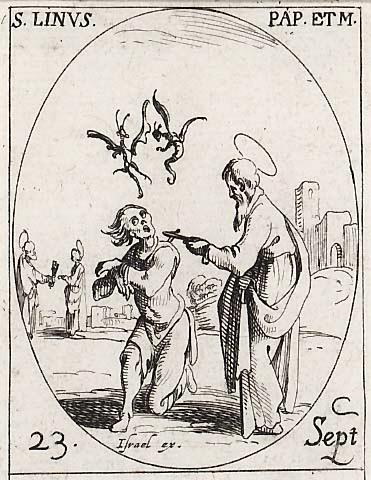
23/09 St Lin, pape et martyr
Toutes les traditions
confirment que Saint Lin fut le successeur de St Pierre. Sa
déposition est attestée le 23 septembre au Liber Pontificalis. Sa fête fut
inscrite au calendrier romain au XIème siècle. On commémore aussi aujourd’hui
Sainte Thècle.
Leçons des Matines (avant
1960)
Quatrième leçon. Le Pape saint Lin, né à Volterra en Toscane, gouverna l’Église immédiatement après saint Pierre. Telles étaient sa foi et sa sainteté, qu’il chassait les démons, et que même il ressuscitait les morts. Il a relaté par écrit les actions de saint Pierre, et principalement sa conduite à l’égard de Simon le magicien. II décréta qu’aucune femme n’entrerait dans une église sans avoir la tête couverte d’un voile. A cause de sa constance dans la foi chrétienne, ce Pontife eut la tête tranchée, sur l’ordre du consulaire Saturnin, monstre d’impiété et d’ingratitude, dont il avait délivré la fille des démons qui l’obsédaient. Lin fut enseveli au Vatican, près du tombeau du prince des Apôtres, le neuf des calendes d’octobre. Il avait occupé le Siège pontifical onze ans, deux mois et vingt-trois jours, et, en deux fois, au mois de décembre, consacré quinze Évêques et ordonné dix-huit Prêtres.
SOURCE : http://www.introibo.fr/23-09-St-Lin-pape-et-martyr

LE XXIII SEPTEMBRE. SAINT LIN, PAPE ET MARTYR.
Une obscurité mystérieuse entoure la vie des premiers Vicaires de l'Homme-Dieu; ainsi se dérobent aux yeux les premières assises d'un monument fait pour défier la durée. Porter l'Eglise éternelle, est assez pour leur gloire ; assez pour justifier notre confiance, animer notre gratitude. Laissons disserter les doctes sur tel ou tel point de la courte Légende qui va suivre; cette fête était réclamée par le cœur de l'Epouse: elle est le témoignage de sa vénération émue pour l'humble et doux Pontife qui, le premier, rejoignit Pierre aux cryptes Vaticanes.
Lin, Pape, né en Toscane à Volterra, gouverna le premier l'Eglise à la suite de Pierre. Si grandes étaient sa foi et sa sainteté que non seulement il chassait les démons, mais ressuscitait aussi les morts. Il écrivit les actes du bienheureux Pierre, et spécialement ce qu'il avait fait contre Simon le magicien II décréta qu'aucune femme n'entrerait dans l'église sans voile sur sa tête. La constance de sa foi chrétienne valut au Pontife une sentence de décapitation de la part de Saturninus, consulaire impie et ingrat, dont il avait délivré la fille que tourmentaient les démons. On l'ensevelit au Vatican près du tombeau du prince des Apôtres, le neuf des calendes d'octobre. Il siégea onze ans, deux mois, vingt-trois jours ; en deux fois, au mois de décembre, il créa quinze évêques et dix-huit prêtres.
Ce fut personnellement et à la vue de tous, que le Seigneur investit Simon fils de Jean du pontificat suprême ; non moins directement, bienheureux Pontife, mais invisiblement, vous reçûtes de Jésus les clefs du royaume des cieux. A vous commence ce règne complet de la foi pure où l'Eglise, sans ouïr derechef l'Homme-Dieu dire à Pierre : Pais mes brebis, s'incline pourtant devant la permanence de son autorité en l'homme dûment désigné comme représentant de l'Epoux. Obtenez que les ombres d'ici-bas ne rendent jamais incertaine notre obéissance; faites qu'au jour de l'éternité, nous méritions de contempler avec vous le Chef divin dans la lumière.
Rome associe aux honneurs du premier successeur de Pierre la mémoire sainte de Thècle la proto-martyre. Faisons comme elle écho en ce jour au concert unanime des Pères de l'Orient et de l'Occident. Lorsque, sur la fin du III° siècle de notre ère, Méthodius, le Pontife Martyr, donnait à l'Eglise son Banquet des vierges, il plaçait au front de la vierge d'Icône la plus belle des couronnes distribuées aux convives de l'Epoux (METHOD. Conviv. dec. virg. XI, i.). C'était justice pour celle que Paul avait formée, la rendant plus supérieure encore dans l'Evangile qu'elle ne l'était dans la philosophie et toute science (Ibid. VII. IX). L'héroïsme avait en elle suivi la lumière ; la force de l'âme y soutint la magnanimité des résolutions ; la gloire d'un multiple martyre fut acquise à celle dont le corps, aussi ferme que l'âme en sa blancheur virginale (Ibid. VIII, XVII), triompha du feu, des fauves, des monstres marins.
C'est elle qui triomphe encore au Banquet mystérieux. La Sagesse est en elle, cithare divine harmonisant son âme, résonnant sur ses lèvres en accents d'admirable éloquence (Ibid. VII, IX; VIII), en sublime poésie. Quand, le festin achevé, les vierges debout rendent grâces au Seigneur, c'est elle qui préside le choeur, et elle chante :
« Pour vous, Epoux, je me garde pure ; je viens à vous, ma lampe allumée.
« J'ai fui les délices de la vie, l'amère félicité des humains; j'aspire à voir toujours votre beauté. — Pour vous, Epoux, je me garde pure; je viens à vous, ma lampe allumée.
« J'ai dédaigné l'union d'un mortel, j'ai quitté la maison remplie d'or; recevez-moi au bienheureux secret de votre amour.—Pour vous, Époux, je me garde pure ; je viens à vous, ma lampe allumée.
« Du dragon j'ai déjoué les ruses, du feu j'ai bravé la flamme, des animaux féroces j'ai subi les assauts; je vous attends des cieux. — Pour vous, Epoux, je me garde pure ; je viens à vous, ma lampe allumée.
« O Verbe, éprise de vous, j'ai oublié la terre de ma naissance, j'ai oublié les jeux des compagnes de mon âge, et ma mère, et mes nobles aïeux ; car vous m'êtes tout, ô Christ. — Pour vous, Epoux, je me garde pure ; je viens à vous, ma lampe allumée (Method. Conviv. dec. virg. XI, II). »
ORAISON.
Dieu tout-puissant, nous célébrons le jour natal de la bienheureuse Thècle, votre Vierge et Martyre ; que cette solennité annuelle soit notre joie ; que l'exemple d'une si grande foi nous soitprofiteble : c'est laprière que nous vous adressons. Par Jésus-Christ.
Dom Guéranger. L'ANNÉE LITURGIQUE
SOURCE : http://www.abbaye-saint-benoit.ch/gueranger/anneliturgique/pentecote/pentecote05/030.htm
Saint Lin de Volterra
Pape et martyr
(† 67)
Saint Lin était le fils
d'un homme fort considérable de la ville de Volterra, en Toscane. Il se
convertit à Rome où saint Pierre prêchait l'Evangile. Aussitôt après sa
conversion, saint Lin renonça à tous ses biens et quitta son père. Il donna de
si grandes preuves de son zèle, de son érudition et de sa prudence, que le chef
des apôtres l'employa à la prédication de la parole de Dieu et à
l'administration des sacrements. Saint Paul parle de saint Lin au chapitre IVe
de sa seconde Epître à Timothée et le place entre les principaux chrétiens de
la ville de Rome.
Envoyé dans les Gaules
pour y porter le flambeau de la foi, le bonheur de l'avoir pour premier évêque
échut à la ville de Besançon dont le nombre des fidèles s'accrut de jour en
jour. Un jour, les païens célébrèrent une fête solennelle en l'honneur de leurs
faux dieux auxquels ils offraient beaucoup de sacrifices. Brûlant de zèle pour
la gloire de Dieu et le salut de ces pauvres âmes, saint Lin entreprit de les
détourner de ce culte abominable. Fendant la foule des idolâtres, il leur dit
courageusement: «Que faites-vous, mes chers enfants? Quelle marque de divinité
voyez-vous dans ces simulacres que vous adorez? Ce ne sont que des statues qui
n'ont ni esprit, ni sentiment, et qui ne représentent que des hommes dont
l'incontinence et l'impiété ont été toutes publiques. Ces idoles de pierre et
de cuivre ne méritent nullement vos respects. C'est à Dieu seul, créateur du
ciel et de la terre que vous devez immoler des victimes. Quittez donc ce culte
sacrilège et acquiescez aux vérités que je vous prêche.»
Ces paroles prononcées
avec une ferveur inspirée retentirent comme un violent coup de tonnerre qui
renversa par terre l'une des colonnes du temple avec l'idole qu'elle soutenait,
la réduisant en poussière. Un prodige si éclatant aurait dû ouvrir les yeux aux
idolâtres et leur faire reconnaître la vérité de la religion que saint Lin leur
annonçait. Hélas, au lieu de profiter de la grâce qui leur était offerte, les
incroyants fermèrent leurs coeurs à la parole de Dieu et se jetèrent
tumultueusement sur saint Lin qu'ils chassèrent à l'heure même de la ville de
Besançon.
L'apôtre retourna à Rome
où saint Pierre s'en servit utilement pour le gouvernement de l'Eglise. Il
s'acquitta avec tant de soin de toutes les fonctions qui lui furent assignées
qu'après la mort du prince des apôtres, on le choisit pour lui succéder dans la
charge de pasteur suprême. Dans cette sublime fonction, saint Lin donna
d'excellents témoignages de son zèle et de sa vigilance pastorale. Il écrivit
deux relations du martyre de saint Pierre et de saint Paul. Nous tenons aussi
de lui l'histoire de la dispute du prince des apôtres avec Simon le Magicien.
Pour l'affermissement de l'Eglise naissante et l'avancement de la chrétienté,
saint Lin créa quinze évêques et dix-huit prêtres.
Le Bréviaire romain dit
que la foi et la sainteté de ce souverain pontife furent si grandes qu'il
ressuscita des morts et chassa les démons des corps de plusieurs énergumènes.
Après avoir gouverné l'Eglise pendant un an, trois mois et douze jours, saint
Lin versa son sang qui servit de semence à de nouveaux chrétiens. On enterra sa
précieuse dépouille au Vatican, auprès des restes de saint Pierre.
Résumé, O.D.M.
SOURCE : http://magnificat.ca/cal/fr/saints/saint_lin_de_volterra.html
Saint LINUS
Pape et martyr, premier
successeur de saint Pierre
Biographie
Pour tout ce qui regarde
saint Lin, faute de documents certains, on est bien forcé de s’en remettre aux
traditions qui s’accordent toutes à dire qu’il était fils d'Herculanus, homme
noble et fort considérable de la ville toscane de Volterra. Toutes disent aussi
qu’après s’être converti à Rome où saint Pierre prêchait l'Evangile, il quitta
son père et renonça à tous ses biens pour pratiquer plus parfaitement la
doctrine de Notre-Seigneur Jésus Christ. Peu de temps après sa conversion, il
donna de si grandes preuves de son zèle, de son érudition et de sa prudence,
que le saint apôtre Pierre l’ordonna pour l'employer à la prédication de la
parole de Dieu et à l'administration des sacrements.
Certains affirment qu’il
fut ensuite envoyé dans les Gaules pour y porter le flambeau de la foi, et une
tradition veut que Besançon (qui le fête au 26 novembre) eut le bonheur de le
recevoir et de l'avoir pour premier évêque. Il y aurait logé chez le tribun
Onasius, que ses exhortations convertirent ; Lin aurait fait de cette
maison en une petite église consacrée en l'honneur de la résurrection du
Sauveur, de la sainte Vierge et de saint Etienne, premier martyr. Le nombre des
fidèles, dit-on, s'augmentait de jour en jour, quand les païens firent une fête
solennelle en l'honneur de leurs dieux où ils devaient leur offrir beaucoup de
sacrifices ; saint Lin qui voulait les détourner de ce culte, se
transporta sur la place, il leur dit : « Que faites-vous, mes chers
enfants ? Quelle marque de divinité voyez-vous dans ces simulacres que
vous adorez ? Ce ne sont que des statues qui n'ont ni esprit ni sentiment,
et qui ne représentent que des hommes dont l'incontinence et l'impiété ont été
toutes publiques. Ces idoles de pierre et de cuivre ne méritent nullement vos
respects, c'est à Dieu seul, créateur du ciel et de la terre, que vous devez
offrir des victimes. Quittez donc ce culte sacrilège et acquiescez aux vérités
que je vous prêche. » Ce fut comme un coup de tonnerre qui jeta par terre
l'une des colonnes du temple et mit en poudre l'idole qu’elle soutenait. Un si
grand prodige qui aurait dû ouvrir les yeux à ces peuples, les endurcit
davantage : se jetant tumultueusement sur leur apôtre, ils le
chassèrent sur l’heure de la ville. Voilà quelle est la tradition de Besançon
qui honore saint Lin comme son premier évêque.
Lorsqu’il fut retourné à
Rome (vers 56, pense-t-on) saint Pierre se servit utilement de Lin pour la
conduite de l’Eglise ; à la demande de saint Pierre, il aurait défendu aux
femmes d'entrer dans l'église sans avoir la tête couverte d’un voile, ce que
saint Pierre avait aussi défendu ; saint Paul jugeait cela si nécessaire
pour l'édification des fidèles, qu'il en fit une loi expresse, comme on le voit
dans le onzième chapitre de sa première épître aux Corinthiens (versets 13 à
15) L'apôtre saint Paul fait mention de lui au quatrième chapitre de sa seconde
épître à Timothée, et il le met entre les premiers et les principaux chrétiens
de la ville de Rome. Il s'acquitta avec tant de gloire de toutes ses
fonctions, qu'après le martyre du prince des apôtres (67) il fut jugé digne de
lui succéder, donnant d'excellents témoignages de son zèle et de sa vigilance
pastorale. Le Bréviaire romain disait que la foi et la sainteté de saint Lin
fut si grande, qu'il ressuscita et chassa les démons des corps de plusieurs
énergumènes. Enfin, après avoir gouverné l'Eglise pendant onze an, trois mois
et douze jours, il fut à son tour martyrisé. On dit que son corps aurait été
enterré au Vatican, près de celui de saint Pierre, le 9 des calendes d'octobre
(23 septembre) En 1630, quand le pape Urbain VIII fit achever les travaux de la
Confession de saint Pierre, on découvrit une tombe sur laquelle on crut pouvoir
lire : Linus.
On représente saint Lin
délivrant des possédés et ressuscitant un mort : on rapporte en effet
qu'il délivra du démon la fille du consul Saturninus.
Autre tradition
Saint Lin fut le deuxième
pape de l'histoire. Il habitait la métairie de Cabrils, actuellement annexe de
Talau, paroisse d'Ayguatebia. Un jour qu'il était en train de labourer, des
ambassadeurs de Rome vinrent lui annoncer qu'il était désigné pour être le
successeur du pontife régnant, gravement malade. –« Je n'ajouterai foi en
votre mission, leur dit Lin, que lorsque cet aiguillon sera couvert de fleurs
et de fruits. » A l'instant l'aiguillon se couvrit de fleurs et de fruits.
Lui continua. « Je
ne croirai à votre mission que s'il sort du lieu que je touche une source d'eau
claire, vive et fraîche. » A l'instant la source jaillit. Convaincu cette
fois, il ramena ses bœufs à la ferme, dit adieu à sa mère (qui habitait
Marcevol) et suivit les ambassadeurs romains.
Effectivement, il fut élu
pape. Sa mère vint à Rome pour le voir. Comme on pense bien, elle était
habillée comme les paysannes du Conflent, corsage en velours noir, jupe de
laine grossière, bonnet catalan, chaussure grossière. Les courtisans lui firent
endosser un costume superbe, à la mode des dames romaines. Lin reçut sa mère et
dit : « Je ne reconnais pas cette femme; qu'on lui enlève cette vanité qui
lui sied si mal. » Ainsi fut fait, et quelques instants plus tard le pape
était dans les bras de sa mère, qu'il embrassait affectueusement.
Dans la ville de Volterra
(Toscane) en 1480, une église fut édifiée sur le lieu où l'on croyait que
s'était élevée jadis sa maison. !
Lin a introduit dans le
canon de la messe la partie dite Communicantes et, comme symbole de
l'autorité papale, il a ajouté aux vêtements liturgiques le Pallium, une
bande de laine blanche à croix noires.
cours de son pontificat,
il vit se succéder cinq empereurs : Néron, Galba, Othon, Vitellius et
Vespasien ; Ménandre perpétua l'hérésie de Simon le Magicien et celle des
Ébionites, judéo-chrétiens qui pratiquaient l'observance de la loi de Moïse.
L'événement le plus important qui se produisit au cours de son pontificat fut
certainement la fin de la guerre de Judée avec la destruction par les Romains
du temple de Jérusalem.
.jpg)
Reliquienbüste im Freiburger Augustinermuseum, Hl. Linus, Matthias Faller?, 1782
Profile
Second Pope,
and the first to be chosen in Rome, Italy.
According to Irenaeus, he is the Linus mentioned by Saint Paul in
2 Timothy 4. His name is mentioned in the prayer “Communicantes”
in the Canon of the Mass.
Traditionally honoured as a martyr,
though there is no certain documentation of this. Nothing else is known of his
life, and ancient documents about his papacy have
proven to be inaccurate or apocryphal.
Born
Papal Ascension
Additional
Information
Book
of Saints, by the Monks of
Ramsgate
Lives
and Times of the Popes, by Alexis-François Artaud de Montor
Lives
of the Saints, by Father Alban
Butler
Saints
of the Canon, by Monsignor John T McMahon
books
Our Sunday Visitor’s Encyclopedia of Saints
other
sites in english
images
video
sitios
en español
Martirologio Romano, 2001 edición
sites
en français
Abbé
Christian-Philippe Chanut
fonti
in italiano
nettsteder
i norsk
MLA
Citation
“Pope Saint Linus“. CatholicSaints.Info.
12 January 2024. Web. 26 November 2025. <https://catholicsaints.info/pope-saint-linus/>
SOURCE : https://catholicsaints.info/pope-saint-linus/

San Lino Roman Catholic church and former monastery, Volterra, Tuscany,

San
Lino, Volterra
Linus in art ; San Lino (Volterra) - Vaults by Cosimo Daddi ; Frescos of popes in Italy

San
Lino, Volterra
Linus in art ; San Lino
(Volterra) - Vaults by Cosimo Daddi ; Frescos of popes in Italy
Article
(Saint) Pope,
Martyr (September
23) (1st
century) The immediate successor of Saint Peter in the See of Rome, as
Saint Irenseus and others of the early Fathers assure us. Tertullian, indeed,
holds that Saint Peter appointed Saint Clement to take his place; but it is now
generally admitted that the order, Linus, Cletus, Clement, is the true one.
Saint Linus ruled the Church for twelve years (A.D. 67-79), and is numbered among
the Martyrs in the Canon of the Roman Mass. Tradition adds that Saint Linus
lies buried near the grave of the Apostle in Saint Peter’s. He is said to have
insisted that women should never enter a church with uncovered heads. He is
almost certainly the Linus mentioned by Saint Paul (2 Timothy 4:41).
MLA
Citation
Monks of Ramsgate.
“Linus”. Book of Saints, 1921. CatholicSaints.Info.
8 November 2014. Web. [php] echo date(‘j F Y’);[/php].
<https://catholicsaints.info/book-of-saints-linus/>
SOURCE : https://catholicsaints.info/book-of-saints-linus/
St. Linus
Feastday: September 23
Death: 76
Linus was a native of
Tuscany. He succeeded St. Peter as
Pope about the year 67. St. Irenaeus says
he is the Linus mentioned by St. Paul in
the second letter to Timothy, chapter 4,
verse 21, and that he was consecrated bishop by
St. Paul. His feast day is
September 23.
SOURCE : https://www.catholic.org/saints/saint.php?saint_id=708
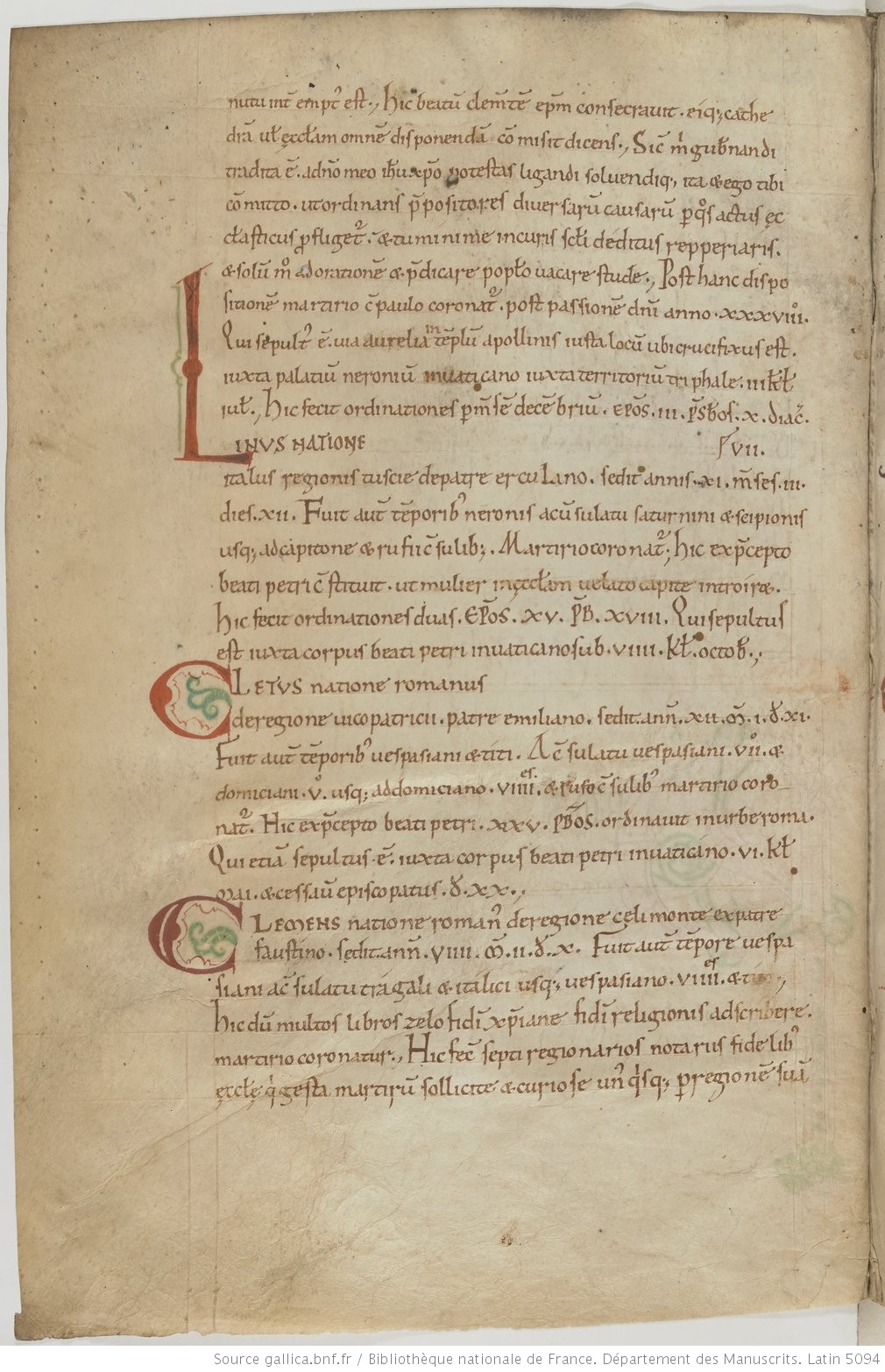
« Linus »
dans un manuscrit du Liber Pontificalis datant de 1086-1100 t originaire du
Nord de la France. Bibliothèque nationale de France, département des
Manuscrits.
Article
Linus, by nationality
an Italian,
from the province of Tuscany, son of Herculanus, occupied the see 11 years, 3
months and 12 days. He was bishop in
the time of Nero from the consulship of Saturninus and Scipio (a.d. 56)
until the year when Capito and Rufus were consuls (a.d. 67).
He was crowned with martyrdom.
He, by direction of the
blessed Peter, decreed that a woman must veil her head to come into the church.
He held two ordinations,
15 bishops,
18 priests.
He also was buried near
the body of the blessed Peter in
the Vatican about September
24.
MLA
Citation
Louise Ropes Loomis,
PhD., translator. “Linus”. Liber
Pontificalis, 1916. CatholicSaints.Info.
23 November 2015. Web. [php] echo date(‘j F Y’);[/php].
<https://catholicsaints.info/liber-pontificalis-linus/>
SOURCE : https://catholicsaints.info/liber-pontificalis-linus/
New
Catholic Dictionary – Pope Saint Linus
Article
Reigned from 64 or 67 to
76 or 79. Died in
Rome. It is generally considered that he was the successor of Saint Peter and
ruled for 12 years. According to Irenaeus he is the Linus mentioned by Saint
Paul (2 Timothy 4). His name is mentioned in the prayer “Communicantes” in the
Canon of the Mass. Feast,
Roman Calendar, 23
September.
MLA
Citation
“Pope Saint Linus”. New Catholic Dictionary. CatholicSaints.Info.
12 August 2018. Web. [php] echo date(‘j F Y’);[/php].
<https://catholicsaints.info/new-catholic-dictionary-pope-saint-linus/>
SOURCE : https://catholicsaints.info/new-catholic-dictionary-pope-saint-linus/
_5992.JPG)
Église Saint-Clair (Réguiny) : "Saint-Clair à Rome reçoit des mains de Saint-Lin pape un clou de la croix de Saint-Pierre", signature de Ch.Lorin, Chartres 1905 (gauche) "Saint-Clair fait détruire le temple des païens et créé à la place une chapelle" (droite)
_5993.JPG)
Église
Saint-Clair (Réguiny) :"Saint-Clair à Rome reçoit des mains de
Saint-Lin pape un clou de la croix de Saint-Pierre", signature de
Ch.Lorin, Chartres 1905, don de mesdemoiselles Pégorier
Saints of the Canon
– Saint Linus
Saint Linus, the
immediate successor of Saint Peter, was Pope for twelve years. He was an
Italian convert of Saint Peter, born in Volterra, an ancient city of Tuscany,
and was consecrated an auxiliary bishop to Saint Peter. Under the Emperor
Claudius all Jews were banished from Rome in 49 A.D. Saint Linus, who was an
Italian and therefore not included in the banishment, ruled the See of Rome
until Saint Peter returned. Saint Paul mentions him in 2 Timothy 4:21.
After Saint Peter’s
martyrdom in 67, Saint Linus was beheaded by Saturninus the Consul about the
year 78. He was buried on the Vatican hill close to the grave of Saint Peter.
– from The Saints of the Canon, by Monsignor John T.
McMahon, M.A., Ph.D; Australian Catholic Truth Society, 1958
SOURCE : https://catholicsaints.info/saints-of-the-canon-saint-linus/
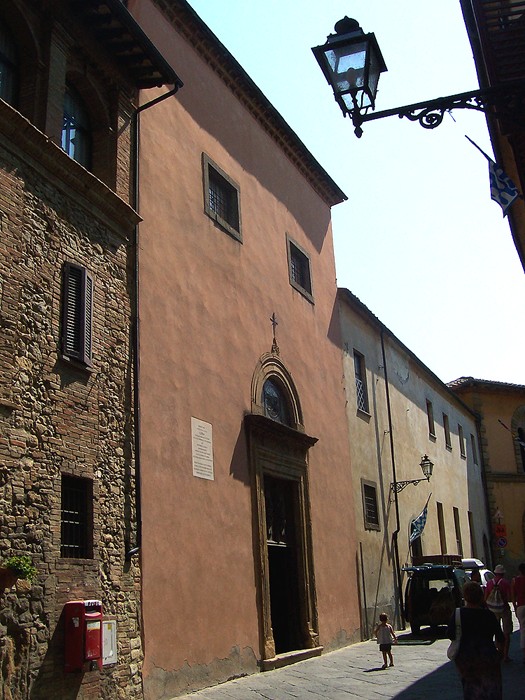
Chiesa
di San Lino
San Lino Roman Catholic church and former monastery, Volterra, Province of Pisa, Tuscany

Chiesa di San Lino

Chiesa di San Lino

Pope St. Linus
(Reigned about A.D. 64 or 67 to 76
or 79).
All the ancient records
of the Roman bishops which
have been handed down to us by St. Irenaeus, Julius Africanus, St. Hippolytus, Eusebius, also the
Liberian catalogue of 354, place the name of Linus directly after that of the
Prince of the Apostles, St. Peter. These records
are traced back to a list of the Roman bishops which
existed in the time of Pope Eleutherus (about
174-189), when Irenaeus wrote
his book "Adversus haereses". As opposed to this testimony, we cannot
accept as more reliable Tertullian's assertion,
which unquestionably places St. Clement (De
praescriptione, xxxii) after the Apostle Peter, as was
also done later by other Latin scholars (Jerome, Illustrious Men 15).
The Roman list in Irenaeus has
undoubtedly greater claims to historical authority. This author claims that
Pope Linus is the Linus mentioned by St. Paul in
his 2 Timothy 4:21.
The passage by Irenaeus (Against Heresies III.3.3)
reads:
After the Holy Apostles (Peter and Paul) had founded and
set the Church in
order (in Rome)
they gave over the exercise of the episcopal office to Linus. The same Linus is
mentioned by St.
Paul in his Epistle to Timothy. His successor was Anacletus.
We cannot be positive
whether this identification of the pope as being the
Linus mentioned in 2 Timothy 4:21 goes
back to an ancient and reliable source, or originated later on account of the
similarity of the name.
Linus's term of office,
according to the papal lists
handed down to us, lasted only twelve years. The Liberian Catalogue shows that
it lasted twelve years, four months, and twelve days. The dates given in this
catalogue, A.D. 56 until A.D. 67, are incorrect. Perhaps it was on account of
these dates that the writers of the fourth century gave their opinion that
Linus had held the position of head of the Roman community during the life of
the Apostle; e.g., Rufinus in
the preface to his translation of the pseudo-Clementine
"Recognitiones". But this hypothesis has no historical foundation. It
cannot be doubted that
according to the accounts of Irenaeus concerning
the Roman Church in
the second century, Linus was chosen to be head of the community of Christians in Rome, after the death of
the Apostle. For this reason his pontificate dates from the year of the death
of the Apostles Peter and Paul, which, however, is
not known for certain.
The "Liber
Pontificalis" asserts that Linus's home was in Tuscany, and that
his father's name
was Herculanus; but we cannot discover the origin of this assertion. According
to the same work on the popes, Linus is supposed
to have issued a decree "in
conformity with the ordinance of St. Peter", that women should have
their heads covered in church. Without doubt this decree is apocryphal, and copied
by the author of the "Liber
Pontificalis" from the first Epistle of St.
Paul to the Corinthians (11:5) and arbitrarily attributed to the first
successor of the Apostle in Rome. The statement made
in the same source, that Linus suffered martyrdom, cannot
be proved and
is improbable. For between Nero and Domitian there is
no mention of any persecution of
the Roman Church;
and Irenaeus (1.
c., III, iv, 3) from among the early Roman bishops designates
only Telesphorus as
a glorious martyr.
Finally this book asserts
that Linus after his death, was buried in the Vatican beside St. Peter. We do
not know whether
the author had any decisive reason for this assertion. As St. Peter was
certainly buried at the foot of the Vatican Hill, it is quite possible that the
earliest bishops of
the Roman Church also
were interred there.
There was nothing in the liturgical tradition
of the fourth-century Roman
Church to prove this, because it was only at the end of the second
century that any special feast of martyrs was
instituted and consequently Linus does not appear in the fourth-century lists
of the feasts of the Roman saints. According to
Torrigio ("Le sacre grotte Vaticane", Viterbo, 1618, 53) when
the present confession was
constructed in St. Peter's (1615), sarcophagi were found, and among them was
one which bore the word Linus. The explanation given by Severano of this
discovery ("Memorie delle sette chiese di Roma", Rome, 1630, 120) is
that probably these sarcophagi contained the remains of the first Roman bishops, and that the
one bearing that inscription was Linus's burial place. This assertion was
repeated later on by different writers. But from a manuscript of
Torrigio's we see that on the sarcophagus in question there were other letters
beside the word Linus, so that they rather belonged to some other name (such as
Aquilinus, Anullinus). The place of the discovery of the tomb is a proof that it could
not be the tomb of
Linus (De Rossi,
"Inscriptiones christianae urbis Romae", II, 23-7).
The feast of St. Linus is
now celebrated on 23 September. This is also the date given in the "Liber Pontificalis".
An epistle on the martyrdom of
the Apostles St.
Peter and Paul was
at a later period attributed to St. Linus, and supposedly was sent by him to
the Eastern Churches.
It is apocryphal and
of later date than the history of the martyrdom of the
two Apostles, by some attributed to Marcellus, which is also apocryphal ("Acta
Apostolorum apocrypha", ed. Lipsius and Bonnet, I, ed; Leipzig, 1891, XIV
sqq., 1 sqq.).
Sources
LIGHTFOOT, The
Apostolic Fathers; St. Clement of Rome, I (London, 1890), 201 sqq.;
HARNACK, Geschichte der Altchristlichen Literatur, II: Die
Chronologie I (Leipzig, 1897), 70; Acta SS. September, VI, 539
sqq., Liber Pontificalis, ed. DUCHESNE, I, 121: cf. Introduction,
lxix; DE SMEDT, Dissertationes selectae in primam aetatem hist. eccl., I,
300 sqq.
Kirsch, Johann
Peter. "Pope St. Linus." The Catholic Encyclopedia. Vol.
9. New York: Robert Appleton
Company, 1910. <http://www.newadvent.org/cathen/09272b.htm>.
Transcription. This
article was transcribed for New Advent by Gerard Haffner.
Ecclesiastical
approbation. Nihil Obstat. October 1, 1910. Remy Lafort,
Censor. Imprimatur. +John M. Farley, Archbishop of New York.
Copyright © 2023 by Kevin Knight.
Dedicated to the Immaculate Heart of Mary.
SOURCE : https://www.newadvent.org/cathen/09272b.htm
LINUS, ST. POPE
Pontificate: 68 to 79;
first successor to Peter (see clement i). All early lists of Roman bishops and
the Canon of the Roman Mass agree that Linus was the immediate successor of
Peter as head of the Roman Church. Possibly he was Peter's "coadjutor."
St. Irenaeus (Adv. Haer. 3.3) identifies him with a disciple of St.
Paul (2 Tm 4.21), which is likely. The epistle's unknown author tried
to give his work a Pauline pedigree by addressing it to a known Pauline
disciple, by setting it in Rome (1:16-7), and by mentioning Prisca and Aquila
(4:19). He probably mentioned Linus because he was known to be a Roman
associate of Paul. The dates of his episcopacy vary according to Eusebius (67–79),
Jerome (Chron. a. Abr., an.70), the Liberian catalogue, and the Liber
pontificalis (56–67), the only source to call him a martyr. The Annuario
Pontificio of 2001 gives the date of 68 for the beginning of his
pontificate. This late date suggests some disorganization in the Roman
community following the Neronian persecution of 64 and the deaths of Peter and
Paul. Linus's feast follows the tradition of the Liber, which claims that
he was a Tuscan and reports that he decreed, at the direction of Peter, and
possibly under the inspiration of 1 Cor. 11.1–16, that women must veil their
heads in church. Modern excavations under the Vatican do not bear out the
account in the Liber of his burial next to Peter.
Feast: Sept. 23.
Bibliography: Eusebius, Historia
Ecclesiastica 3:2, 4, 13, 21; 5:6. Liber pontificalis, ed. L. Duchesne (Paris 1886–92, 1958) 1:cii, 2, 52, 121. Acta Sanctorum Sept.
6:539–545. H. Leclercq, Dictionnaire d'archéologie chrétienne et de
liturgie. ed. F. Cabrol, H. Leclercq and H. I. Marrou (Paris 1907–53) 9.1:1195–98. É. Amann, Dictionnaire de théologie catholique. ed. A. Vacant et al., (Paris
1903–50) 9.1:772. A. P. Frutaz, Lexikon für Theologie und Kirche, ed. J. Hofer and K. Rahner (Freiberg 1957–65) 6:1068. J. N. D. Kelly, The Oxford
Dictionary of Popes (New
York 1986). E. Ferguson, ed., Encyclopedia of Early Christianity, 2d.
ed. (New
York 1997) 2:682. J. Hoffman, "Linus: erster Bischof von Rom und
Heiliger der orthodoxen Kirche" Ostkirchliche Studien (Würzburg
1997) 105–41.
[E. G. Weltin]
New Catholic Encyclopedia
SOURCE : https://www.encyclopedia.com/religion/encyclopedias-almanacs-transcripts-and-maps/linus-st-pope
.jpg)
Patrobulus, Hermas, Linus, Caius, Philologus of 70 disciples (Menologion of Basil II).jpg
Patrobulus, Hermas, Linus, Caius,
Philologus of 70 disciples, Menologion of Basil II in the Vatican
Library
Миниатюра
из Минология Василия II.
http://digi.vatlib.it/view/MSS_Vat.gr.1613/0182?sid=a7590df9b8aca22111c8359533716419&zoomlevel=4
.jpg)
10th-century Byzantine portrait of Linus from Patrobulus, Hermas, Linus, Caius, Philologus of 70 disciples (Portrait of Linus), Menologion of Basil II in the Vatican Library
Миниатюра из Минология Василия II.
.jpg)
10th-century Byzantine
portrait of Linus from Patrobulus, Hermas, Linus, Caius,
Philologus of 70 disciples (Portrait of Linus), Menologion of Basil II in the Vatican
Library
Миниатюра
из Минология Василия II.
http://digi.vatlib.it/view/MSS_Vat.gr.1613/0182?sid=a7590df9b8aca22111c8359533716419&zoomlevel=4
September 23
St. Linus, Pope and Martyr
See Euseb. l. 3, c. 2, St. Epiphan. Hær. 27, c. 6.
ST. LINUS was the immediate successor of St. Peter in the see of Rome, as St. Irenæus, Eusebius, St. Epiphanius, St. Optatus, St. Austin, and others assure us. Tertullian says 1 that St. Clement was appointed by St. Peter to be his successor; but either he declined that dignity till St. Linus and St. Cletus had preceded him in it, or he was at first only vicar of St. Peter, to govern under him the Gentile converts, whilst that apostle presided over the whole church, yet so as to be chiefly taken up in instructing the Jewish converts, and in preaching abroad. 2 St. Linus, succeeding St. Peter after his martyrdom, sat twelve years, 3 and is named among the martyrs in the canon of the Roman mass, which is certainly older in this part than the sacramentary of Gelasius, and of the greatest authority in this point. It is not indeed impossible that he might be called a martyr on account of his sufferings for the faith, without dying by the sword. St. Linus was buried on the Vatican hill, near the tomb of St. Peter.
This saint distinguished himself among the illustrious disciples of the apostles, who were formed upon their model to perfect virtue, and filled with the holy spirit of the gospel. How little are we acquainted with this spirit of fervour, charity, meekness, patience, and sincere humility; without which it is in vain that we bear the honourable name of Christians, and are a reproach and scandal to so sacred a profession!
Note 1. Præscr. c. 32. [back]
Note 2. See Hammond,
Pearson, Cave, &c. [back]
Note 3. See Berti,
Chron. t. 2, and Chronologia primorum Pontificum ex picturis veteribus in
basilicâ S. Pauli, sedente S. Leone vel Symmacho, inter Opr. Anastasii
Biblioth. per utrumque Banchinum edita, Romæ, 1717. [back]
Rev. Alban
Butler (1711–73). Volume IX: September. The Lives of the
Saints. 1866.
SOURCE : http://www.bartleby.com/210/9/231.html
Peter Was the First Pope,
but Who Was the Second Pope?
By George Ryan
June 14, 2017
Every Catholic faithful
to the one true Church knows that Saint Peter was the first pope. As we see in
Matthew 16:18, Jesus Christ founded His Church upon Peter, making him the
first Vicar
of Jesus Christ and establishing the papacy. With his ordination as
the first pope, the papal line of succession was also established. While we
know that Peter was the first, who was the second pope?
And so I say to you, you
are Peter, and upon this rock I will build my church, and the gates of the
netherworld shall not prevail against it. – Matthew 16:18
The earliest account
shows that Pope Saint Linus was the second pope and successor to the Prince of
the Apostles. In a passage from the book Adversus Haereses written by
Saint Irenaeus around the year 180, it is claimed that Pope Linus is the direct
successor to Peter, the same Linus mentioned by Saint Paul in his second
epistle to Timothy 4:21. The passage reads:
After the Holy Apostles
(Peter and Paul) had founded and set the Church in order (in Rome) they gave
over the exercise of the episcopal office to Linus. The same Linus is mentioned
by St. Paul in his Epistle to Timothy. His successor was Anacletus.
According to the Liber
Pontificalis, Linus was Italian, born in Tuscany. His father’s name was
recorded as Herculanus, and his mother’s name recorded as Claudia (The same
Claudia that is mentioned immediately after Linus in 2 Timothy 4:21). His
papacy began the year 67 and ended the year 76.
Try to get here before
winter. Eubulus, Pudens, Linus, Claudia, and all the brothers send greetings. –
2 Timothy 4:21
The papacy of Pope Linus
existed during a period of great religious persecution in Rome, where it was
very dangerous to be Catholic. After a fire broke out in Rome that left several
districts of the city destroyed, the Emperor Nero blamed members of the newly
formed Church to deflect theories that he set the city ablaze for new
construction. He punished the early faithful by feeding them to lions, burning
them at the stake, and through crucifixion.
The Liber
Pontificalis also asserts that after his death, he was buried next to
Saint Peter in the Vatican. A tomb was found at the St. Peters Basilica in 1605
bearing the letters LINVS, but was later found to be part of a longer
name, perhaps Aquilinus. Today, the feast of Pope Saint Linus is celebrated on
September 23rd.
SOURCE : https://ucatholic.com/blog/saint-peter-was-the-first-pope-but-who-was-the-second-pope/

Chevalier
Artaud de Montor (1772–1849), The Lives and Times of the Popes, New York: The
Catholic Publication Society of America, 1911. It was originally published in
1842
The
Lives and Times of the Popes – Saint Linus, A.D. 67
Article
Saint Linus was the son
of Herculanus, of the family of the Mauri, of Volterra, an ancient town of
Tuscany. Some authors suppose the family to be the same that is called Morosina
at Venice, and Morigia at Milan. At the age of twenty-two he was sent to Rome
to study. There he saw Saint Peter, who sent him to Besangon in France to
preach the gospel, and it has even been affirmed that this saint had the title
of bishop. On his return to Rome, Linus was declared by Saint Peter his
coadjutor. The regular canons named after Saint Augustine, who venerate Saint
Peter as their founder, include Linus among their number. He was elected as
pontiff on the 30th of June, in the year 67. Novaes gives precisely that date,
as to the month, but thinks the year was not 67 but 69. Linus was the immediate
successor of Saint Peter, according to Saint Irenaeus, Eusebius, and Saint
Augustine. But Tertullian says that the Prince of the Apostles named Saint
Clement as his successor. These passages are reconcilable on the supposition that
Saint Clement refused to accept that dignity until after the decease of Saint
Linus. And it is added that the reason why some authors have placed Saint
Clement immediately after Saint Peter is that during the life of that apostle,
and during one of his apostolical journeys, Clement officiated as Peter’s
vicar, and administered, ad interim, the affairs of the Holy See.
It is the generally
received opinion that Saint Linus ascended the chair of Saint Peter when the
first vicar of Jesus Christ was martyred. Saint Linus, following a
recommendation of Saint Paul, ordered that women should never enter the church
with uncovered heads. Pope Clement XIV renewed that prohibition in the
eighteenth century. Saint Linus excommunicated the Menandrians, who followed Menander,
a Samaritan and a disciple of Simon Magus. He maintained that the world was a
creation of the angels, and not of God, and defended the errors of the
Nicolaites (so called after Nicolas, deacon of Antioch), who pretended that all
things were in common among the Christians. In their assemblies they practised,
as did most of the early heretics, the most infamous turpitudes. Menander was
perhaps the first to introduce into the Church the germs of the Eastern
philosophy. This developed itself under various forms, through imposture and
ignorance, and propagated an inextricable forest of heresies which it was not
easy to uproot. It was under this pontificate that the destruction of Jerusalem
took place. Linus might have witnessed the arrival at Rome of the first of
those Jews who were subsequently condemned to labor in building the Arch of
Titus, where the Roman pride was flattered by the exhibition of the
seven-branched candlestick as one of the trophies of the victory. Works have
been published, attributed to Saint Linus as their author. They are now
pronounced apocryphal, because they are infected by errors resembling those of
the Manichaeans. Linus is named among the martyrs in the canon of the Roman
Church, which is of a higher antiquity than the Sacramentary of Gelasius, and
of greater authority on that point. Saint Linus died in 78; his feast is kept
on the 23d of September in the Roman Martyrology. The Biographie Universelle is
in error in affirming that Saint Linus received the crown of martyrdom under
Nero. It was under Vespasian that this saint perished, a victim to the
malignity of Saturninus, a man of consular rank. Linus had assisted, during her
long illness, the daughter of that very man who also had solicited the prayers
of the pontiff. Pope Saint Linus reigned about eleven years.
MLA
Citation
Alexis-François Artaud de
Montor. “Saint Linus, A.D. 67”. The
Lives and Times of the Popes, 1911. CatholicSaints.Info.
25 July 2022. Web. [php] echo date(‘j F Y’);[/php]. <https://catholicsaints.info/the-lives-and-times-of-the-popes-saint-linus-a-d-67/>
SOURCE : https://catholicsaints.info/the-lives-and-times-of-the-popes-saint-linus-a-d-67/
Encyclopedia
Britannica – Pope Saint Linus
Article
Linus, one of the saints
of the Gregorian canon, whose festival is celebrated on the 23rd of September.
All that can be said with certainty about him is that his name appears at the
head of all the lists of the bishops of Rome. Irenaeus identifies him with the
Linus mentioned by Saint Paul in 2 Timothy 4:21. According to the Liber
Pontificalis, Linus suffered martyrdom, and was buried in the Vatican. In the
17th century an inscription was found near the confession of Saint Peter, which
was believed to contain the name Linus; but it is not certain that this epitaph
has been read correctly or completely. The apocryphal Latin account of the
death of the apostles Peter and Paul is falsely attributed to Linus.
MLA
Citation
“Pope Saint Linus”. Encyclopedia Britannica, 1911. CatholicSaints.Info.
11 August 2018. Web. [php] echo date(‘j F Y’);[/php]. <https://catholicsaints.info/encyclopedia-britannica-pope-saint-linus/>
See Acta Sanctorum, Septembris, vi. 539-545; C. de Smedt, Dissertationes selectae in primam aetatem hist. eccl. pp. 300-312 (Ghent, 1876); L. Duchesne’s edition of the Liber Pontificalis, i. 121 (Paris, 1886); R. A. Lipsius, Die apokryphen Apostelgeschichten, ii. 85-96 (Brunswick, 1883–1890); J. B. de Rossi, Bullettino di archeologia cristiana, p. 50 (1864). (H. De.)
1911 Encyclopædia Britannica, Volume 16
Linus (saint) by Hippolyte Delehaye
SOURCE : https://catholicsaints.info/encyclopedia-britannica-pope-saint-linus/ et

Benedetto Buglioni, Busto di san Lino papa (1521), terracotta invetriata; Volterra (Pisa), Museo Diocesano d'Arte Sacra
San Lino Papa e
martire
Festa: 23 settembre
Volterra - Roma, secolo I
Etimologia: Lino =
accorc. di Angiolino, Michelino, ecc. ; anche nome a sé
Emblema: Palma
Martirologio
Romano: A Roma, commemorazione di san Lino, papa, al quale, come scrive
sant’Ireneo, i beati Apostoli affidarono la cura episcopale della Chiesa
fondata a Roma e che san Paolo Apostolo ricorda come suo compagno.
Dopo san Pietro c’è subito lui: Lino, secondo capo della Chiesa, primo papa italiano. Toscano d’origine, nato a Volterra: così dicono vari studiosi e il grande Cesare Baronio, lo storico cinquecentesco della Chiesa. A essi si unirà, il 24 settembre 1964 in San Pietro, Paolo VI, dicendo all’udienza generale: "Abbiamo con noi un gruppo di Volterra... La diocesi sorella... Sì, questo titolo le spetta, perché con san Lino ha dato alla Chiesa l’immediato successore di Pietro, il secondo papa".
Sappiamo poco di Lino. Ignoti gli anni di nascita e di morte, la gioventù e gli studi. Uno dei Padri della Chiesa, Ireneo di Lione (II secolo), dice che Pietro e Paolo affidarono a Lino responsabilità importanti, e che Paolo ha citato proprio lui nella seconda lettera a Timoteo: "Ti salutano Eubulo, Pudente, Lino, Claudia e tutti i fratelli...".
Sappiamo però che Lino vive tempi terribili con i cristiani di Roma. Nell’estate del ’64 un incendio distrugge i tre quarti dell’Urbe, e se ne incolpa l’imperatore Nerone. Forse è una calunnia dei suoi molti nemici: ma lui reagisce col diversivo della persecuzione generale contro i cristiani. E a essi giunge l’incoraggiamento di san Pietro nella sua prima lettera: "Non vi sembri strana la prova del fuoco sorta contro di voi... anzi, rallegratevi per la parte che voi venite a prendere alle sofferenze di Cristo".
Anche san Pietro muore in questa persecuzione (forse nel ’67) e gli succede Lino in tempo di delitto e di tragedia. Nerone muore nel ’68 (si fa trafiggere da un servo) e nello stesso anno c’è una strage di successori: Galba, sgozzato nel Foro; Ottone suicida; Vitellio linciato dai romani. Solo con Vespasiano, nel ’69, arrivano ordine e pace in Roma. Ma è scoppiata in Palestina la rivolta contro il dominio romano: la “guerra giudaica”, che finisce nel settembre ’70 con Gerusalemme occupata dalle truppe di Tito (figlio di Vespasiano) e col tempio profanato e distrutto: vicende laceranti per gli ebrei e anche per i cristiani e, per certuni, segnali di calamità universali imminenti, di una ben vicina fine del mondo.
Lino è chiamato in questi suoi anni di pontificato (nove, si ritiene) a rianimare i fedeli, a orientarli nella confusione dottrinaria provocata dall’opera di gruppi settari. E’ lui quello che deve tenere unita la Chiesa sotto l’uragano: e comincia a delinearne la forma organizzata, la “struttura”: sappiamo per esempio che ha nominato vescovi e preti, e ha dato regole alla pratica comune della fede. (Si attribuisce a lui l’obbligo per le donne di partecipare alla celebrazione eucaristica col capo coperto). Sarà anche venerato come martire, a causa delle sofferenze durante la persecuzione neroniana; ma non è certo che sia stato ucciso, perché nel tempo della sua morte la Chiesa viveva in pace sotto il governo di Vespasiano.
Autore: Domenico Agasso
SOURCE : https://www.santiebeati.it/dettaglio/71550

Church San Lino, Vigne, hamlet of Narni, Province of Terni, Umbria, Italy

Church
San Lino, Vigne, hamlet of Narni, Province of Terni, Umbria, Italy

Church San Lino, Vigne, hamlet of Narni, Province of Terni, Umbria, Italy
LINO, santo
di Francesco Scorza
Barcellona
Enciclopedia dei Papi
(2000)
Primo successore di
Pietro già nelle più antiche liste episcopali di Roma. Ireneo di Lione afferma
che L. ricevette la dignità episcopale da Pietro e da Paolo, e lo identifica
con l'omonimo personaggio citato in 2 Timoteo 4, 21, dove si trasmettono i suoi
saluti insieme a quelli di Eubulo, Pudente, Claudia e degli altri fratelli.
Eusebio di Cesarea ribadisce tale identificazione (Historia ecclesiastica III,
2; 4, 8) e afferma ripetutamente che L. fu il primo successore di Pietro (ibid.
III, 2; 4, 8; 21), specificando che L. morì nel 79, dopo aver esercitato il
ministero episcopale a Roma per dodici anni, a partire dal 68 (ibid. III, 13),
mentre nel Chronicon attribuisce al suo ministero episcopale la durata di
undici anni. Il Catalogo Liberiano attesta per il suo episcopato la durata di
dodici anni, quattro mesi e dodici giorni dal 56 al 67. Il Liber pontificalis
(nr. 2) parla di undici anni, tre mesi e dodici giorni, e aggiunge che L.
sarebbe stato di nazionalità italica, proveniente dalla Tuscia, figlio di Ercolano,
e che sarebbe morto martire; per ordine di Pietro avrebbe stabilito che le
donne entrassero in chiesa a capo velato (cfr. 1 Corinzi 11, 1-15). Avrebbe
proceduto a due ordinazioni per un totale di quindici vescovi e diciotto
presbiteri e sarebbe stato sepolto presso s. Pietro, nel cimitero vaticano,
alla data del 23 settembre.
I particolari riferiti
dal Liber pontificalis sono difficilmente verificabili. La datazione che esso
propone, anticipando l'inizio dell'episcopato di L. al 56, quando Pietro era ancora
in vita, sembra doversi porre in relazione alla tradizione secondo cui il primo
successore di Pietro sarebbe stato Clemente. L'espressione utilizzata nel Liber
pontificalis a proposito dell'obbligo imposto alle donne di entrare in chiesa a
capo velato - "ex praecepto beati Petri constituit" - rifletterebbe
il tentativo di conciliare la tradizione che voleva Clemente diretto successore
di Pietro, con quella che faceva di L. e Cleto i predecessori di Clemente: L. e
Cleto sarebbero stati una sorta di coadiutori di Pietro, che avrebbe riservato
per sé l'incarico apostolico demandando a L. e Cleto quello episcopale, secondo
l'argomentazione che si legge nel prologo di Rufino di Aquileia alla sua
traduzione delle Recognitiones pseudoclementine. Questa ipotesi, variamente
ripresa dagli storiografi successivi, sarà contrapposta dai Centuriatori di
Magdeburgo - con intenti polemici sulla disciplina cattolica dell'episcopato -
alla testimonianza di Eusebio di Cesarea. Ma l'ipotesi di Rufino è puramente
congetturale. È indipendente da Ireneo, ma priva di fondamento storico
nonostante sia stata recentemente ripresa da E. Elorduy, l'affermazione posta
in bocca a Pietro in Constitutiones apostolorum VII, 46, secondo cui L.,
ordinato da Paolo, sarebbe stato figlio di Claudia, come quella secondo cui L.
sarebbe morto prima di Pietro, il quale avrebbe ordinato al suo posto Clemente.
Claudia è il personaggio ricordato insieme a Eubulo, Pudente e L. in 2 Timoteo
4, 21. La tradizione che ne faceva la madre di L., pur isolata, si ampliò
facendo del Pudente menzionato nello stesso passo lo sposo di Claudia e
identificandolo con Aulo Pudente, amico di Marziale, che effettivamente avrebbe
preso in moglie una Claudia, forse di origine britannica (Marziale, Epigrammata
IV, 13; XI, 53) e che si pretendeva imparentata con il re Caractacus: una
tradizione ecclesiastica inglese, ancora discussa nel sec. XIX, pretendeva di
identificare L. con un Llin figlio di Caractacus noto alle tradizioni
agiografiche dell'isola. Quanto alla sepoltura di L., nel corso di scavi
condotti nel sec. XVII nella basilica vaticana presso la confessione di s.
Pietro si trovò su un sarcofago l'epigrafe LINUS. Si pensò allora che si
trattasse della sepoltura del primo successore di Pietro, come del resto sembra
che avessero inteso o creduto i pellegrini altomedievali che già nel sec. IX
ottennero reliquie da portare in patria: ma non è chiaro se l'iscrizione fosse
completa o se la forma LINUS sia da interpretarsi come la seconda parte di un
nome.
Come molti papi anteriori
a Silvestro I, L. è considerato martire nel Liber pontificalis, nel quale la
sua depositio è registrata al 23 settembre. Non si hanno però testimonianze di
un culto di L. nei primi secoli: il suo nome figura nel Martyrologium
Hieronymianum alla data del 23 dicembre in una lista di vescovi di Roma. Il
nome di L. insieme a quello di Cleto nel Communicantes del canone romano della
messa, rispetto a quello del canone ambrosiano in cui mancano, si spiega forse
come il tentativo di attestare la successione apostolica a Roma da Pietro fino
a Clemente. Poiché il Communicantes contiene un elenco di santi apostoli e
martiri, è evidente che esso annovera L. tra questi ultimi, come del resto
afferma il Liber pontificalis. Tuttavia tale titolo non poggia su alcuna
tradizione agiografica. La commemorazione di L., fissata a partire dal
Martyrologium di Floro al 26 novembre, nei sinassari greci è attestata il 4 o 5
novembre, insieme a Patroba, Erma, Gaio e Filologo, tutti considerati del
gruppo dei "settanta discepoli e apostoli" di Gesù. Il Martyrologium
Romanum pone la sua commemorazione al 23 settembre, riprendendo la data della
sepoltura attestata dal Liber pontificalis, ma proprio per l'incertezza di
questa notizia, come di quella che fa di L. un martire, il nome di L. è stato
espunto dal Calendarium Romanum promulgato nel 1969.
Nel sec. X a L. fu
dedicata in Milano una cappella nella ecclesia apostolorum dal vescovo
Arderico, probabilmente in relazione con tradizioni agiografiche variamente
attestate secondo cui L. avrebbe battezzato santi locali quali Nazario o
Protasio.
La notizia dell'origine
toscana di L. ha portato allo sviluppo di una tradizione locale, forse di
origine medievale ma sicuramente attestata per la prima volta da Raffaele
Maffei, secondo cui L. sarebbe nato a Volterra dalla famiglia dei Mauri. Per
opera dello stesso Maffei, nel 1513 fu edificata nella città toscana la chiesa
dedicata a s. Lino con l'annesso convento di suore francescane, e nel 1519 fu
approvato l'ufficio proprio di s. Lino nelle cui letture fu inglobata la
tradizione dell'origine volterrana del santo.
A L. sono attribuiti
indebitamente dalla tradizione manoscritta un Martyrium beati Petri e un
Martyrium beati Pauli, entrambi in latino. Il primo, sebbene l'editore R.A.
Lipsius lo ritenesse la forma più antica di quella parte degli Acta Petri nota
come Martyrium Petri, in greco, ne è di fatto un rifacimento, e risalirebbe al
IV-V secolo se non, come è stato proposto più di recente da G.N. Verrando con
validi argomenti, al V-VI secolo. Il Martyrium Pauli è una parafrasi degli Acta
Pauli, che oggi non si pensa necessariamente da ascriversi allo stesso autore
del predetto Martyrium Petri, e si suole datare al IV-V secolo.
fonti e bibliografia
Ireneo di Lione, Adversus
haereses III, 3, 3, a cura di A. Rousseau-L. Doutreleau, Paris 1974
(Sources Chrétiennes, 211), pp. 36-8.
Eusebio di Cesarea, Historia
ecclesiastica III, 2; 4, 8; 13; 21; V, 6, 1, a cura di E. Schwartz,
Leipzig 1903 (Die Griechischen Christlichen Schriftsteller. Eusebius Werke,
II,1), pp. 188, 194, 228, 236, 438.
Id., Chronicon, ad
aa. 68, 80, a cura di R. Helm, Berlin 1956 ( Die Griechischen Christlichen
Schriftsteller. Eusebius Werke, VII), pp. 187, 189.
Le Liber pontificalis, a
cura di L. Duchesne, I, Paris 1886, pp. LXXXIX-XCI, CII, 121.
Catalogo Liberiano,
ibid., pp. 2-3.
Constitutiones
apostolorum VII, 46, a cura di M. Metzger, ivi 1986 (Sources Chrétiennes,
329), pp. 108-09.
Rufino di Aquileia, Recognitiones, prologus
13-15, a cura di B. Rehm, Berlin 1965 (Die Griechischen Christlichen
Schriftsteller, 51), pp. 4-5.
Martyrologium
Hieronymianum, in H. Delehaye, Commentarius perpetuus in
Martyrologium Hieronymianum [...], in Acta Sanctorum Novembris [...],
II, pars posterior, Bruxellis 1931, pp. 662-63 (23 dicembre).
Martyrologium di Floro,
in Édition pratique des Martyrologes de Bède, de l'Anonyme Lyonnais et de
Florus, a cura di J.Dubois-G.Renaud, Paris 1976, p. 214 (26 novembre).
Synaxarium Ecclesiae
Constantinopolitanae [...], a cura di H. Delehaye, in Propylaeum ad
Acta Sanctorum Novembris, a cura di C. de Smedt et al., Bruxellis 1902, coll.
194 (4 novembre), 196 (5 novembre).
Martyrologium Romanum
[...] scholiis historicis instructum, in Propylaeum ad Acta Sanctorum
Decembris, ivi 1940, col. 412 (23 settembre).
Calendarium Romanum ex
decreto sacrosancti oecumenici concilii Vaticani II instauratum auctoritate
Pauli PP. VI promulgatum, In Civitate Vaticana 1969, p. 140.
Opere attribuite a L.:
Martyrium beati Petri
apostoli a Lino episcopo conscriptum (Bibliotheca Hagiographica Latina
[...], II, Bruxellis 1900-01, nr. 6655.
Clavis Apocryphorum Novi
Testamenti, Turnhout 1992, nr. 191), in Acta apostolorum Apocrypha, I, a
cura di R.A. Lipsius-M. Bonnet, Lipsiae 1891, pp. 1-22.
V. anche l'edizione a
cura di A.M. Salonius, Helsingfors 1926.
Trad. it. in M.
Erbetta, Gli apocrifi del nuovo Testamento, II, Atti e leggende, Torino
1966, pp. 169-77.
Martyrium beati Pauli
apostoli a Lino conscriptum (Bibliotheca Hagiographica Latina [...], II,
nr. 6570.
Clavis Apocryphorum Novi
Testamenti, nr. 212), in Acta apostolorum Apocrypha, I, pp. 23-44 (trad.
it. in M. Erbetta, pp. 289-96).
Fonti agiografiche:
Bibliotheca Hagiographica
Latina [...], II, p. 733; ibid., Novum Supplementum, a cura di H.
Fros, Bruxellis 1986, p. 538.
Studi:
Commentariorum Urbanorum
Raphaelis Volaterrani octo et triginta libri, Romae 1506, c. CCCII.
Ecclesiastica Historia
[...] per aliquot studiosos et pios viros in urbe Magdeburgica, Centuria I,
Liber II, Caput X, Basileae 1562, coll. 626-27.
C. Baronio, Annales
ecclesiastici, I, Romae 1588, pp. 564, 637, 639, 674-75.
[L.-S.]Lenain de
Tillemont, Mémoires pour servir à l'histoire ecclésiastique des six
premiers siècles, t. II, Venise 1732, pp. 151-54, 545-55.
Acta Sanctorum [...],
Septembris, V, Antverpiae 1757, pp. 535-45.
R.A. Lipsius, Die
apocryphen Apostelgeschichten, II, 1, Braunschweig 1887, pp. 84 ss..
Inscriptiones Christianae
urbis Romae septimo saeculo antiquiores, a cura di G.B. de Rossi, II, Romae
1888, pp. 236-37, 460.
J.B. Lightfoot, The
Apostolic Fathers, pt. I, St. Clement of Rome, I, London 1890², pp. 76-9.
L. Vouaux, Les Actes
de Paul, Paris 1913, pp. 22-3.
Id., Les Actes de
Pierre, ivi 1922, pp. 134-40.
F. Lanzoni, Le
diocesi d'Italia dalle origini al principio del secolo VII (an. 604),
Faenza 1927, pp. 55, 1003, 1011;
Le Liber pontificalis,
III, a cura di C. Vogel, Paris 1957, p. 71.
V.L. Kennedy, The
Saints of the Canon of the Mass, Città del Vaticano 1963, pp. 119-21.
G.N. Verrando, Osservazioni
sulla collocazione cronologica degli apocrifi Atti di Pietro dello Pseudo-Lino,
"Vetera Christianorum", 20, 1983, pp. 391-426.
A Dictionary of Christian
Biography, III, London 1882, s.v., pp. 726-29.
Dictionnaire de théologie
catholique, IX, Paris 1926, s.v., col. 772.
Dictionnaire d'archéologie
chrétienne et de liturgie, IX, ivi 1930, s.v., coll. 1195-98.
Vies des Saints et des
Bienheureux, IX, ivi 1950, s.v., p. 472.
Iconographie de l'art
chrétien, III, 2, ivi 1958, s.v., p. 810.
E.C., VII, s.v., coll.
1389-90.
New Catholic Encyclopaedia,
VIII, Washington 1967, s.v., p. 782.
A. Amore-Cl. Mocchegiani
Carpano, Lino, in B.S., VIII, coll. 56-8.
Lexikon der christlichen
Ikonographie, VII, Rom 1974, s.v., col. 408.
Catholicisme, VII, Paris
1975, s.v., coll. 807-08.
Biographisch-bibliographisches
Kirchenlexikon, V, Herzberg 1993, s.v., coll. 98-100.
Lexikon für Theologie und
Kirche, VI, Freiburg 1997³, s.v., col. 946.
Il grande libro dei
Santi. Dizionario enciclopedico, II, Cinisello Balsamo 1998, s.v., pp. 1211-12.
© Istituto della Enciclopedia Italiana
fondata da Giovanni Treccani - Riproduzione riservata
SOURCE : https://www.treccani.it/enciclopedia/santo-lino_(Enciclopedia-dei-Papi)/

Cromolitografia in L. Tripepi, Ritratti e biografie dei romani pontefici: da S. Pietro a Leone 13, Roma, Vaglimigli Davide, 1879. Municipal Library of Trento
Papa San Lino
El Papa San Lino gobernó la Iglesia desde
alrededor de 64 o 67 hasta 76 o 79 d.C. Todos los antiguos registros de
los obispos
romanos, que nos han transmitido San Ireneo, Julio
Africano, San Hipólito, Eusebio, también el catálogo Liberiano del 354,
colocan el nombre de Lino directamente después del Príncipe de los
Apóstoles, San Pedro. Estos registros se remontan a una lista de
los obispos romanos
que existía en el tiempo del Papa San Eleuterio (cerca del 174-189),
cuando Ireneo escribió su libro “Adversus haereses”. Como opuesto a este
testimonio, no podemos aceptar como más confiable la afirmación de Tertuliano,
que incuestionablemente coloca a San Clemente (De praescriptione, XXXII)
después del apóstol Pedro, como también lo hicieron otros letrados
latinos (Jerónimo, Hombres Ilustres 15). La lista romana en Ireneo tiene
mayores derechos hacia la autoridad histórica. Este autor afirma que el Papa
Lino es el Lino mencionado por San Pablo en
su segunda carta a Timoteo 4,21. El pasaje de Ireneo
(Adv. Haer., III.3.3) lee como sigue: “Después que los santos apóstoles (Pedro
y Pablo) fundaron y pusieron la Iglesia en
orden (en Roma) le dieron el ejercicio del oficio episcopal a
Lino. El mismo Lino es mencionado por San Pablo en su Epístola a Timoteo. Su
sucesor fue Anacleto”. No podemos estar seguros de
si esta identificación del Papa, como el Lino mencionado en 2 Tim. 4,21 se origina en una
fuente antigua y confiable, o si se originó luego debido a la similitud del
nombre.
De acuerdo a las listas
de Papas que nos han llegado, el término del pontificado de
Lino duró sólo doce años. El Catálogo Liberiano muestra que duró doce años,
cuatro meses y doce días. Las fechas dadas en este catálogo, 56 d.C. hasta
el 67 d.C, son incorrectas. Quizás fue debido a estas fechas que los escritores
del siglo IV opinaron que Lino había ocupado la posición de cabeza de la
comunidad romana durante la vida del apóstol;
por ejemplo, Rufino, en el prefacio a su traducción del
seudo-clementino "Reconocimientos". Pero esta hipótesis no tiene
fundamento histórico. No se puede dudar que, según
los relatos de Ireneo respecto a la Iglesia
Romana en el siglo II, Lino fue escogido para ser jefe de la comunidad
de cristianos en [[[Roma]], luego de la muerte
del apóstol. Por esta razón su pontificado data
desde el año de la muerte de los Apóstoles Pedro y Pablo,
que, sin embargo, no se conoce con toda certeza.
El “Liber Pontificalis” afirma que el hogar de Lino
estaba en Toscana, y que el nombre de su padre era
Herculano; pero no podemos descubrir el origen de esta afirmación. De acuerdo a
la misma obra sobre los Papas, se supone que Lino emitió un decreto "en
conformidad con la ordenanza de San Pedro",
que las mujeres debían
tener sus cabezas cubiertas en la iglesia. Sin duda este decreto
es apócrifo,
el autor del “Liber Pontificalis” lo copió de la Primera Epístola del
apóstol San
Pablo a los Corintios (11,5), y fue atribuido
arbitrariamente al primer sucesor del apóstol en Roma. La declaración
que aparece en esa misma fuente, que Lino sufrió el martirio, no
puede ser probada y
es improbable. Pues entre Nerón y Domiciano no
hay mención de ninguna persecución a
la Iglesia Romana; e Ireneo (1.
C., III, IV, 3) de entre los primeros obispos romanos,
sólo designa a Telesforo como un mártir glorioso.
Finalmente ese libro
afirma que el cadáver de Lino fue enterrado en el
Vaticano, al lado de San Pedro. No sabemos si el autor tuvo alguna razón
decisiva para esta afirmación. Dado que San Pedro ciertamente fue enterrado al
pie de la Colina del Vaticano, es muy posible que los primeros obispos de la
Iglesia Romana fueran enterrados también allí. No había nada en la
tradición litúrgica de
la Iglesia Romana del siglo IV que probara esto, porque fue sólo a fines del
siglo II que se instituyó alguna fiesta especial para los mártires, y
consecuentemente Lino no aparece en las listas del siglo IV de las fiestas de
los santos romanos. Según Torrigio
("Le sacre grotte Vaticane", Viterbo, 1618, 53) cuando la
presente confesión se construyó en San Pedro (1615), se encontraron unos
sarcófagos, y entre ellos había uno que llevaba la palabra Lino. La explicación
dada por Severano acerca de este descubrimiento ("Memorie delle sette
chiese di Roma", Roma, 1630, 120) es que probablemente estos sarcófagos
contuvieron los restos de los primeros obispos romanos, y que el que contenía
esa inscripción era
el lugar de entierro de Lino. Esta afirmación fue repetida luego por diferentes
escritores. Pero a partir de un manuscrito de
Torrigio vemos que en el sarcófago en cuestión había otras letras además de la
palabra “Lino”, de modo que más bien pertenecía a algún otro nombre (tal como
Aquilino, Anulino). El lugar del descubrimiento de la tumba es
una prueba de
que no podría ser la tumba de Lino (De Rossi, "Inscriptiones
christianae urbis Romae", II, 23-7).
La fiesta de San Lino ahora se celebra el 23 septiembre. Esta también es la fecha dada en el “Liber Pontificalis”. Una epístola sobre el martirio de los apóstoles San Pedro y San Pablo se atribuyó a San Lino en un período posterior, y supuestamente fue mandada por él a las Iglesias Orientales. Es apócrifa y de una fecha posterior a la historia del martirio de los dos apóstoles, atribuido por algunos a Marcelo, lo que también es apócrifo ("Acta Apostolorum apocrypha", ed Lipsius y Bonnet, I, ed; Leipzig, 1891, sqq de XIV., 1 sqq.)
Bibliografía: LIGHTFOOT, The Apostolic Fathers; St. Clement of Rome, I
(Londres, 1890), 201 ss.; HARNACK, Geschichte der Altchristlichen Literatur,
II: Die Chronologie I (Leipzig, 1897), 70; Acta SS. September, VI, 539 ss.,
Liber Pontificalis, ed. DUCHESNE, I, 121: cf. Introduction, lxix; DE SMEDT,
Dissertationes selectae in primam aetatem hist. eccl., I, 300 ss.
Fuente: Kirsch, Johann
Peter. "Pope St. Linus." The Catholic Encyclopedia. Vol. 9, págs.
272-273. New York: Robert Appleton Company, 1910. 22 Feb. 2020 <http://www.newadvent.org/cathen/09272b.htm>.
Traducido por Alonso
Teullet. Lmhm
SOURCE : https://ec.aciprensa.com/wiki/Papa_San_Lino
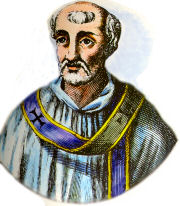
Den hellige pave Linus
( -76)
Minnedag:
23. september
Den hellige Linus ble i
følge LP født
i Volterra i Toscana som sønn av en Herculanus. Vi vet ikke opprinnelsen til
denne opplysningen. Den hellige Ireneus av Lyon og Eusebius hevder
at han er identisk med den Linus som nevnes i 2. Tim 4,21. Vi kan ikke være
sikre på denne identifikasjonen; kanskje er den kommet til i ettertid som en
følge av navnelikheten. Før han ble pave, skal han ha vært Peters vikar.
Etter tradisjonen var
Linus St. Peters første etterfølger som biskop av Roma og dermed pave. På alle
gamle pavelister (Ireneus, Julius Africanus, Hippolyt,
Eusebius, Den liberianske katalog) står hans navn direkte etter Peters. Han
skal ha regjert ca 67-76, men Den liberianske katalog sier at hans pontifikat
varte i 12 år, 4 mnd og 12 dager. Han konsekrerte de første femten biskoper, i
følge LP på
Peters vegne, og han forbød kvinner å gå inn i kirkene uten slør på hodet (kfr
1.Kor 11,1-15). Under hans pontifikat led evangelistene Markus og Lukas martyrdøden.
Tradisjonelt æres Linus
som martyr i vest, men dette er usannsynlig, da historikere påpeker at det ikke
skjedde noen forfølgelser i denne perioden. Tradisjonen sier at han ble
gravlagt ved siden av St. Peter. Dette er ikke umulig at Romas første biskoper
ble gravlagt her, men ingen ting i den liturgiske tradisjon fra 300-tallet
beviser det. Linus' eksistens og ledende rolle i den romerske kirken er
uomtvistelig, men det er umulig å ha noen klar idé om hans rolle og funksjon,
ettersom det «monarkistiske episkopat», det vil si én enkelt regjerende biskop,
først ble utviklet i Roma på midten av 100-tallet. Noen pavelister regner ikke
med Linus, da de betrakter ham og etterfølgeren Kletus som Klemens'
vikarer under hans lange fravær fra Roma.
Den hellige Linus' fest
er feiret den 23. september siden 700-tallet, men etter 1969-revisjonen av
kalenderen er den ikke lenger obligatorisk for hele Kirken. Linus nevnes i Den
romerske Canon (Eukaristisk bønn I) før forvandlingen.
Paverekken - Kildehenvisninger -
Kompilasjon og oversettelse: p. Per Einar Odden -
Sist oppdatert: 1998-02-13 09:58

.jpg)