
Saints
Crispino e Crispiniano printed by Remondini - Bassano - Italy
Santi Crispino e Crispiniano, protettori dei calzolai in una stampa del XVIII secolo degli stampatori Remondini di Bassano, Italia
Saints Crépin et
Crépinien
Martyrs à Soissons (+ 285)
Venus de Rome, ils se
firent cordonniers pour mieux annoncer l'Evangile, ils chaussaient gratis les
pauvres et les riches ne connaissaient pas de meilleures chaussures. Tous ils
s'attardaient avec plaisir pour entendre parler du Christ. Les français les
disent avoir vécu dans la région de Soissons. Les anglais les font vivre dans
le Kent. Shakespeare en fait la louange dans «Henri V» et dans
«Jules César». Mais tous s'accordent à dire qu'ils donnèrent le témoignage
du martyre. Leur «Passion» précise même que leurs bourreaux coupèrent leur peau
en lanières. Avec eux, nous fêtons saint Rufin et
saint Valère, qui, eux, choisirent d'être gardiens de grenier à blé afin de
parler plus facilement avec les paysans des alentours. Ils donnèrent aussi le
témoignage suprême de la foi.
Saint
Crépin et Saint Crépinien, cordonniers, martyrs (285 ou 286) - diocèse
de Soissons, Laon et Saint-Quentin.
Un internaute nous
signale: "Ces deux saints ont été adoptés par les Anglais sur ordre de
Henri V car leur fête correspond au jour de la victoire anglaise
d'Azincourt"
À Soissons, les saints
Crépin et Crépinien, martyrs.
Martyrologe romain
SOURCE : http://nominis.cef.fr/contenus/saint/2076/Saints-Crepin-et-Crepinien.html
.jpeg)
Crispinus-Crispinianusretabel, Kalkar Kreis Kleve, Katholische Pfarrkirche Sankt Nikolai, Jan-Joest-Straße 6, Langhaus, Nordseite, 4. Joch von Westen. Kerstken von Ringenberch, Bildhauer, um 1530 -http://www.bildindex.de/dokumente/html/obj20045543#target
Crispinus-Crispinianusretabel, Kalkar Kreis Kleve, Katholische Pfarrkirche Sankt Nikolai, Jan-Joest-Straße 6, Langhaus, Nordseite, 4. Joch von Westen. Kerstken von Ringenberch, Bildhauer, um 1530 -http://www.bildindex.de/dokumente/html/obj20045543#targetSAINT CRÉPIN et SAINT
CRÉPINIEN
Cordonniers, Martyrs
(285 ou 286)
Crépin et Crépinien, cordonniers,
faisaient des chaussures pour les pauvres, quand on les saisit comme chrétiens
et on les conduisit à l'empereur Maximien, qui était de passage dans le nord
des Gaules:
"D'où êtes-vous,
leur dit le tyran, et quelle religion professez-vous?
Nous sommes,
répondirent-ils, de nobles Romains qui avons émigré dans les Gaules pour y
prêcher la foi chrétienne.
Si vous persistez dans
cette folie, leur dit l'empereur, je vous ferai périr d'une mort cruelle: si
vous sacrifiez aux dieux, je vous comblerai de richesses et d'honneurs.
Tu crois nous effrayer
par tes menaces, répondent les saints martyrs; mais, pour nous, le Christ est
la vie, et la mort est une grâce. Quant aux richesses et aux honneurs, nous les
avons quittés volontairement; garde-les pour tes amis. Si toi-même tu ne
renonces pas à tes dieux, tu brûleras au fond de l'enfer."
Transporté de rage,
Maximien abandonna les deux chrétiens à l'un des plus cruels exécuteurs des
persécutions contre les chrétiens, nommé Rictiovarus, pour les torturer avec
une violence extraordinaire. Rictiovarus leur fit enfoncer sous les ongles des
roseaux pointus; mais ces roseaux se retournèrent contre les bourreaux et en
tuèrent ou blessèrent plusieurs; il les fit jeter ensuite, en plein hiver, avec
des meules de moulin au cou, dans une rivière glacée, mais ils surnagèrent et
ne sentirent pas le froid.
Ce fut ensuite le tour du
supplice de la chaudière remplie de plomb fondu; ce supplice fut inoffensif
pour eux, comme les autres, mais une goutte du terrible liquide jaillit sur
l'oeil du tyran, qui ressentit une affreuse douleur et devint borgne. Sa fureur
lui donna le courage de poursuivre son oeuvre barbare, et les deux généreux
martyrs furent jetés dans une autre chaudière bouillante, remplie d'un mélange
de poix, de graisse et d'huile; ils y entrèrent en chantant de pieux cantiques,
et des anges vinrent les en faire sortir. Rictiovarus, fou de rage et sans
doute saisi du démon, se jeta au milieu du brasier et s'y tordit dans le
désespoir. Telle fut la fin de ce grand persécuteur, qui fit périr tant de
chrétiens dans les Gaules.
Quant à Crépin et
Crépinien, ils eurent la tête tranchée le lendemain. Le culte de saint Crépin
et de saint Crépinien est un de ceux qui sont restés les plus populaires; des confréries
ouvrières furent établies sous leur vocable, de nombreuses églises bâties en
leur honneur; d'éclatants miracles furent obtenus par leur intercession.
Abbé L. Jaud, Vie des Saints pour tous les jours de l'année, Tours, Mame, 1950.
SOURCE : http://www.magnificat.ca/cal/fran/10-25.htm

Saints Crépin et
Crépinien, des missionnaires bien chaussés
Chapelle Notre-Dame de
Châteaulin (Finistère). Détail du tableau de saint Crépin et saint Crépinien,
offert à la chapelle en 1669 par Julien Quintin (confrérie des cordonniers).
Rachel Molinatti - publié
le 24/10/19 - mis à jour le 20/10/25
Patrons des cordonniers,
des tanneurs et des professionnels du cuir, saints Crépin et Crépinien, martyrs
à Soissons, sont fêtés le 25 octobre. Leur histoire témoigne que la mission
d’évangélisation prend parfois des voies originales.
Crépin et Crépinien
étaient frères et l'on connaît leur vie grâce à la tradition. Venus de Rome au
IIIe siècle, ils ont émigré en Gaule, plus précisément à Soissons, où ils
exerçaient le métier de cordonniers. Ils se servaient de leur profession pour
évangéliser et l'on peut dire qu'ils y mettaient du temps, du talent et du
cœur, travaillant d'arrache-pied à l'annonce de la Bonne Nouvelle. Ils
chaussaient les pauvres gratuitement, et de leur côté, les riches appréciaient
leurs souliers. Agréables et bons travailleurs, les deux frangins s'attiraient
inévitablement la sympathie de leur clientèle.
Ni une ni deux, ils ont
bien sûr fini par se faire remarquer (sans surprise). Arrêtés en raison de leur
foi, ils ont été conduits à l'empereur Maximien qui a ordonné leur mise à mort.
Selon les différentes traditions, on dit qu'ils ont été décapités ou que leurs
bourreaux leur ont coupé la peau en lanières. Toujours est-il que leur culte
est devenu très populaire. De nombreuses églises portent leur nom, notamment
dans le nord de la France, ainsi que plusieurs confréries ouvrières. Ils sont
également les patrons des artisans qui travaillent le cuir (cordonniers,
tanneurs, gantiers, selliers...). Nul ne dit qu'il faut les prier pour trouver
chaussure à son pied, mais vous pouvez toujours essayer...
Les pires supplices des
saints martyrs :
Lire aussi :[EN
IMAGES] Ces saints qui étaient frères et sœurs
Lire aussi :Les
martyrs du XXIe siècle, une “espérance pleine d’immortalité”
SOURCE : https://fr.aleteia.org/2019/10/24/saints-crepin-et-crepinien-des-missionnaires-bien-chausses/

Santi
Crispino e Crispiniano, 98 x 190
Aert van den Bossche (fl. 1490–1505),
Martyrdom of St. Crispin and Crispinian, 1494, tempera on oak panel,
98 x 190, National Museum in Warsaw
Aert van den Bossche (fl. 1490-1505). Le martyr de Saint Crépin et Saint Crépinien, 1494, 98 x 190
Saint Crépin et Saint
Crépinien, cordonniers, martyrs ( 285 ou 286)
Crépin et Crépinien,
cordonniers, faisaient des chaussures pour les pauvres, quand on les saisit
comme chrétiens et on les conduisit à l'empereur Maximien, qui était de passage
dans le nord des Gaules :
"D'où êtes-vous,
leur dit le tyran, et quelle religion professez-vous ?
Nous sommes,
répondirent-ils, de nobles Romains qui ont émigré dans les Gaules pour y
prêcher la foi chrétienne.
Si vous persistez dans
cette folie, leur dit l'empereur, je vous ferai périr d'une mort cruelle ;
si vous vous sacrifiez aux dieux, je vous comblerai de richesses et d'honneurs.
Tu crois nous effrayer
par tes menaces, répondirent les saints martyrs ; mais, pour nous, le Christ
est la vie, et la mort est une grâce. Quant aux richesses et aux honneurs, nous
les avons quittés volontairement ; garde-les pour tes amis. Si toi-même tu ne
renonces pas à tes dieux, tu brûleras au fond de l'enfer."
Transporté de rage, Maximien abandonna les deux chrétiens à l'un des plus cruels exécuteurs des persécutions contre les chrétiens, nommé Rictiovarus, pour les torturer avec une violence extraordinaire. Rictiovarus leur fit enfoncer sous les ongles des roseaux pointus ; mais ces roseaux se retournèrent contre les bourreaux et en tuèrent ou blessèrent plusieurs ; il les fit jeter ensuite, en plein hiver avec des meules de moulin au cou, dans une rivière glacée, mais ils surnagèrent et ne sentirent pas le froid.
Ce fut ensuite le tour du supplice de la chaudière remplie de plomb fondu ; ce supplice fut inoffensif pour eux, comme les autres mais une goutte du terrible liquide jaillit sur l'œil du tyran, qui ressentit une affreuse douleur et devin borgne. Sa fureur lui donna le courage de poursuivre son œuvre barbare, et les deux généreux martyrs furent jetés dans une autre chaudière bouillante, remplie d'un mélange de poix, de graisse et d'huile ; ils y entrèrent en chantant de pieux cantiques et des anges vinrent les en faire sortir. Rictiovarus, fou de rage et sans doute saisi du démon, se jeta au milieu du brasier et s'y tordit dans le désespoir. Telle fut la fin de ce grand persécuteur, qui fit périr tant de chrétiens dans les Gaules.
Quand à Crépin et Crépinien, ils eurent la tête tranchée le lendemain sur les bords de l'Aisne le 25 octobre. Le culte de saint Crépin et Crépinien est un de ceux qui sont restés les plus populaires ; des confréries ouvrières furent établies sous leur vocable, de nombreuses églises bâties en leur honneur ; d'éclatants miracles furent obtenus par leurs intercessions.

Saint
Crépin et saint Crépinien recevant les pames du martyre, 1683, Chaudes-Aigues -
Claudine Pépin, Saint
Crépin et Saint Crépinien recevant les palmes du martyre, un tableau
exceptionnel à Chaudes-Aigues [archive] par: http://cantalpatrimoine.free.fr/Arttrois.pdf
LES ACTES DE SAINT CRÉPIN
ET DE SAINT CRÉPINIEN
(l'an de Jésus Christ
287.)
fêtés le 25 octobre
Sous les empereurs
Dioclétien et Maximien, qui avaient formé ensemble un concert impie pour
attaquer l'Église du Christ, les bienheureux Quentin, Lucien, Rufin, Valère et
Eugène, tous issus de familles nobles en la ville de Rome, se transportèrent
dans les Gaules pour y prêcher la foi du Christ ; et c'est de là, qu'après
avoir terminé leurs travaux apostoliques par un heureux martyre, ils
s'envolèrent dans le Sein de Dieu. Ils étaient accompagnés de deux frères,
Crépin et Crépinien, qui ne leur cédaient en rien, ni pour l'éclat de la
vaillance, ni pour la vivacité de la foi. Ceux-ci eurent pour partage la ville
de Soissons. Mais, parce qu'ils étaient chrétiens et que la persécution était
alors dans toute sa violence, ils ne purent obtenir ni l'hospitalité ni les
services les plus indispensables. Cependant, comme ils voulaient vivre du
travail de leurs mains, conformément aux prescriptions de l'Apôtre, ils
apprirent le métier de cordonnier, comme plus paisible ; et, par la Grâce du
Seigneur, ils surpassèrent tellement les hommes de la même profession qu'ils
excitaient l'admiration et les sympathies d'un grand nombre de personnes, qui
voyaient avec surprise qu'ils n'exigeaient jamais de prix pour leur travail, bien
que leur habileté les rendit supérieurs aux autres cordonniers par l'élégance
qu'ils savaient donner à leurs chaussures. Une telle nouveauté leur attira bien
des visiteurs et des chalands ; quelques-uns néanmoins venaient souvent les
voir, non pas tant pour leurs besoins personnels ou pour admirer leur travail,
que dans le dessein d'entendre la parole de Dieu. Et ainsi il arriva que, par
la Grâce du Christ et par les prédications de ses saints artisans, un grand
nombre d'habitants quittèrent leurs erreurs et le culte des idoles, avec un vif
désir de rendre gloire et amour au Dieu vivant et véritable.
Cette nouvelle étant
parvenue aux oreilles de l'impie Maximien, il envoya aussitôt à leur recherche
Rictiovarus, le grand ministre de ses cruautés. Celui-ci les trouva à Soissons
occupés à coudre des chaussures pour les pauvres. Il leur demanda incontinent
quels dieux ils adoraient. Ils lui répondirent qu'ils adoraient le même Dieu,
qui est l'unique et le véritable ; mais que, pour Jupiter, Apollon, Mercure et
autres semblables monstres, ils ne leur rendaient ni culte ni adoration. Sur
cette réponse, Rictiovarus les fit charger de chaînes et les conduisit à
l'empereur. Maximien ordonna d'introduire ces contempteurs des édits impériaux,
et il leur dit : "Dites-moi quelle est votre origine et votre
religion ?" Les saints répondirent : "Nés à Rome d'une
famille noble, nous sommes venus dans les Gaules pour l'amour du Christ, qui,
avec le Père et le saint Esprit, est un seul Dieu, Créateur de toutes choses,
dont le règne s'étend dans les siècles des siècles. Nous Le servons dans la foi
avec un dévouement sans bornes, et nous désirons, tant que l'esprit animera ces
membres, persévérer dans son culte et son service." À ces paroles,
Maximien, plein de colère, leur dit : "Par la vertu des dieux, si
vous persévérez dans cette folie, après vous avoir tourmentés par beaucoup de
supplices, je vous ferai périr par une mort cruelle ; car je veux faire de vous
un exemple. Si au contraire vous sacrifiez aux dieux, je vous comblerai de
richesses et d'honneurs." Les saints martyrs répondirent : "Tu
ne saurais nous effrayer par tes menaces, nous, pour qui le Christ est la vie,
et la mort un gain. Quant aux richesses et aux honneurs que tu nous promets, donne-les
aux tiens ; autrefois nous les avons foulés aux pieds, et nous nous réjouissons
de les avoir ainsi méprisés. Toi aussi, si tu connaissais le Christ, si tu
L'aimais, tu renoncerais facilement non seulement aux richesses et même à
l'empire, mais encore au vain culte des démons, et sa Bonté te donnerait une
vie éternelle. Mais si tu persistes dans ces vanités impies, tu seras précipité
dans le tartare avec ces méchants démons dont tu honores les simulacres."
Maximien dit alors : "C'est bien assez que vous ayez perdu tant de
personnes par vos maléfices et vos détestables artifices." Les martyrs
reprirent : "Tu ignores, misérable, que c'est le Dieu si bon qui a
permis que tu fusses élevé à l'empire, bien qu'indigne ; mais c'est en vain que
tu redoubles d'efforts pour détruire sur la terre son royaume immortel."
Maximien, transporté de
fureur, les livra à Rictiovarus et lui recommanda de les torturer cruellement,
et de les faire périr de la mort la plus horrible. Aussitôt le féroce ministre
du barbare tyran ordonna de les suspendre avec des poulies et de les frapper
avec des bâtons noueux. Durant ce supplice, les martyrs, élevant leurs coeurs
vers les choses célestes, imploraient le Secours et l'Assistance du Christ.
Rictiovarus, les entendant adresser leurs prières au Christ, au lieu des cris
que la vivacité de la douleur devait leur arracher, en fut outré de dépit ; et
incontinent, il donna l'ordre de leur enfoncer sous les ongles des roseaux
pointus, et de leur couper sur le dos des lanières de chair. Ses satellites se
mirent aussitôt à l'oeuvre, et poussèrent avec force ces instruments de
torture : mais les martyrs, au milieu de supplices si atroces, tout joyeux
d'espérance et patients dans les tribulations, conjurèrent le Seigneur de les
délivrer de l'homme inique et rusé ; et le Seigneur, toujours plein de bonté,
exauça aussitôt leur prière. Soudain, les roseaux aigus s'élancèrent de leurs
doigts avec tant d'impétuosité que, si on en croit la tradition, ils tuèrent
quelques-uns des bourreaux et en blessèrent plusieurs autres. Mais Rictiovarus,
que la fureur faisait extravaguer, commanda d'attacher des pierres meulières au
cou des martyrs et de les précipiter dans la rivière de l'Aisne, afin que la
glace leur fût un nouveau tourment. Les martyrs en furent ravis de joie. Mais,
protégés qu'ils étaient du bouclier de la Puissance divine, et les créatures
inanimées obéissant à leur Créateur, ni les eaux ne purent les submerger, ni
les lourdes pierres les accabler, ni la glace leur causer aucune douleur. Bien
plus, ils se sentaient à leur aise comme dans un bain que l'on prend, durant
l'été, dans un fleuve ; et, s'étant débarrassés des pierres meulières, ils
passèrent sains et saufs sur la rive opposée.
A la vue de ce prodige,
Rictiovarus, que l'esprit malin enflammait de colère, donna l'ordre de les
saisir et de les garder enchaînés dans la prison, tandis qu'on ferait fondre du
plomb dans une chaudière. Quand il fut liquéfié, il y fit jeter les martyrs.
Mais le feu ne saurait atteindre ceux qui sont sous la garde de l'invincible
Main du Christ. Les saints martyrs plongés dans le plomb en fusion se livrèrent
à la prière, et, à l'imitation des trois enfants qui louaient le Seigneur dans
la fournaise de la Chaldée, ils chantèrent et dirent : "Secours-nous,
ô Dieu notre Sauveur, et, pour la gloire de ton Nom, délivre- nous, Seigneur,
et sois miséricordieux pour nos péchés à cause de ton Nom, de peur que les
gentils ne disent : Où est leur dieu ?" Tandis qu'ils priaient,
une goutte de plomb fondu sauta dans un des yeux de Rictiovarus, et l'aveugla
en lui causant une cuisante douleur. Mais ce malheureux, au lieu de chercher,
comme il devait, un remède pour son âme et pour son corps, n'en devint que plus
furieux, et il ordonna de faire fondre un mélange de poix, de graisse et d'huile,
et d'y jeter les martyrs. Ses ordres furent aussitôt mis à exécution. Mais ces
bienheureux, pleins d'allégresse dans l'immobilité de leur espérance, dirent
avec confiance au Seigneur "Tu peux, Seigneur, nous délivrer de ces
tourments de l'impie Rictiovarus. Donc, de même que Tu as voulu que nous
souffrions pour la confession de ton saint Nom, ainsi daigne nous retirer sans
lésion de ce supplice." À peine avaient-ils achevé leur prière, qu'un ange
apparut et les retira sans douleur de ces matières embrasées.
L'impie Rictiovarus,
voyant qu'il n'obtenait rien par les tourments les plus recherchés, se
précipita de rage dans le feu, et quitta la vie par cette mort affreuse. Et ce
fut sans doute par un juste jugement de Dieu que celui qui avait fait mourir
par le supplice du feu un si grand nombre de martyrs du Christ, périt lui-même
par cet élément, pour ensuite être précipité dans les flammes du brasier
éternel qui ne s'éteindront jamais. Les martyrs déjà victorieux voyant cette
mort déplorable, prièrent le Seigneur, qu'après les avoir ainsi délivrés des
assauts du combat, Il daigne leur ordonner, dans sa Bonté, de s'envoler vers
Lui. Or, cette même nuit, il leur fut révélé d'en haut que, le lendemain, dès
le point du jour, ils recevraient le prix de leurs travaux et de leur glorieuse
confession. L'événement vérifia bientôt la réalité de cette vision ; car
Maximien, ayant appris la fin tragique de Rictiovarus donna l'ordre de trancher
la tête aux saints martyrs. Ceux-ci, se voyant sur le point de mourir, rendirent
grâces à Dieu de ce que, après les avoir délivrés du siècle, Il voulait bien
leur ordonner d'aller à Lui. Et c'est ainsi qu'après avoir été décapités, ils
quittèrent la vie le huit des calendes de novembre.
Leurs corps furent
abandonnés à la voracité des chiens et des oiseaux ; mais, comme ils étaient
sous la Garde du Christ, ils ne reçurent aucune atteinte. La même nuit, ainsi
qu'il est rapporté, un pauvre vieillard, qui avait une soeur aussi fort âgée,
reçut d'un ange l'ordre de recueillir les corps des saints martyrs et de les
confier avec un grand soin à la sépulture. Le vieillard se leva sans hésiter,
se rendit, avec sa soeur, au lieu du martyre ; et comme les saints avaient été
mis à mort sur les bords de la rivière de l'Aisne, il leur fut facile de
transporter les corps sur une barque jusqu'à leur domicile. Mais que pouvaient
faire deux vieillards indigents, sans ressources, sans vigueur, incapables de
se procurer une barque, ignorant l'art de la conduire, et à qui l'âge avait ôté
les forces nécessaires pour naviguer contre le courant de la rivière ?
Étant enfin arrivés pendant la nuit sur le lieu du martyre, ils trouvèrent les
corps entièrement intacts, et ils aperçurent une barque sur le rivage. Se
sentant alors animés d'une grande confiance, ils prirent chacun un des corps en
même temps, et marchèrent d'un pas si léger et si sûr, qu'on eut dit qu'ils ne
portaient aucun fardeau, mais plutôt que leur fardeau les aidait à marcher. Ils
déposèrent donc les corps saints dans la barque, et les conduisirent à leur
logis avec une grande vitesse, bien que remontant le cours de la rivière et
qu'ils fussent sans rames ni gouvernail. Arrivés chez eux, ils y déposèrent les
saintes reliques, en grande allégresse, dans un lieu secret. Personne ne doute
que le Christ n'ait Lui-même donné cette force surhumaine à ces pauvres
vieillards pour la gloire de ses martyrs, qui avaient de bon coeur souffert la
mort pour Lui en ce monde, et qu'Il n'ait voulu Se servir du ministère de ces
personnes humbles et débiles pour tenir cachés quelque temps ces précieux
corps, les réservant ainsi pour être dans la suite les protecteurs et le refuge
des fidèles.
En effet, à peine eut-Il fait cesser la persécution, qu'ils furent manifestés. Les vieillards qui avaient dérobé ce trésor aux impies, le révélèrent alors aux fidèles, leur annonçant avec grande joie qu'ils possédaient dans leur chaumière les corps des saints martyrs Crépin et Crépinien. A peine la nouvelle en fut-elle divulguée que le peuple fidèle accourut en foule, pénétré de pieux sentiments, à la demeure des vieillards qu'on eût prise alors pour un oratoire, et qui était devenu plus en honneur que la cour ou le palais d'un roi. Or, le clergé et le peuple ayant tenu conseil, il fut décidé qu'on enlèverait de ce lieu les saints corps. Après qu'on eut préparé des tombeaux dignes de les recevoir, on les plaça sur une barque magnifiquement décorée, et tout le peuple les accompagnait, chantant joyeusement des psaumes. Et comme si le Seigneur eût voulu raffermir la foi de ce peuple religieux et augmenter son allégresse, la barque qui portait les saintes reliques avait à peine touché le rivage qu'un enfant aveugle, sourd, muet et boiteux, se trouva guéri, dès qu'il eut touché avec confiance la bière qui les contenait ; il se joignit aussitôt à la foule et louait Dieu avec elle, marchant librement et sans la moindre infirmité. On renferma les corps des martyrs dans des tombeaux préparés ; plus tard, on y érigea une vaste église, dans laquelle le Christ, Seigneur et Dieu, Fils de Dieu, par les prières de ses martyrs, écoute les supplications de ceux qui les invoquent et rend la santé aux malades. A Lui appartiennent l'honneur, la domination, la gloire impérissable, avec le Père souverain et le saint Esprit, dans les siècles des siècles. Amen.
SOURCE : http://orthodoxievco.net/ecrits/vies/martyrs/octobre/crepin.htm

Also
known as
Crispinus
Profile
Member of the imperial
Roman nobility. Brother of Saint Crispian with
whom he evangelized Gaul in the
middle 3rd
century. Worked from Soissons, France,
they preached in
the streets by day, made shoes by night. Their charity, piety,
and contempt of material things impressed the locals, and many converted in
the years of their ministry. Martyred under
emperor Maximian Herculeus, being tried by Rictus Varus, governor of
Belgic Gaul and
an enemy of Christianity.
A great church was built at Soissons in the 6th century
in their honor; Saint Eligius ornamented
their shrine.
Because of his
association with shoes, shoe-making, etc. a shoeshine kit is called a
“Saint-Crispin”; an awl is “Saint Crispin’s lance”; and if your shoes are too
tight, you are “in Saint Crispin’s prison.”
tortured
and beheaded c.286 at Rome, Italy
Worshipful
Company of Cordwainers
cobbler‘s
last
leather awl
Additional
Information
Book
of Saints, by the Monks of
Ramsgate
Lives
of the Saints, by Father Alban
Butler
Lives
of the Saints, by Father Francis
Xavier Weninger
Saints
of the Day, by Katherine Rabenstein
Short
Lives of the Saints, by Eleanor Cecilia Donnelly
books
Our Sunday Visitor’s Encyclopedia of Saints
Oxford Dictionary of Saints, by David Hugh Farmer
Saints
and Their Attributes, by Helen Roeder
Some Patron Saints, by
Padraic Gregory
other
sites in english
1001 Patron Saints and Their Feast Days, Australian
Catholic Truth Society
Catholic Cuisine: Saint Crispin’s Pumpkin Cobbler
Catholic Cuisine: Saint Crispin’s Apple Crisp
images
video
sitios
en español
Martirologio Romano, 2001 edición
sites
en français
L’Eglise catholique dans l’Aisne
fonti
in italiano
Martirologio Romano, 2005 edition
Readings
From the example of the
saints it appears how foolish the pretenses of many Christians are, who imagine
the care of a family, the business of a farm or a shop, the attention which
they are obliged to give to their worldly profession, are impediments which
excuse them from aiming at perfection. Such, indeed, they make them; but this
is altogether owing to their own sloth and malice. How many saints have made
these very employments the means of their perfection! Saint Paul made tents;
Saints Crispin and Crispinian were shoemakers; the Blessed Virgin was taken up
in the care of her poor cottage; Christ himself worked with his reputed father,
and those saints who renounced all commerce with the world to devote themselves
totally to the contemplation of heavenly things, made mats, tilled the earth,
or copied and bound good books. The secret of the art of their sanctification
was, that fulfilling the maxims of Christ, they studied to subdue their
passions and die to themselves; they, with much earnestness and application,
obtained of God, and improved daily in their souls, a spirit of devotion and
prayer; their temporal business they regarded as a duty which they owed to God,
and sanctified it by a pure and perfect intention, as Christ on earth directed
every thing he did to the glory of his Father. In these very employments, they
were careful to improve themselves in humility, meekness, resignation, divine
charity, and all other virtues, by the occasion which call them forth at every
moment, and in every action. Opportunities of every virtue, and every kind of
good work never fail in all circumstances; and the chief means of our
sanctification may be practiced in every state of life, which are self-denial
and assiduous prayer, frequent aspirations, and pious meditation or reflections
on spiritual truths, which disengage the affections from earthly things, and
deeply imprint in the heart those of piety and religion. – by Father Alban
Butler
MLA
Citation
‘Saint
Crispin‘. CatholicSaints.Info. 16 June 2024. Web. 10 December 2025.
<https://catholicsaints.info/saint-crispin/>
SOURCE : https://catholicsaints.info/saint-crispin/

Also
known as
Crispianus
Profile
Member of the imperial
Roman nobility. Brother of Saint Crispin with
whom he evangelized Gaul in the
middle 3rd
century. Worked from Soissons, France,
they preached in
the streets by day, made shoes by night. Their charity, piety,
and contempt of material things impressed the locals, and many converted in
the years of their ministry. Martyred under
emperor Maximian Herculeus, being tried by Rictus Varus, governor of
Belgic Gaul and
an enemy of Christianity.
A great church was built at Soissons in the 6th century
in their honor; Saint Eligius ornamented
their shrine.
tortured
and beheaded c.286 at Rome, Italy
cobbler‘s
last
Additional
Information
Book
of Saints, by the Monks of
Ramsgate
Lives
of the Saints, by Father Alban
Butler
Lives
of the Saints, by Father Francis
Xavier Weninger
Saints
of the Day, by Katherine Rabenstein
Short
Lives of the Saints, by Eleanor Cecilia Donnelly
books
Our Sunday Visitor’s Encyclopedia of Saints
Oxford Dictionary of Saints, by David Hugh Farmer
Saints
and Their Attributes, by Helen Roeder
other
sites in english
1001 Patron Saints and Their Feast Days, Australian
Catholic Truth Society
images
video
sitios
en español
Martirologio Romano, 2001 edición
sites
en français
L’Eglise catholique dans l’Aisne
fonti
in italiano
Martirologio Romano, 2005 edition
Readings
From the example of the
saints it appears how foolish the pretenses of many Christians are, who imagine
the care of a family, the business of a farm or a shop, the attention which
they are obliged to give to their worldly profession, are impediments which
excuse them from aiming at perfection. Such, indeed, they make them; but this
is altogether owing to their own sloth and malice. How many saints have made
these very employments the means of their perfection! Saint Paul made tents;
Saints Crispin and Crispinian were shoemakers; the Blessed Virgin was taken up
in the care of her poor cottage; Christ himself worked with his reputed father,
and those saints who renounced all commerce with the world to devote themselves
totally to the contemplation of heavenly things, made mats, tilled the earth,
or copied and bound good books. The secret of the art of their sanctification
was, that fulfilling the maxims of Christ, they studied to subdue their
passions and die to themselves; they, with much earnestness and application,
obtained of God, and improved daily in their souls, a spirit of devotion and
prayer; their temporal business they regarded as a duty which they owed to God,
and sanctified it by a pure and perfect intention, as Christ on earth directed
every thing he did to the glory of his Father. In these very employments, they
were careful to improve themselves in humility, meekness, resignation, divine
charity, and all other virtues, by the occasion which call them forth at every
moment, and in every action. Opportunities of every virtue, and every kind of
good work never fail in all circumstances; and the chief means of our
sanctification may be practiced in every state of life, which are self-denial
and assiduous prayer, frequent aspirations, and pious meditation or reflections
on spiritual truths, which disengage the affections from earthly things, and
deeply imprint in the heart those of piety and religion. – by Father Alban
Butler
MLA
Citation
‘Saint
Crispian‘. CatholicSaints.Info. 2 December 2023. Web. 10 December 2025.
<https://catholicsaints.info/saint-crispian/>
SOURCE : https://catholicsaints.info/saint-crispian/

Santi
Crispino e Crispiniano, 98 x 190
Maestro di Meßkirch, Saint Crépin et Saint Crépinien, circa 1525
Book of
Saints – Crispin and Crispinian
(Saints) Martyrs (October
25) (3rd century) Shoemakers by trade, victims of the great persecution under
Diocletian. They were beheaded because of their religion at Soissons in France,
A.D. 287. They were in great popular veneration throughout the Middle Ages (see
in this connection Shakspeare’s Henry V, Act. IV, Scene II); but the adoption
of the Roman Calendar in which October 25 (their day), is occupied by the Feast
of the Martyrs Saints Chrysanthus and Darias, has caused the liturgical keeping
of their festival to fall into desuetude. They are the recognised Patron Saints
of shoemakers, and are often represented with the tools of their trade or with strips
of leather in their hands. Some of their relics are in Rome, and a noble church
was erected at Soissons in their honour.
MLA
Citation
Monks of Ramsgate.
“Crispin and Crispinian”. Book of Saints, 1921. CatholicSaints.Info. 15
October 2012.
Web. 10 December 2025.
<http://catholicsaints.info/book-of-saints-crispin-and-crispinian/>
SOURCE : https://catholicsaints.info/book-of-saints-crispin-and-crispinian/

Sts. Crispin &
Crispinian
Feastday: October 25
Unreliable legend had
Crispin and Crispinian, noble Roman brothers who with St. Quintinus, went to
Gaul to preach the gospel and settled at Soissons. They were most successful in
convert work during the day and worked as shoemakers at night. By order of
Emperor Maximian, who was visiting in Gaul, they were haled before Rictiovarus
(whose position is unknown and even his existence is doubted by scholars), a
hater of Christians, who subjected them to torture; when unsuccessful in trying
to kill them, he committed suicide whereupon
Maximian had the two brothers beheaded. They are the patrons of shoemakers,
cobblers, and leatherworkers. Their feast day is October
25th.
SOURCE : https://www.catholic.org/saints/saint.php?saint_id=113

New
Catholic Dictionary – Saints Crispin and Crispinian
Martyrs,
born probably Rome; died Soissons, France,
c.285. According to legend, they were Romans of distinguished lineage who were
sent as missionaries to Gaul.
Having escaped various tortures unscathed, they were finally beheaded. Patrons
of cobblers, tanners, and saddlers. Emblems:
instruments of their trade, and strips of leather. Relics in San Lorenzo at
Rome, and at Osnabruck. Feast, 25
October.
MLA
Citation
“Saints Crispin and
Crispinian”. New Catholic Dictionary. CatholicSaints.Info. 16
September 2012.
Web. 10 December 2025.
<http://catholicsaints.info/new-catholic-dictionary-saints-crispin-and-crispinian/>
SOURCE : https://catholicsaints.info/new-catholic-dictionary-saints-crispin-and-crispinian/
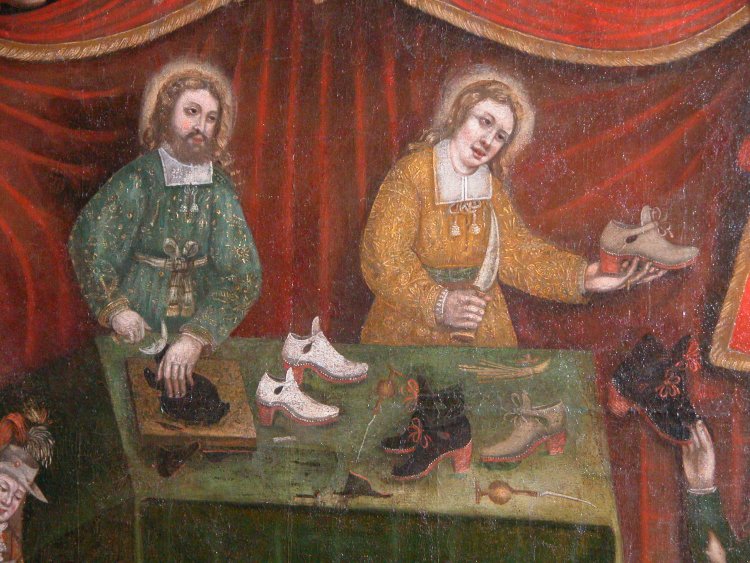
Sts. Crispin and
Crispinian
Martyrs of the Early
Church who were beheaded during the reign of Diocletian; the date of their
execution is given as 25 October, 285 or 286. It is stated that they were
brothers, but the fact has not been positively proved. The legend relates that
they were Romans of distinguished descent who went as missionaries of the
Christian Faith to Gaul and chose Soissons as their field of labour. In
imitation of St. Paul they worked with their hands, making shoes, and earned
enough by their trade to support themselves and also to aid the poor.
During the Diocletian
persecution they were brought before Maximianus Herculius whom Diocletian had
appointed co-emperor. At first Maximianus sought to turn them from their faith
by alternate promises and threats. But they replied: “Thy threats do not
terrify us, for Christ is our life, and death is our gain. Thy rank and
possessions are nought to us, for we have long before this sacrificed the like
for the sake of Christ and rejoice in what we have done. If thou should’st
acknowledge and love Christ thou wouldst give not only all the treasures of
this life, but even the glory of thy crown itself in order through the exercise
of compassion to win eternal life.”
When Maximianus saw that
his efforts were of no avail, he gave Crispin and Crispinian into the hands of
the governor Rictiovarus (Rictius Varus), a most cruel persecutor of the
Christians. Under the order of Rictiovarus they were stretched on the rack,
thongs were cut from their flesh, and awls were driven under their
finger-nails. A millstone was then fastened about the neck of each, and they
were thrown into the Aisne, but they were able to swim to the opposite bank of
the river. In the same manner they suffered no harm from a great fire in which
Rictiovarus, in despair, committed suicide himself. Afterwards the two saints
were beheaded at the command of Maximianus.
In the sixth century a
stately basilica was erected at Soissons over the graves of these saints, and
St. Eligius, a famous goldsmith, made a costly shrine for the head of St.
Crispinian. Some of the relics of Crispin and Crispinian were carried to Rome
and placed in the church of San Lorenzo in Panisperna. Other relics of the
saints were given by Charlemagne to the cathedral, dedicated to Crispin and
Crispinian, which he founded at Osnabrück. Crispin and Crispinian are the
patron saints of shoemakers, saddlers, and tanners.
SOURCE : http://www.ucatholic.com/saints/saints-crispin-and-crispinian/

Retable
de saint Crépin et de saint Crépinien ; Paintings in the
Musée de l'hôtel Sandelin
Crispin and Crispinian MM
(RM)
It is difficult to
separate truth from legend in the story of Saint Crispin and his brother Saint
Crispinian, who were martyred about the year 287. They may actually have been
Christians who fled the persecutions in Rome and put their exile to good effect
by evangelizing. The legend which follows is very late and without historical
value. There is a tradition that they were born of a noble Roman family in the
3rd century and went to preach in Gaul (Soissons) with Saint Quintinius and a
number of other missionaries. According to this tradition they adopted the
trade of shoemakers because they had left all their possessions behind them in
Rome, or mainly as a disguise since Christians were still being persecuted in
Gaul. It seems more probable that they were natives of Noviodunum (Soissons)
and followed their trade as a matter of course.
Like Saint Paul, they
preached by day and worked with their hands by night. Many conversions were
attributed to them, for they preached not only by word of mouth but also by
setting an example of charity and generosity, providing the poor with shoes for
nothing and indeed taking no payment unless it was offered.
Their martyrdom took
place at a time when the Emperor Maximian was travelling through Gaul. Crispin
and Crispinian were accused and the Emperor ordered them to be taken before
Rictiovarus who (if he really existed) was a fanatical persecutor of
Christians.
The two brothers were
subjected to a number of brutal tortures; they were immersed in water, molten lead,
and boiling water. However they survived them all, and it is said that
Rictiovarus became so furious at this that he jumped into the fire that had
been prepared for them and killed himself (or other traditions say he drowned
himself). Finally, on the orders of Maximian, the brothers were beheaded.
The truth may well be
that they were Roman martyrs whose relics were brought to Soissons and
enshrined there. These martyrs are particularly venerated in Soissons, France,
where there was a church in their honor in the 6th century.
Tradition has it that a
church was built over their tomb and their shrine was embellished by Saint
Eligius the Smith, who was also one of the most popular saints of the Middle
Ages. See the references to Crispin and Crispinian in Shakespeare's Henry V,
Act 4, Scene 3.
Their cult spread through
many countries, and there is a legend that they settled for a while at
Faversham, Kent, on the south coast of England, when they fled from
persecution. Formerly, there was an altar in Faversham bearing their names in
the parish church.
To this day they are
recognized as the patron of shoe-makers, cobblers, and leather-workers
(Attwater, Benedictines, Bentley, Delaney, Encyclopedia). Their emblem in art
is a shoe or a last (Roeder).
SOURCE : http://www.saintpatrickdc.org/ss/1025.shtml
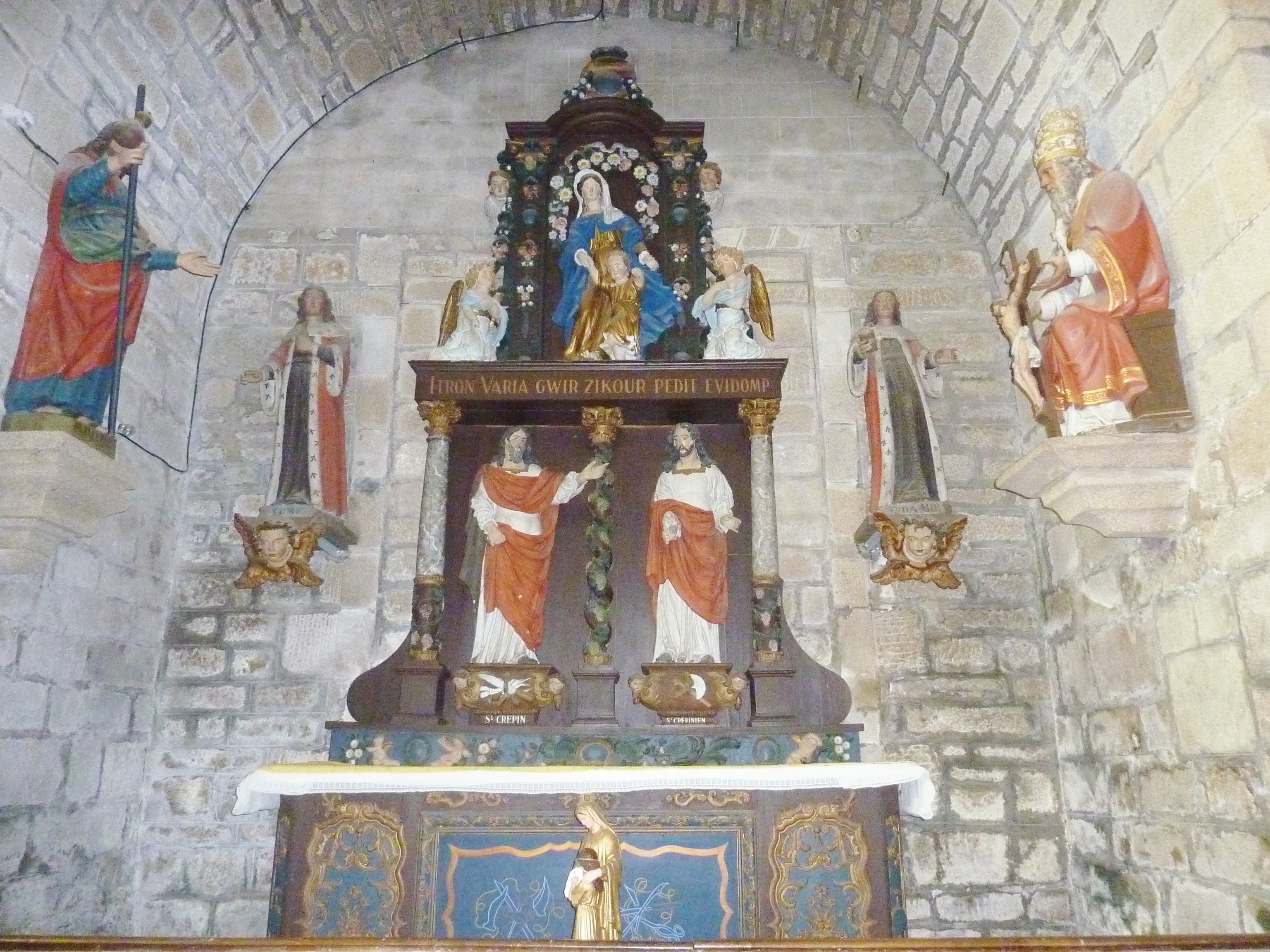
Sts. Crispin and
Crispinian
Martyrs of the
Early Church who were beheaded during the reign of Diocletian;
the date of
their execution is given as 25 October, 285 or 286. It is stated that
they were brothers, but the fact has not been positively proved.
The legend relates that they were Romans of distinguished
descent who went as missionaries of the Christian
Faith to Gaul and chose Soissons as
their field of labour. In imitation of St.
Paul they worked with their hands, making shoes, and earned enough by their
trade to support themselves and also to aid the poor. During the Diocletian persecution they
were brought before Maximianus
Herculius whom Diocletian had
appointed co-emperor. At first Maximianus sought
to turn them from their faith by
alternate promises and threats. But they replied: "Thy threats do not
terrify us, for Christ is our life, and death is our gain. Thy
rank and possessions are nought to us, for we have long before
this sacrificed the like for the sake of Christ and rejoice
in what we have done. If thou shouldst acknowledge and love Christ thou
wouldst give not only all the treasures of this life, but even
the glory of thy crown itself in order through the exercise of
compassion to win eternal life." When Maximianus saw
that his efforts were of no avail, he gave Crispin and Crispinian into the
hands of the governor Rictiovarus (Rictius Varus), a most
cruel persecutor of the Christians.
Under the order of Rictiovarus they were stretched on the rack,
thongs were cut from their flesh, and awls were driven under
their finger-nails. A millstone was then fastened about the neck of each,
and they were thrown into the Aisne, but they were able to swim to the
opposite bank of the river. In the same manner they suffered no harm from a
great fire in which Rictiovarus, in despair, sought death himself.
Afterwards the two saints were
beheaded at the command of Maximianus.
This is the story of
the legend which the Bollandists have
incorporated in their great collection; the same account is found in
various breviaries. The narrative says that a large church was
built over the graves of the two saints,
consequently the legend could not have arisen until a later age; it
contains, moreover, many details that have little probability or historical worth
and seems to have been compiled from various fabulous sources. In the sixth
century a stately basilica was erected at Soissons over
the graves of these saints,
and St.
Eligius, a famous goldsmith, made a costly shrine for the head of St.
Crispinian. Some of the relics of
Crispin and Crispinian were carried to Rome and
placed in the church of San Lorenzo in Panisperna.
Other relics of
the saints were
given by Charlemagne to
the cathedral, dedicated to
Crispin and Crispinian, which he founded at Osnabrück.
Crispin and Crispinian are the patron
saints of shoemakers, saddlers, and tanners.
Their feast falls on 25 October.
Sources
Acta SS., Oct., XI,
495-540; BARING-GOULD, Lives of the Saints, XII, 628; BUTLER, Lives
of the Saints. 25 October; Bio-Bibl. s.v.
Meier,
Gabriel. "Sts. Crispin and Crispinian." The Catholic
Encyclopedia. Vol. 4. New York: Robert Appleton
Company, 1908. 24 Oct.
2019 <http://www.newadvent.org/cathen/04491a.htm>.
Transcription. This
article was transcribed for New Advent by Anthony J. Stokes.
Ecclesiastical
approbation. Nihil Obstat. Remy Lafort, Censor. Imprimatur. +John
M. Farley, Archbishop of New York.
Copyright © 2020 by Kevin
Knight. Dedicated to the Immaculate Heart of Mary.
SOURCE : http://www.newadvent.org/cathen/04491a.htm

October 25
SS. Crispin and
Crispinian, Martyrs
See Tillemont, t. 4, p.
461. Bosquet, Hist. Eccl. de France, l. 5, c. 156. Le Moine, Hist.
Antiq. Soissons, Paris, 1771, t. 1, p. 154.—The new Paris Breviary, and Baillet
from ancient Martyrologies; for the acts of these martyrs are of small
authority.
A.D. 287.
THE NAMES of these two
glorious martyrs are not less famous in France than those of the two former at
Rome. They came from Rome to preach the faith in Gaul towards the middle of the
third century, together with St. Quintin and others. Fixing their residence at
Soissons, in imitation of St. Paul they instructed many in the faith of Christ,
which they preached publicly in the day, at seasonable times; and, in imitation
of St. Paul, worked with their hands in the night, making shoes, though they
are said to have been nobly born, and brothers. The infidels listened to their
instructions, and were astonished at the example of their lives, especially of
their charity, disinterestedness, heavenly piety, and contempt of glory and all
earthly things: and the effect was the conversion of many to the Christian
faith. The brothers had continued this employment several years, when the
Emperor Maximian Herculeus coming into the Belgic Gaul, a complaint was lodged
against them. The emperor, perhaps as much to gratify their accusers as to
indulge his own superstition and give way to his savage cruelty, gave order
that they should be convened before Rictius Varus, the most implacable enemy of
the Christian name, whom he had first made governor of that part of Gaul, and
had then advanced to the dignity of prefect of the prætorium. The martyrs were
victorious over this most inhuman judge, by the patience and constancy with
which they bore the most cruel torments, and finished their course by the sword
about the year 287. 1 They
are mentioned in the Martyrologies of St. Jerom, Bede, Florus, Ado, Usuard,
&c. A great church was built at Soissons in their honour in the sixth
century, and St. Eligius richly ornamented their sacred shrine.
From the example of the
saints it appears how foolish the pretences of many Christians are, who imagine
the care of a family, the business of a farm or a shop, the attention which
they are obliged to give to their worldly profession are impediments which
excuse them from aiming at perfection. Such, indeed, they make them; but this
is altogether owing to their own sloth and malice. How many saints have made
these very employments the means of their perfection! St. Paul made tents;
Saints Crispin and Crispinian were shoemakers; the Blessed Virgin was taken up
in the care of her poor cottage; Christ himself worked with his reputed father;
and those saints who renounced all commerce with the world to devote themselves
totally to the contemplation of heavenly things, made mats, tilled the earth,
or copied and bound good books. The secret of the art of their sanctification
was, that fulfilling the maxims of Christ, they studied to subdue their
passions and die to themselves; they, with much earnestness and application,
obtained of God, and improved daily in their souls, a spirit of devotion and
prayer; their temporal business they regarded as a duty which they owed to God,
and sanctified it by a pure and perfect intention, as Christ on earth directed
everything he did to the glory of his Father. In these very employments, they
were careful to improve themselves in humility, meekness, resignation, divine charity,
and all other virtues, by the occasions which call them forth at every moment,
and in every action. Opportunities of every virtue, and every kind of good work
never fail in all circumstances; and the chief means of our sanctification may
be practised in every state of life, which are self-denial and assiduous
prayer, frequent aspirations, and pious meditation or reflections on spiritual
truths, which disengage the affections from earthly things, and deeply imprint
in the heart those of piety and religion.
Note 1. SS. Crispin and Crispinian are the patrons and models of the pious confraternity of brother shoemakers, an establishment begun by Henry Michael Buch, commonly called Good Henry. His parents were poor day-labourers at Erlon, in the duchy of Luxemburg. Henry was distinguished from his infancy for his parts and extraordinary piety and prudence. He was put apprentice very young to a shoemaker. With the duties of his calling he joined constant devotion and the exercise of all virtues. Sundays and holidays he spent chiefly in the churches, was a great lover of holy prayer, and studied earnestly to know and contemn himself, to mortify his senses and to deny his own will. He took SS. Crispin and Crispinian for his models, and, at his work, had them before his eyes, considering often how they worked with a view purely to please God, and to have an opportunity to convert infidels, and to relieve the poor. It was to him a subject of grief to see many in the same or the like trades ill instructed, slothful in the practice of virtue, and engaged in dangerous or criminal habits; and, by his zealous and prudent exhortations and endeavours, he induced many such to assist diligently at catechism and pious instructions, to shun ale-houses and dangerous company, to frequent the sacraments, to pray devoutly; especially to make every evening acts of faith, hope, divine love, and contrition, and to love only virtuous company, and whatever promoted piety and religion. In this manner, he laid himself out with great zeal and success, when, the term of his apprenticeship being expired, he worked as journeyman; and God so abundantly diffused in his heart his holy spirit and charity, and gave such authority and weight to his words, by the character of his sanctity, that he seemed to have established him the father of his family, to hear the complaints, reconcile the differences, inquire into the distresses, comfort the sorrows, and even relieve the wants of many. The servant of God went always very meanly clad, yet often gave to the poor some of the clothes off his back; he retrenched everything that was superfluous, and often contented himself with bread and water that he might feed the hungry, and clothe the naked. Thus he had lived at his work several years at Luxemburg and Messen, when providence conducted him to Paris, where he continued the same zealous life among the young men of his low rank and profession.
He was forty-five years old when the Baron of Renty, whose piety has rendered his name famous, having heard him spoken of, was extremely desirous to see him. The simplicity and most edifying and enlightened discourse of the poor shoemaker surprised and charmed the good baron, who discovered in him an extraordinary prudence and penetration in spiritual things, and an invincible courage to undertake and execute great projects for the honour of God. He was informed that Henry reformed many dissolute apprentices and children, and, with great address and piety, reconciled to them their angry masters or parents; that he prescribed to many that were so disposed, excellent rules of a pious life: and that he had an excellent talent at instructing and exhorting poor strangers who had no friends, and seemed destitute of comfort, in the hospital of St. Gervaise, which he visited every day. But what gave him the highest idea of Henry’s sanctity, was the eminent spirit of prayer and humility, and the supernatural graces with which he discovered him to be endowed. Thinking him, therefore, a proper instrument for advancing the divine honour, he proposed to him a project of establishing a confraternity to facilitate the heroic exercise of all virtues among persons of his low profession. For this end, he purchased for him the freedom and privilege of a burgess; and made him commence master in his trade that he might take apprentices and journeymen who were willing to follow the rules that were prescribed them, and were drawn up by the curate of St. Paul’s, regarding frequent prayer, the use of the sacraments, the constant practice of the divine presence, mutual succours in time of sickness, and affording relief and comfort to the sick and distressed. Seven apprentices and journeymen joined him, and the foundation of his confraternity was laid in 1645, Henry being appointed the first superior. It appeared visibly, by the innocence and sanctity of this company of pious artisans, how much God had chosen to be honoured by it: the spirit of the primitive Christians seemed revived amongst them.
Two years after this, certain pious tailors who were charmed with the heavenly life of these shoemakers, whom they heard often singing devoutly the divine praises at their work, and saw employing, in penance and good works, that time which many throw away in idleness and sin, begged of good Henry a copy of these rules, and, with the assistance of the same curate, formed a like confraternity of their profession, in 1647. Both these confraternities are propagated in several parts of France and Italy, and are settled in Rome. The principal rules are, that all the members rise at five o’clock every morning, meet together to pray before they go to work; that, as often as the clock strikes, the superior recites aloud some suitable prayer, at some hours a De Profundis, at others some devotion to honour the passion of our Redeemer, or for the conversion of sinners, &c.: that all hear mass every day at an appointed hour; at their work to say certain prayers, as the beads; and sometimes sing a devout hymn, at other times work mostly in silence; make a meditation before dinner; hear pious reading at table; make every year a retreat for a few days; on Sundays and holydays assist at sermons, and at the whole divine office; visit hospitals and prisons, or poor sick persons in their private houses; make an examination of their consciences, say night prayers together, and retire to their rooms at nine o’clock. It would require a volume to give a true idea of the great virtues and edifying deportment of the pious institutor of this religious establishment. After three years’ sickness he died at Paris, of an ulcer in his lungs, on the 9th of June, in 1666, and was buried in the churchyard at St. Gervaise’s. (See Le Vachet, L’Artisan Chrétien, ou la Vie du Bon Henri; and Helyot, Hist. des Ordr. Rel. t. 8, p. 175.) An enterprise which the pious Baron of Renty had extremely at heart, was to engage persons in the world, of all professions, especially artisans and the poor, to instruct themselves in, and faithfully to practise, all the means of Christian perfection, of which his own life was a model.
Gaston John Baptist, baron of Renty, son of Charles, baron of Renty, of an
ancient noble family of Artois, was born at the castle of Beni, in the diocess
of Bayeux in Normandy, in 1611. He was placed very young in the college of
Navarre at Paris, and afterwards in the college of the Jesuits at Caën with a
clergyman for his preceptor, and a secular governor: at seventeen, he was sent
to the academy at Paris, and gained great reputation by his progress in
learning, and his address in all his exercises, especially riding and fencing.
Piety from the cradle was his favourite inclination, which was much
strengthened by his reading the Imitation of Christ. His desire of becoming a
Carthusian was overruled by his parents; and, in the twenty-second year of his
age, he married Elizabeth of Balzac, of the family of Entragues, daughter to
the Count of Graville, by whom he left two sons and two daughters. His great
abilities, modesty, and prudence rendered him conspicuous in the world,
especially in the states at Rouen, wherein he assisted as deputy of the
nobility of the Bailiwick of Vire, and in the army, in which he served in
Lorrain, being captain of a select company of six-score men, of whom sixty were
gentlemen of good families. His valour, watchful and tender care of all under
his charge, regular and fervent devotion, attention to every duty, excessive
charity, humility, penance, and the exercise of all virtues cannot be recounted
in this place. He was much esteemed by King Lewis XIII.; but it was his
greatest happiness, that in the midst of the world his heart appeared as
perfectly disengaged from it, and raised above it as the Pauls, Antonies, and
Arseniuses were in their deserts. In the twenty-seventh year of his age, the
sermons of a certain Oratorian who preached a mission, about seven leagues from
Paris, made so strong an impression upon his soul, that after making a general
confession to that pious priest, by his advice, he entered upon a new course of
life, resolving to break all his connexions with the court, resign all public
business, and lay aside superfluous visits that he might give his whole heart
to God in prayer, and to works of duty and charity. He chose for his director
F. Condren, general of the Oratorians, a most holy and experienced master in an
interior life, as his pious writings and the history of his life show. As the
whole secret of a Christian consists in destroying what is vicious in our
affections that grace may reign in us, and in making the old man die that
Christ alone may live in our hearts, the baron, by the counsels of his
director, redoubled his application to subdue his passions, and regulate all
the interior and exterior motions of his heart and senses. By vigorously
thwarting the inclinations of nature and the senses, he brought them into
subjection; and wherever he discovered any symptom of the least irregularity,
he strongly counteracted the inclination, by doing the contrary. He made every
day two examinations of conscience, at noon and at night; went to confession
twice, and to communion three or four times a week: rose at midnight to say
matins with an hour’s meditation; had regular hours in the day for meditation,
mass, and other devotions, and all family duties. His fasts and abstinence were
most rigorous and continual; his clothes plain; the interior peace and serenity
of his mind demonstrated the submission of his passions to reason and the
divine will, and that he very little desired or feared anything temporal,
considering God alone, whether in prosperity or adversity. His retrenchment of
every superfluity showed his love of poverty. He looked upon himself as the
most unworthy and the basest of all creatures; in his letters took the title of
sinner, or the most grievous sinner, and lived in a total annihilation of
himself before God and all creatures; when he spoke of God, he humbled himself
to the very centre of the earth, and he would feelingly say, that so base a
creature ought with trembling to adore God in silence, without presuming to
pronounce his name. In a sincere love for a hidden and unknown life he shunned
and dreaded esteem and honour, insomuch that it would have been a pleasure to
him to be banished from all hearts, and forgotten by all men. He earnestly
conjured his devout friends to sigh to God for him, that the spirit of his
divine Son might be his life, or that he might live in him and for him alone.
It was his custom to consecrate frequently to God, in the most solemn manner,
his whole being, his body, soul, wife, children, estate, and whatever could
concern him, earnestly praying that with the utmost purity, simplicity, and
innocency he might do all things purely for God, without the least secret spark
of self-love, and without feeling joy or sorrow, or any other sentiment which
he did not totally refer to Him. His devotion to the blessed sacrament was
such, that he usually spent several hours in the day on his knees before it;
and when others wondered he could abide so long together on his knees, he said
it was this that gave him vigour and strength, and revived his soul. He often
served at mass himself: he rebuilt the church at Beni; and out of devotion to
the holy sacrament, he furnished a great number of poor parish-churches with
neat silver chalices and ciboriums. It would be too long here to mention his
care of his family, and of all his tenants, but especially of his children;
frequent attendance upon the sick in hospitals, and in their cottages, and his
incredible and perpetual charities not only among his own vassals and in neighbouring
places, but also among the distant hospitals, the slaves at Marseilles, the
Christian slaves in Barbary, the missions in the Indies, several English and
Irish Catholic exiles, &c. After the death of P. Condren, he chose for his
director a devout father of the Society of Jesus, and, for some time before his
death, communicated usually every day. Prayer being the great channel through
which the divine gifts are chiefly communicated to our souls, in imitation of
all the saints he made this his ordinary employment, and his whole life might
be called a continued prayer. His eminent spirit of prayer was founded in the
most profound humility, and constant mortification. The soul must die before
she can live by the true life; she must be crucified to herself and the world
before she is capable of uniting herself intimately to God, in which consists
her perfection. This faithful servant of God was dead to the love of riches and
the goods of the world; to its amusements, pleasures, and honours; to the
esteem and applause of men, and also to their contempt; to the inordinate
affections or inclinations of self-love, so that his heart seemed to be
withheld by no ties, but totally possessed by God and his pure love. In these
dispositions he was prepared for the company of the heavenly spirits. The
latter years of his life he spent partly at Paris, and partly at his country
seat or castle at his manor of Citri, in the diocess of Soissons. It was at
Paris that he fell ill of his last sickness, in which he suffered great pains
without giving the least sign of complaint. Having most devoutly received all
the sacraments he calmly expired on the 24th of April, in the year 1649, of his
age the thirty-seventh. He was buried at Citri; his body was taken up on the
15th of September, in 1658, by an order of the bishop, to be removed to a more
honourable place; and was found as fresh and entire as if he had been but just
dead. See his life by F. St. Jure, a Jesuit of singular piety and
learning. [back]
Rev. Alban
Butler (1711–73). Volume X: October. The Lives of the
Saints. 1866.
SOURCE : http://www.bartleby.com/210/10/252.html

Saints
Crépin et Crépinien, chapelle des tanneurs de l'église Notre-Dame de
l'Assomption d'Orgelet (Jura)
Weninger’s
Lives of the Saints – Saint Crispin and Saint Crispinian, Martyrs
Article
The festival of the two
holy Martyrs, Crispin and Crispinian is celebrated on the 25th of this month;
but we give their history today, because that of Saints Chrysanthus and Daria
was sufficient for yesterday’s reading. According to the testimony of the Roman
Martyrology, these two Saints were brothers, of a noble family of Rome. Not
contented that they themselves had been educated in Christianity, they
endeavored also to win others to the true faith. With this intention they went
to Soissons in France, and to be better concealed from the persecutors of
Christianity, they learned to make shoes, hoping that this would give them
better opportunities to become acquainted with the heathens and to convert them
to Christianity. Their hopes were not deceived. They were so clever in making
their shoes, asked either no pay at all, or very little for their work, and
treated every one so politely and kindly, that they were universally beloved
and esteemed. They forgot not, however, their principal object, but whenever it
was possible they spoke with those, who came to them, of religion, and exposing
the blindness of heathenism, they explained the truth of Christianity with so
much success, that they converted more infidels than others did with long
sermons.
The two holy brothers
continued thus undisturbed in their apostolic labors, until, after the lapse of
several years, some hardened idolaters were informed of it, who immediately
went to the Emperor Maximian, and denounced them as enemies of the gods and
disturbers of the old religion. The Emperor sent a written order to the prefect
Rictiovarus to imprison Crispin and Crispin- ian and duly to punish them.
Rictiovarus had both brothers brought before him, asked whence they came, and
why they sojourned in Soissons. They answered: “We are noble Romans, and
compassion for the blinded people, who by worshipping false gods, would make
themselves for ever unhappy, brought us hither. We have endeavored to show them
the way of salvation by bringing them to the knowledge of the only true God of
heaven and earth.” The prefect, incensed at this speech, menaced them with most
horrible tortures if they refused to deny their God and to sacrifice to the
idols. “We do not fear your menaces,” said the holy brothers; “it is our desire
to suffer for Christ’s sake.” Rictiovarus, unwilling to contend any longer with
them, ordered them be to put upon the rack, and to be severely scourged; after
which, sharp irons were driven between their finger-nails and the flesh, and
large pieces cut out of their backs. During this terrible martyrdom, the holy
men called to heaven for grace and help, and God sent an Angel to them, who
took the irons out of their fingers. The tyrant, not being able to comprehend
how this was done, after the custom of the heathens, ascribed it to magic and
became still more angry. Without loss of time he had a large cauldron brought
and filled with melted lead, into which he ordered both the holy martyrs to be
thrown, not doubting that they would thus die a most painful death. But the
same God who had manifested His power in so many other dreadful martyrdoms,
showed also in these two brothers, that His arm had not lost its strength.
Crispin and Crispinian sat quietly in the cauldron, without any signs of
suffering, and with a loud voice praised God. Rictiovarus became almost beside
himself with rage, but had to pay dearly for his cruelty; for when he went near
to see if they were not practising some deceit, a drop of the molten lead
struck his eye and gave him indescribable pain. Notwithstanding this, he would
not relent, but ordered an immense fire to be built and both the Saints to be
cast into it. The Angel, however, who had already miraculously assisted them,
brought them unharmed out of the flames. Hereupon, as some writers affirm,
Rictiovarus became like one who had lost his senses and in despair threw
himself into the fire, thus miserably perishing, both body and soul.
The Emperor, when
informed of this, gave orders that the fearless brothers should be beheaded.
The saints, rejoicing at this sentence, knelt down at the place of execution
and received the stroke which set their souls free. Their holy bodies were left
a prey to wild beasts, in accordance with the imperial command; but they
remained untouched, till some courageous Christians carried them during the
night from the place of execution and buried them with due reverence. How
pleased God was with the zeal and constancy of these holy brothers. He has
manifested to the whole world by many miracles wrought at their tombs.
Practical Considerations
• What will not be done
through love of God and the desire to win souls for heaven? The two brothers,
Crispin and Crispinian, not able to convert infidels by preaching, learn the
shoemaker’s trade, and thus try to find opportunities to speak kindly to the heathen,
make them acquainted with Christian truth, and show them the way to heaven.
Have you ever endeavored to exhort your neighbors to do good or to restrain
them from evil? Alas! have not your conversations sometimes restrained others
from doing good and led them to sin? It is a fact, that evil conversation
corrupts good manners, while good conversation may do much to amend evil
manners. Examine yourself today and see what conversation you are accustomed to
have with others. Repent where you have done wrong, and make the resolution
that you will not only yourself abstain from sinful discourses, but will also
prevent others from indulging in them in your presence. If you remember that,
by your frivolous speeches, you have given others occasion to sin, seek now to
do good by your edifying discourses. “Let no evil speech proceed from your
mouth, but that which is good to the edification of faith”; admonishes Saint
Paul. (Ephesians 4) This, as Saint Chrysostom explains, means: speak only that
which is not sinful, and which serves to edify others. “Let all bitterness,”
continues Saint Paul, “all anger, indignation and clamor and blasphemy be put
away from you.” The meaning of this is, that you should abstain from all sinful
speeches, as bitter, angry, indignant and blasphemous words. Saint Clement of
Alexandria writes: “We ought entirely to abstain from all sinful speeches; and
those who indulge in them we should silence by an earnest or averted face, or
by a sharp reproof.”
• Do you not think that
Rictiovarus, the prefect, acted very foolishly when, in his rage, he cast
himself into the fire, and thus miserably ended his life? But will you not act
just as foolishly, if, by sin, you throw yourself wantonly into the fire of
hell, where your body and your soul will be ceaselessly tormented? Our two holy
martyrs rather allowed themselves to be cast into the fire, than offend God by
forsaking the true faith. How wisely they acted! Had they done the contrary,
they would have been in danger of being precipitated into fire which is never
extinguished. You are not threatened with fire or with molten lead, and yet you
offend the Almighty, who menaces you with an unquenchable fire. Is not that a
sign that you either do not believe in hell, or that you have lost your reason?
Consider your dreadful folly, and correct it. It will be very useful to you to
think frequently of hell and of the fire which is never extinguished; for the
thought of this is an efficient means to save you from it, because it will keep
you from committing sin. Saint Chrysostom writes: “None of those, who often
think of hell, will lose their souls; while, on the contrary, none of those,
who do not heed hell, will escape it. How many discard all thought of hell, not
to be disturbed in their sinful conduct, and by so doing, precipitate
themselves into the eternal flames! Hence, I beg of you, think frequently of
hell, as it will prevent you from doing wrong.”
MLA
Citation
Father Francis Xavier
Weninger, DD, SJ. “Saint Crispin and Saint Crispinian, Martyrs”. Lives of the Saints, 1876.CatholicSaints.Info.
20 May 2018. Web. 24 October 2019.
<https://catholicsaints.info/weningers-lives-of-the-saints-saint-crispin-and-saint-crispinian-martyrs/>

October 25
Saints Crispin and
Crispinian
Martyrs
(†285 or 286)
These two glorious
martyrs, who were brothers, were born of a distinguished Roman family; they
came from Rome to preach the Faith in Gaul toward the middle of the third
century, and took up residence in Soissons. They instructed many in the Faith
of Christ, which they preached publicly during the day. At night they worked at
making shoes, following the example of Saint Paul who recommends that the
preachers of Christ imitate him — that is, sustain themselves when necessary by
the work of their own hands. The infidels who came to their workshop were
charmed by their polite and affable manners, and enjoyed coming to ask their
services and converse with them. The profound conviction which imbued all they
said about Christianity made a strong impression on those who heard them. They
remained about forty years in this occupation at Soissons without being
troubled, even though they determined many to renounce the cult of false gods.
But the time was coming
when they were destined to give the most perfect testimony possible to their
faith, by suffering many and varied tortures and shedding their blood. In 285
the emperor Diocletian sent his vicar Maximian Herculeus into Gaul, where this
tyrant revealed his intentions by ordering the massacre of the entire Theban
legion. At Soissons, he soon discovered that the progress of the religion of
the Nazarene was largely the effect of the presence there of the two brothers.
When summoned to appear before him, they were not moved by either threats or
promises; and Maximian, seeing he could do nothing with them, sent them to his
minister Rictiovarus, prefect of Gaul, with orders to spare them no sort of
torture. At Soissons the memory of their torment is still much alive; an abbey
was built at the site of the prison where they were enclosed.
They were suspended by pulleys
and struck with clubs; they were tormented in their hands and mouth with wires,
and strips of flesh were cut off their backs. They ceased not to pray; when
certain instruments destined for them turned against their tormenters, they
were regarded as magicians. They were attached to millstones and thrown in the
river, but the stones detached themselves, and they swam to the far shore. A
hotbed of fire, molten lead and tar did not consume them, and they sang hymns
to the Lord. A drop of this mixture seemed to leap from the fire into the eye
of Rictiovarus. Out of his mind with fury, he threw himself onto the brazier
and there met his end. The martyrs were patient and constant under these
fearful torments and finished their course by the sword in the year 286. A
Christian brother and sister buried their bodies on their own terrain, where
later a public oratory was constructed. On its site, the parish priest of
Mattaincourt, Saint Peter Fourier, long afterwards established the Congregation
of teaching Sisters which he founded.
Reflection: Of many
it can be said that they labor in vain, since God is not the end and purpose
that inspires their labor. What will remain of it in the end? But the wonderful
insuccess of the martyrs serves directly to make His glory shine with eternal
brilliance.
Les Petits
Bollandistes: Vies des Saints, by Msgr. Paul Guérin (Bloud et Barral:
Paris, 1882), Vol. 12
SOURCE : http://magnificat.ca/cal/en/saints/saints_crispin_and_crispinian.html
.jpg)
Golden
Legend – Saints Crispin and Crispinian
Here followeth of Saint
Crispin and Saint Crispinian.
In the time when the
furious persecution of christian men was made under Diocletian and Maximian,
together running, Crispin and Crispinian, born at Rome of noble lineage, came
with the blessed Saints Quintin, Fustian, and Victorin unto Paris, in France,
and they there chose divers places for to preach the faith of Christ. Crispin
and Crispinian came to the city of Soissons and chose that city for the place
of their pilgrimage, where they followed the steps of Saint Paul the apostle,
that is to say to labour with their hands for to provide to them necessarily to
live, and exercised the craft of making of shoes. In which craft they passed
others and took by constraint no reward of no body, wherefore the gentiles and
paynims, overcome by the love of them, not only for need of the craft, but also
for the love of God, came oft to them, and left the error of the idols, and
believed in very God. At the last these holy men being sought of Rictius Varius
were founden amending and clouting poor men’s shoes, which were taken and
bounden with chains and brought unto him. And after many interrogations and
questions, they, refusing to sacrifice to the idols, were stretched and bounden
unto a tree, and were commanded to be beaten with staves, and after, awls such
as shoes be sewed with, were threaden and put under the ongles or nails of
their fingers, and lainers or latchets of their skin were cut out of their back.
Who among these sharp and strong pains praying, the awls sprang from their
ongles and nails, and smote the ministers that pained them and wounded them
cruelly. Then Rictius Varius commanded to hang on their necks millstones, and
in the winter time, under the ice in the river of Anxion to be drowned, but the
water might not drown them ne the stones make them to sink, ne the cold
constrain ne hurt them, but as they had bained and washen them in summer time,
they throwing away the burthen of stones, arrived and came to that other brink
of the river. Which thing Rictius Varius beholding and seeing this miracle, by
the instigation of the devil was all araged, and commanded to melt lead in the
fire, and the holy martyrs to be cast into it, therein to be drowned and
consumed. But these holy men praying and saying: Blessed art thou, Lord God of
our fathers, et cetera, a drop of the fervent oil sprang into the eye of
Rictius Varius and blinded it cruelly, paining him by grievous torment. But he,
yet for all that being wood for anger, commanded to boil pitch, oil, and
grease, and to throw the holy men therein for to be drowned and consumed. But
the saints, immovable of their hope, and busy in their prayers said: O Lord
thou art strong and mighty enough to deliver us from these torments to us
showed and done, to the confusion of the devil and of all his servants. And as
soon as their prayer was finished an angel led them out without hurt or scathe,
which thing when Rictius saw, he sprang and fell down himself in the fire, and
there perished by the righteous judgment of God, which had put to death by fire
many martyrs of Christ, and descended down to everlasting fire. These holy men
seeing this, the next night following they prayed our Lord that he would
command them, so delivered by the torments, to come unto him. To whom it was
showed that same night that, the next day following they should receive the
meed of their reward. and so it was done. For Maximian hearing the death of
Rictius, commanded that their heads should be smitten off, and thus they
suffered and received the crown of martyrdom the tenth kalends of November. And
their bodies were left to be devoured of beasts and fowls, but God suffered
them to be kept undefouled, and not to be touched of any beast.
After this the angel of
our Lord appeared to a certain old man, commanding him to take up the bodies
and bury them in his house, which old man took a cousin of his, an old woman
which dwelled with him in his cell, and went to the place where they had been
beheaded. And because it was nigh to the river, they might lightly be brought
to the cell by water, but they had no ship ne boat ready, ne they couth not the
craft of rowing, ne had the strength to bring them against the stream of the
river. And when they came to the place, they found the bodies of the saints and
a boat ready in the river, ordained by our Lord. Then, they having hope and
trust in our Lord, each of them took up a body of the martyrs, and went freely
without burthen, in such wise that it seemed to them that they bare no burthen,
but that they were borne of the burthens. And they entering with the holy
bodies into the little boat, without oars and governail that might be seen,
against the strong stream of the flood were brought unto the rivage of his cell,
and there buried them in his oratory. And when the persecution of them ceased
the honour of them was showed to the people by miracles. In such wise that a
great church was afterwards made in the honour of the holy saints, of true
christian people. Then let us pray to them that they pray for us, et cetera.
SOURCE : https://catholicsaints.info/golden-legend-saints-crispin-and-crispinian/
_-_Martyrdom_of_Saints_Crispin_and_Crispinian_of_Soissons.jpg)
Ambrosius Francken (I) (circa
1544/1545–1618). Le Martyr of des saints Crépin et Crépinien de
Soissons, circa 1610, Royal Museum of Fine Arts Antwerp
Pictorial
Lives of the Saints – Saint Crispin and Saint Crispinian, Martyrs
These
two glorious martyrs came from Rome to preach the faith in Gaul toward the
middle of the third century. Fixing their residence at Soissons, they
instructed many in the faith of Christ which they preached publicly in the day,
and at night they worked at making shoes, though they are said to have been
nobly born, and brothers. The infidels listened to their instructions, and were
astonished at the example of their lives, especially of their charity,
disinterestedness, heavenly piety, and contempt of glory and all earthly
things: and the effect was the conversion of many to the Christian faith. The
brothers had continued their employment several years when a complaint was
lodged against them. The emperor, to gratify their accusers and give way to his
savage cruelty, gave orders that they should be convened before Rictius Varus,
the most implacable enemy of the Christians. The martyrs were patient and
constant under the most cruel torments, and finished their course by the sword
about the year 287.
Reflection – Of how many
may it be said that “they labor in vain,” since God is not the end and purpose
that inspires the labor!

St Crispin and St
Crispianus
Home / History / People /
St Crispin and St Crispianus
That two Roman saints and
shoemakers, Crispin and Crispinian (or Crispianus), are said to have
lived in Faversham late in the 3rd century is fairly well known, at least among
people interested in the town’s history.
The association is
recalled by a plaque
on the Swan , in Market Street, which marks the spot where they
are said to have lived.
However, the town cannot
be said to be exactly incandescent with interest in this remarkable tradition,
which anywhere else might be the source of great pride and the inspiration for
annual festivities on 25 October, St Crispin’s Day.
There were three legends,
not just one.
The first, first
recorded, and elaborated, by Thomas Deloney in 1598, is the most coherent,
colourful and interesting from a local point of view because it is set in
Faversham, Canterbury and the unspecified location of a battle in France.
In the second, Faversham
plays no part. The main setting is Soissons (Roman Noviodunum), a cathedral
cityabout 20 miles west of Rheims in France.
The third is a variation
of the second and includes a Faversham component. Originally it was probably a
rather clumsy attempt to reconcile the second version with the first. It is
this version which has come to be accepted in the town.
The first has been
forgotten for more than 150 years, but it is, for Faversham, by far the most
important. When local historian Arthur Percival read it, he realised
that it was time to get into print again. This he has done with The
Faversham Legends of Crispin & Crispianus, Princes and Saints, published by
the Faversham Society.
Dr Percival said: “We
could simply have published a transcript of the story as told in 1598 by
Deloney, but the English, though quite racy, is not the English we use today,
and might be a barrier to understanding and enjoyment. So what I have done is
re-write it in contemporary English, retaining - at the risk of stylistic
inconsistency - just a few of the more memorable passages and phrases from the
original.
“The story is really
quite fascinating and, if it embodies a folk tradition, as it probably does,
may even shed a bit of light on the history of Roman Britain. It seems to be
set in the time of Carausius, Britain’s ‘breakaway’ Roman emperor, who reigned
from 286/7 to 293. In this version Crispin and Crispianus are the two young
sons of a native British prince who has been executed by the emperor for
stepping out of line. They are Christians, and, like the emperor himself, live
in Canterbury.
“Their widowed mother
realises that as they near manhood, their lives will be at risk not so much
because of their faith as because they will be seen as a likely focus for
discontent. She decides that for their own safety they need to disguise
themselves and leave Canterbury. They set out on the Roman road to London (the
present A2) and pause outside a shoemaker’s workshop in Faversham.
“The staff sound so
cheerful and the atmosphere seems so congenial that they decide to ask for
seven-year apprenticeships. Offered these, they settle down well and soon
become champion shoe-makers. To tell any more of the story now would spoil it,
but it is great fun, exciting, and has the happiest of endings.
“Though I tell the story
exactly as Deloney told it, I have embroidered it here and there where
knowledge of history has improved since he recorded it. For example he knew
that the Roman Empire was in poor shape at the time, with barbarian invaders
penetrating Italy itself as far as Ravenna. What he did not know was that
Britain was then actually the safest part of the Empire and that as a result
some Roman land-owners had fled here from France. Equally he did not know that
on the outskirts of Faversham was probably a major military depot.”
And how did Deloney hear
of the legend? He seems to have had no roots in Faversham. Not much is known
about him except that he was a silk-weaver, who was born in about 1543 and died
in 1600. He did have good colloquial French, and may have been a member of one
of the thousands of Huguenot refugee families which settled in England in the
later 16th century.
His surname is almost
certainly an Anglicisation of the French Delaune. The Delaunes soon became
prominent in London and one of them, Gideon Delaune (1565-1659) formulated a
patent medicine which made him a fortune. Some of this he used to buy himself a
big country house - Sharsted Court at Doddington, near Faversham.
Dr Percival speculates
that if Thomas Deloney and Gideon Delaune were related, Thomas may have picked
up the Faversham legend of Crispin and Crispianus while staying at
Sharsted.
The other two versions of
the legend are also printed in this new book, the second (Soissons) version in
a few paragraphs, and the third, hybrid, version, in the late Leslie Smith’s
masterly reconstruction from his delightful Stories of Faversham, privately
published in 1974.
The first (Deloney)
version provided inspiration for two Elizabethan plays, as Arthur notes.
Dekker’s The Shoemaker’s Holiday, first produced in 1599 and
performed before Queen Elizabeth I a year later, is still in the
repertory. William Rowley’s A Shoemaker A Gentleman, first performed in
1600, and considered the better play in its day, follows Deloney’s story more
closely than the Dekker drama. It is set wholly in Faversham, Canterbury and
France. Probably it was performed in Faversham, since the town was on all the
big acting companies’ circuit in Elizabethan and Jacobean times. However, it
has not been performed in the town for at least 250 years and may be ripe for
revival.
The Faversham Legends of
Crispin & Crispianus, Princes and Saints, No 73 in the Faversham
Society’s
series of Faversham
Papers, is on sale at the Fleur de Lis Heritage Centre in Preston Street.
SOURCE : http://www.faversham.org/history/people/crispin_crispianus.aspx

Ambito
palermitano, Madonna con Gesù Bambino in
trono tra san Crispino e san Crispiniano (inizio XVI secolo);
Monreale, Palazzo Arcivescovile
Santi Crispino e
Crispiniano di Soissons Martiri
m. circa 285
Due calzolai intenti al
loro lavoro: così sono raffigurati i santi Crispino e Crispiniano, perché la
storia del martirio attribuisce loro questo mestiere. Da secoli, per questo, i
calzolai li venerano come loro patroni in tante parti d’Europa; e con essi i
sellai, i guantai e i conciatori. La Chiesa li ricorda come martiri: uccisi per
la fede nella Gallia romana, ad Augusta Suessionum, l’attuale Soissons.
Patronato: Calzolai,
Lavoratori del cuoio
Etimologia: Crispino
= dai capelli ricci, dal latino
Emblema: Palma,
Scarpe
Martirologio
Romano: A Soissons nella Gallia belgica, ora in Francia, santi Crispino e
Crispiniano, martiri.
Nella redazione di Auxerre del Martirologio Geronimiano sono ricordati al 25 ottobre Crispino e Crispiniano come martiri di Soissons; ivi, infatti, nel secolo VI esisteva una basilica a loro dedicata di cui parla a più riprese Gregorio di Tours. L'itinerario inserito nei Gesta Regum Anglorum di Guglielmo di Malmesbury ricorda gli stessi martiri come sepolti nella basilica dei SS. Giovanni e Paolo sul Celio a Roma; questa notizia, però, dipènde probabilmente dalla passio di questi due ultimi santi, in cui, peraltro, I'episodio è considerato un'aggiunta posteriore, sebbene si sia preteso difenderne l'autenticità storica attraverso il presunto ritrovamento dei sepolcri. Di Crispino e Crispiniano esiste una passio scritta verso la fine del sec. VIII, infarcita dei soliti luoghi comuni. I due santi, di origine romana, si sarebbero recati in Gallia insieme con altri al tempo di Diocleziano, e stabiliti a Soissons dove avrebbero esercitato il mestiere di calzolai a favore dei poveri, non trascurando di propagandare la fede cristiana. Saputo ciò, I'imperatore Massimiano li fece arrestare per mezzo di Riziovaro che con lusinghe, minacce e tormenti, cercò di farli apostatare; a nulla valsero i tentativi, anzi fu Riziovaro che, in un accesso d'ira dispettosa, si gettò nel fuoco incontrandovi la morte. Per vendicare il suo ministro, Massimiano condannò i due santi alla pena capitale. I loro corpi, dopo essere stati nascosti per un certo tempo da due vecchi, finita la persecuzione, furono posti in due sepolcri sui quali venne edificata una basilica.
Nonostante le contraddizioni e la poca attendibilità delle fonti si può ritenere che Crispino e Crispiniano siano due martiri romani periti durante la persecuzione militare della fine del secolo III a Soissons, dove furono creduti santi locali e donde alcune loro reliquie furono portate a Roma.
Per l'allusione della passio al mestiere da loro esercitato, i due martiri sono invocati come patroni dei calzolai.
Autore: Agostino Amore
SOURCE : http://www.santiebeati.it/dettaglio/75150

Petrus
von Saluzzo: Crispinus und Crispinianus als Schuhmacher, 15. Jahrhundert, in
der Johanneskirche in Saluzzo
Święci Kryspin i Kryspinian w
kościele św. Jana w Saluzzo.
Crispinus und
Crispinianus
für Crispinus auch: Crispin, Crispus
französische Namen: Crépin et Crépinien
Gedenktag katholisch: 25. Oktober
gebotener Gedenktag im Bistum Osnabrück
Auffindung der Gebeine: 6. März
Übertragung der Gebeine ins Kloster Lézat-sur-Lèze bei Rieux-Minervais nahe Toulouse 1621: 5. April
in Osnabrück: Erhebung der Gebeine: 20. Juni
in Rom: 27. Juni
in Metz: Übertragung der Gebeine: 27. Juni
Gedenktag anglikanisch:
25. Oktober
Name bedeutet: der Fröhliche (latein.)
oder: der Kraushaarige (latein.)
Märtyrer
* in Rom
† um 287 in Soissons in
Frankreich
Die Legende berichtet von
Crispin und seinem Bruder Crispinianus, den Söhnen einer vornehmen römischen
Familie, dass sie vor der Verfolgung
unter Kaiser Diokletian zusammen mit dem Sohn eines Senators aus Rom nach Soissons flohen,
um dort als Glaubensboten zu wirken. Ihren Lebensunterhalt verdienten sie als
Schuhmacher, den Armen machten sie unentgeltlich Schuhe, wodurch sie viele
Menschen für den Glauben gewannen. In den Christenverfolgungen unter Kaiser
Maximinian wurden sie vom Präfekten Rictiovarus verhaftet und gefoltert: er
ließ ihnen Pfrieme unter die Fingernägel stecken, sie mit flüssigem Blei
übergießen, sie ins Feuer und mit einem Mühlstein beschwert ins eiskalte Wasser
des Flusses Aisne werfen; nachdem sie am anderen Ufer gesund aus dem Fluss
stiegen, wurden sie erneut gefoltert, schließlich enthauptet; andere
Überlieferungen berichten, dass sie verbrannt wurden oder dass ihnen wie Bartholomäus die
Haut bei lebendigem Leibe abgezogen wurde.
Die Berichte über ihr
Leben und ihr Martyrium sind späteren Datums und enthalten viele, auch in
anderen Märtyrerlegenden enthaltene Züge, dazu gehört der Name des Richters
Rictiovarus, der auch bei Justus von
Beauvais und bei Makra
von Reims vorkommt.
An der Stelle
des Martyriums von Crispin und Crispinianus in Soissons wurde schon im
6. Jahrhundert eine Basilika erbaut,
die auch Gregor
von Tours erwähnte, an ihr wurde 1131 das ehemalige Kanonikerstift
Saint-Crépin-en-Chaye gegründet; unweit des abgegangenen Klosters steht heute
eine den beiden geweihte moderne Kirche.
Über ihrem Grab wurde das damalige Kloster
Saint-Crépin-le-Grand erbaut. Reliquien der
beiden wurden 570 durch König Sigibert I. aus Soissons in sein Jagdgebiet im
heutigen Lisdorf -
heute ein Stadtteil von Saarlouis - gebracht und dort am 25. Oktober 570 durch
Bischof Petrus von Metz in
einem Festgottesdienst in den Altar der neu geweihten Kirche eingemauert.
Weitere Reliquien kamen
im 9. Jahrhundert im Zuge der Sachsenmission unter Karl
„dem Großen” in den Dom nach
Osnabrück. Diese wurden 1721 erhoben. Von hier breitete sich ihre Verehrung in
Europa aus, sie sind im Kalender von St.
Gallen und Köln verzeichnet.
Auch nach Rom soll eine Übertragung stattgefunden haben in die Kirche San
Lorenzo in Panisperna. Dort wurde ihre Legende mit der von Johannes
von Rom und Paulus
von Rom verknüpft, deshalb wird ihrer hier auch am 27. Juni gedacht.
Von Rom kamen angebliche Reliquien 838 auch nach Fulda.
Der in der Volksüberlieferung verbreitete Satz Crispinus machte den Armen die Schuh' / und stahl das Leder auch dazu beruhte auf dem Missverständnis des alten Ausdrucks stalt, der eigentlich stellte bedeutet. Im 3. Aufzug der Meistersinger von Nürnberg von Richard Wagner singt die aufmarschierende Schusterzunft:
Sankt Crispin war gar ein heilig Mann, / zeigt, was ein Schuster kann.
Die Armen hatten gute Zeit, / macht ihnen warme Schuh.
Und wenn ihm keiner's Leder leiht / so stahl er sich's dazu.
Attribute: Schuhmacherwerkzeug, Ahle
Patrone von Osnabrück und Soissons; der Schuhmacher 1, Sattler, Gerber, Schneider, Weber und Handschuhmacher; zweite Patrone des Bistums Osnabrück
Bauernregel: Am Tage von Crispin / sind die letzten Fliegen hin.
1 Dabei wird
Crispinus oft als Patron der Schuhmacher, der kleine Crispianus als
der der Schuhflicker betrachtet.
Der Dom in Osnabrück ist täglich von 7 Uhr bis 19 Uhr geöffnet. (2024)
Der Dom in
Fulda ist täglich von 10 Uhr bis 17 Uhr - sonntags erst ab 11.30 Uhr - zur
Besichtigung geöffnet. (2021)
Seite
zum Ausdruck optimiertUnser Reise-Blog:
Reisen zu den Orten, an denen die
Heiligen lebten und verehrt werden.
Empfehlung an
Freunde senden
Artikel
kommentieren / Fehler melden
Fragen? -
unsere FAQs antworten!
Impressum - Datenschutzerklärung
Schauen Sie sich zufällige Biografien an:
Simeon
II von Alexandria
Johannes
Gefährten
Sinthecius
Autor: Joachim
Schäfer - zuletzt aktualisiert am 04.11.2025
Quellen:
• P. Ezechiel Britschgi: Name verpflichtet. Christiana, Stein am Rhein, 1985
• Hiltgard L. Keller: Reclams Lexikon der Heiligen und der biblischen Gestalten. Reclam, Ditzingen 1984
• Gerald Knoll aus Saarlouis, E-Mail vom 23. April 2005
• http://www.gildebesoijen.nl/historie.htm - abgerufen am 29.04.2023
• Lexikon für Theologie und Kirche, begr. von Michael Buchberger. Hrsg. von Walter Kasper, 3., völlig neu bearb. Aufl., Bd. 2. Herder, Freiburg im Breisgau 1994
• Friedrich-Wilhelm Bautz. In: Friedrich-Wilhelm Bautz (Hg.): Biographisch-Bibliographisches Kirchenlexikon, Bd. I, Hamm 1990
• Charlotte Bretscher-Gisinger, Thomas Meier (Hg.): Lexikon des Mittelalters. CD-ROM-Ausgabe J.B. Metzler, Stuttgart / Weimar 2000
• http://heimatforschung.rodena.de/Lisdorf/KatholischeKirche.pdf - abgerufen am
29.04.2023
korrekt zitieren: Joachim Schäfer: Artikel Crispinus und Crispinianus, aus dem Ökumenischen Heiligenlexikon - https://www.heiligenlexikon.de/BiographienC/Crispinus_Crispinianus.html, abgerufen am 11. 12. 2025
Die Deutsche Nationalbibliothek verzeichnet das Ökumenische
Heiligenlexikon in der Deutschen Nationalbibliografie; detaillierte
bibliografische Daten sind im Internet über https://d-nb.info/1175439177 und https://d-nb.info/969828497 abrufbar.
SOURCE : https://www.heiligenlexikon.de/BiographienC/Crispinus_Crispinianus.html

Église
Santi Crispino e Crispiniano (Saint-Crépin-et-Crépinien), connue
aussi comme église des Cordonniers (chiesa de' calzolari), Naples, via Antonio Ranieri
Crépin et Crépinien (IVe siècle) : https://eglisesduconfluent.fr/Pages/Pe-CrepinCrepinien.php
Église Saint-Rémi -
Ceffonds - 52 – FR, baie 5 - Saint-Crépin - Saint-Crépinien : https://vitrail.ndoduc.com/vitraux/htm4/eg_StRemi@Ceffonds_5.htm
Voir aussi : http://www.discerninghearts.com/?p=1218

