
La Maternité Divine de
Marie
En 431, un concile
général convoqué à Ephèse proclama et définit le dogme de la Maternité divine
de la très Sainte Vierge. Jusque-là, il n'avait jamais été contesté qu'il y
avait deux natures en Notre-Seigneur: la nature divine et la nature humaine,
mais qu'il n'y a qu'une seule personne. Notre-Dame étant la Mère de l'unique
personne de Jésus-Christ, a le droit d'être appelée Mère de Dieu, au même titre
que nos mères, qui, bien qu'elles n'aient point formé nos âmes, mais seulement
nos corps, sont cependant appelées les mères de l'homme tout entier, corps et
âme. Car, si l'homme n'est homme qu'en tant que son âme est unie à son corps,
Jésus-Christ n'est réellement Jésus-Christ qu'autant que Sa Divinité est unie à
Son Humanité.
En 1931, à l'occasion du
quinzième centenaire du grand concile d'Ephèse, Pie XI institua la fête que
nous célébrons aujourd'hui.
La Maternité divine de
Marie L'élève au-dessus de toutes les créatures. L'Église honore en ce jour cet
incomparable privilège accordé à Marie, dogme fondamental de notre sainte
religion. Grande est la dignité de la mère! Mais combien plus digne de
vénération est celle de la Mère du Fils de Dieu qui a engendré dans le temps
Celui qui est engendré du Père de toute éternité!
"Il y a dans cette
maternité, dit saint Thomas, une dignité en quelque sorte infinie, puisqu'Elle
a pour Fils Celui que les anges adorent comme leur Dieu et leur Seigneur. Cette
suréminente dignité est la raison d'être de Son Immaculée Conception, de Son
élévation au-dessus des anges, de la toute-puissance de Son crédit auprès de
Dieu."
Cette élévation donne à
Marie une autorité qui doit inspirer notre confiance envers Celle que l'Église
appelle Mère de Dieu, Mère du Christ, Mère de la divine grâce, Mère très pure,
Mère très chaste, Mère aimable, Mère admirable, Mère du Créateur, Mère du
Sauveur.
En nous faisant vénérer
ainsi la très Sainte Vierge, l'Église veut susciter en nos âmes un amour filial
pour Celle qui est devenue notre propre Mère par la grâce. Marie nous a tous
enfantés au pied de la croix. Notre prérogative de frères adoptifs de
Jésus-Christ doit éveiller en nos coeurs une confiance illimitée envers Marie
qui nous a adoptés sur le Calvaire, lorsqu'avant de mourir, le Sauveur nous a
présenté à la Co-rédemptrice, en la personne de saint Jean, comme les enfants
qu'Il désirait La voir adopter, disant: "Mère, voilà Votre fils; fils,
voilà votre Mère! Ces paroles sont comme le legs testamentaire du Christ.
"Que peut-on
concevoir au-dessus de Marie? demande saint Ambroise, quelle grandeur surpasse
celle qu'a choisie pour Mère Celui qui est la grandeur même?" "Il a
plu à Dieu d'habiter en Vous, ô Marie, Lui dit saint Bernard, lorsque de la
substance de Votre chair immaculée, comme du bois incorruptible du Liban, le
Verbe S'est édifié une maison par une construction ineffable. C'est en Vous, ô
Mère unique et bien-aimée qu'Il S'est reposé et qu'Il a versé sans mesure, tous
Ses trésors..."
Résumé O.D.M.
SOURCE : http://magnificat.ca/cal/fr/saints/la_maternite_divine_de_marie.html

Fra
Angelico (circa 1395–1455), Madonna of humility, circa 1430, tempera on panel, 62.8 x
47.2, Galleria Sabauda, Turin
Par Sa divine Maternité,
Marie est élevée au-dessus de toutes les créatures. S’adressant à Celui qui est
la splendeur du Père céleste et dont les Anges se font une gloire d’être les
serviteurs, Elle peut Lui dire: «Vous êtes Mon Fils, Je Vous ai enfanté le jour
où le Ciel a exercé Sa grande miséricorde envers les hommes.» À l’égard de
Jésus-Christ, Marie entre dans tous les droits d’une mère envers son fils. Il
S’est obligé à L’honorer, à L’aimer, à La respecter, à Lui obéir et à La rendre
participante de Ses trésors infinis.
«Que peut-on concevoir
au-dessus de Marie? demande saint Ambroise. Quelle grandeur surpasse Celle qu’a
choisie pour Sa Mère un Fils qui est la grandeur même?» — «Ô Vierge vraiment
bénie, ajoute saint Pierre Chrysologue, qui S’est montrée plus grande que
l’univers, car Elle a renfermé en Elle Celui que l’univers ne saurait contenir!
Elle a porté Celui qui porte le monde! Elle a nourri Celui qui nourrit tous les
êtres vivants!» — «Il a plu à Dieu d’habiter en Vous, ô Marie, Lui dit saint Bernard,
lorsque de la substance de Votre chair immaculée, comme du bois incorruptible
du Liban, le Verbe S’est édifié une demeure par une construction ineffable.
C’est en Vous, ô Mère unique et bien-aimée, qu’Il S’est reposé et qu’Il a versé
sans mesure tous Ses trésors.»
Mais écoutons l’Église
célébrant cette glorieuse prérogative, qu’elle a proclamée dans tous les temps,
qu’elle a défendue contre toutes les hérésies et dont elle a fait l’objet de la
fête de ce jour: «Ô Marie, dit-elle dans son Office, Vous êtes heureuse et
digne de toute louange, car c’est de Vous qu'est sorti le Christ, notre Dieu,
par Lequel nous sommes sauvés et rachetés. Celui qui régit le ciel et la terre,
voulant Se faire homme, S’est enfermé dans Votre sein. Vous êtes bénie de Dieu,
parce que Vous nous communiquez le fruit de vie. Faites que nous tous, qui
célébrons Votre sainte Maternité, nous éprouvions le secours de Votre
protection.»
Souvenons-nous que la
Mère de Dieu est aussi notre Mère; invoquons-La avec une vive ferveur et une
tendre confiance. Disons-Lui souvent avec l’Église: «Sainte Marie, Mère de
Dieu, priez pour nous, pauvres pécheurs, maintenant et à l’heure de notre
mort.»
Vie des Saints pour
chaque jour de l'année, à l'usage des Frères des écoles chrétiennes, Paris, Procure
Générale, 1932
SOURCE : https://sanctoral.com/fr/saints/la_maternite_divine_de_marie.html

La maternité divine,
fondement de la vénération envers Marie
Depuis les premiers siècles, le premier fondement de la vénération envers Marie de Nazareth est sa maternité divine. La piété mariale est d’abord la reconnaissance de « l’immense charge et dignité d'être la Mère du Fils de Dieu » (Vatican II, Lumen Gentium 53).
La maternité de Marie
est messianique
On attendait le Messie,
sans savoir encore qui il serait, prêtre, prophète et roi…
On lisait l’Ecriture, et avec l’événement de l’Incarnation s’éclairent
et s’accomplissent les prophéties, Gn 3,15, Is 7,14, qui annonçaient donc la
maternité de Marie.
« Avec elle, la
fille de Sion par
excellence, après la longue attente de la promesse, s'accomplissent les temps
et s'instaure l'économie nouvelle, lorsque le Fils
de Dieu prit d'elle la nature humaine pour libérer l'homme du péché
par les mystères de sa chair. »
(Vatican
II, Lumen Gentium 55)
« Le Père des
miséricordes a voulu que l'Incarnation fût
précédée par une acceptation de la part de cette Mère prédestinée, en sorte
que, une femme ayant contribué à l'oeuvre de mort, de même une femme contribuât
aussi à la vie. »
(Vatican
II, Lumen Gentium 56)
Le terme
« Prédestinée » n’a aucun rapport avec les débats des XVII et XVIII
siècles sur la prédestination au paradis ou
à l’enfer.
L’interprétation correcte de ce terme, emprunté à l’hymne aux Ephésiens, est de
voir, comme le dit la suite du texte, qu’il célèbre le dessein de Dieu car il
est impossible de penser à l’Incarnation du
Verbe (qui fait partie du dessein éternel de Dieu) sans penser à sa Mère :
« La bienheureuse Vierge,
prédestinée de toute éternité, à l'intérieur du dessein d'incarnation du
Verbe, pour être la Mère de Dieu, fut sur la terre, en vertu d'une
disposition de la Providence divine, la vénérable Mère du divin Rédempteur,
généreusement associée à son oeuvre à un titre absolument unique, humble
servante du Seigneur. »
(Vatican
II, Lumen Gentium 61)
La maternité divine est
en vue du Salut
Le Verbe incarné est le
Sauveur. La maternité divine est en vue du salut et
associe Marie au salut :
« En concevant
le Christ,
en le mettant au monde, en le nourrissant, en le présentant dans le Temple à
son Père, en souffrant avec son Fils qui mourrait sur la croix,
elle apporta à l’œuvre du Sauveur une coopération absolument sans pareille par
son obéissance, sa foi,
son espérance, son ardente charité, pour que soit rendue aux âmes la vie
surnaturelle. C'est pourquoi elle est devenue pour nous, dans l'Ordre de la
grâce, notre Mère. »
(Vatican
II, Lumen Gentium 61)
C’est une maternité
virginale
Elle inclue le rôle
de Joseph,
homme juste qui comprend l’intervention de Dieu. Cette maternité virginale est
un fait. Et ce fait a une grande signification : Dieu est transcendant,
le Christ est
né non pas de la volonté de la chair mais
de Dieu.
Mais comme pour le fait
de la Résurrection, on peut trouver des arguments importants qui le soutiennent
sans toutefois pouvoir le démontrer; ce sont des faits révélés.
« Cette union de la
Mère avec son Fils dans l’œuvre du salut est
manifeste dès l'heure de la conception virginale
du Christ jusqu'à
sa mort ; et d'abord quand Marie, partant en hâte pour visiter Elisabeth, est
saluée par celle-ci du nom de bienheureuse pour avoir cru au salut promis,
tandis que le Précurseur tressaillait au sein de sa mère (cf. Lc 1,41-45
) ; lors de la Nativité ensuite, quand la Mère de Dieu présenta dans
la joie aux
pasteurs et aux mages son Fils premier-né, dont la naissance était non la perte
mais la consécration de son intégrité virginale. »
(Vatican
II, Lumen Gentium 57)
C’est une humanité
humaine, non pas dans un sens qui s’opposerait à la maternité virginale, mais
pour souligner que la chair du Christ est
une vraie chair.
C’est une maternité libre
et responsable
« Marie, fille
d'Adam, donnant à la parole de Dieu son consentement,
devient Mère de Jésus et, épousant à plein cœur,
sans que nul péché ne la retienne, la volonté divine de salut,
se livra elle-même intégralement, comme la servante du Seigneur,
à la personne et
à l’œuvre de son Fils, pour servir, dans sa dépendance et avec lui, par la
grâce du Dieu tout-puissant au mystère de la Rédemption. C'est donc à juste titre
que les saints Pères considèrent Marie comme apportant au salut des
hommes non pas simplement la coopération d'un instrument passif aux mains de
Dieu, mais la liberté de sa foi et
de son obéissance. »
(Vatican
II, Lumen Gentium 56)
C’est une maternité
sponsale
Marie est l’épouse du
Verbe, et en la regardant, l’Eglise apprend
aussi à être épouse du Verbe :
« En se recueillant
avec piété dans la pensée de Marie, qu'elle contemple dans la lumière du Verbe
fait homme, l'Eglise pénètre
avec respect plus avant dans le mystère suprême de l'Incarnation et
devient sans cesse plus conforme à son Epoux. »
(Vatican
II, Lumen Gentium 65)
C’est une maternité qui
révèle la Trinité
En elle s’incarne le Fils
unique de Dieu le Père, par l’opération de l’Esprit
Saint.
C’est une maternité
eschatologique
Cette maternité fait
d’elle la nouvelle Eve (Lumen
Gentium 56), à côté du nouveau Adam, portant à son accomplissement
eschatologique le dessein du créateur.
C’est une maternité
singulière
Au pied de la croix,
c’est le Fils qui dit à la mère « voici ton fils » et au disciple « voici
ta mère »: la maternité de Marie se dilate.
« En concevant
le Christ,
en le mettant au monde, en le nourrissant, en le présentant dans le Temple à
son Père, en souffrant avec son Fils qui mourrait sur la croix,
elle apporta à l’œuvre du Sauveur une coopération absolument sans pareille par
son obéissance, sa foi,
son espérance, son ardente charité, pour que soit rendue aux âmes la vie
surnaturelle. C'est pourquoi elle est devenue pour nous, dans l'Ordre de la
grâce, notre Mère.»
(Vatican
II, Lumen Gentium 61)
... La maternité de Marie
est unique...
Nous pouvons poursuivre
notre contemplation :
- La maternité divine est
l’expression la plus haute de l’amour de
Dieu pour la Vierge Marie.
- La maternité divine exprime le lien le plus profond entre Marie de Nazareth
et le Verbe incarné et même entre Marie et le Père et l’Esprit
Saint (en ce sens, bien qu’elle
ne fasse pas partie de la Trinité, elle appartient à « l’ordre hypostatique »,
c’est à dire qu’elle a un lien personnel avec chaque personne de
la Trinité).
Ceci dit, il y a une
différence essentielle entre l’adoration due
à Dieu et la vénération envers Marie:
- La maternité divine exprime la totalité de l’être et la mission de Marie; elle explique ses privilèges et ses fonctions;
- La maternité divine est l’espace de la rencontre maximale entre Dieu et l’homme, de la nouvelle création en son maximum;
- La Vierge Marie
est la "bienheureuse"... par le fait qu’elle est la mère de
Dieu !
Telle est la thèse
thomiste qui est sur ce point très simple :
« L'humanité
du Christ,
du fait qu'elle est unie à Dieu ; la béatitude créée, du fait qu'elle est
jouissance de Dieu ; et la bienheureuse Vierge,
du fait qu'elle est Mère de Dieu, ont en quelque sorte une dignité infinie,
dérivée du bien infini
qu'est Dieu.
Sous ce rapport rien ne
peut être fait de meilleur qu'eux, comme rien ne peut être meilleur que
Dieu. »
(Saint Thomas d'Aquin,
Somme Théologique, I Qu.25 a. 6 ad 4.)
Françoise Breynaert

La Théotokos à
l'enfant
Jésus. Mosaïque de la basilique Sainte-Sophie à Constantinople.
La maternité de la Vierge
Marie
Par don
Anne-Guillaume Vernaeckt
Le 19 décembre 2023
La Vierge Marie a connu
la joie de la maternité, et quel écho n’a-t-elle pas eu dans son âme ?
Elle qui gardait et
méditait tout dans son Cœur (cf. Lc 2, 19.51)!
Entrons avec délicatesse
dans le Cœur de Marie pour y découvrir les trésors de sa maternité.
« Tu vas concevoir et
enfanter un fils… » (Lc 1, 31)
Mère de Jésus
Une femme, soudain,
s’écrie : « Heureuse la mère qui t’a porté ! » (Lc 11, 27)
Voilà un fils qui honore bien sa mère. Devant l’homme accompli, on pense à sa
mère, spontanément, comme à l’inverse autrefois, en arrivant à la crèche, les
bergers trouvèrent d’abord la mère, avant d’apercevoir le nouveau-né (cf. Lc 2,
16). Marie est la mère de Jésus. L’évangile de Jean souligne ce lien maternel
affectif du début à la fin (cf. Jn 19, 25). Au pied de la Croix, plus personne
ne la dit bienheureuse, mais sa position debout recèle un secret.
Mère de Dieu
« On l’appellera le
Fils du Très Haut » (Lc 1, 32). Premier élément du secret du Cœur de
Marie : son fils est Dieu ! Et Marie est Mère de Dieu. Proclamé dogme
de foi au Concile d’Éphèse (431) pour affirmer le mystère de l’Incarnation, ce
titre marial est comme l’écrin qui contient le joyau le plus précieux de la foi
chrétienne ! En Marie, Dieu a pris chair et est devenu homme pour sauver
tous les hommes.
Digne Mère du Rédempteur
Fille de Sion (cf. Za 9,
9), Marie assume l’espérance d’Israël et se met immédiatement au service du
projet de Dieu. Elle se déclare la servante du Seigneur (cf. Lc 1, 38),
abandonnant toute son existence entre les mains de Dieu, et unissant
parfaitement sa volonté à celle de son Fils, lui-même uni à la Volonté du Père
(cf. Lc 22, 42) pour sauver tous les hommes (cf. 1 Tim 2, 3). Marie est la
Digne Mère du Rédempteur. Avant l’heure, sa sollicitude maternelle la pousse à
engager son Fils dans l’œuvre du salut lors des noces de Cana (cf. Jn 2, 4).
Elle fait ainsi naître à la foi les premiers disciples (cf. Jn 2, 11) et
acquiert ses premiers fils et premières filles !
Mère de l’Église !
Jusqu’au pied de la
croix, Marie creuse ainsi dans son Cœur l’espérance du salut de tous les
hommes. Son amour maternel atteint alors les dimensions de L’Église
universelle. Regardant son Fils unique transpercé de toute part (cf. Jn 19,
37), elle aurait sans doute voulu recueillir son Sang précieux, le Sang de
l’Agneau, le Sang de l’Alliance éternelle, pour en laver tous les hommes
pécheurs, comme si elle eût voulu que tous fussent du même sang ! Donnée à
cet instant pour mère au disciple bien-aimé (cf. Jn 19, 26), elle est consacrée
dans une maternité universelle : Mère de l’Église.
Un signe grandiose
Ultime gloire de Marie,
nous reconnaissons sous le titre de Marie, Mère de l’Église, la volonté de
salut universel inscrite dans la Maternité de Marie. Il est le signe grandiose
donné aux hommes pour les fortifier dans la foi lors des derniers combats,
l’élan décisif avant le rassemblement final des élus dans la gloire du Ciel le
Jour de la Résurrection. « Un signe grandiose apparut au ciel : une
Femme ! le soleil l’enveloppe, la lune est sous ses pieds et douze étoiles
couronnent sa tête ; elle est enceinte… » (Ap. 12, 1-2).
Prière à Marie Mère de
l’Église
Amen.
Ô Marie conçue sans
péché, priez pour nous qui avons recours à vous.
SOURCE : https://www.communautesaintmartin.org/2023/12/19/maternite-de-marie/
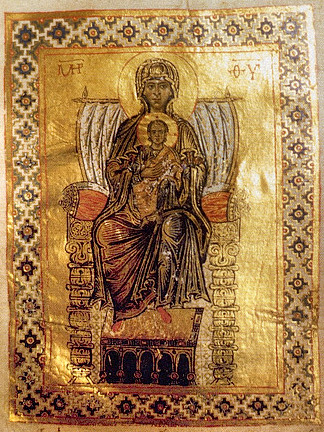
Theotokos Panachranta. Mid-11th-century Kievan illumination from the Gertrude Psalter.
Le mystère de la
maternité divine de la Vierge Marie
Commentaire de l’Evangile
du Jour (1er Janvier 2023, Sainte Marie Mère de Dieu) de l’Abbé Thierry
Delumeau :
« Les bergers se
hâtèrent d’aller à Bethléem, et ils découvrirent Marie et
Joseph, avec le nouveau-né couché dans la mangeoire. » (Lc
2,16). Le mystère de la naissance de l’enfant Dieu, né de la Vierge
Marie, nous conduit à méditer le mystère de la maternité divine de Marie. Très
tôt, en 431, le Concile d’Ephèse affirme, contre le patriarche de
Constantinople, Nestorius, que Marie est Mère de Dieu. Celui-ci refusait à
Marie le titre de Théotokos (Mère de Dieu), lui préférant le titre de
Christokos (Mère du Christ). Bien que ce dernier soit vrai, il n’en demeure pas
moins, qu’il ne peut rendre pleinement la profondeur du mystère de la maternité
de la Vierge Marie. De fait, si l’enfant est bien Dieu, celle qui l’a mis au
monde est bien la Mère de Dieu, même, si elle-même, bien entendu, n’est pas
Dieu. Or, Nestorius, en refusant ce titre à la Vierge Marie, invite à penser
que l’enfant n’est pas tout à fait la personne du Verbe, du Fils de Dieu,
autrement dit la deuxième personne de la Sainte Trinité. Ceci amène à voir
inéluctablement deux personnes, l’une qui serait divine et l’autre humaine.
Ainsi l’erreur de Nestorius conduit à la confusion entre les deux natures
divine et humaine de Jésus et la personne unique de Jésus qui, elle, est bien
divine. Le concile d’Ephèse affirmera donc la doctrine des deux
natures dans l’unique personne du Fils de Dieu, ayant pris chair de la Vierge
Marie et c’est donc en vertu de cette union des deux natures dans la personne
du Verbe que Marie est Mère de Dieu. Plus tard, le Concile de Chalcédoine, en
451, précisera davantage le mystère de l’Incarnation, à cause d’une confusion
conduisant à faire « absorber » la nature humaine dans la divine, ce
qui conduit à penser que le Fils de Dieu n’aurait eu qu’une apparence humaine
: « Un seul et même Christ, Fils, Seigneur, l’unique engendré,
reconnu en deux natures, sans confusion, sans changement, sans division et sans
séparation, … la propriété de l’une et l’autre nature étant gardée et
concourant à une seule personne, un Christ ne se fractionnant ni se divisant en
deux personnes, mais un seul et même Fils, unique engendré, Dieu Verbe,
Seigneur Jésus Christ ».
Tout cela peut paraître
bien compliqué, certes. Mais cela est d’une importance absolument essentielle
de préciser le mystère de la foi. D’ailleurs, les saints, qui n’étaient, loin
de là, tous bardés de connaissances théologiques, comprenaient ces vérités de
foi. De fait, si Marie, n’est pas la Mère de Dieu, alors Jésus n’est pas Dieu
et si Jésus n’est pas Dieu, comment peut-il sauver l’homme ? Ainsi, on le voit,
dire quelque chose de faux sur Marie, conduit à formuler quelque chose de faux
sur Jésus et donc à ruiner le mystère de la foi. Ceci nous amène à affirmer, et
les Pères de l’Eglise le percevaient bien, qu’on ne peut pas évacuer la Vierge
Marie du mystère de la foi, la traiter comme d’une question subalterne. Si Dieu
s’est incarné du sein de la Vierge Marie, en prenant le soin et la délicatesse
de lui demander son « fiat » par l’entremise de l’ange Gabriel, qui
serions-nous pour penser que son rôle ne fut pas essentiel ou minime, puisque
l’histoire de l’humanité repose sur la réponse de la Mère de Dieu à Dieu ? Cela
ne veut pas dire que Dieu ne pouvait pas faire autrement, mais tout simplement
que Dieu n’a pas voulu faire autrement. D’ailleurs, n’en va-t-il pas pour
chacun d’entre nous ? Dieu ne me sauvera pas contre ma volonté, mais bien avec,
puisque le salut ne s’impose pas à moi, mais il m’est donné à la mesure de mon
coeur, de telle sorte que, plus je le désire, plus je grandis dans la sainteté
et plus le bonheur du ciel sera grand. Effectivement, le salut n’est autre que
de vivre de l’amour de Dieu, et l’on comprend bien que plus on aime, plus on
est heureux. Là, une fois de plus, il nous faut nous tourner vers la
Vierge Marie, car elle est bien l’experte en la matière : qui a plus aimé
qu’elle ? Personne. Or, non seulement, elle est la Mère de Dieu, mais il se
trouve qu’elle est devenue notre mère : « Femme, voici ton
Fils! » (Jn 19,26). Une mère n’est-elle pas censée donner ce qu’il y
a de meilleur à son enfant ? Un bébé n’a-t’il pas de meilleur refuge que les
bras de sa maman ? C’est ainsi que Jésus en donnant sa vie sur le bois de la
Croix, nous donne sa mère et il nous confie à elle pour que nous puissions
trouver en elle notre refuge. C’est ce qu’elle a dit à la petite Lucie à
Fatima, le 13 juin 1917 : « Mon Coeur Immaculé sera ton refuge et le chemin
qui te conduira jusqu’à Dieu. »
SOURCE : https://www.paroissesaintleger.fr/le-mystere-de-la-maternite-divine-de-la-vierge-marie/

Master of Saint Veronica (1400–), Madonna of the flowering sweetpea, circa 1400, tempera on wood, 58.9 x 39.5, Wallraf–Richartz Museum, Cologne
11/10 Maternité de la
Vierge Marie
La fête de la Maternité
de la Ste Vierge était fêtée en certains lieux le deuxième dimanche d’octobre,
une messe pro aliquibus locis se trouvait dans l’appendice du Missel
Romain. En 1931, pour célébrer le XVème centenaire du Concile d’Ephèse, qui
proclama le dogme de la maternité divine, Pie XI établit la fête pour l’Eglise
universelle au 11 octobre. Le formulaire est le même que celui qui préexistait,
sauf l’introït.
(Leçons des Matines)
AU PREMIER NOCTURNE
Du livre de l’Ecclésiastique [1]
Première leçon.Je suis sortie de la bouche du Très-Haut, la première engendrée avant toute créature. Dans les cieux j’ai fait surgir une lumière sans fin, et comme une vapeur j’ai couvert la terre. Au plus haut des cieux j’ai ma demeure, et mon trône, sur la colonne de nuée. Seule j’ai fait le tour du cercle des cieux, j’ai parcouru la profondeur des abîmes. Dans les flots de la mer j’ai marché, sur la terre entière j’ai séjourné, sur tout peuple et toute nation j’ai dominé. Les cœurs de tous, des grands et des petits, je les ai soumis par ma puissance. En toute choses, j’ai cherché du repos [2], et c’est dans l’héritage du Seigneur que je demeurerai.
R/. Vous êtes heureuse, sainte Vierge Marie, et digne de toute louange, * Car par vous s’est levé le soleil de justice, le Christ Notre-Seigneur, par qui nous sommes sauvés et rachetés. V/. Célébrons dans la joie la maternité de la sainte Vierge Marie. * Car.
Deuxième leçon.Alors a ordonné et m’a parlé le Créateur de l’univers ; et celui qui m’a créée a reposé dans mon tabernacle, et il m’a dit : Habite dans Jacob, et en Israël place ton héritage, et au milieu de mes élus, étends tes racines [3]. Dès le commencement et avant tous les siècles, j’ai été créée, [4] et jusqu’au siècle futur je ne cesserai pas d’être, et dans l’habitation sainte, j’ai exercé devant lui mon ministère. Et ainsi dans Sion j’ai été affermie, et dans la cité sainte je me suis reposée ; et dans Jérusalem est ma puissance. Et j’ai pris racine dans le peuple que le Seigneur a honoré, et dans la part de Dieu, [laquelle est] son héritage ; et dans l’assemblée entière des saints est ma demeure [5].
R/. Sans atteinte à votre virginité, vous êtes devenue mère du Sauveur, * Celui qui domine sur le ciel et la terre s’est enfermé en votre sein pour devenir homme. V/. Vous êtes bénie entre les femmes, et le fruit de vos entrailles est béni. * Celui.
Troisième leçon. Comme un cèdre, je me suis élevée sur le Liban, et comme un cyprès sur la montagne de Sion ; comme un palmier, je me suis élevée à Cadès, et comme des rosiers à Jéricho ; je me suis élevée comme un bel olivier dans les champs, et comme un platane sur le bord de l’eau, dans les places publiques [6]. Comme le cinnamome et le baume aromatique, j’ai répandu une odeur ; comme la myrrhe de choix, j’ai exhalé une odeur suave ; et comme le storax, le galbanum, l’onyx, le stacté, et comme le Liban qui sort sans incision [7], j’ai rempli de vapeur mon habitation et comme un baume non mélangé est mon odeur. Moi, comme un térébinthe, j’ai étendu mes rameaux, et mes rameaux sont d’honneur et de grâce.
R/. Bien des filles se sont montrées vaillantes, mais vous, vous les
surpasses toutes. * Vous êtes belle et douce en vos charmes, sainte
Mère de Dieu. V/. Qu’ils éprouvent votre secours, tous ceux qui
célèbrent votre sainte maternité. * Vous. Gloire au Père. * Vous.
AU DEUXIÈME NOCTURNE
Sermon de saint Léon, pape
Quatrième leçon. Une vierge, issue de la race royale de David, est choisie pour porter en elle le germe saint, à la fois divin et humain, qu’elle conçut dans son esprit, avant même de le concevoir en son corps. De peur que, si elle eût ignoré le dessein divin, elle n’eût été effrayée de ses conséquences inattendues, elle apprit de la bouche d’un ange ce que l’Esprit-Saint allait opérer en elle. Celle qui allait devenir la mère de Dieu ne craignit pas que ce ne fût au détriment de sa pudeur. Comment n’eut-elle pas espéré une conception insolite, celle à qui était promise l’efficacité de la puissance du Très-Haut ? La foi de l’âme croyante est encore confirmée par un précèdent miracle : à Elisabeth est donnée une fécondité inespérée ; ainsi ne pourrait-on douter que celui qui avait donné à une femme stérile la possibilité de concevoir, ne l’octroyât aussi à une vierge. Donc, le Verbe de Dieu, Dieu lui-même, fils de Dieu "qui était au commencement auprès de Dieu, par qui tout a été fait et rien sans lui" s’est fait homme pour libérer l’homme de la mort éternelle.
R/. Célébrons la très sainte maternité de la glorieuse Vierge Marie. * Le Seigneur a jeté les yeux sur sa petitesse, et à la parole de l’ange elle a conçu le Sauveur du monde. V/. Chantons gloire au Christ en cette sainte solennité de l’admirable Mère de Dieu. * Le.
Cinquième leçon. Jésus Christ, notre Seigneur, descend de son trône du ciel pour pénétrer notre misère, sans pourtant quitter la gloire de son Père, en des conditions tout à fait nouvelles et d’une manière inusitée. Dans des conditions nouvelles, puisque invisible en soi, il se rend visible à nous, incompréhensible, il accepte d’être appréhendé, éternel, il commence à exister dans le temps. — D’une manière inusitée, puisque conçu et né d’une vierge sans la participation d’un homme et sans que soit faite injure à l’intégrité de sa mère. Une telle naissance convenait en effet au futur Sauveur des hommes qui, tout en revêtant la substance de la nature humaine, ignorerait les souillures de la chair. Il serait différent de nous par l’origine, mais semblable par la nature. Nous le croyons, cette naissance fut en dehors du cours normal de la génération humaine, mais elle s’appuya sur la puissance de Dieu, puisque la virginité de la mère demeura intacte dans la conception, l’enfantement et la suite des temps.
R/. Vous êtes la fille bénie par le Seigneur, car par vous nous avons reçu le fruit de vie. * Seule, plus que toute autre vous avez été agréable à Jésus Christ notre Seigneur. V/. Ne rejettez pas nos prières dans nos détresses, mais délivrez-nous de tous périls, sainte Mère de Dieu. * Seule.
Sixième leçon. En l’an 1931, aux applaudissements de tout l’univers catholique, on célébrait le quinzième centenaire du concile d’Éphèse, au cours duquel la bienheureuse Vierge Marie, de qui est né Jésus, fut proclamée, contre l’hérésie de Nestorius, Mère de Dieu par les Pères en union avec le Pape Célestin ; le Souverain Pontife Pie XI voulut que le souvenir de cet heureux événement fut perpétué par un témoignage constant de sa piété. Il existait à Rome un monument glorieux de la proclamation d’Éphèse, l’arc triomphal de la basilique de Sainte-Marie-Majeure, sur l’Esquilin, orné par son prédécesseur Sixte III d’admirables mosaïques, mais détérioré par l’injure du temps ; il le fit heureusement restaurer à ses frais, ainsi que l’aile transversale de la basilique. Il décrivit dans une lettre encyclique la vraie physionomie du concile œcuménique d’Éphèse et exposa abondamment et avec piété le privilège ineffable de la Maternité divine de la bienheureuse Vierge Marie, afin que la connaissance d’un mystère si sublime se gravât plus profondément dans les âmes des fidèles. En même temps il proposa Marie Mère de Dieu, bénie entre toutes les femmes, et la famille de Nazareth, comme un modèle à imiter, illustre entre tous, tant pour la dignité et la sainteté d’un chaste mariage que pour la pieuse éducation de la jeunesse. Enfin, pour que subsistât aussi un monument liturgique, il décréta que la fête de la Maternité divine de la bienheureuse Vierge Marie serait célébrée chaque année le 11 octobre par l’Église universelle, sous le rite double de deuxième classe, avec une Messe et un office propres.
R/. Vous êtes bénie entre les femmes, et le fruit de vos entrailles est
béni. * Comment m’est-il donné que la mère de mon Seigneur vienne à
moi ? V/. Il s’est penché sur son humble servante, et le
Puissant a fait pour moi des merveilles. * Comment. Gloire au
Père. * Comment.
AU DEUXIÈME NOCTURNE
Lecture du saint Évangile selon saint Luc
En ce temps-là, tandis que ses parents s’en retournaient, l’enfant Jésus resta à Jérusalem, et ses parents ne s’en aperçurent pas. Et la suite.
Homélie de saint Bernard, abbé
Septième leçon. Marie donne au Dieu et Seigneur des anges le nom de "fils" : "Mon fils, pourquoi nous as-tu fait cela ?" Quel est l’ange qui oserait en dire autant ? Il leur suffit, et ils le tiennent déjà pour un grand honneur, d’être promus et appelés "anges" par grâce, alors qu’ils sont par nature des esprits, au témoignage de David : "des esprits, le Seigneur fait ses anges". Mais Marie sait qu’elle est sa mère et, en toute simplicité, elle appelle son fils celui que les anges servent avec respect. Quant à Dieu, il ne dédaigne pas de recevoir le titre de ce qu’il a daigné être. Peu après, l’évangéliste ajoute : "Et il leur était soumis". Qui ? — A qui ? — Dieu à des hommes ! Dieu, dis-je, dont les anges sont les sujets, à qui obéissent Principautés et Puissances, c’est à Marie qu’il se soumet !
R/. Vous êtes heureuse, Vierge Marie, Mère de Dieu, qui avez cru au Seigneur. Elles se sont accomplies, les choses qui vous ont été annoncées. * Aussi vous êtes bénie de Dieu à jamais. V/. La grâce est répandue sur vos lèvres ; intercédez pour nous auprès du Seigneur, notre Dieu. * Aussi.
Huitième leçon. Des deux merveilles, laquelle faut-il admirer davantage ? La condescendance toute d’amour du Fils ou la dignité si remarquable de sa Mère ? Toutes deux provoquent la stupeur car elles sont toutes deux un prodige. Dieu obéit à une femme : humilité sans exemple ! Une femme commande à Dieu : sublimité sans pareille ! Comme un privilège des vierges, le Cantique assure qu’« elles suivent l’Agneau partout où il va ». De quelles louanges, pensez-vous sera digne celle qui même le précède ? Apprends, homme, l’obéissance ! Apprends, limon, la soumission ! Apprends, poussière, l’humble dépendance ! C’est en parlant de ton Créateur que l’évangéliste dit : "Et il leur était soumis". Rougis, cendre imbibée d’orgueil ! Dieu s’abaisse pendant que tu t’élèves ! Dieu se soumet aux hommes et toi, n’aspirant qu’à les dominer, tu veux prendre rang au-dessus de ton Créateur !
R/. Félicitez-moi, vous tous qui aimez Dieu. * Car, toute petite, j’ai plu au Très-Haut, et de mon sein, j’ai enfanté Dieu fait homme. V/. Tous les âges me diront bienheureuse, car Dieu s’est penché sur son humble servante. * Car. Gloire au Père. * Car.
Neuvième leçon. Heureuse Marie à qui n’ont manqué ni l’humilité ni la
virginité ! Singulière virginité que la fécondité, au lieu d’y apporter
atteinte, a magnifiée ! Humilité non moins notable, que cette féconde
virginité, au lieu de l’éteindre, a exaltée ! Incomparable fécondité enfin
qu’accompagnent la virginité et l’humilité ! Tout n’est-il pas ici
admirable, inégalable, inouï ? Il serait étonnant que vous n’hésitiez pas
pour savoir ce qui vous paraît le plus digne d’admiration : la fécondité
chez une vierge ou la virginité chez une mère, l’élévation que cause un tel
enfantement ou l’humilité qui lui est jointe ? A moins que, sans doute,
tout cela ne vous semble en même temps préférable et que vous ne pensiez
incomparablement meilleur et heureux de recevoir à la fois tous ces bienfaits.
D’ailleurs, quoi d’étonnant à ce que Dieu qui, nous le lisons, "est
admirable dans ses saints", se montrât plus admirable encore en sa
Mère ? Vénérez donc, épouses, l’intégrité de sa chair dans une chair
corruptible et vous, vierges consacrées, vénérez la fécondité dans une vierge.
Vous tous, qui que vous soyez, imitez l’humilité de la Mère de Dieu.
[1] La sainte Église met le
passage de l’Ecclésiastique qu’on va lire sur les lèvres de Marie. Cette
application des textes de l’Ancien Testament parlant de la Sagesse à la Vierge
Marie est traditionnelle en Occident. Une exégèse fondamentaliste et les influences
protestantes sur une soit-disante ‘rénovation du culte marial’ ont entraîné une
rupture dans la tradition romaine et l’abandon de ces textes dans la liturgie
mariale
[2] En toutes choses j’ai
tendu vers mon centre, ma fin suprême.
[3] La très sainte Vierge
habita en effet parmi les descendants de Jacob, c’est dans la terre d’Israël
qu’elle enfanta le Christ, son fils unique, puis, spirituellement, les premiers
Chrétiens, car elle est le chef, la mère, la gardienne de tous les élus.
(Cornélius a Lapide)
[4] La bienheureuse Vierge
a été prédestinée de toute éternité pour être la première, la reine, la
souveraine de toutes les créatures. Avant que je naquisse, peut-elle dire en
vérité, j’étais présente à Dieu ; avant que j’existasse, je lui étais bien
connue ; il m’a choisie avant la création du monde, pour que je fusse
sainte et immaculée en sa présence, dans la charité. (Rupert.)
[5] Marie possède, et la
plénitude de la grâce et la plénitude de la gloire de tous les Saints.
(Cornélius a Lapide) C’est à juste titre que sa demeure est dans l’assemblée
entière des Saints, car il ne lui a manqué ni la foi des Patriarches, ni l’inspiration
des Prophètes, ni le zèle des Apôtres, ni le courage des Martyrs, ni la
prudence des Confesseurs, ni la chasteté des Vierges, ni la fécondité des
épouses, ni la pureté des Anges. (S. Bernard.)
[6] L’âme sainte de Marie
est comparée au cèdre à cause de l’élévation, de la rectitude, de la solidité
et de l’incorruptibilité de cet arbre ; elle est aussi comparée au cyprès
odorant, dont les rameaux ne sont jamais sans verdure ; au palmier, dont
les branches sont autant de signes de victoire, et qui, de ses doux fruits,
nourrit les hommes ; à la rose, reine des fleurs par sa beauté et son
parfum ; à l’olivier, symbole de paix, de douceur, de sagesse et de chasteté ;
au platane, à l’ombre duquel se repose et se rafraîchit le voyageur fatigué.
Les trois plantes aromatiques citées ensuite indiquent l’humilité, la patience,
la mortification ; enfin les noms de divers aromates que l’on mélange avec
l’encens nous rappelleront la suavité de la prière qui monte devant Dieu, d’un
cœur pur et riche de vertus.
[7] Le Liban, c’est-à-dire
l’oliban, premier encens qui découle de l’arbre
SOURCE : https://www.introibo.fr/11-10-Maternite-de-la-Vierge-Marie

La maternité spirituelle
de Marie dans l’Eglise
"La bienheureuse
Vierge, prédestinée de toute éternité, à l’intérieur du dessein d’incarnation
du Verbe, pour être la Mère de Dieu, fut sur la terre, en vertu d’une
disposition de la grâce divine, l’aimable Mère du divin Rédempteur,
généreusement associée à son œuvre à un titre absolument unique, humble
servante du Seigneur. En concevant le Christ, en le mettant au monde, en le
nourrissant, en le présentant dans le Temple à son Père, en souffrant avec son
Fils qui mourait sur la croix, elle apporta à l’œuvre du Sauveur une
coopération absolument sans pareille par son obéissance, sa foi, son espérance,
son ardente charité, pour que soit rendue aux âmes la vie surnaturelle. C’est
pourquoi elle a été pour nous, dans l’ordre de la grâce, notre Mère.
A partir du consentement
qu’elle apporta par sa foi au jour de l’Annonciation et qu’elle maintint dans
sa fermeté sous la croix, cette maternité de Marie dans l’économie de la grâce
se continue sans interruption jusqu’à la consommation définitive de tous les
élus. En effet, après son Assomption au ciel, son rôle dans le salut ne
s’interrompt pas: par son intercession répétée elle continue à nous obtenir les
dons qui assurent notre salut éternel. Son amour maternel la rend attentive aux
frères de son Fils dont le pèlerinage n’est pas achevé, ou qui se trouvent
engagés dans les périls et les épreuves, jusqu’à ce qu’ils parviennent à la
patrie bienheureuse. C’est pourquoi la bienheureuse Vierge est invoquée dans
l’Eglise sous les titres divers comme avocate, auxiliatrice, secourable,
médiatrice, tout cela cependant entendu de telle sorte que nulle dérogation,
nulle addition n’en résulte quant à la dignité et à l’efficacité de l’unique
Médiateur, le Christ.
Aucune créature en effet
ne peut jamais être mise sur le même pied que le Verbe incarné et rédempteur.
Mais tout comme le sacerdoce du Christ est participé sous des formes diverses,
tant par les ministres que par le peuple fidèle, et tout comme l’unique bonté
de Dieu se répand réellement sous des formes diverses dans les créatures, ainsi
l’unique médiation du Rédempteur n’exclut pas, mais suscite au contraire une
coopération variée de la part des créatures, en dépendance de l’unique
source.
Ce rôle subordonné de
Marie, l’Eglise le professe sans hésitation; elle ne cesse d’en faire
l’expérience; elle le recommande au cœur des fidèles pour que cet appui et ce
secours maternels les aident à s’attacher plus intimement au Médiateur et
Sauveur."
Du Concile Vatican
II (Constitution dogmatique sur l’Eglise Lumen Gentium, nn.
61-62)
Prière
Préparé par le
Département de Théologie Spirituelle de
L’Université Pontificale de la Sainte-Croix
SOURCE : https://www.vatican.va/spirit/documents/spirit_20010501_concilio-vaticano-ii_fr.html
.jpg)
Follower
of Robert Campin (1375/1379–1444), The Virgin
and Child before a Firescreen (Madonna and
Child / Nursing Madonna), circa 1425, oil and tempera on oak wood with
walnut additions, 63.4 48.5, National Gallery, Central
London
LEÇON DU BRÉVIAIRE ROMAIN
L'an mil neuf cent trente
et un, aux applaudissements de l'univers catholique, on célébra la solennité du
quinzième siècle écoulé depuis qu'au concile d'Éphèse, la bienheureuse Vierge
Marie dont est né Jésus, fut, en protestation contre l'hérésie de Nestorius,
proclamée Mère de Dieu par les Pères, sous le pontificat du pape Célestin. Le
Souverain pontife Pie XI voulut perpétuer le souvenir de ce très heureux
événement par un témoignage durable de sa piété. C'est Pourquoi, comme il
existait à Rome un glorieux monument de la proclamation d'Éphèse, savoir :
l'arc triomphal de la Basilique Sainte-Marie-Majeure, sur l'Esquilin, Orné par
son prédécesseur Sixte III de superbes mosaïques, mais détérioré par l'injure
du temps, il prit soin de le faire heureusement restaurer à ses frais en même
temps que l'aile transversale de la Basilique. Puis par une Lettre encyclique,
décrivant la physionomie authentique du Concile œcuménique d'Éphèse, il exposa
pieusement et amplement l'ineffable privilège de la Maternité de la
bienheureuse Vierge Marie, afin que la doctrine d'un mystère si excellent
pénétrât plus profondément dans l'esprit des fidèles. En même temps, il proposa
la Vierge Marie, Mère de Dieu, bénie entre toutes les femmes, avec la Famille
de Nazareth, comme le plus noble exemple entre tous offert à notre imitation,
tant pour la dignité et la sainteté du mariage chrétien, que pour l'éducation
convenable à donner à la jeunesse. Enfin, pour que la liturgie gardât ce
souvenir, il ordonna que la fête de la divine Maternité de la Bienheureuse
Vierge Marie, avec Messe et Office propres, fût célébrée chaque année, le onze
Octobre, sous le rite double de seconde classe, par l'Église universelle.
SOURCE : http://www.icrsp.org/Calendriers/Le%20Saint%20du%20Jour/maternite_divine.htm
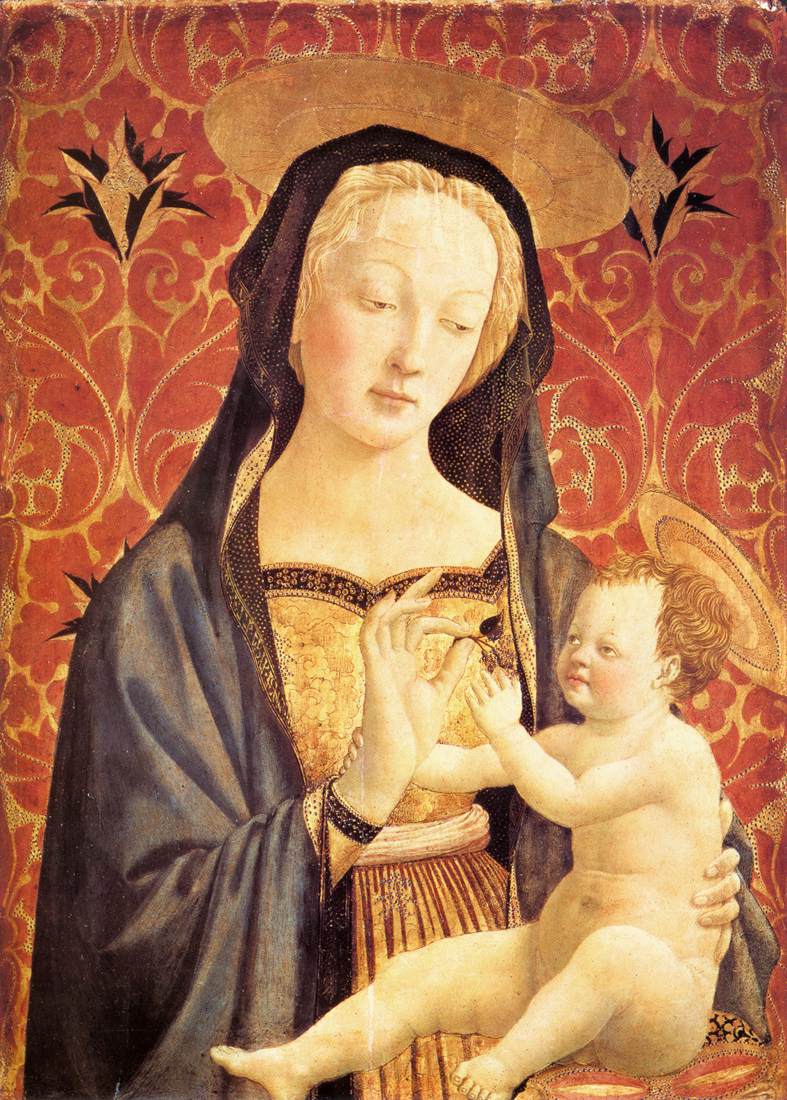
Domenico Veneziano (1410–1461), Madonna and
Child, circa 1450, tempera on wood, 86 x 61, Harvard
University Center for Italian Renaissance Studies (1856: in collection
of Marianna Paulucci ;16 April 1900: in
collection of Bernard Berenson)
Maternité divine de la Sainte Vierge
Mt 1, 18-25 : La
maternité divine
Dans l’annonce à Joseph
(Mt 1,18-25), trois phrases (ou expressions) dénotent le caractère divin de
l’enfant conçu par Marie :
"Il sauvera son
peuple" (Mt 2,21) : cette expression se rapporte uniquement à Dieu.
L’expression "son
peuple" est très forte.
Le Nouveau Testament, en
héritant du langage de l’Ancien Testament, rapporte cette expression uniquement
à Dieu qui avait choisi Israël comme son peuple.
Maintenant, par l’œuvre
du Christ, Dieu s’est acquis un nouveau peuple, formé aussi des gentils (Ac
15,14; Hé 4,9; 10,30; 1 Pt 2,10; Tt 2,14).
Si dans la première
alliance le peuple était exclusivement celui de YHWH, au temps de la nouvelle
alliance il appartient en même temps au Père et au Fils, le Christ.
Le nouvel Emmanuel a reçu
tout pouvoir au ciel et sur la terre (Mt 28,19). Donc il a aussi "son
peuple" (Mt 1,21), qui est le peuple de Dieu (cf. Mt 2,6).
En relation à ce nouveau
peuple qu’il s’est acquis, Jésus dira: "Sur cette pierre j’édifierai mon
Eglise" (Mt 16,18) "Allez annoncer à mes Frère" (Mt 28,10)
"Je suis avec vous…" (Mt 28,20).
"… de ses
péchés" (Mt 2,21) : sauver des péchés est une prérogative divine.
"… de ses
péchés" (Mt 2,21d) Ces paroles aussi sont un témoignage indirect de la
divinité de Christ.
Nous l’apprenons de la
suite de l’évangile. "Jésus, voyant leur foi, dit au paralytique: Aie
confiance, mon enfant, tes péchés sont remis. Et voici que quelques scribes se
dirent par-devers eux: Celui-là blasphème." (Mt 9,3)
Marc précise encore mieux
: "Qui peut remettre les péchés sinon Dieu seul ?" (Mc 2,7)
"Emmanuel… Dieu avec
nous" (Mt 2, 23) : cette appellation doit être comprise dans son sens
plein (cf. Mt 28, 20).
Selon la doctrine de
Matthieu, cette appellation "Emmanuel… Dieu avec nous" (Mt 2, 23)
doit être comprise dans son sens plein, c’est à dire dans son sens post-pascal.
Jésus ressuscité, en apparaissant aux disciples, il leur promet: "Et voici
que je suis avec vous pour toujours jusqu’à la fin du monde." (Mt 28,20).
L’Emmanuel n’est donc pas
simplement un homme, aussi prestigieux soit-il. On pouvait le penser d’Ezéchias
annoncé par Is 7,14. Mais nous sommes ici dans une autre situation.
L’Emmanuel-Christ est le ressuscité, qui a révélé sa divinité dans le mystère
pascal.
Aussi pour le premier
évangéliste, il y n’a absolument aucun doute que le fils de Marie soit de
nature unique, un Être divin ! Plus tard Jésus dira : "Il y a ici plus que
le temple" (Mt 12,6) "il y a ici plus que Jonas !.. il y a plus que
Salomon! " (Mt 12,41.42).
A.SERRA
Extraits de A.SERRA, "Madre di Dio", nel Nuovo dizionario di mariologia, a cura di de Fiores, ed. san Paolo 1985, p.726-727
SOURCE : http://www.mariedenazareth.com/10522.0.html?&L=0

Dieric Bouts (circa 1420–1475), Madonna and Child, circa 1465, oil on egg tempera, 37.1 x 27.6, National Gallery, Central London
Sainte Marie, Mère de
Dieu : une maternité portée par tous les baptisés
Jean-Michel Castaing - publié
le 31/12/20
À l’image de la Vierge
Marie, les chrétiens peuvent « mettre Dieu au monde » en accomplissant Sa
volonté. Ce privilège est attesté par les paroles de Jésus lui-même.La
Tradition a toujours compris la Vierge Marie comme la figure de l’Église.
Autrement dit, tout ce qui est dit de la mère du Christ peut être affirmé
également de l’Église. Par exemple, en professant l’assomption de la Vierge à
la fin de son existence terrestre, la foi nous apprend qu’un jour toute
l’Église sera elle aussi élevée au ciel comme l’assemblée des ressuscités
chantant avec les anges la louange du Très-Haut. Dans cet ordre d’idée, cette
équivalence entre mystère marial et mystère de l’Église vaut-elle également
pour le dogme de la maternité divine de Marie ? Rappelons au passage que
Marie est mère de la personne divine du Verbe, non de sa divinité — car la
génération humaine a toujours pour terme une personne, non un simple corps
organique. Or, la personne à laquelle appartiennent toutes les actions du
Christ, vrai Dieu et vrai homme, est la seconde personne de la Trinité,
c’est-à-dire une personne divine. Voilà pourquoi Marie est mère de Dieu, non
d’un être humain qui « porterait » Dieu.
Revenons à notre
question : pouvons-nous enfanter Jésus en nous comme le fit Marie ?
On objectera que seule la Vierge a engendré à la vie humaine le Fils éternel du
Père en lui donnant une nature similaire à la nôtre. Jésus ne pouvant naître
humainement qu’une seule fois (comme tous les hommes), comment pourrions-nous à
notre tour donner naissance charnellement au Verbe divin, à la deuxième
Personne de la Trinité ? C’est ici qu’il convient de saisir
spirituellement la manière convenable de transposer la maternité divine de
Marie à l’Église et à ses membres, c’est-à-dire à nous-mêmes.
Mettre Jésus au monde en
faisant la volonté de Dieu
Jean Tauleur, un mystique
du XVIe siècle, disait qu’à Noël étaient célébrées trois naissances : la
naissance dans l’éternité du Fils auquel le Père donne la divinité ; la
naissance de Jésus à Bethléem de la Vierge Marie ; enfin la naissance de
Dieu en nos âmes. Il s’agit donc de donner naissance à Dieu en nous, de même
que Marie le fit charnellement dans la ville de David. Mais de quelle façon ?
Pour éclaircir ce mystère, le plus simple est de reprendre les paroles que
Jésus adressa à ses disciples à un moment précis de son ministère public,
tandis que sa famille charnelle désirait le voir : « Qui est ma
mère ? Qui sont mes frères ? […] Quiconque fait la volonté de Dieu,
celui-là est mon frère et ma sœur et ma mère » répondit-il à ceux qui
l’avertissaient que les siens le cherchaient (Mc 3, 34-35). Donc,
en accomplissant la volonté du Père, nous devenons la mère de Jésus !
Essayons de pénétrer la raison profonde de la réponse déconcertante du Christ.
L’agir du chrétien, s’il
est conforme à la charité de Jésus, s’apparente de la sorte à un enfantement du
Christ en lui.
D’abord, faire la volonté
de Dieu fut la nourriture de Jésus toute sa vie (Jn 4, 34). Il ne
vivait que pour elle. Aimant le Père passionnément, son existence n’avait
d’autre boussole que l’accomplissement de Ses desseins. Telle était la
conséquence de son statut de Fils de Dieu. Chaque geste qu’il posait était
comme un engendrement prolongé par le Père. Aussi, le fidèle qui met ses pas
dans les siens en accomplissant la volonté divine, devient-il pareillement un
autre Christ. Ses actes reflètent et concrétisent ici et maintenant le dessein
de Dieu que le Christ a porté à la perfection en sa personne et en ses actes —
actes dont son disciple peut s’inspirer avec son talent propre, car le
christianisme est une école de créativité, non un conditionnement pour
automates mimétiques. L’agir du chrétien, s’il est conforme à la charité de
Jésus, s’apparente de la sorte à un enfantement du Christ en lui. Il met au
monde le Fils de Dieu en faisant progresser le Royaume, ce Royaume que le
Christ est lui-même selon Origène.
Enfanter Jésus pour nos
frères
Tout chrétien conséquent
qui met en pratique ce qu’il a appris de la bouche de Jésus, enfante donc en
lui la volonté du Père — cette volonté incarnée en Jésus. Il consolide de la
sorte son être de fils de Dieu. À l’instar de Marie, il donne Jésus au monde en
étendant le règne du Christ dans les cœurs. En servant ses frères, il contribue
à ce que l’Amour relie les hommes entre eux et qu’ainsi la paternité divine
gagne du terrain sur la rivalité mimétique, la compétition, la jalousie et la
défiance entre les enfants de Dieu.
Lire aussi :
Placez-vous
sous la protection de la Vierge Marie avec cette prière
Certes, à Bethléem, Marie
a déjà donné naissance à Dieu en enfantant Jésus, vrai Dieu et vrai homme.
Cependant, la Vierge n’a pas achevé son rôle d’engendrement le jour de Noël.
Elle continue son office de maternité divine en enfantant Jésus dans les
disciples de son Fils qui sont ses enfants. Avec l’aide de la Vierge et dans le
prolongement de leur baptême, les chrétiens, devenus enfants de Dieu, sont
appelés eux aussi à donner chair à Jésus en aimant leurs frères comme Jésus les
aima et continue de les aimer au Ciel. De même que Jésus fut conçu de l’Esprit,
de même le baptisé, qui est né une seconde fois d’eau et d’Esprit (Jn 3, 5), devient
capable à son tour d’incarner en sa personne la beauté et la bonté de
l’Évangile.
Ne pas rester spectateurs
Surtout, le chrétien doit
être persuadé que sa « maternité divine » est de l’ordre de la foi et
de la charité. Or, en cela, la grâce qui lui est donnée est similaire à la
maternité de Marie. En effet, la Tradition a toujours reconnu que la Vierge
était plus méritante d’avoir porté le Christ dans son cœur que dans son sein.
Marie fut digne de donner naissance à Dieu. À ce titre, sa maternité divine,
sans rien enlever à sa dimension charnelle, découle plus encore des grâces
incomparables qui étaient celles de la jeune femme de Galilée. Sa maternité
spirituelle fut plus importante que sa maternité physique. Cette primauté
du spirituel est précisément ce qui fonde notre faculté de donner Jésus au
monde sous la forme de notre charité et de notre serviabilité fraternelle. Dès
lors, en aimant comme Marie, le chrétien engendre lui aussi Jésus de façon très
concrète autour de lui et jusque dans sa propre personne. « Nous pouvons
toujours être quelques spectateurs de plus à la crèche. Mais ce que Dieu nous
demande, c’est d’être les acteurs de sa mise au monde » (Bruno
Chenu, Croire sur Parole, Bayard, 2008).
Lire aussi :
À
Noël, des géants sur le berceau d’un enfant
Perles denfants : ces
amoureux de la Vierge Marie

Vincenzo Foppa (–1515), Madonna of the Book, circa 1460, 37 x 29, Sforza Castle, Milan
Samedi, 11 octobre 2025
11 octobre. Fête de la maternité divine de la bienheureuse Vierge Marie. 431 - 1931.
Pape : Pie XI.
" C'est par la Très Sainte Vierge Marie que Jésus-Christ est venu au
monde, et c'est aussi par elle qu'il doit régner dans le monde. Marie a été
très cachée dans sa vie : c'est pourquoi elle est appelée par le Saint-Esprit
et l'Eglise Alma Mater : Mère cachée et secrète. Son humilité a été si profonde
qu'elle n'a point eu sur la terre d'attrait plus puissant et plus continuel que
de se cacher à elle-même et à toute créature, pour n'être connue que de Dieu
seul."
Saint Louis-Marie Grignon de Montfort. Traité de la vraie dévotion à la très
sainte Vierge Marie.
En 431, un concile
général convoqué à Ephèse proclama et définit le dogme de la Maternité divine
de la très Sainte Vierge. Jusque-là, il n'avait jamais été contesté qu'il y
avait deux natures en Notre-Seigneur : la nature divine et la nature humaine,
mais qu'il n'y a qu'une seule personne. Notre-Dame étant la Mère de l'unique
personne de Jésus-Christ, a le droit d'être appelée Mère de Dieu, au même titre
que nos mères, qui, bien qu'elles n'aient point formé nos âmes, mais seulement
nos corps, sont cependant appelées les mères de l'homme tout entier, corps et
âme. Car, si l'homme n'est homme qu'en tant que son âme est unie à son corps,
Jésus-Christ n'est réellement Jésus-Christ qu'autant que Sa Divinité est unie à
Son Humanité.
En 1931, à l'occasion du quinzième centenaire du grand concile d'Ephèse, Pie XI
institua la fête que nous célébrons aujourd'hui.
La Maternité divine de
Marie L'élève au-dessus de toutes les créatures. L'Église honore en ce jour cet
incomparable privilège accordé à Marie, dogme fondamental de notre sainte
religion. Grande est la dignité de la mère! Mais combien plus digne de
vénération est celle de la Mère du Fils de Dieu qui a engendré dans le temps
Celui qui est engendré du Père de toute éternité !
" Il y a dans cette maternité, dit saint Thomas, une dignité en quelque
sorte infinie, puisqu'Elle a pour Fils Celui que les anges adorent comme leur
Dieu et leur Seigneur. Cette suréminente dignité est la raison d'être de Son
Immaculée Conception, de Son élévation au-dessus des anges, de la
toute-puissance de Son crédit auprès de Dieu."
Cette élévation donne à Marie une autorité qui doit inspirer notre confiance
envers Celle que l'Église appelle Mère de Dieu, Mère du Christ, Mère de la
divine grâce, Mère très pure, Mère très chaste, Mère aimable, Mère admirable,
Mère du Créateur, Mère du Sauveur.
En nous faisant vénérer ainsi la très Sainte Vierge, l'Église veut susciter en
nos âmes un amour filial pour Celle qui est devenue notre propre Mère par la
grâce. Marie nous a tous enfantés au pied de la croix. Notre prérogative de
frères adoptifs de Jésus-Christ doit éveiller en nos coeurs une confiance
illimitée envers Marie qui nous a adoptés sur le Calvaire, lorsqu'avant de
mourir, le Sauveur nous a présenté à la Co-rédemptrice, en la personne de saint
Jean, comme les enfants qu'Il désirait La voir adopter, disant :
" Mère, voilà Votre fils ; fils, voilà votre Mère !"
Ces paroles sont comme le leg testamentaire du Christ.
" Que peut-on concevoir au-dessus de Marie ? demande saint Ambroise,
quelle grandeur surpasse celle qu'a choisie pour Mère Celui qui est la grandeur
même ?"
" Il a plu à Dieu d'habiter en Vous, ô Marie, dit saint Bernard, lorsque
de la substance de Votre chair immaculée, comme du bois incorruptible du Liban,
le Verbe S'est édifié une maison par une construction ineffable. C'est en Vous,
ô Mère unique et bien-aimée qu'Il S'est reposé et qu'Il a versé sans mesure,
tous Ses trésors..."

Emmanuel Tzanfournaris, (Panagía tou Páthous) Virgin of the Passion, circa 1585, gold leaf and tempera on panel, 33 x 26, Hellenic
Institute of Byzantine and Post-Byzantine Studies in Venice
Divine Motherhood, the
Foundation of Marian Veneration
Since the early
centuries, the first foundation of the veneration of Mary of Nazareth has been
her divine motherhood. Love of Mary is first and foremost the acknowledgment of
the “immense charge and dignity to be the Mother of the Son of God” (Vatican
II, Lumen Gentium 53).
Mary’s motherhood is
messianic
People were expecting the
Messiah, without knowing yet who he would be, priest, prophet and king… They
would read the Scriptures, and with the event of the Incarnation all
the prophecies which announced Mary’s motherhood, such as Gn 3:15 and Is 7: 14,
are fulfilled.
“With her, the daughter
of Zion par excellence, after the long wait of the Promise, the times are
fulfilled and a new economy sets in, when the Son of God took through her the
human nature to free man from sin, by the mysteries of his flesh”
(Lumen Gentium 55).
“The Father of mercies
willed that the incarnation should
be preceded by the acceptance of her who was predestined to be the mother of
His Son, so that just as a woman contributed to death, so also a woman should
contribute to life”
(Vatican
II, Lumen Gentium 56).
The term “predestined”
has nothing to do with the debates of the 17th and 18th centuries about
predestination to paradise or to hell. The correct interpretation of the term,
borrowed from the hymn to the Ephesians, is to see, as the rest of the document
invites us to do, that it celebrates God’s plan. It is impossible to think
about the Incarnation of
the Word (a part of God’s eternal plan) without thinking of his Mother. “Predestined
from eternity by that decree of divine providence which determined the incarnation of
the Word to be the Mother of God, the Blessed Virgin was in this earth the
Virgin Mother of the Redeemer, and above all others and in a singular way the
generous associate and humble handmaid of the Lord” (Lumen Gentium 61).
The divine motherhood is
for Salvation
The incarnate Word is the
Savior. The divine motherhood is for salvation and associates Mary to it: “She
conceived, brought forth and nourished Christ.
She presented him to the Father in the temple, and was united with him by compassion as
he died on the Cross. In this singular way she cooperated by her obedience,
faith, hope and burning charity in the work of the Savior in giving back
supernatural life to souls. Wherefore she is our mother in the order of grace”
(Lumen Gentium 61).
A virginal motherhood
This motherhood includes
the role of Joseph,
a just man who understands God’s intervention. This virginal motherhood is a
fact. And this fact bears great significance: God is transcendent, Christ was
born not from the desire of the flesh but from God.
But just like the
Resurrection, one can find important arguments that support the Incarnation without
proving it; both are revealed facts.
“This union of the Mother
with the Son in the work of salvation is made manifest from the time of Christ's
virginal conception up
to his death it is shown first of all when Mary, arising in haste to go to
visit Elizabeth, is greeted by her as blessed because of her belief in the
promise of salvation and the precursor leaped with joy in the womb of his
mother (cf. Lk 1: 41-45). This union is manifest also at the birth of Our Lord,
who did not diminish his mother's virginal integrity but sanctified it”
(Lumen Gentium 57).
It is a human humanity,
not in the sense that it would be in opposition to the virginal motherhood, but
to underline the fact that Christ’s
flesh is real flesh.
A free and responsible
motherhood
“Thus Mary, a daughter of
Adam, consenting to the Divine Word, became the mother of Jesus, the one and
only Mediator. Embracing God's salvific will with a full heart and impeded by
no sin, she devoted herself totally as a handmaid of the Lord to the person and
work of her Son, under him and with him, by the grace of almighty God, serving
the mystery of redemption. Rightly therefore the holy Fathers see her as used
by God not merely in a passive way, but as freely cooperating in the work of
human salvation through faith and obedience”
(Lumen Gentium 56).
A marital maternity
Mary is the spouse of the
Word, and by looking at her the Church learns also how to become the spouse of
the Word. “Piously meditating on her and contemplating her in the light of the
Word made man, the Church with reverence enters more intimately into the great
mystery of the Incarnation and
becomes more and more like her Spouse” (Lumen Gentium 65).
A motherhood that reveals
the Trinity
In her the only Son of
God the Father takes flesh, by the power of the Holy Spirit.
An eschatological
motherhood
This motherhood makes her
the New Eve (Lumen
Gentium 56), next to the New Adam, bringing to its eschatological
accomplishment the plan of the Creator.
A singular motherhood
At the foot of the cross,
it is the Son who says to the mother “behold your son” and to the disciple “behold
your mother.” Hence Mary’s motherhood is expanded.
“She conceived, brought
forth and nourished Christ.
She presented him to the Father in the temple, and was united with him by compassion as
he died on the Cross. In this singular way she cooperated by her obedience,
faith, hope and burning charity in the work of the Savior in giving back
supernatural life to souls. Wherefore she is our mother in the order of grace”
(Lumen Gentium 61).
Mary’s motherhood is
unique...
We can continue our
contemplation:
The divine motherhood is
the highest expression of God’s love for the Virgin Mary.
The divine motherhood
expresses the deeper link between Mary of Nazareth and the incarnate Word and
even between Mary and the Father and the Holy Spirit (in this sense, although
she is not part of the Trinity, she belongs to the hypostatic order, i.e. she
has a personal relationship with each Person of the Trinity).
This said, there is an
essential difference between the adoration due
to God and the veneration of Mary:
The divine motherhood
expresses the totality of Mary’s being and mission;
it explains her privileges and roles;
The divine motherhood is
the space of greatest encounter between God and man, of the new creation in its
greatest dimension;
The Virgin Mary is the
"blessed one" ... by the fact that she is the mother of God!
Thomas Aquinas’ thesis on
this question is quite simple:
“Christ’s
humanity, since it is united to God; created beatitude, since it is the
enjoyment of God; and the Blessed Virgin since she is the Mother of God, all
have somewhat of an infinite dignity, derived from the infinite good that is
God. In this respect nothing better than them can be made, like nothing can be
better than God”
(Summa Theologica, I
Qu.25 a. 6 ad 4).
Françoise Breynaert

The Blessed Virgin Mary
The Blessed Virgin Mary
is the mother of Jesus
Christ, the mother of God.
In general, the theology
and history of Mary the Mother of God follow the chronological order of their
respective sources, i.e. the Old Testament, the New Testament, the
early Christian and Jewish witnesses.
Mary prophesied in the
Old Testament
The Old Testament refers
to Our Blessed Lady both in its prophecies and
its types or figures.
Genesis 3:15
The first prophecy referring
to Mary is found in the very opening chapters of the Book of Genesis (3:15):
"I will put enmities between thee and the woman, and thy seed and
her seed; she shall crush thy head, and thou shalt lie in wait for her
heel." This rendering appears to differ in two respects from the
original Hebrew text:
(1) First, the Hebrew text employs
the same verb for the two renderings "she shall crush" and "thou
shalt lie in wait"; the Septuagint renders the
verb both times by terein, to lie in wait; Aquila, Symmachus, the Syriac and
the Samaritan translators,
interpret the Hebrew verb
by expressions which mean to crush, to bruise; the Itala renders
the terein employed in the Septuagint by
the Latin "servare",
to guard; St. Jerome [1]
maintains that the Hebrew verb
has the meaning of "crushing" or "bruising" rather than of
"lying in wait", "guarding". Still in his own work, which
became the Latin
Vulgate, the saint employs
the verb "to crush" (conterere) in the first place, and "to lie
in wait" (insidiari) in the second. Hence the punishment inflicted on
the serpent and
the serpent's retaliation
are expressed by the same verb: but the wound of the serpent is mortal,
since it affects his head, while the wound inflicted by the serpent is not
mortal, being inflicted on the heel.
(2) The second point of
difference between the Hebrew text and our
version concerns the agent who is to inflict the mortal wound on the serpent:
our version agrees with the present Vulgate text in
reading "she" (ipsa) which refers to the woman, while the Hebrew text reads hu' (autos,
ipse) which refers to the seed of the woman. According to our
version, and the Vulgate reading,
the woman herself
will win the victory; according to the Hebrew text, she will be
victorious through her seed. In this sense does the Bull "Ineffabilis"
ascribe the victory to Our Blessed Lady. The reading "she" (ipsa) is
neither an intentional corruption of the original text, nor is it an
accidental error;
it is rather an explanatory version expressing explicitly the fact of Our
Lady's part in the victory over the serpent, which is
contained implicitly in the Hebrew original.
The strength of the Christian
tradition as to Mary's share in this victory may be inferred from the
retention of "she" in St. Jerome's version
in spite of his acquaintance with the original text and with the reading
"he" (ipse) in the old Latin version.
As it is quite commonly
admitted that the Divine
judgment is directed not so much against the serpent as against
the originator of sin,
the seed of the serpent denotes
the followers of the serpent,
the "brood of vipers", the "generation of vipers", those
whose father is the Devil,
the children of evil, imitando,
non nascendo (Augustine).
[2] One may be tempted to understand the seed of the woman in a similar
collective sense, embracing all who are born of God. But seed not only
may denote a particular person, but has such a
meaning usually, if the context allows it. St. Paul (Galatians 3:16)
gives this explanation of the word "seed" as it occurs in the patriarchal promises:
"To Abraham were
the promises made and to his seed. He saith not, and to his seeds, as of many;
but as of one, and to his seed, which is Christ". Finally
the expression "the woman" in the
clause "I will put enmities between thee and the woman" is a literal
version of the Hebrew
text. The Hebrew Grammar of Gesenius-Kautzsch [3] establishes the rule:
Peculiar to the Hebrew is
the use of the article in order to indicate a person or thing,
not yet known and
not yet to be more clearly described, either as present or as to be taken into
account under the contextual conditions. Since our indefinite article serves
this purpose, we may translate: "I will put enmities between you and
a woman".
Hence the prophecy promises
a woman, Our
Blessed Lady, who will be the enemy of the serpent to a marked
degree; besides, the same woman will be
victorious over the Devil,
at least through her offspring. The completeness of the victory is emphasized
by the contextual phrase "earth shall thou eat", which is according
to Winckler [4] a common old-oriental expression denoting the deepest
humiliation [5].
Isaias 7:1-17
The second prophecy referring
to Mary is found in Isaias 7:1-17.
Critics have endeavoured to represent this passage as a combination of
occurrences and sayings from the life of the prophet written
down by an unknown hand [6]. The credibility of the contents is not necessarily
affected by this theory, since prophetic traditions may be
recorded by any writer without losing their credibility. But even Duhm
considers the theory as an apparent attempt on the part of the critics to find out
what the readers are willing to bear patiently; he believes it is a real
misfortune for criticism itself
that it has found a mere compilation in a passage which so graphically
describes the birth-hour of faith.
According to 2 Kings 16:1-4,
and 2 Chronicles
27:1-8, Achaz,
who began his reign 736 B.C., openly professed idolatry, so that God gave him into
the hands of the kings of Syria and Israel. It appears that
an alliance had been concluded between Phacee, King of Israel, and Rasin, King
of Damascus, for
the purpose of opposing a barrier to the Assyrian aggressions. Achaz, who
cherished Assyrian proclivities,
did not join the coalition; the allies invaded his territory, intending to
substitute for Achaz a
more subservient ruler, a certain son of Tabeel. While Rasin was occupied in
reconquering the maritime city Elath, Phacee alone proceeded against Juda, "but they
could not prevail". After Elath had fallen, Rasin joined his forces with
those of Phacee; "Syria hath
rested upon Ephraim", whereupon "his (Achaz') heart was moved,
and the heart of his people, as the trees of the woods are moved with the
wind". Immediate preparations must be made for a protracted siege,
and Achaz is
busily engaged near the upper pool from which the city received the greater
part of its water supply. Hence the Lord says to Isaias: "Go forth
to meet Achaz. .
.at the end of the conduit of the upper pool". The prophet's commission
is of an extremely consoling nature: "See thou be quiet; hear not, and let
not thy heart be afraid of the two tails of these firebrands". The scheme
of the enemies shall not succeed: "it shall not stand, and this shall not
be." What is to be the particular fate of the enemies?
Syria will gain
nothing, it will remain as it has been in the past: "the head of Syria is Damascus, and the head
of Damascus is
Rasin".
Ephraim too will remain
in the immediate future as it has been hitherto: "the head of Ephraim
is Samaria, and
the head of Samaria the
son of Romelia"; but after sixty-five years it will be destroyed,
"within threescore and five years Ephraim shall cease to be a
people".
Achaz had abandoned
the Lord for Moloch, and put his
trust in an alliance with Assyria; hence the
conditional prophecy concerning Juda, "if you will
not believe, you
shall not continue". The test of belief follows
immediately: "ask thee a sign of the Lord thy God, either unto the
depth of hell or
unto the height above". Achaz hypocritically answers:
"I will not ask, and I will not tempt the Lord", thus
refusing to express his belief in God, and preferring
his Assyrian policy.
The king prefers Assyria to God, and Assyria will come:
"the Lord shall
bring upon thee and upon thy people, and upon the house of thy father, days
that have not come since the time of the separation of Ephraim from Juda with the king
of the Assyrians."
The house of David has
been grievous not merely to men, but to God also by its
unbelief; hence it "shall not continue", and, by an irony of Divine
punishment, it will be destroyed by those very men whom it
preferred to God.
Still the general Messianic promises
made to the house of David cannot
be frustrated: "The Lord Himself shall
give you a sign. Behold a virgin shall
conceive, and bear a son, and his name shall be called Emmanuel. He shall eat
butter and honey, that he may know to refuse the evil and to choose
the good. For
before the child know to refuse the evil, and to choose
the good, the
land which thou abhorrest shall be forsaken of the face of her two kings."
Without answering a number of questions connected with the explanation of
the prophecy, we
must confine ourselves here to the bare proof that
the virgin mentioned
by the prophet is
Mary the Mother of Christ.
The argument is based on the premises that the prophet's virgin is the
mother of Emmanuel,
and that Emmanuel is Christ. The relation of
the virgin to Emmanuel is clearly
expressed in the inspired words;
the same indicate also the identity of Emmanuel with
the Christ.
The connection of Emmanuel with the
extraordinary Divine sign which was to be given to Achaz predisposes
one to see in the child more than a common boy. In 8:8, the prophet ascribes to
him the ownership of the land of Juda: "the
stretching out of his wings shall fill the breadth of thy land, O Emmanuel". In 9:6, the government
of the house of David is
said to be upon his shoulders, and he is described as being endowed with more
than human qualities:
"a child is born to us, and a son is given to us, and the government is
upon his shoulders, and his name shall be called Wonderful, Counsellor, God the Mighty, the
Father of the World to Come, and the Prince of Peace". Finally, the prophet calls Emmanuel "a
rod out of the root of Jesse" endowed with "the spirit of the Lord. .
.the spirit of
wisdom and of understanding, the spirit of counsel,
and of fortitude, the spirit of
knowledge and of godliness"; his advent shall be followed by the general
signs of the Messianic era,
and the remnant of the chosen people shall
be again the people of God (11:1-16).
Whatever obscurity or
ambiguity there may be in the prophetic text
itself is removed by St.
Matthew (1:18-25).
After narrating the doubt of St. Joseph and
the angel's assurance,
"that which is conceived in her is of the Holy Ghost",
the Evangelist proceeds:
"now all this was done that it might be fulfilled which the Lord spoke by
the prophet,
saying: Behold a virgin shall
be with child, and bring forth a son, and they shall call his name Emmanuel." We need
not repeat the exposition of the passage given by Catholic commentators who
answer the exceptions raised against the obvious meaning of the Evangelist. We may infer
from all this that Mary is mentioned in the prophecy of Isaias as mother
of Jesus Christ;
in the light of St.
Matthew's reference to the prophecy, we may add
that the prophecy predicted
also Mary's virginity untarnished
by the conception of the Emmanuel [7].
Micheas 5:2-3
A third prophecy referring
to Our Blessed Lady is contained in Micah 5:2-3:
"And thou, Bethlehem,
Ephrata, art a little one among the thousands of Juda: out of thee shall
be come forth unto me that is to be the ruler in Israel, and his going
forth is from the beginning, from the days of eternity. Therefore will
he give them up till the time wherein she that travaileth shall bring forth,
and the remnant of his brethren shall be converted to the children of Israel." Though
the prophet (about
750-660 B.C.) was a contemporary of Isaias, his prophetic activity
began a little later and ended a little earlier than that of Isaias. There can be
no doubt that
the Jews regarded
the foregoing prediction as
referring to the Messias.
According to St.
Matthew (2:6)
the chief priests and scribes, when asked
where the Messias was
to be born, answered Herod in
the words of the prophecy,
"And thou Bethlehem the
land of Juda. .
." According to St.
John (7:42),
the Jewish populace
gathered at Jerusalem for
the celebration of the feast asked the rhetorical question: "Doth not
the Scripture say
that Christ cometh
of the seed of David,
and from Bethlehem,
the town where David was?"
The Chaldee paraphrase of Micah 5:2, confirms
the same view: "Out of thee shall come forth unto me the Messias, that he may
exercise dominion in Israel".
The very words of the prophecy admit
of hardly any other explanation; for "his going forth is from the
beginning, from the days of eternity".
But how does the prophecy refer to
the Virgin Mary? Our Blessed Lady is denoted by the phrase, "till the time
wherein she that travaileth shall bring forth". It is true that "she
that travaileth" has been referred to the Church (St. Jerome, Theodoret), or to the
collection of the Gentiles united
with Christ (Ribera, Mariana), or again
to Babylon (Calmet); but, on the one
hand, there is hardly a sufficient connection between any of these events and
the promised redeemer,
on the other hand, the passage ought to read "till the time wherein she
that is barren shall bring forth" if any of these events were referred to
by the prophet.
Nor can "she that travaileth" be referred to Sion: Sion is spoken of
without figure before
and after the present passage so that we cannot expect the prophet to lapse
suddenly into figurative language. Moreover, the prophecy thus
explained would not give a satisfactory sense. The contextual phrases "the
ruler in Israel",
"his going forth", which in Hebrew implies
birth, and "his brethren" denote an individual, not a nation; hence
we infer that the bringing forth must refer to the same person. It has been
shown that the person of the ruler is the Messias; hence "she
that travaileth" must denote the mother of Christ, or Our Blessed
Lady. Thus explained the whole passage becomes clear: the Messias must be
born in Bethlehem,
an insignificant village in Juda: his family must be
reduced to poverty and
obscurity before the time of his birth; as this cannot happen if the theocracy remains
intact, if David's house
continues to flourish, "therefore will he give them up till the time
wherein she that travaileth shall bring forth" the Messias. [8]
Jeremias 31:22
A fourth prophecy referring
to Mary is found in Jeremias 31:22;
"The Lord has
created a new thing upon the earth: A woman shall compass
a man". The text of the prophet Jeremias offers no
small difficulties for the scientific interpreter; we shall follow the Vulgate version of
the Hebrew original.
But even this rendering has been explained in several different ways:
Rosenmuller and several conservative Protestant interpreters
defend the meaning, "a woman shall protect a
man"; but such a motive would hardly induce the men of Israel to return
to God. The
explanation "a woman shall seek a
man" hardly agrees with the text; besides, such an inversion of the
natural order is presented in Isaias 4:1, as a
sign of the greatest calamity. Ewald's rendering, "a woman shall change
into a man", is hardly faithful to the original text. Other commentators see in
the woman a type of the Synagogue or of
the Church, in
man the type of God, so that they
explain the prophecy as
meaning, "God will
dwell again in the midst of the Synagogue (of the
people of Israel)"
or "the Church will
protect the earth with its valiant men". But the Hebrew text hardly
suggests such a meaning; besides, such an explanation renders the passage
tautological: "Israel shall
return to its God,
for Israel will love its God". Some recent
writers render the Hebrew original:
"God creates
a new thing upon the earth: the woman (wife)
returns to the man (her husband)". According to the old law (Deuteronomy 24:1-4; Jeremiah 3:1) the
husband could not take back the wife once repudiated by him; but the Lord will do
something new by allowing the faithless wife, i.e. the guilty nation, to return
to the friendship of God.
This explanation rests upon a conjectural correction of the text; besides, it
does not necessarily bear the Messianic meaning
which we expect in the passage.
The Greek Fathers generally
follow the Septuagint
version, "The Lord has
created salvation in
a new plantation, men shall go about in safety"; but St. Athanasius twice
[9] combines Aquila's version "God has created a
new thing in woman"
with that of the Septuagint,
saying that the new plantation is Jesus Christ, and that
the new thing created in woman is the body
of the Lord,
conceived within the virgin without the co-operation of man. St. Jerome too [10]
understands the prophetic text
of the virgin conceiving the Messias. This meaning of
the passage satisfies the text and the context. As the Word Incarnate possessed
from the first moment of His conception all His perfections excepting those
connected with His bodily development, His mother is rightly said to
"compass a man". No need to point out that such a condition of a
newly conceived child is rightly called "a new thing upon earth". The
context of the prophecy describes
after a short general introduction (30:1-3) Israel's future
freedom and restoration in four stanzas: 30:4-11, 12-22; 30:23; 31:14, 15-26; the
first three stanzas end with the hope of the Messianic time. The
fourth stanza, too, must be expected to have a similar ending. Moreover,
the prophecy of Jeremias, uttered about
589 B.C. and understood in the sense just explained, agrees with the
contemporary Messianic expectations
based on Isaias
7:14; 9:6; Micah 5:3. According
to Jeremias, the
mother of Christ is
to differ from other mothers in this, that her child, even while within her
womb, shall possess all those properties which constitute real manhood [11].
The Old Testament refers
indirectly to Mary in those prophecies which
predict the Incarnation of
the Word of God.
Old Testament types and
figures of Mary
In order to be sure of
the typical sense,
it must be revealed,
i.e. it must come down to us through Scripture or tradition. Individual
pious writers have developed copious analogies between
certain data of the Old
Testament and corresponding data of the New; however ingenious
these developments may be, they do not prove that God really intended
to convey the corresponding truths in the inspired text of
the Old Testament.
On the other hand, it must be kept in mind that not all truths contained in
either Scripture or tradition have been
explicitly proposed to the faithful as matters
of belief by
the explicit definition of
the Church.
According to the principle
"Lex orandi est lex credenti" we must treat at least with reverence
the numberless suggestions contained in the official prayers and liturgies of
the Church. In
this sense we must regard many of the titles bestowed on Our Blessed Lady in
her litany and
in the "Ave
maris stella". The Antiphons and Responses found in
the Offices recited
on the various feasts of
Our Blessed Lady suggest a number of types of Mary that
hardly could have been brought so vividly to the notice of the Church's ministers in
any other way. The third antiphon of Lauds of the Feast of the Circumcision sees
in "the bush that was not burnt" (Exodus 3:2) a figure of Mary
conceiving her Son without
the loss of her virginity.
The second antiphon of Lauds of the
same Office sees
in Gideon's fleece
wet with dew while all the ground beside had remained dry (Judges 6:37-38)
a type of
Mary receiving in her womb the Word Incarnate [12].
The Office of
the Blessed Virgin applies to Mary many passages concerning the spouse in
the Canticle of
Canticles [13] and also concerning Wisdom in the Book of Proverbs
8:22-31 [14]. The application to Mary of a "garden enclosed, a
fountain sealed up" mentioned in Canticles 4:12 is only a particular
instance of what has been said above. [15] Besides, Sara, Debbora, Judith, and Esther are
variously used as figures of
Mary; the ark of the
Covenant, over which the presence of God manifested
itself, is used as the figure of Mary
carrying God Incarnate within
her womb. But especially Eve, the mother of all
the living (Genesis
3:20), is considered as a type of Mary who is
the mother of all the living in the order of grace [16].
Mary in the gospels
The reader of the Gospels is at first
surprised to find so little about Mary; but this obscurity of Mary in the Gospels has been
studied at length by Blessed
Peter Canisius [17], Auguste Nicolas [18], Cardinal Newman [19],
and Very Rev. J.
Spencer Northcote [20]. In the commentary on the "Magnificat",
published 1518, even Luther expresses
the belief that
the Gospels praise
Mary sufficiently by calling her (eight times) the Mother of Jesus. In the following
paragraphs we shall briefly group together what we know of Our Blessed
Lady's life before the birth of her Divine Son, during the
hidden life of Our Lord, during His
public life and
after His resurrection.
Mary's Davidic ancestry
St. Luke (2:4) says that St. Joseph went
from Nazareth to Bethlehem to be
enrolled, "because he was of the house and family of David". As if to
exclude all doubt concerning
the Davidic descent
of Mary, the Evangelist (1:32, 69) states
that the child born of Mary without the intervention of man shall be given
"the throne of David His
father", and that the Lord God has
"raised up a horn of salvation to us in
the house of David his
servant". [21] St.
Paul too testifies that Jesus Christ "was
made to him [God] of
the seed of David,
according to the flesh" (Romans 1:3). If Mary
were not of Davidic descent,
her Son conceived
by the Holy Ghost could
not be said to be "of the seed of David". Hence commentators tell
us that in the text "in the sixth month the angel Gabriel was
sent from God. .
.to a virgin espoused to a man
whose name was Joseph,
of the house of David"
(Luke 1:26-27);
the last clause "of the house of David" does not refer
to Joseph, but
to the virgin who
is the principal person in
the narrative; thus we have a direct inspired testimony
to Mary's Davidic descent.
[22]
While commentators generally
agree that the genealogy found
at the beginning of the first Gospel is
that of St. Joseph, Annius of Viterbo proposes
the opinion, already alluded to by St. Augustine,
that St. Luke's genealogy gives the
pedigree of Mary. The text of the third Gospel (3:23) may be
explained so as to make Heli the father of
Mary: "Jesus. .
.being the son (as it was supposed of Joseph) of Heli", or "Jesus. . .being the son
of Joseph, as it
was supposed, the son of Heli" (Lightfoot,
Bengel, etc.), or again "Jesus. . .being as it
was supposed the son of Joseph, who was [the
son-in-law] of Heli"
[23]. In these explanations the name of Mary is not mentioned explicitly, but
it is implied; for Jesus is
the Son of Heli through
Mary.
Her parents
Though few commentators adhere
to this view of St.
Luke's genealogy,
the name of Mary's father, Heli, agrees with the
name given to Our Lady's father in a tradition founded
upon the report of the Protoevangelium
of James, an apocryphal Gospel
which dates from the end of the second century. According to this document
the parents of
Mary are Joachim and Anna. Now, the
name Joachim is only a variation of Heli or Eliachim,
substituting one Divine name (Yahweh) for the other (Eli, Elohim). The tradition as to
the parents of
Mary, found in the Gospel of James, is reproduced by St. John Damascene [24], St. Gregory of Nyssa [25], St. Germanus of
Constantinople [26], pseudo-Epiphanius [27], pseudo-Hilarius [28],
and St. Fulbert of
Chartres [29]. Some of these writers add that the birth of Mary was
obtained by the fervent prayers of Joachim and Anna in their
advanced age. As Joachim belonged
to the royal family of David, so Anna is supposed to
have been a descendant of the priestly family of Aaron; thus Christ the Eternal
King and Priest sprang
from both a royal and priestly family [30].
The hometown of Mary's
parents
According to Luke 1:26, Mary
lived in Nazareth,
a city in Galilee,
at the time of the Annunciation.
A certain tradition maintains
that she was conceived and
born in the same house in which the Word became flesh [31].
Another tradition based
on the Gospel of James regards Sephoris as the
earliest home of Joachim and Anna, though they are
said to have lived later on in Jerusalem, in a house
called by St. Sophronius of Jerusalem [32] Probatica. Probatica, a
name probably derived from the sanctuary's nearness to the pond
called Probatica or Bethsaida in John
5:2. It was here that Mary was born. About a century later, about A.D.
750, St. John
Damascene [33] repeats the statement that Mary was born in the
Probatica.
It is said that, as early
as in the fifth century the empress Eudoxia built a church over the place where
Mary was born, and where her parents lived in
their old age. The present Church of St. Anna stands at a distance of only
about 100 Feet from the pool Probatica. In 1889, 18 March, was discovered
the crypt which
encloses the supposed burying-place of St. Anna. Probably this
place was originally a garden in which both Joachim and Anna were laid to
rest. At their time it was still outside of the city walls, about 400 feet
north of the Temple.
Another crypt near St. Anna's tomb is
the supposed birthplace of the Blessed Virgin; hence it is that in early times
the church was called St. Mary of the Nativity [34]. In the Cedron Valley, near the
road leading to the Church of the Assumption, is a little sanctuary containing
two altars which
are said to stand over the burying-places of
Sts. Joachim and Anna; but these graves belong to
the time of the Crusades [35].
In Sephoris too
the Crusaders replaced
by a large church an ancient sanctuary which stood over the legendary house of
Sts. Joachim and Anna. After 1788 part of
this church was restored by the Franciscan Fathers.
Her Immaculate Conception
The Immaculate Conception of
Our Blessed Lady has been treated in a SPECIAL ARTICLE.
The birth of Mary
As to the place of the
birth of Our Blessed Lady, there are three different traditions to be
considered.
First, the event has been
placed in Bethlehem.
This opinion rests on the authority of the following witnesses: it is expressed
in a writing entitled "De nativ. S. Mariae" [36] inserted after the
works of St. Jerome;
it is more or less vaguely supposed by the Pilgrim of Piacenza, erroneously
called Antoninus Martyr, who wrote about A.D. 580 [37]; finally the popes Paul II (1471), Julius II (1507), Leo X (1519), Paul III (1535), Pius IV (1565), Sixtus V (1586),
and Innocent XII (1698)
in their Bulls concerning
the Holy House of
Loreto say that the Blessed Virgin was born, educated, and greeted by
the angel in
the Holy House.
But these pontiffs hardly
wish to decide an historical question; they merely express the opinion of their
respective times.
A second tradition placed
the birth of Our Blessed Lady in Sephoris, about three
miles north of Bethlehem,
the Roman Diocaesarea,
and the residence of Herod Antipas till
late in the life of
Our Lord. The antiquity of this opinion may be inferred from the fact that
under Constantine a
church was erected in Sephoris to
commemorate the residence of Joachim and Anna in that place
[38]. St. Epiphanius speaks
of this sanctuary [39]. But this merely shows that Our Blessed Lady may have
lived in Sephoris for
a time with her parents,
without forcing us to believe that
she had been born there.
The third tradition, that Mary was
born in Jerusalem,
is the most probable one. We have seen that it rests upon the testimony of St.
Sophronius, St. John
Damascene, and upon the evidence of the recent finds in the Probatica.
The Feast of Our
Lady's Nativity was not celebrated in Rome till toward
the end of the seventh century; but two sermons found among the writings
of St. Andrew of
Crete (d. 680) suppose the existence of this feast, and lead one to
suspect that it was introduced at an earlier date into some other churches
[40]. In 799 the 10th canon of
the Synod of Salzburg prescribes
four feasts in honour of the
Mother of God: the Purification,
2 February; the Annunciation,
25 March; the Assumption,
15 August; the Nativity,
8 September.
The Presentation of Mary
According to Exodus 13:2 and 13:12,
all the Hebrew first-born male
children had to be presented in the Temple. Such a law would lead
pious Jewish parents to observe
the same religious rite with regard to other favourite children. This inclines
one to believe that Joachim and Anna presented in
the Temple their
child, which they had obtained by their long, fervent prayers.
As to Mary, St. Luke (1:34) tells us that
she answered the angel announcing
the birth of Jesus
Christ: "how shall this be done, because I know not man". These
words can hardly be understood, unless we assume that Mary had made a vow of virginity; for, when she
spoke them, she was betrothed to St. Joseph. [41] The
most opportune occasion for such a vow was her presentation in
the Temple. As
some of the Fathers admit
that the faculties of St.
John the Baptist were prematurely developed by a special intervention
of God's power,
we may admit a similar grace for the child
of Joachim and Anna. [42]
But what has been said
does not exceed the certainty of antecedently probable pious conjectures. The
consideration that Our
Lord could not have refused His Blessed Mother any favours which
depended merely on His munificence does not exceed the value of an a
priori argument. Certainty in
this question must depend on external testimony and the teaching of
the Church.
Now, the Protoevangelium
of James (7-8), and the writing entitled "De nativit. Mariae" (7-8),
[43] state that Joachim and Anna, faithful to
a vow they
had made, presented the
child Mary in the Temple when
she was three years old; that the child herself mounted the Temple steps, and
that she made her vow of virginity on this
occasion. St.
Gregory of Nyssa [44] and St. Germanus of
Constantinople [45] adopt this report; it is also followed by
pseudo-Gregory of Nazianzus in his "Christus patiens". [46] Moreover,
the Church celebrates
the Feast of the
Presentation, though it does not specify at what age the child Mary was
presented in the Temple,
when she made her vow of virginity, and what were
the special natural and supernatural gifts with
which God endowed
her. The feast is
mentioned for the first time in a document of Manuel Commenus, in 1166;
from Constantinople the feast must have
been introduced into the western Church, where we
find it at the papal court at Avignon in 1371;
about a century later, Pope Sixtus IV introduced
the Office of
the Presentation,
and in 1585 Pope
Sixtus V extended the Feast of the Presentation to
the whole Church.
Her betrothal to Joseph
The apocryphal writings to
which we referred in the last paragraph state that Mary remained in the Temple after
her presentation in
order to be educated with
other Jewish children.
There she enjoyed ecstatic
visions and daily visits of the holy angels.
When she was fourteen,
the high priest wished
to send her home for marriage.
Mary reminded him of her vow of virginity, and in his
embarrassment the high
priest consulted the Lord. Then he called all
the young men of the family of David, and promised Mary
in marriage to
him whose rod should sprout and become the resting place of the Holy Ghost in form
of a dove. It was Joseph who
was privileged in this extraordinary way.
We have already seen
that St. Gregory of
Nyssa, St. Germanus
of Constantinople, and pseudo-Gregory Nazianzen seem to adopt these
legends. Besides, the emperor Justinian allowed
a basilica to
be built on the platform of the former Temple in memory of
Our Lady's stay in the sanctuary; the church was called the New St. Mary's so
as to distinguish it from the Church of the Nativity. It seems to be the modern
mosque el-Aksa. [47]
On the other hand,
the Church is
silent as to Mary's stay in the Temple. St. Ambrose [48],
describing Mary's life before the Annunciation, supposes
expressly that she lived in the house of her parents. All the
descriptions of the Jewish
Temple which can claim any scientific value leave us in ignorance as to any
localities in which young girls might have been educated. Joas's stay in
the Temple till
the age of seven does not favour the supposition that young girls were educated within the
sacred precincts; for Joas was king, and was forced by circumstances to remain
in the Temple (cf. 2 Kings 11:3).
What 2
Maccabees 3:19, says about "the virgins also that
were shut up" does not show that any of them were kept in the Temple buildings.
If the prophetess Anna is said (Luke 2:37) not to
have "departed from the temple, by fastings and prayer serving
night and day", we do not suppose that she actually lived in one of
the temple rooms.
[49] As the house of Joachim and Anna was not far
distant from the Temple,
we may suppose that the holy child Mary was
often allowed to visit the sacred buildings in order to satisfy her devotion.
Jewish maidens were
considered marriageable at
the age of twelve years and six months, though the actual age of the bride
varied with circumstances. The marriage was
preceded by the betrothal,
after which the bride legally belonged to the bridegroom, though she did not
live with him till about a year later, when the marriage used to be
celebrated. All this agrees well with the language of the Evangelists. St. Luke (1:27) calls Mary
"a virgin espoused to a man
whose name was Joseph"; St. Matthew (1:18) says,
"when as his mother Mary was espoused to Joseph, before they came
together, she was found with child, of the Holy Ghost". As we
know of no brother of Mary, we must suppose that she was an heiress, and was
obliged by the law of Numbers 36:6 to
marry a member of her tribe.
The Law itself
prohibited marriage within
certain degrees of
relationship, so that the marriage of even an
heiress was left more or less to choice.
According to Jewish custom, the
union between Joseph and
Mary had to be arranged by the parents of St. Joseph. One might
ask why Mary consented to her betrothal, though she
was bound by her vow of virginity. As she
had obeyed God's inspiration
in making her vow,
so she obeyed God's inspiration
in becoming the affianced bride of Joseph. Besides, it
would have been singular among the Jews to
refuse betrothal or marriage; for all
the Jewish maidens
aspired after marriage as
the accomplishment of a natural duty. Mary trusted the
Divine guidance implicitly, and thus was certain that her vow would be kept
even in her married state.
The Annunciation
The Annunciation has
been treated in a SPECIAL
ARTICLE.
The Visitation
According to Luke 1:36,
the angel Gabriel told
Mary at the time of the annunciation,
"behold, thy cousin Elizabeth, she also hath
conceived a son in her old age, and this is the sixth month with her that was
called barren". Without doubting the truth of the angel's words, Mary
determined at once to add to the pleasure of her
pious relative. [50] Hence the Evangelist continues
(1:39):
"And Mary, rising up in those days, went into the hill country with haste
into a city of Juda.
And she entered into the house of Zachary, and saluted Elizabeth." Though
Mary must have told Joseph of
her intended visit, it is hard to determine whether he accompanied her; if the
time of the journey happened to coincide with one of the festal seasons at
which the Israelites had
to go to the Temple,
there would be little difficulty about companionship.
The place of Elizabeth's home
has been variously located by different writers: it has been placed in
Machaerus, over ten miles east of the Dead Sea, or in Hebron, or again in the
ancient sacerdotal city
of Jutta, about seven miles south of Hebron, or finally in
Ain-Karim, the traditional St. John-in-the Mountain, nearly four miles west
of Jerusalem.
[51] But the first three places possess no traditional memorial
of the birth or life of St. John; besides,
Machaerus was not situated in the mountains of Juda; Hebron and Jutta
belonged after the Babylonian
captivity to Idumea,
while Ain-Karim lies in the "hill country" [52] mentioned in
the inspired text
of St. Luke.
After her journey of
about thirty hours, Mary "entered into the house of Zachary, and
saluted Elizabeth"
(Luke 1:40).
According to tradition, Elizabeth lived at
the time of the visitation not
in her city home, but in her villa, about ten minutes distant from the city;
formerly this place was marked by an upper and lower church. In 1861 the
present small Church of the Visitation was erected on the ancient foundations.
"And it came to pass
that, when Elizabeth heard
the salutation of Mary, the infant leaped in
her womb." It was at this moment that God fulfilled the
promise made by the angel to
Zachary (Luke 1:15),
"and he shall be filled with the Holy Ghost, even from
his mother's womb"; in other words, the infant in Elizabeth's womb
was cleansed from the stain of original sin. The
fullness of the Holy
Ghost in the infant overflowed,
as it were, into the soul of
his mother: "and Elizabeth was
filled with the Holy
Ghost" (Luke
1:41). Thus both child and mother were sanctified by the
presence of Mary and the Word Incarnate [53];
filled as she was with the Holy Ghost, Elizabeth "cried
out with a loud voice, and said: Blessed art thou among women, and blessed is
the fruit of thy womb. And whence is this to me, that the mother of my Lord should come to
me? For behold, as soon as the voice of thy salutation sounded in my ears,
the infant in
my womb leaped for joy.
And blessed art thou that hast believed, because those
things shall be accomplished that were spoken to thee by the Lord" (Luke 1:42-45).
Leaving to commentators the
full explanation of the preceding passage, we draw attention only to two
points:
Elizabeth begins
her greeting with the words with which the angel had finished
his salutation, thus showing that both spoke in the same Holy Spirit;
Elizabeth is the
first to call Mary by her most honourable title
"Mother of God".
Mary's answer is the
canticle of praise commonly called "Magnificat" from
the first word of its Latin text;
the "Magnificat" has
been treated in a SEPARATE
ARTICLE.
The Evangelist closes
his account of the Visitation with
the words: "And Mary abode with her about three months; and she returned
to her own house" (Luke 1:56). Many
see in this brief statement of the third gospel an
implied hint that Mary remained in the house of Zachary till the birth of John the Baptist, while
others deny such an implication. As the Feast of the Visitation was
placed by the 43rd canon of
the Council of Basle (A.D.
1441) on 2 July, the day following the Octave of the Feast of St. John the Baptist, it
has been inferred that Mary may have remained with Elizabeth until
after the child's circumcision;
but there is no further proof for this
supposition. Though the visitation is so
accurately described in the third Gospel, its feast does not
appear to have been kept till the thirteenth century, when it was introduced
through the influence of the Franciscans; in 1389 it
was officially instituted by Urban VI.
Mary's pregnancy becomes
known to Joseph
After her return from Elizabeth, Mary
"was found with child, of the Holy Ghost" (Matthew 1:18). As
among the Jews, betrothal was a
real marriage,
the use of marriage after
the time of espousals presented
nothing unusual among them. Hence Mary's pregnancy could not astonish anyone
except St. Joseph.
As he did not know the mystery of
the Incarnation,
the situation must have been extremely painful both to him and to Mary.
The Evangelist says:
"Whereupon Joseph her
husband being a just man, and not willing publicly to expose her, was minded
to put her away privately"
(Matthew 1:19).
Mary left the solution of the difficulty to God, and God informed the
perplexed spouse in His own time of the true condition of
Mary. While Joseph "thought
on these things, behold the angel of the Lord appeared
to him in his sleep, saying: Joseph, son of David, fear not to take
unto thee Mary thy wife, for that which is conceived in her is of the Holy Ghost. And she
shall bring forth a son, and thou shalt call his name Jesus. For He
shall save His
people from their sins"
(Matthew 1:20-21).
Not long after this revelation, Joseph concluded
the ritual marriage contract
with Mary. The Gospel simply
says: "Joseph rising
up from sleep did as the angel of the Lord had
commanded him, and took unto him his wife" (Matthew 1:24).
While it is certain that between the betrothal and
the marriage at
least three months must have elapsed, during which Mary stayed with Elizabeth, it is
impossible to determine the exact length of time between the two ceremonies. We do not
know how long after the betrothal the angel announced to Mary
the mystery of
the Incarnation,
nor do we know how long the doubt of Joseph lasted,
before he was enlightened by the visit of the angel. From the age at
which Hebrew maidens
became marriageable, it is possible that Mary gave birth to her Son when she was
about thirteen or fourteen years of age. No historical document tells
us how old she actually was at the time of the Nativity.
The journey to Bethlehem
St. Luke (2:1-5) explains
how Joseph and
Mary journeyed from Nazareth to Bethlehem in obedience to
a decree of Caesar Augustus which
prescribed a general enrolment. The questions connected with this decree have been
considered in the article BIBLICAL CHRONOLOGY.
There are various reasons why Mary should have accompanied Joseph on this
journey; she may not have wished to lose Joseph's protection
during the critical time of her pregnancy, or she may have followed a special
Divine inspiration impelling her to go in order to fulfil the prophecies concerning
her Divine Son,
or again she may have been compelled to go by the civil law either as an
heiress or to settle the personal tax payable by women over twelve
years of age. [54]
As the enrolment had
brought a multitude of strangers to Bethlehem, Mary
and Joseph found
no room in the caravansary and had to take lodging in a grotto which served as
a shelter for animals. [55]
Mary gives birth to Our
Lord
"And it came to
pass, that when they were there, her days were accomplished, that she should be
delivered" (Luke
2:6); this language leaves it uncertain whether the birth of Our Lord took place
immediately after Joseph and
Mary had taken lodging in the grotto, or several days later. What is said about
the shepherds "keeping the night watches over their flock" (Luke 2:8) shows
that Christ was
born in the night time.
After bringing forth
her Son, Mary
"wrapped Him up in swaddling clothes, and laid Him in a manger" (Luke 2:7), a sign
that she did not suffer from the pain and weakness of childbirth. This
inference agrees with the teaching of some of the principal Fathers and theologians: St. Ambrose [56], St. Gregory of Nyssa [57], St. John Damascene [58],
the author of Christus patiens [59], St. Thomas [60],
etc. It was not becoming that the mother of God should be subject to the
punishment pronounced in Genesis 3:16,
against Eve and
her sinful daughters.
Shortly after the birth
of the child, the shepherds, obedient to
the angelic invitation,
arrived in the grotto, "and they found Mary and Joseph, and the infant lying in the
manger" (Luke
2:16). We may suppose that the shepherds spread the glad tidings they had
received during the night among their friends in Bethlehem, and that the
Holy Family was received by one of its pious inhabitants into more suitable
lodgings.
The Circumcision of Our
Lord
"And after eight
days were accomplished, that the child should be circumcised, his name
was called Jesus"
(Luke 2:21). The
rite of circumcision was
performed either in the synagogue or in the
home of the Child;
it is impossible to determine where Our Lord's Circumcision took
place. At any rate, His Blessed Mother must have been present at the ceremony.
The Presentation
According to the law of Leviticus 12:2-8,
the Jewish mother
of a male child had to present herself forty days after his birth for legal purification;
according to Exodus
13:2, and Numbers
18:15, the first-born
son had to be presented on the same occasion. Whatever reasons Mary
and the Infant might
have for claiming an exemption, they complied with the law. But, instead
of offering a
lamb, they presented the sacrifice of
the poor,
consisting of a pair of turtle-doves or two young pigeons. In 2 Corinthians 8:9, St. Paul informs
the Corinthians that Jesus Christ "being
rich. . .became poor,
for your sakes, that through his poverty you might
be rich". Even more acceptable to God than
Mary's poverty was
the readiness with which she surrendered her Divine Son to the
good pleasure of His
Heavenly Father.
After the ceremonial rites had
been complied with, holy
Simeon took the Child in his arms,
and thanked God for
the fulfilment of his promises; he drew attention to the universality of
the salvation that
was to come through Messianic redemption
"prepared before the face of all peoples: a light to the revelation of
the Gentiles,
and the glory of thy people Israel" (Luke 2:31 sq.).
Mary and Joseph now
began to know their Divine
Child more fully; they "were wondering at those things which were
spoken concerning him" (Luke 2:33). As if
to prepare Our Blessed Mother for the mystery of
the cross, holy Simeon said to
her: "Behold this child is set for the fall, and for the resurrection of
many in Israel,
and for a sign which shall be contradicted. And thy own soul a sword shall
pierce, that, out of many hearts, thoughts may be revealed" (Luke 2:34-35). Mary
had suffered her first great sorrow at the time when Joseph was
hesitating about taking her for his wife; she experienced her second great
sorrow when she heard the words of holy Simeon.
Though the incident of
the prophetess Anna had a more
general bearing, for she "spoke of him (the Child) to all that
looked for the redemption of Israel" (Luke 2:38), it must
have added greatly to the wonder of Joseph and Mary.
The Evangelist's concluding
remark, "after they had performed all things according to the law of the Lord, they
returned into Galilee,
to their city Nazareth"
(Luke 2:39), has
been variously interpreted by commentators; as to the
order of events, see the article CHRONOLOGY OF THE LIFE OF
JESUS CHRIST.
The visit of the Magi
After the Presentation, the Holy
Family either returned to Bethlehem directly,
or went first to Nazareth,
and then moved into the city of David. At any
rate, after the "wise
men from the east" had followed the Divine guidance to Bethlehem,
"entering into the house, they found the child with Mary his mother, and
falling down they adored him;
and opening their treasures, they offered him gifts; gold, frankincense, and
myrrh" (Matthew
2:11). The Evangelist does
not mention Joseph;
not that he was not present, but because Mary occupies the principal place near
the Child. How
Mary and Joseph disposed
of the presents offered by their wealthy visitors
has not been told us by the Evangelists.
The flight to Egypt
Soon after the departure
of the wise men Joseph received the
message from the angel
of the Lord to fly into Egypt with
the Child and
His mother on account of the evil designs of Herod; the holy man's
ready obedience is
briefly described by the Evangelist in the
words: "who arose, and took the child and his mother by night, and retired
into Egypt"
(Matthew 2:14). Persecuted Jews had ever
sought a refuge in Egypt (cf. 1 Kings 11:40; 2 Kings 25:26);
about the time of Christ Jewish colonists
were especially numerous in the land of the Nile [61];
according to Philo [62] they numbered at least a million. In Leontopolis, in the
district of Heliopolis, the Jews had a temple (160
B.C.-A.D. 73) which rivalled in splendour the temple in Jerusalem.
[63] The Holy Family might therefore expect to find in Egypt a certain
amount of help and protection.
On the other hand, it
required a journey of at least ten days from Bethlehem to reach
the nearest habitable districts of Egypt. We do not know by
what road the Holy Family effected its flight; they may have followed the
ordinary road through Hebron;
or they may have gone by way of Eleutheropolis and Gaza, or again they may
have passed west of Jerusalem towards
the great military road of Joppe.
There is hardly any
historical document which will assist us in determining where the Holy Family
lived in Egypt,
nor do we know how long the enforced exile lasted. [64]
When Joseph received
from the angel the
news of Herod's death
and the command to return into the land of Israel, he "arose,
and took the child and his mother, and came into the land of Israel" (Matthew 2:21). The
news that Archelaus ruled in Judea prevented Joseph from
settling in Bethlehem,
as had been his intention; "warned in sleep [by the angel, he] retired into
the quarters of Galilee.
And coming he dwelt in a city called Nazareth" (Matthew 2:22-23).
In all these details Mary simply followed the guidance of Joseph, who in his turn
received the Divine manifestations as head of the Holy Family. There is no need
to point out the intense sorrow which Mary suffered on account of the
early persecution of
the Child.
The Holy Family in
Nazareth
The life of the Holy
Family in Nazareth was
that of the ordinary poor tradesman.
According to Matthew
13:55, the townsfolk asked "Is not this the carpenter's son?";
the question, as expressed in the second Gospel (Mark 6:3), shows a
slight variation, "Is not this the carpenter?" While Joseph gained the
livelihood for the Holy Family by his daily work, Mary attended to the
various duties of
housekeeper. St.
Luke (2:40)
briefly says of Jesus:
"And the child grew, and waxed strong, full of wisdom; and the grace of God was in
him". The weekly Sabbath and
the annual great feasts interrupted the daily routine of life in Nazareth.
The finding of Our Lord
in the Temple
According to the law of Exodus 23:17, only
the men were obliged to visit the Temple on the three
solemn feasts of the year; but the women often joined
the men to satisfy their devotion. St. Luke (2:41) informs us
that "his [the child's] parents went every
year to Jerusalem,
at the solemn day of the pasch". Probably
the Child Jesus was
left in the home of friends or relatives during the days of Mary's absence.
According to the opinion of some writers, the Child did not give
any sign of His Divinity during the years of His infancy, so as to increase
the merits of Joseph's and
Mary's faith based
on what they had seen and heard at the time of the Incarnation and the
birth of Jesus. Jewish Doctors of
the Law maintained
that a boy became a son of the law at the age of
twelve years and one day; after that he was bound by the legal precepts.
The evangelist supplies
us here with the information that, "when he was twelve years old, they
going up into Jerusalem,
according to the custom of the feast, and having fulfilled the days, when they
returned, the child Jesus remained
in Jerusalem,
and his parents knew
it not" (Luke
2:42-43). Probably it was after the second festal day that Joseph and Mary
returned with the other Galilean pilgrims;
the law did
not require a longer sojourn in the Holy City. On the first
day the caravan usually made a four hours' journey, and rested for the night
in Beroth on
the northern boundary of the former Kingdom of Juda.
The crusaders built
in this place a beautiful Gothic church to
commemorate Our Lady's sorrow when she "sought him [her child] among their
kinsfolks and acquaintance, and not finding him, . . .returned into Jerusalem, seeking
him" (Luke
2:44-45). The Child was
not found among the pilgrims who had come to Beroth on their
first day's journey; nor was He found on the second day, when Joseph and Mary
returned to Jerusalem;
it was only on the third day that they "found him [Jesus] in the temple, sitting in the
midst of the doctors,
hearing them, and asking them questions. . .And seeing him, they wondered. And
his mother said to him: Son, why hast thou done so to us? behold thy father and
I have sought thee sorrowing" (Luke 2:40-48).
Mary's faith did
not allow her to fear a mere accident for her Divine Son; but she felt
that His behaviour had changed entirely from His customary exhibition of
docility and subjection. The feeling caused the question, why Jesus had treated
His parents in
such a way. Jesus simply
answered: "How is it that you sought me? did you not know, that I must be
about my father's business?" (Luke 2:49).
Neither Joseph nor
Mary understood these words as a rebuke; "they understood not the word
that he spoke to them" (Luke 2:50). It has
been suggested by a recent writer that the last clause may be understood as
meaning, "they [i.e., the bystanders] understood not the word he spoke
unto them [i.e., to Mary and Joseph]".
The remainder of Our
Lord's youth
After this, Jesus "went
down with them, and came to Nazareth" where He
began a life of work and poverty, eighteen years
of which are summed up by the Evangelist in the
few words, and he "was subject to them, and. . .advanced in wisdom, and
age, and grace with God and men" (Luke 2:51-52). The
interior life of Mary is briefly indicated by the inspired writer in
the expression, "and his mother kept all these words in her heart" (Luke 2:51). A
similar expression had been used in 2:19, "Mary
kept all these words, pondering them in her heart". Thus Mary
observed the daily life of her Divine Son, and grew in
His knowledge and love by meditating on what
she saw and heard. It has been pointed out by certain writers that the Evangelist here
indicates the last source from which he derived the material contained in his
first two chapters.
Mary's perpetual
virginity
In connection with the
study of Mary during Our
Lord's hidden life, we meet the questions of her perpetual virginity, of
her Divine motherhood, and of her personal sanctity. Her
spotless virginity has
been sufficiently considered in the article on the Virgin Birth. The
authorities there cited maintain that Mary remained a virgin when she
conceived and gave birth to her Divine Son, as well as
after the birth of Jesus.
Mary's question (Luke
1:34), the angel's answer
(Luke 1:35-37), Joseph's way of
behaving in his doubt (Matthew 1:19-25), Christ's words
addressed to the Jews (John 8:19) show
that Mary retained her virginity during
the conception of her Divine
Son. [65]
As to Mary's virginity after her
childbirth, it is not denied by St. Matthew's expressions
"before they came together" (1:18),
"her firstborn
son" (1:25),
nor by the fact that the New Testament books
repeatedly refer to the "brothers of
Jesus". [66] The words "before they came together" mean
probably, "before they lived in the same house", referring to the
time when they were merely betrothed; but even if
the words be understood of marital intercourse, they only state that the Incarnation took
place before any such intercourse had intervened, without implying that it did
occur after the Incarnation of
the Son of God.
[67]
The same must be said of
the expression, "and he knew her not till she brought forth her firstborn son" (Matthew 1:25);
the Evangelist tells
us what did not happen before the birth of Jesus, without
suggesting that it happened after his birth. [68] The name "firstborn" applies
to Jesus whether
his mother remained a virgin or
gave birth to other children after Jesus; among the Jews it was a legal
name [69], so that its occurrence in the Gospel cannot
astonish us.
Finally, the "brothers of
Jesus" are neither the sons of Mary, nor the brothers of Our Lord in
the proper sense of the word, but they are His cousins or the more or less near
relatives. [70] The Church insists
that in His birth the Son
of God did not lessen but consecrate the virginal integrity of
His mother (Secret in Mass of Purification).
The Fathers express
themselves in similar language concerning this privilege of Mary. [71]
Mary's divine motherhood
Mary's Divine motherhood
is based on the teaching of the Gospels, on the writings
of the Fathers,
and on the express definition of
the Church. St. Matthew (1:25) testifies
that Mary "brought forth her first-born son" and
that He was called Jesus.
According to St.
John (1:15) Jesus is the Word made flesh,
the Word Who assumed human nature in
the womb of Mary. As Mary was truly the mother of Jesus, and as Jesus was
truly God from
the first moment of His conception, Mary is truly the mother of God. Even the
earliest Fathers did
not hesitate to draw this conclusion as may be seen in the writings of St. Ignatius [72], St. Irenaeus [73],
and Tertullian [74].
The contention of Nestorius denying
to Mary the title "Mother of God" [75] was followed by the teaching
of the Council of
Ephesus proclaiming Mary to be Theotokos in the true sense of the
word. [76]
Mary's perfect sanctity
Some few patristic writers expressed
their doubts as
to the presence of minor moral defects in
Our Blessed Lady. [77] St. Basil, e.g.,
suggests that Mary yielded to doubt on hearing
the words of holy
Simeon and on witnessing the crucifixion. [78] St. John Chrysostom is
of opinion that Mary would have felt fear and trouble, unless the angel had explained
the mystery of
the Incarnation to
her, and that she showed some vainglory at
the marriage feast
in Cana and
on visiting her Son during
His public life together with the brothers of the Lord.
[79] St. Cyril of
Alexandria [80] speaks of Mary's doubt and
discouragement at the foot of the cross. But these Greek writers
cannot be said to express an Apostolic tradition,
when they express their private and singular opinions. Scripture and tradition agree in
ascribing to Mary the greatest personal sanctity; she is conceived without
the stain of original
sin; she shows the greatest humility and
patience in her daily life (Luke 1:38, 48); she
exhibits an heroic patience under the most trying circumstances (Luke 2:7, 35, 48; John 19:25-27).
When there is question of sin, Mary must always be
excepted. [81] Mary's complete exemption from actual sin is confirmed by
the Council of Trent (Session
VI, Canon 23): "If any one say that man once justified can
during his whole life avoid all sins, even venial ones,
as the Church holds
that the Blessed Virgin did by special privilege of God, let him be anathema."
Theologians assert that Mary was impeccable, not by the essential perfection
of her nature,
but by a special
Divine privilege. Moreover, the Fathers, at least since
the fifth century, almost unanimously maintain that the Blessed Virgin never
experienced the motions of concupiscence.
The miracle in Cana
The evangelists connect
Mary's name with three different events in Our Lord's public life:
with the miracle in Cana, with His
preaching, and with His passion. The first of
these incidents is related in John 2:1-10.
There was a marriage feast
in Cana of Galilee. . .and the
mother of Jesus was
there. And Jesus also
was invited, and his disciples,
to the marriage.
And the wine failing, the mother of Jesus saith to him:
They have no wine. And Jesus saith to her:
Woman, what is that to me and to thee? my hour is not yet come.
One naturally supposes
that one of the contracting parties was related to Mary, and that Jesus had been
invited on account of his mother's relationship. The couple must have been
rather poor,
since the wine was actually failing. Mary wishes to save her friends from the
shame of not being able to provide properly for the guests, and has recourse to
her Divine Son.
She merely states their need, without adding any further petition. In
addressing women, Jesus uniformly
employs the word "woman" (Matthew 15:28; Luke 13:12; John 4:21; 8:10; 19:26; 20:15), an
expression used by classical writers as a respectful and honourable address.
[82] The above cited passages show that in the language of Jesus the address
"woman" has a most respectful meaning. The clause "what is that
to me and to thee" renders the Greek ti emoi kai soi, which in its
turn corresponds to the Hebrew phrase mah
li walakh. This latter occurs in Judges 11:12; 2 Samuel 16:10; 19:23; 1 Kings 17:18; 2 Kings 3:13; 9:18; 2 Chronicles 35:21.
The New Testament shows
equivalent expressions in Matthew 8:29; Mark 1:24; Luke 4:34; 8:28; Matthew 27:19. The
meaning of the phrase varies according to the character of the speakers,
ranging from a most pronounced opposition to a courteous compliance. Such a
variable meaning makes it hard for the translator to find an equally variable
equivalent. "What have I to do with thee", "this is neither your
nor my business", "why art thou troublesome to me", "allow
me to attend to this", are some of the renderings suggested. In general,
the words seem to refer to well or ill-meant importunity which they endeavour
to remove. The last part of Our Lord's answer
presents less difficulty to the interpreter: "my hour is not yet
come", cannot refer to the precise moment at which the need of wine will
require the miraculous intervention
of Jesus; for in
the language of St.
John "my hour" or "the hour" denotes the time
preordained for some important event (John 4:21-23; 5:25-28; 7:30; 8:29; 12:23; 13:1; 16:21; 17:1). Hence the
meaning of Our
Lord's answer is: "Why are you troubling me by asking me for such
an intervention? The divinely appointed time for such a manifestation has not
yet come"; or, "why are you worrying? has not the time of manifesting
my power come?" The former of these meanings implies that on account of
the intercession of Mary Jesus anticipated
the time set for the manifestation of His miraculous power [83];
the second meaning is obtained by understanding the last part of Our Lord's words as
a question, as was done by St. Gregory of Nyssa [84],
and by the Arabic version of Tatian's "Diatessaron" (Rome,
1888). [85] Mary understood her Son's words in
their proper sense; she merely warned the waiters, "Whatsoever he shall
say to you, do ye" (John 2:5). There can
be no question of explaining Jesus' answer in
the sense of a refusal.
Mary during the apostolic
life of Our Lord
During the apostolic life
of Jesus, Mary
effaced herself almost completely. Not being called to aid her Son directly in
His ministry, she did not wish to interfere with His work by her untimely
presence. In Nazareth she
was regarded as a common Jewish mother; St. Matthew (3:55-56; cf. Mark 6:3) introduces
the people of the town as saying: "Is not this the carpenter's son? Is not
his mother called Mary, and his brethren James, and Joseph,
and Simon,
and Jude: and
his sisters, are they not all with us?" Since the people wish to
lower Our Lord's esteem
by their language, we must infer that Mary belonged to the lower social order
of townspeople. The parallel passage of St. Mark reads,
"Is not this the carpenter?" instead of, "Is not this the
carpenter's son?" Since both evangelists omit
the name of St.
Joseph, we may infer that he had died before this episode took place.
At first sight, it seems
that Jesus Himself
depreciated the dignity of His Blessed Mother. When He was told: "Behold
thy mother and thy brethren stand
without, seeking thee", He answered: "Who is my mother, and who are
my brethren? And
stretching forth his hand towards his disciples, he said:
Behold my mother and my brethren. For whosoever shall do the will of my Father, that is in heaven, he is my
brother, and my sister, and my mother" (Matthew 12:47-50;
cf. Mark
3:31-35; Luke
8:19-21). On another occasion, "a certain woman from the
crowd, lifting up her voice, said to him: Blessed is the womb that bore thee,
and the paps that gave thee suck. But he said: Yea rather, blessed are they who
hear the word of God,
and keep it" (Luke
11:27-28).
In reality, Jesus in both these
passages places the bond that unites the soul with God above the
natural bond of parentage which
unites the Mother of God with her Divine Son. The latter
dignity is not belittled; as men naturally
appreciate it more easily, it is employed by Our Lord as a means
to make known the real value of holiness. Jesus, therefore,
really, praises His mother in a most emphatic way; for she excelled the rest
of men in holiness not less
than in dignity. [86] Most probably, Mary was found also among the holy women who
ministered to Jesus and
His apostles during
their ministry in Galilee (cf. Luke 8:2-3);
the Evangelists do
not mention any other public appearance of Mary during the time of Jesus's journeys
through Galilee or Judea. But we must
remember that when the sun appears, even the brightest stars become invisible.
Mary during the Passion
of Our Lord
Since the Passion of Jesus Christ occurred
during the paschal week,
we naturally expect to find Mary at Jerusalem. Simeon's prophecy found its
fulfilment principally during the time of Our Lord's suffering.
According to a tradition,
His Blessed Mother met Jesus as He was
carrying His cross to Golgotha. The Itinerarium of the
Pilgrim of Bordeaux describes the memorable sites which the writer visited A.D.
333, but it does not mention any locality sacred to this meeting of Mary and
her Divine Son.
[87] The same silence prevails in the so-called Peregrinatio Silviae which used
to be assigned to A.D. 385, but has lately been placed in A.D. 533-540. [88]
But a plan of Jerusalem,
dating from the year 1308, shows a Church of St. John the Baptist with
the inscription "Pasm.
Vgis.", Spasmus Virginis, the swoon of the Virgin. During the course of
the fourteenth century Christians began to
locate the spots consecrated by
the Passion of
Christ, and among these was the place where Mary is said to have fainted at
the sight of her suffering Son. [89] Since the fifteenth
century one finds always "Sancta Maria de Spasmo" among the Stations of the Way of the
Cross, erected in various parts of Europe in imitation
of the Via Dolorosa in Jerusalem. [90] That Our
Blessed Lady should have fainted at the sight of her Son's sufferings,
hardly agrees with her heroic behaviour under the cross; still, we may
consider her woman and
mother in her meeting with her Son on the way
to Golgotha,
while she is the Mother of God at the foot of the cross.
Mary's spiritual
motherhood
While Jesus was hanging
on the cross,
"there stood by the cross of Jesus, his mother, and
his mother's sister, Mary
Cleophas, and Mary
Magdalen. When Jesus therefore
had seen his mother and the disciple standing
whom he loved,
he saith to his mother: Woman, behold thy son. After that, he saith to
the disciple:
Behold thy mother. And from that hour, the disciple took her
to his own" (John
19:25-27). The darkening of the sun and the other extraordinary phenomena in
nature must have frightened the enemies of Our Lord sufficiently
so as not to interfere with His mother and His few friends standing at the foot
of the cross. In
the meantime, Jesus had prayed for His
enemies, and had promised pardon to the penitent thief;
now, He took compassion on His desolate mother, and provided for her future.
If St. Joseph had
been still alive, or if Mary had been the mother of those who are called Our Lord's brethren or
sisters in the gospels, such a provision
would not have been necessary. Jesus uses the same
respectful title with which he had addressed his mother at the marriage feast in Cana. Then he commits
Mary to John as
his mother, and wishes Mary to consider John as her son.
Among the early writers, Origen is the only
one who considers Mary's motherhood of all the faithful in this
connection. According to him, Christ lives in
his perfect followers,
and as Mary is the Mother of Christ, so she is mother
of him in whom Christ lives.
Hence, according to Origen, man has an
indirect right to
claim Mary as his mother, in so far as he identifies himself with Jesus by the life
of grace. [91]
In the ninth century, George of Nicomedia [92] explains Our Lord's words on
the cross in
such a way as to entrust John to Mary, and
in John all
the disciples,
making her the mother and mistress of all John's companions.
In the twelfth century Rupert of Deutz explained Our Lord's words as
establishing Mary's spiritual motherhood of men, though St. Bernard, Rupert's
illustrious contemporary, does not enumerate this privilege among Our Lady's
numerous titles. [93] After this time Rupert's explanation of Our Lord's words on
the cross became
more and more common, so that in our day it has found its way into practically
all books of piety. [94]
The doctrine of Mary's
spiritual motherhood of men is contained in
the fact that she is the antitype of Eve: Eve is our natural
mother because she is the origin of our natural life; so Mary is our spiritual
mother because she is the origin of our spiritual life. Again, Mary's spiritual
motherhood rests on the fact that Christ is our
brother, being "the firstborn among
many brethren" (Romans
8:29). She became our mother at the moment she consented to the Incarnation of the Word,
the Head of the mystical
body whose members we are; and she sealed her motherhood by consenting
to the bloody sacrifice on
the cross which
is the source of our supernatural
life. Mary and the holy women (Matthew 17:56; Mark 15:40; Luke 23:49; John 19:25)
assisted at the death of Jesus on the cross; she probably
remained during the taking down of His sacred body and during His funeral. The
following Sabbath was
for her a time of grief and hope. The eleventh canon of a council held
in Cologne, in
1423, instituted against the Hussites the feast of the Dolours of Our
Blessed Lady, placing it on the Friday following the third Sunday after Easter. In 1725 Benedict XIV extended
the feast to
the whole Church,
and placed it on the Friday in Passion Week. "And from that hour,
the disciple took
her to his own" (John
19:27). Whether they lived in the city of Jerusalem or
elsewhere, cannot be determined from the Gospels.
Mary and Our Lord's
Resurrection
The inspired record of
the incidents connected with Christ's Resurrection do
not mention Mary; but neither do they pretend to give a complete account of all
that Jesus did
or said. The Fathers too
are silent as to Mary's share in the joys of her Son's triumph over death.
Still, St. Ambrose [95]
states expressly: "Mary therefore saw the Resurrection of the Lord;
she was the first who saw it and believed. Mary Magdalen too
saw it, though she still wavered". George of Nicomedia [96] infers from
Mary's share in Our
Lord's sufferings that before all others and more than all she must
have shared in the triumph
of her Son. In the twelfth century, an apparition of
the risen Saviour to His
Blessed Mother is admitted by Rupert of Deutz [97], and also by Eadmer [98], St. Bernardin of Siena [99], St. Ignatius of Loyola [100], Suarez [101], Maldonado [102],
etc. [103] That the risen Christ should have
appeared first to His Blessed Mother, agrees at least with our pious
expectations.
Though the Gospels do not
expressly tell us so, we may suppose that Mary was present when Jesus showed
himself to a number of disciples in Galilee and at the
time of His Ascension (cf. Matthew 28:7, 10, 16; Mark 16:7).
Moreover, it is not improbable that Jesus visited His
Blessed Mother repeatedly during the forty days after His Resurrection.
Mary in other books of
the New Testament
Acts 1:14-2:4
According to the Book of Acts (1:14),
after Christ's
Ascension into Heaven the apostles "went
up into an upper room", and: "all these were persevering with one
mind in prayer with
the women, and
Mary the mother of Jesus,
and with his brethren".
In spite of her exalted dignity it was not Mary, but Peter who acted as
head of the assembly (1:15).
Mary behaved in the upper room in Jerusalem as she
had behaved in the grotto at Bethlehem; in Bethlehem she had
carried for the Infant
Jesus, in Jerusalem she
nurtured the infant Church.
The friends of Jesus remained
in the upper room till "the days of the Pentecost", when
with "a sound from heaven, as of a mighty
wind coming. . .there appeared to them parted tongues as it were of fire, and
it sat upon every one of them, and they were all filled with the Holy Ghost" (Acts 2:1-4). Though
the Holy Ghost had
descended upon Mary in a special way at the time of the Incarnation, He now
communicated to her a new degree of grace. Perhaps,
this Pentecostal grace
gave to Mary the strength of properly fulfilling her duties to the
nascent Church and
to her spiritual children.
Galatians 4:4
As to the Epistles, the only
direct reference to Mary is found in Galatians 4:4:
"But when the fulness of time was come, God sent his Son, made of a woman, made under
the law".
Some Greek and Latin manuscripts, followed by
several Fathers,
read gennomenon ek gynaikos instead of genomenon ek gynaikos,
"born of a woman"
instead of "made of a woman". But this
variant reading cannot be accepted. For
though the Latin variant
rendering "natum" is the perfect participle, and does not imply the
inconveniences of its Greek original, St. Bede [105]
rejects it, on account of its less appropriate sense.
In Romans 1:3, which is
to a certain extent a parallel of Galatians 4:4, St. Paul writes genomenos
ek stermatos Daveid kata sarka, i.e. "made of the seed of David, according to the
flesh".
Tertullian [106]
points out that the word "made" implies more than the word
"born"; for it calls to mind the "Word made
flesh", and establishes the reality of the flesh made of the Virgin.
Furthermore, the Apostle employs the
word "woman" in the phrase under consideration, because he wishes to
indicate merely the sex, without any ulterior connotation. In reality, however,
the idea of
a man made
of a woman alone,
suggests the virginal
conception of the Son of God. St. Paul seems to
emphasize the true idea of the Incarnation of the Word;
a true understanding
of this mystery safeguards
both the Divinity and the real humanity of Jesus Christ. [107]
The Apostle St. John never
uses the name Mary when
speaking of Our Blessed Lady; he always refers to her as Mother of Jesus (John 2:1-3; 19:25-26). In his
last hour, Jesus had
established the relation of mother and son between Mary and John, and a child does
not usually address his mother by her first name.
Apocalypse 12:1-6
In the Apocalypse (12:1-16) occurs
a passage singularly applicable to Our Blessed Mother:
And a great sign appeared
in heaven:
A woman clothed
with the sun, and the moon under her feet, and on her head a crown of twelve
stars; and being with child, she cried travailing in birth, and was in pain to
be delivered. And there was seen another sign in heaven: and behold a
great red dragon, having seven heads, and ten horns, and on his heads seven diadems;
and his tail drew the third part of the stars of heaven; and cast them to
the earth; and the dragon stood before the woman who was ready
to be delivered; that when she should be delivered, he might devour her son.
And she brought forth a man child, who was to rule all nations with an iron
rod; and her son was taken up to God, and to his throne.
And the woman fled
into the wilderness, where she had a place prepared by God, that there they
should feed her a thousand two hundred sixty days.
The applicability of this
passage to Mary is based on the following considerations:
At least part of the
verses refer to the mother whose son is to rule all the nations with a rod of
iron; according to Psalm 2:9, this is
the Son of God, Jesus Christ, Whose
mother is Mary.
It was Mary's son that
"was taken up to God, and to his
throne" at the time of His Ascension into heaven.
The dragon, or the devil of the earthly paradise (cf. Apocalypse 12:9; 20:2), endeavoured
to devour Mary's Son from
the first moments of His birth, by stirring up the jealousy of Herod and, later
on, the enmities of
the Jews.
Owing to her unspeakable
privileges, Mary may well be described as "clothed with the sun, and the
moon under her feet, and on her head a crown of twelve stars".
It is true that commentators generally
understand the whole passage as applying literally to the Church, and that part of
the verses is better suited to the Church than to
Mary. But it must be kept in mind that Mary is both a figure of the Church, and its most
prominent member. What is said of the Church, is in its own
way true of
Mary. Hence the passage of the Apocalypse (12:5-6) does
not refer to Mary merely by way of accommodation [108],
but applies to her in a truly literal sense which appears to be partly limited
to her, and partly extended to the whole Church. Mary's relation
to the Church is
well summed up in the expression "collum corporis mystici" applied to
Our Lady by St.
Bernardin of Siena. [109]
Cardinal Newman [110]
considers two difficulties against the foregoing interpretation of the vision
of the woman and
child: first, it is said to be poorly supported by the Fathers; secondly, it is
an anachronism to ascribe such a picture of the
Madonna to the apostolic age.
As to the first exception, the eminent writer says:
Christians have
never gone to Scripture for proof of
their doctrines,
till there was actual need, from the pressure of controversy; if in those times
the Blessed Virgin's dignity was unchallenged on all hands, as a matter
of doctrine, Scripture, as far as its
argumentative matter was concerned, was likely to remain a sealed book to them.
After developing this
answer at length, the cardinal continues:
As to the second
objection which I have supposed, so far from allowing it, I consider that it is
built upon a mere imaginary fact,
and that the truth of
the matter lies in the very contrary direction. The Virgin and Child is not a mere
modern idea; on
the contrary, it is represented again and again, as every visitor to Rome is aware, in
the paintings of
the Catacombs.
Mary is there drawn with the Divine Infant in
her lap, she with hands
extended in prayer, he with his hand in the attitude of blessing.
Mary in the early
Christian documents
Thus far we have appealed
to the writings or the remains of the early Christian era in as
far as they explain or illustrate the teaching of the Old Testament or
the New,
concerning the Blessed Virgin. In the few following paragraphs we shall have to
draw attention to the fact that these same sources, to a certain extent,
supplement the Scriptural doctrine. In this
respect they are the basis of tradition; whether the
evidence they supply suffices, in any given case, to guarantee their contents
as a genuine part of Divine
revelation, must be determined according to the ordinary scientific
criteria followed by theologians.
Without entering on these purely theological questions,
we shall present this traditional material,
first, in as far as it throws light on the life of Mary after the day of Pentecost; secondly, in
as far as it gives evidence of the early Christian attitude
to the Mother of God.
Post-pentecostal life of
Mary
On the day of Pentecost, the Holy Ghost had
descended on Mary as He came on the Apostles and Disciples gathered
together in the upper room at Jerusalem. No doubt, the
words of St.
John (19:27), "and from that hour the disciple took her
to his own", refer not merely to the time between Easter and Pentecost, but they
extend to the whole of Mary's later life. Still, the care of Mary did not
interfere with John's Apostolic ministry.
Even the inspired records
(Acts 8:14-17; Galatians 1:18-19; Acts 21:18) show
that the apostle was
absent from Jerusalem on
several occasions, though he must have taken part in the Council of Jerusalem,
A.D. 51 or 52. We may also suppose that in Mary especially were verified the
words of Acts
2:42: "And they were persevering in the doctrine of
the apostles,
and in the communication of the breaking of bread, and
in prayers".
Thus Mary was an example and a source of encouragement to the early Christian community.
At the same time, it must be confessed that we do not possess any authentic documents
bearing directly on Mary's post-Pentecostal life.
Place of her life, death,
and burial
As to tradition, there is some
testimony for Mary's temporary residence in or near Ephesus, but the evidence
for her permanent home in Jerusalem is much
stronger.
Arguments for Ephesus
Mary's Ephesian residence
rests on the following evidence:
(1) A passage in the
synodal letter of the Council
of Ephesus [111] reads: "Wherefore also Nestorius, the instigator
of the impious heresy,
when he had come to the city of the Ephesians, where John the Theologian and
the Virgin Mother of God St. Mary, estranging himself of his own accord from
the gathering of the holy Fathers and Bishops. .
." Since St.
John had lived in Ephesus and had been buried there [112],
it has been inferred that the ellipsis of the synodal letter means either,
"where John.
. .and the Virgin. . .Mary lived", or, "where John. . .and the Virgin.
. .Mary lived and are buried".
(2) Bar-Hebraeus or
Abulpharagius, a Jacobite bishop of the thirteenth
century, relates that St.
John took the Blessed Virgin with him to Patmos, then founded
the Church of
Ephesus, and buried Mary
no one knows where. [113]
(3) Benedict XIV [114]
states that Mary followed St. John to Ephesus
and died there. He intended also to remove from the Breviary those
lessons which mention Mary's death in Jerusalem, but died
before carrying out his intention. [115]
(4) Mary's temporary
residence and death in Ephesus are upheld by such writers as Tillemont [116], Calmet [117], etc.
(5) In Panaghia Kapoli,
on a hill about nine or ten miles distant from Ephesus, was discovered a house,
or rather its remains, in which Mary is supposed to have lived. The house was
found, as it had been sought, according to the indications given by Catherine Emmerich in
her life of the Blessed Virgin.
Arguments against Ephesus
On closer inspection
these arguments for Mary's residence or burial in Ephesus
are not unanswerable.
(1) The ellipsis in the
synodal letter of the Council
of Ephesus may be filled out in such a way as not to imply the
assumption that Our Blessed Lady either lived or died in Ephesus. As there was
in the city a double church dedicated to the Virgin Mary and to St. John, the incomplete
clause of the synodal letter may be completed so as to read, "where John the Theologian and
the Virgin. . .Mary have a sanctuary". This explanation of the ambiguous
phrase is one of the two suggested in the margin in Labbe's Collect.
Concil. (l.c.) [118]
(2) The words of Bar-Hebraeus contain
two inaccurate statements; for St. John did not
found the Church of
Ephesus, nor did he take Mary with him to Patmos. St. Paul founded
the Ephesian Church,
and Mary was dead before John's exile
in Patmos. It
would not be surprising, therefore, if the writer were wrong in what he says
about Mary's burial.
Besides, Bar-Hebraeus belongs
to the thirteenth century; the earlier writers had been most anxious about the
sacred places in Ephesus; they mention the tomb of St. John and of a
daughter of Philip [119],
but they say nothing about Mary's burying place.
(3) As to Benedict XIV, this
great pontiff is
not so emphatic about Mary's death and burial in Ephesus,
when he speaks about her Assumption in heaven.
(4) Neither Benedict XIV nor
the other authorities who uphold the Ephesian claims, advance any argument that
has not been found inconclusive by other scientific students of this question.
(5) The house found in
Panaghia-Kapouli is of any weight only in so far as it is connected with
the visions of Catherine Emmerich. Its
distance from the city of Ephesus creates a presumption against its being the
home of the Apostle
St. John. The historical value of Catherine's visions is not
universally admitted. Mgr. Timoni, Archbishop of Smyrna, writes
concerning Panaghia-Kapouli: "Every one is entire free to keep his
personal opinion". Finally the agreement of the condition of the ruined
house in Panaghia-Kapouli with Catherine's description
does not necessarily prove the truth of her
statement as to the history of the building. [120]
Arguments against
Jerusalem
Two considerations
militate against a permanent residence of Our Lady in Jerusalem: first, it has
already been pointed out that St. John did not
permanently remain in the Holy City; secondly,
the Jewish Christians are said
to have left Jerusalem during
the periods of Jewish persecution (cf. Acts 8:1; 12:1). But as St. John cannot be
supposed to have taken Our Lady with him on his apostolic expeditions,
we may suppose that he left her in the care of his friends or relatives during
the periods of his absence. And there is little doubt that many of
the Christians returned
to Jerusalem,
after the storms of persecution had
abated.
Arguments for Jerusalem
Independently of these
considerations, we may appeal to the following reasons in favour of Mary's
death and burial in Jerusalem:
(1) In 451 Juvenal, Bishop of Jerusalem, testified to
the presence of Mary's
tomb in Jerusalem.
It is strange that neither St. Jerome, nor the
Pilgrim of Bordeaux, nor again pseudo-Silvia give any evidence of such a sacred
place. But when the Emperor Marcion and the Empress Pulcheria asked Juvenal to
send the sacred
remains of the Virgin Mary from their tomb in Gethsemani to Constantinople, where
they intended to dedicate a new church to Our Lady, the bishop cited an
ancient tradition saying
that the sacred body had been assumed into heaven, and
sent to Constantinople only
the coffin and the winding sheet. This narrative rests on the authority of a
certain Euthymius whose report was inserted into a homily of St. John Damascene [121]
now read in the second Nocturn of the
fourth day within the octave of
the Assumption. Scheeben [122] is
of opinion that Euthymius's words are a later interpolation: they do not fit
into the context; they contain an appeal to pseudo-Dionysius [123]
which are not otherwise cited before the sixth century; and they are suspicious
in their connection with the name of Bishop Juvenal, who was charged with forging documents
by Pope St. Leo.
[124] In his letter the pontiff reminds
the bishop of
the holy places which he has under his very eyes, but does not mention
the tomb of Mary.
[125] Allowing that this silence is purely incidental, the main question
remains, how much historic truth underlies the
Euthymian account of the words of Juvenal?
(2) Here must be
mentioned too the apocryphal "Historia
dormitionis et assumptionis B.M.V.", which claims St. John for its
author. [126] Tischendorf believes that the substantial parts of the work go
back to the fourth, perhaps even to the second, century. [127] Variations of
the original text appeared in Arabic and Syriac, and in other
languages; among these must be noted a work called "De transitu Mariae
Virg.", which appeared under the name of St. Melito of Sardes.
[128] Pope Gelasius enumerates
this work among the forbidden books. [129] The extraordinary incidents which
these works connect with the death of Mary do not concern us here; but they
place her last moments and her burial in or
near Jerusalem.
(3) Another witness for
the existence of a tradition placing
the tomb of Mary in Gethsemani is
the basilica erected
above the sacred spot, about the end of the fourth or the beginning of the
fifth century. The present church was built by the Latins in the same
place in which the old edifice had stood. [130]
(4) In the early part of
the seventh century, Modestus, Bishop of Jerusalem, located the
passing of Our Lady on Mount Sion, in the house which contained the Cenacle and
the upper room of Pentecost.
[131] At that time, a single church covered the
localities consecrated by
these various mysteries. One must wonder at the late evidence for a tradition which
became so general since the seventh century.
(5) Another tradition is
preserved in the "Commemoratorium de Casis Dei" addressed to Charlemagne. [132] It
places the death of Mary on Mt. Olivet where a
church is said to commemorate this event. Perhaps the writer tried to connect
Mary's passing with the Church of the Assumption as the sister tradition connected
it with the cenacle. At any rate, we may conclude that about the beginning of
the fifth century there existed a fairly general tradition that Mary
had died in Jerusalem,
and had been buried in Gethsemani. This tradition appears
to rest on a more solid basis than the report that Our Lady died and was buried in or near
Ephesus. As thus far historical documents are wanting, it would be hard to
establish the connection of either tradition with apostolic times.
[133]
Conclusion
It has been seen that we
have no absolute certainty as to the place in which Mary lived after the day
of Pentecost.
Though it is more probable that she remained uninterruptedly in or near Jerusalem, she may have
resided for a while in the vicinity of Ephesus, and this may have given rise to
the tradition of
her Ephesian death and burial. There is still
less historical information concerning the particular incidents of her
life. St. Epiphanius [134] doubts even the
reality of Mary's death; but the universal belief of the Church does not
agree with the private opinion of St. Epiphanius. Mary's
death was not necessarily the effect of violence; it was
undergone neither as an expiation or penalty, nor as the effect of disease from
which, like her Divine
Son, she was exempt. Since the Middle Ages the
view prevails that she died of love, her great desire
to be united to her Son either
dissolving the ties of body and soul, or prevailing
on God to
dissolve them. Her passing away is a sacrifice of love completing the
dolorous sacrifice of
her life. It is the death in the kiss of the Lord (in osculo
Domini), of which the just die.
There is no certain tradition as
to the year of Mary's death. Baronius in his
Annals relies on a passage in the Chronicon of Eusebius for
his assumption that Mary died A.D. 48. It is now believed that the passage of
the Chronicon is
a later interpolation. [135] Nirschl relies on
a tradition found
in Clement of
Alexandria [136] and Apollonius [137]
which refers to a command of Our Lord that
the Apostles were
to preach twelve years in Jerusalem and
Palestine before going among the nations of the world; hence he too arrives at
the conclusion that Mary died A.D. 48.
Her assumption into
heaven
The Assumption of Our
Lady into heaven has
been treated in a SPECIAL
ARTICLE. [138] The feast of the Assumption is
most probably the oldest among all the feasts of Mary
properly so called. [139] As to art, the assumption was a
favourite subject of the school of Siena which
generally represents Mary as being carried to heaven in a
mandorla.
Early Christian attitude
to the Mother of God
Her image and her name
Depictions of her image
No picture has
preserved for us the true likeness
of Mary. The Byzantine representations,
said to be painted by St. Luke, belong only to
the sixth century, and reproduce a conventional type. There are
twenty-seven copies in existence, ten of which are in Rome. [140] Even St. Augustine expresses
the opinion that the real external appearance of Mary is unknown to us, and
that in this regard we know and believe nothing.
[141] The earliest picture of
Mary is that found in the cemetery of
Priscilla; it represents the Virgin as if about to nurse the Infant Jesus, and near
her is the image of a prophet, Isaias or
perhaps Micheas.
The picture belongs
to the beginning of the second century, and compares favourably with the works
of art found
in Pompeii. From the third century we possess pictures of Our
Lady present at the adoration of
the Magi; they
are found in the cemeteries of Domitilla and
Calixtus. Pictures belonging to the fourth century are found in the cemetery of Saints
Peter and Marcellinus; in one of these she appears with her head uncovered, in
another with her arms
half extended as if in supplication, and with the Infant standing
before her. On the graves of
the early Christians,
the saints figured
as intercessors for
their souls, and
among these saints Mary
always held the place of honour. Besides
the paintings on
the walls and on the sarcophagi, the Catacombs furnish
also pictures of
Mary painted on gilt glass disks and sealed up by means of another glass disk
welded to the former. [142] Generally these pictures belong to
the third or fourth century. Quite frequently the legend MARIA or
MARA accompanies these pictures.
Use of her name
Towards the end of the
fourth century, the name Mary becomes rather frequent among Christians; this serves
as another sign of the veneration they had
for the Mother of God. [143]
Conclusion
No one will suspect the
early Christians of idolatry, as if they had
paid supreme worship to
Mary's pictures or name; but how are we to
explain the phenomena enumerated, unless we suppose that the early Christians venerated Mary in a
special way? [144]
Nor can this veneration be said
to be a corruption introduced in later times. It has been seen that the
earliest picture dates
from the beginning of the second century, so that within the first fifty years
after the death of St.
John the veneration of
Mary is proved to have flourished in the Church of Rome.
Early writings
For the attitude of
the Churches of Asia Minor and
of Lyons we
may appeal to the words of St. Irenaeus, a pupil
of St. John's disciple Polycarp [145]; he
calls Mary our most eminent advocate. St. Ignatius of Antioch,
part of whose life reached back into apostolic times,
wrote to the Ephesians
(c. 18-19) in such a way as to connect the mysteries of Our Lord's life more
closely with those of the Virgin Mary. For instance, the virginity of Mary,
and her childbirth, are enumerated with Christ's death, as
forming three mysteries unknown to the devil. The sub-apostolic
author of the Epistle
to Diognetus, writing to a pagan inquirer
concerning the Christian mysteries, describes
Mary as the great antithesis of Eve, and this idea of Our Lady
occurs repeatedly in other writers even before the Council of Ephesus. We
have repeatedly appealed to the words of St. Justin and Tertullian, both of whom
wrote before the end of the second century.
As it is admitted that
the praises of Mary grow with the growth of the Christian community,
we may conclude in brief that the veneration of
and devotion to
Mary began even in the time of the Apostles.
Sources
[1] Quaest. hebr. in Gen., P.L., XXIII, col. 943
[2] cf. Wis., ii, 25; Matt., iii, 7; xxiii, 33; John, viii, 44; I, John, iii, 8-12.
[3] Hebräische Grammatik, 26th edit., 402
[4] Der alte Orient und die Geschichtsforschung, 30
[5] cf. Jeremias, Das Alte Testament im Lichte des alten Orients, 2nd ed., Leipzig, 1906, 216; Himpel, Messianische Weissagungen im Pentateuch, Tubinger theologische Quartalschrift, 1859; Maas, Christ in Type and Prophecy, I, 199 sqq., New York, 1893; Flunck, Zeitschrift für katholische Theologie, 1904, 641 sqq.; St. Justin, dial. c. Tryph., 100 (P.G., VI, 712); St. Iren., adv. haer., III, 23 (P.G., VII, 964); St. Cypr., test. c. Jud., II, 9 (P.L., IV, 704); St. Epiph., haer., III, ii, 18 (P.G., XLII, 729).
[6] Lagarde, Guthe, Giesebrecht, Cheyne, Wilke.
[7] cf. Knabenbauer, Comment. in Isaiam, Paris, 1887; Schegg, Der Prophet Isaias, Munchen, 1850; Rohling, Der Prophet Isaia, Munster, 1872; Neteler, Das Bush Isaias, Munster, 1876; Condamin, Le livre d'Isaie, Paris, 1905; Maas, Christ in Type and Prophecy, New York, 1893, I, 333 sqq.; Lagrange, La Vierge et Emmaneul, in Revue biblique, Paris, 1892, pp. 481-497; Lémann, La Vierge et l'Emmanuel, Paris, 1904; St. Ignat., ad Eph., cc. 7, 19, 19; St. Justin, Dialogue with Trypho; St. Iren., adv. haer., IV, xxxiii, 11.
[8] Cf. the principal Catholic commentaries on Micheas; also Maas, "Christ in Type and Prophecy, New York, 1893, I, pp. 271 sqq.
[9] P.G., XXV, col. 205; XXVI, 12 76
[10] In Jer., P.L., XXIV, 880
[11] cf. Scholz, Kommentar zum Propheten Jeremias, Würzburg, 1880; Knabenbauer, Das Buch Jeremias, des Propheten Klagelieder, und das Buch Baruch, Vienna, 1903; Conamin, Le texte de Jérémie, xxxi, 22, est-il messianique? in Revue biblique, 1897, 393-404; Maas, Christ in Type and Prophecy, New York, 1893, I, 378 sqq.
[12] cf. St. Ambrose, de Spirit. Sanct., I, 8-9, P.L., XVI, 705; St. Jerome,
Epist., cviii, 10; P.L., XXII, 886.
[13] cf. Gietmann, In Eccles. et Cant. cant., Paris, 1890, 417 sq.
[14] cf. Bull "Ineffabilis", fourth Lesson of the Office for 10 Dec.
[15] Response of seventh Nocturn in the Office of the Immaculate Conception.
[16] cf. St. Justin, dial. c. Tryph., 100; P.G., VI, 709-711; St. Iren., adv. haer., III, 22; V, 19; P.G., VII, 958, 1175; Tert., de carne Christi, 17; P.L., II, 782; St. Cyril., catech., XII, 15; P.G., XXXIII, 741; St. Jerome, ep. XXII ad Eustoch., 21; P.L., XXII, 408; St. Augustine, de agone Christi, 22; P.L., XL, 303; Terrien, La Mère de Dieu et la mère des hommes, Paris, 1902, I, 120-121; II, 117-118; III, pp. 8-13; Newman, Anglican Difficulties, London, 1885, II, pp. 26 sqq.; Lecanu, Histoire de la Sainte Vierge, Paris, 1860, pp. 51-82.
[17] de B. Virg., l. IV, c. 24
[18] La Vierge Marie d'apres l'Evangile et dans l'Église
[19] Letter to Dr. Pusey
[20] Mary in the Gospels, London and New York, 1885, Lecture I.
[21] cf. Tertullian, de carne Christi, 22; P.L., II, 789; St. Aug., de cons. Evang., II, 2, 4; P.L., XXXIV, 1072.
[22] Cf. St. Ignat., ad Ephes, 187; St. Justin, c. Taryph., 100; St. Aug., c. Faust, xxiii, 5-9; Bardenhewer, Maria Verkundigung, Freiburg, 1896, 74-82; Friedrich, Die Mariologie des hl. Augustinus, Cöln, 1907, 19 sqq.
[23] Jans., Hardin., etc.
[24] hom. I. de nativ. B.V., 2, P.G., XCVI, 664
[25] P.G., XLVII, 1137
[26] de praesent., 2, P.G., XCVIII, 313
[27] de laud. Deipar., P.G., XLIII, 488
[28] P.L., XCVI, 278
[29] in Nativit. Deipar., P.L., CLI, 324
[30] cf. Aug., Consens. Evang., l. II, c. 2
[31] Schuster and Holzammer, Handbuch zur biblischen Geschichte, Freiburg, 1910, II, 87, note 6
[32] Anacreont., XX, 81-94, P.G., LXXXVII, 3822
[33] hom. I in Nativ. B.M.V., 6, II, P.G., CCXVI, 670, 678
[34] cf. Guérin, Jérusalem, Paris, 1889, pp. 284, 351-357, 430; Socin-Benzinger, Palästina und Syrien, Leipzig, 1891, p. 80; Revue biblique, 1893, pp. 245 sqq.; 1904, pp. 228 sqq.; Gariador, Les Bénédictins, I, Abbaye de Ste-Anne, V, 1908, 49 sq.
[35] cf. de Vogue, Les églises de la Terre-Sainte, Paris, 1850, p. 310
[36] 2, 4, P.L., XXX, 298, 301
[37] Itiner., 5, P.L., LXXII, 901
[38] cf. Lievin de Hamme, Guide de la Terre-Sainte, Jerusalem, 1887, III, 183
[39] haer., XXX, iv, II, P.G., XLI, 410, 426
[40] P.G., XCVII, 806
[41] cf. Aug., de santa virginit., I, 4, P.L., XL, 398
[42] cf. Luke, i, 41; Tertullian, de carne Christi, 21, P.L., II, 788; St. Ambr., de fide, IV, 9, 113, P.L., XVI, 639; St. Cyril of Jerus., Catech., III, 6, P.G., XXXIII, 436
[43] Tischendorf, Evangelia apocraphya, 2nd ed., Leipzig, 1876, pp. 14-17, 117-179
[44] P.G., XLVII, 1137
[45] P.G., XCVIII, 313
[46] P.G., XXXVCIII, 244
[47] cf. Guérin, Jerusalem, 362; Liévin, Guide de la Terre-Sainte, I, 447
[48] de virgin., II, ii, 9, 10, P.L., XVI, 209 sq.
[49] cf. Corn. Jans., Tetrateuch. in Evang., Louvain, 1699, p. 484; Knabenbauer, Evang. sec. Luc., Paris, 1896, p. 138
[50] cf. St. Ambrose, Expos. Evang. sec. Luc., II, 19, P.L., XV, 1560
[51] cf. Schick, Der Geburtsort Johannes' des Täufers, Zeitschrift des Deutschen Palästina-Vereins, 1809, 81; Barnabé Meistermann, La patrie de saint Jean-Baptiste, Paris, 1904; Idem, Nouveau Guide de Terre-Sainte, Paris, 1907, 294 sqq.
[52] cf. Plinius, Histor. natural., V, 14, 70
[53] cf. Aug., ep. XLCCCVII, ad Dardan., VII, 23 sq., P.L., XXXIII, 840; Ambr. Expos. Evang. sec. Luc., II, 23, P.L., XV, 1561
[54] cf. Knabenbauer, Evang. sec. Luc., Paris, 1896, 104-114; Schürer, Geschichte des Jüdischen Volkes im Zeitalter Jesu Christi, 4th edit., I, 508 sqq.; Pfaffrath, Theologie und Glaube, 1905, 119
[55] cf. St. Justin, dial. c. Tryph., 78, P.G., VI, 657; Orig., c. Cels., I, 51, P.G., XI, 756; Euseb., vita Constant., III, 43; Demonstr. evang., VII, 2, P.G., XX, 1101; St. Jerome, ep. ad Marcell., XLVI [al. XVII]. 12; ad Eustoch., XVCIII [al. XXVII], 10, P.L., XXII, 490, 884
[56] in Ps. XLVII, II, P.L., XIV, 1150;
[57] orat. I, de resurrect., P.G., XLVI, 604;
[58] de fide orth., IV, 14, P.G., XLIV, 1160; Fortun., VIII, 7, P.L., LXXXVIII, 282;
[59] 63, 64, 70, P.L., XXXVIII, 142;
[60] Summa theol., III, q. 35, a. 6;
[61] cf. Joseph., Bell. Jud., II, xviii, 8
[62] In Flaccum, 6, Mangey's edit., II, p. 523
[63] cf. Schurer, Geschichte des Judischen Volkes im Zeitalter Jesu Christi, Leipzig, 1898, III, 19-25, 99
[64] The legends and traditions concerning these points may be found in Jullien's "L'Egypte" (Lille, 1891), pp. 241-251, and in the same author's work entitled "L'arbre de la Vierge à Matarich", 4th edit. (Cairo, 1904).
[65] As to Mary's virginity in her childbirth we may consult St. Iren., haer. IV, 33, P.G., VII, 1080; St. Ambr., ep. XLII, 5, P.L., XVI, 1125; St. Aug., ep CXXXVII, 8, P.L., XXXIII, 519; serm. LI, 18, P.L., XXXVIII, 343; Enchir. 34, P.L., XL, 249; St. Leo, serm., XXI, 2, P.L., LIV, 192; St. Fulgent., de fide ad Petr., 17, P.L., XL, 758; Gennad., de eccl. dogm., 36, P.G., XLII, 1219; St. Cyril of Alex., hom. XI, P.G., LXXVII, 1021; St. John Damasc., de fide orthod., IV, 14, P.G., XCIV, 1161; Pasch. Radb., de partu Virg., P.L., CXX, 1367; etc. As to the passing doubts concerning Mary's virginity during her childbirth, see Orig., in Luc., hom. XIV, P.G., XIII, 1834; Tertullian, adv. Marc., III, 11, P.L., IV, 21; de carne Christi, 23, P.L., II, 336, 411, 412, 790.
[66] Matt., xii, 46-47; xiii, 55-56; Mark, iii, 31-32; iii, 3; Luke, viii, 19-20; John, ii, 12; vii, 3, 5, 10; Acts, i, 14; I Cor., ix, 5; Galatians 1:19; Jude, 1
[67] cf. St. Jerome, in Matt., i, 2 (P.L., XXVI, 24-25)
[68] cf. St. John Chrys., in Matt., v, 3, P.G., LVII, 58; St. Jerome, de perpetua virgin. B.M., 6, P.L., XXIII, 183-206; St. Ambrose, de institut. virgin., 38, 43, P.L., XVI, 315, 317; St. Thomas, Summa theol., III, q. 28, a. 3; Petav., de incarn., XIC, iii, 11; etc.
[69] cf. Exodus 34:19; Numbers 18:15; St. Epiphan., haer. lxxcviii, 17, P.G., XLII, 728
[70] cf. Revue biblique, 1895, pp. 173-183
[71] St. Peter Chrysol., serm., CXLII, in Annunt. B.M. V., P.G., LII, 581; Hesych., hom. V de S. M. Deip., P.G., XCIII, 1461; St. Ildeph., de virgin. perpet. S.M., P.L., XCVI, 95; St. Bernard, de XII praer. B.V.M., 9, P.L., CLXXXIII, 434, etc.
[72] ad Ephes., 7, P.G., V, 652
[73] adv. haer., III, 19, P.G., VIII, 940, 941
[74] Against
Praxeas 27
[75] Serm. I, 6, 7, P.G., XLVIII, 760-761
[76] Cf. Ambr., in Luc. II, 25, P.L., XV, 1521; St. Cyril of Alex., Apol. pro XII cap.; c. Julian., VIII; ep. ad Acac., 14; P.G., LXXVI, 320, 901; LXXVII, 97; John of Antioch, ep. ad Nestor., 4, P.G., LXXVII, 1456; Theodoret, haer. fab., IV, 2, P.G., LXXXIII, 436; St. Gregory Nazianzen, ep. ad Cledon., I, P.G., XXXVII, 177; Proclus, hom. de Matre Dei, P.G., LXV, 680; etc. Among recent writers must be noticed Terrien, La mère de Dieu et la meère des hommes, Paris, 1902, I, 3-14; Turnel, Histoire de la théologie positive, Paris, 1904, 210-211.
[77] cf. Petav., de incarnat., XIV, i, 3-7
[78] ep. CCLX, P.G., XXXII, 965-968
[79] hom. IV, in Matt., P.G., LVII, 45; hom. XLIV, in Matt. P.G., XLVII, 464 sq.; hom. XXI, in Jo., P.G., LIX, 130
[80] in Jo., P.G., LXXIV, 661-664
[81] St. Ambrose, in Luc. II, 16-22; P.L., XV, 1558-1560; de virgin. I, 15; ep. LXIII, 110; de obit. Val., 39, P.L., XVI, 210, 1218, 1371; St. Augustin, de nat. et grat., XXXVI, 42, P.L., XLIV, 267; St. Bede, in Luc. II, 35, P.L., XCII, 346; St. Thomas, Summa theol., III. Q. XXVII, a. 4; Terrien, La mère de Dieu et la mère des hommes, Paris, 1902, I, 3-14; II, 67-84; Turmel, Histoire de la théologie positive, Paris, 1904, 72-77; Newman, Anglican Difficulties, II, 128-152, London, 1885
[82] cf. Iliad, III, 204; Xenoph., Cyrop., V, I, 6; Dio Cassius, Hist., LI, 12; etc.
[83] cf. St. Irenaeus, c. haer., III, xvi, 7, P.G., VII, 926
[84] P.G., XLIV, 1308
[85] See Knabenbauer, Evang. sec. Joan., Paris, 1898, pp. 118-122; Hoberg, Jesus Christus. Vorträge, Freiburg, 1908, 31, Anm. 2; Theologie und Glaube, 1909, 564, 808.
[86] cf. St. Augustin, de virgin., 3, P.L., XL, 398; pseudo-Justin, quaest. et respons. ad orthod., I, q. 136, P.G., VI, 1389
[87] cf. Geyer, Itinera Hiersolymitana saeculi IV-VIII, Vienna, 1898, 1-33; Mommert, Das Jerusalem des Pilgers von Bordeaux, Leipzig, 1907
[88] Meister, Rhein. Mus., 1909, LXIV, 337-392; Bludau, Katholik, 1904, 61 sqq., 81 sqq., 164 sqq.; Revue Bénédictine, 1908, 458; Geyer, l. c.; Cabrol, Etude sur la Peregrinatio Silviae, Paris, 1895
[89] cf. de Vogüé, Les Eglises de la Terre-Sainte, Paris, 1869, p. 438; Liévin, Guide de la Terre-Sainte, Jerusalem, 1887, I, 175
[90] cf. Thurston, in The Month for 1900, July-September, pp. 1-12; 153-166; 282-293; Boudinhon in Revue du clergé français, Nov. 1, 1901, 449-463
[91] Praef. in Jo., 6, P.G., XIV, 32
[92] Orat. VIII in Mar. assist. cruci, P.G., C, 1476
[93] cf. Sermo dom. infr. oct. Assumpt., 15, P.L., XLXXXIII, 438
[94] cf. Terrien, La mère de Dieu et la mère des hommes, Paris, 1902, III, 247-274; Knabenbauer, Evang. sec. Joan., Paris, 1898, 544-547; Bellarmin, de sept. verb. Christi, I, 12, Cologne, 1618, 105-113
[95] de Virginit., III, 14, P.L., XVI, 283
[96] Or. IX, P.G., C, 1500
[97] de div. offic., VII, 25, P.L., CLIX, 306
[98] de excell. V.M., 6, P.L., CLIX, 568
[99] Quadrages. I, in Resurrect., serm. LII, 3
[100] Exercit. spirit. de resurrect., I apparit.
[101] de myster. vit. Christi, XLIX, I
[102] In IV Evang., ad XXVIII Matth.
[103] See Terrien, La mère de Dieu et la mère des hommes, Paris, 1902, I, 322-325.
[104] cf. Photius, ad Amphiloch., q. 228, P.G., CI, 1024
[105] in Luc. XI, 27, P.L., XCII, 408
[106] de carne Christi, 20, P.L., II, 786
[107] Cf. Tertullian, de virgin. vel., 6, P.L., II, 897; St. Cyril of Jerus., Catech., XII, 31, P.G., XXXIII, 766; St. Jerome, in ep. ad Gal. II, 4, P.L., XXVI, 372.
[108] cf. Drach, Apcal., Pris, 1873, 114
[109] Cf. pseudo-Augustin, serm. IV de symbol. ad catechum., I, P.L., XL, 661; pseudo-Ambrose, expos, in Apoc., P.L., XVII, 876; Haymo of Halberstadt, in Apoc. III, 12, P.L., CXVII, 1080; Alcuin, Comment. in Apoc., V, 12, P.L., C, 1152; Cassiodor., Complexion. in Apoc., ad XII, 7, P.L., LXX, 1411; Richard of St. Victor, Explic. in Cant., 39, P.L., VII, 12, P.L., CLXIX, 1039; St. Bernard, serm. de XII praerog. B.V.M., 3, P.L., CLXXXIII, 430; de la Broise, Mulier amicta sole, in Etudes, April-June, 1897; Terrien, La mère de Dieu et la mère des hommes, Paris, 1902, IV, 59-84.
[110] Anglican Difficulties, London, 1885, II, 54 sqq.
[111] Labbe, Collect. Concilior., III, 573
[112] Eusebius, Church History III.31 and V.24, P.G., XX, 280, 493
[113] cf. Assemani, Biblioth. orient., Rome, 1719-1728, III, 318
[114] de fest. D.N.J.X., I, vii, 101
[115] cf. Arnaldi, super transitu B.M.V., Genes 1879, I, c. I
[116] Mém. pour servir à l'histoire ecclés., I, 467-471
[117] Dict. de la Bible, art. Jean, Marie, Paris, 1846, II, 902; III, 975-976
[118] cf. Le Camus, Les sept Eglises de l'Apocalypse, Paris, 1896, 131-133.
[119] cf. Polycrates, in Eusebius's Church History III.31, P.G., XX, 280
[120] In connection with this controversy, see Le Camus, Les sept Eglises de l'Apocalypse, Paris, 1896, pp. 133-135; Nirschl, Das Grab der hl. Jungfrau, Mainz, 1900; P. Barnabé, Le tombeau de la Sainte Vierge a Jérusalem, Jerusalem, 1903; Gabriélovich, Le tombeau de la Sainte Vierge à Ephèse, réponse au P. Barnabé, Paris, 1905.
[121] hom. II in dormit. B.V.M., 18 P.G., XCVI, 748
[122] Handb. der Kath. Dogmat., Freiburg, 1875, III, 572
[123] de divinis Nomin., III, 2, P.G., III, 690
[124] et. XXIX, 4, P.L., LIV, 1044
[125] ep. CXXXIX, 1, 2, P.L., LIV, 1103, 1105
[126] cf. Assemani, Biblioth. orient., III, 287
[127] Apoc. apocr., Mariae dormitio, Leipzig, 1856, p. XXXIV
[128] P.G., V, 1231-1240; cf. Le Hir, Etudes bibliques, Paris, 1869, LI, 131-185
[129] P.L., LIX, 152
[130] Guerin, Jérusalem, Paris, 1889, 346-350; Socin-Benzinger, Palastina und Syrien, Leipzig, 1891, pp. 90-91; Le Camus, Notre voyage aux pays bibliques, Paris, 1894, I, 253
[131] P.G., LXXXVI, 3288-3300
[132] Tobler, Itiner, Terr. sanct., Leipzig, 1867, I, 302
[133] Cf. Zahn, Die Dormitio Sanctae Virginis und das Haus des Johannes Marcus, in Neue Kirchl. Zeitschr., Leipzig, 1898, X, 5; Mommert, Die Dormitio, Leipzig, 1899; Séjourné, Le lieu de la dormition de la T.S. Vierge, in Revue biblique, 1899, pp.141-144; Lagrange, La dormition de la Sainte Vierge et la maison de Jean Marc, ibid., pp. 589, 600.
[134] haer. LXXVIII, 11, P.G., XL, 716
[135] cf. Nirschl, Das Grab der hl. Jungfrau Maria, Mainz, 1896, 48
[136] Stromat. vi, 5
[137] in Eusebius, Church History I.21
[138] The reader may consult also an article in the "Zeitschrift fur katholische Theologie", 1906, pp. 201 sqq.
[139]; cf. "Zeitschrift fur katholische Theologie", 1878, 213.
[140] cf. Martigny, Dict. des antiq. chrét., Paris, 1877, p. 792
[141] de Trinit. VIII, 5, P.L., XLII, 952
[142] cf. Garucci, Vetri ornati di figure in oro, Rome, 1858
[143] cf. Martigny, Dict. das antiq. chret., Paris, 1877, p. 515
[144] cf. Marucchi, Elem. d'archaeol. chrét., Paris and Rome, 1899, I, 321; De Rossi, Imagini scelte della B.V. Maria, tratte dalle Catacombe Romane, Rome, 1863
[145] adv. haer., V, 17, P.G. VIII, 1175
The works treating the
various questions concerning the name, the birth, the life, and the death of
Mary, have been cited in the corresponding parts of this article. We add here
only a few names of writers, or of collectors of works of a more general
character: BOURASSE, Summa aurea de laudibus B. Mariae Virginis, omnia
complectens quae de gloriosa Virgine Deipara reperiuntur (13 vols., Paris,
1866); KURZ, Mariologie oder Lehre der katholischen Kirche uber die
allerseligste Jungfrau Maria (Ratisbon, 1881); MARACCI, Bibliotheca Mariana
(Rome, 1648); IDEM, Polyanthea Mariana, republished in Summa Aurea, vols IX and
X; LEHNER, Die Marienerehrung in den ersten Jahrhunderten (2nd ed., Stuttgart,
1886).
Maas, Anthony. "The Blessed Virgin Mary." The Catholic Encyclopedia. Vol. 15. New York: Robert Appleton Company, 1912. <http://www.newadvent.org/cathen/15464b.htm>.
Transcription. This
article was transcribed for New Advent by Michael T. Barrett. Dedicated to
the Immaculate Heart of Mary.
Ecclesiastical
approbation. Nihil Obstat. October 1, 1912. Remy Lafort, S.T.D., Censor. Imprimatur. +John
Cardinal Farley, Archbishop of New York.
Copyright © 2023 by Kevin Knight.
Dedicated to the Immaculate Heart of Mary.
SOURCE : https://www.newadvent.org/cathen/15464b.htm

Carlo Crivelli (circa 1435–circa 1495), Madonna della Passione, circa 1460, tempera and gold on panel, 71 x 48, Castelvecchio Museum, Verona
AD CAELI REGINAM
Venerable Brethren, Health
and Apostolic Blessing.
From the earliest ages of
the catholic church a Christian people, whether in time of triumph or more
especially in time of crisis, has addressed prayers of petition and hymns of
praise and veneration to the Queen of Heaven. And never has that hope wavered
which they placed in the Mother of the Divine King, Jesus Christ; nor has that
faith ever failed by which we are taught that Mary, the Virgin Mother of God,
reigns with a mother's solicitude over the entire world, just as she is crowned
in heavenly blessedness with the glory of a Queen.
2. Following upon the
frightful calamities which before Our very eyes have reduced flourishing
cities, towns, and villages to ruins, We see to Our sorrow that many great
moral evils are being spread abroad in what may be described as a violent
flood. Occasionally We behold justice giving way; and, on the one hand and the
other, the victory of the powers of corruption. The threat of this fearful
crisis fills Us with a great anguish, and so with confidence We have recourse
to Mary Our Queen, making known to her those sentiments of filial reverence
which are not Ours alone, but which belong to all those who glory in the name
of Christian.
3. It is gratifying to
recall that We ourselves, on the first day of November of the Holy Year 1950,
before a huge multitude of Cardinals, Bishops, priests, and of the faithful who
had assembled from every part of the world, defined the dogma of the Assumption
of the Blessed Virgin Mary into heaven[1] where she is present in soul and body
reigning, together with her only[1a] Son, amid the heavenly choirs of angels
and Saints. Moreover, since almost a century has passed since Our predecessor
of immortal memory, Pius IX, proclaimed and defined the dogma that the great Mother
of God had been conceived without any stain of original sin, We instituted the
current Marian Year[2] And now it is a great consolation to Us to see great
multitudes here in Rome - and especially in the Liberian Basilica - giving
testimony in a striking way to their faith and ardent love for their heavenly
Mother. In all parts of the world We learn that devotion to the Virgin Mother
of God is flourishing more and more, and that the principal shrines of Mary
have been visited and are still being visited by many throngs of Catholic
pilgrims gathered in prayer.
4. It is well known that
we have taken advantage of every opportunity - through personal audiences and
radio broadcasts - to exhort Our children in Christ to a strong and tender
love, as becomes children, for Our most gracious and exalted Mother. On this
point it is particularly fitting to call to mind the radio message which We
addressed to the people of Portugal, when the miraculous image of the Virgin
Mary which is venerated at Fatima was being crowned with a golden diadem.[3] We
Ourselves called this the heralding of the "sovereignty" of Mary.[4]
5. And now, that We may
bring the Year of Mary to a happy and beneficial conclusion, and in response to
petitions which have come to Us from all over the world, We have decided to
institute the liturgical feast of the Blessed Virgin Mary, Queen. This will
afford a climax, as it were, to the manifold demonstrations of Our devotion to
Mary, which the Christian people have supported with such enthusiasm.
6. In this matter We do
not wish to propose a new truth to be believed by Christians, since the title
and the arguments on which Mary's queenly dignity is based have already been
clearly set forth, and are to be found in ancient documents of the Church and in
the books of the sacred liturgy.
7. It is Our pleasure to
recall these things in the present encyclical letter, that We may renew the
praises of Our heavenly Mother, and enkindle a more fervent devotion towards
her, to the spiritual benefit of all mankind.
8. From early times
Christians have believed, and not without reason, that she of whom was born the
Son of the Most High received privileges of grace above all other beings
created by God. He "will reign in the house of Jacob forever,"[5] "the
Prince of Peace,"[6] the "King of Kings and Lord of Lords."[7]
And when Christians reflected upon the intimate connection that obtains between
a mother and a son, they readily acknowledged the supreme royal dignity of the
Mother of God.
9. Hence it is not
surprising that the early writers of the Church called Mary "the Mother of
the King" and "the Mother of the Lord," basing their stand on
the words of St. Gabriel the archangel, who foretold that the Son of Mary would
reign forever,[8] and on the words of Elizabeth who greeted her with reverence
and called her "the Mother of my Lord."[9] Thereby they clearly
signified that she derived a certain eminence and exalted station from the
royal dignity of her Son.
10. So it is that St.
Ephrem, burning with poetic inspiration, represents her as speaking in this
way: "Let Heaven sustain me in its embrace, because I am honored above it.
For heaven was not Thy mother, but Thou hast made it Thy throne. How much more
honorable and venerable than the throne of a king is her mother."[10] And
in another place he thus prays to her: ". . . Majestic and Heavenly Maid,
Lady, Queen, protect and keep me under your wing lest Satan the sower of
destruction glory over me, lest my wicked foe be victorious against
me."[11]
11. St. Gregory Nazianzen
calls Mary "the Mother of the King of the universe," and the
"Virgin Mother who brought forth the King of the whole world,"[12]
while Prudentius asserts that the Mother marvels "that she has brought
forth God as man, and even as Supreme King."[13]
12. And this royal
dignity of the Blessed Virgin Mary is quite clearly indicated through direct
assertion by those who call her "Lady," "Ruler" and
"Queen."
13. In one of the
homilies attributed to Origen, Elizabeth calls Mary "the Mother of my
Lord." and even addresses her as "Thou, my Lady."[14]
14. The same thing is
found in the writings of St. Jerome where he makes the following statement
amidst various interpretations of Mary's name: "We should realize that
Mary means Lady in the Syrian Language."[15] After him St. Chrysologus
says the same thing more explicitly in these words: "The Hebrew word
'Mary' means 'Domina.' The Angel therefore addresses her as 'Lady' to preclude
all servile fear in the Lord's Mother, who was born and was called 'Lady' by the
authority and command of her own Son."[16]
15. Moreover Epiphanius,
the bishop of Constantinople, writing to the Sovereign Pontiff Hormisdas, says
that we should pray that the unity of the Church may be preserved "by the
grace of the holy and consubstantial Trinity and by the prayers of Mary, Our
Lady, the holy and glorious Virgin and Mother of God."[17]
16. The Blessed Virgin,
sitting at the right hand of God to pray for us is hailed by another writer of
that same era in these words, "the Queen[17a] of mortal man, the most holy
Mother of God."[18]
17. St. Andrew of Crete
frequently attributes the dignity of a Queen to the Virgin Mary. For example,
he writes, "Today He transports from her earthly dwelling, as Queen of the
human race, His ever-Virgin Mother, from whose womb He, the living God, took on
human form."[19]
18. And in another place
he speaks of "the Queen of the entire human race faithful to the exact
meaning of her name, who is exalted above all things save only God
himself."[20]
19. Likewise St. Germanus
speaks to the humble Virgin in these words: "Be enthroned, Lady, for it is
fitting that you should sit in an exalted place since you are a Queen and
glorious above all kings."[21] He likewise calls her the "Queen of
all of those who dwell on earth."[22]
20. She is called by St.
John Damascene "Queen, ruler, and lady,"[23] and also "the Queen
of every creature."[24] Another ancient writer of the Eastern Church calls
her "favored Queen," "the perpetual Queen beside the King, her
son," whose "snow-white brow is crowned with a golden
diadem."[25]
21. And finally St.
Ildephonsus of Toledo gathers together almost all of her titles of honor in
this salutation: "O my Lady, my Sovereign, You who rule over me, Mother of
my Lord . . . Lady among handmaids, Queen among sisters."[26]
22. The theologians of
the Church, deriving their teaching from these and almost innumerable other
testimonies handed down long ago, have called the most Blessed Virgin the Queen
of all creatures, the Queen of the world, and the Ruler of all.
23. The Supreme Shepherds
of the Church have considered it their duty to promote by eulogy and
exhortation the devotion of the Christian people to the heavenly Mother and
Queen. Simply passing over the documents of more recent Pontiffs, it is helpful
to recall that as early as the seventh century Our predecessor St. Martin I
called Mary "our glorious Lady, ever Virgin."[27] St. Agatho, in the
synodal letter sent to the fathers of the Sixth Ecumenical Council called her
"Our Lady, truly and in a proper sense the Mother of God."[28] And in
the eighth century Gregory II in the letter sent to St. Germanus, the
patriarch, and read in the Seventh Ecumenical Council with all the Fathers
concurring, called the Mother of God: "The Queen of all, the true Mother
of God," and also "the Queen of all Christians."[29]
24. We wish also to
recall that Our predecessor of immortal memory, Sixtus IV, touched favorably
upon the doctrine of the Immaculate Conception of the Blessed Virgin, beginning
the Apostolic Letter Cum praeexcelsa[30] with words in which Mary is
called "Queen," "Who is always vigilant to intercede with the
king whom she bore." Benedict XIV declared the same thing in his Apostolic
Letter Gloriosae Dominae, in which Mary is called "Queen of heaven
and earth," and it is stated that the sovereign King has in some way
communicated to her his ruling power.[31]
25. For all these reasons
St. Alphonsus Ligouri, in collecting the testimony of past ages, writes these
words with evident devotion: "Because the virgin Mary was raised to such a
lofty dignity as to be the mother of the King of kings, it is deservedly and by
every right that the Church has honored her with the title of
'Queen'."[32]
26. Furthermore, the
sacred liturgy, which acts as a faithful reflection of traditional doctrine
believed by the Christian people through the course of all the ages both in the
East and in the West, has sung the praises of the heavenly Queen and continues
to sing them.
27. Ardent voices from
the East sing out: "O Mother of God, today thou art carried into heaven on
the chariots of the cherubim, the seraphim wait upon thee and the ranks of the
heavenly army bow before thee."[33]
28. Further: "O
just, O most blessed (Joseph), since thou art sprung from a royal line, thou
hast been chosen from among all mankind to be spouse of the pure Queen who, in
a way which defies description, will give birth to Jesus the king."[34] In
addition: "I shall sing a hymn to the mother, the Queen, whom I joyously
approach in praise, gladly celebrating her wonders in song. . . Our tongue
cannot worthily praise thee, O Lady; for thou who hast borne Christ the king
art exalted above the seraphim. . . Hail, O Queen of the world; hail, O Mary,
Queen of us all."[35]
29. We read, moreover, in
the Ethiopic Missal: "O Mary, center of the whole world, . . . thou art
greater than the many-eyed cherubim and the six-winged seraphim . . . Heaven
and earth are filled with the sanctity of thy glory."[36]
30. Furthermore, the
Latin Church sings that sweet and ancient prayer called the "Hail, Holy
Queen" and the lovely antiphons "Hail, Queen of the Heavens,"
"O Queen of Heaven, Rejoice," and those others which we are
accustomed to recite on feasts of the Blessed Virgin Mary: "The Queen
stood at Thy right hand in golden vesture surrounded with beauty"[37];
"Heaven and earth praise thee as a powerful Queen"[38]; "Today
the Virgin Mary ascends into heaven: rejoice because she reigns with Christ
forever."[39]
31. To these and others
should be added the Litany of Loreto which daily invites Christian folk to call
upon Mary as Queen. Likewise, for many centuries past Christians have been
accustomed to meditate upon the ruling power of Mary which embraces heaven and
earth, when they consider the fifth glorious mystery of the rosary which can be
called the mystical crown of the heavenly Queen.
32. Finally, art which is
based upon Christian principles and is animated by their spirit as something
faithfully interpreting the sincere and freely expressed devotion of the
faithful, has since the Council of Ephesus portrayed Mary as Queen and Empress
seated upon a royal throne adorned with royal insignia, crowned with the royal
diadem and surrounded by the host of angels and saints in heaven, and ruling
not only over nature and its powers but also over the machinations of Satan.
Iconography, in representing the royal dignity of the Blessed Virgin Mary, has
ever been enriched with works of highest artistic value and greatest beauty; it
has even taken the form of representing colorfully the divine Redeemer crowning
His mother with a resplendent diadem.
33. The Roman Pontiffs,
favoring such types of popular devotion, have often crowned, either in their
own persons, or through representatives, images of the Virgin Mother of God which
were already outstanding by reason of public veneration.
34. As We have already
mentioned, Venerable Brothers, according to ancient tradition and the sacred
liturgy the main principle on which the royal dignity of Mary rests is without
doubt her Divine Motherhood. In Holy Writ, concerning the Son whom Mary will
conceive, We read this sentence: "He shall be called the Son of the most
High, and the Lord God shall give unto him the throne of David his father, and
he shall reign in the house of Jacob forever, and of his kingdom there will be
no end,"[40] and in addition Mary is called "Mother of the
Lord";[41] from this it is easily concluded that she is a Queen, since she
bore a son who, at the very moment of His conception, because of the hypostatic
union of the human nature with the Word, was also as man King and Lord of all
things. So with complete justice St. John Damascene could write: "When she
became Mother of the Creator, she truly became Queen of every
creature."[42] Likewise, it can be said that the heavenly voice of the
Archangel Gabriel was the first to proclaim Mary's royal office.
35. But the Blessed
Virgin Mary should be called Queen, not only because of her Divine Motherhood,
but also because God has willed her to have an exceptional role in the work of
our eternal salvation. "What more joyful, what sweeter thought can we
have" - as Our Predecessor of happy memory, Pius XI wrote - "than
that Christ is our King not only by natural right, but also by an acquired
right: that which He won by the redemption? Would that all men, now forgetful
of how much we cost Our Savior, might recall to mind the words, 'You were
redeemed, not with gold or silver which perishes, . . . but with the precious
blood of Christ, as of a Lamb spotless and undefiled.[43] We belong not to
ourselves now, since Christ has bought us 'at a great price'."[44], [45]
36. Now, in the
accomplishing of this work of redemption, the Blessed Virgin Mary was most
closely associated with Christ; and so it is fitting to sing in the sacred liturgy:
"Near the cross of Our Lord Jesus Christ there stood, sorrowful, the
Blessed Mary, Queen of Heaven and Queen of the World."[46] Hence, as the
devout disciple of St. Anselm (Eadmer, ed.) wrote in the Middle Ages:
"just as . . . God, by making all through His power, is Father and Lord of
all, so the blessed Mary, by repairing all through her merits, is Mother and
Queen of all; for God is the Lord of all things, because by His command He
establishes each of them in its own nature, and Mary is the Queen of all
things, because she restores each to its original dignity through the grace
which she merited.[47]
37. For "just as
Christ, because He redeemed us, is our Lord and king by a special title, so the
Blessed Virgin also (is our queen), on account of the unique manner in which
she assisted in our redemption, by giving of her own substance, by freely
offering Him for us, by her singular desire and petition for, and active
interest in, our salvation."[48]
38. From these
considerations, the proof develops on these lines: if Mary, in taking an active
part in the work of salvation, was, by God's design, associated with Jesus
Christ, the source of salvation itself, in a manner comparable to that in which
Eve was associated with Adam, the source of death, so that it may be stated
that the work of our salvation was accomplished by a kind of
"recapitulation,"[49] in which a virgin was instrumental in the
salvation of the human race, just as a virgin had been closely associated with
its death; if, moreover, it can likewise be stated that this glorious Lady had
been chosen Mother of Christ "in order that she might become a partner in
the redemption of the human race";[50] and if, in truth, "it was she
who, free of the stain of actual and original sin, and ever most closely bound
to her Son, on Golgotha offered that Son to the Eternal Father together with
the complete sacrifice of her maternal rights and maternal love, like a new
Eve, for all the sons of Adam, stained as they were by his lamentable
fall,"[51] then it may be legitimately concluded that as Christ, the new
Adam, must be called a King not merely because He is Son of God, but also
because He is our Redeemer, so, analogously, the Most Blessed Virgin is queen
not only because she is Mother of God, but also because, as the new Eve, she
was associated with the new Adam.
39. Certainly, in the
full and strict meaning of the term, only Jesus Christ, the God-Man, is King;
but Mary, too, as Mother of the divine Christ, as His associate in the
redemption, in his struggle with His enemies and His final victory over them,
has a share, though in a limited and analogous way, in His royal dignity. For
from her union with Christ she attains a radiant eminence transcending that of
any other creature; from her union with Christ she receives the royal right to
dispose of the treasures of the Divine Redeemer's Kingdom; from her union with
Christ finally is derived the inexhaustible efficacy of her maternal
intercession before the Son and His Father.
40. Hence it cannot be
doubted that Mary most Holy is far above all other creatures in dignity, and
after her Son possesses primacy over all. "You have surpassed every
creature," sings St. Sophronius. "What can be more sublime than your
joy, O Virgin Mother? What more noble than this grace, which you alone have
received from God"?[52] To this St. Germanus adds: "Your honor and
dignity surpass the whole of creation; your greatness places you above the
angels."[53] And St. John Damascene goes so far as to say: "Limitless
is the difference between God's servants and His Mother."[54]
41. In order to
understand better this sublime dignity of the Mother of God over all creatures
let us recall that the holy Mother of God was, at the very moment of her
Immaculate Conception, so filled with grace as to surpass the grace of all the
Saints. Wherefore, as Our Predecessor of happy memory, Pius IX wrote, God
"showered her with heavenly gifts and graces from the treasury of His
divinity so far beyond what He gave to all the angels and saints that she was
ever free from the least stain of sin; she is so beautiful and perfect, and
possesses such fullness of innocence and holiness, that under God a greater
could not be dreamed, and only God can comprehend the marvel."[55]
42. Besides, the Blessed
Virgin possessed, after Christ, not only the highest degree of excellence and
perfection, but also a share in that influence by which He, her Son and our
Redeemer, is rightly said to reign over the minds and wills of men. For if
through His Humanity the divine Word performs miracles and gives graces, if He
uses His Sacraments and Saints as instruments for the salvation of men, why
should He not make use of the role and work of His most holy Mother in
imparting to us the fruits of redemption? "With a heart that is truly a
mother's," to quote again Our Predecessor of immortal memory, Pius IX,
"does she approach the problem of our salvation, and is solicitous for the
whole human race; made Queen of heaven and earth by the Lord, exalted above all
choirs of angels and saints, and standing at the right hand of her only [55a]
Son, Jesus Christ our Lord, she intercedes powerfully for us with a mother's
prayers, obtains what she seeks, and cannot be refused."[56] On this point
another of Our Predecessors of happy memory, Leo XIII, has said that an
"almost immeasurable" power has been given Mary in the distribution
of graces;[57] St. Pius X adds that she fills this office "as by the right
of a mother."[58]
43. Let all Christians,
therefore, glory in being subjects of the Virgin Mother of God, who, while
wielding royal power, is on fire with a mother's love.
44. Theologians and
preachers, however, when treating these and like questions concerning the
Blessed Virgin, must avoid straying from the correct course, with a twofold
error to guard against: that is to say, they must beware of unfounded opinions
and exaggerated expressions which go beyond the truth, on the other hand, they
must watch out for excessive narrowness of mind in weighing that exceptional,
sublime, indeed all but divine dignity of the Mother of God, which the Angelic
Doctor teaches must be attributed to her "because of the infinite goodness
that is God."[59]
45. For the rest, in this
as in other points of Christian doctrine, "the proximate and universal
norm of truth" is for all the living Magisterium of the Church, which
Christ established "also to illustrate and explain those matters which are
contained only in an obscure way, and implicitly in the deposit of
faith."[60]
46. From the ancient
Christian documents, from prayers of the liturgy, from the innate piety of the
Christian people, from works of art, from every side We have gathered witnesses
to the regal dignity of the Virgin Mother of God; We have likewise shown that
the arguments deduced by Sacred Theology from the treasure store of the faith
fully confirm this truth. Such a wealth of witnesses makes up a resounding
chorus which changes the sublimity of the royal dignity of the Mother of God
and of men, to whom every creature is subject, who is "exalted to the
heavenly throne, above the choirs of angels."[61]
47. Since we are
convinced, after long and serious reflection, that great good will accrue to
the Church if this solidly established truth shines forth more clearly to all,
like a luminous lamp raised aloft, by Our Apostolic authority We decree and
establish the feast of Mary's Queenship, which is to be celebrated every year
in the whole world on the 31st of May. We likewise ordain that on the same day
the consecration of the human race to the Immaculate Heart of the Blessed
Virgin Mary be renewed, cherishing the hope that through such consecration a
new era may begin, joyous in Christian peace and in the triumph of religion.
48. Let all, therefore,
try to approach with greater trust the throne of grace and mercy of our Queen
and Mother, and beg for strength in adversity, light in darkness, consolation
in sorrow; above all let them strive to free themselves from the slavery of sin
and offer an unceasing homage, filled with filial loyalty, to their Queenly
Mother. Let her churches be thronged by the faithful, her feast-days honored;
may the beads of the Rosary be in the hands of all; may Christians gather, in
small numbers and large, to sing her praises in churches, in homes, in
hospitals, in prisons. May Mary's name be held in highest reverence, a name
sweeter than honey and more precious than jewels; may none utter blasphemous
words, the sign of a defiled soul, against that name graced with such dignity
and revered for its motherly goodness; let no one be so bold as to speak a
syllable which lacks the respect due to her name.
49. All, according to
their state, should strive to bring alive the wondrous virtues of our heavenly
Queen and most loving Mother through constant effort of mind and manner. Thus
will it come about that all Christians, in honoring and imitating their sublime
Queen and Mother, will realize they are truly brothers, and with all envy and
avarice thrust aside, will promote love among classes, respect the rights of
the weak, cherish peace. No one should think himself a son of Mary, worthy of
being received under her powerful protection, unless, like her, he is just,
gentle and pure, and shows a sincere desire for true brotherhood, not harming
or injuring but rather helping and comforting others.
50. In some countries of
the world there are people who are unjustly persecuted for professing their
Christian faith and who are deprived of their divine and human rights to
freedom; up till now reasonable demands and repeated protests have availed
nothing to remove these evils. May the powerful Queen of creation, whose
radiant glance banishes storms and tempests and brings back cloudless skies,
look upon these her innocent and tormented children with eyes of mercy; may the
Virgin, who is able to subdue violence beneath her foot, grant to them that
they may soon enjoy the rightful freedom to practice their religion openly, so
that, while serving the cause of the Gospel, they may also contribute to the
strength and progress of nations by their harmonious cooperation, by the
practice of extraordinary virtues which are a glowing example in the midst of
bitter trials.
51. By this Encyclical
Letter We are instituting a feast so that all may recognize more clearly and venerate
more devoutly the merciful and maternal sway of the Mother of God. We are
convinced that this feast will help to preserve, strengthen and prolong that
peace among nations which daily is almost destroyed by recurring crises. Is she
not a rainbow in the clouds reaching towards God, the pledge of a covenant of
peace?[62] "Look upon the rainbow, and bless Him that made it; surely it
is beautiful in its brightness. It encompasses the heaven about with the circle
of its glory, the hands of the Most High have displayed it."[63] Whoever,
therefore, reverences the Queen of heaven and earth - and let no one consider
himself exempt from this tribute of a grateful and loving soul - let him invoke
the most effective of Queens, the Mediatrix of peace; let him respect and
preserve peace, which is not wickedness unpunished nor freedom without
restraint, but a well-ordered harmony under the rule of the will of God; to its
safeguarding and growth the gentle urgings and commands of the Virgin Mary
impel us.
52. Earnestly desiring
that the Queen and Mother of Christendom may hear these Our prayers, and by her
peace make happy a world shaken by hate, and may, after this exile show unto us
all Jesus, Who will be our eternal peace and joy, to you, Venerable Brothers,
and to your flocks, as a promise of God's divine help and a pledge of Our love,
from Our heart We impart the Apostolic Benediction.
Given at Rome, from St.
Peter's, on the feast of the Maternity of the Blessed Virgin Mary, the eleventh
day of October, 1954, in the sixteenth year of our Pontificate.
PIUS XII
1. Cf. constitutio
apostolica Munificentissirnus Deus: AAS XXXXII 1950, p. 753 sq.
1a. The Latin word
is Unigena. - Ed.
2. Cf. litt. enc. Fulgens
corona: AAS XXXXV, 1953, p. 577 sq.
3. Cf. AAS XXXVIII, 1946,
p. 264 sq.
4. Cf. L'Osservatore
Romano, d. 19 Maii, a. 1946.
5. Luc. I, 32.
6. Isai. IX, 6.
7. Apoc. XIX, 16.
8. Cf. Luc. I, 32, 33.
9. Luc. I, 43.
10. S. Ephraem, Hymni
de B. Maria, ed. Th. J. Lamy, t. II, Mechliniae, 1886, hymn. XIX, p. 624.
11. Idem, Oratio ad
Ssmam Dei Matrem; Opera omnia, Ed. Assemani, t. III (graece), Romae, 1747, pag.
546.
12. S. Gregorius
Naz., Poemata dogmatica, XVIII, v. 58; PG XXXVII, 485.
13. Prudentius, Dittochaeum,
XXVII: PL LX, 102 A.
14. Hom. in S.
Lucam, hom. VII; ed. Rauer, Origenes' Werke, T. IX, p. 48 (ex catena Marcarii
Chrysocephali). Cf. PG XIII, 1902 D.
15. S. Hieronymus, Liber
de nominibus hebraeis: PL XXIII, 886.
16. S. Petrus
Chrysologus, Sermo 142, De Annuntiatione B.M.V.: PL LII, 579 C; cf.
etiam 582 B; 584 A: "Regina totius exstitit castitatis."
17. Relatio
Epiphanii Ep. Constantin.: PL LXII, 498 D.
17a. Generally throughout
the encyclical the Latin word Regina is used to describe Mary. In
this case and a few others the word is Domina. "Queen" seems to
be the best English equivalent. "Ruler", when it occurs, is a
rendition of Dominatrix. - Ed.
18. Encomium in
Dormitionem Ssmae Deiparae (inter opera S. Modesti): PG LXXXVI, 3306 B.
19. S. Andreas
Cretensis, Homilia II in Dormitionem Ssmae Deiparae: PG XCVII, 1079
B.
20. Id., Homilia III
in Dormitionem Ssmae Deiparae: PG XCVII, 1099 A.
21. S. Germanus, In
Praesentationem Ssmae Deiparae, I: PG XCVIII, 303 A.
22. Id., In
Praesentationem Ssmae Deiparae, n PG XCVIII, 315 C.
23. S. Ioannes
Damascenus, Homilia I in Dormitionem B.M.V.: P.G. XCVI, 719 A.
24. Id., De fide
orthodoxa, I, IV, c. 14: PG XLIV, 1158 B.
25. De laudibus
Mariae (inter opera Venantii Fortunati): PL LXXXVIII, 282 B et 283 A.
26. Ildefonsus
Toletanus, De virginitate perpetua B.M.V.: PL XCVI, 58 A D.
27. S. Martinus I, Epist. XIV:
PL LXXXVII, 199-200 A.
28. S. Agatho: PL
LXXXVII, 1221 A.
29. Hardouin, Acta
Conciliorum, IV, 234; 238: PL LXXXIX, 508 B.
30. Xystus IV,
bulla Cum praeexcelsa. d. d. 28 Febr. a. 1476.
31. Benedictus XIV,
bulla Gloriosae Dominae, d. d. 27 Sept. a. 1748.
32. S. Alfonso, Le
glone de Maria, p. I, c. I, §1.
33. Ex liturgia
Armenorum: in festo Assumptionis, hymnus ad Matutinum.
34. Ex Menaeo (byzantino):
Dominica post Natalem, in Canone, ad Matutinum.
35. Officium hymni Axathistos (in
ritu byzantino).
36. Missale
Aethiopicum, Anaphora Dominae nostrae Mariae, Matris Dei.
37. Brev. Rom.,
Versiculus sexti Respons.
38. Festum Assumptionis;
hymnus Laudum.
39. Ibidem, ad Magnificat
II Vesp.
40. Luc. I, 32, 33.
41. Ibid. I, 43.
42. S. Ioannes
Damascenus, De fide orthodoxa, 1. IV, c. 14; PL XCIV, 1158 s. B.
43. I Petr. I,
18, 19.
44. I Cor. VI, 20.
45. Pius XI, litt.
enc. Quas primas: AAS XVII, 1925, p. 599.
46. Festum septem dolorum
B. Mariae Virg., Tractus.
47. Eadmerus, De
excellentia Virginis Mariae, c. 11: PL CLIX, 508 A B.
48. F. Suárez, De
mysteriis vitae Christi, disp. XXII, sect. II (ed Vivès, XIX, 327).
49. S. Irenaeus, Adv.
haer., V, 19, 1: PG VII, 1175 B.
50. Pius XI, epist. Auspicatus
profecto: AAS XXV, 1933, p. 80.
51. Pius XII, litt.
enc. Mystici Corporis: AAS XXXV, 1943, p. 247.
52. S. Sophronius, In
annuntianone Beatae Mariae Virginis: PG LXXXVII, 3238 D; 3242 A.
53. S. Germanus, Hom.
II in dormitione Beatae Mariae Virginis: PG XCVIII, 354 B.
54. S. Ioannes
Damascenus, Hom. I in Dormitionem Beatae Mariae Virginis: PG XCVI, 715 A.
55. Pius IX, bulla Ineffabilis
Deus: Acta Pii IX, I, p. 597-598.
55a.Unigena. - Ed.
56. Ibid. p. 618.
57. Leo XIII, litt.
enc. Adiumcem populi: ASS, XXVIII, 1895-1896, p.130.
58. Pius X, litt
enc. Ad diem illum: ASS XXXVI, 1903-1904, p.455.
59. S. Thomas, Summa
Theol., I, q. 25, a. 6, ad 4.
60. Pius XII, litt.
enc. Humani generis: AAS XLII, 1950, p. 569.
61. Ex Brev. Rom.:
Festum Assumptionis Beatae Mariae Virginis.
62. Cf. Gen. IX, 13.
63. Eccl. XLIII, 12-13.
Copyright © Dicastery for
Communication

"Истинное
изображение" чудотворной русской Молченской иконы Пресвятой Богородицы.
1405, Путивль. Находится в Молченском женском монастыре (Сумская область)..
15th
century icon of
the Theotokos
Mary
Ma'ry
(Μαρία or Μαριάμ, from
the Heb. מַריָם Miriam), the name of several females mentioned in the
New Test.
1. The wife of
Joseph, and a lineal descendant of David (Matthew i); "the Mother of
Jesus" (Ac 1:14), and "Mary, his Mother" (Mt
2:11); in later times generally called the "VIRGIN MARY," but
never so designated in Scripture. Little is known of this highly-favored
individual, in whom was fulfilled the first prophecy made to man, that the
"seed of the woman should bruise the serpent's head" (Ge
3:15). As her history was of no consequence to Christianity, it is not
given at large. Her genealogy is recorded by Luke (ch. 3), in order to prove
the truth of the predictions which had foretold the descent of the Messiah from
Adam through Abraham and David, with the design evidently of showing that
Christ was of that royal house and lineage (comp. Davidson's Sacred
hermeneutics, p. 589 sq.). Eusebius, the early ecclesiastical historian,
although unusually lengthy upon "the name Jesus," and the genealogies
in Matthew's and Luke's Gospels, throws no new light upon Mary's birth and
parentage. The very simplicity of the evangelical record has no doubt been one
cause of the abundance of the legendary matter of which she forms the central
figure. Imagination had to be called in to supply a craving which authentic
narrative did not satisfy. We shall give the account from both these sources
somewhat in detail, with a full discussion of many interesting questions
incidentally involved in their consideration. SEE MARIOLATRY.
I. Scriptural
Statements. —
1. We are wholly
ignorant of the circumstances and occupation of Mary's parents. If, as is most
probable, the genealogy given by Luke is that of Mary (Greswell, etc.), her
father's name was Heli, which is another form of the name given to her
legendary father, Jehoiakim or Joachim. But if Jacob and Heli were the two sons
of Matthan or Matthat, and if Joseph, being the son of the younger brother,
married his cousin, the daughter of the elder brother (Hervey, Genealogies
of our Lord Jesus Christ), her father was Jacob. SEE GENEALOGY OF OUR
LORD ). She was, like Joseph, of the tribe of Judah, and of the lineage of
David (Ps 132:11; Lu
1:32; Ro 1:3). What was her relationship to the so-called
"sister" named Mary (Joh
19:25) is uncertain (see No. 3 below), but she was connected by marriage
(συγγενής, Lu 1:36) with Elisabeth, who wsas of the tribe of Levi and
of the lineage of Aaron.
See also the
International Standard Bible Encyclopedia.
2. In the autumn of
the year which is known as B.C. 7, Mary was living at Nazareth, probably at her
parents' house, not having yet been taken by Joseph to his home. She was at
this time betrothed to Joseph, and was therefore regarded by the Jewish law and
custom as his wife, though he had not yet a husband's rights over her. SEE MARRIAGE. At this
time the angel Gabriel came to her with a message from God,. and announced to
her that she was to be the mother of the long-expected Messiah. He probably
bore the form of an ordinary man, like the angels who manifested themselves to
Gideon and to Manoah (Jg 6; Jg 13). This would appear both from the expression
εἰσελθών, "he came in," and also from the fact of her being troubled,
not at his presence, but at the meaning of his words. Yet one cannot but
believe that there was a glory in his features which at once convinced Mary of
the true nature of her visitor, entering as he did unannounced, apparently into
her secret chamber — most probably at the time of her devotions. The scene as
well as the salutation is very similar to that recounted in the book of Daniel,
"Then there came again and touched me one like the appearance of a man,
and he strengthened me, and said, O man greatly beloved, fear not: peace be
unto thee, be strong, yea, be strong!" (Da
10:18-19). The exact meaning of κεχαριτωμένη is "thou that hast had
bestowed upon thee a free gift of grace." The A.V. rendering of
"highly favored" is therefore very exact, and much nearer to the
original than the "gratia plena" of the Vulgate, on which a
huge and wholly unsubstantial edifice has been built by Romanist devotional
writers. The next part of the salutation, "The Lord is with thee,"
would probably have been better translated, "The Lord be with thee."
It is the same salutation as that with which the angel accosted Gideoi (Jg
6:12). "Blessed art thou among women," is nearly the same
expression as that used by Ozias to Judith (Jg
13:18). Gabriel proceeds to instruct Mary that by the operation of the Holy
Ghost the everlasting Son of the Father should be born of her; that in him the
prophecies relative to David's throne and kingdom should be accomplished; and that
his name was to be called Jesus. He further informs her, perhaps as a sign by
which she might convince herself that his prediction with regard to herself
would come true, that her relative Elisabeth was within three months of being
delivered of a child.
The angel left Mary, and
she set off to visit Elisabeth either at Hebron or Juttah (whichever way we
understand the εἰς τὴν ὀρεινὴν εἰς πόλιν Ι᾿ούδα, Lu
1:39), where the latter lived with her husband Zacharias, about twenty
miles to the south of Jerusalem, and therefore at a very considerable distance
from Nazareth. Immediately on her entrance into the house she was saluted by
Elisabeth as the mother of her Lord, and had evidence of the truth of the
angel's saying with regard to her cousin. She embodied her feelings of
exultation and thankfulness in the hymn known ulnler the name of the Magnificat. Whether
this was uttered by immediate inspiration, in reply to Elisabeth's salutation,
or composed during her journey from Nazareth, or was written at a later period
of her three months' visit at Hebron, does not appear with certainty. The hymn
is founded on Hannah's song of thankfulness (1Sa
2:36), and exhibits an intimate knowledge of the Psalms, prophetical
writings, and books of Moses, from which sources almost every expression in it
is drawn. The most remarkable clause, "From henceforth all generations
shall call me blessed," is borrowed from Leah's exclamation on the birth
of Asher (Ge 30:13). The same sentiment and expression are also found
in Pr 31:28; Mal
3:12; Jas 5:11. In the latter place the word μακαρίζω is rendered
with great exactness "count happy." The notion that there is conveyed
in the word any anticipation of her bearing the title of "Blessed"
arises solely from ignorance.
Various opinions have
been held as to the purpose of divine Wisdom in causing the Savior to be born
of a betrothed rather than a disengaged virgin. It seems
eminently seemly and decorous that the mother of the Messiah should have some
one to vouch for her virginity, and to act as her protector and the foster-father
of her child, and that he should be one who, as heir of the throne of David,
would give to his adopted Son the legal rights to the same dignity, while of
all persons he was the most interested in resisting the claims of a pretendar.
Origen, following Ignatius, thinks it was in order to baffle the cunning of the
devil, and keep him in ignorance of the fact of the Lord's advent.
Mary returned to Nazareth
shortly before the birth of John the Baptist, and continued living at her own
home. In the course of a few months Joseph became aware that she was with
child, and determined on giving her a bill of divorcement, instead of yielding
her up to the law to suffer the penalty which he supposed that she had
incurred. Being, however, warned and satisfied by an angel who appeared to him
in a dream, he took her to his own house. It was soon after this, as it would
seem, that Augustus's decree was promulgated, and Joseph and Mary traveled to
Bethlehem to have their names enrolled in the registers (B.C. 6) by way of
preparation for the taxing, which, however, was not completed till several
years afterwards (A.D. 6), in the governorship of Quirinus. They reached
Bethlehem, and there Mary brought forth the Savior of the world, and humbly
laid him in a manger.
Bethlehem stands on the
narrow ridge of a long gray hill running east and west, and its position
suggests the difficulty that a crowd of travelers would have in finding shelter
within it. As early as the second century, a neighboring cave was fixed upon as
the stable where Joseph abode, and where accordingly Christ was born and laid
in the manger. The hill-sides are covered with vineyards, and a range of
convents occupies the height, and encloses within it the cave of the nativity;
but there are grassy slopes adjoining, where the shepherds may have kept watch
over their flocks, seen the vision of the angelic hosts, and heard the divine
song of "Glory to God in the highest, on earth peace and good will towards
men." Full of wonder and hope, they sought the lowly sojourn of the
Virgin, and there saw with their own eyes what the Lord had made known to them.
But while they published abroad and spread the wondrous tale, Mary kept all
these things and pondered them in her heart.
3. The circumcision,
the adoration of the wise men, and the presentation in the Temple, are rather
scenes in the life of Christ than in that of his mother. The presentation in
the temple might not take place till forty days after the birth of the child.
During this period the mother, according to the law of Moses, was unclean
(Leviticus 12). In the present case there could be no necessity for offering
the sacrifice and making atonement beyond that of obedience to the Mosaic
precept; but already he, and his mother for him, were acting upon the principle
of fulfilling all righteousness. The poverty of Mary and Joseph, it may be
noted, is shown by their making the offering of the poor. But though tokens of
poverty attended her on this occasion, she was met by notes of welcome and
hymns of grateful joy by the worthiest and most venerable of Jerusalem. Simeon,
we know, was a just and devout man-one who waited for the consolation of
Israel, and had revelations from the Holy Ghost; but tradition also says that
he was the great rabbi Simeon, the son of Hillel, and father of Gamaliel, in
whose days, according to the rabbins, the birth of Jesus of Nazareth took place
(Rosenmüller, quoted by Wordsworth). Anna, too, who had spent her long life in
daily attendance at the worship of the Temple, was evidently the center of a
devout circle, whose minds had been led by the study of Scripture to an
expectation of redemption. Mary wondered when Simeon took her child into his
arms, and received him as the promised salvation of the Lord, the light of the
Gentiles, and the glory of Israel; but it was the wonder of joy at the
unexpected confirmation of the promise already given to her by the angel. The
song of Simeon and the thanksgiving of Anna, like the wonder of the shepherds
and the adoration of the magi, only incidentally refer to Mary. One passage
alone in Simeon's address is specially directed to her: "Yea, a sword
shall pierce through thy own soul also." The exact purport of these words
is doubtful. A common patristic explanation refers them to the pang of unbelief
which shot through her bosom on seeing her Son expire on the cross (Tertullian,
Origen, Basil, Cyril, etc.). By modern interpreters it is more commonly
referred to the pangs of grief' which she experienced on witnessing the
sufferings of her Son.
In the flight into Egypt,
Mary and the babe had the support and protection of Joseph, as well as in their
return from thence in the following year, on the death of Herod the Great (B.C.
4). It appears to have been the intention of Joseph to settle at Bethlehem at this
time, as his home at Nazareth had been broken up for more than a year; but on
finding how Herod's dominions had been disposed of, he changed his mind and
returned to his old place of abode, thinking that the child's life would be
safer in the tetrarchy of Antipas than in that of Archelaus. It is possible
that Joseph might have been himself a native of Bethlehem, and that before this
time he had only been a visitor at Nazareth, drawn thither by his betrothal and
marriage. In that case, his fear of Archelaus would make him exchange his own
native town for that of Mary.
4. Henceforward,
until the beginning of our Lord's ministry — i.e. from B.C. 4 to A.D. 25-we may
picture Mary to ourselves as living in Nazareth, in a humble sphere of life,
the wife of Joseph the carpenter, pondering over the sayings of the angels, of
the shepherds, of Simeon, and of those of her Son, as the latter
"increased in wisdom and stature, and in favor with God and man" (Lu
2:52). Two circumstances alone, so far as we know, broke in on the
otherwise even flow of the still waters of her life. One of these was the
temporary loss of her Son when he remained behind in Jerusalem (A.D. 8); the
other was the death of Joseph. The exact date of this last event we cannot
determine, but it w-as probably not long after the other. SEE JOSEPH.
5. From the time at
which our Lord's ministry commenced, Mary is withdrawn almost wholly from
sight. Four times only, as detailed below, is the veil removed which, surely
not without reason, is thrown over her. If to these we add two references to
her, the first by her Nazarene fellow- citizens (Mt
13:54-55; Mr 6:13), the second by a woman in the multitude (Lu
11:27). we have specified every event known to us in her life. It is
noticeable that, on every occasion of our Lord's addressing her, or speaking of
her, there is a sound of reproof in his words, with the exception of the last
words spoken to her from the cross.
(1.) The marriage at
Cana in Galilee (John 2) took place in the few months which intervened between
the baptism of Christ and the Passover of the year 26. When Jesus was found by
his mother and Joseph in the Temple in the year 8, we find him repudiating the
name of "father" as applied to Joseph. "Thy father and I
have sought thee sorrowing." "How is it that ve sought me? Wist ye
not that I must be at [not Joseph's and yours, but] my Father's house?"
(Lu 2:48-49). Now, in like manner, at his first miracle,
which inaugurates his ministry, he solemnly withdraws himself from the
authority of his earthly mother. This is Augustine's explanation of the
"What have I to do with thee? my hour is not yet come." It was his
humanity, not his divinity, which came from Mary. While, therefore, he was
acting in his divine character, he could not acknowledge her, nor does he
acknowledge her again until he was hanging on the cross, when, in that nature
which he took from her, he was about to submit to death (St. Aug. Conmn.
in Joan. Evang. tract 8, vol. 3, p. 1455 [Paris, 1845, edit. Migne]). That
the words Τί ἐμοὶ καὶ σοί;= מה לי יל imply reproof, is certain
(comp. Mt 8:29; Mr
1:24; and Sept., Jg
11:12; 1Ki 17:18; 2Ki
3:13), and such is the patristic explanation of them (see Iren. Adv.
Haer. 3:18; Apuld Bibl. Pair. Alax. tom. ii, part ii, p. 293;
St. Chrysost. Hom. in Joan. 21). But the reproof is of a gentle kind (Trench. On
the Miracles, p. 102 [London, 1856]; Alford, Comm. ad loc.;
Wordsworth, Comm. ad loc.). Mary seems to have understood it, and
accordingly to have drawn back, desiring the servants to pay attention to her
divine Son (Olshausen, Comm. ad loc.). The modern Romanist
translation, "What is that to me and to thee?" is not a mistake,
because it is a wilful misrepresentation (Douay version; Orsini, Life of
Mary, etc.; see The Catholic Layman, p. 117 [Dublin, 1852]).
Lightfoot supposes the marriage to have taken place in the house of Alphaeus,
Mary's brother-in-law, as his son Simon is called the Canaanite, or man of
Cana. But this term rather describes him as a former Zealot. SEE ZELOTES. It is
clear that Mary felt herself to be invested with some authority in the house.
Jesus was naturally there as her Son, and the disciples as those whom he had
called and adopted as his especial friends. As yet, the Lord had done no
miracle; and it has been questioned whether Mary, in drawing his attention to
the failure of the wine, meant to invoke his miraculous powers, or merely to
submit the fact to his judgment, that he might do what was best under the
circumstances — either withdrawing from the feast with his disciples, or
engaging the attention of the guests by his discourse. The better opinion,
however, seems to be that she knew he was about now to enter on his public
ministry, and that miracles would be wrought by him in proof of his divine
mission; and the early fathers do not scruple to say that a desire to
gain eclat by the powers of her Son was one motive for her wish that
he should supply the deficiency of the wine, and that by his reply he meant to
condemn this feeling.
(2.) Capernaum (Joh
2:12) and Nazareth (Mt
4:13; Mt 13:54; Mr
6:1) appear to have been the residence of Mary for a considerable period.
The next time that she is brought before us we find her at Capernaum (Mt
12:46; Mr 3:21,31; Lu
8:19). It is the autumn of the year 27-a year and a half after the miracle
wrought at the marriage-feast in Cana. The Lord had in the mean time attended
two feasts of the Passover, and had twice made a circuit throughout Galilee,
teaching and working miracles. His fame had spread, and crowds came pressing
round him, so that he had not even time "to eat bread." Mary was
still living with her other sons, and with James, Joses Simon, Jude, and their
sisters (Mt 13:55); and she and they heard of the toils which he was
undergoing, and they understood that he was denying himself every relaxation
from his labors. Their human affection conquered their faith. They thought that
he was killing himself, and, with an indignation arising from love, they
exclaimed that he was beside himself, and set off to bring him home either by
entreaty or compulsion. He was surrounded by eager crowds, and they could not
reach him. They therefore sent a message, begging him to allow them to speak to
him. This message was handed on from one person in the crowd to another, till
at length it was reported aloud to him. Again he reproves; again he refuses to
admit any authority on the part of his relatives, or any privilege on account
of their relationship. "Who is my mother, and who are my brethren? And he
stretched forth his hand towards his disciples, and said, Behold my mother and my
brethren! For whosoever shall do the will of my Father which is in heaven, the
same is my brother, and sister, and mother" (Mt
12:48-49). Compare Theoph. in Marc. 3:32; St. Chrys. lonz. 44
in Matt.; St. Aug. in Joan. tract x, who all of them point out that
the blessedness of Mary consists, not so much in having borne Christ, as in
believing on him and in obeying his words (see also Quaest. et Resp. ad
Orthodox. 136; ap. St. Just. Mart. in the Bibl. a. Pax
tr. tom. ii, pt. ii, p. 138). This, indeed, is the lesson taught directly
by our Lord himself in the next passage in which reference is made to Mary. In
the midst or at the completion of one of his addresses on the same occasion, a
woman of the multitude, whose soul had been stirred by his words, cried out,
'Blessed is the womb that bare thee, and the paps which thou hast sucked!"
Immediately the Lord replied, "Yea, rather, blessed are they that hear the
word of God, and keep it" (Lu
11:27). He does not either affirm or deny anything with regard to the
direct bearing of the woman's exclamation, but passes that by as a thing
indifferent, in order to point out in what alone the true blessedness of his
mother and of all consists. This is the full force of the μενοῦνγε with which
he commences his reply.
(3.) The next scene
in Mary's life brings us to the foot of the cross. She was standing there with
her sister Mary and Mary Magdalene, and Salome, and other women, having no
doubt followed her Son as she was able throughout the terrible morning of Good
Friday. It was about 3 o'clock in the afternoon, and he was about to give up
his spirit. His divine mission was now, as it were, accomplished. While his
ministry was in progress he had withdrawn himself from her that he might do his
Father's work. But now the hour had come when his human relationship might
again be recognized, "Tune enim agnovit," says Augustine,
"quando illud quod peperit moriebatur" (St. Aug. In Joan. 9).
Standing near the company of the women was the apostle John, and, with almost
his last words, Christ commended his mother to the care of him who had borne
the name of "the Disciple whom Jesus loved:" "Woman, behold thy
Son." "Commendat homo homini hominem," says Augustine. From that
hour John assures us that he took her to his own abode. If by "that
hour" the evangelist means immediately after the words were spoken, Mary
was not present at the last scene of all. The sword had sufficiently pierced
her soul, and she was spared the hearing of the last loud cry, and the sight of
the bowed head. Ambrose considers the chief purpose of our Lord's words to have
been a desire to make manifest the truth that the redemption was his work
alone, while he gave human affection to his mother. "Non egebat adjutore
ad omniurn redemptionem. Suscepit qnidem matris affectum, sed non quaesivit
hominis auxilium" (St. Amb. Expos. Evang. Luc. 10:132). But it
is more probable that she continued at the spot till all was over. See CRUCIFIXION.
(4.) A veil is drawn
over her sorrow, and over her joy which succeeded that sorrow. Medieval
imagination has supposed, but Scripture does not state, that her Son appeared
to Mary after his resurrection from the dead. (See, for example, Ludolph of
Saxony, Vita Christi [Lyons, 1642], p. 666; and Rupert., De
Divinis Officis [Venice, 1751], 7:25, tom. 4, p. 92). Ambrose is
considered to be the first writer who suggested the idea, and reference is made
to his treatise De Virginitate, 1:3; but it is quite certain that the
text has been corrupted, and that it is of Mary Magdalene that he is there
speaking. (Comp. his Exposition of St. Luke, 10:156. See note of the
Benedictine edition [Paris, 1790], 2:217.) Another reference is usually given
to Anselm. The treatise quoted is not Anselm's, but Eadmer's. (See
Eadmer, De Excellentia Mariae, chap. v, appended to Anselm's Works [Paris,
1721 ], p. 138.) Ten appearances are related by the evangelists as having
occurred in the forty slays intervening between Easter and Ascension Day, but
none to Mary. She was doubtless living at Jerusalem with John, cherished with
the tenderness which her tender soul would have specially needed, and which
undoubtedly she found pre-eminently in John. We have no record of her presence
at the Ascension. Arator, a writer f the 6th century, describes her as being at
the time not on the spot, but in Jerusalem (Arat. De Act. post. 1.
50, apud Migne, 68. 95 [Paris, 1848], quoted by Wordsworth, Gk. Test. Com.
on the Acts, 1:14). We have no account of her being present at the descent
of the Holy Spirit on the day of Pentecost. What we do read of her is, that she
remained steadfast in prayer in the upper room at Jerusalem with Mary Magdalene
and Salome, and those known as the Lord's brothers and the apostles (Ac
1:14). This is the last view that we have of her. Holy Scripture leaves her
engaged in prayer (see Wordsworth, as cited above).
6. From this point
forwards we know nothing of her. It is probable that the rest of her life was
spent in Jerusalem with John (see Epiph. Haer. 78). According to one
tradition, the beloved disciple would not leave Palestine until she had expired
in his arms (see Tholuck, Light from the Cross, vol. 2, Serm. x,
p. 234 [Edinb. 1857]); and it is added that she lived and died in the
Coenaculum, in what is now the Mosque of the Tomb of David, the traditional
chamber of the Last Supper (Stanley, S. and P. ch. 14, p.456). Other
traditions make her journey with John to Ephesus, and there die in extreme old
age. It was believed by some in the 5th century that she was buried at Ephesus
(see Conc. Ephes., Conc. Labb. 3:574 a); by others, in the same
century, that she was buried at Gethsenane, and this appears to have been the
information given to Marcian and Pulcheria by Juvenal of Jerusalem. As soon as
we lose the guidance of Scripture, we have nothing from which we can derive any
sure knowledge about her. The darkness in which we are left is in itself most
instructive.
7. The character of
the Virgin Mary is not drawn by any of the evangelists, but some of its lineaments
are incidentally manifested in the fragmentary record which is given of her.
They are to be found for the most part in Luke's Gospel, whence an attempt has
been made, by a curious mixture of the imaginative and rationalistic methods of
interpretation, to explain the old legend which tells us that Luke painted the
Virgin's portrait (Calmet, Kitto, Migne, Mrs. Jameson). We might have expected
greater details from John than from the other evangelists, but in his Gospel we
learn nothing of her except what may be gathered from the scene at Cana and at
the cross. It is clear from Luke's account, though without any such intimation
we might rest assured of the fact, that her youth had been spent in the study
of the holy Scriptures, and that she had set before her the example of the holy
women of the Old Testament as her model. This would appear from the Magnificat (Lu
1:46). The same hymn, so far as it emanated from herself, would show no
little power of mind as well as warmth of spirit. Her faith and humility
exhibit themselves in her immediate surrender of herself to the divine will,
though ignorant how that will should be accomplished (Lu
1:38); her energy and earnestness, her journey from Nazareth to Hebron (Lu
1:39); her happy thankfulness, in her song of joy (Lu
1:48); her silent, musing thoughtfulness, in her pondering over the
shepherds' visit (Lu 2:19), and in her keeping her Son's words in her heart (Lu
2:51), though she could not fully understand their import. Again, her
humility is seen in her drawing back, yet without anger, after receiving
reproof at Cana, in Galilee (Joh
2:5), and in the remarkable manner in which she shuns putting herself
forward throughout the whole of her Son's ministry, or after his removal from
earth. Once only does she attempt to interfere with her divine Son's freedom of
action (Mt 12:46; Mr
3:31; Lu 8:19); and even here we can hardly blame, for she seems
to have been roused, not by arrogance and by a desire to show her authority and
relationship, as Chrysostom supposes (Hom. 44 in Matt.), but
by a woman's and a mother's feelings of affection and fear for him whom she
loved. It was part of that exquisite tenderness which appears throughout to
have belonged to her. In a word, so far as Mary is portrayed to us in
Scripture, she is, as we should have expected, the most tender, the most
faithful, humble, patient, and loving of women, but a woman still. See
Niemeyer, Charakt. 1:58.
II. Christian
Legends. — These, as might naturally be expected, played an important part
in the traditional history of Mary. They began to appear probably in the early
part of the 3d century, and were usually published under false names. Of these
the apocryphal writings called the Protevangeliumn and the Gospel
of the Birth of Mary are among the earlier specimens. We give at
considerable length their conntents on this head.
1. The early Life of
Mary. — According to these apocryphal accounts, Joachim and Anna were both of
the house of David. The abode of the former was Nazareth, the latter passed her
early years at Bethlehem. They lived piously in the sight of God, and
faultlessly before man, dividing their substance into three portions, one of
which they devoted to the service of the Temple, another to the poor, and the third
to their own wants. So twenty years of their lives passed silently away. But at
the end of this period Joachim went to Jerusalem with some others of his tribe,
to make his usual offering at the Feast of the Dedication. It chanced that
Issachar was high-priest (Gospel of Birth of Mary); that Reuben was high-priest
(Protevangelion). The high-priest scorned Joachim, and drove him roughly away,
asking how he dared to present himself in company with those who had children,
while he had none; and he refused to accept his offerings until he should have
begotten a child, for the Scripture said, "Cursed is every one who does
not beget a man-child in Israel." Joachim was ashamed before his friends
and neighbors, and he retired into the wilderness and fixed his tent there, and
fasted forty days and forty nights. At the end of this period an angel appeared
to him, and told him that his wife should conceive, and should bring forth a
daughter, and he should call her name Mary. Anna meantime was much distressed
at her husbands's absence, and being reproached by her maid Judith with her
barrenness, she was overcome with grief of spirit. In her sadness she went into
her garden to walk, dressed in her wedding-dress. She there sat down under a
laurel-tree, and looked up and spied among the branches a sparrow's nest, and
she bemoaned herself as more miserable than the very birds, for they were
fruitful and she was barren; and she prayed that she might have a child, even
as Sarai was blessed with Isaac. At this moment two angels appeared to her, and
promised her that she should have a child who should be spoken of in all the
world. Joachim returned joyfully to his home, and when the time was
accomplished Anna brought forth a daughter, and they called her name Mary. Now
the child Mary increased in strength day by day, and at nine months of age she
walked nine steps. When she was three years old her parents brought her to the
Temple, to dedicate her to the Lord. There were fifteen stairs up to the
Temple, and, while Joseph and Mary were changing their dress, she walked up
them without help; and the high-priest placed her upon the third step of the
altar, and she danced with her feet, and all the house of Israel loved her.
Then Mary remained at the Temple until she was twelve (Prot.), fourteen (G. B.
M.), years old, ministered to by the angels, an aadvancing in perfection as in
vears. At this time the high- priest commanded all the virgins that were in the
Temple to return to their homes and to be married. But Mary refused, for she said
that she had vowed virginity to the Lord. Thus the high-priest was brought into
a perplexity, and he had recourse. to God to inquire what he should do. Then a
voice from the ark answered him (G. B. M.), an angel spake unto him (Prot.);
and they gathered together all the widowers in Israel (Prot.), all the
marriageable men of the house of David (G. B. M.), and desired them to bring
each man his rod. Among them came Joseph and brought his rod, but he shunned to
present it, because he was an old man and had children. Therefore the other
rods were presented and no sign occurred. Then it was found that Joseph had not
presented his rod; and behold, as soon as he had presented it, a dove came
forth from the rod and flew upon the head of Joseph (Prot.); a dove came from
heaven and pitched on the rod (G. B. M.). So Joseph, in spite of his
reluctance, was compelled to betroth himself to Mary, and he returned to
Bethlehem to make preparations for his marriage (G. B. M.); he betook himself
to his occupation of building houses (Prot.); while Mary went back to her
parents' house in Galilee. Then it chanced that the priests needed a new veil
for the Temple, and seven virgins cast lots to make different parts of it; and
the lot to spin the true purple fell to Mary. As she went out with a pitcher to
draw water, she heard a voice saying to her, "Hail, thou that art highly
favored, the Lord is with thee. Blessed art thou among women!" and she
looked round with trembling to see whence the voice came; and she laid down the
pitcher and went into the house, and took the purple and sat down to work at
it. But behold the angel Gabriel stood by her and filled the chamber with
prodigious light, and said, "Fear not," etc. When Mary had finished
the purple, she took it to the high-priest; and, having received his blessing,
went to visit her cousin Elisabeth, and returned back again. Then Joseph
returned to his home from building houses (Prot.); came into Galilee, to marry
the Virgin to whom he was betrothed (G. B. M.), and finding her with child, he
resolved to put her away privately; but being warned in a dream, he
relinquished his purpose and took her to his house. Then came Annas the scribe
to visit Joseph, and he went back and told the priest that Joseph had committed
a great crime, for he had privately married the Virgin whom he had received out
of the Temple, an d had not made it known to the children of Israel. So the
priest sent his servants, and they found that she was with child; and he called
them to him, and Joseph denied that the child was his, and the priest made
Joseph drink the bitter water of trial (Nu
5:18), and sent him to a mountainous place to see what would follow. But
Joseph returned in perfect health, so the priest sent them away to their home.
Then after three months Joseph put Mary on an ass to go to Bethlehem to be
taxed; and as they were going, Mary besought him to take her down, and Joseph
took her down and carried her into a cave, and, leaving her there with his
sons, he went to seek a midwife. As he went he looked up, and he saw the clouds
astonished and all creatures amazed. The fowls stopped in their flight; the
working people sat at their food, but did not eat; the sheep stood still; the
shepherds' lifted hands became fixed; the kids were touching the water with
their mouths, but did not drink. A midwife came down from the mountains, and
Joseph took her with him to the cave, and a bright cloud overshadowed the cave,
and the cloud became a great light, and when the bright light faded there
appeared an infant at the breast of Mary. Then the midwife went out and told
Salome that a Virgin had brought forth, and Salome would not believe; and they
came back again into the cave, and Salome received satisfaction, but her hand
withered away, nor was it restored until, by the command of an angel, she
touched the child, whereupon she was straightway cured. See Giles, Codex
Apocryphus Novi Testamenti, p. 33- 47 and 66-81 (Lond. 1852); Jones, On
the New Testament, vol. 2, ch. 13 and 15 (Oxf. 1827); Thilo, Codex
Apocryphus; also Vitae glorississimae Matris Anno peir F. Petrum
Doriando, appended to Ludolph of Saxony's Vita Christi (Lyons,
1642); and a most audacious Historia Christi, written in Persian by
the Jesuit P. Jerome Xavier, and exposed by Louis de Dieu (Lugd. Bat. 1639).
Three spots lay claim to
be the scene of the Annunciation. Two of these are, as was to be expected, in
Nazareth, and one, as every one knows, is in Italy. The Greeks and Latins each
claim to be the guardians of the true spot in Palestine; the third claimant is
the holy house of Loretto. The Greeks point out the spring of water mentioned
in the Protevangelion as confirmatory of their claim. The Latins have engraved
on a marble slab in the grotto of their convent in Nazareth the words Verbum
hic caro factum est, and point out the pillar which marks the spot where
the angel stood; while the head of their Church is irretrievably committed to
the wild legend of Loretto. See Stanley, S. and P. ch. 14.
In the Gospel of the
Infancy, which seems to date from the 2d century, innumerable miracles are made
to attend on Mary and her Son during their sojourn in Egypt, e.g. Mary looked
with pity on a woman who was possessed, and immediately Satan came out of her
in the form of a young man, saying, "Woe is me because of thee, Mary, and
thy Son!" On another occasion they fell in with two thieves, named Titus
and Dumachus; and Titus was gentle and Dumachus was harsh: the Lady Mary therefore
promised Titus that God should receive him on his right hand. Accordingly,
thirty-three years afterwards, Titus was the penitent thief who was crucified
on the right hand, and Dumachus was crucified on the left. These are sufficient
as samples. Throughout the book we find Mary associated with her Son, in the
strange freaks of power attributed to them, in a way which shows us whence
the cultus of Mary took its origin. See Jones, On the New
Test. vol. 2 (Oxf. 1827); Giles, Codex Apocryphus; Thilo, Codex
Apocryphus.
2. Mary's later
Life. — The foregoing legends of Mary's childhood may be traced back as
far as the third or even the second century. Those of her death are probably of
a later date. The chief legend was for a length of time considered to be a
veritable history, written by Melito, bishop of Sardis, in the 2d century. It
is to be found in the Bibliotheca Maxima (tom. 2, pt. 2, p. 212),
entitled Sancti Melitonis Episcopi Sardensis de Transitu Virginis Marice
Liber; and there certainly existed a book with this title at the end of
the 5th century, which was condemned by Pope Gelasius as apocryphal (Op.
Gelas. apud Migne, 59:152). Another form of the same legend has been
published at Elberfeld, in 1854, by Maximilian Enger in Arabic. He supposes
that it is an Arabic translation from a Syriac original. It was found in the
library at Bonn, and is entitled Joannis Apostoli de Transitu Beattae
Marice Virginis Liber. It is perhaps the same as that referred to in
Assemani (Biblioth. Orient. [Rome, 1725], 3:287), under the name
of listoria Dormsitionis et Assumptionis B. Mariae Virginis Joanni
Evangeliste falso inscripta. We give the substance of the legend with its
main variations.
When the apostles
separated in order to evangelize the world, Mary continued to live with John's
parents in their house near the Mount of Olives, and every day she went out to
pray at the tomb of Christ, and at Golgotha. But the Jews had placed a watch to
prevent prayers being offered at these spots, and the watch went into the city
and told the chief priests that Mary came daily to pray. Then the priests
commanded the watch to stone her. At this time, however, king Abgarus wrote to
Tiberius to desire him to take vengeance on the Jews for slaying Christ. They
feared, therefore, to add to his wrath by slaying Mary also, and yet they could
not allow her to continue her prayers at Golgotha, because an excitement and
tumult was thereby made. Accordingly, they went and spoke softly to her, and
she consented to. go and dwell in Bethlehem; and thither she took with her
three holy virgins who should attend upon her. In the twenty-second year after
the ascension of the Lord, Mary felt her heart burn with an inexpressible
longing to be with her Son; and behold an angel appeared to her, and announced
to her that her soul should be taken up from her body on the third day, and he
placed a palm-branch from paradise in her hands, and desired that it should be
carried before her bier. Mary besought that the apostles might be gathered
round her before she died, and the angel replied that they should come. Then
the Holy Spirit caught up John as he was preaching at Ephesus, and Peter as he
was offering sacrifice at Rome, and Paul as he was disputing with the Jews near
Rome, and Thomas in the extremity of India, and Matthew and James: these were
all of the apostles who were still living; then the Holy Spirit awakened the
dead, Philip and Andrew, and Luke and Simon, and Mark and Bartholomew; and all
of them were snatched away in a bright cloud and found themselves at Bethlehem.
Angels and powers without number descended from heaven and stood round about
the house; Gabriel stood at blessed Mary's head, and Michael at her feet, and
they fanned her with their wings; and Peter and John wiped away her tears; and
there was a great cry, and they all said "Hail, blessed one! blessed is
the fruit of thy womb!" The people of Bethlehem brought their sick to the
house, and they were all healed. Then news of these things was carried to
Jerusalem, and the king sent and commanded that they should bring Mary and the
disciples to Jerusalem. Accordingly, horsemen came to Bethlehem to seize Mary,
but they did not find her, for the Holy Spirit had taken her and the disciples
in a cloud over the heads of the horsemen to Jerusalem. Then the men of
Jerusalem saw angels ascending and descending at the spot where Mary's house
was. But the high-priests went to the governor, and craved permission to burn
her and the house with fire, and the governor gave them permission, and they
brought wood and fire; but as soon as they came near to the house, behold there
burst forth a fire upon them which consumed them utterly. Now the governor saw
these things afar off, and in the evening he brought his son, who was sick, to
Mary, and she healed him.
Then, on the sixth day of
the week, the Holy Spirit commanded the apostles to take up Mary, and to carry
her from Jerusalem to Gethsemane, and as they went the Jews saw them. Then drew
near Juphia, one of the high-priests, and attempted to overthrow the litter on
which she was carried, for the other priests had conspired with him, and they
hoped to cast her down into the valley, and to throw wood upon her, and to burn
her body with fire. But as soon as Juphia had touched the litter the angel
smote off his arms with a fiery sword, and the arms remained fastened to the
litter. Then he cried to the disciples and Peter for help, and they said,
"Ask it of the Lady Mary;" and he cried, "Lady, O Mother of
Salvations, have mercy on me!" Then she said to Peter, "Give him back
his arms;" and they were restored whole. But the disciples proceeded
onwards, and they laid down the litter in a cave, as they were commanded, and
gave themselves to prayer.
Now the angel Gabriel
announced that on the first day of the week Mary's soul should be removed from
this world. So on the morning of that day there came Eve, and Anne, and
Elisabeth, and they kissed Mary, and told her who they were: there came Adam.
Seth, Shem, Noah, Abraham, Isaac, Jacob, David, and the rest of the old
fathers: there came Enoch, and Elias, and Moses: there came twelve chariots of
angels innumerable: and then appeared the Lord Christ in his humanity, and Mary
bowed before him and said, "O my Lord and my God, place thy hand upon
me;" and he stretched out his hand and blessed her; and she took his hand
and kissed it, and placed it to her forehead, and said, "I bow before this
right hand, which has made heaven and earth, and all that in them is, and I
thank thee and praise thee that thou hast thought me worthy of this hour."
Then she said, "O Lord, take me to thyself!" But he said to her,
"Now shall thy body be in paradise to the day of the resurrection, and
angels shall serve thee; but thy pure spirit shall shine in the kingdom, in the
dwelling-place of my Father's fullness." Then the disciples drew near, and
besought her to pria for the world which she was about to leave. So Mary
prayed. After her prayer was finished her face shone with marvelous brightness,
and she stretched out her hands and blessed them all; and her Son put forth his
hands and received her pure soul, and bore it into his Father's treasure-house.
Then there was a light and a sweet smell, sweeter than anything on earth; and a
voice from heaven saving, "Hail, blessed one! blessed and celebrated art
thou among women" (The legend ascribed to Melito makes her soul to be
carried to paradise by Gabriel while her Son returns to heaven.)
Now the apostles carried
her body to the valley of Jehoshaphat, to a place which the Lord had told them
of, and John went before and carried the palm-branch. There they placed her in
a new tomb, and sat at the mouth of the sepulcher, as the Lord commanded them;
and suddenly there appeared the Lord Christ surrounded by a multitude of
angels, and said to the apostles, "What will ye that I should do with her
whom my Father's command selected out of all the tribes of Israel that I should
dwell in her?" So Peter and the apostles besought him that he would raise
the body of Mary and take it with him in glory to heaven. Then the Savior said,
'Be it according to your word." So he commanded Michael the archangel to
bring down the soul of Mary. Then Gabriel rolled away the stone, and the Lord
said, "Rise up, my beloved, thy body shall not suffer corruption ill the
tomb." Immediately Mary arose, and bowed herself at his feet and
worshipped; and the Lord kissed her, and gave her to the angels to carry her to
paradise.
But Thomas was not
present with the rest, for at the moment that he was summoned to come he was
baptizing Polodius, who was the son of the sister of the king. And he arrived
just after all these things were accomplished, and he demanded to see the
sepulcher in which they had laid his Lady: "For ye know," said he,
"that I am Thomas, and unless I see I will not believe." Then Peter
arose in haste and wrath, and the other disciples with him, and they opened the
sepulcher and went in; but they found nothing therein save that in which her
body had been wrapped. Then Thomas confessed that he too, as he was borne in
the cloud from India, had seen her holy body carried by the angels with great
triumph into heaven; and that on his crying to her for her blessing, she had
bestowed upon him her precious Girdle. which when the apostles saw they were
glad. Then the apostles were carried back each to his own place. For the story
of this Sacratissimo Cintolo, still preserved at Prato, see Mrs.
Jameson's Legends of the Madonna, p. 344 (Lond. 1852).
On this part of the
legend, see generally Joannis Apostoli de Tran situ Benate Mariae Virginis
Liber (Elberfeldae, 18.54); St. Aelitonis Episc. Sard. de Transitu V.
M. Liber, apud Bibl. Malx. Pasr. tom. ii, pt.ii, p. 212 (Lugd.
1677); Jacobi a Voragine. Legenda. Aureas, ed. Graesse, ch. 119, p.
504 (Dresd. 1846); John Damasc. Serma. de Dorsit. Deiparce, in Opp. ii,
p. 857 sq. (Venice, 1743); Andresw of Crete, In Dornmit. Deiparce
Sersr. iii, p. 115 (Par. 1644); Mrs. Jameson, Legends of the
Madonna (London, 1852); Butler, Lives of the Saints in Aug. 15;
Dressel, Edita et inedita Epipahanii Monachi et Presbyteri, p. 105
(Paris, 1843).
3. Her Assumption.
— The above story gradually gained credit. At the end of the 5th century
we find that there existed a book, De Transitu Virginis Mariae, which
was condemned by pope Gelasius as apocryphal. This book is without doubt the
oldest form of the legend, of which the books ascribed to Melito and John are
variations. Down to the end of the 5th century, the the story of the Assumption
was external to the Church, and distinctly looked upon by the Church as
belonging to the heretics and not to her. But then cam he the change of
sentiment on this subject consequent on the Nestorian controversy. The desire
to protest against the early fables which had been spread abroad by the
heretics had now passed away, and had been succeeded by the desire to magnify
her who had brought forth him who was God. Accordingly a writer, whose date
Baronius fixes at about this time (Ann. Eccl. 1:347, Lucca, 1738),
suggested the possibility of the Assumption, but declared his inability to
decide the question. The letter in which this possibility or probability is
thrown out came to be attributed to Jerome, and may still be found among his
works, entitled Ad Paulam et Eustochium de Assumptione B. Virginis (v.
82, Paris, 1706). About the same time, probably, or rather later, an assertion
(now recognized on all hands to be a forgery) was made in Eusebius's Chronicle,
to the effect that "in the year A.D. 48 Mary the Virgin was taken up into
heaven, as some wrote that they had had it revealed to them." Another tract
was written to prove that the Assumption was not a thing in itself unlikely;
and this came to be attributed to St. Augustine, and may be found in the
appendix to his works; and a sermon, with a similar purport, was ascribed to
St. Athanasius. Thus tie names of Eusebius, Jerome, Augustine, Athanasius, and
others, came to be quoted as maintaining the truth of the Assumption. The first
writers within the Church in whose extant writings we find the Assumption
asserted, are Gregory of Tours in the 6th century, who has merely copied
Melito's book, De Transitu (De Glor. Mart. lib. 1, c. 4; Migne, 71,
p. 708); Andrew of Crete, who probably lived in the 7th century; and John of
Damascus, who lived at the beginning of the 8th century. The last of these
authors refers to the Euthymiac history as stating that Marcian and Pulcheria,
being in search of the body of Mary, sent to Juvenal of Jerusalem to inquire
for it. Juvenal replied, "In the holy and divinely-inspired Scriptures,
indeed, nothing is recorded of the departure of the holy Mary, Mother of God.
But from an ancient and most true tradition we have received, that at the time
of her glorious falling asleep all the holy apostles, who were going through
the world for the salvation of the nations, borne aloft in a moment of time,
came together to Jerusalem; and when they were near her they had a vision of
angels, and divine melody was heard; and then with divine and more than
heavenly melody she delivered her holy soul into the hands of God in an
unspeakable manner. But that which had borne God, being carried with angelic
and apostolic psalmody, with funeral rites, was deposited in a coffin at
Gethsemane. In this place the chorus and singing of the angels continued three
whole days. But after three days, on the angelic music ceasing, those of the
apostles who were present opened the tomb, as one of them, Thomas, had been
absent, and on his arrival wished to adore the body which had borne God. But
her all-glorious body they could not find; but they found the linen clothes
lying, and they were filled with an ineffable odor of sweetness which proceeded
from them. Then they closed the coffin. And they were astonished at the
mysterious wonder, and they came to no other conclusion than that he who had
chosen to take flesh of the Virgin Mary, and to become a man, and to be born of
her — God the Word, the Lord of Glory — and had preserved her virginity after
birth, was also pleased, after her departure, to honor her immaculate and
unpolluted body with incorruption, and to translate her before the common
resurrection of all men" (St. Joan. Damas. (Op. 2:880, Venice,
1748). It is quite clear that this is the same legend as that which we have
before given. Here, then, we see it brought over the borders and planted within
the Church, if this "Euthymiac history" is to be accepted as
veritable, by Juvenal of Jerusalem in the 5th century, or else by Gregory of
Tours in the 6th century, or by Andrew of Crete in the 7th century, or,
finally, by John of Damascus in the 8th century (see his three Homilies on
the Sleep of the Blessed Virgin Mary, in his Opp. 2:857- 886).
The same legend is given in a slightly different form as veritable history by
Nicephorus Callistus in the 13th century (Niceph. 1:171, Paris, 1630); and the
fact of the Assumption is stereotyped in the Breviary services for August
15 (Brev. Rom. Pars cest. p. 551, Milan, 1851). Here again, then, we
see a legend originated by heretics, and remaining external to the Church till
the close of the 5th century, creeping into the Church during the 6th and 7th
centuries, and finally ratified by the authority both of Rome and
Constantinople. See Baronius, Anmn. Eccl. (1:344, Lucca, 1738)
and Martyrologium (p. 314, Paris, 1607).
4. On the dogma of
Mary's sinlessness, SEE IMMACULATE CONCEPTION. On her worship, SEE MARIOLATRY. On
the alleged transportation of her dwelling to Italys SEE LORETTO.
III. Jewish
Traditions. — These are of a very different nature from the light-hearted
fairy-tale-like stories which we have recounted above. We should expect that
the miraculous birth of our Lord would be an occasion of scoffing to the
unbelieving Jews, and we find this to be the case. We have already a hint
during our Lord's ministry of the Jewish calumnies as to his birth. "We (ἡμεῖς)
be not born of fornication" (Joh
8:41), seems to be an insinuation on the Jews' part that he was.
To the Christian believer the Jewish slander becomes in the present case only a
confirmation of his faith. The most definite and outspoken of these slanders is
that which is contained in the book called תולרות ישוע, or Toledoth
Jesu. It was grasped at with avidity by Voltaire, and declared by him to
be the most ancient Jewish writing directed against Christianity, and
apparently of the first century. It was written, he says, before the Gospels,
and is altogether contrary to them (Lettre sur les Juifs). It is
proved by Ammon (Biblisch. Theologie, p. 263, Erlang. 1801) to be a
composition of the 13th century, and by Wagenseil (Tela ignea Satanae;
Confut. Libr. Toldos Jeschu, p. 12, Altorf, 1681) to be irreconcilable
until the earlier Jewish tales. In the Gospel of Nicodemus, otherwise called
the Acts of Pilate, we find the Jews represented as charging our Lord with
illegitimate birth (c. 2). The date of this Gospel is about the end of the
third century. The origin of the charge is referred with great probability by
Thilo (Codex Apocsr. p. 527, Lips. 1832) to the circular letters of
the Jews mentioned by Grotius (ad Matt. 27:63, et ad Act.
Apost. 28:22; Op. 2:278 and 666, Basil. 1732), which were sent
from Palestine to all the Jewish synagogues after the death of Christ, with the
view of attacking "the lawless and atheistic sect which had taken its
origin from the deceiver Jesus of Galilee" (Justin, adv.
Tryph.). The first time that we find it openly proclaimed is in an extract
made by Origen from the work of Celsus, which he is refuting. Celsus introduces
a Jew declaring that the mother of Jesus was repudiated by her husband for
adultery (ὑπὸ τοῦ γήμαντος, τέκτονος τὴν τέχνην ὄντος. ἐξεῶσθαι, ἐλεγχθεῖσαν
ὡς μεμοεχευμένην, Contra Celsum, c. 28, Origenis Opera, 18:59,
Berlin, 1845; again, ἡ τοῦ Ιησοῦ μήτηρ κύουσα, έξωσθεῖσα ὑπὸ τοῦ μνηστευσαμένου
αὐτὴν τέκτονος, ἐλεγχθεῖσα ἐπὶ μοιχείᾷ καὶ τίκτουσα ἀπό τινος στρατιώτου Πανθήρα
τοὔνομα, ibid. 32). Stories to the same effect may be found in the
Talmud-not in the Mishna, which dates from the 2d century, but in the Gemara,
which is of the 5th or 6th (see Tract. Sanhedrin, cap. 7, fol. 67,
col. 1; Shabbath, cap. 12, fol. 104, col. 2; and the Midrash
Koheleth, cap. 10:5). Rabanus Maurus, in the 9th century, refers to the
same story: "Jesum filium Ethnici cujusdam Pandera adulteri, more latronum
punitum esse." Lightfoot quotes the same story from the Talmudists (Exercit. at Mt
27:56), who, he says, often vilify Mary under the name of Satdah; and
he cites a story in which she is called Mary the daughter of Heli, and is
represented as hanging in torment among the damned, with the great bar of hell's
gate hung at her ear (ibid. at Lu
3:23). We then come to the Toledoth Jesu, in which these
caltmunies were intended to be summed up and harmonized. In the year 4671, the
story runs, in the reign of king Jannaeus, there was one Joseph Pandera who
lived at Bethlehem. In the same village there was a widow who had a daughter
named Miriam, who was betrothed to a God- fearing man named Johanan. Now it
came to pass that Joseph Pandera meeting with Miriam when it was dark, deceived
her into the belief that he was Johanan her husband. So after three months
Johanan consulted rabbi Sirmeon Shetachides what he should do with Miriam, and
the rabbi advised him to bring her before the great council. But Johanan was
ashamed to do so, and instead he left his home and went and lived at Babylon;
and there Miriam brought forth a son, and gave him the name of Jehoshua. The
rest of the work, which has no merit in a literary aspect or otherwise, contains
an account of how this Jehoshua gained the art of working miracles by stealing
the knowledge of the unmentionable name from the Temple; how he was defeated by
the superior magical arts of one Juda; and how at last he was crucified, and
his body hidden under a watercourse. It is offensive to make use of sacred
names in connection with such tales; but in Wagensei's quaint words we may
recollect, "hec nomina non attinere ad Servatorem Nostrum aut beatissimam
illius matrem cceterosque quos significare videntur, sed designari iis a
Diabolo supposita Spectra, Larvas, Lemures, Lamias, Stryges, aut si quid
turpius istis" (Liber Toldos Jeschu, in the Tel nea ea
Satanae, p. 2, Altorf, 1681). It is a curious thing that a Pandera or
Panther has been introduced into the genealogy of our Lord by Epiphanius (Haeres. 78),
who makes him grandfather of Joseph, and by John of Damascus (De Fide
orthodoxa, 4:15), who makes him the father of Barpanther and grandfather
of Mary.
IV. Mohammnedan
Traditions. — These are again cast in a totally different mold from those
of the Jews. The Mohammedans had no purpose to serve in spreading calumnious
stories as to the birth of Jesus, and accordingly we find none of the Jewish
malignity about their traditions. Mohammed and his followers appear to have
gathered up the floating Oriental traditions which originated in tie legends of
Mary's early years, given above, and to have drawn from them and from the Bible
indifferently. It has been suggested that the Koran had an object in magnifying
Mary, and that this was to insinuate that the Son was of no other nature than
the mother. But this does not appear to be the case. Mohammed seems merely to
have written down what had come to his ears about her, without definite
theological purpose or inquiry.
Mary was, according to
the Koran, the daughter of Amram (sur. 3) and the sister of Aaron (sur. 19).
Mohammed can hardly be absolved from having here confounded Miriam the sister
of Moses with Mary the mother of our Lord. It is possible, indeed, that he may
have meant different persons, and such is the opinion of Sale (Koran, p.
38, 251) and of D'Herbelot (Bibl. Orient. s.v. Miriam); but the
opposite view is more likely (see Gaudagnoli, Apol. pro rel. Christ. c.
8, p. 277, Romans 1631). Indeed, some of the Mohammedan commentators have been
driven to account for the chronological difficulty by saying that Miriam was
miraculously kept alive from the days of Moses in order that she might be the
mother of Jesus. Her mother Hannah dedicated her to the Lord while still in the
womb, and at her birth "commended her and her future issue to the
protection of God against Satan." So Hannah brought the child to the
Temple to be educated by the priests, and the priests disputed among themselves
who should take charge of her. Zacharias maintained that it was his office,
because he had married her aunt. But when the others would not give up their
claims, it was determined that the matter should be decided by lot. So they
went to the river Jordan, twenty-seven of them, each man with his rod: and they
threw their rods into the river, and none of them floated save that of
Zacharias, whereupon the care of the child was committed to him (Al Beidawi;
Jallalo'ddin). Then Zacharias placed her in an inner chamber by herself; and
though he kept seven doors ever locked upon her (other stories make the only
entrance to be by a ladder and a door always kept locked), he always found her
abundantly supplied with provisions which God sent her from paradise, winter
fruits in summer, and summer fruits in winter. Then the angels said unto her,
"O Mary, verily God hath chosen thee, and hath purified thee, and hath
chosen thee above all the women of the world" (Koran, sur. 3).
So she retired to a place towards the east, and Gabriel appeared unto her and
said, "Verily I am the messenger of thy Lord, and am sent to give thee a
holy Son" (sur. 19). Then the angels said, "O Mary, verily God
sendeth thee good tidings that thou shalt bear the Word proceeding from
himself: His name shall be Christ Jesus, the Son of Mary, honorable in this
world and in the world to come, and one of them who approach near to the
presence of God: and he shall speak unto men in his cradle and when he is grown
up; and he shall be one of the righteous." But she said, "How shall I
have a son, seeing I know not a man?" The angel said, "So God
createth that which he pleaseth: when he decreeth a thing, he only saith unto
it, 'Be,' and it is. God shall teach him the Scripture and wisdom, and the Law
and the Gospel, and shall appoint him his apostle to the children of
Israel" (sur. 3). So God breathed of his Spirit into the womb of Mary; and
she preserved her chastity (sur. 66); for the Jews have spoken against her a
grievous calumny (sur. 4). 'Thus she conceived a son, and retired with him
apart to a distant place; and the pains of childbirth came upon her near the
trunk of a palm-tree; and God provided a rivulet for her, and she shook the
palm-tree, and it let fall ripe dates, and she ate and drank, and was calm.
Then she carried the child in her arms to her people; but they said that it was
a strange thing she had done. Then she made signs to the child to answer them;
and he said, "Verily I am the servant of God: he hath given me the book of
the Gospel, and hath appointed me a prophet; and he hath made me blessed,
wheresoever I shall be; and hath commanded me to observe prayer and to give
alms so long as I shall live; and he hath made me dutiful towards my mother,
and hath not made me proud or unhappy: and peace be on me the day whereon I was
born, and the day whereon I shall die, and the day whereon I shall be raised to
life." This was Jesus the son of Mary, the Word of Truth, concerning whom
they had doubt (sur. 19).
Mohammed is reported to
have said that many men have arrived at perfection, but only four women; and
that these are, Asia the wife of Pharaoh, Mary the daughter of Amram, his first
wife Khadijah, and his daughter Fatima.
The commentators on the
Koran tell us that every person who comes into the world is touched at his
birth by the devil. alnd therefore cries out; but that God placed a veil
between Mary and her Son and the Evil Spirit, so that lie could not reach them.
For this reason they were neither of them guilty of sin, like the rest of the
children of Adam. This privilege they had in answer to Hannah's prayer for
their protection from Satan (Jallaloddin; Al Beidawi; Kitada). The Immaculate
Conception therefore, we may note, was a Mohammedan doctrine six centuries
before any Christian theologians or schoolmen maintained it.
See Sale, Koran, p.
39. 79, 250, 458 (Lond. 1734); Warner, Comnpendium Historicumn eorum quae
Muhammedani de Christo tradiderunt (Lugd. Bat. 1643); Gaudagnoli, Apologia
pro Christiana Religione (Romans 1631); D'Herbelot, Bibliotheque
Orientale, p. 58 (Paris 1697); Weil, Biblische Legenden der
Muselmänner, p. 230 (Frkf. 1845).
V. Emblems. —
There was a time in the history of the Church when all the expressions used in
the book of Canticles were applied at once to Mary. Consequently all the
Eastern metaphors of king Solomon have been hardened into symbols,
and represented in pictures or sculpture, and attached to her in popular
litanies. The same method of interpretation was applied to certain parts of the
book of the Revelation. Her chief emblems are the sun, moon, and stars (Re
12:1; Song 6:10). The name of Star of the Sea is also given her,
from a fanciful interpretation of the meaning of her name. She is the Rose of
Sharon (Song 2:1) and the Lily (2:2), the Tower of David (4:4), the
Mountain of Myrrh and the Hill of Frankincense (4:6). the Garden enclosed, the
Spring shut up, the Fountain sealed (4:12), the Tower of Ivory (7:4),
the Palm-tree (7:7), the Closed Gtate (Eze
44:2). There is no end to these metaphorical titles. See Mrs.
Jameson's Leqends of the Madonna, and the ordinary Litanies of the
Blessed Virgin.
VI. Festivals, etc.
— The Festival of Mary's Conception is said to have been instituted on the
occasion of the preservation from shipwreck of St. Anselm, afterwards
archbishop of Canterbury, and by the direction of Mary herself, who informed
him that the day of her conception was the 8th of December.
The Nativity of the
Virgin. — There is a good deal of controversy as to the time of its first
celebration and its origin. It is celebrated on the 8th of September, and is
not traceable further back than the 9th century. There is a Romish calumny that
queen Elizabeth substituted her own birthday in its place.
Her Presentation in the
Temple, November 21, mentioned in very early martyrologies, and in a
constitution of the emperor Manuel Comnenus.
Her Espousals, January
23. The Annunciation, March 25. The Visitation, July 2,
established by Urban VI., and approved by the Council of Basle.
The Purification, February
2, established in the East under the emperor Justinian, and a little later in
the West.
The Assumption (κοίμησις,
in the Greek Church), celebrated originally at different times, but fixed to be
on the 15th of August about the time of Charlemagne.
Besides the great
festivals in honor of Mary, particular churches and fraternities have had their
private ones. Several religious orders have chosen her for their especial
patroness, and the whole kingdom of France was, in 1638, placed under her
protection by a vow of Louis XIII. Festivals have been established in honor of
particular objects connected with her, as the chamber in which she was born,
and which was conveyed miraculously from Nazareth to Loretto (q.v.). la
Cintosla at Prato, la Saint Chemise at Chartres, the rosary which she gave to
St. Dominic, and the scapular which she gave to Simon Stock; and indulgences
have been granted on the occasion of these festivals, and the devotions they
elicited. Books have been written to describe her miraculous pictures and
images, and the boundless extent and diversity of the literature to which her
worship has given rise may be inferred from a description of two of the 115
works, all on the same subject, of Hippolyte Maracci, a member of the
congregation of the Clerks of the Mother of God, born 1604. Bibliotheca
Mariana is a biographical and bibliographical notice in alphabetical order
of all the authors who have written on any of the attributes or perfections of
the holy Virgin, with a list of their works. The number of writers amounts to
more than 3000, and the number of works in print or MS. to twice as many. This
rare and highly-valued work is accompanied by five curious and useful indices.
The other is Conceptio immaculate Deiparae Virginis Marili celebrata MCXV
anagrammatibus priorsus purlis ex hoc salutationis Angelicae programmate
deductis "Ave Maria gratiâ plena Dominus tecum." This work of
which Maracci was only the editor, certainly exceeds in laborious trifling the
production of father J. B. Hepburne, the Scotch Minim, who dedicated to his
patron, Paul V, seventy-two encomiums on the Virgin in as many different languages.
For further literature,
see Volbeding, Index Programmatum, p. 9; Darling, Cyclopaedia
Bibliographica, col. 1841 sq.; Danz, Worterbuch, s.v. Maria;
Winer, Realw. s.v. SEE JESUS CHRIST;
SEE VIRGIN.
SOURCE : https://www.biblicalcyclopedia.com/M/mary.html
_b.jpg)
Sandro Botticelli (1445–1510), Madonna del Magnificat / Madonna of the Magnificat, circa 1483, tondo, tempera on panel, 118 x 119,Uffizi Gallery, Florence
Maria Santissima Madre di
Dio
Festa: 1 gennaio - Solennità
La solennità di Maria SS. Madre di Dio è la prima festa mariana comparsa nella Chiesa occidentale. Originariamente la festa rimpiazzava l'uso pagano delle "strenae" (strenne), i cui riti contrastavano con la santità delle celebrazioni cristiane. Il "Natale Sanctae Mariae" cominciò ad essere celebrato a Roma intorno al VI secolo, probabilmente in concomitanza con la dedicazione di una delle prime chiese mariane di Roma: S. Maria Antiqua al Foro romano, a sud del tempio dei Castori.
La liturgia veniva ricollegata a quella del Natale e il primo gennaio fu chiamato "in octava Nativitatis Domini": in ricordo del rito compiuto otto giorni dopo la nascita di Gesù, veniva proclamato il vangelo della circoncisione, che dava nome anch'essa alla festa che inaugurava l'anno nuovo. La recente riforma del calendario ha riportato al 1° gennaio la festa della maternità divina, che dal 1931 veniva celebrata l'11 ottobre, a ricordo del concilio di Efeso (431), che aveva sancìto solennemente una verità tanto cara al popolo cristiano: Maria è vera Madre di Cristo, che è vero Figlio di Dio.
Nestorio aveva osato dichiarare: "Dio ha dunque una madre? Allora non condanniamo la mitologia greca, che attribuisce una madre agli dèi"; S. Cirillo di Alessandria però aveva replicato: "Si dirà: la Vergine è madre della divinità? Al che noi rispondiamo: il Verbo vivente, sussistente, è stato generato dalla sostanza medesima di Dio Padre, esiste da tutta l'eternità... Ma nel tempo egli si è fatto carne, perciò si può dire che è nato da donna". Gesù, Figlio di Dio, è nato da Maria.
E’ da questa eccelsa ed esclusiva prerogativa che derivano alla Vergine tutti i titoli di onore che le attribuiamo, anche se possiamo fare tra la santità personale di Maria e la sua maternità divina una distinzione suggerita da Cristo stesso: "Una donna alzò la voce di mezzo alla folla e disse: "Beato il ventre che ti ha portato e il seno da cui hai preso il latte!". Ma egli disse: "Beati piuttosto coloro che ascoltano la parola di Dio e la osservano!" (Lc 11,27s).
In realtà, "Maria, figlia di Adamo, acconsentendo alla parola divina,
diventò madre di Gesù e, abbracciando con tutto l'animo e senza peso alcuno di
peccato la volontà salvifica di Dio, consacrò totalmente se stessa quale
Ancella del Signore alla persona e all'opera del Figlio suo, servendo al
mistero della redenzione sotto di Lui e con Lui, con la grazia di Dio
onnipotente" (Lumen Gentium, 56).
Etimologia: Maria =
amata da Dio, dall'egiziano; signora, dall'ebraico
Martirologio
Romano: Nell’ottava del Natale del Signore e nel giorno della sua
Circoncisione, solennità della santa Madre di Dio, Maria: i Padri del Concilio
di Efeso l’acclamarono Theotókos, perché da lei il Verbo prese la carne e il
Figlio di Dio abitò in mezzo agli uomini, principe della pace, a cui fu dato il
Nome che è al di sopra di ogni nome.
Considerazioni generali
Parlare della Madonna è la cosa più bella e più cara per un cristiano. Al semplice nominarla il cuore si apre alla gioia e alla speranza. Sentimenti che crescono a livello esponenziale, se si prende a “guida” colui che della Vergine Maria è il Cantore e il Difensore della sua Immacolata Concezione.
Al momento della gioia spirituale, però, non è disgiunto quello della difficoltà a motivo della grandiosità e profondità dell’argomento. Sembra poter utilizzare l’affermazione di Isaia: “se non crederete, non comprenderete” (7, 9); e con l’osservazione mnemonica di un saggio: “prima di credere, ero in grado di parlare di Dio, ora che credo, ho perduto tale possibilità”.
Che vuol dire questo?
Il discorso intorno alla Madonna non è autonomo. Deve passare attraverso il discorso su Cristo. Ciò comporta che nei destinatari del messaggio mariano si esige una fede autentica e matura in Cristo Gesù. Come solo Cristo rivela il mistero di Dio, perché ne è la vera immagine visibile, così solo Cristo svela l’arcano segreto della Madre sua.
La fede in Cristo apre la via al discorso su Maria, la cui maternità verginale è presentata come segno della divinità del suo Figlio. Lo stretto legame di Madre-Figlio li rende uniti inseparabilmente sia nella storia sia nella preistoria e sia nella metastoria. L’unione non distrugge, però, la differenza qualitativa: Cristo è Dio e Maria, una creatura. Maria rimanda sempre a Cristo, mentre Cristo solo a Dio.
Queste indicazioni generali saranno illuminate da alcune intuizioni del suo
Dottore per eccellenza, così da rendere il cammino verso la Vergine Maria
scientifico e sistematico, originalità e attuale. Nella sua interpretazione
mariologica si distinguono facilmente tesi originali e tesi comuni. Tra le
prime sono da ricordare: la Predestinazione assoluta, la Maternità attiva,
l’Immacolata Concezione e, di conseguenza, anche l’Assunzione. Qui,
l’attenzione si polarizza sulla Maternità.
Unico caso di Madre di Dio
Unico caso accertato nella storia, che una creatura sia venerata come “Madre di Dio”, sembra quello proposto dalla Chiesa cristiana, che dichiara essere verità di fede la proposizione: la Vergine Maria è “Madre di Dio”. La dichiarazione dogmatica risale al 431, con il Concilio di Efeso che afferma essere in Cristo la natura umana e divina nell’unica persona del Verbo di Dio, e, di conseguenza, Maria come Madre di Cristo è anche Madre di Dio: Theotókos (da Theos: Dio e tikto: partorire; Colei che partorisce Dio; in latino: Deipara (Deus: Dio e para: da parere, partorire). In quanto Madre di Dio-Uomo, si può dire anche (Dei Genitrix: Madre di Dio) in forza del principio della communicatio idiomatum.
La traduzione italiana di “Madre di Dio”, per sé, anche se è comune, non rende bene né il testo greco né quello latino, anzi, potrebbe dare adito a qualche difficoltà, se non si è abbastanza attenti. L’imprecisione è dovuto al fatto che nella lingua italiana, il termine “madre” indica normalmente colei che genera, ossia colei da cui ha origine il figlio; invece, i due termini classici - greco e latino - indicano solo colei che ha partorito. Distinzione delicata che introduce al mistero: Maria ha dato alla luce, in “carne umana”, il Verbo, seconda persona della Trinità.
Teologicamente parlando, quindi, il Dogma è più di natura cristologica che mariana, nel senso che asserisce qualcosa meno su Maria che su Cristo. Finalità del dogma, infatti, è chiarire la relazione delle due nature di Cristo, come rispecchia il clima storico della definizione di Efeso. Il mistero dell’Incarnazione consiste proprio in questo: Cristo ha due nature, Divina e Umana e una sola Persona, quella del Verbo. Le due Nature sono in perfetta unione nella Persona di Cristo, e non sono separate. Cristo allora è nello stesso tempo vero Dio (Natura e Persona del Verbo) e vero Uomo (solo Natura Umana senza Persona Umana).
Liturgicamente la festa venne istituita da Pio XI, nel 1931, a ricordo del XV
centenario del concilio di Efeso, fissando la celebrazione all’11 ottobre,
giorno in cui nel 431 venne proclamato il dogma. Con la riforma liturgica del
1969, invece, la Chiesa ha riportato la festa al 1° gennaio, come auspicio di
bene per ogni uomo e modello per ogni cristiano; celebrazione che conclude
anche l’ottava di Natale.
Spiegazione teologica del dogma
Per comprendere la possibilità che la Vergine Maria possa essere venerata come Madre di Dio, è da premettere un’osservazione: tutte le verità in suo onore non sono né autonome né indipendenti, ma dipendono tutte dal Cristo, suo Figlio.
La prima e fondamentale verità su Cristo, da cui discendono tutte le altre verità, come cascata di perle preziose e gioiose, che allietano il cuore e illuminano gli occhi, è quella della “predestinazione assoluta”; nella quale, è logico, che Cristo si sceglie la Madre da cui nascerà storicamente nella “pienezza del tempo” (Gal 4, 4), dopo averla arricchita di ogni grazia, che una creatura possa sopportare, rendendola prima Immacolata e poi Assunta in ciel di “Sol vestita” (Ap 12,1).
Così, nell’unico e medesimo atto di predestinazione, Dio predestina sia Cristo che Maria, come è stato già ricordato nel dogma dell’Immacolata Concezione da Pio IX, che nella sua bolla Ineffabilis Deus, accetta l’interpretazione data da Duns Scoto. E tutto questo è implicitamente incluso nel grandioso e sublime mistero del disegno di Dio rivelato da Paolo: “Benedetto Dio, Padre del Signore nostro Gesù Cristo, che ci ha benedetti con ogni benedizione spirituale nei cieli, in Cristo. In lui [Cristo] ci ha scelti prima della creazione del mondo, per essere santi e immacolati al suo cospetto nella carità, predestinandoci a essere suoi figli adottivi per opera di Gesù Cristo, secondo il beneplacito della sua volontà. E questo a lode e gloria della sua grazia, che ci ha dato nel suo Figlio diletto” (Ef 1, 3-6).
Questo testo rivelato è fondamentale per inquadrare direttamente le verità
cristologiche e quelle mariologiche indirettamente, perché rappresenta la
struttura generale entro cui è racchiuso in nuce tutto il patrimonio della
storia della salvezza, che gradualmente si stenderà nell’arco del tempo fino
alla sua consumazione.
Predestinazione differenziata
Per predestinazione s’intende, normalmente, quella decisione libera ed eterna di Dio con la quale decreta anticipatamente la salvezza o la dannazione definitiva di qualcuno. Tuttavia, la predestinazione alla gloria e alla grazia avviene ante praevisa merita, cioè prima di conoscere i meriti ed è del tutto gratuita, per questo si chiama anche assoluta e indipendente; quella alla riprovazione, invece, avviene post praevisa demerita, cioè dopo la previsione dei demeriti di condotta esistenziale in ordina alla fede e alla carità, e per questo è detta relativa e condizionata. Senza una particolare rivelazione, nessuno può ritenersi predestinato, per cui tutto viene dato all’uomo per “grazia” di Dio.
Secondo la Rivelazione e la Teologia sono predestinate ante praevisa merita solo due persone: Cristo Gesù e Maria Vergine. In questo delicatissimo e difficilissimo mistero, si ritrovano realizzate due norme ermeneutiche del “Rappresentante più qualificato della Scuola Francescana” (Paolo VI): non subordinare mai Cristo a qualcuno; e attribuire a Maria il meglio che si può attribuire nel rispetto della Scrittura e della Chiesa.
In un passaggio fondamentale del Maestro francescano, viene espresso l’intuizione dell’istante dell’agire ad extra di Dio, solo logico e non cronologico: “In primo luogo, Dio ama se stesso. In secondo luogo, Dio ama se stesso negli altri. In terzo luogo, Dio vuole essere amato da chi lo può amare in modo degno. In quarto luogo, Dio prevede l’unione ipostatica che deve amarlo sommamente”.
L’Incarnazione, allora, è il Summum Opus Dei, cioè il Capolavoro di Dio, la cui ragione primaria è quella di amare lodare ringraziare glorificare benedire…Dio ad extra. La presenza storica di Cristo, come si può notare, allora è autonoma e indipendentemente da qualsiasi altro fattore esterno, perché voluto e amato per primo da Dio. In questo modo, Cristo è predestinato alla gloria e alla grazia indipendentemente da qualsiasi fattore esterno alla stessa volontà divina. Tutto ciò che accadrà dopo, storicamente, non è altro che una liberale elargizione di Cristo come “dono”: sia la creazione, sia la redenzione e sia la glorificazione.
Nell’ottica della predestinazione assoluta di Cristo, per logica conseguenza,
ossia per diritto “grazioso”, cioè per grazia, entra anche la predestinazione
della sua Madre, scelta abbellita e resa graziosa al massimo, fin
dall’istante della sua accettazione del mandato del Padre. Così, dai “tempi
antichissimi” (Mi 5, 1) e nell’unico l’unico e medesimo atto di
predestinazione, Dio ha voluto nella sua massima libertà di amore la coppia
originale e originante di Cristo-Maria, indipendentemente dalle future e
previste vicissitudini storiche della realizzazione del suo disegno, come la
tragedia del rifiuto di Cristo da parte di un gruppo di Angeli e da parte dei
progenitori dell’umanità ingannata dal “serpente”, simbolo di Satana.
Nell’ordine della predestinazione, perciò, si può distinguere una varietà di
gradi in base al principio scotista “della vicinanza a Cristo”: dal massimo al
minimo: al primo posto c’è Cristo-Maria, che è incondizionata assoluta e
indipendente da qualsiasi condizione esterna, con la dovuta distinzione, però:
Cristo riceve tutto dall’Amore del Padre; e Maria, invece, dall’Amore di
Cristo; all’ultimo posto, invece, l’uomo in proporzione della sua fedeltà a
Cristo, per cui la sua predestinazione è relativa e condizionata al grado di
fede testimoniale durante l’esistenza storica.
La maternità di Maria
Il primo frutto della doppia predestinazione assoluta di Cristo e di Maria è certamente uno scambio reciproco d’amore: Cristo dona a Maria la grazia della Maternità, rendendola “piena di grazia”; e Maria dona a Cristo l’Umanità, per la quale diviene “vero Uomo”. In questo “gioco” d’amore, le azioni di Cristo e di Maria sono contemporaneamente attive e passive insieme: Cristo è attivo perché dona a Maria la “grazia” ed è passivo in quanto riceve da Maria l’“umanità”; così anche Maria è attiva in quanto dona a Cristo l’“umanità” ed è passiva in quanto riceve da Cristo la “grazia”. Tra Cristo e Maria si instaura, quindi, un duplice vincolo, naturale e morale insieme, con la precedenza certamente del primo sul secondo.
Precisato tale rapporto, l’attenzione verte ora sulla delicata complicata e difficile analisi del concetto di “maternità”. Dalla storia si sa che i grandi teologi del passato, come ad esempio Tommaso d’Aquino e Bonaventura da Bagnoregio, rifacendosi all’autorità di Aristotele (De animalium generatione, I, c. 21; Metafisica, V, c. 15, 1020b 29-31), e in parte anche a qualche espressione del Damasceno e di Agostino, sostenevano che nella procreazione della prole, solo il padre (o maschio) è principio attivo; mentre la madre (o femmina) è semplice passività, avente il compito di far sviluppare in sé il seme vitale dell’uomo. Principio che applicato alla Maria comporta, di conseguenza, che essa non ha operato nulla di attivo nella concezione e nello sviluppo embrionale del Figlio Gesù, ritenuto totalmente opera dello Spirito Santo, interpretando alla lettera il testo di Luca (1, 35).
Il Cantore dell’Immacolata, invece, rifacendosi alla sua teoria della
con-causalità dei principi nel processo conoscitivo e alla teoria sessuologica
del medico Galeno (De usu partium corporis humani. De semine mulieris,1,1),
ripreso da Avicenna e reinterpretando sia Damasceno che Agostino, insegna
categoricamente che sia il padre sia la madre sono entrambi principi attivi
nella procreazione della prole (Ordinatio, III, d. 4, q. un., n. 5). E con
squisita sensibilità e onestà intellettuale, aggiunge che, in argomenti così
delicati, è meglio affidarsi a un medico che a un filosofo! E applicando tale
principio anche alla Madonna si pone contro la comune opinione dell’epoca e
afferma: “Io dico che la beata Vergine Maria ebbe una vera funzione di
principio attivo nella formazione del corpo di Cristo” (Reportata Parisiensia, III,
d. 4, q. 2, n. 10). E pur riconoscendo la naturalità del parto, ammette che il
“modo” come è avvenuto richiede necessariamente l’intervento soprannaturale
(Ivi, n. 7).
La con-causalità di Maria nella maternità
Ora, secondo questo principio di sessuologia, precisa sempre il Cantore dell’Immacolata, mentre per la donna il principio attivo è dato dall’uomo, per Maria, invece, dallo Spirito Santo. Tuttavia, precisare lo specifico tipo di collaborazione, è difficile e arduo, delicato e complesso, perché si entra nell’alone del mistero, in cui la ragione umana oltre non può andare: il mistero si accetta solo con fede.
La con-causalità di Maria non deve essere intesa in senso morale, come concorso volontario all’accettazione dell’Incarnazione e neppure come condiscendenza a fornire la materia alla formazione del corpo del Figlio, ma veramente in senso reale e fisico, cioè di vera causa efficiente della stessa unione ipostatica, anche se secondaria e strumentale. La causa principale resta sempre l’azione dello Spirito Santo o della SS. Trinità, perché nell’Annunciazione il termine “Spirito Santo” è da intendersi come sinonimo di Trinità, dal momento che si tratta di un’opera ad extra di Dio.
Maria, perciò, è realmente e fisicamente collaboratrice con lo Spirito Santo,
come causa essenziale secondaria, che agisce sempre in subordinazione e in
dipendenza della causa principale. Di conseguenza, alla formazione del “corpo”
di Cristo concorrono due cause essenziali, ordinate essenzialmente: lo Spirito
Santo come causa principale e Maria come causa secondaria. Due, le conseguenze
importanti che scaturiscono da questa singolare e ardita interpretazione: Maria
è vera Madre di Gesù, e Gesù è vero Figlio di Maria.
Ulteriore precisazione
Per meglio intendere ancora la delicata verità della “maternità” di Maria, il Cantore dell’Immacolata aggiunge una ulteriore precisazione. Nella procreazione della prole, si dice che la donna partorisce un “uomo”, benché concorra solo alla formazione del corpo, mentre l’anima è creata direttamente da Dio; così nella Maternità divina, benché Maria concepisce solo il corpo di Cristo, è riconosciuta come Madre di Dio, in quanto la maternità è determinata dall’elemento più nobile, cioè dal Verbo che sostanzialmente ha assunto in sé la natura umana da Maria concepita. Partecipazione naturale e attiva di Maria, che ben si sposa con la collaborazione con lo Spirito Santo, che svolge la funzione vicaria del padre nella generazione di Cristo.
Ciò non vuol dire che Maria sia causa dell’esistenza del Verbo o dell’esigenza
nella natura umana a unirsi allo stesso Verbo, perché il Verbo, in quanto Dio,
preesiste alla Madre; e l’essere assunto dipende unicamente dalla volontà di
Dio. Anche nell’animazione, l’esigenza del corpo a unirsi con l’anima dipende
esclusivamente dalla volontà divina, nel senso che Dio ha stabilito che il
corpo prodotto dalla donna venga informato dall’anima, creata sempre
esclusivamente dallo stesso Dio, in Cristo.
Questo, un semplice lembo svelato sulla delicata e misteriosa Maternità Divina
di Maria.
Autore: P. Giovanni Lauriola ofm
SOURCE : https://www.santiebeati.it/dettaglio/20100

Pinturicchio (1454–1513), Madonna del Latte, circa 1490, 29.2 x 21.6, Blaffer Art Museum, University of Houston, Kathrine G. McGovern College of the Arts
PIO XII
LETTERA ENCICLICA
DIGNITÀ REGALE DELLA
SANTA VERGINE MARIA
Fin dai primi secoli
della chiesa cattolica il popolo cristiano ha elevato supplici preghiere e inni
di lode e di devozione alla Regina del cielo, sia nelle circostanze liete, sia,
e molto più, nei periodi di gravi angustie e pericoli; né vennero meno le speranze
riposte nella Madre del Re divino, Gesù Cristo, mai s'illanguidì la fede, dalla
quale abbiamo imparato che la vergine Maria, Madre di Dio, presiede
all'universo con cuore materno, come è coronata di gloria nella beatitudine
celeste.
Ora, dopo le grandi
rovine che, anche sotto i Nostri occhi, hanno distrutto fiorenti città, paesi e
villaggi; davanti al doloroso spettacolo di tali e tanti mali morali, che si
avanzano paurosamente in limacciose ondate, mentre vediamo scalzare le basi
stesse della giustizia e trionfare la corruzione, in questo incerto e
spaventoso stato di cose, Noi siamo presi da sommo dispiacere e perciò
ricorriamo fiduciosi alla Nostra regina Maria, mettendo ai piedi di lei,
insieme col Nostro, i sentimenti di devozione di tutti i fedeli, che si
gloriano del nome di cristiani.
È gradito e utile
ricordare che Noi stessi, il 1° novembre dell'anno santo 1950, abbiamo
decretato, dinanzi a una grande moltitudine di em.mi cardinali, di
venerandi vescovi, di sacerdoti e di cristiani, venuti da ogni parte del mondo,
il dogma dell'assunzione della beatissima vergine Maria in cielo,(2)
dove, presente in anima e corpo, regna tra i cori degli angeli e dei santi,
insieme al suo unigenito Figlio. Inoltre, ricorrendo il centenario della
definizione dogmatica fatta dal Nostro predecessore, Pio IX, di imm. mem.,
sulla Madre di Dio concepita senza alcuna macchia di peccato originale, abbiamo
indetto l'anno mariano,(3)
nel quale con gran gioia vediamo che non solo in questa alma città - specialmente
nella Basilica Liberiana, dove innumerevoli folle continuano a professare
apertamente la loro fede e il loro ardente amore alla Madre celeste - ma anche
in tutte le parti del mondo la devozione verso la Vergine, Madre di Dio,
rifiorisce sempre più; mentre i principali santuari di Maria hanno accolto e
accolgono ancora pellegrinaggi imponenti di fedeli devoti.
Tutti poi sanno che Noi,
ogni qualvolta Ce n'è stata offerta la possibilità, cioè quando abbiamo potuto
rivolgere la parola ai Nostri figli, venuti a trovarci, e quando abbiamo
indirizzato messaggi anche ai popoli lontani per mezzo delle onde radiofoniche,
non abbiamo cessato di esortare tutti coloro, ai quali abbiamo potuto
rivolgerCi, ad amare la nostra benignissima e potentissima Madre di un amore
tenero e vivo, come conviene a figli. In proposito, ricordiamo particolarmente
il radiomessaggio, che abbiamo indirizzato al popolo portoghese,
nell'incoronazione della taumaturga Madonna di Fatima,(4)
da Noi stessi chiamato radiomessaggio della «regalità» di Maria.(5)
Pertanto, quasi a
coronamento di tutte queste testimonianze della Nostra pietà mariana, cui il
popolo cristiano ha risposto con tanta passione, per concludere utilmente e
felicemente l'anno mariano che volge al termine e per venire incontro alle
insistenti richieste, che Ci sono pervenute da ogni parte, abbiamo stabilito di
istituire la festa liturgica della «beata Maria vergine regina».
Non si tratta certo di
una nuova verità proposta al popolo cristiano, perché il fondamento e le
ragioni della dignità regale di Maria, abbondantemente espresse in ogni età, si
trovano nei documenti antichi della chiesa e nei libri della sacra liturgia.
Ora vogliamo richiamarle nella presente enciclica per rinnovare le lodi della nostra Madre celeste e per renderne più viva la devozione nelle anime, con vantaggio spirituale.
I
Il popolo cristiano ha
sempre creduto a ragione, anche nei secoli passati, che colei, dalla quale
nacque il Figlio dell'Altissimo, che «regnerà eternamente nella casa di
Giacobbe» (Lc 1, 32), (sarà) «Principe della pace» (Is 9, 6), «Re dei
re e Signore dei signori» (Ap 19, 16), al di sopra di tutte le altre
creature di Dio ricevette singolarissimi privilegi di grazia. Considerando poi
gli intimi legami che uniscono la madre al figlio, attribuì facilmente alla
Madre di Dio una regale preminenza su tutte le cose.
Si comprende quindi
facilmente come già gli antichi scrittori della chiesa, avvalendosi delle
parole dell'arcangelo san Gabriele, che predisse il regno eterno del Figlio di
Maria (cf. Lc 1, 32-33), e di quelle di Elisabetta, che s'inchinò
davanti a lei, chiamandola «madre del mio Signore» (Lc 1, 43), abbiano,
denominando Maria «madre del Re» e «madre del Signore», voluto significare che
dalla regalità del Figlio dovesse derivare alla Madre una certa elevatezza e
preminenza.
Pertanto sant'Efrem, con
fervida ispirazione poetica, così fa parlare Maria: «Il cielo mi sorregga con
il suo braccio, perché io sono più onorata di esso. Il cielo, infatti, fu
soltanto tuo trono, non tua madre. Ora quanto è più da onorarsi e da venerarsi
la madre del Re del suo trono!».(6)
E altrove così egli prega Maria: «... vergine augusta e padrona, regina,
signora, proteggimi sotto le tue ali, custodiscimi, affinché non esulti contro di
me satana, che semina rovine, né trionfi contro di me l'iniquo avversario».(7)
San Gregorio di Nazianzo
chiama Maria madre del Re di tutto l'universo», «madre vergine, [che] ha
partorito il Re di tutto il mondo»,(8)
mentre Prudenzio ci parla della Madre, che si meraviglia «di aver generato Dio
come uomo sì, ma anche come sommo re».(9)
La dignità regale di
Maria è poi chiaramente asserita da coloro che la chiamano «signora»,
«dominatrice», «regina». Secondo un'omelia attribuita a Origene, Elisabetta
apostrofa Maria «madre del mio Signore», e anche: «Tu sei la mia signora».(10)
Lo stesso concetto si può
dedurre da un testo di san Girolamo, nel quale espone il suo pensiero circa le
varie interpretazioni del nome di Maria: «Si deve sapere che Maria, nella
lingua siriaca, significa Signora».(11)
Ugualmente si esprime, dopo di lui, san Pietro Crisologo: «Il nome ebraico
Maria si traduce "Domina" in latino: l'angelo dunque la saluta
"Signora" perché sia esente da timore servile la madre del
Dominatore; che per volontà del Figlio nasce e si chiama Signora».(12)
Sant'Epifanio, vescovo di
Costantinopoli, scrive al sommo pontefice Ormisda, che si deve implorare
l'unità della chiesa «per la grazia della santa e consostanziale Trinità e per
l'intercessione della nostra santa signora, gloriosa vergine e Madre di Dio,
Maria».(13)
Un autore di questo
stesso tempo si rivolge con solennità alla beata Vergine seduta alla destra di
Dio, invocandone il patrocinio, con queste parole: «Signora dei mortali,
santissima Madre di Dio».(14)
Sant'Andrea di Creta
attribuisce spesso la dignità regale alla Vergine; ne sono prova i seguenti
passi: «(Gesù Cristo) portà in questo giorno come regina del genere umano
dalla dimora terrena (ai cieli) la sua Madre sempre vergine, nel cui seno, pur
rimanendo Dio, prese l'umana carne».(15)
E altrove: «Regina di tutti gli uomini, perché fedele di fatto al significato
del suo nome, eccettuato soltanto Dio, si trova al di sopra di tutte le cose».(16)
San Germano poi così si
rivolge all'umile Vergine: «Siedi, o signora: essendo tu regina e più eminente
di tutti i re ti spetta sedere nel posto più alto»;(17)
e la chiama. «Signora di tutti coloro che abitano la terra».(18)
San Giovanni Damasceno la
proclama «regina, padrona, signora»(19)
e anche «signora di tutte le creature»;(20)
e un antico scrittore della chiesa occidentale la chiama «regina felice»,
«regina eterna, presso il Figlio Re», della quale «il bianco capo è ornato di
aurea corona».(21)
Sant'Ildefonso di Toledo
riassume tutti i titoli di onore in questo saluto: «O mia signora, o mia
dominatrice: tu sei mia signora, o madre del mio Signore... Signora tra le
ancelle, regina tra le sorelle».(22)
I teologi della chiesa,
raccogliendo l'insegnamento di queste e di molte altre testimonianze antiche,
hanno chiamato la beatissima Vergine regina di tutte le cose create, regina del
mondo; signora dell'universo.
I sommi pastori della
chiesa non mancarono di approvare e incoraggiare la devozione del popolo
cristiano verso la celeste Madre e Regina con esortazioni e lodi. Lasciando da
parte i documenti dei papi recenti, ricorderemo che già nel secolo settimo il
Nostro predecessore san Martino I, chiamò Maria «Nostra Signora gloriosa,
sempre vergine»;(23)
sant'Agatone, nella lettera sinodale, inviata ai padri del sesto concilio
ecumenico, la chiamò «Nostra Signora, veramente e propriamente Madre di
Dio»;(24)
e nel secolo VIII, Gregorio II, in una lettera inviata al patriarca san
Germano, letta tra le acclamazioni dei padri del settimo concilio ecumenico,
proclamava Maria «signora di tutti e vera Madre di Dio» e «signora di tutti i
cristiani».(25)
Ricorderemo parimenti che
il Nostro predecessore di immortale memoria Sisto IV, nella lettera
apostolica Cum praeexcelsa,(26)
in cui accenna con favore alla dottrina dell'immacolata concezione della beata
Vergine, comincia proprio con le parole che dicono Maria «regina, che sempre
vigile intercede presso il Re, che ha generato». Parimenti Benedetto XIV, nella
lettera apostolica Gloriosae Dominae, chiama Maria «regina del cielo e
della terra», affermando che il sommo Re ha, in qualche modo, affidato a lei il
suo proprio impero.(27)
Onde sant'Alfonso, tenendo presente tutta la tradizione dei secoli che lo hanno preceduto, poté scrivere con somma devozione: «Poiché la vergine Maria fu esaltata ad essere la Madre del Re dei re, con giusta ragione la chiesa l'onora col titolo di Regina».(28)
II
La sacra liturgia, che è
lo specchio fedele dell'insegnamento tramandato dai Padri e affidato al popolo
cristiano, ha cantato nel corso dei secoli e canta continuamente sia in Oriente
che in Occidente le glorie della celeste Regina.
Fervidi accenti risuonano
dall'Oriente: «O Madre di Dio, oggi sei trasferita al cielo sui carri dei
cherubini, i serafini si onorano di essere ai tuoi ordini, mentre le schiere
dei celesti eserciti si prostrano dinanzi a te».(29)
E ancora: «O giusto,
beatissimo (Giuseppe), per la tua origine regale sei stato fra tutti prescelto
a essere lo sposo della Regina immacolata, la quale darà alla luce in modo
ineffabile il re Gesù».(30)
E inoltre: «Scioglierò un inno alla Madre regina, alla quale mi rivolgo
con gioia, per cantare lietamente le sue glorie. ... O Signora, la nostra
lingua non ti può celebrare degnamente, perché tu, che hai dato alla luce
Cristo, nostro Re, sei stata esaltata al di sopra dei serafini. ... Salve, o
regina del mondo, salve, o Maria, signora di tutti noi».(31)
Nel «Messale» etiopico si
legge: « O Maria, centro di tutto il mondo ... tu sei più grande dei cherubini
pluriveggenti e dei serafini dalle molte ali. ... Il cielo e la terra sono
ricolmi della santità della tua gloria».(32)
Fa eco la liturgia della
chiesa latina con l'antica e dolcissima preghiera «Salve, regina», le gioconde
antifone «Ave, o regina dei cieli», «Regina del cielo, rallégrati, alleluia» e
altri testi, che si recitano in varie feste della beata vergine Maria: «Come
regina stette alla tua destra con un abito dorato, rivestita di vari
ornamenti»;(33)
«La terra e il popolo cantano la tua potenza, o regina»;(34)
«Oggi la vergine Maria sale al cielo: godete, perché regna con Cristo in
eterno».(35)
A tali canti si devono
aggiungere le Litanie lauretane, che richiamano i devoti a invocare
ripetutamente Maria regina; e nel quinto mistero glorioso del santo rosario, la
mistica corona della celeste regina, i fedeli contemplano in pia meditazione
già da molti secoli, il regno di Maria, che abbraccia il cielo e la terra.
Infine l'arte ispirata ai
principi della fede cristiana e perciò fedele interprete della spontanea e
schietta devozione popolare, fin dal Concilio di Efeso, è solita rappresentare
Maria come regina e imperatrice, seduta in trono e ornata delle insegne regali,
cinta il capo di corona e circondata dalle schiere degli angeli e dei santi,
come colei che domina non soltanto sulle forze della natura, ma anche sui
malvagi assalti di satana. L'iconografia, anche per quel che riguarda la
dignità regale della beata vergine Maria, si è arricchita in ogni secolo di
opere di grandissimo valore artistico, arrivando fino a raffigurare il divin
Redentore nell'atto di cingere il capo della Madre sua con fulgida corona.
I pontefici romani non hanno mancato di favorire questa devozione del popolo, decorando spesso di diadema, con le proprie mani o per mezzo di legati pontifici, le immagini della vergine Madre di Dio, già distinte per singolare venerazione.
III
Come abbiamo sopra
accennato, venerabili fratelli, l'argomento principale, su cui si fonda la
dignità regale di Maria, già evidente nei testi della tradizione antica e nella
sacra liturgia, è senza alcun dubbio la sua divina maternità. Nelle sacre
Scritture infatti, del Figlio, che sarà partorito dalla Vergine, si afferma:
«Sarà chiamato Figlio dell'Altissimo e il Signore Dio gli darà il trono di
Davide, suo padre; e regnerà nella casa di Giacobbe eternamente e il suo regno
non avrà fine» (Lc 1, 32-33); e inoltre Maria è proclamata «Madre del
Signore» (Lc 1, 43). Ne segue logicamente che ella stessa è Regina, avendo
dato la vita a un Figlio; che nel medesimo istante del concepimento, anche come
uomo, era re e signore di tutte le cose, per l'unione ipostatica della natura
umana col Verbo. San Giovanni Damasceno scrive dunque a buon diritto: «È
veramente diventata la Signora di tutta la creazione, nel momento in cui
divenne Madre del Creatore»(36)
e lo stesso arcangelo Gabriele può dirsi il primo araldo della dignità regale
di Maria.
Tuttavia la beatissima
Vergine si deve proclamare regina non soltanto per la maternità divina, ma
anche per la parte singolare che, per volontà di Dio, ebbe nell'opera della
nostra salvezza eterna. «Quale pensiero - scrive il Nostro predecessore di
felice memoria Pio
XI - potremmo avere più dolce e soave di questo, che Cristo è nostro
re non solo per diritto nativo, ma anche per diritto acquisito e cioè per la
redenzione? Ripensino tutti gli uomini dimentichi quanto costammo al nostro
Salvatore: "Non siete stati redenti con oro o argento, beni corruttibili,
... ma col sangue prezioso di Cristo, agnello immacolato e
incontaminato" (1 Pt 1;18-19). Non apparteniamo dunque a noi stessi,
perché "Cristo a caro prezzo" (1 Cor 6, 20) ci ha comprati».(37)
Ora nel compimento
dell'opera di redenzione Maria santissima fu certo strettamente associata a
Cristo, onde giustamente si canta nella sacra liturgia: «Santa Maria, regina
del cielo e signora del mondo, affranta dal dolore, se ne stava in piedi presso
la croce del Signore nostro Gesù Cristo».(38)
E un piissimo discepolo di sant'Anselmo poteva scrivere nel medioevo: «Come ...
Dio, creando tutte le cose nella sua potenza, è padre e signore di tutto, così
Maria, riparando tutte le cose con i suoi meriti, è la madre e la signora di
tutto: Dio è signore di tutte le cose, perché le ha costituite nella loro
propria natura con il suo comando, e Maria è signora di tutte le cose,
riportandole alla loro originale dignità con la grazia che ella meritò».(39)
Infatti: «Come Cristo per il titolo particolare della redenzione è nostro
signore e nostro re, così anche la Vergine beata (è nostra signora) per il singolare
concorso prestato alla nostra redenzione, somministrando la sua sostanza e
offrendola volontariamente per noi, desiderando, chiedendo e procurando in modo
singolare la nostra salvezza».(40)
Da queste premesse si può
così argomentare: se Maria, nell'opera della salute spirituale, per volontà di
Dio, fu associata a Cristo Gesù, principio di salvezza, e in maniera simile a
quella con cui Eva fu associata ad Adamo, principio di morte, sicché si può
affermare che la nostra redenzione si compì secondo una certa
«ricapitolazione»,(41)
per cui il genere umano, assoggettato alla morte, per causa di una vergine, si
salva anche per mezzo di una Vergine; se inoltre si può dire che questa
gloriosissima Signora venne scelta a Madre di Cristo proprio «per essere a lui
associata nella redenzione del genere umano»(42)
e se realmente «fu lei, che esente da ogni colpa personale o ereditaria,
strettissimamente sempre unita al suo Figlio, lo ha offerto sul Golgota
all'eterno Padre sacrificando insieme l'amore e i diritti materni, quale
nuova Eva, per tutta la posterità di Adamo, macchiata dalla sua caduta
miseranda»;(43)
se ne potrà legittimamente concludere che, come Cristo, il nuovo Adamo, è
nostro re non solo perché Figlio di Dio, ma anche perché nostro redentore,
così, secondo una certa analogia, si può affermare parimenti che la beatissima
Vergine è regina, non solo perché Madre di Dio, ma anche perché quale nuova Eva
è stata associata al nuovo Adamo.
È certo che in senso
pieno, proprio e assoluto, soltanto Gesù Cristo, Dio e uomo, è re; tuttavia,
anche Maria, sia come madre di Cristo Dio, sia come socia nell'opera del divin
Redentore, e nella lotta con i nemici e nel trionfo ottenuto su tutti, ne
partecipa la dignità regale, sia pure in maniera limitata e analogica. Infatti
da questa unione con Cristo re deriva a lei tale splendida sublimità, da
superare l'eccellenza di tutte le cose create: da questa stessa unione con
Cristo nasce quella regale potenza, per cui ella può dispensare i tesori del
regno del divin redentore; infine dalla stessa unione con Cristo ha origine
l'inesauribile efficacia della sua materna intercessione presso il Figlio e
presso il Padre.
Nessun dubbio pertanto
che Maria santissima sopravanzi in dignità tutta la creazione e abbia su tutti
il primato, dopo il suo Figliuolo. «Tu infine - canta san Sofronio - hai di
gran lunga sopravanzato ogni creatura. ... Che cosa può esistere di più sublime
di tale gioia, o Vergine Madre? Che cosa può esistere di più elevato di tale
grazia, che per volontà divina tu sola hai avuto in sorte?».(44)
E va ancora più oltre nella lode san Germano: «La tua onorifica dignità ti pone
al di sopra di tutta la creazione: la tua sublimità ti fa superiore agli
angeli».(45)
San Giovanni Damasceno poi giunge a scrivere la seguente espressione: «È
infinita la differenza tra i servi di Dio e la sua Madre».(46)
Per aiutarci a
comprendere la sublime dignità che la Madre di Dio ha raggiunto al di sopra di
tutte le creature, possiamo ripensare che la santissima Vergine, fin dal primo
istante del suo concepimento, fu ricolma di tale abbondanza di grazie da superare
la grazia di tutti i santi. Onde - come scrisse il Nostro predecessore Pio XI di fel.
mem. nella lettera apostolica Ineffabilis Deus - «ha con tanta
munificenza arricchito Maria con l'abbondanza di doni celesti, tratti dal
tesoro della divinità, di gran lunga al di sopra degli angeli e di tutti i
santi, che ella, del tutto immune da ogni macchia di peccato, in tutta la sua
bellezza e perfezione, avesse tale pienezza d'innocenza e di santità che non se
ne può pensare una più grande al di sotto di Dio e che all'infuori di Dio
nessuno riuscirà mai a comprendere».(47)
Inoltre la beata Vergine
non ha avuto soltanto il supremo grado, dopo Cristo, dell'eccellenza e della
perfezione, ma anche una partecipazione di quell'influsso, con cui il suo
Figlio e Redentore nostro giustamente si dice che regna sulla mente e sulla
volontà degli uomini. Se infatti il Verbo opera i miracoli e infonde la grazia
per mezzo dell'umanità che ha assunto, se si serve dei sacramenti dei suoi
santi come di strumenti per la salvezza delle anime, perché non può servirsi
dell'ufficio e dell'opera della Madre sua santissima per distribuire a noi i
frutti della redenzione? «Con animo veramente materno - così dice lo stesso
predecessore Nostro Pio IX di imm. mem. - trattando l'affare della nostra
salute ella è sollecita di tutto il genere umano, essendo costituita dal
Signore regina del cielo e della terra ed esaltata sopra tutti i cori degli
angeli e sopra tutti i gradi dei santi in cielo, stando alla destra del suo
unigenito Figlio; Gesù Cristo, Signore nostro, con le sue materne suppliche impetra
efficacissimamente, ottiene quanto chiede, né può rimanere inesaudita».(48)
A questo proposito l'altro predecessore Nostro di fel. mem., Leone XIII, dichiarò
che alla beata vergine Maria è stato concesso un potere «quasi immenso»
nell'elargizione delle grazie;(49)
e san Pio X aggiunge che Maria compie questo suo ufficio «come per diritto
materno».(50)
Godano dunque tutti i
fedeli cristiani di sottomettersi all'impero della vergine Madre di Dio, la
quale, mentre dispone di un potere regale, arde di materno amore.
Però in queste e altre
questioni, che riguardano la beata Vergine, i teologi e i predicatori della
divina parola abbiano cura di evitare certe deviazioni per non cadere in un
doppio errore; si guardino cioè da opinioni prive di fondamento e che con espressioni
esagerate oltrepassano i limiti del vero; e dall'altra parte si guardino pure
da un'eccessiva ristrettezza di mente nel considerare quella singolare,
sublime, anzi quasi divina dignità della Madre di Dio, che il dottore angelico
ci insegna ad attribuirle «per ragione del bene infinito, che è Dio».(51)
Del resto, in questo, come in altri campi della dottrina cristiana, «la norma prossima e universale» è per tutti il magistero vivo della chiesa, che Cristo ha costituito «anche per illustrare e spiegare quelle cose, che nel deposito della fede sono contenute solo oscuramente e quasi implicitamente».(52)
IV
Dai monumenti
dell'antichità cristiana, dalle preghiere della liturgia, dall'innata devozione
del popolo cristiano, dalle opere d'arte, da ogni parte abbiamo raccolto
espressioni e accenti; secondo i quali la vergine Madre di Dio primeggia per la
sua dignità regale; e abbiamo anche mostrato che le ragioni, che la sacra
teologia ha dedotto dal tesoro della fede divina, confermano pienamente questa
verità. Di tante testimonianze riportate si forma un concerto, la cui eco
risuona larghissimamente, per celebrare il sommo fastigio della dignità regale
della Madre di Dio e degli uomini, la quale è stata «esaltata ai regni celesti,
al di sopra dei cori angelici ».(53)
EssendoCi poi fatta la
convinzione dopo mature ponderate riflessioni, che ne verranno grandi vantaggi
alla chiesa se questa verità solidamente dimostrata risplenda più evidente
davanti a tutti, quasi lucerna più luminosa sul suo candelabro, con la Nostra
autorità apostolica, decretiamo e istituiamo la festa di Maria regina, da
celebrarsi ogni anno in tutto il mondo il giorno 31 maggio. Ordiniamo
ugualmente che indetto giorno sia rinnovata la consacrazione del genere umano
al cuore immacolato della beata vergine Maria. In questo gesto infatti è
riposta grande speranza che possa sorgere una nuova era, allietata dalla pace
cristiana e dal trionfo della religione.
Procurino dunque tutti di
avvicinarsi ora con maggior fiducia di prima, quanti ricorrono al trono di
grazia e di misericordia della Regina e Madre nostra, per chiedere soccorso
nelle avversità, luce nelle tenebre, conforto nel dolore e nel pianto, e, ciò
che conta più di tutto, si sforzino di liberarsi dalla schiavitù del peccato,
per poter presentare un ossequio immutabile, penetrato dalla fragrante
devozione di figli, allo scettro regale di sì grande Madre. I suoi templi siano
frequentati dalle folle dei fedeli, per celebrarne le feste; la pia corona del
Rosario sia nelle mani di tutti per riunire insieme, nelle chiese, nelle case,
negli ospedali, nelle carceri, sia i piccoli gruppi, sia le grandi adunanze di
fedeli, a cantare le sue glorie. Sia in sommo onore il nome di Maria, più dolce
del nettare, più prezioso di qualunque gemma; e nessuno osi pronunciare empie
bestemmie, indice di animo corrotto, contro questo nome ornato di tanta maestà
e venerando per la grazia materna; e neppure si osi mancare in qualche modo di
rispetto ad esso.
Tutti si sforzino di
imitare, con vigile e diligente cura, nei propri costumi e nella propria anima,
le grandi virtù della Regina celeste e nostra Madre amantissima. Ne deriverà di
conseguenza che i cristiani, venerando e imitando sì grande Regina e Madre, si
sentano infine veramente fratelli, e, sprezzanti dell'invidia e degli smodati
desideri delle ricchezze, promuovano l'amore sociale, rispettino i diritti dei
poveri e amino la pace, Nessuno dunque si reputi figlio di Maria, degno di
essere accolto sotto la sua potentissima tutela, se sull'esempio di lei non si
dimostrerà mite, giusto e casto, contribuendo con amore alla vera fraternità,
non ledendo e nuocendo, ma aiutando e confortando.
In molti paesi della
terra vi sono persone ingiustamente perseguitate per la loro professione
cristiana e private dei diritti umani e divini della libertà: per allontanare
questi mali nulla valgono finora le giustificate richieste e le ripetute
proteste. A questi figli innocenti e tormentati rivolga i suoi occhi di
misericordia, che con la loro luce portano il sereno allontanando i nembi e le
tempeste, la potente Signora delle cose e dei tempi, che sa placare le violenze
con il suo piede verginale; e conceda anche a loro di poter presto godere della
dovuta libertà per la pratica aperta dei doveri religiosi, sicché servendo la
causa dell'evangelo, con opera concorde e con egregie virtù, che nelle asprezze
rifulgono ad esempio, giovino anche alla solidità e al progresso della città
terrena.
Pensiamo anche che la
festa istituita con questa lettera enciclica, affinché tutti più chiaramente
riconoscano e con più cura onorino il clemente e materno impero della Madre di
Dio, possa contribuire assai a che si conservi, si consolidi e si renda perenne
la pace dei popoli, minacciata quasi ogni giorno da avvenimenti pieni di
ansietà. Non è ella l'arcobaleno posto sulle nubi verso Dio, come segno di
pacifica alleanza? (cf. Gn 9, 13). «Mira l'arcobaleno e benedici
colui che l'ha fatto; esso è molto bello nel suo splendore, abbraccia il cielo
nel suo cerchio radioso e le mani dell'Altissimo lo hanno teso» (Eccli 43,
12-13). Chiunque pertanto onora la Signora dei celesti e dei mortali - e
nessuno si creda esente da questo tributo di riconoscenza e di amore - la
invochi come regina potentissima, mediatrice di pace; rispetti e difenda la
pace, che non è ingiustizia impunita né sfrenata licenza, ma è invece concordia
bene ordinata sotto il segno e il comando della volontà di Dio: a fomentare e
accrescere tale concordia spingono le materne esortazioni e gli ordini di Maria
vergine.
Desiderando moltissimo
che la Regina e Madre del popolo cristiano accolga questi Nostri voti e
rallegri della sua pace le terre scosse dall'odio, e a noi tutti mostri, dopo
questo esilio, Gesù, che sarà la nostra pace e la nostra gioia in eterno, a
voi, venerabili fratelli, e ai vostri fedeli, impartiamo di cuore l'apostolica
benedizione, come auspicio dell'aiuto di Dio onnipotente e in testimonianza del
Nostro amore.
Roma, presso San Pietro, nella festività della maternità di Maria vergine, l'11 ottobre 1954, XVI del Nostro pontificato.
PIO PP. XII
(1)
PIUS PP. XII, Litt. enc. Ad caeli Reginam de regali Beatae Mariae
Virginis dignitate eiusque festo instituendo, [Ad venerabiles Fratres
Patriarchas, Archiepiscopos, Episcopos aliosque locorum Ordinarios pacem et
communionem cum Apostolica Sede habentes], 11 octobris 1954: AAS 46(1954),
pp. 625-640.
Istituzione della festa
della regalità di Maria s.ma. La devozione costante dei popoli per Maria s.ma,
culminata con la proclamazione del dogma della sua assunzione. Coronare l'opera
istituendo la festa di Maria Regina, in realtà non nuova, ma già espressa in
ogni età: dalla sacra Scrittura, dai padri e scrittori ecclesiastici con
dottrina profonda e poetici accenti, dai sommi pontefici, dalla liturgia romana
e orientale e infine dall'arte d'ogni tempo. Principali argomenti dogmatici e
di convenienza. È giusto perciò che tutti riconoscano questo potere regale: la
festa al 31 maggio; ricorrere alla Madre di Dio, imitandone le virtù,
impetrando la forza nelle tribolazioni, la pace fra i popoli e la visione
eterna del suo divin Figlio.
(2)
Cf. Const. apost. Munificentissimus
Deus: AAS 42(1950), p. 753ss; EE 6/1931ss.
(3)
Cf. Litt. enc. Fulgens
corona: AAS 45(1953), p. 577ss; EE 6/944ss.
(4)
Cf. AAS 38(1946), p. 264ss.
(5)
Cf. L'Osservatore Romano, 19.5.1946.
(6)
S. EPHRAEM, Hymni de B. Maria, ed. Th. J. Lamy, t. II, Mechliniae 1886,
Hymn. XIX, p. 624.
(7)
S. EPHRAEM, Oratio ad Ss.mam Dei Matrem: Opera omnia, ed. Assemani, t. III
(graece), Romae 1747, p. 546.
(8)
S. GREGORIUS NAZ., Poemata dogmatica, XVIII, v. 58: PG 37, 485.
(9)
PRUDENTIUS, Dittochaeum, XXVII: PL 60, 102A; Obras
completas de Aurelio Prudencio (edicion bilingüe), BAC, Madrid 1981, p.
758.
(10) Hom.
in S. Lucam, hom. VII: ed. Rauer, Origenes Werke, t. IX, p. 48 (ex catena
Macarii Crysocephali). Cf. PG 13, 1902D.
(11)
S. HIERONYMUS, Liber de nominibus hebraeis: PL 23, 886.
(12)
S. PETRUS CHRYSOLOGUS, Sermo 142, De Annuntiatione B.M.V.: PL 52,
579C; cf, etiam 582B, 584A: «Regina totius exstitit castitatis».
(13) Relatio
Epiphanii Ep. Constantin.: PL 63, 498D.
(14) Encomium
in Dormitionem Ss.mae Deiparae (inter opera S. Modesti): PG 86,
3306B.
(15)
S. ANDREAS CRETENSIS, Homilia II in Dormitionem Ss.mae Deiparae: PG 97,
1079B.
(16)
S. ANDREAS CRETENSIS, Homilia III in Dormitionem Ss.mae Deiparae, I: PG 98,
303A.
(17)
S. GERMANUS, In Praesentationem Ss.mae Deiparae, I: PG 98, 303A.
(18)
S. GERMANUS, In Praesentationem Ss.mae Deiparae, II: PG 98,
315C.
(19)
S. IOANNES DAMASCENUS, Homilia I in Dormitionem B.M.V.: PG 96,
719A.
(20)
S. IOANNES DAMASCENUS, De fide orthodoxa,1. IV, c.14: PG 44,1158B.
(21) De
laudibus Mariae (inter opera Venantii Fortunati): PL 88, 282B et
283A.
(22)
ILDEFONSUS TOLETANUS; De virginitate perpetua B.M.V.: PL 96,
58AD.
(23)
S. MARTINUS I, Epist. XIV: PL 87, 199-200A.
(24)
S. AGATHO: PL 87; 1221A; Dz 547.
(25)
HARDOUIN, Acta Conciliorum, IV, 234 et 238: PL 89, 508B.
(26)
XYSTUS IV, Bulla Cum praeexcelsa, 28 febr. 1476.
(27)
BENEDICTUS XIV, Bulla Gloriosae Dominae, 07 sept. 1748.
(28)
S. ALFONSO, Le glorie di Maria, p. I. c. I, § 1.
(29)
Ex liturgia Armenorum: in festo Assumptionis, hymnus ad Matutinum.
(30)
Ex Menaeo (byzantino): Dominica post Natalem, in Canone, ad
Matutinum.
(31)
Officium hymni Akátistos (in ritu byzantino).
(32) Missale
Aethiopicum, Anaphora Dominae nostrae Mariae, Matris Dei.
(33) Breviarium
Romanum, Versiculus sexti Respons.
(34)
Festum Assumptionis, Hymnus Laudum.
(35)
Festum Assumptionis, ad Magnificat II Vesp.
(36)
S. IOANNES DAMASCENUS, De fide orthodoxa, 1. IV, c. 14: PG 94,
1158s.B.
(37)
PIUS XI, Litt. enc. Quas
primas: AAS 17(1925), p. 599; EE 5/147.
(38)
Festum septem dolorum B. Mariae Virg., Tractus.
(39)
EADMERUS, De excellentia Virginis Mariae, c. 11: PL 159, 508AB.
(40)
F. SUAREZ, De mysteriis vitae Christi, disp. XXII, sect. II: éd. Vivès,
XIX, 327.
(41)
S. IRENAEUS, Adv. haer., V, 19, 1: PG 7, 1175B.
(42)
PIUS XI, Epist. Auspicatus profecto: AAS 25(1933), p. 80.
(43)
PIUS XII, Litt, enc. Mystici
corporis: AAS 35(1943), p. 247; EE 6/258.
(44)
S. SOPHRONIUS, In Annuntiationem Beatae Mariae Virginis: PG 87,
3238D et 3242A.
(45)
S. GERMANUS, Hom. II in Dormitionem Beatae Mariae Virginis: PG 98,
354B.
(46)
S. IOANNES DAMASCENUS, Hom. I in Dormitionem Beatae Mariae Virginis: PG 96,
715A.
(47)
PIUS IX, Bulla Ineffabilis Deus: Acta Pii IX, I, pp. 597-598; EE 2/app.
(48) Ibidem,
p. 618; EE 2/app.
(49)
LEO XIII, Litt. enc. Adiutricem populi: AAS 28(1895-96), p.130; EE 3.
(50)
PIUS X, Litt. enc. Ad diem illum: AAS 36(1903-04), p. 455; EE 4/27.
(51)
S. THOMAS, Summa theol., I, q. 25, a. 6, ad 4.
(52)
PIUS XII, Litt. enc. Humani
generis: AAS 42(1950), p. 569; EE 6/721.
(53)
Ex Brev. Rom.: Festum Assumptionis Beatae Mariae Virginis.
Copyright © Dicastero per
la Comunicazione

Fra Angelico (circa 1395–1455), Madonna and Child, circa 1425, tempera and gold on panel, 134 x 59, Uffizi Gallery, Historic Centre of Florence
MARIA Vergine
di Mariano CORDOVANI
- Umberto GNOLI - Ernesto JALLONGHI - Umberto GNOLI - Luigi GIAMBENE - Bianca
PAULUCCI - Giuseppe CASTELLANI - * * *
Enciclopedia Italiana
(1934)
È la madre di Gesù
Cristo.
Nel Nuovo Testamento il
nome di M. è dato nella forma Μαριάμ (come i Settanta rendono il nome della
omonima sorella di Mosè); e certamente corrisponde all'ebraico Miryām.
Quanto al significato di quest'ultimo, non si sa nulla di sicuro; delle molte
decine di spiegazioni che se ne sono date (anche astraendo da quelle
semplicemente devozionali e pie) moltissime non hanno alcun fondamento
filologico o sono empiriche. Ricordiamo soltanto che la diffusa spiegazione
di stella del mare attribuita a S. Girolamo, non è né giustificata né
di S. Girolamo; egli interpreta il nome scomponendolo in mar-yām, e
traduce giustamente questa scomposizione con goccia del mare (per
l'ebraico mar "goccia", cfr. Isaia, XL, 15):
sennonché, mentre aveva scritto giustamente stilla maris, gli amanuensi
posteriori alterarono la traduzione in stella maris. È invece abbastanza
probabile che si tratti di un nome egiziano (come Mosè e Aronne, fratelli
dell'antica Maria): forse da mry(t), nel senso di "graziosa",
"benamata".
Le fonti si riducono ai
quattro Vangeli canonici, specialmente Matteo e Luca che si
estendono più degli altri sull'infanzia di Gesù. Ai dati di questi Vangeli,
abbastanza scarsi, ne aggiunge altri più numerosi la pia tradizione cristiana;
ma questa solo in minor parte si fonda su accenni di Padri, talora divergenti
fra loro, e per la maggior parte su scritti apocrifi, soprattutto sul Protovangelo
di Giacomo, che del resto è scritto assai antico (sec. II-III) e uscito da
ambiente cattolico.
I Vangeli non dànno la
cronologia esatta di Maria: poté forse nascere un 20 anni prima dell'era
volgare. Apparteneva alla tribù di Giuda e alla discendenza di David; i suoi
genitori, secondo una tradizione si chiamavano Gioacchino e Anna (vedi queste
due voci). Il Protovangelo di Giacomo, largamente seguito dalla successiva
tradizione, dice che M. a tre anni fu presentata al tempio di Gerusalemme,
quasi donata al servizio del Signore. Giovanissima fu fidanzata con uno della
sua parentela di nome Giuseppe, senza che si possano determinare storicamente
le modalità di questa scelta, né le condizioni di quest'uomo, che la tradizione
successiva ama descrivere più verso la matura età che verso la giovinezza. Il
Vangelo descrive molto in particolare il grande annunzio dell'angelo che porta
il divino messaggio dell'Incarnazione, per opera dello Spirito Santo, con la
proclamazione del regno messianico e della salvezza: il figlio della Vergine
sarebbe stato il santo, il Figlio di Dio (v. annunciazione). La sorpresa,
l'affermazione di non conoscere uomo (che fa pensare a un proposito di
verginità), l'assicurazione dell'angelo, sono di un realismo delicato e forte
che viene coronato dal consenso di M.
Il concepimento verginale
così altamente espresso, è seguito nel Vangelo dalla narrazione del viaggio di
Maria alla casa di Elisabetta, moglie di Zaccaria; la quale salutò la Vergine
con parole rivelatrici, perché aveva sentito nel proprio seno balzare di gaudio
il nascituro Precursore, e aveva conosciuto per la prima che Maria era già la
madre del Signore, e lo proclamava altamente. Qui l'evangelista riporta il
cantico Magnificat (v.), come l'inno ispirato che annunzia l'avvento
del Messia, l'attuazione delle profezie, l'umiltà di M. e anche la sua
proclamazione di beata per tutti i secoli. Quel cantico appare come sintesi
dell'atteggiamento che il mondo prenderà di fronte a M. e al suo Figlio, visto
e giudicato in un raggio di luce profetica.
In Matteo, I, 18-20,
è descritto il turbamento di Giuseppe, che scorge gli effetti della concezione
senza potersene spiegare il segreto; ma l'angelo gli rivela l'arcano e il
matrimonio è celebrato. M. e Giuseppe vivono a Nazareth nel lavoro, nella
preghiera e nell'attesa.
Il censimento indetto da
Augusto nelle provincie dell'impero, obbliga i due sposi a recarsi a Betlemme,
alla città di origine, secondo il sistema giudaico. Nell'affluire di tanta
gente i poveri pellegrini non trovarono alloggio; il tempo del parto colse M.
in quelle condizioni disagiate, e Gesù nacque in una grotta che serviva di
rifugio agli animali (Luca, II, 1-16). La Vergine lo avvolse in poveri
pannicelli, e non ebbe le angosce che accompagnano generalmente la nascita
degli uomini; vide i pastori accorrere ad adorare il neonato, condotti dalla
voce degli angeli; assistette, l'ottavo giorno, alla circoncisione e
all'imposizione del nome, che era stato rivelato; compì dopo quaranta giorni il
rito della purificazione che la legge ebraica imponeva, offrendo due tortore,
secondo il costume dei poveri; in tale occasione ascoltò la voce del vecchio
Simeone, che profetava sul bambino dicendolo segno di contrasto, causa di
salute per molti e occasione di perdizione per altri, e annunziava anche alla
madre la spada del dolore (Luca, II, 22-35).
Forse la famiglia di
Giuseppe si era stabilita a Betlemme, quando dall'Oriente arrivarono i Magi
guidati dalla stella miracolosa con i loro doni (v. epifania). Ma la loro
venuta suscitava il sospetto e l'odio di Erode, specialmente quando i Magi non
ritornarono a informarlo. Si scatenò allora la strage degl'Innocenti (v.), per
sopprimere il neonato Gesù; ma Giuseppe e M., ammoniti dall'angelo, erano già
partiti ricoverandosi nell'Egitto, rifugio abituale degli Ebrei della Palestina.
Alla morte del persecutore, l'angelo avvisò in sogno Giuseppe che poteva
tornare al suo paese: ed egli si stabilisce non più a Betlemme, ma in Galilea,
a Nazareth. Qui trascorre un lungo periodo di silenzio e di nascondimento: è la
vita di una piccola famiglia ebraica trascorsa nel lavoro e nella virtù. Ogni
anno essi compivano il viaggio al tempio di Gerusalemme, prescritto dalla legge
ebraica. A dodici anni dì età, anche Gesù vi andò, ma si sottrasse allo sguardo
dei suoi restando nel tempio, ascoltando e interrogando i dottori. Dopo tre
giorni di pena M. e Giuseppe lo trovano là; all'espressione del loro dolore,
sentono rispondersi: "Non sapete che devo trovarmi dove si tratta del
Padre mio?". E M. conservava nel suo cuore e meditava questi avvenimenti e
parole (Luca, II, 46-52). Poi la vita silenziosa di Nazareth riprende il suo
ritmo nascosto.
Verso l'età di trenta
anni Gesù lasciò il silenzio della sua casa. Col miracolo delle nozze di Cana
s'inaugurò la sua vita pubblica, e M. talvolta lo accompagnava, vivendo tutte
le ansie delle lotte e della passione.
Alcuni accenni dei
Vangeli informano di questa partecipazione. Quando gli si annunzia che sua
madre e i suoi "fratelli" (cugini) lo cercano, egli risponde che veri
suoi parenti sono quelli che fanno la volontà del Padre celeste e ascoltano le
sue parole (Matteo, XII, 46). Quando una voce di donna di mezzo alla
moltitudine esclama: "Beato il seno che ti ha portato e il petto che ti ha
nutrito"; egli risponde ancora: "Beati quelli che ascoltano la parola
di Dio e la osservano" (Luca, XI, 27-28). Probabilmente la madre era
presente. M. si trovò poi sul Calvario insieme con Giovanni (v. giovanni, evangelista),
quando Gesù morente l'affidò al discepolo prediletto; si ritrovò ancora al
cenacolo nel giorno della Pentecoste (v.).
La tradizione ricorda
infine la sua dimora a Gerusalemme, il suo transito in mezzo ai discepoli e la
sua assunzione (v.); ma i Vangeli sulla vita di M. non riferiscono che quanto
sopra.
Maria nel dogma cattolico.
- M. occupa un posto di primaria importanza nel dogma cattolico, e la parte che
ne tratta è chiamata con termine recente "mariologia".
La base della mariologia
è l'ufficio che nell'economia della redenzione umana è stato assegnato a Maria,
cioè di essere la madre di Gesù Verbo fatto uomo. Come madre di Gesù, Maria è
madre della persona divina in quanto esistente nella natura umana, e quindi
merita esattamente l'appellativo di "madre di Dio" (ϑεοτόκος). Questo
appellativo, e specialmente la sua interpretazione, fu la vera causa delle
controversie nestoriane, e la piena legittimità della sua applicazione a M. fu
definita nel concilio di Efeso (v. efeso: I Concilî; gesù cristo; nestorio).
Quale preparazione a
questa somma dignità di M., e intimamente connesso con la maternità divina, la
mariologia considera il privilegio di Maria di essere stata concepita immune
dalla colpa originale comune a tutti gli uomini (v. concezione immacolata).
La congruenza di tale privilegio è rilevata nel fatto che a M., redenta
anch'essa in una maniera preventiva e più sublime, non conveniva, come madre
del redentore del genere umano, di esser soggetta in alcun tempo e modo a quel
male morale che il suo figlio divino veniva a distruggere. Intimamente connesso
col precedente è l'altro privilegio di essere stata immune da qualsiasi colpa
attuale, anche lievissima: anche questo privilegio, concesso sempre in vista
della maternità divina, fu effetto di una particolare grazia di Dio che
predisponeva M. al suo ufficio. La maternità divina, poi, avvenne rimanendo
salva la verginità di Maria. È dogma cattolico che la verginità di Maria fu
perpetua, cioè ante partum, in partu, post partum: è da notare a
ogni modo che questo punto della dottrina è ben distinto dall'altro circa la
concezione immacolata di M., mentre non di rado i due punti vengono per
inesperienza confusi.
Che M. abbia concepito
verginalmente Gesù è affermato già in Matteo, I, 20; Luca, I, 30
segg., specialmente versetti 34-35, e concordemente ripetuto dall'intera
tradizione ecclesiastica compresi gli scritti apocrifi (assai specificato su
tal punto è il Protovangelo di Giacomo), fin dai tempi subapostolici.
Avversarî di questo dogma, in qualcuno dei suoi tre momenti, furono da
principio gli Antidicomarianiti (v.), e più tardi Bonoso di Sardica, Gioviniano
ed Elvidio. I primi protestanti per lo più ammisero il concepimento verginale
di Gesù (che altri, specie anabattisti, negarono), ma sostennero comunemente
che M. avrebbe avuto, dopo Gesù, altri figli da naturale matrimonio con
Giuseppe, e cioè Giacomo, Giuseppe, Simone e Giuda, chiamati fratelli di
Gesù, e altre innominate sorelle (Matteo, XIII, 55-56): argomento
questo, che già era stato addotto dagli antidicomarianiti, da Bonoso e
Gioviniano.
Molti critici
indipendenti, e generalmente i modernisti, hanno sottoposto a particolare
critica i citati passi di Matteo e Luca, specialmente dal punto
di vista dello sviluppo storico del pensiero cristiano. Essi affermano che nei
due citati passi è nettamente contenuta la dottrina del concepimento verginale
di Gesù, ma sostengono che i passi sarebbero inserzioni posteriori alla
primitiva storia di Gesù; essi testimonierebbero un momento posteriore
nell'evoluzione del pensiero cristiano delle prime generazioni, allorché sotto
l'influsso o di mitologie pagane (Usener), o del passo di Isaia (VII,
14), interpretato secondo le idee ellenistiche (Loisy), o del docetismo (v.)
che etereizzava il corpo di Gesù e che penetrò nell'ortodossia attraverso
l'ascetismo (Turmel), si pensò per la prima volta a una nascita preternaturale
di Gesù. È superfluo dire che gli studiosi cattolici respingono nettamente
queste interpretazioni, attribuendole ai principî filosofici di chi le ha
avanzate, e sostenendo la piena autenticità dei passi evangelici. Quanto agli
accennati fratelli e sorelle di Gesù, l'espressione è
considerata, e non soltanto dagli studiosi cattolici ma anche da alcuni
acattolici, come espressione semitica designante genericamente i parenti più
prossimi, anche se non sono veri fratelli o sorelle (cfr. in ebraico 'aḥ,
"fratello", 'ahoth, "sorella", impiegati in tal senso).
La vita terrena di Maria,
fu infine conclusa, secondo l'universale credenza cattolica, con la sua
assunzione (v.), che fu la glorificazione di quel corpo da cui era nato Gesù.
Nell'ordine della grazia
e della redenzione la teologia cattolica considera Maria "corredentrice
del genere umano", non nel senso che essa non sia stata redenta nella
maniera preventiva sopra accennata, o che essa sia la fonte prima della grazia
e della redenzione (la quale è solo Gesù Cristo con i suoi meriti divini), ma
in quanto concorse, come causa strumentale, alla redenzione e con ciò divenne
mediatrice universale di tutte le grazie elargite agli uomini. Anche questo
punto è considerato intimamente connesso con l'ufficio di madre di Dio.
In quanto colei che aveva
cooperato all'incarnazione dei Verbo, laVergine Madre divenne poi
l'impetratrice e distributrice di tutte le grazie che il Verbo meritò per gli
uomini con la sua incarnazione.
Culto di Maria. - Il
culto prestato a M. è un'applicazione del dogma cattolico della comunione dei
santi. Al primitivo culto di Cristo, seguì quello dei martiri, e finite le
persecuzioni quello dei santi (v. culto, XII, p. 98); M. entrava già come
oggetto secondario di culto nelle feste della natività di Cristo e in altre
isolatamente. Ma che fosse anche oggetto primario di culto è, secondo alcuni,
provato dai monumenti delle catacombe, specie dall'affresco del cimitero di
Priscilla, sebbene altri riconoscano in esso e negli altri dello stesso genere,
niente più che un elemento decorativo di valore puramente storico (H. Leclerq;
v. Bibl.). A metà del sec. IV Epifanio parla di una setta di donne
"colliridiane" che praticavano un culto speciale a M., nel quale si
offrivano torte speciali chiamate "colliridi"; pur riprovando la
setta, Epifanio riconosce la legittimità del culto a M. Contemporanee
affermazioni in tal senso si riscontrano in altri Padri, sopra tutto in Efrem
Siro (v.), specialmente dopo il concilio di Efeso e la condanna di Nestorio.
Cominciano in seguito le festività distinte in onore di Maria, quali la sua
Purificazione (in origine la festa della Presentazione di Gesù al tempio), il
suo transito, detto anche Dormitio o Pausatio e poi Assumptio,
e la sua Natività. Con la teologia scolastica il culto di Maria è sempre più
chiarito e precisato, e per farne risaltare la sua sovreminenza su quello degli
altri santi (dulia) riceve il nome di iperdulia. Contro gli attacchi dei
protestanti difesero il culto di Maria specialmente S. Pietro Canisio, S.
Roberto Bellarmino e S. Lorenzo da Brindisi. Uno dei più grandi propagatori
dello stesso culto fu poi S. Alfonso de' Liguori con il suo popolarissimo
scritto Le glorie di Maria.
Iconografia. - Descrizioni
o ritratti del primo secolo non esistono e già S. Agostino lamentava che nulla
si sapesse del volto della Vergine. Tale mancanza di documenti iconografici
lasciò agli artisti di tutti i tempi la più ampia libertà d'interpretazione. Il
culto delle immagini di M. s'inizia timidamente nel sec. III, diviene
universale dopo il concilio di Efeso (431). Ma già nel sec. II s'incontra nei
cicli storici o cristologici (Natività, Adorazione dei Magi). Il più antico e
prezioso esempio ce l'offre un affresco dell'epoca antoniniana nel cimitero di
Priscilla a Roma, ov'è rappresentata con Isaia. Questa classica Madonna, con il
Bambino in braccio mosso liberamente, preannunzia la Madonna della
Seggiola di Raffaello. La figura dell'orante con le braccia alzate,
simboleggia l'anima del defunto nella beatitudine. Anche M. è talvolta così
rappresentata fino al sec. IV (Roma, Coemeterium Maius) e riappare al principio
del sec. VIII in ricche vesti orientali (Firenze, S. Marco, mosaico).
Con il nome di Madonna
di S. Luca è conosciuto un dipinto della Vergine, che una tradizione
attestata al sec. VI da Teodoro il Lettore attribuisce a S. Luca. La tradizione
intorno a tale dipinto, "comune a tempo degli apostoli", come ricorda
verso la metà del '600. Andrea di Creta, fu difesa da Germano patriarca di
Costantinopoli e da Giovanni Damasceno contro il decreto iconoclasta del 726.
Nonostante la sua celebrità, il dipinto andò perduto. Le innumerevoli,
cosiddette "Madonne di S. Luca", che concordano nei lineamenti
principali, sono esemplari o ritocchi di antichi originali venerati in Oriente,
e recano un'orante Madre col Bambino. L'arte ne derivò varie ispirazioni.
La Vergine in trono col
Bambino dal sec. VI prende il posto d'onore nelle absidi. È la Theotokos,
la Kyriotissa, in veste dimessa ma su ricco trono, o in abiti imperiali e
coronata (Roma, S. M. Antiqua, sec. VI; S. Nereo ed Achilleo, 800 circa; S. M.
in Domnica, sec. IX; S. Clemente, sec. IX; S. Francesca Romana, sec. XII;
Ravenna, sec. VI; Parenzo, Trieste, Monreale ecc.). Questa Panagia d'ispirazione
orientale, ieratica, solenne, non ha nulla di individuale, nulla di materno: è
una concezione teologica. Il Bambino siede sulle sue ginocchia come il Re del
mondo, benedicendo.
In Oriente le figurazioni
mariane ci si presentano sotto tre aspetti principali. La Hodigitria (o
patrona dei viandanti), in piedi col Bambino sul braccio sinistro. Questo tipo
si svolgerà nella statuaria e negli avorî occidentali. La Nikopoia (che
porta la vittoria) assisa in trono su ricchi cuscini col Bambino seduto sulle
ginocchia, di faccia: è questo il motivo che ebbe il maggiore sviluppo nel
mondo cristiano. La Blacherniütissa (dal nome della chiesa fondata da
S. Pulcheria) corrisponde alla nostra orante, da cui nel sec. VIII deriva la
Panagia Platytera, Vergine orante con un clipeo sul petto che racchiude
l'immagine del Salvatore (Colonia, chiesa di S. Pantaleo; Venezia, S. M. Mater
Domini; Chio, Nea Moni, ecc.). L'iconografia mariana orientale influenzò
profondamente le figurazioni divozionali dell'Occidente che però dal sec. XIII
in poi le svolge liberamente, mentre il mondo greco-slavo-bizantino conserva
nelle sue icone, quasi cristallizzato fino ai tempi nostri, il tipo ieratico di
Maria.
L'ardente devozione dei
premostratensi e dei cisterciensi, l'appassionata poesia di S. Bernardo, la
predicazione dei domenicani e sopra tutto lo spirito fervente ed umano di S.
Francesco imprimono un nuovo carattere all'iconografia mariana. Con Guido da
Siena, Duccio, Cimabue e seguaci, non è più vista di faccia ma di tre quarti,
inchina il capo verso il Bambino, lo guarda teneramente, lo accosta alla
guancia, lo stringe con affetto, scherza con lui. Le Meditazioni sulla
vita di Cristo, d'ispirazione francescana, ebbero larga parte in questo
rinnovamento.
Le litanie della Vergine
e il Cantico dei Cantici forniscono alle immagini di Maria poetici nomi che
sarebbe lungo elencare, ed i tipi si moltiplicano; qui si accenna solo ai più
comuni: 1. La Madre allattante - di cui offre il primo esempio un rilievo del
cimitero di S. Sebastiano in Roma, e che in Oriente troviamo a Bawiti, a
Chiliandari sul Monte Athos ecc. - torna in voga in Italia dal sec. XII
(Assisi, lunetta del Duomo) e si perpetua nei secoli seguenti. In Francia la
troviamo dal 1345, in Germania con il Dürer. - 2. M. col Bambino dormente nel
suo grembo, appare nella scuola padovana fin dal sec. XIV, ma proviene da
prototipo bizantino. - 3. M. che adora il Bambino, genuflessa, ha le sue
origini nelle figurazioni del presepio; comune in Italia nel sec. XV (Lorenzo
da Credi). - 4. M. stante, proviene dalla Hodigitria ed è propria
della scultura monumentale del sec. XIII-XIV (Colonia, S. M. in Campidoglio,
1222; Amiens, duomo) e degli avorî francesi. Sempre coronata, d'aspetto nobile,
guarda il Bambino che porta sul braccio. Nicola e Giovanni Pisano ne desunsero
le fattezze dall'antichità classica (Pisa, Camposanto). Fra le Madonne stanti
ma senza Bambino, ricordiamo l'Immacolata Concezione che appare nel sec. XIV
(Bressanone, duomo) e nel XV (Venezia, S. M. Formosa, B. Vivarini) e si
generalizza nel XVI. Ha veste bianca, manto celeste, corona di stelle, falce di
luna e serpente sotto i piedi; simboli provenienti dalla visione della donna
nell'Apocalisse, XII, 1 segg. cari ai pittori, soprattutto agli spagnoli
(Murillo), e che si riscontrano nella Madonna di Lourdes.
Madonna della
Misericordia: Le sue più antiche figurazioni risalgono al sec. XIII. Sotto
l'ampio mantello di M. stante si raccolgono i devoti genuflessi. Se vi sono
rappresentati l'imperatore, il papa, prelati, gentildonne e persone di varie
classi sociali, prende il nome di Mater omnium.
Nella Deēsis (preghiera)
il Cristo in maestà siede in trono fra il Precursore e M. stante (Spoleto,
mosaico del duomo, 1207). La Madonna dell'Umiltà, seduta a terra col
Bambino in grembo, forse d'origine settentrionale, ebbe grande diffusione anche
in Italia, e prima nel N., a partire dalla fine del sec. XIV e per tutto il
secolo XV (pitture bolognesi del secolo XIV, Masolino, Angelico, ecc.). Il
primo esempio della Madonna del Rosario è nel trittico di S. Andrea a
Colonia (1474); si divulga nel sec. XVI, specialmente nelle chiese domenicane,
spesso circondata da quindici quadretti con i misteri del Rosario. La Madonna
dei sette dolori è nota nei Paesi Bassi nel sec. XV, dapprima circondata
da quadretti con storie dolorose, poi col cuore trafitto da sette spade.
Fin dal periodo romanico
riappare il naturalismo pittorico dei primordî dell'arte delle catacombe che
culmina in Raffaello, nel Correggio, in Tiziano, i quali fondono mirabilmente
lo spirito cristiano con il Rinascimento. Ma già nel Cinquecento, specie dopo
il Concilio di Trento (1563) il puro e mistico sentimento religioso cede il
posto all'accademia, all'elemento teatrale, al manierismo estatico, al
neoclassicismo. Alla dolcezza primitiva subentra la foga realistica
dell'ascetismo spagnolo (Greco, Herrera, Zurbaran e gli scultori Hernandez e
Montanes). Nel Nord, Van Dyck infonde ancora squisita tenerezza alle sue Vergini,
e Rembrandt trae dalla vita familiare i suoi modelli. In Italia ricordiamo i
Carracci e la loro scuola, e le estatiche M. del Reni e di C. Dolci. In Francia
il Mignard, e nel sec. XVIII le Madonne della scuola del Greuze. Nel secolo
seguente il classicheggiante Ingres dà nuovo vigore di forme alle sue Vergini,
ed il romantico Delacroix carattere pittoresco. L'ultimo centennio ci fornisce
nobili tentativi ma isolati e frammentarî. Gli aristocratici preraffaelliti han
poco seguito; i benedettini di Beuron riesumano il tipo bizantino-romanico di
M., che ha solo successo negli ambienti monastici; il movimento tolstoiano dà
breve vita alla Madonna sociale, vestita da operaia o da contadina; la
scuola archeologica tenta ricostruirne il costume e l'ambiente storico.
Ricordiamo infine lo scultore Bourdelle e il pittore Maurice Denis iniziatori
dell'ultima tendenza che riannoda la moderna iconografia mariana alle
tradizioni secolari, pur esprimendo un ideale religioso contemporaneo. Largo
svolgimento ebbero nell'iconografia le principali storie della leggenda
mariana. (V. annunciazione; ascensione; natività, ecc.). (V.
tavv. LXI-LXIV).
Bibl.: Per il nome di
Maria v. O. Bardenhewer, Der Name Maria, Friburgo in B. 1895; S.
Minocchi, Il nome di Maria, Firenze 1897. Per la parte storica valgono i
commenti ai Vangeli (v. Gesù Cristo; Giovanni; Luca; Marco; Matteo)
e agli Atti degli Apostoli (v.), e O. Bardenhewer, Mariä
Verkundigung (Bibl. Studien, X, 5), Friburgo in B. 1905. Per il dogma la
bibliografia alle voci citate (Concezione immacolata; Efeso; Nestorio,
ecc.); inoltre E. Campana, Maria nel dogma cattolico, 3ª ed., Torino 1928;
E. Dublanchy, Marie, in Dictionnaire de théol. cathol., IX, ii,
coll. 2339-2474; H. Leclerq, Marie mère de Dieu, in Dictionn.
d'archeol. chrét. et de liturgie, X, ii, coll. 1982-2043, tutti con ampia
bibliografia. In senso razionalista, G. Herzog (pseudonimo di J. Turmel), La
Sainte Vierge dans l'histoire, Parigi 1908; L. Coulange (ps. dello
stesso), La Vierge Marie, Parigi 1925. Per lo sviluppo del culto, oltre ai
precedenti, F. A. Lehner, Die Marienverehrung in den ersten Jahrhunderten,
Stoccarda 1886; H. F. J. Liell, Die Darstellungen der allersel. Jungfrau
und Gottesgebären Maria auf den Kunstdenkmälern der Katakomben, Dogmen- und
Kunstgeschichtlich bearbeitet, Friburgo in B. 1887; A.-L. Delattre, Le
culte de la sainte Vierge Marie en Afrique, Parigi 1907; E. Neubert, Marie
dans l'Église anténicéenne, Parigi 1908; F. Heiler, La madre di Dio nella
fede e nella preghiera dei primi secoli, in Ricerche religiose, VII
(1931), pp. 390-409; id., Il culto post-efesino della madonna, ibidem,
VIII (1932), pp. 16-39; E. Campana, Maria nel culto cattolico, voll. 2,
Torino 1933. - Per l'iconografia mariana dei primi secoli l'opera classica è di
H. F. J. Liell, Die Darstellungen der alleserligsten Jungfrau und
Gottesgebärerin auf den Kunstdenkmälern der Katakomben, Dogmen- und
Kunstgeschichtlich bearbeiteit, Friburgo in B. 1887; G. B. de Rossi, Immagini
scelte della B. Vergine Maria tratte dalle catacombe romane, Roma 1863; F. A.
von Lehner, Die Marienverehrung in den ersten Jahrhunderten, Stoccarda
1886; J. Wilpert, Madonnenbilder aus den Katakomben, in Röm.
Quartalschrift, 1889, p. 290; A. Venturi, La Madonna. Svolgimento
artistico delle rappresentazioni della Vergine, Milano 1900; A. B.
Jameson, Legends of the Madonna as represented in the fine arts, New York
1902; A. Muñoz, Iconografia della Madonna, Firenze 1905; G. Rohault de
Fleury, La sainte Vierge. Études archéologiques et iconographiques, Parigi
1878; N. Baldoria, La Madonna lattante, in Atti del R. Ist. veneto di
scienze, 1888, p. 777 segg.; K. Künstle, Ikonographie der christlichen
Kunst, Friburgo in B. 1928 (con bibl.); L. Bréhier, L'Art chrétien, Parigi
1928; P. Perdrizet, La Vierge de Miséricorde, Parigi 1908; G.
Guppenberg, Atlas Marianus, Monaco 1672; N. P. Kondakoff, Ikonografia
Bogometeri, I, Pietroburgo 1914; E. Jallonghi, Le madonne di S. Luca,
Monza 1917.
I mariani.
La "Congregazione
dei Chierici regolari mariani sotto il titolo della Immacolata Concezione della
B. V. M." fu fondata nel 1673 dal ven. Stanislao Papezynski (1641-1701),
polacco, già appartenente alla congregazione degli scolopî. Si diffuse in
Polonia e Lituania, fu ridotta agli estremi dalle leggi restrittive della
Russia dopo l'insurrezione polacca del 1863, ma poté risorgere nel 1909 grazie
al sac. lituano, poi arcivescovo Giorgio Matulevicius (1871-1927) che, ricevuto
nella congregazione dall'unico religioso superstite, ne riformò gl'istituti
(1910) rendendoli più adatti alle nuove esigenze. I mariani possiedono case in
Polonia, in Lituania e vigorose propaggini negli Stati Uniti. Si occupano di
ministero sacro e d'insegnamento.
I maristi.
Istituto religioso,
propriamente denominato Piccoli Fratelli di Maria delle Scuole. Fu fondato
il 2 gennaio 1817 in Lavalla (Loire, Francia) dal sacerdote Marcellin
Champagnat (1789-1840, dichiarato venerabile nel 1896), con lo scopo di educare
la gioventù. L'istituto ebbe dalla S. Sede il decreto di lode nel 1859 e
l'approvazione degli statuti nel 1903 e 1922. Nel gennaio 1933 la società
comprendeva 24 provincie, 2 sottoprovincie e 2 distretti, contava circa 9000
religiosi o aspiranti, e dirigeva 700 scuole o collegi con 135.000 alunni.
I marianisti.
I membri di questa
congregazione sono detti propriamente Fratelli della Società di Maria. La
società fu fondata a Bordeaux nel 1817 dal padre Guglielmo Giuseppe Chaminade,
lodata dalla S. Sede (1839) e quindi riconosciuta (1865) e approvata nelle sue
costituzioni (1891). Ne sono membri sia laici sia sacerdoti, che ai soliti tre
voti aggiungono quello di stabilità nel servizio di Maria Vergine. Scopo della
congregazione è l'educazione cristiana della gioventù, la direzione di scuole
di vario grado, collegi, ecc. È estesa in Europa (Francia, Svizzera, Italia,
Austria, ecc.), America (Canada, Stati Uniti), Cina, Giappone, isole Hawai, e
altrove.
Fratelli di Nostra Signora
della Misericordia.
Congregazione religiosa
fondata nel 1839 dal ven. mons. Victor Scheppers. Suo scopo è quello d'istruire
ed educare la gioventù, confortare i reclusi, curare gl'infermi, specialmente
di mente, e di esercitare in genere la misericordia cristiana, sotto la
protezione di Nostra Signora della Misericordia e di S. Vincenzo de' Paoli. La
congregazione ha numerose case in Belgio, Olanda, Inghilterra, Canada, Uruguay,
Argentina, Italia e consta di circa 1000 soggetti. La provincia italiana della
congregazione ha varie case; a Roma, nella scuola Pio X, risiede la procura
generale; a Cappellen, presso Anversa, nel Belgio, risiede il superiore
generale.
Bibl.: Frat. di N. S.
della Mis., Storia della Congregazione, Roma 1932.
Le congregazioni mariane.
Sono associazioni
religiose, canonicamente erette e governate da un superiore ecclesiastico, con
lo scopo di coltivare spiritualmente gli associati mediante soprattutto la
devozione a Maria. La prima congregazione, detta perciò Prima Primaria, fu
istituita da Gregorio XIII il 5 dicembre 1584, nella chiesa del Collegio
Romano, sotto il titolo dell'Annunciazione di Maria. Alla Primaria fu concessa
facoltà di aggregare altre congregazioni di ogni genere, rendendole partecipi
delle sue indulgenze e privilegi. Nel 1932 si contavano 58.461 sodalizî
aggregati, con un totale di circa 6 milioni d'ascritti.
Bibl.: E. Mullan, La
Congreg. Mariana studiata nei documenti, Roma 1911; E. Villaret, Manuel
des directeurs de Congr., Reims-Tolosa 1931.
© Istituto della
Enciclopedia Italiana fondata da Giovanni Treccani - Riproduzione riservata
SOURCE : https://www.treccani.it/enciclopedia/maria-vergine_(Enciclopedia-Italiana)/

Baldassarre di Biagio (–1484), Madonna
in trono col Bambino, circa 1480, Lucca
Liturgia di Maria
SS. Madre di Dio
Commento alle Letture
tratto dal MESSALE DELL'ASSEMBLEA CRISTIANA - FESTIVO opera del
CENTRO CATECHISTICO SALESIANO Leumann (Torino) Editori ELLE DI CI -
ESPERIENZE - EDIZIONI O.R. - QUERINIANA
1 GENNAIO
MARIA SS. MADRE DI
DIO
Solennità
MISSALE ROMANUM VETUS ORDO
LETTURE: Nm
6,22-27; Sal 66; Gal 4,4-7; Lc 2,16-21
Maria dà al mondo Cristo
nostra pace
Nell’ottava del Natale si
celebra la festa di «Maria madre di Dio». In verità, le letture bibliche
mettono l’accento sul «figlio di Maria» e sul «Nome del
Signore», anziché su Maria.
Infatti l’antica «benedizione sacerdotale» è scandita dal nome del Signore, ripetuto all’inizio di ogni versetto (prima lettura); il testo di san Paolo sottolinea l’opera di liberazione e di salvezza compiuta da Cristo, nella quale è incastonata la figura di Maria, grazie alla quale il Figlio di Dio ha potuto venire nel mondo come vero uomo (seconda lettura); il vangelo termina con l’imposizione del nome di Gesù, mentre Maria partecipa in silenzio al mistero di questo suo figlio nato da Dio.
Questa attenzione prevalente al «Figlio» non riduce il ruolo della
Madre: Maria è totalmente Madre perché è stata in totale relazione a Cristo,
perciò onorando lei è più glorificato il Figlio. Il titolo di «Madre di
Dio» sottolinea la missione di Maria nella storia della salvezza: missione
che sta alla base del culto e della devozione del popolo cristiano; Maria
infatti non ha ricevuto il dono di Dio per sé sola, ma per portarlo nel
mondo: «nella verginità feconda di Maria (tu, o Dio) hai donato agli
uomini i beni della salvezza eterna» (colletta).
Madre di Dio - Madre dell’uomo
Il significato etimologico del nome Gesù, «Dio salva», ci introduce in pieno nel mistero di Cristo: dall’incarnazione alla nascita, dalla circoncisione al compimento pasquale della morte-risurrezione, Gesù è in tutto il suo essere la perfetta benedizione di Dio, è dono di salvezza e di pace per tutti gli uomini; nel suo nome siamo salvati (cf At 2,21; Rm 10,13). Ora questa offerta di salvezza viene da Maria ed essa la partecipa al popolo di Dio come un tempo ai pastori. Maria che ha dato la vita al Figlio di Dio, continua a partecipare agli uomini la vita divina. Per questo viene considerata madre di ogni uomo che nasce alla vita di Dio, e insieme proclamata e invocata come «Madre della Chiesa» (cf LG 53.60-65; Paolo VI, 21.11-1964; orazione dopo la comunione).
Con gli Orientali, anche noi onoriamo «Mania sempre Vergine, solennemente
proclamata santissima Madre di Dio dal Concilio di Efeso, perché Cristo...
fosse riconosciuto, in senso vero e proprio, Figlio di Dio e Figlio dell’Uomo» (UR
15). .
«Opere e giorni nella Sua Pace»
E nel nome di Maria, madre di Dio e madre degli uomini, che dal 1967 si celebra in tutto il mondo la «giornata delta pace». La pace, in senso biblico, è il dono messianico per eccellenza, è la salvezza portata da Gesù, è la nostra riconciliazione e pacificazione con Dio. La pace è anche un valore umano da realizzare sul piano sociale e politico, ma affonda le sue radici nel mistero di Cristo (cf GS, cap. V).
La fede in Cristo, «autore della salvezza e principio di unità e di pace» (LG 9), appare evidente nella parte che il cristiano prende agli sforzi della umanità per la pace del mondo. La pace di Cristo non è diversa dalla pace dell’uomo: c’è semplicemente «la pace», e vale la pena spendere la vita per la sua continua ricerca. Il Magistero della Chiesa non ha cessato di attirare l‘attenzione sulla pressante necessità di fare della pace una dimensione effettiva della umana convivenza. Esso continua a rinnovare l’annuncio di quella pace che è poggiata sulla verità, la giustizia, l’amore e la libertà, «i quattro pilastri della casa della pace» aperta a tutti (Giovanni XXIII, 11-4-1963).
Aprite i vostri occhi a visioni di pace!
«E allora il Nostro messaggio raggiunge il suo vertice: mai più gli uni contro gli altri! Se volete essere fratelli, lasciate cadere le armi dalle vostre mani. Non si può amare con armi offensive in pugno» (Paolo VI, Discorso all’ONU, 4-10-1965).
«Di fronte at difficile compito della pace, non bastano le parole... E’
necessario che penetri il vero spirito di pace... Genitori ed educatori,
aiutate i fanciulli e i giovani a fare l’esperienza della pace nelle mille
azioni quotidiane... Giovani, siate dei costruttori di pace! ... Uomini
impegnati nella vita professionale e sociale, spesso difficile per voi
realizzare la pace. Non c’è pace senza giustizia e senza libertà, senza un
coraggioso impegno per promuovere l’una e l’altra... Uomini politici, aprite
nuove porte alla pace! Fate tutto ciò che è in vostro potere per far prevalere
la voce del dialogo su quella della forza... Fate gesti di pace, anche
audaci... poi tessete pazientemente la trama politica, economica e culturale
della pace... Il lavoro per la pace, ispirato dalla carità che non tramonta,
produrrà i suoi frutti. La pace sarà l’ultima parola della
Storia» (Giovanni Paolo II, 21-12-1978).
Il Verbo ha assunto da
Maria la natura umana
Dalle «Lettere» di sant'Atanasio, vescovo (Ad Epitetto 5-9; PG 26,1058. 1062-1066)
Il Verbo di Dio, come dice l'Apostolo, «della stirpe di Abramo si prende cura.
Perciò doveva rendersi in tutto simile ai fratelli» (Eb 2, 16. 17) e prendere
un corpo simile al nostro. Per questo Maria ebbe la sua esistenza nel mondo,
perché da lei Cristo prendesse questo corpo e lo offrisse, in quanto suo, per
noi
Perciò la Scrittura quando parla della nascita del Cristo dice: «Lo avvolse in fasce» (Lc 2, 7). Per questo fu detto beato il seno da cui prese il latte. Quando la madre diede alla luce il Salvatore, egli fu offerto in sacrificio.
Gabriele aveva dato l'annunzio a Maria con cautela e delicatezza. Però non le disse semplicemente colui che nascerà in te, perché non si pensasse a un corpo estraneo a lei, ma; da te (cfr. Lc 1, 35), perché si sapesse che colui che ella dava al mondo aveva origine proprio da lei.
Il Verbo, assunto in sé ciò che era nostro, lo offrì in sacrificio e lo distrusse con la morte. Poi rivestì noi della sua condizione, secondo quanto dice l'Apostolo: Bisogna che questo corpo corruttibile si vesta di incorruttibilità e che questo corpo mortale si vesta di immortalità (cfr. 1 Cor 15, 53).
Tuttavia ciò non è certo un mito, come alcuni vanno dicendo. Lungi da noi un tale pensiero. Il nostro Salvatore fu veramente uomo e da ciò venne la salvezza di tutta l'umanità. In nessuna maniera la nostra salvezza si può dire fittizia. Egli salvò tutto l'uomo, corpo e anima. La salvezza si è realizzata nello stesso Verbo.
Veramente umana era la natura che nacque da Maria, secondo le Scritture, e reale, cioè umano, era il corpo del Signore; vero, perché del tutto identico al nostro; infatti Maria è nostra è sorella poiché tutti abbiamo origine in Adamo.
Ciò che leggiamo in Giovanni «il Verbo si fece carne» (Gv 1, 14), ha dunque questo significato, poiché si interpreta come altre parole simili.
Sta scritto infatti in Paolo: Cristo per noi divenne lui stesso maledizione (cfr. Gal 3, 13). L'uomo in questa intima unione del Verbo ricevette una ricchezza enorme: dalla condizione di mortalità divenne immortale; mentre era legato alla vita fisica, divenne partecipe dello Spirito; anche se fatto di terra, è entrato nel regno del cielo.
Benché il Verbo abbia preso un corpo mortale da Maria, la Trinità è rimasta in se stessa qual era, senza sorta di aggiunte o sottrazioni. E' rimasta
assoluta perfezione: Trinità e unica divinità. E così nella Chiesa si proclama
un solo Dio nel Padre e nel Verbo
MESSALE
Antifona d'Ingresso Sedulio
Salve, Madre santa:
tu hai dato alla luce il Re
che governa il cielo e la terra
per i secoli in eterno
Salve, sancta Parens,
eníxa puérpera Regem, qui cælum terrámque regit in sæcula sæculórum.
Oppure: Cf Is 9,2.6; Lc 1,33
Oggi su di noi splenderà la luce, perché è nato per noi il Signore; Dio
onnipotente sarà il suo nome, Principe della Pace, Padre dell'eternità: il suo
regno non avrà fine.
Lux fulgébit hódie super nos, quia natus est nobis Dóminus; et vocábitur
admirábilis, Deus, Princeps pacis, Pater futúri sæculi: cuius regni non erit
finis.
Colletta
O Dio, che nella verginità feconda di Maria hai donato agli uomini i beni della
salvezza eterna, fa' che sperimentiamo la sua intercessione, poiché per
mezzo di lei abbiamo ricevuto l'autore della vita, Cristo tuo Figlio. Egli è
Dio e vive e regna con te, nell'unità dello Spirito Santo...
Deus, qui salútis ætérnæ, beátæ Maríæ virginitáte fecúnda, humáno géneri præmia
præstitísti, tríbue, quæsumus, ut ipsam pro nobis intercédere sentiámus, per
quam merúimus Fílium tuum auctórem vitæ suscípere. Qui tecum.
Oppure:
Padre buono, che in Maria, vergine e madre, benedetta fra tutte le donne, hai
stabilito la dimora del tuo Verbo fatto uomo tra noi, donaci il tuo Spirito,
perché tutta la nostra vita nel segno della tua benedizione si renda
disponibile ad accogliere il tuo dono. Per il nostro Signore Gesù Cristo, tuo
Figlio, che è Dio
LITURGIA DELLA PAROLA
Prima Lettura Nm 6,22-27
Essi invocheranno il mio Nome, e io li benedirò.
Dal libro dei Numeri
Il Signore parlò a Mosè e disse: «Parla ad Aronne e ai suoi figli dicendo:
“Così benedirete gli Israeliti: direte loro:
Ti benedica il Signore
e ti custodisca.
Il Signore faccia risplendere per te il suo volto
e ti faccia grazia.
Il Signore rivolga a te il suo volto
e ti conceda pace”.
Così porranno il mio nome sugli Israeliti e io li benedirò».
Salmo Responsoriale Dal Salmo 66
Dio abbia pietà di noi e ci benedica.
Dio abbia pietà di noi e ci benedica,
su di noi faccia splendere il suo volto;
perché si conosca sulla terra la tua via,
la tua salvezza fra tutte le genti.
Gioiscano le nazioni e si rallegrino,
perché tu giudichi i popoli con rettitudine,
governi le nazioni sulla terra.
Ti lodino i popoli, o Dio,
ti lodino i popoli tutti.
Ci benedica Dio e lo temano
tutti i confini della terra.
Seconda Lettura Gal 4,4-7
Dio mandò il suo Figlio, nato da donna.
Dalla lettera di san Paolo apostolo ai Gàlati
Fratelli, quando venne la pienezza del tempo, Dio mandò il suo Figlio, nato da donna, nato sotto la Legge, per riscattare quelli che erano sotto la Legge, perché ricevessimo l’adozione a figli.
E che voi siete figli lo prova il fatto che Dio mandò nei nostri cuori lo
Spirito del suo Figlio, il quale grida: Abbà! Padre! Quindi non sei più
schiavo, ma figlio e, se figlio, sei anche erede per grazia di Dio.
Canto al Vangelo Cf Eb 1,1-2
Alleluia, alleluia.
Molte volte e in diversi modi nei tempi antichi
Dio ha parlato ai padri per mezzo dei profeti;
ultimamente, in questi giorni,
ha parlato a noi per mezzo del Figlio.
Alleluia.
Vangelo Lc 2,16-21
I pastori trovarono Maria e Giuseppe e il bambino. Dopo otto giorni gli fu
messo nome Gesù.
Dal vangelo secondo Luca
In quel tempo, [i pastori] andarono, senza indugio, e trovarono Maria e Giuseppe e il bambino, adagiato nella mangiatoia. E dopo averlo visto, riferirono ciò che del bambino era stato detto loro.
Tutti quelli che udivano si stupirono delle cose dette loro dai pastori. Maria, da parte sua, custodiva tutte queste cose, meditandole nel suo cuore.
I pastori se ne tornarono, glorificando e lodando Dio per tutto quello che avevano udito e visto, com’era stato detto loro.
Quando furono compiuti gli otto giorni prescritti per la circoncisione, gli fu
messo nome Gesù, come era stato chiamato dall’angelo prima che fosse concepito
nel grembo.
Sulle Offerte
O Dio, che nella tua provvidenza dai inizio e compimento a tutto il bene che è
nel mondo, fa' che in questa celebrazione della divina Maternità di Maria
gustiamo le primizie del tuo amore misericordioso per goderne felicemente i
frutti. Per Cristo nostro Signore.
Deus, qui bona cuncta ínchoas benígnus et pérficis, da nobis, de sollemnitáte
sanctæ Dei Genetrícis lætántibus, sicut de inítiis tuæ grátiæ gloriámur ita de
perfectióne gaudére. Per Christum
Prefazio della Beata
Vergine Maria I
La maternità della beata Vergine Maria
E’ veramente cosa buona e giusta,
nostro dovere e fonte di salvezza,
rendere grazie sempre e in ogni luogo
a te, Signore, Padre santo, Dio onnipotente ed eterno.
Noi ti lodiamo, ti benediciamo, ti glorifichiamo
nella Maternità della beata sempre Vergine Maria.
Per opera dello Spirito Santo,
ha concepito il tuo unico Figlio;
e sempre intatta nella sua gloria verginale,
ha irradiato sul mondo la luce eterna,
Gesù Cristo nostro Signore.
Per mezzo di lui si allietano gli Angeli
e nell’eternità adorano la gloria del tuo volto.
Al loro canto concedi, o Signore,
che si uniscano le nostre umili voci nell’inno di lode:
Santo, Santo, Santo il Signore....
Vere dignum et iustum est, æquum et salutáre, nos tibi semper et ubíque grátias
ágere: Dómine, sancte Pater, omnípotens ætérne Deus: Et te in sollemnitáte
beátæ Maríæ semper Vírginis collaudáre, benedícere et prædicáre. Quæ et
Unigénitum tuum Sancti Spíritus obumbratióne concépit, et, virginitátis glória
permanénte, lumen ætérnum mundo effúdit, Iesum Christum Dóminum nostrum. Per
quem maiestátem tuam laudant Angeli, adórant Dominatiónes, tremunt Potestátes.
Cæli cælorúmque Virtútes, ac beáta Séraphim, sócia exsultatióne concélebrant.
Cum quibus et nostras voces ut admítti iúbeas, deprecámur, súpplici confessióne
dicéntes:
Sanctus, Sanctus, Sanctus Dóminus Deus Sábaoth.
Antifona alla Comunione Eb 13,8
Gesù Cristo è sempre lo stesso ieri, oggi e nei secoli eterni.
Iesus Christus heri et hódie, ipse et in sæcula.
Oppure: Lc 2,19
Maria serbava tutte queste cose meditandole nel suo cuore.
Quando si recita il Canone Romano si recitano i “Communicantes” propri.
Dopo la Comunione
Con la forza del sacramento che abbiamo ricevuto guidaci, Signore, alla vita
eterna, perché possiamo gustare la gioia senza fine con la sempre Vergine
Maria, che veneriamo madre del Cristo e di tutta la Chiesa. Per Cristo nostro
Signore.
Súmpsimus, Dómine, læti sacraménta cæléstia: præsta, quæsumus, æææut ad vitam
nobis profíciant sempitérnam, qui beátam semper Vírginem Maríam Fílii tui
Genetrícem et Ecclésiæ Matrem profitéri gloriámur. Per Christum.
SOURCE : https://www.maranatha.it/Festiv2/natale/0101Page.htm

CARTA ENCÍCLICA
AD CAELI REGINAM
DE NUESTRO SANTÍSIMO
SEÑOR
PÍO
POR LA DIVINA PROVIDENCIA
PAPA XII
A la Reina del Cielo, ya
desde los primeros siglos de la Iglesia católica, elevó el pueblo cristiano
suplicantes oraciones e himnos de loa y piedad, así en sus tiempos de felicidad
y alegría como en los de angustia y peligros; y nunca falló la esperanza en la
Madre del Rey divino, Jesucristo, ni languideció aquella fe que nos enseña cómo
la Virgen María, Madre de Dios, reina en todo el mundo con maternal corazón, al
igual que está coronada con la gloria de la realeza en la bienaventuranza
celestial.
Y ahora, después de las
grandes ruinas que aun ante Nuestra vista han destruido florecientes ciudades,
villas y aldeas; ante el doloroso espectáculo de tales y tantos males morales
que amenazadores avanzan en cenagosas oleadas, a la par que vemos
resquebrajarse las bases mismas de la justicia y triunfar la corrupción, en
este incierto y pavoroso estado de cosas Nos vemos profundamente angustiados,
pero recurrimos confiados a nuestra Reina María, poniendo a sus pies, junto con
el Nuestro, los sentimientos de devoción de todos los fieles que se glorían del
nombre de cristianos.
INTRODUCCIÓN
2. Place y es útil
recordar que Nos mismo, en el primer día de noviembre del Año Santo, 1950, ante
una gran multitud de Eminentísimos Cardenales, de venerables Obispos, de
Sacerdotes y de cristianos, llegados de las partes todas del mundo, decretamos
el dogma de la Asunción de la Beatísima Virgen María al Cielo[1], donde, presente en alma y en cuerpo,
reina entre los coros de los Ángeles y de los Santos, a una con su unigénito
Hijo. Además, al cumplirse el centenario de la definición dogmática —hecha por
Nuestro Predecesor, Pío IX, de ilustre memoria— de la Concepción de la Madre de
Dios sin mancha alguna de pecado original, promulgamos[2] el Año Mariano, durante el cual
vemos con suma alegría que no sólo en esta alma Ciudad —singularmente
en la Basílica Liberiana, donde innumerables muchedumbres acuden a manifestar
públicamente su fe y su ardiente amor a la Madre celestial— sino también en
toda las partes del mundo vuelve a florecer cada vez más la devoción hacia la
Virgen Madre de Dios, mientras los principales Santuarios de María han acogido
y acogen todavía imponentes peregrinaciones de fieles devotos.
Y todos saben cómo Nos,
siempre que se Nos ha ofrecido la posibilidad, esto es, cuando hemos podido
dirigir la palabra a Nuestros hijos, que han llegado a visitarnos, y cuando por
medio de las ondas radiofónicas hemos dirigido mensajes aun a pueblos alejados,
jamás hemos cesado de exhortar a todos aquellos, a quienes hemos podido
dirigirnos, a amar a nuestra benignísima y poderosísima Madre con un amor
tierno y vivo, cual cumple a los hijos.
Recordamos a este
propósito particularmente el Radiomensaje que hemos dirigido al pueblo de
Portugal, al ser coronada la milagrosa Virgen de Fátima[3], Radiomensaje que Nos mismo hemos llamado
de la "Realeza" de María[4].
3. Por todo ello, y como
para coronar estos testimonios todos de Nuestra piedad mariana, a los que con
tanto entusiasmo ha respondido el pueblo cristiano, para concluir útil y
felizmente el Año Mariano que ya está terminando, así como para acceder a las
insistentes peticiones que de todas partes Nos han llegado, hemos determinado
instituir la fiesta litúrgica de la "Bienaventurada María Virgen
Reina".
Cierto que no se trata de
una nueva verdad propuesta al pueblo cristiano, porque el fundamento y las
razones de la dignidad real de María, abundantemente expresadas en todo tiempo,
se encuentran en los antiguos documentos de la Iglesia y en los libros de la
sagrada liturgia.
Mas queremos recordarlos
ahora en la presente Encíclica para renovar las alabanzas de nuestra celestial
Madre y para hacer más viva la devoción en las almas, con ventajas
espirituales.
I. TRADICIÓN
4. Con razón ha creído
siempre el pueblo cristiano, aun en los siglos pasados, que Aquélla, de la que
nació el Hijo del Altísimo, que «reinará eternamente en la casa de Jacob»[5] y [será] «Príncipe de la Paz»[6], «Rey de los reyes y Señor de los
señores»[7], por encima de todas las demás criaturas
recibió de Dios singularísimos privilegios de gracia. Y considerando luego las
íntimas relaciones que unen a la madre con el hijo, reconoció fácilmente en la
Madre de Dios una regia preeminencia sobre todos los seres.
Por ello se comprende
fácilmente cómo ya los antiguos escritores de la Iglesia, fundados en las
palabras del arcángel San Gabriel que predijo el reinado eterno del Hijo de
María[8], y en las de Isabel que se inclinó
reverente ante ella, llamándola «Madre de mi Señor»[9], al denominar a María «Madre del Rey» y «Madre
del Señor», querían claramente significar que de la realeza del Hijo se
había de derivar a su Madre una singular elevación y preeminencia.
5. Por esta razón San
Efrén, con férvida inspiración poética, hace hablar así a María: «Manténgame el
cielo con su abrazo, porque se me debe más honor que a él; pues el cielo fue
tan sólo tu trono, pero no tu madre. ¡Cuánto más no habrá de honrarse y
venerarse a la Madre del Rey que a su trono!»[10]. Y en otro lugar ora él así a María:
«... virgen augusta y dueña, Reina, Señora, protégeme bajo tus alas, guárdame,
para que no se gloríe contra mí Satanás, que siembra ruinas, ni triunfe contra
mí el malvado enemigo»[11].
San Gregorio Nacianceno
llama a María «Madre del Rey de todo el universo», «Madre Virgen, que dio
a luz al Rey de todo el mundo»[12]. Prudencio, a su vez, afirma que la
Madre se maravilló «de haber engendrado a Dios como hombre sí, pero también
como Sumo Rey»[13].
Esta dignidad real de
María se halla, además, claramente afirmada por quienes la llaman «Señora»,
«Dominadora» y «Reina».
Ya en una homilía
atribuida a Orígenes, Isabel saluda a María «Madre de mi Señor», y aun la
dice también: «Tú eres mi señora»[14].
Lo mismo se deduce de San
Jerónimo, cuando expone su pensamiento sobre las varias
"interpretaciones" del nombre de "María": «Sépase que María
en la lengua siriaca significa Señora»[15]. E igualmente se expresa, después de él,
San Pedro Crisólogo: «El nombre hebreo María se traduce Domina en
latín; por lo tanto, el ángel la saluda Señora para que se vea libre del temor
servil la Madre del Dominador, pues éste, como hijo, quiso que ella naciera y
fuera llamada Señora»[16].
San Epifanio, obispo de
Constantinopla, escribe al Sumo Pontífice Hormidas, que se ha de implorar la
unidad de la Iglesia «por la gracia de la santa y consubstancial Trinidad y por
la intercesión de nuestra santa Señora, gloriosa Virgen y Madre de Dios, María»[17].
Un autor del mismo tiempo
saluda solemnemente con estas palabras a la Bienaventurada Virgen sentada a la
diestra de Dios, para que pida por nosotros: «Señora de los mortales, santísima
Madre de Dios»[18].
San Andrés de Creta
atribuye frecuentemente la dignidad de reina a la Virgen, y así escribe:
«(Jesucristo) lleva en este día como Reina del género humano, desde la morada
terrenal (a los cielos) a su Madre siempre Virgen, en cuyo seno, aun
permaneciendo Dios, tomó la carne humana«[19]. Y en otra parte: «Reina de todos los
hombres, porque, fiel de hecho al significado de su nombre, se encuentra por
encima de todos, si sólo a Dios se exceptúa»[20].
También San Germán se
dirige así a la humilde Virgen: «Siéntate, Señora: eres Reina y más
eminente que los reyes todos, y así te corresponde sentarte en el puesto más
alto»[21]; y la llama «Señora de todos los que en
la tierra habitan»[22].
San Juan Damasceno la
proclama «Reina, Dueña, Señora»[23] y también «Señora de todas las
criaturas»[24]; y un antiguo escritor de la Iglesia
occidental la llama «Reina feliz», «Reina eterna, junto al Hijo Rey, cuya
nívea cabeza está adornada con áurea corona»[25].
Finalmente, San Ildefonso
de Toledo resume casi todos los títulos de honor en este saludo: «¡Oh Señora
mía!, ¡oh Dominadora mía!: tú mandas en mí, Madre de mi Señor..., Señora entre
las esclavas, Reina entre las hermanas»[26].
6. Los Teólogos de la
Iglesia, extrayendo su doctrina de estos y otros muchos testimonios de la
antigua tradición, han llamado a la Beatísima Madre Virgen Reina de todas
las cosas creadas, Reina del mundo, Señora del universo.
7. Los Sumos Pastores de
la Iglesia creyeron deber suyo el aprobar y excitar con exhortaciones y
alabanzas la devoción del pueblo cristiano hacia la celestial Madre y Reina.
Dejando aparte documentos
de los Papas recientes, recordaremos que ya en el siglo séptimo Nuestro
Predecesor San Martín llamó a María «nuestra Señora gloriosa, siempre Virgen»[27]; San Agatón, en la carta sinodal,
enviada a los Padres del Sexto Concilio Ecuménico, la llamó «Señora nuestra,
verdadera y propiamente Madre de Dios»[28]; y en el siglo octavo, Gregorio II en
una carta enviada al patriarca San Germán, leída entre aclamaciones de los
Padres del Séptimo Concilio Ecuménico, proclamaba a María «Señora de todos y
verdadera Madre de Dios y Señora de todos los cristianos»[29].
Recordaremos igualmente
que Nuestro Predecesor, de ilustre memoria, Sixto IV, en la bula Cum
praexcelsa[30], al referirse favorablemente a la
doctrina de la inmaculada concepción de la Bienaventurada Virgen, comienza con
estas palabras: «Reina, que siempre vigilante intercede junto al Rey que ha engendrado». E
igualmente Benedicto XIV, en la bula Gloriosae Dominae[31] llama a María «Reina del Cielo y de
la tierra», afirmando que «el Sumo Rey le ha confiado a ella, en cierto
modo, su propio imperio».
Por ello San Alfonso de
Ligorio, resumiendo toda la tradición de los siglos anteriores, escribió con
suma devoción: «Porque la Virgen María fue exaltada a ser la Madre del Rey de
los reyes, con justa razón la Iglesia la honra con el título de Reina»[32].
II. LITURGIA
8. La sagrada Liturgia,
fiel espejo de la enseñanza comunicada por los Padres y creída por el pueblo
cristiano, ha cantado en el correr de los siglos y canta de continuo, así en
Oriente como en Occidente, las glorias de la celestial Reina.
9. Férvidos resuenan los
acentos en el Oriente: «Oh Madre de Dios, hoy eres trasladada al cielo sobre
los carros de los querubines, y los serafines se honran con estar a tus
órdenes, mientras los ejércitos de la celestial milicia se postran ante Ti»[33].
Y también: «Oh justo,
beatísimo [José], por tu real origen has sido escogido entre todos como Esposo
de la Reina Inmaculada, que de modo inefable dará a luz al Rey Jesús»[34]. Y además: «Himno cantaré a la Madre
Reina, a la cual me vuelvo gozoso, para celebrar con alegría sus glorias... Oh
Señora, nuestra lengua no te puede celebrar dignamente, porque Tú, que has dado
a la luz a Cristo Rey, has sido exaltada por encima de los serafines. ...
Salve, Reina del mundo, salve, María, Señora de todos nosotros»[35].
En el Misal Etiópico se
lee: «Oh María, centro del mundo entero..., Tú eres más grande que los
querubines plurividentes y que los serafines multialados. ... El cielo y la
tierra están llenos de la santidad de tu gloria»[36].
10. Canta la Iglesia
Latina la antigua y dulcisima plegaria "Salve Regina", las alegres
antífonas "Ave Regina caelorum", "Regina caeli laetare
alleluia" y otras recitadas en las varias fiestas de la Bienaventurada
Virgen María: «Estuvo a tu diestra como Reina, vestida de brocado de oro»[37]; «La tierra y el cielo te cantan cual
Reina poderosa»[38]; «Hoy la Virgen María asciende al cielo;
alegraos, porque con Cristo reina para siempre»[39].
A tales cantos han de
añadirse las Letanías Lauretanas que invitan al pueblo católico diariamente a
invocar como Reina a María; y hace ya varios siglos que, en el quinto misterio
glorioso del Santo Rosario, los fieles con piadosa meditación contemplan el
reino de María que abarca cielo y tierra.
11. Finalmente, el arte,
al inspirarse en los principios de la fe cristiana, y como fiel intérprete de
la espontánea y auténtica devoción del pueblo, ya desde el Concilio de Éfeso,
ha acostumbrado a representar a María como Reina y Emperatriz que, sentada en
regio trono y adornada con enseñas reales, ceñida la cabeza con corona, y
rodeada por los ejércitos de ángeles y de santos, manda no sólo en las fuerzas
de la naturaleza, sino también sobre los malvados asaltos de Satanás. La
iconografía, también en lo que se refiere a la regia dignidad de María, se ha
enriquecido en todo tiempo con obras de valor artístico, llegando hasta
representar al Divino Redentor en el acto de ceñir la cabeza de su Madre con
fúlgida corona.
12. Los Romanos
Pontífices, favoreciendo a esta devoción del pueblo cristiano, coronaron
frecuentemente con la diadema, ya por sus propias manos, ya por medio de
Legados pontificios, las imágenes de la Virgen Madre de Dios, insignes
tradicionalmente en la pública devoción.
III. RAZONES TEOLÓGICAS
13. Como ya hemos
señalado más arriba, Venerables Hermanos, el argumento principal, en que se
funda la dignidad real de María, evidente ya en los textos de la tradición
antigua y en la sagrada Liturgia, es indudablemente su divina maternidad. De
hecho, en las Sagradas Escrituras se afirma del Hijo que la Virgen dará a luz:
«Será llamado Hijo del Altísimo, y el Señor Dios le dará el trono de David, su
padre, y reinará en la casa de Jacob eternamente, y su reino no tendrá fin»[40]; y, además, María es proclamada «Madre
del Señor»[41]. Síguese de ello lógicamente que Ella
misma es Reina, pues ha dado vida a un Hijo que, ya en el instante mismo de su
concepción, aun como hombre, era Rey y Señor de todas las cosas, por la unión
hipostática de la naturaleza humana con el Verbo.
San Juan Damasceno
escribe, por lo tanto, con todo derecho: «Verdaderamente se convirtió en Señora
de toda la creación, desde que llegó a ser Madre del Creador»[42]; e igualmente puede afirmarse que fue el
mismo arcángel Gabriel el primero que anunció con palabras celestiales la
dignidad regia de María.
14. Mas la Beatísima
Virgen ha de ser proclamada Reina no tan sólo por su divina maternidad, sino
también en razón de la parte singular que por voluntad de Dios tuvo en la obra
de nuestra eterna salvación.
«¿Qué cosa habrá para
nosotros más dulce y suave —como escribía Nuestro Predecesor, de feliz memoria,
Pío XI— que el pensamiento de que Cristo impera sobre nosotros, no sólo por
derecho de naturaleza, sino también por derecho de conquista adquirido a costa
de la Redención? Ojalá que todos los hombres, harto olvidadizos, recordasen
cuánto le hemos costado a nuestro Salvador; "Fuisteis rescatados, no con
oro o plata, ... sino con la preciosa sangre de Cristo, como de un Cordero
inmaculado"[43]. No somos, pues, ya nuestros, puesto que
Cristo "por precio grande"[44] nos ha comprado»[45].
Ahora bien, en el
cumplimiento de la obra de la Redención, María Santísima estuvo, en verdad,
estrechamente asociada a Cristo; y por ello justamente canta la Sagrada Liturgia:
«Dolorida junto a la cruz de nuestro Señor Jesucristo estaba Santa María, Reina
del cielo y de la tierra»[46].
Y la razón es que, como
ya en la Edad Media escribió un piadosísimo discípulo de San Anselmo: «Así
como... Dios, al crear todas las cosas con su poder, es Padre y Señor de todo,
así María, al reparar con sus méritos las cosas todas, es Madre y Señor de todo:
Dios es el Señor de todas las cosas, porque las ha constituido en su propia
naturaleza con su mandato, y María es la Señora de todas las cosas, al
devolverlas a su original dignidad mediante la gracia que Ella mereció»[47]. La razón es que, «así como Cristo por
el título particular de la Redención es nuestro Señor y nuestro Rey, así
también la Bienaventurada Virgen [es nuestra Señora y Reina] por su singular
concurso prestado a nuestra redención, ya suministrando su sustancia, ya
ofreciéndolo voluntariamente por nosotros, ya deseando, pidiendo y procurando
para cada uno nuestra salvación»[48].
15. Dadas estas premisas,
puede argumentarse así: Si María, en la obra de la salvación espiritual, por
voluntad de Dios fue asociada a Cristo Jesús, principio de la misma salvación,
y ello en manera semejante a la en que Eva fue asociada a Adán, principio de la
misma muerte, por lo cual puede afirmarse que nuestra redención se cumplió
según una cierta "recapitulación"[49], por la que el género humano, sometido a
la muerte por causa de una virgen, se salva también por medio de una virgen;
si, además, puede decirse que esta gloriosísima Señora fue escogida para Madre
de Cristo precisamente «para estar asociada a El en la redención del género
humano»[50] «y si realmente fue Ella, la que,
libre de toda mancha personal y original, unida siempre estrechísimamente con
su Hijo, lo ofreció como nueva Eva al Eterno Padre en el Gólgota, juntamente
con el holocausto de sus derechos maternos y de su maternal amor, por todos los
hijos de Adán manchados con su deplorable pecado»[51]; se podrá de todo ello legítimamente
concluir que, así como Cristo, el nuevo Adán, es nuestro Rey no sólo por ser
Hijo de Dios, sino también por ser nuestro Redentor, así, según una cierta
analogía, puede igualmente afirmarse que la Beatísima Virgen es Reina, no sólo
por ser Madre de Dios, sino también por haber sido asociada cual nueva Eva al
nuevo Adán.
Y, aunque es cierto que
en sentido estricto, propio y absoluto, tan sólo Jesucristo —Dios y hombre— es
Rey, también María, ya como Madre de Cristo Dios, ya como asociada a la obra
del Divino Redentor, así en la lucha con los enemigos como en el triunfo
logrado sobre todos ellos, participa de la dignidad real de Aquél, siquiera en
manera limitada y analógica. De hecho, de esta unión con Cristo Rey se deriva para
Ella sublimidad tan espléndida que supera a la excelencia de todas las cosas
creadas: de esta misma unión con Cristo nace aquel regio poder con que ella
puede dispensar los tesoros del Reino del Divino Redentor; finalmente, en la
misma unión con Cristo tiene su origen la inagotable eficacia de su maternal
intercesión junto al Hijo y junto al Padre.
No hay, por lo tanto,
duda alguna de que María Santísima supera en dignidad a todas las criaturas, y
que, después de su Hijo, tiene la primacía sobre todas ellas. «Tú finalmente
—canta San Sofronio— has superado en mucho a toda criatura... ¿Qué puede
existir más sublime que tal alegría, oh Virgen Madre? ¿Qué puede existir más
elevado que tal gracia, que Tú sola has recibido por voluntad divina?»[52]. Alabanza, en la que aun va más allá San
Germán: «Tu honrosa dignidad te coloca por encima de toda la creación: Tu
excelencia te hace superior aun a los mismos ángeles»[53]. Y San Juan Damasceno llega a escribir
esta expresión: «Infinita es la diferencia entre los siervos de Dios y su
Madre»[54].
16. Para ayudarnos a
comprender la sublime dignidad que la Madre de Dios ha alcanzado por encima de
las criaturas todas, hemos de pensar bien que la Santísima Virgen, ya desde el
primer instante de su concepción, fue colmada por abundancia tal de gracias que
superó a la gracia de todos los Santos.
Por ello —como escribió
Nuestro Predecesor Pío IX, de f. m., en su Bula— «Dios inefable ha enriquecido
a María con tan gran munificencia con la abundancia de sus dones celestiales,
sacados del tesoro de la divinidad, muy por encima de los Ángeles y de todos
los Santos, que Ella, completamente inmune de toda mancha de pecado, en toda su
belleza y perfección, tuvo tal plenitud de inocencia y de santidad que no se
puede pensar otra más grande fuera de Dios y que nadie, sino sólo Dios, jamás
llegará a comprender»[55].
17. Además, la
Bienaventurada Virgen no tan sólo ha tenido, después de Cristo, el supremo
grado de la excelencia y de la perfección, sino también una participación de
aquel influjo por el que su Hijo y Redentor nuestro se dice justamente que
reina en la mente y en la voluntad de los hombres. Si, de hecho, el Verbo opera
milagros e infunde la gracia por medio de la humanidad que ha asumido, si se
sirve de los sacramentos, y de sus Santos, como de instrumentos para salvar las
almas, ¿cómo no servirse del oficio y de la obra de su santísima Madre para
distribuirnos los frutos de la Redención?
«Con ánimo verdaderamente
maternal —así dice el mismo Predecesor Nuestro, Pío IX, de ilustre
memoria— al tener en sus manos el negocio de nuestra salvación, Ella se
preocupa de todo el género humano, pues está constituida por el Señor Reina del
cielo y de la tierra y está exaltada sobre los coros todos de los Ángeles y
sobre los grados todos de los Santos en el cielo, estando a la diestra de su
unigénito Hijo, Jesucristo, Señor nuestro, con sus maternales súplicas impetra
eficacísimamente, obtiene cuanto pide, y no puede no ser escuchada»[56].
A este propósito, otro
Predecesor Nuestro, de feliz memoria, León XIII, declaró que a la
Bienaventurada Virgen María le ha sido concedido un poder «casi inmenso en la
distribución de las gracias»[57]; y San Pío X añade que María cumple este
oficio suyo «como por derecho materno»[58].
18. Gloríense, por lo
tanto, todos los cristianos de estar sometidos al imperio de la Virgen Madre de
Dios, la cual, a la par que goza de regio poder, arde en amor maternal.
Mas, en estas y en otras
cuestiones tocantes a la Bienaventurada Virgen, tanto los Teólogos como los
predicadores de la divina palabra tengan buen cuidado de evitar ciertas
desviaciones, para no caer en un doble error; esto es, guárdense de las
opiniones faltas de fundamento y que con expresiones exageradas sobrepasan los
límites de la verdad; mas, de otra parte, eviten también cierta excesiva
estrechez de mente al considerar esta singular, sublime y —más aún— casi divina
dignidad de la Madre de Dios, que el Doctor Angélico nos enseña que se ha de
ponderar «en razón del bien infinito, que es Dios»[59].
Por lo demás, en este
como en otros puntos de la doctrina católica, la «norma próxima y universal de
la verdad» es para todos el Magisterio, vivo, que Cristo ha constituido
«también para declarar lo que en el depósito de la fe no se contiene sino
oscura y como implícitamente»[60].
19. De los monumentos de
la antigüedad cristiana, de las plegarias de la liturgia, de la innata devoción
del pueblo cristiano, de las obras de arte, de todas partes hemos recogido
expresiones y acentos, según los cuales la Virgen Madre de Dios sobresale por
su dignidad real; y también hemos mostrado cómo las razones, que la Sagrada
Teología ha deducido del tesoro de la fe divina, confirman plenamente esta
verdad. De tantos testimonios reunidos se forma un concierto, cuyos ecos resuenan
en la máxima amplitud, para celebrar la alta excelencia de la dignidad real de
la Madre de Dios y de los hombres, que «ha sido exaltada a los reinos
celestiales, por encima de los coros angélicos»[61].
IV. INSTITUCIÓN DE LA
FIESTA
20. Y ante Nuestra
convicción, luego de maduras y ponderadas reflexiones, de que seguirán grandes
ventajas para la Iglesia si esta verdad sólidamente demostrada resplandece más
evidente ante todos, como lucerna más brillante en lo alto de su candelabro,
con Nuestra Autoridad Apostólica decretamos e instituimos la fiesta de María
Reina, que deberá celebrarse cada año en todo el mundo el día 31 de mayo. Y
mandamos que en dicho día se renueve la consagración del género humano al
Inmaculado Corazón de la bienaventurada Virgen María. En ello, de hecho, está
colocada la gran esperanza de que pueda surgir una nueva era tranquilizada por
la paz cristiana y por el triunfo de la religión.
Procuren, pues, todos
acercarse ahora con mayor confianza que antes, todos cuantos recurren al trono
de la gracia y de la misericordia de nuestra Reina y Madre, para pedir socorro
en la adversidad, luz en las tinieblas, consuelo en el dolor y en el llanto, y,
lo que más interesa, procuren liberarse de la esclavitud del pecado, a fin de
poder presentar un homenaje insustituible, saturado de encendida devoción
filial, al cetro real de tan grande Madre. Sean frecuentados sus templos por
las multitudes de los fieles, para en ellos celebrar sus fiestas; en las manos
de todos esté la corona del Rosario para reunir juntos, en iglesias, en casas,
en hospitales, en cárceles, tanto los grupos pequeños como las grandes asociaciones
de fieles, a fin de celebrar sus glorias. En sumo honor sea el nombre de María
más dulce que el néctar, más precioso que toda joya; nadie ose pronunciar
impías blasfemias, señal de corrompido ánimo, contra este nombre, adornado con
tanta majestad y venerable por la gracia maternal; ni siquiera se ose faltar en
modo alguno de respeto al mismo. Se empeñen todos en imitar, con vigilante y
diligente cuidado, en sus propias costumbres y en su propia alma, las grandes
virtudes de la Reina del Cielo y nuestra Madre amantísima. Consecuencia de ello
será que los cristianos, al venerar e imitar a tan gran Reina y Madre, se
sientan finalmente hermanos, y, huyendo de los odios y de los desenfrenados
deseos de riquezas, promuevan el amor social, respeten los derechos de los
pobres y amen la paz. Que nadie, por lo tanto, se juzgue hijo de María, digno
de ser acogido bajo su poderosísima tutela si no se mostrare, siguiendo el
ejemplo de ella, dulce, casto y justo, contribuyendo con amor a la verdadera
fraternidad, no dañando ni perjudicando, sino ayudando y consolando.
21. En muchos países de
la tierra hay personas injustamente perseguidas a causa de su profesión
cristiana y privadas de los derechos humanos y divinos de la libertad: para
alejar estos males de nada sirven hasta ahora las justificadas peticiones ni
las repetidas protestas. A estos hijos inocentes y afligidos vuelva sus ojos de
misericordia, que con su luz llevan la serenidad, alejando tormentas y
tempestades, la poderosa Señora de las cosas y de los tiempos, que sabe aplacar
las violencias con su planta virginal; y que también les conceda el que pronto
puedan gozar la debida libertad para la práctica de sus deberes religiosos, de
tal suerte que, sirviendo a la causa del Evangelio con trabajo concorde, con
egregias virtudes, que brillan ejemplares en medio de las asperezas,
contribuyan también a la solidez y a la prosperidad de la patria terrenal.
22. Pensamos también que
la fiesta instituida por esta Carta encíclica, para que todos más claramente
reconozcan y con mayor cuidado honren el clemente y maternal imperio de la
Madre de Dios, pueda muy bien contribuir a que se conserve, se consolide y se
haga perenne la paz de los pueblos, amenazada casi cada día por acontecimientos
llenos de ansiedad. ¿Acaso no es Ella el arco iris puesto por Dios sobre las
nubes, cual signo de pacífica alianza?[62]. «Mira al arco, y bendice a quien lo ha
hecho; es muy bello en su resplandor; abraza el cielo con su cerco radiante y
las Manos del Excelso lo han extendido»[63]. Por lo tanto, todo el que honra a la
Señora de los celestiales y de los mortales —y que nadie se crea libre de este
tributo de reconocimiento y de amor— la invoque como Reina muy presente,
mediadora de la paz; respete y defienda la paz, que no es la injusticia inmune
ni la licencia desenfrenada, sino que, por lo contrario, es la concordia bien
ordenada bajo el signo y el mandato de la voluntad de Dios: a fomentar y
aumentar concordia tal impulsan las maternales exhortaciones y los mandatos de
María Virgen.
Deseando muy de veras que
la Reina y Madre del pueblo cristiano acoja estos Nuestros deseos y que con su
paz alegre a los pueblos sacudidos por el odio, y que a todos nosotros nos
muestre, después de este destierro, a Jesús que será para siempre nuestra paz y
nuestra alegría, a Vosotros, Venerables Hermanos, y a vuestros fieles,
impartimos de corazón la Bendición Apostólica, como auspicio de la ayuda de
Dios omnipotente y en testimonio de Nuestro amor.
Dado en Roma, junto a San
Pedro, en la fiesta de la Maternidad de la Virgen María, el día 11 de octubre
de 1954, decimosexto de Nuestro Pontificado.
PÍO PAPA XII
[1] Cf.
const. apost. Munificentissimus Deus: A.A.S. 32 (1950), 753 ss.
[2] Cf.
enc. Fulgens corona: A.A.S. 35 (1953) 577 ss.
[3] Cf. A.A.S. 38
(1946) 264 ss.
[4] Cf. Osservat.
Rom., 19 de mayo de 1946.
[5] Luc.
1, 32.
[6] Is.
9, 6.
[7] Apoc. 19,
16.
[8] Cf. Luc.
1, 32. 33.
[9] Luc.
1, 43.
[10] S.
Ephraem Hymni de B. María (ed. Th. J. Lamy t. II, Mechliniae, 1886)
hymn. XIX, p. 624.
[11] Idem Orat.
ad Ssmam. Dei Matrem: Opera omnia (ed. Assemani t. III [graece] Romae,
1747, p. 546).
[12] S.
Greg. Naz. Poemata dogmatica XVIII v. 58 PG 37, 485.
[13] Prudent. Dittochaeum XXVII PL 60,
102 A.
[14] Hom.
in S. Luc. hom. VII (ed. Rauer Origines' Werke t. IX, 48 [ex
"catena" Macarii Chrysocephali]). Cf. PG 13, 1902 D.
[15] S.
Hier. Liber de nominibus hebraeis: PL 23, 886.
[16] S.
Petrus Chrysol., Sermo 142 De Annuntiatione B.M.V.: PL 52, 579 C; cf.
etiam 582 B; 584 A: "Regina totius exstitit castitatis".
[17] Relatio
Epiphani ep. Constantin. PL 63, 498 D.
[18] Encomium
in Dormitionem Ssmae. Deiparae [inter opera S. Modesti] PG 86,
3306 B.
[19] S.
Andreas Cret., Hom. II in Dormitionem Ssmae. Deiparae: PG 97, 1079 B.
[20] Id., Hom.
III in Dormit. Ssmae. Deip.: PG 97, 1099 A.
[21] S.
Germanus, In Praesentationem Sanctissimae Deiparae 1 PG 98,
303 A.
[22] Id., ibid.
2 PG 98, 315 C.
[23] S.
Ioannes Damasc., Hom. I In Dormitionem B.M.V.: PG 96, 719 A.
[24] Id. De
fide orthodoxa 4, 14 PG 44, 1158 B.
[25] De
laudibus Mariae (inter opera Venantii Fortunati) PL 88, 282 B.
283 A.
[26] Ildefonsus
Tolet. De virginitate perpetua B.M.V.: 96, 58 A.D.
[27] S.
Martinus I, Epist. 14 PL 87, 199-200 A.
[28] S.
Agatho PL 87, 1221 A.
[29] Hardouin, Acta
Conc. 4, 234.238 PL 89, 508 B.
[30] Syxtus
IV, bulla Cum praeexcelsa d. d. 28 febr. 1476.
[31] Benedictus
XIV, bulla Gloriosae Dominae d. d. 27 sept. 1748.
[32] S.
Alfonso Le glorie di Maria, p.I, c.I, §1.
[33] Ex
liturgia Armenorum: in festo Assumpt., hym. ad Mat.
[34] Ex Menaeo (byzant.):
Dominica post Natalem, in Canone, ad Mat.
[35] Officium
hymni, Akathistós (in ritu byzant.).
[36] Missale
Aethiopicum: Anaphora Dominae nostrae Mariae, Matris Dei.
[37] Brev.
Rom.: Versic. sexti Resp.
[38] Festum
Assumpt., hymn. Laud.
[39] Ibid.,
ad Magnificat II Vesp.
[40] Luc.
1, 32. 33.
[41] Ibid.
1, 43.
[42] S.
Ioannes Damasc. De fide orthodoxa 4, 14 PG 94, 1158 B.
[43] 1
Pet. 1, 18. 19.
[44] 1
Cor. 6, 20.
[45] Pius
XI, enc. Quas
primas: A.A.S. 17 (1925), 599.
[46] Festum
septem dolorum B. M. V., tractus.
[47] Eadmerus, De
excellentia V. M., 11 PL 159, 508 A.B.
[48] F.
Suárez, De mysteriis vitae Christi disp. 22, sect. 2 (ed. Vives 19,
327).
[49] S.
Iren., Adv. haer. 4, 9, 1 PG 7, 1175 B.
[50] Pius
XI, epist. Auspicatus profecto: A.A.S. 25 (1933), 80.
[51] Pius
XII, enc. Mystici Corporis: A.A.S. 35 (1943), 247.
[52] S.
Sophronius, In Annuntiationem B. M. V.: PG 87, 3238 D. 3242 A.
[53] S.
Germanus, Hom. II in Dormitionem B. M. V.: PG 98, 354 B.
[54] S.
Ioannes Damasc., Hom. I in Dormitionem B. M. V.: PG 96, 715 A.
[55] Pius
IX, bulla Ineffabilis Deus: Acta Pii IX 1, 597. 598.
[56] Ibid.,
618.
[57] Leo
XIII, enc. Adiutricem populi: A.A.S. 28 (1895-1896), 130.
[58] Pius
X, enc. Ad diem illum: A.A.S. 36 (1903-1904), 455.
[59] S.
Thomas, Sum. Theol. 1, 25, 6, ad 4.
[60] Pius
XII, enc. Humani
generis: A.A.S. 42 (1950), 569.
[61] Brev.
Rom.: Festum Assumpt. B. M. V.
[62] Cf. Gen. 9,
13.
[63] Eccli.
43, 12-13.
Copyright © Dicasterio
para la Comunicación

INTRODUÇÃO
1. Desde os primeiros
séculos da Igreja católica, elevou o povo cristão orações e cânticos de louvor
e de devoção à Rainha do céu tanto nos momentos de alegria, como sobretudo
quando se via ameaçado por graves perigos; e nunca foi frustrada a esperança
posta na Mãe do Rei divino, Jesus Cristo, nem se enfraqueceu a fé, que nos
ensina reinar com materno coração no universo inteiro a Virgem Maria, Mãe de
Deus, assim como está coroada de glória na bem-aventurança celeste.
2. Ora, depois das
grandes calamidades que, mesmo à nossa vista, destruíram horrivelmente
florescentes cidades, vilas e aldeias; diante do doloroso espetáculo de tantos
e tão grandes males morais, que transbordam em temeroso aluvião; quando vacila
às vezes a justiça e triunfa com freqüência a corrupção; neste incerto e
temeroso estado de coisas, sentimos nós a maior dor; mas ao mesmo tempo
recorremos confiantes à nossa rainha, Maria santíssima, e patenteamos-lhe não
só os nossos devotos sentimentos mas também os de todos os fiéis cristãos.
3. É grato e útil
recordar que nós próprios – no dia 1° de novembro do ano santo de 1950, diante
de grande multidão formada de cardeais, bispos, sacerdotes e simples cristãos,
vindos de toda a parte do mundo – definimos o dogma da assunção da
bem-aventurada virgem Maria ao céu(1),
a qual presente em alma e corpo, reina entre os coros dos anjos e santos,
juntamente com o seu unigênito Filho. Além disso – ocorrendo o primeiro
centenário da definição dogmática do nosso predecessor de imortal memória Pio
IX, que proclamou ter sido a Mãe de Deus concebida sem qualquer mancha do
pecado original – promulgamos,(2)
com grande alegria do nosso coração paterno, o presente ano mariano; e vemos
com satisfação que não só nesta augusta cidade – especialmente na Basílica
Liberiana, onde inumeráveis multidões vão testemunhando bem claramente a sua fé
e ardente amor a Mãe do céu – mas em todas as partes do mundo a devoção à
virgem Mãe de Deus refloresce cada vez mais, ocorrendo grandes peregrinações
aos principais santuários de Maria.
4. Todos sabem que nós,
na medida do possível – quando em audiências falamos aos nossos filhos, ou
quando, por meio das ondas radiofônicas, dirigimos mensagens ao longe – não
deixamos de recomendar, a quantos nos ouviam que amassem, com amor terno e
filial, tão boa e poderosa Mãe. A esse propósito, recordamos em especial a
radiomensagem que endereçamos ao povo português, por motivo da coroação da
prodigiosa imagem de nossa Senhora de Fátima (3),
que chamamos radiomensagem da "realeza" de Maria.(4)
5. Portanto, como
coroamento de tantos testemunhos deste nosso amor filial, a que o povo cristão
correspondeu com tanto ardor, para encerrar com alegria e fruto o ano mariano
que se aproxima do fim, e para satisfazer aos insistentes pedidos, que nos
chegaram de toda a parte, resolvemos instituir a festa litúrgica da
bem-aventurada rainha virgem Maria.
6. Não é verdade nova que
propomos à crença do povo cristão, porque o fundamento e as razões da dignidade
régia de Maria encontram-se bem expressos em todas as idades, e constam dos
documentos antigos da Igreja e dos livros da sagrada liturgia.
7. Queremos recordá-los
na presente encíclica, para renovar os louvores da nossa Mãe do céu e avivar
proveitosamente na alma de todos a devoção para com ela.
8. Com razão acreditou
sempre o povo fiel, já nos séculos passados, que a mulher, de quem nasceu o
Filho do Altíssimo – o qual "reinará eternamente na casa de Jacó"(5),
(será) "Príncipe da Paz"(6)
, "Rei dos Reis e Senhor dos senhores"(7)-,
recebeu mais que todas as outras criaturas singulares privilégios de graça. E
considerando que há estreita relação entre uma mãe e o seu filho, sem
dificuldade reconheceu na Mãe de Deus a dignidade real sobre todas as coisas.
9. Assim, baseando-se nas
palavras do arcanjo Gabriel, que predisse o reino eterno do Filho de Maria,(8)
e nas de Isabel, que se inclinou diante dela e a saudou como "Mãe do meu
Senhor",(9)
compreende-se que já os antigos escritores eclesiásticos chamassem a Maria
"mãe do Rei" e "Mãe do Senhor", dando claramente a entender
que da realeza do Filho derivara para a Mãe certa elevação e preeminência.
10. Santo Efrém, com
grande inspiração poética, põe estas palavras na boca de Maria: "Erga-me o
firmamento nos seus braços, porque eu estou mais honrada do que ele. O céu não
foi tua mãe, e fizeste dele teu trono. Ora, quanto mais se deve honrar e
venerar a mãe do Rei, do que o seu trono!"(10)
Em outro passo, assim invoca a Maria santíssima: "...Virgem augusta e
protetora, rainha e senhora, protege-me à tua sombra, guarda-me, para que
Satanás, que semeia ruínas, não me ataque, nem triunfe de mim o iníquo
adversário".(11)
11. A Maria chama s.
Gregório Nazianzeno "Mãe do Rei de todo o universo", "Mãe
virgem, [que] deu à luz o Rei do todo o mundo".(12)
Prudêncio diz que a Mãe se maravilha "de ter gerado a Deus não só como
homem mas também como sumo rei".(13)
12. E afirmam claramente
a dignidade real de Maria aqueles que a chamam "senhora",
"dominadora" e "rainha".
13. Já numa homilia
atribuída a Orígenes, Maria é chamada por Isabel não só "Mãe do meu
Senhor" mas também "Tu, minha Senhora".(14)
14. O mesmo conceito se
pode deduzir dum texto de s. Jerônimo, que expõe o próprio parecer acerca das
várias interpretações do nome de Maria: "Saiba-se que Maria, na língua
siríaca, significa Senhora".(15)
Igualmente e com mais decisão, se exprime depois s. Pedro Crisólogo: "O
nome hebraico Maria traduz-se por "Domina" em latim: "portanto o
anjo chama-lhe Senhora para livrar do temor de escrava a mãe do Dominador, a
qual nasce e se chama Senhora pelo poder do Filho".(16)
15. Santo Epifânio, bispo
de Constantinopla, escreve ao papa Hormisdas pedindo a conservação da unidade
da Igreja "mediante a graça da Trindade una e santa e por intercessão de
nossa Senhora, a santa e gloriosa virgem Maria, Mãe de Deus".(17)
16. Um autor do mesmo
tempo dirige-se a Maria santíssima, sentada à direita de Deus, invocando-a
solenemente como "Senhora dos mortais, santíssima Mãe de Deus".(18)
17. Santo André Cretense
atribui muitas vezes a dignidade real à virgem Maria; escreve, por exemplo:
"Leva [Jesus Cristo] neste dia da morada terrestre [para o céu], como
rainha do gênero humano, a sua Mãe sempre virgem, em cujo seio, permanecendo
Deus, tomou a carne humana".(19)
E noutro lugar: "Rainha de todo o gênero humano, porque, fiel à
significação do seu nome, se encontra acima de tudo quanto não é Deus".(20)
18. Do mesmo modo se
dirige s. Germano à humildade da Virgem: "Senta-te, ó Senhora; sendo tu
Rainha e mais eminente que todos os reis, pertence-te estar sentada no lugar
mais nobre"(21);
e chama-lhe: "Senhora de todos aqueles que habitam a terra".(22)
19. São João Damasceno
proclama-a "rainha, protetora e senhora"(23)
e também: "senhora de todas as criaturas"(24);
e um antigo escritor da Igreja ocidental chama-lhe: "ditosa rainha",
"rainha eterna junto do Filho Rei", e diz que ela tem a "nívea
cabeça ornada com um diadema de ouro".(25)
20. Finalmente, s.
Ildefonso de Toledo resume-lhe quase todos os títulos de honra nesta saudação:
"Ó minha senhora, minha dominadora: tu dominas em mim, ó mãe do meu
Senhor... Senhora entre as escravas, rainha entre as irmãs".(26)
21. Recolhendo a lição
desses e outros inumeráveis testemunhos antigos, chamaram os teólogos a
santíssima Virgem, rainha de todas as coisas criadas, rainha do mundo e senhora
do universo.
22. Por sua vez, os sumos
pastores da Igreja julgavam obrigação sua aprovar e promover a devoção à
celeste Mãe e Rainha com exortação e louvores. Pondo de parte os documentos dos
papas recentes, recordamos que já no século VII o nosso predecessor s. Martinho
I chamou a Maria "gloriosa Senhora nossa, sempre virgem";(27)
s. Agatão, na carta sinodal enviada aos padres do sexto concílio ecumênico,
chamou-a "Senhora nossa, verdadeiramente e com propriedade Mãe de
Deus";(28)
e no século VIII, Gregório II, em carta ao patriarca s. Germano, que foi lida
entre as aclamações dos padres do sétimo concílio ecumênico, proclamava Maria
"Senhora de todos e verdadeira Mãe de Deus" e "Senhora de todos
os cristãos".(29)
23. Apraz-nos recordar
também que o nosso predecessor de imortal memória Sixto IV, querendo favorecer
a doutrina da imaculada conceição da santíssima Virgem, começa a carta
apostólica Cum praeexcelsa (30)
chamando precisamente a Maria "rainha sempre vigilante, a interceder junto
ao Rei, que ela gerou". Do mesmo modo Bento XIV, na carta apostólica Gloriosae
Dominae (31),
chama a Maria "rainha do céu e da terra", afirmando que o sumo Rei
lhe contou, em certo modo, o seu próprio império.
24. Por isso, s. Afonso
de Ligório, tendo presente todos os testemunhos dos séculos precedentes, pôde
escrever com a maior devoção: "Porque a virgem Maria foi elevada até ser
Mãe do Rei dos reis, com justa razão a distingue a Igreja com o título de Rainha".(32)
25. A sagrada liturgia,
espelho fel da doutrina transmitida pelos santos padres e da crença do povo
cristão, cantou por todo o decurso dos séculos e canta ainda sem cessar, tanto
no oriente como no ocidente, as glórias da celestial Rainha.
26. Vozes entusiásticas
ressoam do oriente: "Ó Mãe de Deus, hoje és transferida para o céu sobre
os carros dos querubins, os serafins estão às tuas ordens, e os exércitos da
milícia celeste prostram-se diante de ti".(33)
27. E mais ainda: "Ó
justo, felicíssimo [José], pela tua origem real foste escolhido entre todos
para esposo da Rainha imaculada, que dará à luz de modo inefável a Jesus
Rei".(34)
E depois: "Vou elevar um hino à rainha e Mãe de quem, ao celebrar, me
aproximarei com alegria, para cantar com exultação alegremente as suas
glórias... Ó Senhora, nossa língua não te pode louvar dignamente, porque tu,
que deste à luz a Cristo nosso Rei, foste exaltada acima dos serafins... Salve,
rainha do mundo, salve, ó Maria, senhora de todos nós".(35)
28. Lê-se no Missal
etíope: "Ó Maria, centro do mundo todo,... Tu és maior que os querubins de
olhar penetrante, e que os serafins de seis asas... O céu e a terra estão
cheios da santidade da tua glória".(36)
29. O mesmo canta a
liturgia da Igreja latina com a antiga e dulcíssima oração "Salve,
rainha", as alegres antífonas "Ave, ó rainha dos céus",
"Rainha do céu, alegrai-vos, aleluia", e outras que se costumam rezar
em várias festas de nossa Senhora: "Colocou-se como rainha à tua direita,
com vestido dourado e circundada de vários ornamentos"(37);
"A terra e o povo cantam o teu poder, ó rainha"(38);
"Hoje a virgem Maria sobe ao céu: alegrai-vos, porque reina com Cristo
para sempre".(39)
30. A esse e outros
cânticos devem juntar-se as Ladainhas lauretanas, que levam o povo cristão a
invocar todos os dias nossa Senhora como rainha; e no santo rosário, que se
pode chamar coroa mística da celeste rainha, já há muitos séculos os fiéis
contemplam, do quinto mistério glorioso, o reino de Maria, que abraça o céu e a
terra.
31. Finalmente a arte
cristã, intérprete natural da espontânea e pura devoção do povo, desde o
concílio de Éfeso que representa Maria como rainha e imperatriz, sentada num
trono e adornada com as insígnias reais, de coroa na cabeça, rodeada da corte
dos anjos e santos, como quem domina não só as forças da natureza, mas também
os malignos assaltos de Satanás. A iconografia da virgem Maria como rainha
enriqueceu-se em todos os séculos com obras de arte de alto mérito, chegando
até a figurar o divino Redentor no ato de cingir com brilhante coroa a cabeça
da própria Mãe.
32. Os pontífices romanos
não deixaram de favorecer esta devoção coroando pessoalmente ou por meio de
legados as imagens da virgem Mãe de Deus, que eram objeto de especial
veneração.
A maternidade divina de
Maria
33. Como acima apontamos,
veneráveis irmãos, segundo a tradição e a sagrada liturgia, o principal
argumento em que se funda a dignidade régia de Maria é sem dúvida a maternidade
divina. Na verdade, do Filho que será dado à luz pela Virgem, afirma-se na Sagrada
Escritura: "chamar-se-á Filho do Altíssimo e o Senhor Deus dar-lhe-á o
trono de Davi, seu pai; reinará na casa de Jacó eternamente, e o seu reino não
terá fim"(40);
ao mesmo tempo que Maria é proclamada "a Mãe do Senhor".(41)
Daqui se segue logicamente que Maria é rainha, por ter dado a vida a um Filho,
que no próprio instante da sua concepção, mesmo como homem, era rei e senhor de
todas as coisas, pela união hipostática da natureza humana com o Verbo. Por
isso muito bem escreveu s. João Damasceno: "Tornou-se verdadeiramente
senhora de toda a criação, no momento em que se tornou Mãe do Criador".(42)
E assim o arcanjo Gabriel pode ser chamado o primeiro arauto da dignidade real
de Maria.
34. Contudo, nossa
Senhora deve proclamar-se Rainha, não só pela sua maternidade divina, mas ainda
pela parte singular que Deus queria ter na obra da salvação. "Que pode
haver – escrevia nosso predecessor de feliz memória, Pio XI – mais
doce e suave do que pensar que Cristo é nosso Rei, não só por direito de
natureza, mas ainda por direito adquirido, isto é, pela redenção? Repensem
todos os homens, esquecidos do quanto custamos ao nosso Redentor e recordem
todos: 'Não fostes remidos com ouro ou prata, bens corruptíveis..., mas pelo
precioso sangue de Cristo, cordeiro imaculado e incontaminado'.(43)
'Não pertencemos portanto a nós mesmos, pois Cristo 'a alto preço',(44)
'nos comprou'.(45)
Sua cooperação na
redenção
35. Ora, ao realizar-se a
obra da redenção, Maria santíssima foi intimamente associada a Cristo, e por
isso justamente se canta na sagrada liturgia: "Santa Maria, rainha do céu
e senhora do mundo, estava traspassada de dor, ao pé da cruz de nosso Senhor
Jesus Cristo".(46)
E um piedosíssimo discípulo de s. Anselmo podia escrever na Idade Média:
"Como... Deus, criando todas as coisas pelo seu poder, é Pai e Senhor de
tudo, assim Maria, reparando todas as coisas com os seus méritos, é mãe e
senhora de tudo: Deus é senhor de todas as coisas, constituindo cada uma delas
na sua própria natureza pela voz do seu poder, e Maria é Senhora de todas as
coisas, reconstituindo-as na sua dignidade primitiva pela graça, que lhes
mereceu".(47)
De fato "como Cristo, pelo título particular da redenção, é nosso senhor e
nosso rei, assim a bem-aventurada Virgem [é senhora nossa] pelo singular
concurso, prestado à nossa redenção, subministrando a sua substância e
oferecendo voluntariamente por nós o Filho Jesus, desejando, pedindo e
procurando de modo singular a nossa salvação".(48)
36. Dessas premissas se
pode argumentar: Se Maria, na obra da salvação espiritual, foi associada por
vontade de Deus a Jesus Cristo, princípio de salvação, e o foi quase como Eva
foi associada a Adão, princípio de morte, podendo-se afirmar que a nossa redenção
se realizou segundo uma certa "recapitulação",(49)
pela qual o gênero humano, sujeito à morte por causa duma virgem, salva-se
também por meio duma virgem; se, além disso, pode-se dizer igualmente que esta
gloriosíssima Senhora foi escolhida para Mãe de Cristo "para lhe ser
associada na redenção do gênero humano",(50)
e se realmente "foi ela que – isenta de qualquer culpa pessoal ou
hereditária, e sempre estreitamente unida a seu Filho – o ofereceu no Gólgota
ao eterno Pai, sacrificando juntamente, qual nova Eva, os direitos e o amor de
mãe em benefício de toda a posteridade de Adão, manchada pela sua desventurada
queda"(51)
poder-se-á legitimamente concluir que, assim como Cristo, o novo Adão, deve-se
chamar rei não só porque é Filho de Deus mas também porque é nosso redentor,
assim, segundo certa analogia, pode-se afirmar também que a bem-aventurada
virgem Maria é rainha, não só porque é Mãe de Deus mas ainda porque, como nova
Eva, foi associada ao novo Adão.
Sua sublime dignidade
37. E certo que no
sentido pleno, próprio e absoluto, somente Jesus Cristo, Deus e homem, é rei;
mas também Maria – de maneira limitada e analógica, como Mãe de Cristo-Deus e
como associada à obra do divino Redentor, à sua luta contra os inimigos e ao
triunfo deles obtido participa da dignidade real. De fato, dessa união com
Cristo-Rei deriva para ela tão esplendente sublimidade, que supera a excelência
de todas as coisas criadas: dessa mesma união com Cristo nasce aquele poder
real, pelo qual ela pode dispensar os tesouros do reino do Redentor divino;
finalmente, da mesma união com Cristo se origina a inexaurível eficácia da sua
intercessão junto do Filho e do Pai.
38. Portanto, não há
dúvida alguma que Maria santíssima se avantaja em dignidade a todas as coisas
criadas e tem sobre todas o primado, a seguir ao seu Filho. "Tu
finalmente, canta s. Sofrônio, superaste em muito todas as criaturas... Que
poderá existir mais sublime que tal alegria, ó Virgem Mãe? Que pode existir
mais elevado que tal graça, a qual por divina vontade só tu tiveste em
sorte?"(52)
"A esses louvores acrescenta s. Germano: "A tua honra e dignidade
colocam-te acima de toda a criação: a tua sublimidade faz-te superior aos
anjos".(53)
João Damasceno chega a escrever o seguinte: "É infinita a diferença entre
os servos de Deus e a sua Mãe".(54)
39. Para melhor
compreendermos a sublime dignidade, que a Mãe de Deus atingiu acima de todas as
criaturas, podemos considerar que a santíssima Virgem, desde o primeiro
instante da sua conceição, foi enriquecida de tal abundância de graças, que
supera a graça de todos os santos. Por isso, como escreveu na carta
apostólica Ineffabilis Deus o nosso predecessor, de feliz memória,
Pio IX, Deus "fez a maravilha de a enriquecer, acima de todos os anjos e
santos, de tal abundância de todas as graças celestiais hauridas dos tesouros
da divindade, que ela – imune de toda a mancha do pecado, e toda bela apresenta
tal plenitude de inocência e santidade, que não se pode conceber maior abaixo
de Deus, nem ninguém a pode compreender plenamente senão Deus".(55)
Com Cristo, ela reina nas
mentes e vontades dos homens
40. Nem a bem-aventurada
virgem Maria teve apenas, ao seguir a Cristo, o supremo grau de excelência e
perfeição, mas também participou ainda daquela eficácia pela qual justamente se
afirma que o seu divino Filho e nosso Redentor reina na mente e na vontade dos
homens. Se, de fato, o Verbo de Deus opera milagres e infunde a graça por meio
da humanidade que assumiu – e se utiliza dos sacramentos e dos seus santos,
como instrumentos, para salvar as almas; por que não há de servir-se do múnus e
ação de sua Mãe santíssima para nos distribuir os frutos da redenção? "Com
ânimo verdadeiramente materno para conosco – como diz o mesmo predecessor
nosso, de feliz memória, Pio IX – e ocupando-se da nossa salvação, ela, que
pelo Senhor foi constituída rainha do céu e da terra, toma cuidado de todo o
gênero humano, e – tendo sido exaltada sobre todos os coros dos anjos e as
hierarquias dos santos do céu, e estando à direita do seu unigênito Filho,
Jesus Cristo, nosso Senhor – com as suas súplicas maternas impetra com eficácia,
obtém quanto pede, nem pode deixar de ser ouvida".(56)
A esse propósito, outro nosso predecessor, de feliz memória, Leão XIII,
declarou que foi concedido à bem-aventurada virgem Maria um poder "quase
ilimitado"(57)
na distribuição das graças; s. Pio X acrescenta que Maria desempenha esta
missão "como por direito materno".(58)
Duplo erro a ser evitado
41. Gloriem-se, portanto,
todos os féis cristãos de estar submetidos ao império da virgem Mãe de Deus,
que tem poder régio e se abrasa de amor materno.
42. Porém, nessas e
noutras questões que dizem respeito à bem-aventurada virgem Maria, procurem os
teólogos e pregadores evitar certos desvios, para não caírem em duplo erro:
acautelem-se de opiniões sem fundamento e que ultrapassam com exageros os
limites da verdade; e evitem, por outro lado, a excessiva estreiteza ao
considerarem a singular, sublime, e mesmo quase divina dignidade da Mãe de
Deus, que o doutor angélico nos ensina a atribuir-lhe "em razão do bem
infinito, que é Deus".(59)
43. Mas, nesse, como em
todos os outros capítulos da doutrina cristã, "a norma próxima e
universal" é para todos o magistério vivo da Igreja, instituído por Cristo
"também para esclarecer e explicar aquelas coisas que só de modo obscuro e
como que implícito estão contidas no depósito da fé".(60)
44. Dos testemunhos da
antiguidade cristã, das orações da liturgia, da inata devoção do povo cristão,
das obras artísticas, de toda a parte recolhemos expressões que nos mostram que
a virgem Mãe de Deus se distingue pela sua dignidade real; mostramos também que
as razões, deduzidas pela sagrada teologia do tesouro da fé divina, confirmam
plenamente essa verdade. De tantos testemunhos referidos forma-se uma espécie
de concerto harmonioso que exalta a incomparável dignidade real da Mãe de Deus
e dos homens, a qual domina todas as coisas criadas e foi elevada aos reinos
celestes, acima dos coros dos anjos".(61)
45. Depois de atentas e
ponderadas reflexões, tendo chegado à convicção de que seriam grandes as
vantagens para a Igreja, se essa verdade solidamente demonstrada resplandecesse
com maior evidência diante de todos como luz que brilha mais, quando posta no
candelabro, – com a nossa autoridade apostólica decretamos e instituímos a
festa de Maria rainha, para ser celebrada cada ano em todo o mundo no dia 31 de
maio. Ordenamos igualmente que no mesmo dia se renove a consagração do gênero
humano ao seu coração imaculado. Tudo isso nos incute grande esperança de que
há de surgir nova era, iluminada pela paz cristã e pelo triunfo da religião.
Exortação à devoção
mariana
46. Procurem pois todos,
e agora com mais confiança, aproximar-se do trono da misericórdia e da graça,
para pedir à nossa Rainha e Mãe socorro na adversidade, luz nas trevas,
conforto na dor e no pranto; e, o que é mais, esforcem-se por se libertar da
escravidão do pecado, e prestem ao cetro régio de tão poderosa Mãe a homenagem
duradoura da devoção dial. Freqüentem as multidões de fiéis os seus templos e
celebrem-lhe as festas; ande nas mãos de todos a piedosa coroa do terço; e
reúna a recitação dele – nas igrejas, nas casas, nos hospitais e nas prisões –
ora pequenos grupos, ora grandes assembléias, para cantarem as glórias de
Maria. Honra-se o mais possível o seu nome, mais doce do que o néctar e mais
valioso que toda a pedra preciosa; ninguém ouse o que seria prova de alma vil –
pronunciar ímpias blasfêmias contra este nome santíssimo, ornado de tanta
majestade e venerável pelo carinho próprio de mãe; nem se atreva ninguém a
dizer nada que seja irreverente.
47. Com vivo e diligente
cuidado todos se esforcem por copiar nos sentimentos e nos atos, segundo a
própria condição, as altas virtudes da Rainha do céu e nossa Mãe amantíssima.
Donde resultará que os féis, venerando e imitando tão grande Rainha e Mãe,
virão se sentir verdadeiros irmãos entre si, desprezarão a inveja e a cobiça
das riquezas, e hão de promover a caridade social, respeitar os direitos dos
fracos e fomentar a paz. Nem presuma alguém ser filho de Maria, digno de se
acolher à sua poderosíssima proteção, se à exemplo dela não é justo, manso e
casto, e não mostra verdadeira fraternidade, evitando ferir e prejudicar, e
procurando socorrer e dar ânimo.
A Igreja do silêncio
48. Em algumas regiões da
terra, não falta quem seja injustamente perseguido por causa do nome cristão e
se veja privado dos direitos divinos e humanos da liberdade. Para afastar tais
males, nada conseguiram até hoje justificados pedidos e reiterados protestos. A
esses filhos inocentes e atormentados volva os seus olhos de misericórdia, cuja
luz dissipa nuvens e serena tempestades, a poderosa Senhora dos acontecimentos
e dos tempos, que sabe vencer a maldade com o seu pé virginal. Conceda-lhes
poderem em breve gozar a devida liberdade e cumprir publicamente os deveres
religiosos. E, servindo a causa do Evangelho – com o seu esforço concorde e
egrégias virtudes, de que no meio de tantas dificuldades dão exemplo –
concorram para o fortalecimento e progresso das sociedades terrestres.
Maria, Rainha e
Medianeira da paz
49. A festa – instituída
pela presente carta encíclica, a fim de que todos reconheçam mais claramente e
melhor honrem o clemente e materno império da Mãe de Deus pensamos que poderá
contribuir para que se conserve, consolide e torne perene a paz dos povos,
ameaçada quase todos os dias por acontecimentos que enchem de ansiedade. Não é
ela acaso o arco-íris que se eleva para Deus, como sinal de pacífica aliança?(62)
"Contempla o arco-íris e bendize aquele que o fez; é muito belo no seu
esplendor; abraça o céu na sua órbita radiosa, e foram as mãos do Altíssimo que
o traçaram".(63)
Todo aquele que honra a Senhora dos anjos e dos homens – e ninguém se julgue
isento deste tributo de reconhecimento e amor – invoque esta rainha, medianeira
da paz; respeite e defenda a paz, que não é maldade impune nem liberdade
desenfreada, mas concórdia bem ordenada sob o signo e comando da divina
vontade: tendem a protegê-la e aumentá-la as maternas exortações e ordens de
Maria.
50. Desejando
ardentemente que a Rainha e Mãe do povo cristão acolha estes nossos votos,
alegre com a sua paz as terras sacudidas pelo ódio, e a todos nós, depois deste
exílio, mostre a Jesus, que será na eternidade a nossa paz e alegria; a vós,
veneráveis irmãos, e aos vossos rebanhos, concedemos de todo o coração a bênção
apostólica, como penhor do auxílio de Deus onipotente e testemunho do nosso
paternal afeto.
Dado em Roma, junto de
São Pedro, na festa da maternidade de Nossa Senhora, no dia 11 de outubro do
ano de 1954, XVI do nosso pontificado.
PIO PP. XII
Notas
(1)
Cf. Const. apostólica Munificentissimus
Deus: AAS 42(1950), p. 753ss.
(2)
Cf. Carta enc. Fulgens
corona.: AAS 45(1953), p. 577ss.
(3)
Cf. AAS 38(1946), p. 264ss.
(4)
Cf. L'Osservatore Romano, de 19 de maio, de 1946.
(10)
S. Ephraem. Hymni de B. Maria, ed. Th. J. Lamy, t. II, Mechiniae,1886
Hymn. XIX p. 624.
(11)
Idem, Oratio and Ss.mam Dei Matrem; Opera omnia, Ed. Assemani, t. III
(graece), Romae,1747, p. 546.
(12)
S. Gregorio Naz., Poemata dogmatica, XVIII, v. 58: P G. XXXVII, 485.
(13)
Prudêncio, Dittochoeum, XVII; PL 60,102A.
(14) Hom.
ins. Lucam, hom. VII; ed. Rauer, Origenes Werke, t. IX, p. 48 (ex catem
Macarii Chrysocephali). Cf. PG 13,1902 D.
(15)
S. Jeronimo, Liber de nominibus hebraeis: PL 23, 886.
(16)
S. Pedro Chrisólogo, Sermo 142, De Annuntiatlone B.M.V.: PL 52,
579 C; cf. também 582B; 584A: "Regina totius exstitit castitatis".
(17) Relatio
Epiphanii Ep. Constantin.: PL 63, 498D.
(18) Encomium
in Dormitionem Ss.mae Deiparae (inter opera s. Modesti): PG 86,
3306B.
(19)
s. Andreas Cretensis, Homilia II in Dormitionem Ss.mae Deiparae: PG 97,
1079B.
(20)
Id., Homilia III in Dormitionem Ss.mae Deiparae: I PG 98,
303A.
(21)
S. Germano, In Praesentationem Ss.mae Deiparae, I: PG 98 303A.
(22)
Id., In Praesentationem Ss.mae Deiparae, II: PG 98, 315C.
(23)
S. João Damasceno, Homilia I in Dormitionem B.M.V: PG 96, 719A.
(24)
Id., De fide orthodoxa, I, IV, c.14: PG 44,1158B.
(25) De
laudibus Mariae (inter opera Venantii Fortunati): PL 88 282B e
283A.
(26)
Ildefonso Toledano, De virginitate perpetua B.M.V.: PL 96, 58AD.
(27)
S. Martinho I, Epist. XIV PL 87,199-200A.
(29)
Hardouin, Acta Conciliorum, IV, 234 e 238: PL LXXXIX89 508B.
(30)
Xisto IV, Bulla Cum praeexcelsa, de 28 de Fevereiro de 1476.
(31)
Bento XIV, Bulla Gloriosae Dominae, de 27 de setembro de 1748.
(32)
S. Afonso, Le glorie di Maria, p. I, c. I, § 1.
(33)
Da liturgia dos Armenos: na festa da Assunção, hino do Matutino.
(34) Ex
Menaeo (bizantino): Domingo depois do Natal, no Cânon, no Matutino.
(35)
Offício, hino Akátistos (no rito bizantino).
(36) Missale
Aethiopicum, Anáfora Dominae nostrae Mariae, Matris Dei.
(37) Brev.
Rom., Versículo do sesto Respons.
(38)
Festa da Assunção; hino ad Laudes.
(39)
Ibidem, ao Magnificat, II Vésp.
(42)
S. João Damas., De fide orthodoxa, 1. IV, c.14, PG 94,1158s.B.
(45)
Pio XI, Carta enc. Quas
primas: AAS 17(1925), p.599.
(46)
Festa aeptem dolorum B. Mariae Virg., Tractus.
(47)
Eadmero, De excellentia Virginis Mariae, c. 11: PL 159, 308AB.
(48)
E Suárez, De mysteriis vitae Christi, disp. XXII, sect. II (ed. Vivès.
XIX, 327).
(49)
S. Ireneu, Adv. haer., V,19,1: PG 9,1175B.
(50)
Pio XI, Epist. Auspicatus profecto: AAS 25(1933), p. 80.
(51).
Pio XII, Carta enc. Mystici
Corporis: AAS 35(1943), p. 247.
(52)
S. Sofrônio, In Annuntiationem Beatae Mariae Virg.: PG 87, 3238D e 3242A.
(53)
S. Germano, Hom. II in Dormitionem Beatae Mariae Virginis: PG 98, 354B.
(54)
S. João Damas. Hom. I. in Dormitionem Beatae Mariae Virginis: PG 96, 715A.
(55)
Pio IX, Bula Ineffabilis Deus: Acta Pii IX, I, p. 597-598.
(57)
Leão XIII, Carta enc. Adiutricem
populi: AAS 28(1895-96), p.130.
(58)
Pio X, Carta enc. Ad
diem illum: AAS 36(1903-1904), p. 455.
(59)
S. Tomás, Summa Theol., I, q. 25, a. 6, ad 4.
(60)
Pio XII, Carta enc. Humani
generis: AAS, 42(1950), p. 569.
(61)
Do Brev. Rom.: Festa da Assunção de Maria virgem
Copyright ©
Dicastério para a Comunicação
