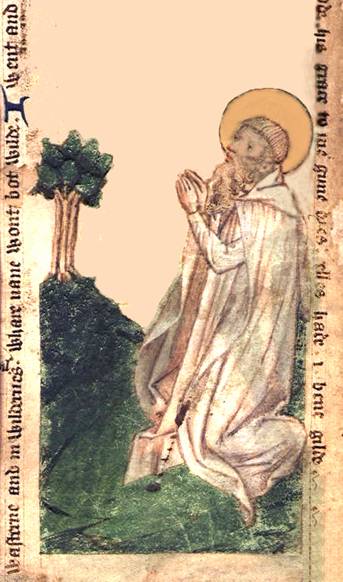
St Godric kneeling
in prayer with rosary (undisplayed upper portion shows Virgin and Child,
teaching Godric , circa 1400, British
Library, MS Cotton Faustina B, VI part ii, folio 16v (see entry for Godric
in the Oxford Dictionary of Saints).
Saint Godric
Ermite (+ 1170)
Colporteur, il en profita
pour se rendre en pèlerinage à Rome et en France. Il alla même jusqu'à
Jérusalem. A son retour, il se retira dans la forêt de Finkley. Sa retraite fut
découverte par des chasseurs qui pourchassaient un cerf. Ils l'épargnèrent à cause
du saint. A partir de ce moment, nous dit son hagiographe, les animaux
poursuivis vinrent se réfugier auprès de saint Godric. Sa renommée fut si
grande qu'on le vénéra dès le lendemain de sa mort.
A découvrir aussi:
- Little-known
Saints of the North (en anglais) site internet 'la sainte île de
Lindisfarne'
SOURCE : http://nominis.cef.fr/contenus/saint/7038/Saint-Godric.html
Saint Godric de Finchale
D'après sa biographie,
écrite par le moine Reginald de Durham, Godric naquit dans une famille pauvre
mais vertueuse du Norfolk. Il devint colporteur, puis marchand, et enfin marin.
Il passa de longues années en mer, voyageant, faisant commerce, et évita
miraculeusement plusieurs fois une mort certaine. À Lindisfarne, saint Cuthbert
apparut à Godric. Cette vision le décida à consacrer sa vie à la religion.
Godric prit la croix et partit en pèlerinage à Jérusalem, Rome, ainsi qu'au
sanctuaire de Saint-Jacques-de-Compostelle en Espagne. À son retour en
Angleterre, il continua à errer, vivant reclus dans des grottes et dans la
forêt. À la fin du siècle, l'évêque de Durham, Flambard, lui fit don d'un
ermitage à Finchale, où il vécut jusqu'à sa mort, soixante ans plus tard. On
dit que Thomas Beckett et le Pape Alexandre III faisait partie de ceux qui
venait lui demander conseil.
SOURCE : http://www.normanconnections.com/fr/characters/famous-characters/st-godric-of-finchale/

Manuscrit
du XIIIe siècle des quatre hymnes de saint Godric.
Also
known as
Godrick
Profile
Oldest of three children born
to a freedman Anglo-Saxon farmer.
An adventurous seafaring man,
Godric spent his youth in travel,
both on land and sea, as a peddler and merchant mariner first
along the coast of the British Isles, then throughout Europe.
Sometime sailor,
sometime ship’s captain, he lived a seafarer’s life of the day, and it was
hardly a religious one. He was known to drink, fight, chase women,
con customers, and in a contemporary manuscript, was referred to as a
“pirate”. Converted upon
visiting Lindisfarne during a voyage, and being touched by the life of Saint Cuthbert
of Lindisfarne.
Pilgrim to Jerusalem and
the holy lands, Saintiago de Compostela,
the shrine of Saint Gaul
in Provence, and to Rome, Italy.
As a self-imposed austerity, and a way to always remember Christ’s lowering
himself to become human, Godric never wore shoes, regardless of the season. He
lived as a hermit in
the holy lands, and worked in a hospital near Jerusalem. Hermit for
nearly sixty years at Finchale,
County Durham, England,
first in a cave, then later in a more formal hermitage;
he was led to its site by a vision of Saint Cuthbert.
It was a rough life, living barefoot in a mud and wattle hut, wearing a hair
shirt under a metal breastplate, standing in icy waters to control his
lust, living for a while off berries and roots, and being badly beaten by Scottish raiders
who strangely thought he had a hidden treasure.
Noted for his close
familiarity with wild animals,
his supernatural visions, his gift of prophecy, and ability to know of events
occurring hundreds or thousands of miles away. Counseled Saint Aelred, Saint Robert
of Newminster, Saint Thomas
Beckett, and Pope Alexander
III. Wrote poetry in
Medieval English. The brief song Sainte nicholaes by
Godric is one of the oldest in the English language,
and is believed to be the earliest surviving example of lyric poetry.
He was said to have received his songs, lyrics and music,
complete during his miraculous visions.
Born
1069 at
Walpole, Norfolk, England
1170 at Finchale,
County Durham, England of
natural causes
in England
very old hermit dressed
in white, kneeling on
grass and holding a rosary,
with a stag by
him
Additional
Information
Book
of Saints, by the Monks of
Ramsgate
Lives
of the Saints, by Father Alban
Butler
Saints
of the Day, by Katherine Rabenstein
books
Our Sunday Visitor’s Encyclopedia of Saints
Saints
and Their Attributes, by Helen Roeder
other
sites in english
fonti
in italiano
Readings
One day there was a grand
hunt near Godric’s hermitage. A magnificent stag was chased by the relations of
Bishop Ramulf. The poor creature came panting to Godric’s cell, as if asking
for refuge. Godric, on emerging from his retreat, saw it trembling with fear,
and seeming to implore his help. Godric, indeed, took it into his cell, and the
noble animal lay down at his feet. The hunters, however, soon came up and
demanded their prey. Godric went to meet them. They asked him where the stag
was. He answered, “God knows.” The hunters, recognising beneath the rags of the
poor hermit an angel and a Saint, went away with their hounds without
disturbing Godric or the stag any more, and the latter, to get over its fright,
passed the night in the hermitage. The next morning it returned joyfully into
the forest, and it came back several times a year to express its gratitude by
caresses. Godric became the natural protector of the beasts in the forest
pursued by the hunters: hares, deer, etc., when in danger, fled to him for
safety. During the cold of winter the little birds warmed themselves in his
breast; one would have said that they recognised in him the son of their
merciful Creator. The hermit-pilgrim, Saint Godric, is often painted surrounded
by serpents, because dangerous animals came to him without hurting him. –
from “The Little Bollandists” by Monsignor Paul Guérin, 1882
MLA
Citation
“Saint Godric of
Finchale“. CatholicSaints.Info. 20 February 2024. Web. 18 April 2026. <https://catholicsaints.info/saint-godric-of-finchale/>
SOURCE : https://catholicsaints.info/saint-godric-of-finchale/
(Saint) Hermit (May 21)
(12th century) A native of Norfolk, who, after having passed some years in
trade, resolved upon embracing a higher life. He made several pilgrimages, and
finally settled in a hermitage in the neighbourhood of Durham. Almighty God favoured
him with the power of working miracles and with other supernatural gifts. He
died A.D. 1170, and is the Title Saint of many churches.
MLA
Citation
Monks of Ramsgate.
“Godric”. Book of Saints, 1921. CatholicSaints.Info.
16 July 2013. Web. 18 April 2026.
<https://catholicsaints.info/book-of-saints-godric/>
SOURCE : https://catholicsaints.info/book-of-saints-godric/

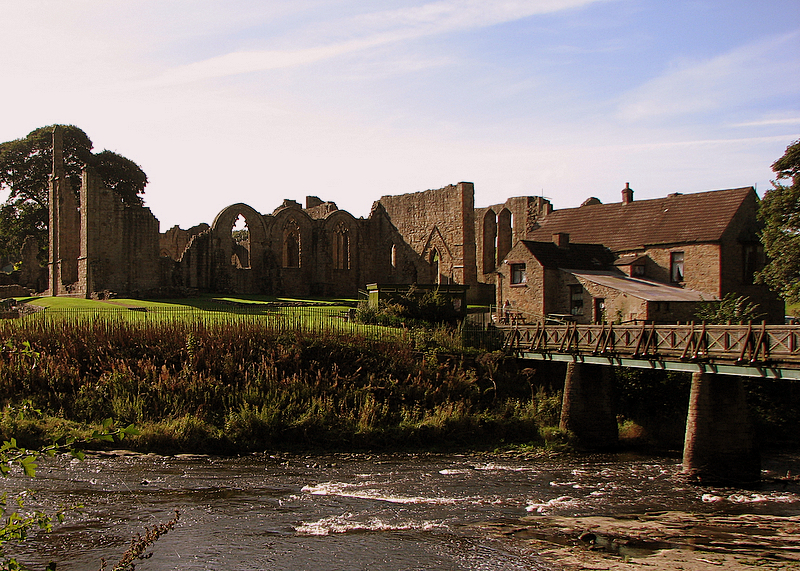
Finchale Priory on the River Wear on the site of Godric's hermitage, Brasside, Co. Durham, England

Le
prieuré de Finchale sur le Wear où Godric s'est retiré comme ermite.
St. Godric of Finchale,
Monk Hermit
Born at Walpole, Norfolk, England, c. 1065;
died in Finchale, County Durham, May 21, c. 1170.
[NB: This is a saint outside our timeframe of interest and post-schism]
I came upon a contemporary biography of Godric, written by Reginald of Durham,
which I'm sending in a separate post, and below I've taken excerpts from this
and other biographies detailing some of the unusual stories about the saint.
The short version is that Godric was a peddler who travelled extensively and,
like Saint Brendan, was eventually attracted to the sea for 16 years. He
managed to purchase part ownership in several ships and even to captain one.
One historian indicates that he may be the Gudericus pirate who carried
Baldwain to Jaffa in 1102. In short, his life was not always a holy one. Having
experienced many difficulties at sea, Godric was forever troubled on stormy
night for ships at sea, even when he lived inland.
His conversion apparently came when he visited Lindisfarne and was touched by
an account of the life of Saint Cuthbert. Thereafter he changed his ways. He
immediately went on a pilgrimage to Jerusalem, where he visited the Holy
Sepulchre. Coming out of the Jordan River, and looking down at his feet, he
vowed, Lord, for love of Your name, Who for men's salvation walked
barefoot through the world, and did not deny to have Your naked feet struck
through with nails for me: From this day I shall put no shoes upon these feet. He
kept this vow until his death, even in the snow.
Returning to England via Santiago de Compostella, he became a house steward
until he realised that the landowner was acting unjustly toward his poorer
neighbours. Upon resigning he went on a pilgrimage to the shrine of Saint Giles
in Provence and to Rome with his mother.
In Cumberland he acquired a Psalter, which became his most valued possession,
and learned it by heart. In 1105, he sold all his goods and travelled to
Walsingham, where he joined up with an elderly hermit named Aelric, with whom
he spent two years. After Aelric's death, Godric made another pilgrimage to
Jerusalem, where he lived for a time with the hermits of Saint John the Baptist
and worked in a hospital for several months.
In a vision, Saint Cuthbert promised Godric a hermitage in England, so he
returned and spent some time in Eskedale and Durham, where he acted as a
sacristan and went to school with the choirboys at Saint Mary-le-Bow. Then he
found his hermitage in Bishop Flambard's hunting grounds on the River Wear near
Durham.
He spent the next 60 years in the Finchale forest living an austere life of
mortification. At first he lived on berries and roots, but later he grew
vegetables and milled and baked his own barley. He wore a hair shirt under a
metal breastplate. Godric built a wattle oratory and later a small stone church
dedicated to Saint Mary. Twice he nearly died, once when he was caught in a
flood, and once when Scottish soldiers beat him on the assumption that he had
hidden valuables.
He lived mainly alone under the guidance of the prior of Durham, who supplied
him with a priest to offer the Holy Sacrifice in his chapel and would send
strangers to him to ask his advice. These visitors included Aelred and Robert
of Newminster, and the monk named Reginald who wrote the included biography.
Thomas a Becket and Pope Alexander III also sought his advice. Godric's sister
Burchwen lived with him for a time but then became a sister in the hospital at
Durham.
Godric had the gift of prophecy. He foretold the death of Bishop William of
Durham and Thomas a Becket--whom he had never met. He often saw visions of
scenes occurring at a distance and was known to stop mid-sentence to pray for
ships in danger of shipwreck.
He suffered a long illness during which the monks of Durham nursed him, but he
died after foretelling his own death. His biographer, Reginald, recorded four
songs that Godric said had been taught to him in visions of the Blessed Virgin,
his dead sister, and others. They are the oldest pieces of English verse of
which the musical settings survive, and are the oldest to show the use of
devices of rhyme and measure instead of alliteration.
Godric was remarkable for his austerities, supernatural gifts, and his
familiarity with wild animals (Benedictines, Delaney, White).
Saint
Godric at Finchale
Finchale is difficult to
find: in a valley bound by the teeming Wear River on the east, north, and west,
and by a dense wood in the south. In this valley "the man of God began to
build the tiny habitations of his going out and coming in . . .[At his first
coming he had built an oratory, and one day saw above the altar two young and
very lovely maids: the one of them, Mary Magdalene, the other the Mother of
God: and the Mother of God put her hand upon his head and taught him to sing
after her this prayer:
Mary Holy Virgin, mother
of Jesus Christ of Nazareth, Hold, shield and help thy Godric, Take him, bring
him soon to the Kingdom of God with thee.
"Thereafter with more devotion than ever he served the Lord: and called
upon the most blessed Mother of God, even as he had promised her, in all
distress that came about him, and found her most swift to aid. A long time thus
spent in solitude, his friends compelled him to take some one to wait on him,
and have a better care of his outward affairs. For so intent was he upon his
prayer, meditation, and contemplation that he would spend no labour on things
out of doors.
"At first, therefore, a little boy, his brother's son, came to wait upon
him, and was with him for 11 years. At that time the only living thing he had
about him was a single cow; and because the boy was yet but small and of very
tender years, he would often be so drowsy with sleep in the mornings that he
would forget to take the beast to pasture, or fetch her again in the evenings;
or indeed perhaps the familiar task became a weariness to him.
"So one day the man of God went up to the creature, and putting his girdle
about her neck, spoke to her as if to one that had reason and intelligence.
'Come,' said he, 'follow me, and go on with me to thy pasture.' She went on,
and the youngster, looking and listening, followed after them. And again the
saint spoke. 'I command thee, in the Lord's name,' said he, 'that every day at
sunrise thou shalt go forth alone, with no guide, to thy pasture; and every
noon and evening at the fitting time, come home, with no servant to lead thee;
and when thine udder with fullness of milk needs easing come to me, wherever I
shall be, and when thou art milked, go lightened back to thy pasture, if yet
there is time.'
"And, marvel as it is, from that day and thence forward, the cow went and
came at the proper hour, and whenever through the day she was heavy with milk
she would come to him; and if by chance he were in church she would stand
outside, by the door, lowing and complaining, calling him. And he, his hour of
prayer ended, would come out and milk her, and she then go away, wherever he
bade her. The boy who saw this, told it; for he grew up, and is now a very old
man.
"In after days, a little lad came to serve in the house of the man of God,
and was set to these outside tasks. And not knowing that the cow was accustomed
to obey the Saint's command, and finding her one day grazing in the meadow, he
began to harry her and prod her with a goad. And she, incensed, turned on the
youngster and catching him between her horns, charged off with him in a great
heat of indignation, to the door of the house where the man of God was busy
within. He came out, took the boy in his arms and lifted him from between her
horns, rescuing him unhurt from the wrath of the irate beast.
"In this are three works of God which we find singularly admirable: first,
that the animal feared to injure or inflict any wound on the servant of her
master, but, nonetheless, by terrifying his boldness and presumption,
administered well-deserved punishment; second, that Christ Himself would not
have the guileless and ignorant youngster killed, but preserved him by the help
of His servant; third, that He made manifest to us the merits of the man of
God, in that by his intervention he saved one set amid death from death's very
jaws.
This same youngster, now indeed an old man, would often tell the story with
thankfulness, praising God who so marvellously deigned to snatch him by the
merits of his master from sudden destruction (Reginald of Durham).
Saint Godric's Garden and
the Wild Deer
There are other stories
written of Godric. As a break from prayer, Godric grafted some cuttings from
visitors' fruit trees to create an enclosed orchard. The sweetness of the crop
drew all the local animals, who nibbled away at the tender shoots and destroyed
Godric's painstaking work. "So one day coming out of his oratory he saw a
wild stag from the wood cropping the tender leafage of his trees, scattering
and spoiling with all its heart; and making his way towards the creature, he
bade it with a crook of his finger not to run away from the spot, but to wait
till he came, without stirring. Oh strange and stupendous mystery! The stag,
this wild thing of the woods, that knew no discretion, understood the will of
the man of God from his gesture alone, and standing still it began trembling
all over, as if it knew that it had offended the soul of the man of God.
"Its extreme tremor and fear went to his heart, and he checked the wrath
in his mind and the blows he had meant to inflict; and the creature dropped on its
knees as he came, and bowed its head, to ask pardon as best it could for its
bold trespass. He ungirt his belt, and put it round the neck of the kneeling
animal, and so led him beyond the bounds of his orchard, and there releasing
him bade him go free wherever he willed. . . .
"It was not long after when lo! a herd of the woodland creatures came
crowding again; they leapt across the fence, they tore off the tender flowers
and delicate leaves, and every one of the slips of apple trees that he had
watched over from the beginning and planted or grafted in his garden, they set
themselves to root up and break off and trample underfoot.
"He came out of the house, and ordered the whole mob to leave the place;
and seizing a rod, he struck one of them thrice on the flank and leading her to
the trees that lay along the ground, he showed her rather by signs than by any
spoken word what damage her herd had done to his planting.
"Then, raising both hand and voice, 'In the name of Jesus of Nazareth,'
said he, 'be off and away as quickly as ye may, nor be so bold as to come near
this garden of mine to its hurt, until these trees are full grown; for the
slips of fruit trees that I have grafted on these trunks I meant for the food
of men and not of beasts.' And so saying, he threatened the rest of the dumb
creatures with the rod that he held in his hand. And thereupon the whole herd,
with heads down bent and stepping delicately, went out; and where they had
rioted, prancing here and there, and leapt in great bounds, they now went forth
stepping as it were on tiptoe, with swift-hurrying hoofs.
"He drove the whole herd to the depth of the forest; and such as lagged
behind in weariness, he set his arms about and gently brought them out, making
a way for them by lifting a hurdle from his fence. From that time forth never
any forest creature dared to trespass the bounds which he had fixed. . . .
Bears, too, would come from the depths of the forest to eat the honey of his
bees, and he would find them out and chastise them with the stick that he
always carried in his hand. And at a word from him the unwieldy creatures would
roar and run, and creatures that no steel blade could daunt would go in terror
of a blow from his light rod (Reginald of Durham).
Saint Godric and Saint John
the Baptist's Salmon
"It was the
serene and joyous weather of high summer, and the turning of the year brought
nigh the solemn feast of Saint John the Baptist. And because the man of God had
begged it, and it was the familiar custom, two brothers from the monastery at
Durham were sent out to him to celebrate the divine office with all due honour.
The office reverently said, and this most solemn Mass ended, the folk who had
come for the Feast made their way home; and the brethren came to him to ask his
blessing, and leave to return to their monastery. 'Ye may have God's blessing,'
said he, 'but when Saint Cuthbert's sons have come to visit me, they must not
go home without their dinner.' And, calling his serving-man, 'Quick, beloved,'
said he, 'and set up the table, for these brethren are to eat with us this
day.'
"The table was set up, and oat cake laid upon it, such as he had, and
bowls of good milk. Yet when he looked at the feast, it seemed to him but poor,
and he bade the serving-man bring fish as well.
"'Master,' said he in amaze, 'where should we get fish at a time like
this, in all this heat and drought, when we can see the very bottom of the
river? We can cross dry shod where we used to spread the seine and the nets.'
But he answered, 'Go quickly and spread my seine in the same dry pool.' The man
went out and did as he was told; but with no hope of any sort of catch.
"He came back, declaring that the pool had dried up till the very sands of
it were parched; and his master bade him make haste to fill the cauldron with
water, and set it on the hearth to heat, and this was done. After a little
while he bade his man go to the bank and bring back his catch; the man went and
looked, and came back empty-handed; he did it again a second time; and then in disgust,
refused to go any more. For a little while the man of God held his peace, and
then spoke. 'Now go this time,' said he, 'for this very hour the fish has come
into the net, that Saint John the Baptist promised me; for never could he break
a promise by not doing what he said, although our sluggish faith deserved it
little. And look you,' said he, 'but that salmon that is now caught in the
seine is a marvellous fine one.'
"So in the end his man went off, and found even as he had been told; and
drawing it out of the net he brought the fish alive to where his master sat in
the oratory, and laid it at his feet. Then as he was bidden, he cut it into
pieces and put it into the pot now boiling on the hearth, and cooked it well,
and brought it and set it before the brethren at table, and well were they fed
and mightily amazed.
For they marvelled how a
fish could come swimming up a river of which the very sands were dry; and,
above al, how the man of God, talking with them and sitting in the oratory
could have seen, by the revelation of the spirit, the very hour when the fish
entered the meshes of the net. To which he made reply, 'Saint John the Baptist
never deserts his own, but sheds the blessing of his great kindness on those
that trust in him.' And so he sent them home, well fed and uplifted at so
amazing a miracle; praising and glorifying God, Who alone doeth marvels, for
all that they had seen and heard (Reginald of Durham).
Saint Godric and the Hare
To feed the poor Godric had planted vegetables, which a little hare used to
devour stealthily. One day Godric tracked down the culprit and bade the hare to
stop as tried to bolt away. He chastised the trembling animal, bound a bundle
of vegetables on its shoulder and sent it off with a warning, 'See to it that
neither thyself nor any of thy acquaintance come to this place again; nor dare
to encroach on what was meant for the need of the poor.' And so it happened
(Geoffrey).
Godric's kindness, however, extended even to the reptiles. "For in winter
when all about was frozen stiff in the cold, he would go out barefoot, and if
he lighted on any animal helpless with misery of the cold, he would set it
under his armpit or in his bosom to warm it. Many a time would the kind soul go
spying under the thick hedges or tangled patches of briars, and if haply he
found a creature that had lost its way, or cowed with the harshness of the
weather, or tired, or half dead, he would recover it with all the healing art
he had. . . .
"And if anyone in his service had caught a bird or little beast in a snare
or a trap or a noose, as soon as he found it he would snatch it from their
hands and let it go free in the fields or the glades of the wood. So that many
a time they would hide their captive spoils under a corn measure or a basket or
some more secret hiding-place still; but even so they could never deceive him
or keep it hidden. For without telling, and indeed with his serving- man
disavowing and protesting, he would go straight to the place where the
creatures had been hidden; and while the man would stand by crimson with fear
and confusion, he would lift them out and set them free.
"So, too, hares and other beasts fleeing from the huntsmen he would take
in, and house them in his hut; and when the ravagers, their hope frustrated,
would be gone, he would send them away to their familiar haunts. Many a time
the dumb creatures of the wood would swerve aside from where the huntsmen lay
in wait, and take shelter in the safety of his hut; for it may be that by some
divine instinct they knew that a sure refuge abided their coming"
(Reginald).
Saint Godric and the
Hunted Stag
"In the time of
Rainulf, Bishop of Durham, certain of his household had come out for a day's
hunting, with their hounds, and were following a stag which they had singled
out for its beauty. The creature, hard pressed by the clamour and the baying,
made for Godric's hermitage, and seemed by its plaintive cries to beseech his
help. "The old man came out, saw the stag shivering and exhausted at his
gate, and moved with pity bade it hush its moans, and opening the door of his
hut, let it go in. The creature dropped at the good father's feet but he,
feeling that the hunt was coming near, came out, shut the door behind him and
sat down in the open; while the dogs, vexed at the loss of their quarry, turned
back with a mighty baying upon their masters.
"They, nonetheless, following on the track of the stag, circled round
about the place, plunging through the well-nigh impenetrable brushwood of
thorns and briars; and hacking a path with their blades, came upon the man of
God in his poor rags.
"They questioned him about the stag; but he would not be the betrayer of
his guest, and he made prudent answer, 'God knows where he may be.' They looked
at the angelic beauty of his countenance, and in reverence for his holiness,
they fell before him and asked his pardon for their bold intrusion.
"Many a time afterwards they would tell what had befallen them there, and
marvel at it, and by their oft telling of it, the thing was kept in memory by
those that came after. But the stag kept house with Godric until the evening;
and then he let it go free. But for years thereafter it would turn from its way
to visit him, and lie at his feet, to show what gratitude it could for its
deliverance" (Reginald).
In art, Saint Godric is depicted as a very old hermit dressed in white,
kneeling on grass, with a stag by him (Roeder, White). He is
venerated especially at Finchdale, County Durham, and Walpole, Norfolk, England
(Roeder).
Past Lives: St Godric at
Finchale Priory
Finchale Priory was
founded in about 1196 on the site of the hermitage of St Godric, a former
sailor who settled here after years of adventure.
2020 marked the 850th
anniversary of the death of St Godric of Finchale. During his eventful 100-year
life, he was a merchant, sailor, pilgrim, hermit, writer of religious verse and
revered holy man.
The son of Anglo-Saxons,
Godric was born at Walpole, Norfolk in c.1070. At an early age he became a
pedlar in Lincolnshire. His trade soon took him as far afield as Scotland and
Flanders. He became a ship’s captain and part-owner of two vessels, making
pilgrimages to Rome, Jerusalem and Santiago de Compostela. In the course of his
seafaring, Godric also visited Farne Island off the coast of Lindisfarne where
St Cuthbert (died 687) had sought seclusion. This inspired Godric to become a
hermit.
He eventually settled, in
around 1112, at Finchale, a remote site on the banks of the River Wear. Here he
sought to atone for his past sins by living a life of almost unimaginable
austerity. His diet initially consisted of roots and berries. Although he later
cultivated barley and vegetables, he would only eat these when they were dry
and mouldy. Labouring wearing a hair shirt and metal breastplate, he cleared
forests to build himself a wooden oratory. Dedicated to the Virgin Mary, it had
a barrel in its floor filled with freezing water in which Godric would immerse
himself. He later built a stone chapel dedicated to St John the Baptist, whose
life in the desert provided inspiration for medieval hermits.
Godric twice nearly lost
his life, first to a flood and then to the hands of Scottish soldiers searching
for treasure. Visitors with more peaceful intentions included two kings of
Scotland and Aelred of Rievaulx. Credited with the ability to heal the sick and
the power of prophecy, Godric also had the distinction of being the author of
hymns in praise of the Virgin and St Nicholas, the patron saint of
sailors.
Monks from Durham
provided care for Godric in his old age. He died on 21 May 1170. His grave in
the church of St John the Baptist at Finchale was the focus of 200 miracles and
a priory was founded around it. In the late Middle Ages it was a holiday
retreat for monks from Durham. Today, Finchale’s beautiful ruins are an
enduring reminder of St Godric and his remarkable life.
SOURCE https://www.english-heritage.org.uk/members-area/past-lives/st-godric/
May 21
St. Godrick, Hermit
HE was born of very mean
parents at Walpole in Norfolk, and in his youth carried about little peddling
wares which he sold in villages. Having by degrees improved his stock he
frequented cities and fairs, and made several voyages by sea to traffic in Scotland.
In one of these he called at Holy Island, or Lindisfarne, where he was charmed
and exceedingly edified with the retirement and religious deportment of the
monks, and especially with the account which they gave him of the wonderful
life of St. Cuthbert. He inquired of them every particular relating to him,
visited every corner of that holy solitude and of the neighbouring isle of
Farne, and falling on his knees, prayed with many tears for grace to imitate
the fervour of that saint in serving God, resolving for that purpose to give up
all earthly pretensions. He entered upon a new course of life by a penitential
devout pilgrimage to Jerusalem, and visited Compostella in his way home. After
his return into Norfolk he accepted the charge of house steward in the family
of a very rich man. The servants were not very regular, and for their private
junketings often trespassed upon their neighbours. Godrick finding he was not
able to prevent these injustices, and that the nobleman took no notice of his
complaints about them, being easy so long as he was no sufferer himself, left
his place for fear of being involved in the guilt of such an injustice.
After making a pilgrimage
to St. Giles in France and to Rome, he went to the north of England in order
the better to carry into execution his design of devoting himself wholly to a
retired life. A fervent servant of God, named Godwin, who had passed a
considerable time in the monastery of Durham, and by conversing with the most
holy monks and exercising himself in the interior and exterior practices of all
virtues, was well qualified to be a director to an inexperienced novice, joined
our saint, and they led together an austere anchoretical life in a wilderness
situated on the north to Carlisle, serving one another, and spending both the
days and nights in the praises of God. After two years God called Godwin to
himself by a happy death after a short sickness. St. Godrick, having lost his
companion, made a second painful pilgrimage to Jerusalem. After his return he
passed some time in the solitude of Streneshalch, now Whitby; but after a year
and some months went to Durham to offer up his prayers before the shrine of St.
Cuthbert, and from thence retired into the desert of Finchal or Finkley, three
miles from Durham, near the river Wear. St. John Baptist and St. Cuthbert he
chose for his principal patrons and models. The austerities which he practised
are rather to be admired than imitated. He had his regular tasks and devotion,
consisting of psalms and other prayers which he had learned by heart, and which
he constantly recited at midnight, break of day, and the other canonical hours,
besides a great number of other devotions. Though he was ignorant of the very
elements of learning, he was too well experienced in the happy art of
conversing with God and his own soul ever to be at a loss how to employ his
time in solitude. Whole days and nights seemed too short for his rapturous
contemplations, one of which he often wished with St. Bruno he could have
continued without interruption for eternity, in inflamed acts of adoration,
compunction, love or praise. His patience under the sharpest pains of
sicknesses or ulcers, and all manner of trials, was admirable; but his humility
was yet more astonishing. His conversation was meek, humble, and simple. He
concealed as much as possible from the sight and knowledge of all men whatever
might procure their esteem, and he was even unwilling any one should see or
speak with him. Yet this he saw himself obliged to allow on certain days every
week to such as came with the leave of the prior of Durham, under whose care
and obedience he lived. A monk of that house was his confessor, said mass for
him, and administered him the sacraments in a chapel adjoining to his cell,
which the holy man had built in honour of St. John Baptist. He was most averse
from all pride and vanity, and never spoke of himself but as of the most sinful
of creatures, a counterfeit hermit, an empty phantom of a religious man: lazy,
slothful, proud, and imperious, abusing the charity of good people who assisted
him with their alms. But the more the saint humbled himself the more did God
exalt him by his grace, and by wonderful miraculous gifts. For several years
before his death he was confined to his bed by sickness and old age. William of
Newbridge who visited him during that time, tells us that though his body
appeared in a manner dead, his tongue was ever repeating the sacred names of
the three Divine Persons, and in his countenance there appeared a wonderful
dignity, accompanied with an unusual grace and sweetness. Having remained in
this desert sixty-three years he was seized with his last illness, and happily
departed to his Lord on the 21st of May, 1170, in the reign of Henry II. His
body was buried in the chapel of St. John Baptist. Many miracles confirmed the
opinion of his sanctity, and a little chapel was built to his memory by
Richard, brother to Hugh Pidsey, bishop of Durham. See William of Newbridge, l.
2, c. 20; Matthew Paris, Matthew of Westminster, his life written by Nicholas
of Durham his confessarius, and abridged by Harpsfield, Sæc. 12, c. 45; see
also the English Calendars, and those of the Benedictins, especially Menard’s
and Edw. Maihew; likewise Henschenius, t. 5, Maij. p. 68.
Rev. Alban
Butler (1711–73). Volume V: May. The Lives of the Saints. 1866.
SOURCE : http://www.bartleby.com/210/5/212.html
St. Godric of Finchale
(C.1070-1170)
We know a good deal about
medieval saints (and non-saints) who came from upper-class families. Godric of
Finchale is one of those rare men of humble origin about whose varied career a
good deal is known. It took a long time for him to find his true calling. Many
of us are late bloomers, and it is consoling to know of a saint who was a
peddler, a pilgrim, a sailor, a ship's captain, a bailiff, and a sacristan
before he discovered that God wanted him to be a hermit.
Godric was born in
Norfolk, England, of Anglo-Saxon peasant stock. Normally he would have stuck to
small farming. Instead, he chose to be a travelling peddler. Apparently he had
gifts as a bargainer. In 1089 he made his first pilgrimage to Rome. (There was
always this piety in his makeup.) On returning to England, however, he decided
to expand his commercial efforts. Now he went to sea, trading in Scotland,
Flanders and Denmark. He was so successful that he bought a share in two ships,
becoming a captain of one of them. In 1101 he went on pilgrimage to the Holy
Land, presumably in his own ship. On the return trip he visited the shrine of
St. James at Compostela in Spain. Back in England he took a job as a bailiff
(property manager), but before long he was again a pilgrim to Rome and
Saint-Gilles in southern France. He made yet a third pilgrimage to the Eternal
City, this time with his aged mother as companion. It is a fair guess that he got
his piety from this dauntless old lady, who is said to have made the journey
barefoot!
After that Roman
pilgrimage, Godric finally gave signs of having made up his mind - partially,
at least. He sold all his goods and began to experiment with a hermit's life in
a forest in northern England. To better learn the eremitical ropes, he returned
to the Holy Land, spent some time with other hermits in the desert of St. John
the Baptist, and worked for a while in the crusader hospital in Jerusalem. Back
in England, he became a peddler again for a while. Then he went to Durham, was
engaged as sacristan of a local church, and attended school with the choirboys
at St. Mary-le-Bow. Finally he settled down for good in the woods of Finchale
on the River Wear. He was by then over 40.
The life of a solitary is
pretty drastic. St. Godric made it even more so, doing penance for the sins of
his youth. He had no spiritual guidance at first. That was remedied when Roger,
the prior of the monastery at nearby Durham, gave him a rule of life to follow.
The routine was typically
eremitical. Long prayers of the liturgy were followed by silent contemplation
of the mysteries of faith, all carried on in penitential austerity. Loneliness
itself had its challenges: not from the wild beasts of the forest, which he
quickly befriended, but from diabolical manifestations; grave illnesses; a
near-drowning; and even being beaten up by Scottish soldiers who believed he
had a hidden treasure. Godric stuck to his rule nevertheless. Gradually he won
the respect of neighboring villagers and monks, and even received a letter of
encouragement from Pope Alexander III.
How did the Hermit of
Finchale appear to those who received permission to speak with him? A
contemporary writer noted that he was "strong and agile, and in spite of
his small stature his appearance was very venerable. He had a broad forehead,
sparkling grey eyes, and bushy eyebrows that almost met. His face was oval, his
nose long, his beard thick. " Visitors found him a good listener, always
serious, and sympathetic to those in trouble. Among his charismatic gifts were
prophecy and the knowledge of distant happenings.
St. Godric also became
noted as a writer of hymns. His lyrics are among the oldest to employ rhyme and
measure rather than the alliteration characteristic of Anglo-Saxon verse. The
tunes to which he set the poems were simple ones, taught him, he said, in
various visions. Four of these melodies and texts have been preserved in the
British Museum and were recorded in 1965.
Stricken with a long
illness at the end of threescore years in his little hermit's cell, Godric died
May 11, 1170. His tomb then became a shrine at which many miracles of healing
were performed, especially on women. Like many ancient saints, Godric was never
formally canonized, but his cult has continued at Finchale, at Durham, and
among the Cistercian monks.
Men and women called
belatedly to the religious life should find in St. Godric of Finchale a
sympathetic patron. Before he finally settled down, he, too, had been around!
--Father Robert F.
McNamara
SOURCE : http://kateriirondequoit.org/resources/saints-alive/gabra-michael-grimoaldo/st-godric-of-finchale/
St Godric
of Finchale
April 16, 2009 by Mark Armitage
Godric was born at
Walpole in Norfolk (England) around the year 1065. He was a peddler of some
sort – a traveling salesman, indeed – whose wanderings led him to sea for a
period of around sixteen years, during which time he became a part-owner of a
number of vessels, one of which he went on to captain. There is, in fact, some
indication that he may have been operating more or less as a pirate, and that
his lifestyle was as far removed from the ways of Christian living as that of
pirates generally is.
Godric’s maritime
exploits brought him to the island of Lindisfarne off the Northumbrian coast,
and here he became acquainted with tales of St Cuthbert, Lindisfarne’s greatest
saint. Godric’s life was transformed by his encounter with Cuthbert (who, even
centuries after his death, must have remained an almost tangible presence on Lindisfarne),
and he experienced a profound conversion.
Ever the seafarer, his
conversion of heart manifested itself in a pilgrimage to Jerusalem. In the
early Middles Ages as in Late Antiquity, the idea of pilgrimage exercised a
powerful hold over the imaginations of the holy, symbolizing as it did both the
wanderings of the Israelites in the desert as they passed from Egypt to the
Promised Land, and the wanderings of Christians exiled by sin from Paradise and
living in this world as “strangers and pilgrims” en route to the New Jerusalem.
Christ himself, who had “nowhere to lay his head”, was essentially a pilgrim,
and pilgrimage was understood as a way of conforming oneself with Christ and of
following in his footsteps.
This last aspect of
following in Christ’s footsteps was one which Godric interpreted with a certain
literalness. While in Jerusalem he visited the river Jordan, and, contemplating
his own feet, vowed: “Lord, for love of your name, who for men’s salvation
walked barefoot through the world, and did not deny to have your naked feet
struck through with nails for me; from this day I shall put no shoes upon these
feet”. Godric always remained faithful to this vow – even in old age (he lived
to be around 100) amid the biting winters of the North East of England.
Further pilgrimages took
him to Santiago de Compostella, the shrine of Saint Giles in Provence, to Rome,
to Cumberland in North West England (where he obtained a copy of the Psalms
which was to provide the material and inspiration for his life of prayer and
contemplation), and back to Jerusalem, where he spent time working in a
hospital and living with the hermits of Saint John the Baptist and worked in a
hospital for several months.
Cuthbert remained his
inspiration, however, and it was a vision of Cuthbert in which the saint
promised him a hermitage in England that promoted him to return to the land of
his birth – this time to Durham, where Cuthbert lay buried – and eventually
became a hermit in the forest around Finchale (just outside Durham) in the
hunting grounds of the rather disreputable Bishop Ranulf Flambard (the first
man to escape from the Tower of London).
Godric embarked upon a
life of austerity and mortification, wearing a hair shirt under a metal
breastplate, under the guidance of the prior of Durham. Many people sought his
advice either in person or from a distance (the latter group included both St
Thomas à Becket and Pope Alexander III), and Godric developed a reputation for
miracles, for prophecy and for an affinity (characteristic of hermits) for the
wild animals among which he lived.
His gift of prophecy
extended to foretelling not only his own death both also the deaths of others.
Though he seafaring days were now behind him, his prophetic charism enabled him
to know when a ship somewhere was in danger of being wrecked, and he would
cease from whatever he was doing in order to offer up a prayer.
Godric’s prophetic
visions were also the occasion for the Blessed Virgin (among others) to teach
him songs, and the four which are recorded by his biographer Reginald are the
oldest examples of English verse for which we possess the original musical settings
survive, and also the first to favour rhyme and metre over traditional
Anglo-Saxon techniques of alliteration.
He died in 1170, tended
and mourned by the monks of Durham, having given expression during the course
of his extended life to the vocations of both the pilgrim and the hermit.
SOURCE : https://saintsandblesseds.wordpress.com/2009/04/16/st-godric-of-finchale/
Memorial
* 21 May
Profile
Oldest of three children
born to a freedman Anglo-Saxon farmer. An adventurous seafaring man, Godric
spent his youth in travel, both on land and sea, as a peddler and merchant
mariner first along the coast of the British Isles, then throughout Europe.
Sometime sailor, sometime ship’s captain, he lived a seafarer’s life of the
day, and it was hardly a religious one. He was known to drink, fight, chase
women, con customers, and in a contemporary manuscript, was referred to as a
“pirate”. Converted upon visiting Lindisfarne during a voyage, and being
touched by the life of Saint Cuthbert of Lindisfarne.
Pilgrim to Jerusalem and
the holy lands, Saintiago de Compostela, the shrine of Saint Gaul in Provence,
and to Rome, Italy. As a self-imposed austerity, and a way to always remember
Christ’s lowering himself to become human, Godric never wore shoes, regardless
of the season. He lived as a hermit in the holy lands, and worked in a hospital
near Jerusalem. Hermit for nearly sixty years at Finchale, County Durham,
England, first in a cave, then later in a more formal hermitage; he was led to
its site by a vision of Saint Cuthbert. It was a rough life, living barefoot in
a mud and wattle hut, wearing a hair shirt under a metal breastplate, standing
in icy waters to control his lust, living for a while off berries and roots,
and being badly beaten by Scottish raiders who strangely thought he had a
hidden treasure.
Noted for his close
familiarity with wild animals, his supernatural visions, his gift of prophecy,
and ability to know of events occurring hundreds or thousands of miles away.
Counseled Saint Aelred, Saint Robert of Newminster, Saint Thomas Beckett, and
Pope Alexander III. Wrote poetry in Medieval English. The brief song Sainte
nicholaes by Godric is one of the oldest in the English language, and is
believed to be the earliest surviving example of lyric poetry. He was said to
have received his songs, lyrics and music, complete during his miraculous
visions.
Born
* 1069 at Walpole,
Norfolk, England
Died
* 1170 at Finchale,
County Durham, England of natural causes
SOURCE : http://laysaints.org/saint-godric-of-finchale/
San Godrico Eremita
Festa: 21 maggio
† 22 maggio 1170
Nato a Walpole, nel
Norfolk, da poveri genitori, Godrico divenne mercante ambulante per aiutare i
suoi genitori. In seguito distribuì ai poveri la fortuna abilmente accumulata e
si diede alla pratica dei pellegrinaggi, recandosi a Roma, in Terra Santa e a
Compostela. Decise poi di dedicarsi alla vita eremitica nelle foreste di Durham
e poi in un luogo vicino al santuario di S. Cutberto. La sua fama si diffuse
ben presto, tanto che le folle lo visitavano per esserne edificate e
confortate. Morì il 22 maggio 1170 e fu sepolto nella piccola chiesa da lui
stesso costruita.
L’Ordine Benedettino lo festeggia il 21 maggio.
Godrico è uno dei più romantici tra i santi inglesi e, già durante la sua vita, fu definito il "prodigio" dell'epoca. Il Libellus de Vita et miraculis S. Godrici di Reginaldo di Durham è evidentemente autentico. Il DNB dedica a Godrico un importante articolo e lo storico gesuita J. Brodrick lo ha incluso nella sua Procession of Saints del 1949 a cui, peraltro, devono preferirsi diverse altre narrazioni della sua vicenda.
Nacque da genitori poveri in una cittadina del Norfolk, Walpole, a nove miglia da King's Lynn. Invece di lavorare la terra, il giovane divenne mercante ambulante raccogliendo e vendendo oggetti per tutta la regione ed aiutando così i suoi genitori.
Doveva avere un particolare "fiuto" per questo commercio, poiché in breve tempo fu in grado di aprire dei depositi in varie città del Norfolk e di acquistare una nave che lo portò presto in Bretagna, nelle Fiandre e in Scandinavia; il suo scalo favorito era St. Andrew’s in Scozia. Avevano una particolare attrazione per lui Holy Island e Lindisfame ed aveva scelto san Cutberto come patrono. I suoi vagabondaggi non erano certamente ispirati dall’amore per il denaro, poiché, dopo avere aiutato i genitori, distribuì la sua fortuna ai poveri e partì per un pellegrinaggio alla tomba degli Apostoli e in Terra Santa.
Nel viaggio di ritorno passò da Compostella per venerare san Giacomo. A questo seguirono un secondo pellegrinaggio a Roma ed un terzo in cui fu accompagnato dalla sua devota madre e che fu fatto completamente a piedi; quando dovevano attraversare un fiume Godrico «sollevava la madre sulle sue forti braccia e la trasportava nel guado».
Dopo tutte queste peregrinazioni compiute durante la prima parte della sua vita, Godrico decise di imitare san Cutberto e si fece eremita nelle foreste di Durham. Un sant’uomo, di nome Africo, divenne il suo direttore spirituale, rimanendo tale sino alla morte. Desolato per la perdita del padre spirituale, Godrico partì ancora una volta per la Terra Santa, si bagnò nel Giordano e visitò gli eremitaggi della Giudea per ragguagliarsi sulla via della perfezione. Quindi tornò in Inghilterra e si stabilì, probabilmente, in un luogo solitario, a Finchdale, presso Durham, a sole tre miglia dal santuario di san Cutberto. Il futuro biografo Reginaldo, divenne suo confessore ed apprese da lui i particolari della straordinaria vita. La sua fama si diffuse ben presto tutt’intorno al luogo del ritiro e le folle lo visitavano per esserne edificate e confortate. Si recarono da lui anche san Aelredo di Rievaulx e san Roberto di Newminster.
Infine, logorato dall’austerità, si preparò all'ultimo viaggio. Morì il 22 maggio 1170 e fu sepolto nella piccola chiesa che aveva lui stesso costruita.
La sua festa ricorre il 21 maggio.
Autore: John Stéphan
SOURCE : https://www.santiebeati.it/dettaglio/94104
Reginald of Durham: Life
of St. Goderic [12th Cent] : https://sourcebooks.fordham.edu/source/goderic.asp