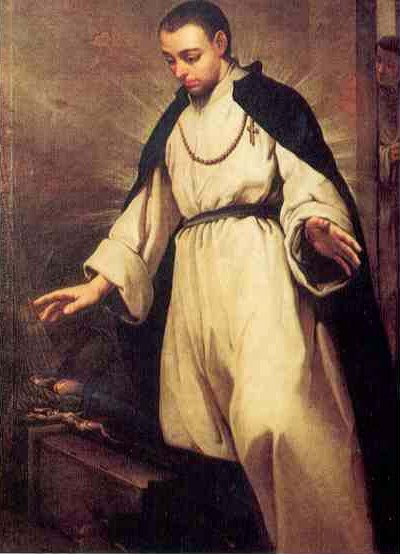
Riproduzione
della più antica figura del Beato Alberto da Villa d'Ogna (autore ignoto - XVI
secolo)
Bienheureux Albert de
Bergame ou de Villa d'Ogna
Tertiaire
dominicain (+ 1279)
"...né dans un petit
village du territoire de Bergame, de parents d'une condition basse et
méprisable selon le monde, mais vertueux, et qui l'élevèrent chrétiennement...
Lorsqu'il fut parvenu à un âge plus mûr, il s'appliqua à l'agriculture en la
compagnie de son père. Tandis que son corps était courbé sous le travail, son
esprit était élevé en Dieu dans une haute contemplation. Il s'engagea dans
l'état du mariage pour obéir à ses parents. Il eut à souffrir de la part de sa
femme les reproches les plus piquants, occasionnés par sa grande libéralité
envers les pauvres; il les endura avec patience... Ayant été longtemps
persécuté par quelques personnes puissantes qui voulaient s'emparer du champ
que possédait son père, il se retira à Crémone où il s'adonna avec une nouvelle
ferveur aux œuvres de miséricorde. Peu de temps après il entra dans le
tiers-ordre de saint-Dominique, qu'on appelait alors la milice de Jésus-Christ,
et dans la suite les Frères de la Pénitence. Il résolut d'acquérir la
perfection évangélique... il excella en particulier dans la charité envers les
malades, les étrangers et les personnes dénuées de tout secours. Il alla par
dévotion visiter les saints lieux de Jérusalem... Il vécut dans une parfaite
humilité, et mourut saintement le 7 mai de l'an 1279..."
(source: Bibliothèque
sacrée, ou Dictionnaire universel historique, dogmatique, canonique,
géographique et chronologique des sciences ecclésiastiques par Charles
Louis Richard)
À Crémone en Lombardie,
l’an 1279, le bienheureux Albert de Bergame. Paysan, il supporta avec patience
les récriminations de sa femme qui lui reprochait sa trop grande générosité
pour les pauvres. Devenu veuf, il abandonna ses champs, sa maison et son pays,
et vécut pauvre, frère de la Pénitence de Saint-Dominique.
Martyrologe romain
SOURCE : http://nominis.cef.fr/contenus/saint/10897/Bienheureux-Albert-de-Bergame-ou-de-Villa-d-Ogna.html

San Michele al Pozzo Bianco, interno, affreschi del 1440 su affreschi bizantineggianti, San Giuseppe e Sant'Alberto
Bienheureux Albert de
Bergame
Laïc de l’Ordre de la
Pénitence
Fête le 7 mai
Villa d’Ogna, près de
Bergame, v. 1214 – † Crémone 7 mai 1279
Béatifié le 9 mai 1748
Autre mention : 11
mai
Autres graphies :
[Alberto da Bergamo] Albert de Bergame, dit le Laboureur ou Albert de Villa
d’Ogna
Ouvrier agricole, de la
fraternité du couvent de Crémone (Ordre de la pénitence du bienheureux
Dominique). Tertiaire dominicain, Albert était un fermier qui habitait près de
Bergame, en Italie, où il était devenu membre du tiers ordre dominicain. Marié,
il secourait les pauvres et les démunis dans sa ville natale d’Ogna. Il passait
de maison en maison, recueillant des aumônes pour les pauvres et les
malades ; il construisit pour eux un hospice, qu’on appellera plus tard
l’Hôpital St-Albert. Sa générosité lui valut la persécution de sa femme
hargneuse et de sa famille jalouse. Un beau jour, Albert fit un pèlerinage au
célèbre sanctuaire de Santiago de Compostela en Espagne. Il visita aussi Rome
et Jérusalem, des expéditions périlleuses à son époque. Après ses pèlerinages,
Albert s’installa à Crémone, où il devint célèbre pour sa piété et pour ses
nombreux miracles. Son culte fut approuvé en 1748.
SOURCE : http://www.martyretsaint.com/albert-de-bergame
ALBERTO DE BERGAME
Dominicain, Bienheureux
env.1214-1279
D’une modeste famille de
paysans, Alberto naquit à Villa d’Ogna, près de Bergame, vers 1214. Bon
travailleur, pieux, il se maria sur les conseils et la volonté des siens, sans
jamais oublier ses habitudes de piété et de charité envers les plus pauvres.
Sa générosité était sans
borne, au point que son épouse lui rendait la vie très difficile par ses
remontrances. Mais sa patience resta inaltérable.
Même ses voisins lui
rendirent la vie dure, en lui faisant croire qu’il n’était pas propriétaire de
ses terres, au point que, par amour de la paix, il quitta Villa d’Ogna, sa
femme et ses champs. Après un pËlerinage à Rome, il s’en vint à Crémone, où il
entra dans le Tiers-Ordre dominicain.
Toutes ses énergies et
tout son temps passèrent à secourir les plus pauvres. Il avait coutume de dire
qu’on trouve toujours le temps de faire le bien, quand on le veut.
Il pressentit sa mort,
reçut les derniers Sacrements et mourut le 7 mai 1279. Les cloches se mirent
alors à sonner d’elles-mêmes et toute la population accourut. Un autre fait
extraordinaire eut lieu lors de sa sépulture : au fur et à mesure qu’on
creusait, la terre se durcissait comme pierre, au point qu’on finit par
ensevelir Alberto dans le chœur-même de l’église. Beaucoup de grâces et de
miracles furent obtenus par son intercession.
Son culte fut approuvé en
1749, et on le fête encore à Bergame et Crémone en son dies
natalis, comme le commémore aussi le Martyrologe Romain au 7 mai.
A Ville d’Ogna, en ce
jour, un cortège va puiser de l’eau au “puits de Saint Albert”, sur la place du
bourg, et la porte à l’église où elle est bénite. Tout cela sur fond de fanfare
et, le soir, de feux d’artifice.
SOURCE : http://nouvl.evangelisation.free.fr/alberto_da_bergamo.htm

Blessed
Albert of Bergamo, with the Dominic tertiaries habit. XVIIIe siècle
Also
known as
Albert of Ogna
Alberto…
11 May on
some calendars
Profile
Born to a modest but
pious farm family. Married layman. Farmer in Villa
d’Ogna, Italy. Dominican tertiary.
Known for his ministry and devotion to the poor. Pilgrim to Rome, Italy,
to Jerusalem and
to Compostela, Spain.
Settled finally in Cremona, Italy.
Known as a miracle worker.
Born
at Villa
d’Ogna, Italy
7 May 1279 in Cremona, Italy of
natural causes
9 May 1748 by Pope Benedict
XIV (cultus
confirmed)
–
in Italy
farm
worker cutting through a stone with
a scythe
farm
worker being brought the Eucharist in the field by a dove
Almighty and
ever-loving God, you
led Blessed Albert
to shine forth in humility of life, in zeal for the truth and in apostolic
charity. May we follow in his footsteps and so obtain the same reward. We ask
this through our Lord Jesus Christ, your Son, who lives and reigns with you and
the Holy
Spirit, one God, for ever and ever. – General Calendar of the Order of
Preachers
Additional
Information
Saints
of the Day, by Katherine Rabenstein
books
Dictionary of Saints, by John Delaney
Our Sunday Visitor’s Encyclopedia of Saints
Saints
and Their Attributes, by Helen Roeder
other
sites in english
sitios
en español
Martirologio Romano, 2001 edición
fonti
in italiano
MLA
Citation
‘Blessed Albert of
Bergamo‘. CatholicSaints.Info. 29 May 2024. Web. 14 April 2026.
<https://catholicsaints.info/blessed-albert-of-bergamo/>
SOURCE : https://catholicsaints.info/blessed-albert-of-bergamo/
Bl. Albert of Bergamo
Feastday: May 11
Death: 1279
Dominican tertiary
and miracle worker.
Albert was a farmer living near Bergamo, Italy, where he became a Dominican
Third Order member. Married, he was a champion of the poor in his hometown of
Ogna. Sometime in his adult life, Albert went on a pilgrimage to the famous
shrine at Santiago de Compostela in
Spain. He also visited Rome and
Jerusalem, perilous journeys in his era. After his pilgrimages, Albert settled
in Cremona, Italy, where he became known for his piety and for his many miraculous works
to benefit others.
SOURCE : https://www.catholic.org/saints/saint.php?saint_id=1205
Blessed Albert of
Bergamo, OP Tert. (AC)
(also known as Albert
d'Ogna or Albert the Farmer)
Born in Valle d'Ogna
(near Bergamo), Italy, in 1214; died in Cremona, Italy, May 7, 1279; cultus
approved 1748; feast day formerly May 11. Albert "the Farmer" was a
peasant farmer who followed his pious and industrious father's example. His father
taught him many practices of penance and piety that later fructified in a
saintly life. At seven, Albert was fasting three days a week, giving the
foregone food to the poor. Working at the heavy labor of the fields, Albert
learned to see God in all things, and to listen for His voice in all nature.
The beauty of the earth was to him a voice that spoke only of heaven. He grew
up pure of heart, discreet, and humble--to the edification of the entire
village.
Albert married while
still quite young. At first his wife made no objection to the generosity and
self-denial for which he was known. When his father died, however, she made
haste to criticize his every act and word, and made his home almost unbearable
with her shrewish scolding. "You give too much time to prayer and to the
poor!" she charged; Albert only replied that God will return all gifts
made to the poor.
In testimony to this, God
miraculously restored the meal Albert had given away over his wife's objections.
Finally, softened by Albert's prayers, she ceased her nagging and became his
rival in piety and charity. She died soon after her conversion, and Albert,
being childless, he left his father's farm to make a pilgrimage to Jerusalem
and Rome.
Stopping at Cremona,
Italy, at harvest time, Albert went to work in the fields. He soon earned the
name of "the diligent worker." His guardian angel worked beside him
in the fields, and, therefore, twice the work was accomplished that might be
expected of one man. Weighing in his grain at the end of the day, Albert always
received twice as much in wages as the other workers did. Though he gave this
to the poor and kept nothing for himself, jealous companions determined to
annoy him. Planting pieces of iron in the field where Albert would be working
the next day, they watched to see him break or dull his scythe. Miraculously,
the scythe cut through iron as it did through the grain, never suffering any
harm. In Cremona Albert's poverty was also a witness to a group of heretics
there who boasted of their own poverty.
In all, Albert visited
Rome nine times, Santiago de Compostela eight times, and Jerusalem once. He
worked his way, giving to the poor every penny he could spare. His pilgrimages
were almost unbroken prayer; he walked along singing hymns and chanting Psalms,
or conversing on things of God with the people he met along the way.
Appalled at the suffering
of pilgrims who fell ill far from home and the penniless, Albert determined to
build a hospital for their use. This he actually accomplished by his prayers
and diligent work.
In 1256, he met the
Dominicans. Attracted by the life of Saint Dominic, Albert joined the Brothers
of Penance, which later became the Order of Penance of Saint Dominic, and
continued his works of charity in his new state. As a lay brother he was
closely associated with the religious but lived in the world so that he was
able to continue his pilgrimages. At home, he assisted the Dominican fathers in
Cremona, working happily in their garden, cultivating the medicinal herbs so
necessary at the time, and doing cheerfully all the work he could find that was
both heavy and humble.
Falling very ill, Albert
sent a neighbor for the priest, but there was a long delay, and a dove came
bringing him Holy Viaticum. When he died, the bells of Cremona rang of
themselves, and people of all classes hurried to view the precious remains. It
was planned to bury him in the common cemetery, outside the cloister, as he was
a secular tertiary, but no spade could be found to break the ground. An unused
tomb was discovered in the church of Saint Matthias, where he had so often
prayed, and he was buried there. Many miracles were attributed to him after his
death, and the farmer- saint became legendary for his generosity to the poor
(Benedictines, Bentley, Dominicans, Dorcy, Gill).
In art, Saint Albert is a
farm laborer cutting through a stone with a scythe. He may shown be shown (1)
when a dove brings him the viaticum, or (2) with a dove, Host, and censer near
him (Roeder). Albert is the patron of bakers and day-laborers, and is venerated
in Cremona, Bergamo, and Ogna (Roeder).
SOURCE : http://www.saintpatrickdc.org/ss/0507.shtml
Saints and
Saintly Dominicans – 13 May
Blessed Albert
of Bergamo, Confessor, O.P.
God, Who is pleased to
show that sanctity can flourish in every state of life, willed that Blessed
Albert should live in the world as a farmer, while observing the rule of the
Third Order. The candor and simplicity of his nature shone out brightly and the
contemplation of natural beauty in the sky, the mountains, the birds and the
flowers raised his soul continually towards the Author of all perfection. He
had much to suffer from his relations, even to being violently turned out of
the farm which he had cultivated so well. But he had learnt always to possess his
soul in peace and he profited by his exile the better to devote himself to the
service of the poor and to making pilgrimages to holy places. Blessed Albert
went nine times to Rome, eight times to Compostella in Spain and once to
Jerusalem; he sanctified the long hours of travel by silence and prayer. The
earth in which they tried to bury him resisted the spade of the grave-digger,
from which it was understood that, on account of his sanctity, God, Who loves
pure and simple souls, desired that he should be buried in the choir of the
church. (1270)
Prayer
O my God, teach me to
behold in the works of nature the image of Thy perfections, avove all of Thy
providence and Thy beauty.
Practice
Pray for Tertiaries
living in the world and make known, when you have the opportunity, the
advantages of the Third Order.
– taken from the
book Saints
and Saintly Dominicans, by Blessed Hyacinthe-Marie
Cormier, O.P.
SOURCE : https://catholicsaints.info/saints-and-saintly-dominicans-13-may/
Blessed Albert of
Bergamo, C.O.P.
(also known as Albert
d'Ogna or Albert the Farmer)
Memorial Day: May 11th
Profile
Albert "the
Farmer" was a peasant farmer who followed his pious and industrious
father's example. His father taught him many practices of penance and piety
that later fructified in a saintly life. At seven, Albert was fasting three
days a week, giving the foregone food to the poor. Working at the heavy labor
of the fields, Albert learned to see God in all things, and to listen for His
voice in all nature. The beauty of the earth was to him a voice that spoke only
of heaven. He grew up pure of heart, discreet, and humble--to the edification
of the entire village.
Albert married while
still quite young. At first his wife made no objection to the generosity and
self-denial for which he was known. When his father died, however, she made
haste to criticize his every act and word, and made his home almost unbearable
with her shrewish scolding. "You give too much time to prayer and to the
poor!" she charged; Albert only replied that God will return all gifts
made to the poor.
In testimony to this, God
miraculously restored the meal Albert had given away over his wife's
objections. Finally, softened by Albert's prayers, she ceased her nagging and
became his rival in piety and charity. She died soon after her conversion, and
Albert, being childless, he left his father's farm to make a pilgrimage to
Jerusalem and Rome.
Stopping at Cremona,
Italy, at harvest time, Albert went to work in the fields. He soon earned the
name of "the diligent worker." His guardian angel worked beside him
in the fields, and, therefore, twice the work was accomplished that might be
expected of one man. Weighing in his grain at the end of the day, Albert always
received twice as much in wages as the other workers did. Though he gave this
to the poor and kept nothing for himself, jealous companions determined to
annoy him. Planting pieces of iron in the field where Albert would be working
the next day, they watched to see him break or dull his scythe. Miraculously,
the scythe cut through iron as it did through the grain, never suffering any
harm. In Cremona Albert's poverty was also a witness to a group of heretics
there who boasted of their own poverty.
In all, Albert visited
Rome nine times, Santiago de Compostela eight times, and Jerusalem once. He
worked his way, giving to the poor every penny he could spare. His pilgrimages
were almost unbroken prayer; he walked along singing hymns and chanting Psalms,
or conversing on things of God with the people he met along the way.
Appalled at the suffering
of pilgrims who fell ill far from home and the penniless, Albert determined to
build a hospital for their use. This he actually accomplished by his prayers
and diligent work.
In 1256, he met the
Dominicans. Attracted by the life of Saint Dominic, Albert joined the Brothers
of Penance, which later became the Order of Penance of Saint Dominic, and
continued his works of charity in his new state. As a lay brother he was
closely associated with the religious but lived in the world so that he was
able to continue his pilgrimages. At home, he assisted the Dominican fathers in
Cremona, working happily in their garden, cultivating the medicinal herbs so
necessary at the time, and doing cheerfully all the work he could find that was
both heavy and humble.
Falling very ill, Albert
sent a neighbor for the priest, but there was a long delay, and a dove came
bringing him Holy Viaticum. When he died, the bells of Cremona rang of
themselves, and people of all classes hurried to view the precious remains. It
was planned to bury him in the common cemetery, outside the cloister, as he was
a secular tertiary, but no spade could be found to break the ground. An unused
tomb was discovered in the church of Saint Matthias, where he had so often
prayed, and he was buried there. Many miracles were attributed to him after his
death, and the farmer- saint became legendary for his generosity to the poor
(Benedictines, Bentley, Dominicans, Dorcy, Gill).
Born: Born in Valle
d'Ogna (near Bergamo), Italy, in 1214
Died: died in
Cremona, Italy, May 7, 1279
Beatified: cultus
approved May 9, 1748 by Pope Benedict XIV
Representation: In
art, Saint Albert is a farm laborer cutting through a stone with a scythe. He
may shown be shown (1) when a dove brings him the viaticum, or (2) with a dove,
Host, and censer near him (Roeder). Albert is the patron of bakers and
day-laborers, and is venerated in Cremona, Bergamo, and Ogna (Roeder).
Commemorations
First Vespers:
Ant. Come, O
daughters of Jerusalem, and behold a Martyr with a crown wherewith the Lord
crowned him on the day of solemnity and rejoicing, alleluia, alleluia
V. Pray for us, Blessed
Albert alleluia
R. That we may be made
worthy of the promises of Christ, alleluia.
Lauds:
Ant. Perpetual light will
shine upon Thy Saints, O Lord, alleluia, and an eternity of ages, alleluia,
alleluia, alleluia
V. The just man shall
blossom like the lily, alleluia.
R. And shall flourish
forever before the Lord, alleluia
Second Vespers:
Ant. In the city of the
Lord the music of the Saints incessantly resounds: there the angels and
archangels sing a canticle before the throne of God, alleluia.
V. Pray for us, Blessed
Albert, alleluia
R. That we may be made
worthy of the promises of Christ. alleluia
Prayer:
Let us Pray: O God ,
who wast pleased that Blessed Albert, Thy Confessor, should shine with singular
sanctity in a lowly condition of life, grant that we may so tread in his
footsteps as to be worthy to obtain his reward. Through Christ our Lord. Amen.
SOURCE :
http://www.willingshepherds.org/Dominican%20Saints%20May.html#Albert of Bergamo
Blessed Albert of Bergamo
There are a lot of saints
and blesseds on the calendar today and I chose Blessed Albert of
Bergamo because he made a pilgrimage to Compostela, Spain and I will be
there in about 90 days. Blessed Albert was born in Villa d'Ogna, Italy to a
modest but pious farm family. He was a married layman and worked as a farmer.
He also became a Dominican tertiary. He ministered to the poor. Other
pilgrimages he made were to Rome and Jerusalem. He eventually settled in
Cremona, Italy. He died on May 7, 1279 in Cremona of natural causes. He was
beatified on May 9, 1748 by Pope Benedict XIV. He is the patron of bakers and
day laborers.
Prayer
Almighty and ever-loving
God, you led Blessed Albert to shine forth in humility of life, in zeal for the
truth and in apostolic charity. May we follow in his footsteps and so obtain
the same reward. We ask this through our Lord Jesus Christ, your Son, who lives
and reigns with you and the Holy Spirit, one God, for ever and ever.
-General Calendar of the
Order of Preachers
SOURCE : http://ginadwithsaints.blogspot.ca/2011/05/day-249-blessed-albert-of-bergamo.html

MAY 11, 2015
Blessed Albert
of Bergamo
Albert “the Farmer” was a
peasant farmer who followed his pious and industrious father’s example. His
father taught him many practices of penance and piety that later fructified in
a saintly life. At seven, Albert was fasting three days a week, giving the
foregone food to the poor. Working at the heavy labor of the fields, Albert
learned to see God in all things, and to listen for His voice in all nature.
The beauty of the earth was to him a voice that spoke only of heaven. He grew
up pure of heart, discreet, and humble–to the edification of the entire
village.
Albert married while
still quite young. At first his wife made no objection to the generosity and
self-denial for which he was known. When his father died, however, she made
haste to criticize his every act and word, and made his home almost unbearable
with her shrewish scolding. “You give too much time to prayer and to the poor!”
she charged; Albert only replied that God will return all gifts made to the
poor.
In testimony to this, God
miraculously restored the meal Albert had given away over his wife’s
objections. Finally, softened by Albert’s prayers, she ceased her nagging and
became his rival in piety and charity. She died soon after her conversion, and
Albert, being childless, he left his father’s farm to make a pilgrimage to
Jerusalem and Rome.
Stopping at Cremona,
Italy, at harvest time, Albert went to work in the fields. He soon earned the
name of “the diligent worker.” His guardian angel worked beside him in the
fields, and, therefore, twice the work was accomplished that might be expected
of one man. Weighing in his grain at the end of the day, Albert always received
twice as much in wages as the other workers did. Though he gave this to the
poor and kept nothing for himself, jealous companions determined to annoy him.
Planting pieces of iron in the field where Albert would be working the next
day, they watched to see him break or dull his scythe. Miraculously, the scythe
cut through iron as it did through the grain, never suffering any harm. In
Cremona Albert’s poverty was also a witness to a group of heretics there who
boasted of their own poverty.
In all, Albert visited
Rome nine times, Santiago de Compostela eight times, and Jerusalem once. He
worked his way, giving to the poor every penny he could spare. His pilgrimages
were almost unbroken prayer; he walked along singing hymns and chanting Psalms,
or conversing on things of God with the people he met along the way.
Appalled at the suffering
of pilgrims who fell ill far from home and the penniless, Albert determined to
build a hospital for their use. This he actually accomplished by his prayers
and diligent work.
In 1256, he met the
Dominicans. Attracted by the life of Saint Dominic, Albert joined the Brothers
of Penance, which later became the Order of Penance of Saint Dominic, and
continued his works of charity in his new state. As a lay brother he was
closely associated with the religious but lived in the world so that he was
able to continue his pilgrimages. At home, he assisted the Dominican fathers in
Cremona, working happily in their garden, cultivating the medicinal herbs so
necessary at the time, and doing cheerfully all the work he could find that was
both heavy and humble.
Falling very ill, Albert
sent a neighbor for the priest, but there was a long delay, and a dove came
bringing him Holy Viaticum. When he died, the bells of Cremona rang of
themselves, and people of all classes hurried to view the precious remains. It
was planned to bury him in the common cemetery, outside the cloister, as he was
a secular tertiary, but no spade could be found to break the ground. An unused
tomb was discovered in the church of Saint Matthias, where he had so often
prayed, and he was buried there. Many miracles were attributed to him after his
death, and the farmer- saint became legendary for his generosity to the poor.
Born: Born in Valle
d’Ogna (near Bergamo), Italy, in 1214
Died: died in
Cremona, Italy, May 7, 1279
Beatified: cultus
approved May 9, 1748 by Pope Benedict XIV
Representation: In
art, Saint Albert is a farm laborer cutting through a stone with a scythe. He
may shown be shown (1) when a dove brings him the viaticum, or (2) with a dove,
Host, and censer near him. Albert is the patron of bakers and day-laborers, and
is venerated in Cremona, Bergamo, and Ogna.
Written by The Rt. Rev. Michael
Beckett, OPI Posted in Dominican
Saints
SOURCE : https://orderofpreachersindependent.org/2015/05/11/blessed-albert-of-bergamo/
DOMINICAN
OP, SAINT
OF THE DAY
Saint of the Day – 7 May
– Blessed Alberto of Bergamo OP (1214-1279)
Posted on May
7, 2020
Saint of the Day – 7 May
– Blessed Alberto of Bergamo OP (1214-1279) Layman, Widow, Apostle of Charity,
Pilgrim, Third Order Dominican – born at Villa d’Ogna, Italy and died on 7 May
1279 in Cremona, Italy of natural causes. Patronages – Villa
d’Ogna, Compagnia dell’Arte dei Brentatori, Farmers, Labourers, Bakers.
Albert “the Farmer” was a
peasant farmer who followed his pious and industrious father’s example.
His father taught him many practices of penance and piety that later
fructified in a saintly life. At seven, Albert was fasting three
days a week, giving the foregone food to the poor. Working at the
heavy labour of the fields, Albert learned to see God in all things and to listen
for His voice in all nature. The beauty of the earth was to him a
voice that spoke only of heaven. He grew up pure of heart, discreet
and humble–to the edification of the entire village.
Albert married while
still quite young. At first his wife made no objection to the
generosity and self-denial for which he was known. When his father
died, however, she made haste to criticise his every act and word and made his
home almost unbearable with her shrewish scolding. “You give too
much time to prayer and to the poor!” she charged; Albert only
replied that God will return all gifts made to the poor.
In testimony to this, God
miraculously restored the meal Albert had given away over his wife’s
objections. Finally, softened by Albert’s prayers, she ceased her
nagging and became his rival in piety and charity. She died soon
after her conversion and Albert, being childless, he left his father’s farm to
make a pilgrimage to Jerusalem and Rome.
Stopping at Cremona,
Italy, at harvest time, Albert went to work in the fields. He soon
earned the name of “the diligent worker.” His guardian angel
worked beside him in the fields and, therefore, twice the work was accomplished
that might be expected of one man. Weighing in his grain at the end
of the day, Albert always received twice as much in wages as the other workers
did. Though he gave this to the poor and kept nothing for himself,
jealous companions determined to annoy him. Planting pieces of iron
in the field where Albert would be working the next day, they watched to see
him break or dull his scythe. Miraculously, the scythe cut through
iron as it did through the grain, never suffering any harm. In
Cremona, Albert’s poverty was also a witness to a group of heretics there who
boasted of their own poverty.
In all, Albert visited
Rome nine times, Santiago de Compostela eight times and Jerusalem once.
He worked his way, giving to the poor every penny he could spare.
His pilgrimages were almost unbroken prayer, he walked along singing hymns
and chanting Psalms, or conversing on things of God with the people he met
along the way.
Appalled at the suffering
of pilgrims who fell ill far from home and the penniless, Albert determined to
build a hospital for their use. This he actually accomplished by
his prayers and diligent work.
In 1256, he met the
Dominicans. Attracted by the life of Saint Dominic, Albert joined
the Brothers of Penance, which later became the Order of Penance of Saint
Dominic and continued his works of charity in his new state. As a
lay brother he was closely associated with the religious but lived in the world
so that he was able to continue his pilgrimages. At home, he
assisted the Dominican fathers in Cremona, working happily in their garden,
cultivating the medicinal herbs so necessary at the time and doing cheerfully
all the work he could find that was both heavy and humble.
Falling very ill, Albert
sent a neighbour for the priest but there was a long delay and a dove came
bringing him Holy Viaticum. When he died, the bells of Cremona rang
of themselves and people of all classes hurried to view the precious
remains. It was planned to bury him in the common cemetery, outside
the cloister, as he was a secular tertiary but no spade could be found to break
the ground. An unused tomb was discovered in the church of Saint
Matthias, where he had so often prayed and he was buried there.
Many miracles were attributed to him after his death and the farmer-
saint became legendary for his generosity to the poor.
Blessed Alberto was
Beatified in 1748 after Pope Benedict XIV confirmed that there existed a
longstanding local ‘cultus’ – or popular devotion – to the late farmer.
Author: AnaStpaul
Passionate Catholic.
Being a Catholic is a way of life - a love affair "Religion must be like
the air we breathe..."- St John Bosco Prayer is what the world needs
combined with the example of our lives which testify to the Light of Christ.
This site, which is now using the Traditional Calendar, will mainly concentrate
on Daily Prayers, Novenas and the Memorials and Feast Days of our friends in
Heaven, the Saints who went before us and the great blessings the Church
provides in our Catholic Monthly Devotions. This Site is placed under the
Patronage of my many favourite Saints and especially, St Paul. "For the
Saints are sent to us by God as so many sermons. We do not use them, it is they
who move us and lead us, to where we had not expected to go.” Charles Cardinal
Journet (1891-1975) This site adheres to the Catholic Church and all her
teachings. PLEASE ADVISE ME OF ANY GLARING TYPOS etc - In June 2021 I lost 95%
sight in my left eye and sometimes miss errors. Thank you and I pray all
those who visit here will be abundantly blessed. Pax et bonum!
SOURCE https://anastpaul.com/2020/05/07/saint-of-the-day-7-may-blessed-alberto-of-bergamo-op-1214-1279/
Blessed
Albert of Bergamo, by Father Thomas Austin Dyson
The life of this holy man
teaches us that we can rise to a great height of sanctity, even while following
our ordinary occupations; and that to be a saint it is not necessary to dwell
in the cloister, but that all may attain holiness in whatever condition of
life.
Blessed Albert was born
at Villa-d-Ogna, near Bergamo. The exact date of his birth is unknown. He was
piously educated, and was remarkable, even in his earliest years, for his
natural goodness, and for his love of God. He fasted three times a week when he
was only seven years of age, loved to hear Holy Mass, and to assist at all the
services of the Church, He also began to practise acts of charity about the
same age, and was often known to give away his own food to the poor.
His father and mother, who
were poor, put him to work in the fields, and while he tilled the ground he fed
his soul with pious thoughts, and meditated upon holy things, and thus made
very remarkable progress in Christian virtue. At a suitable age he married, but
did not on that account lead a less holy life, nor diminish the alms he was
accustomed to give to the poor, although his wife often reproached him for
giving away more than he could afford. He listened patiently to her complaints,
but ceased not to succor those who needed his help. He fed the hungry, and many
were the poor orphans and pilgrims who received bounty from him. His charity
was often rewarded by God with miracles: his store of provisions having been
miraculously increased several times, so that while he assisted others in their
necessities he himself did not want.
Notwithstanding this
Divine assistance, his patience and confidence in God were severely tried. Some
of his neighbors, who were rich and powerful, claimed the fields which he had
inherited from his father, and succeeded in depriving him of them, thereby
reducing him to a state of such poverty that he was forced to seek employment
from others, instead of cultivating his own land. Yet his charity and love for
the poor were so strong that he found means to help them, and at the same time
to provide for his own necessities.
He made two pilgrimages,
one to Rome, and another to the shrine of Saint James at Compostella. On his
journey he spread abroad the good odor of Christ, and wherever he passed, left
behind him a reputation for holiness, especially for faith, simplicity, and
burning zeal for the honor and glory of God. He worked his way as he went
along, and miracles were again vouchsafed him by God.
He was once employed by a
farmer to gather in the hay. Being anxious to gain enough to enable him to
continue his pilgrimage, he worked much faster and better than his
fellow-laborers. This aroused their jealousy, and to revenge themselves upon
him, by hindering him in his work, they hid an iron anvil in the grass to turn
the edge of his scythe, and thus to force him to rest awhile. Blessed Albert,
quite unconscious of the hidden anvil, went on with his work, but when he came
across it his scythe cut it in two, and he continued his work, to the
astonishment and confusion of his fellow-laborers, who became much ashamed of
their jealousy, and humbly asked his pardon for the injury they had attempted
to do him.
As he was returning from
his pilgrimage he found the river Po so swollen with the rain that it was
impossible to cross it. Full of simple trust in God, he made the sign of the
cross over the waters, and spreading his cloak upon them, walked to the other
side in perfect safety. Some hermits, who lived near the river, ran to question
him, but he was silent, and went on his way, humbly rendering thanks to God.
This holy man became a
member of the Third Order of Saint Dominic. He died at Cremona, 7 May 1279. He
devoutly prepared himself for death, by confessing his sins, and it is said
when the priest carried the Most Blessed Sacrament to him a beautiful white
dove descended from heaven, and took the Sacred Host in its beak and placed it
on the tongue of the dying man. All the bells of the churches in the city rang
by themselves when his happy soul went to meet its Creator. No human hand dug
his grave in the church of Saint Matthias, the angels coming from heaven to
perform that pious work themselves.
Many miracles proved his
sanctity, and he became very popular in Cremona. An altar was erected in the
Church of Saint Matthias, and a feast kept in his honor. In the year 1389 it
was decreed that two large wax candles should be offered at his altar, at the
expense of the city, and that a confraternity of laborers, which had been
placed under his patronage, should keep his feast with great solemnity, and
should distribute dowries to virtuous maidens belonging to the confraternity.
According to one author
he was solemnly canonized by Pope John XXI, but as this afterwards seemed
doubtful, his cultus was reconfirmed by Benedict XIV, 9 May 1549. One of his
arms was given to his native town of Ogna, where it is still piously venerated.
Prayer
Ant. I will liken him to
a wise man who built his house upon a rock.
V. Pray for us, O Blessed
Albert,
R. That we may be made
worthy of the promises of Christ
Let us pray.
O God, who wast pleased
that Blessed Albert, Thy Confessor, should shine with singular sanctity in a
lowly condition of life, grant that we may so tread in his footsteps as to be
worthy to obtain his rewards. Through Christ our Lord.
SOURCE : https://catholicsaints.info/blessed-albert-of-bergamo-by-father-thomas-austin-dyson/

Alberto
da Villa d'Ogna affresco murale posto sulla facciata di una abitazione privata
risalente al XVI secolo
Beato Alberto da
Bergamo Domenicano
Villa d’Ogna, Bergamo,
1214 c. - Cremona, 1279
Nacque intorno al 1214 a
Villa d'Ogna (Bg) da una famiglia di modesti contadini. Laborioso e pio si
sposò senza mai tralasciare le opere di pietà e di carità. La sua illimitata
generosità verso i poveri rese estremamente dura la convivenza con sua moglie.
Anche i compaesani fecero convergere su di lui il loro astio fino a
costringerlo ad allontanarsi dal suo paese natio e a riparare a Cremona. Qui
entrò nel Terz'Ordine secolare e spese le sue fatiche a favore dei più poveri e
in opere di pietà.
Etimologia: Alberto
= di illustre nobiltà, dal tedesco
Martirologio
Romano: A Cremona, beato Alberto da Bergamo, contadino, che sopportò con
pazienza i rimproveri della moglie per la sua eccessiva generosità verso i
poveri e, lasciati i campi, visse povero come frate della Penitenza di San
Domenico.
Alberto da Bergamo fu un
modesto fiore del giardino Gusmano e il più bell’esempio di quella santità a
cui ogni cristiano è chiamato e che in nulla esce dall’ordinario. Egli fu
semplice agricoltore del territorio bergamasco, dove nacque, all’inizio del
XIII° secolo, a Villa d’Ogna. Fin dall’infanzia camminò nelle vie di Dio,
mettendo soprattutto in pratica il grande precetto della carità. Per consiglio
e per volontà dei suoi contrasse matrimonio, ma non trovò nella sua compagna,
né comprensione, né affetto; tuttavia la sua pazienza fu inalterabile.
Venendogli contestato il possesso di alcune terre da persone potenti, per amore
di pace, lasciò il suo paese e si ritirò a Cremona, dove visse del lavoro delle
sue mani. Aggregatosi al Terz’Ordine di San Domenico si dedicò senza posa alle
opere di misericordia, essendo solito sostenere che sempre si trova il tempo di
fare il bene quando si vuole. Egli predicò eloquentemente con le opere, dando
l’esempio luminoso di quella carità cosi poco compresa e ancor meno praticata
da tanti cristiani, che pur si dicono praticanti. Alberto presentì l’ora della
sua morte, il 7 maggio 1279, spirando serenamente, confortato dagli ultimi
Sacramenti. Molto popolo accorse a venerare il sacro corpo, attirati dal suono
miracoloso delle campane che suonarono senza essere toccate. Un fatto straordinario
avvenne al momento della sua sepoltura: via via che si scavava la fossa la
terra si pietrificava, sicché si pensò di seppellirlo nel Coro della Chiesa
dove si rese celebre per grazie e miracoli. Papa Benedetto XIV il 9 maggio 1748
ha approvato il culto resogli “ab immemorabili”.
Autore: Franco
Mariani
SOURCE : https://www.santiebeati.it/dettaglio/90768
Beato Alberto da Bergamo
Terz’Ordine di San
Domenico: Il Beato Alberto da Bergamo nacque intorno al 1214 a Villa d'Ogna
(Bg) da una famiglia di modesti contadini. Laborioso e pio si sposò senza mai
tralasciare le opere di pietà e di carità. La sua illimitata generosità verso i
poveri rese estremamente dura la convivenza con sua moglie. Anche i compaesani
fecero convergere su di lui il loro astio fino a costringerlo ad allontanarsi
dal suo paese natio e a riparare a Cremona. Qui entrò nel Terz'Ordine secolare
e spese le sue fatiche a favore dei più poveri e in opere di pietà.
Alberto da Bergamo fu un
modesto fiore del giardino Gusmano e il più bell’esempio di quella santità a
cui ogni cristiano è chiamato e che in nulla esce dall’ordinario. Egli fu
semplice agricoltore del territorio bergamasco, dove nacque, all’inizio del
XIII° secolo, a Villa d’Ogna. Fin dall’infanzia camminò nelle vie di Dio,
mettendo soprattutto in pratica il grande precetto della carità. Per consiglio
e per volontà dei suoi contrasse matrimonio, ma non trovò nella sua compagna,
né comprensione, né affetto; tuttavia la sua pazienza fu inalterabile.
Venendogli contestato il possesso di alcune terre da persone potenti, per amore
di pace, lasciò il suo paese e si ritirò a Cremona, dove visse del lavoro delle
sue mani. Aggregatosi al Terz’Ordine di San Domenico si dedicò senza posa alle
opere di misericordia, essendo solito sostenere che sempre si trova il tempo di
fare il bene quando si vuole. Egli predicò eloquentemente con le opere, dando
l’esempio luminoso di quella carità cosi poco compresa e ancor meno praticata
da tanti cristiani, che pur si dicono praticanti. Alberto presentì l’ora della
sua morte, il 7 maggio 1279, spirando serenamente, confortato dagli ultimi
Sacramenti. Molto popolo accorse a venerare il sacro corpo, attirati dal suono
miracoloso delle campane che suonarono senza essere toccate. Un fatto
straordinario avvenne al momento della sua sepoltura: via via che si scavava la
fossa la terra si pietrificava, sicché si pensò di seppellirlo nel Coro della
Chiesa dove si rese celebre per grazie e miracoli. Papa Benedetto XIV il 9
maggio 1748 ha approvato il culto resogli “ab immemorabili”. Festa il 7 o l’11
maggio.
SOURCE : https://ora-et-labora.net/albertosantiebeati.htm#_Toc105147443

Kapelle
Hl. Dreifaltigkeit im Ortsteil Laimach der Gemeinde Hippach, Zillertal, Tirol.
Alberto de Bérgamo, Beato
Terciario Dominico, 7 de
mayo
Martirologio
Romano: En Cremona, de Lombardía, beato Alberto de Bérgamo, labrador, el
cual, después de soportar con paciencia las reprensiones que su mujer le hacía
por su gran generosidad hacia los pobres, abandonó sus tierras y vivió como
hermano de penitencia de santo Domingo († 1279).
Etimológicamente: Alberto
= Aquel que brilla por su nobleza, es de origen germánico.
Breve Biografía
Alberto pertenecía la Tercera
Orden Dominica y, por eso, vivió como lego, a pesar de ser casado y estar
dedicado a la vida de trabajo en el campo.
Dueño de una sensible generosidad, pasó su vida ayudando a los necesitados,
distribuyendo alimentos y dinero.
Además, hizo numerosas peregrinaciones, sobre todo a Santiago de Compostela,
prestando sus servicios a otros peregrinos a todo lo largo del camino, que era
recorrido a pie.
También visitó Roma y Tierra Santa.
Murió en Cremona, en Italia.
Después de su muerte, le fueron atribuidos muchos milagros, siendo su
generosidad, marca distintiva de su persomalidad, famosa hasta nuestros días.
El Papa Benedicto XIV confirmó su culto el 9 de mayo de 1748.
La comunidad dominica lo recuerda el 7 de mayo, pero en otros santorales se lo
recuerda el 11 del mismo mes.
SOURCE : https://www.es.catholic.net/op/articulos/36043/alberto-de-brgamo-beato.html#modal