
Guillaume,
lors de son retour à York, traverse le pont qui enjambe l'Ouse alors que
celui-ci s'effondre sans que personne ne soit tué
Medieval
carved plaque showing saint William of York as he cross the River Ouse, and the
Ouse bridge collapses but no one is killed.
Bassorilievo medievale rappresentante San Guglielmo rientrante a York, mentre attraversa con numerosi fedeli il ponte sulla Ouse, che crolla ma nessuno rimane ferito
William
überquert die Ouse. Mittelalterliche Bildhauerei
Saint Guillaume
Archevêque d'York (+
1154)
Neveu du roi
d'Angleterre, il fut élu archevêque d'York, mais tomba bientôt en disgrâce.
Après sept ans de patience et d'humiliations, il fut réhabilité grâce au
Souverain Pontife.
À York, en 1154, saint
Guillaume Fitzherbert, évêque. Homme affable et doux, déposé injustement de son
siège, il se retira à Winchester parmi les moines. Quand son siège lui fut
restitué, il pardonna à ses ennemis et apaisa les esprits dans la ville.
Martyrologe romain
SOURCE : http://nominis.cef.fr/contenus/saint/7222/Saint-Guillaume.html
Saint Guillaume Fitz
Herbert
Archevêque d’York
Fête le 8 juin
† York 8 juin 1154
Autres graphies : William Fitz Herbert, d’York ou William de Thwayt
Canonisé en 1226 ou 1227
Fils du comte Herbert et d’Emma, sœur du roi Étienne, il fut nommé en 1130,
chanoine d’York et sa générosité le rendit populaire ; en 1140, le roi le
fit élire archevêque d’York à la place d’un candidat du chapitre, un Cistercien
qui lui déplaisait. Cette intrusion du roi dans les affaires de l’Église
déclencha une tempête : Guillaume fut traité de simoniaque, d’usurpateur,
d’infâme, si bien que le légat du pape, hésitant à le consacrer, soumit son cas
au pape Innocent II. Le procès traîna longtemps puis, renvoyé en Angleterre,
fut jugé en faveur de Guillaume. Mais celui-ci occupait à peine son archevêché
qu’un nouveau pape, Eugène III, montait sur le trône pontifical. Eugène III
était Cistercien ; il prêta donc une oreille attentive aux récriminations
des gens de son ordre et suspendit, puis déposa Guillaume, lequel se soumit et
se retira chez les moines de Winchester. A la mort d’Eugène III, son
successeur, Anastase IV, reconnut les droits de Guillaume et lui rendit son archevêché
d’York, où on lui fit un accueil triomphal. Guillaume apaisa les esprits,
édifia tout le monde par sa piété, pardonna à ses persécuteurs et, dit-on,
opéra des miracles. Mais il mourut le 8 juin 1154, un mois après son retour.
SOURCE : http://www.martyretsaint.com/guillaume-fitz-herbert/comment-page-1/
Also
known as
William FitzHerbert
William FitzHerbert of
York
William of Thwayt
8 January (translation
of relics)
Profile
Son of Count Herbert, treasurer to King Henry
I, and Emma, half-sister to King William. Treasurer of
the church in York, England while
still young. Priest. Chaplain to King Stephen.
Archbishop of York in 1140.
His selection was challenged by reformers, especially a group of Cistercians,
and William was accused of simony,
sexual misconduct, and being unduly influenced by his connections to the
royal court.
The Vatican investigated, Pope Innocent
cleared him of all charges, and confirmed him as archbishop on 26
September 1143.
However, the charges resurfaced a few years later under Pope Eugene
III, a Cistercian;
Eugene suspended William from his see, and
in 1147 removed
him as archbishop,
replacing him with the Cistercian Henry
Murdac, abbot of
Fountains. Some of William’s supporters took to the streets to defend him, and
during a riot, they attacked and burned the monastery of
Fountains. William, however, retired to Winchester, and became a monk,
noted for his austerities and active prayer life.
In 1154,
in the reign of Pope Anastasius
IV, William was called from his seclusion, and again ordained archbishop of York;
he died a
month later. There were accusations of poisoning,
including poison introduced
in the sacramental wine. An investigation ensued, but no records of its result
have survived, and it’s more likely he died from fever.
June 1154
buried in
the cathedral of York, England
18 March 1226 by Pope Honorius
III
the investigation was led
by the Cistercians
Additional
Information
Book
of Saints, by the Monks of
Ramsgate
Life
of Saint William, Archbishop of York, by Bishop Robert
Aston Coffin
Lives
of the Saints, by Father Alban
Butler
Saints
of the Day, by Katherine Rabenstein
books
Our Sunday Visitor’s Encyclopedia of Saints
Saints
and Their Attributes, by Helen Roeder
other
sites in english
images
video
webseiten
auf deutsch
sitios
en español
Martirologio Romano, 2001 edición
fonti
in italiano
MLA
Citation
“Saint William of
York“. CatholicSaints.Info. 6 April 2024. Web. 2 February 2026.
<https://catholicsaints.info/saint-william-of-york/>
SOURCE : https://catholicsaints.info/saint-william-of-york/
Book of Saints –
William – 8 June
Article
(Saint) Bishop (June 8)
(12th
century) A nephew of King Stephen
of England,
who, on account of his holiness of life, was elected Archbishop of York.
After patiently bearing much persecution, he fell asleep in Christ, A.D. 1154,
in the thirteenth year of his Episcopate. He was canonised A.D. 1227.
MLA
Citation
Monks of Ramsgate.
“William”. Book of Saints, 1921. CatholicSaints.Info.
9 November 2017. Web. 3 February 2026.
<https://catholicsaints.info/book-of-saints-william-8-june/>
SOURCE : https://catholicsaints.info/book-of-saints-william-8-june/
St. William of York
Feastday: June 8
Death: 1154
St. William of
York, Bishop (Feast
day is June 8th). William of York was the son of Count Herbert, treasurer to
Henry I. His mother Emma, was the half-sister of King William. Young William
became treasurer of the church of York at an early age and was elected archbishop of
York in 1140.
William's election was
challenged on the grounds of simony and
unchastity. He was cleared by Rome, but later, a new Pope, the Cistercian
Eugene III, suspended William, and in 1147, he was deposed as archbishop of
York.
William then retired to
Winchester where he led the austere life of
a monk, practicing much prayer and
mortification. Upon the death of his accusers and Eugene III, Pope Anastastius
IV restored William his See and made him archbishop. However, after one month
back in York, the saintly prelate died
in the year 1154. Some claim he was poisoned by the archdeacon of
York, but no record of any resolution in the case remains extant. Pope Honorius III canonized
William in 1227.
SOURCE : https://www.catholic.org/saints/saint.php?saint_id=141
St. William of York
St. William of York, born
around the year 1110, was the son of Count Herbert, treasurer to Henry I. He
was elected archbishop of York in 1140. William’s election was challenged on
the grounds of simony and unchastity. He was cleared by Rome, but later a new
Pope suspended William, and in 1147 he was deposed as archbishop of York.
William then retired to
Winchester where he led the austere life of a monk, practicing much prayer and
mortification. Upon the death of his accusers, Pope Anastastius IV restored
William his See and made him archbishop. William died in the year 1154.
After his death miracles
were reported at his tomb, and in 1227 he was declared a saint. His Feast Day
is June 8.
SOURCE : http://www.ucatholic.com/saints/saint-william-of-york/
William Fitzherbert B (RM)
(also known as William of York or William of Thwayt)
Died at York, June 8, 1154; canonized 1226 or 1227 by Pope Honorius III.
William Fitz Herbert--son of Count Herbert, treasurer to Henry I, and Emma,
half sister of King Stephen--had impressed many as canon and treasurer of York
Minster. In 1140, after the death of Archbishop Thurstand, he was elected
archbishop in turn by a majority of the cathedral chapter. At this point the
smooth running of William's life ended. Archdeacon Walter of York and the
diocese's Cistercian monks claimed that he had paid to be elevated to the
archbishopric and that he was sexually incontinent. Others, including the
Augustinian priors, said that his friendship with his uncle, King Stephen, gave
him an improper influence in securing election to the see.
The archbishop of Canterbury was reluctant to consecrate William under such a
cloud of accusation. For a time even Pope Innocent III hesitated, before
finally agreeing to support William. Henry of Blois, who was both bishop of
Winchester and King Stephen's brother accordingly consecrated William and he
took up his duties as archbishop in 1143.
But the dispute did not end; matters soon became difficult again. William
failed to receive the official 'pallium,' symbol of the pope's authority,
before the pope who sent it had died. The papal legate took the pallium back to
Rome.
The new pope, Eugenius III, was a Cistercian and sided with the archbishop's
opponents, including Saint Bernard of Clairvaux. William visited Rome to
persuade the pope of his credentials. But the pope suspended him. To make
things worse, a group of his followers now violently attacked some of the monks
of Fountains Abbey, itself a Cistercian foundation, and set fire to the monastery
farms. The abbot of Fountains, Henry Murdac, had been William's rival for the
see of York in the first place.
A council held at Rheims in 1147 now deposed William. He went to stay with
Henry of Blois, and spent six chastened years living as a monk at Winchester.
Only when both the pope and the abbot of Fountains were dead was he able to
make a successful appeal to Pope Anastasius IV and return in triumph to York.
Enormous crowds gathered on a bridge over the River Ouse as William arrived.
The bridge collapsed. Fortunately no one was injured, and this was taken as a
sign of good things to come. William, however, had reached the end of his life.
William was mild and conciliatory towards his enemies, but within a few months
he was dead, perhaps, it was rumored, from poison at the hands of Osbert, the
new archdeacon of York. He was well liked by the people, and the rumored murder
doubtless contributed to a popular demand for his canonization (Attwater,
Benedictines, Bentley, Delaney, Encyclopedia).
Saint William is depicted
in the episcopal insignia on many windows in York, England. He might be shown
(1) on a shield with eight lozenges near him; (2) crossing the Ouse Bridge; (3)
on horseback, received by the Mayor at Mickelgate Bar; (4) kneeling to kiss the
cross at the entrance to York Minster; or (5) as a tonsured monk praying in the
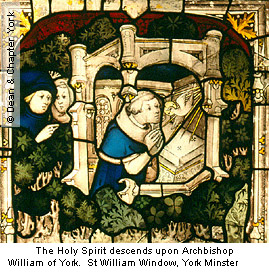
wilderness with a holy dove nearby (Roeder).
SOURCE : http://www.saintpatrickdc.org/ss/0608.shtml
St. William
(WILLIAM FITZHERBERT,
also called WILLIAM OF THWAYT).
Archbishop of York. Tradition represents
him as nephew of King Stephen, whose sister Emma was believed to
have married Herbert of Winchester,
treasurer to Henry I. William became a priest,
and about 1130 he wascanon and treasurer of York. In 1142 he
was elected Archbishop of York at
the instance of the king, in opposition to the candidature
of Henry Murdac, a Cistercian monk.
The validity of the election was disputed on the ground of
alleged simony and
royal influence, and Archbishop Theobald refused to consecrate him
pending an appeal to Rome. St.
Bernard exercised his powerful influence against William in
favour of Murdac, but in 1143 the popedecided
that William should be consecrated,
if he could clear himself from the accusation of bribery, and if
thechapter could show that there had been no undue royal
pressure. William proved his
innocence so conclusively that the legate consecrated him archbishop at Winchester 26
September, 1143. He set himself at once to carry out reforms in
his diocese,
and his gentleness and charity soon won him popularity; but he
neglected to obtain from Cardinal Hincmar the pallium which Lucius
II sent him in 1146, and the pope died
before William had been invested. The new pope, Blessed Eugenius III,
was himself a Cistercian,
and the English Cistercians soon
renewed their complaints against William, which St.
Bernard supported. Meanwhile Hincmar carried the pallium back
to Rome,
so that, in 1147, William had to travel there to obtain it, raising
the expenses of his journey by sale of treasurers
and privileges belonging to York. This afforded
fresh matter of complaint and finally the pope suspended him
from his functions on the ground that he had enthroned the Bishop of Durham without
exacting the pledges required by the former pope.
William took refuge with
his friend, the King of Sicily,
but his partisans in England took
an unwise revenge by destroying Fountains
Abbey, of which Murdac was now prior. This further
inflamed St. William's enemies, who again approached the pope,
with the result that in 1147 he deposed the archbishop from
his seat; and on the failure of
the chapter to elect a successor, he consecrated Murdac in
his stead. St. William devoted himself toprayer and mortification at Winchester till
1153, when the pope and St.
Bernard were both dead. He thenappealed to the new pope, Anastasius IV,
for restoration to his see,
a request which the death of Murdac in October made it easier to
obtain. St. William having received the pallium,
returned to York,
where he showed the greatest kindness to the Cistercians who
had opposed him, and promised full restitution to Fountains
Abbey. But his death, so sudden as to cause suspicion of poison,
took place within a few weeks. Miracles took
place at histomb,
and in 1227 he was canonized by Pope Honorius
III. In 1283 his relics were
translated to a shrine behind the high
altar of York Minster, where they remained till the Reformation. His festival is
observed in England on
8 June.
Sources
JOHN OF HEXHAM,
Continuation of SYMEON OF DURHAM in R.S. (London, 1882-5); WILLIAM OF
NEWBURGH, Historius rerum anglicasarum in R.S. (London, 1884-89); Acta
S.S., II June; ST. BERNARD, Epistles in P.L. CLXXXII-CLXXXV;
CAPGRAVE, Nova Legenda Angliae (Oxford, 1901); CHALLONER, Britannia
Sancta (London, 1745); RAINE, Historians of the Church of York in R.S. (London,
1879-94); IDEM, Fasti Eboracenses.
Burton, Edwin. "St.
William." The Catholic Encyclopedia. Vol. 15. New York:
Robert Appleton Company, 1912. 8 Jun.
2015<http://www.newadvent.org/cathen/15628c.htm>.
Transcription. This
article was transcribed for New Advent by Michael T. Barrett. Dedicated to
all who are unjustly accused of wrongdoing.
Ecclesiastical
approbation. Nihil Obstat. October 1, 1912. Remy Lafort, S.T.D.,
Censor. Imprimatur. +John Cardinal Farley, Archbishop of New York.
Copyright © 2023 by Kevin Knight.
Dedicated to the Immaculate Heart of Mary.
SOURCE : http://www.newadvent.org/cathen/15628c.htm
June 8
St. William, Archbishop
of York, Confessor
HE was son of Earl
Herbert, and Emma, sister to King Stephen. He learned from his infancy that
true greatness consists only in humility and virtue; and renounced the world in
his youth, employing his riches to purchase unfading treasures in heaven by
works of mercy to the poor, and giving himself wholly to the study and practice
of religion. Being promoted to holy orders, he was elected treasurer in the
metropolitical church of York, under the learned and good Archbishop Thurstan.
When that prelate, after having held his dignity twenty years, retired among
the Cluniac monks at Pontefract, to prepare himself for his death, which
happened the year following, St. William was chosen archbishop by the majority
of the chapter, and consecrated at Winchester in September, 1144, according to
Le Neve’s Fasti. 1 But Osbert, the archdeacon, a turbulent man, procured Henry
Murdach, a Cistercian monk of the abbey of Fountains, who was also a man of
great learning and a zealous preacher, to be preferred at Rome, whither William
went to demand his pall, and to plead the cause of his constituents rather than
his own. Being deprived by Pope Eugenius III. in 1147, he, who had always
looked upon this dignity with trembling, appeared much greater in the manner in
which he bore this repulse than he could have done in the highest honours.
Being returned into England, he went privately to Winchester, to his uncle
Henry, bishop of that see, by whom he was honourably entertained. He led at
Winchester a penitential life in silence, solitude, and prayer, in a retired
house belonging to the bishop, bewailing the frailties of his past life with
many tears, for seven years. The Archbishop Henry then dying in 1153, and
Anastasius IV. having succeeded Eugenius III. in the see of Rome, St. William,
to satisfy the importunity of others, by whom he was again elected, undertook a
second journey to Rome, and received the pallium from his holiness. 2 The saint
on his return was met on the road by Robert de Gaunt, dean, and Osbert,
archdeacon of the church of York, who insolently forbade him to enter that city
or diocess. He received the affront with an engaging meekness, but pursued his
journey. He was received with incredible joy by his people. The great numbers
who assembled on that occasion to see and welcome him, broke down the wooden
bridge over the river Ouse, in the middle of the city of York, and a great many
persons fell into the river. The saint seeing this terrible accident, made the
sign of the cross over the river, and addressed himself to God with many tears.
All the world ascribed to his sanctity and prayers the miraculous preservation
of the whole multitude, especially of the children, who all escaped out of the
waters without hurt. 3 St. William showed no enmity, and sought no revenge
against his most inveterate enemies, who had prepossessed Eugenius III. against
him by the blackest calumnies, and by every unwarrantable means had obstructed
his good designs. He formed many great projects for the good of his diocess,
and the salvation of souls; but within a few weeks after his installation was
seized with a fever, of which he died on the third day of his sickness, on the
8th of June, 1154, 4 He was buried in his cathedral; and canonized by Pope Nicholas
III. about the year 1280. At the same time his body was taken up by Archbishop
William Wickwane, and his relics put into a very rich shrine, and deposited in
the nave of the same metropolitan church in 1284. The feast of his translation
was kept on the 7th of January. 5 King Edward I. and his whole court assisted
at this ceremony, during which many miracles are attested to have been wrought.
A table containing a list of thirty-six miracles with a copy of an indulgence
of one hundred and forty days to all who should devoutly visit his tomb, is
still to be seen in the vestry, but no longer legible, as Mr. Drake mentions. 6
The shrine with its rich plate and jewels was plundered at the Reformation; but
the saint’s bones were deposited in a box within a coffin, and buried in the
nave, under a large spotted marble stone. Mr. Drake had the curiosity to see
the ground opened, and found them with their box and coffin in 1732. He laid
them again in the same place with a mark. 7 See Nicholas Trivet in his Annals of
Six Kings of England, ad an 1146. Stubbs, Act. Pontif. Ebor. in S. Willelmo,
Capgrave’s Legend, Gulielm. Neubrig. De Rebus Anglicis sui temporis, Brompton,
Gervasius Monachus inter 10 Scriptor. Angliæ, and Drake, in his curious History
and Antiquities of York. Also Papebroke’s remarks, Jun. t. 2. p. 136. 1
Note 1. P. 307.
Note 2. The Pallium which
the pope sends to archbishops is an ornament worn upon their shoulders, with a
label hanging down the breast and back. It is made of white lamb’s wool, and spotted
with purple crosses, and is worn as a token of the spiritual jurisdiction of
metropolitans over the churches of their whole province. It is regarded as an
emblem of humility, charity, and innocence, and serves to put the prelate in
mind, that he is bound to seek out and carry home on his shoulders the strayed
sheep, in imitation of Christ, the Good Shepherd and the Prince of pastors.
Cardinal Bona says the white lambs are blessed on the festival of St. Agnes, in
her church on the Nomentan road, and from that time kept in some nunnery till
they are shorn; and of the wool are the palliums made which are laid over the
tomb of St. Peter the whole night of the vigil before the feast of that
apostle. The pope sends one to archbishops in the western patriarchate after
their election and consecration: but these prelates only wear them in the
church during the divine office. Palliums are also granted to apostolic
legates, and to certain suffragan bishops of exempt sees, as of Bamberg in
Germany, and of Lucca and Pavia in Italy.
The first use of palliums
by bishops is mentioned among the Orientals. St. Isidore of Pelusium explains
at large various mystical significations of this ornament, l. 1, ep. 136. In
the West, Pope Symmachus sent a pallium to Cæsarius, archbishop of Arles, his
vicar in Gaul, in the beginning of the sixth century. From that time we find it
usually sent to apostolic legates: likewise to several metropolitans, as
appears from the letters of St. Gregory the Great. Peter de Marca shows that it
was not granted promiscuously to all metropolitans before the decree of Pope
Zachary, by which it was established a general law.
The pallium was anciently
an entire long garment, covering the whole body from the neck, not unlike a
priest’s cope, saving that it was shut up before. Instead of the pallium, the
Greek bishops now all wear the Omophorion or Humerale, which is a broad riband
hanging round their neck, across their breast, and reaching below the knees.
Spelman, in his Glossory, Thomassin, &c. show that a pallium was a mantle
worn by the Roman emperors, and that the first Christian emperors gave this
imperial ornament to eminent bishops to wear as an emblem of the royalty of the
Christian priesthood. It was afterwards appropriated to archbishops to show
their dignity, and to command greater respect, as God prescribed several
ornaments to be worn by the Jewish high-priest. See Bona de Rebus, Liturg. l.
1, c. 24. Marca de Concordia Sac. et Imperil, l. 6, c. 6 et 7. Spelman, and
especially Thomas, in Tr. de la Discipline de l’Eglise, p. 1, l. 2, c. 53 et
56, p. 829.
Note 3. Polydore Virgil,
an author of small credit, pretends that this happened on the Are, at
Pontefract, near Ferry-Bridge. But Brompton and Stubbs expressly say, that it
was in the city of York, on the river Ouse, where stood a chapel till the
Reformation, as Mr. Drake testifies. Pontefract could not derive its name from
this accident, as Polydore imagined; for we find it so called long before; and
the name was originally written Pomfrete or Pontfrete, from a very different
Norman etymology.
Note 4. Hoveden advances
that poison had been put into the chalice when he said mass. But Gulielmus
Neubrigensis, a canon regular, a Yorkshire-man, an elegant and most diligent
historian of that very time, in his history De Rebus Anglicis sui Temporis, confutes
that groundless surmise of the vulgar. [back]
Note 5. See the York
Breviary, printed at Paris in 1526.
Note 6. P. 419.
Note 7. See the York
Breviary, printed at Paris in 1526, p. 419.
Rev. Alban Butler
(1711–73). Volume VI: June. The Lives of the Saints. 1866.
SOURCE : http://www.bartleby.com/210/6/084.html
Saint William of York (Thwayt)
Profile
William Fitz Herbert--son
of Count Herbert, treasurer to Henry I, and Emma, half sister of King
Stephen--had impressed many as canon and treasurer of York Minster. In 1140,
after the death of Archbishop Thurstand, he was elected archbishop in turn by a
majority of the cathedral chapter. At this point the smooth running of
William's life ended. Archdeacon Walter of York and the diocese's Cistercian
monks claimed that he had paid to be elevated to the archbishopric and that he
was sexually incontinent. Others, including the Augustinian priors, said that
his friendship with his uncle, King Stephen, gave him an improper influence in
securing election to the see.
The archbishop of
Canterbury was reluctant to consecrate William under such a cloud of
accusation. For a time even Pope Innocent III hesitated, before finally
agreeing to support William. Henry of Blois, who was both bishop of Winchester
and King Stephen's brother accordingly consecrated William and he took up his
duties as archbishop in 1143.
But the dispute did not
end; matters soon became difficult again. William failed to receive the
official 'pallium,' symbol of the pope's authority, before the pope who sent it
had died. The papal legate took the pallium back to Rome.
The new pope, Eugenius
III, was a Cistercian and sided with the archbishop's opponents, including
Saint Bernard of Clairvaux. William visited Rome to persuade the pope of his
credentials. But the pope suspended him. To make things worse, a group of his
followers now violently attacked some of the monks of Fountains Abbey, itself a
Cistercian foundation, and set fire to the monastery farms. The abbot of Fountains,
Henry Murdac, had been William's rival for the see of York in the first place.
A council held at Rheims
in 1147 now deposed William. He went to stay with Henry of Blois, and spent six
chastened years living as a monk at Winchester. Only when both the pope and the
abbot of Fountains were dead was he able to make a successful appeal to Pope
Anastasius IV and return in triumph to York. Enormous crowds gathered on a
bridge over the River Ouse as William arrived. The bridge collapsed.
Fortunately no one was injured, and this was taken as a sign of good things to
come. William, however, had reached the end of his life.
William was mild and
conciliatory towards his enemies, but within a few months he was dead, perhaps,
it was rumored, from poison at the hands of Osbert, the new archdeacon of York.
He was well liked by the people, and the rumored murder doubtless contributed
to a popular demand for his canonization (Attwater, Benedictines, Bentley,
Delaney, Encyclopedia).
Born: late eleventh
century
Died: June 1154; buried
in the cathedral of York, England
Canonization: March 18,
1226 by Pope Honorius III; the investigation was led by the Cistercians,
including the abbot of Fountains who supported the canonization
Representation: Saint
William is depicted in the episcopal insignia on many windows in York, England.
He might be shown (1) on a shield with eight lozenges near him; (2) crossing
the Ouse Bridge; (3) on horseback, received by the Mayor at Mickelgate Bar; (4)
kneeling to kiss the cross at the entrance to York Minster; or (5) as a
tonsured monk praying in the wilderness with a holy dove nearby (Roeder).
Prayer
St. William, you were
chosen by God to be Archbishop of York, but were unjustly accused of simony.
You were election was opposed by many in favor of another. Even through all
this, you never took your eyes off of Christ and his will for you. You devoted
yourself to a life of prayer and mortification. After many years, you were
finally restored to the See that was rightfully yours. Instead of reserving
spite, you showed the utmost amount of forgiveness and love for those who had
before been in opposition to your election. Please help us to follow your
example of perseverance and forgiveness so that we may forgive our
transgressors and always persevere in the Lord’s will. Amen.
Stephen McKenna, Community
of Hope, 2006
SOURCE : http://www.communityofhopeinc.org/Prayer%20Pages/Saints/william.html
Menology
of England and Wales – Translation of Saint William, Bishop, Confessor, 1283
Article
Up to the year 1283, the
relics of Saint William had remained under ground in the tomb in which they had
been first laid. The magnificent Anthony Bek, Bishop-elect of Durham, resolved
to signalise his consecration in York Minster on the Sunday within the octave
of the Epiphany that year, by the long desired translation. King Edward, though
busily engaged in operations on the Welsh borders, came specially to York for
the occasion, being the more moved to do so inasmuch as he had had occasion to
attribute a recent escape from serious danger to the intercession of the Saint.
The Queen was also present, with eleven Bishops, besides Archbishop William
Wyckwane, and a multitude of clergy and laity of all degrees. On Saturday the
relics, after due examination, were placed in a shrine of silver and gold. On
Sunday the Matins of the new feast were sung for the first time; and after the
hour of Prime, the King and prelates took the precious burden on their
shoulders, but the press was so dense that all efforts to make a passage in the
nave of the church were vain, and the procession could only make its way from
the transept up one aisle of the choir to the honourable resting-place which
had been prepared for the relics, in the rear (it would seem) of the high
altar. The feast of this translation was observed in the Church of York on the
Sunday in the octave of the Epiphany.
MLA
Citation
Father Richard Stanton.
“Translation of Saint William, Bishop, Confessor, 1283”. Menology of England and Wales, 1887. CatholicSaints.Info.
15 April 2015. Web. 3 February 2026.
<https://catholicsaints.info/menology-of-england-and-wales-translation-of-saint-william-bishop-confessor-1283/>
Saint William: Patron Saint of York
The stone coffin of York’s Patron Saint, William
Fitzherbert, can be found in the Western Crypt of York Minster. William
Fitzherbert was Archbishop from 1141 to 1147 and from 1153 to 1154. His
appointment was controversial but it ended in miracles and sainthood.
William was the Minster’s Treasurer before being
elected Archbishop in 1141 by the majority of the Chapter. Even then some
of the Canons disputed the decision and he was not officially consecrated until
1143. In 1147 he was deposed by the Pope, who replaced him with the Abbot
of Fountains Abbey, Henry Murdac. In contrast to the abbey in York,
Fountains had a reputation for austere and holy living. Murdac’s appointment
was unpopular and the citizens of York refused to allow him to enter the city
when he arrived in 1148.
William accepted the Pope’s decision and left for Sicily - but that wasn’t to
be the end of the story. Murdac and the Pope both died in the same year,
1153, and William was asked back to York. As he made his triumphant
return to the city, he stopped at Ouse Bridge. So many people were
crowded on the bridge that the structure collapsed. William stopped and
called on God to save the drowning. Miraculously no one was hurt.
It wasn’t long after, in June 1154, that William
himself fell ill after celebrating mass at York Minster and he died a week
later. Many believed he had been given poison in the chalice he had
used. We know that one of his chaplains was accused of murder but not the
outcome of the charge.
The miracle at Ouse Bridge, coupled with various
miracles attributed to him after his death, led to him being canonised in
1224.
Pilgrimage in medieval England was a common
religious act and was economically important for the destination
sites, much as tourism is today. St William was originally
commemorated by a small altar in the Minster but in about 1330 a
shrine was built in the center of the Nave to house
his tomb. This proved a very popular place to visit, pay homage
and pray. So much so that 150 years later the tomb was moved to a new
larger shrine behind the High Altar.
Both shrines were dismantled during Henry VIII's reformation
of the church and buried. Pieces of each have since been
excavated and large parts are now in the collection of the Yorkshire
Museum, York.
St William’s tomb is still in the Minster
and in a location that he would recognise. The stone coffin is
actually a reused Roman sarcophagus, although the top is modern. On St.
William’s day, in June, small services are still held in the Western Crypt, and
the area around the tomb is used as an area of quiet reflection.
Resources
St William's Tomb can be seen in York Minster. Google
Maps: › View location
SOURCE : https://www.historyofyork.org.uk/themes/norman/saint-william-patron-saint-of-york

Saint
William on Ouse Bridge - stained glass in York Minster
San Guglielmo
Fitzherbert Vescovo, monaco
Festa: 8 giugno
† York, Inghilterra, 8
giugno 1154
Nominato Arcivescovo di
York nel 1141, Guglielmo si trovò ben presto ad affrontare l'opposizione di
Enrico Murdac, sostenuto da Bernardo di Chiaravalle e dal papato. Deposto nel
1147, si rifugiò presso lo zio Enrico di Blois, attendendo l'occasione per
riaffermare i propri diritti. La morte di Eugenio III, Bernardo e Murdac nel
1153 aprì la strada al suo ritorno a York, favorito dal nuovo papa Anastasio
IV. Accolto trionfalmente dalla popolazione, Guglielmo vide la sua popolarità
accrescersi dopo il miracoloso salvataggio di molti durante il crollo di un
ponte. Tuttavia, il suo destino fu nuovamente segnato dalla tragedia. Un mese
dopo il suo ritorno, morì improvvisamente, non senza il sospetto di
avvelenamento. Canonizzato nel 1227, le sue reliquie furono venerate fino al
XVIII secolo, quando andarono disperse durante la Riforma.
Etimologia: Guglielmo
= la volontà lo protegge, dal tedesco
Martirologio
Romano: A York in Inghilterra, san Guglielmo Fitzherbert, vescovo, che,
uomo amabile e mansueto, deposto ingiustamente dalla sua sede, si ritirò tra i
monaci di Winchester e, una volta restituito alla sua sede, perdonò i suoi
nemici e favorì la pace tra i cittadini.
Figlio del conte Erberto di Winchester e di Emma, sorellastra del re Stefano d'Inghilterra, Guglielmo Fitzherbert, conosciuto anche come Guglielmo di Thwayt, abbracciò ben presto lo stato ecclesiastico, divenendo verso il 1130 canonico di York e tesoriere di quel capitolo cattedrale.
Andata a vuoto, dopo la morte dell'arcivescovo Turstano (6 febbraio 1140), l'elezione alla sede di York di Enrico di Sully, abate di Fécamp, il quale non volle lasciare la sua abbazia per il vescovato, fu posto sulla cattedra episcopale nel gennaio del 1141 Guglielmo, assai stimato per la profonda pietà che lo animava ed amato inoltre per la sua bontà e santità di vita. La sua elezione fu tuttavia fortemente contrastata dall'arcidiacono Walter di Londra e da alcuni altri, che sostenevano invece la candidatura, a quanto pare, del cistercense Enrico Murdac, rimasto comunque in minoranza. Dall'arcivescovo Teobaldo di Canterbury, presso cui gliioppositori di Guglielmo avevano fatto ricorso avanzando contro di lui accuse di simonia e di intrusione regia, l'affare venne rimesso al giudizio della Sede apostolica; ma Innocenzo II riconobbe la piena validità dell'elezione di Guglielmo il 6 settembre 1143.
La morte di Innocenzo II e i due successivi brevi pontificati di Celestino II e di Lucio II riuscirono però fatali a Guglielmo. Immerso nelle cure della sua diocesi, aveva sempre procrastinato la richiesta del pallio, e non poté piú averlo anche se gli era già stato accordato, perché il legato pontificio Imaro di Tuscolo, inviato appositamente in Inghilterra, se lo era riportato indietro avendo dovuto far ritorno a Roma per la sopraggiunta morte del papa. L'esaltazione al pontificato di Eugenio III, il 15 febbraio 1145, rianimò le speranze di Enrico Murdac, il quale ricorse immediatamente al nuovo papa, giovandosi non solo del fatto di essere anch'egli cistercense, ma soprattutto della protezione di Bernardo di Chiaravalle, ascoltatissimo maestro di Eugenio III. Il papa non esitò infatti ad accogliere le proteste del Murdac e le istanze di Bernardo: sospeso in un primo tempo Guglielmo dalle sue funzioni episcopali, finí poi col deporlo e col sanzionare la nuova elezione dell'abate di Fountaine' a cui conferí egli stesso la consacrazione arcivescovile, il 7 dicembre 1147, dandogli anche il pallio.
Privato in tal modo della sua diocesi, Guglielmo si recò dapprima per qualche tempo alla corte di Ruggero, re di Sicilia e suo parente, quindi, tornato in Inghilterra, si ritirò presso lo zio vescovo, Enrico di Blois, a Winchester, dove rimase sino al 1153, allorché, morti a breve distanza l'uno dall'altro Eugenio III (8 luglio), s. Bernardo (20 agosto) e l'arcivescovo Enrico Murdac (14 ottobre), si affrettò a recarsi a Roma per far valere le sue buone ragioni presso il nuovo pontefice Anastasio IV, che si dichiarò senz'altro in suo favore.
Avuti finalmente riconosciuti i suoi diritti e ricevuto in pari tempo anche il pallio, Guglielmo poté rientrare nella sua antica sede di York, ai primi di maggio del 1154, trionfalmente accolto da tutta la popolazione. Il crollo di un ponte di legno sul fiume Ouse, rovinato improvvisamente sotto il peso eccessivo della folla che vi si era ammassata, senza tuttavia che si avessero a lamentare vittime, accrebbe la popolarità di Guglielmo, che cominciò anche ad essere oggetto di particolare venerazione perché si volle attribuire alle sue preghiere la miracolosa incolumità di quanti erano stati trascinati nel crollo del ponte.
Per pochissimo tempo, nondimeno, poté egli governare la sua ricuperata diocesi, perché un mese dopo il suo trionfale ingresso a York venne colto da un subitaneo e grave malore mentre, di domenica, stava celebrando la Messa, morendo qualche giorno dopo, l'8 giugno 1154. In base all'accusa fatta in tale occasione da Sinforiano, uno dei cappellani del defunto arcivescovo, e mai provata del resto, fu avanzato il sospetto che gli fosse stato versato del veleno nel calice dall'arcidiacono Osbert.
Sepolto in una cappella della sua cattedrale, sulla sua tomba non tardarono a verificarsi frequenti miracoli, che ne favorirono la canonizzazione nel 1227 per opera di Onorio III, come risulta dal Martirologio Romano, in cui sotto la data dell'8 giugno si può leggere infatti: "Ab Honorio papa tertio in Sanctorum canonem relatus est". Nel 1284 il corpo di s. Guglielmo venne trasferito dal suo primitivo sepolcro nella navata centrale del tempio, alla presenza del re Edoardo I e della regina Eleonora, ma i preziosi resti, che pur non ebbero a soffrire danno per tutto il tempo della Riforma, scomparvero durante il sec. XVIII. La festa del santo si celebra l'8 giugno, mentre il 9 gennaio viene commemorata la traslazione delle sue reliquie.
Autore: Niccolò Del Re
SOURCE : https://www.santiebeati.it/dettaglio/56450
Wilhelm Fitzherbert
englischer Name: William
auch: von York
Gedenktag katholisch: 8. Juni
Übertragung der Gebeine: 8. Januar
Name bedeutet: der
willensstarke Schützer (althochdt.)
Erzbischof von York, Märtyrer
* in England
† 8. Juni 1154 in York in
England
Wilhelm, Sohn des
Schatzmeisters von König Heinrich I. und wohl Neffe von König Stephan von
Blois, wurde 1143 nach langem Streit um die Nachfolge Erzbischof von York.
Seine Ernennung wurde von König Stephan von Blois und dessen Bruder Heinrich,
dem Bischof von Winchester,
unterstützt, aber von den politischen Gegnern seiner Gönner und von
lokalen Zisterziensern angegriffen;
sie beschuldigten Wilhelm der Simonie und
appellierten an den Papst, wo ihr Anliegen die Unterstützung von Bernhard
von Clairvaux fand. Bei einer Reise nach Rom konnte
Wilhelm aber seine Ernennung bei Papst Innozenz II. durchsetzen.
Als 1146 Eugen III.,
ein Zisterzienser,
zum Papst gewählt wurde, wurde die Streitfrage wieder aufgerollt, 1147 wurde
Heinrich Murdac anstelle von Wilhelm vom Papst geweiht. Der Tod seines Rivalen
sowie von Eugen III. und Bernhard
von Clairvaux 1153 führte zur Wiedereinsetzung von Wilhelm in sein Amt
durch Papst Anastasius IV., 1154 kehrte er im Triumph nach York zurück,
obwohl seine Gegner ihren Widerstand nicht aufgaben. Als er noch im selben Jahr
starb, wurde ein Giftmord vermutet.
Wilhelm galt als
Märtyrer; über Wunder an seinem Grab gab es viele Berichte.
Kanonisation: Wilhelm
wurde am 18. März 1226 durch Papst Honorius III. heiliggesprochen.
Stadlers
Vollständiges Heiligenlexikon
Seite
zum Ausdruck optimiertUnser Reise-Blog:
Reisen zu den Orten, an denen die
Heiligen lebten und verehrt werden.
Empfehlung an
Freunde senden
Artikel
kommentieren / Fehler melden
Fragen? -
unsere FAQs antworten!
Impressum - Datenschutzerklärung
Schauen Sie sich zufällige Biografien an:
Didacus
von Lugo
Guido
von Arezzo
Juliana
de Collalto
Autor: Joachim
Schäfer - zuletzt aktualisiert am 08.08.2016
Quellen:
• Vera Schauber, Hanns Michael Schindler: Heilige und Patrone im Jahreslauf. Pattloch, München 2001
• Charlotte Bretscher-Gisinger, Thomas Meier (Hg.): Lexikon des Mittelalters. CD-ROM-Ausgabe J.B. Metzler, Stuttgart / Weimar 2000
• Lexikon für Theologie und Kirche, begr. von Michael Buchberger. Hrsg. von
Walter Kasper, 3., völlig neu bearb. Aufl., Bd. 10. Herder, Freiburg im
Breisgau 2001
korrekt zitieren: Joachim Schäfer: Artikel Wilhelm Fitzherbert, aus dem Ökumenischen Heiligenlexikon - https://www.heiligenlexikon.de/BiographienW/Wilhelm_von_York.html, abgerufen am 3. 2. 2026
Die Deutsche Nationalbibliothek verzeichnet das Ökumenische
Heiligenlexikon in der Deutschen Nationalbibliografie; detaillierte
bibliografische Daten sind im Internet über https://d-nb.info/1175439177 und https://d-nb.info/969828497 abrufbar.
SOURCE : https://www.heiligenlexikon.de/BiographienW/Wilhelm_von_York.html
