
Saint Hubert
Évêque de
Tongres-Maastricht-Liège (+ 727)
On le dit apparenté à
Charles Martel. Il est vrai qu'on le trouve à la cour de Pépin d'Héristal,
maire du Palais. Il épouse Floribanne, la fille du roi Dagobert, et les
chroniqueurs nous disent qu'il était connu par "les folles joies de sa vie
mondaine" peu édifiante, jusqu'au jour où la grâce de Dieu et les conseils
de saint Lambert, évêque de Maestricht, l'entraînèrent vers la sainteté. La
tradition légendaire raconte cette belle histoire du cerf qu'il vit durant une
chasse, un jour de Vendredi-saint, et qui lui apparut avec une croix entre ses
bois "Chasser un jour pareil ? pourquoi ne vas-tu pas prier?" Dès le
XIe siècle, il était le patron des chasseurs. Ce qui est historique, c'est
qu'en 688, il abandonne le duché d'Aquitaine à son frère pour se consacrer
totalement à Dieu. Après une vie monastique exemplaire, il est élu évêque de
Liège-Maestricht et Tongres, puisque saint Lambert venait d'être martyrisé.
Saint Hubert fut un grand évêque, proche de ses fidèles qu'il rejoignait là où
ils vivaient, dans les clairières, sur les rivières, dans les villages.
Attentif à toute misère, il aidait les malheureux et les prisonniers. Il mourut
des suites d'une blessure occasionnée par un ouvrier maladroit qui lui écrasa
la main gauche.
À Tervuren, dans le
Brabant, en 727, le trépas de saint Hubert, évêque de Tongres et Mästricht.
Disciple et successeur de saint Lambert, il déploya son activité à répandre
l’Évangile à travers le Brabant et les Ardennes et à y combattre les mœurs
païennes, et il bâtit à Liège une église où il transféra les restes de son
prédécesseur. (au 30 mai au martyrologe romain)
Martyrologe romain
SOURCE : http://nominis.cef.fr/contenus/saints/6/Saint-Hubert.html

Jean Bourdichon (1503-1508), Grandes Heures d'Anne de Bretagne, Fol. 191v - Saint-Hubert
Saint Hubert
Évêque
(657-727)
Saint Hubert était un
prince de la lignée de Clovis, roi de France. Il avait douze ans quand, au
milieu d'une chasse, il vit un ours furieux se jeter sur son père et
l'étreindre de ses griffes redoutables. À ce spectacle, il poussa un cri vers
le Ciel: "Mon Dieu, faites que je sauve mon père!" Aussitôt, se
jetant sur l'animal féroce, il lui donne le coup de la mort. C'est là, sans
doute, le premier titre de saint Hubert à sa réputation de patron des
chasseurs.
Plus tard, Hubert
chassait, un Vendredi saint, dans la forêt des Ardennes, ce qui était une chose
peu convenable pour un chrétien. Soudain, un beau cerf, qu'il poursuit avec
ardeur, s'arrête et lui fait face. Entre les cornes de l'animal brille une
Croix éclatante, et une voix prononce ces paroles:
"Hubert! Hubert! Si
tu ne te convertis pas et ne mènes pas une vie sainte, tu descendras bientôt en
enfer.
— Seigneur, s'écrie le
jeune prince, que voulez-Vous que je fasse?
— Va vers l'évêque
Lambert, il t'instruira."
Bientôt Hubert renonce à
tous ses droits sur la couronne d'Aquitaine, se revêt d'un costume de pèlerin
et s'achemine vers Rome. Comme il arrivait au tombeau des saints Apôtres, le
Pape Sergius, dans une vision, apprenait le meurtre de l'évêque Lambert,
victime de son zèle pour la défense de la sainteté conjugale, et il recevait
l'ordre d'envoyer à sa place le pèlerin qui arrivait en ce moment, pour prier,
à la basilique de Saint-Pierre. Le Pontife trouva en effet l'humble pèlerin,
lui fit connaître les ordres du Ciel, et Hubert, malgré sa frayeur et ses
larmes, dut se soumettre à la Volonté de Dieu.
De retour en sa patrie,
il fonda l'évêché de Liège, où il fit briller toutes les vertus des Apôtres. Sa
douce et persuasive éloquence captivait les foules; il parlait quelquefois
pendant trois heures consécutives, sans qu'on se lassât de l'entendre. A la
puissance de la parole il joignait celle des miracles. A sa prière, les démons
abandonnaient le corps des possédés, les flammes de l'incendie s'éteignaient,
la sécheresse désastreuse cessait tout à coup pour céder la place à une pluie
féconde: "Le Dieu d'Élie est le nôtre, disait-il, implorons-Le dans la
prière et le jeûne; la miséricorde fera le reste."
Une voix céleste lui dit
un jour: "Hubert, dans un mois tes liens seront brisés." Il se
prépara pieusement à la mort, et, après avoir chanté le Credo et entonné le
Pater, il rendit son âme à Dieu. On l'invoque spécialement contre la rage et
contre la peur.
Abbé L. Jaud, Vie des Saints pour tous les jours de l'année, Tours, Mame, 1950
SOURCE : http://magnificat.ca/cal/fr/saints/saint_hubert.html

Master of the Life of the Virgin, The Conversion of Saint Hubert: Left Hand Shutter, oil on oak wood, circa 1485-1490, 123 x 83.2, National Gallery, Central London
3 novembre
Saint Hubert
Saint Hubert qui occupa
le siège de saint Servais de 705 à 727, était apparenté, selon une hypothèse
assez plausible, à Plectrude, femme du maire du palais Pépin II. Il semble
qu’il se maria et que son fils distingué, Florbert (évêque de Liège de 727
à 746), signalé par son biographe, était plus qu'un fils spirituel.
Une Vie, écrite vers
745, dit qu’Il arrachait bien des gens à l'erreur des gentils : il la fit
cesser. Des pays éloignés on accourait vers lui, et il confirmait par la grâce
septiforme ceux qui étaient lavés par l'eau du baptême... Plusieurs idoles et
sculptures qu'on allait adorant en Ardenne furent détruites et livrées au feu.
Comme par la suite des fanatiques vénéraient d'une manière sacrilège cette
poussière et ces cendres, il leur infligea trois ans de pénitence. De même en
Taxandrie et en Brabant, il détruisit plusieurs images et beaucoup de
sculptures, et il construisit en divers lieux, à la sueur de son front, des
sanctuaires en l'honneur des saints martyrs. La treizième année de son
épiscopat, la veille de Noël, il fit transporter à Liège les restes de saint
Lambert, qui reposaient dans l'église Saint-Pierre de Maestricht.
Dans l'église Saint-Lambert, on construisit un mausolée magnifique. Mais
il n'y eut pas, semble-t-il, de transfert officiel du siège épiscopal de
Maestricht à Liège, pas plus que jadis de Tongres à Maestricht.
Hubert pêchant à
Nivelle-sur-Meuse, dans une barque, s'appuyait d'une main sur un piquet à
enfoncer, lorsqu'un serviteur, involontairement, lui assena un coup de maillet
sur la main et lui broya les doigts. Le lendemain, comme il était retourné à la
pêche avec ses gens, un coup de vent chavira la barque. De la berge Hubert
pria. Un homme est sous l'eau, roulé, un pan de sa tunique enroulé à un
piquet. Je le secouais trois fois, impossible de me dégager. Assiégé par
l'eau, je m'écriais : “Par ses mérites, au secours, toi qui as créé mer et
terres !” Aussitôt délié, je glissais entre deux poteaux et, en quelques
brasses à peine, je m'évadais jusqu'à la berge. Et tous les serviteurs s'en
sortirent sains et saufs. L'évêque dut s'aliter à cause de sa blessure. La
douleur l'empêchait de dormir. Il répétait sans cesse le
psaume Miserere. Dieu éprouvait son athlète : pendant trois
mois, les doigts suppurèrent. Enfin, une nuit qu'il somnolait, un ange lui
montra une basilique neuve en disant : Il y a beaucoup de demeures
dans la maison de mon Père (Jean XIV 2) ; et celle-ci que tu vois, je
te la donnerai pour que tu la possèdes devant Dieu pour l'éternité. Et il
lui prédit la fin de sa tribulations au bout d'un an.
Saint Hubert augmenta son
ascèse, ses aumônes et, l'année se terminant, il vint prier longuement au
tombeau de saint Lambert, puis se rendit aux Saints-Apôtres, à Liège, et
désigna l'endroit où il voulait reposer. Il consentit d’aller en Brabant pour
la dédicace d'une église et comme on lui insinuait qu'il pourrait abréger la
longue cérémonie, il répondit : Faisons les choses amplement, de
notre mieux : voilà pour aujourd'hui le programme !
Il fit non seulement la
fonction liturgique, mais prêcha encore à tierce (9 heures) et à sexte (midi)
sur la mort, sur sa mort. Faites pénitence, il va venir, il est proche, le
jour du jugement. La mort est voisine, elle ne tarde pas à venir, comme dit
l'Écriture. Oui, de ce sommeil nous serons tous pris. Si quelqu'un de vous se
sent empêtré dans une faute ou tombé dans les péchés, vite qu'il recoure aux
médecines salutaires, tant qu'une porte est encore ouverte, afin que l'âme ne
meure pas avec le corps. Les méfaits qu'il a commis, qu'il s'en repente de tout
cœur. Et vous, frères, pesez et soupesez bien ce que vous avez fait, et
maintenant faites attention à ce que vous faites. Moi, pauvre pêcheur, quand je
parle pour vous, c'est pour moi que je crains. Sinon autant que je le dois, du
moins autant que je le puis, j'avertis. Celui qui méprise le héraut, qu'il
craigne le juge ! Voilà que mon juge est là tout près qui va me
dire : Où sont ceux que tu as instruits, où sont ceux que tu as prêchés,
où sont-ils ? Je t'ai constitué pour être à la tête de mon troupeau. Rends
compte de ta gestion (Luc XVI 2) : combien as-tu exigé, combien as-tu
travaillé, combien me rapportes-tu d'argent ? Et moi, misérable, que
répondrai-je, inutile serviteur, quand il apparaîtra dans toute sa majesté,
glorieux, avec les saints anges et archanges, les trônes et les
dominations ? Le juge sévère viendra exiger son dû et rendre ce qu'il a
promis. Alors, si je peux sortir quelques biens de vous, je dirai :
Ceux-là, ils ont gardé tes commandements et tes préceptes (Jean XVII
6) ; ta loi, grâce à mon enseignement, ils ne l'ont pas oubliée. Et vous,
contents, vous porterez vos gerbes devant le Seigneur, dans une liesse
éternelle. Ah ! pas de cette redoutable sentence que le serviteur mauvais
et paresseux mérita d'entendre ! mais plutôt celle que le fidèle serviteur
a méritée Dans le détail tu as été fidèle, je vais te donner une belle
situation. Entre dans la joie de ton maître. Et aussi : Venez, bénis de
mon Père, recevez le royaume (Matthieu XXV 21 34). Puissiez-vous mériter
de venir heureusement dans ce royaume par la grâce de celui qui vous a appelés
à la gloire, et qui m'a donné le pouvoir de vous conduire jusqu'ici.
Aujourd'hui, vous, tous, je vous recommande à Jésus-Christ pour que dans ses
préceptes, par mes paroles, vous persévériez toujours !
Saint Hubert, après la
cérémonie, se rendit à un banquet où il accepta un peu d’une coupe de vin, fit
une prière sur la table, donna à tous des pains bénits (eulogies) et mangea
peu, les yeux au ciel. Comme il se levait de table, un anachorète qui comptait
douze ans de vie solitaire l'invita à boire un peu plus. Il
répondit : Au revoir dans le royaume de Dieu ! mais ici, je ne
boirai pas plus. Puis il gagna sa barque, probablement sur le Dyle.
Quand il en sortit, il
avait grand soif et grand froid. Il alla se reposer, mais fut tiré de son
sommeil par des serviteurs qui se battaient au couteau. Alors on le mit sur un
cheval et, soutenu par des mains amies, il rentra chez lui (à Tervueren)
pendant la nuit. La fièvre grandit du lundi au vendredi. Il psalmodiait sans
pouvoir dormir. Une nuit, le démon le tourmenta spécialement. Hubert appela un
disciple, demanda l'heure. Le coq n'avait pas encore chanté. Il voulut de l'eau
bénite, de l'huile sainte. Avant l'aube, il avait déjà récité son office
jusqu'à vêpres. Au matin, après avoir récité le Credo et
le Pater en présence de son fils distingué, Florbert, Hubert
mourut (30 mai 727). Son corps fut porté aux Saints-Apôtres de
Liège où, seize ans après sa mort, il fut retrouvé intact. Le 3 novembre 743,
le maire du palais Carloman aida à porter ses reliques devant l'autel. En 825,
Liège les céda partiellement au monastère d'Andage qui
devint Saint-Hubert, et prétendit posséder le corps dans son intégralité.
SOURCE : http://missel.free.fr/Sanctoral/11/03.php

Bekehrung des Hubertus von Lüttich in einer spätmittelalterlichen Buchmalerei
Also known as
Apostle of the Ardennes
Hubert the Hunter
Hubertus…
30 May (translation
of relics)
Profile
Grandson of Charibert, King of Toulouse.
Eldest son of Bertrand, Duke of
Aquitaine. Worldly, popular and dissolute layman courtier at
Nuestria in northwest France in
his youth.
For political reasons he emigrated,
to Austrasia in the border area between modern France and Germany. Married in 682 to
Floribanne, daughter of Dagobert, Count of
Louvain. Father of
one son, Saint Floribert
of Liege.
Hubert was passionately devoted to hunting.
While chasing a
stag on a Good
Friday morning, he received a vision of a crucifix between
the animal’s antlers. A voice warned him, “Hubert, unless you turn to the
Lord, and lead a holy life, you shall quickly go down to hell.” It was
a conversion experience
for Hubert.
Spiritual student of Saint Lambert
of Maastricht. When his wife died,
Hubert renounced all his worldy positions, titles and wealth, handed his
patrimony, and the care of his son, to his brother, and studied for
the priesthood.
After ordination,
he served as assistant to Saint Lambert. Pilgrim to Rome,
where he was when Lambert was murdered.
Chosen bishop of Maastricht.
Known for his excellent preaching and
his generosity to the poor,
stripping the diocese of
all excesses to help them. Following another vision, and to defend of the
memory of Lambert,
he moved his mentor’s body from
Maastricht to Liege,
and built a church for it on the site of Lambert‘s martyrdom.
First bishop of Liege.
Hubert evangelized the
Ardenne region, converting pagans and
strengthening Christians.
He tracked down some of the old idolatrous places
of worship, but generally permitted the new converts to
decide for themselves to destroy the old idols. They all, naturally, did so.
Hubert predicted the date of his own death,
and died while
reciting the Our Father. He became highly revered in the Middle Ages, and
there were several military orders named in his honor. His association with
the hunt led
to his patronage of furriers and trappers,
and against rabies and
bad behavior in dogs,
primarily hunting dogs.
The breed commonly known as bloodhounds are also called Saint
Hubert’s hounds.
Born
c.656 at
Maastricht, Netherlands
30 May 727 at
Fura (modern Tervueren), Brabant, Belgium of
natural causes
interred at Saint Peter’s collegiate church in Liege, Belgium
relics translated
in 825 to
the abbey which
has since been renamed Saint Hubert’s
–
in Belgium
bishop celebrating Mass as
an angel brings
him a scroll
bishop with
a hound and
hunting horn
bishop with
a stag with
a crucifix
huntsman adoring
a stag with
a crucifix in
its antlers
kneeling before a stag as an angel brings
him a stole
kneeling in prayer,
a hound before
him and often with hunting gear
nearby
knight with
a banner showing
the stag‘s
head and crucifix
stag with
a crucifix over
its head
young courtier with
two hounds
Additional Information
A
Garner of Saints, by Allen Banks Hinds, M.A.
Book
of Saints, by the Monks of
Ramsgate
Catholic
Encyclopedia, by C F Wemyss Brown
Lives
of the Saints, by Father Alban
Butler
Lives
of the Saints, by Father Francis
Xavier Weninger
Saints
of the Day, by Katherine Rabenstein
Short
Lives of the Saints, by Eleanor Cecilia Donnelly
books
Our Sunday Visitor’s Encyclopedia of Saints
Sacred
and Legendary Art, by Anna Jameson
other sites in english
Honoring
the Patron Saints of Hunters
What Does Jägermeister Have to Do with Saint Hubert?
images
sitios en español
Martirologio Romano, 2001 edición
sites en français
Abbé Christian-Philippe Chanut
fonti in italiano
MLA Citation
“Saint Hubert of Liège“. CatholicSaints.Info. 29
May 2021. Web. 3 November 2021. <https://catholicsaints.info/saint-hubert-of-liege/>
SOURCE : https://catholicsaints.info/saint-hubert-of-liege/

Saint Hubert évêque et le cerf, église Notre-Dame.Villedieu-les-Poêles (Normandie, France).
Hubert of Liège B (RM)
Died at Tervueren (near
Brussels), Belgium, May 30, 727. Nothing reliable is known about Saint Hubert
before he became a cleric under Saint Lambert, whom he succeeded as bishop of
Tongres-Maestricht.
In medieval times many
saints derived both the pleasure of sport and some of their food from hunting.
According to legend both Saint Eustace and Saint Hubert came upon a stag with a
crucifix between its antlers. The stag's warning to Hubert was sterner than
that to Saint Eustace, since Hubert had been hunting on Good Friday. Stopped in
his tracks by the sight of the stag and crucifix, Hubert heard a voice warning
him that unless he turned to Christ he was destined for hell.
This was in the forest of
Ardenne. Hubert had been a courtier whose wife died giving birth to their son
in the year 685. He retired from the service of Pepin of Heristal and became a
priestly servant of Bishop Lambert. For 10 years Saint Lambert taught the
future Saint Hubert self-discipline by making him live alone as a hermit in the
forest.
Around 705 Lambert
publicly criticized King Pepin for his adultery with the sister of his wife.
The woman called on her brother and some other men to murder Lambert in the
tiny village of Liège. Hubert was elected Lambert's successor.
Hubert courageously
cherished the memory of Saint Lambert. Since the saint had been murdered at
Liège, Hubert decided that his bones should not lie in the cathedral at
Maestricht. He transferred them to Liège and also made that village the seat of
his diocese. In consequence Liège grew to be a great city. There today Saint
Lambert is regarded as patron of the diocese and Saint Hubert as patron and
founder of the city.
In the 8th century, the
forest of Ardenne was filled with men and women to whom the Gospel had never
been preached. They worshipped idols. The saint assiduously worked to convert
these people and destroy their pagan gods. He loved to go in procession through
the fields, chanting Christian prayers and blessing the crops.
In 726, while fishing
from a boat in the Meuse, he met with an accident that caused him much
suffering, and he died fifteen months later, murmuring the Lord's Prayer on May
30, 727, while on a trip to consecrate a new church. His son succeeded him as
bishop of Liège (Attwater, Bentley, Delaney, Encyclopedia).
In art Hubert is
represented as a huntsman adoring a stag with a crucifix in its horns.
Variously, he may be shown (1) as a knight with a banner showing the stag's
head and crucifix; (2) as a young courtier with two hounds; (3) kneeling in
prayer, a hound before him; (4) kneeling before a stag as an angel brings him
his stole; (5) as a bishop holding a stag with the crucifix on his book; (6) as
a bishop with a hound, hunting horn, and stag with a crucifix (not to be
confused with Germanus of Auxerre); (7) celebrating Mass as an angel brings him
a scroll (very similar to the Mass of Saint Giles) (Roeder).
Hubert is the patron of
hunters and trappers, metal-workers, and mathematicians (Roeder). It is
believed that the 15th century legend of his conversion developed because he
was regarded as a patron of hunters in Ardenne (Attwater).
SOURCE : http://www.saintpatrickdc.org/ss/1103.shtml

Hochkönigsburg
(Elsass). Saal der Jagdtrophäen: Wandmalerei mit der Bekehrung des heiligen
Hubertus.
Haut-Koenigsbourg
castle (Alsace). Hunting room: Mural showing the conversion of saint Hubertus.
St. Hubert
Confessor,
thirty-first Bishop of
Maastricht, first Bishop of Liège,
and Apostle of the Ardennes, born about 656; died at Fura (the modern
Tervueren), Brabant, 30 May, 727 or 728. He was honored in the Middle
Ages as the patron of huntsmen, and the healer of hydrophobia
(rabies). He was the eldest son of Bertrand, Duke of Aquitaine, and grandson of
Charibert, King of Toulouse,
a descendant of the great Pharamond. Bertrand's wife is variously given as
Hugbern, and as Afre, sister of Saint Oda. As a youth, Hubert went to the court
of Neustria, where his charming manners and agreeable address won universal
esteem, gave him a prominent position among the gay courtiers, and led to his
investment with the dignity of "count of the palace". He was a
worldling and a lover of pleasure, his chief passion being for the chase, to which
pursuit he devoted nearly all his time. The tyrannical conduct of Ebroin caused
a general emigration of the nobles and others to the court of Austrasia. Hubert
soon followed them and was warmly welcomed by Pepin Heristal, mayor of the
palace, who created him almost immediately grand-master of the household. About
this time (682) he married Floribanne, daughter of Dagobert, Count of Louvain,
and seemed to have given himself entirely up to the pomp and vanities of this
world. But a great spiritual revolution was imminent. On Good
Friday morn, when the faithful were
crowding the churches, Hubert sallied forth to the chase. As he was pursuing a
magnificent stag, the animal turned and, as the pious legend
narrates, he was astounded at perceiving a crucifix between its antlers, while
he heard a voice saying: "Hubert, unless thou turnest to the Lord, and
leadest an holy life, thou shalt quickly go down into hell".
Hubert dismounted, prostrated himself and said, "Lord, what wouldst Thou
have me do?" He received the answer, "Go and seek Lambert, and he
will instruct you."
Accordingly, he set out
immediately for Maastricht, of which place St.
Lambert was then bishop.
The latter received Hubert kindly, and became his spiritual
director. Hubert, losing his wife shortly after this, renounced all his
honors and his military rank, and gave up his birthright to the Duchy of
Aquitaine to his younger brother Eudon, whom he made guardian of his infant
son, Floribert. Having distributed all his personal wealth among the poor,
he entered upon his studies for the priesthood,
was soon ordained,
and shortly afterwards became one of St.
Lambert's chief associates in the administration of his diocese.
By the advice of St.
Lambert, Hubert made a pilgrimage to Rome and
during his absence, the saint was
assassinated by the followers of Pepin. At the same hour, this was revealed to
the pope in
a vision, together with an injunction to appoint Hubert bishop,
as being a worthy successor to the see.
Hubert was so much possessed with the idea of
himself winning the martyr's crown
that he sought it on many occasions, but unsuccessfully. He distributed his
episcopal revenues among the poor,
was diligent in fasting and prayer,
and became famous for his eloquence in the pulpit.
In 720, in obedience to a vision, Hubert translated St.
Lambert's remains from Maastrict to Liège with
great pomp and ceremonial, several neighboring bishops assisting.
A church for the relics was
built upon the site of the martyrdom,
and was made a cathedral the
following year, the see being
removed from Maastricht to Liège,
then only a small village. This laid the foundation of the future greatness
of Liège,
of which Lambert is honored as patron, and St. Hubert as founder and
first bishop.
Idolatry still lingered
in the fastnesses of the forest of Ardennes--in Toxandria, a district
stretching from near Tongres to the confluence of the Waal and the Rhine, and
in Brabant. At the risk of his life Hubert penetrated the remote lurking places
of paganism in
his pursuit of souls,
and finally brought about the abolishment of the worship of idols in his
neighborhood. Between Brussels and Louvain,
about twelve leagues from Liège,
lies a town called Tervueren, formerly known as Fura. Hither Hubert went for
the dedication of a new church. Being apprised of his impending death by a
vision, he there preached his valedictory sermon, fell sick almost immediately,
and in six days died with the words "Our Father, who art in Heaven .
. . " on his lips. His body was deposited in the collegiate church of
St. Peter, Liège.
It was solemnly translated
in 825 to the Abbey of Amdain (since called St. Hubert's) near what is now the
Luxemburg frontier; but the coffin disappeared in the sixteenth century. Very
many miracles are
recorded of him in the Acta SS., etc. His feast is
kept on 3 November, which was probably the date of
the translation. St. Hubert was widely venerated in
the Middle
Ages, and many military
orders were named after him.
Brown, C.F.
Wemyss. "St. Hubert." The Catholic Encyclopedia. Vol.
7. New York: Robert Appleton Company, 1910. 2 Nov.
2021 <http://www.newadvent.org/cathen/07507a.htm>.
Transcription. This
article was transcribed for New Advent by H. Jon Thomas.
Ecclesiastical approbation. Nihil
Obstat. June 1, 1910. Remy Lafort, S.T.D.,
Censor. Imprimatur. +John Cardinal Farley, Archbishop of New York.
Copyright © 2020 by Kevin
Knight. Dedicated to the Immaculate Heart of Mary.
SOURCE : https://www.newadvent.org/cathen/07507a.htm
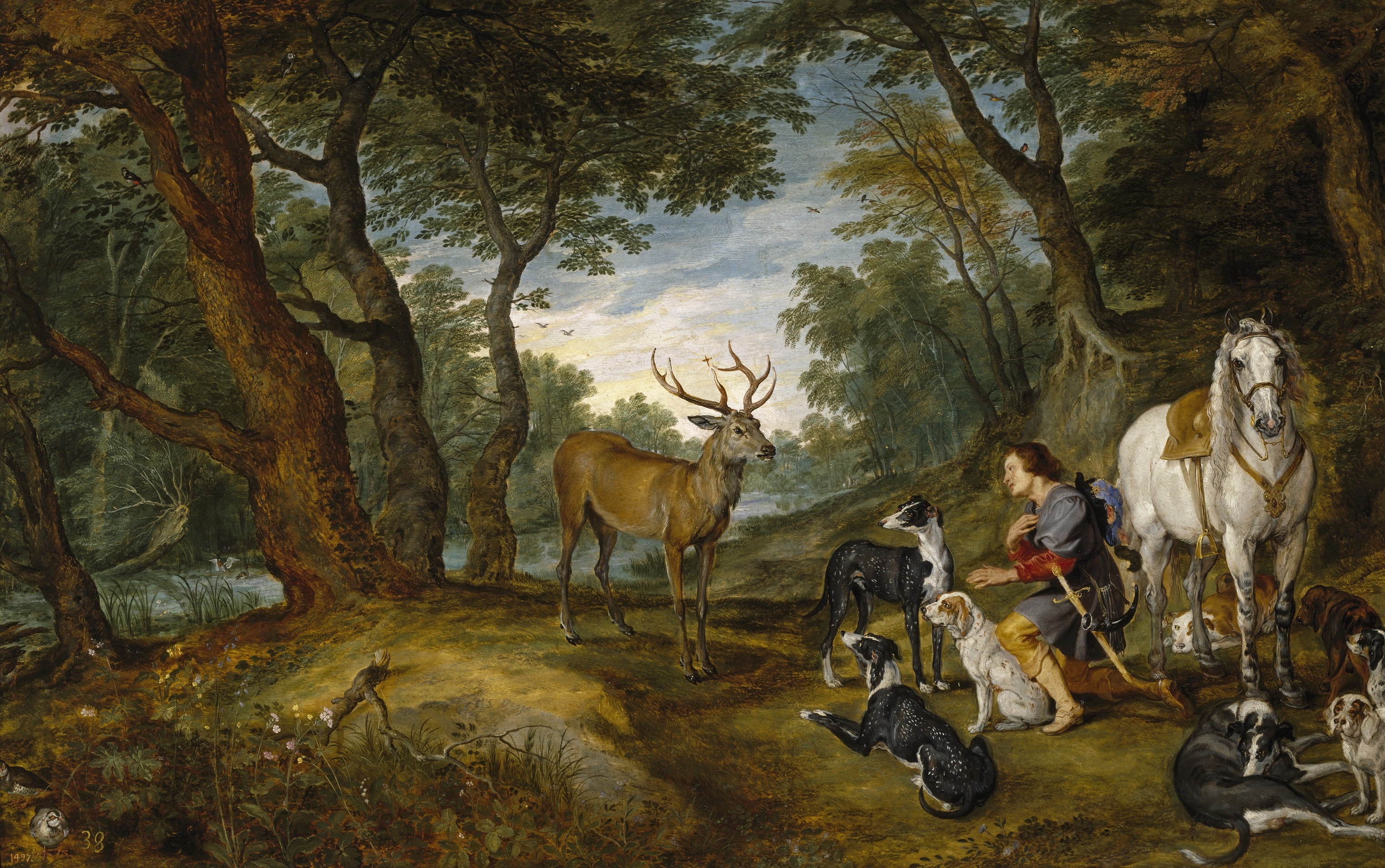
Jan Brueghel the Elder (1568–1625) / Peter Paul Rubens (1577–1640), Het
visioen van de heilige Hubertus
/ Miracle of Saint Hubert, 1617, 63 x 100.5, Museo del Prado
SOURCE : http://www.bartleby.com/210/11/032.html

Wallfahrtskirche Heilig Kreuz, ehemalige Klosterkirche
des Klosters Bergen in Bergen, einem Ortsteil von Neuburg an der Donau im Landkreis
Neuburg-Schrobenhausen (Bayern), Fresken von Johann Wolfgang Baumgartner, von
1758; Darstellung: Hl. Hubertus
Weninger’s Lives of the Saints –
Saint Hubert, Bishop of Maestricht and Liege
Article
Saint Hubert, bishop of Maestricht and Liege, was the
son of Bertrand, duke of Aquitain. In his childhood, he was led in the path of
piety; but coming afterwards to the Court of King Theodoric, and thence to that
of Duke Pepin of Heristal, he lost all love for devotion, and was carried away
by the pleasures of the world. Yielding to Pepin’s wish, he married Floribana,
a very virtuous duchess, but did not in the least change his conduct. His
occupations were gaming and feasting. He was also passionately fond of hunting,
and wasted much of his precious time in roving through fields and forests.
Saint Oda, a sister of his mother, who had very carefully guided his early
youth, was very sad on account of his having given himself entirely to worldly
pursuits, and prayed daily to God for his conversion. Her prayer was at length
granted. One day, when Hubert was in full pursuit of a noble stag, the animal,
suddenly turning round, stood still. Hubert gazed at it in astonishment, and
saw a crucifix between its antlers, while from its lips he heard distinctly:
“Hubert! Hubert, how long wilt you pursue wild animals, and waste the time
given thee to work out thy salvation? I warn thee that, if you wilt not lead a
better life, you shalt be cast into hell.” Hubert, who, on seeing the image of
his crucified Lord, had immediately dismounted and thrown himself upon the
ground, listened trembling, and was deeply moved at these words. A second Saul,
he cried: “Lord, what wilt you have me do?” “Go to Maestricht,” was the reply;
“Bishop Lambert will tell thee what you must do.”
Hubert, somewhat consoled by these words, although
still full of fear at the terrible menace, repented of his past conduct, and
immediately went to Saint Lambert. Sinking down on his knees before the bishop,
Hubert wept so bitterly that he could not utter a word. Lambert asked him the cause
of his grief, and why he had come. Hubert related all that had happened, and
humbly begged the holy bishop to show him the path he ought to follow in order
not to be cast into hell. The bishop, having encouraged him to trust in the
mercy of God, advised him to make a thorough confession* and then instructed
him in regard to his future conduct. After this, Hubert returned home, and,
without informing any one of what had happened to him, he showed by his life
that he was quite a different man. His only desire now was to leave the world
entirely, and to serve God more perfectly. The early death of his wife gave him
the desired opportunity for doing so; for, God called her to Himself after she
had given birth to a son.
Hubert, recognizing the hand of the Almighty in this
event, gave thanks to Him, and going to his holy teacher, told him that he was
determined to lead the life of a hermit, in order the better to atone for his
sins and to serve God in peace. Saint Lambert praised his resolution,
instructed him how to regulate his life in the desert, gave him his blessing
and dismissed him quite consoled. On his return home, Hubert was informed that
his father had become very sick, and hastening to him, he remained with him
until his end. By this death, Hubert became heir to the whole duchy; but he
resigned it to his younger brother, gave his own possessions to the poor,
reserving only as much as was needed for his son, whom he gave in charge of his
brother, to be educated according to his station in life. In this manner,
Hubert freed himself from every earthly tie, and, going into the forest where
he had had the above-mentioned apparition, he led during seven years a most
austere and holy life.
After this time, he felt an inner desire to make a
pilgrimage to Rome, and having the permission of Saint Lambert, he went thither
as a poor pilgrim, and visited with great devotion the churches and the tombs
of the Saints. During his stay there, Saint Lambert was cruelly murdered in his
church, for having fearlessly reproved the King of France for his unchaste
life. An angel appeared on the following night to Pope Sergius, and informing
him of the death of Saint Lambert, commanded him at the same time to appoint
Hubert, the disciple of Lambert, whom he would see enter the Church of the
Apostles on the following day, as his successor. When the Pope awoke, he went
into the church, and when he saw Hubert enter in the garb of a pilgrim, he
called him and asked him who he was and whence he came. Hubert gave his name,
adding that he was a disciple of bishop Lambert, and that the purpose of his
pilgrimage was to visit the holy places. The Pope desired to hear no more, but
taking Hubert by the hand, led him to the shrine of Saint Peter and said to
him: “Your teacher, Saint Lambert has been killed by wicked people, but is
already crowned in heaven; and you shall become his successor.” The humble
servant of God endeavored to excuse himself, but the Pope informed him of the
divine command, which Hubert could not disobey. He was therefore consecrated by
the Pope himself, and returned as bishop to Maestricht. Before he had reached
the city, his appointment and consecration had been made known, so that he was
joyfully received by the people and the clergy, and placed upon the episcopal
throne. The first resolution of the new bishop was to conform his life to the
example of his holy teacher, Saint Lambert, who was already honored as a
martyr. Hubert transferred his see to Liege, where Saint Lambert had been
buried; and not satisfied with guarding and leading by word and example the
flock entrusted to his care, he also endeavored to uproot entirely the idolatry
which still existed in the neighboring places; and his undertaking was blessed
with great success.
After having converted many thousand souls to Christ,
and administered his functions as a true and holy pastor for nearly 30 years,
he was called to receive the eternal reward of his faithful services. A year
before he died, his last hour was made known to him by divine revelation,
while, at the same time, the glory which was prepared for him in heaven was
shown him in an ecstasy. In his last sickness, after he had received the holy
Sacraments, he saw a great number of spirits of hell, who menacing him most
fearfully, tried to approach him. Asking for holy water, he sprinkled himself
and his bed with it and thus drove away the hosts of hell. After this, he
raised his eyes on high, and having recited the Apostles’ Creed and the Lord’s
Prayer, he expired. The power of the intercession of the Saint is still seen at
this day, especially in favor of those who are bitten by rabid animals.

Practical Considerations
• “How long will you pursue wild beasts and waste the
precious time given you to work out your salvation?” This was asked of Hubert
by Christ, the Lord. The same question I address to you. How long will you
waste the time of your life? Behold, the present days of your life are the days
of your salvation; that is, they are days which God has given you to work out
your salvation. You have, until now, wasted so many days, because you did not
employ them to the end for which they were given.
How long will you continue thus? Has not the Almighty
waited long enough for your conversion? Have you not reason to fear that He
will say to you what He said to Hubert: “I warn thee that if you dost not soon
change thy conduct, you shall go to hell.” Heed it well: “Soon!” God may suffer
from you a certain number of iniquities; He destines for you a certain number
of graces, a certain number of. days. How large this number is, you do not
know. For some men it is large, for others small. If you fill the measure of
sin without being converted, you will die and go to destruction in your sins.
When the number of your graces or of your days is full, you will not receive
others from God, and your time will have expired in which to work out your
salvation. God will then let you die and will banish you eternally from His
face. If it is, therefore, your earnest desire to escape hell, follow Saint
Hubert, and reform your life. Today the Almighty gives you yet time and grace;
whether He will give you the same also tomorrow, I do not know. “We must,
therefore,” says Saint Ambrose, “work, with the grace of the Almighty, without
delay.” “And we helping, exhort you that you receive not the grace of God in
vain,” writes Saint Paul. “For he saith: in an accepted time have I heard thee,
and in the day of salvation have I helped thee. Behold, now is the acceptable
time; behold, now is the day of salvation!” (2nd Corinthians 6) But who
receives the grace of God in vain? Saint Anselm says: “Those who do not
cooperate with it, or who, by their indolence, cause the grace received to be
idle and of no effect.” Take care that you do not belong to these. Work today
with the grace; because today is the day of salvation, a day on which you can
work at your salvation.
• Hunting, gaming and such amusements were the pastime
and occupation of Hubert: God threatened him with hell if he did not change his
conduct. Why this? Is gaming or hunting a mortal sin? No, in itself, it is not.
But as Hubert passed most of his time in these diversions, as he was
passionately devoted to them, and did not earnestly occupy himself with his
salvation, he sinned, and would have gone to eternal destruction, had he not
changed his conduct. Heed this most important truth. There are many worldly
pleasures and pastimes, which in themselves are no sin; but if we devote
ourselves passionately to them, waste much time on them and hence neglect the
duties of our station, and do not endeavor earnestly to gain Heaven, then we
sin, and may cause our eternal ruin; because we have not used our time well and
have not given it to that object for which God bestowed it upon us. My fear
that many thus go to perdition, is great beyond words! They flatter themselves
with the empty pretext: “I do nothing wrong; playing at this or that game is
not doing evil; hunting or dancing is not a sin.” But is it not sinful enough
to employ the noble time, given us by God to work out our salvation, almost
entirely in idle amusements? Is it not evil enough to do no good? A servant who
does no other evil, except not to employ his time according to the will of his
master, does evil enough, and must not expect to be rewarded, but to be beaten
with many stripes. “And that servant who knew the will of his Lord, and
prepared not himself, and did not according to his will, shall be beaten with
many stripes.” (Luke 12) “And the unprofitable servant cast ye out into the
exterior darkness!” (Matthew 25)
Examine yourself; and if you are such an unprofitable
servant – reform!
MLA Citation
Father Francis Xavier Weninger, DD, SJ. “Saint Hubert,
Bishop of Maestricht and Liege”. Lives of the
Saints, 1876. CatholicSaints.Info.
23 May 2018. Web. 3 November 2021.
<https://catholicsaints.info/weningers-lives-of-the-saints-saint-hubert-bishop-of-maestricht-and-liege/>

Святы
Губерт; палатно, алей. 1934
Święty
Hubert; płótno, olej, 1934
Short Lives of the Saints – Saint
Hubert, Bishop
Entry
Hubert of Aquitaine was a nobleman of the court of
Pepin d’Heristal in the seventh century. He was given up, as was the custom of
his fellow-courtiers, to the pursuit of worldly pleasures, and was specially
devoted to the chase. One day in Holy Week, when hunting in the forest of
Ardennes, he pursued a milk-white stag which, turning at last upon the
astounded Hubert, revealed a crucifix shining between its antlers. Penetrated
with awe at this miracle of the divine mercy, the hunter fell upon his knees,
and then and there dedicated himself entirely to the service of God. He became
a hermit in the forest of Ardennes, and, after years of penance, was elected
successively to the bishoprics of Maestricht and Liege. He was a preacher of
great power and unction, and by his zeal freed his large diocese from all
remains of idolatry. God accorded him the gift of miracles before his death,
which took place November 3, 727.
. . . Thrice-happy Hubert! thou art nigh
The foot-stool of the King!
In this lone place, O child of grace,
Henceforth in penance bide;
Forsake the court, forego the chase,
And follow the Crucified!”
– from “Legend of the Best-Beloved”
Favorite Practice – To permit no delay between
God’s inspiration and your correspondence to it.
MLA Citation
Eleanor Cecilia Donnelly. “Saint Hubert,
Bishop”. Short
Lives of the Saints, 1910. CatholicSaints.Info.
22 April 2021. Web. 3 November 2021.
<https://catholicsaints.info/short-lives-of-the-saints-saint-hubert-bishop/>
SOURCE : https://catholicsaints.info/short-lives-of-the-saints-saint-hubert-bishop/
_-_Mus%C3%A9e_d%C3%A9partemental_Maurice-Denis_%C2%AB_Le_Prieur%C3%A9_%C2%BB_-_%22La_l%C3%A9gende_de_Saint_Hubert_-_4_7_Le_miracle%22_(Maurice_Denis%2C_1870-1943)_(48296744977).jpg)
Maurice Denis, "La légende de Saint Hubert : Le miracle" (Maurice Denis, 1870-1943), quatrième panneau d’une suite de sept. Décor pour l'hôtel particulier du baron Denys Cochin à Paris. 7 panneaux, huile sur toile, 1896-1897, Saint-Germain-en-Laye (Yvelines) - Musée départemental Maurice-Denis « Le Prieuré » (Musée départemental Maurice Denis "The Priory")
Sant' Uberto
di Tongeren-Maastricht Vescovo
Regione delle Ardenne (?), ca. 685 - Tervuren
(Belgio), 30 maggio 727
Patronato: Cacciatori, Fonditori, Cani
Etimologia: Uberto = spirito brillante, dal
tedesco
Emblema: Bastone pastorale, Libro, Cervo, Cane
Martirologio Romano: A Tervueren sempre nel
Brabante in Austrasia, transito di sant’Uberto, vescovo di Tongeren e
Maastricht, che, discepolo e successore di san Lamberto, si adoperò con tutte
le forze per diffondere il Vangelo nel Brabante e nelle Ardenne, dove estirpò i
costumi pagani.
Il suo nome fa subito venire in mente la leggenda del cervo che gli sarebbe apparso, con un crocifisso splendente sul capo, mentre egli cacciava nei boschi delle Ardenne, in un giorno di raccoglimento: un Venerdì santo. Leggenda, e nemmeno esclusiva, perché cose simili si raccontano di altri santi. Su di lui le notizie certe scarseggiano. Sappiamo che era di famiglia nobile e che fu discepolo di san Lamberto vescovo di Tongres (Belgio), il quale trasferì poi la sua sede a Maastricht (Olanda).
Lamberto lo ordinò sacerdote, e morì tragicamente – forse per una vendetta – ai primi dell’VIII secolo. A succedergli fu chiamato appunto Uberto, che ricevette la consacrazione episcopale a Roma dal papa Sergio I. Questo, non più tardi del 701, perché in quell’anno papa Sergio morì, in settembre. La sua allora era una diocesi di boschi e di gente dei boschi, in parte ancora lontana dal cristianesimo, sicché egli dovette dedicarsi soprattutto alla predicazione. Nel dicembre del 717-718 fece portare il corpo del predecessore Lamberto da Maastricht a Liegi, dov’era stato ucciso e dove ebbe definitiva sepoltura. Nel 722 trasferì a Liegi anche la sede vescovile.
Dopodiché, per anni, ci sono soltanto narrazioni postume e fantasiose. Di certo sappiamo che anche da vescovo Uberto andava a pescare: e che un giorno, trafficando con un amo, si ferì a una mano. Secondo un’altra leggenda, in quel momento una voce dall’alto gli preannunciò la morte vicina. Dopo l’incidente – che deve avere avuto sviluppi infettivi – Uberto dà disposizione di essere seppellito a Liegi. Ma non interrompe la sua attività, e nel maggio 737 consacra una nuova chiesa vicino a Lovanio. Poi crolla. Il male si è aggravato, e lui muore sei giorni dopo quel rito, a Tervuren (una ventina di km da Lovanio). Sepolto in San Pietro a Liegi, è presto venerato come santo in Belgio e Olanda, poi anche in Francia e in Germania. Sedici anni dopo la morte (3 novembre 743) il suo corpo viene trasferito davanti all’altar maggiore della chiesa di San Pietro, e per l’evento è accorso a Liegi addirittura Carlomanno, Maestro di Palazzo, e in sostanza padrone del regno franco: un altro segno di questa diffusa venerazione e del suo “peso” anche politico. Intanto si diffondono leggende sulla sua vita, e lungo il tempo nasceranno confraternite intitolate al suo nome; in Germania, l’Ordine cavalleresco di Sant’Uberto durerà fino al 1918.
Nell’825 i resti del santo vengono portati in un’abbazia benedettina delle Ardenne, che prenderà il suo nome, e vi resteranno fino alle devastazioni e incendi della rivolta dei Gueux (“pezzenti”) nel 1568, scomparendo nel saccheggio del monastero. I cacciatori lo hanno proclamato loro patrono, e così i fonditori e lavoratori di metalli e i pellicciai. Già nel IX secolo la festa di Sant’Uberto si celebrava il 3 novembre, e a questa data lo ricorda il Martirologio romano.
Autore: Domenico Agasso
