
Saint Félix de Valois
Ermite (✝ 1212)
Martyrologe romain

Théo
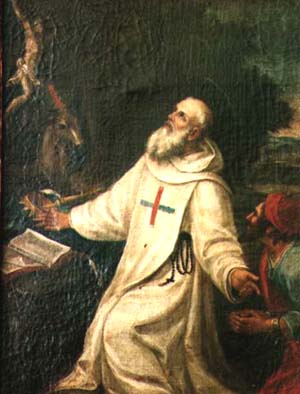
Mayan. La Vierge Marie et l’enfant Jésus avec saint Félix de Valois et
saint Jean de Matha, Église de La Trinité-La Palud à Marseille
Saint Félix de Valois
De l'Ordre de la Trinité
(1127-1212)
Saint Félix de Valois
était petit-fils du roi de France Henri Ier. Sa mère, avant sa naissance, vit
en songe un bel enfant armé d'une Croix et entendit une voix lui dire:
"Cet enfant est le fils que vous allez mettre au monde, il aura la gloire
de changer le lis de France pour la Croix de Jésus-Christ."
Pendant une famine, la
nourrice du petit Félix eut l'inspiration de faire tracer à l'enfant, avec sa
main, le signe de la Croix sur le pain que l'on distribuait aux pauvres, et ce
pain se multiplia tellement, qu'on put en distribuer pendant plusieurs jours à
tous les malheureux qui se présentaient. La nourrice lui fit aussitôt bénir les
champs d'alentour, et les nuées du ciel, obéissant à la main de Félix,
versèrent une pluie féconde qui ramena l'abondance. Cependant le jeune prince
croissait en sagesse et en grâce devant Dieu et devant les hommes, et ne
montrant aucun des défauts de l'enfance. Il aimait tant à faire la charité aux
pauvres, qu'un de ses oncles l'appelait son grand aumônier.
Après ses études, qu'il
fit à Clairvaux, sous la direction de saint Bernard, Félix dut aller à la cour
du roi de France, prit part à la Croisade prêchée par le saint moine de
Clairvaux, son maître; puis, revenu à la cour, il la quitta bientôt pour se
réfugier au désert. Dans la solitude, il sentit son esprit s'illuminer de
clartés nouvelles et son âme redoubler de vaillance dans la pratique des vertus
évangéliques. Le démon lui déclara une guerre acharnée; mais le Saint triompha
de lui par la prière et les plus effrayantes mortifications.
Félix, ayant désormais
pour palais une misérable grotte, pour vêtement un cilice, pour mets des herbes
amères, renouvela dans sa retraite les merveilles des Antoine et des Hilarion.
Par la permission de Dieu, tous les dimanches, un corbeau lui apportait un pain
du Ciel. Il habitait le désert depuis bientôt quarante ans, quand saint Jean de
Matha, de la part de Dieu, vint le trouver dans sa solitude, pour s'édifier par
ses exemples. C'est alors que les deux Saints eurent la vision d'un cerf blanc,
portant au front une croix bleue et rouge, et qui venait se désaltérer à la
fontaine voisine. Dieu leur révéla l'explication de ce prodige; ils se
disposèrent aussitôt à partir pour Rome, afin d'obtenir la fondation d'un
institut dont les religieux, vêtus de blanc, porteraient sur la poitrine une
Croix bleue et rouge, et travailleraient au rachat des captifs, que les Turcs
d'Afrique retenaient par milliers dans les fers. Le Pape Innocent III approuva
le projet, l'Ordre fut fondé et produisit un bien immense.
Abbé L. Jaud, Vie
des Saints pour tous les jours de l'année, Tours, Mame, 1950
SOURCE : http://magnificat.ca/cal/fr/saints/saint_felix_de_valois.html

Sillano
Sillani, Felix of Valois, Façade de San Carlo alle Quattro Fontane,
1682
Saint Félix de Valois
Anachorète. Cofondateur
de l'Ordre de la Très Sainte Trinité et de la Rédemption des Captifs.
Fête le 20 novembre.
C'était un prince du sang
qui, après avoir suivi son cousin le roi Louis VII à la croisade, vivait en
ermite dans la forêt. Il reçut un jour la visite de Jean de Matha qui venait le
prier de fonder avec lui un ordre« pour la rédemption des captifs ».
C'est alors que les deux
hommes furent témoins de l'apparition d'un cerf portant une croix entre les
bois, qui vint s'abreuver à une fontaine auprès d'eux.
Félix accepta et partit
pour Rome avec Jean afin d'obtenir l'approbation pontificale. L'Ordre de la
Très Sainte Trinité et de la Rédemption des Captifs est approuvé par Innocent
III le 17 décembre 1198.
Philippe Auguste aida les
Trinitaires à construire un monastère sur le lieu de l'apparition du cerf, à
Cerfroid (actuellement commune de Brumetz, dans l'Aisne). La Maison de la
Trinité de Cerfroid restera le Chef-d'ordre des Trinitaires jusqu'à la
Révolution.
En fait, il semble
aujourd'hui que ce soient les Mathurins de Paris qui aient « inventé » Félix de
Valois au XVIIe siècle. Désireux de se donner comme fondateur, outre saint Jean
de Matha, un prince royal de France, ils racontèrent que la bulle d'Urbain IV
(mort en 1264) qui canonisait Félix avait été perdue ; Louis XIV intervint à
Rome en faveur de son parent. Innocent XI le recanonisa et fixa sa fête au 20
novembre. Il entra dès lors au Martyrologe romain et y resta jusqu'à ce que
Paul VI l'en fît sortir (1970).
SOURCE : http://damien.jullemier.pagesperso-orange.fr/sts/st-felix-de-valois.htm
SAINT JEAN DE MATHA ET
SAINT FÉLIX DE VALOIS.
C’était dans ce siècle
troublé et cependant plein de foi où François d’Assise avait entendu une voix
lui dire : « François, relève ma maison qui tombe en ruines. » Les hérésies
étaient actives ; les vices et les crimes étaient nombreux. Cependant, au fond
de l’âme humaine, une foi vivace et inexterminable vivait et régnait. On se
livrait aux passions, mais on ne les adorait pas; on tombait et on se relevait.
On faisait le mal, mais on ne le prenait pas pour le bien. Les choses avaient
gardé leur nom.
Trois grands
reconstructeurs s’élevèrent au milieu des ruines: saint Dominique, saint
François, saint Jean de Matha. Le premier se consacra aux captifs de l’erreur,
le second aux captifs de la pauvreté, le troisième aux captifs des prisons.
Jean de Matha naquit vers
l’an 1156. Son père Euphrème et sa mère Marthe étaient chrétiens. Le père
destinait son fils à la science; il étudia en effet et vit à Marseille le monde
des riches. Mais, en même temps, sa mère elle-même le conduisait dans le monde
des pauvres ; ce contraste frappa le jeune homme qui méditait et cherchait sa
voie.
Il arriva à Paris vers
l’an 1180. Attendu et accueilli par plusieurs éminents personnages amis de sa
famille, il sentit néanmoins le vide. Un ennui secret s’empara de son âme. Il
regretta son enfance. Comme il priait dans l’abbaye de Sainte-Geneviève, il
entendit distinctement une voix qui prononça trois fois ces paroles de
l’Écriture : Stude sapientiae, fili mi, et loetifica cor meum.
« Étudiez la sagesse, mon
fils, et réjouissez mon cœur. »
Quand Jean sortit de
l’église, il avait fait son choix et consacré sa vie.
L’étude de la théologie
le posséda dès lors tout entier. La prière et le travail remplirent son
existence.
Il fit connaissance avec
un gentilhomme italien nommé Jean Lothaire; et, un jour, dans une confidence
intime, le Jean français dit au Jean italien : « Tu seras bientôt assis sur le
trône de saint Pierre. »
La prophétie se réalisa
contre toute apparence.
Jean Lothaire gouverna le
monde catholique sous le nom d’Innocent III.
Le moment solennel
arrivait où Jean de Matha allait dire sa première messe. A cette époque, sa
réputation de sainteté s’étendait dans le public. Maintenant, quand elle
existe, elle se circonscrit et ne va pas dans la foule ; autrefois elle y
allait. C’est pourquoi une multitude immense remplit l’église à la première
messe de Jean de Matha.
Or, au moment où le jeune
célébrant élevait pour la première fois entre ses mains l’hostie sainte, on vit
son visage s’embraser, son regard devint fixe et sa tête lumineuse. L’évêque de
Paris, frappé de ce spectacle, disait en lui-même : « Jean voit quelque chose
que les autres ne voient pas. »
-Venez, lui dit-il après
la messe, racontez à votre évêque ce qui s’est passé.
-J’ai vu, dit Jean de
Matha, j’ai vu l’ange du Seigneur. Son visage était resplendissant, ses vêtements
blancs comme la neige ; il portait sur sa poitrine une croix rouge et azur; à
ses pieds deux esclaves chargés de chaînes étaient dans une attitude suppliante
; l’un était Maure, l’autre chrétien. Sa main droite reposait sur le chrétien,
sa main gauche sur le Maure. Voilà ce que j’ai vu. »
Cependant Jean de Matha
avait vaguement attendu Félix de Valois. Félix de Valois habitait dans les
montagnes au diocèse de Meaux, se préparant dans le silence et la solitude à la
destinée vers laquelle il se sentait appelé. Il pensait nuit et jour à la
rédemption des captifs.
Un jour, Jean de Matha
dirigea ses pas vers le diocèse de Meaux, et dans le diocèse de Meaux vers les
montagnes. Enfin il se trouva face à face avec Félix de Valois.
Félix de Valois avait été
dirigé là par les voies les plus mystérieuses. Son père Raoul et sa mère
Éléonore avaient divorcé. L’excommunication de Rome tomba sur la tête du comte
Raoul. Le chagrin du jeune Félix fut tel qu’il voulut quitter du même coup sa
famille et le monde. Il passa quelque temps á Clairvaux ; et, fuyant
l’admiration dont il était l’objet, il chercha une solitude.
Pour cacher son dessein,
il passa quelque temps à la cour de son oncle Thibault, comte de Champagne. Un
jour il disparut. Il profita pour cette disparition d’une excursion dans une
forêt. On le chercha partout. Ses serviteurs demeurèrent convaincus qu’il avait
péri dans un ravin et racontèrent partout sa mort.
En effet, il était mort à
son ancienne vie. Mais il naissait à une vie nouvelle. Ayant entendu parler
d’un anachorète qui vivait dans une forêt, entouré de lumière et de grâce, le
jeune homme s’était rendu près du vieillard pour partager sa vie. Il la
partagea en effet et avec elle les grâces dont elle était remplie. Il devint le
confident de celui qui ignorait les choses extérieures et savait les choses
intérieures. Quand le vieillard mourut, le jeune homme était formé. Il avait
reçu avec le dernier soupir de l’anachorète son dernier secret et son dernier
présent.
Alors Félix, préparé,
enrichi, se disposa à prendre lui-même l’initiative d’une vie érémitique. Le
disciple allait devenir maître. Il revint en France ; le changement d’habits le
rendit méconnaissable. Il s’installa au diocèse de Meaux, dans une forêt, sur
une montagne. Il passa sa vie dans la prière et la contemplation. Ce fut dans
cette solitude que la voix qui parle aux solitaires se fit entendre à lui ; et
elle lui parla de la rédemption des captifs. Il ne se hâta pas de se mettre à
l’oeuvre. L’action a sa racine dans la contemplation et il laissa mûrir dans la
solitude le fruit de vie qu’il portait. A cette époque, Jean de Matha vint le
visiter.
Il n'y a rien de plus
singulier dans l’histoire que les rencontres. Rien n’est plus important et rien
n’est plus accidentel, plus involontaire, plus imprévu. Deux hommes peuvent
être perdus ou sauvés pour s’être rencontrés à temps ou à contretemps. Il y a
des hommes qui sont l’un pour l'autre une planche de salut ou une pierre
d’achoppement. Il y a des hommes dont les noms sont unis quelque part et dont
l’union visible sur la terre constitue le commencement, ou le centre, ou la fin
de leur destinée. Or, le doigt de Dieu est d’autant plus visible dans la
rencontre des inconnus que l’homme n’y peut mettre aucune préméditation. Il y a
peut-être tel individu qui me sera un grand secours dans l’ordre de la pensé e
ou dans l’ordre de l’action. Il m’aidera, il me complétera, il me soutiendra,
il me conseillera, il m’instruira. Mais, où est-il ? Il est absolument
impossible d’établir là-dessus même la moindre conjecture. Je n’ai aucune
raison pour aller à droite ou pour aller à gauche. Non-seulement je ne peux pas
le trouver, mais je ne peux pas le chercher. Car aucune direction ne m’offre
plus de chances que la direction contraire.
Jean de Matha et Félix de
Valois n’avaient aucun moyen naturel de savoir qu’ils étaient unis dans la
pensée de Dieu pour une oeuvre commune.
Ils ne savaient même pas
longtemps d’avance quelle était cette oeuvre; ils auraient été bien embarrassés
si quelqu’un leur avait dit : « Il vous faut chercher un auxiliaire, un homme
dévoué à la même idée que vous. » Ils avaient toutes les chances naturelles
pour ne pas se rencontrer. Leur vie très différente les avait jetés dans les
directions les plus contraires; leurs familles ne se connaissaient pas ; rien
ne les appelait ni l’un ni l’autre dans une forêt près de Meaux, rien du moins
de ce qui appelle les hommes quelque part ordinairement. Pourtant ils y vinrent
tous les deux, et leur rencontre fut le point de départ de leur oeuvre commune.
Jean de Matha ouvrit le
premier son âme à celui qui l’avait précédé dans cette solitude. Félix admirait
les voies par lesquelles son nouveau compagnon lui avait été mystérieusement
préparé et amené. Il fut convenu entre eux qu’ils vivraient ensemble et attendraient
dans l’oraison de nouvelles pensées et de nouvelles lumières.
Ils vécurent trois ans
ensemble. Peut-être l’homme qui aurait assisté pendant ces trois années à leurs
entretiens et à leurs prières serait plus savant que les savants. Qui sait
combien de choses secrètes se déroulèrent aux yeux de ces deux hommes qui
avaient écarté d'eux les innombrables, causes d’erreurs qui nous assiègent
constamment; aux yeux de ces deux hommes qui n’avaient qu’un ami, et cet ami
était un saint ? L’unique société de chacun d’eux était un saint ; et ce saint
était précisément celui dont l’autre avait besoin, et chacun d’eux un ami
directement donné par la main du Seigneur.
Un jour, après trois ans
de vie commune, ils virent un cerf blanc qui venait se désaltérer à la source
d’eau vive. Il portait entre son bois une croix rouge et azur semblable à celle
que Jean, le jour de sa première messe, avait vue sur la poitrine de l’ange.
Décidés alors, ils
quittèrent leur solitude et vinrent à Paris, afin de communiquer leurs projets
à L’évêque, ainsi qu’aux abbés de Sainte-Geneviève et de Saint-Victor.
L’évêque, Eudes de Sully, successeur de Maurice, approuva leur résolution et
leur donna des lettres de recommandation pour le pape Célestin III.
Ces deux saints partirent
pour Rome ; mais pendant leur voyage, Célestin mourut ; et à leur arrivée ils
trouvèrent sur le trône de saint Pierre Innocent III.
C’était l’ancien ami de
Jean de Matha, Lothaire et son compagnon d’études à Paris, auquel Jean avait
autrefois dit: « Tu seras pape. »
Il était difficile de se
présenter avec une meilleure recommandation que cette prophétie. Elle dut
édifier le pape complétement.
Innocent III soumit à
l’examen du sacré collège une oeuvre dont il comprenait l’importance, et décida
que le 25 janvier une messe serait célébrée dans la basilique de Latran à
l’intention des deux fondateurs.
Mais le doigt de Dieu,
qui voulait tout faire dans cette histoire merveilleuse, souleva devant les
yeux d’Innocent III le voile qu’il avait soulevé devant les yeux de Jean de
Matha, au jour de sa première messe ; et le pape vit ce qu’avait vu le jeune
prêtre. Il vit l’ange du Seigneur revêtu du même habit et des mêmes couleurs,
dans la même attitude, et l’esclave chrétien et l’esclave maure étaient à ses
pieds tous les deux.
Innocent III, convaincu,
fonda immédiatement l’ordre de la Très Sainte Trinité pour la rédemption des
captifs, ordo sanctissimae Trinitatis de redemptione captivorum.
Les occasions ne
manquaient pas au zèle des deux fondateurs. C’était le temps des croisades. Un
grand nombre de chrétiens tombait entre les mains des infidèles. En même temps,
des corsaires maures infestaient les mers, s’emparant des passagers et des
équipages. Ces malheureux étaient conduits dans les prisons de Tunis et du
Maroc, où on les entassait. Après leur avoir enlevé la liberté, les musulmans
cherchaient à leur enlever le christianisme. Toutes les violences physiques et
morales étaient accumulées sur eux.
L’ordre de Jean de Matha
s’organisa avec une force et une sagesse qui faisaient face à toutes les
éventualités de cette terrible situation. Ses biens furent répartis en
plusieurs parts consacrées soit à l’intention des religieux, soit à la
rédemption des captifs, soit au soulagement des pauvres.
Jean l’Anglais et
Guillaume d’Écosse, qui furent parmi les premiers disciples de Jean, furent les
premiers vainqueurs qui rapportèrent en Europe le butin désiré. Ils revinrent
du Maroc avec cent quatre-vingt-six esclaves libérés. La procession de ces
captifs traversa Marseille. Ils traversaient deux à deux en casaque rouge ou
brune, les mains encore meurtries de leurs chaînes, montrant aux populations
les traces affreuses des mauvais traitements qu'ils avaient subis, puis rendant
grâces à Dieu et à leurs libérateurs.
Mais saint Jean ne se
contenta pas de leur délivrance. Il prit de nouvelles mesures et fit de
nouvelles institutions pour les soigner, pour les nourrir, pour les conduire
d’étapes en étapes jusqu’au lieu choisi par eux. Sa charité n'abandonnait pas
les captifs délivrés à la misère, à la maladie, à l’isolement. Elle voulait la
délivrance complète et elle conduisait à son foyer, à sa famille ou à son
travail le captif libéré, soigné et guéri.
Jean de Matha partit
lui-même pour Tunis. Malgré la difficulté et le danger de l’entreprise, malgré
le prix énorme fixé par le souverain, dans une audience que le saint lui
demanda, Jean put obtenir cent dix esclaves.
Les musulmans, malgré
l’ordre du souverain, ne respectèrent pas la convention passée entre Jean de
Matha et lui. Ils s’emparèrent du saint, le frappèrent et le laissèrent
sanglant sur la place.
Cependant Jean, que rien
n’arrêtait, descendit lui-même dans les cachots, où les scènes les plus
horribles s’offrirent à lui. Le récit des malheurs lointains est faible auprès
de la vue des malheurs présents; et l’idée que Jean s’était faite des prisons
africaines était dépassée par la réalité qui frappait ses yeux. Pour comble de
douleur, il fallait choisir. Il n’en pouvait délivrer que cent dix, et les
portes du cachot allaient se refermer sur leurs frères. Jean emmena les plus
misérables, les conduisit à Rome, et, à peine sauvé des effrayants périls d’une
telle entreprise, il songea à la recommencer pour aller délivrer les autres
malheureux.
Un second voyage fut
bientôt résolu. L’infatigable libérateur repartit pour Tunis. Le gouverneur
consentit encore à échanger quelques hommes contre beaucoup d’or. Mais les
Tunisiens se montrèrent plus féroces que leur maître. Ils s’ameutèrent contre
le saint, l’accablèrent de coups et lui enlevèrent ses captifs. Jean les
revendique avec la violence du dévouement qui ne veut pas avoir tout donné pour
rien. Les Tunisiens demandent une nouvelle rançon. La prière de Jean lui
procure la somme nécessaire. Les captifs sont remis en liberté. Mais la
populace, que rien ne pouvait calmer, puisque son agitation venait de sa fureur
interne, et non d’une circonstance extérieure, la populace se précipite sur le
vaisseau de Jean, enlève le gouvernail, coupe les mâts, déchire les voiles, et
brise les rames. Le départ est devenu impossible ; que fait Jean de Matha ? Il
donne le signal du départ. Les passagers, qui ont à choisir entre deux genres
de mort, obéissent et aident le mouvement. Les voyant faire la manoeuvre avec
des tronçons de rames et de planches, les Tunisiens poussent des huées. Jean se
dépouille de son manteau, l’étend en forme de voile; et, à genoux, le crucifix
à la main, il invoque l’Étoile de la mer. Les vents se taisent, et, en moins de
deux jours, le vaisseau désemparé, sans gouvernail, sans voiles et sans rames,
fait dans le port d’Ostie son entrée triomphale.
Le souverain pontife
pleura d’admiration,
Cependant, Félix de
Valois était toujours à Cerfroy. Pendant que son ami faisait les choses du
dehors, il organisait celles du dedans. Il priait, et dans ses prières
demandait au Seigneur de revoir Jean avant de mourir. Sa prière fut exaucée.
Jean vint à Cerfroy. Quels durent être les sentiments et les entretiens de deux
pareils amis, dans une pareille situation, pleins de tels souvenirs et de tels
récits ! Après avoir mêlé une dernière fois leurs larmes, ils se séparèrent
pour ne plus se retrouver qu’au ciel.
Immédiatement après le
départ de Jean, Félix tomba malade. Quand il mourut, son ami fut averti de sa
gloire par une vision.
Il ne tarda pas à aller
le rejoindre. Le corps de Jean fut illustré par les miracles qui éclatèrent sur
son tombeau,
L'ordre des Trinitaires a
été rétabli en France le 15 septembre 1859, dans l’ancien couvent de Faucon. Il
possède maintenant deux maisons, l’une à Notre-Dame de Sise et l’autre à
Cerfroy.
Le R. P. Calixte,
trinitaire lui-même, a publié la Vie de saint Jean de Matha, à Paris,
chez Watelin.
Ernest
HELLO. Physionomies de saints, Paris, Victor Palmé, 1875.
SOURCE : https://archive.org/stream/PhysionomiesDeSaintsParErnestHello/physionomies%20de%20saints_djvu.txt

Franz Anton Maulbertsch (1724–1796). Saint Felix of Valois et Saint John of Matha et la Sainte Trinité, XVIIIe
siècle, 43 x 32, National Museum in Warsaw
Saint Félix de Valois
Né en 1127. Mort le 4
novembre 1212. Il est le cofondateur des Trinitaires en compagnie de St Jean de
Matha.
Des historiens mettent en
cause l’existence de St Félix dont le nom n’apparaît qu’au XVème dans les
récits de la fondation des Trinitaires. Culte reconnu en 1666 par Alexandre VII
qui l’inscrivit au martyrologe en 1671. Fête en 1694, par Innocent XII comme
double.
Leçons des Matines avant
1960
Quatrième leçon. Félix,
d’abord appelé Hugues, naquit en France, de la famille royale des Valois. Dès
l’âge le plus tendre, il donna des gages sérieux de sa sainteté future, et
principalement de sa charité envers les pauvres ; car, tout petit enfant, il
distribuait, de sa propre main, des aumônes aux malheureux, comme s’il eût été
plus avancé en âge et en pleine maturité de jugement. Devenu plus grand, il
avait coutume d’envoyer aux indigents une partie des plats servis sur sa table,
et il réservait d’ordinaire aux petits enfants pauvres le mets le plus
savoureux. Au cours de son adolescence, il se dépouilla plus d’une fois de ses
vêtements pour en couvrir les mendiants. Il obtint de son oncle Thibaut, comte
de Champagne et de Blois, la grâce d’un condamné à mort, prédisant que ce
misérable, alors assassin, parviendrait dans la suite à une très grande
sainteté de vie ; l’événement confirma la vérité de cette prédiction.
Cinquième leçon. Après
avoir passé d’une manière digne de louanges les années de son adolescence, son
goût pour la contemplation des choses d’en haut commença à lui inspirer la
pensée de la solitude ; mais il voulut auparavant recevoir les ordres sacrés,
afin de s’enlever toute prétention au trône, dont la succession prochaine lui
était assurée, en vertu de la loi salique. Ordonné Prêtre, il célébra avec la
plus grande dévotion sa première Messe. Peu après, il se retira dans un désert
où, vivant avec une extrême austérité, il nourrissait son âme de l’abondance
des grâces célestes. Il y passa très saintement quelques années, en compagnie
de saint Jean de Matha, docteur de Paris, qui, poussé par une inspiration d’en
haut, s’était mis à sa recherche et l’avait trouvé. Sur l’avis que Dieu leur
donna par le ministère d’un Ange, ils se rendirent tous deux à Rome, afin
d’obtenir du souverain Pontife une règle de vie spéciale. De son côté, le Pape
Innocent III, pendant qu’il célébrait les saints Mystères, eut une révélation,
lui faisant connaître l’Ordre religieux et l’œuvre ayant pour but la rédemption
des captifs. Ce Pontife revêtit donc lui-même Félix et son compagnon de
vêtements blancs, marqués d’une croix de deux couleurs et de même forme que
ceux dont l’Ange était revêtu lorsqu’il lui avait apparu. Le Pape voulut en
outre que le nouvel institut religieux, conformément à l’indication
emblématique de son habit aux trois couleurs, portât le nom de la très sainte
Trinité.
Sixième leçon. Après
avoir reçu du souverain Pontife Innocent III leur règle propre, confirmée par
son autorité, les deux Saints retournèrent au diocèse de Meaux, dans le lieu
appelé Cerfroid, où Félix agrandit le premier monastère de son Ordre, que, peu
de temps auparavant, il avait construit avec l’aide de son compagnon. Il y fit
merveilleusement prospérer l’observance religieuse et l’œuvre de la rédemption,
qu’il propagea de là avec beaucoup de zèle dans les autres provinces, par
l’entremise de ses disciples. C’est aussi en ce lieu qu’il reçut une faveur
signalée de la Vierge-Mère : la nuit d’avant la Nativité de la Mère de Dieu,
par une permission divine, tous les frères restèrent endormis et pas un ne se
leva pour la récitation de Matines ; Félix, qui veillait, selon sa coutume,
devança l’heure et, entrant au chœur, vit au milieu la bienheureuse Vierge,
revêtue de l’habit de l’Ordre, marqué de la croix et accompagnée d’esprits
célestes vêtus de même. Félix se joignit à eux, et la Mère de Dieu ayant
entonné les divines louanges, il chanta tout l’Office avec eux. Il semblait
avoir déjà reçu l’invitation de quitter les chœurs de la terre, pour aller se
mêler à ceux du ciel ; un Ange, en effet, l’avait averti que l’heure de sa mort
était proche. Ayant exhorté ses fils à la charité envers les pauvres et les
captifs, il rendit son âme à Dieu, plein de jours et de mérites, l’an de
l’Incarnation mil deux cent douze sous le pontificat du même Pape Innocent III.
Dom
Guéranger, l’Année Liturgique
Félix, appelé dès
l’adolescence au désert, semblait devoir y mourir oublié d’un monde qu’il avait
méprisé. Mais le Seigneur se réservait de rendre aux yeux des hommes sa
vieillesse féconde [1].
On était à ce qu’on nomme
de nos jours un tournant de l’histoire. Le premier des grands Ordres actifs
allait, avec saint Jean de Matha, se lever dans l’Église ; d’autres suivraient,
réclamés par les temps nouveaux. Ce fut l’heure où l’éternelle Sagesse, qui
préside immuable aux variations des peuples [2], voulut montrer qu’elle non
plus la sainteté ne change pas, la charité demeurant sous des formes variées ce
que la connurent nos pères, n’ayant toujours qu’en Dieu aimé pour lui-même son
principe et sa fin. Et c’est pourquoi Jean de Matha fut amené par l’Esprit à
Félix de Valois, comme le disciple au maître ; l’anachorète dont les derniers
ans s’achevaient au fond des forêts, vit se greffer sur la contemplation pure,
en sa personne, la vie d’action débordante du rédempteur des captifs ;
Cerfroid, son désert, resta le chef-lieu des Trinitaires comme il en avait été
le berceau.
Lisons la vie du
serviteur de Dieu dans le livre de la sainte Église (voir plus haut les
lectures de Matines). Mais rappelons-nous qu’elle demande à être complétée par
celle de son disciple et fils (VIII février).
Félix, heureux amant de
la charité, enseignez-nous le prix de cette reine des vertus et aussi sa
nature. C’est elle qui vous attira dans la solitude pour y poursuivre son objet
divin, et quand vous sûtes trouver Dieu en lui-même, vous le montra et fit
aimer dans vos frères. N’est-ce pas le secret qui rend l’amour fort comme la
mort, lui donne comme en vos fils l’audace d’affronter l’enfer [3] ?
Puisse-t-il ne point cesser d’être chez nous l’inspirateur de tous les
dévouements ; qu’il demeure la part excellente de votre saint Ordre, le procédé
précieux de son adaptation toujours féconde aux besoins d’une société où ne cesse
point de régner sous mille formes la tyrannie des pires servitudes.
[1] Psalm. XCI, 15.
[2] Sap. VII, 27.
[3] Cant. VIII, 6.

Bhx Cardinal
Schuster, Liber Sacramentorum
Un des plus grands Pontifes
qui aient illustré le trône de saint Pierre fut certainement Innocent III, sous
lequel la papauté atteignit, pour ainsi dire, au faîte de la puissance et de la
gloire, réalisant en des formes nouvelles et appropriées au temps, ce sublime
idéal pour lequel le pape Hildebrand était mort en exil. Avec l’œuvre
restauratrice du jeune Lothaire de Segni, coïncide l’institution de nouveaux et
grands Ordres religieux, en sorte qu’Innocent III, en approuvant les règles des
Mineurs, des Dominicains et des Frères de la rédemption des captifs, vint
effectivement infuser au sein de la famille catholique ce flot de sang jeune,
d’énergie et d’élan surnaturel que réclamait désormais la nouvelle ère des
Communes et des libertés populaires.
L’œuvre de saint Félix de
Valois entre dans ce vaste plan de renouvellement catholique qui eut Innocent
pour promoteur, et nous aimons à évoquer la douce figure de ce Saint qui, au
Latran, agenouillé aux pieds du Pontife avec saint Jean de Matha, reçoit de lui
la confirmation de l’institut des frères rédempteurs des esclaves.
Désormais, les confins
traditionnels de la chrétienté ne suffisaient plus à ces hardis jeunes gens,
débordants de vie et de sainteté, désireux de se sacrifier pour l’amour du
Christ. Tandis que Dominique s’attarde encore à prêcher en France contre les
Albigeois, François part pour la Palestine.
Ce mouvement d’émigration
missionnaire est rapidement suivi par les deux fondateurs de l’Ordre de la Très
Sainte Trinité pour la rédemption des esclaves ; il y a cependant une
différence : tandis que les disciples dé François et de Dominique vont
directement vers les infidèles pour les gagner à l’Évangile, l’œuvre de Félix
de Valois et de Jean de Matha se rapporte plutôt au bien des chrétiens qui,
tyrannisés par ceux-ci, couraient le risque de perdre, avec leur liberté, le
trésor de la foi.
La messe Justus, en
l’honneur de ce héros de la charité fraternelle (+ 4 novembre 1212) est du
commun, seule la collecte est propre.
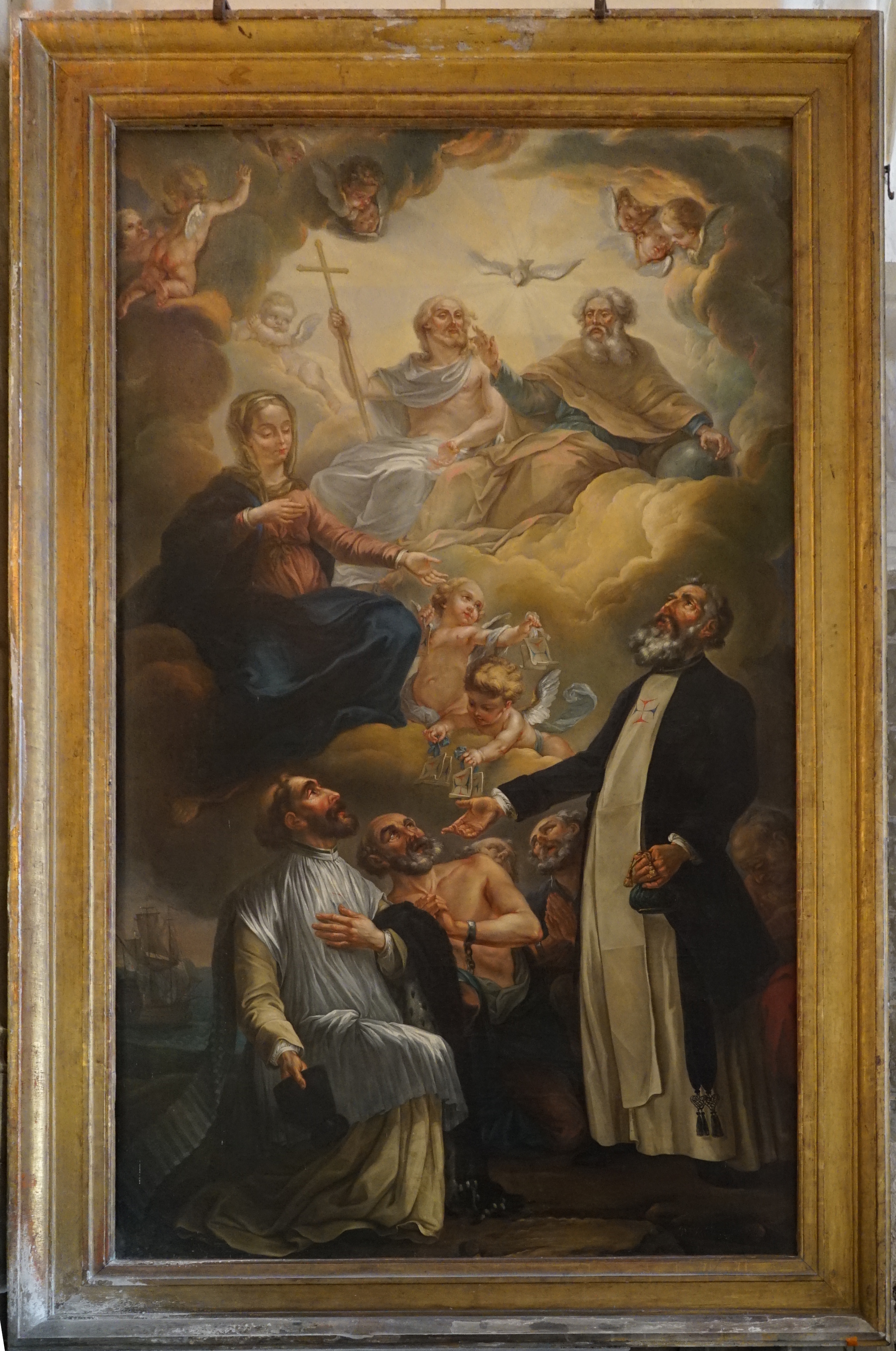
Pierre
Le Clerc. Saint Jean de Matha et saint Félix de Valois, 1783, église St
Jean-au-Marché. Photographie : G.Garitan
Dom Pius Parsch, le Guide
dans l’année liturgique
« Hors de l’esclavage du
démon »
Saint Félix — Jour de
mort : 4 novembre 1212. Tombeau : au monastère de Cerfroid (Meaux) Image : On
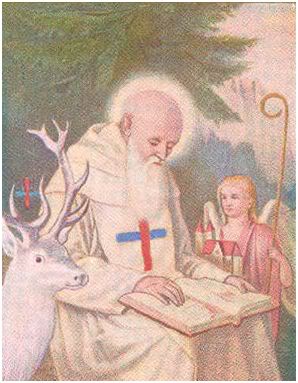
le représente en Trinitaire (robe blanche avec une croix rouge et bleue), un
cerf blanc à côté de lui. Vie : Saint Félix (né en 1127) est, avec saint Jean
de Matha (voir 8 février), le fondateur de l’Ordre -des Trinitaires pour le
rachat des esclaves chrétiens retenus sous le joug des Sarrazins. La prière des
Heures raconte quelques traits merveilleux de sa vie : Arrivé à l’âge de
l’adolescence, il se dépouilla plus d’une fois de ses vêtements pour couvrir
les indigents. Il demanda à son oncle, le comte Thibaut de Blois, la grâce d’un
homicide condamné à mort, lui prédisant que ce meurtrier mènerait bientôt une
vie pleine de vertus, ce que l’événement confirma. Plus tard, il se rendit à
Rome, sur l’inspiration d’un ange, avec saint Jean de Matha, pour demander au
pape la permission de fonder un Ordre. Le pape Innocent III reçut de Dieu
pendant la messe une révélation concernant l’Ordre de la rédemption des
captifs, et Félix fut, ainsi que ses compagnons, revêtu par le pape lui-même de
la robe blanche portant une croix de deux couleurs, costume sous lequel l’ange
lui était apparu. Le pape ajouta que cet Ordre, en raison des trois couleurs de
son costume, devrait porter le nom de la Très Sainte Trinité. Dans le monastère
de Cerfroid, nouvellement fondé, Félix fut honoré d’une apparition de la Très
Sainte Vierge. Pendant la nuit précédant la fête de la Nativité, par une
permission de Dieu, tous les frères de l’Ordre étaient demeurés endormis à
l’heure de Matines, de sorte que, seul, il se trouvait au cœur. Alors il
aperçut au milieu du chœur la Sainte Vierge, portant le costume des Trinitaires
avec la croix et accompagnée d’une nombreuse phalange d’anges vêtus du même
costume. Félix chanta en union avec eux et sous la direction de Marie l’office
liturgique. Comme s’il était arraché aux chants d’ici-bas pour être transporté
dans le chœur des bienheureux, il fut averti par un ange de sa mort prochaine.
Il exhorta alors les siens à une constante charité envers les pauvres et les
captifs et mourut le 4 novembre 1212, chargé d’ans et de mérites.
La Messe (Justus ut
palma). — La messe est du deuxième commun des confesseurs, qui est volontiers
employé pour les saints s’étant distingués par une particulière mortification
et par l’amour de la solitude. L’Oraison propre met en relief deux actes de sa
vie : son séjour dans la sol1tude et le rachat des captifs, et nous en fait
l’application pratique : Puissions-nous être délivrés de la captivité de nos
péchés et conduits dans la céleste patrie. Ainsi la liturgie insiste sur une
pensée qui lui est chère à la fin de l’année ecclésiastique (voir les deux
fêtes de Dédicace et aussi l’oraison de demain).
SOURCE : http://www.introibo.fr/20-11-St-Felix-de-Valois
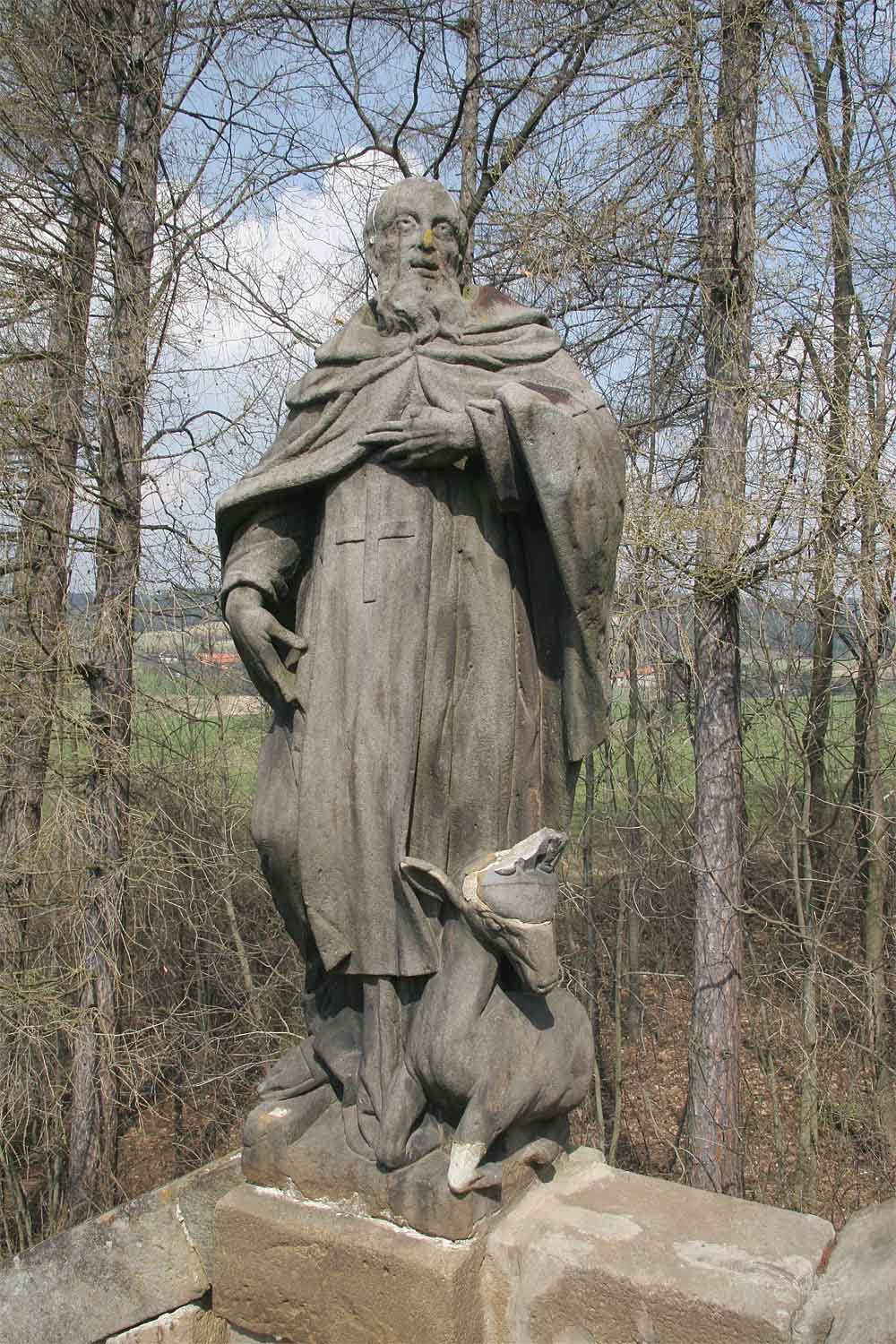
Poutní
místo Homol s kostelem Bolestné Panny Marie -
socha sv. Felixe z Valois, zdobící schodiště.
Statue
of St Felix of Valois besides stairway to Homole pilgrimage site (church of Our
Lady of Sorrows), Borovnice, Rychnov nad Kněžnou District, Czech Republic.
Also
known as
Hugh of Valois
20
November on some calendars
Profile
Son of Count Raoul
de Vermandois et de Valois and Alienor de Champagne. As a child,
Felix received the blessings of Saint Bernard
of Clairvaux and Pope Innocent
II. Educated at
the abbey of Clairvaux.
As a young man, following his parents’ extremely disruptive divorce, he
renounced his wealth and took the name Felix. Cistercian monk at Clairvaux. Hermit in
the Italian Alps. Priest. Hermit in
the forest of Galeresse, diocese of Meaux, France.
Friend and spiritual teacher of Saint John
of Matha. The two of the founded the Order of
the Holy Trinity for the Redemption of Captives (Trinitarians; Redemptionists)
in order to ransom Christians held
as slaves by Moors in Spain and
Northern Africa. The Order received papal approval
on 17
December 1198,
and within 40 years there were over 600 houses worldwide. Today there are
around 600 members of the Order working in prison ministries
in over twenty countries continuing over 800 years of ministry.
Born
April 1127 in
the province of Valois, France as Hugh
4 November 1212 at
the Cerfroi monastery,
Picardy, France of
natural causes
buried in
the church in Cerfroi, which became a pilgrimage destination
confirmed on 21 October 1666 by Pope Alexander
VII
feast day
fixed in 1679 by Pope Innocent
XI
in France
flag
old man in Trinitarian habit with
a coronet at
his feet
Trinitarian with
a stag nearby
Trinitarian with chains or captives nearby
with Saint John
of Matha
with the Holy Trinity
cannon ball and sword (referring
to prisoners
of war he ransomed)
Additional
Information
Book
of Saints, by the Monks of
Ramsgate
Catholic
Encyclopedia, by Michael M O’Kane
Lives
of the Saints, by Father Alban
Butler
Lives
of the Saints, by Father Francis
Xavier Weninger
Saints
and Saintly Dominicans, by Blessed Hyacinthe-Marie
Cormier, O.P.
Saints
of the Day, by Katherine Rabenstein
books
Our Sunday Visitor’s Encyclopedia of Saints
Saints
and Their Attributes, by Helen Roeder
other
sites in english
Father Francis Xavier Weninger
images
video
sitios
en español
Martirologio Romano, 2001 edición
sites
en français
L’Eglise catholique dans l’Aisne
fonti
in italiano
MLA
Citation
“Saint Felix of
Valois“. CatholicSaints.Info. 20 February 2024. Web. 15 January 2026.
<https://catholicsaints.info/saint-felix-of-valois/>
SOURCE : https://catholicsaints.info/saint-felix-of-valois/
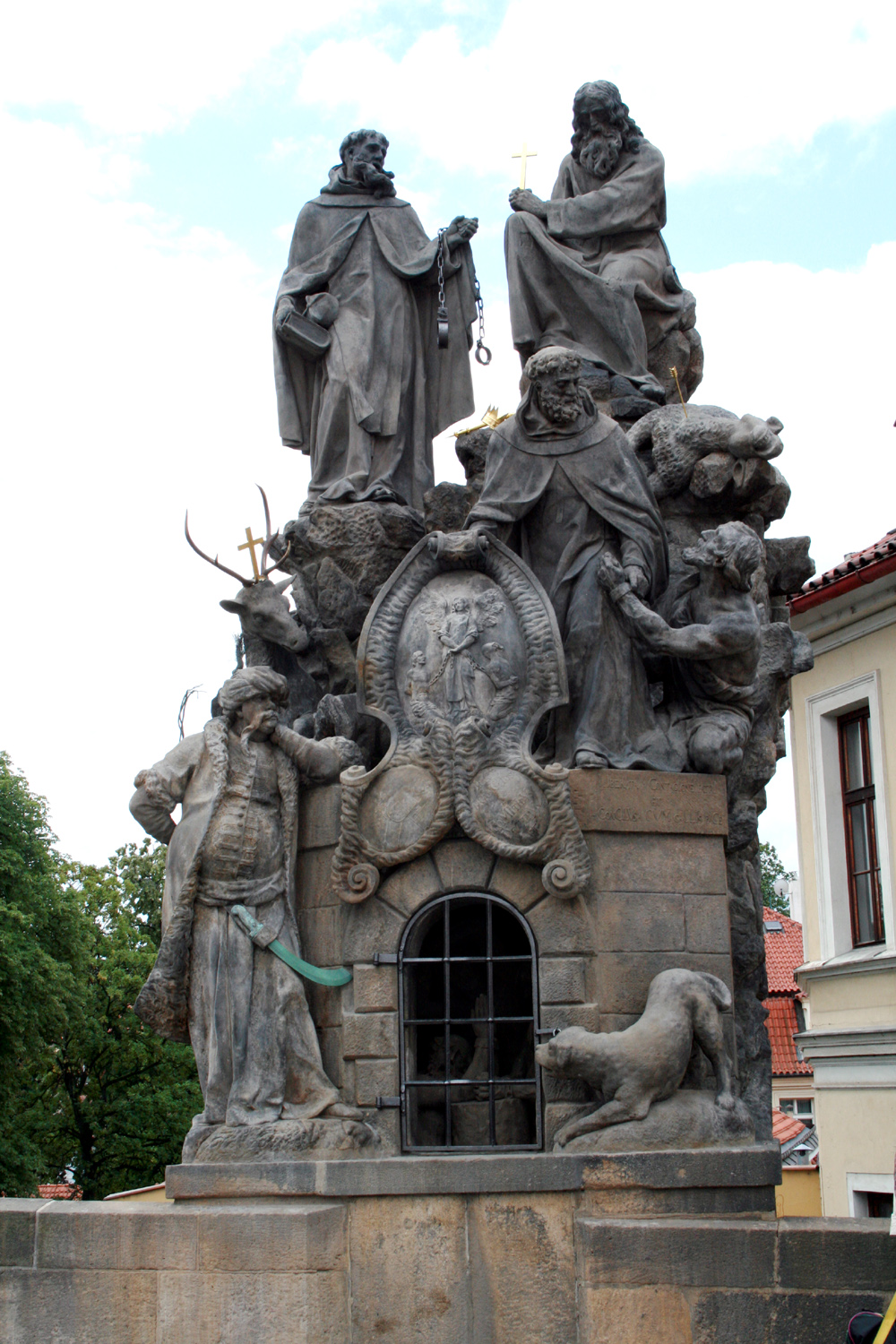
F.
M. Brokof. Sculpture of John of Matha, Félix de Valois and Saint Ivan. Prague,
Charles Bridge.
Book of Saints –
Felix of Valois
Article
FELIX of VALOIS (Saint)
(November 20) (13th century) Saint Felix of the Royal House of Valois, born
A.D. 1127, after having for some time led a most austere life as a hermit in a
forest near Meaux, became with Saint John of Matha the Founder of the
Trinitarian Order (still existing), of which the scope was the great work of
charity of that age, the freeing of the Christian captives held in slavery by
the Moors of Spain and North Africa. Pope Innocent III confirmed the new
Institute, and Saint Felix lived to see as many as six hundred of its houses
begun. He died at Cerf-Froid, his old hermitage, November 4, A.D. 1212, having
shortly before been comforted by a vision of Our Lady, wearing the Trinitarian
habit.
MLA
Citation
Monks of Ramsgate. “Felix
of Valois”. Book of Saints, 1921. CatholicSaints.Info.
12 August 2018. Web. 15 January 2026. <https://catholicsaints.info/book-of-saints-felix-of-valois/>
SOURCE : https://catholicsaints.info/book-of-saints-felix-of-valois/
_with_the_Christ_Child%2C_Saint_Wellcome_V0033178.jpg)
Saint
Mary (the Blessed Virgin) with the Christ Child, Saint John of Matha and Saint
Felix of Valois. Engraving by Castellus.
St. Felix of Valois
Feastday: November 20
Death: 1212
Hermit and co-founder of
the Trinitarians with St. John of
Matha. He lived as a recluse at Cerfroid, France, and in 1198 received approval
from the Holy
See for the Order of the Most Holy Trinity to ransoms captives from
the Moors. Felix founded St. Mathburn Convent in Paris while
in his seventies. He died in Cerfroid on November 4. In 1969 his feast was
confined to local calendars.
SOURCE : https://www.catholic.org/saints/saint.php?saint_id=3336
St. Felix of Valois
Born in 1127; d.
at Cerfroi, 4 November, 1212. He is commemorated 20 November. He was
surnamed Valois because, according to some, he was a member of the royal branch
of Valois in France,
according to others, because he was a native of the province of
Valois. At an early age he renounced his possessions and retired to a
dense forest in the Diocese of Meaux, where he gave himself to prayer and contemplation.
He was joined in hisretreat by St. John of Matha, who proposed
to him the project of founding an order for the redemption ofcaptives.
After fervent prayer, Felix in
company with John set out for Rome and
arrived there in the beginning of the pontificate of Innocent
III. They had letters of recommendation from the Bishop of Paris,
and the new pope received
them with the utmost kindness and lodged them in his palace. The project of
founding the order was considered in several solemn
conclaves of cardinals and prelates,
and the pope after
fervent prayer decided
that these holy men were inspired by God,
and raised up for the good of the Church.
He solemnly confirmed their order, which he named
the Order of the Holy
Trinity for the Redemption of Captives. The pope commissioned
theBishop of Paris and
the Abbot of St.
Victor to draw up for the institute a rule, which
was confirmed by the pope,
17 December, 1198. Felix returned to France to
establish the order. He was received with great enthusiasm, andKing
Philip Augustus authorized the institute France and
fostered it by signal benefactions. Margaret of Blois granted
the order twenty acres of the wood where Felix had built his first
hermitage, and on almost the same spot he erected the famous monastery of Cerfroi,
the mother-house of the institute. Within forty years the order possessed six
hundred monasteries in
almost every part of the world. St. Felix and St. John of
Matha were forced to part, the latter went to Rome to
found a house of the order, the church of which, Santa
Maria in Navicella, still stands on the Caeclian Hill. St.
Felix remained in France to
look after the interests of the congregation. He founded a house in Paris attached
to the church of St. Maturinus, which afterwards became famous under
Robert Guguin, master general of the order. Though the Bull of
his canonization is
no longer extant, it is the constant tradition of his institute that he
was canonized by Urban
IV in 1262. Du Plessis tells us that his feast was
kept in the Diocese of Meaux in 1215. In 1666 Alexander
VII declared him a saint because of immemorial
cult. His feastwas transferred to 20 November by Innocent
XI in 1679.
O'Kane, Michael. "St. Felix of Valois." The Catholic
Encyclopedia. Vol. 6. New York: Robert Appleton
Company, 1909. 8 Feb.
2016 <http://www.newadvent.org/cathen/06033c.htm>.
Transcription. This
article was transcribed for New Advent by Joseph P. Thomas.
Ecclesiastical
approbation. Nihil Obstat. September 1, 1909. Remy Lafort, Censor. Imprimatur. +John
M. Farley, Archbishop of New York.
Copyright © 2020 by Kevin
Knight. Dedicated to the Immaculate Heart of Mary.
SOURCE : http://www.newadvent.org/cathen/06033c.htm
Felix of Valois, Founder
(RM)
Born in Amiens, France, 1127; died 1212; cultus approved by Pope Alexander VII
in 1666.
Felix of Valois is one of
those difficult saints. His name is linked with that of John of Matha, founder
of the Trinitarians. Some say that there is no evidence that he ever
existed--that he is a purely imaginary character; members of the order insist
that he and Saint John were canonized in 1262 by Pope Urban IV.
Did he really exist?
It is a difficult
question for historians, and even more difficult for Christians, since the
infallibility of the Church is somehow involved in the canonization of saints.
If a saint who has been venerated by the universal Church, and who has been the
object of a complete service and Mass turns out to be a myth and an invention,
what will be the effect on faith?
Before answering these
questions, let me tell you his story as it has come down to us, and as written
by Father Calixte, a Trinitarian Cerfroid, in his book published in 1878.
At the beginning of the
12th century, what is now the Somme and Aisne districts of France was ruled by
Count Raoul de Vermandois et de Valois, a prince of the houses of Capet and
Charlemagne. His wife Alienor de Champagne was also of the house of
Charlemagne. On April 19, 1127, she gave birth to a son who was baptized Hugh,
like his grandfather, the son of Henry I, King of France.
Young Hugh was presented
to Saint Bernard and later sent to the abbey of Clairaux to be educated. He was
also presented to Pope Innocent II.
At 20 he set off on a
crusade, but went incognito to avoid being treated with deference. Three years
later he returned, travelled through Italy, and went to live as a hermit either
in northern Italy or near Clermont d'Oise. To avoid recognition and indicate a
change of life, he took the name of Felix and became a priest.
In 1193-94, when he was
living in extreme solitude near Montigny, he received a visit from Saint John
de Matha, who had just graduated from the schools at Aix and Paris. They soon
became friends and John stayed with Felix. They were joined by other disciples
and formed a small community.
Then one day in 1197, a
white deer, which often came to drink at the fountain where the hermits got
their water, appeared with a red and blue cross between its antlers. John was
reminded of the vision he had during his first Mass, when he had seen an angel
dressed in white with a red and blue cross on his chest. Both he and Felix knew
that the deer with a cross was a sign from God, and that they should go ahead
with a plan they had been discussing. This plan was to found a religious order
dedicated to ransoming Christian slaves who were captured during the Crusades.
Together they presented
their plan in Rome to Pope Innocent III, who not only gave his approval but
also gave the founders a habit for their order: white, with a red and blue
cross. John and Felix then returned to France, where their hermitage was renamed
Cerfroid, in memory of the deer which had appeared there.
February 3, 1198, the
pope sent a letter to "brother John, minister of the house of the Holy
Trinity at Cerfroid, and to all his brothers both present and future." The
letter placed the young "Order of the Holy Trinity for the Ransom of
Captives" under the protection of the pope. The letter also mentioned the
property that had already been given to the order by Roger de Catillon,
Marguerite de Bourgogne, and a noble lady of Paris.
May 16, 1198, the pope
sent another letter about the property. On December 17, 1198, a letter arrived
approving the text of the order's rule. In the meantime, the king of France had
also given his approval to the new order.
John left Cerfroid to
begin the real work of redeeming captives by establishing a monastery in Rome.
Felix remained as superior (or minister) at Cerfroid, but later went to Paris
to establish the order in the hospital of Saint-Mathurin, which had been given
to them. As a result, members of the order were popularly called "the
Mathurins," or else they were called "friars on donkeys" because
of their mode of transportation.
On the night of September
8, 1212, though the sacristan of Cerfroid had forgotten to ring the matins bell
(generally about 3:00 a.m.), Felix went down to the church as usual and found
the Blessed Virgin and angels, all of them wearing the order's habit. There
were many other miracles, but that is the only one that will be recounted here.
A few days later John de
Matha returned to Cerfroid to see his old friend. He stayed only a short while,
and on November 4, 1212, Felix died at the age of 85. He was buried at
Cerfroid. The great reputation for sanctity which both surrounded his tomb and
his memory led Urban IV to canonize him on May 1, 1262.
It was a good life, long
and eventful, but at the same time extremely simple. Unfortunately there are
doubts and questions marks at every turn. For example, the authority for his
royal birth was the Trinitarian breviary of 1482, which has been lost.
Authorities quoted for other details are either ambiguous, lost, or of
uncertain authorship. For a long, detailed explanation of the reasons for
doubting his existence as related by Fr. Calixte, read the Encyclopedia cited
below. It will give you some idea of how hagiographers work.
It may be that instead of
being heir to an important family, he was simply a resident of Valois, which
became confused later.
In 1631 the Trinitarians
attempted to gain permission to celebrate the feasts of SS. John and Felix
liturgically in France and Spain, as their brothers in England had been doing
since 1308, but since the Council of Trent had established restrictive controls
on such celebrations, they did not immediately gain permission. The Urban IV's
papal bull canonizing Felix had been lost. So the Trinitarians started
gathering data.
They found that the
canons of Meaux had been invoking Saint Felix since 1219; in 1291 the
chapter-general had fixed his feast day; and in 1308 the provincial of England
received Mass and offices from John XXII. That was enough to convince Pope
Alexander VII, who confirmed the cultus on October 21, 1666. But five years
later the Sacred College of Rites had still not added Felix and John to the
Roman Martyrology, and it was only after the intervention of Louis XIV and
Philip V of Spain who, on the strength of the "de Valois," claimed
descent from Felix, that Innocent XII extended the feasts of SS John de Matha
and Felix de Valois to the Catholic Church in 1694.
The Encyclopedia also
notes that the remains of Saint Felix have been lost, which is troublesome if
he had been venerated throughout the ages. In 1705 searches were carried out
for the bones at Cerfroid and no relics of any type were found.
If by chance the Church
has canonized someone who didn't exist, does that mean that there is a crisis
of faith? Certainly not. First of all the equivalent canonization which took
place in the 17th century was not carried out with the full canonical
procedure. It was a special procedure, based on prescription and good faith.
Its meaning was: "the person here presented is certainly an everlasting
beatitude if he really lived as is claimed."
The historical problem is
not really Rome's concern and may more or less be set aside. To be sure,
matters would be conducted very differently today--precisely in order to avoid
the inaccuracies that are found with Saint Felix. But whether Saint Felix
existed or not, humility, charity, and all the virtues that he had or were
ascribed to him, are the ones which will bring us to a greater love of God. And
isn't that the real reason we venerate the saints? (Attwater, Benedictines,
Delaney, Encyclopedia)
Saint Felix is depicted in art as an old man in Trinitarian habit with a coronet at his feet and chains or captives nearby. On occasion he is shown (1) near a fountain from which a stag drinks perhaps with a cross in his antlers; (2) often with Saint John of Matha (because together they organized the Trinitarians in France for the release of captives from the Moors); or (3) with the Holy Trinity appearing in the picture. He is venerated at Meaux and Valois (Roeder).
SOURCE : http://www.saintpatrickdc.org/ss/1120.shtml

es:Félix de Valois, ilustrando Biblioteca
nueva de los escritores aragoneses que florecieron desde el año de 1500 hasta
1680, Volumen III, editado en es:Pamplona
Butler’s
Lives of the Saints – Saint Felix of Valois, Confessor
Article
The surname of Valois was
given to this saint, according to some, because he was of the royal branch of
Valois in France; but according to Jaffred, Baillet, and many others, because
he was of the province of Valois. The saint was born in 1127, and when grown up
renounced his estate, which was very considerable, and retired into a great
wood, in the diocess of Meaux, called Cerfroi. Here, sequestered from the
world, and forgetting its shadows and appearances which grossly impose upon its
deluded votaries, he enjoyed himself and God, and studied to purify, reform,
and govern his own heart, and to live only to his Creator. In the calm and
serenity of this silent retreat, letting others amuse themselves with the airy
bubbles of ambition, and enjoy the cheats of fancy, and the flatteries of
sense, he abandoned himself to the heavenly delights of holy contemplation,
(which raised his soul above all created things,) and to the greatest rigours
of penance, which were known only to God, but which fervour, love, and
compunction rendered sweeter to him than the joys of theatres. The devout
hermit had no thoughts but of dying in the obscurity of this silent retreat,
when Divine Providence called him thence to make him a great instrument of
advancing his honour amongst men.
Saint John of Matha, a
young nobleman, a native of Provence, and doctor of divinity, who was lately
ordained priest, having heard much of the wonderful sanctity of the holy hermit
of Cerfroi, sought him out in his desert, and put himself under his direction.
Felix soon perceived that his new guest was no novice in the exercises of a
spiritual life; and it is not to be expressed with what fervour the two
servants of God applied themselves to the practice of all virtues. Their fasts
and watchings exceeded the strength of those who have not inured themselves by
long habits to such extraordinary austerities; prayer and contemplation were
their ordinary employment, and all their conversation tended to inflame each
other to the most ardent love of God. After some time Saint John proposed to
the other a project of establishing a religious Order for the redemption of
captives, a design with which he was inspired when he said his first mass.
Felix, though seventy years of age, readily offered himself to do and suffer
whatever it should please God in the execution of so charitable a design. They
agreed to consult heaven by redoubling their fasts and prayers for three days;
after which term they resolved to beg the approbation of the holy see, and made
an austere pilgrimage together to Rome, in the depth of winter, and arrived
there in January 1198. Innocent III, who was lately installed in Saint Peter’s
chair, having read the strong letters of recommendation which the bishop of
Paris sent him in their favour, received them as if they had been two angels
sent by God, and lodged them in his own palace. After many audiences, and
several deliberations with his cardinals and prelates, having consulted God by
prayer and fasting, his holiness was persuaded the two hermits were moved by the
Holy Ghost, and gave a solemn approbation of a new religious institute which he
would have called of the Holy Trinity, and of which he appointed Saint John of
Matha the superior-general. Eudo of Sully, bishop of Paris, and the abbot of
Saint Victor were commissioned by him to draw up a rule or constitutions, which
they had already projected; and they were confirmed by his holiness on the 17th
of December following. The holy founders who had taken a second journey to Rome
to present their rule to the pope, returned into France with its confirmation,
and were every where received with applause and benedictions. King Philip
Augustus authorized the establishment of their Order in France, and promoted it
by his liberalities. Margaret of Blois gave them twenty acres of the wood where
their hermitage was situate, with other benefactions; and they built the
monastery of Cerfroi, which is the mother and chief house of the Order, about a
mile from their old cells. This Order within the space of forty years was so much
increased as to be possessed of six hundred monasteries. Saint John being
obliged to go to Rome to settle his institute there in the church of Saint
Thomas della Navicella, upon Mount Cælius, the direction of the new convents
which were erected in France, was left to Saint Felix, who, amongst other
houses, founded one at Paris, in the church of Saint Maturinus, though the
house was afterwards rebuilt more spacious by Robert Gaguin, the learned and
famous general of this Order, who died in 1501. Saint John, after two voyages
to Barbary, spent the two last years of his life at Rome, where he died on the
21st of December, in 1213. Saint Felix died in his solitude at Cerfroi a year
and about six weeks before him, on the 4th of November in the year 1212, being four
score and five years and several months old. It is related, that a little time
before his death, coming to choir to matins before the rest, he saw there the
Blessed Virgin with a company of heavenly spirits singing the divine office;
which vision is frequently represented in pictures of this saint. It is the
constant tradition of the Order, that these two founders were canonized by a
bull of Urban IV in 1260: though the bull is no where extant. That the festival
of Saint Felix was kept in the whole diocess of Meaux in 1219, is proved by an
authentic act, produced by Du Plessis. Alexander VII in 1666 declared his
veneration to be of time immemorial. Innocent XI in 1679 transferred the feast
of Saint John to the 8th of February; and that of Saint Felix to the 20th of
November.
MLA
Citation
Father Alban Butler.
“Saint Felix of Valois, Confessor”. Lives of the
Fathers, Martyrs, and Principal Saints, 1866. CatholicSaints.Info.
11 August 2018. Web. 4 November 2020.
<https://catholicsaints.info/butlers-lives-of-the-saints-saint-felix-of-valois-confessor/>
SOURCE : https://catholicsaints.info/butlers-lives-of-the-saints-saint-felix-of-valois-confessor/

Weninger’s
Lives of the Saints – Saint Felix of Valois
Article
Saint Felix, of the royal
house of Valois, was born in France, in 1127, and manifested in his earliest
childhood great compassion towards the poor. While yet in the arms of his
nurse, no greater pleasure could be given him than to allow him to bestow alms
on the needy. When older, he sent the best dishes from his table to the poor;
and it happened more than once, that he gave his own cloak to some beggar,
because he happened not to have anything else at hand. He once implored mercy
and life for a condemned criminal, who, he said, was destined to become a great
saint; and the event justified the prediction. Having passed his youth in
acquiring knowledge, and in the practice of virtue, Felix resolved to serve the
Almighty in retirement and solitude. He first, however, took holy orders, so as
to deprive himself of all hope of ever attaining the crown, from which, by his
birth, he was not far removed. After having said his first Mass, he went into a
desert, where he led a very austere life, which was made extremely sweet to him
by divine consolations; so that he intended to spend his whole life, unknown,
in that lonely place. But the Almighty, who had chosen him for greater work,
sent to him a noble young doctor from Paris, named John of Matha, who had also
been ordained priest, and who desired to walk in the path of perfection under
his direction. Saint Felix received him with great pleasure; for he perceived
in the candidate great inclination to virtue. They had lived harmoniously
together, in great piety, for three years, when, one day, while they were
sitting beside a well, in devout discourse, a stag, bearing a blue and red
cross between its antlers, came suddenly forth from the bushes. Saint Felix, greatly
amazed, knew not what to say; but John made use of the occasion to relate a
vision which he had had while saying his first holy Mass, and which was vividly
recalled to his memory by the appearance of this stag. Both saints sank upon
their knees and prayed that they might be favored to recognize more clearly the
will of God. Heaven inspired both with an intense desire to labor for the
ransom of those prisoners who languished under the yoke of the Turks and other
barbarians, and thus save many from the danger of renouncing their faith, and
going to eternal ruin. Both were admonished three times during their sleep to
found a special order for this end, and to request, at Rome, the necessary
permission. Innocent III, who sat at that time on the papal throne, was greatly
pleased with such holy intentions, but desired to confer on the subject with
some learned men, and consult the will of the Almighty in prayer. During holy
Mass the Pope saw the same vision which had been shown to Saint John of Matha,
during his first Mass, as as we related. On the 8th of February, putting away
all doubt, Innocent approved the plan of the new “Order of the Most Holy
Trinity, for the Redemption of Captives,” and invested the two holy founders
with the habit. The first monastery was founded in the diocese of Meaux, by
means of ample donations from charitable persons whom God had moved to favor
the undertaking; whilst others eagerly flocked to the monastery, as soon as it
was completed, to devote their lives to the noble work of ransoming their
captive brethren. When this happy beginning had been made, Saint John again set
out for Rome, leaving the government of the house to Saint Felix, who, by word
and example, led those under him in the path of religious perfection. He
represented to them, with special energy, the many and fearful dangers of those
Christians who were slaves among the barbarians, as many of them forsook the
Christian faith, either from fear of greater misery, or in the hope of
regaining their liberty. The same representations he made to the laity in his
sermons; and thus, after having awakened in the hearts of his religious a great
desire to relieve the captives, he also induced the laity to contribute
liberally to their ransom. With the funds thus collected, the religious of the
new order sailed to Africa, where they knew that the Christians were
imprisoned. They bought them from the infidels, liberated them from slavery,
and saved them, not only from temporal misery, but, what was of much greater
importance, from the imminent danger of going to eternal ruin. It is easy to
conceive that the disciples of Saint Felix, in this holy work, had to combat
with many and great dangers, and also to endure numberless sufferings and
hardships. But they were so inflamed by their holy Master with love for God and
their neighbor, that they feared neither danger nor dishonor, nor even death.
All this gave great comfort to Saint Felix, as he considered that, in this
manner, many souls were saved for eternity. The holy man received great favors
from heaven, among which may be counted the vision which he had, in the night
preceding the festival of the Nativity of the Blessed Virgin. He went,
according to his custom, an hour earlier than the rest to the choir, in order
to pray. On arriving there, he saw the divine Mother, surrounded by a great
many angels. Going towards them, he fell into ecstasy, and with them sang the
praises of the Almighty; when one of them told him that he would soon be called
into heaven to sing eternally the glory of the Almighty. Felix, greatly
rejoicing, called his disciples to him, admonished them most earnestly to
remain constant in their devotion to the captives; and, after receiving the
holy Sacraments, gave his soul calmly into the hands of his Maker, in the eighty-fifth
year of his age.
Practical Considerations
Saint Felix labored long
and hard to save the poor Christian captives from the danger of eternal
damnation in which they were while among the infidels. Perhaps among those who
are under you, or among your friends or relatives, there is some one whom you
know to be in danger of eternal damnation. Consider whether you can extricate
him from this danger, and go to work without delay. Before all, examine your
own soul, and see whether it is not in similar danger, and if so, rescue it
immediately. “Whoever will give alms in the right manner,” says Saint
Chrysostom, “must begin with himself, and first give to himself.” For, to give
alms, is to be charitable, and is a work of charity: but it is written:
“Have pity on your own
soul, that you may please the Lord.” You are perhaps in a proximate occasion of
sin; you have a sinful affection, or a dangerous friendship; your conscience is
burdened with some sin, which you perhaps conceal in your confession, out of shame;
or you have evil habits, which you do not earnestly endeavor to correct. If
this be the case, your soul is in evident danger of eternal ruin. Ah! endeavor
to save it without delay from so terrible a danger, Think that it is your own
soul, and that the loss of it will be your own loss; and hasten to help it.
Delay is fraught with danger. “I pray you,” says Saint Peter Damian, “by the
love of Jesus, do not deceive yourself, do not delay; that you may not ruin
your soul by procrastination; lest some unforeseen accident lay you low, or a
sudden death take you away, and hell devour you.” “Why do you wish to wait for
tomorrow?” asks Saint Ambrose, “You can gain the present day. Take care lest in
losing today, you do not gain the morrow. The loss of one single hour may be of
eternal injury to you.”
MLA
Citation
Father Francis Xavier
Weninger, DD, SJ. “Saint Felix of Valois”. Lives
of the Saints, 1876. CatholicSaints.Info.
26 May 2018. Web. 4 November 2020.
<https://catholicsaints.info/weningers-lives-of-the-saints-saint-felix-of-valois/>
SOURCE : https://catholicsaints.info/weningers-lives-of-the-saints-saint-felix-of-valois/

Retablo
mayor. Iglesia de la Trinidad de Córdoba.
Pictorial
Lives of the Saints – Saint Felix of Valois
Saint Felix was son of
the Count of Valois. His mother throughout his youth did all she could to
cultivate in him a spirit of charity. The unjust divorce between his parents
matured a long-formed resolution of leaving the world; and confiding his mother
to her pious brother, Thibault, Count of Champagne, he took the Cistercian
habit at Clairvaux. His rare virtues drew on him such admiration that, with
Saint Bernard’s consent, he fled to Italy, where he led an austere life with an
aged hermit. At this time he was ordained priest, and his old counsellor having
died, he returned to France, and for many years lived as a solitary at
Cerfroid, Here God inspired him with the desire of founding an Order for the
redemption of Christian captives, and moved Saint John of Matha, then a youth,
to conceive a similar wish. Together they drew up the rules of the Order of the
Holy Trinity. Many disciples gathered round them; and seeing that the time had
come for further action, the two Saints made a pilgrimage to Rome to obtain the
confirmation of the Order from Innocent III. Their prayer was granted, and the
last fifteen years of Felix’s long life were spent in organizing and developing
his rapidly increasing foundations. He died in 1213.
Reflection – “Think how
much,” says Saint John Chrysostom, ” and how often thy mouth has sinned, and
thou wilt devote thyself entirely to the conversion of sinners. For by this one
means thou wilt blot out all thy sins, in that thy mouth will become the mouth
of God.”
SOURCE : https://catholicsaints.info/pictorial-lives-of-the-saints-saint-felix-of-valois/

Estàtues
de Sant Francesc de Paula (esquerra) i Sant Fèlix de Valois (dreta), al Palau
de Mafra
Palácio
Nacional de Mafra
.jpg)
Estàtues
de Sant Francesc de Paula (esquerra) i Sant Fèlix de Valois (dreta), al Palau
de Mafra
Palácio
Nacional de Mafra
Saints and
Saintly Dominicans – 8 February
Saint John
of Matha and Saint Felix
of Valois, Founders of the Trinitarian
Order
John
of Matha was born at Faucon, in Provence, and showed himself from his
earliest childhood so humble that he considered himself born to wash the feet
of others. On the day of his ordination,
when the bishop said at the imposition of hands: “Receive the Holy Ghost,” a
fiery radiance was seen upon his head. God prepared him by three years of
contemplation in the desert to found, with Saint Felix
of Valois, the Order of the Trinity for the redemption of captives. France
was the cradle of this new Institute, which at first Innocent
III hesitated to approve. But during the elevation at Mass he saw an
angel clothed in the habit of this Order (that is, a white habit with a red and
blue cross), with his arms crossed and holding by each hand a slave,
one a Christian,
the other a Moor, as if offering one in exchange for the other. At this sign
from Heaven the Pope gave
his consent. Felix
of Valois died in 1212,
after having founded many hospitals and
religious houses. Saint John
of Matha died in Rome,
to the last exhorting his sons to perseverance (1213). Saint Dominic was
among his friends and admirers. Had not he himself, while yet a young student,
offered himself to slavery to ransom a captive and restore him to his mother?
Later on the Friars Preachers defended the Trinitarian
Order against powerful opposition.
Prayer
Where should I be today,
O my Jesus, if thou hadst not redeemed me by Thy blood?
Practice
Pray for prisoners who
are tempted to hatred towards those who have punished them, or to
discouragement on account of their dishonor.
– taken from the
book Saints
and Saintly Dominicans, by Blessed Hyacinthe-Marie
Cormier, O.P.
SOURCE : https://catholicsaints.info/saints-and-saintly-dominicans-8-february/

Vincenzo Carducci (1576–1638). Encuentro
de san Juan de Mata y san Félix de Valois, Museo del Prado. Óleo sobre
lienzo, 238 x 199, Museo del Prado
San Felice di Valois
1127 - 1212
Etimologia: Felice =
contento, dal latino
Martirologio
Romano: Presso Cerfroid nel territorio di Meaux in Francia, san Felice di
Valois, che, dopo avere condotto per lungo tempo vita solitaria, si ritiene sia
stato compagno di san Giovanni de Matha nel fondare l’Ordine della Santissima
Trinità per la liberazione degli schiavi.
Felice, illustre rampollo
della stirpe reale dei Valois, nacque in Francia nell'anno 1127. Di indole
dolce e compassionevole, fin da bambino diede prove insigni di quella pietà e
carità che poi lo resero l'apostolo degli schiavi.
Ricco di beni, dava ai
poveri quanto gli era permesso, e spesso si privava anche della frutta e del
pane per soccorrerli. Lo zio duca un giorno condannò a, morte un omicida: il
giovane Felice gli chiese per amor di Dio di non punire quel delinquente, ma di
darlo a lui: ne avrebbe fatto un ottimo cristiano. Fu esaudito, e il
disgraziato liberato dalla morte, condusse d'allora vita esemplarissima.
Felice compì regolarmente
gli studi, e ricevuti gli ordini sacri rinunziò a ogni diritto e ricchezza
terrena. La gente lo lodava per le sue rare doti di animo e di corpo ed egli,
per sottrarsene, un giorno si ritirò in un bosco a vivere da anacoreta. La fama
della sua santità però non poteva rimanere ignota.
L'amico, S. Giovanni di
Matha, che aveva deliberato di consacrare il suo ministero alla liberazione
degli schiavi cristiani dalle mani dei Turchi, si portò presso il nostro
eremita pregandolo di volerlo ricevere per prepararsi al grande apostolato. Lo
studio, la preghiera e la penitenza furono i tre grandi mezzi che maturarono i
loro animi per l'eroica impresa. E quando Giovanni conobbe essere giunto il
tempo di iniziare l'ordine da lui vagheggiato, Felice rispose: “Io sarò il
primo a seguirti”. Si portarono quindi a Roma presso la Santa Sede per averne
l'approvazione. Papa Innocenzo III li accolse con deferenza e approvò il nuovo
ordine, sotto il nome di Trinilari o Frati della SS. Trinità colla divisa di
abito bianco ed una croce rosso-azzurra sul petto.
Ritornati in Francia,
vennero favoriti dall’autorità. Re Filippo offrì loro le terre per edificare il
primo convento; S. Giovanni s'impose viaggi lunghi e faticosi nell'Africa e a
Roma, mentre S. Felice in Francia consacrò libertà, averi e vita per la
formazione e propagazione dell'ordine.
Il primo gagliardo
manipolo di Trinitari coronarono le loro fatiche con un felice successo. Circa
200 cristiani furono liberati nell'anno 1201 e nel seguente altri 100. Non si
può dire però quanto fosse difficile strapparli di mano a quei barbari tiranni.
Il mezzo più opportuno era il denaro; ma quando non si poteva raggiungere le
somme da loro richieste, bisognava offrire la propria vita.
E S. Felice seppe così
bene preparare i suoi figli a questa missione che molti, seguendo l'esempio del
loro fondatore S. Giovanni, fecero l'eroico sacrificio.
Già più che
ottantacinquenne il nostro Santo meritò di contemplare la Vergine e di sapere
il momento della sua morte. Convocò allora i numerosissimi figli, li esortò a
perseverare generosamente nella vocazione, indi spirò nella casa madre di
Cerfroi nell'anno 1212.
La Chiesa lo venera come santo dal 1694.
Autore: Antonio
Galuzzi
