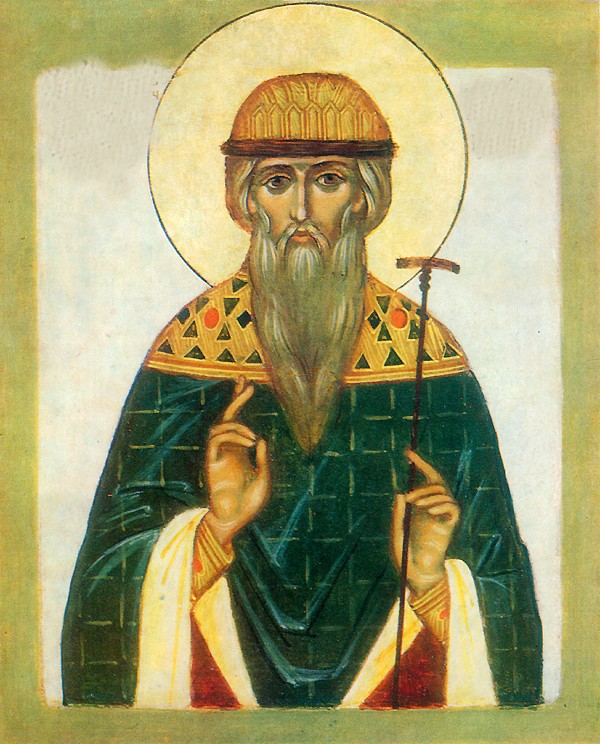
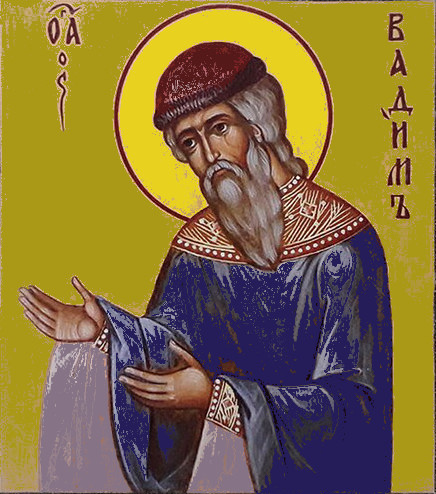
Saint Bademus,
Little Pictorial Lives of the Saints, 1878
Saint Bademus de Perse
Martyr (+ v.
380)
Bademus ou Bademe et ses
compagnons.
Né en Perse dans une
riche famille noble, Bademus fonda un monastère près de Bethlapeta. Il passait
de longs moments en prière et jeûnait de nombreux jours. Sa gentillesse, sa
charité et sa sagesse le conduisirent sur la voie de la sainteté. Il fut arrêté
avec sept de ses compagnons moines puis emprisonné et torturé sous le règne du
roi Sapor vers l'an 380.
Un autre chrétien
emprisonné en même temps nommé Nersan abjura et le roi lui ordonna de tuer
Bademus ce qu'il fit. Ses disciples furent relâchés quatre ans plus tard.
SOURCE : http://nominis.cef.fr/contenus/saint/12575/Saint-Bademus-de-Perse.html

Also
known as
Bademo
Vadim
Profile
Born to the wealthy Persian nobility,
Bademus cared little for worldly things, and when he was old enough he founded
and led a monastery in
Bethlapeta, Persia.
He and seven of his monks were imprisoned for
their faith during
the lengthy persecution by King Sapor. Chained and
regularly beaten for
four months, he was murdered by
Nersan, an apostate Persian prince who
hacked him to death to
prove his renunciation of Christianity.
Born
Betlapeta, Persia
clumsily beheaded 10 April 376
body thrown to the dogs but
recovered and secretly buried by Christians
Additional
Information
Book
of Saints, by the Monks of
Ramsgate
Lives
of the Saints, by Father Alban
Butler
Saints
of the Day, by Katherine Rabenstein
books
Our Sunday Visitor’s Encyclopedia of Saints
other
sites in english
video
fonti
in italiano
websites
in nederlandse
MLA
Citation
‘Saint Bademus‘. CatholicSaints.Info.
20 May 2023. Web. 2 June 2026. <https://catholicsaints.info/tag/name-bademus/>
SOURCE : https://catholicsaints.info/tag/name-bademus/
Bademus of Persia, Abbot
M (AC)
(also known as Bademe)
Born in Persia; died
there c. 380. The rich and noble Saint Bademus founded and governed an abbey
near Bethlapeta in Persia. There he passed whole nights in prayer, and
sometimes went several days together without eating: bread and water were his
usual fare. With sweetness, prudence, and charity, he conducted his religious
in the paths of perfection. God crowned the virtues of Bademus with suffering
by allowing the abbot and seven of his monks to be arrested for their faith,
thrown into a dungeon, and whipped daily for four months.
Prince Nersan of Aria, a
Christian member of the Persian court, was captured and imprisoned about that
same time. He could not withstand the repeated torture and apostatized. To test
Nersan's resolve, King Shapur promised to release Nersan and restore his former
dignities, if the prince would murder Bademus with his own hands. Thus the
wretch, fearing the he himself would be martyred, accepted the sword but frozen
in fear as he was about to thrust it into the abbot's breast.
The undaunted Bademus
stood before him and said: "Unhappy Nersan, to what a pitch of impiety do
you carry your apostasy. With joy I run to meet death; but could wish to fall
by some other hand than yours: why must you be my executioner?"
Nersan vacillated between
fear of King Shapur and fear of the King of kings. Finally he struck with a
trembling hand that made his sword unsteady and forceless. Thus, Bademus was
pierced numerous times before Nersan could deliver the ultimate thrust that
severed the head of Bademus. The martyr's body was cast outside the city gates,
but was secretly retrieved and buried by the Christians. His disciples were released
from their chains four years later at the death of Shapur (Benedictines,
Encyclopedia, Husenbeth).
SOURCE : http://www.saintpatrickdc.org/ss/0410.shtmlApril
10
St. Bademus, Abbot,
Martyr
From his original Syriac
acts, written by St. Maruthas, published by Assemani, t. 1. p. 165. The Greek
from Metaphrastes were given us by Henschenius, p. 828. and Ruinart, p. 680.
A.D. 376
BADEMUS was a rich and
noble citizen of Bethlapeta, in Persia, who, desiring to devote himself to the
service of God, out of his estates founded a monastery near that city, which he
governed with great sanctity. The purity of his soul had never been sullied by
any crime, and the sweet odour of his sanctity diffused a love of virtue in the
hearts of those who approached him. He watched whole nights in prayer, and
passed sometimes several days together without eating: bread and water were his
usual fare. He conducted his religious in the paths of perfection with
sweetness, prudence, and charity. In this amiable retreat he enjoyed a calmness
and happiness which the great men of the world would view with envy, did they
compare with it the unquiet scenes of vice and vanity in which they live. But,
to crown his virtue, God permitted him, with seven of his monks, to be
apprehended by the pursuivants of King Sapor, in the thirty-sixth year of his
persecution. He lay four months in a dungeon, loaded with chains; during which
lingering martyrdom he was every day called out to receive a certain number of
stripes. But he triumphed over his torments by the patience and joy with which
he suffered them for Christ. At the same time, a Christian lord of the Persian
court, named Nersan, prince of Aria, was cast into prison, because he refused
to adore the sun. At first he showed some resolution; but at the sight of
tortures his constancy failed him, and he promised to conform. The king, to try
if his change was sincere, ordered Bademus to be brought to Lapeta, with his
chains struck off, and to be introduced into the prison of Nersan, which was a
chamber in the royal palace. Then his majesty sent word to Nersan, by two
lords, that if, with his own hand, he would despatch Bademus, he should be
restored to his liberty and former dignities. The wretch accepted the
condition; a sword was put into his hand, and he advanced to plunge it into the
breast of the abbot. But being seized with a sudden terror, he stopped short,
and remained some time without being able to lift up his arm to strike. The
servant of Christ stood undaunted, and, with his eyes fixed upon him, said:
“Unhappy Nersan, to what a pitch of impiety do you carry your apostacy. With
joy I run to meet death; but could wish to fall by some other hand than yours:
why must you be my executioner?” Nersan had neither courage to repent, nor
heart to accomplish his crime. He strove, however, to harden himself, and
continued with a trembling hand to aim at the sides of the martyr. Fear, shame,
remorse, and respect for the martyr, whose virtue he wanted courage to imitate,
made his strokes forceless and unsteady; and so great was the number of the
martyr’s wounds, that they stood in admiration at his invincible patience. At
the same time they detested the cruelty, and despised the base cowardice of the
murderer, who at last, aiming at his neck, after four strokes severed his head
from the trunk. Neither did he escape the divine vengeance: for a short time
after, falling into public disgrace, he perished by the sword, after tortures,
and under the maledictions of the people. Such is the treachery of the world
towards those who have sacrificed their all in courting it. Though again and
again deceived by it, they still listen to its false promises, and continue to
serve this hard master, till their fall becomes irretrievable. The body of St.
Bademus was reproachfully cast out of the city by the infidels: but was secretly
carried away and interred by the Christians. His disciples were released from
their chains four years afterward upon the death of King Sapor. St. Bademus
suffered on the 10th of the moon of April, in the year 376, of King Sapor the
sixty-seventh.
Monks were called
Mourners by the Syrians and Persians, because by their state they devoted
themselves in a particular manner to the most perfect exercises of compunction
and penance, which indeed are an indispensable duty of every Christian. The
name of angels was often given them over all the East, during several ages, 1 because
by making heavenly contemplation and the singing of the divine praises their
great and glorious employment, if they duly acquit themselves of it, they may
be justly called the seraphim of the earth. The soul which loves God, is made a
heaven which he inhabits, and in which she converses with him in the midst of
her own substance. Though he is infinite, and the highest heavenly spirits
tremble before him, and how poor and base soever we are, he invites us to
converse with him, and declares that it is his delight to be with us. Shall not
we look upon it as our greatest happiness and comfort to be with Him, and to
enjoy the unspeakable sweetness of his presence? Oh! what ravishing delights
does a soul taste which is accustomed, by a familiar habit, to converse in the
heaven of her own interior with the three persons of the adorable Trinity!
Dissipated worldlings wonder how holy solitaries can pass their whole time
buried in the most profound solitude and silence of creatures. But those who
have had any experience of this happiness, are surprised with far greater
reason how it is possible that any souls which are created to converse
eternally with God, should here live in constant dissipation, seldom
entertaining a devout thought of Him, whose charms and sweet conversation
eternally ravish all the blessed.
Note 1. See Du
Cange’s Glossary of the Greek Language for the middle ages. [back]
Rev. Alban
Butler (1711–73). Volume IV: April. The Lives of the
Saints. 1866
SOURCE : https://www.bartleby.com/lit-hub/lives-of-the-saints/volume-iv-april/st-bademus-abbot-martyr
Saint of the Day – 10
April – St Bademus (Died 376) Confessor, Abbot and Martyr
Posted on April
10, 2023
Saint of the Day – 10
April – St Bademus (Died 376) Confessor, Abbot and Martyr, Founder of a
Monastery. Bademus died on 10 April 376 by being stabbed countless times and
finally beheaded by a wavering and frightened executioner. Also known as
– Bademo, Vadim.
Bademus was a rich and
noble citizen of Bethlapeta in Persia, who sold his possessions to follow
Christ, then gave the greater part of the proceeds to the poor. He reserved
just enough to found a Monastery near that City, to which he retired with several
others and then governed it with great sanctity. He conducted his religious in
the paths of perfection with sweetness, prudence and charity.
To crown his virtue, God
permitted him, with seven of his Monks, to be apprehended by the followers of
King Sapor in the thirty-sixth year of that King’s persecution. He lay for four
months in a dungeon, loaded with chains and during this lingering martyrdom,
received everyday, a cruel flagellation. But he triumphed over his torments by
the patience and joy with which he suffered them for Christ.
At the same time, a
Prince named Nersan, who was a Christian, was cast into prison and his goods
confiscated because he refused to adore the sun. At first he seemed resolute
but, at the sight of tortures,his constancy failed him and he promised to
conform if he could be delivered. The King, to test whether his change was
sincere, ordered Bademus to be brought where Nersan was kept in the royal
palace and sent word to Nersan that if he would slay the Abbot, he would be
restored to his liberty and former dignities. The apostate accepted the
condition; a sword was put into his hand and he advanced to plunge it into the breast
of the Abbot. But being seized with a sudden terror, he stopped short and
remained for some time unable to lift up his arm to strike – he had neither
courage to repent, nor heart to accomplish his crime.
Finally, he hardened
himself and continued with a trembling hand to aim at the Martyr’s sides. Fear,
shame, remorse and respect made his strokes forceless and unsteady and so great
was the number of his victim’s wounds that the bystanders were in admiration at
his invincible patience. Saint Bademus reproached his executioner, saying,
“What will you do on the day when you will have to render an account of your
actions and hear the sentence of your condemnation? I offer myself willingly to
die for the glory of my Lord Jesus Christ but I would prefer to die by another
hand, than yours!” The pagans themselves were horrified at the cruelty of the
King, the long Martyrdom and the perfidious acts of the apostate.
Saint Bademus suffered on
the 10th of April in the year 376. His body was cast out of the City but
secretly carried away and interred by the Christians. A short time afterwards
Nersan fell into public disgrace and perished by the sword – other accounts say
that he committed suicide. . The disciples of the Saint were released from
their chains four years later, at the death of King Sapor.
Author: AnaStpaul
Passionate Catholic.
Being a Catholic is a way of life - a love affair "Religion must be like
the air we breathe..."- St John Bosco Prayer is what the world needs
combined with the example of our lives which testify to the Light of Christ.
This site, which is now using the Traditional Calendar, will mainly concentrate
on Daily Prayers, Novenas and the Memorials and Feast Days of our friends in
Heaven, the Saints who went before us and the great blessings the Church
provides in our Catholic Monthly Devotions. This Site is placed under the
Patronage of my many favourite Saints and especially, St Paul. "For the
Saints are sent to us by God as so many sermons. We do not use them, it is they
who move us and lead us, to where we had not expected to go.” Charles Cardinal
Journet (1891-1975) This site adheres to the pre-Vatican II Catholic Church and
all her teachings. . PLEASE ADVISE ME OF ANY GLARING TYPOS etc - In June 2021 I
lost 100% sight in my left eye and sometimes miss errors. Thank you and I pray
all those who visit here will be abundantly blessed. Pax et bonum! View All Posts
Saint Bademus
Martyr
(† 376)
Bademus was originally a
rich and noble citizen of Bethlapeta in Persia, who sold his rich possessions
to follow Christ, then gave the greater part of the proceeds to the poor. He
reserved just enough to found a monastery near that city, to which he retired
with several other persons, and then governed it with great sanctity. He
conducted his religious in the paths of perfection with sweetness, prudence,
and charity.
To crown his virtue, God
permitted him, with seven of his monks, to be apprehended by the followers of
King Sapor in the thirty-sixth year of that king's persecution. He lay four
months in a dungeon, loaded with chains, and during this lingering martyrdom received
every day a cruel flagellation. But he triumphed over his torments by the
patience and joy with which he suffered them for Christ.
At the same time a prince
named Nersan, who was a Christian, was cast into prison and his goods
confiscated because he refused to adore the sun. At first he seemed resolute,
but at the sight of tortures his constancy failed him, and he promised to
conform if he could be delivered. The king, to test whether his change was
sincere, ordered Bademus to be brought where Nersan was kept in the royal
palace, and sent word to Nersan that if he would slay the abbot, he would be
restored to his liberty and former dignities. The apostate accepted the
condition; a sword was put into his hand, and he advanced to plunge it into the
breast of the abbot. But being seized with a sudden terror, he stopped short,
and remained some time unable to lift up his arm to strike; he had neither
courage to repent, nor heart to accomplish his crime.
Finally he hardened
himself and continued with a trembling hand to aim at the martyr's sides. Fear,
shame, remorse, and respect made his strokes forceless and unsteady; and so
great was the number of his victim's wounds that the bystanders were in
admiration at his invincible patience. Saint Bademus reproached his
executioner, saying, What will you do on the day when you will have to render
an account of your actions, and hear the sentence of your condemnation? I offer
myself willingly to die for the glory of my Lord Jesus Christ, but I would
prefer to die by another hand than yours! The pagans themselves were horrified
at the cruelty of the king, the long martyrdom, and the perfidious acts of the
apostate.
Saint Bademus suffered on
the 10th of April in the year 376. His body was cast out of the city, but
secretly carried away and interred by the Christians. A short time afterwards
Nersan fell into public disgrace, and perished by the sword. The disciples of
the Saint were released from their chains four years later, at the death of
King Sapor.
Reflection. What
ravishing delights does the soul taste which is accustomed to converse, in the
heaven of its own interior, with the Three Persons of the adorable Trinity!
Little Pictorial Lives of
the Saints, a compilation based on Butler's Lives of the Saints and
other sources by John Gilmary Shea (Benziger Brothers: New York, 1894); Les
Petits Bollandistes: Vies des Saints, by Msgr. Paul Guérin (Bloud et
Barral: Paris, 1882), Vol. 4
SOURCE : https://www.magnificat.ca/cal/en/saints/saint_bademus.html
Monkmartyr Bademus
(Vadim) of Persia
Commemorated on April
9
Monk Martyr Archimandrite
Bademus (Vadim) was born in the fourth century in the Persian city of
Bithlapata, and was descended from a rich and illustrious family. In his youth,
he was enlightened with the Christian teaching. The saint gave away all his
wealth to the poor and withdrew into the wilderness, where he founded a
monastery. He would go up on a mountain for solitary prayer, and once was
permitted to behold the Glory of God.
During this period the
Persian emperor Sapor (310-381) began to persecute Christians. They arrested St
Bademus and his seven disciples, and tortured them in prison, hoping that they
would renounce Christ and worship the sun and fire. But St Bademus and his
disciples held firmly to the Christian Faith. The confessors spent four months
in jail. All this time St Bademus was a spiritual leader and support for the
Christians living in Persia.
One of the associates of
the emperor Sapor, Nirsanes, was a Christian and suffered imprisonment for
this. He did not hold up under torture and denied Christ, promising to fulfill
whatever the emperor commanded. Sapor demanded that Nirsanes personally cut off
the head of St Bademus. For this he was promised a reprieve and great rewards.
Nirsanes was not able to overcome his fear of new tortures, and he agreed to
follow the path of betrayal walked by Judas.
When they brought St
Bademus to him, he took the sword and turned toward him, but overcome by
conscience, he trembled and stood petrified. St Bademus said to him, “Has your
wickedness now reached this point, Nirsanes, that you should not only renounce
God, but also murder His servants? Woe to you, accursed one! What will you do
on that day when you stand before the Dread Judgment Seat? What answer will you
give to God? I am prepared to die for Christ, but I don’t want to receive death
at your hands.”
Nirsanes struck with the
sword, but his hands shook, and he could not behead the saint immediately, and
the fire-worshippers began to call him a coward. The holy martyr Bademus stood
motionless, enduring many terrible blows, until the murderer succeeded in
cutting off his head.
The just punishment for
his misdeeds were not slow in overtaking the hapless fellow. Tormented by his
conscience, he did away with himself, throwing himself on a sword. After the
death of the emperor Sapor, the seven disciples of St Bademus were released
from prison.
SOURCE : http://oca.org/saints/lives/2013/04/09/101040-monkmartyr-bademus-vadim-of-persia

San Bademo (Vadim) Monaco
Festa: 10 aprile
† Persia, 13 aprile 376
Nato da nobile famiglia
in Persia, diviene eremita e abate di un monastero. La sua esistenza ascetica,
dedita alla preghiera e alla carità, si scontra con la brutalità del regime
persiano che lo imprigiona insieme ad altri sette monaci. In carcere, la fede
di Vadim viene messa alla prova di fronte al cedimento di Narsete, un compagno
di fede che abiura per ottenere la libertà. Incaricato di uccidere Vadim,
Narsete vacilla, tormentato dal rimorso e dalla paura del giudizio divino. Solo
dopo atroci sofferenze, Narsete decapita Vadim, che ottiene la palma del
martirio il 13 aprile 376.
E' una bella storia quella di san Vadim, in russo, o Bademo, in italiano. Storia di un giovane coraggioso, poi santo monaco e, infine, martire vittorioso.
Bademo nacque nella città di Betlapeta, in Persia, da ricchi e nobili genitori. Essendo divenuto erede dei molti beni della famiglia, non si lasciò abbagliare dal vano splendore delle ricchezze né sedurre dai fallaci piaceri del mondo, ancora giovane abbracciò con tutto il cuore il Vangelo di Cristo, distribuì il suo patrimonio ai poveri e si ritirò a vita eremitica, edificando poi un monastero del quale fu abate.
Visse meditando le verità eterne, in intima e familiare unione con Dio, molto sollecito della salute del prossimo, dei poveri e dei miserabili che a lui ricorrevano e che egli accoglieva con singolare affetto. Viveva in mirabile povertà e pregava molto, anche di notte. Godeva di grande stima per le sue virtù.
Durante la persecuzione contro i cristiani del re Sapore II, Bademo e altri sette monaci furono incarcerati nell’anno 375 ed esposti a crudeli torture.
Nello stesso carcere c’era anche Narsete, un signore della città di Arnuno, anch’egli imprigionato per avere ricusato, come cristiano, di adorare il sole. Egli, raffreddatosi nella pietà, stanco delle angustie del carcere, invaghito di recuperare il suo perduto splendore, antepose la grazia del principe terreno a quella del celeste Imperatore. Si diede per vinto e, pur di riavere la sua libertà, con detestabile apostasia, si dichiarò pronto ad eseguire quello che il re Sapore II gli avesse ordinato.
Udita questa sua risoluzione, il re lo fece chiamare alla sua reggia e gli
diede ordine di uccidere egli stesso il compagno di fede e di catene Bademo.
Impugnato il ferro, Narsete, stava per uccidere Bademo, quando fu sorpreso da
un improvviso terrore, cominciò a tremare e restò immobile come un sasso.
Allora, Bademo lo mirò in viso con compassione e gli disse: “Così, Narsete, ti
sei lasciato vincere dal male, ti sei indotto a negare Dio. Non hai orrore di
spargere il sangue innocente? Per me e cosa dolce e soave il morire in
testimonianza della vera fede per Cristo, ma tu a qual raggio di speranza di
appiglierai davanti al tribunale del giustissimo Dio?”.
Narsete, pallido e tremante, con la mente turbata e fuori di sé per la
confusione, né rifletteva sull’indegnità del fatto né si muoveva a
misericordia. Alzò più volte la spada e vibrò più colpi ma sempre con mano
tremante, così che fece soffrire a Bademo un più lento e doloroso martirio e,
nello stesso tempo, espose se stesso alle beffe dei presenti che ammiravano la
fortezza del martire e la vergognosa codardia del misero apostata. Solo alla
fine, dopo molte ferite gli riuscì di recidere la testa a Bademo.
Bademo, il beato atleta di Cristo, conseguì la corona del martirio il 13 aprile
dell’anno 376. La sua festa è celebrata il 10 aprile.
Autore: Flavio Peloso
SOURCE : https://www.santiebeati.it/dettaglio/99306
Den hellige Bademus av
Betlapat (d. 376)
Minnedag:
10. april
Den rike og fornemme
Bademus var født i Beth-Lapat (Betlapat, Bithlapet, Bithlapata, Bethlapeta), det
senere Gundishapur, nord i dagens iranske provins Khuzestan. Etter å ha delt ut
det han eide, grunnla han et kloster på sine eiendommer i hjembyens forsteder
og ble selv arkimandritt (abbed) for syv munker. For bedre å kunne fokusere
sine tanker om Gud og for mer konsentrert bønn, dro han noen ganger til et
nærliggende ørkenfjell, og der ble han en gang funnet verdig til å få en visjon
av Gud. Han tilbrakte hele netter i bønn, og noen ganger gikk han i flere dager
uten å spise. Hans vanlige føde var vann og brød. Med mildhet, klokskap og
nestekjærlighet ledet han sine munker på perfeksjonens vei. Under kong Shapur
IIs forfølgelser ble han i 376 arrestert sammen med sine syv munker. De ble
kastet i et fangehull og pisket hver dag i fire måneder.
Nersan vaklet mellom
frykt for kong Shapur og frykt for kongenes Konge. Til slutt hogg han med en
skjelvende hånd som gjorde sverdet ustødig og kraftløst. Dermed ble Bademus
gjennomboret en rekke ganger før Nersan klarte å prestere det fjerde og siste
hogget som skilte Bademus’ hode fra kroppen. Dette skjedde den 10. april 376.
Martyrens legeme ble kastet utenfor byportene, men ble i hemmelighet tatt vare
på og gravlagt av de kristne. Prins Nersan klarte ikke å leve med sin
samvittighet og begikk selvmord kort etter. Bademus’ disipler ble løslatt fra
sine lenker i 379 etter at kong Shapur II døde. Bademus’ minnedag er 10. april,
men 9. april nevnes også.
Den hellige biskop Maruthas av Maiferkat i
Mesopotamia (d. ca 415) satte sammen listen over martyrer i Persia under kong
Shapur II og skrev hymner til deres ære. Se hans biografi for en oversikt over
de martyrene vi hittil har funnet opplysninger om. Under Shapurs forfølgelser
ble den blomstrende iranske kirken i praksis utryddet for all fremtid og klarte
aldri å hente seg igjen. De kristne som lever der i dag, er små ikke-persiske
etniske grupper som innvandret til Iran etter selevkidenes regime.
Kilder:
Attwater/Cumming, Benedictines, Bunson, KIR, Patron Saints SQPN, Infocatho,
en.wikipedia.org, Butler 1866, zeno.org, heiligen-3s.nl, oca.org,
fatheralexander.org - Kompilasjon og oversettelse: p. Per Einar Odden
Opprettet: 30. desember
1997
SOURCE : https://www.katolsk.no/biografier/historisk/bademus