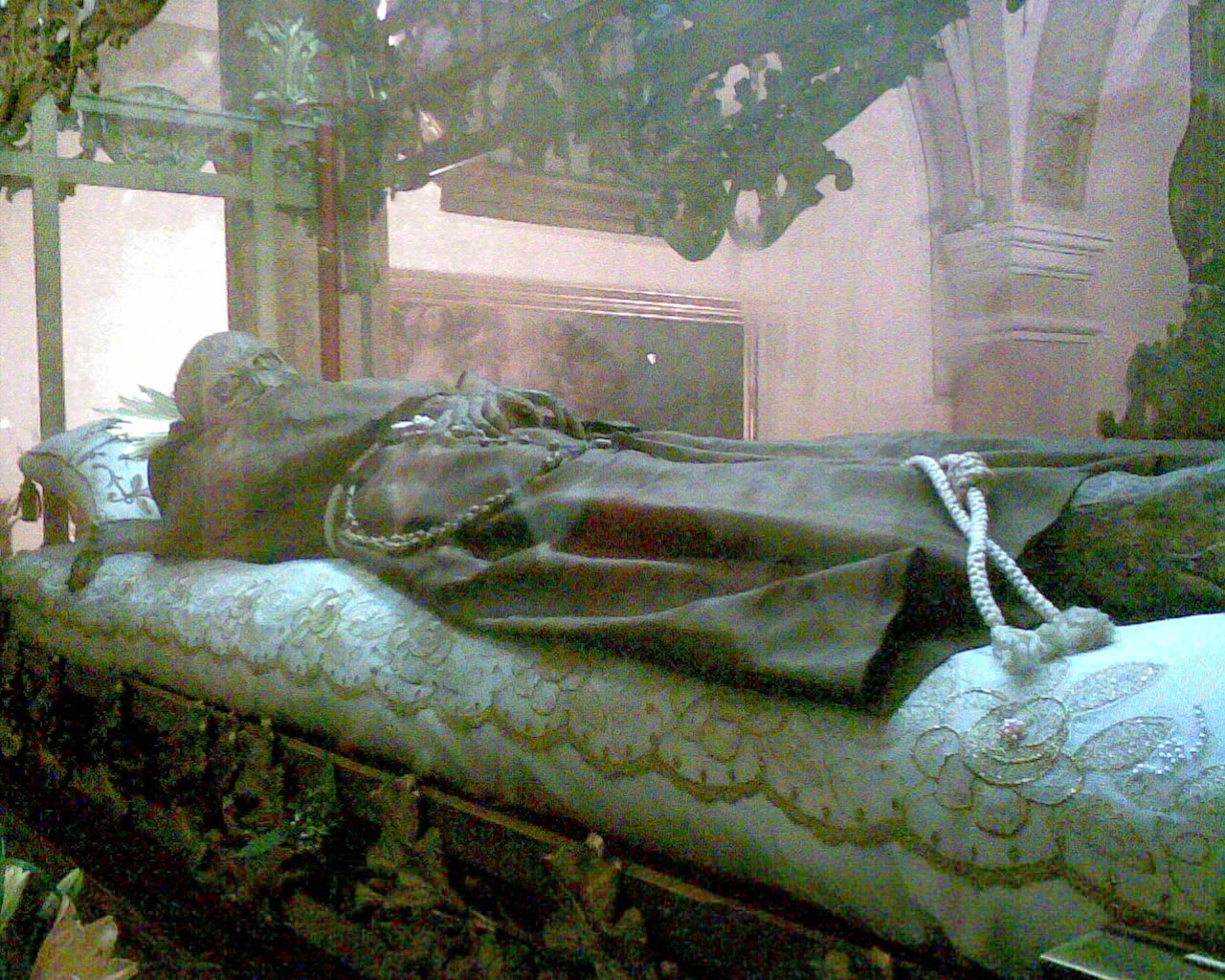
Bienheureux Jacques
Illirico
Laïc franciscain (+ 1496)
Le bienheureux Giacomo
Illirico da Bitetto, laïc profès franciscain (1400 - 1496).
À Bitetto dans les
Pouilles, vers 1485, le bienheureux Jacques, religieux de l’Ordre des Mineurs,
né en Dalmatie, d’une humilité remarquable.
Martyrologe romain
SOURCE : http://nominis.cef.fr/contenus/saint/11274/Bienheureux-Jacques-Illirico.html
Also
known as
Giacomo de Bitetto
Giacomo of Bitetto
Giacomo Varingez
Giacomo Veringuez
Jacobo de Iádere
Varinguer
James of Bitecto
James of Bitetto
James of Dalmatia
James of Illyricum
James of Sclavonia
James of Zara
James the Illyrian
James the Slav
Profile
Son of Leonardo and
Beatrice Varingez. Jakov re-located to Bari, Italy to
escape Turkish invaders. There he felt a call to religious life
and joined the Order of Friars Minor at the friary of Bitetto, Italy;
he lived there nearly all the rest of his life. He served as cook, alms–beggar, gardener, porter,
and sacristan.
Known for being continually in prayer, he
was given to ecstasies,
noted as a miracle worker
and for the ability to levitate.
In his 80’s he worked with victims of the plague of 1482.
Born
c.1400 in
Zadar, Zadarska, Croatia
27 April 1496 in Bitetto, Bari, Italy
body incorrupt about
20 years after his burial,
and parts of the body are still so today
29
December 1700 by Pope Clement
XI (cultus confirmation)
19
December 2009 by Pope Benedict
XVI (decree of heroic
virtues)
Additional
Information
Book of Saints, by the Monks of
Ramsgate
Lives
of the Saints, by Father Alban
Butler
Saints
of the Day, by Katherine Rabenstein
books
Our Sunday Visitor’s Encyclopedia of Saints
other
sites in english
video
sitios
en español
Martirologio Romano, 2001 edición
fonti
in italiano
nettsteder
i norsk
MLA
Citation
“Blessed Jakov
Varingez“. CatholicSaints.Info. 27 April 2024. Web. 2 June 2026.
<http://catholicsaints.info/blessed-jakov-varingez/>
SOURCE : http://catholicsaints.info/blessed-jakov-varingez/
Book of Saints –
James of Sclavonia
(Saint) (April 20) (15th
century) A Franciscan Friar, native of Dalmatia, who lived a most holy life in
a convent near Bari in the South of Italy. He died there, A.D. 1485. Many
miracles have been worked through his intercession.
MLA
Citation
Monks of Ramsgate. “James
of Sclavonia”. Book of Saints, 1921. CatholicSaints.Info.
20 October 2013. Web. 2 June 2026.
<https://catholicsaints.info/book-of-saints-james-of-sclavonia/>
SOURCE : https://catholicsaints.info/book-of-saints-james-of-sclavonia/
Blessed James of Bitetto,
OFM (AC)
James received the habit
of Saint Francis at Zara, but served as a lay brother at Bitetto, near Bari in
southern Italy. James possessed heroic humility and reached the heights of
heaven in his contemplation. During the process of beatification, a fellow friar
testified that he had seen James levitate during prayer and heard him
accurately predict the future.
While James was the cook
of the abbey at Conversano (18 miles from Bari), he would contemplate the
cooking fire and see the fires of hell or the spark of God's love that ignites
hearts. Often he would be found in the kitchen, motionless, rapt in ecstatic
contemplation. This happened one morning as he was fixing beans for that
night's dinner. He stood with his hand in the beans, tears streaming down his
face into the vessel before him. Thus he was found by the duke on whose estate
the monastery was founded. King Ferdinand I's courtier watched in amazement
before declaring, "Blessed are the religious brethren whose meals are
seasoned with such tears." Later that day James, learning of the duke's
presence, went to him and asked what he would like for his dinner. The nobleman
replied that he wanted nothing but some of the beans seasoned with James'
tears.
Eventually James was sent
back to Bitetto where he died and where his incorrupted body remains. Many
miracles attributed to James' intercession have been recorded (Benedictines,
Husenbeth).
SOURCE : http://www.saintpatrickdc.org/ss/0427.shtml
April 20
St. James of Sclavonia, or Illyricum, Confessor
THOUGH a native of Dalmatia, from which country he
received his surname, he spent the chief part of his life on the opposite coast
of the Adriatic sea, in Italy, where he embraced with great fervour the humble
and penitential state of a lay-brother among the Observantin Franciscan friars
at Bitecto, a small town, nine miles from Bari. By an eminent spirit of
compunction, humility, self-denial, and heavenly contemplation, he seemed not
to fall short in fervour of the greatest lights of his Order. He was seen by a
fellow-friar, whose testimony is produced in the process for his canonization,
raised in body from the ground at prayer, and many predictions, authentically
proved, show him to have been often favoured by God with a prophetic spirit. He
was sometimes removed to other neighbouring convents of his Order; and he was
for some years employed in quality of cook in that of Conversano, eighteen
miles from Bari. In this office, from the presence and sight of a temporal
fire, he took occasion sometimes to contemplate the everlasting fire of hell,
and at other times to soar in spirit above the highest heavens, to the source
of infinite love which burns through all eternity, begging some spark to be
kindled in his breast from this divine flame, which darts its rays on all
creatures, though many unhappily shut their hearts to them, and receive not
their influence. In such contemplation he often fell into ecstacies in the
midst of his work, and stood for some time motionless and entirely absorpt in
God. One morning whilst he was making ready a mess of beans for his community’s
dinner, he happened to be thus ravished in spirit, and stood for a considerable
time with his hand in the beans, having his mind absorpt in God, and tears
streaming from his eyes, fell into the vessel of beans before him. The Duke of
Adria, or Atria, in whose estate Conversano was comprised, and who often
retired from the court of King Ferdinand I. to pass some months in the country,
coming to this convent, passed through the kitchen, and saw the holy brother in
this wonderful rapture. He stood some time in great surprise, and said,
“Blessed are the religious brethren whose meals are seasoned with such tears.”
After he was gone from the place, James came to himself, and being informed
that so great a guest was come, he went to ask the duke what he was pleased to
order to be dressed for his dinner. “I will eat nothing,” said the duke, “but
some of the beans which have been seasoned with your tears.” Which answer gave
the saint extreme confusion. The duke took every occasion of testifying his
extraordinary veneration for his sanctity. St. James was sent back by his
superiors to Bitecto, and there closed a holy life by a most happy death, in
1485, on the 27th of April: but his festival occurs on the 20th in the
Martyrology published by Pope Benedict XIV. for the use of his Order. His body
remains uncorrupted at Bitecto; and an account of many miracles wrought through
his intercession is collected from authentic vouchers by Papebroke, in April,
t. 3, p. 527.
Rev. Alban Butler (1711–73). Volume IV: April. The Lives of the Saints. 1866.
Beato Giacomo da Bitetto Francescano
Zara, Dalmazia, 1400 ca - 1485/90
Della vita di fra Giacomo si hanno solo alcuni flash. Nato a Zara nel 1400 circa, lo lo ritroviamo giovane frate francescano nel convento di San Pietro a Bari. Visse poi a Conversano e Cassano delle Murge come cuciniere, ortolano e frate cercatore. La nobile famiglia degli Acquaviva lo prese a benvolere. Ma - gtiunto in età avanzata al convento di San Francesco di Bitetto - fu lui a salvare uno dei membri della potente famiglia, il conte Andrea. Questi, inseguito da sicari del re di Napoli, contro cui aveva congiurato, si era infatti rifugiato nel convento. Per sdebitarsi gli Acquaviva fecero costruire la strada che collega il luogo di preghiera con la città. Il frate, che aveva un'intensa vita contemplativa, si prodigò nella carità per i poveri: sia nella peste del 1483, sia nelle numerose siccità. Morto tra il 1485 e il 1490, il corpo vent'anni dopo fu trovato incorrotto. È beato dal 1700. La festa porta a Bitetto molti emigrati. (Avvenire)
Martirologio Romano: A Bitetto in Puglia, beato Giacomo Varinguer da Zara, religioso dell’Ordine dei Minori.
Nato nel 1400 circa a Zara, capitale della Dalmazia da Leonardo e daBeatrice Varinguez. Venuto a Bari all'età di 18-20 anni dimorò nel conventodi S. Pietro. A Bitetto arrivò negli anni 1438-39. Dimorò in Conversano eCassano delle Murge per poi ritornare di nuovo a Bitetto.
Si narra che mentre il Beato Giacomo se ne stava in orazione dinanzi alla cappella della Vergine,una lepre, inseguita da levrieri e cacciatori corre a ripararsi sotto il suoabito, scampa il pericolo ed è dal Beato Giacomo presa in braccio,accarezzata e benedetta.
"Fai una via che dalla città porta al convento"disse il Beato Giacomo al Duca D'Atri e in una notte la strada fu bella efatta.
Prima di morire il Beato
Giacomo piantò in terra, nel piccologiardino di agrumeti, il suo bastone di
legno di ginestra, che crebbe inalbero maestoso. Dopo due secoli seccò, ma se
ne conserva ancora nellostesso sito il tronco.
Morì fra il 1485/90 il 27
aprile.
Il Beato Giacomo è
conosciuto e venerato soprattutto dagli abitanti deipaesi di Toritto,Grumo
Appula, Bitritto e la stessa Bitetto ed è assai noto fra gli
emigrati,soprattutto in America del Nord, partiti assai numerosi per tutto
ilNovecento da questi paesi.
Autore: Leonardo
Acquaviva
SOURCE : http://www.santiebeati.it/dettaglio/90858
Den salige Jakob av
Bitetto (~1400-~1485)
Minnedag:
27. april
Den salige Jakob av
Bitetto (Jakov; lat: Jacobus) ble født rundt 1400 i Zadar (Jadera, it: Zara) i
Dalmatia (Illyria), dagens Kroatia. I dokumenter kalles han derfor også Jakob
av Illyria («av Illyricum», «Illyricus», «illyreren»), «av Sclavonia»
(«Schiavone», «slaveren»), «av Dalmatia» og «av Zadar» («a Jadera», «di Zara»).
I senere italiensk litteratur ble han vanligvis kalt «av Bitetto», etter byen
hvor han virket og døde. Imidlertid er alle biografene enige om at han var
kroat. De har til og med fått med navnene på hans foreldre: Leonardo og
Beatrica (Blaženka) Varindjec.
Som tyveåring ble Jakob
legbror i klosteret St. Frans i hjembyen Zadar, som tilhørte
fransiskanerordenens observantgren (Ordo Fratrum Minorum Observantiae –
OFMObs). I 1438 fulgte han sin provinsial til ordenens generalkapittel i
Italia, og deretter ønsket han å forbli i provinsen St. Nikolas biskop (Bari).
Resten av livet tilbrakte han i dette området.
Først tjente han i flere
av ordenens hus før han slo seg ned i ordenshuset i Bitetto, en liten by rundt
15 km fra Bari i Sør-Italia. Han var en bønnens mann som var svært dyktig i
utførelsen av all slags oppgaver. I noen år arbeidet Jakob som kokk i
kommuniteten i Conversano, rundt tre mil fra Bari. Der ble det observert at han
ble så beveget over flammene i kjøkkenets ovn som symbol på den guddommelige
kjærlighet, at han ofte falt i ekstase under arbeidet.
Det skjedde for eksempel
en morgen han gjorde klar bønnene til kveldens middag. Han sto med hendene i
bønnene med tårene rennende nedover ansiktet og ned i karet foran seg. Slik ble
han funnet av hertugen som eide jorden der klosteret var grunnlagt. Kong
Ferdinand Is hoffmann så forbløffet på scenen før han utbrøt: «Velsignet er de
munkene hvis måltid blir krydret med slike tårer». Da Jakob senere samme dag
hørte om hertugens nærvær, gikk han til ham og spurte hva han ville ha til
middag. Adelsmannen svarte at han ikke ville ha annet enn noen av bønnene som
var krydret med Jakobs tårer.
I Bitetto var hans
viktigste arbeid å tigge almisser til ordenen. Han fikk et ry for stor
hellighet gjennom ydmykhet, selvfornektelse og praktisert kontemplasjon. En
medbror avla vitnesbyrd på at Jakob leviterte (svevde) under bønn og hadde
profetiske evner. Han utmerket seg gjennom å pleie de syke under pesten i 1482.
Han var spesielt hengiven til Kristi lidelse og Maria, og han påla
seg selv botsøvelser og viet seg til timevis med bønn og kontemplasjon.
Han døde en 27. april
rundt 1485 (1490?) i klosteret i Bitetto. Allerede mens han levde, betraktet
folket der ham som en helgen. De begynte straks å ære ham og påkalle ham i sine
bønner. Mange mirakler ble tilskrevet hans forbønn, og hans kult var populær
fra tidlig på 1500-tallet og fremover. Det ble bygd et spesielt kapell for å
huse hans legeme, og i Bitetto finnes fortsatt hans bevarte legeme. Han ble
saligkåret den 29. desember 1700 ved at hans kult ble stadfestet av pave
Klemens XI (1700-21) (ikke Innocent XII som flere kilder skriver – han døde den
27. september 1700) for hele fransiskanerordenen. Pave Leo XIII (1878-1903)
tillot hans kult i erkebispedømmet Zadar, og den nyeste utgaven av det
fransiskanske breviaret og missalet for det kroatiske språkområdet har tekster
for den liturgiske feiring av den salige Jakob. Hans minnedag er dødsdagen 27.
april, men blant fransiskanerne feires han den 20. april.
Kilder:
Attwater/Cumming, Butler (IV), Benedictines, Index99, KIR, Patron Saints SQPN,
hbk.hr/katcrkva - Kompilasjon og oversettelse: p. Per Einar Odden -
Sist oppdatert: 2005-07-17 18:09
SOURCE : https://www.katolsk.no/biografier/historisk/jbitteto
Bitetto, Santuario Beato
Giacomo : https://www.beatogiacomo.it/
La reliquia Beato Giacomo
da Bitetto : https://www.parrocchiasantamariavetere.it/2022/01/16/reliquia-beatogiacomo/