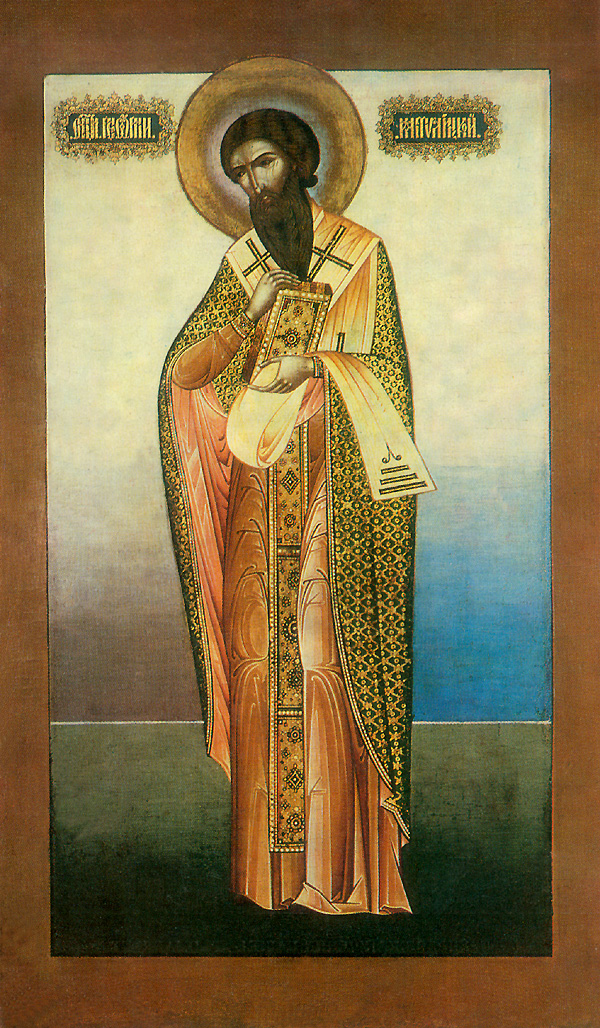
Saint Georges de Mytilène
Évêque de Mytilène (+ 821)
Confesseur.
Entré jeune dans un
monastère de la région de la côte occidentale de l'Asie Mineure, il se retira
sur l'île de Mytilène et fut élu bientôt évêque. Venu auprès du patriarche saint
Nicéphore, il connut la tempête de la persécution iconoclaste, fut soumis
aux verges et exilé. Il mourut ainsi dans une île de Propontide.
À Mytilène dans l’ïle de
Lesbos, en 816, saint Georges, évêque, qui, sous l’empereur Léon l’Arménien,
pour la cause des saintes images, fut exilé en Crimée, où il mourut.
Martyrologe romain
SOURCE : http://nominis.cef.fr/contenus/saint/928/Saint-Georges-de-Mytilene.html
Also
known as
George of Militene
Profile
Born wealthy, he used his
fortune help the sick and poor until
it was gone, then entered a monastery. Bishop of Mitylene, Greece;
known as the Younger because there had been two previous bishops in Mitylene named George.
Noted for his humility and fasting, for his gifts of healing,
and his work as an exorcist.
Stood against emperor Leo the Armenian and the iconoclasts.
For his courage and defense of the icons he
was exiled to
Chersonese (near modern Sevastopol, Ukraine)
for the rest of his life.
Born
c.776 at Mitylene,
island of Lesbos, Greece
816 in
Chersonese (near modern Sevastopol, Ukraine)
of natural causes while in exile
his relics were
returned to Mitylene,
and his tomb became a scene of miraculous healings
Additional
Information
Saints
of the Day, by Katherine Rabenstein
books
Our Sunday Visitor’s Encyclopedia of Saints
other
sites in english
sitios
en español
Martirologio Romano, 2001 edición
fonti
in italiano
MLA
Citation
‘Saint George the
Younger‘. CatholicSaints.Info. 7 April 2024. Web. 9 September 2026.
<https://catholicsaints.info/saint-george-the-younger/>
SOURCE : https://catholicsaints.info/saint-george-the-younger/
George the Younger B (AC)
Died c. 816. Bishop
George of Mitylene, Lesbos Island, is called 'the Younger' because two of his
predecessors in that see and century, also named George, are venerated as
saints (Benedictines).
SOURCE : http://www.saintpatrickdc.org/ss/0407.shtml
St. George the Confessor
the Bishop of Mytilene
Commemorated on April
7
Saint George, Metropolitan
of Mytilene, from his youth he led a monastic life, and was especially
accomplished in the virtue of humility. In the reign of Leo the Isaurian
(716-741) the saint underwent persecution from the iconoclasts and became a
Confessor.
During the reign of the
emperor Constantine Porphyrogenitos (780-797) Saint George was elevated to the
archbishopal cathedra of the city of Mytilene on the island of Lesbos. His life
was radiant with prudence and purity and resembled the life of angels. He
possessed a gift of wonderworking, cast out unclean spirits and healed
incurable diseases. The saint distinguished himself by his compassion, and he
helped all the needy. In 815, during the reign of the iconoclast Leo the
Armenian (813-820), the holy archpastor was banished and sent to Cherson, where
he died after the year 820.
At the hour of his death
a bright star shone in the heavens over the city of Mytilene.
SOURCE : https://oca.org/saints/lives/2017/04/07/101023-st-george-the-confessor-the-bishop-of-mytilene
San Giorgio di Militene Vescovo
Asia, 776 circa – 7
aprile 820/821
Martirologio Romano: A
Mitilene sull’isola di Lesbo, san Giorgio, vescovo, che patì molto sotto
l’imperatore Leone l’Armeno per il culto delle sacre immagini.
Giorgio nacque in Asia
verso il 776 da una famiglia ricca e religiosa. All’età di diciassette anni
distribuì tutti i suoi beni ai poveri ed entrò in un monastero per dedicare
tutta la sua vita a Dio. Due anni dopo fuggì a Mitilene, sull’isole di Lesbo
nel Mar Egeo, ove per sei anni si diede all’austera vita anacoretica, sino a
quando nell’804 il clero di Mitilene all’unanimità non lo elesse vescovo
all’età di soli ventisette anni. Per nove anni fu pastore di questa Chiesa
locale, sempre perseverando nella sua vita di penitenza e di carità.
Verso l’813 le vessazioni
del governatore lo costrinsero a recarsi a Costantinopoli, capitale imperiale,
per difendere i diritti della Chiesa di Mitilene. Trattenuto dal patriarca
Niceforo, assistette all’ascesa al trono di Leone V l’Armeno, sotto il cui
regno si scatenò nuovamente la persecuzione iconoclasta. Giorgio insieme al
patriarca si schierò in difesa del culto delle sacre immagini, ma ciò gli valse
la fustigazione e l’esilio in un’isola nell’815. Non potendo più occuparsi
della cura pastorale dei suoi fedeli, tornò alla via di anacoreta, ma rimase
indebolito dalle pratiche ascetiche e dopo sei anni a seguito di una lunga
malattia morì il 7 aprile 820 o 821.
Le sue spoglie furono
sepolte provvisoriamente e solo con il ritorno alla pace in ambito religioso
poterono essere traslate a Mitilene, al tempo del patriarca San Metodio. Sulla
sua tomba si verificarono parecchi miracoli, come attesta la sua Vita. Talune
fonti hanno dato adito all’ipotesi che siani esistiti due santi omonimi,
entrambi vescovi della stessa città, in primis secondo i sinassari bizantini
che oltre alla festa del 7 aprile ne prevedono un’altra al 16 maggio. In
mancanza di fonti più certe si ritiene però che solamente uno sia stato il il
vescovo di Mitilene di nome Giorgio ad essere venerato come santo, cioè quello
oggetto della presente scheda agiografica.
Autore: Fabio
Arduino
SOURCE : http://www.santiebeati.it/dettaglio/92524
Saint Geoerge, Bishop of Mytilene (+821) : https://www.johnsanidopoulos.com/2016/04/saint-george-bishop-of-mytilene-821.html
