Saint François-Antoine
Fasani
Prêtre de l'Ordre des
Mineurs conventuels (+ 1742)
Né en 1681 à Lucera dans
les Pouilles, Antoine Jean Fasani, nom de religion: François-Antoine.
"Pendant trente-cinq ans de ministère, au début du siècle des lumières
(XVIIIe), il prêche courageusement la 'folie de la croix'. Il est aussi un
confesseur assidu, un conseiller éclairé et un savant théologien. La charité
franciscaine l'attire surtout vers les pauvres et les humbles en faveur
desquels il a des initiatives qui annoncent l'assistance sociale de notre
époque. Il meurt à Lucera en 1742." (source: abbaye Saint-Benoît)
Béatifié le 15 avril 1951 par Pie XII, canonisé le 13 avril 1986 par Jean-Paul
II.
À Lucera dans les Pouilles en 1742, saint François-Antoine Fasani, prêtre de
l'Ordre des Mineurs conventuels, homme d'une doctrine, d'une prédication et
d'une vie pénitente remarquables. Soutenu par un grand zèle, il vint en aide
aux pauvres et aux indigents jusqu'à ne jamais hésiter à se dépouiller de son
habit pour en couvrir un mendiant et à offrir à tous un secours chrétien.
Martyrologe romain
SOURCE : https://nominis.cef.fr/contenus/saint/10603/Saint-Fran%C3%A7ois-Antoine-Fasani.html
San Francesco Antonio Fasani
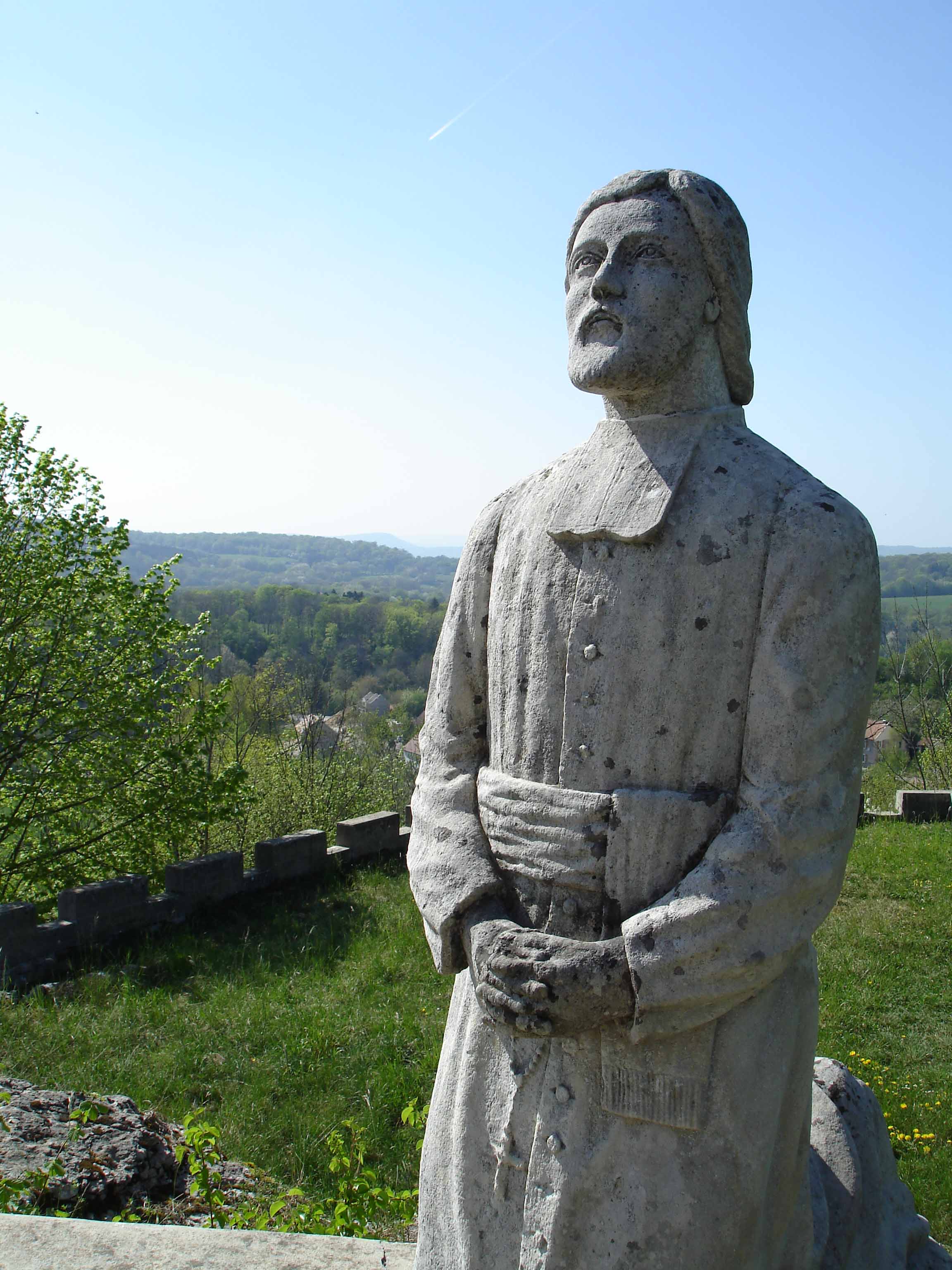
Monumento
al Padre Maestro,Piazza Tribunali (più conosciuta come piazza San Francesco), Lucera
St François-Antoine
(Francesco Antonio) Fasani
Prêtre o.f.m.
‘Il Padre Maestro’ (le
Père Maître)
François-Antoine
(Francesco Antonio) Fasani naît le 6 août 1681 à Lucera, dans les Pouilles
(sud-est de l’Italie). Ses parents sont d’humble condition mais riches de foi.
Chaque soir, on récite le chapelet devant une image de Marie Immaculée, ce qui
déterminera certains aspects de son apostolat plus tard.
L’enfant est confié pour
son éducation aux frères mineurs conventuels. Et c’est dans cet ordre
franciscain, au couvent du mont Saint-Ange (Monte Gargano), qu’il entre comme
novice à l’âge de quatorze ans, en 1695. L’année suivante, il fait ses vœux
sous le nom de François-Antoine.
Ordonné prêtre le 11
septembre 1705, il achève ses études de philosophie à Assise, puis, il obtient
le grade de Maître en théologie. Désormais on l’appellera : ‘Il Padre
Maestro’ (le Père Maître) et de nos jours encore, c’est le titre qu’on lui
donne dans la région où s’est exercée son influence.
Il commence à prêcher
lors du Carême de 1707. Contrairement au style fleuri et pompeux de l’époque,
il parle avec simplicité en employant des exemples tirés de l’Écriture. Il
émeut ses auditeurs et les invite sans ambages à la conversion. En ce siècle
des Lumières, rationaliste et orgueilleux, il rencontre parfois de vives
oppositions, surtout qu’il ne cache jamais la vérité et n’hésite pas à fustiger
les vices ou les injustices sociales, mais souvent les gens réfléchissent après
coup, et aboutissent à son confessionnal.
À ce ministère du pardon,
il consacre de nombreuses heures, toujours accueillant et souriant. Il a un
ministère très actif qui s’étend sur la région des Pouilles et de la Molise. Il
inculque sa dévotion à l’Immaculée, distribuant à ses auditeurs, spécialement
aux enfants, des images de la Vierge au dos de laquelle est inscrite telle ou
telle phrase. (Ces images font souvent des miracles !) « Si la Mère
de Dieu est immaculée, dit-il, c’est pour être le refuge des pécheurs. »
Il répand l’habitude de mettre en valeur la fête de l’Immaculée-Conception par
une neuvaine préparatoire.
Pendant 35 ans son
ministère s’exerce partout où on l’appelle. Dans son couvent, il est
successivement professeur de philosophie puis de théologie, maître des novices
et ‘gardien’ (c'est-à-dire supérieur). En tant que supérieur religieux,
« il est un vrai ‘ministre’ au sens franciscain du terme, a dit saint Jean
Paul II, c'est-à-dire le serviteur de tous ses frères : charitable et
compréhensif, mais saintement exigeant quant à l’observance de la Règle,
particulièrement en ce qui concerne la pratique de la pauvreté, donnant
lui-même un exemple irréprochable d’observance régulière et d’austérité de vie.
»
En 1721, Clément XI
(Giovanni Francesco Albani, 1700-1721) lui confie l’administration de la
province franciscaine de Saint-Ange. « À une époque caractérisée par une
si grande insensibilité des puissants à l’égard des problèmes sociaux, notre
saint se dépense avec une charité inépuisable pour l’élévation spirituelle et
matérielle de son peuple. Ses préférences vont aux couches sociales les plus
méprisées et les plus exploitées, surtout les humbles travailleurs des champs,
les malades, les prisonniers. Il fait preuve d’initiatives géniales,
sollicitant la coopération des classes plus aisées, réalisant ainsi des formes
d’assistance concrète et capillaire, qui ont paru anticiper et annoncer les
formes modernes d’assistance sociale ». En effet, il crée une banque
de crédit dont le but est de protéger les pauvres contre la spéculation
des usuriers.
Il fait des miracles. Un
jour, il est amené à défendre la vertu d’une jeune fille contre les visées d’un
noble. Cela lui vaut la vindicte du gentilhomme qui le dénonce à Rome. Convoqué
en présence du Pape, il ne dit mot pour se défendre, mais tandis que, selon la
coutume, il baise les pieds du Pontife, celui-ci, qui souffre de la goutte, se
sent immédiatement guéri !
Il meurt à Lucera le 29
novembre 1742.
Toute la ville participe
à l’enterrement et crie : « Notre saint Père Maître est mort ! »
François-Antoine
(Francesco Antonio) Fasani a été béatifié à Rome, le 15 avril 1951, par le
vénérable Pie XII (Eugenio Pacelli, 1939-1958) et canonisé, toujours à Rome, le
13 avril 1986, par saint Jean Paul II (Karol Józef Wojtyła, 1978-2005).
©Evangelizo.org
SOURCE : http://levangileauquotidien.org/main.php?language=FR&module=saintfeast&id=14183&fd=0
Aujourd'hui, 27 novembre,
nous célébrons St. Francesco Antonio Fasani
Saint Francesco
(François) Antonio Fasani est né sous le nom de Giovanneillo à Lucera, en
Italie, en 1681, fils de Giuseppe Fasani et Isabella Della Monaca. Il est entré
chez les franciscains conventuels en 1695 et a pris les noms de saint François
et saint Antoine.
Il passa beaucoup de
temps à étudier et fut ordonné prêtre dix ans après son entrée dans l'ordre. Il
enseigna ensuite la philosophie à de jeunes frères, fut le gardien de son
couvent, puis devint provincial de son ordre. À la fin de son mandat de
provincial, Francesco est devenu maître des novices, puis pasteur dans sa ville
natale. Dans tous ses ministères, il a été affectueux, pieux et pénitent. Il
était un confesseur et un prédicateur recherché.
Un témoin des audiences
canoniques concernant la sainteté de Francesco a déclaré : "Dans sa
prédication, il parlait d'une manière familière, rempli comme il l'était de
l'amour de Dieu et du prochain ; enflammé par l'Esprit, il se servait des mots
et des actes de la Sainte Écriture, remuant ses auditeurs et les incitant à
faire pénitence."
Francesco se montra un
ami fidèle des pauvres, n'hésitant jamais à demander aux bienfaiteurs ce dont
ils avaient besoin. C'était aussi un mystique, connu pour sa profonde vie de
prière et ses dons surnaturels, et il était connu pour léviter en priant.
Les habitants de Lucera
étaient connus pour le comparer à Saint François d'Assise, dont il tirait son
nom. Il est mort en 1742 et a été canonisé en 1986.
SOURCE : https://www.aciafrique.org/index.php/news/4448/aujourdhui-27-novembre-nous-celebrons-st-francesco-antonio-fasani
Saint François-Antoine
Fasani (1681-1742) guérit le pape
Originaire des Pouilles
(Italie), François-Antoine Fasani est l'un des plus célèbres prédicateurs
franciscains dans l'Italie du XVIIIe siècle. Les témoins de ses sermons disent
de lui qu'il parle comme s'il s'entretenait, en face-à-face, avec Jésus et
Marie. Sa grande popularité tire surtout son origine de sa charité inépuisable
en faveur des pauvres.
Un jour, on lui présente
une jeune fille de quinze ans désemparée et sans aucune ressource. Un
aristocrate riche et influent a jeté son dévolu sur elle, mais ses intentions
sont loin d'être claires. Le saint la soustrait aux mauvais penchants de cet
homme en la conduisant dans un orphelinat où elle mangera à sa faim.
Le noble ne l'entend pas
de cette oreille. Il menace le Franciscain puis le dénonce au Saint-Siège.
François-Antoine doit se rendre à Rome pour se défendre.
Reçu en audience privée
par le pape, il ne dit rien d'abord. On l'invite, comme c'est la tradition, à
baiser la mule du Pontife. Il s'approche, s'agenouille... Le pape ouvre alors
grand les yeux et lève les bras au ciel : à l'instant où le saint a touché
son pied, la goutte épouvantable dont il souffrait, a disparu ! Le saint
repart de la Ville éternelle absous et disculpé.
L'humble prédicateur a
été béatifié en 1951 par le pape Pie XII. C'est saint Jean-Paul II
qui l'a canonisé le 13 avril 1986.
SOURCE : https://codexdei.mariedenazareth.com/un-saint-un-miracle/saint-francois-antoine-fasani-1681-1742-guerit-le-pape-b-11-29
Saint François Antoine
Fasani, le saint à invoquer pour la pluie
31 juillet 2023
Saint François Antoine
Fasani, théologien et homme de grand coeur et charité, est rappelé également
pour certains miracles liés à l’eau et à la pluie. Voici pourquoi il est
invoqué en cas de sécheresse.
Un Saint à invoquer pour
la pluie ? Cela semble une image peu convenable à la figure d’un Saint… Et
pourtant, en ces jours de chaleur torride et de sécheresse, il serait
réconfortant d’avoir quelqu’un à qui se vouer afin d’obtenir un peu de
fraîcheur, mais surtout pour apporter une trêve aux nombreuses cultures qui
souffrent du manque d’eau. Voici que Saint François Antoine Fasani, connu
également comme le Père Maître après avoir achevé ses études en
théologie, nous vient en aide. Mais qui était cet homme très humble et dévot à
la Vierge
Immaculée, auquel furent attribués des nombreux miracles parmi lesquels,
justement, la capacité d’attirer la pluie ?
Saint François Antoine
Fasani est né à Lucera, dans les Pouilles, en 1681, et y a vécu pour une
bonne partie de sa vie en tant que membre de l’Ordre
des frères mineurs conventuels du monastère desquels il devint à un
moment donné Supérieur. On raconte que le jour où il naquit, l’humble maison de
sa famille fut envahie d’une étrange lueur, qui fit comprendre, dès le début, à
ses concitoyens que celui qui était en train de naître n’était pas un homme
commun. De caractère gentil et calme, Giovanniello (son surnom de jeunesse)
démontra dès le plus jeune âge une forte propension pour la religion, la vie
conventuelle et en particulier la dévotion à la Vierge Immaculée. Toujours
tourné vers les autres, surtout les pauvres et les nécessiteux, il se
dédia aux études de théologie à Assise, mais surtout aux œuvres de charité,
aux soupes populaires, aux collectes de fonds et de biens pour les malchanceux.
Il n’hésita pas à prendre la défense des faibles opprimés par les puissants,
qui tentèrent à plusieurs reprises de le discréditer. Mais avec sa gentillesse
et son humilité, Saint François Antoine réussit à démontrer toujours son
innocence et vit reconnu ses mérites.
Lire aussi :
Padre
Pio et l’ordre des Frères Mineurs Capucins
Qu’est-ce qui rend Padre Pio, connu aujourd’hui comme Saint Pio de Pietrelcina,
un personnage si vénéré et célébré déjà pendant…
En ce qui concerne
le miracle de la pluie, qui en a fait un des saints à invoquer en cas de
sécheresse, ce n’est que l’un des miracles qui lui ont été attribués et qui ont
amené à sa canonisation, qui après un long processus fut proclamée par
pape Jean-Paul II en 1986. Un jour, pendant une période prolongée de
sécheresse qui était en train de ravager les cultures de Lucera, le Père Maître
se présenta au duc Orazio Zunica, en lui demandant l’aumône pour les pauvres.
Le Duc et sa femme lui promirent que, s’il arrivait à amener la pluie à Lucera,
ils feraient une riche offrande pour les nécessiteux. Saint François promit,
retourna au monastère et s’enferma en prière devant le Tabernacle et l’autel de
l’Immaculée. Ceux qui le virent prier affirmèrent qu’à un moment donné il
lévita dans les airs, dans une sorte de trance mystique. La pluie arriva cette
même nuit et dura pendant des jours, sauvant les cultures. Le Duc maintint sa
promesse et déclara sa conviction à tous que celui-là devait vraiment être le
saint de la pluie.
Un autre miracle lié à
l’eau est attribué à Saint François Antoine Fasani impliqua un couvent de
nonnes qui ne pouvaient plus donner de l’eau au pauvre car leur puits était
sec. Le Saint demanda à une d’entre elles d’en puiser de l’eau et elle
découvrit que le puits s’était de nouveau rempli. Ainsi advint également à la
citerne du couvent de Saint François, où il vivait. Pour cette raison, Saint
François Antoine Fasani est encore aujourd’hui prié dans les périodes de
sécheresse pour invoquer la pluie.
La Basilique Sanctuaire
de Saint François Antoine Fasani
L’église de Saint
François d’Assise sur la place de Lucera est un des lieux de culte de cette
petite ville depuis toujours. Après plus de 15 ans depuis la canonisation de
Saint François Antoine Fasani, en 2001, elle a été déclarée Sanctuaire
diocésain de Saint François Antoine Fasani, mais déjà avant que cela n’eut lieu
elle était lieu d’un fréquent pèlerinage de fidèles qui s’y rendaient pour
prier devant les restes du Saint, recouverts de cire et exposés dans un
reliquaire de cristal et bronze sous le maître-autel. En effet, en 1951, pape
Pie XII avait déclaré Saint François Antoine bienheureux et avait fait déplacer
ici sa dépouille. En 2008, la basilique a également pris le nom de Monument
Témoin d’une Culture de Paix de l’UNESCO. Même la maison de via Torretta
où le Saint est né a été transformée en oratoire et est visitée par des
nombreux pèlerins.
La dévotion à l’Immaculée
Conception
Saint François Antoine
Fasani fut toujours très dévot à Marie
Immaculée. Dès son enfance, il récitait le Rosaire devant l’effigie de
Marie Immaculée avec le restant de sa famille et, en grandissant, il était
tellement amoureux de Marie, dans cette veste, qu’il avait pris le surnom
de pécheur de l’Immaculée, et cela bien que le dogme catholique de l’Immaculée
Conception n’ait été proclamé que très longtemps après, en 1845. On
dit que c’était justement la Vierge, dont il offrait des petites images aux
enfants, qui le guidait dans les nombreuses guérisons miraculeuses dont il fut
protagoniste et auteur. Aujourd’hui, dans l’église de Saint François qui lui
est dédiée, il y a une statue de l’Immaculée Conception acheminée par le Saint
en personne depuis Naples, devant laquelle il avait l’habitude de prier et qui
aujourd’hui est le centre d’une grande dévotion. La Vierge Immaculée était
également peinte sur la porte de sa cellule et à elle Saint François dédia
prières et chansons : « …Parmi les pures créatures, tu es, Marie, la
plus parfaite ; toi la seule bénite, parmi les femmes tu es appelée :
Ô, Conçue Immaculée. Que chacun dise sois loué la Reine du Ciel
Immaculée !… »
Les saints protecteurs de
la pluie
Saint François Antoine
Fasani n’est pas le seul Saint à invoquer en cas de sécheresse. Comme autrefois
les gens simples s’adressaient aux dieux pour obtenir une aide dans la vie de
tous les jours, ainsi avec l’avent et la diffusion du Christianisme la dévotion
populaire adressée aux Saints, devenus les nouveaux patrons et protecteurs de
différents aspects de la vie et du travail, s’est poursuivie. Les Saints liés
aux événements climatiques, à invoquer pour obtenir leur protection pour soi et
pour les récoltes, en cas de sécheresse, alluvions ou grêle, ne manquent pas.
Voyons de qui il s’agit.
Saint Gemolus
Le 4 février l’Église
fête Saint Gemolus, Saint martyr qui vécu autour de l’an 1000. Selon la
légende, il était le neveu d’un Évêque et il se rendit chez les bandits qui
avaient volé son illustre parent, en revendiquant la restitution du butin au
nom de Dieu et des Saints Apôtres Pierre et Paul. Les bandits refusèrent et,
quand ils lui demandèrent si au nom de ces mêmes Saints il aurait été prêt à
mourir, il affirma que oui et ils le décapitèrent. Alors Gemolus ramassa sa
tête, remonta à cheval et retourna auprès de son oncle, dans les bras duquel il
mourut. À l’endroit où le jeune homme mourut surgit une source disséminée de
petits cailloux rouges, identifiés comme les gouttes de sang du jeune martyr.
Au XIV siècle, pas trop loin de la source, fut construit un oratoire en son
honneur et ici aussi émergea une source. À partir de ce moment-là, les pèlerins
associèrent Gemolus à la pluie et au cours des siècles suivants ils s’y
rendaient du Piémont et de la Lombardie afin de récolter l’eau de sa source et
de la déverser sur les champs pour protéger les champs de la sécheresse.
Saint Antoine
Un jour Saint
Antoine de Padoue se trouvait en France, à Limoges, pour prêcher en
plein air, puisque l’immense affluence de fidèles ne permettait pas de les
recueillir tous à un endroit fermé. À un moment donné, le ciel s’emplit de
nuages chargés de pluie, mais le Saint promit à ceux qui étaient recueillis
pour l’écouter qu’il n’aurait pas plu. La pluie tomba, mais la foule venue
écouter Saint
Antoine resta au sec, miraculeusement.
Lire aussi :
Saint
Antoine de Padoue, le Saint aux miracles
Saint Antoine de Padoue fut, déjà parmi ses contemporains, maître de sagesse
chrétienne et auteur d’œuvres immortelles.
Saint George, le Saint de
la grêle
Saint Cristanziano, Saint
Victor de Césarée, Saint Uguzon du Val Cavargna, Saint Dominique de Sora ne
sont que quelques-uns des Saints à invoquer en cas de grêle, tandis que Saint
George de Lydda, prince de Cappadoce, martyr et patron des chevaliers,
doit son lien avec la grêle au fait que sa mémoire liturgique tombe à la fin du
mois d’avril, mois où les perturbations sont fréquentes. Ainsi il est connu
comme le saint de la grêle ou aussi le chevalier du froid.
Saint Jacques
Quand en juillet il fait
trop chaud, on prie Saint
Jacques, dont la mémoire liturgique tombe le 25 de ce mois. Les jours les
plus chauds, qui vont du 22 juillet au 23 août, sont appelés jours de la canicule,
du latin canicula, « petite chienne », surnom de l’étoile
Sirius.
Sainte Sabine
Martyre chrétienne du II
siècle, Sainte
Sabine est la sainte à laquelle s’adresse les prières pour être
protégés de pluies violentes, mais aussi pour invoquer la pluie en cas de
sécheresse. Sa fête tombe le 29 août.
SOURCE : https://www.holyart.fr/blog/articles-religieux/saint-francois-antoine-fasani-le-saint-a-invoquer-pour-la-pluie/
San Francesco Antonio Fasani
Saint Francesco
Antonio Fasani
Also
known as
Antony Fasani
Francis Anthony Fasani
Francis Fasani
Memorial
29
November
Profile
Known as a pious child.
Entered the Conventual
Franciscan order in 1695,
taking the name Francis. Ordained in 1705. Taught philosophy to
younger friars, served as guardian of his friary, provincial of the Order, master
of novices, and finally pastor in
his hometown. Sought after confessor and preacher,
a loyal friend of the poor,
never hesitating to seek from benefactors what was needed. A mystic, known for
his deep prayer life,
he was known to levitate while praying.
Born
6
August 1681 in Lucera, Foggia, Puglia, Italy as Antony
Fasani
Died
29
November 1742 in Lucera, Foggia, Puglia, Italy of
natural causes
when news of his death spread, children ran
through the streets crying, “The saint is dead! The saint is dead!”
buried at
the church of
San Francesco di Lucera
Venerated
1 June 1891 by Pope Leo
XIII (decree of heroic
virtues)
Beatified
15
April 1951 by Pope Pius
XII
Canonized
13
April 1986 by Pope John
Paul II
Patronage
Lucera, Italy
Additional
Information
Saints
of the Day, by Katherine Rabenstein
books
Our Sunday Visitor’s Encyclopedia of Saints
other
sites in english
Ana Stpaul
Catholic
Online
Daily Prayers
Find A Grave
Franciscan Media
Hagiography
Circle
Independent
Catholic News
video
YouTube PlayList
sitios
en español
Martirologio Romano, 2001 edición
fonti
in italiano
Cathopedia
Dicastero delle Cause dei Santi
Santi e Beati
Santo del Giorno
nettsteder
i norsk
Den
katolske kirke
Readings
In his preaching he spoke
in a familiar way, filled as he was with the love of God and neighbor; fired by
the Spirit, he made use of the words and deed of Holy Scripture, stirring his
listeners and moving them to do penance. – witness to Francesco’s preaching,
recorded in the investigation for his canonization
Francesco made the love
taught us by Christ the fundamental characteristic of his existence, the basic
criterion of his thought and activity, the supreme summit of his
aspirations. – Pope John
Paul II
MLA
Citation
“Saint Francesco Antonio
Fasani“. CatholicSaints.Info. 28 June 2023. Web. 17 August 2026.
<http://catholicsaints.info/saint-francesco-antonio-fasani/>
SOURCE : http://catholicsaints.info/saint-francesco-antonio-fasani/
San Francesco Antonio Fasani
Casa
Natale Padre Maestro.
Maison
natale de François Antoine Fasani.
St. Francis Fasani
Feastday: November 29
Birth: 1681
Death: 1742
Canonized: Pope John Paul II
Franciscan mystic, born
Antony Fasani in 1681. He entered the Franciscans and was ordained in 1775.
While serving as provincial and
in other administrative positions, he was known for prayer and for supernatural gifts.
Francis was canonized in 1986.
SOURCE : https://www.catholic.org/saints/saint.php?saint_id=3443
Francis Antony of Lucera
(RM)
(also known as Antony Fasani)
Born at Lucera, Apulia, Italy, on August 6, 1681; died November 29, 1742;
beatified by Pope Pius XII on April 15, 1951; canonized by John Paul II April
13, 1986.
Donato Anthony John Nicholas Fasani was born into a family of farm laborers.
Although he was baptized with this august name, he was known simply as
Giovanniello (Johnny). His mother remarried after his father died while
Giovanniello was still very young. It was Giovanniello's stepfather who sent
him to the Friars Conventual for his education. At age 15, the little saint was
sent to Monte Gargano to begin his novitiate. Upon making his profession as a
Franciscan on August 23, 1696, he took the name Francis Antony.
In 1703, Francis Antony was sent to Assisi, where he was ordained to the
priesthood on September 11, 1705. He completed his master's degree in theology
at the College of Saint Bonaventure in Rome. From that time he was called
"Father Master" in his hometown, where he taught theology from 1707.
At the convent of Lucera, he also served as guardian, novice master, and
minister provincial of the Province of Sant'Angelo.
Although his scholarship was great, he was better known for his preaching in
both the city and countryside. He spoke in a way that all who heard him could
understand and directed his catechetical efforts to the poor. He produced
several volumes of sermons, which include some in Latin. Francis Antony was
devoted to the downtrodden: the poor, the suffering, and the imprisoned. He
often accompanied those condemned to death to their execution.
Francis Antony promoted devotion to the Immaculate Conception, which was his
own special love at a time when the dogma had not yet been defined. He had
brought from Naples a statue of the Immaculate Conception that he put in the
church of Saint Francis, and he wrote hymns for the people to sing before it.
This statue is still an object of veneration in Lucera. He also established a
novena to Our Lady under this appellation. On November 29, the first day of
this novena, Francis Antony died, a man revered and loved as another Saint
Francis of Assisi (Attwater 2, Walsh).
SOURCE : http://www.saintpatrickdc.org/ss/1127.shtml
St Francesco Antonio
Fasani
Celebrated
on November 27th
Franciscan priest. Born
in Lucera, southeast Italy, in 1681, Francesco entered the Conventual
Franciscans when he was just 14. After his ordination 10 years later, he taught
philosophy to younger friars, served as guardian of his friary and later became
provincial. When his term of office ended, Francesco became master of novices
and finally parish priest in his hometown.
In his various ministries, he was loving, devout and humble. He was a
sought-after confessor and preacher. One witness at the canonical hearings
regarding Francesco's holiness testified: "In his preaching he spoke in a
familiar way, filled as he was with the love of God and neighbour; fired by the
Spirit, he made use of the words and deed of Holy Scripture, stirring his
listeners and moving them to do penance."
Francesco was a loyal friend of the poor, never hesitating to seek from
benefactors what was needed.
When he died in Lucera, in 1742, children ran through the streets and cried
out: "The saint is dead! The saint is dead!" Francesco was canonised
in 1986.
During his homily at the canonization of Francesco, Pope John Paul II reflected
on John 21:15 in which Jesus asks Peter if he loves Jesus more than the other
apostles and then tells Peter, "Feed my lambs." The Pope observed
that in the final analysis human holiness is decided by love. "He
[Francesco] made the love taught us by Christ the fundamental characteristic of
his existence, the basic criterion of his thought and activity, the supreme
summit of his aspirations."
SOURCE : https://www.indcatholicnews.com/saint/337
Francis Anthony Fasani
(1681-1742)
priest, O.F.M. Conv.
A study of the life of
Fr. Francis Anthony Fasani shows clearly that his life was directed toward God
in a singular manner from his very infancy, thanks to the Christian education
received from his parents and to the workings of the grace of a religious and
priestly vocation upon his soul. He was born in Lucera on August 6, 1681, the
son of Giuseppe Fasani and Isabella Della Monaca. His parents had the joy of
seeing their "Giovanniello" (this was the name they gave him at
Baptism) grow up endowed with promising moral and intellectual gifts. He began
his studies at the Franciscan friary of the Friars Minor Conventual at Lucera;
there Giovanniello's understanding of his vocation became clearer-a vocation to
which he gave himself with generous enthusiasm. He entered the Order of Friars
Minor Conventual and took the names of Saints Francis and Anthony, thus
expressing his fervent desire to follow their example by consecrating himself
to an evangelical and apostolic life. Professing his vows in 1696, the young
Friar Francis Anthony completed his liberal arts studies and followed with his
philosophical studies in the seminaries of his religious province. Thereafter,
he began theological studies in Agnone and continued them in the General Study
Centre at Assisi near the tomb of St. Francis. It was there that Francis
Anthony was ordained to the priesthood in 1705 and there, too, that he
completed his theological studies in 1707.
His application to his
studies, carried out with diligence and with a lively desire to assimilate the
salvific value of the mysteries of faith, made him "profound in philosophy
and learned in theology." The Venerable Antonio Lucci, bishop of Bovino,
attests to this in the canonical hearings investigating Fasani's holiness.
Bishop Lucci was a fellow student of his and imitated him in the exercise of
religious virtue. At the same time, by means of an intense spiritual formation
aided by enlightened spiritual masters, Francis Anthony progressed in a life of
union with God, patterning himself on the Lord through religious consecration
and the priestly charism.
From 1707 until his death
he continued to live at Lucera for thirty-five years, always giving splendid
witness to the gospel life and zealous pastoral ministry. For this reason he
was admired by the faithful of Lucera and all of Daunia and Molise. Within his
Franciscan Order he fulfilled offices of special responsibility. He was a
respected teacher of scholastic philosophy and a revered master of novices and
the professed, making notable contributions to the spiritual and doctrinal
formation of his confreres. In 1709 he received a graduate degree in theology
and from that time on Fr. Fasani was known to all as "Padre Maestro"
("Father Master"), a title which is still attributed to him today in
Lucera. He exercised the offices of local superior and minister provincial with
charity and wisdom, demonstrating that he was and effective animator of the
religious life of the brethren.
The spiritual life of Fr.
Fasani was characterized by those virtues that made him like his Seraphic
Father St. Francis. In fact, it was said in Lucera: "Whoever wants to see
how St. Francis looked while he was alive should come to see Padre Maestro."
In imitation of St. Francis he built his religious life on the basis of a
generous participation in the mysteries of Christ through the most faithful
practice of the evangelical counsels, which he considered to be a radical
expression of perfect charity. In his constant prayers, inflamed with seraphic
love, he called out to God, saying to Him: "O Highest Love, Immense Love,
Eternal Love, Infinite Love."
His fervent devotion to
the Immaculate Mother of the Lord was nourished by his intense dedication to
knowing ever better "who Mary is" and making her known to others,
while at the same time knowing and making known the maternal role entrusted to
her in the history of salvation with faith and love.
The priestly life of
Father Anthony Fasani is a splendid testimony to fidelity and dedication to the
mission given to all priests in the Church. It is their duty-as Vatican Council
II so vigorously confirms-to promote "the glory of God the Father in
Christ by their ministry and their life" (PO, 2).
In exercising this
evangelical mission Fr. Fasani gave himself devotedly from the very moment of
his priestly ordination, to such an extent that a witness could assert:
"He allowed himself no rest in the salvation of souls." His pastoral
ministry shows that he was involved zealously in many fields and forms of the
apostolate according to the needs of the particular Churches in which he
ministered.
The ministry of preaching
the word of God assumed a special role in his apostolic life. He preached
popular missions, retreats, Lenten devotions and novenas almost constantly - at
Lucera and wherever he was called. The duty which falls to all priests "to
invite all people to conversion and holiness" (PO, 4) was carried out by
Fr. Fasani through a type of preaching based on the scriptures that was well
prepared, persuasive, and had the particular purpose, as one witness recalled,
"of rooting out vices and sins and planting in their place goodness and
the exercise of virtue."
As a worthy ministry of
"the one who uninterruptedly exercises his priestly mission for us in the
Liturgy through the Spirit" (PO, 5), Fr. Fasani dedicated himself with
zeal-especially the administration of the sacrament of Penance and the
celebration of the Holy Eucharist. "He heard the confession of every type
of person," asserted a witness, "with the greatest patience and
kindness on his face". He was charitable and welcoming to all, giving as
his reason the hope of being able one day to say to the Lord: "I was indulgent,
I don't deny it; but it was You who taught me to be so."
The most holy Eucharist
was the summit of his religious life and wholly represented the goal toward
which be ordered his entire priestly ministry. In fact, he always considered
the Eucharist "the source and summit of evangelization," and that the
faithful were "fully incorporated into the Body of Christ through the
Eucharist" (PO, 5). A fervent minister of the Eucharist, Fr. Fasani
celebrated the sacrifice of the Mass with an intense ardor that lifted and
nourished his spirit while at the same time it edified all who were present. In
his preaching he inculcated in the faithful the love of the Eucharist,
promoting even daily communion.
The poor, the sick, and
the imprisoned held a privileged place in his pastoral activities. Motivated by
his ideal of gospel charity ("We must be charitable."), he loved to
pray with the poor and for them. Every day he personally distributed to the
poor the alms of his religious community and very often he gave them as well
gifts and special goods gathered from benefactors. Oftentimes his prayers
obtained extraordinary interventions of divine Providence for the poor. He
visited and comforted the sick, exhorting them to seek reasons for hope and
resignation in the goodness of God. The spiritual care of the imprisoned, an
apostolate given him by the bishop of Lucera, permitted him to visit them daily
and to exhort them to trust in the merciful love of God. He was given the
responsibility of assisting those condemned to death in their last moments.
The witnesses at the
canonical proceedings for his holiness assure us that God rewarded the
apostolic zeal of Fr. Fasani with abundant fruits of conversion and a renewed
Christian life among the faithful. In this way those values of the sacred ministry
were totally fulfilled in the priestly life of Fr. Francis Anthony Fasani which
Vatican Council II expresses in the following terms: "Priests, whether
they devote themselves to prayer and adoration, to the preaching of the Word,
to offering the Eucharistic Sacrifice and administering the other sacraments,
or to carrying out other ministries in the service of mankind, always
contribute to the increase of the glory of God and at the same time to
enriching mankind with divine life" (PO, 2).
When Fr. Fasani was taken
by his final illness in 1742, he wanted to offer it to the Lord in a spirit of
perfect joy, with that same expression with which he had always offered God all
the actions of his life: "The Will of God: that is my Paradise." On
November 2 of the same year, comforted by the holy sacraments and the
protection of the Immaculate Virgin Mary for which he prayed, Fr. Francis
Anthony Fasani returned his soul to God in the friary of the city where he was
born and where, for thirty-five years, he showed himself a faithful witness to
Christ. His body was interred in the adjoining church of St. Francis, after
funeral rites in which all of Lucera participated with the cry: "Our holy
Padre Maestro has died!"
The fame of the sanctity
that surrounded Fr. Fasani in life witnessed an extraordinary increase after
his death. Thus, already in 1746 the bishop of Lucera decided to institute
proceedings to investigate the holiness of life, the virtues and the miracles
of this Servant of God. There followed the Apostolic Cause of particular
virtues and the decree on the heroicity of his virtues promulgated by His
Holiness Pope Leo XIII on June 21, 1891. His Holiness, Pope Pius XII, having
approved two miracles attributed to the intercession of Venerable Fasani, raised
him to the honor of the altars on April 15, 1951.
A new miracle attributed
to the intercession of Blessed Francis Anthony was approved with the decree of
March 21, 1985, by the Holy Father, John Paul II.
SOURCE : http://www.vatican.va/news_services/liturgy/saints/ns_lit_doc_19860413_fasani_en.html
Saint of the Day – 29
November – St Francesco Antonio Fasani (1681 – 1742) – 29 November
Posted on November
29, 2018
Saint of the Day – 29
November – St Francesco Antonio Fasani OFM Conv. (1681 – 1742) also known
as Antony Fasani, Francis Anthony Fasani, Francis Fasani – was an
Italian Friar and Priest of the Order of Conventual Friars Minor, Teacher,
Confessor, Preacher, Mystic, Apostle of prayer and charity, Marian devotee – he
was born on 6 August 1681 in Lucera, Foggia, Italy as Giovanniello Fasani and
died on 29 November 1742 in Lucera, Foggia, Italy of natural causes.
Patronage – Lucera, his home town in Foggia.
St Francesco was the son
of Giuseppe Fasani and Isabella della Monaca. He began his studies
at the Conventual friary in his town and there entered the Order, taking the
religious names of Saints Francis and Anthony. Fasani professed his
religious vows in 1696.
Once having professed his
vows, Fasani began theological studies in Agnone and continued them in the
General Study Centre at Assisi, close to the tomb of St Francis. It
was there that Fasani was ordained to the priesthood in 1705. He
stayed in Assisi and completed his theological studies there in 1707.
From 1707 until his death
in 1742, Fasani spent the rest of life in residence in his hometown of Lucera
and endeared himself to the faithful of that town and all of Daunia and
Molise. In 1709, he received the degree of Doctor of Theology and,
from that time on, Fasani became known to all as “Padre Maestro” (“Father
Master”), a title which is still attributed to him today in Lucera.
Fasani also fulfilled many duties in the Franciscan Order, being a
respected teacher of scholastic philosophy and was entrusted with the position
of Master of novices and the junior professed friars.
He was later appointed to
serve as the guardian of the community of friars and the pastor of the
town. He came to be elected Minister Provincial of his province in
the Order. As a worthy ministry of “the one who uninterruptedly
exercises his priestly mission for us in the Liturgy through the Spirit” (PO,
5), Fr Fasani dedicated himself with zeal-especially the administration of the
sacrament of Penance and the celebration of the Holy Eucharist. “He
heard the confession of every type of person,” asserted a witness, “with
the greatest patience and kindness on his face”. He was charitable
and welcoming to all, giving as his reason the hope of being able one day to
say to the Lord: “I was indulgent, I don’t deny it but it was You
who taught me to be so.”
Fasani was known for
having a deep life of prayer and was considered to be a mystic, becoming
greatly in demand as a confessor and preacher. He constantly
preached popular parish missions, gave retreats and led Lenten devotions and
novenas – either in his own town or wherever he was requested. It
was reported by his contemporaries that he would levitate while at
prayer. At the same time, he was a steadfast friend of the poor,
constantly seeking out the financial support necessary for efforts to meet
their needs.
Fasani died in Lucera and
was buried in the parish church there. Upon the news of his death,
children could be heard running through the streets shouting, “The saint
is dead! The saint is dead!”
The proceedings to open
the cause for his canonisation began several years after his death.
Testimony to his holy life was given by many people of region.
Among them was his old friend, Blessed Antonio Lucci (1682–1752), who by
then was a Bishop in the region. Progress did not take place, however,
until the 20th century, when he was beatified in 1951 by Pope Pius XII and
subsequently Canonised in 1986 by St Pope John Paul II.
From the Vatican
biography of St Francesco: – “The spiritual life of Fr Fasani was characterised
by those virtues that made him like his Seraphic Father St Francis.
In fact, it was said in Lucera: “Whoever wants to see how St
Francis looked while he was alive should come to see Padre Maestro.”
In imitation of St Francis he built his religious life on the basis of a
generous participation in the mysteries of Christ through the most faithful
practice of the evangelical counsels, which he considered to be a radical
expression of perfect charity. In his constant prayers, inflamed
with seraphic love, he called out to God, saying to Him: “O Highest
Love, Immense Love, Eternal Love, Infinite Love.”
Author: AnaStpaul
Passionate Catholic.
Being a Catholic is a way of life - a love affair "Religion must be like
the air we breathe..."- St John Bosco Prayer is what the world needs
combined with the example of our lives which testify to the Light of Christ.
This site, which is now using the Traditional Calendar, will mainly concentrate
on Daily Prayers, Novenas and the Memorials and Feast Days of our friends in
Heaven, the Saints who went before us and the great blessings the Church
provides in our Catholic Monthly Devotions. This Site is placed under the
Patronage of my many favourite Saints and especially, St Paul. "For the
Saints are sent to us by God as so many sermons. We do not use them, it is they
who move us and lead us, to where we had not expected to go.” Charles Cardinal
Journet (1891-1975) This site adheres to the pre-Vatican II Catholic Church and
all her teachings. . PLEASE ADVISE ME OF ANY GLARING TYPOS etc - In June 2021 I
lost 100% sight in my left eye and sometimes miss errors. Thank you and I pray
all those who visit here will be abundantly blessed. Pax et bonum! View All Posts
SOURCE : https://anastpaul.com/2018/11/29/saint-of-the-day-29-november-st-francesco-antonio-fasani-1681-1742-29-november/
Francis Anthony Fasani
St Francis (1681-1742)
was born in Lucera, Italy. He was educated locally and studied in the Town
Friary where he professed his religious vows. Following further Theological
Studies at Assisi, he was ordained a Priest in 1705 and remained there for
another two years. He later received a Doctor of Theology.
St Francis returned to
his hometown to minister, spending the remainder of his entire life
serving his Order as a teacher of Philosophy and Master of Novices, while at
the same time, performing extensive pastoral duties within his local community.
St Francis lived a life
of deep prayer and devotion to the Holy Eucharist and Reconciliation. He was
considered a mystic and became a very popular and sought after confessor and
preacher. Despite his many work commitments, St Francis was a steadfast friend
of the poor and marginalised; routinely seeking funds to support their needs.
St Francis’ Feast Day is
the 29th November. He is Patron Saint of Lucera.
St Francis Anthony
Fasani:
Pray that we will
earnestly live by Jesus’s teachings and give generously to the poor and
marginalised.
Glory be to the…
SOURCE : https://www.daily-prayers.org/saints-library/francis-anthony-fasani-2/
San Francesco Antonio Fasani
Simone
De Troia, Lapide dell'antico sepolcro di Padre Maestro
San Francesco Antonio
Fasani
29
novembre
Lucera, 6 agosto 1681 -
Lucera, 29 novembre 1742
Nacque da umile famiglia
il 6 agosto 1681 a Lucera, antica città della Daunia nelle Puglie. Entrò da
giovane tra i Minori conventuali del suo paese natale per poi completare il
Noviziato a Monte Sant'Angelo sul Gargano dove emise la professione il 23 agosto
1696. Quindi, nel 1703 fu mandato nel convento di Assisi dove fu ordinato
sacerdote l'11 settembre 1705. Passato a Roma, nel collegio di San Bonaventura,
tornò ad Assisi fino al 1707 quando rientrò a Lucera. Eletto ministro
provinciale fu protagonista di un'intensa attività apostolica percorrendo tutti
paesi della Capitanata e località limitrofe. Sempre attento ai bisogni dei
poveri e dei sofferenti, devotissimo alla Vergine, fu particolarmente vicino ai
carcerati e ai condannati che accompagnava fino al luogo del supplizio. Morì il
29 novembre 1742. Ancora oggi la sua tomba, nella chiesa di San Francesco a
Lucera è meta di frequenti pellegrinaggi. Proclamato beato il 15 aprile
1951 da Pio XII è stato canonizzato da Giovanni Paolo II il 13 aprile 1986. (Avvenire)
Martirologio Romano: A
Lucera in Puglia, san Francesco Antonio Fasani, sacerdote dell’Ordine dei Frati
Minori Conventuali, che, uomo di raffinata cultura pervaso da un grande amore
per la predicazione e la penitenza, si adoperò al tal punto per i poveri e i
bisognosi da non esitare mai a privarsi della veste per coprire un mendicante e
offrire a tutti il suo cristiano sostegno.
Nacque a Lucera, antica
città della Daunia nelle Puglie, il 6 agosto 1681, da umili e modesti
lavoratori, Giuseppe e Isabella Della Monaca. Battezzato con i nomi di
Donato Antonio Giovanni, fu chiamato familiarmente Giovanniello.
Entrò giovinetto
nell'Ordine di s. Francesco, tra i Minori Conventuali del convento di Lucera e
vi rifulse per innocenza di vita, spirito di penitenza e povertà, ardore
serafico e zelo apostolico, sì da sembrare un "s. Francesco
redivivo".
Compiuto il noviziato a
Monte S. Angelo sul Gargano ed emessavi la professione il 23 agosto 1696, fu
mandato, nel 1703, a completare la sua formazione nel sacro convento di Assisi
dove ebbe come direttore spirituale il servo di Dio Giuseppe A. Marcheselli, e
fu ordinato sacerdote l'll settembre 1705.
Passato a Roma nel
collegio di S. Bonaventura, vi fu creato maestro in teologia, per cui, in
seguito, sarà da tutti chiamato a Lucera "Padre Maestro". Ritornato
ad Assisi, vi rimase dedicandosi alla predicazione nelle campagne fino al 1707,
quando rientrerà definitivamentc a Lucera.
Dalla scuola, dal pulpito
e dal confessionale esplicò un intenso e fecondo apostolato, percorrendo tutti
i paesi della Capitanata e località limitrofe, sì da meritarsi l'appellativo di
apostolo della sua terra. "Profondo in filosofia e dotto in
teologia", come attesta il ven. Antonio Lucci, suo confratello e vescovo
di Bovino, fu dapprima lettore e reggente di studi nel collegio filosofico di
Lucera, e poi guardiano del convento e maestro dei novizi, modello ai
confratelli di osservanza regolare, per cui fu nominato nel 1721, con speciale
Breve di Clemente XI, ministro provinciale della provincia religiosa
conventuale di S. Angelo, che in quel tempo si estendeva dalla Capitanata al
Molise.
Scrisse alcune operette
predicabili, tra cui un Quaresimale, un Mariale, una esposizione al Pater e al
Magnificat, e vari Sermoni, alcuni in lingua latina. Suo principale
intendimento nel predicare era quello di "farsi capire da tutti",
come nella sua modestia era solito dire, e la sua catechesi, tipicamente
francescana, era rivolta di preferenza all'umile popolo verso cui sentivasi
particolarmente attratto. Inesauribile fu la sua carità verso i poveri e
sofferenti; fra le varie iniziative, promosse la simpatica usanza di
raccogliere e distribuire pacchi-dono ai poveri in occasione del S. Natale. Ma
il suo zelo e la sua carità sacerdotale rifulsero in modo singolarissimo
nell'assistenza ai carcerati e ai condannati che accompagnava personalmente
fino al luogo del supplizio per confortarne gli estremi momenti, precorrendo in
ciò l'ammirabile esempio di carità di s. Giuseppe Cafasso. Fece restaurare
decorosamente il bel tempio di S. Francesco in Lucera, centro per quasi
trentacinque anni continui della sua indefessa attività sacerdotale. Fu
devotissimo dell'Immacolata Concezione, e alle anime che egli dirigeva era
solito inculcare gli atti di ossequio alla Madonna e la meditazione delle sue
virtù. Anche oggi è oggetto di particolare venerazione nella chiesa di S.
Francesco la bella statua dell'Immacolata, che il beato fece venire da Napoli,
ed il popolo canta tuttora la canzone mariana da lui composta.
Morì a Lucera il 29
novembre 1742, il primo giorno della novena dell'immacolata ed il suo corpo è
venerato nella chiesa di S.Francesco. Fu beatificato da Pio XII il 15 aprile
1951.
Autore: Gaetano Stano
SOURCE : http://www.santiebeati.it/dettaglio/79825
Francesco Antonio Fasani
(1681-1742)
Beatificazione:
- 15 aprile 1951
- Papa Pio XII
Celebrazione
Canonizzazione:
- 13 aprile 1986
- Papa Giovanni
Paolo II
- Basilica Vaticana
Celebrazione
Memoria Liturgica:
- 29 novembre
Sacerdote professo
dell’Ordine dei Frati Minori Conventuali, che, uomo di raffinata cultura
pervaso da un grande amore per la predicazione e la penitenza, si adoperò al
tal punto per i poveri e i bisognosi da non esitare mai a privarsi della veste
per coprire un mendicante e offrire a tutti il suo cristiano sostegno
"Volontà di Dio,
paradiso mio"
La vita del P. Francesco
Antonio Fasani appare chiaramente orientata in modo singolare verso Dio
fin dall'infanzia, ad opera della educazione cristiana ricevuta dai genitori, e
della attrazione esercitata nel suo animo dalla grazia della vocazione
religiosa e sacerdotale. Era nato a Lucera il 6 agosto 1681 da Giuseppe Fasani
e Isabella Della Monaca i quali ebbero presto la gioia di veder crescere il
loro Giovanniello - così lo chiamavano col nome del Battesimo - ben dotato di
promettenti doti morali e intellettuali. Avviato agli studi presso il Convento
francescano dei Frati Minori Conventuali di Lucera, Giovanniello ebbe più
chiara la percezione della sua vocazione cui aderì con generoso entusiasmo.
Ammesso nell'Ordine dei
Frati Minori Conventuali assunse i nomi dei Santi Francesco e Antonio
esprimendo così la sua fervente aspirazione a voler seguire il loro esempio
consacrandosi alla vita evangelica e apostolica. Emessa la professione nel
1696, il giovane frate Francesco Antonio completò gli studi umanistici e
frequentò i corsi filosofici nei seminari della sua Provincia religiosa.
Successivamente iniziò i corsi di teologia nello Studio di Agnone, li proseguì
nello Studio Generale di Assisi presso la Tomba di S. Francesco, dove ricevette
l'ordinazione sacerdotale nel 1705; e sempre in Assisi frequentò pure il Corso
teologico accademico fino al 1707.
Il tirocinio degli studi,
espletato con impegno e con vivo desiderio di assimilare il valore salvifico
dei misteri della fede, lo resero " profondo in filosofia e dotto in
teologia ", come attesterà ai Processi Canonici il Ven. Antonio Lucci,
Vescovo di Bovino, che era stato suo condiscepolo ed emulo nell'esercizio delle
virtù religiose. Nel contempo attraverso una intensa formazione spirituale
coadiuvata da illuminati maestri di spirito, progrediva nella vita di unione
con Dio configurandosi al Signore nella consacrazione religiosa e nel carisma
sacerdotale.
Dal 1707 fino alla morte,
per trentacinque anni continui visse a Lucera rendendo splendida testimonianza
di vita evangelica e di zelante ministero pastorale, e per questo ammirato dai
fedeli di Lucera, di tutta la Daunia e del Molise. Nell'ambito del suo Ordine
Francescano ricoprì uffici di particolare responsabilità. Valente lettore di
filosofia scolastica e stimato maestro dei giovani novizi e professi, diede
notevole impulso alla formazione spirituale e dottrinale dei confratelli. Nel
1709 conseguì la laurea in teologia, e da allora il Padre Fasani venne
comunemente chiamato con l'appellativo di " Padre Maestro ", titolo
che ancora oggi gli viene attribuito a Lucera. Esercitò con carità e saggezza
gli uffici di superiore locale e provinciale dimostrandosi efficace animatore
della vita religiosa dei confratelli.
La vita spirituale del P.
Fasani era caratterizzata da quelle virtù che lo rendevano simile al suo
serafico padre S. Francesco. Si diceva infatti a Lucera: "Chi vuol vedere
come appariva S. Francesco in vita venga a vedere il Padre Maestro". Ad
imitazione di S. Francesco costruì la sua vita religiosa sulla base di una
generosa partecipazione ai misteri di Cristo nella pratica fedelissima dei
consigli evangelici che considerava come espressione radicale di perfetta
carità. Nelle sue continue preghiere, acceso da ardore serafico invocava Dio
chiamandolo "sommo Amore, immenso Amore, eterno Amore, infinito
Amore".
La sua fervida devozione
all'Immacolata Madre del Signore era alimentata da intensa applicazione a
conoscere sempre meglio e far conoscere "chi è Maria", ed insieme a
riconoscere e far riconoscere con fede e con amore il ruolo materno a lei
affidato nella storia della salvezza.
La vita sacerdotale del
Padre Francesco Antonio Fasani è una splendida testimonianza di fedeltà e di
dedizione alla missione affidata nella Chiesa a tutti i presbiteri, i quali
tendono, come conferma vigorosamente il Concilio Vaticano II, a promuovere "con
il loro ministero e la loro vita la gloria di Dio Padre in Cristo" (PO,
2). All'esercizio di questa missione evangelica il P. Fasani si dedicò con
ardore fin dalla ordinazione sacerdotale, a tal punto che un teste poté
asserire: "Non perdonò fatica alcuna per salvare le anime". Il suo
ministero pastorale si rivela impegnato con zelo nei molteplici campi e forme
di apostolato secondo le esigenze delle Chiese particolari in cui si sentiva
inserito.
Particolare rilievo
assume nella sua vita apostolica il ministero della parola di Dio. Predicava
quasi in continuazione corsi di missione al popolo, esercizi spirituali,
quaresime e novene a Lucera e ovunque veniva chiamato. Il compito di tutti i
sacerdoti, che è quello di "invitare tutti alla conversione e alla santità"
(PO, 4), fu assolto dal P. Fasani con una forma di predicazione basata sulla
Sacra Scrittura, ben preparata, persuasiva, che aveva lo scopo, come ricorda un
teste, " di estirpare i vizi e i peccati, piantare il bene e far
esercitare la virtù".
Degno ministro di
"Colui che ininterrottamente esercita la sua missione sacerdotale in
favore nostro nella Liturgia, per mezzo dello Spirito " (PO, 5), il P.
Fasani si dedicò con tutte le sue energie ad assolvere con zelo il sacro
ministero, specialmente con l'amministrazione del Sacramento della
Riconciliazione e con la celebrazione del Sacrificio Eucaristico.
"Confessava ogni ceto di persone - asserisce un teste - con somma pazienza
e ilarità di volto". Con tutti si dimostrava caritatevole e accogliente,
giustificandosi con la speranza di poter dire un giorno al Signore: "Sono
stato indulgente, non lo nego, ma voi me lo avete insegnato". L'Eucaristia
costituiva il perno della sua vita religiosa, ed insieme rappresentava il fine
cui ordinava tutto il suo ministero sacerdotale. Sempre, infatti, l'Eucaristia
è stata considerata " come fonte e culmine dell'evangelizzazione ", e
sempre i fedeli si sono sentiti " pienamente inseriti nel Corpo di Cristo
per mezzo dell'Eucaristia " (PO, 5). Fervente ministro dell'Eucaristia il
P. Fasani celebrava il Sacrificio della Messa con un 'intenso ardore che
elevava e nutriva il suo spirito ed insieme edificava i partecipanti; e nella
predicazione inculcava nei fedeli l'amore all'Eucaristia promuovendo anche la
Comunione quotidiana.
Costituivano un campo
privilegiato della sua attività pastorale i poveri, gli ammalati, i carcerati.
Spinto da questo suo programma evangelico-caritativo " Bisogna che si
faccia la carità ", amava pregare con i poveri e per i poveri; ogni giorno
distribuiva personalmente ai poveri l'aiuto caritatevole della comunità
religiosa, e molto spesso faceva loro pervenire doni e soccorsi raccolti dai
benefattori. Talvolta le sue preghiere ottennero prodigiosi interventi della
divina Provvidenza in favore dei poveri. Visitava e confortava i malati
esortandoli a cercare nella bontà di Dio motivi di speranza e di rassegnazione.
La cura spirituale dei detenuti, affidatagli dal Vescovo di Lucera, gli
consentiva di visitare ogni giorno i carcerati e di esortarli alla fiducia
nell'amore misericordioso di Dio; a lui era affidato il compito di assistere i
condannati a morte fino ai momenti estremi.
Ci assicurano le
testimonianze rese ai Processi canonici che Dio premiò lo zelo apostolico del
P. Fasani con abbondanti frutti di conversione e di rinnovata vita cristiana
tra i fedeli. Trovavano così piena attuazione nella vita sacerdotale del P.
Francesco Antonio Fasani quei valori del sacro ministero che il Concilio
Vaticano II esprime in questi termini: "I Presbiteri, sia che si dedichino
alla preghiera e all'adorazione, sia che predichino la Parola, sia che offrano
il Sacrificio Eucaristico e amministrino gli altri Sacramenti, sia che svolgano
altri ministeri ancora in servizio degli uomini, sempre contribuiscono
all'aumento della gloria di Dio e nello stesso tempo ad arricchire gli uomini
della vita divina" (PO, 2).
Quando nel 1742 il P.
Fasani venne colto dall'ultima malattia, egli volle offrirla al Signore, in
spirito di perfetta letizia, con l'espressione con cui sempre aveva offerto a
Dio le azioni della sua vita: "Volontà di Dio, paradiso mio". Il 2
novembre dello stesso anno il P. Francesco Antonio Fasani, confortato dai santi
Sacramenti e dalla invocata protezione dell'Immacolata Vergine Maria, rese
l'anima a Dio, nel Convento della sua città natale dove per 35 anni si era
dimostrato fedele testimone di Cristo. II corpo venne tumulato nell'annessa
chiesa di S. Francesco dopo un rito funebre cui aveva partecipato tutta Lucera
al grido: "È morto il santo Padre Maestro!".
SOURCE : https://www.causesanti.va/it/santi-e-beati/francesco-antonio-fasani.html
L’EROICITÀ DELLE VIRTÙ
La fama di santità che
aveva circondato il P. Fasani in vita, ebbe straordinario incremento dopo la
morte; così che il Vescovo di Lucera decise di istruire il Processo sulla vita,
le virtù e i miracoli del Servo di Dio già nel 1746. Successivamente fu istruito
il Processo Apostolico sulle virtù, cui seguì il Decreto sulla eroicità delle
virtù promulgato dal Sommo Pontefice Leone XIII il 21 giugno 1891. Sua Santità
Pio XII, dopo aver approvato due miracoli attribuiti alla intercessione del
Venerabile Fasani lo elevò all'onore degli altari il 15 aprile 1951.
Un nuovo miracolo
attribuito alla intercessione del Beato fu approvato con Decreto del 21 marzo
1985 dal Santo Padre Giovanni Paolo II.
SOURCE : https://www.causesanti.va/it/santi-e-beati/francesco-antonio-fasani.html
San Francesco Antonio Fasani
Saint
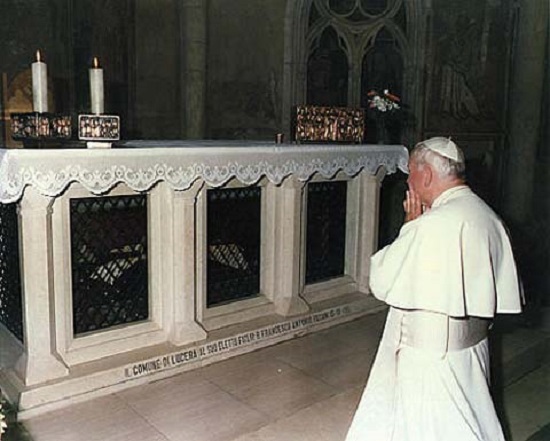
Jean-Paul II priant devant le tombeau de Saint Francesco Antonio Fasani
CANONIZZAZIONE DEL BEATO
FRANCESCO ANTONIO FASANI
OMELIA DI GIOVANNI POALO
II
Domenica, 13 aprile 1986
1. Nella liturgia
dell’odierna domenica, che segue a breve distanza la Pasqua, risuona la breve
domanda di Cristo risorto indirizzata a Simon Pietro. La domanda sull’amore:
“Mi ami? . . . mi ami tu più di costoro?” (Gv 21, 15).
Questa domanda appartiene
al mistero pasquale. La risurrezione di Cristo orienta l’uomo verso ciò che
“non muore”, verso ciò che è più forte della morte. Ciò che permane
eternamente. Che costituisce la sostanza stessa dell’immortalità. Che
appartiene alla vita in Dio. Proprio questo è amore.
Alla domanda di Cristo
sull’amore, Simon Pietro risponde: “Certo, Signore, tu lo sai che ti amo”. E la
terza volta: “Signore, tu sai tutto; tu sai che ti amo” (Gv 21, 17).
2. Non è una domanda
facile quella sull’amore. E non è facile nemmeno la risposta a questa domanda.
Simon Pietro sa di amare, ma si richiama a ciò che Cristo conosce di lui, più
che alla testimonianza della propria coscienza.
Non è facile per l’uomo
questa domanda, e non è facile la risposta. Eppure si tratta di una domanda
fondamentale. Dalla risposta dipende in definitiva il valore della vita umana.
Davanti a Dio che è “Amore”, il valore di tutto viene misurato con l’amore.
Davanti a Cristo, che “ci ha amato e ha dato se stesso per noi” (cf. Ef 5,
2), il valore della vita umana viene misurato soprattutto con l’amore: col dono
di se stessi. L’amore decide in definitiva della santità dell’uomo.
3. È di questo amore che
ha dato prova esemplare il francescano conventuale Francesco Antonio Fasani,
che oggi la Chiesa annovera ufficialmente nel numero dei santi. Egli ha fatto
dell’amore insegnatoci da Cristo il parametro fondamentale della sua esistenza.
Il criterio basilare del suo pensiero e della sua azione. Il vertice supremo
delle sue aspirazioni. Anche per lui, la “domanda sull’amore” è stata il
criterio orientatore di tutta la vita, la quale pertanto non è stata altro che
il risultato di una volontà ardente e tenace di rispondere affermativamente -
come Pietro - a quella domanda.
Con l’atto di
canonizzazione or ora compiuto, la Chiesa stessa, oggi, intende rendere
testimonianza a frate Francesco Antonio Fasani, attestando che egli ha
veramente e sinceramente risposto di sì a quella cruciale domanda del Signore:
una risposta che, prima ancora che dalle sue labbra, è venuta dalla sua vita,
interamente dedicata a corrispondere, con eroica fedeltà, all’amore col quale
Gesù lo aveva prevenuto dall’eternità. Un amore, quello di Gesù, che - lo
abbiamo ricordato nei giorni del Triduo pasquale - non si arrestò davanti al
sacrificio supremo della vita. Un amore, quello di frate Francesco Antonio, di
totale adesione all’esempio del Signore. Il nuovo Santo ha dimostrato con la
sua vita - come gli apostoli - che sempre “bisogna obbedire a Dio piuttosto che
agli uomini” (At 5, 29), anche al prezzo di sofferenze e di umiliazioni,
che non gli mancarono, al di là della stima e dei consensi che la sua
generosità seppe accattivarsi presso i contemporanei. La sua letizia, pertanto
- come quella degli apostoli - era motivata dal fatto di soffrire e faticare
per il Signore, quando non addirittura di “essere oltraggiato per amore del suo
nome” (cf. At 5, 41).
4. San Fasani ci si
presenta in modo speciale come modello perfetto di sacerdote e pastore di
anime. Per più di 35 anni, agli inizi del 1700, egli si dedicò, nella sua
Lucera ma con numerose puntate anche nelle zone circostanti, alle più svariate
forme del ministero e dell’apostolato sacerdotale.
Vero amico del suo
popolo, fu per tutti fratello e padre, eminente maestro di vita, da tutti
ricercato come consigliere illuminato e prudente, guida saggia e sicura nelle
vie dello Spirito, difensore e sostenitore coraggioso degli umili e dei poveri.
Ne è testimonianza il riverente e affettuoso titolo col quale lo salutarono i
contemporanei e che è tuttora familiare al buon popolo di Lucera: egli, allora
come oggi è sempre per loro il “Padre Maestro”.
Come religioso, fu un
vero “ministro” nel senso francescano, vale a dire il servo di tutti i frati:
caritatevole e comprensivo, ma santamente esigente per l’osservanza della
Regola, e particolarmente per la pratica della povertà, dando egli stesso
inappuntabile esempio di regolare osservanza e di austerità di vita.
In un’epoca
caratterizzata da tanta insensibilità dei potenti nei confronti dei problemi
sociali, il nostro santo si prodigò con inesausta carità per l’elevazione
spirituale e materiale del suo popolo. Le sue preferenze andavano verso i ceti
più trascurati e più sfruttati, soprattutto verso gli umili lavoratori dei
campi, verso i malati e sofferenti, verso i carcerati. Escogitò geniali
iniziative, sollecitando la cooperazione delle classi più abbienti, così da
realizzare forme di assistenza concreta e capillare, che parvero precorrere i
tempi e preludere alle forme moderne dell’assistenza sociale.
5. “Il Dio dei nostri
padri ha risuscitato Gesù, che voi avete ucciso appendendolo alla croce” (At 5,
30): le parole di san Pietro davanti al Sinedrio di Gerusalemme - le abbiamo
ascoltate poc’anzi nella prima Lettura - possono ben applicarsi all’azione
pastorale di frate Francesco Antonio Fasani. L’annuncio del mistero pasquale fu
il nucleo intorno al quale ruotò tutta la sua predicazione. Non senza sfidare a
volte l’ostilità di certi ambienti piuttosto refrattari ai valori della fede
cristiana.
Il secolo XVIII, nei cui
primi decenni il novello santo visse e operò, è comunemente noto come “il
secolo dei lumi”, a motivo del grande onore in cui vi fu tenuta la ragione
umana. Non pochi dotti dell’epoca, sulla spinta dell’entusiasmo per le
possibilità conoscitive dell’uomo, erano giunti a mettere in questione l’altra
sua fondamentale fonte di luce: la fede. In particolare, urtava la loro
sensibilità il discorso sull’incapacità dell’uomo a salvarsi con le sole sue
forze, non riuscendo di conseguenza ad ammettere la necessità di un Redentore
che venisse a liberarlo dalla sua situazione di disperata impotenza.
È chiaro che, in un
simile contesto culturale, l’annuncio del mistero di un Dio incarnato, che è
morto e risorto per redimere l’uomo dal peccato, poteva presentarsi
particolarmente ostico e duro. La “parola della croce” poteva tornare ad
apparire, come nei primi tempi del cristianesimo, una vera e propria
“stoltezza” (cf. 1 Cor 1, 18). È pensabile che padre Fasani, indicato
dal vescovo Antonio Lucci come “dotto in teologia e profondo in filosofia”,
sentisse vivamente questo contrasto. Nella sua Lucera, da secoli importante
centro di cultura e di arte, i fermenti delle idee illuministe erano certamente
presenti e operanti. Forse anche il giovane francescano dovette affrontare
l’impatto, venendo a trovarsi al centro delle sorde resistenze degli ambienti
ai quali non garbava - come già un tempo ai membri del Sinedrio - che si
continuasse a “insegnare nel nome di costui”, cioè di Cristo (cf. At 5,
28).
Sappiamo con certezza che
egli fu predicatore impavido e instancabile. Percorse ripetutamente il Molise e
la provincia di Foggia, spargendo dappertutto il seme della parola di Dio, fino
a meritare il titolo di “apostolo della Daunia”. E nella sua predicazione mai
attenuò le esigenze del messaggio, nel desiderio di compiacere agli uomini.
Come Pietro e gli altri apostoli, anch’egli infatti era sorretto dalla
convinzione che “bisogna obbedire a Dio piuttosto che agli uomini” (At 5,
29).
6. Fedele all’integrità
della dottrina, il novello santo fu tuttavia umanissimo verso quanti si
rivolgevano a lui per rivelargli le loro debolezze. Sapeva di essere ministro
di Colui che era morto e risorto “per dare a Israele la grazia della
conversione e il perdono dei peccati” (At 5, 31). Padre Fasani fu un
autentico ministro del sacramento della Riconciliazione, un infaticabile
apostolo del confessionale, nel quale sedeva per lunghe ore della giornata,
accogliendo con infinita pazienza e grande benignità coloro che - di ogni ceto
e condizione - venivano per cercare con cuore sincero il perdono di Dio.
Quanti furono coloro che,
inginocchiati al suo confessionale, sperimentarono la verità delle parole
proclamate oggi nel Salmo responsoriale: “Signore Dio mio, / a te ho gridato e
mi hai guarito. / Signore, mi hai fatto risalire dagli inferi, / mi hai dato
vita / perché non scendessi nella tomba”. La gratitudine che i penitenti di
padre Fasani provarono allora nel segreto del confessionale, si perpetua ora
nella gioia che essi condividono con lui in cielo.
7. “L’agnello che fu
immolato - abbiamo proclamato nella seconda Lettura (Ap 5, 11) - è degno
di ricevere potenza e ricchezza, sapienza e forza, onore, gloria e
benedizione”. Gloria di Cristo sono i santi, quegli uomini cioè che, per un
amore spintosi “al di là di tutto”, hanno trovato la pienezza della Vita
rivelata nella risurrezione di Cristo. Con questa pienezza vivono in Dio. E
pure a noi indicano le vie della Vita.
San Francesco Antonio
Fasani è uno di questi. Ascoltiamo dunque il suo insegnamento. Lo ascoltino in
particolare le genti della nobile terra di Puglia, che ben può gloriarsi di
questo suo figlio, nel quale essa ravvisa le migliori caratteristiche, che
hanno fatto grande il suo popolo: un popolo laborioso e semplice, coraggioso e
tenace, un popolo saldamente ancorato ai valori del Vangelo.
Ascoltino il loro
illustre concittadino e pratichino ciò che egli ha praticato, per poter essere
accolte un giorno con lui in cielo tra le “miriadi di miriadi” che cantano le
lodi dell’Agnello “nei secoli dei secoli”.
© Copyright 1986 -
Libreria Editrice Vaticana
Copyright ©
Dicastero per la Comunicazione
La Santa Sede
SOURCE : https://www.vatican.va/content/john-paul-ii/it/homilies/1986/documents/hf_jp-ii_hom_19860413_beato-fasani.html
FASANI, Francesco Antonio
di Massimo Bray
Dizionario Biografico
degli Italiani - Volume 45 (1995)
FASANI, Francesco Antonio
(al secolo Donato Antonio)
Nato a Lucera (Foggia) il
6 ag. 1681da Giuseppe e Isabella Della Monaca, entrò giovanissimo nel convento
di S. Francesco a Monte Sant'Angelo.
Nel primo periodo di
noviziato, il F., così almeno concordano i ricordi agiografici ricavabili dal
processo di beatificazione, visse con entusiasmo le prime esperienze da
francescano all'interno della comunità dei minori conventuali, affiancando
all'educazione religiosa una prima formazione di studi classici. Da Monte
Sant'Angelo si spostò nel convento di Venafro, dove si era andato formando il
collegio per gli studi di retorica e di umanità. Durante questo soggiorno ebbe
modo probabilmente di approfondire i suoi studi e di fare le prime esperienze
di predicazione. Dopo brevi periodi trascorsi nei collegi di Alvito presso
Cassino e di Montella nell'Irpinia, seguì i corsi di filosofia scolastica ad
Aversa dal 1699 al 1701. Il primo biennio teologico fu ad Agnone (od. prov. di
Isernia); il secondo nel convento di Assisi, dal 1703 al 1705, sotto la guida
di Giuseppe Antonio Marcheselli. Furono questi gli anni più importanti nella
formazione spirituale del Fasani. Le cure ricevute dal Marcheselli, autore di
un trattato in sei volumi sulla vita del perfetto cristiano (Ilcristiano devoto,
Venezia 1740) portarono a compimento la sua formazione spirituale.
L'ordinazione sacerdotale avvenne il 19 sett. 1705 ad Assisi nel convento delle
clarisse. Dopo un anno trascorso a Roma, nel 1706, ed uno ad Assisi, nel 1707,
fece ritorno a Lucera, dove per trentaquattro anni, sino agli ultimi giorni
della sua vita, si dedicò alla vita conventuale.
Reggente del collegio di
filosofia, guardiano e maestro dei novizi, egli divenne infatti, con un breve
apostolico di Clemente XI, ministro provinciale dei francescani dal 1º giugno
1720 al maggio del 1723. Il F. dimostrò negli anni del suo impegno come
superiore dell'Ordine una grande disponibilità di apostolato rivolta
soprattutto al popolo, a tutta quella massa di fedeli che viveva ai limiti
della sussistenza. Nelle risposte rese durante gli interrogatori super
fama, che fanno parte del processo di beatificazione cominciato nel 1746 e
portato a termine nel 1765, tutti i testimoni, esaltando le sue cristiane
virtù, si soffermavano a considerare la carità da lui dimostrata nei confronti
della povera gente, come la prova più certa di un'esperienza religiosa vissuta
secondo la più autentica spiritualità francescana.
Le trasformazioni legate
ai provvedimenti tridentini prima, e alla riforma innocenziana in seguito,
avevano mutato alcune caratteristiche del ruolo e della funzione degli Ordini
monastici. L'Ordine dei frati minori non somigliava più a quella schiera di
cavalieri della Madonna Povertà, tutti eguali fra loro, che aveva avuto come
scopo la realizzazione del Vangelo, con gli esempi continui della carità e
dell'umiltà. Queste trasformazioni si avvertirono soprattutto nella seconda
metà del sec. XVII e in particolare modo nel rapporto tra le comunità religiose
e il tessuto cittadino. Se ancora esistevano, le forme del primo spirito
francescano si manifestavano e si accrescevano nei grandi conventi delle città.
I conventuali erano divenuti, adattandosi alle esigenze della Chiesa, un Ordine
di chierici. I religiosi prestavano la loro assistenza all'interno delle
carceri, degli ospedali. Nei quartieri più poveri delle città si instauravano
relazioni di solidarietà con quella parte della popolazione che viveva in
condizioni di estrema miseria. La predicazione, il valore degli esempi di vita
cristiana proposti, diveniva uno dei pochi mezzi a disposizione del religioso
per trasmettere l'insegnamento evangelico. L'incisività del racconto, la
semplicità della trama narrativa permetteva infatti di rivolgersi ad un
pubblico quasi mai omogeneo. Nelle prediche il povero al pari del ricco acquistava
una sua dignità; nelle sue sofferenze, nella sua miseria si affermava il valore
della vita di Cristo.
Ancora più significativa
può apparire la presenza dell'uomo di Chiesa in una realtà geografica
particolarmente depressa, dove il confine tra il vivere quotidiano e
l'indigenza degli abitanti andava lentamente scomparendo.
Il F. compilò una
raccolta di excerpta, che, anche non avendo le caratteristiche proprie di
un manuale di predicazione, suggeriva quei temi che il religioso avrebbe dovuto
tenere sempre presenti nella sua attività pastorale. L'opera non ha un
carattere originale, ma si presenta piuttosto come un rifacimento della vasta
lettura sugli exempla. Nei brevi racconti le tappe della vita di s.
Francesco sono presentate nel valore più autentico dell'esperienza di umiltà e
povertà.
Un'incredibile folla si
accalcava sempre per ascoltare le prediche del Fasani. E ancora dalla lettura
delle testimonianze rese nel primo processo per la beatificazione si può
seguire il rapporto che s'instaurava tra il predicatore e i fedeli. Dopo aver
raccontato, ad esempio, quali fossero i vizi e i peccati su cui il F. tornava
ripetutamente nelle sue prediche, una donna chiamata a testimoniare sulla
capacità di convincimento che avevano le parole del religioso, annotava come
egli "s'infervorava tanto parlando di Cristo che pareva di uscire di se
stesso". La capacità di coinvolgere emotivamente gli uditori era
certamente una delle qualità necessarie al predicatore. Nel caso del F. è
sorprendente notare il grado non solo di ascolto che egli aveva, quanto la
capacità di vivere un'esistenza costruita in modo esemplare nell'imitazione
della vita di Cristo.
Il F. morì a Lucera il 29
nov. 1742.
Gli Excerpta e Sacra
Scriptura, praedicatoribus Verbi Dei valde utilia, I Discorsi di
varia devozione francescana, il Mariale e le note e i commenti in
margine al Magnificat sono tuttora inediti. Le opere, tutte in forma
manoscritta, sono conservate presso l'Archivio segreto Vaticano in tre
fascicoli appartenenti alle carte del processo di beatificazione nella
congregazione dei Riti (Scripta, 4257).
Fu beatificato da Pio XII
il 15 apr. 1951. Il processo di beatificazione, diviso nelle differenti fasi in
cui ebbe luogo, è così ordinato: ms. 1471 Proc. ord. s. fama,
1746-1765; ms. 1470 Proc. ord. s. non cultu, 1765; ms.
4220 Proc. apost. s. scriptis, 1884; ms. 4597 Proc. apost. s. miro,
1945-1946; ms. 4598 Proc. apost. s. miro, 1948.
Bibl.: T. M.
Vigilanti, Vita del ven. servo di Dio fr. F. A. F., predicatore, maestro
e provinciale dell'Ordine dei minori conventuali di S. Francesco, Lucera
1848; G. Fratini, La vita del venerabile servo di Dio fr. F. A. F. da
Lucera, Foligno 1893; G. Polatucci, Il venerabile servo di Dio F. A. F.,
Ravello 1927; A. Orlini, Appunti su la biografia del venerabile F., Roma
1950; L. Berardini, Il beato F. A. F. dei frati minori
conventuali, Roma 1951; G. Stano, in Bibl. sanctorum, V, Roma 1964,
coll. 468 ss.; A. Blasucci, in Dict. d'hist. et de géogr. ecclés.,
XVI, Paris 1967, coll. 669 s.
© Istituto della
Enciclopedia Italiana fondata da Giovanni Treccani - Riproduzione riservata
SOURCE : https://www.treccani.it/enciclopedia/francesco-antonio-fasani_(Dizionario-Biografico)/
San Francesco Antonio Fasani
Den hellige Frans
Antonius Fasani (1681-1742)
Minnedag:
29. november
Fransiskanerkonventualene
kalles noen steder også minoritter eller «svarte fransiskanere». De voktet da
som nå gravene til de hellige Frans av Assisi og Antonius av Padova.
I en alder av knapt 15 år bestemte Giovanniello seg for selv å gå inn i
ordenen, og han ble sendt til Monte Sant'Angelo på Monte Gargano for
novisiatet. Han tok ordensnavnet Frans Antonius (it: Francesco Antonio) etter
fransiskanerordenens to store hellige og avla sine løfter den 23. august 1696 i
Monte Sant'Angelo. Deretter begynte han på sine filosofiske og teologiske
studier i ulike hus i sin orden, i Venafro, Montella, Napoli, Aversa og Foggia.
I 1703 ble han sendt til
Assisi, hvor han ble presteviet den 11. september 1705. Deretter ble han sendt
til Roma for videre studier, og han ble magister i teologi på St.
Bonaventura-kollegiet. I hjembyen Lucera var han alltid siden kjent som Padre
Maestro, «pater magister». Etter avsluttede studier i Roma ble han sendt
tilbake til Assisi, hvor han ble til 1707. Der viet han seg til
prekenvirksomhet i byen og landsbyene omkring.
I 1707 ble han sendt for
å undervise i teologi på konventualenes kollegium i hjembyen Lucera, og
deretter tilbrakte han nesten hele livet i hjembyen. Folket sa om ham: «Hvis du
ønsker å se den hellige Frans, se på Padre Maestro». Bortsett fra sin
undervisningspost hadde han mange andre embeter i Lucera, inkludert guardian i
klosteret og novisemester. Han var også en tid provinsialminister for
ordensprovinsen Sant'Angelo (Apulia).
Hans vitenskapelige
arbeid var bemerkelsesverdig, men det var som predikant han ble kjent både i
byen og landsbygda omkring. Hans altoverskyggende anliggende var å gjøre sine
prekener forståelige for alle som hørte på, og han rettet sin katekese fremfor
alt mot de fattige. Han utøvde selv den strengeste fattigdom. Han skrev flere
bind med prekener, inkludert noen på latin. Blant dem var Quaresimale (prekener
for fastetiden), en Mariale (Maria-prekener), en forklaring av Fader
Vår og en forklaring av Magnificat.
Hans særlige hengivenhet
var til Den uplettede unnfangelse, som den gangen ikke var et dogme
(trossannhet), og han ledet de som søkte hans åndelige råd, mot hengivelse til
Maria. Han hadde tatt med seg fra Napoli en statue av Den uplettede unnfangelse
som han satte i kirken San Francesco, og han tilbrakte hver dag minst en halv
time foran den. Han skrev hymner som folket kunne synge foran statuen. Den æres
fortsatt i Lucera, og sangene synges fortsatt gjerne i Sør-Italia. Han
etablerte også en novene for Den uplettede unnfangelse før festen den 8.
desember. Han kalte Maria «Nøkkelen til paradiset».
En tid før novenen før 8.
desember begynte i 1742, mens han syntes å være ved god helse, betrodde han en
ledsager, pater Lodovico Gioca, at han snart ville dø, og at pater Ludovico
ikke ville overleve ham særlig lenge. Snart etter forverret en sykdom seg som
han hadde hatt i flere år, og fem dager senere, på den første dagen i novenen,
den 29. november, døde Frans Antonius i Lucera. Barna løp gjennom gatene og
ropte: «Helgenen er død! Helgenen er død!» Pater Ludovico overlevde ham ikke
med mer enn to måneder.
Frans Antonius' grav i
kirken San Francesco i hjembyen Lucera er fortsatt et valfartsmål. Biskopen av
Lucera startet informasjonsprosessen for å undersøke Frans Antonius' liv, dyder
og mirakler. Den 21. juni promulgerte pave Leo XIII (1978-1903) dekretet som
anerkjente hans heroiske dyder, noe som ga ham tittelen Venerabilis,
«Ærverdig». Han ble saligkåret den 15. april 1951 av pave Pius XII (1939-58).
Den 21. mars 1985 undertegnet pave Johannes Paul II dekretet fra
Helligkåringskongregasjonen som anerkjente et nytt mirakel på hans forbønn, og
han ble helligkåret den 13. april 1986 av pave Johannes Paul II på
Petersplassen i Roma. Hans minnedag er dødsdagen 29. november. Andre minnedager
som blir angitt er 27. november og 9. desember.
Kilder:
Attwater/Cumming, Butler, Butler (XI), Benedictines, Bunson,
Schauber/Schindler, Holböck (2), Index99, KIR, CSO, Patron Saints SQPN,
Infocatho, Bautz, Heiligenlexikon, vatican.va - Kompilasjon og
oversettelse: p. Per Einar Odden -
Sist oppdatert: 2003-06-12 00:38
SOURCE : https://www.katolsk.no/biografier/historisk/flucera
Antonio Giovanni Fasani, Prêtre, Frère mineur conventuel, Saint, 1681-1742 : http://nouvl.evangelisation.free.fr/francesco_antonio_fasani.htm