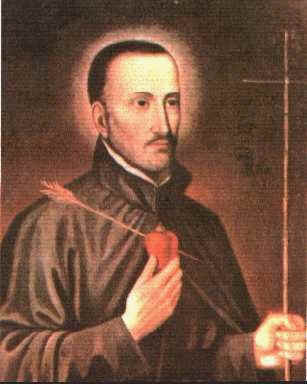
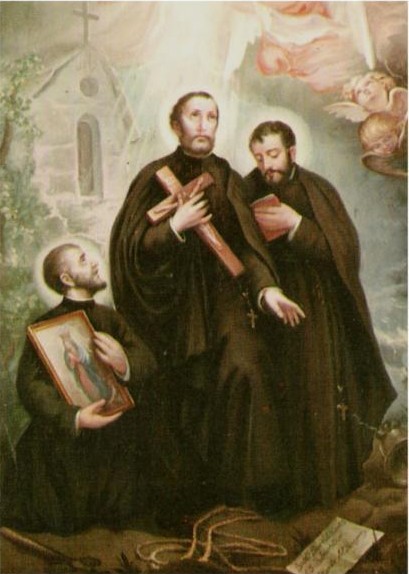
Saints Roch Gonzalez et
Alphonse Rodriguez
Prêtres et martyrs au
Paraguay (+ 1628)
"Roch Gonzalès de Santa Cruz naquit au Paraguay, à Assuncion, en 1576. Ordonné prêtre, il entra dans la Compagnie de Jésus en 1609; durant près de vingt ans il se consacra à la tâche de civiliser les habitants du pays, à les rassembler en Réduction, à leur enseigner la foi chrétienne et à leur apprendre à vivre chrétiennement. Il fut tué par trahison et à cause de sa foi le 15 novembre 1628, en même temps qu'Alphonse Rodriguez, espagnol, prêtre de la Compagnie de Jésus.
Deux jours plus tard, dans une autre Réduction, Jean
del Castillo subit un cruel martyre: jésuite d'origine espagnole, il
avait été un courageux défenseur des Indiens contre leurs oppresseurs."
Ils ont été béatifiés par Pie XI en 1934.
- Roch Gonzalez, Alphonse Rodriguez et Jean del Castillo, site des jésuites, Province de France.
À Caaro au Paraguay, en 1628, les saints martyrs Roch Gonzalez et Alphonse
Rodriguez, prêtres de la Compagnie de Jésus, qui gagnèrent au Christ une
population indigène abandonnée en créant des villages appelés vulgairement
"réductions", où la vie sociale et les arts trouvaient leur place en
même temps que la vie chrétienne, et ils furent mis à mort par ruse, par un
assassin à gages payé par un homme adonné à la magie.
Martyrologe romain
SOURCE : https://nominis.cef.fr/contenus/saint/10581/Saints-Roch-Gonzalez-et-Alphonse-Rodriguez.html
Saint Roque González
de Santa Cruz
Religieux martyr au
Paraguay
Fête le 17 novembre
SJ
Asunción, Paraguay, 1576 – † Réduction de Tous-les-Saints 15 novembre 1628
Groupe « Roque González et ses compagnons martyrs »
Béatifié le 28 janvier 1934 par le pape Pie XI
Canonisé le 16 mai 1988 par le pape Jean Paul II
Autre mention : 16 novembre
« Premier saint du Paraguay »
Saint Roque González de Santa Cruz, jésuite (1609), est le premier saint du
Paraguay, martyr avec deux autres jésuites d’origine espagnole : les Pères
Alfonso Rodriguez et Juan del Castillo. Saint Roque Gonzales, né à Asuncion au
Paraguay en 1576, fils de Bartolomé Gonzáles Villaverde et de María de Santa
Cruz, prêtre en 1598, fut un grand évangélisateur dans ces terres encore
vierges du Nouveau Monde ; ce fut aussi un défenseur de la justice en ce
temps de la conquête espagnole ; enfin il eut une grande action
civilisatrice qui se manifesta par la fondation de dix « réductions »
au Paraguay, au Brésil et en Argentine. Les réductions, véritables villes pouvant
atteindre jusqu’à 40 000 habitants, étaient dues au génie organisateur
déployé par les Jésuites en ces contrées : elles permettaient aux
autochtones de s’initier aux différentes activités d’un peuple civilisé, depuis
l’agriculture jusqu’à l’architecture et la musique. Saint Roque Gonzales et ses
deux compagnons furent tués le 15 novembre 1628 à Réduction de Tous-les-Saints
par une bande d’Indiens armés et hostiles. Il a été béatifié en 1934 par Pie XI
à Rome et canonisé le 16 mai 1988 par Jean-Paul II à Asuncion (Paraguay).
SOURCE : http://www.martyretsaint.com/roque-gonzalez-de-santa-cruz/

San Rocco Gonzalez de Santa Cruz
Sculpture
of Roque González de Santa Cruz and comps. in Santa Cruz do Sul Cathedral.
Imagem
dos três Mártires Riograndenses na Catedral de Santa Cruz do Sul.
ROQUE GONZALEZ,
ALFONSO RODRIGUEZ
et JUAN DEL CASTILLO
Jésuites, Martyrs, Saints
Roque Gonzalez de Santa
Cruz naquit au Paraguay, à Assunción, en 1576. Ordonné prêtre, il entra dans la
Compagnie de Jésus en 1609 ; durant près de vingt ans il se consacra à la
tâche de civiliser les habitants du pays, à les rassembler en Réduction, à leur
enseigner la foi chrétienne et à leur apprendre à vivre chrétiennement. Il fut
tué par trahison et à cause de sa foi le 15 novembre 1628, en même temps
qu'Alphonse Rodriguez, espagnol, prêtre de la Compagnie de Jésus.
Deux jours plus tard,
dans une autre Réduction, Juan del Castillo subit un cruel martyre :
jésuite d'origine espagnole, il avait été un courageux défenseur des Indiens
contre leurs oppresseurs.
Ils ont été béatifiés par
Pie XI en 1934.
*****
Lors de la cérémonie de
canonisation — le 16 mai 1988, à Assunción, au
Paraguay — présidée par le Serviteur de Dieu Jean-Paul II, le
pape soulignait :
« Se sentant
responsables de la nécessité de défendre la dignité humaine à ce moment
l'histoire, le père Roque Gonzalez, le père Alfonso Rodriguez, le père Juan del
Castillo et tant d'autres chrétiens, affrontèrent le terrible défi représenté
par la découverte du soi-disant nouveau monde. Convaincus que l'Évangile est un
message d’amour et de liberté, ils se sont efforcés à faire connaître “la
vérité en Christ Jésus” (Ef 4, 21) dans toutes ces terres. En
répondant à l'appel du Seigneur qui les invitait à faire des disciples dans
toutes les nations, ils voulurent répéter aux populations à peine connues les
mots que saint Paulo adressait aux éphésiens : “Mais vous, vous avez
été instruits à vous dépouiller, eu égard à votre vie passée, du vieil homme et
à revêtir l'homme nouveau, créé selon Dieu dans une justice et une sainteté que
produit la vérité” (Ep. 4,24) ».
Un peu plus loin, dans
homélie, le bon et saint Pape, disait encore, parlant de ces héroïques
jésuites :
« Dans leur zèle de
gagner des âmes au Christ, le père Roque et ses confrères parcoururent tous les
territoires de l'estuaire de la Plata jusqu'aux sources des fleuves Paraná et
Uruguay, jusqu'aux sierras de Mbaracayú dans le Haut Paraguay, en affrontant toute
sortes d’épreuves et de dangers. Infatigables dans la prédication, austères
avec eux-mêmes, l'amour au Christ et aux indigènes les porta à ouvrir des
nouvelles routes et à construire des missions qui facilitaient la diffusion de
la foi et assuraient de dignes conditions de vie pour leurs frères. Itapúa,
Saint’Anne, Yaguapoá, Concepción, Saint Nicolas, Saint Xavier, Yapeyú,
Candelaria, Asunción du Yjuhí et Todos los Santos Caaró sont des noms de lieux
entrés dans l'histoire de l’œuvre de ces saints ».
Ce même mémorable jour,
le Saint-Père apporta encore ces précisions importantes et faisant référence au
“Vade-mecum” que tout jésuite connaît dans les moindres détails : Les
Exercices Spirituels de saint Ignace de Loyola :
« L'immense œuvre de
ces hommes, toute cette œuvre d'évangélisation des villages guaranis fut
possible grâce à leur union avec Dieu. Saint Roque et ses compagnons suivirent
l'exemple saint Ignace codifié dans ses constitutions : “Les moyens qui
unissent le moyen à Dieu et le dispose à se faire guider de sa main divine sont
plus efficaces que ceux qui le tournent vers les hommes” (S. Ignace de Loyola
“Constitutions de la Société de Jésus”, 813). Donc ces nouveaux saints vécurent
dans cette “familiarité avec Dieu notre Seigneur” (S. Ignace de Loyola
“Constitutions de la Société de Jésus”, 813), que le fondateur désirait quelle
caractérise le jésuite. Ils se sont ainsi abandonnés, jour après jour à leur
travail dans la prière, sans jamais l'abandonner pour quelque raison que ce
soit. “Aussi avec tous les engagements que nous avions — écrivait le
père Roque en 1613 — nous n'avons jamais manqué aux exercices
spirituels et aux obligations de notre vie” (Lettre du 8 octobre 1613) ».
Puis, à la fin de son
homélie — et avant d’adresser à Marie une prière
fervente — Jean-Paul II rend hommage aux Jésuites en ces
termes :
« Cette canonisation
des trois martyrs Jésuites est aussi motif d’un saint orgueil pour toute la
Compagnie de Jésus. Roque Gonzalez est parmi les premiers Jésuites du nouveau
continent et Alphonse Rodriguez et Juan del Castillo appartiennent à ce groupe
d’hommes généreux qui, répondant à l’appel du Christ à entrer et à appartenir à
la Compagnie, ont apporté le message du Christ dans le monde entier ».
Alphonse Rocha
SOURCE : http://nouvl.evangelisation.free.fr/roque_gonzalez.htm
Saints ROCH GONZALEZ, ALFONSO RODRIGUEZ et JEAN DEL CASTILLO prêtres et martyrs,
Fête le 16 novembre
Roch Gonzalès de Santa
Cruz naquit au Paraguay, à Assuncion, en 1576. Ordonné prêtre, il entra dans la
Compagnie de Jésus en 1609 ; durant près de vingt ans il se consacra à la tâche
de civiliser les habitants du pays, à les rassembler en Réduction, à leur
enseigner la foi chrétienne et à leur apprendre à vivre chrétiennement. Il fut
tué par trahison et à cause de sa foi le 15 novembre 1628, en même temps
qu’Alphonse Rodriguez, espagnol, prêtre de la Compagnie de Jésus.
Deux jours plus tard, dans une autre Réduction, Jean del Castillo subit un cruel martyre : jésuite d’origine espagnole, il avait été un courageux défenseur des Indiens contre leurs oppresseurs. Ils ont été béatifiés par Pie XI en 1934.
Mémoire
Commun des martyrs (p.
237) ou pasteurs (p. 260).
OFFICE DES LECTURES
DEUXIÈME LECTURE
Lettre du bienheureux
Roch Gonzalès, prêtre et martyr.
J’espère dans le Seigneur
que cette croix, toute nouvelle qu’elle soit dans ce pays, sera la première de
nombreuses autres dressées ici.
Revenu rapidement
en ce lieu, je me suis arrangé une petite hutte qui se trouvait non loin du
fleuve jusqu’à ce qu’on me donne une autre hutte de paille un peu plus grande.
Au bout de deux mois, le P. Recteur envoya Didace de Boroa. Il est arrivé ici
le lundi de la Pentecôte ; grandement consolés, nous étions heureux de voir
comment l’amour de
Dieu nous avait réunis en des contrées si lointaines et désolées. Peu après,
nous avons coupé en deux notre petite habitation en y élevant une cloison de
roseaux ; nous y avons ajouté un oratoire un peu plus grand que l’autel
lui-même, pour y célébrer la messe.
À cause de la force de ce divin sacrifice, dans lequel le Christ s’est offert
au Père et par lequel il fait éclater son triomphe ici même parmi nous, les
démons n’ont plus osé se manifester, eux qui avaient l’habitude auparavant de
se montrer aux indigènes. Nous manquions de tout dans cette cabane ; le froid y
était si rigoureux que nous avions de la peine à dormir. Notre nourriture était
tantôt du maïs cuit, tantôt de la farine de manioc, aliments ordinaires des
indigènes ; nous nous sommes mis à chercher dans la campagne des herbes dont se
nourrissent les perroquets, si bien que les indigènes nous appelèrent de ce nom
pour se moquer de nous.
Les choses en étant là,
les démons commencèrent à craindre que si la Compagnie pénétrait dans ce grand
pays, ils perdraient rapidement tout ce qu’ils avaient gagné depuis si
longtemps. Aussi ne tardèrent-ils pas à faire répandre la nouvelle dans tout le
pays Parana que nous étions des espions et de faux prêtres, et que les livres
et les images que nous avions étaient porteurs de mort. Ce fut à ce point que,
lorsque le P. Boroa expliquait les mystères de notre foi aux infidèles,
certains redoutaient de se mettre près des images saintes dans la crainte de se
voir frappés de mort par celles-ci. Mais ils abandonnèrent peu à peu cette
croyance lorsqu’ils virent de leurs propres yeux comment les Nôtres étaient
pour eux de véritables pères, leur offrant volontiers tout ce qui se trouvait
chez nous et se consacrant jour et nuit, dans leurs souffrances et leurs
maladies, à guérir non seulement leurs âmes (ce qui est l’essentiel), mais
aussi leurs corps.
Lorsqu’il nous sembla que
l’affection des Indiens envers nous s’était affermie, la pensée nous vint de
construire une église qui, bien que petite et humble avec son toit de paille,
apparaisse aux yeux de ces malheureux comme un palais royal. Ne sachant pas
faire des briques, nous construisîmes de nos mains des murs en terre. Et c’est
ainsi que l’église fut achevée pour la fête de saint Ignace de l’année dernière
1615. Le même jour, nous avons célébré pour la première fois la messe dans
cette église, en y renouvelant nos voux et avec toute la solennité que
permettait la pauvreté du lieu ; nous voulûmes même former une chorale
d’enfants, mais ceux-ci sont tellement frustes qu’ils furent incapables
d’apprendre à chanter. Après avoir construit une petite tour en rondins, nous
avons placé une cloche à son sommet, au grand émerveillement de ces gens qui
n’avaient ni vu ni entendu une chose pareille en ce pays. Une autre cause de
grande dévotion fut la croix que les Indiens avaient eux-mêmes dressée devant
l’église : en effet, comme nous leur avions expliqué pour quelles raisons nous
autres chrétiens adorions la Croix, ils l’adoraient eux-mêmes en s’agenouillant
avec nous. J’espère donc dans le Seigneur que cette croix, toute nouvelle
qu’elle soit dans ce pays, sera la première de nombreuses autres croix dressées
ici.
SOURCE : http://www.jesuites.com/2013/01/roch-gonzalez/
Le pape prie un père des
« Réductions », le martyr jésuite Roch Gonzalez
Le pape François est allé
se recueillir auprès d’un père des “Réductions” du Paraguay, le premier saint
du pays.
2 JUILLET 2015 ANITA BOURDINSAINTS,
BIENHEUREUX
Le pape François est allé
se recueillir auprès du coeur du martyr jésuite Roch Gonzalez, premier saint du
Paraguay, au collège des jésuites Cristo Rey de la capitale, Asuncion, samedi
11 juillet.
Roch
Gonzalez de Santa Cruz (1576-1628), prêtre jésuite, est né est au
Paraguay, à Asuncion. Il a été ordonné prêtre et il est entré dans la Compagnie
de Jésus en 1609. Il a ensuite passé vingt ans à l’annonce de l’Évangile aux
Guaranis, organisant leur rassemblement dans ces villages de quelque 5.000
personnes dont il ne reste que des ruines aujourd’hui, comme à Trinidad :
une société « heureuse » passée à l’histoire sous le nom de
« Réduction ». Il fut tué par trahison le 15 novembre 1628, avec un
autre jésuite, saint Alphonse Rodriguez.
Ils ont été béatifiés par
Pie XII, avec Jean del Castillo, jésuite d’origine espagnole, courageux
défenseur des Indiens contre leurs oppresseurs, et assassiné deux jours plus
tard. Roch Gonzalez a été canonisé par Jean-Paul II à Asuncion, le 16
mai 1988.
Ils sont tous les trois
fêtés le 16 novembre, par le martyrologe romain qui dit: “À Caaro au Paraguay,
en 1628, les saints martyrs Roch Gonzalez et Alphonse Rodriguez, prêtres de la
Compagnie de Jésus, qui gagnèrent au Christ une population indigène abandonnée
en créant des villages appelés vulgairement “réductions”, où la vie sociale et
les arts trouvaient leur place en même temps que la vie chrétienne, et ils furent
mis à mort par ruse, par un assassin à gages payé par un homme adonné à la
magie. »
Après avoir prié les
vêpres en la cathédrale d’Asuncion, samedi soir, le pape s’est arrêté quelques
minutes, pour une visite privée, au collège des ses confrères jésuites. Le
corps du saint martyr a été brûlé, mais son cœur est miraculeusement été
préservé des flammes.
Lors de la chorégraphie
qui a accueilli le pape François à l’aéroport d’Asuncion, vendredi soir, 10
juillet, les danseurs ont porté en procession un jeune représentant saint
Roch : un hommage au pape jésuite.
Le président Horacio
Cartes a ensuite offert au pape les oeuvres de Ruiz de Montoya, un jésuite des
réductions fameux pour sa connaissance de la langue et de la culture des
Guaranis.
En 1995 le Paraguay a
émis un billet de banque à l’effigie du saint considéré comme un héros
national. Et le pont enjambant le fleuve Parana, reliant les deux villes
fondées par Roque Gonzalez de Posadas (Argentine) et Encarnacion (Paraguay), a
été baptisé Pont Saint Roch Gonzalez de Santa Cruz.
SOURCE : https://fr.zenit.org/articles/le-pape-prie-un-pere-des-reductions-le-martyr-jesuite-roch-gonzalez/

San Rocco Gonzalez de Santa Cruz
Igreja
São João em Porto Alegre, Brasil : Vitral São Roque González de Santa Cruz
e comps. mártires
Also
known as
Roch Gonzalez
Roque Gonzalez
15 November (Martyrology)
17 November on
some calendars
Profile
Born to the Paraguayan nobility. Jesuit priest.
One of the architects of the Jesuit Reductions in Paraguay.
Realizing the damage of the slave trade,
the Jesuits gathered
the indigenous Indians and went inland. In Paraguay,
beginning in 1609,
they built settlements, taught agriculture, architecture, construction, metallurgy, farming, ranching and printing.
By the time the Jesuits were expelled in 1767 they
had 57 settlements with over 100,000 native residents.
Roch served as doctor, engineer, architect, farmer and pastor,
supervised the construction of churches, schools and
homes, and introduced care for cattle and sheep to
the natives. He adapted his tactics to the locals love of ornament, dancing,
and noise. On the great feasts of
the Church,
Roch solemnly celebrated Mass outside
the little thatched church, and then the whole village dressed in their best
and celebrated the rest of the day with games, bonfires, religious dances,
flute music, and fireworks.
Fierce warriors were
softened by Roch’s gentle Christianity,
put aside their hatred for religion, and embraced the faith;
violent revenge, previously part of the local culture, was abandoned.
This progress recevied a
severe blow by the arrival of slave traders
who were able to influence the Spanish crown
and get permission for their activity. They lured natives away from the
Reductions, betrayed them, and sold them into slavery.
Roch became a stanch protector of their freedom, pleading the Indian cause so
forcefully with the Spanish government that
the Reduction of Saint Ignatius was finally left in peace.
Because of his success
in evangelizing the
natives, a local witch-doctor who was losing his power base murdered Roch
along with Saint John
de Castillo and Saint Alphonsus
Rodriquez. One of the Jesuit
Martyrs of Paraguay.
Born
martyred on 15 November 1628 at
Caaro, Brazil,
just as he finished celebrating Mass
3 December 1933 by Pope Pius XI (decree
of martyrdom)
28 January 1934 by Pope Pius XI
16 May 1988 by Pope John
Paul II
Additional
Information
Saints
of the Day, by Katherine Rabenstein
books
John Paul II’s Book of
Saints
Our Sunday Visitor’s Encyclopedia of Saints
other
sites in english
Catholic
Encyclopedia: Paraguay
images
video
sitios
en español
Martirologio Romano, 2001 edición
fonti
in italiano
Dicastero delle Cause dei Santi
Martirologio Romano, 2005 edition
MLA
Citation
“Saint Rocco
Gonzalez“. CatholicSaints.Info. 28 June 2023. Web. 24 June 2026.
<https://catholicsaints.info/saint-rocco-gonzalez/>
SOURCE : https://catholicsaints.info/saint-rocco-gonzalez/

San Rocco Gonzalez de Santa Cruz
Monumento
a San Roque González de Santa Cruz - Avenida Mitre - Posadas, Provincia de
Misiones, Argentina. Fuenteː Periodista Horacio Cambeiro.
St. Roque Gonzalez de
Santa Cruz
Feastday: November 17
Patron: of native traditions; Posadas, Argentina; Encarnación, Paraguay
Birth: 1576
Death: 1628
Beatified: January 28, 1934 by Pope Pius XI
Canonized: Pope John Paul II
The earliest beatified martyrs of America are
three Jesuits of Paraguay, and one of them was American-born.
Roque Gonzalez y de
Santa-Cruz was the son of noble Spanish parents, and he came into this world at
Asuncion, the capitol of Paraguay, in 1576. He was an unusually good and
religious boy, and everybody took it for granted that young Roque would become
a priest. He was in fact ordained, when he was twenty-three: but unwillingly,
for he felt very strongly that he was unworthy of the priesthood. At once he
began to take an interest in the Indians of Paraguay, seeking them out in
remote places to preach to and instruct them in Christianity; and after ten
years, to avoid ecclesiastical promotion and to get more opportunity for
missionary work, he joined the Society of
Jesus.
These were the days of
the beginnings of the famous "reductions" of Paraguay, in the
formation of which Father Roque Gonzalez played an important part. These
remarkable institutions were settlements of Christian Indians
run by the Jesuit missionaries, who looked on themselves, not like so many
other Spaniards did as the conquerors and "bosses" of the Indians,
but as the guardians and trustees of their welfare.
It was to bring about
such a happy state of things that Father Roque labored for nearly twenty years,
grappling patiently and without discouragement with hardships, dangers and
reverses of all kinds, with intractable and fierce tribes and with the
opposition of the European colonists. He threw himself heart and soul into
the work. For three years he was in charge of the Reduction of St. Ignatius,
the first of them, and then spent the rest of his life establishing
others reductions, half a dozen in all, east of the Parana and Uruguay rivers;
he was the first European known to have penetrated into some districts of South
America.
In 1628, Father Roque was
joined by two young Spanish Jesuits, Alonso (Alphonsus) Rodriguez and Juan
(John)de Castillo, and together they founded a new reduction near the Ijuhi
river, dedicated in honor of Our Lady's Assumption. Father Castillo was left in
charge there, while the other two pushed on to Caaro (in the southern tip of
what is now Brazil), where they established the All Saints' Reduction.
Here they were faced with
the hostility of a powerful "medicine man", and at his instigation
the Mission was soon attacked. Father Roque was getting ready to hang a small
church bell when the raiding party arrived; one man stole up
from behind and killed him with blows on the head from a tomahawk. Father
Rodriguez heard the noise and, coming to the door of his hut to see what it was
about, met the bloodstained savages who knocked him down. "What are you
doing, my sons?" he exclaimed. But he was silenced by further blows. The
wooden chapel was
set on fire and the two bodies thrown into the flames. It was November 15,
1628. Two days later the Mission at Ijuhi was attacked; Father Castillo was
seized and bound, barbarously beaten, and stoned to death.
The first steps toward
the beatification of these missionaries were taken within six months of their
martyrdom, by the writing down of evidence about what had happened. But these
precious documents were lost. Then copies of the originals turned up in the
Argentine, and in 1934, Rogue Gonzalez, Alonso Rodrigues and Juan de Castillo
were solemnly declared Blessed. They were canonized in 1988 by Pope John Paul II.
Their feast day is
November 17th.
SOURCE : https://www.catholic.org/saints/saint.php?saint_id=317
Roque Gonzalez, SJ M
(also known as Roch)
Born in Asunciön, Paraguay, 1576; died November 15, 1628; beatified in 1934;
canonized 1988 as one of the Martyrs of Paraguay.
As early as 1537, Pope
Paul III, at the instigation of Bartolome de las Casas and the Dominicans, had
condemned the enslavement and dispossession of Native Americans. Though also
condemned in theory by the Spanish Crown, in practice encomienda system was enslavement.
In Paraguay in 1586 the
encomienda system was in place. In Peru's mines Quechuan labor was exploited
without regard for marriage ties, which led to Indian uprisings, suppression by
the conquistadors, and a reluctance on the part of the Quechuans to accept the
religion of their masters.
Roque Gonzalez was born
of noble Spanish parents (some say of mixed blood--Creole) in Asunciön,
Paraguay. (Whatever his bloodline, there is no doubt that his family was
influential: his brother was the governor of Asunciön for a time.) Roque has
been described as tall and slender with a broad forehead, fine lips, and a
sympathetic expression.
Here in Asunciön he was
educated, ordained at 23, became a beneficed priest of the Cathedral of
Asunciön and began he priestly career working among the Indians. He
participated in the local synod of 1603, during which the enslavement of
Indians was again condemned. It ordered that they should be gathered into
settlements for protection.
At 32 (in 1609), Roque
became a Jesuit and was posted to a settlement south of Asunciön called San
Ignacio. With other Jesuits he opposed Spanish imperialism, the imported
Spanish Inquisition, and enslaving the Indians--for all of which he was
bitterly opposed by the Spanish authorities.
He worked among and for
the Indians for two decades, heading the first Paraguayan reduction of San
Ignacio for three years and establishing another six in the Parana and Uruguay
river regions. The reductions were similar to communes in that the members
worked common land but each family also had its own plot.
It is a blessing that he
was such a talented man. He was an architect, mason, and carpenter, and laid
out a plaza in the Spanish fashion with Indian houses on three sides and a
church with its rectory on the fourth. Roque spoke the Indian language and
instituted a school for the study of Guarani as well as more traditional
subjects. He introduced sheep and cattle herding.
He wrote hymns (which my
friend Fr. Peter, a Russian priest, has rediscovered and is now studying while
working in Paraguay among his beloved Guarani), organized processions, and
compiled a catechism in rhyming verse.
The Franciscans in
pueblos near Asunciön had neophytes work daily for settlers for a legal wage.
In San Ignacio they worked for themselves and paid the Crown directly.
Roque believed the Gospel
had to be preached in love from a position of trust not power and refused the
normal military escort. In ten years he established a chain of settlements in
Argentina and Uruguay. Indians flocked to the settlements for protection. After
long and careful instruction, they would be baptized. They were taught valuable
skills: weaving cotton, boat building, joinery, cart-making, farming, etc.--and
the making of musical instruments, painting manuscripts, printing books,
dancing, singing, and painting.
Contemporary accusations
of the paternalism of the system disregards the political concepts of the 17th
century. The Jesuits created the communities in an urgent defense of life. The
administration and authority within the communities was in the hands of the
Indians themselves--each had a mayor and council. In fact this was the only
region of the Americas which was governed by the indigenous peoples themselves.
Jesuit educational methods enriched and defended indigenous culture. Paraguay
is still today the only officially bilingual country on the continent.
One of the last
settlements founded by Gonzalez was in the forest north of the Rio Iyui (Ijuhi)
Grande in an area dominated by the witch doctor and chieftain Nezu. In 1628 a
settlement there and later in the year a pueblo at Caaro in southern Brazil.
Roque was opposed by
Nezu, who instigated a raid by the Indians on the new reduction during which
both Fr. Gonzalez and his brother priest Fr. Rodriguez were killed on November
15. Roque was struck in the head by an Indian, who broke Gonzalez's skull. Fr.
Alonso Rodriguez suffered a similar fate. And two days later, Ijuhi was
attacked and Fr. Castillo was stoned to death (see under Martyrs of Paraguay).
Fr. Gonzalez had spent
his life seeking justice for the Guarini. The Indians who killed him thought he
was just another White man. When they learned whom they had killed, it is said:
"The Indians themselves lamented the death of Gonzalez, their 'pa'i' or
protector, bitterly regretting their involvement in his death"
(Benedictines, Delaney, Markus).
SOURCE : http://www.saintpatrickdc.org/ss/1117.shtml
St. Roque González, SJ (1576-1628)
By Bert Ghezzi
From Voices
of the Saints
“All the Christians among my countrymen loved the Father and grieved for his
death because he was the father of us all, and so he was called by the Indians
of the Paraná River.” So testified Chief Guarecupi after the martyrdom of
Jesuit Roque González and his companions in Paraguay in 1628. The Indians loved
him because they had felt his love for them and their ways. And they knew that
for two decades he had sacrificed everything to improve their lives both
materially and spiritually.
At a time when Spanish conquistadors were brutalizing and enslaving natives,
Roque helped them become self-sufficient and free. He led the Jesuits who
founded the “reductions,” independent Indian village communities that
excluded European settlers. The economy of the reductions made the Indians
self-supporting by combining communal agriculture with private property
holding. And the reductions had their own political structure that gave the
natives a measure of freedom. Roque González was the innovative social activist
who created the model for these avant-garde communities. Here is his
description of Saint Ignacio, the first reduction that he established in 1613:
This town had to be built from its very foundations. In order to do away with
occasions of sin, I decided to build it in the style of the Spaniards, so that
everyone should have his own house, with fixed boundaries and a corresponding
yard. This system prevents easy access from one house to another, which used to
be the case and which gave occasion for drunken orgies and other evils.
A church and parish house are being erected for our needs. Comfortable and
enclosed with an adobe wall, the houses are built with cedar girders—cedar is
very common wood here. We have worked hard to arrange all this. But with even
greater zest and energy—in fact with all our strength—we have worked to build
temples to Our Lord, not only those made by hands but spiritual temples as
well, namely the souls of these Indians.
On Sundays and feast days we preach during mass, explaining the catechism
beforehand with equal concern for boys and girls. The adults are instructed in
separate groups of about 150 men and the same number of women. Shortly after
lunch, we teach them reading and writing for about two hours.
There are still many non-Christians in this town. Because of the demands of
planting and harvesting all cannot be baptized at the same time. So every month
we choose those best prepared. . . . Among the 120 or so adults baptized this
year there were several elderly shamans.
Roque and other Jesuits built more than thirty reductions with an average
population of three thousand.
In 1628, Roque and Jesuits Alonso Rodriguez and Juan de Castillo started a
reduction on the Iijui River and another at Caaró on Brazil’s southern tip.
Somehow they roused the hostility of a shaman who determined to exterminate all
Jesuits. On November 15 his men tomahawked Roque and Alonso at Caaró. Two days
later at Iijui they stoned Juan to death. In 1934 these three became the first
American martyrs to be beatified.
Roque González’s creative social action not only made Christianity attractive
to the Indians of Paraguay. It also impressed secular sophisticates like
Voltaire, who had this high praise for Roque’s settlements: “The Paraguayan
missions reached the highest degree of civilization to which it is possible to
lead a young people. In those missions, law was respected, morals were pure, a
happy brotherliness bound men together, the useful arts and even some of the
more graceful sciences flourished, and there was abundance everywhere.”
Excerpt from Voices
of the Saints by Bert Ghezzi.
The heart of a Jesuit
martyr
by Maria C. AllendeFebruary
14, 2025
The open-heart bypass surgery was scheduled to
last about four hours. My brother had been wheeled into the operating room to
start the risky procedure, so his wife and I went to find the nearest church in
downtown Buenos Aires to spend some quiet time in prayer. We walked four blocks
and saw the Jesuit parish church, the Iglesia del Salvador. It had been a long
time since I had resided in my home country of Argentina; I had been living in
the United States for 30 years, but I returned home often to see family and
friends.
Although I had been
educated in the Catholic schools of Buenos Aires and was a devotee of St.
Ignatius Loyola—Ignatian retreats made an impact on me in my youth—I had never
entered this particular church. I had passed by it many times, and I knew about
its school and university next door, which was founded in 1868 by the Jesuits.
At this moment, I was
gripped by a feeling of extreme stress: As a physician trained in a
cardiovascular hospital, I knew exactly what could go wrong with my brother’s
surgery. I was contemplating that life-threatening moment in the operation when
the extracorporeal circulation is halted, and the heart is left to pump on its
own the adequate volume of blood to keep the myocardium healthy. There is a
risk that a slow response in the pumping will make the myocardium suffer
ischemia (a low flow of oxygen) that could severely damage its integrity, with
potentially serious medical consequences.
So I leaned into this
opportunity for prayer and emotional comfort. We walked into the church and
marveled at the frescoes depicting the story of Jesuit evangelization and
martyrdom in the South American missions. I had read about the French Jesuit
martyrs of North America, and I knew there were other martyrs, Spanish Jesuits,
in the Viceroyalty of the Rio de la Plata. Even so, I had to admit that I did
not even know their names, much less their stories of martyrdom.
Yet there they were in
the frescoes—like a cloud of witnesses—radiant with their holy and innocent
expressions along with their names: Fathers Juan del Castillo, Alonso Rodríguez
and Roque González de Santa Cruz, the latter of whom was the first saint from
Paraguay.
A Jesuit priest named
Father Daniel came to greet us, walking down the aisle with a warm smile as if
he had known to expect us. Seeing our expressions of wonder, he asked if this
was our first time in the church; we confirmed it was.
Despite the splendor of
the art, my mind was still gripped with frightening images of a potential
myocardial damage that I envisioned could be happening at the hospital. Then
Father Daniel gently asked us, “Have you seen the intact myocardium of Father
Roque González de Santa Cruz?”
I heard his words and,
all of the sudden, an overwhelming sense of calm and wonder filled me. I felt
peace about the outcome of my brother’s surgery and knew that he was being
watched over by this holy saint, who had been previously completely unknown to
me. “Where?” I asked.
Father Daniel pointed to
a small chapel at the right side of the entrance to the church, where the relic
of St. Roque González was kept in a glass reliquary. As we walked together to
see the relic, Father Daniel told us the story of the saint’s life and his
martyrdom on Nov. 15, 1628.
The son of a Spanish
noble and a native Guarani mother, St. Roque was born in Asunción, Paraguay,
but he abandoned a life of privilege and instead embraced one of dedication to
service and evangelization among the Guarani people of the region. He was a
conquistador with a cross instead of a sword. He taught the Guarani about
Jesus, and he educated them to seek heaven to better serve their brothers and
sisters. St. Roque was fluent in the Guarani language, which he had learned
from his mother. He founded 15 Jesuit missions in the northeast region of the
upper Paraná River.
The martyrdom of St.
Roque came at the hands of local shamans. He was attacked when he was working
on the construction of a belfry for a new chapel. It was a slaying that filled
the locals that he had served so piously with deep sorrow. The shamans ordered
that the body of St. Roque be burned and his heart taken out to ensure that he
was dead. But according to witnesses, his heart was not consumed by the flames
and, in addition, kept beating in the fire. His astonished disciples retrieved
it from the ashes, and it has remained intact for four centuries.
And now the heart of St.
Roque lay in the display case in front of me. It still held the power of life
and evangelization, announcing its presence at the very moment when I most
needed faith and consolation.
I now reflect with
gratitude on the impact that this serendipitous walk to a nearby church on a
fear-filled morning had on my life and that of my family, an unexpected
blessing. Besides strengthening my faith in an almighty God who loves us and
takes care of our needs before we ask him, this encounter brought me closer to
the life of St. Roque. In fact, it inspired me and my husband to visit the
ruins of the San Ignacio Mini mission complex in the Iguazu region. Here among
the still-standing stone buildings constructed by Guarani labor, we heard from
the local guide that on the last Good Friday before our visit, the heart of St.
Roque had been carried in procession throughout the place we were visiting,
making for another close encounter with his life and the lasting presence of
the Jesuit spirit in those hallowed lands.
My brother was inspired
to read about the life of this new patron saint we had discovered. I also
learned that three of my brother’s employees were Paraguayans and had been
praying for the intercession of St. Roque, who was the patron saint of Borja,
the hometown of one of the employees. They had been praying for the health of my
brother, whom they had come to know as a friend as well as a boss, and upon
whom their sustenance depended. One employee, who was from Borja, brought me a
St. Roque prayer card when I told her the story.
And I learned that Pope
Francis, when he visited Asunción in 2015, had prayed before the heart of St.
Roque, for whom he has a special devotion.
I began this journey
simply looking for a church in which to find a moment of peace. But in my
encounter with St. Roque I also found a new saintly model and companion who
opened my eyes and my heart to the wonder of God’s love in the martyrdom of the
Jesuits of the Rio de la Plata, and to their living and loving impact on our
lives and faith.
SOURCE : https://www.americamagazine.org/faith/2025/02/14/roque-gonzalez-saint-heart-paraguay-249905/
González de Santa
Cruz, Roque (1576–1628)
Roque González de Santa
Cruz (b. 1576; d. 15 November 1628), Paraguayan Jesuit
who founded many of the Jesuit missions (reducciones) in his native land, as
well as in present-day Argentina and Uruguay. Born of Spanish parents in
Asunción, he learned Guaraní as a child. He was ordained a priest around 1589
and worked among the Indians in the region of Jejuí, north of Asunción. In 1603
he was named rector of the cathedral in Asunción, and in 1609 he entered
the Society
of Jesus. As a Jesuit he returned to work with the Indians. He helped build
the first of the reducciones, San Ignacio Guazú, south of Asunción. In
1614 he wrote a letter to his brother Francisco, the lieutenant governor of
Asunción, in which he denounced the encomenderos for their
mistreatment of the Indians. He went on to found many other reducciones in
southern Paraguay, in the province of Misiones in present-day Argentina, and in
Uruguay. In 1627 he was appointed superior of all of the reducciones in
Uruguay. At Caaró, in modern Rio
Grande do Sul, Brazil, he and two other Jesuits were killed by Indian
shamans who were hostile to his efforts to Christianize the Indians in their
region.
González was a skilled
builder, leader, and organizer. Although he died at the hands of hostile
Indians, he was greatly esteemed by the Indians in general, who appreciated his
efforts to organize them in defense of their land and culture against Spanish
exploiters. The first Paraguayan to be a missionary in his own land, he was
also the first martyr born in the New World. He was canonized in 1988.
See alsoMissions:
Jesuit Missions (Reducciones) .
BIBLIOGRAPHY
Clement J. McNaspy, Conquistador
Without Sword: The Life of Roque González, S.J. (1984).
Philip Caraman, The
Lost Paradise, 2d ed. (1990).
Silvio Palacios and Ena
Zoffoli, Gloria y tragedia de las misiones guaraníes (1991).
Additional Bibliography
Miglioranza,
Contardo. Los santos mártires rioplatenses: Roque González de Santa Cruz,
Alonso Rodríguez y Juan del Castillo. Buenos
Aires: Comision Episcopal de Misiones: Misiones Franciscanas Conventuales,
1998.
Rojas, Antonio. Un
paraguayo fuera de serie: Roque González, visto y admirado por otro paraguayo.
Asunción: Distribuidora Montoya, 2000.
Jeffrey Klaiber
Encyclopedia of Latin
American History and Culture

San Rocco Gonzalez de Santa Cruz
Saints
Juan del Castillo, Roque González and Alfonso Rodríguez, Jesuit martyrs at
Paraguay. Painting at Belmonte Collegiate, where Juan del Castillo was born
MARTYRS OF PARAGUAY
(STS. ROQUE GONZALEZ, JUAN CASTILLO, ALONSO RODRIGUEZ)
Feast Day: November 17
Canonized: 1988
Three missionaries went
to Paraguay in South America to share the Good News of Jesus with the native
Indians. These Jesuit priests preached about Jesus and God’s saving plan for
all people. Many Paraguay Indians listened and believed in their message. They
asked to be baptized and began to live new lives as Christians.
Rogue Gonzalez loved God
even as a young child. It did not surprise people when he decided to become a
priest. Father Gonzalez was ordained when he was 23 years old. Because he was
born in Paraguay, the native Indians of his land had always interested him. He
wanted to work among them. He decided to join the Jesuit order so that he could
do missionary work with the natives of his country.
Father Gonzalez loved his
new work! He went to tiny villages to teach the Indians about Jesus. He helped
them to build settlements, community centers for the Indians where they could
live together, grow in faith, learn skills, receive an education, and be protected
from slave raiders.
Two young priests from
Spain, Father Alphonsus Rodriguez and Father Juan de Castillo heard about
Father Gonzalez’s work. They traveled to South America to help him establish
more settlements. One day, Father Gonzalez and Father Rodriguez went to Brazil
to begin work on new settlement. They left Father Castillo in charge of the settlement
where they were living.
The local medicine man
was angry at the work of the Jesuit priests. They had changed the hearts of so
many people that he had lost many of his followers. He organized a group of his
believers and plotted to kill the Jesuits.
Father Rodriguez was
hanging a small church bell at the new settlement when the medicine man’s
followers attacked and killed him. Father Gonzalez was in the chapel when he
heard the noise. He, too, was killed when he went to check on his friend. The
attackers burned the chapel to the ground. Two days later they returned to
Paraguay and killed Father Castillo.
The
Church honors these three Jesuits as saints. They followed Jesus’ command to
his apostles: “Make disciples of all nations” (Matthew 28:19). We can join in
their work by praying for all the missionaries who bring Christ to people all
over the world.
SOURCE : http://saintsresource.com/martyrs-of-paraguay/
Paraguay
One of the inland
republics of South America, separated from Spain and
constituted as an independent state in 1811.
Etymology
Historians disagree as to
the true origin
of the word "Paraguay", one of the most common versions being that it
is a corruption of the term "Payagua", the name of an Indian tribe
and "i" the Guaraní for water or river, thus "Paragua-i" or
"river of the Payaguas". Another version, which is accepted as more
correct, is that which construes the word as meaning "crowned river",
from "Paragua" (palm-crown) and "i" (water or river).
Geography
The Republic of Paraguay,
with an area of about 196,000 square miles, occupies the central part of South
America, bounded by Brazil to
the north and east, by the Argentine
Republic to the south-east and south-west, and by Bolivia to
the west and northwest. It lies between 22º 4' and 27º 30' S. lat., and 54º 32'
and 61º 20' W. long. The Paraguay River divides its territory into two great regions,
viz.: the Oriental, which is Paraguay proper, and the Occidental, commonly
known as the Chaco.
Population
The population of
Paraguay is composed of Indians, white Europeans,
a very small number of negroes,
and the offspring of the mixture of the various races, among whom the
Spanish-Indian predominates. According to the last census (1908) the total
number of inhabitants is 805,000, of which nearly 700,000 are Catholics.
Most of the Indian
tribes which are still uncivilized are scattered throughout the
immense territory of the Chaco, the principal ones being the Guaranis, the
Payaguas, and the Agaces.
Languages
The official and
predominating language is Spanish, and of the Indian dialects the one most in
use is Guarani.
History
Originally, Paraguay
comprised the entire basin of the River Plate, and it was discovered in 1525
by Sebastian
Cabot during his explorations along the Upper Paraná and Paraguay
Rivers. He was followed by Juan de Ayolas and Domingo Martinez de Irala
(1536-38). It was during the first administration of the latter (1538-42)
that Christianity was
first preached, by the Franciscan Fathers,
who, as in almost every instance, were the priests accompanying
the first conquerors. In 1542 Irala was superseded by Alvar Nuñez Cabeza de
Vaca, famous for his explorations in North America, who had been appointed
governor of the River Plate, and received among other instructions from the
king that of "propagating the Christian
religion with the greatest zeal".
This task was, however, beset with many difficulties. In the first place
the priests,
although picked and of high moral character, were few in number; then they had
to preach through interpreters; and worst of all, the cruel treatment of the
Indians by the soldiers was itself sufficient to engender in the hearts of the
natives a keen antipathy towards the religion that their new masters professed.
Furthermore, the corrupt morals of
the conquerors, their insatiable thirst for riches, their quarrels in the
struggle for power, and their own discords and controversies could not but
render their religion suspicious to the Indians. The new governor was well
aware of all this; so his first official act upon reaching Asunción (11 March,
1542) was to call the missionaries together to convey to them the wishes of his
sovereign, impressing upon them the kindness with which the Indians should be
treated as the necessary means
of facilitating their conversion; he made them responsible for the success of
the undertaking. He then convoked the Indians of the surrounding country and
exhorted them to receive the Faith. The administration of Alvar Nuñez was
characterized by his wisdom, tact, and spirit of justice,
no less than by his courage,
energy, and perseverance. He succeeded in subduing the Indians, tribe after
tribe, mainly through a policy of conciliation, and by force when necessary.
It was thus that the march of Christianity in
Paraguay was greatly facilitated during his short régime (1542-44). His
achievements, however, only served to increase the jealousies of Martinez de
Irala, who, never forgetting his relegation to a subordinate post, finally
succeeded in turning most of the officers and soldiers against the governor. As
a result of this rebellion, Nuñez was made a prisoner and
sent to Spain,
where he was acquitted after a trial that lasted eight years.
Irala was then left in
full command of the province (1542) until his death in 1557. His second
administration was noted for the many improvements he introduced, such as the
establishment of schools,
the construction of the Cathedral of
Asunción and other public buildings, the promotion of local industries, etc. He
was succeeded by Gonzalo de Mendoza, upon whose death (1559) Francisco Ortiz de
Vergara was made governor, ruling until 1565, when he was deposed. Juan Ortiz
de Zarate was then appointed, but, having sailed for Spain immediately
thereafter in order to obtain the confirmation of the king, Felipe de Cáceres
was left in charge of the government. Although Zarate secured the confirmation,
he did not assume command, for he died in the same year. Juan de Garay then
took the reins of government, and upon his assassination by the Indians in
1580, he was followed by Alonso de Vera y Aragon,
who resigned in 1587 leaving Juan Torres de Vera in command.
Torres de Vera was still
governing the province when S. Francis Solanus, a Spanish Franciscan missionary,
made his celebrated journey through the Chaco to Paraguay, coming from Peru.
In the course of that expedition he preached to the natives in their own
tongues and converted thousands and thousands of them (1588-89). When Torres de
Vera resigned his post, Hernando Arias de Saavedra, a native of Asunción, was
elected governor, ruling until 1593, when Diego Valdes de Banda was appointed
in his stead. Upon the death of the latter, Hernandarias, as he is also known,
again took command in 1601. It was during this second administration of Arias
(1601-09) that the Jesuits obtained
official recognition for the first time in Paraguay, by virtue of an order from
Philip III (1608), approving the plan submitted by Governor Arias for the
establishment of missions by the disciples of Loyola. This marked the beginning
of the flourishing period of the Church in
Paraguay, as well as that of the welfare and advancement of the natives, just
as the expulsion of the Jesuit
Fathers in 1767, by order of Charles III, marked the decadence of the
Faith among the Indians of the Chaco and their falling back into their former
state of barbarism.
Paraguay was then
nominally under the jurisdiction of
the Viceroy of Peru,
but in 1776 the Viceroyalty of La
Plata was created, including Paraguay.
Finally, when in 1811
Paraguay declared its independence of Spain,
the foundations of the Church were
firmly established, as was the case in the other Latin-American countries.
After its emancipation,
the country was ruled, more or less despotically, by José Gaspar Rodriguez de
Francia, as dictator (1811-40); Carlos Antonio Lopez (1841-62); Marshal
Francisco Solano Lopez, a son of the former, during whose rule (1862-70) was
fought one of the bloodiest wars in
the history of South America, between Paraguay on one side, and Brazil, Argentina,
and Uruguay on the other. The results of this struggle, provoked by the
political ambitions of Lopez, were most disastrous for Paraguay. It began on 24
Nov., 1864, and lasted until 1 March, 1870, on which date the Paraguayan
president was killed in the battle of Cerro Cora. At the close of the war,
Paraguay was in a state of desolation, with its population decimated, its
agriculture destroyed, and its treasury completely exhausted. After the peace
was signed, a constitution was promulgated (1870),
under whose shadow the republic has recuperated within the comparatively short
term of forty years, having now entered upon an era of prosperity, peace, and
stability of government.
Relations between the
Church and state
Under the constitution in
force, promulgated 25
Nov., 1870, the religion of the nation is the Roman
Catholic, and the chief prelate must
be a Paraguayan. Congress, however, has no power to forbid the free exercise of
any other religion within the territory of the Republic (article 3).
By authority of paragraph
7, article 2, of the constitution, the president exercises the rights of
national patronage vested in the republic, and nominates the bishop of
the diocese,
said nomination to
be made upon presentation of three names by the legislative senate, with the
advice and consent of the ecclesiastical senate
or, in default thereof, of the national clergy assembled.
It is further provided by the constitution (par. 8, art. 102) that the
president may grant or refuse, with the advice of congress, the acceptance of
the decrees of the councils and of the Bulls,
Briefs, or Rescripts of
the Supreme
Pontiff.
The Minister of Justice,
Worship, and Public Instruction is charged with the inspection of all branches
of Divine worship in so far as the national patronage over the Church is
concerned; it is also his duty to
negotiate with the Apostolic Delegates in behalf of the executive. The fiscal
budget assigns the sum of $2,259 for the salaries of the bishop, vicar-general,
and secretary of the diocese.
The diocese
The Diocese of Paraguay
(Paraguayensis) was created under a Bull issued
by Paul
III on 1 July, 1547, eleven years after the foundation of Asunción by
Juan de Ayolas, 15 Aug., 1536, and is therefore the oldest see of the River
Plate. The first bishop was
Father Pedro de La Torre, a Franciscan who
arrived at Asunción on the eve of Palm
Sunday, 1555, during the second administration of Martinez de Irala.
Directly dependent upon Rome,
its jurisdiction extends
over the whole territory of the republic, which is divided into 102 parishes,
6 of them being located in the capital. The present Cathedral of Asunción was
formally dedicated on 27 Oct., 1845.
Laws affecting the Church
As above stated, the
constitution provides that worship shall be free within the territory of the
republic. The incorporation of churches and tenure of church
property in Paraguay are governed under laws similar
to those in force in the Argentine
Republic, and the same may be said as to wills and testaments, charitable
bequests, marriage, divorce,
etc., the Argentine Civil
Code having been adopted as a law of the country under an act of congress dated 19
Aug., 1876. All Catholic marriages
are ipso facto valid for the purposes of the civil
law, and by an act of 27 Sept., 1887, marriages performed under other rites
should be recorded in the civil register in order that they may have legal
force.
Under the Paraguayan law
the clergy are
exempt from military and jury service, and all accessories of Divine worship
are admitted free of duty when
imported at the instance of the bishop.
Law for the conversion of
the Indian tribes
On 6 Sept., 1909, a law
was enacted providing for the conversion of Indians to Christianity and
civilization. By virtue of this law,
the President of the Republic is authorized to grant public lands to individuals or
companies organized for the purpose of converting the said tribes, in parcels
not exceeding 7,500 hectares (about 18,750 acres) each, on which
the concessionaire shall establish a reduction with the necessary churches,
houses, schools,
etc. Several English Episcopalian missions have been established in the Chaco
under this law.
Education
By law of 22 July, 1909,
and in accordance with the Constitution (Art. 8) primary instruction is
compulsory in the republic for all children between 5 and 14 years of age. At
the beginning of 1909 there were in Paraguay 344 primary schools,
attended by 40,605 pupils, and employing 756 teachers. These figures do not
include the private schools,
which had during the same year an attendance of from 2,000 to 3,000 pupils. The
course of primary instruction covers a period of six years. Secondary
instruction is given in five national colleges, one of which is in the capital,
and the others in Villa Concepción, Villa Rica, Villa Encarnación, and Villa
del Pilar. There are also two normal schools for
the preparation of teachers. Higher education is
provided for in the University of Asunción, which offers a six-years' course in
law, social sciences,
and medicine. Further courses in pharmacy and other branches have recently been
added. There is besides a school of
agriculture and a military academy.
Conciliar seminary
For the education of
young men in the ecclesiastical career
there is at Asunción an excellent institution known as the "Seminario
Conciliar", founded in 1881 upon the initiative of Ana Escate, who
personally collected the funds necessary for
its establishment. During the thirty years of its existence sixty priests have
graduated therefrom, one of them being the present Bishop of
Paraguay, Monsignor Juan Sinforiano Bogarin.
Sources
WASHBURN, History of
Paraguay (Boston, 1871); FUNES, Ensayo de la Historia Civil del
Paraguay, Buenos Ayres y Tucuman (Buenos Aires, 1816); BOUGARDE, Paraguay,
tr. (New York, 1892); MASTERMAN, Seven Eventful Years in Paraguay (London,
1870); GRAHAM, A Vanished Arcadia (New York, 1901); BANCO AGRICOLA
DEL PARAGUAY, Paraguay (Asunción, 1910); BUTLER, Paraguay (Philadelphia,
1901); YUBERO, Guia General del Paraguay (Asunción, 1910); Bulletin
of the Pan-American Union (August, 1910).
Moreno-Lacalle,
Julian. "Paraguay." The Catholic Encyclopedia. Vol.
11. New York: Robert Appleton
Company, 1911. <https://www.newadvent.org/cathen/11470b.htm>.
Transcription. This
article was transcribed for New Advent by Douglas J. Potter. Dedicated to
the Immaculate Heart of the Blessed Virgin Mary.
Ecclesiastical
approbation. Nihil Obstat. February 1, 1911. Remy Lafort, S.T.D.,
Censor. Imprimatur. +John Cardinal Farley, Archbishop of New York.
Copyright © 2026 by New
Advent LLC. Dedicated to the Immaculate Heart of Mary.
SOURCE : https://www.newadvent.org/cathen/11470b.htm

San Rocco Gonzalez de Santa Cruz
Print
with the Saint Jesuit Martyrs of Paraguay, 1628, published in 1919
San Rocco Gonzalez de
Santa Cruz Martire
Paraguay, 1576 - Caaro,
Brasile, 1628
Emblema: Palma
Martirologio Romano: In
località Caaró in Paraguay, santi Rocco González e Alfonso Rodríguez, sacerdoti
della Compagnia di Gesù e martiri, che avvicinarono a Cristo le diseredate
popolazioni indigene fondando i villaggi chiamati reducciones, nei quali il
lavoro e la vita sociale si coniugavano liberamente con i valori del
cristianesimo, e furono per questo uccisi in un agguato dal sicario di uno
stregone.
Anche se figlio di coloni spagnoli, si può considerare il primo santo del Paraguay, perché nato e vissuto nello Stato sudamericano. Nacque nel 1576 ad Asunción, capitale del Paraguay e già a 14 anni convinse alcuni compagni a ritirarsi in luoghi solitari per fare penitenza.
Intraprese la via del sacerdozio cattolico, venendo ordinato il 25 marzo 1599 e i suoi primi atti furono rivolti agli Indios, dispersi lungo il fiume Paraguay, di cui si sforzava di apprendere la strana lingua: il guarani.
Fu destinato come curato della cattedrale ad Asunción, operò in questo compito per dieci anni; a 32 anni fatto eccezionale, fu nominato vicario generale dell’ampia diocesi; ma padre Rocco González, per la sua grande umiltà, rifiutò la carica ed entrò nella Compagnia di Gesù nel 1609.
Fu subito inviato presso la forte tribù dei Guaycurúes, che indusse a lasciare il nomadismo e insegnando loro l’agricoltura, egli stesso lavorò con l’aratro. In tutta la vasta zona del Rio de La Plata, era in atto l’istituzione delle “riduzioni”, ossia villaggi indigeni nei quali i Gesuiti riunirono gli Indios che vivevano sparsi, per insegnare loro a lavorare stabilmente, convertirli al cristianesimo, avviarli alla vita civile; la prima “riduzione” fu quella di S. Ignazio Guassù (S. Ignazio il Grande).
Nel 1611 padre Rocco González prese a dirigere e perfezionare le “riduzioni”
iniziate dal gesuita M. di Lorenzana. Dal 1614 spinse le sue missioni
apostoliche attraverso le regioni selvagge del Paranà e dell’Uruguay ancora
inesplorate; continuando a fondare altre “riduzioni” dedicandosi ‘tutto a
tutti’; di lui si diceva che era presente in tutti i compiti, non pensava altro
che alla sua chiesa, faceva il carpentiere, aggiogava i buoi all’aratro, faceva
il falegname, l’architetto e muratore delle costruzioni.
Prese a difendere gli Indios contro l’avidità dei ‘commendatori’, che
requisivano le loro terre; istruiva nella fede e battezzava grandi e piccoli,
amministrava i sacramenti. Ma gli stregoni delle tribù, ovviamente non
gradivano la presenza dei missionari e uno di questi di nome Niezú, fingendo di
accondiscendere alle ragioni del missionario, preparò invece una congiura per
sterminare le “riduzioni” che per lui erano come fumo negli occhi.
Padre Rocco González de Santa Cruz, aveva progettato una nuova “riduzione” nel
Caaró, allora all’estremo confine dell’Uruguay oggi nel Brasile, e il mattino
del 15 novembre 1628 celebrò la Messa su un altare improvvisato, dopo aver
fatto il ringraziamento, si mise a dirigere i lavori in atto; mentre stava
chinato ad attaccare il batacchio alla campana dell'erigenda chiesa, uno dei
congiurati lo colpì sulla testa con una mazza facendolo stramazzare a terra
morto; insieme a lui morì anche il confratello padre Alonso Rodriguez.
I gesuiti Rocco González, Alonso Rodriguez e Juan del Castillo, ucciso due
giorni dopo il 17 novembre 1628, furono beatificati da papa Pio XI il 28
gennaio 1934 e a seguito del riconoscimento di miracoli avvenuti per loro
intercessione, sono stati canonizzati da papa Giovanni Paolo II ad Asunción in
Paraguay, il 16 maggio 1988. Degni figli di s. Ignazio, impegnati con animo
veramente missionario, non solo per il bene delle anime di questi popoli, ma
anche per il loro sollievo economico e per il loro inserimento nella vita
sociale; le “riduzioni” e gli sforzi dei gesuiti, furono magistralmente
rappresentati nel famoso film ‘Mission’.
Autore: Antonio Borrelli
A stare dalla parte degli ultimi già 400 anni fa si rischiava grosso. Lo potrebbe testimoniare San Rocco Gonzalez de Santa Cruz, il primo santo del Paraguay, che ha pagato con la vita il suo servizio a favore degli Indios. Nato ad Asuncion, capitale del Paraguay, nel 1576, figlio di coloni spagnoli, a 23 anni è ordinato prete e da subito si sente attratto dagli Indios, a cominciare da quelli che vivono sparpagliati lungo le sponde del fiume Paraguay. Tutti devono avere una gran stima di questo prete cocciuto, generoso e infaticabile, se ad appena 32 anni viene nominato vicario generale della diocesi. Davanti all’inattesa “promozione” la risposta di Rocco è tra le più drastiche ed imprevedibili: non solo rifiuta l’incarico per il quale non si sente degno, ma abbandona anche ogni cosa per entrare nella Compagnia di Gesù. La quale ovviamente lo accoglie a braccia aperte, affidandogli subito un vasto campo di apostolato in mezzo ad alcune tribù di indios. Il Padre Rocco si rimbocca le maniche, mette mano all’aratro e insegna l’agricoltura alla tribù dei Guayecùrues, aiutandola ad abbandonare il nomadismo. I Gesuiti da alcuni anni si sono impegnati nell’istituzione delle “riduzioni”, cioè villaggi nei quali riuniscono gli Indios per insegnare loro a lavorare stabilmente la terra, convertirli al cristianesimo e avviarli alla vita civile. Questi sforzi missionari sono stati recentemente rappresentati con efficacia dal film “Mission”. Il Padre Rocco eredita le prime “riduzioni” realizzate dai confratelli che lo hanno preceduto, spingendosi ad istituirne altre nelle regioni ancora inesplorate del Paranà e dell’Uruguay. Il lavoro non gli fa paura, per cui eccolo trasformarsi ora in carpentiere, ora in falegname, ora in architetto piuttosto che in muratore a seconda delle circostanze e delle specifiche necessità, senza dimenticare comunque mai i suoi impegni pastorali. La sua è un’azione di promozione umana e di emancipazione degli Indios dall’avidità degli “encomenderos”, i “commendatori” o per così dire i “padrini” dell’epoca, che requisiscono le terre degli Indios e che hanno tutto l’interesse a mantenerli in uno stato di soggiogazione e schiavitù. Il Padre Rocco si scaglia con coraggio contro questa gente senza scrupoli, che si arricchisce sulle spalle altrui, arrivando anche a negare loro i sacramenti. Ovvio che così facendo si crea dei nemici, che si vanno ad aggiungere ai nemici “storici”, cioè gli stregoni, che con l’arrivo dei missionari si sono visti portare via i “clienti”. E’ proprio uno di questi stregoni a studiare un complotto contro il Padre Rocco, sperando con ciò di fermare la sua opera di evangelizzazione e di promozione sociale. Il 15 novembre 1628 lo colpiscono a tradimento proprio mentre sta lavorando con gli Indios, al termine della messa. Insieme a lui vengono massacrati anche due giovani confratelli, Alonso Rodriguez e Juan del Castillo. La Chiesa li ha riconosciuti martiri della fede, beatificandoli tutti e tre nel 1934 sotto il pontificato di Pio XI, mentre Giovanni Paolo II° li ha canonizzati il 16 maggio 1988 durante il suo viaggio in Paraguay.
Autore: Gianpiero Pettiti
SOURCE : http://www.santiebeati.it/dettaglio/78125
VIAGGIO APOSTOLICO IN
URUGUAY, IN BOLIVIA, A LIMA E IN PARAGUAY
OMELIA DI GIOVANNI PAOLO
II
Campo «Ñu Guazú»
di Asunción (Paraguay) - Lunedì, 16 maggio 1988
“O Signore, nostro Dio,
quanto è grande il tuo nome
su tutta la terra!” (Sal 8, 2).
1. Amatissimi fratelli e
sorelle di Asunción e di tutto il Paraguay, oggi è un giorno di grande festa
per il vostro Paese e per tutta la Chiesa. Quale successore dell’apostolo
Pietro, ho la gioia di celebrare questa Eucaristia nella quale sono elevati
all’onore degli altari un figlio di questa carissima città di Asunción, padre
Roque González de Santa Cruz - primo santo di questo amatissimo Paraguay - e i
suoi due confratelli Alfonso Rodríguez e Juan del Castillo, nati in Spagna, il
primo a Zamora e il secondo a Belmonte (Cuenca), i quali, per amore di Dio, e
degli uomini, versarono il loro sangue in terra americana.
Tutti diedero la loro
vita nell’adempimento del mandato di Cristo di annunciare il suo messaggio
“fino agli estremi confini della terra” (At 1, 8). La forza salvifica e
liberatrice del Vangelo si è fatta vita in questi tre generosi sacerdoti
gesuiti che la Chiesa in questo giorno presenta come modelli di evangelizzazione.
La loro incrollabile fede in Dio, alimentata in ogni momento da una profonda
vita interiore, fu la grande forza che sostenne questi pionieri del Vangelo in
terra americana. Il loro zelo per le anime li condusse a fare tutto quanto era
nelle loro possibilità per servire i più poveri e derelitti. Tutto il loro
encomiabile lavoro a favore di quelle popolazioni, così bisognose di aiuto
spirituale ed umano, tutte le loro fatiche e sofferenze, ebbero come unico
scopo quello di trasmettere il grande tesoro di cui erano portatori: la fede in
Gesù Cristo, salvatore e liberatore dell’uomo, vincitore del peccato e della
morte.
I pastori e tutto il
Popolo di Dio che vive in Paraguay, così come le altre nazioni sorelle della
Conca del Plata, i cui segni rappresentati sono oggi in mezzo a noi, hanno di
fronte, in questi nuovi santi, dei modelli e delle guide sicure nel loro
pellegrinaggio verso Gerusalemme, la patria celeste. Il fatto stesso di essere
venerati in tutti i Paesi del Sud di questo continente della speranza non
indica solamente la forza di una fede che non conosce frontiere, ma deve
spingervi a promuovere in queste nazioni una coscienza sempre più viva e
operante dell’ideale cristiano di fraternità, sulla base delle comuni radici
religiose, culturali e storiche.
2. “O Signore nostro Dio,
quanto è grande il tuo nome su tutta la terra” (Sal 8, 2), ripetiamo con
le parole del salmo.
Glorificando il nome di
Dio, che ci ha arricchiti con questi modelli di evangelizzatori, saluto tutti i
presenti e tutti coloro che abitano queste terre paraguayane. Saluto anche il
signor Arcivescovo di questa amata arcidiocesi e il suo Vescovo ausiliare,
tutti i fratelli nell’episcopato del Paraguay e degli altri Paesi vicini che
hanno voluto unirsi a noi in questa liturgia, i sacerdoti, i religiosi e le
religiose, le autorità civili e militari e tutti gli amatissimi fedeli.
Saluto in particolare i
superiori della Compagnia di Gesù e tutti i figli di sant’Ignazio di queste
regioni.
Poco fa, nel richiedere
ufficialmente la canonizzazione dei padri Roque Gonzalez de Santa Cruz, Alfonso
Rodríguez e Juan de Castillo, si è passata in rassegna la loro vita santa, così
come i meriti e le grazie celesti di cui il Signore ha voluto ricolmarli. In
loro e nella presenza dei frutti che ebbero nel loro compito di diffusione
della verità cristiana e della promozione umana riconosciamo il segno autentico
degli apostoli la cui vita è solidamente costruita ad imitazione di Cristo.
1. “O Signore nostro Dio
quanto è grande il tuo nome
su tutta la terra!” (Sal 8, 2).
“A tua immagine creasti
l’uomo” (“Prex Eucharistica”).
“Eppure l’hai fatto poco
meno degli angeli,
di gloria e di onore lo hai coronato,
gli hai dato potere sulle opere delle tue mani” (Sal 8, 6).
Tutta la creazione canta
le lodi di Dio. Tutte le sue opere sono motivo di azioni di grazie. E, su
tutte, si eleva l’uomo “poco meno degli angeli”, che ha il dominio su tutte le
opere delle mani di Dio. L’uomo, la creatura che può lodare Dio con
consapevolezza, che può arrivare a riconoscerlo attraverso le opere delle sue
mani, quando contempla “il cielo . . . la luna e le stelle” (Sal 8, 4).
Quest’uomo che fu creato
da Dio “a sua immagine” (Gen 1, 27), a sua “somiglianza” (Gen 1, 26)
è ciononostante capace di dimenticarsi di lui e cadere nel peccato, che è la
peggiore delle schiavitù. “Accecati nei loro pensieri, estranei alla vita di
Dio” (Ef 4, 18) - come dice san Paolo ai fedeli di Efeso -, avendo perso
il senso morale si danno al libertinaggio “commettendo ogni sorta di impurità
con avidità insaziabile” (Ef 4, 19). È “l’uomo vecchio che si corrompe
dietro alle passioni ingannatrici” (Ef 4, 22).
4. Ma l’Apostolo stesso
aggiunge: “Voi non così avete imparato a conoscere Cristo . . . in lui siete
stati istruiti secondo la verità che è in Gesù, per la quale dovete deporre
l’uomo vecchio con la condotta di prima, l’uomo che si corrompe dietro le
passioni ingannatrici” (Ef 4, 22-23). “Cristo Redentore rivela pienamente
l’uomo all’uomo stesso” (Redemptor Hominis,
10). Solo in Cristo “l’uomo ritrova la grandezza, la dignità e il valore propri
della sua umanità” (Redemptor Hominis, 10).
Sentendosi responsabili
della necessità di tutelare la dignità umana in quel momento della storia, il
padre Roque Gonzalez, il padre Alfonso Rodríguez, il padre Juan del Castillo e
tanti altri cristiani, affrontarono la tremenda sfida rappresentata dalla scoperta
del cosiddetto nuovo mondo. Convinti che il Vangelo è messaggio di amore e
libertà, si sforzarono di far conoscere “la verità in Cristo Gesù” (Ef 4,
21) per tutte queste terre. Rispondendo alla chiamata del Signore che li
invitava a fare seguaci in tutte le nazioni, vollero ripetere alle popolazioni
appena conosciute le parole di san Paolo agli efesini:
“Dovete rinnovarvi nello
spirito della vostra mente e rivestire l’uomo nuovo, creato secondo Dio nella
giustizia e nella santità vera” (Ef 4, 24).
5. Nel loro zelo di
guadagnare anime a Cristo, il padre Roque e i suoi confratelli percorsero tutti
i territori dall’estuario del Plata fino alle sorgenti dei fiumi Paraná e
Uruguay, fino alle sierre di Mbaracayú nell’Alto Paraguay, affrontando ogni
tipo di disagi e di pericoli. Instancabili nella predicazione, austeri con se
stessi, l’amore a Cristo e agli indigeni li portò ad aprire nuove strade e a
costruire missioni che facilitassero la diffusione della fede e assicurassero
degne condizioni di vita per i loro fratelli. Itapúa, Santa Ana, Yaguapoá,
Concepción, San Nicolás, San Javier, Yapeyú, Candelaria, Asunción del Yjuhí e
Todos los Santos Caaró sono nomi di luoghi entrati nella storia ad opera di
questi santi. Luoghi in cui si promosse uno sviluppo che si estese alle
“dimensioni culturali, trascendenti e religiose dell’uomo e della società” (Sollicitudo Rei Socialis,
46).
Tutta la vita del padre
Roque Gonzalez de Santa Cruz e dei suoi compagni martiri fu pienamente
contrassegnata dall’amore: amore verso Dio e, attraverso di lui, a tutti gli
uomini, specialmente i più bisognosi, quelli che non conoscevano l’esistenza di
Cristo nè erano stati ancora liberati dalla sua grazia redentrice. I frutti non
si fecero attendere. Come risultato della loro azione missionaria, furono molti
coloro che abbandonarono i culti pagani per aprirsi alla luce della vera fede.
I Battesimi si succedettero ininterrottamente e continuarono anche dopo la
morte a comprendere intere moltitudini. Assieme all’amministrazione dei
sacramenti, svolgeva un ruolo prioritario l’istruzione sistematica e
accessibile delle verità della fede. Fiorì allo stesso modo la vita liturgica:
i Battesimi solenni, le processioni eucaristiche e tutta una pietà popolare
radicata nella dottrina: congregazioni mariane, feste patronali di
sant’Ignazio, musica sacra . . .
Allo stesso tempo l’opera
dei padri Gesuiti rese possibile, per quelle popolazioni guaraní, di passare in
pochi anni da uno stato di vita seminomade ad una civiltà singolare, frutto
dell’ingegno dei missionari e degli indigeni.
6. Cominciò così un
notevole sviluppo urbano, agricolo e dell’allevamento. Gli indigeni furono
istruiti nella pratica agricola e dell’allevamento. Fiorirono gli studi e le
arti, di cui ancora oggi rimane testimonianza nei tanti monumenti. Chiese e
scuole, case per le vedove e gli orfani, ospedali, cimiteri guaraní, mulini,
stalle e altre opere e servizi civili sorsero in pochi anni in più di trenta
villaggi e paesi per tutto il vostro territorio e anche nelle regioni vicine.
Con la parola e con
l’esempio di tanti santi religiosi, gli aborigeni divennero anche pittori,
scultori, musicisti, artigiani e costruttori. Il senso di solidarietà raggiunto
creò un sistema di appartenenza della terra che combinò la proprietà familiare
con quella comunitaria, assicurando la sussistenza di tutti e l’aiuto ai più
bisognosi. Si navigarono e si esplorarono i grandi fiumi. Si effettuarono
scoperte geografiche e scientifiche e si guadagnarono alla civiltà e alla fede
territori immensi. Con la saggezza che dà il vivere in Cristo e mosso
unicamente dai valori del Vangelo, il padre Gonzalez de Santa Cruz seppe
guadagnarsi il rispetto e la considerazione tanto dei caciqui indigeni quanto delle
autorità europee di Asunción e Rio de la Plata. Il suo sentimento di giustizia
- vissuto in primo luogo con Dio - lo portò ad elevare la sua voce in difesa
dei diritti degli Indios. Insieme con altri ecclesiastici della regione riuscì
ad eliminare e mitigare gli abusi in questa pare del continente. Si formò così
una legislazione esemplare in un clima di concordia e di armonia, che rese
possibile la fusione etnica e culturale caratteristica di questo Paese.
7. “O Signore nostro Dio
quanto è grande il tuo nome su tutta la terra!
Sopra i cieli si innalza
la tua magnificenza;
. . . affermi la tua potenza contro i tuoi avversari,
per ridurre al silenzio nemici e ribelli” (Sal 8, 2-3).
L’immensa opera di questi
uomini, tutta quest’opera di evangelizzazione dei villaggi guaraní fu possibile
grazie alla loro unione con Dio. San Roque e i suoi compagni seguirono
l’esempio di sant’Ignazio codificato nelle sue costituzioni: “I mezzi che
uniscono lo strumento a Dio e lo dispongono a farsi guidare dalla sua mano divina
sono più efficaci di quelli che lo rivolgono verso gli uomini” (S. Ignatii de
Loyola “Constitutiones Societatis Iesu”, 813). Perciò questi nuovi santi
vissero in quella “familiarità con Dio nostro Signore” (S. Ignatii de Loyola
“Constitutiones Societatis Iesu”, 813), che il fondatore desiderava quale
caratteristica del gesuita. Radicarono così di giorno in giorno il loro lavoro
nella preghiera senza abbandonarla per nessun motivo. “Pur con tutti gli
impegni che avevamo - scriveva il padre Roque nel 1613 - non abbiamo mai
mancato agli esercizi spirituali e agli obblighi della nostra vita” (“Epist.”,
die 8 oct. 1613).
8. La liturgia di oggi,
carissimi fratelli e sorelle, ci conduce al cenacolo: dove ascoltiamo quelle
parole di Cristo: “Vi do un comandamento nuovo: che vi amiate gli uni gli
altri, come io vi ho amato . . . Da questo tutti sapranno che siete miei
discepoli” (Gv 13, 34-35).
San Giovanni ci ha
trasmesso anche queste parole di Cristo: “Nessuno ha un amore più grande di
questo: dare la vita per i propri amici” (Gv 15, 13). Queste parole ci
danno la chiave per intendere la vita cristiana capace di immolarsi con il
martirio. Per questo dobbiamo amarci gli uni gli altri avendo come modello
l’amore di Cristo verso gli uomini. Le pagine del Vangelo sono piene di questo
amore.
Grandi e bambini, colti e
ignoranti, proprietari e nullatenenti, giusti e peccatori avranno sempre
un’accoglienza affettuosa nel cuore di Cristo. Appeso alla croce, poco prima di
morire, diede l’estrema testimonianza di amore perdonando a coloro che lo
avevano crocifisso (cf. Lc 23, 34). L’apostolo Giovanni, il discepolo
amato ci ha tramandato nel suo Vangelo il comandamento nuovo del Signore,
sottolineando qual è la più grande prova d’amore (cf. Gv 15, 12-13).
Il padre Roque Gonzalez
de Santa Cruz e i suoi confratelli martiri avevano senza dubbio capito e
sperimentato questo insegnamento. Per questo furono capaci di abbandonare la
vita tranquilla della casa paterna, il loro ambiente e le attività che erano
loro familiari per mostrare la grandezza dell’amore a Dio e ai fratelli. Né gli
ostacoli di una natura selvaggia né l’incomprensione degli uomini né gli
attacchi che venivano da coloro che vedevano nella loro azione evangelizzatrice
un pericolo per i loro interessi, furono capaci di intimorire questi campioni
della fede. Il loro slancio senza riserve li condusse al martirio. Una morte
cruenta che mai cercarono con gesti di sfida arrogante. Sulle orme dei grandi
evangelizzatori furono umili nella loro perseveranza e fedeli al loro impegno
missionario. Accettarono il martirio perché il loro amore, nobilitato da una
robusta fede e da un’indomita speranza non poteva soccombere neanche di fronte
ai colpi dei loro carnefici.
Così, come testimoni del
comandamento nuovo di Gesù dettero prova con la loro morte della grandezza del
loro amore.
9. Il cuore incorrotto
del padre Roque Gonzalez de Santa Cruz costituisce un’immagine eloquente
dell’amore cristiano, capace di superare tutti i limiti umani, fino alla morte.
Oggi, giorno della sua
canonizzazione, il padre Roque Gonzalez de Santa Cruz si fa presente in modo
speciale tra di voi. Non è soltanto un paraguayano ma un figlio della vostra
città di Asunción, parroco della vostra Cattedrale, gesuita esemplare,
amatissimo dal vostro popolo. Egli torna a voi e vi parla nuovamente:
- per esortarvi a
conservare viva la vostra fede; quella fede in Cristo che i nuovi santi vi
tramandarono attraverso la loro vita e resero feconda con il loro sangue;
- per incoraggiarvi a
rendere questa fede realmente operativa. Che il vostro amore verso Dio
fruttifichi e si rivolga ad un amore verso il prossimo capace di abbattere
tutte le barriere di divisione e creare un sentimento di vera solidarietà e di
carità nel Paraguay dei nostri giorni;
- per invitarvi ad essere
fedeli alle tradizioni culturali più autentiche del vostro popolo e della
vostra terra, impregnate del senso di autentica religiosità cristiana;
- per darvi esempio di
amore alla Vergine Maria, che vi guiderà nella vostra vita come guidò i passi
di san Roque nel suo pellegrinaggio apostolico tra di voi.
Cattolici di Asunción e
di tutto il Paraguay: non siate sordi a questa voce. È il primo santo del
vostro Paese. È rimasto qui tra di voi come segno del suo amore senza limiti.
Che non siano vane le sue fatiche! Date al suo cuore la gioia di vedere che vi
amate come Cristo ci ha amato!
10. Dice Gesù ai suoi
discepoli nel cenacolo: “Figlioli ancora per poco sono con voi; mi cercherete .
. . ma dove vado io voi non potete venire” (Gv 13, 33). “Nella casa del
Padre mio vi sono molti posti . . . Io vado a prepararvi un posto; quando sarò
andato e vi avrò preparato un posto, ritornerò e vi prenderò con me, perché
siate anche voi dove sono io” (Gv 14, 2-3).
Cristo ci ha spalancato
le porte del cielo. Egli è il primogenito dei morti e il primo di coloro che
risorgono. La Chiesa, Corpo mistico di Cristo, ha già il suo capo in cielo e
con Cristo sono già là molti dei suoi membri. È la Chiesa trionfante, descritta
da san Giovanni nell’Apocalisse:
“Vidi anche la città santa,
la nuova Gerusalemme, scendere dal cielo, da Dio, pronta come una sposa adorna
per il suo sposo . . .”.
“Ecco la dimora di Dio
con gli uomini: egli dimorerà tra di loro ed essi saranno il suo popolo ed egli
sarà «Dio-con-loro»” (Ap 21, 2-3).
Lì, godendo la visione di
Dio, si trovano tutti coloro che abbandonarono “l’uomo vecchio con la condotta
di prima” (Ef 4, 22) di cui ci parla san Paolo e che hanno seguito il suo
consiglio: “Dovete rinnovarvi nello spirito della vostra mente e rivestire l’uomo
nuovo, creato secondo Dio nella giustizia e nella santità vera” (Ef 4,
24). Lì si trovano tutti coloro ai quali il Signore, giusto giudice, dirà:
“Venite benedetti del Padre mio, ricevete in eredità il Regno preparato per voi
fin dalla fondazione del mondo” (Mt 25, 34). Sono tutti coloro che hanno
seguito l’“angusta via che conduce alla vita” (Mt 7, 14) rifiutando la
“larga porta e spaziosa via che conduce alla perdizione” (Mt 7, 13).
11. Tra tutti coloro che
già godono della visione di Dio, la Chiesa canonizza alcuni, proponendoli come
modelli di santità per tutti i cristiani. Ogni volta che questo accade, tutta
la Chiesa si riempie di gioia perché uno dei suoi figli ha ottenuto il premio
promesso da Cristo. Ogni volta che questo accade, ciascun cristiano ha il cuore
pieno di speranza perché un suo fratello - con tutti i limiti della natura
umana - “ha terminato la sua corsa” (2 Tm 4, 7), ha “conservato la fede” (2
Tm 4, 7).
Questa canonizzazione dei
tre martiri Gesuiti è anche un motivo di sano orgoglio per tutta la Compagnia
di Gesù. Roque Gonzalez è tra i primi Gesuiti del nuovo continente e Alfonso
Rodríguez e Juan del Castillo appartengono a quel gruppo di uomini generosi
che, rispondendo alla chiamata di Gesù di entrare a far parte della Compagnia,
portarono Cristo in tutto il mondo.
12. “O Signore, nostro
Dio, quanto è grande il tuo nome su tutta la terra!” (Sal 8, 2).
La Vergine è, per noi,
modello di santità. San Roque Gonzalez de Santa Cruz, san Alfonso Rodríguez e
san Juan del Castillo, come sant’Ignazio di Loyola e san Francesco Saverio,
furono esempi di fervente devozione alla Vergine santissima - che nel loro
anelito a conquistare anime a Dio, invocavano con il titolo di “Virgen
Conquistadora”.
La fede del vostro popolo
e lo zelo dei primi evangelizzatori hanno lasciato una eloquente testimonianza
di devozione a Maria nella moltitudine di titoli mariani che popolano la vostra
geografia e le regioni limitrofe.
Senza quella intensa
pietà e pratica mariana, in particolar modo la recita del santo rosario, non ci
sarebbero stati così numerosi frutti apostolici per i quali oggi rendiamo
grazie a Dio.
Che l’intercessione della
Vergine dei Miracoli di Caacupé ci ottenga la fedeltà a suo Figlio perché,
finalmente possiamo entrare tutti nella nuova Gerusalemme, dove “non ci sarà
più la morte, né lutto, né lamento, né affanno” (Ap 21, 4).
“Vidi la città santa” (Ap 21,
2) la dimora di Dio con gli uomini . . . “Essi saranno suo popolo ed egli sarà
il «Dio-con-loro»” (Ap 21, 3). “Un nuovo cielo e una nuova terra” (Ap 21,
1), “perché le cose di prima sono passate” (Ap 21, 4).
Così sia.
© Copyright 1988 -
Libreria Editrice Vaticana
Copyright © Dicastero per
la Comunicazione

San Rocco Gonzalez de Santa Cruz
Estatua
de San Roque González de Santa Cruz en el Panteón de los Héroes de Asunción,
Paraguay
SAN ROQUE DE SANTA CRUZ y Compañeros Mártires
Día festivo: 16 noviembre
El primer Santo Paraguayo e inspiración para
toda la humanidad.
Nacido en Asunción,
Paraguay, en 1576. Desde joven demostró una gran piedad ya que a los 14 años
dirigió una procesión por el bosque en honor a la Eucaristía.
Fue ordenado sacerdote a
la edad de 22 años y poco después nombrado párroco de la catedral de Asunción
por el Obispo Martín Ignacio de Loyola.
El 9 de mayo de 1609 San
Roque entró en la Compañía de Jesús y dos años mas tarde fue nombrado superior
de la primera Reducción de Paraguay, San Ignacio Guazú. En la plaza de esta
ciudad existe hoy una enorme estatua en su honor.
El deseo de llevar el
evangelio a todo el mundo lo animaba a seguir adelante. El 22 de marzo de 1615
fundó una reducción en Itapúa (actual ciudad de argentina de Posadas) la cual
pronto se trasladó a la otra orilla del río, en lo que es hoy Encarnación,
Paraguay. Por eso se le reconoce como fundador y patrono de ambas ciudades.
Otras dos Reducciones fundadas por San Roque González son: Concepción (1619) y
Candelaria (1627).
Gran amante de la Virgen
María. Con ella conquistaba corazones para Cristo. Por eso le llamaba
"conquistadora".Se cuenta que muchas veces con solo levantar el
cuadro de la imágen de nuestra Señora, los índios admiraban la belleza de María
y sin pronunciar palabras se convertían.
Martirio
El 15 de noviembre de
1628, celebró la Santa Misa cerca de Caaró (hoy día en Brasil), donde se
planeaba una nueva reducción. Allí fue asesinado por un cacique llamado Nezú.
Los asaltantes quemaron su cuerpo pero, milagrosamente, quedó intacto el
corazón. Para gran asombro de los asesinos, el corazón del santo les habló
haciéndoles ver lo que habían hecho e invitándoles al arrepentimiento. Este
corazón tan lleno del amor divino para todos los hombres, se mantuvo
incorrupto. Cinco años mas tarde fue llevado a Roma junto con el instrumento
del martirio: un hacha de piedra.
El corazón de San Roque y
el hacha fueron trasladados a Paraguay en 1960 tras una breve estancia en
Argentina. Ahora están expuestos en la Capilla de los Mártires en el colegio de
Cristo Rey, Asunción, Paraguay. En la misma capilla hay una placa con los
nombres de 23 misioneros jesuitas martirizados en la región.
Es de notar que ninguno
murió a manos de los indios guaraníes de las Reducciones sino por miembros de
otras tribus que no les conocían o de los "paulistas". Estos últimos
eran cazadores de esclavos procedentes de San Paulo, Brasil, que tenían a los
padres por enemigos por su defensa de los indios.
La visión de San Roque
sobre las Reducciones se conserva en una carta a su hermano Francisco:
"Nosotros trabajamos por la justicia. Los indios necesitan estar libres de
la esclavitud y de la dura servidumbre personal en la que ahora se encuentran.
En justicia ellos están exentos de esto por ley natural, divina y humana".
En 1931 Roque de Santa
Cruz y sus dos compañeros mártires, Alonso Rodríguez y Juan del Castillo,
fueron beatificados.
San Roque fue canonizado
por Su Santidad Juan Pablo II en su visita al Paraguay, en la ciudad de
Asunción, Mayo de 1988.
Fuente: Conferencia
Episcopal Paraguaya
SOURCE : https://www.aciprensa.com/santo/308/san-roque-de-santa-cruz-y-companeros-martires
VIAJE
APOSTÓLICO A URUGUAY, BOLIVIA, LIMA Y PARAGUAY
HOMILÍA DEL SANTO PADRE
JUAN PABLO II
Campo «Ñu Guazú» de Asunción (Paraguay)
Lunes 16 de mayo de 1988
“¡Señor, dueño nuestro, /
qué admirable es tu nombre / en toda la tierra!” (Sal 8, 2).
1. Hoy amadísimos
hermanos y hermanas de Asunción y de todo Paraguay, es un día de fiesta grande
para vuestro país y para toda la Iglesia. Como Sucesor del Apóstol Pedro, tengo
la dicha de celebrar esta Eucaristía, en la que son elevados a los altares un
hijo de esta querida ciudad de Asunción, el padre Roque González de Santa Cruz
–primer santo de este queridísimo Paraguay–, y sus dos compañeros, los padres
Alfonso Rodríguez y Juan del Castillo, nacidos en tierras de España, en Zamora
el primero y en Belmonte (Cuenca) el segundo, los cuales, por amor a Dios y a
los hombres, vertieron su sangre en tierras americanas.
Todos ellos gastaron su
vida en cumplir el mandato de Cristo de anunciar su mensaje “hasta los confines
de la tierra” (Hch 1, 8). La fuerza salvadora y liberadora del
Evangelio se hizo vida en estos tres abnegados sacerdotes jesuitas que la
Iglesia en este día presenta como modelos de evangelizadores. Su inquebrantable
fe en Dios, alimentada en todo momento por una profunda vida interior, fue la
gran fuerza que sostuvo a estos pioneros del Evangelio en tierras americanas.
Su celo por las almas les llevó a hacer cuanto estuvo en sus manos por servir a
los más pobres y abandonados. Todos sus encomiables trabajos en favor de aquellas
poblaciones –tan necesitadas de ayuda espiritual y humana–, todas sus fatigas y
sufrimientos tuvieron como único objetivo el transmitir el gran tesoro de que
eran portadores: la fe en Jesucristo, salvador y liberador del hombre, vencedor
del pecado y de la muerte.
Los Pastores y todo el
Pueblo de Dios que vive en Paraguay, así como de las otras naciones hermanas de
la cuenca del Plata, cuyos dignos representantes están entre nosotros,
encontrarán en estos nuevos Santos modelos y guías seguros en su peregrinación
hacia la Jerusalén, la patria celestial. El hecho mismo de ser venerados en
todos los países del sur de este continente de la esperanza no solamente indica
la vigencia de una fe que no conoce fronteras, sino que ha de estimularos a
promover en estas naciones una conciencia cada vez más viva y operante del
ideal cristiano de fraternidad, sobre la base de las comunes raíces religiosas,
culturales y históricas.
2. “¡Señor, ...qué
admirable es tu nombre en toda la tierra!” (Sal 8, 2), repetimos con
las palabras del Salmo.
Ensalzando el nombre de
Dios, que nos ha enriquecido con estos modelos de evangelizadores, saludo a
todos los aquí presentes y a todos los que habitan estas tierras paraguayas. Al
señor arzobispo de esta querida arquidiócesis y a su obispo auxiliar, a todos
los hermanos en el Episcopado del Paraguay y de los demás países vecinos que
han querido unirse a nosotros en esta liturgia, a los sacerdotes, religiosos y
religiosas, a las autoridades civiles y militares y a todos los amadísimos fieles.
Saludo especialmente a los superiores de la Compañía de Jesús y a todos los
hijos de San Ignacio de estas regiones.
Hace un momento, al
solicitar oficialmente la canonización de los padres Roque González de Santa
Cruz, Alfonso Rodríguez y Juan del Castillo, se ha pasado en reseña su vida
santa, así como los méritos y gracias celestiales con que el Señor quiso
adornarlos. En ellos, y en presencia de los frutos que obtuvieron en sus tareas
de difusión de la verdad cristiana y de promoción humana, reconocemos las
señales auténticas de los apóstoles, cuya vida está sólidamente edificada en la
imitación de Cristo.
3. “¡Señor, dueño
nuestro, / que admirable es tu nombre / en toda la tierra!” (Sal 8,
2).
“A imagen tuya creaste al
hombre” («Prex Eucharistica»).
“Lo hiciste poco inferior
a los ángeles, / lo coronaste de gloria y dignidad; / le diste el mando sobre
las obras de tus manos” (Sal 8, 6).
Toda la creación canta
alabanzas a Dios. Todas sus obras son motivo de acción de gracias. Y sobre
todas destaca el hombre, “poco inferior a los ángeles”, el cual tiene el
dominio sobre las obras de sus manos. El hombre, la criatura que puede alabar a
Dios conscientemente, la que puede llegar a reconocerlo por las obras de sus
manos cuando contempla “el cielo, ...la luna y las estrellas” (Ibíd. 4).
Este hombre que fue
creado por Dios “a imagen suya” (Gen 1, 27), según su “semejanza” (Ibíd.
1, 26), es, sin embargo, capaz de olvidarse de El y caer en el pecado,
que es la peor de las esclavitudes. “Sumergido su pensamiento en las tinieblas
y excluido de la vida de Dios (Ef 4, 18) –como dice San Pablo a los fieles
de Efeso–, habiendo perdido el sentido moral, se entregan al libertinaje, hasta
practicar con desenfreno toda suerte de impurezas” (Ef, 4, 19). Es “el
hombre viejo corrompido por deseos de placer” (Ibíd. 4, 22).
4. Pero el mismo Apóstol
añade: “Cristo os ha enseñado a abandonar el anterior modo de vivir... a
renovaros en la mente y en el espíritu” (Ibíd. 4, 22-23). “Cristo
Redentor revela plenamente el hombre al mismo hombre (Redemptor
hominis, 10). Sólo en Cristo “el hombre vuelve a encontrar la
grandeza, la dignidad y el valor propios de la humanidad” (Ibíd.).
Sabiéndose responsables
en cuanto a la necesidad de custodiar la dignidad humana en aquel momento de la
historia, el padre Roque González, el padre Alfonso Rodríguez, el padre Juan
del Castillo y tantos otros cristianos, afrontaron el tremendo desafío que
había supuesto el descubrimiento del llamado Nuevo Mundo. Convencidos de que el
Evangelio es mensaje de amor y de libertad, procuraron dar a conocer “la verdad
en Cristo Jesús” (Ef 4, 21) a lo largo y a lo ancho de estas
tierras. Respondiendo al llamado del Señor que los invitaba a hacer discípulos
en todas las naciones, quisieron repetir a los pueblos recién conocidos las
palabras de San Pablo a los Efesios:
“Dejad que el espíritu
renueve vuestra mentalidad, y vestíos de la nueva condición humana, creada a
imagen de Dios: justicia y santidad verdaderas” (Ibíd. 4, 24).
5. En su afán de ganar
almas para Cristo, el padre Roque y sus compañeros recorrieron todas estas
tierras desde el estuario del Plata hasta las nacientes de los ríos Paraná y
Uruguay, y hasta las sierras de Mbaracayú en el Alto Paraguay, afrontando todo
tipo de incomodidades y peligros. Infatigables en la predicación, austeros en
su vida personal, el amor a Cristo y a los indígenas les llevó a abrir caminos nuevos
y levantar reducciones que facilitaran la difusión de la fe y aseguraran
condiciones de vida dignas a sus hermanos. Itapúa, Santa Ana, Yaguapoá,
Concepción, San Nicolás, San Javier, Yapeyú, Candelaria, Asunción del Yjuhí y
Todos los Santos Caaró son nombres de lugares que han entrado en la historia de
la mano de estos Santos. Lugares en que se promovió un auténtico desarrollo,
que abarcó “la dimensión cultural, trascendente y religiosa del hombre y de la
sociedad” (Sollicitudo
rei socialis, 46).
Toda la vida del padre
Roque González de Santa Cruz y sus compañeros mártires estuvo marcada
plenamente por el amor: amor a Dios y, por El, a todos los hombres, en especial
a los más necesitados, a aquellos que no conocían la existencia de Cristo ni
habían sido aún liberados por su gracia redentora.
Los frutos no se hicieron
esperar. Como resultado de su acción misionera, muchos fueron abandonando los
cultos paganos para abrirse a la luz de la verdadera fe. Los bautismos se
sucedieron ininterrumpidamente y continuaron también después de su muerte hasta
abarcar multitudes. Junto a la administración de los sacramentos ocupaba un lugar
primordial la instrucción en las verdades de la fe expuesta sistemáticamente y
de modo asequible a los oyentes. Floreció también la vida litúrgica –bautismos
solemnes, procesiones eucarísticas– y toda una piedad popular enraizada en la
doctrina: congregaciones marianas, fiestas patronales de San Ignacio, música
sagrada...
6. Al mismo tiempo, la
labor de los padres jesuitas hizo que aquellos pueblos guaraníes pasaran, en
pocos años, de un estado de vida seminómada a una civilización singular, fruto
del ingenio de misioneros y indígenas.
De este modo se puso en
marcha un notable desarrollo urbano, agrícola y ganadero. Los nativos se
iniciaron en la agricultura y en la ganadería. Florecieron los oficios y las
artes, de lo cual dan testimonio todavía hoy tantos monumentos. Iglesias y
escuelas, casas para las viudas y huérfanos, hospitales, cementerios, graneros,
molinos, establos y otras obras y servicios civiles surgieron en pocos años en
más de treinta villas y pueblos por toda vuestra geografía y por las regiones
vecinas. Con la palabra y el ejemplo de tantos santos religiosos, los
aborígenes se hicieron también pintores, escultores, músicos, artesanos y
constructores. El sentido de solidaridad conseguido creó un sistema de tenencia
de tierras que combinó la propiedad familiar con la comunitaria, asegurando la
subsistencia de todos y el socorro de los más necesitados. Se navegaron y
exploraron los grandes ríos. Se hicieron descubrimientos geográficos y
científicos, y llegaron a incorporarse a la civilización y a la fe territorios
inmensos.
Con la prudencia que da
el vivir en Cristo y movido únicamente por los valores del Evangelio, el padre
González de Santa Cruz supo ganarse el respeto y la consideración tanto de los
caciques indígenas como de las autoridades europeas de Asunción y del Río de la
Plata. Su sentido de justicia –vivido en primer lugar con Dios–, le llevó a
elevar su voz en defensa de los derechos de los indios. Junto con otros muchos
eclesiásticos de la región, consiguió eliminar el yaconazgo en esta parte del
continente y mitigar los abusos de la encomienda. Se formó así una legislación
ejemplar, en un clima de concordia y armonía, que posibilitó la fusión étnica y
cultural característica de este país.
7. “¡Señor, dueño
nuestro, / qué admirable es tu nombre / en toda la tierra! / Ensalzaste tu
majestad sobre los cielos; / ...afirmas tu fortaleza / frente a tus
adversarios, / para acabar con enemigos y rebeldes” (Sal 8, 2-3).
La labor inmensa de estos
hombres, toda esa labor evangelizadora de las reducciones guaraníticas, fue
posible gracias a su unión con Dios. San Roque y sus compañeros siguieron el
ejemplo de San Ignacio, plasmado en sus Constituciones: “Los medios que unen al
instrumento con Dios y lo disponen a dejarse guiar por su mano divina son más
eficaces que aquellos que lo disponen hacia los hombres” (San Ignacio de
Loyola, Constitutiones Societatis Iesu, n. 813).
Por eso, estos nuevos
santos vivieron en aquella “familiaridad con Dios, nuestro Señor” (Ibíd.),
que su fundador quería como característica del jesuita. Fundamentaron así, día
a día, su trabajo en la oración, sin dejarla por ningún motivo. “Por más
ocupaciones que hayamos tenido –escribía el padre Roque en 1613–, jamás hemos
faltado a nuestros ejercicios espirituales y modo de proceder” (Epist., 8 de
octubre de 1613).
8. La liturgia del día de
hoy nos lleva, queridos hermanos y hermanas, al Cenáculo, donde escuchamos
aquellas palabras de Cristo: “Os doy el mandato nuevo: que os améis mutuamente
como yo os he amado... En esto conocerán todos que sois discípulos míos” (Jn 13,
34-35).
San Juan nos ha
transmitido también estas otras palabras de Cristo: “Nadie tiene mayor amor que
el que da la vida por sus amigos” (Ibíd. 15, 13). Ellas nos dan la clave
para entender la vida cristiana capaz de inmolarse con el martirio. Por eso,
debemos amarnos los unos a los otros, teniendo como modelo el amor de Cristo a
los hombres. Las páginas del Evangelio están llenas de este amor. Grandes y
pequeños, sabios y ignorantes, hombres con posesiones y otros que no tenían
nada, justos y pecadores, hallaron siempre acogida bondadosa en el corazón de
Cristo. Clavado en la cruz, poco antes de entregar su vida, dio el testimonio
postrero de amor perdonando a quienes lo crucificaron (cf. Lc 23.
34). El Apóstol Juan, discípulo amado, nos legó en su Evangelio el
mandamiento nuevo del Señor, subrayando cuál es la mayor prueba de amor
(cf. Jn 15, 12.13).
El padre Roque González
de Santa Cruz y sus compañeros mártires habían entendido y experimentado, sin
duda, esta enseñanza. Por eso, fueron capaces de abandonar la vida tranquila
del hogar paterno, el ambiente y las actividades que les eran familiares, para
mostrar la grandeza del amor a Dios y a los hermanos. Ni los obstáculos de una
naturaleza agreste, ni las incomprensiones de los hombres, ni los ataques de
quienes veían en su acción evangelizadora un peligro para sus propios
intereses, fueron capaces de atemorizar a estos campeones de la fe. Su entrega
sin reservas los llevó hasta el martirio. Una muerte cruenta que ellos nunca
buscaron con gestos de arrogante desafío. Siguiendo las huellas de los grandes
evangelizadores, fueron humildes en su perseverancia y fieles a su compromiso
misionero. Aceptaron el martirio porque su amor, levantado sobre una robusta fe
y una invicta esperanza, no podía sucumbir ni siquiera ante los duros golpes de
sus verdugos. Así, como testigos del mandamiento nuevo de Jesús, dieron prueba
con su muerte de la grandeza de su amor.
9. El corazón incorrupto
del padre Roque González de Santa Cruz constituye una imagen elocuente del amor
cristiano, capaz de superar todos los límites humanos, hasta los de la muerte.
Hoy, día de su canonización, el padre Roque González de Santa Cruz se hace
presente de una manera especial entre vosotros. Es no sólo un paraguayo, sino
un hijo de vuestra ciudad, de Asunción, párroco de vuestra catedral, jesuita
ejemplar, amadísimo de vuestro pueblo. El vuelve hasta vosotros y os habla otra
vez:
– para exhortaros a
conservar viva vuestra fe; aquella fe en Cristo que los nuevos Santos
transmitieron con su vida y hicieron fecunda con su sangre;
– para alentaros a hacer
que esta fe sea verdaderamente operativa. Que vuestro amor a Dios fructifique
en un amor al prójimo capaz de abatir todas las barreras de división y crear un
sentido de verdadera solidaridad y de caridad en el Paraguay de hoy;
– para invitaros a ser
fieles a las más genuinas tradiciones culturales de vuestro pueblo y de vuestra
tierra, impregnadas del sentido de auténtica religiosidad cristiana;
– para daros ejemplo de
amor a la Virgen María, que os guiará en vuestra vida como guió los pasos de
San Roque en su peregrinación apostólica entre vosotros.
Católicos de Asunción y
de todo el Paraguay: No cerréis vuestros oídos a esta voz. Es el primer Santo
de vuestro país. El se ha quedado aquí, entre vosotros, como señal de su amor
sin límites. ¡Que sus fatigas no sean vanas! ¡Dad a su corazón la alegría de
ver que os amáis como Cristo nos ha amado!
10. “Hijos míos –dice
Jesús a sus discípulos en el Cenáculo– ya poco tiempo voy a estar con vosotros.
Me buscaréis... pero a donde yo voy, vosotros no podéis venir” (Jn 13,
33). “En la casa del Padre hay muchas mansiones; ...voy a prepararos un
lugar. Y cuando haya ido y os haya preparado un lugar, volveré y os tomaré
conmigo, para que donde esté yo estéis también vosotros” (Ibid. 14, 2-3).
Cristo nos ha abierto las
puertas del cielo. El es el primogénito de los muertos y el primero de los que
resucitan. La Iglesia, Cuerpo místico de Cristo, tiene ya su Cabeza en el cielo
y, con Cristo, están ya muchos de sus miembros. Es la Iglesia triunfante,
descrita por San Juan en el Apocalipsis:
“Vi la ciudad santa, la
nueva Jerusalén, que descendía del cielo, enviada por Dios, arreglada como una
novia que se adorna para su esposo.... Esta es la morada de Dios con los
hombres: acampará entre ellos. Ellos serán su pueblo y Dios estará con ellos” (Ap 21,
2-3).
Allí, gozando de la
visión de Dios, están todos los que abandonaron “el anterior modo de vivir”(Ef 4,
22), de que nos habla San Pablo y que han seguido su consejo: “Dejad que
el Espíritu renueve vuestra mentalidad, y vestíos de la nueva condición humana,
creada a imagen de Dios: justicia y santidad verdaderas” (Ibíd. 4, 24). Allí
están todos aquellos a los que el Señor, como justo Juez, dirá: “Venid,
benditos de mi Padre, recibid la herencia del reino preparado para vosotros
desde la creación del mundo” (Mt 25, 34). Todos aquellos que han
seguido el “angosto camino que lleva a la vida” (Ibíd. 7, 14), desechando
“la entrada ancha y el camino espacioso que lleva a la perdición” (Ibíd. 7,
13).
11. Entre todos los que
gozan ya de la visión de Dios, la Iglesia canoniza a algunos, proponiéndolos
como modelos de santidad para todos los cristianos. Cada vez que esto ocurre,
toda la Iglesia se llena de alegría porque uno de sus hijos ha conseguido el
premio prometido por Cristo. Siempre que esto ocurre, cada cristiano se llena
de esperanza, porque un hermano suyo –con todas las limitaciones de la
naturaleza humana– ha “llegado a la meta en la carrera” (2 Tm 4, 7),
ha “conservado la fe” (Ibíd.).
Esta canonización de tres
mártires jesuitas es también un motivo de sano orgullo para toda la Compañía de
Jesús. Roque González se encuentra entre los primeros jesuitas del nuevo
continente, y Alfonso Rodríguez y Juan del Castillo pertenecen a aquel grupo de
hombres generosos que, respondiendo a la llamada de Jesús para incorporarse a
su compañía, llevaron a Cristo por todo el mundo.
12. “¡Señor, dueño
nuestro, qué admirable es tu nombre / en toda la tierra!” (Sal 8 ,
2).
La Virgen es, para
nosotros, modelo de santidad. San Roque González de Santa Cruz, San Alfonso
Rodríguez y San Juan del Castillo, como San Ignacio de Loyola y San Francisco
Javier, fueron ejemplo de ferviente devoción a la Santísima Virgen –a la que
invocaban como Virgen Conquistadora– en su anhelo por conquistar almas para
Dios. La fe de vuestro pueblo y el celo de los primeros evangelizadores han
dejado un elocuente testimonio de devoción a María en la multitud de
advocaciones marianas que pueblan vuestra geografía y las regiones limítrofes.
Sin aquella acendrada piedad y prácticas marianas, particularmente el rezo del
Santo Rosario, no hubieran sido tan abundantes los frutos apostólicos por los
que hoy damos gracias a Dios.
Que la intercesión de la
Virgen de los Milagros de Caacupé nos obtenga la fidelidad a su Hijo para que,
finalmente, todos entremos en la nueva Jerusalén, donde ya “no habrá muerte, ni
luto, ni llanto, ni dolor” (Ap 21, 4).
“Vi la ciudad santa” (Ibíd. 21,
2), la morada de Dios con los hombres. “Ellos serán mi pueblo y Dios
estará con ellos” (Ibíd. 21, 3). “Un cielo nuevo y una tierra nueva”
(Ibíd. 21, 1), “porque el primer mundo ha pasado”(Ibíd. 21,
4).
Así sea.
Copyright ©
Dicasterio para la Comunicación

San Rocco Gonzalez de Santa Cruz
Stained
glass window of Roque González de Santa Cruz and comps. in Santa Cruz do Sul
Cathedral.
Português: Vitral
dos Três Mártires Riograndenses na Catedral de Santa Cruz do Sul.
San Roque González de
Santa Cruz
González de Santa Cruz, Roque. Asunción (Paraguay), 1576 – Río Grande do Sul (Brasil), 15.XI.1628. Religioso jesuita (SI), misionero, mártir y santo.
Biografía
Hijo del escribano
español Bartolomé González de Villaverde y de María de Santacruz. Nació en la
pequeña población de Asunción, en el actual Paraguay, en 1576. Como sus
hermanos, eran nueve, desde pequeño aprendió a hablar tanto español como
guaraní, así como a trabajar la tierra, lo que luego le sería de gran utilidad
en su ulterior labor evangelizadora.
Roque, en 1585 y 1586,
estudió en un seminario improvisado en el coro de la catedral por el obispo
dominico Francisco Guerra. Después, sin el seminario, le formó el padre
Lorenzana, rector del colegio de la Compañía en Asunción, que enseñaba Moral y
algo de Teología al clero.
Vacante la diócesis, la
visitó fray F. de Trejo y Sanabria, obispo de Tucumán, conoció a Roque y le
rogó que aceptase ser ordenado sacerdote y lo fue en diciembre de 1598,
convirtiéndose en uno de los primeros sacerdotes que fueron ordenados en el Río
de la Plata. Su maestro en pastoral indígena, el franciscano Luis de Bolaños,
se alegró de que así fuera. De hecho, al principio, su labor pastoral se centró
en la atención a los indígenas.
En 1609 llegó el dominico
fray Reginaldo de Lizárraga, y el nuevo obispo nombró vicario general a Roque
González. Éste inició su noviciado en el colegio de la Compañía de Jesús, y
antes de acabarlo, a ruego de autoridades civiles y eclesiásticas, calmó a los
guacurús que atacaban Asunción.
En 1611 llegó a una
reducción, iniciada por franciscanos, dejada por ataques de guaraníes, y otra
vez iniciada con pocos guaraníes hartos de guerra. Así los jesuitas comenzaron
a evangelizar el Paraná en 1610.
El padre Roque comprendió
bien las relaciones entre los caciques parientes y utilizando estos contactos
empezó a evangelizar gracias a guaraníes ya evangelizados, de modo que
comunicaba cada reducción con la más próxima; como el padre Antonio Ruiz de
Montoya en el Guayrá y el padre Boroa en el Paraná, el padre Roque inició la
evangelización por el río Uruguay, convirtiéndose en superior de todas las
misiones que coordinaba en 1626. Su ingente labor misionera comenzó en la
reducción de San Ignacio de Loyola. En ella los indios aprendían trabajos
manuales y las primeras letras, y se les instruía en la doctrina católica. El
padre Roque, además de la labor evangelizadora, era un solícito promotor de su
vida económica y social.
Más adelante fundó otras
diez reducciones.
Pero tras la imprudente intervención de un funcionario que envió el gobernador desde Buenos Aires para administrar una reducción (algo imprevisto), que golpeó a un cacique, un chamán, ante tal abuso, amenazó a quien no le obedeciera, y fueron víctimas quienes a través del provincial habían retirado al funcionario impertinente: los padres Roque, Alonso Rodríguez, Juan del Castillo y un anciano cacique guaraní catecúmeno que recibió a los padres Roque y Alonso, y defendió la evangelización el 15 de agosto de 1628. Los tres jesuitas ya fueron canonizados, y la causa del anciano cacique está iniciada en base a haber muerto por el Evangelio en idénticas circunstancias (bautismo de sangre) y con nombre guaraní que muestra valentía al manifestar su fe: Ará sunú, voz del cielo.
Bibliografía
R. Carbonell de Masy, “La
familia de S. Roque González de Santa Cruz, S.J.”, en Historia Paraguaya,
Anuario de la Academia de la Historia (Asunción), vol. 38, págs. 245-306
J. M. Blanco, Historia
documentada de los mártires del Caaró e Yjuí, Buenos Aires, 1929
C. Testore, I
Martiri Gesuiti del Sud-America, Roma, 1934
L. G. Jaeger, Os
tres mártires Rio- Grandeses, Porto Alegre, Livraria Selbach, 1951
C. Bruno, Historia
de la Iglesia en la Argentina, vols. I y II, Buenos Aires, Don Bosco,
1971, pág. 280 y págs. 209-220 y 236-252, respect.
G. Bleiberg (dir.), Diccionario
de Historia de España, Madrid, Alianza Editorial, 1981
R. Gullón (dir.), Diccionario
de Literatura Española e Hispanoamericana, Madrid, Alianza Editorial, 1993
F. M. Moreno, R.
Carbonell de Masy y T. Rodríguez Miranda, Para que los indios sean libres
(escritos de los mártires de las reducciones guaraníes), Asunción, 1994
(col. Santos Mártires)
Ch. E. O’Neill (SI) y J.
M.ª Domínguez (SI) (dirs.), Diccionario Histórico de la Compañía de Jesús.
Biográfico-Temático, Roma-Madrid, Institutum Historicum, S.I.-Universidad
Pontificia Comillas, 2001.
Autor/es
Rafael Carbonell de Masy,
SI
SOURCE : https://historia-hispanica.rah.es/biografias/21393-san-roque-gonzalez-de-santa-cruz
Fiesta de San Roque
González de Santa Cruz, primer santo paraguayo
Comunicación, 15
noviembre, 2019
Hoy conmemoramos la
fiesta de San Roque González de Santa Cruz y compañeros mártires. Pedimos
que por sus intercesiones seamos fieles seguidores de la Palabra y luchemos por
lograr la justicia y el bienestar en nuestro querido Paraguay.
San Roque nació en
Asunción en 1576. Fue inicialmente sacerdote diocesano y después ingresó a la
Compañía de Jesús en 9 de mayo de 1609. Hace gran parte de sus dos años de
noviciado entre los indígenas guaycurúes de la Región del Chaco.
Después de realizar sus
primeros votos, en 1612 es enviado por el Provincial Jesuita Diego de Torres a
explorar las orillas del Río Paraná. Funda en 1618 las reducciones de
“Itapúa” (actual Ciudad de Encarnación, “Santa Ana” (Itatï), “Yaguapoa”.
Profesa sus últimos votos.
En 1620 funda la
Reducción de “Concepción” y en 1626 “Yapeyú”, “San Nicolás” y “San Javier”. En
1627 se convierte en Superior de las Reducciones, y en 1628 funda las
reducciones de “Candelaria”, “Todos los Santos del Ka’aro” y “Nuestra Señora de
la Anunciación del Yyuhi”.
Muere mártir el 15 de
noviembre de 1628 en la reducción “Todos los Santos del Ka’aro”. (A orillas del
Río Uruguay, actualmente Rio Grande Do Sul- Brasil). A pesar de que su cuerpo
haya sido quemado, su corazón milagrosamente permaneció intacto y fue
llevado a Roma.
Recién en 1928 vuelve a
tierras americanas, en Buenos Aires para ser precisos. En 1934 Roque y sus
compañeros Alonso Rodríguez y Juan del Castillo fueron beatificados por el Papa
Pío XI.
El 16 de mayo de 1988 el
Papa Juan Pablo II durante su visita al Paraguay canonizó a Roque, Alonso y
Juan. Estas fueron las palabras del Papa en Ñu Guazú, Asunción “Hoy amadísimos
hermanos y hermanas de Asunción y de todo Paraguay, es un día de fiesta grande
para vuestro país y para toda la Iglesia. Como Sucesor del Apóstol Pedro, tengo
la dicha de celebrar esta Eucaristía, en la que son elevados a los altares un
hijo de esta querida ciudad de Asunción, el padre Roque González de Santa Cruz
–primer santo de este queridísimo Paraguay–, y sus dos compañeros, los padres
Alonso Rodríguez y Juan del Castillo”.
En el año 2013, el
Cardenal Hummes, representante del Papa, vino al Paraguay para celebrar los 25
años de la Canonización de los Santos Mártires del Paraguay.
La reliquia del corazón
de Roque se encuentra en la Parroquia de Cristo Rey de Asunción.
SOURCE : https://arzobispado.org.py/fiesta-de-san-roque-gonzalez-de-santa-cruz-primer-santo-paraguayo/
Saint Roque Gonzalez de Santa Cruz, SJ (1576-1628) Martyr of the River Plate : https://www.manresa-sj.org/stamps/1_Gonzalez.htm