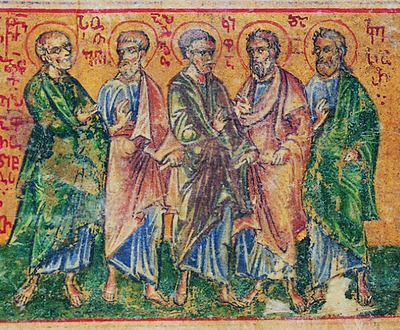
Epaphroditus,
Sosthenes, Apollos, Cephas et Caesar
Saint Sosthène
Disciple et compagnon de
Saint Paul (1er s.)
Disciple de
l'apôtre saint
Paul qui en fait mention dans sa lettre aux Corinthiens (1ère lettre
aux Corinthiens 1. 1 à 3). Dans le livre des Actes des Apôtres, on mentionne
aussi un chef de synagogue qui porte ce nom et qui a laissé parler Saint Paul,
et pour cela fut battu par les juifs de Corinthe.
"Alors, ils se
saisirent tous de Sosthène, le chef de la synagogue, et se mirent à le frapper
devant le tribunal, tandis que Gallion demeurait indifférent." (Ac - 18 :
17) - Bible
de la liturgie
Saint Sosthène et
les disciples de saint Paul : Apollos, Céphas, Tychique, César, Epaphrodite
furent des coopérateurs fidèles de l'Apôtre à Corinthe, Ephèse ou Philippes.
Nous les connaissons par les lettres de saint Paul et le livre des Actes des
Apôtres.
SOURCE : http://nominis.cef.fr/contenus/saint/143/Saint-Sosthene.html
SOSTHENE
Chef de la synagogue de
Corinthe. Les Juifs de Corinthe s'étant saisis de saint Paul, le menèrent au
tribunal de Gal-lion, et l'accusèrent de vouloir introduire parmi eux une
nouvelle manière d'adorer Dieu. Mais le proconsul les renvoya, disant qu'il
n'entrait point dans ces contestations, qui ne regardaient que leur loi. Alors
ils se saisirent de Sosthène chef-de la synagogue (Ac 17 :12,13), et
commencèrent à le battre devant son tribunal, sans que Gallion s'en mît en
peine. Voilà ce que porte le texte des Actes. On dispute si ce furent les Juifs
ou les gentils qui se saisirent de Sosthène, et qui le battirent. Le grec
imprimé des Actes porte que ce furent les gentils. Saint Augustin et Bède
lisaient de même. Ils croyaient que lus païens, ayant vu que Gallion avait mal
reçu les Juifs, voulurent, pour leur insulter encore davantage, maltraiter le
chef de leur synagogue, qui était à leur tête, soit qu'ils le fissent
simplement en haine des Juifs, ou par amitié pour saint Paul. Ce sentiment est
suivi par Cajetan, Lyran, Grotius et quelques autres.
D'autres croient que
Sosthène, tout chef de la synagogue qu'il était, pouvait être ami et disciple
secret de saint Paul, et que les Juifs, se voyant rebutés par Gallion,
déchargèrent leur mauvaise humeur sur Sosthène, chef de leur synagogue. Ceux-là
veulent aussi que ce soit le même Sosthène dont le nom se lit avec celui de
saint Paul à la tête de la première Epltre aux Corinthiens, écrite d'Ephèse
l'an 56 de l'ère vulgaire, trois ans après ce qui était arrivé à Corinthe. Il
faut pourtant avouer que ce sen- timent n'a pas toujours été commun dans
l'Eglise, puisque, du temps d'Eusèbe on croyait que Sosthène était un des
soixante et dix disciples; et par conséquent il n'était pas chef de la
synagogue de Corinthe vingt ans après la mort de Jésus-Christ. Les Grecs font
sa fête le 8 de décembre, et lui donnent le titre d'apôtre, comme à l'un des
septante disciples, et la qualité de premier évêque de Colophon. Les Latins
l'honoraient dès le neuvième siècle comme un disciple de saint Paul, le 11 de
juin et le 28 de novembre.
SOURCE : http://456-bible.123-bible.com/calmet/S/sosthene.htm
Première lettre de saint
Paul Apôtre aux Corinthiens
01 PAUL, APPELE par
la volonté de Dieu pour être apôtre du Christ Jésus, et Sosthène notre frère,
02 à l’Église de
Dieu qui est à Corinthe, à ceux qui ont été sanctifiés dans le Christ Jésus et
sont appelés à être saints avec tous ceux qui, en tout lieu, invoquent le nom
de notre Seigneur Jésus Christ, leur Seigneur et le nôtre.
03 À vous, la grâce
et la paix, de la part de Dieu notre Père et du Seigneur Jésus Christ.
04 Je ne cesse de
rendre grâce à Dieu à votre sujet, pour la grâce qu’il vous a donnée dans le
Christ Jésus ;
05 en lui vous avez
reçu toutes les richesses, toutes celles de la parole et de la connaissance de
Dieu.
06 Car le témoignage
rendu au Christ s’est établi fermement parmi vous.
07 Ainsi, aucun don
de grâce ne vous manque, à vous qui attendez de voir se révéler notre Seigneur
Jésus Christ.
08 C’est lui qui
vous fera tenir fermement jusqu’au bout, et vous serez sans reproche au jour de
notre Seigneur Jésus Christ.
09 Car Dieu est
fidèle, lui qui vous a appelés à vivre en communion avec son Fils, Jésus Christ
notre Seigneur.
10 Frères, je vous
exhorte au nom de notre Seigneur Jésus Christ : ayez tous un même
langage ; qu’il n’y ait pas de division entre vous, soyez en parfaite
harmonie de pensées et d’opinions.
11 Il m’a été
rapporté à votre sujet, mes frères, par les gens de chez Chloé, qu’il y a entre
vous des rivalités.
12 Je m’explique.
Chacun de vous prend parti en disant : « Moi, j’appartiens à
Paul », ou bien : « Moi, j’appartiens à Apollos », ou
bien : « Moi, j’appartiens à Pierre », ou bien :
« Moi, j’appartiens au Christ ».
13 Le Christ est-il
donc divisé ? Est-ce Paul qui a été crucifié pour vous ? Est-ce au
nom de Paul que vous avez été baptisés ?
14 Je remercie Dieu
de n’avoir baptisé aucun de vous, sauf Crispus et Gaïus :
15 ainsi on ne
pourra pas dire que vous avez été baptisés en mon nom.
16 En fait, j’ai
aussi baptisé Stéphanas et les gens de sa maison ; et je ne sais plus si
j’ai baptisé quelqu’un d’autre.
17 Le Christ, en effet,
ne m’a pas envoyé pour baptiser, mais pour annoncer l’Évangile, et cela sans
avoir recours au langage de la sagesse humaine, ce qui rendrait vaine la croix
du Christ.
18 Car le langage de
la croix est folie pour ceux qui vont à leur perte, mais pour ceux qui vont
vers leur salut, pour nous, il est puissance de Dieu.
19 L’Écriture dit en
effet : Je mènerai à sa perte la sagesse des sages, et l’intelligence des
intelligents, je la rejetterai.
20 Où est-il, le
sage ? Où est-il, le scribe ? Où est-il, le raisonneur
d’ici-bas ? La sagesse du monde, Dieu ne l’a-t-il pas rendue folle ?
21 Puisque, en
effet, par une disposition de la sagesse de Dieu, le monde, avec toute sa
sagesse, n’a pas su reconnaître Dieu, il a plu à Dieu de sauver les croyants
par cette folie qu’est la proclamation de l’Évangile.
22 Alors que les
Juifs réclament des signes miraculeux, et que les Grecs recherchent une
sagesse,
23 nous, nous
proclamons un Messie crucifié, scandale pour les Juifs, folie pour les nations
païennes.
24 Mais pour ceux
que Dieu appelle, qu’ils soient Juifs ou Grecs, ce Messie, ce Christ, est puissance
de Dieu et sagesse de Dieu.
25 Car ce qui est
folie de Dieu est plus sage que les hommes, et ce qui est faiblesse de Dieu est
plus fort que les hommes.
26 Frères, vous qui
avez été appelés par Dieu, regardez bien : parmi vous, il n’y a pas
beaucoup de sages aux yeux des hommes, ni de gens puissants ou de haute
naissance.
27 Au contraire, ce
qu’il y a de fou dans le monde, voilà ce que Dieu a choisi, pour couvrir de
confusion les sages ; ce qu’il y a de faible dans le monde, voilà ce que
Dieu a choisi, pour couvrir de confusion ce qui est fort ;
28 ce qui est
d’origine modeste, méprisé dans le monde, ce qui n’est pas, voilà ce que Dieu a
choisi, pour réduire à rien ce qui est ;
29 ainsi aucun être
de chair ne pourra s’enorgueillir devant Dieu.
30 C’est grâce à
Dieu, en effet, que vous êtes dans le Christ Jésus, lui qui est devenu pour
nous sagesse venant de Dieu, justice, sanctification, rédemption.
31 Ainsi, comme il
est écrit : Celui qui veut être fier, qu’il mette sa fierté dans le
Seigneur.
SOURCE : https://www.aelf.org/bible/1Co/1
Also
known as
Sosthenes of Corinth
Sostene…
9
December (Byzantine calendar)
30
March (Eastern calendar)
Profile
First
century leader of the synagogue at Corinth. Convert,
led to the faith by Saint Paul
the Apostle, and mentioned in the opening of the 1st Epistle to the
Corinthians. First bishop of
Colophon, Asia
Minor. Martyr.
Additional
Information
Book
of Saints, by the Monks of
Ramsgate
books
Our Sunday Visitor’s Encyclopedia of Saints
video
fonti
in italiano
websites
in nederlandse
nettsteder
i norsk
Readings
Paul, called to be an
apostle of Christ Jesus by the will of God, and Sosthenes our brother, to the
church of God that is in Corinth, to you who have been sanctified in Christ
Jesus, called to be holy, with all those everywhere who call upon the name of
our Lord Jesus Christ, their Lord and ours. – 1st Corinthians 1:1-2
MLA
Citation
‘Saint Sosthenes of
Colophon‘. CatholicSaints.Info. 30 September 2022. Web. 9 May 2026.
<https://catholicsaints.info/saint-sosthenes-of-colophon/>
SOURCE : https://catholicsaints.info/saint-sosthenes-of-colophon/
Article
(Saint) (November
28) (1st
century) The ruler of the synagogue of Corinth (Acts 18:17), who became a
disciple of Saint Paul,
and is probably the “brother” mentioned in 1 Corinthians 1:1. Some say that
Sosthenes was afterwards made a Bishop,
and that he ended his life by martyrdom.
MLA
Citation
Monks of Ramsgate.
“Sosthenes”. Book of Saints, 1921. CatholicSaints.Info.
19 November 2016. Web. 9 May 2026.
<https://catholicsaints.info/book-of-saints-sosthenes/>
SOURCE : https://catholicsaints.info/book-of-saints-sosthenes/
Sosthenes (RM)
1st century. Saint
Sosthenes was the ruler of the synagogue at Corinth (Acts 18:17), who was
converted by Paul (1 Corinthians 1:1). Greek tradition makes him the first
bishop of Colophon in Asia Minor (Benedictines, Encyclopedia).
SOURCE : http://www.saintpatrickdc.org/ss/1128.shtml
The Story
of Sosthenes
On June 28,
2023 By sheilaalewine
In 1 Corinthians 1:1 we are introduced to
Sosthenes, Paul’s companion and possibly his scribe in writing this first
letter to the believers at Corinth. It’s likely you’ve never heard of him, as
his name is only mentioned twice in the New Testament.
We first meet Sosthenes
in Acts 18. Paul has spent the last eighteen months teaching the word of God in
Corinth. When he first arrives, Crispus is the leader of the Jewish synagogue,
but soon becomes a believer. Sosthenes is appointed in his place.
Paul was a cause of
trouble for the Jews who attended synagogue and held to the old covenant laws,
just as Jesus was. They rejected Jesus as their Messiah and believed Paul’s
teaching to be blasphemous, and that Paul was a traitor to his Jewish roots and
faith. Yet he continued teaching and winning converts to the church, protected
by God’s Spirit.
Acts 18:9-10 – And
the Lord said to Paul in the night by a vision, “Do not be afraid any longer;
but go on speaking and do not be silent; for I am with you, and no man will
attack you in order to harm you, for I have many people in this city.”
After a year and a half,
the Jews assembled in agreement and brought Paul to the Gentile court of the
proconsul, Gallio, accusing him of persuading men to worship God contrary to
the law. Gallio, however, isn’t to be bothered with their religious issues and
dismisses the case. For a reason that isn’t clear, Sosthenes suffers because of
this decision. Scripture says, “they all” took hold of Sosthenes and began
beating him in front of the judgment seat.
Either the Jews were
angry that Sosthenes had been unsuccessful in the attempt to bring a solid case
against Paul and had allowed him to continue teaching, or the Greeks were angry
that the Jews were wasting their time in court. At any rate, Sosthenes bears
the brunt of the anger against Paul. After remaining many days longer, Paul
finally leaves town.
I believe something
happened in Sosthenes’ heart in those “remaining many days” of Paul’s ministry
in Corinth. Confused and rejected, perhaps he sought out Paul to make sense of
his Jewish brothers’ anger against the gospel Paul preached. Two years after
this event, we find him traveling with Paul, helping to deliver the message of
salvation and hope to his people.
1 Corinthians 1:1 – Paul,
called as an apostle of Jesus Christ by the will of God, and Sosthenes our
brother.
Here’s an interesting
tidbit. The name “Sosthenes” is a combination of two Greek words: sōzō meaning
“to save,” and sthenoō, meaning “to strengthen or make strong.”
Imagine how Sosthenes felt as he transcribed the words of Paul’s
letter: But by His doing you are in Christ Jesus, who became to us wisdom
from God, and righteousness and sanctification, and redemption (1:30).
By His doing…by
God’s doing. Sosthenes was one of God’s “many people in this city,” although at
the time God gave that vision to Paul, he had not yet come to faith. God
allowed him to experience a difficult trial to strengthen him for salvation. He
was an unlikely convert, a leader in the Jewish synagogue, but God had other plans
for him.
Scripture only gives us
the barest details of the life of Sosthenes. We see where he began and where he
ended, but we will have to wait to talk to him in heaven to hear his full
story. How encouraging, though, to see another example of how God is in the
business of transforming lives, even, and especially, through the most
difficult circumstances.
Sosthenes’ story is also
an encouragement to all of God’s people who may be tempted to stop speaking the
gospel when it becomes difficult. What if Paul had decided the risk was too
great, or the circumstances too difficult, and walked away from his mission? I
believe God would still have saved Sosthenes, but Paul would have forfeited the
opportunity to be part of his journey and enjoy his help and friendship as they
served together.
Aren’t you glad that it
is only “by His doing” we are in Christ?
Two takeaways. For those
who are still seeking the Savior, let your difficult circumstances drive you
toward Jesus, not away from Him. He wants to transform your life into something
amazing for your good and His glory. And for those who already are in the
family, may we serve faithfully like Paul, as God gives us the privilege to
proclaim the gospel that is still saving His people today.
SOURCE : https://sheilaalewine.com/2023/06/28/the-story-of-sosthenes/
Saint of the Day – 28
November – St Sosthenes (1st Century) Bishop
Posted on November
28, 2023
Saint of the Day – 28
November – St Sosthenes (1st Century) the first Bishop of Colophon, Asia Minor,
probably a Martyr, Jewish Ruler in Corinth, converted by St Paul and became his
disciple, who is mentioned by him in his First Epistle to the Corinthians (1
Corinthians 1:1–2) and by St Luke in Acts 18:12–17. Also known as – Sosthenes of Corinth, Sosthenes of Colophon, Sostene…
The Roman Martyrology
reads: “At Corinth, the birthday of St Sosthenes, fisciple of the blessed
Apostle Paul, who is mentioned by that Apostle in his first Epistle to the
Corinthians. He was chief of the synagogue when converted to Christ and, as a
glorious beginning, consecrated the first fruits of his faith by being scourged
in the presence of the Proconsul, Gallio.”
During the long stay of
the Apostle St Paul in Corinth, an event occurred which was not only
sensational but, at least for us, difficult to explain, although reported with
the usual clarity by St Luke, the Chronicler of the Acts of the Apostles:
“Gallio, being then Proconsul of Achaia (i.e. of the region in which Corinth was located) – we read – “the Jews, all in agreement, rose up against Paul and took him to the Tribunal, saying:
‘This man persuades the people to give God a cult, contrary to the law.’
And as Paul was there ready to speak, Gallio said to the Jews:
‘If it were a question of some crime, of some serious misdeed, I, Jews, would listen to you as reason dictates but, since it is a question of questions of words and names and they belong to your law, think about it – I do not want to be judge of these things!’ And he sent them away from the court.
They all then took Sosthenes, the Ruler of the Synagogue and beat him before
the tribunal and Gallio did not care at all. ”
The first part of the
episode is quite clear – the Roman Proconsul, in a City which, after all, was
in Greece and not in Palestine, cleverly refuses to be the judge of a doctrinal
question which interests and concerns, only a minority of his subjects.
It is, again, the tactic
of washing one’s hands, adopted by Pilate towards Jesus, with the difference
that Corinth was not Jerusalem and, therefore, the “abstaining, so to speak, of
the Roman Governor, saves Paul from accusations and threats of his enemies,
without the Apostle even opening his mouth.
Except, here’s the unexpected fact – instead of Paul, his accusers, in that same Court, take and beat our Saint Sosthenes, who had nothing to do with Paul and who was, indeed, the Ruler of the local Synagogue.
Why did this happen? Why was Sosthenes beaten instead of Paul? Scholars have
failed to give a convincing answer to this question. Probably, the head of the
Synagogue was the one who had incited his fellow Jews to demonstrate against
Pau, and the Jews released their fury upon him when they saw that their entire
design to attach St Paul had been destroyed by the Governor.
According to some,
however, the resentment of the Jews related to the fact that Sosthenes’
converssion by St Paul had alreay taken place and was known by his fellow Jews.
But the Acts do not
mention the conversion of Sosthenes, Ruler of the Synagogue of Corinth. Shortly
afterwards, however, his name appears again in the address of the letter twhich
St Paul wrote from Ephesus to the restless Christians of Corinth and, of which,
Sosthenes seems to have been the bearer.
“Paul, called to be an
Apostle of Jesus Christ by the will of God and Sosthenes, a brother, To the
Church of God which is at Corinth, to them that are sanctified in Christ Jesus,
called to be saints, with all that invoke the name of our Lord Jesus Christ, in
every place of theirs and ours.” – 1 Corinthians 1:1-2
It was so natural to
think that the ancient leader of the Synagogue, beaten by his fellow believers,
was actually converted by Saint Paul, becoming his disciple, responsible for
maintaining contacts between the Apostle and the community of Corinth, where he
was well known and respected.
This hypothesis, is
probable but not certain, was accepted by the compilers of the Martyrologies,
who today remember Sosthenes among the Saints, as a disciple of Saint Paul and
former Ruler of the Synagogue of Corinth. With the beatings before the
tribunal, he would have “consecrated the first fruits of his faith with a
glorious beginning”, and then matured that faith as Bishop of Colophonia, in
Asia Minor. But this is traditional understanding which no historical testimony
is completely able to confirm.
Author: AnaStpaul
Passionate Catholic.
Being a Catholic is a way of life - a love affair "Religion must be like
the air we breathe..."- St John Bosco Prayer is what the world needs
combined with the example of our lives which testify to the Light of Christ.
This site, which is now using the Traditional Calendar, will mainly concentrate
on Daily Prayers, Novenas and the Memorials and Feast Days of our friends in
Heaven, the Saints who went before us and the great blessings the Church
provides in our Catholic Monthly Devotions. This Site is placed under the
Patronage of my many favourite Saints and especially, St Paul. "For the
Saints are sent to us by God as so many sermons. We do not use them, it is they
who move us and lead us, to where we had not expected to go.” Charles Cardinal
Journet (1891-1975) This site adheres to the pre-Vatican II Catholic Church and
all her teachings. . PLEASE ADVISE ME OF ANY GLARING TYPOS etc - In June 2021 I
lost 100% sight in my left eye and sometimes miss errors. Thank you and I pray
all those who visit here will be abundantly blessed. Pax et bonum! View All Posts
SOURCE : https://anastpaul.com/2023/11/28/saint-of-the-day-28-november-st-sosthenes-1st-century-bishop/
Apostle Sosthenes of the
Seventy
Commemorated on March 30
The Holy Apostles
Sosthenes was head of the Corinthian synagogue before his conversion. The
Apostle Paul converted him to Christianity and made him his helper in his work.
In addressing the Corinthian church, Saint Paul sent greetings from both of
them: “Paul, by the will of God called to be an apostle of Jesus Christ, and
brother Sosthenes...” (1 Cor.1:1). Afterwards, Saint Sosthenes was made bishop
at Colophon (Asia Minor).
Saint Sosthenes is also
commemorated on December 8 and the Synaxis of the Seventy Apostles on January
4.
SOURCE : https://www.oca.org/saints/lives/2047/03/30/100946-apostle-sosthenes-of-the-seventy
San Sostene Discepolo di Paolo
Sec. I
Durante la lunga permanenza dell'Apostolo San Paolo a Corinto avvenne un fatto non soltanto clamoroso ma, almeno per noi, difficilmente spiegabile, per quanto riferito con la consueta chiarezza da San Luca, il cronista degli Atti degli Apostoli.
" Essendo poi Gallione proconsole dell'Acaia (cioè della regione nella quale si trovava Corinto) - vi si legge - i Giudei tutti d'accordo insorsero contro Paolo e lo portarono in Tribunale, dicendo: "Costui persuade la gente a rendere a Dio un culto contrario alla legge". " E come Paolo era lì pronto a parlare, Gallione disse ai Giudei: "Se si trattasse di qualche delitto, di qualche grave misfatto, io, Giudei, vi darei ascolto come ragion vuole; ma poiché si tratta di questioni di parole e di nomi, e appartengono alla vostra legge, pensateci voi: io non voglio farmi giudice di queste cose". E li mandò via dal tribunale.
" Tutti allora presero Sostene, capo della Sinagoga, e lo percossero dinanzi al tribunale; e Gallione non se ne curava affatto ".
La prima parte dell'episodio è abbastanza chiara: il proconsole romano, in una città che, dopo tutto, si trovava in Grecia e non in Palestina, rifiuta abilmente di farsi giudice di una questione dottrinale che interessa e riguarda soltanto una minoranza dei suoi amministrati. E’, di nuovo, la tattica del lavarsene le mani, adottata da Pilato nei confronti di Gesù, con la differenza che Corinto non era Gerusalemme, e quindi F" astensionismo ", diciamo così, del governatore romano salva Paolo dalle accuse e dalle minacce dei suoi nemici, senza che l'Apostolo apra neanche bocca.
Se non che, ecco il fatto inaspettato: al posto di Paolo, i suoi accusatori, in quello stesso tribunale, prendono e percuotono Sostene, che non aveva nulla a che fare con Paolo, e che era, anzi, il capo della Sinagoga locale.
Perché accadde questo? Perché venne malmenato Sostene, al posto di Paolo? Gli studiosi non sono riusciti a dare una risposta convincente a questa domanda. Probabilmente, il capo della Sinagoga era colui che aveva sobillato i correligionari a manifestare contro Paolo, e i Giudei se la rifecero con lui quando videro che tutta la loro manovra era andata in fumo. Secondo alcuni, però, il risentimento dei Giudei " estremisti " avrebbe avuto un'altra origine: Sostene, cioè, sarebbe stato convertito da San Paolo, passando in campo nemico, così da essere punito per il suo tradimento.
Della conversione di Sostene, capo della Sinagoga di Corinto, gli Atti non fanno parola. Poco dopo, però, il suo nome appare di nuovo nell'indirizzo della lettera che, da Efeso, San Paolo scrisse proprio agli irrequieti cristiani di Corinto, e di cui Sostene sembra essere stato il latore.
E’ stato così naturale pensare che l'antico capo della Sinagoga, percosso dai compagni di fede, sia stato effettivamente convertito da San Paolo, diventando suo discepolo, incaricato di tenere i contatti tra l'Apostolo e la comunità di Corinto, dove era ben noto e stimato.
Questa ipotesi, probabile ma non certa, è stata accolta dai compilatori dei
Martirologi, i quali oggi ricordano Sostene tra i Santi, come discepolo di San
Paolo ed ex-capo della Sinagoga di Corinto. Con le percosse davanti al
tribunale, egli avrebbe " consacrato con un glorioso inizio le primizie
della propria fede ", per poi maturare quella sua fede come Vescovo di
Colofonia, in Asia Minore. Ma questa è notizia tradizionale, che nessuna
testimonianza storica conferma.
Fonte : Archivio
Parrochia
SOURCE : http://www.santiebeati.it/dettaglio/90452
Den hellige Sostenes av
Kolofon (1. årh)
Minnedag:
28. november
Den hellige Sostenes
(Sosthenes) var synagogeforstander i Korint.
«Mens Gallio var guvernør
i Akaia, slo jødene seg sammen mot Paulus og trakk ham for retten. 'Denne
mannen,' sa de, 'overtaler folk til å dyrke Gud på en måte som er i strid med
loven.' Paulus skulle nettopp til å gripe ordet da Gallio sa til jødene: 'Hadde
det dreid seg om en forbrytelse eller en kjeltringstrek, da hadde jeg grunn til
å høre tålmodig på dere, jøder. Men er det strid om lære og om navn og deres
egen lov, da får dere selv ordne opp. Jeg vil ikke dømme i slike saker.' Så
jaget han dem bort fra retten. Alle grep da fatt i synagogeforstanderen
Sostenes og julte ham opp like foran dommersetet. Men Gallio brydde seg ikke
det minste om det» (Apg 18,12-17).
Det står ikke noe om
motivet for angrepet på Sostenes, og det nevnes heller ikke om han ble jult opp
av romere eller grekere.
Noen identifiserer ham
med den Sostenes den hellige apostelen Paulus kaller
«vår bror»: «Paulus, som etter Guds vilje er kalt til Jesu Kristi apostel, og
vår bror Sostenes hilser Guds menighet i Korint» (1.Kor 1,1-2), men det er ikke
klart om dette er riktig.
En tradisjon sier at han
ble biskop av Caesarea og ble etterfulgt av den hellige Tykikos. Han
står som nr. 55 på biskop Dorotheus av Tyrus liste over «Jesu Sytti disipler»
i henhold til Den ortodokse kirkes tradisjon. Der sies det at han ble biskop av
Kolofon (Colophon) og ble etterfulgt av Tykikos i det setet. Kolofon var en av
de tolv ioniske byer i Lilleasia, mellom Lebedos (ruiner nær Hypsili-Hissar) og
Efesos (Aya-Solouk).
Hans minnedag er 28.
november, men 30. mars (øst) eller 29. mars, 11. juni og 8. desember (vest)
nevnes også.
Kilder:
Benedictines, Bunson, KIR, Patron Saints SQPN, Infocatho, Bautz,
santiebeati.it, en.wikipedia.org - Kompilasjon og oversettelse: p. Per Einar Odden -
Sist oppdatert: 2006-08-12 10:20
SOURCE : https://www.katolsk.no/biografier/historisk/sostenes
Sosthenes (ook Sostenes) van
Korinte (ook Apostel), Colofon, Klein-Azië; apostel &
bisschop; † eerste eeuw.
Feest 4 januari
(oosterse kerken: synaxis) & 30 maart (oosterse kerken) & 28
november & 9 december (byzantijnse kerk).
Hij was een leerling en
metgezel van Paulus. Deze noemt hem in de aanhef van zijn eerste brief aan de
Korintiërs (1 Kor. 01,01). Volgens de overlevering behoorde hij tot de
(tweeën)zeventig.
Vanouds gaat men ervan
uit dat hij het hoofd was van de synagoge, over wie verteld wordt in het boek
van de Handelingen van de Apostelen: 'Onder het proconsulaat van Gallio in
Achaje keerden de joden zich als één man tegen Paulus en brachten hem voor de
rechtbank. Zij verklaarden: "Deze man tracht de mensen over te halen tot
onwettige godsverering." Paulus wilde juist iets zeggen, toen Gallio de
joden antwoordde: "Als het ging over een of ander onrecht of ernstig
misdrijf, joden, zou ik u vanzelfsprekend geduldig aanhoren. Maar zijn het
twisten over een woord, over de namen of over die Wet van u, dan moet u zelf
maar zien. Daarover wil ik geen rechter zijn." Hij joeg ze van zijn
rechterstoel weg. Nu wierpen allen zich op Sostenes, de overste van de
synagoge, en gaven hem voor de rechterstoel een pak slaag. Gallio trok er zich
niets van aan'
[Handelingen 18,12-17]
Sosthenes zou dan enige
tijd nadien overgegaan zijn naar de volgelingen van Jezus en zich bij Paulus
hebben aangesloten. Later zou hij bisschop geworden zijn van de
Klein-Aziatische plaats Colofon.
[101a; 102; 141»10.04»synaxis.03.30; 407; 500; Dries van den Akker
s.j./2007.11.15]
© A. van den Akker
s.j. / A.W. Gerritsen
SOURCE : https://www.heiligen-3s.nl/heiligen/11/28/11-28-0100-sosthenes.php