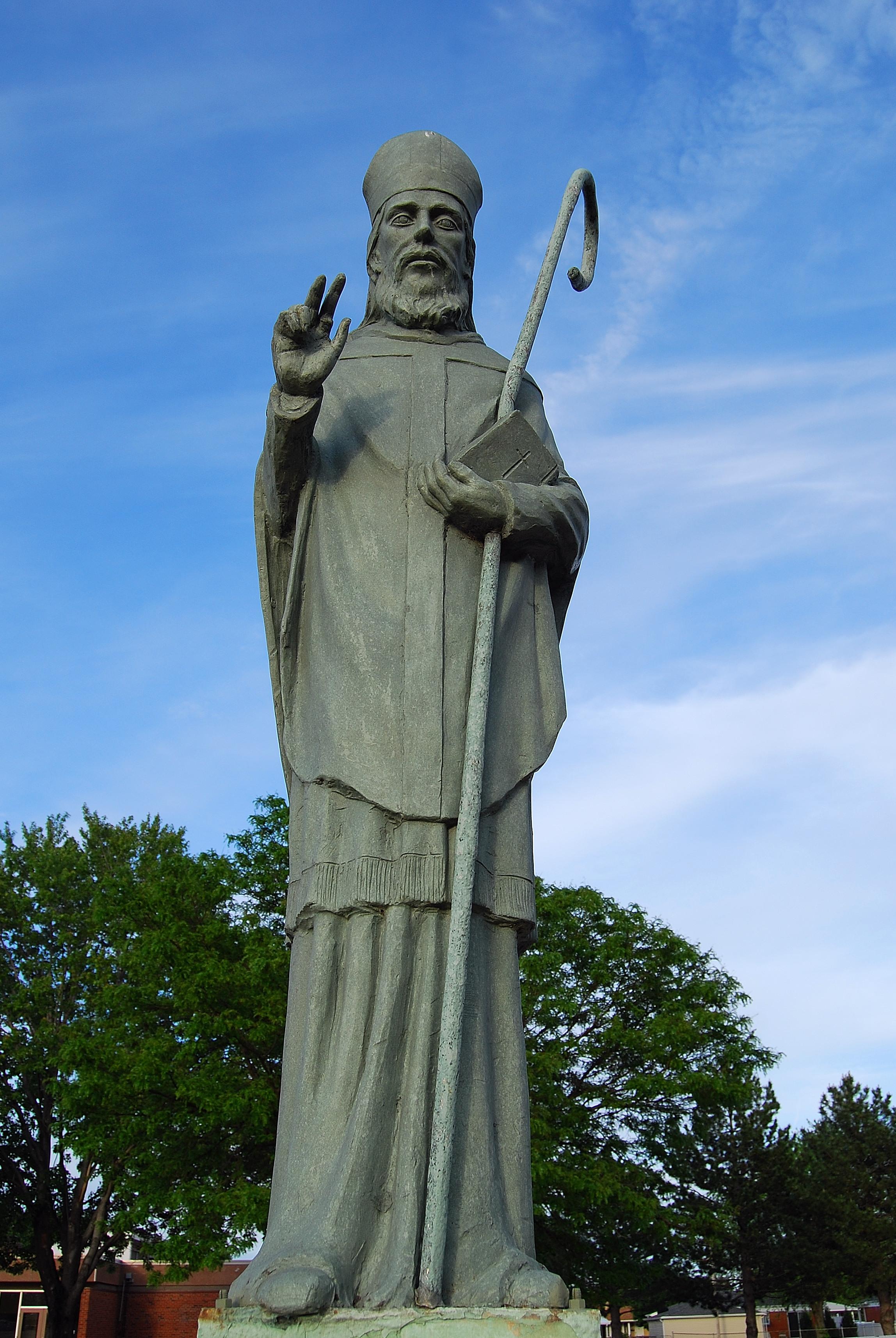
Saint Malachie d'Armagh
Archevêque en
Irlande (+ 1148)
Il est surtout connu en
raison des prophéties sur les papes dont il aurait été l'auteur et qui ne sont,
en fait, que la fabrication d'un faussaire qui utilisa son patronyme.
Le véritable Malachie est
tout autre. Il est né à Armagh en Irlande vers 1094. Il entra dans la vie
monastique et restaura l'abbaye de Bangor que les Vikings avaient détruite.
Choisi comme évêque d'Armagh, il eut beaucoup à souffrir des seigneurs qui
tentèrent de l'assassiner. Ami de saint
Bernard de Clairvaux, il se rendit à Rome en 1139 pour demander au
pape de lui ôter sa charge et d'aller vivre à Clairvaux.
La réponse fut directe :
nommé légat pontifical pour l'Irlande, il devenait ainsi chef de l'Eglise de ce
pays et c'est là qu'il donna toute sa mesure en en faisant l'un des plus
religieux de la chrétienté.
En 1148, il reprend le
chemin de Rome, tombe malade à Clairvaux. Saint Bernard lui-même l'accompagnera
jusqu'à son dernier soupir.
Au monastère de Clairvaux
en Bourgogne, l’an 1148, la mise au tombeau de saint Malachie, évêque. Depuis
l’abbaye de Bangor qu’il restaura, il dirigea le diocèse de Connor, mettant en
œuvre le programme de réforme grégorienne. Archevêque d’Armagh, il se heurta
aux traditions insulaires et ne put tenir ce siège; il retourna à son diocèse
de Connor, qu’il divisa en deux, se réservant le nouveau siège de Down. Alors
qu’il se dirigeait vers Rome, il mourut à Clairvaux en présence de saint
Bernard.
Martyrologe romain
SOURCE : https://nominis.cef.fr/contenus/saint/40/Saint-Malachie-d-Armagh.html

Lucien-Leopold Lobin (1837–1892), Saint
Malachy, Sligo Cathedral of the
Immaculate Conception, County Sligo, Ireland, 7th stained
glasswindow in the ambulatory (counting from left to right, beginning from
the west transept), depicting
MALACHIE D’ARMAGH
Archevêque, Saint
† 1148
La décadence des mœurs,
et la confusion occasionnée par des guerres continuelles, avaient presque
entièrement éteint en Irlande l'esprit de religion et de piété. On y était
retombé dans la barbarie et dans les vices grossiers qui ont coutume d'en être
la suite. Ce fut alors que Dieu fit naître Malachie, qu'il destinait à
rétablir, en quelque sorte, cette église dans son ancienne splendeur. Quelques
auteurs irlandais lui donnent le surnom d'O'Morgair. Il eut Armagh
pour patrie. Ses parents étaient d'une naissance illustre, et en même temps
fort vertueux. Sa mère surtout prit un soin extrême de l'élever dans la crainte
du Seigneur. Lorsqu'il fut capable d'instruction, on le mit sous la conduite de
maîtres recommandables par leur piété. Il étudia la grammaire à Armagh. Sa
mère, qui ne le perdait point de vue, ne cessait de lui inspirer les plus vifs
sentiments de religion ; et ces sentiments se gravèrent dès-lors si
profondément dans l'âme du jeune Malachie, qu'ils ne s'effacèrent plus dans la
suite. Il était doux, humble, docile, modeste, fidèle à ses devoirs, porté à
servir tous ceux avec lesquels il avait à vivre. On admirait sa tempérance, son
amour pour la mortification, son éloignement pour tout ce qui faisait
l'amusement de l'enfance ; en sorte que, comme il surpassait ses condisciples
par ses progrès, il l'emportait en vertu sur ses maîtres mêmes.
Pendant le cours de ses
études, il évitait tout ce qui aurait pu se ressentir de l'affectation ;
ses pratiques extraordinaires de pénitence n'étaient connues que de Dieu ; par
là il évitait encore le danger de la vaine gloire. Il ne restait point à l'église
aussi longtemps qu'il l'aurait désiré ; il se retirait dans des lieux écartés
pour prier ; et s'il lui arrivait de se livrer en priant à l'impétuosité de son
zèle, il prenait garde qu'on ne l'aperçût. Dans les promenades qu'il faisait
avec les jeunes gens de son âge, il se laissait un peu devancer par eux, afin
d'avoir la liberté de s'unir à Dieu par des aspirations vives et enflammées.
Mais résolu d'apprendre
le grand art de mourir à lui-même, et de se consacrer entièrement au service de
Dieu, il se mit sous la conduite d'Imar, ou Imarius, qui menait la vie d'un
reclus dans une cellule voisine de l'église d'Armagh, et qui avait une grande
réputation de sainteté. Cette démarche de la part d'un jeune homme de qualité,
étonna toute la ville ; plusieurs en firent le sujet de leurs railleries ;
d'autres l'attribuèrent à la mélancolie, ou du moins à la légèreté. Les amis du
Saint en ressentirent une vive douleur, et lui en firent des reproches amers.
Ils ne pouvaient s'imaginer qu'avec une constitution si délicate, et des
espérances si bien fondées de réussir dans le monde, il prit le parti
d'embrasser un genre de vie, dont la pensée seule les effrayait, et qui
d'ailleurs leur paraissait vil et méprisable. Malachie ne fut point ému de tout
ce que dirent les censeurs de sa conduite. Il dut à sa douceur et à son
humilité la victoire qu'il remporta sur le monde et sur lui-même. Pour se
rendre digne d'aimer Dieu parfaitement, il se condamna, selon la remarque de
saint Bernard, à vivre, pour ainsi dire, dans un tombeau ; il se soumit à la
règle d'un homme, bien différent de ceux qui veulent enseigner ce qu'ils n'ont
jamais appris, et qui cherchent à se faire des disciples avant d'avoir eu des
maîtres.
La docilité de Malachie,
son amour pour le silence, sa ferveur dans la prière, son zèle pour les
pratiques de la mortification, annoncèrent ses progrès dans la perfection. Il
devint infiniment cher à son maître, et il édifia tous ceux qui avaient d'abord
condamné sa conduite ; les railleries se changèrent bientôt en admiration.
Plusieurs même, touchés de ses exemples, embrassèrent le genre de vie qu'il
avait choisi. Imar consentit à recevoir les plus fervents d'entre eux, et peu à
peu il se forma une communauté. Malachie était le modèle de tous, quoiqu'il
s'en regardât comme le dernier, et qu'il se jugeât indigne d'habiter parmi ces
serviteurs de Dieu. Avec de pareilles dispositions, il ne pouvait manquer de
parvenir à un degré sublime de perfection.
Imar, son supérieur, et
Celse ou Ceillach, archevêque d'Armagh, crurent que la gloire de Dieu exigeait
qu'il reçût les saints ordres. Ainsi, sans avoir égard à sa résistance, Celse
l'ordonna diacre, et prêtre peu de temps après. Il n'avait que vingt-cinq ans,
lorsqu'on lui conféra la prêtrise, quoiqu'il fallût alors en avoir trente,
suivant les canons : mais on trouva dans son mérite extraordinaire une juste
cause de le dispenser de la règle générale. L'archevêque l'établit en même
temps son vicaire pour prêcher la parole de Dieu au peuple, et il le chargea de
travailler à déraciner les abus invétérés qui avaient horriblement défiguré la
face de l'église d'Irlande. Malachie remplit la commission dont il était
chargé, avec autant de zèle que de succès; les vices furent corrigés, les
coutumes barbares détruites, les superstitions bannies, et l'on vit revivre
partout la_ pratique des vraies maximes de l'Evangile. C'était comme une flamme
au milieu des forêts, qui cause un incendie auquel rien ne résiste. Il fit
plusieurs règlements pour l'observation de la discipline ecclésiastique ; il rétablit
dans toutes les églises du diocèse l'office canonial, qui avait été interrompu,
même dans les villes, depuis les invasions des Danois ; et il y réussit
d'autant plus facilement, qu'il avait bien appris dès sa jeunesse le chant
ecclésiastique. Mais ce qui était encore d'une plus grande importance, il
rétablit l'usage des sacrements, et surtout celui de la pénitence et de la
confirmation, qui depuis longtemps étaient fort négligés. Il prit aussi des
mesures pour qu'à l'avenir les mariages fussent célébrés selon les règles de
l'Eglise.
Le serviteur de Dieu
craignit cependant de n'être point assez versé dans la connaissance des saints
canons, pour exécuter le projet de réforme qu'il avait formé relativement à la
discipline ; et cette crainte lui donnait souvent des inquiétudes. Il obtint
donc de son évêque la permission d'aller passer quelque temps auprès de
Malachie, évêque de Lismore. Ce prélat, Anglais de naissance, avait été moine
de Winchester ; il était également renommé pour son savoir et sa sainteté, et
on le regardait comme l'oracle de toute l'Irlande. Il reçut Malachie avec
bonté, et l'instruisit de tout ce qui concernait le service divin et la
conduite des âmes. Il le pria en même temps de ne pas priver l'église de
Lismore des avantages qu'elle recevait de son ministère.
L'Irlande était alors
divisée en plusieurs petits royaumes. Cormac, Roi de Munster, fut détrôné par
son frère pendant le séjour de notre Saint à Lismore. Dans son malheur, il eut
recours à Malachie, non dans l'intention de recouvrer la couronne, mais pour
apprendre de lui les moyens de sauver son âme. La nouvelle de son arrivée à
Lismore s'étant répandue, l'évêque se prépara à le recevoir avec les honneurs
dus à la Majesté royale ; mais le prince ne voulut point y consentir ; il
déclara qu'il renonçait pour toujours aux pompes mondaines ; qu'il demandait à
vivre parmi les chanoines, et à s'assurer par la pénitence, la possession d'un
royaume éternel. Malachie, après l'avoir instruit des conditions qu'exigeait le
sacrifice qu'il avait projeté, lui assigna une demeure, et lui donna Malachie
pour maître ; du pain et de l'eau devaient faire sa nourriture. Cormac, animé
par les exhortations de notre "Saint, goûta les douceurs qu'on trouve dans
le service de Dieu ; la corn ponction dont son cœur était brisé, lui
fournissait une source de larmes par lesquelles il purifiait continuellement
son âme ; il répétait sans cesse comme David, et avec de vifs sentiments de
douleur et de confiance : Voyez, Seigneur, ma bassesse et ma misère, et
pardonnez-moi toutes mes offenses. Ses prières furent exaucées au-delà de
ce qu'il demandait. Il reçut les avantages temporels avec les dons de la grâce.
En effet, un Roi voisin, indigné qu'on eût outragé dans sa personne la Majesté
royale, entreprit de le remettre sur le trône. Il vint le chercher dans sa
cellule; mais il ne put l'engager à entrer dans ses vues. Voyant qu'il ne
pouvait le toucher par son propre intérêt, il fit valoir les motifs tirés de la
religion et de la justice qu'un Roi doit à ses sujets. Ses efforts furent
encore inutiles. Malchi et Malachie se joignirent à lui, et représentèrent
fortement à Cormac, que la volonté de Dieu était qu'il ne résistât pas plus
longtemps. Il se rendit donc, et remonta sur le trône dont il avait été
dépouillé. Il conserva pour Malachie une affection qui ne se démentit jamais,
et il l'honora toujours comme son père.
Peu de temps après, Celse
et Imar rappelèrent Malachie à Armagh. L'abbaye de Bangor[1],
située dans le comté de Down, était alors dans un état déplorable ; les revenus
en étaient possédés par un oncle du Saint, jusqu'à ce qu'il fût possible de la
rétablir. L’oncle, après l'avoir résignée à son neveu, afin qu'il pût y faire
revivre l'observation de la règle, s'y retira lui-même, et voulut se mettre
sous la conduite de Malachie. Bangor prit bientôt une nouvelle forme. Cette
maison, quoique moins nombreuse qu'elle ne l'avait été autrefois, devint une
école célèbre de savoir et de piété. Le serviteur de Dieu la gouverna quelque
temps, et pour nous servir des termes de saint Bernard, il y fut, par sa
conduite, une règle vivante, un miroir qui réfléchissait toutes les vertus, un
livre ouvert où tous pouvaient apprendre les vraies maximes de la perfection
monastique. Les austérités de la communauté ne suffisaient point à sa ferveur;
il en pratiquait de particulières, dont il dérobait la connaissance, autant
qu'il lui était possible. Plusieurs guérisons miraculeuses ajoutèrent un nouvel
éclat à la réputation de sainteté dont il jouissait. Mais sa vie, dit saint
Bernard, fut le plus grand de ses miracles. Nous rapporterons le fait suivant,
d'après le même Père.
Malachie avait une sœur
qui mourut après avoir mené une vie mondaine. Pendant longtemps il recommanda
son âme à Dieu dans la célébration du saint Sacrifice. Ayant cessé de le faire
l'espace de trente jours, il fut averti en songe que sa sœur attendait dans le
cimetière avec douleur, et qu'elle avait été trente jours sans nourriture
spirituelle. Il reprit l'usage de prier pour sa sœur, et dit, ou fit dire tous
les jours la messe à son intention. Quelque temps après, il lui sembla la voir
à la porte de l'église, puis dans l'église même. Enfin, au bout de quelques jours,
lorsqu'il était à l'autel, elle lui apparut dans la joie, au milieu d'une
troupe d'esprits bienheureux; ce qui lui donna une grande consolation.
A peine eut-il atteint sa
trentième année, qu'on l'élut évêque de Connor, aujourd'hui dans le comté
d'Antrim. Il refusa d'acquiescer à son élection ; mais Celse et Imar lui
ordonnèrent de ne point écouter ses répugnances, et de se soumettre; ce qu'il
fit par obéissance. Les peuples confiés à son zèle étaient de vrais barbares,
souillés de vices grossiers, et qui n'étaient chrétiens que de nom. Il les
instruisit, et leur parla avec une douceur mêlée de sévérité. Quand ils ne
venaient point à l'église, il allait les chercher, et les exhortait avec une
bonté paternelle, et souvent avec larmes, à rentrer en eux-mêmes. Il offrait à
Dieu pour eux le sacrifice d'un cœur contrit et humilié; quelquefois il passait
les nuits en prières pour obtenir leur conversion. Il visitait les lieux les
plus écartés de son diocèse, voyageant toujours à pied, et il supportait avec
une patience admirable les affronts et les maux qu'il avait à endurer.
Insensiblement les cœurs les plus endurcis se laissèrent toucher. Le saint et
le fréquent usage des sacrements fut rétabli ; des pasteurs zélés que le Saint
s'associa, bannirent l'ignorance et la superstition. On vit refleurir la piété
de toute part. On regarda comme miraculeuse la conversion d'une femme tellement
sujette à la colère, qu'elle était insupportable à tous ceux qui
l'approchaient. Malachie, au rapport de saint Bernard, en fit la plus douce et
la plus patiente de toutes les personnes de son sexe, en lui ordonnant, au nom
de Jésus-Christ, de ne plus s'abandonner au même vice, et en lui imposant une
pénitence proportionnée aux fautes qu'elle lui avait déclarées en confession.
Depuis ce temps-là, rien ne fut capable de troubler la tranquillité de son âme.
Quelques années après, la
ville de Connor fut prise et saccagée par le Roi d'Ulster. Malachie, accompagné
de cent vingt de ses disciples, se retira dans celle de Munster. Il y bâtit le
monastère d’Ibrac, que les uns mettent auprès de Corck, et les autres dans
l'île de Begerin, où Imar fit d'abord sa résidence. Tandis qu'il gouvernait sa
communauté en paix, et qu'il en était l'édification par sa ferveur et son
humilité, Celse, archevêque d’Armagh, fut attaqué de la maladie dont il mourut.
Il désigna Malachie pour son successeur, et conjura tous ceux qui étaient
auprès de lui, au nom de saint Patrice, fondateur du siège d’Armagh, de
concourir efficacement à cette promotion, et d'écarter tout intrus. Il ne se
contenta point d'une simple déclaration verbale, il écrivit encore à ce sujet
aux personnes les plus puissantes du pays, notamment aux Rois du haut et du bas
Munster. Par-là il voulait abolir un abus scandaleux qui avait été une source de
désordres dans les églises d'Irlande. Eu effet, la famille de Ceise, une des
plus distinguées du diocèse, était en possession, depuis deux cents ans, de
s'emparer de l'archevêché d'Armagh, qu'elle regardait comme son héritage. Cet
abus était allé si loin, qu'au défaut d’ecclésiastiques, on en confiait
l'administration à des laïques, quelquefois à des personnes mariées de la même
famille. Ces intrus jouissaient des revenus du siège, et traitaient en vrais
tyrans les autres évêques de l'île.
Après la mort de Celse,
on suivit ses intentions, qu'il avait si visiblement manifestées ; Malachie fut
élu canoniquement pour lui succéder. Maurice, qui était de la famille de Celse,
n'eut aucun égard à cette élection, et prit possession de l'archevêché. Notre
Saint ne voulut point faire valoir la légitimité de son droit, alléguant pour
raison qu'il craignait les suites d'une démarche qui ne manquerait pas
d'exciter des troubles , et de faire peut-être répandre du sang. Trois ans se
passèrent de la sorte. Enfin Malachie, évêque de Lismore, et Gilbert, évêque de
Limerick, lequel était légat du Pape en Irlande, assemblèrent les prélats et
les grands de l’île, pour remédier au scandale. On pressa Malachie de venir au
secours du siège dont le gouvernement lui avait été confié, et on le menaça de
l'excommunier s'il refusait plus longtemps de se rendre. Il se soumit donc, en
disant toutefois à ceux qui composaient l'assemblée : « Vous voulez ma
mort, j'obéis dans l'espérance du martyre ; mais c'est à condition que si les
choses tournent comme vous le désirez, j'aurai la permission, lorsque l'ordre
sera rétabli, de retourner à ma première épouse, et à ma pauvreté bien-aimée. »
La condition ayant été acceptée, il commença d'exercer les fonctions
d'archevêque dans toute la province. Il ne les exerça cependant pas dans la
ville d’Armagh, où il ne voulut point entrer tant que vécut Maurice, de peur
d'exciter une sédition. Celui-ci mourut deux ans après, sans se reconnaître,
puis qu'il nomma Nigel son parent pour lui succéder. Mais le Roi Cormac et les
évêques de la province installèrent Malachie, qui fut reconnu pour le seul
métropolitain légitime d’Irlande, en 1133, à la trente-huitième année de son
âge. Nigel fut obligé de sortir d'Armagh. Sa fuite cependant ne rétablit pas la
paix ; il emporta deux reliques pour lesquelles les Irlandais avaient une
grande vénération, et le petit peuple s'imaginait que celui qui les avait en
possession était le véritable archevêque. Ces reliques étaient un livre des
évangiles qui avait appartenu à saint Patrice, et une crosse appelée le bâton
de Jésus, qui était couverte d'or et ornée de pierreries. Nigel eut encore par
ce moyen plusieurs partisans, et sa famille suscita diverses persécutions
à Malachie. Un de ses principaux pareils invita le Saint è venir dans sa
maison, sous prétexte d'avoir une conférence avec lui; mais son dessein était
de lui «Mer la vie. L'archevêque, malgré tout ce que ses amis purent lui dire,
se trouva au rendez-vous, dans la résolution d'affronter la mort pour le bien
de la paix. Il n'avait avec lui que trois de ses disciples, qui étaient dans
les mêmes dispositions. Mais il ne fut pas plus tôt au milieu de ses ennemis,
qu'ils se sentirent désarmés par son courage et sa douceur toute céleste. Celui
qui avait résolu de le massacrer lui rendit l'honneur qui lui était dû, et la
paix fut conclue de part et d'autre. Quelque temps après, Nigel remit à
Malachie le livre des évangiles et la crosse qu'il avait enlevés. Quant aux
différents ennemis du Saint, plusieurs périrent misérablement par un juste
jugement de Dieu.
La peste ravageant le
diocèse d’Armagh, Malachie arrêta ce fléau par ses prières. Lorsqu'il eut
retiré son église de l'oppression, il y rétablit le bon ordre et la discipline.
Il ne pensa plus alors qu'à se démettre, comme on en était convenu ; et il
sacra pour le remplacer un vertueux ecclésiastique, nommé Gélase. Il retourna
ensuite à son premier siège, qui était uni depuis longtemps à celui de Down. Il
crut qu'il était de la gloire de Dieu de les diviser. 11 sacra un évêque pour
gouverner l'église de Connor, et réserva pour lui le diocèse de Down, qui était
le plus petit et le plus pauvre. Il établit une communauté de chanoines
réguliers, auxquels il se réunissait pour vaquer à la prière et à la
méditation, autant que ses autres devoirs pouvaient le lui permettre. Il fit
encore d'autres règlements très-utiles.
Le désir de les faire
confirmer par le Souverain-Pontife, l'engagea à entreprendre le voyage de Rome.
Il se proposait encore d'obtenir le pallium pour le siège d’Armagh,
et pour un autre siège métropolitain dont Celse avait formé le projet, mais
dont l'exécution n'avait point eu l'approbation du Pape. Le premier était
depuis longtemps privé de cet honneur, par la négligence et les abus qu'y
avaient introduits ceux qui s'en étaient emparés contre les règles. Ce fut en
1139 que Malachie quitta l'Irlande. Il passa quelque temps à York, avec un
saint prêtre nommé Sycar. Etant en France, il visita l'abbaye de Clairvaux, où
il fit connaissance avec saint Bernard, qui conçut pour lui autant de respect
que d'affection. Il fut si édifié des grands exemples de vertu qu'il y vit, que
s'il en avait eu la liberté, il y aurait passé le reste de ses jours. Il
continua malgré lui sa route pour aller en Italie. Lorsqu'il fut à Yvrée, en
Piémont, il rendit la santé à un enfant qui était près de mourir. Arrivé à
Rome, il se présenta au Pape Innocent II, qui le reçut d'une manière honorable,
mais qui lui refusa constamment la permission qu'il demandait de se consacrer
aux exercices de la pénitence dans l'abbaye de Clairvaux. Le Souverain -
Pontife confirma tout ce qu'il avait fait en Irlande, le fit son légat dans
cette île, et lui promit le pallium. En revenant d’Italie, le Saint
passa par Clairvaux, et donna, dit saint Bernard, une seconde fois sa
'bénédiction aux religieux de cette abbaye. El comme il ne pouvait rester avec
eux, il leur laissa son cœur, et quatre de ses compagnons, qui, après avoir
fait profession, retournèrent en Irlande, et fondèrent le monastère de
Mellifont, qui donna depuis naissance à plusieurs autres du même ordre. Il se
rendit à la prière que lui faisait le Roi David, de prendre sa route par
l’Ecosse, afin de rendre la santé à son fils Henri, qui était dangereusement
malade. Il dit au jeune prince d'avoir bon courage, et l'assura qu'il ne
mourrait point cette fois ; il jeta ensuite sur lui de l'eau bénite, et le
lendemain Henri se trouva parfaitement guéri.
Malachie, en arrivant en
Irlande, y fut reçu avec de grandes démonstrations de joie. Il s'acquitta avec
autant de zèle que de fruit, de la commission dont le Pape l'avait chargé. Il
tint divers synodes, et fit d'excellents règlements pour corriger les abus.
Dieu continua de le favoriser du don des miracles. Saint Charles Borromée avait
coutume d'en rappeler un à ses prêtres, lorsqu'il les exhortait à veiller pour
que le sacrement de l'Extrême-onction fût administré à temps aux malades. Voici
de quelle manière saint Bernard le raconte. Une femme, qui demeurait auprès de
Bangor, étant à l'article de la mort, on envoya chercher Malachie. II vint, fit
les exhortations convenables en pareil cas, et se mit en devoir de donner
l'Extrême-onction à la malade. Mais ses amis représentèrent qu'il valait mieux
lui différer l'administration de ce sacrement jusqu'au lendemain matin, et
qu'elle serait plus en état de le recevoir avec fruit. Le saint évêque se
rendit à leurs représentations, quoique avec beaucoup de répugnance. Il fil le
signe de la croix sur la malade, et se retira dans sa chambre. Mais au
commencement de la nuit toute la maison est dans le trouble, ce ne sont que
pleurs et gémissements. Les domestiques annoncent par leurs cris qu'ils ont
perdu leur maîtresse. L'évêque court à la chambre de la malade, qu'il trouve
morte effectivement. Il lève les mains au ciel, en disant avec douleur que lui
seul est coupable d'un délai si funeste. Il se met en prières, et exhorte les
assistants à se joindre à lui. Toute la nuit se passade la sorte. Enfin, au
point du jour, la malade donne des signes de vie, ouvre les yeux et reconnaît
Malachie. Ceux qui étaient présents furent saisis d'étonnement, et leur douleur
se changea en joie. Le Saint lui administra l'Extrême-onction sans délai,
croyant avec l’Eglise, que ce sacrement avait été institué pour la rémission
des péchés, et même pour le soulagement du corps du malade, selon qu'il lui est
plus avantageux pour le salut. Cette femme recouvra la santé, passa le reste de
ses jours dans la pénitence, et mourut depuis de la mort des justes.
Le saint évêque, pour
exciter la piété, donna ses soins à augmenter la magnificence du culte
extérieur. Il fit bâtir à Bangor une église de pierre,
semblable ù. celles qu'il avait vues dans ses différents voyages. Il
répara aussi la cathédrale de Down, célèbre par le tombeau de S. Patrice, et dans
laquelle on transporta depuis les corps de S. Colomb et de sainte Brigitte.
Toujours animé du désir
de rétablir l'Eglise d'Irlande dans sa première splendeur, il résolut de
repasser en France, pour voir le Pape Eugène III, qui était venu dans ce
royaume. Innocent II était mort sans avoir envoyé les
deux pallium qu'il avait promis. Célestin II et Luce II étaient morts
aussi en moins de dix-huit mois. Malachie, qui voulait terminer une affaire
différée depuis sj longtemps, assembla les évêques d'Irlande pour conférer avec
eux. Ils le choisirent pour leur député auprès du Saint-Siège. Malachie prit sa
route par l'Angleterre. Etant chez les chanoines de Gisburn, il guérit avec de
l'eau bénite une femme affligée d'un horrible cancer. Avant son arrivée en
France, le Pape retourna à Rome : Malachie ne voulut point partir pour
l’Italie, sans avoir visité l'abbaye de Clairvaux. Ce fut au mois d'Octobre
1148 qu'il y arriva. Saint Bernard et ses religieux le revirent avec la plus
grande joie ; mais cette joie ne fut pas de longue durée.
Malachie ayant célébré la
messe le jour de saint Luc, fut saisi d'une fièvre violente qui l'obligea de se
mettre au lit. Les religieux s'empressèrent de lui procurer tous les secours
dont il avait besoin : mais il les assura, en les remerciant de leur charité,
que leurs soins n'auraient pas l'effet qu'ils en espéraient, et qu'il ne
guérirait point. Il connaissait, selon saint Bernard, le jour où Dieu devait
l'appeler à lui. Malgré son extrême faiblesse, il voulut aller à l’église, où
il reçut les derniers sacrements, couché sur la cendre. Il conjura les
assistants de lui continuer le secours de leurs prières après sa mort, leur
promettant à son tour de se souvenir d'eux quand il serait avec le Seigneur. Il
leur recommanda aussi toutes les âmes qui avaient été confiées à ses soins. Il
expira tranquillement le 2 de Novembre 1148, à la cinquante-quatrième année de
son âge. On l'enterra dans la chapelle de la Vierge, et ce furent des abbés qui
le portèrent au tombeau. Parmi ceux qui assistèrent à ses funérailles, était un
jeune homme qui avait un bras paralysé, en sorte qu'il n'en pouvait faire aucun
usage. Saint Bernard le fit approcher, et appliqua son bras malade sur la main
du saint évêque. Le jeune homme fut guéri sur-le-champ. Le même saint docteur,
dans son discours sur saint Malachie, dit à ses moines. « Prions-le de nous
protéger par ses mérites, lui qui nous » a instruits par ses exemples et
confirmés par ses miracles. » Ayant chanté à ses funérailles une
messe de Requiem pour le repos de son âme, saint Bernard ajouta une
collecte pour implorer le Seigneur par son intercession ; il avait appris par
révélation, à l'autel, qu'il était dans la gloire, comme Geoffroi son disciple
le rapporte dans le quatrième livre de la vie qu'il a donnée de son bienheureux
maître. Saint Malachie fut canonisé par une bulle de Clément III ou Clément IV,
la troisième année de son pontificat. Cette bulle est adressée au chapitre
général des Cisterciens.
Deux choses, dit saint
Bernard, firent un saint de Malachie : une douceur parfaite, et une foi vive.
Par la première de ces vertus, il était mort à lui-même ; par la seconde, son
âme était intimement unie à Dieu. Il est donc vrai de dire qu'il se
sanctifia par la foi et par la douceur, Nous ne pouvons nous sanctifier
nous-mêmes, qu'en faisant usage des mêmes moyens. Que saint Malachie fût
parfaitement mort à lui-même, c'est ce que prouve la conduite qu'il tint par
rapport au siège métropolitain d'Armagh : il ne le garda qu'autant qu'il y eut
des dangers et des contradictions à essuyer ; et il n'y eut pas plus tôt
rétabli la paix qu'il le quitta. Il était également mort au monde. N'en
avons-nous pas la preuve dans son amour pour les souffrances et la pauvreté,
dans ce dévouement volontaire où il vivait au milieu de la prospérité :
toujours pauvre pour lui-même, il n'était riche que pour les pauvres, dit saint
Bernard. Ce père trace en lui le caractère d'un véritable pasteur, en nous
apprenant que l'amour — propre et le monde étaient crucifiés dans son cœur, et
qu'il savait allier la solitude intérieure avec l'application aux fonctions du
ministère. « Il paraissait vivre uniquement pour lui» même, et il
était si dévoué au service du prochain, qu'on eût dit qu'il ne vivait que pour
les autres. » L'accomplissement des différents devoirs était en lui si
admirable, que la charité ne prenait rien sur ce qu'il devait au salut de sa
propre âme, et que le soin de sa propre sanctification ne l'empêchait point de
se livrer au service de ses frères. En le voyant occupé des fonctions pastorales,
vous auriez cru qu'il était né pour les autres, et non pour lui-même. D'un
autre côté, en considérant son amour pour la retraite et la continuité de son
recueillement, vous l'eussiez pris pour un homme qui ne vivait que pour Dieu et
pour lui-même. »
SOURCE : Alban
Butler : Vie des Pères, Martyrs et autres principaux
Saints… – Traduction : Jean-François Godescard.
[1] L'abbaye
de Banchor, appelée depuis Bangor, fut fondée par saint Comgall, vers l'an 555.
Ou dit qu'il s'y trouva jusqu'à trois milles moines à la fois. Il eu sortit au
moins de nombreuses colonies qui fondèrent plusieurs monastères en Ecosse et en
Irlande. Saint Colomban, religieux de cette maison, en porta la règle en France
et en Italie. Les pirates danois en détruisirent les bâtiments, et massacrèrent
900 moines en un jour. Depuis ce temps-là, elle fut ruinée jusqu'au
rétablissement qu'en fit saint Malachie. On voit encore une petite partie des
bâtiments construits par ce Saint, et les traces des anciennes fondations
prouvent qu'ils avaient beaucoup d'étendue.
SOURCE : http://nouvl.evangelisation.free.fr/malachie_darmagh.htm

Statue de Saint Malachy (1094–1148), 14115 Fourteen Mile Road, Statue of Malachy, Sterling Heights, Michigan
Also
known as
Maelmhaedhoc O’Morgair
Maolmhaodhog ua Morgair
Maol Maedoc
Malachy O’Morgair
Malachi
Malachy of Armagh
Máel Máedóc Ua Morgair
2 November in
the monastery of
Clairvaux
Profile
Son of a teacher;
brother of Saint Christian
O’Morgair of Clogher. Upon the death of
his parents, Malachy entered religious
life. Ordained at
age 25. Studied under Saint Malchus. Preacher and clerical reformer.
Instituted celibacy regulations
and other disciplines on the Irish clergy.
Re-introduced the use of canonical hour prayers. Abbot at Bangor. Bishop of Connor, Ireland at
age 30. Archbishop of Armagh, Ireland at
age 35, the chosen successor of Saint Celsus
of Armagh. Spiritual teacher of Blessed Christian
O’Conarchy.
Malachy replaced
the Celtic
liturgy (the “Stowe” missal) with the Roman liturgy in an effort to
bring uniformity and discipline to the clergy and
those in religious
life. A miracle worker
and healer,
he sometimes cured people instantly
by laying his hands upon them. Friend of Saint Bernard
of Clairvaux who helped him establish the Cistercians
in Ireland, wrote a
biography of him, and sat with him as he died.
One of Malachy’s great
claims to popular fame was his gift of prophesy. While in Rome, Italy in 1139,
Malachy received a vision showing him all the Popes from
his day to the end of time. He wrote poetic descriptions
of each of the pontiffs,
presented the manuscript to Pope Innocent
II – and it was reportedly forgotten until 1590.
It has been in print – and hotly debated, both for authenticity and correctness
– ever since. According to these prophecies, there is only one Popes remaining
after Benedict
XVI. It is most likely a 16th century forgery, but see the quotes below,
and have a look at Father Dwight Longnecker‘s column on the prophecies.
Born
2 November 1148 at Clairvaux
Abbey, France of
natural causes
6 July 1190 by Pope Clement
III
first papal canonization of
an Irish saint
in Ireland
Armagh, archdiocese of
Down,
city of
presenting an apple to
a king and
thus restoring his sight
bishop encountering
the spirit of
his dead sister
Additional
Information
1st
Letter of Saint Bernard of Clairvaux to Saint Malachy of Armagh
2nd
Letter of Saint Bernard of Clairvaux to Saint Malachy of Armagh
3rd
Letter of Saint Bernard of Clairvaux to Saint Malachy of Armagh
4th
Letter of Saint Bernard of Clairvaux to Saint Malachy of Armagh
1st
Sermon of Saint Bernard of Clairvaux on the Passing of Saint Malachy of Armagh
2nd
Sermon of Saint Bernard of Clairvaux on the Passing of Saint Malachy of Armagh
Book
of Saints, by the Monks of
Ramsgate
Catholic
Encyclopedia: Prophecies of Saint Malachy
Catholic
Encyclopedia: Saint Malachy
Introduction
to the Life of Saint Malachy of Armagh
Life
of Saint Malachy of Armagh, by Saint Bernard
of Clairvaux
Lives
of the Saints, by Father Alban
Butler
Lives
of the Saints, by Father Francis
Xavier Weninger
Saints
of the Day, by Katherine Rabenstein
books
Battersby’s Registry for
the Whole World
Our Sunday Visitor’s Encyclopedia of Saints
other
sites in english
images
video
fonti
in italiano
nettsteder
i norsk
Readings
He submitted himself to
the rule of man, condemning himself while alive to the grave, that he might
attain the true love of God. Not being like those who undertake to teach others
what they have never learned themselves, seeking to gather and multiply
scholars, without ever having been at school, becoming blind guides of the
blind. His obedience as a disciple, his love of silence, his fervor in
mortification and prayer, were the means and marks of his spiritual
progress. – Saint Bernard of Clairvaux in his
Biography
From the first day of his
conversion to the last of his life he lived without personal possessions. He
had neither manservants nor maidservants; nor villages nor hamlets; nor, in
fact, any revenues, ecclesiastical or secular, even when he was bishop. There
was nothing whatever assigned for his episcopal upkeep for he had not a house
of his own. But he was always going about all the parishes, preaching the
Gospel and living by the Gospel…. When he went out to preach he was accompanied
by others on foot; bishop and
legate that he was he too went on foot. That is the apostolic rule; and it is
the more to be admired in Malachy because it is too rare in others…. They lord
it over the clergy – he made himself the servant of all. They either do not
preach the Gospel and yet eat; or preach the Gospel in order to eat–Malachy
imitating Paul, eats that he may preach the Gospel. They suppose that arrogance
and gain are godliness – Malachy claims for himself by right only toil and a
burden. They count themselves happy if they enlarge their borders–Malachy
glories in enlarging charity. They gather into barns and fill the wine-jars
that they may load their tables–Malachy foregathers men into deserts and
solitudes that he may fill heaven. They though they receive tithes and
first-fruits and oblations besides customs and tribute by the gift of Caesar
and countless other revenues, nevertheless take counsel as to what they may eat
and drink – Malachy having nothing enriches many out of the store-houses of
faith. Of their desire and anxiety there is no end–Malachy, desiring nothing,
knows not how to be solicitous for tomorrow. They exact from the poor that they
may give to the rich – Malachy implores the rich to provide for the poor. They
empty the purses of
their subjects – he for their sins loads altars with vows and peace offerings.
They build lofty palaces, raise towers and ramparts to the skies– Malachy, not
having whereon to lay his head, does the work of an evangelist. They ride on
horses with a throng of men who eat bread for nought, and that is not theirs –
Malachy girt around by a throng of holy brethren goes on foot bearing the bread
of angels. They do not even know their congregation–he instructs them. They
honor powerful men and tyrants–he punishes them. O apostolic man! whom so many
and such striking signs of apostleship adorn. What wonder that he has wrought
such wonder, being so great a wonder himself. – Saint Bernard of Clairvaux advising Pope
Eugenius III on handling his pontificate by emulating Malachy
Prophecies concerning the
final five Popes:
The words of the 108th prophesy
are “Flos Florum” (Flower of Flowers). The 108th pope after Innocent
II was Paul
VI (1963-78). His coat of arms included three fleurs-de-lis (iris
blossoms).
The 109th is “De
Medietate Lunae” (Of the Half Moon). The corresponding pope was John Paul I (1978-78), who was born in
the diocese of
Belluno (beautiful moon) and was baptized Albino Luciani (white light). He
became pope on August 26, 1978, when the moon appeared exactly half full. It
was in its waning phase. He died the following month, soon after an eclipse of
the moon.
The 110th is “De Labore
Solis” (Of the Solar Eclipse, or, From the Toil of the Sun). The corresponding
pope was John
Paul II (1978 to 2005). John
Paul II was born on May 8, 1920 during
an eclipse of the sun. Like the sun, he came out of the East (Poland). Like the
sun, he visited countries all around the globe while doing his work (he is the
most-traveled pope in history).
The 111th prophesy is
“Gloria Olivae” (The Glory of the Olive). The Order of Saint Benedict had
claimed that this pope will come from their ranks; Saint Benedict himself
prophesied that before the end of the world his Order, known also as
the Olivetans, will triumphantly lead the Catholic
Church in its fight against evil. The corresponding pope to
this description is Benedict
XVI
The 112th prophesy says:
“In the final persecution of the Holy Roman Church there will reign Petrus
Romanus (Peter the Roman), who will feed his flock amid many tribulations;
after which the seven-hilled city will be destroyed and the dreadful Judge will
judge the people. The End.”
MLA
Citation
“Saint Malachy
O’More“. CatholicSaints.Info. 15 January 2024. Web. 2 May 2026.
<https://catholicsaints.info/saint-malachy-omore/>
SOURCE : https://catholicsaints.info/saint-malachy-omore/

Marienfeld,
Kloster, die Kirche, Ordensaltar, Statue des heiligen Malachias
Marienfeld,
monastery, the church, order altar, statue of Saint Malachy
(Saint) Bishop (November 3)
(12th
century) Born at Armagh (A.D. 1095) and brought up under the care of the
famous Recluse, Imhar (O’Hagan), Malachy was ordained priest by Saint Celsus.
He was successively Abbot of Ben-Chor, Bishop of Connor and Archbishop of
Armagh (A.D. 1132). He at once set about restoring the discipline of the Church
of Ireland and succeeded in raising it in great part to its former splendour.
Pope Innocent II appointed him Papal Legate in Ireland. However, the holy man
resigned the Primatial See and retired to that of Down, the territory of which
he separated from the Diocese of Connor. He made more than one journey to Rome,
and on his return from the last of these, died at Clairvaux, the great
Cistercian Abbey ruled over by his friend, Saint Bernard (November 2, A.D.
1148). Saint Bernard has left us a magnificent Panegyric of Saint Malachy and
his work.
MLA
Citation
Monks of Ramsgate.
“Malachy”. Book of Saints, 1921. CatholicSaints.Info.
15 November 2014. Web. 2 May 2026.
<https://catholicsaints.info/book-of-saints-malachy/>
SOURCE : https://catholicsaints.info/book-of-saints-malachy/
New Catholic
Dictionary – Saint Malachy
Maelmhaedhoc O’Morgair
Confessor, archbishop of
Armagh, born Armagh, Ireland, 1094; died Clairvaux,
France, 1148.
After ordination he studied liturgy and theology at Lismore, and was Abbot of
Bangor, Bishop of Connor (1124),
and Archbishop of Armagh (1132),
where he restored church discipline, which had become relaxed through the
system of lay abbots, and, on resigning the See of Armagh, he became Bishop of
Down, where he established the Austin canons; returning from a visit to Rotne
he introduced the monks of Clairvaux to Mellifont, 1142.
He died in
the arms of Saint Bernard while on a second journey to the Eternal City.
Represented in his cell, instructing a king who has laid his crown upon the
ground. Canonized, 1199.
His relics were preserved in the cathedral at Troyes. Feast, 3
November.
In 1590 there was
discovered in Rome a collection of 112 mystical mottoes, which were said to
have been written down by Saint Malachy during his visit to Rome in 1139, after
he had received them in a vision. They purport to be brief descriptions of all
the future popes from the time of the vision to the end of the world. The
authenticity and the applicability of these mottoes have been questioned, and
many consider them a forgery of 1590; but from the end of the 18th century to
the present day there has been a number of remarkably apposite mottoes. This
does not mean to indicate that the end of the world will occur in the reign of
the last pope; the last prophecy is couched in special terms, viz. –
“In the final persecution
of the Holy Roman Church, there will reign Peter the Roman, who will feed his
flock amid many tribulations, after which the seven-hilled city will be
destroyed, and the dreadful Judge will judge the people. The End.”
This means that Peter the
Roman is to be the last pope; but there may be an indefinite number of popes
between him and his predecessor De Gloria Olivæ (from the glory of the
olive-tree).
MLA
Citation
“Saint Malachy”. People of the Faith. CatholicSaints.Info. 18
October 2010.
Web. 2 May 2026. <http://catholicsaints.info/new-catholic-dictionary-saint-malachy/>
SOURCE : https://catholicsaints.info/new-catholic-dictionary-saint-malachy/

Saint
Patrick's Pro-Cathedral, Dundalk, County Louth, Ireland. Upper lights of the
north-most stained glass window in the east aisle, depicting the Life of St.
Malachy, by Mssrs. W. Early & Son. Inscription at the bottom left of the
window (not to be seen in this photo): Erected in honour of our patron,
St. Malachy, and to commemorate the golden jubilee of the confraternity of the
Immaculate Conception. This appears to refer to 1932,

Saint
Patrick's Pro-Cathedral, Dundalk, County Louth, Ireland. Lower lights of the
north-most stained glass window in the east aisle, depicting the Life of St.
Malachy, by Mssrs. W. Early & Son. Inscription at the bottom left: Erected
in honour of our patron, St. Malachy, and to commemorate the golden jubilee of
the confraternity of the Immaculate Conception. This appears to refer to
1932
St. Malachy
Feastday: November 3
Patron: of Archdiocese of Armagh, Diocese of Down and Connor
Birth: 1095
Death: 1148
Bishop famous for writing
prophecies of the popes. Also listed as Mael Maedoc ua Morgair or Maolrnhaodhog
ua Morgair, Malachy was born in Armagh, Ireland, in 1095. He was ordained
by St.
Cellach or Celsus of Armagh in
1132 and studied under Bishop St.
Maichius of Lismore. Malachy reformed ecclesiastical discipline and replaced
the Celtic liturgy with
the Roman when he served as abbot of
Bangor. In 1125 he was made bishop of
Connor, using Bangor as
his seat. He also established a monastery at Iveragh, Kerry. He was named archbishop of Armagh in
1129. In 1138, he resigned and made a pilgrimage to Rome. He visited St. Bernard at
Clairvaux, France, wanting to be a monk there,
but returned to Ireland to
found Mellifont Abbey, also serving as papal legate to
Ireland. He returned to Clairvaux and died on November 2 in St. Bernard’s
arms. St.
Bernard declared him a saint, an action confirmed in 1190 by Pope
Clement III. Malachy is known for many miracles, including healing the son of
King David I of Scotland. Malachy’s prophecies did not appear until 1597.
Tradition states that Malachy wrote them while in Rome and
that they were buried in papal archives until 1597, when Dom Arnold de
Wyon discovered them. Serious doubts remain as to the true authorship of the
prophecies.
SOURCE : https://www.catholic.org/saints/saint.php?saint_id=4431
St. Malachy
St. Malachy, whose family
name was O'Morgair, was born in Armagh in
1094. St. Bernard describes
him as of noble birth.
He was baptized Maelmhaedhoc
(a name which has been Latinized as Malachy) and was trained under Imhar
O'Hagan, subsequently Abbot of Armagh. After a long
course of studies he was ordained priest by St.
Cellach (Celsus) in 1119. In order to perfect himself in sacred liturgy and theology, he proceeded
to Lismore,
where he spent nearly two years under St. Malchus. He was then chosen Abbot of Bangor, in 1123. A year
later, he was consecrated Bishop of Connor, and, in 1132, he
was promoted to the primacy of Armagh.
St. Bernard gives
us many interesting anecdotes regarding St. Malachy, and highly praises
his zeal for
religion both in Connor and Armagh. In 1127 he paid
a second visit to Lismore and
acted for a time as confessor to Cormac MacCarthy, Prince of Desmond.
While Bishop of Connor, he continued to
reside at Bangor,
and when some of the native princes sacked Connor, he brought the Bangor monks to Iveragh,
County Kerry, where they were welcomed by King Cormac. On the death of St.
Celsus (who was buried at Lismore in 1129),
St. Malachy was appointed Archbishop of Armagh, 1132,
which dignity he
accepted with great reluctance. Owing to intrigues, he was unable to take
possession of his see for two years; even then he had to purchase the Bachal
Isu (Staff of Jesus) from Niall, the usurping lay-primate.
During three years
at Armagh,
as St. Bernard writes,
St. Malachy restored the discipline of the Church,
grown lax during the intruded rule
of a series of lay-abbots,
and had the Roman Liturgy adopted.
St. Bernard continues:
Having extirpated barbarism and re-established Christian morals, seeing all
things tranquil he began to think of his own peace. He therefore resigned Armagh, in 1138, and
returned to Connor, dividing the see into Down and Connor,
retaining the former. He founded a priory of Austin Canons at
Downpatrick, and was unceasing in his episcopal labours.
Early in 1139 he
journeyed to Rome,
via Scotland, England, and France, visiting St. Bernard at Clairvaux. He
petitioned Pope
Innocent for palliums for
the Sees of Armagh and Cashel, and was
appointed legate for Ireland. On his return
visit to Clairvaux he
obtained five monks for
a foundation in Ireland,
under Christian, an Irishman, as superior: thus arose the great Abbey of Mellifont in
1142. St. Malachy set out on a second journey to Rome in 1148, but
on arriving at Clairvaux he
fell sick, and died in the arms of St. Bernard, on 2
November.
Numerous miracles are
recorded of him, and he was also endowed with the gift of prophecy. St. Malachy
was canonized by Pope Clement (III), on 6
July, 1199, and his feast is
celebrated on 3 November, in order not to clash with the Feast of All Souls.
An account of the relics of St.
Malachy will be found in Migne, Patrologiae
cursus completus, CLXXXV.
For a discussion of
the prophecies concerning
the popes, known
as St. Malachy's Prophecies, the reader is referred to the article PROPHECIES.
Grattan-Flood,
William. "St. Malachy." The Catholic Encyclopedia. Vol.
9. New York: Robert Appleton
Company, 1910. <https://www.newadvent.org/cathen/09565a.htm>.
Transcription. This
article was transcribed for New Advent by Michael C. Tinkler.
Ecclesiastical
approbation. Nihil Obstat. October 1, 1910. Remy Lafort,
Censor. Imprimatur. +John M. Farley, Archbishop of New York.
Copyright © 2026 by New Advent LLC.
Dedicated to the Immaculate Heart of Mary.
SOURCE : https://www.newadvent.org/cathen/09565a.htm

Saint Malachy, estátua na Sala do Capítulo do Mosteiro de Alcobaça
Malachy O'More B (RM)
(also known as
Maolmhaodhog ua Morgair)
Born in Armagh, County,
Down, Ireland, in 1094; died Clairvaux in 1148; canonized in 1190 by Pope
Clement IV--the first papal canonization of an Irish saint; feast day in
Ireland is November 4.
God, in His great
goodness and mercy, has given us the Sacraments to strengthen us all our
days--from our birth and rebirth in Baptism, to restoration in Reconciliation,
to sustenance in the Eucharist, and ultimately fortification for the final
journey through the Anointing of the Sick.
Our dear Lord has cared
for us more tenderly than an earthly mother does her child--for His love is
constant. But God uses the instruments of His holy priests to bring His
Presence into the world in these life-giving Sacraments. Saint Malachy was
known for his devotion to the Sacraments.
Saint Bernard honored Malachy
and regarded him as a special friend. Saint Charles held him up before the eyes
of his priests as a model in administering the Sacraments to the dying, for
like that zealous pastor of souls, he sought out the needy in the remotest
villages and cottages of his diocese, giving the holy sacraments to all alike
and renewing the fervor of the people in receiving them.
Malachy was born Mael
Maedoc Ua Morgair. His father's name was O'Morgair (Irish: Maol-Maodhog). He
was a teacher in the schools of his native city. His father died in Limerick in
1102, when Malachy was seven. His mother, who brought up her son in the love
and fear of God, was a most pious woman. Saint Bernard tells us:
"His parents,
however, were great both by descent and in power, like unto the name of the
great men that are in the earth (2 Samuel 7:9). Moreover, his mother, more
noble in mind than in blood, took pains at the very beginning of his way to
show her child the ways of life: esteeming this knowledge of more value to him
than the empty knowledge of the learning of this world. For both, however, he
had aptitude in proportion to his age."
He first studied at the
schools where his father had taught, making great progress in virtue and
learning. After the death of his parents, wishing more perfectly to learn the
art of dying to himself and living wholly for God, he put himself under the
discipline of Eimar (Imar O'Hagan), a holy recluse in a cell near the
cathedral.
Saint Bernard of
Clairvaux says of him: "He submitted himself to the rule of man,
condemning himself while alive to the grave, that he might attain the true love
of God. Not being like those who undertake to teach others what they have never
learned themselves, seeking to gather and multiply scholars, without ever
having been at school, becoming blind guides of the blind. His obedience as a
disciple, his love of silence, his fervor in mortification and prayer, were the
means and marks of his spiritual progress."
When he had learned
himself, he persuaded his master to accept others to the same discipline, so
that a large community grew up around the church at Armagh. The archbishop,
Ceolloch, judged him worthy to receive Holy Orders and ordained him a priest at
age 25, though the canonical age at that time was 30.
Before fulfilling his
preaching mission, he was instructed by the 74-year-old Saint Malchus, the
bishop of Waterford and Lismore. Malachy acted as a minister in his church at
the same time.
Malachy's sister had
become wayward after the death of their mother and he had sworn never to visit
her while she lived in sin. At this time she died and, according to Saint
Bernard, Malachy began seeing her spirit. He offered up the Holy Sacrifice of
the Mass on hearing of her death. Some thirty days after having ceased to offer
up the Mass for her:
"He heard in a dream
by night the voice of one saying to him that his sister was standing outside in
the courtyard, having tasted nothing for forty days. On awakening he soon
realized the kind of food for want of which she was pining away."
So, his prayers and
Masses for her soul continued. Soon he saw her at the threshold of the church;
but clad in black. Later on he saw her clad in grey; within the church, but not
allowed to the altar. At last she was seen a third time, with the throng of the
white- robed and in apparel that shone (McNabb).
Ireland had been
converted from paganism to Christianity in the 5th century. In the three
succeeding centuries the land became the principal seat of learning in the
whole of Europe. The great change was brought about during the period when the
Roman Empire was breaking up, when invasions of pagan nations seized upon the
greater part of Europe.
Ireland was remote and
guarded by the seas: she was the only country not overrun. For at least 300
years students flocked from the continent to seek instruction in the science of
the saints, as well as in secular learning, so that she became known as the
"Island of Saints and Scholars." In the 9th century, however, the
country was also invaded in turn by the Danes, who burned and sacked the
monasteries doing irreparable damage.
The Normans followed
these hordes of barbarians, ravaging on their way the maritime districts of
England and Scotland. Nothing seemed to escape their depredations. The monks
were put to the sword, the churches demolished, the precious libraries
committed to the flames.
The result of this long
oppression showed itself in later years by a great relaxation of piety and
morals. Ignorance and vice succeeded the Christian virtues and knowledge. At
the beginning of the 11th century the country had in some places, especially in
the north and east, sunk back to its former paganism and ignorance, through the
accumulation of so many evils.
The same thing happened
in other parts of Europe, where the relics of paganism lingered, in remote
places, even into modern times. The great abbey of Bangor, County Down, founded
by Saint Comgall in 550, lay in a desolate condition. In the days of its glory
as many as 3,000 monks were assembled at its schools. It was there that Saint
Columban had studied; from there many others like him had gone forth to France
and Italy, to set up religious houses and propagate the faith.
The archbishop appointed
Malachy his vicar, sending him to preach the word of God to the people, to overcome
superstition, to correct the many abuses that had grown up over the years. Like
a flame amid the forest, he swept forward to burn out once more the noxious
weeds, to plant in their place the belief and practice of the faith. He made
regulations in ecclesiastical discipline and restored the recitation of the
canonical hours, which had been omitted since the Danish invasions.
More than all else, he
gave back the Sacraments to the common people, sending good priests among them
to instruct the ignorant. He visited Lismore, where the bishop had a great
reputation for sanctity and learning. Having learned all he needed and
completed his plans, he returned to Armagh in 1123.
His uncle, a lay-abbot of
the Abbey of Bangor, County Down, resigned the abbey to Malachy in the hopes
that he might return it to regular observance. Malachy, however, in a spirit of
humility that cause great objection, turned its lands and most of its revenues
over to someone else.
With ten members of
Eimar's community of hermits, he rebuilt the house and ruled it for a year,
during which time miracles were attributed to him. At Bangor he established a
seminary for priests, though the abbey never regained its former size or
importance.
In all the monastic
observances he was very zealous and a model to his priests. Soon after this
great work, at age 30, Malachy was chosen to be bishop of the diocese of Down
and Connor (Antrim). Malachy set about to lead the see's nominal Christians to
a genuine devotion, searching them out on foot in their homes and fields to
bring them to church.
He was now able to fill
the diocese with well-instructed priests, who revived the fervor of the people;
in fact, he renewed all things in Christ. In all his actions he breathed a
spirit of patience and meekness; both priests and people followed his lead as
with Saint Charles in later centuries.
When the Church was
gaining ground again, establishing once more her rightful position, the secular
princes made trouble in Ulster. The city of Connor was sacked; Malachy was obliged
to flee with his community of monks first to Lismore and then to the Iveragh in
Kerry. They made a settlement in the vicinity of Cork, which explains how
Malachy came to be venerated there, too.
On April 1, 1129, Saint
Ceolloch, age 50, died at Ardpatrick, Limerick. In a vision Saint Malachy saw a
woman of great stature and reverend mien, who on being asked, said she was the
Bride of Ceolloch. Then she gave to Malachy a bishop's staff and disappeared. A
few days later Saint Malachy received from the dying Ceolloch a letter naming
him archbishop of Armagh and sending him the bishop's staff, which Saint
Malachy recognized as the staff given to him in the vision.
As in England then the
secular arm had great power, often forcing unworthy men into positions of the
Church to hold the revenues, causing many evils, more especially the neglect of
the common people. Ceolloch's see had become hereditary over the years, and he
wished to break that tradition by leaving it to Malachy. Saint Ceolloch's
relatives, however, installed his cousin Murtagh. Malachy refused to make
efforts to occupy the see.
Still delaying after
three years, declining the promotion because he feared further bloodshed on the
part of Ceolloch's kin, Malachy was threatened with excommunication if he
refused the appointment. The Papal Legate Gillebert (Gilbert), who was also
bishop of Limerick, and Malebus (Saint Malchus), bishop of Lismore, assembled a
synod.
When told he must obey,
Malachy submitted saying, "You drag me to death. I obey in the hopes of
martyrdom, but on this condition: that if the business succeeds and God frees
His heritage from those who are destroying it--all being then completed, and
the Church at peace, I may be allowed to go back to my former bride and friend,
poverty, and to put another in my place!"
In this way Malachy
declared that he would stay only long enough to restore order, and he refused
to enter the city or the cathedral, ruling from outside, because he did not
wish to incite trouble by his presence. This condition was agree to and Malachy
set north again for Ulster.
In 1134, Murtagh died,
naming a layman Nigellus (Niall), Ceolloch's brother, as successor. The secular
authorities refused to recognize the authority of the new archbishop. Both
sides were supported by troops, and armed conflict broke out between the
followers of the two, but Malachy finally obtained possession of his cathedral.
To give weight to his own
authority Nigellus seized two precious relics from the cathedral, the Crozier
of Saint Patrick, called the "staff of Jesus," made of gold studded
with precious stones, and the Book of the Gospels, which had been handed down
from the time of Ireland's patron saint. These men persecuted Saint Malachy,
putting obstacles in his way at every turn.
Twelve of Nigellus's
supporters were killed by lightning when they tried to surprise their
adversaries during a thunderstorm. Two years after Malachy returned to Armagh
his opponents invited him to a conference, and though the saint was warned of
their evil designs, he went with a few companions to meet his rivals.
His mildness and courage
disarmed his enemies; they who intended to threaten now rose up to do him
honor. Peace was concluded between them; Nigellus was deposed, the relics
restored, and the saint took possession of the see and its benefices. They
happy event occurred in 1133, when Malachy was 38--five years after the death
of the former incumbent.
Having rescued Armagh
from oppression, restored discipline, and peace, Malachy insisted on resigning
according to the covenant made, appointing a worthy prelate in his place.
Though Down and Connor had been united in one diocese, they were again divided
in 1137, the saint taking possession of his original see (in 1441 the two
diocese were reunited).
As bishop of Down he
established the community Ibracense, a congregation of Augustinian canons, with
whom he lived. This community acted to spread the custom of following a regular
way of life.
Now that more peaceful
times blessed the country, our saint decided to make a journey to Rome; he
wished to receive confirmation of the many works he had commenced, as well as
to receive the pallium for the archbishop of Armagh and for another see to be
created (Cashel), but had not received confirmation from Rome.
The next year the saint
set out for Rome, passing through England visiting York, then a great center of
learning, where he met Saint Waltheof of Kirkham, who gave him a horse. Then he
crossed to France where he broke his journey at Clairvaux to visit Saint
Bernard. The two saints became great friends. (Saint Bernard wrote Malachy's
biography.)
Saint Malachy was so
taken with all that he saw, with the wonderful spirit of piety and discipline
of the monks, their large number, their order and peace, that he wished to
remain there for good but the pope would not consent. Pope Innocent II received
him with great honor; he confirmed all his work in Ireland, appointed him
legate and promised to send the pallium to Armagh if they were applied for with
all formality.
On his return journey,
Malachy again visited Clairvaux, leaving some of his companions there to learn
the way of life and the rule of the Cistercians. He would have them return
later to establish the order in their own country. The order was afterward
established at Mellifont (Millifont), County Louth, becoming the parent of many
other houses.
Malachy took the shortest
route to the north by way of Scotland, where he miraculously restored to health
Henry, the son of King David (son of Saint Margaret). Malachy told the prince,
"Be of good courage; you will not die this time," and sprinkled him
with holy water. The following day the dangerously ill boy was well.
Arriving in Ireland
again, he was welcomed by the people and priests as their father returned. As
the newly-appointed legate, he discharged his office by holding synods and
enforcing further regulations for abolishing abuses. Malachy continued to work
many miracles on the sick and afflicted.
He added further to the
abbey of Bangor, building a stone church similar to what he had seen on the
continent. He repaired the cathedral at Down, which was famous for the joint
tomb of Saints Patrick, Columkille, and Brigid.
The pope died before the
pallia were sent. Two other popes were elected and died that year. Saint
Malachy convened the bishops in a synod in 1148 and received from them a
commission to make a fresh application to the Apostolic See to obtain pallia
for the two metropolitans. Malachy set off to see Pope Eugenius III, who was in
France. Slowed by the political strategies of King Stephen in England, by the
time he reached France, the pope had returned to Rome.
On his second journey to
Rome, he passed through Clairvaux a third time in 1148. As he approached the
Alps in October, the weather was hot and sultry; he fell ill with a fever. He
was given medical attention by the monks, who with Saint Bernard, loved him as
a dear friend. As his fever grew worse, he told them that their pains were in
vain because he would not recover. He demanded that he be taken downstairs to the
church so that he might receive the last sacraments. He died in Saint Bernard's
arms on November 2 at the age of 54.
The body of the saint was
buried in the Lady Chapel at Clairvaux. Saint Bernard exchanged Saint Malachy's
tunic for one of his own. Thereafter he wore this tunic of his dead friend
whenever he chanted Mass on great feasts. At Malachy's Requiem, Saint Bernard
used the post-Communion prayer for a Confessor Bishop, rather than for the
dead--thus, one saint canonized another.
Many miracles were worked
at the tomb in addition to the ones attributed to him as he walked the earth.
Saint Bernard records some after saying, "his first and greatest miracle
was himself. His inward beauty, strength, and purity are proved by his life;
there was nothing in his behavior that could offend anyone."
Nevertheless, many are
the recorded miracles wrought by Malachy. In Ivrea in the Piedmont, Italy,
Malachy cured his host's child on his return from Rome. He exorcised two women
in Coleraine, and another at Lismore. In Ulster a sick man was immediately
cured by lying on the saint's bed. A sick baby was healed instantly in
Leinster. In Saul, County Down, a woman whose madness was so great that she was
tearing her limbs with her teeth was cured when he laid hands on her. At Antrim
a dying man recovered the use of his tongue and his speech on receiving the
holy Viaticum. A paralyzed boy was cured in Cashel and another near Munster. At
Cork he raised from a sick bed one whom he named bishop of the city; in another
unnamed place a notorious scold was cured when she made her first confession to
Malachy. On an island where the fishermen had suffered for a lack of fish, he
knelt by the shore and prayed--the fish returned.
He succeeded in replacing
the Celtic liturgy with the Roman and is famous as a pioneer of Gregorian
reform. His was the first papal canonization of an Irish saint.
When the first Cistercian
pope, Blessed Eugenius III, asked his old abbot Saint Bernard for guidance as
the pontiff, the holy doctor answered that he should study the life and follow
the example of Saint Malachy:
"From the first day
of his conversion to the last of his life he lived without personal
possessions. "He had neither manservants nor maidservants; nor villages
nor hamlets; nor, in fact, any revenues, ecclesiastical or secular, even when
he was bishop.
"There was nothing
whatever assigned for his episcopal upkeep for he had not a house of his own.
But he was always going about all the parishes, preaching the Gospel and living
by the Gospel. . . . When he went out to preach he was accompanied by others on
foot; bishop and legate that he was he too went on foot. That is the apostolic
rule; and it is the more to be admired in Malachy because it is too rare in
others. . . .
"They lord it over
the clergy--he made himself the servant of all.
"They either do not
preach the Gospel and yet eat; or preach the Gospel in order to eat--Malachy
imitating Paul, eats that he may preach the Gospel.
"They suppose that
arrogance and gain are godliness--Malachy claims for himself by right only toil
and a burden.
"They count
themselves happy if they enlarge their borders--Malachy glories in enlarging
charity.
"They gather into
barns and fill the wine-jars that they may load their tables--Malachy
foregathers men into deserts and solitudes that he may fill heaven.
"They though they
receive tithes and first-fruits and oblations besides customs and tribute by
the gift of Caesar and countless other revenues, nevertheless take counsel as
to what they may eat and drink--Malachy having nothing enriches many out of the
store- houses of faith.
"Of their desire and
anxiety there is no end--Malachy, desiring nothing, knows not how to be
solicitous for tomorrow.
"They exact from the
poor that they may give to the rich--Malachy implores the rich to provide for
the poor.
"They empty the
purses of their subjects--he for their sins loads altars with vows and peace
offerings.
"They build lofty
palaces, raise towers and ramparts to the skies-- Malachy, not having whereon
to lay his head, does the work of an evangelist.
"They ride on horses
with a throng of men who eat bread for nought, and that is not theirs--Malachy
girt around by a throng of holy brethren goes on foot bearing the bread of
angels.
"They do not even
know their congregation--he instructs them.
"They honor powerful
men and tyrants--he punishes them.
"O apostolic man!
whom so many and such striking signs of apostleship adorn. What wonder that he
has wrought such wonder, being so great a wonder himself." --Saint Bernard
of Clairvaux
What is known as the
"Prophecy of Saint Malachy" consists of enigmatical oracles, taken
from Scriptures, each of which is supposed to contain some reference to the
pope from Celestine to the end of the world. The prophecy's symbolic terms are
very accurate until 1590, but extremely vague thereafter, leading to the
conclusion that it is a 16th forgery (Attwater, Delaney, Lawlor, Murray,
White).
He is portrayed in art
presenting an apple to a king, thus restoring his sight; or instructing a king
in a cell (White).
SOURCE : http://www.saintpatrickdc.org/ss/1103.shtml

Metten
( Lower Bavaria ). Abbey church: Fresco ( 1722/24 ) by Wolfgang Andreas Heindl
- Saint Malachy and his emblem.
Metten
( Niederbayern ). Klosterkirche : Fresko ( 1722/24 ) von Wolfgang Andreas
Heindl - Heiliger Malachias mit Emblem.
November 3
St. Malachy, Archbishop
of Ardmach or Armagh, Confessor in Ireland
From St. Bernard’s Life,
l. 4, c. 4. and the Life of St. Malachy, written by St. Bernard himself, partly
from his own knowledge, and partly from relations sent him from Ireland by the
abbot Congan, t. 2. p. 663. ad p. 698. ed. Mabill. Also St. Bernard’s Letters,
ep. 341. (p. 314. t. 1.) ad Malachiam Hiberniæ Archiep. anno 1140. ep. 356. (p.
223. anno 1141.) ad Malachiam Hiberniæ Archiep. sedis Apostolicæ legatum. And
ep. 374. anno 1148. (p. 337.) ad Fratres de Hibernia, de Transitu Malachiæ,
giving his brethren in Ireland an account of his death. Also St. Bernard’s two
Sermons, one spoken at his funeral, in transitu S. Malachiæ, (p. 1048. t. 3.)
the other on his anniversary festival, entitled, De S. Malachiâ, p. 1052. t. 3.
ed. Mabill. See the bull of the canonization of St. Malachy, published by
Mabillon, ib. p. 698. St. Bernard’s discourses on St. Malachy are ranked
amongst the most methodical and elegant of his writings. He seems to surpass
himself when he speaks of this saint. The Jesuit Maffei, a true judge and
passionate student of eloquence, placed his translation of St. Bernard’s Life
of St. Malachy the first among the seventeen elegant lives of confession which
he published in Italian.
A.D. 1148
IN the fifth century
Ireland was converted from heathenism to Christianity. Through the three
succeeding ages it became the principal seat of learning in Christendom. So
happy a distinction was owing to the labours and apostolic lives of the native
ecclesiastics, who were never known to abuse the great immunities and secular
endowments conferred on them by the Irish princes. This change from idolatry to
the gospel was brought about in a period when the Roman empire in the West was
torn to pieces, and when inundations of pagan nations seized on the greater
part of Europe. In that state, providence, ever watchful over the Church,
erected an asylum in this remote island for its repose and extension. For three
hundred years the Christian youth of the continent flocked hither to be
instructed in the science of the saints, and in the literature which leads to
it. In the ninth century Ireland began to feel the grievances which followed
the invasion of the sanctuary in other countries. It was infested in its turn
by heathen barbarians, who under the general name of Normans, ravaged at the
same time the maritime districts of France, England, and Scotland, and finally,
made establishments in all. Nothing sacred had escaped their depredations;
wherever their power prevailed they massacred the ecclesiastics, demolished the
monasteries, and committed their libraries to the flames. In these confusions
the civil power was weakened; and kings contending with a foreign enemy, and
with vassals often equally dangerous, lost much of their authority. The
national assemblies, the guardians and framers of law, were seldom convened;
and when convened they wanted the power, perhaps the wisdom, to restore the old
constitution, or establish a better on its ruins. Through a long and
unavoidable intercourse between the natives and the oppressors of religion and
law, a great relaxation of piety and morals gradually took place. Vice and
ignorance succeeded to the Christian virtues, and to knowledge. Factions among
the governors of provinces ended in a dissolution of the Irish monarchy on the
demise of Malachy II. in 1022; and, through the accumulation of so many evils,
the nation was, in a great degree, sunk in barbarism.
It was in this state of
the nation that the glorious saint, whose life we are writing, was born.
Malachy, 1 called
in Irish Maol-Maodhog O Morgain, 2 was
a native of Armagh; his parents were persons of the first rank, and very
virtuous, especially his mother, who was most solicitous to train him up in the
fear of God. When he was of age to go to school, not content to procure him
pious tutors whilst he studied grammar at Armagh, 3 she
never ceased at home to instil into his tender mind the most perfect sentiments
and maxims of piety; which were deeply imprinted in his heart by that interior
master in whose school he was from his infancy a great proficient. He was meek,
humble, obedient, modest, obliging to all, and very diligent in his studies; he
was temperate in diet, vanquished sleep, and had no inclination to childish
sports and diversions, so that he far outstripped his fellow-students in
learning, and his very masters in virtue. In his studies, devotions, and little
practices of penance he was very cautious and circumspect to shun as much as
possible the eyes of others, and all danger of vain-glory, the most baneful
poison of virtues. For this reason he spent not so much time in churches as he
desired to do, but prayed much in retired places, and at all times frequently
lifted up his pure hands and heart to heaven in such a manner as not to be
taken notice of. When his master took a walk to a neighbouring village without
any other company but his beloved scholar, the pious youth often remained a
little behind to send up with more liberty, as it were by stealth, short
inflamed ejaculations from the bow of his heart, which was always bent, says
St. Bernard.
To learn more perfectly
the art of dying to himself, and living wholly to God and his love, Malachy put
himself under the discipline of a holy recluse named Imar or Imarius, who led a
most austere life in continual prayer in a cell near the great church of
Armagh. This step in one of his age and quality astonished the whole city, and
many severely censured and laughed at him for it; many ascribed this
undertaking to melancholy, fickleness, or the rash heat of youth; and his
friends grieved and reproached him, not being able to bear the thought that one
of so delicate a constitution and so fine accomplishments and dispositions for
the world, should embrace a state of such rigour, and, in their eyes, so mean
and contemptible. The saint valued not their censures, and learned by despising
them with humility and meekness to vanquish both the world and himself. To
attain to the true love of God he condemned himself whilst alive, as it were,
to the grave, says St. Bernard, and submitted himself to the rule of a man; not
being like those who undertake to teach what they have never learned, and by
seeking to gather and multiply scholars without having ever been at school,
become blind guides of the blind. The simplicity of the disciple’s obedience,
his love of silence, and his fervour in mortification and prayer, were both the
means and the marks of his spiritual progress, which infinitely endeared him to
his master, and edified even those who at first had condemned his choice. Their
railleries were soon converted into praises, and their contempt into
admiration: and many, moved by the example of his virtue, desired to be his
imitators and companions in that manner of life. Malachy prevailed upon Imar to
admit the most fervent among these petitioners, and they soon formed a
considerable community. Malachy was by his eminent virtues a model to all the
rest, though he always looked upon himself as the last and most unworthy of
that religious society. A disciple so meek, so humble, so obedient, so
mortified and devout, could not fail, by the assiduous exercises of penance and
prayer, to advance apace to the summit of evangelical perfection. Imar, his
superior, and Celsus or Ceallach, archbishop of Armagh, 4 judged
him worthy of holy orders, and this prelate obliged him, notwithstanding all
the resistance he could make, to receive at his hands the order of deacon, and
some time after, the priesthood, when he was twenty-five years old, though the
age which the canons then required for priestly orders was thirty years, as St.
Bernard testifies; but his extraordinary merit was just reason for dispensing
with that rule. At the same time, the archbishop made him his vicar to preach
the word of God to the rude people, and to extirpate evil customs, which were
many, grievous, and inveterate, and most horribly disfigured the face of that
church. Wonderful was the zeal with which St. Malachy discharged this
commission; abuses and vices were quite defeated and dispersed before his face:
barbarous customs were abolished, diabolical charms and superstitions were
banished; and whatever squared not with the rule of the gospel could not stand
before him. He seemed to be a flame amidst the forests, or a hook extirpating
noxious plants: with a giant’s heart he appeared at work on every side. He made
several regulations in ecclesiastical discipline, which were authorized by the
bishops, and settled the regular solemn rehearsal of the canonical hours in all
the churches of the diocess, which, since the Danish invasions, had been
omitted even in cities: in which it was of service to him that from his youth
he had applied himself to the church music. What was yet of much greater
importance, he renewed the use of the sacraments, especially of confession or
penance, of confirmation, and regular matrimony. St. Malachy, fearing lest he
was not sufficiently skilled in the canons of the church to carry on a thorough
reformation of discipline, and often labouring under great anxieties of mind on
this account, resolved, with the approbation of his prelate, to repair for some
time to Malchus, bishop of Lismore, who had been educated in England where he
became a monk of Winchester, and was then for his learning and sanctity reputed
the oracle of all Ireland. Being courteously received by this good old man, he
was diligently instructed by him in all things belonging to the divine service,
and to the care of souls, and, at the same time, he employed his ministry in
that church.
Ireland being at that
time divided into several little kingdoms, 5 it
happened that Cormac, king of Munster, was dethroned by his wicked brother,
and, in his misfortunes, had recourse to Bishop Malchus, not to recover his
crown, but to save his soul; fearing him who takes away the spirit of princes,
and being averse from shedding more blood for temporal interests. At the news
of the arrival of such a guest, Malchus made preparations to receive him with
due honour; but the king would by no means consent to his desires, declaring it
was his intention to think no more of worldly pomp, but to live among his
canons, to put on sackcloth, and labour by penance to secure to himself the
possession of an eternal kingdom. Malchus made him a suitable exhortation on
the conditions of his sacrifice, and of a contrite heart, and assigned him a
little house to lodge in, and appointed St. Malachy his master, with bread and
water for his sustenance. Through our saint’s exhortations the king began to
relish the sweetness of the incorruptible heavenly food of the soul, his heart
was softened to compunction; and whilst he subdued his flesh by austerities, he
washed his soul with penitential tears, like another David, never ceasing to
cry out with him to God: Behold my baseness and my misery, and pardon me
all my offences. The sovereign judge was not deaf to his prayer, but
(according to his infinite goodness) heard it not only in the sense in which it
was uttered, purely for spiritual benefits, but also with regard to the
greatest temporal favours, granting him his holy grace which he asked, and in
addition restoring him to his earthly kingdom. For a neighbouring king, moved
with indignation at the injury done to the majesty of kings in his expulsion,
sought out the penitent in his cell, and finding him insensible to all worldly
motives of interest, pressed him, with those of piety, and the justice which he
owed to his own subjects; and not being able yet to succeed, engaged both
Malchus the bishop and St. Malachy to employ their authority and command, and
to represent to him that justice to his people, and the divine honour, obliged
him not to oppose the design. Therefore, with the succours of this king and the
activity of many loyal subjects, he was easily forced again upon the throne;
and he ever after loved and honoured St. Malachy as his father. Our saint was
soon after called back by Celsus and Imar, both by letters and messaged to
Armagh.
The great abbey of
Benchor, 6 now
in the county of Down, lay at that time in a desolate condition, and its
revenues were possessed by an uncle of St. Malachy, till it should be
re-established. This uncle resigned it to his holy nephew that he might settle
in it regular observance, and became himself a monk under his direction in this
house, which, by the care of the saint, became a flourishing seminary of
learning and piety, though not so numerous as it had formerly been. St. Malachy
governed this house some time, and, to use St. Bernard’s words, was in his
deportment a living rule, and a bright glass, or, as it were, a book laid open
in which all might learn the true precepts of religious conversation. He not
only always went before his little flock, in all monastic observances, but also
did particular penances, and other actions of perfection, which no man was able
to equal; and he worked with his brethren in hewing timber, and in the like
manual labour. Several miraculous cures of sick persons, some of which St.
Bernard recounts, added to his reputation. But the whole tenour of his life,
says this saint, was the greatest of his miracles; and the composure of his
mind, and the inward sanctity of his soul, appeared in his countenance, which
was always modestly cheerful. A sister of our saint, who had led a worldly
life, died, and he recommended her soul to God for a long time in the sacrifice
of the altar. Having intermitted this for thirty days, he seemed one night to
be advertised in his sleep that his sister waited with sorrow in the church-yard,
and had been thirty days without food. This he understood of spiritual food;
and having resumed the custom of saying mass, or causing one to be said for her
every day, saw her after some time admitted to the door of the church, then
within the church, and some days after to the altar, where she appeared in joy,
in the midst of a troop of happy spirits; which vision gave him great comfort. 7
St. Malachy, in the
thirtieth year of his age, was chosen bishop of Connor, (now in the county of
Antrim,) and, as he peremptorily refused to acquiesce in the election, he was
at length obliged by the command of Imar, and the archbishop Celsus, to submit.
Upon beginning the exercise of his functions he found that his flock were
Christians in name only, but in their manners savage, vicious, and worse than
pagans. However, he would not run away like a hireling, but resolved to spare
no pains to turn these wolves into sheep. He preached in public with an
apostolical vigour, mingling tenderness with a wholesome severity; and when
they would not come to the church to hear him, he sought them in the streets
and in their houses, exhorted them with tenderness, and often shed tears over
them. He offered to God for them the sacrifice of a contrite and humble heart,
and sometimes passed whole nights weeping and with his hands stretched forth to
heaven in their behalf. The remotest villages and cottages of his diocess he
visited, going always on foot, and he received all manner of affronts and
sufferings with invincible patience. The most savage hearts were at length
softened into humanity and a sense of religion, and the saint restored the
frequent use of the sacraments among the people; and whereas he found amongst
them very few priests, and those both slothful and ignorant, he filled the
diocess with zealous pastors, by whose assistance he banished ignorance and
superstition, and established all religious observances, and the practice of
piety. In the whole comportment of this holy man, nothing was more admirable
than his invincible patience and meekness. All his actions breathed this spirit
in such a manner as often to infuse the same into others. Amongst his miracles
St. Bernard mentions, that a certain passionate woman, who was before
intolerable to all that approached her, was converted into the mildest of women
by the saint commanding her in the name of Christ never to be angry more,
hearing her confession, and enjoining her a suitable penance; from which time
no injuries or tribulations could disturb her.
After some years the city
of Connor was taken and sacked by the King of Ulster; upon which St. Malachy,
with a hundred and twenty disciples, retired into Munster, and there, with the
assistance of King Cormac, built the monastery of Ibrac, which some suppose to
have been near Cork, others in the isle of Beg-erin, where St. Imar formerly
resided. Whilst our saint governed this holy family in the strictest monastic
discipline, humbling himself even to the meanest offices of the community, and,
in point of holy poverty and penance, going beyond all his brethren, the
archbishop Celsus was taken with that illness of which he died. In his
infirmity he appointed St. Malachy to be his successor, conjuring all persons
concerned, in the name of St. Patrick, the founder of that see, to concur to
that promotion, and oppose the intrusion of any other person. This he not only
most earnestly declared by word of mouth, but also recommended by letters to
persons of the greatest interest and power in the country, particularly to the
two kings of Upper and Lower Munster. This he did out of a zealous desire to
abolish a most scandalous abuse which had been the source of all other
disorders in the churches of Ireland. For two hundred years past, the family
out of which Celsus had been assumed, and which was the most powerful in the
country, had, during fifteen generations, usurped the archbishopric as a
inheritance; insomuch, that when there was no clergyman of their kindred, they
intruded some married man and layman of their family, who, without any holy
orders, had the administration and enjoyed the revenues of that see, and even
exercised a despotical tyranny over the other bishops of the island.
Notwithstanding the precaution taken by Celsus, who was a good man, after his
death, though Malachy was canonically elected, pursuant to his desire, Maurice,
one of the above-mentioned family, got possession. Malachy declined the
promotion, and alleged the dangers of a tumult and bloodshed. Thus three years
passed till Malchus bishop of Lismore, and Gillebert, bishop of Limerick, who
was the pope’s legate in Ireland, assembled the bishops and great men of the
island, and threatened Malachy with excommunication if he refused to accept the
archbishopric. Hereupon he submitted, but said: “You drag me to death. I obey
in hopes of martyrdom; but, on this condition, that if the business succeed
according to your desires, when all things are settled, you shall permit me to
return to my former spouse, and my beloved poverty.” They promised he should
have the liberty so to do, and he took upon him that charge, and exercised his
functions with great zeal through the whole province, except in the city of
Armagh, which he did not enter for fear of bloodshed, so long as Maurice lived,
which was two years more.
At the end of five years,
after the demise of Celsus, Maurice died, and, to complete his iniquities and
increase his damnation, named his kinsman Nigellus for his successor. But King
Cormac, and the bishops, resolved to instal St. Malachy in that see, and he was
acknowledged the only lawful metropolitan in the year 1133, the thirty-eighth
of his age. Nigellus was obliged to leave Armagh, but carried with him two
relics held by the Irish in great veneration; and the common people were
foolishly persuaded that he was archbishop who had them in his possession.
These were a book of the gospels which had belonged to St. Patrick, and a
crosier called the staff of Jesus, which was covered with gold, and ornamented
with rich jewels. By this fallacy some still adhered to him, and his kindred
violently persecuted St. Malachy. One of the chief amongst them invited him to
a conference at his house with a secret design to murder him. The saint,
against the advice of all his friends, went thither, offering himself to
martyrdom for the sake of peace; he was accompanied only by three disciples,
who were ready to die with him. But the courage and heavenly mildness of his
countenance disarmed his enemies as soon as he appeared amongst them: and he
who had designed to murder him, rose up to do him honour, and a peace was
concluded on all sides. Nigellus not long after surrendered the sacred book and
crosier into his hands; and several of the saint’s enemies were cut off by
visible judgments. A raging pestilence, which broke out at Armagh, was suddenly
averted by his prayers, and he wrought many other miracles. Having rescued that
church from oppression, and restored discipline and peace, he insisted upon
resigning the archiepiscopal dignity, according to covenant, and ordained
Gelasius, a worthy ecclesiastic, in his place. He then returned to his former
see: but whereas the two sees of Connor and Down had been long united, he again
divided them, consecrated another bishop for Connor, and reserved to himself
only that of Down, which was the smaller and poorer. Here he established a
community of regular canons, with whom he attended to prayer and meditation, as
much as the external duties of his charge would permit him. He regulated every
thing and formed great designs for the divine honour.
To obtain the
confirmation of many things which he had done, he undertook a journey to Rome:
in which one of his motives was to procure palls for two archbishops; namely,
for the see of Armagh, which had long wanted that honour through the neglect
and abuses of the late usurpers, and for another metropolitical see which
Celsus had formed a project of, but which had not been confirmed by the pope. 8 St.
Malachy left Ireland in 1139; conversed some time at York with a holy priest
named Sycar, an eminent servant of God, and in his way through France visited
Clairvaux, where St. Bernard first became acquainted with him, and conceived
the greatest affection and veneration for him on account of his sanctity. St.
Malachy was so edified with the wonderful spirit of piety which he discovered
in St. Bernard and his monks, that he most earnestly desired to join them in
their holy exercises of penance and contemplation, and to end his days in their
company; but he was never able to gain the pope’s consent to leave his
bishopric. Proceeding on his journey, at Yvree in Piedmont he restored to
health the child of the host with whom he lodged, who was at the point of
death. Pope Innocent II. received him with great honour; but would not hear of
his petition for spending the remainder of his life at Clairvaux. He confirmed
all he had done in Ireland, made him his legate in that island, and promised
him the pall. The saint in his return called again at Clairvaux, where, says
St. Bernard, he gave us a second time his blessing. Not being able to remain
himself with those servants of God, he left his heart there, and four of his
companions, who taking the Cistercian habit, afterwards came over into Ireland,
and instituted the abbey of Mellifont, of that Order, and the parent of many
others in those parts. St. Malachy went home through Scotland, where king David
earnestly entreated him to restore to health his son Henry, who lay dangerously
ill. The saint said to the sick prince: “Be of good courage; you will not die
this time.” Then sprinkled him with holy water, and the next day the prince was
perfectly recovered.
St. Malachy was received
in Ireland with the greatest joy, and discharged his office of legate with
wonderful zeal and fruit, preaching every where, holding synods, making
excellent regulations, abolishing abuses, and working many miracles. One of
these St. Charles Borromeo used to repeat to his priests, when he exhorted them
not to fail being watchful and diligent in administering in due time the
sacrament of extreme unction to the sick. It is related by St. Bernard as
follows. 9 The
lady of a certain knight who dwelt near Benchor, being at the article of death,
St. Malachy was sent for; and after suitable exhortations he prepared himself
to give her extreme-unction. It seemed to all her friends better to postpone
that sacrament till the next morning, when she might be better disposed to
receive it. St. Malachy yielded to their earnest entreaties, though with great
unwillingness. The holy man having made the sign of the cross upon the sick
woman, retired to his chamber; but was disturbed in the beginning of the night
with an uproar through the whole house, and lamentations and cries, that their
mistress was dead. The bishop ran to her chamber, and found her departed;
whereupon, lifting up his hands to heaven, he said with bitter grief and
remorse: “It is I myself who have sinned by this delay, not this poor creature.”
Desiring earnestly to render to the dead what he accused himself that he by his
neglect had robbed her of, he continued standing over the corpse, and praying
with many bitter tears and sighs; and from time to time turning towards the
company, he said to them: “Watch and pray.” They passed the whole night in
sighs and reciting the psalter, and other devout prayers; when, at break of
day, the deceased lady opened her eyes, sat up, and knowing St. Malachy, with
devout bow saluted him: at which sight all present were exceedingly amazed, and
their sadness was turned into joy. St. Malachy would annoint her without delay,
knowing well that by this sacrament sins are remitted, and the body receives
help as is most expedient. The lady, to the greater glory of God, recovered and
lived some time to perform the penance imposed on her by St. Malachy; then
relapsed, and with the usual succours of the church, happily departed.
St. Malachy built a
church of stone at Benchor on a new plan, such as he had seen in other
countries: at which unusual edifice the people of the country were struck with
great admiration. 10 He
likewise rebuilt or repaired the cathedral church at Down, famous for the tomb
of St. Patrick; whither also the bodies of St. Columba and St. Bridget were
afterwards removed. 11 St.
Malachy’s zeal for the re-establishment of the Irish church in its splendour
moved him to meditate a second journey into France, in order to meet Pope
Eugenius III. who was come into that kingdom. Innocent II. died before the two
palls which he had promised could be prepared and sent. Celestine II. and
Lucius II. died in less than a year and a half. This affair having been so long
delayed, St. Malachy convened the bishops of Ireland, and received from them a
deputation to make fresh application to the apostolic see. In his journey
through England, whilst he lodged with the holy canons at Gisburn, a woman was
brought to him, who had a loathsome cancer in her breast; whom he sprinkled
with water which he had blessed, and the next day she was perfectly healed.
Before he reached France the pope was returned to Rome: but St. Malachy
determined not to cross the Alps without first visiting his beloved Clairvaux.
He arrived there in October, 1148, and was received with great joy by St.
Bernard and his holy monks, in whose happy company he was soon to end his
mortal pilgrimage. Having celebrated mass with his usual devotion on the feast
of St. Luke, he was seized with a fever, which obliged him to take to his bed.
The good monks were very active in assisting him; but he assured them that all
the pains they took about him was to no purpose, because he should not recover.
St. Bernard doubts not but he had a foreknowledge of the day of his departure.
How sick and weak soever he was, he would needs rise and crawl down stairs into
the church, that he might there receive the extreme-unction and the viaticum,
which he did lying on ashes strewed on the floor. He earnestly begged that all
persons would continue their prayers for him after his death, promising to
remember them before God; he tenderly commended also to their prayers all the
souls which had been committed to his charge; and sweetly reposed in our Lord
on All Souls’-day, the 2nd of November, in the year 1148, of his age
fifty-four; and was interred in the chapel of our Lady at Clairvaux, and
carried to the grave on the shoulders of abbots. At his burial was present a
youth, one of whose arms was struck with a dead palsy, so that it hung useless
and without life by his side. Him St. Bernard called, and taking up the dead
arm, applied it to the hand of the deceased Saint, and it was wonderfully
restored to itself, as this venerable author himself assures us. 12 St.
Bernard, in his second discourse on this saint, says to his monks: 13 “May
he protect us by his merits, whom he has instructed by his example, and
confirmed by his miracles.” At his funeral, having sung a mass of Requiem for
his soul, he added to the mass a collect to implore the divine grace through
his intercession; having been assured of his glory by a revelation at the
altar, as his disciple Geoffroy relates in the fourth book of his life. St.
Malachy was canonized by a bull of Pope Clement, (either the third or fourth,)
addressed to the general chapter of the Cistercians, in the third year of his
pontificate. 14
Two things says St.
Bernard, 15 made
Malachy a saint, perfect meekness (which is always founded in sincere profound
humility) and a lively faith: by the first, he was dead to himself; by the
second, his soul was closely united to God in the exercises of assiduous prayer
and contemplation. He sanctified him in faith and mildness. 16 It
is only by the same means we can become saints. How perfectly Malachy was dead
to himself, appeared by his holding the metropolitical dignity so long as it
was attended with extraordinary dangers and tribulations, and by his quitting
it as soon as he could enjoy it in peace: how entirely he was dead to the
world, he showed by his love of sufferings and poverty, and by the state of
voluntary privations and self-denial, in which he lived in the midst of
prosperity, being always poor to himself, and rich to the poor, as he is styled
by St. Bernard. In him this father draws the true character of a good pastor,
when he tells us, that self-love and the world were crucified in his heart, and
that he joined the closest interior solitude with the most diligent application
to all the exterior functions of his ministry. “He seemed to live wholly to himself,
yet so devoted to the service of his neighbour as if he lived wholly for them. 17 So
perfectly did neither charity withdraw him from the strictest watchfulness over
himself, nor the care of his own soul hinder him in any thing from attending to
the service of others. If you saw him amidst the cares and functions of his
pastoral charge, you would say he was born for others, not for himself. Yet if
you considered him in his retirement, or observed his constant recollection,
you would think that he lived only to God and himself.”
Note 1. Maol-Maodhog
was the name given to St. Malachy at the font of baptism. It is a compound
which merits explanation, as it relates to a pious custom among the ancient
Irish.—Maol, in the ecclesiastical acceptation of that adjective, signifies
tonsured; and prefixed to Maodhog, it denotes one tonsured, i. e. devoted
to the patronage of St. Maodhog, who was the first bishop of Ferns, and is
honoured on the 31st of January. Of this prefix of Maol denoting the dedication
of infants to patron saints, there are numberless examples in the Irish annals;
as Maol-Muire; Maol-Eoin; Maol-Colum; Maol-Brighid; i. e. the
tonsured to the Blessed Mary, to John the Baptist, to Columbkille, to Brigit,
&c. The piety of parents converted these compounds to baptismal names.
Instead of Maol, others among the ancient Irish prefixed the word Gilla or
Gilda, (in baptismal names,) to the saints they chose as patrons to infants.
Gilla signifies servant, and hence the name of Gilla-De, the servant of God;
Gilla-Croist, the servant of Christ; Gilla-Padraic, the servant of Patrick;
Gilla-na-Naomb, the servant of the saints, &c. [back]
Note 2. Sir James
Ware, Antiq. Hibern. c. 26. p. 206. 210, &c. Item, de Script. Hibern.
p. 54. and Tanner, p. 502. [back]
Note 3. Ardmacha in
the Irish language signifies a high field. [back]
Note 4. His life is
on the 6th of April. Hanmer (chron. 101,) is certainly mistaken when he says
that Celsus was a married man, and was buried with his wife at Armagh. Out of
the fifteen intruders into the see of Armagh from the year 885, eight were
married men; but they only usurped the temporalities, and had a suffragan or
vicar who was a consecrated bishop, and who performed all the functions, as
Colgan and Ware observe; whence these vicars are named in some catalogues instead
of the intruders. Maol-brighid, who was the first archbishop of the fifteen of
this family, and the thirteenth in descent from Nial the Great, was a
charitable and worthy prelate; but the thirteen following were oppressors of
the see. Celsus, the last prelate of the family, was duly elected, and put an
end to this tyranny by recommending the canonical election of Malachy. St.
Celsus is usually styled in the Irish annals Comarba of St. Patrick, i. e. his
successor. [back]
Note 5. Ireland was
anciently divided into two parts, the southern called Leth-Moga, or
Mogha’s-share; and the northern called Leth-Cuinn, or Conn’s-share; from
Concead-cathach, king of Ireland, and Mogha-muadhad, king of Munster. The
partition was made between the two contending kings about the year 192, by a
line drawn from the mouth of the river Liffey at Dublin, to Galway. [back]
Note 6. Benchor, now
corruptly called Bangor, is derived from the Latin Benedictus-chorus, Blessed
choir. It was founded by St. Comgall about the year 550, is said to have had
sometimes three thousand monks at once; at least from it swarmed many other
monasteries in Ireland and Scotland; and St. Columban, a monk of this house,
propagated its institute in France and Italy. The buildings were destroyed by
Danish pirates, who massacred here nine hundred monks in one day. From that
time it lay in ruins till St. Malachy restored it. A small part of St.
Malachy’s building yet subsists. The traces of the old foundation discover it
to have been of great extent. See the new accurate History of the County of
Down, p. 64, published in 1744, and Sir James Ware, in. Monasteriologiâ
Hibernicâ, p. 210. [back]
Note 7. S. Bern.
Vit. S. Malachiæ, c. 5. [back]
Note 8. The great
metropolitical see of Armagh was erected by St. Patrick, in the year 444,
according to the annals of Ulster, quoted by Sir James Ware. The great church
was built in 1262, by the archbishop Patrick O’Scanlain, a great benefactor to
this see. It was served by regular canons of St. Austin, who are said to have
been founded here by Imar O’Hedagain, master of St. Malachy O’Morgair, who
settled that community in this church when he was archbishop. The
metropolitical see erected by Celsus, the name of which was unknown to St.
Bernard, was perhaps that of Tuam, to which a pall was first granted in
1152. [back]
Note 9. S. Bernard,
invit. S. Malachiæ, c. 24, (al. 20) p. 686. ed. Mabill. fol. [back]
Note 10. St.
Bernard, in vit. S. Malachiæ, c. 26. [back]
Note 11. The see of
Down was again united to that of Connor, by Eugenius IV. in 1441. Dun signified
a hill amongst the Irish, Britons, Saxons, and Gauls. Whence Dun-keran,
Dun-gannon, Dun-garvan, &c. Dunelmum, Camelodunum, Sorbiodunum, &c.
Lugdunum, Juliodunum, &c. (Sir James Ware, Antiq. Hibern. c. 29. p.
296.) Dun also signifies a habitation, generally erected on elevated
ground. We learn from the ancient Irish Annals that many stone churches had
been erected in Ireland before the time of St. Malachy. They were, in the
language of the country, called Damliags; from Dam a house, and liag a stone. [back]
Note 12. S. Bern.
vit. S. Malach. c. ult. p. 698. [back]
Note 13. Serm. 2 de
S. Malach. p. 1052. [back]
Note 14. Mabill. ib.
p. 698. [back]
Note 15. Serm. de S.
Malachiâ. [back]
Note 16. Ecclus. xi.
5. [back]
Note 17. “Totus suus
et totus omnium erat,” &c. S. Bern. Serm. 2. de S. [back]
Rev. Alban
Butler (1711–73). Volume XI: November. The Lives of the
Saints. 1866.
SOURCE : http://www.bartleby.com/210/11/031.html

St. Patrick's Cathedral (RC), Armagh, County Armagh, Northern Ireland. Stained
glass window in the south wall of the west transept (liturgically north) by
Mayer & Co., Munich, depicting St. Malachy and St. Bernard of Clairvaux in
the upper scene and the cure of the prince by St. Malachy in the lower scene.
The signature “Mayer & Co. Munich” is to be found in the lower right
corner.

St.
Patrick's Cathedral (RC), Armagh, County Armagh, Northern Ireland. Upper lights
of the stained glass window in the south wall of the west transept
(liturgically north) by Mayer & Co., Munich, depicting St. Malachy and St.
Bernard of Clairvaux.

St. Patrick's Cathedral (RC), Armagh, County Armagh, Northern Ireland. Lower
lights of the stained glass window in the south wall of the west transept
(liturgically north) by Mayer & Co., Munich, depicting the cure of the
prince by St. Malachy. The signature “Mayer & Co. Munich” is to be found in
the lower right corner.
Weninger’s
Lives of the Saints – Saint Malachy, Bishop
Saint Malachy, whose life
was written by the great Saint Bernard, was born of noble and rich parents, in
Ireland. From his youth he loved silence, solitude and prayer. His mind was far
beyond his years, and he surpassed all his fellow-students in learning and
wisdom. Not less did he excel them in virtue and piety. While yet a youth, he
went to a very devout hermit and learned from him the way to serve God and
secure the salvation of his soul. Celsus, the Archbishop of Armagh, soon after
ordained him priest, and charged him to preach, to visit the sick, and to
instruct the ignorant. All this was done by the holy priest, with great zeal
and to the great benefit of souls. His sister frequently found fault with him
when she saw how unweariedly he visited the poor, assisted the sick and buried
them after their death. But after her death, she appeared to him and told him
that she had much to suffer for it in purgatory, and implored him to intercede
for her. The holy priest said Mass for her and thus released her from her
pains. Some time later, he rebuilt the Abbey of Benchor, and made his residence
there, in company with several religious whom he had himself instructed. The
life these monks led was an example to the whole country, and their labors in
preaching and other religious duties conduced to the salvation of numberless
souls.
Meanwhile, the See of
Connor became vacant, and as the people desired Malachy to be their bishop,
Celsus commanded him to accept the dignity. The zeal and solicitude of the holy
man in his new office, and the labors and sufferings he underwent in the
discharge of his duties cannot be related in few words. He travelled from town
to town, from village to village, visited his flock, instructed them, and then
returned to his Abbey. After some years, the city of Connor was taken and
destroyed in war, and Malachy was forced to take refuge with Cormac, King of
Munster, who received him and his religious brethren most kindly and assisted
him to build a new abbey. The Saint had spent but a few years in this new home,
when Celsus, the Primate of Ireland, died, after having, – on his death-bed,
expressed the wish that Malachy should be his successor. The Clergy and all the
people elected the Saint with great joy; but it was not until after a long time
and great trouble that he could freely exercise his functions, on account of
the opposition made by some of the nobility, who desired to make the see of
Armagh hereditary in their own family. Two of them successively took forcible
possession of it. At last, however, the holy man was established in the See,
but he had much to suffer from those of the nobles and great men of the
country, who had opposed his promotion, and who now calumniated him and
endeavored to make him hateful to the people. One day, there were some hired
assassins lying in wait for him in a wood through which he had to pass.
Suddenly, however, a fearful thunderstorm arose and four of them were killed by
the lightning. A man, who had most shamefully insulted the Saint at a public
meeting, was immediately afflicted by a horrible swelling in his mouth, which
soon swarmed with worms. His tongue corrupted and fell from his mouth and he
died most miserably. A woman had the insolence to apply to the holy man, among
other epithets, that of hypocrite, and to call him a thief who had stolen the
crosier. The bishop replied not a word, but the wicked woman was cast to the
ground by an invisible power, and violently tossed hither and thither, until
she expired, crying out: “Malachy strangles me; Malachy strangles me!” Thus did
the Almighty punish the enemies and calumniators of His faithful servant.
At another time, he was
most miraculously protected. The most powerful of the nobles opposed to the
Saint had conspired with several others to kill him. Under the pretext of a
conference to agree upon the terms of a reconciliation, the bishop was invited
to the nobleman’s house. The friends of Malachy strongly urged him to decline
the invitation, as they had every reason to suspect an evil design. The holy man
replied: “My brethren, allow me to follow my Master. How can I call myself a
Christian, if I do not imitate Christ. Perhaps I may soften the heart of my
enemy by my humility.” He then went to the appointed place, where he was met by
a number of armed men, who, however, became so frightened when he appeared,
that none of them had the heart to move. The leader of the conspiracy repented
and asked the Saint’s pardon, and ever after treated him with due reverence.
This and other marks of the divine protection encouraged the bishop so that
neither menaces nor persecutions could ever deter him from the performance of
his duty. After the lapse of some years, he went to Rome and requested the Pope
to release him from his episcopal dignity, as he desired to spend the remainder
of his life in the monastery of Saint Bernard, with whom he had become
acquainted during his travels. But the Pope, instead of consenting to his
request, placed his own mitre on the bishop’s head, presented him with his own
priestly robes, declared him papal Nuncio, and thus sent him back to Ireland.
On his return, he redoubled his labors for the salvation of souls, and God
favored him with many and great miracles. Saint Bernard relates many of them,
but adds:
“The greatest miracle was
the holy man himself, on account of his virtues and truly apostolic life.” From
the day of his ordination to the priesthood, he practised the strictest
poverty. Never was an idle, much less a sinful word heard to pass his lips. He
always travelled on foot, and was satisfied with the poorest fare, nor would he
ever be served better than his religious brethren. He begged alms for the poor
and assisted them most tenderly. No one left him without being comforted. His
exhortations to sinners were full of kindness; he represented to them the great
mercy of the Almighty, and encouraged them to hope. Not until he was convinced
that such motives would make no impression, did he endeavor to awaken in them a
wholesome fear, by menacing them with the vengeance of the Lord, and thus
induce them to do penance. To more than one, who still refused to reform, he,
with prophetic spirit, denounced the vengeance of heaven, and the event showed
that his words were not idle. We have an example of this in a man, whom the
Saint had several times most earnestly exhorted to remove an occasion of sin,
but who swore that he would never obey. The Saint, indignant at this
perversity, said: “May God then tear you, against your will, from your wicked
companion!” In the same hour, the wretch was taken away in his sin by being
murdered.
Many other details, which
Saint Bernard relates, we must omit, to add only a few words of our Saints
happy end. During a second journey to Rome, whither he was called by some
important affairs, he stopped at Clairvaux to visit Saint Bernard. Here he became
sick, and having devoutly received the holy Sacraments, he blessed all those
around him, and died so calmly, that they who stood by did not perceive that he
had passed away. Long before his end, when, one day, some of his religious said
where and how they would like to die, he expressed his wish that he might die
at Clairvaux, the monastery of Saint Bernard, and on the Feast of Ail Saints,
because on that, day so many masses and good works were offered for the souls
of the departed. God granted the wishes of His faithful servant, by taking him
to heaven from Clairvaux, in the night following the Feast of All Saints, in
his 54th year, A.D. 1148.
Practical Considerations
• Saint Malachy
represents to sinners the mercy of God, to animate them with hope, and also His
justice to awaken within them a wholesome fear and thus stimulate them to do
penance. Many Christians think only of the divine mercy, and hence become more
and more free in sinning and slow to repentance. Their standing phrase is: “God
is so immeasurably merciful; He will forgive my sins, and will not condemn me.
He receives a sinner even in his last hour, and thus I can continue to live
after my own fancy; I have time enough to repent.” Others, on the contrary,
think only of the divine justice, and become despondent pr perhaps even
despair. The former hope too much and fear too little; the latter fear too much
and hope too little. Both are wrong . Saint Basil says: “Holy Writ most
generally unites the mercy and the justice of the Almighty. God is merciful and
just (Psalm 24) Hence we ought not to separate these attributes of the Most
High in our meditations.” By meditating on the mercy of God, we should animate
ourselves with hope, and by meditating on His justice, we ought to be filled
with wholesome fear. “Love God,” says Saint Augustine, “because He is full of
mercy; fear Him, because He is just.” Fear and hope, hope and fear, must be
united. How this may be done, Saint Caesarius teaches, in the following words:
“A sinner should fear justice while seeking mercy: and hope for mercy while
fearing justice.” Saint Gregory gives most excellent advice, which you ought to
impress deeply on your heart: “Before committing sin, man ought to fear divine
justice; but after having sinned, he ought to hope for mercy;” that is, when we
are tempted to sin, we should think of the justice of God, that fear may
prevent us from becoming guilty; but when we have committed sin, let us think
of God s mercy, that the hope of pardon may lead us to repentance. If man,
before he sins, considers only God’s mercy, he may easily yield to evil, saying
to himself: “I will confess it; and God, who is all-merciful, will pardon me.”
And if, after having become guilty of sin, he thinks only of the justice of
God, he may fall into despair. The chaste Susanna thought of the justice of God
when she was tempted to sin. “For if I do this thing,” said she. “it is death
to me, (Daniel 13) meaning, “if I commit this sin, I shall be damned: God will
punish me.” This inspired her with a wholesome fear, and kept her from evil.
Cain, after having become guilty, thought only of the justice of God, and
despaired. “My iniquity is greater, than that I may deserve pardon” (Genesis
4). Judas, according to the opinion of Saint Chrysostom, thought, before his
crime, only of his Masters goodness, and hence he became guilty. Afterwards,
considering the great- ness of his sin, and the justice of the Most High, he
despaired. May you be wise, and follow the advice of Saint Gregory. Before you
become guilty of any wrong, think of the justice of heaven. Hope and fear; but
each at the right time.
• The threat of Saint
Malachy to the lewd man, who paid no heed to exhortations and admonitions, was
fulfilled. Learn from it that the menaces of God’s ministers are not to be
despised, and be careful that you do not learn this by your own experience and
perhaps to your eternal grief. Your confessor, the preacher in the pulpit, as
well as your own conscience, have frequently admonished you to avoid some
occasion of sin; to shun’ the companionship of a certain person not to enter a
certain house where you have often offended God; to correct this or that bad
habit; and these admonitions told you, at the same time, to fear lest God would
punish you, if you heeded them not, by striking you with a sudden and unhappy
death. And you perhaps laugh at such menaces, relate them to others, and scoff
at them. Oh, beware! The same God, that fulfilled the menaces of Saint Malachy,
is still living, and He can do to you also what His ministers say in His name.
You despise God when you despise the threats and admonitions of your confessor;
and this will not remain unpunished. If punishment has not yet reached you, it
will come, sooner or later, either in this world or in the next; for, Saint Bernard
says with reason: “The longer God waits for our conversion, the more terribly
will He punish us if we neglect it.” Saint Augustine says, on the same subject:
“As merciful and long-suffering as the Almighty shows Himself in this life, so
terrible will be His judgment in the life to come.” One point more I wish you
to consider well. You have heard what happened to the persecutors and defamers
of Saint Malachy, and how terribly God punished them. If the same fate befell
all persecutors and calumniators of the clergy, I am convinced that there would
not be so many to slander them so wickedly, and to accuse them of so many
vices. But we must not imagine, that, because they do not immediately
experience God’s wrath, they will escape unpunished; indeed, they may well fear
the judgment of the Almighty in the next world. Guard yourself, then, against
the grievous crime of slander against the clergy. Even if some of them are not
all that they should be, it is a sin for you to make known their faults to
those who cannot correct them; and you are unreasonable if, on that account,
you despise and calumniate the whole clergy. God has not made you a judge of
their actions; He has kept this to Himself. What are their faults to you? Heed
your own; for, of these you will have to render an account. Remember the words
of Saint Chrysostom: “Priests are the representatives of Christ. Whoever honors
them, honors the Lord; and whoever wrongs them, wrongs Him whom they replace
upon earth.” Can you think that the just God will allow a wrong done to Him to
go unpunished?
MLA
Citation
Father Francis Xavier
Weninger, DD, SJ. “Saint Malachy, Bishop”. Lives
of the Saints, 1876. CatholicSaints.Info.
22 May 2018. Web. 5 May 2026.
<https://catholicsaints.info/weningers-lives-of-the-saints-saint-malachy-bishop/>
SOURCE : https://catholicsaints.info/weningers-lives-of-the-saints-saint-malachy-bishop/
Pictorial
Lives of the Saints – Saint Malachi, Bishop
During
his childhood Malachi would often separate himself from his companions to
converse in prayer with God. At the age of twenty-five he was ordained priest;
his devotion and zeal led to his being consecrated Bishop of Connor, and
shortly afterwards he was made Archbishop of his native city Armagh. This see
having by a long-standing abuse been held as an heirloom in one family, it
required on the part of the Saint no little tact and firmness to allay the
dissensions caused by his election. One day, while Saint Malachi was burying
the dead, he was laughed at by his sister. When she died, he said many Masses
for her. Some time afterwards, in a vision, he saw her, dressed in mourning,
standing in a church-yard, and saying that she had not tasted food for thirty
days. Remembering that it was just thirty days since he last offered the
Adorable Sacrifice for her, he began again to do so, and was rewarded by other
visions, in the last of which he saw her within the church, clothed in white,
near the altar, and surrounded by bright spirits. He twice made a pilgrimage to
Rome to consult Christ’s Vicar, the first time returning as Papal Legate, amid
the joy of his people, with the pall for Armagh; but the second time bound for
a happier home. He was taken ill at Clairvaux. He died, aged fifty-four, where
he fain would have lived, in Saint Bernard’s monastery, on the 2nd of November,
1148.
Reflection – Our Lord
said to Saint Gertrude, “God accepts every soul you set free, as if you had
redeemed him from captivity, and will reward you in a fitting time for the
benefit you have conferred.”
SOURCE : https://catholicsaints.info/pictorial-lives-of-the-saints-saint-malachi-bishop/
Calendar
of Scottish Saints – Saint Malachy, Archbishop
A.D. 1148. Among the
Irish saints who benefited Scotland, the illustrious contemporary and dear
friend of his biographer, Saint Bernard, must not be omitted. Saint Malachy,
Archbishop of Armagh, twice visited Scotland. On his return from one of his
visits to Rome, he stayed with King David I, and by his prayers restored to
life the monarch’s son, Prince Henry, who was in danger of death. During this
visit, Saint Malachy erected an oratory of wattles and clay on the sea-shore
near Port Patrick. Saint Bernard relates that the saint not only directed the
work but laboured with his own hands in its construction. He blessed the cemetery
adjoining, which was arranged according to Irish usage, within a deep fosse.
The second visit to Scotland was shortly before Saint Malachy set out on that
last journey to the continent from which he never returned, dying on November
2nd, 1148, in Saint Bernard’s own Abbey of Clairvaux. He had set his heart on
founding a monastery in Scotland at a place called Viride Stagnum, “The Green
Lake,” situated about three miles from the present town of Stranraer. There he
marked out the boundaries, and established a community brought from one of his
Irish houses. Saint Bernard alludes to a monastery in Scotland as the last
founded by Saint Malachy, and this is undoubtedly the one referred to. Later
on, this monastery, which acquired the name of Soulseat (Sedes Animarum), was
peopled by Premonstratensian Canons, brought from Saint Norbert’s own house of
Premontre. It became known in after ages as Saulseat.
MLA
Citation
Father Michael
Barrett, OSB.
“Saint Malachy, Archbishop”. The Calendar of
Scottish Saints, 1919. CatholicSaints.Info.
8 December 2019. Web. 5 May 2026.
<https://catholicsaints.info/calendar-of-scottish-saints-saint-malachy-archbishop/>
SOURCE : https://catholicsaints.info/calendar-of-scottish-saints-saint-malachy-archbishop/
Prophecies of St. Malachy
Concerning Ireland
This prophecy, which is
distinct from the prophecies attributed to St. Malachy concerning
the popes, is to
the effect that his beloved native isle would undergo at the hands of England oppression, persecution, and
calamities of every kind, during a week of centuries; but that she would
preserve her fidelity to God and to
His Church amidst
all her trials. At the end of seven centuries she would be delivered from her
oppressors (or oppressions), who in their turn would be subjected to dreadful
chastisements, and Catholic Ireland would be
instrumental in bringing back the British nation to that Divine Faith
which Protestant England had, during
three hundred years, so rudely endeavoured to wrest from her. This prophecy is
said to have been copied by the learned Dom Mabillon from
an ancient manuscript preserved
at Clairvaux,
and transmitted by him to the martyred successor
of Oliver Plunkett.
Concerning the Popes
The most famous and best
known prophecies about the popes are those
attributed to St.
Malachy. In 1139 he went to Rome to give an
account of the affairs of his diocese to
the pope, Innocent II, who
promised him two palliums for
the metropolitan Sees
of Armagh and Cashel.
While at Rome,
he received (according to the Abbé Cucherat) the strange vision of the future
wherein was unfolded before his mind the long list of illustrious pontiffs who
were to rule the Church until
the end of time. The same author tells us that St. Malachy gave
his manuscript to Innocent II to
console him in the midst of his tribulations, and that the document remained
unknown in the Roman Archives until its discovery in 1590 (Cucherat,
"Proph. de la succession des papes", ch. xv). They were first
published by Arnold de Wyon, and ever since there has been much discussion as
to whether they are genuine predictions of St. Malachy or
forgeries. The silence of 400 years on the part of so many learned authors who
had written about the popes,
and the silence of St.
Bernard especially, who wrote the "Life of St. Malachy", is
a strong argument against their authenticity, but it is not conclusive if we
adopt Cucherat's theory that they were hidden in the Archives during those 400
years.
These short prophetical
announcements, in number 112, indicate some noticeable trait of all
future popes from Celestine II, who was
elected in the year 1143, until the end of the world. They are enunciated under
mystical titles. Those who have undertaken to interpret and explain these
symbolical prophecies have succeeded in discovering some trait, allusion,
point, or similitude in their application to the individual popes, either as to
their country, their name, their coat of arms or
insignia, their birth-place, their talent or learning, the title of their cardinalate, the
dignities which they held etc. For example, the prophecy concerning Urban VIII is Lilium
et Rosa (the lily and the rose); he was a native of Florence and on the
arms of Florence figured a fleur-de-lis; he had three bees emblazoned on
his escutcheon, and the bees gather honey from the lilies and roses. Again, the
name accords often with some remarkable and rare circumstance in the pope's career;
thus Peregrinus apostolicus (pilgrim pope), which
designates Pius VI,
appears to be verified by his journey when pope into Germany, by his long
career as pope,
and by his expatriation from Rome at the end of
his pontificate. Those who have lived and followed the course of events in an
intelligent manner during the pontificates of Pius IX, Leo XIII, and Pius X cannot fail
to be impressed with the titles given to each by the prophecies of St. Malachy and
their wonderful appropriateness: Crux de Cruce (Cross from a
Cross) Pius IX; Lumen
in caelo (Light in the Sky) Leo XIII; Ignis
ardens (Burning Fire) Pius X. There is
something more than coincidence in the designations given to these three popes so many
hundred years before their time. We need not have recourse either to the family names,
armorial bearings or cardinalatial titles,
to see the fitness of their designations as given in the prophecies. The
afflictions and crosses of Pius IX were more
than fell to the lot of his predecessors; and the more aggravating of these
crosses were brought on by the House of Savoy whose emblem
was a cross. Leo
XIII was a veritable luminary of the papacy. The
present pope is
truly a burning fire of zeal for the
restoration of all things to Christ.
The last of these
prophecies concerns the end of the world and is as follows: "In the
final persecution of
the Holy Roman
Church there will reign Peter the Roman, who will feed his flock amid
many tribulations, after which the seven-hilled city will be destroyed and
the dreadful Judge will
judge the people. The End." It has been noticed concerning Petrus
Romanus, who according to St. Malachy's list
is to be the last pope,
that the prophecy does not say that no popes will
intervene between him and his predecessor designated Gloria olivæ. It
merely says that he is to be the last, so that we may suppose as many popes as we please
before "Peter the Roman". Cornelius a Lapide refers
to this prophecy in his commentary "On the Gospel of St. John" (C.
xvi) and "On the Apocalypse" (cc. xvii-xx), and he endeavours to
calculate according to it the remaining years of time.
Devine,
Arthur. "Prophecy." The Catholic Encyclopedia. Vol.
12. New York: Robert Appleton
Company, 1911. <https://www.newadvent.org/cathen/12473a.htm>.
Transcription. This
article was transcribed for New Advent by Marie Jutras.
Ecclesiastical
approbation. Nihil Obstat. June 1, 1911. Remy Lafort, S.T.D.,
Censor. Imprimatur. +John Cardinal Farley, Archbishop of New York.
Copyright © 2026 by New Advent LLC.
Dedicated to the Immaculate Heart of Mary.
SOURCE : https://www.newadvent.org/cathen/12473a.htm#malachy

South portal (liturgically west) of the Roman Catholic Cathedral of St. Patrick in Armagh. The statues left and right of the arch depict St. Patrick (left) and St. Malachy (right). Above are statues of the eleven faithful apostles which were created by Pietro Lazzerini. Inscription: “SOLI DEO OMNIPOTENTI TRINO IN PERSONIS SUB INVOCATIONE ST PATRITII HIBERNORUM APOSTOLI AD MDCCCLVI”. (See Kevin V. Mulligan, The Buildings of Ireland: South Ulster, p. 111.)

Statue
of St. Malachy at the south portal (liturgically west) of the Roman Catholic
Cathedral of St. Patrick in Armagh, County Armagh, Northern Ireland
San Malachia di Armagh
(Mael Madoc ua Morgair) Vescovo
1094/5 - 2 novembre 1148
Etimologia: Malachìa
= inviato da Dio, messo del Signore, dall'ebraico
Emblema: Bastone
pastorale
Martirologio
Romano: Nel monastero di Chiaravalle in Burgundia, ora in Francia,
deposizione di san Malachia, vescovo di Down e Connor in Irlanda, che rinnovò
la vita della sua Chiesa e, giunto a Chiaravalle mentre era in cammino per
Roma, rese lo spirito al Signore alla presenza dell’abate san Bernardo.
Il vescovo S. Malachia è
una delle più belle glorie che la Chiesa Cattolica vanti nella terra d’Irlanda.
Nacque in quell’isola
l’anno 1094 da nobili e pii genitori che lo educarono rettamente nella
religione cristiana e l’avviarono assai per tempo per le vie del sapere, sotto
la guida di dotti maestri.
Ancora giovanissimo si
diede a vita eremitica, sotto la direzione di Imaro, uomo insigne nella santità
e nella penitenza.
Dopo qualche tempo il
pubblico venne a conoscenza delle virtù del giovane eremita e coloro che prima
lo deridevano e disprezzavano furono presi da santa ammirazione. La fama della
sua santità giunse anche alle orecchie dell’Arcivescovo di Armac, che per
divina ispirazione lo volle ordinare sacerdote. Malachia, stimandosi indegno di
tale dignità, si rifiutò, ma costretto dall’ubbidienza dovette sottomettersi.
Sostenuto dalla divina
grazia e irreprensibile nei costumi, ebbe dapprima l’incarico di predicare la
Parola. Si dedicò a quest’apostolato con tanto zelo che in pochi anni la
diocesi mutò d’aspetto.
Rimasta vacante la chiesa
di Cannoret, Malachia fu eletto alla dignità episcopale. Fu un nuovo rifiuto da
parte sua, ma l’ubbidienza lo costrinse un’altra volta ad accettare. Fiducioso
nell’aiuto divino, in breve stabilì tra quelle popolazioni una esemplare vita
religiosa.
Prima di morire,
l’Arcivescovo di Armac aveva manifestato il desiderio di avere per successore
il Santo, e clero e popolo accolsero lieti la proposta: ma un parente del
defunto Arcivescovo ne usurpò la sede. Malachia, fu perseguitato,
calunniato, ma alla fine la giustizia trionfò. Lasciato allora il governo di
quella chiesa a Gelasio, dotto e pio vescovo, ritornò a Connoret, che divise in
due diocesi, tenendo per sè la più piccola, quella cioè di Duno.
In Duno formò un capitolo
di Canonici Regolari, che associò a sé nel governo della diocesi, e intraprese
con essi vita religiosa.
S’aceresceva intanto la
stima e la venerazione verso di lui, sia per le sue eccelse virtù, sia per i
prodigi che operava: ma quanto più veniva esaltato, tanto più il Santo si
umiliava.
In un viaggio che fece in
quel tempo a Roma, ricevette la potestà di Legato Apostolico d’Irlanda.
Desiderando che
l’Arcivescovo di Armac fosse eletto cardinale ed essendo venuto in Francia il
Pontefice Eugenio III, si recò a fargli visita, ma giunto sul suolo francese
ebbe notizia che il Papa era ripartito per l’Italia. Allora si recò nel
convento di Chiaravalle, dove fu ricevuto da S. Bernardo e dai suoi monaci con
grande allegrezza.
Ma dopo pochi giorni
Malachia venne colpito da improvvisa febbre: il male si aggravò e Malachià
morì, secondo le sue predizioni, tra le preghiere di quei religiosi il giorno 2
novembre 1149.
S. Bernardo ne fece
l’elogio funebre e ne scrisse la vita.
Autore: Antonio
Galuzzi
SOURCE : http://www.santiebeati.it/dettaglio/37650
MALACHIA, santo
di Giuseppe De Luca
Enciclopedia Italiana
(1934)
, Nato di buona
famiglia ad Armagh nel 1094, il suo nome originario è Maelmaedhog (latinizzato
in Malachia) Ua Morgair. Prete nel 1199, abate di Bangor (nella contea di
Doron) nel 1123, vescovo di Connor (ora piccolo villaggio presso Ballimena) nel
1124, fu infine primate d'Irlanda ad Armagh nel 1132, e si distinse come
riformatore energico. Nel 1138 rinunziò alla sede e tornò monaco; viaggiò per
il continente europeo. Fu due volte a Roma e legato papale. Introdusse i
cisterciensi in Irlanda e morì a Clairvaux nelle braccia di S. Bernardo il 2
novembre 1198. S. Bernardo ne scrisse la vita.
Sotto il nome di S.
Malachia corre, dalla fine del 1500, una prophetia de summis pontificibus,
dove, con una breve caratteristica si designano e descrivono futuri papi, da
Celestino II alla fine del mondo. Fu pubblicata la prima volta dal benedettino
Arnoldo Wion, in Lignum vitae, Venezia 1595, come composta prima del
conclave di Celestino II (1143): ma l'editore stesso la credette spuria.
Nessuno storico di valore ha ritenuto autentica la profezia: ma da molti, per
lo meno a intermittenza, si torna a citarla, perché alcuni dei motti si
trovarono calzantissimi.
Bibl.: A. von Harnack, in Zeitschrift für Kirchengeschichte, III (1879), pp. 315-324, mise in rapporto la creazione della profezia con il conclave del 1590 e i fautori del card. Simoncelli. Cfr. Dublin Review, II (1885), 371 segg. (con il testo della profezia); L. von Pastor, Storia dei papi, X, trad. it., Roma 1928, pp. 351-2, per le più recenti indagini in proposito.
© Istituto della
Enciclopedia Italiana fondata da Giovanni Treccani - Riproduzione riservata
SOURCE : https://www.treccani.it/enciclopedia/santo-malachia_(Enciclopedia-Italiana)/

Fragment d'os de Saint Malachie - église de Ville-sous-la-Ferté (Clairvaux) - Aube – France
Bone
fragment of St Malachy, Clairvaux
Abbey
Den hellige Malakias av
Armagh (~1094-1148)
Minnedag:
3. november
Skytshelgen for Irland
Den hellige Malakias
O'More tok sitt navn etter den siste profet i Det gamle testamentet; hans
egentlige navn var Maol Maedoc ua Morgain. Han ble født ca år 1094 i Armagh i
Nord-Irland som sønn av lektoren på klosterskolen der, Mughron ua Morgain. Som
ung ble han elev hos munken Imar, som hjalp den hellige erkebiskop Cellach (Celsus)
av Armagh med å gjennomføre de gregorianske reformene i bispedømmet. Som
20-åring ble han munk under Imar, som nå var blitt abbed, og han ble presteviet
i år 1119 av erkebiskop Cellach. Kort tid etter, da Cellach okkuperte Dublin,
styrte Malakias bispedømmet Armagh som hans vikar. Hans politikk var basert på
synoden i Rath Bresaill i 1111, og gikk ut på å insistere på kirkeretten som
normen for styret, å gjenetablere ekteskapet som en stabil, legal kontrakt, å
fornye praksisen for skriftemål og konfirmasjon og å innføre romerske hymner og
seremonier i liturgien. Alt dette hadde tidligere blitt forsømt på grunn av
sær-irske tradisjoner og gjentatte vikingangrep. I 1121 studerte Malakias det
gregorianske reformprogrammet mer fullstendig og klostervesenet som en
integrert del av det under erkebiskop Malchus av Cashel, som tidligere hadde
vært munk i Winchester.
I 1123 fikk han av sin
onkel det berømte, men forlatte klosteret i Bangor i grevskapet Down i
Nord-Irland. Han påtok seg oppgaven å revitalisere det, men avslo det meste av
dets land og skatteinntekter. Han restaurerte det ved hjelp av ti munker fra
Armagh og bygde en kirke av tre. Året etter ble han også utnevnt til biskop av
det forsømte bispedømmet Connor (og Down), men han fortsatte å bo i Bangor. Han
gikk løs på begge oppgavene med stor energi, men hans største problem var en
alvorlig mangel på prester, forsømmelse av sakramentene, avvisning av
kirkeretten til fordel for irske skikker og mangel på betaling av tiende. I tre
år arbeidet han for å omforme bispedømmet, men ble i 1127 drevet ut av en lokal
høvding. Han dro da for å grunnlegge det klostret som ble kalt Ibracense,
kanskje Inveragh i Lismore eller heller Ballinskelligs i grevskapet Kerry i
sørvest, som ble senteret for en av hans viktigste bedrifter, innføringen av
Augustinerkorherrene i mange deler av Irland. Deres blanding av pastoralt
arbeid og utdannelse i kommuniteter sørget for en påkrevet regulert livsmåte.
Etter hvert hadde de hus i mange katedralbyer.
Da den store reformator
erkebiskop Cellach døde i 1129, hadde han ikke utnevnt en slektning til sin
etterfølger, men Malakias. Det ble straks heftig opposisjon mot dette, særlig
fra Cellachs klan, hvor både klosteret og kirken i Armagh hadde vært arvelig i
generasjoner. Støttet av den lokale høvdingen satte klanen opp sin egen
kandidat, Muirchertach. For å unngå blodsutgytelse gjorde Malakias i tre år
ikke noe forsøk på å overta sitt sete. Men da overvant den pavelige legaten,
Gilbert av Limerick, hans motvillighet. I en tid utøvde Malakias jurisdiksjon i
deler av sitt bispedømme, men ikke over byen og katedralen i Armagh, og mer enn
en gang var han i livsfare. En væpnet fred fulgte inntil Muirchertachs død i
1134. Men selv om hans etterfølger Niall overlot Armagh til Malakias, beholdt
han bispestaven som kaltes Jesu stav og Armagh-boken. Dette sikret ham noe
anerkjennelse i nord, men i sør hadde Malakias sterk støtte. Denne lange
disputten, en prøvesak for den gamle skikken med arvelig etterfølgelse, endte
først da Malakias valgte å trekke seg fra embetet i 1137 til fordel for abbed
Gilla av Derry, en kandidat alle stridende parter kunne enes om. Han trakk seg
tilbake til sitt bispedømme i Down, idet han konsekrerte en annen til å overta
Connor.
I 1139 ble Malakias sendt
av de irske biskopene til Roma via Skottland, York og Clairvaux, for å få
pavens godkjennelse av de irske reformene og hente palliene for erkebispesetene
Armagh og Cashel, men dette mislyktes. Pave Innocent II utnevnte ham i stedet
til pavelig legat og sendte ham tilbake til Irland for å fortsette reformene.
Også på veien opp dro han innom Clairvaux, der han var blitt venner med den hellige Bernhard, og
han etterlot fire av sine ledsagere der for å få opplæring. Med disse munkene
og andre grunnla han i 1142 det første cistercienserklosteret i Irland,
Mellifont i grevskapet Louth, som snart fikk flere datterklostre, inkludert
flere av de gamle, men oppløste irske klostrene. Han grunnla også mange klostre
for augustinerkorherrer.
I åtte år var Malakias
aktiv i utøvelsen av sin autoritet som legat. På synoden i Innishpatrick i 1148
ble den formelle søknaden fra Kirken i Irland om palliene vedtatt, og samme år
dro Malakias på en andre reise til Roma, hvor han på nytt skulle appellere om
etableringen av erkebispesetene og hente palliene. Etter hvert ble det
opprettet fire metropolittseter i stedet for to, men Malakias levde ikke lenge
nok til å oppleve dette. For på veien sørover ble han svært syk i Frankrike, og
han døde i sin venn St. Bernhards armer i Clairvaux den 2. november 1148, noe
han skal ha forutsagt. Der ble han også bisatt i klosterkirken. Bernhard skrev
hans biografi
Hans kult startet i
Clairvaux, fremmet av St. Bernhard, som sa om Malakias: «Hans første og største
mirakel var hamselv. Hans indre skjønnhet, styrke og renhet er bevist ved hans
liv; det var ingenting i hans oppførsel som kunne støte noen». Hans navn
opptrer i en irsk martyrologium i Gorman i 1170. Den 6. juli 1190 godkjente
pave Klemens III hans kult for cistercienserordenen, tilsvarende en
kanonisering. Han var den første ire som ble formelt kanonisert.
Hans minnedag er senere
flyttet til 3. november fra dødsdagen den 2. på grunn av allesjelersdag. Det er
også noen tidlige bevis på at han ble feiret den 5. november, som for eksempel
var hans minnedag i den gamle norske kalenderen (1808-1911).
De såkalte «St. Malakias'
profetier», som karakteriserer fremtidige paver, ble funnet i Roma i 1595, men
det er en oppdiktning fra 1500-tallet. I kunsten avbildes Malakias mens han gir
et eple til kongen for å gi ham synet tilbake. Hans fest ble feiret i hele Irland,
av cistercienserne og regularkannikene i Lateranet i Roma. Hans navn står i
Martyrologium Romanum.
Kilder:
Attwater/John, Farmer, Jones, Schauber/Schindler, Attwater/Cumming -
Kompilasjon og oversettelse: p. Per Einar Odden -
Sist oppdatert: 1998-06-08 21:52
SOURCE : https://www.katolsk.no/biografier/historisk/malachy
LIVRE DE LA VIE DE SAINT MALACHIE * ÉVÊQUE D'IRLANDE, PAR SAINT BERNARD, ABBÉ
DE CLAIRVAUX. Préface a l'Abbé Congan : https://www.livres-mystiques.com/partieTEXTES/StBernard/tome02/malachie/malachie.htm
Profezia di san Malachia :
https://it.cathopedia.org/wiki/Profezia_di_san_Malachia

.jpg)