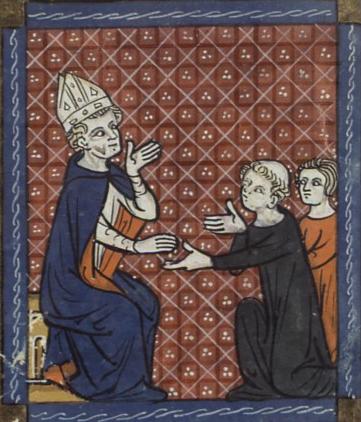
Saint
Loup de Sens faisant l'aumône. Cote :
Français 185 , Fol. 252. Vies de saints, France, Paris, XIVe siècle, Richard de
Montbaston et collaborateurs.
Saint Lupus of Sens giving alms—from a 14th-century manuscript
Saint Loup
Evêque de Sens (+ 623)
ou Leu.
Sens fut une cité
chrétienne dès les premiers siècles. Saint Leu en sera l'un des plus célèbres
archevêques. Né à Orléans, il fit, dit-on, de bonnes études classiques. Deux de
ses oncles étant évêques, l'un d'Orléans et l'autre d'Auxerre, la carrière
cléricale s'ouvre tout naturellement pour lui. Il semble qu'il y eut du succès,
puisqu'à la mort de leur archevêque Artème, en 609, les habitants de Sens le
réclamèrent. Il fut un bon archevêque. En 614, il prit part au concile de
Paris. Mais il eut à souffrir des calomnies de Madégésile, abbé de Saint Rémi
de Reims qui, jaloux, le dénonça auprès des souverains. Saint Leu se trouva
pris dans le conflit entre Brunehaut et Clotaire II. Il reprochait à ce dernier
d'avoir annexé la Bourgogne. Madégésile œuvrait en coulisses. Le roi exila
saint Leu à Ansenne dans la Somme. Mettant à profit cette opportunité, il fit
merveille auprès des Francs païens de la région qu'il évangélisa. Les habitants
de Sens finirent par obtenir le retour de leur archevêque bien-aimé.
"Saint Loup (ou
saint Leu) naquit près d’Orléans, vers 573, d’une famille noble: il avait deux
oncles qui étaient évêques et qui se chargèrent de son éducation. En 609, il
devint archevêque de Sens. Il s’opposa vivement aux prétentions du roi Clotaire
II qui voulait prendre Sens et fut condamné à l’exil. Mais les sénonais se
révoltèrent et réclamèrent le retour de leur archevêque que leur accorda
Clotaire II. Celui-ci demanda pardon à Loup et l’aida à fonder le monastère de
Sainte Colombe. Loup mourut dans son domaine de Brienon le 1 septembre 623. Le
coeur de St Loup se trouve dans la collégiale de Brienon." (diocèse de
Sens-Auxerre)
À Sens, vers 623, saint
Loup, évêque. Parce qu’il avait eu l’audace de déclarer, devant un important
personnage du lieu, que le devoir de l’évêque était de diriger le peuple et
qu’il fallait obéir à Dieu plutôt qu’aux princes, il dut subir l’exil.
Martyrologe romain
SOURCE : http://nominis.cef.fr/contenus/saint/1776/Saint-Loup.html
Saint Loup
Septième siècle
Saint Loup (ou saint Leu)
naquit près d’Orléans, vers 573, d’une famille noble : il avait deux oncles qui
étaient évêques et qui se chargèrent de son éducation. En 609, il devint
archevêque de Sens. Il s’opposa vivement aux prétentions du roi Clotaire II qui
voulait prendre Sens et fut condamné à l’exil. Mais les sénonais se révoltèrent
et réclamèrent le retour de leur archevêque que leur accorda Clotaire II.
Celui-ci demanda pardon à Loup et l’aida à fonder le monastère de Ste Colombe.
Loup mourut dans son domaine de Brienon le 1 septembre 623.
* Le coeur de St Loup se
trouve dans la collégiale de Brienon.
SOURCE : http://www.catholique-sens-auxerre.cef.fr/spip1.9/Saint-Loup.html
Saint Loup, saint
guérisseur
Sans doute par homonymie
avec "la bête", saint Loup est le saint le plus fréquemment invoqué
contre la peur. Né près d’Orléans vers 573, devenu par la suite archevêque de
Sens, il était très populaire dans le Loiret.
De nombreux pèlerinages.
Il y a suscité, selon R. Gauthier, de nombreux pèlerinages, que ce soit dans le
Gâtinais (Cepoy, Gondreville-la-Franche, etc.), en Beauce (Aschères-le-Marché,
Sermaises, etc.), en forêt d’Orléans (Lorris, Le-Moulinet-sur-Solin), en
Sologne (Cerdon, Neuvy-en-Sullias, etc.), en Val de Loire (Ingré,
Saint-Jean-de-Braye, etc.) et en Puisaye (Cernoy-en-Berry).
Il faudrait encore
ajouter à cet inventaire les églises placées sous son vocable (Amilly,
Dampierre-en-Burly, Pannes, etc.) et celles qui en conservent des représentations
ou des reliques (Ervauville, Olivet), les paroisses où ont existé des
confréries (Courtenay, Nogent-sur-Vernisson, Saint-Benoît-sur-Loire, Vimory) ou
des manifestations plus profanes (comme la Foire de Beaugency) et, bien sûr,
les villages de Saint-Loup-de-Gonois et de Saint-Loup-des-Vignes. Ceci porte à
une quarantaine le nombre de communes où l’on vénérait et où l’on fête encore
parfois, saint Loup, le 1er septembre.
Guérisons. A
Cernoy-en-Berry, comme à Saint-Loup-des-Vignes, des monceaux de melons étaient
vendus à cette occasion : "Chevaux de bois, loterie, marchands de
berlingots, baraques diverses, cabaret pleins de consommateurs, melons en tas
d’un mètre pour tenter les chalands, une foule grouillante évoluait au milieu
de tout cela." Saint Leu de Cerdon avait le pouvoir de guérir de la peur
et des convulsions, mais aussi d’autres maladies : poliomyélite, croup. Il
suffisait d’emmener l’enfant ou un de ses vêtements à la bénédiction.
Des "voyageurs"
existaient. Ainsi, à Brinon-sur-Sauldre, quand un enfant était au plus mal, on
y envoyait le père Desnous. Il y allait en courant et devait y être pour la
"petite messe". Dès qu’il mettait le pied sur le territoire de Cerdon
le petit malade cessait de pleurer. "Ça faisait un contact à
l’enfant", nous confiait L. Villoing en 1980. De tels voyages avaient
également lieu à Dampierre-en-Burly ou Ingré…
SOURCE : http://www.loiret.com/saint-loup-saint-guerisseur-histoire-et-tradition--40759.htm?RH=1273140124819
_%C3%89glise_Tableau_2.jpg)
Saint-Loup.
Détail du tableau figurant Clotaire II implorant le pardon de Saint-Loup,
oeuvre de Charles-Nicolas Lambinet sise en l’église prieurale de Saint-Loup-de-Naud (77), XVIIIe s.
Also known as
Leu
Loup
Lowe
Lupo
Wolf
Profile
Born to the Burgundian nobility,
he was early noted to have a love to Christ and the Church.
Nephew of Saint Austremius
of Orleans, and Saint Aunarius
of Auxerre who both saw to his education.
Noted for his love of music and
his generosity to the poor. Monk at Lérins. Priest. Archbishop of Sens, Burgundy (in
modern France)
in 609.
When Lupus hesitated to acknowledge Clotaire II as the
rightful ruler of Burgundy,
and insisted that the will of God trumps
the will of rulers,
Clotaire used the excuse of slander about Lupo and a woman to exile him
to Ansenne, a predominently pagan area.
Lupus evangelized the
people of the area, converting many,
including the region’s governor.
When Lupus’ replacement in Burgundy,
the politically ambitious monk Monegisil,
was killed during
a riot, the people demanded the return of their rightful bishop.
Clotaire recalled Lupus, and punished those who had spoken against him.
Legend says that once when celebrating Mass, a jewel
descended from heaven into the elevated chalice.
Born
near Orleans, Gaul (in
modern France)
as Wolf
623 in
Brienon-sur-Armançon, Yonne, France of
natural causes
buried under
the gutter of Saint Columba’s basilica, Sens, France
relics transferred
to the new cathedral on 23 July 853
against
epilepsy; of epileptics
Additional Information
Book
of Saints, by the Monks of
Ramsgate
Lives
of the Saints, by Father Alban
Butler
Roman Martyrology, 1914 edition
books
Lives of the Saints, by Omer Englebert
Our Sunday Visitor’s Encyclopedia of Saints
Saints
and Their Attributes, by Helen Roeder
other sites in english
images
sitios en español
Martirologio Romano, 2001 edición
sites en français
fonti in italiano
websites in nederlandse
MLA Citation
“Saint Lupus of Sens“. CatholicSaints.Info. 25
February 2024. Web. 23 January 2026.
<https://catholicsaints.info/saint-lupus-of-sens/>
SOURCE : https://catholicsaints.info/saint-lupus-of-sens/
Book of Saints – Lupus
of Sens
Article
(Leu)(Saint) Bishop (September
1) (7th
century) The nineteenth Bishop of Sens (France), in witness to whose
eminent sanctity, on one occasion, while he was offering up the Holy Sacrifice,
a precious stone fell from Heaven into his chalice. He distinguished himself by
his tact and firmness in dealing with the rival Merovingian Princes of his time.
MLA
Citation
Monks of Ramsgate. “Lupus
of Sens”. Book of Saints, 1921. CatholicSaints.Info.
10 November 2014. Web. 23 January 2026. <https://catholicsaints.info/book-of-saints-lupus-of-sens/>
SOURCE : https://catholicsaints.info/book-of-saints-lupus-of-sens/
Golden
Legend – Life of Saint Lowe or Lupus
Here followeth the Life
of Saint Lowe, and first of the interpretation of his name.
Lowe or lupe is some
sickness in the leg, which behoveth a medicine, for it is a malady that rogneth
and useth the flesh. And also it is said a manner of fish that is on the water
and on the land, and it may not drown by no force of water. And thus may be
expounded Saint Lowe, for he used and strained his proper flesh by penance. For
he was like the lupe of the water and of the earth, for he dwelled in the
waters of delices, of riches, and of temptations, and might not drown among
these waters in no wise.
Of Saint Lupe or Lowe.
Saint Lupe or Lowe was
born at Orleans, and was of the royal lineage, and by the splendour of his
great and many miracles and virtues, he was made Archbishop of Sens. And he
gave all that he had to poor people, and on a day when all was given, it happed
that he had bidden many men to dine with him. And then his ministers said that
there was not wine half enough for the dinner. And he answered to them: He that
feedeth the birds of heaven shall perform his charity of wine. And anon after
came a messenger to the gate, that said to them, that there were arrived tofore
the gate an hundred mues of wine.
On a time, they of the
court said evil of him, because that he had with him a virgin of our Lord,
which was daughter of his predecessor. And as they said, he loved paramours,
and spake much despitously and over disattemperately. And when he had heard
these things, he took the virgin, and kissed her tofore all the detractors and
evil sayers, and said that, ne strange ne evil words annoy ne hurt no man when
his own conscience defileth him not. And because he knew well that she loved
well Jesu Christ, and purely, therefore this holy man loved her with a right
pure thought.
On a time when the King
Clothair was King of France, and entered in to Burgundy, he sent his steward against them of
Sens for to assiege the city. Then Lupe entered in to the church and began to
ring the clock, and when the enemies heard it, they had so great dread that
they supposed never to have escaped from thence, but that they should have died
all, but if they fled, and at the last the steward of Burgundy was taken. And when he was taken,
there was another steward sent in to Burgundy, and came to Sens. And because Saint
Lupe had given to him no gifts he had great despite, and defamed him to the king,
so that the king sent him into exile, and there he shone by miracles and
virtues. And in the meanwhile, they of Sens slew a bishop which had taken the
place of Saint Lupe, and after, they impetred of the king that Saint Lupe
returned from exile. And when the king saw that he was wrongly done to, he was
changed by the grace of God that, he kneeled tofore the saint and required
pardon, and re-established him again in his church, and gave to him many fair
gifts.
On a time as he came to
Paris, a great company of prisoners came against him, their bonds broken and
all the doors of the prison open. On a Sunday as he sang mass, a precious stone
fell down from heaven into his chalice, the which he gave to the king, which he
held for a noble relic.
On a time the King
Clothair heard say that the clocks of Saint Stephen of Sens had a marvellous
sweetness in their sound, and sent for them and took them from thence, and did
do bring them to Paris, because he would hear the sound of them. But it
displeased much to Saint Lupe, and as soon as they were out of the city they
lost all the sweetness of their sound, and when the king heard that, he
commanded that they should be brought again into their place. And as soon as
they were seven miles nigh unto the town, they began to reprise the sound like
as they had tofore. And Saint Lupe went against them and received them with
great joy and honour, for he had lost them with great sorrow tofore.
On a night as he prayed,
he had over great thirst by the false movings of the devil. And he demanded
cold water for to drink, and he knew well the treachery of the enemy, and when
he held the vessel in which he should drink, he set a platter upon it and shut
the devil fast therein, and he began all the night to howl and bray. And in the
morning the holy man conjured him that, he that was comen by night to tempt
him, by day he let him go all confused.
On a time, as he by night
visited the churches, as he was accustomed, as he returned home he heard his
clerks brawling and chiding because they would do fornication with women, which
anon entered into the church and prayed for them, and anon all the pricking of
temptation went from them, and they came tofore him and demanded pardon and
forgiveness. At the last, he being ennobled in many virtues, slept in peace in
our Lord. He flourished about the year of our Lord six hundred and ten.
SOURCE : https://catholicsaints.info/golden-legend-life-of-saint-lowe-or-lupus/
Butler’s
Lives of the Saints – Saint Lupus, or Leu, Archbishop of Sens, Confessor
Article
He was a saint from the cradle, and brought up in the
sanctuary, like another Samuel, in learning and piety among the clergy of
Orleans, his native city. It was always a favourite devotion with him to visit
often the tombs of the martyrs, honouring God in his faithful servants who had
glorified his divine name by the sacrifice of their lives. Studying to walk in
their spirit, he subdued his flesh by austere fasts, watching in holy prayer,
humiliations, and penance. Being extremely sensible of the sufferings and
necessities of all who were in distress, he carried his hospitality and charity
to a degree, which on any other occasion would have been deemed profusion.
Having succeeded Artemius in the archbishopric of Sens in 609, he signalized
himself by the most zealous discharge of every branch of the pastoral duty, and
showed, that as no dignity could inspire him with pride, so no application to public
employments could divert him from constant attention to God. When the safety of
his country demanded his assistance, he was active in maintaining the public
tranquillity; and after the death of King Theodoric, he supported the party of
his son Sigebert to the utmost of his power. Afterwards, when King Clotaire had
become master of Burgundy, he sent Farulph thither to take care of his affairs.
This minister was exasperated against the saint because he did not bring him
presents; accused him falsely to the king, and was seconded in his calumnies by
Medigisil, abbot of Saint Remigius’s in the suburbs of Sens, whose aim it was
to supplant Saint Lupus in his archbishopric.
Clotaire had not yet learned how dangerous a thing it
is in a prince to listen to, or encourage informers, those caterpillars of the
state; and, being seduced by the artifices of flattering slanderers, banished
Saint Lupus, and gave orders to Landegesil, a pagan officer, to conduct him to
Ausene, a village in Vimeu, not far from Lyons. The holy bishop having come
thither, and finding profane temples in which the people of the country
worshipped false gods, believed he was sent by God for their conversion, which
he soon compassed by his zealous preaching and example. By restoring sight to a
blind man he converted Landegesil, the duke or governor, and baptized him with
several who were still Pagans, in the armies of the Franks. In the meantime
Saint Vinebaud, abbot of Saint Lupus at Troyes, and the citizens of Sens,
solicited King Clotaire to recal Saint Lupus. That prince, who was then near
Rouen, was made sensible of the injury he had done the holy man, and of the
slanders of his accusers. He therefore disgraced and detested them, sent for
Saint Lupus, prostrated himself at his feet to ask him forgiveness, caused him
to eat at his table, and sent him back to his church loaded with presents. The
saint never showed the least resentment against his enemies, sought no other
revenge than by conferring the greatest benefits on his calumniators, and by
the evenness of temper with which he bore his disgrace, gave the highest mark
of true heroism and sincere virtue. He died happily about the year 623, on the
1st of September, at the manor of Brinon, which still belongs to his church.
His body was carried back to Sens, and buried as he had ordered, out of
humility, under the water-conduit pipe in the church of Saint Columba. His name
occurs in the Roman Martyrology, and in those of Ado and Usuard. See his life
written soon after his death in Surius, and F. Velde, the Bollandist, t. 1,
Sept. p. 248. See also Cointe’s Annales Eccl. Franc. An. 613, n. 4, Fleury, l.
37, n. 16, t. 4, Rivet, Hist. Littér. t. 4, p. 192.
MLA Citation
Father Alban Butler. “Saint Lupus, or Leu, Archbishop
of Sens, Confessor”. Lives of the Fathers,
Martyrs, and Principal Saints, 1866. CatholicSaints.Info.
19 August 2014. Web. 23 January 2026. <https://catholicsaints.info/butlers-lives-of-the-saints-saint-lupus-or-leu-archbishop-of-sens-confessor/>
San Lupo di Sens Vescovo
Festa: 1 settembre
Il culto di Lupo, vescovo
di Sens, è particolarmente diffuso in Francia, dove è santo protettore di molte
parrocchie e monasteri. Secondo la tradizione, il ragazzo rivelò ben presto il
suo amore per Cristo. I suoi due zii materni, entrambi vescovi, lo ritennero
allora degno degli Ordini sacri. Per il suo ardore, venne nominato vescovo di
Sens. I disordini politici dovuti alle successioni dinastiche (siamo nel VII
secolo) lo costrinsero all'esilio. Lupo stabilì la sua residenza ad Ansenne,
sulla Bresle, evangelizzando la regione occupata dai Franchi. Fino a quando fu
richiamato dall'esilio dal re Clotario II, che gli chiese perdono, offrendo
moltissimi doni per la chiesa. La tradizione gli attribuisce molti miracoli: un
giorno in cui celebrava la Messa, una gemma preziosa discese dal cielo nel
calice da lui tenuto. Lupo sarebbe morto a Brienon-sur-Armanon dove ancora
esiste una fontana di san Lupo. Per sua volontà ,venne seppellito a Sens. (Avvenire)
Martirologio
Romano: A Sens in Neustria, ora in Francia, san Lupo, vescovo, che patì
l’esilio per avere coraggiosamente affermato davanti a un notabile del luogo
che il popolo deve essere guidato dal sacerdote e obbedire a Dio piuttosto che
ai príncipi.
Alcuni tra i manoscritti piú completi del Martirologio Geronimiano, aggiungono al 1° settembre: "Senonis civitate, depositio sancti Lupi episcopi et confessoris". Allo stesso giorno ne fa menzione il Martirologio di Wandelbert de Prum, apparso nell'848. Il culto di Lupo è assai antico e per parecchio tempo fu molto vivo in una vasta regione. Molte parrocchie e monasteri hanno scelto il santo come patrono; da ricordarsi in particolare i due importanti priorati di Saint-Loup-de-Naud, presso Provins (Seine-et-Marne) e di Saint-Leud'Esserent, presso Senlis (Oise) le cui splendide chiese ricordano per sempre la popolarità del santo. A Parigi venne fondata nel 1235 la chiesa di Saint-Leu-Saint-Gilles. Lupo era considerato protettore degli epilettici.
La lista episcopale di Sens lo cita come diciannovesimo vescovo della sede; il suo predecessore, Artemio, aveva assistito ancora al concilio di Macon del 585 ed egli stesso fu presente a quello di Parigi del 10 ottobre 614, mentre il suo successore, Mederio, assistette a quello di Clichy del 627. Egli volle essere sepolto nella basilica di S. Colomba, a Sens, che ben presto fu chiamata di S. Colomba e di S. Lupo e intorno alla quale sorse un monastero.
Il 23 luglio 853, Gaunilone, arcivescovo di Sens, trasferì le reliquie di Lupo nella nuova basilica di cui si celebrava la dedicazione. Nel 1878, il cofano con le reliquie di s. Colomba e, nel 1896, quello di Lupo, contenevano ancora due lembi di un antico tappeto orientale, decorato a medaglioni con leoni rampanti, nel quale un tempo erano state avvolte le reliquie stesse.
La Vita di Lupo, in passato si riteneva appartenesse alla fine dell'VIII secolo, oggi si pensa sia del IX e alcuni critici la giudicano "poco attendibile"; le sue notizie si possono tuttavia utilizzare con grande cautela. Questa Vita racconta che i genitori di Lupo, Bettone e Austregilda. erano nobili orleanesi abitanti sulle rive della Loira. E fanciullo si dimostrò scolaro giudizioso e brillante, ed i suoi due zii materni, Austrenio, vescovo di Orléans e Aunacario, vescovo di Auxerre, constatando il suo amore per "i precetti del Cristo", lo giudicarono degno degli Ordini sacri. La mortificazione, la pietà, la carità di Lupo provocarono la sua designazione a successore di Artemio di Sens.
I disordini politici dovuti alle successioni merovinge (613), uniti alle calunnie, causarono il suo esilio nel Vimeu; egli stabilì la sua residenza ad Ansenne, sulla Bresle, oggi un villaggio tra Blangy-sur-Bresle e Camaches, e si mise ad evangelizzare la regione. Il re Clotario II richiamò ben presto l'esiliato, chiedendogli perdono ed offrendo moltissimi doni per la chiesa.
La Vita attribuisce a Lupo alcuni miracoli; in particolare un giorno in cui celebrava la Messa a Ordon, oggi Saint-Loup-d'Ordon (Yonne), discese dal cielo, nel calice da lui tenuto, una gemma preziosa. Lupo sarebbe morto a Brienon-sur-Armanon (Yonne) dove ancora esiste una fontana di s. Lupo. Il suo corpo fu riportato a Sens e sulla tomba la mano del Signore moltiplicò le guarigioni miracolose.
Autore: Paul Viard
SOURCE : https://www.santiebeati.it/dettaglio/91950
Lupus (ook Bleiz,
Leu of Leû) van Sens, Frankrijk; aartsbisschop; † 623.
Feest 1 september.
Hij wordt geboren in
Orléans; zijn vader heet Betto, zijn moeder Austregildis of Aiga; beiden zijn
van vorstelijke afkomst. De legende vertelt dat Austregildis tijdens de
zwangerschap door God werd gewaarschuwd dat haar kind ooit een groot
licht voor Gods kerk op aarde zou zijn. Dat bracht haar ertoe – in
tegenstelling tot wat gebruikelijk was in die tijd - zelf het kind de borst de
geven. Dan kreeg hij om zo te zeggen haar vroomheid met de paplepel ingegeven.
Lupus heeft van moeders
zijde twee ooms die bisschop zijn: Austrenius van Orléans en Aunarius (ook
Anacharius: † 604; feest 25 september) van Auxerre. Zij zien nauwlettend toe op
de vorming van de jongen. Trouwens hij voelt zich al op jeugdige leeftijd
aangetrokken tot het geestelijk leven. Hij heeft een mooie stem en houdt ervan
in de kerk de koorzang mee te zingen. Zijn ooms geven hem toestemming tot het
ontvangen van de lagere wijdingen. Nu treedt hij toe tot de monniksgemeenschap
op het eiland Lérins voor de Zuid-Franse kust. Maar als bisschop Artemius van
Sens sterft († 609; feest 28 april), wordt hij tot zijn opvolger benoemd. Zo
wordt hij de negentiende bisschop van Sens.
Intussen is Chlotarius II
(† 629) koning van Bourgondië geworden. Hij zendt een zekere Farulfus naar Sens
als zijn hoogste ambtenaar. Farulfus had verwacht dat de bisschop hem plechtig
tegemoet zou treden tot aan de stadspoort, maar in plaats daarvan had Lupus
zich opgesteld aan de ingang van de kerk en daar de nieuwe machthebber
opgewacht. Farulfus beschouwt dit als een belediging en zint op wraak. Hij
krijgt de medewerking van de abt van St-Rémi, Madegisilis, die zelf graag
aartsbisschop wil worden. Consequent plaatsen zij Lupus bij de koning in een
kwaad daglicht. Zodat deze hem in 614 in de ban doet naar een dorpje in de buurt
van stad Eu.
De legende vertelt dat
Lupus bij zijn vertrek de bisschopsring van zijn vinger deed en in een gracht
gooide. Hij bezwoer dat hij niet eerder zou terugkeren voordat de ring gevonden
was. In de plaats van verbanning verkondigt onze bisschop het evangelie met
zoveel verve dat de plaatselijke burgemeester Boson, zich tot Christus bekeert.
Intussen wenst de bevolking van Sens haar bisschop terug. Nu ontvangt men het
bericht dat er in de buurt van Melun een rivierkarper gevangen is die een ring
in zijn buik bleek te hebben. Dat brengt de bevolking ertoe de zaak in een
stroomversnelling te brengen door de nieuwe bisschop Madegisilis bij een
aanslag te doden en hun oude bisschop terug te eisen. De aartsdiaken van de
stad roept de hulp in van abt Winbald van Troyes († 623; feest 6 april). Deze
begeeft zich naar koning Chlotarius die op dat moment in Rouen resideert. De
reis naar Rouen wordt beschreven als een opeenvolging van wonderen. De koning
toont zich zeer rouwmoedig, biedt nederig zijn verontschuldigingen aan, laat
als bewijs van goede wil een aantal gevangenen vrij, en geeft bevel Lupus bij
zich te brengen. De begroeting met Winbald is uitermate hartelijk en roerend.
De bisschop blijkt zeer vermagerd wat de koning ertoe brengt nogmaals zijn
verontschuldigingen aan te bieden en dringend om vergiffenis te vragen.
Eenmaal terug hervat
Lupus zijn taak als zielenherder. Door de herhaalde wisseling van vorsten in
die tijd, was er altijd wel ergens oorlog. Zo werd ook Sens eens belegerd door
troepen die klaar stonden om de stad te brandschatten en te plunderen. Lupus
trok zich terug in de St-Stefanuskapel en met wijd gespreide armen vroeg hij de
hemel om uitkomst.
De legende zelf legt verband met Mozes die op de berg bad, terwijl zijn volk beneden slag moest leveren op leven en dood.
[Exodus 17,08-3]
Daarop begon hij de
kerkklok te luiden. Het geluid ervan joeg de belagers zoveel schrik aan dat zij
het op een lopen zetten. Toen koning Chlotarius ervan hoorde, beval hij de klok
over te brengen naar Parijs. Maar dat was tegen de zin van Lupus. En bij
aankomst bleek de klok helemaal niet meer dat mooie geluid te geven. Zodat de
koning zich genoodzaakt zag het ding terug te sturen. Nu bleek de klank weer
even welluidend als eerst.
De legende vertelt nog
dat er eens een steen uit de hemel in de kelk viel tijdens het opdragen van de
heilige mis. Aanvankelijk bewaarde men hem in de sacristie. Maar koning
Chlotarius II († 629) besloot hem als relikwie op te eisen. Veel plezier had
hij er niet van. Het ding schitterde zo dat het pijn deed aan zijn ogen.
Lupus overlijdt in
Brinon-sur-Armençon, een dorpje dat hem door erfenis toebehoorde en dat hij aan
de kathedraal had geschonken. Hij wordt begraven in de Ste-Colombe-abdij te
Sens.
Verering & Cultuur
Chlotarius’ opvolger,
Koning Dagobert I († 639), vroeg zijn goudsmid, de latere Sint Eligius († 660;
feest december), een mooie reliekschrijn voor hem te maken. Omdat Lupus’
feest valt op dezelfde dag als St-Gilles worden zij beiden vaak tezamen
vereerd. In de landstreek ten zuiden van Parijs, als ook in Parijs zelf, kent
men kerken die aan St-Leu-St-Gilles zijn toegewijd. Hij is patroon van de
Bretonse stad Lanloup (Côtes-du-Nord). Daar neemt hij de plaats in van zijn
illustere naamgenoot van Troyes († 478; feest 29 juli). In de plaatselijke kerk
is zijn beeld (Bretons ondertiteld als Sant Bleiz) te zien naast dat van zijn
beroemde stadgenote Sint Columba († 273; feest 31 december): zo staan daar
naast elkaar ‘sint duif’ en ‘sint wolf’.
Weerspreuk(en)
A la Saint-Loup
La lampe au clou
[Met Sint-Lupusdag
De lamp aan mag]
[Bdt.1925; Gué.1880/10p:397-400; Plg.1987p:447; Rgf.1991; Roy.1986p:41;
TSÉ.1994p:59(wsp).222; Dries van den Akker s.j./2010.02.11]
© A. van den Akker
s.j. / A.W. Gerritsen
SOURCE : https://heiligen-3s.nl/heiligen/09/01/09-01-0623-lupus.php
Voir aussi : http://orthodoxievco.net/ecrits/vies/synaxair/septembr/loup.pdf
