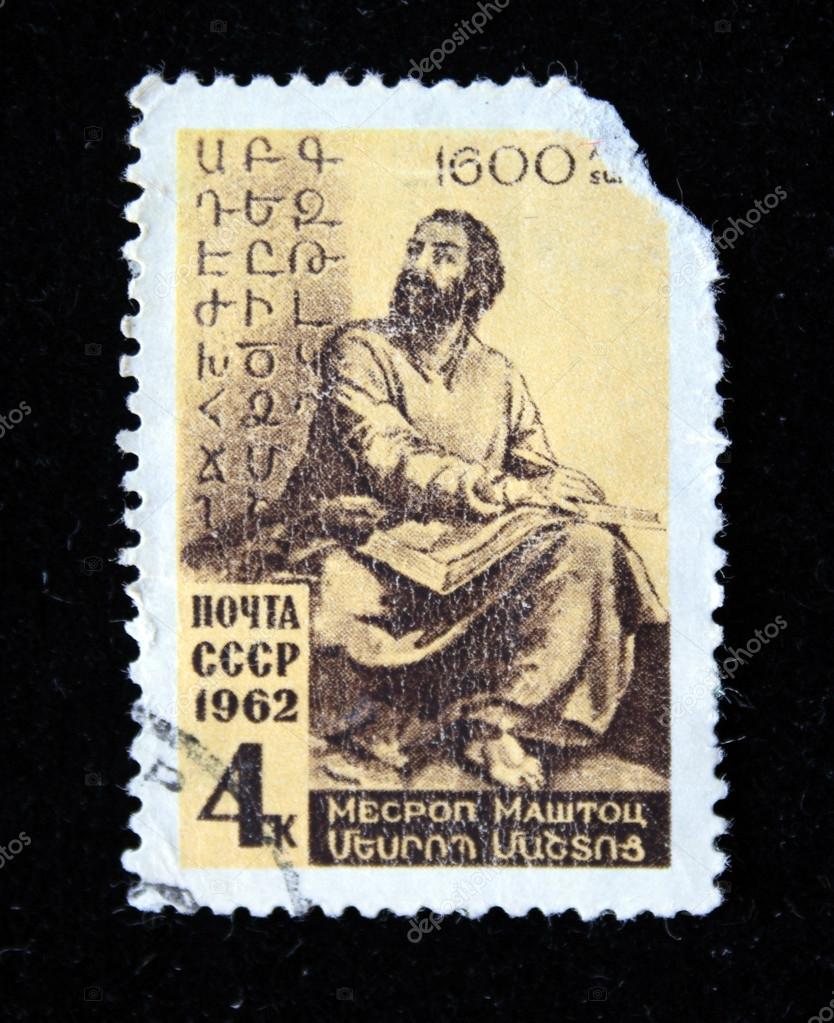
Mesrob
Mashtots, créateur de l’alphabet arménien, Grammaire de Simeon de
Julfa, Matenadaran, Ms. 5996, 1776.
Image
of the creator of the Armenian alphabet Mesrob Mashtots, Grammar of
Simeon of Julfa, Matenadaran, Ms. 5996, 1776
создателя армянского алфавита Месропа Маштоца, 1776
Saint Mesrop
Docteur des Arméniens (+ 441)
Tout d'abord militaire, il se retire dans la solitude monastique avant de prêcher la foi à ses compatriotes. La nation arménienne lui est reconnaissante de l'avoir dotée d'un merveilleux alphabet à la demande de saint Isaac, le patriarche catholicos, afin de lutter contre le paganisme perse en rendant accessibles à son peuple les saintes Écritures.
Neveu du catholicos saint Houssik, il fit de brillantes études dans les lettres syriaques et helléniques. Secrétaire du roi, il interrompit sa carrière administrative pour devenir moine et prêtre. Il constata que beaucoup des fidèles chrétiens avaient un christianisme superficiel, ne lisant pas les Saintes Écritures, la langue arménienne n'étant pas alors une langue écrite. Il perfectionna un alphabet et commença aussitôt la traduction de l'Écriture Sainte et celle des Pères de l'Église de Cappadoce. L'un de ses disciples, Koriun, fit de même pour la langue géorgienne. Il multiplia les voyages apostoliques, ouvrant des écoles et fondant des monastères aux nombreux calligraphes. Il travaillait à préserver l'identité culturelle de son peuple et il est l'un des plus grands docteurs de cette Église.
L'Église apostolique arménienne en fait mémoire le 5 juillet.
A lire aussi Saint Mesrop, docteur des arméniens sur le site de l'Eglise de Polynésie:
"Mesrob (Mesrop, Mastots) a donné à l'Église arménienne une personnalité en lui composant un alphabet à son usage : par là son rôle est comparable à celui des saints Cyrille et Méthode pour les Églises slaves d'Europe. Des deux côtés, initiative importante dont les effets n'ont pas fini de se développer."... "En 440, inventeur de l’alphabet arménien et traducteur, en cette langue, de la Bible et de divers livres liturgiques. Son œuvre littéraire favorisa l’unité du peuple arménien en dépit des vicissitudes de son histoire."...
En Arménie, vers 440, saint Mesrob, docteur des Arméniens. D’abord soldat puis
fonctionnaire au palais royal, il reçut le baptême et se fit moine, composa un
alphabet pour la langue arménienne, pour que le peuple soit formé par les
saintes Écritures. On lui attribue la traduction en arménien des deux
Testaments, des hymnes et d’autres cantiques. (au 17 février au martyrologe
romain)
Martyrologe romain
SOURCE : http://nominis.cef.fr/contenus/saint/9345/Saint-Mesrop.html

Mesrop
Mashtots, St. Mesrop Mashtots church, Kapan, Armenia
Saint Mesrop (+439)
Fêté le 19 février
Confesseur. Neveu du
catholicos saint Houssik, il fit de brillantes études dans les lettres
syriaques et helléniques. Secrétaire du roi, il interrompit sa carrière
administrative pour devenir moine et prêtre. Il constata que beaucoup des
fidèles chrétiens avaient un christianisme superficiel, ne lisant pas les
Saintes Ecritures, la langue arménienne n’étant pas alors une langue écrite. Il
perfectionna un alphabet et commença aussitôt la traduction de l’Ecriture
Sainte et celle des Pères de l’Eglise de Cappadoce. L’un de ses disciples,
Koriun, fit de même pour la langue géorgienne. Il multiplia les voyages
apostoliques, ouvrant des écoles et fondant des monastères aux nombreux
calligraphes. Il travaillait à préserver l’identité culturelle de son peuple et
il est l’un des plus grands docteurs de cette Eglise. L’Eglise apostolique
arménienne en fait mémoire le 5 juillet.
SOURCE : http://rouen.catholique.fr/saint-du-jour/19/02/

A
sculpture of Mesrop Mashtots on Moskovyan St., Yerevan,
Armenia, near the Cascade
Saint Mesrop Machtots, l’inventeur
de l’alphabet arménien
Nom complet: Mesrop
Machtots
Activités: Militaire,
administrateur, religieux, théologien, linguiste, hymnologue
Né: en 361/362 à
Hatsekats, province de Taron, Grande Arménie (auj. Hac'ik, province de Muş,
Turquie)
Mort: le 17 février
440 à Vagharchapat, Arménie perse (auj. Etchmiadzin en Arménie)
Mesrop Machtots (Մեսրոպ Մաշտոց en
arménien), né en 361 ou 362 et décédé le 17 février 440 était un moine,
théologien, linguiste et hymnologue arménien. Il est surtout connu pour avoir
inventé l'alphabet arménien vers 405 de notre ère. Différentes sources et un
certain nombre de chercheurs contemporains le créditent aussi de l'origine des
alphabets géorgien et aghbanien.
Biographie.
Mesrop Machtots est le
fils d'un azat (noble de classe inférieure) nommé Vardan. Il nait en
Arménie occidentale et reçoit une éducation libérale. Il fait de brillantes
études et parle couramment quatre langues : le grec, l'araméen, le perse et le
géorgien. De plus, il manie l'arménien avec une rare maîtrise.
Il occupe d'abord des
fonctions militaires avant de se tourner vers l'administration. Par sa piété et
son érudition, il est vite remarqué par les plus hautes instances de l'État et
finit comme secrétaire du Roi. Son rôle consistait à écrire en caractères
grecs, persans et araméens les décrets et édits du souverain. C'était parce
qu'à l'époque la pratique de l'arménien était uniquement orale.
Il quitte ensuite la cour
des Arsacides et se consacre à la religion et se retira dans un monastère avec
quelques compagnons soigneusement choisis. Là, il choisit une vie pleine
d'austérité entre ses nombreux jeûnes et la pauvreté. Il dormait à même le sol
et passait souvent des nuits entières dans l'étude et la prière des Saintes
Écritures. Cette vie fut la sienne pendant quelques années.
Il constate que malgré
que le Christianisme est religion d'État depuis 301, beaucoup de fidèles ne
sont que superficiellement chrétiens, car ne lisant pas les Saintes Écritures.
La non écriture de la langue nationale apparait alors clairement comme une barrière
à l'évangélisation du peuple.
Avec le soutien du Roi et du Patriarche, il se fixe pour objectif la création
d'un alphabet arménien de trente-six lettres (trente-huit à partir du XIIème
siècle) en partie inspiré du grec. Cette écriture à deux buts : d'une part
créée une liturgie arménienne écrite et d'autre part assurer l'unité culturelle
et linguistique des Arméniens. Le premier texte rédigé en Grabar (arménien
classique, actuelle langue liturgique de l'Église arménienne) est une
traduction de la Bible. L'intégralité de son travail va ainsi faire naître la
littérature arménienne.
Mesrop Machtots rassembla autour de lui de nombreux disciples et les
envoya à Edesse, Constantinople, Athènes, Antioche, Alexandrie, Rome ... dans
le but de ramener des chefs-d'œuvre littéraires. Il s'emploie au travail
titanesque d'en rédiger des copies en arménien. Beaucoup de ces textes
originellement rédigés en grec et en araméen n'ont survécu que par l'exemplaire
arménien.
Soucieux que d'autres puissent pleinement profiter de son œuvre, et avec l'encouragement du Roi et du Patriarche, Mesrop fonde de nombreuses écoles dans les différentes régions du pays, là l'alphabet est enseigné. Avec l'aide du Patriarche, il se rendit à Constantinople et obtint l'autorisation de l'Empereur de prêcher et d'enseigner dans ses possessions arméniennes.
Par la suite, il est à l'origine des alphabets géorgien et aghbanien, créées
dans le même but que celui des Arméniens.
A la suite de la mort du
Patriarche, il se retrouva à la tête de l'administration du patriarcat pendant
six mois avant de mourir à son tour.
Le 17 février 440, Mesrop
Machtots s'éteint. Korioun, un de ses talentueux et fidèles élèves écrivit :
" Saint Mesrop a trouvé sa juste place dans le royaume de Dieu au
paradis avec notre tout-puissant Sauveur ". Sa mort fut un véritable
deuil pour toute l'Arménie. Il fut inhumé avec tous les honneurs à Ochakan. Sa
tombe reste à ce jour un haut lieu de pèlerinage.
Postérité.
Selon le poète moderne
Parouir Sévak, Mesrop Machtots fut " le plus grand homme politique
que l'Arménie ait connu ". En créant l'alphabet arménien, il permit
l'unité linguistique et culturelle et fit ainsi perdurer sa nation
politiquement divisée.
C'est aujourd'hui un
saint vénéré par l'Église apostolique arménienne, l'Église catholique
arménienne, l'Église catholique romaine et l'Église orthodoxe.
Pratiquement chaque ville
en Arménie possède une rue nommée d'après l'érudit Machtots. Par exemple, à
Erevan la rue Machtots est l'une des plus importantes du centre-ville. Il
existe aussi une statue à sa gloire devant le Matenadaran (qui de son complet
est un énième hommage), l'un des plus riches dépôts de manuscrits et de
documents au monde. A Ochakan, où sa dépouille repose, une église lui est
dédiée. Enfin, il apparait fréquemment sur les timbres émis par l'Arménie.
Il est largement
considéré par les spécialistes du sujet comme étant à l'origine de l'alphabet
arménien. Cependant, un certain nombre remettent en doute ce qui semblait être
une vérité absolue. Selon cette théorie, Mesrop ne serait non pas le créateur
mais le restaurateur d'une écriture oubliée et disparue. Cela expliquerait
l'étonnante richesse de la langue arménienne déjà à l'époque.
SOURCE : http://volti.skyrock.com/3249433796-Saint-Mesrop-Machtots-l-inventeur-de-l-alphabet-armenien.html

Verses
of Mesrop Mashtots. Library of Congress Armenian Manuscript (1722 AD) (African
and Middle Eastern Division)
മലയാളം: മെസ്രോബിന്റെ
പദ്യങ്ങൾ.
Стихи
Месропа Маштоца.
Вірші
Месропа Маштоца.
MESROP saint (360
env.-440)
Moine, théologien et
linguiste inventeur de l'alphabet arménien,
Mesrop Machtots (ou Mesrob Machtotz) est né vers 360 à Hatsik (ou Hatsekats),
près de Taron, en Arménie (auj.
Mus en Turquie), et mort le 17 février 440 à Vagharshapat (auj.
Etchmiadzine). Après des études dans les lettres et langues classiques sous la
direction du patriarche Nersès Ier, il embrasse la vie monastique vers
395. Ordonné prêtre, il continue à nourrir un grand respect pour l'ascétisme et
fonde plusieurs monastères. Il va s'employer à propager la parole des Saintes
Écritures dans les contrées reculées d'Arménie, ce qui permet d'éradiquer le
mazdéisme, religion héritière du zoroastrisme. Plus tard, il devient secrétaire
du roi Vramchapouh, dont il reçoit le soutien dans sa tâche de systématisation
d'un alphabet arménien définitif de trente-six lettres, calqué sur le grec
(405). On considère qu'il bénéficie également de l'aide de Sahak Partev (Isaac
le Grand), patriarche de l'Église apostolique arménienne, ainsi que d'un érudit
grec du nom de Rufanos. Deux lettres seront ajoutées au xiie siècle.
Cet alphabet va servir en premier lieu à traduire, à partir du grec, la
première Bible arménienne populaire (vers
410), en krapar (langue arménienne de cette époque, Ve-VIIe siècles,
et langue liturgique actuelle). Mesrop Machtots assure dans ce cadre la traduction du
Nouveau Testament et du Livre des Proverbes de l'Ancien Testament. Il procédera
par la suite à une révision de l'intégralité du texte biblique. Tous ses
efforts vont ainsi participer à l'âge d'or de la littérature chrétienne en
Arménie.
Mesrop Machtots envoie ses disciples à Constantinople, Alexandrie et Rome rechercher des manuscrits bibliques et liturgiques. La tradition lui attribue un recueil de commentaires bibliques, la traduction des écrits patristiques, ainsi que des prières et hymnes liturgiques composées sur la base de l'octave. Autant d'éléments qui viennent conforter sa réputation de fondateur des bases de la liturgie nationale arménienne.
SOURCE : http://www.universalis.fr/encyclopedie/mesrop/

Stepanos Nersissian, Mesrop Mashtots / Մեսրոպ Մաշտոց,
1882, 106 x 88, Pontifical Residence in Etchmiadzin,
Etchmiadzin Cathedral, Etchmiadzin
(Ejmiatsin) and Vagharshapat, Armenia
Also
known as
Mesrop Mashtots
Mesrob…
5 July (Armenian
Apostolic Church)
19
February on some calendars
Profile
Career soldier who
retired from the military to
become a hermit, monk and preacher.
Worked with Saint Isaac
the Great in the formation of the Armenian Church. Civil
servant. Missionary to Armenia and Georgia.
Developed the alphabet for writing Armenian.
Organized schools and
the translation of
the Bible into Armenian, translating the
New Testament himself.
Born
c.362 in
Hatsik, Taron Province, Kingdom of Armenia
17
February 440 in
Vagharshapat, Armenia of
natural causes
Additional
Information
Saints
of the Day, by Katherine Rabenstein
books
Our Sunday Visitor’s Encyclopedia of Saints
other
sites in english
images
sitios
en español
Martirologio Romano, 2001 edición
sites
en français
fonti
in italiano
nettsteder
i norsk
MLA
Citation
“Saint Mesrop the
Teacher“. CatholicSaints.Info. 25 October 2023. Web. 4 September 2026.
<https://catholicsaints.info/saint-mesrop-the-teacher/>
SOURCE : https://catholicsaints.info/saint-mesrop-the-teacher/

Francesco Maggiotto (1738–1805), Mesrop
Mashtots
St. Mesrop
Feastday: November 25
Patron: of Armenia
Birth: 361
Death: 440
Confessor and disciple of St. Nerses the
Great of Armenia, called “the Teacher.” Mesrop was born in Taron, Armenia, and
became a hermit under St. Nerses the
Great. He served as a missionary with St. Isaac the
Great and helped compose the Armenian alphabet and translations of the Holy
Scriptures. Mesrop, sometimes listed as Mesrob, was proficient in Greek,
Syriac, and Persian. He founded schools in Armenia and
Georgia, and reportedly succeeded Patriarch Sahak
in 440. Mesrop was beloved for his many contributions to Armenian education and
died at Valarshapat on February 19 at age eighty.
SOURCE : https://www.catholic.org/saints/saint.php?saint_id=5097

Estatua
de San Mesrob Mashtóts en el Matenadarán.
Instituto de Antiguos Manuscritos en Ereván, Armenia. Las
letras originales pueden ser vistas en la piedra.
Posąg Mesropa
Masztoca. Matenadaran. Erywań,
Armenia.
Statue
of Mesrop Mashtots. Matenadaran. Yerevan,
Armenia.
Статуя Месропа Маштоца. Матенадаран. Ереван, Армения.
Հուշարձան
Մեսրոպ Մաշտոցի. Երևանի Մաշտոցի անվան Մատենադարան. Երևան, Հայաստան.
Mesrob the Teacher B (AC)
(also known as Mesrop)
Born at Taron, Armenia,
c. 345; died at Valarshapat, February 19, 441; feast day formerly November 25.
Saint Mesrob 'the Great'
was a government official in Armenia, then a hermit and a disciple of Saint
Nerses the Great. Mesrob was ordained and devoted himself to the study of
Greek, Syriac, and Persian because Armenia had recently been partitioned
between Persia and the Empire.
With Saint Isaac the
Great, Mesrob was the founder of the Armenian church through his missionary
efforts. He is credited with inventing the Armenian alphabet and translating
the New Testament and Proverbs into Armenian from the Syriac version.
Mesrob's missionary
activities took him into Georgia, where he also had a literary influence, and
is said to have sent students as far as Rome in search of manuscripts. He also
organized schools in Armenia and Georgia and created a Georgian alphabet.
Mesrob and Isaac began
the formation of a distinctly Armenian liturgy of worship based on that of the
mother church at Caesarea in Cappadocia. He also founded his own school in
Armenia, and continued preaching until his death at Valarshapat aged of 80. The
Armenian translation of the Bible has a special value for scholars (Attwater,
Benedictines, Delaney, Encyclopedia).
SOURCE : http://www.saintpatrickdc.org/ss/0219.shtml

Gravesite
of Mesrop Mashtots in the village of Oshakan
Mesrob
(Also called MASHTOTS)
One of the greatest
figures in Armenian history,
he was born about 361 at Hassik in the Province of Taron; died at Valarsabad,
441. He was the son of Vartan of the family of the
Mamikonians. Goriun, his pupil and biographer, tells us that Mesrob received a
liberal education,
and was versed in the Greek, Syriac, and Persian languages. On account of
his piety and
learning Mesrob was appointed secretary to King Chosroes III. His duty was to write
in Greek, Persian,
and Syriac characters the decrees and edicts of the sovereign, for, at this
time, there was no national alphabet. But Mesrob felt called to a more perfect
life. Leaving the court for the service of God, he took Holy orders, and
withdrew to a monastery with
a few chosen companions. There, says Goriun, he practised great austerities,
enduring hunger and thirst, cold and poverty. He lived on vegetables, wore a
hair shirt, slept upon the ground, and often spent whole nights in prayer and the
study of the Holy Scripture.
This life he continued for a few years, preparing himself for the great work to
which Providence was soon to call him. Indeed both Church and State needed
his services. Armenia,
so long the battle-ground of Romans and Persians, lost its
independence in 387, and was divided between the Byzantine Empire and Persia, about
four-fifths being given to the latter. Western Armenia was
governed by Greek generals, while an Armenian king
ruled, but only as feudatory, over Persian Armenia. The Church was
naturally influenced by these violent political changes, although the loss of
civil independence and the partition of the land could not destroy its
organization or subdue its spirit. Persecution only quickened it into greater
activity, and had the effect of bringing the clergy, the nobles, and
the common people closer together. The principal events of this period are the
invention of the Armenian alphabet,
the revision of the liturgy, the creation of an ecclesiastical and
national literature, and the readjustment of hierarchical relations. Three men
are prominently associated with this stupendous work: Mesrob, Patriarch Isaac,
and King Vramshapuh, who succeeded his brother Chosroes III in 394.
Mesrob, as we have noted,
had spent some time in a monastery preparing
for a missionary life. With the support of Prince Shampith, he preached the
Gospel in the district of Golthn near the Araxes, converting many heretics and pagans. However, he
experienced great difficulty in instructing the people, for the Armenians had no
alphabet of their own, but used the Greek, Persian, and Syriac
scripts, none of which was well suited for representing the many complex sounds
of their native tongue. Again, the Holy Scripture and the liturgy,
being written in Syriac, were, to a large extent, unintelligible to the faithful. Hence the
constant need of translators and interpreters to explain the Word of God to the people.
Mesrob, desirous to remedy this state of things, resolved to invent a national
alphabet, in which undertaking Isaac and King Vramshapuh promised to assist
him. It is hard to determine exactly what part Mesrob had in the fixing of the
new alphabet. According to his Armenian biographers,
he consulted Daniel, a bishop of
Mesopotamia, and Rufinus, a monk of Samosata, on the matter.
With their help and that of Isaac and the king, he was able to give a definite
form to the alphabet, which he probably adapted from the Greek. Others, like
Lenormant, think it derived from the Zend. Mesrob's alphabet consisted of
thirty-six letters; two more (long O and F) were added in the twelfth century.
The invention of the
alphabet (406) was the beginning of Armenian literature,
and proved a
powerful factor in the upbuilding of the national spirit. "The result of
the work of Isaac and Mesrob", says St. Martin (Histoire du Bas-Empire de
Lebeau, V, 320), "was to separate for ever the Armenians from the
other peoples of the East, to make of them a distinct nation, and to strengthen
them in the Christian
Faith by forbidding or rendering profane all the foreign alphabetic
scripts which were employed for transcribing the books of the heathens and of the
followers of Zoroaster. To Mesrob we owe the preservation of the language and
literature of Armenia;
but for his work, the people would have been absorbed by the Persians and
Syrians, and would have disappeared like so many nations of the East".
Anxious that others should profit by his discovery, and encouraged by the
patriarch and the king, Mesrob founded numerous schools in
different parts of the country, in which the youth were taught the new
alphabet. But his activity was not confined to Eastern Armenia. Provided with
letters from Isaac he went to Constantinople and obtained from the Emperor
Theodosius the Younger permission to preach and teach in his Armenian possessions.
He evangelized successively the Georgians, Albanians, and
Aghouanghks, adapting his alphabet to their languages, and, wherever he
preached the Gospel, he built schools and
appointed teachers and priests to continue
his work. Having returned to Eastern Armenia to report
on his missions to the patriarch, his first thought was to provide a religious
literature for his countrymen. Having gathered around him numerous disciples,
he sent some to Edessa,
Constantinople, Athens, Antioch, Alexandria, and
other centres of learning, to study the Greek language and bring back the
masterpieces of Greek literature. The most famous of his pupils were John of
Egheghiatz, Joseph of Baghin, Eznik, Goriun, Moses of Chorene, and
John Mandakuni.
The first monument of
this Armenian literature
is the version of the Holy
Scripture. Isaac, says Moses of Chorene, made a
translation of the Bible from
the Syriac text about 411. This work must have been considered imperfect, for
soon afterwards John of Egheghiatz and Joseph of Baghin were sent to Edessa to translate
the Scriptures. They journeyed as far as Constantinople, and brought back with
them authentic copies of the Greek text. With the help of other copies obtained
from Alexandria the Bible was
translated again from the Greek according to the text of the Septuagint and Origen's Hexapla. This version,
now in use in the Armenian Church,
was completed about 434. The decrees of the first three councils — Nicæa,
Constantinople, and Ephesus — and the national liturgy (so far written in
Syriac) were also translated into Armenian, the latter
being revised on the liturgy
of St. Basil, though retaining characteristics of its own. Many works of
the Greek Fathers also passed
into Armenian.
The loss of the Greek originals has given some of these versions a special
importance; thus, the second part of Eusebius's
"Chronicle", of which only a few fragments exist in the Greek,
has been preserved entire in Armenian. In the midst
of his literary labours Mesrob did not neglect the spiritual needs of the
people. He revisited the districts he had evangelized in his earlier years,
and, after the death of Isaac in 440, looked after the spiritual administration
of the patriarchate.
He survived his friend and master only six months. The Armenians read his
name in the Canon of the Mass, and celebrate his memory on 19 February.
Sources
SMITH AND WACE, Dict.
Christ. Biog., s.v. Mesrobs; LANGLOIS, Collection des
Historiens de l'Arménie, II (Paris, 1869); WEBER, Die kathol. Kirche
in Armenien (1903); NEUMANN. Versuch einer Gesch, der armen.
Litteratur (Leipzig, 1836); GARDTHAUSEN, Ueber den griech. Ursprung
der armen. Schrift in Zeitschr. der deutsch. morgenländ.
Gesellschaft, XXX (1876); LENORMANT, Essai sur la propagation de
l'alphabet phénicien, I (1872).
Vaschalde, Arthur
Adolphe. "Mesrob." The Catholic Encyclopedia. Vol.
10. New York: Robert Appleton Company, 1911. <https://www.newadvent.org/cathen/10211a.htm>.
Transcription. This
article was transcribed for New Advent by Douglas J. Potter. Dedicated to
the Immaculate Heart of the Blessed Virgin Mary.
Ecclesiastical
approbation. Nihil Obstat. October 1, 1911. Remy Lafort, S.T.D.,
Censor. Imprimatur. +John Cardinal Farley, Archbishop of New York.
Copyright © 2026 by New Advent LLC.
Dedicated to the Immaculate Heart of Mary.
SOURCE : https://www.newadvent.org/cathen/10211a.htm

Սուրբ
Մեսրոպ
Saint
Mesrop
St Mesrop the Teacher
Celebrated
on February 19th
Bishop. Born in 345, this
saint was one of the founders of the Armenian church. He worked with St Isaac
the Great as a missionary among his people.
St Mesrop developed an alphabet for the Armenian language and set up schools
around the country. He then accomplished the massive task of organising a
translation of the Bible - with students travelling as far as Rome to collect
manuscripts. He contributed the Armenian version of the New Testament and the
Book of Proverbs himself. St Mesrop also worked as a missionary in Georgia,
where he also had a literary influence.
It was Mesrop and Isaac who began the formation of the Armenian liturgy of
worship based on that of the mother church of Caesarea in Cappadocia. The
Armenian translation of the Bible has a special value for scholars as it is so
ancient. St Mesrop died in 439.
SOURCE : https://www.indcatholicnews.com/saint/055

Van Khachatur [hy] (1958–59), panel painting of Mashtots at the entrance hall of the Armenian Academy of Sciences headquarters in Yerevan - https://www.arlis.am/hy/acts/56884
Mesrob the Vartabed
(known as Mashdotz) (438 A.D.)
St. Mesrob was born in
the village of Hatzegatz in the province of Daron. In his early years, he
learned both Greek and Persian and served in the Armenian royal court.
Later, he decided to enter the ranks of the clergy, and with some other young
men he went to preach in the province of Koghtn around 395 A.D. During
this period, he felt the great need of the Armenian people for an alphabet of
their own, so he petitioned Catholicos Sahag, and together they requested the
aid of King Vramshabouh.
After much research and
travel, Mesrob was able to come up with the skeleton of an alphabet.
However, it did not meet the needs of the Armenian language. According to
tradition, while meditating in a cave near the village of Palu, the saint had a
vision, in which "the hand of God wrote the alphabet in letters of
fire." Upon his return to the Catholicos and king, the saint was
received with great honors and much joy.
Immediately after the
discovery of the alphabet, the Holy Translators worked to translate the Bible;
the first words written in the Armenian language were from the Book of Proverbs: "To
know wisdom and instruction; to perceive the words of understanding" (Proverbs
1:2). They also opened schools to teach the newly-discovered alphabet,
among whose students were the famous translators Yeghisheh, Movses, Tavit, and
Vartan.
After the discovery of
the alphabet, St. Mesrob spent many years translating and writing literary and
ecclesiastical works. He went to many provinces where paganism still
existed and preached the word of God in the people's own language, with the
light of the Holy Gospels. During this period, he was invited to Georgia
and Caucasian Albania, where he likewise invented alphabets to suit the
respective local languages. His life's works have been recorded by one of
his famous students, Goriun, in his book, The Life of Mashdotz. St.
Mesrob was buried in Oshagan in the province of Vaspouragan, where a beautiful
cathedral has been built in his honor, and where one may go and pay homage at
the saint's tomb to the present day.
The Book of Ritual used
in the Armenian Church bears the name "Mashdotz" and is dedicated to
this great saint. Although compiled at a later date, it is based on an
earlier sacramental anthology attributed to Mashdotz.
St. Mesrob gave the
Armenian people the most precious of gifts, and continues to serve as an
inspiration to all generations. Beloved by all, St. Mesrob is a special
inspiration to Armenian writers and poets.
SOURCE : https://www.armenianchurch-ed.net/feasts/mesrop-mashtots/

Mesrop Mashtots, «Illustrated Armenia and the Armenians», 1898
Mesrop
Machtots, « L'Arménie et les Arméniens illustrés», 1898
THE LIFE OF MASHTOTS
the Story of the Life and
Death of the Blessed Man St. Mashtots Vardapet Our Translator by his Pupil,
Koriun Vardapet
I
I had been thinking of
the God-given alphabet of the Azkanazian* nation and of the land of Armenia -
when, in what time, and through what kind of man that new divine gift had been
bestowed, as well as the luminous learning and angelic, virtuous piety of the
person, so as to cause memorials to blossom in an individual volume. And while
I was striving to remember [the facts], there came the command of an excellent
man named Hovsep,** a disciple of that person, as well as the encouragement of
others, our fellows of student days. Therefdre, I, who had had the fortune of
being [his] special pupil, even though the youngest [among his pupils], and the
task beyond my capacities, [nevertheless] hastened to write without delay that
which was suggested, compelled by the clear mandate which had been addressed to
me. And we ask them all that they assist us in our tasks by their prayers, and
to commit us to the divine grace, so that we may sail suecessfully and
unerringly over the boundless waves of the sea of doctrine.
____________________
* Azkanazian nation - The Armenian nation. Our Translators so designated the Armenians, based on the passage in the Bible: “Call together against her the kingdoms of Ararat, Minni, and Ashchenaz”. Jeremiah 51:27.
** Hovsep - One of the foremost pupils of Sahak and Mesrop, who named him
(Hovsep) Locum Tenens of the Cathulicate before their death. He became
Catholicos and played a prominent role during the Vardanants period. Soon after
the Battle of Avarair (451 A. D.) he was taken to Persia, as one of the
instigators of tho revolt under Vaidan, and was martyred three years later.
____________________
II
But let me make an introductory
statement whether it is permissible to write concerning the lives of men of
(269) perfection. We on our part do not wish to engage in disputatious
eloquence, relying on our own thoughts; but through examples we simply wish to
prove the contrary.* For God the bountiful has been so gracious to His beloved
as not only to deem them worthy of the splendid and high reward in endless
cternity for their virtuous lives, but has caused them to be extolled to the
heavens here in this world, in the course of this transitory life, so that they
may in general shine with spiritual and earthly lustre.
____________________
*That is, contrary to the opinion of those who say that it is not permissible.
(270)
____________________
And in the Mosaic story manifest is the nobility of blessed men and the firmness of [their] true faith, the beauty of godly and god-fearing life, and the radiance of a marvelous life. For one of them by virtue of acceptable sacrifice has been called just; another, because of his pleasing work, disdaining all-devouring death, has remained alive; a third, because of his perfect righteousness has been preserved in a ship for a period of one year on the god-sent scourge of a boundless, mountain-high sea, along with every breathing thing; a fourth, has been justified through [his] suddenly-found faith, and drawing nigh unto God, has become an oracle and ally of God and has inherited the promise of the bounties to come. Many others similarly have come to know God, and whose nobility all the divine books have described.
Similar to those I have mentioned, blessed Paul in his [epistle] to the Hebrews praises by name the true faith of such persons, whereby each one has received, according to his attainments, rewarding consolation from God the Bountiful, giver of all things. He even offers as an example the hospitality of Raab the evildoer [which she had shown] to the spies. However, upon noting how numerous such persons are, he actually has revealed the names of but a few of them, omitting others, deeming the time insufficient to recount them all in their proper order. He then records in a general manner the tribulations of such persons and their martyrdom without resistance, which he considers preferable to all the wealth of the world.
Thus, all the inspired books have recorded the brave deeds of men of war; the victory of some, in accordance with the divine religion, the bravery of some in the course of encounters and wars, in the manner of the world, as those of Nimrod, Samson, and David. A few are praised, moreover, for their natural as well as godly intelligence, as that of joseph, in Egypt, and Daniel, in Babylon. There were among them advisors to mighty kings, who indicated the state of worldly affairs, at the same time imparting knowledge to everyone concenling God, the Lord of all. In praise of the wisdom of such persons, the prophet himself states as follows: “Art. thou wiser than Daniel; or were they wise councilors who have advised thee by their understanding.” And this is Tiot all, he extolls the power of the saints, by dispatching the angels as emissaries, who declared Daniel to be magnificent and the Holy Mother of the Lord, in Galilee, “blessed among women.”
But what to say concerning the praise whereby comrades honored each other, whose nobility the Lord Him-sell loudly proclaimed before the angels and men, revealing not only their known works, but also the radiance in the recesses of their hearts. How He represented hospitable Abraham as an intimate servant, and after the promise he had received, related to him what was to befall to Sodom. Similarly, He praises the good martyr Job, prior to his encounter with Satan, saying: “A perfect and upright man; one that feareth God and turneth away (271) from evil.” Moreover, He has revealed, in every religious book, the close intimacy of great Moacs with God. The divine tradition has disclosed even his youthful intelligence, nor has the advice of Jethro, the alien, been omitted.
And thus, through divine tradition there shine the good works of all the devout
masters~whose blessed names no one can completely record. And He has caused to
blossom forth not only the noble deeds of those who had come before, but also
of those who came after the Only Begotten Son, the Saviour of all, even
crowning them with beatitudes in His luminous gospel, lauding not only His own
twelve or the Forerunner,* but also praising the rectitude of the faith of the
others who had come nigh unto the truth. of the faith. Thus concerning
Nathanael He states that in him there was no guile, and the greatness of the
faith of the patrician, which He says, was not to be found in Israel. Yet
Christ who exalts the humble [praises] not only the greater things, but more so
he [praises] the lesser ones; who thinks highly of the pouring of a little
ointment and [states that] the memory of those who poured it shall be preached
under heaven. He, moreover, says concerning the faith of the Canaanite woman
that it was great, and the generosity of those who contributed two mites He
found more praiseworthy than those of the wealihy.
____________________
* The Forernnner - St. John the Baptist.
____________________
As for Paul, who had deternuned to spread the luminous order that was established by Christ, he was designated as a chosen vessel who could bear His won4rous name in the world. Therefore, the blessed one, upon beholding the loftiness of the grace [which had been’bestowed] for his faith and for that of all the saints, begins loudly to glorify [by saying] that “the grace of God which is proclaimed in everything, concerning us in Christ, and (272) the savor of His knowledge is made manifest everywhere through us.” Yet he adds even more boldly: “Who shall lay anything 10 the charge of God’s elect’!” And the blessed apostles had received from the Lord permission put into writing the virtues of all their co-workers. A few [of them] can be seen in the Holy Gospel, and a few others are found in the Acts, written by blessed Luke, and there are others who are better presented in the general epistles.
At the same time St. Paul tells in fourteen epistles concerning his fellow apostles and co-workers, making [them] participalits in his joy, and at the end of his epistles extends greeting to each one of them, inquiring [concernmg them] by name, and quotes the gospel in praise of one of them. But he is thankful not only for the assistance to the blessed one, but gives much praise for the Christian hospitality of his hosts, and pleadingly applies to God, asking recompense for their kindness. And he declares in all the synagogues the nobility of the chosen, not only of the men, but also of the women disciples who preached the truth of the gospel.
And he has declared all this not for the sake pf praise or pride, but so that it may serve as an example for those who were to come later. So that they all should be zealous in good deeds, he says: “Follow after charity and desire spiritual gifts.” In relating in Macedonia, otthe Achaians’ readiness to serve the saints, he exhorts by rousing their envy, and even permits them to be unreservedly [jealous] of the virtue of the just, by saying that, “it is good to be zealously affected always in a good thing.” lie moreover, exhorts them to resemble him an&l the Lord.
Again, he strives to live with them all by Christ’s example. “Look unto Jesus,” says he, “the author and perfector of our faith,” and again, “remember them which (273) have rule over you, who have spoken unto you the word of God; whose faith follow.” And finally, “Let this mind be in you, which was also in Christ Jesus.” Thus states also Luke at the beginning of the book of “The Acts,” while beloved James, brother of Jesus, taking as his example the entire phalanx of the saints as well as the Lord, lover of the saints, states in his epistle: “Take my brethren, the prophets who have spoken in the name of the Lord, for an example of suffering, affliction and patience. Ye have heard of the patience of Job, and have seen the end of the Lord.”
It is evident from what has been stated that praise of the God-loving chosen is from the Lord Himself, some from the angels, and some from others, not for the sake of pride, but for the purpose of arousing each other’s envy, so that encouraged by each other, we may succeed in the accomplishment of good works, the goal set up by blessed Paul, “to come.., unto the measure of the stature of the fulness of Christ,” whose freedom is in heaven, to await The Saviour, the great God.
We have also the gracious canonic writings which came after the apostles indicating how they honored and praised one another for their tnIe faith and evangelical life and have been similarly tie’ated to this very day.
And thus we have from them both permisaion to commit to writing the life of the just man.
Therefore, that which we have promised shall hence forth be produced, to the
best of our ability; the biogmphy of the father shall be duly completed and
their* sweet command shall be elaborately carried out.
____________________
*That is, of Hovsep, the Acting Catholicos, and the other pupils of St. Mesrop.
(274)
____________________
III
Mesrop Mashtots was the
name of the person to whom we referred at the beginning of our account, whose
story we have been eager to write. He was from the province of Taron,* the
village of Hatsekats,** son of a blessed man named Vardan. From childhood he
had been tutored in Greek literature, and coming to the court of the Arsacid
kings in Armenia Major, served in the royal secretariat, as an executor of the
royal commands, during the service of one named Arvan as the hazarapet*** of
the land of Armenia. He was well versed in secular laws, and was esteemed by
his men for his mastery of the military art. While serving the princes, he,
nevertheless, devoted him-self eagerly to the reading of the scriptures,
whereby he soon was enlightened, gaining insight and profundity in matters
related to the divine commands, and adorning himself with every preparation, he
served the princes.
____________________
* Taron - A district in the province of Tourouberan, west of Lake Van and north of the Taurus Mountains. Its principal city is Moush.
** Hatsekats - This village was still in existence up to the massacre of the Armenians in Turkey, in 1915, and was known as Khas Kegh.
*** Hazarapet - The highest civil official in Armenia and Persia was so
designated, grand vizir.
____________________
IV
And subsequently, in compliance with the precepts of the gospel, he devoted himself to the service of God the lover of men. Thenceforward he was divested of princely passions, and taking the exalted cross went after the all-sustaining Crucified. And in obedience to the commands of [faith], joined the crusading legion of Christ, and soon entered the monastic order. He experienced many kinds of hardships, in keeping with the precepts of the gospel. He subjected himself to all types of spiritual discipline - solitude, mountain-dwelling, hunger, thirst, and living on herbs, in dark cefls, clad in sackcloth, with the floor as his bed. Often, in the twinkling of an eye, he would end in standing vigil, a night’s pleasant rest and much needed sleep. And he did all this not a few times. And having (275) found a few persons, he caused ilieni to adhere to him, making them pupils in the same evangelical exercise.
And thus, bearing with a courageous will all the temptations that came upon
him, and growing in radiance, became known and beloved of God and men.
V
Taking along with him his
faithful pupils, the blessed one went to the disorderly and uncultivated
regions of Goghtan.* He was met by the ruler of Goghtan, a pious man whose name
was Shabit. A gracious and hospitable man, who devoutly served him in a manner
worthy of an apostle of Christian faith. And the blessed one at once exercising
the art of evangelism, with the faithful cooperation of the ruler, began [to
preach] in the province, and capturing them all away from their native
traditions and satanic idolatry, turned them to obedience to Christ.
____________________
* Goghtan - The province of Goghtan was located in Siunik, present Agoulis with
its surrounding villages.
____________________
And as he implanted in
them the word of life, there appeared many miracles that are known to all the
people of the province. Evil spirits* ill various aspects took flight and fell
in the regions of the Medians.** He resolved to have greater concern for the
consolation of the people of the entire land; [therefore] he increased his
moanful prayers to God with upraised hands and ceaseless tears, remembering the
words of the Apostle who said: “I am sorrowful and constant in my heartache for
my brethren and my kin.”
____________________
* Evil spirits (In Aimenian, dev) - Pagan priests who escaped along with their idols the persecution of the Christians were so designated by ancient Armenian and non-Armenian writers. (357)
** Medians are not to be confused with Media or the people of Media. Koriun has
reference to an area on th north-east of Ararat, along both banks of River
Araxes. In ancient times Medians had lived in the area which was known as Mark
or Medians.
____________________
He was thus surrounded
and ensnared with sad worries and engulfed by waves of apprehension as to how
he might find a solution to the problem. (276)
VI
And after being occupied
with the same [problem] for many days; he rose and came to the Holy Catholicos
of Armenia Major. whose name was Sahak,* and whom he found predisposed and
sharing in the same concern. Cordially they came together, and with earnest
prayers early every morning [besought] God that all men attain the salvation
brought by Christ. And they did this many days.
____________________
* Sahak - A dcscendant of Gregory the illuminator and son of Catholicos Nerses
the Great He became Caitholicos around 390-395. He had received a Greek
education and possessed great learning, which qualified him as one of the
principal translators of the Bible. When the last Arsacid king of Armenia was
deposed by the Persians (428), Sahak also was deprived of his authority as
Catliolicos. However his and Mesrop’s pupils continued their masters’ work.
____________________
Then as a boon from God the gracious, the council of blessed monks, devoted to the service of the land, gathered to secure letters for the Armenian nation. They conducted much inquiry and exploration, and much toil. Later they disclosed the foremost object of their search to the King of the Armenians whose name was Vramshapouh.
The King told them of a man named Daniel, a Syrian bishop of noble lineage, who unexpectedly had come into the possession of letters of Armenian alphabet. And when the King told them concerning Daniel’s discovery, they prevailed upon him to do what was needful. He then dispatched a man named Vahrij along with messages to a priest called Habel, who was an intimate of Bishop Daniel.
As for Habel, upon hearing it, he hastened to Daniel, and first became
familiar, through Daniel, with the letters, then taking them from him sent to
the King in the land of Armenia. The [letters] reached his hands on the fifth
year* of his reign. Upon receiving the letters from Habel, the King rejoiced
with Sahak and Mashtots.
____________________
* The fifth year of Vramshapnah - The dates relative to the arrival of the
“Danielian alphabet” as well as Mesrop’s subsequent journey to Mesonotamia have
been distorted. According to Prof. Ajaran, this passage may have originally
read “third” instead of the “fifth” year of Vramshapouh.
____________________
Then the blessed stewards taking the unexpectedly discovered object of their search, requested of the King young children through whom they ‘night experiment with the alphabet. And when many of them had been taught, the King commanded that everywhere the in- (277) struction be effected through the same [letters]. Thus the blessed one attained the noble rank of teacher, and taught for two years with the use of the same letters.
Yet when they became aware of the fact that those letters were insufficient to
form all the syllables of the Armenian language, especially since the letters
essentially proved to have been buried and then resurrected from other
languages, they found themselves once more in the same anxieties and for some
time were engaged in search of a solution.
VII
Therefore, taking with
him a group of young men, by authority of the King and the consent of Saint
Sahak, the blessed Maslitots took leave with a kiss of holiness, on the fifth
year of King Vramshapouh’s reign, and came to the region of Aram,* to two
Assyrian cities, one of which was called Edessa,** and the other, Amid.***
There he presented himself to two bishops, one of whom was called Babilas,****
and the other, Akakios. And they, clergy and nobles of the city, received the
visitors with due honors and solicitude, in keeping with the custom of
Christians.
____________________
* Aram - This is the designation given for Asorik (Syria) in the Bible, an area which extended over Mesopotamia and Syria. It is supposed to have been derived from Aram, seventh son of Noah’s son Shem. Aramaic had become the dominant language in the Near Fast especially during the Persian ascendency until the Arabian domination. The Aramaic dialects of Edessa and Nisibin had become the Literary language which was known as Syriac.
** Edessa - Present Ourfa in Turkey. Once an important Syrian religious center, a bishopric with some 300 monasteries.
*** Amid - Present Diarbekir on River Tigris which was in Koriun’s time a bishopric.
**** Babilas - It has been suggested that this name be changed to Rabulas, who
was a very prominent bishop whose incumbency as the bishop of Edessa is said to
have begun in 411-412. But Mesrop’s visit to Edessa must have taken place
before 411. Marquart thinks that the name Rabulas has been mistakenly mentioned
in place of his predecessors.
____________________
The dedicated teacher
then divided his pupils into two groups, assigning one group to the Assyrian
school in the city of Edessa, and the other to the Hellenic school in
Samosata.*
____________________
* Samosata - A city north of Edessa, on the Euphrates River. In Mesrop’s time
it was within the Roman (Byzantine) Empire and the dominant language was Greek.
____________________
VIII
He then resumed, with his co-workers, his usual prayerful labors, his tearful pleadings, his life of austerity, and (278) his anxieties, remembering the word of the prophet: “In retiring and rest shalt thou live.”
Thus he experienced many tribulations in order to serve his nation. And God the All-Bountiful finally granted him that good fortune; for with his holy hand he became the father of new and wonderful offsprings - letters of the Armenian language, and then and there quickly designed, named, determined, their order and devised the syllabication.
Then taking leave of the holy Bishop, he went, along with his pupils, to the
city of Samosata, where he was accorded great honors by the Bishop and the
Church. He found there in the same city, a Hellenic scribe, named Ropanos, by
whose hands all the variations of the letters, thin and heavy strokes, long and
short, th~ single letters as well as the diphthongs were devised, after which
he proceeded with translations, with the help of two of his pupils, Hovhan,
from the province of Ekeghiats,* and Hovsep from the House of Baghan.** And
thus began the translation of the Bible, first, the Proverbs of Solomon, which
begins with the exhortation to seek wisdom: “To know wisdom and instruction, to
perceive the words of understanding,” which was written also by the same
scribe. At once they began to teach the youth, [training] scribes for the same
task.
____________________
* Ekeghiats province - The present district of Erzinjan.
** Baghan - The name of a province, presently the province of Palou. The
reference here is to Hovsep Baghnatsi, with whom Mesrop made translations in
Samosata.
____________________
IX
Then taking papers from
thd Bishop of the city and taking leave of them together with his followers, he
came to the Assyrian Bishop. He showed the alphabet to those who had received
him earlier. Whereupon from the holy bishops and all the churches there rose
many hymns of (279) praise, glorifying God and offering encouragement to the students.
And taking with him letters of good tidings and God’s gracious gift, he set out
with his group, safely, passing many hostelries, and with profound joy, he
arrived in Armenia, in the regions of the province of Airarat, near the limits
of the New City,* on the sixth year** of King Vramshapouh’s reign.
____________________
* Nor Kaghak - The city of Vagharshapat, capital of Armenla in Mesrop’s time.
** The date here is incorrect. See 11.
____________________
Even Moses the Great was not as happy when he descended from Mount Sinai. We do not say that he [was happier], but that he was even much less[happy]. For as the man who had seen God descenaed froxif the mountain, holding the Commandments inscribed by God, he [was saddened] because of the sinful people: who having [turned away] from Providence, had become abject God-forsakers and were bowing down before their molten idol, to the great distress of the bearer of the Commandments, causing him to lament, as is evident from his breaking the tablets.
But the blessed one concerning whom this essay is bemg written did not act as had transpired there; on the contrary, filled with spiritual consolation, he was confident of the eagerness of those who were to be the recipients, and in anticipation of the joy of the recipients, the very hostekies on his road appeared as receivers of tidings.
Let no one consider us bold or what we have said. We may be subject to censure for our analogy between a very modest man and Moses the magnificent, who had spoken with God. But we feel justified in that, there is no reason to disparage, overtly or covertly that which is from God; for it is from only one omnipotent God that all graces come to earth-born men.
And thus as the unforgettable one approached the royal city, they informed the King and the holy Bishop. (280)
And they, followed by the entire assemblage of noble courtiers and a throng,
came outside the city and met the blessed one on the bank of River Rah,* and
after warm greetings amidst sounds of joy and the singing of hymns and
doxologies, returned to the city. And the days passed in festive joy.
____________________
* Rah - Probably a distortion of Veraskh or Kasakh; most probably Veraskh.
____________________
X
He then immediately
obtained permission from the King to undertake [to teach] in the savage regions
of the Medians* who were difficult to communicate with, not only because of
their devilish, satanic, and fiendish character, but also because of their very
crude, corrupt, and harsh language. Undertaking to refine them, they made them,
offsprings of many generations, intelligible, eloquent, educated, and informed
of godly wisdom. Thus they became immersed in the laws and commandments, to the
extent of becoming distinguishable from their fellow natives.
____________________
* See 9.
____________________
XI
And from then on continuing with the husbandry of God’s work, they began with the evangelical art - to translate, to write, and to teach, especially since they had before their eyes the Lord’s lofty commands and God’s lofty Commandments which were given to blessed Moses concerning all the things that were - so as to be inscribed in a book to be preserved for the eternity to come, as well as similar commands which had been given to other prophets: “Take thee a great roll,” said He, “and write in (281) it with a scribe’s pen.” And elsewhere: “Now go, write it on a tablet, and inscribe it in a book.” But David indicates even more clearly that the divine law shall apply to all nations, by saying, “This shall be written for the generation to come,” and that “The Lord shall count when he writeth up the people,” which in His coming Christ fulfilled by His gracious commandment: “Go ye therefotre and teach all nations,” and that “this gospel shall be preached in all the world.” Thus our blessed fathers, having obtained permission, rendered their work, through hopeful endeavor, manifest and fruitful as the gospel.
At that time our blessed and wonderful land of Armenia became truly worthy of admiration, where by the hands of two colleagues, suddenly, in an instant, Moses, the law-giver, along with the order of the prophets, energetic Paul with the entire phalanx of the apostles, along with Christ’s world-sustaining gospel, became Armenian-speaking.
What heart-warming joy existed there thenceforward, and what a pleasant scene
for the eyes! For a land which had not known even the name of the regions where
all those wonderful divine acts had been performed, soon learned all the things
that were, not only those that had transpired in time, but that of the eternity
which had preceded, and those that had come later, the beginning and the end
and all the divine traditions.
XII
And as they became certain that things were firmly established, they were emboldened even more in gathering more pupils for the newly discovered leamiug, so as to instruct, educate, and train for preaching illiterate men. (282) On their part they arose and came in large numbers from all parts and provinces of Armenia to the [newly] opened fountain of divine knowledge. For in the provinces of Airarat at the seat of kings and patriarchs, there gushed forth for the Armenians a grace of God’s commandments. Here it is needful to recall the words of the Prophet: “And there shall spring a fountain in the House of David.”
And truly the [two] pillars of the Church boldly assumed the task of preaching Christ by sending to different parts and provinces of Arnienia their apostles of truth, [deeming] those of us who had completed their training as qualified to teach others. To them they offered their own labors as examples and guide rules, bidding them to stay within those rules.
And by their God-given wisdoni they instructed nearby the royal court together
with the entire azatagound banak.* Moreover, blessed Sahak instructed especially
the men of the Mamikonians, foremost of whom was named Vardan,** who was also
called Vardkan. Likewise he strove to instruct everyone and to impart the
knowledge of the truth.
____________________
* Azatagound banak - The king’s army. Aside from the soldiery, it included the court, the king, the queen, the nobles, and the bishop of the palace. Wherever the king went in state, he was accompanied with the azatagound banak. After the fall of the Armenian dynasty, the army, under foreign overlords, was referred to as the “Armenian army”.
** Vardan - The great national hero who fell in the Battle of Avarair (451). He
was a grandson of Catholicos Sahak on his mother’s side.
____________________
XIII
After this the blessed
Mashtots obtained permission so that while the Lord Bishop* disseminated the
word of life among the royal garrisons, he himself would do likewise in areas
of heathendom.** And he took leave of them with his assistants, the first one
of whom was named Tirayr from the province of Khordsenakan, and that of the
second, Moushe, from the province of Taron, who were both saintly, energetic
Imeni, as well as other servants of the gospel whom I ani unable to designate
by name. To- (283) gether with them, trusting in God’s grace, the blessed one
arrived in Rotastak of Goghtan, his first parish. And expounding the doctrine
in his usual manner, in company with the pious Shabit, he filled the province
with the message of Christ’s gospel, and in all the towns of the province he
established orders of monks. He was soon joined by Git, son of the
Christ-loving Shabit, who followed in his father’s footsteps, and rendered much
service to the vardapet in the manner of a true son.
____________________
* Lord Bishop - Catholicos Sahak.
** This passage indicates that there were still some pagans in the districts of
Goghtan and Siunik in Mesrop’s time.
____________________
XIV
After this he went to
Siunik,* across the boundary. Here too he was received with godly amenities by
the ruler of Siunik21 whose name was Vaghinak. From him (Mashtots) obtained
much assistance in his assumed task, enabling him to visit and to familiarize himself
with all parts of Siunik. And so as to teach he gathered youths from the more
brutal, barbarian, and fiendish regions and cared for them and instructed as a
teacher, educated and advised them so well as to ordain a bishop overseer from
among those barbarians, whose name was Ananias, a saintly, distinguished man,
and a father for the seminarians. He then filled the region of Siunik with
monastic orders.
____________________
* Siunik - One of the prominent provinces of Armenia. It included the areas of
present Zangezur, Daralakiaz, and Gegharkounik in the region of Sevan.
____________________
At that time God ordained
that brave Vasak Siuni,* a wise and ingenious, far-seeing man, endowed with the
grace of divine knowledge, came to be the ruler of Siunik. He greatly assisted
in the work of the evangelization. He showed obedience, as a son to his father,
and duly serving the gospel, carried out all his requests. (284)
____________________
* Vasak Siuni - the traitor prince who betrayed the loyalists under Vardan
Mamikonian. If Koriun had written his life of Mesrop at a later date, be would
not have praised him so lavishly.
____________________
XV
Again, after the passage of sonie time, the beloved of Christ thought of taking care of the barbarian regions, and by the grace of God undertook to create an alphabet for the Georgian language. He wrote, arranged, and put it in order, and taking a few of his pupils, arrived in the regions of Georgia. And he went and presented himself to King Bakour, and the bishop of the land, Moses.
He placed his skill at their disposal, advised and urged them, and they consented to do what he requested. And he found a Georgian translator by the name of Jagha, a literate and devout man. The Georgian king then ordered that youths be gathered from various parts and provinces of his realni and brought to the vardapet. Taking them he put them throughthe forge of education, and with spiritual love and energy he removed [frbm them] the purulent uncleanliness of the worship of spirits and false idols, and he separated and purged them from their native [traditions], and made them lose their recollection to such an extent that they said, “I forgot my people and my father’s house.”
And thus they who had been gathered from among so many distinct and dissimilar tongues, he bound together with one (set of) divine commandments, transforming them into one nation and glorifiers of one God. There were found among them men worthy of attaining the order of bishop, first among whom was a saintly and devout man by the name of Samuel, who became the Bishop of the royal court.
And when he had organized the work of God’s worship in all parts of Georgia,
taking leave of them he returned to Armenia, and meeting Sahak, the Catholicos
of the Armenians, recounted all that had transpired [and] together they
glorified God and the exalted Christ. (285)
XVI
And then he caine back to
visit the places he had organized and the provinces in Armenia that had been
taught, in order to revitalize, renovate, and confirin. And when he had filled
every place with the holy gospel of the Lord, admonishing them all to walk in
die path of life, he then thought of the other half of the Armenian nation
which was under the rule of the king of the Horoms.*
____________________
*The Byzantine emperor. (286)
____________________
And he hastened and went
with many pupils to the region of the Greeks,* and owing to the renown for his
good works which had reached there long before, from the northern regions,** he
received at the very outset of his journey a very sincere and amicable
reception from the bishops and princes and provincials of the land, especially
from the commander-in-hief of the area whose name was Anatolis, who transmitted
in writing [Mesrop’s] design to Caesar, whose name was Theodosius,*** son of
Arcadius,**** from whom there came an order to accord due honors to the Saint,
who was to be called Acoemeti.*****
____________________
* Greeks - The reference here is to the Eastern Roman Empire. (See the preface). In the year 307 Armenia was divided between two powerful neighbors. The eastern half (larger segment) became a suzerainty under the Persian kings, and until 428 continued to be ruled by an Armenian vassal king. The western half was occupied by the Byzantine Empire. The Byzantines recognized no Armenian king in their section of the country, but governed it through governors who were also referred to as sparapet (generals).
** Northern region. Georgia and eastern Armenia.
*** Theodosius II - Roman emperor who ruled 408-450.
**** Arcadius. The first emperor of the Eastern Roman Empire (395-408).
***** Acoemeti. A Greek word which means, “without sleeping”. Sometimes an
appellation common to Eastern ascetics known by rthe rigor of their vigil, but
usually the name of Greek Basilian monks who devoted themselves to prayer and
praise without intermission day and night.
____________________
And he took the group of
his pupils ‘to.Militene* and left them in the care of the saintly Bishop of the
city whose name was Akakios, and [he] named as their supervisor one called
Leontius, a loyal and pious man. And then the blessed one taking with him the
excellent Bishop of Derjan, whose name was Gint, and a few of his pupils there,
and boarding a public transport and receiving much courtesy, arrived at tile
capital city of Constantinople. The court was immediately informed of him, and
he entered into the presence of the exalted throne, the God ordained monarchs
and to the Patriarch and saintly Catholicos of the royal city, whose name was
Atticus, and was well received. It was ordered that [Mesrop] be honored in the
capital city for a definite period with the same living accommodations accorded
to the Church, the court, and the excellent nobles of the city.
____________________
* Militene - Present Malatia, Turkey, east of the Euphrates River, north of
Samosata. During the fourth and fifth centuries it was the center of the
Armenian territory under Byzantine rule.
____________________
And after the passage of Easter, he explained to Caesar the nature of his needs, and obtained unassailable authorization, along with a sacra rescripta* bearing Caesar’s seal, to gather youths from their half of the Armenian nation** for the purpose of instruction, concerning the Borboritons,*** evil doing men, and the preservation of the Church, as well as to be honored with valuable gifts. The virtuous one, however, having prevailed upon the court, dec]ining the gifts, left [them]. Thereupon he made obeisance to the empurpled august [personages] and to His Holiness the Catholicos, and having ~een bid god-speed by the Church and the foremost princes of the city, they boarded the litters and carriages provided by the court, and with much pomp and circumstance took the royal road. And they were met at every city, and were treated as high dignitaries un every] city.
____________________
* Sacra rescripta - Letter or message from caesar.
** The part of Armenia under Byzantine ruIe. (287)
*** Borburitons - According to Ormanian the Borboritons, who are supposed to
have originated in Syria, in all likelihood, a remnant from pagan times,
considered every law and form of worship superfluous and indulged in all types
of disorderliness, impiety, and lasciviousness, believing a simple prayer
sufficient to wipe out all sins. (From “Azkapatum”)
____________________
And having received many gifts, they finally arrived at the appointed places. At once they visited the sparapet of Armenia, and presented themselves [armed with] Caesar’s sacra rescripta. And when he received the sacra rescripta bearing Caesar’s seal, he hastened to carry out the cornmand at once. He therefore dispatched messengers to the provinces in the half of the Armenian nation to have many youths gathered and to have provisions made for their maintenance at suitable places, where the blessed one resumed his teaching, educating those who had been gathered. Then he undertook to examine the uncouth and stubborn sect of the Borboritons. And when he found no other way to rectify them, he began to use the misery-inflicting stick, with very severe chastisements, imprisonments, tortures, fetters. And when even then they remained deprived of salvation, scourged, braeeed1 imeared in soot, and subjected to various indignities, they were driven out of the land.
However, the blessed one devoted himself to his educational task, organieed and completed it. And having acquired many a noble book by the church fathers, he further deepened his knowledge of the doctrine and was filled with all goodness.
Then there came and visited them an elderly man, an Albanian* named Benjamin.
And he [Mesrop] inquired and examined the barbaric diction of the Albanian
Ianguage, and then through his usual god-given keenness of mind invented an
alphabet, which he, through the grace of Christ, successfully organized and put
in order.
____________________
* Albanian - (In Armenian, Aghvan), a native of Caspian Albania, a country
which lay north-east of Armenia, extendIng from Kura to Caspian Sea. Aghvans
were friendly to the Armenians. 38. Artashes - Son of Vramshapouh, the last
Arsacid king on the throne of Armenia.
____________________
After this he separated
from the bishops, the princes of the land, and all the churches. He appointed
two of his pupils, the first one of whom was called, Yenovk, and the second
Danan, as overseers for the faithful, clerics, effective men in. the
evangelical service, whom he corn-mended to God and placed them there. And
along with many pupils he came to the regions of Greater Armenia, and arriving
at Nor Kaghak presented himself to the saintly bishop, Sahak, and to the
Armenian King whose name was Artashes,* and to the nobles, and related to them
the things wrought by the Grace of God in those regions, and remained there a
few days to distributc spiritual consolation. (288)
____________________
* Artashes - Son of Vramshapouh, the last Arsacid king on the throne of
Armenia.
____________________
XVII
And then he bid farewell
to then’ in order to go to the region of the Albanians and arrived in their
country, and upon reaching the royal regions, he saw the saintly Bishop of the
Albanians whose name was Jeremiah, and their King, whose name was Arsvagh, who
along with the nobility received [him] in the name of Christ with utter
compliance. And then they inquired and he explained the reason for his coming.
And they, the two associates, the King and the Bishop, expressed their
readiness to adopt the letters and ordered that a large number of youths be
gathered from provinces and places in the realm and to open schools in suitable
places to make provisions for their livelihood.
And when this order was actually fulfilled and bore results, Bishop Jeremiah
soon began the translation of the divine books, whereby at once in one instant,
the barbaric, slothful, and brutal men become well acquainted with the prophets
and the apostles, becoming heirs to the gospel, and in no way ignorant of the
divine traditions. Moreover, the God-fearing King of the Albanians promptly
commanded the satanic and devil worshipping nation to withdraw and to free
itself from the old superstitions and to submit to the sweet yoke of Christ.
And when they had accomplished it and had done all that was needed and that which he wanted, he was aided in his sacred task of indoctrination, in the region of Baghas, by the saintly Bishop whose name was Moushegh. He then took leave of the Albanian King, the Bishop, and the Church.
And he named a few of his pupils as overseers over them along with one of the
royal priests whose name was Jonathan, who had shown much eagerness for his
instruction. And committing them and himself in God’s provi- (289) dential
mercy, he resumed his journey from the regions of Albania to the land of
Georgia.
XVIII
He arrived opposite to the Gardmanian valley. He was met by the ruler of the Gardmank whose name was Khours, who with god-loving piety welcomed him and placed himself along with his office at the service of the Vardapet. After enjoying the richness and essence of his doctrine, he helped the blessed one to get on his way while he set out towards his destination.
At that time [one] by the name of Ardzugh became King of Georgia and caused learning to progress and ftounsh, and he visited all the pupils and exhorted them to remain in righteousness.
At that time the ruler of Dashir,* an excellent god-loving man, whose name was
Ashusha, placed himself along with his entire province under his disposal, and
the dissenunation of his doctrine was no less successful than in other
provinces.
____________________
* Dashir - Present Lori.
____________________
And leaving them in the
care of the saintly Bishop Samuel, mentioned above, he returned to the regions
of Armenia Major. Coming to the usual places he warmly greeted Saint Sahak and
all those whom he saw, and related to them also of those new endeavors. Upon
hearmg him they praised God for [His] bounties.
XIX
Then the blessed ones turned their attention to the improvement and refinement of the literature of their nation. (290) Sahak the Great, as before, began to write and to translate.
And it so happened that they dispatched two brothers from among their pupils to
the city of Edessa in the region of the [Syrians] the first one Hovsep, as
mentioned above, and the second, Eznik* by name, from the village of Goghb in
the province of Airarat, for the purpose of translating and writing down the
traditions of the church fathers from Syriac to Armenian.
____________________
* Eznik - Eznik Koghbatsi, who colIaborated with Cath-(360) tholicos Sahak in
the translation of the Bible from the Greek, and authored the book, ‘Concerning
False Sects”.
____________________
The translators, therefore, upon arriving at their destination, carried out their orders and sent [the translations] to the excellent fathers. Then they went to the region of the Greeks where they studied and became proficient translators from the Greek language.
After a while a few brethren came to the region of the Greeks, the name of the
first one of which was Ghevondes, and the second, was I, Koriun. And as they
drew near Constantinople they joined Eznik, and as most intimate companions,
together they performed their spiritual tasks.* Then they came to the land of
Armenia, having brought authentic copies of the God-given book and many
subsequent traditions of the worthy church fathers, along with the canons of
Nicaea and Ephesus, and placed before the fathers the testaments of the Holy
Church which they had brought with them.
____________________
*That is, the work of translation. (291)
____________________
Yet blessed Sahak, who had rendered from the Greek language into Armenian all the ecclesiastical books and the wisdom of the church fathers, once more undertook, with Eznik, the comparison of the former random, hurriedly done translations from then available copies with the authentic copies, and they translated many commentaries of the Bible.
And thus the fathers passed their time, day and night, with the reading of
books, and thus served as good examples to their studious assistants,
especially in keeping with the commandments from God’s messengers, the first of
whom has commended: “On His laws shalt thou meditate day and night,” and the
second which similarly cornmands: “And give attendance to reading,
exhort’ation, and to doctrine. Neglect not the gift that is in them.....
Meditate - upon the things, giving thyself wholly to them... for doing this
thou shalt save both thyself and them that hear thee.”
XX
Then the blessed Mashtots
with his excellent erudition began to prepare diverse, easily understood and
gracious sermons, full of the light and essence of the prophetic books and
illustrations of tfue evangelical faith. He then (created) and organized many
examples and allusions from ephemeral things of the world related to
after-life, resurrection, and hope, so as to make them intelligible even to
fools and to those distracted by secular things, to revive, to awaken; and to
convince them of the iewards that have been promised.
XXI
And thus all over
Armenia, Georgia, and Albania, throughout his lifetime, in summer and winter,
night and day, fearless and without hesitation, he bore, with his evangelical
and upright life, the name of Jesus the Saviour of all, before kings, princes,
and all the pagans, and with no c6ntradiction from opponents. And he adorned
every (292) man spiritually with the vestments of Christ, and he saved many who
had been imprisoned and in chains, by wresting them away from the hands of
tyrants by the mighty power of Christ, and he tore up many inequitable
contracts and through the doctrine of consolation gave to many who were in
mourning and in despair, expectation and hope in the appearance of the glory of
Almighty God and our Saviour Jesus Christ, and in general he changed them all
by bringing them under God’s law.
XXII
And again he estabjished many and countiess groups of monks in inhabited as well as in uninhabited places, count-less groups in lowlands, in mountains, in caves, and in cloisters. From time to time he showed himself as an example to them. From all the monasteries he took with him a few pupils to retire into the mountains and to Jive in caves. They secluded themselves in caverns and ended the day by receiving their daily nourishment frorn herbs. And thus they subjected themselves to painful weakness, having especially in view the consolation of the apostolic word: “When I am weak for Christ, I am strong,” as well as, “It is better that I glory in my infirmities so that the power of Christ may rest in me.” There they did not become drunk with wine, but were filled with the spirit and their hearts were ever ready to praise with hymns the glory of God.
There they received training by reading spiritually instructive books. There the master instructed and exhorted the chosen to go forward to attain the crown offered by Christ. There they were fired with God-worshipping service. There they prayed tearfully and pleaded to God, the lover of (293) mankind, for the reconciliation of the life of all [men].
And thus he performed his spiritual art for many days in desolate places until he received word from the priests of the region to come to their assistance for any worthy purpose in the grace of Christ. And he without hesitation hurried with his assistants whatever happened to the the problem, and through the power of God solved it, and with ceaseless speech, he caused the streams of the doctrine to flow abundantly in the hearts of his hearers.
And he did this throughout his lifetime for himself and for the world. For all true teachers earnestly strive to render their virtues as examples for their ‘pupils, especially stressing that of the Lord, the only wise God. “For Jesus began to work and to teach.” He often took His disciples aside, and made His all powerful person and example to imperfect men, when on Mount Tabor He pronounced the Beatitudes and offered on the same mountain the canonical prayer, while His disciples sailed on the Sea of Tiberias. And, again, during the feast of the unleavened bread, having secluded himself on the Mount of Olives, He offered His prayer of the night. Thus it is evident without the need of scrutiny that the Lord of All strove not for Himself, but to teach the world, as an example for all who obey, and for that reason said, “watch and pray that ye enter not into temptation.”
And if earthen man is deficient in the knowledge of the minor arts, how much more lacking may he be considered in the art which enables him to speak with God? Thus blessed Paul states that all are ignorant; therefore, the omniscient spirit comes to their aid and intercedes for them “with groanings that cannot be uttered.”
Yet when we hear that “Jesus began to work and to teach,” it should be understood that He worked and taught and not as though He made a present [of the knowledge]. (294) And the intercession of the saints and the intercession of the Holy Spirit was for the purpose of teaching us, and is to be understood as intercession for one another, for Godhood is not of varying but of equal [rank].
While the blessed apostles, having received the example from the teacher of truth, first applied it to their imperfect selves, and then transmitted it to their disciples. They greatly exalted the glory of Christ, sometimes in private, and sometimes by gathering the people together. For in reality it is far more useful to retreat from all worldly interests, to withdraw one’s self and to engage only in the worship of God, as had done the prophets who in the mountains and deserts and in caverns had devoted themselves to the service of the divine faith.
Similarly, all the church fathers who came after the order of the disciples,
endowed as they were with piety, served as examples to us who have followed
them. Thus the blessed one had assumed this honored tradition, and similarly
admonished all who came near him with the same exhortation. And it was thus
that they lived a long time, richly filled by the grace of divine gifts,
risin’g early in the morning for the same purpose, daily, with perseveranee.
XXIII
At that time there was
brought to the land of Armenia the false books and inane traditions of a man
named Theodore.* Synodical fathers of the church had informed Sahak and Mesrop,
the faithful glorifiers [of God], concerning it in writing; and the latter, in
the interest of truth, destroyed and sent them beyond their borders, so that no
satanic smoke might contaminate the luminous doctrine. (295)
____________________
* Theodore Mopsuestia - The teacher of Patriarch Nestorius of Constantinople
428-431, who was deprived of his office, as a heretic, by the Council of
Ephesus.
____________________
XXIV
After that the blessed
Sahak, righteous to the end, full I the number of years and gracious with the
goodness of God-given bounties, on the first year of Jazdegerd [II], son of
Vram, the King of Persia, in the province of Bagrevand* and village of
Belrotsats, at the end of the month of Navasard,** even as they had been
commemorating ie birthday of the blessed one, at the hour of two, in the course
of the administration of extreme unction with rayers pleasing to God, expired
in Christ, as spoken y the prophet, “Into thine hand commit I my spirit,” rid
as the blessed Stephan said, “Lord Jesus receive iy spirit.” He, moreover,
committed to God those he ft behind.
____________________
* Bagrevand - Present district of Aiashgerd.
** Navasard - The first month of the Armenian calendar.
____________________
Hastily making all
preparations, his God-loving officers, his own pupils, the chief of whom was
called Yeremia, a saintly and devout man, who with the assistance of noble lady
named Douster, the wife of Vardan, whom e have mentioned before, as well as a
large group of Lintly men, raised him with psalms, doxologies, and ymns, and
going day and night for several days, arrived Taron, thc very village of
Ashtishat.* And there, at ie altar of All the Martyrs, placed him with
sweet-smellg incense of all kinds in the’sarcophagus of the saints, id sealed
it with the seal of Christ, and after performing the customary rites, everyone
returned to this place. very year coming together at that month, they observed
his memory.
____________________
* Ashtishat - A village where the celebrated pagan temple which housed the
statues of Armenia’s gods and goddesses, Vahakn, Anahit, Astghik, were located.
After the adoption of Christianity it became the property of Gregory the
Illuminator.
____________________
XXV
But his blessed
colleague, by this I mean Mashtots, ared with yearning, was immersed in sad,
tearful, and heartfelt lamentations, and deep mourning. For if the (296) holy
Apostle upon not finding his co-worker, Timothy,* says that his soul was
restless, how much more sorrow is experienced over those who are forever
departed, by those who are left behind? Even though the sorrow caused by
loneliness would not permit cheerfulness, yet he continued with the grace of
God, faultlessly, his evangelism and administration of the Holy Church and
strove even more and exhorted everyone to be undaunted in goodness. And day and
night, with fasting and praying and with supplications, and in loud voice
admonished everyone, reminding them of the God-ordained commandments, and
performed some of the most arduous disciplines [of monastic life]. Above all,
owing to his advanced age, thinking of his last days, he would not allow his
eyes to be overcome with sleep nor his eyelids with somnolence, until he
attained rest in the Lord.
____________________
* Timothy - This reference is supposed to be to Titus and not to Timothy, since
it appears to refer to the passage in II Corinthians 2:13: “I had no rest in my
spirit because I found not Titus my brother”.
____________________
XXVI
And while he thus revived
the religious fervor of those who were near blin, and sent many messages of
advice and exhortation to all the pr6vinces, the same year, six months after
the death of blessed Sahak,* the Armenian Army being located, along with the saintly
master, in the Nor Kaghak in Airarat, with the same godly life he reached the
sainfly end of those who have been summoned by Christ. And after an illness of
a few days, on the 13th day of the month of Mehekan, as was about to become
separated from his beloved pupils to join Christ’s legion, freed from his pains
and regaining consciousness, he arose and sat in the midst of those around him,
and with hands upraised to heaven, he surrendered to God’s grace those who
remained, and asked assistance of them. (297)
____________________
* The death of Sahak occurred on September 7, 439, and that of Mesrop, on
February 7, 440.
____________________
And the names of the
prindipal disciples who had gathered [there] are, first, Hovsep, whom we have
menioned at the beginning; second, Tadik, a temperate nan, most heedful to the
directions of the master. Among he military, the name of the first one, Vahan,
of the Amatouni clan, who was the commander in chief of Arnenia Major, and that
of the second, Hmayak,* of the Mamikonian clan, excellent and pious men,
heedful to Lile master’s instructions.
____________________
* Hmayak - Brother of Vardan Mamikonian.
____________________
And as the hands of the
saint were upraised to heaven, Lhere was seen a luminous vision resembling a
cross over the mansion where the blessed one was dying. This was seen by
everyone with his own eyes, and was not related by acquaintances. And he passed
on to the saints love and unity as a legacy, blessed them that were far and
near, and went to his rest, offering prayers pleasing to Christ.
Vahan and Hmayak, along with the populace, lifted the deceased, having made all
arrangements, with psalms and doxologies and spiritual joy, with burning
bandles and flaming torches, sweet-smelling incense, and brilliant
candlesticks, preceded by luminous crucifixes, went up to Oshakan* and laid him
there in the place of the Martyrs and performed the funeral rites. Then the
vision disappeared, and they all returned to their places.
____________________
* Oshakan - Even though a number of martyrs and confessors already had been
buried at Oshakan, it became famous as the final resting place of the creator
of the Armenian alphabet.
____________________
However, three years
later Vahan Amatouni was able to build, with Christ-loving zeal, a marvelous
church with finely hewn, sculptured stones, and inside the church built the
Saint’s tomb. For the altar of the life-giving body and blood of Christ, he
prepared graceful vessels of varied colors, decorated with shining gold,
silver, and precious stones. And together with the assembled monks, he
transferred the body of Mashtots, the witness for Christ’s religion of the
cross, to the sarcophagus in the church. And for the glory of God they
appointed one of 298 his pupils named Tadik, a temperate and pious man, along
with brethren, as servants of the Saint who had attained the state of bliss.
XXVII
The principals,
administrators, and vicars had been named by the departed church fathers. The
first of these was Hovsep, chief of the council, and the second, another pupil
named Hovhan, a truly saintly, truth-loving man. It so happened that, dfter the
passing of the Saint, this man victoriously withstood for Christ many and
varied torments and sorrows in chains at Ctesiphone* in a singlehanded combat
against redoubled tyranny, and thereby inherited the designatibn of confessor,
and returned to his administrative task in Armenia.
____________________
* Cteslphone - The winter capital of the Sassanid Persian kings, 18 kilometers
south of Bagdad.
____________________
As for the beneficent
Vahan, who rendered unexpected assistance to all, through the grace of Christ
our God, becoming a true spiritual son of the world-reforming fathers, was
worthy of being a close participant in their life.
XXVIII
And the fathers went to
their reward as we have written. We did not record them by gleaning them from
old tales; on the contrary, we witnessed their countenances, as assistants in
[their] spiritual endeavors, were hearers of their gracious teaching, and were
their co-workers as per the dictum of the Gospel. We have done.this for my
father, not by resort to false eloquence, but we wrote [this] concise work by leaving
out much and by gathering (299) from all best informed people, [facts] which
are known not only to us but to those who have read this book. For we could not
record in detail all the things that they each of them had done, but sufficed
by this easier apostolic Acts. We set aside a multitude of the acts of the
saints, so as to relate in detail the most important events. And we related
this not for the glory of the saints of God who already have been honored for
their most luminous faith and life, but as an inspiring example to their
spiritual sons and to all who, through them, will be taught from generation to
generation.
XXIX
And thus the blessed
one’s years of faith* were forty-five years, and the period from the creation
of the Armenian alphabet to his death, thirty-five years,** which is computed
as follows: The Persian King Kerman*** reigned six years and Jazdegcrd,
twenty-one years, (and Vram eighteen years), and the Saint died in the first
year of Vram’s son, Jazdegerd II.
____________________
*Life as a clergyman.
** Invention of the Alphabet - As per Koriun Mashtots died 35 years after the invention of the Armenian aiphahet. If the figures have not been distorted, the beginning of the invention of the Armenian alphabet was in 404.
*** Persian Overlords of Armenia who reigned during the period described by
Koriun were: Kerman or Kermansbah who reigned 389-399; Jazdegerd 1, 399-420;
Vram V, 420-439, Jazdegerd II, 439-457. These dates coincide with those
mentioned by Koriun.
____________________
Thus, the years of [service] ir, the holy faith began on the fourth year of King Kerman up to the first year of Vram’s son Jazdegerd II, and the Armenian alphabet was created on the eighth year of Jazdegerd [I].
And glory to Christ, the lover of mankind.
Acknowledgements:
Source: ambarts.tripod.com/files/koriun.htm
Koriun, "The Life of
Mashtots" Yerevan, 1981.
Translated from Old Armenian (Grabar) by Bedros Norehad
See also:
"The
Life of Mashtots" by Koryun in Russian section of
ArmenianHouse.org
SOURCE : http://armenianhouse.org/koryun/mashtots-en.html

Giovanni Battista Tiepolo (1696-1770). Mesrop
Mashtots, fresque, Würzburg Residence, Bavaria.
San Mesrop Dottore
della Chiesa armena
Festa: 17 febbraio
362 - febbraio 441
Padre della letteratura
ecclesiastica armena, fu un monaco, linguista e traduttore che, nel V secolo,
creò l'alfabeto armeno, dando così un impulso decisivo allo sviluppo della
lingua e della cultura armena. Inizialmente funzionario statale, si ritirò a vita
solitaria dopo la spartizione dell'Armenia tra la Persia e l'impero romano
d'Oriente. Ricevuta l'ordinazione presbiterale, si diede allo studio di tre
lingue: greco, siriaco e persiano. Morì ormai ultraottantenne nel febbraio del
441.
Martirologio Romano: In
Armenia, san Mesrop, dottore degli Armeni: discepolo di san Narsete e scrivano
nel palazzo reale, divenuto monaco, creò un alfabeto, perché il popolo potesse
essere avviato alle sante Scritture, tradusse i due Testamenti e compose inni e
altri cantici in lingua armena
San Mesrop, padre della letteratura ecclesiastica armena, fu un monaco, linguista e traduttore che, nel V secolo, creò l'alfabeto armeno, dando così un impulso decisivo allo sviluppo della lingua e della cultura armena.
Il testo inizia con la storia della cristianizzazione dell'Armenia, che avvenne
nel IV secolo grazie a San Gregorio l'Illuminatore. Successivamente, la Chiesa
armena fu ulteriormente strutturata da San Narsete I il Parto e da suo figlio
Sant'Isacco, che posero le basi di una letteratura in lingua armena.
Nel 420, quando il territorio armeno fu spartito fra la Persia e l'impero
romano d'Oriente, Mesrop, ex funzionario statale, meditò di ritirarsi a vita
solitaria. Ricevuta l'ordinazione presbiterale, si diede allo studio del greco,
del siriaco e del persiano.
Ben presto, si accorse che l'efficacia della sua opera missionaria tra la popolazione armena era ostacolata dall'assenza di una versione della Bibbia e dei libri liturgici in lingua vernacolare. Fu così che, con la collaborazione di Sant'Isacco e di un calligrafo greco, creò l'alfabeto armeno, composto di trentasei lettere.
L'introduzione di questo alfabeto diede un grande impulso allo sviluppo della letteratura nazionale armena. In pochi anni, fu tradotta l'intera Bibbia, e Mesrop meritò così di essere considerato il padre della letteratura ecclesiastica armena.
In seguito, Mesrop si spinse a predicare anche in Georgia, ove condusse a termine un lavoro simile con l'alfabeto di tale nazione. Dopo aver fondato alcune scuole, fece ritorno nel suo paese ed incoraggiato da Isacco ne fondò una propria per cimentarsi in nuove traduzioni dal greco e dal siriaco all'armeno.
Morì ormai ultraottantenne nel febbraio del 441. Nel 1962, la Chiesa armena ne
ha commemorato solennemente il sedicesimo centenario della nascita. Esistono
almeno due versioni della sua Vita, redatte in lingua armena dal fedele
discepolo Gorìun.
Autore: Franco
Dieghi
La tradizione vuole che il primitivo annuncio del Vangelo in terra armena avvenne ad opera dei santi apostoli Bartolomeo e Giuda, ma indipendentemente dalla veridicità di tale notizia l’Armenia venne cristianizzata alcuni secoli dopo dal celebre San Gregorio l’Illuminatore. Questi, con il determinante appoggio del re San Tiridate III, nel 310 fece proclamare il cristianesimo religione di stato, undici anni prima che Costantino si limitasse a concedere la libertà di culto nell’impero romano. La Chiesa armena venne poi meglio strutturata da San Narsete I il Parto, il cui figlio Sant’Isacco ne confermò l’autocefalia da quella della Cappadocia, edificando monasteri, eliminando i vescovi coniugati e ponendo le basi di una letteratura in lingua armena. Suo principale collaboratore in questa opera fu proprio San Mesrop, oggi festeggiato.
Ex funzionario statale, quando il territorio armeno fu spartito fra la Persia e l’impero romano d’Oriente, tra il 420 ed il 430, Mesrop meditò di ritirarsi a vita solitaria e, ricevuta l’ordinazione presbiterale, si diede allo studio del greco, del siriaco e del persiano. Si accorse però ben presto come l’efficacia della sua opera missionaria tra la popolazione armena fosse non poco ostacolata dall’assenza di una versione della Bibbia e dei libri liturgici in lingua vernacolare. Fu innanzitutto necessario dotarsi di un alfabeto: con la collaborazione di Sant’Isacco e di un calligrafo greco di nome Rufino, adattò i caratteri minuscoli dell’alfabeto greco insieme ad altri elementi provenienti da diverse fonti, dando così vita ad un nuovo alfabeto composto di trentasei lettere. La sua introduzione diede un grande impulso allo sviluppo della letteratura nazionale ed in pochi anni fu tradotta l’intera Bibbia. Mesrop, che pare abbia curato la traduzione del Nuovo Testamento, meritò così di essere considerato il padre della letteratura ecclesiastica armena. Egli si cimentò inoltre nella traduzione di numerosi testi liturgici e patristici. In seguito si spinse a predicare anche in Georgia, ove condusse a termine un lavoro simile con l’alfabeto di tale nazione. Dopo aver fondato alcune scuole, Mesrop fece ritorno nel suo paese ed incoraggiato da Isacco ne fondò una propria per cimentarsi in nuove traduzioni dal greco e dal siriaco all’armeno.
Il santo morì ormai ultraottantenne nel febbraio del 441 e nel 1962 la Chiesa armena ne ha commemorato solennemente il sedicesimo centenario della nascita. Esistono almeno due versioni della sua Vita, redatte in lingua armena dal fedele discepolo Gorìun.
Autore: Fabio Arduino
SOURCE : https://www.santiebeati.it/dettaglio/41370

Почтовая
марка СССР. 1600 лет со дня рождения Месропа Маштоца, 1962
Den hellige Mesrop (
-441)
Minnedag:
19. februar
Den hellige Mesrop var
misjonær i Armenia under den hellige Isak den Store.
Det var han som utviklet det armenske alfabet, og som oversatte Det nye
Testament til armensk. Han organiserte også studier og skoler i hele landet, og
anropes i den armenske messe som «Mesrop læremesteren». Minnedag 19. februar.
Sist oppdatert: 1998-06-08 09:05
SOURCE : https://www.katolsk.no/biografier/historisk/mesrop
La vie et l'oeuvre de
Saint Mesrob – 1965 : https://www.youtube.com/watch?v=lMNJJ9tzOMY
Mesrop Mashtots by Mark Cartwright, published on 20
March 2018 : https://www.worldhistory.org/Mesrop_Mashtots/

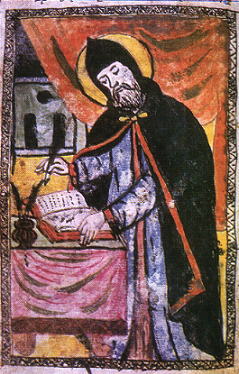


.jpg?utm_source=es.wikipedia.org&utm_campaign=imageinfo&utm_content=original)


.JPG?utm_source=en.wikipedia.org&utm_campaign=imageinfo&utm_content=original)
.jpg?utm_source=fr.wikipedia.org&utm_campaign=imageinfo&utm_content=original)