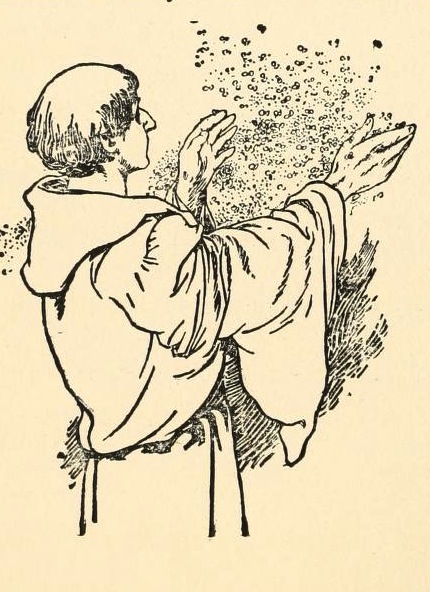
Saint Modomnoc
O’Neil
Ermite à Tibraghny
(Kilkenny) et évêque
Fête le 13 février
† 550
Autres graphies :
Modomnoc O’Neil, Domnoc, Dominic ou Modomnock
Il quitta l’Irlande pour
faire ses études auprès de saint David au Pays de Galles. On lui attribue
l’introduction des abeilles en Irlande, celles qu’il avait soignées au Pays de
Galles ayant refusé de le quitter et l’ayant suivi lors de son retour en
Irlande.
SOURCE : http://www.martyretsaint.com/modomnoc-o%E2%80%99neil/
Saint Modomnoc O'Neil,
évêque (+ 550)
Mort vers 550. Modomnoc
(Domnoc, Dominic, Modomnock), appartenait à la lignée royale irlandaise des
O'Neil. Pour pouvoir faire les études pour devenir prêtre, les grands
monastères irlandais n'ayant pas encore été créés, il dût quitter l'Irlande.
Son nom réel est probablement Dom ou Donogh mais les saints Celtes étant si
aimés, on leur rajoutait un affectueux "mon" ou "petit" ou
"cher" à leur nom, ce qui finissait par le changer complètement. Par
exemple, un autre disciple Irlandais bien aimé de Saint David était appelé au
début Aidan, mais apparaît d'habitude dans les registres du monastère comme
Maidoc.
Modomnoc traversa le bras de mer pour être formé par le grand saint David au
monastère de Mynyw (Menevia, maintenant saint David) dans le Pays de Galles. Il
était prévu que tous ceux qui résident dans la communauté prennent part au
travail manuel, en plus de l'étude et des Offices. Une histoire nous raconte
comment un jour, Modomnoc travaillait avec un autre moine à faire une route,
quand il dût le réprimander pour quelque problème. L'autre moine fut saisi de
colère et prit une pince, mais avant qu'il ne put en frapper Modomnoc, Saint
David, qui était témoin de l'incident, bloqua son bras par ses pouvoirs
spirituels et il resta paralysé.
Modomnoc reçut la charge des abeilles et il aimait ça. Et si tous les autres
aimaient le miel, peu aimaient s'occuper des ruches. Modomnoc aima les abeilles
presque plus qu'il n'aima leur miel. Il les soigna, les gardant tendrement dans
abris de paille dans un coin spécial et abrité du jardin, où il planta les
genres de fleurs préférées des abeilles.
Chaque fois qu'elles
fourmillaient en groupe, il prenait l'essaim très délicatement et avec amour,
et il préparait une nouvelle ruche. Il parlait aux abeilles tout en travaillant
au milieu d'elles et elles bourdonnaient en nuage autour de sa tête, comme si
elles répondaient. Et, bien sûr, elles ne l'ont jamais piqué.
A la fin d'été, elles lui
donnaient beaucoup de miel, tant que Modomnoc avait besoin de l'aide pour
porter le tout à l'intérieur. Les moines n'ont jamais manqué de miel pour leurs
repas ou de faire de l'hydromel. Le bon Modomnoc remerciait Dieu pour cela, et
aussi les abeilles. Il marchait parmi les abris le soir et parlait aux
abeilles, et elles, de leur côté, venaient à sa rencontre. Tous les autres
moines évitaient soigneusement ce coin du jardin de monastère parce qu'ils
avaient peur d'être piqué.
De même que remerciant
les abeilles, Modomnoc faisait tout son possible pour prendre soin d'elles dans
le froid et l'orage. Bientôt ses années d'étude terminées, Modomnoc put
retourner en Irlande pour commencer son ministère de prêtre. Tout en étant
heureux de rentrer à la maison, il sentit qu'il manquerait à ses abeilles. Le
jour de son départ, il dit au revoir à l'Abbé, aux moines, et ses collègues
étudiants. Puis il descendit au jardin pour dire adieu à ses abeilles.
Elles sortirent par
centaines, par milliers, à l'appel de sa voix et jamais là-bas un tel
bourdonnement et une telle agitation n'eurent lieu parmi les rangs et les rangs
de ruches. Les moines restés à distance admiraient le prodige, "On dirait
que les abeilles ont su," disaient-ils. "On dirait qu'elles savaient
que Modomnoc partait."
Modomnoc s'en alla
résolument et descendit sur la rive et embarqua dans un bateau. Quand ils
étaient à peu près 3 miles de la rive, Modomnoc vit ce qui ressemblait à un
petit nuage noir dans le ciel dans la direction de la côte Galloise. Il le
regarda et comme il se rapprochait de plus en plus, il vit à son étonnement que
c'était un essaim d'abeilles, se rapprochant jusqu'à finalement se poser sur le
bord du bateau. C'était un essaim gigantesque -- toutes les abeilles de toutes
les ruches, en fait. Les abeilles l'avaient suivi!
Cette fois Modomnoc ne félicita pas ses amies. "Mais vous êtes
sottes," les gronda-t'il, "vous ne m'appartenez pas mais au
monastère! Comment voulez-vous que les moines fassent sans vous le miel, ou
l'hydromel? Retournez tout de suite, petites sottes!" Mais si les abeilles
ont compris ce qu'il avait dit, elles ne lui ont pas obéi. D'abord, elles se
posèrent dans le calme sur le bateau, dans un murmure d'endormissement, et
restèrent là. Les marins n'apprécièrent pas et demandèrent à Modomnoc ses
intentions.
Il dit de reprendre le
cap sur le Pays de Galles. C'était déjà trop loin pour que les abeilles
puissent retourner en volant, même si elles avaient voulu lui obéir. Il ne
voulait pas laisser ses petites amies souffrir de leur bêtise. Mais le vent
poussait le bateau vers l'Irlande et quand ils réussirent le changement de cap,
la voile était devenue inutilisable. Les marins durent ramer jusqu'à la côte
galloise. Ils le firent de très mauvaise grâce, mais ils avaient si peur des
abeilles qu'ils auraient fait n'importe quoi.
Saint David et les moines furent très étonnés de voir revenir Modomnoc, qui
avait l'air plutôt honteux. Il leur expliqua ce qui était arrivé. Au moment où
le bateau toucha la terre ferme, les abeilles retournèrent à leurs ruches et
s'y calmèrent. "Attends jusqu'à demain," lui conseilla l'abbé,
"mais ne fais pas tes adieu aux abeilles. Elles arriveront à accepter la
séparation dans ce cas."
Le lendemain matin, le bateau était à nouveau prêt pour Modomnoc et cette fois
il partit précipitamment sans dire adieu à personne. Mais arrivés à peu près 3
miles de la rive, il fut découragé de voir encore ce petit nuage noir s'élevant
au-dessus de la côte Galloise. Tout le monde reconnu la situation et les marins
refirent cap sur la terre immédiatement. Une fois plus Modomnoc, honteux,
revint chercher David et lui dit son histoire. "Que dois-je faire?"
demanda-t'il. "Je dois rentrer à la maison. Les abeilles ne me permettent
pas de partir sans elles. Je ne peux pas vous priver d'elles, si utiles au
monastère."
David dit,
"Modomnoc, je te donne les abeilles. Prends-les avec ma bénédiction. Je
suis sûr qu'elles ne prospéreront plus sans toi. Prends-les. Nous obtiendrons
d'autres abeilles plus tard pour le monastère."
L'abbé descendit au
bateau et raconta l'histoire aux marins. "Si les abeilles suivent Modomnoc
pour la troisième fois, emmenez-les en Irlande avec lui et avec ma
bénédiction." Mais cela lui prit du temps et beaucoup de palabres pour obtenir
que les marins l'acceptent. Ils ne se souciaient pas de savoir qui avait les
abeilles tant qu'elles n'étaient pas dans leur bateau.
L'abbé rassura les marins
: les abeilles ne feraient pas d'ennui aussi longtemps que Modomnoc serait à
bord. Les marins demandèrent pourquoi les abeilles n'avaient pas obéi à l'ordre
de Modomnoc de retourner au monastère. Après beaucoup de longues explications,
les marins furent finalement persuadés de reprendre la mer.
Pour la troisième fois
que le bateau repartait, Modomnoc pria intensément afin que les abeilles aient
la bonne idée de rester dans leur jardin au lieu de risquer leurs vies en mer.
Pour la troisième fois, il vit un petit nuage noir s'élevant en haut,
approchant de plus en plus, jusqu'à ce qu'il vit que c'était le même essaim. Il
s'installa sur le bateau une fois plus. Cette fois il fit pas revenir le bateau
au port. Modomnoc cajola ses fidèles amies dans un coin abrité du bateau, où
elles restèrent silencieusement durant le voyage, au grand soulagement des marins.
Quand il arriva en Irlande, il établit une église à un endroit nommé Bremore,
près de Balbriggan, dans le Comté de Dublin, et il installa ici les abeilles
dans un jardin heureux tout comme elles en avaient un au Pays de Galles.
L'endroit est connu encore aujourd'hui comme "l'église de
l'apiculteur." Il devint ermite à Tibberaghny dans le Comté de Kilkenny et
quelques-uns disent qu'il fut sacré évêque ultérieurement.
Tropaire de saint Modomnock ton 4
Le faste et la splendeur n'avait aucune attirance pour toi, O père Modomnock./
en quittant le scintillement du monde, tu embrassa librement la pauvreté avec
le Christ,/
priant pour le Salut de toutes les âmes fidèles.
Kondakion de saint Modomnock ton 7
Te retirant de la compagnie des hommes,/
tu servis Dieu dans la solitude, O père Modomnock,/
et ton Père, voyant ta vertu dans le secret,/
t'a récompensé ouvertement./
c'est pourquoi nous glorifions ton nom/
et louons et bénissons ta mémoire vertueuse.
Sur le site officiel de l'Église en Russie : "Holy
Father Modomnoc of Ossory, Patron Saint of Bees"
SOURCE : http://stmaterne.blogspot.ca/2016/02/saint-modomnoc-oneil-eveque-550.html
Saint Modomnoc O'Neil
(Domnoc, Dominic, Modomnock, † vers 550) et les abeilles
"Modomnoc reçut la
charge des abeilles et il aimait ça. Et si tous les autres aimaient le miel,
peu aimaient s'occuper des ruches. Modomnoc a aimé les abeilles presque plus
qu'il n'a aimé leur miel. Il les a soignées, les gardant tendrement dans abris
de paille dans un coin spécial et abrité du jardin, où il planta les genres de
fleurs préférées des abeilles.
Chaque fois qu'elles
fourmillaient en groupe, il prennait l'essaim très délicatement et avec amour,
et il préparait une nouvelle ruche. Il parlait aux abeilles tout en travaillant
au milieu d'elles et elles bourdonnaient en nuage autour de sa tête, comme si
elles répondaient. Et, bien sûr, elles ne l'ont jamais piqué.
A la fin d'été, elles lui
donnaient beaucoup de miel, tant que Modomnoc avait besoin de l'aide pour
porter le tout à l'intérieur. Les moines n'ont jamais manqué de miel pour leurs
repas ou de faire de l'hydromel. Le bon Modomnoc remerciait Dieu pour cela, et
aussi les abeilles. Il marchait parmi les abris le soir et parlait aux abeilles,
et elles, de leur côté, venaient à sa rencontre. Tous les autres moines
évitaient soigneusement ce coin du jardin de monastère parce qu'ils avaient
peur d'être piqué.
De même que remerciant
les abeilles, Modomnoc faisait tout son possible pour prendre soin d'elles dans
le froid et l'orage. Bientôt ses années d'étude terminées, Modomnoc put
retourner en Irlande pour commencer son ministère de prêtre. Tout en étant
heureux de rentrer à la maison, il sentit qu'il manquerait à ses abeilles. Le
jour de son départ, il dit au revoir à l'Abbé, aux moines, et ses collègues
étudiants. Puis il descendit au jardin pour dire adieu à ses abeilles.
Elles sortirent par
centaines, par milliers, à l'appel de sa voix et jamais là-bas un tel
bourdonnement et une telle agitation n'eurent lieu parmi les rangs et les rangs
de ruches. Les moines restés à distance admiraient le prodige, "On dirait
que les abeilles ont su," disaient-ils. "On dirait qu'elles savaient
que Modomnoc partait."
Modomnoc s'en alla
résolument et descendit sur la rive et embarqua dans un bateau. Quand ils
étaient à peu près 3 miles de la rive, Modomnoc vit ce qui ressemblait à un
petit nuage noir dans le ciel dans la direction de la côte Galloise. Il le
regarda et comme il se rapprochait de plus en plus, il vit à son étonnement que
c'était un essaim d'abeilles, se rapprochant jusqu'à finalement se poser sur le
bord du bateau. C'était un essaim gigantesque -- toutes les abeilles de toutes
les ruches, en fait. Les abeilles l'avaient suivi!
Cette fois Modomnoc ne
félicita pas ses amies. "Mais vous êtes sottes," les gronda-t'il,
"vous ne m'appartenez pas mais au monastère! Comment voulez-vous que les
moines fassent sans vous le miel, ou l'hydromel? Retournez tout de suite, petites
sottes!" Mais si les abeilles ont compris ce qu'il avait dit, elles ne lui
ont pas obéi. D'abord, elles se posèrent dans le calme sur le bateau, dans un
murmure d'endormissement, et restèrent là. Les marins n'ont pas apprécié et
demandé à Modomnoc ses intentions.
Il dit de reprendre le
cap sur le Pays de Galles. C'était déjà trop loin pour que les abeilles
puissent retourner en volant, même si elles avaient voulu lui obéir. Il ne
voulait pas laisser ses petites amies souffrir de leur bêtise. Mais le vent
poussait le bateau vers l'Irlande et quand ils réussirent le changement de cap,
la voile était devenue inutilisable. Les marins dûrent ramer jusqu'à la côte
Galloise. Ils le firent de très mauvaise grâce, mais ils avaient si peur des
abeilles qu'ils auraient fait n'importe quoi.
Saint David et les moines
furent très étonnés de voir revenir Modomnoc, qui avait l'air plutôt honteux.
Il leur expliqua ce qui était arrivé. Au moment où le bateau toucha la terre
ferme, les abeilles retournèrent à leurs ruches et s'y calmèrent. "Attends
jusqu'à demain," lui conseilla l'abbé, "mais ne fait pas tes adieu
aux abeilles. Elles arriveront à accepter la séparation dans ce cas."
Le lendemain matin, le bateau était à nouveau prêt pour Modomnoc et cette fois il partit précipitamment sans dire adieu à personne. Mais arrivés à peu près 3 miles de la rive, il fut découragé de voir encore ce petit nuage noir s'élevant au-dessus de la côte Galloise. Tout le monde reconnu la situation et les marins refirent cap sur la terre immédiatement. Une fois plus Modomnoc, honteux, revint chercher David et lui dit son histoire. "Que dois-je faire?" demanda-t'il. "Je dois rentrer à la maison. Les abeilles ne me permettent pas de partir sans elles. Je ne peux pas vous priver d'elles, si utiles au monastère."
David dit, "Modomnoc, je vous donne les abeilles. Prennez-les avec ma bénédiction. Je suis sûr qu'elles ne prospéreront plus sans vous. Prenez-les. Nous obtiendrons d'autres abeilles plus tard pour le monastère."
L'abbé descendit au bateau et raconta l'histoire aux marins. "Si les
abeilles suivent Modomnoc pour la troisième fois, emmenez-les en Irlande avec
lui et avec ma bénédiction." Mais cela lui pris du temps et beaucoup de
palabres pour obtenir que les marins l'acceptent. Ils ne se souciaient pas de
savoir qui avait les abeilles tant qu'elles n'étaient pas dans leur bateau.
L'abbé rassura les marins : les abeilles ne feraient pas d'ennui aussi longtemps que Modomnoc serait à bord. Les marins demandèrent pourquoi les abeilles n'avaient pas obéi à l'ordre de Modomnoc de retourner au monastère. Après beaucoup de longues explications, les marins furent finalement persuadés de reprendre la mer.
Pour la troisième fois que le bateau repartait, Modomnoc pria intensément afin
que les abeilles aient la bonne idée de rester dans leur jardin au lieu de
risquer leurs vies en mer. Pour la troisième fois, il vit un petit nuage noir
s'élevant en haut, approchant de plus en plus, jusqu'à ce qu'il vit que c'était
le même essaim. Il s'installa sur le bateau une fois plus. Cette fois il fit
pas revenir le bateau au port. Modomnoc cajola ses fidèles amies dans un coin
abrité du bateau, où elles restèrent silencieusement durant le voyage, au grand
soulagement des marins.
Quand il arriva en
Irlande, il établit une église à un endroit nommé Bremore, près de Balbriggan,
dans le Comté de Dublin, et il installa ici les abeilles dans un jardin heureux
tout comme elles en avaient un au Pays de Galles. L'endroit est connu encore
aujourd'hui comme "l'église de l'apiculteur." Il devint ermite à
Tibberaghny dans le Comté de Kilkenny et quelques-uns disent qu'il fut sacré
évêque ultérieurement."
extrait de : http://home.scarlet.be/amdg/sankt/fev13.html
SOURCE : http://www.encyclopedie-universelle.net/abeille1/abeille-histoire-hommes-civilisations9.html

Also
known as
Dominic
Dominick
Domnoc
Domnock
Modomnock
Profile
Member of the Irish royal
O’Neill clan. Monk.
Spiritual student of Saint David of
Wales. Beekeeper while
a novice.
When he returned to Ireland,
a swarm of his bees followed
his ship. Hermit at
Tibraghny, Kilkenny, Ireland. Bishop of Ossory, Ireland.
Born
c.550 of
natural causes
Additional
Information
Lives
of the Saints, by Father Alban
Butler
Saints
of the Day, by Katherine Rabenstein
books
Our Sunday Visitor’s Encyclopedia of Saints
Oxford Dictionary of Saints, by David Hugh Farmer
other
sites in english
fonti
in italiano
MLA
Citation
“Saint Modomnoc“. CatholicSaints.Info.
11 November 2023. Web. 3 September 2026.
<https://catholicsaints.info/saint-modomnoc/>
SOURCE : https://catholicsaints.info/saint-modomnoc/
St. Modomnoc
Feastday: February 13
Death: 550
Irish bishop and
a disciple of St. David of
Wales. Sometimes called Domnoc or Dominic, he was a member of the royal
Irish family of
O’Neil and ended his years as a hermit at Tibraghny in Kilkenny When Modomnoc
returned to Ireland after
studying with St. David, swarms of bees left Wales to
follow him, thus supposedly being introduced to Ireland.
SOURCE : https://www.catholic.org/saints/saint.php?saint_id=5148
February 13
St. Modomnoc, or
Dominick, of Ossory, Bishop and Confessor
HE is said to have
been of the noble race of the O’Neils, and passing into Wales, to have studied
under St. David in the Vale of Ross. After his return home he served God at
Tiprat Fachna, in the western part of Ossory. He is said to have been honoured
there with the episcopal dignity, about the middle of the sixth century. The
see of Ossory was translated from Seirkeran, the capital of this small county,
to Aghavo, in the eleventh century, and in the twelfth, in the reign of Henry
II. to Kilkenny. See Sir James Ware, l. De Antiquitatibus Hiberniæ, and l. De
Episcopat. Hibern.
Rev. Alban Butler
(1711–73). Volume I: January. The Lives of the Saints. 1866.
Holy Father Modomnoc of
Ossory, Patron Saint of Bees
Commemorated: February
13/26
St. Modomnoc (also Domnoc,
Dominic) lived in the first half of the sixth century. This name, by which he
is commonly known, means “my Domnoc”, or “little Domnoc”. Irish hagiographers
used to add the prefix “mo”, which means “my”, “little”, “dear” before the
names of saints whom they particularly loved and venerated. The name “Domnoc”
is of unknown Irish origin, while the name form “Dominic” means “belonging to
God”.
St. Modomnoc descended
from the royal family (or, to be more exact the clan) of O’Neil in Ulster,
Northern Ireland. With all his heart young Modomnoc wished to serve God as
priest, so he went to Wales to receive a good education and training in the
great monastery of Mynyw, or Menevia (now St. Davids) under St. David, the
patron-saint of Wales. Unlike other disciples of the great Abbot David who
practiced manual labor, church singing and grew vegetables, the young ascetic
Modomnoc had beekeeping as his obedience. Modomnoc loved this obedience very
much and took great care of the little creatures that were in his charge. He
looked after them, kept them in specially-made straw beehives in a sheltered
corner of the large monastery garden where he grew the most beautiful flowers
that were loved and appreciated by his bees.
Modomnoc often talked to
the bees and they, in their turn, flew in swarms around his head, as if
speaking to him in their language and expressing reciprocity for his affection.
At the end of the summer the bees provided St. Modomnoc with such a great
amount of honey that he needed helpers to deliver it to the monastery. Owing to
Modomnoc and his faithful bees, the monks of Mynyw Monastery had honey in
abundance. St. Modomnoc always thanked God for sending him such an obedience.
All the other monks were afraid of the bees and avoided walking or appearing in
the corner of the garden where the Modomnoc’s bees lived because they could
sting them, but the insects never stung Modomnoc himself.
Several years passed. It
was time for St. Modomnoc to return to his native Ireland and start his
priestly ministry. According to tradition, a whole swarm of faithful bees flew
after their beloved master to Ireland. This is how it happened. The day before
his departure, Modomnoc bid farewell to his holy abbot and the brethren and at
the end came to the garden to say goodbye to his most beloved friends, the
bees, knowing that he would miss them in Ireland. The bees, as if feeling that
their dear father was going to leave, flew out of their beehives and with
extremely loud buzzing started whirling around the saint (several hundred
thousand of them!). All this time the monks stood at a distance from the holy
man, greatly amazed. St. Modomnoc got on the boat and departed for
Ireland.
However, before he had
sailed three miles he suddenly saw a small black cloud that was swiftly
approaching from the Welsh coast. Soon the cloud drew near and the holy man to
his great astonishment realized that these were the bees from all the beehives
of the Mynyw Monastery. The insects began impetuously and joyfully descending
onto the boat of their master. St. Modomnoc, taking pity on the monks who would
be deprived of wonderful honey, and fearing for the safety of bees which could
all perish during the journey from Wales to Ireland, commanded them to fly
back. But the tiny creatures this time were far from obeying their protector.
Meanwhile, the sailors, fearing the bees, implored Modomnoc to make a decision
as soon as possible. And the saint had to ask the sailors to turn back to
Wales.
The brethren of Mynyw
were really staggered on seeing St. Modomnoc returning together with all the
bees to Wales! The holy man related to the abbot what had happened to him and
St. David suggested he set sail the following morning, but this time with no
farewells to the bees. Modomnoc did what was told him. But the event was
repeated: when the saint had covered three miles by sea the bees in the shape
of a cloud caught up with him. Then the man of God resolved to sail back to
Mynyw again.
The abbot, seeing that
Modomnoc had to return already twice, said to him: “Modomnoc, I give you these
bees. Take them with my blessing. I see they will not be able to live without
you. And we will obtain new bees for us.” Modomnoc agreed to fulfil the will of
the abbot; but he had to persuade the sailors for a long time to take the bees
with them. On parting, St. David told Modomnoc that the bees would not do any
harm to the sailors as long as the saint stayed aboard. Before leaving,
Modomnoc prayed so that the bees, if that was the will of God, might remain to
live in the garden of Mynyw as they could all die during their flight to
Ireland. However, even this time all the bees flew after their master. Modomnoc
made a shelter for the bees on his boat and all of them on his command moved
there, patiently waiting for the end of the sea journey, doing absolutely no
harm to the sailors.
Upon his arrival in
Ireland, according to tradition, St. Modomnoc erected a church in Bremore near
the town of Balbriggan, in present-day County Dublin. Near the church, as the
tradition says, he settled the swarm of his bees in beehives in an amazingly
beautiful garden that resembled the garden in Mynyw. This spot is known as “the
beekeeper’s church” (“Llan-Beach-Aire”) to this day. Thus, Irish people from
ancient times believe that the bees as well as beekeeping appeared in their
country due to St. Modomnoc.
Most probably, arriving
in Ireland, Modomnoc undertook missionary work and served as a bishop of
Ossory. There is a tradition that St. Modomnoc ended his days as a hermit in
Tibraghny in the south-west of the present-day County Kilkenny where he was
especially venerated. Our holy father Modomnoc reposed in the Lord in about
550. The name of Modomnoc was included in the “Martyrology of St. Oengus” from
the Tallacht Monastery. Specifically, St. Oengus wrote: “In a little boat, from
the east, over the pure-colored sea, my Domnoc brought… the gifted race of
Ireland's bees.” By the way, approximately at the same time as St. Modomnoc in
Ireland lived a holy woman named Gobnait, who was Abbess of Ballyvourney in
County Cork and a wonderworker (commemorated February 11/24—just two days
before Modomnoc) who was a beekeeper as well. Researchers suppose that her bees
were relatives of the bees of St. Modomnoc.
St. Modomnoc is widely
venerated as the patron-saint of bees and beekeeping to this day.
Holy Father Modomnoc,
pray to God for us!
25 / 02 / 2015
SOURCE : http://www.pravoslavie.ru/english/77526.htm
St. Modomnoc O'Neil and
the Bees
By Denny Sellen, Eastern Orthodox Christian based in Seattle
(Specialist in Semitic Anthropology and Compared Religions)
Since the first time I
read this story, it has made a great impression on me. The Celtic saints, in
particular those of Ireland, have always exhibited a keen connection with the
world of nature, with which they felt no duality, but rather perfect harmony.
They saw the natural world as being at the forefront of redemption and the
grace of God as being able to work through even the violent-natured of animals.
This story is an example of the lovely the Celtic saint had for animals, and,
more over, the love those animals had for them. We cannot forget the stories of
modern day saints and their animal friends, such as Saint Seraphim of Sarov who
had a bear that lived with him (whom he had met when it was an adult), or Fr. Paisios
of Mount Athos (d. 1995) who according to countless witnesses had a
supernatural ability to communicate with animals and even became sadened when a
visitor killed a snake.
St. Modomnoc O'Neil, Bishop
(Domnoc, Dominic, Modomnock)
Died c. 550. Modomnoc, descended of the Irish royal line of O'Neil, had to leave Ireland to train for the priesthood, since he was a student before the creation of the great Irish monasteries. His name is most likely to have been Dom or Donogh but the Celtic saints were so tenderly loved that "my", "little" and "dear" were very
often added to the names, which completely altered their appearance. Another disciple from Ireland much loved by St.David was originally called Aidan, but usually appears in accounts of the monastery as Maidoc.
He crossed the English Channel to be educated under the great Saint David at Mynyw (Menevia, now Saint David's) Monastery in Wales. All those who resided in the community were expected to share in the manual work as well as the study and worship, and there is a story which tells how one day Modomnoc was working with another monk making a road, when he had occasion to rebuke him for some matter. The other monk was seized with anger and took up a crowbar, but before he could bring it down on Modomnoc, SaintDavid, who was witness to the incident, stayed his arm by his spiritual powers and it remained paralysed.
Modomnoc was given charge of the bees and he loved it. And so did everyone else--they all loved honey, but few like taking charge of the hives. Modomnoc liked the bees almost more than he liked their honey. He cared for them tenderly, keeping them in straw skeps in a special sheltered corner of the garden, where he planted the kinds of flowers best loved by the bees.
Every time they swarmed, he captured the swarm very gently and lovingly and set up yet another hive. He talked to the bees as he worked amongthem and they buzzed around his head in clouds as if they were responding. And, of course, they never stung him.
At the end of summer, they gave him much honey, so much that Modomnoc needed help carrying it all inside. The monks never ran out of honey for their meals or making mead to drink. The good Modomnoc thanked God for this, and he also thanked the bees. He would walk among the skeps in the evening and talk to them, and the bees, for their part, would crowd out to meet him. All the other monks carefully avoided that corner of the monastery garden because they were afraid of being stung.
As well as thanking the bees, Modomnoc did everything he could to care for them in cold and storm. Soon his years of study ended, and Modomnoc had to return to Ireland to begin his priestly ministry. While he was glad to be returning home, he knew he would be lonely for his bees. On the day of his departure, he said good-bye to the Abbot, the monks, and his fellow students. Then he went down to the garden to bid farewell to his bees.
They came out in the hundreds of thousands in answer to his voice and never was there such a buzzing and excitement among the rows and rows of hives. The monks stood at a distance watching the commotion in wonder, "You'd think the bees knew," they said. "You'd think they knew
that Modomnoc was going away."
Modomnoc resolutely turned and went down to the shore and embarked the ship. When they were about three miles from the shore, Modomnoc saw what looked like a little black cloud in the sky in the direction of the Welsh coast. He watched it curiously and as it approached nearer, he saw to his amazement that it was a swarm of bees that came nearer and nearer until finally it settled on the edge of the boat near him. It was a gigantic swarm--all the bees from all the hives, in fact. The bees had followed him!
This time Modomnoc did not praise his friends. "How foolish of you,"
he scolded them, "you do not belong to me but to the monastery! How do you suppose the monks can do without honey, or mead? Go back at once, you foolish creatures!" But if the bees understood what he said, they did not obey him. They settled down on the boat with a sleepy kind of murmur, and there they stayed. The sailors did not like it one bit and asked Modomnoc what he intended to do.
He told them to turn the boat back for Wales. It was already too far for the bees to fly back, even if they wanted to obey him. He could not allow his little friends to suffer for their foolishness. But the wind was blowing the boat to Ireland and when they turned back, the sail was useless. The sailors had to furl it and row back to the Welsh coast. They did it with very bad grace, but they were too much afraid of the bees to do anything else.
Saint David and the monks were very surprised to see Modomnoc coming back and looking rather ashamed. He told them what had happened. The moment the boat had touched land again, the bees had made straight for their hives and settled down contentedly again. "Wait until
tomorrow," advised the abbot, "but don't say farewell to the bees again. They will be over the parting by then."
Next morning, the boat was again in readiness for Modomnoc and this time he left hurriedly without any fuss of farewell. But when they were about three miles from the shore, he was dismayed to see again the little black cloud rising up over the Welsh coast. Everyone recognised the situation and the sailors turned back to shore immediately.
Once more the shamefaced Modomnoc had to seek out David and tell his story. "What am I to do?" he pleaded. "I must go home. The bees
won't let me go without them. I can't deprive you of them. They are so useful to the monastery."
David said, "Modomnoc, I give you the bees. Take them with my blessing. I am sure they would not thrive without you. Take them. We'll get other bees later on for the monastery."
The abbot went down to the boat and told the sailors the same story. "If the bees follow Modomnoc for the third time, take them to Ireland with him and my blessing." But it took a long time and a great deal of talking to get the sailors to agree to this. They did not care who had the bees as long as they weren't in their boat.
The abbot assured the sailors that the bees would give no trouble as long as Modomnoc was onboard. The sailors asked, if that were so, why the bees did not obey Modomnoc's command to return to the monastery. After much back and forth, the sailors were finally persuaded into starting out again.
For the third time the boat set sail, Modomnoc praying hard that the bees would have the sense to stay in their pleasant garden rather than risking their lives at sea. For the third time he saw the little black cloud rising up in the distance, approaching nearer and nearer until he saw it was the same swarm of bees again. It settled on the boat once more. This time it did not turn back. Modomnoc coaxed his faithful friends into a sheltered corner of the boat, where they remained quietly throughout the journey, much to the sailors' relief.
When he landed in Ireland, he set up a church at a place called Bremore, near Balbriggan, in County Dublin, and here he established the bees in a happy garden just like the one they had in Wales. The place is known to this day as "the Church of the Beekeeper."
He became a hermit at Tibberaghny in County Kilkenny and some say he waslater consecrated Bishop of Ossory(Benedictines , Curtayne).
Troparion of St Modomnock tone 4
Pomp and splendour held no attraction for thee, O Father Modomnock./ By leaving the glitter of the world, thou didst freely embrace thy poverty with the Waterman,/ praying for the salvation of all faithful souls.
Kontakion of St Modomnock tone 7
Retiring from the company of men,/ thou didst serve God in solitude, O Father Modomnock,/ and thy Father, seeing thy virtue in secret,/ rewarded thee openly./ Therefore we glorify thy name/ and praise and bless thy righteous memory.
SOURCE : http://abbaaw.blogspot.ca/2009/02/st-modomnoc-oneil-and-bees.html
St Modomnoc
Celebrated
on February 13th
Abbot. Modomnoc was born
in the 6th century, and, according to legend was a son of the royal O'Neill
family of Ireland. He studied under St David at his Menevia monastery in
Pembrokeshire.
One of his duties as a monk was looking after the beehives. Stories tell that a
swarm of his bees settled on his ship when it was time for him to return to
Ireland - and so he was the person that introduced beekeeping to the country.
In the 9th century Martyrology of Oegus the Culdee, it is written: "in a
little boat from the east in a pure-coloured sea my Domnoc brought the gifted
race of Ireland's bees."
Modomnoc settled at Tibberaghny in Co Kilkenny. Some historians claim he became
bishop of Ossory.
SOURCE : https://www.indcatholicnews.com/saint/048
Modomnoc O'Neil B (AC)
(also known as Domnoc,
Dominic, Modomnock)
Died c. 550. The story
goes that Modomnoc, descended of the Irish royal line of O'Neil, had to leave
Ireland to train for the priesthood, since he was a student before the creation
of the great Irish monasteries. He crossed the English Channel to be educated
under the great Saint David at Mynyw (Menevia, now Saint David's) Monastery in
Wales. All the pupils had to work in the fields, garden, or in building, in
addition to attending to their studies.
Modomnoc was given charge
of the bees and he loved it. And so did everyone else--they all loved honey,
but few like taking charge of the hives. Modomnoc liked the bees almost more
than he liked their honey. He cared for them tenderly, keeping them in straw
skeps in a special sheltered corner of the garden, where he planted the kinds
of flowers best loved by the bees.
Every time they swarmed,
he captured the swarm very gently and lovingly and set up yet another hive. He
talked to the bees as he worked among them and they buzzed around his head in
clouds as if they were responding. And, of course, they never stung him.
At the end of summer,
they gave him loads and loads of honey, so much that Modomnoc needed help
carrying it all inside. The monks never seemed to run out of honey for their
meals or making mead to drink. The good Modomnoc thanked God for his success,
and he also thanked the bees. He would walk among the skeps in the evening and
talk to them, and the bees, for their part, would crowd out to meet him. All
the other monks carefully avoided that corner of the monastery garden because
they were afraid of being stung.
As well as thanking the
bees, Modomnoc did everything he could to care for them in cold and storm. Soon
his year's of study ended, and Modomnoc had to return to Ireland to begin his
priestly ministry. While he was glad to be returning home, he knew he would be
lonely for his bees. On the day of his departure, he said good- bye to David,
the monks, and his fellow students. Then he went down to the garden to bid
farewell to his bees.
They came out in the
hundreds of thousands in answer to his voice and never was there such a buzzing
and excitement among the rows and rows of hives. The monks stood at a distance
watching the commotion in wonder, "You'd think the bees knew," they
said. "You'd think they knew that Modomnoc was going away."
Modomnoc resolutely
turned and went down to the shore and embarked the ship. When they were about
three miles from the shore, Modomnoc saw what looked like a little black cloud
in the sky in the direction of the Welsh coast. He watched it curiously and as
it approached nearer, he saw to his amazement that it was a swarm of bees that
came nearer and nearer until finally it settled on the edge of the boat near
him. It was a gigantic swarm--all the bees from all the hives, in fact. The
bees had followed him!
This time Modomnoc did
not praise his friends. "How foolish of you," he scolded them,
"you do not belong to me but to David's monastery! How do you suppose the
monks can do without honey, or mead? Go back at once, you foolish
creatures!" But if the bees understood what he said, they did not obey
him. They settled down on the boat with a sleepy kind of murmur, and there they
stayed. The sailors did not like it one bit and asked Modomnoc what he intended
to do.
He told them to turn the
boat back for Wales. It was already too far for the bees to fly back, even if
they wanted to obey him. He could not allow his little friends to suffer for
their foolishness. But the wind was blowing the boat to Ireland and when they
turned back, the sail was useless. The sailors had to furl it and row back to
the Welsh coast. They did it with very bad grace, but they were too much afraid
of the bees to do anything else.
David and the monks were
very surprised to see Modomnoc coming back and looking rather ashamed. He told
them what had happened. The moment the boat had touched land again, he bees had
made straight for their hives and settled down contentedly again. "Wait
until tomorrow," advised the abbot, "but don't say farewell to the
bees again. They will be over the parting by then."
Next morning, the boat
was again in readiness for Modomnoc and this time he left hurriedly without any
fuss of farewell. But when they were about three miles from the shore, he was
dismayed to see again the familiar little black cloud rising up over the Welsh
coast. Everyone recognized the situation and the sailors turned back to shore
immediately.
Once more the shamefaced
Modomnoc had to seek out David and tell his story. "What am I to do?"
he pleaded. "I must go home. The bees won't let me go without them. I
can't deprive you of them. They are so useful to the monastery."
David laughed and said,
"Modomnoc, I give you the bees. Take them with my blessing. I am sure they
would not thrive without you anyhow. Take them. We'll get other bees later on
for the monastery."
The abbot went down to
the boat and told the sailors the same story. "If the bees follow Modomnoc
for the third time, take them to Ireland with him and my blessing." But it
took a long time and a great deal of talking to get the sailors to agree to
this. They did not care who had the bees as long as they weren't in their boat.
Bees, they explained, were the kind of passengers they never wanted. If they
gave trouble on the boat and no one could sail it, they might all be drowned.
Anything but bees, they said. Wild animals, okay; bee, no.
The abbot assured the
sailors that the bees would give no trouble as long as Modomnoc was around. The
sailors asked, if that were so, why the bees did not obey Modomnoc's command to
return to the monastery. After much back and forth, the sailors were finally
persuaded into starting out again.
For the third time the
boat set sail, Modomnoc praying hard that the bees would have the sense to stay
in their pleasant garden rather than risking their lives at sea. For the third
time he saw the dreaded little black cloud rising up in the distance,
approaching nearer and nearer until he saw it was the same swarm of bees again.
It settled on the boat once more. This time it did not turn back. Modomnoc
coaxed his faithful friends into a sheltered corner of the boat, where they
remained quietly throughout the journey, much to the sailors' relief.
When he landed in
Ireland, he set up a church at a place called Bremore, near Balbriggan, in
County Dublin, and here he established the bees in a happy garden just like the
one they had in Wales. The place is known to this day as "the Church of
the Beekeeper."
Some say that he became a
hermit at Tibraghny in Kilkenny and later bishop (Benedictines,
Curtayne).
SOURCE : http://www.saintpatrickdc.org/ss/0213.shtml
San Modomnock Abate
Festa: 13 febbraio
† 550 ca.
Fu abate di Tipra
Fachtnai (Tibberaghny, contea di Kilkenny) alla fine del VI e all'inizio del
VII secolo. E' commemorato da solo il 13 febbraio nei martirologi irlandesi e,
insieme a s. Maedoc di Ferns il 18 maggio. Con Maedoc di Ferns (m. 626) e
Scuithin di Sliab Mairge, era discepolo di s. David nel Galles. L'infondata
notizia secondo cui "fu lui ad introdurre dal Galles le api in
Irlanda" si trova nella Vita di s. Molaa e, più ampiamente, in quella di
s. David.
San Modomnock, abate di
Tipra Fachtnai (Tibberaghny, contea di Kilkenny), nacque in Galles intorno al
500. Fu discepolo di san David, il vescovo di Menevia (l'attuale St David's)
che fu uno dei principali evangelizzatori dell'Irlanda.
Modemnock arrivò in
Irlanda intorno al 520, insieme a san Maedoc di Ferns e a san Scuithin di Sliab
Mairge. Insieme fondarono diversi monasteri, tra cui quello di Tipra Fachtnai,
che divenne un importante centro di cultura e spiritualità.
Modemnock fu un monaco
esemplare, dedito alla preghiera, alla meditazione e alla cura dei poveri e dei
bisognosi. Si distinse anche per la sua abilità nel predicare e nel
catechizzare.
Morì intorno al 550, e fu
sepolto a Tipra Fachtnai. La sua festa viene celebrata il 13 febbraio.
La leggenda delle api
Una tradizione, riportata
nella Vita di san Molaa e in quella di san David, vuole che Modomnock sia stato
l'introduttore delle api in Irlanda. Secondo questa tradizione, Modomnock
avrebbe portato con sé dal Galles un favo di api, che avrebbe piantato a Tipra
Fachtnai. Le api si sarebbero moltiplicate rapidamente, e avrebbero diffuso la
loro presenza in tutta l'Irlanda.
Questa tradizione è
probabilmente infondata. L'apicoltura era già praticata in Irlanda in epoca
pre-cristiana, e non c'è alcuna prova che Modomnock abbia avuto un ruolo in
questo processo.
Autore: Franco Dieghi