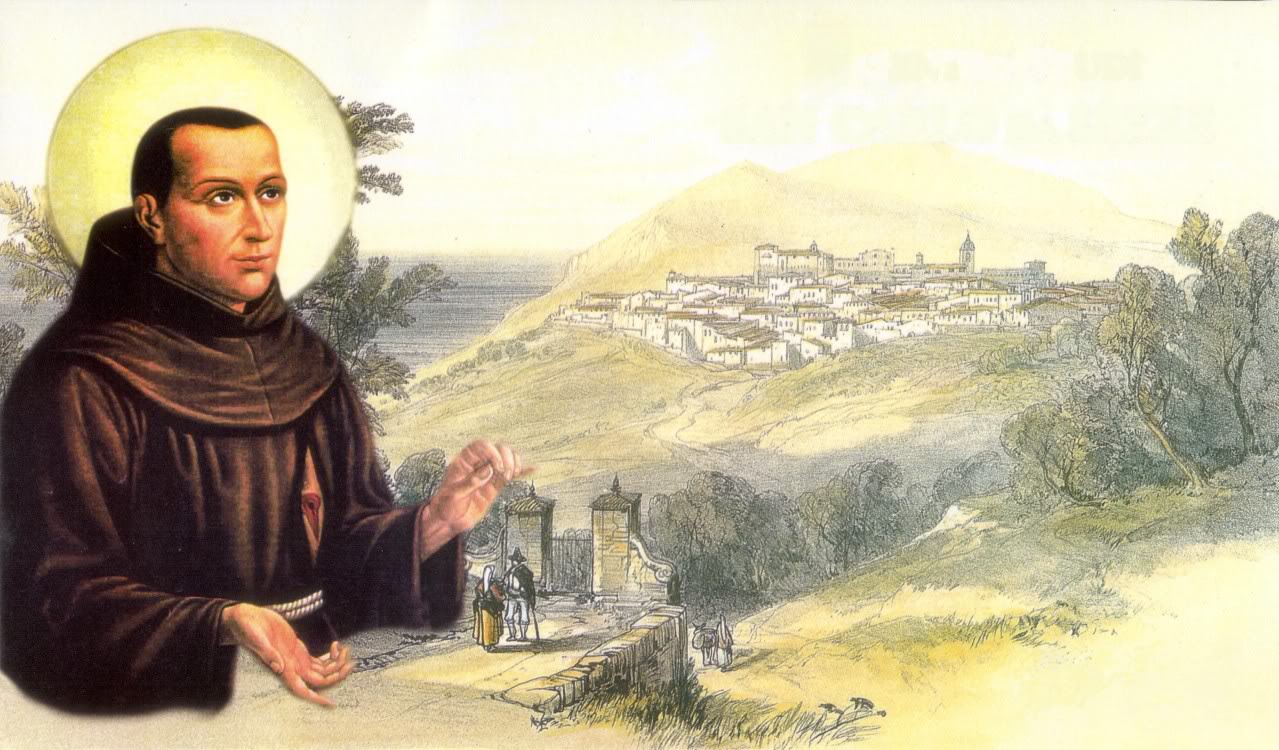
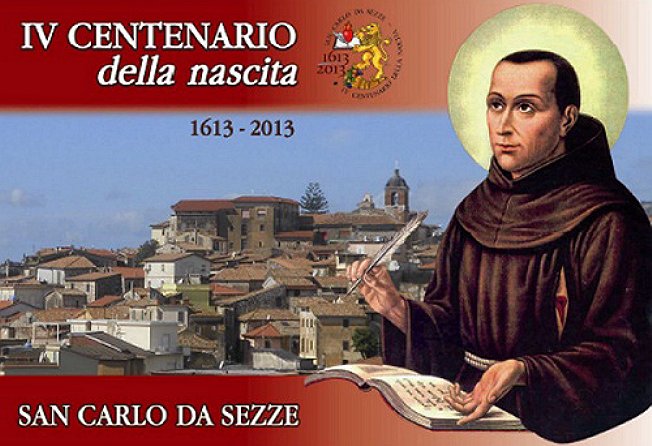
Antonio Sicurezza (1905–1979). Charles
de Sezze, 1969
Saint
Charles from Sezze, Immaculate's church, Latina
Saint Charles de Sezze
Frère mineur (+ 1670)
Saint
Charles de Sezze Macchione
Frère lai
Franciscain, portier, sacristain...
Favorisé de dons
mystiques, consulté par les Papes, stigmatisé.
Béatifié en 1882 à Rome
par Léon XIII et premier saint canonisé par Jean XXIII le 12 avril 1959.
Homélie du Card. José
Saraiva Martins pendant la concélébration eucharistique à l'honneur des saints
patrons du diocèse et de la ville de Sezze (Latina) (3 juillet 2004) [Italien]
À Rome, en 1670, saint
Charles de Sezze, religieux de l’Ordre des Mineurs. Contraint depuis son
enfance de gagner sa nourriture quotidienne, il amenait ses compagnons à
l’imitation du Christ et des saints. Enfin, comme il le désirait, revêtu de
l’habit franciscain, il se consacra à l’adoration devant l’autel du saint
Sacrement.
Martyrologe romain
SOURCE : http://nominis.cef.fr/contenus/saint/379/Saint-Charles-de-Sezze.html

Châsse de Charles de Sezze dans l'église San Francesco a Ripa, Roma
Urna
contenente il corpo di San Carlo da Sezze, Chiesa di San Francesco a Ripa, Roma
Karls
unverwester Leichnam in der Kirche San
Francesco a Ripa in Rom
Saint Charles de Sezze
MACCHIONE
Nom: MACCHIONE
Prénom: Jean Charles
(Giancarlo)
Nom de religion: Charles
de Sezze
Pays: Italie
Naissance: 1613 à
Sezze Romano (Latium)
Mort: 06.01.1670 à
Rome
Etat: Frère lai
Franciscain
Note: Portier,
sacristain, etc. Favorisé de dons mystiques, consulté par les Papes,
stigmatisé.
Béatification: 1882 à
Rome par Léon XIII
Canonisation:
12.04.1959 à Rome par Jean XXIII
Fête: 6 janvier
Réf. dans l’Osservatore
Romano:
Réf. dans
la Documentation Catholique: 1959 col.583-587
Notice
Giancarlo Macchione naît
en 1613 au village de Sezze en Latium d'une pieuse famille de cultivateurs.
Élevé par sa grand-mère, il manifeste dès son plus jeune âge une grande piété
et se fait l'apôtre de ses camarades. Il mène une vie pure et mortifiée. Frappé
d'une grave maladie à 17 ans, il en sort miraculeusement après avoir fait le
vœu d'entrer en religion. Il est reçu chez les Franciscains comme frère lai,
car son manque d'instruction lui interdit l'accès au sacerdoce comme le
désirait sa famille. Mais Dieu qui manifeste sa force dans la faiblesse, donne
à Frère Charles de Sezze de telles lumières qu'il résout les embarras de
savants théologiens et que des cardinaux et Clément IX lui-même viennent le
consulter. Par obéissance il compose, en prose ou en vers, des écrits très
simples mais profonds. Il désire enfin aller en mission pour y être martyr,
mais une maladie providentielle l'empêche au dernier moment de partir. C'est à
Rome, au couvent de S. François de Transtévère, que, brûlant d'amour pour le Seigneur,
il meurt le six janvier 1670. Il avait 57 ans.
SOURCE : http://www.abbaye-saint-benoit.ch/hagiographie/fiches/f0113.htm
SIGNES SUR LA VIE DE
SAINT CHARLES DE SEZZE
Né à Sezze le 22
d'Octobre du 1613, Jean Charles (ceci était son nom de Baptême) fut obligé
bientôt à laisser les écoles publiques pour attendre à la garde du troupeau,
amis au même temps il réussit à cultiver la profonde dévotion à l'Esprit chrétien
lui transmise grâce à ses parents.
L'amour pour la Croix et de la Vierge Marie lui furent ses deux conseillers sur son chemin spirituel; Charles
entra au couvent franciscain de Nazzano, en endossant le vêtement du Pauvre
d'Assise le 18 de mai du 1635.
En étant obéissant aux
dispositions de ses supérieurs, il exerça ses charges religieuses dans de
différents couvents de Morlupo, Ponticelli, Palestrina, Piglio, Carpineto
Romano, Castel Gandolfo, S. Pietro in Montorio et S. Francesco à Ripa en Rome,
en vivant toujours en extrême humilité et discipline franciscaine.
Fr. Charles accomplit des
oeuvres qui étaient joyeusement tournées pour procurer une certaine
sustentation aux pauvres et l'assistance aux infirmes et aux moribonds. Le
Seigneur voulût reconnaitre l'extraordinaire foi de Fr. Charles.
Un matin, pendant que le
frère participait à la Sainte Messe à l'Eglise de Saint Joseph à Capo le Case en
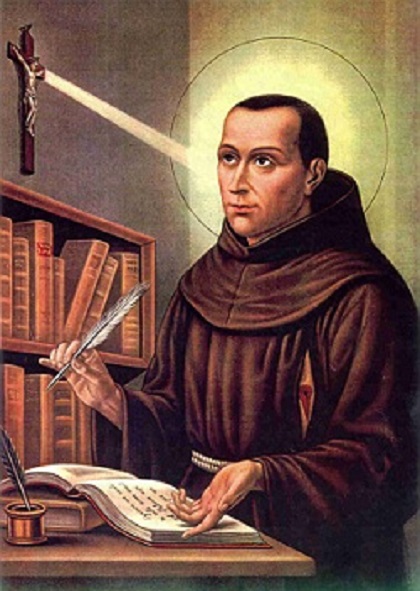
Rome, au moment de l'élévation, un rayon lumineux, parti de l'hostie sainte, toucha Charles au coeur, en lui procurant une profonde blessure. Tel fut le
signe d'amour reçu, qu'il décrit ainsi : "Il était entre deux
extrêmes, c'est à dire entre la douleur et la suavité de la douceur, et on avait
l'impression que l'âme voulait sortir du corps. Pour la l'éprouver j'aurais supporté
quelconque tourment et chaque peine".
Ceci arriva en octobre du
1648.
Frère Charles accomplit
beaucoup de miracles, comme des guérisons d'infirmités et des multiplications
de mets. Frappé de maladie il mourut au couvent de Sain François à Ripa le 6 janvier
1670. Au point ou le Seigneur lui infligea la blessure d'amour, un signe en forme de croix commença à apparaitre après sa mort; le phénomène est un des
miracles reconnus par la Sacrée Congrégation des Rites.
Une fois que les miracles
proposés pour la béatification furent reconnus, le décret de Béatification fut publié en octobre 1881 sous le Pontificat de Léon XIII.
Frère Charles de Sezze fut
reconnu Saint par l'Eglise le 12 avril 1959, par le Pape Jean XXIII.
Saint Charles est connu
comme le seul Saint stigmatisé de l'Eucharistie.
SOURCE : http://www.sancarlodasezze.it/signes_sur_la_vie_de_Saint_Charles_de_Sezze.htm

Also
known as
Carlo of Sezze
Giancarlo Marchioni
John Charles Marchioni
Karl av Sezze
Karl von Sezze
5 January on
some calendars
7 January on
some calendars
18 January on
some calendars
19 January on
some calendars
Profile
Born to a poor but
pious rural family, he worked as a shepherd as
a child.
His family encouraged his vocation to the priesthood,
but Charles was a terrible student,
barely able to read or write, and had no hope of success in seminary. Franciscan lay
brother at age 22 at Naziano, Italy. Poor
health prevented his going on foreign missions, and he served in
assorted menial positions, such as cook, porter,
and gardener at
friaries near Rome, Italy.
Once a friary superior
ordered Charles, as porter,
to give food only to traveling friars.
When Charles strictly adhered to the rule, alms to
the friary decreased. He convinced the superior the two things were related,
and Charles was allowed to be more opened handed to travellers; alms to
the friars increased.
He worked among plague victims
in 1656.
Charles wrote several mystical works,
and at the direction of his confessor,
his autobiography, The Grandeurs of the Mercies of
God. He had a strong devotion to the Eucharist and the Passion.
The simple lay
brother was sought out for spiritual advice, and the dying Pope Clement
IX called Charles to his bedside for a blessing.
Stigmatist,
with a visibly open wound in his side; said to have been opened by a piercing
ray of light that came from an elevated host during Mass at
the Church of Saint Joseph a Capo le Case. The area of the wound was marked
with a cross after his death.
Born
19 October 1613 at Sezze,
Roman Campagna, Italy as John
Charles Marchioni
6 January 1670 at
San Francesco a Ripa, Rome, Italy of
natural causes
entombed at
the Church of Saint Francis in Rome
Venerated
14 June 1772 by Pope Clement
XIV (decree of heroic
virtues)
22 January 1882 by Pope Leo
XIII
12 April 1959 by Pope John
XXIII
Additional
Information
Saints
of the Day, by Katherine Rabenstein
books
Lives of the Saints II, by Father Thomas J Donaghy
Our Sunday Visitor’s Encyclopedia of Saints
Penguin Dictionary of
Saints, by Donald Attwater and Catherine Rachel John
Wounded Heart: Saint
Charles of Sezze, by Raphael Brown
other
sites in english
images
video
webseiten
auf deutsch
sitios
en español
Martirologio Romano, 2001 edición
sites
en français
fonti
in italiano
Dicastero delle Cause dei Santi
Saint Charles of Sezze
Study Centre
nettsteder
i norsk
spletne
strani v slovenšcini
Works
Birth of Holy Mary’s
Novena
Christmas Novena
Holy Settenario
Invalid Path of the Soul
Jesus Christ’s Talk About
Life
The Grandeurs of the
Mercies of God
The Three Ways
Readings
God does not command us
to live in hair shirts and chains, or
to chastise our flesh with scourges, but to love Him above all things and our
neighbor as ourselves. – Saint Charles
of Sezze
The autobiography of
Charles stands as a very strong refutation of the opinion, quite common among
religious people, that saints are
born saints,
that they are privileged right from their first appearance on this earth. This
is not so. Saints become saints in
the usual way, due to the generous fidelity of their correspondence to divine
grace. They had to fight just as we do, and more so, against their passions,
the world and the devil. – Father Serverino
Gori
MLA
Citation
“Saint Charles of
Sezze“. CatholicSaints.Info. 16 November 2023. Web. 24 August 2026.
<https://catholicsaints.info/saint-charles-of-sezze/>
SOURCE : https://catholicsaints.info/saint-charles-of-sezze/

St. Charles of Sezze
Feastday: January 5
Birth: 1613
Death: 1670
John Charles Marchioni
was born at Sezze, Italy, on October 19, of humble parents. He became a
shepherd and wanted to become a priest. When unable to do so because of his
poor scholarship (He barely learned to read and write), he became a lay brother
at Naziano, served in various menial positions - cook, porter, gardener - at
different monasteries near Rome and
became known for his holiness, simplicity, and charity. He wrote several
mystical works, lived a life of
great mortifications, and worked heroically to help the stricken in the plague
of 1656. He died in Rome on
January 6. His family name
may have been Melchior, and he is also known as Charles of Sezze. He was
canonized by Pope John XXIII in
1959. His feast day is
January 5th.
SOURCE : https://www.catholic.org/saints/saint.php?saint_id=600
Saint Charles of Sezze
Also known as
Giancarlo Marchioni
John Charles Marchioni
Karl av Sezze
Karl von Sezze
Memorial
Profile
Born to a poor but pious rural family, he worked
as a shepherd as a child. His family encouraged his vocation to
the priesthood, but Charles was a terrible student, barely able to read or write, and had
no hope of success in seminary. Franciscan lay brother at age 22 at Naziano. Poor
health prevented his going on foreign missions, and he served in assorted
menial positions, such as cook, porter, and gardener at friaries near Rome.
Once a friary superior
ordered Charles, as porter, to give food only to traveling friars.
When Charles strictly adhered to the rule, alms to the friary decreased.
He convinced the superior the two things were related, and Charles was allowed
to be more opened handed to travellers; alms to the friars
increased.
Worked among plague
victims in 1656. Wrote several mystical works, and at the direction of
his confessor, his autobiography, The Grandeurs of the Mercies of God. Had a
strong devotion to the Eucharist and the Passion. The simple layman was sought out for spiritual
advice, and the dying Pope Clement IX called
Charles to his bedside for a blessing.
Stigmatist, with a visibly open wound in his
side; said to have been opened by a piercing ray of light that came from an
elevated host during Mass at the Church of Saint Joseph in Capo le Case. The
area was marked with a cross after his death.
Born
19 October 1613 at Sezze, Roman Campagna, Italy as John Charles Marchioni
Died
6 January 1670 at San Francesco a Ripa, Rome, Italy of natural causes; entombed at the
Church of Saint Francis, Rome
Beatified
Canonized
12 April 1959 by Pope John XXIII
Additional Information
Lives
of the Saints II, by Father Thomas J Donaghy Book
of Saints, by the Monks of Ramsgate
Our
Sunday Visitor's Encyclopedia of Saints, by Matthew Bunson, Margaret
Bunson, and Stephen Bunson
Works
Birth of Holy Mary's
Novena
Christmas Novena
Holy Settenario
Invalid Path of the Soul
Jesus Christ's Talk About
Life
The Three Ways
Readings
God does not command us
to live in hair shirts and chains, or to chastise
our flesh with scourges, but to love Him above all things and our neighbor as
ourselves.
-Saint Charles of Sezze
The autobiography of
Charles stands as a very strong refutation of the opinion, quite common among
religious people, that saints are born saints, that they are privileged right
from their first appearance on this earth. This is not so. Saints become saints
in the usual way, due to the generous fidelity of their correspondence to
divine grace. They had to fight just as we do, and more so, against their
passions, the world and the devil.
-Father Serverino Gori
SOURCE : https://web.archive.org/web/20090115212730/http://saints.sqpn.com:80/saintc23.htm
Saints of the
Day – Charles of Sezze
Article
(born John Charles
Marchioni)
Born at Sezze, Roman
Campagna, Italy, October 19, 1616; died in Rome in January 6, 1670; beatified
in 1882; canonized by Pope John XXIII in 1959; feast day may be January 6 or 7.
Born of humble parents in the Roman Campagna, John Charles Marchioni (or
possibly Melchoir) became a shepherd and wanted to become a priest. When unable
to do so because of his poor scholarship (he barely learned to read and write),
he became a lay brother of Franciscan Order at Naziano (in Rome?), served in
various menial positions – cook, porter, gardener – at different monasteries
near Rome and became known for his holiness, simplicity, and charity. His was a
life of great mystical experiences; it is told that his heart was pierced by a
ray of light proceeding from the Sacred Host, which left a visible wound. He
wrote several mystical works, lived a life of great mortifications, and worked
heroically to help the stricken in the plague of 1656 (Attwater, Benedictines,
Delaney, Perotti).
MLA
Citation
Katherine I
Rabenstein. Saints of the Day, 1998. CatholicSaints.Info.
5 December 2020. Web. 6 January 2021.
<https://catholicsaints.info/saints-of-the-day-charles-of-sezze/>
SOURCE : https://catholicsaints.info/saints-of-the-day-charles-of-sezze/
St. Charles of Sezze
(St. Charles de Sezza)
Feast Day – January 7
Charles, the son of lowly
country folk, was born at Sezze in Italy on October 22, 1613. At the urgent
request of his grand-mother, the rearing of the child was entrusted to her, and
the gentle boy acquired a great love of God and of prayer from the example and
teaching of this devout lady. He grasped the truths of religion so readily that
his parents entertained the sweet hope that Charles would later become a
priest.
But when Charles was old
enough to go to school, his studies did not meet with marked success; and so,
when his schooling ended, his parents were sensible enough to put him to work
in the fields with his brothers. There, in God’s free nature, a new light came
to the boy. From books he had not learned much, but he understood very well the
wonders of God’s creation. Everything conspired to raise his thoughts to
heavenly things, so that his work was constantly mingled with interior prayer.
He began to receive the sacraments more frequently, and evinced real zeal for
Christian perfection.
Our of veneration for the
Virgin Mother of God, he made a vow of chastity at the age of seventeen, and he
preserved it so faithfully that the Beloved of pure souls, “who feeds among the
lilies” (Cant. 2,16), seemed to have His dwelling-place in the heart of
Charles. He was seized with a great desire for holiness. He read with delight
the lives of the saints and related them to the others while at work. In the
Franciscan church which he often visited, he used to study the pictures of the
saints with a desire to imitate them.
When he was twenty years
old he fell dangerously ill, so that his life was despaired of. Then he made a
vow that, if he would recover, he would enter the Franciscan Order. At once his
illness took a turn for the better, and, true to his vow, although there were
many hardships to overcome, Charles received the habit two years later. After
his consecration to God through the vows, he advanced visibly not only in piety
but in all the virtues of his state of life, so that even the oldest brothers
were edified by him and followed his example. He ardently desired to shed his
blood for Christ, and asked that he might be sent as a lay brother to the
missions in India; but a new illness frustrated the design.
He was sent to a convent
in Rome so that he could fully recover his health. But here God Almighty
destined him for another field of labor. He received remarkable enlightenment
about things divine and about the truths of religion, so that the most learned
theologians were astonished at it and consulted with him on some of the most
difficult questions. The cardinals and even Pope Clement IX sought his advice.
In compliance with the will of God he also wrote several books about spiritual
things.
At the same time the
pious brother remained deeply humble. Concerning his remarkable gift of
enlightenment he used to say to himself, that Our Lord in His wisdom hides such
things from the wise but reveals them to the simple, to which class he
belonged. He so fervently adored his Lord under the appearances of bread that
one day a ray of light like an arrow went out from the Sacred Host and
impressed a wound in his left side. This wound was still visible after his
death.
Charles died on January
6, 1670. Pope Leo XII pronounced him blessed in 1882, and Pope John XXIII
canonized him in the spring of 1959.
*from: The
Franciscan Book of Saints, ed. by Marion Habig, ofm
SOURCE : http://www.roman-catholic-saints.com/saint-charles-of-sezze.html
January 18 : Saint Charles of Sezze
“God does not command us
to live in hair shirts and chains, or to chastise our flesh with scourges, but
to love Him above all things and our neighbor as ourselves.”
Today, January 18, we
celebrate the feast of Saint Charles of Sezze (San Carlo de Sezze,
1613-1670), a man remembered for holiness, simplicity, service, and humility.
His devotion to the Lord, and love of the Eucharist, was such that he was
graced with a mystical wound on his heart. Throughout his life, Saint Charles
demonstrated the virtues of charity and self-giving love to all he encountered.
Born John Charles
Marchioni, the future saint belonged to a pious, but poor family, in rural
Sezze, Italy. As a child—like many of the region—John worked as a shepherd, and
spent long hours in the fields with the family sheep. Due to his work, he had
little time for education, and was barely able to read and write. In the
fields, the love of the Lord, the Eucharist, and the Blessed Virgin grew deeper
within him, and he felt certain that he was destined to become a priest. While
his family encouraged his call to vocation, John’s poor academic abilities
precluded the seminary as a viable option. Instead, he entered the Franciscan
Order as a lay brother, joining a community in Naziano, and working in the most
menial of positions. He served his brothers as cook, porter, and gardener, and
never complained. While Charles wished to participate and assist in foreign
missions, his poor health prevented this as well. Instead, he embraced his role
at the monastery, serving with simplicity, humility, and love for all he
encountered.
In his autobiography,
Charles tells us, "Our Lord put in my heart a determination to become a
lay brother with a great desire to be poor and to beg alms for his
love." Following this determination, Charles became well known for
his holiness and charity. He was frequently sought out for spiritual advice and
counsel. Even the dying Pope Clement IX called Charles, the simple lay brother,
to his bedside for a blessing. Charles also became known for his generosity and
charitable nature. His superior, worried that his constant charity would
deplete the monastery’s stores, forbade Charles to continue with his generosity
to all travelers. Instead, he was ordered to only provide food to visiting
friars. Ever obedient, Charles followed the rule strictly, but immediately
noticed that alms to the friary decreased at the same time. After some time, he
was able to convince his superior that the decrease in charity was related to
the decrease in generosity of the community. As he was allowed to provide food
generously to all, so, too, did the alms increase!
In 1656, Italy was struck
with the plague, and Charles worked tirelessly among the victims. He traveled
amongst the sickest of the sick, providing prayer, medical care, food, and
assistance. He performed numerous miracles of healing and multiplication of
foods to serve all in need. This, like all his works, were completed with sincerity
and humility.
Charles’ devotion to the
Passion and Eucharist—devotion that had begun in the fields of his
youth—continued to grow each day. He was rewarded by the Lord, in recognition
of his devotion and extraordinary faith—with the mystical experience of the
stigmata. One morning, while Charles was participating in Mass, a bright ray of
light emanated from the Sacred Host as it was elevated, and struck Charles in
the heart. The experience left him deeply wounded, yet filled with incredible
joy. One of his brothers described him in the following manner: "It
was between two extremes, that is between pain and sweet bliss, and it seemed
as if the spirit wanted to leave the body. I would have sustained whatever
great torment or any hardship because of the sweetness.”
Sick the majority of his
life, Charles died in the convent of Saint Francis in Ripa, Italy. The wound
that had resulted form his miraculous encounter with the Holy Eucharist changed
into the form of a cross following his death. His body remains incorrupt.
Saint Charles wrote
several mystical works during his lifetime—despite having limited
education—including his autobiography entitled “The Grandeurs of the
Mercies of God.” Of this work, Father Serverino Gori wrote, “The
autobiography of Charles stands as a very strong refutation of the opinion,
quite common among religious people, that saints are born saints, that they are
privileged right from their first appearance on this earth. This is not so.
Saints become saints in the usual way, due to the generous fidelity of their
correspondence to divine grace. They had to fight just as we do, and more so,
against their passions, the world and the devil.”
Saint Charles of Sezze
followed where the Lord led him. When he was unable to become a priest, he
entered the Franciscans as a lay brother. When he was unable to go on foreign
missions, he embraced the most menial of tasks with charity, obedience, and
humility. Saint Charles, in his quiet and simple way, is the perfect example of
the love of Our Lord, shining forth to the world, through those who adore Him.
Lord our God, You are the
shield and glorious reward of those who walk blamelessly in Your sight. keep us
steadfast in Your holy service so that aided by the wise teaching and
intercession of Brother Charles of Sezze, we may with hearts open to You run
the way of perfect charity.
SOURCE : http://365rosaries.blogspot.ca/2011/01/january-18-saint-charles-of-sezze.html

Statue
in der Konkathedrale in
Sezze
San Carlo da Sezze Frate
laico francescano
Sezze (Latina), 19
ottobre 1613 - San Francesco a Ripa, 6 gennaio 1670
Giancarlo Marchionne
nacque a Sezze (Latina) nel 1613 da genitori contadini. Fece anche lui il
pastore e l'agricoltore. A 17 anni fece voto di castità in onore della Vergine
e poco dopo entrò nell'Ordine dei Frati minori come fra Carlo. Fu in numerosi
conventi del Lazio come cuoco. portinaio, questuante e sacrestano. Ma,
nonostante gli scarsi studi, aveva doni di scienza straordinari e ciò gli
permise di realizzare una vasta produzione di opere ascetico-letterarie. Fu
consigliere di Alessandro VII e Clemente IX. Morì nel 1670 ed è santo dal 1959.
E' patrono di Sezze e della diocesi di Latina-Terracina Sezze-Priverno. (Avvenire)
Etimologia: Carlo =
forte, virile, oppure uomo libero, dal tedesco arcaico
Martirologio Romano: A
Roma, san Carlo da Sezze, religioso dell’Ordine dei Frati Minori: costretto fin
dalla fanciullezza a procurarsi il vitto quotidiano, esortava i compagni
all’imitazione di Cristo e dei santi; indossato finalmente, come desiderava, l’abito
francescano, si dedicò all’adorazione del Santissimo Sacramento.
Nato a Sezze (Latina) il
19 ottobre 1613 da Ruggero Melchiori (o Marchionne) e Antonia Maccione,
contadini piissimi e di buona condizione, Carlo fu battezzato il 22 dello
stesso mese, come risulta dall'unico registro contemporaneo esistente tuttora
presso la cattedrale di S. Maria. Per motivi di salute dovette sospendere gli
studi elementari: fece il pastore e poi il contadino. A diciassette anni emise
il voto di perpetua castità in onore della Vergine e quindi, contro il parere
dei genitori e dei parenti che lo avrebbero voluto sacerdote, preferì, per
spirito di umiltà, rendersi religioso converso. Vestì, pertanto, l'abito dei
Frati Minori nel convento di S. Francesco in Nazzano il 18 maggio 1635 e, dopo
aver superato molte difficoltà, professò il 18, o il 19 maggio dell'anno
seguente. Risiedette successivamente nei conventi di S. Maria Seconda in
Morlupo, di S. Maria delle Grazie in Ponticelli, di S. Francesco in Palestrina,
di S. Pietro in Carpineto Romano, di S. Pietro in Montorio e di S. Francesco a
Ripa in Roma. Tra il 1640 e il 1642 dimorò per breve tempo nei conventi di S.
Giovanni Battista al Piglio e in quello di S. Francesco in Castelgandolfo.
NelI'ottobre 1648, ascoltando la Messa nella chiesa di San Giuseppe a Capo le
Case in Roma, al momento dell'elevazione, ricevette dall'Ostia divina una
ferita di amore al petto.
Impiegato negli uffici
propri del suo stato, di cuoco, ortolano, portinaio, questuante e sagrestano,
Carlo si distinse per l'umiltà, l'ubbidienza, la pietà serafica e l'amore verso
il prossimo, riuscendo ad unire alla più intensa vita interiore e contemplativa
una instancabile attività caritativa e apostolica che lo condusse a Urbino, a
Napoli, a Spoleto e in altre città.
Laici, sacerdoti,
religiosi, vescovi, cardinali e pontefici si giovarono dell'opera di Carlo, che
aveva avuto da Dio doni straordinari, tra i quali, in particolare, quelli del
consiglio e della scienza infusa (riconosciuto, questo prorsus mirabile dal
breve stesso della beatificazione). Ad Alessandro VII, che lo interrogava su
Girolama Spada, giustiziata come eretica a Campo de' Fiori il 5 luglio 1659,
Carlo rispose che non si era mai recato a casa della donna, sapendo che in lei
non v'era nulla di buono. Clemente IX lo inviò a Montefalco per esaminarvi lo
spirito di una monaca, falsamente ritenuta santa. Carlo predisse il supremo
pontificato ai cardinali Fabio Chigi (Alessandro VII), Giulio Rospigliosi
(Clemente IX), Emilio Altieri (Clemente X) e Gianfrancesco Albani (Clemente
XI).
Dopo la morte, avvenuta
il 6 gennaio 1670 a San Francesco a Ripa, comparve sul petto di Carlo un
singolare stigma, che fu riconosciuto di origine soprannaturale da un'apposita
commissione medica e fu addotto come uno dei due miracoli richiesti per la
beatificazione. I processi canonici, iniziati poco dopo la morte, subirono
notevoli ritardi dovuti a contingenze storiche. Clemente XIV dichiarò
l'eroicità delle virtù il 14 giugno 1772; Leone XIII, con breve del 1° ottobre
1881, lo beatificò il 22 gennaio 1882, e Giovanni XXIII lo canonizzò il 12
aprile 1959. La sua festa si celebra il 6 gennaio. Benché a scuola avesse
imparato a leggere e a scrivere malamente, Carlo fu autore straordinariamente
fecondo.
Autore: Severino Gori
SOURCE : http://www.santiebeati.it/dettaglio/36500
Carlo da Sezze
(1613-1670)
Beatificazione:
- 22 gennaio 1882
- Papa Leone XIII
Canonizzazione:
- 12 aprile 1959
- Papa Giovanni
XXIII
- Basilica Vaticana
Memoria Liturgica:
- 6 gennaio
Religioso dell’Ordine dei
Frati Minori: costretto fin dalla fanciullezza a procurarsi il vitto
quotidiano, esortava i compagni all’imitazione di Cristo e dei santi; indossato
finalmente, come desiderava, l’abito francescano, si dedicò all’adorazione del Santissimo
Sacramento
"Sia benedetto Dio!
Sia benedetto Dio” Sia benedetto Dio!"
Giancarlo Marchionne nacque
a Sezze (Latina) il 19 ottobre 1613 da genitori contadini.
Fece anche lui il pastore
e l'agricoltore.
A 17 anni fece voto di
castità in onore della Vergine e poco dopo entrò nell'Ordine dei Frati Minori
come fra Carlo: lavora come cuoco, portinaio, questuante.
Nonostante gli scarsi
studi, ha il dono della scienza infusa ed è chiamato dai Papi come consigliere.
Si distingue per l’umiltà, unendo contemplazione e carità concreta.
Fu in numerosi conventi
del Lazio come cuoco. portinaio, questuante e sacrestano. Ma, nonostante gli
scarsi studi, aveva doni di scienza straordinari e ciò gli permise di
realizzare una vasta produzione di opere ascetico-letterarie.
Fu consigliere di
Alessandro VII e Clemente IX.
Morì nel 1670 ed è santo
dal 1959.
Patrono di Sezze e della
diocesi di Latina-Terracina Sezze-Priverno.
SOURCE : https://www.causesanti.va/it/santi-e-beati/carlo-da-sezze.html
Siamo lieti di aprirvi le
Nostre braccia nel più accogliente saluto, diletti figli e figlie, che, guidati
dai vostri Pastori e dalle Autorità civili dei vostri paesi di origine, siete
venuti a Roma per la Canonizzazione del Beato Carlo da Sezze e della Beata
Gioacchina de Vedruna.
Ieri, nei fulgori della
Basilica Vaticana, nella sovrana maestà di riti vetusti, avete assistito
trepidanti e commossi all'atto solenne, con cui essi sono stati dichiarati
santi. La vostra commozione è stata grande, perchè vi sentite più strettamente
uniti ai nuovi Santi, per i legami insopprimibili della stirpe e della
nazionalità, oltre che della fede comune. Ma lasciate che vi diciamo che grande
è stata la Nostra gioia e la Nostra commozione: da quando infatti il Signore ha
voluto elevarCi alla responsabilità di Supremo Pastore della Chiesa, è questa
la prima occasione in cui, tremando per la Nostra indegnità, abbiamo proclamato
davanti al mondo intero, davanti al cielo stesso, l'eroico esempio di questi
figli della vostra terra.
Salga dunque a Dio
onnipotente l'inno di riconoscenza, per la grazia che Ci ha data; e s'innalzi
pure il vostro tripudio osannante, perchè le vostre genti, ricche di antica
virtù, hanno così offerto al Signore due nuove, splendide gemme.
Nell'omelia che
pronunciammo ieri durante il pontificale, tratteggiammo in breve sintesi la
vita dei due Santi e non vogliamo oggi riperterCi. Ci piace tuttavia
sottolineare nuovamente come il loro accostamento provvidenziale nel rito della
Canonizzazione faccia risaltare che davanti a Dio tutti, senza distinzione,
siamo chiamati alla santità. Si è avverata ancora una volta la dolcezza sublime
dell'invito del Salvatore: « siate dunque perfetti, come è perfetto il Padre
vostro che è nei cieli » [1]; parole che armoniosamente riecheggiano
quelle dell'antica legge: « siate santi, perchè io sono santo, il vostro Dio e
Signore » [2]. Partendo da diverse strade, i due
protagonisti della solennità di ieri arrivano ad un unico traguardo: la morte
alla propria natura, l'adeguamento perfetto alla volontà di Dio, l'esercizio
eroico delle virtù.
Guardate S. Carlo da
Sezze! È un pastorello, un semplice; eppure quale splendore sotto la ruvida
scorza della sua tonaca grossolana, quale altissima contemplazione in
quell'apparenza modesta! La sua predilezione, che dimostra fino a quale grado
di eroismo abbia vissuto il Vangelo ed il genuino spirito francescano, va all'umiltà,
al nascondimento, all'annientamento di sé. Non cerca « altro che Gesù Cristo, e
questo crocifisso» [3]. E Gesù lo esalta, fino allo spirituale
trionfo, culminato ieri nel rito solenne.
Sconosciuto, o quasi, in
vita, è oggi venerato dalle supreme autorità della Chiesa. Anche dai grandi del
mondo, anche da chi non si sarebbe forse accorto di lui durante la sua vita.
L'insegnamento che egli oggi ci imparte è quello di un assoluto amore al
silenzio, al distacco, all'umiltà — valori che il mondo disprezza, ma che soli
valgono davanti a Dio.
Guardate Santa Gioacchina
de Vedruna! Viene da un'illustre famiglia della nobile terra di Spagna, ed
avrebbe tutte le doti per percorrere con distinzione le brillanti vie del
successo mondano. Eppure anch'essa è conquistata dall'amore di Dio e del
prossimo, e negli stati più diversi vive eroicamente il Vangelo fino a fondare una
famiglia di Carmelitane, che nella carità trovino l'unica ragione di essere e
di immolarsi; sicché, madre di ben nove figli, diventerà madre, tuttora
benefica, di innumerevoli poveri. E in tutta la vita, un filo la dirige,
invisibile e sicuro: il far la volontà di Dio. « Figlio mio — sono sue parole —
abbandoniamoci alla divina Provvidenza, lasciamo a Dio la cura di tutto... e
facciamo in tutto la sua dolce volontà... ». E ancora: « Iddio paga il cento
per uno. Se vogliamo ottenere grazie, bisogna fare il bene ».
Ecco il suo insegnamento:
parole semplici, alla portata di tutti: eppure sono state il segreto della sua
santità.
L'itinerario, diverso e
uguale, dei due Santi, diverge solo al principio, per le opposte condizioni
storiche, sociali, geografiche, ma converge in un unico fine: amore, amore,
amore. In S. Carlo da Sezze è radicato nell'umiltà; in Santa Gioacchina
nell'abbandono, ed in ambedue è fatto dedizione assoluta a Dio ed alle
anime. É sempre il soave, profondo richiamo al precetto evangelico: «
Amerai il Signore Dio tuo con tutto il tuo cuore, con tutta la tua anima e con
tutta la tua mente; ... e il prossimo come te stesso » [4]; è la pacata esortazione all'esercizio
delle quattordici opere di misericordia che a Noi piace tanto di richiamare e
che vuole essere la quotidiana opera di evangelizzazione, possibile a tutti i
cristiani, quella che, senza il rumore delle parole vane, edifica la nuova
società in Cristo Gesù.
Diletti figli e figlie !
Ben fieri dovete essere per questi due fiori di santità ! Essi sono la prova
delle antiche virtù, che sempre sono regnate nelle vostre regioni e il cui
patrimonio è affidato ora alle vostre cure gelose. San Carlo e Santa Gioacchina
dicono a voi, genti d'Italia, genti di Spagna, che dovete saper custodire il
deposito prezioso della tradizione antica, nel quale sta il segreto della vera
gloria dei vostri paesi, benedetti da Dio. Essi vi parlano ancora dell'amore
alla Chiesa, ed al suo perenne magistero; vi ricordano che assoluta dev'essere
la fedeltà alla ricchezza domestica dei buoni costumi e dei retti insegnamenti;
vi dicono che ciò che vale non sono le cose del mondo — non l'onore umano, non la
nobiltà del sangue, non la ricchezza — ma il fare in semplicità e ordine la
volontà di Dio, nel conoscerlo, amarlo e servirlo rettamente, per poi goderlo
eternamente in Cielo.
L'esempio congiunto dei
due Santi Ci offre anche la felice occasione di inculcare nel vostro cuore la
stima della vita consacrata a Dio nei voti religiosi, specialmente oggi, quando
la generosa gioventù può essere sviata da falsi miraggi di illusorio successo
terreno; affermiamo dunque la superiorità della vocazione sacerdotale e religiosa
su gli altri stati di vita, anche il più sacrificato e fedele al Signore. Ma
vogliamo pure manifestare la nostra paterna e incoraggiante lode a quelle
famiglie che sanno apprezzare e rispettare nel loro grembo il dono della
vocazione, e si reputano felici di dare al Signore qualcuno dei loro figli, se
Egli li chiama. Sappiano queste famiglie che si preparano le più soavi
soddisfazioni in questa terra, e soprattutto una luminosa corona nei Cieli.
Queste sono le
esortazioni che intendevamo rivolgervi, diletti figli. Ne affidiamo pertanto il
frutto ai novelli Santi, efficaci intercessori presso il trono di Dio.
Ma prima di confermare i
nostri voti con la paterna Benedizione Apostolica, desideriamo rivolgere un
saluto ai diletti figli qui presenti della terra di Spagna.
Y ahora, una palabra en
espanol, para deciros a todos la alegría que tenemos al ver reunido un grupo
tan selecto y numeroso de personalidades venidas de España: el dignísimo
Cardenal de Tarragona, casi veinte Obispos, las primeras Autoridades locales y
provinciales de Barcelona y tantos fervorosos peregrinos. Grande ha sido
Nuestro consuelo al poner, con la primera Canonización de Nuestro Pontificado,
en la lista de los Santos a Santa Joaquina Vedruna, gloria de Barcelona, honra
de Espana, cuna de Santos.
Damos, como prenda de los
dones divinos y testimonio de Nuestro afecto a ese Noble País, una particular
Bendición que deseamos extender a vuestros hogares y familias y a vuestras
personas queridas.
* AAS.
vol. LI, 1959, pp. 304-307.
[1] Matth. 5, 48.
[2] Lev. 19, 2.
[3] 1 Cor. 2, 2. 20.
[4] Matth. 22, 37-39.
Copyright © Dicastero per
la Comunicazione
San Carlo da Sezze
San Carlo da Sezze nacque
in provincia di latina col nome di Giancarlo Marchionne nel 1613 da genitori
semplici che lavoravano nei campi. Fece anche lui il pastore e l’agricoltore
fino a 17 anni, quando decise di fare voto di castità. Poco dopo prese i voti
ed entrò nell’Ordine dei Frati minori col nome di fra Carlo. Visse in
diversi conventi nel Lazio, dove si adoperò come cuoco, questuante, sacrestano
e portinaio. Carlo era molto umile e ubbidiente, il suo amore verso il
prossimo era riconosciuto da tutti e non offuscava l’intensa vita interiore e
di contemplazione. La costante attività di cura dei bisognosi e di
apostolato lo portarono anche ad Urbino, Napoli e Spoleto. San Carlo da
Sezze non aveva seguito un percorso di studi approfondito e, tuttavia, aveva
un’intelligenza spiccata e grandi doni di scienza grazie ai quali realizzò un
gran numero di opere ascetico-letterarie.
I miracoli
Nel 1648 a Roma, durante la Messa nella chiesa di San Giuseppe a Capo le Case, si compì il miracolo e al momento dell’elevazione Carlo da Sezze ricevette dall’Ostia una Santa ferita d’amore al petto.
Dopo la morte, avvenuta il 6 gennaio 1670, comparve sul petto di Carlo uno
stigma. La commissione medica ne riconobbe l’origine soprannaturale e da
un’apposita commissione medica e fu addotto come uno dei due miracoli richiesti
per la beatificazione. I processi canonici ritardarono molto a causa di
contingenze storiche. Papa Clemente XIV sancì l’eroicità delle virtù nel 1772;
Leone XIII lo beatificò nel 1882 e, infine, Giovanni XXIII lo canonizzò il 12
aprile 1959.
San Francesco a Ripa
Trascorse gli ultimi 15 anni della sua vita nel Convento di San Pietro a Montorio ma morì nell’infermeria del Convento di San Francesco a Ripa. Oggi è possibile visitare la cappella di San Carlo da Sezze e pregare accanto alla sua tomba, che si trova nella navata sinistra della Chiesa. La sua festa si celebra il 7 gennaio.
San Carlo è
patrono di Sezze e della diocesi di Latina-Terracina Sezze-Priverno.
SOURCE : https://www.sanfrancescoaripa.it/project/san-carlo-da-sezze/

Den hellige Karl av Sezze
(1613-1670)
Minnedag:
7. januar
Den hellige Karl av Sezze
ble født som Giovanni Carlo (Giancarlo) Marchioni (eller Melchiori) den 19.
oktober 1613 i Sezze sørøst for Roma i Italia. Han kom fra en beskjeden familie
og var en tungnem elev på skolen, slik at han knapt lærte å lese og skrive.
Dette gjorde at han ikke kunne studere til prest, slik foreldrene ønsket, og i
stedet ble han gjeter. Som 16-åring avla han i 1629 privat løfte om evig
kyskhet og bestemte seg for å gå i kloster.
Den 18. mai 1635 ble han
opptatt som legbror i fransiskanerordenens observantgren (Ordo Fratrum
Minorum Observantiae - OFMObs) i deres kloster San Francesco i Nazzano, og
i henhold til fransiskanernes skikk ble han kjent som Karl av Sezze. Et år
senere avla han løftene. Han kunne ikke bli prest på grunn av sin manglende
skolegang, og på grunn av sin helse kunne han ikke reise utenlands som
misjonær, så han tjente som kokk, portner og gartner i en rekke
fransiskanerklostre i området rundt Roma. Til 1640 levde han i følgende
klostre: Santa Maria Seconda i Morlupo, Santa Maria delle Grazie i Ponticelli,
San Francesco i Palestrina, San Pietro i Carpineto Romano, San Pietro i
Montorio og San Francesco a Ripa i Roma. I sistnevnte kloster bodde han resten
av livet bortsett fra kortere opphold i San Giovanni Battista al Piglio og San
Francesco i Castelgandolfo.
Han engasjerte seg i et
stadig mer omfattende karitativt arbeid. Han utviklet også usedvanlige evner
når det gjaldt menneskekunnskap, og den enkle legmannen ble rådspurt om
gyldigheten av religiøse opplevelser, og det av personer fra alle nivåer i
Kirken, fra paver og nedover. Han opptrådte som rådgiver ved en kjetterprosess
og en helligkåringsprosess. Pave Klemens IX (1667-69) kalte ham til sitt
dødsleie for å bli velsignet. Han skal ha forutsagt pontifikatene til Alexander
VII (1655-67) og Klemens IX (1667-69), men også til Klemens X (1670-76) og
Klemens XI (1700-21), som ble paver først etter hans død.
Til tross for sine
dårlige resultater på skolen ble han en betydelig åndelig forfatter. Ved siden
av en omfattende korrespondanse skrev han flere andaktsbøker som utmerket seg
for sin enkelhet, en kvalitet som har fått merkelappen «serafisk», og en
Kristus-sentrert kjærlighet til Gud. Han ble også pålagt å skrive en
selvbiografi, noe han bare gjorde av lydighet, og den ble utgitt i anledning
hans helligkåringer.
Karl ble kjent for sin
hellighet, enkelhet og barmhjertighet. Han hadde mange mystiske opplevelser.
Det fortelles han en morgen i oktober 1648 var til stede ved messen i kirken
San Giuseppe a Capo le Case, og under elevasjonen av den hellige hostien kom
det en lysstråle fra den og gjennomboret hans hjerte, og den etterlot seg et
synlig sår. Han levde et liv med store botsøvelser og han skal også ha gjort
mange mirakler, fra helbredelser til mangfoldiggjøring av mat. I 1656 arbeidet
han heroisk for å hjelpe dem som var rammet av pesten.
Han fikk en dødelig
sykdom og døde den 6. januar 1670 i klosteret San Francesco a Ripa i Roma, 56
år gammel. Etter hans død viste det seg et sår på brystet hans, noe som
Rituskongregasjonen erklærte som et mirakuløst stigma som viste såret
etter lansen i Kristi side (eller merket etter lysstrålen fra hostien). Det ble
omhyggelig målt opp og kommentert, og bevisene sirkulerte på trykk. 110 år
etter at hans dyder ble anerkjent ble han saligkåret den 22. januar 1882
(dokumentet (Breve) var datert den 1. oktober 1881) av pave Leo XIII
(1878-1903) og helligkåret den 12. april 1959 av den salige pave Johannes XXIII (1958-63).
Hans minnedag er 7. januar, men dødsdagen 6. januar nevnes også, det gjør også
5., 18. og 19. januar. Hans navn står i Martyrologium Romanum under dødsdagen
6. januar.
Hans legeme kledd i
munkekutte har man etter 1882 kunnet se i alteret i Cappella della Pietà o
Mattei di San Francesco d'Assisi i Ripa Grande. Hans hjerte er i samme kirke, i
et relikvar i Santuario di San Francesco.
Kilder:
Attwater/John, Attwater/Cumming, Butler (I), Benedictines, Delaney, Bunson,
Schauber/Schindler, Index99, KIR, CSO, Patron Saints SQPN, Bautz,
Heiligenlexikon, enrosadira.net, Centro Studi San Carlo da Sezze -
Kompilasjon og oversettelse: p. Per Einar Odden -
Sist oppdatert: 2002-08-07 00:27
SOURCE : https://www.katolsk.no/biografier/historisk/karlseze

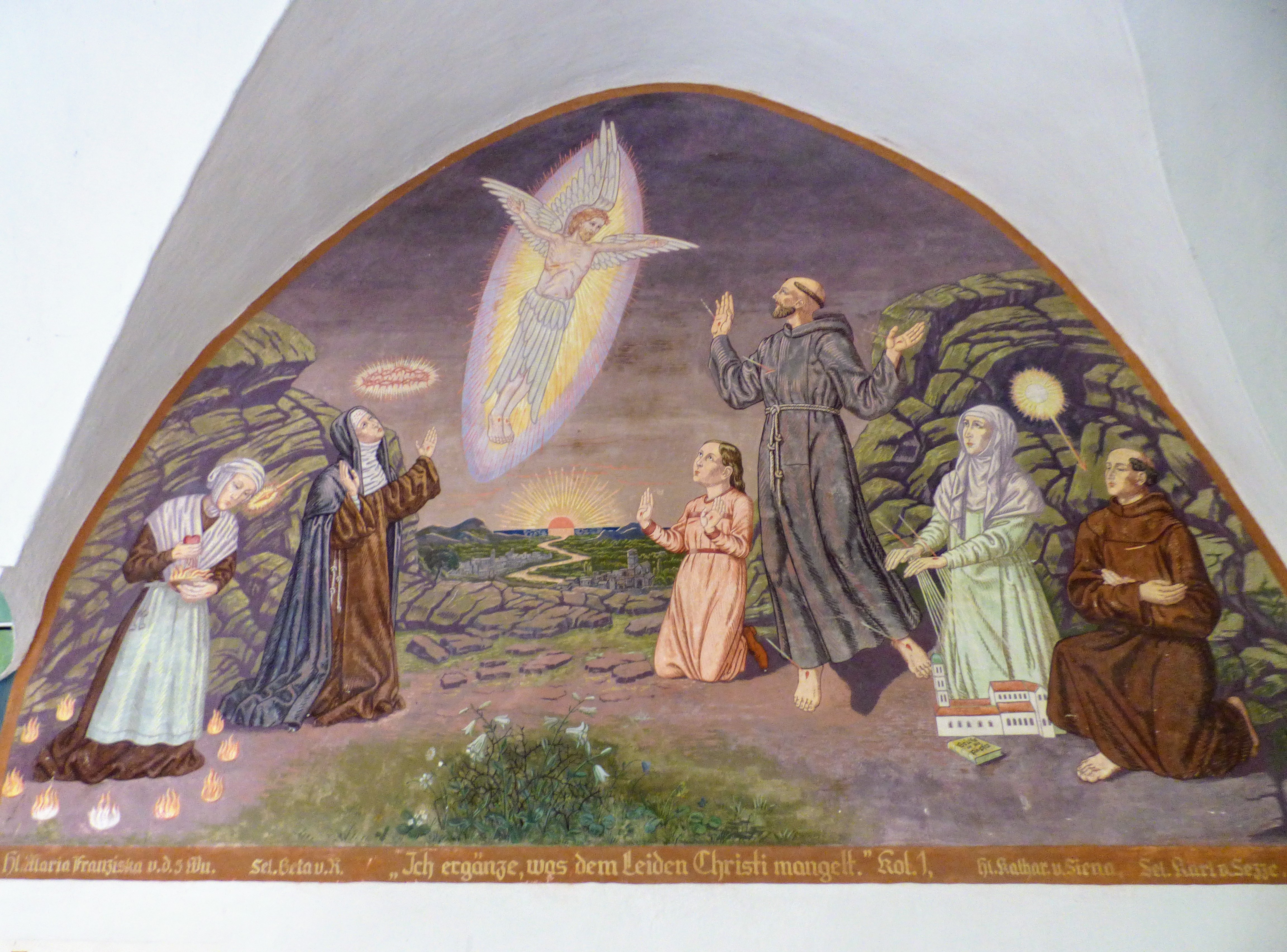
Redemptoristenkloster
und Schule Katzelsdorf, Niederösterreich: Wandmalerei von Josef Weilharter im
Kreuzgang: "Ich ergänze, was dem Leiden Christi mangelt." - Maria
Franziska von den Fünf Wunden, Betha von Reute, Katharina von Siena, Karl von Sezze
Karl von Sezze
italienischer Name: Carlo
bürgerlicher Nachname: Melchiori
Gedenktag katholisch: 6. Januar
im Bistum Mondoñedo-Ferrol und im Orden der Franziskaner-Observanten: 7. Januar
Name bedeutet: der
Tüchtige (althochdt.)
Mystiker
* 19. Oktober 1613 in Sezze bei Terracina in Italien
† 6. Januar 1670 in Rom
Karl Melchiori war
Bauernsohn, nach kurzer Ausbildung Schafhirt und später Bauer. Mit 17 Jahren
entschied er sich für ein Leben im Zölibat, 1635
trat er als Laienbruder ins Kloster
San Francesco der Franziskaner-Minoriten in
Nazzano bei Rom ein und legte ein Jahr später die Profess ab. Bis 1640 lebte er
in verschiedenen Konventen, schließlich im Kloster San
Francesco a Ripa in Rom. Im Oktober 1648 wurde Karl während einer
Messe stigmatisiert mit den Wundmalen Christi.
Neben seinen Aufgaben als Gärtner, Koch, Pförtner, Almosensammler und Sakristan
gelang es ihm, unermüdlich karitativ tätig zu sein. Trotz mangelhafter Lese-
und Schreibkenntnisse verfasst er auf Veranlassung seines Seelenführers
umfangreiche mystische Schriften. In einem Häretiker- und in einem
Heiligsprechungsprozess trat er als Ratgeber auf. Der Überlieferung nach hat er
die Pontifikate von Papst Alexander VII. sowie der Päpste Clemens IX., X. und
XI. vorausgesagt.
Bei Karls Tod wurde die
Stigmatisation entdeckt und von Ärzten als übernatürliche Wunde erkannt. Sein
als unverwest geltender Leichnam ruht in der Kirche San
Francesco a Ripa in Rom
Im Ortsteil Scalo von
Sezze ist Karl heute eine moderne
Kirche geweiht. Das Kloster
San Francesco in Nazzano ist heute in Privatbesitz.
Kanonisation: Am 22. Januar 1882 erfolgte Carlos Selig-, am 12. April 1959 durch Papst Johannes XXIII. die Heiligsprechung.
Patron von Sezze;
der Diözese Sezze
Die Kirche San
Francesco a Ripa in Rom ist täglich von 7 Uhr bis 13 Uhr und von 15
Uhr bis 19 Uhr geöffnet. (2017)
Seite zum
Ausdruck optimiertUnser Reise-Blog:
Reisen zu den Orten, an denen die
Heiligen lebten und verehrt werden.
Empfehlung an
Freunde senden
Artikel
kommentieren / Fehler melden
Fragen? -
unsere FAQs antworten!
Impressum - Datenschutzerklärung
Schauen Sie sich zufällige Biografien an:
Märtyrer
Friedrich II
Tewdrig
von Glamorgan
Didymus
Theodosia
Autor: Joachim
Schäfer - zuletzt aktualisiert am 16.01.2025
Quellen:
• Vera Schauber, Hanns Michael Schindler: Heilige und Patrone im Jahreslauf. Pattloch, München 2001
• Walter Troxler. In: Friedrich-Wilhelm Bautz †, Traugott Bautz (Hg.): Biographisch-Bibliographisches Kirchenlexikon, Bd. III, Herzberg 1992
• Lexikon für Theologie und Kirche, begr. von Michael Buchberger. Hrsg. von
Walter Kasper, 3., völlig neu bearb. Aufl., Bd. 5. Herder, Freiburg im Breisgau
1996
korrekt zitieren: Joachim Schäfer: Artikel Karl von Sezze, aus dem Ökumenischen Heiligenlexikon - https://www.heiligenlexikon.de/BiographienK/Karl_von_Sezze.htm, abgerufen am 24. 8. 2026
Die Deutsche Nationalbibliothek verzeichnet das Ökumenische
Heiligenlexikon in der Deutschen Nationalbibliografie; detaillierte
bibliografische Daten sind im Internet über https://d-nb.info/1175439177 und https://d-nb.info/969828497 abrufbar.
SOURCE : https://www.heiligenlexikon.de/BiographienK/Karl_von_Sezze.htm
Centro Studi San Carlo da Sezze: Custodi di una Memoria Francescana : https://sancarlodasezze.it/index/