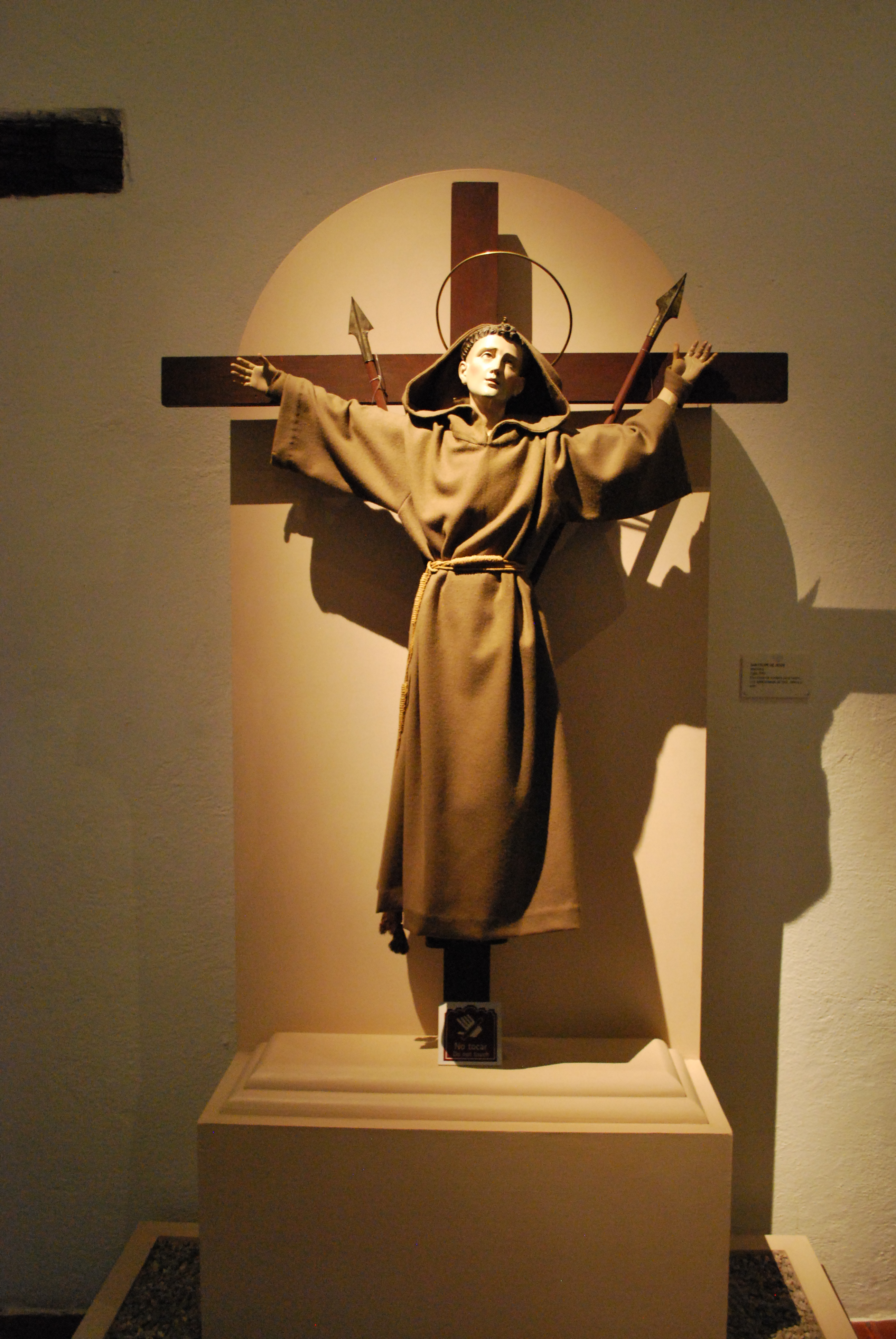
Statue de Philippe de Jésus au Museo Nacional del
Virreinato (musée de la vice-royauté) à Tepotzotlán au Mexique :
Saint Philippe de Jésus (en espagnol :
San Felipe de Jesús) était un missionnaire catholique mexicain qui devint l'un
des vingt-six martyrs du Japon, le
premier saint mexicain
et saint patron de Mexico.
Statue
of Philip of Jesus at the Museo Nacional del Virreinato in Tepotzotlan, Mexico:
Saint Philip of Jesus (Spanish: San Felipe de Jesús) was a Mexican Catholic
missionary who became one of the Twenty-six Martyrs of Japan, the first Mexican
saint, and the patron saint of Mexico City.
Estatua
de Felipe de Jesús en el Museo Nacional del Virreinato en Tepotzotlán, México:
San Felipe de Jesús fue un misionero católico mexicano que se convirtió en uno
de los veintiséis mártires de Japón, el primer santo mexicano y el santo patrón
de la Ciudad de México.
Saint Philippe de Jésus
Martyr à
Nagasaki (+ 1597)
Il naquit à Mexico de
parents espagnols et se fit franciscain à Puebla. Il n'avait pas, disait-il, cette
vocation. Il quitta l'Ordre en 1589 et partit faire commerce aux Philippines.
Mûri par l'existence, il revint à sa première vocation et rejoignit les frères
mineurs à Manille. Envoyé au Mexique, il fit naufrage pendant la traversée et
échoua au Japon. Là il fut arrêté et crucifié à Nagasaki le 5 février 1597 avec
vingt autres martyrs canonisés en 1862, martyrs
dont la mémoire sera célébrée le lendemain donc le 6 février.
Notre vie n'est pas entre
nos mains, mais en celles de Dieu.
Ses dernières paroles
SOURCE : https://nominis.cef.fr/contenus/saints/5609/Saint-Philippe-de-Jesus.html

Transfer
of San Felipe de Jesús and other Franciscans towards martyrdom. Collection of
the Metropolitan Cathedral of Mexico City.
Traslado
de San Felipe de Jesús y otros franciscanos rumbo al martirio. Colección de la
Catedral Metropolitana de la Ciudad de México.
5 février : Saint
Philippe de Jésus
Philippe de las Casas
Ruiz naquit à Mexico le 1er mai 1572, de parents tout juste arrivés
d’Espagne. Enfant turbulent, sa nounou déclara un jour, voyant un figuier mort
dans le jardin familial, qu’il serait saint le jour où l’arbre verdirait à
nouveau.
Jeune homme, il entra
chez les Franciscains, mais abandonna après peu de temps ; il fut alors
envoyé à l’étranger par son père pour faire du commerce. Bien qu’il menât
désormais une vie mondaine, il s’interrogeait toujours quant à sa vocation, et,
à Manille, il entra à nouveau chez les Franciscains, en 1590, cette fois
définitivement. Il prit le nom de Philippe de Jésus.
Après quelques années, le
12 juillet 1596, en vue de son ordination sacerdotale, il s’embarqua pour
le Mexique, le siège épiscopal de Manille étant vacant. Mais son navire fut
pris dans une tempête et poussé vers les côtes du Japon. Le navire, qui
transportait d’autres religieux et quelques armes, fut confisqué par les
autorités locales, qui le considérèrent à tort comme le signe d’une prochaine
invasion.
Philippe se rendit alors
à Méaco (aujourd’hui au centre de Kyoto), où se trouvait un couvent de
missionnaires franciscains. Accusé d’être un agent préparant une future
invasion, il fut arrêté le 8 décembre 1596. Le 5 février 1597, avec
25 autres chrétiens, il fut emmené sur une colline de Nagasaki, où il fut
crucifié et percé de deux coups de lance. A la même heure, le figuier de son
enfance verdit.
Les dernières paroles de
Philippe furent : « Notre vie n’est pas entre nos mains, mais en
celles de Dieu. » Béatifié par Urbain VIII le 14 septembre 1627,
il fut canonisé, ainsi que ses 25 compagnons, par Pie IX le 8 juin
1862 ; il devint ainsi le premier saint mexicain.
SOURCE : https://reinformation.tv/5-fevrier-philippe-jesus-calendrier/

Couvent Saint-Antoine de Padoue à Puebla dans
l'État de Puebla au Mexique.
Also
known as
Felipe las Casas Martínez
Philip de la Casas
Philip of Jesus
Profile
Philip’s parents
had immigrated from
Illescas, Spain to Mexico
City, and the boy was
born in the New World. It was a pious family; two of his brothers entered
the Augustinians,
and one was martyred.
He joined the
Reformed Franciscan Convent of
Santa Barbara in
Pueblo, Mexico in
his early teens, but left after a year. With his father’s assistance, Philip
sailed to Manila in the Philippines to
start an overseas trading buiness. However, he continued to feel the call to
religious life, and on 22 May 1594 he
entered the Franciscan Convent of
Our Lady of the Angels in Manila, becoming a friar, and working with the sick.
At his family’s request,
he was returned to Mexico in 1596 to
be consecrated a bishop,
but the ship was blown off course and wrecked on
a reef on the coast of Japan;
during the storm, Philip had a vision of a white cross hanging above Japan,
a cross which became blood red. The locals impounded the ship’s cargo and imprisoned the
crew. In order to keep the cargo from Philip’s ship, the warlord Taikosama
accused Philip and his crew of piracy and spying for the king of Spain preparatory
to an invasion. Philip and several other Christians were
placed under house arrest at
Miako for several weeks, and then condemned to death.
One of the Martyrs
of Nagasaki.
Born
1575 in Mexico as Philip
de al Casas
crucified on 5 February 1597 at
Nagasaki, Japan
14
September 1627 by Pope Urban
VIII
Mexico
City, Mexico, archdiocese of
Additional
Information
Book
of Saints, by the Monks of
Ramsgate
Lives
of the Saints, by Father Alban
Butler
Saints
of the Day, by Katherine Rabenstein
books
Our Sunday Visitor’s Encyclopedia of Saints
other
sites in english
images
fonti
in italiano
MLA
Citation
‘Saint Felipe de
Jesus‘. CatholicSaints.Info. 2 February 2023. Web. 23 May 2026.
<https://catholicsaints.info/saint-felipe-de-jesus/>
SOURCE : https://catholicsaints.info/saint-felipe-de-jesus/

Templo
Expiatorio Nacional de San Felipe de Jesús. Escultura de San Felipe de Jesús
National
Expiatory Temple of San Felipe de Jesus. Sculpture of San Felipe de Jesus in an
alms recipient.
New
Catholic Dictionary – Saint Philip of Jesus
Article
Martyr; born Mexico; died
Nagasaki, Japan, 1597. He joined the Discalced Franciscans of the province of
Saint Didacus, founded by Saint Peter Baptist, but left the order in 1589 to
engage in mercantile affairs which later brought him to the Philippines where
he was re-admitted to the order, 1590. He was arrested with Peter Baptist and
companions, tortured, and crucified. Patron of Mexico City. Canonized, 1862.
Feast, 6
February.
MLA
Citation
“Saint Philip of
Jesus”. New Catholic Dictionary. CatholicSaints.Info.
25 September 2015. Web. 23 May 2026. <https://catholicsaints.info/new-catholic-dictionary-saint-philip-of-jesus/>
SOURCE : https://catholicsaints.info/new-catholic-dictionary-saint-philip-of-jesus/

Saint Mary Magdalene Church and Convent, San Martin Texmelucan de Labastida, Puebla State, Mexico
Philip of Jesus, OFM M
(RM)
(also known as Philip de
las Casas)
Born in Mexico City,
Mexico, May 1, 1571; died in Nagasaki, Japan, 1597; beatified by Pope Urban
VIII; canonized by Pope Pius IX in 1862; feast day formerly February 5.
The life of Saint Philip
points again to the importance of the domestic church--the family. Early in
life Saint Philip ignored the pious teachings of his immigrant Spanish family,
but eventually he entered the Reformed Franciscan Convent of Santa Barbara at
Puebla, Mexico--and soon exited the novitiate in 1589. Grieved at the inconstancy
of his son, Philip's father sent him on a business trip to the Philippines.
Like many of us, Philip
sought to escape God's love in worldly pleasures but the Hound of Heaven
tracked him down. Gaining courage by prayer, Philip was again able to follow
his vocation, joined the convent of Our Lady of the Angels in Manila in 1590,
and took his vows in 1594. The richest cargo Philip could have sent back to
Mexico couldn't have pleased his father more than the message that Philip had
been professed a friar. Alonso de las Casas obtained directions from the
commissary of the order that Philip should be sent to Mexico to be ordained a
priest.
He embarked with other
religious on the Saint Philip in July 1596 but storms shipwrecked them in
Japan. Amid the storm, Philip saw over Japan a white cross, in the shape used
in that country, which after a time became blood-red, and remained so for some time.
It was an omen of his coming victory.
The ship's captain sent
Philip and two others to the emperor to gain permission for them to continue
their voyage, but they could not obtain an audience. He then continued to the
Franciscan house in Macao to see if they could apply pressure. In the meantime,
the pilot of the Saint Philip had excited the emperor's fears of Christians,
causing him to contemplate their extermination.
In December, officers
seized a number of the Franciscan fathers, including Philip, three Jesuits, and
several of their young pupils. When Philip had that they were to die, he
responded with joy. His left ear was cut off, and he offered the first fruit of
his blood to God for the salvation of Japan.
The martyrs were taken to
Nagasaki, where crosses had been erected on a high hill. When Philip was led to
the one on which he was to die, he knelt down, clasped it, and exclaimed,
"O happy ship! O happy galleon for Philip, lost for my gain! Loss--no loss
for me, but the greatest of all gain!" He was bound to the cross, but the
footrest under him gave way, so that he was strangled by the cords that bound
him. While repeating the name of Jesus, he was the first of the group to die.
Philip was 25. Miracles attested the power before God of these first martyrs of
Japan (Benedictines, Butler, Delaney).
Saint Philip is the
patron of Mexico City, Mexico.
SOURCE : http://www.saintpatrickdc.org/ss/0206.shtml

San
Felipe de Jesús Church, Mazatlan, Sinaloa State, Mexico
St. Philip of Jesus
Born in Mexico, date unknown; died
at Nagasaki early
in February, 1597. Though unusually frivolous as a boy, he joined the
Discalced Franciscans of
the Province of St.
Didacus, founded by St. Peter Baptista, with
whom he suffered martyrdom later.
After some months in the Order, Philip grew tired of monastic life, left
the Franciscans in
1589, took up a mercantile career, and went to the Philippines, where he
led a life of pleasure. Later he desired to re-enter the Franciscans and was
again admitted at Manila in
1590. After some years he was to have been ordained at
the monastery in
Mexico, the episcopal See of Manila being at
that time vacant. He sailed, 12 July, 1596, but a storm drove the vessel upon the
coast of Japan.
The governor of the province confiscated the ship and imprisoned its crew
and passengers, among whom were another Franciscan, Juan de
Zamorra, two Augustinians, and a Dominican. The discovery
of soldiers, cannon, and ammunition on the ship led to the suspicion that it
was intended for the conquest of Japan, and that the
missionaries were merely to prepare the way for the soldiers. This was also
said, falsely and unwarrantably, by one of the crew (cf. JAPAN). This enraged
the Japanese Emperor
Hideyoshi, generally called Taicosama by Europeans. He commanded,
8 December, 1596, the arrest of the Franciscans in
the monastery at
Miako, now Kyoto, whither St. Philip had gone. The religious were kept prisoners in
the monastery until
30 December, when they were transferred to the city prison. There were
six Franciscans,
seventeen Japanese tertiaries,
and the Japanese Jesuit, Paul Miki, with
his two native servants. The ears of the prisoners were
cropped on 3 January, 1597, and they were paraded through the streets of Kyoto;
on 21 January they were taken to Osaka, and thence
to Nagasaki,
which they reached on 5 February. They were taken to a mountain near the city,
"Mount of the Martyrs", bound upon crosses, after which they were
pierced with spears. St. Philip was beatified in 1627
by Urban VIII,
and, with his companions, canonized 8 June,
1862, by Pius IX.
He is the patron
saint of the city
of Mexico.
Sources
RIBADENEGRA, Historia de
las Islas del Archipielago y Reynos de la Gran China, Tartaria . . . y Japon,
V, VI (Barcelona, 1601); these are sometimes wrongly cited as Actas del
martirio de San Pedro Bautista y sus companeros (Barcelona, 1601); Archivum
franc. hist., I (Quaracchi, 1908), 536 sqq.; FRANCISCO DE S. ANTONIO, Chron. de
la apostol. prov. de S. Gregorio . . . in Las Islas Philipinas, III (Manila,
1743), 31 sqq.; Acta SS., Feb.I, 723 sqq.; GERONIMO DE JESUS, Hist. della
Christandad del Japon (1601); DA CIVEZZA, Saggio di Bibliog. Sanfrancesc.
(Prato, 1879), 250, 590 sqq., 523; IDEM, Storia univ. delle missioni franc.,
VII, ii (Prato, 1891), 883 sqq.; DA ORIMA, Storia dei ventitre Martiri
Giapponesi dell' Ord. Min. Osserv. (Rome, 1862); MELCHIORRI, Annal. Ord. Min.
(Ancona, 1869), 101 sqq. 218 sqq., 260 sqq.
Bihl, Michael. "St.
Philip of Jesus." The Catholic Encyclopedia. Vol. 12. New
York: Robert Appleton
Company, 1911. <https://www.newadvent.org/cathen/12006b.htm>.
Transcription. This
article was transcribed for New Advent by Ann M. Bourgeois. Offered to
Almighty God for graces and blessings on Carmen and Walter Karas.
Ecclesiastical
approbation. Nihil Obstat. June 1, 1911. Remy Lafort, S.T.D.,
Censor. Imprimatur. +John Cardinal Farley, Archbishop of New York.
Copyright © 2026 by New Advent LLC. Dedicated to the Immaculate Heart of Mary.
SOURCE : https://www.newadvent.org/cathen/12006b.htm

Monument
to St. Philip of Jesus, Garden of Santo Domingo de Guzmán, Mixcoac, Mexico
Butler’s
Lives of the Saints – Saint Philip of Jesus
Article
Martyr, Patron of the
City of Mexico.
Philip de las Casas was
born in the city of Mexico. Brought up piously, Philip at first showed little
care for the pious teaching of his parents, but at last resolved to enter the
Reformed Franciscan Convent of Santa Barbara at Pueblo. He was not yet weaned
from the world and soon left the novitiate. Grieved at the inconstancy of his
son, de las Casas sent him to the Philippine Islands on a business errand. In
vain did Philip seek to satisfy his heart with pleasure. He could not but feel
that God called him to a religious life. Gaining courage by prayer, he entered
the Franciscan Convent of Our Lady of the Angels at Manila, and persevered,
taking his vows in 1594.
The richest cargo that he could have sent to Mexico would not have gratified
his pious father as much as the tidings that Philip was a professed friar.
Alonso de las Casas obtained from the Commissary of the Order directions that
Philip should be sent to Mexico. He embarked on the Saint Philip in July, 1596,
with other religious. Storms drove the vessel to the coast of Japan, and it was
wrecked while endeavoring to enter a port. Amid the storm Philip saw over Japan
a white cross, in the shape used in that country, which after a time became
blood-red, and remained so for some time. It was an omen of his coming victory.
The commander of the vessel sent our Saint and two other religious to the
emperor to solicit permission to continue their voyage, but they could not
obtain an audience. He then proceeded to Macao, to a house of his Order, to
seek the influence of the Fathers there; but the pilot of the vessel by idle
boasts had excited the emperor’s fears of the Christians, and the heathen ruler
resolved to exterminate the Catholic missionaries. In December, officers seized
a number of the Franciscan Fathers, three Jesuits, and several of their young
pupils. Saint Philip was one of those arrested and heard with holy joy that
sentence of death had been passed on them all. His left ear was cut off, and he
offered this first-fruit of his blood to God for the salvation of that heathen
land. The martyrs were taken to Nagasaki, where crosses had been erected on a
high hill. When Saint Philip was led to that on which he was to die, he knelt
down and clasped it, exclaiming: “O happy ship! O happy galleon for Philip,
lost for my gain! Loss – no loss for me, but the greatest of all gain!” He was
bound to the cross, but the rest under him gave way, so that he was strangled
by the cords. While repeating the holy name of Jesus he was the first of the
happy band to receive the death-stroke. Miracles attested the power before God
of these first martyrs of Japan. Pope Urban VIII granted permission to say an
Office and Mass in their honor, and Pope Pius IX formally canonized them.
Saint Philip died at the
age of twenty-five and his feast is celebrated February 5th.
MLA
Citation
Father Alban Butler.
“Saint Philip of Jesus”. Lives of the Fathers,
Martyrs, and Principal Saints, 1866. CatholicSaints.Info.
25 September 2015. Web. 23 May 2026.
<https://catholicsaints.info/butlers-lives-of-the-saints-saint-philip-of-jesus/>
SOURCE : https://catholicsaints.info/butlers-lives-of-the-saints-saint-philip-of-jesus/

Felipe
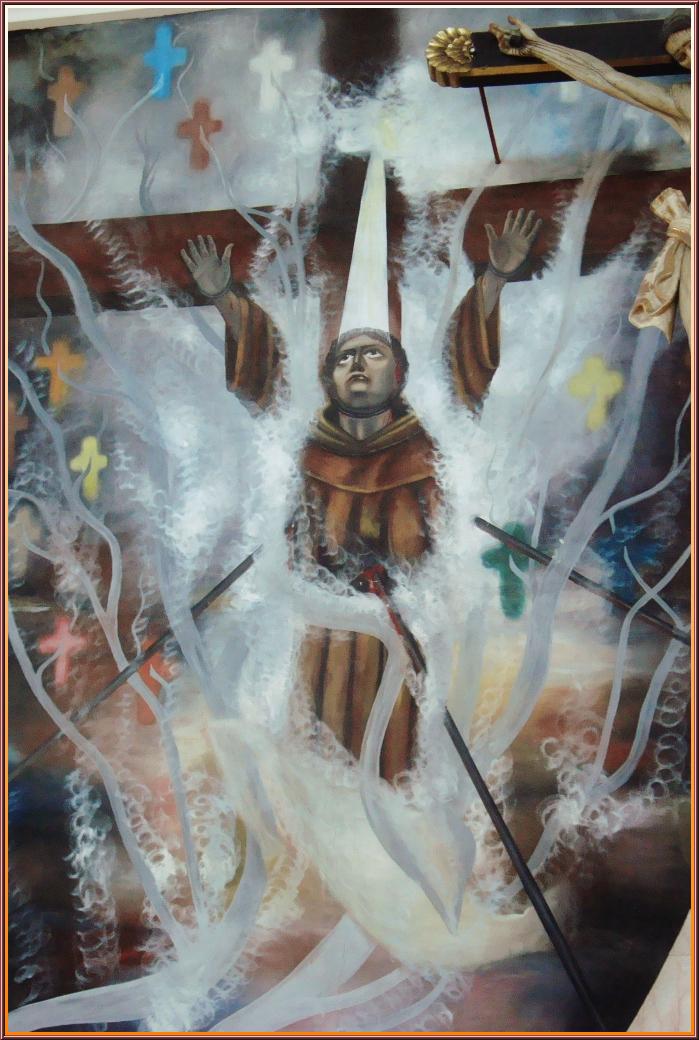
de Jesus imagen basilica Zapopan. Pintura con motivo de la vida de San Felipe
de Jesús.
Picture
featuring the life of San Felipe de Jesús.
Saint Philip of Jesus
Martyred at Nagasaki,
Patron of the City of Mexico
(1572-1597)
Philip de Las Casas was
born in the city of Mexico. Brought up piously, Philip at first showed little
care for the pious teaching of his parents, but at last resolved to enter the
Reformed Franciscan Convent of Santa Barbara at Pueblo. He was not yet weaned
from the world and soon left the novitiate. Grieved at the inconstancy of his
son, de las Casas sent him to the Philippine Islands on a business errand. In
vain did Philip seek to satisfy his heart with pleasure.
He could not but feel
that God called him to a religious life. Gaining courage by prayer, he entered
the Franciscan Convent of Our Lady of the Angels at Manila, and persevered,
taking his vows in 1594. The richest cargo that he could have sent to Mexico
would not have gratified his pious father as much as the tidings that Philip
was a professed friar.
Alonso de las Casas
obtained from the Commissary of the Order directions that Philip should be sent
to Mexico. He embarked on the St. Philip in July, 1596, with other religious.
Storms drove the vessel to the coast of Japan, and it was wrecked while
endeavoring to enter a port. Amid the storm Philip saw over Japan a white
cross, in the shape used in that country, which after a time became blood-red,
and remained so for some time. It was an omen of his coming victory. The
commander of the vessel sent our Saint and two other religious to the emperor
to solicit permission to continue their voyage, but they could not obtain an
audience.
He then proceeded to
Macao, to a house of his Order, to seek the influence of the Fathers there; but
the pilot of the vessel by idle boasts had excited the emperor's fears of the
Christians, and the heathen ruler resolved to exterminate the Catholic
missionaries. In December, officers seized a number of the Franciscan Fathers,
three Jesuits, and several of their young pupils. St. Philip was one of those
arrested and heard with holy joy that sentence of death had been passed on them
all. His left ear was cut off, and he offered this first-fruit of his blood to
God for the salvation of that heathen land.
The martyrs were taken to
Nagasaki, where crosses had been erected on a high hill. When St. Philip was
led to that on which he was to die, he knelt down and clasped it, exclaiming:
"O happy ship! O happy galleon for Philip, lost for my gain! Loss — no
loss for me, but the greatest of all gain!" He was bound to the cross, but
the rest under him gave way, so that he was strangled by the cords. While
repeating the holy name of Jesus he was the first of the happy band to receive
the death-stroke. Saint Philip was only twenty-five years old.
Miracles attested the
power before God of these first martyrs of Japan. Pope Urban VIII. granted
permission to say an Office and Mass in their honor, and Pope Pius IX. formally
canonized them. His feast is celebrated February 5th.
Little Pictorial Lives of
the Saints, a compilation based on Butler's Lives of the Saints and other
sources by John Gilmary Shea (Benziger Brothers: New York, 1894)
SOURCE : https://sanctoral.com/en/saints/saint_philip_of_jesus.html

Ex
Convento y Parroquia de Santa Clara, Puebla de los Ángeles, México
Pictorial
Lives of the Saints – Saint Philip of Jesus, Patron of the City of Mexico
Article
Philip de las Casas was
born in the city of Mexico, where his parents settled after setting out for the
New World from Illescas, in Spain. They were earnest in all their religious
duties and brought up their family piously, two sons entering the Augustinian
Order, one to die by the hands of the heathen. Philip at first showed little
care for the pious teaching of his parents and the example of his brethren, but
at last he, too, resolved to forsake the world, and entered the Reformed
Franciscan Convent of Santa Barbara at Pueblo. He was not yet weaned from the
world and its vanities, and soon left the novitiate. Grieved at the inconstancy
of his son, Alonso de las Casas sent him to the Philippine Islands with a large
stock of goods and money to make purchases. In vain did Philip seek to satisfy
his heart with pleasure. He could not but feel that God called him to a
religious life. Gaining courage by prayer, he entered the Franciscan Convent of
Our Lady of the Angels at Manila, and persevered, taking his vows in 1594. His
novitiate had produced a great spirit of poverty, obedience, and prayer, and he
sought by austerity to atone for the errors of his youth. As infirmarian,
Brother Philip of Jesus beheld Our Lord in the person of the sick, and attended
them with holy care. The richest cargo that he could have sent to Mexico would
not have gratified his pious father as much as the tidings that Philip was a
professed friar. Alonso de las Casas obtained from the Commissary of the Order
directions that Philip should be sent to Mexico. He embarked on the Saint
Philip in July, 1596, with other religious. Storms drove the vessel to the
coast of Japan, and it was wrecked while endeavoring to enter a port. Amid the
storm Philip saw over Japan a white cross, in the shape used in that country,
which after a time became blood-red, and remained so for some time. It was an
omen of his coming victory. The commander of the vessel sent our Saint and two
other religious to the emperor to solicit permission to continue their voyage,
but they could not obtain an audience. He then proceeded to Meaco to a house of
his Order, to seek the influence of the Fathers there; but the pilot of the
vessel by idle boasts had excited the emperor’s fears of the Christians, and
the heathen ruler resolved to exterminate the Catholic missionaries. In
December, officers seized a number of the Franciscan Fathers, three Jesuits,
and several of their young pupils. Saint Philip was one of those arrested while
they were in the choir singing the office. Philip bore with heroic patience the
insults of the rabble who assailed the martyrs on their way to prison, and
heard with holy joy that sentence of death had been passed on them all. His
left ear was cut off, and he offered this first-fruits of his blood to God for
the salvation of that heathen land. The martyrs were led through the streets of
several towns with inscriptions declaring the cause of their death. The
twenty-six at last reached Nangasaki, where crosses had been erected on a high
hill near the bay. When Saint Philip was led to that on which he was to die, he
knelt down and clasped it. exclaiming: “O happy ship! O happy galleon for
Philip, lost for my gain! Loss—no loss for me, but the greatest of all gain!”
He was bound to the cross, but the rest under him gave way, so that he was
strangled by the cords. While repeating the holy name of Jesus he was the first
of the happy band to receive the death-stroke, a lance being driven across
through his body to the right shoulder, then another to the left, a third
stroke being given to assure his death. The Spanish and Japanese Christians who
witnessed his triumph caught his blood in their hats and in cloths to preserve
as relics. Miracles attested the power before God of these first martyrs of
Japan, and Pope Urban VIII. granted permission to say an Office and Mass in
their honor, and Pope Pius IX. formally canonized them. The devotion to Saint
Philip of Jesus in his native city and throughout Mexico has always been very
great. A church and a convent of Capuchin nuns are dedicated to him. His feast
was in Spanish times kept with great solemnity in New Mexico, Texas, and
California, and a settlement in Arizona bore his name. Saint Philip died at the
age of twenty-five. He is an example to encourage those who falter in the path
of God’s service; his prayers will aid those who are tempted, and enable them
to acquire strength to recover lost ground, and go on with renewed courage in
the narrow way of the Cross.
MLA
Citation
John Dawson Gilmary Shea.
“Saint Philip of Jesus, Patron of the City of Mexico”. Pictorial
Lives of the Saints, 1922. CatholicSaints.Info.
14 December 2018. Web. 23 May 2026.
<https://catholicsaints.info/pictorial-lives-of-the-saints-saint-philip-of-jesus-patron-of-the-city-of-mexico/>

Escultura
de cantera contemporánea de Felipe de Jesús en un nicho de la Capilla del Pocito,
Basílica de Guadalupe, Ciudad de México.
Contemporary
quarry stone sculpture by Felipe de Jesús in a niche of the Pocito Chapel,
Basilica of Guadalupe, Mexico City.
San Filippo di Gesù (Felipe Las Casas Martinez) Religioso
e martire
Festa: 6
febbraio
>>>
Visualizza la Scheda del Gruppo cui appartiene
Città del Messico, Messico, 1571 – Nagasaki, Giappone,
5 febbraio 1597
Nato in Messico da genitori spagnoli, Chierico dei
Frati Minori Alcantarini, missionario in Giappone. Papa Urbano VIII lo
beatificò unitamente al gruppo dei protomartiri giapponesi il 14 settembre 1627
e il pontefice Beato Pio IX infine li canonizzò l'8 giugno 1862.
Patronato: Messico
Toyotomi Hideyoshi (1535-1598), capo incontrastato del Giappone dal 1582 al 1598, chiamato dai cristiani Taicosama, fu nei primi anni favorevole ad essi. Dopo la sfortunata guerra contro la Corea, però, pretese la sovranità sulle isole Filippine, a danno degli spagnoli, e in seguito alla loro opposizione, emanò, in data 24 lugl. 1587, un editto di proscrizione contro i cristiani. Sembra che abbiano influito sul cambiamento del suo stato d'animo altri fattori, come le insinuazioni di un bonzo, suo medico di fiducia, che gli mostrò i pericoli di una sistemazione degli europei a Nagasaki, il timore dell'ascendente dei missionari sui signori di Cyushu, la ripulsa di donne cristiane a prestarsi ai suoi capricci. Tuttavia la propaganda missionaria continuò la sua attività e Hideyoshi lasciò dormire il suo decreto, pur seguendo attentamente per mezzo di spie i movimenti dei missionari.
Intanto nel 1593 alcuni francescani sotto la guida del p. Pietro Battista, da Manila si portarono nel Giappone, ricevuti cordialmente da Hideyoshi. Fondarono due conventi e si dedicarono con grande ardore all'evangelizzazione della regione. Ma una serie di circostanze sfavorevoli, fra le quali il naufragio di un galeone spagnolo pieno di pesos d'argento sulle coste giapponesi, confiscato da Hideyoshi, rese tesi i rapporti con gli spagnoli. Il 9 dic. 1596 l'autocrate fece arrestare ad Osaka sei francescani e tre gesuiti e il 31 dic. a Meaco quindici laici giapponesi terziari francescani, ai quali se ne aggiunsero, durante il viaggio, altri due. I religiosi trasportati a Meaco, subirono il taglio dell'orecchio sinistro. Fatti salire su carri in gruppi di tre, dovettero percorrere pubbliche strade, alla vista di tutti, come si usava per i delinquenti e questo per incutere terrore ai cristiani e per aumentare le sofferenze dei martiri. Ciononostante la popolazione mostrava loro molta compassione e cercava di soccorrerli. Da Meaco per Sacai, Corazu, Facata giunsero il 5 febb. a Nagasaki, luogo dell'esecuzione che avvenne mediante crocifissione.
Fra le vittime vi fu Filippo di Gesù, religioso francescano, nato da genitori spagnoli nel Messico. Aveva avuto una giovinezza molto inquieta e disordinata. Ammesso nell'Ordine Francescano, ne era uscito per rientrarvi nuovamente a Manila. Giunse a Meaco al momento dell'arresto dei confratelli, al cui gruppo fu unito, come appare dall'elenco dei martiri. Nella fredda mattina del 5 febb. 1597, a Nagasaki, fu crocifisso insieme con gli altri martiri e fu il primo ad essere trafitto. L'esecuzione avvenne alla presenza di numerosi cristiani e dei marinai portoghesi della Nao.
Urbano VIII, dimostrato il martirio, concesse la Messa e l'Ufficio al suo Ordine nel 1627. Benedetto XIV lo iscrisse nel Martirologio che pubblicò nel 1748, mentre Pio IX lo canonizzò, con gli altri martiri, l'8 giug. 1862, con una magnifica cerimonia, alla presenza di numerosi vescovi (v. La Civiltà Cattolica, serie V, II [1862], pp. 737-46).
Autore: Filippo Caraffa
SOURCE : https://www.santiebeati.it/dettaglio/93367

San
Felipe de Jesús, San Felipe de Jesús Church, Celaya, Guanajuato State, Mexico
Felipe de Jesús, Santo
Primer santo mexicano, 5
de febrero
Por: Tere Vallés | Fuente: Catholic.net
Religioso Franciscano y Mártir
Martirologio
Romano: En Nagasaki, en Japón, pasión de los santos Pablo Miki y compañeros, Declarada una persecución contra
los cristianos, ocho presbíteros o religiosos de la Compañía de Jesús o de la
Orden de los Hermanos Menores, procedentes de Europa o nacidos en Japón, junto
con diecisiete laicos, fueron apresados, duramente maltratados y, finalmente,
condenados a muerte. Todos, incluso los adolescentes, por ser cristianos fueron
clavados en cruces, manifestando su alegría por haber merecido morir como murió
Cristo († 1597) Su memoria litúrgica es el día de mañana.
Compañeros en el martirio: Pablo Miki, Juan de Goto Soan, Jacobo Kisai,
religiosos de la Compañía de Jesús; Pedro Bautista Blásquez, Martín de la Ascensión Aguirre,
Francisco Blanco, presbíteros de la Orden de los Hermanos Menores; Gonzalo
García, Francisco de San Miguel de la Parilla, religiosos de la misma Orden;
León Karasuma, Pedro Sukeiro, Cosme Takeya, Pablo Ibaraki, Tomás Dangi, Pablo
Suzuki, catequistas; Luis Ibaraki, Antonio, Miguel Kozaki y su hijo Tomás,
Buenaventura, Gabriel, Juan Kinuya, Matías, Francisco de Meako, Ioaquinm
Sakakibara y Francisco Adaucto, neofitos.
Fecha de canonización: 8 de julio de 1862 por el Papa Pío IX.
Breve Biografía
Un poco de historia
De padres españoles (Don Alfonso de las Casas y Doña Antonia Martínez), nació
Felipe de las Casas Martínez en la Ciudad de México en 1572. Fue el mayor de
once hermanos, de los que tres siguieron la vida religiosa. Su padre estaba
emparentado con otro notable monje y evangelizador de América, Fray Bartolomé
de las Casas. Felipe era travieso e inquieto de niño. Estudió gramática en el
colegio de San Pedro y San Pablo de la ciudad de México, dirigido por los
jesuitas. Mostró interés por la artesanía de la plata. Por eso, cuando Felipe
fue beatificado el gremio de los plateros lo nombró su patrón.
A los 21 años se encontraba en las Islas Filipinas, a donde había ido en busca
de aventura. Las personas que viajaban a ese lugar, en aquellos tiempos, no lo
hacían generalmente por motivos piadosos. Ni tampoco predominaba lo espiritual
en el ambiente de Manila, ciudad conquistada apenas en 1571. En ésta lo común
era ver gente ocupada con planes de conquista militar y haciendo planes para el
comercio. Ahí decidió Felipe ingresar a la orden de los Franciscanos y escogió
el nombre Felipe de Jesús. Entró al convento de Santa María de los Ángeles de
Manila. Un año más tarde, Jesús hizo su profesión religiosa. Cuando tres años
después se acercaba el tiempo de su ordenación, el 12 de julio de 1596, partió
rumbo a México en barco. En Filipinas no se podía ordenar porque no había un
obispo. El viaje de Filipinas a América era una aventura peligrosa y el viaje
podía durar hasta siete u ocho meses. La travesía del barco en el que iba
Felipe estuvo a punto de ser desastrosa. Durante un mes la nave estuvo a la
deriva, arrojada por las tempestades de un lado a otro hasta que, destrozada y
sin gobierno, fue a dar a las costas del Japón.
En Japón, no les tenían confianza a los misioneros. Cuando ellos llegaron ahí
no sabían qué les iba a pasar y así pasaron varios meses. Fray Felipe de Jesús
se refugió en Meaco, donde los franciscanos tenían escuela y hospital. El 30 de
diciembre todos los frailes fueron hechos prisioneros junto con un grupo de
cristianos japoneses. Comenzó el martirio. El día 3 de enero les cortaron a
todos la oreja izquierda. Luego emprendieron una marcha en pleno invierno, por
un mes, de Tokyo a Nagasaki.
El 5 de febrero, 26 cristianos fueron colgados de cruces sobre una colina en
las afueras de Nagasaki. Los fijaron a las cruces con argollas de hierro en el
cuello, en las manos y en las piernas. Los atravesaron con lanzas. El primero
fue Felipe de Jesús. Murió repitiendo el nombre de Jesús. Las argollas que
debían sostenerle las piernas estaban mal puestas, por lo que el cuerpo resbaló
y la argolla que le sujetaba el cuello comenzó a ahogarlo. Le dieron dos
lanzadas en el pecho que le abrieron las puertas de la Gloria de Dios.
Fue beatificado, junto con sus compañeros, el 14 de septiembre de 1627 y canonizado
el 8 de julio de 1862.
Estos mártires eran frecuentemente recordados por el Papa Juan Pablo II dando a
saber que su sangre no fue derramada en balde. Llegaron al cielo.
Este día nos podemos acercar a la Eucaristía para pedirle a Jesús nos ayude a
realizar la vocación que tenemos en la vida.
Recuerda que el testimonio de los santos confirma el amor a Dios (CEC 313). El
testimonio de estas personas nos puede ayudar a crecer en nuestra vida
espiritual, en nuestra vida de fe.
Algo que no debes olvidar
San Felipe de Jesús fue el protomártir mexicano.
Fue un religioso de la orden de los franciscanos en Manila.
Al venir a ordenarse a México, naufragó su barco y llegó a Japón donde lo
mataron.
Murió repitiendo el nombre de “Jesús”.
SOURCE : https://es.catholic.net/op/articulos/32202/felipe-de-jess-santo.html#modal
~ Martyrs of Japan
~ († 1590-1715) [1] : http://newsaints.faithweb.com/martyrs/Japan01.htm
« Felipe de Jesús [archive] », Revisteria Ponchito, 1er mai 1954 : http://revisteriaponchito.com/vidasejemplares/1/
El 5 de febrero y La Higuera de San Felipe de Jesús en la UPAEP : https://upress.mx/secciones/vida-universitaria/8703-el-5-de-febrero-y-la-higuera-de-san-felipe-de-jes%C3%BAs-en-la-upaep