Benozzo
Gozzoli, Sainte Fine, fresque, chapelle absidiale de Sant' Agostino, San
Gimignano
Benozzo Gozzoli, St. Fina, circa 1464, Apsidal Chapel of Sant' Agostino, San Gimignano.
Bienheureuse Fina de San
Gimignano
(+ 1253)
ou Joséphine.
Elle passa la plus grande
partie de sa vie, étendue sur une planche. Elle était jeune et belle aux dires
de ses contemporains quand une maladie étrange la couvrit d'ulcères
douloureuses qui ne se guérirent jamais. Ses mains immobiles ne pouvaient
chasser les mouches qui l'importunaient. L'odeur de ses plaies ne favorisait
pas les visites de ses voisines qui lui apportaient le minimum de nourriture.
Ce qui ne l'empêcha pas de se déclarer la plus heureuse des créatures de Dieu.
On la découvrit morte un matin, les traits souriants des extases dont souvent
le Seigneur crucifié lui donnait la grâce.
À San Geminiano en
Toscane, l’an 1253, la bienheureuse Fine, vierge, qui supporta, depuis son plus
jeune âge, une longue et cruelle maladie, avec une patience inaltérable,
mettant toute sa confiance en Dieu.
Martyrologe romain
SOURCE : http://nominis.cef.fr/contenus/saint/792/Bienheureuse-Fina-de-San-Gimignano.html

Representation
of Saint Fina on a ceramic dish
Riproduzione
di Santa Fina su piatto in ceramica
Also
known as
Fina
Serafina
Profile
Born poor,
and though she stayed that way, she still found ways to help those in worse
shape that herself. A pretty girl,
she lived as a hermit in
her home, doing chores, giving to the poor when
she could, spinning,
sewing, and praying through
the nights. Seraphina’s father died when
the girl was
very young. Soon after, she was stricken with a condition that made any
movement painful; she had to be carried everywhere on a board. Fina lived the
rest of her life in constant suffering, and neglect, which she turned over
to God in
her constant prayers.
She never joined an order but lived her life under Benedictine
Rule. Devoted to Saint Gregory
the Great who suffered from a condition like hers. She received a
vision from Saint Gregory who
foretold the date of her death.
Born
1238 at
San Geminiano, Tuscany, Italy
12 March 1253 of
natural causes
with Saint Gregory
the Great
lying on a wooden board
Additional
Information
A Garner of Saints, by
Allen Banks Hinds, M.A.
Book of
Saints, by the Monks of
Ramsgate
Saints
of the Day, by Katherine Rabenstein
Saints
of the Order of Saint Benedict, by Father Aegedius
Ranbeck, O.S.B.
books
Our Sunday Visitor’s Encyclopedia of Saints
Saints
and Their Attributes, by Helen Roeder
other
sites in english
images
video
sitios
en español
Martirologio Romano, 2001 edición
fonti
in italiano
MLA
Citation
‘Saint Seraphina‘. CatholicSaints.Info.
14 March 2026. Web. 27 May 2026.
<https://catholicsaints.info/saint-seraphina/>
SOURCE : https://catholicsaints.info/saint-seraphina/

Domenico Ghirlandaio. Announcement of Death to
Saint Fina by Saint Gregory the Great, Collegiate Church
of San Gimignano
Domenico Ghirlandaio, Apparizione di san
Gregorio a santa Fina, affresco, Cappella di Santa Fina,
Article
FINA (SERAPHINA) (Saint)
Virgin (March 12) (13th century) A Tuscan Saint who died A.D. 1253, and is
venerated at San Geminiano.
MLA
Citation
Monks of Ramsgate.
“Fina”. Book of Saints, 1921. CatholicSaints.Info.
28 April 2013. Web. 28 May 2026.
<https://catholicsaints.info/book-of-saints-fina/>
SOURCE : https://catholicsaints.info/book-of-saints-fina/
SERAPHINA (FINA), ST.
Virgin; b. San Gimignano,
Tuscany, 1238; d. there, March 12, 1253. She led a religious life in her
parental home and was an example of piety, charity, mortification, and patience
during a long serious illness. She was buried in the village church of San Gimignano.
Feast: Mar. 12.
Bibliography: G. Coppi, La historica vita e morte di s. F. di S. Gimignano (Florence
1575). Acta Sanctorum March 2:231–238. Bibliotheca hagiographica
latina antiquae et mediae aetatis (Brussels 1898–1901) 1:2978. J. L. Baudot and L. Chaussin, Vies des saints et des bienheureux selon l'ordre
du calendrier avec l'historique des fêtes (Paris 1935–56) 3:279–280. J. Baur, Lexikon für Theologie und Kirche, ed. J. Hofer and K. Rahner
(Freiburg 1957–65) 4:132.
[K. Nolan]
New Catholic Encyclopedia
SOURCE : https://www.encyclopedia.com/religion/encyclopedias-almanacs-transcripts-and-maps/seraphina-fina-st
Fina of San Gimignano V
(AC)
(also known as Seraphina)
Born in San Gimignano,
Tuscany, Italy, in 1238; died there in 1253. Santa Fina, who is still greatly
venerated in her hometown, was a virgin whom a reverse of fortune caused to take
a vow of holy poverty. She desperately repented of her sins (her worse
apparently was accepting an orange from a boy) after contracting a fatal
illness at age 10. It appears, however, that she never became a nun, but rather
lived at home under obedience to the Benedictines. She patiently suffered
constant, repulsive diseases and continuous neglect on her oaken plank. In a
vision, Pope Saint Gregory the Great warned her of her approaching death at the
age of 15. As she lay ill, she worked many miracles, some of which are
illustrated in Ghirlandaio's frescoes in the Collegiata. For example, she
restored a choirboy's sight. At her passing, all the bells of the town
spontaneously began to ring, her room was found full of flowers, violets
blossomed from her board, and wallflowers sprang from a village tower. Her dead
hand cured her nurse of a serious malady (Benedictines, Encyclopedia, Jepson,
Tabor).
Saint Fina is depicted in
art as a maiden holding a bunch of flowers in the town of San Gimignano. She
may also be shown lying on a pallet tended by a nurse, as Saint Gregory appears
to her, or at her death her pallet is covered with flowers (Roeder). Domenico
Ghirlandaio painted an illustrated life of Saint Fina in the frescoes of the
Collegiate Church of San Gimignano (Tabor). Fina is the patron saint of at San
Gimignano, where her feast is celebrated every five years on the first Sunday
in August (Roeder, Tabor).
SOURCE : http://www.saintpatrickdc.org/ss/0312.shtml
St. Seraphina
Feastday: March 12
Seraphina was born in San
Gimignano, Italy, to a poor family. She was known for her self denial and acts of penance as
a young girl. A mysterious illness left this beautiful girl unattractive; her
eyes, feet, and hands became deformed and eventually Seraphina was paralyzed.
Her mother and father both died while she was young. She was devoted to St.
Gregory the Great. She died on the feast of St. Gregory, exactly as she had
been warned by Gregory in a dream. Seraphina was a very helpful child around
the family home.
She did many of the chores and helped her mother spin and sew. Her feast day is March 12.
SOURCE : https://www.catholic.org/saints/saint.php?saint_id=750
St. Fina
Feastday: March 12
St. Fina, also known as
Seraphina, was a young virgin from the Tuscan town of San Gimignano whose
holiness was revealed through extraordinary patience in suffering. Born to a
once-prosperous family that had fallen into poverty, Fina grew up with a deep love
for God and compassion for the poor. Though her family had little, she often
set aside part of her own food to give to those in greater need.
From a young age she
lived a quiet and prayerful life, spending her days sewing and spinning while
dedicating many hours of the night to prayer. When her father died and her
family's hardships grew worse, Fina herself was struck by a severe illness that
left her paralyzed and in constant pain. Her condition gradually worsened,
affecting her entire body.
Desiring to unite her
suffering with Christ on the Cross, Fina chose to lie upon a wooden plank for
the last six years of her life, unable to move. Despite terrible pain and
abandonment, she remained serene, gazing at a crucifix and often praying,
"It is not my wounds, but Yours, O Christ, that hurt me."
After her mother's sudden
death, Fina was left nearly alone, cared for only occasionally by neighbors and
a devoted friend named Beldia. During this time she developed a strong devotion
to St. Gregory the Great, asking his intercession for patience in her
suffering. Eight days before her death, St. Gregory is said to have appeared to
her, telling her that on his feast day God would grant her eternal rest.
The prophecy was
fulfilled. When Fina died on March 12, 1253, the wooden plank on which she had
lain was discovered covered with fragrant white violets. The people of San
Gimignano considered it a sign of her holiness, and miracles were soon reported
through her intercession. According to tradition, even after death she
miraculously healed the injured arm of her friend Beldia.
To this day, the delicate
white violets that bloom in San Gimignano around her feast are known as
"St. Fina's flowers." St. Fina is remembered as a powerful witness to
patience, humility, and trust in God amid suffering.
SOURCE : https://www.catholic.org/saints/saint.php?saint_id=184
ST. SERAPHINA
Feast: March 12
Author: Rev.
Clifford Stevens
She was a little girl,
very pretty, born into a very poor family, whose father died when she was very
young. As a little girl she learned to sew and spin, spending most of her time
at home.
After her father's death,
she was struck with a strange and paralyzing illness. She became misshapen and
ugly, in constant pain, unable to get out of bed or even to move. Her mother
took care of her but had to leave her for hours at a time to attend to her
work. Seraphina's only consolation was the crucifix, and she realized that she
was called to imitate the suffering Christ.
Yet she never complained.
She managed to remain serene, and something beautiful shone out of her face.
Then she was struck another blow. Her mother died, and she was left completely
destitute, her neighbors repelled by her appearance and her sickness, her only
friend a girl named Beldia who visited her and brought her food.
In her reading, St.
Seraphina had heard of the great sufferings of Pope St. Gregory the Great and
he became her special saint. She prayed to him, drew strength from the
sufferings that he had to endure, and prayed that he would obtain for her the
patience she needed to bear her own sufferings. She was now so weak and
helpless that it was clear to everyone she could not live very long.
Eight days before her
death, alone and almost completely forsaken, St. Gregory appeared to her and
told her: "Dear child, on my feast day, God will give you rest" (in
those days his feast day was celebrated on March 12). On that day, she died. The
whole city attended her funeral and from that moment everyone began to pray to
her. On the place where she had lain, her neighbors found white violets
growing, and even today in the village of San Geminiano where she lived, the
white violets that bloom in March are called Santa Fina flowers. She died on
March 12,1253, at the age of fifteen.
Thought for the Day:
Sufferings and pain are difficult for anyone to bear, and in St. Seraphina's
case they were a true martyrdom. Seraphina had to make sense out of it, young
as she was. She drew strength from the sufferings of Jesus and found her
happiness in God, in spite of her terrible afflictions. We have little reason
to complain about ours.
From 'The Catholic One
Year Bible': . . . "Don't be so surprised. Aren't you looking for Jesus,
the Nazarene who was crucified? He isn't here! He has come back to life! Look,
that's where his body was lying. Now go and give this message to his disciples
including Peter: 'Jesus is going ahead of you to Galilee. You will see him there,
just as he told you before he died!'"—Mark 16:6-7
Taken from "The One
Year Book of Saints" by Rev. Clifford Stevens published by Our Sunday
Visitor Publishing Division, Our Sunday Visitor, Inc., Huntington, IN 46750.
SOURCE : https://www.ewtn.com/catholicism/library/st-seraphina-5813

Domenico Ghirlandaio. Obsequies of St Fina,
circa 1473, Collegiate Church
of San Gimignano
Domenico Ghirlandaio, Esequie di Santa Fina
affresco, Cappella di Santa Fina,
Saint Fina – Seraphina
Feast Day: March 12
Patronage: Physically
Challenged People
St. Fina, also known as
Seraphina, was born Fina dei Ciardi, in Gimignano, a village in Tuscany, Italy
in 1238. She was the daughter of the Imperiera, a declined noble family.
She lived all her life in humble house located in the historic center of the
famous “city of beautiful towers”. In 1248, Fina’s life was changed by a
serious illness, which began to progressively paralyze her body. Her deep
faith relieved her pain. She refused a bed and chose instead to lie on a
wooden board. According to her legend, during her long sickness her body
became attached to the wood board, and worms and rats fed on her flesh.
During her illness, she
lost her father, and later her mother died after a severe fall. In spite
of her misfortune and extreme poverty, she thanked God and expressed a desire
that her soul might separate from the body in order to meet Jesus Christ.
Fina’s immense devotion was an example to all the citizens of San Gimignano,
who frequently visited her. Visitors were surprised to receive words of
encouragement from a desperately ill young girl who was resigned to the Will of
God. With her mother and father both gone, she was at the mercy of
neighbors and a young girl that was her friend, to take care of her.
On March 4, 1253 after
five years of sickness and pain, being bound to a board she used as her bed,
those around her were waiting for her passing away. During this time, St.
Gregory the Great allegedly appeared in Fina’s room and predicted that she
would die on March 12th. Fina died on the predicted date, and she was
only 15 years old. She was one of the most beautiful girls in her town,
and the disease disfigured her to a point of being grotesque. She did
pass on March 12, which at that time was the Feast Day of St. Gregory the
Great, just as she predicted he told her.
When Fina’s body was
removed from the pallet in which she had laid for over 5 years, the people who
were there saw white violets bloom from the wood and smelt a fresh flower
fragrance through the whole house. The violets grew out of the board on
which she laid, and the violets also grew on the walls of San Gimignano,
something that is still occurring to this day. For this reason, the white
violets have been called throughout the world as the “St. Fina Violets”.
As they transferred her body through town, the town’s people shouted, “The
Young Saint is Dead”.
For the next several
days, pilgrims went to the Pieve to see Fina’s remains and in that same period,
many miracles of healing took place. One person healed was her young
friend, who had a hand paralyzed while caring for Fina during her illness,
holding her head up. While she was near the body, the dead young girl
cured her hand. At the exact moment of Fina’s passing, all the bells of
San Gimignano rang without anyone touching them. Many sick people who
visited her grave during the following years were cured and some of these
became some of the most fervent supporters of St. Fina. The decision of
Fina to lie down on a wood table is still a mystery, but legend says she did it
to offer her suffering for the conversion of sinners.
Another legend tells that
during a walk with two of her friends, she heard another young girl cry out.
The young girl crying had broken a pitcher that her mother had given her in
order to fill water from the well. While she stopped to play with the
other children, she forgot the pitcher on the ground, which unfortunately
rolled down and broke. Fina told her to arrange the pieces and put them
under the water. The Pitcher became complete and full of water.
Another miracle was Fina’s neighbor, the man, a few years after Fina’s death on
March 12th stopped working to remember the poor young girl’s passing, went
to cut the wood and unfortunately hurt his leg. Suffering for his pain he
asked forgiveness of St. Fina and was very sorry for not having respected the
holy day of her passing. Then his cut disappeared, completely
healed. Many miracles are attributed to St. Fina through writings,
paintings, poems, and legend.
St. Fina’s Feast day is
celebrated since 1481. In 1479, two years before her feast day being
celebrated, she was implored to stop the plague. The plague stopped and
this miracle occurred again in the same period of 1631, when the plague
returned. The most important thing produced from St. Fina’s
intercession, is the hospital that took her name and was built in 1255.
It was built thanks to the donations given at her tomb. The hospital gave
housing to the old and poor, and pilgrims too. It became in the following
century, one of the best in Tuscany. In the hospitals chapel, the
original oak wood board where St. Fina lay down for five years, is preserved.
SOURCE : https://connection.newmanministry.com/saint/saint-fina-seraphina/

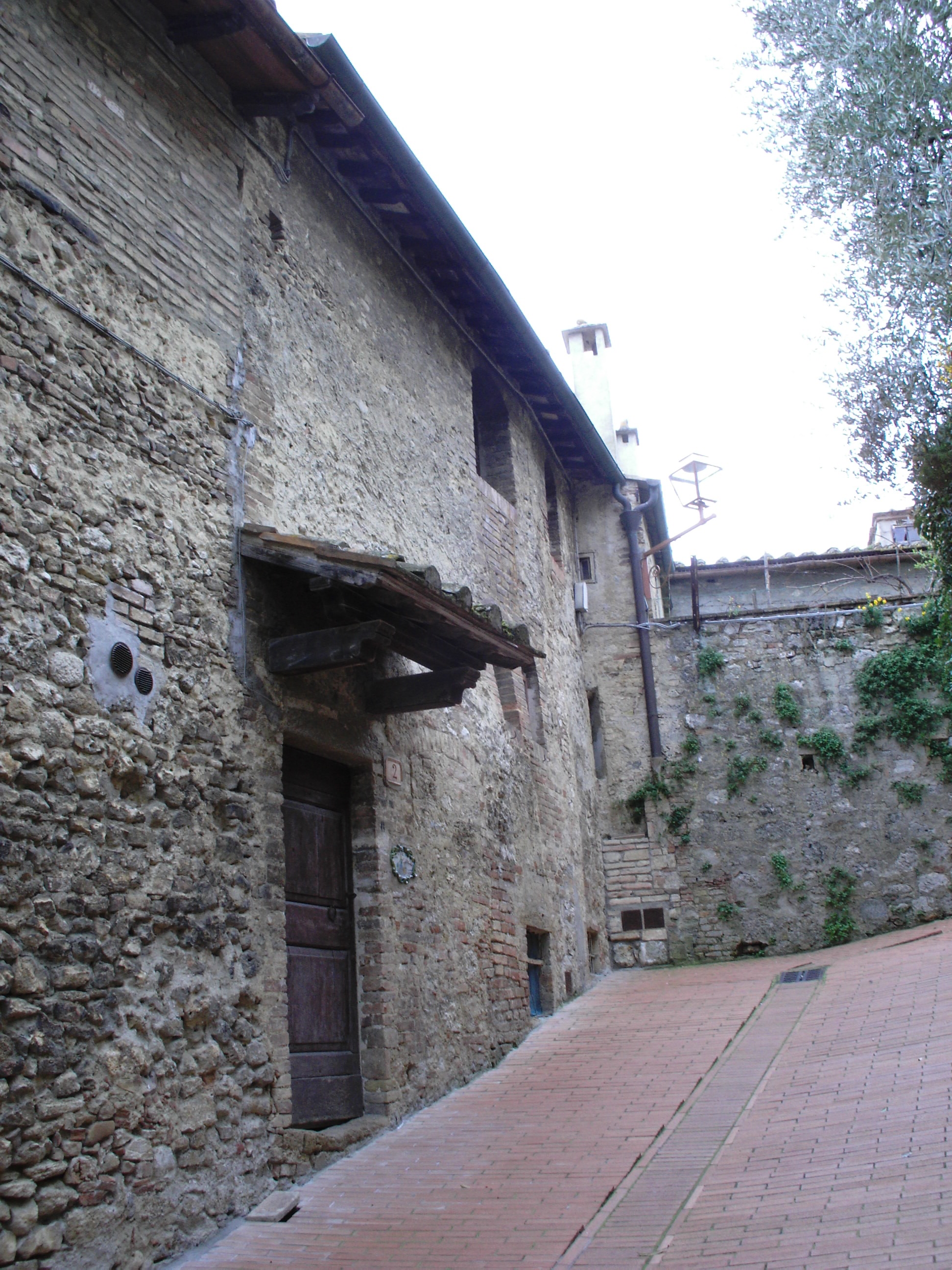
San
Gimignano, Casa di Santa Fina
San
Gimignano, Elternhaus der Hl.
Fina
Saints
of the Order of Saint Benedict – Saint Fina, Virgin and Recluse
Wild and desert places
have, thus far, given us not a few hermits, who gained Heaven by contemplation
and works of penance in solitude; in Saint Fina we honour one who lived the
life of a Recluse in the midst of a crowded city. The town of Saint Geminianus
in Tuscany was her birthplace. When grown up, she, at the inspiration of
Heaven, entreated her parents for a small corner of their dwelling where she
could shut herself up as a Recluse. In spite of repeated refusals she
persisted, and at last, her constancy having come forth triumphant from every
trial, her prayer was granted. A small cell was made in the midst of her
parental home; in this the Virgin, having cut off her hair and taken the veil,
was walled in. The observance of the exact rule of a Recluse was not enough for
the fervour of Fina. Her food was stale bread and cold water; often for a whole
week she abstained even from vegetables and beans. In the daytime, after the
regular Office, she busied herself with spinning or sewing, mending whatever
portions of her cloak or habit had got worn out; the nights she spent in
reciting the Psalter, in pouring forth prayers, and in repeating the Rosary.
Notwithstanding the
watches, the long fasts, and the mortification of hair-cloth and the scourge,
she still retained her beauty; so much so, that the sight of it would excite in
the skeptical a suspicion of fraud, since soft, smooth cheeks were quite
different from what gloomy silence, a narrow cell, and severe discipline would
produce. Through the trials of patiently borne suffering then must she pass.
All at once every kind of disease attacked her. Feet, hands, head, internal
organs – all were affected; from her eyes there dripped a thick rheum, her face
was covered with pustules, her body with ulcers. So weak was she, that, once
she had stretched her stricken frame on the plank she used as a bed, she could
neither turn from her back to her side, nor from her side to her back, to
relieve her pain. The very timber on which she lay, moist with the fetid
discharge, rotted and bred worms. The mice gnawed her gangrened flesh and
licked her blood. Yet she never murmured, never tried to drive them away. With
calm countenance she kept her eyes fixed on the Model of Patience, the
Crucifix. The offensive smell from her mortifying limbs prevented even her
nearest relatives from approaching her cell. Meanwhile, so forgetful of self
was she, that her mouth, the only part of her body free from pain, kept
repeating, as she gazed on the Cross, “Not my wounds, but Thine, O Christ, pain
me.”
However, her release was
near. She had always had great veneration for Saint Gregory the Great. As his
body too, while in life, was tortured by disease, she prayed to him that he
might intercede for her with the Almighty to grant her patience in her
afflictions. The sainted Pontiff, who, from his place in heaven, had long
looked with pity on her torments, appeared to her eight days before her death,
and assured her of her heavenly reward. Cheered by this vision, she passed
peacefully away, A.D. 1253. After death her body became more fragrant than the
choicest perfumes of Arabia. The whole city joined in celebrating her funeral.
Crowds of the lame, the blind, and the sick nocked to her tomb, and, through
her mediation, went away cured.
– text and illustration
taken from Saints
of the Order of Saint Benedict by Father Aegedius
Ranbeck, O.S.B.
SOURCE : https://catholicsaints.info/saints-of-the-order-of-saint-benedict-saint-fina-virgin-and-recluse/

San Gregorio
annuncia la morte a santa Fina, scuola Duccio
Attributed
to Niccolò di Segna (–1348), St Gregory
appearing to Saint Fina to announce her death, 14th century, fresco, Collegiate
church of San Gimignano
Saint Fina - Seraphina
Century: 13th
Century
Patronage: Physically
Challenged People
Feast Day: March
12th
St. Fina, also known as
Seraphina, was born Fina dei Ciardi, in Gimignano, a village in Tuscany, Italy
in 1238. She was the daughter of the Imperiera, a declined noble
family. She lived all her life in humble house located in the historic
center of the famous “city of beautiful towers”. In 1248, Fina’s life
was changed by a serious illness, which began to progressively paralyze her
body. Her deep faith relieved her pain. She refused a bed and chose
instead to lie on a wooden board. According to her legend, during her
long sickness her body became attached to the wood board, and worms and rats
fed on her flesh.
During her illness, she
lost her father, and later her mother died after a severe fall. In spite
of her misfortune and extreme poverty, she thanked God and expressed a desire
that her soul might separate from the body in order to meet Jesus Christ.
Fina’s immense devotion was an example to all the citizens of San Gimignano,
who frequently visited her. Visitors were surprised to receive words of
encouragement from a desperately ill young girl who was resigned to the Will of
God. With her mother and father both gone, she was at the mercy of
neighbors and a young girl that was her friend, to take care of her.
On March 4, 1253 after
five years of sickness and pain, being bound to a board she used as her bed,
those around her were waiting for her passing away. During this time, St.
Gregory the Great allegedly appeared in Fina’s room and predicted that she
would die on March 12th. Fina died on the predicted date, and she was
only 15 years old. She was one of the most beautiful girls in her town,
and the disease disfigured her to a point of being grotesque. She did
pass on March 12, which at that time was the Feast Day of St. Gregory the Great,
just as she predicted he told her.
When Fina’s body was
removed from the pallet in which she had laid for over 5 years, the people who
were there saw white violets bloom from the wood and smelt a fresh flower
fragrance through the whole house. The violets grew out of the board on
which she laid, and the violets also grew on the walls of San Gimignano,
something that is still occurring to this day. For this reason, the white
violets have been called throughout the world as the “St. Fina Violets”.
As they transferred her body through town, the town’s people shouted, “The
Young Saint is Dead”.
For the next several
days, pilgrims went to the Pieve to see Fina’s remains and in that same period,
many miracles of healing took place. One person healed was her young
friend, who had a hand paralyzed while caring for Fina during her illness,
holding her head up. While she was near the body, the dead young girl
cured her hand. At the exact moment of Fina’s passing, all the bells of
San Gimignano rang without anyone touching them. Many sick people who
visited her grave during the following years were cured and some of these
became some of the most fervent supporters of St. Fina. The decision of
Fina to lie down on a wood table is still a mystery, but legend says she did it
to offer her suffering for the conversion of sinners.
Another legend tells that
during a walk with two of her friends, she heard another young girl cry
out. The young girl crying had broken a pitcher that her mother had given
her in order to fill water from the well. While she stopped to play with
the other children, she forgot the pitcher on the ground, which unfortunately
rolled down and broke. Fina told her to arrange the pieces and put them
under the water. The Pitcher became complete and full of water.
Another miracle was Fina’s neighbor, the man, a few years after Fina’s death on
March 12th stopped working to remember the poor young girl’s passing, went
to cut the wood and unfortunately hurt his leg. Suffering for his pain he
asked forgiveness of St. Fina and was very sorry for not having respected the
holy day of her passing. Then his cut disappeared, completely
healed. Many miracles are attributed to St. Fina through writings,
paintings, poems, and legend.
St. Fina’s Feast day is
celebrated since 1481. In 1479, two years before her feast day being
celebrated, she was implored to stop the plague. The plague stopped and
this miracle occurred again in the same period of 1631, when the plague
returned. The most important thing produced from St. Fina’s
intercession, is the hospital that took her name and was built in 1255.
It was built thanks to the donations given at her tomb. The hospital gave
housing to the old and poor, and pilgrims too. It became in the following
century, one of the best in Tuscany. In the hospitals chapel, the
original oak wood board where St. Fina lay down for five years, is preserved.
Practical Take Away
St. Fina was a young girl
born in Tuscany, Italy. She was one of the most beautiful girls in her town,
and became paralyzed from an illness at the age of 10. The disease
disfigured her greatly, and then she lost her parents. Her survival was
dependant on her friend, who’s arm became paralyzed from taking care of her and
holding her head up, and the town’s people who came to visit the young
girl. She chose to lie on a board, rather than a bed during her illness,
which lasted for five years. When she died, her body was grown fast to
the board. When she was removed, instead of finding her decaying flesh,
white violets suddenly grew from the board. The white violets grew on the
stone walls throughout the city as well. The town folks named them “Fina
Violets” and to this day, you can purchase them throughout the world, known as
Fina Violets.
SOURCE : http://www.newmanconnection.com/faith/saint/saint-fina-seraphina

Lorenzo di Niccolò (1373–1412), Reliquary
with scenes from the legend of St Fina, cira 1402, Museum of
Religious Art
Santa Fina di San
Gimignano Vergine
San Gimignano, 1238 - 12
marzo 1253
Nata nel 1238 da due
nobili decaduti di San Gimignano, Iosefina (Fina) mori giovanissima, 15enne,
nel 1253. Colpita a dieci anni da una grave malattia che la immobilizzò, fu
esempio di vita cristiana per chi la visitava. Il dolore della santa fu
aumentato, oltretutto, dalla morte della madre. Al momento del trapasso di Fina
le campane della città suonarono senza che nessuno le azionasse, narra il suo
biografo, il domenicano Giovanni del Coppo, attento più alla devozione che alla
storia. Il culto si diffuse subito anche per i molti miracoli avvenuti sulla
tomba. Dichiarata patrona della cittadina toscana, in suo onore fu costruito un
ospedale. Nel 1457 il Consiglio del Popolo decise la realizzazione di una
splendida cappella nella collegiata. (Avvenire)
Martirologio Romano:
Nella città di San Gimignano in Toscana, beata Fina, vergine, che fin dalla
tenera età sopportò con invitta pazienza una lunga e grave infermità confidando
solo in Dio.
Nata da Cambio ed Imperia, nobili decaduti, a san Gimignano nel 1238, Fina (abbreviazione di Iosefina) ebbe una vita breve, ma religiosamente molto intensa. A dieci anni di età fu colpita da una gravissima malattia che la costrinse a letto impedendole qualsiasi movimento. Ad accrescere il dolore si aggiunse la perdita della madre.
Col corpo piagato diede ai visitatori esempio di pazienza, insegnando loro il culto della Passione del Signore e la devozione alla Regina dei martiri.
Si spense il 12 marzo 1253, festa di s. Gregorio Magno, di cui era devota e dal quale avrebbe avuto l'annuncio della morte; al momento del trapasso le campane di San Gimignano suonarono a festa senza che mano alcuna toccasse le corde. Questi particolari si trovano nella sua biografia scritta al principio del sec. XIV dal domenicano Giovanni del Coppo, più con intenti pii e devoti che storici.
Il culto per s. Fina fu molto vivo fin dagli inizi anche per i numerosi miracoli che avvenivano al suo sepolcro. Fu eletta patrona della città; in suo onore fu costruito un ospedale; nel 1457 il Consiglio del Popolo deliberò la costruzione della magnifica cappella che si può ancora ammirare nella collegiata.
Autore: Adone Terziarol
SOURCE : http://www.santiebeati.it/dettaglio/44650
La vie de la Bse Joséphine (Fina) de San Gimignano, la ... - Chaîne Catholique d'Arnaud Dumouch
La Chapelle Sainte Fine,
San Gimignano : https://www.cityzeum.com/la-chapelle-sainte-fine
St. Seraphina : https://santosepulcro.co.il/en/saints/1055840-seraphina/
Festa di Santa Fina :
https://viafrancigena.visittuscany.com/site/en/points-of-interest/festa-di-santa-fina/
The Stories of St Fina at San Gimignano (1473-75) by Domenico GHIRLANDAIO : https://www.wga.hu/frames-e.html?/html/g/ghirland/domenico/2s_fina/index.html & http://www.wga.hu/html_m/g/ghirland/domenico/2s_fina/