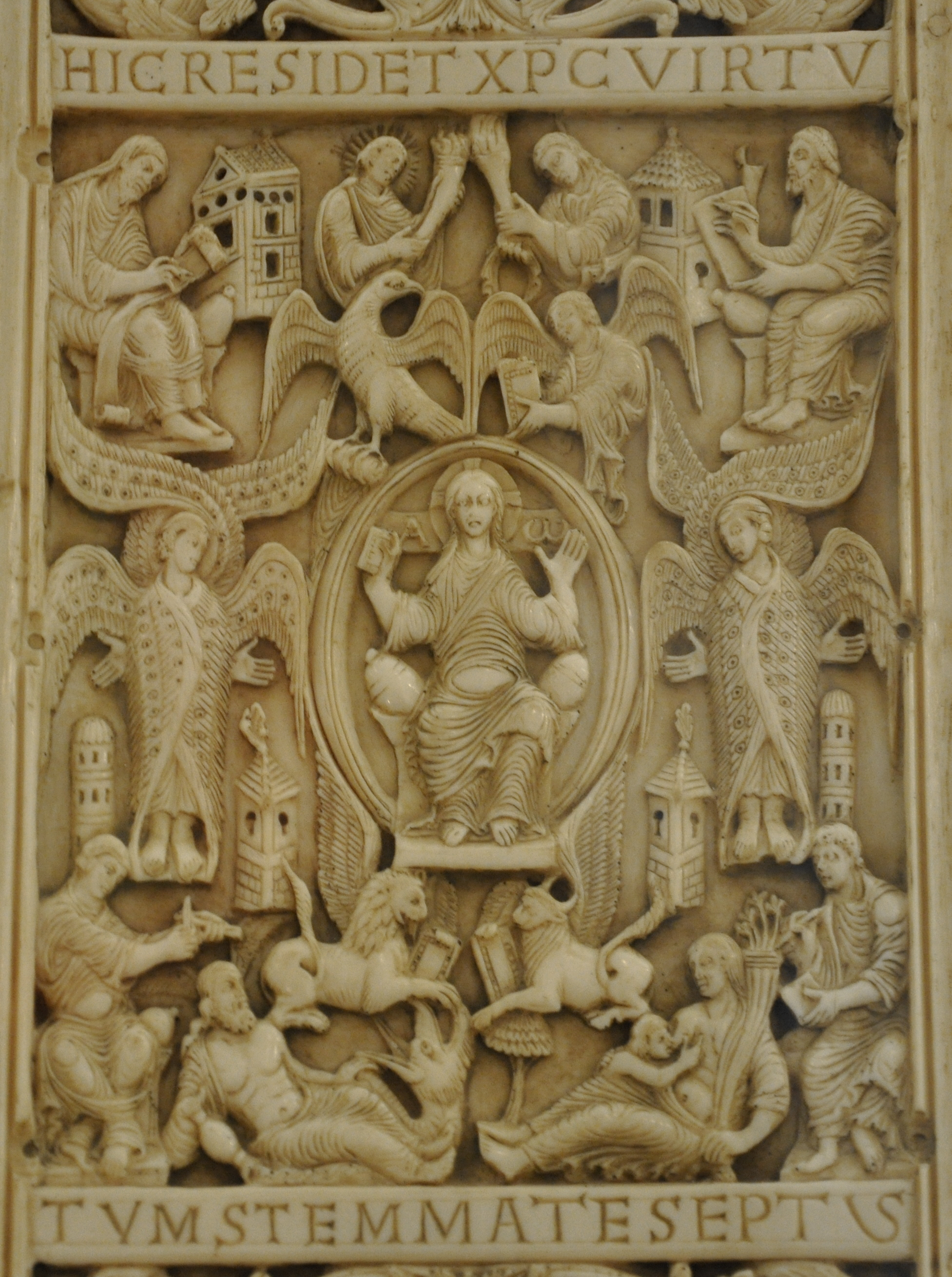
Copertina
posteriore dell'Evangelium longum, scolpito da Tutilo
Rear
cover of Cod. Sang. 53, St. Gallen, Stiftsbibliothek,
circa 895
Rückseite
des Einbandes von Cod. Sang. 53, St. Gallen, Stiftsbibliothek,
circa 895. e-Mail mit Bestätigung durch Hr. Rafael Schwemmer, M.A., Project
Manager / Web Developer, e-codices - Virtual Manuscript Library of Switzerland
am 23. Oktober 2009 um 14:10
Saint Tutilon
Moine et artiste de
l'abbaye de Saint Gall en Suisse (+ v. 915)
Tutilo ou Tuathal.
Moine de Saint Gall en
Suisse, il était adroit de ses mains, éloquent de sa parole, d'une remarquable
intelligence, excellent poète, musicien, peintre et ciseleur. L'empereur
Charles le Gros regrettait qu'on eût enseveli dans un cloître un si bel homme. Il
était d'une grande humilité et d'un grand recueillement. Mais saint Tutilon
donnait à tous la richesse de ses dons. On l'appelait au loin pour peindre des
saintes images, il élevait les enfants dans la beauté du chant liturgique, il
ciselait les objets liturgiques. On ne conserve de lui que quelques élégies et
une hymne.
Tutilo de Saint Gall né
en Irlande vers 850, mort vers 915 moine et artiste.
Il était de forte stature
et passa sa vie dans l'abbaye bénédictine de Saint Gall en Suisse où il était ami
de Saint Notker le
Bègue.
Il était bon orateur,
poète, musicien, peintre, architecte, sculpteur....
Très talentueux, il
pouvait jouer de tous les instruments utilisés pour la liturgie y compris la
harpe.
Peu de ses œuvres nous
sont parvenues mais des peintures et sculptures existent encore.
Il fut reconnu saint pour
ses qualités d'humilité et de dévotion à Dieu par la prière et par ses œuvres.
SOURCE : http://nominis.cef.fr/contenus/saint/6381/Saint-Tutilon.html
Tuotilo
Version de 2011
(remanié le 29.11.2012)
Autrice/Auteur: Hannes
Steiner Traduction: Monique Baud-Wartmann
Vers 855, un 27.5
après 912 . T. accomplit sa formation à l'abbaye de Saint-Gall à
l'époque où Grimald (872) était abbé. Il prononça ses vœux vers 873 et
contribua notablement à l'épanouissement du couvent au temps de son apogée (fin
du IXe s.), sous les abbés Hartmut, Bernhard et Salomon III. Attesté
comme cellérier et hospitalier, il s'occupa donc aussi bien de l'économat que
de l'accueil des élèves du couvent, des pèlerins et des pauvres. D'après ce que
relate Ekkehard IV dans son histoire de l'abbaye, T. maîtrisait la
technique des instruments à cordes et à vent, possédait une voix claire,
enseignait la musique à des fils de familles nobles et faisait preuve de dons
artistiques extraordinaires. Il sculpta par exemple les planches d'ivoire de l'Evangelium
longum (Cod. Sang. 53), grava ou cisela des plaques en métal (auj.
perdues) pour des églises de Constance, Mayence et Metz; il déploya aussi des
talents de peintre. En étudiant ses sculptures sur ivoire, les chercheurs ont
prouvé la véracité des affirmations d'Ekkehard IV. T. est célèbre aussi
comme compositeur de tropes et d'hymnes d'après des textes bibliques. Six des
tropes en latin qu'il a composés sont conservés et ont apparemment été
largement diffusés; le plus connu est le trope de Noël Hodie cantandus est
nobis puer. Aucun de ses poèmes en allemand n'est gardé (même sous forme de
résumé). Comme T. était éloquent et doté d'une nature robuste, il entreprit
aussi des voyages d'affaires et fut chargé de missions par son couvent. D'après
Ekkehard IV, T., tout comme Ratpert, adopta une position critique face à
l'abbé-évêque Salomon III et s'opposa à lui. En tant que tel, il fut l'un
des défenseurs - victorieux à long terme - de l'indépendance de l'abbaye face à
l'évêque de Constance.
Sources et bibliographie
LThK, 10, 306
VL, 9, 1149-1151
LexMA, 8, 1095-1096
J.-M. Sansterre, «Le
moine ciseleur, la Vierge Marie et son image», in Revue bénédictine, 106,
1996, 185-191
R. Schaab, Mönch in
Sankt Gallen, 2003
A. von Euw, Die St.
Galler Buchkunst vom 8. bis zum Ende des 11. Jahrhunderts, 2008, 154-167
C. Hospenthal, Tropen
zum Ordinarium missae in St. Gallen, 2010
SOURCE : https://hls-dhs-dss.ch/fr/articles/013016/2012-11-29/

Two
ivory tablets attributed to Tuotilo.
St.
Gallen, Lapidarium, Ausstellung "Die Kultur der Abtei St. Gallen",
Kopie der Tuotilotafeln vom "Evangelium longum", Cod Sang. 53

St.
Gallen, Lapidarium, Ausstellung "Die Kultur der Abtei St. Gallen",
Kopie der Tuotilotafeln vom "Evangelium longum", Cod Sang. 53, Detail
Majestas Domini, Titulus: "Hic Residet Xp(istu)c Virtutum Stemmate
Septus", "Hier thront Christus umgeben vom Kranz der Tugenden"
6 May 2009, 6:48 pm
Also
known as
Tutilo von Gallen
Tutilo of Gall
Tuathal…
Tuotilo…
Tutilóne…
Profile
A large, powerfully built
man. Educated at
Saint Gall’s monastery in Switzerland where
he stayed to become a Benedictine monk.
Friend of Blessed Notkar
Balbulus. A renaissance man before the term was coined.
Excellent student,
he became a sought after teacher at
the abbey school.
Noted speaker. Poet and
hymnist, though nearly all of his work has been lost. Architect, painter, sculptor, metal
worker, and mechanic;
some of his art continues
to grace galleries and monasteries around Europe. Composer and musician,
playing several instruments including the harp. No matter his talents or works,
he preferred the solitude and prayers of
his beloved monastery.
Born
c.915 at
Saint Gall’s monastery, Switzerland
Additional
Information
Saints
of the Day, by Katherine Rabenstein
books
Our Sunday Visitor’s Encyclopedia of Saints
other
sites in english
images
video
fonti
in italiano
Dizionario
Storico della Svizzera DSS
MLA
Citation
“Saint Tutilo of Saint
Gall“. CatholicSaints.Info. 21 May 2023. Web. 30 May 2026.
<https://catholicsaints.info/tag/name-tuathal/>
SOURCE : https://catholicsaints.info/tag/name-tuathal/
St. Tutilo
Feastday: March 28
Death: 915
Monk and artist. A member
of the Benedictines at St. Gall, Switzerland, he distinguished himself through
his abilities as a painter, sculptor, musician, poet, metalworker, and orator
there. He taught at the abbey school
and was noted for his particular adherence to obedience.
SOURCE : https://www.catholic.org/saints/saint.php?saint_id=2397
Tutilo of Saint-Gall, OSB
(AC)
Died at Saint-Gall,
Switzerland, c. 915. The handsome, eloquent, quick-witted Saint Tutilo was a
giant in strength and stature and a friend of Saint Notker Balbulus, with whom
he received musical training from Moengal. Tutilo, a monk of Saint-Gall, may have
been Tuathal, a younger member of the party of the Irish Bishop Marcus and his
nephew who stopped at the abbey on their return from Rome. Tutilo was a
painter, musician and composer of music for harp and other strings, poet,
orator, architect, metal worker, mechanic, head of the cloister school, and
sculptor, but he is best known for his obedience, recollection, and aversion to
publicity. Some of his paintings can be found in Constance, Metz, Saint-Gall,
and Mainz. The chapel in which he was buried, dedicated to Saint Catherine, was
later renamed for him (Attwater2, Benedictines, D'Arcy, Encyclopedia,
Fitzpatrick2).
SOURCE : http://www.saintpatrickdc.org/ss/0328.shtml
Saint TUTILO
Feast: March 28
When St. Gall, the
companion of St. Columbanus, died in Switzerland in 640, a monastery was built
over the place of his burial. This became the famous monastery of St. Gall, one
of the most influential monasteries of the Middle Ages and the center of music,
art, and learning throughout that period.
About the middle of the
ninth century, returning from a visit to Rome, an Irishman named Moengul
stopped off at the abbey and decided to stay, along with a number of Irish
companions, among them Tuathal, or Tutilo. Moengul was given charge of the
abbey schools and he became the teacher of Tutilo, Notker, and Radpert, who
were distinguished for their reaming and their artistic skills. Tutilo, in
particular, was a universal genius: musician, poet, painter, sculptor, builder,
goldsmith, head of the monastic school, and composer.
He was part of the abbey
at its greatest, and the influence of Gall spread throughout Europe. The
Gregorian chant manuscripts from the monastery of St. Gall, many of them
undoubtedly the work of St. Tutilo, are considered among the most authentic and
were studied carefully when the monks of Solesmes were restoring the tradition
of Gregorian chant to the Catholic Church. The scribes of St. Gall supplied
most of the monasteries of Europe with manuscript books of Gregorian chant, all
of them priceless works of the art of illumination. Proof of the Irish
influence at St. Gall is a large collection of Irish manuscripts at the abbey
dating from the seventh, eighth, and ninth centuries.
Tutilo was known to be
handsome, eloquent, and quick-witted, who brought something of the Irish love
of learning and the arts to St. Gall. He died in 915 at the height of the
abbey's influence, remembered as a great teacher, a dedicated monk, and a
competent scholar.
Thought for the Day:
Beauty is one of the names of God, and we often forget that the cultivation of
beauty can give glory to God. "O Lord, I have loved the beauty of Your
house and the place where Your glory dwells." St. Tutilo loved God deeply
and expressed it in a thousand beautiful ways, leading many people to
God. Beautiful things can lift our minds to God.
From 'The Catholic One
Year Bible': ". . . The good soil represents honest, good-hearted people.
They listen to God's words and cling to them and steadily spread them to others
who also soon believe."—Luke 8:15
Taken from "The One
Year Book of Saints" by Rev. Clifford Stevens published by Our Sunday
Visitor Publishing Division, Our Sunday Visitor, Inc., Huntington, IN 46750
Provided Courtesy of:
Eternal Word Television
Network
5817 Old Leeds Road
Irondale, AL 35210
www.ewtn.com
SOURCE : http://www.ewtn.com/library/MARY/TUTILO.htm

Seite
6 des Evangelium
Longum, Codex
Sangallensis
Page
6 of the Evangelium
Longum
St Tutilo and Blessed
Virgin Mary, Mother of the Church
Celebrated on March
28th
Monk, and gifted
musician. Tutilo was an Irish monk who lived in the late ninth and early tenth
centuries. He was educated at the Benedictine monastery of Saint-Gall in
Switzerland.
A good-humoured person of many talents, he was a poet, portrait painter,
sculptor, orator, architect and mechanic. But his greatest talent was music. He
could play all the instruments known to the monks. Together with his friend,
Blessed Notker, he composed much church music and taught at the abbey school.
Only three poems and one hymn remain of all Tutilo's works. But his paintings
and sculptures are still found today in several cities of Europe. Tutilo is
said to have been a 'giant in strength, stature and wits'. He praised God
through all his work. St Tutilo died in 915.
and
Blessed Virgin Mary,
Mother of the Church
Today is also the
Memorial of the Blessed Virgin Mary, Mother of the Church. On 11 February 2018,
Pope Francis decreed that this ancient devotion to Our Lady be celebrated
annually as a Memorial on the day after Pentecost.
The decree reflects on
the history of Marian theology in the Church's liturgical tradition and the
writings of the Church Fathers. It says Saint Augustine and Pope Saint Leo the
Great both reflected on the Virgin Mary's importance in the mystery of Christ.
"In fact the former [St Augustine] says that Mary is the mother of the
members of Christ, because with charity she cooperated in the rebirth of the
faithful into the Church, while the latter [St. Leo the Great] says that the
birth of the Head is also the birth of the body, thus indicating that Mary is
at once Mother of Christ, the Son of God, and mother of the members of his
Mystical Body, which is the Church."
The decree says these
reflections are a result of the "divine motherhood of Mary and from her
intimate union in the work of the Redeemer".
Scripture, the decree
says, depicts Mary at the foot of the Cross (cf. Jn 19:25). There she became
the Mother of the Church when she "accepted her Son's testament of love
and welcomed all people in the person of the beloved disciple as sons and daughters
to be reborn unto life eternal."
In 1964, the decree says,
Pope Paul VI "declared the Blessed Virgin Mary as 'Mother of the Church,
that is to say of all Christian people, the faithful as well as the pastors,
who call her the most loving Mother' and established that 'the Mother of God
should be further honoured and invoked by the entire Christian people by this
tenderest of titles'".
Read the full Decree
here: www.vatican.va/roman_curia/congregations/ccdds/documents/rc_con_ccdds_doc_20180211_decreto-mater-ecclesiae_en.html
SOURCE : https://www.indcatholicnews.com/saint/092

Seite
8 des Evangelium
Longum, Codex
Sangallensis
Page
8 of the Evangelium
Longum
TUTILO
Tutilo was an Irish
man who, while visiting the renowned Benedictine Abbey of St. Gall in
present-day Switzerland, delayed his departure – and stayed his whole life.
Said to have been a
large, powerful, handsome and quick-witted Irishman, Tutilo was also genial in
that he was a teacher, an orator, a poet, an architect, a painter, a sculptor,
an accomplished illuminator, a musician, even a mathematician and astronomer.
His numerous talents and
gifts led to his being much in demand and, by permission of his abbot, he
fulfilled many artistic commissions outside the monastery. One of these was his
sculpture of the Blessed Virgin Mary for the Cathedral at Metz, considered to
be a masterpiece.
He was a member of the
abbey at the zenith of its influence throughout all of Europe. Many of the
Gregorian chant manuscripts that survive to this day, and some of the most
authentic, are undoubtedly Tutilo’s own work.
Of all his many talents,
the one Tutilo loved the most was music.
According to tradition,
he could play and teach all of the instruments in the monastery and had a fine
musical voice.
King Charles had a great
admiration for the gifted monk and remarked that it was a great pity for so
much talent to be hidden away in a monastery.
But the saint himself
shrank from publicity and when obliged to go to the great cities he strove to
avoid notice and compliments.
All he wanted was to use
his gifts for the service of God.
Though Tutilo was the
epitome of today's "Renaissance man", sanctity was his real crown.
SOURCE : https://www.americaneedsfatima.org/Saints-Heroes/st-tutilo.html

Detail
of an ivory tablet attributed to Tuotilo
St.
Gallen, Lapidarium, Ausstellung "Die Kultur der Abtei St. Gallen",
Kopie der Tuotilotafeln vom "Evangelium longum", Cod Sang. 53,
Detail: "Der Bär hilft Gallus beim Bau seiner Zelle" und "Gallus
reicht dem Bären ein Brot"
Tuotilo
Versione del 2011
(aggiornata il 29.11.2012)
Autrice/Autore: Hannes
Steiner Traduzione: Livia Taddei
ca. 855, un 27.5.
dopo il 912 . Formatosi nell'abbazia di San Gallo ancora durante
l'abbaziato di Grimald (872), professò i voti attorno all'873 e fu tra i
principali artefici del periodo di splendore del convento alla fine del IX
sec., sotto gli abati Hartmut, Bernhard e Salomon III. Attestato come cellario
e ospedaliero, si occupava dunque sia dell'economato sia dell'assistenza agli
allievi della scuola conventuale, ai pellegrini e ai poveri. Secondo la descrizione
nel Casus sancti Galli di Ekkehard IV, sapeva suonare strumenti a
corda e a fiato, aveva una voce chiara, impartiva lezioni di musica a figli di
fam. nobili ed era dotato di uno straordinario talento in ambito artigianale.
Fra le altre cose, intagliò le tavolette d'avorio per l'Evangelium longum (Cod.
Sang. 53), realizzò incisioni e cesellature su metallo (andate perse) per le
chiese di Costanza, Magonza e Metz e fu attivo anche come pittore. Studiando i
suoi intagli su avorio, i ricercatori hanno dimostrato l'attendibilità delle
affermazioni di Ekkehard IV. T. divenne celebre anche come creatore di tropi e
inni da testi biblici. Sei dei tropi in lat. da lui composti sono conservati ed
ebbero apparentemente larga diffusione, come il noto tropo di Natale Hodie
cantandus est nobis puer. Non si è conservata nessuna delle sue non meglio
specificate poesie in ted. Eloquente e di natura robusta, T. intraprese anche
missioni diplomatiche e viaggi d'affari per il suo convento. Secondo Ekkehard
IV fu, insieme a Ratpert, oppositore e critico dell'abate vescovo Salomon III e
in quanto tale fece parte dei difensori, a lungo termine vittoriosi,
dell'indipendenza dell'abbazia nei confronti della diocesi di Costanza.
Riferimenti bibliografici
LThK, 10, 306
VL, 9, 1149-1151
LexMA, 8, 1095 sg.
J.-M. Sansterre, «Le
moine ciseleur, la Vierge Marie et son image», in Revue bénédictine, 160,
1996, 185-191
R. Schaab, Mönch in
Sankt Gallen, 2003
A. von Euw, Die St.
Galler Buchkunst vom 8. bis zum Ende des 11. Jahrhunderts, 2008, 154-167
C. Hospenthal, Tropen
zum Ordinarium missae in St. Gallen, 2010
SOURCE : https://hls-dhs-dss.ch/it/articles/013016/2012-11-29/
TUTILONE di San Gallo
di Fausto
Ghisalberti
Enciclopedia Italiana
(1937)
Monaco contemporaneo di
Notkero Balbulo (v.), morto in un 27 aprile al principio del sec. X. Cantore,
incisore, pittore e musico, dotato di cultura latina, ricoprì cariche ed
espletò missioni ufficiali: dall'898 al 912 si trova nei documenti come cellarius, secretarius, hospitarius.
In un obituario di S. Gallo è designato come doctor nobilis celatorque, ed
Eccheardo gli attribuisce alcuni lavori d'intaglio e di pittura.
Da T. ebbe origine il
primo dramma liturgico nella forma del tropo pasquale. La scuola musicale della
celebre abbazia, accanto a Notkero autore di parole senza musica (v. sequenza),
accanto a Hartmann e Ratperto che avevano composto parole e musica
indipendentemente dal testo ufficiale, produsse anche T. che, aggiungendo al
testo biblico un seguito di parole sue proprie, e accompagnandole con melodie,
creò quella forma originaria di tropo pasquale qual'è nei mss. Sangall. 484 e
381. Sono attribuiti a lui i tropi: Hodie cantandus est e l'altro
raffigurante la visita delle Marie al Sepolcro: Quem quaeritis in
sepulchro. Gli viene anche ascritta la melodia Omnium virtutum gemmis, su
parole dettate dall'imperatore Carlo III.
Bibl.: L. Gautier, Hist.
de la poésie liturgique. Les Tropes, Parigi 1886; K. Young, in Publicat.
of the Modern Language Assoc. of America, XXIX (1924), pp. 1-58; V. De
Bartholomaeis, Le origini della poesia drammatica ital., Bologna 1924, pp.
124-28.
© Istituto della
Enciclopedia Italiana fondata da Giovanni Treccani - Riproduzione riservata
SOURCE : https://www.treccani.it/enciclopedia/tutilone-di-san-gallo_(Enciclopedia-Italiana)/

St.
Gallen, Lapidarium, Ausstellung "Die Kultur der Abtei St. Gallen",
Kopie der Tuotilotafeln vom "Evangelium longum", Cod Sang. 53, Detail
Himmelfahrt Mariens
Tuotilo
Version von 2011
(bearbeitet am 29.11.2012)
Autorin/Autor: Hannes
Steiner
um 855, an einem 27.
Mai nach 912. Tuotilo wurde noch in der Amtszeit von Abt Grimald (872) im
Kloster St. Gallen ausgebildet. Er legte ca. 873 die Profess ab und gehörte
unter den Äbten Hartmut, Bernhard und Salomo III. zu den massgeblichen
Gestaltern der Blütezeit des Klosters im späten 9. Jahrhundert. Bezeugt ist er
als Cellerar und als Hospitar, betätigte sich folglich sowohl in der
Wirtschaftsführung des Klosters wie in der Betreuung der Klosterschüler, der
Pilger und Armen. Nach Ekkehards IV. Klostergeschichte beherrschte Tuotilo
Saiten- und Blasinstrumente, besass eine helle Stimme, erteilte Adelssöhnen
Musikunterricht und verfügte über ausserordentliche handwerkliche Talente. So
schnitzte er unter anderem die Elfenbeintafeln zum "Evangelium
longum" (Cod. Sang. 53), gravierte bzw. ziselierte (heute verlorene)
Metallarbeiten für die Kirchen in Konstanz, Mainz sowie Metz und wirkte auch
als Maler. Die Forschung wies anhand der erhaltenen Elfenbeinschnitzereien
Tuotilos die Zuverlässigkeit der entsprechenden Angaben Ekkehards IV. nach.
Berühmt wurde Tuotilo auch als Schöpfer von Tropen und Hymnen nach
biblischen Texten. Sechs der von ihm komponierten lateinischen Tropen sind
erhalten und wurden offenbar breit rezipiert, so der berühmte Weihnachtstropus
"Hodie cantandus est nobis puer". Von seinen nicht näher bezeichneten
deutschen Dichtungen hat sich nichts erhalten. Da Tuotilo eloquent und von
robuster Natur war, übernahm er auch Gesandtschafts- und Geschäftsreisen für
sein Kloster. Nach Ekkehard IV. war er zusammen mit Ratpert Opponent und
Kritiker von Abtbischof Salomo III. und gehörte als solcher zu den langfristig
erfolgreichen Verteidigern der klösterlichen Unabhängigkeit gegenüber dem
Bistum Konstanz.
Quellen und Literatur
LThK 10, 306
VL 9, 1149-1151
LexMA 8, 1095 f.
J.-M. Sansterre, «Le
moine ciseleur, la Vierge Marie et son image», in Revue bénédictine 106,
1996, 185-191
R. Schaab, Mönch in
St. Gallen, 2003
A. von Euw, Die St.
Galler Buchkunst vom 8. bis zum Ende des 11. Jh., 2008, 154-167
C. Hospenthal, Tropen
zum Ordinarium missae in St. Gallen, 2010
SOURCE : https://hls-dhs-dss.ch/de/articles/013016/2012-11-29/
Hugh O'Reilly, Tuotilo,
the Monk of St. Gall : http://www.traditioninaction.org/religious/h104_Tuotilo.htm
Medieval Sourcebook : Ekkehard of St. Gall: Three Monks of St. Gall : https://web.archive.org/web/20090330011651/http://www.fordham.edu/halsall/source/eckehard1.html/