
St.
Pietro Orseolo (Petrus Urseolus), *928 †987, Doge of Venice
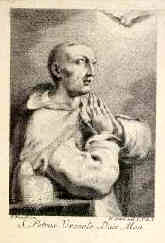
RADIERUNG
von P. Novelli [Druck, um 1800]
Saint Pierre Orseolo
Doge de Venise (+ 997)
En 976, il suscita un coup d’État pour supplanter le doge Pierre IV, qu'il fit assassiner pour devenir, à son tour, doge de Venise. C'est du moins ce que dit saint Pierre Damien. Toujours est-il qu'il déploya les plus grands talents dans l'administration de la République. En deux ans, il restaura la paix, reconstruisit l'église Saint Marc et les quartiers incendiés. Le 1er septembre 978, il disparut sans laisser de traces. Sous un faux nom, il avait gagné l'abbaye de Cuxa dans le Roussillon et y passa le reste de sa vie dans l'expiation, la pénitence et la prière. Sa femme l'avait laissé partir, sachant et comprenant la volonté de son époux. Leur fils unique devint à son tour doge de Venise et suivit l'exemple de son père dans la probité et le service de la République.
Au monastère de Cuxa dans les Pyrénées, vers 987, saint Pierre Urséol, qui, de
doge de Venise, embrassa la vie monastique, brilla par sa piété et son
austérité et termina sa vie dans un ermitage, près du monastère.
Martyrologe romain
SOURCE : http://nominis.cef.fr/contenus/saint/407/Saint-Pierre-Orseolo.html

Ritratto
del doge Pietro I Orseolo, 100 x 74, chiesa della Madonna dell'Orto
Portrait
of the Doge Pietro I Orseolo, 100 x 74, Madonna dell'Orto
(Venice)
Portrait
du doge Pietro Orseolo, 100 x 74,
Saint Pierre Orseolo
Originaire de Venise, dès
l’âge de 20 ans il est placé à la tête d’une flotte chargée de chasser les
pirates qui écument la mer Adriatique et sa mission est un succès. En 976, le
doge Pierre Candiani IV trouve la mort dans un incendie qui ravage une partie
de la ville de Venise. Pierre Orseolo, qui entre-temps s’est marié et a eu un
fils (qui deviendra doge à son tour en 991 et suivit l'exemple de son père dans
la probité et le service de la République), est alors choisi pour lui succéder.
Très habile, il entreprend des travaux de restauration de la ville et de la
cathédrale Saint-Marc puis administre la cité avec compétence et justesse. Et
puis deux ans après son élection, peut-être pour expier les conditions de sa
prise de pouvoir, il disparaît brusquement, après avoir décidé de tout
abandonner. Il s’enfuit clandestinement par une nuit de septembre et se rend
jusqu’à l’Abbaye Saint-Michel de Cuxa, située au pied du mont Canigou, dans les
Pyrénées, où il demande à être admis. Il mène pendant quelque temps une vie
très austère au sein de la communauté, puis il part s’isoler dans un modeste
ermitage des environs où il termine sa vie en 997. De nombreux miracles ont été
rapportés sur sa sépulture.

Portraits
of Doges of Venice (series by Domenico Tintoretto - Doge’s Palace)
Domenico Tintoretto: Der Doge in der Reihe der
115 Porträts im Dogenpalast; das
Spruchband nennt seine Taten, nämlich, dass er das Hospital des hl. Markus
errichtet und dann als Mönch viele Wunder bewirkt habe: „HOSPITALE SANCTI MARCI
PRIOR ÆDIFICAVI DEINDE MONACUS FACTUS MIRACULA PLURIMA EGI“.
Also
known as
Peter Urseolus
Profile
Born to a wealthy, noble,
and prominent family. Married at
age 18 to Felicitas, and the father of
one son, Peter, who became the Doge of Venice in 991. Admiral and
commander of the Venetian fleet
by age 20. Rid the Adriatic Sea of pirates.
Chosen Doge of Venice on 12 August 976,
the day after a revolt, the murder of
his predecessor, and a fire that destroyed much of the city. Built hospitals and orphanages,
started reconstruction of the Cathedral of
Saint Mark, and began social programs to help widows, orphans, pilgrims,
and the abandoned.
He poured much of his own fortune into the effort, and within two years Peter
had restored law and order, and rebuilt much of the city. Rightly considered
one of Venice‘s
greatest rulers.
In the night of 1 September 978,
believing his duty to the world fulfilled, and possibly feeling crushed by it
all, Peter secretly left Venice for
the Benedictine monastery of
Saint-Michel-de-Cuxa in the Pyrenees on the border of France and Spain,
not even telling his family of his plans. Benedictine monk.
While the move was sudden, it was apparently something he’d been considering
for over a decade. When his wife learned
of his move, she approved; they’d lived chastely since the birth of their son,
and she knew of his spiritual yearnings. Spiritual student of Saint Romuald at
Saint-Michel-de-Cuxa at whose suggestion he built a hermitage,
and retired even further from the world, spending the rest of his life in
solitude and prayer.
Born
928 at
Rivo alto, Province of Udine, Venice, Italy
10 January 987 at
Saint-Michel-de-Cuxa Abbey, Pyrenees mountains, France of
natural causes
his tomb became a site
for pilgimages and miracles
recognized in 1027 by
the bishop of Elne, France
cultus
confirmed by Pope Clement
XII in 1731
Additional
Information
Book
of Saints, by the Monks of
Ramsgate
Roman
Martyrology, 1914 edition
Saints
of the Day, by Katherine Rabenstein
books
Our Sunday Visitor’s Encyclopedia of Saints
other
sites in english
sitios
en español
Martirologio Romano, 2001 edición
sites
en français
fonti
in italiano
Wikipedia: Santi patroni della città di Venezia
nettsteder
i norsk
spletne
strani v slovenšcini
MLA
Citation
“Saint Peter
Orseolo“. CatholicSaints.Info. 21 April 2022. Web. 20 May 2026.
<https://catholicsaints.info/saint-peter-orseolo/>
SOURCE : https://catholicsaints.info/saint-peter-orseolo/

Abbildung aus Leone Matina : Ducalis regiae lararium, Padua 1659.
Pietro I Orseolo ; Ducalis regiae lararium
Book of Saints –
Peter Urseolus
Article
(Saint)
(January
10) (10th
century) A Doge of Venice who,
after some years of successful administration of the Republic, renounced his
dignity and embraced the Religious life in a Benedictine monastery in
the Pyranees. Having lived there in poverty and
penance to the age of sixty-nine, he died A.D. 997.
An accusation made against him in the Middle Ages to the effect that he entered
the monastery out
of remorse for having been accessory to the murder of his predecessor at Venice has
been proved to be baseless.
MLA
Citation
Monks of Ramsgate. “Peter
Urseolus”. Book of Saints, 1921. CatholicSaints.Info.
19 October 2016. Web. 20 May 2026.
<https://catholicsaints.info/book-of-saints-peter-urseolus/>
SOURCE : https://catholicsaints.info/book-of-saints-peter-urseolus/
St. Peter Orseolo
Feastday: January 10
Birth: 928
Death: 987
Peter Orseolo, of Rivo
Alto, Italy, served as commander of the Venetian navy before becoming doge
of Venice in
976. In this office he rebuilt the fire-ravaged Saint Mark’s Cathedral, funding
the work from his own wealth. From Constantinople he
obtained for the cathedral’s high altar what
is considered the earliest known example of a gold altar cloth. He also founded
a hospice for
pilgrims. But after governing for only two years, Peter suddenly disappeared
from the city during the night of September 1-2, 978. He fled his prestigious
station to devote the rest of his life to
God, traveling over five hundred miles westward to enter the Benedictine
monastery of Cuxa, at the foot of the eastern Pyrenees, along the
French-Spanish border. As he neared the monastery, Peter took off his shoes and
walked the remaining steps of the journey bare-footed. As a monk, he excelled
in humility, devotion to prayer, charity, and self-denial. Thereafter,
Peter’s zeal for
even greater perfection prompted him to obtain permission to live in solitude a
short distance from the monastery.
SOURCE : https://www.catholic.org/saints/saint.php?saint_id=5620
St. Peter Urseolus
Feastday: January 10
Birth: 928
Death: 987
Benedictine hermit. Also
called Peter Orseolo, he was a member of one of the most noble houses of Venice and,
at the age of twenty, became an admiral in the Venetian Navy. After a series of
successful campaigns against the Dalmatian pirates, he was elected Doge
of Venice in
967, supposedly securing his elevation by poisoning his predecessor Peter
Candiani IV, as was charged by St. Peter Damian.
For two years Peter ruled with consummate skill, assisting Venice to
weather a series of political crises. Then, without any warning and without
informing his family, he disappeared from Venice and
secretly entered the Benedictine abbey of
Cuxa, in the Spanish Pyrenees. There he devoted himself to a life of
severe austerity and asceticism, working as a humble sacrist until St. Romuald suggested
that he become a hermit. He lived alone until his death.
SOURCE : https://www.catholic.org/saints/saint.php?saint_id=5411

Reliquien
des Pietro Orseolo in der Schatzkammer des Markusdoms in Venedig
St. Peter Urseolus
(Orseolo)
Born
at Rivo alto, Province of Udina, 928; at Cuxa, 10
January, 987 (997 is less probable). Sprung from
the wealthy and noble Venetian family,
the Orseoli, Peter led from his youth an earnest Christian life.
In the service of the republic, he distinguished himself in naval battles
against the pirates. In 946 he married a noble Venetian lady, Felicitas;
a son of this marriage, who bore the same name as his father,
also became Doge of Venice (991-1009).
On 11 Aug., 976, the Doge Pietro Candiano fell a victim to a
conspiracy, whose members, in their anxiety to obtain possession of
him, set fire to his palace, thereby destroying not only this building, but
also the churches of San Marco, San Teodoro, and Santa
Maria di Zobenigo, as well as about three hundred houses. On the following
day Pietro Orseolo was chosen doge in San Pietro di
Castello, but it was only out of regard for his obligations towards
his native land that he allowed himself to be prevailed upon to accept the
office. The tradition recorded by Peter
Damian (Vita s. Romualdi, V, in P.L., CXLIV, 960),
that Peter had taken part in the conspiracy and that his later
retirement from the world was due to his desire to expiate therefor, is without
foundation. As one might expect from his personal piety,
the new doge showed himself a zealous patron of churches and monasteries as
well as an able ruler. He had the doge's palace and
the church of San Marco rebuilt at his own expense,
procuring in Constantinople for the latter the first
golden altar-covering (Pala d'oro), and bequeathed one thousand
pounds to persons injured
by the fire and a similar sum to the poor. He renewed the treaty
with Capodistria, and succeeded in averting from the republic the
vengeance of Candiano's family,
especially of his wife Waldrada, niece of Empress Adelaide, and his
son Vitalis, Patriarch of
Grado. About this time, through the influence
of Abbot Guarinus of Cuxa (a Benedictine monastery at
the foot of the Pyrenees, in the territory of Roussillon), he decided to enter
a monastery,
leaving Venice secretly
with the abbot and
two companions in the night of 1-2 September, 987. As a monk in
the abbey of Cuxa, he presented to
his spiritual brothers a model of humility, zeal for prayer,
and charity. For a period he was under the spiritual guidance
of St.
Romuald. As early as the eleventh century the veneration of Peter
Urseolus as a saint was approved by the Bishop of
Elne. In 1731 Clement
XII ratified this cult, and appointed 14 January as his feast.
Sources
MABILLON, Acta SS.
ordinis s. Benedicti, V, 878 sqq.; Bibliotheca hagiographica latina, II,
986; TOLRA, St Pierre Orséolo (Paris, 1897); SCHMID, D. hl.
Petrus Orseolo, Doge von Venedig u. Benedictiner, in Studien und
Mitteilungen aus dem Bened. u. Cisterzienserorden (1901), 71 sq., 251 sq.;
KRETSCHMAY, Gesch. von Venedig, I (Gotha, 1905), 115 sq., 438 sq.
Kirsch, Johann Peter.
"St. Peter Urseolus." The Catholic Encyclopedia. Vol. 11. New York:
Robert Appleton Company, 1911. 10 Jan. 2016
<http://www.newadvent.org/cathen/11776a.htm>.
Transcription. This
article was transcribed for New Advent by WGKofron. With thanks to Fr.
John Hilkert and St. Mary's Church, Akron, Ohio.
Ecclesiastical
approbation. Nihil Obstat. February 1, 1911. Remy Lafort, S.T.D.,
Censor. Imprimatur. +John Cardinal Farley, Archbishop of New York.
Copyright © 2026 by New Advent LLC.
Dedicated to the Immaculate Heart of Mary.
SOURCE : http://www.newadvent.org/cathen/11776a.htm
PETER ORSEOLO, ST.
Doge of Venice,
Benedictine recluse; b. Venice, 928;d. Cuxa Abbey, Prades, France, Jan. 10,
987. Married at age 18, Orseolo (Urseolus) and his wife lived in continence
after the birth of a son. In 948 he commanded the fleet in a war against
pirates. After a revolution (976) during which Doge Peter
IV Candiano was murdered, Orseolo was elected doge of Venice. He
promoted peace, built hospitals, and cared for widows, orphans, and pilgrims.
Using his own money he began the reconstruction of St. Mark's Cathedral and the
doge's palace, both having been destroyed in the revolution.
At Mass one day, Peter
heard, "And he who does not carry his cross and follow Me cannot be my
disciple" (Lk 14:26), and he determined to join Marinus and romuald,
hermits living in the Po Delta. They refused to accept him, but shortly
afterward he met Abbot Guarin of Cuxa, the great reformer of northern Catalonia
and southern France, who took Orseolo and two other Venetians, John Gradenego
and Morosone, as well as the two hermits, back to cuxa abbey on Sept. 1, 978.
Orseolo was immediately a model religious, seeking the most menial tasks and
undertaking severe penances.
As for Venice and her
affairs, Peter contented himself with instructing his son, Otto, then doge, in
the virtues of a Christian ruler. After Peter's death a cult sprang up; his
body was translated in 1027; his cult was approved for Cuxa and Venice in 1731
and later for all Benedictines and camaldolese.
Peter Damian (Vita s.
Romualdi, Patrologia Latina, ed. J. P. Migne [Paris 1878–90] 144:959–963)
claimed that Orseolo entered Cuxa in reparation for his share in the revolt and
murder of his doge predecessor. Orseolo's chaplain, John the Deacon of Venice (Chronicon
Venetum, Monumenta Germaniae Historica [Berlin 1826–] Section: Scriptores.
7:4), gave other reasons. And while it is likely that the Candiano family
deliberately fostered the story given in Damian's account, it remains a fact
that Orseolo's election was somewhat mysterious. The piety of certain
chronicles may conceal the factional strife to which Orseolo owed his office.
Furthermore, mild and tolerant, he probably encouraged local mischief and was
happy to go to a monastery to fulfill an old vow. Peter called himself duke of
Venice, Dalmatia, and Croatia, a title that reflected his ambition rather than
an historical reality.
Feast: Jan. 10.
Bibliography: Vita (1027)
by a monk of Cuxa, in J. Mabillon, Acta sanctorum ordinis S. Benedicti 5:851–860. Bibliotheca
hagiographica latina antiquae et mediae aetatis (Brussels 1898–1901)
2:6784–86. H. Tolra, St. Pierre Orséolo (Paris 1897). B. Schmid, Studien und Mitteilungen aus dem Benediktiner- und
Cistercienser-Orden 22 (1901) 71–112; 251281. A. M. Zimmermann, Kalendarium
Benedictinum: Die Heiligen und Seligen des Benediktinerorderns und seiner
Zweige (Metten 1933–38) 1:81–84. R. Cessi, Enciclopedia Italiana di
scienzi, littere ed arti (Rome 1929–39) 25:603. G. F. von Pölnitz, Venedig (Munich
1949) 78–84. A. Butler, The Lives of the Saints, rev. ed. H. Thurston and A. Attwater (New
York 1956) 1:64–65.
[C. M. Aherne]
New Catholic Encyclopedia
SOURCE : https://www.encyclopedia.com/religion/encyclopedias-almanacs-transcripts-and-maps/peter-orseolo-st
Peter Orseolo, OSB,
Hermit (RM)
(also known as Peter
Urseolus)
Born in Udine near
Venice, Italy, 928; died at Cuxa in Roussillon, 987. In 976, the doge of
Venice, Italy, Peter IV Candiano, was killed in a riot provoked by his attempt
to set up a monarchy. A member of the powerful Orseoli family, also named
Peter, was elected to replace him. (According to Saint Peter Damian, Peter
Orseolo had led a conspiracy against Candiano, but the statement is not
verified).
He had distinguished
himself as a naval officer and soldier. becoming admiral of the Venetian fleet
at the age of 20, in which post he conducted a successful campaign against the
Dalmatian pirates who infested the Adriatic. Peter now exercised his authority
as doge with high energy and tactful statesmanship to restore order to Venice.
He also showed generosity in his treatment of the widow of Peter IV.
Then during the night of
September 1, 978, Peter Orseolo, without the knowledge even of his wife of 32
years or their son, left Venice and made his way to the Benedictine monastery
of Cuxa in the foothills of the Pyrenees on the border between France and
Spain. He was always of religious disposition and it seems that he may have
meditated for a long time about retiring from the world. There is evidence that
he and his wife lived in continence since the birth of their only child, and a
letter from Ratherius to Peter suggests that the saint had contemplated
becoming a monk for at least ten years.
At Cuxa, Orseolo led a
life of the strictest asceticism and self- effacement under the holy Abbot
Guarinus. After a few years as sacristan in the monastery, he became a hermit
under the direction of the abbot, doubtless with the encouragement of Saint
Romuald when the latter was at Cuxa. He built himself a hermitage and lived
alone until his death. So many miracles took place at his tomb that forty years
after his death, Saint Peter Orseolo was officially recognized as a saint by
the local bishop (Attwater, Benedictines, Encyclopedia).
SOURCE : http://www.saintpatrickdc.org/ss/0110.shtml

Giovanni Marchiori. Statua di Pietro Orseolo il 23° doge della Repubblica di Venezia, Chiesa di San Rocco (Venezia), la facciata
- Giovanni Marchiori. Statue of Saint Pietro I Orseolo doge of Venice from 976 until 978, Church of San Rocco in Venice - Facade
Giovanni Marchiori. Statue de Pietro Orseolo 23e doge de Venise. Église San Rocco à Venise, la façade
San Pietro Orseolo Doge
di Venezia, monaco
Festa: 10 gennaio
Venezia, 928 – Cuxa,
Spagna, 10 gennaio 987
Nato nel 928 in Friuli da
nobile famiglia veneziana, Pietro Urseolo (Orseolo) nel 976 divenne Doge e fece
ricostruire San Marco e il Palazzo ducale distrutti dai cospiratori che avevano
fatto cadere il predecessore, Pietro Candiano. Fu munifico nella costruzione di
chiese. Sotto l'influenza dell'abate Guarino di Cuxa (Cussano), monastero
benedettino ai piedi dei Pirenei, intraprese la vita monastica e per un certo
periodo fu seguito da san Romualdo, fondatore dei Camaldolesi. Profondamente
umile e austero, viveva in una cella così angusta da non potervi stare né ritto
né steso. Morì a Cuxa il 10 gennaio del 987. (Avvenire)
Martirologio
Romano: Nel monastero di Cuxa tra i Pirenei, san Pietro Orseolo, che, da
doge di Venezia fattosi monaco, rifulse per pietà e austerità e passò la vita
in un eremo vicino al monastero.
Pietro Orseolo nacque a Venezia nel 928, da nobile famiglia veneziana. Fu comandante della flotta veneta contro i corsari saraceni, che ormai da secoli costituivano una vera e propria piaga per il mar Mediterraneo. Non accontentandosi di attaccare le navi commerciali, spesso costoro compivano anche spaventose scorrerie sulle coste, saccheggiando e massacrando, portandosi via il bottino e soprattutto degli schiavi. Partendo dai loro covi africani, colpivano le loro vittime e fuggivano prima di aver dato loro tempo di poter organizzare la difesa. Talvolta si spingevano anche nell’entroterra continentale, attaccando castelli, monasteri e villaggi, che proprio non si aspettavano di veder spuntare i saraceni.
Inutile ribadire come il commercio marittimo fosse fortemente penalizzato da tutto ciò, a maggior danno delle Repubbliche Marinare, che furono così costrette ad organizzare flotte militari permanenti al solo scopo di contrastare i saraceni.
Nel 976 a Venezia una congiura di palazzo sfociò in una rivolta in cui rimase ucciso il doge Pietro Candiano. Stava dunque per iniziare una nuova aspra lotta tra le fazioni della Serenissima, quando saggiamente prevalse l’opzione di eleggere alla massima carica cittadina un personaggio neutrale. La scelta non poté che cadere su Pietro Orseolo, uomo di profonda fede cristiana, da tutti stimato per la sua capacità e il rigore morale.
Il novello doge non deluse le aspettative ed in breve tempo riuscì nell’intento di riappacificare la città, convogliando le risorse del suo governo in numerose opere benefiche e di pubblica utilità. Fece ricostruire la patriarcale basilica di San Marco ed il Palazzo Ducale, distrutti dai cospiratori che avevano ucciso il suo predecessore. Fu munifico anche nella costruzione di nuove chiese e finanziò perfino di tasca propria l’erezione di un ospizio.
Furono questi due anni “serenissimi”, nei quali Venezia poté così ben meritare il suo celebre appellativo, sotto la guida del santo doge. Due soli anni, perché nel frattempo Pietro I Orseolo maturò una scelta di vita diversa: al regno terreno preferì quello dello spirito. D’accordo con moglie e figli e sotto l’influenza dell’abate Guarino intraprese la vita religiosa nel monastero benedettino di Cuxa, ai piedi dei Pirenei. Seguendo l’esempio ed il magistero di San Romualdo, fondatore dei Camaldolesi, si rinchiuse in una cella così angusta da non potervi stare né ritto né steso. Profondamente umile ed austero, fu dotato da Dio di spirito profetico. Terminò dunque santamente la sua vita in preghiera e penitenza pressò Cuxa il 10 gennaio del 987.
Il Martyrologium Romanum lo ricorda nell’anniversario della morte, mentre il Menologio Camaldolese pone una sua festa anche al 19 gennaio.
Autore: Fabio Arduino
SOURCE : https://www.santiebeati.it/dettaglio/91342

Pietro
Orseolo I abbandona il trono e la patria per farsi monaco in Francia, anno 978
oge en:Pietro I Orseolo abandons the throne to
become a monk in France. Original from Storia veneta espressa in
centocinquanta tavole inventate e disegnate da Giuseppe Gatteri sulla scorta
delle cronache e delle storie e secondo i vari costumi del tempo, incise da
Antonio Viviani e dai migliori artisti veneziani ed illustrate da Francesco
Zanotto. Venice, Giuseppe Grimaldo , 1863.
PIETRO Orseolo, santo
di Marco Pozza
Dizionario Biografico
degli Italiani - Volume 83 (2015)
PIETRO Orseolo,
santo. – Pietro I Orseolo nacque probabilmente alla fine del terzo decennio del
X secolo, secondo la testimonianza del cronista contemporaneo Giovanni diacono,
apertamente favorevole alla famiglia Orseolo, che gli attribuisce non più di
cinquant’anni di età allorché rinunciò alla sua carica nel 978 (Giovanni
Diacono, 1890, p. 143).
La prima notizia su
Pietro di cui si dispone risale al giugno del 960 quando sottoscrisse un
divieto di commercio degli schiavi emanato dal doge Pietro IV Candiano da poco
tempo salito al potere.
Nel luglio del 971 il
medesimo doge, su pressione degli imperatori bizantini Giovanni I, Basilio II e
Costantino VIII che stavano preparando una campagna contro i Fatimidi d’Egitto,
inibì ai suoi concittadini il commercio di armi e legname con i saraceni.
Anche questo documento
reca la sottoscrizione dell’Orseolo, segno che egli rivestiva già una certa
importanza nella società lagunare del tempo.
Fu eletto doge nel 976,
presumibilmente il 12 agosto. Il giorno prima, Pietro IV Candiano era stato
ucciso dagli aderenti a una fazione ostile che gli rimproverava di avere
ancorato la politica veneziana a quella degli imperatori tedeschi Ottone I e
Ottone II di Sassonia, trascurando i tradizionali interessi marittimi del
Ducato e la sua posizione di oculata equidistanza fra l’Impero germanico e
quello bizantino. Pietro Orseolo apparteneva evidentemente al partito avverso
ai Candiano e quindi non stupisce la sua elezione, avvenuta a seguito di
un’assemblea di venetici riuniti nella cattedrale di S. Pietro di Castello,
essendo rimasti danneggiati sia il Palazzo ducale che la chiesa palatina di S.
Marco dall’incendio con il quale i rivoltosi avevano costretto il vecchio doge
a un disperato quanto inutile tentativo di fuga.
La prima preoccupazione
di Pietro I fu di regolare i rapporti patrimoniali con la moglie del Candiano,
Waldrada, figlia di Uberto marchese di Toscana, imparentata con l’imperatrice
Adelaide vedova di Ottone I.
L’operazione ebbe
successo e nel settembre del 976 la donna rinunciò a ogni sua possibile
rivendicazione, confermando tale scelta di lì a poco, in un placito tenutosi a
Piacenza il 25 ottobre di quello stesso anno. Non fu invece possibile risolvere
allora la questione dei beni confiscati ai Candiano, di cui Vitale, figlio del
defunto doge e patriarca di Grado, rivendicava la restituzione, forte del
sostegno di Ottone II presso la cui corte in Germania si era recato
appositamente.
In seguito il doge
provvide ad avviare i lavori di restauro o ricostruzione degli edifici rimasti
danneggiati o distrutti durante la sommossa del 976, commissionò inoltre a
Costantinopoli la celebre Pala d’oro che tutt’oggi si conserva nella basilica
marciana, e cercò con elargizioni di denaro di guadagnarsi il favore dei
concittadini. Il 17 ottobre 977 stipulò ancora un trattato con Sicardo conte
d’Istria che garantiva libertà di commercio e altri vantaggi per i mercanti
veneziani nell’intera penisola adriatica.
I sostenitori dei
Candiano rimanevano tuttavia ancora molto forti, al punto da attentare alla
vita del doge e progettare complotti, che per il momento non ebbero seguito.
Essi potevano continuare a contare sull’appoggio imperiale, che forse ispirò
l’arrivo in laguna di Guarino, abate del monastero di S. Michele di Cuxà nei
Pirenei orientali (allora in Catalogna, ora nella regione francese della
Linguadoca-Rossiglione), il quale, di ritorno da un pellegrinaggio a Roma,
cercò di convincere Pietro I Orseolo a rinunciare alla carica e a ritirarsi dal
mondo, facendo leva sui suoi sentimenti religiosi.
In quella circostanza il
tentativo fallì, ma nell’estate del 978 Guarino tornò a Venezia e, sostenuto
dal giovane s. Romualdo e da un eremita di nome Marino, riuscì questa volta nel
suo intento, al quale non furono forse estranee velate minacce ottoniane. Così,
nella notte fra il 30 agosto e il 1° settembre, Pietro lasciò di nascosto
Venezia, tenendo forse all’oscuro della sua scelta parenti e sostenitori,
accompagnato dai tre religiosi, dal genero Giovanni Morosini e da Giovanni
Gradenigo, diretto al monastero pirenaico.
L’abbandono della
funzione dogale è stato oggetto di interpretazioni non univoche già da parte
dei contemporanei, attenti a privilegiare ora le motivazioni spirituali (come
Giovanni diacono) ora quelle politiche (come Pier Damiani biografo di s. Romualdo)
e tuttora dividono gli studiosi. Sta di fatto che, fuggito il doge, al suo
posto tornò al potere la fazione a lui contraria, nella persona di Vitale
Candiano, omonimo del patriarca gradense, che resse il Ducato per un solo anno,
prima di rinunciare anch’egli alla carica.
Morì il 10 gennaio 987 o
988 e venne sepolto nel monastero presso il quale aveva trascorso l’ultimo
decennio della sua esistenza.
Fu proclamato santo da
papa Clemente XII il 18 aprile 1731. La sua ricorrenza si celebra in occasione
del giorno della morte.
Aveva sposato Felicia, da
cui ebbe un figlio anch’egli chiamato Pietro, che fu doge di Venezia dal 991 al
1009, e almeno una figlia, di cui non è noto il nome, che andò sposa a Giovanni
Morosini, compagno dell’Orseolo nella sua fuga verso i Pirenei.
Fonti e Bibl.: Giovanni
Diacono, Cronaca veneziana, in Cronache veneziane antichissime, I, a
cura di G. Monticolo, Roma 1890, pp. 140-142, 148, 178; M. Sanuto, Le vite
dei dogi, a cura di G. Monticolo, in RIS2, XXII, 4, Città di Castello
1890, pp. 134 s.; Origo civitatum Italiae seu Venetiarum (Chronicon
Altinate et Chronicon Gradense), a cura di R. Cessi, Roma 1933, pp. 29, 119;
Andreae Danduli ducis Venetiarum Chronica per extensum descripta, a cura
di E. Pastorello, in RIS2, XII, 1, Bologna 1938-58, pp. 179,
181-184; Documenti relativi alla storia di Venezia anteriori al Mille, a
cura di R. Cessi, Padova 1942, II, pp. 100, 102 s., 106-108, 139; I
placiti del ‘Regnum Italiae’, a cura di C. Manaresi, II, Roma 1957, pp. 169,
171-174; Petri Damiani Vita beati Romualdi, a cura di G. Tabacco, Roma
1957, pp. 23-25, 28 s.; Venetiarum historia vulgo Petro Iustiniano
Iustiniani filio adiudicata, a cura di R. Cessi - F. Bennato, Venezia 1964, p.
58; Martin da Canal, Les estoires de Venise, a cura di A. Limentani,
Firenze 1972, pp. 22 s.; G.G. Caroldo, Istorii Veneţiene, I, De la
originile Cetăţii la moartea dogelui Giacopo Tiepolo (1249), a cura di Ş.V.
Marin, Bucureşti 2008, pp. 73, 75; S. Romanin, Storia documentata di
Venezia, I, Venezia 1853, pp. 181, 183-185; H. Kretschmayr, Geschichte von
Venedig, I, Gotha 1905, pp. 115-119, 126, 208; A. Da Mosto, I dogi di
Venezia con particolare riguardo alle loro tombe, Venezia 1939, pp. 40, 42; R.
Cessi, Politica, economia, religione, in Storia di Venezia, II, Dalle
origini del ducato alla IV crociata, Venezia 1958, pp. 205, 218, 220-222, 234;
A. Da Mosto, I dogi di Venezia nella vita pubblica e privata, Milano 1960,
pp. 29-35; G. Musolino - A. Niero - S. Tramontin, Santi e beati veneziani:
quaranta profili, Venezia 1963, pp. 105-113; R. Cessi, Venezia ducale,
I, Duca e popolo, Venezia 1963, pp. 15, 316, 333, 335, 338, 350-352, 354;
G. Ortalli, Venezia dalle origini a Pietro II Orseolo, in Storia
d’Italia (UTET), I, Longobardi e bizantini, a cura di P. Delogu - A.
Guillou - G. Ortalli, Torino 1980, pp. 416, 418 s., 423; S. Tramontin, Problemi
agiografici e profili di santi, in La chiesa di Venezia nei secoli XI-XIII,
a cura di F. Tonon, Venezia 1988, pp. 155-160; G. Ortalli, Petrus I.
Orseolo und seine Zeit. Anmerkungen zur Geschichte der Beziehungen zwischen
Venedig und dem Ottonischen Reich, Venezia 1990, pp. 5-15, 41, 45-48, 51 s.,
66-72; G. Ortalli, Il ducato e la ‘civitas Rivoalti’ tra carolingi,
bizantini e sassoni, in Storia di Venezia dalle origini alla caduta della
Serenissima, I, Origini-Età ducale, a cura di L. Cracco Ruggini et al.,
Roma 1992, pp. 768 s.; G. Cracco, I testi agiografici: religione e
politica nella Venezia del Mille, in Storia di Venezia dalle origini alla
caduta della Serenissima, I, Origini-Età ducale, a cura di L. Cracco
Ruggini et al., Roma 1992, pp. 931 s., 934; D. Rando, Una chiesa di
frontiera. Le istituzioni ecclesiastiche veneziane nei secoli VI-XII, Bologna
1994, pp. 97, 133-135, 157; G. Ortalli, Quando il doge diventa santo. Fede
e politica nell’esperienza di Pietro I Orseolo, in Studi Veneziani, n.s.,
XLI (2001), pp. 15-34, 36-48.
© Istituto della
Enciclopedia Italiana fondata da Giovanni Treccani - Riproduzione riservata
SOURCE : https://www.treccani.it/enciclopedia/santo-pietro-orseolo_(Dizionario-Biografico)/

Phantasiedarstellung
des Dogen, vor 1834 angefertigter Kupferstich, Antonio
Nani: Serie dei
Dogi di Venezia intagliati in rame da Antonio Nani. Giuntevi alcuni notizie
biografiche estese da diversi, Bd. 1, Merlo, Venedig 1840, o. S. (Google
Books)
Den hellige Peter Orseolo
(928-987)
Minnedag:
10. januar
Den hellige Peter Orseolo
ble født i Venezia. Tyve år gammel ble han admiral for den venetianske flåte.
Etter at dogen Peter Candiani IV ble myrdet, ble den hellige Peter valgt til
doge i 976, og loset republikken trygt gjennom den politiske krisen. Så, etter
å ha vært doge i kun år, forsvant han plutselig. Ikke en gang hans kone og barn
visste hvor det var blitt av ham. Han ble til slutt funnet i abbediet i Cuxa,
på grensen mellom Frankrike og Spania. Han fortsatte å bo der en stond i streng
bot. Mot slutten ble han eneboer. Minnedag 10. januar.
Kilder:
Attwater/Cumming - Sist oppdatert: 1998-07-05 11:05
SOURCE : https://www.katolsk.no/biografier/historisk/porseolo

_-_Chapel_St_Mauro_-_Pietro_I_Orseolo.jpg)


_-_Statue_of_Saint_Peter_Orseolo.jpg)

