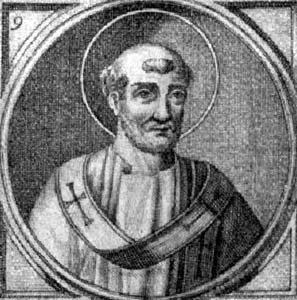
Saint
Télésphore, le 8e pape (127 ou 128-137 ou 138), Médaillon de la frise des papes
à Saint-Paul-hors-les-Murs, mosaïque
Portrait
of en:Pope Telesphorus in the en:Basilica of Saintr Paul
Outside the Walls, Rome
Retratto
di it:Papa Telesforo nella it:Basilica di San Paolo fuori
la Mura, Roma
Medaillon, um 1848, in der Basilika San Paolo fuori le Mura in Rom
Saint Télesphore
Pape (8 ème) de 125 à 136
et martyr (+ 136)
Originaire de la Grande Grèce, il nous est peu connu. Il aurait décrété que le "Gloria" soit chanté à la messe de la nuit de Noël. Selon la Tradition rapportée par saint Irénée et Eusèbe, il fut le premier pape, après saint Pierre, à avoir été martyrisé. Les Églises d'Orient le fêtent le 22 février. Sa mémoire est célébrée le 5 janvier dans l'Église catholique romaine.
Martyrologe romain au 2 janvier: À Rome, vers 136, la mise au tombeau de saint
Télesphore, pape. Au témoignage de saint Irénée, il fut institué septième
évêque de cette ville depuis les Apôtres, et rendit un glorieux témoignage.
Martyrologe romain
SOURCE : http://nominis.cef.fr/contenus/saint/5834/Saint-Telesphore.html
Saint Télésphore
(125-136)
Naquit en Calabre au sein
d’une famille grecque.
Pendant de longues années
il vécut en ermite.
Il prescrivit le
jeûne et la pénitence pendant les sept semaines qui précèdent Pâques.
SOURCE : http://eglise.de.dieu.free.fr/liste_des_papes_01.htm

Giovanni Battista de'Cavalieri (1525–1601),
Calcografia in Giovanni Battista Cavalieri, Pontificum Romanorum effigies,
Roma, Basa Domenico\Zanetti Francesco, 1580, Municipal
Library of Trento
St Télesphore, pape et
martyr
Le Liber Pontificalis
donne le 2 janvier pour la déposition de St Télesphore, attesté par St Irénée.
C’est à cette date qu’il été fêté avant qu’une confusion s’installe avec un
martyr homonyme du Martyrologe Hiéronymien fêté le 5.
Jusqu’à 1955, le 5
janvier étant le jour de la Vigile
de l’Épiphanie, St Télesphore n’était que commémoré. Sa fête a gardé ce
degré et n’a donc pas de lectures à Matines.
Il faut noter que la fête
est inscrite dans le Temporal du Missel et non au Sanctoral, comme toutes les
fêtes de saints tombant entre la Nativité du Seigneur et l’Octave de
l’Épiphanie (du 25 décembre au 13 janvier).
Dom
Guéranger, l’Année Liturgique
La sainte Église Romaine
fait mémoire en ce jour d’un de ses Papes Martyrs, saint Télesphore. Ce Pontife
monta sur le Siège Apostolique l’an 127 ; et parmi les décrets qu’il
rendit, on remarque celui par lequel il établissait l’usage de célébrer la
Messe durant la nuit de Noël, pour honorer l’heure de là Naissance du Christ,
et un autre dans lequel il décrète que l’Hymne Angélique Gloria in excelsis Deo
serait chantée ordinairement au commencement du saint Sacrifice. Cette piété du
saint Pape envers le grand mystère que nous célébrons en ces jours, rend sa
mémoire plus vénérable encore à l’époque de l’année où elle tombe. Télesphore
souffrit un glorieux martyre, selon l’expression de saint Irénée, et fut
couronné de la gloire céleste, l’an 138.
Bhx
Cardinal Schuster, Liber Sacramentorum
Aujourd’hui le
Martyrologe Hiéronymien commémore un martyr du nom de Télesphore, mais en
Afrique. Par la suite, l’homonymie a fait mentionner le pape Télesphore, et
c’est ainsi que sa mémoire en ce jour a pénétré dans le calendrier romain
durant le bas moyen âge.
De Télesphore, successeur
de Sixte Ier dans le pontificat romain, nous ne savons avec certitude que ce
qui nous est rapporté par saint Irénée. Tandis que celui-ci, relatant la liste
des premiers papes, ne dit absolument rien de leur mort sanglante, quand il
arrive à Télesphore, il atteste : ‘qui subit glorieusement le
martyre’ [1].
Par conséquent vers le
milieu du IIe siècle, Télesphore gloriose martyrium fecit, et son corps
fut déposé en paix dans la nécropole vaticane, près de la tombe de saint
Pierre.
Aujourd’hui, la messe
étant celle de la vigile de l’Épiphanie, on y ajoute la simple commémoraison du
martyr.
[1] Contr. Haer., III, c. II, P. G., VII, col. 851.
Dom Pius Parsch, le Guide dans l’année liturgique
Saint Télesphore
(127-137). — « A Rome, le pape saint Télesphore. Il souffrit sous Antonin
le Pieux, après de nombreux tourments, la mort glorieuse du martyre pour la foi
chrétienne. » — La fête du premier pape martyr, dans l’année nouvelle,
nous rappelle que beaucoup de vicaires de Jésus-Christ ont rendu à Notre
Seigneur le témoignage du sang. Recommandons-nous à tous les saints papes
martyrs.
SOURCE : http://www.introibo.fr/05-01-St-Telesphore-pape-et-martyr
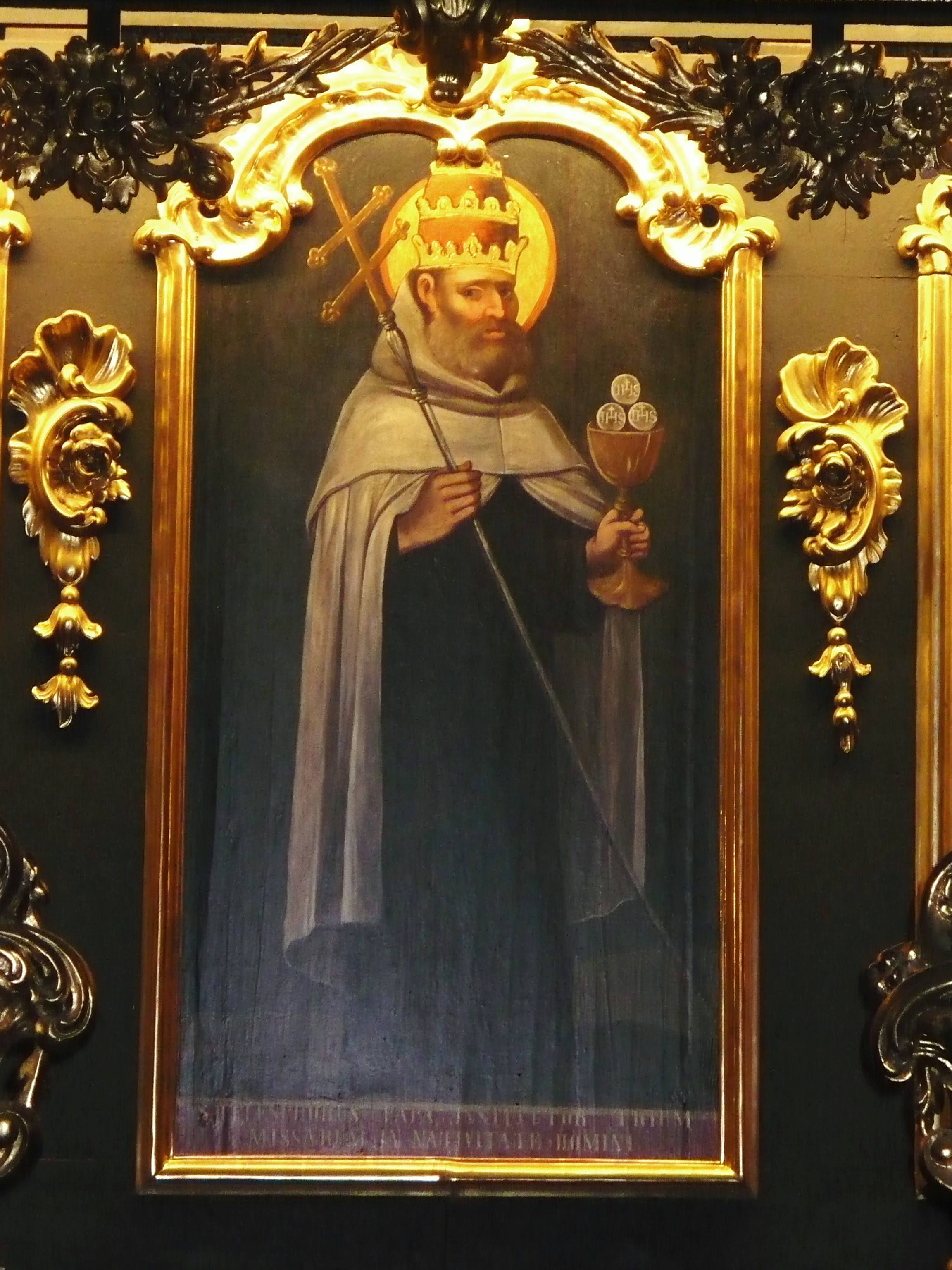
Papież
Telesfor-obraz w rokokowych stallach bydgoskiej katedry
Telesphorus ; Stalls in Bydgoszcz Cathedral
S. Télesphore
5 janvier
RÉSUMÉ :
Grec de nation et
anachorète du mont Carmel, saint Télesphore, venu à Rome au temps d’Adrien, y
fit preuve de tant de sainteté et de sagesse, qu’il fut élu pape après le
martyre de saint Sixte, l’an 127.
C’est lui qui généralisa,
par un décret, le pieux usage du jeûne quadragésimal, et c’est lui aussi qui
ordonna la célébration de la sainte Messe à minuit en la solennité de Noël.
Aidé du grand
philosophe saint
Justin, saint Télesphore combattit et réduisit les hérésies de Valentin, de
Marcion et d’Appellès. Son pontificat fut couronné par le martyre le
5 janvier 138.
Saint Télesphore était
Grec de nation et anachorète. C’est une tradition, dans l’ordre des Carmes, que
le lieu où il exerça la vie solitaire, avant d’entreprendre la prédication
de l’Évangile, était le mont Carmel, célèbre par le séjour des
saints prophètes Élie et Élisée.
Étant
venu à Rome pour travailler à l’établissement de la religion chrétienne, il
donna des marques si visibles d’une sagesse et d’une sainteté consommées,
qu’après le martyre de saint Sixte, premier de ce nom, il fut mis en sa place,
et créé souverain Pontife, sous l’empire d’Adrien.
Entre
plusieurs beaux règlements qu’il fit pour l’avancement de l’Église, l’un des
principaux fut celui du jeûne de quarante jours avant Pâques, que nous
appelons Carême. Ce n’est pas qu’il soit le premier auteur
de cette observance ; car saint
Ignace, martyr, qui vivait avant lui, en fait mention dans
son Épître aux Philippiens ; et c’est le sentiment commun des Pères
de l’Église, qu’elle est de tradition apostolique : plusieurs même
en parlent comme d’une chose d’institution divine, en tant que
Notre-Seigneur nous l’a apprise par Son exemple.
Mais
ce que fit ce saint Pape, fut d’établir par un décret ce qui n’était gardé que
par l’autorité de la tradition, et de réveiller la ferveur des Chrétiens qui
commençaient à se relâcher dans cette sainte pratique : on peut voir
à ce sujet un traité fort curieux touchant les jeûnes, que le P.
Thomassin, si connu par sa pénétration dans l’antiquité ecclésiastique, a
donné au public.
On
dit aussi que notre Saint ordonna qu’à la solennité de Noël on célébrerait
la Messe au milieu de la nuit, au lieu qu’aux autres temps, on ne la
célébrait qu’à l’heure de tierce, c’est-à-dire sur les neuf heures
du matin : ce qui se doit entendre de la Messe solennelle, et de
ce qui se faisait le plus ordinairement dans les églises. On lui attribue
encore le commandement de chanter l’hymne des Anges : Gloria in
excelsis, etc., avant l’action du Sacrifice. Toutes ces ordonnances sont
rapportées dans le Liber pontificalis.
Il
s’éleva, du temps de ce bienheureux pontife, trois hérétiques
très pernicieux, savoir : Valentin, Marcion et Appellès, dont les
dogmes impies et sacrilèges sont rapportés par saint Épiphane et par les
autres auteurs ecclésiastiques qui ont écrit sur les hérésies. Cet homme
apostolique ne manqua pas de les combattre avec toute la vigueur que l’on
pouvait attendre d’un chef de l’Église aussi savant et aussi pieux qu’il était,
et il fut aidé dans ce combat par le grand saint
Justin, philosophe chrétien, qui présenta aussi, depuis, aux
empereurs, deux excellentes apologies, pour justifier notre sainte
religion des crimes que les païens lui imputaient, poussés qu’ils étaient par
leur propre malice, et par la doctrine diabolique et les mœurs corrompues de
ces hérétiques qui se donnaient pour chrétiens.
Enfin,
saint Télesphore, après avoir gouverné l’Église onze ans, trois mois et
vingt-deux jours, fut couronné d’un très glorieux martyre, comme le dit
expressément saint
Irénée. Il avait donné trois fois les Ordres au mois de décembre, et
créé douze prêtres, huit diacres et treize évêques. Son corps fut enterré
au Vatican, proche de celui du Prince
des Apôtres, et sa mémoire est célébrée dans l’Église au jour même de son
martyre, selon l’ordre du Bréviaire réformé par Clément VIII, le 5
janvier. C’était l’an 138, Antonin étant empereur.
On
peint saint Télesphore avec un calice surmonté de trois hosties,
pour rappeler qu’il institua la pratique de dire trois Messes le jour de
Noël.
À
PROPOS DU GLORIA IN EXCELSIS DEO
On
sait que les premières paroles de ce cantique ont été chantées
par les Anges, lorsqu’ils annoncèrent la Naissance du divin Sauveur.
De là lui est venu le nom d’hymne angélique.
L’origine
des paroles qui suivent n’est pas tout à fait certaine :
on les attribue aux Apôtres, à saint Télesphore, au pape saint
Symmaque, à saint
Hilaire, évêque de Poitiers.
Il
est facile de voir l’analogie qu’il y a entre notre Gloria in excelsis et
celui des Constitutions apostoliques, tel que le transcrit le docteur
Grancolas :
Gloria in excelsis Deo et
in terra pax hominibus bonæ voluntatis.

Cromolitografia
in L. Tripepi, Ritratti e biografie dei romani pontefici: da S. Pietro a Leone
13, Roma, Vaglimigli Davide, 1879, Municipal
Library of Trento
Also
known as
Telesforo
5 January (Latin
Church)
22
February (Greek Church)
2 January on
some calendars
3 January on
some calendars
7 January on
some calendars
Profile
Greek,
probably from Calabria. Pope.
Celebrated Easter on
Sunday but maintained fellowship with communities that did not. Started the
tradition of Christmas Midnight Mass, and
decided that the Gloria should be sung. Some legends say he was
a hermit before
his election, and that he instituted the tradition of Lent, but
these are doubtful. Martyred,
possibly due to conversions caused
by his preaching.
Papal Ascension
pope with
a chalice over
which three Hosts hover (may refer to the celebration of Christmas with
three Masses said
to represent the temporal, spiritual, and eternal birth of Christ)
pope with
a chalice with
a nearby club (possibly an indication of his martyrdom)
Additional
Information
An
Old English Martyrology, by George Herzfeld
Book
of Saints, by the Monks of
Ramsgate
Lives
and Times of the Popes, by Alexis-François Artaud de Montor
Lives
of the Saints, by Father Alban
Butler
Lives
of the Saints, by Sabine Baring-Gould
Saints
of the Day, by Katherine Rabenstein
The
Liturgical Year, by Father Prosper
Gueranger
books
Martirlogio Romano, 2004 edizione
Our Sunday Visitor’s Encyclopedia of Saints
other
sites in english
Encyclopedia Britannica, 1911 edition
images
webseiten
auf deutsch
sitios
en español
Martirologio Romano, 2001 edición
sites
en français
fonti
in italiano
Martirologio Romano, 2005 edition
nettsteder
i norsk
spletne
strani v slovenšcini
MLA
Citation
“Pope Saint
Telesphorus“. CatholicSaints.Info. 15 May 2024. Web. 2 March 2026.
<https://catholicsaints.info/pope-saint-telesphorus/>
SOURCE : https://catholicsaints.info/pope-saint-telesphorus/

Alsace,
Bas-Rhin, Abbatiale Saint-Étienne de Marmoutier. Vitrail : Saint
Alphonse Liguori, Saint Joseph, saint Télesphore
Alphonsus Liguori
on stained-glass windows ; Saint Joseph
on stained-glass windows in France ; Telesphorus ; Stained-glass
windows of Abbey Church, Marmoutier ; Nave of Abbey Church,
Marmoutier ; 1910s stained-glass
windows in Bas-Rhin
St. Telesphore, Pope ad
Martyr
Telesphore was an
anchorite in Egypt and Palestine. He reigned from 125 to 136. He established
the Midnight Mass at Christmas with the song of Gloria in excelsis Deo, the
celebration of Easter on Sunday, and fixed the Lenten fast. He also worked to
counter Gnostic heresy, and died a martyr.
SOURCE : https://www.vaticannews.va/en/saints/01/03.html
TELESPHORUS, POPE, ST.
Pontificate 127 or 128 to
137 or 138. Telesphorus was the seventh successor to Peter (see clement i).
Sources generally agree that he reigned for 11 years. Eusebius and Jerome begin
his reign in 128. The Liber pontificalis makes him a Greek and,
anachronistically, an anchorite. It also says that he fixed the Easter fast at
seven weeks, a regulation more compatible with the seventh century than the
second, and that he ordered the Gloria sung either at midnight Mass at
Christmas or in daily Masses after Terce. The tradition that he was martyred
under Hadrian is too well attested to be discredited. Irenaeus (Adv. Haer. 3.3)
singles him out as the first Roman bishop so honored. Eusebius (Historia
Ecclesiastica 4.5, 10; 5.6, 24) and the Liber pontificalis repeat
the story. The legend that Telesphorus is buried in the Vatican is not borne
out by modern excavations.
Feast: Jan. 5.
Bibliography: Liber
pontificalis, ed. L. Duchesne (Paris 1886–92, 1958) 1:56–57, 129; 3:72. É. Amann, Dictionnaire de théologie catholique, ed. A. Vacant et al., (Paris
1903–50) 15.1:82. E. Caspar, Geschichte de Papsttums von den Anfängen bis
zur Höhe der Weltherrschaft (Tübingen 1930–33) 1:21, 34, 48. J. N. D. Kelly, Oxford Dictionary of Popes (New
York 1986). E. Sauser, Biographisch-Bibliographisches Kirchenlexikon (Herzberg
1995). B. Sodaro, Santi e beati di Calabria (Rosarno 1996).
[E. G. Weltin]
New Catholic Encyclopedia
Article
(Saint) Pope, Martyr (January
5) (2nd
century) A Greek by
birth, he succeeded Saint Xystus
I in Saint Peter’s
Chair (A.D. 142),
and twelve years later received the crown of martyrdom.
Some authorities, however, date his Pontificate from A.D. 126 to
A.D. 142.
He did much for Church discipline and was altogether an able Pope and
truly a “man of God.” It was he, it is said, who made the observance of Lent
obligatory on Christians.
He is also credited with having introduced the chanting of the Hymn Gloria in
excelsis into the Mass,
and with having been the first to celebrate the Three Masses of Christmas
Day. From this tradition he has come to be represented in art as
holding in his hand a chalice with
three hosts.
MLA
Citation
Monks of Ramsgate.
“Telesphorus”. Book of Saints, 1921. CatholicSaints.Info.
26 December 2016. Web. 2 March 2026.
<https://catholicsaints.info/book-of-saints-telesphorus/>
SOURCE : https://catholicsaints.info/book-of-saints-telesphorus/
Telesphorus, Pope M (RM)
Died 136. Saint Telesphorus was born in Greece, followed Pope Saint Sixtus I to
the papacy, and reigned for ten years. Of the fourteen bishops who succeeded
Saint Peter, to the end of the 2nd century, every one is listed as a martyr. In
the case of some of them, martyrdom is historically improbable, and for none of
them does good historical evidence for the correctness of the tradition still
exist, with one exception: Saint Telesphorus. Even for him the circumstances
are not known; Saint Ireneaus (c. 125-203) simply says that he suffered a
glorious martyrdom under the Emperor Hadrian. Saint Telesphorus is commemorated
in both the Greek and Latin churches (Attwater, Benedictines, Delaney). In art,
Saint Telesphorus is shown as a pope with a chalice, over which three Hosts
hover, there might also be a club nearby (Roeder).
SOURCE : http://www.saintpatrickdc.org/ss/0105.shtml
Pope Saint Telesphorus
Pope St. Telesphorus (ca.
125 – 138 AD) was a Greek who had been an anchorite. He ruled the Church
in the time of Emperor Antoninus Pius. To St. Telesphorus are attributed some
church practices which endure down to this day. According to the “Liber
Pontificalis” St. Telesphorus ordered a fast for seven weeks before Easter.
That the Lenten fast goes back even before the time of Telesphorus, St.
Irenaeus gives testimony. But the length of the fast varied considerably in
those early days. It is probable enough that Pope St. Telesphorus did make some
regulation as to the length of the Lenten fast.
A custom much loved even
today is also attributed to St. Telesphorus. He is said to have ordered that
although Mass was not celebrated before the hour of tierce (i.e., 9 to 12
o’clock in the morning) at Christmas time Mass should be celebrated at night. This
is the first mention of the beloved midnight Mass. However, scholars doubt
whether this decree actually does go back to the time of St. Telesphorus.
St. Telesphorus is said
also to have decreed that the Gloria in excelsis should be sung at the Christmas
Mass and only at the Christmas Mass. This magnificent hymn of praise is not
said at all Masses even today. As late as the eleventh century, though the Pope
could say it oftener, priests were not allowed to say it except at Easter.
St. Telesphorus died a
martyr as is known not only from the “Liber Pontificalis” but also from the
earlier testimony of St. Irenaeus. He was buried near St. Peter on the Vatican.
His feast is kept on January 5 in the Roman liturgy and February 22 in the
Greek.
SOURCE : http://ucatholic.com/saints/telesphorus/
Pope St. Telesphorus
(Lived about 125-136.)
St. Telesphorus was the
seventh Roman
bishop in succession from
the Apostles,
and, according to the testimony of St.
Irenæus (Against
Heresies III.3.3), suffered a glorious martyrdom. Eusebius (Church
History IV.7, IV.14) places the beginning of his pontificate in the
twelfth of Hadrian's reign (128-129), his death in the first year of
the reign of Antoninus
Pius (138-139). These statements, however, should be compared with
Lightfoot, "The Apostolic Fathers", I (London, 1899), 201 sq.,
section on "Early Roman Successions", and Harnack, "Geschlichte
der alchristl. Literatur", pt. II, "Die Chronologie", I
(Leipzing, 1879), 70 sq. In the fragment of the letter of Irenæus of
Lyons to Pope
Victor concerning the celebration of Easter (Eusebius, Church
History V.24), Telesphorus is mentioned as one of the Roman bishops who
always celebrated Easter on Sunday,
without, however, abandoning church fellowship with those communities that did
not follow this custom. None of the statements in the "Liber
pontificalis" and other authorities of a later date as to liturgical and
other decisions of this pope are
genuine. In the Roman Martyrology his feast is
given under 5 January; the Greek
Church celebrates it on 22 February.
Kirsch, Johann Peter. "Pope
St. Telesphorus." The Catholic Encyclopedia. Vol. 14. New
York: Robert Appleton Company,1912. 23 Dec.
2015 <http://www.newadvent.org/cathen/14477b.htm>.
Transcription. This
article was transcribed for New Advent by Christine J. Murray.
Ecclesiastical
approbation. Nihil Obstat. July 1, 1912. Remy Lafort, S.T.D.,
Censor. Imprimatur. +John Cardinal Farley, Archbishop of New York.
Copyright © 2023 by Kevin Knight.
Dedicated to the Immaculate Heart of Mary.
SOURCE : http://www.newadvent.org/cathen/14477b.htm
SAINT TELESPHORUS A.D. 12
SAINT TELESPHORUS was a
Greek by birth, though some authors say that he was born in Terranova, in
Calabria. It is by some affirmed that his father was an anchorite, and that
Telesphorus himself was Roman by birth. Some say that by his decrees he
confirmed the observance of Lent; and others affirm that the quadragesimal fast
came down by tradition, as stated by Saint Ignatius, Saint Jerome, and
Theophilus. At any rate, he is credited with having introduced the "Gloria
in Excelsis"; in the Mass. This holy pope suffered martyrdom, A.D. 139. In
his four ordinations Telesphorus created thirteen bishops, fifteen priests, and
eight deacons. Some pious Christians removed his body after execution, and
placed it near that of Saint Peter, in the Vatican. It is said that this pope
ordered that all priests should celebrate three Masses on Christmas day.
However, this observance was followed under Saint Gregory the Great. Saint
Telesphorus presided over the Holy See during eleven years, eight months, and
eighteen days.

Steinerkirchen
( Oberösterreich ). Kath. Pfarrkirche hl. Martin - Heiliger Telesphorus.
Steinerkirchen
( Upper Austria ). Saint Martin church - Saint Telesphorus.
St. Telesphorus, Pope and
Martyr
HE was a Grecian by
birth, and the seventh bishop of Rome. Towards the end of the year 128, he
succeeded Saint Sixtus I. sat eleven years, and saw the havoc which the
persecution of Adrian made in the church. “He ended his life by an illustrious
martyrdom,” says Eusebius; 1 which
is also confirmed by St. Irenæus. 2
Note 1. Hist. l. 4.
c. 10. [back]
Note 2. L. 3. c.
3. [back]
Rev. Alban
Butler (1711–73). Volume I: January. The Lives of the
Saints. 1866.
SOURCE : http://www.bartleby.com/210/1/052.html
Liturgical
Year: Saint Telesphorus, Pope and Martyr
The holy Church of Rome
commemorates today the holy Pope and Martyr Saint Telesphorus. This Pontiff
began his reign in the year 127; and among his decrees, we find that of his
prescribing the holy sacrifice of the Mass to be offered up on Christmas Night,
in order to honour the hour when our Saviour was born: he also ordered that the
Angelic Hymn Gloria in excelsis should be said, on most days, at the beginning
of Mass. This devotion of the holy Pope towards the great Mystery which we are
now celebrating, renders his commemoration at this season of the year doubly
dear to us. Telesphorus suffered a glorious martyrdom, as Saint Ireneus
expresses it, and was crowned with eternal glory in the year 138.
Collect
O God, who by the yearly
solemnity of blessed Telesphorus, your Martyr and Bishop, rejoicest the hearts
of the faithful; mercifully grant that we who celebrate his martyrdom may enjoy
his protection.
Commemoration of Saint
Telesphorus
Sanctify, Lord, the
offerings consecrated to you: and being appeased thereby, mercifully look upon
us, by the intercession of blessed Telesphorus, your Martyr and Bishop.
Commemoration of Saint
Telesphorus
May this communion, O
Lord, cleanse us from sin, and by the intercession of blessed Telesphorus, your
Martyr and Bishop, make us effectually partakers of this heavenly remedy.
– from the book The Liturgical Year: Christmas, volume 1, by the
Very Reverend Dom Prosper Gueranger, Abbot of Solesmes, translated from the
French by the Revered Dom Laurence Shepherd, Monk of the English-Benedictine
Congregation, 2nd edition; published in Dublin Ireland by James Duffy, 15
Wellington-Quay, 1870
SOURCE : https://catholicsaints.info/liturgical-year-saint-telesphorus-pope-and-martyr/
An
Old English Martyrology – January 7 – Saint Telesphorus
Article
On the same day is the
festival of the pope called Telesphorus, who was of Greek origin. He sat eleven
years and three months on the papal throne in the days of the Emperors Antoninus
and Marcus. This pope was afterwards Christ’s martyr, and his body rests near
to that of Saint Peter. This pope decreed first of all men that at Rome there
should be a fast seven weeks before Easter, and he first appointed that the
hymn Gloria in excelsis Deo should be sung before the mass.
MLA
Citation
George Herzfeld. “January
7 – Saint Telesphorus”. An Old English Martyrology, 1900. CatholicSaints.Info.
15 May 2024. Web. 2 March 2026.
<https://catholicsaints.info/an-old-english-martyrology-january-7-saint-telesphorus/>
SOURCE : https://catholicsaints.info/an-old-english-martyrology-january-7-saint-telesphorus/

This
illustration is from The Lives and Times of the Popes by Chevalier
Artaud de Montor (1772–1849), New York: The Catholic Publication Society of
America, 1911. It was originally published in 1842.
The
Lives and Times of the Popes – Saint Telesphorus – A.D. 127
Article
Saint Telesphorus was a
Greek by birth, though some authors say that he was born in Terranova, in
Calabria. It is by some affirmed that his father was an anchorite, and that
Telesphorus himself was Roman by birth. Some say that by his decrees he
confirmed the observance of Lent; and others affirm that the quadragesimal fast
came down by tradition, as stated by Saint Ignatius, Saint Jerome, and
Theophilus. At any rate, he is credited with having introduced the “Gloria in
Excelsis” in the Mass.
This holy pope suffered
martyrdom, A.D. 139.
In his four ordinations
Telesphorus created thirteen bishops, fifteen priests, and eight deacons. Some
pious Christians removed his body after execution, and placed it near that of
Saint Peter, in the Vatican.
It is said that this pope
ordered that all priests should celebrate three Masses on Christmas day.
However, this observance was followed under Saint Gregory the Great.
Saint Telesphorus
presided over the Holy See during eleven years, eight months, and eighteen
days.
MLA
Citation
Alexis-François Artaud de
Montor. “Saint Telesphorus – A.D. 127”. The
Lives and Times of the Popes, 1911. CatholicSaints.Info.
26 July 2022. Web. 2 March 2026.
<https://catholicsaints.info/the-lives-and-times-of-the-popes-saint-telesphorus-a-d-127/>
SOURCE : https://catholicsaints.info/the-lives-and-times-of-the-popes-saint-telesphorus-a-d-127/

Pietro Perugino, San
Telesforo papa (1481-1482),
affresco; Città del Vaticano, Cappella
Sistina
Fresko,
in der Sixtinischen
Kapelle in Rom
San Telesforo Papa e
martire
m. 136
(Papa dal 125 al 136).
Da poco abbiamo celebrato la Messa della notte di Natale. La sua introduzione
si deve proprio a Papa Telesforo, settimo successore di Pietro, che governò la
Chiesa dal 125 al 136. Di origine greca e nato in Calabria, prima di giungere a
Roma era stato anacoreta in Egitto e Palestina. Forse fu tra gli eremiti del
Monte Carmelo (l'ordine carmelitano tuttora lo annovera tra i suoi santi).
Successe a Sisto I. Oltre alla Messa di Mezzanotte pare abbia istituito anche
le altre due liturgie del Natale (all'aurora e all'ora terza), raccomandato
l'osservanza del digiuno quaresimale e partecipato alla disputa d'Oriente sulla
data di Pasqua.
Emblema: Palma
Martirologio Romano: A
Roma, deposizione di san Telesforo, papa, che, come attesta sant’Ireneo,
nominato settimo vescovo dopo l’Apostolo, subì un glorioso martirio.
Di origine greca o nativo della Magna Grecia; Ottavo papa, succedette a Sisto I nella sede di Roma e governò 11 anni, 3 mesi e 22 giorni, dal 125 al 136 d.C.
Non si conosce assolutamente nulla del suo pontificato, tuttavia le poche notizie, senza fondamento storico, ci vengono tramandate dal Liber Pontificalis vol. I, 129 secondo cui Telesforo istituì il digiuno quaresimale e l’introduzione delle tre Messe notturne di Natale con il canto del “Gloria in excelsis Deo”.
Nel dare la serie dei primi papi, s. Ireneo asserisce nella sua nota opera Adversus haereses che Telesforo subì un ‘glorioso martirio’, affermazione ripetuta e confermata da Eusebio nella sua Historia ecclesiastica V, 6,4.
Morto a Roma, fu sepolto presso la tomba di s. Pietro in Vaticano.
Il Martirologio Romano e il Messale lo commemorano il 2 gennaio.
Una sua immagine si trova nella Cappella Sistina in Vaticano, dipinta nella cosiddetta Cerchia di Sandro Filipepi detto Botticelli.
Autore: Antonio Borrelli
SOURCE : http://www.santiebeati.it/Detailed/36375.html
TELESFORO, santo
di Francesco Scorza
Barcellona
Enciclopedia dei Papi
(2000)
Tra i vescovi di Roma citati nella sua lista, Ireneo di Lione ricorda solo di T. che "rese gloriosamente la testimonianza", cioè che morì martire. Eusebio di Cesarea pone nel 128 gli inizi del suo episcopato, durato undici anni (Historia ecclesiastica IV, 5, 5; Chronicon, ad a. 128) e che si sarebbe concluso nel 138 (Historia ecclesiastica IV, 10; Chronicon, ad a. 138). Al seguito di Ireneo, Eusebio ricorda il suo martirio, e anche che T. fu uno dei predecessori di Vittore nella Sede romana che, pur non celebrando la Pasqua secondo il calendario giudaico il 14 di nis¯an, mantenne la pace con le comunità che si attenevano a quella tradizione senza imporre la propria (Historia ecclesiastica V, 6, 4; 24, 14). La durata di undici anni per il suo episcopato (Eusebio, ibid. IV, 10 afferma che nel 138 T. era nel ventesimo anno della sua carica) è attestata anche nel Catalogo Liberiano (undici anni, tre mesi e tre giorni), dal 127 al 137. Il Liber pontificalis, nr. 9, aggiunge una serie di notizie, come al solito non accertabili e verosimilmente fantasiose: T. sarebbe stato precedentemente un anacoreta, avrebbe proceduto a quattro ordinazioni per un totale di dodici presbiteri, otto diaconi e tredici vescovi, sarebbe morto martire e sarebbe stato sepolto nel cimitero vaticano presso s. Pietro il 2 gennaio, e alla sua morte sarebbe seguito un periodo di sede vacante di sette giorni. In particolare a T. sono attribuite alcune disposizioni disciplinari e liturgiche relative al digiuno prepasquale di sette settimane, alla messa notturna del Natale e alla introduzione del canto del Gloria nella messa. La notizia sul martirio di T. lo accomuna a quanto il Liber pontificalis afferma di molti papi anteriori a Silvestro I, ma di fatto si trova a coincidere con la testimonianza di Ireneo, più antica e da prendersi in considerazione per la sua eccezionalità nella lista del vescovo di Lione. Relativamente al digiuno prepasquale di sette settimane, una pratica di tale estensione non è attestata prima del sec. IV in Oriente, mentre si sa che a Roma tra i secc. V e VI si osservava un digiuno prepasquale di sei settimane. È dunque probabile che il provvedimento attribuito a T. sia da intendere come il tentativo di imporre, all'epoca della composizione del Liber pontificalis, una disciplina più austera in proposito. Quanto alla celebrazione della messa notturna del Natale, benché quella del Liber pontificalis costituisca la testimonianza più antica di questo uso, tale provvedimento risulta anacronistico per quest'epoca, perché l'introduzione della festa del Natale non è anteriore al sec. IV. Per quel che concerne l'introduzione del canto del Gloria durante la messa, conviene osservare che nella prima redazione del Liber pontificalis, come si ricostruisce dai compendi feliciano e cononiano, la disposizione era limitata alla sola messa del Natale, evidentemente a differenza dall'uso di cantarlo la domenica e nelle feste dei martiri introdotto da papa Simmaco (cfr. Le Liber pontificalis, p. 263). In ogni caso non si hanno testimonianze del Gloria anteriori al IV secolo, e un intervento in proposito di T. non può corrispondere a un dato reale. A T. è poi attribuita una delle decretali pseudoisidoriane. L'antica tradizione carmelitana, che pretendeva di far risalire le origini dell'Ordine al profeta Elia, annoverava tra i suoi adepti T., per la fama di anacoreta che gli veniva dalla notizia del Liber pontificalis. Nei martirologi la commemorazione di T. compare a partire da quello di Floro, il quale la pose alla data del 5 gennaio, identificando il vescovo romano con un omonimo martire africano ricordato a quella data nel Martyrologium Hieronymianum: come tale passò nel Martyrologium Romanum, ma il Calendarium Romanum del 1969 la espunge in quanto non attestata, relativamente al vescovo di Roma, nel Martyrologium Hieronymianum.
Fonti e Bibl.: Ireneo di Lione, Adversus haereses III, 3, 3, a cura di A. Rousseau-L. Doutreleau, Paris 1974 (Sources Chrétiennes, 211), pp. 36-8; Eusebio di Cesarea, Historia ecclesiastica IV, 5, 5; 10; V, 6, 4; 24, 14, a cura di E. Schwartz, Leipzig 1903 (Die Griechischen Christlichen Schriftsteller. Eusebius Werke, II, 1), pp. 306, 320, 438, 494-95; Id., Chronicon, ad aa. 128, 138, a cura di R. Helm, Berlin 1956 (Die Griechischen Christlichen Schriftsteller. Eusebius Werke, VII), pp. 199, 202; Le Liber pontificalis, a cura di L. Duchesne, I, Paris 1886, pp. 56-7, 129, 263; Catalogo Liberiano, ibid., pp. 2-3; Martyrologium di Floro, in Édition pratique des Martyrologes de Bède, de l'Anonyme Lyonnais et de Florus, a cura di J. Dubois-G. Renaud, ivi 1976, p. 8; Martyrologium Romanum [...] scholiis historicis instructum, in Propylaeum ad Acta Sanctorum Decembris, Bruxellis 1940, p. 7; Calendarium Romanum ex decreto sacrosancti oecumenici concilii Vaticani II instauratum auctoritate Pauli PP. VI promulgatum, In Civitate Vaticana 1969, p. 112.
Fonti agiografiche: Bibliotheca
Hagiographica Latina [...], II, Bruxellis 1900-01, p. 1158. Decretali
attribuite a T.: P. Hinschius, Decretales pseudo-Isidorianae et Capitula
Angilramni [...], Lipsiae 1863, pp. 109-12. Studi: Ecclesiastica Historia [...]
per aliquot studiosos et pios viros in urbe Magdeburgica, Centuria II, Caput X,
Basileae 1562, col. 212; C. Baronio, Annales ecclesiastici, II, Romae 1590, pp.
98, 121; Acta Sanctorum [...], Ianuarii, I, Antverpiae 1643, pp. 236-40;
[L.-S.] Lenain de Tillemont, Mémoires pour servir à l'histoire ecclésiastique
des six premiers siècles, t. II, Venise 1732, pp. 251-52, 600. A Dictionary of
Christian Biography, IV, London 1887, s.v., p. 816; Vies des Saints et des Bienheureux,
I, Paris 1935, s.v., pp. 92-3; E.C., XI, s.v., col. 1872; N. Del Re, Telesforo,
in B.S., XII, coll. 188-89; Lexikon für Theologie und Kirche, IX, Freiburg
1964², s.v., col. 625; New Catholic Encyclopaedia, XIII, Washington 1967, s.v.,
p. 982; Lexikon der christlichen Ikonographie, VIII, Rom 1976, s.v., col. 422;
Biographisch-bibliographisches Kirchenlexikon, XI, Herzberg 1996, s.v., col.
625; Il grande libro dei Santi. Dizionario enciclopedico, III, Cinisello
Balsamo 1998, s.v., p. 1834.
© Istituto della
Enciclopedia Italiana fondata da Giovanni Treccani - Riproduzione riservata
SOURCE : https://www.treccani.it/enciclopedia/santo-telesforo_(Enciclopedia-dei-Papi)/

Den hellige pave
Telesforus ( - ~136)
Minnedag:
5. januar
Den hellige Telesforus
var i følge LP gresk,
noe også navnet viser. Han hadde vært eneboer.
Han styrte Kirken på
keiser Antonius Pius' tid. Ireneus sier om ham at han alltid feiret påske på
søndag (altså ikke nødvendigvis den 14. nisan etter jødisk kalender). I
følge LP innførte
han sju uker faste før påske. Vi vet fra Ireneus at
langfasten til og med går tilbake til før Telesforus' tid, men lengden varierte
betydelig i den første tiden. Det er godt mulig at Telesforus ga noen regler
for lengden på den. LP skriver
også at han innførte midnattsmessen julenatt, men vitenskapsmennene mener at
dette sannsynligvis skjedde flere århundrer senere. LP sier
også at han forordnet at Gloria in Excelsis Deo skulle synges i
julenattsmessen, og bare da. Så sent som på 1000-tallet hadde ikke prester lov
til å fremsi Gloria annet enn i påsken, selv om paven kunne fremsi
det oftere. Han skal også ha innført nye bønner i messen. Under ham kom
Bar-Kochbas opprør 132-135. Jerusalem blir en hedensk by.
I LP står
Telesforus, som alle de fjorten første av Peters etterfølgere,
oppført som martyr. Vi mangler bevis for de fleste andres martyrium, men
Ireneus bevitner at Telesforus døde som martyr under keiser Hadrian (død 138).
Nærmere enkeltheter kjenner vi ikke. Han ble gravlagt nær St. Peter i
Vatikanet.
Hans minnedag 5. januar
sto i den romerske kalenderen til 1969. Dagen stammer imidlertid fra Florian,
som forvekslet ham med en annen romersk martyr. Hans fest er den 22. februar i
den greske kirken.
Paverekken - Kildehenvisninger -
Kompilasjon og oversettelse: p. Per Einar Odden -
Sist oppdatert: 1998-02-13 15:47
SOURCE : https://www.katolsk.no/biografier/historisk/telesfor

Statue
of Pope Telesphorus Carmelite Abbey / Karmelitenkloster, Straubing, Lower
Bavaria, Germany
Telesphorus
Gedenktag katholisch: 2. Januar
Gedenktag
IV. Klasse: 5. Januar
Gedenktag orthodox: 22.
Februar
Name bedeutet: der
zielgerichtet Eifrige (griech. - latein.)
römischer Gemeindevorsteher, Märtyrer
* in Griechenland
† 136 (?) in Rom
Telesphorus war nach der
Bischofsliste von Irenäus
von Lyon der sechste Nachfolger von Petrus,
demnach starb er als Märtyrer.
Telesphorus soll zuvor
auf dem Berge Karmel als
Eremit gelebt haben. Nachdem er Vorsteher der Gemeinde in Rom wurde,
soll er die Weihnachtsmesse
um Mitternacht, die Feier des Osterfestes an
Sonntagen, die sieben Wochen des Fastens in der Passionszeit und
das Singen des Gloria begründet haben; dies wurde jedoch historisch widerlegt.
In seinem Brief an Victor I. erwähnte Irenäus Telesphorus
noch einmal und nannte ihn vor Soter amtierenden
Presbyter, der sich in kirchlichen Disziplinarfragen gegenüber Christen anderer
Gemeinden als tolerant erwies.
Historisch gesehen dürfte
Telesphorus einer aus dem Kreis der Gemeindeleitenden gewesen sein, dessen Name
wegen seines Martyriums im Gedächtnis blieb und der deshalb für die
Bischofsliste verwendet wurde.
Stadlers
Vollständiges Heiligenlexikon
Telesphorus'
Dekret über das Fasten gibt es online zu lesen in den Documenta
Catholica Omnia.
Seite
zum Ausdruck optimiertUnser Reise-Blog:
Reisen zu den Orten, an denen die
Heiligen lebten und verehrt werden.
Empfehlung an
Freunde senden
Artikel
kommentieren / Fehler melden
Fragen? -
unsere FAQs antworten!
Impressum - Datenschutzerklärung
Schauen Sie sich zufällige Biografien an:
Quiriacus
Albert
von Gladbach
Henoch
Autor: Joachim
Schäfer - zuletzt aktualisiert am 06.02.2022
Quellen:
• Karl Heussi: Kompendium der Kirchengeschichte. J.C.B. Mohr (Paul Siebeck), Tübingen 1976
• Ekkart Sauser. In: Friedrich-Wilhelm Bautz †, Traugott Bautz † (Hg.): Biographisch-Bibliographisches Kirchenlexikon, Bd. XI, Herzberg 1996
• Lexikon für Theologie und Kirche, begr. von Michael Buchberger. Hrsg. von
Walter Kasper, 3., völlig neu bearb. Aufl., Bd. 9. Herder, Freiburg im Breisgau
2000
korrekt zitieren: Joachim Schäfer: Artikel Telesphorus, aus dem Ökumenischen Heiligenlexikon - https://www.heiligenlexikon.de/BiographienT/Telesphorus.htm, abgerufen am 2. 3. 2026
Die Deutsche Nationalbibliothek verzeichnet das Ökumenische
Heiligenlexikon in der Deutschen Nationalbibliografie; detaillierte
bibliografische Daten sind im Internet über https://d-nb.info/1175439177 und https://d-nb.info/969828497 abrufbar.
SOURCE : https://www.heiligenlexikon.de/BiographienT/Telesphorus.htm


.jpg)