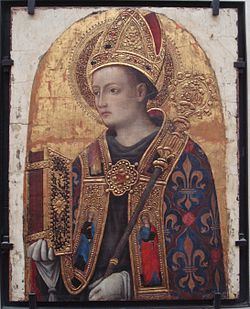
Antonio Vivarini (Antonio of Murano) (active
c. 1440 – 1480), Saint Louis de Toulouse, circa 1450, gold on panel, 46 x 36, Louvre
Museum, Paris
Saint Louis d'Anjou
évêque de Toulouse -
premier évêque de Pamiers (+ 1297)
Fils du roi de Naples, Charles II, et de Marie, fille du roi de Hongrie, il est retenu en otage à Barcelone auprès du roi d'Aragon. C'est là qu'il rencontre les Frères Mineurs et, devenu libre, il se fit franciscain. Nommé évêque de Toulouse, il garde ses habitudes de pauvreté et d'humilité au service des pauvres. Il meurt prématurément (il a 23 ans) à Brignoles en Provence et, selon son désir, est inhumé à Marseille.
Il est canonisé en 1317 et devient le saint patron de Brignoles, sa ville natale, en 1617, l'occasion pour le musée de fêter ces centenaires par une exposition-événement.
"Louis, fils du roi Charles Il de Sicile, est amené encore enfant, en Catalogne comme otage à la place de son père, prisonnier. Détenu en captivité avec ses frères, il montra une grande patience et des vertus exceptionnelles. Tombé malade, il forme le vœu d'entrer dans l'ordre de saint François. Une fois guéri, il est empêché par son père. Il part pour Rome puis Naples, et reçoit les ordres sacrés. Ce qui n'était pas du goût de son père. Boniface VIII le nomme évêque de Toulouse, mais avant d'être ordonné, il fit profession dans la règle de saint François.
Durant son ministère épiscopal, il s'employa totalement à gagner les âmes par ses avertissements et l'exemple d'une vie sans tache. Il amena plusieurs juifs à la foi chrétienne.
Il reçut la charge de l'église de Pamiers, devenue récemment siège épiscopal, à la place de Bernard Saisset, empêché par le roi de France. On peut donc, à juste titre, le qualifier de premier évêque de Pamiers.
Très généreux envers les pauvres, il les servait en fléchissant le genou. Tout auréolé d'humilité, il s'envola vers le ciel dans la vingt-quatrième année de son âge. Selon sa volonté, il fut enseveli à Marseille dans la maison des Franciscains. Célèbre dans l'église pour ses mérites illustres pour ses miracles dont plusieurs résurrections, Jean XXII l'a placé au nombre des saints.
Remarques : Louis d'Anjou était fils de Charles Il le Boiteux (1248-1309) et petit fils de Charles 1er de France, frère de saint Louis. Bréviaire de Pamiers." (saints du diocèse de Pamiers)
Louis d'Anjou, né probablement à Nocera près de Salernes(*) le 9 février 1274, est fils de Charles II, roi de Naples, Comte de Provence et de Marie de Hongrie. Il est petit-neveu d'un autre saint Louis, le roi de France.
Il est élevé à Brignoles. En 1284, son père, encore duc de Calabre, est capturé lors d'un combat contre la flotte aragonaise, et retenu prisonnier à Barcelone. Six mois plus tard, il devient roi de Naples à la mort de Charles Ier d'Anjou. Des négociations aboutissent en 1288, qui permettent la libération du roi contre la remise en qualité de prisonniers de trois de ses fils. Traité avec honneur, les jeunes princes et leur suite organisent une cour. Louis passa du temps auprès des Frères Mineurs François Brun et Pierre Scarrerii et s'initie à la théologie.
Libéré le 7 juin 1295, il revint dans le royaume de Naples, prononce ses vœux et reçoit la tonsure, malgré l'avis de son père. La mort de son frère aîné le fait héritier du royaume, mais il y renonce en faveur de son frère Robert et est ordonné prêtre le 19 mai 1296.
En janvier 1296, le pape Boniface VIII le nomme évêque de Toulouse tout en étant admis dans l'ordre des franciscains. Malade, il se rend à Brignoles où il achève sa vie le 19 août 1297 : il n'a que 23 ans.
Il est inhumé dans l'église des Cordeliers de Marseille. Le 7 avril 1317, le
pape Jean XXII, qui avait fait une partie de sa carrière au service de la
maison d'Anjou et qui avait été son secrétaire à Toulouse, prononce sa
canonisation. (Histoire des saints de Provence - diocèse de Fréjus-Toulon)
(*) un internaute nous dit qu'il est né à Brignoles.
À Brignoles en Provence, l'an 1297, le trépas de saint Louis, évêque de
Toulouse. Neveu du roi saint
Louis, il rechercha la pauvreté évangélique plutôt que la gloire et les
honneurs de ce monde. Tout jeune encore, mais déjà d'une grande maturité en
vertu, il fut promu à l'évêché de Toulouse, mais bientôt consumé par une
mauvaise santé et par son zèle, il s'endormit pieusement à l'âge de vingt-trois
ans.
Martyrologe romain
SOURCE : https://nominis.cef.fr/contenus/saint/1697/Saint-Louis-d-Anjou.html

Simone Martini (1284–1344), St Francis and
St Louis of Toulouse, 1318, fresco, 120 x 12,
Basilica of San Francesco d'Assisi, Assisi - Basilica Papale e Sacro Convento di San
Francesco in Assisi - www.sanfrancescoassisi.org/html/ita/shownews.php?idNews=376&zone=WEBluoghi

Simone Martini (1284–1344), St Francis and
St Louis of Toulouse, 1318, fresco,
Basilica of San Francesco d'Assisi, Assisi - Basilica Papale e Sacro Convento di San
Francesco in Assisi - www.sanfrancescoassisi.org/html/ita/shownews.php?idNews=376&zone=WEBluoghi
Saint Louis
Évêque de Toulouse
(1274-1297)
Saint Louis, évêque de
Toulouse, petit-neveu de saint Louis, roi de France, fils de Charles le
Boiteux, roi de Naples et de Jérusalem, naquit à Brignoles, en Provence. Il
parut, dès son enfance, n'avoir d'inclination que pour la vertu. Ses
récréations même se rapportaient à Dieu; il n'en choisissait que de sérieuses
et ne s'y livrait que pour donner à son corps l'exercice nécessaire et
conserver la vigueur de son esprit. Sa promenade ordinaire consistait à visiter
les églises et les monastères. A l'âge de sept ans, il pratiquait déjà la
pénitence, et souvent il couchait sur une natte étendue auprès de son lit. Il
fut tout particulièrement remarquable par sa pureté angélique, qui ne se
ressentit en rien de la mollesse des cours ni des séductions du monde.
Sa charité pour les
pauvres était extraordinaire. Un jour qu'il sortait des cuisines du palais, son
père, prévenu par des valets malveillants, lui demanda ce qu'il portait sous
son manteau. Louis, tremblant, ouvre le manteau qui ne contenait qu'un bouquet
de fleurs magnifiques, bien qu'on fût en hiver. A l'âge de quatorze ans, il fut
envoyé comme otage, avec deux de ses frères, au roi d'Aragon, qui retenait son
père prisonnier. Pendant ses sept ans de captivité, il répandit autour de lui
le parfum de la patience, de la résignation, de la modestie la plus parfaite et
fut l'ange consolateur de ses compagnons d'infortune. Une fois libre, Louis
s'abandonna aux pieux excès de la charité qu'il avait tant aimée dès son
enfance. Il chérissait surtout les lépreux, les recherchait, les embrassait
tendrement, et baisait leurs horribles plaies.
Dans une maladie
mortelle, il fit voeu d'embrasser la vie religieuse, s'il guérissait. Il guérit
en effet, refusa les offres séduisantes d'un mariage royal, renonça même au
trône de son père et s'enrôla sous la bannière du séraphique François d'Assise.
A peine avait-il consommé son sacrifice, que Dieu l'appela à de plus hautes
destinées; à vingt-deux ans il fut nommé, par le Pape, évêque de Toulouse. Son
amour pour les pauvres devint plus héroïque que jamais. Un jour qu'il sortait
de consoler une pauvre malade fort misérable, ses serviteurs lui firent
remarquer que son vêtement était couvert de vermine: "Ce sont là, dit-il
en souriant, les perles des pauvres."
Dieu voulut seulement montrer à la terre ce saint pontife. A son dernier soupir, une belle rose sortit de sa bouche, et un saint religieux vit les anges emporter son âme vers les Cieux.
Abbé L. Jaud, Vie des Saints pour tous les jours de l'année, Tours, Mame,
1950
SOURCE : http://magnificat.ca/cal/fr/saints/saint_louis_de_toulouse.html
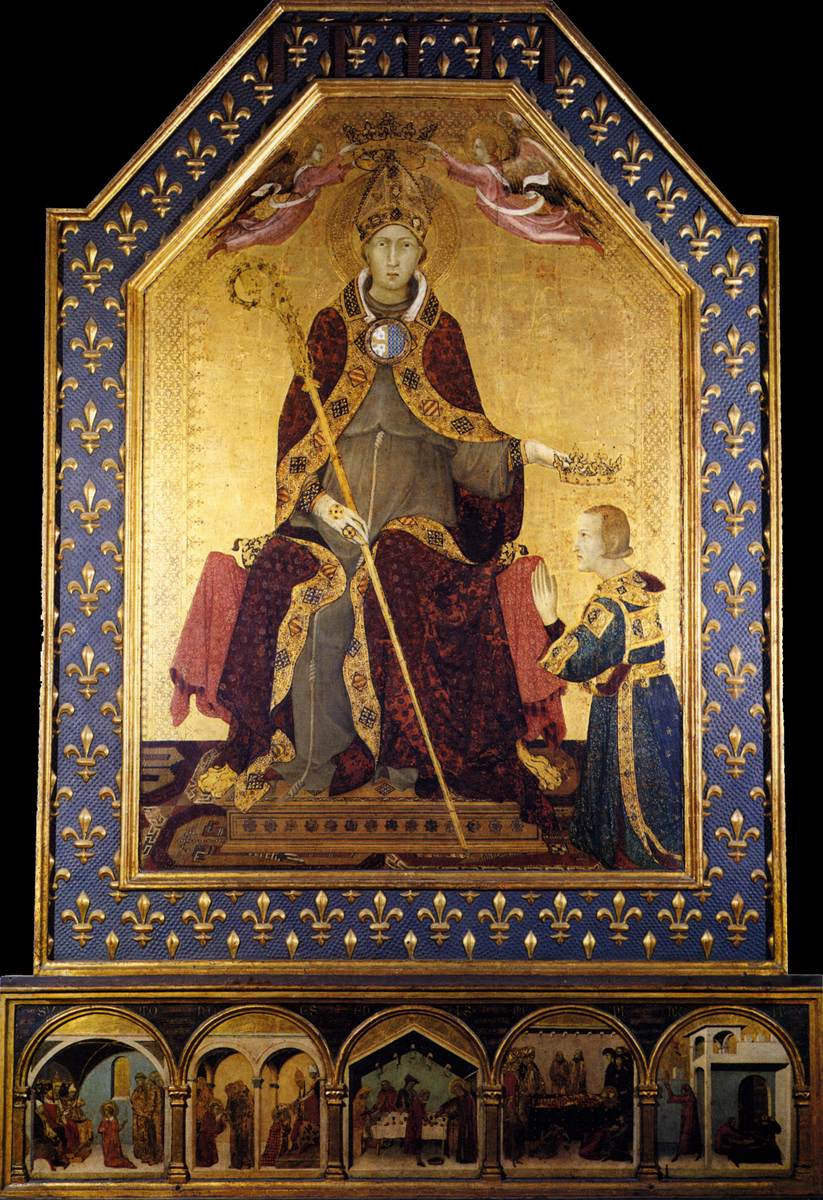
Simone
Martini, Saint Louis de Toulouse
couronne Robert d'Anjou, retable, circa 1317 (année de
la canonisation de Louis
de Toulouse par Jean XXII), tempera sur panneaux de bois, 200 x 138, musée de Capodimonte, Naples
Simone Martini (1284–1344), Saint Louis of Toulouse of Toulouse crowns his
brother, King Robert of Naples, Altarpiece, circa 1317, tempera on panel, 200 x 138,
Museo di Capodimonte, Palace of Capodimonte, Naples
Saint Louis d'Anjou
Voilà sept cents ans,
dans la nuit du 19 au 20 août 1297, que mourrait saint Louis d’Anjou,
archevêque de Toulouse, à Brignoles.
Par son père, Charles
d’Anjou, le Boiteux, prince de Salerne, Louis d’Anjou était le neveu de
saint Louis[1] et, par sa mère, Marie de Hongrie, il
était l’arrière-petit-neveu de sainte Elisabeth de Hongrie. Louis naquit en
février 1274, probablement à Nocera près de Salerne au royaume de Naples, mais
il fut élevé en Provence, à Brignoles, au diocèse d'Aix (aujourd'hui de
Toulon-Fréjus). Charles I° voulait que ses descendants fussent élevés en France
comme des princes français. Louis était le second ; il devait avoir
quatorze frères et sœurs.
Leur gouverneur fut un
chevalier normand, Guillaume de Manerie. Le choix était heureux : honnête,
plein de bon sens, sage, prudent et très pieux, Guillaume régla strictement la
journée des jeunes princes, ne laissant pas une minute à l'oisiveté, mais
partageant harmonieusement le temps entre la prière, l'étude et les exercices
physiques. Dès l'âge de sept ans, Louis savait monter à cheval, chassait,
pêchait, faisait de l'escrime, connaissait le chant et la danse; il étonnait
tout le monde par sa vivacité d'esprit et la précoce maturité de son jugement.
Il n'eut jamais à tâter des verges dont son gouverneur n'hésitait pas à user en
cas de besoin ; Robert, le futur roi de Naples, s'en aperçut assez
souvent, ce qui chagrinait Louis, qui n'osait pourtant pas demander la grâce du
coupable par respect de l'autorité.
En 1286, Louis entra en
relations avec un frère mineur d’Apt, François Brun, qui ne devait presque
jamais le quitter et joua un grand rôle dans le développement de sa
piété ; déjà il avait le culte de la sainte pauvreté ; sa dévotion à
la Vierge s'affirmait : chaque jour il recitait son office, la nuit il se
levait en secret pour prier debout, les bras étendus ; il se délectait en
lisant la Fleur des saints : c'est là qu'il cherchait ses modèles.
Le 5 juin 1284, Charles
le Boiteux, après un combat inégal dans la baie de Naples, fut fait
prisonnier par la flotte aragonaise. Quelques mois plus tard, le 7 janvier
1285, Charles I° mourait, laissant les jeunes princes sans aucun appui en face
de la puissante maison d'Aragon. L''épreuve mûrit le jeune Louis qui ne cessait
de prier Dieu de relever sa famille accablée et de ramener son père ; il
s'imposait des pénitences rigoureuses, et à ceux qui l'invitaient à les
modérer, il répondait : « La vie de mon père est plus précieuse et
plus nécessaire au bien de tous que la mienne. Je l'offre avec joie pour
obtenir sa délivrance. » ', Le 25 juillet 1288, une convention signée à
Oloron rendait la liberté à Charles II, mais trois de ses fils, Louis, Robert
et Raymond-Bérenger, ainsi qu'une centaine de jeunes seigneurs devaient prendre
sa place comme otages.
Le château de Moncade,
près de Barcelone, leur fut assigné comme résidence, puis, deux ans plus tard,
ils furent transférés dans celui de Ciurana, dans la province montagneuse de
Tarragone. Ils étaient traités avec honneur, passaient leurs journées à leur
guise, mais les rapports avec l'extérieur étaient strictement surveillés et les
secours que Charles II, ruiné, leur faisait parvenir étaient minimes.
Louis qui était le chef
des otages, et composa pour sa petite cour un règlement à la fois militaire et monastique. Aux repas, très frugaux, on écoutait une lecture choisie dans la
Bible, saint Grégoire, saint Bernard ou la Fleur des saints. Ceux auxquels
avaient échappé des jurons mangeaient assis par terre avec les chiens. Les jeux
d'argent étaient interdits, mais le jeu d'échecs recommandé. Les exercices physiques
étaient largement pratiqués : on montait à cheval, on chassait et on
organisait des tournois. A toute autre compagnie, Louis préférait celle des
frères mineurs François Brun et Pierre Scarrerii qui avaient été autorisés à
rejoindre les jeunes captifs ; c’est là que Louis apprit le latin,
s’initia à la théologie et composa ses premiers sermons. Chaque jour il
assistait à la messe et récitait les heures ; bien souvent on dut
l'arracher à l'oraison pour lui rappeler qu'on avait besoin de lui.
Physiquement, la
captivité lui fut très pénible : il devint tuberculeux ; consumé de
fièvre, déchiré par la toux, crachant le sang, il se consacra totalement à Dieu
le 1° février 1290. Sa santé s'améliora et, le jour de la Pentecôte, il put se
croire guéri il renouvela sa promesse. Un accident de cheval dont il
sortit indemne le fortifia dans sa décision ; il renonça à la chasse et au
port des armes ; désormais il vivrait comme un clerc. Sous ses vêtements
il se ceignit de la corde franciscaine en attendant de pouvoir entrer dans
l'ordre ; on eut beaucoup de peine à le faire patienter. Au bout de
quelques années les conditions de sa captivité s'adoucirent et il put venir
habiter Barcelone où il fréquenta assidûment le couvent des Frères Mineurs et
suivit les cours de 1'Université.
Le 7 juin 1295, la paix
entre l'Aragon et la Maison d'Anjou fut enfin conclue grâce aux efforts de
Boniface VIII et, le 31 octobre suivant, Louis retrouva son père à Figueras. Le
lendemain il reçut la tonsure dans l'église du monastère de Villabertran et
prononça le sermon de circonstance au mariage de sa sœur Blanche avec Jacques
d'Aragon. Charles II avait autorisé son fils à entrer dans la cléricature pour
ne pas le contrarier : sa longue captivité et sa maladie
n'exigeaient-elles pas quelques ménagements ? Et ces premiers engagements
n'étaient pas irrévocables. Charles II espérait bien lui faire passer ces
idées étranges et le marier à Yolande d'Aragon. Dès les premières étapes du
voyage de retour, il vit que ce ne serait pas facile. A Montpellier, Louis
demanda au provincial des Frères Mineurs de le recevoir dans l'ordre ; il
lui répondit qu'il ne pouvait l'accepter sans l'autorisation de son père et lui
conseilla de s'adresser au ministre généra1 quand il passerait à Rome. Le voyage
s'accomplit rapidement : le 1- novembre la cour était à Aix, le 19 à
Brignoles et, le 1_ décembre, à Rome. Boniface VIII conféra à Louis les
ordres mineurs, le sous-diaconat et le diaconat. Le jeune clerc repoussa
énergiquement toutes les marques d'honneur qu'on voulait lui faire et remplit
humblement à l'église ses nouvelles fonctions.
Charles II avait compris
qu’il était inutile d'essayer de détourner Louis de sa vocation. La mort de son
frère ainé l'avait rendu héritier présomptif ; au mois de janvier 1296, il
fut autorisé à renoncer à tous ses droits en faveur de son cadet Robert, qui
hériterait du royaume de Sicile et épouserait Yolande d'Aragon. Louis
résiderait au château de l'Œuf, construit dans une petite île rocheuse au sud
de Naples : calme, isolée dans un site splendide, c'était un refuge idéal.
Une pension de quatre mille livres lui serait servie régulièrement. De plus,
sachant son goût pour les livres, le Roi lui donna la Somme de saint Thomas
d’Aquin. Ne pouvant encore devenir franciscain, Louis organisa sa vie comme un
Vrai religieux ; il s'entoura de frères mineurs, partagea son temps entre
la prière et l'étude de la théologie, lisant surtout saint Bernard. Boniface
VIII qui ne l’oubliait pas, l’invita à venir à Rome recevoir le sacerdoce, mais
il déclina cet honneur et fut ordonné prêtre à Naples le 19 mai 1296, avec une
dispense d'âge, puisqu'il avait juste vingt-deux ans. Le lendemain, il
célébrait sa première messe dans la chapelle des Frères Mineurs, puis il
regagna bien vite le château de l'Œuf. Il en sortait quelquefois pour prêcher
ou faire la charité. Un jour il se rendit en hâte auprès du roi pour implorer
la grâce de corsaires condamnés à mort. Il l'obtint.
Célestin V avait confié à
Louis l'administration du diocèse de Lyon, mais il était alors en Catalogne et
cette nomination ne fut pas suivie d'effet.
A la fin de l'année 1296,
l'évêque de Toulouse mourut ; la situation était délicate ; Bernard
Saisset, évêque du nouveau diocèse de Pamiers détaché de celui de Toulouse,
était fort mal vu par le roi de France, Philippe IV le Bel. Boniface VIII,
cherchant quelqu'un pour aplanir ces difficultés, pensa à Louis d'Anjou et
écrivit au roi de Sicile qui fut très flatté de cette promotion. L'élu qui le
fut beaucoup moins, se rendit à Rome et n'accepta que par obéissance et à
condition de pouvoir entrer immédiatement dans l'ordre franciscain. Le 24
décembre 1296, Jean Minio de Muro, ministre général, recevait ses vœux :
le F. François Brun lui donna son propre habit, que l'on raccourcit et dont on
rogna les manches, car Louis n'avait pas été autorisé à le porter
ostensiblement et devait le garder caché sous ses vêtements. Le 29 décembre
1296, il était sacré évêque à Saint-Pierre de Rome. Il repartit aussitôt pour
faire ses adieux à sa famille, à Naples ; il y arriva le 13 janvier 1297
et demeura au château de l'Œuf où comme dans un vrai couvent, il put mener la
vie simple des Frères Mineurs. Au bout de quelques jours, il dut se mettre en
route pour gagner son diocèse en passant par Paris. A Rome, il alla loger chez
les Frères Mineurs et il eut, le 5 février, la grande joie de recevoir
l'autorisation de porter l'habit franciscain ; aussitôt il laissa ses
insignes épiscopaux pour circuler dans la ville mêlé aux autres religieux. Il
devait recommencer souvent cette pratique de l'humilité. Durant son voyage il
dut bien souvent faire violence à son entourage ou à ses hôtes qui
n'épargnaient rien pour multiplier les marques d'honneur et lui rendaient bien
difficile la pratique de l'humilité et de la pauvreté. Par Florence, Brignoles
et Lyon, il gagna Paris ; il refusa les appartements que le Roi lui avait
fait préparer au Palais et descendit au couvent des Cordeliers où il put mener
un peu la vie des simples religieux : il lut à son tour au réfectoire,
mais il dut rendre visite au Roi et à de grands personnages, prendre part à des
réunions à l'Université, prêcher et assister à de multiples cérémonies. Le
séjour à Paris fut bref ; au mois de mars 1297, Louis entrait à Toulouse.
Pour un évêque de
vingt-trois ans à la santé chancelante, l’administration de ce diocèse était
lourde. Il organisa aussitôt sa maison épiscopale qui prit l'aspect d'un
couvent. A François Brun et Pierre Scarrerii, il adjoignit un célèbre
professeur de droit canon, Jacques Duèze, le futur Jean XXII. Louis d’Anjou
essaya la réforme du clergé : le jour de l'ordination, il coupa de sa main
les cheveux longs et frisés que portaient certains ordinands, il obligea des
bénéficiers indignes à démissionner, résista aux agents royaux qui voulaient
entraver son action. Lui-même donnait l'exemple, secourait les pauvres,
visitait les malades, intercédait en faveur des prisonniers et des Juifs... Cet
immense effort devait achever de ruiner sa santé ; au bout de quelques
semaines, voyant son impuissance, effrayé de ses responsabilités, il prit la
résolution de résigner sa charge.
Il accepta l’invitation
de sa sœur Blanche et de son beau-frère Jacques d’Aragon et se rendit à
Barcelone où il passa un mois. Il décida d’aller à Rome pour la canonisation de
son grand oncle, le saint roi Louis IX. Il fêta sainte Marthe à Tarascon et le
3 août il arriva à Brignoles où son père l'attendait. Sa maladie
s’aggravait ; il trouva la force d'officier pontificalement pour la fête
de saint Dominique et de chanter une messe le 5 août pour le repos de l'âme de
son frère aîné, mais après ce dernier effort il dut s'aliter. Bientôt il n’y
eut plus aucun espoir de le guérir ; il le savait et détrompa ceux qui
espéraient un miracle. Il dicta son testament, demanda à être enseveli dans
l'église des Cordeliers de Marseille et mourut doucement dans la nuit du 19 au
20 août 1297.
Les funérailles furent
triomphales ; il était acclamé par les fidèles qui lui attribuaient déjà
des miracles. Les évêques des provinces d'Aix, Arles et Embrun écrivirent au
Pape pour le supplier de commencer les informations canoniques en vue de sa
canonisation. Jean XXII, son ancien secrétaire, le canonisa le 7 avril 1317,
dans la cathédrale d’Avignon, en même temps que saint Thomas d’Aquin ; sa
mère, Marie de Hongrie, et son frère, le roi Robert, étaient présents à la
cérémonie. Le 8 novembre 1318 eut lieu l'élévation des reliques à Marseille.
Elles furent déposées dans une châsse et confiées à la garde des Cordeliers. En
1433, Marseille fut prise par Alphonse d’Aragon qui emporta les reliques de
saint Louis d’Anjou et les déposa dans la cathédrale de Valence (Espagne) où
elles sont toujours.
SOURCE : http://missel.free.fr/Sanctoral/08/19.php#louis

Lippo
Memmi (1291–1356), Saint Louis of Toulouse and Saint Francis of Assisi, Pinacoteca Nazionale, Siena
S. Louis d’Anjou (de
Brignoles)
19 août
Saint Louis, évêque de
Toulouse, petit-neveu de saint Louis,
roi de France, fils de Charles le Boiteux, roi
de Naples et de Jérusalem, naquit à Brignoles, en Provence,
l’an 1274, le Bienheureux Grégoire X étant pape, Rodolphe Ier empereur
germanique et Philippe III roi de France.
Il
parut, dès son enfance, n’avoir d’inclination que pour la vertu. Ses récréations
même se rapportaient à Dieu : il n’en choisissait que de sérieuses et
ne s’y livrait que pour donner à son corps l’exercice nécessaire et conserver
la vigueur de son esprit. Sa promenade ordinaire consistait à visiter les
églises et les monastères. À l’âge de sept ans, il pratiquait déjà la
pénitence, et souvent il couchait sur une natte étendue auprès de son lit.
Il
fut tout particulièrement remarquable par sa pureté angélique, qui ne se
ressentit en rien de la mollesse des cours ni des séductions qu’il put
rencontrer dans le monde. Sa charité pour les pauvres était extraordinaire. Un
jour qu’il sortait des cuisines du palais, son père, prévenu par des valets
malveillants, lui demanda ce qu’il portait sous son manteau. Saint Louis,
tremblant, ouvre le manteau, qui ne contenait qu’un bouquet de fleurs
magnifiques, bien qu’on fût en hiver.
À
l’âge de quatorze ans, il fut envoyé comme otage, avec deux de ses frères, au
roi d’Aragon, qui retenait son père prisonnier. Pendant ses sept ans de
captivité, il répandit autour de lui le parfum de la patience et de la
résignation et fut l’ange consolateur de ses compagnons d’infortune.
À
son retour dans sa patrie, saint Louis rencontra sa mère
à Florence ; il reçut ses tendres embrassements, après une si longue
absence, sans même lever les yeux pour considérer son visage, tant la modestie
de l’angélique jeune homme était extraordinaire. Une fois libre,
saint Louis s’abandonna aux pieux excès de cette charité qu’il avait tant
aimée dès son enfance. Il chérissait surtout les lépreux, les recherchait, les
embrassait tendrement, et baisait respectueusement leurs horribles plaies.
Dans
une maladie mortelle, il fit vœu d’embrasser la vie religieuse, s’il
guérissait. Il guérit en effet, refusa les offres séduisantes d’un mariage
royal, renonça même au trône de son père et s’enrôla sous la bannière du
séraphique François
d’Assise. À peine avait-il consommé son sacrifice, que Dieu l’appela à de
plus hautes destinées ; à vingt-deux ans il fut nommé, par
le Pape, Évêque de Toulouse.
Son
amour pour les pauvres devint plus héroïque que jamais. Un jour qu’il sortait
de consoler une pauvre malade fort misérable, ses serviteurs lui firent
remarquer que son vêtement était couvert de vermine : « Ce sont là,
dit-il en souriant, les perles des pauvres ».
Dieu
voulut seulement montrer à la terre ce saint pontife. Au moment de son dernier
soupir, une belle rose sortit de sa bouche, et un saint religieux vit les Anges
emporter son âme vers les Cieux, le 19 août 1297,
Boniface VIII étant pape, Adolphe empereur germanique et
Philippe IV le Bel roi de France.
Voir
Bulletin Dominical N° 1222-1223 « Nos Saints de Provence » #743

Maître
de la Madonna del Parto, Saint Louis de Toulouse, circa 1400, tempera and gold on poplar wood, 51 x 22, Musée du Petit Palais, Avignon
19 août 2008 par OH
Saint Louis, évêque de
Toulouse au 13e siècle, honoré le 19 août
dit « saint Louis d’Anjou
»
La famille d’Anjou a
régné si loin, qu’elle n’a parfois plus rien à voir avec l’Anjou que par son
nom. Voici un saint au nom Angevin, méconnu en Anjou.
Louis, né à Brignoles, en
Provence, l’an 1274, eut pour père Charles, prince de Salerne, qui fut roi de
Naples, et pour mère Marie, fille d’Etienne V, roi de Hongrie. (Ce Charles
est Charles II le Boiteux (1248-1309), fils aîné de Charles 1er comte d’Anjou,
du Maine, de Provence et de Forcalquier, et de sa 1ère épouse Béatrice,
comtesse de Provence et de Forcalquier. Charles le Boiteux était donc
beau-frère de Raimon Bérenger, comte de Provence, père de Marguerite, Eléonore,
Sancie et Béatrice, ces demoiselles de Provence, objet de l’ouvrage de Patrick
de Carolis, paru chez Plon en 2003, qui faute de postérité mâle eut pour
héritier son neveu Robert, fils de Charles Le Boiteux, né 4 ans après saint
Louis d’Anjou dont est question aujourd’hui. Charles Le Boiteux fut roi de
Naples, de Jérusalem, de Sicile, prince de Tarente, comte d’Anjou et du Maine,
comte de Provence.)
Il était ainsi
petit-neveu de saint Louis, roi de France, et neveu de sainte Elisabeth de
Hongrie. (Il est aussi frère cadet de Charles Martel, de Marguerite comtesse
d’Anjou qui épousa Charles de France et firent les Valois, et enfin de Robert
qui succèdera à son oncle Raimon Bérenger)
Le jeune Louis parut
s’inspirer de la piété de ces deux grands modèles, et son enfance s’écoula dans
les pratiques de la pénitence, qui, proportionnées à son âge, fortifiaient son
corps et son âme. (l’abbé Pétin ajoute « son plus grand plaisir était d’entendre
les serviteurs de Dieu discourir sur des matières de piété, et ses récréations
les plus agréables, de visiter les églises et les monastères. Dès l’âge de 7
ans, il pratiquait de grandes austérités et couchait souvent sur une natte »)
Il avait à peine 14 ans,
lorsqu’il fut donné en otage avec 2 de ses frères, pour racheter la liberté de
son père, que le roi d’Aragon avait fait prisonnier. (en fait, il avait 10 ans
seulement seulement lorsque son père fut fait prisonnier et c’est 4 ans plus
tard que la libération de son père se fit en échange de ses fils)
Il resta 7 ans captif à
Barcelone, sans jamais entendre aucune plainte, soumis en toutes choses à la
volonté de Dieu. Il jeûnait plusieurs fois la semaine, il priait, il visitait
les malades dans les hôpitaux, et le reste de son temps, il le consacrait à
l’étude et principalement à la méditation des saintes Écritures. (l’abbé Pétin
précise « il avait pour prison la ville de Barcelone, il allait souvent visiter
les malades dans les hôpitaux » et ajoute « Ayant été atteint d’une maladie
dangereuse, il fit vœu, s’il en revenait, de se consacrer à Dieu dans l’ordre
de Saint-François, et après sa guérison se mit en devoir d’accomplir sa
promesse. »)
Rendu à la liberté, il
prit l’habit de Saint-François ou des Frères mineurs, et peu après, bien qu’il
ne fût âgé que de 22 ans, son mérité et ses vertus le firent nommer à l’évêché
de Toulouse par le pape Boniface VIII, qui voulut lui-même le sacrer.
(« Son frère Charles, qui s’était fait couronner roi de Sicile en 1289,
conclut en 1294 un traité avec son compétiteur, Jacques II, roi d’Aragon, et
les deux cours voulurent marier avec la princesse de Majorque, sœur de Jacques,
le jeune Louis, devenu libre par ce traité. Charles lui promettait le royaume
de Naples, qu’il avait déjà reconquis en partie, et dont Louis était devenu
l’héritier présomptif depuis que son frère aîné occupait le trône de Hongrie.
Louis, loin d’être tenté par cette offre brillante d’une couronne, persévéra
dans la résolution où il était de se consacrer à Dieu et céda tous ses droits à
son frère Robert. Sa famille s’étant opposée à son entrée chez les Frères
Mineurs, consentit toutefois à ce qu’il entrât dans l’état ecclésiastique. »)
Son premier soin, en
arrivant dans son diocèse, fut de pourvoir aux besoins des malheureux, en
réglant la dépense de sa maison de manière que la plus grande partie de ses
revenus fût employée pour la subsistance des pauvres. Selon l’abbé Pétin : « Le
pape saint Célestin le nomma archevêque de Lyon, quoiqu’il n’eût que 20 ans ;
mais comme il n’avait pas encore reçu la tonsure, il réussit à faire échouer
cette nomination. Ordonné prêtre à 22 ans, en vertu d’une dispense de Boniface
XIII, ce pape le nomma à l’évêché de Toulouse, avec ordre exprès d’acquiescer à
sa nomination. S’étant rendu à Rome il y fit profession chez les Frères Mineurs
du couvent d’Ara-Coeli la veille de Noël 1296, afin d’exécuter l’engagement
qu’il avait pris à Barcelone. Il fut sacré évêque par le pape lui-même au mois
de février suivant, et pour ne pas choquer le roi son père, il lui ordonna de
porter par-dessus l’habit de Franciscain, l’habit ordinaire ecclésiastique mais
le jour de la sainte Agathe, Louis se rendit du Capitole à l’église
Saint-Pierre, où il devait prêcher, les pieds nus set avec la ceinture de
corde. Il se mit ensuite en route pour aller en procession de son église, et,
étant arrivé à Sienne, il logea chez les Frères Mineurs, et voulut être traité
sans aucune distinction, jusqu’à laver la vaisselle avec les religieux après le
dîner. A Florence, il refusa de coucher dans une chambre qu’on avait meublée
pour le recevoir. Il fit son entrée à Toulouse sous l’habit de pauvre de son
ordre ; mais il fut reçu avec la vénération due à un saint, et la magnificence
due à un prince. »
Après avoir visité son
diocèse, faisant partout bénir son nom par sa douceur, sa piété et sa charité,
évangélique, il s’était rendu à Brignoles pour y régler quelques affaires,
lorsqu’il mourut n’étant pas encore âgé de 24 ans.
Il fut inhumé chez les
Franciscains de Marseille, et le pape Jean XXII le canonisa en 1317.
SOURCE : http://www.odile-halbert.com/wordpress/?p=1818
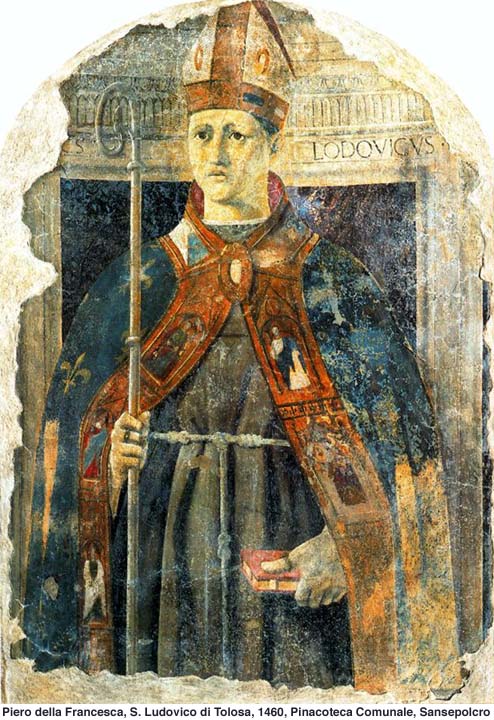
Piero della Francesca, San
Ludovico di Tolosa (1453 - 1466), affresco; Arezzo, Basilica di San Francesco
Piero della Francesca (1415–1492),
Saint Louis of Toulouse, 1460, fresco, 123 x
90, Museo Civico di Sansepolcro, Sansepolcro,
Province of Arezzo, region of Tuscany
Also
known as
Louis of Anjou
Louis of Angio
Louis of Brignoles
Ludwig of…
Ludovico d’Angiò
Luis…
Profile
Born to the nobility, the
son of Charles II of Anjou, king of Naples.
Great-nephew of Saint Louis
IX, and of Saint Elizabeth
of Hungary. Grew up in Provence (in modern France).
Spent seven years as a hostage for his father at Barcelona and
Tarragona in Spain. Ordained at
age 23. Friar
Minor. Reluctant bishop of Toulouse, France for
the last six months of his life.
Born
9
February 1274 at Nocera, Italy
19 August 1297 at Brignolles, Italy of
natural causes
some relics in Valencia, Spain
some relics in
the Franciscan church of
the Cordeliers in Marseille, France
7 April 1317 by Pope John
XXII
–
Mission
San Luis Obispo de Tolosa, California
boy bishop
young bishop with
a crown by
his feet
young man in pontifical
garments and holding a book and
a crosier
Additional
Information
A
Garner of Saints, by Allen Banks Hinds, M.A.
Book
of Saints, by the Monks of
Ramsgate
Lives
of the Saints, by Father Alban
Butler
Lives
of the Saints, by Father Francis
Xavier Weninger
Pictorial
Lives of the Saints, by John
Dawson Gilmary Shea
Short
Lives of the Saints, by Eleanor Cecilia Donnelly
books
Our Sunday Visitor’s Encyclopedia of Saints
Saints
and Their Attributes, by Helen Roeder
other
sites in english
images
video
sitios
en español
Martirologio Romano, 2001 edición
sites
en français
Abbé
Christian-Philippe Chanut
fonti
in italiano
MLA
Citation
“Saint Louis of
Toulouse“. CatholicSaints.Info. 7 March 2024. Web. 6 November 2025.
<https://catholicsaints.info/saint-louis-of-toulouse/>
SOURCE : https://catholicsaints.info/saint-louis-of-toulouse/

Simone Martini (1284–1344), Saint Louis IX of France and Saint Louis of Toulouse, circa 1322-1326, fresco, 215 x
185, Cappella di San Martino, Lower Basilica of San Francesco, Assisi
St. Louis of Toulouse
The life of the future
saint Louis of Toulouse (1274- August 19, 1297) is a good example of how family
expectations mingled with royal power politics in the service of religion.
Louis was the second son of Angevin Charles II "the Lame" of Naples.
As a child, he served with two of his brothers as a hostage for his father, who
had been defeated in a naval battle with the Sicilians and Aragonians. For
these seven years (1288-1295) he was educated by Franciscan friars, among them
Peter Olivi, and impressed them with his holiness and learning. During an
illness, he made a vow to become a Friar Minor. Even when he was still in
captivity (1294), he was named Archbishop of Lyons. When his older brother died
in 1295, Louis also became heir to his father's secular titles.
When Louis was released
in 1295, at age twenty-one, he went to Naples where he renounced his rights of
succession to his brother Robert. He then fairly quickly ascended through the
priestly orders, becoming Bishop of Toulouse in 1296. Although Louis was a
pious person-attested by his teachers who were renowned spiritual leaders-he
was an untried administrator, whose appointment was suggested by his superb
connections. He finally got to Toulouse in February of 1297, where his mildness
and care for the poor were admired. However, he fell sick and died after only a
few short months in office.
On what basis was Louis
made a saint? The scenes depicted on the predella emphasize the Franciscan
virtue of humility above all else. But whatever his virtues, it was undoubtedly
his connection to the royal house of Naples, among other saintly relations
(nephew to Louis IX of France, and descendent of saint Elizabeth of Hungary.)
His case was promoted by Pope Clement V in 1307, and he was canonized by John
XXII on April 7, 1317.
As a saint, Louis of
Toulouse was not widely venerated, although his day was kept by the Franciscan
order, and he became the patron saint of Valencia, where his relics were taken
in 1423. He was also held in great honor in Naples by his brother Robert, who
commissioned an extraordinarly sumptuous and beautiful altar to him from Simone
Martini not long after the canonization.
In this altar, Louis of
Toulouse gazes directly at us from his throne, dressed in episcopal garments
whose looseness hints that he barely had time to grow into them. Although he
sits against a glowing gold background highly reminiscent of Byzantine icons,
the throne is positioned firmly on an inlaid floor, suggesting
three-dimensional space in the progressive manner of International Gothic
style. Robert of Anjou kneels to his left, and receives a crown from his
brother's hand. Robert receives earthly glory, as Louis' abdication left him
with a clear claim to the Kingdom of Naples. Presumably Robert is also the
recipient of heavenly favors, as well, for his brother will surely intercede in
heaven for this anointed king, and all of the Angevin dynasty. The panel
emphasizes heraldic imagery, notably the French fleurs-de-lis in the frame.
The French ruling house
was particularly honored in the Church. The canonization of Louis IX of France
had only occurred ten years before, in 1297. The French nobility's intimate
access to divinity is evident in a grouping of saints in the Francisan Church
at Assisi. Around 1317, Simoni Martini decorated a chapel in honor of French
patron Saint Martin. Here also St. Louis of Toulouse is pictured, in the
company of other members of his order and family (St Louis and St Elizabeth).
Resources
Websites of Interest
Catholic Encyclopedia article on Simone Martini
Simone Martini, Web Gallery
Amelia
Carr, "St Louis of Toulouse"
SOURCE : http://merlin.allegheny.edu/employee/a/acarr/anjouhistory/stlouis.html

Tommaso del Mazza (fl. 1377–1392),
Saint Jean l'évangéliste, saint Louis d'Anjou et la donatrice Catarina dei
Franzesi, circa 1386, 88 x 58, Musée du Petit Palais, Avignon
Book of Saints –
Louis of Toulouse
Article
(a
href=”saints”>Saint) Bishop (August
19) (13th
century) Born in Provence (A.D. 1274), he was the great nephew of Saint
Louis, King of France, and through his mother, the great-nephew also of Saint
Elisabeth of Hungary. He was inured to hardships from his childhood, both
because of the strictness of his homelife, and because of the ill-treatment he
had received while kept prisoner for seven years at Barcelona, as hostage for
his father, who had been taken prisoner of war. When again free he voluntarily
embraced a life of austerity and prayer. He made his Religious Profession as a
Franciscan Friar in Rome. Reluctantly, and “as the poorest of the poor,” he
took possession of the important Archbishopric of Toulouse, to which he was
almost at once promoted. He did not, however, live to govern his Diocese, but
passed away at Brignolles, his birthplace, August 19, A.D. 1297, when only
twenty-three years old. Such was his repute for sanctity that he was almost at
once canonised. His relics are at Valentia in Spain.
MLA
Citation
Monks of Ramsgate. “Louis
of Toulouse”. Book of Saints, 1921. CatholicSaints.Info.
26 July 2014. Web. 6 November 2025.
<https://catholicsaints.info/book-of-saints-louis-of-toulouse/>
SOURCE : https://catholicsaints.info/book-of-saints-louis-of-toulouse/

Bicci di Lorenzo (1373–1452), Sts Francis of Assisi, Louis of Toulouse and Anthony of Padua, circa 1427, tempera on panel, gold ground, 27 x 17
St. Louis of Toulouse
Bishop of Toulouse, generally
represented vested in pontifical garments and holding a book and a crosier, b. at
Brignoles, Provence, Feb., 1274; d. there, 19 Aug., 1297. He was the second son
of Charles II of Anjou, called the Lame, King of Naples (1288-1309),
and nephew of St. Louis IX of France; and of Mary
of Hungary,
whose great-aunt was St.
Elizabeth of Hungary. If in some and even early sources (Analecta
Franciscana, IV, 310) he is called primogenitus, it is only because he
succeeded to the rights of
his eldest brother, Charles
Martel (d. 1295). In 1288 Louis was sent with two of his brothers to the Kingdom of Aragon as
hostage for his father,
who had been defeated and captured in a naval battle off Naples by the Sicilians and Aragonians (1284).
During the seven years of their captivity (1288-95) in the castle of
Sciurana, Diocese of
Tarragona, and partly in Barcelona, the education of the
three princes was entrusted to some Franciscan friars, among whom
were Ponzius
Carbonelli (Analecta Franciscana, IV, 310), Peter of Falgar, and Richard of Middleton (Analecta
Bollandiana, IX, 295). Peter John Olivi, the great Franciscan Spiritual,
was also one of their friends, who on 18 May, 1295, wrote them a long letter,
published by Ehrle in "Archiv f. Litt. u. Kirchengesch.", III, 534-
40 (see ibid., 439-41). Louis outstripped his brothers both in holiness and
learning, and, during a severe illness, made the vow to become
a Friar Minor.
He was still in captivity
when Celestine V entrusted
to him the administration of the Archbishopric of Lyons, on 7 Oct., 1294
(Bullar. Franc., IV, 332), having previously granted Francis of Apt, O.F.M.,
the saint's confessor,
the faculty of giving him the clerical tonsure and minor orders (cf.
Bullar. Franc., 332). Neither Bull seems to have
been carried out. From John of Orta (Anal. Boll., IX, 292) it appears that he
was tonsured only
on 1 Nov., 1295, after his release. Louis then returned to Naples. After renouncing
all the rights of
succession in favour of his brother Robert, he was ordained subdeacon in Rome by Boniface VIII, and in
1296 deacon and priest at Naples (Anal.
Boll., IX, 314). Boniface
VIII appointed the saintly young priest Bishop of Toulouse, but Louis,
wishing first to become a Friar Minor, received
the Franciscan habit
in Rome from
the minister general, John Minio of Murro, on 24 Dec., 1296, and immediately
made solemn profession. He was consecrated Bishop of Toulouse by Boniface VIII on 29
(30?) Dec., 1296 ("Bullar. Franc.", IV, 422; cf. "Anal.
Boll.", IX, 297). After the Feast of St. Agatha (5
Feb.), 1297, on which day he appeared for the first time publicly in the Franciscan habit,
he betook himself to Toulouse,
where his mild figure and his virtues were admired by everybody. He was the
father of the poor and a model of administration. But his episcopate was very
brief, for on his return journey from a visit to his sister, the Queen of Aragon, he was seized by
fever and died at Brignoles.
We have scarcely any
record of literary work of St. Louis. Recently, however, Amelli, O.S.B.,
published in the "Archivium Franciscanum Historicum", II (Quaracchi,
1909), 378-83, a small treatise on music written by the saint, and from this it
appears that he is also the author of a "Liber de Musicae
Commendatione". Sbaralea ("Suppl. ad Script.", Rome, 1806, p.
498) ascribes to him also some sermons. His canonization, promoted
by Clement V in
1307 (Bullar. Franc., V, 39), was solemnized by John XXII on 7
April, 1317 (loc. cit., 111). His relics reposed in
the Franciscan church
at Marseilles till
1423, when they were taken by Alfonso V of Aragon to the cathedral church of
Valencia, of which town Louis became patron saint. His feast, celebrated in
the Franciscan Order on
19 Aug., was decreed by the general chapter held at Marseilles in 1319
(Anal. Franc., III, 473), and the rhythmical office, beginning Tecum,
composed by the saint's brother,
King Robert of Naples,
was inserted in the Franciscan Breviary by the
General Chapter of Marseilles in
1343 (loc. cit., 539), but seems to have been abolished by the Tridentine reform
of the Breviary under Pius IV [sic, i.e.,
St. Pius V], 1568 (cf. Acta SS., Aug., III, 805).
Sources
The best contemporary
life is by the saint's chaplain, JOHN DE ORTA in Anal. Boll., IX (Paris and
Brussels, 1890), 278-340; ibid., 341-51 (miracles); and in Anal. Ord. Min.
Cap., XIII (Rome, 1897), 338-51, 360-72; XIV (1898), 16-27, 83- 92; some
appendixes, ibid., 92-4, 120-6, 156-8, 181-3. A second old life is by PETER
CALO, of which extracts are given in Acta SS., Aug., III, 781-97, passim; a
compendium edited by PRESUTI in Archiv. Franc. Hist., I (Quaracchi, 1908), 278-
80; cf. ibid., 569-76 (miracles). BARTHOLOMEW OF PISA in Anal. Franc., IV
(Quaracchi, 1906), 309-17; Chronicle of the XXIV Generals in Anal. Franc., III
(Quaracchi, 1897), 447-52; BLUME AND DREVES, Anal. Hymnica Medii Aevii, XXVI
(Leipzig, 1897), 265-74, give three rhythmical offices formerly used in
Franciscan Breviaries. For some samples of notable hymns see EUSEBE CLOP,
Cantus varii in usu apud nostrates (Tournai, 1902), 177-88. LEON, Lives of the
Saints and Blessed of the Three Orders of St. Francis (Taunton, 1886), 26-49,
tr. from the Aureole Seraphique, III. The best modern life is: VERLAQUE, Saint
Louis, prince royal, évêque de Toulouse (Paris, 1885); DA PALMA, Vita di S.
Lodovico d' Angio (Naples, 1855). On the iconography, see SALTER, Franciscan
Legends in Italian Art (London, 1905), 180-182; BERTAUX, Les saints Louis dans
l'art italien in Revue des Deux Mondes, CLVIII (Paris, 1900), 616-44;
KLEINSCHMIDT, St. Ludwig von Toulouse in der Kunst in Archivium Franc. Hist.,
II (Quaracchi, 1909), 197- 215. Concerning the sixth centenary see the richly
illustrated work, S. Lodovico d'Angio. . .e Sua Santita Leone XIII, Ricordo del
VI Centennario della morte del Santo 1297-1897 e del LX Anniversario del
Giubileo Sacerdotale di Sua Santita 1838-1898 (Rome, 1898).
Oliger, Livarius. "St.
Louis of Toulouse." The Catholic Encyclopedia. Vol. 9. New
York: Robert Appleton
Company, 1910. <http://www.newadvent.org/cathen/09385c.htm>.
Transcription. This
article was transcribed for New Advent by Herman F. Holbrook. "Jesus
Christ is my kingdom. If I possess him alone, I shall have all things."
Ecclesiastical
approbation. Nihil Obstat. October 1, 1910. Remy Lafort,
Censor. Imprimatur. +John M. Farley, Archbishop of New York.
Copyright © 2023 by Kevin Knight.
Dedicated to the Immaculate Heart of Mary.
SOURCE : https://www.newadvent.org/cathen/09385c.htm

Márk
Kálti (fl. 14th century)
- Saint Louis of Toulouse, Chronicon
Pictum, 1358 (Page 140).
In the initial "A" is a standing figure with halo, Saint Louis of
Toulouse, (Louis of Anjou, Bishop of Toulouse). The Hungarian Anjou coat of arms is attached to the
ornate priest robe on his breast. The saint is a descendant of maternal lineage
of the House of Árpád: his mother was Mary, the daughter of King Stephen V of
Hungary. e raises his right hand in blessing and the royal crown lies at his
feet, symbolizing the fact that he renounced the Kingdom
of Naples by taking Holy Orders.
Képes
krónika (140.oldal) - Toulouse-i Szent Lajos
"A" iniciáléban Toulouse-i Szent Lajos (Anjou Lajos toulouse-i
püspök). Álló alak glóriával. Pluviáléját a mellén öszszefogó csaton
magyar-Anjou címer. A szent ugyanis az Árpád-ház leányági leszármazottja: anyja
V. István király leánya, Mária volt. Jobbját áldva emeli fel, a királyi korona
lábánál fekszik, jelképezve azt, hogy egyházi pályára lépve lemondott a nápolyi
királyságról. National
Széchényi Library, Budapest, https://www.oszk.hu/en/
https://web.archive.org/web/20120304111134/http://konyv-e.hu/pdf/Chronica_Picta.pdf
St. Lewis, Bishop of
Toulouse, Confessor
THIS saint was
little nephew to St. Lewis, king of France, and nephew by his mother to St.
Elizabeth of Hungary. He was born at Brignoles, in Provence, in 1274, and was
second son to Charles II., surnamed the Lame, king of Naples and Sicily, and to
Mary, daughter of Stephen V., king of Hungary. He was a saint from the cradle,
and from his childhood made it his earnest study to do nothing which was not
directed to the divine service, and with a view only to eternity. Even his
recreations he referred to this end, and chose only such as were serious, and
seemed barely necessary for the exercise of the body, and preserving the vigour
of the mind.
His walks usually led him
to some church, or religious house. It was his chief delight to hear the
servants of God discourse of mortification, or the most perfect practices of
piety. His modesty and recollection in the church inspired with devotion all
who saw him. His mother assured the author of his life, that when he was only
seven years old she found him often lying in the night on a mat which was
spread on the floor near his bed, which he did out of an early spirit of
penance. He inured himself to the practice of self-denial, sobriety, and mortification
from his tender years. His mother herself taught him this lesson, judging it no
severity for him to practise that for the sake of virtue which the
Lacedemonians, and other warlike nations, obliged their children to do for the
sake of corporal strength, and that they might be trained up to a martial life.
The government and restraint of the senses, and of all the affections of the
soul, especially against gluttony, lust, and other importunate passions,
according to the prescript of reason, is called the virtue of temperance; and
is that cardinal virtue which chiefly enables us and prepares us for all moral
good; it is the sure basis upon which the whole building of a good life is
erected, and was called by the ancient Greek philosophers the storehouse of all
virtues. Under this are comprised chastity, sobriety, meekness, poverty of
spirit, contempt of the world, humility, modesty, or the government of a man’s
exterior, especially of the tongue; compunction, cleanness of heart, peace of
mind, the mastery of the senses and passions, and the triumph over our own most
dangerous and domestic enemies; all which make up the noble train of her
attendants. These are the delightful streams which flow from her fountain; the
beautiful flowers which grow in her garden, and are cultivated by her care. It
is not therefore to be wondered at that all these virtues took early root in
the soul of a young prince who laid their foundation so deep. God, by an
unforeseen affliction, furnished him with a powerful means of spiritual
improvement, and Lewis was inspired by his mercy with docility to the grave.
In 1284, two years after
the general revolt of the two Sicilies, our saint’s father, Charles II., then
prince of Salerno, was taken prisoner in a sea-fight by the king of Arragon.
His father Charles died within a few months, and he was saluted by his friends,
king of Sicily, but he remained four years prisoner, and was only released on
hard conditions; being moreover obliged to send into Arragon, for hostages,
fifty gentlemen, and three of his sons, one of whom was our saint, who was then
fourteen years old; and remained seven years at Barcelona in rigorous
captivity, where the inhuman usage he met with afforded him occasions for the
exercise of patience and all other virtues. He was always cheerful, and
encouraged his companions under their sufferings, often saying to them:
“Adversity is most advantageous to those who make profession of serving God. We
learn by it patience, humility, and resignation to the divine will, and are at
no other time better disposed for the exercise of all virtue. Prosperity blinds
the soul, makes it giddy and drunk, so as to make her forget both God and
herself; it emboldens and strengthens exceedingly all the passions, and
flatters pride, and the inordinate love of ourselves.” Not content with what he
suffered from the severity of his condition, he practised extraordinary
voluntary austerities, fasted rigorously several days every week, rejected the
least vain or dangerous amusements, and would never see or speak to any woman
but in public company, fearing the most remote danger of any snare that could
be laid to his purity. He knew that this holy and amiable virtue is only to be
kept untainted by a life of assiduous devout prayer, frequent pious meditation
on the precepts of religion, the strictest rules of temperance, and the
diligent shunning of all dangers: for, the least occasion, or the smallest
spark of temptation, when not watched against, may sometimes suffice to put the
contrary passion into a flame. He every day recited the church office, the
office of our Lady, that of the passion of Christ, and several other devotions:
went every day to confession before he heard mass, that he might assist at that
tremendous sacrifice with greater purity of soul; and, as the whole city of
Barcelona was his prison, he often waited on the sick in the hospitals. He
obtained leave that two Franciscan friars, who were appointed to attend him,
might live with him in his own apartments; he rose to pray with them in the
night, and under them he applied himself diligently to the studies of
philosophy and theology. In a dangerous fit of illness he made a vow to embrace
that austere order, if he recovered his health and his liberty. In his
releasement, he seemed to have no other joy than in the power of fulfilling
this engagement.
He was set at liberty in
1294, by a treaty concluded between the king of Naples, his father, and James
II., king of Arragon; one condition of which was the marriage of his sister
Blanche with the king of Arragon. Both courts had, at the same time, extremely
at heart the project of a double marriage, and that the princess of Majorca,
sister to King James of Arragon, should be married to Lewis, on whom his father
promised to settle the kingdom of Naples, (which he had in part recovered,) his
eldest brother, Charles Martel, prince of Salerno, having been already crowned
king of Hungary, in the right of his mother Mary, sister to the late King
Ladislas IV., but the saint’s resolution of dedicating himself to God was
inflexible, and he resigned his right to the crown of Naples, which he begged
his father to confer on his next brother, Robert, which was done accordingly.
Thus it was his ambition to follow Jesus Christ, poor and humble, rather than
to be raised to honour in the world, which has no other recompenses to bestow
on those who serve it but temporal goods. “Jesus Christ,” said he, “is my
kingdom. If I possess him alone, I shall have all things: if I have not him, I
lose all.” The opposition of his family obliged the superiors of the Friar
Minors to refuse for some time to admit him into their body; wherefore he took
holy orders at Naples. The pious Pope St. Celestine had nominated him
archbishop of Lyons in 1294; but, as he had not then taken the tonsure, he
found means to defeat that project. Boniface VIII. gave him a dispensation to
receive priestly orders in the twenty-third year of his age; and afterwards
sent him a like dispensation for the episcopal character, together with his
nomination to the archbishopric of Toulouse, and a severe injunction in virtue
of holy obedience to accept the same. However, he took a journey first to Rome,
and to fulfil his vow, made his religious profession among the Friar Minors, in
their great convent of Ara Cœli, on Christmas Eve, 1296, and received the
episcopal consecration in the beginning of the February following.
He travelled to his
bishopric as a poor religious, but was received at Toulouse with the veneration
due to a saint, and the magnificence that became a prince. His modesty,
mildness, and devotion, inspired a love of piety into all who beheld him. It
was his first care to provide for the relief of the indigent, and his first
visits were made to the hospitals and poor. Having taken an account of his
revenues, he reserved to his own use a very small part, allotting the rest
entirely to the poor; of whom he entertained twenty-five every day at his own
table, serving them himself, and sometimes bending one knee when he presented
them necessaries. He extended his charities over all his father’s kingdom, and
made the visitation of his whole diocess, leaving every where monuments of his
zeal, charity, and sanctity. In his apostolical labours, he abated nothing of
his austerities, said mass every day, and preached frequently. He was very
severe in the examination of the abilities and piety of all those whom he
admitted and employed among his clergy. Sighing under the weight of the charge
which was committed to him, he earnestly desired leave to resign it, but could
not be heard. He answered to some that opposed his inclination: “Let the world
call me mad, provided I may be discharged from a burden which is too heavy for
my shoulders I am satisfied. Is it not better for me to endeavour to throw it
off than to sink under it?” God was pleased to grant him what he desired by
calling him to himself. Being obliged to go into Provence for certain very
urgent ecclesiastical affairs, he fell sick at the castle of Brignoles. Finding
his end draw near, he said to those about him: “After a dangerous voyage, I am
arrived within sight of the port, which I have long earnestly desired. I shall
now enjoy my God whom the world would rob me of; and I shall be freed from the
heavy charge which I am not able to bear.” He received the viaticum on his
knees, melting in tears, and in his last moments ceased not to repeat the Hail
Mary. He died on the 19th of August, 1297, being only twenty-three years and a
half old. He was buried in the convent of Franciscan friars at Marseilles, as
he had ordered. Pope John XXII., the successor of Boniface VIII., canonized him
at Avignon, in 1317, and addressed a brief thereupon to his mother, who was
still living. The saint’s relics were enshrined in a rich silver case, in the
same year, in presence of his mother, his brother Robert, king of Sicily, and
the queen of France. In 1423, Alphonsus, surnamed the Magnanimous, king of
Arragon and Naples, having taken and plundered Marseilles, carried away these
relics and deposited them at Valentia in Spain, where they remain to this day.
See the life of St. Lewis, carefully written by one who had been intimately
acquainted with him, and the bull of his canonization; also Fleury, t. 18, and
Pinius the Bollandist, &c.
Rev. Alban Butler
(1711–73). Volume VIII: August. The Lives of the Saints. 1866.

Vittore Crivelli (1440–1501),
Saint Louis of Toulouse, circa 1481, 125.5 x
40, Rijksmuseum, Amsterdam
Saint Louis of Anjou
Bishop of Toulouse
Feast Day – August 20
The son of Charles II of
Naples and Sicily, Saint Louis of Anjou was born in 1274 and named after his
uncle, the holy king of France. It was the great concern of his mother, the
niece of St Elizabeth, to rear her many children as true servants of the King
of Kings.
The devout queen observed
in her son Louis particularly blessed results of his maternal solicitude. He
loved prayer, was reserved and gentle, and his whole conduct radiated angelic
purity. Even as a child he practiced mortification. On a certain occasion,
after he had retired, his mother found him sleeping on a rug on the floor of
his room instead of in his comfortable bed.
Sweets and delicious
foods he carried to the poor and sick with his mother's permission. It is
related that once he was leaving the dining room with a roasted pullet under
his mantle and so met his father. The king wished to see what he was carrying.
Timidly the boy laid back his mantle, and lo, it was a beautiful bouquet of
flowers!
When he was 14 Louis was
taken to Barcelona with two of his brothers, as a hostage for the release of
his father, who had been taken a prisoner of war. Gladly did Louis accept this
misfortune to obtain his father's freedom; but at the same time, the
disposition with which he accepted it was astonishing in a boy of his age.
"Misfortune,"
he said, "is more useful to the friends of God than good fortune, for on
such occasions they can prove their loyalty to their Lord."
Under the guidance of
several excellent Franciscan friars who were appointed teachers to the young
princes, Louis made remarkable progress in virtue as well as in secular
knowledge. In public debates he manifested his mastery of the various branches
of knowledge, both sacred and profane. Theology was his favorite subject. So
devoid was he of ambition that he planned to renounce his claims to the throne
in order to devote himself entirely to the service of God.
About this time he became
seriously ill. He made a vow that if he recovered, he would join the Order of
Friars Minor. The sickness immediately took a turn for the better, but the
superiors of the order hesitated to receive the young prince without the
consent of the king, his father. Louis was thus obliged to defer his pious
design.
At the end of six years
his captivity ended. On returning home, after much pleading he finally obtained
the permission of his father to settle his claims on his brother Robert, and to
become a priest. Not very long after his ordination, and although he was only
21 years old, he was selected by Pope Boniface VIII for the bishopric of
Toulouse.
"Whatever is lacking
to the young priest in age and experience," said the pope, "his
extraordinary knowledge, his maturity of mind, and his holiness of life will
amply supply."
Saint Louis of Anjou had
to yield to the pope's wishes, but he requested that he might first be admitted
into the Order of Friars Minor. That request was granted. The royal prince was
overjoyed to be permitted, for a time at least, to perform the humblest
exercises in the garb of a son of St Francis; in Rome he went from door to door
gathering alms.
The pope himself
officiated at the ceremony of Episcopal consecration, and shortly afterwards
Saint Louis of Anjou left to assume the government of his diocese. His noble
birth and above all the fame of his sanctity caused him to be received at
Toulouse like a messenger from heaven. The entire city went out to meet him,
and everybody was enchanted with his modesty, sweetness, and angelic virtue
which radiated from his face and bearing.
A sinner who for many
years had lived a wicked life, cried out at the sight of him: "Truly, this
man is a saint!" and then turned away from his sinful habits and led a
better life.
A woman who doubted the
sanctity of the young man went to church one morning to attend the Mass which
the bishop was celebrating. Then she, too, cried out: "Ah, yes, our bishop
is a saint!"
Bishop Louis led the poor
and rigorous life of a Friar Minor and devoted himself with all solicitude to
the welfare of his diocese. The poor were his best friends, and he fed 25 of
them daily at his own table. His ministry, however, was destined to be
short-lived.
Saint Louis of Anjou died
in the 24th year of his life, having been bishop no longer than a year and a
half.
Saint Louis of Anjou
received the last sacraments on the feast of the Assumption of Our Lady; and on
the 19th of August, 1297, while pronouncing the holy name of Mary, he yielded
his soul to God. Because of the many miracles that were wrought at his tomb, he
was canonized as early as 1317, during the lifetime of his mother.
from: The Franciscan Book
of Saints, ed. by Marion Habig, OFM
SOURCE : https://www.roman-catholic-saints.com/saint-louis-of-anjou.html
.jpg)
Girolamo da Treviso the Elder (1450–1496), Madonna in trono tra i santi Francesco e Prosdocimo, Ludovico da Tolosa e Antonio, , 1494, panel painting, 210 x 214, Gallerie dell'Accademia, Venice,
Weninger’s
Lives of the Saints – Saint Louis, Bishop of Toulouse
Article
Saint Louis was the son
of Charles II, king of Naples and Sicily, and of Mary, the daughter of Stephen
V, of Hungary. In his childhood, he gave great promise of future holiness. He
never showed any inclination for those sports which are generally the pastime
of young princes. Prayer, the reading of devout books, and pious discourses
were his only pleasures. At the early age of seven years, he mortified his body
in order to preserve his purity, was very modest in his habits, and cultivated
the most tender devotion to the Blessed Virgin. He never allowed a woman to
enter his room, never spoke to one alone, except to his mother and sister,
looked none in the face and generally kept his eyes down. When the Queen of
France, his nearest relative, wished to salute him with a kiss, according to
the custom of the country, he would not permit it; he even refused it to his
own mother; and when she said: “But my son, I am thy mother,” he replied: “I
know well that you art my mother, but I know also that you art a woman; and it
is not proper that a woman should kiss a servant of the Most High.” This
virginal modesty acquired for him such veneration, ‘that, at Court, he was
called nothing else but the angel. God also designed him to practise patience
early in life. His father, unfortunate in war, was captured at Barcelona.
Although by a treaty he was set free, his three sons, among whom was Louis, and
fifty noblemen were retained as hostages by the king of Aragon, until the
stipulations were fulfilled. Thus Louis became a prisoner. But he never
complained; he was always cheerful and contented, and frequently said to his
companions: “Believe me, adversity is more wholesome to those who desire to
serve God, than continual prosperity; for the latter blinds and seduces men.”
During the time of his imprisonment, he increased his exercises of devotion as
much as possible. He was also very assiduous in studying theology under the
direction of the priests of the order of Saint Francis, for whom he entertained
a most sincere friendship. He was permitted to go about within the walls of the
city, but he went nowhere so frequently as to the churches and hospitals. In
the former, he always appeared with such devotion, that he was a model to all;
in the latter, he did all possible deeds of kindness to the sick. During an
illness which befell him while he was in captivity, he vowed to take the habit
of the Franciscans, if God restored his health. No sooner was he convalescent,
than he requested admission to the order, which however, was refused him, through
fear of his father’s wrath. After he had been released, a marriage with the
sister of the king of Aragon was proposed to him, and his father promised that
he should succeed him on the throne of Naples; but the prince remained firm in
his resolution to leave the world, disregarding the crown and all temporal
goods in order to serve God and work out his salvation. After long pleading, he
received permission from his father to enter the priesthood. Soon after his
ordination, the Bishop of Toulouse died, and Pope Boniface VIII, immediately
appointed Louis to the vacant see. The saint employed every means in his power
to evade this dignity; but at last, seeing resistance useless, he consented, on
condition that he would first be allowed to fulfill his vow and take the habit
of the Franciscans. Having received permission, he entered the monastery, was
instructed in the rules of the religious life, pronounced the three vows, and
was then consecrated bishop by the Pope himself. In his new dignity, he led the
life of a poor religious, but fulfilled his office with the zeal and wisdom of
a true bishop. He travelled through his whole diocese and founded benevolent
institutions in many places. To visit, comfort and assist the sick was his
greatest delight. Out of his income he retained only sufficient to support him
as a poor religious, and gave all the rest to the needy, of whom he had
twenty-five daily at his table, serving them himself. He was full of compassion
for the poor lepers, tenderly embracing them, washing their feet, seating them
at his own table, and waiting on them, as if he had been their servant. He once
had the happiness of entertaining Christ Himself in the form of a leper. By his
fervent preaching he converted many sinners and incited the faithful to zeal in
serving the Almighty. Although he did a great deal of good in this manner, he
still desired to enter a convent and live solely for his own salvation. He,
therefore, went to Rome to seek the Pope’s permission. Having reached
Brignolles, the castle in ¦which he had been born, in Provence, he was taken
dangerously sick. On the feast of the Assumption of the Blessed Virgin, he made
his confession, received Holy Communion and Extreme Unction; after which he
remained absorbed in fervent prayer. He frequently repeated the Hail Mary, and
when asked why he did so, replied: “I have always placed my trust, next to God,
in the Blessed Virgin; she will assist me in my last moments.” At last, he gave
his pure soul to his Creator, while impressing a kiss upon the crucifix. At the
same hour, a holy Franciscan brother, during his prayers, saw the soul of Saint
Louis ascend to Heaven, accompanied by a great many angels, and heard
distinctly the words. “This is the reward of those who serve the Almighty with
a pure heart.” Many miracles wrought through the intercession of this saint
gave his name high renown in the Christian world, after his departure.
Practical Considerations
Saint Louis cultivated
a special modesty in his demeanor, kept his eyes perfectly controlled and would
not allow a kiss even where there was no danger of sin. He did all this to
preserve his angelic purity. The same was practised by all those whose lives
were chaste and pure. Those who are free and unrestrained in their manners, who
do not guard their eyes, who regard kissing and other immodest frivolities as
harmless, who even laugh at their confessor when he represents the danger to
them, may well be said to have no purity of heart. “An audacious eye is the
sign of an impure heart,” says Saint Augustine. The same may be said of bold
manners. If you desire to lead a chaste life, imitate Saint Louis, and strive
to be modest in your deportment. Control your eyes. Do not allow them to wander
too freely about, as by so doing you give yourself opportunities to sin. Allow
no wanton liberties. David and many others would not have committed such great
sins, if they had not permitted their eyes such liberties. “Turn away thy face
from a woman dressed up, and gaze not about upon another’s beauty; for many have
perished by the beauty of a woman, and hereby lust is enkindled as a fire.”
(Eccl. ix.)
• The soul of the chaste
Louis was carried by the angels to heaven, with the words: “This is the reward
of those. that serve God with a pure heart.” Whither and by whom is the soul of
the unchaste carried? Certainly not to heaven; for, nothing unclean can enter
the kingdom of God. Neither is it carried by the angels; for, they are pure
spirits and detest everything unclean. There remain none but the unclean
spirits the devils, whose greatest pleasure consists in impurity. These carry
the souls of the unchaste into hell. But what awaits them there? Ah! dearly
have they to pay for those short-lived pleasures in which they indulged against
the laws of the Almighty. The impure must suffer the most terrible pains
without ceasing, without end. Is it possible that a human being should believe
this, and then commit a sin, the punishment of which is so sure to follow? Is
it possible? Unhappily not only possible, but only too common. Why is this?
Because we do not seriously consider what we confess with our lips. If you will
instill into your heart a real horror for the sin of impurity, think often of
the sufferings of hell, into which this sin casts all who are addicted to it.
“Call to mind the terrible pains of hell. The heat of hell-fire will extinguish
in you the heat of your lust,” says Saint Bernard.
MLA
Citation
Father Francis Xavier
Weninger, DD, SJ. “Saint Louis, Bishop of Toulouse”. Lives
of the Saints, 1876. CatholicSaints.Info.
9 April 2018. Web. 6 November 2025.
<https://catholicsaints.info/weningers-lives-of-the-saints-saint-louis-bishop-of-toulouse/>
SOURCE : https://catholicsaints.info/weningers-lives-of-the-saints-saint-louis-bishop-of-toulouse/

A Garner
of Saints – Saint Louis of Toulouse
Article
The son of Charles II,
king of Naples, and nephew of Louis of France. As a child he would leave his play
for acts of devotion, and would often get out of bed and lie on the, floor. At
the age of thirteen he was sent as a hostage to Alfonso, king of Aragon, who
had taken his father prisoner. He remained seven years in captivity and was
very badly treated, but no word of complaint ever escaped him. Such liberty as
he enjoyed he devoted to the poor, and one day he assembled all the lepers of
Barcelona to wash their feet and wait on them at table. In a severe sickness he
entered the Franciscan order as the result of a vow. In 1291 he
was released from captivity and was pressed by his relations to marry, but he
persisted in his determination to remain chaste. At Rome he renounced the crown
of Naples, which passed to his younger brother, and was ordained by the pope.
Some time later, in 1296,
Pope Boniface VIII made him bishop of
Toulouse. Passing through Florence he refused a sumptuous apartment which the
friars had prepared for him, and was lodged like a simple monk.
At Toulouse the people received him with every manifestation of joy. He
employed half of his revenues for the maintenance of his house and devoted the
remainder to the poor. He always bore an extreme devotion to his order and wore
the habit constantly. Towards the close of his life he proposed to resign his
see and to go to Rome for the purpose; but Christ appeared to him in a vision
and revealed to him that his end was near. In his last sickness he would rise
from his bed to kneel before the crucifix, and he died in 1297 at the age of
twenty-three. A monk saw his soul rise to Heaven in company of the spirits of
the blessed, while a crimson rose issued from his mouth to signify his
incomparable chastity. His body was carried to Marseilles, and on the road it
was surrounded by a miraculous light, while the candles, when blown out,
lighted of themselves. Many miracles were worked at his tomb, more than ten
dead men were raised and numberless sick made whole, so that he was canonised
in 1317. 19th
August.
Attributes
Dressed as a bishop, with
the Franciscan habit, and three crowns by him and a rose in his hand.
MLA
Citation
Allen Banks Hinds, M.A.
“Saint Louis of Toulouse”. A Garner of Saints, 1900. CatholicSaints.Info.
21 April 2017. Web. 6 November 2025.
<https://catholicsaints.info/a-garner-of-saints-saint-louis-of-toulouse/>
SOURCE : https://catholicsaints.info/a-garner-of-saints-saint-louis-of-toulouse/

Saint
Louis, Bishop of Toulouse, of the First Order
Article
This saint was the son of
Charles II, Count of Anjou and Provence, and King of Naples. He was born at
Brignoles, in southern France, in 1274. At his baptism, he received the name of
Louis, in memory of his great-uncle Saint Louis IX, King of France. His mother,
a niece of Saint Elizabeth of Hungary, was above all solicitous about the
spiritual welfare of her children and strove to make them faithful servants of
the King of kings. She instructed them in the practice of prayer and encouraged
them to make use of the opportunities to perform good works and to exercise
themselves in virtue. Louis, a child of grace from his infancy, listened to her
instructions and exhortations with pious eagerness, and, earnestly striving to
carry out her instructions, soon became a model of modesty, obedience,
kindness, and purity. He delighted in visiting churches to Dray before the
tabernacle, and to converse with religious on the perfect practice of piety. He
cared little for the comforts and pleasures which the court of his father
afforded him, and at an early age, began to perform acts of self-denial and
mortification. When only seven years old, he often slept on a mat which was
placed on the floor of his room, instead of taking his rest in his bed. Thus,
by prayer and self-denial, he early laid the foundation of those virtues which
shone forth so conspicuously in his later life: chastity, meekness, poverty in
spirit, humility, and charity.
The virtue and constancy
of our Saint were soon to be tried by adversity. When he was fourteen years of
age, his father .was taken captive in a naval battle by Peter III, King of
Aragon, and after four years, was released on harsh conditions. He was obliged,
moreover, to give fifty hostages, among whom were Louis and his two brothers.
The hostages were brought to Barcelona and kept in rigorous captivity. The
virtue of the holy youth became manifest in this painful trial. Without the
least sign of impatience, he bowed to the adorable will of God, and endeavored
to make the privations and insults, which he had to suffer, so many means to
grow in the love of God. To a nobleman, who expressed his astonishment at the
serenity of the Saint’s soul in the midst of such trials, he replied,
“Adversity is most advantageous to those who profess to love God. We learn by
it patience, humility, and resignation to the divine will, and are at no time
better disposed for the exercise of all virtue.”
Not content with what he
suffered in consequence of his harsh treatment, he practiced extraordinary
voluntary austerities. He fasted rigorously on several days of the week,
afflicted his body with bloody disciplines, and carefully avoided amusements
that might endanger the purity of his soul. To preserve the lily of innocence
in all its freshness, he, moreover, used the greatest reserve in all his
dealings, and he never spoke to persons of the other sex except when necessary
and in the presence of a witness. His charity toward the poor and the sick knew
no bounds. He often invited a number of poor persons to his apartment, waited
on them, and assisted them with the most touching care. He delighted in
visiting the lepers in their homes to console and help them in their
affliction, and even cleansed and dressed their ulcers.
Whence did the youthful
Saint derive the courage and strength to gain the mastery over himself and to
practice heroic virtue? In fervent and assiduous meditation and prayer. With
two Franciscan friars, under whose direction he, together with his brothers,
had been placed at the request of his father, he daily recited the Divine
Office. To this he added the Office of Our Lady, and other prayers in honor of
the Passion of Christ. His love of Jesus in the Blessed Sacrament was so
burning, his faith so lively, that, in order to assist at the Sacrifice of the
Mass, and to partake more abundantly of its fruits, he daily approached the
tribunal of Penance.
While striving to grow in
virtue, Louis did not neglect the cultivation of his mind. Under the direction
of a pious knight and of the sons of Saint Francis, he applied himself with
great diligence to the study of those branches of learning which are useful and
necessary for the education of a prince, and also to the study of philosophy,
theology, and the Sacred Scriptures. Endowed as he was with a very high degree
of intelligence, he made rapid progress in- Saint Louis of Toulouse all
branches of learning, so that he was able to maintain the most difficult theses
against learned opponents His great accomplishments, far from arousing in him
sentiments of vanity and pride, only increased his love of God and his contempt
of the things of this world, and he began to meditate on giving up his rights
to the throne of Naples to consecrate himself entirely t© the service of God.
About this time, the
Saint fell seriously ill. When all hope of recovery seemed lost, he made the
vow to enter the Order of Saint Francis, if he recovered his health and
liberty. At once, his strength began to return, and he was soon restored to
health. As the Friars Minor did not dare to admit him into the Order without
the consent of his father, he publicly renewed his vow before an altar of the
Blessed Virgin, and patiently waited until Providence would make it possible
for him to carry out his pious resolve.
In 1294, a treaty of
peace was concluded between the kings of Naples and Aragon, and Louis was set
at liberty. He at once declared his determination to fulfill the vow he had
made to consecrate himself to the service of God, and to give up his rights to
the crown of Naples in favor of his younger brother. His father strenuously
opposed his resolve, and many were the assaults the Saint had to sustain, many
were the tempting offers made to shake his resolve; but he remained inflexible.
His constancy at length gained the victory, and though the opposition of his
family made it impossible for him to receive the habit of Saint Francis, he was
ordained priest in 1296.
In the same year,
Boniface VIII, admiring the learning, prudence, and holy life of the young
priest, appointed him to the vacant see of Toulouse, in France, commanding him
in holy obedience to accept the post. Louis submitted to the command of the
Pope, but requested that he might first be permitted to fulfill his vow to
enter the Order of Saint Francis. The Pope gave his consent, and Louis, full of
spiritual joy. received the habit and made his profession in the church of Ara
Coeli, in Rome. The dearest wish of his heart was realized. Henceforth he could
repeat in all truth the words that were familiar to him: “Jesus Christ is my
treasure. If I possess Him alone, I have all things.”
After receiving the
episcopal consecration, Louis set out for his diocese. He traveled as a poor
religious, clothed in the habit of the Order. When he made his entry into
Toulouse, the people flocked from all sides to meet him, and all were enchanted
with his modesty, kindness, and piety. The saintly bishop displayed the
greatest activity and solicitude in fulfilling his pastoral duties; he took the
wisest measures with regard to the education and reform of the clergy, visited
his whole diocese, leaving everywhere monuments of his zeal, charity, and
sanctity. He reserved a fourth part of his revenues for the maintenance of his
household, the rest he devoted to the wants of the poor, of whom he daily
entertained twenty-five at his table. In his apostolic labors, he continued to
practice great austerities, and regulated his life as closely as possible
according to the Rule of the Order. The humility of the Saint, and his desire
to serve God in the retirement of the cloister, caused him to petition the Pope
to deliver him from his charge; but Boniface VIII, appreciating the merits of
the saintly young bishop, refused to accede to his wishes.
The Saint’s desire was,
however, soon to be fulfilled. On his return from a journey into Catalonia, in
Spain, which he had undertaken to visit his sister, the Queen of Aragon, and to
consecrate a church built in honor of Saint Nicholas, he fell ill at Brignoles.
He prepared for death with all the fervor of his God-fearing soul, and after
receiving the last Sacraments on his knees, he fell asleep in the Lord on
August 19, 1297, in the twenty-fourth year of his age. He was buried in the
convent church of the Friars Minor at Marseilles, as he had desired. On account
of the many miracles wrought at his tomb, he was canonized by Pope John XXII,
in 1713.
MLA
Citation
Franciscan
Herald, August 1913. CatholicSaints.Info.
7 October 2022. Web. 9 November 2025.
<https://catholicsaints.info/saint-louis-bishop-of-toulouse-of-the-first-order/>
SOURCE : https://catholicsaints.info/saint-louis-bishop-of-toulouse-of-the-first-order/

Pictorial
Lives of the Saints – Saint Louis of Toulouse, Bishop
This Saint was little
nephew to Saint Louis, King of France, and nephew, by his mother, to Saint
Elizabeth of Hungary. He was born at Brignoles, in Provence, in 1274. He was a
Saint from the cradle, and from his childhood made it his earnest study to do nothing
which was not directed to the divine service, and with a view only to eternity.
Even his recreations he referred to this end, and chose only such as were
serious and seemed barely necessary for the exercise of the body and preserving
the vigor of the mind. His walks usually led him to some church or religious
house. It was his chief delight to hear the servants of God discourse of
mortification or the most perfect practices of piety. His modesty and
recollection in the church inspired with devotion all who saw him. When he was
only seven years old, his mother found him often lying in the night on a mat
which>was spread on the floor near his bed, which he did out of an early
spirit of penance. In 1284, our Saint’s father, Charles II, then Prince of Salerno,
was taken prisoner in a sea-fight by the King of Arragon, and was only released
on condition that he sent into Arragon, as hostages, fifty gentlemen and three
of his sons, one of whom was our Saint. Louis was set at liberty in 1294, by a
treaty concluded between the King of Naples, his father, and James II, King of
Arragon, one condition of which was the marriage of his sister Blanche with the
King of Arragon. Both courts had, at the same time, extremely at heart the
project of a double marriage, and that the princess of Majorca, sister to King
James of Arragon, should be married to Louis, but the Saint’s resolution of
dedicating himself to God was inflexible, and he resigned his right to the
crown of Naples, which he begged his father to confer on his next brother,
Robert The opposition of his family obliged the superiors of the Friar Minors
to refuse for some time to admit him into their body, wherefore he took holy
orders at Naples. The pious Pope Saint Celestine had nominated him Archbishop
of Lyons in 1294; but, as he had not then taken the tonsure, he found means to
defeat that project. Boniface VIII gave him a dispensation to receive priestly
orders in the twenty-third year of his age, and afterward sent him a like
dispensation for the episcopal character, together with his nomination to the
archbishopric of Toulouse, and a severe injunction, in virtue of holy
obedience, to accept the same. However, he first made his religious profession
among the Friar Minors on Christmas eve, 1296, and received the episcopal
consecration in the beginning of the February following. He travelled to his
bishopric as a poor religious, but was received at Toulouse with the veneration
due to a Saint and the magnificence that became a prince. His modesty,
mildness, and devotion inspired a love of piety in all who beheld him. It was
his first care to provide for the relief of the indigent, and his first visits
were made to the hospitals and the poor. In his apostolical labors, he abated
nothing of his austerities, said Mass every day, and preached frequently. Being
obliged to go into Provence for certain very urgent ecclesiastical affairs, he
fell sick at the castle of Brignoles. Finding his end draw near, he received
the viaticum on his knees, melting in tears, and in his last moments ceased not
to repeat the Hail Mary. He died on the 19th of August, 1297. being only
twenty-three years and six months old.
SOURCE : https://catholicsaints.info/pictorial-lives-of-the-saints-saint-louis-of-toulouse-bishop/

San Ludovico d'Angiò
(di Tolosa) Vescovo
Festa: 19 agosto
Brignoles (Provenza),
febbraio 1274 - 19 agosto 1297
Figlio di Carlo d’Angiò, re di Napoli. Da ragazzo fu condotto prigioniero con i fratelli presso il re di Aragona, ed ebbe occasione di conoscere i Francescani. Riacquistata la libertà, rinunciò al trono e ad ogni altra prospettiva di grandezze terrene. Ludovico venne ordinato sacerdote nel febbraio 1296, a ventidue anni, e vescovo nel dicembre successivo. Fu inviato a reggere la diocesi di Tolosa.
Nel ricco episcopato Ludovico, improntò la propria vita alle rigide regole della povertà francescana. Predilesse i poveri, i malati, i giudei vittime di persecuzione ed emarginazione e i carcerati ai quali si recava spesso a far visita.
Ludovico venne elevato agli onori degli altari nel 1318 da Giovanni XXII,
presenti sua madre e il fratello Roberto.
Martirologio
Romano: Presso Brignoles nella Provenza in Francia, transito di san
Ludovico, vescovo, che, nipote del re san Luigi, desiderò la povertà evangelica
ben più che le lodi e gli onori del mondo e, ancor giovane di età ma maturo
nella virtù, fu elevato alla sede di Tolosa, ma, consumato dalla sua malferma
salute, si addormentò presto nella pace del Signore.
Un condensato di grandezza in una vita durata appena 23 anni; il titolo di d’Angiò proviene dalla dinastia angioina, fondata alla fine del secolo IX da Folco il Rosso, signore della antica contea di Angiò; nel 1234 Angiò fu annessa alla Francia dal re s. Luigi IX (1214-1270) e da lui assegnata al fratello Carlo nel 1246.
Carlo I (1226-1285) allargò la grande dinastia oltre i confini francesi, raggiungendo vasti domini in Italia, specie da quando il francese papa Clemente IV, l’aveva chiamato a contrapporsi alla Casata degli Svevi e così dopo averne sconfitto l’ultimo discendente Corradino di Svevia (1252-1268), divenne il signore assoluto di tutto il Meridione d’Italia.
Suo figlio primogenito Carlo II (1248-1309), si unì in matrimonio con Maria, figlia ed erede del re Stefano IV d’Ungheria; da questa unione nasceva secondogenito Ludovico nel febbraio 1274, a Brignoles in Provenza, ma secondo altri studiosi egli sarebbe nato nel castello di Nocera (SA); cosa possibile perché il padre Carlo II detto “lo Zoppo”, era in quel tempo, sia principe di Salerno, sia governatore della Provenza.
Ludovico insieme ai numerosi fratelli e sorelle, cresce educato cristianamente dalla madre, mentre il padre si preoccupa di scegliere per loro validi educatori nelle arti liberali e nelle scienze teologiche e filosofiche; la fanciullezza trascorre in grande serenità tra preghiera, studio, svaghi con i fratelli, passeggiate nei verdi parchi dei Castelli della sua famiglia, in Provenza e in Italia.
Con la sensibilità del suo giovane cuore, si adopera per aiutare i bisognosi, ricorrendo a tutti gli espedienti, anche non confacenti ad un principe, come quello di sottrarre dalle cucine del cibo per i poveri affamati.
Il 5 luglio 1284, durante una battaglia navale nelle acque di Napoli, il padre Carlo II d’Angiò, principe di Salerno ed erede al trono di Sicilia, viene fatto prigioniero da Alfonso III d’Aragona (1265-91) nell’ambito della Guerra dei Vespri Siciliani, in corso fra Angioini ed Aragonesi per il governo della Sicilia.
Verrà poi liberato quattro anni dopo, per succedere sul trono al padre Carlo I morto nel 1285; con il trattato di Camporeale del 1288 Alfonso III d’Aragona gli concede la libertà, ma solo se lascia come ostaggi agli Aragonesi, tre suoi figli, Ludovico, Roberto e Raimondo, insieme a cinquanta gentiluomini del regno; costretto ad accettare, Carlo II però chiese per loro, una educazione confacente al rango di principi.
E il 18 novembre 1288 i tre giovani principi strappati dalla loro casa e dagli affetti familiari, si imbarcarono per la Spagna, facendo una prima tappa nel grande castello di Moncada in Catalogna, dove restarono per un anno, poi dal 1289 al 1293 furono nel castello di Ciurana, nel 1293 per alcuni mesi a Castile e fino alla metà del 1294 a Barcellona.
In quell’anno vennero ricondotti al castello di Ciurana dove rimasero fino al 31 ottobre 1295, quando vennero restituiti, dopo sette anni, alla famiglia. Durante tutto questo itinerante e tormentato periodo catalano, i tre giovani ostaggi, per volere del loro genitore, vivevano insieme a due francescani, Francesco Brun (futuro vescovo di Gaeta) e Pietro Scarrier (futuro vescovo di Rampolla, confessore della regina Sancia) i quali erano valenti educatori; inoltre furono sempre in contatto epistolare con il dotto francescano Pietro di Giovanni Olivi, ricevendone conforto con il suo profondo pensiero.
Tali contatti francescani, avranno un’influenza decisiva sulla vita di Ludovico, nel quale proprio nel periodo catalano, sbocciò la vocazione al sacerdozio, del resto la sua vita fu più intensamente vissuta nella preghiera dei suoi fratelli, con episodi premonitori come la lotta con un grande gatto nero che l’aveva assalito mentre era in preghiera e che Ludovico mise in fuga con un segno di croce.
Nel gennaio 1290 si ammala in modo così grave da sembrare ormai prossima la morte, curato dai due fratelli esiliati e dai gentiluomini costernati del seguito, con i ritrovati più nuovi dei medici si cerca di vincere la terribile malattia, la tisi polmonare; Ludovico si affida allora alla fede in Dio e alla Sua volontà e prodigiosamente guarisce istantaneamente, lasciando sbalorditi gli stessi medici; ed egli confida ai due francescani, la promessa fatta sull’orlo della sua fine, di indossare il saio dell’Ordine di s. Francesco.
Pur se lontano, il padre Carlo II lo segue con trepidazione e alla fine acconsente alla sua scelta di vita religiosa, con qualche perplessità per il tipo di Ordine che è mendicante, poco consono ad un principe.
Nel 1294 a 20 anni papa Celestino V gli permette di ricevere la tonsura ed i primi quattro Ordini minori; già nel 1290 nella piccola cappella della fortezza di Ciurana, aveva indossato l’abito ecclesiastico. Nel 1295 muore il primogenito Carlo Martello suo fratello, re d’Ungheria dal 1292 ed erede del trono di Napoli; in linea di successione Ludovico diventa erede del Regno.
Intanto egli aveva tentato di entrare fra i francescani di Montpellier, durante il suo viaggio di ritorno dalla lunga prigionia in Catalogna, ma non viene accettato perché è un principe reale designato al trono; prosegue il viaggio, dopo aver incontrato i suoi genitori giubilanti e arriva a Roma dove nel Natale del 1295 papa Bonifacio VIII gli conferisce il suddiaconato.
Ripartito da Roma, giunge con i fratelli finalmente a Napoli, sede della Casa Angioina, fra il tripudio del popolo e qui fra il gennaio e febbraio del 1296 egli compie il gesto ufficiale di rinuncia sui diritti del Regno di Napoli e sulle contee di Angiò e di Provenza a favore del fratello Roberto d’Angiò (1275-1343) che governò lasciando una grande impronta della sua grande personalità nel regno, cultore delle lettere è soprannominato “il Saggio”.
Ludovico libero dagli impegni ereditari, si ritira per un breve periodo con alcuni religiosi, nel Castel dell’Ovo sul litorale napoletano, dove trascorre in preghiera e meditazione, la preparazione al sacerdozio. Verrà ordinato sacerdote il 19 maggio 1296 dall’arcivescovo di Napoli, nella basilica francescana di San Lorenzo Maggiore, il giorno seguente celebra la prima Messa nella Cappella del Palazzo Reale.
Ludovico resta a Napoli proseguendo la sua opera di carità verso i bisognosi, fra il rispetto di tutti per il suo stato sacerdotale; interviene presso il padre Carlo II per risparmiare la vita di un centinaio di uomini sovversivi, di una ‘galera’ catturata e il padre accondiscese. Poi da Roma giunge la notizia inaspettata che il papa Bonifacio VIII lo vuole nominare vescovo di Tolosa in Francia, egli corre a Roma per cercare di rifiutare la carica, a causa della sua giovane età, ha appena 22 anni, ma a quei tempi erano altri i criteri nell’assegnazione di cariche così importanti.
Dopo l’insistenza del papa egli accetta solo con la condizione di potersi fare prima francescano e così il 24 dicembre 1296 pronunziò i voti nel convento dell’Ara Coeli di Roma, dove aveva trascorso un periodo di preparazione all’evento, facendo vita in comune con i frati, portando però il saio sotto la veste ecclesiastica, per consiglio del papa, per non turbare la suscettibilità del re suo padre.
Il 30 dicembre sempre del 1296 nella basilica di S. Pietro viene consacrato
vescovo dal papa, con una solenne celebrazione, così contrastante con lo
spirito francescano di cui si sente pervaso. Poi affronta di nuovo il viaggio
fino a Napoli, con varie tappe per non compromettere le sue delicate condizioni
fisiche.
A Napoli la regina sua madre, con la corte e una folla festante, gli va
incontro per ricevere la sua benedizione episcopale e gli dona l’anello
pastorale fatto cesellare apposta per lui. Ludovico ritorna per un po’ nella
pace del Castel dell’Ovo per ritemprarsi nello spirito e nel corpo dopo tante
emozioni.
Agli inizi del 1297 intraprende il lungo viaggio per la sua nuova diocesi in Francia, facendo varie tappe di cui una al convento dell’Ara Coeli, dove si dice depose solennemente gli abiti ecclesiastici e indossando il saio francescano, suscitando lo scontento del padre.
Si fermò sempre in conventi francescani a Firenze, Siena, Genova, Marsiglia, Montpellier, accolto festosamente dai frati consci del suo rango, che invece lui non voleva ad ogni costo far risaltare. Nel maggio 1297 finalmente arriva a Tolosa tutta in festa per il suo nuovo vescovo e un questa città Ludovico, sebbene così giovane attua il suo ministero episcopale senza risparmiarsi, sempre presente dove c’è da aiutare, senza escludere quanti sono ammalati di mali oscuri probabilmente contagiosi.
Il suo amore della povertà, il suo disprezzo per ogni fasto e vanità mondane, il rifiuto di ogni comodità, il desiderio di seguire le orme di Cristo povero, ne fanno decisamente un francescano della posizione degli “spirituali” in opposizione ai “frates communes”, che costituivano allora i movimenti contrapposti in seno all’Ordine Francescano.
Un mese dopo l’arrivo a Tolosa si reca in Spagna in Catalogna, per riappacificare Giacomo II re d’Aragona, suo cognato perché sposo di sua sorella Bianca, e il conte di Foix. Durante il suo ritorno dalla Catalogna, egli pensa di recarsi a Roma per assistere alla canonizzazione del suo prozio s. Luigi IX re dei Francesi e in piena estate si mette in viaggio, a fine luglio 1297 arriva a Tarascona nella Francia sud-orientale, dove tiene una predicazione in onore di s. Marta e qui apprende che il re suo padre si trova a Brignoles in Provenza e che desidera vederlo ed egli benché molto affaticato per il caldo afoso e per le strade accidentate, vi si reca.
Sempre a dorso di mulo, il cavallo è da lui rifiutato per un incidente capitatogli qualche anno prima, e con alcuni frati, arriva a Brignoles il 3 agosto e s’incontra con il padre, il quale vedendo il suo viso sofferente, lo invita a fermarsi qualche giorno per riprendersi.
Il giorno dopo celebra la Messa in onore della festa di s. Domenico alla presenza del re e della corte, ma già durante il rito si notano i segni del suo pessimo stato di salute; il 5 agosto celebra ancora la S. Messa in suffragio del fratello defunto Carlo Martello; alla sera dopo un malessere, gli sale la febbre alta e da quel momento egli si dibatte tra la vita e la morte, fra lo sgomento del re, dei suoi superiori francescani e di tutta la corte; chiede il 15 agosto il S. Viatico, trascorrono ancora quattro giorni di lotta inutile dei medici contro la tisi polmonare, con Ludovico che affina la sua sofferenza offrendola a Dio, edificando con la preghiera e la sopportazione tutti i presenti.
Il 19 agosto 1297 muore serenamente a soli 23 anni, nella sua città natia, fra la costernazione generale, per suo desiderio viene tumulato nel convento dei Frati Minori di Marsiglia, la cui tomba diventa subito una meta di pellegrinaggi di tantissimi fedeli.
Le sue spoglie rimarranno a Marsiglia fino al 1423, quando per volere di
Alfonso V d’Aragona vennero traslate nella cattedrale di Valencia in Spagna,
dove riposano tuttora. Tre anni dopo la morte, nel 1300, si avviarono i
procedimenti per la sua canonizzazione, che avvenne il 7 aprile 1317,
proclamata da parte di papa Giovanni XXII, nella città pontificia di Avignone
in Francia.
La sua festa è posta al 19 agosto.
Autore: Antonio Borrelli
SOURCE : https://www.santiebeati.it/dettaglio/90385
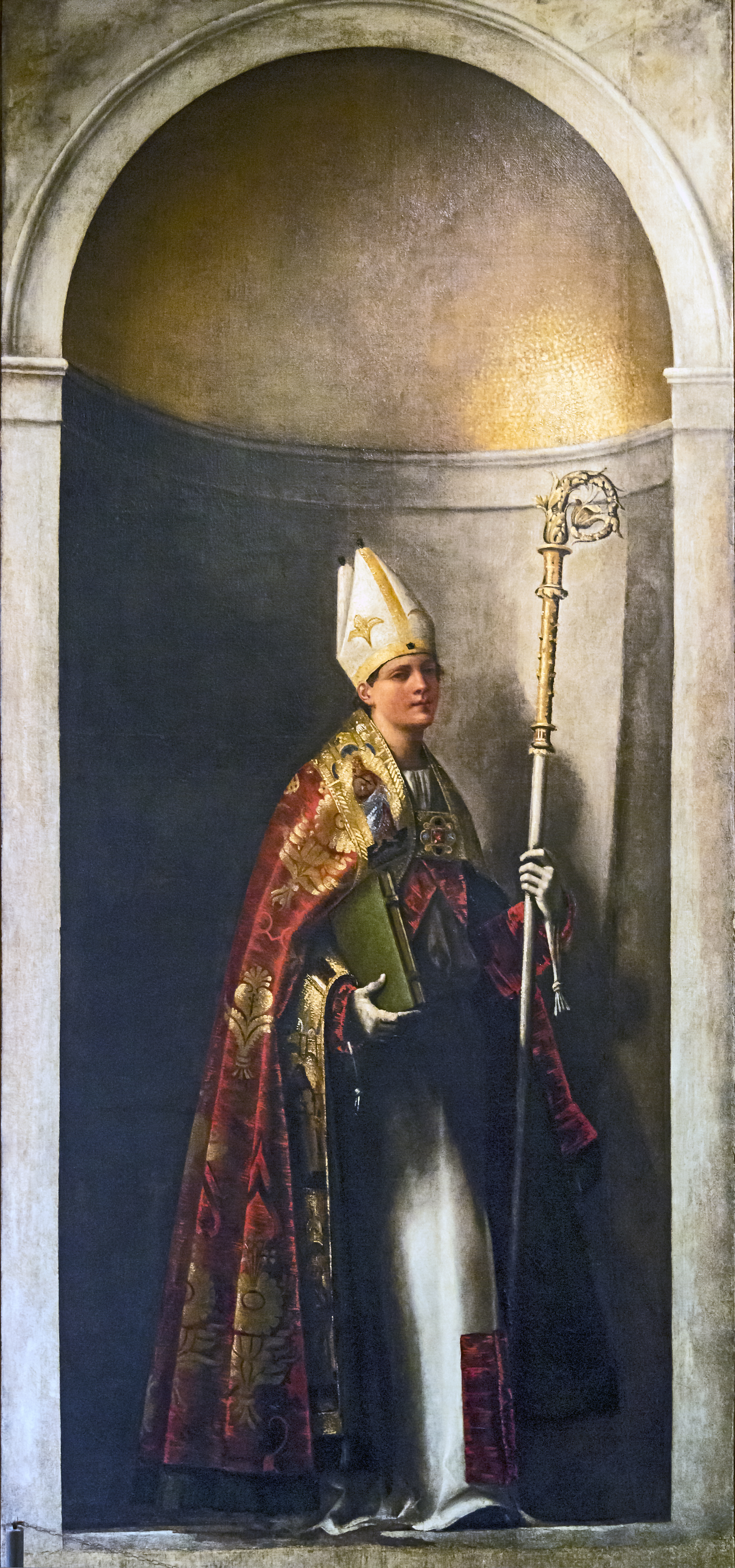
Sebastiano del Piombo (1485–1547), San Ludovico da Tolosa / Saint Louis of Toulouse / Saint Louis de Toulouse, circa 1509, 293 x 137, Gallerie dell'Accademia, in the
Scuola della Carità on the south bank of the Grand Canal, within the sestiere of Dorsoduro, Venice
LUDOVICO vescovo di
Tolosa, santo
di Giorgio De
Gregori
Enciclopedia Italiana (1934)
Figlio di Carlo II re di
Sicilia, nacque nel 1274 nel reame di Napoli, probabilmente a Nocera, e non in
Provenza come si ritiene generalmente. Ancora giovanissimo passò cinque anni
come ostaggio in Aragona; ivi, sotto la direzione di due francescani, si diede
a una vita di pietà. Volendo poi farsi francescano, fu obbligato, per fare la
professione, ad accettare il vescovato di Tolosa; ma sei mesi dopo la sua
consacrazione morì a Brignoles in Provenza. Fu canonizzato da Giovanni XXII nel
1317. Il suo corpo si conserva a Valenza in Spagna.
La vita di L. scritta da
Giovanni d'Orta di Trani, è in Analecta Bollandiana, IX (1890), pp.
281-353. I francescani di Quaracchi preparano l'edizione del suo processo di
canonizzazione in Analecta Franciscana. Vedi inoltre: M. R.
Townbee, St. Louis of Toulouse, Manchester 1929 (British Society of
Franciscan Studies, XV); S. Gaeta, S. Ludovico d'Angiò, Roma 1896; E.
Jordan, in Revue d'histoire ecclésiastique, XXVI (1930), p. 1017. La vita
pubblicata in Acta Sanctorum, III, agosto, p. 781, è un rimaneggiamento
posteriore di quella di Giovanni d'Orta.
© Istituto della
Enciclopedia Italiana fondata da Giovanni Treccani - Riproduzione riservata
SOURCE : https://www.treccani.it/enciclopedia/ludovico-vescovo-di-tolosa-santo_(Enciclopedia-Italiana)/
_interior_-_Saint_Louis%2C_sacred%2C_bishop_of_Toulouse_by_Pietro_Damini.jpg)
Pietro
Damini (1592–1631), Saint Louis, sacred, bishop of Toulouse, Sant'Alvise, in
the sestiere of Cannaregio in Venice,
Pietro
Damini, Saint Louis, sacré, évêque de Toulouse, Église Sant'Alvise, Venise
Pietro
Damini, San Ludovico di Tolosa, sacra, vescovo di Tolosa, Chiesa di Sant'Alvise, Venezia
LUDOVICO d'Angiò
(Ludovico di Tolosa), santo
di Andrè Vauchez
Dizionario Biografico
degli Italiani - Volume 66 (2006)
Secondogenito di Carlo
d'Angiò, futuro re di Sicilia, e di Maria d'Ungheria, L. nacque a Brignoles nel
febbraio del 1274 e trascorse l'infanzia a Napoli e in Provenza. Dal settembre
1288 all'ottobre 1295 fu trattenuto come ostaggio in Aragona, insieme con i
fratelli minori Roberto e Raimondo Berengario, al posto di suo padre, fatto
prigioniero al largo di Napoli nel 1284 dalla flotta di Alfonso III d'Aragona
comandata da Ruggero di Lauria.
Nell'estate di quell'anno
Carlo, in lotta contro Alfonso III per il possesso della Sicilia, aveva
attaccato senza successo la flotta aragonese che incrociava nel golfo
partenopeo. Catturato, ottenne la libertà solo nel 1288, a patto di consegnare
in ostaggio agli Aragonesi tre dei suoi figli.
Nel corso della cattività
L. risiedette in diversi castelli della Catalogna (Moncada, Ciurana,
Barcellona) e fu in contatto con il grande teologo francescano Pietro di
Giovanni Olivi, che il 18 maggio 1295 dal convento di Narbona indirizzò a L. e
ai suoi fratelli una lunga lettera di esortazione, in cui spiegava che aveva
preferito non incontrarli per non irritare Carlo II, il quale temeva che Olivi
facesse di loro dei "beguini" ("eciam dominus pater vester
timuerat vos inbeguiniri", cfr. Ehrle, p. 538). Già in quell'epoca,
infatti, L. subiva l'influenza della sua cerchia formata da francescani
provenzali, in particolare di François Brun e di Pierre Scarrier, quest'ultimo
incaricato della sua formazione culturale e spirituale, e fu allora che fece
segretamente il voto di entrare nell'Ordine dei frati minori. Nell'ottobre 1294
gli fu assegnata da papa Celestino V, dietro intervento di Carlo II,
l'amministrazione dell'arcidiocesi di Lione: come tutte le decisioni del
"papa angelico", anche questa nomina fu cassata nell'aprile 1295 dal
suo successore, Bonifacio VIII. La morte di Carlo Martello (agosto 1295), suo
fratello maggiore e principe di Salerno, fece di L. l'erede al trono, ma una
volta liberato vi rinunciò nel gennaio-febbraio 1296 in favore di Roberto,
terzogenito di Carlo II. Già ordinato suddiacono da papa Bonifacio VIII nel
Natale 1295, L. ricevette in seguito il diaconato e fu quindi ordinato
sacerdote dall'arcivescovo Filippo Capece Minutolo il 19 maggio 1296 a Napoli,
dove risiedette diversi mesi al Castel dell'Ovo insieme con la sua famiglia.
In seguito a una
negoziazione - che sembra essere stata difficile - con Carlo II e il pontefice,
fu nominato vescovo di Tolosa, incarico che accettò a condizione di poter
indossare l'abito francescano, come fece in segreto il 24 dic. 1296 nella
chiesa del convento romano di S. Maria in Aracoeli, prima di essere consacrato
vescovo da Bonifacio VIII; il 5 febbr. 1297 compì pubblicamente la vestizione
con grande disappunto di Carlo II.
Lasciata l'Italia, si
recò dapprima a Parigi dove trascorse la settimana santa (e si distinse lavando
i piedi a numerosi poveri nel giovedì santo) e dove si intrattenne con i
teologi francescani dell'Università. Poi raggiunse Tolosa e lì prese possesso
della cattedra vescovile nel mese di maggio, dopo aver compiuto il solenne
ingresso in città; ma non rimase abbastanza nella sua diocesi per imprimervi
una traccia determinante. Dopo poche settimane, lasciò Tolosa per la Catalogna
al fine di pacificare il conte di Foix e il re Giacomo II d'Aragona, nonché per
incontrare sua sorella Bianca, sposa di quest'ultimo; fu in quell'occasione
che, il 15 luglio 1297, consacrò la nuova chiesa francescana di Barcellona.
Dalla città catalana L. si diresse verso Roma, dove aveva intenzione di
presentare al papa le dimissioni dal suo incarico vescovile, che riteneva in
contrasto con la sua vocazione religiosa; il 28 luglio era a Tarascona, dove
predicò davanti al capitolo provinciale dei domenicani. Nei giorni successivi,
indebolito da una malattia, L. si fermò nel natio castello di Brignoles e lì
morì il 19 ag. 1297, all'età di 23 anni. Poco prima aveva dettato il
testamento, affidandone l'esecuzione a Raymond Geoffroy, un tempo ministro
generale dei frati minori, che Bonifacio VIII aveva costretto alle dimissioni
nel 1295.
Il suo corpo fu traslato
a Marsiglia e sepolto nella chiesa francescana della città, dove furono ben
presto segnalati miracoli a lui attribuiti, annotati in un Liber
miraculorum redatto dal guardiano della tomba (cfr. ed. Processus,
pp. 275-332). In seguito alla diffusione in Provenza della sua reputazione di
santo taumaturgo, Carlo II nominò, nel gennaio 1300, alcuni procuratori,
incaricati di promuoverne il culto e di preparare il processo di
canonizzazione, la cui apertura fu formalmente richiesta nel 1304 dai vescovi
delle diocesi provenzali. Il 1( ag. 1307 papa Clemente V rispose a quella
richiesta ordinando un'informativa sulla vita e i miracoli di L. con la
bolla Ineffabilis providentia Dei. L'inchiesta ebbe inizio il 23
febbr. 1308; i testimoni furono interrogati sulla base di una lista di 54
articoli seguendo un piano approssimativamente biografico; fra questi, 33
furono coloro che rilasciarono deposizioni abbastanza lunghe e circostanziate,
in particolare i francescani e i pochi laici che avevano condiviso con L. la
cattività in Catalogna, oltre a frate Adam - il quale testimoniò in nome di
Roberto d'Angiò, di cui era cappellano - e a Raymond Geoffroy, che aveva
incontrato L. a Roma nel 1295 e in Provenza nel 1297. Gli atti di questo
processo di canonizzazione costituiscono una fonte di primaria importanza per
la conoscenza di L. e per la storia delle origini del suo culto (ibid., pp.
1-254).
A Napoli, l'arcivescovo
Giacomo da Viterbo, legato agli Angiò, scrisse e pronunciò almeno due sermoni
nel 1303 e nel 1304, in occasione dell'anniversario del transito di L., per
esaltarne i meriti e sottolineare che L. aveva attinto alla perfezione sia come
secolare sia come regolare e pastore, condizione che doveva fargli valere al
più presto la gloria degli altari. Questa sanzione ufficiale non tardò ad
arrivare, poiché L. fu canonizzato il 7 apr. 1317 ad Avignone da Giovanni XXII,
che di L. era stato uno dei suoi più prossimi collaboratori all'episcopio di
Tolosa nel 1297, prima di diventare, nel 1308, cancelliere del Regno di Napoli.
Qualche anno più tardi un anonimo francescano, che aveva senza dubbio fatto
parte della cerchia di L. (l'attribuzione tradizionale a Giovanni d'Orta,
attestata da un solo manoscritto, non si fonda su alcun dato concreto), scrisse
un'interessante Vita s. Ludovici episcopi Tolosani, ricca di annotazioni
spirituali e psicologiche non tutte confluite nel processo di canonizzazione (Processus,
pp. 333-380).
La santità di L. diede
luogo, subito dopo la sua morte, a divergenti interpretazioni rintracciabili
negli atti del processo di canonizzazione; la personalità del giovane
principe-vescovo angioino è inoltre stata oggetto di nuove analisi da parte
degli storici nel corso della seconda metà del Novecento. Si è sottolineata la
particolarità di questo processo riguardante un frate minore destinato a
diventare una delle glorie del suo Ordine al quale non fu ufficialmente
associato: infatti, nessuno dei due ministri generali in quel periodo ai
vertici dell'Ordine - Giovanni da Morrovale (Minio Giovanni), subentrato a
Geoffroy nel 1296, e Gonsalvo di Balboa - figura fra i postulatori e tutte le
petizioni in favore della sua canonizzazione provengono dalla casata angioina,
come anche dal clero secolare di Provenza e del Regno di Napoli. Sulla scorta
di questa constatazione Pásztor (1955) e Manselli hanno ipotizzato che L.
facesse parte della cosiddetta ala "spirituale" dell'Ordine
francescano e che, per l'inasprirsi del conflitto fra gli spirituali e la
"comunità" dell'Ordine negli anni successivi alla sua morte, in
particolare in occasione del concilio di Vienne (1311-12), la gerarchia del suo
Ordine preferisse tenersi in disparte per non apparire in accordo con le
posizioni da lui assunte, in particolare sulla questione della povertà. Non è
escluso che L. abbia incontrato Pietro di Giovanni Olivi in occasione della sua
permanenza in Catalogna, e la lettera che questi indirizzò ai tre principi
presuppone che esistevano reali affinità fra loro, anche se in L. non si trova
alcuna eco delle concezioni escatologiche dell'Olivi. Sarebbe pertanto
eccessivo fare di L. l'incarnazione dello "spirituale" francescano e
si può pensare che, se realmente lo fosse stato, papa Giovanni XXII, che lo
aveva conosciuto di persona e che, è ben noto, non nutriva alcuna simpatia nei
confronti di questa corrente e delle idee dell'Olivi, non gli avrebbe accordato
la gloria degli altari, nonostante le pressioni della corte napoletana. I frati
minori provenzali e napoletani che furono vicini a L. nella sua giovinezza e
che giocarono un ruolo decisivo nella sua formazione - F. Brun, P. Scarrier e
Pierre Coccardi - erano certamente molto legati al rispetto della regola
francescana, ma non erano degli "zelanti" o dei ribelli, e divennero
vescovi di diocesi dell'Italia meridionale.
Inoltre, se L. fu senza
alcun dubbio un sostenitore degli ideali evangelici, altre componenti si
ritrovano nella sua santità: sembra in effetti che egli abbia praticato un
estremo ascetismo e spinto al più alto grado il contemptus mundi,
indossando un cilicio a pelle, dormendo con i suoi abiti religiosi e fuggendo
la compagnia delle donne; era di una eccezionale sobrietà, contentandosi
sovente di poco cibo e di un po' di vino annacquato. La sua stessa rinuncia
all'episcopato, presentata dai testimoni al processo di canonizzazione come
marchio di umiltà, sembra essere motivata soprattutto dalla paura di non poter
perseguire la propria salvezza per la dedizione esclusiva alla cura
animarum.
Anche la sua compassione
per i poveri, pur essendo conforme all'ideale francescano, si espresse secondo
modalità che hanno condotto J. Paul (1999) a parlare di "franciscanisme
royal" a proposito di L., il cui modello di riferimento sarebbe stato il
prozio, Luigi IX re di Francia, proclamato santo solo nel 1297, ma del quale L.
doveva certamente conoscere le biografie. Così, la cura nel lavare i piedi ai
poveri e nel servirli personalmente a tavola, al pari dell'abitudine a
genuflettersi davanti a loro rinviano all'esempio del pio re di Francia; mentre
il bacio che egli avrebbe dato in Catalogna, nel corso di un giovedì santo, a
un lebbroso, in seguito dileguatosi, attestato dal cappellano di suo fratello
Roberto, fa pensare a un'imitazione del modello del "poverello".
Si deve infine
considerare l'importanza che ebbe per L. l'attività intellettuale. Nel corso
del processo del 1308, un testimone laico lo definì "magnus clericus"
e ricordò le sei o sette bestie da soma necessarie per trasportare i suoi libri
nei suoi spostamenti. Benché non avesse seguito un cursus tradizionale
di studi universitari, sembra aver avuto uno spiccato gusto per la disputatio e,
in generale, per gli aspetti dottrinali. Dopo aver studiato il primo libro
delle Sentenze di Pietro Lombardo, sotto la guida di Guglielmo di
Falgar, approfittò della presenza a Napoli, nel 1296, del teologo francescano
attivo a Parigi Riccardo di Mediavilla per intrattenere con lui lunghi colloqui
a questo riguardo; sappiamo inoltre, da una deposizione del processo di
canonizzazione, che era un lettore assiduo delle opere di Bernardo di
Chiaravalle. Il testamento di L. conferma in generale i suoi interessi
culturali, viste la quantità e la qualità delle opere che vi sono menzionate.
Poco prima di morire, L. affidò infatti alcuni libri ai suoi compagni e al
vicino convento di Draguignan, mentre i due francescani che gli erano stati
vicini fin dalla prigionia, F. Brun e P. Scarrier, ereditarono l'essenziale
della sua biblioteca. La rivendettero nel 1299 per 231 libbre a Carlo II
d'Angiò, il quale ne fece dono al convento domenicano di St-Maximin, da lui
fondato nel 1295.
Il culto di L. si diffuse
rapidamente e fu sostenuto dai sovrani napoletani: già dal 1306 Roberto
d'Angiò, vicario di Carlo II in Provenza, istituì a nome del padre una rendita
annuale di 25 libbre per celebrare l'anniversario del fratello L. e, l'8 nov.
1319, assistette alla solenne traslazione dei suoi resti nella chiesa dei frati
minori a Marsiglia. In Francia, re Filippo VI di Valois, suo nipote, istituì
rendite per le confraternite che si fossero intitolate a L., come quella
fondata nel 1329 nella chiesa francescana di Le Mans. Identica iniziativa fu
presa in Aragona, dove il culto di L. fu diffuso da sua sorella Bianca e dal
figlio di questa, Alfonso (IV), che nel 1355 offrì al convento francescano di
Terruel un trittico raffigurante Ludovico d'Angiò. L'aspetto dinastico e
familiare del culto fu dunque preponderante, come ben mostra la celebre tavola
dipinta da Simone Martini negli anni 1317-20 (Napoli, Museo nazionale di
Capodimonte), che rappresenta L. con i paramenti vescovili indossati sopra al
saio francescano in posizione frontale mentre incorona con la mano sinistra suo
fratello Roberto. Non si tratta di un suo reale ritratto, poiché il vero
soggetto della tavola è costituito dalla rinuncia di L. al trono e dal
trasferimento dei suoi diritti successori a favore del fratello Roberto;
l'aspetto politico di questa rappresentazione è anche sottolineato dal fatto
che la scena è contornata da gigli e sormontata dagli stemmi degli Angiò. Il
culto di L. conobbe in seguito una certa diffusione in Italia meridionale dove
gli furono dedicate diverse chiese e cappelle.
Nel resto dell'Italia
esso si propagò soprattutto nelle città e nelle regioni di tradizione guelfa,
di cui re Roberto e i suoi successori erano i principali sostenitori. A
Firenze, Giotto rappresentò L. nella cappella Bardi di S. Croce, mentre
Donatello lo raffigurò in una piccola statua di bronzo per ornare la nicchia
della Parte guelfa in Orsanmichele. Inoltre L. è particolarmente venerato nella
basilica inferiore di S. Francesco ad Assisi, dove il cardinale francescano
Gentile da Montefiore, legato pontificio in Ungheria molto vicino alla dinastia
angioina, fece erigere due cappelle, decorate dopo il 1312: nella prima,
dedicata a S. Martino, Simone Martini ha raffigurato, tra il 1322 e il 1326, s.
Luigi di Francia e L., insieme con Elisabetta d'Ungheria; nella seconda,
intitolata a S. Luigi, il giovane L. è raffigurato in una vetrata. Al di là di
questi esempi, L. è soprattutto presente in polittici e tavole d'altare, dove
compare con altri personaggi, antichi e moderni, in quanto terzo santo
canonizzato dell'Ordine francescano e autorevole personalità; tuttavia, a
differenza di Francesco d'Assisi o Antonio di Padova, nel caso di L. non si
conoscono che pochi cicli pittorici consacrati agli avvenimenti della sua vita.
La devozione nei riguardi
di L., anche nelle regioni dove era particolarmente diffusa, declinò nel corso
del XV secolo; fu un destino paradossale quello del giovane principe-vescovo
che aveva ardentemente desiderato rinunciare a ogni forma di potere, politico o
ecclesiastico, per condurre una vita secondo i precetti evangelici e che era
stato canonizzato senza il sostegno della gerarchia francescana, ma che finì
per diventare il simbolo di una "santa alleanza", creatasi all'inizio
del XIV secolo tra gli Angiò di Napoli, il Papato d'Avignone, i guelfi italiani
e l'Ordine dei frati minori.
Fonti e Bibl.: F.
Ehrle, Petrus Iohannis Olivi. Sein Leben und seine Schriften, in Archiv
für Literatur- und Kirchengeschichte des Mittelalters, III (1887), pp. 534-540
(Epistola ad filios Caroli II regis(); Processus canonizationis et
legendae variae s. Ludovici O.F.M., in Analecta Franciscana, VII
(1951); De canonizatione s. Ludovici, in Die Zerimonienbücher der
römischen Kurie im Mittelalter, a cura di B. Schimmelpfennig, Tübingen 1973, p.
166; E. Bertaux, Les saints Louis dans l'art italien, in Revue des
deux mondes, CLVII (1900), pp. 610-614; M. Toynbee, St Louis of Toulouse
and the process of canonization in the fourteenth century, Manchester 1929; C.
Vielle, St. Louis d'Anjou, sa vie, son temps, son culte, Vanves 1930;
M.-H. Laurent, Le culte de saint Louis d'Anjou à Marseille au XIVe siècle,
Roma 1954; R. Manselli, La "Lectura super Apocalypsim" di Pietro
di Giovanni Olivi, Roma 1955, pp. 167-172; E. Pásztor, Per la storia di s.
L. d'A., Roma 1955; Id., L. d'A., in Bibliotheca sanctorum, VIII,
Roma 1966, coll. 300-307; J. Paul, Saint Louis d'Anjou, franciscain et
évêque, in Cahiers de Fanjeaux, VII (1972), pp. 59-90; Id., Evangélisme
et franciscanisme chez Louis d'Anjou, ibid., VIII (1973), pp. 375-401;
Id., Témoignage historique et hagiographique dans le procès de
canonisation de Louis d'Anjou, in Provence historique, XCIII-XCIV (1973),
pp. 305-317; Id., Le Liber miraculorum de saint Louis d'Anjou, in Archivum
Franciscanum historicum, LXIX (1976), pp. 209-219; Id., Miracles et
mentalité religieuse populaire à Marseille au début du XIVe siècle,
in Cahiers de Fanjeaux, XI (1976), pp. 61-89; Id., Le rayonnement
géographique du pèlerinage au tombeau de Louis d'Anjou, ibid., XV (1980),
pp. 137-158; A. Vauchez, La sainteté en Occident aux derniers siècles du
Moyen Âge, Roma 1981, ad ind.; J. Gardner, The cult of a fourteenth
century saint: the iconography of saint Louis of Toulouse, in I
francescani nel Trecento. Atti del XIV Convegno internazionale,( 1986, Assisi
1988, pp. 168-193; D. Anderson, Dominus Ludovicus in the sermons of
Jacobus of Viterbo (Arch. S. Pietro, D.213), in Literature and religion in
the later Middle Ages. Philological studies in honor of Siegfried Wenzel, a
cura di R.G. Newhauser - J.A. Alford, Binghampton 1994, pp. 275-295; J.
Paul, Louis d'Anjou, un évangélisme dynastique?, in Cahiers de
Fanjeaux, XXXIV (1999), pp. 141-170; Id., Perception et critères de
sainteté en France méridionale(, ibid., XXXVII (2002), pp. 31-62; Ch.
Gadrat, La bibliothèque de saint Louis d'Anjou, évêque de Toulouse,
in Revue Mabillon, n.s., XIV (2003), pp. 179-202; Hierarchia
catholica, I, pp. 316 n. 11, 488; Dictionnaire de spiritualité, IX, coll.
1038 s.
© Istituto della
Enciclopedia Italiana fondata da Giovanni Treccani - Riproduzione riservata
SOURCE : https://www.treccani.it/enciclopedia/santo-ludovico-d-angio_(Dizionario-Biografico)/

Saints
Bonaventure, Agnes of Assisi, Margaret of Hungary and Louis of Toulouse - San
Domenico - Siena
Jeunes témoins de la foi
: saint Louis d’Anjou : https://blog.croix-glorieuse.org/jeunes-temoins-de-la-foi-saint-louis-danjou
« Saint Louis », Église catholique dans le Tarn : https://albi.catholique.fr/liturgie-art-et-culture/saints-et-saintes/saint-louis/
Tüskés Anna, « L’iconographie
de Saint Louis d’Anjou de Toulouse en Hongrie aux XV–XVIIIe siècles », Conférence
présentée au colloque international «Espace sacré, mémoire sacrée: les
SaintsÉvêques et leurs villes», organisé par Christine Bousquet-Labouérie et
Yossi Maurey, Tours, Université François-Rabelais, 10–12 juin 2010.: https://real.mtak.hu/7466/1/2.053.pdf
Saint Louis d’Anjou : le procès en canonisation : https://www.saintsdeprovence.com/wp-content/uploads/2018/02/texte-Saint-Louis-dAnjou-.pdf
Key to Umbria - St Louis of Toulouse (19th August) : https://www.keytoumbria.com/Umbria/S_Louis_of_Toulouse.html