
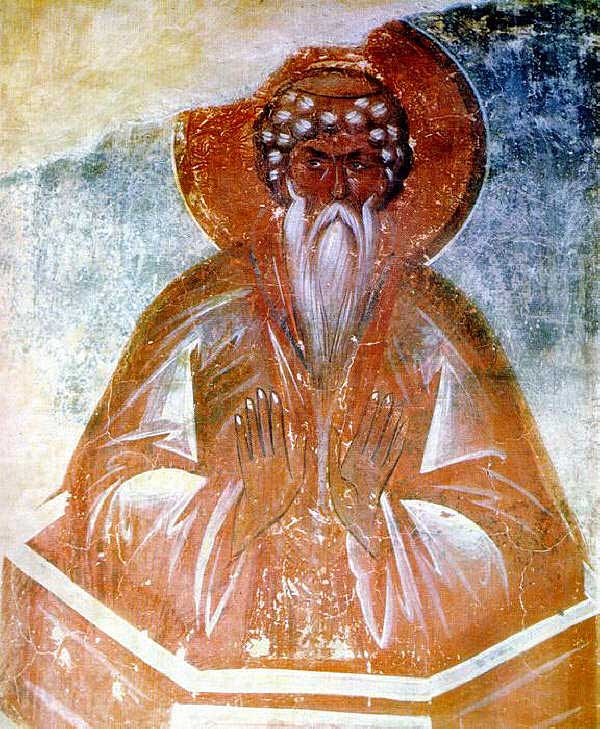
Theophanes the Greek (1340–1410). Daniel
the Stylite /Daniel le Stylite / Даниил Столпник, 1378,
fresco / fresque, Church of the Transfiguration on Ilina Street / Église de la Transfiguration / Спасо-Преображенская церковь на Ильине, Veliky Novgorod. Scanned from Alexandrov V. N. History of Russian Art. Short schoolboy’s reference. Harvest 2004
Saint Daniel le Stylite
Prêtre au
Proche-Orient (+ 489)
Originaire de l'Asie
Mineure, il passera les trente-trois dernières années de sa vie sur une
colonne, au bord du Bosphore, c'est-à-dire une petite plate-forme montée sur
deux piliers et entourée d'une balustrade. Il exhortait les fidèles qui
venaient à ses pieds et laissait monter ceux qui voulaient lui parler.
À Constantinople, en 493,
saint Daniel, prêtre, surnommé le Stylite. Après avoir vécu dans un monastère
et supporté de nombreux travaux, il se tint en haut d’une colonne à la manière
et à l’exemple de saint Siméon le
Stylite et y demeura pendant trente-trois ans et trois mois jusqu’à sa
mort, sans se laisser briser par la violence du froid, de la chaleur ou des
vents.
Martyrologe romain
SOURCE : http://nominis.cef.fr/contenus/saint/247/Saint-Daniel-le-Stylite.html
Saint Daniel le stylite
Le moine Daniel est
originaire de Maratha en Syrie, au début du Ve siècle. Il entre tout jeune,
dans la vie monastique. Il fut assez vertueux, original, admirable et peu
imitable pour devenir stylite comme son maître saint Syméon. Stylite est une
expression grecque qui signifie "sur une colonne". À cette
époque, en Asie mineure, des moines ardents, passionnés de l'absolu de Dieu (et
qui ne craignaient pas le vertige) se faisaient volontairement reclus. Ils
vivaient en permanence au sommet d'une colonne, dans un espace étroit et fort
peu confortable, exposé à toutes les intempéries.
Daniel le Stylite dut cependant accepter une amélioration de sa situation entre ciel et terre. C'était près de Byzance et l'empereur était intervenu : il imposa à l'ermite intrépide une...seconde colonne accotée à la première, pour aménager au sommet un espace moins réduit ! Et ainsi, de son estrade, saint Daniel distribuait largement ses conseils aux personnages de l'Empire venant le consulter et auxquels il ne mâchait pas ses mots. Il répétait constamment : "Il faut aimer Dieu puisqu'il nous aime, et aimer nos semblables, surtout les pauvres, puisque Dieu les aime". Saint Daniel le stylite termina sa vie le 11 décembre 384.
Daniel est un prénom d'origine hébraïque qui signifie "juge" (dan) et
"dieu" (El).
Rédacteur: Frère Bernard
Pineau, OP
SOURCE : http://www.lejourduseigneur.com/index.php/Web-TV/Saints/Daniel
Daniel le Stylite
Solitaire, Saint
(410-493)
Il est des saints dont
tout le monde connaît le nom mais dont on ignore à peu près tout. Il en est
ainsi de notre saint d'aujourd'hui, saint Daniel le Stylite. Pourtant il faut
absolument raconter sa vie. Les documents que l'on découvre sont assez
déconcertants: qu'y a-t-il de vrai et qu'est-ce qui relève de la légende?
Impossible de le savoir. Nous sommes au VIe siècle, et les biographies connues
relèvent toutes de l'hagiographie. Alors où est la vérité? Au fond qu'importe,
car ce qui compte dans la vie des saints, c'est de nous rapprocher de Dieu, de
nous faire grandir dans la vie de Dieu et de nous apprendre à prier.
Maintenant, munis de tous ces avertissements, nous pouvons essayer de découvrir
saint Daniel le Stylite dont c'est la fête aujourd'hui.
Daniel le Stylite naquit
en 410, dans le village de Mathara, près de la ville de Samosate en Syrie.
Pendant de nombreuses années, sa mère Martha demeura stérile; aussi priait-elle
beaucoup, et elle jurait que, si elle avait un enfant, elle le consacrerait au
Seigneur. Ses prières furent entendues, et, après une vision lumineuse, Martha
donna naissance à un fils, qui resta sans nom pendant cinq ans.
Les parents du petit
garçon voulaient, en effet, que puisqu'il était né de la grâce de Dieu, il
devait aussi recevoir son nom de Dieu. Dès que cela leur fut possible, ils
présentèrent leur fils à l'Higoumène d'un monastère situé non loin de chez eux.
L'higoumène (le supérieur du monastère) donna l'ordre d'ouvrir l'un des
annuaires de la maison, ou une bible, et l'ouvrit au hasard. Il tomba sur le
prophète Daniel, et c'est ainsi que le petit garçon reçut son nom. Les parents
auraient souhaité que l'enfant restât au monastère, mais l'higoumène refusa,
car l'enfant était encore beaucoup trop jeune. Mais quand il eut douze
ans, sa mère lui ayant dit un jour qu'il était consacré à Dieu, sans rien dire
à personne, le petit Daniel quitta la maison pour le monastère.
Ses parents furent très
heureux quand ils apprirent où était leur fils, et ils se rendirent au
monastère. Ils prièrent l'higoumène de le vêtir de l'habit monastique.
L'higoumène accepta seulement de garder l'enfant au monastère, mais demanda aux
parents de rendre souvent visite à leur fils. Cependant, les frères du
monastère furent vite étonnés des efforts vertueux de la jeune recrue, et
malgré ses réticences antérieures, l'higoumène le tonsura très vite et lui
donna l'habit. Le temps passait, et le moine pouvait, avec la grâce de
Dieu, grandir en vertu, en sainteté, en sagesse et en science.
Un jour, le supérieur de
Daniel, appelé à une réunion d'Archimandrites convoquée par l'Archevêque
d'Antioche, choisit Daniel comme compagnon de voyage, lui donnant ainsi
l'occasion de réaliser un cher désir: vénérer les Lieux Saints et rendre visite
à l'illustre Saint Syméon le Stylite, dont l'ascèse si peu commune attirait
l'admiration des uns et les critiques des autres. Syméon, en effet, passa
quarante sept ans de sa vie sur une colonne qui avait dix huit mètres de
hauteur. Syméon fit une forte impression sur Daniel, lequel, au moyen d'une
échelle, monta pour recevoir la bénédiction de l'ascète qui lui dit: "Courage,
Daniel, prends force et patience, car tu auras à supporter pour Dieu bien des
fatigues. Mais j'ai confiance dans le Seigneur que je sers, qu'Il te fortifiera
et se fera ton compagnon de route." Puis, après avoir rempli leur
mission à Antioche, les higoumènes et Daniel rentrèrent dans leurs monastères.
En 447, Daniel avait
trente sept ans, quand son higoumène fut rappelé à Dieu. Il fut désigné pour le
remplacer. Mais, après avoir éprouvé les capacités de son second, Daniel se mit
en route pour visiter les Saints Lieux et s'enfoncer dans la solitude du désert
de Palestine, lorsque Syméon le Stylite, qui mourut en 461, lui apparut
soudain et le persuada de ne pas s'exposer inutilement au danger des rebelles
Samaritains, mais de prendre le chemin de Constantinople.
Parvenu aux abords de la
ville impériale, Daniel se retira d'abord pendant sept jours dans une chapelle
de Saint-Michel l'Archange pour y prier, nuit et jour. Attirée par sa
réputation, de nombreuses personnes venaient le trouver, mais des Clercs de
Saint-Michel allèrent le dénoncer à l'Archevêque Anatole, en l'accusant
d'hérésie. Le sage prélat fit enlever Daniel et l'amener à Byzance. Édifié par
ses vertus et par sa foi, et plein de reconnaissance après avoir été délivré
d'une grave maladie par la prière du saint ascète, l'Archevêque devint l'un de
ses plus fervents admirateurs et se résolut difficilement à le laisser regagner
sa retraite, accompagné par une foule en liesse.
Neuf années plus tard,
âgé de 51 ans, Daniel tomba un jour en extase et vit Syméon le Stylite debout
devant lui, au sommet d'une immense colonne de nuée, entouré de deux hommes à
l'apparence lumineuse qui, sur l'ordre du vieillard, vinrent prendre Daniel pour
l'amener auprès de lui. On apprit par la suite que Syméon venait de mourir.
Alors Daniel se retira dans le désert de Thrace, non loin de Constantinople.
C'est là, qu'avec deux disciples, il construisit une colonne haute, constituée
d'une petite plate-forme montée sur deux piliers et entourée d'une balustrade.
De là-haut il exhortait les très nombreux fidèles qui venaient à ses pieds; il
laissait même monter vers lui ceux qui voulaient lui parler. Beaucoup de
malades furent guéris. Daniel habita sur cette colonne pendant 33 ans.
C'est au sommet de sa
colonne que Daniel fut ordonné prêtre par Gennade, l'évêque de Constantinople.
Celui-ci fit les prières en bas puis monta en haut de la colonne pour terminer
la cérémonie. L'empereur Léon lui rendait souvent visite. Il fit même bâtir un
monastère près de la colonne. C'est ainsi que Daniel fut amené, plusieurs fois,
à avoir un rôle de médiateur politique, notamment entre l'Empereur Léon et le
roi des Lazes, Goubazions, dans la Colchide (à l'est de la mer noire) afin de
régler leurs différends politiques. À maintes reprises, l'homme de Dieu mit
aussi son esprit prophétique, sa sagesse et le pouvoir de sa prière au service
du bon droit et de la justice. Ainsi, Daniel prédit un jour qu'en 465, un
incendie ravagerait Constantinople et qu'il fallait faire des prières publiques
chaque semaines pour prévenir la catastrophe. Naturellement personne ne le
crut... Au moment de l'incendie, on accourut vers sa colonne en le suppliant de
faire cesser l'incendie. Daniel, après avoir prié, leur annonça que le feu
s'éteindrait au bout de sept jours. Puis il les renvoya. Il faut ajouter que
Daniel le Stylite fut conduit à lutter contre le monophysites. Ainsi, il
descendit de sa colonne et se rendit en ville, pour venir au secours de
l'Église en détresse.
La colonne du Saint était
devenue un des lieux les plus vénérés de la région de Constantinople, on y
accourait de toutes parts; et, malgré les objections de Daniel, l'empereur y
fit construire une vaste hôtellerie, à côté d'une église où étaient déposées
les Reliques de Saint Syméon le Stylite, venues d'Antioche. Daniel guida aussi
de nombreuses personnes sur le chemin de la conversion. Ses innombrables
miracles étaient pour lui l'occasion de progresser dans l'humilité car il ne les
attribuait jamais à sa propre vertu, mais demandait à ceux qui venaient vers
lui d'aller vénérer les Reliques de Saint Syméon ou de s'oindre avec l'huile
des veilleuses qui brûlaient près du tombeau du Saint.
Daniel prédit son départ
vers le ciel. Quelques jours avant sa mort, il rassembla ses nombreux
disciples, pour leur livrer son dernier enseignement et demander l'assistance
de leurs prières. Puis, il tomba en extase. Après être revenu à lui, il
communia aux Saints Mystères et s'endormit en paix, le lendemain, en délivrant
un possédé d'un esprit impur, au moment même où il rendait son dernier soupir,
sur sa colonne. C'était le 11 décembre 493, et le Saint avait atteint l'âge de
84 ans.
Paulette Leblanc
SOURCE : http://nova.evangelisation.free.fr/leblanc_daniel_le_stylite.htm
Le 11 decembre, mémoire
de notre vénérable Père DANIEL le STYLITE
Astre illuminant le monde de l'éclat de ses vertus et vivante échelle qui, à
son exemple, nous invite à monter de la terre vers le ciel, notre Saint Père
Daniel était originaire du petit village de Mératha, près de Sarnosate en
Syrie. Sa mère, restée longtemps stérile, l'obtint par ses prières, à la suite
d'une vision lumineuse, signe de la gloire réservée à son enfant. Parvenu à
l'âge de cinq ans, il fut conduit par ses parents dans le monastère voisin pour
être consacré à Dieu comme le Prophète Samuel (voir 1 Samuel 1:19 sv). Il reçut
alors le nom de Daniel, après avoir, sur l'ordre du supérieur, tiré au hasard
le Livre du Prophète Daniel qui se trouvait placé devant l'Autel; mais il ne
fut pas accepté dans le monastère, à cause de son trop jeune âge. Quand il eut
atteint ses douze ans, il entendit sa mère lui dire: «Mon enfant, je t'ai
consacré à Dieu». Sans plus attendre, il se rendit de lui-même dans un
monastère des environs et obtint par ses instantes supplications d'être reçu
parmi les frères, malgré les réticences de l'Higoumène. Il fit de tels progrès
dans la voie de Dieu et montra une telle ardeur aux combats de la vertu, qu'au
bout de peu de temps, le supérieur le tonsura et le revêtit de l'habit
angélique, en présence de ses parents au comble de la joie, puis il en fit son
disciple préféré.
Appelé un jour à une réunion d'Archimandrites convoquée par l'Archevêque
d'Antioche, son supérieur prit Daniel pour compagnon de voyage et lui donna
ainsi l'occasion de réaliser son plus cher désir: vénérer les Lieux Saints et
rendre visite à l'illustre Saint
Syméon le Stylite (mémoire le ler septembre), dont l'ascèse si peu
commune attirait l'admiration des uns et les critiques des autres. Parvenus aux
pieds de la colonne du Saint, le spectacle d'un combat si héroïque mené pour le
Christ et le rayonnement de la charité du grand Ancien frappa de stupeur tous
ceux qui avaient mis en doute sa sainteté. Daniel fut le seul à surmonter la
crainte qui paralysait tous les Higoumènes qu'il accompagnait, et, au moyen
d'une échelle, il monta prendre la bénédiction du Saint qui lui dit: «Courage,
Daniel, prends force et patience, car tu auras à supporter pour Dieu bien des
fatigues. Mais j'ai confiance dans le Seigneur que je sers, qu'Il te fortifiera
et se fera ton compagnon de route».
Quelque temps après, son Higoumène ayant été rappelé vers le Seigneur, Daniel,
alors âgé de 37 ans, fut désigné pour le remplacer. Après avoir éprouvé les
capacités de son second, il se rendit à nouveau, pour deux semaines, auprès de
Saint Syméon; puis il se mit en route pour enfin visiter les Saints Lieux et
s'enfoncer dans la solitude du désert de Palestine. Sur la route, un vieillard
ayant l'apparence de Saint Syméon, lui apparut soudain et le persuada de ne pas
s'exposer inutilement au danger des rebelles Samaritains, mais de prendre le
chemin de Constantinople, la «nouvelle Jérusalem», illustrée par la présence de
tant de précieuses Reliques et de si nombreux sanctuaires, et aux environs de
laquelle on pouvait aisément trouver la quiétude du désert.
Parvenu aux abords de la ville impériale, dans un endroit appelé Anaple1,
Daniel se retira d'abord pendant sept jours dans une chapelle de Saint-Michel
l'Archange pour y prier; puis, à l'exemple des vaillants héros de la foi:
Antoine, Paul et tant d'autres, il pénétra avec audace dans un temple païen
infesté de démons qui maltraitaient beaucoup de voyageurs, revêtu de l'armure
de Dieu, du bouclier de la foi et du glaive de la prière (voir Ephésiens 6:14).
Indifférent aux cris sauvages qui perçaient le silence de la nuit et aux jets
de grosses pierres, 1'athlète du Christ persévéra dans la prière, nuits et
jours, et mit en fuite les esprits impurs par le feu de la vivifiante Croix.
Enfermé dans ce temple, il ne communiquait avec les visiteurs, qui affluèrent
bientôt attirés par sa réputation, que par une étroite ouverture. Pris de
fureur devant une telle renommée, le démon excita la jalousie de quelques
Clercs de Saint-Michel, qui allèrent dénoncer le serviteur de Dieu à l'Archevêque
Anatole, en l'accusant d'hérésie. Après avoir une première fois repoussé les
calomniateurs, le sage prélat fit enlever Daniel et amener à Byzance. Mais,
grandement édifié par sa pure confession de foi et plein de reconnaissance
après avoir été délivré d'une grave maladie par la prière du saint ascète,
l'Archevêque devint l'un de ses plus fervents admirateurs et se résolut
difficilement à le laisser regagner sa retraite, accompagné par une foule en
liesse.
Neuf années plus tard, âgé de 51 ans, Daniel tomba un jour en extase et vit
Saint Syméon le Stylite debout devant lui, au sommet d'une immense colonne de
nuée, entouré de deux hommes à l'apparence lumineuse qui, sur l'ordre du
vieillard, vinrent prendre Daniel pour l'amener auprès de lui. Celui-ci
l'embrassa paternellement et disparut dans le ciel, en laissant son fils
spirituel sur la colonne, en compagnie des deux Anges. Cette vision fut bientôt
confirmée par l'arrivée d'un des disciples du grand Stylite, le moine Serge,
qui venait annoncer le trépas de Saint Syméon à l'empereur Léon Ier (457-474)
et lui remettre la cuculle de peau du Saint2. Mais l'entrevue avec le souverain
tardant, il remit finalement la précieuse Relique à Daniel, devenu ainsi, comme
un nouvel Elisée, héritier de la mélote d'Elie après son départ vers le ciel
(voir II Rois 11:13).
Confirmé par ces signes et averti du moment propice par un songe, Daniel, aidé
de quelques pieux amis, décida de sortir du temple pour suivre de Saint Syméon
et monter sur une colonne, haute de la taille de deux hommes, qu'une colombe
blanche, envoyée par Dieu, avait désignée au Saint et à ses amis. Le
propriétaire des lieux, Gèlanios, un familier de l'empereur, irrité de cette
intrusion,voulut chasser Daniel; mais à la suite orage soudain qui détruisit
ses vignes et devant le spectacle de l'endurance du stylite, il changea d'avis
et, dans son enthousiasme pour l'héroïque combattant du Christ, il fit même
construire à côté une nouvelle colonne, plus haute, aux pieds de laquelle Serge
s'installa afin d'assurer la direction des disciples en nombre sans cesse
croissant. Exposé devant les hommes et les Anges comme le Christ sur la Croix,
Daniel restait immobile, vivant que pour le ciel, et en retour Dieu utilisait
sa colonne comme un canal déversant à profusion Sa grâce sur les fidèles.
Miracles, signes, guérisons, paroles de salut et de sagesse céleste attirèrent
bientôt auprès du solitaire un grand nombre de visiteurs, parmi lesquels se
trouvaient les personages les plus illustres du temps: le consul Cyrus, dont
les deux filles furent guéries par le Saint, l'impératrice Eudocie à son retour
d'Afrique, et l'empereur Léon lui-même, qui obtint un héritier grâce à la
prière de Daniel et qui en témoignage de gratitude, fit jeter les bases d'une
troisième colonne.
Dévorés par le démon de la jalousie, des hérétiques envoyèrent alors au
bienheureux une célèbre prostituée pour le dévoyer; mais celle-ci fut soudain
assaillie et cruellement tourmentée par un démon. Elle en fut finalement
délivrée par la prière de Daniel, à la confusion des intrigants qu'elle dénonça
en public.
Devant une telle renommée, le pieux empereur pressa l'Archevêque Gennade
(458-471) d'ordonner Prêtre l'homme de Dieu, malgré ses réticences. Mais une
fois le Hiérarque et sa suite sur les lieux, Daniel, devinant leur projet, ne
les laissa pas monter jusqu'à lui. Gennade prononça alors la prière
d'ordination à distance, demandant au Christ d'imposer d'en-haut invisiblement
la main sur son disciple, pendant que la foule criait: «Il est digne! » Daniel
finit par céder et ordonna qu'on pose l'échelle pour que l'Evêque monte vers
lui. Après s'être embrassés, ils reçurent tous deux l'un de l'autre la Sainte
Communion, entre le ciel et la terre.
Peu après l'installation de Daniel sur la troisième colonne, la capitale fut
ravagée pendant une semaine par un terrible incendie (ler septembre 465), qui
avait été prédit par le Saint, mais l'empereur et sa cour n'en avaient pas tenu
compte. On vint alors en foule, le souverain lui-même et son épouse en tête,
pour lui demander pardon et le supplier d'intercéder pour le peuple de Dieu en
détresse. Peu après, un violent orage se déchaîna et le vent ébranla la colonne
qui avait été mal ajustée, de sorte qu'elle oscillait de droite à gauche sous
des trombes d'eau, en mettant à tout moment en danger la vie du solitaire, sous
le regard effrayé de ses disciples. Une autre fois, en hiver, le vent emporta
sa tunique de peau, et il resta toute la nuit exposé nu à la neige. Lorsque,
bien tard, ses disciples vinrent à lui, ils le trouvèrent inanimé et couvert de
glace. Après l'avoir ranimé avec de l'eau chaude, ils apprirent avec stupeur
que pendant tout ce temps le Saint avait été transporté en esprit dans un lieu
de repos, où il s'était entretenu avec Saint Syméon le Stylite. A la suite de
cet incident, l'empereur exigea que l'on construisit un petit abri au-dessus de
la colonne pour protéger Daniel des intempéries.
L'empereur Léon était si admiratif devant la conduite du Saint stylite qu'il se
fit construire une demeure à proximité et emmenait tous ses visiteurs étrangers
lui rendre visite, rois, empereurs ou ambassadeurs. C'est ainsi que Daniel joua
le rôle de médiateur entre Léon et le roi des Lazes, Goubazios, pour régler
leurs différends politiques. A maintes autres occasions, l'homme de Dieu mit
son esprit prophétique, sa sagesse et le pouvoir de sa prière au service du bon
droit et de la justice.
Lorsque Basilisque usurpa le pouvoir et chassa l'empereur Zénon (475), prenant
la défense des monophysites, il voulut rejeter les décisions du Saint Concile
de Chalcédoine et menaça le pieux Archevêque Acace qui dut trouver refuge à
Sainte-Sophie, entouré par les moines de la capitale. Après avoir repoussé les
avances de Basilisque, qui cherchait à le mettre de son côté, Saint Daniel,
confirmé par un signe divin, résolut de descendre de sa colonne et de se rendre
en ville, comme Saint Antoine autrefois, pour venir au secours à l'Eglise en
détresse, Porté par une foule immense et enthousiaste, qui grandissait d'autant
plus que les guérisons se multipliaient sur son passage, le Saint se rendit
d'abord à la Grande Eglise (Sainte-Sophie) pour y prêcher la Foi Orthodoxe,
puis il poursuivit sa marche triomphale jusqu'au palais de l'Hebdomon, où
s'était réfugié l'usurpateur. En signe de malédiction, il secoua alors devant
la porte la poussière de ses pieds, selon la parole évangélique (Mt 10:11),
imité par la foule. Basilisque, effrayé devant ce déploiement de force, fut
convaincu lorsque la tour du palais s'écroula à l'arrivée du Saint, et il
décida de rentrer à la capitale, où il fit profession d'orthodoxie et se
réconcilia avec Acace en présence de tout le peuple. De retour sur sa colonne,
après d'autres nombreux Miracles sur le chemin, Daniel prédit la mort prochaine
de Basilisque et le retour au pouvoir de Zénon (476-491), lequel lui porta une
haute vénération, ainsi que son successeur Anastase (491-518).
La colonne du Saint était devenue un des lieux les plus vénérés de la région de
Constantinople, on y accourait de toutes parts; et, malgré les objections de
Daniel, l'empereur y fit construire une vaste hôtellerie, à côté d'une église
où étaient déposées les Reliques de Saint Syméon le Stylite, venues d'Antioche.
Tel un ange terrestre, le cœur et les yeux constamment tournés vers Dieu, le
saint homme demeurait inaccessible à la vaine gloire ou à l'orgueil. Au
contraire, ses innombrables miracles étaient pour lui l'occasion de progresser
dans l'humilité car il ne les attribuait jamais à sa propre vertu, mais
demandait à ceux qui venaient vers lui d'aller vénérer les Reliques de Saint
Syméon ou de s'oindre avec l'huile des veilleuses qui brûlaient près du tombeau
du Saint.
Cette humilité admirable, il la montra jusque dans la mort. En effet, avoir
prédit son prochain départ vers le ciel, Daniel tomba malade; et comme son
admirateur l'empereur Anastase préparait de somptueuses funérailles, il lui fit
promettre d'enterrer son corps profondément et de déposer au-dessus les
Reliques des Saints Ananie, Azarie et Misaël (mémoire le 17 décembre),
récemment transférées de Babylone à Constantinople, de sorte que si quelqu'un
voulait vénérer sa tombe, il attribuât aux Saints Martyrs la satisfaction de
ses demandes.
Quelques jours avant sa dormition, il assembla ses nombreux disciples, pour leur
livrer son dernier enseignement et demander l'assistance de leurs prières.
Puis, alors que le foule venue de la capitale grandissait sans cesse pour
assister à ses derniers instants, il tomba en extase de nuit et contempla
l'assemblée de tous les Saints qui, après l'avoir salué comme l'un des leurs,
l'engagèrent à célébrer avec eux la Divine Liturgie. Après être revenu à lui,
il communia aux Saints Mystères et s'endormit en paix, le lendemain, en délivrant un possédé d'un esprit impur, au moment même où il rendait son
dernier soupir. Avec bien des difficultés, on réussit à descendre la dépouille
du saint homme du haut de sa colonne où il se tenait recroquevillé depuis
trente-trois ans et, après l'avoir présenté à la vénération du peuple, on
l'ensevelit en présence de tous les plus grands personnages de la capitale.
C'était le 11 décembre 493, et le Saint avait atteint l'âge de 84 ans.
1. Sur les hauteurs de la côte européenne du Bosphore.
2. Le coucoulion était le manteau à capuchon des anciens moines. Chez les
moines orthodoxes contemporains, il est réduit à un voile qui recouvre le
skouphos (couvre-chef) pendant les Offices Liturgiques et autres manifestations
officielles de la communauté.
SOURCE : http://calendrier.egliseorthodoxe.com/sts/stsdecembre/dec11.html

Miniatura dal Menologio di Basilio II
Saint
Daniel le Stylite d'après une enluminure du manuscrit 'le Ménologe de
l'empereur Basile II'
Daniel
Stylites. Menologion of Basil II
Ο
άγιος Δανιήλ ο Στυλίτης. Μικρογραφία από το Μηνολόγιο του αυτοκράτορα Βασιλείου
Β΄ (φ. 237).

Miniatura dal Menologio di Basilio II
Saint
Daniel le Stylite d'après une enluminure du manuscrit 'le Ménologe de
l'empereur Basile II'
Daniel
Stylites. Menologion of Basil II
Ο
άγιος Δανιήλ ο Στυλίτης. Μικρογραφία από το Μηνολόγιο του αυτοκράτορα Βασιλείου
Β΄ (φ. 237).
Also
known as
Daniel of Constantinople
Profile
Monk at
Samosata on the Upper Euphrates River at the age of twelve. When chosen abbot by
his brothers, he declined. He made two trips to learn from Saint Simeon
Stylites the Elder, and received that saint‘s blessing.
Would-be pilgrim to
the Holy Lands, but a vision of Saint Simeon caused
him to travel instead
to Constantinople where
he spent the rest of his life. At age 42, Daniel decided to become a
pillar-dwelling hermit like Simeon,
and spent the next thirty-three years on one.
Daniel lived on a series
of pillars built for him by Emperor Leo I and other wealthy supporters, living
in the open weather, standing each day until he collapsed. Ordained by Saint Gennadius.
Many came to learn from the holy man, sitting at the foot of the pillar as
he preached,
celebrated Mass, gave
spiritual counsel, and healed the sick who
were taken up to his platform. Counsellor to Emperor Leo, Emperor Zeno, and the
Patriarch of Constantinople;
prophesied some of the political turmoil in which Zeno was involved. Daniel
came down from his pillar only once – to convince Emperor Baliscus to abandon
the Monophysite heresy.
Born
493 near Constantinople of
natural causes
accurately predicted the
date of his death,
and near the end he had visions of angels
Additional
Information
Book
of Saints, by the Monks of
Ramsgate
Lives
of the Saints, by Father Alban
Butler
Roman
Martyrology, 1914 edition
books
Our Sunday Visitor’s Encyclopedia of Saints
other
sites in english
Life
of Daniel the Stylite, translated by
Elizabeth Dawes
images
video
sitios
en español
Martirologio Romano, 2001 edición
sites
en français
fonti
in italiano
websites
in nederlandse
nettsteder
i norsk
Readings
Thou becamest a pillar of
patience and didst emulate the Forefathers, O righteous one: Job in his
sufferings, Joseph in temptations, and the life of the bodiless while in the
body, O Daniel, our righteous Father, intercede with Christ God that our souls be
saved. – Greek Orthodox Apolytikion
MLA
Citation
“Saint Daniel the
Stylite“. CatholicSaints.Info. 14 May 2020. Web. 13 May 2026.
<https://catholicsaints.info/saint-daniel-the-stylite/>
SOURCE : https://catholicsaints.info/saint-daniel-the-stylite/
Book of Saints –
Daniel the Stylite
Article
DANIEL THE STYLITE
(Saint) (December 11) (5th century) One of the most famous of the Pillar-Saints
of the fifth century. He entered a monastery near Samosata on the Upper
Euphrates, but travelling with his Abbot came to know the celebrated Saint
Simon Stylites who did penance on the top of a pillar near Antioch. Saint
Daniel, resolved on imitating him, and encouraged by him, embraced the same
strange form of austere life at a spot a few miles outside the walls of
Constantinople. He lived thirty years on his pillar, whereon he was ordained
priest and used to say Mass. Thereon also, honoured by the Greek Emperor and
the idol of the people whose sick he miraculously healed, he passed away A.D.
492, four score years old.
MLA
Citation
Monks of Ramsgate.
“Daniel the Stylite”. Book of Saints, 1921. CatholicSaints.Info. 23
October 2012.
Web. 13 May 2026.
<http://catholicsaints.info/book-of-saints-daniel-the-stylite/>
SOURCE : https://catholicsaints.info/book-of-saints-daniel-the-stylite/
St. Daniel the Stylite
Feastday: December 11
St. Daniel, the Stylite,
Priest. Feast day is
December 11. Daniel was
born in Maratha, Syria in
409 and became a monk in
nearby Samosata on
the Upper Euphrates. He learned of St. Simeon Stylites the
Elder, living on a pillar at Antioch and
got to see him twice. At the age of forty-two, Daniel decided
that he too wanted to become a stylite (from the Greek word "stylos",
meaning pillar) and live on a pillar at a spot near Constantinople. Therefore,
Emperor Leo I, built a series of pillars with a platform on top for him, and Daniel was
ordained there by St. Gennadius. The saint quickly became an attraction for the
people. He celebrated the Eucharist on
his pillar, preached sermons, dispensed spiritual advice, and cured the sick
who were brought up to him. He also gave prudent counsel to Emperors Leo and
Zeno and the patriarch of
Constantinople. All the while, Daniel lived his
particular type of pillar spirituality. He came down from his perch only once
in thirty-three years - to turn Emperor Baliscus away from backing the heresy of
Monophysitism. Daniel died
in 493 and became the best known Stylite after St. Simeon Stylites the
Elder. The life of
St. Daniel the
Stylite is an apt reminder that there are many ways to live the spiritual life.
All of us have our own way to be close to God every
day. Our task is to find that way and follow it to the very end.
SOURCE : https://www.catholic.org/saints/saint.php?saint_id=219
St Daniel the Stylite
Celebrated
on December 11th
Hermit. Daniel was born
at Maratha in Mesopotamia, in 409. At the age of 12 he decided he wanted to
join a monastery. The abbot consulted with his parents and admitted him to the
community. Years later he visited St Simeon Stylite, who lived on top of a
pillar, and received a blessing from him.
Daniel stayed in the monastery until he was 42, but never forgot his meeting
with St Simeon. When the abbot died, his fellow monks asked Daniel to take his
place but he refused. Instead he went on a series of pilgrimages and then lived
alone in an old temple.
When St Simeon died in 459, Daniel decided to follow the way he had lived. For
the next 33 years he lived on top of pillars, refusing to come down even for
his own ordination. The Patriarch of Constantinople climbed up to lay his hands
on the saint's head.
Thousands of people came to visit St Daniel on his pillar to ask for his advice
and prayers. Many healings were attributed to him. He died at the age of 80 in
493 and was buried in a chapel at the foot of his column.
SOURCE : https://www.indcatholicnews.com/saint/352

Прп.
Даниїл Стовпник. Фрагмент розпису церкви Панагії Мавріотиси в Касторії. Кін.
XII ст.
Saint
Daniel Stovpnik. Fragment de la peinture de l'église Panagia Mavriotis à
Kastoria. Kin. XIIe s.
St. Daniel the Stylite,
Confessor
THOUGH a love of
singularity is vicious, and always founded in pride, sometimes extraordinary
paths of virtue may be chosen in a spirit of fervour and humble simplicity,
which is discovered by the effects. And true virtue is always so far singular
that it is raised above and essentially distinguished from, the manners of the
crowd, which ever walks in the broadway, and runs counter to the rules of the
gospel, by which a Christian is bound to square his conduct. The manner of
living which a Simeon and Daniel Stylites chose by an extraordinary inspiration
and impulse of true piety and fervour, is only to be considered by us as an
object of admiration; but the ardour, humility, and devotion with which they
pursued the means of their sanctification, are imitable by all Christians.
Daniel was a native of the town of Maratha near Samosata; at twelve years of
age he retired into a neighbouring monastery, where, with astonishing fervour,
he embraced all the means of perfection. A long time after, his abbot going to
Antioch about the affairs of the church, carried Daniel with him, and passing
by Telanissa, went to see St. Simeon on his pillar. That saint suffered Daniel
to come up to him, gave him his blessing, and foretold that he would suffer
much for Jesus Christ. The abbot dying soon after, the monks would have put
Daniel in his place, but he declined it, and returning to see St. Simeon,
continued fourteen days in the mandra, 1 or
monastery, which was near his pillar. He afterwards undertook a journey to the
Holy Land; but St. Simeon appeared to him on the way, and ordered him to steer
his course towards Constantinople, which he did. He passed seven days in the
church of St. Michael without the walls of that city; then nine years at
Philempora in a ruinous abandoned little temple.
After this term he
resolved to imitate the manner of life of which St. Simeon had set the example,
whose cowl he had obtained of that saint’s disciple Sergius, after his death in
459. St. Daniel chose a spot in the neighbouring desert mountains towards the
Euxine sea, four miles by sea, and seven by land, from Constantinople towards
the north. A friend erected him a pillar, which consisted of two pillars fastened
together with iron bars; whereon another lesser pillar was placed, on the top
of which was fixed by other friends a kind of vessel somewhat like a
half-barrel, on which he abode, encompassed by a balustrade. 2 The
country of Thrace where he lived, was subject to high winds, and very severe
frosts; so that his penance was more surprising than that of St. Simeon. The
lord of the ground, about the year 463, built him a second pillar, which was
stronger and higher than the first. When the saint took his rest he supported
himself against the balustrade of his pillar. But by continually standing, his
legs and feet were swoln, and full of ulcers and sores. One winter he was found
so stiff with cold that his disciples, having soaked some sponges in warm
water, ascended the column, and rubbed him therewith to bring him to himself.
This did not oblige him to leave his pillar, where he lived till he was
fourscore years old. Without descending from it, he was ordained priest by
Gennadius, bishop of Constantinople, who, having read the preparatory prayers
at the bottom of the pillar, went up to the top of it to finish the rest of the
ceremony, and the saint said mass on the top of the pillar: and the first time
administered the communion to the patriarch. Afterwards many frequently
received the communion at his hands. In 465 a great fire happened at
Constantinople, which consumed eight of its regions. St. Daniel had foretold it,
and advised the patriarch Gennadius, and the emperor Leo, to prevent it, by
ordering public prayers to be said twice a-week; but no credit was given to
him. The event made them remember it, and the people ran in great haste to his
pillar. The saint, moved with their affliction, burst into tears, and advised
them to have recourse to prayer and fasting. Stretching out his hands to
heaven, he prayed for them. By his prayers he obtained a son for the emperor
Leo, who frequently visited, and greatly respected him; but this son died
young, God rather choosing that he should reign in heaven than on earth. Leo
caused a small monastery to be built near the saint’s pillar for his disciples.
Gubas, king of the Lazi, in Colchis, coming to renew his alliance with the Romans,
the emperor carried him to see St. Daniel, as the wonder of his empire. The
barbarian king prostrated himself with tears before the pillar, and the holy
man was umpire of the treaty between the two princes. Gubas being returned to
his own dominions, wrote often to St. Daniel, recommending himself to his
prayers. This prince built a third pillar for the saint, adjoining to the other
two, in such manner that the middle pillar was the lowest, that the saint might
retire upon it for shelter in violent stormy weather: the saint also acquiesced
that the emperor Leo should cause a roof to be made over the standing place on
the top of his pillar. Unsavoury herbs and roots were St. Daniel’s ordinary
diet, and he often fasted some days without sustenance. God honoured him with
the spirit of prophecy and the gift of miracles. The sick whom he often caused
to come up his pillar, he frequently cured by laying his hands upon them, or by
anointing them with the oil of the saints, as it is called in his life; by which
we are to understand the oil which burnt before the relics of the saints, in
the same manner as St. Sabas cured many with the oil of the cross. The
instructions which St. Daniel usually gave to those who resorted to him,
wrought the conversion of many sinners; for his words penetrated their hearts,
and being enforced by the example of his penitential life, were wonderfully
powerful in bringing others into the narrow path of penance and true virtue.
Certain persons had his image made of silver, which they placed in St.
Michael’s church not far distant from his pillar.
St. Daniel foretold Zeno
that God would preserve him in a certain dangerous expedition; also, that he
should succeed his father-in-law Leo in the empire, but should lose it for some
time, and at last recover it again. The emperor Leo died in January, 474, and
Zeno was saluted emperor; but openly abandoned himself to vice as if it had
been the privilege of the imperial dignity to account nothing unlawful or
dishonourable. Whilst the Huns plundered Thrace, and the Arabs the East, he
completed the ruin of his people by tyrranical oppressions. Having quarrelled
with his mother-in-law Verina, the widow of his predecessor, he saw himself
abandoned, and fled into Isauria, his own country, in the year 475, the second
of his reign. Basiliscus, brother to the empress Verina, usurped the throne,
but was a profligate tyrant, and declared himself publicly the protector of the
Eutychians. He restored Timothy Elurus, Peter the Fuller, and other ringleaders
of that heresy; and by a circular letter addressed to all the bishops, ordered
the acts of the council of Chalcedon and the letter of St. Leo to be every
where anathematized and burnt, condemning the bishops and clerks to be deposed,
and the monks and laymen banished, who should refuse to subscribe his letter,
or should dare to make mention of the council of Chalcedon. The holy Pope
Simplicius wrote strenuously to the tyrant against these proceedings, 3 also
to Acacius, patriarch of Constantinople, charging him as his legate to oppose
the reestablishment of Timothy at Alexandria, and forbidding mention to be made
against the definitions of the council of Chalcedon. Acacius refused to
subscribe the tyrant’s letter, put on mourning, covered the pulpit and the
altar of his church with black, and sent to St. Daniel Stylites, to acquaint
him with what the emperor had done. Basiliscus, on his side, sent to him to
complain of Acacius, whom he accused of raising a rebellion in the city against
him. St. Daniel replied, that God would overthrow his government, and added
such vehement reproaches, that he who was sent durst not report them, but
besought the saint to write them, and to seal the letter. The patriarch having
assembled several bishops, in his own and their name, sent twice, in the most
urgent manner, to entreat Daniel to come to the succour of the church. At
length the saint, though with reluctance, came down from his pillar, and was
received by the patriarch and bishops with incredible joy. Basiliscus being
alarmed at the uproar which was raised in the city, retired to Hebdomum,
whither the saint followed him. Not being able to walk for the sores in his
legs and feet, he was carried by men, piety paying to his penance on that
occasion the honour which the world gave to consuls. The guards would not
suffer St. Daniel to enter the palace, who thereupon shook off the dust from
his feet, and returned to the city. The tyrant was terrified, went himself to
the saint, and threw himself at his feet, begging pardon, and promising to
annul his former edicts. The saint threatened him with the thunderbolts of the
divine anger, and said to those who stood by: “This feigned humility is only an
artifice to conceal designs of cruelty. You shall very soon see the power of
God, who pulls down the mighty.” Having thus foretold the fall of Basiliscus,
and performed several miracles, he returned to the top of his pillar, where he
lived eighteen years longer. Elurus recovered the see of Antioch, and Peter the
Fuller that of Alexandria, and Eutychianism was every where encouraged. But
Zeno after twenty months returned with an army from Isauria, and Basiliscus
fled to the church, put his crown upon the altar, and took sanctuary in the
baptistery, together with his wife and son. Zeno sent them to a castle in
Cappadocia, where they were starved to death. One of the first things which the
emperor did after his return was to pay a visit to St. Daniel Stylites, who had
foretold both his banishment and his restoration.
The saint, when fourscore
years old, foretold his own death, and caused a short exhortation to be written
which he left his disciples, whom he commended to God, and admonished to
practice humility, obedience, hospitality, and mortification; to love poverty,
maintain constant peace and union, study always to advance holy charity, shun
the tares of heresy, and obey the church, our holy mother. Three days before
his death he offered the holy sacrifice at midnight, and was visited by angels
in a vision. The patriarch Euphemius assisted him in his last moments, and he
died on his pillar about the year 494, on the 11th of December, the day which
is sacred to his memory both in the Latin and Greek Calendars. See his life
carefully compiled in the sixth century, quoted by St. John Damascen, somewhat
adulterated as extant in Metaphrastes and Surius. See also Theodorus Lector,
Evagrius, and Theophanes. Also Falconius in Ephemerides Græco-Moschas, p. 43.
Note 1. Mandra, in
Syriac, signifies a shepherd’s tent; and was used for a cluster of
cells. [back]
Note 2. Theodor.
Lector, l. 1, p. 554; Vit. S. Dan. c. 28, 31. [back]
Note 3. Cond. t. 4.
p. 1070; Simplic. ep. 4. [back]
Rev. Alban
Butler (1711–73). Volume XII: December. The Lives of the
Saints. 1866.
SOURCE : http://www.bartleby.com/210/12/113.html
Saint Daniel the Stylite
Today, December 11, we
celebrate the feast day of Saint Daniel the Stylite (409-490),
hermit, preacher, counselor to emperors, and pillar-dwelling saint consecrated
to the Lord. Daniel spent his life living atop a narrow pillar, offering
spiritual guidance and the Eucharist to those who came to him. His detachment
from the world allowed him to read the hearts of man, observe the actions of
all, and offer direct and effective sermon and counsel to all who would listen.
While pillar-living never appealed to western Christian hermits, it was a
popular method of dedication to the Lord in the middle east and eastern Church.
There, those who observed this seemingly strange manner of life were deeply
moved by its symbolism and it’s warning against worldliness. It was a life of
austerity and public scrutiny, and Daniel embraced both as a model of
discipline, obedience, and wisdom.
Daniel was born in
Maratha, Syria. From an early age he voiced interested in becoming a monk, and
demonstrated the piety, sacrifice, and holiness the calling would require. His
parents dedicated him to the Lord, and he entered the monastery at Samosata on
the Upper Euphrates at the age of 12, and lived in relative peace and
discipline, earning the respect of his brothers. When time came to choose a new
abbot, they selected Daniel, who, in humility, declined. Rather, he had
intentions of living in hermitude. During this time, Daniel learned of Saint
Simeon the Stylite, the most famous of the pillar-dwellers. Daniel visited
Saint Simeon on two occasions, receiving counsel and a blessing from the great
hermit. Saint Simeon also told Daniel that he would suffer greatly for Christ.
At the age of 42, Daniel
decided to embrace the life of a stylite, and set off for the Holy Lands to
dwell. However, he received a vision of Saint Simeon, and instead traveled to
Constantinople—the city he would spend the remainder of his days. Taking his
“first steps upward,” Daniel lived on a series of pillars constructed for him
by Emperor Leo I for the remaining 33 days of his life. The pillars were open
to the elements, and narrow enough that we has generally forced to stand all
day, every day, until collapsing. The nights were sometimes well below
freezing, but Daniel embraced this as the suffering foretold by Saint Simeon.
Daniel became somewhat of
a local celebrity, attracting many to come and sit beneath his pillar. There,
he preached, celebrated Mass, offered spiritual direction and counsel, and
performed many miraculous cures of the sick and weak who were brought to him.
He was ordained atop his pillar by Saint Gennadius, and lived to offer prudent
counsel to Emperors Leo and Zeno, and the patriarch of Constantinople. In 465,
for example, he warned the emperor that fire would strike the capital city
unless the people said public prayers twice a week to avert it. The warning was
ignored, and Constantinople was in large part destroyed by fire. The fact that
Saint Daniel had predicted this made him still more highly regarded by the
people who had earlier paid no attention to his warnings. In 33 years, Daniel
came down from his pillar only once, to combat heresy through advising Emperor
Baliscus. Following that meeting, he returned to his pillar spirituality.
At that age of 84, Daniel
knew his life was drawing to a close. Weak and atrophied from a lifetime of
little movement, he celebrated a midnight Mass and died quietly thereafter atop
his pillar. Saint Daniel was buried at the foot of the pillar he had dwelt on,
dedicating himself through asceticism, prayer, and penance to the Lord. The
life of Saint Daniel the Stylite reminds us that there are many ways to live a
spiritual life. All of us have our own way to be close to God every day. Our
task is to find the way our own personal manner in which to love and serve the
Lord.
Thou becamest a pillar of
patience and didst emulate the Forefathers, O righteous one: Job in his
sufferings, Joseph in temptations, and the life of the bodiless while in the
body, O Daniel, our righteous Father, intercede with Christ God that our souls
be saved.
With longing and zeal for
things on high, O righteous one, thou leftest behind all things that are found
here below, when thou builtest thy pillar as another Heaven whence thou didst
flash with the light of wonders and signs. Do thou ever pray Christ that our
souls be saved. Amen.
SOURCE : http://365rosaries.blogspot.ca/2011/12/december-11-saint-daniel-stylite.html
Venerable Daniel the
Stylite of Constantinople
Commemorated on December
11
Saint Daniel the Stylite
was born in the village of Bethara, near the city of Samosata in Mesopotamia.
His mother Martha was childless for a long while and in her prayers she vowed
that if she had a child, she would dedicate him to the Lord. Her prayers were
heard, and Martha soon gave birth to a son, who was without a name until he was
five years of age.
The boy’s parents desired
that since he was born through the good-will of God, he should also receive his
name from God. They took their son to a monastery located nearby and approached
the igumen. The igumen gave orders to take down one of the service books, and
unrolled it at random. He found the Prophet Daniel (December 17) mentioned in
it. Thus did the boy receive his name. The parents asked that he might remain
at the monastery, but the igumen would not accept him, since he was still only
a small boy. At twelve years of age, saying nothing to no one, the child left
home for the monastery.
His parents were happy
when they learned where their son was, and they went to the monastery. Seeing
that he was still going about in his worldly clothes, they besought that the
igumen should clothe him in the angelic garb. That Sunday the igumen fulfilled
their request, but permitted them often to visit their son. The brethren of the
monastery were astonished at the saint’s ascetical efforts.
Once, St Simeon the
Stylite (September 1), visited the monastery. He foretold to the young monk,
that he too would undertake the feat of pillar-dwelling. St Daniel continued with
his ascetic life in seclusion. When the place of a new exploit was revealed to
him in a vision, he withdrew into the Thracian wilderness together with two
disciples. They set up a pillar, upon which St Daniel dwelt for 33 years.
People thronged to the pillar, the unfortunate and those who were sick, and all
received help and healing from St Daniel. Byzantine emperors also sought the
prayers of the holy ascetic. The most notable of the saint’s predictions was
about a great fire in Constantinople. St Daniel possessed also the gift of
gracious words. He guided many onto the path of correcting their lives. The
monk reposed in his eightieth year.
SOURCE : http://oca.org/saints/lives/2015/12/11/103520-venerable-daniel-the-stylite-of-constantinople

St.
Danilo Stolpnik, north aisle, Gracanica monastery - Frescos in the Gračanica
Monastery
San Daniele lo Stilita Sacerdote
Maratha, Samosata, 409 -
Siria, 490 circa
Nasce a Maratha, nelle
vicinanze di Samosata in Siria nel 409. Daniele a dodici anni chiede di essere
accolto in un vicino monastero e davanti alla resistenza dell'abate gli
risponde che con la sua fede sopporterà la dura vita del cenobio. Guadagna
subito la fiducia dell'abate, a tal punto che lo accompagna ad Antiochia dove
conoscono san Simone che, da poco, ha iniziato a vivere da asceta in cima ad
una colonna. Tornato a Maratha, alla morte dell'abate Daniele viene scelto come
suo successore, ma rifiuta l'incarico perché vuol tornare a visitare
Simone. A causa delle guerre è costretto a fermarsi a Costantinopoli,
quindi si ritira in un tempio abbandonato a Filempora. Nel 459 muore Simone e
il suo mantello viene dato a Daniele che, ormai cinquantenne, decide di seguire
l'esempio del maestro e si stabilisce su una colonna. Muore nel 490 e viene
sepolto ai piedi della colonna sulla quale aveva vissuto trentatré anni e tre
mesi. (Avvenire)
Etimologia: Etimologia:
Daniele = Dio è il mio giudice, dall'ebraico
Martirologio Romano: A
Costantinopoli, san Daniele, detto Stilita, sacerdote, che, dopo aver condotto vita
monastica e superato molte difficoltà, seguendo l’esempio di vita di san
Simeone, alloggiò sull’alto di una colonna per trentatré anni e tre mesi fino
alla morte, imperterrito davanti all’impeto del freddo, del caldo o dei venti.
Testimoni estremi della
fede, la cui vita di penitenza era sempre sotto gli occhi di tutti, gli stiliti
incarnarono una forma originale di ascetismo cui stenteremmo a credere se non
avessimo fonti storiche documentate. Nati nel V secolo in Oriente (si diffusero
poi anche in Russia), questi anacoreti vivevano presso un villaggio o un
monastero, su una colonna alta dai dieci ai venti metri. Su di essa
predicavano, guarivano malati e celebravano l’Eucaristia, trasformando così un
simbolo pagano (solitamente sulle colonne si innalzavano gli idoli) in luogo di
elevazione cristiana. La piattaforma garantiva la sopravvivenza grazie ad una
tettoia, mentre dal balcone vi era il contatto con i fedeli. Alcuni seguaci
provvedevano al sostentamento dello stilita innalzando il cibo con una
carrucola o una scala. Alla sommità accedevano quanti necessitavano di conforto
spirituale o cercavano soluzioni a controversie. Il primo e il più celebre
stilita fu S. Simeone detto “il vecchio” (390-459) che visse in Siria a Qal’At
Sem’An, nei pressi di Antiochia, e fu famoso per i miracoli e per aver
convertito anche alcuni arabi. Daniele fu un suo discepolo, come apprendiamo
dalla dettagliata biografia scritta, con diversi particolari storici, da un
giovane seguace.
Daniele nacque a Maratha (vicino a Samosata) nel 409 da pii genitori che lo
consacrarono subito al Signore. Crebbe buono e a soli dodici anni chiese di
essere accolto in un vicino monastero. Alle resistenze dell’abate rispose che
era sì giovane ma, con la sua grande fede, avrebbe sopportato la dura vita del
cenobio. Pochi anni dopo godeva già della sua fiducia, tanto da accompagnarlo
in un viaggio ad Antiochia. Ospiti del monastero di Telanissos (Dair Sem’an),
conobbero S. Simeone che aveva da poco iniziato a vivere da asceta in cima ad
una colonna, incompreso dai compagni e accusato di vanagloria. Nonostante la
grande calura, il santo li accolse e li benedisse facendo breccia nel cuore del
giovane, cui però predisse molte sofferenze. Qualche tempo dopo l’abate morì e
Daniele venne scelto come suo successore. Egli però, rifiutato l’incarico,
tornò a far visita a Simeone con l’intento di raggiungere successivamente la
Terra Santa. Ripiegò su Costantinopoli a causa delle guerre, per poi ritirarsi
a Filempora, in un tempio abbandonato, sotto la protezione del patriarca S.
Anatolio. Nel 459 Simeone morì e il suo mantello, destinato inizialmente
all’Imperatore Sergio I, venne dato a Daniele che, ormai cinquantenne, decise
di seguire l’esempio del maestro. Alcuni compagni lo aiutarono a stabilirsi su
una colonna dove iniziò la sua vita di meditazione e preghiera. All’ordine
iniziale dell’Imperatore Leone di lasciare il luogo, la guarigione di un
ragazzo posseduto dal demonio convinse il messo imperiale a tornare
dall’imperatore per raccontare l’accaduto. Questi chiese a Daniele di pregare
affinché l’imperatrice Verena concepisse un figlio. A grazia ottenuta
l’imperatore andò di persona a ringraziarlo, salendo sulla colonna e
toccandogli i piedi. Fece poi costruire un’altra colonna collegata con un
ponte alla precedente, mentre il luogo era ormai meta di pellegrinaggi. Durante
una tempesta la struttura corse il pericolo di crollare, ma Daniele non
l’abbandonò e, a pericolo scampato, fece graziare il costruttore condannato
dall’imperatore per la sua imperizia.
Il santo stilita era continuamente esposto alle intemperie e durante un inverno
particolarmente rigido fu salvato in extremis dall’assideramento. L’imperatore
fece allora costruire una stanza in cui fosse maggiormente riparato. Purtroppo
a Daniele non mancarono gli attriti col Patriarca di Costantinopoli Gennadio e
solo dietro ordine imperiale questi andò a trovarlo. All’incontro, nonostante
la giornata caldissima, assistette una grande folla e il presule, dopo aver
celebrato le preghiere d’ordinazione, salì sulla colonna dove si diedero
vicendevolmente la comunione.
Daniele era ormai famoso in tutto l’impero. Si narra che predisse un incendio
nella capitale (465) e che davanti alla sua colonna furono siglati patti di
alleanza tra principi. Le visite più gradite erano però quelle dei malati che,
dopo aver ascoltato la sua sapiente parola, ricevevano i sacramenti. Scese
dalla colonna solo quando, morto l’imperatore, gli eretici monofisiti
usurpavano il trono. Portato a spalle dalla folla ottenne il riconoscimento del
nuovo Imperatore Zenone che, da lì a poco, con gratitudine, andò a onorarlo
sulla colonna. Lo stesso successivamente promulgò il decreto detto Henoticon,
diretto a vescovi, chierici e monaci della chiesa orientale, relativo
all’approvazione del Simbolo Niceno.
Daniele morì ultraottantenne nel 490 (o 493) dopo aver incontrato il Patriarca Eufemio e aver celebrato la Messa. Fu sepolto in un oratorio ai piedi di quella colonna su cui era vissuto trentatre anni e tre mesi.
Autore: Daniele Bolognini
SOURCE : http://www.santiebeati.it/dettaglio/92529

Даниил
Столпник. Первая половина XVI века. Собор Рождества Богородицы Ферапонтова
монастыря. Музей Кирилло-Белозерского монастыря.
Daniel
le Stylite. Première moitié du XVIe siècle. Cathédrale de la Nativité de la
Vierge, monastère de Ferapontov. Musée du monastère Kirillo-Belozersky.
School
of Dionisius (1444–1502)
Den hellige Daniel
stylitten (409-493)
Minnedag:
11. desember
Foreldrene spurte om
gutten kunne bli værende i klosteret, men hegumenen ville ikke akseptere ham
siden han bare var et lite barn. Allerede da han var tolv år gammel, dro han
uten å si fra til noen til det samme klosteret nær hjembyen og tilbød seg å bli
munk. Etter å ha konsultert foreldrene, tok abbeden imot ham, og med tiden ble
han munk i klosteret.
Noen år senere reiste
Daniel sammen med abbeden til Antiokia ved Orontes i Syria (nå Antakya i
Tyrkia). Der bodde de i klosteret i Telanissos (Dair Sem’an), hvor den
hellige Simeon
Stylitten (den Eldre) (ca 390-459) hadde fått sin monastiske
opplæring. Simeon var den første og mest berømte av søyleasketene eller
stylittene (gresk: stylos = søyle). De syriske stylittenes merkelige
liv oppe på sine søyler ble et karakteristisk innslag i Østkirken på
400-tallet. De levde et lev i ekstrem askese, hvor de søkte å ta del i Kristi
lidelser samtidig som de avla et maksimalt vitnesbyrd, siden deres botsøvelser
og hellige liv kunne bevitnes av alle. De var avhengige av disipler eller
velyndere for å få mat, som kunne heises opp med tau eller bringes opp med
stiger. Noen ganger fikk besøkende komme opp på plattformen for rådgivning
eller helbredelse, og stylittene tiltrakk seg ofte store mengder pilegrimer og
nysgjerrige.
Mens Daniel og abbeden
oppholdt seg i klosteret, oppsto en diskusjon mellom munkene i Telanissos og
noen munker fra Mesopotamia om verdien av Simeons eksempel. De lokale munkene
snakket med respekt om de prøvelsene han gjennomgikk «for Herrens sak», men de
mesopotamiske munkene hevdet at det ikke var annet enn «en brautende
oppførsel», og de hevdet at den askesen som behaget Gud kunne gjennomføres i
det stille i et kloster, og de mente at det var unødvendig å bo på toppen av en
søyle.
De ble overtalt til å dra
for å besøke Simeon, og de ble svært imponert og forbløffet over det øde
stedet, søylens høyde, den brennende solen, den helliges tålmodighrt og hans
velkomst til de fremmede, og ikke minst den kjærlighet han viste dem. Simeon ba
om at stigen måtte settes opp og inviterte dem til å komme opp, men munkene var
skamfulle og unnskyldte seg. Men Daniel spurte om han kunne få komme opp.
Simeon ga tillatelse til det, velsignet ham og forutsa at han ville komme til å
lide mye for sin tro.
Daniel ble i klosteret
til han var 42 år gammel, men han glemte aldri det inntrykket som Simeon hadde
gjort på ham. Da abbeden døde i 451, ba munkene Daniel om å ta hans plass, men
han avslo. I stedet besøkte han Simeon igjen og bodde i to uker i klosteret som
var bygd nær søylen. Deretter la Daniel avgårde på en pilegrimsreise til
Palestina, men han ble overtalt til å holde seg borte på grunn av politisk uro.
I stedet slo han seg ned nær Konstantinopel. Først tilbrakte han en uke i
oratoriet St. Mikael i Anaplus ved Bosporos nord for Konstantinopel, deretter
bestemte han seg for å leve alene i et gammelt tempel, som skulle være bebodd
av djevler, i Filempora (Roumeli-Hissar) nær Konstantinopel. Man mente at
djevlene var ansvarlige for tap av skip til sjøs og nattlige angrep på
forbipasserende.
Daniel låste seg inne og
kommuniserte med omverdenen bare gjennom et lite vindu. Han opplevde fryktelige
lyder og visjoner med fantomer som bar sverd, en del av slaget mot djevler som
ble forventet av eremitter. Han ble der i ni år, hjulpet av den hellige
patriark Anatolius
av Konstantinopel (449-58), som ble helbredet for alvorlige sykdommer,
angivelig ved Daniels bønner.
Der etablerte Daniel
sin stasis eller stasjon og viet seg til bønn og meditasjon. Landet
hvor søylen var blitt reist, tilhørte keiser Leos forvalter. Han ga Daniel
ordre om å forsvinne, men da han hadde vært vitne til kraften i hans bønner for
en syk gutt som ble sagt å være besatt av en demon, ble han overbevist om
Daniels hellighet. Han fikk bygd en høyere søyle med en bredere plattform på
toppen, og Daniel gikk med på å flytte dit. Deretter dro forvalteren til
Konstantinopel og fortalte alt i detalj til keiseren og til alle stormennene
ved hoffet.
Keiseren sendte Daniel en
beskjed og ba ham be for at keiserinne Verina skulle gi ham en sønn. Senere, da
deres sønn var født, dro han for å besøke Daniel, som lot stigen bli satt opp.
Keiseren klatret opp og tryglet om å få røre den helliges føtter. Da han så
hvor ødelagt og hovne de var, ble han forbløffet over Daniels utholdenhet.
Keiseren fikk bygd to søyler for ham som var enda høyere, forbundet med en
plankebro holdt sammen av jernrør. På den ene søylen var hans stasis, og
fra den andre kunne han velsigne mengden som kom for å bli helbredet.
Men åpenbart var det en
dårlig konstruksjon, for da det kom et voldsomt tordenvær, ble støttene revet
bort og fundamentet ble rystet. Daniels disipler sto «skjelvende og forferdede
og snudde hodet fra side til side etter hvert som søylene svingte den ene eller
andre veien. (…) Men Guds tjener sa ikke et ord til noen, han bare fortsatte
med sine bønner og sine påkallelser til Gud om hjelp». Da keiseren hørte om
dette, fikk han sikret søylene og truet med å henrette arkitekten. Men Daniel
tryglet om at det ikke måtte skje ham noe, og keiseren benådet ham.
Oppe på sin søyle hadde
Daniel ingen beskyttelse mot stormer, brennende sol og frosten. Ved en
anledning ble hans lærkappe blåst av ham, og han hadde ikke noe vern mot snøen
som falt hele natten. «Han lignet til slutt en saltstøtte. (…) Hans disipler så
håret på hodet hans og skjegget klistret til huden av istapper, og ansiktet
hans var skjult av is som om det var dekket av glass (…) og han var fullstendig
ute av stand til å snakke eller å bevege seg». Disiplene hentet bøtter med
varmt vann og svamper og tinte ham gradvis opp.
Da keiseren hørte om
dette, klatret han opp stigen igjen og tryglet Daniel om å la ham få bygge en takkonstruksjon
av stål. Daniel var uvillig, for han visste at Simeon aldri hadde hatt noe tak.
Men keiseren påpekte at Gud hadde gitt ham en oppgave å gjøre, og at det ikke
var en del av det guddommelige oppdrag for ham å ta livet av seg straks. Så
taket ble bygd, og der ble Daniel til han var 84 år gammel. For til tross for
deres påkjenninger ble stylittene bemerkelsesverdig gamle.
Daniels forhold til den
hellige patriark Gennadios I av Konstantinopel (458-71) var ikke enkelt. Først
ga Gennadios keiserens forvalter det råd å drive Daniel bort fra sin eiendom og
sa at han ikke hadde noen myndighet til å være der. Senere, da keiseren ga ham
ordre om «å dra opp til den hellige mannen og hedre ham med rang av prest»,
trakk han dette ut så lenge at keiseren ble sint. Da patriarken til slutt
reiste ut sammen med et følge av klerikere, nektet Daniel ham tillatelse til å
klatre opp til toppen av søylen og nektet å snakke med ham bortsett fra å be om
hans velsignelse.
Det var en svært varm
dag, og folkemengden presset på, utålmodige på grunn av heten og fordi det ikke
skjedde noe, og til slutt leste patriarken ordinasjonsbønnene ved foten av
søylen og erklærte Daniel for presteviet uten håndspåleggelse. Da lot Daniel
ham klatre opp stigen «mens han holdt kalken med Kristi hellige legeme og
blod», noe som må ha vært temmelig risikabelt. Formodentlig la han deretter
hendene på Daniels hode, selv om dette ikke nevnes i biografien. De to
utvekslet fredskyss og mottok deretter kommunionen fra hverandre. Den ventende
mengden var tilfreds, og det samme var keiseren.
I 465 forutsa Daniel at
det ville bli en katastrofal brann, og den ødela flere deler av byen. Folket
flokket seg rundt hans søyle hvor han ba for dem med hendene utstrakt. Keiser
Leo I besøkte ham ofte og ga ham relikvier, og han pleide også å vise frem
Daniel for besøkende som en av imperiets underverker. Da kongen av Lazi i
Colchis kom for å fornye sin troskapsed til romerne, tok keiseren ham med for å
se Daniel. Barbarkongen prostrerte seg (kastet seg til jorden) foran søylen, og
den hellige mannen var vitne til avtalen mellom de to fyrstene.
Etter Leo Is død i 474
satte den nye keiseren Zeno (474-91) ikke mindre pris på Daniel. Men Basiliskos
(476-77), bror av enkekeiserinnen, ranet til seg tronen og beskyttet de
kjetterske monofysittene. Daniel sa da at Gud ville få en slutt på hans styre
og la til andre budskap som var altfor provoserende til å bringes videre.
Daniels kjetterske fiender håpet å kunne diskreditere ham ved å bestikke en
beryktet prostituert ved navn Basiane til å si at hun hadde forført Daniel da
hans disipler brakte henne opp stigen for å bli helbredet for en simulert
sykdom. Mange kontroverser fulgte, og de fikk en slutt først da hun ble «besatt
av en djevel» og avslørte navn og rang på dem som hadde bestukket henne.
Imens overtalte patriark
Akakios (472-89) Daniel til «å komme og redde Kirken». Han kom ned fra søylen
for første og eneste gang og ble båret i en stol, siden han ikke var i stand
til å gå, og dro for å besøke Basiliskos, som kalte seg en «enkel soldat» og
lovte å annullere sin ordre til fordel for kjetteriet. Daniel irettesatte ham
kraftig og vendte tilbake til sin søyle. Noen måneder senere tok usurpatorens
regime slutt da Zeno vendte tilbake med en hær, og Basiliskos flyktet. En av de
første tingene keiseren gjorde etter sin retur, var å besøke Daniel på hans
dobbelsøyle.
Daniels siste preken syv
dager før sin død var imponerende. Sterk bibelsk inspirasjon gjennomsyret hans
oppsummering av skapelsen og frelsen. Han lovte sine disipler at Gud ville
styrke dem og holde dem borte fra det onde hvis de opprettholdt enheten og
kjærligheten og ikke fjernet seg fra sin hellige mor, Kirken, men holdt seg
borte fra kjetterier. Deretter bød han dem farvel og etterlot et testamente til
sine tilhengere – en oppsummering av kristne dyder, hvorav han særlig la vekt
på nestekjærligheten.
Lyden av munkenes jammer
lød som torden. Patriark Eufemios (490-96) klatret opp stigen, erklærte at
Daniel fortsatt levde og ga ham vandringsbrødet, viaticum. Snart etter
døde han. Det var i 493, og Daniel var 84 år gammel. Hans hår var to meter
langt og hans skjegg var halvannet. Hans knær var trukket opp til brystet og
hælene og leggene opp til lårene. Da hans legeme ble strukket ut, knakk beina
så høyt at man fryktet en ulykke. Hans legeme, festet til en planke, ble
fremvist til de troende før han ble gravlagt i kapellet ved foten av sin søyle
hvor han hadde bodd i 33 år og tre måneder.
Daniels minnedag er 11.
desember både i ortodokse og katolske kirker og hans navn står i Martyrologium
Romanum. Nest etter Simeon Stylitten ble han den mest navngjetne stylitten.
Hans biografi ble skrevet av en yngre samtidig, trolig en av hans disipler, og
den er bekreftet av andre kilder for tidens historie gjennom sin nøyaktighet.
Se en lang biografi på
engelsk http://www.fordham.edu/halsall/basis/dan-stylite.html
Kilder:
Attwater/John, Attwater/Cumming, Farmer, Jones, Bentley, Butler (XII),
Benedictines, Delaney, Bunson, Schauber/Schindler, Gorys, CSO, Patron Saints
SQPN, Infocatho, Bautz, Heiligenlexikon, santiebeati.it, en.wikipedia.org,
oca.org, zeno.org - Kompilasjon og oversettelse: p. Per Einar Odden
Opprettet: 4. april 2004
SOURCE : https://www.katolsk.no/biografier/historisk/dstylitt

Daniel
Stylites, Iconostasis in Blaj, 18th Century
Daniel Stylites ; Blaj Greek-Catholic Cathedral
Daniel de Styliet (ook van
Constantinopel), Constantinopel; kluizenaar op een pilaar; † 492.
Feest 22 mei
& 11 december.
Hij werd in 409 geboren
te Samosata (= het huidige Mratha) aan de bovenloop van de Eufraat. Op zijn
twaalfde jaar meldde hij zich als monnik aan bij het plaatselijke klooster.
Tijdens een reis tezamen met zijn abt kwam hij in aanraking met de beroemde pilaarheilige
Simeon de Stylie († 459; feest 5 januari). Deze leidde in de buurt van de
Syrische stad Antiochië een leven van boete en gebed boven op een pilaar.
Daniël was hier zo van onder de indruk dat hij besloot op dezelfde manier zijn
leven in te richten; hij werd hierbij krachtig gesteund door Simeon.
Zo betrok hij in 460 te
Anaplus, een plaatsje vlak in de buurt van Constantinopel, een pilaar, die
uitkeek op de Bosporus. Het platform, waar hij op leefde, rustte in zijn geval
niet op één, maar op twee hoge pijlers; het werd omringd door een balustrade en
afgeschermd door een soort afdakje. Drieëndertig jaar lang bracht hij zo door.
Hij werd intussen priester gewijd door de plaatselijke patriarch Gennadius (†
471; feest 25 augustus) en droeg elke dag de mis op. Intussen werd hij vol
bewondering aangestaard door voorbijgangers en toeristen die apart naar hem
kwamen kijken. Tot hen behoorde keizer Leo I († 474), die zelfs een hele reeks
pilaren voor hem liet oprichten. Evenals zijn opvolger Zeno († 491) kwam hij de
heilige man herhaaldelijk opzoeken om raad te vragen.
Onafgebroken richtte
Daniël het woord tot de mensen beneden. Hij sprak zonder omhaal van woorden:
rechttoe rechtaan. Waarover hij sprak was altijd hetzelfde: dat wij God onze
Heer moeten liefhebben, omdat Hij ons het eerst heeft liefgehad; dat zonde niet
gelukkig maakt, al heeft het er soms wel de schijn van; en dat we onze naasten
moeten beminnen, vooral de armen onder hen. Mensen kwamen met hun zieken en
ziektes naar hem toe om zich door hem te laten genezen. Wie hem persoonlijk
wilde spreken, moest gebruik maken van het laddertje, ook de keizers.
In al die tijd is hij nog
maar één keer naar benden gekomen; dat was om de keizer de mantel uit te vegen
over het feit dat hij de ketterse stroming van de monofysieten steunde.
In de tweede helft van de
13e eeuw liet grootvorst Daniël van Moskou aan de Moskwa een klooster bouwen,
dat hij aan hem, zijn patroonheilige toewijdde: het beroemde Danilovklooster.
[000; 000»Helena; 014; 101; 101a; 102; 104; 105; 107; 108; 293p:238; 500; Dries
van den Akker s.j./2007.11.25]
© A. van den Akker
s.j. / A.W. Gerritsen
SOURCE : https://heiligen-3s.nl/heiligen/12/11/12-11-0492-daniel.php
Medieval Sourcebook:
The Life of Daniel The Stylite. From Three Byzantine Saints: Contemporary
Biographies of St. Daniel the Stylite, St. Theodore of Sykeon and St. John the
Almsgiver, trans. Elizabeth Dawes, and introductions and notes by Norman H.
Baynes, (London: 1948) : https://sourcebooks.fordham.edu/basis/dan-stylite.asp



.jpg?utm_source=commons.wikimedia.org&utm_campaign=imageinfo&utm_content=original)
