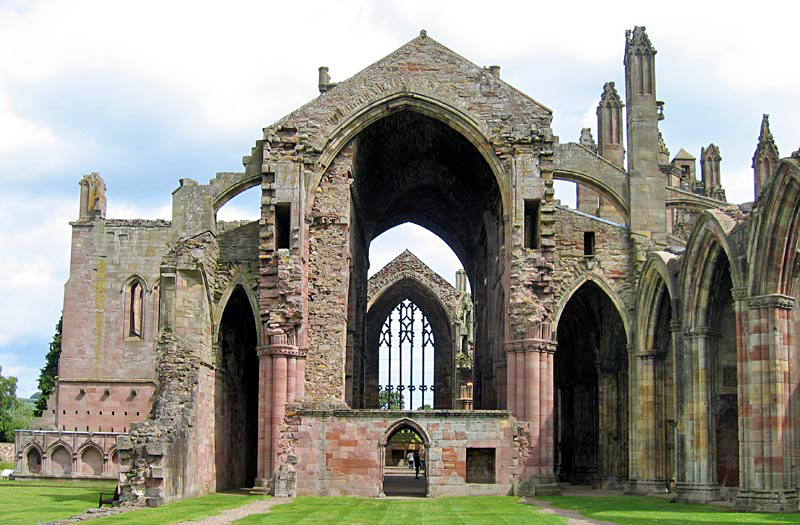
Saint Waltheof de Melrose
Abbé cistercien (+ 1159)
Walthène, Waltheof,
Waldef, Walden, Wallevus, Walène ou Walthen.
Fils d'un duc anglais, né
vers 1100, élevé à la cour du roi d'Ecosse quand sa mère, veuve, épousa David
Ier. Il est influencé par Saint Aelred. Attiré
par la vie monastique, il entre chez les augustiniens dans le Yorkshire et est
élu abbé de Kirkham. Il rejoint ensuite les cisterciens et devient abbé de Melrose,
abbaye fondée par le roi David Ier, près de celle fondée par Saint
Aidan au VIIe siècle. Il est réputé pour une grande charité envers les
pauvres, la sainteté de sa vie et sa profonde austérité.
Voir aussi: Melrose
abbey - Historic Scotland - site en anglais
SOURCE : http://nominis.cef.fr/contenus/saint/12649/Saint-Waltheof-de-Melrose.html

Melrose Abbey, Melrose, Scotland
Also
known as
Walthen
Waldef
Walden
Waldeve
Wallevus
Walene
Profile
Born to the English nobility,
the second son of Simon, Earl of Huntingdon, and Maud (Matilda), grand-niece of
William the Conqueror. Grandson of Saint Waldef
of Northumbria. Even as a child,
Waltheof felt drawn to churches, and later to the religious
life. Following his father‘s death,
he, his mother and
his brother moved to Scotland where
Maud married King David
I. Part of David’s court where
he was educated and
became a spiritual student of Saint Aelred
of Rievaulx, master of the royal household. Deciding on a religious
life, Waltheof left Scotland.
Augustinian canon at
Nostelle Monastery,
Yorkshire, England c.1130. Abbot of
Kirkham, England in 1134.
Chosen archbishop of York, England in 1140,
but King Stephen
opposed Waltheof’s connections with and sympathy toward Scotland,
and prevented the appointment.
Cistercian monk at
Wardon, Bedforshire, England;
he tried to bring along some of his brothers, but failed. Abbot of Melrose
Abbey in 1149.
Acquainted with Saint Malachy
O’More, and helped him in his travels.
With his step-father, King David,
he helped found monasteries at
Cultram and Kinross. Named archbishop of Saint
Andrews, Scotland in 1154,
but felt inadequate; he convinced Saint Aelred of
his desire to avoid the see,
and Aelred publicly
opposed the appointment.
Noted for his severe,
self-imposed austerities, endless kindness to the poor,
and a gentle hand with the brothers under
his supervision. Received visions of
Christ during the feasts of Christmas, Passiontide,
and Easter;
had visions of
heaven and hell. Miracle worker
who is reported to have multiplied food, and miraculously healed the sick,
especially the blind.
Born
3 August 1160 of
natural causes
buried at
the Cistercian chapter
house at Melrose
Abbey
body found incorrupt in 1207,
but when moved again in 1240,
it had decayed
Cistercian kneeling
by a block of stone at sunrise
restoring sight to
a blind man
Additional
Information
Book
of Saints, by the Monks of
Ramsgate
Book
of Saints, by the Monks of
Ramsgate
Calendar
of the Scottish Saints
Life
of Saint Waltheof, by Father John
Dobree Dalgairns
Lives
of the Saints, by Father Alban
Butler
Saints
of the Day, by Katherine Rabenstein
books
Our Sunday Visitor’s Encyclopedia of Saints
other
sites in english
video
fonti
in italiano
MLA
Citation
“Saint Waltheof of
Melrose“. CatholicSaints.Info. 6 April 2024. Web. 12 June 2026.
<https://catholicsaints.info/saint-waltheof-of-melrose/>
SOURCE : https://catholicsaints.info/saint-waltheof-of-melrose/
Article
(Saint) Abbot (August 9)
(12th
century) A monk of
almost princely birth who governed wisely for the space of eleven years the
great Abbey of
Melrose. He entered into his rest A.D. 1159.
Many years later, on his tomb being opened, his body was found to be incorrupt.
MLA
Citation
Monks of Ramsgate.
“Waltheof”. Book of Saints, 1921. CatholicSaints.Info.
9 August 2016. Web. 12 June 2026.
<https://catholicsaints.info/book-of-saints-waltheof/>
SOURCE : https://catholicsaints.info/book-of-saints-waltheof/
Article
(Saint) Abbot (August 3)
(12th
century) A Canon
Regular of Nostel near Pontefract in Yorkshire, who passed to
the Cistercian
Order and became Abbot of
Melrose. He was remarkable for his gift of high prayer and
for the miracles he
wrought. He died A.D. 1160,
and fifty years afterwards his body was found to be still incorrupt.
MLA
Citation
Monks of Ramsgate.
“Walthen”. Book of Saints, 1921. CatholicSaints.Info.
2 August 2016. Web. 12 June 2026. <https://catholicsaints.info/book-of-saints-walthen/>
SOURCE : https://catholicsaints.info/book-of-saints-walthen/
Waltheof of Melrose, OSB
Cist. Abbot (AC)
(also known as Waldef, Walden,
Wallevus, Walène, Walthen)
Died August 3, c. 1160.
Waltheof was the grandson of the Northumbrian patriot Saint Waldef, and the
second son of Earl Simon of Huntingdon and Matilda (Maud), daughter of Judith,
the niece of William the Conqueror. During their childhood, his elder brother
Simon loved to build castles and play at soldiers, but Waltheof's passion was
to build churches and monasteries of wood and stones. When grown up, Simon
inherited his father's martial disposition as well as his title; but Waltheof
had a strong inclination toward the religious life, and was mild and
peace-loving.
When their father died,
King Henry I gave their mother in marriage to King Saint David of Scotland.
Waltheof followed his mother to the Scottish court, where he became an intimate
friend of Saint Aelred, who was master of the royal household at that time.
Soon Waltheof decided to
enter religious life. He left Scotland, and, about 1130, professed himself an
Augustinian canon regular at Nostell, near Pontefract in Yorkshire. He was soon
chosen prior of the recently founded Kirkham (1134) in the same country, and,
realizing the obligations he now had to work for the sanctification of others
as well as himself, he redoubled his austerity and regularity of observance.
In 1140, Waltheof was
chosen by the canons of York to succeed Thurstan as archbishop, but King
Stephen quashed the election because of Waltheof's known Scottish sympathies.
Waltheof, impressed by
the life and vigor of the Cistercian monks, became anxious to join them. At
first he tried to unite his community en bloc with that of Rievaulx, but met
with opposition. Naturally he was encouraged by the advice of his friend
Aelred, then abbot of Rievaulx, and accordingly he took the habit at Wardon
(Waldron) in Bedfordshire.
Perhaps because one of
his own traits was undaunted cheerfulness, Waltheof found Cistercian life
excessively severe. The canons also put obstacles in his way. But he persevered
as a Cistercian and moved to Rievaulx, where Aelred had been elected abbot in
1148. Only four years after profession, Waltheof was chosen abbot of Melrose in
1149, recently founded on the banks of the Tweed by King David. He had
succeeded a man of ungovernable temper, so his sweetness must have been a shock
for his brothers. He won their love and respect through humility, simplicity,
and kindness. Like Saint Mayeul of Cluny, he preferred to be damned for
excessive mercy rather than for excessive justice. With the help of King David,
he also founded monasteries at Cultram and Kinross.
Whenever he fell into the
smallest failing by inadvertence, Waltheof immediately made his confession, a
practice of perfection which the confessors found rather trying, as one of them
admitted to Jordan, the saint's biographer. In 1154 (or 1159), Waltheof was
chosen archbishop of Saint Andrew's; but he prevailed upon Aelred to oppose the
election and not to oblige him to accept it.
Upon his death, this
saint of unbounded generosity to the poor was buried in the chapter house at
Melrose. In 1207, his body was found to be incorrupt and was translated. When
it was again translated in 1240, it was corrupted. Waltheof was never formally
canonized but a popular cultus continued until the time of the Reformation.
Many miracles were recorded
of Saint Waltheof during his lifetime. He had Eucharistic visions of Christ in
the form appropriate to the feasts of Christmas, Passiontide, and Easter, and
visions of heaven and hell. He multiplied food and had the gift of healing
(Benedictines, Farmer, Walsh).
In art, Saint Waltheof is
portrayed as a Cistercian kneeling by a block of stone at sunrise. Sometimes he
may be shown restoring sight to a blind man (Roeder).
SOURCE : http://www.saintpatrickdc.org/ss/0803.shtml
St. Walthen, or Waltheof,
Abbot of Melross, Confessor
HE was second son of
Simon, Earl of Huntingdon, and Maud, daughter to Judith the niece of William
the Conqueror, who was married to Waltheof, the powerful Earl of
Northumberland, grandson to the warlike Earl Siward, in his time the bulwark of
his country. Walthen, the son of Siward, was the valiant count and governor of
Northumberland, and part of Yorkshire, when the Norman conquered England,
eminent for his martial exploits and much more for his devotion, immense
charities, and all heroic Christian virtues. The Conqueror suspecting him to
favour the exiled Saxon family which had taken sanctuary in Scotland,
treacherously invited him to court as if it had been to honour him; then cast
him into prison, and caused him to be beheaded at Winchester. The constancy,
piety, and resignation with which he received his death, procured him the title
of martyr among the people. His body was buried in St. Guthlake’s church at
Croyland, and afterwards, upon the evidence of miracles wrought at his tomb, of
which a history was compiled and kept in that abbey, was taken up and deposited
behind an altar in that church, as Fordun relates. He left only one child, the
Countess Maud, who was married to Simon, Earl of Huntingdon, by whom she had
two sons, Simon and Walthen. In their infancy it was the pastime of Simon to
build towers and castles, but Walthen’s to build churches and monasteries of
paper and wood. When grown up the elder brother Simon inherited his father’s
martial disposition together with his titles; but Walthen, from his cradle,
discovered the strongest inclinations to piety, and was humble, modest, mild,
obedient, beneficent, prudent, and devout much beyond his years. The first
impressions of these virtues, together with a great esteem of angelical purity,
he received from his pious mother Maud, who, after the death of her first
husband, was given in marriage by king Henry I. to David, the most religious
king of Scotland, and the worthy son of St. Margaret. Walthen followed his
mother to that court, where he contracted an intimate friendship with St.
Aëlred, in whose heart our saint sowed the first seeds of his perfect
conversion from the world. The good king was charmed with the virtues of his
son-in-law, gave him on all occasions marks of his particular affection, and
took great delight in his company.
The young nobleman was
too steadfastly grounded in the maxims of humility and mortification to be
seduced by the flatteries of the world; and the smiles of fortune served only
to make him the more apprehensive of its dangers. To fence his heart against
these illusions, and the contagion of the air which he breathed in the world,
he was solicitous to put on the armour of God, that he might be able to resist
all assaults, watch against the secret insinuations of a worldly spirit, and
stand in all things perfect. Loving and valuing only heavenly things, and being
always fervent in the exercise of good works, he seemed to be carried with
wings in the path of every virtue. Whatever he did he used to say to himself:
“What will this avail me to eternal life?” Such was his ardour for prayer, that
he found opportunities to practise it in those very circumstances which often
make others forget it. When he went out hunting with the king, his majesty
would himself present him with a bow and quiver; but Walthen, giving them to
some servant or other person, and withdrawing from the company into the wood,
used to hide himself in some secret place amidst the thickets, and there employ
the day in prayer, holy meditation, or reading some pious book which he carried
in his pocket. The king having one day surprised him in this employment, told
the queen at his return that her son was not a man of this world; for he could
find no amusement or satisfaction in any of its diversions. By the strictest
temperance, the assiduous mortification of his will and senses, and a constant
watchfulness over his heart, supported by a life of prayer, he kept his
passions in due subjection, and enjoyed a happy tranquillity within himself, in
the constant and uniform pursuit of virtue.
His purity he carried
unsullied by the least stain from his birth into the heavenly paradise. A
subtle assault which was made upon him against his virtue, contributed to
disgust him entirely with the world. A certain lady of the first rank at court
was fallen in love with him, and not daring to discover her passion, she sought
to gain his heart insensibly. With this view she sent him one day a present of
a rich gold ring in which the stone was a diamond of extraordinary value.
Walthen received it as a civility without any further meaning, and innocently
put the ring on his finger. Hereupon one of the courtiers said: “Walthen begins
to have some regard for the ladies.” This reflection made the saint sensible of
the snare, and of the tendency of such presents. He therefore immediately went
out of the room, and to prevent the danger of any temptation ensuing, pulled
off the ring, and threw it into a great fire, thus gaining a double victory
over impurity, and a vain affection of worldly toys. This accident made him
stand more upon his guard against the very shadow of dangers; and the
consideration of the snares of the world, and of the unprofitableness of many
of his moments in it, led him to a resolution of taking shelter in a monastery.
To be removed from the
distracting visits of friends, and from the neighbourhood of the court, he left
Scotland, and made his religious profession among the regular canons of St.
Austin, in St. Oswald’s monastery at Nostel, near Pontefract in Yorkshire. Here
he lived concealed from the world, in the company of his crucified Jesus,
humbling himself so much the lower in proportion as he had been exalted above
others in the world. Kings and the great ones of the world were astonished at
his humility; but his colleagues in a religious state were more surprised to
see one come out of a court already perfect in the maxims of the cross. He was
after some time promoted to the holy order of priesthood; and, agreeably to his
inclinations, always to attend the altar, was appointed sacristan. He was soon
after, against his will, chosen prior of Kirkham, a numerous house of that
Order in the same county. Considering the obligations he then lay under for the
sanctification of others as well as for his own, in this dignity he redoubled
his fervour in the practice of austerity, regularity, and every virtue. Nothing
appeared in him more remarkable than his devotion, and the abundance of tears
with which his prayers were usually accompanied, especially when he was
celebrating the divine mysteries. In saying mass one Christmas-day, after the
consecration of the bread, he was ravished in the contemplation of that divine
mystery of God made man, and melting into tears of love and tender devotion,
was favoured with a wonderful vision. The Divine Word, who on that day had made
himself visible to mankind by his nativity, was pleased to manifest himself not
only to the eyes of faith, but also to the corporal eyes of his servant. The
holy man saw in his hands, not the form of bread, but a most amiable infant of
ravishing beauty, stretching out its hands as if it had been to embrace him,
and looking upon him with a most gracious countenance: in which vision the
saint finding himself penetrated with unspeakable sweetness and heavenly
delights, paid a thousand adorations to that divine infant whom he could not
sufficiently love. When he had laid down the host on the altar he saw only the
sacramental form. He could never after remember this favour without tears of
sensible joy, sweetness and love. The saint disclosed this favour only to his
confessarius, who after his death told it to several others, and confirmed his
testimony that he received the account from the saint himself with an oath. The
author says he himself heard it from the mouth of this confessarius, and also
from divers Cistercian monks both at Melross and at Holm-Coltrum. 1 Whilst
a canon of Kirkham was saying mass, a spider fell into the chalice. The prior
being called made the sign of the cross over the chalice, then bid the priest
drink it; which he did without receiving any harm, or feeling any repugnance. 2
Walthen, moved by the
great reputation of the Cistercian Order, was very desirous to embrace it: in
which resolution he was encouraged by the advice of his friend St. Aëlred, then
abbot of Rievalle. Accordingly our saint took the habit of that Order at
Wardon, a Cistercian convent in Bedfordshire. The regular canons, who both
loved and honoured him, used all endeavours to retain him among them. Earl
Simon, the saint’s brother, alleging that the austerities of this latter Order
were too severe for his tender constitution, employed both the secular and
ecclesiastical power to oblige him to quit it, and even threatened to destroy
the monastery if he remained in it. The monks therefore sent the saint to
Rievalle, their mother-house in Yorkshire, that he might be further out of the
earl’s reach. During the year of his novitiate St. Walthen suffered much more
from a most grievous interior trial than he had done from the persecutions of
his kindred, or of the canons of Kirkham; but from these afflictions, his pure
soul reaped infinite spiritual advantages; for St. John Climacus observes, 3 that
God prepares souls for his choicest graces by interior crosses, by which all
earthly dross in their affections is most perfectly purged, their constancy is
put to the test, and occasions are afforded them for the exercises of the most
difficult and heroic virtues. It was thus by an effect of the divine mercy,
that the saint fell into a state of spiritual dryness, and interior desolation
and darkness of soul.
Though the canons allow a
religious man to pass from one order to another that is more perfect and
austere, he began, nevertheless, to be perplexed with scruples and anxious
fears whether he ought not rather to have remained in his first vocation, and
whether the extraordinary austerities of this new order were not above his
strength. His body seemed to sink under the weight of his watchings, fasts, and
labour, every exercise seemed heavy and grievous, his soul was drowned in
bitterness, and he seemed in vain to seek comfort and strength by prayer. Had
the enemy prevailed over him by this means to become more remiss in that holy
exercise, the saint would have sunk under the trial; but notwithstanding the
bitterness and heaviness with which he was overwhelmed so as to seem to himself
almost incapable of prayer, the divine grace supported and directed him still
to persevere, and even to redouble his fervour in continually laying before the
eyes of his heavenly Father, the God of all Consolation, the anguish
of his heart, and his earnest desires to raise up his soul to praise and love
him, with his faithful servants, and to implore his mercy, though of all creatures
the most unworthy. Nevertheless, his fears and inward darkness and agonies
continued still to increase; but after a long conflict with this painful enemy,
in great anguish of soul, he one day cast himself on the ground, as he had
often done, to pray with the utmost earnestness, and in that posture poured
forth a flood of tears, begging of God that he would vouchsafe to direct him
that he might follow his holy will, to which he had always desired to
consecrate himself without reserve. He no sooner rose from his prayer but he
found the thick mists of darkness which had overwhelmed his mind scattered, and
his soul suddenly filled with light, fervour, and an inexpressible holy joy, in
which he sung the praises of the divine mercy with an interior jubilation which
seemed to give him, in some degree, a foretaste of the joys of the blessed.
From that moment he found the yoke of the Lord sweet and easy, and used to
repeat that saying of St. Bernard, that worldlings who thought the austerities
of devout persons hard, saw their crosses, but saw not the interior unction of
the Holy Ghost by which they are made light. 4 Neither
do they know the strength or wings which the fervour of divine love gives to
the soul, nor the vigour and comfort with which the view and hope of an
immortal crown inspires her.
Walthen, four years after
his profession, was chosen abbot of Melross, a great monastery in the marches
of Scotland, on the river Tweed, for some time the burying place of the noble
family of Douglas. The saint took upon him this charge with great reluctance,
and only because he was compelled by obedience. In correcting others he
tempered severity with sweetness, so as to make them love the correction
itself, and to gain their heart to their duty. After the person had done
penance for a fault, he would never suffer it to be any more mentioned, saying
this was to act a worse part than that of the devils, who forget our sins when
they have been wiped away by sincere repentance. In hearing confessions he
often, out of tender compassion, wept abundantly over the penitent, and by
moving words softened the hearts of the most hardened sinners to compunction
and tears. If he perceived that he was fallen into the smallest failing of
inadvertence he had recourse immediately to the remedy of confession, accused
himself of it with many tears, and caused another severely to discipline his
bare shoulders, often to blood. By the continual exercises of penance, and deep
compunction, he endeavoured always to obtain the grace by which his soul might
be cleansed more and more perfectly, that he might at prayer present himself
without spot before God, who is infinite purity and infinite sanctity, and
whose eyes cannot bear the least iniquity or uncleanness. Yet a certain
cheerfulness and spiritual joy always shone on his pale countenance. His words
were animated with a divine fire, and sweet unction, by which they penetrated
the hearts of those who heard him; his voice was sweet and soft, but weak and
low, which was owing to the feebleness of his body, and to his assiduous singing
of psalms, which was usually accompanied with many tears. He founded the
monastery of Kylos in Scotland, and that of Holm-Coltrum in Cumberland. By his
great alms he supported the poor of the whole country round his abbey to a
considerable distance. In a famine which happened in 1154, about four thousand
poor strangers came and settled in huts near Melross, for whom he provided
necessary sustenance for several months. He sometimes induced his monks to
content themselves with half their pittances of bread, in order to supply the
poor. He twice multiplied bread miraculously, and sometimes gave away at once
all the cattle and sheep that belonged to his monastery.
His humility and love of
holy poverty appeared in all his actions. In travelling he would carry the
baggage of his companions, and sometimes that of servants. He went once to wait
on King Stephen in England, about certain affairs of his community, carrying a
bundle on his back. His brother Simon, who was with the king, was moved with
indignation at the sight, and said to his majesty: “See how this brother of
mine, and cousin to your majesty, disgraces his family.” “Not so,” said the
king; “but if we understand what the grace of God is, he does us and all his
kindred a very great honour.” He readily granted all the saint desired, begged
his blessing, and after his departure expressed how much he was moved by his
example to a contempt of the world for the love of God. In 1154 Walthen was
chosen archbishop of St. Andrew’s; but by his tears and repeated assurances
that the weight of such a burden would in a short time put an end to his life,
he prevailed with his superior St. Aëlred, not to oblige him by his command to
accept that dignity. Our saint cured many sick by his prayers, but studied
always to disguise whatever appeared miraculous. He was favoured with frequent
visions and ecstacies. In one of these, whilst he was praying with ardent sighs
that he might be so happy speedily to behold the King of kings manifested in
his beauty and glory, and admitted to praise him, with his whole heart, in the
company of all the saints, he saw the heavens opened, and God discovered to him
the bright thrones in which his saints are seated in that kingdom which he had
prepared for them from the beginning. The saint, who never ceased to excite in
his monks the desire and expectation of eternal life, in order to encourage
them in their penitential courses, in one of those exhortations mentioned this
vision in the third person as of another; but at last by surprise spoke in the
first person, which he no sooner perceived, but, cutting his discourse short,
he withdrew with many tears, much afflicted for the word which had escaped him.
The possession of God was the object of his longing and earnest desires night
and day; and these were more vehement in the time of consolations than amidst
crosses and in adversity. The contemplation of that day which would drown him
in the boundless ocean of eternal joy, was the comfort and support of his soul
during his last tedious and lingering illness, in which he bore great pains
with the most edifying silence and patience. Having exhorted his brethren to
charity and regular discipline, and received the last sacraments, lying on
sackcloth and ashes, he calmly gave up his soul to God on the 3d of August,
1160. His body was found incorrupt thirteen, and again forty-eight years after
his death. Several miracles wrought by his relics and intercession are recorded
by the authors of his life. His name occurs in the English Calendars, and in
those of his order. See his authentic life written by a disciple, extant in the
Bollandists. See also Manriquez in the annals of his order, and Le Nain, t. 2,
John de Fordun, Scoti-chronicon, l. 6, c. 3, 4, 5, 6, 7, 8, 25, 27, 28, 29, 30,
31, 32, 34, &c., t. 3.
Note 1. See his
authentic life; also John de Fordun, Scotichronicon, l. 6, c. 8, t. 3, p. 518,
ed Hearne. [back]
Note 2. Though some
spiders are venomous, modern philosophers assure us that the domestic kinds
which weave webs are harmless. See Philos. Transact. [back]
Note 3. Gr. 1. n.
23. [back]
Note 4. Cruces
vident, unctiones non vident. S. Bero. Serm. in Cant. [back]
Rev. Alban
Butler (1711–73). Volume VIII: August. The Lives of the
Saints. 1866
SOURCE : http://www.bartleby.com/210/8/034.html
Saint Waltheof of Melrose
Jul 09, 2015 /
Written by: America
Needs Fatima
Feast August 3
Abbot of Melrose
Waltheof was born of
English nobility. The son of Simon, the Earl of Huntingdon, and Maud, the
grand-niece of William the Conqueror, he was also the grandson of Saint Waldef
of Northumbria.
As a child, Waltheof felt
drawn to churches and the religious life. Following his father's death, he, and
his mother and brother moved to Scotland where Maud married King David I. As
part of the royal court, he was educated and became a spiritual student of St.
Aelred.
Following his long-held
inclination to contemplation and desiring to dedicate himself entirely to God,
Waltheof left Scotland and traveled to Yorkshire to join the Augustinian Canons
at the monastery at Nostell.
He was soon chosen as prior, and led the monks in a more austere rule. Some
time later, Waltheof left Nostell for the more austere life of the Cistercian
monks.
Four years after receiving the Cistercian habit, he was nominated as abbot of
Melrose, a newly established monastery. Then, in 1154, he was chosen as the new
bishop of St. Andrews, but in his humility, he begged St. Aelred to oppose the
election and not oblige him to accept.
Waltheof died in 1160 of old age. It has been said that he strove so greatly
for perfection, that his confessors often found him irksome.
SOURCE : https://americaneedsfatima.org/articles/saint-waltheof-of-melrose
St Waldef
Celebrated on August
3rd
Cistercian abbot. Of
noble birth, (he was the son of Earl Simon of Northampton and Matilda, the
great niece of William the Conqueror) Waldef (Waltheof) was born in 1100 and
grew up in the Scottish court. He could have become a court cleric, but chose
the monastic life, becoming an Austin canon at Nostell in Yorkshire. In 1134,
he became prior of Kirkham. In 1140 he was a favourite to become Archbishop of
York but King Stephen prevented this because he felt he would be too
sympathetic to Scotland.
In his Life of Waldef, Jocelin of Furness writes: 'Waldef's face was the
faithful interpreter of the inner man and gave convincing evidence of the
indwelling of the Holy Spirit inhabiting his heart. It was thin, but fair
except where ruddy colour infused his cheeks, soft as doves. His handsome white
hair was in keeping with his reverend and religious character. His appearance
showed grace infusing his spirit with happiness and exultation; it expressed
the fact that the lord treasured him, and induced all who saw and spoke to him
to hold him in affectionate reverence.'
St Waldef wanted to bring the Cistercians at Rievaulx and the Austins at Kirkham
together, but the canons objected strongly. In 1149 he became abbot of Melrose,
taking over from someone who had a notorious temper. St Waldef developed a
reputation for great kindness, gentleness and humility. He went on to found
monasteries at Cultram and Kinross. In 1159 he was asked to be bishop of St
Andrews but he refused as he knew death was near.
Jocelin also recalls that Abbot Waldef was prone to take a nap whilst riding
his horse, 'Brother Grizzel'. On such occasions the horse would pick his steps
carefully and slowly, lest he should trip, but once the abbot was awake he
would gallop swiftly, overtaking other steeds. Following Waldef's death, the
horse was distraught and simply wasted away through sadness.
St Waldef was never formally canonised but a popular cult grew around him until
the Reformation. During his life, many wonders were said to have taken place
including visions at Christmas and Easter and miracles of multiplying food.
SOURCE : https://www.indcatholicnews.com/saint/224
Miniature
Lives of the Saints – Saint Waltheof, Abbot
Article
Saint Waltheof was
brought up at the court of his step-father, King David of Scotland, and there
formed a friendship with Saint Aelred. When the king took him out to the chase
he would withdraw to some hidden spot, and spend his time in pious reading or
prayer. At the first chance he stole away from court to the Augustinian priory
of Saint Oswald’s in Yorkshire, where he hoped to lie hid and die. But such was
not his lot. He was chosen prior of Kirkham, and was sent to Rome to appeal
against the election of William, Archbishop of York. On his return, an interior
call of grace, seconded by the advice of Saint Aelred, moved him to exchange to
the Cistercian Order. Scarcely had he done so when a violent reaction set in,
and it was only after bitter suspense that he felt assured of having followed
God’s will. He became abbot of Melrose, and governed his monks with great
charity. He had the gift of tears, his voice was sweet and soft, and a certain
spiritual joy always shone on his pale face. Once he appeared before King
Stephen in England with his bundle of clothes on his back. His brother, who
stood by, said to the king, “See how my brother and thy kinsman does honour to
his lineage.” But Stephen answered, “If thou and I had only the grace to see
it, he is an ornament to our race.” Saint Waltheof died a.d. 1160. A stone in
the ruins of Melrose marks his grave.
Saint Waltheof teaches us
what he taught his monks — that we must never fear a cross because of its
outward look, as we see not the interior unction by which it is made light,
– Cruces vident, unctiones non indent.
God prepares souls for
His graces by interior crosses. By them the affections are purged of all
earthly dross, constancy is tried, and an occasion is afforded for the exercise
of the most difficult and heroic virtues. — Saint John Climacus
Saint Waltheof’s trial in
his novitiate is thus described. Observance of the rule became loathsome to
him; while his former life, though less austere, seemed more guided by
Christian prudence, and more fit for the saving of souls. The temptation
increased the more he prayed against it, till at length one day he flung
himself down in utter anguish, and asked only to do God’s will. An invisible
hand raised him from the ground, his soul was filled with light, and from that
moment he felt neither regret nor doubt. At the end of the year he received the
white habit from his friend, Saint Aelred, who clothed him with the usual form:
“The Lord put off thee the old man with his deeds.” Great indeed was the joy of
his heart as the brethren answered, “Amen.”
It is I, fear ye
not. – Mark 6:50
MLA
Citation
Henry Sebastian Bowden.
“Saint Waltheof, Abbot”. Miniature Lives of the
Saints for Every Day of the Year, 1877. CatholicSaints.Info.
3 March 2015. Web. 12 June 2026. <https://catholicsaints.info/miniature-lives-of-the-saints-saint-waltheof-abbot/>
SOURCE : https://catholicsaints.info/miniature-lives-of-the-saints-saint-waltheof-abbot/
Calendar
of Scottish Saints – Saint Walthen or Waltheof, Abbot
Article
A.D. 1160. He was the son
of Simon, Earl of Hunting don, and Maud, grand-niece of William the Conqueror.
After the death of her first husband, Maud married David, King of Scotland, one
of the sons of Saint Margaret. The early life of the young Walthen was consequently
spent at the Scottish Court, where he edified all who knew him by his purity of
life and diligent practice of the Christian virtues. Desiring to embrace the
religious life, Walthen left Scotland, and entered the monastery of Nostell in
Yorkshire, belonging to the Austin Canons. His holiness, attested by miracles,
procured the esteem of his contemporaries, and led to his appointment, while
still young, as Prior of the monastery of Kirkham, in the same county.
Attracted by the reputation of the Cistercians, he resolved to pass into that
Order, and was encouraged in his purpose by Saint Aelred, Cistercian Abbot of
Rievaulx, who became his attached friend. In spite of the remonstrances of his
religious brethren, and the avowed indignation of his kindred, Walthen
persevered in his resolution, and took the Cistercian habit at Rievaulx, where
he eventually made his profession as a monk.
He was made Abbot of the
Scottish abbey of Melrose, which he ruled till his death. In the later years of
his life he was nominated Archbishop of Saint Andrew’s; but his humility shrank
from the burden, and he prevailed upon his religious superiors to prevent the
election. He died at Melrose at an advanced age. Many miracles are attributed
to him, even during life, and fifty years after death his body was found to be
incorrupt.
MLA
Citation
Father Michael
Barrett, OSB.
“Saint Walthen or Waltheof, Abbot”. The Calendar
of Scottish Saints, 1919. CatholicSaints.Info.
9 June 2014. Web. 12 June 2026.
<https://catholicsaints.info/calendar-of-scottish-saints-saint-walthen-or-waltheof-abbot/>
SOURCE : https://catholicsaints.info/calendar-of-scottish-saints-saint-walthen-or-waltheof-abbot/