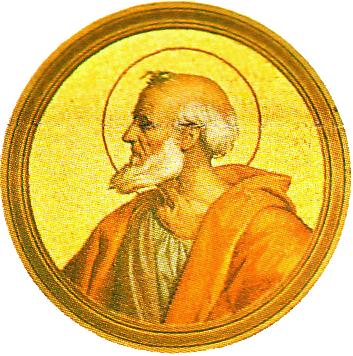
Portrait
imaginaire, basilique Saint-Paul-hors-les-Murs (mosaïque
du milieu du XIXe siècle).
Medaillon, um 1848, in der Kirche San Paolo fuori le Mura in Rom
Saint Simplice
Pape (47 ème) de 468 à
483 (+ 483)
Son long pontificat lui
fit connaître les dernières années de l'empire romain. Mais son action
s'étendit surtout à défendre la foi orthodoxe devant les hérésies de ce temps,
en soutenant l'application doctrinale du concile de Chalcédoine. Il eut
quelques démêlés avec le patriarche de Constantinople. La ville de Rome lui
doit beaucoup d'églises nouvelles et une répartition des tâches pastorales qui
donnent au clergé la charge paroissiale des baptêmes et des enterrements,
modifiant ainsi la géographie ecclésiastique romaine.
À Rome, près de saint
Pierre, en 483, saint Simplice, pape. Alors que les barbares dévastaient
l’Italie et Rome, il consola les affligés, favorisa l’unité de l’Église et
raffermit la foi.
Martyrologe romain
SOURCE : http://nominis.cef.fr/contenus/saint/734/Saint-Simplice.html
Saint Simplicius
(468-483)
Né à Tivoli, mort à Rome
en 483.
Son pontificat vit la fin
de l’empire de l’Occident.
Il s’occupa, entre autres
choses, de l’organisation du patrimoine du Saint-Siège, démontrant en cela ses
excellentes qualités d’administrateur.
Il fut l’adversaire des
adeptes du monophysisme
SOURCE : http://eglise.de.dieu.free.fr/liste_des_papes_04.htm
468-483
Simplicius, fils de
Castinus, était né à Tibur, qui est aujourd’hui Tivoli, dans les environs de
Rome, et était devenu une figure emblématique du clergé de la Ville.
Il succéda à saint
Hilarius (voir au 29 février), comme quarante-septième pape.
A Rome, l’empire latin
s’écroula en 476, lorsque le barbare Odoacre, chef des Hérules, balaya ce qui
restait du pouvoir des derniers empereurs. Le pape n’avait plus qu’à consoler
les chrétiens affligés et à jeter les semences de la foi dans ce monde des envahisseurs.
En Orient, l’empereur
Basilisque faisait repartir l’agitation doctrinale en favorisant les
eutychianistes (du nom de Eutychès, qui prétendait qu’à partir de
l’Incarnation, les deux natures du Christ étaient confondues) ; Pierre Monge,
diacre d’Alexandrie, jeta de l’huile sur le feu, et le patriarche de
Constantinople Acace, au lieu de seconder les efforts du pape, faisait signer
une formule doctrinale sinon pas hérétique, du moins trop compromissiste.
Condamnés, Acace et Pierre Monge persévérèrent dans l’erreur et le schisme.
Simplicius fit la
dédicace de plusieurs églises romaines : Saint-Etienne au Cœlius, Saint-Etienne
près de Saint-Laurent, Saint-André près de Sainte-Marie-Majeure,
Sainte-Bibiane.
Il ordonna trente-sept
évêques, cinquante-neuf prêtres et onze diacres.
Saint Simplicius mourut
le 10 mars 483.
Son successeur fut saint
Felix III.
SOURCE : http://www.samuelephrem.eu/article-simplicius-115433146.html
SAINT SIMPLICE
Pape de Rome
Simplice naquit à Tivoli
(Tibur) et eut pour père Castinus, dit l'auteur du Liber pontificalis. Sous ses
prédécesseurs immédiats, saint Léon le Grand et saint Hilaire, il fut
l'ornement du clergé de Rome. A son avènement, il y avait de grandes agitations
dans l'Église, son pontificat qui dura de 468 à 483, vit se dérouler de graves
événements en Occident et en Orient.
En Occident, ce fut la
chute de l'empire et l'envahissement des barbares. Pendant 20 années, les 10
derniers empereurs d'Occident n'avaient été que des ombres de potentats. La
8ème année du pontificat de Simplice, Rome devint la proie des étrangers. Les
Hérules, qui avaient demandé comme butin un tiers des terrains de l'Italie, se
virent rebutés dans leurs exigences; ils choisirent pour chef Odoacre, homme de
basse extraction, mais de haute taille, résolu, intrépide, hérétique arien. Il
était officier de la garde impériale, on le proclama roi de Rome en 476. Il mit
à mort Oreste, régent de l'empire au nom de son fils Augustule; il épargna ce dernier,
lui fournit une pension et lui permit d'aller vivre en liberté à Naples. Le
pape romain Simplice s'appliqua à consoler les affligés et à jeter les semences
de la foi catholique [orthodoxe à l'époque ] dans le monde barbare.
D'après des lettres qu'on
lui attribue, il régla divers points de discipline en litige. A Rome, il fit la
dédicace de plusieurs églises, Saint-Étienne au Mont-Celius, Saint-André près
de la basilique Sainte-Marie, une autre église sous le vocable de Saint-Étienne
près de la basilique Saint-Laurent, enfin l'église Sainte-Bibiane. Il pourvut
en même temps du clergé nécessaire les grandes basiliques de Saint-Pierre, de
Saint-Paul, de Saint-Laurent.
En Orient surtout, il lui
fallut intervenir pour tâcher de mettre fin au schisme fomenté par Acace,
patriarche de Constantinople : le dissentiment venait des revendications de ce
siège patriarcal et en partie aussi de l'hérésie monophysite condamnée en 451
par le Concile de Chalcédoine. La première occasion du conflit fut la promulgation
d'un édit de l'empereur Léon de Thrace, confirmant le 28e canon de Chalcédoine
donnant une primauté d'honneur à l'évêque de Constantinople, immédiatement
après l'évêque de Rome : le pape saint Léon avait fait opposition à ce canon.
Simplice dut envoyer un légat avec mission de protester contre l'édit impérial;
on ignore le succès de cette démarche.
La controverse doctrinale
fut réveillée par Basilisque, usurpateur de l'empire en 475, qui se prononça
pour l'eutychianisme, rappela Timothée Elure à Alexandrie : d'où agissements de
ce dernier pour rétablir les évêques eutychiens sur leurs sièges. A la mort
d'Elure, on vit Pierre Monge, un diacre d'Alexandrie, jouer un triste rôle dans
les dissentiments qui s'accentuèrent entre Constantinople et Rome : il devait
en résulter un schisme qui sépara l'Orient [hellénistique] et l'Occident durant
35 ans. Acace de Constantinople fut loin de seconder le zèle de Simplice : une
sorte de formule de profession de foi, désignée sous le nom d'Hénotique de
Zénon, où la condamnation d'Eutychês au Concile de Chalcédoine était passée
sous silence, dut être condamnée par le pape de Rome comme un compromis avec
une hérésie condamnée. Simplice mourut peu de temps après avoir écrit à Acace
une lettre de blâme pour son attitude à l'égard de Pierre Monge.
Cette mort de Simplice paraît devoir être placée au 10 mars 483 et non au 2 mars. De là vient que l'édition de 1922 du martyrologe romain a fait ce changement en se basant sur L. Duchesne, Liber pontificalis, t. , p. 251; substituer dans l'épitaphe, vi id. mart., à vi non. mart.
Le corps de Simplice fut enseveli dans la basilique de Saint-Pierre; les
habitants de Tivoli croient posséder ses reliques et célèbrent sa fête avec une
grande solennité.
SOURCE : http://www.histoire-russie.fr/icone/saints_fetes/textes/simplice_rome.html

formerly 2 March
Profile
Son of Castinus. Held
the pontificate during
the end of the Roman Empire. He defended the Council of Chalcedon against
the Monophysites heresy of
the Eastern empire. Worked for the Italian people
against barbarian invaders. Built four large churches in Rome,
and brought some order and organization to the administration of the sacraments
in the local churches, bringing the focus back to the sacrament rather than the
place of its administration. Opposed Emperor Leo who wanted to officially make
the Patriarch of Constantinople second
only to the pope in
authority. Worked to support orthodox Christianity against
the Arianism promoted
by King Odoacer.
Born
Papal
Ascension
10 March 483 of
natural causes
interred in
Saint Peter’s Basilica, Vatican City, Rome, Italy
Additional
Information
Book
of Saints, by the Monks of
Ramsgate
Lives
of the Saints, by Father Alban
Butler
Roman
Martyrology, 1914 edition
Saints
of the Day, by Katherine Rabenstein
Short
Lives of the Saints, by Eleanor Cecilia Donnelly
books
Lives of the Saints, by
Sabine Baring-Gould
Our Sunday Visitor’s Encyclopedia of Saints
other
sites in english
Medieval Religion Listserv, by John Dillon
images
webseiten
auf deutsch
sitios
en español
Martirologio Romano, 2001 edición
fonti
in italiano
strony
w jezyku polskim
Conference of the Polish Episcopate
MLA
Citation
‘Pope Saint
Simplicius‘. CatholicSaints.Info. 5 January 2023. Web. 25 February 2026.
<https://catholicsaints.info/pope-saint-simplicius/>
SOURCE : https://catholicsaints.info/pope-saint-simplicius/

This
illustration is from The Lives and Times of the Popes by Chevalier Artaud
de Montor (1772–1849, New York: The Catholic Publication Society of America,
1911. It was originally published in 1842.
Book of Saints
– Simplicius – 2 March
Article
(Saint) Pope (March
2) (5th
century) A native of Tivoli who succeeded (A.D. 468) Saint Hilary
in the Chair of Saint Peter,
which he occupied for fifteen years, dying in
A.D. 483.
He strenuously upheld the Council of Chalcedon and resisted three successive
Emperors of Constantinople,
partisans, more or less, of the Eutychian heresy.
He did much good in Rome itself,
building churches and
watching over ecclesiastical discipline. Some of his Epistles are still extant.
MLA
Citation
Monks of Ramsgate.
“Simplicius”. Book of Saints, 1921. CatholicSaints.Info.
20 November 2016. Web. 25 February 2026.
<https://catholicsaints.info/book-of-saints-simplicius-2-march/>
SOURCE : https://catholicsaints.info/book-of-saints-simplicius-2-march/
St. Simplicius
Feastday: March 10
Death: 483
The first pope depicted
with a square nimbus in
a contemporary mosaic, St. Simplicius was
born in Tivoli and
was elected to the papacy in 468. In 476, the last emperor of the Western
Empire was deposed, and Odoacer the Goth became the first king of Italy and
a Roman patrician. Simplicius opposed monothelitism and built churches. He
wanted to maintain papal authority in the Western Empire in spite of the
collapse of civil authority. Simplicius died, after a long illness, in 483.
SOURCE : https://www.catholic.org/saints/saint.php?saint_id=910
New
Catholic Dictionary – Pope Saint Simplicius
Article
Reigned from 468 to 483.
Born in Italy; died in Rome. His pontificate, which saw the Western Empire fall
under barbarian control, was disturbed by the Monophysite controversy
in the East. He defended the independence of the Church against the
encroachments of the Emperor Zeno, who sought to have his Henotikon recognized
by Rome in 482; upheld the authority of the pope in matters of faith, in
opposition to the future schismatic patriarch, Acacius; condemned Peter Mongus,
Fullo, Paul of Ephesus, and John of Apamea; and built four churches in Rome.
Feast, Roman Calendar, 2 March.
MLA
Citation
“Pope Saint
Simplicius”. New Catholic Dictionary. CatholicSaints.Info.
10 August 2018. Web. 25 February 2026.
<https://catholicsaints.info/new-catholic-dictionary-pope-saint-simplicius/>
SOURCE : https://catholicsaints.info/new-catholic-dictionary-pope-saint-simplicius/
Saints of the
Day – Simplicius, Pope
Article
Born at Tivoli, Italy;
died 483. Simplicius was elected pope to succeed Pope Saint Hilary on March 3,
468. He defended the action of the Council of Chalcedon against the Monophysite
heresy, labored to help the people of Italy against the marauding raids of
barbarian invaders, and saw the Heruli mercenaries in Roman service revolt and
proclaim Odoacer king in 476 during his pontificate. Odoacer’s deposition of
the last Roman emperor, Romulus Augustus, and his occupation of Rome in 476
marked the end of the Roman Empire (Benedictines, Delaney).
MLA
Citation
Katherine I
Rabenstein. Saints of the Day, 1998. CatholicSaints.Info.
5 January 2023. Web. 25 February 2026. <https://catholicsaints.info/saints-of-the-day-simplicius-pope/>
SOURCE : https://catholicsaints.info/saints-of-the-day-simplicius-pope/
Pope St. Simplicius
St. Simplicius, a native
of Tivoli, was elected to succeed St. Hilary. His election was peaceful, his
pontificate stormy. The empire in the West was dying. After the murder of
Valentinian III back in 455, a succession of nine shadow emperors held the throne.
Most of these were tools of barbarian generals, and finally in the time of Pope
Simplicius in 476 the Heruli chieftain Odovakar deposed the last of these
little monarchs and informed Emperor Zeno at Constantinople that he would rule
the West for him. By this time, anyway, the imperial government had ceased to
exercise much influence in the West. Visigoths ruled Spain, Franks and other
tribes dominated Gaul, Vandals controlled Africa, and Britain had long been
abandoned to Picts and Scots, Angles and Saxons.
The Pope was not much
troubled by the change. Odovakar, though an Arian, treated the Church well. But
Simplicius was very much troubled by affairs in the East.
In 475 a usurper named
Basiliscus drove Emperor Zeno from the throne. Basiliscus favored the
Monophysites, and now these heretics enjoyed a very resurrection. Timothy the
Cat, that old Monophysite who had been deposed from the see of Alexandria by
Emperor Marcion, now returned in triumph. Peter the Fuller took over Antioch.
The usurper Basiliscus issued an imperial decree known as the “Encyclion” which
ordered the dogmatic letter of St. Leo to Flavian and the acts of the Council
of Chalcedon to be burned. It looked as if the whole East trembled on the brink
of heresy as five hundred bishops actually subscribed to this audacious bit of
imperial dogmatizing. Acacius the patriarch of Constantinople, still held firm,
and to his rescue came Pope Simplicius. He strongly encouraged the monks and
clergy of Constantinople to resist the usurper’s tyranny. But though
Constantinople held firm, Antioch and Alexandria were in heretic hands. When
Timothy the Cat died, he was succeeded by his friend the equally ardent
Monophysite, Peter the Hoarse.
Just when things looked
worst, Emperor Zeno made a comeback and regained the throne. Out went the
intruded Monophysite bishops. Back came the Catholics. Pope Simplicius could
feel that he had helped the East survive a fierce tempest. The time of peace,
however, was very short. When the Catholic patriarch of Alexandria died, the
Catholics elected John Talaia to succeed him. The Monophysites once more
elected Peter the Hoarse. Now the Emperor Zeno and Patriarch Acacius began to
favor the Monophysite, Peter. Strange this! But politics were at work. Zeno,
alarmed at the strength of the Monophysites, was thinking of a way to pacify
them, and Acacius was hand in glove with the Emperor. In spite of the Pope’s
protests, Peter the Hoarse was recognized as true patriarch of Alexandria. Then
Peter went to Constantinople, where he joined Zeno and Acacius to cook up a
compromise known as the Henoticon. This was in 482 while Simplicius still
lived; but he died before the storm reached its peak.
St. Simplicius built four
churches in Rome. He died in 483. His feast is kept on March 2.
SOURCE : http://www.ucatholic.com/saints/pope-saint-simplicius/
Pope St. Simplicius
Reigned 468-483; date of
birth unknown; died 10 March, 483. According to the "Liber
Pontificalis" (ed. Duchesne, I, 249) Simplicius was the son of a
citizen of Tivoli named
Castinus; and after the death of Pope Hilarius in 468 was elected to succeed
the latter. The elevation of the new pope was
not attended with any difficulties. During his pontificate the Western Empire
came to an end. Since the murder of Valentinian
III (455) there had been a rapid succession of insignificant emperors
in the Western Roman Empire, who were constantly threatened by war and
revolution. Following other German tribes the Heruli entered Italy,
and their ruler Odoacer put an end to the Western Empire by deposing the last
emperor, Romulus Augustulus, and assuming himself the title of King of Italy.
Although an Arian,
Odoacer treated the Catholic Church with
much respect; he also retained the greater part of the former administrative
organization, so that the change produced no great differences at Rome.
During the Monophysite controversy,
that was still carried on in the Eastern Empire, Simplicius vigorously defended
the independence of the Church against
the Cæsaropapism of the Byzantine rulers
and the authority of the Apostolic
See in questions of faith.
The twenty-eighth canon of the Council
of Chalcedon (451) granted the See of Constantinople the same
privileges of honour that
were enjoyed by the Bishop of
Old Rome,
although the primacy and the highest rank of honour were
due to the latter. The papal
legates protested against this elevation of the Byzantine Patriarch,
and Pope Leo confirmed only the dogmatic decrees of the council. However,
the Patriarch of
Constantinople sought to bring the canon into force, and the Emperor Leo II
desired to obtain its confirmation by Simplicius. The latter, however, rejected
the request of the emperor and opposed the carrying out of the canon, that
moreover limited the rights of
the old Oriental patriarchates.
The rebellion of
Basiliscus, who in 476 drove the Emperor Zeno into exile and seized the
Byzantine throne, intensified the Monophysite dispute.
Basiliscus looked for support to the Monophysites,
and he granted permission to the deposed Monophysite patriarchs,
Timotheus Ailurus of Alexandria and
Peter Fullo of Antioch, to return to their sees.
At the same time he issued a religious edict (Enkyklikon) addressed to Ailurus,
which commanded that only the first three ecumenical synods were
to be accepted, and rejected the Synod of Chalcedon and the Letter of Pope Leo.
All bishops were
to sign the edict. The Bishop of
Constantinople, Acacius (from 471), wavered and was about to proclaim this
edict. But the firm stand taken by the populace, influenced by the monks who
were rigidly Catholic in
their opinions, moved the bishop to
oppose the emperor and to defend the threatened faith.
The abbots and priests of
Constantinople united with Pope Simplicius, who made every effort to maintain
the Catholic dogma and
the definitions of the Council
of Chalcedon. The pope exhorted
to loyal adherence to the true faith in
letters to Acacius, to the priests and abbots,
as well as to the usurper Basiliscus himself. In a letter to Basiliscus of 10
Jan., 476, Simplicius says of the See of Peter at Rome:
"This same norm of Apostolic doctrine is
firmly maintained by his (Peter's) successors, of him to whom the Lord
entrusted the care of the entire flock of sheep, to whom He promised not to
leave him until the end of time" (Thiel, "Rom. Pont.", 182). In
the same way he took up with the emperor the cause of the Catholic Patriarch of Alexandria,
Timotheus Salophakiolus, who had been superseded by Ailurus. When the Emperor
Zeno in 477 drove away the usurper and again gained the supremacy, he sent
the pope a
completely Catholic confession
of faith,
whereupon Simplicius (9 Oct., 477) congratulated him on his restoration to
power and exhorted him to ascribe the victory to God,
who wished in this way to restore liberty to the Church.
Zeno recalled the edicts
of Basiliscus, banished Peter Fullo from Antioch, and reinstated Timotheus
Salophakiolus at Alexandria.
He did not disturb Ailurus on account of the latter's great age, and as matter
of fact the latter soon died. The Monophysites of Alexandria now
put forward Peter
Mongus, the former archdeacon of
Ailurus, as his successor. Urged by the pope and
the Eastern Catholics,
Zeno commanded the banishment of Peter
Mongus, but the latter was able to hide in Alexandria,
and fear of the Monophysites prevented
the use of force. In a moment of weakness Salophakiolus himself had permitted
the placing of the name of the Monophysite patriarch Dioscurus in
the diptychs to
be read at the church services. On 13 March, 478, Simplicius wrote to Acacius
of Constantinople that Salophakiolus should be urged to wipe out the
disgrace that he had brought upon himself. The latter sent legates and
letters to Rome to
give satisfaction to the pope.
At the request of Acacius, who was still active against the Monophysites,
the pope condemned
by name the heretics Mongus,
Fullo, Paul of Epheseus, and John of Apamea,
and delegated the Patriarch of
Constantinople to be in this his representative. When the Monophysites at
Antioch raised a revolt in 497 against the patriarch Stephen II, and killed
him, Acacius consecrated Stephen
III, and afterwards Kalendion as Stephen's successors. Simplicius made an
energetic demand upon the emperor to punish the murderers of the patriarch, and
also reproved Acacius for exceeding his competence in performing this consecration;
at the same time, though, the pope granted
him the necessary dispensation.
After the death of Salophakiolus, the Monophysites of Alexandria again
elected Peter
Mongus patriarch, while the Catholics chose
Johannes Talaia. Both Acacius and the emperor, whom he influenced, were opposed
to Talaia, and sided with Mongus. Mongus went
to Constantinople to advance his cause. Acacius and he agreed upon a formula of
union between the Catholics and
the Monophysites that
was approved by the Emperor Zeno in 482 (Henotikon). Talaia had sent
ambassadors to Pope Simplicius to notify the pope of
his election. However, at the same time, the pope received
a letter from the emperor in which Talaia was accused of perjury and
bribery and a demand was made for the recognition of Mongus.
Simplicius, therefore, delayed to recognize Talaia, but protested energetically
against the elevation of Mongus to
the Patriarchate of Alexandria.
Acacius, however, maintained his alliance with Mongus and
sought to prevail upon the Eastern bishops to
enter into Church communion with him. For a long time Acacius sent no
information of any kind to the pope,
so that the latter in a letter blamed him severely for this. When finally
Talaia came to Rome in
483 Simplicius was already dead.
Simplicius exercised
a zealous pastoral
care in western Europe also,
notwithstanding the trying circumstances of the Church during
the disorders of the Migrations. He issued decisions in ecclesiastical questions,
appointed Bishop Zeno of Seville papal vicar
in Spain,
so that the prerogatives of the papal
see could be exercised in the country itself for the benefit of
the ecclesiastical administration.
When Bishop John of Ravenna in
482 claimed Mutina as a suffragan diocese of
his metropolitan see,
and without more ado consecrated Bishop
George for this diocese,
Simplicius vigorously opposed him and defended the rights of
the papal
see. Simplicius established four new churches in Rome itself.
A large hall built in the form of a rotunda on the Cælian Hill was turned into
a church and dedicated to St. Stephen; the main part of this building still
exists as the Church of
San Stefano Rotondo. A fine hall near the Church of Santa
Maria Maggiore was given to the Roman
Church and turned by Simplicius into a church dedicated to St. Andrew
by the addition of an apse adorned
with mosaics;
it is no longer in existence (cf. de Rossi, "Bull. di archeol.
crist.", 1871, 1-64). The pope built
a church dedicated
to the first martyr,
St. Stephen, behind the memorial church of San Lorenzo in Agro Verano; this
church is no longer standing. He had a fourth church built in the city in honour of St.
Balbina, "juxta palatium Licinianum", where her grave was; this
church still remains. In order to make sure of the regular holding of church
services, of the administration of baptism,
and of the discipline of penance in the great churches of the catacombs outside
the city walls, namely the church of
St. Peter (in the Vatican), of St.
Paul on the Via Ostiensis, and of St.
Lawrence on the Via Tiburtina, Simplicius ordained that the clergy of
three designated sections of the city should, in an established order, have
charge of the religious functions at these churches of the catacombs.
Simplicius was buried in St. Peter's on the Vatican. The "Liber
Pontificalis" gives 2 March as the day of burial (VI non.);
probably 10 March (VI id.) should be read. After his death King Odoacer desired
to influence the filling of the papal
see. The prefect of the city, Basilius, asserted that before death Pope
Simplicius had begged to issue the order that no one should be consecrated Roman bishop without
his consent (cf. concerning the regulation Thiel, "Epist. Rom.
Pont.", 686-88). The Roman clergy opposed
this edict that limited their right of election. They maintained the force of
the edict, issued by the Emperor
Honorius at the instance of Pope
Boniface I, that only that person should
be regarded as the rightful Bishop
of Rome who was elected according to canonical form with Divine
approval and universal consent. Simplicius was venerated as
a saint; his feast is
on 2 or 3 March.
Sources
Liber pontificalis, ed.
DUCHESNE, I, 249-251; JAFFÉ, Regesta Pont. Rom., 2nd ed., I, 77-80;
THIEL, Epist. Rom. Pontif., I (Brunswick, 1868), 174 sq.; LIBERATUS, Breviar.
Causæ Nestor., xvi sq.; EVAGRIUS, Hist. eccl., III, 4 sq.;
HERGENRÖTHER, Photius, I, 111-22; GRISAR, Geschichte Roms und der
Päpste, I, 153 sq., 324 sq.; LANGEN, Geschichte der römischen Kirche, II
(Bonn, 1885), 126 sqq.; WURM, Die Papstwahl (Cologne, 1902).
Kirsch, Johann
Peter. "Pope St. Simplicius." The Catholic Encyclopedia. Vol.
14. New York: Robert Appleton Company,1912. 2 Mar.
2016 <http://www.newadvent.org/cathen/14002a.htm>.
Transcription. This
article was transcribed for New Advent by Kenneth M. Caldwell. Dedicated
to the memory of Don McGonigle.
Ecclesiastical
approbation. Nihil Obstat. July 1, 1912. Remy Lafort, S.T.D.,
Censor. Imprimatur. +John Cardinal Farley, Archbishop of New York.
Copyright © 2023 by Kevin Knight.
Dedicated to the Immaculate Heart of Mary.
SOURCE : http://www.newadvent.org/cathen/14002a.htm
March 2
St. Simplicius, Pope and
Confessor
HE was the ornament of
the Roman clergy under SS. Leo and Hilarius, and succeeded the latter in the
pontificate in 497. He was raised by God to comfort and support his church
amidst the greatest storms. All the provinces of the western empire, out of
Italy, were fallen into the hands of barbarians, infected for the greater part
with idolatry or Arianism. The ten last emperors, during twenty years, were
rather shadows of power than sovereigns, and in the eighth year of the
pontificate of Simplicius, Rome itself fell a prey to foreigners. Salvian, a
learned priest of Marseilles in 440, wrote an elegant book on Divine
Providence, in which he shows that these calamities were a just chastisement of
the sins of the Christians; saying, that if the Goths were perfidious, and the
Saxons cruel, they were, however, both remarkable for their chastity; as the
Franks were for humanity, though addicted to lying: and that though these
barbarians were impious, they had not so perfect a knowledge of sin, nor
consequently were so criminal as those whom God chastised by them. The
disorders of the Roman state paved the way for this revolution. Excessive taxes
were levied in the most arbitrary ways. The governors oppressed the people at
discretion, and many were obliged to take shelter among the barbarians: for the
Bagaudes, Franks, Huns, Vandals, and Goths raised no taxes upon their subjects:
on which account nations once conquered by them were afraid of falling again
under the Roman yoke, preferring what was called slavery, to the empty name of
liberty. Italy, by oppressions, and the ravages of barbarians, was left almost a
desert without inhabitants; and the imperial armies consisted chiefly of
barbarians, hired under the name of auxiliaries, as the Suevi, Alans, Heruli,
Goths, and others. These soon saw their masters were in their power. The Heruli
demanded one third of the lands of Italy, and, upon refusal, chose for their
leader Odoacer, one of the lowest extraction, but a tall, resolute, and
intrepid man, then an officer in the guards, and an Arian heretic, who was
proclaimed king at Rome in 476. He put to death Orestes, who was regent of the
empire, for his son Augustulus, whom the senate had advanced to the imperial
throne. The young prince had only reigned eight months, and his great beauty is
the only thing mentioned of him. Odoacer spared his life, and appointed him a
salary of six thousand pounds of gold, and permitted him to live at full
liberty near Naples. Pope Simplicius was wholly taken up in comforting and
relieving the afflicted, and in sowing the seeds of the Catholic faith among
the barbarians.
The East gave his zeal no
less employment and concern. Zeno, son and successor to Leo the Thracian,
favoured the Eutychians. Basiliscus, his admiral, who, on expelling him,
usurped the imperial throne in 476, and held it two years, was a most furious
stickler for that heresy. Zeno was no Catholic, though not a staunch Eutychian:
and having recovered the empire, published, in 482, his famous decree of union,
called the Henoticon, which explained the faith ambiguously, neither admitting
nor condemning the council of Chalcedon. Peter Cnapheus, (that is, the Dyer,) a
violent Eutychian, was made by the heretics patriarch of Antioch; and Peter
Mongus, one of the most profligate of men, that of Alexandria. This latter
published the Henoticon, but expressly refused to anathematize the council of
Chalcedon; on which account the rigid Eutychians separated themselves from his
communion, and were called Acephali, or, without a head. Acacius, the patriarch
of Constantinople, received the sentence of St. Simplicius against Cnapheus, but
supported Mongus against him and the Catholic Church, promoted the Henoticon,
and was a notorious changeling, double dealer, and artful hypocrite, who often
made religion serve his own private ends. St. Simplicius at length discovered
his artifices, and redoubled his zeal to maintain the holy faith which he saw
betrayed on every side, whilst the patriarchal sees of Alexandria and Antioch
were occupied by furious wolves, and there was not one Catholic king in the
whole world. The emperor measured everything by his passions and human views.
St. Simplicius having sat fifteen years, eleven months, and six days, went to
receive the reward of his labours, in 483. He was buried in St. Peter’s on the
2nd of March. See his letters: also the historians Evagrius, Theophanes,
Liberatus, and amongst the moderns, Baronius, Henschenius, Ceillier, t. 15. p.
123.
Rev. Alban
Butler (1711–73). Volume III: March. The Lives of the
Saints. 1866.
Pictorial
Lives of the Saints – Saint Simplicius, Pope
Article
Saint Simplicius was the
ornament of the Roman clergy under Saints Leo and Hilarius, and succeeded the
latter in the pontificate in 497. He was raised by God to comfort and support
His Church amidst the greatest storms. All the provinces of the Western Empire,
out of Italy, were fallen into the hands of barbarians. The emperors for many
years were rather shadows of power than sovereigns, and in the eighth year of
the pontificate of Simplicius, Rome itself fell a prey to foreigners. Italy, by
oppressions and the ravages of barbarians, was left almost a desert without
inhabitants; and the imperial armies consisted chiefly of barbarians, hired
under the name of auxiliaries. These soon saw their masters were in their
power. The Heruli demanded one-third of the lands of Italy, and, upon refusal,
chose for their leader Odoacer, one of the lowest extraction, but a resolute
and intrepid man, who was proclaimed king at Rome in 476. He put to death
Orestes, who was regent of the empire for his son Augustulus, whom the senate
had advanced to the imperial throne. Odoacer spared the life of Augustulus, and
appointed him a salary of six thousand pounds of gold, and permitted him to
live at full liberty near Naples. Pope Simplicius was wholly taken up in
comforting and relieving the afflicted, and in sowing the seeds of the Catholic
faith among the barbarians. The East gave his zeal no less employment and
concern. Peter Cnapheus, a violent Eutychian, was made by the heretics
patriarch of Antioch; and Peter Mongus, one of the most profligate men, that of
Alexandria. Acacius, the patriarch of Constantinople, received the sentence of
Saint Simplicius against Cnapheus, but supported Mongus against him and the
Catholic Church, and was a notorious changeling, double-dealer, and artful
hypocrite, who often made religion serve his own private ends. Saint Simplicius
at length discovered his artifices, and redoubled his zeal to maintain the holy
faith, which he saw betrayed on every side, whilst the patriarchal sees of
Alexandria and Antioch were occupied by furious wolyes, and there was not one
Catholic king in the whole world. The emperor measured every thing by his
passions and human views. Saint Simplicius having sat fifteen years, eleven
months, and six days, went to receive the reward of his labors, in 483. He was buried
in Saint Peter’s on the?A of March.
Reflection – “He that
trusteth in God, shall fare never the worse,” saith the Wise Man in the Book of
Ecclesiasticus.
MLA
Citation
John Dawson Gilmary Shea.
“Saint Simplicius, Pope”. Pictorial Lives of the
Saints, 1889. CatholicSaints.Info.
30 July 2013. Web. 25 February 2026. <https://catholicsaints.info/pictorial-lives-of-the-saints-saint-simplicius-pope/>
SOURCE : https://catholicsaints.info/pictorial-lives-of-the-saints-saint-simplicius-pope/
Short
Lives of the Saints – Saint Simplicius, Pope and Confessor
Entry
Saint Simplicius, already
made famous by his piety and learning, during the pontificate of Saint Leo and
Saint Hilary, ascended the papal chair in 467. The Arian and Macedonian
heresies were then being boldly supported by the imperial authorities of the age,
and the seamless robe of Christendom was torn by violence and schism. But Saint
Simplicius did not despair. By his fervent prayers, by the prudence and
firmness of his policy, he met and mastered the difficulties which threatened
the cause of Christ; and after twelve laborious years of ecclesiastical
administration he died in 483, leaving the Church in perfect peace.
Well has the name of
Pontifex been given
Unto the Church’s head, as the chief builder
And architect of the invisible bridge
That leads from earth to heaven.
– Henry W. Longfellow
Favorite Practice – To
convince yourself that prayer and perseverance conquer all things.
MLA
Citation
Eleanor Cecilia Donnelly.
“Saint Simplicius, Pope and Confessor”. Short
Lives of the Saints, 1910. CatholicSaints.Info.
4 April 2021. Web. 25 February 2026.
<https://catholicsaints.info/short-lives-of-the-saints-saint-simplicius-pope-and-confessor/>
SOURCE : https://catholicsaints.info/short-lives-of-the-saints-saint-simplicius-pope-and-confessor/
Pope St. Simplicius
Debra Booton
McCoy | 02/28/2017
Pope St. Simplicius was
the last pope to be elected without the intercession of Arian barbarians. He
was elected March 3, 468 by the clergy and citizens of Rome without much
agitation. Like many popes of this era, Simplicius was the son of a Roman
citizen named Castinus, and was born in Tivoli, a town 30 kilometers from Rome.
The reign of Simplicius
coincided with the official fall of the Western Empire, in 476. The Italian
peninsula was overrun by barbarians and was in a constant state of war.
Eventually, the Herulis, an East Germanic tribe who formed a kingdom around the
middle Danube, joined forces with Odoacer and beat the Roman soldiers. The weak
Western emperor, Romulus Augustus, was deposed. Odoacer became king of a new
kingdom. Simplicius had been bishop of Rome for eight years at this point and
surely was concerned over a heretic taking command of the empire, considering
the ties that had developed between church and state. However, Odoacer was an
organizer. He saw the way the government that had been in power had worked hand
in hand with the Catholic Church, and, for the most part left the Church to
rule itself.
One of the early
difficulties Simplicius had was the defence of the Council of Chalcedon.
Simplicius probably was not even involved in this council, which was called in
October, 451 by the emperor, and, reluctantly, by Leo the Great. This council
repudiated the Second Council of Ephesus and defined the dual nature of Christ,
both divine and human. In addition, the Council of Chalcedon claimed that the
Patriarchy of Constantinople was second in standing only to Rome.
Simplicius found himself
on both sides of the support of the council. He supported the definition of
Christ's nature. But those against the definition, known as monophysites, had
spread like wildfire throughout the Levant and Egypt, thus showing a large
population arguing about the nature of the Lord. Simplicius was also opposed to
the elevation of the patriarchy of Constantinople. Thus began a tearing away of
the Eastern church from orthodoxy. The current Eastern emperor, Zeno, was more
or less orthodox. He was overthrown for a year in 475 by the monophysite,
Bascilicus. A year later, Zeno was reinstated, but this time chose to reconcile
with monophysitism. This was not an easy situation for the pope. And he did not
live to see the outcome.
The pope clashed with
Patriarch Acacius in the jurisdictional dispute and the argument almost
destroyed the legacy of Chalcedon.
Aside from this large
problem, Simplicius showed himself to be an able, effective administrator.
Concerned about his role as pastor to the Western Church, Simplicius appointed
Bishop Zeno of Seville as a papal vicar. He constructed several churches, at
least one of which was originally a columned walkway in the city of Rome. One
church is still extant, St. Bibiana's. A concern this pope had was what to do
with the churches of the catacombs, which were not used the same way as they
had the first few hundred years of Church history. He appointed priests to say
Masses, baptize and offer the Sacrament of Penance routinely in the three
primary catacomb churches: St. Peter's at the Vatican, St. Paul's and St.
Lawrence Outside the Walls.
A long illness led to
Simplicius' death on March 10, 483. This date is his feast day.
Pope St. Simplicius is
seen as one who championed orthodoxy and promoted papal supremacy. Here is a
quote to show you his attitude:
"Let whoever attempts to disseminate anything other than what we have
received to be anathema. Let no approach be open to the pernicious plans of
undermining. Let no pledge of revising any of the old definitions be granted,
for what has deserved to be cut away is clearly destined to eternal fire."
SOURCE : https://www.catholic365.com/article/6171/pope-st-simplicius.html

Tripepi,
Ritratti e biografie dei romani pontefici: da S. Pietro a Leone 13, Roma,
Vaglimigli Davide, 1879. Municipal Library of Trento
San Simplicio Papa
Festa: 10 marzo
sec. V
Etimologia: Simplicio
= ingenuo, dal latino
Martirologio
Romano: A Roma presso san Pietro, san Simplicio, papa, che, al tempo delle
invasioni dell’Italia e dell’Urbe da parte dei barbari, confortò gli afflitti,
incoraggiò l’unità della Chiesa e rinsaldò la fede.
S. Simplicio, nativo di Tivoli, esercitò il ministero pontificio dal 468 al 483, in un periodo tormentato sia per la vita della Chiesa che per quella dello Stato. Com'è noto, Odoacre, poiché non venivano soddisfatte le richieste di terre da coltivare avanzate dai suoi Eruli, troncò ogni indugio: tolto di mezzo Oreste, ne depose il figlio Romolo Augustolo, ultimo rappresentante imperiale, che relegò in una villa napoletana con una rendita annuale di 6.000 libbre d'oro, e rinviò le insegne imperiali all'imperatore d'Oriente, Zenone.
Neppure questi d'altra parte aveva una vita tranquilla, poichè proprio nel 475-476 dovette fronteggiare la rivolta di Basilisco: riuscì ad averne ragione solo con l'aiuto di Teodorico, re degli Ostrogoti, che poi spodestò anche Odoacre. Questa serie di avvicendamento non restava senza conseguenze anche per la vita della Chiesa sia in Occidente che in Oriente. Odoacre, infatti, e anche Teodorico erano seguaci dell'eresia ariana, mentre Basilisco si appoggiava nella sua rivolta particolarmente sui seguaci dell'eresia monofisita.
Il monofisismo era stato suscitato da Dioscoro, patriarca di Alessandria d'Egitto, e soprattutto dal monaco Eutiche: la sua tesi centrale, che le dava anche il nome, era che in Cristo vi è una sola natura, quella divina. Nonostante l'importante ed energico intervento di S. Leone Magno, l'eresia trionfò in occasione del cosiddetto "latrocinio di Efeso", ma due anni dopo la dottrina ortodossa venne affermata con chiarezza nel concilio di Calcedonia, che assunse come articolo di fede il documento di S. Leone Magno.
Questo concilio emanò anche il famoso canone 28, che riconosceva una preminenza del patriarcato costantinopolitano, che venne contestata come innovazione pericolosa dagli inviati di S. Leone Magno e venne combattuta anche da S. Simplicio. La controversia sul monofisismo andò avanti ancora per qualche tempo: ne fu responsabile anche l'imperatore Zenone che nel 482 tentò un impossibile compromesso con il suo Henoticon, contro il quale papa Simplicio prese netta posizione.
Oltre a questa difesa della dottrina cristiana genuina, S. Simplicio si rese benemerito per aver restaurato e dedicato alcune chiese romane come S. Stefano Rotondo e S. Bibiana, e, mostrandosi rispettoso di ogni valida arte, fu lui ad ordinare che venissero salvati dalla distruzione i mosaici pagani della chiesa di S. Andrea. Le sue reliquie si venerano a Tivoli.
Autore: Piero Bargellini
SOURCE : https://www.santiebeati.it/dettaglio/43650
SIMPLICIO, santo
di Maria Cristina
Pennacchio
Enciclopedia dei Papi
(2000)
Di S., originario di Tivoli e figlio di un certo Castino secondo il Liber pontificalis, non si hanno notizie riguardanti il periodo precedente l'elezione papale, che, secondo L. Duchesne, dovette avvenire il 3 marzo del 468 (mentre secondo Ph. Jaffé, ma ciò è assai improbabile, fu eletto il 25 febbraio). Durante il suo pontificato, durato quindici anni, cercò di seguire le orme dei suoi predecessori, Leone e Ilaro, nella difesa del Credo calcedonese e nel tentativo di affermare l'autorità della Chiesa romana, ma, soprattutto nei rapporti con la Chiesa orientale, ebbe scarso successo non riuscendo a gestire i tumultuosi e repentini rivolgimenti avvenuti in quel periodo. Gli eventi più significativi degli anni del pontificato di S. furono la caduta dell'Impero d'Occidente e l'inizio di quello che verrà definito lo scisma acaciano. La deposizione di Romolo Augustolo e l'insediamento dell'ariano Odoacre come re d'Italia non ebbero tuttavia conseguenze rilevanti nella vita della Chiesa: gli ultimi imperatori d'Occidente infatti erano stati figure di scarsissimo rilievo. Odoacre inoltre non sembra aver interferito in modo significativo negli affari ecclesiastici, limitandosi, tra l'altro in accordo con S., a riservarsi il diritto, proprio dell'imperatore, di essere consultato in merito all'elezione del pontefice. Risale al pontificato di Simmaco l'abrogazione dell'accordo sancito tra S. e Odoacre che prevedeva che l'elezione del successore avvenisse con il consenso del re: Simmaco infatti riferisce, nel concilio romano del 502, che alla morte di S. il prefetto del pretorio Basilio aveva ricordato all'assemblea riunita che il defunto papa e Odoacre avevano comunemente stabilito, per il bene e l'unità della Chiesa, che non si celebrasse l'elezione senza la consultazione del re. Dai documenti dello stesso concilio si apprende inoltre che Odoacre aveva sottoposto l'alienazione dei beni ecclesiastici alla propria autorità (Bene quidem fraternitas vestra, ep. 6, pp. 685-96). Per quanto riguardava però gli affari strettamente ecclesiastici S. aveva continuato a godere di piena libertà. Intervenne infatti nelle questioni disciplinari sorte nell'Italia suburbicaria adottando sanzioni severe, come è testimoniato da alcune lettere: l'epistola indirizzata ai vescovi del Piceno (475) espone le misure da adottare nei confronti del vescovo Gaudenzio, a riguardo del quale era pervenuta al papa una relazione dei vescovi limitrofi in cui veniva denunciato per aver eseguito ordinazioni secondo procedure non canoniche e per essersi inoltre appropriato indebitamente, per tre anni, di tutti gli introiti della sua diocesi, trascurando di devolvere, come prescritto dai canoni, le percentuali dovute al clero e ai bisognosi. S. decretava in primo luogo che non venissero riconosciute le ordinazioni celebrate da Gaudenzio senza il rispetto dei canoni, che lo stesso fosse privato del diritto di eseguire ordinazioni e che restituisse tutto il danaro sottratto illecitamente, accontentandosi della quarta parte degli introiti. Al 482 risale la lettera a Giovanni, metropolita di Ravenna, in cui il papa rimprovera il destinatario per aver eseguito un'ordinazione al di fuori del territorio sottoposto alla sua giurisdizione: Giovanni infatti aveva consacrato vescovo un certo Gregorio per la sede di Modena e oltretutto contro la volontà del candidato. S. dichiara comunque valida l'ordinazione di Gregorio, ma minaccia Giovanni di privarlo del diritto di ordinazione se oserà ripetere una tale trasgressione dei canoni. È pervenuta senza data l'epistola con cui S. nomina il vescovo di Siviglia, Zenone, vicario pontificio per la Spagna. La situazione della Chiesa d'Oriente invece sfuggì completamente al controllo di S. nonostante egli si fosse impegnato ripetutamente nel tentativo di guidare gli avvenimenti, come documentano le numerosissime lettere inviate al clero e alla corte di Costantinopoli. In realtà l'azione di S. venne ostacolata non poco dal patriarca Acacio che, inizialmente per timore delle possibili ritorsioni, poi per una scelta deliberata, tenne il pontefice all'oscuro degli avvenimenti. Nella delicata crisi con l'Occidente si sovrapponevano due fattori: da un lato Costantinopoli, a motivo del prestigio politico ormai incontrastato, rivendicava il diritto a un primato d'onore che riconosceva secondo soltanto a quello della Chiesa romana. Invece il primato di Roma non si fondava ormai sul ruolo politico della città, ma sulla sua origine apostolica, e precisamente sull'autorevolezza della figura di Pietro. La prima espressione della preoccupazione di S. per l'evidente aspirazione di Costantinopoli ad essere riconosciuta come la seconda sede della cristianità si manifestò nella reazione alla pubblicazione dell'editto con cui l'imperatore Leone I, sicuramente sotto le pressioni di Acacio, confermava la validità del canone 28 di Calcedonia. Questo canone riconosceva un primato d'onore a Costantinopoli in quanto sede dell'Impero, che veniva quindi definita "nuova Roma". Attribuiva inoltre al patriarca il diritto di ordinare i metropoliti dell'Asia, del Ponto e della Tracia, contravvenendo però ai canoni del concilio di Nicea in cui si riconosceva la preminenza delle sedi di Antiochia e Alessandria. Papa Leone aveva energicamente protestato contro questa che considerava una prevaricazione da parte di Costantinopoli; il patriarca Anatolio allora, sostenuto dall'imperatore Marciano, aveva inviato a Roma una lettera di scuse, ma di fatto il problema era rimasto aperto. Grazie all'editto dell'imperatore Leone I appare chiara l'intenzione di Acacio di rendere noto al papa appena eletto che il canone 28 era considerato pienamente valido e che a nulla erano valse le proteste di papa Leone. S. di rimando inviò a Costantinopoli Probo, vescovo di Canosa in Puglia, per comunicare il proprio disappunto. Non si conosce l'esito della missione che è documentata solo grazie a una notazione di Gelasio nell'Epistula ad episcopos Dardaniae. Un secondo motivo di turbamento fu la recrudescenza dell'eresia eutichiana che ricevette nuovo vigore durante il regno dell'usurpatore Basilisco. Eutiche, monaco di Costantinopoli seguace di Cirillo e intransigente monofisita, aveva estremizzato la dottrina del maestro alessandrino insistendo sull'unicità della natura di Cristo dopo l'unione; pare anche che abbia sostenuto la non consustanzialità della carne di Cristo rispetto a quella umana; fu condannato nel sinodo permanente di Costantinopoli del 448. Basilisco nel 475 aveva scacciato l'imperatore Zenone e, schierandosi apertamente per il partito monofisita, aveva richiamato nelle loro sedi i vescovi eutichiani precedentemente esiliati. Aveva poi emanato un'enciclica con la quale dichiarava nulle le decisioni del concilio di Calcedonia; gran parte dei vescovi orientali, per timore, la sottoscrisse. Timoteo Eluro, uno dei vescovi monofisiti in esilio, tornando trionfalmente a prendere possesso della sede di Alessandria grazie al provvedimento di Basilisco, riunì un concilio a Efeso in cui vennero deposti i vescovi che rifiutavano di sottoscrivere l'enciclica; tra essi anche Acacio. Risalgono a questo periodo tre lettere di S.: a Basilisco, in cui il papa tenta di indirizzare l'imperatore verso la posizione filocalcedonese assunta dai suoi predecessori; ad Acacio, con cui S. prega il patriarca di intercedere presso l'imperatore affinché impedisca la riunione di un concilio, da lungo tempo auspicato dai monofisiti, in cui si rivedessero le decisioni prese a Calcedonia; infine la risposta ai monaci di Costantinopoli che per primi avevano informato il pontefice degli avvenimenti; S. li incoraggia a resistere, lamentando velatamente di non essere stato informato da Acacio stesso, ma giustifica questa reticenza come una precauzione diplomatica, in quanto la posizione autorevole di Acacio avrebbe potuto far interpretare una semplice lettera di informazione come un appello ufficiale a Roma, incrinando ancor più il già precario equilibrio dei rapporti con l'imperatore. Significativo della tensione il fatto che mentre nell'epistola a Basilisco S. sottolinea chiaramente la particolare autorità spirituale della Chiesa di Roma, qui invece ometta ogni riferimento all'argomento, evidentemente per non irritare il patriarca costantinopolitano. Acacio nel frattempo persisteva nella sua ferma opposizione organizzando a Costantinopoli manifestazioni di protesta a volte plateali (per esempio si racconta che in un'occasione fece velare di nero la chiesa di S. Sofia, e in un'altra costrinse Daniele lo Stilita a scendere dalla colonna per aiutarlo nel coinvolgimento del popolo). In realtà il patriarca non era sostenuto, nella sua strenua resistenza, da una sincera e fedele adesione all'ortodossia nei confronti della quale, come si vedrà subito, si mostrerà piuttosto tiepido, ma piuttosto da un fine politico: rendendosi conto infatti del malcontento che si manifestava intorno a Basilisco, certo che il suo regno non sarebbe durato ancora a lungo, mentre Zenone si riorganizzava per il rientro, si unì ai calcedonesi per agevolare il ritorno dell'imperatore che avvenne nel 476. La notizia del ritorno di Zenone giunse a S. di nuovo tramite una lettera del clero e dei monaci di Costantinopoli, mentre solo in un secondo momento gli pervenne la lettera ufficiale di Acacio che lo informava anche della morte di Timoteo Eluro (avvenuta in realtà prima del rivolgimento politico), del fallimento del tentativo di Pietro Mongo (diacono alessandrino, seguace di Timoteo Eluro, che era stato con lui esiliato nel 470 ed era tornato al suo seguito nel 475) di impadronirsi del seggio di Alessandria e del successivo insediamento, incontrastato, di Timoteo Salofaciolo. Anche in questa occasione S. esorta l'imperatore a mantenere la condotta dei suoi predecessori e scrive ad Acacio rallegrandosi per i nuovi eventi. Pur essendosi apparentemente placata, la situazione della Chiesa orientale tendeva piuttosto verso una soluzione di compromesso con i monofisiti: Timoteo Salofaciolo, uomo molto gradito all'opinione pubblica anche per la sua mansuetudine e disponibilità, aveva accettato di nominare Dioscoro nei dittici. Dioscoro di Alessandria, che nel 444 era succeduto a Cirillo nell'episcopato, aveva presieduto il concilio di Efeso del 449 (definito da papa Leone "latrocinio di Efeso" nella sua ep. 95 ) in cui aveva sostenuto il monofisita Eutiche commettendo prevaricazioni e violenze nei confronti dei suoi avversari. Tra le vittime fu il patriarca di Costantinopoli, Flaviano, che morì in seguito ai maltrattamenti subiti in questa occasione. L'azione di Timoteo aveva provocato la riprovazione di S. che raccomandò ad Acacio di sorvegliare la Chiesa di Alessandria (ep. 9, p. 195). Una successiva lettera di S. ad Acacio riferisce della professione di pentimento che il Salofaciolo aveva inviato al papa. Ad Alessandria inoltre si nascondeva ancora Pietro Mongo, in quanto Zenone e Acacio non si erano dimostrati affatto solleciti nell'esaudire i voleri di S. che ne chiedeva insistentemente l'esilio. Anche se ufficialmente i rapporti tra Roma e Costantinopoli si mostravano ancora buoni, le avvisaglie di un imminente contrasto cominciavano a manifestarsi in quanto si andava sempre più approfondendo la divergenza nell'atteggiamento delle due sedi nei confronti dei monofisiti. Un ennesimo motivo di attrito tra S. e Acacio fu la questione della successione episcopale ad Antiochia in seguito alla morte cruenta del vescovo Stefano, detto il Vecchio, assassinato sull'altare da un gruppo di monofisiti. Per la drammaticità del momento Acacio e Zenone, di comune accordo, elessero il vescovo Stefano, detto il Giovane, senza rispettare i canoni di Nicea, che prevedevano che l'elezione fosse eseguita dai vescovi della regione del candidato; in seguito scrissero a S. per giustificare il loro operato in base alla gravità della situazione, ma questa violazione dei canoni doveva aver procurato il biasimo del papa. Anche per l'elezione del successore di Stefano il Giovane, Giovanni Calendione, si verificarono dei disguidi in quanto S., in una lettera ad Acacio, lamenta di essere stato informato dal sinodo e non dal patriarca stesso come l'uso avrebbe voluto (ep. 17, pp. 206-07). Il contrasto esplose però apertamente in occasione della successione di Timoteo Salofaciolo: un sinodo di vescovi ortodossi aveva eletto, nel pieno rispetto dei canoni, Giovanni Talaia; mentre S., essendogli giunta la comunicazione del sinodo, stava per accordare la propria approvazione, ricevette una lettera di Zenone che accusava Giovanni di spergiuro proponendo al suo posto Pietro Mongo. Il motivo dell'opposizione di Zenone a Talaia, e quindi dell'accusa di spergiuro, era causato dal fatto che, quando il Talaia si era recato a Costantinopoli per conto del Salofaciolo onde preparare una successione favorevole all'ortodossia, Zenone, che già premeditava di insediare Pietro Mongo nella sede di Alessandria, gli aveva fatto giurare che mai avrebbe accettato o rivendicato per sé quella sede. S. scrisse ad Acacio e a Zenone per protestare, ma la lettera è perduta. Da questo momento Acacio interruppe le comunicazioni con Roma, tanto che S., il 10 marzo del 483, morì senza essere giunto a conoscenza della promulgazione dell'Henotikon, o editto di unione, con cui Zenone e Acacio, in accordo con Pietro Mongo, emanavano una formula di fede di indubbio compromesso; questa, anche se assumeva una posizione formalmente ortodossa, di fatto finiva per scontentare, per eccessiva genericità, entrambi i partiti. Il Liber pontificalis fornisce molteplici informazioni sull'intensa attività edilizia di S. (p. 249); egli fondò la basilica di S. Bibiana sull'Esquilino "iuxta palatium Licinianum", ponendola in relazione con la sepoltura della martire omonima di cui probabilmente dovette accogliere soltanto alcune reliquie. Il "palatium Licinianum", menzionato anche nella Passio di s. Bibiana, si trovava all'interno degli "horti Liciniani", di proprietà dell'imperatore Gallieno. A S. risale anche la costruzione della chiesa di S. Stefano Rotondo sul Celio di cui è da sottolineare la planimetria dell'impianto, che associa la forma circolare a quella a croce, rinviando a modelli orientali, e il gusto classicheggiante della decorazione architettonica. Una seconda chiesa, preesistente e posta probabilmente presso l'angolo sud-orientale della basilica di S. Lorenzo fuori le Mura, fu dedicata da S. a s. Stefano (Codice topografico, p. 242 n. 3). Inoltre adibì ad uso ecclesiastico un edificio privato fatto costruire da Giunio Basso, il console del 331, e appartenente allora ad un certo Valila che probabilmente lo aveva lasciato in eredità alla Chiesa, come risulta dall'iscrizione dedicatoria dell'abside (Inscriptiones Christianae urbis Romae, nr. 115, p. 436); tale costruzione, dedicata a s. Andrea, sorgeva nei dintorni di S. Maria Maggiore, ma fu demolita nel 1684. A S. Pietro in Vaticano il pontefice avviò la costruzione dei portici dell'atrio per offrire riparo dalla pioggia ai fedeli che si recavano al santuario, come recita l'iscrizione originariamente collocata "in paradiso", cioè nell'atrio (Inscriptiones Christianae urbis Romae. Nova series, nr. 4104); l'intervento di S. è ricordato in un'altra iscrizione, oggi perduta, originariamente posta sull'architrave del portale principale della basilica (ibid., nr. 4103); l'opera venne completata da papa Simmaco. S. organizzò il servizio delle basiliche fuori le mura (S. Paolo, S. Lorenzo e S. Pietro) destinandovi il clero delle parrocchie limitrofe in modo da assicurare l'amministrazione del battesimo e del sacramento della penitenza (battesimi e sepolture). Secondo la testimonianza di Giovanni Diacono, S. sarebbe stato sepolto nel portico occidentale dell'atrio di S. Pietro, davanti la sacrestia, insieme ai papi Gelasio e Simmaco; in questo stesso luogo furono traslate, da Sergio I, le spoglie di Leone I. L'epitaffio di S., evidentemente ancora visibile nel IX secolo, è andato perduto. La sua memoria liturgica, indicata dal Martyrologium Romanum al 2 marzo, dal 1971 viene celebrata il 10 marzo.
Fonti e Bibl.: Regesta Pontificum Romanorum, a cura di Ph. Jaffé-G. Wattenbach-S. Loewenfeld-F. Kaltenbrunner-P. Ewald, I, Lipsiae 1885, pp. 77-80; Le Liber pontificalis, a cura di L. Duchesne, I, Paris 1886, pp. 294-51; S. Simplicii papae Epistolae et decreta, in Epistolae Romanorum Pontificum genuinae [...], a cura di A. Thiel, I, Brunsbergae 1868, pp. 174-220; S. Gelasii papae Epistula 26, Ad episcopos Dardaniae, ibid., p. 408; S. Symmachi papae Epistula 6, ibid., pp. 682-96; I.D. Mansi, Sacrorum conciliorum nova et amplissima collectio, VI, Graz 1960, pp. 651 ss.; L. Duchesne, Histoire ancienne de l'Église, III, Paris 1910, pp. 455-518; F.X. Seppelt, Der Aufstieg des Papsttums, I, Leipzig 1931, pp. 212-15; V. Grumel, Les regestes des actes du patriarcat de Constantinople, I, 1, Paris 1972, pp. 110-25; E. Caspar, Geschichte des Papsttums, II, Tübingen 1933, pp. 10-25; Acta Conciliorum Oecumenicorum, II, 1, pt. 1, a cura di E. Schwartz, Berlin-Leipzig 1933, p. 100 n. 225; II, 2, pt. 1, a cura di E. Schwartz, ivi 1932, p. 3; E. Schwartz, Publizistische Sammlungen zum acacianischen Schisma, "Abhandlungen der Bayerischen Akademie der Wissenschaften", n. ser., 10, 1934, pp. 209-19; H. Grisar, Roma alla fine del mondo antico, Roma 1943, pp. 334-38 e passim; G. Bardy, in Histoire de l'Église, a cura di A. Fliche-V. Martin, IV, Paris 1945, pp. 271-98; J. Gaudemet, L'Église dans l'Empire Romain (IV-V siècles), ivi 1958, pp. 389-95, 408-50; M. Simonetti, La controversia cristologica da Apollinare a Giustiniano, "Bessarione", 1986, nr. 5, pp. 23-54. Per quanto riguarda la documentazione archeologica ed epigrafica v.: Inscriptiones Christianae urbis Romae septimo saeculo antiquiores, a cura di G.B. de Rossi, II, 1, Romae 1888; Inscriptiones Christianae urbis Romae. Nova series, II, a cura di G.B. de Rossi-A. Silvagni, Romae-In Civitate Vaticana 1935; R. Krautheimer, Corpus basilicarum christianarum Romae. Le basiliche paleocristiane di Roma (Sec. IV-IX), I, Città del Vaticano 1937, p. 94 (S. Bibiana); Codice topografico della città di Roma, a cura di R. Valentini-G. Zucchetti, II, Roma 1942 (Fonti per la Storia d'Italia, 88); J. Ch. Picard, Étude sur l'emplacement des tombes des papes du IIIe au Xe siècle, "Mélanges d'Archéologie et d'Histoire. École Française de Rome", 81, 1969, pp. 759-60; R. Krautheimer-S. Corbett-W. Frankl, Corpus basilicarum christianarum Romae. Le basiliche paleocristiane di Roma (Sec. IV-IX), IV, Città del Vaticano 1976, pp. 191-229 (S. Stefano Rotondo); R. Krautheimer-S. Corbett-A. Frazer, Corpus basilicarum christianarum Romae. Le basiliche paleocristiane di Roma (Sec. IV-IX), V, ivi 1980, pp. 171-285 (S. Pietro in Vaticano); H. Brandenburg, La chiesa di S. Stefano Rotondo a Roma. Nuove ricerche e risultati: un rapporto preliminare, "Rivista di Archeologia Cristiana", 68, 1992, pp. 201-32; Lexicon Topographicum Urbis Romae, I, Roma 1993, s.v. S. Andreas, S. Andreas Apostolus, S. Andreas cata Barbara; ecclesia, monasterium, p. 39; s.v. Basilica Libiana, p. 182; s.v. S. Bibiana, pp. 194-95; S. de Blaauw, Cultus et decor. Liturgia e architettura nella Roma tardoantica e medievale, Città del Vaticano 1994, pp. 463-64 (a proposito degli interventi a S. Pietro in Vaticano); Lexicon Topographicum Urbis Romae, III, Roma 1996, s.v. Horti Liciniani, pp. 64-6 (a proposito del "palatium Licinianum"); V. Fiocchi Nicolai, Strutture funerarie ed edifici di culto paleocristiani di Roma dal III al VI secolo, in Le iscrizioni dei cristiani in Vaticano. Materiali e contributi scientifici per una mostra epigrafica, a cura di I. Di Stefano Manzella, Città del Vaticano 1997, pp. 136-37 (a proposito dell'attività edilizia di S.). A Dictionary of Christian Biography, IV, London 1887, s.v., pp. 690-95; Dictionnaire de théologie catholique, XIV, 1, Paris 1941, s.v., coll. 2161-64; Dizionario patristico e di antichità cristiane, II, Casale Monferrato 1984, s.v., pp. 3210-11; J.N.D. Kelly, The Oxford Dictionary of Popes, Oxford-New York 1986, s.v., pp. 45-6; Dizionario storico del Papato, a cura di Ph. Levillain, II, Milano 1996, s.v., pp. 1388-90.
© Istituto della
Enciclopedia Italiana fondata da Giovanni Treccani - Riproduzione riservata
SOURCE : https://www.treccani.it/enciclopedia/santo-simplicio_(Enciclopedia-dei-Papi)/
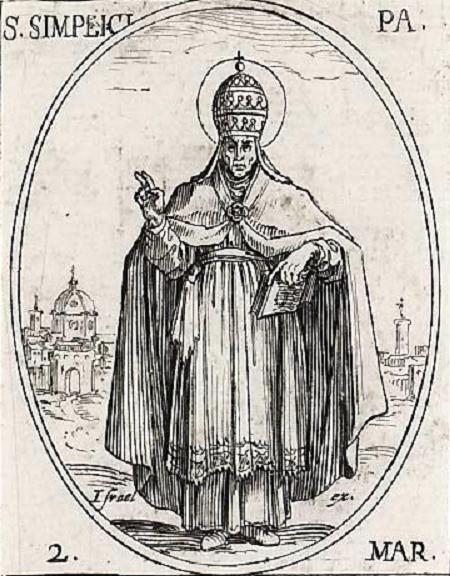
Simplicius
Gedenktag katholisch: 10.
März
Gedenktag orthodox: 10.
März
Name bedeutet: der
Einfache (latein.)
Papst
* in Tivoli bei Rom in Italien
† 10. März 483 in Rom
Simplicius wurde 468 als
Nachfolger von Hilarius zum
Papst gewählt. Im Unterschied zum Vorgänger standen für Simplicius - im
zerbrechenden Römischen Reich des Westens angesichts der von Norden
eingedrungenen Germanen unter Odoaker - wieder die Beziehungen zum Osten im
Vordergrund seines Wirkens. Den beim Konzil
in Chalkedon festgehaltenen Vorrang des Patriarchen von Konstantinopel
bestritt Simplicius gegenüber Achatius
von Konstantinopel; dies führte zu heftigen Konflikten und zur ersten
Spaltung zwischen West- und Ostkirche, dem Acacianischen Schisma, das erst
519 unter Papst Hormisdas beigelegt
wurde.
In der Frage des Streites
um den Monophysitismus setzte
Simplicius sich auch bei den Kaisern für die Beschlüsse des Konzils
von Chalkedon ein, aber es gelang ihm nicht, diese Lehren in Alexandria durchzusetzen;
dort gab es zeitweise nebeneinander zwei Patriarchen, gegen den Willen von
Simplicius bestätigte Kaiser Zeno 482 den Monophysiten Petrus Mongus. Die
Kirche in Spanien band Simplicius enger an Rom,
indem er Bischof Zeno von Sevilla zum
apostolischen Vikar ernannte.
In Rom gehen mehrere
Kirchenbauten auf Simplicius zurück, so die Kirche San
Stefano Rotondo - die erste Stephanus geweihte
Kirche -, die Basilika Liciniana
als Vorgängerbau von San
Antonio Abate und Santa
Bibiana.
Simplicius starb nach
langer Krankheit, er wurde in der Peterskirche in
Rom bestattet.
Worte des Heiligen
In einem Brief an Patriarch Achatius von Konstantinopel vom 10. Januar 476 betont Simplicius sehr selbstbewusst die Stellung des römischen Bischofs, zudem äußert er sein großes Misstrauen gegenüber einem möglichen Konzil. Dabei spielt er auf die Konzilien von Nicäa 325, Ephesus 431 und Chalkedon 451 an:
Weil die Lehre Unserer Vorgänger heiligen Angedenkens, gegen die zu diskutieren nicht erlaubt ist, vorliegt und daher keiner, der bei rechtem Verstand zu sein scheint, mit neuen Erklärungen belehrt zu werden braucht, sondern alles klar und vollkommen ist, womit entweder ein von Häretikern Getäuschter unterwiesen oder einer, der im Weinberg des Herrn gepflanzt werden soll, unterrichtet werden kann, so flehe den Glauben des gütigsten Fürsten an und lass ihn den Vorschlag, ein Konzil abzuhalten, verwerfen. …
Ich fordere also dazu auf, liebster Bruder, dass auf alle Weisen den Versuchen
verruchter Leute, ein Konzil abzuhalten, Widerstand geleistet werde; ein
solches wurde stets nur dann einberufen, wenn in verkehrten Sinnen etwas Neues
oder in der Erklärung der Glaubenslehren (etwas) Zweifelhaftes aufgetaucht ist;
damit denjenigen, die zum gemeinsamen Nutzen eine etwaige Unklarheit behandeln,
(diese) die Autorität priesterlicher Überlegung erhelle, so wie zuerst die
Gottlosigkeit des Arius und
dann die des Nestorius,
zuletzt die des Dioskur und Eutyches zu verfahren zwang. Und es ist
einzuschärfen, dass es abscheulich ist - was die Barmherzigkeit Christi,
unseres Gottes und Erlösers, verhüte! -, gegen die Entscheidungen der Priester
des Herrn aus dem ganzen Erdkreis und der beiden regierenden Fürsten
Verurteilte zu rehabilitieren.
Quelle: Heinrich
Denzinger: Kompendium der Glaubensbekenntisse und kirchlichen
Lehrentscheidungen, hrsg. von Peter Hübermann, 42. Auflage. Herder, Freiburg i
Br. 2009, Nr. 343
Zitate von Papst
Simplicius:
Brief an Kaiser Basiliscus (476):
Die Norm der apostolischen Lehre bleibt stets dieselbe bei den Nachfolgern
dessen, dem der Herr die Sorge für die ganze Herde anvertraut und dem er
versprochen hat, dass er bei ihm sein werde bis ans Ende der Welt, dass ihn die
Pforten der Hölle nicht überwältigen werden, und von dessen Urteil er bezeugt
hat, dass, was durch dasselbe auf Erden gebunden wird, auch im Himmel nicht
gelöst werden könne.
Brief an Kaiser Basiliscus (476):
Man muss dies öfter wiederholen, was von apostolischen Händen unter Zustimmung
der gesamten Kirche mit der evangelischen Sichel abgeschnitten zu werden
verdiente, kann nicht weder neue Lebenskraft erlangen, noch kann ein
fruchtbringender Setzling am Weinstock des Herrn werden, was einmal ganz entschieden
für das ewige Feuer bestimmt wurde.
An die Priester und Archimandriten von Konstantinopel (476):
Es schließt sich nicht das Gute an das Schlechteste, das Rechte an das
Verkehrte an, noch kann sich das Heilsame mit dem Schädliche verbinden, weil
das Licht keine Gemeinschaft mit der Finsternis noch der Ungläubige Anteil hat
an dem Gläubigen.
An den Patriarchen Achatius
von Konstantinopel:
Indem wir uns auch über den Glauben und die Andacht des christlichen Volkes
freuen, bitten und flehen wir unaufhörlich zu Gott um dessen Gedeihen und
Vermehrung, auf dass es in der Furcht und Liebe des Herrn verharrend sowohl der
Zahl nach vermehrt wie auch durch den göttlichen Beistand geschützt zu werden
verdiene. Hierin rühmen wir uns ganz besonders und freuen uns, das Wohlgefallen
unseres Gottes zu erwerben, weil das Wachstum der heiligen Herde eine Frucht
des Hirteneifers ist.
Quelle: Franz Xaver
Reithmayr und Valentin Thalhofer (Hrsg.: Bibliothek der Kirchenväter. Die
Briefe der Päpste, Bd. 6. Kösel, Kempten 1879, S. 114, 119, 131
zusammengestellt von Abt em. Dr. Emmeram Kränkl OSB,
Benediktinerabtei Schäftlarn,
für die Katholische
SonntagsZeitung
Stadlers
Vollständiges Heiligenlexikon
Briefe
von Simplicius und seine Lebensgeschichte gibt es online zu lesen in
den Documenta Catholica Omnia.
Die Kirche San Stefano Rotondo in Rom ist täglich von 10 Uhr bis 13 Uhr und von 15.30 Uhr bis 18.30 Uhr geöffnet. (2017)
Der Petersdom -
die Basilika Sancti
Petri in Vaticano - in Rom ist täglich von 7 Uhr bis 19 Uhr, mittwochs
erst ab 13 Uhr geöffnet, der Eintritt ist wie in alle Kirchen Roms frei. Die
Vatikanischen Grotten unter der Peterskirche mit dem Petrusgrab
sind vom linken vorderen Vierungspfeiler des Petersdoms aus zugänglich und
können von 8 Uhr bis 18 Uhr kostenfrei besucht werden. Der Besuch der darunter
liegenden Nekropole ist nur nach Anmeldung unter scavi@fsp.va und mit Führung möglich, diese
kostet 13 €. Der Besuch des Museums in der Sakristei ist von 8.30 Uhr bis 18.30
Uhr möglich, der Eintritt beträgt 5 €; der Besuch des Daches des Petersdoms,
von dem man auch die Kuppel besteigen kann, kostet 6 €, bei der Fahrt mit dem
Aufzug 8 €. (2017)
Seite zum
Ausdruck optimiertUnser Reise-Blog:
Reisen zu den Orten, an denen die
Heiligen lebten und verehrt werden.
Empfehlung an
Freunde senden
Artikel
kommentieren / Fehler melden
Fragen? -
unsere FAQs antworten!
Impressum - Datenschutzerklärung
Schauen Sie sich zufällige Biografien an:
Lupicius
von Condat
Evasius
von Asti
Konrad
Müller
Autor: Joachim
Schäfer - zuletzt aktualisiert am 16.03.2025
Quellen:
• Vera Schauber, Hanns Michael Schindler: Heilige und Patrone im Jahreslauf. Pattloch, München 2001
• Charlotte Bretscher-Gisinger, Thomas Meier (Hg.): Lexikon des Mittelalters. CD-ROM-Ausgabe. J.B. Metzler, Stuttgart / Weimar 2000
• Lexikon für Theologie und Kirche, begr. von Michael Buchberger. Hrsg. von Walter Kasper, 3., völlig neu bearb. Aufl., Bd. 9. Herder, Freiburg im Breisgau 2000
• https://de.wikipedia.org/wiki/Santa_Bibiana - abgerufen am 16.03.2025
korrekt zitieren: Joachim Schäfer: Artikel Simplicius, aus dem Ökumenischen Heiligenlexikon - https://www.heiligenlexikon.de/BiographienS/Simplicius.htm, abgerufen am 25. 2. 2026
Die Deutsche Nationalbibliothek verzeichnet das Ökumenische
Heiligenlexikon in der Deutschen Nationalbibliografie; detaillierte
bibliografische Daten sind im Internet über https://d-nb.info/1175439177 und https://d-nb.info/969828497 abrufbar.
SOURCE : https://www.heiligenlexikon.de/BiographienS/Simplicius.htm

