
Saint Nicolas du Japon
(+ 1912)
Originaire de la province
de Smolensk en Russie, il voulait devenir militaire. Mais une fois ses études
finies, il se décida à évangéliser le Japon. Après quatre années à l'académie
de Saint Petersbourg, il partit à Khakondate où il apprit seul le japonais.
Après des années de patience, il put réunir une petite communauté orthodoxe et
transféra son centre missionnaire à Tokyo qui était alors la nouvelle capitale
de l'empire. Il ouvrit un séminaire pour la formation du clergé autochtone où
l'on enseignait les langues chinoise, japonaise et russe. Durant la guerre
russo-japonaise de 1905, il continua d'aimer ses ouailles d'un grand amour et
c'est ainsi qu'il fut et qu'il est encore une source de grâce pour l'Eglise
orthodoxe du Japon.
SOURCE : http://nominis.cef.fr/contenus/saint/5535/Saint-Nicolas-du-Japon.html
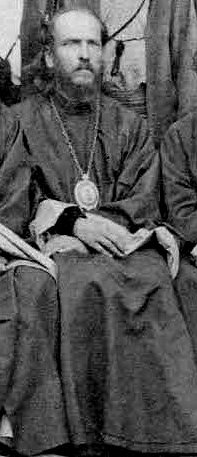
Nicholas of Japan, 1882
Saint Nicolas du Japon
Saint Nicolas du Japon était
un exemple unique et remarquable pour tous les missionnaires chrétiens
orthodoxes. Premièrement, il s'est jeté à corps perdu dans la compréhension de
la langue et la culture [du Japon]. Quand il le surprenait à lire des livres
dans une langue autre que le japonais, son archevêque le réprimandait, et il
résolut de ne lire que de la littérature japonaise. Il sortit de sa communauté
et écouta les conteurs et prédicateurs bouddhistes et shintoïstes. Il étudia
l'histoire du Japon. Il la connaissait mieux que la plupart des Japonais.
Deuxièmement, il avait
des vues à long terme pour sa mission. Il passa huit ans en recherches sur la
langue et la culture japonaises. Son premier converti vint après quatre années
d'études. Vue à long terme signifie également la délégation. En 1869 (cinq ans
après la première conversion!), il a remis sa congrégation à un autre
missionnaire. Après avoir établi une congrégation, il partit à Tokyo afin d'en
mettre en place une autre. Ce modèle d'établissement, de délégation et de
mobilité a marqué son ministère.
Troisièmement, il comprit
le peuple. Son premier chrétien, était un samouraï appelé Sawabe. Takuma.
Sawabe était un ultra-nationaliste (l'un des types de personnes dans des
mini-fourgonnettes noires qui nous feraient peur de nos jours) qui considérait
le consulat de Russie comme le symbole de tous les problèmes de l'ouverture du
pays aux étrangers. Lorsque Sawabe vint au consulat, épée tirée, prêt à tuer
Nicolas, Nicolas sut faire appel à sa nature de Samuraï:
"Pourquoi êtes-vous
en colère contre moi?" a demandé Père Nicolas à Sawabe.
"Vous, tous les
étrangers devez mourir. Vous êtes venus ici pour espionner notre pays et ce qui
est pire encore, vous faites du mal au Japon avec votre prédication,"
répondit Sawabe.
"Mais savez-vous ce
que je prêche?" a répondu Nicolas.
"Non,"
répondit-il.
"Alors comment
pouvez-vous juger, et encore moins condamner quelque chose dont vous ne savez
rien? Est-il juste de diffamer quelque chose que vous ne connaissez pas?
Ecoutez-moi, d'abord, puis jugez. Si ce que vous entendez est mauvais, alors
jetez-nous dehors."
Sawabe l'écouta alors, et
fut persuadé par ses paroles et par l'Esprit Saint qui agissait en lui. Nicolas
a su se faire écouter de Sawabe. Comment aujourd'hui, beaucoup d'entre nous
peuvent-ils dire honnêtement que nous savons comment nous faire écouter des
Japonais et leur faire entendre notre message?
Quatrièmement, il a été
dévoué à son peuple. C'est une question d'intégrité. Il avait besoin que le
peuple japonais sache qu'il était de leur côté. Beaucoup de missionnaires
préfèrent se fier à leur pays d'origine quand les choses deviennent difficiles,
mais Nicolas était absolument engagé pour le Japon, et sa congrégation
connaissait son amour par son dévouement pour eux. Lorsque le Japon et la
Russie sont entrés en guerre, beaucoup de gens de sa propre congrégation le
pressèrent de rentrer chez lui [en Russie] -Rappelez-vous qu'il était venu au
Japon sous l'égide du Consulat de Russie au Japon. Mais il a refusé, il avait
besoin de servir et d'être avec son peuple. Dans le même temps, il a trouvé des
moyens pour s'occuper des prisonniers de guerre russes au Japon.
Enfin, il fut prompt à
déléguer, comme nous l'avons déjà mentionné. Quand Paul Sawabe commença à
croire, il a amené trois amis avec lui pour entendre la prédication de Nicolas.
Nicolas laissa les quatre croyants autochtones faire leurs propres disciples,
et un an plus tard, il y avait douze baptisés, et vingt-cinq de ce que nous
appellerions aujourd'hui "personnes en recherche". Quinze ans plus
tard, l'église était forte de quatre mille hommes. Pour que cela fonctionne, il
fallait encore plus de délégation, et ainsi il a commencé le processus
d'ordination de prêtres japonais. Au moment où il vint fêter les cinquante
années de sa mission, il y avait quarante-trois prêtres ordonnés et cent
vingt-et-un prédicateurs laïcs. Et rappelons-nous que, cinq ans après avoir une
personne dans l'Église, il la confia [à Sawabe] et partit à Tokyo. Il savait
que s'il voulait atteindre l'ensemble du Japon, il ne pouvait se borner à un
seul territoire pour l'ensemble de sa vie missionnaire.
Version française Claude Lopez-Ginisty d'après Père Geoffrey Korz. Mission Notes: Saint Nicholas of Japan in http://www.pravmir.com/article_420.html
SOURCE : http://orthodoxologie.blogspot.ca/2010/02/saint-nicolas-du-japon.html
SAINT NICOLAS du Japon
16 février / 3 février
Saint Nicolas du Japon fut un missionnaire Russe qui
partit pour le Japon au XIXe siècle, et c'est un des plus grands saints
missionnaires des temps modernes
Son nom de Baptême était Jean, et il naquit le 22
août1836, second fils de Dimitri Ivanovitch Kasatkin, qui était diacre de
l'église de Beryoza dans la province de Smolensk. Il étudia la théologie à
l'Académie théologique de Saint-Petersbourg
Il fut nommé chapelain du consulat Russe à Hakodate.
Il traversa la Sibérie en calèche en juillet 1860, et atteint Nikolaevsk à la
fin septembre. Il y demeura pour l'hiver, et là il rencontra le célèbre
missionnaire de Sibérie et d'Alaska, Saint Innocent (Veniaminov) d'Alaska. Il
continua son voyage l'année suivante et atteint Hakodate en juillet 1861
A sa demande, le père Nicolas fut affecté au Japon
dans la ville de Hakodate.
Au début, la prédication de l'Évangile au Japon lui
parut complètement impossible. Selon ses propres mots : "De tout temps, le
Japonais a considéré des Étrangers comme des bêtes, et voit dans le
christianisme comme la partie la plus mauvaise, à laquelle seulement les
bandits et les sorciers peuvent appartenir." Il passa huit ans à étudier
le pays, la langue, des façons et des coutumes du peuple parmi qui il prêcherait.
Il donna aussi des leçons de russe aux Japonais qui étaient intéressés.
En 1868, Nicolas avait regroupé autour de lui une
vingtaine de japonais. Après son retour à Moscou, la décision fut prise, en
1870, de former une mission spirituelle russe spéciale pour prêcher la parole
de Dieu parmi les Japonais païens et de nommer le père Nicolas au grade
díarchimandrite et nommé comme chef de cette mission.
Après deux ans passés en Russie, le Père Nicolas
retourna au Japon. Il transféra la responsabilité de la communauté de Hakodate
au hiéromoine Anatole, et commença sa mission d'évangélisation à Tokyo .
En 1871, les premiers chrétiens de Hadokate furent persécutés
et arrêtés dont le premier prêtre orthodoxe japonais : Paul Sawabe. En 1873 les
persécutions diminuèrent et la prédication devint plus libre.
En 1874, l'Archimandrite Nicolas commença la
construction d'une église, d'un séminaire pour une cinquantaine d'hommes et
d'une école religieuse. La même année l'Évêque Paul du Kamtchaka vint à Tokyo
pour y ordonner prêtres plusieurs japonais recommandés par Nicolas.
Plusieurs écoles virent le jour : quatre à Tokyo et
deux à Hakodate.
En 1877 la mission publia régulièrement un journal : «
Le héraut de l'Église ». En 1878 on comptait 4 115 convertis répartis en
plusieurs communautés et Nicolas demanda bientôt que soit nommé un évêque
supplémentaire.
Un Samurai, propriétaire terrien et prêtre Shintoïste,
Takuma Sawabe, considéra le père Nicolas comme une menace pour le Japon et sa
culture, et vint au consulat où il le menaça de le tuer s'il n'arrêtait pas
d'enseigner la Foi Chrétienne au peuple. La réponse de Nicolas fut simple : il
lui demanda s'il savait ce que lui enseignait. Sawabe dit qu'il ne savait pas,
et Nicolas lui demanda s'il était raisonnable pour lui de tuer quelqu'un pour
avoir enseigné ce qu'il ignorait, et s'il ne serait pas plus raisonnable
d'écouter d'abord ce qu'il enseignait. Sawabe accepta d'écouter... et fut
convaincu de la vérité de la Foi Chrétienne Orthodoxe.
L'Archimandrite Nicholas fut consacré évêque le 30
mars 1880 dans la cathédrale de La Trinité à la laure st Alexandre Nevski.
Retournant au Japon, il reprit son travail apostolique avec une ferveur accrue.
Il termina la construction de la cathédrale de la Résurrection du Christ à
Tokyo, il traduisit des livres et créa un dictionnaire théologique orthodoxe
spécial dans la langue japonaise.
Le saint et ses communautés eurent de graves problèmes
lors de la guerre Russo-Japonaise. Pour son travail pendant ces années
difficiles, il fut élevé au rang d'archevêque.
En 1911, un demi-siècle après son arrivée au Japon, il
y avait 33.017 chrétiens dans les 266 communautés de l'église orthodoxe
japonaise, y compris 1'Archevêque, 1 évêque, 35 prêtres, 6 diacres, 14
instructeurs chanteurs, et 116 catéchistes.
Le 3 février 1912, l'Archevêque Nicholas parti
paisiblement vers le seigneur à l'âge de soixante-seize ans.
SOURCE : http://www.histoire-russie.fr/icone/saints_fetes/textes/nicolas_japon.html
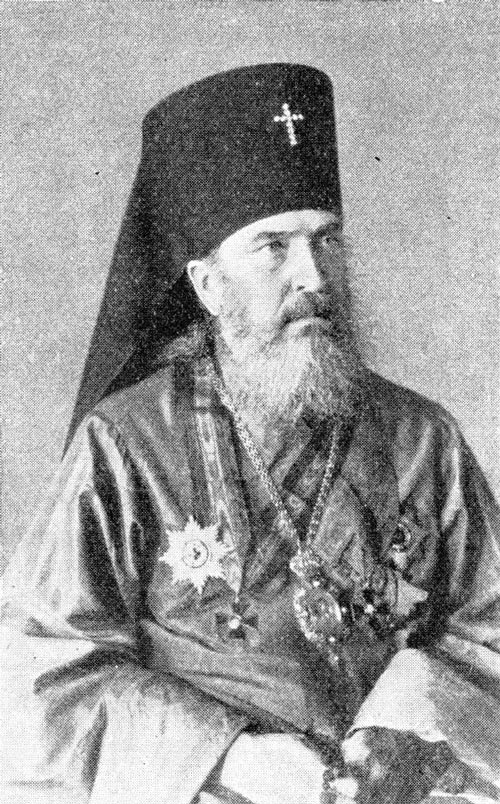
Saint Nicholas, Enlightener of Japan
Commemorated on February 3
Saint Nicholas (Kasatkin) Equal of the Apostles,
Bishop of the Russian Orthodox Church. Missionary, Founder of the Orthodox Church
in Japan, honorary member of the Imperial Orthodox Palestine Society. (Name
Day: May 9).
Saint Nicholas (in the world John Kasatkin) was born
on August 1,1836 in the village of Berezovsky Pogost, Belsky District, Smolensk
Province into the family of a deacon. He graduated from the Belsk Theological
School and the Smolensk Theological Seminary (1857). Among the best students he
was recommended for the St. Petersburg Theological Academy, where he studied
until 1860, when, at the personal request of Metropolitan Gregory (Postnikov)
of St. Petersburg, he was given the post of rector of the church at the Russian
consulate in the city of Hakodate (Japan), and was also awarded a Ph.D in
Theology without having to submit an appropriate qualifying essay.
On June 23, 1860, he was tonsured by the rector of the
Academy, Bishop Nektarios (Nadezhdin), and named for Saint Nicholas of Myra. On
June 30 he was ordained a Hieromonk.
He arrived at Hakodate on July 2, 1861. During the
first years of his stay in Japan, on his own he studied the Japanese language,
culture and way of life.
The first Japanese person to convert to Orthodoxy,
despite the fact that conversion to Christianity was forbidden by law, was the
adopted son of a Shinto cleric, Takuma Sawabe, a former samurai who was
baptized with two other Japanese in the spring of 1868.
During his half-century of service in Japan, Father
Nicholas left only twice: in 1869-1870 and in 1879-1880. In 1870, through his
intercession, a Russian ecclesiastical mission was opened in Japan with its
center in Tokyo. On March 17, 1880, by the decision of the Holy Synod, he was
assigned as vicar of Reval, then vicar of the Diocese of Riga. He was
consecrated as a Bishop on March 30, 1880, in Holy Trinity Cathedral at
Alexander Nevsky Lavra.
In the course of his missionary work, Father Nicholas
translated the Holy Scriptures and other liturgical books into Japanese; he
established a theological seminary, six theological schools for girls and boys,
a library, a shelter and other institutions. He published the Orthodox journal
Church Herald in Japanese. According to his report to the Holy Synod, by the
end of 1890 the Orthodox Church in Japan numbered 216 communities with 18,625
Christians in them.
On March 8, 1891, the Cathedral of the Resurrection in
Tokyo, called Nikorai-do (ニコライ堂)
by the Japanese, was consecrated. During the Russo-Japanese War, he remained
with his flock in Japan, but did not take part in any public services. because
according to the rite of worship (and the blessing of Japanese Christians to
pray for their country's victory over Russia. Bishop Nicholas said:
"Today, according to custom, I serve in the cathedral, but from now on I
will no longer take part in the public services of our church... Hitherto I
have prayed for the prosperity and peace of the Empire of Japan. Now, since war
has been declared between Japan and my country, I, as a Russian subject, cannot
pray for Japan's victory over my own homeland. I also have obligations to my
country, and that is why I will be happy to see that you fulfill your duty in
relation to your country."
When Russian prisoners of war began to arrive in Japan
(their total number reached 73,000 people), Bishop Nicholas, with the consent
of the Japanese government, formed the Society for the Spiritual Consolation of
Prisoners of War. For their spiritual guidance, he selected five priests who
spoke Russian. The prisoners were provided with icons and books. Vladyka
repeatedly addressed them in writing (he himself was not allowed to see the
prisoners).
On March 24, 1906, he was elevated to the rank of
Archbishop of Tokyo and All Japan. In the same year, the Kyoto Vicariate was
founded. In 1911, when half a century of Saint Nicholas' s missionary work was
completed, there were already 266 communities of the Japanese Orthodox Church,
which included 33,017 Orthodox laymen.
Archbishop Nicholas, the Enlightener of Japan, fell
asleep in the Lord on February 3, 1912 at the age of 76, After the Hierarch's
repose, the Japanese Emperor Meiji personally gave permission for him to be
buried within the city, at the Yanaka cemetery. In Japan, Saint Nicholas is
revered as a great righteous man and a special intercessor before the Lord.
He was canonized on April 10, 1970, by the decision of
the Holy Synod of the Moscow Patriarchate. A Service was composed for him by
Metropolitan Nikodim (Rotov) of Leningrad and Novgorod, and published in 1978.
Saint Nicholas is also commemorated on the Sunday
before July 28 (Synaxis of the Smolensk Saints).
SOURCE : https://www.oca.org/saints/lives/2026/02/03/100455-saint-nicholas-enlightener-of-japan
Enlightener of Japan –
Blessed Nicholas Kasatkin
By Presbytera Doreen
Bartholomew
On August 1, 1836, one of
the greatest missionaries in the history of the Orthodox Church was born, a man
who, in the course of his life in Japan, left behind over two hundred churches,
more than 30,000 Orthodox Christians, translations of almost the entire Bible,
almost all of the Orthodox liturgical texts and theological literature; a man
who founded several schools, a seminary, a library and countless other
institutions, some of which are still functioning today.
The early life of Ivan
Dimitrievich Kasatkin was one of poverty and great hardship. His mother died
when he was very young and he was brought up by his father, the village deacon.
He was full of life and very mischievous but his pranks ceased when he entered
the church for services. He sang and prayed with such attentiveness that it
seemed inevitable he would enter the seminary, which he did in 1853.
The Smolensk Seminary was
150 miles from Ivan’s home and, being one of the poorer seminarians, he was
forced to walk back and forth at the beginning and end of term. Nevertheless,
he never lost his sense of humor and remained a good student. After graduation
in 1857 he was offered a scholarship to the St. Petersburg Theological Academy
where he continued his studies, showing a particular gift for patristics and
foreign languages. After graduation Ivan was invited to stay at the St.
Petersburg Theological Academy to prepare for an academic seat, but one day a
notice appeared on the bulletin board requesting applications from students
interested in a consular posting in Japan. Ivan was intrigued. Five people
applied, he being one of them. However, the other four applicants withdrew
their application upon learning that the position called for a celibate priest.
Ivan had never considered the monastic life, but his call to Japan was so
strong that it did not present a problem. Bishop Nektary, the rector of the
Academy, was originally opposed to Ivan being sent to Japan, feeling that a man
with such academic abilities would be wasting his talents in a consular position.
Ivan agreed that such a position would be a waste of time, but he was planning
to evangelize Japan. After much thought Bishop Nektary finally consented, but
the other members of the Holy Synod hesitated at sending such a young man, with
no experience behind him. It was only after the agreement of Metropolitan
Isidore, Ivan’s spiritual father, that permission was granted. On June 22,
1860, Ivan Kasatkin made his monastic profession, receiving the name of
Nicholas. After his ordination to the diaconate on June 22 and to the
priesthood on June 29, he was ready to begin his journey to Japan.
On July 29 Nicholas left
St. Petersburg for his new assignment in Hakodate, Japan. The journey was
arduous: in order to reach his point of embarkation at Nikolaevsk-on-Amur he
had to cross the Volga region, the Urals and all of Siberia-a distance of 6,214
miles-all done on carriages and sleds. When he arrived in Nikolaevsk it was
winter and further travel was impossible due to frozen conditions. Fr. Nicholas
was forced to spend the winter of 1861 in Nikolaevsk. This turned out to be a
blessing instead of the waste of time he thought it would be. During this time
he had the opportunity to speak with Archbishop Innocent (Veniaminov), the
missionary to America. Archbishop Innocent was forty years Nicholas’ senior and
was almost at the end of his missionary career. The hierarch told him that his
first goal had to be to master the Japanese language, and next, to translate
the Bible, especially the Gospels. He cautioned Fr. Nicholas not to expect too
much, that his life in Japan would be filled with great disappointments as well
as good times. He advised him not to despair when he found himself longing for
his native Russia, that the feeling would pass and soon Japan would seem almost
like home.
Archbishop Innocent
decided Fr. Nicholas’ cassock was too worn to make a good impression in Japan,
and he helped Fr. Nicholas to cut and sew a new one. He also gave him the
bronze cross he had been wearing.
With the arrival of
spring Fr. Nicholas continued his journey to Japan aboard the military
transport vessel Amur. He reached Hakodate on June 14, 1861, almost a year
after leaving St. Petersburg.
It was not a good time
for missionary work in Japan. The Japanese regarded foreigners with suspicion,
even hatred. For the most part they ignored missionaries, but they were quite
prepared to kill them at the drop of a hat. The preaching of Christianity was
strictly prohibited and converts to Christianity faced torture or even death.
Missionaries walking on the streets were often assaulted by stone-throwing
crowds.
This was hard on the
young hieromonk; he had imagined flocks of people gathering to hear his
preaching, once the word of God had been heard. “Imagine my disappointment,” he
wrote, “when I arrived in Japan only to be greeted by the exact opposite of
what I had dreamed.” He resigned himself to being restricted to performing the
Divine services for the small Russian community at the consulate. He tried to
hire a Japanese teacher, but this proved almost impossible; no Japanese wanted
to be seen with a foreigner, let alone a missionary. This being the case he
contented himself with reading the German and French books he found in the
consulate and began evolving into the kind of chaplain he promised Bishop
Nektary he would never become.
At this time Archbishop
Innocent was on a trip to Kamchatka and, being delayed in Hakodate for a few
days, he decided to drop in on the young missionary. Learning of the sad state
of affairs, the hierarch advised Fr. Nicholas to throw away the French and
German books and begin a serious study of Japanese. Soon Fr. Nicholas was able
to find a language tutor and he began to study diligently. In the end, Fr.
Nicholas needed three teachers to maintain his pace in learning. In addition to
this private tutoring Fr. Nicholas began to attend the Japanese schools, never
saying a word but just listening to the lectures. There is a story recorded in
the memoirs of Shimomura Kainan, the editor of Tokyo Asahi newspaper, which
tells of Fr. Nicholas’ going to school and the reaction of the school
authorities. The school sought to keep Fr. Nicholas out, fearing reprisals
should the government find out that a Christian missionary, a Russian no less,
was attending classes. They tried everything, even threatening him with
violence. In the end a notice was placed on the school gates saying “Entrance
Forbidden to Russian Priest”. Fr. Nicholas read the notice, put it in his
pocket and went to class. Eventually they let him stay, simply because they
could not get him to leave.
The Japanese language
consists of three systems of writing, two being hiragana and katakana, and the
Chinese characters known as Kanji. Hiragana is used to show some Japanese
grammer while katakana is used to transcribe foreign words and onomatopeia. Any
foreigner wishing to study the language had to do so without the use of modern
grammers, textbooks or other learning tools available to students today. This
meant that Fr. Nicholas had to devise his own system of study; it worked so
well that he rapidly gained a working knowledge of the language.
After seven years of
language study, Fr. Nicholas felt he was prepared to begin conversion of the
Japanese. As it happens, his first “catechumen” came with sword in hand and
murder in his mind. Takuma Sawabe, a samurai Shinto priest and devoted
nationalist, came to Fr. Nicholas one night and told him that all foreigners
must die because they spread lies and are here to spy on Japan. Sawabe demanded
that Fr. Nicholas either leave Japan at once or prepare to die. Fr. Nicholas
heard him out and then asked if Sawabe was acquainted with what he preached.
Sawabe admitted that he was not and Fr. Nicholas asked him why he was
condemning him to death without a hearing first. Sawabe agreed to hear what Fr.
Nicholas had to say before killing him.
Fr. Nicholas began to
preach the Gospel to Sawabe. He spoke of God, sin, the soul and its
immortality. Sawabe listened intently, then took out some paper and began to
take notes. He came back again and again and became so filled with love for his
newfound faith that he was baptized and received the name of Paul. Soon Sawabe
began to talk of Orthodoxy to his friends, specifically Sakai and Urano. They
were also converted to Orthodoxy and in April of 1868 received baptism with the
names of John and Jacob, respectively. The cornerstone for the building of
Orthodoxy in Japan had been put in place through the events of one night.
Around this time
political change was in the air and the Shogun’s government wanted to stop it.
They placed road blocks everywhere and the police arrested any suspicious
characters. Knowing of the danger to Japanses Christians, in Hakodate
specifically, Fr. Nicholas ordered Sawabe, Sakai and Urano to leave Hakodate at
once. He armed them with a variety of religious books but really did not expect
much in the way of preaching from them. It was enough that they were safe. In
the meantime Fr. Nicholas’ catechumens were growing in number. One, baptized as
John Ono, was later to become the first native bishop of the Japanese Orthodox
Church. (John Ono’s great-grandson is now a priest at the cathedral in Tokyo,
also having taken the name of John at baptism.)
In 1869 the Holy Synod
ordered Hieromonk Nicholas to return to St. Petersburg to work towards the
establishment of a Russian Orthodox mission in Japan. The Japanese Missionary
Society was granted 6,000 rubles annually, which was received until the
beginning of the Russo-Japanese War. In addition, Metropolitan Isidore raised
Fr. Nicholas to the rank of Archimandrite and appointed him head of the
mission. It was put under the jurisdiction of the Bishop of Kamchatka. Fr.
Nicholas returned to Japan on February 15, 1871 with a few monks to assist him.
They all soon left due to illness or personal reasons. During his absense,
Sawabe, Sakai and Urano continued their missionary activities and Fr. Nicholas
returned to a whole new flock of catechumens.
Upon his return from
Russia, Fr. Nicholas increased his translation effort. He had met Dr. Mayama, a
scholar from the city of Sendai in the northern part of Japan, and together
with John Ono they translated and published a Russian-Japanese Dictionary, a
catechism, prayerbook, wall calendar and Lives of the saints.
It is important to
understand the emphasis Fr. Nicholas put on his translation work. It was
extremely important to him; he considered that the soul of the mission’s work
was to be found in the translation of books. He, therefore, spent most of his
time in translation. For thirty years he spent every evening from six until ten
with his assistant, Nakai, and translated. The only time this routine was
broken was on days when there were evening services. During the hours of
translation the door was shut and only his aide, Ivan, could enter to serve
tea. “Were the heavens to unfold I would have no right to abandon my
translation work,” said Fr. Nicholas.
He always strove for
perfection and was never satisfied, always seeking new forms. The Lord’s
Prayer, for example, went through four revisions. He began by using already
existing Chinese translations but this did not succeed. The Chinese
translations were either too literal or too much like paraphrases. This forced
him to follow the Russian and Slavonic texts closely while also using the Vulgate,
the English version and the Greek. Using this method, he was able to translate
at the rate of fifteen verses per five hours of work. It was in this manner
that the Gospels were translated. After his move to Tokyo the scope of his work
increased. He began work on the Sunday cycle, then moved to the Pentecostarion
and the Lenten Triodion. Gradually, the whole cycle of services and all the
parts of the Old Testament necessary for services were translated, and he still
dreamed of translating the entire Bible.
Fr. Nicholas’ biggest
problem was choosing the proper Chinese characters and not simply using ones
that have special meaning in the Buddhist and Shinto canons. For example, the
Buddhist terms referring to an absolute being as impersonal, such as Nirvana, are
completely different from the Orthodox teaching of a personal God, paradise and
free will. Sometimes selection of one character took hours of discussion; there
were even cases where letters to the entire church were sent requesting
suggestions as to a suitable translation.
Fr. Nicholas’
translations have been criticized as being too difficult for Japanese to read.
His attitude towards this was that the level of translations of the Gospels and
the services should never descend to the level of the masses; rather, the
masses should be raised to the level of the Gospels and services. He said that
popular language was not admissible in the Gospels. If there were two
completely identical characters and both were equally pleasing to the ear, he
would naturally choose the simpler of the two, but he never would make the
slightest compromise in the accuracy of the translations, even if it meant
using little known characters. The move to Tokyo took place in January of 1872
and Nicholas took up residence in Tsukiji, one of the places designated for
foreigners. When he arrived in Tsukiji he found it difficult to find a place to
live. He ended up spending nights at the house of an Englishman and being
forced to wander around the city during the day. Finally he found a small house
consisting of two rooms, the larger of which could-with all the furniture
removed-hold ten people. Although it was still illegal to preach Christianity
in Japan, he managed to attract about fifteen listeners from the people in
Tsukiji. Meanwhile he continued his study of the language, making friends with
people in the area. He became particular friends with the abbot of Zojoji
Temple, and it was this abbot who sheltered him when the Japanese government
became suspicious of his activity.
Fr. Nicholas came to the
notice of the government in a positive way when he served as interpreter for
Tsar Alexander II during his visit to Japan in 1872. Meanwhile, the laws
against Christianity were becoming an embarrassment to Japan and its diplomatic
relations with western nations, and were soon revoked. Fr. Nicholas felt
reassured as a result of this and his recent service to the Japanese government
and so set about finding a suitable plot of land on which to build the mission.
He searched all over Tokyo but kept coming back to a residence on Surugadai
Hill. Surugadai was then the residence of Count Toda and when the property came
up for sale in 1872, Fr. Nicholas secured it. He first used the buildings for
preaching and teaching of the Russian language, but in 1873 he built two
European-style buildings and used the top floor of one building for a chapel.
In the midst of all this, he baptized his first group of ten catechumens.
It was in the 1870’s that
the Orthodox missionary activity ceased to be a “one man show” and truly became
an organized effort. A girls’ school was opened and a seminary. In addition,
four missions were opened in 1874 in Tokyo and one in Osaka in 1875. Soon to
follow were the catechist’s school, the orphanage, the iconography division of
the mission, the choir and the library. A monthly magazine, Seiko Shimpo, was
published. (It still exists under the name of Seiko Jiho or Orthodox Herald.)
On June 12, 1875, the
Synod of the Japanese Orthodox Church decided to ordain Paul Sawabe to the
priesthood and John Sakai to the diaconate. They were ordained by Bishop Paul
of Eastern Siberia and were soon followed in 1878 by Paul Sakai, Paul Sato,
Jacob Takaya, Matthew Kageta and Timothy Hariyu.
In 1880 Archimandrite
Nicholas was summoned to Russia and on March 3 he was consecrated Bishop of
Revel. He returned to Japan on October 17 with choir master Dimitry
Konstantinovich Lvov. Fr. Nicholas had long felt the need for a qualified music
teacher in the Japanese mission and with the help of J.D. Tikhai they set about
adapting the Japanese words to the Russian melodies. It was Tikhai who formed
the first choir in the cathedral and it was he who adapted the Obikhod for unison
singing in Japanese (these same books are still used for Vigil services.) When
Lvov arrived at the mission he was appointed a teacher of singing and soon
music was arranged for the festal and paschal services (1).
In the 1880s and 1890s the Orthdox Church of
Japan grew more, with magazines being published and people being sent abroad to
study. It is also during this period that construction of the cathedral
building began. Much money and labor went into this building which occupies
9,573 square feet and measures 110 feet in height, with a bell tower of 128
feet. The cornerstone was laid in 1884 and construction took seven years. It
was supervised by the English architect Josiah Conder, who designed many
buildings in Meiji Japan, and was built in the Byzantine style according to plans
drawn up by the Russian architect Michael Shicherpov.
Construction was not
without its problems, most of which came from the newspapers. The problem was
that the site occupied the highest ground in Tokyo, above and not far from the
Imperial Palace. Until very recently it was considered rude to build even an
office building more than three stories high lest it overlook the palace. This
was taken very seriously in the 1880s and there was a strong newspaper campaign
against the building of the cathedral. It was argued that it would become an
observation post and that the Russians must have some ulterior motive. Even
some Orthodox Christians were against it. Nevertheless, Bishop Nicholas
persisted and the cathedral was built.
Construction was
completed in 1891 and it was consecrated on March 8, and given the name of the
Cathedral of the Holy Resurrection. But from the first it was rarely referred
to by this name; it was simply called “Nikorai-do” or Nicholas’ house (“do”
meaning temple, or house). It is a most remarkable building and is considered
one of the great architectural achievements in Japan. A minor event worth
nothing is that the major bell in the belltower was donated by the then Grand
Duke Nicholas upon his visit to Japan in 1891.
On February 8, 1904, the
Russo-Japanese war began. To say that this put the Japanese Church in a
difficult position is an understatement. But thanks to the attitude and love of
Bishop Nicholas the Church was kept from falling apart. From the beginning of
the war there were attacks from the Japanese. The church was placed under
supervision and in some places Orthodox Christians were persecuted. The
Japanese press launched an all-out campaign against the Church.
At this point Bishop
Nicholas was asked by his flock if Orthodox Japanese could fight Orthodox
Russians. After studying the situation carefully he concluded that the Japanese
should fight, using the example of our Lord’s patriotism and loyalty. He told
the Japanese that Jesus Himself shed tears for the fate of Jerusalem, giving
proof of His patriotism and that they must follow in the footsteps of the
Teacher. He instructed them to do their duty as loyal Japanese subjects, to
pray for the victory of Japan and to do all things necessary to work for that
victory, but to do all this not out of hatred for the enemy, but for love of
their country.
The war put Bishop
Nicholas in a very difficult position. As a Russian, he could hardly pray for
the victory of Japan, yet he would not abandon his flock. He told the Church
that until the war was over he would not take part in the public prayers of the
Church, that he, too, had responsibilities to his homeland.
From the beginning of the
war a military guard was posted to the mission, and when a Japanese transport
was sunk by Russian cruisers more than a company of soldiers was placed outside
the mission. Recognizing the danger to Bishop Nicholas, the clergy asked if he
wanted to spend the remainder of the war outside Japan. Although well aware
that his life was in constant danger, he declined, choosing to remain with his
flock.
The Japanese Church did
not neglect its responsibilities to the over 70,000 Russian prisoners of war.
Eventually twenty Russian-speaking priests were set to serve as chaplains for
the prisoners. Reading materials were provided which included over two thousand
religious books and a thousand books on secular subjects. Independent of the
church effort, the Orthodox Christians organized the “Society for the Spiritual
Comfort of P.O.W.s” and collected donations for gifts and foodstuffs for the
prisoners. Meanwhile, in 1906, Bishop Nicholas was raised to the rank of
Archbishop and the Japanese Church celebrated his twenty-fifth anniversary as
bishop. In recognition of the Church’s work during the war, the Japanese
government donated a silver vase to the church and the Holy Synod in Russia
sent twenty gold altar crosses.
June 16, 1911 was the
fiftieth anniversary of the Archbishop’s arrival in Japan. He was then seventy
years old and had to begin thinking about an assistant. On June 27 Bishop
Sergius arrived and was appointed Bishop of Kyoto.
Archbishop Nicholas had
begun to suffer from heart disease in 1910, and the activities of the Church
and the celebration in 1911 had worsened his condition. In the beginning of the
winter of 1911 he became ill and in January of 1912 was admitted to St. Luke’s
Hospital in Tsukiji. The newspapers published daily bulletins about his illness
and many people called on him. On February 5, regardless of the fact that there
was no improvement in his condition, he decided to leave the hospital, saying
that there were too many things that needed to be done and there was no time to
waste in a hospital. He returned to Nikorai-do and continued his translation
work of the Old Testament. By February 15 he had recovered his strength enough
to write a final report to the Holy Synod and discuss with Bishop Sergius his
ten-year plan for the Church. While this meeting was in progress Archbishop
Nicholas noticed that the choir was not practicing as usual. He was told that
his doctors had advised the choir not to practice for fear it would disturb
him. He said he preferred that they practice and requested his favorite piece,
“By the Waters of Babylon”.
The Apostle of Japan
reposed at 7:15 a.m. on February 3 (OS), 1912, as Bishop Sergius was reading
the prayers for the departure of the soul. His last word was “resurrection.” At
that moment the doctor and the nurse-both unbelievers-fell to their knees in
honor of their great patient. The righteous hierarch-his life, his spiritual
countenance-made such an impression on the nurse that she said later:
“Definitely, I’m definitely going to get baptized.”
The bell of the cathedral
announced his passing and the Japanese Orthodox Church fell into a state of
mourning, as did the rest of Japan. After being dressed in his archepiscopal
vestments, the body of the hierarch was taken to the cathedral which was
already packed. Memorial services alternated with reading of the Gospel.
Countless wreaths arrived from parishioners, from Japanese nobility, the
diplomatic community, the mission; there was one from the Emperor himself.
In accordance with his
will, mourners paid respect to Nicholas bearing palm branches in hand. His
funeral was the largest one ever given a foreigner in Japan and none has
surpassed it since. The local English-language newspaper reported the details
which included the fact that the streets of Tokyo were lined with people,
ordinary Japanese citizens, who wished to say goodbye to the Enlightener of
Japan. He was buried in Yanaka Cemetery, close to the grave of the last
Tokugawa shogun.
There are those who think
that sanctity must necessarily be attested by miracles-and they look in vain
for such signs in the life of Archbishop Nicholas of Japan. During his final
illness he himself found nothing in which to boast. “Here I look back upon my
life… And what do I find? Only darkness! God alone accomplished everything,
while I… such a nonentity, zero, literally zero! And if a righteous man shall
scarcely be saved, then where shall I, a sinner, find myself? I’m worthy of the
very depths of hell.” This was, however, but evidence of his extraordinary humility
which crowned and safeguarded his outstanding achievements By the time of his
death, Japanese Orthodoxy had grown from one man with his single convert to
over 35,000 believers and thirty-two priests, all native Japanese! In addition
there were seven deacons, fifteen choir directors, 121 lay preachers, a
cathedral, ninety-six churches and 265 chapels. What further “sign” is needed?
And there is the miracle of his enduring legacy. For the last twenty years or
so, the Japanese Orthodox Church has been headed by Metropolitan Theodosius
(Nagashima) as an autonomous Church. Having recovered from the devastation of
the Great Kanto Earthquake and World War II, plus the cutting off of funds from
Russia after the Russian Revolution, the Church is now back up to around
thirty-thousand faithful. The cathedral itself has been declared a national
historic landmark and receives over five thousand visitors per year. Services
are sung entirely in Japanese and all the clergy are Japanese. A visit to the
cathedral is a must on any Tokyo itinerary.
Sources: Nicholas
Kasatkin and the Orthodox Church in Japan, by Roberta Takahashi; “The
Missionary Activity of St. Nicholas of Japan”, Master’s Thesis by The Rev. John
Bartholomew; A History of the Japanese Orthodox Church, by A. Bakulevski
(translation by Fr. John Bartholomew); Archbishop Nicholas of Japan:
Reminiscences and Characteristics, by Dimitrii Pozdneev (translation by Fr.
John Bartholomew).
Those acquainted with the
life of this hierarch have no doubt that he now dwells in the choirs of the
saints. He has already been glorified by several local Churches, and after the
glorification of Metropolitan Innocent (Veniaminov), Apostle to America, now in
preparation, it is earnestly hoped that the Russian Church Abroad will accord
the same official recognition to Archbishop Nicholas, Apostle to Japan. Grant
this, O Lord!
(1) The task of organizing
the church choir and setting Japanese liturgical texts to Russian music was a
difficult one. The Japanese texts are much longer, to begin with, and the
language is diametrically opposed to Russian in construction. In addition, the
Japanese language has a nasal “N” sound, which must be pronounced as a separate
syllable. When a beat falls on this sound it cannot be ignored but must be
sung. Bearing this in mind one can well imagine the difficulty the Japanese
texts presented to these musicians. Soon there were over one hundred male and
female voices in the choir and it was an ornament to the church. To this day,
students of music are brought to the cathedral to hear the choir, considered
one of the best in Japan.
SOURCE : https://www.roca.org/oa/volume-xii/issue-113-114/enlightener-of-japan-blessed-nicholas-kasatkin/
Enlightener of Japan
Blessed Nicholas Kassatkin
Matushka Naomi Takahashi
In these evil times when
the forces of materialism, ignorance and coldness of faith rise up against us,
the believers, and challenge us to prove at all moments our faith, whether or
not we are consciously aware of it, each of us is a missionary to those around
us who are in darkness; that is, we are wit nesses of the power and glory of
the Holy Spirit graciously transmitted to us through our Holy Orthodox Church.
As Christ our Saviour taught us in the parable of the talents, we are not to
bury our talents but to cultivate, invest and employ them that they might
manifest the reality of our faith in God. Each of us has different talents-for
some it is the achievement of virtues; for others, power of prayer; some are
gifted with practicing mercy and charity-and a few, special chosen are granted
missionary zeal and fervor to preach the Gospel to the far corners of the
earth.
Go ye therefore, and
teach all nations, baptizing them in the name of the Father, and of the Son,
and of the Holy Spirit. (Matt. 28:19)
A young Russian priest,
inspired by the Lord’s call to preach the Gospel to all nations , traveled to
one of the far corners of the earth, to the band of the Rising Sun. He was to
become known as one of the greatest missionaries of recent times and the “Enlightener
of Japan”-Blessed Nicholas Kassatkin.
This righteous hierarch
was born in l835 to the family of a poor deacon in the provincial village
Beryoza of Smolensk. His pa rents, Deacon Dimitri and Matushka Xenia, were
blessed with four children, Gabriel, Olga, Basil and the future great
missionary to Japan who was given the name of John at baptism. When john was
still very young his elder brother Gabriel died and not long after- wards, his
mother also departed this life at the age of 35. His father worked hard to
preserve his little family and instructed his children in piety and service to
the Lord. As little john was the eldest of the two remaining boys, it is only
natural that his father paid special attention to the cultivation of virtue and
love of God in this child. He also taught him secular subjects. Among other
things, he told him about the far off land of Japan; about how highly civilized
and polite its people were. This struck a responsive chord in the heart of the
youth who soon developed a great sense of love and respect for the Japanese
people. He himself grew up to be a highly refined and dignified personality
with a determined will.
When john was old enough,
he was sent to the local elementary school, and upon completion, he entered a
seminary in Belinski. After graduating from the seminary near the top of his
class , he was sent to the Theological Academy in Petersburg from which he
graduated in 1361, Through all these years he never lost his love for the
Japanese.
It was during this time
that Japan, after several hundred years of isolationism, once again opened its
doors to foreign traders and diplomats. For the young seminarian this signaled
an opportunity to evangelize the Far Fast. When a Russian embassy was
established in. Hakodate, a port in northern Japan, and there arose a need for
a priest to serve the diplomatic corps. John enthusiastically answered the
call.
Immediately upon
graduating from the academy, he was tonsured and given the name of Nicholas. He
was soon ordained and the same year, at the age of 26, this young priest- monk
set out upon the arduous journey across Siberia-alone. Sometimes he traveled on
foot, sometimes by coach and lastly, by ship. Upon his arrival to Japan, Fr.
Nicholas wrote back to his superiors in St. Petersburg that he was impressed by
the highly civilized, polite, and refined character of the Japanese people.
Yet, he could not help pitying them for they lacked the one good thing-faith in
Jesus Christ the Saviour of mankind.
Unfortunately, the young missionary was not very warmly received either by the
Russiansin Hakodate, nor by the Japanese who, because of the nation’s previous
isolationism, were not well disposed to hear the Gospel. The situation was
discouraging. However, on September 9, 1861, he received a visit from
Archbishop Innocent, Apostle to America, who rebuked him for his waning
enthusiasm and advised him to study the Japanese language. Thus, his missionary
zeal was rekindled and Father Nicholas began to apply himself in earnest to the
study of Japanese. He studied diligently with a private tutor and also visited
the Buddhist temples to listen to the sermons and study the vocabulary
necessary to preach about virtues. His teacher was filled with admiration for
his pupil’s patience and ability to withstand hardships and proudly introduced
Father Nicholas to many important people.
I will give you a mouth
and wisdom which all your adversaries shall not be able to gainsay nor resist
(Luke 21:15)
During the time he was
studying the language, Father Nicholas began his preaching. One evening, as he
was sitting in his study, a samurai (Japanese war-lord) burst into the room
brandishing a sword and threatened his life if he did not stop preaching and
“corurupting” the local people. Humbly, the gentle Father Nicholas agreed to
die-if the man would listen to what he was studying. Out of customary Japanese
politeness, the samurai laid down his sword and agreed to listen. Father
Nicholas began to tell his would-be- assassin about the creation of the
universe by God, about His will for man and about how Christ came for man’s
salvation. The war- lord, Takuma Sawabe, became so engrossed in what Father
Nicholas was explaining, that he gave no more thought to his original murderous
intent and, in S t e a d, returned time and again to listen to the words of
life and wisdom which flowed so sweetly from the lips of the zealous
missionary. This Japanese samurai became the first man to be baptized by Father
Nicholas and fourteen years later, when be was ordained to the priesthood, he
became the first Japanese Orthodox priest- Father Paul Sawabe.
Within seven years,
Father Nicholas had mastered reading and writing Japanese sufficiently to begin
his translation work. As much as he is admired by the Japanese people for his
gift as a preacher and evangelizer and as a merciful and 10 v i n g pastor,
Blessed Nicholas’ greatest talent is universally recognized as his ability to
translate. Besides all of the other works for which he is knownthe righteous
hierarch must be ac claimed for the vast quantities of material which he
translated; he translated all of the Scriptures and all of the major services
and prayers with the exception only of the Synax- anon and Typicon. He did not,
however, hide himself in a closet to translate. This great lover of souls
applied himself equally diligently to preaching instructing and pastoral care
for his people. One of the first things he did as soon as he had begun to
gather a flock, was to set up a carefully organized system of catechism. He
established some rules for catechists and sent out a network of instructors to
preach in the outlying areas. His teaching was best received in the rural
districts, where the people are closer to God’s creation, but he was not
rejected in the urban areas either; by the time he reposed there were churches
in almost all of the major cities in Japanincluding an immense cathedral
erected in Tokyo.
On March 30, 1381, while
he was touring Russia to collect funds for the building of this cathedral, he
was consecrated Bishop. He returned with the funds from the Russian faithful
and a beautiful set of bells donated by the Tsar. It took seven years to complete
the construction of the cathedral which was dedicated to the Holy Resurrection.
A semi nary was built on some adjacent property be longing to the cathedral.
Here Orthodox young women were also accepted for instruction. This was one of
the first public institutions of higher learning where ladies could study in
all of Japan.
The fame of this
outstanding missionary hierarch grew. The cathedral received more members and
visitors so that each Sunday when he served, Nicholai-do (the affectionate name
given in the cathedral by local residents) was filled from the front to the
back. Bishop Nicholas continued to translate, preach and baptize. By the time
of his repose on Feb. 3, 1912, more than 35,000 people had received Holy
Baptism in Japan
May Blessed Nicholas’
spirit of love and evangelism move everyone to employ his own talent, however
small, to be a living witness, to the power and glory of Holy orthodoxy
throughout the whole world!
SOURCE : https://www.roca.org/oa/volume-ii/issue-17/enlightener-of-japan-blessed-nicholas-kassatkin
St. Nicholas Kasatkin
1836-1912
Harisutosu fukkatsu!
Christ is risen! Jitsu ni fukkatsu! Indeed He is risen!
February 3, 2012
marked the centennial of the death of Archbishop Nicholas (Kasatkin) of Tokyo
who is venerated around the world as the "Enlightener of Japan" and
"Equal-to-the-Apostles". By the time of his death in 1912 St.
Nicholas left behind a church that grew from one man with one convert to over
35,000 Orthodox Christians, 32 priests, 96 churches, and 265 chapels.
St. Nicholas was born
with the name Ivan Kasatkin in the Smolensk province of Russia. His mother died
when he was age five leaving his father, the parish deacon, to raise him alone.
He entered the seminary, and due to the poverty of his family he would walk the
150 miles to and from the seminary at the beginning and end of each semester.
Being a gifted and intelligent student, upon graduation in 1857, he received a
scholarship for advanced studies at the St. Petersburg Theological Academy.
With a special aptitude for the study of the Church Fathers (Patristics) and
for foreign languages he was headed for a career as a seminary professor. But
as the words of the Scripture states: Many are the plans in a man's heart, but
it is the Lord's purpose that prevails. (Proverbs 19:21) One day, Ivan saw a
notice on the seminary bulletin board requesting applications from students
interested in working at the Russian consulate in Japan. Initially the rector
of the Academy, Bishop Nektary, was opposed to sending Ivan to Japan feeling
that he would be wasting his academic talents in such a far off, pagan land.
Finally, after much reluctance on his part and on the part of the Holy Synod,
Ivan received permission to leave for Japan. First he was professed as a monk,
taking the name of Nicholas, then ordained as a deacon and priest in June,
1860.
Father Nicholas left for
his new assignment in Hakodate, Japan the next month. Unable to reach Japan
before winter set in, he was forced to spend the winter in city of Nikolaevsk
in the Russian Far East. While this delay seemed at first to be a waste of
time, the words of Proverbs 19 once again proved true in the life of the young
priest. While in Nikolaevsk he was able to meet and spend time with Archbishop
Innocent (Veniaminov) the great missionary to Alaska (now St. Innocent, Apostle
of America). With decades of missionary experience behind him, St. Innocent
advised Father Nicholas to first learn the Japanese language, begin translating
the Scriptures and not be tempted by setbacks and disappointments. St. Innocent
even sewed a new cassock for the priest and gave him the bronze cross he had
been wearing.
After a year of
traveling, Father Nicholas arrived in Japan in 1861 and expected flocks of people
gather to hear him preach the Gospel. He later wrote:
I was young and not
devoid of imagination, which painted a picture of crowds of listeners then
followers of the word of God coming from all directions. Imagine my
disappointment when I arrived in Japan only to be greeted by the exact opposite
of what I had dreamed.
The Mission Begins
The Japanese regarded
these foreigners with suspicion and mostly ignored them. In fact the preaching
of Christianity was forbidden by law and converts were threatened with death.
The new missionary resigned himself to simply serving the small Russian
community at the Russian embassy and reading the books in their library. It was
only another encounter with the saintly Archbishop Innocent (Veniaminov) that
changed the direction of Father Nicholas' life. Traveling through Japan, he
stopped to see the young priest. St. Innocent counseled him to put away the
library books he was reading and to begin a serious study of the Japanese
language. After seven years of language study, Father Nicholas felt prepared to
begin preaching the Gospel to the Japanese people. A samurai Shinto priest by
the name of Takuma Sawabe came to Father Nicholas one night with the intention
of forcing him to leave the country or killing him.
We must kill all you
foreigners. Your preaching brings evil and harm to Japan. You came to spy on
our country. I would sooner kill you than permit preaching.
Father Nicholas persuaded
him to listen to what he had to say before killing him. Takuma heard the
message of God, sin, the soul and eternal life. He was so moved that he
received baptism in 1868 along with two of his friends Sakai and Urano. The
Orthodox Church in Japan had begun!
The new converts faced
danger from the hostile government and were forced to go into hiding to save
their lives. Father Nicholas supplied them with Orthodox books and sent them
off across the country with little hope that they would be able to spread the
Faith. He wrote:
The goal of their
journey, besides the obvious one of saving them from danger, was to enable them
to get in touch with the currents of thought in various places, to discover the
kind of people necessary for our work, and finally, if possible, to lay the
foundation for Christian groups. But, frankly, I had little hope for their
success. As long as they remained safe it would be enough.
Despite the danger,
Father Nicholas continued to attract catechumens as did his new converts:
Takuma, Sakai and Urano. In 1869, Father Nicholas returned to Russia to report
on his efforts and the Church set up a formal Mission. By 1873 the persecution
of Christians in Japan had eased which allowed more widespread preaching and
teaching. The Orthodox mission grew rapidly. In 1873 schools were established,
in 1878 a seminary, in 1874 the first Japanese candidates were ordained priests
and deacons. The first man to be ordained a priest was his first convert,
Takuma Sawabe who became Father Paul Sawabe. By 1878 there were 4,115 Orthodox
Christians, by 1879 7,000. Because of the fast growth of the new Church, in
1880 Father Nicholas returned to Russia to be consecrated as the first bishop
of Tokyo.
Bishop Nicholas spent
much of his time in translating the Bible and the liturgical services from
Russian to Japanese. For thirty years he spent every evening from 6:00 till
10:00 on this project. By the end of his life, taking one verse at a time,
Bishop Nicholas provided the Scriptures, liturgical books, prayers, theological
texts which are still used by the Orthodox Church of Japan. Along with his translation
work, Bishop Nicholas devoted much time to visiting all of the parishes and
communities of the Church. He held discussion sessions with the parishioners,
made a point to meet with the children and performed baptisms. A major project
was the construction of Holy Resurrection Cathedral in Tokyo which was
consecrated in 1891. Today it is a tourist attraction in Tokyo and is commonly
called "Nikorai-do" or "House of Nicholas".
Bishop Nicholas lived a
simple life, living in Tokyo for forty years in two small rooms. His clothes
were patched because he washed them many times and would not throw them away.
When his assistant, Bishop Sergei, checked his rooms after his death, he found
nothing but some old underwear.
Bishop Nicholas
celebrated his last Divine Liturgy on Christmas Day, January 7, 1912 after
which he fell ill and was hospitalized. He continued his translation work from
his hospital bed and met Bishop Sergei to review a ten-year plan for the future
of the Mission. As he came to the end of his life he reflected on his life,
showing his great humility:
As I look her upon the
path I've followed in my life...and what of it, then?...Only
darkness...Everything was done by God, and I...what an
insignificance!....Nothing, nil, literally nil...And yet if a righteous man
barely attains to salvation, then where will I – a sinner – find myself? I am
deserving of the worst place in the abyss.
He fell asleep in the
Lord on February 16, 1912 and was buried following a massive funeral sung
entirely in Japanese by a 200 member student choir. He was glorified as the
first saint of Japan in 1970.
Tropar (Tone 4)
O holy Saint Nicholas,
the Enlightener of Japan
You share the dignity and the throne of the Apostles;
You are a wise and faithful servant of Christ,
A temple chosen by the Divine Spirit,
A vessel overflowing with the love of Christ.
O hierarch equal to the Apostles,
Pray to the life-creating Trinity
For all your flock and for the whole world.
His Significance
Upon arriving in Japan,
St. Nicholas was initially satisfied with serving "his people", that
is, the small Russian community in Japan. This has been the problem with
Orthodox Christians in America: we have limited the mission of our Church to
serve our people. We do welcome others into our churches but we exist primarily
to serve the religious needs of our people. We have neglected the final command
of Jesus: Go therefore and make disciples of all nations....(Matthew
28:19) There are people all around us who are yearning for a meaning in life
which only Jesus can provide. There are people in our communities who are open
to a Christian Church that was established by the Lord Jesus Himself and not
some human reformer. There are people looking for the preaching and teaching of
the Gospel that is unchanged from the time of the Apostles. While the steps
that a parish can undertake to begin outreach work is beyond this short
article, there are several simple steps every parish can and must take:
Are the times of services
clearly listed on the outside of your church with a welcome sign to all? Is
your parish visible on the internet with a website that is regularly updated?
Are visitors warmly welcomed to your parish and escorted to the social hour
afterwards? (From my experience in several parishes, this often does not
happen.) Are there booklets and brochures on the Orthodox Faith available in
the vestibule and/or hall? Do we offer avenues for spiritual growth such as
regular Bible Studies or other small groups?
May the life and example
of St. Nicholas of Japan inspire us to move beyond the comfort of serving our
people!
- Father Edward Pehanich
SOURCE : https://www.acrod.org/orthodox-christianity/articles/saints/st-nicholas-of-japan
St. Nicholas, Equal of
the Apostles and Archbishop of Japan
Commemorated on February
16
O holy saint Nicholas
The enlightener of Japan,
You share a dignity and the throne of the Apostles;
You are a wise and faithful servant of Christ,
A temple chosen by the Divine Spirit,
A vessel overflowing with the love of Christ.
O hierarch equal to the Apostles,
Pray to the Life-Creating Trinity
For all your flock and for the whole world.
--Troparion, Tone 4
Saint Nicholas,
Enlightener of Japan, was born Ivan Dimitrievich Kasatkin on August 1, 1836 in
the village of Berezovsk, Belsk district, Smolensk diocese, where his father
served as deacon. At the age of five he lost his mother. He completed the Belsk
religious school, and afterwards the Smolensk Theological Seminary. In 1857
Ivan Kasatkin entered the Saint Peterburg Theological Academy. On June 24,
1860, in the academy temple of the Twelve Apostles, Bishop Nectarius tonsured
him with the name Nicholas.
On June 29, the Feast of
the foremost Apostles Peter and Paul, the monk Nicholas was ordained deacon.
The next day, on the altar feast of the academy church, he was ordained to the
holy priesthood. Later, at his request, Father Nicholas was assigned to Japan
as head of the consular church in the city of Hakodate.
At first, the preaching
of the Gospel in Japan seemed completely impossible. In Father Nicholas’s own
words: “the Japanese of the time looked upon foreigners as beasts, and on
Christianity as a villainous sect, to which only villains and sorcerers could
belong.” He spent eight years in studying the country, the language, manners
and customs of the people among whom he would preach.
In 1868, the flock of
Father Nicholas numbered about twenty Japanese. At the end of 1869 Hieromonk
Nicholas reported in person to the Synod in Peterburg about his work. A
decision was made, on January 14, 1870, to form a special Russian Spiritual
Mission for preaching the Word of God among the pagan Japanese. Father Nicholas
was elevated to the rank of archimandrite and appointed as head of this
Mission.
Returning to Japan after
two years in Russia, he transferred some of the responsibility for the Hakodate
flock to Hieromonk Anatolius, and began his missionary work in Tokyo. In 1871
there was a persecution of Christians in Hakodate. Many were arrested (among
them, the first Japanese Orthodox priest Paul Sawabe). Only in 1873 did the
persecution abate somewhat, and the free preaching of Christianity became
possible.
In this year
Archimandrite Nicholas began the construction of a stone building in Tokyo
which housed a church, a school for fifty men, and later a religious school,
which became a seminary in 1878. In 1874, Bishop Paul of Kamchatka arrived in
Tokyo to ordain as priests several Japanese candidates recommended by
Archimandrite Nicholas. At the Tokyo Mission, there were four schools: for
catechists, for women, for church servers, and a seminary. At Hakodate there
were two separate schools for boys and girls.
In the second half of
1877, the Mission began regular publication of the journal “Church Herald.” By
the year 1878 there already 4115 Christians in Japan, and there were a number
of Christian communities. Church services and classes in Japanese, the
publication of religious and moral books permitted the Mission to attain such
results in a short time. Archimandrite Nicholas petitioned the Holy Synod in
December of 1878 to provide a bishop for Japan.
Archimandrite Nicholas
was consecrated bishop on March 30, 1880 in the Trinity Cathedral of Alexander
Nevsky Lavra. Returning to Japan, he resumed his apostolic work with increased
fervor. He completed construction on the Cathedral of the Resurrection of
Christ in Tokyo, he translated the service books, and compiled a special
Orthodox theological dictionary in the Japanese language.
Great hardship befell the
saint and his flock at the time of the Russo-Japanese War. For his ascetic
labor during these difficult years, he was elevated to the rank of Archbishop.
In 1911, half a century
had passed since the young hieromonk Nicholas had first set foot on Japanese
soil. At that time there were 33,017 Christians in 266 communities of the
Japanese Orthodox Church, including 1 Archbishop, 1 bishop, 35 priests, 6 deacons,
14 singing instructors, and 116 catechists.
On February 3, 1912,
Archbishop Nicholas departed peacefully to the Lord at the age of seventy-six.
The Holy Synod of the Russian Orthodox Church glorified him on April 10, 1970,
since the saint had long been honored in Japan as a righteous man, and a
prayerful intercessor before the Lord.
SOURCE : https://www.orthodoxtacoma.com/stnicholasofjapan

St. Nicholas, equal to the Apostles and enlightener of Japan
San Nicola del Giappone Arcivescovo, isapostolo
Berjozovskij, Russia, 1
agosto 1836 - Tokyo, Giappone, 12 febbraio 1912
Nicola, al secolo Ivan
Kasatkin, fu monaco e teologo russo. Nel 1861 si trasferì in Giappone dove
fondò la Chiesa ortodossa giapponese; a lui si deve anche la fondazione di
circa 250 chiese. Nel 1970 la Chiesa Ortodossa Russa lo ha canonizzato e
dichiarato “isapostolo”, cioè uguale agli apostoli, per la sua opera
missionaria svolta in terra Giapponese.
SOURCE : http://www.santiebeati.it/dettaglio/93805
Maria Junko MATSUSHIMA, ST.
NIKOLAI of JAPAN and the Japanese Church Singing : https://www.orthodox-jp.com/maria/Nikolai-JAPAN.htm
