
Andrea Sabbatini (1487–1530), San Nicola di Bari, circa 1514, Museo di Capodimonte, Palace of Capodimonte, Naples
Saint Nicolas de Myre
Évêque de Myre (+ v. 350)
Nous ne savons que peu de choses de lui. Il naquit en Asie Mineure, devint évêque de Myre et, à ce titre, il assiste et souscrit au concile de Nicée en 325. Par contre, sa vie posthume est beaucoup plus riche, grâce aux légendes sans doute fondées sur la réputation de sa bonté envers les pauvres et les enfants. Son tombeau devient un lieu de pèlerinage, d'abord à Myre, puis à Bari en Italie où ses reliques furent transportées au XIe siècle pour les protéger des Musulmans. Chaque année, des délégations des Églises orthodoxes, particulièrement de Russie, viennent se joindre au pèlerinage des catholiques latins, en une rencontre œcuménique significative. Le "bon saint Nicolas" est invoqué aussi bien en Orient où il est le patron des Russes, qu'en Occident où il est le patron des enfants et, si l'on peut parler ainsi, l'ancêtre du Père Noël.
Il est fêté le 9 mai par les Églises d'Orient.
Des internautes nous signalent:
- "St Nicolas honoré en Lorraine est aussi le protecteur des filles à marier et des prisonniers. Deux épisodes de sa légende: l'un explique qu'il fournit secrètement une dot à trois sœurs dont le père trop pauvre ne pouvait les marier, l'autre rapporte qu'il exauça les prières du seigneur de Réchicourt (actuelle Moselle), prisonnier en Terre Sainte depuis des années, qui se retrouva miraculeusement libéré de ses chaînes sur le parvis de la basilique à St Nicolas de Port (Meurthe-et-Moselle)."
- "Saint Nicolas était le saint patron des navigateurs pour être réputé sauveur de ceux-ci. Il faut savoir que le tonneau, d’où sortent des enfants sur les images populaires, était à l’origine un bateau avec des marins. En effet pour la réalisation des sceaux hagiographiques, il était d’usage d’agrandir certains éléments de scènes pour en souligner l’importance, c’est ainsi que la main bénissante du sceau du Prieuré de l’église saint Nicolas d’Oignies est démesurée par rapport au corps du saint. Cette technique présentant des marins démesurés par rapport au bateau et l’esprit des légendes faisant, certains ont pu y voir des enfants et appuyer ainsi la légende de saint Nicolas, qui a enjolivé notre enfance."
L'évêché de Metz nous signale: "La fête de St Nicolas de Smyrne est une fête obligatoire pour toute la Lorraine: il est son saint patron. Le diocèse de Nancy possède la Basilique St Nicolas de Port qui abrite des reliques rapportées par le chevalier Aubert de Bari. Le diocèse de Metz compte 36 églises ou chapelles de ce patronyme."
Nicolas fut évêque de Myre (Asie Mineure) dans la première moitié du IVe siècle. Au VIe siècle, une église à son nom abritait son tombeau. Mais, en 1087, des marins de Bari s'emparèrent de ses reliques et les emportèrent dans leur ville qui est devenue le centre de son culte. A la même époque, le chevalier Aubert, de Port, près de Nancy, rapporta d'un voyage à Bari une relique du saint. Dans cette localité, qui prit plus tard le nom de Saint-Nicolas-de-Port, plusieurs églises furent construites successivement jusqu'à la belle basilique actuelle où viendront, nombreux, les pèlerins à l'exemple de Jeanne-la- Lorraine.
Dans le diocèse de Metz, trente-six églises ou chapelles portent le titre de saint Nicolas. La plus célèbre est celle de Munster.
- vidéo: Philippe Verdin raconte comment saint Nicolas, évêque de Myre, est devenu patron des écoliers. Un récit digne d’un conte.
Mémoire de saint Nicolas, évêque de Myre en Lycie au IVe siècle, célèbre en
Occident comme en Orient, car Dieu récompensa par de nombreux miracles sa charité
et son zèle apostolique.
Martyrologe romain
Délivre-nous de toutes nécessités, ô saint Père, par
tes prières auprès du Seigneur. O saint pontife Nicolas, port tranquille où
trouve un abri quiconque réclame ton secours au milieu de la tempête, prie le Christ
qu'il daigne déployer pour nos âmes sa grande miséricorde.
Office orthodoxe des Sobors moscovites

Jean Bourdichon (1457–1521), Saint
Nicolas, Les Grandes Heures d'Anne de Bretagne, circa 1503
Illustration of Saint Nicolas from the Grandes Heures of Anne of Brittany
Saint Nicolas
Archevêque de Myre
(† 324)
Saint Nicolas de Patare,
en Lycie, fut le fruit des prières de ses pieux parents. Il eut l'esprit ouvert
aux choses divines dès sa plus petite enfance; à peine sut-il manger, qu'il sut
jeûner, et l'on rapporte même que, le vendredi et le samedi, il ne prenait
qu'une fois le sein de sa nourrice. Il avait un oncle évêque, qui, voyant avec
admiration les vertus de Nicolas, l'ordonna prêtre dès qu'il eut l'âge requis
et fit de lui cette prédiction: "Il sera la consolation des affligés, le
sauveur des âmes en péril, le bon pasteur qui rassemble ses brebis égarées au
bercail de Jésus-Christ."
Une de ses premières
oeuvres fut de sauver l'honneur de trois filles exposées à la perte de leur
vertu; il les dota toutes, l'une après l'autre, et il le fit si discrètement,
que c'est à la fin seulement que le père, touché d'admiration, surprit la main
du bienfaiteur.
Après un pèlerinage aux
Lieux saints, Nicolas se retira à Myre, espérant échapper aux honneurs qu'il
voulait éviter avec tant de soin, et à la mort de l'évêque de Myre, qui arriva
peu de temps après, il fut élu pour lui succéder. Dès lors il s'appliqua à
devenir le modèle de son troupeau. Il ne mangea plus qu'une fois le jour, et
jamais de viande; il faisait toujours lire à sa table quelque livre de la
Sainte Écriture; ses nuits se passaient en oraison, et la terre dure était sa
couche pour le peu de repos qu'il prenait. Levé avant le jour, il réveillait
ses clercs pour chanter des hymnes et des psaumes; aussitôt le soleil paru, il
allait à l'église et employait le reste du jour à ses diverses fonctions
pastorales.
Nicolas, sous la
persécution de Dioclétien, fut jeté dans un cachot et mis à la torture; mais on
n'osa pas le faire mourir, par peur de la vengeance de son peuple.
Peu de Saints ont opéré
de plus nombreux et de plus éclatants miracles. Tantôt il apparaît à Constantin
pendant la nuit, pour lui ordonner de mettre en liberté trois innocents qui
doivent être exécutés le lendemain; tantôt il se montre, en pleine tempête, à
des matelots en danger qui l'ont appelé à leur secours. Il est surtout
légendaire entre mille, le miracle de la résurrection de trois enfants tués par
un boucher et hachés menu, pour être mêlés à la viande de son commerce. On
l'honore comme le patron des écoliers.
Abbé L. Jaud, Vie
des Saints pour tous les jours de l'année, Tours, Mame, 1950
SOURCE : http://magnificat.ca/cal/fr/saints/saint_nicolas.html

Cecco di Pietro (1330–1402), San Nicola di Bari, 1386, poplar wood, 103 x 36, Musée du Petit Palais, Avignon, dépôt du musée du Louvre
Nicolas de
Myre, l’évêque trois fois saint patron
Anne
Bernet - publié le 05/12/23
Patron des jeunes filles
à marier, des gens de mer et des enfants : d’où vient le triple patronage d’un
des saints les plus populaires de la chrétienté ? Saint Nicolas est fêté le 6
décembre.
Mort le 6 décembre 343 à
Myre, ville anatolienne dont il est évêque depuis l’an 300, Nicolas a inspiré,
sous le nom de Santa Claus ou Santa, le personnage laïcisé du Père Noël.
Il a été longtemps l’un des saints les plus célèbres et populaires de la
chrétienté, en raison des innombrables miracles qui lui ont été attribués de
son vivant même. Mais savez-vous pourquoi il est le patron des jeunes filles à
marier, des marins, et des
enfants ?
Protecteur des jeunes
filles
Né à Patara, sur la côte
lycienne, vers 270, dans une riche famille chrétienne, Nicolas hérite, à la
mort prématurée de ses parents, victimes d’une épidémie de peste, d’une fortune
considérable. Élevé par son oncle maternel, un autre Nicolas, il lui succède
sur le trône épiscopal de Myre peu avant que débute, en 303, la très violente,
et, en Orient, interminable, persécution de Dioclétien à laquelle, bien
qu’emprisonné et torturé, il survit. Désormais entouré d’une réputation méritée
de confesseur de la foi, Nicolas, confronté à la grande misère de son peuple,
utilise sa fortune pour le soulager.
Un jour, apprenant que
son voisin, dans l’impossibilité, faute de dots, de marier convenablement ses
trois filles, envisage de les « prostituer », qu’il faille prendre ce
terme au pied de la lettre ou comprendre qu’il veut monnayer des mariages
répugnants mais avantageux, il décide d’en sauver ces demoiselles et, afin de
ménager la susceptibilité paternelle, plusieurs jours de suite, jette par sa
fenêtre qui donne sur leur jardin, des bourses d’or suffisantes pour leur
permettre de s’établir dignement. Ce geste délicat de charité justifie que
Nicolas protège les jeunes filles, et leur pureté.
Patron des gens de mer
Myre est une cité
portuaire et de nombreux équipages faisant route vers Constantinople, y font
relâche. Une époque vient où la région est dévastée par la disette. Profitant
que la flotte de l’annone [approvisionnement, ndlr], qui assure chaque automne
le ravitaillement en blé de la capitale, victime du mauvais temps, a cherché
refuge dans le port, Nicolas propose aux capitaines de leur acheter, à ses
frais, assez de grain pour assurer du pain à son diocèse jusqu’aux prochaines
récoltes. Les officiers refusent car ils ne peuvent rien distraire de leur
cargaison. Nicolas affirme que, s’ils acceptent, à l’arrivée, leur chargement
sera conforme au poids indiqué sur les documents de bord ; ils se laissent
convaincre, non sans réticence, et, sur les quais du Bosphore, constatent,
ahuris, que l’évêque de Myre a dit vrai : leur cargaison est intacte, comme
s’ils n’en avaient pas laissé une partie en Anatolie.
Nicolas s’impose, en
Méditerranée, particulièrement en Grèce, mais aussi ailleurs, comme patron des
gens de mer.
Dès lors, la réputation
de Nicolas se répand dans tout l’Orient, surtout parmi les équipages, de sorte
que, peu après, leur navire pris dans une violente tempête; des marins en
perdition invoquent son secours tel celui d’un saint défunt. Et voilà qu’à leur
stupeur, ils voient apparaître sur le pont un évêque à longue barbe, sa crosse
à la main, qui bénit les flots, commande aux vents au nom du Christ, et calme
d’un coup les éléments en furie. L’histoire, authentique, constitue l’un des
premiers cas de bilocation rapportés dans l’histoire du catholicisme. Dès lors,
Nicolas s’impose, en Méditerranée, particulièrement en Grèce, mais aussi
ailleurs, comme patron des gens de mer.
Patron des enfants
Quant aux petits enfants…
Tout le monde se souvient de la célèbre Complainte de saint Nicolas :
« Il était trois petits enfants qui s’en allaient glaner aux
champs », et de la suite, horrible puisque les gamins, surpris par la
nuit, demandent hospitalité à un boucher qui les assassine, les coupe en
morceaux, les met « au saloir comme pourceaux » dans l’intention d’en
faire du petit salé et du pâté, dessein criminel déjoué par saint Nicolas qui
ressuscite les petits. L’histoire doit tout, en fait, à l’imagination du dominicain Jacques
de Voragine, auteur de La Légende dorée. Cependant, il y a bien
dessous un fond de vérité.
En fait, il ne s’agit pas
d’enfants mais de trois jeunes officiers de l’entourage de Constantin, qui,
calomniés auprès de l’empereur, sont injustement condamnés à mort par leur très
emporté souverain. Étant peu avant passés par Myre, ils ont assisté à la
libération, à la prière de l’évêque, de trois innocents, comme eux condamnés à
tort, ce qui leur donne l’idée d’en appeler à Nicolas, à 300 kilomètres de leur
prison. Nouveau miracle de bilocation, dont le prélat semble coutumier : en
pleine nuit, il surgit dans la chambre de l’empereur et l’admoneste pour ses
emportements et sa mauvaise justice, de sorte qu’à l’aube, Constantin libère
les officiers et les envoie à Myre remercier Nicolas. De là vient son rôle de
patron des enfants, plus spécialement des garçons, et sa réputation d’offrir
libéralement des présents.
Pourfendeur du paganisme
Cela dit, l’évêque de
Myre fut aussi un redoutable pourfendeur du paganisme, puisqu’il fit démolir
dans sa ville le temple d’Artémis, ce qui lui valut, dit-on, la fureur du démon
qui s’y faisait adorer et persécuta longtemps ses dévots ; il fut aussi, lors
du concile
de Nicée, en 325, le hardi défenseur de la divinité du Christ et osa gifler
en public, ce qui lui valut de retourner en prison, l’hérétique
Arius qui s’en proclamait le négateur. À l’époque, on ne plaisantait
pas avec l’honneur du Sauveur !
Lire aussi :La
tombe de saint Nicolas enfin retrouvée ?
Lire aussi :Entrez
dans la première crèche de Noël avec saint François d’Assise
Lire aussi :Épiphane
de Salamine, l’ombrageux chasseur d’hérésies

Saint
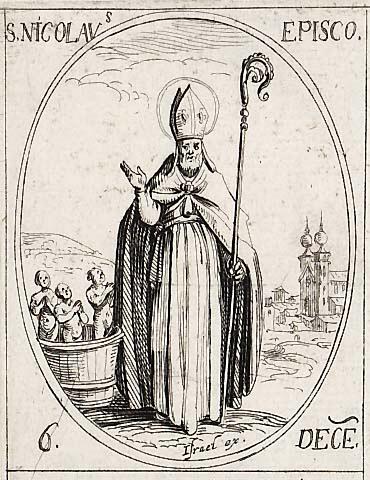
Nicolas représenté avec les 3 enfants et le tonneau, collection musées départementaux de la
Haute-Saône
Saint Nicolas de Myre,
évêque
Né à Patare en Lycie (1) vers 270 de parents chrétiens : son père, Euphémius, était un homme riche,
pieux et charitable ; sa mère, Anne, était la sœur de Nicolas l’Ancien, évêque
de Myre. Nicolas fit présager dès l’enfance sa fidélité à la pratique du jeûne
: les imagiers médiévaux ont reproduit sur nos vitraux le nourrisson repoussant
d’un geste décidé le sein maternel. nombreux sont les traits analogues qui ont
rendu saint Nicolas si populaire. La peste ayant enlevé ses parents et l’ayant
laissé jeune à la tête d'un riche héritage, Nicolas consacra sa fortune à de
bonnes œuvres. Un homme veuf de son voisinage ayant trois filles nubiles et,
par suite de revers de fortune, ne pouvant leur assurer une honnête situation,
résolut de les prostituer ; Nicolas se fit à leur égard l'instrument de la
Providence en leur procurant une riche dotation. On dit que son oncle l’ordonna
prêtre et le fit supérieur du monastère de Sainte-Sion, près de Myre.
Quand l'évêque de Myre
vint à mourir, Dieu fit connaître aux évêques de la province que Nicolas était
l’homme de son choix pour cet office. Contraint d'accepter l’épiscopat, Nicolas
réalisa tout ce qu on attendait de l'évêque en ces temps primitifs ; il fut le
guide doctrinal de son peuple, son défenseur dans les périls des persécutions,
le sage administrateur des biens de la communauté chrétienne, un organisateur
zélé des œuvres charitables. Jeté en prison durant les dernières années de la
persécution de Dioclétien, il fut délivré à l'avènement de Constantin et revint
à Myre. L'idolâtrie était encore vivace : l'évêque la combattit, renversant le
temple de Diane qui était le centre de la réaction païenne dans la ville de
Myre ; en un temps de famine, il s'ingénia pour procurer les vivres nécessaires
à son peuple.
Parmi les miracles
nombreux qui lui sont attribués, il faut mentionner celui que les artistes ont
le plus fréquemment reproduit. Trois officiers de Constantin avaient été
envoyés en Phrygie pour réprimer une sédition ; en passant par Myre ils avaient
été reçus par l'évêque et l'avaient vu tirer des mains du bourreau trois de ses
concitoyens injustement condamnés. Rentrés à Constantinople les trois officiers
tombèrent en disgrâce et furent condamnés à mort. Se souvenant de ce qu'avait
fait l'évêque de Myre, ils .s'adressèrent à Dieu pour obtenir que Nicolas
manifestât sa puissance en leur faveur. Constantin, à qui le prélat apparut en
songe, reconnut l'innocence des condamnés et les fit remettre en liberté. Tel
est le thème que les artistes du Moyen Age ont représenté sous le titre des «
trois tribuns sauvés de la mort. » Un trouvère du XII° siècle a narré dans un
de ses poèmes l'histoire de « trois clercs allant à l'école », mis à mort par
un boucher à qui ils avaient demandé l'hospitalité, puis ressuscités par le
saint évêque de Myre. La légende des « trois petits enfants qui s'en allaient
glaner aux champs » s'ancra profondément dans la croyance populaire :
représentée et chantée en Occident elle contribua a l'extension du culte rendu
à saint Nicolas. Il faut en dire autant du miracle de la tempête apaisée par
l'intercession de saint Nicolas.
Enfin Nicolas, au cours
de son épiscopat, combattit les erreurs d'Arius, et fut l'un des 318 évêques
qui condamnèrent l'arianisme au premier concile de Nicée. Sa mort arriva peu de
temps après, vers 325, et de son tombeau s'écoula une huile miraculeuse. Vers
1087, comme la ville de Myre était au pouvoir des Turcs, des marchands de Bari
furent assez heureux pour enlever les saintes reliques et les apportèrent dans
leur ville où une église magnifique fut construite en l'honneur de saint
Nicolas.
Saint Nicolas de Myre est
assurément un des saints les plus populaires et son culte, né dans l’Eglise
grecque, était déjà très répandu en Orient, lorsque soixante-deux corsaires de
Bari razzièrent ses restes mortels abandonnés par les gens de Myre qui fuyaient
les Turcs. Le culte de saint Nicolas se développa Occident à la fin du XI°
siècle, après le transfert de ses reliques à Bari (9 mai 1087), pour connaître,
à partir du XII° siècle, un essor considérable, singulièrement en Italie et en
Lorraine, dans l’Est de la France et en Allemagne rhénane.
Un très grand nombre de
corporations ont pris saint Nicolas pour protecteur et pour patron, ce qui
s'explique par les très nombreux miracles qui lui sont attribués.
La tempête apaisée
explique que saint Nicolas soit réclamé par les marins, les bateliers, les
pécheurs, les voyageurs et les pèlerins. Les mal jugés se souviennent qu'il a
obtenu de Constantin la grâce de trois officiers condamnés sur de faux
témoignages. Pour les tonneliers, c’est saint Nicolas qui fit sortir vivants
d'un tonneau ou d'un cuvier les trois enfants mis à mort par un cruel boucher.
Les écoliers et écolières sont des protégés de prédilection : s'ils se
conduisent bien, s'ils sont obéissants et studieux, saint Nicolas, le 5
décembre, veille de sa fête, remplit leurs souliers ou leurs bas de friandises
; mais s'ils sont paresseux ou indociles, il leur apporte un martinet. En
Alsace, le 5 décembre au soir, les petits garçons se réunissent et parcourent
les rues du village avec une clochette qu'ils agitent, puis ils crient : « Les
petits enfants sont-ils couchés ? Saint-Nicolas va passer ! » Avant de se
coucher les enfants ne manquent pas de placer dans la cheminée un sabot pour
recevoir le cadeau de saint Nicolas. En Angleterre, les enfants de chœur
avaient saint Nicolas pour patron : le 6 décembre, ceux des cathédrales et des
collégiales élisaient l'un d'entre eux pour évêque : ce devait être le plus
sage, le plus pieux, le plus zélé ; durant un mois, jusqu’au jour des Rois, des
honneurs lui étaient rendus. La dotation des filles de son pauvre voisin font
de saint Nicolas le protecteur des filles à marier.
Avant la translation du
corps de saint Nicolas à Bari, son culte avait déjà été introduit à Rome, au
VII° siècle, par des moines orientaux. Au IX° siècle, le pape Nicolas I° (mort
en 867) ajoutait à Sainte-Marie-in-Cosmedin, un oratoire en l’honneur de son
saint patron. La diaconie Saint-Nicolas-in-Carcere, sans doute en relation avec
une église antérieure, fut créée au IX° ou au X° siècle. On a pu dénombrer à
Rome quatre-ving-cinq églises, chapelles, couvents et hospices Saint-Nicolas.
Le culte de saint Nicolas
fut introduit en Allemagne par la femme d’Othon I°, la byzantine Théophano dont
le fils, Othon III (975-991) fonda, près d’Aix-la-Chapelle,
Saint-Nicolas-de-Burtscheid. Saint Nicolas est le patron de Hambourg.
Après qu’Albert de
Varangéville, rentrant de Terre Sainte eut dérobé à Bari un fragment de la
dextre bénissant de saint Nicolas pour la rapporter en Lorraine, il fit édifier
la chapelle Saint-Nicolas-de-Port qui laissa la place à une église plus grande,
consacrée par Pibon, évêque de Toul, en 1101 ; une nouvelle église fut
construite en 1193 qui fut à son tour remplacée au XV° siècle quand saint
Nicolas devint le patron de la Lorraine pour avoir favorisé la victoire du duc
René II contre Charles le Téméraire, battu et tué sous les murs de Nancy (5
janvier 1477). A Rome, on le vénère à Saint-Nicolas-des-Lorrains.
En France, le comte
d’Anjou, Foulque Nerra, grand pèlerin de Palestine, à la suite d’un vœu qu’il
avait fait dans une tempête, fonda, en 1020, l’abbaye Saint-Nicolas d’Angers
dont l’église nouvelle fut consacrée par le pape Urbain II (10 février 1096).
Saint Nicolas est invoqué à Provins, de nombreuses églises lui sont dédiées
dans les diocèses de Bourges, de Nevers, de Limoges et de Clermont, dans la
Flandre française, au nord de la Lys, il est un des saints les plus honorés.
Trente-deux communes françaises portent encore le nom de Saint-Nicolas.
A Paris, la première
chapelle du Palais (île de la Cité), fondée par Robert le Pieux (996-1031),
restaurée par Louis VI le Gros et détruite par saint Louis pour édifier la
Sainte-Chapelle, était dédiée à saint Nicolas. Le Parlement de Paris, à sa
rentrée annuelle, entendait sa messe rouge célébrée à l’autel de saint Nicolas
qui était l’un des patrons des juristes ; le président de la confrérie des
avocats du palais prit le nom de bâtonnier parce qu’il tenait un bâton surmonté
d’une effigie de saint Nicolas.
Robert de Dreux, frère de
Louis VII, fonda, en 1187, en même temps que l'église collégiale Saint-Thomas
du Louvre, un hôpital des pauvres écoliers de saint Nicolas. En 1217 les
écoliers obtinrent permission d'établir une chapelle et un cimetière, ce fut
l'hospice Saint-Nicolas du Louvre, supprimé (1541) par le cardinal Jean du
Bellay et remplacé par un collège de dix chanoines. En 1744, Saint-Nicolas et
Saint-Thomas du Louvre furent réunis en un seul corps sous le titre de
Saint-Louis du Louvre. Depuis Charles V, le jour de la fête de saint Nicolas,
les écoliers, déguisés et menés par un des leurs portant les attributs des
évêques, couraient les rues en chantant. Les enfants de chœur de Notre-Dame
allaient célébrer l'office à Saint-Nicolas-des-Champs.
Saint-Nicolas-des-Champs
qui était à l’origine une chapelle dépendante de l’abbaye
Saint-Martin-des-Champs, attestée dès 1119, fut érigée en paroisse en 1184 et
souvent agrandie au cours des siècles. Les parties les plus anciennes de
l’actuel édifice sont du premier quart du XV° siècle, tandis que le reste fut
construit aux XVI° et XVII° siècles ; le retable que Simon Vouet et Jacques
Sarazin réalisèrent en 1629, est le seul retable parisien de cette époque à
avoir échappé au vandalisme révolutionnaire. On y voit, dans la deuxième
chapelle de gauche, un Saint Nicolas dans la tempête de Jean-Baptiste Pierre
qui imite en peinture un relief sculpté (1747), rapporté de
Saint-Pierre-du-Gros-Caillou.
Lorsque le clos du
Chardonnet fut englobé dans l’enceinte de Philippe Auguste, l’évêque de Paris,
Guillaume d’Auvergne, pour les habitants de ce nouveau quartier, fit élever une
chapelle et un presbytère qu’il dédia à saint Nicolas (1230). Devenue paroisse,
la chapelle fut remplacée par une église (1243) qui fut à son tour remplacée par
une église plus grande que Jean de Nanton, évêque de Paris, consacra le 13 mai
1425. Agrandie en 1545, l’église Saint-Nicolas-du-Chardonnet reçut un nouveau
clocher en 1625. Le 19 juillet 1656, le conseiller du Roi Christophe Martin,
contrôleur général de la Marine et ancien marguillier de
Saint-Nicolas-du-Chardonnet, posa la première pierre d’une nouvelle église à
laquelle travailla Charles Le Brun et dont Hardouin de Péréfix fit la dédicace
le 15 août 1667 ; la nef fut achevée en 1716, la voûte fut posée en 1763, le
maître-autel fut consacré par l’archevêque Christophe de Beaumont le 4 décembre
1768.
Si l’on voulait chercher saint Nicolas à Paris, outre les deux églises dont nous venons de parler, on trouverait un vitrail de l’église Saint-Merry (début du XVI° siècle), une statue en bois (XVII° siècle), dans la chapelle de la congrégation Notre-Dame (ancienne Abbaye-aux-Bois), 11 rue de la Chaise, et une peinture sur l’iconostase de l’église Saint-Georges-des-Roumains, 38 rue Ribera (XVI°). On pourrait aussi voir, présentés au Louvre, le triptyque Harbaville, ivoire byzantin du XII° siècle, et une œuvre de Lorenzo di Credi (XV° siècle) où saint Nicolas est associé à saint Julien de Rimini. Dans les collection de la Bibliothèque nationale, on garde une miniature du XI° siècle, dans la Vie et miracle de saint Nicolas, et les Heures d’Anne de Bretagne, de Jean Bourdichon (XVI° siècle) où saint Nicolas ressuscite les trois écoliers dans le saloir. Au musée Jacquemart-André, on montre la miniature des Heures du maréchal Boucicaut.
Au tympan du portail sud
de l’église Saint-Martin de Colmar, saint Nicolas est debout entre trois
pucelles et trois clergeons (XII° siècle) ; à la même époque, on peignit la
fresque romane de Saint-Jacques-des-Guérets, dans le vendômois, et l’on sculpta
le bas-relief de l’église de Saint-Nicolas de Civray . On voit saint Nicolas
sur plusieurs vitraux, tels ceux du XIII° siècle des cathédrales de Chartres,
d’Auxerre, de Bourges, du Mans et de Tours et tel celui de l’église de
Saint-Julien-du-Sault (Yonne) et de l’église Saint-Pierre de Dreux ; c’est à la
même époque que l’on doit les bas-reliefs du tympan du portail sud du transept
de la cathédrale de Chartres. Au XIV° siècle, saint Nicolas est représenté sur
un vitrail de l’église Saint-Gengoult de Toul ; c’est à de même époque que date
le rétable de pierre du Mesnil-sur-Oger (Marne). Le XV° siècle a laissé
quelques belles statues de pierre, comme celle du Moutier-Saint-Jean
(Côte-d’Or) et celle d’Ervy-le-Châtel (Aube), un saint Nicolas représenté par
Jean Fouquetdans les Heures d’Etienne Chevalier, à Chantilly, et les fresques
de l’église alsacienne d’Hunawihr. On doit au XVI° siècle les vitraux de
l’église Saint-Nicolas de Vézelise, en Lorraine, une statue de l’église
Saint-Pantaléon de Troyes, un vitrail de l’église Saint-Etienne de Beauvais,
une statuette reliquaire en argent de l’église d’Avesnes-le-Comte, en Artois.
Dans la cathédrale de Sens, on voit un bas-relief en marbre, sculpté au XVIII°
siècle par Etienne Gois.
1 La Lycie est une
ancienne région située au sud de l’Asie-Mineure, bordée au nord-ouest par la
Carie, à l’ouest et au sud par la Méditerranée, à l’est par la Pamphylie et au
nord-est par la Pisidie. Les principales villes de Lycie sont Telmissus,
Xanthe, Myre, Limyre et Patare.
SOURCE : http://missel.free.fr/Sanctoral/12/06.php

Saint
Nicolas, peinture sur velin. Feuillet 023, recto, du manuscrit messin "Les
Heures de Jean de Vy et Perrette, Baudoche Metz", vers 1435-1447, suivies
d’un psautier (vers 1340).
Saint Nicolas de
Myre
Il y a, au calendrier,
deux saints Nicolas : Nicolas de Flue, en Suisse, qui est fêté le 21 mars
et Nicolas de Myre, en Asie mineure, qui est célébré en ce jour.
Nicolas est un nom
d'origine gréco-latine, signifiant " victoire et louange ".
Né en Turquie à la fin du
IIIe siècle dans la Lycie, aujourd'hui Demré, Nicolas eut à souffrir pour la
foi à la fin du règne de l'empereur Dioclétien. Il survécut à la persécution et
participa au premier Concile de Nicée en 325. On sait qu'il était d'une extrême
miséricorde pour toutes les détresses, tant physiques que spirituelles. La
légende de saint Nicolas est une "merveille" ! Elle connut un succès
énorme à partir de deux épisodes : le récit impressionnant des trois petits
enfants assassinés et mis au saloir par un aubergiste et que le saint ramena à
la vie, et l'histoire qui montre saint Nicolas jetant par la fenêtre trois
bourses d'or chez un voisin qui, faute de pouvoir leur constituer une dot,
allait livrer ses filles à la prostitution.
Les reliques de saint
Nicolas de Myre allaient beaucoup "voyager", d'Orient en Occident,
après sa mort survenue un 6 décembre vers 350. En 1087, à l'approche des
Sarrazins, on transféra les restes du saint à Bari en Italie. En même temps,
une autre de ses reliques était apportée par un chevalier lorrain à Port, près
de Nancy ; la localité prit par suite le nom de Saint-Nicolas-de-Port. C'est à
travers toute l'Europe que s'étend la popularité de saint Nicolas, jusqu'en
Russie où il supplante "Mikoula", divinité de la moisson. Au cours
des siècles, la Saint Nicolas est devenu la grande fête des écoliers, en
référence à l'action miséricordieuse du saint ressuscitant les "trois
petits enfants" et les envoyant à l'école. Avec son âne chargé de hottes
de cadeaux, porteur de jouets et de friandises, le bon saint Nicolas distribue
ses bienfaits, de nuit, dans la cheminée. Toutefois, ce rôle merveilleux de
saint Nicolas a beaucoup souffert de la concurrence d'autres légendes comme
celle, chez nous, du "Père Noël" ou de l'américain "Santa
Claus".
Rédacteur : Frère Bernard
Pineau, OP
SOURCE : http://www.lejourduseigneur.com/Web-TV/Saints/Nicolas-de-Myre

Ambrogio Lorenzetti (1290–1348), La
Charité de Saint Nicolas de Bari, circa 1330, tempera and gold on poplar
panel, 30 x 20.5, Louvre Museum
06/12 St Nicolas, évêque et confesseur
A Myre, déposition de St
Nicolas, vers 350. Diffusion du culte en Europe au IXe siècle (Il est déjà
représenté par une fresque au VIIIè siècle à Ste Marie Antique, en compagnie
des Pères de l’Église d’Orient, Chrysostome, Grégoire de Naziance, etc.). La
fête entre au XIe siècle au calendrier Romain. En Lorraine, proclamé ‘Patron du
duché’ par les ducs en 1120, on le célèbre avec une messe propre.
Dom Guéranger, l’Année
Liturgique
Pour faire honneur au
Messie Pontife, la souveraine Sagesse a multiplié les Pontifes sur la route qui
conduit à lui. Deux Papes, saint Melchiade et saint Damase ; deux Docteurs,
saint Pierre Chrysologue et saint Ambroise ; deux Évêques, l’amour de leur
troupeau, saint Nicolas et saint Eusèbe : tels sont les glorieux Pontifes qui
ont reçu la charge de préparer, par leurs suffrages, la voie du peuple fidèle
vers Celui qui est le souverain Prêtre selon l’ordre de Melchisédech. Nous
développerons successivement leurs titres à faire partie de cette noble cour.
Aujourd’hui, l’Église célèbre avec joie la mémoire de l’insigne thaumaturge
Nicolas, aussi fameux dans l’Orient que le grand saint Martin l’est dans
l’Occident, et honoré depuis près de mille ans par l’Église latine. Rendons
hommage au souverain pouvoir que Dieu lui avait donné sur la nature ; mais
félicitons-le surtout d’avoir été du nombre des trois cent dix-huit Évêques qui
proclamèrent, à Nicée, le Verbe consubstantiel au Père. Il ne fut point
scandalisé des abaissements du Fils de Dieu ; ni la bassesse de la chair que le
souverain Seigneur de toutes choses revêtit au sein de la Vierge, ni l’humilité
de la crèche, ne l’empêchèrent de proclamer Fils de Dieu, égal à Dieu, le fils
de Marie ; c’est pourquoi il a été élevé en gloire et a reçu la charge
d’obtenir, chaque année, pour le peuple chrétien, la grâce d’aller au-devant du
Verbe de vie, avec une foi simple et un ardent amour.
Presque tous les
Bréviaires de l’Église Latine, jusqu’au XVIIe siècle, sont très abondants sur
les vertus et les œuvres merveilleuses de saint Nicolas, et contiennent le bel
Office du saint Évêque tel qu’il fut composé vers le XVIIe siècle. Nous avons
parlé ailleurs de cet Office sous le rapport musical ; ici, nous nous bornerons
à dire qu’il est tout entier puisé dans les Actes de saint Nicolas, et plus
explicite sur certains faits que la Légende du Bréviaire romain. Les pièces qui
vont suivre insistent sur un fait dont cette Légende ne dit rien : nous voulons
parler de l’huile miraculeuse qui, depuis près de huit siècles, découle sans
cesse du tombeau du saint Évêque, et au moyen de laquelle Dieu a souvent opéré
des prodiges. Le Répons et l’Antienne que nous donnons tout d’abord, célèbrent
le miracle de cette huile ; et ces deux pièces étaient autrefois si populaires,
qu’au XIIIe siècle on en emprunta la mélodie, pour l’appliquer au Répons Unus
panis et à l’Antienne O quam suavis est, dans l’Office du Saint-Sacrement.
RÉPONS. [1]
R/. De son tombeau de
marbre, découle une huile sacrée qui guérit les aveugles dont les yeux en sont
oints, * Rend l’ouïe aux sourds, et remet en santé tous ceux qui sont débiles.
V/. Les peuples courent en foule, empressés de voir les merveilles qui se font
par l’entremise de Nicolas. * Cette huile rend l’ouïe aux sourds, et remet en
santé tous ceux qui sont débiles.
ANTIENNE. [2]
O bonté du Christ, digne
d’être relevée par toutes sortes de louanges ! C’est elle qui manifeste au loin
les mérites de Nicolas son serviteur ; car de la tombe de ce Saint découle une
huile, et elle guérit tous ceux qui sont dans la langueur.
Nous donnons ensuite les
deux Hymnes qui se trouvent dans tous les Bréviaires Romains-Français.
Ière HYMNE [3]
Chante, ô ma langue, les
louanges du pontife Nicolas : afin que le suprême Adonaï, Roi et Père de tous
les êtres, nous fasse aborder par l’entremise de son divin Fils au port du
salut.
A l’âge où Nicolas
pendait encore aux mamelles de sa mère, jamais on ne le vit plus d’une fois le
jour s’y désaltérer, à la quatrième et sixième férié de la semaine : il
craignait, le pieux enfant, de rompre son jeûne par une goutte de lait.
Élevé à l’honneur de
Prélat, Nicolas fit pleuvoir si abondamment la rosée de la piété sur tous les
peuples, qu’à peine a-t-il son pareil dans toute la série des siècles.
Par l’usage qu’il fait de
son or, il sauve trois vierges de la prostitution ; dans la famine il multiplie
le blé et le distribue au peuple ; il retire un vase tombé dans la mer, et
porte secours aux nautoniers qui craignaient le naufrage.
Du milieu des morts est
par lui ressuscité un homme qui avait commis un vol : par lui un Juif est
baptisé et recouvre le bien qu’on lui avait dérobé ; l’un est rendu à la vie,
l’autre s’élance dans la voie de la foi.
Des Pontifes l’ornement,
l’honneur et la gloire, Nicolas, que la grâce dont vous êtes enrichi vienne en
aide au peuple et au clergé ; qu’elle assiste nos âmes, nos mains et nos
lèvres, et nous fasse rendre à Dieu nos vœux.
Louange à la souveraine
Trinité : à elle puissance et victoire ; qu’elle daigne nous accorder d’entrer
après la vie, chargés de palmes, dans la patrie des cieux, en part des joies
éternelles de Nicolas. Amen.
IIe HYMNE.
Que le clergé, déployant
la voix et les chants de l’allégresse, exalte et préconise Nicolas, du clergé
le père et le patron ! Que le cœur prompt et docile se dilate au son de la
voix.
Que tous, Grecs, Latins,
langues, tribus, nations ; étendue des terres, profondeurs des mers ; sexes,
conditions, hôtes , citoyens , étrangers ; tous chantent avec un pareil
enthousiasme.
Il n’a cessé, ne cesse,
ne cessera de nous combler tous de ses bienfaits, cet immortel Prélat, dont le
nom ne s’échappera jamais de notre mémoire. Par lui, tout homme qui sema dans
la tristesse fleurira comme le lis.
Ce héros magnanime,
revêtu de la chair, méprisa les œuvres de la chair, ne faisant, ne disant rien
que de salutaire ; délivré des liens du corps, il vole enfin au séjour éthéré.
Quelle fut sa vertu de
charité, l’huile qui coule de son tombeau le déclare assez hautement jusqu’en
ce siècle même ; elle donne au peuple qui implore son assistance le bienfait de
la santé.
Louange à la souveraine
Trinité : à elle puissance et victoire ; qu’elle daigne nous accorder d’entrer,
après la vie, chargés de palmes, dans la patrie des cieux, en part des joies
éternelles de Nicolas. Amen.
Adam de Saint-Victor ne
pouvait faire défaut à saint Nicolas : les Églises du moyen âge lui durent la
belle Séquence qui suit :
SÉQUENCE.
Réjouissons-nous et
tressaillons, unis de bouche et de cœur, à cette solennelle fête du bienheureux
Nicolas.
Encore enfant au berceau,
il observe les jeûnes ;
Encore enfant à la
mamelle, déjà il mérite les joies suprêmes.
Adolescent, il embrasse
l’étude des lettres,
Sans pécher, sans
connaître la licence de son âge.
Bienheureux Confesseur,
une voix venue du ciel l’appelle aux dignités.
Promu par elle, il monte
au faîte le plus élevé de la Prélature.
Il avait dans le cœur une
tendre miséricorde, et il prodiguait ses bienfaits aux opprimés.
Par ses trésors, des
vierges sont sauvées de l’opprobre ; et la pauvreté de leur père est soulagée.
Des matelots en mer
luttaient contre la furie des flots, sur une nef à demi brisée.
Déjà désespérant de la
vie, en ce danger si pressant, ils crient et disent tous d’une voix :
« O bienheureux Nicolas !
Ramenez-nous à un port de mer ; sauvez-nous de ce péril de mort.
Ramenez-nous à un port de
mer, vous dont la compassion généreuse est tant de fois venue en aide. »
Pendant qu’ils criaient,
et non sans fruit, voici quelqu’un qui leur dit : « J’arrive à votre secours. »
Soudain souffle un vent
favorable, et la tempête est apaisée, et les mers sont en repos.
De sa tombe découle une
huile abondante,
Qui guérit tous les
malades par l’intercession du Saint.
Nous que voici en ce
monde, naufragés déjà plus d’une fois dans l’abîme du vice,
Glorieux Nicolas,
menez-nous au port du salut où sont paix et gloire.
Obtenez-nous du Seigneur,
par vos secourables prières, l’onction qui sanctifie ;
Cette onction qui a guéri
les blessures d’innombrables iniquités dans Marie la pécheresse.
Qu’à jamais soient dans
la joie ceux qui célèbrent cette fête ;
Et qu’après cette course
de la vie, le Christ les couronne.
Amen.
La plus populaire de
toutes les Séquences de saint Nicolas est néanmoins celle qui suit. On la
trouve dans un grand nombre de Processionnaux jusqu’au XVIIe siècle, et elle a
servi de type à quantité d’autres qui, bien que consacrées à la louange de
divers Patrons, gardent non seulement la mesure et la mélodie de la Séquence de
saint Nicolas, mais retiennent encore, par un tour de force ingénieux, le fond
même des expressions.
SÉQUENCE.
Les malades sont rendus à
la santé par l’huile miraculeuse.
Au milieu du naufrage,
Nicolas est d’un puissant secours.
Il ressuscite du tombeau
un mort étendu sur le chemin.
Un juif aperçoit de l’or,
et demande le Baptême.
Nicolas retire de l’eau
le vase et l’enfant qu’il rend à son père !
Oh ! qu’il parut bien le
Saint de Dieu , quand il multiplia la farine dans la disette !
Qu’ainsi les louanges de
Nicolas soient chantées en cette assemblée ;
Car quiconque le prie de
cœur, met le vice en fuite, et s’en retourne guéri.
Ainsi soit-il.
(On trouvera la Séquence
du Propre du Diocèse de Toul, où se trouve le plus grand centre de pèlerinage à
St Nicolas en dehors de Bari, à la messe propre de ce diocèse. N.d.W.)
Mais aucune Église n’a
marqué autant d’enthousiasme pour saint Nicolas, que l’Église grecque dans ses
Menées. On voit que l’illustre Thaumaturge était une des plus fermes espérances
de l’Empire Byzantin ; et cette confiance en saint Nicolas, Constantinople l’a
transmise à la Russie qui la garde encore aujourd’hui. Nous allons, selon notre
usage, extraire quelques strophes de la masse de ces chants sacrés que
Sainte-Sophie répétait autrefois en langue grecque, et que les coupoles dorées
des Sobors de Moscou entendent retentir encore chaque année dans l’idiome
Slavon.
HYMNE DE SAINT NICOLAS.
(Tirée des Menées des Grecs.)
Tu as vraiment habité à
Myre, exhalant un parfum précieux ; parfumé toi-même d’un baume spirituel, ô
bienheureux Nicolas, grand Hiérarque du Christ ; et tu parfumes la face de ceux
qui, avec foi et amour, honorent ton illustre mémoire, les délivrant de toutes
nécessités et tribulations, ô Père saint, par tes prières auprès du Seigneur.
Ton nom propre est
véritablement : Victoire du peuple, bienheureux Nicolas, souverain prêtre du
Christ ; car, invoqué en tous lieux, tu préviens aussitôt ceux qui avec amour
requièrent ta protection ; apparaissant nuit et jour à ceux qui t’invoquent
avec foi, tu les délivres des nécessités et des tentations.
Tu apparus à l’Empereur
Constantin et à Ablavius, et leur inspiras une terrible frayeur par ces mots,
afin de les engager à la clémence : « Les innocents que vous retenez dans les
fers ne méritent point un injuste supplice ; et si tu v méprises mes paroles, ô
Prince ! j’en porterai contre toi ma plainte au Seigneur. »
Ton œil intrépide a pu
fixer les sublimes hauteurs de la Gnose, et tu as sondé le profond abîme de la
Sagesse, toi qui as enrichi le monde de tes enseignements, ô Père saint ! prie
pour nous le Christ, ô grand Pontife Nicolas !
Le Christ t’a fait voir à
ton troupeau, comme la règle de la foi et l’image de la douceur, ô grand
Hiérarque Nicolas ! Car tu répands à Myre un précieux parfum, tout y resplendit
de la gloire de tes œuvres, ô protecteur des veuves et des orphelins ! prie sans
cesse le Seigneur de sauver nos âmes.
Réjouis-toi, ô très
sainte âme, demeure très pure de la Trinité, colonne de l’Église, soutien des
fidèles, appui de ceux qui sont fatigués, astre rayonnant qui, par l’éclat de
tes agréables prières, dissipes en tous lieux les ténèbres des tentations ;
saint Pontife Nicolas, port tranquille où trouve un abri quiconque dans la
fureur de la tempête réclame ton secours, prie le Christ qu’il daigne accorder
à nos âmes une grande miséricorde.
Réjouis-toi, homme rempli
d’un divin zèle, qui, par un terrible avertissement et par l’éclat de ta voix
menaçante dans un songe, as délivré ceux que le glaive allait immoler. Fontaine
abondante, tu répands dans Myre la richesse de tes parfums ; tu verses dans les
âmes une douce rosée, tu écartes les ordures des passions mauvaises, tu coupes
avec le glaive l’ivraie de l’erreur ; prends le van de ton zèle, dissipe les
futiles enseignements d’Arius, et prie le Christ d’accorder à nos âmes une
grande miséricorde.
Roi très haut de tous les
rois, vous dont la puissance est infinie, à la prière c notre saint Pasteur,
rendez paisible, ô Verbe, non en conjurons, la vie de tous les Chrétiens.
Donnez contre les barbares à notre pieux Empereur la force et la victoire ;
afin que tous, et toujours, nous chantions votre puissance, et l’exaltions dans
les siècles des siècles.
Saint Pontife Nicolas,
que votre gloire est grande dans l’Église de Dieu ! Vous avez confessé
Jésus-Christ devant les Proconsuls, et endure la persécution pour son Nom ; vous
avez ensuite été témoin des merveilles du Seigneur, quand il rendit la paix à
son Église ; et peu après, votre bouche s’ouvrait dans l’Assemblée des trois
cent dix-huit Pères, pour confesser, avec une autorité irréfragable, la
divinité du Sauveur Jésus-Christ, pour lequel tant de millions de Martyrs
avaient répandu leur sang. Recevez les félicitations du peuple chrétien qui,
par toute la terre, tressaille de joie à votre doux souvenir ; et soyez-nous
propice, en ces jours où nous attendons la venue de Celui que vous avez
proclamé Consubstantiel au Père. Daignez aider notre foi et seconder notre
amour. Vous le voyez maintenant face à face, ce Verbe par qui toutes choses ont
été faites et réparées ; demandez-lui qu’il daigne se laisser approcher par
notre indignité. Soyez notre médiateur entre lui et nous. Vous l’avez fait
connaître à notre intelligence, comme le Dieu souverain et éternel ; révélez-le
à notre cœur, comme le suprême bienfaiteur des fils d’Adam. C’est en lui, ô
Pontife charitable, que vous aviez puisé cette compassion tendre pour toutes
les misères, qui fait que tous vos miracles sont autant de bienfaits :
continuez, du haut du ciel, de secourir le peuple chrétien.
Ranimez et augmentez la
foi des nations dans le Sauveur que Dieu leur a envoyé. Que, par l’effet de vos
prières, le Verbe divin cesse d’être méconnu et oublié dans ce monde qu’il a
racheté de son sang. Demandez, pour les Pasteurs de l’Église, l’esprit de
charité qui brilla si excellemment en vous, cet esprit qui les rend imitateurs de
Jésus-Christ, et leur gagne le cœur du troupeau.
Souvenez-vous aussi,
saint Pontife, de cette Église d’Orient qui vous garde encore une si vive
tendresse. Votre pouvoir sur la terre s’étendait jusqu’à ressusciter les morts
; priez, afin que la véritable vie, celle qui est dans la Foi et l’Unité,
revienne animer cet immense cadavre. Par vos instances auprès de Dieu, obtenez
que le Sacrifice Je l’Agneau que nous attendons soit de nouveau et bientôt
célébré sous les Dômes de Sainte-Sophie. Restituez à l’unité les Sanctuaires de
Kiev et de Moscou, et après avoir soumis à la Croix l’orgueil du Croissant,
abaissez devant les Clefs de saint Pierre la majesté des Tzars, afin qu’il n’y
ait plus ni Scythe, ni Barbare, mais un seul pasteur.
[1] Dom Guéranger cite
ici un répond propre du Diocèse de Toul, aujourd’hui 8ème répons des Matines
[2] Antienne des Laudes,
au bréviaire de Toul
[3] XIVe siècle,
bréviaire de Toul 1510

Carlo Crivelli (circa 1435–circa 1495), Saint Nicholas, 1472 Polyptych, Oil on wood panel, 96.2 x 32, Cleveland Museum of Art
Bhx Cardinal
Schuster, Liber Sacramentorum
Ce célèbre Thaumaturge,
évêque de Myre à l’époque du concile de Nicée, fut définitivement accueilli
dans le calendrier romain vers le XIe siècle. Mais son culte est beaucoup plus
ancien, et dans la Rome médiévale il prit jadis de si grandes proportions qu’on
compte au moins une soixantaine d’églises s’élevant sous son vocable. Parmi
celles-ci, la plus insigne est celle qui se trouve près du portique d’Octavie :
Saint-Nicolas in Carcere Tulliano, ou in foro clitorio, où se célèbre aussi la
station le samedi de la IVe semaine de Carême.
Dans le Patriarchium du
Latran existait un oratoire en l’honneur de saint Nicolas, et qui, entièrement
restauré par le pape Callixte II, devint comme le monument votif de la victoire
remportée au xne siècle par le Pontificat romain contre le Césarisme
germanique.
Cette chapelle, qui
s’élevait presque en face de l’oratoire de Saint-Laurent, fut détruite sous
Clément XIII ; on n’a conservé que les dessins des peintures qui la décoraient.
En Orient, la fête de ce
Thaumaturge, du ‘saint Héraut’, du ‘porte-parole du Père’, de ‘Celui qui fait
jaillir l’huile’, est une fête chômée, en vertu d’une ordonnance de l’empereur
Emmanuel Comnène (1143-1181) ; il en fut de même en certains diocèses d’Europe.
Ce qui valut chez les Grecs une immense renommée à saint Nicolas, c’est le
liquide miraculeux qui, aujourd’hui encore à Bari, découle de ses ossements.
Le titre de confesseur,
attribué dans l’antiquité au Thaumaturge de Myre, se rapporte à ce qu’il eut à
souffrir durant la dernière persécution. La présence de saint Nicolas au
concile de Nicée est très probable, mais tout le reste de la légende du saint
est sujet à de prudentes réserves.
La messe n’a de spécial
que les collectes et l’épître. Les autres parties sont tirées du Commun des
confesseurs pontifes.
L’antienne pour l’introït
s’inspire librement de l’Ecclésiastique (45, 30) dans l’éloge du pontife Aaron.
L’alliance dont il est ici question est en relation avec ce ministerium
réconciliationis dont parle l’Apôtre. Non seulement le Seigneur répandit sa
douce, paix dans l’âme du Pontife, mais précisément parce qu’il était agréable
à Dieu, il lui accorda la grâce de l’apaiser même envers le peuple,
réconciliant celui-ci avec Lui et l’induisant à l’observance de sa sainte Loi.
La conformité du cœur et de la volonté avec celle de Dieu : voilà le fondement
de la paix.
Dans la collecte on
rappelle les nombreux prodiges par lesquels, au moyen âge, le Thaumaturge de
Myre était célèbre. Ensuite on demande au Seigneur, par ses mérites, que tant
de choses merveilleuses, grâce auxquelles il daigne chaque jour confirmer la
foi chrétienne, servent à nous faire éviter les flammes de l’enfer. Voilà le
but suprême de notre sainte vocation : nous éloigner de Satan et de l’enfer,
pour nous diriger tout entiers vers Dieu et la vertu.
Dans la lecture suivante
(Hebr., 13, 7-17), l’Apôtre propose à notre imitation l’exemple des premiers
disciples du Sauveur et des premiers chefs des communautés chrétiennes, qui
avaient déjà confessé leur foi par le martyre. Jésus n’a pas simplement la
signification historique d’une vie n’appartenant qu’au passé. Non seulement, il
remplit l’histoire tout entière de la création, en tant que principe et fin
dernière des choses, mais d’une manière spéciale il continue à travers les
siècles sa vie mystique dans l’Église et dans les âmes des fidèles. Quand donc
nous souffrons pour son saint nom, nous ne faisons rien autre que prendre la
croix sur nos épaules, que nous laisser entraîner hors de notre cité terrestre
pour aller à sa rencontre sur la montée du Calvaire.
Le répons-graduel est
tiré du psaume 88. « Je trouvai David mon serviteur ; je l’oignis de l’huile de
ma sainteté. Ma main l’aidera et mon bras le soutiendra. » Dans les Écritures,
David symbolise le Roi-Messie, et chaque fois que le Saint-Esprit veut faire
l’éloge d’un chef quelconque de son peuple israélite, il le compare à David.
Dans la sainte liturgie, ce verset est aussi adapté aux saints pontifes qui, en
raison de l’onction épiscopale et de leurs fonctions, ressemblent en effet au
véritable David, Jésus-Christ, source et modèle de toute sainteté.
La lecture évangélique
est celle du Commun des confesseurs pontifes (Matth. 25, 14-23), et elle
rapporte la parabole des talents confiés par le maître à ses serviteurs pour
qu’ils les fassent fructifier en son absence. Avec tous les dons de nature et
de grâce dont elle est ornée, la vie est comme un capital qui nous est confié
en dépôt pour que nous le fassions fructifier. Personne ne peut demeurer
inactif et oisif, s’occupant seulement de garder le dépôt. Il faut le faire
fructifier et celui qui a reçu davantage doit absolument rendre aussi
davantage. Il est donc parfaitement licite à chacun de reconnaître les qualités
qu’il a reçues du Seigneur. Cette connaissance se présuppose même, avant que
personne ne puisse déterminer quelle est la voie qui lui convient davantage
pour mieux servir Dieu et pour sauver son âme. Toutefois la conscience des
propres qualités, loin de nous enorgueillir, doit au contraire nous faire
trembler, à la pensée de la terrible responsabilité qu’elles impliquent devant
Dieu et même devant la société. Chacun de nous, en effet, n’est pas créé et
constitué isolément dans le monde ; mais, faisant partie de la famille humaine,
il a reçu des dons, des qualités, non pas exclusivement pour lui-même, mais
dont il doit se servir pour l’avantage commun de ses semblables.
Le verset pour l’offrande
des oblations est tiré du psaume 88 : « Je lui ferai grâce et je lui serai
fidèle, et en mon nom sa puissance s’élèvera. » Voilà le secret du succès qui
distingue les œuvres des saints. Ils ne vivent ni ne travaillent isolément,
mais, unis à Jésus-Christ, vraie vigne, ils rapportent un fruit abondant. Faute
de cette union intérieure, que d’activité, même dans le clergé, demeure stérile
et sans consistance !
Dans la collecte avant
l’anaphore, nous supplions le Seigneur de rendre précieux, par les charismes de
la sainteté, le sacrifice que nous allons lui offrir en mémoire de saint
Nicolas. Le fruit que nous en espérons est la fermeté dans la divine charité et
dans l’union au Christ, en sorte que ni les joies ni les inévitables douleurs
de la vie n’arrivent jamais à relâcher le lien qui nous unit à Lui. Quels
trésors de doctrine en ces phrases incisives de notre Mère l’Église !
Le verset pour la
Communion du peuple est tiré du même psaume 88, d’où a été pris l’offertoire. «
J’ai juré une seule fois par ma sainteté elle-même. La race de David sera
éternelle. Son trône resplendira devant moi comme le soleil, et comme la lune
il durera éternellement, semblable à l’arc-en-ciel. » Même si les institutions
des saints viennent parfois à disparaître ici-bas — puisque l’Église, à l’égal
d’un arbre touffu, laisse tomber en leur temps les feuilles jaunies, pour se
couvrir de feuilles nouvelles — leur mérite et leur gloire demeurent intacts
devant le trône de Dieu.
Dans la collecte d’action
de grâces, nous demandons que le sacrifice festif en l’honneur du pontife
Nicolas produise en nous un effet éternel ; en sorte que l’union sacramentelle
avec Jésus fortifie cette charité qui doit nous unir à Lui pour toujours.
La renommée des miracles
rendit très populaire le nom de saint Nicolas non seulement en Orient où,
spécialement chez les Russes, il est encore aujourd’hui en grande vénération,
mais jusque dans les plus lointaines provinces d’Occident où son culte est
antérieur de plusieurs siècles à la translation de ses reliques de Myre à Bari.
Les ossements sacrés du
Thaumaturge s’emperlent continuellement, de nos jours encore, d’une sorte de
stillation ou sueur à laquelle les fidèles donnent le nom de manne de saint
Nicolas. Dans une révélation qu’elle eut à l’occasion de son pèlerinage à Bari,
sainte Brigitte apprit du Seigneur le motif de ce prodige. L’huile miraculeuse
qui transsude des os du saint Pontife de Myre, désigne l’immense charité et la
compassion qui l’animèrent durant sa vie, alors qu’il se faisait tout à tous
pour secourir les autres et ainsi les amener au Christ.
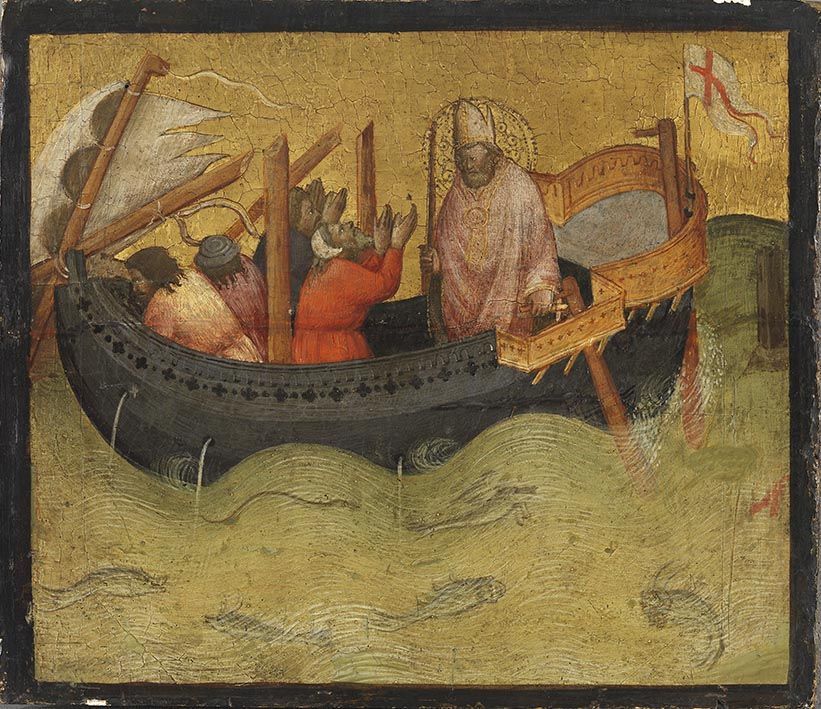
Agnolo Gaddi (1350–1396), Saint Nicolas saving a sinking ship, circa 1393, oil on poplar panel, 24.9 x 28.8, Bavarian State Painting Collections, Alte Pinakothek
Dom Pius Parsch, le Guide
dans l’année liturgique
Don joyeux.
La fête de Saint-Nicolas
fut jadis une des plus populaires et la poésie populaire a maintes fois chanté
« le grand saint Nicolas ».
Saint Nicolas. — Jour de
mort (d’après le martyrologe) : 6 décembre, vers 350. Église du tombeau :
l’église de Saint-Nicolas à Bari dans les Pouilles (église des Bénédictins)
depuis 1087. Image : On le représente avec trois boules sur un livre (la dot
des trois jeunes filles), avec trois enfants dans une cuve avec un vaisseau et
une ancre. Sa vie : Nicolas naquit à Patara en Lycie. Ses parents, qui étaient
restés longtemps sans enfants l’obtinrent de Dieu à force de prières. Il était
encore jeune quand il perdit ses parents. Il aimait à secourir les malheureux
et les affligés de toute sorte. Dans sa ville natale vivait un homme noble mais
pauvre, qui avait trois filles nubiles : ces filles ne pouvaient trouver de
parti parce qu’elles n’avaient pas de dot. Le père conçut alors la pensée
coupable de les livrer à la prostitution. Quand Nicolas l’apprit, il jeta, une
nuit, par la fenêtre une bourse contenant autant d’argent qu’il en fallait pour
constituer une dot à l’une des filles. Il renouvela ce geste, la seconde et la
troisième nuit. Dans une traversée sur mer, il apaisa la tempête par ses
prières c’est pourquoi il est considéré comme le patron des marins. Il dut
aussi subir l’emprisonnement pour sa foi. Il mourut tranquillement dans sa
ville épiscopale en prononçant ces paroles : « Entre vos mains, Seigneur je
remets mon esprit. » En Orient, saint Nicolas est très vénéré comme un grand
thaumaturge, comme un annonciateur de la parole de Dieu et « porte-parole du
Père ».
Pratique : A la fête
populaire de Saint-Nicolas nous pourrions rendre tout son contenu liturgique.
Comme dans beaucoup de pays, elle pourrait redevenir la fête des enfants.
La messe (Statuit). —
Dans la personne du prêtre nous voyons le saint évêque s’avancer vers l’autel.
Mais saint Nicolas est aussi l’image du divin Pontife qui, dans la messe,
marche avec nous vers les portes de Jérusalem pour offrir le sacrifice de la
Rédemption ; précédés de saint Nicolas, nous portons après lui la croix de la
vie (Introït). Il faut aussi que nous soyons avec saint Nicolas de « fidèles
serviteurs » qui ont bien administré les talents de la foi et de la grâce, et
les ont doublés. Au moment du Saint Sacrifice, le « Maître vient pour demander
des comptes » (chaque messe est en même temps un jugement, « les affamés sont
remplis de biens et les riches sont renvoyés les mains vides »). La communion
nous fait participer aux biens que saint Nicolas possède déjà dans la gloire,
mais que nous ne possédons encore que par la foi (Év.). Puissions-nous, par les
mérites et les prières de saint Nicolas, être préservés du feu de l’enfer !
(Oraison).
Leçons des Matines (avant
1960)
Quatrième leçon. Nicolas
naquit d’une famille illustre, à Patara, ville de Lycie. Ses parents avaient
obtenu de Dieu cet enfant par leurs prières. Dès le berceau il fit présager
l’éminente sainteté qu’il devait faire paraître dans la suite. On le vit, en
effet, les mercredis et vendredis ne prendre le lait de sa nourrice qu’une
seule fois, et sur le soir, bien qu’il le fît fréquemment les autres jours. Il
conserva toute sa vie l’habitude de jeûner la quatrième et la sixième férie.
Orphelin dès l’adolescence, il distribua ses biens aux pauvres. On raconte de
lui ce bel exemple de charité chrétienne : un indigent, ne parvenant point à
marier ses trois filles, pensait a les abandonner au vice ; Nicolas l’ayant su
jeta, la nuit, par une fenêtre, dans la maison de cet homme, autant d’argent
qu’il en fallait pour doter une de ces jeunes filles. Ayant réitéré une seconde
et une troisième fois cet acte de générosité, toutes trouvèrent d’honorables
partis.
Cinquième leçon. Le Saint
s’étant entièrement consacré à Dieu, partit pour la Palestine, afin de visiter
et de vénérer les lieux saints. Durant son voyage, il prédit aux matelots, par
un ciel serein et une mer tranquille, l’approche d’une horrible tempête. Elle
s’éleva bientôt, et tous les passagers coururent un grand danger : mais il
l’apaisa miraculeusement par ses prières. De retour dans sa patrie, il donna à
tous les exemples d’une grande sainteté ; et, par un avertissement de Dieu, il
se rendit à Myre, métropole de la Lycie. Cette ville venait de perdre son
Évêque, et tous les Évêques de la province étaient rassemblés afin de pourvoir
à l’élection d’un successeur. Pendant leur délibération ils furent divinement
avertis de choisir celui qui, le lendemain, entrerait le premier dans l’église,
et se nommerait Nicolas. Cet ordre du ciel fut exécuté, et Nicolas, trouvé à la
porte de l’église, fut créé Évêque de Myre à la grande satisfaction de tous.
Durant son épiscopat on vit constamment briller en lui la chasteté, qu’il avait
toujours gardée, la gravité, l’assiduité à la prière et aux veilles,
l’abstinence, la libéralité et l’hospitalité, la mansuétude dans les
exhortations, la sévérité dans les réprimandes.
Sixième leçon. Il ne
cessa d’assister les veuves et les orphelins de ses aumônes, de ses conseils et
de ses services, il s’employa avec tant d’ardeur à soulager les opprimés, que
trois tribuns, condamnés sur une calomnie par l’empereur Constantin, encouragés
par le bruit des miracles du Saint, s’étant recommandés à lui dans leurs
prières, malgré la distance, Nicolas, encore vivant, apparut à l’empereur avec
un air menaçant, et les délivra. Comme il prêchait à Myre la vérité de la foi
chrétienne, contrairement à l’édit de Dioclétien et de Maximien, il fut arrêté
par les satellites impériaux, emmené au loin et jeté en prison. Il y resta
jusqu’à l’avènement de l’empereur Constantin, par l’ordre duquel il fut délivré
de captivité, revint à Myre, puis se rendit au concile de Nicée, et, avec les
trois cent dix-huit Pères de cette assemblée, y condamna l’hérésie arienne. De
Nicée, il retourna dans sa ville épiscopale, où, peu de temps après, il sentit
sa mort approcher ; élevant les yeux au ciel il vit les Anges venir à sa
rencontre, et commença le Psaume : « En vous, Seigneur, j’ai espéré. » Arrivé à
ce verset : « En vos mains, je remets mon âme », il s’en alla dans la patrie
céleste. Son corps fut transporté à Bari dans la Fouille, où il est honoré par
une grande affluence de peuple et avec la plus profonde vénération.
SOURCE : http://www.introibo.fr/06-12-St-Nicolas-eveque-et
%2C_17th_c.jpg)
Theodore Poulakis (1622–1692) / Θεόδωρος
Πουλάκης, Ο Άγιος Νικόλαος και σκηνές από τον βίο του δεύτερο μισό του 17ου
αιώνα, 24,5x30εκ.
SAINT NICOLAS
Nicolas vient de nikos,
qui signifie victoire et de laos, qui veut dire peuple. Nicolas, c'est victoire
du peuple, c'est-à-dire, des vices qui sont populaires et vils. Ou bien
simplement victoire, parce qu'il a appris aux peuples, par sa vie et son
enseignement, à vaincre les vices et les péchés. Nicolas peut venir encore de
nikos, victoire et de laus, louange, comme si on disait louange victorieuse. Ou
bien encore de nitor, blancheur et de laos, peuple, blancheur du peuple. Il eut
en effet, dans sa personne, ce qui constitue la blancheur et la pureté; selon
saint Ambroise, la parole divine purifie, la bonne confession purifie, une
bonne pensée purifie, une bonne action (37) purifie. Les docteurs d Argos ont
écrit sa légende. D'après Isidore, Argos est une ville de la Grèce, d'où est
veau aux Grecs le nom d'Argolides. On trouve ailleurs que le patriarche Méthode
l’a écrite en grec. Jean la traduisit en latin et y fit des augmentations.
Nicolas, citoyen de
Patras, dut le jour à de riches et saints parents. Son père Epiphane et sa mère
Jeanne l’engendrèrent en la première fleur de leur âge et passèrent le reste de
leur vie dans la continence. Le jour de sa naissance, il se tint debout dans le
bain ; de plus (Honorius d'Autan) il prenait le sein une fois seulement. la
quatrième (mercredi) et la sixième férie (vendredi). Devenu grand, il évitait
les divertissements, et préférait fréquenter les églises; il retenait dans sa
mémoire tout ce qu'il y pouvait apprendre de l’Écriture sainte. Après la mort
de ses parents, il commença à penser quel emploi il ferait de ses grandes richesses,
pour procurer la gloire de Dieu, sans avoir en vue la louange qu'il en
retirerait de la part des hommes. Un de ses voisins avait trois filles vierges,
et que son indigence, malgré sa noblesse, força à prostituer, afin que ce
commerce infâme lui procurât de quoi vivre. Dès que le saint eut découvert ce
crime, il l’eut en horreur, mit dans un linge une somme d'or qu'il jeta, en
cachette, la nuit par une fenêtre dans la maison du voisin et se retira. Cet
homme à son lever trouva cet or, remercia Dieu et maria son aînée. Quelque
temps après, ce serviteur de Dieu en fit encore autant. Le voisin, qui trouvait
toujours de l’or, était extasié du fait; alors il prit le parti de veiller pour
découvrir quel était celui qui venait ainsi à son aide. Peu de jours après,
Nicolas doubla la somme d'or et la jeta chez son voisin. Le bruit fait lever
celui-ci, et poursuivre Nicolas qui s'enfuyait : alors il lui cria : « Arrêtez,
ne vous dérobez pas à mes regards. » Et en courant le plus vite possible, il
reconnut Nicolas; de suite il se jette à terre, veut embrasser ses pieds.
Nicolas l’en empêche et exige de lui qu'il taira son action tant qu'il vivrait.
L'évêque de Myre vint à
mourir sur ces entrefaites ; les évêques s'assemblèrent pour pourvoir à cette
église. Parmi eux se trouvait un évêque de grande autorité, et l’élection
dépendait de lui. Les ayant avertis tous de se livrer au jeûne et à la prière,
cette nuit-là même il entendit une voix qui lui disait de rester le matin en
observation à la porte; celui qu'il verrait entrer le premier, dans l’église,
et qui s'appellerait Nicolas, serait l’évêque qu'il devait sacrer. Il
communiqua cette révélation à ses autres collègues, et leur recommanda de
prier, tandis que lui veillerait à la porte. O prodige! à l’heure de matines,
comme s'il était conduit par la main de Dieu, le premier qui se présente à
l’église, c'est Nicolas. L'évêque l’arrêtant : « Comment t'appelles-tu, lui
dit-il? » Et lui; qui avait la simplicité d'une colombe, le salue et lui dit :
« Nicolas, le serviteur de votre sainteté. » On le conduit dans l’église, et
malgré toutes ses résistances, on le place sur le siège épiscopal. Pour lui, il
pratique, comme auparavant, l’humilité et la gravité de moeurs en toutes ses
oeuvres; il passait ses veilles dans la prière, mortifiait sa chair, fuyait la
compagnie des femmes; il accueillait tout le monde avec bonté; sa parole avait
de la force, ses exhortations étaient animées, et ses réprimandes sévères. On
dit aussi, sur la foi d'une chronique, que Nicolas assista au concile de Nicée.
Un jour que des matelots
étaient en péril, et, que, les yeux pleins de larmes, ils disaient : « Nicolas,
serviteur de Dieu, si ce que nous avons appris de vous est vrai, faites que
nous en ressentions l’effet. » Ans sitôt, leur apparut quelqu'un qui
ressemblait au saint : « Me voici, dit-il ; car vous m’avez appelé. » Et il se
mit à les aider dans la manoeuvre du bâtiment, soit aux antennes, soit aux
cordages, et la tempête cessa aussitôt. Les matelots vinrent à l’église de
Nicolas, où, sans qu'on le leur indiquât, ils le reconnurent, quoique jamais
ils ne l’eussent vu. Alors ils rendirent grâces à Dieu et à lui de leur
délivrance : mais le saint l’attribua à la divine miséricorde et à leur foi, et
non à ses mérites.
Toute la province où
habitait saint Nicolas eut à subir une si cruelle famine, que personne ne
pouvait se procurer aucun aliment. Or l’homme de Dieu apprit que des navires
chargés de froment étaient mouillés dans le port. Il y va tout aussitôt prier
les matelots de venir au secours du peuple qui mourait de faim, en donnant,
pour le moins, cent muids de blé par chaque vaisseau. « Nous n'oserions, père,
répondirent-ils, car il a été mesuré à Alexandrie, et nous avons ordre de le
transporter dans les greniers de l’empereur: » Le saint reprit: « Faites
pourtant ce que je vous dis, et je vous promets que, par la puissance de Dieu,
vous n'aurez aucun déchet devant le commissaire du roi. »
Ils le firent et la
quantité qu'ils avaient reçue à Alexandrie, ils la rendirent aux employés de
l’empereur; alors ils publièrent le miracle, et ils louèrent Dieu qui' avait
été glorifié ainsi dans son serviteur. Quant au froment, l’homme de Dieu le
distribua selon les besoins de chacun, de telle sorte que, par l’effet d'un
miracle, il y en eut assez pendant deux ans, non seulement pour la nourriture,
mais encore pour les semailles. Or, ce pays était idolâtre, et honorait
particulièrement l’image de l’infâme Diane : jusqu'au temps de l’homme de Dieu,
quelques hommes grossiers suivaient des pratiques exécrables et accomplissaient
certains rites païens sous 'un arbre consacré à la Déesse ; mais Nicolas abolit
ces pratiques dans tout le pays et fit. couper l’arbre lui-même. L'antique
ennemi, irrité pour cela contre lui, composa une huile dont la propriété contre
nature était de brûler dans l’eau et sur les pierres ; le démon, prenant la
figure d'une religieuse, se présenta à des pèlerins qui voyageaient par eau
pour aller trouver saint Nicolas et leur dit. « J'aurais préféré aller avec
vous chez le saint de Dieu, mais je ne le puis. Aussi vous priai-je d'offrir
cette huile à son église, et, en mémoire de moi, d'en oindre toutes les
murailles de sa demeure. » Aussitôt il disparut. Et voici que les pèlerins
aperçoivent une mitre nacelle chargée de personnes respectables, au milieu
desquelles se trouvait un homme tout à fait ressemblant à saint Nicolas, qui
leur dit : « Hélas ! que vous a dit cette femme, et qu'a-t-elle apporté ? » On
lui raconta tout de point en point. « C'est l’impudique Diane, leur dit-il; et
pour vous prouver la vérité de mes paroles, jetez cette huile dans la mer. » A
peine l’eurent-ils jetée, qu'un grand feu s'alluma sur l’eau, et, contre
nature, ils le virent longtemps brûler. Quand ils furent arrivés auprès du
serviteur de Dieu, ils lui dirent: « C'est vraiment vous qui nous avez apparu
sur la mer, et qui nous avez délivrés des embûches du diable. »
Dans le même temps, une
nation se révolta contre l’empire romain ; l’empereur envoya contre elle trois
princes, Népotien, Ursus et Apilion. Un vent défavorable les fit aborder au
port adriatique, et le bienheureux Nicolas les invita à sa table, voulant par
là préserver son pays des rapines qu'ils exerçaient dans les marchés. Or un
jour, pendant l’absence du saint évêque, le consul corrompu par argent avait
condamné trois soldats innocents à être décapités. Dès que l’homme de Dieu en
fut informé, il pria ces princes de se rendre en toute hâte avec lui sur le
lieu de l’exécution: à leur arrivée, ils trouvèrent les condamnés le genou
fléchi, la figure couverte d'un voile et le bourreau brandissant déjà son épée
sur leurs têtes. Mais Nicolas, enflammé de zèle, se jeta avec audace sur le
licteur, fit sauter au loin son épée de ses mains, délia ces innocents .et les
emmena avec lui sains et saufs ; de là, il court au prétoire du consul et en
brise les portes fermées. Bientôt le consul arrive et le salue. Le saint n'en
tient compte et lui dit : « Ennemi de Dieu, prévaricateur de la loi, quelle est
ta présomption d'oser lever les yeux sur nous, alors que tu es coupable d'un si
grand crime. » Quand il l’eut repris durement, à la prière des chefs, il
l’admit cependant a la pénitence. Après donc avoir reçu sa bénédiction, les
envoyés de l’empereur continuent leur route et soumettent les révoltés sans répandre
de sang. A leur retour, ils furent reçus par l’empereur avec magnificence. Or
quelques-uns, jaloux de leurs succès, suggérèrent par prière, et par argent, au
préfet de l’empereur, de les accuser auprès de lui du crime de lèse-majesté.
L'empereur circonvenu, et enflammé de colère, les fit emprisonner et sans aucun
interrogatoire, il ordonna qu'on les tuât cette nuit-là même. Informés de leur
condamnation par le geôlier, ils déchirèrent leurs vêtements et se mirent à
gémir avec amertume. Alors l’un deux, c'était Népotien, se rappelant que le
bienheureux Nicolas avait délivré trois innocents, exhorta les autres à
réclamer sa protection. Par la vertu de ces prières, saint Nicolas apparut
cette nuit-là à l’empereur Constantin et lui dit : « Pourquoi avoir fait saisir
ces princes si injustement et avoir condamné à mort des innocents? Levez-vous
de suite, et faites-les relâcher tout aussitôt ; ou bien je prie Dieu qu'il
vous suscite une guerre dans laquelle vous succomberez et deviendrez la pâture
des bêtes. » « Qui es-tu, s'écria l’empereur, pour pénétrer la nuit dans mon
palais et m’oser parler ainsi ? » « Je suis, répliqua-t-il, Nicolas, évêque de
la ville de Myre. » Il effraya aussi de la même manière le préfet dans une
vision. « Insensé, lui dit-il, pourquoi as-tu consenti à la mort de ces
innocents? Va vite et tâche de les délivrer, sinon ton corps fourmillera de
vers et ta maison va être détruite. » « Qui es-tu, répondit-il, pour nous
menacer de si grands malheurs? » « Sache, lui répondit-il, que je suis Nicolas,
évêque de Myre. » Et ils s'éveillent l’un et l’autre, se racontent mutuellement
leur songe, et envoient de suite vers les prisonniers. L'empereur leur dit donc
: « Quels arts magiques connaissez-vous, pour nous avoir soumis à de pareilles
illusions en songes? » Ils répondirent qu'ils n'étaient pas magiciens, et
qu'ils n'avaient pas mérité d'être condamnés à mort. « Connaissez-vous, leur
dit l’empereur, un homme qui s'appelle Nicolas ? » En entendant ce nom, ils
levèrent les mains au ciel, en priant Dieu de les délivrer, par les mérites de
saint Nicolas, du péril qui les menaçait. Et après que l’empereur leur eut
entendu raconter toute sa vie et ses miracles : « Allez, dit-il, et remerciez
Dieu qui vous a délivrés par ses prières ; mais portez-lui quelques-uns de nos
joyaux, de notre part, eu le conjurant de ne plus m’adresser de menaces, mais
de prier le Seigneur' pour moi et pour mon royaume. » Peu de jours après, ces
hommes se prosternèrent aux pieds du serviteur de Dieu, et lui dirent : «
Vraiment vous êtes le serviteur, le véritable adorateur et l’ami du Christ: »
Quand ils lui eurent raconté en détail ce qui venait de se passer, il leva les
yeux au ciel, rendit de très grandes actions de grâces à Dieu. Or après avoir
bien instruit ces princes, il les renvoya en leur pays.
Quand le Seigneur voulut
enlever le saint de dessus la terre, Nicolas le pria de lui envoyer, des anges;
et en inclinant la tète, il eu vit venir vers lui : et après avoir dit le
Psaume, In te, Domine, speravi, jusqu'à ces mots : In manus tuas, etc., il
rendit l’esprit, l’an de J.-C. 343. Au même moment, on entendit la mélodie des
esprits célestes. On l’ensevelit dans' un tombeau de marbré ; de son chef
jaillit une fontaine d'huile et de ses pieds une source d'eau; et jusqu'aujourd'hui,
de tous ses membres, il sort une huile sainte qui guérit beaucoup de personnes.
Il eut pour successeur un homme de bien qui cependant fut chassé de son siège
par des envieux. Pendant son exil, l’huile cessa de couler; mais quand il fut
rappelé elle reprit son cours. Longtemps après les Turcs détruisirent la ville
de Myre ; or, quarante-sept soldats de Bari y étant venus, et quatre moines
leur ayant montré le tombeau de saint Nicolas, ils l’ouvrirent, et trouvèrent
ses os qui nageaient dans l’huile ; ils les emportèrent avec respect dans la
ville de Bari, l’an du Seigneur 1087.
Un homme avait emprunté à
un Juif une somme d'argent, et avait juré sur l’autel de saint Nicolas, car il
ne pouvait avoir d'autre caution, qu'il rendrait cet argent le plus tôt qu'il
pourrait. Comme il le gardait longtemps, le Juif le lui réclama, mais le
débiteur prétendit lui avoir payé sa dette. Le Juif le cita en justice et lui
déféra le serment. Cet homme avait un bâton creux qu'il avait rempli d'or en
petites pièces, il l’apporta avec lui comme s'il en eût besoin pour s'appuyer.
Alors qu'il voulut prêter serment, il donna au Juif son bâton à tenir, et jura
avoir rendu davantage qu'il ne lui avait été prêté. Après le serment, il
réclama son bâton et le Juif, qui ne se doutait pas de la ruse, le lui rendit :
or, en revenant chez lui, le coupable, oppressé par le sommeil, s'endormit dans
un carrefour, et un char qui venait avec grande vitesse le tua, brisa le bâton
et l’or dont il était plein se répandit sur là terre. Le Juif averti accourut
et. vit la ruse : et comme on lui suggérait de reprendre son or, il s'y refusa
absolument, à moins que le mort ne fût rendu à la vie par les mérites de saint
Nicolas, ajoutant que, s'il en arrivait ainsi, il recevrait le baptême et se ferait
chrétien. Aussitôt le mort ressuscite, et le Juif est baptisé au nom de J.-C.
Un Juif, témoin de la
merveilleuse puissance du bienheureux Nicolas à opérer des miracles, se fit
sculpter une image du saint qu'il plaça dans; sa maison, et quand il
entreprenait un long voyage, il lui confiait la garde de ses biens en disant
ces paroles ou d'autres à peu près pareilles : « Nicolas, voici tous mes biens
que je vous confie, si vous n'en faites bonne garde, j'en tirerai vengeance,
par des coups de fouet. » Or, un jour qu'il était absent, des voleurs viennent
ravir tout et ne laissent que l’image. A son retour, le Juif se voyant
dépouillé s'adresse à l’image et lui dit à peu près ces paroles : « Seigneur
Nicolas, ne vous avais-je pas placé dans ma maison pour soigner mes biens
contre les voleurs ? Pourquoi avez-vous négligé de le faire, et n'avoir point
empêché les voleurs ? Eh bien ! Vous en serez cruellement puni et vous paierez
pour les larrons. Aussi vais-je compenser le dommage que j'éprouve en vous
faisant souffrir, et je calmerai ma fureur en vous assommant de coups de fouet.
» Alors le Juif prit l’image, la frappa et la flagella avec une atroce cruauté.
Chose merveilleuse et épouvantable ! Au moment où les voleurs se partageaient
leu butin, le saint leur apparut, comme s'il eût reçu les coups sur lui, et
leur dit: « Pourquoi-ai-je été flagellé par rapport à vous ? Pourquoi ai-j e
été frappé si inhumainement ? Pourquoi ai-je enduré tant de tourments ?
Voyez comme mon corps est
livide. Voyez comme il est couvert de sang. Allez au plus tôt restituer tout ce
que vous avez pris, sinon la colère de Dieu s'appesantira sur vous ; votre
crime sera rendu public et chacun de vous sera pendu. » Et ils lui dirent: «
Qui es-tu, toi qui nous parles de cette façon? » « Je suis Nicolas, reprit-il,
serviteur de J.-C., c'est moi que le Juif a si cruellement traité pour le vol
dont vous êtes coupables. » Pleins d'effroi, ils viennent trouver le Juif, lui
racontent le miracle, en apprennent ce qu'il a fait à l’image et lui rendent
tout;; après quoi ils rentrent dans la voie de la droiture et le Juif embrasse la
foi du Sauveur.
Par amour pour son fils
qui étudiait les belles-lettres, un homme célébrait tous les ans avec solennité
la fête de saint Nicolas. Une fois le père de l’enfant prépara un repas auquel
il invita grand nombre de clercs. Or le diable vint à la porte, en habit de
mendiant, demander l’aumône. Le père commande aussitôt à son fils de donner au
pèlerin. L'enfant se hâte, mais ne trouvant pas le pauvre, il court après lui.
Parvenu à un carrefour, le diable saisit l’enfant et l’étrangle. A cette nouvelle,
le père se lamenta beaucoup, prit le corps, le plaça sur un lit et se mit à
exhaler sa douleur en proférant ces cris : « O très cher fils ! Comment es-tu ?
Saint Nicolas ! Est-ce la récompense de l’honneur dont je vous ai donné si
longtemps des preuves ? » Et comme il parlait ainsi, tout à coup l’enfant
ouvrit les yeux, comme s'il sortait d'un profond sommeil, et ressuscita.
Un noble pria le
bienheureux Nicolas de lui obtenir un fils, lui promettant de conduire son
enfant à son église où il offrirait une coupe d'or. Un fils lui naquit et quand
celui-ci fut parvenu à un certain âge, il commanda une coupe. Elle se trouva
fort de son goût, et il l’employa à son usage, mais il en fit ciseler une autre
d'égale valeur. Et comme ils allaient par mer à l’église de saint Nicolas, le
père dit à son fils d'aller lui puiser de l’eau dans la coupe qu'il avait
commandée en premier lieu. L'enfant, en voulant puiser de l’eau avec la coupe,
tomba dans là mer et disparut aussitôt. Le père cependant, tout baigné de larmes,
accomplit son vceu. Etant donc venu à l’autel de saint Nicolas, comme il
offrait la seconde coupe, voici qu'elle tomba de l’autel comme si elle en eût
été repoussée. L'ayant reprise et replacée une seconde fois sur l’autel, elle
en fut rejetée encore plus loin. Tout le monde était saisi d'admiration devant
un pareil prodige, lorsque voici l’enfant sain et sauf qui arrive portant dans
les mains la première coupe ; il raconte, en présence des assistants, qu'au
moment où il tomba dans la mer, parut aussitôt saint Nicolas qui le garantit.
Le père rendu à la joie offrit les deux coupes au saint.
Un homme riche dut aux
mérites de saint Nicolas d'avoir un fils qu'il nomma Adéodat. Il éleva, dans sa
maison, une chapelle en l’honneur du saint dont il célébra, chaque année, la
fête avec solennité. Or le pays était situé près de la terre des Agaréniens. Un
jour Adéodat est pris par eux, et placé comme esclave chez leur roi. L'année
suivante, tandis que le père célébrait dévotieusement la fête de saint Nicolas,
l’enfant, qui tenait devant le monarque une coupe précieuse, se rappelle la
manière dont il a été pris, la douleur et la joie de ses parents à pareil jour
dans leur maison, et se met à soupirer tout haut. A force de menaces, le roi
obtint de connaître la cause de ces soupirs, et ajouta: « Quoi que fasse ton
Nicolas, tu resteras ici avec nous. » Tout à coup s'élève un vent violent qui
renverse la maison et transporte l’enfant avec sa coupe devant les portes de
l’église où ses parents célébraient la fête; ce fut pour tous un grand sujet de
joie. On lit pourtant ailleurs que cet enfant était de la Normandie, et
qu'allant outre-mer, il fut pris par le Soudan qui le faisait fouetter souvent
en sa présence. Or un jour de Saint-Nicolas, qu'il avait été fouetté et que,
renfermé dans sa prison, il pleurait en pensant à sa délivrance et à la joie
ordinaire de ses parents à pareil jour, tout à coup il s'endormit et, en se
réveillant, il se trouva dans la chapelle de son père *.
* On lit à la fin d'un
sermon attribué à saint Bonaventure : « Deux écoliers de famille noble et riche
portaient une grosse somme d'argent, se rendant à Athènes pour y étudier la
philosophie. Or, comme ils voulaient auparavant voir saint Nicolas pour se
recommander à ses prières, ils passèrent par la ville de Alyre. L'hôte,
s'apercevant de leur richesse, se laissa entraîner aux suggestions de l’esprit
malin, et les tua. Après quoi, les mettant en pièces comme viande de porc, il
sala leur chair dans un vase (saloir). Instruit de ce méfait par un ange, saint
Nicolas se rendit promptement à l’hôtellerie, dit à l’hôte tout ce qui s'était
passé, et le réprimanda sévèrement; après quoi il rendit 1a vie aux jeunes gens
par la vertu de ses prières. »
La Légende dorée de
Jacques de Voragine nouvellement traduite en français avec introduction,
notices, notes et recherches sur les sources par l'abbé J.-B. M. Roze, chanoine
honoraire de la Cathédrale d'Amiens, Édouard Rouveyre, éditeur, 76, rue de
Seine, 76, Paris mdccccii
SOURCE : http://www.abbaye-saint-benoit.ch/voragine/tome01/006.htm
52.
St. Nicholas of Bari. The 140 Saints of the ColonnadeSt. Nicholas of Bari. Born
- 15 March 270. Died - 6 December 343. Feastday - 6 December. Statue Installed
- c. 1703. On 11 January 1703 Canusi agreed to execute the statue and was given
until 18 June. Sculptor - Fabio Canusi. He was given a payment of 80 scudi
which was received by Giovanni Maria Baratta.. Height - 3.1 m. (10ft 4in)
travertine. The saints right hand is raised in a gesture of blessing. His
left, in accordance with the Eastern tradition, holds a book. Nicholas was
Bishop of Myra (modern-day Turkey). He had a reputation for secret gift-giving,
a practice celebrated on his feast day, and thus became the model for Santa
Claus. The Roman Martyrology states that he is famous for his sanctity, and for
the power of his intercession before the throne of grace. https://stpetersbasilica.info/Exterior/Colonnades/Saints/St%20Nicholas%20of%20Bari-52/StNicholasofBari.htm
Also
known as
Nicholas of Bari
Nicholas of Lpnenskij
Nicholas of Lipno
Nicholas of Sarajskij
Nicholas the Miracle
Worker
Klaus…
Mikulas…
Nikolai…
Nicolaas…
Nicolas…
Niklaas…
Niklas…
Nikolaus…
Santa Claus
22 May (translation
of relics (9 May on
the Julian calendar))
Profile
Priest. Abbot. Bishop of
Myra, Lycia (modern Turkey). Generous to the poor,
and special protector of the innocent and wronged. Many stories grew up around
him prior to his becoming associated with Santa Claus. Some examples
Upon hearing that a local
man had fallen on such hard times that he was planning to sell his daughters
into prostitution, Nicholas went by night to the house and threw three bags of
gold in through the window, saving the girls from an evil life. These three
bags, gold generously given in time of trouble, became the three golden balls
that indicate a pawn broker’s shop.
He raised to life three
young boys who
had been murdered and pickled in a barrel of
brine to hide the crime. These stories led to his patronage of children in
general, and of barrel-makers besides.
Induced some thieves to
return their plunder. This explains his protection against theft and robbery,
and his patronage of
them – he’s not helping them steal, but to repent and change. In the past,
thieves have been known as Saint Nicholas’ clerks or Knights of
Saint Nicholas.
During a voyage to the
Holy Lands, a fierce storm blew up, threatening the ship. He prayed about
it, and the storm calmed – hence the patronage of sailors and
those like dockworkers who work on the sea.
c.346 at
Myra, Lycia (in modern Turkey) of natural
causes
relics believed
to be at Bari, Italy
perfumers (his shrine in Bari, Italy is
said to emit a nice fragrance)
Greek
Catholic Church in America
Worshipful
Company of Parish Clerks
Ariano
Irpino-Lacedonia, Italy, diocese of
Bari-Bitonto, Italy, archdiocese of
Castellaneta, Italy, diocese of
Galway
and Kilmacduagh, Ireland, diocese of
in Belgium
in England
St
Nicholas, Glamorganshire
St
Nicholas, Pembrokeshire
locations in France
locations in Germany
locations in Greece
Hagios
Nikolaos Anapafsas Meteora Monastery
in Ireland
locations in Italy
Acquaviva Picena • Albisola Superiore • Alfano • Alice Castello • Altissimo • Amaro • Ancona • Anoia • Antonimina • Apulia • Aradeo • Arcidosso • Arcola • Arena • Argenta • Ascea • Ascrea • Avolasca • Bagnara Calabra • Bajardo • Bardolino • Bari • Baschi • Baunei • Belmonte Castello • Belvedere Langhe • Bocchigliero • Bomporto • Bonea • Bonefro • Borgiallo • Borgone Susa • Briatico • Brucoli • Calascio • Calenzano • Calvello • Camini • Camisano Vicentino • Cammarata • Campoli del Monte Taburno • Campora • Camposanto • Candidoni • Canolo • Capistrano • Capizzi • Cappelle dei Marsi • Capraia Isola • Caprarica di Lecce • Capriati a Volturno • Capriglia Irpina • Carano • Cardinale • Carisolo • Casabona • Casalanguida • Casaletto Spartano • Casalnuovo
di Napoli • Castagnaro • Castel d’Aiano • Castelfondo • Castelfranci • Castelguglielmo • Castellaneta • Castell’Azzara • Castello di Cisterna • Castelluccio Inferiore • Castelnuovo
di Conza • Castelnuovo di Farfa • Castelpoto • Castelvetere in Val Fortore • Castiglione Carovilli • Castrocaro Terme • Celico • Centola • Ceppaloni • Ceraso • Ceresole Reale • Cerreto di Spoleto • Cervicati • Cerzeto • Champorcher • Chialina, Ovaro • Chiusa Sclafani • Ciminà • Ciorlano • Cividate al Piano • Coassolo Torinese • Coccau • Cocumola • Colobraro • Colonna • Comeglians • Concerviano • Contessa Entellina • Controne • Coperchia • Coreglia Ligure • Corigliano d’Otranto • Cotronei • Craco • Creazzo • Cursi • Cusano Mutri • Dasà • Diano Castello • Dipignano • Duronia • Egna • Episcopia • Farindola • Feroleto della Chiesa • Fiume Veneto • Flumeri • Fontanarosa • Forchia • Forino • Fossalto • Fragneto Monforte • Gagliato • Galatro • Gallo di Comiziano • Gardone Riviera • Genazzano • Gesualdo • Gioi • Gioiosa Marea • Gualtieri Sicaminò • Guardiaregia • Guspini • Ionadi • Irgoli • Isnello • Ispani • La
Thuile • Lacedonia • Lago • Lagonegro • Lattarico • Lauria • Lecco • Lettomanoppello • Ligosullo • Lucito • Lungro • Lupara • Macchia d’Isernia • Macchia Valfortore • Macchiagodena • Maglie • Maierato • Mallare • Mandela • Marina di Gioiosa Ionica • Marliana • Massa San Nicola • Mazzanoz Romano • Meldola • Melicucco • Melissa • Mendicino • Mentana • Meran • Merano • Mesoraca • Mezzojuso • Mileto • Mira • Molina Aterno • Monfumo • Monsummano Terme • Montalbano Elicona • Montazzoli • Monte di Pruno,
Contursi Terme • Monte Giberto • Montecalvo in Foglia • Montecastrilli • Montefredane • Monteleone di Spoleto • Montelibretti • Monterosso Calabro • Montesano sulla Marcellana • Montesarchio • Monteu Roero • Montoro Inferiore • Morro d’Oro • Motta di Livenza • Muravera • Naples • Narcao • Nicosia • Nocara • Novi Velia • Nughedu San Nicolò • Ofena • Omignano • Ornavasso • Orvinio • Ottana • Paduli • Paganico Sabino • Palazzo Adriano • Palmi • Pancalieri • Paternopoli • Pentone • Perarolo di Cadore • Perinaldo • Pesco Sannita • Piaggine • Picerno • Pietra Ligure • Pietrafitta • Pietraroja • Pizzoni • Poggio San Marcello • Polla • Pollica • Pollutri • Ponte San Nicolò • Ponzano Romano • Postiglione • Pozza di Fassa • Pratella • Pratiglione • Presenzano • Prignano Cilento • Proves • Provvidenti • Quarna
Sotto • Ribera • Riva
di Solto • Rivello • Rivisondoli • Roccastrada • Roccavaldina • Rodengo-Saiano • Rofrano • Roscigno • Roseto Capo Spulico • Roverè Veronese • Rutigliano • Sacile • Sagrado • Saint-Nicolas • Salemi • Salve • San Giuliano del Sannio • San Marco d’Alunzio • San Nicola da Crissa • San Nicola la Strada • San Pietro a Maida • Poffabro, Frisanco • San Polo Matese • Santa Cristina d’Aspromonte • Santa Maria a Vico • Santadi • Sant’Egidio del Monte Albino • Santo Stefano di Camastra • Saponara • Sassari • Savignano Irpino • Scandale • Scheggino • Secinaro • Sellia Marina • Serravalle Sesia • Sestri Levante • Sicily • Siderno Superiore • Simala • Simeri Crichi • Sirolo • Solferino • Sorano • Sorianello • Soriano nel Cimino • Spadola • Specchia • Squinzano • Stefanaconi • Stella Cilento • Summonte • Tadasuni • Talla • Teora • Terzolas • Torelli • Tortoreto • Trecastagni • Uggiano Montefusco • Varapodio • Vastogirardi • Vazzano • Venetico • Venice • Verano • Vernante • Villa Santa Maria • Villafranca Tirrena • Volturara Irpina • Zanica • Zola Predosa • Zoldo Alto • Zungri • Zuni, Calvi
Risorta
Beit
Jala, Palestinian
Territory
Miklavž
na Dravskem polju, Slovenia
in Spain
in Switzerland
bishop holding
three bags of gold
bishop with
three children in
a tub at
his feet
three balls
Additional
Information
A
Garner of Saints, by Allen Banks Hinds, M.A.
Book
of Saints, by Father Lawrence
George Lovasik, S.V.D.
Book
of Saints, by the Monks of
Ramsgate
Catholic
Encyclopedia, by Michael Ott
Dictionary
of Phrase and Fable, by Ebenezer Cobham Brewer
Golden
Legend, by Jacobus
de Voragine
Handbook
of Christian Feasts and Customs
In
God’s Garden, by Amy Steedman
Lives
of the Saints, by Father Alban
Butler
Lives
of the Saints, by Father Francis
Xavier Weninger
Roman
Martyrology, 1914 edition
Roman
Martyrology, 1914 edition
Saints
and Saintly Dominicans, by Blessed Hyacinthe-Marie
Cormier, O.P.
Saints
of Italy, by Ella Noyes
Saints
of the Day, by Katherine Rabenstein
Short
Lives of the Saints, by Eleanor Cecilia Donnelly
The
Liturgical Year, by Father Prosper
Gueranger
books
1001 Patron Saints and Their Feast Days, by Australian
Catholic Truth Society
Battersby’s Registry for the Whole World
Our Sunday Visitor’s Encyclopedia of Saints
Oxford Dictionary of Saints, by David Hugh Farmer
Sacred
and Legendary Art, by Anna Jameson
Saints
and Their Attributes, by Helen Roeder
Some Patron Saints, by
Padraic Gregory
other
sites in english
Breviarium SOP: Saint Nicholas and the Dominican Order
Breviarium SOP: Saint Nicholas and Saint Thomas Aquinas
Breviarium SOP: Saint Nicholas and the O Lumen Ecclesiae
Antiphon
Catholic Cuisine: Babybel Cheese Saint Nicholas
Domestic Church, by Catherine Fournier
Saint Nicholas Center: Who is Saint Nicholas?
Saint
Nicholas Center: Forensic Reconstruction of the Real Face
Wikipedia:
Saint Nicholas
Wikipedia: Translation of Relics
images
audio
In Conversation: Saint Nicholas, Who Are You?
Inside the Pages: The Saint Who Would Be Santa
video
sitios
en español
Martirologio Romano, 2001 edición
sites
en français
Abbé
Christian-Philippe Chanut
fonti
in italiano
websites
in nederlandse
nettsteder
i norsk
MLA
Citation
“Saint Nicholas of
Myra“. CatholicSaints.Info. 16 June 2024. Web. 6 December 2025.
<https://catholicsaints.info/saint-nicholas-of-myra/>
SOURCE : https://catholicsaints.info/saint-nicholas-of-myra/

Jacopo
Tintoretto (1519–1594), Saint Nicholas, circa 1554, 130 x 73.5, Kunsthistorisches Museum, Vienna
Book of Saints
– Nicholas – 6 December
Article
(Saint) Bishop (December
6) (4th
century) An Archbishop of Myra in Asia
Minor who from the innocence of his own life and the devotedness with
which he, as a Bishop,
watched over the young,
has come to be regarded as the Patron
Saint of children.
He died in
the middle of the fourth
century, and some hundred years later his holy relics were
translated to Bari in Italy.
The familiar “Santa Klaus” is a corrupt form of his name.
MLA
Citation
Monks of Ramsgate.
“Nicholas”. Book of Saints, 1921. CatholicSaints.Info.
25 March 2016. Web. 8 December 2025.
<https://catholicsaints.info/book-of-saints-nicholas-6-december/>
SOURCE : https://catholicsaints.info/book-of-saints-nicholas-6-december/

Jan
Cossiers (1600–1671), Saint Nicholas rescuing captives, 1660,
305 x 237, Palais des Beaux-Arts de Lille
New
Catholic Dictionary – Saint Nicholas of Myra
Article
Also Saint Nicholas of
Bari. Confessor, Bishop of Myra; born Patara, Lycia, Asia Minor; died Myra,
c.352. Although he is popular in the Greek as well as the Latin Church, nothing
is historically certain about him except that he was Bishop of Myra in the 4th
century. In his youth he is supposed to have made a pilgrimage to Egypt and
Palestine; shortly after his return he became bishop. During the persecution of
Diocletian he was imprisoned, but released after the accession of Constantine,
and attended the Council of Nicaea. He was buried in the cathedral at Myra, but
in 1087 Italian merchants stole his body and carried it to Bari, Italy. The
numerous miracles Saint Nicholas is said to have wrought before and after his
death are outgrowths of a long tradition. His representations in art are as
various as his miracles. In Germany, Switzerland, and the Netherlands it is the
custom to make him the secret purveyor of gifts to children on 6
December; in the United States and some other countries Saint Nicholas has
become identified with the popular Santa Claus. Patron of Greece, Russia,
Naples, Sicily, Apulia, Lorraine, Limerick, etc., of mariners, merchants,
coopers, pawnbrokers, travellers, bakers, brewers. Emblems: children, mitre,
vessel. Relics in the crypt of Saint Nicholas at Bari. Feast, Roman Calendar, 6
December.
MLA
Citation
“Saint Nicholas of
Myra”. People of the Faith. CatholicSaints.Info. 13
October 2010.
Web. 8 December 2025. <http://catholicsaints.info/new-catholic-dictionary-saint-nicholas-of-myra/>
SOURCE : https://catholicsaints.info/new-catholic-dictionary-saint-nicholas-of-myra/
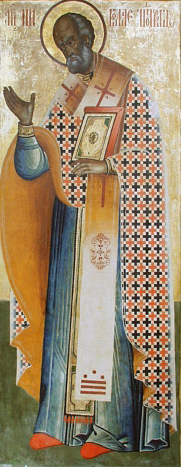
Saint
Nicholas, 18th-century Russian icon at Kizhi monastery, Karelia
St. Nicholas
St. Nicholas, called “of
Bari” was Bishop of Myra (Fourth Century). The great veneration with which this
saint has been honored for many ages and the number of altars and churches
which have been everywhere dedicated in his memory are testimonials to his
holiness and of the glory which he enjoys with God.
He is said to have been
born at Patara in Lycia, a province of Asia Minor. Myra, the capital, not far
from the sea, was an episcopal see, and this church falling vacant, the holy
Nicholas was chosen bishop, and in that station became famous by his
extraordinary piety and zeal and many astonishing miracles. The Greek histories
of his life agree that he suffered imprisonment of the faith and made a
glorious confession in the latter part of the persecution raised by Dioletian,
and that he was present at the Council of Nicaea and there condemned Arianism,
even going so far, according to some accounts of the council, as to slap the
heretic across the face. The silence of other authors makes many justly suspect
these circumstances. He died at Myra, and was buried in his cathedral.
We are assured that from
his earliest days Nicholas would take nourishment only once on Wednesdays and
Fridays, and that in the evening according to the canons. “He was exceedingly
well brought up by his parents and trod piously in their footsteps. The child,
watched over by the church enlightened his mind and encouraged his thirst for
sincere and true religion”. His parents died when he was a young man, leaving
him well off and he determined to devote his inheritance to works of charity.
An opportunity soon arose.
A citizen of Patara had
lost all his money, and had moreover to support three daughters who could not
find husbands because of their poverty; so the wretched man was going to give
them over to prostitution. This came to the ears of Nicholas, who thereupon
took a bag of gold and, under cover of darkness threw it in at the open window
of the man’s house. Here was a dowry for the eldest girl and she was soon duly
married. At intervals Nicholas did the same for the second and third; at the
last time the father was on the watch, recognized his benefactor and
overwhelmed him with his gratitude. It would appear that the three purses
represented in pictures, came to be mistaken for the heads of three children
and so they gave rise to the absurdstory of the children, resuscitated by the
saint, who had been killed by an innkeeper and pickled in a brine-tub.
Coming to the city of
Myra when the clergy and people of the province were in session to elect a new
bishop, St. Nicholas was indicated by God as the man they should choose. This
was at the time of the persecutions at the beginning of the fourth century and
“As he was the chief priest of the Christians of this town and preached the
truths of faith with a holy liberty, the divine Nicholas was seized by the
magistrates, tortured, then chained and thrown into prison with many other
Christians. But when the great and religious Constatine, chosen by God assumed
the imperial diadem of the Romans, the prisoners were released from their bonds
and with them the illustrious Nicholas, who when he was set at liberty returned
to Myra.” St. Methodius asserts that “thanks to the teaching of St. Nicholas
the metropolis of Myra alone was untouched by the filth of the Arian heresy,
which it firmly rejected as death-dealing poison”, but says nothing of his
presence at the Council of Nicaea in 325.
According to other
traditions he was not only there but so far forgot himself as to give the
heresiarch Arius a slap in the face. Whereupon the conciliar fathers deprived
him of his episcopal insignia and committed him to prison; but our Lord and His
Mother appeared there and restored to him both his liberty and his office. As
against Arianism so against paganism, St. Nicholas was tireless and took strong
measures: among other temples he destroyed was that of Artemis, the principal
in the district, and the evil spirits fled howling before him.
He was the guardian of
his people as well in temporal affairs. The governor Eustathius had taken a
bribe to condemn to death three innocent men. At the time fixed for their
execution Nicholas came to the place, stayed the hands of the executioner, and
released the prisoners. Then he turned to Eustathiujs and did not cease to
reproach him until he admitted his crime and expressed his penitence. There
were present on this ocfcasion three imperial officers who were on their way to
duty in Phrygia.
Later, when they were
back again in Constantinople, the jealousy of the prefect Ablavius caused them
to be imprisoned on false charges and an order for their death was procured
from the Emperor Constantine. When the officers heard this they remembered the
example they had witnessed of the powerful love of justice of the Bishop of
Myra and they prayed to God that through his merits and by his instrumentality
then might yet be saved. That night St. Nicholas appeared in a dream to
Constatine, and told him with threats to release the three innocent men, and Ablavius
experienced the same thing.
In the morning the
Emporor and the prefect compared notes, and the condemned men were sent for and
questioned. When he heard that they had called on the name of the Nicholas of
Myra who had appeared to him, Constatine set them free and sent them to the
bishop with a letter asking him not to threaten him any more but to pray for
the peace of the world. For long this was the most famous miracle of St.
Nicholas, and at the time of St. Methodius was the only thing generally known
about him.
The accounts are
unanimous that St. Nicholas died and was buried in his episcopal city of Myra,
and by the time of Justinian there was a basilica built in his honor at
Constantinople. An anonymous Greek wrote in the tenth century that, “the West
as well as the East acclaims and glorifies him. Wherever there are people, in
the country and the town, in the villages, in the isles, in the furthest parts
of the earth, his name is revered and churches are built in his honor. Images
of him are set up, panegyrics preached and festivals celebrated.
All Christians, young and
old, men and women, boys and girls, reverence his memory and call upon his
protection. And his favors, which know no limit of time and continue from age
to age, are poured out over all the earth; the Scythians know them, as do the
Indians and the barbarians, the Africans as well as the Italians.” When Myra
and its great shrine finally passed into the hands of the Saracens, several
Italian cities saw this as an opportunity to acquire the relics of St. Nicholas
for themselves. There was great competition for them between Venice and Bari.
The last-named won, the relics were carried off under the noses of the lawful
Greek custodians and their Mohammedan masters, and on May 9, 1087 were safety
landed at Bari, a not inappropriate home seeing that Apulia in those days still
had large Greek colonies.
A new church was built to
shelter them and the Pope, Bd. Urban II, was present at their enshrining.
Devotion to St. Nicholas was known in the West long before his relics were
brought to Italy, but this happening naturally greatly increased his veneration
among the people, and miracles were as freely attributed to his intercession in
Europe as they had been in Asia. At Myra “the venerable body of the bishop,
embalmed as it was in the good ointments of virtue exuded a sweet smelling
myrrh, which kept it from corruption and proved a health giving remedy against
sickness to the glory o f him who had glorified Jesus Christ, our true God.”
The translation of the relics did not interrupt this phenomenon, and the “manna
of St. Nicholas” is said to flow to this day. It was one of the great
attractions which drew pilgrims to his tomb from all parts of Europe.
It is the image of St.
Nicholas more often than that of any other that is found on Byzantine seals; in
the later middle ages nearly four hundred churches were dedicated in his honor
in England alone; and he is said to have been represented by Christian artists
more frequently than any saint except our Lady. St. Nicholas is venerated as
the patron saint of several classes of people, especially, in the East, of
sailors and in the West of children.
The first of these
patronage is probably due to the legend that during his life time, he appeared
to storm tossed mariners who invoked his aid off the coast of Lycia and brought
them safely to port. Sailors in the Aegean and Ionian seas, following a common
Eastern custom, had their “star of St. Nicholas” and wished one another a good
voyage in the phrase “May St. Nicholas hold the tiller”.
The legend of the “three
children” gave rise to his patronage of children and various observances,
ecclesiastical and secular, connected there with; such were the boy bishop and
especially in Germany, Switzerland and the Netherlands, the giving of presents
in his name at Christmas time. This custom in England is not a survival from
Catholic times. It was popularized in America by the Dutch Protestants of New
Amsterdam who had converted the “popish” saint into a Nordic magician (Santa
Claus = Sint Klaes = Saint Nicholas). The deliverance of the three imperial
officers naturally caused St. Nicholas to be invoked by and on behalf of
prisoners and captives, and many miracles of his intervention are recorded in
the middle ages.
Curiously enough the
greatest popularity of St. Nicholas is found neither in the eastern
Mediterranean nor north-western Europe, great as that was, but in Russia. With
St. Andrew the Apostle he is patron of the nation, and the Russian Orthodox
Church even observes the feast of his translation; so many Russian pilgrims
came to Bari before the revolution that their government supported a church,
hospital and hospice there. He is a patron saint also of Greece, Apulia, Sicily
and Loraine, and of many citiesand dioceses (including Galway) and churches
innumerable.
At Rome the basilica of
St. Nicholas in the Jail of Tully (in Carcere) was founded between the end of
the sixth and the beginning of the seventh centuries. He is named in the
preparation of the Byzantine Mass.
SOURCE : http://www.ucatholic.com/saints/saint-nicholas/

Large
icon of Saint Nicholas painted in 1294 for the Lipno
Church
St. Nicholas
Feastday: December 6
Patron: of Bakers
and Pawnbrokers
The great veneration with
which St. Nicholas has been honored for many ages and the number of altars and
churches all over the world that are dedicated in his memory are testimonials
to his wonderful holiness and the glory he enjoys with God. As an episcopal
see, and his childhood church falling vacant, the holy Nicholas was chosen
bishop, and in that station became famous by his extraordinary piety and zeal
and by his many astonishing miracles. The Greek histories of his life agree he
suffered an imprisonment of the faith and made a glorious confession in the
latter part of the persecution raised by Dioletian, and that he was present at
the Council of Nicaea and there condemned Arianism. It is said that St.
Nicholas died in Myra, and was buried in his cathedral.
St. Nicholas' episcopate
at Myra during the fourth century is really all that appears indubitable
authentic, according to Alban Butler, an English Roman Catholic priest from the
1700s. This is not for lack of material, beginning with the life attributed to
the monk who died in 847 as St. Methodius, Patriarch of Constantinople.
Nevertheless, the universal popularity of the saint for so many centuries
requires that some account of the legends surrounding his life should be given.
St. Nicholas, also known
as "Nikolaos of Myra," was a fourth century saint and Greek bishop of
Myra. Nicholas was born in Asia Minor in the Roman Empire as an only child to
Christian parents. Nicholas would take nourishment only once on Wednesdays and
Fridays, and that in the evening according to the canons. "He was
exceedingly well brought up by his parents and trod piously in their footsteps.
The child, watched over by the church, enlightened his mind and encouraged his
thirst for sincere and true religion." Both of his parents tragically died
during an epidemic when he was a young man, leaving him well off, but to be
raised by his uncle – the Bishop of Patara. Nicholas was determined to devote
his inheritance to works of charity, and his uncle mentored him as a reader and
later ordained him as a presbyter (priest).
An opportunity soon arose
for St. Nicholas and his inheritance. A citizen of Patara had lost all his
money, and needed to support his three daughters who could not find husbands
because of their poverty; so the wretched man was going to give them over to
prostitution. Nicholas became informed of this, and thus took a bag of gold and
threw it into an open window of the man's house in the night. Here was a dowry
for the eldest girl and she was soon duly married. At intervals Nicholas did
the same for the second and the third; at the last time the father was on the
watch, recognized his benefactor and overwhelmed Nicholas with his gratitude.
It would appear that the three purses represented in pictures, came to be
mistaken for the heads of three children and so they gave rise to the
absurdstory of the children, resuscitated by the saint, who had been killed by
an innkeeper and pickled in a brine-tub.
Coming to the city of
Myra when the clergy and people of the province were in session to elect a new
bishop, St. Nicholas was indicated by God as the man they should choose. This
was during the time of persecutions in the beginning of the fourth century and
"as he [Nicholas] was the chief priest of the Christians of this town and
preached the truths of faith with a holy liberty, the divine Nicholas was
seized by the magistrates, tortured, then chained and thrown into prison with
many other Christians. But when the great and religious Constatine, chosen by
God, assumed the imperial diadem of the Romans, the prisoners were released
from their bonds and with them the illustrious Nicholas, who when he was set at
liberty returned to Myra."
St. Methodius asserts
that "thanks to the teaching of St. Nicholas the metropolis of Myra alone
was untouched by the filth of the Arian heresy, which it firmly rejected as
death-dealing poison," but says nothing of his presence at the Council of
Nicaea in 325.
According to other
traditions St. Nicholas was not only there during the Council of Nicaea in 325,
but so far forgot himself as to give the heresiarch Arius a slap in the face.
The conciliar fathers deprived him of his episcopal insignia and committed him
to prison; but our Lord and His Mother appeared there and restored to him both
his liberty and his office.
As against Arianism so
against paganism, St. Nicholas was tireless and often took strong measures:
among other temples he destroyed was that of Artemis, the principal in the
district, and the evil spirits fled howling before him. He was the guardian of
his people as well in temporal affairs. The governor Eustathius had taken a
bribe to condemn to death three innocent men. At the time fixed for their
execution Nicholas came to the place, stayed the hands of the executioner, and
released the prisoners. Then he turned to Eustathiujs and did not cease to
reproach him until he admitted his crime and expressed his penitence.
St. Nicholas' presence
was found in a separate occasion involving three imperial officers simply on
their way to duty in Phrygia. When the men were back again in Constantinople,
the jealousy of the prefect Ablavius caused them to be imprisoned on false
charges and an order for their death was procured from the Emperor Constantine.
When the officers heard this they remembered the example they had witnessed of
the powerful love of justice of the Bishop of Myra and they prayed to God that
through his merits and by his instrumentality they might yet be saved. That
night St. Nicholas appeared in a dream to Constatine, and told him with threats
to release the three innocent men, and Ablavius experienced the same thing. In
the morning the Emporor and the prefect compared notes, and the condemned men
were sent for and questioned. When he heard they had called on the name of the
Nicholas of Myra who appeared to him, Constatine set them free and sent them to
the bishop with a letter asking him not to threaten him any more, but to pray
for the peace of the world. For a long time, this has been the most famous miracle
of St. Nicholas, and at the time of St. Methodius was the only thing generally
known about him.
The accounts are
unanimous that St. Nicholas died and was buried in his episcopal city of Myra,
and by the time of Justinian, there was a basilica built in his honor at
Constantinople.
An anonymous Greek wrote
in the tenth century that, "the West as well as the East acclaims and
glorifies him. Wherever there are people, in the country and the town, in the
villages, in the isles, in the furthest parts of the earth, his name is revered
and churches are built in his honor. Images of him are set up, panegyrics
preached and festivals celebrated. All Christians, young and old, men and
women, boys and girls, reverence his memory and call upon his protection. And
his favors, which know no limit of time and continue from age to age, are
poured out over all the earth; the Scythians know them, as do the Indians and
the barbarians, the Africans as well as the Italians." When Myra and its
great shrine finally passed into the hands of the Saracens, several Italian
cities saw this as an opportunity to acquire the relics of St. Nicholas for
themselves. There was great competition for them between Venice and Bari.
Bari won and the relics
were carried off under the noses of the lawful Greek custodians and their
Mohammedan masters. On May 9, 1087 St. Nicholas' relics safetly landed in Bari,
a not inappropriate home seeing that Apulia in those days still had large Greek
colonies. A new church was built to shelter the relics and the pope, Bd. Urban
II, was present at their enshrining.
Devotion to St. Nicholas
has been present in the West long before his relics were brought to Italy, but
this happening greatly increased his veneration among the people, and miracles
were as freely attributed to his intercession in Europe as they had been in
Asia.
At Myra "the
venerable body of the bishop, embalmed as it was in the good ointments of
virtue exuded a sweet smelling myrrh, which kept it from corruption and proved
a health giving remedy against sickness to the glory o f him who had glorified
Jesus Christ, our true God." The translation of the relics did not
interrupt this phenomenon, and the "manna of St. Nicholas" is said to
flow to this day. It was one of the great attractions that drew pilgrims to his
tomb from all parts of Europe.
The image of St. Nicholas
is, more often than any other, found on Byzantine seals. In the later middle
ages nearly four hundred churches were dedicated in his honor in England alone,
and he is said to have been represented by Christian artists more frequently
than any saint, except our Lady.
St. Nicholas is
celebrated as the patron saint of several classes of people, especially, in the
East, of sailors and in the West of children. The first of these patronage is
most likely due to the legend that during his lifetime, he appeared to storm
tossed mariners who invoked his aid off the coast of Lycia and brought them
safely to port. Sailors in the Aegean and Ionian seas, following a common
Eastern custom, had their "star of St. Nicholas" and wished one
another a good voyage in the phrase "May St. Nicholas hold the
tiller."
The legend of the
"three children" is credited to his patronage of children and various
observances, ecclesiastical and secular, connected there with; such were the
boy bishop and especially in Germany, Switzerland and the Netherlands, the
giving of presents in his name at Christmas time.
This custom in England is
not a survival from Catholic times. It was popularized in America by the Dutch
Protestants of New Amsterdam who converted the popish saint into a Nordic
magician (Santa Claus = Sint Klaes = Saint Nicholas) and was introduced into
this country by Bret Harte. It is not the only "good old English
custom" which, however good, is not "old English," at any rate
in its present form. The deliverance of the three imperial officers naturally
caused St. Nicholas to be invoked by and on behalf of prisoners and captives,
and many miracles of his intervention are recorded in the middle ages.
Curiously enough, the
greatest popularity of St. Nicholas is found neither in the eastern Mediterranean
nor north-western Europe, great as that was, but in Russia. With St. Andred the
Apostle, he is patron of the nation, and the Russian Orthodox Church even
observes the feast of his translation; so many Russian pilgrims came to Bari
before the revolution that their government supported a church, hospital and
hospice there.
He is also the patron
saint of Greece, Apulia, Sicily and Loraine, and of many citiesand dioceses
(including Galway) and churches innumerable. At Rome the basilica of St.
Nicholas in the Jail of Tully (in Carcere) was founded between the end of the
sixth and the beginning of the seventh centuries. He is named in the
preparation of the Byzantine Mass. St. Nicholas became recognized as a saint
long before the Roman Catholic Church began the regular canonizing procedures
in the late 10th century. Therefore, he does not have a specific date of
canonization, rather records of him exist in a gradual spread until his stories
became widley known and celebrated. St. Nicholas' feast day is December 6.
SOURCE : https://www.catholic.org/saints/saint.php?saint_id=371

Saint Nicholas, 110 x 180, Santa Maria in
Cosmedin (Napoli)
Nicholas of Myra (Bari) B
(RM)
Died c. 350. St. Nicholas was probably born to wealthy parents at Patara in
Lycia, a province of Asia Minor. He was chosen bishop of the then rundown
diocese of the capital of Myra, which he ruled with great care and faith. There
he became known for his holiness, zeal, and miracles. To these meager facts
legend, however, has supplied colorful details. His first 'biography' was
written in the 9th century; a more popular one was written by Simon Metaphrastes
in the 10th century.
Greek histories hold that
he suffered imprisonment and made a famous confession during the persecution of
Diocletian. He was present at the Council of Nicaea, where he condemned
Arianism--one story holds that he actually slapped the heretic Arius. He died
at Myra in Lycia. However, there is no historical support for either his
confession nor his attendance at the council.
By the time of Justinian
(6th century), there was a basilica built in his honor at Constantinople. From
the 9th century in the East and the 11th century in the West, he has been one
of the most popular saints of Christendom and the subject of many legends.
These hold that he was a wealthy young man who decided to devote his money to
charitable activities and his life to converting sinners.
The legends tell of how
St. Nicholas, still sticky from the womb, rose up out of his first bath to fold
his hands and raise his eyes to heaven in order to cleanse his heart before his
body. He is also said to have taught his wet nurse about mortification by
refusing her breast more than once on each Wednesday and Friday--a precocious
exercise of asceticism!
Nicholas could have found
communion with God in a monastic life, but to walk within the confines of a
cloister would be insufficient for the saint's devotion. He wanted to be able
to follow the footsteps of Jesus in the Palestine, which he did. On his voyages
across the sea, he calmed the waves (which is why he is patron of sailors and
travellers).
A citizen of Patara lost
his fortune, and because he could not raise dowries for his three daughters, he
was going to give them over to prostitution. After hearing this, Nicholas took
a bag of gold and threw it through the window of the man's house at night. The
eldest girl was married with it as her dowry. He performed the same action for
each of the other girls. The three purses, portrayed in art with the saint,
were mistakenly thought to be the heads of children, and thus originated the
story that three children, murdered by an innkeeper and pickled in a tub of
brine, were resuscitated by Nicholas. The three purses are also thought to be
the origin of the pawnbrokers' symbol of three gold balls.
Another legend holds that
he appeared to sailors caught in storms off the coast of Lycia and led them
safely into port. Churches built under his dedication are often placed so that
they can be seen off the coast as landmarks.
Yet another legend has it
that he appeared to Constantine in a dream and thereby caused him to save three
unjustly condemned imperial officers from death. Possibly another version says
that the governor of Myra took a bribe to condemn to death three innocent men.
The executioner was about to kill them when the bishop of the city, Nicholas,
appeared and prevented the execution. Turning to the governor, the saint
upbraided him till he confessed his sin and begged to be forgiven.
When Myra fell into the
hands of the Saracens, Italian cities seized the chance to acquire the relics
of Nicholas. The relics were stolen by Italian merchants and came to Bari in
southern Italy in 1087. A new church was built to shelter them, and Pope Urban
II was present at their enshrining. The already popular saint became even more
highly regarded thereafter. The shrine became one of the great pilgrimage
centers of medieval Europe. Many miracles were reputed to have been worked
through his intercession.
The popular cultural
representation of "St. Nick" is based on a combination of Low
Countries' custom of giving children presents on his feast day as their patron,
and the Dutch Protestants of New Amsterdam (now New York) linking this to
Nordic folklore of a magician who punished naughty children and rewarded
exemplary ones with presents. (It should be noted that the figure of Santa
Claus is really non-Christian and is based on the Germanic god Thor, who was
associated with winter and the Yule log and rode on a chariot drawn by goats
named Cracker and Gnasher.)
Throughout Europe in the
middle ages, St. Nicholas's feast day was the occasion for electing a Boy
Bishop, who reigned until the feast of the Holy Innocents on December 28. Even
in this century the custom survives in Montserrat in Catalonia, Spain
(Attwater, Benedictines, Bentley, Delaney, Encyclopedia, White).
St. Nicholas's emblem in
art is three balls. Sometimes he is portrayed (1) as a young man throwing three
golden balls into the window of three poor girls; (2) raising three children
from a pickle tub; (3) rescuing survivors from a shipwreck; (4) reviving a man
unjustly hanged (not to be confused with Nicholas of Tolentino, who is never a
bishop); or (5) as a new-born babe praising God. Venerated at Bari, Monserrat,
and Russia (Roeder).
Patron of children (Santa
Claus, Sint Klaus), bankers, captives (because of the rescue), pawnbrokers
(three balls), and sailors (for miraculously saving doomed mariners off the
coast of Lycia) (Roeder), brides, unmarried women (because he provided
dowries), perfumers (from his shrine at Bari there was said to originate a
fragrant 'myrrh'), of travellers, pilgrims, and safe journeys (because he
reputedly travelled to the Holy Land and Egypt), maritime pilots (White),
boatmen, fishermen, sailors, dock workers, stevedores, brewers, coopers,
bootblacks, the unjustly judged, and poets (Encyclopedia). Russia, Greece,
Sicily, Lorraine, Moscow, Freibourg, and Apulia all fall under his patronage,
too (White).
SOURCE : https://catholicsaints.info/saints-of-the-day-nicholas-of-myra-bari/

Hl.
Nikolaus, Schwäbische Schule, 16. Jahrhundert, Öl auf Holz, 87 x 58
St. Nicholas of Myra
(Also called Nicholas of
Bari).
Bishop of Myra in
Lycia; died 6 December, 345 or 352. Though he is one of the most popular saints in
the Greekas
well as the Latin
Church, there is scarcely anything historically certain about him
except that he was Bishop of Myra in
the fourth century.
Some of the main points
in his legend are as follows: He was born at Parara, a city of Lycia
in Asia
Minor; in his youth he made a pilgrimage to Egypt and
Palestine; shortly after his return he became Bishop of Myra;
cast into prison during
the persecution of Diocletian,
he was released after the accession of Constantine,
and was present at the Council
of Nicaea. In 1087 Italian merchants stole his
body at Myra,
bringing it to Bari in Italy.
The numerous miracles St.
Nicholas is said to have wrought, both before and after his death, are
outgrowths of a long tradition. There is reason to doubt his
presence at Nicaea,
since his name is not mentioned in any of the old lists of bishops that
attended this council.
His cult in the Greek
Church is old and especially popular in Russia.
As early as the sixth century Emperor
Justinian I built a church in
his honour at Constantinople,
and his name occurs in the liturgy ascribed
to St.
Chrysostom. In Italy his
cult seems to have begun with the translation of his relics to Bari,
but in Germany it
began already under Otto
II, probably because his wife Theophano was a Grecian. Bishop
Reginald of Eichstaedt (d. 991) is known to have written a metric,
"Vita S. Nicholai." The course of centuries has not lessened his
popularity. The following places honour him
as patron: Greece, Russia,
the Kingdom
of Naples, Sicily, Lorraine,
the Diocese
of Liège; many cities in Italy, Germany, Austria,
and Belgium; Campen
in theNetherlands; Corfu in Greece; Freiburg in Switzerland;
and Moscow in Russia.
He is patron of
mariners, merchants, bakers, travellers, children, etc. His representations
in art are
as various as his alleged miracles.
In Germany, Switzerland,
and the Netherlands,
they have the custom of making him the secret purveyor
of gifts to children on 6 December, the day on which the Church celebrates
his feast;
in the United
States and some other countries St. Nicholas has become
identified with Santa Claus who distributes gifts to
children on Christmas
eve. His relics are
still preserved in the church of San Nicola in Bari;
up to the present day an oily
substance, known as Manna di S. Nicola, which is highly valued for its
medicinal powers, is said to flow from them.
Sources
The traditional legends
of St. Nicholas were first collected and written in Greek by Metaphrastes in
the tenth century. They are printed in P.G. 116 sq.
Ott, Michael. "St. Nicholas of Myra." The Catholic
Encyclopedia. Vol. 11. New York: Robert Appleton
Company, 1911. 14 Nov. 2015 <http://www.newadvent.org/cathen/11063b.htm>.
Transcription. This
article was transcribed for New Advent by Fr. Rick Losch.
Ecclesiastical
approbation. Nihil Obstat. February 1, 1911. Remy Lafort, S.T.D.,
Censor. Imprimatur. +John Cardinal Farley, Archbishop of New York.
Copyright © 2020 by Kevin
Knight. Dedicated to the Immaculate Heart of Mary.
SOURCE : http://www.newadvent.org/cathen/11063b.htm
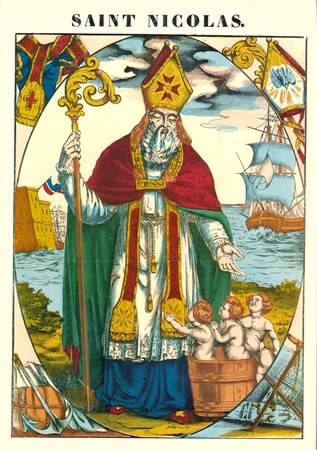
St. Nicholas, Archbishop
of Myra, Confessor
The Acts of St. Nicholas,
published about the year 912 by Metaphrastes, are extant, translated by
Lipoman, Surius, &c. Others much shorter, but imperfect, compiled by
Methodius, patriarch of Constantinople, about the year 840, are published by
Mombritius Falconius, &c. Another life of St. Nicholas was written by John,
deacon of Naples, anno 860, from Methodius and others. (See Murat. Ital.
Scriptor. t. 1, part 2, p. 287, and Jos. Assemani, t. 5, p. 417.) Mention is
made of a vision of St. Nicholas in the second council of Nice: also by Suidas,
(on whose testimony see Putignani, Diatr. 1, p. 66,) &c. See several acts
of his life, published by Falconius, archbishop of San-Senerino, at Naples, in
1751, together with those of St. Nicholas of Pinara, with whom this author
confounds him; which hypothesis is confuted by Nicholas Putignani, a canon of
Bari, author of Vindiciæ Vitæ S. Nicolai, at Naples, an. 1753, and more fully
by Jos. Assemani in Cal. Univ. t. 5, ad 6, Dec. p. 415, et t. 6, ad 4, Apr. p.
226, et ad 9. Maij, p. 822. See also Tillemont, t. 6, Vie de S. Nicholas,
et Note, 1. 2, Fleury, t. 13, p. 446.
A.D. 342
THE GREAT veneration with
which this saint has been honoured, both in the Greek and Latin churches for
many ages, and the great number of altars and churches which have been
everywhere erected in his memory, are proofs of his extraordinary sanctity, and
of the glory which he enjoys with God. The Emperor Justinian built a church in
his honour at Constantinople, in the quarter called Blaquernæ, about the year
430, 1 and
he was titular saint of four churches in Constantinople. 2 All
accounts agree that he was a native of Patara, in Lycia. We are told that in
his infancy he observed the fasts of Wednesdays and Fridays, refusing to suck
the breasts on those days, which were consecrated to fasting by the law of the
church, as St. Clement of Alexandria mentions, 3 and
as Bishop Potter proves, in his note upon that passage from the Apostolic
Constitutions, 4 and
the canonical epistle of St. Peter, bishop of Alexandria, and martyr. Also St.
Epiphanius 5 and
others testify the same. Happy are they who, from their infancy and innocent
age, are inured to the exercises of devotion, penance, and perfect obedience.
St. Nicholas increased his fervour in these and all other virtues with his
years, especially when he had devoted himself to a religious life in the
monastery of holy Sion, near Myra, of which house he was made abbot, by the
archbishop, its founder. Charity in comforting and relieving the distressed,
seemed his characteristic virtue. Amongst many other instances, it is related,
that when three young virgins were exposed through distress to the danger of
falling into vicious courses, he, for three successive nights, conveyed to them
through the window a competent sum of money for a fortune for one of them, so
that they were all portioned, and afterwards happily married. Lycia was a large
ancient province of Asia, in which St. Paul had planted the faith. Myra, the
capital, three miles from Patara, and from the sea, was an archiepiscopal see,
founded by St. Nicander, of such great dignity, that, in later ages, thirty-six
suffragan bishoprics were subject to it. This metropolitan church falling
vacant, the holy abbot Nicholas was chosen archbishop, and in that exalted
station became famous by his extraordinary piety and zeal, and an incredible
number of stupendous miracles. The Greek histories of his life agree, that he
suffered imprisonment for the faith, and made a glorious confession in the
latter part of the persecution raised by Dioclesian: and that he was present at
the great council of Nice, and there condemned Arianism. The silence of other
authors make many justly suspect these circumstances. The history of the
translation of his relics place his death in 342. He died at Myra, and was
buried in his own cathedral. 6 Several
churches were built in his honour, even in the West, long before the
translation of his relics to Bari: and the manner in which Usuard mentions him
in his Martyrology, almost three ages before, shows in what great veneration
his name then was in the West. The history of the translation of his relics to
Bari, assures us, that no saint was more universally honoured in all Christian
nations than St. Nicholas. The Muscovites, who received their account of him
from the Greeks, seem to pay a greater veneration to his memory than to that of
any other saint who lived since the times of the apostles. The relics of St.
Nicholas were kept with great honour at Myra till they were translated into
Italy. Certain merchants of Bari, a sea-port in the kingdom of Naples, situate
on the Adriatic Gulf, sailed in three ships to the coast of Lycia; and watching
an opportunity when no Mahometans were near the place, went to the church in
which the relics of St. Nicholas were kept, which stood in a desert place,
three miles from the sea, and was guarded by a small community of monks. They
broke open the marble coffin, in which the sacred bones lay, and carried them
off to their ships; the inhabitants, upon the alarm given, pursued them to the
shore with horrible outcries, but the Europeans were got safe on board. They
landed at Bari on the 9th of May, 1087, and the sacred treasure was deposited
by the archbishop in the church of St. Stephen. On the first day, thirty
persons were cured of various distempers, imploring the intercession of St.
Nicholas, and from that time the tomb of St. Nicholas of Bari has been famous
for pilgrimages. The authentic history of this translation, written by John, at
that time archdeacon of Bari, by order of the archbishop, is extant in Surius.
The same account is confirmed by another history of this translation, drawn up
at the same time by Nicephorus of Bari, also an eye-witness, commissioned by
the magistrates of the city, quoted in manuscript by Baronius, and published by
Falconius. 7 By
this history of Nicephorus, it appears, that the Venetians having formed a
design of carrying off the relics of St. Nicholas, certain merchants from Bari,
who happened then to be at Antioch, prevented them. 8 This
enterprise could only be justified by the laws of a just war, joined with the
apprehension of the sacrilegious impiety of the Mahometans. Mention is made in
a novella of the Emperor Emmanuel, recorded by Balsamon, and all modern
writers, of a fragrant unctuous matter which issues from the relics of St.
Nicholas in his shrine at Bari, a large quantity of which was found in his
sepulchre near Myra in Lycia, when his relics were brought thence.
St. Nicholas is esteemed
a patron of children, because he was from his infancy a model of innocence and
virtue, and to form that tender age to sincere piety was always his first care
and delight. 9 To
impress on the minds of children perfect sentiments of devotion, religion, and
all virtues, with an earnestness in all duties, is a task often as delicate as
it is important. Instructions must be made sensible, and adapted by similes,
parables, and examples, to the weakness of their capacities. Above all, they
are to be enforced by the conduct of those with whom children converse. They
learn their maxims, imbibe their spirit, and are moulded upon their example. A
child which sees those who are about him love their own ease, and ever seek
what best pleases their senses; still more if he observes them to be choleric,
peevish, vain, slothful, or impatient, will naturally cherish these passions,
and yield up the government of himself to them, instead of learning by
tractableness, humility, meekness, and self-denial, to subdue and govern them.
And so in all other points. Precepts and exhortations lose their force when
contradicted by example: and whilst the infant sees every one study to please
himself in every thing, in flat opposition to the rules of the gospel, which he
hears preached from their mouths, he seems tacitly persuaded, that such a
conduct is reconcilable with those very maxims which condemn it.
Note 1. Procop. de
Ædific. Justinian, l. 1, c. 6, p. 31. Putignani, Diatr. 1, c. 5, pp. 37,
52. [back]
Note 2. Du Cange,
Constantinopolis Christiana, l. 4, c. 6, n. 67. Codinus Orig. Constan. p.
62. [back]
Note 3. Clem. Alex.
Strom. l. 7, t. 2, p. 877, n. 10 et 15, ed Oxon. anno 1715. [back]
Note 4. Constit.
Apost. l. 5, c. 19, et l. 7, c. 24. [back]
Note 5. See Pope
Benedict XIV. in Literis Apostolicis ad Joan. V. Portug. Reg. novæ edit.
Martyr. Rom. præfixis, à n. 19, ad 36. [back]
Note 6. Falconius
published, in 1751, from a manuscript of the tenth age, in the Vatican library,
the life of St. Nicholas of Pinara, whom he pretends to be the same with St.
Nicholas of Myra. But, in the life of the former, express mention is made of a
church or martyrium, dedicated in honour of the great St. Nicholas
(of Myra,) who must consequently have been dead before the other was born, as
Jos. Assemani proves; (in Cal. Univ. ad 6 Dec. p. 424, t. 5;) and this
distinction is demonstrated by the church built at Constantinople by Justinian,
in honour of the great St. Nicholas, as he is usually styled by the Greeks, and
by many other arguments. (See Jos. Assemani, ib. and Nicholas Putignani,
Diatribâ 1.) St. Nicholas of Pinara was born at Pharrais, near Myra, was
afterwards abbot of Holy Sion, and was at length consecrated bishop of Pinara,
which church he governed five years, and died there; and his relics were kept
with honour in the church of the monastery of Holy Sion in Pharroa, near Pinara
in Lycia, the abbot of which place subscribed the second council of Nice, in
787. Falconius supposes St. Nicholas of Pinara to have been born in 480,
ordained bishop in 547: that he assisted at the council of Myra, held about the
controversy concerning the three chapters in 550, and died in 551. From the
year of his death, the other epochs are determined by the history of his life.
But Jos. Assemani demonstrates (t. 6, in Calend. Univ. ad 4 Apr. p. 230,) that
St. Nicholas of Pinara flourished in the seventh century, and died in 699,
having governed the see of Pinara, from the year 694, five years. His body
remained in the church of his monastery at Pharroa, together with the relics of
St. John Baptist, SS. Theodorus, Sergius and Bacchus, MM. and of the forty
martyrs of Sebaste. See Assemani ad 4 April. [back]
Note 7. Falconius,
Acta Primigenia S. Nicolai, p. 131. [back]
Note 8. See also on
this translation, Dandulus, in Chronico Veneto, l. 7, pp. 157, 256, ap Murat.
Italic. Rerum Scriptores, t. 12. Though Dandulus lived only in 1350, neither
can he or other Venetians be heard, who pretend, so many years after, that the
relics of St. Nicholas were brought to Venice, since two learned men of Bari,
and Sigebert, a foreigner of the same age, assure us they were translated to
Bari. And it is manifest, that the Venetians only carried home, in 1097, what
the citizens of Bari had left, namely, the bodies of two other bishops,
Theodorus and another Nicholas, and some of the unctuous matter that was found
in the sepulchre of St. Nicholas. The church of one of the twenty-three great
monasteries of the Greeks on Mount Athos, is dedicated in honour of St.
Nicholas. See Montfaucon, Paleographia Græca, l. 7, p. 493. [back]
Note 9. St. Nicholas
is called particularly the patron of children, not only because he made their
instruction a principal part of his pastoral care, but chiefly because he
always retained the virtues, the meekness, the simplicity, without guile or
malice, and the humility of his tender age, and in his very infancy devoted
himself to God by a heroic piety: these reasons are given in the ancient MS.
book of Festivals at Sarum, fol. 55. On the great solemnity with which it was
kept by the boys at the cathedral of Sarum, at Eton school, and in other
schools and colleges. See the History and Antiquities of the Cathedral Church of
Salisbury, printed anno 1722, p. 74. [back]
Rev. Alban
Butler (1711–73). Volume XII: December. The Lives of the
Saints. 1866.
SOURCE : http://www.bartleby.com/210/12/061.html
.jpg)
Saint Nicholas, tempera on wood, 89 x 105, Basilian Salvatorian Order, (Icônes
arabes : art chrétien du Levant, France: Institut du monde arabe (France), 2003,
pp. A89 ISBN: 2914338074),
photographie : Michel Bakni (1989–)
Weninger’s
Lives of the Saints – Saint Nicholas, Bishop of Myra
Article
Saint Nicholas, whom the
Almighty honored with numberless miracles, was born at Patara, in Lycia, of
rich and pious parents, who having lived a long time without issue, at last,
after many prayers, were rejoiced by the Lord with a son. It was a remarkable
fact that Nicholas, when an infant, on Wednesdays and Fridays, refused to take
nourishment from his mother’s breast until nightfall; and this custom of
partaking of no food on those days, he observed as long as he lived. When sent
to school, he carefully avoided all intercourse with frivolous young men, and
still more with the other sex. He shunned all occasions of evil, chastised his
body by watching, fasting, wearing a penitential girdle, and read only such
books as aided him to acquire virtue and knowledge. In this manner he preserved
his innocence inviolate through all dangers. Having made great progress in
virtue and knowledge, he was ordained priest by the bishop of Myra, who was his
God-father. As he felt himself obliged by the sacredness of his station to
strive to attain greater virtue, he redoubled his austerities, his fervor in
prayer, and his zeal in doing good. The rich inheritance which came into his
possession after the death of his parents, was employed only to relieve and
comfort the needy. Among these were three young virgins whom their father,
impoverished by misfortune, had advised to maintain themselves at the cost of
their virtue, as he saw no means to provide for them. Saint Nicholas, having
heard this, went, during the night and threw into the father’s room, through
the window, as much money as was necessary to give one of the three maidens a
marriage dower. The same was done, after a lapse of some time, for the second
and the third; and, by this noble work of charity, the father and the daughters
were saved from temporal and eternal ruin. After some time, by order of the
bishop of Myra, Nicholas was charged with the care of a monastery, and
performed this task with great prudence and care.
Meanwhile, his heart was
filled with the desire to visit the Holy Land, and to pass the remainder of his
life in solitude. The day on which he set sail he prophesied to the sailors,
that they would soon encounter a severe storm. The sailors, thinking they were
better skilled in such matters, laughed at him, but the issue showed that the
Saint was right; for so terrific a storm arose that all on board thought
themselves lost. Hence they begged the Saint, as God had revealed to him the
danger, to implore Him to turn it from them. Hardly had the holy man begun to
pray when the winds abated and the storm ceased. Similar miracles the holy man
performed frequently; hence he is honored and invoked as a special patron of
sailors. In Palestine he visited the holy places with great devotion, and made
the resolution to remain there in some retired spot, where he might serve the
Almighty undisturbed. But, by divine admonition, he returned to his monastery,
where he did not remain long, as God inspired him to go to Myra, the capital of
Lycia. The bishops of that country had just assembled at Myra, to elect a
successor to the late bishop, and while they were praying to be guided by
heaven in their choice, God revealed to one of them that they should choose him
who, on the following morning, should first enter the church, and whose name
was Nicholas. Saint Nicholas, knowing nothing of what had passed, was the first
who entered the church the next morning. A bishop who had been appointed to be
there, having asked his name, took him by the hand and led him to the assembled
prelates, who informed him of the divine will and consecrated him bishop in
spite of the tears he shed and the objections he offered.
Nicholas considering that
so high an office required high virtues, endeavored to lead a still more
perfect life than before. He practised severe penance, partook daily of one
meal only, and never touched meat; took his short rest on the bare floor, gave
all the time left to him from the administration of his functions to prayer,
daily said holy Mass, at which he often shed many tears; visited the prisoners,
the sick, and the poor of the city, among whom he divided almost all his
income; preached on all Sundays and Holy days, and frequently visited the
churches and parishes of his diocese, providing all with able priests and a
sufficient income. In one word, he did all that could be expected of a bishop,
who perfectly fulfilled his sacred duties. At that period there were still many
pagans in Myra, besides an idolatrous temple, and the emperor sent his officers
to exterminate Christianity and restore the pagan worship. On this occasion our
holy bishop showed his generous zeal. He went through all the streets and into all
the houses exhorting the Christians to remain faithful to Christ, without
fearing for himself either danger, persecution or death. He was seized, dragged
out of the city, and cast into a dungeon, where he remained until Constantine
the Great ascended the throne. The holy bishop experienced the greatest joy
when this emperor gave orders to demolish the idolatrous temples and to build
churches in their places. He himself assisted at the work and rested not until
all pagan temples had disappeared from his diocese. Some time later an
opportunity presented itself to him to fight against the Arian heresy, which he
condemned in the Council of Nice.
The many and great
miracles that he performed and the fame of his holiness gave him great
consideration. Eustathius, an avaricious officer, had condemned to death three
innocent citizens, living not far from Myra, in order that he might take
possession of their property. No sooner had Saint Nicholas been informed of
this than he hastened to the place, where he found the three men already in the
hands of the executioner. The Saint ran towards him and took the sword from
him; he then reproved the wicked judge with severe words, and thus freed the
innocent persons, amid the great rejoicings of the people.
Still more remarkable is
the following: Constantine, the emperor, had condemned three of his most
renowned generals to death, on false accusations. These, having heard much of
the holiness of the Bishop of Myra, called on God to come to their aid for the
sake of His servant. In the night before the day on which the sentence on the
three prisoners was to be executed, Constantine saw Saint Nicholas standing
before him, threatening him with divine vengeance if he did not immediately
recall the sentence against the innocent men. In the same manner the Saint
appeared to the unjust accuser. Both, greatly frightened, set the prisoners
free, and sent them with many rich gifts to Saint Nicholas, to thank him for
having thus protected them. Almost at the same time the Saint appeared to some
sailors who were in great danger of being wrecked, and had invoked him. They
saw him at the helm, guiding the ship safely to land. When they expressed their
gratitude to him, he said: “My children, give honor to God; I am but a poor
sinner.” Taking them aside, he said that their sins, which he named to them,
had been the cause of the danger they experienced, admonished them to repent,
and then dismissed them. On account of this and numberless other miracles, the
holy bishop was called the Thaumaturgus, or Wonder-worker of his age. All his
biographers unite in saying that he raised many dead to life. Among these were
three children who had been- cruelly murdered and cast into a tub; and this
miracle is frequently represented by artists in their pictures of the Saint.
Although Saint Nicholas
was gifted with such high graces, and administered his episcopal functions so
well, he yet feared that he did not do enough, and frequently prayed to God to
release him from this burden. A voice from heaven, however, encouraged him,
saying: “Fear not, Nicholas, I will recompense thy faithful services/’ God also
revealed to him the day and hour of his death, and the Saint, rejoicing soon to
see the Lord, received with great devotion, the holy Sacraments, and after a short
sickness ended his holy life. In his last moments he saw heaven open, and a
great multitude of angels came to accompany his soul to heaven. His last prayer
was the Psalm, “In Thee, O Lord, have I hoped.” When he came to the words,
“Into Thy hands I commend my spirit,” he calmly expired. From his body emanated
a miraculous oil, which restored the health of many sick. This oil is still
flowing at Bari, in Apulia, where the holy body is enshrined, and is yearly
visited by many devout pilgrims.
Practical Considerations
• Saint Nicholas was very
generous to the poor, but endeavored to hide his good deeds as much as
possible, from men. Hence, in the darkness of night, he threw money into the
house of the poor father of three daughters who stood so greatly in need of
being protected. By thus acting, he obeyed the words of Christ, who said: “Take
heed that you do not your justice before men, to be seen by them; otherwise you
shall not have a reward from your Father who is in heaven.” And again: “Let not
thy left hand know what thy right hand does.” (Matthew 6) If you do good to the
poor, or perform other pious works, never do it with the desire to earn human
praise; but let your motive be holy. Do not boast of the good deeds you have
performed. The vain honor which you seek robs you of the reward that you would
have received from God. “Those who seek their reward on this earth,” says Saint
Ambrose, “lay nothing by for the next life; and as they have already received
their reward here, they cannot expect one in the other world.”
• God revealed to Saint
Nicholas the time of his death. You have no such revelation, and probably never
will have it. It must be sufficient that God has revealed to us all, that we
all must die. The time and the manner of your death God has concealed from you,
for the reason that you should be always prepared to die. “The last day has
been concealed from us,” says Saint Augustine, “that we may live well every
day.” “Watch ye therefore,” says Christ, “for ye know not when the Lord of the
house comes, at even, or at midnight” (Mark 13). Happy is he whom death finds
prepared. This Our Saviour says, in the following words: “Blessed is that
servant, whom when his Lord shall come, he shall find so doing. Verily I say
unto you, he will set him over all he possesses.” (Luke 12) To this end, it is
very useful to think frequently of death, as this thought will urge us to
prepare ourselves for it in time, and to be constantly prepared. “It is quite
certain,” says Saint Bernard, “that you will die; but you know not when, how
and where! As, therefore, death waits for you everywhere, if you wish to act
wisely, be ready everywhere for him.” Saint Gregory writes: “We ought to have
the hour of our death continually before us and al- ways think of the words of Christ:
‘Watch, for you know neither the day nor the hour.'”
MLA
Citation
Father Francis Xavier
Weninger, DD, SJ. “Saint Nicholas, Bishop of Myra”. Lives
of the Saints, 1876. CatholicSaints.Info.
2 June 2018. Web. 8 December 2025.
<https://catholicsaints.info/weningers-lives-of-the-saints-saint-nicholas-bishop-of-myra/>
SOURCE : https://catholicsaints.info/weningers-lives-of-the-saints-saint-nicholas-bishop-of-myra/
_-_Sv._Mikul%C3%A1%C5%A1_(cropped).jpg)
Jaroslav Čermák (1830–1878), Saint
Nicholas
The
Liturgical Year: Saint Nicholas, Bishop of Myra, and Confessor
Divine Wisdom has willed
that on the way which leads to the Messias, our Great High Priest, there should
be many Pontiffs to pay him the honour due to him. Two Popes, Saint Melchiades
and Saint Damasus; two Holy Doctors, Saint Peter Chrysologus and Saint Ambrose;
two Bishops, Saint Nicholas and Saint Eusebius: these are the glorious Pontiffs
who have been entrusted with the charge of preparing, by their prayers, the way
of the Christian people towards Him, who is the Sovereign Priest according to
the order of Melchisedecb. As each of their feasts comes, we will show their
right to have been thus admitted into the court of Jesus. Today the Church
celebrates with joy the feast of the great Thaumaturgus Nicholas, who is to the
Greek Church what Saint Martin is to us. The Church of Rome has honoured the
name of Nicholas for nearly a thousand years. Let us admire the wonderful power
which God gave him over creation; but let us offer him our most fervent
congratulations in that he was permitted to be one of the three hundred and
eighteen Bishops, who proclaimed, at Nicaea, that the Word is Consubstantial to
the Father. The humiliations of the Son of God did not scandalise him. Neither
the lowliness of the flesh, which the Sovereign Lord of all things assumed to
himself in the womb of the Virgin, nor the poverty of the crib, hindered him
from confessing to be Son of God, equal to God, Him who is the Son of Mary: and
for this reason, God has glorified this his servant, and given him the power to
obtain, each year, for the children of the Church, the grace of receiving this
same Jesus, the Word, with simple faith and fervent love. Let us now listen to
the eulogy of Saint Nicholas, which the Roman Church has inserted in her
Liturgy.
About Saint Nicholas
Nicholas was born in the
celebrated city of Patara, in the province of Lycia. His birth was the fruit of
his parents’ prayers. Evidences of his great future holiness were given from
his very cradle. For when he was an infant, he would only take his food once on
Wednesdays and Fridays, and then not till evening, but on all other days he
frequently took the breast: he kept up this custom of fasting during the rest
of his life.
Having lost his parents
when he was a boy, he gave all his goods to the poor. Of his Christian kindheartedness
there is the following noble example. One of his fellow-citizens had three
daughters; but being too poor to obtain them an honourable marriage, he was
minded to abandon them to a life of prostitution. Nicholas having learned of
the case, went to the house during the night and threw in by the window a sum
of money sufficient for the dower of one of the daughters; he did the same a
second and a third time; and thus the three were married to respectable men.
Having given himself
wholly to the service of God, he set out for Palestine, that he might visit and
venerate the holy places. During this pilgrimage, which he made by sea, he
foretold to the mariners, on embarking, though the heavens were then serene and
the sea tranquil, that they would be overtaken by a frightful storm. In a very
short time, the storm arose. All were in the most imminent danger, when he
quelled it by his prayers.
His pilgrimage ended, he
returned home, giving to all men example of the greatest sanctity. He went, by
an inspiration from God, to Myra, the Metropolis of Lycia,which had just lost
its Bishop by death, and the Bishops of the province had come together for the
purpose of electing a successor. Whilst they were holding council for the
election, they were told by a revelation from heaven, that they should choose
him who, on the morrow, should be the first to enter the church, his name being
Nicholas. Accordingly, the requisite observations were made, when they found
Nicholas to be waiting at the church door: they took him, and, to the
incredible delight of all, made him the Bishop of Myra.
During his episcopate, he
never flagged in the virtues looked for in a bishop; chastity, which indeed he
had always preserved, gravity, assiduity in prayer, watchings, abstinence,
generosity, and hospitality, meekness in exhortation, severity in reproving. He
befriended widows and orphans by money, by advice, and by every service in his
power. So zealous a defender was he of all who suffered oppression, that, on
one occasion, three Tribunes having been condemned by the Emperor Constantine,
who had been deceived by calumny, and having heard of the miracles wrought by
Nicholas, they recommended themselves to his prayers, though he was living at a
very great distance from that place: the saint appeared to Constantine, and
angrily looking upon him, obtained from the terrified Emperor their
deliverance.
Having, contrary to the
edict of Dioclesian and Maximian, preached in Myra the truth of the Christian
faith, he was taken up by the servants of the two Emperors. He was taken off to
a great distance and thrown into prison, where he remained until Constantine,
having become Emperor, ordered his rescue, and the Saint returned to Myra.
Shortly afterwards, he repaired to the Council which was being held at Nicaea:
there he took part with the three hundred and eighteen Fathers in condemning
the Arian heresy.
Scarcely had he returned
to his See than he was taken with the sickness of which he soon died. Looking
up to heaven, and seeing Angels coming to meet him, he began the Psalm, In
thee, O Lord, have I hoped; and having come to those words, Into your hands I
commend my spirit, his soul took its flight to the heavenly country. His body,
having been translated to Bari in Apulia, is the object of universal veneration.
Almost all the Breviaries
of the Latin Church, up to the 17th century, contain most fervent praises of
the virtues and miracles of Saint Nicholas, and give the beautiful Office of
the holy Bishop, which was composed about the 12th century. We have spoken elsewhere
upon this Office, as far as regards the music; at present we will only mention
its being drawn up exclusively on the Acts of Saint Nicholas, and its being
more explicit on some circumstances of the Saint’s life than is the Legend of
the Roman Breviary. The following portions of this Office dwell with
complacency on a fact which is not mentioned in our Liturgy: we mean the
miraculous oil, which, for almost eight hundred years, has flowed without
ceasing from the tomb of the holy Bishop, and by means of which God has
frequently wrought miracles. The Responsory and Antiphon, which we give, are
upon the miracle of the oil itself. They were formerly so familiar to the
faithful, that in the 13th century their music was sung to the Responsory Unus
Panis, and to the Antiphon quam suavis est, of the Office of Corpus
Christi.
Responsory
R: From his marble tomb
there flows a holy oil, wherewith the blind are annointed and healed: The deaf
recover their hearing: and the weak return home strong.
V: The people rush in
crowds, desiring to witness the wonderful works which are done by him. The deaf
recover their hearing: and the weak return home strong.
Antiphon
O! the mercy of Christ,
worthy of all our praise! which makes known, through the length and breadth of
the world, the merits of his servant Nicholas: for from his tomb there flows an
oil, and it heals all that are infirm.
Hymn I
• Tell, my tongue, the praise of the Pontiff Nicholas that so the sovereign Adonai, the King and Father of all creatures, may grant us to be brought by his Son, to the port of salvation.
• When yet a babe at his mother’s breast, he took it but once on each fourth and sixth feria, nor would the child break his fast by one drop of milk.
• Elevated to the dignity of Pontiff, Nicholas so abundantly gave to all men the dew of piety, that scarce could any age find a better or so good a Pastor.
• He gives his gold to secure virgins their treasure; he distributes corn to the people in a famine; he brings up from the depths of the sea a vase that had fallen in; he brings help to mariners who were well nigh to shipwreck.
• He brings to life a dead man who had committed a theft; the man is baptized and recovers what had been stolen from him; the one is restored to life; the other is brought to the faith.
• Nicholas! you fair gem, and honour, and glory of the priesthood! help by your gracious intercession the whole people, the whole clergy; that their minds, and hands, and lips, may pay their tribute to our God.
• Praise, power, and triumph, to the most High Trinity! May it give us to come,
after this life, with our laurel wreaths upon us, to the joys which Nicholas
the Blessed possesses in our country of heaven. Amen.
Hymn II
• Let the clergy joyfully raise their voice in song, and magnify Nicholas the father and patron of the clergy; and let their chants give fresh devotion to their already fervent and docile heart.
• Let the Greeks, and Latins, and every tongue and tribe and nation; let the sea, and land; let all, whatever their sex or condition, guest or citizen or stranger, sing the praises of Nicholas with one like enthusiasm.
• This Pontiff, whose name is immortal in the memory of men, ever gave, gives, and will give favours to all; he will make him, who was pining away in grief, bloom in joy as a lily.
• Whilst living in the flesh he spurned the deeds of the flesh; he did nothing and spoke nothing but what was unto salvation; and now, having been loosed from the bonds of the flesh, he has mounted to the starry realms.
• How great is the power of his charity, even in this very age, is plainly enough manifested by the oil which flows from his tomb, giving to all people, that ask it, the boon of health.
• Praise, power, and triumph to the most High Trinity! May it give us to come,
after this life, with our laurel wreaths upon us, to the joys which Nicholas
the Blessed possesses in our country of heaven. Amen.
It was impossible for
Adam of Saint-Victor to remain silent in the praises of Saint Nicholas. The
Churches, in the Middle Ages, received from him the following beautiful
Sequence.
Sequence
• With our hearts and songs in unison, let us exult on this festive solemnity of Blessed Nicholas,
• When a babe in his cradle, he began to fast,
• And thus deserved, before weaned from the breast, the joys of heaven.
• He enters, when a boy, upon a course of studies,
• Yet follows not, yet knows not, impurity.
• Blessed Confessor indeed, whose worth was known by a message from heaven,
• At whose bidding he was promoted and exalted to the supreme dignity of Pontiff.
• There was in his soul the most tender compassion, which prompted him to bestow continual benefits on them who suffered oppression.
• He averted infamy from virgins by the gold he gave; and by the same he relieved their father’s poverty.
• There were some mariners had set sail; when a furious storm attacked them, and their bark was well-nigh wrecked:
• Despairing of life, and in this extreme danger, they cry out with one voice, saying:
• “O holy Nicholas! help us out of these straits of death, and lead us into harbour!
• “Yea, lead us into harbour, you whose kind heart is ever ready to help them that are in affliction.”
• They prayed; nor was it in vain: for lo! a voice was heard saying: ” I am here to help you.”
• Straightways arose a favourable wind: the storm was lulled: the sea was calm.
• From his tomb there flows an abundant oil:
• It heals all kinds of sickness, through the intercession of the Saint.
• We who are now living in this world, have already suffered shipwreck in the sea of sin:
• Ah! glorious Nicholas, lead us into the harbour of salvation,where there is peace and glory.
• There is an unction, which your merciful prayers must get us from the Lord:
• It is that unction which healed the wound of Magdalene’s many sins.
• May they that keep this feast, come to the eternal joys;
• And may Jesus crown them after this life is run. Amen.
But none of the Sequences
of Saint Nicholas were so popular as the one we now give. It is to be found in
a great many Processionals up to the 17th century, and on its model were
composed innumerable others, which, though drawn up in praise of various
Patrons, not only kept the measure and the melody, but the very expressions,
ingeniously turned here and there, of the Sequence of Saint Nicholas.
Sequence
• The sick are restored
to health by the miraculous oil.
• They who are in danger of shipwreck are delivered by Nicholas’ prayers.
• He raised from amongst the dead a corpse which lay on the road.
• A Jew asks for baptism, on witnessing the miraculous recovery of his money.
• A vase that had sunk in the deep sea, and a child that was lost to his
father, are both recovered.
• O how great a saint did he not appear by the multiplying corn in a famine!
• Let, then, this congregation sing the hymns of Nicholas’ praise;
• For all who pray to him with earnest hearts, will go back cured of their
spiritual ailments.
• Amen.
But no Church has evinced
such enthusiasm for Saint Nicholas as the Greek Church in its Mensea. This
illustrious Thaumaturgus was evidently one of the firmest hopes of the
Byzantine Empire, and Constantinople transmitted the same confidence to Russia,
which even to this day professes great devotion to Saint Nicholas. We extract,
as usual, a few stanzas from the sacred chants which the Church of Saint Sophia
anciently sang in the Greek language, and which the gilded domes of Moscow
re-echo still, every year, in Sclavonic.
Hymn of Saint Nicholas
• You dwelled in Myra, and being spiritually anointed, you showed yourself to be truly a mystic myrrh, Saintly Nicholas, great High Priest of Christ! You anointest them that ever come with faith and love to celebrate your memory; for, by your prayers to God, O Father, you deliver them from every necessity, and peril, and tribulation.
• How well indeed have you fulfilled your name, The Peoples Victory! for, Saintly Nicholas, and High Priest of Christ, you are the powerful helper of them that are in temptation. Wheresoever you are invoked, you swiftly are with those that lovingly have recourse to your protection, for day and night you showed yourself to the eye of faith, and saved them from temptations and necessities.
• You appeared to the Emperor Constantine and to Ablavius in their sleep, terrifying them, and thus bidding them speedily set their prisoners free: “These men, whom you keep bound in prison, deserve not the death you have unjustly sentenced them to: and if you, O Prince, set my word at nought, I will beseechingly bear a petition against you to the Lord.”
• You fixed your keen vision on the heights of the Mystery, and looked down into the cloud-covered abyss of Wisdom. O Father, that enriched the world by your doctrines, pray for us to Christ, High Priest Nicholas!
• Christ our God showed you to your flock as the rule of faith and the model of meekness, you High Priest, you sainted Hierarch Nicholas! for you pour forth in Myra a delicious fragrance, and your splendid deeds give out their bright light, you the protector of the orphan and the widow: therefore, cease not to pray for the salvation of our souls.
• Rejoice, most holy soul, most pure abode of the Trinity, pillar of the Church, support of the faithful, help of the wearied, star, which by the vivid rays of your most efficacious prayers, dispel the darkness of every temptation, holy Priest Nicholas! most tranquil port, into which the tempest tossed run and find safety, beseech Jesus to show unto our souls his great mercy.
• Rejoice, O you that burnest with divine zeal, who, by your terrible threat spoken to men in their dream, rescued them that were unjustly condemned to death. O fount of Myra overflowing with sweetness, that refreshes souls, that cleans what passion defiles! Sword that cuts down the tares of error! come and winnow away the chaffy doctrines of Arius; and beseech Jesus to grant unto our souls his great mercy.
• O you the most high King of kings, Almighty Lord, O Divine Word, we beseech you hear the prayer of this your holy Pastor, and give to all Christians to pass their days in peace: grant to our good King victory and energy against the barbarians: that thus we may all and in all times hymn your power, and extol you for ever and ever.
– from the Menæa of the Greeks
Prayer of Petition to
Saint Nicholas
Holy Pontiff Nicholas,
how great is your glory in God’s Church! You confessed the name of Jesus before
the proconsuls of the world’s empire, and suffered persecution for his name’s
sake; afterwards, you were witness to the wonderful workings of God, when he
restored peace to his Church; and a short time after this again, you opened
your lips, in the assembly of the three hundred and eighteen Fathers, to
confess with supreme authority the Divinity of our Saviour Jesus Christ, for
whose sake so many millions of Martyrs had already shed their blood. Receive
the devout felicitations of the Christian people throughout the universe, who
thrill with joy when they think of your glorious merits. Help us by your
prayers during these days when we are preparing for the coming of Him, whom you
proclaimed to be Consubstantial to the Father. Vouchsafe to assist our faith
and to obtain fresh fervour to our love. You now behold face to face that Word
by whom all things were made and redeemed; beseech him to permit our unworthiness
to approach him. Be our intercessor with him. You have taught us to know him as
the sovereign and eternal God; teach us also to love him as the supreme
benefactor of the children of Adam. It was from him, charitable Pontiff, that
you learned that tender compassion for the sufferings of your fellow men, which
made all your miracles to be so many acts of kindness: cease not, now that you
are in the company of the Angels, to have pity on and to succour our miseries.
Stir up and increase the
faith of mankind in the Saviour whom the Lord has sent them. May this be one of
the fruits of your prayer, that the Divine Word may be no longer unknown and
forgotten in this world, which he has redeemed with his Blood. Ask for the
pastors of the Church that spirit of charity, which shone so brilliantly in
thee; that spirit which makes them like their divine Master, and wins them the
hearts of their people.
Remember, too, O holy
Pontiff, that Church of the East which still loves you so fervently. When you
were on this earth, God gave you power to raise the dead to life; pray now,
that the true life, which consists in Faith and Unity, may return once more and
animate that body which schism has robbed of its soul. By your supplications,
obtain of God that the sacrifice of the Lamb, who is so soon to visit us, may
be again and soon celebrated under the cupolas of Saint Sophia. May the
sanctuaries of Kiev and Moscow become re-sanctified by the return of the people
to unity. May the pride of the Crescent be humbled into submission to the
Cross, and the majesty of leaders be brought to acknowledge the power of the
Keys of Saint Peter; that thus there may be henceforth neither Scythian, nor
Barbarian, but one fold under one Shepherd.
– from the book The Liturgical Year: Advent, by the Very
Reverend Dom Prosper Gueranger, Abbot of Solesmes, translated from the French
by the Revered Dom Laurence Shepherd, Monk of the English-Benedictine
Congregation, 2nd edition; published in Dublin Ireland by James Duffy, 15
Wellington-Quay, 1870
SOURCE : https://catholicsaints.info/the-liturgical-year-saint-nicholas-bishop-of-myra-and-confessor/

Paolo de Matteis (1662–1728), Saint Nicholas of Bari Felling a Tree Inhabited by Demons, circa 1727, High Museum of Art, Atlanta
Golden Legend – Saint
Nicholas
Article
Here beginneth the Life
of Saint Nicholas the Bishop.
Nicholas is said of
Nichos, which is to say victory, and of laos, people, so Nicholas is as much as
to say as victory of people, that is, victory of sins, which be foul people. Or
else he is said, victory of people, because he enseigned and taught much people
by his doctrine to overcome vices and sins. Or Nicholas is said of Nichor, that
is the resplendour or shining of the people, for he had in him things that make
shining and clearness. After this Saint Ambrose saith: “The word of God, very
confession, and holy thought, make a man clean.” And the doctors of Greece
write his legend, and some others say that Methodius the patriarch wrote it in
Greek, and John the deacon translated it into Latin and adjousted thereto many
things.
Nicholas, citizen of the
city of Patras, was born of rich and holy kin, and his father was Epiphanes and
his mother Johane. He was begotten in the first flower of their age, and from
that time forthon they lived in continence and led an heavenly life. Then the
first day that he was washed and bained, he addressed him right up in the
bason, and he would not take the breast nor the pap but once on the Wednesday
and once on the Friday, and in his young age he eschewed the plays and japes of
other young children. He used and haunted gladly holy church; and all that he
might understand of holy scripture he executed it in deed and work after his
power. And when his father and mother were departed out of this life, he began
to think how he might distribute his riches, and not to the praising of the
world but to the honour and glory of God.
And it was so that one,
his neighbour, had then three daughters, virgins, and he was a nobleman: but
for the poverty of them together, they were constrained, and in very purpose to
abandon them to the sin of lechery, so that by the gain and winning of their
infamy they might be sustained. And when the holy man Nicholas knew hereof he
had great horror of this villainy, and threw by night secretly into the house
of the man a mass of gold wrapped in a cloth. And when the man arose in the
morning, he found this mass of gold, and rendered to God therefor great
thankings, and therewith he married his oldest daughter. And a little while
after this holy servant of God threw in another mass of gold, which the man
found, and thanked God, and purposed to wake, for to know him that so had aided
him in his poverty. And after a few days Nicholas doubled the mass of gold, and
cast it into the house of this man. He awoke by the sound of the gold, and
followed Nicholas, which fled from him, and he said to him: “Sir, flee not away
so but that I may see and know thee.” Then he ran after him more hastily, and
knew that it was Nicholas; and anon he kneeled down, and would have kissed his
feet, but the holy man would not, but required him not to tell nor discover
this thing as long as he lived.
After this the bishop of
Mirea died and other bishops> assembled for to purvey to this church a
bishop. And there was, among the others, a bishop of great authority, and all
the election was in him. And when he had warned all for to be in fastings and
in prayers, this bishop heard that night a voice which said to him that, at the
hour of matins, he should take heed to the doors of the church, and him that
should come first to the church, and have the name of Nicholas they should
sacre him bishop. And he showed this to the other bishops and admonished them
for to be all in prayers; and he kept the doors. And this was a marvellous
thing, for at the hour of matins, like as he had been sent from God, Nicholas
arose tofore all other. And the bishop took him when he was come and demanded
of him his name. And he, which was simple as a dove, inclined his head, and
said: “I have to name Nicholas.”
Then the bishop said to
him: Nicholas, servant and friend of God, for your holiness ye shall be bishop
of this place.” And sith they brought him to the church, howbeit that he
refused it strongly, yet they set him in the chair. And he followed, as he did
tofore in all things, in humility and honesty of manners. He woke in prayer and
made his body lean, he eschewed company of women, he was humble in receiving
all things, profitable in speaking, joyous in admonishing, and cruel in
correcting.
It is read in a chronicle
that, the blessed Nicholas was at the Council of Nice; and on a day, as a ship
with mariners were in perishing on the sea, they prayed and required devoutly
Nicholas, servant of God, saying: “If those things that we have heard of thee
said be true, prove them now.” And anon a man appeared in his likeness, and
said: “Lo! see ye me not? ye called me,” and then he began to help them in
their exploit of the sea, and anon the tempest ceased. And when they were come
to his church, they knew him without any man to show him to them, and yet they
had never seen him. And then they thanked God and him of their deliverance. And
he bade them to attribute it to the mercy of God, and to their belief, and
nothing to his merits.
It was so on a time that
all the province of Saint Nicolas suffered great famine, in such wise that
victual failed. And then this holy man heard say that certain ships laden with
wheat were arrived in the haven. And anon he went thither and prayed the mariners
that they would succour the perished at least with an hundred muyes of wheat of
every ship. And they said: “Father we dare not, for it is meted and measured,
and we must give reckoning thereof in the garners of the Emperor in
Alexandria.”
And the holy man said to
them: “Do this that I have said to you, and I promise, in the truth of God,
that it shall not be lessed or minished when ye shall come to the garners.”
And when they had
delivered so much out of every ship, they came into Alexandria and delivered
the measure that they had received. And then they recounted the miracle to the
ministers of the Emperor, and worshipped and praised strongly God and his
servant Nicholas. Then this holy man distributed the wheat to every man after
that he had need, in such wise that it sufficed for two years, not only for to
sell, but also to sow.
And in this country the
people served idols and worshipped the false image of the cursed Diana. And to
the time of this holy man, many of them had some customs of the paynims, for to
sacrifice to Diana under a sacred tree; but this good man made them of all the
country to cease then these customs, and commanded to cut off the tree. Then
the devil was angry and wroth against him, and made an oil that burned, against
nature, in water, and burned stones also. And then he transformed him in the
guise of a religious woman, and put him in a little boat, and encountered
pilgrims that sailed in the sea towards this holy saint, and areasoned them
thus, and said: “I would fain go to this holy man, but I may not, wherefore I
pray you to bear this oil into his church, and for the remembrance of me, that
ye anoint the walls of the hall”; and anon he vanished away. Then they saw anon
after another ship with honest persons, among whom there was one like to
Nicholas, which spake to them softly: “What hath this woman said to you, and
what hath she brought?” And they told to him all by order. And he said to them:
“This is the evil and foul Diana; and to the end that ye know that I say truth,
cast that oil into the sea.” And when they had cast it, a great fire caught it
in the sea, and they saw it long burn against nature. Then they came to this
holy man and said to him: “Verily thou art he that appeared to us in the sea
and deliveredst us from the sea and awaits of the devil.”
And in this time certain
men rebelled against the emperor; and the emperor sent against them three
princes Nepotian, Ursyn, and Apollyn. And they came into the port Adriatic, for
the wind, which was contrary to them; and the blessed Nicholas commanded them
to dine with him, for he would keep his people from the ravin that they made.
And whilst they were at dinner, the consul, corrupt by money, had commanded
three innocent knights to be beheaded. And when the blessed Nicholas knew this,
he prayed these three princes that they would much hastily go with him. And
when they were come where they should be beheaded, he found them on their
knees, and blindfold, and the righter brandished his sword over their heads.
Then Saint Nicholas embraced with the love of God, set him hardily against the
righter, and took the sword out of his hand, and threw it from him, and unbound
the innocents, and led them with him all safe. And anon he went to the judgment
to the consul, and found the gates closed, which anon he opened by force. And
the consul came anon and saluted him: and this holy man having this salutation
in despite, said to him: Thou enemy of God, corrupter of the law,. wherefore
hast thou consented to so great evil and felony, how darest thou look on us?
And when he had sore chidden and reproved him, he repented, and at the prayer
of the three princes he received him to penance. After, when the messengers of
the emperor had received his benediction, they made their gear ready and
departed, and subdued their enemies to the empire without shedding of blood and
sith returned to the emperor, and were worshipfully received. And after this it
happed that some other in the emperor’s house had envy on the weal of these
three princes, and accused them to the emperor of high treason, and did so much
by prayer and by gifts that they caused the emperor to be so full of ire that
he commanded them to prison, and without other demand, he commanded that they
should be slain that same night. And when they knew it by their keeper, they
rent their clothes and wept bitterly; and then Nepotian remembered him how
Saint Nicholas had delivered the three innocents, and admonested the others
that they should require his aid and help. And thus as they prayed Saint Nicholas
appeared to them, and after appeared to Constantine the emperor, and said to
him: Wherefore hast thou taken these three princes with so great wrong, and
hast judged them to death without trespass? Arise up hastily, and command that
they be not executed, or I shall pray to God that he move battle against thee,
in which thou shalt be overthrown, and shalt be made meat to beasts. And the
emperor demanded: What art thou that art entered by night into my palace and
durst say to me such words? And he said to him: I am Nicholas bishop of Mirea.
And in like wise he appeared to the provost, and feared him, saying with a
fearful voice: Thou that hast Iost mind and wit, wherefore hast thou consented
to the death of innocents? Go forth anon and do thy part to deliver them, or
else thy body shall rot, and be eaten with worms, and thy meiny shall be
destroyed. And he asked him: Who art thou that so menaces me? And he answered:
Know thou that I am Nicholas, the bishop of the city of Mirea. Then that one
awoke that other, and each told to other their dreams, and anon sent for them
that were in prison, to whom the emperor said: What art magic or sorcery can
ye, that ye have this night by illusion caused us to have such dreams? And they
said that they were none enchanters ne knew no witchcraft, and also that they
had not deserved the sentence of death. Then the emperor said to them: know ye
well a man named Nicholas? And when they heard speak of the name of the holy
saint, they held up their hands towards heaven, and prayed our Lord that by the
merits of Saint Nicholas they might be delivered of this present peril. And
when the emperor had heard of them the life and miracles of Saint Nicholas, he
said to them: Go ye forth, and yield ye thankings to God, which hath delivered you
by the prayer of this holy man, and worship ye him; and bear ye to him of your
jewels, and pray ye him that he threaten me no more, but that he pray for me
and for my realm unto our Lord. And a while after, the said princes went unto
the holy man, and fell down on their knees humbly at his feet, saying: Verily
thou art the sergeant of God, and the very worshipper and lover of Jesu Christ.
And when they had all told this said thing by order, he lift up his hands to
heaven and gave thankings and praisings to God, and sent again the princes,
well informed, into their countries.
And when it pleased our
Lord to have him depart out this world, he prayed our Lord that he would send
him his angels; and inclining his head he saw the angels come to him, whereby
he knew well that he should depart, and began this holy psalm: In te domine
speravi, unto, in manus tuas, and so saying: Lord, into thine hands I commend
my spirit, he rendered up his soul and died, the year of our Lord three hundred
and forty- three, with great melody sung of the celestial company. And when he
was buried in a tomb of marble, a fountain of oil sprang out from the head unto
his feet; and unto this day holy oil issueth out of his body, which is much
available to the health of sicknesses of many men. And after him in his see
succeeded a man of good and holy life, which by envy was put out of his
bishopric. And when he was out of his see the oil ceased to run, and when he
was restored again thereto, the oil ran again.
Long after this the Turks
destroyed the city of Mirea, and then came thither forty- seven knights of
Bari, and four monks showed to them the sepulchre of Saint Nicholas. And they
opened it and found the bones swimming in the oil, and they bare them away
honourably into the city of Bari, in the year of our Lord ten hundred and
eightyseven.
There was a man that had
borrowed of a Jew a sum of money, and sware upon the altar of Saint Nicholas
that he would render and pay it again as soon as he might, and gave none other
pledge. And this man held this money so long, that the Jew demanded and asked
his money, and he said that he had paid him. Then the Jew made him to come
tofore the law in judgment, and the oath was given to the debtor. And he
brought with him an hollow staff, in which he had put the money in gold, and he
leant upon the staff. And when he should make his oath and swear, he delivered
his staff to the Jew to keep and hold whilst he should swear, and then sware
that he had delivered to him more than he ought to him. And when he had made
the oath, he demanded his staff again of the Jew, and he nothing knowing of his
malice delivered it to him. Then this deceiver went his way, and anon after,
him list sore to sleep, and laid him in the way, and a cart with four wheels
came with great force and slew him, and brake the staff with gold that it
spread abroad. And when the Jew heard this, he came thither sore moved, and saw
the fraud, and many said to him that he should take to him the gold; and he
refused it, saying, But if he that was dead were not raised again to life by
the merits of Saint Nicholas, he would not receive it, and if he came again to
life, he would receive baptism and become Christian. Then he that was dead
arose, and the Jew was christened.
Another Jew saw the
virtuous miracles of Saint Nicholas, and did do make an image of the saint, and
set it in his house, and commanded him that he should keep well his house when
he went out, and that he should keep well all his goods, saying to him:
Nicholas, lo! here be all my goods, I charge thee to keep them, and if thou
keep them not well, I shall avenge me on thee in beating and tormenting thee.
And on a time, when the Jew was out, thieves came and robbed all his goods, and
left, unborne away, only the image. And when the Jew came home he found him
robbed of all his goods. He areasoned the image saying these words: Sir
Nicholas, I had set you in my house for to keep my goods from thieves,
wherefore have ye not kept them? Ye shall receive sorrow and torments, and
shall have pain for the thieves. I shall avenge my loss, and refrain my
woodness in beating thee. And then took the Jew the image, and beat it, and
tormented it cruelly. Then happed a great marvel, for when the thieves departed
the goods, the holy saint, like as he had been in his array, appeared to the
thieves, and said to them: Wherefore have I been beaten so cruelly for you and
have so many torments? See how my body is hewed and broken; see how that the
red blood runneth down by my body; go ye fast and restore it again, or else the
ire of God Almighty shall make you as to be one out of his wit, and that all
men shall know your felony, and that each of you shall be hanged. And they
said: Who art thou that sayest to us such things? And he said to them: I am
Nicholas the servant of Jesu Christ, whom the Jew hath so cruelly beaten for
his goods that ye bare away. Then they were afeard, and came to the Jew, and
heard what he had done to the image, and they told him the miracle, and
delivered to him again all his goods. And thus came the thieves to the way of
truth, and the Jew to the way of Jesu Christ. A man, for the love of his son,
that went to school for to learn, hallowed, every year, the feast of Saint
Nicholas much solemnly. On a time it happed that the father had do make ready
the dinner, and called many clerks to this dinner. And the devil came to the
gate in the habit of a pilgrim for to demand alms: and the father anon
commanded his son that he should give alms to the pilgrim. He followed him as
he went for to give to him alms, and when he came to the quarfox the devil
caught the child and strangled him. And when the father heard this he sorrowed
much strongly and wept, and bare the body into his chamber, and began to cry
for sorrow, and say: Bright sweet son, how is it with thee? Saint Nicholas, is
this the guerdon that ye have done to me because I have so long served you? And
as he said these words, and other semblable, the child opened his eyes, and
awoke like as he had been asleep, and arose up tofore all, and was raised from
death to life.
Another nobleman prayed
to Saint Nicholas that he would, by his merits, get of our Lord that he might
have a son, and promised that he would bring his son to the church, and would
offer up to him a cup of gold. Then the son was born and came to age, and the
father commanded to make a cup, and the cup pleased him much, and he retained
it for himself, and did do make another of the same value. And they went
sailing in a ship toward the church of Saint Nicholas, and when the child would
have filled the cup, he fell into the water with the cup, and anon was lost,
and came no more up. Yet nevertheless the father performed his avow, in weeping
much tenderly for his son; and when he came to the altar of Saint Nicholas he
offered the second cup, and when he had offered it, it fell down, like as one
had cast it under the altar. And he took it up and set it again upon the altar,
and then yet was it cast further than tofore and yet he took it up and remised
it the third time upon the altar; and it was thrown again further than tofore.
Of which thing all they that were there marvelled, and men came for to see this
thing. And anon, the child that had fallen in the sea, came again prestly
before them all, and brought in his hands the first cup, and recounted to the
people that, anon as he was fallen in the sea, the blessed Saint Nicholas came
and kept him that he had none harm. And thus his father was glad and offered to
Saint Nicholas both the two cups.
There was another rich
man that by the merits of Saint Nicholas had a son, and called him: Deus dedit,
God gave. And this rich man did do make a chapel of Saint Nicholas in his
dwellingplace; and did do hallow every year the feast of Saint Nicholas. And
this manor was set by the land of the Agarians. This child was taken prisoner,
and deputed to serve the king. The year following, and the day that his father
held devoutly the feast of Saint Nicholas, the child held a precious cup tofore
the king, and remembered his prise, the sorrow of his friends, and the joy that
was made that day in the house of his father, and began for to sigh sore high.
And the king demanded him what ailed him and the cause of his sighing; and he
told him every word wholly. And when the king knew it he said to him:
Whatsomever thy Nicholas do or do not, thou shalt abide here with us. And
suddenly there blew a much strong wind, that made all the house to tremble, and
the child was ravished with the cup, and was set tofore the gate where his
father held the solemnity of Saint Nicholas, in such wise that they all
demeaned great joy.
And some say that this
child was of Normandy, and went oversea, and was taken by the sowdan, which
made him oft to be beaten tofore him. And as he was beaten on a Saint Nicholas
day, and was after set in prison, he prayed to Saint Nicholas as well for his
beating that he suffered, as for the great joy that he was wont to have on that
day of Saint Nicholas. And when he had long prayed and sighed he fell asleep,
and when he awoke he found himself in the chapel of his father, whereas was
much joy made for him. Let us then pray to this blessed saint that he will pray
for us to our Lord Jesu Christ which is Blessed in secula seculorum. Amen.
SOURCE : https://catholicsaints.info/the-golden-legend-the-life-of-saint-nicholas/

Giotto (1266–1337), Bishop Saint Nicholas, panel of the Badia Polyptych, circa 1301, Uffizi, Florence

Giotto (1266–1337), Badia Polyptych, circa 1301, tempera on panel, 91 x 334, Uffizi, Florence
The Good Bishop
There was once a noble and wealthy couple, to whom, after many years, a son was
born. They gave him the name of Niccolo. When he was but an hour old, the nurse
began to wash him in the bath, and, to her exceeding wonder, the helpless babe
knelt up of himself in the water, and, lifting his little hands, gave praise to
God. She marvelled yet more when on Friday, the day whereon our dear Lord
suffered His Passion, the infant refused to eat more than once, weeping and
turning away his head in disgust when she would have had him take food a second
time. These things being told to his parents, they were greatly astonished. And
they called to mind how it is written, ” Out of the mouths of babes and
sucklings Thou hast perfected praise.” As he increased in years he showed forth
many other signs of God’s grace, and grew up a thoughtful and devout youth. He
was goodly of countenance, and had long golden hair; his speech also was very
pleasant, so that men were wont to stop him in the public ways, that they might
look on him and hear him speak. His heart was full of loving-kindness; he
grieved over the sick and sorrowful, and would not rest till he had done all he
might to ease their distress. Now, there was in the city a certain merchant who
had lately lost all his goods in an unlucky venture on the seas, and was
brought to great poverty. He had three fair daughters, and was sorely troubled
on their account, for without giving them marriage portions he could not get
them husbands, and he had no longer any bread wherewith to feed them. One
afternoon the damsels, being very hungry, came to him and said, “Father, suffer
us to go into the street and beg bread, else we must all perish of hunger.” But
he, being ashamed, forbade them, and commanded them to go to bed, that sleeping
they might forget the pains of emptiness. He himself sat down on a stool, and
leant his head upon his hand, pondering with a heavy heart. Now, his sad plight
had been told to Niccolo, and that very night the kind youth came beneath the
window of the house, bearing under his cloak a lump of gold; and he lifted
himself up upon tiptoe, and threw the gold softly in through the bars, so that
it fell at the merchant’s feet, and then he ran off as fast as he might. The
merchant was astonished and overjoyed at this unexpected gift, and, picking it
up, went forth in haste to buy victuals for his household. He bestowed the
remainder of the gold upon his eldest daughter, and shortly after married her,
amid great rejoicings, to a good man of his acquaintance. Then Niccolo came
again and threw in a second lump, and yet a third time he did likewise. Now,
the merchant was resolved to discover who he might be who came in such a hidden
manner, so he lay in wait in a dark place outside the house, and the third
time, as Niccolo was departing, he ran after him, and, seizing the good youth
by the cloak, compelled him to reveal himself. Then, falling down on the
ground, the happy father desired to kiss the feet of the young man; but Niccolo
prevented him, and, raising him up, adjured him that he should tell no man this
thing. And the merchant returned to his home, and there being now portions for
the two younger maidens, he sought earnestly among his acquaintance for
husbands for them; and very soon each in her turn was married to a worthy man,
and lived happily ever afterwards.
Now, it came to pass that
the bishop of that city died, and the prelates and priests throughout all the
country assembled together to appoint a new shepherd for the flock. And there
was a certain bishop among them who was exceedingly holy, and all men supposed
that the choice should have fallen on him. But this good man heard a voice
which spoke to him in the night, and bade him place himself next morning before
dawn at the door of the church, and take him who should be the first person to
come there, and consecrate him as bishop. It happened by the secret operation
of the Lord that Niccolo rose very early that morning, before any other of the
city, and went, according to his wont, to the church. As he was about to cross
the threshold, the bishop took hold of him and asked, saying, “What is thy
name?” Niccolo, full of the innocence of the dove, bowed his head and answered,
” Thy servant’s name is Niccolo.” Then the good man summoned all the others,
and they led Niccolo into the church, telling him that he was chosen to be the
bishop. The young man, greatly astonished, declared himself to be utterly
unworthy, but they refused to listen to him, and compelled him to seat himself
upon the episcopal throne. Being now bishop, he continued to walk in all virtue
and humility, bearing himself with equal kindness towards every man, whether
great or small; he reproved the guilty, and taught wisdom to all who came to
him. And he began also to do many signs and wonders, so that the fame of him
was spread far and wide.
It happened one day that
a certain ship was exceedingly tossed by a tempest, and the sailors, fearing
they must have perished, cried out, saying, ” Niccolo, servant of God, if these
things be true which men tell of thee, haste now to help us.” Straightway a
man, wearing the garments of a bishop, appeared in their midst and said, ” Ye
called, and behold, I am come.” And he instructed them how to manage the ship
in the storm, and very soon a great calm arose, and he was seen of them no
more. And being come safe to land, the sailors went up into the city, and
entered into the church. Then when they saw Niccolo, those among them who had
never been there before knew immediately that this was he who had succoured
them in their distress, and they all knelt down and gave thanks to God for
their deliverance.
Now, when Niccolo had
been a short while bishop, there came to him certain persons from a country not
far off, complaining to him that, being Christians, they were cruelly
persecuted by the rest of the inhabitants, who were still held fast in the
bonds of heathenism, worshippers of the false goddess Diana. The good bishop
immediately rose up and went himself to the place, where he sought out the
sanctuary of the goddess, destroyed her image and temple, and converted the
people to the faith by his wise and kindly words. And after he had abode there
a few days he returned to his own city. Now, because of this thing, the Evil One
was sorely vexed against him, and made a kind of oil so potent that the flame
of it was able to consume stones, and could not be quenched by water. Then,
taking the form of a pious old woman, the devil entered into a ship wherein
were certain pilgrims, who were on their way to visit Niccolo, and said to
them, “I would that I also might go up with you to see the holy man, but I am
not able; wherefore, I pray you to take this oil and anoint with it the walls
of his dwelling in remembrance of me.” The pilgrims consented, and took the
oil. And when they were come soon after to another port, they met one like unto
the good Niccolo, but they knew not who it was, and he asked them, saying,
“What did the woman say, and what did she give to you? ” And they, astonished
at the question, answered and told him; and he said, “Lo, this is the wicked
Diana, and that ye may know that I speak true, take the oil and throw it on the
water.” They did so, whereupon a great fire burst up upon the sea, and burnt
with great fury, contrary to the laws of nature. The pilgrims marvelled
greatly, and, continuing on their way, came at last to the city, and were
brought into the presence of the bishop. And when they saw him they fell down
and said, ” Now we know that it was thou who spakest to us at the port, and
delivered us from the snares of that devil.” And they gave glory and thanks to
God.
And after Niccolo had
ruled his flock for many years with the utmost wisdom and loving-kindness, and
was grown old and infirm, the Lord at length called to Himself His faithful
servant. Niccolo, knowing his hour was come, prayed that angels might be sent
unto him, and presently a multitude, all in white, with wreaths of roses on
their heads, alighted round his couch, and folded their radiant wings. Then he
bowed his head, comforted, and began to sing, saying, “Lord, in Thee is my
hope,” and after a little while he said, “Lord, into Thy hands I commend my
spirit,” and, falling back, he sighed and passed away.
Then pious men took his
body and laid it in a sepulchre of marble, and built over it a beautiful altar.
And multitudes came to visit the sepulchre, and many wonders were done there.
Now, it came to pass, many years after, that a certain man borrowed a large sum
of money from a Jew, and took an oath upon the altar of San Niccolo that he
would pay it as soon as he was able. But a long time passed, and the man did
not restore the money, and when the Jew asked for it he confidently affirmed
that he had already paid it. Then the Jew called the debtor before the judge,
who commanded him to swear solemnly that he had paid the money. Thereupon the
crafty man took a hollow stick and put the money inside it, and leaned upon it
as if it had been a staff; then being summoned to swear, he asked the Jew to
hold the stick, and having in this manner given him the money, he went and took
an oath that he had paid what he owed, and afterwards demanded the staff again
of the Jew, who gave it back to him. Then that fraudulent fellow went out, and
being overcome by slumber, lay down at the cross-roads and slept, and presently
a waggon passed over his body and killed him, and, breaking the stick,
scattered the gold over the ground. The Jew, hearing this, ran to the place,
and immediately saw how he had been deceived. The people who had assembled
there would have had him take up his gold; but the Jew, being a good man, said,
“Not so; I will not take it, except the dead be restored to life by the
intercession of the holy Niccolo, and then will I myself become a Christian,” And
immediately, to the astonishment of all, the dead man opened his eyes, and rose
up alive and well. Falling at the feet of the Jew, he implored forgiveness with
much weeping; and the Jew raised him up and pardoned him. Then they went
together to the altar of San Niccolo, and gave thanks to God; and shortly
afterwards the Jew received Baptism.
And there was another
Jew, who, observing the miracles which were done by the saint, made an image of
him and set it in a chamber of his own house. When he had occasion to go forth
he would say to the image, ” Niccolo, I commit all my goods to thy care; guard
them well, for if I find aught missing when I return, I will lay vengeance on
thee, and beat thee soundly.” One day, whilst he was absent, some robbers came
and carried away everything out of the house save the image only. When the Jew
returned, and saw himself thus despoiled of his goods, he cried out in great
anger to the image, “Holy Niccolo, I put thee in my house to preserve me from
robbers. Wherefore hast thou not kept better watch? ” And he took it and smote
it cruelly, and cast it away all battered and broken. Then a strange thing came
to pass. The robbers, having hidden in a deep cave, known only to themselves,
were that same night engaged in counting their stolen treasures by the light of
a wood fire, when suddenly a man stood in their midst, covered with bruises and
bloody gashes. They looked on him amazed, and he spoke, saying, “Wherefore
should I suffer such sore beatings and pains because of your sins? Behold how
my body is torn; behold my blood flowing! Now go and restore all, else shall
your crimes be discovered, and ye shall be delivered to the tormentors, and be
hanged upon the gallows.” They said, “Who art thou that speakest to us in this
manner?” He answered, “I am Niccolo, the servant of the Lord; and now hath the
Jew beaten me because you stole his goods.” He vanished, and the robbers,
wondering and greatly afraid, went straightway to the Jew’s house, where they
beheld the broken image, and understood the words of Niccolo. Then they gave
back everything to the Jew, who was beyond measure astonished and joyful, so
that he soon afterwards received Baptism. And the robbers went to the church to
implore pardon of God for their sins, and from that time forth they forsook
their evil courses, and lived honestly in the sight of all men.
A certain man had a son
whom he loved dearly. He was accustomed to celebrate every year with great
solemnity the feast of San Niccolo, the day being also the birthday of the child.
Now, when the boy reached his seventh year, the father prepared a sumptuous
banquet, according to his wont, and bade many guests to the feast. In the midst
of the laughter and revelry a knock was heard at the door, and a pilgrim
presented himself, asking for alms. The host bade his little son carry some
bread and wine to the stranger. The child, being curious, like all of his age,
watched the man as he sat and eat upon a bench in the courtyard, and presently,
looking down, said to him, “Thou hast strange feet, Master Pilgrim, for when I
saw them but now I thought they were the hoofs of some animal. I prithee of thy
kindness show them to me again.” The pilgrim said, ” If thou wilt go with me to
the fountain at the cross-ways yonder, fair babe, I will wash my feet before
thine eyes, and then will I also remove my hood and show thee the pretty
ornaments which I wear on my forehead.” The child agreed gladly, and put out
his little hand, but the stranger kept his own hidden in his bosom, so the
child laid hold of his cloak, and they went together to the fountain. After a
short space the father looked round, and not seeing his son, sent servants to
seek for him, but he might nowhere be found. Then a neighbour came running
breathless into the hall, and cried, saying, “Thy child lieth dead in the
fountain at the cross-ways, for, being on a housetop a little way off, I saw
one like unto a pilgrim come thither with the boy, and when he cast off his
mantle he was a horrible demon, with cloven hoofs and hands like a vulture’s
claws, and on his forehead there were two hideous horns. He took the innocent
babe, and strangled him, and threw him into the water.” The father, tearing his
hair with grief, caused the boy’s body to be fetched and laid in an upper
chamber, and he knelt down beside it, and wringing his hands, cried out, “San
Niccolo, San Niccolo, dost thou reward me thus for all the honour I have done
thee?” And as he spoke the child stirred on the bed, and presently opened his
eyes, as if he were waking out of a sweet sleep. The father seized him in his
arms, and saw that he was indeed alive and well. Then was there great joy and
thanksgiving throughout the house. They questioned the boy of what had happened
to him, and he remembered nothing, but thought that he had been on a long
journey in a pleasant land, and that a venerable man with a bishop’s mitre on
his head had led him back to his father’s house. So they knew that the Lord had
sent San Niccolo to deliver him from the Evil One.
Another man, who had no
children, and greatly desired a son, earnestly besought the saint to pray for
him to the Lord, vowing to offer up a gold cup upon the altar if a child was
granted to him. Soon after his wife bore a son, and when the boy was come to
the age of six years the father caused a gold cup to be made in accordance with
his vow. The vessel being finished, he was so pleased with the beauty thereof
that he kept it for himself, and thought to redeem his vow to the saint with
one of silver instead. Now, as he and his household were crossing the sea to
come to the city of San Niccolo, the father bade the child fetch him some water
in the gold cup, and as the boy leant over the side of the ship to get water,
he fell in with the cup, and was swallowed up by the waves. The father
continued on his way, sorrowing very grievously, and being come to the shore,
he went to the Church of San Niccolo and offered up the silver cup upon the
altar. But the cup fell back on to the ground with such violence that it was as
if it had been flung down. A second time the man set it on the altar, and it
was hurled yet further away; and again a third time, when it seemed to rebound
like a ball, and fell at the other side of the church. Then all there began to
ask one another what this thing might mean, and they perceived clearly that the
saint rejected the gift. Whilst they stood there wondering, the lost boy
suddenly appeared in their midst, bearing in his hands the gold cup. He related
to them how San Niccolo had come down out of the sky, and snatched him up from
the deep waters and borne him in his own arms, where the boy had fallen into a
deep slumber, and, awaking, found himself where he now was. Then the father
rejoiced greatly, and embraced his child with tears of thanksgiving. Convinced
of his guilt in keeping the more precious vessel for himself, he knelt down in
deep humility before the altar, and, taking both the gold cup and the silver
one, he offered them up together to the saint.
They tell, also, how a
certain nobleman’s son fell into the hands of the heathen, and was given up to
the Sultan, who appointed him to serve at the royal table. One day, as he knelt
beside the monarch and offered the wine-cup, he called to remembrance that it
was the day of the Feast of San Niccolo, whereon it was the custom to hold high
festival in his father’s house. Overcome by his thoughts of home, he sighed
deeply, and tears came into his eyes, whereupon the Sultan asked him why he was
sad, and when the child told him, that cruel man said jestingly, ” Let thy San
Niccolo do what he is able for thee, thou shalt yet remain here as my slave.”
Immediately a great wind arose and rushed through all the halls of the palace,
shaking it to its very foundations; and the boy was seized away before the
astonished eyes of the monarch, and borne swiftly through the air, over
mountains and seas, to the house of his father, where he was welcomed with the
utmost wonder and joy.
These, and many other
marvels, were wrought by the good San Niccolo, and in especial he succoured
children, as you have seen, for he loved them and compassionated their
distresses more than all others. For this cause boys and young maids throughout
the world paid him much reverence. It is said that in certain countries of the
north, to this very day, the little ones hang their stockings by their bedsides
on the night of Christmas Eve, and when all eyes are fast closed in sleep, the
kind saint comes silently in and fills each stocking with everything that the
heart of its owner most desires; but those of naughty children he heaps up with
rubbish, rags, and old bones, and such like. If this be true, I know not, but I
counsel you all to see for yourselves when next the joyful feast of Yule comes
round.
The Famine
It happened in a certain
year that the country where the good San Niccolo was bishop was visited by a
grievous famine, and all the grain in the city having been consumed, so that no
bread was to be had anywhere, the people began to be in sore straits. Niccolo,
grieving for their distress, distributed all his own stores among them, and
when there was nothing more left he became sadly perplexed, for he knew not how
to relieve their sufferings. He prayed continually to God for succour. One day
it was told him that three ships, laden with grain for Constantinople, were
come into the port of the city. He rose, and went down to the harbour, and
commanded the captains of the ships to unlade and deliver to him a certain
measure of wheat, sufficient to feed his people. But they refused, saying, ” We
dare not do it, for the grain was measured at Alexandria, and must be rendered
up in full to the Emperor.” Then said Niccolo, ” Fear not, for of a surety the
Lord will replenish your sacks.” And after a little the excellence of his
speech prevailed with them, so that they did as he required. And continuing
their journey, they came at length to Constantinople, and when they unladed the
ship they were rejoiced to find the number of the sacks of corn complete as
when they had set out from Alexandria, and in each sack the full measure of
grain. Now, this was the Lord’s doing. And of the grain they had given to the
good bishop, he distributed abundantly to all of the city, and there remained
over and above enough wherewith to sow the ground for another year.
Having thus happily delivered
the city from its trouble, Niccolo set forth on a journey into the country
round about, wishing to see how the people fared. And there was everywhere
great scarcity, and men in their hunger were become cruel, each one snatching
what he might for himself, heedless of his neighbour’s want, so that Niccolo
found much occasion to reprove them. When he was come to a certain village, a
poor woman, who was a widow, met him and fell at his feet, weeping bitterly,
and implored him to give her back her three young sons, who had disappeared,
and she did not know where to find them. Niccolo said, “How may I restore to
thee thy sons, good woman? Without doubt they have wandered into some forest in
search of food, and are fallen dead of hunger.” But she cried, saying, “Nay,
for I had victual enough, and my children were not an hungered, but were fat
and well liking.” The good bishop comforted her and continued on his way to the
inn, where he entered in and commanded the host to serve him with supper,
expecting that a little bread and water at the most should have been brought.
But the innkeeper set before him a dish of roasted meat. “What is this,
fellow?” said Niccolo. “How comest thou by this meat, seeing the dearth is so
sore in the land?” The innkeeper, bowing low before him, answered, “It was told
me that the holy bishop was about to enter into my house, whereupon I took the
kid that remained to me alone of all my flocks and killed it that I might have
meat for thy refreshment.” But Niccolo perceived by the countenance of the man
that he lied, and said, ” Bring me to thy larder.” The innkeeper began to shake
in all his limbs, yet not daring to refuse, he went before the holy man with
the candle in his hand, and led him into the courtyard. Here were set three tubs,
full of salted meat. “What do I see?” cried Niccolo. “Thou wicked one, and
murderer of helpless babes. This is not the flesh of kids, but of children.”
And he prayed to the Lord with a loud voice to deliver the innocent, and
immediately the pieces of meat began to stir in the tubs and join themselves
together and became three little live boys, who sprang up before the eyes of
all who stood there. They knelt down before the bishop; then seeing the
innkeeper standing there, they began to weep and be sore afraid; but Niccolo
comforted them, and bade them tell everything that had befallen them. Then they
related how the man had met them in a wood and had cunningly persuaded them to
go with him to his house, and had there bound and killed them, and made them into
meat for the strangers which should come to the inn. Then the wicked fellow was
terrified beyond measure, and fell at Niccolo’s feet, imploring mercy; but the
good bishop answered sternly, and sending for the soldiers, delivered him up to
be carried before the magistrates and punished as his iniquities deserved. The
three children were restored to the woman, who rejoiced over them with so great
tenderness that the beholders were moved to tears, and joined with one heart
and mind in glorifying God, “Who causeth the widow’s heart to sing for joy.”
The Three Princes
It came to pass that the
people of the country round about that city, wherein San Niccolo dwelt,
rebelled against the Emperor, who sent forth three great princes, with a large
host, to subdue them. Now, the heart of Niccolo was sorrowful because of the
rebels, for they were poor and ignorant folk, and he feared their chastisement
would be heavy. Seeing far off, from his window, the three captains pricking
across the plain on their chargers, at the head of a great procession of
horsemen and foot-soldiers, with banners floating and trumpets sounding, he
sent messengers to bid them to come and eat meat in his house, for he hoped to
persuade them to deal mercifully with their enemy. The princes consented
gladly, having heard men speak of the wonders which were done by the good
bishop, and desiring greatly to see him. And they ascended to the city, and
entered into his house. It happened that the judge of the city, a harsh and
unjust man, had secretly condemned three innocent young noblemen to be beheaded
that very evening, pretending that they were traitors, in league with the
rebels. Now, as Niccolo was sitting at meat with the princes, there came one
running, with dishevelled hair and marks of frantic haste, and falling down
before the good bishop, told him of the execution, which was even then taking
place, and implored him to come and deliver the innocent. Niccolo, filled with
righteous indignation, rose up without delay, and praying his guests to go with
him, hastened to the market-place. There, in the midst of a multitude of
people, who had run together to witness the woeful spectacle, they beheld the
three victims, kneeling down, with their eyes bound and hands tied behind their
backs, and the executioner, a horrid, squint-eyed fellow, in the very act of
lifting his axe to smite the neck of the eldest. Niccolo, crying loudly,
“Hold!” fell upon the executioner, and snatching the weapon from his hand,
threw it far away over the heads of the bystanders. Then he tenderly loosed the
captives each in turn, and led them away unhurt, amid the joyful applause of
the multitude, whilst the soldiers, who had been sent to guard against the
escape of the prisoners, looked on astounded, and dared not hinder him. Afterward
Niccolo went to the palace of the judge and rebuked him with great severity in
the presence of the princes. The miserable man, filled with shame, knew not how
to excuse himself, and at length fell on his knees, and shedding abundant tears
of repentance, besought pardon for his sin, which the saint deigned to grant.
Now, all these things were observed with no small wonder by the princes, and
they kept them in their hearts. Having taken leave of the good bishop, they
went forth with their army, and reduced the rebellious people to submission
without shedding blood, and afterwards returned to the Emperor, who gave them
much praise and honour.
When a long time had
passed, these three princes fell into disgrace, being falsely accused of high
treason by some wicked men, who coveted their possessions. The Emperor, in a
great rage, caused them to be thrown into a dreadful dungeon, and commanded
that they should be put to death in the night. The captives learned their
condemnation from the gaoler, and became very sorrowful, not knowing how they
might be saved. At length they called to remembrance Niccolo, and how they had
seen him deliver the innocent men, and they knelt down and invoked the succour
of the good bishop. In that same hour of the night, when all was dark and
silent in the great palace, a man stood beside the Emperor in a vision, and
said to him, “Wherefore art thou provoked to anger against the princes, and
hast condemned them to death, who have done no evil against thee? Arise, and
command that they be set free, else shalt thou perish beneath the sword of
thine enemies and be eaten of wild beasts.” The Emperor asked, saying, ” Who
art thou, that darest to enter in here in the night and speak so boldly to me?
” The saint answered, ” I am the Bishop Niccolo.” Then the Emperor awoke, and,
calling his guards, sent for the prisoners; and when they were come he asked
them, saying, ” What magic do you use, that you have caused me to dream so
strange a dream?” They answered that they were not magicians, and were innocent
of all offence against him. Then he said, “Know you a man called Niccolo?” When
they heard this name, they raised their hands to heaven and prayed aloud to the
Lord to succour them by the help of the saint. Then the Emperor bade them tell
him all things concerning Niccolo, and, having listened attentively, said, ”
Behold, I set you free. Go in peace, and give thanks to God, who hath given you
your lives in answer to the prayers of His servant.”
– from Saints of Italy, by Ella Noyes; J M Dent and
Sons, London, 1901
SOURCE : https://catholicsaints.info/saints-of-italy-nicholas/

Gentile da Fabriano, The dowry for the three virgins, circa 1425, 36 x 36, Pinacoteca Vaticana, Rome
San Nicola di Mira (di
Bari) Vescovo
- Memoria Facoltativa
Pàtara, Asia Minore
(attuale Turchia), ca. 250 - Mira, Asia Minore, ca. 326
Proveniva da una famiglia
nobile. Fu eletto vescovo per le sue doti di pietà e di carità molto esplicite
fin da bambino. Fu considerato santo anche da vivo. Durante la persecuzione di
Diocleziano, pare sia stato imprigionato fino all’epoca dell’Editto di
Costantino. Fu nominato patrono di Bari, e la basilica che porta il suo nome è
tuttora meta di parecchi pellegrinaggi. San Nicola è il leggendario Santa Claus
dei paesi anglosassoni, e il NiKolaus della Germania che a Natale porta i doni
a bambini.
Patronato: Bambini,
Ragazzi e ragazze, Scolari, Farmacisti, Mercanti, Naviganti, Pescatori,
Etimologia: Nicola =
vincidore del popolo, dal greco
Emblema: Bastone
pastorale, tre sacchetti di monete (tre palle d'oro)
Martirologio Romano: San
Nicola, vescovo di Mira in Licia nell’odierna Turchia, celebre per la sua
santità e la sua intercessione presso il trono della grazia divina.
San Nicola è uno dei santi più venerati ed amati al mondo. Egli è certamente una delle figure più grandi nel campo dell’agiografia. Tra il X e il XIII secolo non è facile trovare santi che possano reggere il confronto con lui quanto a universalità e vivacità di culto.
Ogni popolo lo ha fatto proprio, vedendolo sotto una luce diversa, pur
conservandogli le caratteristiche fondamentali, prima fra tutte quella di
difensore dei deboli e di coloro che subiscono ingiustizie. Egli è anche il
protettore delle fanciulle che si avviano al matrimonio e dei marinai, mentre
l’ancor più celebre suo patrocinio sui bambini è noto soprattutto in Occidente.
La Patria di San Nicola
San Nicola nacque intorno al 260 d.C. a Patara, importante città della Licia,
la penisola dell’Asia Minore (attuale Turchia) quasi dirimpetto all’isola di
Rodi. Oggi tutta la regione rientra nella vasta provincia di Antalya, la quale
comprende, oltre la Licia, anche l’antica Pisidia e Panfilia.
Nell’antichità i due porti principali erano proprio quelli delle città di San Nicola: Patara, dove nacque, e Myra, di cui fu vescovo.
Prima dell’VIII secolo nessun testo parla del luogo di nascita di Nicola. Tutti fanno riferimento al suo episcopato nella sede di Myra, che appare così come la città di San Nicola. Il primo a parlarne è Michele Archimandrita verso il 710 d. C., indicando in Patara la città natale del futuro grande vescovo. Il modo semplice e sicuro con cui riporta la notizia induce a credere che la tradizione orale al riguardo fosse molto solida.
Di Patara parla anche il patriarca Metodio nel testo dedicato a Teodoro e ne
parla il Metafraste. La notizia pertanto può essere accolta con elevato grado
di probabilità.
L'infanzia
Di S. Nicola di Bari, si sa ben poco della sua infanzia. Le fonti più antiche
non ne fanno parola. Il primo a parlarne è nell’VIII secolo un monaco greco
(Michele Archimandrita), il quale, spinto anche dall’intento edificante,
scrive che Nicola sin dal grembo materno era destinato a santificarsi.
Sin dall’infanzia dunque avrebbe cercato di mettere in pratica le norme che la
Chiesa suggerisce a chi si avvia alla vita religiosa.
Nicola nacque nell’Asia Minore, quando questa terra, prima di essere occupata
dai Turchi, era di cultura e lingua greca. La grande venerazione che nutrono i
russi verso di lui ha indotto alcuni in errore, affermando che sarebbe nato in
Russia. Non è mancato chi lo facesse nascere nell’Africa, a motivo del fatto
che a Bari si venerano alcune immagini col volto del Santo piuttosto scuro (“S.
Nicola nero”). In realtà, Nicola nacque intorno all’anno 260 dopo Cristo a
Patara, importante città marittima della Licia, penisola della costa
meridionale dell’Asia Minore (oggi Turchia). Nel porto di questa città aveva
fatto scalo anche S. Paolo in uno dei suoi viaggi.
Il fatto che l’Asia Minore fosse di lingua e cultura greca, sia pure all’interno dell’Impero Romano, fa sì che Nicola possa essere considerato “greco”. Il suo nome, Nikòlaos, significa popolo vittorioso, e, come si vedrà, il popolo avrà uno spazio notevole nella sua vita.
Da alcuni episodi (dote alle fanciulle, elezione episcopale) si potrebbe dedurre che i genitori, di cui non si conoscono i nomi, fossero benestanti, se non proprio aristocratici. In alcune Vite essi vengono chiamati Epifanio e Nonna (talvolta Teofane e Giovanna), ma questi, come vari altri episodi, si riferiscono ad un monaco Nicola vissuto (480-556) due secoli dopo nella stessa regione. Questo secondo Nicola, nato a Farroa, divenne superiore del monastero di Sion e poi vescovo di Pinara (onde è designato anche come Sionita o di Pinara).
Amante del digiuno e della penitenza, quando era ancora in fasce, Nicola era
già osservante delle regole relative al digiuno settimanale, che la Chiesa
aveva fissato al mercoledì ed al venerdì. Il suddetto monaco greco narra che il
bimbo succhiava normalmente il latte dal seno materno, ma che il mercoledì ed
il venerdì, proprio per osservare il digiuno, lo faceva soltanto una volta
nella giornata.
Man mano che il bimbo cresceva, dava segni di attaccamento alle virtù,
specialmente alla virtù della carità. Egli rifuggiva dai giochi frivoli dei
bambini e dei ragazzi, per vivere più rigorosamente i consigli evangelici.
Molto sensibile era anche nella virtù della castità, per cui, laddove non era
necessario, evitava di trascorrere il tempo con bambine e fanciulle.
La dote alle fanciulle
Carità e castità sono le due virtù che fanno da sfondo ad uno egli episodi più
celebri della sua vita. Anzi, a questo episodio si sono ispirati gli artisti,
specialmente occidentali, per individuare il simbolo che caratterizza il nostro
Santo. Quando si vede, infatti, una statua o un quadro raffigurante un santo
vescovo dell’antichità è facile sbagliare sul chi sia quel santo (Biagio,
Basilio, Gregorio, Ambrogio, Agostino, e così via). Ed effettivamente anche in
libri di alta qualità artistica si riscontrano spesso di questi errori. Il devoto
di S. Nicola ha però un segno infallibile per capire se si tratta di S.
Nicola o di uno fra questi altri santi. Un vescovo che ha in mano o ai suoi
piedi tre palle d’oro è sicuramente S. Nicola, e non può essere in alcun modo
un altro Santo. Le tre palle d’oro sono infatti una deformazione artistica dei
sacchetti pieni di monete d’oro, che sono al centro di questa storia.
L’episodio si svolge a Mira, città marittima ad un centinaio di chilometri da Patara, ove probabilmente Nicola con i suoi genitori si era trasferito. Secondo alcune versioni i suoi genitori erano morti ed egli era divenuto un giovane pieno di speranze e di mezzi. Secondo altre, i genitori erano ancora vivi e vegeti e Nicola dipendeva ancora da loro. Quale che sia la verità, alle sue orecchie giunse voce che una famiglia stava attraversando un brutto momento. Un signore, caduto in grave miseria, disperando di poter offrire alle figlie un decoroso matrimonio, aveva loro insinuato l’idea di prostituirsi allo scopo di raccogliere il denaro sufficiente al matrimonio.
Alla notizia di un tale proposito, Nicola decise di intervenire, e di farlo secondo il consiglio evangelico: non sappia la tua sinistra ciò che fa la tua destra. In altre parole, voleva fare un’opera di carità, senza che la gente lo notasse e lo ammirasse. La sua virtù doveva essere nota solo a Dio, e non agli uomini, in quanto se fosse emersa e avesse avuto gli onori degli uomini, avrebbe perduto il merito della sua azione. Decise perciò di agire di notte. Avvolte delle monete d’oro in un panno, uscì di casa e raggiunse la dimora delle infelici fanciulle. Avvicinatosi alla finestra, passò la mano attraverso l’inferriata e lasciò cadere il sacchetto all’interno. Il rumore prese di sorpresa il padre delle fanciulle, che raccolse il denaro e con esso organizzò il matrimonio della figlia maggiore.
Vedendo che il padre aveva utilizzato bene il denaro da lui elargito, Nicola volle ripetere il gesto. Si può ben immaginare la gioia che riempì il cuore del padre delle fanciulle. Preso dalla curiosità aveva cercato invano, uscendo dalla casa, di individuare il benefattore. Con le monete d’oro, trovate nel sacchetto che Nicola aveva gettato attraverso la finestra, poté fare realizzare il sogno della seconda figlia di contrarre un felice matrimonio.
Intuendo la possibilità di un terzo gesto di carità, nei giorni successivi il
padre cercò di dormire con un occhio solo. Non voleva che colui che aveva
salvato il suo onore restasse per lui un perfetto sconosciuto. Una notte,
mentre ancora si sforzava di rimanere sveglio, ecco il rumore del terzo
sacchetto che, cadendo a terra, faceva il classico rumore tintinnante delle
monete. Nonostante che il giovane si allontanasse rapidamente, il padre si
precipitò fuori riuscendo ad individuarne la sagoma. Avendolo rincorso, lo
raggiunse e lo riconobbe come uno dei suoi vicini. Nicola però gli fece
promettere di non rivelare la cosa a nessuno. Il padre promise, ma a giudicare
dagli avvenimenti successivi, con ogni probabilità non mantenne la promessa. E la
fama di Nicola come uomo di grande carità si diffuse ancor più nella città di
Mira.
Nicola è eletto vescovo
Intorno all’anno 300 dopo Cristo, anche se il cristianesimo non era stato
legalizzato nell’Impero e non esistevano templi cristiani, le comunità che si
richiamavano all’insegnamento evangelico erano già notevolmente organizzate. I
cristiani si riunivano nelle case di aristocratici che avevano abbracciato la
nuova fede, e quelle case venivano chiamate domus ecclesiae, casa della
comunità. Per chiesa infatti si intendeva la comunità cristiana. E questa
comunità partecipava attivamente all’elezione dei vescovi, cioè di quegli
anziani addetti alla cura e all’incremento della comunità nella fede e nelle
opere. Questi divenivano capi della comunità e la rappresentavano nei concili,
cioè in quelle assemblee che avevano il compito di analizzare e risolvere i
problemi, e quindi di varare norme che riuscissero utili ai cristiani di una o
più province.
Solitamente erano eletti dei presbiteri (sacerdoti), laici che abbandonavano lo stato laicale per consacrarsi al bene della comunità. L’imposizione delle mani da parte dei vescovi dava loro la facoltà di celebrare l’eucarestia, e questo li distingueva dai laici. Non mancano però casi, e Nicola è uno di questi, in cui l’eletto non è un presbitero, ma un laico. Il che non significa che passava direttamente al grado episcopale, ma che in pochi giorni gli venivano conferiti i vari ordini sacri, fino al presbiterato che apriva appunto la via all’episcopato.
In questo contesto ebbe luogo l’elezione di Nicola, che lo scrittore sacro descrive in una cornice che ha del miracoloso. Essendo morto il vescovo di Mira, i vescovi dei dintorni si erano riuniti in una domus ecclesiae per individuare il nuovo vescovo da dare alla città. Quella stessa notte uno di loro ebbe in sogno una rivelazione: avrebbero dovuto eleggere un giovane che per primo all’alba sarebbe entrato in chiesa. Il suo nome era Nicola. Ascoltando questa visione i vescovi compresero che l’eletto era destinato a grandi cose e, durante la notte, continuarono a pregare. All’alba la porta si aprì ed entrò Nicola. Il vescovo che aveva avuto la visione gli si avvicinò e chiestogli come si chiamasse, lo spinse al centro dell’assemblea e lo presentò agli astanti. Tutti furono concordi nell’eleggerlo e nel consacrarlo seduta stante vescovo di Mira.
L’episodio forse avvenne diversamente, anche perché, come si è detto,
all’elezione dei vescovi partecipava sempre il popolo. Ma l’agiografo, vissuto
in un’epoca in cui i vescovi avevano un potere più autonomo rispetto al
laicato, narrando così l’episodio intendeva esprimere due concetti: Nicola fu
fatto vescovo da laico e la sua elezione era il risultato non di accordi umani,
ma soltanto della volontà di Dio.
La persecuzione di Diocleziano
Nel 303 d.C. l’imperatore Diocleziano mise fine alla sua politica di tolleranza
verso i cristiani e scatenò una violenta persecuzione. Questa durò un decennio,
anche se i momenti di crudeltà si alternarono con momenti di pausa. Nel 313 gli
imperatori Costantino e Licinio a Milano si accordarono sulle sfere di
competenza, prendendosi il primo l’occidente, il secondo l’oriente. Essi
emanarono anche l’editto che dava libertà di culto ai cristiani. Sei anni dopo
(319), in contrasto con la politica costantiniana filocristiana, Licinio riaprì
la persecuzione contro i cristiani.
Nelle fonti nicolaiane antiche (anteriori al IX secolo) non si trova alcun riferimento alla persecuzione. Considerando però che il vescovo di Patara Metodio affrontò coraggiosamente la morte, sembra probabile che anche il nostro Santo abbia dovuto patire il carcere ed altre sofferenze, non ultima quella di vedere il suo gregge subire tanti patimenti.
Alcuni scrittori, come il Metafraste verso il 980 d.C., specificavano che Nicola aveva sofferto la persecuzione di Diocleziano, finendo in carcere. Qui, invece di abbattersi, il santo vescovo avrebbe sostenuto ed incoraggiato i fedeli a resistere nella fede e a non incensare gli dèi. Il che avrebbe spinto il preside della provincia a mandarlo in esilio. Autori successivi hanno voluto posticipare la persecuzione patita da Nicola, individuandola in quella di Licinio, piuttosto che in quella di Diocleziano. Ciò per ovviare al fatto che durante la persecuzione Nicola era già vescovo e, secondo loro, sarebbe stato consacrato vescovo fra il 308 ed il 314.
Lo storico bizantino Niceforo Callisto, per rendere più viva l’impressione di
un Nicola vicino al martirio e con i segni delle torture ancora nelle carni,
scriveva: Al concilio di Nicea molti splendevano di doni apostolici. Non pochi,
per essersi mantenuti costanti nel confessare la fede, portavano ancora nelle
carni le cicatrici e i segni, e specialmente fra i vescovi, Nicola vescovo dei
Miresi, Pafnuzio e altri.
Il Concilio di Nicea
L’imperatore Costantino, con la sua politica a favore dei cristiani, il 23
giugno dell’anno 318 emanava un editto col quale concedeva a coloro che erano
stati condannati dalle normali magistrature di presentare appello al vescovo.
Ma, mentre la Chiesa con simili provvedimenti si rafforzava nella società
pagana, ecco che un’opinione intorno alla natura di Gesù Cristo come Figlio di
Dio (se uguale o inferiore a quella del Padre) suscitò una polemica tale da
spaccare l’impero in due partiti contrapposti. A scatenare lo scisma fu il
prete alessandrino Ario (256-336), coetaneo di S. Nicola. Per risolvere la
questione e riportare la pace l’imperatore convocò la grande assemblea
(concilio) a Nicea nel 325.
Data l’ubicazione in Asia Minore ben pochi furono i vescovi occidentali che vi presero parte, mentre quelli orientali furono quasi tutti presenti. Qualcuno ha voluto mettere in dubbio la partecipazione di Nicola a questo primo ed importantissimo concilio ecumenico. Ma se è vero che il suo nome (come quello di S. Pafnuzio) non compare in diverse liste, è anche vero che compare in quella redatta da Teodoro il Lettore verso il 515 d.C., ritenuta autentica dal massimo studioso di liste dei padri conciliari (Edward Schwartz).
Una delle preghiere più note della liturgia orientale si rivolge a Nicola con queste parole: O beato vescovo Nicola, tu che con le tue opere ti sei mostrato al tuo gregge come regola di fede (kanòna pìsteos) e modello di mitezza e temperanza, tu che con la tua umiltà hai raggiunto una gloria sublime e col tuo amore per la povertà le ricchezze celesti, intercedi presso Cristo Dio per farci ottenere la salvezza dell’anima.
Questa antica preghiera viene solitamente collegata proprio al ruolo svolto da Nicola al concilio di Nicea. Alla carenza di documentazione sulle sue azioni a Nicea suppliscono alcune leggende, la più nota delle quali (attribuita in verità anche a S. Spiridione) è quella del mattone. Dato che a provocare lo scisma era stato Ario, che non ammetteva l’uguaglianza di natura fra il Dio creatore e Gesù Cristo, il problema consisteva nel dimostrare come fosse possibile la fede in un solo Dio se anche Cristo era Dio. Considerando poi che la formula battesimale inseriva anche lo Spirito Santo, Nicola si preoccupò di dimostrare la possibilità della coesistenza di tre enti in uno solo. Preso un mattone, ricordò agli astanti la sua triplice composizione di terra, acqua e fuoco. Il che stava a significare che la divinità del Padre, del Figlio e dello Spirito Santo non intaccava la verità fondamentale che Dio è uno. Mentre illustrava questa verità, ecco che una fiammella si levò dalle sue mani, alcune gocce caddero a terra e nelle sue mani restò soltanto terra secca.
Ancor più nota a livello popolare è la leggenda dello schiaffo ad Ario, legata all’usanza dei pittori di raffigurare agli angoli in alto il Cristo e la Vergine in atto di dare l’uno il vangelo l’altra la stola. Secondo questa leggenda Nicola, acceso di santo zelo, udendo le bestemmie di Ario che si ostinava a negare la divinità di Cristo, levò la destra e gli diede uno schiaffo. Essendo stata riferita la cosa a Costantino, l’imperatore ne ordinò la carcerazione, mentre i vescovi lo privavano dei paramenti episcopali. I carcerieri dal canto loro lo insultavano e beffeggiavano in vari modi. Uno di loro giunse anche a bruciargli la barba. Durante la notte Nicola ebbe la visita di Cristo e della Madonna che gli diedero il vangelo (segno del magistero episcopale) e la stola o omophorion (segno del ministero sacramentale). Quando andò per celebrare la messa, indotto da spirito di umiltà, Nicola evitò di indossare i paramenti vescovili, ma alle prime sue parole ecco scendere dal cielo la vergine con la stola e degli angeli con la mitra. Ed appena terminata la celebrazione ecco rispuntargli folta la barba che la notte precedente i carcerieri gli avevano bruciata.
Queste però sono tutte leggende posteriori, poiché, a parte la sua presenza in
quel concilio (sull’autorità di Teodoro il Lettore ed alcune liste del VII-VIII
secolo), non si sa nulla di ciò che fece Nicola a quel concilio. Certo è che fu
dalla parte di Atanasio e dell’ortodossia, altrimenti la liturgia non l’avrebbe
chiamato regola di fede.
L'eretico Teognide
Il silenzio degli antichi scrittori sul ruolo di Nicola a quel concilio si
spiega forse col fatto che Nicola ebbe un atteggiamento diverso da quello del
capo del partito cattolico ortodosso, Atanasio di Alessandria. Pur avendo un
carattere altrettanto energico, Nicola era più sensibile alla ricomposizione
dell’armonia nella Chiesa. Non si fermava come Atanasio alla difesa ad oltranza
delle fede, ma tentava anche tutte le vie per riportare gli erranti (eretici)
nel grembo della Chiesa. Un atteggiamento che dovette apparire ad Atanasio come
troppo incline al compromesso, e di conseguenza non degno di essere ricordato
fra i difensori della fede. Questa “damnatio memoriae” da parte di Atanasio
(che pure menziona molti vescovi) si spiega anche col fatto che quasi
certamente Nicola militava politicamente nel “partito” opposto. Mentre infatti
Atanasio parla di Ablavio, prefetto di Costantino, come “amato da Dio”,
l’antico biografo di Nicola lo definisce “perverso e malvagio” (come ritiene
anche il grande storico Eusebio di Cesarea e tutti gli storici pagani). Né la
cosa deve sorprendere più di tanto. Anche oggi infatti persone degnissime
militano politicamente su versanti opposti.
Che in S. Nicola si incontrassero il grande amore per la retta fede col grande amore dell’armonia nella Chiesa, è testimone S. Andrea di Creta, il quale scrive: Come raccontano, passando in rassegna i tralci della vera vite, incontrasti quel Teognide di santa memoria, allora vescovo della Chiesa dei Marcianisti. La disputa procedette in forma scritta fino a che non lo convertisti e riportasti all’ortodossia. Ma poiché fra voi due era forse intervenuta una sia pur minima asprezza, con la tua voce sublime citasti quel detto dell’Apostolo dicendo: “Vieni, riconciliamoci, o fratello, prima che il sole tramonti sulla nostra ira”.
Nonostante il riferimento ai Marcianisti (talvolta è scritto Marcioniti), il vescovo Teognide è quasi certamente il vescovo di Nicea al tempo del Concilio di cui si è parlato. Simpatizzante dell’eretico Ario, Teognide si lasciò tuttavia convincere e alla fine firmò gli atti del concilio. Quasi certamente Nicola si era messo in contatto con lui già in precedenza e dovette avere un certo ruolo nel farlo decidere a firmare gli atti. In realtà Teognide successivamente non mutò atteggiamento verso Atanasio, che continuò ad avversare decisamente. Dopo un esilio di tre anni in Gallia, al ritorno continuò a criticare il termine “consustanziale” col quale Atanasio e la Chiesa definivano il rapporto fra Padre e Figlio. Nel 336 contribuì a fare esiliare S. Atanasio.
Come si può vedere, l’antichità cristiana non fa eccezione. Anche all’interno
di sostenitori della retta fede si formarono “partiti” diversi. Il che comportò
persino giudizi contrapposti sul piano della spiritualità. E’ il caso di
Teognide, da S. Andrea di Creta ritenuto di “santa memoria”, da altri pur
sempre un eretico. Ed è il caso di Teodoreto (storico della Chiesa), dalla
chiesa greca considerato un eresiarca, dalla russa un “beato” (blažennyj). Ed è
pure il caso del patriarca Anastasio (729-752), dalla chiesa latina ritenuto un
iconoclasta, da quella greca “di santa memoria” perché pentito, dopo essere
stato salvato proprio da S. Nicola dall’annegamento.
Il tempio di Diana
Costantino aveva lasciato libertà di culto ai pagani, tuttavia è chiaro che
almeno a partire dal 318, coi poteri giurisdizionali ai vescovi, i cristiani
ebbero uno spazio privilegiato all’interno dell’impero. Non pochi vescovi, e
sembra che Nicola sia stato fra di essi, si impegnarono per quanto possibile a
cancellare dalle loro città i segni della religione pagana fino ad abbattere
alcuni templi. La tradizione ci fa vedere Nicola impegnato in tal senso.
Andrea di Creta nel suo celebre Encomio di S. Nicola, rivolgendosi al nostro
Santo esclama: Hai dissodato, infatti, i campi spirituali di tutta la
provincia della Licia, estirpando le spine dell’incredulità. Con i tuoi
insegnamenti hai abbattuto altari di idoli e luoghi di culto di dèmoni
abominevoli e al loro posto hai eretto chiese a Cristo. Pur rimanendo molto
vicino al testo di Andrea, Michele Archimandrita, “concretizzava” l’opera di
Nicola facendo riferimento non alle armi della parola e dell’insegnamento, ma a
vere e proprie spranghe di ferro per abbattere il tempio di Diana, che si
ergeva imponente. Era questo il maggiore di tutti i templi sia per altezza che
per varietà di decorazioni, oltre che per presenza di demoni.
Che Michele Archimandrita si fosse documentato su fonti miresi dirette è dimostrato proprio da queste sue parole. Se non avesse fatto ricorso a tali documenti difficilmente avrebbe potuto sapere di questo ruolo preminente del tempio di Diana. Dopo recenti scavi archeologici è risultato infatti che nel 141 questo tempio era stato restaurato ed ampliato dal mecenate licio Opramoas di Rodiapoli. Una conferma, questa, che quanto dice il monaco Michele riflette i racconti che si narravano a Mira nell’VIII secolo.
E’ probabile che la verità sia quella di Andrea di Creta, che ci mostra un
Nicola che abbatte il paganesimo con le armi della parola. Tuttavia, a
giudicare dal carattere energico del vescovo di Mira (dimostrato in altre
occasioni), non è impossibile che sia avvenuto secondo il racconto
dell’Archimandrita. Ciò che li accomuna, ed era una credenza molto diffusa a
livello popolare, è il particolare dei demoni che abitavano in questi templi
pagani, per cui quando questi venivano demoliti, i demoni venivano a trovarsi
senza un tetto ed erano costretti a cercarsi altre dimore.
Carestia e grano
Il santo vescovo era impegnato però non soltanto nella diffusione della verità
evangelica, ma anche nell’andare incontro alle necessità dei poveri e dei
bisognosi. La parola della fede era seguita dalla messa in pratica della
carità.
Al tempo del suo episcopato mirese scoppiò una grave carestia, che mise in ginocchio la popolazione. Pare che Nicola prendesse varie iniziative per sovvenire ai bisogni del suo gregge, e l’eco di queste attraversò i secoli, rimanendo nella memoria dei Miresi. Una leggenda lo vede apparire in sogno a dei mercanti della Sicilia, suggerendo loro un viaggio sino alla sua città per vendere il grano, ed aggiungendo che lasciava loro una caparra. Quando i mercanti si resero conto di aver avuto la stessa visione e trovarono effettivamente la caparra, subito fecero vela per Mira e rifornirono la popolazione di grano.
Ancor più noto è l’episodio delle navi che da Alessandria d’Egitto fecero sosta nel porto di Mira. Nicola accorse e, salito su una delle navi, chiese al capitano di sbarcare una certa quantità di grano. Quello rispose che era impossibile, essendo quel grano destinato all’imperatore ed era stato misurato nel peso. Se fosse stato notato l’ammanco avrebbe potuto passare i guai suoi. Nicola gli rispose che si sarebbe addossato la responsabilità, e alla fine riuscì a convincerlo. Il frumento fu scaricato e la popolazione trovò grande sollievo, non solo perché si procurò il pane necessario, ma anche perché arò i terreni e seminò il grano che restava e poté raccoglierlo anche negli anni successivi. Quanto alle navi “alessandrine”, queste giunsero a Costantinopoli e, come il capitano aveva temuto, il tutto dovette passare per il controllo del peso. Quale non fu la sua gioia e meraviglia quando vide che il peso non era affatto diminuito, ma era risultato lo stesso della partenza delle navi da Alessandria.
Questo miracolo è all’origine non solo di tanti quadri che lo raffigurano, ma
anche di tante tradizioni popolari legate al pane di S. Nicola. A Bari, anche
per facilitarne il trasporto nei paesi d’origine, ai pellegrini che giungono
nel mese di maggio vengono date “serte” di taralli, tenuti insieme da una
funicella.
Nicola salva tre innocenti
Tutti gli episodi sinora narrati hanno subìto l’incuria del tempo. Essi
venivano narrati dai miresi e da nonni a nipoti giunsero fino all’VIII-IX
secolo. Il lungo travaglio orale fece loro perdere i connotati della “storia”
per apparire piuttosto come “tradizione” o come “leggenda”. I nomi dei
protagonisti delle vicende si perdettero quasi del tutto. E’ vero che in tante
Vite di S. Nicola si trovano i nomi dei genitori, dello zio archimandrita, del
suo predecessore sulla cattedra di Mira, del nocchiero che l’avrebbe condotto
in pellegrinaggio in Egitto e in Terra Santa, e così via. Ma si tratta di nomi
che nulla hanno a che fare col nostro Nicola. Bisogna rassegnarsi alla realtà
che, ad eccezione del concilio di Nicea e del vescovo Teognide, nessun nome
compare nella vita del nostro Santo prima della storia dei tre innocenti
salvati dalla decapitazione.
Questa storia, insieme a quella successiva dei generali bizantini (Praxis de
stratelatis), è il pezzo forte di tutta la vicenda nicolaiana. Nell’antichità,
per esprimere il concetto che questa narrazione era la più importante di tutte
quelle che riguardavano S. Nicola, spesso non veniva indicata come Praxis de
stratelatis (racconto intorno ai generali) ma semplicemente come Praxis tou
agiou Nikolaou (storia di S. Nicola), quasi che tutti gli altri racconti non
rivestissero alcuna importanza a paragone con questo.
In occasione della sosta di alcune navi militari nel porto di Mira, nel vicino
mercato di Placoma scoppiarono dei tafferugli, in parte provocati proprio dalla
soldataglia che sfogava così la tensione di una vita di asperità. In quei
disordini le forze dell’ordine catturarono tre cittadini miresi, i quali dopo
un processo sommario furono condannati a morte. Nicola si trovava in quel
momento a colloquio con i generali dell’esercito Nepoziano, Urso ed Erpilio, i
quali gli stavano dicendo della loro imminente missione militare contro i
Taifali, una tribù gotica che stava suscitando una rivolta in
Frigia. Invitati da S. Nicola, i generali riuscirono a fare riportare
l’ordine. Ma ecco che alcuni cittadini accorsero dal vescovo, riferendogli
che il preside Eustazio aveva condannato a morte quei tre innocenti.
Seguito dai generali, Nicola prese il cammino per Mira. Giunto al luogo detto Leone, incontrò alcuni che gli dissero che i condannati erano nel luogo detto Dioscuri. Nicola procedette così fino alla chiesa dei santi martiri Crescente e Dioscoride. Qui apprese che i condannati erano già stati portati a Berra, il luogo ove solitamente venivano messi a morte i condannati. Ben sapendo che solo lui, in quanto vescovo, avrebbe potuto fermare il carnefice, accelerò il passo e vi giunse, aprendosi la strada fra la folla che faceva da spettatrice. Il carnefice era già pronto, e i condannati stavano già col collo sui ceppi, quando Nicola si avvicinò e tolse la spada al carnefice.
Avendo liberato gli innocenti dalla decapitazione, Nicola si recò al palazzo
del preside Eustazio, entrandovi senza farsi annunciare. Giunto dinanzi al
preside l’apostrofò accusandolo di ingiustizie, violenze e corruzione. Quando
minacciò di riferire la cosa all’imperatore, Eustazio rispose che era stato
indotto in errore da due notabili di Mira, Simonide ed Eudossio. Ma Nicola,
senza contestare il particolare, gli rinfacciò nuovamente la corruzione e,
giocando sulle parole, gli disse che non Simonide ed Eudossio, ma
Crisaffio (oro) e Argiro (argento) l’avevano corrotto. Avendo così ristabilita
la verità e la giustizia, Nicola non infierì ma perdonò al preside pentito.
I generali liberati dalla prigione
Edificati dal comportamento del santo vescovo, tre generali ripresero il
mare e raggiunsero la Frigia, ove riuscirono a sottomettere le forze ribelli
all’impero. Un po’ per il successo dell’impresa un po’ perché Nepoziano era
parente dell’imperatore, il loro ritorno a Costantinopoli avvenne in
un’atmosfera di vero e proprio trionfo. Tuttavia la gloria e gli onori durarono
poco, perché queste sono spesso accompagnate da gelosie ed invidie.
Gli agiografi parlano di malevoli suggerimenti del diavolo, certo è che ben presto si formò un partito avverso a Nepoziano e compagni. I componenti di questo partito riuscirono a coinvolgere il potente prefetto Ablavio, il quale convinse l’imperatore che i tre generali stavano complottando per rovesciarlo dal trono. Convinto o meno dell’attendibilità della notizia, Costantino preferì non correre rischi, e li fece mettere in prigione. Dopo alcuni mesi i seguaci di Nepoziano si stavano organizzando su come liberare i generali. Per cui i loro avversari, col denaro promesso a suo tempo, tornarono da Ablavio e lo convinsero a suggerire all’imperatore un provvedimento più drastico. Infatti, Costantino diede ordine di sopprimerli quella notte stessa.
Appresa la notizia, il carceriere Ilarione corse ad avvertire i generali, che furono presi da grande angoscia. Sentendosi prossimo alla morte, Nepoziano si sovvenne dell’intervento in extremis del vescovo Nicola a favore dei tre innocenti. Allora levò al Signore questa preghiera: Signore, Dio del tuo servo Nicola, abbi compassione di noi, grazie alla tua misericordia e all’intercessione del tuo servo Nicola. Come, per i suoi meriti, hai avuto compassione dei tre uomini condannati ingiustamente salvandoli da sicura morte, così ora rida’ la vita anche a noi, mosso a misericordia dall’intercessione di questo santo vescovo.
Il Signore esaudì la preghiera di Nepoziano, fatta propria dai compagni. Quella notte S. Nicola apparve in sogno all’imperatore minacciandolo: Costantino, alzati e libera i tre generali che tieni in prigione, poiché vi furono rinchiusi ingiustamente. Se non fai come ho detto, conferirò con Cristo, il re dei re, e susciterò una guerra e darò in pasto i tuoi resti a fiere ed avvoltoi. Spaventato, Costantino chiese chi fosse: Sono Nicola, vescovo peccatore, e risiedo a Mira, metropoli della Licia.
Nicola apparve minaccioso anche ad Ablavio, e quando l’imperatore lo mandò a
chiamare, entrambi pensarono ad un’opera di magia. Mandarono a prendere i tre
generali per chiedere spiegazioni. Il colloquio aveva preso il binario della
“magia”, quando Costantino chiese a Nepoziano se conoscesse un tale di nome
Nicola. Nepoziano si illuminò, accorgendosi che la sua preghiera era stata
esaudita. E narrò tutto all’imperatore, che seduta stante ne ordinò la
liberazione. Anzi, volle che andassero a Mira a ringraziare il santo vescovo ed
a portargli da parte sua preziosi doni, fra cui un Vangelo tutto decorato d’oro
e candelieri ugualmente d’oro. Altri autori aggiungono che giunti a Mira si
tagliarono i capelli in segno di gratitudine e di devozione verso il Santo.
La riduzione delle tasse
E’ difficile dire quanto ci sia di vero e quanto sia stato il parto della
fantasia di un popolo consapevole di aver avuto un “progenitore” ed un
difensore. Per i Miresi Nicola era colui che aveva riportato la retta fede, la
giustizia ed il benessere alla loro città. Non per nulla, secondo la
testimonianza sia della Vita Nicolai Sionitae sia dell’Encomio di Andrea di Creta,
essi istituirono la festa delle “rosalie del nostro progenitore S.
Nicola”.
Fra le tante iniziative del Santo a favore della popolazione, intorno al VII secolo si narrava il suo intervento per fare ridurre le tasse per i Miresi (Praxis de tributo).
E’ nota a diversi storici la tendenza di Costantino a gravare le popolazioni dell’impero con tasse esorbitanti. Ed anche se i cristiani cercavano delle attenuanti, i pagani come Zosimo ricordavano che Costantino era costretto a una pesante politica tributaria a causa della sua eccessiva prodigalità. L’anonimo scrittore che compose l’Epitome de Caesaribus descriveva così la sua politica tributaria: Per dieci anni eccellente, nei dodici anni successivi predone, negli ultimi dieci fu chiamato pupillo per le eccessive prodigalità.
Quando anche la città di Mira si trovò a dover pagare tasse esorbitanti, i rappresentanti del popolo si rivolsero a Nicola affinché scrivesse all’imperatore. Nicola fece di più. Partì alla volta di Costantinopoli e chiese udienza. L’anonimo scrittore qui si lascia prendere la mano e, non tenendo conto che Nicola era vissuto al tempo di Costantino, immagina i vescovi della capitale che gli rendono omaggio riunendosi nel tempio della Madre di Dio alle Blacherne, chiedendogli la benedizione. A parte l’esagerazione di una simile accoglienza, quel tempio sarebbe stato costruito un secolo dopo la morte del Santo.
L’abbellimento agiografico si nota anche al momento dell’arrivo di Costantino. Prima che cominciasse il colloquio, l’imperatore gettò il suo mantello ed ecco che questo, incrociando un raggio di sole, rimase sospeso ad esso. Il prodigio rese timoroso e benevolo l’imperatore. Quando Nicola gli riferì come i Miresi fossero oppressi dalle tasse, chiedendogli di apportare una sensibile riduzione, l’imperatore chiamò il notaio ed archivista Teodosio, e secondo il desiderio di Nicola operò una netta riduzione a soli cento denari.
Nicola prese la carta su cui era registrata questa concessione e legatala ad
una canna, la gettò in mare. Per volere di Dio la canna giunse nel porto di
Mira e pervenne nelle mani dei funzionari del fisco, i quali furono molto
sorpresi ma si adeguarono. Intanto però a Costantinopoli i consiglieri di
Costantino fecero notare all’imperatore che forse la concessione era stata un
tantino esagerata. Per cui l’imperatore chiamò nuovamente Nicola per correggere
la somma della tassa che i Miresi dovevano pagare. Il Santo gli rispose che da
tre giorni la carta era pervenuta a Mira. Essendo ciò impossibile, Costantino
promise che se le cose stavano veramente così avrebbe confermato la precedente
concessione. I nunzi, da lui inviati per verificare quel che era accaduto,
tornarono e riferirono che Nicola aveva detto la verità. Mantenendo la
promessa, l’imperatore confermò la concessione.
La morte del Santo
Considerando la tradizione secondo la quale era già anziano al tempo del
concilio di Nicea, con ogni probabilità il nostro Santo morì in un anno molto
prossimo al 335 dopo Cristo. Come della sua nascita, anche della sua morte non
si sa alcunché. Gli episodi e i particolari che si leggono in alcune Vite non
riguardano il nostro Nicola, ma un santo monaco vissuto due secoli dopo nella
stessa regione.
Traslazione delle reliquie
Nel 1087 una spedizione navale partita dalla città di Bari si impadronì delle
spoglie di San Nicola, che nel 1089 vennero definitivamente poste nella cripta
della Basilica eretta in suo onore. L’idea di trafugare le sue spoglie venne ai
baresi nel contesto di un programma di rilancio dopo che la città, a causa
della conquista normanna, aveva perduto il ruolo di residenza del catepano e
quindi di capitale dell’Italia bizantina. In quei tempi la presenza in città
delle reliquie di un santo importante era non solo una benedizione spirituale,
ma anche mèta di pellegrinaggi e quindi fonte di benessere economico.
Autore: Padre Gerardo Cioffari O.P.
Fonte : www.basilicasannicola.it

Tesoro
di San Nicola, Cathédrale de Bari.
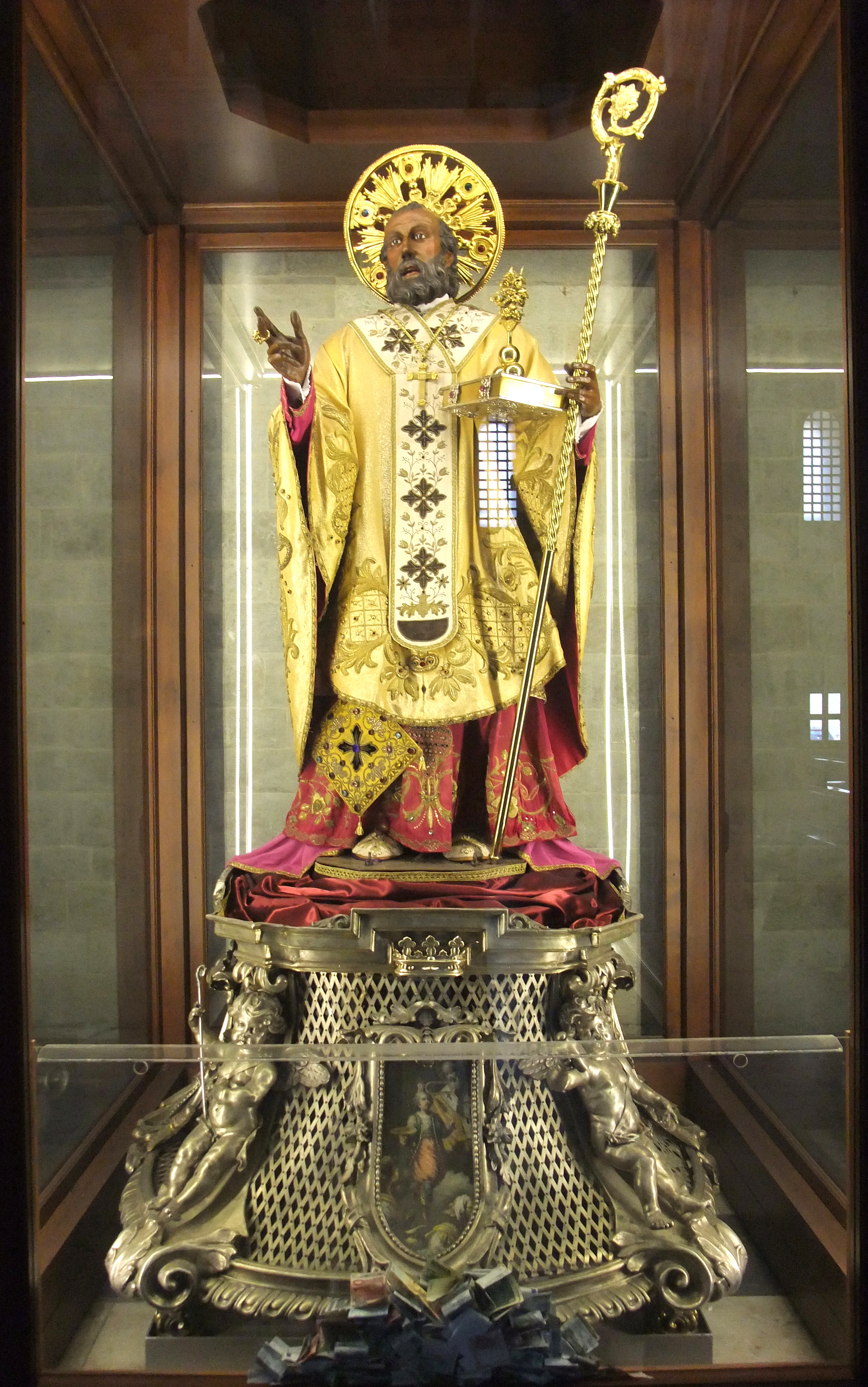
San
Nicola, Cathédrale de Bari.
Proclamato patrono della Grecia, Nicola nasce nel III secolo a Patara, in Licia (Turchia), in una ricca famiglia che lo educa ad essere generoso con i bisognosi. Nicola è di buon cuore e si sente portato verso la spiritualità. Prega e frequenta la chiesa. Aiuta i poveri donando loro il cibo ed è sua abitudine gettarlo nelle misere case dalla finestra, per non farsi scoprire. Diventa vescovo della Myra (Turchia) e, rimanendo molto umile, compie tanti miracoli: libera condannati a morte ingiustamente, moltiplica il grano per gli affamati, converte i cuori malvagi, guarisce e salva dai pericoli. La leggenda narra che il piccolo Nicola il mercoledì e il venerdì succhiasse il latte materno solo una volta al giorno e in piccole quantità, per rispettare i dettami del digiuno cristiano.
Una famiglia sul lastrico sta per vendere le proprie figlie ma, grazie all’intervento generoso di San Nicola, le tre ragazze sono salve. Il vescovo, di nascosto, getta nella loro povera casa tre borse d’oro, la dote occorrente alle fanciulle per potersi sposare. E tre palle d’oro sono, infatti, uno dei simboli con i quali il santo viene spesso raffigurato. Un gruppo di marinai, poi, miracolosamente si salva da una bufera, ancora per intercessione di Nicola. Nei Paesi del Nord Europa San Nicola viene comunemente chiamato Santa Claus, nome che deriva dal tedesco Nicolaus. Per i bambini di questi Paesi è tradizione che a Natale, giorno in cui si celebra la nascita di Gesù, Santa Claus porti loro giocattoli e dolci. Ecco le origini di Babbo Natale: il vescovo con la lunga barba che, in sella a un cavallo bianco, regala cibo ai poveri, si trasforma in un simpatico “nonno”, vestito di rosso, che guida una slitta trainata da renne. Infatti San Nicola è protettore dei bambini e della loro salute, dei ragazzi e delle ragazze.
È patrono anche di porti di mare, marinai, barcaioli, pescatori, panettieri, produttori e commercianti di olio, prestatori di denaro, banchi di pegno e bisognosi. Viene invocato contro i pericoli del mare, i furti e i ladri, le carestie, gli errori giudiziari e per avere un matrimonio felice. Festeggiato il 6 dicembre, giorno in cui muore intorno al 343 a Myra, nel 1087 le sue reliquie vengono portate a Bari (Puglia), di cui San Nicola diventa il patrono. In questa città, che si affaccia sul Mare Adriatico, sorge una grande basilica che custodisce i resti di San Nicola, meta di pellegrinaggio per tanti fedeli.
Autore: Mariella Lentini
SOURCE : http://www.santiebeati.it/dettaglio/30300
.jpg)
Statue
de t Nicolas de Myre, basilique Saint-Nicolas, Bari

Den hellige Nikolas av
Myra (~280-~345)
Minnedag:
6. desember
Skytshelgen for Russland,
Hellas, Sicilia, (kongeriket Napoli), Lorraine, Moskva, Fribourg i Sveits,
Kampen i Nederland, Korfu i Hellas, Portsmouth og Puglia (Apulia); Bari, Trani,
Venezia, Merano, Ancona og Sassari i Italia, Amsterdam, Beit Jala på Vestbredden,
La Rioja i Argentina og Barranquilla i Colombia; bispedømmene Galway og Liège;
Den gresk-katolske Kirke i Amerika; for studenter og lærde i Hellas, Belgia,
Bulgaria, Georgia, Russland, Makedonia, Slovakia, Serbia og Montenegro; for
fattige, barn, unge ugifte jenter og bruder, nygifte og gamle jomfruer,
korgutter og ministranter, pilegrimer, reisende, sigøynere, poeter, advokater,
dommere, notarer, uskyldig dømte, tyver, kjøpmenn, apotekere, verter,
vinhandlere, parfymefabrikanter og parfymehandlere, skopussere, skippere,
fiskere, fiskehandlere, matroser, bryggearbeidere, sjauere, fløtere, møllere,
bakere, kornhandlere, slaktere, ølbryggere, spritbrennere, bøkkere, bønder,
vevere, spinnere, tøyhandlere, steinhoggere, tønnebindere, knappestøpere, lysestøpere,
brannvesenet, fanger og pantelånere; for et godt ekteskap, for å få tilbake
stjålne ting, for trygge reiser; mot havsnød, tyveri og ran, fengsling og
falske anklager
Den hellige Nikolas har mange navneformer (Nicholas, Nicolas, Niklas, Niklaas, Klaus, Claus, Klaas, Klaes, Claes; ru: Nikolaj; ung: Miklós, Mikulás; cz: Mikuláš; slov: Miklavž; rum: Nicolae; port: Nicolau; it: Nicola, Nicolò; gr: Nikolaos; lat: Nicolaus), men de historiske data om ham er ikke mange. Det som med troverdighet fortelles om hans liv, er ikke annet enn at han var biskop av Myra i Lykia i det sørvestre Lilleasia en gang på 300-tallet. Resten er mer eller mindre legendarisk. Myra er i dag den lille byen Demre (frem til 2005 Kale) i dagens tyrkiske provins Antalya.
Nikolas skal ha blitt
født rundt år 280 (286?) i Patara i Lykia (lykisk: Pttara), senere omdøpt til
Arsinoe, nær dagens lille by Gelemis i den tyrkiske provinsen Antalya. Hans far
var den rike og fromme Eufemios, som var kjent for sin velgjørenhet, og hans
mor Anna var søster av biskopen av Myra, som også het Nikolas. Myra var
provinsens hovedstad og bispesete. Gutten ble født først etter mange års
ekteskap, etter at foreldrene hadde gitt opp å få barn.
Det fortelles at Nikolas
allerede som nyfødt var svært from – han skal ha reist seg fra sitt første bad
rett etter fødselen, foldet hendene og hevet øynene til himmelen, slik at han
kunne rense sin sjel før legemet. Som spedbarn var svært asketisk; han nektet
nemlig å die sin amme mer enn en gang på onsdager og fredager, og da alltid om
kvelden i henhold til Kirkens regler for fastedager.
Han ble svært godt
oppdratt av sine foreldre og trådte fromt i deres fotspor. Hans onkel biskop
Nikolas viet unge Nikolas til prest da han var nitten år gammel. Foreldrene ble
revet bort av pesten, og Nikolas arvet en stor formue. Han delte imidlertid alt
ut til de fattige, men det skjedde alltid i det stille, slik at ingen skulle
rose og berømme ham. Onkelen hadde bygd et kloster, og der innsatte han nevøen
som abbed. Etter onkelens død valfartet Nikolas til Egypt og Det hellige land.
Kort etter at han kom tilbake, ble den fortsatt unge Nikolas i år 300 valgt av
folket til biskop av Myra. Det skal ha vært et forfallent bispedømme som han forvandlet
med fromhet, energi og mirakler.
Snart etter begynte
kristenforfølgelsene under keiserne Diokletian (284-305) og Maximian (286-305).
I den østlige delen av imperiet fortsatt forfølgelsene under keiser Galerius
(305-11), medkeiser under keiser Konstantin I den Store (306-37; enekeiser fra
324). Men forfølgelsene stanset i 311 da Galerius utstedte et toleranseedikt på
dødsleiet. Hans medkeiser Licinius (307-24) tolererte stort sett de kristne.
Som et resultat kunne Kirken utvikle seg ytterligere, og deres ledere biskopene
kunne konsentrere både religiøs, sosial og politisk innflytelse og velstand i
sine hender. I mange tilfeller fungerte de som ledere i sine respektive byer.
Det er åpenbart i denne perioden at Nikolas ble valgt til biskop av Myra.
Det hevdes at også
Nikolas ble fengslet i forfølgelsene rundt år 310, og at han ble hardt
mishandlet i fengslet. Ennå merket av denne behandlingen skal han i år 325 ha
deltatt på kirkemøtet i Nikea (i dag Iznik i Tyrkia). Der skal han ha ført
heftige diskusjoner med sin venn, biskop Theognis av Nikea, som hellet til å
ville støtte Arius' lære; til slutt tilhørte Theognis dem som undertegnet den
nikenske trosbekjennelsen. De fleste forskere mener imidlertid at det ikke er
noe historisk grunnlag for beretningen om at Nikolas led for sin tro før
Konstantins tronbestigelse og at han deltok på kirkemøtet i Nikea, siden hans
navn ikke nevnes i noen av de gamle listene over biskoper som deltok på
konsilet.
Men en historie vil ha
det til at han var til stede på konsilet og kjempet mot det arianske kjetteri,
som han betraktet som en dødbringende gift. Han skal til og med ha glemt seg og
faktisk fiket til heresiarken (erkekjetteren) Arius i ansiktet! Det førte til
at konsilfedrene fratok ham hans biskoppelige insignier og dømte ham til
fengselsstraff. Men der viste Kristus og hans Mor seg for ham og ga ham både
friheten og embetet tilbake.
Mer enn dette vet vi ikke
om Nikolas, annet enn at han døde en 6. desember mellom år 345 og 351 (342, 343
og 352 angis også som dødsår). Et av de uvanligste trekkene ved Nikolas'
biografi er han levde til han var en gammel mann og døde en fredelig død i sin
egen seng. På en tid da de fleste helgener døde for sin tro på de mest
usedvanlige og grusomme måter, gjorde dette at han skilte seg ut sammen med den
hellige Martin
av Tours, som også døde gammel og mett av dager. Både Nikolas og Martin
regnes som «apostellignende». Begge har det til felles at de var blant de
første ikke-martyrene som ble regnet som helgener. Men til forskjell fra Martin
feires Nikolas både i den latinske og den greske Kirken.
Allerede på 400-tallet
ble det reist en kristen basilika over hans grav i Myra, men den raste sammen i
jordskjelvet i 529. Keiser Justinian I (527-65) beordret at den skulle
gjenoppbygges som en kuppelkirke, og i tilknytning til kirken ble det reist et
kloster for å ta seg av helligdommen og de mange pilegrimene. Keiser Justinian
fikk også bygd en Nikolas-basilika i Konstantinopel, og hans egentlige kult
begynte på denne tiden, rundt 200 år etter hans død. Hans navn opptrer i
liturgien som tilskrives den hellige Johannes
Krysostomos (ca 347-407).
Fra sin begynnelse i den
greske kirken bredte Nikolas' kult seg til de slaviske land. Et høydepunkt kom
på 700-tallet i Russland, da han ble valgt til landets skytshelgen. På slutten
av 800-tallet overstrålte Nikolas alle andre helgener i øst og sto like
under Guds Mor.
Gradvis bredte kulten seg
også til Vest-Europa, fra 900-tallet i Tyskland, Frankrike og England. I
Tyskland begynte kulten allerede under keiser Otto II (973-83), trolig fordi
hans hustru Theofano var gresk. Det hospitset som den hellige Bernhard av Menthon fikk
opprettet i Alpene, var viet til Nikolas. På 800-tallet ble det bygget en kirke
til hans ære i Roma – ikke tilfeldig het den San Nicola in
Carcere – kirken ved fengselet. I Roma ble Nikolas' fest feiret fra
1000-tallet.
Siden har Nikolas vært en
av de mest populære helgener i kristenheten og er skytshelgen for land,
provinser, bispedømmer og byer. Blant annet er han skytshelgen for Russland,
Hellas, Sicilia, (kongeriket Napoli), Lorraine, Moskva, Fribourg i Sveits,
Kampen i Nederland, Korfu i Hellas, Portsmouth og Puglia (Apulia), Barranquilla
i Colombia, Bari, Amsterdam, Beit Jala på Vestbredden; bispedømmene Galway og
Liège, den gresk-katolske Kirke i Amerika, for studenter og lærde i Hellas,
Belgia, Bulgaria, Georgia, Russland, Makedonia, Slovakia, Serbia og Montenegro.
I 1809 møttes The New York Historical Society og utnevnte Sancte Claus til
skytshelgen for Nieuw Amsterdam, det nederlandske navnet for New York. Dermed
kan Nikolas altså regnes som skytshelgen for New York. Han er også
titularhelgen for utallige kirker, helgen for sjømenn, barn, kjøpmenn,
pantelånere og en rekke andre, feiret i fromme skikker og folklore og gjengitt
utallige ganger på malerier og i skulpturer. Nikolas er først og fremst kjent
som giveren av de gode gaver. Han hjalp de fattige og var en sann venn i nøden.
I hagiografien
(helgenbiografier) forbindes Nikolas med historiske enkeltheter fra livene til
andre helgener ved samme navn, som abbeden Nikolas fra klosteret Sion ved Myra,
senere biskop av Pinara ved Myra, som døde den 10. desember 564 i Lykia. På
grunn av Nikolas' nære forbindelser til det folkelige livet er hans biografi
senere utvidet med legendariske og mirakuløse begivenheter. Det er bevart mange
legender, de eldste greske Nikolas-legendene er fra 500-tallet.
Den del av legenden som
har hatt størst virkning, er historien om de tre jomfruene i Patara. Deres far
hadde mistet sin formue og hadde ikke råd til døtrenes medgift, så i
desperasjon ville han selge dem til et bordell. Da Nikolas hørte om det, kom
han i hemmelighet til huset om natten. Inn gjennom vinduet kastet han en sekk
gull, som var tilstrekkelig for medgift til den eldste av søstrene. Snart etter
var hun vel gift. Nikolas gjentok sin nattlige aksjon to ganger til, og med
dette frelste han de tre søstrene fra bordellet. Det finnes ulike varianter av
historien. Noen sier at han kastet de tre sekkene inn ved samme anledning, en
annen at han gjorde det tre påfølgende netter og en tredje at han gjorde det en
gang i året, alltid dagen før en av døtrene nådde «gifteferdig alder». Den
tredje gangen ønsket faren å finne ut hvem velgjøreren var, så han lå på lur,
løp ut på gaten, gjenkjente sin velgjører og ville takke ham, men Nikolas påla
ham streng taushet og å takke Gud i stedet. I en annen versjon får Nikolas vite
at mannen lå på lur, så han kastet den siste sekken ned skorsteinen i stedet
for gjennom vinduet. En variant sier at den tredje datteren hadde vasket sine
strømper den kvelden og hengt dem opp til tørk ved glørne og at sekken falt ned
i en av strømpene. En svært gammel form av legenden forteller at det bare var
to søstre – i denne varianten stjal Nikolas pengene fra sine foreldre for å
hjelpe jentene, noe som minner om en senere legende om den hellige Frans av Assisi.
På den tiden skulle det
velges ny biskop i Myra. Den fremste av landets biskoper drømte da at den
første som neste dag gikk inn i kirken, var ham de skulle velge. Han samlet de
andre biskopene til bønn, og den første de så, var Nikolas. Tross hans motstand
og vegring ble han valgt, og han ble en from og ydmyk, fast og tapper biskop,
streng mot syndere og god mot alle. En annen variant av legenden sier at den
unge Nikolas dro for å studere i Alexandria. På en av sine sjøreiser fra Myra
til Alexandria skal han ha reddet livet til en sjømann som falt ned fra riggen
under en storm. I en fargerik versjon av denne legenden, reddet Nikolas mannen
på en reise tilbake fra Alexandria til Myra, og da de kom frem, tok han med
sjømannen til kirken. På den tiden var den gamle biskopen nettopp død og
kirkefedrene hadde fått instrukser i en drøm å velge til sin neste biskop en
«mann som erobrer» (gr: nikei). Mens Nikolas ba i kirken, gikk den løsmunnede
sjømannen rundt og fortalte hvor modig han var reddet av mannen Nikei-Laos.
Etter det hadde kirkens eldste ikke noe annet valg enn å utnevne Nikolas til
sin nye biskop.
Noen sjøfolk var kommet i
havsnød og holdt på å forlise i et forrykende uvær utenfor Lykias kyst. I sin
nød anropte de Nikolas, og straks var det en mann hos dem som hjalp til med
seil og tauverk og stillet stormen. Da de var kommet trygt i land, gikk de opp
i kirken for å takke. Men da de så biskopen, gjenkjente de sin hjelper ute fra
havet. Derfor er han skytshelgen for sjøfolk og reisende. Han ble ofte påkalt
av sjøfolk som var i drukningsfare eller led skipbrudd. I Tyskland brakte
overlevende etter skipbrudd tradisjonelt biter av seilduk til Nikolas som
votivgaver.
En gang var det
hungersnød i landet. Skip lastet med korn ankret opp i havnen, men de tilhørte
keiseren, og matrosen turde ikke overlate noe til de sultende. Men Nikolas
lovte at de skulle komme frem til sitt bestemmelsessted med full last, noe som
også skjedde. Skipene ble tømt, og sultekatastrofen var avverget. Kornet varte
forunderlig lenge og vel, og det var til og med nok til overs til å få sådd
åkrene.
Det var ennå mye
avgudsdyrkelse i landet, og folk tilba den hedenske gudinnen Diana.
Ødeleggelsen av flere hedenske templer tilskrives Nikolas, blant dem templet
for Artemis. Nikolas fikk hogd ned det treet som var viet til Diana, og da
ville hun hevne seg på ham. Da noen pilegrimer ville besøke Nikolas, forkledde
hun seg som nonne og ga dem en liten olje med en kostbar, velluktende olje som
var forgiftet. Da de reisende ville overrekke flasken til Nikolas, kastet han
den straks i havet, og da begynte vannet å brenne på det uhyggeligste.
På grunn av at feiringen
av gudinnen Dianas fødselsdag foregikk den 6. desember, har noen forfattere
spekulert i at denne datoen ble valgt med overlegg som Nikolas' festdag for å
overskygge eller erstatte de hedenske feiringene.
I Frygia gjorde folk
opprør mot keiseren, og tre høye embetsmenn ble sendt av sted for å slå ned
oppstanden. Vinden førte imidlertid deres skip til Nikolas' by, og han innbød
de adelige gjestene til sitt hjem for å formane dem og formilde dem, og de lyttet
gjerne til ham.
Mens de var der, hadde
guvernør Eustathius i Myra mottatt en bestikkelse for å dømme tre uskyldige
soldater til døden. Men da de skulle til å bli henrettet ved halshogging, kom
den hellige biskopen til stedet, rev sverdet fra bøddelen og refset den onde og
udugelige guvernøren. Biskopen ga seg ikke med irettesettelsene før guvernøren
bekjente sin synd og tryglet om å bli tilgitt, og han løslot de tre uskyldige
soldatene.
De tre utsendingene var
til stede og opplevde biskopens inngripen med ærefrykt. Deretter dro de videre
til Frygia på sitt oppdrag, velsignet av Nikolas, og de gjenopprettet ro og
orden uten blodsutgytelse. Men da de var kommet vel tilbake til hovedstaden
Konstantinopel, ble de baktalt av onde tunger, og på grunn av sjalusi og falske
anklager fra prefekten Ablavius ble de kastet i fengsel. En ordre om deres
henrettelse ble til og med skaffet fra keiser Konstantin. I sin nød husket de
på biskop Nikolas, som hjalp uskyldig dømte, så de ba til Gud om at de måtte
bli berget gjennom biskopens fortjenester og gjennom hans hjelp. Samme natt
viste Nikolas seg i drømme for keiseren og ba ham under trusler om å løslate de
tre uskyldige mennene, og prefekt Ablavius opplevde det samme.
Om morgenen snakket
keiseren og prefekten sammen om sine drømmer, og de dødsdømte mennene ble sendt
bud etter og forhørt. Da keiseren hørte at de hadde påkalt navnet til Nikolas
av Myra som hadde vist seg for ham, satte keiseren dem fri og sendte dem til
Myra med et brev til biskopen, hvor han ba Nikolas om ikke å true ham mer, men
om å be for fred i verden.
Forskerne er enige om at
denne siste kompliserte historien er den eldste. Denne legenden kalles
«Stratelat-legenden» (Praxis de stratelatis) (gr: stratelat =
general) og kalles «kjernen i Nikolaslegenden». Den eldste bevarte versjonen
dateres mellom 460 og 580, men den bygger uten tvil på enda eldre sagn som vi
ikke kjenner. Lenge var dette det mest berømte av Nikolas' mirakler, og på
800-tallet var denne legenden det eneste som generelt var kjent om ham.
Stratelat-legenden var så utbredt at den er bevart i mer enn femti ulike
manuskripter.
Nikolas' kult økte sterkt
gjennom de ulike biografiene som ble skrevet om ham. Hans første biograf var
Mikael arkimandritten (abbeden), som mellom 750 og 850 (trolig rundt 810/20) i
Konstantinopel skrev Vita per Michaelem. Denne forble den kanoniske
biografien og grunnlaget for alle de følgende, først for Methodius ad
Theodorum, en blanding av biografi og lovtale som ble samlet få år senere
(første halvdel av 800-tallet) av den hellige patriark Methodios av
Konstantinopel (d. 847). Han skriver: «Frem til nå har biografien til
denne fremtredende hyrden vært ukjent for de fleste troende». Deretter går han
i gang med å bøte på deres uvitenhet nesten 500 år etter den helliges død. Hans
biografi er den minst upålitelige av de tilgjengelige «biografiske» kildene, og
en enorm mengde litteratur, kritisk og fortolkende, har vokst opp rundt
dem. Encomium Methodii, en festpreken fra rundt 860 som er overlevert i
patriark Methodios' navn, bygger på Vita per Michaelem.
Den såkalte
«Synaksarium-biografien» ble skrevet rundt 900 for den liturgiske feiringen av
Nikolas (synaksarium = martyrologium), og har fortsatt gyldighet i
den ortodokse liturgien. Den er en utvidelse av Vita per Michaelem, men
samtidig et nytt trinn på tradisjonsstigen. Denne biografien får nye motiver
gjennom innblandingen av detaljer fra biografien om abbed Nikolas av Sion.
Blant de mest omfangsrike
biografiene på dette nye utviklingstrinnet er Vita Compilata, som ble samlet
(kompilert) av en ukjent forfatter. Han samler fem forskjellige kilder fra
Nikolas-tradisjonen og blander dem med stoff fra biografien om abbed Nikolas av
Sion. Denne biografien hadde ikke særlig stor utbredelse.
Den neste viktigs
biografien er Vita per Metaphrasten, som ble skrevet på 900-tallet av den
hellige Simeon
Metafrastes (d. ca 1000), også kalt Logoteta. Denne biografien utvider
biografien til Mikael arkimandritten og er bevart i tallrike manuskripter både
fra øst og vest, de eldste stammer fra 1000-tallet. Biografien ble på
begynnelsen av 1400-tallet oversatt til latin av den venetianske kjøpmannen og
patrisieren Leonardo Giustiniani (d. 1446), og på denne måten fikk biografien
stor litterær utbredelse.
Før dette fantes det
allerede en eldre latinsk biografi, nemlig Vita beati Nicolai episcopi,
som ble skrevet i 880 av en viss Johannes Diakon i Napoli. Denne første
biografien på latin var skrevet på bakgrunn av greske kilder, og den står på
andre plass i biografiutviklingen (1: Vita per Michaelem, 2: Vita
beati Nicolai episcopi, 3: Synaxarium-Vita / Vita per Metaphrasten).
Vita per Metaphrasten fikk
universell utbredelse gjennom den nye utgaven av Breviarium Romanum etter
Tridentinerkonsilet i 1568. I den reviderte utgaven av breviaret fra 1602 er
beretningen om overføringen av Nikolas' relikvier til Bari tilføyd.
Den mest omfangsrike
biografien om Nikolas ble skrevet av den lærde Antonio Beatillo, som stammet
fra Bari. I syv bind ga han i 1620 ut Historia della vita, Miracoli,
Traslatione et Gloria dell'illustratissimo Confessore di Christi S. Nicolo,
archiepiscopo di Mira («Historien om den høyberømte Kristi bekjenner og store
erkebiskop av Myra, den hellige Nikolas' liv, mirakler, translasjon og
venerasjon»). De fleste av de nevnte biografiene har vedlagt samlinger av
mirakler.
Stratelat-legenden (Praxis
de stratelatis) dukket første gang opp på vestromersk jord i en Codex fra
Reichenau fra første halvdel av 800-tallet. Bare kort tid etter, mellom 840 og
854, finner vi igjen legenden i en noe forkortet form i martyrologiet til abbed
og senere erkebiskop av Mainz, den salige Rabanus Maurus.
I Tyskland skrev biskop Reginald av Eichstätt (d. 991) en metrisk Vita
Sancti Nicholai.
I høymiddelalderen oppsto
også populære Nikolasbiografier på folkespråkene. Den eldste kjente Vita
stammer fra anglo-normanneren Robert Wace. Med sin tekst St. Nicholas baserer
han seg på Johannes Diaconus og dermed på Methodios, men han bygger også på
andre kilder, muligens muntlige. Denne gammelfranske Vita finnes også i form av
en yngre mellomengelsk variant. Den første tyske biografien kom på 1200-tallet,
men det er dessverre bare bevart fragmenter av den.
Bestselgeren blant
Nikolas-biografiene i det latinske vesten ble skrevet i andre halvdel av
1200-tallet av den salige dominikaneren Jakob de Voragine (ca
1226-98), som senere ble erkebiskop av Genova. Hans berømte Legenda Aurea («Den
gylne legende») ble først skrevet på latin og ordnet de hellige etter
kirkeåret, så Nikolas kom rett etter den hellige apostelen Andreas (30.
november). Dette verket fikk en eventyrlig suksess, først i utallige
håndskrifter og fra slutten av 1400-tallet som trykte bøker, som varte helt til
1900-tallet. Nikolas' popularitet i høy- og senmiddelalderen, men også
ettervirkningene helt inn i vår egen tid, har sin kilde i denne sensasjonelt
suksessrike boken, som gjennom århundrene ble betraktelig utsmykket og utvidet:
De 170 tekstene fra 1200-tallet var i 1470 allerede blitt til 448. Legenda
Aurea forteller at Nikolas flere ganger hjalp jøder som var blitt narret av
kristne, og at han på mirakuløst vis skaffet foreldre sine sønner hjem fra
fangenskap – de kom simpelthen flyende med vinden. Disse befrielseshistoriene
står i en merkelig forbindelse med et gullbeger.
Den 26. august 1071
møttes den østromerske keiseren Romanus IV (1068-71) og seldsjukkene (tyrkerne)
under sultan Alp Arslan i slaget ved Manzikert. Slaget endte med et ydmykende
nederlag for keiser Romanus, og han ble tatt til fange. Som et resultat mistet
imperiet midlertidig kontrollen over det meste av Lilleasia til de invaderende
seldsjukkene. Østromerriket gjenvant kontrollen over Lilleasia under keiser
Alexios I Komnenos (1081-1118), men tidlig i hans regjeringstid ble Myra
inkludert kirken St. Nikolas overtatt av de invaderende muslimene.
Da Nikolas' helligdom
dermed var havnet i sarasenernes (muslimenes) hender, var det flere italienske
byer som så dette som en mulighet for å få tak i relikviene for seg selv og
dermed redde dem for kristenheten. Det oppsto en sterk konkurranse mellom byene
Venezia og Bari om hvem som ville komme først.
I byen Bari i Puglia
(Apulia) i Sør-Italia bodde det mange greske innvandrere som hadde flyktet fra
tyrkerne, og i 1087 dro en sjørøver derfra sammen med 62 sjømenn til Myra. Byen
var forlatt av innbyggerne, som hadde søkt tilflukt i fjellene for å berge seg
fra tyrkerne, og bare noen ortodokse munker var igjen for å vokte helligdommen.
Sjømennene berget (eller stjal, alt ettersom) Nikolas' relikvier fra sarkofagen
i gravkirken i Myra, rett for nesen på de rettmessige greske vokterne og deres
muslimske herrer, la dem i et skrin og brakte det til hjembyen, hvor
normannerne regjerte på den tiden. Den tomme Nikolas-sarkofagen kan den dag i
dag ses i den gjenoppbygde krypten i kirken St. Nikolas i Demre (Myra).
Relikviene ankom til Bari
den 9. mai 1087, og der ble de under stor høytidelighet ført til kirken San
Stefano. Den salige kommende pave Urban II (1088-99)
var til stede ved skrinleggingen. Man begynte straks byggingen av en ny stor
kirke i Bari til Nikolas' ære, Basilica San Nicola. Relikviene ble værende i
San Stefano i to år mens byggearbeidene fortsatte. Da pave Urban II i 1089 kom
til Bari for å overføre relikviene av den hellige Eustacius til
katedralen, var krypten til den nye basilikaen allerede ferdig, så den 29.
september 1089 vigslet paven også krypten, og Nikolas' skrin ble overført dit.
I denne krypten befinner
skrinet seg stadig, derfor kalles helgenen noen ganger Nikolas av Bari,
spesielt i Italia. Der feires 9. mai, translasjonsdagen, med en stor fest. Hans
kult i Italia startet med overføringen av relikviene til Bari, selv om han var
kjent i vesten før den tid.
Fra Nikolas' skrin i den
korsformede Martyrion som var tilknyttet basilikaen i Myra, ble det tidlig
utskilt en usedvanlig væske som ble kalt myron, helt sikkert forbundet med den
parfymeessensen som ble fremstilt i området og som hadde gitt byen Myra dens
navn. Det er denne velluktende «myrraen» som forklarer at Nikolas er
skytshelgen for parfymefabrikanter.
I den middelalderske
hagiografien var ikke utskillelsen av væsker fra helgenrelikvier noe
enestående, og slike helgener ble gjerne kalt på gresk \Myroblýtes
(«myrrautgytere»). Den hellige apostelen Andreas'
relikvier i Patras utskilte en «manna» på hans festdag, det samme gjorde den
hellige apostelen Johannes'
relikvier i Efesos og den hellige Demetrius' i
Thessaloniki (olje og manna in modo farinae), den hellige Eufemia i
Kalkedon utskilte dråper av blod, den hellige Hyacint i
Amastris en merkelig voldsom strøm av støv. Alt ble samlet opp av pilegrimer i
små beholdere og ampuller (eulogie; det vil si velsignelser) og tatt med hjem,
ikke bare som suvenir, men som tegn på helgenens beskyttelse.
Men Nikolas' skrin i Myra
ble likevel det mest berømte av Myroblýtes, og fenomenet tiltrakk seg
store mengder pilegrimer. Det er dessverre ikke bevart en eneste eulogia av
Nikolas fra 400/500-tallet, til forskjell fra de hellige Mennas av Egypt, Tekla i
Antiokia, Simeon
Stylitt (den Eldre) (ca 390-459) i Syria, Fokas Gartneren av
Sinope (d. ca 303) og Demetrius av Thessaloniki, som er bevart i
museer i Bobbio, Monza, Farfa, Sassari, London og Paris. Disse eulogie har
bilder av den hellige eller de er dekorert med kors, stjerner, blomster eller
scener fra den helliges liv. I øst gjorde allerede den hellige Johannes
Krysostomos pilegrimene oppmerksom på disse ampullene i en preken hvor
han sa: «Dra til martyrenes graver, gråt elver av tårer, tukt deres hjerter og
ta med dere eulogia. Dere tar den hellige oljen og påfører den deres kropp,
samtidig på tungen, leppene, halsen og øynene».
Når det gjelder Nikolas,
snakker hans første biograf, Mikael arkimandritten, rundt 810/20 om den
helliges «parfymerte og velduftende oppførsel» mens han levde, om hans
«dyrebare legeme, velduftende som dydenes sødme» og om den følgende
utskillelsen av en «velluktende og mild olje som fjerner ethvert onde og som
gjør godt ved å sørge for et middel som frelser og bekjemper djevelen». Han
viser mer til generelt konsept til noe spesifikt undergjørende. I vesten er den
første forfatteren som skriver om Nikolas' manna, Johannes av Amalfi rundt 950.
Han forteller om alle miraklene som den bevirket og undrenes effekt på den
tilstrømmende skaren av pilegrimer.
Da sjømennene fra Bari
kom til basilikaen i Myra i 1087, trodde munkene som voktet Nikolas' relikvier,
at de var pilegrimer, om enn noe bråkete. De tilbød sjømennene litt av den
hellige «likøren» fra graven, som var tappet på glasampuller av presbyteren
Lupus. Sjømennene gjengjeldte denne gjestfriheten med å stjele relikviene.
Graven var da full av manna, og det heter seg at sjømennene fra Bari lot den
være igjen for å trøste de sørgende grekerne. «Krøniken fra Kiev» sier derimot:
«De fant urnen full av manna. De helte den i skinnsekker og tok relikviene».
Det er ikke kjent om
relikviene utskilte manna i de to årene de ble voktet i kirken San Stefano. Men
etter overføringen til krypten i den nybygde Basilica San Nicola i Bari,
begynte Manna di San Nicola å strømme igjen. Denne mannaen eller Oleum San'
Nicolai er en klar, oljeaktig væske som kommer fra relikviene og som samles
hvert år på 9. mai, hans festdag i Bari. Denne væsken blandes med vann og enten
drikkes eller smøres på syke kroppsdeler, og den sies å skulle ha helbredende
egenskaper. Den samles på flasker av ulike størrelser, fra ampuller til store
beholdere som tar flere liter, alle påmalt bilder av den hellige og scener fra
hans liv. Hva denne væsken nå enn er eller inneholder, har den i alle fall i
mange århundrer tiltrukket seg utallige pilegrimer til Nikolas' skrin.
Betydningen av relikvier
og den forretningsvirksomheten som var assosiert med pilegrimer førte til at de
jordiske restene av de fleste helgener ble spredt til flere kirker i opptil
flere land. Nikolas er unik i den forstand at de fleste av hans knokler er bevart
på ett sted: hans grav i krypten i kirken i Bari. Det finnes imidlertid mange
lokale legender om spredningen av også Nikolas' relikvier.
En av dem forteller at
noen av hans knokler ble brakt av tre pilegrimer til en kirke i det som nå er
Nikolausberg i nærheten av byen Göttingen i Tyskland, noe som ga kirken og
landsbyen deres navn. Det finnes også en venetiansk legende (bevart i
Morosini-krøniken) som sier at de fleste av hans relikvier i virkeligheten ble
brakt til Venezia, hvor en stor kirke viet til Nikolas, sjøfolkenes
skytshelgen, ble bygd på Lidoen, og at bare en arm ble etterlatt i Bari. Lokal
folklore i Kilkenny i Irland hevder at noen av Nikolas' knokler ble brakt
tilbake fra korstogene av en lokal ridder og gravlagt nær Thomastown.
Til tross for at Nikolas'
relikvier fortsetter å utsondre manna, har Den katolske Kirke tillatt én eneste
vitenskapelig undersøkelse av hans knokler. Sent på 1950-tallet, under en
restaurering av kapellet, tillot Kirken at et håndplukket team av
vitenskapsmenn fotograferte og målte innholdet av graven i krypten. Sommeren
2005 skal en kopi av deres rapport ha blitt sendt til et kriminalteknisk
laboratorium i England. Rapporten viste at Nikolas var knapt fem fot høy (150
cm) – ikke usedvanlig kort, men kortere enn gjennomsnittet, selv på hans tid –
og at han hadde en brukket nese.
På mange bilder av
Nikolas, særlig i Nord-Europa, fremstilles en scene som ikke finnes i de gamle
legendene. Vi ser et kar eller en balje, og der sitter det tre små skikkelser
som stråler av glede, og noen ganger klapper de i hendene, åpenbart hjulpet av
den gode biskopen. Dette er en illustrasjon til en sen, nordfransk legende, som
oppsto etter en feiltolkning av den eldre legenden om de tre gullposene som
hadde reddet de tre søstrene fra en skjebne på bordellet. For disse posene var
alltid med på avbildninger og kom til å bli Nikolas symbol (attributt) i
kunsten. På et tidspunkt ble de trodd å representere tre hoder, og legenden
forteller:
Tre unge studenter var på
reise, og da natten falt på, tok de inn på et herberge. Verten og hans hustru
trodde at de hadde penger på seg, og derfor myrdet de dem. De døde kroppene ble
partert og gjemt i en stor syltetønne med saltlake eller eddik. Da kom Nikolas
forbi, forkledd som tigger. Han tok også inn på herberget og tvang myndig
ekteparet til å tilstå mordet. Deretter vakte den gode biskop de tre studentene
tilbake til livet.
Denne historien, som
avbildes svært ofte, finnes første gang som tekst til et mirakelspill i et
håndskrift fra Hildesheim fra 1100-tallet. Den ble brukt i franske
Nikolas-spill, prekener og kirkelige sanger, og er naturligvis blitt fortalt i
utallige varianter. Man mener at denne legenden var opphavet til den engelske
horror-legenden om Sweeney Todd («The Demon Barber of Fleet Street»). Det
merkelige med Nikolas' legender, til forskjell fra andre helgeners, er at han
aldri selv kommer i vanskeligheter, og at han kommer og forsvinner helt
plutselig og mirakuløst.
Nikolas er en av de mest
populære helgenene i kristenheten. Hollandske protestanter tok legendene om ham
med seg til Amerika og Ny Amsterdam (senere New York), og der ble hans
hollandske navn Sinte Klaas (St. Nikolas) til Santa Claus. I Amerika ble hans
legender forent med nordiske folkloretradisjoner om nissen som straffet slemme
og ga gaver til de snille barna, og guden Tor med sin vogn trukket av
geitebukker ble også trukket inn. På denne måten ble den papistiske helgenen
forvandlet til en nordisk trollmann, og dermed oppsto den snille julenissen med
sleden og reinsdyrene som kremmere overalt begjærlig har trykket til sitt
bryst, både i kristne og ikke-kristne deler av verden.
Den moderne julenissens
fremste opphavsmann i USA er Clement C. Moore, en episkopal (anglikansk) prest
i New York, som ikke huskes for sitt livsverk, The Hebrew and English
Lexicon, men for et dikt han skrev for sine barn, The Visit of St Nicholas,
nå verdenskjent under tittelen basert på diktets første linje, The Night
Before Christmas. Det ble utgitt i 1822 og ga verden en St. Nikolas som en
nattlig gavebringer med slede, reinsdyr og en sekk med gaver på ryggen, som
kommer inn i huset gjennom skorsteinen og fyller barnas strømper med leker og
godteri. Han har blitt rundmaget og leende, rødkinnet og hvitskjegget, men
diktet nevner ikke noe om hans drakt. Hans utseende ble endelig fiksert gjennom
Coca Colas reklamekampanje i 1931, da en fet julenisse i en rød pelskantet
jakke med bredt belte ble det universelt aksepterte bildet. Dermed hadde den
røde bispedrakten og mitraen blitt til dagens røde julenissedrakt.
Flere steder er det
fortsatt den 6. desember, Nikolas' minnedag, man gir barna gaver. I
middelalderen var det flere steder vanlig å velge en guttebiskop til å «herske»
over klosteret og skolen; dette skjedde først på festen for De uskyldige Barn den
28. desember, men ble fra 1200-tallet flyttet til Nikolas' festdag. Til og med
i våre tider har denne skikken overlevd i Montserrat i Catalonia i Spania.
Nikolas (San Nicola) er
naturligvis skytshelgen for byen Bari, hvor hans grav finnes. Festa di San
Nicola holdes hvert år fra 7. til 9. mai. Den 8. mai føres hans relikvier på en
båt på sjøen utenfor byen med en prosesjon av båter etter (Festa a mare).
Den 6. desember feires det et ritual som kalles Rito delle nubili. Alle ugifte
jenter i gifteferdig alder kommer til den første messen, som feires klokken fem
om morgenen. Deretter snur de seg mot den såkalte mirakelsøylen (colonna
miracolata) i håp om å finne en mann innen et år.
Nikolas er også
skytshelgen for den lille palestinske byen Beit Jala, to kilometer vest for
Betlehem. Den skryter over å være det stedet hvor Nikolas tilbrakte fire år av
sitt liv under sin valfart til Det hellige Land. Hvert år på den 19. desember
etter den gregorianske kalenderen – det vil si den 6. desember etter den
julianske kalenderen – holdes det en stor messe i den ortodokse kirken St.
Nikolas, og den etterfølges vanligvis av parader, utstillinger og mange
aktiviteter. Arabiske palestinske kristne av alle konfesjoner og kirker kommer
til Beit Jala og deltar i bønn og fest.
Nikolas' sterke
innflytelse i Nederlandene, et område som var spesielt engasjert innen handel
og skipsfart, skyldtes først og fremst hans rolle som skytshelgen for sjøfolk
og handelsmenn. Men i Nederland skapte en billedbok av Jan Schenkman fra 1845
(Sint Nikolaas en Zijn Knecht) moderne skikker ved å etablere Sint Nikolaas'
ankomst med en dampbåt fra Spania med en maurisk assistent. De tre gullkulene
som ofte følger Nikolas i kunsten, ble noen ganger feiltolket til å være
appelsiner eller annen frukt. Ettersom man i Nederland generelt regnet
appelsiner for å komme fra Spania, førte det til den tro at Sinterklaas bor i
Spania og kommer nordover på besøk hver vinter og har med seg appelsiner og
annen «vinterlig» frukt. Fortsatt hyller folkemengder entusiastisk hvert år i
midten av november ankomsten av Nikolas og hans mauriske assistent, Zwarte
Piet, med dampbåt. I de senere år har det naturligvis vært diskusjoner i den
politiske korrekthetens navn om det eventuelt rasistiske i disse skikkene fra
1800-tallet angående Sinterklaas' rampete hjelpere Zwarte Pieten med svarte
fjes og fargerike mauriske klær.
I Nederland er det
fortsatt 6. desember som er den store gavedagen, spesielt for de minste barna,
men i de senere årene har butikkinnehavere med et visst hell presset på for
julen som en annen gavefest i likhet med i resten av verden. I Belgia ble
Sinterklaas eller Sint-Nikolaas opprinnelig feiret på nederlandsk maner bare i
Flandern, men i senere år har feiringen av Saint-Nicolas i det franskspråklige
Vallonia kommet etter. Også i andre europeiske land har Nikolas gjerne med seg
en medhjelper; i Tyskland Knecht Ruprecht, i Frankrike Père Fouettard, i Sveits
Schmutzli, i Østerrike og Bayern Krampus, i Luxemburg Housecker.
Det blir sagt at Nikolas
er den helgenen som er mest avbildet av kristne kunstnere bortsett fra den
hellige Jomfru
Maria, Guds Mor. Han avbildes på utallige ortodokse ikoner, spesielt
russiske. I katolsk ikonografi avbildes han som biskop med en biskops
insignier: rød bispekappe, rød mitra og bispestav. Han kan også avbildes som
erkebiskop med pallium. Den røde bispedrakten og mitraen har senere blitt til
dagens verdensomspennende bilde av nissen i rød julenissedrakt.
Nikolas' attributt i
kunsten er vanligvis tre kuler, men det kan også være snakk om tre sekker eller
tre mynter. Andre symboler er anker og skip, som går på hans patronat for
sjøfolk. Mange av avbildningene illustrerer noen av legendene: en ung mann som
kaster tre pengesekker inn vinduet til de tre jentene, en mann som redder tre
barn fra salttønnen, eller en mann som redder overlevende fra et skipsvrak,
eller han gjenoppvekker en mann som er uskyldig hengt (kan lett forveksles med
den hellige Nikolas
av Tolentino, men han avbildes aldri som biskop), eller han avbildes som
nyfødt mens han priser Gud.
På grunn av sin hjelp til
de fattige er Nikolas skytshelgen for pantelånere, og de tre gullkulene som
tradisjonelt hang utenfor en pantelåneforretning, symboliserer de tre
gullsekkene. Folk begynte å mistenke at Nikolas sto bak en hel rekke av anonyme
gaver til de fattige og at han brukte arven etter foreldrene til dette. Etter
at han døde, fortsatte folk i regionen å gi anonymt til de fattige, og slike
gaver ble ofte tilskrevet Nikolas. En nesten identisk historie fortelles i
gresk folklore om den hellige Basilios den Store av
Caesarea. Hans festdag den 1. januar er også en dag for å utveksle gaver.
I vest er Nikolas barnas
skytshelgen (Santa Claus), han er skytshelgen for bankierer, fanger (på grunn
av de tre keiserlige utsendingene han reddet), sjømenn og reisende, bruder og
ugifte kvinner (på grunn av medgiften). Noen steder regnes han blant De 14 nødhjelperne,
selv om han ikke står på den mest alminnelige listen. Fordi han er skytshelgen
for sjøfolk, ble kirker viet til ham ofte plassert slik at de kunne ses som
landemerker fra sjøen. Han skal også ha fått noen tyver til å levere tyvegodset
tilbake. Dette forklarer hans beskyttelse mot tyveri og ran og hans patronat
for tyver. Han hjelper dem ikke til å stjele, men til å angre og forandre seg.
Tidligere var tyver kjent som «St. Nikolas' riddere».
Nikolas' minnedag er 6.
desember, med en translasjonsfest den 9. mai. Østkirken minnes ham den 4.
desember. Hans navn står i Martyrologium Romanum. Hans festdag er avmerket på
den norske primstaven. Det skal være mer enn 2.000 kirker i Europa som er viet
til ham, og i senmiddelalderen var det nesten 400 Nikolas-kirker bare i
England.
Selv om Nikolas var
populær i det østlige Middelhavsområdet og i Nordvest-Europa, Nikolas det
kuriøst nok ikke der han var aller mest populær – det var i Russland. Sammen
med apostelen Andreas er han nasjonens skytshelgen, og han er så høyt elsket
blant russerne at det ble sagt at «hvis Gud dør, har vi i det miste fortsatt
St. Nikolas.» Den russisk-ortodokse kirken feirer til og med hans
translasjonsfest til Bari. Før revolusjonen var det så mange russiske
pilegrimer som kom til Bari at den russiske regjeringen støttet en kirke, et
sykehus og et hospits der. Han er også en passende skytshelgen for økumeniske
samtaler mellom øst og vest, og av denne grunn bærer det instituttet som er
ledet av dominikanerne i Bari for å fremme forbindelsene mellom de østlige og
latinske kirkene, hans navn, Istituto di Teologia Ecumenica San Nicola.
Se en side med mange
eksempler på bilder
av Nikolas i kunstmuseer verden rundt.
Kilder: Attwater
(dk), Attwater/John, Attwater/Cumming, Farmer, Jones, Bentley, Hallam, Lodi,
Butler, Butler (XII), Benedictines, Delaney, Bunson, Engelhart, Gad,
Schnitzler, Schauber/Schindler, Melchers, Gorys, Dammer/Adam, KIR, CE, CSO,
Patron Saints SQPN, Infocatho, Bautz, Heiligenlexikon, santiebeati.it,
en.wikipedia.org, basilicasannicola.org, nikolaus-von-myra.de,
thehollandring.com, Daily Telegraph 21.12.2007 - Kompilasjon og
oversettelse: p. Per
Einar Odden
Visste du at Den hellige
Nikolas’ minnedag opprinnelig var den store «gavedagen»?
SOURCE : https://www.katolsk.no/biografier/historisk/nmyra
.jpg)
Hans
Baldung Grien (1484–1545), Heiliger Nikolaus von Bari, Altar des Hl.
Johannes des Täufers / Saint John Altarpiece, circa 1515, tempera and oil on fir wood, 168.2 x 61.5,
Historical Museum Frankfurt
Nikolaus von Myra
syrisch: Soche, Zakka,
Zeka (= der Sieger)
Gedenktag katholisch: 6. Dezember
nicht gebotener Gedenktag
Hochfest im Kanton Fribourg und im Dom in Feldkirch
Fest in der Stadt Alicante, im Erzbistum Bari-Bitonto und im übrigen Bistum Lausanne - Genf - Fribourg
Diözesankalender Basel, Chur, St. Gallen, Sitten, Feldkirch
im mozarabischen Ritus: 7. Dezember
Übertragung der Gebeine von Myra nach Bari: 9. Mai
Übertragung von Reliquien in die Jesuitenkirche São Roque nach Lissabon: 25. Januar
gebotener Gedenktag im Erzbistum Bari-Bitonto: Übertragung der Gebeine: 9. Mai
Übertragung der Gebeine in Paris und in der Kathedrale von Fribourg: 9. Mai
Übertragung der Gebeine in Nantes: 11. Mai
Übertragung der Gebeine nach Venedig: 29. Mai, 30. Mai
Tag der Bischofsweihe: 14. Juni
Tag der Geburt: 27. Juni
Übertragung der Gebeine in Salzburg: 9. Juli
Wiederherstellung / Zurückführung: 31. Juli
Gedenktag evangelisch: 6.
Dezember
Gedenktag anglikanisch:
6. Dezember
Gedenktag orthodox: 6. Dezember
Übertragung der Gebeine nach Bari: 9. Mai, 20. Mai
Tag der Geburt: 29. Juli
bedacht in der Proskomidie
Gedenktag armenisch: 6. Dezember
liturgische Feier am Samstag vor dem 1. Adventssonntag
und am Samstag nach dem 2. Adventssonntag
Gedenktag koptisch: 6. Dezember
Weihe seines Altars, des ersten Altares der Jakobiten in Ägypten: 10. April
Gedenktag
äthiopisch-orthodox: 6. Dezember
Gedenktag
syrisch-orthodox: 6. Dezember
Name bedeutet: der
Sieger über das / aus dem Volk (griech.)
Metropolit von Myra, Wundertäter
* um 283 in Patara (?), heute Ruinen bei Kalkan in der Türkei
† um 348 in Myra,
heute Demre in der Türkei
Nikolaus wurde der
Überlieferung zufolge von seinem Onkel, Bischof Nikolaus von Myra,
im Alter von 19 Jahren zum Priester geweiht und als Abt im Kloster von Sion -
heute untergegangener Ort, Namensgeber eines katholischen Titularbistums - nahe
seiner Heimatstadt eingesetzt. Als seine Eltern an der Pest starben, erbte
Nikolaus ihr Vermögen und verteilte es an Arme: so bewahrte er mehrere junge
Frauen aus seiner Nachbarschaft in seiner Heimatstadt Patara,
indem er heimlich Geld durchs Fenster - oder durch den Kamin in die darin
aufgehängten Socken - warf, so für eine ausreichende Mitgift sorgte und
verhinderte, dass der Vater seine Töchter zur Prostitution hergeben musste;
deshalb gilt Nikolaus als Geber guter Gaben und Freund der Kinder; eine sehr
alte Fassung der Legende behauptet, er habe das Geld seinen Eltern gestohlen,
was an eine spätere Legende von Franziskus erinnert.
Nach dem Tod seines
Onkels pilgerte Nikolaus ins Heilige Land, nach seiner Rückkehr wählte die
Gemeinde Myra ihn
zum neuen Bischof und damit zum Nachfolger von Nikandros
von Myra. Die Legende zeichnet Nikolaus als temperamentvollen Streiter und
zugleich als Mann der fähig war, diplomatisch zu vermitteln und Gnade vor Recht
ergehen zu lassen. Bei einem Aufstand von in Phrygien stationierten
germanischen Söldnern begegnete er in Myra hohen Offizieren aus Konstantinopel
- dem heutigen Ístanbu,
bei denen er nachhaltigen Eindruck hinterließ.
Drei zu Unrecht gefangen
gehaltene Feldherrn konnte Nikolaus der Überlieferung zufolge wundersam
befreien, indem er im Traum dem Kaiser erschien und um ihre Befreiung bat; in
anderer Version rettete er sie, indem er das Schwert des Henkers abwehrend
ergriff; deshalb wurde er Patron der Gefangenen. Er rettete Schiffbrüchige,
deshalb ist er Patron der Seefahrer. Um ein in Seenot geratenes Schiff zu
retten mit drei Pilgern, die von Ephesus -
heute Ruinen bei Selçuk - ausfuhren mit für eine christliche Kapelle bestimmtem
heiligen Öl, begab er sich an Bord, stillte den Sturm und brachte das Schiff
sicher in den Hafen. 1 Drei
ermordete und von Kannibalen bereits in einem Fass zu Pökelfleisch zubereitete
Knaben erweckte er wieder zum Leben; Hintergrund dieser Legende ist wohl das um
den Nikolaustag üblich gewesene Schlachten vor Weihnachten.
Nikolaus zerstörte
mehrere Tempel der Heidengöttin Diana / Artemis, die in den Küstenorten Lykiens als
Patronin der Seefahrer verehrt wurde; ihr Tempel in Myra war
der größte und prunkvollste - Nikolaus' Gedenktag 6. Dezember ist Dianas
Geburtstag. Während der bald schon einsetzenden Christenverfolgung wurde er um
310 gefangen genommen und gefoltert.
325 nahm Nikolaus
am 1.
Konzil von Nicäa teil. Überliefert ist, wie er kämpferisch gegen die
falsche Lehre des Arianismus vorging;
die Legende erzählt, dass er deren Verfechter Arius während des Konzils
geohrfeigt habe. Erzählt wird, dass Nikolaus beim Konzil anhand eines
Ziegelsteins die Lehre von der Dreieinigkeit illustrierte: in einer einzigen
Realität, dem Ziegelstein, existieren drei verschiedene Wesenheiten, nämlich
Wasser, Erde und Feuer; seine Worte wurden demnach unterstrichen durch das
Wunder, dass aus dem Ziegelstein eine Flamme emporschlug. Auch mit seinem Freund
Bischof Theognis von Nicäa - dem heutigen Íznik -,
der den Auffassungen des Arius zuneigte, führte Nikolaus heftige Diskussionen;
schlussendlich gehörte Theognis zu den Unterzeichnern des Bekenntnisses
von Nicäa. Lassen wir über unserem Zorn die Sonne nicht untergehen,
zitiert später Andreas
von Kreta den Vermittler Nikolaus.
Vom 15. Jahrhundert an
verbreitete sich die Legende von den Getreidehändlern: Nikolaus erbat bei einer
Hungersnot in Myra von
jedem der für den Kaiser in Rom bestimmten
Schiffe nur 100 Scheffel und versicherte, dass durch sein Gebet nichts bei der
Ablieferung fehlen werde, was sich bewahrheitete; Nikolaus aber konnte seine
Gemeinde auf Jahre hinaus ernähren und sogar Saatgut austeilen.
Gesicherte historische
Nachrichten über das Leben und Wirken von Nikolaus gibt es nicht. In der
Überlieferung vermischten sich Nachrichten über einen Abt Nikolaus von Sion
nahe Myra und solche über den Bischof Nikolaus aus
dem nahen Pinara bei
Minare nahe Fethiye.
Der Kult um Nikolaus
entwickelte sich zu Beginn des 6. Jahrhunderts. Kaiser Justinian weihte ihm
Mitte des 6. Jahrhunderts eine Kirche in Konstantinopel - dem heutigen Ístanbul,
in der auch einige Reliquien verwahrt
wurden. Der Kult verbreitete sich auch in Griechenland, wo er
als Hyperhagios, Überheiliger, verehrt wird, und kam dann in die
slawischen Länder. Über die byzantinische Tradition wurde Nikolaus einer der am
meisten verehrten Heiligen Russlands, er folgt im Osten in der Verehrung
unmittelbar nach Maria.
Nikolaus wurde einer der beliebtesten Volksheiligen mit vielen legendären
Erzählungen, die vor allem seine menschenfreundliche und hilfsbereite Art
bezeugen. Sein aufgebrochener, leerer Sarkophag wird noch heute in der wieder
hergestellten Nikolaus-Basilika in
Demre von Wallfahrern der Ostkirche verehrt.
In Rom zog
der Kult im 8. Jahrhundert ein, er verbreitete sich dann zunehmend auch in Süd-
und Mitteleuropa. Schon Friesen-Missionar Liudger baute
der Überlieferung nach die erste deutsche Nikolauskapelle im münsterländischen
Billerbeck bei Coesfels an der Stelle der heutigen Kirche
St. Johannes der Täufer. 972 brachte Kaiserin Theophanu anlässlich ihrer
Hochzeit mit Kaiser Otto II. eine Reliquie -
1660 als Fingerknochen beschrieben - aus Byzanz mit;
sie befand sich seit 1058 in der Nikolaus geweihten Kapelle am südlichen
Seitenschiff des Domes in
Worms und ging 1688 bei der Zerstörung des Domes im Pfälzer Erbfolgekrieg
verloren.
Johannes Kienast:
Reliquiar mit Wasser vom Nikolaus-Grab, 1990, Ersatz für die Um 980 entstand in
Deutschland die erste Nikolauskirche im Kloster Brauweiler.
Im April 1087 wurden die Gebeine von
Nikolaus, dem Patron der Seefahrer, durch 62 Abenteurer aus der italienischen
Hafenstadt Bari, die auf drei Schiffen anreisten, aus dem Marmorgrab in
der Nikolaus-Basilika in
Myra entwendet und in ihre Heimatstadt entführt. Dort wurden sie zunächst im
damaligen Benediktinerkloster
San Benedetto - an der Stelle der heutigen Kirche San
Michele Arcangelo aufbewahrt.
Als Tag der Ankunft
der Gebeine in
Bari gilt der 9. Mai, die Feiern in Bari - einschließlich einer See-Prozession
und von Feuerwerken - beginnen schon am 7. und dauern bis zum 10. Mai. Der Abt
Elias des Klosters
San Benedetto - der zugleich Erzbischof von Bari war
- bekam für den Bau einer neuen Kirche als Ort der Verehrung der Reliquien den
Platz mit den Trümmern des byzantinischen Gouverneurspalastes zur Verfügung
gestellt und begann mit den Arbeiten für die monumentale Basilika San
Nicola, die Papst Urban II. 1098
weihte, wobei er bei dieser Gelegenheit zur Teilnahme am 1.
Kreuzzug aufrief.
Peter Amann schreibt in
seinem Reiseführer Apulien, 6. Aufl. Reise Know-How Verlag Bielefeld 2016:
Das Wirtschaftswunder des Heiligen Nikolaus
Nachdem Papst Urban II. in
Bari zum Kreuzzug aufgerufen
hatte, setzte ein nicht abreißender Strom von Pilgern und Kreuzfahrern ein, die
sich auf dem Weg ins Heilige Land den Segen des hl. Nikolaus holten und dafür
mit barer Münze zahlten. Glücklicherweise hatten dessen Gebeine beim Umzug die
Fähigkeit, wohlriechendes Manna auszuschwitzen, nicht verloren. Die
wasserartige Flüssigkeit, in homöopatischer Verdünnung in Flaschen gefüllt, war
ein Verkaufsrenner. Nach ihrer glücklichen Rückkehr aus den Heiligen Land
stifteten Kreuzfahrer der Kirche große Reichtümer.
Schon beim Bau der Bailika
San Nicola in Bari vollbrachte Nikolaus der Überlieferung zufolge das
erste Wunder, indem er fünf verschüttete Bauarbeiter aus der Grube rettete.
Bari wurde zum Wallfahrtsort,
auch für orthodoxe Pilger,
in der Kirche San Nicola werden Gottesdienste auch im byzantinischen Ritus
gefeiert, an einem Seitenaltar gibt es eine Ikonostase. Vor
der Basilika steht eine Statue, die der Stadt 2003 vom russischen Präsidenten
Wladimir Putin geschenkt wurde.
Angeblich die Hälfte der
Nikolaus-Reliquien kam dann nach Venedig in die Kirche San
Nicolò di Lido, an der die Seeleute der Marine ihren Truppenübungsplatz
hatten; noch heute wird dort alljährlich an Christi
Himmelfahrt (inzwischen am Sonntag danach) die Sposalizio del Mare,
die Meereshochzeit, gefeiert. 1098 brachte der Kreuzzugsteilnehmer
Aubert de Varangéville aus Bari ein
Fingerglied der Segenshand des Heiligen nach Port - dem heutigen
St-Nicolas-de-Port - in Lothringen, wo 1093 eine erste Kirche errichtet
wurde; sie wurde ein bedeutendes Wallfahrtsziel.
Vom 11. bis zum 16. Jahrhundert wurden diesseits der Alpen mehr als 2200
Kirchen nach Nikolaus benannt.
Nikolaus ist Patron auch
der Pfandleiher und Bankiers aufgrund der Legende um das Geld, das ein Christ
höher stellte als sein Versprechen: Ein Christ hatte einem Juden, der ihm Geld
geliehen hatte, beim heiligen Nikolaus versprochen, das Geld pünktlich
zurückzugeben. Aber er tat es dann nicht, sondern behauptete, er habe den
Betrag längst zurückgegeben. Als es in einer Gerichtsverhandlung zum Schwur
kam, benutzte er einen Trick: er versteckte das Geld im Inneren eines Stabes
und bat den Juden, den Stab zu halten, damit er die Hände für den Schwur frei
halten könne; dann schwor er, dass der Jude das Geld habe, nahm dann den Stab
wieder und verließ mit dem Geld darin das Gerichtsgebäude. Zur Strafe kam der
Christ danach unter einen Wagen und starb; der Jude aber zeigte sich großzügig:
er wollte das ihm gehörende Geld nur nehmen, wenn Nikolaus den Christen wieder
zum Leben erwecke, was dann auch geschah, woraufhin der Jude sich zum
Christentum bekehrte.
Im 14. Jahrhundert
entstand der Brauch des Bischofsspieles in Klosterschulen, wo ein
Schüler für einen Tag - zuerst am Tag
der Unschuldigen Kindlein, dann am Nikolaustag -
als Bischof fungieren durfte; in der Schule des Klosters Montserrat wird
dieser Brauch bis heute gepflegt. Daraus entstand der Brauch, dass Nikolaus die
Kinder beschenkt, seit 1555 ist Nikolaus als Gabenbringer für Kinder belegt.
Nikolaus gilt als Helfer
in fast allen Schwierigkeiten. Ansatzpunkte für das Brauchtum und seine
zahlreichen Patronate finden sich in den Legenden. Als Gegenpol zum gütigen
Nikolaus, der die Kinder beschenkt, bekam er in verschiedenen Ländern seit dem
17. Jahrhundert Begleiter zur Seite gestellt: in Deutschland Knecht Ruprecht,
in Frankreich Père Fouettard, in der Schweiz Schmutzli, in Österreich und
Bayern Krampus, der mit Bocksfuß, Teufelsfratze und Kettenrasseln die weniger
Braven einschüchtern soll, in Luxemburg den Housecker, in den Niederlanden den
Zwarte Piet, der einen gezähmten Teufel darstellen soll. In der Gegend um Berchtesgaden sind
noch wildere Erscheinungsformen als Volksbrauch geläufig: die mit Stroh
verkleideten Perchten oder Buttnmandl. Am 6. Dezember wurde nach früherer
Perikopenordnung das Gleichnis von den anvertrauten Talenten
(Matthäusevangelium 25, 14 - 23) erzählt: Drei Knechten wird jeweils Geld
anvertraut; jeder muss Rechenschaft ablegen, was er mit dem Geld gemacht hat.
Der bekannte Brauch der Befragung der Kinder durch den Nikolaus, ob sie denn
auch brav und fromm gewesen seien, geht auf diese Praxis zurück. Ursprünglich
war der Nikolaustag - nicht Weihnachten -
der Tag der großen Bescherung mit Geschenken; in einigen Ländern ist er dies
heute noch.
Schiffchensetzen nennt
man den seit dem 15. Jahrhundert bekannten Brauch, bei dem Nikolausschiffe aus
Papier gebastelt werden, in die Nikolaus seine Gaben legen soll - Hintergrund
für diesen Brauch dürfte sein Patronat für Schiffer sein - auch heute noch
findet sich auf vielen Handelsschiffen ein Bildnis von Nikolaus. Das
Nikolausschiffchen wurden später durch Stiefel, Schuhe oder Strümpfe abgelöst,
die am Nikolausabend von den Kindern vor die Tür gestellt werden und die über
Nacht von ihm mit Süßigkeiten gefüllt werden; dieser Brauch basiert auf der
Legende von den drei Jungfrauen, die nachts von Bischof Nikolaus beschenkt
wurden.
Als kyndisch
Ding lehnte Martin
Luther die Legende um Nikolaus in einer Predigt zum Nikolausfest 1527
ab. Doch trotz seiner Widerstände gegen den katholischen Kult ließ Luther
Nikolaus als Gabenbringer noch einige Zeit neben dem von ihm bevorzugten Christkind in
seiner Familie gewähren: in einer Haushaltsrechnung aus dem Jahr 1535 sind
Ausgaben für 135 Nikolausgeschenke an die von Luther und seiner Frau Katharina betreuten
Kinder sowie Jahrmarktsgeschenke für das Gesinde aufgeführt. So konsequent, wie
Luther den Nikolausbrauch am 6. Dezember bekämpfte, versuchte er, das
Beschenken durch das Christkind am 25. Dezember zu beleben, seitdem wurde die
Bescherung in vielen - auch in katholischen - Ländern auf Weihnachten verlegt.
Auch das Weihnachtsgebäck Spekulatius -
deutsch: Aufseher, die traditionelle Bezeichung für Bischöfe -, steht mit
Nikolaus in Verbindung: seine rotbraune Farbe und die Bildmotive wie Esel,
Stiefel, Schiff, manchmal auch Nikolaus selbst erinnern an Episoden der
Nikolaus-Legende.
Der Weihnachtsmann mit
weißem Bart und rotem Gewand, der den Kindern am Heiligen Abend die Geschenke
überreicht, geht auf den niederländischen Sinterklaas zurück, dessen
Tradition holländische Auswanderer nach Nordamerika mitbrachten, wo er
als Santa Claus bedeutsam wurde. Der Karikaturist Thomas Nast
zeichnete ihn erstmals im Jahr 1862 für Harper's Weekly als eine
kleine Elfe, die im Amerikanischen Bürgerkrieg die in der Union verbliebenen
Nordstaaten unterstützt; in den folgenden 30 Jahren benützte Nast seine Figur
immer wieder, nach 1880 erhielt sie auch den roten Mantel. In den 1920er-Jahren
verwendete die Firma Coca Cola Santa Claus im Stil von Nasts Figur
und in ihren Firmenfarben für Anzeigen. Das heute gewohnte Bild des beleibten,
freundlichen Nikolaus wurde spätestens 1915 von der US-amerikanischen
Mineralwasserfirma White Rock zu Werbezwecken erfunden. Für die weltweite
Verbreitung dieses heute gewohnten Bildes des Nikolaus sorgte dann
wieder Coca Cola ab 1931.
In Bari wurde
neben Kirchen und einem Platz auch das moderne Fußballstadion nach Nikolaus
benannt. Das Bild des Weihnachtsmanns, der mit einem von Rentieren
gezogenen Schlitten um die Welt fliegt und seine Geschenke verteilt, geht
angeblich zurück auf ein 1823 anonym veröffentlichtes Gedicht mit dem
Titel The Night before Christmas.
Auch in liberalen
islamischen Familien beschenkt Noel Baba die Kleinen. In der Türkei
ist Noel Baba für eher weltlich eingestellte Familien das Symbol, sich am Silvesterabend zu
beschenken und den Übergang ins neue Jahr zu feiern; in großen Kaufhäusern
verteilen dann als Noel Baba verkleidete Angestellte Süßigkeiten an die Kunden.
Die
frühmittelalterliche Nikolaus-Basilika in
Myra - dem heutigen Demre - enthält das leere Grab von Nikolaus. Die früheste
Kirche über dem Bischofsgrab in Myra wurde Mitte des 5. Jahrhunderts errichtet,
die ältesten Teile des jetzigen Baus stammen aus dem 9./10. Jahrhundert.
Russlands Zar Alexander I. ließ im Jahr 1853 die Kirche seines Landespatrons
teilweise wiederherstellen, nachdem Überschwemmungen und Erdbeben Myra hatten
versinken lassen. Der deutsche Archäologe Jürgen Borchardt trug von 1965 bis
1968 durch seine Arbeiten am Ort viel dazu bei, dass die Basilika mit
Bodenmosaiken und die restaurierten Fresken wieder freigelegt wurde. Nach fünf
Jahren Unterbrechung konnte der griechisch-orthodoxe Patriarch von Konstantinopel am
6. Dezember 2007 dort erstmals wieder einen Gottesdienst zelebrieren.
2012 entdeckten türkische
Archäologen eine Unterkirche unter der heutigen Nikolaus-Basilika in
Myra; nach ihrer Auffassung liegen dort die echten Gebeine von
Nikolaus; die Gebeine aus dem Grab in der Basilika, die nach Bari gebracht
wurden, seien nur die eines dort bestatten Priesters gewesen.
Wohl wegen seines
Patronats für - eigentlich unschuldige - Gefangene haben wohl auch Diebe
Nikolaus zu ihrem Patron erkoren. In Rom war die Kirche San
Nicola in Carcere eine Gefängniskirche, die das päpstliche Privileg
hatte, jedes Jahr zum Nikolausfest einen zum Tode Verurteilten zu begnadigen.
In Fribourg in der
Schweiz findet am 1. Samstag des Dezembers jedes Jahr das Nikolaus-Fest statt;
ein weiß gekleideter Nikolaus zieht auf einem Esel durch die Straßen und wirft
den Kindern das Süßgebäck Saint-Nicolas zu. Nikolaus ist Schutzpatron
der Stadt, die Kathedrale birgt Reliquien und
ist nach ihm benannt. 2009 kamen Teile dieser Reliquien nach Wolgograd in
Russland.
Reliquien besitzt
auch die 1616 bis 1662 erbaute Konkathedrale
San Nicolás de Bari (!) in Alicante, wo er Stadtpatron ist. 2017
reisten die Gebeine von Nikolaus von Bari nach
Russland und machten dort für zwei Monate in den großen Kathedralen des Landes
Station; über 2,5 Millionen Gläubige nahmen stundenlanges Schlangestehen auf
sich, um die Reliquien zu verehren. Kurienkardinal Kurt Koch, der Präsident des
Päpstlichen Rates zur Förderung der Einheit der Christen, sah den Besuch der
Reliquien als ein historisches Ereignis auf dem Weg zur Einheit der
Kirchen an.
Russische Wissenschaftler
haben 2014 das Gesicht des Heiligen anhand der Reliquien aus Bari rekonstruiert,
seine Größe mit 1,67 Meter festgestellt und herausgefunden, dass er kein
Fleisch gegessen hat. Eine innere Quetschung der Schädelhöhle sei wohl durch das
lange Ausgesetztsein in der Kälte und Feuchtigkeit des Gefängnisses
hervorgerufen worden.
Attribute: Bischof,
drei Goldkugeln, drei Brote, drei Äpfel, drei Steine, Pökelfass mit drei
Knaben, Schiffe, Steuerrad, Anker
Patron von Russland, Lothringen; von Rosenheim in Bayern, Amsterdam, Kanton und Stadt Fribourg in der Schweiz, Bari, Meran und Lagonegro bei Potenza in Italien, Alicante in Spanien, Spetses in Griechenland und New York; der Kinder, der Schüler, Mädchen, Jungfrauen, Frauen mit Kinderwunsch, Gebärenden und alten Menschen, der Ministranten, Feuerwehr, der Pilger und Reisenden; der Sinti und Roma, der Gefangenen, Diebe und Verbrecher, der Eigentümer und Bettler; der Seeleute, Schiffer, Fischer, Flößer, Schiffsbauer, Matrosen und Fährleute, der Kaufleute, Bankiers, Pfandleiher; der Richter, Rechtsanwälte und Notare, der Apotheker, Bauern, Bäcker, Müller, Korn- und Samenhändler, Metzger, Bierbrauer, Schnapsbrenner, Wirte, Weinhändler, Fassbinder, Parfümhersteller und -händler, Schneider, Weber, Spitzen- und Tuchhändler, Knopfmacher, Brückenbauer, Steinmetze, Steinbrucharbeiter, Kerzenzieher; für glückliche Heirat und Wiedererlangung gestohlener Gegenstände; gegen Wassergefahren, Seenot und Diebe; (zweiter) Patron des Bistums Lausanne - Genf - Fribourg und des Bistums Bari-Bitonto
Bauernregeln: Regnet es an Nikolaus / wird der Winter streng, ein Graus.
Trockener St. Nikolaus, / milder Winter rund um's Haus.
Fließt zu Nikolaus noch Birkensaft, / dann kriegt der Winter keine Kraft.
St. Nikolaus / spült die Ufer aus.
1Myra -
das heutige Demre - lag damals direkt am Meer. Der Schlamm des Demre-Flusses,
der die Gegend seit Menschengedenken fruchtbar macht, bedeckte aber nach und
nach die Ansiedlung und verschob die Küstenlinie um Kilometer nach Süden.
Myra
und die Nikolaus-Basilika in Demre
Martyrologium
Romanum Flori-Legium
Mit vielen Fotografien
illustriert ist das von Daniel Rimsl und Klaus Unterburger herausgegebene Buch
über Wolfgangs Lebensgeschicht, sein Wirken, die Wolfgang-Verehrung und die
Darstellung in der Kunst (Link mit Vergütung) Wolfgang,
Bischof von Regensburg, Heiliger Europas.
Literatur zu
Nikolaus von Myra
Das Bonifatiuswerk
der deutschen Katholiken hat eine sehr interessante
Internetseite mit Geschichten, Legenden, Texten zum Brauchtum,
Bildern, Liedern und einem umfangreichen Lexikon ins Netz gestellt.
Über Die Anfänge der
Nikolaus-Verehrung im Westen berichtet der Autor und Historiker
Michael Hesemann auf seiner Homepage.
Die Nikolaus-Basilika in Bari ist täglich von 6.30 Uhr bis 20.30 Uhr - sonntags bis 22 Uhr - geöffnet.(2023)
Der Dom in
Worms ist täglich von 9 Uhr bis 17.45 Uhr, im Winter von 10 Uhr bis 16.45 Uhr
zur Besichtigung geöffnet. (2019)
Web 3.0 -
Leserkommentare:
Die von Frau Scheefeldt
erwähnten Kirschzweige gehören eigentlich zum Barbaratag
am 4. Dezember!
Christoph Rütten über
E-Mail, 1. Dezember 2010
Ich bin Mama von 2 Kindern und kannte, als Protestantin, nur die halbe Legende von St. Nikolaus.
Ich bin eine Nachfahrin von einer alten schwäbischen Familie, die vor 400 Jahren nach Bromberg ausgewandert ist. Bei meiner Großmutter war es Brauch, dass am 6. Dezember Kirsch- und Apfelzweige geschnitten wurden. * Die wurden dann in die Stube gestellt und blühten dann am 24. Dezember. Das verhieß der Familie für das kommende Jahr Glück und Freude. Ein einziges Mal hat dies, laut der Überlieferung nicht geklappt. Das war im Jahre 1938. 1939 verschwand mein Großvater bei dem Prognom in Bromberg und ist seitdem verschollen.
Um die Frage zu beantworten, was der Konzern Coca Cola, mit Santa zu tun hat, kann ich aber auch noch etwas beisteuern. Auch wenn ich die erregte E-mail von Frau Martin nicht ganz nachvollziehen kann. Zum Beispiel kann ich Ihnen berichten, dass sich Coca Cola um 1900 einfach nur volksnah und salonfähig machen wollte nach dem Motto: Cola kann man bei jeder Gelegenheit konsumieren. Und sie hatte doch Erfolg, wurde diese Werbekampagne doch erst in den späten 40er-Jahren eingestellt. Durch den Kriegseintritt der USA kam die Werbung dann auch nach Europa. Das von Ihnen abgebildete Werbematerial zeigt einen pensionierten Mitarbeiter der Firma.
Ich habe einige Zeit in Holland gelebt. Deshalb habe ich auch noch einen
wunderschönen Brauch kennen gelernt, von dem ich Ihnen noch berichten möchte.
In Holland kommt Santa Klaas nämlich nicht auf einem Esel, sondern auf einem
Schiff, wo er von den Kindern sehnsüchtig erwartet wird. Dann reitet Santa auf
einem Pferd (meistens ein weißer Schimmel) auf den Marktplatz. Und Kinder, die
am 6. Dezember geboren werden, bekommen eine Kette mit einem Anhänger, der
Sankt Nikolaus zeigt. Damit stellte man das Kind unter dessen Schutz. Die Kette
gilt als Glücksbringer.
Martina Scheefeldt aus
Celle über E-Mail, 2. Dezember 2009
Was hat ausgerechnet in
einem ökumenischen, also christlichen Lexikon der Coca-Cola-Weihnachtsmann zu
suchen???
Brigitte Martin über
E-Mail, 2. Dezember 2009
Seite
zum Ausdruck optimiertUnser Reise-Blog:
Reisen zu den Orten, an denen die
Heiligen lebten und verehrt werden.
Empfehlung an
Freunde senden
Artikel
kommentieren / Fehler melden
Fragen? -
unsere FAQs antworten!
Impressum - Datenschutzerklärung
Schauen Sie sich zufällige Biografien an:
Quintus
Gefährten
Wendreda
von March
Alice
Kotowska
Autor: Joachim
Schäfer - zuletzt aktualisiert am 12.10.2025
Quellen:
• Vera Schauber, Hanns Michael Schindler: Heilige und Patrone im Jahreslauf. Pattloch, München 2001
• Hiltgard L. Keller: Reclams Lexikon der Heiligen und der biblischen Gestalten. Reclam, Ditzingen 1984
• Sonntag Aktuell 48/97
• https://nikolaus-von-myra.de/de/legenden/einfuehrung/langfassung.html - abgerufen am 01.12.2022
• http://anatolienmagazin.de/noel-baba-der-heilige-nikolaus-von-myra - abgerufen am 01.12.2022
• http://www.oecumene.radiovaticana.org/ted/Articolo.asp?c=250370 nicht mehr erreichbar
• https://de.wikipedia.org/wiki/Saint-Nicolas-de-Port - abgerufen am 01.12.2022
• http://www.unifr.ch/iso/iso100101de.htm nicht mehr erreichbar
• https://www.worms-erleben.de/erleben-wAssets/docs/flyer/Kleiner-domfuehrer-Domgemeinde.pdf - abgerufen am 01.12.2022
• http://amroemsten.blogspot.com/2010/01/mini-bischof.html - abgerufen am 01.12.2022
• http://www.thecoca-colacompany.com/heritage/cokelore_santa.html nicht mehr erreichbar
•http://www.mz-web.de/servlet/ContentServer?pagename=ksta/page&atype=ksArtikel&aid=1289550890736&openMenu=1013016724285&calledPageId=1013016724285&listid=1018881578312 nicht mehr erreichbar
• Lexikon für Theologie und Kirche, begr. von Michael Buchberger. Hrsg. von Walter Kasper, 3., völlig neu bearb. Aufl., Bd. 7., Herder, Freiburg im Breisgau 1998
• http://www.orthodoxeeinheit.de/heilige-und-gerontes-zeugnisse/wissenschaftler-rekonstruieren-die-gestalt-des-heiligen-nikolaos nicht mehr erreichbar
• http://www.general-anzeiger-bonn.de/news/panorama/Gebeine-von-Nikolaus-in-der-T%C3%BCrkei-entdeckt-article3671785.html - abgerufen am 01.12.2022
• https://www.katholisch.de/artikel/33887-geschenk-von-putin-nikolaus-statue-in-bari-sorgt-fuer-diskussionen - abgerufen am 01.12.2022
• https://www.barinedita.it/cronaca/n3409-la-chiesa-e-il-monastero-di-san-benedetto--sito-leggendario-celato-in-un-angolo-di-bari - abgerufen am 10.05.2023
•
https://www.ndr.de/kirche/Spekulatius-Kekse-erinnern-an-Episoden-der-Nikolaus-Legende,kirchenlexikon178.html
- abgerufen am 10.12.2023
korrekt zitieren: Joachim Schäfer: Artikel Nikolaus von Myra, aus dem Ökumenischen Heiligenlexikon - https://www.heiligenlexikon.de/BiographienN/Nikolaus_von_Myra.htm, abgerufen am 8. 12. 2025
Die Deutsche Nationalbibliothek verzeichnet das Ökumenische Heiligenlexikon in
der Deutschen Nationalbibliografie; detaillierte bibliografische Daten sind im
Internet über https://d-nb.info/1175439177 und https://d-nb.info/969828497 abrufbar.
SOURCE : https://www.heiligenlexikon.de/BiographienN/Nikolaus_von_Myra.htm

Ilia Répine. Saint Nicolas arrêtant le bourreau. 1888,
huile sur toile, 215 x 196, Saint Petersburg, musée Russe.
Ilya Repin,
Saint Nicholas
of Myra saves three innocents from death, 1888
Nicolaas (ook Nikolaj, Nikolaus) van Myra (ook van Bari, Lipnenskij, van Lipno, Sarajskij of De Wonderdoener), Klein-Azië / Bari, Italië; bisschop; † ca 350.
Feest 9 mei
(overbrenging relieken van Myra naar Bari) & 6 december.
Geschiedenis
Nicolaas moet geboren zijn rond 280 in de stad Patara. Volgens de overlevering
was hij bisschop van Myra in de eerste helft van de 4e eeuw.
Historisch gesproken is
er over hem nagenoeg niets bekend. Des te meer weten de legendes over hem te
vertellen.
Kindheidsverhalen
Nicolaas was afkomstig uit de stad Patara in Lycië, gelegen aan Turkse
zuidkust, iets ten westen van Myra. Zijn ouders waren rijk en vroom. Ze
hebben hun kind dan ook met gebeden van God afgesmeekt. Zijn vader heette
Epiphanes, zijn moeder Johanna. Toen zijn ouders hem kregen, waren ze in de
bloei van hun leven. Maar vanaf dat moment zagen zij verder af van elk
lichamelijk contact.Reeds op de dag van zijn geboorte ging de kleine Nicolaas -
toen hij in bad werd gedaan - uit eigen beweging rechtop in het badje
staan. Als baby dronk hij elke dag op de vaste tijden de moedermelk. Maar
niet op woensdag en vrijdag. Dan dronk hij alleen 's avonds. Deze gewoonte om
te vasten heeft hij zijn hele verdere leven volgehouden. Zie ook de
afbeeldingen 1, 23 en 24.
In zijn jeugd deed hij
niet mee aan de nutteloze spelletjes van zijn vriendjes. In plaats daarvan ging
hij vaak naar de kerk. Hij probeerde alle stukken uit de Heilige Schrift die
hij er hoorde, te onthouden.
Nicolaas-Legende: Drie Meisjes
Bij de dood van zijn ouders werd hij schatrijk. Nu zocht hij een manier om zijn
rijkdommen goed te besteden. Niet om bij de mensen gezien te worden, maar om
God te eren. Eén van zijn buren, die van goede huize kwam, was straatarm
geworden. Hij zag nog maar één mogelijkheid om zichzelf en zijn drie dochters
in leven te houden: namelijk zijn dochters als prostitué te laten werken. Toen
Nicolaas dat vernam, was hij vol afschuw over zo'n wandaad. Hij wikkelde een
klomp goud in een doek en gooide die 's nachts door het raam bij die buurman
naar binnen.
Vervolgens nam hij
ijlings de benen. Niemand had hem gezien. Toen de man de volgende morgen
opstond, vond hij de klomp goud. Hij dankte God en begon onmiddellijk alles in
orde te maken voor het huwelijk van zijn oudste dochter.
Enige tijd later schonk onze dienaar Gods op diezelfde manier weer een klomp goud. Toen de buurman die vond, jubelde hij het uit. Nu nam hij zich voor verder wakker te blijven. Zo wilde hij erachter komen wie hem op deze manier uit de armoede hielp. Welnu, een paar dagen later zeilde er weer een klomp naar binnen. Deze was wel twee keer zo groot als de vorige en maakte dus nog al wat leven, toen hij op de grond terecht kwam. Dat hoorde die buurman. Hij zette prompt de achtervolging in. Maar Nicolaas was er vliegensvlug vandoor gegaan. De buurman smeekte de wegrennende gestalte vóór hem te blijven staan. Hij wou zo graag zijn gezicht even zien. Hij liep zo hard dat hij uiteindelijk de jongeman toch inhaalde... en herkende. Hij wierp zich voor hem neer en maakte zelfs aanstalten om zijn voeten te gaan kussen. Maar Nicolaas weerde zijn dankbetuigingen af. Hij eiste alleen maar dat hij tot aan zijn dood het geheim zou bewaren van de vriendendienst die hij hem bewezen had.
[183; Romeins Brevier]
Nicolaas stilt storm
Hij heeft zich later geheel aan God gegeven. Zo reisde hij naar Palestina om de
heilige plaatsen te bezoeken. En vereerde ze. Tijdens die bedevaartstocht
vertrok hij per schip bij heldere hemel en kalme zee. Maar hij voorspelde de
zeelui, dat er noodweer zou komen. En het kwam. Al heel gauw. Allen zagen zich
plotseling in levensgevaar. Maar hij begon te bidden. En het hield wonderwel
op.
[183]
Nicolaas wordt bisschop
Op de terugweg naar huis werden deze bewijzen van zijn bijzondere heiligheid
overal bekend. Hij kwam nu - en dat was een ingeving van God - in Myra aan, de
hoofdstad van Lycië (in het zuidwesten van het huidige Turkije): juist in de
tijd, dat de bisschop van die stad gestorven was, en de bisschoppen uit de
omgeving bijeen waren om te overleggen, wie hier opvolger moest worden. Er zat
een bisschop tussen die veel gezag had. Als die iets van mening was, meenden
zijn collega's dat ook. Deze bisschop had alle anderen opgedragen om te vasten
en te bidden. 's Nachts echter hoorde hij een stem, die hem zei, dat hij de
volgende ochtend bij de kerk moest gaan staan, en de eerste de beste tot
bisschop moest wijden, die Nicolaas bleek te heten. Meteen bracht hij deze
opdracht aan de andere bisschoppen over. Zo begaf hij zich naar de kerk en
vatte er post bij de deur.
Het wonder wilde, dat
Nicolaas - door God gezonden - al voor dag en dauw naar de kerk ging. Toen hij
naar binnen stapte, kwam de bisschop op hem af, want die dacht: "Ik zal
eens even vragen naar zijn naam." Argeloos als een duif boog hij het hoofd
en zei: "Nicolaas, dienaar van Uwe heiligheid." Toen hebben ze hem
daar bij de deur vastgegrepen en met algemene stemmen meteen maar als bisschop
geïnstalleerd. Ze bekleedden hem met schitterende sieraden en troonden hem op
de bisschopszetel.
Ondanks alle eerbetuigingen bewaarde hij altijd zijn oude nederigheid en zijn serieuze levenswandel. Hij bracht de nacht steeds in gebed door. Hij geselde zijn lichaam en je zag hem nooit in gezelschap van vrouwen. Hij ontving je eenvoudig, stond je doeltreffend te woord, gaf je ijverige goede raad en strenge berispingen.
Er is een kroniek die zegt, dat Sint Nicolaas ook deelnam aan het beroemde
Concilie van Nicea, in
325.
[183]
Nicolaas-legende: Spiridon van Kos
'Waarom 6 december op het eiland Kos niet als feest van Sint Nicolaas wordt
gevierd, maar beschouwd wordt als een gewone doordeweekse dag'
Omstreeks het jaar 320
zal het geweest zijn, dat er op het eiland Kos - één van de Griekse eilandjes
voor de Turkse kust (maar dat gebied behoorde toen allemaal tot het Romeinse
Rijk) - dat er op dat eiland Kos dus een goede bisschop leefde, Spiridon. Hij
was een heel hartelijke man, maar niet zo intelligent als je eigenlijk van een
bisschop wel zou mogen verwachten. Hij sprak ook niet welsprekend Grieks zoals
bijvoorbeeld andere collega-bisschoppen. Spiridon was dan ook maar een
eenvoudige schaapherder geweest. Gestudeerd had hij niet. Hoe was hij dan
bisschop geworden? Toen het bericht kwam, dat op het eiland Kos een bisschop
gekozen moest worden, waren alle herders bij elkaar gaan zitten, en spraken af,
dat de aardigste van hen er de aangewezen man voor zou zijn. Er werd gestemd,
en Spiridon was gekozen. Een groot cadeau hadden die eenvoudige herders aan hun
nieuwe bisschop niet kunnen geven. Op het vasteland had één van hen op de markt
een gitzwarte ezel gekocht, een zeldzame kleur voor zo'n beest. Zijn secretaris
reed op een gewone grijze ezel. Die secretaris had hij eigenlijk niet nodig.
Hij kwam alleen goed van pas als gezelschap.
Tegenover Kos lag
indertijd op het vasteland een vrij onbetekenend plaatsje, Myra. Maar de
inwoners van die stad streefden ernaar om steeds groter en belangrijker te
worden. Myra moest een stad worden op het voorste plan van de landelijke
politiek. Een stad waar je rekening mee hield. Toen ze een bisschop hadden
moeten kiezen, hadden ze dan ook een man genomen waarmee je voor de dag kon
komen: Nicolaas. Híj had wel gestudeerd, en was bijzonder scherpzinnig. Zijn
Grieks was elegant en verzorgd. Allemaal dingen dus die je ook van een béétje
bisschop indertijd mocht verwachten. De hele bevolking had destijds bijgedragen
aan het bijzonder zeldzame cadeau voor de bisschop: een volkomen wit paard. In
tegenstelling tot Spiridon had de bisschop niet één, maar twee secretarissen;
de bevolking zamelde goud in om voor beiden een kostbare volbloed Arabische
hengst te kunnen aanschaffen. Dat toonde! Nicolaas keek natuurlijk met
minachting neer op zijn collega van Kos, of - zoals hij hem noemde - 'die boer
van de overkant'.
Nu gebeurde het, dat er
destijds in de kerk een geweldige strijd aan de gang was. Toen ook al. De
geloofsgemeenschap was ernstig verdeeld over de vraag hoe je nu precies over de
persoon van Jezus Christus moest spreken. Moest je van Hem zeggen, dat Hij God
was? Hoe zat dat dan, want Hij was immers een mens geweest? Of moest je zeggen
dat Hij mens was geweest? Maar wat bedoelden dan de heilige bijbelboeken die
steeds maar zeiden dat Hij Gods Zoon was, ja God zelf? Om de waarheid te vinden
riep de keizer van het Romeinse Rijk, keizer Constantijn, alle leiders van de
kerk in vergadering bijeen. (De keizer sprak niet gewoon van een vergadering,
hij zei deftig 'concilie'; en hij keek daar zeer ernstig bij). Alle bisschoppen
werden uitgenodigd om zich te verzamelen in het plaatsje Nicea. Iedere bisschop zou daar
zijn zegje mogen doen over de persoon van Christus. Daar zou ook uiteindelijk
bepaald worden wat de waarheid was.
Met name voor Spiridon
beloofde het een lange reis te worden. Niet alleen moest hij eerst overvaren
naar het vasteland, waarna de tocht naar Nicea per ezel minstens
veertien dagreizen in beslag zou nemen. Daar kwam nog bij, dat hij nog nooit
zo'n lange reis had ondernomen; sterker nog, hij was nog nooit van zijn eiland
af geweest. Hij en zijn secretaris besloten dan ook ruim op tijd te vertrekken.
Ze verheugden zich vooral op de reis. Ze zouden nieuwe werelden ontdekken;
mensen tegenkomen, aan wie ze misschien over Jezus zouden kunnen vertellen,
zodat ook zij in Hem zouden gaan geloven en dus gelukkiger zouden worden. Of
misschien kenden ze Jezus al, dan zouden ze samen daarvan kunnen genieten.
Terwijl Spiridon in alle
rust aan de lange reis begon, zat Nicolaas nog aan zijn bisschoppelijk bureau.
Hij had nog veel dingen te doen. Er moesten stukken ondertekend worden,
bouwplannen voor nieuwe kerkjes in de omgeving beoordeeld, gewijzigd en
goedgekeurd worden; straks zouden weer de armen voor de deur staan voor hun
dagelijkse portie voedsel; hij moest zijn gebeden nog doen, waarmee hij toch al
achter was; ach er was teveel om op te noemen. Toen hij na een drukke dag met
zijn beide secretarissen bij het vuur nog een kroes wijn dronk voor het slapen
gaan, mijmerde hij wat voor zich uit over het concilie (net als de keizer sprak
Nicolaas natuurlijk niet gewoon over bisschoppenvergadering). Hoe het daar toe
zou gaan. Welke bisschoppen er allemaal waren, en hij liet alle beroemde mannen
van die dagen aan zijn geestesoog voorbijgaan: die zou hij straks allemaal een
hand geven, met 'je' en 'jij' kunnen aanspreken...
Maar plotseling betrok
zijn gezicht: "En dan te bedenken, dat die boer van de overkant daar ook
naar toe gaat. Stel je voor: een lompe schaapherder die nauwelijks lezen heeft
geleerd. En die zou dan iets moeten zeggen over Jezus, waar zelfs de knapste
geleerden, die hun leven lang in de boeken hebben getuurd, het nog niet over
eens zijn. Wat een toestanden toch in onze kerk, dat zo'n domme man evenveel
recht van spreken heeft als de knapste kop... Je zou toch een manier moeten
bedenken om hem tegen te houden!" De secretarissen zwegen; ze waren het met
hun bisschop eens. Er moest nog veel verbeterd worden in de Kerk van Jezus.
Maar daar zou dat concilie mooi toe kunnen bijdragen.
Intussen vorderde
Spiridon gestaag op zijn weg naar het verre Nicea. Hij maakte geen haast;
had alle tijd om met de mensen te praten. Die vonden het een vriendelijke man.
Ze waren zelfs een beetje jaloers op de schaapherders van Kos, dat zij zo'n
aardige bisschop hadden. Déze vroeg naar je kinderen, hoe het land erbij lag,
hoe de laatste oogst was geweest en hoe de verwachtingen waren voor de komende;
hij schoof bij aan de eenvoudigste tafels, nam genoegen met het armzaligste
onderdak als in de middag de zon op zijn heetst was en een enkele keer zelfs
had de bisschop even moeten meehelpen om een losgebroken bok te vangen waarbij
ook de secretaris van de bisschop zich niet onbetuigd had gelaten. Intussen
trok zijn zwarte ezeltje veel bekijks; en telkens weer vertelde hij met
dankbare stem dat het een cadeau was geweest van zijn mensen. Zo naderde
Spiridon geleidelijk aan Nicea.
Nicolaas had tot op het
laatste moment gewacht met zijn vertrek. Eigenlijk kon hij niet gemist worden,
maar dat concilie was tenslotte toch belangrijker. Dus vooruit dan maar. In
grote haast joeg hij achter zijn secretarissen aan, dat ze voort moesten maken
met het pakken van zijn reistassen en het reisvaardig maken van de paarden. Met
grote snelheid legden ze elke dag zo'n groot mogelijk traject af om nog juist
op tijd in Nicea te
zijn. Tijd om te stoppen was er niet. Hoogstens voor een plas. Ook onderweg kon
Nicolaas zijn verontwaardiging niet de baas, dat ze nu straks die boer van de
overkant zouden tegenkomen, en dat het godgeklaagd was, en dat er toch een
middel moest zijn om die man duidelijk te maken dat zijn plaats niet was
temidden van bestudeerde mensen, maar tussen de naar stront stinkende beesten.
Nu stond er op één
dagreis afstand van Nicea een
herberg. Spiridon was daar in alle rust lang voor de middag gearriveerd.
Terwijl zijn secretaris de dieren verzorgde, had de bisschop een gesprekje
aangeknoopt met de herbergier. Ze hadden er de tijd voor genomen. Spiridon had
gevraagd of hij en zijn secretaris mee mochten eten temidden van het gezin. Dat
was een hele eer. De bisschop had met de kinderen gespeeld en had vervolgens
zijn middagdutje gedaan.
De avond was al gevallen.
De herbergier moest zijn aandacht aan de gasten geven. Spiridon zat met zijn
secretaris nog even bij het vuur, toen de deur breed openzwaaide en Nicolaas
met wapperende tabberd binnen stormde: of er voor hem en zijn beide
secretarissen een bed in orde kon worden gemaakt, of de paarden verzorgd konden
worden in de stal, of er maar even een maaltijd kon worden opgediend; vlug vlug
graag, want ik ben Nicolaas, bisschop van Myra. De waard knipte en boog en
snelde van hot naar her om aan al die wensen te voldoen. Nicolaas nam met zijn
secretarissen plaats aan een tafeltje en toen pas viel zijn blik op zijn
collega en diens secretaris daar bij het vuur. Spiridon knikte vriendelijk.
Maar de glimlach van Nicolaas kwam niet verder dan een bittere grimas, en
tussen zijn tanden door siste hij naar zijn beide helpers: "Daar zit-ie,
die boer - en weer boog hij hoffelijk in diens richting met opeengeklemde
lippen; "nou zien jullie het zelf! En zo'n man zou de waarheid over de
persoon van Jezus Christus aan het licht moeten brengen. Wat een schande. Wat
een verspilde tijd om naar zulke lieden te moeten luisteren! En wat een
kostbare geldverspilling. Zou er nu werkelijk geen mogelijkheid zijn zo iemand
het zwijgen op te leggen?" Op dat moment mompelde zijn linker secretaris
met onderdrukte stem: "Ik geloof, monseigneur, dat mij juist een heel
probaat middel te binnen schiet om dat gedaan te krijgen" en daarbij
streek hij lichtjes, maar veelbetekenend, met zijn duim over het lemmet van het
mes waarmee hij juist een homp brood had afgesneden. "Hoe bedoel je?"
vroeg Nicolaas. "Nou precies wat u zegt - zei de secretaris aldoor nog
strijkend - een middel om hem het zwijgen op te leggen..." Nicolaas' ogen
volgden de bewegingen van de duim en keek geschrokken op; bijna luid zei hij:
"Bejje helemaal idioot. Ik weet niet precies waaraan je denkt. Maar
vergeet niet dat we in Gods Kerk zitten, en daar doe je dit soort dingen
niet!" Een priemende wijsvinger wees naar duim en mes. Zoetsappig
onderdanig en quasi verontwaardigd zei nu de secretaris: "Maar monseigneur,
waar ziet u me nou voor aan? Oké, dan zullen we er verder niet meer over
praten." Zwijgend trokken ze een tijdje vlees van een geslacht half lam.
Intussen was Spiridon
opgestaan; hij ging naar bed. Dan was hij goed uitgerust voor de dag van
morgen. Vriendelijk zei hij iedereen goede nacht. Ook Nicolaas. Deze gromde wat
vanuit zijn mond met vlees gevuld. Er viel weer een stilte aan het tafeltje.
Toen vroeg Nicolaas aan de man aan zijn linkerhand: "Hoe zit dat dan: dat
plan van jou om hem het zwijgen op te leggen?" "Nou kijk,
monseigneur, en nu keek de man met onschuldige ogen naar de zoldering (die
bestond uit balken en stro) ik denk dat het beter voor u is, wanneer u dat niet
weet." "Hoe bedoel je? Je hebt dus toch iets kwaads tegen hem in de
zin..." "Integendeel, monseigneur, integendeel. Ik beloof u - weer
die ogen naar boven - er zal hem geen haar worden gekrenkt..." "Maar
wat denk je dan te doen, als je hem het spreken wilt beletten?" "Laat
u dat nu maar ons over. U kunt alvast in alle rust gaan slapen." "Maar
je belooft dat er niets zal gebeuren wat God verboden heeft?" "Wat
dacht u dan, monseigneur; we zijn bedienaren van Gods kerk dat heeft u zelf
heel juist opgemerkt: dacht u dat wij dat vergeten waren? Hoe komt u erbij.
Maar ja, als u ons niet vertrouwt...!" "Nou, als er inderdaad niets
gebeurt wat verkeerd is... vooruit dan maar!"
Op dat moment kregen de
beide secretarissen ineens enorme haast. "Dan wordt het tijd om naar bed
te gaan, monseigneur. We willen morgen vroeg vertrekken, want met onze snelheid
kunnen we dan voor de middaghitte in Nicea zijn. Welterusten
dus. U wordt morgen door ons gewekt." Nicolaas werd bijna de gelagkamer
uitgedúwd door zijn helpers; hij had nauwelijks nog de gelegenheid ieder in de
ruimte iets toe te grommen bij wijze van goede nacht. Ook de secretarissen
gingen naar bed. En tenslotte verkeerde de hele herberg in diepe rust.
Zo komt het dat niemand
zag hoe midden in de nacht een donkere schaduw door de gangen van de slaapafdeling
van de herberg sloop, de trap afdaalde, zich naar buiten begaf en in het donker
verdween. En nog minder heeft iemand gezien, hoe een schaduw na enige tijd de
herberg binnensloop, de trap opging en verdween achter een deur van één der
slaapvertrekken.
De volgende morgen werd
Nicolaas heel vroeg gewekt. Alles was al in gereedheid gebracht toen hij
beneden kwam. Even een hap en een snap bij wijze van ontbijt, en daar gingen de
drie mannen, de middelste op zijn witte paard, de buitenste twee op hun volbloed
Arabische hengsten. Toen Spiridon opstond, kon hij nog juist zien hoe Nicolaas
met zijn twee secondanten over de glooiingen van de heuvels achter de horizon
verdween.
Spiridon maakte geen
haast. Hij sprak met zijn helper af dat deze de dieren in de stal in gereedheid
zou brengen, terwijl hij zou afrekenen en het ontbijt zou bestellen. Aan zijn
tafeltje gezeten wou hij juist met zijn mes het ei aftoppen, toen zijn
secretaris tierend en scheldend binnenkwam: "Die schurk, die hufter, dat
ellendig stuk kouwe kak van de overkant - werkelijk ziedend was hij - dat stuk
ongeluk, dat..." "Hé hé hé, over wie gaat dit allemaal, over wie heb
je het?" wees de bisschop hem terecht. "Over wie? Over wie? Over dat
mooie heerschap dat zich - god betere het - bisschop noemt; dat te trots is om
ons aan te kijken, dat... dat... dat een onwaardig stuk vreten is, een schoft,
een vreselijke... "Ja zo is het wel genoeg!!" donderde Spiridon met
zijn vuist op tafel. En weer met rustige stem: "Vertel me nu eindelijk eens
wat er aan de hand is." Maar de secretaris zeeg neer op een stoel en wist
niet anders meer te fluisteren met verstikte stem: "Gaat u dan zélf
kijken: in de stal."
Dat deed Spiridon.
Onmiddellijk veerde zijn helper op en draafde achter hem aan. En inderdaad, de
aanblik van wat daar te zien viel was verschrikkelijk. Echt afschuwelijk. Daar
lagen de beide rijdieren naast elkaar in het hooi, met afgesneden koppen en poten.
Overal bloed. Dit was zelfs voor Spiridon te veel. Hij pinkte iets weg uit een
ooghoek. Niet eens vanwege die rijdieren. Eigenlijk omdat een bisschop, die
toch de eerste was om het voorbeeld van Jezus' naastenliefde te volgen, zich zo
verlaagde. Intussen rende zijn helper om hem heen: "Nou ziet u het zelf.
Ziet u wel?" Hij bleef maar draven en rennen door die stal. Plotseling
stond hij stil tegenover de bisschop en riep: "Een wonder. Nu moet u een
wonder doen!" "Ja ja zuchtte Spiridon, alweer een wonder! Je denkt
toch zeker niet dat ik een poosje aan de gang kan blijven?" "Maar dit
vráágt toch om een wonder. Stel u voor: dan zou u straks niet over de lieve
Jezus kunnen vertellen, zoals u dat bij ons altijd zo fijn doet..." Je zag
Spiridon aarzelen, en tenslotte knikte hij: "Goed. Je hebt gelijk. Haal
mijn tabberd, mijn mijter, mijn staf en mijn ring." In een oogwenk was de
secretaris terug. Vervolgens moest er nog het een en ander aan de beesten
worden gefatsoeneerd; anders zouden ze straks ten leven gewekt worden met
scheve poten en neergeknakte koppen, en dat was oneerbiedig tegenover God die
alles mooi geschapen had. De bisschop had zich in vol ornaat gehesen: mijter op
het hoofd, de staf in de linkerhand op de grond gesteund. Toen hief hij zijn
rechterhand met twee vingers omhooggestoken ten teken van de zegen...; op dat
moment aarzelde hij en zei: "Nee; ik vind dit eigenlijk zo
verschrikkelijk, dat nu ook maar bekend moet worden wat hier is gebeurd. Weet
je wat je doet: leg de kop van zwarte ezel tegen de grijze romp en
andersom."
Toen dat gebeurd was,
maakte de bisschop een plechtig kruisteken over de beide ezels. Waarop deze
moeizaam opstonden alsof ze zojuist uit hun slaap waren gewekt, keken even
bevreemd naar elkaar, zagen toen hun meesters staan en begonnen verheugd te
balken. Dit gebeuren ging natuurlijk als een lopend vuurtje door de herberg en
vandaar door het nabijgelegen dorpje. Ieder juichte en riep dat Spiridon een
wonder had gedaan, en dat hij dus Jezus Christus aan zijn kant had. Het verhaal
bereikte zelfs eerder Nicea dan
zijzelf. Overal stonden mensen langs de weg. Ze herkenden aan de ezels
onmiddellijk dat zij het waren; ze applaudisseerden; de kinderen renden een
stuk met de ezeltjes mee; de bisschop moest ze allemaal de handen opleggen. En
de mensen herinnerden zich dat er van Jezus net zo werd verteld! Ook heel Nicea was op de been. Ieder
wou de wonderbisschop graag zien en aanraken; zelfs de collega-bisschoppen uit
verre streken die Spiridon helemaal niet kende. Hij werd met hoogachting
behandeld, kreeg de mooiste hotelkamer en bovendien een ereplaatsje op het
concilie, vlak in de buurt van de keizer. Nicolaas zat wat meer naar achter.
Toen tijdens één van de
vergaderdagen Spiridon de bisschoppen had toegesproken, had Nicolaas
knarsetandend geluisterd. Het enthousiaste applaus van de vergaderde
bisschoppen ergerde hem. Na zíjn toespraak had het applaus eerder beleefd, nee
beschaafd geklonken! Toen Spiridon ging zitten, kon Nicolaas zich niet langer
bedwingen, boog zich ver voorover en gaf zijn collega van de overkant een klap
op de rechter wang die luid door de zaal weerklonk...
Welnu, deze en nog vele andere gebeurtenissen herinneren de mensen van Kos zich nog tot op de dag van vandaag. Vandaar, dat ze 6 december niet vieren als het feest van Nicolaas, maar beschouwen als een gewone doordeweekse dag.
[opgetekend uit de mond van Pater Verhofstad s.j.]
Nicolaas-legende: Koren
Eens werd de hele provincie waar het bisdom van Sint Nicolaas onder hoorde, door een geweldige hongersnood geteisterd. Niemand had ook nog maar iets te eten.
Nu verneemt onze man Gods dat er schepen in de haven liggen, boordevol graan. Hij gaat er meteen heen en vraagt de sjouwersknechten de uitgehongerde bevolking te hulp te komen. Al lieten ze maar per schip zo'n honderd baal graan op de kade staan.
Maar zij zeiden: "Vader, dat durven we niet. Want toen we uitvoeren uit Alexandrië, is onze lading precies afgewogen en die moeten we in dezelfde hoeveelheid afleveren bij de graanschuren van de staat."
De heilige man antwoordde hun: "Doe toch maar wat ik je zeg. En ik beloof je in naam van God zelf dat de douanebeambten van de staat geen greintje minder zullen aantreffen in de lading." Toen deden die mannen het dus maar.
Op de plaats van bestemming aangekomen, leverden zij alle graan af in de
graanschuren en het was inderdaad precies de hoeveelheid die in Alexandrië was
afgewogen. Ze realiseerden zich dat dit een wonder was, begonnen het overal
rond te bazuinen en verheerlijkten God in de persoon van zijn dienaar.
Het graan dat ze bij hem hadden achtergelaten, was intussen door Nicolaas
uitgedeeld. Ieder kreeg naar behoefte; het wonder was van dien aard dat de
hoeveelheid voldoende was om de hele landstreek voor twee jaar te voeden. En
dat niet alleen. Het leverde zelf ook weer rijke oogsten op.
[183]
Nicolaas redt zeelui
Op een dag bevonden zich zeelui op zee in groot gevaar. Onder tranen baden ze zo: "Nicolaas, dienaar van God, als het waar is wat ze van u zeggen, laat ons daar dan nu eens iets van zien."
Onmiddellijk verscheen hun iemand die eruit zag als een heilige. Die zei tot hen: "Jullie hebben me geroepen. Nou, hier ben ik."
Hij ging meteen aan de slag en hielp met de zeilen, de tuigage en met alles wat er op zo'n schip komt kijken. Op slag was het noodweer voorbij.
Aldus gered begaven die zeelui zich naar de kerk, waar Nicolaas thuishoorde. Ze herkenden hem onmiddellijk, hoewel ze hem nog nooit hadden gezien.
Maar hij zei hun, dat ze God maar moesten bedanken. Het was immers geen
verdienste van hem, maar van Gods barmhartigheid en niet te vergeten van hun
eigen geloof.
[183]
Nicolaas verdrijft duivels en boze geesten
In vroeger tijden had men in deze streken afgoden aanbeden. Zelfs tot in de dagen van Nicolaas deden de boeren nog aan heidense gewoonten en rituelen, die ze van oudsher hadden bewaard. Die deden ze onder een boom, toegewijd aan Diana. Om een eind te maken aan deze afgoderij liet de heilige die boom omhakken. De duivel was woedend. Hij mengde een olie van tegennatuurlijk karakter. Ze bezat namelijk de eigenschap, dat ze in water of op kale steen vanzelf vlam vatte. Toen nam hij de gedaante aan van een kloosterzuster, ging scheep en voer langszij een schip met bedevaartgangers, die naar Sint Nicolaas koersten. Hij zei hun: "Ik vind het jammer, dat ik niet met jullie mee kan naar die heilige man. Maar zouden jullie dan wel zo vriendelijk willen zijn - als aandenken van mij - de muren van zijn kerk en zijn huis met deze olie te overgieten."
Dat schip was nog niet weg, of de bedevaartgangers zeiden tegen elkaar: "Zie ginds komt een andere boot alweer op ons aan."
Daar zat Sint Nicolaas op. Die zei hun: "Wat heeft die vrouw jullie gezegd? Wat heeft die vrouw jullie gegeven?"
De bedevaartgangers vertelden wat er gebeurd was. Hij zei: "Die vrouw is niet een kloosterzuster, maar de schaamteloze Diana zelf. Wil je een bewijs? Dan moet je die olie van haar maar eens in zee gooien."
Ze gooiden ze in zee, en op het moment dat de olie in aanraking kwam met de golven, vatte ze onmiddellijk vlam. Dat was een duidelijk bewijs van het tegennatuurlijk karakter ervan.
Ook die tweede boot verdween weer.
Maar toen die bedevaartgangers de kerk van Nicolaas binnenkwamen, herkenden ze
in hem de man van de boot.
[183]
Nicolaas redt drie ter dood veroordeelden en drie gevangenen.
Een of ander land was in opstand gekomen tegen het Romeinse Rijk. De keizer zond er drie hoogwaardigheidsbekleders naartoe: Nepotianus, Ursus en Apilion. Deze werden onderweg erg opgehouden door tegenwind. Ze zochten de luwte in een van de havens die binnen het bisdom van Nicolaas gelegen was. De heilige nodigde ze uit om met hem ergens te gaan eten. Hij wilde zijn volk namelijk sparen voor die houwdegens.
Tijdens de afwezigheid van de heilige had de consul zich laten omkopen voor een flinke som geld. En nu had hij drie onschuldige soldaten ter dood laten veroordeeld.
Meteen toen de heilige hiervan hoorde, vroeg hij zijn gasten of zij hem wilden
vergezellen. Zo kwam hij met hen aangesneld op de plaats waar de
terechtstelling stond te gebeuren. Hij trof er drie soldaten al geblinddoekt en
op hun knieën aan. Reeds hield de beul het zwaard geheven boven hun hoofd.
Nicolaas stortte zich in allerijl en onvervaard op de beul, wrong hem het
zwaard uit de handen, maakte de drie onschuldigen los en nam ze gezond en wel
met zich mee. Toen stoof hij naar het pretorium van de consul en brak er de
deur open, want die zat dicht. De consul verscheen en begon hem overijverig te verwelkomen.
Maar de heilige duwde hem van zich af met de woorden: "Weet wat jij bent?
Je bent..., je bent een vijand van God. Een verkrachter van de wet: dat ben je!
Hoe durf je ons nog onder ogen te komen, terwijl je zo'n afschuwelijke misdaad
op je geweten hebt." Hij bedolf hem onder verwijten. Maar de
hoogwaardigheidsbekleders deden een goed woordje voor hem. En toen hij eenmaal
berouw toonde, ging hij ermee akkoord hem vergiffenis te schenken. Daarna
moesten de keizerlijke gezanten weer verder. Ze ontvingen zijn zegen,
vervolgden hun weg en onderwierpen de opstandelingen zonder bloedvergieten. Zo
kwamen ze tenslotte weer terug bij de keizer, die hun een fantastische
ontvangst bereidde.
Een paar mannen aan het hof waren jaloers op de al gunsten die de drie generaals ten deel vielen. Zij kochten de keizerlijke prefect om. Toen deze het geld eenmaal had, beschuldigde hij de drie hoogwaardigheidsbekleders voor het oog van zijn heer van majesteitsschennis. De keizer ontstak natuurlijk in woede. Hij liet ze in de gevangenis werpen en gaf bevel ze nog diezelfde nacht zonder enige vorm van proces nog diezelfde nacht ter dood te brengen. Hun bewaker bracht hen op de hoogte van het lot dat hun wachtte. Toen scheurden die drie hoogwaardigheidsbekleders hun mantel, en klaagden bitter.
Maar bij een van hen, Nepotianus, kwam plotseling de gelukzalige Nicolaas in gedachten, en hoe deze destijds drie onschuldige mannen op het nippertje van de dood had gered. Daar waren ze nota bene zelf bij geweest. Hij spoorde zijn collega's aan de hulp van Sint Nicolaas in te roepen.
En ja hoor, op hun gebed verscheen de heilige Nicolaas diezelfde nacht nog aan keizer Constantijn zelf. Hij zei: "Waarom heb jij die hoogwaardigheidsbekleders ten onrechte in hechtenis genomen? Onmiddellijk je bed uit. En laat ze vrij! En gauw! Anders zal ik God bidden, dat Hij voor een oorlog tegen je zorgt, die je dan verliest; dan zul je aan de wilde beesten te vreten worden gegeven."
En de keizer antwoordde: "Ik zou wel eens willen weten wie jij bent. Dat komt me zomaar midden in de nacht mijn paleis binnen en durft zo'n toon tegen me aan te slaan."
Waarop Nicolaas reageerde: "Ik ben Nicolaas, bisschop van de stad Myra."
En op dezelfde manier verscheen de heilige ook aan de prefect. Hem joeg hij de schrik op het lijf door te zeggen: "Bij jíj gek, dat je je toestemming hebt gegeven om drie onschuldige mannen ter dood te brengen? Aan het werk. Je zorgt maar dat ze loskomen. Anders zal je lijk - nog warm en wel - worden opgevreten en je huis met de grond gelijk worden gemaakt!"
En de prefect: "Wie denk jij wel dat je bent, dat je me zulke dreigementen
naar het hoofd durft te slingeren?"
"Als je het weten wilt: ik ben Nicolaas, bisschop van de stad Myra."
De keizer en de prefect waren nu klaarwakker. Ze gaven elk gehoor aan hun droom en renden wat ze rennen konden om de drie gevangen de tijding te brengen.
"Zijn jullie tovenaars" vroeg de keizer, "dat je ons met dergelijke visioenen de stuipen op het lijf jaagt?"
Ze antwoordden dat ze geen tovenaars waren. En ook onschuldig aan het misdrijf waarvan ze werden beschuldigd.
Toen zei de keizer: "Kennen jullie iemand die Nicolaas heet?"
Bij het horen van die naam hieven ze hun handen ten hemel. Ze baden God, dat ze door de verdiensten van Sint Nicolaas gered mochten worden uit het gevaar waar ze nu midden in zaten. De keizer werd vervolgens op de hoogte gesteld van leven en wonderen van de heilige. Daarop sprak hij: Dan mag je God wel gaan bedanken: Hij heeft jullie bij deze gered op het gebed van die Nicolaas. Ga Nicolaas mijn gedrag uitleggen en neem van mij een aantal geschenken voor hem mee. En vraag hem, dat hij mij niet meer bedriegt, maar dat hij God bidt voor mij en mijn Rijk."
Een paar dagen later gingen de hoogwaardigheidsbekleders op weg naar de dienaar
van God. Ze vertelden hem tot in de kleinste bijzonderheden wat er allemaal
gebeurd was. Hij hief zijn handen ten hemel, loofde God en zond de drie
hoogwaardigheidsbekleders naar huis terug. Maar niet, nadat hij ze eerst nog
even de waarheden van het geloof terdege had bijgebracht.
[183]
Nicolaas-legende: Nicolaas en Cassianus
Toen Sint Nicolaas was overleden, voer zijn ziel naar de hemel op; in zo'n smetteloos wit gewaad waarmee je in de oosterse kerken heiligen ziet afgebeeld. Onderweg op zijn vlucht omhoog voegde zich de ziel van een martelaar bij hem, te oordelen naar de dieprode kleur van het gewaad waarin hij gekleed was. Natuurlijk raakten ze aan de praat: "Ik ben Nicolaas van Myra, ik was een bisschop en heb veel voor kinderen en armen gedaan."
"Aangenaam, sprak de ander, ik ben Cassianus van Imola - dat is een stadje bij Napels. Ik was schoolmeester. Maar mijn leerlingen hebben mij gedood, toen het uitkwam dat ik christen was."
Nu was Nicolaas' nieuwsgierigheid gewekt. Hij die zoveel van kinderen hield...: "Maar hoe is dat dan gegaan?"
En Cassianus vertelde zijn verhaal. Hij was als schoolmeester ontzettend gesteld op goede manieren; zag er zelf steeds tot in de puntjes verzorgd uit. Eiste dat ook van zijn leerlingen, en was bijzonder streng op de verzorging van hun werk. Hij liet het dan nog wel eens overmaken, of als dat zo uitkwam paste hij het forsere middel van de lijfstraffen toe. En dat werd hem niet altijd in dank afgenomen. In ieder geval toen de ouders van zijn leerlingen tijdens de christenvervolgingen ontdekten dat hij christen was, stookten ze hun kinderen op hun schoolmeester met hun fijn gepunte ganzenveren te doden... waaraan ze maar al te graag gehoor hadden gegeven. Cassianus was dan ook niet weinig trots op het prachtige gewaad waarin zijn ziel gekleed ging. "En u, monseigneur? Vertelt u eens..."
Enfin, zo gezellig pratend vlogen hun zielen op naar de hemel... Totdat ze van diep beneden hulpgeroep hoorden:
"Nicolaas van Myra, help mij!! Nicolaas van Myra, help mij!!"
Ergens in Rusland zagen ze een boer die met zijn kar was vastgereden in de modder. De as was gebroken, de wagen omgeslagen, de boer met zijn armzalige vruchten die hij op de markt had willen verkopen, waren in de troep en de stront terechtgekomen, en nu riep de man in zijn nood tot Sint Nicolaas. Met een hoofdknikje en een zucht van verlichting zei Cassianus: "Het is voor jou."
"Ik ga maar even kijken" zei Nicolaas, ga jij maar vast door, ik zie je straks wel."
Terwijl Cassianus zijn reis voortzette, vloog Nicolaas weer naar beneden, sjorde de kar weer rechtop, kroop eronder om de as te herstellen en het wiel er aan te zetten - daarbij had hij even geen oog voor zijn prachtige witte gewaad! - wreef met zijn mouwen de boerenkolen op die de arme man naar de markt aan het brengen was, zodat ze mooier glansden dan ooit en plotseling van de eerste soort bleken te zijn. Vervolgens zei hij tegen de arme boer: "Maak er een goede prijs, zodat je iets extra's mee kunt nemen voor je kinderen en je vrouw. Ga in vrede."
Na hem de zegen gegeven te hebben vloog hij weer op naar de hemel. Toen hij tenslotte bij de hemelpoort aankwam, stond daar tot zijn verwondering nog Cassianus. "Ben je nog niet naar binnen?"
Cassianus probeerde te verbergen wat een walgelijk stank er van zijn collega afkwam en met een zijden zakdoek deed hij of hij zijn neus moest afvegen: "Nee ik moest hier wachten."
Op datzelfde moment zwaaide de hemelpoort open en kwam er onder trompetgeschal
en luide muziek een stoet van engelen, heiligen, martelaren, belijders en
maagden naar buiten. Ze droegen een lege draagstoel in hun midden. Nicolaas
werd uitgenodigd daarop plaats te nemen. Cassianus mocht achteraan aansluiten.
Dat werd de heilige martelaar toch
te erg: "Waarom moet ik achteraan meelopen en krijgt Nicolaas nota
bene een draagstoel, terwijl hij niet eens martelaar is? Ik heb
mijn kleed in alle zuiverheid en ongerept tot hiertoe bewaard. En moet je dan
eens kijken hoe hij eruit ziet!"
Hij kreeg ten antwoord: "Zie je die modder en stront op zijn
gewaad?"
Hij antwoordde met een kort knikje. "Dat zíjn juist de tekenen van
zijn heiligheid..."
Nicolaas en de bedrogen Joodse geldschieter
Een man had geld geleend van een jood. Hij zwoer hem - bij het altaar van Sint Nicolaas, dat hij het hem zo spoedig mogelijk zou teruggeven. Welnu, hij gaf het geld maar steeds niet terug. En de jood ging bij hem verhaal halen. Maar de man beweerde, dat hij het hem allang teruggegeven had.
Zijn tegenstander dwong hem te zweren, dat hij het geld inderdaad had teruggegeven.
Nu had die man in feite al het verschuldigde geld in een holle stok verstopt.
Alvorens te zweren, vroeg hij de jood of deze zijn stok even voor hem wilde
vasthouden. Toen zwoer hij, dat hij hem zijn geld had teruggegeven. Hij nam de
stok uit handen de jood weer aan. Deze had natuurlijk geen enkel idee van de
gemene streek die hem geleverd werd.
Maar let nu op wat er verder gebeurde.
Onderweg naar huis viel die bedrieger in slaap en werd overreden door een kar, waarbij de stok die vol goud zat, in stukken brak. Dat ging men de jood zeggen. Die kwam er vlug naartoe. Alle omstanders gaven hem de raad zich van het geld meester te maken. Maar hij zei, dat hij dat niet zou doen, als niet meteen de dode - door de verdienste van Sint Nicolaas - tot het leven zou worden teruggebracht. En hij voegde er aan toe, dat hij zich in dat geval zou laten dopen en zich tot het christengeloof zou bekeren.
Toen kwam natuurlijk de dode onmiddellijk weer tot leven.
En de jood ontving het
doopsel.
[183]
Nicolaas' beeld en de rijke jood
Er was eens een andere jood die in de gaten had gekregen, hoeveel macht Sint
Nicolaas bezat om wonderen te doen. Hij zette een beeld van de heilige in zijn
huis. Als hij voor langere tijd weg moest, zei hij tegen het beeld:
"Nicolaas, ik laat het aan jou over mijn goederen te bewaken. En als je er
niet op past, zoals ik dat van je wil hebben, zal ik wraak op je nemen door je
bont en blauw te slaan."
Toen de jood op een dag weg was, kwamen er dieven, die alles meenamen. Alleen het beeld lieten ze staan. De jood besefte dat hij volkomen uitgekleed was. Hij wendde zich tot het beeld met de woorden: "Vertel me nu eens, heerschap Nicolaas, had ik je niet in huis gehaald om mijn goederen te bewaken? Waarom heb je dat dan niet gedaan? Je zult voor die dieven moeten boeten. Ik ga je bont en blauw slaan. Dat zal mijn woede een beetje koelen." En hij begon het beeld er verschrikkelijk van langs te geven.
De heilige verscheen nu aan de dieven, juist op het moment, dat ze de buit van de jood zaten te verdelen. Hij zei hun: "Moet je eens kijken hoe ik geslagen ben omwille van jullie. Ik ben over mijn hele lichaam bont en blauw. Ga dus teruggeven wat je weggenomen hebt. Anders zal de toorn van God op jullie hoofd neerkomen: je zult gewoon opgehangen worden."
En de dieven zeiden: "En wie ben jij dan wel, dat je ons dit allemaal zegt?"
En hij zei: "Ik ben Nicolaas, dienaar Gods. En degene die mij zo heeft toegetakeld is de jood die jullie bestolen hebben."
Geschrokken liepen zij vlug naar die jood en vertelden hem van hun visioen. En
op hun beurt hoorden zij van hem wat hij met het beeld had gedaan. Ze gaven hem
al zijn goederen terug. Zo kwamen ze weer op het goede pad. De jood van zijn
kant bekeerde zich tot het christengeloof.
[183]
Nicolaas-legende: De Drie Studenten
In de middeleeuwen was Europa overdekt met dichtbegroeide bossen en wouden.
Waar nu koeien grazen en graan staat te wuiven, of ook wel dorpjes en steden
zijn gebouwd: daar moet vroeger bos geweest zijn. Voor reizigers was het vaak
niet veilig. Met name 's nachts niet. Want zelfs al was het volle maan, dan
wist het licht ervan toch maar nauwelijks door te dringen door de takken,
naalden en bladeren. Daarom trof je hier en daar herbergen aan, een boerderij
of houtvesterswoning die als onderdak konden dienen voor de nacht. Ze lagen
haast altijd op één dagmars van elkaar.
Zo gebeurde het eens, dat
er drie studenten door zo'n bos onderweg waren. Het was najaar. Het weer was
somber en donker, de dagen kort en de weg door het bos soms nauwelijks te zien:
zo donker was het zelfs overdag. Op hun tocht de afgelopen dagen hadden ze
gezien hoe de mensen zich opmaakten voor een lange koude winter. De
oogstfeesten waren voorbij. Beesten werden geslacht en ingepekeld zodat het
vlees niet zou bederven, want wat in het vat zit verzuurt niet. Hooivoorraden
opgeslagen en droog toegedekt onder een afdak. In de kelders werd de fruitoogst
in weckflessen ingemaakt. Aardappels op de zolder uitgelegd. In de bossen werd
hout gesprokkeld om straks voldoende vuur in de haard te hebben.
Het was al haast volkomen
donker toen de drie studenten bij een herberg aankwamen. In feite was het een
boerderij waar strozakken op de hooizolders waren geschud en opgemaakt en
voorzien van smoezelige lakens. Reizigers keken indertijd niet zo nauw.
Bovendien: wassen was ingewikkeld en tijdrovend. Dat deed ja pas als je echt kon
zíén dat de lakens en slopen vuil waren. Die konden wel een maand of zes mee
dus, voor je ze verschoonde.
Doe boer en boerin
ontvingen de drie vriendelijk. Ze wezen hun hun slaapplaats aan, en nodigden ze
uit voor een lekkere vleesmaaltijd. Het vlees is juist ingepekeld en nog vers.
De drie lieten het zich goed smaken, en omdat ze er ook een sterk bier bij
dronken, bemerkten ze niet, hoe de boer en boerin elkaar blikken van
verstandhouding toewierpen. Daar zat geld. Wie zulke lange reizen maakte en het
er zo goed van kon nemen: die moest iets in de buidel hebben. Bovendien, wie
anders konden zich vandaag de dag een studie permitteren dan de
rijkeluiskinderen? En daar hadden ze er nu ineens drie van onder hun dak. Hier
viel, als ze het handig aanpakten, behoorlijke winst uit te slaan.
De drie studenten deden -
zoals te doen gebruikelijk in die tijd - hun avondgebeden, en bevalen zich
vooral aan in de zorgen van de heilige Nicolaas, bisschop van Myra; die was
immers zowel patroon van de reizigers als van de studenten. Ze vroegen hem of
hij hun wilde behoeden op hun weg, waar zo vaak rovers en ander gespuis de
buurt onveilig maakten. Met een gerust hart gingen ze slapen, want
Sint-Nikolaas zou waken over hen. Daar vertrouwden ze vast op.
Toen alles in diepe rust
was, stonden de boer en zijn vrouw op, slopen naar de slaapzolder, schoven het
gordijn weg waarachter de drie sliepen, en hakten hun de hoofden af. Eerst
werden de rinkelende goudstukken verzameld. Die werden naar een goed verborgen
plekje gebracht: onder in het pekelvat: daar zou nooit iemand zoiets zoeken.
Maar wat te doen met de drie jongemannen? Natuurlijk, die konden nog eens van
pas komen als het vlees van de beesten opraakte. Mooie reserve voor krappe
dagen. Omdat boer en boerin natuurlijk ervaren slagers waren, lagen de drie
binnen enkele uren tussen de andere hompen vlees in het vat. Dat was dat.
Natuurlijk, ergens ver
weg waren er vaders en moeders die na verloop van tijd hun kinderen misten. Er
waren leermeesters die hun leerlingen maar steeds niet zagen komen opdagen.
Maar ja, dat gebeurde wel vaker. Ze spijbelden. Of ze waren verongelukt. Of
door een wild beest opgevreten. Of overvallen. In ieder geval leverden de
naspeuringen niets op.
Op de boerderij ging in
de tijd erna alles zijn gewone gang. Er was vlees genoeg. De winter was mild
geweest. Het voorjaar brak aan. De vleesoverschotten bedierven niet en konden
wachten tot de volgende winter. Gasten kwamen en gingen, en niemand merkte iets
vreemds op.
Tot jaren later een
bisschop door dat bos kwam. Hij reed op een prachtige schimmel. Het was najaar
en somber weer: "Hopelijk vinden we voor de avond een goed
onderkomen", sprak de bisschop tegen zijn knecht die een zwarte huidskleur
had. De knecht droeg een grote zak over zijn schouder, en was moe. Hij
verlangde eerlijk gezegd niets liever dan dat ze zouden stoppen voor vandaag.
Daar doemde een boerderij in het schemerdonker op.
Buigend en knippend als
messen verwelkomden de boer en zijn vrouw de hoge gast. Ze maakten voor hem de
beste slaapplaats in orde. En ze nodigden hem uit voor een heerlijke maaltijd:
"We hebben juist vers vlees in het pekelvat. Dat zal u na zo'n vermoeiende
dag best smaken, eerwaarde." Dat leek de bisschop wel wat.
Terwijl hij zich aan
tafel zette, ging de boerin het beste vlees uit het vat halen. Maar toen zij de
deksel in het achterhuis oplichtte, bereikte de geur van het vlees de neus van
bisschop Nikolaas in het voorhuis. En omdat hij een fijnproever was, vroeg hij
aan de waard: "Wat is dat voor vlees dat u daar in de kuip hebt?"
"Heerlijk vers varkensvlees, monseigneur." "Gek, zei Nikolaas
tegen zijn zwarte knecht, maar zo luid dat de boer hem goed kon verstaan:
"wat ik ruik is iets heel anders dan varkensvlees. Vind jij niet,
Pieterman?" De boer die nattigheid begon te voelen, kwam vlug naderbij en
bezwoer Nikolaas, dat het toch echt varkensvlees was; misschien dat de bisschop
het vlees van vorig jaar rook dat ook nog in hetzelfde vat werd bewaard.
"Nee nee, het is niet van vorig jaar; en het is geen varkensvlees. Zeg
eens, Pieterman, jij komt uit een land waar ze expert zijn in dit soort vlees:
ruik jij ook wat ik ruik?" Maar voor de negerknecht Pieterman antwoord kon
geven, schoot de boer angstig toe om nogmaals met omslachtige omhaal van
woorden te zeggen en te zweren dat er niets anders in zat dan varkensvlees.
"Zullen we het eens aan uw vrouw vragen?" vroeg de bisschop. En de
boer was niet goed genoeg of hij moest de boerin erbij halen en ook aan haar
vroeg bisschop Nikolaas wat er nu precies in dat pekelvat zat. Zij reageerde zo
mogelijk nog zenuwachtiger dan haar man: "Echt monseigneur, u maakt ons
een beetje bang. En dat, terwijl wij eerlijke mensen zijn, die met hard werken
aan de kost moeten komen. Dacht u dat wij u een mindere soort vlees zouden
voorzetten?" "Nee, dat dacht ik zeker niet. Niet een mindere, maar
een hogere soort, want wat ik ruik is mensenvlees!" Nu werden de beide
echtelieden doodsbleek. Nikolaas gebood: "Wijs mij dat vat maar eens
aan." Trillend en bibberend gingen ze hem voor. "Haal die deksel er maar
eens af...! Wilt u nog steeds volhouden dat het hier alleen maar om
varkensvlees gaat? En hoe komt het dan, dat uit dit pekelvat al zeven jaar lang
gebeden naar mij opstijgen: gebeden van drie jongemannen die hier in uw
boerderij voor het laatst zijn gezien en sindsdien worden vermist? Weet u wel
wie u voor u heeft? Ik ben Sint-Nikolaas, bisschop van Myra. En om te tonen dat
ik gekomen ben om de mensen te redden die in hun nood bidden tot mij - en nu
richtte hij zich tot het vat, hief zijn hand in een zegenend gebaar omhoog en
sprak: "Zoals ooit een engel vanuit de hemel neerdaalde om drie
jongemannen uit de vuuroven te redden, zo ben ik neergedaald om jullie drieën
uit dit pekelvat tot het leven terug te brengen. Daarom zeg ik jullie: sta op!"
Tot ontsteltenis van de boer en de boerin kwam er borrelend beweging in het
vat, en vervolgens kwamen de drie studenten levend en wel uit het vat
omhoog." Onmiddellijk wezen ze de boer en boerin als hun moordenaars aan.
En om hun woorden kracht bij te zetten, doken ze nogmaals onder en brachten
handen vol goudstukken tevoorschijn.
De boer en zijn vrouw
vielen nu op hun knieën en smeekten om genade, hun handen geheven tot de
heilige bisschop. Zij beloofden hun leven te beteren en nooit meer te zondigen.
Ze beloofden elk jaar vlees te geven aan de studenten van de meest naburige
stad. Ze gaven hooi en winterpeen voor het paard van Sinterklaas, en namen zich
voor elk jaar het feest van Sinterklaas te vieren. Maar de Sint zei: "Ik
zal jullie vergiffenis schenken en in leven laten. Op één voorwaarde...!"
De twee van de boerderij jammerden: "Zeg het, zeg het maar. En we beloven
u dat we het allemaal zullen doen. Wat het ook is." "Heel
eenvoudig" zei de Sint "zoals ik jullie laat leven en een nieuwe kans
geef, zo wil ik dat je dat ook doet met de mensen die je in je verdere leven
nog zult ontmoeten."
Toen vroeg hij nog aan de
studenten of ze het met deze regeling eens konden zijn. "Ja" zeiden
ze. "Als dat zo is, zei Sint-Nikolaas, en nu wendde hij zich tot de boer
en boerin "dan zou ik nu eindelijk wel eens willen proeven hoe lekker
jullie varkensvlees is; en zouden we het op prijs stellen, als u met ons vijven
meeat."
Verering & Cultuur
Na zijn dood werd Nicolaas in een sarkofaag (= stenen doodkist) begraven in
zijn kerk te Myra. Volgens de bevolking was hun bisschop een heilige geweest:
Nicolaas was dus in de hemel. Zo werd zijn graf al gauw een bedevaartsoord:
mensen kwamen er naartoe om te bidden. Dan vroegen ze aan Sint Nicolaas of hij
in de hemel bij God een goed woordje voor hen wilde doen. Als de bidders
inderdaad kregen waarom ze vroegen, zeiden ze natuurlijk dat het te danken was
aan Sint Nicolaas.
Ook kwam er een geurige
vloeistof van onder zijn sarcofaag vandaan. Als je er van dronk - zeiden de
mensen - werd je genezen van al je ziekten en kwalen. Van heinde en ver
stroomden de pelgrims toe met flesjes en kruikjes om ervan mee naar huis te
nemen. Dan konden ze er thuis ook de zieken mee genezen.
Reeds vanaf de 6e eeuw is zijn verering bijzonder populair. In 1071 werd Turkije veroverd door de Islam. Christenen mochten niet langer in het openbaar hun godsdienst belijden. Ook verering van Sint Nicolaas in Myra werd verboden. In 1087 deden vissers uit het Zuid-Italiaanse plaatsje Bari een inval in de stad Myra. Ze roofden de sarcofaag met het stoffelijk overschot van Sint Nicolaas en brachten het over naar hun vaderstad. Op 8 mei 1087 voer de boot met de kostbare schat plechtig de haven van Bari binnen. Vanaf dat moment werd deze stad bedevaartsoord. Er verrees een nieuwe kerk ter ere van hem. Van daaruit verspreidde zich Sint Nicolaas' verering over de hele wereld verspreid: in het westen als kindervriend, in het oosten als wonderdoener. In de 13de eeuw werd zijn feestdag vastgesteld op 6 december.
Vanaf dat moment verspreidde zich de Nicolaasverering over heel Europa.
Patronaten
Hij werd patroon (= beschermheilige) van Griekenland en Rusland; van zeelui, handelaars en vele handelssteden. In vele grote Europese havensteden verrezen er Sint-Nicolaaskerken:
-in België-
bv. te Antwerpen, Brussel, Gent en het naar hem genoemde Sint-Niklaas;
-in Duitsland-
bv. te Berlijn, Hamburg en Frankfurt;
-in Frankrijk-
bv. te Parijs en het beroemde Sint-Nicolaasbedevaartsoord Saint-Nicolas-de-Port (daar wordt ee vingerkootje van de heilige bewaard dat afkomstig zou zijn uit Nicolaas' sarkofaag te Bari;
-in Engeland-
bv. te Londen en in talloze andere plaatsen;
-in Nederland-
bv. te Amsterdam (stadspatroon!), Deventer, Edam, Groningen en Utrecht; tussen
1100 en 1500 werden en er verspreid over Noord-Nederland minstens 900
(negenhonderd) Nicolaaskerken gebouwd; in Friesland werd zelfs een dorp naar
hem genoemd plaatsje Sint-Nicolaasga. Hieronder zie je dat een aantal plaatsen
in Nederland zelfs een afbeelding van Sint Nicolaas in het gemeentewapen
hebben.
Ook zijn relieken raakten
verspreid over Europa. Zo zijn er ook in de kathedraal van Fribourg
(Zwitserland). De kerk van St-Nicolas-de-Port bij Nancy, een belangrijk
bedevaartsoord, heeft een vingerkootje van hem (volgens de legende meegebracht
door een ridder vanuit Bari). Op 9 mei wordt in Bari uitbundig feest gevierd.
Op de 3de zondag van oktober wordt Nicolaas al binnengehaald in zijn residentie
te Sint-Niklaas in Vlaanderen. In Hasselt viert men een St-Niklaasstoet op een
zaterdag van eind oktober of begin november. In Neder-over-Heembeek wordt hij
pas in het weekend voor 6 december binnengehaald. In Nederland heeft bijna elke
stad een Sinterklaasintocht, in Deventer traditioneel pas op 5 december.
Veel oude haven- en
handelssteden in Europa hebben een kerk die aan hem is toegewijd.
Hij is patroon
Griekenland en Rusland.
In België van
de plaatsen Antwerpen, Enghien, van stad en bisdom Luik, Saint-Nicolas (gem.
Luik) en Sint-Niklaas; daarnaast is er een Nicolaaskerk te Brussel (de bekende
schipperskerk), Eupen en Gent.
In Denemarken is er Nicolaaskerk te Aabenraa.
In Duitsland van de plaatsen Anklam, Berlijn, Greifswald, Grossaitingen, Hamburg, Kalkar, Lübeck, Stendal en Überlingen. Daarnaast zijn er nog Sint-Nikolaikerken te Frankfurt-am-Main, Hamburg (toren), Kiel, Lüneburg, Möln, Passau, Siegen, Soest (kapel), Überlingen, Wismar en Worms (berg).
In Engeland van de plaatsen North-Moreton (Berks.), St-Nicholas (Glam.), St-Nicholas (Pemb.), St-Nicholas-at-Wade (Kent) en Winchester (Hants.).
In Frankrijk van de landstreek Lotharingen, en van de plaatsen
Amiens, Parijs en Saint-Nicolas-de-Port. Daarnaast bevinden zich
Sint-Nicolaaskerken te Autun (Saône-et-Loire) en Avesnes-sur-Helpe (Nord).
In Griekenland van Kerkyra (Corfu); een van de Meteorakloosters heet
Hagios Nikolaos Anapafsas.
In Italië van het eiland Sicilië, en van de plaatsen Bari, Merano,
Napels en Venetië.
In Joego-Slavië van Ljubljana.
In Nederland van de plaatsen Amsterdam, Kampen en Sintnicolaasga (gem. Skarsterlân). Bovendien bevinden (of bevonden) er zich Sint-Nicolaaskerken te Amsterdam (de middeleeuwse Oude Kerk en de Nicolaaskerk van Tepe tegenover het Centraal Station uit 1887), Appingedam, Arnhem, Baarn, Blesdijke, Blija, Britswerd, Broekhuizen, Colmschate, Creil-Rutten, Deersum, Den-Helder, Denekamp, Deventer (Bergkerk), Edam, Eemnes, Firdgum, Gauw, Groningen (A-kerk), Guttecoven (tezamen met Willibrord), Haps, Haren (bij Groningen), Harkema, Helvoirt, Hendrik-Ido-Ambacht, Herbaijum, Heythuysen, Hijum, Holwierde, Hoorn-Terschelling, Huins, Idsegahuizum, IJsselstein-Utrecht, Jutfaas, Klein-Linden (kapel), Kornjum, Kuinre, Lettele, ook het middeleeuwse kerkje van Lidlum was toegewijd aan Nicolaas[342p:178], Lierderholthuis, Loënga, Lutjebroek, Maastricht, Meijel, Middelburg (middeleeuwse abdijkerk), Midlum, Monnikendam (tezamen met Antonius van Padua), Muiden, Nieuwegein-Jutphaas, Nieuwveen, Nijeholtwolde, Nijemirdum, Nijhuizum, Nijland, Nijmegen (kapel), Nijtrijne, Odijk, Offingawier, Oldenzijl, Oldetrijne, Oosterwierum, Oostrum, Peperga, Piaam, Poppingawier, Purmerend (tezamen met Catharina), Rotsterhaule, Rotterdam (tezamen met het Heilig Hart), Schalkhaar, Schalsum, Schoonebeek, Smallebrugge, Snikzwaag, Sonnega, Swichum (tezamen met Catharina), Tienhoven (Zuid-Holland), Utrecht (een middeleeuwse en een recente tezamen met Monica), Valkenburg (tezamen met Barbara), Valkenswaard, Venlo, Vollenhove, Waalwijk (ziekenhuis), Wieuwerd, Wijnjeterp en Zoetermeer.
In Oostenrijk van de plaats Feldkirch. Daarnaast is er een Nicolaaskerk bij Golling in de buurt van Salzburg.
In Rusland van de plaats Moskou.
In Spanje is er een Nicolaaskerk te Burgos.
In Zweden van de plaats Stralsund,
In Zwitserland van de plaats Fribourg.
Met Martinus is hij
waarschijnlijk de meest vereerde heilige in West-Europa. In Oost-Europa heeft
hij zelfs de titel gekregen van 'Mede-Verlosser met Christus'!
Hij is patroon van de liefde; daarnaast is hij beschermheilige van ongetrouwde
en trouwlustige meisjes; van kinderen en in het bijzonder van schoolkinderen,
koorknapen, studenten, onderwijzers, leraren, advocaten, notarissen, juristen,
rechters, rechtsgeleerden en geestelijken; van reders, zeelui, schippers,
matrozen, veerlieden, reizigers en pelgrims; van vissers en vishandelaars; van
handelslui en de christelijke middenstand, van kruideniers kooplieden,
marskramers, leurders en lommerdhouders; van kruideniers, specerijenhandelaren,
parfumeurs en apothekers; van molenaars, korenhandelaren (vanwege de legende
met het koren); van bakkers (niet alleen vanwege de verhoogde activiteit van
deze beroepsgroep rond zijn feest, maar wellicht ook, omdat men de gouden
bollen op zijn afbeeldingen - de bruidsschat voor de drie meisjes - voor broden
aanzag); van slagers; van jeneverstokers, bierbrouwers, kuipers en herbergiers;
; van lakenscheerders, linnenhandelaren, band- en lintwevers,
kantwerkhandelaren en knopenmakers; van bankiers; van boeren; van
kaarsenmakers; van brandweerlieden (wellicht vanwege de legende met Diana?);
van stoelenmakers; van soldaten (vanwege de legende met de generaals?);
steengroevearbeiders, steenhouwers; van gevangenen;
Hij wordt aangeroepen
tegen echtelijke onvruchtbaarheid, voor bevrijding uit de gevangenis, voor het
terugkrijgen van verloren zaken, tegen foutieve oordelen, tegen gevaren van stormen
en van het water, patroon van de zee.
Afbeelding
Hij wordt afgebeeld als bisschop (tabberd, mijter, staf) vaak met drie
goudklompen op een boek, of met drie mannetjes in een tonnetje aan zijn voeten.
Weerspreuk(en)
'Neige de Saint-Nicolas
donne froid pour trois mois.'
[Sneeuw met sinterklaas
dan blijft de kou drie maanden baas]
'Regent het op Sint-Nicolaas,
dan wordt de winter streng en grijs.'
'Sint Nikolaas regen?
Nooit een zegen!'
In 1946 publiceerden Gabriël SMIT (rijmpjes) & Piet WORM (prentjes) een boekje over heiligen voor kinderen: ‘Roosjes uit de Hemeltuin’; Utrecht/Antwerpen, De Fontein.
Het bevat ook een rijmpje voor Sint Nicolaas:
Sint Nicolaas, ons aller vrind,
Loopt steeds iets mooiers te bedenken
Om als hij het dan eindelijk vindt,
Aan brave kinderen te schenken.
Wie even heilig hier wil leven
Moet anderen alles willen geven.
Muziek
Uit de middeleeuwen is een manuscript bekend ‘de wonderen van Sint Nicolaas’.
Het betreft legendes uit het leven van Sint Nicolaas op muziek gezet om tot
klinken te brengen in de liturgie. CD ‘l’empreinte digitale ED13153’
Sinterklaasgebruiken
Hoe werd het Sinterklaasfeest gevierd door onze middeleeuwse voorouders?
Om daar goed antwoord op te geven, moeten we de geschiedenis in twee delen verdelen:
1 De tijd vóór de Reformatie, toen praktisch ieder hetzelfde katholieke geloof had en dat op dezelfde manier beleefde;
2 Na de Reformatie; zeg maar vanaf het jaar 1572.
1 Vóór de Reformatie (tot
1572)
6 december
De feestdag, 6 december, was een vrije dag. Die begon met een mis in de kerk. Soms met processie (plechtige optocht). Dan gingen de gelovigen de kerk uit en trokken ze biddend en zingend rond door de stad. Meestal werd het beeld van de heilige op een draagstel geplaatst en door vier mannen meegedragen. Dat was een hele eer. Soms werd het leven van de heilige in de processie uitgebeeld of nagespeeld. Daarna hadden de mensen vrij. Er waren straatartiesten, kraampjes met spelletjes en lekkernijen. Kortom: ons woord kermis komt daar vandaan: het sloeg niet alleen op de 'kerk-mis', maar ook op de feestelijkheden erna buiten de kerk.
Er zijn geleerden die menen dat daar de oorsprong gezocht moet worden van de
intocht van Sinterklaas in de stad.
5 decembermarkt
De dag vóór Sinterklaas, 5 december dus, was er vaak een extra drukke marktdag.
Omdat Sinterklaas zo laat in het jaar viel, hield men op zijn feest de laatste
marktdag voor de winter. Er waren dus extra veel voorraden aangevoerd: niet
alleen warme kleding, maar ook voedsel en snoep, zoals speculaas, taaitaai,
marsepein en suikerbeesten. Met het oog op de komende kou moest het voedsel
immers extra vet en suikerrijk zijn. De ouders vertelden aan hun kinderen dat
Sinterklaas al die voorraden had aangevoerd op zijn schip. In vele
Sinterklaasverhalen kwam immers een schip voor, en hij was patroon van de zee-
en handelslui.
Spanje
Als kinderen vroegen waar Sinterklaas dat allemaal vandaan had, antwoordden de
volwassenen: 'Uit Spanje'. Spanje was indertijd een steenrijk land. Denk maar
aan de Spaanse Zilvervloot, die Piet Hein straks zal veroveren. Rijke
Spanjaarden hadden vaak een zwarte, moorse knecht in dienst: Sinterklaas dus
ook. We zagen al dat Sinterklaas soms werd afgebeeld met gouden bollen die voor
sinaasappelen werden aangezien. Trouwens, hij kwam toch uit... Myra...?
Bari...? Die klanken verbasterden tot Madrid: Sint had immers iets met Spanje!
Cadeautjes
De mensen kochten op de markt van 5 december voor elkaar een cadeautje om dat
's avonds in elkaars schoen te doen; daar kon je dan de volgende dag, die vrij
was, plezier van hebben! Van die cadeautjes werd gezegd dat Sinterklaas ze
eigenlijk in de schoenen deponeerde. Wie stout was geweest kreeg geen
cadeautje.
Bisschopsgeld
In de scholen werd op 5 december de braafste leerling van het jaar uitgekozen om een dag lang Sinterklaas te zijn. Op 6 december kreeg hij een lange jurk aan, een mijter op en een staf in de hand. Bovendien kreeg hij een aantal priesters om zich heen. Zij gingen de straat op om voorbijgangers om 'bisschopsgeld' te vragen
2. Na de Reformatie
(vanaf 1572) (met extra aandacht voor Delft)
Versobering
De Reformatie was een beweging van gelovigen die protesteerden tegen de manier
waarop de Katholieke Kerk van die tijd het geloof preekte. Zij worden dan ook
Protestanten genoemd. Maarten Luther († 1546) en Johannes Calvijn († 1564) zijn
het meest bekend, maar er waren er veel meer. Zij wilden versobering: God, de
Bijbel en het geloof. Dat was voldoende. En alles wat er in de loop der eeuwen
omheen was gegroeid: daar wilden zij vanaf. Dus geen beelden in de kerk
(beeldenstorm!), geen kaarsjes, geen heiligen, geen processies, geen zegeningen
met wijwater, geen aangeklede paus, kardinalen en bisschoppen...
Sinterklaas officieel verboden
Dus ook geen Sinterklaasfeest. Vanaf 1573 was in Delft de overheid officieel
Calvinistisch. De pastoors van de Oude en de Nieuwe Kerk werden verjaagd en er
kwamen protestantse predikanten. Ook de wetten van de stad werden dus
Calvinistisch. Dat betekende dat het traditionele Sinterklaasfeest werd
afgeschaft. Zij vonden het een heidens feest. het leidde alleen maar tot
bijgeloof ('waangeloof' of 'superstitie'), en 'afgoderij'.
De Sinterklaasmarkt werd
verboden. Ook mocht er geen snoep of gebak meer verkocht worden in de vorm van
poppen: allemaal bijgeloof en afgodendienst. In de Tien Geboden staat immers
dat de gelovigen geen gesneden beelden mogen maken: dus ook niet om op te eten!
"Het bestuur van de
stad Delft heeft gemerkt dat op 5 december, de zogenaamde sinterklaasavond, de
markt bezet is met veel kramen. Daar worden verschillende goederen verkocht,
waarvan men de kleine kinderen wijsmaakt dat Nicolaas die aan hen geeft. Deze
zaak is niet alleen in strijd met de goede orde en het gezag, maar het leidt de
mensen ook af van de ware godsdienst. Zo krijgen we hier ongeloof en afgoderij.
Daarom hebben de schout en de schepenen, samen met de burgemeesters, besloten
dat voortaan niemand, inwoner van Delft of afkomstig van buiten, op
Nicolaasavond met marktkramen, goederen of artikelen op de markt of elders mag
gaan staan. Bovendien wordt verboden om voortaan brood, koek, suikerwerk of andere
etenswaren te verkopen of uit te stallen, in de vorm van een afbeelding. Koeken
met afbeeldingen worden meteen in beslag genomen. Bekend gemaakt bij het luiden
van de grote klok op het Stadhuis op 28 november 1600."
Op 25 november 1607 werd
dezelfde verordening nog eens uitgevaardigd. Blijkbaar had die vorige niet erg
geholpen...!? In 1618 kwam het stadsbestuur van Tiel met een officieel verbod
om thuis de schoen te zetten! Ene Walrich Sieuwerts schreef in de 17e eeuw:
"Het is zot en zinloos om de schoenen van de kinderen met allerlei
snoeperij en 'slikkerdemik' te vullen. Wat is dit anders dan
afgodendienst?"
Jan Steen
In 1626 maakt Jan Steen een schilderij getiteld 'Sinterklaasavond'. Een gezin
van vader en moeder, oma en zeven kinderen. Allemaal blij met een cadeautje in
de hand. Behalve de oudste zoon; die huilt...
Dus nog steeds Sinterklaasfeest. En dat terwijl het Calvinisme in Holland dan
al meer dan vijftig jaar de dienst uitmaakt.
Een strooiende Sint te paard
Uit eigentijdse afbeeldingen blijkt dat men in de 17e eeuw het gebruik kende
van een Sint Nicolaas te paard. In ieder geval in Duitsland en Noord-Frankrijk.
Hij strooit lekkers en de roe! Tegelijk ziet men hem op de hoge daken met zijn
paard, waarbij hij cadeautjes door de schoorsteen gooit. Zo zijn er
afbeeldingen uit de 18e eeuw. Halverwege de 19e eeuw zien we ook Pieterman op
de afbeeldingen verschijnen.
Sint in Delft
In Delft moeten we wachten tot omstreeks 1900, willen we een Sinterklaas zien
verschijnen. Dan is het de behanger en stoffeerder Fritz Dücker van de
Boterbrug die aan het stadsbestuur officieel om toestemming vraagt om als
Sinterklaas verkleed zijn bestellingen rond te brengen. Waarschijnlijk had hij
dat idee dus afgekeken van elders. Het gaat dus nog niet om een intocht zoals
wij die nu kennen, maar om een winkelier die bestellingen thuisbezorgt en dat
rond 5 december doet, verkleed als Sinterklaas. In het voorbijgaan legde hij
ook even een bezoekje af bij de burgemeester en bij de deken van de katholieke
kerk. Die speelden het spel graag mee. Dat heeft hij zo'n twintig jaar gedaan.
Intussen bleek dat allerlei winkeliers het idee hadden overgenomen en dat de sinterklazen elkaar danig voor de voeten liepen. Zo kwam het dat de winkeliersvereniging van de Delftse binnenstad een gezamenlijke Sinterklaas organiseerden, die officieel zijn intocht hield in de stad. Precies zoals wij dat nu nog steeds kennen.
SINTERKLAAS: GERMAANS of
CHRISTELIJK?
De geleerden zijn het er
nog altijd niet over eens of de sinterklaasgebruiken een christelijke of
Germaanse oorsprong hebben. In dat laatste geval zeggen ze dat de
sinterklaasgewoonten eigenlijk van Germaanse oorsprong zijn, en dat er door het
christendom alleen maar een christelijk sausje overheen is gegaan. Je mag zelf
kiezen wat jij het meest geloofwaardig vindt.
1 GERMAANSE OORSPRONG
Het Sinterklaasfeest is eigenlijk een vruchtbaarheidsfeest. In vele Sinterklaasgebruiken kun je nog vruchtbaarheidsrituelen herkennen.
In het najaar wordt het land ingezaaid. Dan moest er regen komen. De Germanen waren van de regen afhankelijk. Regen was vruchtbaarheid. De regen kwam van de dondergod Donar. Dan reed hij op zijn ros Sleipnir over de wolken; soms met veel gerommel en gedonder. Vervolgens begon het daaruit te regenen.
Vervolgens werd dit hele verhaal ook overgeplaatst naar de huizen van de mensen. Die moesten ook vruchtbaar zijn. Dus liet men Donar op zijn paard ook over de daken rijden, en in de huizen hetzelfde geluid veroorzaken als de donder. Vervolgens liet hij het 'regenen' door in de schoorsteen (de verbindingslijn tussen hemel en aarde) snoep en cadeautjes te strooien.
Niet alleen het land moest vrucht voortbrengen, het ging ook om de vruchtbaarheid van de mensen zelf. Zo was er in sommige streken van ons land een gebruik dat tegen de winter de ongehuwde meisjes voor één keer de rollen mochten omdraaien. Was het gedurende het jaar gebruik dat een jongen een meisje ten huwelijk vroeg, nu mochten ongehuwde meisjes achter een ongehuwde jongeman aan. Dat gebruik is nog terug te vinden in onze speculaas- en taai-taaipoppen: dat waren vrijers die aan ongehuwde meisjes gegeven werden!
De benaming 'Goedheiligman' voor Sinterklaas zou eigenlijk teruggaan op een
oud-Germaans woord: 'Goed-huwlijk-man'. Dat sloeg dan op een Germaanse godheid
die het vruchtbare huwelijk bevorderde.
Donar had een knecht, Eckart, geheten. De bundel wilgetakken waarmee hij sloeg,
was een vruchtbaarheidssymbool. Ook schoenen waren indertijd seksuele symbolen.
Als knecht Eckart dus cadeautjes of pepernoten door de schoorsteen in een
schoen wierp was dat een symbolische aanduiding voor de menselijke
vruchtbaarheid!
Volgens anderen ging Donar niet vergezeld van een knecht, maar van zijn zoon
Oel. Hij had de taak om door het rookgat te kijken of er bij de haard van de
mensen offers klaarlagen voor zijn vader Donar. Was dat het geval dan gaf hij
er geschenken voor in ruil. Van al dat kijken in die beroete rookgaten kreeg
hij natuurlijk een zwart gezicht, net als schoorsteenvegers.
2 CHRISTELIJKE OORSPRONG
Aan het eind van het jaar denken de gelovigen na over het einde van de wereld. Dan zal Christus op aarde terugkeren: al het goede zal behouden blijven, en alwat niet goed is zal vergaan.
De komst van Sinterklaas valt precies in die periode van het jaar. Door de Sint plechtig binnen te halen spelen we alvast hoe het straks zal zijn, wanneer Christus terugkomt.
Van de Sint wordt gezegd: "Wie zoet is krijgt lekkers, wie stout is de roe." Zo zal Christus straks het goede belonen en kwade straffen.
Sint wordt genoemd Goedheiligman. Als er nu één eretitel op Jezus van toepassing is, dan wel 'Goedheiligman'.
Vooral in het laatste bijbelboek 'Openbaring' (of 'Apokalyps') wordt voorspeld hoe de wederkomst van Christus verloopt. Soms lijkt het alsof daarin de intocht van Sinterklaas beschreven wordt:
"Toen zag ik de hemel open, en zie, een wit paard, en zijn berijder heet 'Getrouw' en 'Waarachtig': Hij komt om te oordelen..." (Openbaring 19,11).
En op een andere plaats: "En zie, er verscheen een wit paard, en die erop zat droeg een boog (jammer dat het geen staf is), en hem werd een kroon gegeven (nou ja: mijter) en hij ging als winnende heen, om te overwinnen" (Openbaring 06,02).
Wat betekende de naam 'Nikolaas ook al weer...?
In datzelfde boek van de Openbaring zegt Jezus: "Zie, Ik sta aan de deur en klop"
(Openbaring 03,20). Is er niet een sinterklaasliedje dat zingt over 'kloppen'...?
Ook wordt in Openbaring verteld dat Christus het kwaad zal overwinnen en bedwingen. Sommige geleerden zien in de figuur van Zwarte Piet een symbolische aanduiding van het kwaad of een bedwongen duiveltje; net als in het boek Openbaring staat het hier in dienst van het goede, van de Goedheiligman.
[Dries van den Akker s.j./2007.11.23]
Sint Nicolaas' intocht in het licht van Markus 13,24-32
[Preek gehouden in de Krijtbergkerk, Amsterdam, 1970.11.16 naar Barnard in
'Tussen twee stoelen]
Na de verschrikkingen komt Christus. Hij zal komen op de wolken met grote macht en heerlijkheid. Maar eerst die verschrikkingen.
In de geschiedenis is het opvallend, hoe vaak er temidden van rampen en oorlogen mensen opstaan, die aankondigen, dat nu Christus gauw zal komen. Nu was het einde der tijden aangebroken. Maar - zo bleek dan: nog niet! Oneerlijk eigenlijk: wel hebben we de verschrikkingen altijd bij ons, maar we moeten maar afwachten, wanneer Christus komt.
Misschien is het wel uit ongeduld geboren: dat denkbeeld om eens per jaar allemaal net te doen of we de Heer Jezus binnenhalen. We kunnen één keer per jaar (uitgerekend als de advent vlakbij is) niet langer wachten. En daarom spelen we alvast maar, wat er hopelijk ooit in werkelijkheid zal gebeuren. Vanmiddag hebben we allemaal als kinderen meegedaan in dat grote spel: de intocht van de Heer Jezus, gespeeld door Sinterklaas. Want vindt u ook niet, dat Sinterklaas wel erg veel weg heeft van Jezus?
Alleen zal naam al: Niko-laos: da's Grieks en vertaald betekent het 'die het
volk voor zich wint', dus 'de populaire'.
Zoals wij met het sinterklaasfeest omspringen: het lijkt wel of we dat allemaal zo'n beetje afgekeken hebben van die plaatsen in de Heilige Schrift, die over het komen van Jezus, de Heer, spreken.
Kijk maar:
-Christus komt op de wolken, zegt Markus. Nou ja, da's wat moeilijk te spelen.
Maar in het boek Openbaring (het allerlaatste boek van het Nieuwe Testament)
lezen we over het komen van Christus: "Toen zag ik de hemel open, en zie,
een wit paard, en zijn berijder heet 'Getrouw' en 'Waarachtig'" (Apokalyps
19,11). Da's dus geen beschrijving van Sinterklaas, maar van het komen van
Jezus de Heer. En als we doorlezen: "Hij komt om te oordelen..."
(Apokalyps 19,11). Onze kinderen weten, hoe ze zich dat oordeel moeten
voorstellen: 'Vol verwachting klopt ons hart: wie de koek krijgt, wie de gard.'
-Bij de intocht van de
Goedheiligman in Amsterdam, het Jeruzalem van het noorden, moet je - zeker,
wanneer je zo nu en dan in de bijbel leest - onwillekeurig even denken aan die
intocht destijds in het echte Jeruzalem.
. Wij roepen dan wel
niet: 'Hosanna!' (dat betekent 'wees barmhartig'), maar wij roepen wel: 'Piet,
Piet...!' En ieder weet wat dat betekent.
. Wij spreiden onze
mantels niet uit op de weg, maar waar Sinterklaas ontvangen wordt, is namens
ons allemaal de rode loper uitgelegd.
. En we zwaaien wel niet
met jonge takken, maar wel zetten we onze eigen jonge kinderen hoog op onze
schouders. En onze kinderen zwaaien wel: met hun handjes en hun wantjes.
Ja, goed beschouwd, lijkt
het wel of we bij de inrichting van het sinterklaasfeest telkens even met een
schuin oog gekeken hebben naar datgene, wat er geschreven staat over de wederkomst
van Christus. Net of we Sinterklaas de rol geven van de Messias die komen moet.
Eén keertje, één keertje in het jaar is Amsterdam stad van vrede. Want de goede
Sint wint al onze harten. En ook dat heeft hij van Jezus de Heer afgekeken:
-"En zie, er
verscheen een wit paard - zo lezen we alweer in het boek van de Openbaring - er
verscheen een wit paard, en die erop zat droeg een boog (jammer dat het geen
staf is), en hem werd een kroon gegeven (nou ja: mijter) en hij ging als
winnende heen, om te overwinnen" (Apokalyps 6,2).
Het wordt van Christus
gezegd. Maar we zagen daarnet al: Niko-laos betekent uitgerekend 'die het volk
voor zich wint'.
-En dan: het is eigenlijk jammer, dat wij nooit in de protestantse gezangenbundel bladeren. Want dan zouden wij een heel oud adventslied (!) aantreffen:
'Daar komt een schip geladen
tot aan de hoogste boord
draagt Gods Zoon vol genade...'
Het is dat het lied al uit de veertiende eeuw stamt, want anders was het vast
en zeker 'Zie ginds komt de stoomboot' geworden.
-En als we straks zingen:
'Hoort wie klopt daar kinderen', dan weet iedereen dat er van Jezus geschreven
staat: 'Zie, Ik sta aan de deur en klop' (Apokalyps 3,20).
-En als het zeker een
vreemdeling is, dan herinneren we ons, dat er tegen Jezus ooit gezegd is: 'Zijt
Gij dan de enige vreemdeling in Jeruzalem...?' (Lukas 24,18).
-En als u eens even zal
vragen naar zijn naam, dan weet u wat u te horen krijgt: 'Niko-laos'. En u weet
nu ook, wat u zich dan zult herinneren: dat er van die Jezus-die-komt
geschreven staat, dat Híj de overwinnaar is.
-Maar het opvallendste is
misschien wel, dat de Sint - om wie het tenslotte allemaal begonnen is -
bescheiden op de achtergrond blijft. Hij laat zijn pieten strooien, kunstjes
doen en gekheid maken. Zij trekken de aandacht. Hij laat een prachtige,
kleurige stoet voor zich uit gaan. En de kinderen hebben helemaal geen oog voor
de glimlachende en wuivende Sint. Wie moet er dan niet denken aan wat er van
ons mensen al zo vaak is gezegd: dat wij spelen voor Gods aangezicht; dat wij
argeloos zullen spelen aan zijn voeten (vgl. Spreuken 8,30)?
Op een middag als deze
zou je - heel even maar - kunnen menen, dat het al echt de Messias is, die
komt. En er zijn kinderen ons: die ménen het ook! Dat het echt is nu: God onder
ons. Vrede op aarde. Maar de Sint vertrekt straks weer om ruimte te maken voor
de Advent. Het wachten op de komst van de echte Messias.
Maar vandaag hebben wij
zijn wederkomst alvast gespeeld. En mocht er nu toch nog iemand zijn, die
vlakweg zegt, dat Sinterklaas maar een gewone man is, bekleed met de
waardigheid van Sinterklaas, dan moeten we nog maar even naar Paulus luisteren.
Want als die te spreken komt over het wederkomen van Christus, dan - zegt hij -
'zullen wij allen bekleed worden met de heerlijkheid van Christus! Zoals wij de
beeltenis van de aardse mens hebben gedragen, zo ook zullen wij de beeltenis
van de hemelse mens dragen' (1 Korinte 15,49).
En het is misschien wel
daarom, dat vele gewone mensen zich één keer in het jaar bekleden met de
waardigheid van Sint Nicolaas: om met hun kinderen Christus die komen gaat
spelenderwijs te gedenken.
Amen
Over Sinterklaas
[Preek gehouden in Krijtberg, 1971.11.14 naar Barnard in 'Tussen twee stoelen]
Sinterklaas is misschien wel het beste voorbeeld van een heilige; van wat de Kerk van oudsher bedoeld heeft met haar heiligenverering.
Natuurlijk is het leuk om te weten dat Sinterklaas de bisschop van Myra was omstreeks het jaar 325. En dat hij van af zijn vroegste jeugd boete en versterving onderhield. Want - zo staat er in het brevier - reeds als baby weigerde hij op woensdag en vrijdag de melk van de moederborst.
En het is natuurlijk leuk om te weten, dat hij in Myra de drie dochters van een straatarme vader van de straat wist te houden door er 's nachts zakken geld naar binnen te gooien. Maar u voelt wel: dat is enkel de geschiedenis. En van dat soort heiligen zijn er wel meer (al zijn er nog altijd veel te weinig van).
Toch heeft Sinterklaas he het verste geschopt van alle heiligen. Waarom? Omdat
tot op de dag van vandaag iedereen graag en van harte sinterklaas wil zijn voor
anderen. Met dat we Sinterklaas de stad inhalen, halen we hem tegelijk in ons
hart. Wijzelf willen immers van harte Sinterklaas zijn. Wíj willen de goedheid
van Sinterklaas zijn.
Daarom doet het altijd zo
potsierlijk aan, als ongelovigen proberen uit te leggen, dat Sinterklaas niet
zou bestaan. Het is een aangeklede man, zeggen die ongelovigen. Maar, lieve ongelovigen,
dat is de priester voor het altaar ook! Wij hebben juist die uiterlijke
aankleding van eentje nodig om aan te wijzen hoe wij allen van binnen zijn.
Juist zoals bij moederdag: het is natuurlijk alle dagen van het jaar moederdag.
En om dat te laten zien, is het één keer per jaar Moederdag met een
hoofdletter. Natuurlijk zijn alle mensen priester (dat betekent: moeten God
tegenwoordig stellen in hun leven); alle mensen zijn priester; en om dat te
laten zien, bekleden we er één met de waardigheid van Priester met een
hoofdletter. En willen wij niet allemaal van harte sinterklaas zijn? Nou, en om
dat te laten zien, is er één Sinterklaas: met een hoofdletter.
Wie gaat er nou zeggen,
dat Sinterklaas bestaat, terwijl je zelf ondertekent met Sint; terwijl je zelf
van harte Sinterklaas wilt zijn! Immers, we laten door uiterlijke dingen aan de
buitenkant zien, dat we Sinterklaas in ons hart gesloten hebben.
En dat is nou precies de
bedoeling van alle heiligen. Niet alleen dat we een voorbeeld aan ze nemen, maar
ook, dat wij zelf van harte zo'n heilige willen zijn. Dat wij zelf die heilige
willen worden. Juist zoals wij dat bij Sinterklaas willen.
Nu moeten we nog één
stapje verder. Want wanneer noemt de Kerk iemand heilig? De Kerk noemt een mens
heilig, als hij heel erg op Jezus lijkt. Het valt niet moeilijk te zien, waarom
Sinterklaas dan een heilige wordt genoemd. Als de Goedheiligman niet op Jezus
gelijkt, wie dan nog wel? Een heilige wil van harte, zoals Jezus was. Een
heilige brengt Jezus iets dichterbij. Door de goedheid en de liefde van de
heilige wordt Jezus tastbaar en voelbaar tegenwoordig gesteld. Je zou bijna
kunnen zeggen: juist zoals ieder van ons van harte Sinterklaas wil zijn, zo wil
iedere heilige van harte Jezus zijn. Paulus zegt dan ook: 'Niet ik leef,
Christus leeft in mij' (Galaten 2,20). Als iemand dat zegt, en hij leeft er ook
nog naar, hij laat aan de buitenkant zien door zo te zijn,... dan is dat een
heilige: 'Niet ik leef, Christus leeft IN mij.
En nu het laatste stapje.
Als wij allen van harte net zo zouden willen zijn als een heilige, bv. als
Sinterklaas: dan zeggen wij eigenlijk: ik zou ook wel iemand willen zijn, die
van zichzelf kan zeggen en laten zien: "Niet ik leef, Christus leeft in
mij." De mensen moeten bij mij - zeggen we eigenlijk mét Sinterklaas... De
mensen moeten bij mij aan de buitenkant kunnen zien, dat ik - net als de Sint -
Jezus Christus in mijn hart gesloten houd.
Moge het zo zijn.
Nicolaas van Myra (Sinterklaas: † ca 350; feest 6 december)
Voor Rond Zending 2006, december: Thema ‘Consumptie’
Sint Nicolaas is toch als
heilige afgeschaft? Integendeel. Bij de liturgische vernieuwing van het Tweede
Vaticaans Concilie heeft men besloten de heiligenkalender op te schonen. Dan
komt er ruimte voor meer recente heiligen. Maar de oude heiligen mogen nog
steeds worden vereerd. Ook Sint Nicolaas.
Over hem is niet veel
bekend. Hij was bisschop van de stad Myra aan de zuidkust van het huidige
Turkije. In 325 nam hij deel aan een beroemde bisschoppenconferentie. Daar werd
nagenoeg de tekst opgesteld die wij op zondag nog steeds in de kerk bidden als
de Geloofsbelijdenis.
Beroemd is het verhaal
van de drie meisjes. Nicolaas was een jaar of achttien, en vroeg zich als
serieus christen af wat hij moest doen met de flinke erfenis die zijn overleden
ouders hem hadden nagelaten. Verderop in de straat woonde een schoenmaker met
drie dochters. De man had te weinig geld om een bruidschat te bekostigen, zodat
de meisjes besloten te gaan tippelen. Als goed christen gruwde Nicolaas bij dat
idee. Hij nam een zakje geld (anderen zeggen, een klompje goud in een doek),
sloop er in de nacht mee naar het huis van de dochters en gooide het naar
binnen. Zielsgelukkig arrangeerde de vader meteen een huwelijk voor zijn oudste
dochter. Dit herhaalde zich voor de andere twee.
Dat zijn feest weerzin
wekt door de overmatige consumptie ligt dus niet aan hem!
Een heilige lijkt op
Jezus. Sinterklaas dus ook. Ooit heerste er hongersnood in zijn bisdom. Tijdens
een hevige storm zochten schepen beschutting in de haven. Ze bleken volgeladen
met graan, en van Egypte onderweg naar de Zwarte Zee. Nicolaas wendde zich tot
de kapitein: “Mijn mensen komen om van de honger. Laat wat zakken graan op de
kade achter.” “Maar heilige vader, dat kan niet. Ze zijn bij mijn vertrek
gewogen. En ze worden weer gewogen bij aankomst. Als dat niet klopt, voelt u
wel wie ze van diefstal verdenken.” Nicolaas bleef aandringen: “Doe het toch
maar op mijn verantwoording.” Tenslotte liet de kapitein twee rijen zakken op de
kade deponeren. Nicolaas deelde meteen de ene helft uit voor onmiddellijke
consumptie. De rest liet hij op de velden uitzaaien. Hongersnood voorbij. Bij
aankomst in de Zwarte Zee bleek dat de schepen nog altijd evenveel graan hadden
als bij hun vertrek uit Egypte. Broodwonder!
Kunnen wij hier iets mee?
Als het nu eens niet om graan gaat, maar barmhartigheid, hartelijkheid,
vergevingsgezindheid, naastenliefde…?
© A. van den Akker
s.j. / A.W. Gerritsen
SOURCE : https://heiligen-3s.nl/heiligen/12/06/12-06-0350-nicolaas.php#div2
Saint Nicholas: The
Iconography : https://www.christianiconography.info/nicholas.html
