
Damase
Ier, 37e pape de l'Église catholique (1er octobre 366-11 décembre 384), mosaïque,
frise des papes à Saint-Paul-hors-les-Murs.
en:Pope Damasus I in the en:Basilica of Saint Paul
Outside the Walls, Rome
Ritratto di it:Papa Damaso I nella it:Basilica di San Paolo fuori la Mura, Roma
Saint Damase Ier
Pape (37e) de 366 à
384 (+ 384)
Fils de prêtre et membre
du clergé romain par tradition familiale, Damase est élu Pape en 366 dans une
époque troublée par les dissensions théologiques et les querelles de partis. On
lui opposera même un antipape durant quelque temps. Il soutient la foi en la
Trinité que les ariens combattaient. En même temps, il œuvre en faveur de la
réconciliation des fidèles que divisaient alors les problèmes de la traduction
entre le grec, langue traditionnelle de l'Église et le latin, langue populaire
qui devenait la langue usuelle de l'Italie. Il aura l'audace de commander
à saint Jérôme la
traduction latine de la Bible, ce sera la Vulgate.
Il organisa le culte des
martyrs, nettoya et agrandit les catacombes où ils étaient inhumés et, sur leur
tombe, il grave et compose des épigrammes qui font de lui un des premiers
poètes latins chrétiens. Il fit écrire sur les murs des catacombes de saint
Calixte: "Moi aussi, Damase, c'est ici que j'eusse voulu reposer si je
n'avais pas craint de profaner les cendres des saints" et il se fit
humblement enterrer dans une église voisine.
Mémoire de saint Damase
Ier, pape. Dans une période difficile, il réunit de nombreux synodes pour
défendre la foi de Nicée contre les schismes et les hérésies, il confia à saint
Jérôme la traduction latine des livres saints, embellit avec piété les tombes
des martyrs et les décora d'éloges versifiés. Lui-même, mort en 384, avait fait
graver d'avance sur sa tombe, au cimetière de Calliste, un acte de foi :
"Celui qui marche sur les eaux... fera se dresser Damase de ses
cendres".
Martyrologe romain
"Damase est un
personnage éminent, fort versé dans la connaissance des saintes
écritures."
(Saint Jérôme, Épître à
Eustochium)
SOURCE : https://nominis.cef.fr/contenus/saint/246/Saint-Damase-Ier.html

Bíblia
dos Jerónimos, frontispício do Vol. VI - painel de São Jerónimo com o Papa
Dâmaso I, 1496, Bíblia dos Jerónimos, Arquivo Nacional Torre do Tombo, Lisboa,
Portugal
Saint Damase d'Espagne
Pape
(304-384)
On convient que saint
Damase était d'origine espagnole, quoiqu'on ne sache pas précisément en quelle
ville ni en quelle province il naquit, vers l'an 304. Étant venu à Rome avec sa
famille, il entra dans les Ordres sacrés et devint par ses mérites un des membres
les plus considérables du clergé. Le pape saint Libère en fit son archidiacre
ou vicaire général et lui confia la charge de nonce apostolique auprès des
empereurs Valens et Valentinien.
En 355, Libère, gardien
de la foi de Nicée et défenseur de saint Athanase, fut enlevé de son siège par
ordre de l'empereur Constance. Ne se contentant pas de témoigner de sa fidélité
au souverain pontife, Damase voulut l'accompagner quelque temps jusqu'en Thrace
où il souffrit l'exil et la mort. Après le décès du Saint-Père, saint Damase,
alors âgé de soixante-deux ans, fut élu pour lui succéder.
Ursin ou Ursicin, diacre
ambitieux qui convoitait la haute dignité de souverain pontife, se fit élire
antipape. Jaloux de l'ascendant moral dont jouissait saint Damase, Ursin le fit
accuser d'adultère. Le saint pontife ne se troubla point de cette noire
calomnie, mais pour le bien de l'Église, il assembla à Rome un synode de
quarante-quatre évêques où il se justifia pleinement. Ses accusateurs furent
excommuniés et chassés de la ville éternelle.
Malgré ces difficultés,
saint Damase donna tout son éclat à la papauté au IVe siècle. En 369, sur le
conseil de saint Athanase, il convoqua un concile à Rome où il condamna les
décrets du faux concile de Rimini dans lequel la profession de foi du concile
de Nicée avait été rejetée, et déposa Auxence, évêque arien de Milan. En 373,
dans un deuxième concile toujours tenu à Rome, il condamna les nombreuses
hérésies qui infectaient alors l'Église d'Orient, surtout celle d'Apollinaire
qui prétendait que le corps de Jésus-Christ n'avait pas été formé dans le sein
de Marie, et qu'en la personne du Christ, le Verbe tenait lieu de l'entendement
humain. Durant ce même concile, saint Damase promulgua la liste des Livres de
l'Ancien et du Nouveau Testament reconnus comme divinement inspirés. Ce saint
pape régla aussi la psalmodie et introduisit l'usage de terminer tous les
psaumes par le Gloria Patri.
En 381, après avoir
convaincu d'hérésie les évêques Pallade et Secondien, saint Damase tint le
second concile général de l'Église dans la ville d'Aquilée, afin de remédier au
schisme qui affligeait depuis longtemps l'Église d'Antioche. Cette réunion au
sommet se composait de cent cinquante évêques d'Orient. Arius et le prince
Macédonius furent condamnés, leurs erreurs démasquées, et la foi orthodoxe
ressuscita plus forte et plus belle qu'auparavant. Le saint pape Damase mourut
octogénaire, après avoir gouverné pendant dix-huit ans l'Église de Jésus-Christ
avec un dévouement inlassable et une sagesse éprouvée.
SOURCE : http://magnificat.ca/cal/fr/saints/saint_damase_d_espagne.html

Saint
Damase. Missel romain. Bologne. XIVe.
Saint Damase Ier, Pape
Né à Rome vers 305,
Damase fut diacre du pape Libère (352-366) qu’il accompagna en exil (355) ;
retourné assez vite à Rome, il prit du service auprès de l’antipape Félix II
(355-365) mais se réconcilia avec le pape Libère quand celui-ci fut autorisé à
rentrer à Rome. A la mort de Libère (24 septembre 366) éclatèrent de violents
désordres : les fidèles du défunt pape, réunis dans la basilique Julienne,
élisaient le diacre Ursin à sa succession et le faisaient sacrer ; les autres
où l’on voyait beaucoup de partisans du défunt antipape, choisirent Damase et
soudoyèrent un bande de voyous qui firent l’assaut de la basilique Julienne où,
pendant trois jours, on massacra des ursiniens. Le 1° octobre 366, après que
ses partisans se furent emparé de la basilique du Latran, Damase fut sacré et,
avec l’appui du préfet de la ville, fit chasser Ursin et ses fidèles de Rome
d’où les derniers disparurent dans la prise de la basilique libérienne (26
octobre 366).
Pour les chrétiens du IV°
siècle, les catacombes sont des cimetières où ils enterrent chaque jour les
leurs qui veulent reposer près des martyrs, mais l'accès est malaisé
(éboulements, dégradations, vétusté). Après la paix constantinienne, de
somptueuses basiliques sont édifiées en l'honneur des martyrs : Saint-Pierre,
Saint-Paul, Saint-Laurent, Sainte-Agnès ... Devait-on multiplier ces monuments
qui demandaient d’énormes dépenses ? Le pape Damase préféra restaurer le culte
des martyrs dans les catacombes elles-mêmes et il entreprit des fouilles systématiques
pour découvrir les tombes inconnues ou méconnues. Dans la Via Salaria vetus, la
catacombe des saints Prothe et Hyacinthe est explorée, restaurée et embellie.
On relie les salles par des escaliers qui facilitent la marche et la
circulation des pèlerins. Au cimetière de Saint-Sébastien, Damase met à jour et
honore les reliques du pape saint Eutychien (mort en 283). Non content de
restaurer et de canaliser la dévotion populaire, le maître-d'œuvre compose et
appose une bonne cinquantaine d'inscriptions. Tibulle, poète élégiaque du I°
siècle avant Jésus-Christ, exprimait le souhait : Fac lapis inscriptis stat
super ossa notis, (Fais en sorte que, grâce aux inscriptions sur pierre, nos
restes soient identifiés) ; ce sera l'actif souci du pape Damase. Les fragments
découverts dans la crypte des papes du cimetière de Calliste permettent de
reconstituer l'hommage de Damase aux témoins ici rassemblés : Ci-gît, réunie,
une foule de saints. Si vous les cherchez, leurs corps sont réunis dans ces
vénérables tombes. Quant à leurs âmes sublimes, les célestes royaumes les
ravit. Ci-gisent les compagnons de Sixte ; de l'ennemi, ils portent les
trophées. Ici, nombre d'hommes illustres gardent les autels du Christ. Ci-gît
un évêque dont la vie s'écoula en longue paix. Ici, les saints confesseurs,
transférés de Grèce, reposent. Ici, vous trouverez : jeunes gens, enfants,
vieillards, chaste génération qui pudeur garda. Ici, je l'avoue, Moi, Damase,
j'aurais souhaité faire ensevelir mes restes. Je m'en suis abstenu, soucieux de
ne pas troubler les pieuses cendres des saints.
Sur la tombe d'un prêtre,
via Latina, Damase fit graver cette épitaphe : Marcellin et Pierre, écoutez le
récit de votre triomphe ! Dans mon enfance, le bourreau lui-même me raconta ce
qui suit. Le persécuteur acharné avait ordonné de vous trancher la tête au
milieu des broussailles pour que leur tombeau ne soit pas retrouvé. Joyeux,
vous avez vous-mêmes creusé la fosse. Après avoir, un moment, reposé sur cette
blanche sépulture, vous avez averti Lucile, lui demandant de faire transférer
vos restes. Elle les ensevelit alors, sur la via Labricane.
Si Damase ne fut pas un
très grand versificateur, il eut le génie et le courage du restaurateur,
soucieux de canaliser la piété populaire par le culte des saints et les
pèlerinages à leurs tombes. On lui doit aussi la fondation de Sainte-Anastasie,
de Saint-Laurent-in-Damaso, de Saint-Clément, de Sainte-Pudentienne et du
baptistère de Saint-Pierre. Son rôle n'est-il pas celui d'un pontife éclairé
qui, non seulement prescrit la doxologie (formule de louange) Gloria Patri, à
la fin des psaumes, mais surtout établit des rapports étroits entre Eglise et
Etat, après l’extirpation des vieilles hérésies. Il mourut le 11 décembre 384,
presque octogénaire sous l’empereur Théodose, dit saint Jérôme.
Le 11 décembre 1813, un
décret rendait au culte l'église Notre-Dame du Salut, à Fécamp, et un habitant
de Fécamp rapportait sur l'autel la statue que, pendant la Révolution, il avait
sauvée au péril de sa vie. La fête patronale s'y célèbre le 25 mars.
SOURCE : http://missel.free.fr/Sanctoral/12/11.php
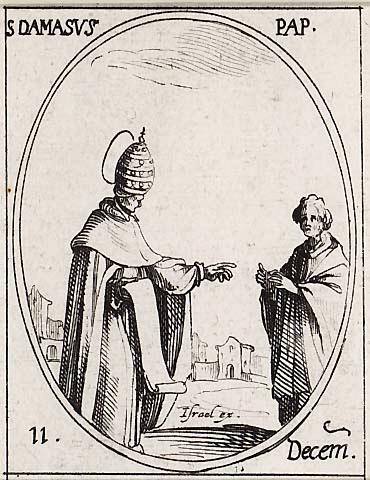
11/12 St Damase Ier, pape
et confesseur
Leçons des Matines avant
1960
Quatrième leçon. Damase,
espagnol, homme excellent et versé dans les Écritures, ayant convoqué le
premier concile de Constantinople, étouffa la criminelle hérésie d’Eunomius et
de Macédonius. Il condamna de nouveau l’assemblée de Rimini, déjà rejetée par
Libère, dans laquelle, comme l’écrit saint Jérôme, les artifices d’Ursace et
surtout de Valens avaient fait proclamer une condamnation de la foi de Nicée,
en sorte que le monde gémissant, s’étonnait d’être arien.
Cinquième leçon. Il
édifia deux basiliques, l’une sous le nom de Saint-Laurent (près du théâtre de
Pompée), qu’il enrichit par les plus grands présents, et à laquelle il attribua
des revenus de maisons et de terres ; l’autre sur la voie Ardéatine, aux Catacombes.
Il dédia le lieu enrichi de marbres où les corps de saint Pierre et de saint
Paul ont reposé quelque temps, et l’orna de vers élégamment composés. Il
écrivit aussi sur la virginité en vers et en prose, et composa beaucoup
d’autres poésies. Sixième leçon. Il établit la peine du talion contre ceux qui
auraient accusé quelqu’un faussement, et ordonna que, selon l’usage déjà reçu
en plusieurs lieux on chanterait jour et nuit, dans toutes les églises, les
Psaumes à deux chœurs, et qu’on ajouterait à la fin de chaque Psaume : Gloire
au Père, et au Fils, et au Saint-Esprit. Ce fut lui qui chargea saint Jérôme de
traduire le nouveau Testament selon la fidélité du texte grec. Il gouverna
l’Église pendant dix-sept ans, deux mois et vingt-six jours, et fit cinq
ordinations au mois de décembre, dans lesquelles il créa trente et un Prêtres,
onze Diacres, et soixante-deux Évêques pour divers lieux. Illustre par sa
vertu, sa science et sa prudence, et presque octogénaire, Damase s’endormit
dans le Seigneur, sous l’empire de Théodose le Grand, et fut enseveli avec sa
mère et sa sœur, dans la basilique qu’il avait lui-même élevée sur la voie
Ardéatine. Ses reliques ont été transportées depuis dans l’église de
Saint-Laurent, appelée de son nom, in Damaso.

Saint
Jérome présente son oeuvre au Pape Saint Damase. Miniature. Valenciennes
- BM - ms. 0007 f. 223
Dom Guéranger, l’Année
Liturgique
Ce grand Pontife apparaît
au Cycle, non plus pour annoncer la Paix comme saint Melchiade, mais comme un
des plus illustres défenseurs du grand Mystère de l’Incarnation. Il venge la
foi des Églises dans la divinité du Verbe, en condamnant, comme son
prédécesseur Libère, les actes et les fauteurs du trop fameux concile de Rimini
; il atteste par sa souveraine autorité l’Humanité complète du Fils de Dieu
incarné, en proscrivant l’hérésie d’Apollinaire. Enfin, nous pouvons considérer
comme un nouvel et éclatant témoignage de sa foi et de son amour envers
l’Homme-Dieu, la charge qu’il donna à saint Jérôme de travailler à une nouvelle
version du Nouveau Testament sur l’original grec, pour l’usage de l’Église
Romaine. Honorons un si grand Pontife que le Concile de Chalcédoine appelle
l’ornement et la force de Rome par sa piété, et que son illustre ami et protégé
saint Jérôme qualifie d’homme excellent, incomparable, savant dans les
Écritures, Docteur vierge d’une Eglise vierge.
Saint Pontife Damase !
Vous avez été durant votre vie le flambeau des enfants de l’Église ; car vous
leur avez fait connaître le Verbe incarné, vous les avez prémunis contre les
doctrines perfides au moyen desquelles l’Enfer cherchera toujours à dissoudre
ce Symbole glorieux, dans lequel sont écrites la souveraine miséricorde d’un
Dieu pour l’œuvre de ses mains, et la dignité sublime de l’homme racheté. Du
haut de la Chaire de Pierre, vous avez confirmé vos frères, et votre foi n’a
point défailli ; car le Christ avait prié pour vous. Nous nous réjouissons de
la récompense infinie que le Prince des Pasteurs a octroyée à votre intégrité,
ô Docteur vierge de l’Église vierge ! Du haut du ciel, faites descendre jusqu’à
nous un rayon de cette lumière dans laquelle le Seigneur Jésus se fait voir à
vous en sa gloire ; afin que nous puissions aussi le voir, le reconnaître, le
goûter dans l’humilité sous laquelle il va bientôt se montrer à nous.
Obtenez-nous et l’intelligence des saintes Écritures, dans la science
desquelles vous fûtes un si grand Docteur, et la docilité aux enseignements du
Pontife romain, auquel il a été dit, en la personne du Prince des Apôtres : Duc
in altum : avancez dans la haute mer.
Faites, ô puissant successeur de ce pêcheur d’hommes, que tous les Chrétiens soient animés des mêmes sentiments que Jérôme, lorsque, s’adressant à votre Apostolat, dans une célèbre Épître, il disait : « C’est la Chaire de Pierre que je veux consulter ; je veux que d’elle me vienne la foi, nourriture démon âme. La vaste étendue des mers, la distance des terres, ne m’arrêteront point dans la recherche de cette perle précieuse : là où se trouve le corps, il est juste que les aigles s’y rassemblent. C’est à l’Occident que maintenant se lève le Soleil de justice : c’est pourquoi je demande au Pontife la Victime du salut ; du Pasteur, moi brebis, j’implore le secours. Sur la Chaire de Pierre est bâtie l’Église : quiconque mange l’Agneau hors de cette Maison est un profane ; quiconque ne sera pas dans l’Arche de Noé, périra dans les eaux du déluge. Je ne connais pas Vital ; je n’ai rien de commun avec Mélèce ; Paulin m’est inconnu : quiconque ne recueille pas avec vous, ô Damase, dissipe ce qu’il a amassé ; car celui qui n’est pas au Christ est à l’Antéchrist »
Bhx Cardinal
Schuster, Liber Sacramentorum
Les résultats des
fouilles et des études faites récemment nous apprennent que ce célèbre Pontife
des martyrs naquit à Rome l’an 305 et que son père, nommé Antoine — qu’on
l’identifie ou non avec ce saint évêque Léon enseveli dans l’Agro Verano et
dont De Rossi a expliqué le poème sépulcral — avait fait toute sa carrière
ecclésiastique non loin du Théâtre de Pompée, près des archives de l’Église
romaine : « Hic pater exceptor, lector, levita, sacerdos. »
La mère de Damase portait
le nom de Laurentia, elle vécut environ quatre-vingt-douze ans et fut ensevelie
sur la voie Ardéatine. Cette Laurentia eut aussi une fille nommée Irène, qui
fut vierge consacrée. Quant à Damase, il est dit de lui dans une inscription :
« Natus qui antistes sedis Apostolicae », précisément parce qu’il avait eu pour
père un évêque, un des nombreux évêques ruraux disséminés à cette époque dans
la campagne romaine. Dès sa jeunesse Damase fut employé aux Archives
pontificales, et c’est là sans doute qu’il dut sentir naître sa vocation de
poète des martyrs, commençant dès lors ses recherches historiques sur ces
héroïques confesseurs de la Foi, — comme il le fit pour les martyrs Pierre et
Marcellin, — recherches qui, parfois, purent profiter des dépositions orales
des bourreaux eux-mêmes : « Marcelline, tuos pariter, Petre, cognosce triumphos
Percussor retulit Damaso mihi, cum puer essem. »
Damase fut élu pape in
Lucinis en octobre 366, mais dans les premiers temps de son pontificat il fut
combattu par le parti schismatique d’Ursin auquel adhéra une bonne partie du
clergé. Quand celui-ci se soumit enfin au Pontife, Damase attribua cette
réconciliation à l’intercession des martyrs, et il orna de cette inscription la
tombe d’un groupe anonyme de martyrs sur la voie Salaria : « Pro reditu cleri,
Christo praestante, triumphans. »
Il n’y a pour ainsi dire
pas de tombe illustre de martyr dans les cimetières romains que Damase n’ait
honorée de ses vers, ordinairement gravés sur marbre, en caractères spéciaux et
très beaux que nous devons au calligraphie Furius Dionysius Philocalus. Mais il
ne se contenta pas seulement des vers ; il commença des restaurations et des
embellissements en faveur d’un grand nombre de sépulcres de saints ; de
certains, comme celui d’Eutychius ad Catacumbas, on avait perdu jusqu’à la
trace.
Damase creusa, chercha,
refit l’histoire, rétablit le culte, et, en certains cas où le martyre subi
pour la foi était encore discuté, le Pontife régla la controverse et fit la
canonique vindicatio Martyris. Tel semble avoir été le cas de Némésius, dont la
tombe « Incultam pridem dubitatio longa reliquit, Sed tenuit virtus adseruitque
fidem. ».
Saint Damase mourut le 11
décembre 384 et fut enseveli près de sa mère et de sa sœur dans une crypte
érigée par lui sur la voie Ardéatine, que le Liber Pontificalis appelle sans
plus basilica sua.
A la vérité, son premier
désir eût été de se préparer une tombe dans la crypte papale de la nécropole de
Callixte. Il le dit lui-même dans une épigraphe en l’honneur de tous les saints
qui reposaient dans ce cimetière : « Hic, fateor, Damasus volui mea condere
membra, Sed cineres timui sanctos vexare piorum. ». C’est donc par humilité
qu’il se jugea indigne d’un si grand honneur ; et, se conformant à une
tradition inaugurée par le pape Marc, qui s’était construit lui aussi une
basilique sépulcrale non loin du cimetière de Callixte, il prépara la tombe de
sa famille près de celle de Marc sur la voie Ardéatine, à proximité, donc, des
martyrs de l’area de Callixte.
Les itinéraires romains
des pèlerins du haut moyen âge attestent que le corps de Damase reposait encore
dans sa tombe primitive sur la voie Ardéatine. Du temps de Paul Ier, on le
transporta dans la basilique de Saint-Laurent in Damaso — siège des anciennes
Archives pontificales, que Damase avait fait agrandir et que, après y avoir
ajouté la basilique, il avait voulu dédier au Staurophore romain Laurent. Voici
le texte de l’épigraphe que Damase composa lui-même pour son propre tombeau :
QVI • GRADIENS • PELAGI •
FLVCTVS • COMPRESSAT • AMAROS
VIVERE • QVI • PRAESTAT •
MORIENTIA • SEMINA • TERRAE
SOLVERE • QVI • POTVIT •
LETALIA • VINCVLA • MORTIS
POST • TENEBRAS • FRATREM
• POST • TERTIA • LVMINA • SOLIS
AD • SVPEROS • ITERVM •
MARTHAE • DONARE • SORORI
POST • CINERES • DAMASVM
• FACIET • QVIA • SVRGERE • CREDO
Saint Damase à qui saint
Jérôme, dans son Apologie du traité de la Virginité à Pammachius, donne le beau
titre de « vir egregius et eruditus in Scripturis, virgo virginis Ecclesiae
doctor », resplendit dans l’Église par ses immenses mérites. Outre son éminente
sainteté, sa dévotion envers les martyrs romains, la construction du baptistère
Vatican et sa fermeté apostolique dans la condamnation des différentes hérésies
qui pullulaient alors, c’est à lui que revient la gloire d’avoir introduit dans
la Messe du dimanche selon la tradition de la Palestine, le chant de
l’alléluia. Au dire de saint Jérôme il fut l’inspirateur et le protecteur de la
nouvelle version de la sainte Écriture, que nous appelons la Vulgate. D’après
le conseil de saint Ambroise, le pape Damase dut aussi s’occuper de la réforme
de l’ancien cursus du psautier, pour donner à cette forme de la prière
liturgique un caractère vraiment populaire. Tout de suite après sa mort, Damase
reçut de ses contemporains le titre de saint.

Le
Saint Pape Damase Ier, vitrail, église Saint-Vincent-de-Paul, Clichy
Dom Pius Parsch, le Guide
dans l’année liturgique
Jour de mort : 11
décembre 384. Tombeau : à Rome, dans l’église Saint-Laurent in Damaso, qu’il a
bâtie lui-même. Sa vie : Damase siégea sur la chaire de saint Pierre de 366 à
384. L’Église venait de recouvrer la paix. La tâche des papes était maintenant
de développer la vie religieuse, de veiller à la beauté du service divin. Le
rôle de notre saint pape fut, à cette époque, des plus importants. Son grand
mérite fut de donner à l’Église une bonne traduction de la Sainte Écriture. Il
fit venir saint Jérôme, qui traduisit la Bible en latin (cette version est
appelée la Vulgate). Cette version est utilisée aujourd’hui encore dans la
liturgie. L’exemple de saint Damase nous suggère une résolution : lire avec
zèle la Bible. Ce saint pape fut aussi un grand ami de la liturgie. On lui
attribue l’introduction du chant des psaumes à deux chœurs dans toutes les
églises. Il ordonna aussi qu’à la fin de chaque psaume on ajouterait : Gloria
Patri. D’après l’exemple de Jérusalem, il introduisit le chant de l’Alléluia
dans les messes des dimanches. Saint Damase fit aussi ensevelir avec honneur
les corps de plusieurs martyrs, et il composa des épitaphes en vers pour
presque tous les martyrs romains connus. Il est donc le chantre illustre des
martyrs. Saint Jérôme a une belle parole à son sujet : Il était le docteur
virginal d’une Église virginale. On ne peut pas rend !:e un plus bel hommage à
un prêtre.
SOURCE : http://www.introibo.fr/11-12-St-Damase-Ier-pape-et

Saint Damase d'Espagne,
Pape. 384.
" Damase est un
personnage éminent, fort versé dans la connaissance des saintes
écritures."
Saint Jérôme, Épître
à Eustochium.
Ce grand Pontife apparaît
au Cycle, non plus pour annoncer la Paix comme saint Melchiade, mais comme un
des plus illustres défenseurs du grand Mystère de l'Incarnation. Il venge la
foi des Eglises dans la divinité du Verbe, en condamnant, comme son prédécesseur
Libère, les actes et les fauteurs du trop fameux concile de Rimini ; il atteste
par sa souveraine autorité l'Humanité complète du Fils de Dieu incarné, en
proscrivant l'hérésie d'Apollinaire. Enfin, nous pouvons considérer comme un
nouvel et éclatant témoignage de sa foi et de son amour envers l'Homme-Dieu, la
charge qu'il donna à saint Jérôme de travailler à une nouvelle version du
Nouveau Testament sur l'original grec, pour l'usage de l'Eglise Romaine.
Honorons un si grand Pontife que le Concile de Chalcédoine appelle l'ornement
et la force de Rome par sa piété, et que son illustre ami et protégé saint
Jérôme qualifie d'homme excellent, incomparable, savant dans les Ecritures,
Docteur vierge d'une Eglise vierge.
Si saint Jéröme a été si
heureux de trouver à Rome saint Damase, qui a su reconnaître son mérite et lui
donner en cette ville des emplois convenables à sa piété et à son érudition,
nous pouvons dire aussi que ce n'a pas été un petit avantage à saint Damase d'y
recevoir ce grand docteur, qui a été l'admirateur de ses vertus et le grand
héraut de ses louanges.
Saint Damase était
espagnol, quoiqu'on ne sache pas exactement en quelle ville ni en quelle
province il est né. Son père s'appelait Antoine ; il eut une soeur parfaitement
belle et vertueuse nommée Irène. Etant venu à Rome avec sa famille, il y entra
dans les ordres sacrés, et, s'étant rendu par ses mérites un des plus
considérables membres du clergé, il fut premièrement fait nonce apostolique
auprès des empereurs Valens et Valentinien ; puis il exerça dans la ville même
l'office de vicaire du souverain pontife. Après la mort de Libérius, il fut élu
en sa place à l'âge de soixante-deux ans.
Ursin, ou Ursicin, homme
turbulent et qui ambitionnait cette haute dignité, ne pût souffrir qu'il lui
eût été préféré. Aussi, ayant assemblé quelques clercs factieux, il se fit
élire antipape et tâcha de se conserver par la violence un rang que le droit
d'une élection canonique ne lui donnait pas. Dans ce tumulte, beaucoup de
personnes furent tuées, et on trouva en un seul jour jusqu'à 137 corps étendus
sur la place, sans néanmoins que saint Damase y eut contribué en aucune
manière, parce qu'il était d'un esprit fort doux et qu'il aurait plutôt renoncé
au souverain Pontificat que de le conserver par les armes.
L'empereur Valentinien,
persuadé du bon droit de notre saint, envoya Prétextat à Rome pour en chasser
Ursicin et ses adhérents, et le maintenir dans la paisible possession de son
siège. Cette paix ne dura pas longtemps ; Ursicin eut permission de retourner
dans Rome, et, sa malice ne diminuant point avec le temps, il eut l'âme assez
noire pour faire accuser le saint Pontife d'adultère? Concordius et Calliste,
diacres, furent les instruments de sa calomnie. Ils ouvrirent la bouche contre
l'oint du Seigneur et lui imputèrent ce crime pour le faire juger indigne de la
souveraine prélature. Damase ne se troubla point ; il assembla à Rome un synode
de 44 évêques, où il se justifia si parfaitement, que ses accusateurs furent
excommuniés et chassés de la ville, et qu'on décréta que, dans la suite, ceux
qui accuseraient injustement quelqu'un seraient sujet à la peine du talion.
Les schismatiques ne
laissèrent pas de le persécuter pendant tout le reste de son pontificat ; mais
leurs traverses en l'empêchèrent pas de s'acquitter dignement de sa charge et de
combattre perpétuellement les hérésies. Il convoqua pour cela divers conciles
dans la même ville : l'un en 369, où il fit condamner les décrets du faux
concile de Rimini et déposer Auxence, évêque de Milan, grand fauteur de
l'Arianisme, lequel, néanmoins, se maintint toujours dans son siège par la
faveur de Valentinien l'aîné, dont il avait su gagner l'esprit par flatterie ;
l'autre, en 373, contre un grand nombre d'hérésies qui infectaient l'Orient ;
surtout contre celle d'Apollinaire, qui renfermait une infinité
d'extravagances, entre autres, que Notre Seigneur Jésus-Christ n'avait point
d'âme ou du moins d'entendement, mais que le Verbe, uni à ce corps, lui tenait
lieu de ces parties essentielles de l'homme ; que sa chair venait du ciel et
n'avait fait que passer par le sein de Marie comme par un canal ; le troisième,
en 382, pour remédier au schisme qui affligeait depuis longtemps l'Eglise
d'Antioche.
De plus, il en fit tenir
un à Aquilée, en 381, où, en une seule session, qui dura depuis une heure après
midi jusqu'à sept heures du soir, Pallade et Secondien, évêques d'Illyrie,
furent convaincus d'hérésie, confondus dans la discussion et condamnés comme
coupables des blasphèmes d'Arius. Il envoya aussi à Constantinople le célèbre
saint Zénobe, depuis évêque de Florence, pour consoler les fidèles cruellement
persécutés par l'empereur Valens, qui s'était déclarés pour l'Arianisme. Enfin,
ce fut par son autorité qu'en la même année 381 et en la même ville, se tint le
deuxième concile général de l'Eglise, composé de cent cinquante évêques
d'Orient, où Arius et Macédonius furent condamnés, et où la foi orthodoxe, que
la cruauté de ce prince semblait avoir éteinte et réduite au tombeau, fut
heureusement ressuscitée. Saint Damase le confirma et le reçut, en ce qui
touchait la doctrine, comme une des règles de la foi : ce qui lui a donné le nom
et la force de concile oecuménique, quoiqu'en effet les évêques d'Occident n'y
fussent pas, et qu'il ne s'y fût trouvé qu'un assez petit nombre de ceux de
l'Eglise grecque.
Outre le soin et la
diligence qu'apporta ce généreux Pontife à bannir les hérésies de toutes la
terre, il s'étudia aussi à retrancher les abus qui s'étaient glissés dans
l'Eglise? Entre les épîtres qui lui sont attribuées dans la collection des
conciles, il y en a une aux évêques d'Afrique, où, après avoir établi la
primauté du Saint-Siège, il fait de très sages constitutions, principalement
touchant les accusations des clercs et des évêques, dont quelques-unes ont été
insérées dans le corps du droit canon. Il y en a une autre aux évêques de
Numidie, où il condamne l'usurpation des chorévêques, lesquels, n'étant que
simples prêtres, et n'ayant pas reçu la consécration épiscopale, ne laissaient
pas de s'attribuer le droit d'ordonner des prêtres et des ministres, de bénir
des religieuses, de consacrer les églises, de faire le saint Chrême, de
conférer la confirmation et de réconcilier publiquement les pénitents : ce qui
n'appartient qu'aux véritables évêques.
Saint Damase régla la
psalmodie et fit chanter en Occident les psaumes de David, selon la correction
des Septante, que saint Jérôme avait faite par son ordre. Il introduisit aussi
la coutume de dire Alleluïa dans l'Eglise hors le temps de Pâques, au lieu
qu'auparavant on ne le disait qu'à Rome qu'en ce temps de réjouissance
extraordinaire. Il bâtit deux église dans la ville : l'une de Saint-Laurent,
auprès du théâtre de Pompée, l'autre sur la voie Ardéatine. Il orna le lieu où
les bienheureux apôtres saint Pierre et saint Paul avaient longtemps reposé, et
que l'on appelait la Platonie. Il trouva plusieurs corps saints et les fit
mettre dans les tombeaux honorables, autour desquels il fit graver des vers qui
faisaient mention de leurs triomphes. Il fit aussi construire un baptistère
magnifique dont le poète Prudence fait une riche description dans la huitième
de ses hymnes.
En cinq ordinations qu'il
célébra, selon la coutume, au mois de décembre, il créa 31 prêtre, 2 diacres et
62 évêques. Enfin, après avoir gouverné saintement l'Eglise au milieu de tant
de tribulations, 18 ans, 2 mois et 10 jours, il fut appelé au ciel pour
recevoir la récompense de ses travaux, le 11 décembre 384. Dieu le rendit
illustre par plusieurs miracles ; car à son invocation des malades furent
guéris et des énergumènes délivrés des démons qui les possédaient. Il avait
aussi pendant sa vie rendu la vue à un aveugle qui l'avait perdus depuis 13
ans.
Les Pères de l'Eglise lui
ont donné de grands éloges. Saint Ambroise dit qu'il fut élu par un coup du
ciel. Saint Jérôme témoigne qu'il était demeuré vierge ; ce qui montre encore
plus la malice des schismatiques, qui ne craignirent point de l'accuser
d'adultère. Théodoret assure qu'il avait mérité le nom d'homme admirable.
Enfin, le même saint Jérôme, qui lui avait servi de secrétaire, le met au
nombre des écrivains ecclésiastiques.
Son corps fut d'abord
déposé près du tombeau de sa mère et de sa soeur, dans la basilique élevée par
lui sur la voie Ardéatine. Plus tard, vers l'époque d'Adrien Ier (772-795), ses
reliques furent transférées dans celle de Saint-Laurent in Damaso, à
l'intérieur de la ville. Elles y reposent encore aujourd'hui sous le
maître-autel, à l'exception du chef du bienheureux Pape, qui est conservé à
Saint-Pierre de Rome.
On représente saint
Damase :
1. tenant un écrit sur
lequel se lisent ces paroles : Gloria Patri et Filio et Spiritui Sancto, etc.,
parce qu'il a établi dans l'Eglise l'usage de terminer tous les psaumes par
cette doxologie ;
2. ayant près de lui un
portail d'église, qu'il montre comme pour en prendre possession, ou pour
indiquer qu'il en est le fondateur.
Le pape Saint Damase et
les catacombes
Jusqu'à nos temps, on ne
connaissait de la sollicitude et de la dévotion de saint Damase pour les
reliques des martyrs que les Carmina ou Inscriptiones qui lui étaient
attribués, et recueillis, au nombre de 37, probablement par les pèlerins du Ve
et VIe siècle qui les avaient transcrits pour la satisfaction de leur piété
personnelle sur les monuments catacombaires. Encore devons-nous ajouter que la
critique se montrait assez difficile sur leur authenticité.
Mais, de nos jours,
l'étude des catacombes a singulièrement modifié la question. Les travaux de
saint Damase dans nos hypogées chrétiens, dit M. de Rossi, ne furent pas
seulement partiels, et ne se localisèrent pas sur un point déterminé, ils
s'étendirent à toute la Rome souterraine. Son nom se retrouve dans chacune des
catacombes, sur le tombeau de tous les martyrs illustres. Les constructions
pour l'ornement ou la solidité, les escaliers de marbres ménagés dans chaque
crypte insigne, portent tous l'empreinte de sa pieuse main.
C'est à sa haute
intelligence que nous devons la conservation des hypogées chrétiens, parce que
c'est lui qui fit abandonner le système vicieux adopté pour la construction des
basiliques Constantiniennes. Ce système consistait à raser les étages
superposés d'une catacombe jusqu'à ce qu'on fût arrivé au niveau de la crypte
inférieure, où d'ordinaire se trouvait la sépulture des martyrs les plus
illustres. On dégageait ainsi une tombe principale sur laquelle s'élevait un
édifice somptueux ; mais il avait fallu sacrifier un nombre immense d'autres
loculi pour arriver à ce résultat.
Saint Damase comprit que
si les reliques des martyrs ont droit à notre culte, la tombe des simples
fidèles doit être aussi l'objet d'un respect inviolable. Dès lors, il étendit
sa sollicitude pontificale à tout l'ensemble des monuments chrétiens de l'âge
héroïque. Les trésors que la piété des matrones mettait à sa disposition, et
que lui reprochait la jalousie païenne d'Ammien Marcellin, il les consacrait
non pas à la satisfaction de son luxe personnel, mais à la décoration des lieux
sanctifiés par la présence des martyrs.
On sait que, par un
sentiment d'admirable d'humilité, ce grand Pontife ne voulut point choisir sa
sépulture au milieu des tombes des martyrs dont il avait si religieusement fait
décorer les monuments.
" J'avoue, j'aurai
ardemment souhaité ce bonheur ; mais j'ai craint de profaner le lieu auguste où
reposent les Saints."
Après un tel scrupule, si
modestement exprimé par un grand Pape, par un thaumaturge et un Saint, on
comprend que les sépultures dans les catacombes devinrent fort rares. Elles ne
furent plus autorisées que dans des circonstances exceptionnelles.
" Saint Pontife
Damase ! Vous avez été durant votre vie le flambeau des enfants de l'Eglise ;
car vous leur avez fait connaître le Verbe incarné, vous les avez prémunis
contre les doctrines perfides au moyen desquelles l'Enfer cherchera toujours à
dissoudre ce Symbole glorieux, dans lequel sont écrites la souveraine
miséricorde d'un Dieu pour l'œuvre de ses mains, et la dignité sublime de
l'homme racheté. Du haut de la Chaire de Pierre, vous avez confirmé vos frères,
et votre foi n'a point défailli ; car le Christ avait prié pour vous.
Nous nous réjouissons de
la récompense infinie que le Prince des Pasteurs a octroyée à votre intégrité,
Ô Docteur vierge de l'Eglise vierge ! Du haut du ciel, faites descendre jusqu'à
nous un rayon de cette lumière dans laquelle le Seigneur Jésus se fait voir à
vous en sa gloire ; afin que nous puissions aussi le voir, le reconnaître, le
goûter dans l'humilité sous laquelle il va bientôt se montrer à nous.
Obtenez-nous et l'intelligence des saintes Ecritures, dans la science
desquelles vous fûtes un si grand Docteur, et la docilité aux enseignements du
Pontife romain, auquel il a été dit, en la personne du Prince des Apôtres :
" Duc in altum !" : " Avancez dans la haute mer !".
Faites, Ô puissant
successeur de ce pêcheur d'hommes, que tous les Chrétiens soient animés des
mêmes sentiments que Jérôme, lorsque, s'adressant à votre Apostolat, dans une
célèbre Epître, il disait :
" C'est la Chaire de
Pierre que je veux consulter ; je veux que d'elle me vienne la foi, nourriture
démon âme. La vaste étendue des mers, la distance des terres, ne m'arrêteront
point dans la recherche de cette perle précieuse : là où se trouve le corps, il
est juste que les aigles s'y rassemblent. C'est à l'Occident que maintenant se
lève le Soleil de justice : c'est pourquoi je demande au Pontife la Victime du
salut ; du Pasteur, moi brebis, j'implore le secours. Sur la Chaire de Pierre
est bâtie l'Eglise : quiconque mange l'Agneau hors de cette Maison est un
profane ; quiconque ne sera pas dans l'Arche de Noé, périra dans les eaux du
déluge. Je ne connais pas Vital ; je n'ai rien de commun avec Mélèce ; Paulin
m'est inconnu : quiconque ne recueille pas avec vous, Ô Damase, dissipe ce
qu'il a amassé ; car celui qui n'est pas au Christ est à l'Antéchrist."
Considérons notre divin
Sauveur au sein de la très pure Marie sa Mère ; et adorons, avec les saints
Anges, le profond anéantissement auquel il s'est réduit pour notre amour.
Contemplons-le s'offrant à son Père pour la rédemption du genre humain, et
commençant dès lors à remplir l'office de Médiateur dont il a daigné se
charger. Admirons avec attendrissement cet amour infini, qui n'est pas
satisfait de ce premier acte d'abaissement dont le mérite est si grand qu'il
eût suffi pour racheter des millions de mondes.
Le Fils de Dieu veut
accomplir, comme les autres enfants, le séjour de neuf mois au sein de sa Mère,
naître ensuite dans l'humiliation, vivre dans le travail et la souffrance, et
se faire obéissant jusqu'à la mort et à la mort de la Croix. Ô Jésus ! Soyez
béni, Soyez aimé pour un si grand amour. Vous voici donc descendu du ciel, pour
être l'Hostie qui remplacera tant d'autres hosties stériles, par lesquelles n'a
pu être effacée la faute de l'homme. La terre porte maintenant son Sauveur,
bien qu'elle ne l'ait pas contemplé encore. Dieu ne la maudira pas, cette terre
ingrate, enrichie qu'elle est d'un tel trésor. Mais reposez encore, Ô Jésus,
dans les chastes entrailles de Marie, dans cette Arche vivante, au sein de
laquelle vous êtes la véritable Manne destinée à la nourriture des enfants de
Dieu. Toutefois, Ô Sauveur ! l'heure approche où il vous faudra sortir de ce
sanctuaire. Au lieu de la tendresse de Marie, il vous faudra connaître la
malice des hommes ; et cependant, nous vous en supplions, nous osons vous le
rappeler, il est nécessaire que vous naissiez au jour marqué : c'est la volonté
de votre Père ; c'est l'attente du monde, c'est le salut de ceux qui vous
auront aimé."
_%C3%A9glise%2C_statue_08_Saint_Damase.jpg)
Statue
Saint Damase, église, Bernières (Seine-Mar.)
CONCILE DE ROME
(382)
" DÉCRET DE DAMASE
"
Il nous faut maintenant
parler des divines Écritures, de ce que reçoit l'Église catholique universelle
et de ce qu'elle doit éviter.
On commence par l'ordre
de l'Ancien Testament. Genèse, un livre ; Exode, un livre ; Lévitique, un livre
; Nombres, un livre ; Deutéronome, un livre ; Jésus Navé, un livre ; Juges, un
livre ; Ruth, un livre ; Rois, quatre livres ; Paralipomènes, deux livres ;
Cent cinquante Psaumes, un livre ; Salomon, trois livres : Proverbes, un livre,
Ecclésiaste, un livre, Cantique des Cantiques, un livre ; encore, Sagesse, un
livre ; Ecclésiastique, un livre.
Puis l'ordre des
prophètes, Isaïe, un livre ; Jérémie, un livre, avec Cinoth, c'est-à-dire ses
Lamentations ; Ézéchiel, un livre ; Daniel, un livre ; Osée, un livre ; Amos,
un livre ; Michée, un livre ; Joël, un livre ; Abdias, un livre ; Jonas, un
livre ; Nahum, un livre ; Habacuc, un livre ; Sophonie, un livre ; Aggée, un
livre ; Zacharie, un livre ; Malachie, un livre.
Puis l'ordre des
histoires. Job, un livre ; Tobie, un livre ; Esdras, deux livres ; Esther, un
livre ; Judith, un livre ; Maccabées, deux livres.
Puis l'ordre des
Écritures du Nouveau et éternel Testament, que l'Église sainte et catholique
reçoit. Évangiles : un livre selon Matthieu, un livre selon Marc, un livre
selon Luc, un livre selon Jean.
Les épîtres de Paul, au
nombre de quatorze : une aux Romains ; deux aux Corinthiens ; une aux Éphésiens
; deux aux Thessaloniciens ; une aux Galates ; une aux Philippiens ; une aux
Colossiens ; deux à Timothée ; une à Tite ; une à Philémon ; une aux Hébreux.
Ensuite l'Apocalypse de
Jean, un livre.
Et les Actes des Apôtres,
un livre.
Puis les épîtres
canoniques, au nombre de sept : deux épîtres de l'apôtre Pierre, une épître de
l'apôtre Jacques, une épître de l'apôtre Jean, deux épîtres de l'autre Jean, le
presbytre, une épître de l'apôtre Jude le zélote.
Tel est le canon du
Nouveau Testament.
SOURCE : http://lesbonstextes.awardspace.com/romedecretdedamase.htm

Profile
Raised in a pious family;
his father was
a priest in Rome, Italy and
Damasus served for a time as deacon in
his father‘s
church, Saint Laurence. Priest.
Assistant to Pope Liberius.
Chosen 37th pope in
a disputed election in which a minority chose the anti-pope Ursinus.
The two reigned simultaneously in Rome which
eventually led to violence between their supporters and false accusations of
Damasus having committed a crime.
His pontificate suffered
from the rise of Arianism,
and from several schisms including
break-away groups in Antioch, Constantinople, Sardinia,
and Rome.
However, it was during Damasus’s reign that Christianity was
declared the religion of the Roman state. He enforced the 370 edict
of Emperor Valentinian controlling gifts to prelates,
and opposed Arianism and Apollinarianism.
He supported the 374 council
of Rome which
decreed the valid books of the Bible, and the Grand Council of
Constantinople in 381 which
condemned Arianism.
Economic patron of
his secretary, Saint Jerome,
commissioning him to make the translation of
scripture now known as the Vulgate. Damasus restored catacombs, shrines,
and the tombs of martyrs,
and wrote poetry and
metrical inscriptions about and dedicated to martyrs.
They state that he would like to be buried in
the catacombs with
the early martyrs,
but that the presence of one of his lowly status would profane such an august
place. Ten of his letters, personal and pontifical, have survived.
Born
his family were Spanish in
orgin
Papal Ascension
11
December 384 in Rome, Italy of
natural causes
buried in
the Mark and Marcellianus catacombs in Rome
bones re-buried in
the church of San Lorenzo in Damaso
Additional
Information
Book
of Saints, by the Monks of
Ramsgate
Catholic
Encyclopedia, by Thomas J Shahan
Lives
of the Saints, by Father Alban
Butler
Lives
of the Saints, by Father Francis
Xavier Weninger
Roman
Martyrology, 1914 edition
Saints
of the Day, by Katherine Rabenstein
The Liturgical Year,
by Father Prosper
Gueranger
books
Our
Sunday Visitor’s Encyclopedia of Saints
other
sites in english
video
sitios
en español
Martirologio
Romano, 2001 edición
sites
en français
Abbé
Christian-Philippe Chanut
fonti
in italiano
websites
in nederlandse
nettsteder
i norsk
Readings
He who walking on the sea
could calm the bitter waves, who gives life to the dying seeds of the earth; he
who was able to loose the mortal chains of death, and after three days’
darkness could bring again to the upper world the brother for his sister
Martha: he, I believe, will make Damasus rise again from the dust. –
epitaph Damasus wrote for himself
The arrangement of the
names of Christ, however, is manifold: Lord, because He is Spirit; Word,
because He is God; Son, because He is the only-begotten son of the Father; Man,
because He was born of the Virgin; Priest, because He offered Himself as a
sacrifice; Shepherd, because He is a guardian; Worm, because He rose again;
Mountain, because He is strong; Way, because there is a straight path through
Him to life; Lamb, because He suffered; Corner-Stone, because instruction is
His; Teacher, because He demonstrates how to live; Sun, because He is the
illuminator; Truth, because He is from the Father; Life, because He is the
creator; Bread because He is flesh; Samaritan, because He is the merciful
protector; Christ, because He is anointed; Jesus, because He is a mediator;
Vine, because we are redeemed by His blood; Lion, because he is king; Rock,
because He is firm; Flower, because He is the chosen one; Prophet, because He
has revealed what is to come. – from the Decree
of Damasus (attributed to Damasus); from The Faith of the Early Fathers, by William A
Jurgens, copyright 1970,
the Order of Saint Benedict, Collegeville, Minnesota
MLA
Citation
“Pope Saint Damasus
I“. CatholicSaints.Info. 21 August 2020. Web. 8 December 2020.
<https://catholicsaints.info/pope-saint-damasus-i/>
SOURCE : https://catholicsaints.info/pope-saint-damasus-i/

Illumination in a gospel from Lund,
Sweden (Cod. Ups. 83). Above Laurentius in the heavenly Jerusalem, below a
praying monk, perhaps the painter. In the middle the church father Jerome
presents versio Vulgata to the Pope Damasus.
Illumination i ett evangelium från Lund
(Cod. Ups. 83). Överst Laurentius i det himmelska Jerusalem, nederst en
tillbedjande munk, kanske målaren själv. I mitten överräcker kyrkofadern
Hieronymus versio Vulgata till påve Damasus.
Pope St. Damasus I
Probably born near the
city of Idanha-a-Nova in what is present-day Portugal. His life coincided with
the rise of Constantine I and the reunion and redivision of the Western and
Eastern Roman Empire as well as what is sometimes known as the Constantinian
shift associated with the widespread legitimization of Christianity and the
later adoption of Christianity as the religion of the Roman state.
Damasus was a
sixty-year-old deacon when he was elected bishop of Rome in 366. His reign was
marked by violence from the start when another group decided to elect a
different pope. Both sides tried to enforce their selections through violence.
Though the physical fighting stopped, Damasus had to struggle with these
opponents throughout his years as pope. Damasus defended with vigour the
Catholic Faith in a time of dire and varied perils.
Damasus may not have won
this battle directly, but he won the war by initiating works that outlasted all
his opponents. Not only did he commission the Vulgate translation by his
personal secretary, St. Jerome, but he also changed the liturgical language of
the Church from Greek to Latin. He worked hard to preserve and restore the
catacombs, the graves of the martyrs, and relics.
Damasus was a writer —
but he didn’t author many-volumed treatises as other Christian writers did.
Damasus liked to write epigrams in verse: short sayings that capture the
essence of what needed to be said. He wrote many epigrams on martyrs and
saints. And he wrote one about himself that shows his humility and the respect
he had for the martyrs.
In a Roman cemetery is
the papal crypt he built. All that is left of him there, however, is this: ” I,
Damasus, wished to be buried here, but I feared to offend the ashes of these
holy ones.” Instead, when he died in 384, he was buried with his mother and
sister.
SOURCE : http://www.ucatholic.com/saints/pope-st-damasus/
Article
DAMASUS (Saint) Pope.
(December 11) (4th century) “An incomparable man” (so Saint Jerome styles him),
“the Virgin Doctor of the Virgin Church.” Of Spanish extraction, but born in
Rome, he attended Pope Liberius in exile, and was in constant communion with Saint
Athanasius. He succeeded Liberius (A.D. 366), but had to struggle against an
Anti-Pope, Ursinus, whose rebellion was finally crushed, not without bloodshed,
by the Emperor Valentinian. Saint Damasus held Councils in Rome against the
Arians and Apollinarians. A cultured man (as is seen from Ids verses) he was
the great patron of Saint Jerome, who under his direction re-translated into
Latin or revised the current versions of Holy Scripture. Saint Damasus is
famous for having restored and beautified in Rome the tombs of the holy
Martyrs. His share in the development of the Roman Liturgy, mainly by the
introduction of certain elements borrowed from the Eastern Rites, was
considerable. He died nearly eighty years old, A.D. 364, and was buried in one
of the two important churches he had built in honour of Saint Laurence the
Martyr.
MLA
Citation
Monks of Ramsgate.
“Damasus”. Book of Saints, 1921. CatholicSaints.Info. 22 October 2012.
Web. 11 December 2025.
<http://catholicsaints.info/book-of-saints-damasus/>
SOURCE : https://catholicsaints.info/book-of-saints-damasus/
Pope Saint Damasus I
Feastday: December 11
Birth: 306
Death: 384
All lovers of Scripture have reason to
celebrate this day. Damasus was the pope who commissioned Saint Jerome to
translate the Scriptures into Latin, the Vulgate version of the Bible.
Damasus was a
sixty-year-old deacon when he was elected bishop of Rome in
366. His reign was marked by violence from
the start when another group decided to elect a
different pope. Both sides tried to enforce their selections through violence.
Though the physical fighting stopped, Damasus had to struggle with these
opponents throughout his years as pope.
Damasus may not have won
this battle directly, but he won the war by
initiating works that outlasted all his opponents. Not only did he commission
the Vulgate translation but he also changed the liturgical language of the
Church from Greek to Latin. He worked hard to preserve and restore the
catacombs, the graves of the martyrs, and relics.
Damasus was a writer --
but he didn't author many-volumed treatises as other Christian writers
did. Damasus liked to write epigrams in verse: short sayings that capture the
essence of what needed to be said. He wrote many epigrams on martyrs and
saints. And he wrote one about himself that shows his humility and
the respect he had for the martyrs. In a Roman cemetery is the papal crypt he
built. All that is left of him there, however, is this: " I, Damasus,
wished to be buried here, but I feared to offend the ashes of
these holy ones." Instead, when he died in 384, he was buried with his
mother and sister.
From the Decree of
Damasus (attributed to Damasus):
The arrangement of the
names of Christ, however, is manifold: Lord, because He is Spirit; Word,
because He is God; Son, because He is the only-begotten son of the Father; Man,
because He was born of the Virgin; Priest, because He offered Himself as a
sacrifice; Shepherd, because He is a guardian; Worm, because He rose again;
Mountain, because He is strong; Way, because there is a straight path through
Him to life; Lamb, because He suffered; Corner-Stone, because instruction is
His; Teacher, because He demonstrates how to live; Sun, because He is the
illuminator; Truth, because He is from the Father; Life, because He is the
creator; Bread because He is flesh; Samaritan, because He is the merciful
protector; Christ, because He is anointed; Jesus, because He is a mediator;
Vine, because we are redeemed by His blood; Lion, because he is king; Rock,
because He is firm; Flower, because He is the chosen one; Prophet, because He
has revealed what is to come.
From The Faith of
the Early Fathers , by William A. Jurgens, Copyright 1970, the Order of St. Benedict,
Collegeville, Minnesota
In His Footsteps:
Damasus' love and respect
for Scripture is
shown in his authorization of the Vulgate translation. Spend 30 minutes today
reading and meditating on Scripture. Try to make this a daily habit. One way to
do this is keep a Bible open
by your bedside and read it first thing in the morning and last thing before
you turn out the light at night.
Prayer: Saint Damasus,
instead of worrying about the short term of life on
earth, you took God's view and looked to the things that last. Pray for me that
I may be able to look beyond immediate popularity and fleeting favors, and
choose to do the things that God wants
me to do. Amen
SOURCE : https://www.catholic.org/saints/saint.php?saint_id=41
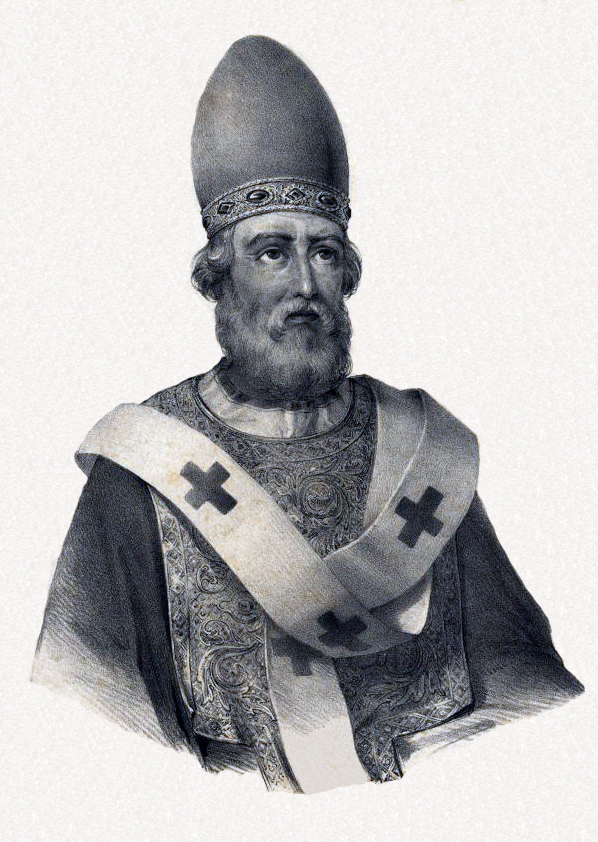
St. Damasus
Feastday: December 11
Birth: 305
Death: 384
St. Damasus Pope
and Confessor December
11 A.D. 384 Pope Damasus is said in the Pontifical to have
been a Spaniard; which may be true of his extraction; but Tillemont and Merenda
show that he seems to have been born at Rome. His father, whose name was
Antony, either after the death of his wife, or by her free consent, engaged
himself in the ecclesiastical state, and was successively reader, deacon, and priest of
title or parish church
of St.
Laurence in Rome. Damasus served in the sacred ministry in the same
church, and always lived in a perfect state of continence, as St. Jerome assures
us. When Liberius was
banished by Constantius to Beroea, in 355, he was archdeacon of
the Roman church, and attended him into exile, but immediately returned to
Rome. Liberius at
length was prevailed upon to sign a confession of faith in
which the word consubstantial was omitted. After his return from banishment, he
constantly held communion with St. Athanasius, as is clear from that holy man's
letter to the bishops of
Egypt, in 360. He condemned and annulled the decrees of the council of Rimini,
by a letter which he wrote to those bishops, mentioned by Siricius. Liberius,
after this, lay hid some time in
the vaults of the cemeteries, for fear of the persecutors, as we learn from
Sozomen, Prosper, in his chronicle, Lucifer of
Cagliari, and Anastasius, in the life of
pope Julius. Thus he repaired the fault which he had committed by his
subscription. All this time Damasus
had a great share in the government of the church, and doubtless animated
the zeal of
the pope. Liberius died
on the 24th of September, 366, and Damasus, who was then sixty years old, was
chosen bishop of
Rome, and ordained in the basilic of Lucina, otherwise called St. Laurence's,
which title he bore before his pontificate. Soon after, Ursinus, called by some
moderns Ursicmus, who could not bear that St. Damasus should
be preferred before him, got together a crowd of disorderly and seditious
people in the church of Sicin, commonly called the Liberian basine, now St. Mary Major,
and persuaded Paul bishop of
Tibur, now Tivoli, a dull ignorant man, to ordain him bishop of
Rome, contrary to the ancient canons, which require three bishops for
the ordination Or a bishop; and to the ancient custom of the Roman church
whose bishop was
to be consecrated by the bishop of
Ostia, as Baronius and Tillemont observe. Juventius, prefect of Rome, banished
Ursinus, and some others of his party. Seven priests who adhered to him were
seized to be carried into exile; but were rescued by their partisans, and
carried to the Liberian basilic. The people that sided with Damasus came
together with swords and clubs, besieged the basilic to deliver these men up to
the prefect, and a fight ensued, in which one hundred and thirty-seven persons
were killed, as Ammianus Marcellinus and St. Austin relate. In September the
following year, 367, the emperor Valentinian allowed Ursinus to return to Rome;
but, on account of new tumults, in November banished him again with seven
accomplices, into Gaul. The schismatics still kept possession of a church,
probably that of St. Agnes without
the walls, and held assemblies in the cemeteries. But Valentinian sent an order
for that church to be put into the hands of Damasus; and Maximin, a magistrate
of the city, a man naturally
inclined to cruelty, put several schismatics to the torture. Rufin clears
Damasus of any way concurring to, or approving of such barbarous proceedings,
and the schismatics fell into the snare they had laid for trim, by which it
seems that they demanded an inquiry to be made by the rack, which turned to
their own confusion and chastisement. It appears by certain verses of pope
Damasus that he had made a vow to God in
honor of certain martyrs, to engage their intercession for
the conversion of
some of the clergy who continued obstinate in the schism; and that these
clergymen being converted to the unity of
the church, in gratitude, adorned at their own expense the tombs of these
martyrs. By the same poem we learn, that the warmest abettors of the cause of
Ursinus, after some time sincerely
submitted to Damasus. His election was
both anterior in time and
in all its circumstances regular; and was declared such by a great council held
at Aquileia in
381, composed of the most holy and eminent bishops of
the western church; and by a council at Rome in
378, in both which the acts of violence are
imputed to the fury of Ursinus. St. Ambrose, St. Jerome, St. Austin, Rufin, and
others, bear testimony to the demeanor, and to the due election of
Damasus. Ammianus Marcellinus, the famous pagan historian
of those times, says, that the chariots, rich clothes, and splendid feasting of
the bishops of
Rome, whose tables surpassed those of kings, were a tempting object to
ambition; and wishes they would imitate the plainness of some prelates in the
provinces. Herein, at least with regard to the table, there is doubtless a
great deal of exaggeration and spleen; though sometimes extraordinary
entertainments were probably given by the church. However, some appearance of
pomp and state was certainly then made, since, as St. Jerome reports,
Praetextatus, an eminent pagan senator
who was afterwards prefect of Rome, said to pope Damasus, "Make me bishop of
Rome, and I will be
a Christian tomorrow."
Power alone is a snare to ambitious and worldly men; and a danger inseparable
from exalted stations; yet all such things are rather an object of dread to
those clergymen whose hearts are disengaged from the world; and riches in their
hands are only the patrimony of Christ, instruments of charity. The reflection,
however, of this heathen shows how necessary Christian modesty
is to recommend the spins of the gospel. Damasus certainly deserved not to fall
under his censure. For St. Jerome, the great admirer of this holy pope,
severely m weighs against the luxury and state which some ecclesiastics
at Rome affected,"
which he would never have done if it had been a satire on his patron, at least
he was too sincere to have continued his admirer. More over, in 370,
Valentinian, to repress the scandalous conduct of ecclesiastics, who persuaded
persons to bequeath estates or legacies to
the church in prejudice of their heirs, addressed a law to
Damasus, forbidding the clergy or monks to frequent the houses of orphans and
widows, or to receive from them any gift, legacy, or feoffment in trust. This
edict pope Damasus caused to be read in all the churches of Rome, and he was
very severe in putting the same in execution, so as to give great offense to
some unworthy persons who, on that account, went over to the schismatics, but
some time after
returned to their duty. Baronius thinks this law was
enacted at the request of the pope, because it was addressed to him. At least
it was certainly approved by him, and was not less agreeable to him than just
in itself. It appears by St. Damasus's fifteenth poem, that having escaped all
dangers and persecutions, in thanksgiving he made a pilgrimage to St. Felix's
shrine at Nola, and there hung up this votive poem, and performed his
devotions. Arianism reigned
in the East under the protection of Valens, though vigorously opposed by many
pillars of orthodoxy, as St. Athanasius, St. Basil, &c. In the West it was
confined to Milan and
Pannonia. Utterly to extirpate it in that part of the world, pope Damasus, in a
council at Rome in
368, condemned Ursacius and Valens, famous Arian bishops in
Pannonia; and in another in 370, Auxentius of Milan. The schism of Antioch fixed
the attention of the whole church. Meletius had beer ordained upon the
expulsion of St. Eustathius, whom the Arians had banished; Paulinus was
acknowledged by the zealous Catholics, called, Eustathians, because, during
the life of
St. Eustathius, they would admit no other bishop. St. Basil, and other
Orientals, being well informed of the orthodox faith of
St. Meletius, adhered to him; but Damasus, with the western prelates, held
communion with Paulinus, suspecting the orthodoxy of
Meletius on account of the doubtful principles of some of those by whom he was
advanced to the see. Not with standing this disagreement, these prelates were
careful to preserve the peace of Christ with one another.
The heresy of
Apollinarius or Apollinaris caused
a greater breach. Apollinarius, the father, taught grammar first at Berytus,
afterwards at Laodicea in
Syria, where he married, and had a son of the same name, who was brought up to
learning, had a good genius
well improved by studies, and taught rhetoric in the same town; and both
embracing an ecclesiastical state, the father was priest, and the son reader in
that church at the same time. The younger of these was chosen bishop of Laodicea in
362. When Julian
the Apostate forbade Christians to read the classics, the two
Apollinariuses composed very beautiful hymns in all sorts of verse on the
sacred history and other pious subjects; which are lost, except a paraphrase on
the psalms in
hexameter verse. In these poems they began to scatter the poison of certain
errors, which were condemned by St. Athanasius, in his council at Alexandria in
360, but the author was not then known. St. Athanasius wrote
against these without naming the author, in 362 In the council which Damasus
held at Rome in
374, the same conduct was observed. But the obstinacy of the bishop Apollinarius
appearing incurable, from that time his
name was no longer spared: it was anathematized first by pope Damasus at Rome The
heresiarch lived to a great age, and died in his impiety. His capital errors
consisted in this, that he said Christ had not assumed a
human understanding, (soul,) but only the flesh, that is, the body and a
sensitive soul, such as beasts have; and that the divine person was
to him instead of a soul or
human understanding; for which he insisted upon those words, the Word was made
flesh; and he pretended that the human soul being
the fountain of sin, it was not fitting that Christ should assume it In
this erroneous system it followed that Christ was not made man,
having only taken upon him a body, the least part of human nature. Apollinarius
also taught, that the body of Christ came from heaven,
was impassible, and descended into the womb of the Virgin Mary, was not born or
formed of her; also, that Christ only
suffered and died in appearance." He likewise revived the Millenarian
heresy, and advanced certain errors about the Trinity. His followers chose
Vitalis, one of his disciples, bishop of
their sect at Antioch, and called Timothy, another of his disciples, patriarch of
Alexandria. The decrees of pope Damasus against this heresiarch were received
in a council held at Alexandria, in another at Antioch, and in the general
council at Constantinople in
381. Illyricum in that age comprised all Greece and
several other provinces near the Danube. The emperor Gratian, in favor of
Theodosius, yielded up Eastern Illyricum, that is, Greece and
Dacia, to the Eastern empire: the popes maintained
that this country still belonged to the Western patriarchate, and reserved to
themselves the confirmation of
its bishops and
other patriarchal rights. St. Damasus appointed
St. Ascholius, bishop of
Thessalonica, (who frequently preserved Macedon from the Goths with no other
arms but his prayers,) his vicar over
those churches: and in a letter to him, which is yet extant, gave him strict
charge to be watchful that nothing should be done in the church of Constantinople prejudicial
to the faith, or against the canons: and he condemned the illegal intrusion of
Maximus the Cynic into that important see. When Nectarius was
chosen archbishop of
Constantinople, Theodosius sent deputies to Rome, to entreat pope Damasus to
confirm his election. When St. Jerome accompanied
St. Epiphanius and
St. Paulinus of Antioch to
Rome, Damasus detained him till his death, three years after, near his person,
employing him in quality of
secretary, to write his letters, and answer consultations. This pope, who was
himself a very learned man, and well skilled in the holy scriptures,
encouraged St.
Jerome in his studies. That severe and holy doctor calls
him "an excellent man;" and in another place, "an incomparable
person, learned in the scriptures, a virgin doctor of
the virgin church, who loved chastity, and heard its eulogiums with
pleasure. Theodoret calls
him the celebrated Damasus," and places him at the head of the famous
doctors of divine grace in
the Latin church. The oriental bishops in
431, profess that they follow the holy example of Damasus, Basil, Athanasius,
Ambrose, and others who have been eminent for their learning. The general
council of Chalcedon styles
Damasus, for his piety, the honor and glory of
Rome." Theodoret says,
"He was illustrious by his holy life, and ready to preach, and to do all
of the apostolic doctrine." This pope rebuilt, or at
least repaired, the church of St. Laurence neat
Pompey's theater, where he had officiated after his father, and which to this
day is called from St. Laurence, in Damaso. He beautified it with paintings of
sacred history, which were remaining four hundred years afterwards." He
presented it with a paten of
silver weighing fifteen pounds, a wrought vessel of ten pounds weight, five
silver chalices weighing three pounds each, five silver sconces to hold wax
lights, of eight pounds each, and candlesticks of
brass, of sixteen pounds weight. He also settled upon it several houses that
were near the church, and a piece of land. St. Damasus likewise
drained all the springs of the Vatican which ran over the bodies that were
buried there, and he decorated the sepulchers of a great number of martyrs in
the cemeteries, and adorned them with epitaphs in verse, of which a collection
of almost forty is extant. Some of these belong not to him; those which are his
work, are distinguished by a peculiar elegance and elevation, and justify the
commendation which St. Jerome gives
to his poetical genius. In the few letters of this pope which we have in the
editions of the councils, out of the great number which he wrote, it appears
that he was a man of
genius and taste, and wrote with elegance. The ancients particularly commend
his constancy in maintaining the purity of our holy faith, the innocence of his
manners, his Christian humility,
his compassion for the poor, his piety in adorning holy places, especially the
tombs of the martyrs, and his singular learning. Having sat eighteen years and
two months, he died on the 10th of December in 384, being near fourscore years
of age. A pontifical kept in the Vatican library, quoted by Merenda, says, that
the saint burning with an ardent desire to be dissolved, and be with Christ, he
was seized with a fever, and having received the body and blood of the Lord,
lifting up his eyes and hands to heaven, he expired in devout prayer. His intercession is
particularly implored in Italy by
persons that are sick of fevers." He was buried near his mother and
sister, in an oratory which
he had built and adorned at the catacombs near the Ardeatin Way, between that
road and the cemetery of Calixtus or Praetextatus. Marangonus describes his
sepulcher and those of his mother and sister, as they were discovered in the
year 1736. Learning, the great accomplishment and
improvement of the human mind, is often made its bane. This sometimes happens
by the choice which a man makes
of his studies, and much oftener by the manner in which he pursues them. As to
the choice, there is no sloth more
trifling or vain than the studies of some learned men; to whom we may apply
what Plato said to the charioteer, whose dexterity in the circus struck the
spectators with astonishment. But the philosopher declared he deserved to be
publicly chastised for the loss of so much time as
was necessary for him to have attained that dexterity in so trifling; useless
an exercise. A perfect knowledge of
our own, and some foreign and learned languages, is a necessary instrument, and
a key to much useful knowledge, but of little use if it be not directed to
higher purposes. Holy David, St. Ambrose, St. Damasus Prudentius,
St. Paulinus, and many others consecrated poetry to the divine praises. The
belles letters in all their branches, give an elegance to a man's mind and
thoughts, and help us to communicate with dignity our most useful knowledge to
others. But if made an employment of life, especially when the proper studies
or occupations of a state ought to have banished them, they become a pernicious
idleness, and so much entertain the heart as to ruin devotion and the taste of
duties. and to occupy our reason in
trifles. They are particularly condemned by the fathers and councils, in
clergymen, as trespassing upon their obligations and destructive of the spirit of
their profession. Logic gives
a justness and clearness to our thoughts teaches accurate reasoning, and
exceedingly improves the judgment and other faculties of the mind. Yet, if its
rules are made too prolix or spun into refined subtilties, they puzzle and
confound the understanding. The same is to be said of metaphysics, which ought
properly to be called the generals of science: a just acquaintance with which
is, above all other studies and accomplishments, the means of improving
the mind to
the highest perfection, especially its ruling faculty, the judgment, and
fitting it for success and accuracy in all other sciences and arts. The
principles of Aristotlei in logic and metaphysics are
solid, exact, complete, and far preferable to all others; but the exposition
must be concise, methodical, profound, infinitely accurate, clear, elegant, or
free from a Gothic dress, which disfigures the best attainments, and is the
characteristic of barbarism. Skill in useless knotty problems or questions
which some start, is compared by an elegant writer to a passion for breaking
hard stones with a man's teeth, merely to show their goodness. All studies, he
they ever so methodically conducted and regulated, must, in imitation of the
saints, be directed to a holy end and serious purpose, and sanctified by
a life of
prayer. If fondness for any science degenerates into passion, it becomes a
dangerous and vicious branch of curiosity, drains the heart, hinders holy
meditation and prayer, captivates the soul, and produces all the disorders of
inordinate passions.
SOURCE : https://www.catholic.org/saints/saint.php?saint_id=618

Cromolitografia
in L. Tripepi, Ritratti e biografie dei romani pontefici: da S. Pietro a Leone
13, Roma, Vaglimigli Davide, 1879. Biblioteca comunale di Trento
Saints of the Day – Pope Saint Damasus I
Article
Born c.304; died in Rome
in 384. In short, Saint Damasus was a pope whose authority was challenged but
who had great literary taste. Damasus appears to have been born in Rome – the
son of a priest of Spanish extraction. He never married but became a deacon in
the Spanish church of Saint Laurence, where his father served.
When Pope Liberius died
in 366, Damasus, then about 60, was chosen bishop of Rome. His election was
highly contested, and a minority elected an antipope, Ursinus, whom they
supported with violence. The opposition was put down by great cruelty by the
civil authorities, and Ursinus was exiled by Emperor Valentinian. The
opposition was not put down immediately, however, and as late as 378, a synod
cleared Damasus of a charge of incontinence cast against him by his opponents.
He enforced Valentinian’s
edict of 370 forbidding gifts by widows and orphans to bishops. He was also a
vigorous opponent of Arianism, Apollinarianism, and other heresies. He sent
legates to the Council of Constantinople in 381, which accepted papal teaching,
again condemned Arianism, and denounced the view of Macedonius that the Holy
Spirit is not divine. The place of the Church was stabilized when, in 380,
orthodox Christianity was recognized by the emperors Gratian and Theodosius I
as the religion of the Roman state.
Damasus also devoted much
effort to gathering the relics and resting places of Roman martyrs, and to
restoring the sacred catacombs, and to drawing up instructions for their care.
He composed many beautiful epitaphs – many of which still exist – for the tombs
of the martyrs and encouraged pilgrimages to the tombs. Unfortunately, these
epitaphs have little historical value because the true histories of many Roman
martyrs were already lost or nearly forgotten by that time.
He had placed in the
papal crypt of the cemetery of Saint Callistus a general epitaph that ends, “I,
Damasus, wished to be buried here, but I feared to offend the ashes of these
holy ones.” He was buried with his mother and sister at a small church he had
built on the Via Ardeatina.
By far the most
influential action of Damasus was his patronage of Saint Jerome. He
commissioned Jerome to write his Biblical commentaries and to revise the Latin
text of the Bible, which yielded the Vulgate version of the Bible. Saint
Jerome, who served as his secretary for a time, called him “an incomparable
man.” (Elsewhere I read that Saint Jerome left Rome when Damasus was elected in
preference to himself – Jerome was too irascible to be pope.)
As a biblical scholar,
Damasus published the canon of the Holy Scripture, specifying the authentic
books of the Bible as decreed by a council in Rome in 374. He also saw to the
collection and housing of papal archives (Attwater, Benedictines, Delaney,
Encyclopedia, White).
In art Saint Damasus is a
pope holding a ring. Sometimes he is shown with Saint Jerome; or restoring
sacred buildings (Roeder). Or, he may hold a screen with “Gloria Patri,” etc.,
upon it; or be shown with a church door behind him (White). Saint Damasus is
the patron saint of archaeologists (White).
MLA
Citation
Katherine I
Rabenstein. Saints of the Day, 1998. CatholicSaints.Info.
21 August 2020. Web. 8 December 2020.
<https://catholicsaints.info/saints-of-the-day-pope-saint-damasus-i/>
SOURCE : https://catholicsaints.info/saints-of-the-day-pope-saint-damasus-i/

Francesco Botticini (1446–1498).
S Gerolamo Altarpiece/ Saint Jerome in Penitence with Saints and Donors, circa 1490,
235 X 258, tempera and poplar wood, National Gallery To either
side are saints connected with him: Pope Damasus and Saint Eusebius on the left, and Saint Paula with a book and
Saint Eustochium with a lily on the right. In the foreground, either side of
the panel with Saint Jerome, two donors kneel, possibly Gerolamo di Piero di
Cardinale Rucellai (died 1497?) and his son. Altarpiece complete in its
original frame. The frame was extensively remade and regilded in about 1850
Pope St. Damasus I
Born about 304; died 11
December, 384. His father, Antonius, was probably a Spaniards;
the name of his mother, Laurentia, was not known until quite
recently. Damasus seems to have been born at Rome;
it is certain that
he grew up there in the service of the church of the martyr St.
Laurence. He was elected pope in
October, 366, by a large majority, but a number of over-zealous adherents
of the deceased Liberius rejected
him, chose the deacon Ursinus
(or Ursicinus), had the latter irregularly consecrated,
and resorted to much violence and bloodshed in
order to seat him in the Chair of Peter. Many details of this scandalous conflict
are related in the highly prejudiced "Libellus Precum" (P.L., XIII,
83-107), a petition to the civil
authority on the part of Faustinus and Marcellinus, two
anti-Damasan presbyters (cf.
also Ammianus Marcellinus, Rer. Gest., XXVII, c.
iii). Valentinian recognized Damasus and banished (367) Ursinus
to Cologne,
whence he was later allowed to return to Milan,
but was forbidden to come to Rome or
its vicinity. The party of the antipope (later
at Milan an
adherent of the Arians and
to the end a contentious pretender) did not cease
to persecute Damasus. An accusation of adultery was
laid against him (378) in the imperial court, but he was exonerated
by Emperor Gratian himself (Mansi,
Coll. Conc., III, 628) and soon after by a Roman synod of
forty-four bishops (Liber Pontificalis,
ed. Duchesne, s.v.; Mansi,
op. cit., III, 419) which also excommunicated his
accusers.
Damasus defended with vigour the Catholic Faith in
a time of dire and varied perils. In two Roman synods (368
and 369) he condemned Apollinarianism and Macedonianism;
he also sent his legates to
the Council of Constantinople (381), convoked against the
aforesaid heresies.
In the Roman synod of 369 (or 370) Auxentius, the Arian Bishop of Milan,
was excommunicated;
he held the see,
however, until his death, in 374, made way for St.
Ambrose. The heretic Priscillian,
condemned by
the Council of Saragossa (380) appealed to
Damasus, but in vain. It was Damasus who induced Saint Jerome to
undertake his famous revision of the earlier Latin versions of
the Bible (see VULGATE). St.
Jerome was also his confidential secretary for
some time (Ep. cxxiii, n. 10). An important canon of
the New
Testament was proclaimed by him in the Roman synod of
374. The Eastern
Church, in the person of St.
Basil of Cæsarea, besought earnestly the aid and encouragement of Damasus
against triumphant Arianism;
the pope,
however, cherished some degree of suspicion against the great
Cappadocian Doctor. In the matter of
the Meletian Schism at Antioch,
Damasus, with Athanasius and Peter
of Alexandria, sympathized with the party of Paulinus as more
sincerely representative of Nicene orthodoxy;
on the death of Meletius he sought to secure
the succession for Paulinus and to exclude Flavian (Socrates, Church
History V.15). He sustained the appeal of the Christian senators
to Emperor Gratian for the removal of the altar of
Victory from the Senate House (Ambrose, Ep. xvii, n. 10), and lived
to welcome the famous edict of Theodosius
I, "De fide Catholica" (27 Feb., 380), which proclaimed as
the religion of the Roman State that doctrine which St.
Peter had preached to the Romans and of which Damasus was
supreme head (Cod. Theod., XVI, 1, 2).
When, in 379, Illyricum was detached from the Western Empire, Damasus
hastened to safeguard the authority of the Roman
Church by the appointment of a vicar
Apostolic in the person of Ascholius, Bishop of Thessalonica;
this was the origin of the important papal vicariate long
attached to that see.
The primacy of the Apostolic
See, variously favoured in the time of Damasus by
imperial acts and edicts, was strenuously maintained by
this pope;
among his notable utterances on this subject is the assertion (Mansi,
Coll. Conc., VIII, 158) that the ecclesiastical supremacy
of the Roman
Church was based, not on the decrees of councils, but
on the very words of Jesus
Christ (Matthew
16:18). The increased prestige of the early papal
decretals, habitually attributed to the reign
of Siricius (384-99), not improbably belongs to the reign of Damasus
("Canones Romanorum ad Gallos"; Babut, "La plus
ancienne décrétale", Paris, 1904). This development of the papal office,
especially in the West, brought with it a great increase of external
grandeur. This secular splendour, however, affected disadvantageously
many members of the Roman clergy,
whose worldly aims and life, bitterly reproved by St.
Jerome, provoked (29 July, 370) and edict
of Emperor Valentinian addressed to the pope,
forbidding ecclesiastics and monks (later
also bishops and nuns)
to pursue widows and orphans in
the hope of obtaining from them gifts and legacies.
The pope caused the law to
be observed strictly.
Damasus restored his own church (now San
Lorenzo in Damaso) and provided for the proper housing of
the archives of the Roman
Church (see VATICAN ARCHIVES). He built in
the basilica of St. Sebastian on the
Appian Way the (yet visible) marble monument known as the
"Platonia" (Platona, marble pavement) in honour of
the temporary transfer to that place (258) of the bodies of
Sts. Peter and Paul, and decorated it with an
important historical inscription (see Northcote and
Brownlow, Roma Sotterranea). He also built on the Via Ardeatina, between
the cemeteries of Callistus and Domitilla,
a basilicula, or small church, the ruins of which were discovered in
1902 and 1903, and in which, according to the "Liber
Pontificalis", the pope was buried with
his mother and sister. On this occasion the
discoverer, Monsignor Wilpert, found also the epitaph of the pope's mother,
from which it was learned not only that her name was Laurentia, but also
that she had lived the sixty years of her widowhood in
the special service of God,
and died in her eighty-ninth year, having seen the fourth generation of her
descendants. Damasus built at the Vatican a baptistery in honour of St.
Peter and set up therein one of his
artistic inscriptions (Carmen xxxvi), still preserved in
the Vatican crypts.
This subterranean region he drained in order that the
bodies buried there (juxta sepulcrum beati Petri) might not
be affected by stagnant or overflowing water. His
extraordinary devotion to the Roman martyrs is
now well known, owing particularly to the labours of Giovanni
Battista De Rossi. For a good account of his architectural restoration
of the catacombs and
the unique artistic characters (Damasan Letters) in which his
friend Furius Dionysius Filocalus executed the
epitaphs composed by Damasus, see Northcote and
Brownlow, "Roma Sotterranea" (2nd ed., London, 1878-79).
The dogmatic content of the Damasan epitaphs (tituli) is
important (Northcote, Epitaphs of
the Catacombs,
London, 1878). He composed also a number of brief epigrammata on
various martyrs and saints and
some hymns,
or Carmina, likewise brief. St.
Jerome says (Ep. xxii, 22) that Damasus wrote on virginity, both
in prose and in verse, but no such work has been preserved. For the few letters
of Damasus (some of them spurious) that have survived, see P.L., XIII, 347-76,
and Jaffé, "Reg. Rom. Pontif." (Leipzig, 1885), nn.
232-254.
Shahan, Thomas. "Pope
St. Damasus I." The Catholic Encyclopedia. Vol. 4. New
York: Robert Appleton Company, 1908. 12 Dec.
2015 <http://www.newadvent.org/cathen/04613a.htm>.
Ecclesiastical
approbation. Nihil Obstat. Remy Lafort, Censor. Imprimatur. +John
M. Farley, Archbishop of New York.
Copyright © 2020 by Kevin
Knight. Dedicated to the Immaculate Heart of Mary.
SOURCE : http://www.newadvent.org/cathen/04613a.htm
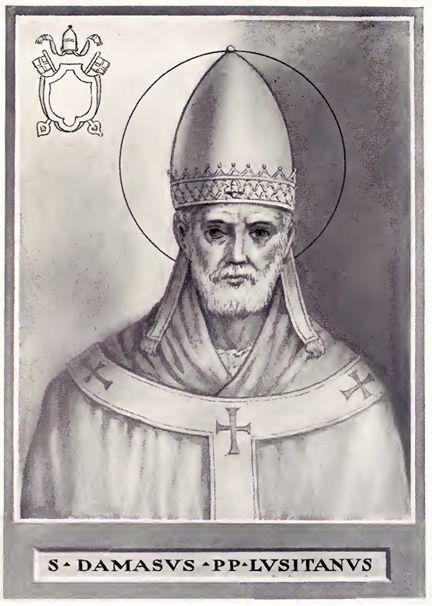
This illustration is from The Lives and Times of the Popes by Chevalier Artaud de Montor (1772–1849), New York: The Catholic Publication Society of America, 1911. It was originally published in 1842.
December 11
St. Damasus, Pope and
Confessor
From his works, St.
Jerom, Rufin, and Anastasius in the Pontifical. See Tillemont, t. 8, p. 386;
Ceillier, t. 6, p. 455. Abbate Anton. Merenda, in the new edition of this
pope’s works, which he published at Rome, in folio, anno 1754, in which he
gives the life of this pope in annals.
A.D. 384.
POPE DAMASUS is said in
the Pontifical to have been a Spaniard: which may be true of his extraction:
but Tillemont and Merenda show that he seems to have been born at Rome. His father,
whose name was Antony, either after the death of his wife, or by her free
consent, engaged himself in an ecclesiastical state, and was successively
reader, deacon, and priest of the title or parish church of St. Laurence in
Rome. Damasus served in the sacred ministry in the same church, and always
lived in a perfect state of continence, as St. Jerom assures us. When Liberius
was banished by Constantius to Berœa, in 355, he was archdeacon of the Roman
church, and attended him into exile, but immediately returned to Rome. Liberius
at length was prevailed upon to sign a confession of faith in which the word
consubstantial was omitted. After his return from banishment, he constantly
held communion with St. Athanasius, as is clear from that holy man’s letter to
the bishops of Egypt, in 360. He condemned and annulled the decrees of the
council of Rimini, by a letter which he wrote to those bishops, mentioned by
Siricius. 1 Liberius,
after this, lay hid some time in the vaults of the cemeteries, for fear of the
persecutors, as we learn from Sozomen, 2 Prosper,
in his chronicle, 3 Lucifer
of Cagliari, 4 and
Anastasius, in the life of Pope Julius. Thus he repaired the fault which he had
committed by his subscription. All this time Damasus had a great share in the
government of the church, and doubtless animated the zeal of the pope.
Liberius died on the 24th
of September 366, and Damasus, who was then sixty years old, was chosen bishop
of Rome, and ordained in the basilic of Lucina, otherwise called St.
Laurence’s, which title he bore before his pontificate. Soon after, Ursinus,
called by some moderns Ursicinus, who could not bear that St. Damasus should be
preferred before him, got together a crowd of disorderly and seditious people
in the church of Sicin, commonly called the Liberian basilic, now St. Mary
Major, and persuaded Paul bishop of Tibur, now Tivoli, a dull ignorant man, to
ordain him bishop of Rome, contrary to the ancient canons, which require three
bishops for the ordination of a bishop; and to the ancient custom of the Roman
church, whose bishop was to be consecrated by the bishop of Ostia, as Baronius
and Tillemont observe. Juventius, prefect of Rome, banished Ursinus, and some
others of his party. Seven priests who adhered to him were seized, to be carried
into exile; but were rescued by their partisans, and carried to the Liberian
basilic. The people that sided with Damasus came together with swords and
clubs, besieged the basilic to deliver these men up to the prefect, and a fight
ensued, in which one hundred and thirty-seven persons were killed, as Ammianus
Marcellinus 5 and
St. Austin relate. 6 In
September the following year, 367, the Emperor Valentinian allowed Ursinus to
return to Rome; but, on account of new tumults, in November banished him again,
with seven accomplices, into Gaul. The schismatics still kept possession of a
church, probably that of St. Agnes without the walls, and held assemblies in
the cemeteries. But Valentinian sent an order for that church to be put into
the hands of Damasus; and Maximin, a magistrate of the city, a man naturally
inclined to cruelty, put several schismatics to the torture. Rufin clears
Damasus of any way concurring to, or approving of such barbarous proceedings,
and the schismatics fell into the snare they had laid for him, 7 by
which it seems that they demanded an inquiry to be made by the rack, which
turned to their own confusion and chastisement. It appears by certain verses of
Pope Damasus that he had made a vow to God in honour of certain martyrs, to
engage their intercession for the conversion of some of the clergy, who
continued obstinate in the schism; and that these clergymen being converted to
the unity of the church, in gratitude adorned, at their own expense, the tombs
of these martyrs. By the same poem we learn, that the warmest abettors of the
cause of Ursinus, after some time sincerely submitted to Damasus. His election
was both anterior in time, and in all its circumstances regular; and was
declared such by a great council held at Aquileia in 381, composed of the most
holy and eminent bishops of the western church; and by a council at Rome in
378, in both which the acts of violence are imputed to the fury of Ursinus. St.
Ambrose, 8 St.
Jerom, 9 St.
Austin, Rufin, and others bear testimony to the demeanour, and to the due
election of Damasus.
Ammianus Marcellinus, the
famous pagan historian of those times, says, that the chariots, rich clothes,
and splendid feasting of the bishops of Rome, whose tables surpassed those of
kings, were a tempting object to ambition; and wishes they would imitate the
plainness of some prelates in the provinces. Herein, at least with regard to
the table, there is doubtless a great deal of exaggeration and spleen; though
sometimes extraordinary entertainments were probably given by the church.
However, some appearance of pomp and state was certainly then made, since, as
St. Jerom reports, 10 Prætextatus,
an eminent pagan senator who was afterwards prefect of Rome, said to Pope
Damasus, “Make me bishop of Rome, and I will be a Christian to-morrow.” Power
alone is a snare to ambitious and worldly men; and a danger inseparable from
exalted stations; yet all such things are rather an object of dread to those
clergymen whose hearts are disengaged from the world; and riches in their hands
are only the patrimony of Christ, instruments of charity. The reflection,
however, of this heathen shows how necessary Christian modesty is to recommend
the spirit of the gospel. Damasus certainly deserved not to fall under his
censure. For St. Jerom, the great admirer of this holy pope, severely inveighs
against the luxury and state which some ecclesiastics at Rome affected, 11 which
he would never have done if it had been a satire on his patron; at least he was
too sincere to have continued his admirer. Moreover, in 370, Valentinian, to
repress the scandalous conduct of ecclesiastics, who persuaded persons to
bequeath estates or legacies to the church, in prejudice of their heirs,
addressed a law to Damasus, forbidding the clergy or monks to frequent the
houses of orphans and widows, or to receive from them any gift, legacy, or
feoffment in trust. This edict Pope Damasus caused to be read in all the
churches of Rome, and he was very severe in putting the same into execution, so
as to give great offence to some unworthy persons who, on that account, went
over to the schismatics; but some time after returned to their duty. Baronius
thinks this law was enacted at the request of the pope, because it was
addressed to him. At least it was certainly approved by him, and was not less
agreeable to him than just in itself. It appears by St. Damasus’s fifteenth
poem, that having escaped all dangers and persecutions, 12 in
thanksgiving he made a pilgrimage to St. Felix’s shrine at Nola, and there hung
up this votive poem, and performed his devotions. 13
Arianism reigned in the
East under the protection of Valens, though vigorously opposed by many pillars
of orthodoxy, as St. Athanasius, St. Basil, &c. In the West it was confined
to Milan and Pannonia. Utterly to extirpate it in that part of the world, Pope Damasus,
in a council at Rome in 368, condemned Ursacius and Valens, famous Arian
bishops in Pannonia; and in another in 370, Auxentius of Milan. The schism of
Antioch fixed the attention of the whole church. Meletius had been ordained
upon the expulsion of St. Eustathius, whom the Arians had banished; Paulinus
was acknowledged by the zealous Catholics, called Eustathians, because, during
the life of St. Eustathius, they would admit no other bishop. St. Basil, and
other orientals, being well informed of the orthodox faith of St. Meletius,
adhered to him; but Damasus, with the western prelates, held communion with
Paulinus, suspecting the orthodoxy of Meletius on account of the doubtful
principles of some of those by whom he was advanced to the see. Notwithstanding
this disagreement, these prelates were careful to preserve the peace of Christ
with one another. The heresy of Apollinarius or Apollinaris caused a greater
breach. Apollinarius, the father, taught grammar first at Berytus, afterwards
at Laodicea in Syria, where he married, and had a son of the same name, who was
brought up to learning, had a good genius well improved by studies, and taught
rhetoric in the same town; and both embracing an ecclesiastical state, the
father was priest, and the son reader in that church at the same time. The
younger of these was chosen bishop of Laodicea in 362. When Julian the Apostate
forbade Christians to read the classics, the two Apollinariuses composed very
beautiful hymns in all sorts of verse on the sacred history and other pious
subjects; which are lost, except a paraphrase on the psalms in hexameter verse.
In these poems they began to scatter the poison of certain errors, which were
condemned by St. Athanasius, in his council at Alexandria in 360, but the
author was not then known. St. Athanasius wrote against these errors, without
naming the author, in 362. In the council which Damasus held at Rome in 374,
the same conduct was observed. But the obstinacy of the bishop Apollinarius
appearing incurable, from that time his name was no longer spared: it was
anathematized first by Pope Damasus at Rome. The heresiarch lived to a great
age, and died in his impiety. His capital errors consisted in this, that he
said Christ had not assumed a human understanding ([Greek] or soul) but only
the flesh, that is, the body and a sensitive soul, such as beasts have; and
that the divine person was to him instead of a soul or human understanding; for
which he insisted upon those words, the Word was made flesh; and he
pretended that the human soul being the fountain of sin it was not fitting that
Christ should assume it. In this erroneous system it followed that Christ was
not made man, having only taken upon him a body, the least part of human
nature. Apollinarius also taught, that the body of Christ came from heaven, was
impassible, and descended into the womb of the Virgin Mary, was not born or
formed of her; also, that Christ only suffered and died in appearance. 14 He
likewise revived the Millenarian heresy, and advanced certain errors about the
Trinity. His followers chose Vitalis one of his disciples, bishop of their sect
at Antioch, and called Timothy, another of his disciples, patriarch of
Alexandria. The decrees of Pope Damasus against this heresiarch were received
in a council held at Alexandria, in another at Antioch, and in the general
council at Constantinople in 381.
Illyricum in that age
comprised all Greece and several other provinces near the Danube. The Emperor
Gratian, in favour of Theodosius, yielded up Eastern Illyricum, that is, Greece
and Dacia, to the Eastern empire: the popes maintained that this country still
belonged to the Western patriarchate, and reserved to themselves the
confirmation of its bishops and other patriarchal rights. St. Damasus appointed
St. Ascholius, bishop of Thessalonica, (who frequently preserved Macedon from
the Goths with no other arms but his prayers,) his vicar over those churches:
and in a letter to him, which is yet extant, gave him strict charge to be
watchful that nothing should be done in the church of Constantinople
prejudicial to the faith, or against the canons: and he condemned the illegal
intrusion of Maximus the Cynic into that important see. When Nectarius was
chosen archbishop of Constantinople, Theodosius sent deputies to Rome, to
entreat Pope Damasus to confirm his election. 15 When
St. Jerom accompanied St. Epiphanius and St. Paulinus of Antioch to Rome,
Damasus detained him till his death, three years after, near his person,
employing him in quality of secretary, to write his letters, and answer
consultations. This pope, who was himself a very learned man, and well skilled
in the holy scriptures, encouraged St. Jerom in his studies. That severe and
holy doctor calls him “an excellent man;” 16 and
in another place, 17 “an
incomparable person, learned in the scriptures, a virgin doctor of the virgin
church, who loved chastity, and heard its eulogiums with pleasure.” Theodoret
calls him the celebrated Damasus, 18 and
places him at the head of the famous doctors of divine grace in the Latin
church. 19 The
oriental bishops in 431, profess that they follow the holy example of Damasus,
Basil, Athanasius, Ambrose, and others who have been eminent for their
learning. The general council of Chalcedon styles Damasus, for his piety, the
honour and glory of Rome. 20 Theodoret
says, “He was illustrious by his holy life, and ready to preach, and to do all
things in defence of the apostolic doctrine.” 21
This pope rebuilt, or at
least repaired the church of St. Laurence near Pompey’s theatre, where he had
officiated after his father, and which to this day is called from St.
Laurence, in Damaso. He beautified it with paintings of sacred
history, which were remaining four hundred years afterwards. 22 He
presented it with a paten of silver weighing fifteen pounds, a wrought vessel
of ten pounds weight, five silver chalices weighing three pounds each, five
silver sconces to hold wax lights, of eight pounds each, and candlesticks of
brass, of sixteen pounds weight. He also settled upon it several houses that
were near the church, and a piece of land. 23 St.
Damasus likewise drained all the springs of the Vatican which ran over the
bodies that were buried there, and he decorated the sepulchres of a great
number of martyrs in the cemeteries, and adorned them with epitaphs in verse,
of which a collection of almost forty is extant. 24 Some
of these belong not to him; those which are his work, are distinguished by a
peculiar elegance and elevation, and justify the commendation which St. Jerom
gives to his poetical genius. In the few letters of this pope which we have in
the editions of the councils, out of the great number which he wrote, it
appears that he was a man of genius and taste, and wrote with elegance. The
ancients particularly commend his constancy in maintaining the purity of our
holy faith, the innocence of his manners, his Christian humility, his
compassion for the poor, his piety in adorning holy places, especially the
tombs of the martyrs, and his singular learning. Having sat eighteen years and
two months, he died on the 10th of December in 384, being near fourscore years
of age. A pontifical kept in the Vatican library, quoted by Merenda, says, that
the saint burning with an ardent desire to be dissolved, and be with Christ, he
was seized with a fever, and having received the body and blood of the Lord,
lifting up his eyes and hands to heaven, he expired in devout prayer. His
intercession is particularly implored in Italy by persons who are sick of
fevers. 25 He
was buried near his mother and sister, in an oratory which he had built and
adorned at the catacombs near the Ardeatin Way, between that road and the
cemetery of Calixtus or Prætextatus. Marangonus describes his sepulchre and
those of his mother and sister, as they were discovered in the year 1736. 26
Learning, the great
accomplishment and improvement of the human mind, is often made its bane. This
sometimes happens by the choice which a man makes of his studies, and much
oftener by the manner in which he pursues them. As to the choice, there is no
sloth more trifling or vain than the studies of some learned men: to whom we
may apply what Plato said to the charioteer, whose dexterity in the circus
struck the spectators with astonishment. But the philosopher declared he
deserved to be publicly chastised for the loss of so much time as was necessary
for him to have attained that dexterity in so trifling and useless an exercise.
A perfect knowledge of our own, and some foreign and learned languages, is a
necessary instrument, and a key to much useful knowledge, but of little use if
it be not directed to higher purposes. Holy David, St. Ambrose, St. Damasus,
Prudentius, St. Paulinus, and many others consecrated poetry to the divine
praises. The belles lettres in all their branches, give an elegance to man’s
mind and thoughts, and help us to communicate with dignity our most useful
knowledge to others. But if made an employment of life, especially when the
proper studies or occupations of a state ought to have banished them, they
become a pernicious idleness, and so much entertain the heart as to ruin
devotion and the taste of duties, and to occupy our reason in trifles. They are
particularly condemned by the fathers and councils, in clergymen, as
trespassing upon their obligations and destructive of the spirit of their
profession. Logic gives a justness and clearness to our thoughts, teaches
accurate reasoning, and exceedingly improves the judgment and other faculties
of the mind. Yet, if its rules are made too prolix or spun into refined subtilties,
they puzzle and confound the understanding. The same is to be said of
metaphysics, which ought properly to be called the generals of science: a
just acquaintance with which is, above all other studies and accomplishments,
the means of improving the mind to the highest perfection, especially its
ruling faculty, the judgment, and fitting it for success and accuracy in all
other sciences and arts. The principles of Aristotle in logic and metaphysics
are solid, exact, complete, and far preferable to all others; but the
exposition must be concise, methodical, profound, infinitely accurate, clear,
elegant, or free from a Gothic dress, which disfigures the best attainments,
and is the characteristic of barbarism. Skill in useless knotty problems or
questions which some start is compared by an elegant writer to a passion for
breaking hard stones with a man’s teeth, merely to show their goodness. All
studies, be they ever so methodically conducted and regulated, must, in
imitation of the saints, be directed to a holy end and serious purpose, and
sanctified by a life of prayer. If fondness for any science degenerates into
passion, it becomes a dangerous and vicious branch of curiosity, drains the
heart, hinders holy meditation and prayer, captivates the soul, and produces
all the disorders of inordinate passions.
Note 1. Siricius,
ep. ad Himer. Terrac. [back]
Note 2. Soz. l. 4,
c. 11 et 19. [back]
Note 3. See this
chronicle published entire by Canisius, aed. Basnac. t. 1. [back]
Note 4. Lucifer adv.
Constantium. [back]
Note 5. Ammian. l.
27, c. 3. [back]
Note 6. S. Aug.
Brevic. Collat. c. 16. St. Hier. in Chron. an. 367. [back]
Note 7. Ruf. l. 2,
hist. c. 10. [back]
Note 8. Ambr. ep.
11. [back]
Note 9. In Chron.
&c. [back]
Note 10. St. Hier.
ep. 61, ad Pammach. c. 3. [back]
Note 11. Ib. [back]
Note 12. Carm. 15,
p. 230. See Muratori, Not. in Carm. Paulini xi. v. 11. et diss. 18;
Ferrarius, De Nol; Cœmer. c. 10; Merenda, an. 368, p. 15. [back]
Note 13. The Emperor
Gratian, in 378, passed several laws in favour of the authority of bishops, and
remitted to the pope the decision of the causes of all bishops. Newton (in
Daniel Prophet, c. 8, and in Apoc. c. 3,) pretends this law to have been the
original of the papal authority, and the eleventh horn of Daniel, which is to
precede the day of judgment. Nothing can be more contradictory or more absurd than
the comments of fanatics upon the divine prophecies. [back]
Note 14. S. Greg.
Naz. ep. ad Cledon. p. 747, et Or. 52: St. Epiph. hær. 77; S. Basil, ep. 293,
p. 1060; Theodoret, Hist. l. 5, c. 10; Sozomen, &c. [back]
Note 15. Bonifacius,
ep. ad episc. Macedon. Conc. t. 4, p. 1708. [back]
Note 16. S. Hier.
ep. ad Eustoch. [back]
Note 17. Id. ep. 30,
p. 240. [back]
Note 18. Theodoret,
ep. 144. [back]
Note 19. Ep.
145. [back]
Note 20. Conc. t. 4,
p. 825. [back]
Note 21. Theod. Hist.
l. 5, c. 2. [back]
Note 22. Adrian. 1,
ep. Conc. t. 7. [back]
Note 23. Anast. in
Pontif. [back]
Note 24. The
epitaphs on St. Maur, (a child martyred a little before St. Chrysanthus,) on
St. Paul, SS. Marcellinus and Peter, St. Saturninus, SS. Protus and Hyacinthus,
St. Laurence, St. Marcellus, St. Eusebius, St. Mark, pope, St. Eutychius,
&c. are acknowledged to be his. Merenda (p. 136,) confirms the conjecture
of Vossius, Colomesius, and Dr. Cave who, upon the authority of good MSS. and
other arguments of weight, attribute to Pope Damasus the small pious Christian
poems which have been printed among the works of Claudian the Poet. The
pontifical which bears the name of Damasus, certainly derives very little, if
anything, from his pen, is written in a low, flat style, and seems the work of
several hands. It is quoted by Walafridus Strabo, Bede, Rabanus Maurus,
&c., consequently is older than Anastasius the Bibliothecarian, though it
perhaps received from him some additions. (See on this Pontifical Orsi, Berti,
and Fabricius in Biblioth. Lat. med. et infim. ætat.) His forty Latin pieces of
poetry are republished by Mattaire in his Corpus Poetarum. [back]
Note 25. Fonseca, l.
1, c. 16; Merenda, ad an. 384, p. 133. [back]
Note 26. Marangonus
in Commentariis ad Chronologiam Romanorum Pontificum in picturis Ostiensis
basilicæ superstitem. [back]
Rev. Alban
Butler (1711–73). Volume XII: December. The Lives of the
Saints. 1866.
SOURCE : http://www.bartleby.com/210/12/111.html
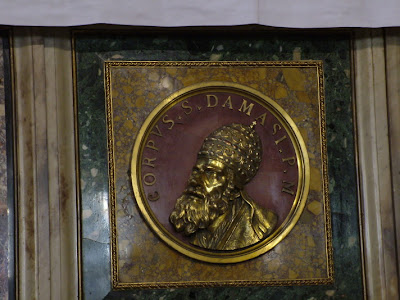
Portrait
of Pope Saint Damasus I on the altar of San Lorenzo in Damaso in Rome, where
his relics are kept.
Weninger’s
Lives of the Saints – Saint Damasus, Pope
Article
Saint Damasus, one of the
noblest and holiest of Popes, was by birth a Spaniard. He received his
instruction in virtue, as Well as in the liberal arts, at Rome, whither he was
taken by his father after his mother’s death. His progress in both was such, that
he was soon esteemed one of the most pious and learned men of his time. He was
ordained deacon, and when Pope Liberius died, he was placed in the papal chair,
of which he was thought worthy as well on account of his great erudition and
holy life, as also for the fearlessness with which he had defended the Church
of Christ against heresy. He governed the Church seventeen years and two
months, in the most difficult times, with so much wisdom and virtue, that all
ancient historians join in praising him. Saint Jerome calls him, “a lover of
chastity and a virgin teacher of a virgin church;” Theodoret, “a man adorned
with virtue, and worthy of praise.” Saint Ambrose says, that Providence had
especially chosen him to promote the welfare of the Church. The bishops,
assembled in council at Constantinople, praise the fortitude which he displayed
in protecting the true faith, and compare him to a wall of adamant. This
strength of character the holy Pope evinced on several occasions. Soon after he
had been elected Head of the Church, a certain man, named Ursicinus, sought to
overthrow him. He made a cabal of some unruly minds, by whose aid he endeavored
to gain for himself the papal throne. The holy Pope was deeply saddened by
this, not because he dreaded to lose the dignity, but because he feared that
the consequence might be a schism in the Church. Hence he was willing to give
way to Ursicinus and pass his life in obscurity. The better disposed refused,
however, to consent to this, and prevailed on the Governor of Rome to banish
Urcisinus and his principal followers from the city. The others, who were
allowed to remain, received the holy Pope’s pardon, who never thought of
revenging himself. Notwithstanding all this, there were several among them who,
instigated by Ursicinus, endeavored to rob the holy Pope of his honor and good
name, as they could not take his pontifical dignity and his life. They spread
the report that Damasus had been surprised in the act of committing a crime
against chastity. Most of the people, convinced of the holiness of their chief
Shepherd, looked upon it as a slander; but the innocent man desired to lay the
wickedness of the defamers bare to the eyes of the whole world. Hence he called
to Rome forty bishops who were to hear the accusation and investigate the
matter with all possible rigor. The evil-doers confessed their falsehood, and
the innocence of Damasus was most clearly established. Hardly had the holy Pope
overcome this and other persecutions of his enemies, when he had to fight, for
a long time, against the heretics, who arose in different places and even at
Rome. He assembled several councils at Rome, examined the doctrines
disseminated by the heretics, and anathematized them as impious and heretical.
Similar councils were also held in other cities. The most renowned of these was
the general council which the Emperor Theodosius, induced by the Pope, called
together at Constantinople, in which the decrees of the general council at Nice
were confirmed, and Macedonius and others were anathematized as heretics and
banished from the city. Besides this, the watchful Shepherd did not neglect to
uproot the abuses which had crept into the church, and to exhort all Christians
especially the bishops, to fulfill their duties. Among other regulations, he
ordered that after the recital or singing of each Psalm, the following words
should be added, as a confession of the Most Holy Trinity: “Glory be to the
Father and to the Son and to the Holy Ghost, as it was in the beginning, is
now, and ever shall be, world without end. Amen.” He also built new churches
and ornamented them splendidly. Many bodies of Saints he reverentially exhumed
and exhibited for public veneration. The holy men who lived at that period, as
Athanasius, Ambrose and Jerome, he esteemed highly and made use of their
counsel. He specially honored Saint Jerome, whom he exhorted to work for the
benefit of the Church by translating and expounding the Holy Scriptures. On
account of these and many other endeavors, but above all, in consequence of his
irreproachable life, he was so highly esteemed, that the Emperors, Theodosius,
Gratian and Valentinian, commanded their subjects to profess only that faith
and no other, which Saint Peter had formerly preached at Rome, and which
Damasus was now teaching; and declared as heresy, all doctrines which had been
denounced by the Pope. At the age of eighty years, the Saint ended his holy
life by a holy death. It is known that, during his life, he restored the sight
of a blind man, while after his death, many possessed were freed from the Evil
One at his grave, and many infirm restored to health by his intercession.
Practical Considerations
• Saint Damasus, from the
depth of his heart, pardoned his enemies the great wrong done to him, and never
thought of revenging himself. Saint Anno evinced, in all persecutions a heroic
patience and fortitude, without uttering a word of complaint, or punishing his
offenders. Thus act the true disciples of Christ; they do not repay evil for
evil; they seek no revenge, but bear wrongs patiently and pardon their
persecutors. How do you act when you suffer wrong? Examine your self today in
regard to this, and correct yourself where you see you are at fault. Remember
the strict, plain and earnest command of Christ, in virtue of which you are
obliged to pardon your enemies and persecutors, if you wish God to pardon your
transgressions. You have done much greater wrong to the Almighty by your sins,
than your enemies and persecutors can ever do to you. Yet you desire that God
shall forgive you. How can you then hesitate to pardon the wrong your neighbor
has inflicted on you. You say in the Lord’s Prayer: “Forgive us our trespasses
as we forgive them who trespass against us.” You ask in these words, that God
may pardon you, as you pardon the wrong your neighbor has done to you; but heed
it well: if you do not pardon your neighbor perfectly, with your whole heart,
you ask of the Lord, in the words of the above prayer, not to forgive you. Does
not your hair stand on end if you consider this rightly? Listen to the words of
Saint Anastasius: “If you do not pardon the wrong done to you, you recite no
prayer, but ask and draw down upon yourself the curse of the Almighty, when you
say: forgive us our trespasses as we forgive them who trespass against us.”
Saint Chrysostom says the same in the following words: “How dare you raise your
hands to heaven, or move your lips to ask pardon? Should God wish to pardon
you, you would prevent Him, so long as you bear malice towards your neighbor.”
Yes, you even request that He would not forgive you; because you ask that He
would forgive you as you forgive. Now you do not forgive; hence you ask that He
may not forgive you.
• Saint Damasus died in
the 81st year of his age; but he is not a Saint because he lived long, but
because he lived a holy life. Holiness and piety lead to heaven, be our life
short or long. The years alone have nothing to do with it. Many Saints,
confessors and martyrs of both sexes, lived only thirteen, fifteen, or twenty
years; and yet they are greatly reverenced on account of their virtue and
holiness. Many are in hell who lived long in this world. You have, perhaps, no
other wish than to live long, and have prayed to God for this favor. My opinion
is that you ought rather to pray for grace to live piously; for, who knows that
a long life will be beneficial to his salvation! The words of Saint Bernard
apply well to only too many: “The longer we live, the greater becomes the
number of our sins.” Many would have died in grace if they had died young; in
later years, they fell into vices and thus went to perdition. “What avails long
life to us,” says Thomas A Kempis,” if we so little improve our conduct? Long
life, so far from reforming us, only increases the number of our
transgressions.” According to Holy Writ, Solomon became not wicked until he was
old in years. (3 Kings 11) Had he not lived so long, he would not have
committed such great sins.
MLA
Citation
Father Francis Xavier
Weninger, DD, SJ. “Saint Damasus, Pope”. Lives of
the Saints, 1876. CatholicSaints.Info.
3 June 2018. Web. 8 December 2020.
<https://catholicsaints.info/weningers-lives-of-the-saints-saint-damasus-pope/>
SOURCE : https://catholicsaints.info/weningers-lives-of-the-saints-saint-damasus-pope/

Giuseppe Tedeschi, Ritratto di Papa Damaso I, olio su tela, 100 x 100, Ambasciata di Spagna presso la Santa Sede. Ritratto di Damaso I, commissionato su ordine di re Juan Carlos I di Spagna tramite lo storico Ambasciatore di Spagna Carlos Abella y Ramallo e ora collocato presso l'ambasciata di Spagna di Roma presso la Santa Sede in Piazza di Spagna e in carico alla "Establecimientos Españoles en Italia"
San Damaso I Papa
- Memoria
Facoltativa
Roma, 305? - Roma, 384
(Papa dal 01/10/366 al
11/12/384)
Spagnolo di origine, ma
probabilmente nato a Roma, Damaso divenne Papa nel 366, dopo la pace costantiniana.
Si adoperò affinché la catacombe non cadessero in rovina e non fosse perduta la
memoria dei martiri. Man mano che ne rintracciava le tombe, le ornava di
poetiche epigrafi di sua composizione. Ma non fu solo archeologo e letterato.
Agì con fermezza di fronte al rappresentante del potere civile, l'imperatore, e
commissionò a san Girolamo la traduzione in latino della Bibbia. Morì nel 384.
Patronato: Archeologi
Martirologio
Romano: San Damaso I, papa, che, nelle difficoltà dei suoi tempi, convocò
molti sinodi per difendere la fede nicena contro gli scismi e le eresie,
incaricò san Girolamo di tradurre in latino i libri sacri e onorò i sepolcri
dei martiri adornandoli di versi.
Papa e santo
Nonostante il «Liber pontificalis» lo dica «Damasus, natione Spanus, ex patre
Antonio», è più corretto considerare Roma come patria di Damaso. Per una serie
di elementi se ne può circoscrivere la nascita intorno al 305-306. La data
della morte è certa: l’11 dicembre 384. Papa Damaso è stato proclamato santo e
l’11 dicembre è il giorno in cui se ne celebra la memoria liturgica.
«Epigrammata Damasiana»
Una caratteristica originale di questo Pontefice consiste nella sua
composizione di epigrammi: ne possediamo sessanta, pervenuti nell’originale
epigrafico e/o attraverso copie altomedievali del VII secolo, conservate in
sillogi dei secoli VIII-XII. Gli esemplari integri o parzialmente integri sono
quelli del Vaticano, dei papi e dei martiri sepolti in S. Callisto, di
Cornelio, di Eutichio, di Gennaro, di Felicissimo e Agapito, di Agnese, di
Proietta.
Lo scisma ursiniano
Alla morte del predecessore Liberio, iniziò una vera e propria lotta per la
successione, «attraverso momenti di grave tensione e di scontri cruenti». Il 24
settembre 366 un gruppo di sacerdoti, i tre diaconi Ursino, Amanzio e Lupo e
una parte della comunità rimasta fedele a Liberio si riuniscono nella basilica
di papa Giulio in Trastevere (S. Maria in Trastevere): viene ordinato vescovo di
Roma il diacono Ursino. Damaso con i propri sostenitori si raduna nella chiesa
di S. Lorenzo in Lucina e qui il 1° ottobre 366 – data di inizio del
pontificato – si procede alla nomina di Damaso a vescovo di Roma. In più
riprese, come racconta precisamente Carlo Carletti, l’atteggiamento di Damaso
durante lo scisma ursiniano non fu privo del ricorso alla violenza. La sua è
stata definita una «pastorale energica» (Ch. Pietri), ma si trattò in realtà di
una pastorale molto più che energica e in più di una occasione non si esitò a
usare la violenza. La storiografia filodamasiana ha cercato di omettere o
ridimensionare queste violenze, cercando di sottolineare la legittimità anche
formale della successione a Liberio; così in Girolamo, Ambrogio, Rufino,
Socrate e Sozomeno.
Roma, l’Occidente e l’Oriente
«Damaso non fu certo un teologo, né si cimentò direttamente nelle problematiche
dottrinali che pure si dibattevano ai suoi tempi: era d’altra parte tutto teso
al consolidamento del primato di Roma, e probabilmente impreparato, oltreché
per natura alieno a comprendere e ad affrontare – soprattutto in relazione alle
delicate questioni delle Chiese di Oriente – quegli aspetti dialettici del
dibattito teologico che andassero al di là della semplicistica dicotomia tra
niceni e antiniceni. Tuttavia durante il suo pontificato la Sede romana
accentua notevolmente la sua funzione nel mediare e dirimere (ma non sempre con
successo) molteplici questioni dottrinali e disciplinari che si dibattevano sia
in Occidente sia in Oriente», scrive Carletti. A tal proposito è opportuno
ricordare il concilio svoltosi a Roma tra la fine del 377 e l’inizio del 378,
che può essere considerato «la prima assise conciliare romana che si occupa
intenzionalmente di questioni dottrinali e disciplinari relative all’Oriente
cristiano».
Un concordato ante litteram
Nel 378 un altro concilio chiede all’imperatore di recepire e rendere operante
la giurisdizione del pontefice romano sugli altri vescovi d’Italia e
d’Occidente: il rescritto imperiale Ordinariorum accoglie, almeno in parte, le
istanze avanzate nella sinodale e, con il riconoscimento della giurisdizione
episcopale romana, può essere considerato una tappa significativa nel processo
dei rapporti istituzionali tra papato e potere politico, una sorta di
concordato ante litteram (P. Batiffol).
«Christiani catholici»
Successivamente la Sede romana damasiana raggiunge un altro importante
obiettivo con il riconoscimento imperiale del proprio ruolo di depositaria e
garante dell’unica fede cattolico-nicena ammessa dallo Stato. Nel celebre
editto «Cunctos populos» promulgato da Teodosio a Tessalonica il 27 febbraio
380, l’imperatore ordina a tutti i popoli a lui sottoposti di abbracciare la
fede cattolica, cioè quella che «il divino apostolo Pietro ha trasmesso ai
Romani e che seguono il pontefice Damaso». Quelli che professano tale fede –
aggiunge la costituzione imperiale – devono definirsi «christiani catholici»,
mentre tutti gli altri sono eretici e come tali dovranno temere non soltanto il
castigo divino ma anche quello imperiale.
Il primato della Chiesa di Roma
Durante il pontificato di Damaso, dopo che il predecessore Liberio aveva per la
prima volta usato l’espressione «sedes apostolica» per definire la Chiesa di
Roma, il tema del primato della Chiesa romana assume «un rilievo assoluto».
Nella sinodale «Et hoc gloriae» del 378, oltre alla celebrazione della Sede
apostolica, è presente la dichiarazione secondo cui se Damaso «è per le sue
funzioni uguale agli altri vescovi, egli tuttavia ha su di essi una primazia in
virtù della prerogativa della sede apostolica». Il fondamento teologico del
primato è indicato nel passo di Matteo 16, 17-19: per Damaso, primato e
autorità della Chiesa romana non si fondano su alcuna costituzione conciliare ma
direttamente sulla parola del Signore, la vox Domini.
Pietro e Paolo
Per l’affermazione del primato della Chiesa di Roma, oltre al ricorso alla
figura di san Pietro, riemerge la figura di san Paolo che viene riproposta come
ulteriore argomento funzionale al consolidamento della Sede romana. Nel
concilio del 382, subito dopo la menzione di Matteo 16, 17-19, si sottolineava
come Paolo fosse stato martirizzato nello stesso giorno di Pietro, a Roma sotto
Nerone. Damaso, «con la concretezza che aveva sempre contraddistinto la sua
azione», diede forza e valore a un culto, quello della coppia Pietro-Paolo, che
a Roma da oltre un secolo era profondamente radicato. Nel celeberrimo «Elogium
Petri et Pauli» (cfr. «memoria Apostolorum in catacumbas» degli Epigrammata
Damasiana), il Nostro proclama solennemente la cittadinanza romana di Pietro e
Paolo in virtù del comune martirio subito a Roma.
Un nascente diritto ecclesiastico
Il consolidamento del primato della Sede romana si sarebbe servito di «una
curia pontificia centralizzata» e del ricorso, per la prima volta nella storia
della Chiesa di Roma, alla decretale, espressione diretta dell’autorità
pontificia ed elemento costitutivo di «un nascente diritto ecclesiastico». In
tale contesto figurano Girolamo come «collaboratore di Damaso per le carte
ecclesiastiche» e l’istituzione di una nuova figura professionale, il «defensor
ecclesiae Romanae».
Il latino nella liturgia
Negli ultimi anni del pontificato è possibile registrare «un evento di capitale
importanza per la storia della Chiesa di Roma»: l’uso ufficiale della lingua
latina nella prassi liturgica. La medesima attenzione alla prassi liturgica
comporta l’avvio della revisione dei Vangeli e dei salmi per opera di Girolamo,
per unificare, nelle intenzioni del Pontefice, la molteplicità di versioni
latine della Sacra Scrittura.
La «pastorale martiriale»
Oltre a «un piano organico di edilizia sacra», Damaso si dedicò alla riscoperta
delle autentiche tombe dei martiri, all’acquisizione della storicità delle loro
imprese, per valorizzare un «patrimonio di santità». Questa «pastorale
martiriale» di Damaso si serve degli «elogia martyrum»: epigrammi che, oltre a
esprimere la sincera fede del loro autore, rivelano il loro peculiare carattere
di strumento di propaganda. Non a torto in queste composizioni si è voluta
vedere una sorta di liturgia perenne.
Il proprio epitaffio
Fin dai primi anni del suo pontificato, Damaso compone un autoepitaffio: «Colui che camminando calcò gli amari flutti del mare, / colui che ridà vita ai semi della terra destinati a morire, / colui che poté sciogliere dopo la morte i lacci letali della morte / e, trascorsi tre giorni, rendere vivo il fratello alla sorella Marta, / dalle ceneri - credo - farà risorgere Damaso».
Autore: Eugenio Russomanno
Fonte : Vatican
Insider
SOURCE : http://www.santiebeati.it/dettaglio/30350

Giovan Battista Cavalieri (1525–1601),
Pontificum Romanorum effigies, Roma, Basa Domenico\Zanetti Francesco, 1580, calcografia,
Biblioteca comunale di Trento
DAMASO I, papa
di Pio Paschini - Enciclopedia
Italiana (1931)
DAMASO I, papa.
- Morto il 24 settembre 366 papa Liberio, si ebbe una duplice elezione; la
massima parte del clero raccolto nella basilica di S. Lorenzo in Lucina elesse
il diacono D., romano, la rimanente elesse, in quella di Giulio (S. Maria in
Trastevere) Ursino, che fu subito consacrato dal vescovo di Tivoli. D. fu
consacrato la domenica seguente (i ottobre) al Laterano. Si ebbero feroci
tumulti con spargimento di sangue nella basilica Liberiana, tanto che il
prefetto di Roma prima e poi l'imperatore Valentiniano cacciarono da Roma
Ursino e i suoi seguaci. Ma Ursino non lasciò in pace D.: verso il 370
gl'intentò un processo e più tardi Isacco, un ebreo convertito
(v. ambrosiastro) ne intentò un altro dinnanzi al prefetto di Roma. Non si
conoscono le accuse; ma l'imperatore Graziano avocò a sé l'affare, per cui, nel
378, Isacco fu esiliato in Spagna e Ursino a Colonia e un sinodo romano chiese
poi all'imperatore che facesse allontanare dalle chiese i fomentatori di
disordini. L'attività religiosa di D. si rivolse soprattutto a eliminare quanto
rimaneva di arianesimo, continuando la condotta conciliante di papa Liberio,
diretta però a raccogliere tutti i vescovi nell'unità dei decreti niceni. Dopo
un concilio in proposito tenuto nel 370 circa, egli trovò aiuto in Ambrogio,
successo nel 374 nel vescovado di Milano; si ebbero così i concilî di Aquileia
(381) e di Roma (382); intanto si teneva nel 381 a Costantinopoli il concilio,
che fu annoverato fra gli ecumemici e si condannavano insieme con gli ultimi
ariani anche le eresie macedoniana e apollinarista. Durante il 381 venne a Roma
anche Girolamo e D. si valse di lui largamente per le questioni bibliche e per
la correzione della Bibbia latina e soprattutto dei salmi. Morì l'11 dicembre
384.
Damaso eresse la basilica
ora conosciuta col nome di S. Lorenzo in Damaso, dove il suo corpo fu poi
trasferito, presso il Teatro di Pompeo, dov'erano gli archivî della Chiesa
romana ed un'altra basilica cemeteriale sull'Ardeatina, dove poi fu sepolto con
la madre e con la sorella. Speciale fu pure in lui la premura di ricercare le
tombe dei martiri, molte delle quali giacevano oscure e dimenticate, di
scoprire quello che sul loro conto si poteva sapere di sicuro, di
contrassegnare con iscrizioni, in gran parte in versi, le tombe più illustri.
Egli trovò un incisore assai valente in Furio Dionisio Filocalo, onde il nome
di filocaliani ai caratteri da lui usati. Alcune di queste epigrafi esistono
ancora intere o frammentarie; il testo di altre è conservato negl'itinerarî
medievali.
Le lettere di Damaso e
dei suoi concilî sono in D. Mansi, Coll. Concil., III, p. 459 segg.;
le epigrafi in M. Jhm, Damasi epigrammata, accedunt pseudo-damasiana,
Lipsia 1895; G.B. De Rossi, Inscript. christ. urbis Romae, Roma
1888, II, p. 30 segg. e passim.
Bibl.: Liber
pontificalis, ed. Duchesne, I, Parigi 1886, pp. 212-285; L. Duchesne, Storia
della Chiesa antica (trad. it.), Roma 1911, p. 255 segg.; passim; P.
Batiffol, Le siège apostolique, Parigi 1924, p. 13 segg. ecc.; Hefele
Leclercq, Histoire des Conciles, I, Parigi 1907, p. 980 segg.; II, p. 53
segg.; H. Leclercq, in Dict. d'archéol. chrét., IV, pp. 145-197; Analecta
Bolland, 1929, p. 426.
SOURCE : https://www.treccani.it/enciclopedia/papa-damaso-i_(Enciclopedia-Italiana)/

Juan Carreño de Miranda (1614–1685). San
Dámaso, 1685, 206 109, Ayuntamiento (Casa de la Villa), Madrid
Juan
Carreño de Miranda, San Damaso I papa (1685),
olio su tela; Madrid (Spagna), Palazzo municipale
Papa San Dámaso I
Nacido aproximadamente en
el año 304; murió el 11 de Diciembre del 384. Su padre, Antonio, probablemente
era español; el nombre de su madre, Laurencia (Lorenza), hasta hace poco no era
conocido. Dámaso podría haber nacido en Roma; lo cierto es que creció allí
prestando sus servicios a la iglesia de San Lorenzo mártir. Fue elegido por
gran mayoría Papa en octubre del año 366, pero un cierto número de ultra
conservadores seguidores del difunto Papa Liberio lo rechazaron, y escogieron
al diácono Ursino (o Ursicino), quien fue de modo irregular consagrado, y
quienes para tratar de sentarlo en la silla de Pedro ocasionaron gran violencia
y legando al derramamiento de sangre. Muchos detalles de este escandaloso
conflicto están relatados en el "Libello Precum" (P.L., XIII, 83-107)
de forma muy tendenciosa, pero por una demanda a la autoridad civil por parte
de Faustino y Marcelino, dos presbíteros contrarios a Dámaso (cf. también
Ammianus Marcellinus, Rer. Gest, XXVII, c. 3). El emperador Valentiniano
reconoció a Dámaso y desterró en el año 367 a Ursino a Colonia, posteriormente
le fue permitido volver a Milán, pero se le prohibió volver a Roma o a su
entorno. Los partidarios del antipapa (ya en Milán aliado a los Arrianos y
hasta su muerte pretendiendo la sucesión) no dejaron de perseguir a Dámaso. Una
acusación de adulterio fue presentada contra él ( en el 378) en la corte
imperial, pero fue exonerado de ella primero por el propio Emperador Graciano
(Mansi, Coll. Conc. III, 628) y poco después por un sínodo romano de cuarenta y
cuatro obispos (Liber Pontificalis, ed. Duchesne, s.v.; Mansi, op. cit., III,
419) qué también excomulgó a sus acusadores.
Dámaso defendió con vigor
la Fe católica en una época de graves y variados peligros. En dos sínodos
romanos (años 368 y 369) condenó el Apolinarismo y Macedonialismo; también
envió legados al Concilio de Constantinopla (año 381), convocado contra las
herejías mencionadas. En el sínodo romano del año 369 (o 370) Auxentio, el
Obispo Arriano de Milán fue excomulgado; mantuvo la sede hasta su muerte, en el
año 374, facilitando la sucesión a San Ambrosio. El hereje Prisciliano,
condenado por el Concilio de Zaragoza (año 380) atrajo a Dámaso, pero en vano
(Prisciliano era natural de Galicia, España y hay eruditos que consideran a
Dámaso o a su familia también gallega. N. del T.). Dámaso animó a San Jerónimo
para realizar su famosa revisión de las versiones latinas más tempranas de la
Biblia (vea VULGATA). Durante algún tiempo, San Jerónimo también fue su
secretario particular (Ep. 123, n. 10). Un canon importante del Nuevo
Testamento fue proclamado por él en el sínodo romano del año 374. La Iglesia
Oriental recibió gran ayuda y estímulo de Dámaso contra el arrianismo
triunfante, en la persona de San Basilio de Cesárea; el papa, sin embargo,
mantuvo cierto grado de suspicacia hacia el gran Doctor de Capadocia. Con
relación al Cisma Meletiano en Antioquía, Dámaso, con Atanasio y Pedro de Alejandría,
simpatizaron con el partido Paulino por ser el mejor representante de la
ortodoxia de Nicea; a la muerte de Meletio trabajó para afianzar en la sucesión
a Paulino excluyendo a Flaviano (Socrates, Hist. Eccl., V, 15). Apoyó la
petición de los senadores cristianos ante el Emperador Graciano para el retirar
el altar de Victoria del Senado (Ambrosio, Ep. 17, n. 10), y vivió para dar la
bienvenida al famoso decreto de Teodosio I, "Del fide Católica" (27
Feb., 380) que declaraba como la religión del Estado Romano aquella doctrina
que San Pedro había predicado a los romanos y de la cual Dámaso era su cabeza
suprema (Cod. Theod., XVI, 1, 2).
Cuando, en el año 379, la
Iliria fue separada del Imperio de Occidente, Dámaso se movió para salvaguardar
la autoridad de la Iglesia romana creando una vicaría apostólica y nombrando
para ella a Ascolio, Obispo de Tesalónica; éste es el origen del importante
Vicariato Papal durante mucho tiempo ligado a la sede. La primacía de la Sede
Apostólica fue defendida vigorosamente por este papa, y en el tiempo de Dámaso
por actas y decretos imperiales; entre los pronunciamientos importantes sobre
este tema esta la afirmación (Mansi, Coll. Conc., VIII, 158) que basa la
supremacía eclesiástica de la Iglesia Romana en las propias palabras de
Jesucristo (Matt., 16, 18) y no en decretos conciliares. El prestigio aumentado
de los primeros decretales papales, habitualmente atribuido al papado de
Siricio (384-99), muy probablemente debe ser atribuido al papado de Dámaso
("Cánones Romanorum ad Gallos"; Babut, "Las decretales más
antiguas", París, 1904). Este desarrollo de la administración papal, sobre
todo en Occidente, trajo con él un gran aumento de grandeza externa. Esta
magnificencia seglar, sin embargo, afectó las costumbres de muchos miembros del
clero romano cuya vida y pretensiones mundanas, fueron amargamente reprobadas
por San Jerónimo, provocando (el 29 de Julio del 370) que con un decreto de
Emperador Valentiniano dirigido al papa, se prohibiera a los eclesiásticos y
monjes (posteriormente a obispos y monjas) dirigirse a viudas y huérfanos para
persuadirlos con la intención de obtener de ellos regalos y herencias. El papa
hizo que la ley fuese estrictamente observada.
Dámaso restauró su propia
iglesia (ahora iglesia de San Lorenzo en Dámaso) y la dotó con instalaciones
para los archivos de la Iglesia Romana (vea ARCHIVOS VATICANOS). Construyó la
basílica de San Sebastián en la Vía Apia (todavía visible) edificio de mármol
conocido como la "Platonia" (Platona, pavimento de mármol) en honor
al traslado temporal a ese lugar (año 258) de los cuerpos de los Santos Pedro y
Pablo, y la decoró con una inscripción histórica importante (vea Northcote y
Brownlow, Roma Subterránea). En la Vía Argentina, también construyó, entre los
cementerios de Calixto y Domitilla, una basilicula, o pequeña iglesia, cuyas
ruinas fueron descubiertas en 1902 y 1903, y donde, según el "Liber
Pontificalis", el papa fue enterrado junto con su madre y su hermana. En
esta ocasión el descubridor, Monseñor Wilpert, encontró también el epitafio de
la madre del papa de la que ni sé sabia que su nombre era Lorenza, ni tampoco
que había vivido los sesenta años de su viudez al servicio de Dios, y que murió
a los ochenta y nueve años, después de haber visto a la cuarta generación de
sus descendientes. Dámaso construyó en el Vaticano un baptisterio en honor de
San Pedro y gravó en el una de sus inscripciones artísticas (Carmen 36),
todavía conservada en las criptas Vaticanas. Desecó esta zona subterránea para
que los cuerpos que se enterraran allí (beati sepulcrum juxta Petri) no
pudieran ser afectados por agua estancada o por inundaciones. Su devoción
extraordinaria a los mártires romanos ahora es muy bien conocida y se debe
particularmente a los trabajos de Juan Bautista De Rossi.
Para darse cuenta de la
gran restauración arquitectónica de las catacumbas y de sus características
artísticas únicos tenemos las Cartas de Dámaso donde su amigo Furius Dionisius
Filocalus plasmó los epitafios compuestos por Dámaso, (vea Northcote y Brownlow,
"Roma Subterránea" 2 ed., Londres, 1878-79). El contenido dogmático
de los epitafios de Dámaso (tituli) es importante (Northcote, Epitafios de las
Catacumbas, Londres, 1878). También compuso varios resúmenes epigramas de
diversos mártires y santos y algunos himnos, o Carmina, igualmente el resumen
de San Jerónimo dice (Ep. 22, 22) que Dámaso los escribió en virginidad, ambos
en prosa y en verso, pero ninguna de dichas obras se ha conservado. Para las
pocas cartas de Dámaso (algunas de ellos espurias) que han sobrevivido, vea
P.L., XIII, 347-76, y Jaffé, "Reg. Rom. Pontif." (Leipzig, 1885), nn.
232-254.
THOMAS J. SHAHAN
Traducido por Félix Carbo
SOURCE : https://ec.aciprensa.com/wiki/Papa_San_D%C3%A1maso_I

Saint
Pape Damase, Église Sainte-Bernadette, Montréal
Den hellige pave Damasus
I (~305-384)
Minnedag:
11. desember
Den hellige Damasus I var
sannsynligvis av spansk familie, men født i Roma rundt år 305. Han var sønn av
Laurentia og Antonius, som var prest i kirken som senere er kjent som S.
Lorenzo, og han hadde en søster ved navn Irene. De første sikre henvisninger
forteller om ham som diakon hos Liberius, som
han fulgte i eksil da paven ble forvist til Beroea i 355 på grunn av
stridigheter med arianerne. Men da Damasus snart etter vendte tilbake til Roma,
tok han først motpave Felix (II)s
parti. Men da Liberius ble tillatt å vende tilbake i 358, forsonte Damasus seg
med ham.
Etter at Julian Apostaten
i 363 ble drept av en persisk pil, levde Kirken i vesten i fred. Den nye
keiseren, den modige og dyktige soldaten Valentinian (364-75), var ikke bare
kristen, men også ortodoks. Dermed kom det en tid med vekst og utvikling.
Etter at pave Liberius
døde den 24. september 366, brøt det ut voldsom uro i forbindelse med valget av
hans etterfølger. En gruppe som alltid hadde vært trofaste mot Liberius, valgte
straks hans diakon Ursinus i Den julianske Basilika og fikk ham konsekrert til
biskop. Men en rivaliserende fraksjon av Felix' tilhengere, som utgjorde et
stort flertall, valgte Damasus. Det faktum at Damasus var gift sto ikke i veien
for ham - han ganske enkelt forstøtte kone og barn.
Han nølte ikke med å
befeste sin stilling ved å leie en gjeng pøbler som stormet Den julianske
Basilika og utførte en tredagers massakre på ursinianerne. Søndag den 1.
oktober tok Damasus' menn Lateranbasilikaen, og der ble han konsekrert til
biskop. Han søkte da hjelp fra byprefekten (den første gangen en pave brukte
den sivile makt mot sine motstandere), som straks utviste Ursinus og hans
tilhengere fra Roma. Voldshandlingene fortsatte til 26. oktober, da Damasus'
menn angrep Den liberianske Basilika, hvor ursinianerne hadde søkt tilflukt.
Den hedenske historikeren Ammianus Marcellinus skriver at de etterlot 137 døde
på marken. Resten av livet trengte Damasus beskyttelse mot ursinianerne.
Damasus satt nå sikkert
på St. Peters stol. Han skulle vise seg som en dyktig administrator og
forfatter og en from biskop. Men biskopene i Italia ble sjokkerte over de
rapportene de mottok, og pavens autoritet var svekket for mange år fremover.
Motpave Ursinus og hans tilhengere fortsatte med å angripe Damasus gjennom hele
hans pontifikat, til tross for myndighetenes gjentagne forvisninger av dem.
Omkring 371 brakte de en
«vanærende anklage» mot Damasus gjennom den konverterte jøden Isaac;
sannsynligvis gjaldt anklagen utukt. En synode på 44 biskoper behandlet
spørsmålet. Etter å ha hørt vitnemålene, var biskopene ikke i tvil om at han
var skyldig, og de skulle til å avsette ham og dømme ham til døden. Bare keiser
Valentinian Is inngripen sikret at paven ble frikjent.
I 377 ble Damasus
urettmessig anklaget for mord. Han ble frifunnet ved keiserlig dekret, og noen
måneder senere, i 378, ble han også frifunnet på en synode han selv hadde kalt
inn. Angrepene tok slutt først da Ursinus ble forvist til Gallia.
Til tross for disse
forlegenhetene, nøt Damasus hoffets og aristokratiets gunst, ikke minst gjaldt
dette velstående kvinner. Hans strålende livsstil og gjestfrihet hjalp til å
bryte ned de antikristne fordommene hos hedenske overklassefamilier.
Damasus var aktiv i å bekjempe
kjetterier, inkludert arianismen, og nølte ikke med å tilkalle den verdslige
makt, men han mislyktes i å fjerne Auxentius (død 374), den arianske biskopen
av Milano. Men han var så forsonlig overfor angrende heretikere at den
uforsonlige Nikea-forkjemperen Lucifer av Cagliari (død 370/71) faktisk forlot
Kirken i avsky for å starte et rigoristisk skisma.
I flere romerske synoder
(369, 375, 376, 378 og 382) bekjempet Damasus arianismen og andre kjetterier i
tiden, for eksempel om Treenigheten. I 380 anbefalte han moderasjon i
håndteringen av priscillianismen (etter Priscillian), et esoterisk spansk
kjetteri med dualistiske og sabellianske trekk, men ved etterfølgende synoder
fordømte han apollinarianismen (etter Apollinaris), som påsto at Kristus ikke hadde
noen fornuftsbetont, menneskelig sjel, og makedonianismen (etter Makedonius),
som benektet at Den Hellige Ånd var guddommelig. På synoden i 382 ble også de
bibelske bøkers kanon fastlagt, det vil si hvilke bøker i GT og NT som skal
betraktes som Guds inspirerte ord.
I øst opplevde arianerne
en siste gullalder. Vestkeiser Valentinian (364-75) hadde innsatt sin mindre
kapable og mindre ortodokse bror, Valens (364-78), som medkeiser i
Konstantinopel. Valens var under ariansk innflytelse og gjorde det hett for de
ortodokse. Men i 378 kom vestgoternes store seier ved Hadrianopel, som skulle
bety begynnelsen til slutten for det romerske verdensherredømmet. Romerne ble
tilført et sviende nederlag, og av deres hær på 60.000 mann skal bare en
tredjedel ha sluppet unna. Valens ble selv drept, og katastrofen gjorde et dypt
inntrykk på samtiden.
Etter Valens' død fikk
vestkeiseren Gratian (375-83) utnevnt en sønn av sin fars spanske
ryttergeneral, Theodosius I den Store (379-95), til østkeiser. I en kort
periode var han keiser i både øst og vest (394-95), den siste gangen riket var
samlet. Theodosius støttet de ortodokse, og ba om at det ble holdt et konsil
for kirken i østriket for å avgjøre saken.
Pave Damasus' forhold til
østkirken var ulykkelig. Der kjempet Basilios den Store (død 379) for å
gjenreise ortodoksien på basis av en raffinert ny forklaring av den nikenske
doktrine. Lik vesten generelt forsto ikke Damasus den nye utviklingen, og da
Antiokia ble splittet mellom rivaliserende biskoper, holdt paven hardnakket
fast på støtten til Paulinus, den lite representative lederen for en reaksjonær
gruppe, i stedet for Meletius, som det østlige håpet om enhet hvilte på. Da
Meletius døde i 381, nektet Damasus å inngå kirkefellesskap med etterfølgeren
Flavian. I desperasjon beskrev Basilios paven som usannsynlig arrogant, som
ikke gjorde noe for å bidra til den konstruktive avspenning mellom øst og vest
som nå var underveis.
Det andre økumeniske
konsil fant sted i Konstantinopel fra mai til juli 381. Opprinnelig var det et
østlig rikskonsil, hvor det bare deltok ca 150 østlige biskoper. Pave Damasus
var ikke til stede, men da konsilbeslutningene senere ble forelagt ham,
godkjente han dem, og konsilet ble dermed regnet som økumenisk. Her ble læren
om Treenigheten fastlagt for godt og konsilet vedtok en kraftig erklæring om
Den hellige Ånds guddom, rettet mot makedonianerne og pneumatomakerne (som
avviste Den Hellige Ånds guddom). Konsilet fordømte også arianerne og
semi-arianerne.
På konsilet fikk
trosbekjennelsen sin endelige form, selv om den først ble opptatt i den
romerske messebok av pave Benedikt VIII (1012-24). Paven godtok også
tilføyelsen til Nikea-trosbekjennelsen om Den Hellige Ånd: «Herre og livgiver,
som utgår fra Faderen, som med Faderen og Sønnen tilbes og forherliges, og som
har talt ved profetene». (Senere tilføyd i vest: Utgår fra Faderen og
Sønnen). Dermed oppsto den nicaeno-konstantinopolitanske trosbekjennelse,
som vi fortsatt bruker.
Damasus bidro også til å
styrke det romerske bispesetes krav på forrang i den kristne kirke og var den
første som talte om Roma som «den apostoliske stol». Derfor ville han ikke
godkjenne canon 3 fra konsilet om å gjøre biskopen i den nye keiserbyen,
Konstantinopel, det nye Roma, til patriark og gi ham rang, riktignok etter Roma,
men før Antiokia og Alexandria. I vesten mente man at nest etter Roma i
betydning kom Alexandria, grunnlagt av St. Markus etter
oppdrag av St. Peter.
Deretter kom Antiokia, hvor St. Peter var biskop før han dro til Roma.
I samsvar med pave
Damasus' ideer utstedte vestkeiseren Gratian og østkeiseren Theodosius I den
27. februar 380 et edikt som anerkjente som romersk statsreligion
«kristendommen i den form som romerne en gang hadde mottatt av St. Peter og nå
praktisert av Damasus av Roma og Peter av Alexandria». For Damasus var ikke
Romas primat basert på avgjørelser på synoder, som Konstantinopels krav, men
utelukkende på at han selv var den direkte etterfølgeren av St. Peter og dermed
den rettmessige arving av de løfter Kristus ga Apostelfyrsten (Matt 16,18).
Denne suksesjonen ga ham en unik juridisk makt til å binde og løse, og
vissheten om dette fylte alle hans avgjørelser i saker om kirkelig disiplin.
Damasus fremholdt at
kriteriet for om en tro var ortodoks, var om den fikk tilslutning fra paven. I
378 overtalte han myndighetene til å anerkjenne Den hellige Stol som en domstol
av første instans og også appelldomstol for det vestlige episkopat, men de
nektet å innrømme paven selv spesiell immunitet ved sivile domstoler.
I følge LP var
det pave Damasus I som innførte doksologien Gloria Patri (Ære være
Faderen) på slutten av salmene. Han var også den første som overtok tittelen
Pontifex Maximus (Yppersteprest) fra de romerske keiserne. Han autoriserte også
Den ambrosianske Ritus og innførte bruken av det hebraiske uttrykket Halleluja
(latin: Alleluia).
Damasus arbeidet også for
å heve moralen blant presteskapet, men selv befattet han seg først med spørsmål
om Den hellige Skrift. Han ble venner med St. Hieronymus og ansatte ham som sin
sekretær, en stilling han hadde i mange år. De korresponderte om eksegetiske
spørsmål, men Damasus' viktigste innsats for Kirken var kanskje at han ga
Hieronymus i oppdrag å revidere den eksisterende latinske oversettelsen av
evangeliene basert på den originale greske. Dette skulle bli bibeloversettelsen
som senere ble kalt Vulgata.
Som ung hadde Damasus
arbeidet i de pavelige arkiver (den første henvisning til et pavelig arkiv),
hvor han leste om martyrenes liv og død. Nå når forfølgelsene var slutt,
arbeidet han hardt for å fremme martyrkulten. Han oppmuntret til pilegrimsferder
til katakombene og gjenåpnet dem, etter at de var blitt stengt av keiser
Diokletian. Han restaurerte dem, bygde trapper og lyssjakter, alt med det mål å
demonstrere at Romas virkelige prakt ikke var hedensk, men kristen.
Som pave skrev Damasus
vers og epigrammer (gravskrifter) i klangfulle, men svulstige vers, mest til
ære for martyrer og tidligere paver. Han fikk sin venn og medhjelper Furius
Filocalus til å skrive dem i elegante bokstaver på marmorplater som ble
plassert på helgenenes graver. På St. Callistus' grav skrev han: «Her ville
jeg, Damasus, likt å bli gravlagt, men jeg er redd for å verdsliggjøre
helgenens aske.» I tillegg er det bevart mer enn 50 av hans innskrifter i Roma.
Hieronymus tilskriver ham essays i prosa og vers om jomfruelighet, og i
middelalderen ble han (feilaktig) ansett som forfatteren av LP.
Damasus bygde også flere
kirker, blant dem S. Lorenzo in Damaso.
Damasus døde den 11.
desember 384 i Roma, og ble først bisatt i Markus og Marcellianus-katakomben i
nærheten av Domitilla-katakomben ved Via Ardeatina, på et gravsted han hadde
gjort klart for sin mor og sin søster Irene. Familiegraven ble funnet igjen i
en vakker krypt i 1880. Senere ble hans ben overført til kirken S. Lorenzo in
Damaso, som han selv hadde bygd. Der ble de etter å ha vært glemt i lang tid
funnet igjen i 1645. Hans fest er feiret den 11. desember siden 700-tallet.
Paverekken - Kildehenvisninger -
Kompilasjon og oversettelse: p. Per Einar Odden -
Sist oppdatert: 1999-11-28 20:51
SOURCE : https://www.katolsk.no/biografier/historisk/damasus1
.jpg)
Igreja
de São Dâmaso, Oliveira, São Paio e São
Sebastião, Guimarães (Historic Centre of Guimarães), Braga, Portugal
Damasus, Rome, Italië;
paus; † 384.
Feest 11 december.
Damasus was van Spaanse
afkomst en werd waarschijnlijk rond het jaar 305 te Rome geboren. Op 1 oktober
366 werd hij gekozen als opvolger van paus Liberius († 366), die hij nog
als diaken had
vergezeld toen deze in ballingschap was gestuurd. Bij hun terugkeer had hij
zelfs nog even de kant gekozen van de tegenpaus Felix II († 365), maar spoedig
had hij zijn vergissing ingezien en zich weer verzoend met Liberius.
Op zijn beurt had hij
veel te stellen met een tegenpaus: Ursinus († 367). Toen deze werd vermoord,
werd Damasus officieel aangeklaagd. Zowel keizer Valentinianus II (375-392) als
een in 378 te Rome bijeengeroepen bisschoppenvergadering sprak hem echter vrij
van elke beschuldiging.
Damasus was een verfijnd
man; hij voerde een aantal wijzigingen door in de liturgie, die hij aan de
oosterse kerk had ontleend en hij gaf de kerkvader Hiëronymus († 420; feest 30
september) de opdracht tot de Latijnse bijbelvertaling, de Vulgaat. Hieronymus noemde
paus Damasus respectvol: "Een man die zijn weerga niet kent..."
[133; Dries van den Akker s.j./2007.11.25]
© A. van den Akker
s.j. / A.W. Gerritsen
SOURCE : https://heiligen-3s.nl/heiligen/12/11/12-11-0384-damasus.php
