
Henri
d'Uppsala marchant sur son meurtrier Lalli, circa 1450
Bishop
Henry of Finland as depicted in a painting in the church of Taivassalo, Finland
in about 1450
Piispa Henrik Taivassalon kirkon maalauksessa noin vuodelta 1450
Saint Henri
Martyr et patron de la
Finlande (+ v. 1157)
D'origine anglaise, il
accompagna Nicolas Breakspear, le futur pape Adrien IV, en Suède où il fut
évêque d'Uppsala en 1152. Soutenu par le roi saint
Eric IX, il l'accompagna en Finlande où il fut tué à Abo-Turku, par un
opposant à la réforme qu'il entreprenait dans cette Eglise. Il fut canonisé en
1158 par la voix populaire. Considéré comme un martyr, il est patron de la
Finlande et son nom est inscrit au martyrologe romain.
Henry ou Eric.
Il était anglais de
naissance, comme bien des évangélisateurs de la Scandinavie. Il fut d'abord
apôtre en Norvège, puis en Suède où il fut sacré évêque d'Uppsala par Nicolas
Breakspeare, son compatriote, qui deviendra Pape sous le nom d'Adrien IV. Il
alla porter la lumière de la foi en Finlande et, au sortir de sa messe, à
Turku, il fut assassiné.
En Finlande, vers 1157,
saint Henry, évêque et martyr. Né en Angleterre, il dirigea l’Église d’Uppsala
et employa le plus grand zèle à annoncer l’Évangile aux Finnois. Il fut enfin
mis à mort par un meurtrier qu’il s’était efforcé de redresser selon la
discipline de l’Église.
Martyrologe romain
SOURCE : http://nominis.cef.fr/contenus/saint/5243/Saint-Henri.html
Saint Henri (+ 1157)
D’origine anglaise, il
accompagna Nicolas Breakspear, le futur pape Adrien IV, en Suède où il fut
évêque d’Uppsala en 1152. Soutenu par le roi saint Eric IX, il l’accompagna en
Finlande où il fut tué à Abo-Turku, par un opposant à la réforme qu’il entreprenait
dans cette Eglise. Il fut canonisé en 1158 par la voix populaire. Considéré
comme un martyr, il est patron de la Finlande et son nom est inscrit au
martyrologe romain.
"Dans la mesure où
l’on accueille l’amour de Dieu dans le fond de son âme, dans cette mesure on a
l’amour de Dieu. C’est pourquoi désormais un tel homme vit dans une ardente
passion pour l’illumination de la connaissance jusqu’à ce qu’il goûte une
grande plénitude intérieure. Alors, il ne se connaît plus lui-même, il est
entièrement transformé par l’amour de Dieu."
(Diadoque de Photicé – Au
livre des heures de ce jour)
SOURCE : http://www.eglise.catholique.fr/actualites-et-evenements/agenda/saint-du-jour.html

L'évêque
Henri entouré de ses successeurs comme le montre la Missale Aboense, 1488
St.
Henry of Uppsala, bishop and martyr, standing on top of his assassin Lalli,
with Bishop de:Konrad Bitz, who commissioned the Missale
Aboense, and Dean Magnus Stiernkors kneeling at his side. Also shown is the
printer's mark of de:Bartholomäus Ghotan, 1488
Suomi: Piispa
Henrik ja Lalli, 1488
Also
known as
Henry of Finland
Henry of Sweden
Heikki of….
Henrik of….
18 June (translation
of his relics)
Profile
While working in Rome, Italy,
Henry was sent to evangelize Scandinavia, travelling with papal legate Cardinal Nicholas
Breakspear, the future Pope Adrian
IV. Bishop of Uppsala in 1148. Evangelized Sweden and Norway.
Friend of King Saint Eric
of Sweden, and accompanied him into battle with Finnish pirates
in 1154.
Eric offered friendship and Christianity to
the Finns;
they chose war, but lost to the Swedes.
Henry then evangelized in Finland.
Built a church at Nousis, Finland which
became his headquarters. Martyred by
a Finnish soldier named
Lalli whom he had just excommunicated for
murdering a Swedish soldier.
Legend says that Lalli had a long life – continually tormented by mice as
a penance for his attack.
Born
struck
with an axe c.1156 at
Nousis, Finland
buried at
Nousis
miracles reported
at his tomb
relics translated
to Torku on 18 June 1300
relics stolen
by Russian troops
in 1720
Finland (proclaimed
on 24
February 1961 by Pope John
XXIII)
bishop being murdered at Mass with
young King Saint Eric
bishop being murdered by
a man wielding an axe
trampling on Lalli
Additional
Information
Book
of Saints, by the Monks of
Ramsgate
Lives
of the Saints, by Father Alban
Butler
Saints
of the Day, by Katherine Rabenstein
books
Our Sunday Visitor’s Encyclopedia of Saints
Oxford Dictionary of Saints, by David Hugh Farmer
Saints
and Their Attributes, by Helen Roeder
other
sites in english
1001 Patron Saints and Their Feast Days, Australian
Catholic Truth Society
images
sitios
en español
Martirologio Romano, 2001 edición
fonti
in italiano
Martirologio Romano, 2005 edition
websites
in nederlandse
spletne
strani v slovenšcini
MLA
Citation
‘Saint Henry of Uppsala‘. CatholicSaints.Info.
29 February 2024. Web. 24 February 2026.
<https://catholicsaints.info/saint-henry-of-uppsala/>
SOURCE : https://catholicsaints.info/saint-henry-of-uppsala/

Henri
sur le sceau de l'évêque Bénédicte de Turku en 1332.
Henry,
Bishop of Uppsala pictured in the seal of Bishop Benedictus of Finland from
1332 19/4. Image from book Finlands medeltidssigill, Reinhold Hausen,
Helsinfors 1900
Piispa
Henrik kuvattuna Turun piispa Benedictuksen sinetissä vuodelta 1332.
Book of Saints –
Henry of Upsala
(Saint) Bishop, Martyr
(January 19) (12th century) An Englishman, a missionary to Sweden, where he
worked under the protection of the holy King Saint Eric, and became Bishop of
Upsala. His zeal in correcting a miscreant led to his being struck down somewhere
in Finland by the dagger of an assassin (A.D. 1150), and to his being honoured
as a Martyr.
MLA
Citation
Monks of Ramsgate. “Henry
of Upsala”. Book of Saints, 1921. CatholicSaints.Info.
2 September 2013. Web. 24 February 2026.
<https://catholicsaints.info/book-of-saints-henry-of-upsala/>
SOURCE : https://catholicsaints.info/book-of-saints-henry-of-upsala/
St. Henry of Uppsala
Feastday: January 19
Patron: of the Catholic Cathedral of Helsinki
Death: 1156
Bishop and patron saint
of Finland. Henry was an Englishman who accompanied Cardinal Nicholas
Breakspear to Sweden and Norway in
1151. There he was made the bishop of
Uppsala, Sweden. He accompanied King St. Eric of Sweden on
a military campaign to Finland, never leaving that land again. Henry was
murdered in Finland by
an excommunicate named Lalli. He was never formally canonized.
SOURCE : https://www.catholic.org/saints/saint.php?saint_id=3721
St. Henry of Sweden
Feastday: January 19
Henry was an Englishman
of the twelfth century residing at Rome. In 1152, he was consecrated Bishop of
Uppsala, Sweden, by the Papal Legate Nicholas
Breakspear, who later became Pope Adrian IV. In 1154, St. Eric, King of Sweden,
led a punitive expedition against the Finns in retaliation for their marauding
activity into Sweden, and Henry accompanied him. Eric offered
peace and the Christian Faith to
the people of Finland, but they refused. A battle ensued and the Swedes
won. Henry baptized the defeated people in the Spring of Kuppis near
Turku. When Eric returned
to Sweden, Henry remained behind, working to convert more of the Finns. To this
end he built a church at Nousis, which became his headquarters. In time, Henry
met a violent death on account of his love of God. A converted Finnish soldier
named Lalli had murdered a Swedish soldier. After careful consideration of the
facts and assiduous prayer, Henry imposed the penalty of excommunication on
the murderer. Lalli became enraged and slew the saintly bishop with
an ax. Henry was buried at Nousis, and miracles were reported at his tomb.
SOURCE : https://www.catholic.org/saints/saint.php?saint_id=660
St. Henry of Uppsala
Feastday: January 19
Patron: saint of Finland
Death: 1156
Henry was an Englishman
living in Rome. He accompanied the papal legate, Nicholas Cardinal Breakspear
to Scandinavia in 1151 and was consecrated bishop of
Uppsala, Sweden, the next year by the cardinal. Henry was with King Eric of Sweden in
the latter's invasion of Finland to
punish Finnish pirates and remained behind when Eric returned
to Sweden. Henry was murdered by a convert named Lalli, on whom he had imposed
a penance for
a murder he
had committed. Henry is considered the patron saint of Finland, though he does
not appear to have ever been formally canonized.
SOURCE : https://www.catholic.org/saints/saint.php?saint_id=817
St. Henry
Feastday: January 19
Patron: of the Catholic Cathedral of Helsinki
Death: 1156
The Englishman Henry was consecrated bishop of
Uppsala, Sweden in
1152. When Sweden’s king, Saint Eric, embarked upon a crusade against the pagan pirates
of Finland, Henry accompanied him. Eric was
victorious, and Henry remained in Finland to
exercise his zeal for
the conversion of
the Finns to Christianity. A convert who resented a penance that
Henry imposed upon him after the convert had committed murder turned
his wrath upon the bishop himself,
slaughtering him. Henry has been venerated as the patron saint of Finland,
where from 1300 until 1720 his body rested in the cathedral of
Turku.
SOURCE : https://www.catholic.org/saints/saint.php?saint_id=5694
St. Henry of Uppsala
St. Henry of Uppsala, the
Patron of Finland, was an Englishman of the twelfth century residing at Rome.
In 1152, he was consecrated Bishop of Uppsala, Sweden, by the Papal Legate
Nicholas Breakspear, who later became Pope Adrian IV.
In 1154, St. Eric, King
of Sweden, led a punitive expedition against the Finns in retaliation for their
marauding activity into Sweden, and Henry accompanied him. Eric offered peace
and the Christian Faith to the people of Finland, but they refused. A battle
ensued and the Swedes won. Henry baptized the defeated people in the
Spring of Kuppis near Turku. When Eric returned to Sweden, Henry remained
behind, working to convert more of the Finns.
To this end he built a
church at Nousis, which became his headquarters. In time, Henry met a violent
death on account of his love of God. A converted Finnish soldier named Lalli
had murdered a Swedish soldier. After careful consideration of the facts and
assiduous prayer, Henry imposed the penalty of excommunication on the murderer.
Lalli became enraged and slew the saintly bishop with an ax. Henry was buried
at Nousis, and miracles were reported at his tomb.
SOURCE : http://www.ucatholic.com/saints/saint-henry-of-uppsala/
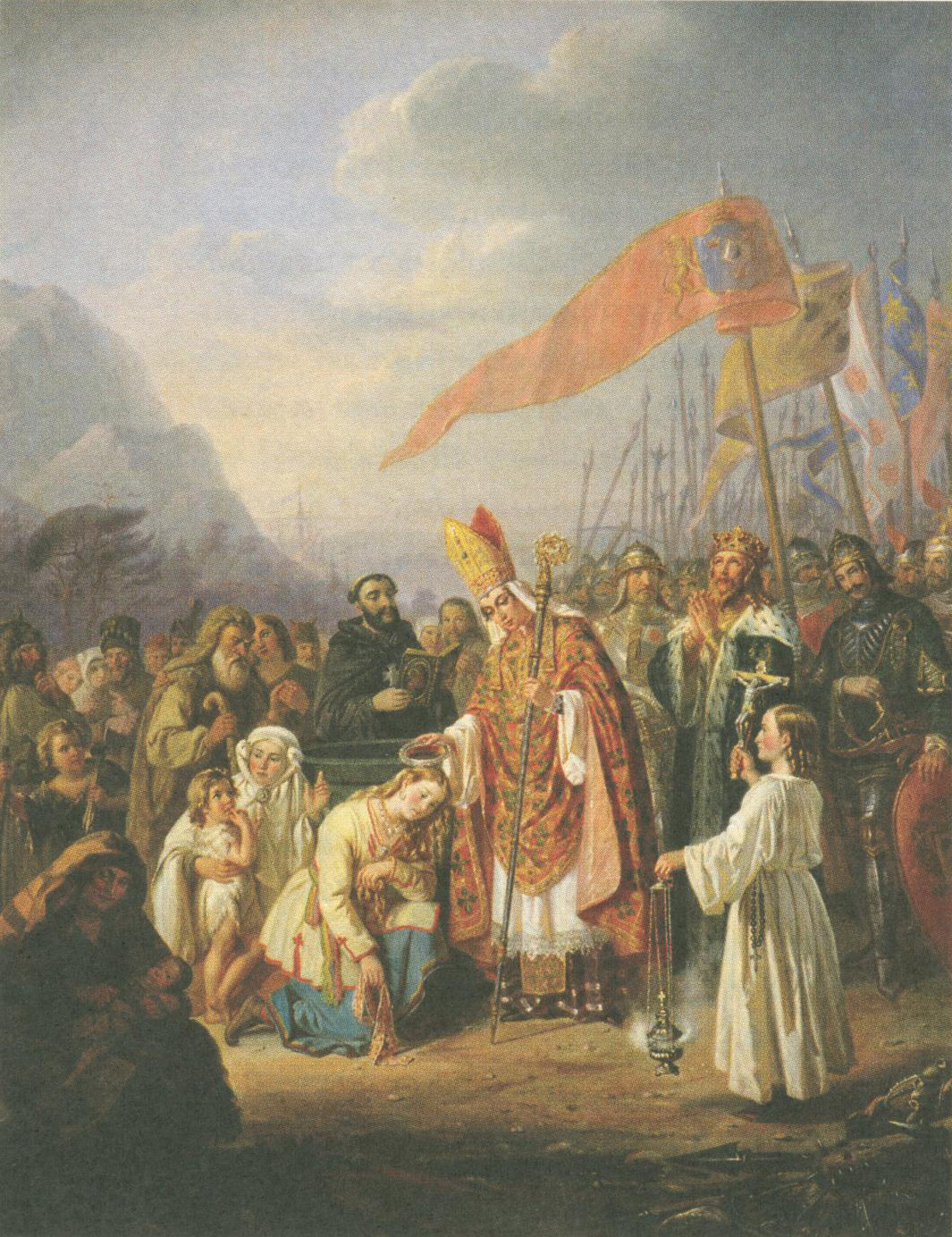
R. W. Ekman. Saint Henri
baptisant les Finnois durant le printemps de Kuppis, 1850, Cathédrale de Turku.
Bishop
Henry baptizes the Finns at the spring of Kuppis, close to Turku. Painting by Robert Wilhelm Ekman (1808–1873),
also made in large format in the cathedral of Turku in 1850-54, depicts pagans
in decorative folk costumes and a very pious king, over whose head massed
standards with a Swedish coat of arms fly.
Biskop
Henrik döper finnarna vid Kuppis källa invid Åbo. Målning av R. W. Ekman, även
utförd i Åbo domkyrka åren 1850-1854, visar hedningar i dekorativa foldräkter
samt en mycket from kung, över vars huvud en fanborg med ett svenskt riksvapen
vajar.
Henry of Uppsala BM (RM)
(also known as Henry of Finland)
Born in England; died in Finland c. 1156; canonized in 1158; feast of the
translation of his relics to Abo, June 18. Saint Henry, an Englishman living in
Rome, became an apostle to Scandinavia. He accompanied the papal legate,
Nicholas Cardinal Breakspear (later Pope Adrian IV), to Scandinavia in 1151 and
was consecrated bishop of Uppsala, Sweden, the following year by the cardinal
at the council of Linköping.
Henry was with King Saint
Eric of Sweden during the latter's crusade into Finland, in 1154, to punish to
Finnish pirates who repeatedly invaded Sweden. Eric offered peace and the
Christian faith, both of which were refused by the Finns. In the ensuing
battle, Eric prevailed. Thereafter, Henry baptized the defeated Finns in the
spring of Kuppis near Abo.
When Eric returned home,
Henry remained in Turku to continue his efforts at evangelization.
Unfortunately, he was less tactful than zealous, and the warlike circumstances
under which he arrived in Finland were not a good recommendation for
Christianity. Nevertheless, Henry built a church at Nousis and made it his
headquarters. After a few years, Henry was martyred on Kirkkosaari in Lake
Kjulo with an axe by an angry convert named Lalli, upon whom Henry had imposed
a heavy penance, including excommunication, for the murder of a Swedish
soldier. Soon after his burial in Nousis, miracles began to occur. The union of
Finland and Sweden wrought by Henry and Eric lasted much longer than they
did--until the 14th century.
On June 18, 1300, Henry's
relics were translated to Abo cathedral, and, in 1370, a magnificent Flemish
sepulchral brass was placed on his original tomb. This brass, which depicts
Henry's life, death, and miracles, still exists. Henry's cultus spread to
Sweden, where Uppsala cathedral has a cycle of murals devoted to him. An
English chapel in the Carmelite church in Great Yarmouth is also dedicated to
him. The Russians took the relics from Abo in 1720 (Attwater, Benedictines,
Delaney, Encyclopedia, Farmer, Gill).
In Sweden, Saint Henry is
generally portrayed in art as a bishop being murdered at Mass together with
young King Eric, patron saint of Sweden (Roeder). In medieval churches in
Finland, Henry is depicted trampling on Lalli--Finland's primary contribution to
iconography. He is also included in Niccolo Circignani's series of paintings of
English martyrs completed in 1582 for the English College in Rome. Henry is
considered the patron saint of Finland and is especially invoked by the local
seal-fishermen during storms (Farmer).
SOURCE : https://catholicsaints.info/saints-of-the-day-henry-of-uppsala/
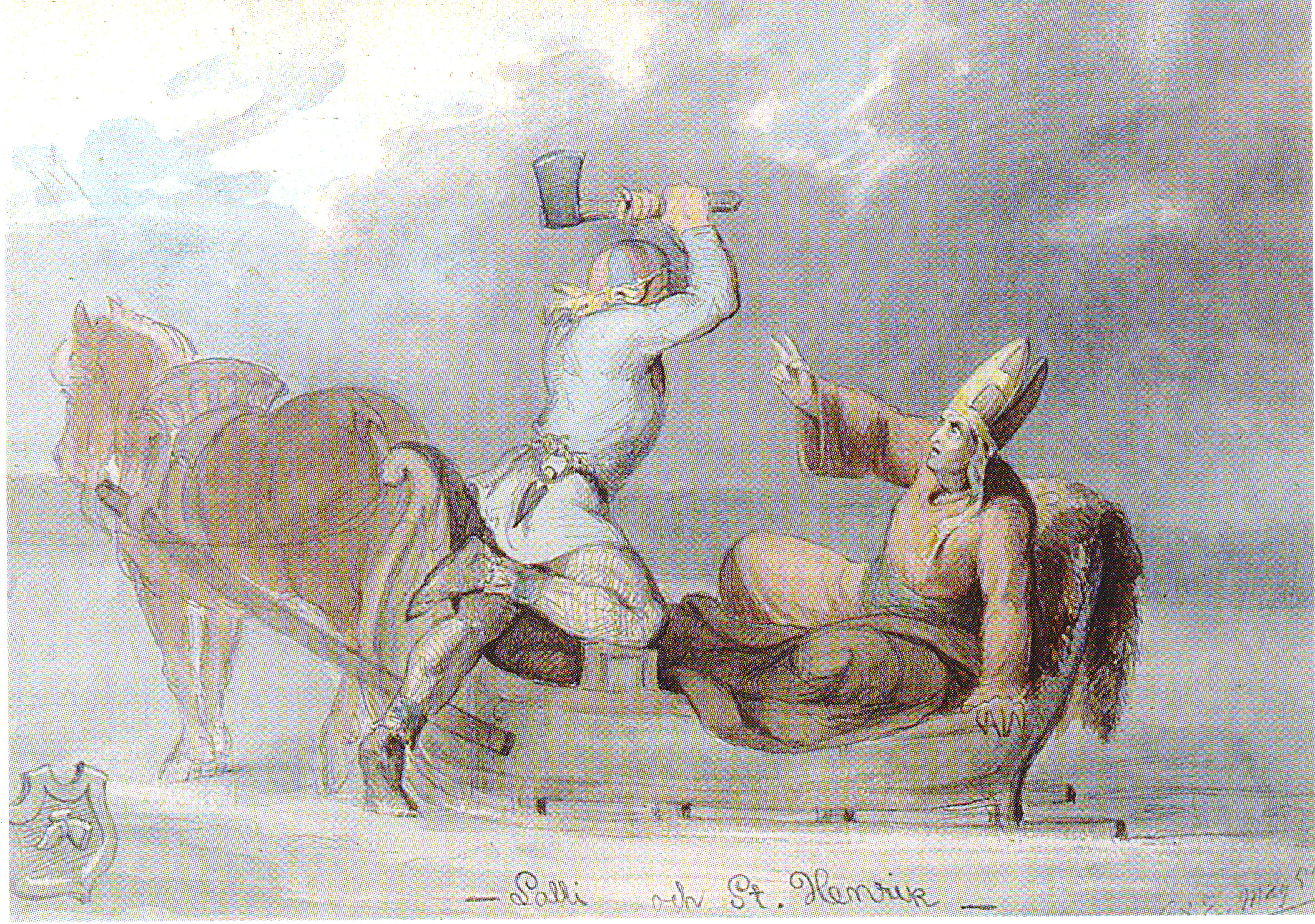
Lalli tuant
Henri d'Uppsala.
Anders Ekman (1833–1855), The murder of St. Henry by Lalli, 1854
R.W.
Ekman, 1854, Lalli tappaa reellä ajavan piispa Henrikin.-
https://www.narvasoft.fi/kalevanpojat/sources/kultainenlegenda.html
St. Henry of Uppsala
Feast: January 19
Henry was an Englishman
living in Rome. He accompanied the papal legate, Cardinal Breakspear (later
Pope Adrian IV) to Scandinavia in 1151 and was consecrated bishop of Uppsala,
Sweden, the next year by the cardinal. During the reign of Saint Erik, King of
Sweden, he was a missionary bishop for the Baltic area, living in Uppsala,
Sweden, and working energetically for the establishment of the Christian faith.
He took part in a crusade to Finland, organised by the king in 1155. When the
king had returned home with his troops, Bishop Henry remained in Finland to
continue organising ecclesiastical life. St. Henry was the first bishop of
Finland. He died a martyr's death the winter after the crusade (on 19 or 20
January in 1156). A peasant named Lalli, who had been excommunicated for
manslaughter, killed Henry on the ice of Lake Köyliö. Bishop Henry was first
buried in the village church of Nousiainen but on 18 June, 1300, his earthly
remains were transferred to the cathedral of Turku. On a small man-made island
at the place where Saint Henry was killed, a memorial chapel was built,
apparently in the 14th century. The chapel eventually fell into ruin and all
that remains of it now are some scattered stones and timber. The island became
a popular place of pilgrimage during the Middle Ages, and to this day Finnish
Catholics gather there annually on a Sunday in mid-June to venerate the memory
of St. Henry and to thank God for the grace he has shown to Finland and the
Finns through the saint and his successors. No documents have been preserved of
the canonisation of Bishop Henry. The first document in which he is referred to
as "saint" is a letter of Pope Boniface VIII from the year 1296. St.
Henry became the patron of the Cathedral of Turku and later the patron of the
church and nation of Finland.
SOURCE : http://medjugorjelive.org/forum/viewtopic.php?f=3&t=23365
St.
Henry, Archbishop of Upsal, Martyr
HE was
an Englishman, and preached the faith in the North with his countryman,
Cardinal Nicholas Breakspear, the apostle of Norway, and legate of the holy
see, afterwards Pope Adrian IV. by whom he was raised to this see, in 1148. St.
Eric, or Henry, (for it is the same name,) was then the holy king of Sweden. 1 Our
saint, after having converted several provinces, went to preach in Finland,
which that king had lately conquered. He deserved to be styled the apostle of
that country, but fell a martyr in it, being stoned to death at the instigation
of a barbarous murderer, whom he endeavoured to reclaim by censures, in 1151.
His tomb was in great veneration at Upsal, till his ashes were scattered on the
change of religion, in the sixteenth century. See John Magnus, l. 1, Vit. Pont.
Upsal. Olaus Magnus, l. 4. Bollandus, and chiefly his life published by
Benzelius. Monum. Suec. p. 33.
Note
1. Stiernman, in his discourse ‘on the State
of Learning among the Ancient Swedes,’ observes, that Sweden was chiefly
converted to Christianity by English Saxon missionaries. The principal among
these were Ansgar; Sigfrid, Roduard, Richolf, Edward, Eskil, David, and Henric,
as he gives their names.
In the history of the bishops and archbishops of Upsal, published by Benzelius in his Monum. Suec. p. 37, the first whose name is recorded is Everin, whom Benzelius supposes to be the person whom St. Sigfrid consecrated to this see. He seems to have been one of his English colleagues. Stephen, the sixth bishop of Upsal, was the first archbishop. See the life of St. Sigfrid, and Benzelius’s notes on the catalogue of the bishops of Upsal, p. 186. [back]
Rev. Alban Butler
(1711–73). Volume I: January. The Lives of the Saints. 1866.

Sant' Enrico di Uppsala Vescovo
e martire
Inghilterra - XII secolo
- Finlandia
Martirologio
Romano: In Finlandia, sant’Enrico, vescovo e martire, che, nato in
Inghilterra, ebbe l’incarico di reggere la Chiesa di Uppsala, adoperandosi con
grande zelo nell’evangelizzazione dei Finni; fu, infine, crudelmente trucidato
da un omicida, che egli aveva cercato di correggere secondo la disciplina
ecclesiastica.
Sant’Enrico visse nel XII secolo e divenne apostolo della Finlandia. Originario dell’Inghilterra, operò in Svezia lottando contro il paganesimo anche se purtroppo non sappiamo di preciso quando giunse in Scandinavia. Verso la metà del XII secolo compare quale vescovo di Uppsala, ove secondo la tradizione locale avrebbe innaugurato la nuova cattedrale edificata da Sant’Erick IX, re di Svezia. In seguito accompagnò il sovrano in una crociata volta alla cristianizzazione della Finlandia e si fermò nella regione per continuare l’opera intrapresa. Vinti i capi locali, li battezzò forzataemente alla fonte di Kuppis, nei pressi di Abo. Poche notizie sono comunque state tramandate circa la sua attività missionaria: secondo la tradizione sarebbe giunto sino al villaggio di Ylistaro, nella contrada di Kumo, ove ancora oggi sopravvivono le rovine della casa in cui il santo vescovo avrebbe predicato.
Enrico trovò la morte nel primo inverno dal suo arrivo in Finlandia per mano di un indigeno di nome Lalli, cui egli aveva imposto penitenza per un precedente omicidio. L’omicidio avvenne nella palude di Kjulo e secondo le leggende Lalli avrebbe anche staccato il pollice del vescovo al quale era infilato l’anello pastorale sulla cui pietra era inciso il suo sigillo. In primavera il dito con l’anello ancora infilato fu rinvenuto su un pezzo di ghiaccio galleggiante ed un cieco riacquistò immediatamente la vista stroppiciandosi gli occhi con la reliquia. Il capitolo del duomo di Abo, in Finlandia, assunse e conserva ancora oggi quale suo sigillo particolare l’immagine del dito con l’anello.
Enrico avrebbe predetto per tempo la sua morte e diede disposizione ai suoi compagni che il suo cadavere fosse attaccato ad un paio di buoi e ove questi lo avrebbero casualmente trascinato fosse sepolto e venisse eretta una chiesa. Così avvenne presso Nouis, ma in seguito i suoi resti furono racchiusi in un prezioso reliquiario e traslati nel nuovo duomo di Abo. Durante l’occupazione russa della Finlandia, lo zar Pietro I nel 1720 fece spedire in Russia il reliquiario e da allora scomparve. La sua tomba originaria nella chiesa di Nouis continuò comunque ad essere considerata un luogo sacro, tanto che dopo secoli vi fu eretto un monumento recante l’immagine del santo ed alcune scene della sua vita.
Ufficialmente pare che Enrico di Uppsala non sia mai stato canonizzato, ma abitualmente al suo nome da tempo immemorabile venne anteposto l’attributo di “santo”. Invocato quale particolare protettore della Finlandia, gli furono dedicate le feste del 20 gennaio e del 18 giugno ed in molte chiese finlandesi e svedesi era posta la sua effige. Oggi la cristianità Finlandia è difisa fra cattolicesimo, luteranesimo ed ortodossia, ma ormai da tempo è iniziata una consuetudine secondo cui ogni anno il 20 gennaio, festa che cade provvidenzialmente durante la Settimana di Preghiera per l’Unità dei Cristiani, una delegazione ecumenica dalla Finlandia si reca in visita dal Vescovo di Roma.
Autore: Fabio Arduino
SOURCE : http://www.santiebeati.it/Detailed/38360.html

Henry (ook Henrik) van
Uppsala, Köyliö, Finland; bisschop & martelaar; † ca 1156.
Feest 19 & 20
(Finland) januari & 18 juni (overbrenging relieken) & 13
december.
Hij was van Engelse afkomst en begeleidde Nicholas Breakspear, de toekomstige paus Adrianus iv († 1159), op diens missiereis naar de Scandinavische landen. In 1152 werd Henry bisschop van de Zweedse stad Uppsala. Daarbij ondervond hij de steun van de heilige koning Erik IX († 1160; feest 18 mei).
Op een van zijn reizen door Finland werd hij gedood door een man die hij
zojuist uit de geloofsgemeenschap had gebannen. Sindsdien wordt hij vereerd
als martelaar.
Verering & Cultuur
Zijn graf bevindt zich in Nousis (nu: Masku); er zijn ook relieken van hem in
de dom van het nabijgelegen Turku. Hij wordt vereerd als 'de Apostel van
Finland'.
Hij werd heilig verklaard in 1158.
Hij is patroon van Finland.
Afgebeeld
Hij wordt afgebeeld als bisschop (mijter, staf en tabberd); met een raaf, die
ervoor zorgde dat men zijn lijk vond; met bijl (martelwerktuig).
[101; 101a; 102; 106; 107; 115; 122; 142jr1151; 500; Dries van den Akker
s.j./2010.02.27]
© A. van den Akker
s.j. / A.W. Gerritsen
SOURCE : https://heiligen-3s.nl/heiligen/01/19/01-19-1156-henry.php


