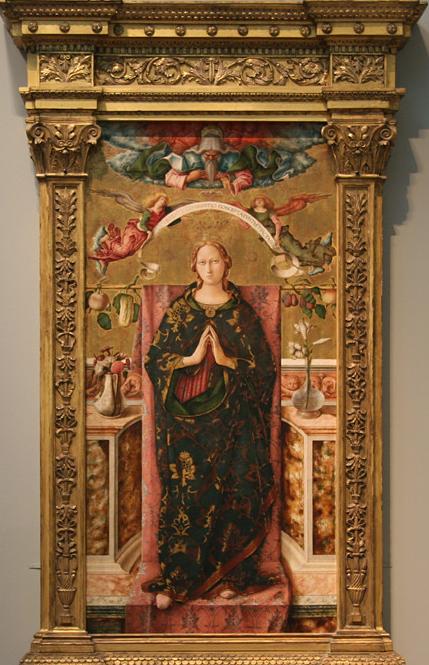
samedi 8 février 2014

La VIERGE MARIE : Icône de la foi obéissante


BENOÎT XVI

AUDIENCE GÉNÉRALE

Salle Paul VI

Mercredi 19 décembre 2012

La Vierge Marie : Icône de la foi obéissante


Chers frères et sœurs,

Sur le chemin de l’Avent, la Vierge Marie occupe une place particulière comme celle qui, de façon unique, a attendu la réalisation des promesses de Dieu, en accueillant dans la foi et dans la chair Jésus, le Fils de Dieu, en pleine obéissance à la volonté divine. Aujourd’hui, je voudrais réfléchir brièvement avec vous sur la foi de Marie à partir du grand mystère de l’Annonciation.

« Chaîre kecharitomene, ho Kyrios meta sou », « Réjouis-toi, comblée de grâce, le Seigneur est avec toi » (Lc 1, 28). Telles sont les paroles — rapportées par l’évangéliste Luc — par lesquelles l’archange Gabriel s’adresse à Marie. À première vue, le terme chaîre, « réjouis-toi », semble une salutation normale, habituelle dans le contexte grec, mais s’il est lu dans le cadre de la tradition biblique, ce mot acquiert une signification beaucoup plus profonde. Ce même terme est présent quatre fois dans la version grecque de l’Ancien Testament et toujours comme une annonce de joie pour la venue du Messie (cf. So 3, 14 ; Jl 2, 21 ; Za 9, 9 ; Lm 4, 21). Le salut de l’ange à Marie est donc une invitation à la joie, à une joie profonde, il annonce la fin de la tristesse qu’il y a dans le monde face à la limite de la vie, à la souffrance, à la mort, à la méchanceté, aux ténèbres du mal qui semblent obscurcir la lumière de la bonté divine. C’est un salut qui marque le début de l’Évangile, de la Bonne Nouvelle.

Mais pourquoi Marie est-elle invitée à se réjouir de cette façon ? La réponse se trouve dans la deuxième partie du salut :  «Le Seigneur est avec toi ». Ici aussi, pour bien comprendre le sens de l’expression, nous devons nous tourner vers l’Ancien Testament. Dans le Livre de Sophonie, nous trouvons cette expression : « Pousse des cris de joie, fille de Sion... Le Seigneur est roi d'Israël au milieu de toi... Le Seigneur ton Dieu est au milieu de toi, héros sauveur » (3, 14-17). Dans ces paroles, il y a une double promesse faite à Israël, à la fille de Sion : Dieu viendra comme sauveur et habitera précisément au milieu de son peuple, dans le sein de la fille de Sion. Dans le dialogue entre l’ange et Marie se réalise exactement cette promesse : Marie est identifiée avec le peuple épousé par Dieu, elle est véritablement la Fille de Sion en personne; en elle s’accomplit l’attente de la venue définitive de Dieu, en elle habite le Dieu vivant.

Dans le salut de l’ange, Marie est appelée « pleine de grâce » ; en grec, le terme « grâce », charis, a la même racine linguistique que le terme « joie ». Dans cette expression également est éclaircie ultérieurement la source de la joie de Marie : la joie provient de la grâce, c’est-à-dire qu’elle provient de la communion avec Dieu, du fait d’avoir une relation si vitale avec Lui, du fait d’être demeure de l’Esprit Saint, entièrement formée par l’action de Dieu. Marie est la créature qui de façon unique a ouvert toute grande la porte à son Créateur, elle s’est placée entre ses mains, sans limite. Elle vit entièrement de la et dans la relation avec le Seigneur ; elle est dans une attitude d’écoute, attentive à saisir les signes de Dieu sur le chemin de son peuple ; elle est insérée dans une histoire de foi et d’espérance dans les promesses de Dieu, qui constitue le tissu de son existence. Et elle se soumet librement à la parole reçue, à la volonté divine dans l’obéissance de la foi.

L’évangéliste Luc raconte l’histoire de Marie à travers un subtil parallélisme avec l’histoire d’Abraham. Comme le grand Patriarche est le père des croyants, qui a répondu à l’appel de Dieu à quitter la terre où il vivait, ses certitudes, pour entamer le chemin vers une terre inconnue et possédée uniquement dans la promesse divine, de même Marie s’en remet avec une totale confiance à la parole que lui a annoncée le messager de Dieu et devient modèle et mère de tous les croyants.

Je voudrais souligner un autre aspect important : l’ouverture de l’âme à Dieu et à son action dans la foi inclut aussi l’élément de l’obscurité. La relation de l’être humain avec Dieu n’efface pas la distance entre le Créateur et la créature, n’élimine pas ce qu’affirme l’apôtre Paul face aux profondeurs de la sagesse de Dieu : « Que ses décrets sont insondables et ses voies incompréhensibles ! » (Rm 11, 33). Mais justement celui qui — comme Marie — est ouvert de façon totale à Dieu, parvient à accepter le vouloir divin, même s’il est mystérieux, même si souvent il ne correspond pas à notre propre volonté et qu’il est une épée qui transperce l’âme, comme le dira prophétiquement le vieux Syméon à Marie, au moment où Jésus est présenté au Temple (cf. Lc 2, 35). Le chemin de foi d’Abraham comprend le moment de joie pour le don de son fils Isaac, mais aussi le moment de l’obscurité, lorsqu’il doit monter sur le mont Moriah pour accomplir un geste paradoxal : Dieu lui demande de sacrifier le fils qu’il vient de lui donner. Sur le mont, l’ange lui ordonne : « N’étends pas la main contre l’enfant ! Ne lui fais aucun mal ! Je sais maintenant que tu crains Dieu : tu ne m’as pas refusé ton fils, ton unique » (Gn 22, 12) ; la pleine confiance d’Abraham dans le Dieu fidèle aux promesses ne manque pas non plus lorsque sa parole est mystérieuse et difficile, presque impossible à accueillir. Ainsi en est-il pour Marie, sa foi vit la joie de l’Annonciation mais passe aussi à travers l’obscurité de la crucifixion de son Fils, pour pouvoir atteindre la lumière de la Résurrection.

Il en est de même aussi pour le chemin de foi de chacun de nous: nous rencontrons des moments de lumière, mais nous rencontrons aussi des passages où Dieu semble absent, son silence pèse dans notre cœur et sa volonté ne correspond pas à la nôtre, à ce que nous voudrions. Mais plus nous nous ouvrons à Dieu, plus nous accueillons le don de la foi, plus nous plaçons totalement en Lui notre confiance — comme Abraham et comme Marie — alors plus Il nous rend capables, par sa présence, de vivre toute situation de la vie dans la paix et dans la certitude de sa fidélité et de son amour. Mais cela signifie sortir de soi et de nos projets, afin que la Parole de Dieu soit la lampe qui guide nos pensées et nos actions.

Je voudrais m’arrêter encore sur un aspect qui émerge des récits sur l’Enfance de Jésus raconté par saint Luc. Marie et Joseph portent leur fils à Jérusalem, au Temple, pour le présenter et le consacrer au Seigneur comme le prescrit la loi de Moïse : «Tout garçon premier-né sera consacré au Seigneur » (cf. Lc 2, 22-24). Ce geste de la Sainte Famille acquiert un sens encore plus profond si nous le lisons à la lumière de la science évangélique de Jésus à douze ans qui, après trois jours de recherche, est retrouvé au Temple en train de discuter parmi les docteurs. Aux paroles pleines d’inquiétude de Marie et Joseph : « Mon enfant, pourquoi nous as-tu fait cela ? Vois ! ton père et moi, nous te cherchons, angoissés », correspond la mystérieuse réponse de Jésus : « Pourquoi donc me cherchiez-vous ? Ne saviez-vous pas que je dois être dans la maison de mon Père ? » (Lc 2, 48-49). C’est-à-dire dans la propriété du Père, dans la maison du Père, comme l’est un fils. Marie doit renouveler la foi profonde avec laquelle elle a dit « oui » lors de l’Annonciation ; elle doit accepter que la priorité soit donnée au Père véritable et propre de Jésus ; elle doit savoir laisser libre ce Fils qu’elle a engendré pour qu’il suive sa mission. Et le « oui » de Marie à la volonté de Dieu, dans l’obéissance de la foi, se répète tout au long de sa vie, jusqu’au moment le plus difficile, celui de la Croix.

Face à tout cela, nous pouvons nous demander : comment Marie a-t-elle pu vivre ce chemin aux côtés de son Fils avec une foi aussi solide, même dans l’obscurité, sans perdre la pleine confiance dans l’action de Dieu ? Il existe une attitude de fond que Marie prend face à ce qui se passe dans sa vie. Lors de l’Annonciation, elle est troublée en écoutant les paroles de l’Ange — c’est la crainte que l’homme éprouve lorsqu’il est touché par la proximité de Dieu —, mais ce n’est pas l’attitude de celui qui a peur devant ce que Dieu peut demander. Marie réfléchit, elle s’interroge sur la signification de ce salut (cf. Lc 1, 29). Le terme grec utilisé dans l’Évangile pour définir cette « réflexion », « dielogizeto », rappelle la racine de la parole « dialogue ». Cela signifie que Marie entre dans un dialogue intime avec la Parole de Dieu qui lui a été annoncée, elle ne la considère pas superficiellement, mais elle s’arrête, elle la laisse pénétrer dans son esprit et dans son cœur pour comprendre ce que le Seigneur veut d’elle, le sens de l’annonce. Nous trouvons une autre mention de l’attitude intérieure de Marie face à l’action de Dieu, toujours dans l’Évangile de saint Luc, au moment de la naissance de Jésus, après l’adoration des bergers. Il y est affirmé que Marie « retenait tous ces événements et les méditait dans son cœur » (Lc 2, 19) ; en grec le terme est symballon, nous pourrions dire qu’Elle « retenait ensemble », qu’elle « mettait ensemble » dans son cœur tous les événements qui lui arrivaient ; elle plaçait chaque événement particulier, chaque parole, chaque fait à l’intérieur du tout et elle le confrontait, elle le conservait, reconnaissant que tout provient de la volonté de Dieu. Marie ne s’arrête pas à une première compréhension superficielle de ce qui se passe dans sa vie, mais elle sait regarder en profondeur, elle se laisse interpeller par les événements, elle les élabore, elle les discerne et acquiert cette compréhension que seule la foi peut garantir. C’est l’humilité profonde de la foi obéissante de Marie, qui accueille en elle également ce qu’elle ne comprend pas dans l’action de Dieu, en laissant Dieu ouvrir son esprit et son cœur. « Heureuse celle qui a cru à l’accomplissement des paroles qui lui furent dites de la part du Seigneur » (Lc 1, 44), s’exclame sa parente Élisabeth. C’est précisément en raison de sa foi que toutes les générations l’appelleront bienheureuse.

Chers amis, la solennité du Noël du Seigneur que nous célébrerons d’ici peu, nous invite à vivre cette même humilité et obéissance de foi. La gloire de Dieu ne se manifeste pas dans le triomphe et dans le pouvoir d’un roi, elle ne resplendit pas dans une ville célèbre, dans un palais somptueux, mais elle prend sa demeure dans le sein d’une vierge, elle se révèle dans la pauvreté d’un enfant. La toute-puissance de Dieu, même dans notre vie, agit avec la force, souvent silencieuse, de la vérité et de l’amour. La foi nous dit alors que la puissance sans défense de cet Enfant vainc le bruit des puissances du monde.

* * *

Je salue avec joie les francophones, en particulier les lycéens en pèlerinage ! Marie est appelée bienheureuse à cause de sa foi obéissante. Comme elle, laissons la Parole de Dieu illuminer nos pensées et nos actions. Durant les fêtes de la Nativité, demandons-lui la grâce de sentir comment la toute-puissance de Dieu agit dans nos vies avec la force de la vérité et de l’amour. Joyeux Noël à tous !

© Copyright 2012 - Libreria Editrice Vaticana

SOURCE : http://www.vatican.va/holy_father/benedict_xvi/audiences/2012/documents/hf_ben-xvi_aud_20121219_fr.html

BENEDICT XVI

GENERAL AUDIENCE

Paul VI Audience Hall

Wednesday, 19 December 2012

Dear Brothers and Sisters,

The Virgin Mary has a special place in the journey of Advent as the One who, in a unique way, awaited the fulfilment of God’s promises, welcoming Jesus the Son of God in faith and in the flesh and with full obedience to the divine will. Today, I wish to ponder briefly with you on Mary’s faith, starting from the great mystery of the Annunciation.

“Chaîre kecharitomene, ho Kyrios meta sou”, “Hail, [rejoice] full of grace, the Lord is with you” (Lk 1:28). These are the words — recorded by Luke the Evangelist — with which the Archangel Gabriel addresses Mary. At first sight the term chaire “rejoice”, seems an ordinary greeting, typical in the Greek world, but if this word is interpreted against the background of the biblical tradition it acquires a far deeper meaning. The same term occurs four times in the Greek version of the Old Testament and always as a proclamation of joy in the coming of the Messiah (cf. Zeph 3:14, Joel 2:21; Zech 9:9; Lam 4:21).

The Angel’s greeting to Mary is therefore an invitation to joy, deep joy. It announces an end to the sadness that exists in the world because of life’s limitations, suffering, death, wickedness, in all that seems to block out the light of the divine goodness. It is a greeting that marks the beginning of the Gospel, the Good News.

But why is Mary invited to rejoice in this way? The answer is to be found in the second part of the greeting: “The Lord is with you”. Here too, if we are to understand correctly the meaning of these words we must turn to the Old Testament. In the Book of Zephaniah, we find these words “Sing aloud, O daughter of Zion.... The King of Israel, the Lord, is in your midst.... The Lord, your God, in your midst, a warrior who gives victory” (3:14-17).

In these words a twofold promise is made to Israel, to the daughter of Zion: God will come as a saviour and will pitch his tent in his people’s midst, in the womb of the daughter of Zion. This promise is fulfilled to the letter in the dialogue between the Angel and Mary. Mary is identified with the people espoused by God, she is truly the daughter of Zion in person; in her the expectation of the definitive coming of God is fulfilled, in her the Living God makes his dwelling place.

In the greeting of the Angel Mary is called “full of grace”. In Greek, the term “grace”, charis, has the same linguistic root as the word “joy”. In this term too the source of Mary’s exultation is further clarified: her joy comes from grace, that is, from being in communion with God, from having such a vital connection with him, from being the dwelling place of the Holy Spirit, totally fashioned by God’s action. Mary is the creature who opened the door to her Creator in a special way, placing herself in his hands without reserve. She lived entirely from and in her relationship with the Lord; she was disposed to listen, alert to recognizing the signs of God in the journey of his people; she was integrated into a history of faith and hope in God’s promises with which the fabric of her life was woven. And she submitted freely to the word received, to the divine will in the obedience of faith.

The Evangelist Luke tells Mary’s story by aligning it closely to the history of Abraham. Just as the great Patriarch is the father of believers who responded to God’s call to leave the land in which he lived, to leave behind all that guaranteed his security in order to start out on the journey to an unknown land, assured only in the divine promise, so Mary trusts implicitly in the word that the messenger of God has announced to her, and becomes the model and Mother of all believers.

I would like to emphasize another important point: the opening of the soul to God and to his action in faith also includes an element of obscurity. The relationship of human beings with God does not delete the distance between Creator and creature, it does not eliminate what the Apostle Paul said before the depth of God’s wisdom: “How unsearchable are his judgements and how inscrutable his ways!” (Rom 11:33).

Yet those who — like Mary — open themselves totally to God, come to accept the divine will, even though it is mysterious, although it often does not correspond with their own wishes, and is a sword that pierces their soul, as the elderly Simeon would say prophetically to Mary when Jesus was presented in the Temple (cf. Lk 2:35). Abraham’s journey of faith included the moment of joy in the gift of his son Isaac, but also the period of darkness, when he had to climb Mount Moriah to execute a paradoxical order: God was asking him to sacrifice the son he had just given him. On the mountain, the Angel told him: “Do not lay your hand on the lad or do anything to him; for now I know that you fear God, seeing you have not withheld your son, your only son, from me” (Gen 22:12). Abraham's full trust in the God who is faithful to his promises did not fail, even when his word was mysterious and difficult, almost impossible to accept. So it is with Mary. Her faith experienced the joy of the Annunciation, but also passed through the gloom of the crucifixion of the Son to be able to reach the light of the Resurrection.

It is exactly the same on the journey of faith of each one of us: we encounter patches of light, but we also encounter stretches in which God seems absent, when his silence weighs on our hearts and his will does not correspond with ours, with our inclination to do as we like. However, the more we open ourselves to God, welcome the gift of faith and put our whole trust in him — like Abraham, like Mary — the more capable he will make us, with his presence, of living every situation of life in peace and assured of his faithfulness and his love. However, this means coming out of ourselves and our own projects so that the word of God may be the lamp that guides our thoughts and actions.

I would like once again to ponder on an aspect that surfaces in the infancy narratives of Jesus recounted by St Luke. Mary and Joseph take their Son to Jerusalem, to the Temple, to present him to the Lord and to consecrate him as required by Mosaic Law: “Every firstborn male shall be designated as holy to the Lord” (cf. Lk 2:22-24). The Holy Family’s action acquires an even more profound meaning if we interpret it in the light of the evangelical knowledge of the 12-year-old Jesus. After three days of searching he was found in the Temple in conversation with the teachers. The deeply anxious words of Mary and Joseph: “Son, why have you treated us so? Behold, your father and I have been looking for you anxiously”, are in conformity with Jesus’ mysterious answer: “How is it that you sought me? Did you not know that I must be in my Father’s house?” (Lk 2:48-49). The significance lies in the Father’s property, “in my Father’s house”, as a son is.

Mary is obliged to renew the profound faith with which she said “yes” at the Annunciation; she must accept that it is the true and proper Father of Jesus who has precedence; she must be able to leave the Son she has brought forth free to follow his mission. And Mary’s “yes” to God’s will, in the obedience of faith, is repeated throughout her life, until the most difficult moment, that of the Cross.

Confronting all this, we may ask ourselves: how was Mary able to journey on beside her Son with such a strong faith, even in darkness, without losing her full trust in the action of God? Mary assumes a fundamental approach in facing what happens in her life. At the Annunciation, on hearing the Angel’s words she is distressed — it is the fear a person feels when moved by God’s closeness — but it is not the attitude of someone who is afraid of what God might ask. Mary reflects, she ponders on the meaning of this greeting (cf. Lk 1:29). The Greek word used in the Gospel to define this “reflection”, “dielogizeto”, calls to mind the etymology of the word “dialogue”.

This means that Mary enters into a deep conversation with the Word of God that has been announced to her, she does not consider it superficially but meditates on it, lets it sink into her mind and her heart so as to understand what the Lord wants of her, the meaning of the announcement.

We find another hint of Mary's inner attitude to God’s action — again in the Gospel according to St Luke — at the time of Jesus’ birth, after the adoration of the shepherds. Luke affirms that Mary “kept all these things, pondering them in her heart” (Lk 2:19). In Greek the term is symballon, we could say that she “kept together”, “pieced together” in her heart all the events that were happening to her; she placed every individual element, every word, every event, within the whole and confronted it, cherished it, recognizing that it all came from the will of God.

Mary does not stop at a first superficial understanding of what is happening in her life, but can look in depth, she lets herself be called into question by events, digests them, discerns them, and attains the understanding that only faith can provide. It is the profound humility of the obedient faith of Mary, who welcomes within her even what she does not understand in God’s action, leaving it to God to open her mind and heart. “Blessed is she who believed that there would be a fulfilment of what was spoken to her from the Lord” (Lk 1:45), her kinswoman Elizabeth exclaims. It is exactly because of this faith that all generations will call her blessed.

Dear friends, the Solemnity of the Nativity of the Lord which we shall soon be celebrating invites us to practise this same humility and obedience of faith. The glory of God is not expressed in the triumph and power of a king, it does not shine out in a famous city or a sumptuous palace, but makes its abode in a virgin’s womb and is revealed in the poverty of a child. In our lives too, the almightiness of God acts with the force — often in silence — of truth and love. Thus faith tells us that in the end the defenceless power of that Child triumphs over the clamour of worldly powers. Many thanks!

To special groups:

I offer a warm welcome to Japanese pilgrims from the Diocese of Kagoshima. My cordial greeting also goes to the Nigerian Christian Pilgrim Commission. Upon all the English-speaking pilgrims present at today’s Audience I invoke God’s blessings for a happy and holy celebration of the coming feast of Christmas.

I address a special greeting to the young people, to the sick and to the newlyweds. Dear young people, especially you students of the Capriotti Institute in San Benedetto del Tronto, may you approach the mystery of Bethlehem with the same sentiments of faith and humility as Mary. Dear sick people, may you draw from the manger scene that joy and inner peace that Jesus comes to bring to the world. And may you, dear newlyweds, contemplate the example of the Holy Family of Nazareth, to impress the virtues practised in it upon the journey of your family life.

© Copyright 2012 - Libreria Editrice Vaticana

SOURCE : http://www.vatican.va/holy_father/benedict_xvi/audiences/2012/documents/hf_ben-xvi_aud_20121219_en.html

BENEDETTO XVI

UDIENZA GENERALE

Aula Paolo VI

Mercoledì, 19 dicembre 2012

Maria Vergine: Icona della fede obbediente


Cari fratelli e sorelle,

nel cammino dell’Avvento la Vergine Maria occupa un posto particolare come colei che in modo unico ha atteso la realizzazione delle promesse di Dio, accogliendo nella fede e nella carne Gesù, il Figlio di Dio, in piena obbedienza alla volontà divina. Oggi vorrei riflettere brevemente con voi sulla fede di Maria a partire dal grande mistero dell’Annunciazione.

«Chaîre kecharitomene, ho Kyrios meta sou», «Rallegrati, piena di grazia: il Signore è con te» (Lc 1,28). Sono queste le parole - riportate dall’evangelista Luca – con cui l’arcangelo Gabriele si rivolge a Maria. A prima vista il termine chaîre, “rallegrati”, sembra un normale saluto, usuale nell’ambito greco, ma questa parola, se letta sullo sfondo della tradizione biblica, acquista un significato molto più profondo. Questo stesso termine è presente quattro volte nella versione greca dell’Antico Testamento e sempre come annuncio di gioia per la venuta del Messia (cfr Sof 3,14; Gl 2,21; Zc 9,9; Lam 4,21). Il saluto dell’angelo a Maria è quindi un invito alla gioia, ad una gioia profonda, annuncia la fine della tristezza che c’è nel mondo di fronte al limite della vita, alla sofferenza, alla morte, alla cattiveria, al buio del male che sembra oscurare la luce della bontà divina. E’ un saluto che segna l’inizio del Vangelo, della Buona Novella.

Ma perché Maria viene invitata a rallegrarsi in questo modo? La risposta si trova nella seconda parte del saluto: “il Signore è con te”. Anche qui per comprendere bene il senso dell’espressione dobbiamo rivolgerci all’Antico Testamento. Nel Libro di Sofonia troviamo questa espressione «Rallégrati, figlia di Sion,… Re d’Israele è il Signore in mezzo a te… Il Signore, tuo Dio, in mezzo a te è un salvatore potente» (3,14-17). In queste parole c’è una duplice promessa fatta ad Israele, alla figlia di Sion: Dio verrà come salvatore e prenderà dimora proprio in mezzo al suo popolo, nel grembo della figlia di Sion. Nel dialogo tra l’angelo e Maria si realizza esattamente questa promessa: Maria è identificata con il popolo sposato da Dio, è veramente la Figlia di Sion in persona; in lei si compie l’attesa della venuta definitiva di Dio, in lei prende dimora il Dio vivente.

Nel saluto dell’angelo, Maria viene chiamata “piena di grazia”; in greco il termine “grazia”, charis, ha la stessa radice linguistica della parola “gioia”. Anche in questa espressione si chiarisce ulteriormente la sorgente del rallegrarsi di Maria: la gioia proviene dalla grazia, proviene cioè dalla comunione con Dio, dall’avere una connessione così vitale con Lui, dall’essere dimora dello Spirito Santo, totalmente plasmata dall’azione di Dio. Maria è la creatura che in modo unico ha spalancato la porta al suo Creatore, si è messa nelle sue mani, senza limiti. Ella vive interamente della e nella relazione con il Signore; è in atteggiamento di ascolto, attenta a cogliere i segni di Dio nel cammino del suo popolo; è inserita in una storia di fede e di speranza nelle promesse di Dio, che costituisce il tessuto della sua esistenza. E si sottomette liberamente alla parola ricevuta, alla volontà divina nell’obbedienza della fede.

L’Evangelista Luca narra la vicenda di Maria attraverso un fine parallelismo con la vicenda di Abramo. Come il grande Patriarca è il padre dei credenti, che ha risposto alla chiamata di Dio ad uscire dalla terra in cui viveva, dalle sue sicurezze, per iniziare il cammino verso una terra sconosciuta e posseduta solo nella promessa divina, così Maria si affida con piena fiducia alla parola che le annuncia il messaggero di Dio e diventa modello e madre di tutti i credenti.

Vorrei sottolineare un altro aspetto importante: l’apertura dell’anima a Dio e alla sua azione nella fede include anche l’elemento dell’oscurità. La relazione dell’essere umano con Dio non cancella la distanza tra Creatore e creatura, non elimina quanto afferma l’apostolo Paolo davanti alle profondità della sapienza di Dio: «Quanto insondabili sono i suoi giudizi e inaccessibili le sue vie!» (Rm 11,33). Ma proprio colui che - come Maria – è aperto in modo totale a Dio, giunge ad accettare il volere divino, anche se è misterioso, anche se spesso non corrisponde al proprio volere ed è una spada che trafigge l’anima, come profeticamente dirà il vecchio Simeone a Maria, al momento in cui Gesù viene presentato al Tempio (cfr Lc 2,35). Il cammino di fede di Abramo comprende il momento di gioia per il dono del figlio Isacco, ma anche il momento dell’oscurità, quando deve salire sul monte Moria per compiere un gesto paradossale: Dio gli chiede di sacrificare il figlio che gli ha appena donato. Sul monte l’angelo gli ordina: «Non stendere la mano contro il ragazzo e non fargli niente! Ora so che tu temi Dio e non mi hai rifiutato tuo figlio, il tuo unigenito» (Gen 22,12); la piena fiducia di Abramo nel Dio fedele alle promesse non viene meno anche quando la sua parola è misteriosa ed è difficile, quasi impossibile,  da accogliere. Così è per Maria, la sua fede vive la gioia dell’Annunciazione, ma passa anche attraverso il buio della crocifissione del Figlio, per poter giungere fino alla luce della Risurrezione.

Non è diverso anche per il cammino di fede di ognuno di noi: incontriamo momenti di luce, ma incontriamo anche passaggi in cui Dio sembra assente, il suo silenzio pesa nel nostro cuore e la sua volontà non corrisponde alla nostra, a quello che noi vorremmo. Ma quanto più ci apriamo a Dio, accogliamo il dono della fede, poniamo totalmente in Lui la nostra fiducia - come Abramo e come Maria - tanto più Egli ci rende capaci, con la sua presenza, di vivere ogni situazione della vita nella pace e nella certezza della sua fedeltà e del suo amore. Questo però significa uscire da sé stessi e dai propri progetti, perché la Parola di Dio sia la lampada che guida i nostri pensieri e le nostre azioni.

Vorrei soffermarmi ancora su un aspetto che emerge nei racconti sull’Infanzia di Gesù narrati da san Luca. Maria e Giuseppe portano il figlio a Gerusalemme, al Tempio, per presentarlo e consacrarlo al Signore come prescrive la legge di Mosé: «Ogni maschio primogenito sarà sacro al Signore» (cfr Lc 2,22-24). Questo gesto della Santa Famiglia acquista un senso ancora più profondo se lo leggiamo alla luce della scienza evangelica di Gesù dodicenne che, dopo tre giorni di ricerca, viene ritrovato nel Tempio a discutere tra i maestri. Alle parole piene di preoccupazione di Maria e Giuseppe: «Figlio, perché ci hai fatto questo? Ecco, tuo padre e io, angosciati, ti cercavamo», corrisponde la misteriosa risposta di Gesù: «Perché mi cercavate? Non sapevate che devo essere nelle cose del Padre mio?» (Lc 2,48-49). Cioè nella proprietà del Padre, nella casa del Padre, come lo è un figlio. Maria deve rinnovare la fede profonda con cui ha detto «sì» nell’Annunciazione; deve accettare che la precedenza l’abbia il Padre vero e proprio di Gesù; deve saper lasciare libero quel Figlio che ha generato perché segua la sua missione. E il «sì» di Maria alla volontà di Dio, nell’obbedienza della fede, si ripete lungo tutta la sua vita, fino al momento più difficile, quello della Croce.

Davanti a tutto ciò, possiamo chiederci: come ha potuto vivere Maria questo cammino accanto al Figlio con una fede così salda, anche nelle oscurità, senza perdere la piena fiducia nell’azione di Dio? C’è un atteggiamento di fondo che Maria assume di fronte a ciò che avviene nella sua vita. Nell’Annunciazione Ella rimane turbata ascoltando le parole dell’angelo - è il timore che l’uomo prova quando viene toccato dalla vicinanza di Dio –, ma non è l’atteggiamento di chi ha paura davanti a ciò che Dio può chiedere. Maria riflette, si interroga sul significato di tale saluto (cfr Lc 1,29). Il termine greco usato nel Vangelo per definire questo “riflettere”, “dielogizeto”, richiama la radice della parola “dialogo”. Questo significa che Maria entra in intimo dialogo con la Parola di Dio che le è stata annunciata, non la considera superficialmente, ma si sofferma, la lascia penetrare nella sua mente e nel suo cuore per comprendere ciò che il Signore vuole da lei, il senso dell’annuncio. Un altro cenno all’atteggiamento interiore di Maria di fronte all’azione di Dio lo troviamo, sempre nel Vangelo di san Luca, al momento della nascita di Gesù, dopo l’adorazione dei pastori. Si afferma che Maria «custodiva tutte queste cose, meditandole nel suo cuore» (Lc 2,19); in greco il termine è symballon, potremmo dire che Ella “teneva insieme”, “poneva insieme” nel suo cuore tutti gli avvenimenti che le stavano accadendo; collocava ogni singolo elemento, ogni parola, ogni fatto all’interno del tutto e lo confrontava, lo conservava, riconoscendo che tutto proviene dalla volontà di Dio. Maria non si ferma ad una prima comprensione superficiale di ciò che avviene nella sua vita, ma sa guardare in profondità, si lascia interpellare dagli eventi, li elabora, li discerne, e acquisita quella comprensione che solo la fede può garantire. E’ l’umiltà profonda della fede obbediente di Maria, che accoglie in sé anche ciò che non comprende dell’agire di Dio, lasciando che sia Dio ad aprirle la mente e il cuore. «Beata colei che ha creduto nell’adempimento della parola del Signore» (Lc 1,45), esclama la parente Elisabetta. E’ proprio per la sua fede che tutte le generazioni la chiameranno beata.

Cari amici, la solennità del Natale del Signore che tra poco celebreremo, ci invita a vivere questa stessa umiltà e obbedienza di fede. La gloria di Dio non si manifesta nel trionfo e nel potere di un re, non risplende in una città famosa, in un sontuoso palazzo, ma prende dimora nel grembo di una vergine, si rivela nella povertà di un bambino. L’onnipotenza di Dio, anche nella nostra vita, agisce con la forza, spesso silenziosa, della verità e dell’amore. La fede ci dice, allora, che l’indifesa potenza di quel Bambino alla fine vince il rumore delle potenze del mondo.

Saluti:

Je salue avec joie les francophones, en particulier les lycéens en pèlerinage ! Marie est appelée bienheureuse à cause de sa foi obéissante. Comme elle, laissons la Parole de Dieu illuminer nos pensées et nos actions. Durant les fêtes de la Nativité, demandons-lui la grâce de sentir comment la toute-puissance de Dieu agit dans nos vies avec la force de la vérité et de l’amour. Joyeux Noël à tous !

I offer a warm welcome to Japanese pilgrims from the Diocese of Kagoshima. My cordial greeting also goes to Nigerian Christian Pilgrim Commission. Upon all the English-speaking pilgrims present at today’s Audience I invoke God’s blessings for a happy and holy celebration of the coming feast of Christmas!

Herzlich grüße ich alle Pilger und Besucher deutscher Sprache. Wir alle wollen durch unser Leben sichtbar machen, daß Gott die Menschen liebt und uns in seinem Sohn Jesus Christus nahe gekommen ist. Wir wollen versuchen mitzuhelfen, daß sich der Friede auf der Erde ausbreitet. Der Herr stärke uns dazu mit seiner Gnade. Von Herzen wünsche ich euch und euren Familien ein frohes und gesegnetes Weihnachtsfest.

Saludo a los peregrinos de lengua española, en particular a los Legionarios de Cristo que recientemente han sido agregados al Orden Sacerdotal, así como a sus familiares. Saludo a los grupos venidos de España y de los países latinoamericanos. Que la próxima solemnidad de la Navidad, en la que contemplamos cómo Dios pone su morada en el seno de la Virgen, nos haga crecer en el amor al Señor, acogiendo con humildad su Palabra. Muchas gracias y Feliz Navidad.

Amados peregrinos de língua portuguesa, a minha saudação amiga para todos, com votos de um santo Natal de Jesus no coração e na família de cada um, pedindo a mesma humildade e obediência da fé de Maria e José, que vos faça ver, na força indefesa daquele Menino, a vitória final sobre todos os arrogantes e rumorosos poderes do mundo. Bom Natal!

Saluto in lingua araba:

البَابَا يُصْلِي مِنْ أَجَلِ جَمِيعِ النَّاطِقينَ بِاللُّغَةِ العَرَبِيَّةِ. لِيُبَارِك الرَّبّ جَمِيعَكُمْ.

Traduzione italiana:

Il Papa prega per tutte le persone di lingua araba. Dio vi benedica tutti.

Saluto in lingua polacca:

Witam serdecznie przybyłych na audiencję Polaków. W adwentowej atmosferze, wspominamy dzisiaj scenę Zwiastowania. Dziewica Maryja z pokorą i wiarą, posłuszna woli Bożej, zgadza się zostać Matką Zbawiciela: Bóg staje się człowiekiem. Uczmy się od Niej posłuszeństwa woli Boga, słuchania Jego Słowa. W tym czasie oczekiwania na narodziny Zbawiciela, niech Bóg błogosławi każdego z was, wasze rodziny i bliskich.

Traduzione italiana:

Saluto cordialmente i Polacchi venuti a quest’udienza. Nell’atmosfera dell’Avvento ricordiamo oggi la scena dell’Annunciazione. La Vergine Maria docile alla volontà di Dio, acconsente con fede e umiltà a diventare Madre del Salvatore: Dio si fa uomo. Impariamo da Lei l’obbedienza alla volontà di Dio e l’ascolto della Sua parola. In questo tempo di attesa della nascita del Salvatore, Dio benedica voi, le vostre famiglie e i vostri cari.

Saluto in lingua lituana:

Man džiugu matyti grupę tikinčiųjų iš Lietuvos, iš Klaipėdos miesto!

Laukdami Šventųjų Kalėdų malonės, įsiklausykime į tą gyvenimo pilnatvę, kurią mums dosniai teikia gimstantis Jėzus. Viešpats telaimina jūsų darbus ir jūsų šeimas! 
Garbė Jėzui Kristui!

Traduzione italiana:

Sono lieto di rivolgermi a un gruppo di pellegrini lituani della città di Klaipėda!

Nell’attesa della grazia del Santo Natale, accogliamo nei nostri cuori la pienezza di vita offertaci generosamente da Gesù che nasce per noi. Il Signore benedica le vostre opere e le vostre famiglie!
Sia lodato Gesù Cristo!

* * *

Nel clima di serena attesa, caratteristico di questi giorni prossimi alla festa che celebra la venuta di Dio fra gli uomini, mi è gradito salutare con affetto i fede li di lingua italiana. In particolare, saluto la Comunità dei Legionari di Cristo con i sacerdoti novelli; l’Associazione «Città del Crocifisso», di Gravina in Puglia; la delegazione del Comune di Bolsena; e gli Zampognari del Matese, di Boiano, accompagnati dall’Arcivescovo di Campobasso Mons. Giancarlo Bregantini. Tutti esorto a rendere più intenso in questi giorni l’impegno di preghiera e di opere buone, affinché il Natale riempia i nostri cuori della gioia che solo Cristo può dare.

Un saluto speciale rivolgo ai giovani, agli ammalati e agli sposi novelli. Cari giovani, specialmente voi alunni dell’Istituto Capriotti di San Benedetto del Tronto, accostatevi al mistero di Betlemme con gli stessi sentimenti di fede e di umiltà che furono di Maria. Voi, cari ammalati, attingete dal presepe quella gioia e quell'intima pace che Gesù viene a portare nel mondo. E voi, cari sposi novelli, contemplate l’esempio della santa Famiglia di Nazaret, per improntare alle virtù in essa praticate il vostro cammino di vita familiare.

© Copyright 2012 - Libreria Editrice Vaticana

Copyright © Dicastero per la Comunicazione

La Santa Sede

SOURCE : https://www.vatican.va/content/benedict-xvi/it/audiences/2012/documents/hf_ben-xvi_aud_20121219.html

vendredi 7 février 2014

Saint LUC le jeune, le Thaumaturge, ermite

San Luca il Giovane

Saint Luc le Thaumaturge, mosaïque, XIe siècle, Monastère de Hosios Loukas


Saint Luc le jeune

Ermite en Grèce (+ 945)

ou Luc le thaumaturge.

Chargé de garder les troupeaux familiaux, il menait ainsi une vie retirée, austère et ascétique. A la mort de son père, il quitta le domicile familial pour entrer dans la vie monastique. En chemin, les soldats le prirent pour un esclave fugitif. Luc leur répondit que c'était le Christ qui lui avait demandé de partir ainsi. Ils crurent à une moquerie, le rouèrent de coups et le ramenèrent dans sa famille. Il y fut mal reçu et même battu. Il réussit à convaincre sa mère de le laisser partir et il fut confié à un higoumène d'un monastère d'Athènes et s'installa sur le mont Ioannitza. Lors de l'invasion bulgare, il se réfugia à Patras puis à Corinthe et se mit au service d'un vieillard, stylite, à qui il obéit pendant quinze ans. Revenu à Ioannitza, il en fut chassé par une invasion des Hongrois et se retira dans une île aride où il rendit paisiblement son âme à Dieu.

Ermite et faiseur de miracles il vivait seul en Thessalie dans un lieu qui s'appela Sotérion 'lieu de guérison'. Il voulait devenir religieux mais fut arrêté comme esclave en fuite et emprisonné quelques temps. Il devint ensuite ermite au Mont Joannitsa près de Corinthe où il était admiré pour la sainteté de sa vie et les miracles qu'il faisait et qui lui méritèrent le surnom de thaumaturge.

À Sotérion en Phocide, l’an 945, saint Luc le Jeune, ermite.

Martyrologe romain

SOURCE : http://nominis.cef.fr/contenus/saint/11428/Saint-Luc-le-jeune.html

Saint Luc le Thaumaturge

Saint Luc le Thaumaturge, ou saint Luc d' Hellade provenait d' une famille de petits propriétaires de l' île d' Egine en Grèce qui durent fuir les invasions sarrazines...

Ayant tôt reçu la vocation monastique, il partit à la recherche de moines dans la région comprise aujourd' hui entre la Hongrie et la Bulgarie, mais il fut pris pour un esclave fugitif et molesté. Il fut reconduit à la maison familiale où il fut maltraité.

Il se rendit près d'Athènes dans une communauté religieuse, mais le supérieur au bout d' un certain temps lui ordonna de retourner chez lui pour subvenir aux besoins de sa mère Euphrosyne. Elle accepta finalement la vocation de son fils. 

Il mena une vie érémitique austère sur un mont près de Corinthe, après avoir été obligé de fuir lors des invasions des païens venus du nord. Il est fêté le 7 février, jour de sa mort en 955,  par le Martyrologium romanum ainsi que par les Eglises grecque et slaves.

Cette vie illustre l' esprit d' obéissance et de sacrifice par la pérégrination, forcée ( les invasions ) ou acceptée ( la vie monastique ).

SOURCE : http://ut-pupillam-oculi.over-blog.com/article-5555574.html

San Luca il Giovane


Saint Luke the Younger

Also known as

Luke of Aegina

Luke of Mount Joannitsa

Luke of the Soterion

Luke the Thaumaturgus

Luke the Wonder-Worker

Feasts

7 February

Profile

Third of seven children born to Stephen and Euphrosyne, small land-owning farmers; the family was forced to flee to Thessaly ahead of Saracen raids on their home island. In his youth Luke worked the fields and tended sheep to help support his family, but when his father died, the young man followed a call to religious life, gave away all his property to the poor (which put him in conflict with his relatives) and left home to pursue his calling. Settling as a monk in the area of modern Hungary and Bulgaria, he was mistaken for a runaway slave and imprisoned for a while. Eventually released, he found that his family refused to have anything else to do with him. He briefly joined a monastery in Athens, Greece, but the superior there received a dream in which Luke’s mother was calling for help, so he sent the young man home. His mother finally accepted Luke’s call to religious life, and he became a hermit on Mount Joannitsa near Corinth, Greece. He healed so many people by prayer that his hermitage became know as the Soterion (the place of healing; place of safety), and Luke as as Thaumaturgus (Wonder worker).

Born

c.920 on Aegina, Greece

Died

c.950 near Corinth, Greece of natural causes

upon his death, his hermitage was turned into a chapel

Canonized

Pre-Congregation

Representation

holding his hermitage

Additional Information

Saints of the Day, by Katherine Rabenstein

books

Book of Saints, by the Monks of Ramsgate

Our Sunday Visitor’s Encyclopedia of Saints

other sites in english

Catholic Online

Facebook

uCatholic

sitios en español

Martirologio Romano, 2001 edición

fonti in italiano

Cathopedia

Santi e Beati

spletne strani v slovenšcini

Svetniki

MLA Citation

“Saint Luke the Younger“. CatholicSaints.Info. 16 May 2020. Web. 24 February 2026. <https://catholicsaints.info/saint-luke-the-younger/>

SOURCE : https://catholicsaints.info/saint-luke-the-younger/

St. Luke the Younger

Feastday: February 7

Death: 946

Hermit and wonder-worker whose solitary hermitage in Thessaly, Greece, became known as the Soterion, “the place of healing.” Luke tried to become a religious but was arrested as an escaped slave and imprisoned for a time. He finally became a hermit on Mount Joannitsa. near Corinth. There he was revered for his holiness and miracles, which earned him the surname Thaumaturgus .

SOURCE : https://www.catholic.org/saints/saint.php?saint_id=4354

St. Luke the Younger

Born on the Greek island of Aegina, St. Luke the Younger was the son of farmers and the third of seven children. Saracen raiders forced his family to leave their homeland for Thessaly, where St. Luke the Younger worked in the fields and tended sheep. He was a dutiful child, but his charity often frustrated his parents.

St. Luke the Younger frequently gave his own food to those who were hungry and even offered beggars the clothes from his back. When he sowed seeds in his family’s fields, he sometimes scattered half in the neighboring fields of the poor. His family’s crops flourished, but his parents still did not approve. After his father’s death, young Luke decided to become a hermit. The decision angered his mother, who was hoping for a more traditional secular life for her son. He left home to find a monastery.

St. Luke the Younger was captured by tribesmen who mistook him for a runaway slave. He was imprisoned for a time, and then returned home, where he was ridiculed for running away. Later, two monks on their way to the Holy Land persuaded Luke’s mother to allow him to join a monastery in Athens. St. Luke the Younger had hardly arrived before his superior sent him home, claiming that his mother had appeared in a vision calling for his help.

Eventually, St. Luke the Younger’s mother understood her son’s call to religious life and no longer opposed him. Luke built his hermitage on Mount Joannitsa, near Corinth. His reputation for holiness, and his numerous miracles inspired people to call him , meaning “miracle worker.” St. Luke the Younger became so popular that after his death his cell was turned into an oratory.

SOURCE : http://www.ucatholic.com/saints/saint-luke-the-younger/

Luke the Younger (AC)

(also known as Luke Thaumaturgus or the Wonder-worker)

Died c. 946. Saint Luke is known to the Greek Church as Luke the Wonderworker. His parents were farmers or peasant proprietors on the island of Aegina, but were forced off their land by attacking Saracens. They settled in Thessaly, Greece. Luke was the third of the seven children of Stephen and Euphrosyne. Although Luke was a pious and obedient boy generally, he often made them angry because of his charity to those poorer than himself. In childhood he often gave his meal away to the hungry, or would strip off his clothes for a beggar. When sowing seed, for instance, Luke the Wonderworker spread at least half of it over the fields of the poor instead of over his parents' fields. Later it was said that one of wonders God worked on Luke's behalf was to make his parents' crops yield more than anyone else's, even though he had given away half the seeds. But at the time his mother and father were extremely angry.

After Stephen's death, Luke left the fields and gave himself for a time to contemplation. When he told his family that he wanted to enter a monastery, they tried to stop him. But Luke ran away. Unfortunately, some soldiers caught him and for a time put him in prison, thinking he was a runaway slave. When he said that he was a servant of Christ and had undertaken the journey out of devotion, they refused to believe him. He was shut up in prison and cruelly treated until his identity was discovered. He was allowed to return home where he was scolded for running away.

In the end, however, Luke got his way. Euphrosyne provided hospitality to two monks on their way between Rome and the Holy Land. They managed to persuade his mother to let him accompany them as far as Athens. There Luke was admitted as a novice in a monastery, but he didn't stay long. One day the superior sent for him and told the young saint that Luke's mother had appeared to him in a vision and that, as she needed him, he must return home to help her. Luke went home once again and was received with joy and surprise. After four months Euphrosyne herself became convinced of her son's calling and no longer opposed his entering religious life. So, age the age of 18, he built himself a hermitage on Mount Joannitsa near Corinth and lived there happily for the rest of his life. Luke is one of the earliest saints to be seen levitating in prayer. He worked so many miracles there that the site was turned into an oratory after his death and became known as Soterion or Sterion (place of healing) and he himself as the Thaumaturgus (the wonder-worker) (Benedictines, Bentley, Walsh).

SOURCE : http://www.saintpatrickdc.org/ss/0207.shtml

The Venerable Luke the Younger

Today, 7 February on the Church’s calendar, we commemorate the Venerable Luke the Younger (896-953), also known as St Luke ‘of Mt Steirion’, ‘of Steiris’, and ‘of Hellas’. He is perhaps best remembered as the founder of the Monastery of Osios Loukas (Venerable Luke), on the slopes of ‘the great and godly mount / Of Helicon’ (Hesiod, ‘Theogony’, Hesiod and Theognis, trans. Dorothea Wender [Harmondsworth, UK: Penguin, 1976], p. 23) between Delphi and Levadia near the coast of the Gulf of Corinth in Boeotia, Greece. Born quite close to Delphi and baptised ‘Stephen’, at a young age (14) St Luke secretly left home with some monks to join a monastery in Athens—according to this article from Road to Emmaus, thought to have been ‘the Monastery of Atheniotissa on the Acropolis, the formerly pagan Parthenon’, though the Vita of St Luke on the monastery’s website identifies it as Pantanassa, in Monastiraki.

The great emphasis, however, of most of the accounts of St Luke’s life that I’ve looked at—the Prologue, Bulgakov’s Handbook, and the RTE article I mentioned above—is the lesson St Luke soon learned in filial devotion. According to the latter article, which gives the fullest account of this incident:

His mother [Euphrosyne], already a widow, entreated God day and night to bring Luke back to her. Far from intending to hinder his calling, this pious woman had taught him to value God’s service above all else, but she had not expected him to leave her at such a young age and his disappearance brought her to despair. The Lord heard her prayers and for three continuous nights the abbot of the Athenian monastery was discomfited by a dream of Stephen’s mother begging for her son’s return. Finally, the abbot called Stephen to him and curtly sent him home, suggesting that he pursue a life of quiet somewhere else with the words, ‘Under the present circumstances it is quite impossible that you fail to return to your mother. . . Her prayer, it seems, is exceedingly persuasive to God and able to overpower you own . . . Depart then from us, and from the borders of Attica, and give yourself back to the person who gave you birth, and from whom, for three nights now, I have undergone ten thousand harrassments.’

Thanks to God, however, St Luke’s mother, as was said, had no intention of preventing his tonsure into the monastic life. After living ‘with her in complete humility and obedience for four months, and, asking her blessing for his ascetical efforts of monasticism, he left his parental home, intending to lead a life of a hermit’ (Bulgakov). It seems he lived in various locations around southern Greece, spending most of his time—a 7-yr stretch, and then, 10 years later, a 12-yr stretch—in ‘Ioannitzi’, where he was tonsured by some elders on pilgrimage. During his first seven years there, according to a brief life of the Saint by Photios Kontoglou, ‘Above all his faith in God shone, simple, like a tree rooted in his heart.’ St Nicholas (Velimirović) tells us, ‘At night he prayed to God and during the day he worked in the garden and in the field, not for his sake but for the sake of the indigent and the visitors. However, Luke fed only on bread made of barley.’

In 945, St Luke finally settled at the present site of the monastery, which, being near the village of Steiri, earned him the name of ‘Steirites’. According to this account: ‘Here brethren gathered to the monk, and there emerged a small monastery, the church of which was dedicated to the Great Martyress Barbara. Dwelling in the monastery, the monk worked many miracles, healing sicknesses both of soul and of body.’ Finally, he received the foreknowledge of his coming repose, and, in Kontoglou’s words, ‘Three months before his falling asleep he went round to all of the villages and places of asceticism and asked forgiveness of all.’

St Luke went to be with the Lord on 7 February 953 (there is a discrepancy on this year—I have gone with Kontoglou and the monastery). His relics were myrrh-gushing and bestowed grace and healing on all who venerated them, and the Venerable one’s disciples built a new church over them shortly after his repose. Unfortunately, sometime in the later Middle Ages they were taken elsewhere and, there being two different stories of how they came to be there (see the monastery website), ended up in Venice. Thanks be to God, in 1986 they were correctly identified and returned to the monastery, where they reside to this day.

I made a pilgrimage to Osios Loukas in May of 2004, driving there from Athens by myself. The location of the monastery on the slopes of the mountain, with a view of the distant gulf, coupled with the beautiful architecture and the absolutely stunning mosaics, made this the most beautiful monastery I have ever seen. There are some photos here, plus links to others. Also, there is a modern edition of a Byzantine Bios kai Politeia of St Luke here. Unfortunately, I discovered it rather late in the writing of this post, and this, coupled with my abysmal knowledge of Ancient Greek, precluded its use in this post. But those whose skills in that noble language exceed my own may wish to avail themselves of this source.

SOURCE : http://logismoitouaaron.blogspot.ca/2009/02/his-faith-in-god-shonest-luke-younger.html

Venerable Luke of Hellas

Commemorated on February 7

Saint Luke of Hellas was a native of the Greek village of Kastorion. The son of poor farmers, the saint from childhood had toiled much, working in the fields and shepherding the sheep. He was very obedient to his parents and very temperate in eating. He often gave his own food and clothing to the poor, for which he suffered reproach from his parents. He once gave away almost all the seed which was needed for planting in the fields. The Lord rewarded him for his charity, and the harvest gathered was greater than ever before.

As a child, he prayed fervently and often. His mother saw him more than once standing not on the ground, but in the air while he prayed.

After the death of his father, he left his mother and went to Athens, where he entered a monastery. But through the prayers of his mother, who was very concerned about him, the Lord returned him to his parental home in a miraculous manner. He spent four months there, then with his mother’s blessing he went to a solitary place on a mountain called Ioannou (or Ioannitsa). Here there was a church dedicated to the holy Unmercenaries Cosmas and Damian, where he lived an ascetical life in constant prayer and fasting. He was tonsured there by some Elders who were on pilgrimage. After this, St Luke redoubled his ascetic efforts, for which the Lord granted him the gift of foresight.

After a seven years on Ioannou, the saint moved to Corinth because of an invasion of the Bulgarian armies. Hearing about the exploits of a certain stylite at Patras, he went to see him, and remained for ten years to serve the ascetic with humility and obedience. Afterwards, the saint returned again to his native land and again began to pursue asceticism on Mount Ioannou.

The throngs of people flocking there disturbed his quietude, so with the blessing of his Elder Theophylactus, St Luke went with his disciple to a still more remote place at Kalamion. After three years, he settled on the desolate and arid island of Ampelon because of an invasion of the Turks. Steiris was another place of his ascetic efforts. Here brethren gathered to the monk, and a small monastery grew up, the church of which was dedicated to the Great Martyr Barbara. Dwelling in the monastery, the saint performed many miracles, healing sicknesses of soul and of body.

Foreseeing his end, the saint confined himself in a cell and for three months prepared for his departure. When asked where he was to be buried, the monk replied, “Throw my body into a ravine to be eaten by wild beasts.” When the brethren begged him to change these instructions, he commanded them to bury his body on the spot where he lay. Raising his eyes to heaven, he said, “Into Thy hands, O Lord, I commend my spirit!”

St Luke fell asleep in the Lord on February 7, 946. Later, a church was built over his tomb. Myrrh flowed from his holy relics, and many healings occurred.

SOURCE : http://oca.org/saints/lives/2014/02/07/100458-venerable-luke-of-hellas

Life of the Saint

"Saint Luke of Hellas [also known as Osios Loukas O Steiriotis] was a native of the Greek village of Kastorion. The son of poor farmers, the saint from childhood had toiled much, working in the fields and shepherding the sheep. He was very obedient to his parents and very temperate in eating. He often gave his own food and clothing to the poor, for which he suffered reproach from his parents. He once gave away almost all the seed which was needed for planting in the fields. The Lord rewarded him for his charity, and the harvest gathered was greater than ever before.

As a child, he prayed fervently and often. His mother saw him more than once standing not on the ground, but in the air while he prayed.

After the death of his father, he left his mother and went to Athens, where he entered a monastery. But through the prayers of his mother, who was very concerned about him, the Lord returned him to his parental home in a miraculous manner. He spent four months there, then with his mother's blessing he went to a solitary place on a mountain called Ioannou (or Ioannitsa). Here there was a church dedicated to the holy Unmercenaries Cosmas and Damian, where he lived an ascetical life in constant prayer and fasting. He was tonsured there by some Elders who were on pilgrimage. After this, St Luke redoubled his ascetic efforts, for which the Lord granted him the gift of foresight.

After a seven years on Ioannou, the saint moved to Corinth because of an invasion of the Bulgarian armies. Hearing about the exploits of a certain stylite at Patras, he went to see him, and remained for ten years to serve the ascetic with humility and obedience. Afterwards, the saint returned again to his native land and again began to pursue asceticism on Mount Ioannou.

The throngs of people flocking there disturbed his quietude, so with the blessing of his Elder Theophylactus, St Luke went with his disciple to a still more remote place at Kalamion. After three years, he settled on the desolate and arid island of Ampelon because of an invasion of the Turks. Steiris was another place of his ascetic efforts. Here brethren gathered to the monk, and a small monastery grew up, the church of which was dedicated to the Great Martyr Barbara. Dwelling in the monastery, the saint performed many miracles, healing sicknesses of soul and of body.

Foreseeing his end, the saint confined himself in a cell and for three months prepared for his departure. When asked where he was to be buried, the monk replied, "Throw my body into a ravine to be eaten by wild beasts." When the brethren begged him to change these instructions, he commanded them to bury his body on the spot where he lay. Raising his eyes to heaven, he said, "Into Thy hands, O Lord, I commend my spirit!"

St Luke fell asleep in the Lord on February 7, 946. Later, a church was built over his tomb. Myrrh flowed from his holy relics, and many healings occurred."

(http://ocafs.oca.org/FeastSaintsViewer.asp?SID=4&ID=1&FSID=100458)

For another researched, annotated life of the Saint, see: 

http://logismoitouaaron.blogspot.com/2009/02/his-faith-in-god-shonest-luke-younger.html.

The Relics of the Saint

"Tradition has it that the Hosios’ holy relics had been removed during the 13th century by the Crusaders and had been taken to the Vatican. They later surfaced in Venice accompanied by the following legend: when the Turks conquered Boeotia in 1460, a group of monks, carrying the Hosios’ relics, found refuge on the island of Lefkada. After the island fell to the Turks, the relics were transported to Bosnia. In July 1463, Bosnia also fell to the turks and Franciscan monks transported the holy relics to Venice. Much confusion had already been caused and it was thought that Hosios Loukas’ relics in fact belonged to St. Luke [the Evangelist] who had also been buried in Thebes [and whose relics had also been taken to an area outside Venice]. On the 16th of December 1464, following numerous talks, it was proved that the relics which had been moved to Italy were in fact those of the monk of the Eastern Church, Loukas Steiriotis.

On the 11th of October 1986, after 526 years and coordinated efforts by the Diocese of Thebes and Levadia and local officials, a delegation headed by the Bishop of Thebes and Levadia Ieronymous [the current Archbishop of Greece], the ex-bishop Nikodemos, the then abbot of the Monastery Nikodemos and the then dean and current abbot, Georgios, collected the holy relics and replaced them in the reliquary of the Katholikon at the Monastery of Hosios Loukas, on the 13th of December 1986."
(http://www.osiosloukas.gr/english_xml/index.html)

SOURCE : http://full-of-grace-and-truth.blogspot.ca/2010/02/st-luke-righteous-of-mount-steirion-and.html

Luke the Younger, Hermit

June 27 is the commemoration of Saint Luke the Hermit.

“Our Venerable and God-bearing Father Luke the Younger, also Luke of Steiris, Luke of Steirion, Luke the New of Mount Stirion, Osios Loukas O Steiriotis, Luke the Wonderworker, Luke Thaumaturgus, or Luke of Hellas (896-953 AD) was a Byzantine saint of the tenth century AD, who founded the Monastery of Osios Loukas (Venerable Luke) on the slopes of the “great and godly mount of Helicon” between Delphi and Levadia, near the coast of the Gulf of Corinth in Boeotia, Greece. He was also one of the earliest saints to be seen levitating in prayer.

The principal source for Luke’s life is an anonymous Life written by a monk of Hosios Loukas who had been one of Luke’s followers. According to some, he reposed in the year 946; according to others, in 953 AD.

Saint Luke was born in 896 to pious parents who came from Aegina but were forced to settle on the Greek mainland due to Saracen raids. Luke was the third of the seven children of Stephen and Euphrosyne. From his earliest years, he showed a desire for a life of ascesis and contemplation usually only found in seasoned elders. He abstained from all flesh, cheese, eggs, and delicacies, drank only water, and kept a total fast on Wednesdays and Fridays. While herding cattle or tilling the family fields, he would often give away his food and even his clothing to the poor, returning home naked. He once gave away almost all the seed which was needed for planting in the fields. The Lord rewarded him for his charity, and the harvest gathered was greater than ever before.

When his father died, he abandoned farm work to devote himself entirely to prayer, making such progress that he was often witnessed by his mother lifted above the ground while praying.

As a child Luke tried twice to leave home to seek a solitary life of prayer. The first time, he attempted to withdraw to Thessaly, but was captured by soldiers lying in wait for escaped slaves and was returned home. The second time he had more success, meeting two monks journeying from Rome to Jerusalem who took him to a monastery in Athens where he received the small habit. At this point he was only fourteen years old (910 AD), and Luke’s mother who was very concerned for him, prayed for her son’s return. After seeing his mother in a dream, tearfully calling for her son, the abbot sent him home.

He returned home for four months, and then with his mother’s blessing he set out again upon the monastic life, going to a solitary place on a mountain called Ioannou (or Ioannitsa). Here there was a church dedicated to the holy Unmercenaries Cosmas and Damian, where he lived an ascetical life in constant prayer and fasting for seven years. The Life records with suspicious symmetry that during this time Luke received the great habit from two monks travelling from Jerusalem to Rome (presumably the same two from whom he had received the small habit on their outward journey). After this, St Luke redoubled his ascetic efforts, for which the Lord granted him the gift of foresight.

Luke’s fame spread and a number of miracles are ascribed to him during this period, such as revealing to two brothers the location of their dead father’s buried treasure. Numerous proofs of Luke’s holiness are also given, such as sleeping in a trench to remind himself of death, or being visited in a dream by an angel who let a hook down Luke’s mouth and “drew out a certain fleshly member therefrom”, freeing him from the temptations of the flesh.

After a seven years on Ioannou, the saint moved to Corinth because of an invasion of the Bulgarian emperor Symeon (which Luke had predicted). Hearing about a certain Stylite at Zemena (Gimenes) near Corinth, he went to see him, and remained for ten years to serve the ascetic with humility and obedience.

Afterwards, ca. 927 AD, the saint returned again to Mount Ioannou to build his own community and again pursue asceticism. Often he would be forced to move by the number of visitors who learned of his holiness, and came to him for prayer or a word of counsel or prophecy, no matter how secretly he tried to live. Luke drew so many followers that he found the distractions unbearable and decided to retreat further into the wilderness, with the blessing of his Elder Theophylactus. Three years later, however, Luke was displaced again, this time by a Magyar invasion.

Luke retreated with the local villagers to the nearby island of Ampelon. Once there, Luke found the desert island to be a suitable place to pursue his solitary ascetic life, and stayed for three years, enduring terrible thirsts. His sister would occasionally bring him some bread, but he gave much of it away to the needy or to passing sailors.

Eventually Luke’s disciples persuaded him to leave, and he returned to the mainland and settled for the remainder of his life in the far more amenable environment of the present Hosios Loukas, where he founded his hermitage ca. 946 AD in the area of Stiris (which may be a corruption of Soterion, or place of healing).

Here brethren gathered to the elder, and a small monastery grew up, the church of which was dedicated to the Great Martyr Barbara. Dwelling in the monastery, the saint performed many miracles, healing sicknesses of soul and of body.

Saint Luke fell ill in his seventh year at Stirion. Foreseeing his end, the saint confined himself in a cell and for three months prepared for his departure. When asked where he was to be buried, the monk replied, “Throw my body into a ravine to be eaten by wild beasts.” When the brethren begged him to change these instructions, he commanded them to bury his body on the spot where he lay. Embracing his disciples, he asked them to pray for him, prophesying that the place where he died would someday be the site of a great church and monastery. Then raising his eyes to heaven, he said, “Into Thy hands, O Lord, I commend my spirit!” and reposed in peace and joy. St Luke fell asleep in the Lord on February 7, 953.

Myrrh flowed from his holy relics, and many healings occurred. His tomb exuded a fragrant oil which was collected and burned in a lamp, and many miracles and healings were wrought at the tomb. The rumour that his relic worked miracles brought great numbers of believers to the monastery to be healed, and the original buildings gave way to more monumental structures. As the Saint had predicted, two churches and a monastery were built there, and the monastery of Hosios Loukas became a great place of pilgrimage, as it remains to this day.

Troparion of St Luke of Mount Stirion Tone 1

Let us firmly honour Luke the Godbearer with hymns and chants,
the glory of the faithful,
the boast of the righteous,
bright light of Stirion and its true inhabitant;
he brings near to Christ those who cry out in faith:
Glory to Him Who has strengthened thee;
Glory to Him Who has crowned thee;
Glory to Him Who through thee works healings for all.

Kontakion of St Luke of Mount Stirion Tone 8

God in ineffable judgment chose thee before thou wast fashioned according to His good pleasure;
He took thee from thy mother’s womb,
He sanctified thee as His servant.
As the Lover of mankind,
He guided thee to Himself,
before Whom thou dost now stand rejoicing,
O Luke.

http://orthodoxwiki.org/Luke_the_Younger

“Hermit and wonder-worker whose solitary hermitage in Thessaly, Greece, became known as the Soterion, “the place of healing.” Luke tried to become a religious but was arrested as an escaped slave and imprisoned for a time. He finally became a hermit on Mount Joannitsa near Corinth. There he was revered for his holiness and miracles, which earned him the surname Thaumaturgus .”

http://www.catholic.org/saints/saint.php?saint_id=4354

“Saint Luke of Hellas was a native of the Greek village of Kastorion. The son of poor farmers, the saint from childhood had toiled much, working in the fields and shepherding the sheep. He was very obedient to his parents and very temperate in eating. He often gave his own food and clothing to the poor, for which he suffered reproach from his parents. He once gave away almost all the seed which was needed for planting in the fields. The Lord rewarded him for his charity, and the harvest gathered was greater than ever before.

As a child, he prayed fervently and often. His mother saw him more than once standing not on the ground, but in the air while he prayed.

After the death of his father, he left his mother and went to Athens, where he entered a monastery. But through the prayers of his mother, who was very concerned about him, the Lord returned him to his parental home in a miraculous manner. He spent four months there, then with his mother’s blessing he went to a solitary place on a mountain called Ioannou (or Ioannitsa). Here there was a church dedicated to the holy Unmercenaries Cosmas and Damian, where he lived an ascetical life in constant prayer and fasting. He was tonsured there by some Elders who were on pilgrimage. After this, St Luke redoubled his ascetic efforts, for which the Lord granted him the gift of foresight.

After a seven years on Ioannou, the saint moved to Corinth because of an invasion of the Bulgarian armies. Hearing about the exploits of a certain stylite at Patras, he went to see him, and remained for ten years to serve the ascetic with humility and obedience. Afterwards, the saint returned again to his native land and again began to pursue asceticism on Mount Ioannou.

The throngs of people flocking there disturbed his quietude, so with the blessing of his Elder Theophylactus, St Luke went with his disciple to a still more remote place at Kalamion. After three years, he settled on the desolate and arid island of Ampelon because of an invasion of the Turks. Steiris was another place of his ascetic efforts. Here brethren gathered to the monk, and a small monastery grew up, the church of which was dedicated to the Great Martyr Barbara. Dwelling in the monastery, the saint performed many miracles, healing sicknesses of soul and of body.

Foreseeing his end, the saint confined himself in a cell and for three months prepared for his departure. When asked where he was to be buried, the monk replied, “Throw my body into a ravine to be eaten by wild beasts.” When the brethren begged him to change these instructions, he commanded them to bury his body on the spot where he lay. Raising his eyes to heaven, he said, “Into Thy hands, O Lord, I commend my spirit!”

St Luke fell asleep in the Lord on February 7, 946. Later, a church was built over his tomb. Myrrh flowed from his holy relics, and many healings occurred.”

http://oca.org/saints/lives/2013/02/07/100458-venerable-luke-of-hellas

“The tomb of Hosios Lukas in the crypt. Several other important members of the community are buried here. The church of Hosios Lukas is lower than the church of the Virgin, which forced the monks to build a crypt under the church to elevate the floor of the church to make it even with that of the church of the Virgin and also to support it. When the monks rededicated the first church to the Virgin, they dedicated the crypt to Saint Barbara.” (http://www.osiosloukas.gr/english_xml/index.html, http://www.faculty.de.gcsu.edu/~dvess/ids/medieval/hlukas/crypt.htm)

See also:

http://en.wikipedia.org/wiki/Luke_of_Steiris
http://full-of-grace-and-truth.blogspot.com.au/2010/02/st-luke-righteous-of-mount-steirion-and.html

SOURCE : https://citydesert.wordpress.com/2014/06/25/luke-the-younger-hermit/


San Luca il Giovane Eremita

Festa: 7 febbraio

m. 955

Eremita nella Focile. Si costruì una cella sul monte Joannitza, nei pressi di Corinto, ove condusse una vita eremitica di grande austerità, unità però anche ad opere di carità. La sua fama non tardò a diffondersi ed i numerosi miracoli attribuiti alla sua intercessione gli meritarono il titolo di “Thaumaturgus”.

Martirologio Romano: A Stiri nella Focide, in Grecia, san Luca il Giovane, eremita.

San Luca il Giovane proveniva da una famiglia di piccoli proprietari dell’isola greca di Egina, costretta a trasferirsi in Tessaglia dalle incursioni saracene. Terzo dei sette figli di Stefano ed Eufrosina, sin dalla più tenera età si dedicò al lavoro nei campi ed alla morte del padre iniziò invece una vita totalmente dedita alla preghiera. Era sua consueta abitudine donare tutto ciò che possedeva ai poveri e ciò lo mise presto in conflitto con i suoi parenti. Dovette allora lasciare la casa ed iniziò a peregrinare in cerca di un monastero. Si stabilì come eremita nella pericolosa regione al confine tra l’Ungheria e la Bulgaria e qui fu catturato da feroci predoni che lo scambiarono per uno schiavo fuggiasco. Infine rilasciato, Luca poté far ritorno a casa, ove però venne maltrattato ed ingiuriato per il modo in cui se ne era andato.

Dopo un certo periodo entrò allora in un monastero presso Atene, ma il suo superiore lo inviò nuovamente a casa quando Eufrosina gli apparve in sogno dicendogli che aveva bisogno del figlio. Lo accolse infatti con grande gioia e non senza sorpresa, ma ben presto si persuase della reale vocazione di Luca alla vita religiosa. Questi si costruì una cella sul monte Joannitza, nei pressi di Corinto, ove condusse una vita eremitica di grande austerità, unità però anche ad opere di carità. La sua fama non tardò a diffondersi ed i numerosi miracoli attribuiti alla sua intercessione gli meritarono il titolo di “Thaumaturgus”.

Il nuovo Martyrologium Romanum, che lo commemora al 7 febbraio, colloca la sua morte nel 955, correggendo così la data precedentemente accettata del 946. In seguito la sua cella fu trasformata in oratorio e denominata “Soterion”, cioè “luogo di salvezza”.

Autore: Fabio Arduino

SOURCE : https://www.santiebeati.it/dettaglio/92721