
Siostra
Małgorzata Łucja Szewczyk CMBB, circa 1900
Bienheureuse Marguerite
Lucie Szewczyk
Fondatrice des Filles de
la Vierge des douleurs (+ 1905)
Après la prière mariale le Saint-Père a rappelé qu'aujourd'hui, 9 juin 2013, à Cracovie (Pologne), deux religieuses polonaises sont proclamées bienheureuses: Sofia Czeska Maciejowska qui, dans la première moitié du XVII siècle, fonda la Congrégation des Vierges de la Présentation, et Margarita Lucia Szewczyk qui fonda au XIX siècle la Congrégation des Filles de la Vierge des douleurs. "Avec l'Eglise à Cracovie, rendons grâce au Seigneur!".
Marguerite Lucie Szewczyk (1828 - 1905) fondatrice de la Congrégation des Filles de la Vierge des douleurs pour les pauvres, les malades, les abandonnés, les orphelins... avec l'aide du bienheureux Honoré de Biala Podlaska - biographie en polonais - morte le 5 juin 1905.
Beatyfikacja założycielek sióstr prezentek i serafitek - béatification de deux Serviteurs de Dieu: Mère Sophia Maciejowskis et Mère Marguerite Lucie Szewczyk - Conférence épiscopale, Eglise catholique en Pologne.
Archives de Radio Vatican: les saints font beaucoup de bien non seulement à l'Eglise mais
aussi à la société (en slovène)
SOURCE : https://nominis.cef.fr/contenus/saint/12768/Bienheureuse-Marguerite-Lucie-Szewczyk.html
2013-06-09 12:33:18
Angélus : « Allons avec
confiance vers Jésus, il nous pardonne toujours »
« Le Sacré Cœur de Jésus
représente le centre, la source de laquelle est surgi le salut pour l’humanité
entière » : le pape François est revenu ce dimanche midi, lors de la prière de
l’angélus, sur ce Sacré Cœur auquel le mois de juin est « traditionnellement
dévoué ». « Expression humaine suprême de l’amour divin », « il est le symbole
par excellence de la miséricorde de Dieu » a expliqué d’emblée le Pape.
Devant une foule encore très nombreuse, le Pape a expliqué que « la miséricorde
de Jésus n’est pas seulement un sentiment, c’est également une force qui donne
la vie, qui ressuscite l’homme ». La compassion qu’éprouve Jésus en visitant la
veuve de Naïm, qui a perdu son fils, comme le relate l’évangile de ce dimanche,
est « l’amour de Dieu pour l’homme, la miséricorde, c’est-à-dire l’attitude de
Dieu au contact de la misère humaine, de notre indigence, de notre souffrance,
de notre angoisse ». « Le terme biblique « compassion » rappelle les entrailles
maternelles : la mère, en effet, éprouve une réaction qui lui est propre face à
la douleur des fils. C’est ainsi que Dieu nous aime, disent les Ecritures ».
Miséricorde
« Quel est le fruit de cet amour ? » se demande ensuite le pape François. «
C’est la vie ! » « La miséricorde de Dieu donne la vie à l’homme, le ressuscite
de la mort. Le Seigneur nous regarde toujours avec miséricorde, il nous attend
avec miséricorde. N’ayons pas peur de nous approcher de lui. Il a un cœur
miséricordieux. Si nous lui montrons nos blessures intérieures, nos péchés, il
nous pardonne toujours » a souligné avec force le Pape.
Après la prière de l’angélus et les divers saluts, le pape François a conclu
son message dominical par cet exorde qui lui tient à cœur et qu’il répète
souvent : « Allons avec confiance vers Jésus : il nous pardonne toujours ».
Après la récitation de la prière de l’angélus, le Pape a envoyé un salut aux
Polonais réunis ce dimanche à Cracovie pour la béatification de deux
religieuses : Sophie Czeska Maciejowska et Marguerite Lucie Szewczyk . La
première fonda dans la première moitié du XVIIe siècle la Congrégation des
Vierges de la Présentation de la Bienheureuse Vierge Marie. La seconde, au XIXe
siècle, fonda la Congrégation des Filles de Notre-Dame des Douleurs.

Innenansicht
der Kosterkirche der Seraphischen Schwestern in Oświęcim, auf dem linken
Seitenaltar befindert sich der Schrein der seligen Małgorzata Łucja Szewczyk
Bse Marguerite Lucie Szewczyk
Religieuse, fondatrice de la Congrégation des : « Filles de la B.V.M. des Douleurs » (dites Sœurs séraphiques)
Małgorzata (au
baptême : Łucja) Szewczyk naît en 1828 dans une famille
polonaise de Wołyń (aujourd'hui en Ukraine).
Dans sa plus tendre enfance, elle perd ses parents et est élevée par sa sœur
aînée. Se sentant attirée par la vie religieuse, à l'âge de 20 ans, Lucie entre
dans l'ordre tertiaire de Saint François d'Assise car, à cause de la situation
politique dans la Pologne occupée, elle ne peut entrer dans aucun Ordre
religieux.
Afin de renforcer sa foi
et son amour pour Dieu, en 1870, Lucie entreprit un pèlerinage en Terre Sainte
où elle travailla, comme simple laïque, au service des pèlerins et des
pauvres. Profondément émue par cette expérience Lucie décide de consacrer
sa vie à aider les pauvres, les vieillards et les malades.
Rentrée en Pologne,
elle déclare son désir à son confesseur, le père franciscain Honorat
de Biała Podlaska (de son nom de famille : Florentyn Koźmiński), qui
approuva sa décision et l'encouragea à commencer le travail.
Elle fonde avec lui, en
1881, la Congrégation des : « Filles de la B.V.M. des Douleurs »
appelé l'Ordre Séraphique ; elle prend alors le nom de Sœur Małgorzata
(Marguerite).
Elle est élue première
supérieure de cette fondation, fonction qu’elle remplira jusqu'à sa démission
en 1904, pour des raisons de santé.
Mère
Marguerite quitte sa demeure terrestre, pour la rencontre avec
Dieu, le 5 juin 1905 à Nieszawa, ville située dans le centre-nord de la
Pologne.
Son procès en
béatification a été ouvert à la phase diocésaine en 1993. La cause est passée à
la phase romaine en 1996 pour y être examinée par la Congrégation pour la cause
des saints ; elle a été déclarée vénérable par le pape Benoît XVI en 2008.
Małgorzata Łucja
Szewczyk a été béatifiée le 9 juin 2013. Messe et cérémonie ont été
célébrées au sanctuaire de la Divine Miséricorde de Łagiewniki (Cracovie,
Pologne), en présence de 20 000 fidèles, sous la présidence du card. Angelo
Amato s.d.b., qui représentait le pape François, et la conduite du cardinal
Stanisław Dziwisz, archevêque métropolitain de Cracovie et l’archevêque Józef
Kowalczyk, Primat de Pologne. Étaient également présents : l’ancien
archevêque de Cracovie, le cardinal Franciszek Macharski, le cardinal Kazimierz
Nycz, archevêque Métropolitain de Varsovie, et le nonce apostolique, Mgr
Celestino Migliore, ainsi que bien d’autres prélats polonais ou d’autres pays
et un groupe de parlementaires.
Sources principales :
es.catholic.net/ ; zenit.org/fr ; wikipédia.org (« Rév. x gpm »).
SOURCE : https://levangileauquotidien.org/FR/display-saint/20c2acc6-d6d9-49fa-9746-8b79ff0e980d

Also
known as
Sister Lucja
Margherita Lucia Szewczyk
Mother of the Poor and
Orphans
Profile
Born to a deeply
religious family, she was orphaned young (her father died when
Malgorzata was seven, her mother when
she was nine) and leaned on her faith;
the Eucharist became the center of her faith the rest of her life. At age 20
Malgorzata became a Franciscan tertiary,
making her initial vows on 24
August 1878.
Spiritual student of Blessed Honorat
Kozminski beginning c.1880.
She began a personal ministry of caring for sick and
neglected elderly women,
letting the homeless ones
move in with her. This work attracted other women,
and with Blessed Honorat,
she organized them into the Daughters of the Sorrowful Mother of God, also
known as the Seraphic Sisters, founded formally on 18
April 1881.
In 1891 she
moved to the Galicia region of eastern Europe and
built a monastery in
Oswiecim, Poland,
which became the motherhouse of the Daughters and a hub of care
for abandoned and sick people, orphans,
and for religious education.
She worked for two years in the Holy Land where she cared for sick pilgrims.
The Daughters full pontifical approval from Pope Pius
XII on 3 March 1953,
and continue their good work today with hundreds of Sisters in dozens
of houses.
Born
c.1828 in
Szepetówka, Khmelnytskyi, Russian empire
(in modern Ukraine)
5 June 1905 in
the convent in
Nieszawa, Aleksandrów, Poland of
natural causes
19
December 2011 by Pope Benedict
XVI (decree of heroic
virtues)
beatification recognition
celebrated by Cardinal Angelo
Amato at the Sanktuarium Bozego Milosierdzia, Kraków-Lagiewniki, Poland
the beatification miracle involved
the 1975 cure of
severe pneumonia in
a nun
Daughters
of the Sorrowful Mother of God
Additional
Information
other
sites in english
images
fonti
in italiano
Dicastero delle Cause dei Santi
strony
w jezyku polskim
Beatyfikacja Matki Malgorzaty Bolesnej
Fundacja im Matki Malgorzaty Szewczyk
Konferencja Rodziny Honorackiej
Parafia sw. Maksymiliana Meczennika w Oswiecimiu
Readings
Triune God, You called
Your Handmaid Margaret Lucia to care for the poor and abandoned members of the
Mystical Body of Christ the Lord, let us follow the voice of Your holy will,
and through the intercession of Your Handmaid Margaret Lucia grant us the grace
(mention it here) for which I humbly plea. Through Christ our Lord. Amen.
MLA
Citation
‘Blessed Malgorzata
Szewczyk‘. CatholicSaints.Info. 11 July 2023. Web. 4 June 2026.
<https://catholicsaints.info/blessed-malgorzata-szewczyk/>
SOURCE : https://catholicsaints.info/blessed-malgorzata-szewczyk/

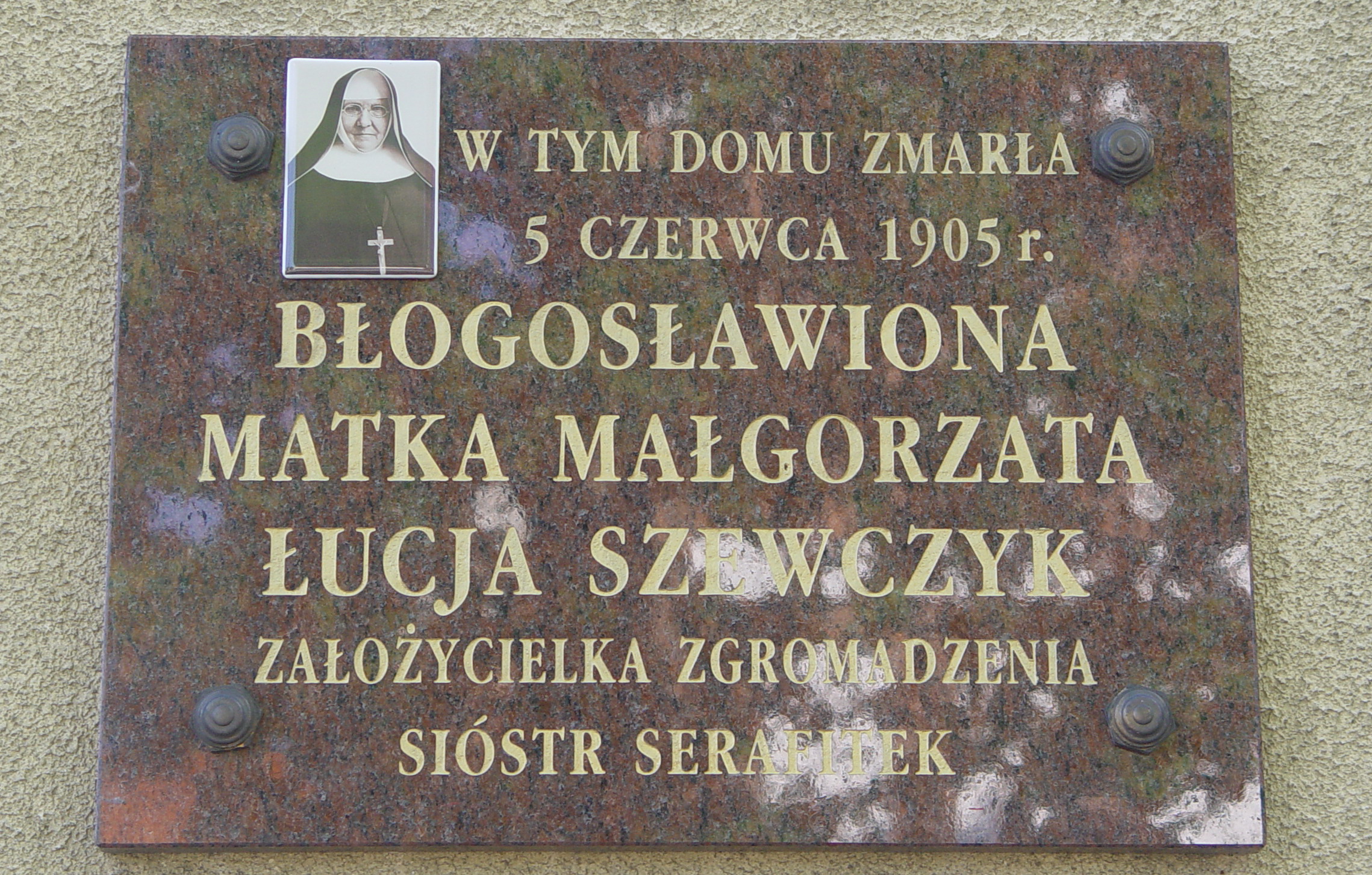
Nieszawa
- tablica pamiątkowa bł. Matki Małgorzaty, Łucji Szewczyk, założycielki
Zgromadzenia Sióstr Serafitek
Nieszawa
- plaque Blessed Mother Margaret Lucia Szewczyk, foundress of the Congregation
of the Sisters of Serafitki
Saint of the Day – 5 June
– Blessed Malgorzata Szewczyk (1828-1905).
Posted on June
5, 2020
Saint of the Day – 5 June
– Blessed Malgorzata Szewczyk (1828-1905). She was called “an
Angel of Kindness” – Religious and Founder of the Daughters of the
Sorrowful Mother of God, known commonly as the “Seraphic Sisters,” Apostle of
Mercy and Charity to the poor, needy, homeless, the sick and orphans – born
as Łucja Szewczyk in 1828 in Szepetówka, Khmelnytskyi, Ukraine and
died on 5 June 1905 in Nieszawa, Aleksandrów, Poland. Patronage –
the Seraphic Sisters.
Łucja Szewczyk was born
in 1828 in a noble family in Volhynia. Orphaned at an early age, she was
cared for by her half-sister. In the difficult situation of
partitions and persecution of the Church at the age of 20, she made her
tertiary profession in the Third Order of St Francis. She learned to love “love
who is not loved” from the poor man from Assisi.
At the age of 42,
together with another tertiary she went on a dangerous journey to the Holy
Land. She went all the way to Odessa on foot. There she
boarded a ship that sailed to her dream destination. In Jerusalem, she worked
at St Joseph’s Hospital alongside French nuns. During her
three-year stay in the land of Jesus, she surrendered her life to Our Lady of
Sorrows. Here, in the footsteps of the Lord, she discovered her
calling – she wished to live “for the glory of God and for the good of
suffering humanity.”
After returning from the
Holy Land and Loreto, in 1880, she went to Zakroczym near Warsaw.
On the advice of Father Honorat Koźmiński, who became her Spiritual
Director, the first step she took was to invite two poor and sick elderly women
to live in her apartment. According to her memoirs, she carried two
elderly women on her own back, whom she cared for. She took care of
them in secret, because charitable or church activities were forbidden,
according to the decrees of the Russian Emperor, who at the time ruled over
Poland. When taking her Franciscan vows, in addition to obedience,
poverty and chastity, she took a vow pledging mercy to the needy.
Father Honoratwrote: “Łucja felt a desire to devote herself to
the misery of the poor … She found paupers and devoted herself to them with a
strange passion…. Encouraged by her example, pious people began to join her. …
God blessed her.”
Later to accommodate the
growing number and better serve those in need, she decided to purchase a new
house with a garden. On the feast of Our Lady of Sorrows – on 8
April 1881, she founded a new Congregation, initially under the name of the Sisters
of the Poor. Father Honorat chose their Superior, Łucja, who took the
name Małgorzata. For the first 10 years, the sisters operated in the
Russian partition in a hidden way. Mother Małgorzata opened houses
in Warsaw and Częstochowa. In 1891 she went to Galicia, where there
was greater religious freedom. She founded a religious house in
Hałcnów. The Congregation adopted Franciscan habits and a new
name: Daughters of Our Lady of Sorrows.
A year later, the
construction of the Monastery in Oświęcim began, which became the Motherhouse
of the “Seraphic Sisters.” The sisters created an orphanage for
children, a shelter for sick and abandoned old men, a tailoring and embroidery
workshop for girls. There was also an orphanage in Żywiec, a
religious institution in Wielka Wieś (teaching), in Przemyśl (to serve in a
local hospital), Stryj and Frydrychowice (orphanages for children, a shelter
for the elderly), Siemiechów (teaching), Przemyślany (hospital ministry),
Drohobych (orphanage, orphanage), in Mogila near Kraków (teaching in elementary
school) and Jarosław (hospital ministry). Mother Małgorzata, by her
example, encouraged the sisters, by using the sick and neglected, to reach their
souls and to preserve the “holy virtue of poverty.”
In 1904, after
twenty-three years, Mother Małgorzata, “burdened with age and physical
weaknesses,” she resigned from the post of Superior General. She
went to Nieszawa, a branch which at that time was the only one operating within
the Russian partition. She became a “little” sister again.
She continued to serve the needy and, toward the end of her life, offered her
suffering for their intentions.
The inhabitants of
Nieszawa called their Mother Małgorzata “an Angel of Kindness.” She
spent the last months of her life “praying constantly.” She died on
5 June 1905. Crowds of people attended her funeral in 1905.
The “mother of the poor and orphaned” was beatified on 9 June 2013 in
Krakow, where the Motherhouse of the congregation she founded is currently
located, at 3 Łowiecka.
In 1931, her remains were
moved from Nieszawa to the cemetery chapel in Oświęcim and in 1951 – to the
local church which she, herself had built.
Translation of the Bl
Małgorzata’s Relics
Mother Małgorzata makes
us careful not to pass by a person who may not seem in need but suffers from
loneliness, rejection and ill health. It is not enough to secure someone
materially or give him professional help. One must first see a
person, a human being, because human suffering has a specific face.
Bl Małgorzata ‘s Order
now operates in places such as Belarus and France and in 2005 had 679 religious
in 76 houses. The Order received the Papal Decree of praise from
Pope Pius X on 12 February 1909 and full pontifical approval from Pope Pius XII
on 3 March 1953. At some stage the order was aggregated to the
Order of Friars Minor Capuchin.
Author: AnaStpaul
Passionate Catholic.
Being a Catholic is a way of life - a love affair "Religion must be like
the air we breathe..."- St John Bosco Prayer is what the world needs
combined with the example of our lives which testify to the Light of Christ.
This site, which is now using the Traditional Calendar, will mainly concentrate
on Daily Prayers, Novenas and the Memorials and Feast Days of our friends in
Heaven, the Saints who went before us and the great blessings the Church
provides in our Catholic Monthly Devotions. This Site is placed under the
Patronage of my many favourite Saints and especially, St Paul. "For the
Saints are sent to us by God as so many sermons. We do not use them, it is they
who move us and lead us, to where we had not expected to go.” Charles Cardinal
Journet (1891-1975) This site adheres to the pre-Vatican II Catholic Church and
all her teachings. . PLEASE ADVISE ME OF ANY GLARING TYPOS etc - In June 2021 I
lost 100% sight in my left eye and sometimes miss errors. Thank you and I pray all
those who visit here will be abundantly blessed. Pax et bonum! View All Posts
SOURCE : https://anastpaul.com/2020/06/05/saint-of-the-day-5-june-blessed-malgorzata-szewczyk-1828-1905/

Zdjęcie
zrobione podczas uroczystości beatyfikacji Zofii Czerskiej i Małgorzaty
Szewczyk, w Sanktuarium Bożego Miłosierdzia w Łagiewnikach.
Image
de Marguerite Szewczyk lors de sa béatification.
Beata Margherita
Lucia Szewczyk Fondatrice
Festa: 5 giugno
Szepetówka, Ucraina, 1828
- Nieszawa, Polonia, 5 giugno 1905
Margherita Lucia
Szewczyk, fu la fondatrice della Congregazione delle Figlie della Beata Maria
Vergine Addolorata, dette Serafitki, nel XIX secolo. Nata a Szepetówka
(Ucraina) nel 1828, era conosciuta comela "madre dei poveri e degli
orfani". Durante la sua intera esistenza, infatti, si dedicò
coraggiosamente e con profondo amore alle necessità degli altri, in particolare
dei bambini negli orfanotrofi, degli anziani nei ricoveri e dei malati negli
ospedali. Per due anni lavorò in Terra Santa dove si occupò della cura
disinteressata dei pellegrini malati. Gli ultimi mesi della sua vita li
trascorse nel convento di Nieszawa, in Polonia. Lì morì il 5 giugno 1905,
all'età di 77 anni. Papa Benedetto XVI in data 20 dicembre 2012 ha riconosciuto
un miracolo a lei attribuito ai fini della sua beatificazione, che è stata
celebrata il 9 giugno 2013.
Łucia Szewczyk nacque nel
1828 a Szepetówka (Ucraina) in una famiglia profondamente religiosa. Rimase
presto orfana e venne allevata da una sorellastra, che era già sposata, potendo
ricevere una buona istruzione. A vent’anni professò nel Terz ’Ordine
francescano, con voti privati, e cominciò ad assistere alcune anziane
bisognose, vivendo al meglio la sua vocazione. Avrebbe desiderato entrare in un
istituto, ma la situazione politica era complessa, la Chiesa perseguitata e gli
ordini religiosi soppressi. Poco più che quarant’enne intraprese un
pellegrinaggio in Terra Santa dove stette tre anni circa e, come volontaria,
servì a Gerusalemme i pellegrini nell’ospedale di San Giuseppe, insieme ad
alcune suore francesi. In quel servizio fece suo il proposito di consacrare
totalmente la vita a Dio nel servizio ai poveri. Fu poi pellegrina a Loreto e
anche presso la “Santa Casa” rinnovò il proposito. Si stabilì a Zakroczym (Varsavia),
che era sotto l’occupazione russa, e si dedicò con grande amore al servizio di
anziane ammalate. Provvidenziale fu l’incontro col beato Onorato Koźmiński il
quale riusciva a dar vita a numerose comunità religiose che operavano in
segretezza. Nelle sue mani Lucia emise la professione religiosa, prendendo il
nome di Maria Margherita. Insieme ad alcune compagne, nel 1881, con l’ausilio
del beato Onorato, diede origine a una nuova congregazione, vennero chiamate
Sorelle dei poveri. Dovettero operare in clandestinità per ben dieci anni, poi
si trasferirono in Galizia che all’epoca era sotto il Governo austriaco e dove
era concessa una certa libertà religiosa. Nominata superiora dal beato Onorato,
madre Margherita Lucia per oltre vent’anni guidò la congregazione a servizio
dei più poveri, mettendo però sempre al primo posto la vita spirituale.
L’Eucaristia fu la fonte del suo zelo apostolico, davanti al tabernacolo trovò
la forza per superare tanti ostacoli. Ebbe una profonda devozione per la
Vergine Addolorata, che scelse come Patrona dell’Istituto. Il motto era: «Tutto
per Gesù attraverso il Cuore Addolorato di Maria». Fu quindi aperta una casa ad
Hałcnów (Cracovia) dove, il 14 agosto 1891, dalle mani del cardinale
Dunajewski, le suore ricevettero l’abito religioso. Nacque così la
Congregazione delle Figlie della Beata Maria Vergine Addolorata, dette Suore
Serafiche. La casa generalizia fu aperta a Oświęcim, dove si edificò un grande
convento e una chiesa intitolata a Maria Vergine Addolorata. Si diede vita a
una scuola per le ragazze povere e ad alcuni laboratori di sartoria. Le suore
iniziarono a prestare il loro servizio anche negli ospedali. All’inizio del
1904 madre Margherita Lucia, ormai anziana, consigliata dal beato Onorato,
presentò le dimissioni dall’incarico di superiora generale. Trascorse gli
ultimi mesi di vita nella casa religiosa di Nieszawa dove morì il 5 giugno
1905.
Madre Szewczyk è stata beatificata a Cracovia il 9 giugno 2013, città in cui
sorge l’attuale Casa Generalizia dell’Istituto che, aggregato all'Ordine dei
Cappuccini, ricevette il 12 febbraio 1909 il Decreto Pontificio di lode e fu
approvato definitivamente dalla Santa Sede il 3 marzo 1953. La congregazione è
oggi presente anche in Svezia, Francia, Italia, Stati Uniti e Bielorussia, con
opere dedicate all’assistenza di anziani e infermi e all'istruzione giovanile.
Autore: Daniele Bolognini
SOURCE : https://www.santiebeati.it/dettaglio/95974
Margherita Lucia Szewczyk
(1828-1905)
Beatificazione:
- 09 giugno 2013
- Papa Francesco
Memoria Liturgica:
- 5 giugno
Religiosa, fondatrice
della Congregazione delle Figlie della Beata Maria Vergine Addolorata, nella
sua vita scelse di occuparsi dei bambini negli orfanotrofi, degli anziani nei
ricoveri e dei malati negli ospedali
Conosciuta come la “madre dei poveri e degli
orfani”
Łucja Szewczyk nacque
nel 1828 in una famiglia profondamente credente, a Szepetówka, nella regione di
Wołyń. Rimasta orfana dei genitori fu allevata dalla sorellastra sposata.
Ricevette una buona
formazione umana e cristiana, e a vent’anni fece la professione nel Terz
’ordine francescano e i voti religiosi privati. Non poté
realizzare la vocazione alla vita consacrata per la situazione
politica e religiosa allora molto difficile: la Chiesa era perseguitata,
gli ordini religiosi erano stati soppressi.
Nel 1870
intraprese un pellegrinaggio in Terra Santa, dove si fermò circa tre anni
e, come volontaria, servì i pellegrini poveri e malati nell’ospedale di
San Giuseppe a Gerusalemme. Lì maturò la decisione di donare tutta
la propria vita a Dio e di dedicarsi al servizio degli ultimi. A Loreto,
poi, rinnovò il proposito. Dopo aver lasciato la sua terra di origine si
stabilì a Zakroczym (Varsavia), anch’essa sotto l’occupazione russa,
dedicandosi con grande amore alla cura delle anziane povere e ammalate,
sotto la guida spirituale del beato Onorato Koźmiński. Nelle sue mani
emise la professione religiosa e il voto di misericordia, ricevendo il
nome religioso di Maria Margherita.
Nonostante gli ostacoli
posti dalle autorità zariste, il suo esempio venne seguito da altre persone con
le quali, nel 1881, sempre con l’aiuto del beato Onorato, diede origine a
una congregazione in clandestinità, denominata Sorelle dei poveri. Lo scopo
principale era portare aiuto spirituale e materiale ai più bisognosi, e
andre incontro alle loro necessità con il lavoro delle proprie mani, secondo il
motto: «Tutto per Gesù attraverso il Cuore Addolorato di Maria».
Dopo dieci anni di
attività clandestina, Margherita Lucia con alcune suore si trasferì in
Galizia, territorio allora sotto il Governo austriaco che concedeva una certa
libertà religiosa.
Successivamente ad
Hałcnów, nella diocesi di Cracovia, fondò una casa religiosa ove svolse
attività caritativa e apostolica. Qui il 14 agosto del 1891, dalle mani del
cardinale di Cracovia Albino Dunajewski, le suore ricevettero l’abito
religioso con la facoltà d’indossarlo in pubblico e la congregazione
prese il nome di Figlie della Beata Maria Vergine Addolorata – Suore Serafiche.
Ad Oświęcim, poi, costruì un ampio convento e una chiesa intitolata a
Maria Vergine Addolorata.
Nominata superiora dal
beato Onorato nel 1881, madre Margherita Lucia per oltre 20 anni guidò la
congregazione. Nonostante le molteplici attività, metteva sempre al primo
posto la vita spirituale, lasciando una mirabile testimonianza di come sia
possibile la sintesi tra contemplazione e azione, tra preghiera e
donazione di sé nella carità.
L’Eucaristia fu il centro
e la fonte del suo zelo apostolico, del fervore per la gloria di Dio
e dell’amore serafico. Davanti al tabernacolo attingeva la forza per
superare le difficoltà che incontrava, conservando l’ottimismo e la pace
interiore in ogni situazione. Brilla così la sua massima: «Che Dio sia in
tutto benedetto e lodato».
Nutrì profonda devozione
per la Vergine Addolorata, che scelse come Patrona e modello per
realizzare il carisma della congregazione, che le sue suore
continuano a incarnare da più di 130 anni, non soltanto in Polonia, ma
anche in altri Paesi: Svezia, Francia, Italia, Stati Uniti d’America, Ucraina e
Bielorussia. Con dedizione, a costo persino talvolta della vita, servono
coloro che hanno maggiormente bisogno: i poveri, gli anziani, gli
ammalati, i disabili e i bambini.
All’inizio del 1904,
madre Margherita Lucia per le sue precarie condizioni di salute e l’età
avanzata, su consiglio del beato Onorato presentò al cardinale di Cracovia Jan
Puzyna le dimissioni dall’incarico di superiora generale. Gli ultimi mesi di
vita li trascorse nella casa religiosa di Nieszawa, passando lunghe ore in
preghiera. Lì morì il 5 giugno 1905.
Benedetto XVI ne
riconobbe l’eroicità delle virtù il 19 dicembre 2011.
SOURCE : https://www.causesanti.va/it/santi-e-beati/margherita-lucia-szewczyk.html

The
beatification celebration in 2013.
Zdjęcie
zrobione podczas uroczystości beatyfikacji Zofii Czerskiej i Małgorzaty
Szewczyk, w Sanktuarium Bożego Miłosierdzia w Łagiewnikach.
Beata Margarida Lucia
Szewczyk, Fundadora - 5 de junho
A Beata viveu em tempos
difíceis e teve que agir muitas vezes de forma ilegal e secretamente. O que
pode parecer um ato de corajosa bravura digna de cavaleiros poloneses, pode ser
um obstáculo para aqueles que, em condições de conspiração, estão fazendo obras
para ajudar a sociedade e devem sobreviver no tempo da ocupação. Como uma
mulher sozinha pode realizar sua obra quando vivia sob a ameaça de deportação
para a Sibéria? Onde ela encontrou forças para confiar no Senhor e acreditar
que seu trabalho fazia sentido apesar do mundo pessimista ao seu redor?
O sofrimento foi presente
em sua vida desde o nascimento. Tendo nascido em Szepetówka (Ucrânia) em 1828,
em tenra infância perdeu seus pais e foi criada por sua meia-irmã mais velha.
Sentindo-se atraída pela vida religiosa, ela não podia realizar seu maior
sonho, porque naquela época todos os conventos haviam sido fechados pelos
russos. Aos 20 anos Lúcia tornou-se terceira da Ordem Franciscana: cuidava dos
pobres, dos doentes, preparava crianças para a primeira comunhão.
Em 1870, a fim de
fortalecer sua fé e seu amor a Deus, ela fez uma peregrinação à Terra Santa.
Ela seguiu a pé até Odessa, na Ucrânia, onde tomou o barco para chegar ao local
desejado. Chegando em Jerusalém, ela trabalhou no Hospital São José com freiras
francesas. Durante sua estadia de 3 anos na terra de Cristo, ela ofereceu sua
vida a Nossa Senhora das Dores.
De volta a Polônia, ela
desejava realizar algo pelos mais fracos. A forma concreta ela encontrou quando
conheceu o Padre Honório Koźmiński, graças ao qual Lúcia pode se tornar
religiosa e com sua ajuda fundar de uma nova ordem.
Em 1881, Lúcia fundou a
Congregação das Filhas da Bem-aventurada Virgem Maria das Dores chamada de
Ordem Seráfica, tomando então o nome de Irmã Margarida (Małgorzata). Ela
cuidava dos pobres em um abrigo em Varsóvia, e depois de um tempo comprou uma
casa em Zakroczym.
De acordo com relatos,
ela levou duas mulheres idosas nas costas até o andar superior, para cuidar
delas. Foi assim que nasceu a Congregação de Nossa Senhora das Dores. Madre
Margarida não parou por aí. Novas casas nasceram e a congregação cresceu apesar
da vigilância policial. O fim das inspeções foi para a congregação um sinal da
Providência, que velava pela nova obra e a salvava apesar do terror que
reinava.
Outras obras da
Congregação de Nossa Senhora das Dores começaram a aparecer na Galícia, para
onde Madre Margarida se mudou. Ela construiu novas casas para idosos, crianças
e órfãos, em condições mais favoráveis do que na Polônia. Ela fundou escolas
para meninas pobres, oficinas de costura, enquanto as Irmãs visitavam os doentes
e trabalhavam em hospitais. As "seráficas" (este é o nome mais
popular da congregação) oferecem suas intenções à Divina Providência, que nunca
as desapontou.
Após vinte anos de
compromisso, Madre Margarida nomeou uma nova superiora e voltou para as terras
da ocupação russa. Ela continuou a ajudar os necessitados e, no final de sua
vida, ofereceu seus sofrimentos por sua intenção. Os últimos meses de sua vida
transcorreram no convento de Nieszawa, cidade localizada no centro-norte da
Polônia.
Madre Margarida deixou
esta terra em 5 de junho de 1905, em Nieszawa. Uma multidão compareceu ao seu
funeral.
A "mãe dos pobres e
órfãos" foi beatificada dia 9 de abril de 2013 em Cracóvia, onde, na 3 Rue
Łowiecka, é atualmente a Casa Geral da Congregação por ela fundada.
Seu processo de
beatificação foi aberto na fase diocesana em 1993. A causa foi passada para a
fase romana em 1996 para ser examinada pela Congregação para as Causas dos
Santos. Em 20 de dezembro de 2012, o Papa Bento XVI reconheceu um milagre a ela
atribuído com a finalidade de sua beatificação, que foi celebrada em 9 de junho
de 2013.
A Missa e a cerimônia de
beatificação foram realizadas no Santuário da Divina Misericórdia em Lagiewniki
(Cracóvia, Polônia), na presença de 20.000 fiéis, sob a presidência do Cardeal
Ângelo Amato SDB, representando o Papa Francisco, e a direção do Cardeal
Stanislaw Dziwisz, Arcebispo metropolitano de Cracóvia e o Arcebispo Józef
Kowalczyk, Primaz da Polônia.
Na ocasião foram
beatificadas duas religiosas polonesas: Margarida Lúcia Szewczyk e Sofia Czeska
Maciejowska, que na metade do século XVII fundou a Congregação das Virgens da
Apresentação da Bem-aventurada Virgem Maria.
SOURCE : https://heroinasdacristandade.blogspot.com/2018/06/beata-margarida-lucia-szewczyk.html
Cresce la schiera dei Santi e Beati provenienti dalla Polonia : https://web.archive.org/web/20131015124604/http://www.zenit.org:80/it/articles/cresce-la-schiera-dei-santi-e-beati-provenienti-dalla-polonia


.jpg)
.jpg)