
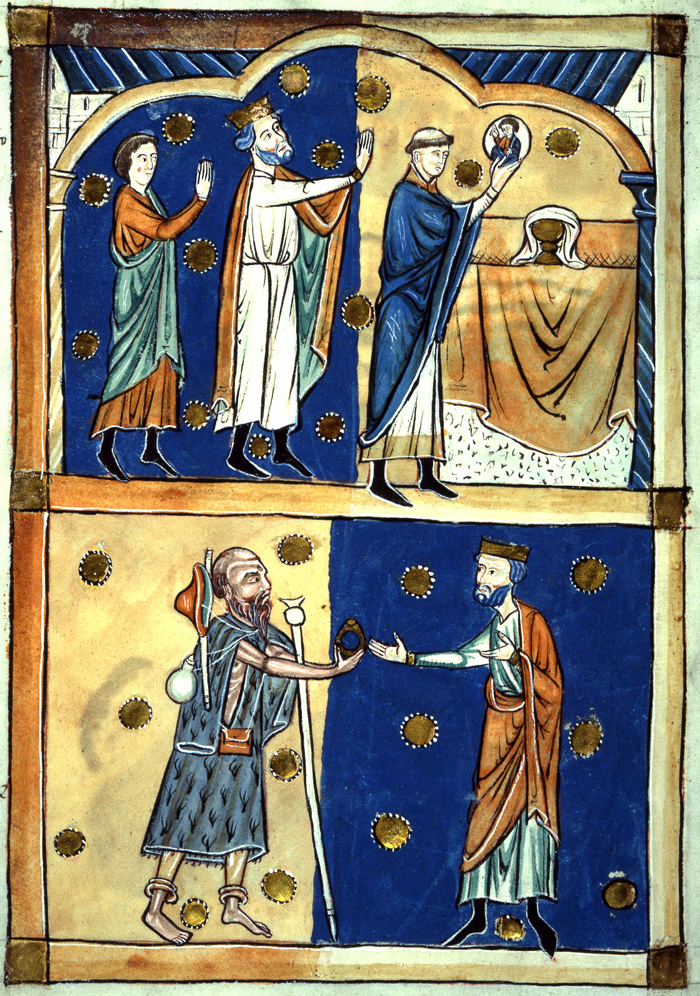
Miniature d'Édouard le Confesseur dans une généalogie royale du XIVe siècle.
Genealogical roll of the kings of England (1300-1308) - BL Royal MS 14 B VI, Edward the Confessor in miniature - http://www.bl.uk/manuscripts/FullDisplay.aspx?ref=Royal_MS_14_B_VI
Saint Edouard le
Confesseur
Roi d'Angleterre (+ 1066)
Il fut le dernier roi à
régner sur l'Angleterre avant la conquête de ce pays par les Normands de
Guillaume le Conquérant. Il avait horreur du sang versé. Son peuple le
chérissait. Aussi éminent par sa piété que par sa générosité, il sut se faire
l'ami des petites gens et fut vite l'objet d'un culte populaire, mais il
n'était pas fait pour être roi.
Après bien des querelles
pour le pouvoir en Angleterre, la situation n'était pas bien claire. Les Danois
avec le roi Canut régnaient sur l'est du pays, la Norvège et le Danemark.
Edmond "Côte de Fer" prince d'Angleterre avait été assassiné et sa
femme s'était réfugiée en Normandie. Edouard, son demi-frère, revint en
Angleterre et y rétablit la couronne par sa sagesse, son humilité et sa
compétence. Il cherchait toujours l'entente et la réconciliation là où c'était
possible. Les expéditions danoises échouèrent. Le royaume connut une période
moins troublée. Il épousa une princesse et vécurent toujours l'un et l'autre
dans l'union la plus intime et la plus parfaite. Pourtant les guerres
continuaient de se succéder entre Gallois et Anglais, entre les partisans
d'Harold et ceux de Malcolm en Ecosse, ce qui n'empêcha pas saint Edouard de
légiférer pour son royaume afin d'y établir meilleure justice et plus grande
attention aux pauvres. Il résidait à Londres et à Westminster où il fit
construire sa cathédrale. Il mourut quelque temps après sa dédicace.
Décédé le 5 janvier 1066,
il est aussi fêté le 13 octobre, date à laquelle son corps fut transféré dans
le tombeau prévu pour lui (1163).
Voir
sur le site (en anglais) de l'abbaye de Westminster.
- vidéo, webTV de la CEF:
le pape a offert à la reine Elisabeth en 2014 une reproduction d'un document
grâce auquel le culte de Saint Edouard le Confesseur s'est étendu à l'Eglise
universelle.
À Londres, en 1066, saint
Édouard le Confesseur, roi d'Angleterre, qui fut très aimé de son peuple à
cause de sa remarquable charité. Il assura la paix à son royaume et maintint
avec soin la communion avec le Siège romain.
Martyrologe romain
SOURCE : https://nominis.cef.fr/contenus/saint/372/Saint-Edouard-le-Confesseur.html
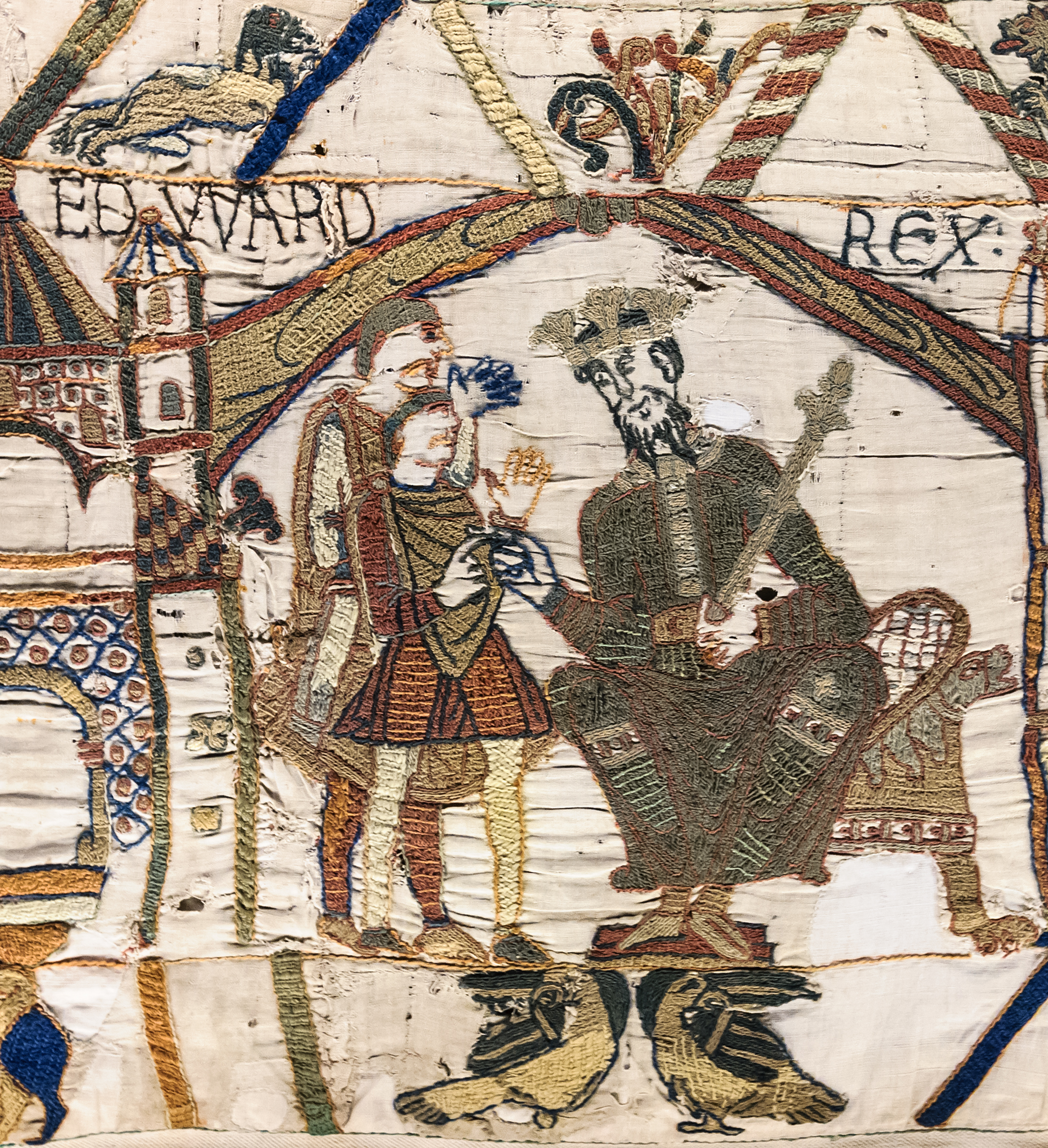
Tapisserie de Bayeux - Scène 1 : le roi Édouard le Confesseur reçoit son beau-frère Harold Godwinson dans son palais de Winchester et lui confie une mission.
Bayeux Tapestry - Scene 1 : King Edward the Confessor, enthroned, and Harold Godwinson at Winchester. Opening scene of the Bayeux Tapestry.
.jpg)
Bayeux
Tapestry - Scene 1 : King Edward the Confessor, enthroned, and Harold Godwinson at Winchester.
Opening scene of the Bayeux Tapestry.

Reconstruction
of the end of the Tapestry by Jan Messent, 1997. In 1997, the embroidery artist
Jan Messent completed a suggested reconstruction which depicted William
accepting the surrender of English nobles at Berkhamsted in Hertfordshire, and
his coronation at Westminster.
Such an ending would balance the beginning of the tapestry where King Edward is shown seated on his throne. It has been suggested that when the tapestry was displayed in Bayeux Cathedral, King Edward and King William would then appear opposite each other. SOURCE : http://anglo-saxon.archeurope.com/bayeux-tapestry-reconstruction-of-the-end/#:~:text=In%201997%2C%20the%20embroidery%20artist,shown%20seated%20on%20his%20throne
Saint Édouard III
Roi d'Angleterre
(1002-1066)
A la suite de grands
troubles qui désolaient l'Angleterre, le prince Édouard passa trente-cinq ans
de sa vie en exil. Nous avons peu de détails sur cette période de son histoire.
Doué d'un caractère doux, ami de la solitude, il se tenait de longues heures au
pied des autels, assistait aux offices divins et aimait beaucoup à s'entretenir
avec les religieux. Cependant toute l'Angleterre priait pour obtenir enfin la
paix avec un prince légitime. Dieu apparut à un pieux évêque et lui montra,
dans une vision, Édouard sacré roi par saint Pierre: "Voilà, lui dit-il,
celui qui sera roi par ma faveur; il sera chéri du Ciel, agréable aux hommes,
terrible à ses ennemis, aimable à ses sujets, très utile à l'Église de
Dieu."
A peine établi sur le
trône, Édouard s'appliqua à développer dans son âme toutes les vertus d'un
prince vraiment chrétien. Délivré, par l'aide de Dieu, de tous les ennemis du
dedans et du dehors, Édouard voulut accomplir le voeu qu'il avait fait d'aller
à Rome vénérer le tombeau du Prince des Apôtres; mais il dut céder aux
instances de ses sujets, qui avaient besoin de sa présence. Le Pape le délia de
son voeu; le roi, en revanche, fit construire une belle église en l'honneur de
saint Pierre.
Édouard est célèbre par
son désintéressement et par sa charité envers les pauvres. A trois reprises
différentes, il vit un des officiers de sa maison mettre la main aux trésors
royaux; la troisième fois, il se contenta de lui dire: "Prenez bien garde
qu'on ne vous y surprenne!" Le trésorier du palais se plaignant au roi de
ces vols, celui-ci, comme s'il n'eût rien su, lui dit: "Pourquoi vous
plaindre? Celui qui a pris cet argent en avait sans doute plus besoin que
nous."
Édouard avait promis de
ne jamais refuser l'aumône demandée au nom de Jean l'Évangéliste; un jour, un
pauvre lui ayant tendu la main au nom de cet Apôtre, le roi, dépourvu d'argent,
retira de sa main un riche anneau et le lui donna, pour ne pas le faire
attendre. Une autre fois, à la demande d'un pauvre infirme tout perclus, il le
prit sur ses épaules et le porta à l'église Saint-Pierre, où il fut guéri.
Saint Jean l'Évangéliste se montra un jour à deux pèlerins anglais qui se
mettaient en voyage pour les Lieux Saints; il leur remit un anneau en leur
disant: "Portez cet anneau au roi; c'est lui qui me l'a donné un jour que
je lui demandais l'aumône en habit de pèlerin; dites-lui que, dans six mois, je
le visiterai et le mènerai avec moi à la suite de l'Agneau sans tache."
Édouard mourut, en effet, six mois après.
Abbé L. Jaud, Vie
des Saints pour tous les jours de l'année, Tours, Mame, 1950
SOURCE : http://magnificat.ca/cal/fr/saints/saint_edouard_iii.html
.jpg)
LE XIII OCTOBRE. SAINT
EDOUARD LE CONFESSEUR, ROI D'ANGLETERRE.
Saluons le lis que porte
à son sommet l'antique branche des rois de Westsex ! Les temps ont
marché depuis ce sixième siècle où le païen Cerdik et les autres
chefs de bandes, venus comme lui de la mer du Nord, jonchaient de ruines le sol
de l'île des Saints. Leur mission de colère accomplie, les Anglo-Saxons furent
des instruments de grâce pour la terre qu'ils avaient conquise. Baptisés par
Rome, comme auparavant les Bretons qu'ils venaient de châtier, ils oublièrent
moins qu'eux d'où leur venait le salut ; une éclosion de sainteté nouvelle
marqua les complaisances que le ciel prenait derechef en Albion, pour la
fidélité dont princes et peuples de l'heptarchie ne cessèrent point d'entourer
le Siège de Pierre. L'an 800 du Seigneur, Egbert, descendant de Cerdik,
visitait en pèlerin la Ville éternelle, lorsqu'une députation des West-Saxons lui
offrit la couronne à ce tombeau du Prince des Apôtres au pied duquel, à l'heure
même, Charlemagne restaurait l'empire. Comme Egbert devait ramener sous un
sceptre unique la puissance des sept royaumes, ainsi Edouard, son dernier
successeur, en résume aujourd'hui les gloires saintes.
Neveu du Martyr du même
nom, Edouard s'est vu attribuer devant les hommes et devant Dieu le beau titre
de Confesseur. L'Eglise, dans le récit de sa vie, relève avant tout les vertus
qui lui méritèrent une appellation si glorieuse ; on ne doit pas négliger
toutefois de saluer dans son règne de vingt-quatre ans l'un des plus fortunés
que l'Angleterre ait connus. Alfred le Grand n'eut point de plus illustre
imitateur. Les Danois, si longtemps maîtres, soumis au dedans pour toujours, au
dehors contenus par la hère attitude du prince ; Macbeth, l'usurpateur du trône
d'Ecosse, vaincu dans une campagne que Shakespeare a immortalisée ; et
ces lois d'Edouard restées jusqu'à nos temps l'une des bases du droit
britannique ; et sa munificence pour toutes les nobles entreprises, dans le
même temps qu'il trouvait le secret de réduire les charges de son peuple : tout
montre assez que le plus suave parfum des vertus qui firent de lui l'intime de
Jean le bien-aimé, n'a rien d'incompatible en histoire avec la grandeur des
rois.
Voici les lignes que lui
consacre l'Eglise.
Edouard , surnommé
le Confesseur, était le neveu du saint roi Edouard le Martyr, et il fut le dernier
roi des Anglo-Saxons. Le Seigneur avait révélé dans une extase sa future
royauté à un saint personnage du nom de Brithuald. Cependant les Danois
qui dévastaient l'Angleterre le cherchant pour le faire mourir, il fut dès sa
dixième année contraint de s'exiler à la cour du duc de Normandie, son oncle.
Telles y parurent, au milieu de toutes les amorces des passions, l'intégrité de
sa vie, l'innocence de ses mœurs, qu'il faisait l'admiration générale. On
voyait dès lors éclater en lui l'extraordinaire piété qui l'attirait vers Dieu
et les choses divines. D'une nature très douce, sans nulle ambition de dominer,
on rapporte de lui cette parole : J'aime mieux ne régner jamais, que de
recouvrer mon royaume par la violence et l'effusion du sang.
Mais les tyrans qui
avaient enlevé la vie et le trône à ses frères étant morts, il fut rappelé dans
sa patrie et couronné au milieu des acclamations et de l'allégresse
universelle. Tous ses soins se tournèrent à effacer les traces des fureurs de
l'ennemi, en commençant par la religion et les églises, réparant les unes, en
élevant de nouvelles, les dotant de revenus et de privilèges ; car son premier
souci était de voir refleurir le culte de Dieu qui avait grandement souffert.
C'est l'affirmation de tous les auteurs que, contraint par les seigneurs de sa
cour au mariage, il y garda la virginité avec son épouse, vierge comme lui.
Tels étaient son amour et sa foi dans le Christ, qu'il mérita de le voir au
saint Sacrifice lui souriant et resplendissant d'un éclat divin. On l'appelait
communément le père des orphelins et des malheureux; car sa charité était si
grande, qu'on ne le voyait jamais plus heureux que lorsqu'il avait épuisé le
trésor royal pour les pauvres.
Il fut illustré du don de
prophétie, et reçut des lumières d'en haut touchant l'avenir de son pays ; fait
remarquable entre autres : il connut surnaturellement, à l'instant même qu'elle
arriva, la mort de Suénon, roi de Danemark, englouti dans les flots comme
il s'embarquait pour envahir l'Angleterre. Fervent dévot de saint Jean
l'Evangéliste, il avait la coutume de ne jamais refuser ce qu'on lui demandait
en son nom; comme donc, un jour, l'Apôtre lui-même, sous l'apparence d'un
mendiant en haillons, lui demandait l'aumône, le roi, n'ayant pas d'argent,
tira du doigt son anneau et l'offrit au Saint, qui peu après le retourna à
Edouard avec l'annonce de sa mort prochaine. Le roi, prescrivant à sa propre
intention des prières, mourut en effet très pieusement au jour prédit par
l'Evangéliste, à savoir les nones de janvier de l'an du salut mil soixante-six.
La gloire des miracles entoura sa tombe, et dans le siècle suivant, Alexandre
III l'inscrivit parmi les Saints.
Toutefois le culte de sa
mémoire dans l'Église universelle a été, quant à l'Office public, fixé par
Innocent XI au présent jour; c'est celui où son corps, levé du tombeau après
trente-six ans, fut trouvé sans corruption et répandant une suave odeur.
Vous représentez au Cycle
sacré le peuple en qui Grégoire le Grand prévit l'émule des Anges ; tant de
saints rois, d'illustres vierges, de grands évoques et de grands moines, qui
furent sa gloire, forment aujourd'hui votre cour brillante. Où sont les
insensés (1) pour lesquels, avec vous, votre race a semblé mourir ? C'est du
ciel que doit se juger l'histoire. Tandis que vous et les vôtres y régirez
toujours, jugeant les nations et dominant les peuples (2) ; les
dynasties de vos successeurs d'ici-bas, jalousant l'Eglise, appelant de longue
date le schisme et l'hérésie, se sont éteintes l'une après l'autre, stérilisées
par la colère de Dieu, dans ces vaines renommées dont le livre de vie ne garde
nulle trace. Combien meilleurs et plus durables apparaissent, ô Edouard,
les fruits de votre virginité sainte ! Apprenez-nous à voir dans le monde
présent la préparation d'un autre qui ne doit pas finir, à n'estimer les
événements humains qu'en raison de leurs résultats éternels. Des yeux de l'âme,
notre culte vous cherche et vous trouve en votre royale abbaye de Westminster;
c'est de là que par avance nous aimons à vous contempler montant dans la
gloire, au redoutable jour qui verra près de vous tant de fausses grandeurs manifester leur
honte et leur néant. Bénissez-nous, prosternés de cœur à ce tombeau dont
l'hérésie inquiète prétend vainement écarter la prière. Offrez à Dieu les
supplications qui montent de tous les points du monde, à cette heure, pour les
brebis errantes que la voix du pasteur rappelle si instamment en nos jours à
l'unique bercail (JOHAN. X, 16.).
1. Sap. III, 2. —
2. Ibid.
Dom Guéranger, L'Année
liturgique

Saint Édouard le Confesseur. Canterbury Cathedral
Choir screen of
Canterbury Cathedral ; Statues of
Saint Edward the Confessor in England

Canterbury
Cathedral: drie van de zes koningen aan de rechterkant van het doksaal:Eduard
de Belijder, Hendrik IV en Hendrik VI.
Canterbury
Cathedral: Sculptures of three of the six kings on the right hand side of the
choir screen (Pulptium). From left to right, Edward the Confessor, Henry IV,
Henry VI
Choir screen of
Canterbury Cathedral ; Statues of
Saint Edward the Confessor in England
Saint Edouard le
Confesseur
Mort le 5 janvier 1066 :
le 13 octobre est l’anniversaire de sa translation à l’abbaye de Westminster.
Canonisé en 1161, fête en 1680.
Leçon des Matines (avant
1960)
Quatrième leçon. Édouard
surnommé le Confesseur, était petit-fils de S. Édouard, roi et Martyr, et fut
le dernier souverain des Anglo-Saxons. Le Seigneur fit voir dans une extase, à
un homme de très grande sainteté nommé Brithuald, qu’Édouard serait roi. Il
n’avait que dix ans lorsque les Danois, qui alors dévastaient l’Angleterre le
cherchant pour le faire mourir, il fut contraint de s’exiler, et se réfugia
chez son oncle, le duc de Normandie. Là, au milieu des séductions du vice, il
fit paraître une telle intégrité de vie et une si grande innocence de mœurs,
qu’il fut un sujet d’admiration pour tous. On vit même alors éclater en lui une
piété admirable envers Dieu et pour les choses divines. Il était d’un caractère
très doux et sans aucune ambition du pouvoir ; on rapporte de lui cette parole,
qu’il aimait mieux se passer de la royauté, s’il ne pouvait l’obtenir sans
carnage et effusion de sang.
cinquième leçon. Après la
mort des tyrans qui avaient enlevé à ses frères la vie avec la couronne, il fut
rappelé dans sa patrie et mis en possession du trône, d’après les vœux et aux
applaudissements de tous. Il s’appliqua tout entier à faire disparaître les
traces de ressentiments et d’inimitiés. Commençant par les choses saintes et
par les églises, dont il réédifia ou restaura les unes, enrichit les autres de
revenus et de faveurs, il mit ses plus grands soins à relever et faire
refleurir la religion. Poussé par les grands du royaume à se marier, il
conserva avec son épouse la virginité dans l’état du mariage : les écrivains
sont d’accord pour l’affirmer. Il avait tant de foi et d’amour envers
Jésus-Christ que plusieurs fois, pendant la célébration des saints Mystères, il
mérita de le voir apparaître, le visage empreint de douceur divine. Partout on
l’appelait le père des orphelins et des indigents, et jamais il n’était plus
joyeux que lorsqu’il avait épuisé les trésors royaux à soulager les pauvres.
Sixième leçon. Doué du don de prophétie, il prévit surnaturellement plusieurs faits à venir concernant l’état de l’Angleterre, et, chose remarquable entre toutes, il connut par inspiration divine, au moment même où elle arrivait, la mort de Suénon, roi des Danois, qui fut submergé en s’embarquant pour aller faire invasion en Angleterre. Édouard eut pour saint Jean l’Évangéliste un culte particulier, et il avait coutume de ne rien refuser de ce qu’on sollicitait de lui en son nom. Saint Jean, sous les haillons d’un pauvre, lui ayant un jour demandé l’aumône, le roi, dépourvu d’argent, prit l’anneau qu’il portait au doigt et le lui donna ; mais peu de temps après, le saint Apôtre le lui rendit en l’avertissant de sa fin prochaine. Le roi demanda donc aussitôt des prières, et le jour des nones de janvier, jour qu’avait prédit l’Évangéliste, il mourut très saintement, l’an du Seigneur mil soixante-six. Des miracles ayant jeté sur lui de l’éclat, le Pape Alexandre III, au cours du siècle suivant, le mit au nombre des Saints. Innocent XI ordonna d’honorer sa mémoire dans toute l’Église par un Office public, et cela, au jour même où, trente-six ans après sa mort, son corps, dans la translation qu’on en fit, fut trouvé exempt de corruption et exhalant une suave odeur.
SOURCE : http://www.introibo.fr/13-10-St-Edouard-roi-et-confesseur

The
Great Seal of Edward the Confessor was furnished
with a counter seal, the design being nearly identical with that of the
obverse. 1911 Encyclopædia Britannica, Vol. 24, pg. 540.
Edward the Confessor was one of the
last Anglo-Saxon kings of England and is usually regarded as the last king of
the House of Wessex, ruling from 1042 to 1066.
Shën Eduard Rrëfimtari,
9 qershor 1042–1066. Lista
e monarkëve anglezë

Saint Édouard III
Roi d'Angleterre
(1002-1066)
Dans le Martyrologe Romain
la date de la mémoire est celle de la naissance au ciel (dies natalis) :
le 05 janvier. Localement, le jour de la mémoire est le 13
octobre, date à laquelle son corps fut transféré dans le tombeau prévu pour lui
(1163).
À la suite de grands
troubles qui désolaient l'Angleterre, le prince Édouard passa trente-cinq ans
de sa vie en exil. Nous avons peu de détails sur cette période de son histoire.
Doué d'un caractère doux, ami de la solitude, il se tenait de longues heures au
pied des autels, assistait aux offices divins et aimait beaucoup à s'entretenir
avec les religieux. Cependant toute l'Angleterre priait pour obtenir enfin la
paix avec un prince légitime. Dieu apparut à un pieux évêque et lui montra,
dans une vision, Édouard sacré roi par saint Pierre : « Voilà, lui
dit-Il, celui qui sera roi par ma faveur ; il sera chéri du Ciel, agréable
aux hommes, terrible à ses ennemis, aimable à ses sujets, très utile à l'Église
de Dieu. »
À peine établi sur le
trône, Édouard s'appliqua à développer dans son âme toutes les vertus d'un
prince vraiment chrétien. Délivré, par l'aide de Dieu, de tous les ennemis du
dedans et du dehors, Édouard voulut accomplir le vœu qu'il avait fait d'aller à
Rome vénérer le tombeau du prince des apôtres; mais il dut céder aux instances
de ses sujets, qui avaient besoin de sa présence. Le pape le délia de son vœu ;
le roi, en revanche, fit construire une belle église en l'honneur de saint
Pierre.
Édouard est célèbre par
son désintéressement et par sa charité envers les pauvres. À trois reprises
différentes, il vit un des officiers de sa maison mettre la main aux trésors
royaux ; la troisième fois, il se contenta de lui dire : « Prenez bien
garde qu'on ne vous y surprenne ! » Le trésorier du palais se plaignant au
roi de ces vols, celui-ci, comme s'il n'eût rien su, lui dit : « Pourquoi
vous plaindre? Celui qui a pris cet argent en avait sans doute plus besoin que
nous. »
Édouard avait promis de
ne jamais refuser l'aumône demandée au nom de Jean l'Évangéliste ; un jour, un
pauvre lui ayant tendu la main au nom de cet apôtre, le roi, dépourvu d'argent,
retira de sa main un riche anneau et le lui donna, pour ne pas le faire attendre.
Une autre fois, à la demande d'un pauvre infirme tout perclus, il le prit sur
ses épaules et le porta à l'église Saint-Pierre, où il fut guéri. Saint Jean
l'Évangéliste se montra un jour à deux pèlerins anglais qui se mettaient en
voyage pour les lieux saints ; il leur remit un anneau en leur disant : « Portez
cet anneau au roi ; c'est lui qui me l'a donné un jour que je lui demandais
l'aumône en habit de pèlerin ; dites-lui que, dans six mois, je le visiterai et
le mènerai avec moi à la suite de l'Agneau sans tache. »
Édouard meurt le 5
janvier 1066, en effet, six mois après.
SOURCE : https://levangileauquotidien.org/FR/display-saint/17790d63-8b20-48b7-a169-953cf85e9fbe

Anonimo
inglese o francese, Edoardo il confessore, Dittico Wilton, 1395-1399, National Gallery
Saint
Édouard le Confesseur. Panneau gauche du Wilton Diptych (c.1395-1399), tempera sur
panneau de chêne, 53 x 37, National Gallery, Central
London,
.jpg)
Richard II d’Angleterre avec ses saints
patrons (Edmund the Martyr, Édouard le Confesseur et Jean
Baptiste).
Panneau
gauche du Wilton Diptych (c.1395-1399), tempera sur
panneau de chêne, 53 x 37, National Gallery, Central
London,
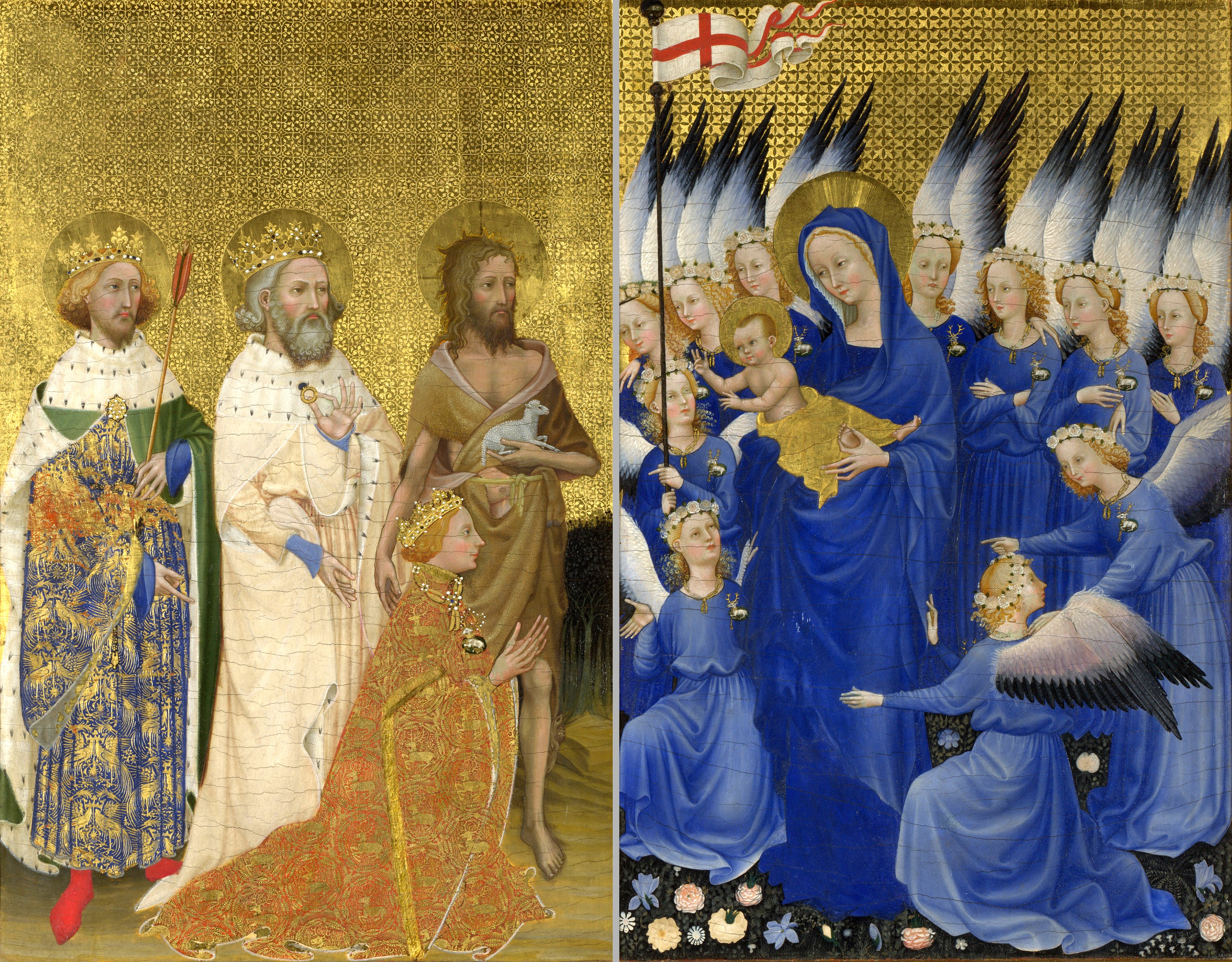
The Wilton
Diptych (c. 1395–99), tempera on oak wood, 53 x 37, National Gallery, Central
London, is a small portable diptych of
two hinged panels, painted on both sides. It is an extremely rare survival of a
late Medieval religious panel
painting from England. The diptych was painted for King Richard II of England who is depicted
kneeling before the Virgin and Child in what is known as
a votive portrait. The painting is an outstanding
example of the International Gothic style, and the
nationality of the unknown artist is probably French or English.
Saint Edouard le
Confesseur
Roi d'Angleterre (+ 1066)
Dieu donne souvent les
mauvais princes dans sa colère ; mais un bon roi est aussi le présent le plus
précieux qu’Il puisse faire à une nation.
" Un roi sage est le
soutien du peuple ", dit la Sagesse.
Et l’Ecclésiastique :
" Tel qu’est le juge
du peuple, tels sont les ministres ; tel qu’est le prince de la ville, tels
sont aussi les habitants. Le roi insensé perdra son peuple ; et les villes se
peupleront par la sagesse de ceux qui les gouvernent."
La vérité de ces maximes
est confirmée par le bonheur qui accompagna le règne d’Edouard le Confesseur.
Le roi Ethelred II eut
d’Elvige, sa première femme, Edmond, surnommé Côte de fer, qui lui succéda. Il
épousa depuis Emme, fille de Richard Ier, duc de Normandie ; il en eut deux
fils, Alfred et Edouard.
Le règne d’Ethelred fut
malheureux parce qu’il fut faible. Les Danois, qui depuis environ soixante ans
n’avaient point inquiété la Grande-Bretagne, vinrent l’attaquer de toutes
parts, et y commirent d’horribles ravages. Ethelred acheta d’eux une paix
honteuse, et ne rougit pas de s’engager à leur payer tous les ans un tribut
considérable, qui fut levé par une taxe à laquelle on donna le nom de Danegelt.
Swein, ou Suénon, roi des
Danois, fit la conquête de toute l’Angleterre peu de temps après, en 1015. Ce
prince mourut la même année, laissant un fils nommé Knut ou Canut (que l’on ne
confondra pas avec saint Canut III d’Odensée, roi de Danemark et martyr, petit
neveu de ce Canut, dont le père fut Suénon II, et que l’on fête au 19 janvier).
Ethelred, qui s’était
retiré en Normandie, revint en Angleterre, lorsqu’il eut été instruit de la
mort de Suénon, et il remonta sur le trône ; mais il mourut l’année suivante,
laissant encore la Mercie et quelques provinces de ses Etats entre les mains
des Danois.
Edmond Côte de fer se
présenta pour lui succéder. Malheureusement pour lui, il avait affaire à des
ennemis puissants, et il lui fallut livrer plusieurs batailles. Enfin, les
choses en vinrent au point que l’on proposa de part et d’autre un traité ; il
fut conclu près de Gloucester et l’on arrêta que Canut aurait le royaume de
Mercie, de Northumberland (ou Northumbrie) et d’Est-Anglie.
Peu de temps après,
Edmond fut indignement assassiné par un Danois qu’il avait comblé de bienfaits.
Le Danois Canut profita de cette occasion pour s’emparer de toute l’Angleterre.
Emme s’était retirée en
Normandie avec ses deux fils Alfred et Edouard. Canut la demanda en mariage au
duc Richard son frère, et elle lui fut accordée ; mais les deux jeunes princes
restèrent en Normandie, à la cour de Richard II et de ses successeurs, Richard
III, et Guillaume le Conquérant.
Canut régna dix-neuf ans
en Angleterre. Il fut magnifique, libéral, brave et zélé pour la religion ;
mais l’ambition ternit l’éclat de ses vertus. Il mourut en 1036, et ses États
furent partagés entre ses enfants : Suénon eut la Norvège, Harold l’Angleterre,
et Hardi-Cajut le Danemark.
Alfred et Edouard vinrent
de Normandie à Winchester pour voir Emme leur mère. Godwin, qui commandait dans
le West-Sex et qui avait contribué principalement à établir l’autorité d’Harold
dans cette partie de l’Angleterre, convint avec le roi d’attirer les deux
princes à la cour, dans le dessein de les faire périr secrètement. Emme, se
défiant de ce qui se tramait, craignit pour ses enfants ; elle se contenta
d’envoyer Alfred et garda Edouard près d’elle.
Godwin alla au devant
d’Alfred et se saisit de sa personne : il le fit d’abord enfermé au château de
Guilford d’où il fut conduit ensuite Ely. On lui creva les yeux, et on le mit
dans un monastère où il mourut peu de jours après.
Edouard retourna
promptement en Normandie et Emme se retira chez le comte de Flandres.
Après la mort d’Harold,
qui arriva en 1039, Hardi-Canut vint en Angleterre avec quarante vaisseaux et
s’y fit reconnaître roi. Le prince Edouard y vint aussi de Normandie, et il fut
reçu par le nouveau roi avec les égards qui lui étaient dus.
Il demanda vengeance de
la mort de son frère ; mais Godwin l’évita, en faisant serment qu’il n’avait
point eu part dans la triste fin d’Alfred.
Hardi-Canut, prince
vicieux, mourut subitement en 1041. Suénon, autre fils de Canut, existait
encore et régnait en Norvège ; mais les Anglais, las de vivre sous la
domination de rois étrangers et qui les traitaient avec indignité, résolurent
de rétablir sur le trône leurs princes légitimes. C’était l’unique moyen qu’ils
eussent de s’affranchir d’un joug pesant qu’ils portaient avec impatience
depuis plus de quarante ans. D’un autre côté, les vertus d’Edouard avaient
gagné les ennemis de sa famille, et tout le monde s’accordait à vouloir lui
rendre la couronne de ses pères. Léofrick, comte de Mercie, Siward, comte de
Northumberland, et Godwin, comte de Kent – qui était en même temps gouverneur
du royaume de West-Sex, les trois hommes les plus puissants de la nation,
furent les principaux auteurs de la révolution qui fit rentrer l’Angleterre
sous la domination de ses véritables maîtres.
Edouard avait été formé à
l’école de la vertu, et il en avait fait un bon usage. Il savait apprécier à
leur juste valeur les biens de ce monde visible. Jamais il n’avait cherché de
consolation ailleurs que dans la vertu et la religion. Élevé dans le palais du
duc de Normandie, il avait su se préserver de la corruption des vices qui
régnaient à la cour de ce prince ; il s’appliqua même à acquérir les vertus
contraires dès son enfance ; il était fidèle aux pratiques que prescrit le
christianisme, et il aimait à converser avec les personnes de piété. Toutes ses
actions étaient extérieures portaient l’empreinte de la modestie. Il parlait
peu, mais ce n’était ni par ignorance, ni par défaut de talent ; tous les
historiens s’accordent en effet à dire qu’il était d’une gravité et d’une
sagesse au-dessus de son âge. Son amour pour le silence venait donc d’un fond
d’humilité et de la crainte de perdre le recueillement ou de tomber dans les
fautes qu’entraîne ordinairement la démangeaison de parler. Son caractère était
composé de l’heureux assemblage de toutes les vertus chrétiennes et morales. On
distinguait cependant en lui une douceur admirable, qui avait sa source dans
une humilité profonde et dans une tendre charité qui embrassait tous les
hommes. Il était aisé de s’apercevoir qu’il était entièrement port à lui-même :
de là cette horreur pour l’ambition et pour tout ce qui pouvait flatter les
autres passions.
S’il monta sur le trône
de ses ancêtres, c’est qu’il y fut appelé par la volonté de Dieu ; aussi ne se
proposa-t-il d’autre but que de faire aimer la religion et de venir au secours
d’un peuple malheureux. Il était si éloigné de tout sentiment d’ambition, qu’il
déclara refuser la plus puissante monarchie, si, pour l’obtenir, il fallait
faire couler le sang d’un seul homme. Les ennemis mêmes de la famille royale se
réjouirent de le voir sur le trône. Tous se félicitaient d’avoir un saint pour
roi, surtout après tant de malheurs sous le poids desquels la nation avait gémi
; ils espéraient que les maux publics et particuliers allaient être réparés par
sa piété, sa justice et sa bienfaisance.
Edouard fut sacré le jour
de Pâques de l’année 1042, à l’âge d’environ 40 ans.
Malgré les circonstances
critiques dans lesquelles il monta sur le trône, son règne fut l’un des plus
heureux qu’on eut jamais vus. Les Danois même établis en Angleterre le
craignaient, l’aimaient et le respectaient. Quoiqu’ils se regardassent comme
maîtres du pays en vertu d’un prétendu droit de conquête, qu’ils en eussent été
maîtres pendant quarante ans, et qu’ils eussent rempli de leurs colonies les
royaumes de Northumberland, de Mercie et d’Est-Anglie, on ne les vit cependant
s’agiter nulle part, et depuis le temps dont nous parlons, il ne fut plus
question d’eux en Angleterre.
Pontan, un de leurs
historiens, calomnie les Anglais, lorsqu’il les accuse d’avoir massacré tous
les étrangers sous le règne d’Edouard. Une pareille entreprise aurait été aussi
dangereuse qu’injuste et barbare ; son exécution aurait sans doute fait plus d’éclat
qu’un massacre arrivé sous Ethelred II, dans un temps où les Danois étaient
moins puissants et moins nombreux.
Si l’on demande ce que
devinrent ceux dont il s’agit, nous répondrons que s’étant mêlés avec les
Anglais, ils ne firent plus bientôt qu’un même corps de peuple avec eux, à
l’exception de quelques uns d’entre eux qui retournaient de temps en temps dans
leur patrie.
Suénon, fils de Canut,
qui régnait en Norvège, équipa une flotte pour venir attaquer l’Angleterre.
Edouard mit son royaume en état de défense, et envoya en Danemark Gulinde,
nièce de Canut, de peur que si elle restait en Angleterre elle ne favorisât
secrètement l’invasion projetée.
Sur ces entrefaites, le
roi de Danemark, appelé aussi Suénon, fit une irruption dans la Norvège et fit
ainsi échouer l’expédition contre les Anglais. Peu de temps après, Suénon fut
détrôné par Magnus, fils d’Olaüs le Martyr, que Canut le Grand avait dépouillé
de la Norvège.
En 1046, des pirates
danois se présentèrent à Sandwich, puis sur les côtes d’Essex ; mais la
vigilance des principaux officiers d’Edouard les força de se retirer avant
qu’ils eussent pu ravager le pays, et ils n’osèrent plus reparaître par la
suite.
Edouard n’entreprit
qu’une seule guerre, qui eut pour objet de rétablir Malcolm, roi d’Ecosse, et
qui se termina par une victoire glorieuse. Il y eut quelques mouvements à
l’intérieur du royaume, mais ils furent apaisés avec autant de promptitude que
de facilité. On vit alors ce que peut un roi qui est véritablement le père de
ses sujets. Tous ceux qui approchaient de sa personne essayaient de régler leur
conduite sur ses exemples. On ne connaissait à sa cour ni l’ambition, ni l’amour
des richesses, ni aucune de ces passions qui, malheureusement, sont si communes
parmi les courtisans et qui préparent peu à peu la ruine des États. Edouard
paraissait uniquement occupé du soin de rendre ses peuples heureux et d’établir
une société qui favorisât le salut du plus grand nombre de ses sujets.
Il diminua les impôts et
chercha tous les moyens de ne laisser personne en souffrance. Comme il n’avait
point de passion à satisfaire, tous ses revenus étaient employés à récompenser
ceux qui le servaient fidèlement, à soulager les pauvres, à doter les églises
et les monastères. Il fit un grand nombre de fondations dont le but était de
faire chanter à perpétuité les louages de Notre Seigneur Jésus-Christ ; les
divers établissements qu’il fit ne furent jamais à la charge du peuple. Les
revenus de son domaine lui suffisaient pour toutes les bonnes œuvres qu’il
entreprenait. On ne connaissait point encore les taxes, ou l’on y avait recours
qu’en temps de guerre ou de nécessités pressantes. Le saint roi abolit le
Danegelt.
Les grands du royaume,
s’imaginant que le saint roi avait épuisé ses finances par ses aumônes,
levèrent une somme considérable sur leurs vassaux sans l’en prévenir, et la lui
apportèrent comme un don que lui faisaient ses peuples pour l’entretien de ses
troupes, et pour les autres frais occasionnés par les dépenses publiques.
Saint Edouard, ayant
appris ce qui s’était passé, remercia ses sujets de leur bonne volonté et
voulut que l’on rendît l’argent à tous ceux qui avaient contribué à former la
somme. Toute sa conduite annonçait qu’il était parfaitement maître de lui-même
; il avait une égalité d’âme qui ne se démentait dans aucune circonstance, sa
conversation était agréable mais toujours accompagnée d’une majesté qui
inspirait le respect. Il aimait, il est vrai, surtout parler à Dieu et des
choses spirituelles.
Edouard avait toujours fait
une estime particulière de la pureté, et il conserva cette vertu sur le trône
par l’amour de la prière, par la fuite des occasions, par la pratique de
l’humilité et de la mortification. Il veillait avec soin sur tous ses sens et
prenait les précautions les plus sages pour se garantir de la moindre
souillure. Cependant on désirait le voir marié, et il ne put résister aux
instances que la noblesse et le peuple lui faisaient à cet égard.
Godwin mit tout en œuvre
pour que le choix du prince se fixât sur Edithe, sa fille, qui joignait une
vertu éminente à toutes les qualités du corps, de du cœur et de l’esprit. Une
chose arrêtait le roi : c’est qu’il avait fait vœu de garder une chasteté
perpétuelle. Il se recommanda à Dieu, puis il découvrit à celle qu’on lui
proposait pour épouse l’engagement qu’il avait contracté. Edithe entra dans ses
vues, et ils convinrent l’un et l’autre qu’ils vivraient dans l’état du mariage
comme frère et sœur.
C’est par un effet de la
calomnie que quelques écrivains ont attribué la résolution de saint Edouard à
la haine qu’il aurait portée à Godwin. De tels sentiments sont incompatibles
avec la haute vertu dont il faisait profession ; il était d’ailleurs incapable
de traiter, avec l’injustice qu’on lui suppose, un princesse accomplie, à
laquelle il s’était uni par les liens les plus sacrés.
Godwin était le sujet le
plus riche et le plus puissant du royaume. Canut l’avait fait général de son
armée, l’avait créé comte de Kent et lui avait fait épouser sa belle-sœur. Il
fut ensuite grand trésorier de duc de West-Sex, c’est-à-dire général de toutes
les armées au midi de la Mercie. Dévoré par l’ambition, il viola souvent les
lois divines et humaines. Swein, le plus jeunes de ses fils, marcha sur ses
traces et porta même le libertinage jusqu’aux excès les plus coupables. Edouard
le punit par l’exil, mais il lui pardonna dans la suite. Godwin lui-même,
s’étant rendu coupables de plusieurs crimes, fut menacé de proscription s’il ne
paraissait pas devant le roi alors qu’il était à Gloucester.
Il refusa d’abord et prit
la fuite ; mais il revint bientôt avec une armée pour attaquer le roi. Quelques
uns de ses amis demandèrent sa grâce, et, quoique Edouard fut vainqueur, il lui
pardonna et le rétablit dans son premier état.
Pendant la rébellion de
Godwin, on crut nécessaire de renfermer Edithe dans un monastère de peur qu’on
ne ses servit de sa dignité pour exciter les vassaux et les amis de son père.
Malgré cette précaution, saint Edouard n’en était pas moins attaché à la reine,
qui de son côté l’aimait tendrement, et ils vécurent toujours l’un de l’autre
dans l’union la plus intime et la plus parfaite.
En 1053, le comte Godwin
fut emporté par une mort subite. Harold, son fils, lui succéda dans toutes ses
dignités. Il vainquit le roi des Gallois méridionaux, qui faisaient des
incursions dans les États de saint Edouard. Quelques années après, ce prince fut
fait prisonnier et mis à mort par le roi des Gallois septentrionaux. Celui-ci
envoya la tête de son ennemi à Harold, afin qu’il la présenta à Edouard. Le
saint roi, naturellement généreux, laissa ces provinces conquises par ses
troupes, dans le Pays de Galles, aux deux frères du prince qui venait de périr.
En 1058, saint Edouard
perdit le pieux et brave Siward. C’était lui qui, l’année précédente, avait
rétabli Malcolm III sur le trône d’Ecosse, dont l’usurpateur Macbeth l’avait
dépouillé. Dans cette guerre, Siward donna la plus haute idée de son courage.
Quelqu’un lui ayant appris que son fils avait été tué sur le champ de bataille,
il demanda s’il était blessé par devant ou par derrière ; et comme on lui
assura qu’il était tombé les armes à la main et qu’il était blessé par devant,
il se consola en disant qu’il avait toujours souhaiter ce genre de mort pour
lui et pour son fils. Sa vertu était d’autant plus solide qu’il était d’un
caractère bouillonnant et impétueux. Il fut enterré dans l’église Sainte-Marie
de York.
Quelques temps après,
Léofrick mourut aussi ? C’était un homme d’une piété éminente et d’une prudence
consommée. Les abondantes aumônes qu’il distribua aux pauvres, les églises
qu’il bâtit ou répara, le célèbre monastère qu’il fonda à Coventry, furent les
monuments publics de son zèle et de sa charité ; mais il joignit encore à ses
vertus une humilité profonde. Les privilèges qu’il accorda à la ville de
Coventry ont rendu son nom immortel dans le pays. Saint Edouard trouvait autant
de secours que de consolation dans les pieux et sages conseils de ce grand
homme. Algard, fils de Léofrick, fut fait duc de Mercie ; mais il ne se montra
pas digne de son père.
Saint Edouard le
Confesseur s’est surtout rendu célèbre par ses lois ? Il adopta ce qu’il y
avait d’utile dans celles que l’on suivait alors et fit les changements et les
additions qu’il crut nécessaires. Depuis, son code devint commun à toute
l’Angleterre sous le nom de Lois d’Edouard le Confesseur, titre par lequel
elles sont distinguées de celles que donnèrent les rois normands. Elles font
partie du droit britannique, excepté en quelques points qui depuis ont subi des
changements. Les peines infligées aux coupables par ces lois ne sont point
sévères, elles reconnaissent peu de crimes punissables de mort ; les amendes y
sont déterminées d’une manière fixe et ne dépendent point de la volonté des
juges. Elles pourvoient à la sûreté publique et assurent à chaque particulier
la propriété de ce qu’il possède. On était rarement dans le cas de sévir, parce
qu’on veillait à l’observation des lois et que la justice était bien
administrée.
L’écrivain Gurdon de
commenter :
" La sage
administration du pieux roi avait autant et même plus de pouvoir sur le peuple
que le texte des lois."
" Edouard le
Confesseur, ce grand et sage législateur, régnait dans le cœur de ses sujets.
L’amour, l’harmonie, l’intelligence qu’il y avait entre lui et l’assemblée
générale de la nation, produisirent un bonheur qui devint la mesure de celui
que le peuple désirait les siècles suivants. Les barons anglais et normands en
appelaient à la loi et au gouvernement d’Edouard."
On a vu peu de princes
qui se soient montrés aussi zélés qu’Edouard pour le bonheur de leurs peuples.
Il prenait spécialement les malheureux sous sa protection, faisait observer les
lois, et voulait que la justice fut rendue avec autant de d’intégrité que de
promptitude. Guillaume le Bâtard, duc de Normandie, fut lui-même le témoin des
vertus et de la sagesse de son parent, lorsqu’en 1052 il vint le voir en
Angleterre.
Saint Edouard, pendant
son exil en Normandie, avait fait vœu d’aller visiter le tombeau de saint
Pierre à Rome, si Dieu mettait fin aux malheurs de sa famille. Lorsqu’il se fut
solidement établi sur le trône, il prépara de riches offrandes pour l’autel du
Prince des Apôtres, et disposa tout pour se mettre en état de passer en Italie.
Ayant convoqué ensuite l’assemblée générale de la nation, il y déclara
l’engagement qu’il avait contracté, et fit sentir l’obligation où il était de
témoigner à Dieu sa reconnaissance. Il proposa ensuite les moyens qui lui
paraissaient les plus propres à faire fleurir le commerce et à maintenir la
paix ; il finit par mettre ses sujets sous la protection du Ciel. Les
principaux de l’assemblée alléguèrent les raisons les plus fortes pour le
dissuader de l’exécution de son dessein. Après avoir loué sa piété, ils lui
représentèrent avec larmes les dangers auxquels l’État serait exposé ; qu’on
aurait à craindre tout à la fois les ennemis du dedans et du dehors ; qu’ils
s’imaginaient déjà voir toutes les calamités tomber sur le royaume.
Edouard fut si touché de
leurs raisons et de leurs prières, qu’il promit, avant de rien entreprendre, de
consulter Léon IX, qui occupait alors la chaire de Pierre. Il envoya à Rome,
pour ce sujet, Aëlred, archevêque d’York, Herman, évêque de Winchester, et deux
abbés. Le Pape, persuadé que le roi ne pouvait quitter ses États sans exposer
son peuple à de grands dangers, le dispensa de l’accomplissement de son vœu ;
mais ce fut à condition qu’il distribuerait aux pauvres l’argent qu’il aurait
dépensé en venant à Rome, et qu’il bâtirait ou doterait un monastère en
l’honneur de saint Pierre.
Sébert, roi des
Est-Angles, avait fondé la cathédrale de Saint-Paul de Londres. Quelques
auteurs lui ont aussi attribué la fondation d’un monastère en l’honneur de
saint Pierre, qui était hors les murs et au couchant de la ville. On dit que ce
monastère occupait l’emplacement d’un ancien temple d’Apollon, qu’un
tremblement de terre avait renversé : mais le silence de saint Bède le
Vénérable fait croire qu’il fut bâti quelques années plus tard par quelque
particulier et qu’il était peu de chose dans son origine. On l’appelait Torney.
Des Danois l’ayant détruit, le roi Edgard le fit reconstruire. Saint Edouard,
après l’avoir réparé, y fit des donations considérables ; il voulut encore
qu’il fut honoré d’exemptions et de privilèges ; ce qu’il obtint du pape
Nicolas II en 1059. On lui donna le nom de Westminster, à cause de sa
situation. Il est devenu fort célèbre depuis par le sacre des rois et par la
sépulture des grands hommes du royaume. C’était l’abbaye la plus riche de toute
l’Angleterre lorsqu’on y détruisit tous les monastères.
Saint Edouard faisait sa
résidence à Winchester, à Windsor et à Londres, mais plus communément à Islip,
dans la province d’Oxford, où il était né. Anciennement les seigneurs du
royaume demeuraient à la campagne et vivaient parmi leurs vassaux ; ils
n’allaient à la cour qu’aux grandes fêtes et dans quelques occasions extraordinaires.
La fête de Noël était une des principales où la noblesse se rendait auprès du
roi. Saint Edouard la choisit pour la dédicace de la nouvelle église de
Westminster, afin que la cérémonie s’en fît avec plus de solennité. Les
personnes les plus qualifiées du royaume y assistèrent. Le roi signa l’acte de
fondation, et y fit insérer à la fin de terribles imprécations contre ceux qui
oseraient violer les privilèges de son monastère.
Plusieurs historiens
rapportent divers miracles opérés par saint Edouard. Un lépreux le pria
instamment de le porter sur son dos royal dans l’église de Saint-Pierre, disant
que ce saint avait promis qu’il guérirait par ce moyen. Ce bon prince se prêta
à cette cérémonie rebutante et obtint ainsi la guérison du malade. Par le signe
de la croix, il guérit une femme d’une tumeur chancreuse reconnue incurable.
Trois aveugles ont recouvré la vue en s’appliquant l’eau dont le prince s’était
servi pour se laver les mains. Saint Edouard mérita un jour de voir Notre
Seigneur Jésus-Christ pendant le saint sacrifice de la messe et de recevoir
visiblement sa bénédiction.
Après le Prince des
Apôtres, celui des saints auquel saint Edouard avait le plus de dévotion était
saint Jean l’Évangéliste, ce parfait modèle de la pureté et de la charité.
Voici à ce sujet une
histoire charmante.
Saint Edouard ne refusait
jamais l’aumône qu’on lui demandait au nom de saint Jean l’Évangéliste. Un
jour, n’ayant rien autre chose, il donne son anneau à un étranger qui le priait
au nom de saint Jean. Quelque temps après, deux Anglais qui allaient à Jérusalem
visiter le Saint Sépulcre, s’égarèrent un soir et se trouvèrent surpris par la
nuit. Comme ils ne savaient plus que devenir, un vénérable vieillard les remit
dans leur chemin, les conduisit à la ville, et leur dit qu’il était le disciple
bien-aimé de Notre Seigneur Jésus-Christ ; qu’il chérissait singulièrement leur
prince, Edouard, à cause de sa chasteté, et qu’il les assisterait aussi dans
tout leur voyage à sa considération. Ensuite il leur remit entre les mains la
bague que ce prince avait donnée au pauvre pèlerin pour l’amour de lui, les
assurant que c’était lui-même déguisé en pauvre qui l’avait reçue. Il les
chargea de la lui rapporter à leur retour en Angleterre et de dire au saint roi
qu’il viendrait le chercher au bout de six mois pour le mener avec lui à
l’Agneau sans tâche.
Le roi reçut de ces deux
pèlerins sa bague et les promesses de saint Jean en fondant en larmes et en
louant Dieu pour une faveur si insigne.
S’étant trouvé mal à la
cérémonie de dédicace de l’église de Westminster dont nous avons parlé plus
haut, il n’y assista pas moins jusqu’à la fin ; mais fut obligé de se mettre au
lit à l’issue de la cérémonie. Il ne pensa plus dès lors qu’à se préparer à la
mort par des actes fervents de piété et par la réception des sacrements ? Tous
les seigneurs de sa cour témoignaient la douleur la plus vive. Voyant la reine
fondre en larmes, saint Edouard lui dit :
" Ne pleurez plus ;
je ne mourrai point, mais je vivrai ; j’espère en quittant cette terre de mort
entrer dans la terre des vivants pour y jouir du bonheur des saints."
Il la recommanda ensuite à Harold et à d’autres seigneurs, et il leur déclara qu’elle était resté e vierge. Il expira tranquillement le 5 janvier 1066, dans la 64e année de son âge et après un règne de 23 ans.
SOURCE : http://jubilatedeo.centerblog.net/6125273-Saint-Edouard-le-Confesseur?ii=1
_%C3%89glise_Saint-Ouen_-_Int%C3%A9rieur_-_Vitrail_-_05.jpg)
Saint-Édouard. Baie 02 de l'église Saint-Ouen de Saint-Ouen-la-Rouërie (35).
_%C3%89glise_Saint-Ouen_-_Int%C3%A9rieur_-_Vitrail_-_08.jpg)
Saint-Édouard. Baie 02 de l'église Saint-Ouen de Saint-Ouen-la-Rouërie (35).
_%C3%89glise_Saint-Ouen_-_Int%C3%A9rieur_-_Vitrail_-_09.jpg)
Saint-Édouard.
Baie 02 de l'église Saint-Ouen de Saint-Ouen-la-Rouërie (35).
Qui est Saint Édouard le
Confesseur, honoré chaque 13 octobre ?
Chaque 13 octobre,
l’Église catholique célèbre Saint Édouard le Confesseur, une figure
majeure du christianisme médiéval et de l’histoire anglaise. Roi pieux, homme
de paix et souverain visionnaire, Édouard le Confesseur demeure l’un des rares
rois d’Angleterre canonisés. Sa vie, empreinte d’humilité et de dévotion,
marque une transition entre l’Angleterre anglo-saxonne et la conquête normande.
Mais qui était vraiment Saint Édouard ? Pourquoi le célèbre-t-on chaque 13
octobre ? Et que représente aujourd’hui son héritage spirituel ?
Un roi devenu saint :
origines et jeunesse d’Édouard
Les racines d’un futur
roi
Édouard naît vers 1003
à Islip, près d’Oxford, dans une Angleterre déchirée entre invasions vikings et
luttes internes. Il est le fils du roi Æthelred II le Malavisé et d’Emma
de Normandie, une princesse issue de la puissante famille ducale normande.
Cette double origine — anglo-saxonne par son père et normande par sa mère —
jouera un rôle clé dans l’histoire du royaume.
Dès son enfance, Édouard
est témoin du chaos politique : les Danois envahissent l’Angleterre et, en
1013, sa famille est contrainte à l’exil en Normandie. C’est là qu’il
grandit, entouré de moines, profondément influencé par la culture religieuse et
la piété du monde franc.
Un roi pieux au destin
inattendu
Le retour en Angleterre
En 1041, après la mort de
son demi-frère Harthacanute, Édouard est rappelé d’exil pour régner sur un
royaume divisé. Il est couronné roi d’Angleterre à Winchester en
1043, devenant ainsi Édouard III le Confesseur (à ne pas confondre
avec Édouard III de la dynastie Plantagenêt, au XIVᵉ siècle).
Un roi de paix dans un
monde de guerre
Contrairement à beaucoup
de ses prédécesseurs, Édouard n’est pas un guerrier. Son règne se distingue par
une recherche constante de paix et de justice. Il tente d’unifier le
royaume, apaise les tensions entre les nobles anglo-saxons et les Normands, et
s’efforce de gouverner selon les principes de la foi chrétienne.
Ses contemporains le
décrivent comme un homme doux, patient et profondément religieux. On
raconte qu’il passait de longues heures en prière et qu’il assistait
quotidiennement à la messe. Son règne marque une accalmie après des décennies
de violence.
LIRE AUSSI : Sainte Hedwige de Silésie : la sainte du 16 octobre
Le « Confesseur » : un
titre rare et symbolique
Que signifie “confesseur”
?
Dans la tradition
chrétienne, le mot “confesseur” ne désigne pas un prêtre qui reçoit
les confessions, mais un saint ayant confessé sa foi avec courage et
persévérance, sans pour autant avoir subi le martyre.
Ainsi, Édouard est appelé le Confesseur car il a témoigné de sa foi
tout au long de sa vie, en l’incarnant dans ses actions, son gouvernement et sa
charité, sans mourir pour elle.
Une piété exemplaire
Édouard vivait dans
une ascèse personnelle remarquable : il observait la chasteté, priait
souvent pour son peuple et se montrait généreux envers les pauvres. On rapporte
qu’il aurait guéri des malades en les touchant — un geste devenu plus tard la
tradition du “toucher royal” pratiquée par les rois d’Angleterre et
de France.
Cette réputation de
sainteté, déjà vivante de son vivant, ne fera que croître après sa mort.
Le mariage d’Édouard et
la question de sa succession
Un mariage sans héritier
En 1045, Édouard
épouse Édith, fille du puissant comte Godwin de Wessex. Ce mariage vise
avant tout à renforcer l’unité politique du royaume. Cependant, le couple
n’aura pas d’enfant. Certains chroniqueurs affirment qu’Édouard aurait choisi
de vivre dans la continence, fidèle à son vœu de chasteté. D’autres
estiment simplement que le couple est resté stérile.
Cette absence d’héritier
direct sera l’une des causes de la crise de succession qui suivra sa mort et
mènera à la célèbre bataille de Hastings (1066).
Westminster : le joyau
spirituel d’Édouard
Le rêve d’un roi
bâtisseur
Édouard le Confesseur est
aussi connu pour avoir fondé et fait reconstruire l’abbaye de Westminster,
sur les bords de la Tamise. Ce lieu, qu’il consacre à saint Pierre, devient un
symbole spirituel et politique majeur de l’Angleterre.
Achevée peu avant sa
mort, l’abbaye de Westminster est consacrée en décembre 1065. Elle servira
de nécropole royale et de lieu de couronnement pour presque
tous les souverains anglais depuis Guillaume le Conquérant jusqu’à nos jours.
Un héritage architectural
et religieux
L’édifice d’Édouard, bien
que reconstruit au XIIIᵉ siècle en style gothique, demeure au cœur de la
mémoire nationale britannique. Son tombeau, situé derrière le grand autel, est
devenu un lieu de pèlerinage dès le Moyen Âge.
LIRE
AUSSI : Qui est Saint Grégoire Ier et pourquoi le fête-t-on le 3
septembre ?
Mort et canonisation du
saint roi
La mort d’un roi paisible
Saint Édouard meurt
le 5 janvier 1066, peu après la dédicace de son abbaye. Selon la légende,
il aurait eu une vision céleste juste avant de rendre son dernier
souffle, promettant la paix éternelle à l’Angleterre.
Son décès ouvre une
période de bouleversements : Harold Godwinson, son beau-frère, lui succède,
mais son trône sera bientôt contesté par Guillaume le Conquérant, duc de
Normandie — un lointain parent d’Édouard par sa mère Emma.
Une canonisation
exceptionnelle
La canonisation
d’Édouard est prononcée en 1161 par le pape Alexandre III, près
d’un siècle après sa mort. Il devient ainsi le dernier roi d’Angleterre
canonisé. Son culte se répand rapidement, surtout à Westminster, où son tombeau
attire des milliers de pèlerins.
Le 13 octobre 1163,
sa dépouille est solennellement transférée dans un nouveau reliquaire
: cette date devient le jour officiel de sa fête.
Le culte de Saint Édouard
à travers les siècles
Un symbole de royauté
chrétienne
Pendant des siècles,
Saint Édouard incarne l’idéal du roi chrétien : juste, pacifique,
proche du peuple et fidèle à Dieu. Son modèle inspire de nombreux souverains
européens, y compris en France, où des églises lui sont dédiées.
Il devient le patron de la monarchie anglaise avant que saint Georges ne prenne cette place au XIVᵉ siècle.
Néanmoins, son souvenir reste profondément lié à Westminster : c’est là qu’ont
lieu les couronnements, dans la continuité de son œuvre spirituelle.
Un modèle de sainteté
royale
La figure de Saint
Édouard rappelle que la sainteté n’est pas réservée aux moines ou aux
martyrs : elle peut se vivre au cœur du pouvoir. En gouvernant selon la
foi, il montre qu’un roi peut être serviteur avant d’être maître.
Saint Édouard aujourd’hui
: une mémoire vivante
En Angleterre et dans le
monde
De nos jours, Saint
Édouard le Confesseur reste un patron secondaire de l’Angleterre. Son
effigie figure encore sur des blasons et vitraux. Des paroisses, des écoles et
des hôpitaux portent son nom, non seulement au Royaume-Uni, mais aussi au
Canada, en Irlande, et dans plusieurs pays du Commonwealth.
LIRE
AUSSI : 28 août : qui était vraiment Saint Augustin ?
En France
Bien que peu connu du
grand public français, Saint Édouard est célébré chaque 13 octobre dans
le calendrier liturgique. Dans certaines paroisses, notamment celles portant
son nom, des messes spéciales lui rendent hommage.
Sa fête rappelle le lien
historique et spirituel profond entre la France et l’Angleterre : sa mère étant
normande, il incarne cette double identité franco-anglaise qui a
marqué le Moyen Âge.
Les représentations et
symboles de Saint Édouard
Iconographie
Dans l’art chrétien, Édouard est souvent représenté vêtu d’un manteau royal, tenant un anneau ou un sceptre, et portant une couronne.
L’anneau symbolise la charité et la fidélité : selon une légende célèbre,
Édouard aurait donné son anneau à un mendiant, qui se révéla être saint
Jean l’Évangéliste déguisé.
Ses attributs
Couronne : sa
royauté juste et humble.
Anneau : symbole de
son amour pour Dieu et pour les pauvres.
Abbaye de Westminster :
son œuvre majeure et son sanctuaire éternel.
Que nous enseigne Saint
Édouard le Confesseur ?
Un modèle de gouvernance
spirituelle
Dans un monde souvent
dominé par la recherche du pouvoir, Édouard nous rappelle que la vraie
autorité vient du service. Il a exercé son rôle de roi avec humilité, préférant
la paix à la conquête, la justice à la richesse.
Un message toujours
actuel
En célébrant Saint
Édouard, l’Église et les fidèles se souviennent qu’il est possible d’être puissant
sans être orgueilleux, riche sans être avide, et roi sans cesser
d’être serviteur.
Son exemple invite
chacun, quelle que soit sa position, à vivre sa foi au quotidien avec intégrité
et compassion.
Conclusion
Saint Édouard le
Confesseur, roi d’Angleterre canonisé, demeure une figure inspirante de
l’histoire chrétienne. Son règne pacifique, sa dévotion, son sens du devoir et
sa charité ont marqué durablement l’âme anglaise.
Chaque 13 octobre, sa fête rappelle que la sainteté peut se manifester
dans la simplicité d’un cœur fidèle, même au sommet du pouvoir.
Son héritage, inscrit à
jamais dans la pierre de Westminster, continue d’unir foi et histoire,
rappelant que gouverner, c’est avant tout servir avec justice et amour.
SOURCE : https://www.hymne-nationale.com/saint-edouard-confesseur/

13
October (translation of his relics)
Profile
Born a prince,
the son of King Ethelred
II and Queen Emma;
half-brother to King Edmund
Ironside and King Hardicanute.
When his father was
unseated by Danish invasion.
Edward and his brother were sent to Denmark to
be quietly killed,
but the officer in charge took pity on the boys,
and sent them to Sweden,
and from there they went to the King of Hungary to
be raised and educated.
Edward’s interests were in things religious. When grown, the brothers moved to
Normandy and waited their chance to return to England.
In 1035 Edward
and Alfred tried to regain the crown of England,
but they were turned back, Alfred was killed,
and Edward returned to Normandy. He returned to England again
in 1042,
and was chosen king by
acclamation, ascending the throne on 3 April.
Edward gained a reputation as just and worthy of the kingship,
and the people of England supported
him.
During his reign Edward
repulsed invasion, helped restore the King of Scotland to
his throne, remitted unjust taxes, and was noted for his generosity to
the poor and
strangers, and for his piety and love of God.
He married to
satisfy his people, but he and the queen remained
chaste. Reported to have the power to heal by
touch. Built churches, including Westminster Abbey.
Born
1003 at
Islip, Oxford, England
5
January 1066 of
natural causes
interred at the Abbey of Saint Thomas
Becket
body incorrupt
England (former
tradition)
Westminster, England, archdiocese of
carrying a sick man
on his shoulders
curing a leper
elderly king offering
a ring or coin to Saint John who
is disguised as a beggar
Additional
Information
Book
of Saints, by Father Lawrence
George Lovasik, S.V.D.
Book
of Saints, by the Monks of
Ramsgate
Catholic
Encyclopedia, by G E Phillips
Eileen
Taylor: A Saint Who Was A King
Lives
of the Saints, by Father Alban
Butler
Lives
of the Saints, by Father Francis
Xavier Weninger
Lives
of the Saints, by Sabine Baring-Gould
Our
Island Saints, by Amy Steedman
Saints
of the Day, by Katherine Rabenstein
Short
Lives of the Saints, by Eleanor Cecilia Donnelly
True
Historical Stories for Catholic Children, by Josephine Portuondo
books
Our Sunday Visitor’s Encyclopedia of Saints
Oxford Dictionary of Saints, by David Hugh Farmer
Saints
and Their Attributes, by Helen Roeder
other
sites in english
BBC: Ancient Royal Tomb Discovered
Little
Pictorial Lives of the Saints
Professor Plinio Corrêa de Oliveira
images
video
webseiten
auf deutsch
sitios
en español
Martirologio Romano, 2001 edición
sites
en français
fonti
in italiano
websites
in nederlandse
nettsteder
i norsk
MLA
Citation
“Saint Edward the
Confessor“. CatholicSaints.Info. 28 February 2024. Web. 4 December 2025.
<https://catholicsaints.info/saint-edward-the-confessor/>
SOURCE : https://catholicsaints.info/saint-edward-the-confessor/

Book of Saints
– Edward the Confessor
Article
EDWARD THE CONFESSOR
(Saint) King (October 13) (11th century) The son of Ethelred the Unready, born
A.D. 1004, and brought up in exile on account of the Danish occupation of
England. He was crowned King of England on the restoration of the Anglo-Saxon
line (A.D. 1042). A just ruler and in all things considerate of the interests
of his subjects, he yet, by the continuous proofs of affection he gave to the
Normans, who had befriended him in his youth, stirred up a feeling against him
among the high nobles. Foremost among these was the powerful Earl Godwin, whose
daughter, Edith, he had espoused. But the Commoners were for “Good King
Edward,” and for centuries idolised his memory. His armies were successful in
wars with the Scots and Welsh, while peace was maintained within his own
dominions. His remission of the odious tax called the Dane-Gelt, and the wise
laws he enacted, endeared him to his people, and his care for the interests of
religion was of lasting good to them. He died January 5, A.D. 1060, and his
body was enshrined in Westminster Abbey, built or rather restored by him, where
it yet remains. His festival is kept by the Church on October 13, the
anniversary of the Translation at Westminster of his relics.
MLA
Citation
Monks of Ramsgate.
“Edward the Confessor”. Book of Saints, 1921. CatholicSaints.Info. 22
November 2012.
Web. 4 December 2025.
<http://catholicsaints.info/book-of-saints-edward-the-confessor/>
SOURCE : https://catholicsaints.info/book-of-saints-edward-the-confessor/

Matthew
Paris (1200–1259), Harold and Tostig fighting at King Edward's feast, Cambridge
University Library, MS Ee.3.59 p. 44, in Haskins Society Journal Volume 2, 1990
p. 245
Feastday: October 13
Edward the Confessor was
the son of King Ethelred III and his Norman wife, Emma, daughter of Duke Richard I
of Normandy. He was born at Islip, England, and sent to Normandy with
his mother in the year 1013 when the Danes under Sweyn and his son Canute invaded
England. Canute remained
in England and the year after Ethelred's death in 1016, married Emma, who had
returned to England, and became King of England. Edward remained in Normandy,
was brought up a Norman, and in 1042, on the death of his half-brother,
Hardicanute, son of Canute and
Emma, and largely through the support of the powerful Earl Godwin, he was
acclaimed king of England. In 1044, he married Godwin's daughter Edith. His
reign was a peaceful one characterized by his good rule
and remission of odious taxes, but also by the struggle, partly caused by his
natural inclination to favor the Normans, between Godwin and his Saxon
supporters and the Norman barons, including Robert of Jumieges, whom Edward had
brought with him when he returned to England and whom he named Archbishop of Canterbury in
1051. In the same year, Edward banished Godwin, who took refuge in Flanders but
returned the following year with a fleet ready to lead a rebellion. Armed
revolt was avoided when the two men met and settled their differences; among
them was the Archbishop of
Canterbury, which was resolved when Edward replaced Robert with Stigand, and
Robert returned to Normandy. Edward's difficulties continued after Godwin's
death in 1053 with Godwin's two sons: Harold who had his eye on the throne since
Edward was childless, and Tostig, Earl of Northumbria. Tostig was driven from
Northumbria by a revolt in 1065 and banished to Europe by
Edward, who named Harold his successor. After this Edward became more
interested in religious affairs and built St. Peter's Abbey at
Westminster, the site of the present Abbey, where he is buried. His piety
gained him the surname "the Confessor". He died in London on January
5, and he was canonized in 1161 by Pope Alexander III. His feast day is October 13.
SOURCE : https://www.catholic.org/saints/saint.php?saint_id=223

St
Edward the Confessor, detail. The statue of the Saint sits over the porch on
the south side of the RC church.
Edward the Confessor,
King (RM)
Born at Islip (near
Oxford) c. 1004; died January 5, 1066; canonized 1161. Edward was the son of
Ethelbert the Unready (or Ethelred III), king of the English, and Emma, sister
of Duke Richard I of Normandy. After Edward's father was defeated by the Danes
under Sweyn and his son Canute, Edward and his mother fled to Normandy in 1013.
Canute remained in England and in 1016 married Emma, who had returned to
England after Ethelred's death.
Edward spent his life
from age ten until 1041 in exile in Normandy, returning to England only when
Canute the Great died. The following year he succeeded to the throne with the
support of Earl Godwin, when his half-brother Hardicanute died.
His elder brother Alfred,
had been brutally murdered by Godwin, Earl of Kent. Nevertheless, for reasons
of state, in 1044 Edward married Godwin's daughter Edith, who turned out to be
the opposite of her father.
Edward's reign was
outwardly peaceful and he was a peace-loving man; but he had to contend with
the ambitious and powerful Godwin's opposition and other grave difficulties
(rivalry between Norman and Saxon courtiers), and he did so with a
determination that hardly supports the common picture of Edward as a tame and
ineffectual ruler. His was a good ruler and remitted odious taxes.
His anonymous
contemporary biographer gives a convincing portrait of him in his old age that
has obscured the evidence concerning his middle life. The chronicler as that
though physically tall and strong, Edward was unambitious and somewhat lacking
in energy, and it seems that his character and temperament were more suited to
the cloister than to the throne.
When Robert, the former
abbot of Jumieges whom he had brought with him from Normandy and had promoted
to the archbishop of Canterbury in 1051, declared Godwin to be an outlaw,
Edward did little to support him. Godwin took refuge in Flanders but returned
the following year with a fleet ready to lead a rebellion. Armed revolt was
avoided when the two men met and settled their differences; among them was the
archbishop Robert returned to France and was replaced by Stigand. After
Godwin's death in 1053, his son Tostig, earl of Northumbria, led an
unsuccessful revolt and was exiled by Edward to the continent. On the other
hand a chronicler speaks of 'the king's just and religious administration' and
to the people he was 'good King Edward.'
The belief that Edward
was a saint was supported by his general reputation for religious devotion and
for generosity to the poor and infirm, by the relation of a number of miracles
and, too, by the assertion that he and his wife were so ascetic as always to
have lived together as brother and sister. Edward and Edith were certainly
childless; but that this was due to life-long voluntary abstinence is unlikely
in the circumstances of their marriage and is not supported by adequate
evidence.
Frugal in his own life,
he was generous to monasteries and churches and gave freely to the poor. In
commutation of a vow that he had made to undertake a pilgrimage to Rome he
rebuilt the abbey at Westminster, where his relics still rest behind the high
altar.
According to legend, as
Saint Edward was returning from Mass one day, he gave his ring as an alms to
Saint John the Baptist, who appeared to him as a poor pilgrim. Twenty-four years
later, two English pilgrims returning from the Holy Land met another pilgrim
who introduced himself to them as Saint John. Through them he sent word to King
Edward that he thanked him for his alms. Through the pilgrims he promised the
king that in six months Edward should be with him forever. The message brought
joy to the royal heart.
As predicted, Saint
Edward died at Westminster on January 5, 1066. He was succeeded by Harold, the
son of Godwin, whose brief reign ended with the Battle of Hastings. "Weep
not," said Edward to his queen as he lay on his deathbed, "I shall
not die but shall live. Departing from the land of the dying, I hope to see the
good things of the Lord in the land of the living" (Appleton, Attwater,
Barlow, Encyclopedia, Tabor)
His emblem is a finger
ring, which he is sometimes shown handing to a pilgrim (Roeder). King Edward is
generally shown in royal robes, holding a sceptre surmounted with a dove
(Tabor).
SOURCE : http://www.saintpatrickdc.org/ss/1013.shtml
_%C3%89glise_Saint-Hilaire_-_Int%C3%A9rieur_-_Vitrail_-_04.jpg)
Saint
Édouard le Confesseur, Vitrail de l'église Saint-Hilaire à Cantenay-Épinard
(49).
St. Edward the Confessor
St. Edward the Confessor
was the son of King Ethelred III and his Norman wife, Emma, daughter of Duke
Richard I of Normandy. He was born at Islip, England, and sent to Normandy with
his mother in the year 1013 when the Danes under Sweyn and his son Canute invaded
England. Canute remained in England and the year after Ethelred’s death in
1016, married Emma, who had returned to England, and became King of England.
Edward remained in Normandy, was brought up a Norman, and in 1042, on the death
of his half-brother, Hardicanute, son of Canute and Emma, and largely through
the support of the powerful Earl Godwin, he was acclaimed king of England.
In 1044, he married
Godwin’s daughter Edith. His reign was a peaceful one characterized by his good
rule and remission of odious taxes, but also by the struggle, partly caused by
his natural inclination to favor the Normans, between Godwin and his Saxon
supporters and the Norman barons, including Robert of Jumieges, whom Edward had
brought with him when he returned to England and whom he named Archbishop of
Canterbury in 1051. In the same year, Edward banished Godwin, who took refuge
in Flanders but returned the following year with a fleet ready to lead a
rebellion.
Armed revolt was avoided
when the two men met and settled their differences; among them was the
Archbishop of Canterbury, which was resolved when Edward replaced Robert with
Stigand, and Robert returned to Normandy. Edward’s difficulties continued after
Godwin’s death in 1053 with Godwin’s two sons: Harold who had his eye on the
throne since Edward was childless, and Tostig, Earl of Northumbria. Tostig was
driven from Northumbria by a revolt in 1065 and banished to Europe by Edward,
who named Harold his successor.
After this Edward became more interested in religious affairs and built St. Peter’s Abbey at Westminster, the site of the present Abbey, where he is buried. His piety gained him the surname “the Confessor”. He died in London on January 5, and he was canonized in 1161 by Pope Alexander III. His feast day is October 13.
SOURCE : http://www.ucatholic.com/saints/saint-edward-the-confessor/
Edward was raised to the
throne of England at the age of forty years, twenty-seven of which he had
passed in exile. He and his wife, Edith, lived a saintly life.
Edward was generous to
the poor. He used to stand at his palace gate, speaking kindly to the poor
beggars and the sick who crowded about him.
No matter how busy he
was, he would be present at Mass daily. He built and enriched churches.
Westminster Abbey was his last work.
One of the noblemen at
his palace wrote: “Edward was a man by choice devoted to God, living the life
of an angel in ruling his kingdom, and therefore was directed by God. He was so
gentle that he would not say an unkind word even to the meanest person.”
Edward died on 5 January
1065. In 1611 he was canonized. His incorrupt body was taken to the shrine of
the Abbey by Saint Thomas Becket.
MLA
Citation
Father Lawrence
George Lovasik, S.V.D..
“Saint Edward”. Book of Saints. CatholicSaints.Info.
8 January 2019. Web. 4 December 2025.
<https://catholicsaints.info/book-of-saints-saint-edward/>
SOURCE : https://catholicsaints.info/book-of-saints-saint-edward/

Edward the Confessor, detail of the left light of the second south aisle window of All Saints Church, Danehill, East Sussex. It was made in 1892 by the Kempe studio.
All Saints Church, Danehill ; Stained-glass
windows by Charles Eamer Kempe ; Stained-glass windows in
East Sussex
Menology
of England and Wales – Saint Edward, King, Confessor, 1066
Saint Edward the
Confessor, whose memory is still dear and venerated throughout the nation which
he ruled, though born in England, was from early childhood brought up in
Normandy, but without a mother’s care and affection. All this she reserved for
the children of her second husband, King Canute, the Dane, the foreign occupant
of the throne of her first husband, the English King, Ethelred. Unexpectedly,
and against his will, Edward was called in middle age to assume the crown and
the burden of rule, for which his education and previous life had not prepared
him. By nature he was endowed with few of the qualities which go to make a
great sovereign. He indeed possessed a regal dignity and grace of manner and
person, set off by blitheness of temper and true kindliness of heart; he was a
model of purity of life and unaffected piety, chaste and mild. His power lay
not in strength, but essentially in goodness, and by virtue of this goodness he
was enabled without bloodshed to impose peace on warring factions, and keep in
check high and unscrupulous ambitions, to secure fidelity at home and respect
abroad. In the course of his reign of twenty-four years, the love of him
entered into the heart of his people. He became to them the good King Edward,
the peaceful King, whose memory was so dear, that to have trifled with his
simplicity and sincerity seemed in their eyes little less than a crime. His
contemporaries had no doubt that he possessed even in his lifetime the gift of
miracles, some of which are recorded by one who knew him well. The Abbey of
Westminster, which he refounded, and where his relics still repose, bears
testimony alike to Edward’s devotion to Saint Peter, Prince of the Apostles,
and to the veneration of the English people, until the change of religion, for
the Saint, who was the last of their Kings of the ancient race. He was
canonized by Pope Alexander III in the year 1161. The festival of Saint Edward
is now observed throughout the Church on the 13th October, the day of his
solemn translation.
MLA
Citation
Father Richard Stanton.
“Saint Edward, King, Confessor, 1066”. Menology of
England and Wales, 1887. CatholicSaints.Info.
15 April 2015. Web. 4 December 2025.
<https://catholicsaints.info/menology-of-england-and-wales-saint-edward-king-confessor-1066/>
SOURCE : https://catholicsaints.info/menology-of-england-and-wales-saint-edward-king-confessor-1066/
%2C_f.5_-_BL_Royal_MS_20_A_II.jpg)
Pierre
de Langtoft, ou Piers Langtoft (mort vers 1307), Sanctus
Edwardus (Edward the Confessor), standing with a sceptre and a book. British Library,
Chronicle
of England (c.1307-c.1327) - BL Royal MS 20 A II ; Edward the Confessor in
miniature
New
Catholic Dictionary – Saint Edward the Confessor
(1003–1066)
King of England.
He was the son of Ethelred II and Queen Emma and half-brother to Kings Edmund
Ironside and Hardicanute. Upon the election of Canute to the throne of England,
when Edward was only ten years of age, he went with his brother Alfred and his
mother to live at the court of his uncle, the duke of Normandy. There he
received a pious education, his chief interests being ecclesiastical. After
Canute’s death, 1035,
Edward and his brother were persuaded to return to England in
order to secure the crown. However, the expedition was not successful, for
Canute’s illegitimate son Harold had already seized control. Alfred was killed
and Edward was forced to return to Normandy. He returned to England again, 1042,
after the death of Hardicanute, and by popular acclaim, ascended the throne.
His reign was remarkable only as a period of peace. He was completely under the
control of Earl Godwin of Wessex, and in 1045,
married Edith, the earl’s daughter, but, having taken a vow of chastity, he did
not live with her. His only warlike enterprises were the repulsion of a Welsh
invasion and the assistance which he gave to Malcolm III of Scotland against
Macbeth. He remitted the burdensome tax, “Danegelt,” made wise and just laws,
and rebuilt Westminster Abbey. He was the first English king to “touch for the
king’s evil,” curing many of scrofulous taint. His mildness and sanctity made
him the idol of the people. Represented curing a leper, and carrying a sick man
on his shoulders. Canonized, 1161;
buried in Westminster Abbey. Feast,
Roman Calendar, 13
October; in England also 5
January.
MLA
Citation
“Saint Edward the Confessor”. New Catholic Dictionary. CatholicSaints.Info.
10 August 2017. Web. 4 December 2025.
<https://catholicsaints.info/new-catholic-dictionary-saint-edward-the-confessor/>
SOURCE : https://catholicsaints.info/new-catholic-dictionary-saint-edward-the-confessor/

A
sculpture of Edward the Confessor on the exterior of the library at
Stow-on-the-Wold in Gloucestershire.
St. Edward the Confessor
King of England,
born in 1003; died 5 January, 1066. He was the son of Ethelred II and Emma,
daughter of Duke Richard of Normandy, being thus half-brother to
King Edmund Ironside, Ethelred's son by his first wife, and to
King Hardicanute, Emma's son by her
second marriage with Canute. When hardly ten years old he was
sent with his brother Alfred into Normandy to
be brought up at the court of the duke his uncle, the Danes having
gained the mastery in England.
Thus he spent the best years of his life in exile, the crown having been
settled by Canute, with Emma's consent, upon his own offspring
by her. Early misfortune thus taught Edward the folly of ambition,
and he grew up in innocence, delighting chiefly in assisting
at Mass and the church offices, and in association
with religious, whilst not disdaining the pleasures of the chase, or
recreations suited to his station. Upon Canute's death in 1035
his illegitimate son, Harold,
seized the throne, Hardicanute being then in Denmark,
and Edward and his brother Alfred were persuaded to make an
attempt to gain the crown, which resulted in the cruel death
of Alfred who had fallen into Harold's hands,
whilst Edward was obliged to
return to Normandy. On Hardicanute's sudden death in
1042, Edward was called by acclamation to
the throne at the age of about forty, being welcomed even by
the Danish settlers
owing to his gentle saintly character. His reign was one of almost
unbroken peace, the threatened invasion of Canute's son, Sweyn
of Norway,
being averted by the opportune attack on him by Sweyn of Denmark;
and the internal difficulties occasioned by the ambition of
Earl Godwin and his sons being settled without bloodshed by Edward's own
gentleness and prudence.
He undertook no wars except
to repel an inroad of the Welsh,
and to assist Malcolm III of Scotland against Macbeth,
the usurper of his throne. Being devoid of personal ambition, Edward's one
aim was the welfare of his people. He remitted the odious "Danegelt",
which had needlessly continued to be levied; and though profuse in alms to
the poor and for religious purposes, he made his own royal
patrimony suffice without imposing taxes. Such was
the contentment caused by "the good St.
Edward's laws", that their enactment was repeatedly demanded by later
generations, when they felt themselves oppressed.
Yielding to the entreaty of his nobles, he accepted as his consort the virtuous Editha,
Earl Godwin's daughter. Having, however, made a vow of chastity,
he first required her agreement to live with him only as a sister. As he could
not leave his kingdom without injury to his people, the making of
a pilgrimage to St.
Peter's tomb,
to which he had bound himself, was commuted by the pope into
the rebuilding at Westminster of St.
Peter's abbey,
the dedication of which took place but a week before his death, and
in which he was buried. St. Edward was the first King of England to
touch for the "king's evil", many sufferers from the disease
were cured by him. He was canonized by Alexander
III in 1161. His feast is
kept on the 13th of October, his incorrupt body having
been solemnly translated on that day in 1163 by St.
Thomas of Canterbury in the presence of King Henry II.
Phillips, George. "St. Edward the Confessor." The Catholic
Encyclopedia. Vol. 5. New York: Robert Appleton
Company, 1909. 14 Oct.
2015 <http://www.newadvent.org/cathen/05322a.htm>.
Transcription. This
article was transcribed for New Advent by Ann Waterman.
Ecclesiastical
approbation. Nihil Obstat. May 1, 1909. Remy Lafort, Censor. Imprimatur. +John
M. Farley, Archbishop of New York.
Copyright © 2020 by Kevin
Knight. Dedicated to the Immaculate Heart of Mary.
SOURCE : http://www.newadvent.org/cathen/05322a.htm

Shrine of Edward the Confessor. Edward the Confessor Chapel Westminster Abbey London England

Shrine of Edward the Confessor.
Edward the Confessor Chapel Westminster Abbey London England
October 13
St. Edward, King and
Confessor
From William of
Malmesbury, (de Reg. Angl. 2, c. 13,) whom Sir H. Saville calls the best
historian of our nation, and who wrote in 1140; Matthew of Westminster, or
whoever compiled the Flores Hist. Angl. from Matthew Paris, &c.; the life
of St. Edward, C. written by St. Aëlred, abbot of Rieval, who died in 1166, of
which work the most complete and accurate edition is that of Roger Twysden,
(inter 10 Angl. Scriptores, Londini, an. 1652, t. 1, p. 370.) An accurate
account of his death is given by Sulcard, a monk of Westminster, in the reign
of the Conqueror, who wrote, by order of his abbot, Vitalis, a short history,
(De Constructione Westmonasterii,) of which two beautiful MS. copies were lent
me from the Cotton Library, and the archives of Westminster. See also
Ingulphus, published by Gale, Brompton by Twysden, Knyghton, ibid. Hoveden and
Matt. Paris, ad an. 1066. Harpsfield, Sæc. xi. c. 3. Likewise the historians of
Normandy, Odericus Vitalis in Hist. Normann. Gulielmus Pictav. de Gestis Gul.
Ducis, &c. The Letter of Innocent II. on the Canoniz. of St. Edw. an. 1138,
ap. Wilk. Conc. Br. t. 1, p. 419; the bull of Alexander III. ibid. p. 434; that
of Greg. IX. in 1227; and Rymer’s Fœdera, t. 1, p. 297.
A.D. 1066.
GOD often gives bad
princes in his wrath; but in a good king he bestoweth a great public blessing
on a nation. A wise king is the upholding of his people. 1 As
the judge of the people is himself, so are his officers: and what manner of man
the ruler of the city is, such also are they that dwell therein. An unwise king
destroyeth his people; but through the prudence of them that are in authority,
the city shall be inhabited. 2 The
happiness of the reign of St. Edward the Confessor is itself a panegyric of his
virtue. This prince was son of King Ethelred II. who left by Elgiva, his first
wife, Edmund Ironside, who was his successor; and, by his second wife, Emma,
daughter to Richard I. and sister to Richard II. the third and fourth Dukes of
Normandy, he had Alfred and Edward. In his unhappy and weak reign, the Danes,
who from the time of King Athelstan had, for about sixty years, left this
island unmolested, committed in all parts of it most horrible ravages. To
redeem the country from these vexations, Ethelred engaged to pay them a tax,
called Danegelt, of forty thousand pounds a-year, which was raised at the rate
of twelve pence upon each hide of land, or as much as could be tilled with one
plough in a year. Swein or Sweno, King of the Danes, conquered all England soon
after, in 1015; but died the same year, leaving here his son Knute or Canute.
Ethelred, who had fled into Normandy, returned upon his death and recovered his
kingdom; but, dying in 1016, left Mercia and some other parts in the hands of
the Danes. Edmund Ironside, after several battles, came to an agreement, which
was concluded in the isle Alney, in the Severn, near Gloucester, by which he
consented to divide the kingdom with Canute, yielding up to him the kingdoms of
Mercia, Northumberland, and the East-Angles. Shortly after, he was
treacherously assassinated by the contrivance of Edric Strean, a Dane, Count of
Mercia, on whom he had bestowed the greatest favours, and by whom he had been
before often betrayed.
Canute took this
opportunity to seize the whole kingdom, and ordered the late king’s two infant
sons, Edmund and Edward, to be conveyed into Denmark, there to be privately
made away with. The officer who conducted them was moved to compassion, and
carried them into Sweden, where the king sent them to his cousin Solomon, king
of Hungary. When they were grown up, Solomon gave in marriage to Edmund one of
his own daughters, and to Edward his sister-in-law Agatha. Emma was retired
with her two sons, Alfred and Edward, into Normandy. Canute demanded her of her
brother, Duke Richard, in marriage, and his request was agreed to. But the two
princes remained in Normandy, where Richard II. was succeeded, 1026, by his son
Richard III. He reigned only one year, and by his death his brother Robert
became duke of Normandy, who, at his death left no other issue than a bastard,
known afterwards by the name of William the Conqueror. Canute reigned in
England nineteen years, and was magnificent, liberal, valiant, and religious,
though no virtues could excuse his ambition. Dying in 1036, he left Norway to
his eldest son, Sweno, England to his son Harold, and Denmark to his son
Hardicanute, whom he had by Emma. The two Saxon princes, Alfred and Edward,
came over from Normandy to see their mother at Winchester. Godwin, duke or
general of West-Sex, who had been the chief instrument in establishing Harold’s
interest in that part of England, agreed with the king that the two princes
should be invited to court, in order to be secretly made away with. Emma was
startled at this message, which was sent to them at Winchester, and was
apprehensive of a snare; she therefore contrived to send only Alfred, and, upon
some pretences, to keep Edward with her. Godwin met Alfred at Guilford, where
the young prince was seized, put first into the castle, and thence conducted to
Ely, where his eyes were pulled out: he was shut up in a monastery, and died a
few days after. Edward made haste back into Normandy, and Emma retired to the
Count of Flanders, and lived at Bruges. King Harold dying in winter, 1039, her
son Hardicanute landed in England with forty Danish ships, and was acknowledged
king. Prince Edward came from Normandy, and was received by him with honour. At
his request Count Godwin was brought to his trial for the murder of Prince
Alfred; but was acquitted upon his making oath that he was not privy to his
death. Hardicanute, an unworthy prince, died suddenly at the marriage
entertainment of a certain Dane at Lambeth, in the third year of his reign,
1041. Sweno, another son of Canutus, was still living, and king of Norway; but
the oppressions which the English had groaned under for many years, inspired
them with a vigorous resolution of restoring the crown to their own princes.
The calamities of the most furious war, and the want of power to make any
resistance, had obliged them to bear the Danish yoke forty-four years.
But they were harassed beyond expression under three or rather four Danish
kings (including Sweno) with continual cruel exactions; and so great was the
tyranny of these masters, that if any Englishman met any Dane upon a bridge, he
durst not go over it till the Dane had passed first; and whoever did not
respectfully salute a Dane on the road, was severely punished on the spot. On
the other side, the virtues of Prince Edward silenced even the enemies of his
family, and the voice of the whole kingdom was unanimous in demanding that he
should be placed upon the throne of his ancestors. Leofric, earl of Mercia,
Siward, earl of Northumberland, and Godwin, earl of Kent and governor of the
whole kingdom of West-Sex, were the leading men in this resolution, and were
the most powerful persons in the nation. 3
St. Edward was nursed in
the wholesome school of adversity, the mistress of all virtues to those who
make a right use of it. The heart of the young prince seemed almost naturally
weaned from the world by an early feeling experience of its falsehood,
deceitfulness, and miseries. This also led him to seek comfort in the only true
channel; which is virtue and the divine love. Though educated in the palace of
the Duke of Normandy, he was always an enemy to vanity, pleasure, and pride; so
diligently did he fortify his mind against the contagion of a court in which
these vices reigned. The arms by which he triumphed over them were, at the same
time, the means by which he grounded his heart in the rooted habits of the
contrary virtues. From his infancy it was his delight to pray much, to assist
as often as possible at the divine sacrifice of the altar, to visit churches
and monasteries, and converse with the most holy and perfect among the servants
of God. He was modest in his comportment, and sparing in his words; not out of
ignorance or slowness of parts, for all historians assure us, that in wisdom
and gravity he much surpassed his years; but out of sincere humility, love of
recollection, and just apprehension of the snares and dangers of too great
forwardness and volubility of speech. His character from his youth was the
aggregate of all Christian and moral virtues; but that which particularly
distinguished him was an incomparable mildness and sweetness of
temper; the fruit of the most sincere humility, and tender universal charity.
By this test of genuine virtue, and mark of the spirit of our divine Redeemer,
it manifestly appeared how perfectly the saint was dead to himself. Ambition
could find no place in a heart crucified to the world, and to all the false
interests of the passions. He had learned in the school of Christ how empty,
how false all worldly honours are, how heavy their burden is, and how grievous
the charge that attends them. If, where a person has no other aim in them but
what is directed to the honour of God, and the utility of others, they may be
lawful and holy; it is a certain principle in morality that it is a most fatal
and criminal passion for a person to rest in them, or to love them for
themselves, or to seek or please himself in them. A man must be grounded in
perfect humility, and has need of an extraordinary strength and grace to bear the
weight of honour, and not suffer his heart to cleave to it. The height of
dignity exposes souls to great dangers, as the highest trees are assailed by
the greatest storms. So that a much greater virtue is required to command than
to obey; and a Christian ought to learn from the example which Christ has set
us, that it is often the safest way to endeavour to fly such posts; and that no
one ought to receive a place of honour, without being well assured that it is
the will of God that calls him to it, and without being resolved to live upon
that pinnacle always in fear and trembling, by having constantly the weight of
his obligations, and the fear of the divine judgments before his eyes. Those
who open a door to any secret ambition in their hearts, are justly abandoned by
God, who says of them: The kings have reigned, but not by me: they have
been princes, and I knew it not. 4 St.
Edward was called to the crown by the right door, and placed by God on the
throne of his ancestors, and had no views but to the advancement of the divine
honour, and to the comfort and relief of a distressed people. So far was he
from the least spark of ambition, that he declared he would by no means accept
the greatest monarchy, if it were to cost the blood of a single man. The very
enemies of the royal family rejoiced to see Edward seated on the throne. All
were most desirous, after so much tyranny, wars, and bloodshed, to have a saint
for king, in whom piety, justice, universal benevolence, and goodness would
reign, and direct all public councils. With the incredible joy of the whole
kingdom he was anointed and crowned on Easter day in 1042, being about forty
years old.
Though he ascended the
throne in the most difficult times of distraction and commotions, both foreign
and domestic, and by his piety and simplicity might seem fitter for a cloister
than such a crown, yet never was any reign more happy. The very Danes that were
settled in England, loved, respected, and feared his name; and to him it was
owing, that though they had looked upon England as their own by a pretended
right of conquest, and though they were so numerous as to be able to hold the
whole nation in the most barbarous subjection for forty years past, and filled
the kingdoms of Northumberland, Mercia, and the East-Angles with their
colonies, yet they made not the least opposition or disturbance, and from that
time were never more mentioned in England. It is certain, from the silence of
all our historians, that no massacre was made of them by the English in the
reign of St. Edward, as Pontanus, the Danish historian pretends. Such an attempt
could not but have been as dangerous as it would have been barbarous and
unjust, and must have made a much greater noise than that which happened under
Ethelred II. when their power and numbers were much less. Nor is it to be
doubted but, mingling with the English, they became incorporated with them;
except some who might, from time to time, return into their own country. Sweno,
king of Norway, son of Canute the Great, equipped a fleet to invade England.
Edward put his kingdom in a good posture to repulse him, and sent Gulinda, a
niece of Canute’s, into Denmark, lest, by staying in England, she might favour
the invasion. In the mean time another Sweno, king of Denmark, made an
irruption into Norway, which obliged the Norwegian to lay aside his expedition
against England; and he was soon after dethroned by Magnus, the son of Olaus
the Martyr, whom Canute the Great had stripped of Norway. In 1046, certain
Danish pirates, in twenty-five vessels, landed first at Sandwich, then on the
coasts of Essex; but the vigilance of Godwin, Leofric, and Siward obliged them
to leave this island in peace; nor did they ever return again. This happened a
little above two hundred years after their first invasion, in the reign of
Egbert, about the year 830. 5
The only war the saint
ever undertook was to restore Malcolm, king of Scotland, to which a glorious
victory immediately put an end; and we have seen that the only attempt which
was ever formed against him by the Danes failed of itself. At home Earl Godwin,
and some other ambitious spirits, complained he kept several Normans, whom he had
brought over with him, about his person. But the holy king with great prudence
brought them to reason, or obliged them to leave his dominions for a time,
without bloodshed; so that the little clouds which began to gather in his time,
were immediately scattered without embroiling the state. A sensible proof how
formidable the affection of a whole people renders a prince, and how great a
happiness it is to a nation when a king who is truly the father of his
subjects, reigns in their hearts. The example of St. Edward’s virtues had a
powerful influence over many that were about his person in teaching them to
curb their passions. It is frequently the ambition of sovereigns which awakens
that of their subjects; and a love of riches sharpens a violent love of vanity
and luxury, and produces pride, which passions break forth in various vices,
which weaken, undermine, and destroy a state. No prince ever gave stronger or
more constant proofs than St. Edward of a heart entirely free from that canker.
He seemed to have no other desire than to see his people happy, and to ease
their burdens; and no prince seems ever to have surpassed him in his compassion
for the necessities of others. Having no inordinate passions to feed, he knew
no other use of money than to answer the obligations of justice, to recompense
the services of those that deserved well of the state, and to extend his
liberality to monasteries and churches, and, above all, to the poor. He
delighted much in religious foundations, by which the divine service and
praises might be perpetuated on earth to the end of time; but he would never
think of plundering his people to raise these public structures, or to satisfy
his profuse alms. His own royal patrimony sufficed for all. At that time kings
had their estates; taxes were not raised except in time of war or on other
extraordinary emergencies. 6 St.
Edward never found himself under any necessity of having recourse to such
burdensome methods. He remitted the Danegelt, which in his father’s time had
been paid to the Danish fleet, and had been ever after paid into the royal
exchequer. On a certain occasion the lords of the kingdom understanding that
the king’s exchequer had been exhausted by his excessive alms, raised upon
their vassals a large sum, unknown to him, and one Christmas begged his majesty
to accept that free present of his grateful subjects to clothe his soldiers,
and defray other public expenses. St. Edward, surprised to see such a heap of
money gathered into his exchequer, returned his thanks to his affectionate
subjects, but expressed a great abhorrence of what he called a pillaging of the
poor, and commanded that it should be returned every farthing to those that had
given it. His great alms and actions of pious liberality showed what the sole
retrenching of luxury and superfluity may do. His whole deportment showed how
much he was master of himself. He was never morose, never appeared transported
with anger, puffed up with vanity, or fond of pleasure. His conversation was
agreeable, and accompanied with a certain majesty; and he delighted much to
speak of God and spiritual things.
St. Edward had conceived
from his youth the greatest esteem and love for the precious treasure of
purity, and preserved this virtue both in mind and body without stain. St.
Aëlred testifies, that, in his youth, through the warmth of his constitution,
the subtle artifices of the devil, and the liberties of a court in which he
lived a stranger, he sustained violent assaults; but resisted this enemy so
manfully, that in all his battles he was gloriously triumphant. Humility, a
life of prayer and mortification, a diligent flight of all dangerous occasions,
and the practice of all manner of good works were the weapons by which he
diligently armed himself against these temptations. Bearing always in mind
that, A man’s enemies are those of his own household, he chastised
his body by an abstemious life in the midst of dainties; for to pamper it on
such occasions is as if, when a house is on fire, a man should throw dry wood
on the flames. He watched all the avenues of his soul, keeping his eyes and his
other senses under the strictest restraint, and an habitual government, that
they should never steal any unguarded glances or other dangerous liberties; and
he shunned all superfluous converse with persons of the other sex, from which
at least the secret corners of the heart contract something which impairs that
perfection of purity, by which the affections are entirely shut up against all
creatures, and rendered fit to invite the embraces of the heavenly spouse. His
triumph seemed, by rooted victorious habits both of purity and of humility, and
those other virtues by which it is preserved, to be become easy and secure,
when, being placed on the throne, he was entreated both by his nobility and
people to take a royal consort. Earl Godwin, whose immoderate power and wealth
seemed to raise him above the level of his fellow-subjects, moved every engine
to make the choice fall upon his daughter Edgitha, a lady totally unlike her
father, being most remarkably virtuous and abstemious; for beauty,
understanding, and all accomplishments, she was the miracle of her sex. Edward
seeing that reading, studying, and devotion were her whole delight, hoped she
would be easily engaged to become his wife upon condition always to live in
holy virginity, in imitation of the mother of God and St. Joseph; it not being
in his power otherwise to marry, he having long ago consecrated himself to God
by a vow of perpetual chastity, as St. Aëlred assures us. The good king
earnestly recommended the matter to God, joining much fasting and almsdeeds to
devout prayer, before he disclosed his purpose to the virgin. She readily
assented to his religious desire, so that, being joined together in holy
wedlock, they always lived as brother and sister, and their example was
afterwards imitated by St. Henry and St. Elzear. To ascribe this resolution of
St. Edward to an aversion to earl Godwin, is a slander repugnant to the
original writers of St. Edward’s history, and to the character of his virtue,
with which so strange a resentment, and so unjust a treatment of a virtuous
lady whom he had made his queen, would have been very inconsistent. Godwin was
the richest and greatest subject in the realm; Canute had made him general of
his army, and earl of Kent, and had given him in marriage, not his sister, as
Tyrrel and some others mistake, but his sister-in-law, or the sister of count
Ulpho, his brother-in-law, as Pontanus calls her. He was afterwards
high-treasurer, and duke of West-Sex, that is, general of the army in all the
provinces that lay south of Mercia, then called West-Sex. That part of his
estate in Kent which was overflowed by the sea, retains from him the name of
Godwin sands. An unbounded ambition made him often trample on the most sacred
laws, divine and human. Swein, his youngest son, being convicted of having
offered violence to a nun, was banished by St. Edward into Denmark, but
pardoned some years after. Godwin, for repeated disobedience and treasons, was
himself outlawed, unless he appeared according to a summons sent him before the
king at Gloucester, who had assembled there an army under the earls Leofric and
Siward. Godwin refused to stand his trial, and returning from Flanders, whither
he had first fled, marched with an armed force towards the king. But Edward,
whose army was much superior in strength, through the mediation of certain
friends, pardoned him in 1053, and restored him to his estates and dignity.
During the rebellion of Godwin it was judged necessary that the queen his
daughter should be confined in the nunnery of Warewell, lest her dignity might
be made use of to encourage or give countenance to the vassals and friends of
the earl. 7 Notwithstanding
this precaution of state prudence, from the regard which St. Edward showed to
his queen even after the death of earl Godwin, and when the king lay at the
point of death, it is evident that they had for each other the most
affectionate and sincere esteem, and tender chaste love.
Many actions of kings, in
public trials and certain affairs of state, are rather the actions of their
counsel than their own. This is sometimes necessary that no room be left to
suspect that scandalous public crimes are by an unjust connivance passed over
with impunity, or that any essential part of the duties and protection which a
prince owes his people, is neglected. This accounts, in some measure, for the
good king’s behaviour towards his mother, in the famous trial which she
underwent. The fact is related by Brompton, 8 Knyghton, 9 Harpsfield,
and others, though no mention is made of it by Ingulphus or any others who
lived nearest the time. Certain wicked men who desired to engross alone the
confidence of the king, and the entire administration of the government, set
their wits to work to invent some wicked plot for ruining the queen-mother in
the opinion of the king. Ambition puts on every shape to obtain its ends, and
often suffers more for the devil than would gain a high crown in heaven. These
courtiers could play the hypocrites, and had no hopes of surprising the
religious king but under some pretence of piety. Queen Emma often saw Alwin,
the pious bishop of Winchester, by whose advice she governed her conscience.
She was therefore accused of having had criminal conversation with him. Her
chastity must have been very perfect and very wary, that calumny itself could
find no other but so holy a man to fasten upon. Robert, archbishop of
Canterbury, formerly abbot of Jumiege, whom Edward had brought over with him
from Normandy, was drawn into a persuasion of her guilt. Her enemies loaded
her, moreover, with invectives and accusations for having consented, not only
to marry Canute, the enemy of her former husband’s family, but also to have
favoured Hardicanute, to the prejudice of the right of her children by her
first husband, and of the whole Saxon line, to whose exclusion from all share
in the kingdom she consented in the articles of this second marriage, agreeing
that the crown of all England should be settled on her issue by Canute; though
Canute himself altered this settlement by will, so far as to leave only Denmark
to Hardicanute, and England to Harold, whom he had by a former wife or
concubine: for he looked upon his possession of England as founded in the right
of conquest. The law of nations allows this to give a title when it is in
itself just, or the fruit of a just and necessary war, which a prince
undertakes after all other ways of doing justice to his people and crown had
been tried and failed, and which he always carried on in the dispositions of
peace the moment he could obtain the just rights he was obliged to pursue by
that violent method. But Canute’s possession, especially of West-Sex, (under
which name was then comprised also Sussex and whatever lying on the south side
of the Thames was, by Canute’s partition, left to the English Saxons) was an
unjust usurpation; and, for Emma voluntarily to concur to the exclusion of the
rightful heirs, was an inexcusable and unnatural step, for which only her
repentance could atone. To this charge, however, Edward seemed altogether
insensible; and perhaps never was any man more remarkably so, even toward
strangers, with regard to private or personal injuries. The accusation of
sacrilege and incontinency disturbed him, and filled him with horror and grief
beyond measure, being, on the one side, unwilling to believe so atrocious a
crime, and, on the other, afraid of conniving at such a scandal. He therefore
suffered the bishops to take cognizance of the cause in an assembly which they
held at Winchester; and, in the mean time, the bishop was confined in that
city, and Emma in the royal nunnery of Warewell in Hampshire. In the synod
several bishops wished, to the king’s great satisfaction, that the cause might
be dropped: but the archbishop of Canterbury insisted so warmly on the enormity
of the scandal, and the necessity and obligation of penance and a public
reparation, that the synod was worked up to the severest resolutions. The
injured queen could only have recourse to God, like another Susanna, against
the malice of her perjured accusers, and, in proof of her innocence, trusting
in him who is the protector of the oppressed, offered herself to the trial of
Ordeal. 10 Accordingly,
after the night had been spent in imploring the divine protection through the
intercession of St. Swithin, Queen Emma walked blindfold and barefoot over nine
red-hot ploughshares, laid in St. Swithin’s church in Winchester, without receiving
the least hurt, so that when she was gone over them she asked how far she was
from her purgation? Upon which her eyes were uncovered, and looking behind her
upon the ploughshares which she had passed over, she burst into praises of God
for her wonderful deliverance. 11 The
king, who, anxious for the event, had not ceased all this while earnestly to
recommend it to God, seeing this testimony of heaven in favour of the innocence
of his dear mother, full of gratitude to her deliverer, cast himself at her
feet, begged pardon for his fault of credulity, and in satisfaction received
the discipline from two bishops who were present. In acknowledgment for this
miraculous favour he bestowed on the church of St. Swithin at Winchester, the
isle of Portland and three manors: queen Emma gave to it nine manors, and
bishop Alwyn nine others according to the number of ploughshares, which were
kept as a memorial in that monastery. The archbishop Robert returned to
Normandy, and retired to his monastery of Jumiege, after having, first, in
penance, performed a pilgrimage to St. Peter’s tomb at Rome. The king commanded
all his mother’s goods and estates which had been seized, to be restored to
her. She afterwards died at Winchester in 1052.
The following year was
remarkable for the death of Earl Godwin, who fell down dead whilst he was at
supper with the king at Winchester, 12 or,
according to Brompton, 13 at
Windsor, in 1053. Ralph of Disse, Brompton, and others say, that, thinking the
king still harboured a suspicion of his having been the contriver of his
brother Alfred’s death, he wished that if he was guilty he might never swallow
a morsel of meat which he was putting into his mouth; and that he was choked
with it. This circumstance, however, is not mentioned by Ingulf, who wrote soon
after. Harold succeeded his father Godwin in the earldom of Kent, and in his
other dignities. 14 Griffith,
prince of South Wales, having made inroads into Herefordshire, the king ordered
Harold to curb him, which he executed. This Griffith some years after was taken
prisoner, and put to death by Griffith-ap-Shewelyn, King or Prince of North
Wales, who sent his head to Harold, and presents to King Edward, who was so
generous as to bestow the kingdom of the former which his troops had conquered,
on the late prince’s two brothers, Blechgent and Rithwalag, who swore
allegiance to Edward. 15 In
1058 the king suffered a great loss by the death of the pious and most valiant
Earl Siward. So great was this soldier’s passion for arms that in his agony he
regretted as a misfortune his dying on his bed like a cow, and calling for his
armour, expired as soon as he had it on. The year before, by the king’s orders,
he had led an army into Scotland, with which he discomfited the usurper
Macbeth, and restored Malcolm III. to the throne. In this war, upon receiving
news that his son was killed in the battle against Macbeth, he only asked
whether he was wounded before or behind, and being assured that he fell
fighting valiantly, and was wounded before, he comforted himself, saying, he
wished not a more glorious death for his son or himself. 16 It
is rare for so strong an inclination to arms to be under the influence and
direction of virtue; which, however, was the character of this brave soldier.
He was buried in the monastery of Saint Mary at York. 17 The
earldom of Northumberland was given first to Tosti, a son of the late Earl
Godwin; and he being soon after banished for his oppressions and crimes, to
Morkard, a grandson of Leofric, Earl of Mercia or Chester. The death of Siward
was followed by that of Leofric, who was the most prudent and religious
counsellor of St. Edward, being for his wisdom, the Nestor of his age, and by
his piety a perfect model of Christian perfection. His immense charities to the
poor, the great number of churches which he repaired or built, and the great
monastery which he founded at Coventry, were public monuments of his zeal and
beneficence, which virtues were proved genuine by his sincere humility and
devotion. The exemptions and privileges which his pious and charitable lady
Godiva obtained of him for the city of Coventry, have commended their memory to
the latest posterity in those parts. 18 In
the pious and wise counsels of this great man, St. Edward, who most frequently
resided at Islip, found his greatest comfort and support. His son Alfgar was
made Duke of Mercia, but fell short of his father’s reputation.
The laws framed by St.
Edward were the fruit of his wisdom, and that of his counsellors. Under the
heptarchy King Ethelbert in 602, and King Wihtred in 696, published laws, or
dooms for the kingdom of Kent; Ina in 693 for West-Sex, and Offa, about the
year 790, for the Mercians. 19 After
the union of the heptarchy, from these former laws Alfred formed a new short
code in 877: Athelstan, Edmund, Edgar, and Ethelred did the like. Canute added
several new laws. Guthrun, the Danish king, who was baptized, and made an
alliance with King Alfred, published with him laws for the Danes who then ruled
the East-Angles and Northumbrians. Edward the Confessor reduced all these laws
into one body, with amendments and additions; which code from this time became
common to all England, under the name of Edward the Confessor’s Laws, by which
title they are distinguished from the posterior laws of the Norman kings; they
are still in force as part of the common law of England, unless in things
altered by later statutes: 20 they
consisted in short positive precepts, in which judges kept close to the words
of the law, being not reasoned away either by the judges or advocates, says Mr.
Gurdon. In them punishments were very mild; scarcely any crimes were capital,
and amercements and fines were certain, determined by the laws, not inflicted
at the will and pleasure of the judges. The public peace and tranquillity were
maintained, and every one’s private property secured; not by the rigour of the
laws, but by the severity and diligence with which they were executed, and
justice administered. Whence Mr. Gurdon says: 21 This
king’s religious and just administration was as much or more valued by the
people than the text of the laws.” It is the remark of the same ingenious
author in another place: 22 “Edward
the Confessor, that great and good legislator, reigned in the hearts of his
people. The love, harmony, and good agreement between him and the great council
of the nation, 23 produced
such a happiness as to be the measure of the people’s desires in all succeeding
reigns; the law and government of King Edward being petitioned for, and
strenuously contended for, by the English and Norman barons.” The saint’s
historians relate, as an instance of his extreme lenity and goodness, that as
he seemed one day asleep in his chamber, he saw a servant boy come twice and
steal a considerable quantity of money out of a great sum which Hugoline, the
keeper of his privy purse, had left exposed: and that when the boy came a third
time, he only bade him take care, for Hugoline was coming, who, if he caught
him, would have him severely whipped, and he would lose his booty. When
Hugoline came in, and burst into a rage for the loss, the king bade him be
easy, for the person who had taken the money wanted it more than they did. Some
moderns censure this action. But we must observe that the king, doubtless, took
all care that the thief should be made sensible of his sin, and did not imagine
he would return to the theft; also that he regarded it merely as a personal
injury which he was always ready to forgive; and that this single private
instance of such a pardon was not imprudent, or would have any influence on the
administration of public justice. Saints are always inclined to pardon personal
injuries; and in these cases easily persuade themselves that lenity may be used
without offending against prudence. No prince seems to have understood better
than St. Edward what he owed to the protection of his people, to the laws, and
to public justice; in administering which, he walked in the steps of the great
King Alfred, and proposed to himself as a model his severity in inspecting into
the conduct of his judges. William the Bastard, Duke of Normandy, came into
England, to pay a visit to the king his cousin in 1052, the year before
Godwin’s death. 24
St. Edward during his
exile in Normandy had made a vow to perform a pilgrimage to St. Peter’s tomb at
Rome, if God should be pleased ever to put an end to the misfortunes of his
family. When he was settled on the throne he began to prepare suitable gifts
and offerings to make to the altar of the apostle, and to put things in order
for his journey. For this purpose he held a great council, in which he declared
his vow, and the obligation he lay under of returning thanks in the best manner
he was able to the divine clemency, propounded the best methods to be taken for
securing commerce and the public peace, and affectionately commended all his
dear subjects to the divine mercy and protection. The whole assembly of the
governors and chief men of the provinces made strong expostulations against his
design. They commended his devotion, but with tears represented to him that the
kingdom would be left exposed to domestic divisions and to foreign enemies; and
had already before their eyes slaughters, civil wars, armies of fierce Danes,
and every other calamity. The king was moved by their entreaties and reasons,
and consented that the matter should be referred to Leo IX. who then sat in St.
Peter’s chair. Aëlred, Archbishop of York, and Herman, Bishop of Winchester,
with two abbots, were despatched to Rome on this errand.
The pope, considering the
impossibility of the king’s leaving his dominions exposed to such grievous
dangers and calamities, dispensed with his vow upon condition that, by way of
commutation, he should give to the poor the sum he would have expended in his
journey, and should moreover build or repair and endow a monastery in honour of
St. Peter. King Edward having received this brief, after due deliberation,
pitched upon a spot where to erect this royal abbey. Sebert, king of the
East-Angles, nephew to St. Ethelbert, upon his conversion, founded the
cathedral of St. Paul’s in London, and also, according to Sulcard, without the
walls on the west of that city, a monastery in honour of St. Peter, called
Thorney, where a temple of Apollo is said to have stood in the time of the
Romans, and to have been thrown down by an earthquake. But, from the silence of
Bede, Mr. Widmore thinks this little monastery was built something later, and
by some private person. It is first mentioned in a charter of King Offa, in
785. This monastery was called Thorney, and being destroyed by the Danes, was
restored by King Edgar. St. Edward, invited by the situation and other
circumstances, repaired and endowed the same in a most magnificent manner out
of his own patrimony, and obtained of Pope Nicholas II. the most ample
exemptions and privileges for it dated in 1059. 25 From
its situation it was called Westminster, and is famous for the coronation of
our kings, and the burial of great persons, and was, at the dissolution, the
richest abbey in England. William of Malmesbury, 26 St.
Aëlred, Brompton, and others relate, that St. Edward, whilst he resided in a
palace near this church, cured an Irishman named Gillemichel, who was entirely
a cripple, and was covered with running sores. The king carried him on his
back, and set him down sound, though Sulcard takes no notice of this miracle.
The same historians mention, that a certain woman had a swelling in her neck,
under her chin, full of corruption and exhaling a noisome smell. Being
admonished in a dream, she addressed herself to the king for his blessing. St.
Edward washed the ulcerous sore and blessed it with the sign of the cross;
after which the sore burst, and cleansed itself, and the patient was healed.
Malmesbury adds, that it was the constant report of such as well knew the life
of Edward, that he had healed many of the same disease whilst he lived in
Normandy. Hence was derived the custom of our kings touching for the cure of
that species of scrophulous tumour called the king’s-evil. Peter of Blois, in
1180, wrote in a letter from the court of Henry II. that the king had touched
persons in this manner. 27 In
the records of the Tower it appears, that in 1272, Edward I. gave gold medals
to those whom he had touched for this distemper, as Mr. Becket acknowledges.
Queen Elizabeth laid aside the sign of the cross in the ceremony, in which she
was imitated by the three succeeding kings, though they all continued the
practice; and Charles I. in 1650, by a pompous proclamation, invited all who
stood in need of it, to repair to him, that they might be made partakers of the
heavenly gift. 28King
Edward resided sometimes at Winchester, sometimes at Windsor or at London; but
most ordinarily at Islip, in Oxfordshire, where he was born. 29 Formerly
noblemen lived on their estates amidst their tenants and vassals, and only
repaired to court on certain great festivals, or when called by the king upon
extraordinary occasions. Christmas being one of the chief feasts on which the
nobility waited on the king, St. Edward, when the buildings were finished,
chose that solemnity for the dedication of the new church at Westminster. The
ceremony was performed with great devotion and the utmost pomp, the bishop and
nobility of the whole kingdom assisting thereat, as Sulcard testifies. The king
signed the charter of the foundation, and of the immunities and privileges
granted to this church, to which were annexed the most dreadful spiritual
comminations against those who should ever presume to infringe the same. 30 Next
to the prince of the apostles this holy king had a singular devotion to St.
John Evangelist, the great model of holy purity and divine charity; and it is
related in his life, that he was forewarned by that glorious Evangelist of his
approaching dissolution, in recompense of his religious devotion, in never
refusing any just and reasonable request that was made him for the sake, or in
the name of that saint. The pious king, by his munificent foundation hoped to
erect a standing monument of his zeal for the divine honour, and of his
devotion to the holy apostle St. Peter, and to establish a seminary of
terrestrial angels, by whom a perpetual holocaust of divine praise and love
might be paid to God with chaste affections disengaged from the world, and all
earthly things, for all succeeding ages, when he should be no longer on earth
to praise God here himself: also by the fervour of many pious servants of God
he desired to supply the defects and imperfection of his own devotion in the
divine love and service. At the same time he renewed with the utmost fervour
the entire oblation, which he had never failed all his life continually to make
of his heart, and of all that he had or was to the divine glory, begging he
might be made, through the divine mercy, an eternal sacrifice of love. In these
dispositions, he sung with holy Simeon: Lord, now lettest thou thy servant
depart in peace. Being taken ill before the ceremony of the dedication was
over, he hastened the same and continued to assist at it to the end. He then
betook himself to his bed, and by the most perfect exercises of devotion and
the sacraments of the church, prepared himself for his passage to eternity. In
his last moments, seeing his nobles all bathed in tears round his bed, and his
affectionate and virtuous queen sobbing more vehemently and weeping more
bitterly than the rest, he said to her with great tenderness: “Weep not, my
dear daughter; I shall not die, but shall live. Departing from the land of the
dying, I hope to see the good things of the Lord in the land of the living.” 31 Commending
her to her brother Harold, and certain other lords, he declared he left her an
untouched virgin. 32 He
calmly expired on the 5th of January, in 1066, having reigned twenty-three
years, six months, and twenty-seven days, in the sixty-fourth year of his age.
Never was king more sincerely or more justly regretted by his subjects; and to
see the happiness of the good Confessor’s reign revived, was the constant and
highest object of all the temporal wishes of their posterity for many
succeeding ages. William the Conqueror, who ascended the throne in October the
same year St. Edward died, caused his coffin to be enclosed in a rich case of
gold and silver. His queen Edgitha survived the saint many years. Ingulf, a
learned Norman monk, whom the Conqueror made abbot of Croyland, and who was
intimately acquainted with her, very much extols her learning, humility,
invincible meekness, and extensive goodness towards all ranks. 33 All
our historians give her the same great and amiable character. Whence Speed
calls her a lady of incomparable piety. When she lay on her death-bed, she
assured upon oath many that were present, that she had lived with the king
Edward only as sister, and died a maid. 34 By
the Conqueror’s order she was buried by St. Edward, and her coffin was covered
with plates of silver and gold. 35 In
1102, the body of St. Edward was found entire, the limbs flexible, and the
clothes fresh. Soon after a certain Norman, whose name was Ralph, and who was
an entire cripple, recovered the use of his limbs by praying at his tomb, and
six blind men were restored in like manner to their sight; which miracles, with
some others, being duly proved, the saint was canonized by Alexander III. in
1161, 36 and
his festival began to be kept on the 5th of January. Two years after, a solemn
translation of his body (which was found incorrupt, and in the same condition
as formerly) was performed by St. Thomas, archbishop of Canterbury, in presence
of King Henry II. and many persons of distinction on the 13th of October; on
which day his principal festival is now kept. The national council of Oxford,
1222, commanded his feast to be kept in England a holyday. Out of respect to
the memory of St. Edward, the kings of England to this day, at their
coronation, receive his crown, and put on his dalmatic and maniple, as a part
of the royal robes, though even the crown has been since changed, and now only
bears St. Edward’s name, being made in imitation of his. 37
St. Edward was a saint in
the midst of a court, and in a degenerate age. Such an example must convince
us, that for any to impute their want of a Christian spirit and virtue to the
circumstances of their state or situation, is a false and foolish pretence: a
proof of which is, that if these were changed, they would still remain the same
persons. The fault lies altogether in their own sloth and passions. One who is
truly in earnest, makes dangers and difficulties a motive of greater vigilance,
application, and fervour, and even converts them into the means of his greater
sanctification. Temperance and mortification may be practised, the spirit of
true devotion acquired, and all virtues exercised by the divine grace, even in
an heroic degree, where a desire and resolution does not fall short. From
obstacles and contradictions themselves the greatest advantages may be reaped:
by them patience, meekness, humility, and charity are perfected, and the soul
is continually awaked, and quickened, into a lively sense of her duty to God.
Note
2. Ecclus. x. 2, 3. [back]
Note
3. Edward, the son of Edmund Ironside, nephew to St. Edward the
Confessor, was the next heir of the Saxon line; whence some modern English
condemn the accession of the Confessor, who certainly could derive no right
from the unjust Danish conquest, as Bedford, or whoever was the author of the
book entitled Hereditary Rights, &c., pretends. But it is evident from Mr.
Earberry (Occasional Historian, n. 4,) that during the reign of the English Saxons,
when the next heir was esteemed by the states unfit in dangerous or difficult
times, the king’s thanes advanced another son or brother of the deceased king,
so as never to take one that was not of his family. Often, if the heir was a
minor, an uncle was made king; and, upon the uncle’s death, though he left
issue, the crown reverted to the former heir, or his children, as the very
inspection of a table of their succession shows. (See Mr. Squire’s Diss. on the
English Saxon Government, an. 1753.) Cerdic, founder of the kingdom of the
West-Saxons, in 495, from whom the Confessor descended, was the tenth from
Woden, according to the Saxon Chronicle, published by Bishop Gibson, from an
original copy which formerly belonged to the abbey of Peterborough, was given by
Archbishop Laud to the Bodleian library at Oxford, and is more correct than the
copies in the Cotton library, and at Cambridge, made use of by Wheloc. This
most valuable chronicle derives also the pedigrees of Hengist and his
successors in Kent, and of the kings of Mercia and Northumberland, from
Woden, whom Bede calls
the father of the royal Saxon lineage in England, or of the chief kings in the
heptarchy; he must have preceded the reign of Dioclesian. Some take him to have
been the great god of this name honoured by the Saxons; others a mighty king
who bore the name of that false god. That the regal succession in the heptarchy
was hereditary, and when interrupted, again restored, is manifest from the
above chronicle. The Norman carried so high his claim of conquest, as to set
himself above all established laws and rights, and to exclude his son Robert
from the crown; but the succession was deemed hereditary, after Stephen at
least. The unanimous sense and approbation of the whole nation, and of all foreign
states, in the succession of St. Edward, demonstrates the legality of the
proceedings by which he was called to the crown; which no one, either at home
or abroad, ever thought of calling in question; so clear was the law or custom
in that case. The posture of affairs then required that the throne should be
immediately filled before a Dane should step into it. Edward Atheling was
absent at a great distance, and unequal to the difficulties of the state; nor
could matters be brought to bear that his arrival could be waited for. St.
Edward afterwards sent for him with his whole family, in 1054, and treated him
as his heir; and after that prince’s death, behaved towards his son Edgar in
the same manner, who was also styled by him Atheling or Adeling. The Greek
title Clyto, or Illustrious, given to the prince royal by our
ancestors, was by them changed into the Saxon word Atheling,
from Adel, Noble, the termination ing signified a person’s
descent, as Malmesbury takes notice. (l. 1, de Reg. c. 3.) Thus Edgaring was
the son of Edgar; and in France, Meroving and Carloving, son of
Meroveus and Charles.
The spelling of our
saint’s name was altered upon his accession to the throne; till that time it is
constantly spelled in the Saxon Chronicle Eadward, even two years before; but
in 1042, Edward, which is observable also in his coins; though Eadmund and
Eadward are found in later MSS. This is one of the arguments by which Bishop
Gibson (pref.) shows this chronicle to have been one of the public registers
which were written by persons deputed to record all transactions of the times,
and preserved in the royal monasteries, as the Scoti-chronicon informs us. The
Saxon Chronicle ends in 1154. On it see Nicolson’s English Historical Library,
p. 114. [back]
Note
5. For this deliverance from the Danes the festival of Hoctide or
Houghtide, is thought to have formerly been kept in England as a day of
rejoicing on the 8th of June, or on the Wednesday on which Hardicanute died. It
was celebrated with dancing and drawing cords across the highway, to stop
people till they paid some money. See John Rouse, De Regibus Angliæ ed. Hearne. [back]
Note
6. Impositions of taxes were made regular in the reigns of Edward III.
in England, and Philip of Valois in France. See in the ingenious History of
Taxes the gradual progress that has been made in them. The great estates of the
crown have been, for the greatest part, alienated. [back]
Note
7. From this circumstance some moderns falsely pretend that the king
had an aversion to his queen. Whereas the historians who wrote nearest that
time, assure us that he always treated her as queen, and with the highest
regard and tenderness, no way imputing to her the crimes of her father. This
short removal of her person from court was an action of state prudence, the
circumstances of which cannot be known at this distance of time; nor can we
judge better of it than from the known characters of those who were the authors
of it. No sooner was her father pardoned but she was recalled to court, and all
respect shown her, as formerly. Had there been any coldness between her and the
king he would have certainly treated her otherwise. He pardoned the father
perhaps as much on her account as out of motives of clemency. Leofric and
Siward were an overmatch for Godwin in power, and the weakness of his efforts
in this rebellion shows his attempt to have been no less rash than wicked, in
which his own vassals would probably have forsaken him. Leofric and Siward were
both persons eminent for virtue and prudence, the former, one of the wisest,
most munificent, and religious statesmen, the latter, one of the bravest and
most experienced soldiers this island ever produced. When Swein or Sueno,
Godwin’s son, had offered violence to a nun in 1046, the father’s power was not
sufficient to protect him; though, after he had been long an exile in Denmark,
the father being supported by the joint supplications of Leofric and others
that were at the head of affairs, obtained his pardon. But, for a murder of
Count Beorn, his kinsman, he was afterwards obliged to go on a pilgrimage to
Jerusalem, and from Milan thither barefoot. He died in Lycia on his
return, in 1052. [back]
Note
8. Chron. inter 10 Scriptor. [back]
Note
9. De Eventibus Angliæ, ib. t. 2, p. 2329. [back]
Note
10. Ordeal is derived from the Saxon Or, Great,
and Deal, Judgment. (See John Stiernhook, l, 1, de Jure Sueonum
Vetusto, c. 8; Hicks, Dissertatio Epistol. p. 149; also Spelman and Du Cange’s
Glossaries, both in the new edit.) This trial was instituted to come at the
truth of facts not sufficiently proved. First, the person accused purged
himself by oath, if the judge and accuser admitted him to oath, and thought
this satisfactory; sometimes this oath was confirmed by twelve others called
Compurgators, who swore they believed it true. In trials where the oath was not
admitted, the great purgation was ordered: this was of three sorts: the first,
by red-hot iron (which the person accused held in his hand or walked over
barefoot); the second by boiling water, into which a person dipped his hand as
far as the wrist or elbow to take out a stone; the third, by cold water, or
swimming persons, which practice was chiefly used in pretending to discover wizards
and witches; and whereas it was originally employed only by judges, it became
in the reigns of James I. and the two Charles’s, in frequent use among the
common people. (See the notes on Hudibras, and Hutcheson against Witchcraft.)
By the MS. history of miracles performed at the shrine of St. Thomas of
Canterbury, written in the reign of Henry II. it appears that the king’s
foresters and other officers and country judges, at that time frequently made
use of this trial of water in examining criminals. On the prayers, fasts,
&c. that preceded and accompanied the administration of Ordeal trials, see
various forms transcribed from Textus Roffens, in the end of the Fasciculus
Rerum, published by Mr. Brown. Such trials are allowed by the laws of King Edgar,
c. 24, 62, and his successors to the end of the Conqueror’s reign; though
Agobard, the learned archbishop of Lyons, who died in 840, and is honoured at
Lyons among the saints on the 6th of June, wrote a book Against the Judgments
of God, wherein he proves such trials to be tempting God, and contrary to his
law, and to the precepts of charity. See his works published by Baluze. (t. 1,
p. 301.) These trials were condemned by the council of Worms in 829. See on
them Baluze, (Capitul. Regum Franc. t. 2, pp. 639, 654; Goldast. Constit.
Imper. t. 2, p. 301,) and chiefly Dom Bernard Pez. (Anecdotorum Thesaurus
Novus, Augustæ Vindelic, an. 1721, t. 2, part 2, pp. 635, 648.) Alexander II.
formerly the Conqueror’s own ghostly father, absolutely forbade them by a
decree extant. (Causa 2, quæst. 5, c. 7.) A council at Mentz, in 847, having
enjoined the ordeal of plough-shares to suspected servants, Pope Stephen V.
condemned it in an epistle to the Bishop of Mentz. (Causa 2, quæst. 5, c. 20.)
All such trials were before condemned by St. Gregory the Great. (Cap. Mennam.
c. 2, qu. 5.) Such practices, for which there is no warrant of a divine
institution, or promise of a supernatural interposition, are superstitious and
tempting God. They sprung up among the northern nations, but were condemned by
the see of Rome whenever any notice of them reached it. The first legal
prohibition of Ordeal, mentioned by Sir H. Spelman in England, is in a letter
from King Henry III. to his justices itinerant in the north, in the third year
of his reign: some great lawyers say it was suppressed by act of parliament
that year. (See Johnson’s English Canons, an. 1065.) A purgation by oath was
called in law Legal Purgation; that of Ordeal Vulgar Purgation. (See Gonzales
in Decretales.) Where these trials prevailed by the sanction of certain
particular bishops, examples are recorded of God favouring the simplicity and
piety of some persons with a miraculous protection of the innocent. Of this,
amongst others, a remarkable instance is recorded in the monk Peter, surnamed
Igneus, at Florence, in 1067. See Macquer, Fleury, &c. l. 61, n. 27, p.
183, t. 13.)
Purgations by single
combats of the accuser and the accused person were instituted by the
Burgundians, introduced in England by the Conqueror, and continued later than
Henry III. though always condemned at Rome. See Gerdil. Tr. des Combats
Singuliers, c. 11, 71. 167. [back]
Note
11. Brompton, Knyghton, Tho. Rudborne, &c. See Harpsfield, Parker,
in vit. Roberti archiep. Alford ad an. 1047. [back]
Note
12. Ralph of Disse, in chron. p. 476, &c. [back]
Note
14. Such dignities were at that time titles of high offices and
governments. The Roman emperors had in their courts, besides several great
officers of the state, certain select noblemen who were called the Companions
of the Emperor, Comites imperatoris. Suetonius mentions them as early
as the reign of Tiberius. Constantine the Great, having formed the government
of the empire upon a new model, gave to many officers of his court the title of
Count, as the Count of the privy purse, of the stable, &c. also to many
governors abroad, as the Count of the East. &c. Those who had the command
of the armies in a certain country were called dukes or generals, as the Duke
of Egypt. Pepin, Charlemagne, and all the other Carlovignian princes, gave
these titles, though at first very rarely, to some whom they vested with a
limited and dependent kind of sovereignty in some country. Thus Charlemagne
created a duke of Bavaria. Feudatory laws were unknown to the world till framed
by the Lombards in Italy, the first authors of feudatory lands and
principalities. Pepin and Charlemagne began to introduce something of them in
Germany and France, where they were afterwards exceedingly multiplied in the
reigns of weak princes, and by various accidents. The emperor Otho I.
instituted the title of count, duke, &c. which till then had denoted high
posts of command and jurisdiction, to be frequently borne merely as badges of
honour, and to be hereditary in illustrious families: which example was
immediately copied in France and other kingdoms.
In England, the Saxon
title and office of ealderman of a country was changed in the ninth age into
the Danish title of Earl: which office was of its own nature merely civil; the
military governor or general of the army was called by the
Saxons, Heartogh; which title is given to Hengist, &c. in the
Saxon Chronicle, and was afterwards exchanged for that of duke. On these earls
or viceroys sometimes a kind of limited sovereignty was conferred. Such was
bestowed by Alfred on his son-in-law Ethelred, Ealderman or earl of Mercia, as
William of Malmesbury testifies. A homage being reserved to the king, these
provinces were still regarded as members or districts of the kingdom, though
such earls were a kind of petty kings. Under our Norman kings such sovereign
earldoms or duchies were distinguished amongst us by the epithet of Palatines.
The kings of France of
the third race made several governments hereditary under the title of Counties,
&c. reserving to the crown some homage or acknowledgment as for fiefs. The
Normans introduced hereditary titles of honour in England, substituting barons
instead of king’s thanes, who long held capital estates and vassalages in fee.
Earls and dukes frequently retained long after this some jurisdiction in the
counties which gave them their honours. I have had in my possession an original
MS. ordinance of John Talbot, earl of Shrewsbury, in which, by an act which is
called perpetual, he commands that every musician who shall play on any
instrument within the limits of his county of Salop, shall pay a small sum to a
certain chapel of our Lady, under pain of forfeiting their instruments, with
other ordinances of the like nature. This pious and excellent nobleman was killed
at Northampton fighting for Henry VI. in 1460, and was buried in St. Mary’s
chapel in the church of St. Cuthbert at Worksop, as is mentioned by Rob. Glover
(in Geneal. istorum Comitum) and Thoreton in his Nottinghamshire. See Selden,
On Titles of Honour, Op. vol. 2. Also, Janus Anglorum, On English Distinctions
of Honour, vol. 3, and Spelman’s Glossary, ed. noviss.
The title of Dominus
appeared at first so insolent and haughty that Augustus and Tiberius would not
allow it to be given them. Caligula first assumed it. Shortly after it was
given, not only to emperors, but likewise to all governors and courtiers. In
France it was long given only to kings; and the epithet of Senior to noblemen,
equivalent to the English Ealderman. From Dominus was derived Dam, which in
France was long used only of God and the king. At length it became common to
all noblemen: but for some ages has been reserved to the female sex. From
Senior came Seigneur, Sieur, Sire, and Messire. In the reigns of Lewis XII. and
Francis I. in France Sire was a vulgar title; whence our English Sir. Sire
since that time has been appropriated to the French kings. The Franks for many
ages took no titles but the names of their manors or residence, as of Herstal,
&c. See Glatigny, Œuvres Posthumes.—Discours sur les Titres
d’Honneur. Paris, 1757. [back]
Note
15. See Echard’s Hist. of Engl. t. 1, p. 122, and Percy Enderbie’s
British and Welch History, p. 215. [back]
Note
16. Brompton in Chron. [back]
Note
18. See Brompton in Chron. and Dugdale’s Warwickshire by Lye. [back]
Note
19. See these laws extant in Sir H. Spelman’s Concilia Brit. in
Lambard, Saxon Leg. more correct in Wilkins, Conc. M. Britann. See also Hicks,
Diss. Epist. Wheloc, and Johnson’s Canons. [back]
Note
20. The laws of Edward the Confessor were with great solemnity
confirmed by William the Conqueror in the fourth year of his reign. (Conc. t.
9, p. 1020, 1024.) These are comprised in twenty-two articles. It appears by
the partiality shown to the Normans that certain clauses were added by him.
Ingulf, at the end of his history of Croyland, has inserted fifty other laws of
the Confessor, merely civil, which are published by Selden. (Not. in Eadmer,
Hist. Novor. p. 116, 123.) These were also ratified by the Conqueror, who, as
Eadmer testifies, (Hist. Novor. l. 1, p. 29,) afterwards introduced in England
many Norman laws, though they are not now to be distinguished from those of his
successors. Sir Thomas Craig, in his celebrated Jus Feudale, observes that the
principal statutes of the English law are borrowed from the usages of France,
and principally of Normandy. (See Journ. des Scav. 1716, p. 634.) The Conqueror
caused those of the Confessor to be translated into French, in which language
he would have causes pleaded. For the Normans were at that time become French
both by their language and manners.
The great survey of all
the lands, castles, &c. in England was made by the Conqueror in the
eighteenth or twentieth year of his reign, and two authentic copies drawn, one
of which was lodged in the archives at Westminster, the other at Winchester
cathedral, as Tho. Rudborne informs us. (Angl. sacra, t. 1, p. 259.) This
register or survey, called by the English The Red Book, or more frequently
Dooms-day Book, often quotes the usages and survey of Edward the Confessor, as
appears from the curious and interesting extract of English Saxon customs
copied from this MS. by Mr. Gale. (Angl. Script. 15, t. 2, p. 759.) Alfred
first made a general survey, but this only comprised Shires, Hundreds, and
Tenths or Tythings. The survey of the Confessor perhaps was of this nature.
That of the Conqueror was made with the utmost rigour and such minute accuracy,
that there was not a hyde of land, (about sixty-four acres) the yearly revenue
or rent whereof, and the name of the proprietors which were not enregistered,
with the meadows, arable land, forests, rivers, number of cattle, and of the
inhabitants in towns and villages, &c. [back]
Note
21. History of the Parliament, t. 1, p. 47. [back]
Note
23. The Wittena-Gemot or Mycel Synod, that is, Council of the Wites,
or Great Council, was the assembly of the States of the Nation. How far its
authority extended, or of what persons it was composed, is much controverted.
Its name, derived from the Wites, seems only to imply the great thanes or lords
and governors; yet Ina, Egbert, Alfred, Edgar, Canute, &c. in their
charters and laws mention the permission, approbation, and consent of the
people; which some take for an argument in favour of the commons having had a
share in the great assembly of the nation. The Conqueror had certainly no
council by which he could be controlled in anything. Nevertheless the ancient
statutes concerning the holding the parliament in England, ascribed in the
preface to Edward the Confessor, are there said to have been corrected and approved
by the Conqueror. In them is regulated the manner of assembling this court in
twenty-five articles; but it seems not to be doubted but several of them are
added in posterior reigns after the Conqueror. They are extant in D’Achery’s
Spicilegium, t. 12, p. 557. Though the name of Parliament was new and French,
this court was looked upon in the wars of the barons as a restoration of the
great council of the nation under the English Saxons, though doubtless the form
was considerably altered. And the little mention that is made of this
Wittena-Gemot in the Saxon Chronicle, seems to indicate that its transactions
were not then so famous. As to the other chief English Saxon courts, the
Shire-Gemot or Folk-Mote was held twice a year to determine the causes of the
county. In it the bishop and the ealderman presided; in the absence of the
former, an ecclesiastical deputy of the latter, the high sheriff, held their
places. The Conqueror excused the bishops from assisting at this court; but
they had their own court for ecclesiastical matters. Every thane of the first
class had a court, in which he determined matters relating to his vassals. This
was the original of the Court Baron under the Normans, though causes which were
formerly tried here, for near three hundred years, are reserved to the king’s
courts; and those which were judged by the ealderman, or earl, or his sheriff,
&c. are long since determined by itinerant royal judges. The king presided
in his own court, and in his absence the chancellor: to this lay appeals from
all Shire-Gemots, &c. In this court Alfred condemned to death forty-four
judges of inferior courts, convicted of neglect in the administration of
justice; though mild in his laws he was rigid in their execution. To this
council of the king succeeded the court of King’s Bench, and Common Pleas. See
Lambard, On the laws of the ancient English, Selden, Spelman, Somner, Drake,
and particularly Squires. [back]
Note
24. The Norman historians pretend that St. Edward, some say on that
occasion, others before he was king, promised to settle upon him the kingdom of
England; others say, he gave it him by will. But the whole seems a Norman
fiction to abate the national prejudices against the Conqueror. Why was no such
will or promise ever produced? How could Edward pretend to make an
unprecedented alteration in the settlement: and this without so much as laying
it before the council of the nation? On the Contrary, he certainly called over
his nephew Edward as his heir, in 1057, and thought of no other till Edward’s
death, which happened the same year, as our best historians agree. After his
death he treated Edgar with the greatest affection and distinction with no
other view; gave him the title of Etheling or Edeling, appropriated to the heir
of the crown, or at least to princes of the blood, says Speed. Brompton writes
that “he loved Edgar as if he had been his own son, and thought to leave him
the heir of England.” (inter 10 Scriptor. p. 946.) The manner in which the same
author mentions the disappointment of Edgar, and those who favoured his just
cause by the usurpation of Harold, and again by the conquest of the Norman,
evinces the same. (p. 957, 961.) St. Aëlred (alias Ethelred) shows clearly this
to have been the intention of St. Edward. (l. de Geneal. Regum Angliæ inter 10
Scriptor. t. 1, p. 366.) The same may be clearly proved from Turgot, (who lived
then in England, was afterwards bishop of St. Andrew’s in Scotland, and died at
Durham in 1115,) also from Fordun, and even from the inconsistent authors who
seem to give most credit to this idle pretension of the Norman, who himself
relied on no other title than that of conquest. Harold indeed, when at sea he
was driven accidentally on the coast of France, and was conducted to the duke,
promised him his interest to set the crown on his head. Whence the
guilt of perjury was complicated with his usurpation. [back]
Note
25. Westminster Abbey was last of all rebuilt in the reign of Henry
III. (Widmore, p. 9 and 42.) Sir Christopher Wren complains, that the Norman
architects, who had been accustomed to work the soft Caen stone, chose here
soft stone, like that of Rigate in Surry, which takes in water, and when
frozen, scales off; whereas good stone, like that of Burford in Oxfordshire,
gathers a crust, and defends itself. Hence these walls are much decayed and the
stones fall off in great scales. Even in Henry the Seventh’s chapel, almost the
finest Gothic piece of architecture in the world, the tender Caen stone is
already eaten by the weather. For the vicissitude of heat and cold, drought and
moisture, rots materials; whereas timber will bear constant moisture or cold;
otherwise Venice and Amsterdam would fall. See Mr. Widmore’s History of
Westminster Abbey in 1751: also his inquiry into the first foundation. This
monastery was converted by Henry VIII. into a collegiate church of canons, and
in 1541 into an episcopal see, Thomas Thurley being the short-lived only
bishop. Queen Mary restored this abbey to the monks: Queen Elizabeth, in 1560,
made it a collegiate church, with a dean and twelve prebendaries, besides a
great school, with forty king’s or queen’s scholars. See Dugdale’s Monastic. t.
1, p. 55. Stow’s Survey of London and Westminster, from p. 497 to 525. Also
Maitland, Tanner’s Notitia Monastic. Widmore’s History of Westminster Abbey, in
1751. On the profanations committed by the fanatics in this church, see
Appendix to the Antiquities of Westminster Abbey, p. 6.
King Edward the Confessor
also bestowed several estates on the episcopal see of Exeter, which he erected,
or rather translated from Crediton and Cornwall, which two sees he united; and
upon the death of Lewin, who was bishop of them both, he nominated Leofric
first bishop of Exeter, in 1044, that these churches might not be exposed to
the insults of pirates. See part of this king’s charter for the erection of
this see in Leland’s Itinerary, t. 3, p. 49, 51, 53. [back]Note
26. L. 2, de Reg. c. 13. [back]
Note
27. Petr. Bles. ep. 150, ad Clericos, Aulæ regiæ, p. 235, n.
6. See Alford, Annal. ad an. 1062. [back]
Note
28. That the kings of France cure the Strumæ or King’s evil, by their
touch with the sign of the cross, is confidently affirmed by the bold critic
Dr. Thiers, (Tr. des Superstitions, l. 6, c. 4, p. 106,) though he calls the
like notion of the seventh son a vulgar error, (ib. p. 107,) which is confirmed
by the author of the Remarks, (ib.) in the Dutch edition. Guibert of Nogent, in
1100, (l. 1, de Pignor. Sanct. c. 1, p. 331,) tells us, that King Lewis the Big
cured the Strumæ by his touch with the sign of the cross, which it seems he had
often seen him do. He adds, that this king’s father, Philip, lost that
privilege by his crimes; and that he knows that the King of England attempted
nothing of that kind. But herein a foreigner may have been mistaken. William of
Nangis says, that St. Lewis first used the sign of the cross in touching such
diseased persons; but it appears from Guibert that he only restored the use of
it. Pope Boniface VIII. in his bull for the canonization of St. Lewis, says:
“Among other miracles, he conferred the benefit of health upon those that were
afflicted with the king’s-evil.” Philip of Valois cured fourteen hundred of
these patients. Francis I. touched for this distemper at Bologna, in presence
of the pope, in 1515, and whilst he was prisoner in Spain. No one pretends that
all that are touched are cured; for several are touched more than once, as F.
Le Brun remarks, who maintains this privilege to be miraculous. (Hist. Critique
des Superstitions, l. 4.) Patritius Armachanus, (that is, Jansenius of Ipres,)
in his furious invective against the French, entitled Mars Gallicus,
acknowledges this privilege in their kings. In England, the learned Bradwardin
confidently ascribes this privilege to Edward III. (De Causa Dei, fol. 39.)
Since the revolution, only Queen Anne has touched for this distemper. Brompton,
in 1198, is said to be the first author who openly derives this gift from St.
Edward the Confessor. [back]
Note
29. Mr. Hearne, our most learned and inquisitive antiquarian, in his
edition of Leland’s Itinerary, takes notice that the palace of St. Edward at
Islip stood on the north-east side, in a place still called Court Close, where
the remains of a moat, though filled up, are still visible. At some distance
stood his chapel, still in being, though employed to a profane use. The font in
which St. Edward was baptized at Islip, is shown in the gardens of the late Sir
George Brown, at Kiddington. [back]
Note
30. The learned Dr. Hickes (in Dissert. epist. p. 64,) pretends that
Edward the Confessor was the first king of England who used a seal in his
charters, such as we find in his charter given to Westminster Abbey, kept among
the archives of that church, and on one of his diplomas shown in the monastery
of St. Denys near Paris. This is the origin of the broad seal in England.
Montfaucon exhibits three or four rough seals found on some of the charters of
the Merovingian kings, the oldest of which is one of Theodoric I. (Antiq. de la
Monarchie Françoise, t. 1, p. 191.) The ancient kings of Persia and Media had
their seals. (Dan. vi.
17; xiv.
13, 16; Esther iii.
10.) They are also mentioned by profane authors. The Benedictins in their
new French Diplomatique (t. 4, p. 100, &c.) present us the prints of the
heads or seals of all the ancient kings of France, from Childeric, father of
Clovis; of the German emperors and kings from Charlemagne, especially from St.
Henry II. in the eleventh century, in imitation of the emperors of
Constantinople; of the kings of Denmark, Bohemia, Hungary, &c.
from the twelfth century. These authors prove against Hickes, Dugdale, (in his
Antiq. of Warwickshire,) &c. that seals were used by the kings of England
before St. Edward, Ethelbert, Edgar, St. Dunstan, even Offa during the
heptarchy. St. Edward brought the more frequent use of the royal seal from
France; yet he often gave charters attested by the subscription of many
illustrious witnesses, with a cross to each name, without any royal seal; which
was the ancient custom, and continued sometimes to be used even after the
Conquest. Menage and the editors of the new Latin Glossary of Du Cange, (t. 6,
p. 487,) by a gross mistake attribute to the Conqueror the first use of the royal
seal in England. He only made it more solemn and common. Ingulphus, (p. 901,)
the Annals of Burton, (p. 246,) &c. are to be understood that seals were
not used by particulars before the Conquest: but they do not comprise the
court: hence we learn the sense of that common assertion of our historians and
lawyers that St. Edward was the first institutor of the broad seal.
At first kings used for
their seal their own image on horseback: afterwards great men used their arms,
when these became settled and hereditary. About the time of Edward III. seals
became common among all the gentry. Nisbet and Mackenzie observe that they
served in deeds without the subscription of any name till this was ordered in
Scotland by James V. in 1540; and about the same time in England. See
Bigland’s Observations on Parochial Registers, p. 81. [back]Note
31. Brompton in Chronic. p. 950. [back]
Note
32. St. Edward, in his last illness, gave a ring which he wore to the
Abbot of Westminster, as William Caxton, in the reign of Henry VI. relates in
his MS. Chronicle of England. It is said, in the life of the saint, to have
been brought to the king by a pilgrim, as an assurance of his death being at
hand, given in a vision by St. John Evangelist, though this circumstance was
unknown to Sulcard. This ring of St. Edward’s was kept some time in Westminster
Abbey, as a relic of the saint, and applied for curing the falling-sickness. In
imitation of this, the succeeding kings were accustomed to bless rings on
Good-Friday against the the cramp and the falling-sickness, till the change of
religion. See Polydore Virgil, (Hist. l. 8,) Harpsfield. (Sæc. 11, c. 3.) The
late king at arms, the learned and ingenious Mr. Anstis, (Rules of the Gart. t.
2, p. 223,) proves the custom of our kings blessing these rings on Good-Friday
from John of Ipres, in the reign of Edward III. and from several MS. accounts
of the comptrollers of the king’s household. In the chapel of Havering (so
called from having this ring) in the parish of Horn-Church, near Rumford, in
Essex, (once a hunting seat of the king’s,) was kept till the dissolution of
abbeys, the ring given by the pilgrim to St. Edward; which Mr. Weaver says he
saw represented in a window of Rumford church. The miracles chiefly produced
for the canonization of St. Edward, were wrought after his death, but long
before the reign of Henry II., not then trumped up to serve that occasion. [back]
Note
34. Malmesb. l. 2, Reg. c. 19. [back]
Note
35. Underneath St. Edward’s chapel was buried, without any monument or
inscription, Maud, the most holy Queen of England, daughter to St. Margaret,
and wife to Henry I. and mother to the Empress Maud, married to the Emperor
Henry V. and mother of our Henry II. Queen Maud walked to church every day in
Lent bare-foot and bare-legged, wearing a garment of sackcloth; she likewise washed
and kissed the feet of the poorest persons, and gave them alms. The priory of
Christ Church without Aldgate, and the hospital of St. Giles in the Fields were
founded by her. [back]
Note
36. See Baron. ad eum ann. Alford, Annal. t. 4, p. 101. [back]
Note
37. Watts in Glossario M. Parisii, p. 282, and the Account of the
Regalia. [back]
Rev. Alban
Butler (1711–73). Volume X: October. The Lives of the
Saints. 1866.
SOURCE : http://www.bartleby.com/210/10/131.html
_Engeland%2C_Ierland_en_Sch%2C_RP-P-1906-522.jpg)
Jules
Arnout, Reliekschrijn van Eduard de Belijder in de Westminster Abbey,
Jules
Arnout, Reliquaire du Roi Edouard le Confesseur, Abbaye Westminster,
Jules
Arnout, Relics of Kind Edward the Confessor, Westminster Abbey,
Golden
Legend – Saint Edward the Confessor
Here
followeth the Life of Saint Edward, King and Confessor
In old time the realm of
England was greatly troubled with the Danes, so that in many kings’ days there
could no peace be made, but continually war. And the Danes prevailed against
England, and they brought it under their subjection, for their cruelty and
tyranny was so great that, without sparing of anything, they burnt and
destroyed.
But at the last it
pleased Almighty God that this tyranny should cease, and sent of his grace unto
this realm of England a peaceable king named Edgar, in whose birth angels sang
that peace should be in his time, and so in his days was no war in England.
Saint Edward, king and martyr, his son, reigned not long after him, for his
stepmother did do slay him in his young age, because her son Ethelred should
reign, and Saint Dunstan baptized Ethelred, and said because he defiled the
fontstone that, he should live in great trouble, and so he did, for the Danes
warred all his time. And this Ethelred wedded Earl Godwin’s daughter, on whom
he gat Edmond Ironside. And after the death of that queen, he wedded the
daughter of Richard, duke of Normandy, which hight Emma, by whom he had two
sons, Alfred and Edward, which was a saint and confessor, of whom we purpose to
speak. When king Ethelred was fallen in age, he made a parliament which of his
two sons should be kings after him. And then by the provision of God it was
concluded that Edward, which was not then born in his mother’s belly, should be
king, and excluded Edmond Ironside and Alfred, which were the king’s older
sons. And when the king had consented thereto, a general oath was made to
perform the same in time coming. And after, when this child was born, all the
land enjoyed in his birth, hoping to be greatly relieved by him. Yet always the
cruelty of the Danes was so great, which the king so much doubted, that he sent
the queen and his two sons Alfred and Edward, into Normandy, and took his
oldest son Edmond with him to battle, to fight against the Danes. The sorrow
was then great in England, for much people turned to the Danes against their
own king, and without pity did burn and slay their own country with the Danes,
among whom was slain Alphage, archbishop of Canterbury at Greenwich, and many
other good men. And some bishops, priests,
and men of religion, fled into secret places and deserts, where they devoutly
prayed unto Almighty God for to have very peace in this land, but this war
continued all the life of Ethelred, according to the prophecy of Saint Dunstan.
And after Ethelred,
reigned Edmond Ironside his son, in full great trouble, for in his days no man
durst trust other, ne open his courage to his neighbour, for that time each man
appeached other of treason, to the intent that he might have his good. And they
that were not of power to overcome their neighbours, turned unto the Danes
against their own neighbours, and so, by the help of the Danes, they fulfilled
their cursed purpose, and so there was much extortion, and much people slain in
divers places, in houses, fields and ways, that the people unnethe durst bury them. Also in
that time was great tyranny, murder, oppressing of women, as wives, widows, and
maidens against their wills. And in this persecution Englishmen were nigh
destroyed, and great desolation was in holy church, for monasteries, churches,
and houses of religion were burnt and destroyed, which caused many to flee into
wilderness, among whom the good bishop of Winchester, Brightwold, fled into the
abbey of Glastonbury, where he daily prayed unto Almighty God for peace of this
realm of England.
Our blessed Lord, seeing
his meekness, showed to him a vision by which he was greatly comforted. For in
a night, as he was in his oratory, he fell in a sweet slumber, and saw the
glorious apostle Saint Peter with bright shining clothes appearing in a high
place of dignity, and with him a seemly young man richly arrayed in clothing of
a king, whom Saint Peter did consecrate and anoint into a king, and commending
his chastity greatly, and his clean living. And it was showed to this bishop
many years tofore, that this Edward should reign in this land, and the bishop,
being abashed of this vision, desired of Saint Peter to know the vision
thereof, to whom Saint Peter said the estate of this realm, and told that the
fury and woodness of the Danes should cease soon after, and said that all this
punishment was for the sins of the people, and God should purvey for a
peaceable king, which shall finish all the woodness of his enemies the Danes.
In whose time shall be plenty of peace, both to the church and to the land, and
great abundance of corn and fruit. And this realm shall be prosperous in all
things, and the people shall be of such conditions that other lands shall both
love and dread them. The king’s name shall be Edward, which shall rule all
manner things to the pleasing of God, and shall end his life in the love of our
Lord graciously. And when this holy bishop awoke, he kneeled down and made his
prayers with shedding of tears, and though that peace was not yet reformed,
nevertheless he thanked Almighty God that he was certain that, by God’s grace,
he should see it in his days, wherefore he went about and preached to the people
for to do penance, and our Lord should show to us mercy, and give to us peace
and all things plenteous. And in this war was the king slain by treason, and he
was buried at Glastonbury. Then both his sons were brought to King Canute the
Dane, to do with them what he would, and when he saw them he might not for pity
slay them, but sent them over the sea to be slain there, so that he might reign
in England peaceably when the rightful blood was destroyed. Notwithstanding,
they were preserved and kept alive, and were conveyed to the emperor of Rome,
the which kept them till Saint Edward was made king of England, and then he
married the oldest of them to a cousin of his, because of the love that they
had to King Edward, which was uncle to them. Then had King Canute the rule of
England by strong hand, all law and good rule set aside. For in his days was
full much trouble and robbery with other great oppressions and importable
charges among the commonalty. For he dreaded no man except the two sons of the
king, that were then with the emperor, wherefor his council would that he
should wed the mother of them named Emma, to make the more alliance between
them. And soon after, Alfred came to England for to speak with his mother, and
anon as he was come over the sea into this land Earl Godwin came and welcomed
him, and anon after slew him by treason, ere he came to the presence of his
mother. For whose death Saint Edward made great sorrow. And while this holy
child Saint Edward was in Normandy, he used a full good life, haunting ofttimes
holy church, and loved and conversed many times with the company of holy
religious men, and especially among holy monks. And used to pray and say in
this manner: O good Lord, I have none help but thee only, my friends be gone
from me, and they be become mine adversaries. My father is dead and my brethren
be slain, my mother is wedded to my most enemy, and I am left alone, and daily
they seek the means to slay me, but to thee, Lord, I am left poor. I beseech
thee, Lord, to help me that am a fatherless child, for thou sometime helpedst
marvellously Edwin and Oswald, which were exiled and ordained for to die. Thou
defendedst them not only from death, but also thou, Lord, restoredst them again
to their own kingdoms. O good Lord, I beseech thee and pray thee to keep me
safe, and bring me into the kingdom of my father. Thou shalt be my God, and
Saint Peter the apostle my patron, the relics of whom, by the grace of God, I
purpose to visit and to honour in the same place where they now rest, if thou,
Lord, send to me life, health, opportunity and space.
And when King Canute had
reigned in England twenty years, having two sons by the said Emma, that is to
wit, Harold and Hardicanute, he died, and when his first son had reigned four
years, he exiled his own mother, and died soon after. And after him reigned his
brother a little time, and died also, as our Lord had ordained, and then was
England delivered from the grievous tribute and thraldom of the Danes. And then
the lords and the commons of England remembered the oath that they made in the
parliament, which sware that Edward, which was then in his mother’s womb,
should be their king, and anon sent into Normandy for this holy child Edward.
And the lords and the commons received him with great gladness, and then the
archbishop of Canterbury and the archbishop of York, with other bishops, did
consecrate him, anointed and crowned him king of England. O good Lord! what joy
and gladness was then in England. For when the old felicity of this land was
almost despaired, then it was kindled again by the coming of this blessed king
Saint Edward. Then had the commons rest and peace, and the lords and gentlemen
rest and honour, and then holy church received all her liberties again. Then
was the sun lifted up, and the moon set in his order, that is to say, priests
shined in wisdom and in holiness. The monasteries flourished in devotion by
holy religion. The clerks gave light and prospered in their offices to the
pleasure of God. The common people were content and were joyful in their
degree, and in this king’s days there was no venom that might then corrupt the
earth with pestilence, and in the sea none outrageous tempests, and the land
plenteous of all manner of fruits; and in the clergy nothing inordinate; and
among the common people was no grudging. And the renomee and fame of this holy
king Saint Edward sprang so marvellously about to other nations, in such wise
that all christian kings desired to have peace with him. The king of France,
which was nigh of his kin, made with him a general peace, so that it might be
said of him as it was said of Solomon: All the kings of the earth desired to
see his face, and to hear his wisdom; except only Denmark, which yet conspired
against this realm of England. And what fell thereof, it shall be declared
hereafter more openly, for this holy king Edward was ever full of meekness and
of virtue, and never lifted up by vain glory, but ever he remembered the words
of our Lord that saith: I have set thee prince of the people, but be not
therefore lifted up in vain glory, but be thou among them as one of them.
He was among his
household men equal and familiar, among priests
meek and debonair, to his people amiable and cheerful, to wretches and needy
men full of compassion and large of almsgiving. He was also much devout in the
service of God, and diligent to repair and re-edify churches that were
destroyed by the Danes. And in judgment full discreet, considering no man’s
person, but only the weight of his cause, as well to the rich as to the poor,
and he had riches enough, and his treasure seemed common to all poor men. His
words were sad and discreet and meddled with mirth, speaking oft of Jesu Christ
the second person in the Trinity, and of our blessed Lady his mother. And
sometime he spake sharply, as he saw need, correcting trespassers, gentle and
sweet to good men. He was never elate, ne enhanced in pride, ne dishonest by
gluttony. He would not be compelled by wrath, ne incline for gift.
He despised riches, and
was never sorry for loss of worldly goods and riches, ne the more glad for
winning thereof, in such wise that all men marvelled of the sadness of him. And
about the king were divers covetous men, which said to the king how his
treasure wasted fast, and if the Danes came again he had not wherewith to
defend him. Wherefore they counselled him to raise an aid among his commons,
like as King Canute had done divers times. An aid was then except the danegeld,
and they counselled to do in like wise. And he said: Nay, and he would not
agree thereto, notwithstanding they daily cried upon him. And when he saw them
so importunate and showed so great perils, then at the last he said to them to
prove them, Let us see how ye will do. And when they heard that of his own
mouth they were right glad, and sent out commissions for to gather it, and
spared no country, but made them pay in the largest wise. And when this money
was levied and brought in to the king’s treasury, then they brought the king
thither for to see it. The king then standing afar from it, saw the devil in
likeness of an ape, sitting upon the treasure, and said: What have ye done? and
what money have ye brought to me? Forsooth, there shall not one penny be spent
to my use, but I charge you for to deliver to each man his money again, but
thereto they were much loth, and said that they might spend it in deeds of
charity. Then the king said: God forbid that I should spend the goods of other
men, for what alms should I make with the goods of poor commons and labourers ?
See ye not how the devil sitteth upon the heap of money, and maketh great joy
that he hath taken us in his snare? Wherefore I charge you on pain of death
that ye deliver this money again there as ye had it, every penny. Then they
obeyed the king, and repaid it unto them of whom they had received it, and
durst never after move the king to such matters, ne in none other like, so that
all the days of Saint Edward was neither task ne taillage levied among his
commons, which was a great joy to the realm.
In a time the king was
sick, lying in his bed, and there stood in his chamber a chest open, full of
gold and silver, and a clerk came in, supposing the king had slept, and took
out of it a certain sum of money, and went his way. And soon after he came
again and would have taken more; then the king said: Forsooth, now thou art
unwise to come again, for thou hadst sufficiently enough tofore, therefore
beware, for if the treasurer come and find thee thou art like to die therefor,
wherefore if thou love thy life flee fast away with that thou hast. And anon
after came the treasurer and found how of the treasure was borne away a great
part, and sought and enquired diligently for the thief that stole it. And the
king seeing the great trouble and sorrow of the treasurer demanded him the
cause of his heaviness. And when he had told it to the king, the king said to
him: Sorrow no more, for peradventure he that hath it hath more need to it than
we, and so the thief escaped and was not pursued.
After, when all things
were quiet in the realm, the council of the land assembled for to treat for a
marriage for the king, at which thing, when it was moved, he was greatly
abashed, dreading to lose the treasure of his virginity, which was kept in a
frail and brittle vessel; and what he should do or say he wist not. For, if he
should obstinately deny it, he dreaded lest his vow of chastity should be
openly known, and if he consented thereto he dreaded to lose his chastity,
wherefore he commended himself only to God, saying these words: O good Lord,
thou deliveredst sometime three children from the flame of fire in the chimney
and furnace of the Chaldees, and, by the Lord, Joseph escaped with his chastity
from the wife of Potiphar, she holding his mantle, and yet by thy mercy he
escaped, and, good Lord, by thy virtue Susanna was delivered from the death to
the which the old unchaste priests
had damned her to; and by thy might, Lord, Judith escaped when she had slain
Holofernes, and reserved her from defouling, and escaped without hurt; and
above all other thou hast preserved thy blessed mother, most best and sweetest
lady, she being both wife and virgin; then behold on me thy servant, and son of
thine handmaid, that I am in great dread. I lift up my heart to thee,
beseeching thee that art my Lord, and thy mother, my sweetest Lady, to help me
now in this most need, that I may so receive the sacrament of wedlock that I
fall not in peril of my chastity. And with this condition in his heart, he
consented to matrimony.
Then was all the council
right glad, and searched for a virgin that were according to his estate. And
among all the virgins of the land Edith, daughter of Earl Godwin, was found
most according to him by her virtuous conditions. And her father made great
means to the king’s council for to accomplish this marriage, by which he might
come in the king’s conceit. And by his wisdom, for his great might and power,
he had his intent. And when the marriage was solemnised and accomplished by the
holy sacrament, he and the queen vowed to live together chaste secretly, that
no man knew it but God alone. There was between them a loving spousehood
without bodily knowing of deed, chaste embracing without defloration of virginity.
There was between them verily chaste love, without fleshly touching and
knowing. Afterward, some of the realm grudged, saying he had taken a wife by
compulsion against his will of an unkind lineage, and would not know his wife
because he would not bring forth more tyrants. And thus none knew the very
truth of his chaste life whilst he lived, but the very cleanness of his mind
was sufficient witness of his chastity.
It happened on a
Whitsunday, as the king was crowned at Westminster in his estate, and kneeling,
made his prayers devoutly for the tranquillity and peace of his land before the
altar of the blessed Trinity, at the elevation of the blessed sacrament he fell
in a soft and demure laughing, so that the lords that were there present awaiting
on him marvelled greatly, but durst say nothing to him till the service was
done. Then one, that was hardier than another, demanded of him the cause of his
laughing, and then he told to him how the Danes had assembled in great power of
people against the realm of England, and were entering into their ships; and as
the king of Denmark would have entered into the ship, suddenly his strength was
taken from him, and so fell into the sea between two ships and was drowned, by
whose death the people of Denmark, and also of England, were delivered from sin
and peril. They, hearing this, marvelled greatly, and sent into Denmark to know
the truth. And when the messengers returned, they reported that it was true as
the king had said, and that the king of Denmark was drowned that same time that
Saint Edward laughed.
After this, the noble
Saint Edward remembered his vow and promise to visit Saint Peter at Rome, which
he made in Normandy, wherefore he let call his commons and his lords to a
council tofore him, whereof he communed with them how and in what manner he
might depart, and of the governance of the realm in his absence, what people
should be convenient for to accompany him, and what money should suffice him
and his meiny. And when the lords and commons heard this, they were full heavy
and sorrowful that he should depart from them, and he seeing their heaviness
comforted them, and said how that our Lord had sent to them peace, and by his
good grace should continue the same in his absence. Yet, notwithstanding, the people
required him to send unto the pope to be assoiled of his vow, or else delay it
till another time. And the king, seeing the sorrow and lamentation of his
people, which wept and wrung their hands, and as people amazed without a
defender and keeper, comforted them and granted to abide still with them, and
ordained certain bishops for to go to Rome and to ask of our holy father
counsel, how he might be assoiled of this avow that he had made to visit Saint
Peter. And the archbishop of York, and bishop of Winchester, and two abbots,
with divers clerks and laymen, went to Rome, and when they came to Rome, the
pope had made that time a great congregation of clerks of divers great matters
belonging to holy church, and when the pope wist of their coming, he was right
glad and sent for them, and the pope bade them tell the cause of their coming.
And anon, silence was made, and they exposed the cause of their coming, and
recited the avow and the desire of King Edward, the peril of the realm, the
trouble, the dread of the people, the breaking of the peace, the clamour of the
poor commons, the jeopardy of the king in his absence, and the piteous
destruction which the Danes had late made by their cruelty; and also declared
the great devotion he had to visit the holy apostles Peter and Paul. Then the
pope and the clergy marvelled greatly, and gave laud and praising unto Almighty
God that he had sent so devout and virtuous a prince in the angle of the world
to maintain by his wisdom the christian faith, and how dreadful he was to
offend against the holy church. And when the pope understood how his people
loved him, and how sorrowful they would be of his departing, he marvelled
greatly, and thought verily that he was greatly beloved of God and was with him
in all his works, for he saw in him the meekness of David, the chastity of
Joseph, and the riches of Solomon, and yet he set nought thereby. Then the
pope, considering the great perils that might ensue by his departing, dispensed
with him, and assoiled him of his avow, of which he sent to him a bull under
lead, and enjoined him in penance to give the goods that he should have spent
in his pilgrimage, to deeds of charity, and to re-edify some church of Saint
Peter, and endow it with sufficient livelihood. And then the messengers
received the pope’s blessing, and returned into England, and came unto the king
at Westminster. And when the king understood how he was assoiled of his avow,
and how they had sped, he was glad, and thanked Almighty God and our holy
father the pope.
There was a holy man, a
recluse in the diocese of Worcester, which knew nothing of the council
assembled upon the governance of the land, ne of the avow of the king, ne of
the message sent to Rome, to whom Saint Peter appeared in a night, and said to
him how King Edward had sent to Rome to be assoiled of the avow that he made
when he was beyond the sea, and he hath great conscience because his council
would not suffer him to accompany it in going in his proper person to Rome,
wherefore thou shalt write to him in my name and give him knowledge that he is
assoiled by mine authority from the bond of his avow, and how he shall have, in
commandment of the pope for his penance, to give such goods as he hath ordained
for his expenses, to poor men, and to make a new abbey in the honour of Saint
Peter, or to repair an old one, and to endow it sufficiently, and write to him
that, by the same token that he chose me sometime to be his patron in Normandy,
that he repair the abbey called Thorney in the west of the city of London,
which sometime I hallowed myself. And let him set therein monks of good
conversation, for from that place shall be a ladder stretching in to heaven,
and angels descending and ascending, bearing up to heaven to our Lord the
prayers of meek and devout men. And to him that ascendeth by that ladder, I
shall open the gates of heaven, like as our Lord hath enjoined me by mine
office, and I shall loose them that be bound, and receive them that be unbound.
All this that thou hast herd of me, thou shalt write it, and send it to King
Edward, which then was many a mile thence. And the messenger that came from
this anker or recluse came to the presence of the king the same time that the
bishops came from Rome. And when the king had received the letters that came from
Rome with great reverence and read them, he thanked God that he was so clearly
released of the bond of his avow. And then he commanded the letters of the
recluse to be read. And when they were read, and he saw they were according to
the letters that came from Rome, he humbly thanked God and Saint Peter his
patron, and incontinent disposed him to fulfil his penance, and began to repair
the abbey that he was assigned to repair by the glorious apostle Saint Peter,
and gave largely alms to poor people, and franchised all England of the tribute
that was used yearly to be paid to the Danes for evermore.
On a time when King
Edward was at Westminster, there came to him a cripple, born in Ireland, which
was named Giles Michell. And this cripple had no feet, but went upon his hands
and knees, having in either hand a little stool to go with. His legs were both
bent backward and cleaved to his thighs, and his toes grew fast to his
buttocks. This cripple entered boldly into the king’s palace, and came to the
king’s chamber door. And one Hulin, the king’s chamberlain, demanded him
sharply what he did there. To whom the cripple said: Let me not, I pray you,
for I must needs speak to the king, for I have been out of this land six times
to visit the holy relics of the holy apostle Saint Peter, to the intent to be
healed, and Saint Peter denied me not, but bade me go into England and let the
king bear me on his back into the church of Saint Peter, and then I shall be
made perfectly whole. Which thing was told to the king by the same Hulin, and
anon the king had pity on the poor man, and disdained not, but took him on his
shoulders and bare him, whom the cripple beclipped with his foul and scabby
hands and arms, and so, in the bearing, his sinews loosed and were reached out.
And of kernels and botches of his face, and of scurvies, there ran great plenty
of blood and matter on the king’s clothes, which was told to the king, and also
that he was all whole, but the king took none heed thereto, but bare him to the
high altar, and there he was set down on his feet, and was made perfectly whole
to ride or go whither he would, but the king would in no wise have this miracle
ascribed to him, but gave to him a reward and bade him to go to Rome and thank
God and his holy apostle Saint Peter.
In that time King
Ethelbert, which reigned in Kent, and Sigbert in Middlesex, were converted to
the faith of Christ by Saint Austin. Which Ethelbert made in London, within the
city, a noble and royal church in the honour of Saint Paul, in which Saint Austin
ordained Saint Mellitus to be bishop of that city. Which king was not satisfied
with that good deed, but thought and also did do make another church in the
west end of the city, which then was called Thorney, and now is named
Westminster, which church he prayed Mellitus for to hailow in the honour of
Saint Peter, and the night before that he had purposed to hallow it, Saint
Peter appeared to a fisher in Thames, and bade him set him over from Stangate
to Westminster, and he prayed the fisher to abide him there till he came again,
and he would well reward him for his labour. And soon after the fisher saw
Saint Peter enter into the church with a great light, which light endured as
long as he was in the church. And a certain space after, he returned to the
fisher asking him if he had any meat to eat, and the fisher was so greatly
abashed of the light that issued out of the church with him, that he durst not
speak to him. To whom Saint Peter said: Brotber, dread thee not, I am a man as
thou art; hast thou any fish? And he said: Nay, for I have awaited on you all
this night while ye have been in the church. And then they entered into the
boat, and Saint Peter commanded him to cast out his net. And when he had so
done, there came so great a multitude of great fishes into his net, that unnethe they might draw up the net
for breaking. And when they were come to land Saint Peter divided the fishes,
and bade the fisher bear the greatest unto Mellitus, bishop of London, and
deliver it to him, and tell to him that I have hallowed the church of
Westminster this night, and say to him that he say mass therein to-morrow, and
if he will not believe it, say to him, when he cometh he shall find there
tokens sufficient, and I shall be patron of that church, and visit it ofttimes,
and bear in the sight of Almighty God the prayers and devotions of true
christian people that pray in that place, and take thou the remnant of the fish
for thy labour. And this said, Saint Peter vanished away. Then the fisher
marvelled greatly of the sight that he had seen, and early by the morrow he
went to the bishop Mellitus, of London, and delivered to him the fish that
Saint Peter had sent to him, and told to him, by order, like as Saint Peter had
given him charge, and as ye have heard tofore. But the bishop would not believe
him till he came to Westminster and saw the tokens for to put him out of doubt.
And when he had opened the church door he found a cross made of sand from that
one side of the church unto that other, with a. b. c. Ietters of grewe, and he
found also twelve crosses made on the walls in divers places of the church, and
the ends of twelve candles almost burnt out, and also he saw the places that
were anointed with holy oil, which were yet moist and appeared newly done. Then
the bishop believed this thing verily, and said mass that same day in the
church, and there preached to the people a glorious sermon, and declared the
great miracle openly. Wherefore the people gave laud and praisings to God and
to his glorious apostle Saint Peter. And then Saint Edward understood that this
church was of old time hallowed by Saint Peter, and how Saint Peter had commanded
him to repair the same church, as the letter of the recluse maketh mention. So
then ever after he had full great devotion to the same place. And he did do
cast down the old work, and did do build it up new, and endowed that monastery
worshipfully with livelihood and jewels. And at that time pope Leo was dead and
pope Nicholas was after him. And then the king, to give relation to him of his
penance, enjoined by Leo his predecessor, to re-edify a monastery of the
glorious apostle Saint Peter, and sent Alfred, the archbishop of York, to Rome
with other clerks to inform the pope that he had accomplished his penance, that
is to wit, both distributed his goods to poor men, and also repaired a
monastery of Saint Peter, and how he had by revelation what place he should
repair, praying him to ratify and confirm the same, which pope Leo had done
tofore him. Then pope Nicholas, considering the great devotion and true intent
of this christian king, Saint Edward, confirmed the bull of absolution, and
ratified the foundation and the statutes of the monastery, and gave thereto
great and large privileges, that whosoever presumed to take away any movable or
immovable goods, or would take any man by force or strength out of that church
or of the precinct of the same, should be accursed by the authority of Peter
and Paul to be damned with Judas, in hell everlastingly to lie in pain. Then
the messengers returned again from Rome with letters of confirmation. And when
the king saw the great benevolence of our holy father the pope, and his favour
and gentleness, giving to him, by writing, more privileges and freedom than he
desired, then he was full of gladness and joy, and thanked Almighty God of all
his gifts.
On a time when the king
was in the church of Saint Peter at Westminster, and was disposed in great
devotion, as his custom was, to hear mass, Earl Leofric kneeled behind the king
and saw with his bodily eyes our Lord Jesu Christ between the priest‘s
hands, appearing in the likeness of a glorious child or beauteous person, which
blessed the king with his right hand. And the king, which was greatly comforted
with the sight, bowed down his head, and with great devotion and meekness
received the blessing of our Lord. Then the earl arose to tell the king,
supposing that the king had not seen it, but he knew the earl’s intent and bade
him stand still, for that thou seest I see, and him I honour. And when mass was
done they talked together of their vision, and they were marvellously refreshed
with the gifts of the Holy Ghost, and might not well speak for joy and weeping.
Then the king commanded Leofric that this vision should never be uttered ne
openly known till the time that they should die. And when Leofric should depart
hence, he told it in confession to his ghostly father, and made it to be
written, and that writing was laid in a chest among other relics. And many
years after, when they were both dead, the writing was found and read. And then
the holiness of the king was known, and his meekness showed, which would not it
should be showed by their life for vain glory.
There was a young woman
given in marriage to a noble man, and not long after she had twain misfortunes.
First she was barren, and also there arose under her cheek many foul botches
and kernels full of corrupt humours, which engendered foul worms, and made her
flesh to stink, so that she was abominable and hateful to her husband, and to
all her friends. And when she could not be healed by no medicine, then she put
all her hope and trust in Almighty God, and with many a bitter tear, both day
and night besought and prayed him to deliver her from that reproof and disease,
or else to take her out of this world. And when she had thus long continued in
prayer, she was commanded by a voice in her sleep that she should go to the
holy King Edward, and if he would wash her face with his hands, she should be
all whole. And when she awoke she avowed to seek the king in his palace, and
then she came thither, and made means that the king might have knowledge of her
dream. And when the king understood it, he called her to him and said: If God
will that I should wash thy face, I will not refuse it, and called after water,
and with his own hands he washed her face, and wrung out the worms and all the
foul blood out of her face, and bade her tarry there three or four days till
the skin might cover again her visage, and thank thou God for thy deliverance.
And when she was made perfectly whole, and her visage fair and beauteous, then
she fell down at the king’s feet. and thanked him humbly of her deliverance,
but he forbade her for to give any praising to him therefor, but bade her to
give laud and praising to God therefor, for he is the doer, not I. Then she
prayed the king that he would pray to God for her that she might have a child
by her husband, for she had been long barren. And the king promised her so to
do. And then she returned joyously home to her husband, and soon after
conceived and had a child, whereof she thanked God that she was healed of both
her diseases.
Saint Paul writeth that
the Holy Ghost giveth graces diversely; to some he giveth wisdom, to some
conning, and to some grace to heal and to cure sick people. But this blessed
king Saint Edward had a special grace above others in giving sight to blind
men. There was a blind man well known, which heard a voice in his sleep, that
if he might have of the water that the king washed his hands in, and wash his
eyes therewith, he should have his sight again. Then the next day after, this
blind man went in to the king’s palace, and told his vision to the king’s
chamberlain, and the chamberlain told it to the king. Then the king said that
it might be well an illusion or a dream which is not always true, for it hath
not been seen that foul water of a sinner’s hands should give sight to blind
men. Then said the chamberlain that many times dreams have been found true, as
the dreams of Joseph, Pharaoh, Daniel, and many others. Then the king in great
humility went into the church on a solemn day with a basin of water, and
commanded the blind man to be brought to him. And as the king washed the face
of the blind man, his eyes were opened and he had his sight, and stood all abashed
looking on the people, as he had newly come into this world. And then the
people wept for joy to see the holiness of the king. And then he was demanded
if he might see clearly, and he said: Yea, forsooth, and the king kneeled down
before the altar saying this verse with great dread and meekness: Non nobis
domine, non nobis, sed nomini tuo da gloriam, that is to say: Not to us, Lord,
not to us, but unto thy name be given glory.
After this, the holiness
and fame of Saint Edward sprang about so that, a citizen of Lincoln, which had
been blind three years, came to the king’s palace to have of the water that the
king had washed his hands in, for he believed that it would heal him. And as he
had gotten of that water by one of the king’s officers, he washed his face and
eyes therewith, and anon he was restored to his sight and was perfectly made
whole, and so joyfully returned home, magnifying God and Saint Edward that he
had his sight again.
In a time there were
gathered together certain workman to hew down trees to the King’s palace at
Bruham. And after their labour, they laid them down to sleep in the shadow, and
a young man of that fellowship that hight Wilwin, when he should rise, he
opened his eyes and might not see. He washed his face and rubbed his eyes, but
he might nothing see, wherefore he was full of heaviness. Then one of his
fellows led him home to his house and he abode so blind eighteen years. And at
the last, a worshipful woman came to visit and comfort him. And when she knew
how he was made blind, she bade him be of good cheer, and said if he would
visit sixty churches with good devotion, and then to have the water that the
king had washed his hands in and wash his eyes withal, he should have his sight
again. Then he was greatly comforted, and gat him a guide, and went and visited
three score churches with great devotion, and came to the king’s palace and
cried for help, and they that heard him bade him cease of his crying, but for
all that he cried more and more. And when the king understood it, he called him
to him and said: Why should I not set my hands to help this poor man, though I
be unworthy, if it please God to relieve him and to give to him his sight? And
because he would not be found disobedient to God ne presumptuous, he took water
and washed his eyes full meekly, and anon he was restored to his sight, and saw
as clearly as ever he did.
Also there was a fair
miracle of three blind men, and the fourth had but one eye, which came to the
king’s palace, and then came one of the king’s servants, which had pity on
them, and he gat of the water that the king had washed his hands in when he had
healed that other blind man, and he brought this water to the gate, and told
these four men how the king a little before had healed a blind man with the same
water, and said to them, if they would wash their eyes with good devotion, they
might be healed by God’s grace with the same water. And then they kneeled down
with great devotion and prayed this man to wash their eyes therewith. And then
he made a cross with the water upon each of their eyes, and besought Almighty
God to open their eyes, and they all there received their perfect sight, and
returned in giving laud and praising God of their sight given to them by the
merits of Saint Edward.
As the king on a time sat
at the table with the queen and her father Earl Godwin, and saw how Harold and
Tosti, the two sons of Godwin, played tofore the king, but at the last the game
turned into earnest, and they began to fight. And Harold took his brother by
the hair, and threw him to the earth and fell upon him in great anger, and
would have strangled him but if he had been let. Then the king demanded Godwin
if he understood anything thereby, and he said: Nay, forsooth. Then the king
said: Ye shall see when they come to man’s age that, one of them shall slay
that other if he can. And Harold, which is the stronger, shall put that other
out of his land. Then shall his brother Tosti come again with the king of
Norway, and hold a battle against Harold his brother in England, in the which
both the king of Norway and Tosti shall be slain, and all their host save a few
that shall escape. And the same Harold shall give himself to penance for the
death of his brother and so escape, or else he shall be put out of his kingdom
and die wretchedly. The king was many time moved and displeased with Godwin,
for he misused the king’s power, and attempted the king in many things that
were unlawful. And in all that he might, he laboured to bring out of conceit,
the king’s cousins and friends that came to him out of Normandy, to the intent
that he might have all the rule about the king as well secretly as outward. And
the king, understanding his falseness, said but little. But in a time, as the
king sat at his dinner with divers lords and gentles about him, one of his
servants was almost overthrown as he smote that one foot with that other, and
yet the sadder foot saved all, and kept him on his feet; which thing gave
occasion to the king to talk to his lords, and the two feet were likened to two
brethren, that if one were overcharged that other should help and succour him.
Then said the king: So might my brother have been a help to me, and a supporter
in time of need, if he had not been betrayed of Godwin. Then Godwin, hearing
these words of the king’s mouth, was sore afeard, and said: Sire, ye deem that
I should betray your brother? I pray God that this morsel of bread may choke me
if I consented to his death. Then the king blessed the bread, and bade him eat
it, and the morsel abode in his throat and choked him, so that his breath was
stopped, and so died wretchedly. Then the king said: Draw the traitor out of my
presence, for now his treason and falsehood appeareth.
On Easter-day when he had
received our Lord, and was set at his dinner, in the middle of it, when all was
silence, he fell into a smiling, and after into a sadness, wherefore all that
were there marvelled greatly, but none durst ask of him what he meant. But
after dinner duke Harold followed him into his chamber with a bishop and an abbot
that were of his privy council, and demanded of him the cause of that thing.
Then the king said: When I remembered at my dinner the great benefits of
worship and dignity of meats, of drinks, of servants, of array, and of all
riches and royalty that I stood in at that time, and I referred all that
worship to Almighty God, as my custom is, then our Lord opened mine eyes, and I
saw the seven sleepers Iying in a cave in the Mount Celion beside the city of
Ephesus, in the same form and manner as though I had been by them. And I smiled
when I saw them turn them from the right side to the left side, but when I
understood what is signified by the said turning, I had no cause to laugh but
rather to mourn. The turning signifieth that the prophecy be fulfilled that
saith: Surget gens contra gentem, that is to say, people shall arise against
people, and a kingdom against another. They have lain many years upon their
right side, and they shall lie yet on their left side seventy years, in which
times will be great battles, great pestilence, and great murrain, great
earthquaves, great hunger and great dearth through all the world. Of which
saying of the king they greatly marvelled, and anon they sent to the emperor to
know if there were any such city or hill in his land in which such seven men
should sleep. Then the emperor, marvelling, sent to the same hill and there
found the cave and the seven martyrs sleeping as they had been dead, Iying on
the left side every one. And then the emperor was greatly abashed of that sight,
and commended greatly the holiness of Saint Edward, the king of England, which
had the spirit of prophecy. For after his death began great insurrections
through all the world. For the paynims destroyed a great part of Syria, and
threw down both monasteries and churches, and what by pestilence and stroke of
sword, streets, fields, and towns lay full of dead men. The prince of Greece
was slain, the emperor of Rome was slain, the king of England and the king of
France were slain, and all the other realms of the world were greatly troubled
with divers diseases.
When the blessed King
Edward had lived many years, and was fallen into great age, it happed he came
riding by a church in Essex called Havering which was at that time in hallowing
and should be dedicated in the honour of our Lord and Saint John the
Evangelist; wherefore the king for great devotion lighted down and tarried
while the church was in hallowing. And in the time of procession, a fair old
man came to the king and demanded of him alms in the worship of God and Saint
John the Evangelist. Then the king found nothing ready to give, ne his almoner
was not present, but he took off the ring from his finger and gave it to the
poor man, whom the poor man thanked and departed. And within certain years after,
two pilgrims of England went into the holy land to visit holy places there, and
as they had lost their way and were gone from their fellowship, and the night
approached, and they sorrowed greatly as they that wist not whither to go, and
dreaded sore to be perished among wild beasts; at the last they saw a fair
company of men arrayed in white clothing, with two lights borne afore them, and
behind them there came a fair ancient man with white hair for age. Then these
pilgrims thought to follow the light and drew nigh. Then the old man asked them
what they were, and of what region, and they answered that they were pilgrims
of England, and had lost their fellowship and way also. Then this old man
comforted them goodly, and brought them into a fair city where was a fair
cenacle honestly arrayed with all manner of dainties, and when they had well
refreshed them and rested there all night, on the morn this fair old man went
with them, and brought them in the right way again. And he was glad to hear
them talk of the welfare and holiness of their king Saint Edward. And when he
should depart from them, then he told them what he was, and said: I am John the
Evangelist, and say ye unto Edward your king that I greet him right well, by
the token that he gave to me this ring with his own hands at the hallowing of
my church, which ring ye shall deliver to him again. And say ye to him that he
dispose his goods, for within six months he shall be in the joy of heaven with
me, where he shall have his reward for his chastity and for his good living.
And dread ye not, for ye shall speed right well in your journey, and ye shall
come home in short time safe and sound. And when he had delivered to them the
ring he departed from them suddenly. And soon after they came home and did their
message to the king, and delivered to him the ring, and said that Saint John
Evangelist sent it to him.
And as soon as he heard
that name he was full of joy, and for gladness let fall tears from his eyes,
giving laud and thanksgiving to Almighty God, and to Saint John his avowry that
he would vouchsafe to let him have knowledge of his departing out of this
world. Also he had another token of Saint John, and that was that the two
pilgrims should die tofore him, which thing was proved true, for they lived not
long after. And at the feast of Christmas the king was sick, and on the day of
the Innocents he heard mass in the new church of Westminster, which he had
re-edified, and then he, giving thankings unto Almighty God, returned into his
chamber sore sick, there abiding the mercy of our Lord. And all the lords,
gentles, and commons were in great heaviness when they understood that the king
might not live, remembering what wealth and prosperity the land had been in
during his days, and what jeopardy it was like to stand in after his decease.
Then all things were committed to the queen whom he loved specially, and she
full diligently ministered to him all things necessary. And when he was so
feeble by sickness that his natural heat was almost gone, he lay nigh two days
in a trance, as a man that had been ravished, and when he came to himself again
they that were about him marvelled greatly, for they weened verily that he
should no more have spoken. Notwithstanding, after, he spake with a noble
spirit these words: O thou merciful Lord God, that art infinite Almighty, in
whose power all things be put, which changest realms and empires, if those
things be true that thou hast showed to me, so grant me space and strength to
declare them to my people, that if peradventure they give them to penance, they
may have grace and forgiveness. Then Almighty God gave to him a new strength
that passeth all man’s reason, and that might not be without miracle, for
before that time he spake so soft that for feebleness he might not well be
heard, and at that time he spake with a whole breast, these words following:
When I was young and dwelled in Normandy, I loved well the fellowship of good
men, for he that spake most religiously and goodly, with him was I most
conversant. And among all others there were twain to whom I drew much for their
honest conversation, and for the holiness of their life, sweetness of their
manners and their comfortable words, whom I saw translated into heaven; for
many years gone they died, and now they have appeared to me by the sufferance
of God and have showed to me the state of my people, and what sins reign among
them, and what vengeance shall be taken on them for their sins. priests
have offended, for they minister the holy sacraments with unclean thoughts and
polluted hands, and as an hired man and not as a very shepherd, defend not
their sheep ne feed them. And as for princes and gentles, they be found false
and untrue, and fellows to fiends, thieves, and robbers of the country, which
have no dread of God ne honour him. And true law is a burden to them, and had
in despite, and cruelness much used. And the prelates keep not righteousness,
they correct not their subjects, ne teach ne inform them as they should do. And
therefore our Lord hath now drawn out his sword of vengeance to smite his
people. This punishment shall begin within this year both by sword and wasting
this realm piteously. And then I began to sigh and mourn for the trouble that
was coming to my people, and said: If they would be turned and do penance,
shall not they have forgiveness and God shall bless them again ? And it was
answered to me: The hearts of the people be so indurate and so blinded, and
their ears so stopped, that they will not hear of no correction, ne they be not
moved ne provoked by no benefits that our Lord giveth them. Then I asked if
there were any remedy that might attemper the wrath of our Lord. To whom it was
answered in these words: A green tree cut from his stock shall be divided from
his proper root the space of three furlongs, and without man’s hand shall turn
again to his old root, and take again his sap and flourisheth and bringeth
forth fruit, and when this is done there may come remedy. And when this was
said they were suddenly gone out of my sight.
There was about the king
that time, the queen, duke Harold her brother, Robert, keeper of the palace,
and Stigand, which had defiled his father’s bed. For whiles Robert, the
archbishop of Canterbury lived, the said Stigand put him down and came in by
simony, wherefore he was suspended by the pope. And afterward God took
vengeance upon him, so that his belly brake and his bowels fell out, and so he
died wretchedly. This Stigand gave no credence to the king’s words, but
ascribed it to his age, and to the feebleness of the king, and made it but a
fantasy, but others that were better advised, wept and sorrowed and wrung their
hands, and sent to our holy father the pope, giving him information of the same
vision. And our holy father wrote epistles to England exhorting the people to
do penance, but his writing profited not. But when king Harold had broken the
oath that he had made to duke William, therefor he was slain in battle, then
they knew well that the prophecy af Saint Edward was come. For then the liberty
of England made an end, and then came in bondship and thraldom. That time
England was all changed, and I understand Saint Dunstan prophesied the same
trouble coming, and after a certain time he promised comfort also. Wherefore
this foresaid vision may be conveniently expounded as here followeth. The tree
signifieth the realm of England, whose greatness and fairness betokeneth riches
plenteous, and honour of England, of whom all worship proceedeth which worship
hath proceeded of the true blood of the land, and of the true lineage which
descended from Alfred, which our holy father the pope crowned and anointed
king, as for the first king of the true line of England, unto this holy king
Edward, by succession. The tree is cut down from the stock when the realm is
divided and translated from one seed or lineage to another. The space of three
furlongs is the time of three kings, that is to say Harold, William Conqueror,
and William his son. The coming again of the tree to the stock without man’s
help was when king Henry the first came into the realm, not by man’s strength
but by the very true love of his commons. He took his sap and his very strength
when he wedded Maud the daughter of the niece of Saint Edward, joining together
the seed of England and of Normandy, and by the tree flourished, whom Maud the
empress sprang of their seed, and it brought forth fruit when of her came Henry
the second, and thus these two people were joined together. If this exposition
displease any man, let him expound it better, or else let him abide a time till
it be fulfilled, so that the prophecy of king Edward accord to the prophecy of
Saint Dunstan.
This holy king Saint
Edward, knowing that his hour drew nigh, spake to them that stood weeping about
him and in comforting them said: Forsooth if ye loved me ye would pray that I
should pass from this world to the father of heaven, there to receive the joy
which is promised to all true christian men. Put ye away your weeping and speed
forth my journey with prayers, with holy psalms and with almsdeeds. For though
mine enemy the fiend may not overcome me in my faith, yet there is none found
so perfect but he will assay and tempt to let or to fear him. And then he
commended the queen to her brother in commending her virtues unto his lords,
and declared to them their pure chastity. For she was to him in open places as
his wife, and in secret places as his sister. And he commanded also that her
dowry should be made sure to her, and they that came with him out of Normandy
should be put to their choice, whether they should abide still in England and
to be endowed with livelihood after their degree, or else to return again into
Normandy with a sufficient reward. And he chose his place for his sepulture in
the church of Saint Peter, which he had new builded, and said he should not
long abide in this world. And when he beheld the queen and saw her weep and
sigh among, he said to her ofttimes: My daughter, weep not, for I shall not
die, but I shall live, and shall depart from the land of death, and believe to
see the goodness of God in the land of life. And then he set his mind all in
God, and gave himself wholly to the faith of the church, in the hope and
promises of Christ under the sacraments of the church. And among these words of
praising, he yielded up his spirit unto God, in the year of our Lord one
thousand and sixty-six, when he had reigned in this land twenty-three years and
six months and twenty-seven days, the fourth day of January. And as his cousins
and his lovers stood about this holy body when the spirit was passed, they saw
a marvellous beauty, and a heavenly sight in his face. And when they looked on
his naked body, they saw it shine with a marvellous brightness for the
clearness of his virginity. And then they wrapped the holy body in palls and
buried it with great reverence and worship, and largely alms were given for
him. And all the lords, spiritual and temporal, were present at the burying of
him, thanking God of the great benefits that he showed in this land during the
life of the holy saint and king, Saint Edward. Wherefore laud, glory and honour
be given to Almighty God, world without end. Amen.
The eighth day after his
burying there came a cripple to his tomb to be holpen of his great disease,
which many times afore had received alms of the king’s hand, and he had been
washen of the king’s hand on Cene-Thursday. Notwithstanding, the miracle of his
curing was prolonged by the provision of God, and not showed in his lifetime,
because that many miracles God showed for him, in like wise he would show after
his death. This cripple was called Ralph, and was a Norman born, and the sinews
of his arms were shrunken together, and his feet were drawn up to his buttocks
that he might not go, neither on his feet ne on his knees, but sat on a hollow
vessel in manner of a basin, drawing his body after him with his hands. And
when he came to the tomb, he besought Almighty God and Saint Edward devoutly
that he might be cured and healed of his disease, which in his lifetime had
most lived by his alms. And when he had continued awhile in his prayers other
people that had compassion of him, prayed for him also, and at the last he
lifted himself up, and felt his sinews loosed, and then he arose up and stood
on his feet, and felt himself made perfectly whole for to do what he should. We
have read of the virtues that Saint Edward had in healing blind men in his
living, which our Lord hath not withdrawn from him after his death. It happed
that thirty days after his burying, there came to his tomb a man which had but
one eye, leading after him six blind men, and each of them held other by the
skirt. And all they devoutly prayed to God and to Saint Edward that they might
have their sight, and to be delivered of the great misery that they stood in,
and much people came thither for to see what should befall of this thing. And
when they saw how heartily these blind men prayed, then all the people being
moved with pity, kneeled down devoutly, and prayed for them to God, and to this
holy saint. And anon as they had ended their prayers all they received
perfectly their sight. And then each of them that had been blind looked fast on
each other, and thought it a new world with them. And each enquired of other,
if they might see, and they said yea. And all kneeled down, thanking God full
heartily that, by the merits of Saint Edward he had restored to them their
sight perfectly, and also to their leader, which had but one eye at his coming,
and had sight of the blind eye also, and so all had their perfect sight. And
after, they returned home each into his country, giving laud and thankings to
God and to this holy king.
After this Harold
Harfager, king of Norway, and Tosti, brother of king Harold of England, came
with a great navy and a great host, and arrived in Humber, and there made war,
intending to conquer this land. Howbeit, the people began to resist them, but
they were not of power to overcome them. And when Harold understood this, he
raised a great multitude of people to withstand them. Then Saint Edward on a
night appeared to a holy monk, which was abbot of Rumsey, and bade him go and
tell to Harold that he should overcome his enemies, the which intended to
destroy and consume this realm of England, and say to him that he dread not,
for I shall so conduct him and his host, that he shall have victory, for I may
not see ne suffer this realm of England to be destroyed. And when thou hast
told to him this, he will not believe thee, wherefore thou shalt prove thy
vision in this manner. Let him think and set his mind on what thing he will,
and thou shalt tell him what he thinketh, for God shall show that to thee, and
then he shall give credence to thy words. On the morn the abbot of Rumsey,
named Alexis, went to king Harold and told to him this vision, and how he
should by the aid of Saint Edward overcome his enemies. And when he heard it
first, he supposed it had been a fantasy, and when he showed to him his privy
thought, then he gave faith thereto and went to the battle, howbeit that he was
then sick in his groin of a pestilence botch, and slew Tosti, his brother, and
Harold Harfager, and right few or none escaped alive, from the battle.
Wherefore the Englishman thanked God and Saint Edward of their victory.
In the monastery of
Westminster there was a fair young man which was blind, whom the monks had
ordained to ring the bells, and he had a custom daily to visit the tomb of Saint
Edward with certain prayers. And on a time as he prayed there, he fell asleep,
and he heard a voice that bade him go and ring to the last hour. And when he
awoke he saw Saint Edward going tofore him like a king with a crown on his
head, and had marvellous light about him. And he beheld him till he came to the
high altar, and then he saw him no more, ne the light, but he had his sight
ever after till his life’s end, and then he told unto the monks how he was
healed, and had his sight again by this miracle.
Of the Deposition of
Saint Wulstan, and how he was restored again.
When William Conqueror
had gotten all England, and had it under his power, then he began to meddle
with the church, and by the advice of Lanfranc, the holy bishop Saint Wulstan,
was challenged that he was not able of letters, ne of conning for to occupy the
realm and office of a bishop, and was called tofore Lanfranc, and willed him to
resign by the consent of the king to the said Lanfranc, archbishop, that a man
of greater conning might occupy the dignity. To whom Wulstan said: Forsooth
father, I know well that I am not worthy to have this dignity, ne am not
sufficient to occupy so great a charge, for I knew well mine unconning at such
time when I was elect thereto, but I was compelled by our holy father the pope,
and by good king Edward, and sith it pleaseth the council that I
shall resign, I shall gladly resign, but not to you, but to him that compelled
me to take it. And he departed incontinent from the archbishop Lanfranc, and
went straight to the tomb of Saint Edward with his cross in his hand, and he
said to Saint Edward, as he had then been alive: O thou holy and blessed king,
thou knowest well that I took this charge on me against my will, but by
constraint of the pope and thee I obeyed to take it, and it now so is that we
have a new king, new laws, and giveth new sentences, in reproving thee of thine
error for so much as thou gavest it to me, simple and unconning man, and me,
for the presumption that I would consent to take it. That time thou mightest
well have been beguiled, for thou wert a frail man, but now thou art joined to
God, whereas thou mayst not be deceived. Thou gavest to me the charge, and to
thee I here resign it again. And with that he fixed his staff into the hard
stone of his tomb, saying: Take this and give it to whom it pleaseth thee. And
the hard stone that lay upon his tomb resolved by miracle, and received his
cross or pastoral staff, and held it so fast that it might not be taken out by
man’s hand. And anon he did off the habit of a bishop, and did on a cowl, and
stood among the monks in such degree as he did tofore ere he was bishop. And
when word came, and was reported to them that had consented to his resignation,
they marvelled greatly and were all abashed, and some of them went to the tomb
and would have pulled out the staff, but they could not move it. And when the
archbishop Lanfranc heard thereof he commanded to Gundulf, bishop of Rochester,
to go and fetch to him the pastoral staff, but when he came he set hand on it
and pulled at it, but the stone held it so fast that he might not move it,
wherefore he was sore abashed, and came to Lanfranc, and told to him of this
miracle. Then the king and Lanfranc were abashed and came both in their persons
to see this thing, and there made their prayers. And after, with great
reverence Lanfranc assayed and set hand on the staff for to have pulled it out,
but it would not move. Then the king and the archbishop were sore afraid, and
repented them, and sent for to seek Wulstan, whom they found among the monks
and brought him tofore the king and the archbishop, who anon kneeled down and
asked forgiveness. And Wulstan meekly kneeled down and prayed them not so to do
to him, and humbly and meekly pardoned them and prayed the archbishop humbly to
bless him. Then Lanfranc went to this holy man Wulstan and said: Brother, thy
rightful simplicity hath been but little set by among us, but our Lord hath
made thy righteousness to shine like as a day-star. But, brother, we have
trespassed and erred in judging the good to be evil and the evil good, but our
Lord God hath araised the spirit of Saint Edward which hath made void all our
sentences, and thy simpleness is allowed tofore God. Wherefore come hither to
thy king and ours, Saint Edward, and receive again thy staff which he hath
denied to us, for we suppose he will deliver it to you. Then Wulstan the
servant of God meekly obeyed with great reverence unto the archbishop, and went
unto the tomb whereas the staff stood fast fixed in the stone, and kneeling
down saying: O blessed saint of God, I here meekly submit me to thy sentence to
whom sometime thou gavest and chargedst me unworthy with this staff. If it so
please thee that thine old sentence abide, then restore to me again this
pastoral staff, and if it please to thee to change it, so show to us whom thou
wilt shall take it. And this said he set his hand humbly and with great
reverence on the staff, and anon the hard stone resolved, and let the staff to
go out, as it had been soft earth or clay. And when they that stood about him
saw this great miracle they wept for joy in giving out largely tears, and asked
him forgiveness, giving laud and praising unto Almighty God and to this holy
saint king Edward. And ever after, king William had great devotion to visit the
tomb of his cousin, Saint Edward, and did great cost toward the making of his
shrine.
How his holy body was
found incorrupt many years after.
After this miracle was
showed, there was much talking of his holiness, and the devotion of the people
increased daily more and more, so there were many diverse worshipful persons
that desired to see this holy body. For some said that it lay incorrupt, and
some said nay; and in this meek strife they gat licence of the abbot Gilbert to
see it. And when the day was set that this holy body should be showed, there
came thither many worshipful men and women of religion, among whom came
Gundulf, bishop of Rochester, and this was six-and-thirty years after his
burying that they opened his tomb. And when the stone was removed they felt a
marvellous sweet savour, that all the church was replete thereof as though an
odour aromatic had flowed out of the tomb. And they found the pall that lay
next his body as whole and as fair as it was when he was buried; and when the
pall was taken off they drew forth his arms, they moved his fingers and his
toes, and they were bowing and whole as they had been newly buried. And in his
flesh was found no corruption, but it was fair and fresh of colour, pure, and
brighter than glass, whiter than snow, and it seemed a body glorified. And they
feared to discover his visage, but Gundulf which was hardier than another, with
devotion unbound his head, and the first that appeared was the fair hoar hair
of his head, and then he thought to take some thereof for a relic, and with
reverence and dread plucked thereat, but he could none have out, for they were
as fast as they were when he was alive. Then said the abbot: Father, suffer him
to lie in rest, and attempt not to minish that our Lord hath so long preserved
and kept whole. Then the pall in which the holy body was wrapt was taken away,
and another of the same value was fetched, and the holy body laid therein, and
covered again his tomb with full great reverence, abiding the great
resurrection.
How vengeance was showed
to a damoiselle that blasphemed Saint Edward.
In the city of London
there was a noble woman which was right conning in silk work, which was desired
to embroider certain garments to the countess of Gloucester, which then was
young, Iusty, fresh, and newly wedded, and would have them made in short space.
And when the festal day of Saint Edward approached, this noble woman was sore
troubled in her mind for she dreaded the indignation of the great lady if her
garments were not ready at time set, and also she dreaded to work on the day of
Saint Edward, for it was both sinful and perilous. Then she said to a young
damoiselle that was fellow with her, and wrought in the same work: What think
ye best now, either to displease this lady or else this good Saint Edward? And
she answered: Is this not that Edward whom the churls of the country worship as
he were a god? And she said yet more: What have I to do with him? I will no
more worship him than if he were a churl. Then this noble woman was sore
abashed and moved with her, that she said such words of blasphemy to this holy
saint, and she all to-beat her for to be in peace, and she of frowardness
blasphemed him more and more, and then suddenly was smitten with a palsy, so
that her mouth was drawn to her ear, and also she had lost her speech, and
foamed at the mouth like a boar, and grinded her teeth together marvellously,
and was sore punished in all her members. And when this noble woman saw this,
she was full heavy that she had beaten her, because Almighty God had so
punished her, and wept full bitterly. And when it was known in the city, her
neighbours came, some for to comfort her and some to wonder upon her so Iying.
And then there came a worshipful man to visit her, and counselled that she
should be carried by water unto the shrine of Saint Edward, and to pray to God
there, that by the merits of the holy Saint Edward he would show some miracle
for her. And when she was so brought thither, much people prayed for her, but
they had not their intent anon, but abode in their prayers till midnight that
matins began, and then they prayed the monks to pray for her. And when they had
done matins they came to the shrine also and prayed for this damoiselle which
lay there in full great pain and torment. And when the holy monks had prayed
for her a good while, then this damoiselle arose up all whole, and demanded why
they wept and made so much sorrow. And when they saw her mouth in his right
place and all her members restored again, they were full of joy, and gave laud
and thankings unto Almighty God and to his holy king and confessor Saint
Edward.
How a monk was healed of
a fever quartan.
In the abbey of
Westminster there was a virtuous monk and conning named Gilbert, which was sore
vexed with a fever quartan from the month of July to Christmas, and consumed
like a dry image, whereof he prayed God to release his pain or take him out of
this world. And on Christmas night he took heart to him and went to matins with
his brethren. And when he heard the gospel, how a little child was born and
given to us from the father of heaven, whose mother was a pure virgin, he had
so great devotion that his mind was ravished with so great joy that he felt no
disease two days after. After those two days the fever came again, and vexed
him continually unto the feast of Saint Edward which is always in the vigil of
the Epiphany. And that day in the high mass time he came to the tomb of Saint
Edward and fell down plat in great devotion, and weeping, and said thus: O
thou, my lord and king, how long wilt thou forget me? How long shall I suffer
this pain? How long shalt thou turn thy face from me? Where be all the great
miracles that our fathers have told to us, done in their days? Thou hast holpen
many strangers, but me that am in thine own church thou forgettest and closest
to me the gate of thy pity. Would God that I might die, I am nourished in pain
and may not die, my life is sorrow to me, but it can have none end, and I
desire death and dare not have it. What shall I strive with thee? But I beseech
thee, good king, laudable prince, and sweet patron, move thy bowels of mercy on
me, if it please thee give me health, or else let me die anon. And among these
words the tears brake out of his eyes, and sobbings from his heart, that he
could not speak with his mouth but with his affection. And when mass was done,
he arose up from prayer all whole, and felt all his members marvellously
refreshed with a new strength and entered in and asked after meat and drink,
and anon he felt himself that he had received again his strength. And ever
after he was moved with great devotion unto the glorious Saint Edward, by whose
merits he was delivered from his sickness and disease.
And in like wise a knight
named Gerin was healed that same day, a year after, of the fever quartan, which
came that day unto the shrine and heard the same monk that had so been healed,
which then was prior, make a sermon in which he told of the miracle, how he was
whole. And after the sermon this knight thought he would not cease. but
devoutly prayed this holy saint till he were whole, and abode there praying all
that day and night following till the monks came to matins, whom he prayed to
pray for him. And when they had prayed a good while he felt himself made
perfectly whole, and then he with all the people gave thankings to our Lord,
Almighty God, and Saint Edward, for his deliverance.
Also a nun of Barking,
that had been sick twelve months, and nigh consumed away, had a vision on a
night by which she understood that she should go to Saint Edward and be whole;
and she making her prayers to Saint Edward. And at such time as her sickness
came, she entered into her oratory and said the seven Psalms and Litany, and
when she did so twice all her pain was gone, and she was made perfectly whole,
and thanked Almighty God, which by the merits of Saint Edward had healed her,
and soon after came to Westminster in pilgrimage, and there did show this
miracle, and told how she was made whole.
Also there was a monk of
Westminster which was accustomed to say every day five Psalms in the worship of
God and Saint Edward, which monk was grieved with three manner sicknesses. For
he had on his arm a congelation of blood in manner of a posthume, he had also
in his breast a straitness that unnethe he might draw his breath,
also he had in his foot a marvellous swelling and a great, that he might not go
but with great pain. And when the yearly feast was hallowed, he saw his
brethren go to the church at midnight for to ring the bells, and he was right sorry that he might not do the same.
Notwithstanding he pained himself and went thither, and said the seven psalms.
And when he had done, and saw his brethren ring merrily, he said in his prayer
to
Saint Edward: O thou my
good king, I beseech thee to pray for me that I may have strength to do as I
see my brethren do, for I commit me fully to thy might, and I believe verily
that thou wilt suffer me no longer in this great disease. And when he had made
an end of his prayers he arose up, and went to the bells for to ring them, and anon the posthume of his arm
brake, and when the foul matter was out, he felt himself whole of that disease.
Then his most pain was in his breast, and he went again to pray and to give
thankings to God and to Saint Edward of the deliverance of his posthume. And
there he prayed full devoutly that he might be delivered of the disease of his
breast, and when he arose from prayer he felt his heart all whole from the sickness
that he had in his breast. Then he felt no disease but on his foot, and when he
came among his brethren in the fraitour, he told them how he was delivered from
twain of his sicknesses, and when they saw him they marvelled greatly, and
besought Almighty God and Saint Edward that he might be delivered of that
disease in his foot. And at night, when he went to his bed, he put himself
wholly in the merits of Saint Edward, and when he arose he felt no pain, but
put down his hand to his foot to feel how it was, and he felt that the swelling
was gone. He leapt out of his bed and told to his brethren, with full great
joy, how he was made perfectly whole as ever he was. Then they were all full
glad, and went with him to the church to give thankings and praisings to
Almighty God, and to his holy confessor Saint Edward for these miracles, and
for his deliverance from the three sicknesses, wherefore God be praised in his
servant without end. Amen.
SOURCE : https://catholicsaints.info/the-golden-legend-the-life-of-saint-edward-the-confessor/

Edward the Confessor on stained-glass windows, Christ Church, Turnham Green, London Borough of Hounslow
A
Saint Who Was A King – Saint Edward of England
Saint
Edward was born almost at the beginning of a new century, in the year 1003. But
although he lived so long ago, he is still remembered as one of the best kings
that England has ever had, and many of the wise laws he made have remained to
the present day. He was called Edward the Peacemaker, and if ever the world
needed a true peacemaker, it needs one today. What, then, can this saint and
hero teach us?
When Edward was a little
boy, England was in a state of war and unrest, and the Danish King, Canute, who
ruled the country at that time, sent Edward and his brother Alfred, the
rightful heirs to the throne, to Normandy, in France. Edward grew up in
Normandy, leading a quiet and peaceful life. He was very fond of sport,
particularly hunting and hawking, but at the same time, he liked to spend much
of his time at prayer, alone with God. Once during his prayer he made a vow, a
very solemn promise, to make a pilgrimage to Saint Peter’s tomb in Rome if it
should be God’s Will to restore him to the English throne.
In the year 1042, the
people of England sent to Edward to ask him to be their King. He agreed to
this, although he knew it would be no easy task to rule a country that had been
torn by many wars and unjust laws. He said to one of his friends: “I would not
accept the greatest of monarchies if it were to cost the blood of a single
man.”
Edward came back to
England, and was crowned King on Easter Sunday, 1042. He was now forty, very
handsome to look at, and very gentle in manner. Many people thought he would be
too easygoing, and after a few years, another Danish king, Magnus, declared he
would like to be King of England, and prepared to send Edward away again.
King Edward very firmly
replied: “I sit on the throne as the descendant of the English monarchs, and I
have been called to it by the free choice of the English people. Let Magnus
come! I will raise no army against him, but he will never mount the throne of
England until he has taken the life of Edward.”
The people were delighted
with such an answer, and England entered upon a period of peace and prosperity
such as it had not known for a long time. King Edward was kind and charitable
to his people, particularly the poor. He freed them from an unjust tax they had
paid to the Danes, and no further taxes were imposed upon them. Someone has
written this great praise about him: “Those in trouble were not afraid to ask
his help. He always welcomed those who came to see him,” It is not always easy
to be able to welcome visitors, but Edward managed to do it.
The King now remembered
his vow to go to Rome, but the people were so afraid that if he left the
country the peace of the land might be broken again, that they begged him not
to go. Edward pointed out that he must keep his vow, but he was moved by the
fear of his people and wrote to the Pope to ask him what he should do.
The Pope understood how
matters were in England. He freed King Edward from his vow and told him instead
to give to the poor anything that he had collected for his journey, and also to
build a church dedicated to Saint Peter to make up for the wonderful Saint
Peter’s in Rome that he was never to see.
There is one thing about
the saints – they always obey.
Edward immediately set
about putting aside money for the church he was to build, and finally it was
completed. It is known today as Westminster Abbey, and it was here that, later
on, the King was to be buried.
In the year 1065, Edward
went to London to be present at the beautiful ceremony of the Dedication of the
church he had built. But, as so often happens, he was not to witness the
crowning glory to his work. On Christmas Eve, he became very ill, yet he
practised his usual self-control by appearing as cheerful as ever and carrying
on with his ordinary duties. He asked his wife, Queen Edith, to see to the
proper decoration of the church for the Consecration ceremony, but despite all
his efforts, Edward was too ill to be present himself on the great day. His
work for God and his people was almost over, and on January 5th, 1066, he died.
His feast is not kept on this day, but on October 13th, the day when Saint
Thomas a’Becket removed Saint Edward’s body from its first burial place to the
shrine in the Abbey where it still rests.
There are several lessons
that we can learn from the life of Saint Edward, but perhaps two stand out
above the rest. The first is his great love for peace, a peace that he always
had within his own soul, and that he also won for his country. No wars, no
arguments, no conferences were used to obtain this peace; his every-day good
example and peaceful living among his own people were the weapons of victory.
The second lesson is his
faithful fulfilling of God’s Will. King Edward knew that to be a saint he must
do God’s Will, and for him this Will of God consisted in trying to do at all
times what he knew to be right for his country, his people and himself.
Saint Edward, the
Peacemaker, who always tried to do God’s Will, is a wonderful hero and patron
for any boy.
– from the pamphlet Hero Stories especially for Boys. (Girls too!),
by Eileen Taylor, Australian Catholic Truth Society, #1258, 1957
SOURCE : https://catholicsaints.info/a-saint-who-was-a-king-saint-edward-of-england/

Edward the
Confessor on stained-glass windows, St Chad's Church,
Chadwell Heath (interior), Stained glass window. London Borough of Barking
and Dagenham
Pictorial
Lives of the Saints – Saint Edward the Confessor
Edward
was unexpectedly raised to the throne of England at the age of forty years,
twenty-seven of which he had passed in exile. On the throne, the virtues of his
earlier years, simplicity, gentleness, lowliness, but above all his angelic
purity, shone with new brightness. By a rare inspiration of God, though he
married to content his nobles and people, he preserved perfect chastity in the
wedded state. So little did he set his heart on riches, that thrice when he saw
a servant robbing his treasury he let him escape, saying the poor fellow needed
the gold more than he. He loved to stand at his palace-gate, speaking kindly to
the poor beggars and lepers who crowded about him, and many of whom he healed
of their diseases. The long wars had brought the kingdom to a sad state, but
Edward’s zeal and sanctity soon wrought a great change. His reign of
twenty-four years was one of almost unbroken peace, the country grew
prosperous, the ruined churches rose under his hand, the weak lived secure, and
for ages afterwards men spoke with affection of the “laws of good Saint
Edward.” The holy king had a great devotion to building and enriching churches.
Westminster Abbey was his latest and noblest work. He died January 5th, 1066.
Reflection – David longed
to build a temple for God’s service. Solomon reckoned it his glory to
accomplish the work. But we, who have God made flesh dwelling in our
tabernacles, I ought to think no time, no zeal, no treasures too much to devote
to the splendor and beauty of a Christian church.
SOURCE : https://catholicsaints.info/pictorial-lives-of-the-saints-saint-edward-the-confessor/

Pietro
Francavilla su dis. del Giambologna, Sant'Edoardo il Confessore, 1579, Cappella
Salviati in Basilica di San Marco, Firenze
Saint Edward the Confessor by Giambologna and Pietro Francavilla (San Marco church, Florence)

Pietro
Francavilla su dis. del Giambologna, Sant'Edoardo il Confessore, 1579, Cappella
Salviati in Basilica di San Marco, Firenze
Saint
Edward the Confessor by Giambologna and Pietro Francavilla (San Marco church,
Florence)
Sant' Edoardo III il
Confessore Re d'Inghilterra
Oxford, Inghilterra,
1004/1005 - Londra, Inghilterra, 5 gennaio 1066
Normanno da parte di
madre, nel primo periodo la sua vita, visse in esilio in Francia per sfuggire
all'invasione danese. Incoronato re d'Inghilterra nel 1043, si trovò a far da
mediatore, con grandi difficoltà ed insuccessi, fra i Normanni e i Sassoni. Per
spirito di conciliazione, sposò Edith, la figlia colta e intelligente del suo
principale avversario politico. Il matrimonio, nonostante inizialmente fosse
stato dettato dalla ragion di Stato, fu caratterizzato da un profondo accordo.
Mite e generoso, Edoardo lasciò una traccia indelebile nel popolo inglese che
lo venerò non solo per alcuni saggi provvedimenti amministrativi ma,
principalmente, per la sua bontà, per la carità verso coloro che avevano
bisogno e per la santità della sua vita. A lui si deve la restaurazione del
monastero di Westminster.
Patronato: Inghilterra
Etimologia: Edoardo = che
si cura della proprietà, dal tedesco
Emblema: Corona, Anello
Martirologio Romano: A
Londra in Inghilterra, sant’Edoardo, detto il Confessore: re degli Angli,
amatissimo dal suo popolo per la sua grande carità, assicurò la pace al suo
regno e promosse con tenacia la comunione con la sede di Roma.
In Inghilterra ci fu un
re che lavorò costantemente per mantenere la pace nei suoi Stati e la comunione
con la Chiesa cattolica. Sant’Edoardo, chiamato il Confessore, è stato il più
popolare dei re inglesi dell’antichità.
Tre qualità gli fecero
meritare la sua fama di santo: era molto pio, estremamente gentile e amava
molto la pace.
Un autore vissuto
all’epoca ci ha lasciato questi dati su di lui:
* Era
un vero uomo di Dio.
*
Viveva come un angelo tra tante occupazioni materiali, e si notava che Dio lo
aiutava in tutto.
* Era
così buono che non ha mai umiliato con le sue parole neanche l’ultimo dei suoi
servi.
* Si
mostrava particolarmente generoso con i poveri e con gli emigrati, e aiutava
molto i monaci.
* Anche
quando era in vacanza o andava a caccia, non si perdeva neanche un giorno la
Messa.
* Era
alto, maestoso, dal volto roseo e con i capelli bianchi.
* La
sua sola presenza ispirava affetto e apprezzamento.
La vita
Nacque verso il 1003,
figlio del re anglosassone Etelredo “l’Indeciso”. Era figlio del terzo
matrimonio di Etelredo con la principessa Emma di Normandia.
Quando nel 1015 il re
danese Canuto invase l’Inghilterra, la madre Emma partì subito con Edoardo e
suo fratello Alfredo verso la Normandia, dove svilupparono grande familiarità con
i normanni e i loro leader.
Poco dopo la morte del
marito Emma tornò in Inghilterra, sposando in seguito Canuto, durante il
governo danese in Inghilterra.
Dopo la morte di Canuto e
dei suoi figli, il diritto anglosassone e la nobiltà ecclesiastica invitarono
Edoardo, figlio di Emma, a tornare in Inghilterra. Era il 1041. Nel 1042, a
circa 40 anni, divenne re.
Un modello di re
Per evitare che si
ravvivasse il risentimento della nobiltà anglosassone, nel 1045 Sant’Edoardo si
unì in matrimonio con Edith, la figlia del conte Godwin, scontento per
l’elezione di Edoardo al trono e che con il suo atteggiamento costituiva una
minaccia per il suo regno.
La tradizione dice che
Edoardo e la moglie erano persone così ascetiche e dedite a Dio che decisero di
vivere insieme come fratello e sorella, per poter così raggiungere la santità.
Sant’Edoardo conservò quindi la sua castità.
Edoardo ebbe dei modi
d’agire che lo resero estremamente popolare tra i sudditi e lo trasformarono in
un modello per i futuri re.
La prima cosa che fece
assumendo il suo incarico fu sopprimere l’imposta di guerra, che rovinava molta
gente.
Durante il suo lungo
regno cercò di vivere nell’armonia più completa con le Camere legislative (che
divise in due: Camera di Lord e Camera dei Comuni).
Si preoccupò sempre di
far sì che gran parte delle imposte che venivano raccolte fosse ripartita tra i
più bisognosi.
L’esilio e una promessa
Quando Edoardo era in
esilio in Normandia, promise a Dio che se fosse riuscito a tornare in
Inghilterra si sarebbe recato in pellegrinaggio a Roma per offrire una
donazione al papa.
Quando divenne re, raccontò
ai suoi collaboratori il giuramento che aveva fatto, ma questi gli dissero: “Il
regno è in pace perché tutti vi obbediscono volentieri, ma se compirete un
viaggio così lungo scoppierà la guerra civile e il Paese andrà in rovina”.
Sant’Edoardo decise allora
di inviare alcuni ambasciatori a consultare papa San Leone IX, che gli mandò a
dire che gli permetteva di cambiare la sua promessa con un’altra: dare ai
poveri quello che avrebbe speso per il viaggio e costruire un convento per i
religiosi.
Il re lo fece subito:
ripartì tra i poveri tutto quello che aveva risparmiato per compiere il
viaggio, e vendendo varie delle sue proprietà costruì un convento per 70
monaci, la famosa Abbazia di Westminster (nome che significa monastero
d’Occidente: West = Ovest o Occidente e Minster = monastero). È nella
cattedrale che si trova in questo luogo che vengono sepolti i re d’Inghilterra.
Morte e venerazione
L’inaugurazione solenne
del famoso coro del Monastero di Westminster ebbe luogo il 28 dicembre 1065, ma
il re era già gravemente malato e non poté assistere alla cerimonia.
Morì nel 1066 e venne
seppellito nella chiesa dell’Abbazia, restaurata di recente. Non aveva figli, e
la lotta per la successione diede origine all’invasione normanna dell’ottobre
1066 e alla battaglia di Hastings. Presto iniziarono i pellegrinaggi sulla sua
tomba.
Nel 1102 il suo corpo
venne trovato incorrotto, e il 17 febbraio 1161 papa Alessandro III lo incluse
nel catalogo dei santi.
I resti del re santo
vennero trasferiti nell’Abbazia di Westminster con una cerimonia solenne
officiata dall’arcivescovo San Tommaso Becket nel 1163. La Chiesa lo ricorda
con gioia ogni 13 ottobre.
Patrono di re, matrimoni
difficili e coniugi separati
La Chiesa cattolica si
riferisce a Edoardo il Confessore come al santo patrono dei re, dei matrimoni
difficili e dei coniugi separati.
Dopo il regno di Enrico
II, Edoardo venne considerato il santo patrono dell’Inghilterra finché nel 1348
San Giorgio, il cui culto come santo per i soldati arrivò in Inghilterra durante
le Crociate, lo sostituì in questo ruolo. Edoardo, tuttavia, continua ad essere
il santo patrono della famiglia reale inglese.
Autore: Roberta
Scimplicotti
Fonte: Aleteia
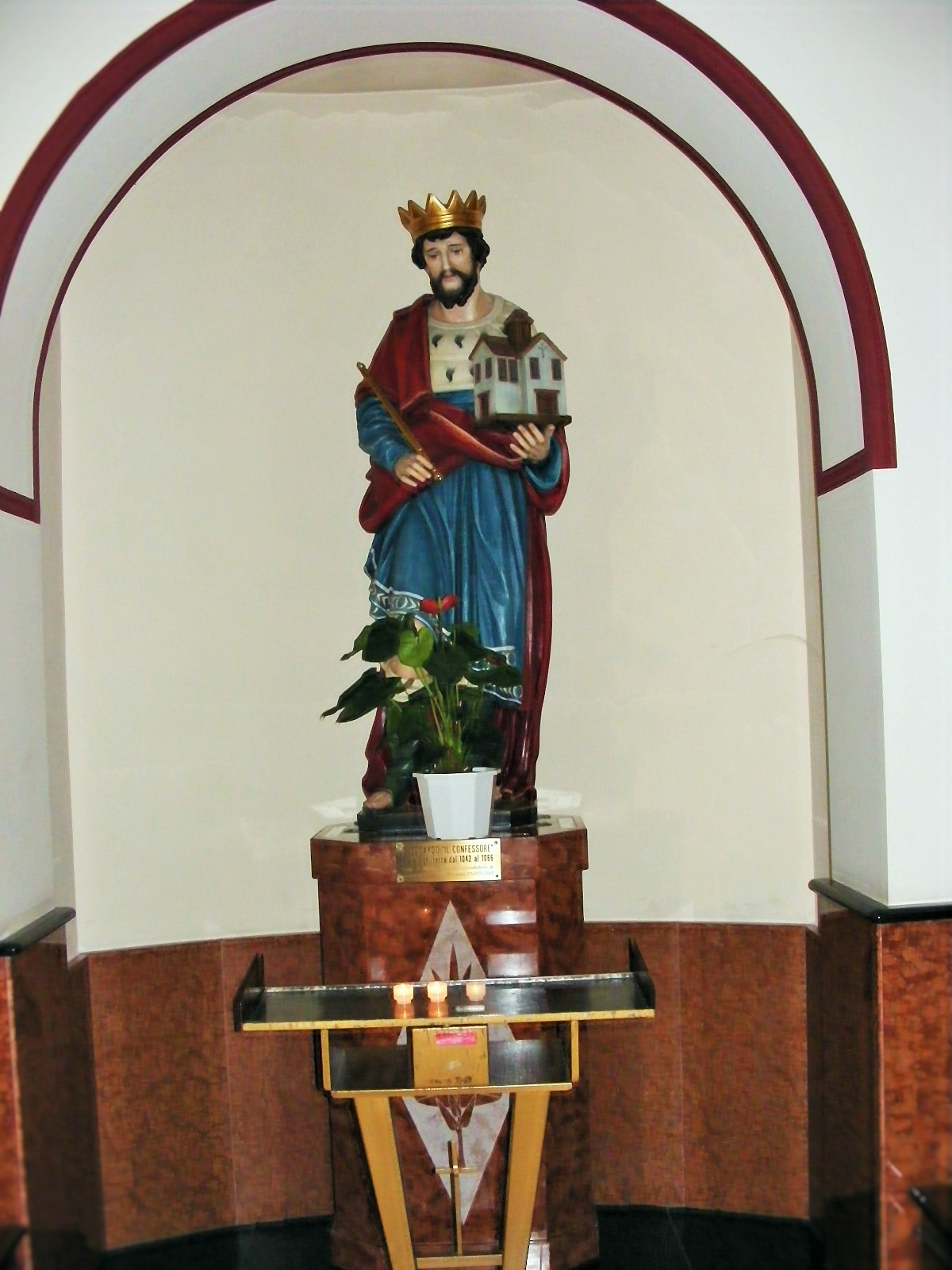
Chiesa
di Sant'Edoardo, Sant’Edoardo (Busto
Arsizio) - Interior ; Edward the Confessor in
statues
Edoardo III il
Confessore, re d’Inghilterra, è il santo più celebre a portare tale nome,
insieme con il suo avo, Sant’Edoardo II il Martire. Il futuro Edoardo III
nacque nei pressi di Oxford tra il 1004 ed il 1005 da Etelredo II lo
Sconsigliato e dalla sua seconda moglie, la principessa normanna Emma. A causa
dello stato di agitazione che regnava nel paese, all’età di soli dieci anni fu
mandato in esilio in Normandia, ove rimase sino al 1041. Richiamato poi in
Inghilterra, l’anno seguente ascese al trono. Proprio durante l’esilio il
futuro re aveva appreso molte delle qualità che gli tornarono più utili, come
ricorda il suo biografo Barlow: “opportunismo e flessibilità, pazienza,
cautela, capacità di evitare lo scontro frontale [...] sapienza terrena [...]
disponibilità ad accettare qualunque sorte gli fosse riservata”. Regnò per
un periodo abbastanza lungo, riuscendo a tenere sotto controllo i molteplici
nemici, sia interni che esterni. Il suo successore Aroldo, ventidue anni
dopo, si trovò a governare un paese ben più tranquillo, unito e stabile di
quanto non lo fosse stato all’incoronazione di Edoardo.
La santità di Edoardo non
è data esclusivamente da alcune azioni eroiche, bensì è frutto del suo
comportametno complessivo quale sovrano. Resta tuttavia difficile conoscere con
certezza molti aspetti del suo governo, del suo carattere e delle sue
motivazioni. Con lo sviluppo del suo culto, la fama del suo regno si accrebbe
tanto da giudicarlo quasi un’epoca d’oro e per sua la grande popolarità
Sant’Edoardo divenne uno dei principali patroni d’Inghilterra. Le numerose
“Vite” scritto in seguito sul suo conto misero in evidenza la santità di questo
grande sovrano, i miracoli ottenuti per sua intercessione, la castità custodita
integra per tutta la vita, la carità verso i poveri, verso la Chiesa ed in
particolare verso i monaci.
Occorre però sottolineare
come qualcuno nutrisse non pochi interessi dall’incentivare il culto di
Sant’Edoardo: in primis i monaci dell’abbazia di Westminster, che ne
conservavano la tomba e fecero proliferare i racconti circa la santità e la
potenza taumaturgica del re, al fine di incrementare l’afflusso di pellegrini;
in seguito la venerazione nei confronti di Edoardo, normanno per parte materna,
risultò di aiuto agli invasori normanni per tentare di ottenere un’indiretta
legittimazione al loro potere sull’isola. Parecchi leggendari elementi sulla
sua esistenza terrena non sono certi, come la scelta fatta con la moglie Edith
di condurre una vita di castità ed il matrimonio bianco, forse pure
supposizione volte a giustificare il fatto che non lasciò discendenza. Anche la
maggior parte dei racconti sui miracoli è assai dubbia: la “Vita” più anica,
scritta pochissimi anni dopo la sua morte, narra di alcune guarigioni avvenute
con l’acqua in cui il santo re si era lavato le mani. Fu allora invocato contro
le malattie della pelle e l’epilessia e secondo la tradizione fu il primo
sovrano inglese a contrarre la cosiddetta “malattia del re”, cioè la scrofola.
Abolì la tassa dell’heregeld, destinata al mantenimento dell’esercito, per
devolvere il ricavato ai poveri, ma forse si trattò solo di un provvedimento
temporaneo.
Analizzando invece le
qualità di Edoardo come sovrano, ci si può rifare a notizie più certe: difese
il paese dagli attacchi stranieri e protesse la propria autorità dai sudditi
troppo ambiziosi. Tentò sempre in ogni modo di evitare le guerre, ma fu sempre
risoluto nel dispiegare un esercito o una flotta contro la minaccia di
invasione. Per rafforzare la propria posizione non mancò di stringere numerose
alleanze straniere. In patria la più seria minaccia al suo potere era
costituita dal conte Godwin del Wessex: ne sposò allora la figlia, Edith, ma
quando nel 1051 Godwin minacciò una rivolta, ad Edoardo non restò che esiliarlo
insieme all’intera sua famiglia, facendo rinchiudere anche Edith in un
convento. Già l’anno seguente il re permise a Godwin di fare ritorno in patria,
evitando così il rischio di una guerra civile e nel regno continuò dunque a
regnare la pace.
Indipendentemente dalla
fama acquisita in seguito, pare che non fu un grande benefattore della Chiesa,
ad eccezione di Westminster. Una saggia amministrazione delle nomine
ecclesiastiche costituiva una parte essenziale per affermare l’autorità regio
ed un buon governo. Il giudizio di Edoardo in queste questioni si rivelo sempre
oculato, salvo il caso di Stigand, arcivescovo di Canterbury che si rivelò
certo un abile amministratore, ma poco animato da spirito religioso. Edoardo
nominò anche degli stranieri alle sedi episcopali inglesi, non per distruggere
la matrice nazionale della Chiesa, quanto più per il desiderio di scegliere
degli uomini di qualità. Durante il suo regno furono applicate importanti
riforme locali, non vi furono scandali e vennero rafforzati i rapporti con
Roma.
La decisione di rifondare
l’abbazia di Westminster, monumento che perpetuò indefinitamente il suo
ricordo, nacque da un voto che Edoardo aveva fatto quando in gioventù era esule
in Normandia: se Dio avesse reintegrato nei suoi diritti la sua famiglia, si
sarebbe recato a Roma in pellegrinaggio. Asceso poi al trono, si trovò impossibilitato
a lasciare l’Inghilterra e chiese perciò al papa di essere dispensato dal voto.
Il pontefice acconsentì, commutando l’obbligo nella fondazione di un monastero
dedicato all’apostolo Pietro. Edoardo scelse allora un convento già esistente
presso Thorney, ad ovest di Londra, al quale fece ingenti donazioni di terreni
e in denaro, dando inizio all’edificazione di una magnifica chiesa romanica,
che fu l’embrione dell’odierna abbazia di Westminster.
Le sue condizioni di
salute, purtroppo, si aggravarono prima di poter partecipare all’innaugurazione
del coro della basilica. Morì dopo pochi giorni, il 5 gennaio 1066, e venne
sepolto proprio nell’abbazia. Nel 1102 il suo corpo, riesumato e trovato
incorrotto, venne traslato in un nuovo sito. In seguito fu soggetto ad alcune
traslazioni e le sacre reliquie sopravvissero alla Riforma ed ancora oggi sono
oggetto di venerazione. Nel 1161 papa Alessandro III canonizzo Sant’Edoardo
III, detto “il Confessore” per distinguerlo dal suo predecessore Edoardo II “il
Martire”, dietro interessamento del re Enrico II. Nel 1689 la sua festa fu
estesa alla Chiesa universale e fissata in data 13 ottobre, anniversario della
prima traslazione. Oggi però il nuovo Martyrologium Romanum ha spostato la
commemorazione alla data della morte.
Autore: Fabio
Arduino
SOURCE : http://www.santiebeati.it/dettaglio/74150

Saint
Édouard le Confesseur. Église Saint-Pierre-et-Saint-Romain (vitrail) -
Savennières (France)
Den hellige kong Edvard
Bekjenneren (~1004-1066)
Minnedag:
13. oktober
Den hellige Edvard (eng:
Edward) med tilnavnet «bekjenneren» (eng: Confessor) ble født rundt 1004 i
Islip ved Oxford i England. Han var eldste sønn av den engelske kong Ethelred
II den Rådville (978-1016) med hans andre, normanniske hustru Emma, datter av hertug
Richard I og søster av hertug Richard II av Normandie. Ethelred var kommet på
tronen etter at hans halvbror, den hellige Edvard martyren,
ble myrdet i 978.
Ethelred hadde giftet seg
første gang rundt 985 med Elgiva (Ælfgifu), datter av jarl Thored av
Northumbria, og deres seks sønner var: 1) Ethelstan Atheling (d. 1014) 2)
Egbert Atheling (d. ca 1005) 3) Edmund Ironside (ca 989-1016) 4) Edred Atheling
(d. ca 1012) 5) Edwy Atheling (d. 1017) (henrettet av Knut) 6) Edgar Atheling
(d. ca 1008). I tillegg hadde de minst fire døtre: 1) Edith (Eadgyth) 2) Elgiva
(Ælfgifu) 3) Wulfhilda 4) en abbedisse av Wherwell Abbey.
Etter sin første hustrus
død giftet Ethelred seg i 1002 med Emma av Normandie, søster av hertug Richard
II av Normandie og grandtante til den senere kongen Vilhelm Erobreren. Deres
barn var: 1) Edvard bekjenneren (ca 1004-66) 2) Alfred Atheling (d. 1036/37) 3)
Goda av England. Alle Ethelreds sønner var oppkalt etter hans forgjengere på
tronen. Den hellige Margareta av
Skottland var datter av den engelske prins Edvard d’Outremer
(«landsforvist») Atheling («adelsmannen»), sønn av kong Edvards halvbror kong
Edmund Ironside (apr-nov 1016).
Edvard hadde altså seks
eldre halvbrødre, farens sønner med sin første hustru Elgiva, så sjansen for at
han skulle arve den engelske tronen må ha vært ansett som små i hans barndom.
Det ble enda mindre sannsynlig på grunn av den danske erobringen av England. I
1002 beordret Ethelred en massakre av danskene som levde i England den 13.
november. Derfor startet den danske kongen Svein Tjugeskjegg (ca 986-1014)
flere felttog for å erobre England. Han lyktes i desember 1013, men etter sin
seier levde han bare i fem uker før han døde den 3. februar 1014. Da England
ble tatt av Svein, flyktet Ethelred til Normandie sammen med hustruen Emma og
den tiårige Edvard og hans yngre bror Alfred, og de søkte beskyttelse hos
hertug Robert. Ethelred vendte tilbake til England i februar 1014, etter Sveins
død.
Etter at kong Svein
Tjugeskjegg døde i 1014, utropte hæren hans Sveins sønn Knut den mektige til
konge av England, mens høvdingene i hjemlandet Danmark utropte den eldre broren
Harald Sveinsson til konge av Danmark. Sannsynligvis hadde det vært kong Sveins
intensjon at brødrene skulle arve hvert sitt rike. Da broren Harald døde fire
år senere arvet Knut også Danmark. Ethelred klarte å beholde sin trone til han
døde den 23. april 1016 i London, og han ble etterfulgt av sin sønn Edmund II
Ironside (apr-nov 1016). Edmund ble valgt til konge av befolkningen i London,
men hans rival Knut den mektige hadde større støtte enn ham i resten av landet.
Edmund ble slått av
danskene, men fikk lov av Knut til å beholde Wessex på den betingelse at den av
dem som overlevde den andre, skulle regjere over hele England. Kort tid etter
at denne avtalen ble inngått, døde Edmund den 30. november 1016, og det antas
at han ble myrdet. Ifølge tradisjonen ble han drept ved at en rødglødende
ildraker ble stukket opp i endetarmen på ham mens han satt på toalettet. I
henhold til deres avtale overtok Knut da hele riket. Hans tilnavn «den mektige»
kom av at han ble konge over tre riker, England (1016-35), Danmark (1018-35) og
Norge (1028-35). I 1017 giftet han seg strategisk med kong Ethelreds enke, Emma
av Normandie, mens Knuts søster Estrid giftet seg med hertugens bror Richard.
Emma ga sin nye ektemann en sønn, Hardeknut, og en datter, Gunhild (ca 1019-38),
fra 1036 til sin død gift med den tyske kong Henrik III (den Svarte) (1039-56;
keiser fra 1046) som dronning Kunigunde av Tyskland. I 1017 ble Edvards siste
gjenlevende halvbror Edwy henrettet av Knut, noe som gjorde den unge prins
Edvard til den ledende tronpretendenten. Dette gjorde det imidlertid mest
tilrådelig for ham å bli værende ved onkelens hoff i Normandie.
Edvard hadde fått sin
første utdannelse i Ely, og han fullførte utdannelsen ved hoffet til morens
bror, hertug Richard den Gode. Edvard bodde siden i Normandie, selv etter at
moren i 1017 dro tilbake til England for å gifte seg med Knut den Mektige.
Etter kong Knuts død i 1035, var den engelske suksesjonen omstridt mellom den
avdøde kongens to sønner med hans to hustruer, Harald Harefot, sønn av frillen
Alfiva (Aelfgitha) av Northampton, og Hardeknut (Hardicanute), sønn av Emma.
Edvard forsøkte å overta tronen selv og ledet et mislykket angrep mot
Southampton, men han vendte tilbake til Normandie. Edvards yngre bror Alfred
seilte fra Wissant eller Boulogne og kom til England i 1036. Alfred ble tatt av
jarl Godwin av Wessex og overlevert til Harald Harefot, som fikk ham blindet
for å ødelegge hans kongeverdighet, og han døde av den brutale behandlingen. En
kortvarig kult for «martyren» blusset opp i Ely Abbey hvor han ble gravlagt.
Fra Bayeux-teppet og
Edvards første biografi er det en kontinuerlig tradisjon om hans utseende: Han
var en høy mann med langt ansikt, askeblondt hår og skjegg, rødlig ansiktsfarge
og lange, tynne fingre. Edvards biografi tegner et overbevisende portrett av
ham som gammel, men den har til gjengjeld formørket vitnesbyrdene om hans modne
år. Hans regjeringstid var ytre sett fredelig, og han var en fredselskende
mann, men han sto overfor alvorlige vanskeligheter.
Edvard hadde trengt
støtte fra den ambisiøse og mektige jarl Godwin av Wessex for å sikre seg
tronen, og hans strenge kontroll over England skyldtes hovedsakelig Godwins
mektige familie. Flere av hans sønner ble jarler og Edvard giftet seg med hans
datter Edith i 1045. Uansett hvor fordelaktig denne alliansen kan ha vært på
den tiden, er det sannsynlig at Edvard faktisk næret et dyptfølt nag mot
Godwin, som hadde vært innblandet i mordet på hans bror Alfred, og jarlens
saksiske lojalitet kom da også senere i konflikt med Edvards egne normanniske
preferanser.
Edward brakte med seg
mange venner fra Normandie til England, blant dem baronen Robert av Jumièges,
som han ga bispedømmet London. I 1050 foretrakk kongen Jumièges fremfor et
annet medlem av Godwins klan som erkebiskop av Canterbury (1051-52), og
deretter tillot han sine tilhengere å bygge borger i jarledømmene til Godwins
sønner Svein og Harald (i henholdsvis Herefordshire og Essex). Året etter kom
Edwards svoger Eustace av Boulogne til England og satte i gang med å organisere
byggingen av enda en borg i Dover, en del av jarl Godwins eget område. Folket i
Dover motsatte seg dette med vold og drepte nitten av Eustaces menn. Godwin
nektet å reagere mot mennene fra Kent, og kongen fikk dermed den unnskyldningen
han trengte for å sende Godwin i eksil. I 1051 forviste kongen Godwin og hans
familie, og til og med dronningen, Godwins datter, måtte tilbringe en tid i et
kloster. Edvard forviste også i 1065 en av Godwins sønner, Tostig, etter et
opprør i hans jarledømme Northumbria. I 1051 besøkte også hertug Vilhelm av
Normandie det engelske hoffet, og det kan neppe betviles at Edvard da tilbød
sin fetter på morssiden å bli sin etterfølger på tronen.
Godwin hadde vært
overbevist om at Edvard skulle bli så opptatt av sine bønner at han i praksis
ville overlate styret av landet til ham. Kongens svigerfar Godwin vendte i 1052
tilbake fra Flandern med en flåte, og da møtte kongen ham personlig og sluttet
akseptable betingelser med ham for å unngå opprør og borgerkrig. Godwin ble
rehabilitert, og kongens råd «lyste alle franskmenn fredløse». Den normanniske
erkebiskopen Robert av Canterbury og en annen biskop flyktet utenlands, og
Stigand ble ny erkebiskop (1052-70).
Troen på at Edvard var en
helgen startet mens han ennå levde, og den ble støttet av hans generelle ry for
fromhet og religiøs hengivenhet, og for sjenerøsitet overfor de fattige og
svake. Det ble også fortalt om flere mirakler, og han var den første hersker
som ble rapportert å ha helbredet skrofulose eller kjertelsyke ved berøring,
«touch for the King’s Evil». Det ble også påstått at han og hans hustru var så
asketiske at de alltid hadde levd sammen som bror og søster. Edvard og Edith
var ganske visst barnløse, men tatt i betraktning omstendighetene rundt deres
bryllup er det usannsynlig at dette skyldtes livsvarig frivillig avholdenhet,
og påstanden støttes ikke av noe håndgripelig bevis.
Edvard styrket de nære
forbindelsene mellom den gamle engelske kirken og Roma, og han sendte biskoper
til den hellige pave Leo
IXs (1049-54) konsiler i 1049-50 og mottok pavelige legater i 1061. Han
forfremmet sekularprester, noen ganger utenlandske, til bispeseter, og
reduserte dermed de monastiske biskopenes tilnærmede monopol. Dette innebærer
imidlertid ingen mangel på aktelse for klostervesenet. Mot slutten av sin
regjeringstid var kong Edvard mest opptatt av jakt og byggearbeider. Det
prosjektet som han huskes best for, er nygrunnleggelsen av Westminster Abbey.
Da Edvar bodde i
Normandie, hadde han avlagt løfte om at han skulle dra på valfart til
apostelen Peters
grav i Roma om han fikk komme tilbake til England. Da han var kronet, holdt han
et konsil hvor han kunngjorde sin forpliktelse. Forsamlingen roste hans
hengivenhet, men spenningen mellom de angelsaksiske og normanniske partiene var
så sterk at de fryktet at landet i kongens fravær ville ligge åpent for indre
splittelse og utenlandske fiender. Kongen ble overbevist av deres
argumentasjon, og han ba pave Leo IX om dispensasjon fra løftet. Det ble
innvilget, under forutsetning av at kongen i stedet ga til de fattige den
summen han ville ha brukt på reisen, samt bygde eller restaurerte et kloster
for St. Peter.
Edvard valgte et
eksisterende lite kloster like ved London, på et sted som het Thorney. Han ble
dermed den faktiske grunnlegger av dette Petersklosteret, som han utstyrte med
fyrstelig gavmildhet, og fikk fra pave Nikolas II store privilegier og eksempsjoner.
En tid skal han ha brukt en tiendedel av sine inntekter på klosteret, og ga det
mange eiendommer i mange land. Han bygde en enorm romansk kirke, 300 fot lang,
med et skip på tolv fag. På grunn av beliggenheten ble den etter hvert kalt
West Minster («den vestlige katedralen») for å skille den fra St. Pauls-kirken
øst i byen. Denne kirken, Westminster Abbey, har gitt London ikke bare stedet
for kroningen av konger og dronninger, men også Westminster Hall og Parlamentet
som et sentrum for kongenes regjering og lov. Kirkens kor ble fullført like før
Edvards død og konsekrert den 28. desember 1065, da han var for syk til å
delta.
I mellomtiden hadde jarl
Godwins andre sønn Harald etterfulgt sin far som kongens fremste rådgiver. I
1054 reiste hans allierte, biskop Aeldred av Worcester, til Sentral-Europa på
jakt etter kongens nevø, Edvard Atheling. Han kom til England tre år senere,
men døde nesten umiddelbart, åpenbart myrdet. Hans femårige sønn Edgar ble
deretter oppdratt ved hoffet. Jarl Harald ble svært populær i landet gjennom
sine suksessfulle militærkampanjer, særlig mot waliserne (1055-63) og opprørere
i Northumbria (1065).
I slutten av 1065 falt
kong Edvard bekjenneren i koma uten å ha klargjort sin preferanse for
etterfølgelsen. Selv om Edvard kan ha sverget å støtte den normanniske hertug
Vilhelms krav på tronen, skiftet han mening på dødsleiet. For like før sin død
fikk han bevisstheten tilbake og overlot sin enke og kongeriket til jarl
Haralds «beskyttelse». Deretter døde Edvard, den 5. januar 1066 ifølge Vita
Ædwardi Regis. Han ble gravlagt i Westminster Abbey, som var blitt konsekrert
bare ti dager tidligere.
Kong Harald forventet en
invasjon og samlet sine tropper på Isle of Wight, men siden normannerne ikke
kom og det begynte å bli slutt på proviant, oppløste han hæren og dro til
London den 8. september. Men samme dag sluttet kong Harald III Hardråde av
Norge (1046-66), som også gjorde krav på den engelske tronen, seg til Tostig
Godvinsson og invaderte England med sin flåte ved munningen av Tyne.
Invasjonstroppene til Hardråde og Tostig bekjempet de engelske jarlene Edwin av
Mercia og Morcar av Northumbria i slaget ved Fulford nær York den 20.
september. Men Harald ledet sin hær nordover i ilmarsj på fire dager, og han
slo Hardråde og Tostig i slaget ved Stamford Bridge ved elven Derwent den 25.
september. I det blodige slaget ble både Harald Hardråde og Tostig drept sammen
med de fleste nordmennene.
Men selv om Harald
Godvinsson slo tilbake de norske angriperne, var hans seier kortvarig, for han
ble beseiret og drept av normannerne i slaget ved Hastings mindre enn tre uker
senere, den 14. oktober 1066, og normannerne erobret England. Hertug Vilhelm
ble dermed kong Vilhelm Erobreren av England. Riktignok ble den fjortenårige
Edgar Atheling proklamert som konge etter slaget ved Hastings i 1066, men han
styrte aldri og ble avsatt etter rundt åtte uker.
I 1065-67 skrev en anonym
forfatter, trolig en munk fra Saint-Omer, en beretning om Edvards liv, Vita
Ædwardi Regis, for hans enke, dronning Edith. Det synes som den hadde som
formål å fremme hennes families krav på å sørge for en etterfølger til den
barnløse kongen. Selv om denne biografien skulle bli basis for den
hagiografiske legenden, er den i sin tidligste form nesten fullstendig fri for
hagiografi og har en viss historisk verdi. Men dessverre var forfatterentrolig
både uvitende om og uinteressert i sitt objekts «viking»-bakgrunn.
Under kong Stefan
(1135-54) ble det i 1138 gjort et forsøk på å oppnå en formell pavelig
helligkåring av Edvard, støttet av den nye biografien av Osbert av Clare, prior
i Westminster. Pave Innocent II (1130-43) utsatte en avgjørelse, men oppfordret
munkene i Westminster til å samle mer informasjon. Kong Henrik II av England
(1154-89) var i slekt med Edvard gjennom sin oldemor, Margareta av Skottland.
Henrik var sønn av keiserinne Matilda (1141), som var datter av kong Henrik I
(1100-35) og Margaretas datter Edith, som ble dronning Matilda av England,
kjent som Good Queen Maud.
I 1160 la kong Henrik II
nytt press på Roma for helligkåring av sin fjerne slektning. Ved å støtte pave
Alexander III (1159-81) mot motpave Viktor IV (1159-64), oppnådde han også at
Edvard ble helligkåret i 1161. Den 13. oktober 1163 ble helgenens legeme, som
fortsatt var like friskt, høytidelig skrinlagt og flyttet til en ny grav av den
hellige erkebiskop Thomas Becket.
Dette var en nasjonal begivenhet med kong Henrik til stede sammen med mange
erkebiskoper og prelater, og prekenen ble holdt av den hellige Ailred av Rievaulx,
som skrev en ny biografi om Edvard.
Edvards legeme hviler
fortsatt i restene av hans skrin i Westminster Abbey. Skrinet ble plyndret ved
reformasjonen, men relikviene fikk ligge i fred, for kong Henrik VIII (1509-47)
var varsom med åpenlyse angrep på kongelige personer. Ved siden av det
beskjedne skrinet til den ukjente hellige Wite (Whyte
eller Candida) i landsbyen Whitchurch Canonicorum i Dorset er Edvard
Bekjennerens skrin det eneste i hele England som er bevart intakt og med
relikvier som overlevde reformasjonen.
Under dronning Maria
Tudor den Katolske ble Westminster gjenskapt som kloster, og abbed Feckenham
restaurerte også Edvards gravmæle. Den forgylte treskrinet som vanligvis
tilskrives ham, kommer trolig fra Henrik VIIs tid og kan være et arbeid av
Torrigiano. I 1685 ble Edvards kiste åpnet, og det ble da oppdaget at hans levninger
da var redusert til et skjelett.
Edvard kalles bekjenneren
(eng: Edward the Confessor; lat: Eduardus Confessor), det vil si en som bringer
vitnesbyrd om Kristus ved sitt liv og ikke sin død, for å skjelne ham (Sanctus
Eduardus Confessor rex Anglorum) fra kong Edvard Martyren, hans
onkel (Sanctus Eduardus Martyr rex Anglorum). I middelalderen var Edvard
en svært populær helgen, og sammen med den hellige Edmund av East
Anglia ble han allment ansett for å være Englands skytshelgen, inntil
han ble trengt til side av ridderen Georgs
popularitet. Ved beleiringen av Calais i 1351 påkalte engelske tropper, ifølge
William Worcestre (ca 1415-85), Edvard, selv om han ikke selv var noen soldat,
og Georg sammen før de gjorde sitt siste angrep.
Den mest berømte
avbildningen av Edvard er i Wilton-diptyket fra rundt 1395, som nå er i
National Gallery i London. Der er Edvard Bekjenneren, Edmund og Johannes Døperen avbildet
på venstre panel sammen med den unge kong Richard II av England (1377-99), som
kneler foran Jomfruen og barnet på høyre panel. Men høyalteret i kapellet i
Windsor Castle ble gjeninnviet til Georg rundt 1400. Ved slaget ved Agincourt i
1415, som det blir beskrevet av Shakespeare, ser Georg ut til å regnes som
Englands viktigste forbeder, men uten å utelukke Edvard. Innen rundt 1450 ble
Georg regnet som skytshelgen for England på samme måte som den hellige Dionysius (Denis)
var det for Frankrike.
Edvard Bekjennerens
emblem er en fingerring, som kommer fra hans legende.
Legenden forteller at
kongen ga en ring til en tigger ved Westminster. To år senere møtte noen
engelske pilegrimer i Det hellige Land (eller India) en gammel mann som sa at
han var apostelen Johannes. Han ga dem ringen og ba dem returnere den til
Edvard, som de skulle advare om hans forestående død om et halvt års tid.
Edvard avbildes også ofte mens han bærer en mann, som henspeiler på historien
om han at en gang helbredet en giktsyk mann ved å bære ham.
Nummereringen av engelske
monarker starter på nytt etter den normanniske erobringen, noe som forklarer
hvorfor nummereringen av engelske konger med navnet Edvard begynner med den
senere kong Edvard I av England (1272-1307) og ikke inkluderer Edvard
Bekjenneren (som var den tredje kong Edvard).
Kilder: Attwater (dk), Attwater/John, Attwater/Cumming, Farmer, Jones, Bentley, Butler, Butler (X), Benedictines, Delaney, Bunson, Cruz (1), Engelhart, Schauber/Schindler, Melchers, Gorys, ODNB, KIR, CE, CSO, Patron Saints SQPN, Infocatho, Bautz, Heiligenlexikon, santiebeati.it, en.wikipedia.org, britannia.com, earlybritishkingdoms.org, zeno.org - Kompilasjon og oversettelse: p. Per Einar Odden Opprettet: 1. februar 2000
SOURCE : https://www.katolsk.no/biografier/historisk/edward
.jpg)
Eduard der Bekenner
englischer Name:
Edward Confessor
Gedenktag katholisch: 5. Januar
nicht gebotener Gedenktag in England: 13. Oktober (Übertragung der Gebeine)
Gedenktag
III. Klasse: 13. Oktober (Übertragung der Gebeine), Todestag: 5. Januar
Gedenktag anglikanisch:
13. Oktober
Name bedeutet: Hüter
des Besitzes (althochdt.)
König von England
* um 1003 in Islip bei Oxford in England
† 5. Januar 1066 in Westminster,
heute Stadtteil von London in England
Eduard war der älteste
Sohn von König Æthelred II. und dessen zweiter Frau Emma, die eine Schwester
des Herzogs Richard II. von der Normandie war.
Nach dem Tod seines Vaters 1016 flohen Eduard und sein Bruder vor den Dänen,
die England besetzt hatten, zunächst nach Flandern und
dann in die Normandie. Als seine Mutter 1017 durch ihre Heirat mit Dänenkönig
Knut dem Großen ihre Machtstellung zurückgewann, blieb er im Exil. Ein Versuch,
mit Unterstützung der Normannen 1036 den englischen Thron zurückzuerlangen,
endete bei Southampton mit
einer Niederlage. 1041 konnte er nach der Verdrängung der Dänen aber zurückkehren
und 1042 den Königsthron besteigen; 1043 wurde er von Eadsigus
von Canterbury und dem Erzbischof von York gekrönt.
Er war der letzte in der Reihe der westsächsischen Könige. Er war ein
schwacher, von normannischen Günstlingen beeinflusster Regent, ohne große
eigene Besitztümer, auch abhängig von den lokalen Fürsten, das Kommando über
die Land- und Seestreitkräfte überließ er dem Adel.
Eduard förderte
kirchliche Einrichtungen, berief Bischöfe aus Lothringen und
der Normandie und
stärkte damit die Bindung der englischen Kirche an den Kontinent. Er ließ
die Benediktinerabtei
St. Peter in Westminster -
die heutige Westminster Abbey in London - neu als Steinhaus bauen und
beschenkte sie reich.
Eduard lebte sehr
bescheiden, um Arme unterstützen zu können; mit seiner 1045 geheirateten Frau
Editha, der Tochter des Fürsten von Wessex,
habe er keusch gelebt; das Ehepaar blieb kinderlos, die Nachfolge wurde erst
mit der Unterwerfung Englands durch Wilhelm den Eroberer entschieden. Eduards
tiefe Religiosität und seine vorbildliche Wohltätigkeit hatte großen Einfluss
auf die Verbreitung des Christentums in England. Die Legende erzählt, wie er
einen Gichtkranken heilte.
Eduard wurde bald schon
als Heiliger und Wundertäter verehrt; die Verehrung wurde v. a. durch Ælred
von Rievaulx gefördert und diente auch der Legitimierung des
englischen Königtums. Sein Grab in der Westminster Abbey in London wurde
zum Nationalheiligtum.
Kanonisation: Edward wurde am 7. Februar 1161 durch Papst Alexander II. heiliggesprochen.
Attribute: einen Kranken tragend
Patron von England, der englischen Könige, gegen Skrofeln (angeschwollene
Lymphknoten am Hals)
Schriften
von Eduard gibt es online zu lesen in den Documenta Catholica Omnia.
Seite
zum Ausdruck optimiertUnser Reise-Blog:
Reisen zu den Orten, an denen die
Heiligen lebten und verehrt werden.
Empfehlung an
Freunde senden
Artikel
kommentieren / Fehler melden
Fragen? -
unsere FAQs antworten!
Impressum - Datenschutzerklärung
Schauen Sie sich zufällige Biografien an:
Johannes
Calabria
Jakob
Strepa
Ämilianus
von Valence
Autor: Joachim
Schäfer - zuletzt aktualisiert am 08.12.2023
Quellen:
• Vera Schauber, Hanns Michael Schindler: Heilige und Patrone im Jahreslauf. Pattloch, München 2001
• P. Ezechiel Britschgi: Name verpflichtet. Christiana, Stein am Rhein, 1985
• http://www.lib.cam.ac.uk/Newsletters/nl08/
• http://www.battle1066.com/confess.shtml
• Lexikon für Theologie und Kirche, begr. von Michael Buchberger. Hrsg. von Walter Kasper, 3., völlig neu bearb. Aufl., Bd. 3. Herder, Freiburg im Breisgau 1995
• Charlotte Bretscher-Gisinger, Thomas Meier (Hg.): Lexikon des Mittelalters.
CD-ROM-Ausgabe J.B. Metzler, Stuttgart / Weimar 2000
korrekt zitieren: Joachim Schäfer: Artikel Eduard „der Bekenner”, aus dem Ökumenischen Heiligenlexikon - https://www.heiligenlexikon.de/BiographienE/Eduard_der_Bekenner.htm, abgerufen am 3. 12. 2025
Die Deutsche Nationalbibliothek verzeichnet das Ökumenische
Heiligenlexikon in der Deutschen Nationalbibliografie; detaillierte
bibliografische Daten sind im Internet über https://d-nb.info/1175439177 und https://d-nb.info/969828497 abrufbar.
SOURCE : https://www.heiligenlexikon.de/BiographienE/Eduard_der_Bekenner.htm

Edward de Belijder,
Londen, Engeland; koning; † 1066.
Feest 5 januari &
13 oktober (overbrenging relieken naar Westminster-Abbey: 1163).
Hij werd geboren in 1003 en was de zoon van Emma, dochter van graaf Richard van Normandië en van koning Ethelred II, die de bijnaam kreeg van 'de onberadene' omdat hij alle Noormannen in zijn rijk liet vermoorden. Daarop kwamen achtereenvolgens de Deense koningen Sven en Knut wraak nemen en maakten zich meester van de Engelse troon. Met als gevolg dat de jonge Edward naar Normandië moest vluchten. Desondanks werd hij toch in 1042 uitgeroepen tot koning over Engeland.
Zijn regeringsperiode wordt zeer verschillend beoordeeld. Volgens sommigen zou
hij door zijn zwakte een eind hebben gemaakt aan het aloude Engelse
koningshuis. Anderen wijzen erop dat hij zijn vijanden, Schotland en Wales,
versloeg, ernst maakte met de vrede binnen zijn land en wijze wetten
uitvaardigde. Bovendien hield hij er een heilige levenswijze op na. Gewone
mensen hadden gemakkelijk toegang tot hem, hij gaf zijn zorg en aalmoezen aan
de armen; in zijn persoonlijk leven leidde hij met Godwina, de dochter van de
graaf van Wessex, een huwelijksleven als broer en zus. Hij startte de bouw van
wat eens de beroemde Westminster Abbey zou worden.
Afgebeeld
In de kunst wordt hij afgebeeld als gekroonde koning met een ring in de hand.
Dit attribuut heeft te maken met de volgende legende.
Edward zou die ring aan
een bedelaar hebben gegeven in de buurt van zijn geliefde Westminster Abbey.
Twee jaar later ontmoetten enkele Engelse pelgrims in het Heilige Land (volgens
sommigen betreft het India) een oude grijsaard die zich uitgaf voor Johannes de
Evangelist. Hij gaf hun de ring en droeg hun op ze aan koning Edward te brengen
met de mededeling, dat hij binnen een half jaar zou sterven. Dat gebeurde.
Hij is de koning Edward
over wie verteld wordt op de beroemde Tel de Conquest, het tapisserie dat
bewaard wordt in de Normandische stad Bayeux.
Edward is patroon van de Engelse koningen en één van de patroons van Engeland.
[011; Dries van den Akker s.j./2010.02.21]
© A. van den Akker
s.j. / A.W. Gerritsen
SOURCE : https://heiligen-3s.nl/heiligen/01/05/01-05-1066-edward.php

Maïté Billoré, “Les lettres dans les Vies d’Édouard le Confesseur”, Cahiers de civilisation médiévale [Online], 241 | 2018, Online since 01 January 2021, connection on 04 December 2025. URL: http://journals.openedition.org/ccm/1799; DOI: https://doi.org/10.4000/ccm.1799 : https://journals.openedition.org/ccm/1799?lang=en
