.jpg)
La
chapelle Saint-Firmin-le-Martyr de la Cathédrale Notre-Dame d'Amiens.
Saint Firmin Évêque d'Amiens (IVe siècle) Les historiens voient en lui le premier évêque d'Amiens où il aurait subi le martyre au IVe siècle. La légende du portail nord de la cathédrale d'Amiens se base sur un écrit du IXe siècle. Le sénateur Firmus conduisait son fils, le futur saint Firmin, au temple de Jupiter à Pampelune en Espagne quand il rencontra le prêtre chrétien Honestus qui lui parla de Jésus et lui fit rencontrer une semaine plus tard son maître, saint Saturnin, l'un des soixante-dix disciples de Jésus. Saturnin, à Pampelune, convertit quarante mille personnes en quelques jours dont le jeune Firmin qui, avec l'âge, devint un fidèle prédicateur du Christ. Firmin à vingt-sept ans reçut le sacre épiscopal, évangélisa l'Aquitaine, l'Auvergne, le Beauvaisis et s'en fut à Amiens. C'est là qu'il fut arrêté et discrètement assassiné par le gouverneur païen qui craignait les trop nombreux chrétiens de la région. L'histoire est belle, mais les détails sont peu historiques. - ordo du diocèse d'Amiens, pages 7 et 8, Cent trois évêques se sont succédé sur le siège d’Amiens depuis saint Firmin: sept sont honorés du culte des saints : Firmin le martyr, Euloge, Firmin le confesseur, Honoré, Saulve, Berchond, Geoffroy 1er. Saint Firmin fin IIIe siècle, 2e. Saint Euloge de 325 à 357 ?, 3e. Saint Firmin le confesseur IVe siècle, 8e. Saint Honoré de 554 à 600, 9e. Saint Saulve de 600 à 615, 10e. Saint Berchond de 615 à 644, 37e. Saint Geoffroy de 1104 à 1115. Les diocèses du nord de la France comptent parmi les plus anciens d'Europe. Celui d'Amiens a ainsi été fondé par le sang d'un chrétien d'Espagne, Firmin, qui a été exécuté par les romains de l'époque... Le diocèse d'Amiens est créé vers la fin du IIIe siècle, au temps des premiers missionnaires venus évangéliser le nord de la Gaule. Notons, pour le diocèse, Saint Quentin, les Saints Fuscien, Victoric et Gentien, et un peu plus tard, Saint Firmin. Traditionnellement, c'est ce dernier qui est retenu comme étant le premier évêque d'Amiens... (Histoire du diocèse d'Amiens) Saint-Firmin 2015: Une fête de famille! (diocèse d'Amiens)
À Amiens, saint Firmin, vénéré comme évêque et martyr. Martyrologe romain La vie d'un saint ne nous
est pas contée pour satisfaire notre curiosité, mais pour nous entraîner à la
suite de sa sainteté. Alors ? construisons nous-mêmes notre sainteté avec la
grâce de l'Esprit-Saint. Lectionnaire Emmaüs SOURCE : https://nominis.cef.fr/contenus/saint/1914/Saint-Firmin.html  Saint
Firmin, Cathédrale d'Amiens, contrefort nord Saint Firmin Évêque d'Amiens et Martyr (IIe siècle) Le père et la mère de
saint Firmin, qui étaient des plus riches et des plus considérables de la ville
de Pampelune, en Espagne, à la fin du 1er siècle, furent convertis à la foi par
saint Honestus, prêtre de Toulouse et disciple de saint Saturnin. Convaincus
que de la première éducation dépend ordinairement le reste de la vie, ils
mirent leur fils entre les mains de ce saint ecclésiastique, qui l'instruisit
et le prit pour compagnon de ses courses apostoliques. Prêtre à vingt-quatre
ans, Firmin eut tant de succès dans ses prédications, que saint Honorat,
successeur de saint Saturnin à Toulouse l'ordonna évêque, pour évangéliser les
païens. L'évêque missionnaire parcourut les Gaules, évangélisa Agen, Clermont,
Angers, Beauvais, essuyant plusieurs fois la persécution, battu de verges,
chargé de chaînes, jeté dans les cachots. Amiens fut la dernière et
la plus glorieuse étape de l'apôtre, qui y fixa son siège. Dès les premiers
jours, le sénateur Faustinien fut converti avec toute sa famille. Firmin
joignait aux charmes de son éloquence le témoignage invincible d'une multitude
de miracles. Un jour c'est un homme borgne qui en est l'objet; le lendemain, ce
sont deux lépreux; puis des aveugles, des boiteux, des sourds, des muets, des
paralytiques, des possédés du démon. Peu de temps après son arrivée, les
temples de Jupiter et de Mercure furent complètement déserts. Firmin eut la
tête tranchée. Abbé L. Jaud, Vie des Saints pour tous les jours de l'année, Tours, Mame, 1950 SOURCE : http://magnificat.ca/cal/fr/saints/saint_firmin.html .jpg) Mauricio
García (fl. 1747–1760),
Martirio de san Fermín, 1751, Real Academia de Buenos Aires - https://www.diariodenavarra.es/noticias/cultura-ocio/cultura/2022/09/19/el-martirio-san-fermin-el-arte-hispano-e-hispanoamericano-541750-1034.html Saint Firmin, premier
évêque et martyr d’Amiens Aujourd’hui encore, saint
Firmin est célébré à Amiens comme évêque et martyr, figure fondatrice d’un
diocèse marqué dès ses origines par le témoignage de la foi chrétienne évêque d’Amiens (IVe siècle) Selon la tradition, saint
Firmin est considéré comme le premier évêque d’Amiens, où il aurait subi le
martyre au IVe siècle. Les historiens relèvent que les récits de sa vie
reposent en grande partie sur une légende rédigée au IXe siècle, reprise
notamment dans le décor du portail nord de la cathédrale d’Amiens. Né en Espagne, Firmin
aurait été conduit par son père, le sénateur Firmus, au temple de Jupiter à
Pampelune. C’est là qu’il rencontra Honestus, un prêtre chrétien, qui
l’introduisit auprès de saint Saturnin, présenté comme l’un des soixante-dix
disciples de Jésus. Saturnin aurait converti en quelques jours des milliers
d’habitants de la ville, parmi lesquels le jeune Firmin. Devenu adulte,
celui-ci fut ordonné évêque à l’âge de vingt-sept ans, puis entreprit
d’évangéliser plusieurs régions : l’Aquitaine, l’Auvergne, le Beauvaisis. Il
gagna ensuite Amiens, où il fut arrêté et exécuté discrètement par le
gouverneur romain, inquiet du développement du christianisme. La tradition
rapporte que l’Église d’Amiens s’enracine dans ce martyre. L’ordo du diocèse
recense cent trois évêques depuis saint Firmin. Parmi eux, sept sont honorés
comme saints : Firmin le martyr, Euloge, Firmin le confesseur, Honoré, Saulve,
Berchond et Geoffroy. Les diocèses du nord de la France, parmi les plus anciens
d’Europe, ont vu émerger dès le IIIe siècle de nombreuses figures
missionnaires. Outre saint Firmin, on y compte saint Quentin, ainsi que les
saints Fuscien, Victoric et Gentien. Aujourd’hui encore, saint
Firmin est célébré à Amiens comme évêque et martyr, figure fondatrice d’un
diocèse marqué dès ses origines par le témoignage de la foi chrétienne. SOURCE : https://tribunechretienne.com/saint-firmin-premier-eveque-et-martyr-damiens/ 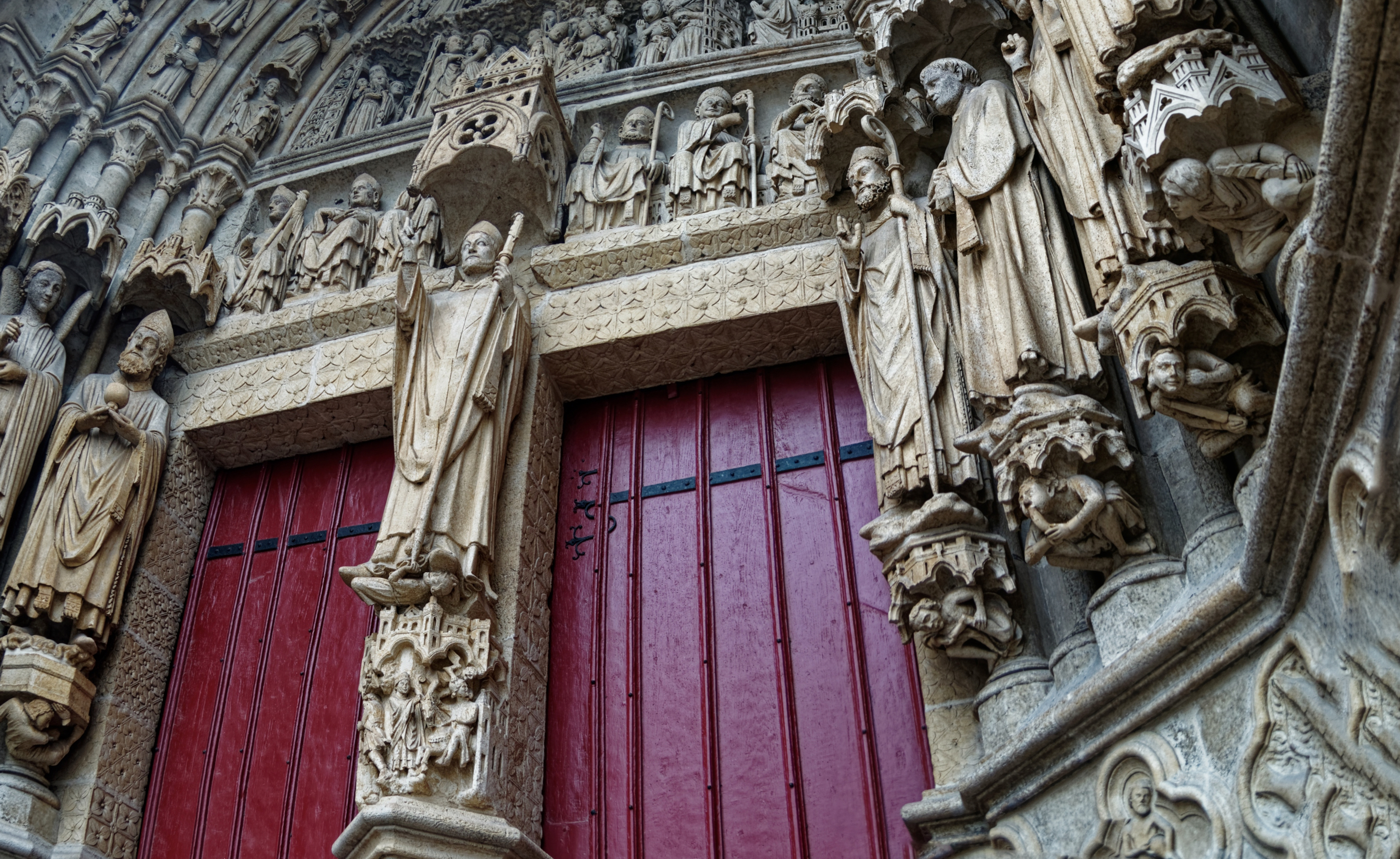 Le portail Saint-Firmin, Cathédrale Notre-Dame d’Amiens, 1220-1288  Cathédrale d'Amiens, statue de saint Firmin-le-Martyr  Cathédrale
d'Amiens, statue de saint Firmin-le-Martyr Saint Firmin : Apôtre des
Gaules et martyr intrépide Premier évêque d'Amiens
et martyr Date : Commencement du
IIe s. Fête : 25 septembre Saint Firmin, évêque de
Pampelune, est une figure emblématique de l’évangélisation des Gaules. Né dans
une période troublée où le christianisme se répandait avec force et conviction,
il s’est fait le champion de la foi, n’hésitant pas à affronter les dangers
pour proclamer l’Évangile. Fils spirituel de saint Saturnin de Toulouse, Firmin
a consacré sa vie à convertir les païens et à répandre la lumière du Christ
dans une terre encore imprégnée des croyances anciennes. C’est avec une ferveur
indomptable qu’il s’est rendu jusqu’en Gaule, annonçant la Bonne Nouvelle et
posant les premières pierres de communautés chrétiennes. La vocation naissante de
saint Firmin Firmin est né dans une
famille païenne de Pampelune, en Navarre. Dès son plus jeune âge, il fut attiré
par la figure de saint Saturnin, évêque missionnaire qui prêchait la foi
chrétienne avec zèle dans la région. Baptisé par l’évêque Honeste, disciple de
saint Saturnin, Firmin ressentit très tôt l’appel à consacrer sa vie au service
du Christ. Formé à la prêtrise, il devint rapidement évêque, animé par un désir
ardent d’évangéliser au-delà de ses terres natales. Sous l’inspiration
divine, il décida de poursuivre l’œuvre missionnaire de ses maîtres spirituels
en se rendant en Gaule. Cette terre, bien que partiellement touchée par le
christianisme, restait dominée par le paganisme. Pour Firmin, c’était un champ
fertile pour semer la parole du Seigneur. L’évangélisation des
Gaules : un apostolat de feu Arrivé en Gaule, Firmin
parcourut plusieurs régions, notamment le Béarn, l’Aquitaine et la Picardie,
prêchant sans relâche et baptisant des milliers de personnes. Son zèle
apostolique ne connaissait pas de limites. Dans les villes comme dans les
villages, il affronta les résistances, tant des populations encore attachées
aux cultes païens que des autorités locales, souvent méfiantes à l’égard de
cette nouvelle religion. Son passage dans la ville
d’Amiens fut décisif. C’est là que, selon la tradition, il fonda une communauté
chrétienne florissante, jetant les bases de ce qui deviendra plus tard un des
centres majeurs du christianisme en Gaule. Firmin fut également un bâtisseur
spirituel. Non content de prêcher, il consacrait ses énergies à la formation de
nouveaux clercs, assurant ainsi a pérennité de l’Église
dans ces territoires encore hostiles à la foi. Le martyre de saint
Firmin Le courage de saint
Firmin, pourtant, allait le conduire à la confrontation ultime avec les
pouvoirs païens de son époque. Son succès croissant dans la conversion des
populations attira la colère des autorités locales, qui voyaient d’un mauvais
œil cette nouvelle religion ébranler les cultes traditionnels. Firmin fut
arrêté et sommé d’abandonner sa foi en Christ. Refusant de renier le
Seigneur, il fut soumis à des tortures cruelles, mais sa détermination resta
inébranlable. Il continuait à proclamer la vérité de l’Évangile, même dans les
pires épreuves. Finalement, Firmin fut décapité à Amiens, offrant sa vie en martyr
pour le Christ. Son sacrifice eut un écho
retentissant. Non seulement il affermit la foi des premiers chrétiens de la
région, mais il inspira également de nouvelles vocations missionnaires. Le sang
des martyrs, disait Tertullien, est la semence des chrétiens, et Firmin, par
son martyre, devint un exemple lumineux de fidélité à Dieu. L’héritage de saint
Firmin Aujourd’hui, saint Firmin
est vénéré comme l’un des apôtres des Gaules et comme le saint patron de la
ville d’Amiens, où une basilique imposante est dédiée à sa mémoire. Chaque
année, de nombreux fidèles viennent honorer celui qui, par sa foi inébranlable,
a donné sa vie pour répandre l’Évangile. Le culte de saint Firmin
s’est également étendu en Espagne, notamment dans sa ville natale de Pampelune,
où une fête populaire, les célèbres fêtes de San Fermín, célèbre son souvenir
avec éclat. Conclusion : Une lumière
dans les ténèbres Saint Firmin demeure une
figure exemplaire de courage et de fidélité à la foi chrétienne. Son apostolat,
marqué par un zèle infatigable et un amour ardent pour le Christ, a laissé une
empreinte indélébile dans l’histoire de l’Église. En ces temps modernes, son
exemple continue de rappeler l’importance de la mission et du témoignage
chrétien, même face à l’adversité. Que son intercession nous
inspire à notre tour à suivre les traces de celui qui, par son martyr, a montré
que rien ne pouvait éteindre la lumière du Christ dans le cœur des croyants. On gagne tout à tout
sacrifier. 1°. Les âmes lâches allèguent leur faiblesse quand il
s’agit de la religion, quoique rien ne soit capable de les rebuter dans la
recherche des faux biens du monde. 2°. Si nous désirions sincèrement
notre salut, nous ferions bientôt, avec autant de facilité que de plaisir, ce
que notre indolence nous représente comme impossible, et nous éprouverions que
la vraie vertu renferme une manne infiniment délicieuse. On ne la possède point
sans avoir en soi le principe d’une joie pure et intarissable, en comparaison
de laquelle toutes les voluptés du monde et du péché ne sont rien, en supposant
qu’elles ne fussent pas empoisonnées par cette amertume désespérante qui en
accompagne toujours la jouissance Oraison O Dieu, la lumière des
fidèles et le pasteur des âmes, qui avez élevé à l’épiscopat le
bienheureux Firmin, pour nourrir la piété des enfants de votre Église par
la parole et le bon exemple ; accordez- nous de mettre en pratique les vérités
qu’il nous a enseignées, et de marcher sur les traces de ses vertus. Par Jésus-Christ Notre-Seigneur.
Ainsi soit-il.
SOURCE : https://www.laviedessaints.com/saint-firminin/
José
Ximénez Donoso (1628-1690), Martirio de san Fermín (martir), 1687.
Ayuntamiento de Pamplona Also
known as Farmin of… Firmin of… Firmins of… Firmino of… Fermin of… Profile Son of a Roman
senator. Converted to Christianity by Saint Saturninus. Ordained by Saint Honestus
at Toulouse, France. Missionary to France.
First bishop of Amiens at
age 24. Martyred at
age 31. Born beheaded 25
September 303 in Amiens, France his place of burial was
lost for centuries, but re-discovered by Saint Salvius
of Amiens Saint Salvius had
the relics enshrined in Amiens, France;
as the relics were
processed through the streets, legend says that the sick were healed and
trees suddenly burst into full leaf in the dead of winter just by being near
them some relics translated
to Pamplona, Spain in 1196 in France Amiens,
city of in Spain Additional
Information Book
of Saints, by the Monks of
Ramsgate Catholic
Encyclopedia: Diocese of Pamplona Lives
of the Saints, by Father Alban
Butler books Our Sunday Visitor’s Encyclopedia of Saints Saints
and Their Attributes, by Helen Roeder other
sites in english images video sitios
en español Martirologio Romano, 2001 edición sites
en français fonti
in italiano Martirologio Romano, 2005 edition MLA
Citation “Saint Firminus of
Amiens“. CatholicSaints.Info. 16 January 2024. Web. 28 November 2025.
<https://catholicsaints.info/saint-firminus-of-amiens/>
SOURCE : https://catholicsaints.info/saint-firminus-of-amiens/ 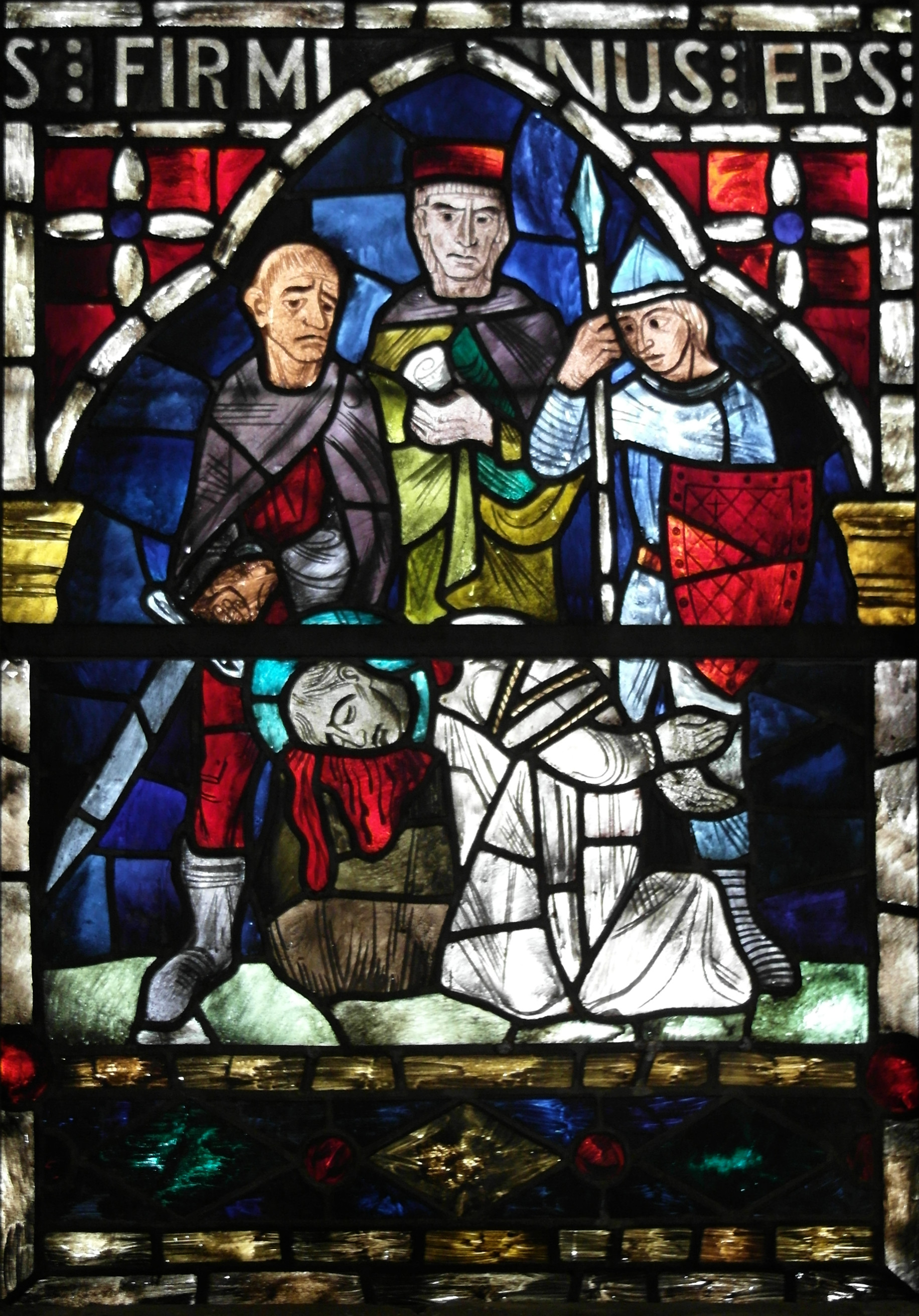 Decapitación de san Fermín, detalle de vidriera, Roncesvalles. Book of Saints –
Firminus of Amiens Article (Saint) Bishop, Martyr
(September 25) (3rd century) Described as a native of Navarre, baptised by
Saint Saturninus, Bishop of Toulouse, and consecrated Bishop in the same city.
He preached the Faith on his journey northwards through Gaul, finally fixing his
abode at Amiens, where he was martyred towards the end of the third century,
under Rictius Varus, Prefect of the Gauls. He was succeeded by one of his
disciples, Saint Eulogius, and the latter by a second Saint Firminus, likewise
held in great veneration in the district. MLA
Citation Monks of Ramsgate.
“Firminus of Amiens”. Book of Saints, 1921. CatholicSaints.Info.
28 April 2013. Web. 29 November 2025. <https://catholicsaints.info/book-of-saints-firminus-of-amiens/> SOURCE : https://catholicsaints.info/book-of-saints-firminus-of-amiens/ %2C_mus%C3%A9e_de_Picardie%2C_art_m%C3%A9di%C3%A9val%2C_bas-relief_-_d%C3%A9collation_de_saint_Firmin%2C_fin_XVe_si%C3%A8cle%2C_provenant_de_la_chap._des_Macchab%C3%A9es_d'Amiens.jpg) Bas-relief - décollation de saint Firmin, fin XVe siècle, pierre calcaire, proviendrait de la chapelle des Macchabées d'Amiens, inv. 1188A. St. Firminus of Amiens Feastday: September 25 Patron: of Amiens, France, Lesaka, Spain, Navarre, Spain. Birth: 272
Death: 303 Two bishops of
that name, one celebrated on September 1 and listed as the third bishop of
the see; the other is cited as Amien’s first bishop, a native of Spain and
a convert of St. Satuminus consecrated by St. Honestus. He went to France as
a missionary and built his church at Amiens. He was martyred by beheading.
SOURCE : https://www.catholic.org/saints/saint.php?saint_id=3379  Sala
de columbarios de la Iglesia de San Lorenzo (Pamplona) September 25 St. Firmin, Bishop of
Amiens, Martyr IF we may rely on his
acts, he was a native of Pampelone, in Navarre, initiated in the Christian
faith by Honestus, a disciple of St. Saturninus of Toulouse, and consecrated
bishop by St. Honoratus, successor to St. Saturninus, in order to preach the
gospel in the remoter parts of Gaul. He preached the faith in the countries of
Agen, Anjou, and Beauvais, and, being arrived at Amiens, there chose his
residence, having founded there a numerous church of faithful disciples. He
received the crown of martyrdom in that city, whether under the prefect,
Rictius Varus, as Usuard says, or in some other persecution from Decius, in
250, to Dioclesian, in 303, is uncertain. Faustinian buried him in his field
called Abladana, where Firmin II. (who is honoured on the 1st of September)
built the first church under the invocation of the Blessed Virgin. St. Salvius,
in the beginning of the seventh century, translated his relics into the
cathedral. St. Godefrid made another translation of them about the year 1107,
and Bishop Theobald put them into a gold shrine about the year 1200. See Gall.
Chr. Nova, t. 10, p. 1150, Tillemont and Stilting. Rev. Alban
Butler (1711–73). Volume IX: September. The Lives of the
Saints. 1866.
SOURCE : http://www.bartleby.com/210/9/253.html Article And next followeth the
Invention of Saint Firmin. In the time of the
invention of Saint Firmin the martyr, was Saint Savin, bishop of Amiens, and
saw that tofore him in the time of Saint Honor, our Lord had done take up the
bodies of Saint Fulcian, Saint Victorice, and Saint Gentian, and thought all an
whole night upon the body of Saint Firmin the martyr.
And when it was day this holy man Saint Savin summoned the clergy and the
people to fast and make prayers through the city of Amiens, to the end that our
Lord would show them the place where the body of Saint Firmin the martyr lay.
And on the third day our Lord sent such a miracle that he sent a ray of the
sun, which pierced the wall of the monastery on the same place where the body
lay. Then they began to dig and delve there, and when they came nigh the body,
there issued out so great a sweetness out of the pit, that all they that were
there weened they had been in Paradise. And it seemed that if all the spices of
the world had been stamped together it should not have smelled so well ne so
sweet, and this sweet odour spread through the city of Amiens and divers cities
about, that is to wit Therouanne, Cambray and Noyon. And the people of these
cities moved them each from his place with candles and offerings, without sayer
or commander, but for the odour that so spread, and came unto this glorious
saint. And as the body was borne in the city of Amiens, there were showed such
miracles that never none were like found ne seen tofore of any saint, for the
elements moved them by the miracle of this saint; the snow that was that time
great on the earth was turned into powder and dust by the heat that was then,
and the ice that hung on the trees became flowers and leaves, and the meadows
about Amiens flowered and became green, and the sun which by his nature should
go low, that day ascended as high as she is on Saint John’s day at noon in the
summer. And as men bare the body of this saint the trees inclined and
worshipped the body, and all manner sick men, of what malady they had, they
received health in the invention of the blessed body of Saint Firmin. And the
burgesses that were in their gowns and mantles had so great heat that they
called their servants and bond men, of whom there were many that day in Amiens,
and affranchised them for to bear their clothes into the city of Amiens. Our
Lord did do show such miracles, and so far sent the odour that the lord of
Beaugency which was at a window and was sick of lazary, smelled the odour and
was anon guerished and whole. And he took his gold and came and did homage unto
the body of Saint Firmin in the city of Amiens. Our Lord hath showed many
miracles for this glorious saint, and much he ought to be honoured in this
world, and then pray we unto this blessed saint, Saint Firmin, that he pray for
us to our Lord that he will pardon us our sins, and octroy and grant to us the
glory of heaven. Amen. SOURCE : https://catholicsaints.info/golden-legend-saint-firmin/ _%C3%A9glise%2C_statue_(04)_Saint_Firmin.jpg) Statue
de Saint Firmin. Église Notre-Dame de Sommesnil
(Seine-Maritime) Pictorial
Lives of the Saints – Saint Firmin, Bishop, Martyr Saint Firmin was a native
of Pampelone, in Navarre, initiated in the Christian faith by Honestus, a
disciple of Saint Saturninus of Toulouse, and consecrated bishop by Saint
Honoratus, successor to Saint Saturninus, in order to preach the Gospel in the
remoter parts of Gaul. He preached the faith in the countries of Agen, Anjou,
and Beauvais, and being arrived at Amiens, there chose his residence, and
founded there a numerous Church of faithful disciples. He received the crown of
martyrdom in that city, whether under the prefect, Rictius Varus, or in some
other persecution from Decius, in 250, to Diocletian, in 303, is uncertain.
SOURCE : https://catholicsaints.info/pictorial-lives-of-the-saints-saint-firmin-bishop-martyr/ Busto
de San Fermín. Iglesia de San Lorenzo de Pamplona. Navarra, (España).
Reliquaire
de Saint Firmin - Église de San Lorenzo de Pampelune (Espagne) Diocese of Pamplona (PAMPILONENSIS) This Diocese comprises
almost all of Navarre and
part of Guipuzcoa. This diocese is said to
date from Apostolic times. It is matter of tradition in the churches of
Pamplona, Toledo, and Toulouse (France), that St. Saturninus, disciple
of St. Peter, sent from Toulouse the priest Honestus to
preach to the inhabitants of Navarre, and later came
in person. Finding that Honestus had already made many converts, Saturninus
left him in Pamplona. Honestus was the teacher of St. Firminus (son of the
senator Firmus), first Bishop of Pamplona.
Firminus went later into France, where he
was martyred at Amiens. There is no note
of any other Bishop of
Pamplona until 589, when Liliolus signed as such in the Third Council of
Toledo. During the seventh century other bishops are known
as signatories of various councils of Toledo. It was not known with certainty whether
the Arabs succeeded
in establishing themselves in Pamplona (Ferreras affirms and Moret denies it);
at all events, there is no record of a Bishop of Pamplona
from the Saracen invasion
until the reign of Opilanus (829). The old cathedral had
meanwhile fallen into ruins, and the bishops now took
refuge in the monastery of San Salvador of
Leyre (founded in the eighth century). Inigo Arista recovered Pamplona in 848
or 849, and restored the monastery, converting it
into a stronghold. This was for a long time the episcopal court and see, and
hither Arista had transferred the bodies of the holy virgins Nunilona and
Alodia, martyred at Huesca in the time
of Abd-er-Rahman II. It was the wish of Sancho
the Elder to introduce into Leyre the Cluniac reform, but
the bishops and abbots (e.g. in the
Council of Pamplona of 1023) resisted until 1090, during the reign of Sancho
Ramirez. In the said council they resolved to restore the See of Pamplona, and
decreed that all the bishops of
Pamplona should be thereafter of the monastery of Leyre
like Sancho I, who then occupied the see. In 1025 the monks of Leyre were
affiliated with the canons of Pamplona, and Juan II took the title of Bishop of Pamplona
and Leyre, and signed in a number of decrees "Joannes, ecclesiæ
Navarrensium rector".
Until the reign of Sancho Ramirez (1076-94) Leyre remained the seat of
the bishops of
Pamplona. The monastery held
under its jurisdiction fifty-eight
towns and seventy-two religious
houses, and was besides the mausoleum of the Kings of Navarre. Theobald I
brought Cistercian monks to Leyre, but
at the end of the same century the monks of Cluny
returned and occupied it for some time. The monastery is now in
ruins, and its church serves as that of a rural parish. The see having
been reestablished in Pamplona, King Sancho Ramirez (1076-94) procured the
appointment as Bishop of
Pedro de Roda, monk of
St. Pons de Tomières, who built the new cathedral and
established a chapter of canons under the Rule of St. Augustine.
The bishops of
Pamplona, as such, presided over the ecclesiastical order
and the three estates that made up the Cortes of Navarre. The cathedral of Santa Maria held
the seigniory of the city, and its canons enjoyed the privileges of the royal
family. Bishop Sancho de Larrosa consecrated the cathedral, completed in
1124. His predecessor, Guillermo Gastón, had accompanied King Alfonso to the
conquest of Saragossa, and there founded the Church of "St.
Michael of the Navarrese". In the Cathedral of
Pamplona is venerated the
ancient statue of
"St. Mary, the White Virgin (Santa María la Blanca, Santa Maria de la
Sede or del Sagrario), which was preserved in Leyre from very ancient
times until the eleventh century. There is also a reliquary containing
a thorn from Our
Saviour's crown, given by St. Louis to Theobald II; likewise the heads of
the virgins Nunilona and Alodia, whose bodies were in Leyre. Bishop Pedro de
Artajona — known as Pedro of Paris, because it was
there he had received his education —
obtained from Celestine
III (1191) the confirmation of all the privileges of the Church of Pamplona,
and procured besides from the Bishop of Amiens a few relics of St.
Firmin whose feast was from this time (1186) celebrated with the same solemnity
as the feasts of the Apostles.
In 1197 Sancho the Strong ceded his palace to Bishop Garcia. The sovereigns,
Donna Juana and Philip of Evreux, recovered it, leaving
it in turn to Bishop Arnaldo de Barbazán; their son, Carlos the Bad, returned
it to Bishop Miguel Sanchez de Asiain, and later to Bishop Bernardo Folcant.
Since the union of Navarre and
Castille, it had been occupied by the viceroys, and is today the headquarters
of the Captaincy-General. The bishops resided
later in the "Casa del Condestable" (House of the Constable, i.e., of
the Duke of Alba) until Bishop Melchor Angel Gutierrez Vallejo commenced the
new palace, completed by Francisco III Ignacio Añoa y Busto. In 1317 Jimeno
III, Garcia being bishop,
Pamplona, formerly a suffragan of Tarragona, became a
suffragan of Saragossa. Carlos III the Noble reconstructed the cathedral, and gave it
for twelve years the fortieth part of the royal revenues from Navarre. Bishop Martin
de Zavala, partisan of the antipope Pedro de Luna, aided in
the erection. In 1400 Emperor Manuel Palæologus gave to the Church of Pamplona
a particle of the wood of the True Cross and
another of the reputed blue vestment of Our Lord; these relics are
preserved in the cathedral.
Toward the end of the eighteenth century Bishop Sancho de Oteyza completed
the façade. The parish church of
St. Saturnioro is a very old structure and has but one nave; not far from this
is pointed out the well where the saint baptized his first
converts. The parish church of St.
Lorenzo was renovated in the eighteenth century, and enlarged by the erection
of the Chapel of St. Firminus on the spot where tradition says he was born. The
basilica of St.
Ignatius of Loyola was erected in the place where that saint was
wounded when fighting against the French. In 1601 Viceroy Juan de Cardona had
an arch erected with an inscription, and later Count de Santisteban urged
the Jesuits to
raise the basilica, which was opened on 10 October, 1694. Former Dominican and Carmelite convents have been
converted into barracks and hospitals, and the convent of St.
Francis into schools.
The sanctuaries of Ignatius Loyola and Francis Xavier belong to this diocese. That of Loyola
contains the old house of St. Ignatius enshrined in a monument constructed by
Fontana under the auspices of Queen Mariana of Austria, mother of
Carlos II (1689-1738). The sanctuary of St. Francis Xavier, home
of the Apostle of the Indies, has been restored by the generosity of the Dukes
of Villahermosa (1896-1901). The collegiate church of our Lady of Roncesvalles
was founded at the beginning of the ninth century as a hospice for travellers
on their way to Compostela or from Spain to Rome and Jerusalem. There are
two seminaries in
Pamplona, a conciliar and an episcopal. There was also a university, first
incorporated with that of Saragossa and in 1745 with that of Alcalá. It was
founded in 1608 by resolution of the Cortes of Navarre in the Dominican College
of the Rosary, approved by Philip III in 1619, and established by Gregory XV in
1621. Urban VIII in
1623 and Philip IV in 1630 confirmed it. In this university the well-known
moralist, Francisco Larraga, was a professor. It boasts of other famous
scholars — jurists like Martin de Azpilcueta, historians like the Jesuit Moret,
missionaries like Calatayud,
and bishops like
the Benedictine Prudencio
de Sandoval, historian of Charles V. Sources MORET, Anales del
Reino de Navarra (Tolosa, 1890); MELIDA, Album de
Javier (Madrid, 1901); DE LA FUENTE, Historia de las Universidades de
España, II (Madrid, 1885); PEREZ, La santa Casa de Loyola (Bilbao,
1891); DE MADRAZO, España, sus monumentos y artes: Navarra y
Logrono (Barcelona, 1886). Amadó, Ramón
Ruiz. "Diocese of Pamplona." The Catholic
Encyclopedia. Vol. 11. New York: Robert Appleton
Company, 1911. <http://www.newadvent.org/cathen/11437a.htm>. Transcription. This
article was transcribed for New Advent by Douglas J. Potter. Dedicated to
the Immaculate Heart of the Blessed Virgin Mary. Ecclesiastical
approbation. Nihil Obstat. February 1, 1911. Remy Lafort, S.T.D.,
Censor. Imprimatur. +John Cardinal Farley, Archbishop of New York. Copyright © 2023 by Kevin Knight.
Dedicated to the Immaculate Heart of Mary. SOURCE : https://www.newadvent.org/cathen/11437a.htm  Melchior Doze, Extase de saint Firmin, cathédrale Notre-Dame-et-Saint-Castor, chapelle latérale méridionale, dédiée à saint Firmin, Nîmes (Gard, France)  Melchior
Doze, Extase de saint Firmin, cathédrale Notre-Dame-et-Saint-Castor, chapelle
latérale méridionale, dédiée à saint Firmin, Nîmes (Gard, France) Saint Firmin First Bishop of Amiens and Martyr
(† Beginning of Second Century) Saint Firmin, son of a
senator, was a native of Pampeluna in Navarre. With his father he was taught
the Christian faith by Honestus, a disciple of Saint Saturninus, the bishop of
Toulouse, himself the disciple of Saint Peter the Apostle. Saint Firmin, who had
been confided by his father to Honestus for his education and had accompanied
him on his apostolic journeys, was eventually consecrated bishop by Saint
Honoratus, successor to Saint Saturninus at Toulouse. Firmin received the
mission to preach the Gospel in the remoter parts of the Occident, or Gaul;
thus he preached in the regions of Agen, Angers, and Beauvais. In what is now
Clement-Ferrand, after long discussions with two ardent idolaters, he won them
over. Error, wherever he passed, seemed to flee before him, as if the infernal
powers feared to undertake a combat with this formidable adversary who was sure
to defeat them. He had not yet suffered
persecution. Desiring martyrdom, he decided to go to a center of paganism in
the north, in what is now Normandy, near Lisieux. There he was arrested and
imprisoned for a time by the pagans. When delivered, he continued on towards
the north, to a region where Saint Denys of Paris had baptized many. He
confirmed the Christians in their faith, and went wherever a soul might have
need of him. The Roman authorities heard of him and arrested him; the Saint
generously confessed Jesus Christ in their presence. Again he was imprisoned,
but released when the prefect and his successor both died suddenly. He was
obliged, however, to flee secretly. When he arrived at
Amiens, he placed his residence there and founded a large church of faithful
disciples. Amiens conserves the memory of the day he arrived and preached
fearlessly there beside a temple of Jupiter, at a site where now the Basilica
of Our Lady stands. He taught aloud the salutary doctrine of Christianity to
all who came to listen. Many conversions followed, even among the authorities
of the city, including the senator. He continued his preaching in that region
for a number of years, while the pagan temples became literally deserted. And
then two Roman officials, Longulus and Sebastian, heard of him and came to the
city. The pagan priests saw
their opportunity, when all the city residents were convoked to appear before
the visitors. The two officials explained that the capital penalty was decreed
for those who did not obey the imperial edicts, not offering incense to the
gods and honoring them. The pagan priests then told them of one who always
refused to do so, and Saint Firmin, after an eloquent defense of the religion
of Christ, was imprisoned. He finally saw his most ardent desire fulfilled when
certain soldiers decided on their own to accomplish the imperial orders, and
came with swords to his prison at night, where they decapitated the bishop. He
died, filled with joy at their coming. This occurred under the reign of Trajan
in the first years of the second century. The holy bishop remains in the
greatest honor in the city of Amiens. Les Petits Bollandistes:
Vies des Saints, by Msgr. Paul Guérin (Bloud et Barral: Paris, 1882), Vol.
11
SOURCE : https://sanctoral.com/en/saints/saint_firmin.html  Statue
de Saint-Firmin. Église Saint-Martin de Lorleau San Firmino di
Amiens Vescovo Festa: 25 settembre e 7 luglio Martirologio
Romano: Ad Amiens nella Gallia belgica, ora in Francia, san Firmino,
venerato come vescovo e martire. Cominciamo col dire che vi sono ben tre santi di nome Firmino di Amiens, uno abate con festa all’11 marzo, un altro vescovo della città con festa al 1° settembre e il terzo anch’egli vescovo di Amiens ma martire, oggetto di questa scheda, con festa al 25 settembre. Gli ‘Atti’ che parlano di lui, risalgono al V o VI secolo, ma la loro autenticità storica è molto scarsa. Nonostante gli elementi principali siano leggendari, bisogna narrarli, perché sono serviti come motivi di decorazioni scultoree nella stessa cattedrale di Amiens. Firmino sarebbe stato originario di una nobile famiglia di Pamplona in Spagna, i suoi genitori Fermo ed Eugenia erano pagani, ma in seguito si convertirono al tempo dell’episcopato del figlio. Firmino che era il figlio maggiore, fu affidato alle cure del prete Onesto, che lo battezzò e lo istruì nella fede cristiana. In seguito fu ordinato sacerdote dal vescovo di Tolosa Onorato e dopo qualche anno vescovo; sembra che Firmino rimase dapprima nella città natia di Pamplona (dove una tradizione locale, lo considera primo vescovo della città); poi passò ad evangelizzare alcune regioni della Francia come l’Aquitania, l’Alvernia, l’Anjou e altre del nord-est, Nonostante l’opposizione dei sacerdoti pagani, i risultati della sua opera furono strepitosi. Gli “Atti” dicono che fu pure arrestato per ordine del governatore romano Valerio, frustato e poi liberato. Nel suo itinerare, alla fine si fermò ad Amiens (l’antica Samobriva Ambianorum) dove fu vescovo con grande successo, per molti anni. Si sa che convertì molti nobili fra cui il senatore Faustiniano, dalla cui discendenza nacque poi l’altro vescovo confessore s. Firmino di Amiens (1° sett.). Ad opera dei solerti magistrati Longulo e Sebastiano, fu di nuovo incarcerato nei primi anni del secolo IV ed invitato ad abiurare; ma Firmino rifiutò rimanendo fermo nella sua fede, ed allora i magistrati, per evitare una reazione popolare, lo fecero decapitare in carcere, il 25 settembre di un anno imprecisato fra il 290 e il 303. Nel secolo VII si ignorava dove fosse il sepolcro del santo vescovo e martire, ma per una visione miracolosa, il vescovo di Amiens s. Salvio lo ritrovò. Le sue reliquie sono sparse in varie chiese di Francia, perché il culto per s. Firmino ebbe una vasta diffusione sia in Francia che in Spagna, a Pamplona in particolare è solennissimo, documentato per la prima volta nel 1186, quando il vescovo della città Pietro II, ricevette da quello di Amiens alcune reliquie di s. Firmino; nel 1217 nella cattedrale esisteva un altare dedicato a lui e se ne celebrava la festa con ottava, cioè per otto giorni consecutivi, indice di solennità liturgica. La sua festa celebrata il 10 ottobre, nel 1590 fu trasferita al 7 luglio ed estesa poi a tutta la Spagna nel 1725. Nel 1657 papa Alessandro VII dichiarò san Firmino vescovo e s. Francesco Saverio, ‘patroni principali’ della città di Pamplona. Attualmente nella città d’origine, esistono due cappelle dedicate al lui, una nella cattedrale e un’altra nella chiesa di S. Lorenzo, sorta secondo la tradizione sul luogo della casa nativa di s. Firmino. La festa a Pamplona è diventata notissima nel mondo, per la corsa dei tori, il famoso “encierro”, che si svolge per le strade della città per circa 850 metri, con i tori liberi che corrono insieme a uomini abbastanza temerari, c’è sempre qualche ferito da incornata o perché travolto, con la partecipazione di una grande folla e di numerosi turisti, e che termina nell’arena. Ad Amiens in Francia il nome di s. Firmino era inserito nelle litanie medioevali dei santi, e anticamente vi erano ben cinque celebrazioni in suo onore durante l’anno, compresa il 25 settembre giorno del martirio e data in cui è inserito nel ‘Martyrologium Romanum’. Nel Medioevo fu invocato come protettore dei bottai, dei mercanti di vino, dei panettieri e contro le malattie dello scorbuto e della erisipela. Nell’arte figurativa le opere si confondono ad Amiens proprio per i due vescovi omonimi della stessa diocesi, ma quelle di s. Firmino vescovo e martire sono più facilmente identificabili a causa del suo martirio, che lo rese più celebre; infatti essendo stato decapitato, in alcune opere è raffigurato con il suo capo in mano, oppure che guarda la sua testa mozzata per terra.
Autore: Antonio Borrelli
SOURCE : https://www.santiebeati.it/dettaglio/91990
Retouched
from a painting of San Fermín (Saint Fermin, Sanctus Ferminus; patron
saint of Pamplona's "Running of the Bulls") en la escuela
quiteña (in the style of the School of Quito; Colonial School) San Fermín Fermín, San. Pamplona
(Navarra), m. s. III – Amiens (Francia), c. 290. Obispo,
mártir y santo. Todo lo que se sabe de
este obispo de Amiens, natural de la ciudad de Pamplona, viene dado por
leyendas tan tardías que se duda muy razonablemente de la existencia histórica
del personaje. Hasta el siglo VIII no hay noticia alguna ni de su
vida ni tan siquiera de su culto, y sólo a partir del siglo IX empieza
a forjarse su leyenda. Según ésta, Fermín era hijo del senador Firmo de
Pamplona, quien se convirtió al cristianismo con toda su familia gracias a la
predicación de san Saturnino de Toulouse y de su discípulo Honesto. Éste se
encargó de la educación cristiana de Fermín y, al hacerse viejo, consiguió que
el joven recibiera la consagración episcopal de manos del obispo Honorato de
Toulouse, cuando sólo contaba con veinticuatro años de edad. Al cumplir los
treinta y uno, san Fermín abandonó Pamplona para predicar el Evangelio en las
Galias. En Beauvais fue azotado y arrojado a la prisión por orden del
gobernador Valerio, pero la repentina muerte de éste le permitió obtener la
libertad. De allí pasó a Amiens, donde convirtió a muchos al cristianismo,
entre ellos al senador Faustiniano. Encarcelado por orden de los gobernadores
Lóngulo y Sebastián, fue decapitado secretamente en la cárcel un 25 de
septiembre. Su cuerpo fue recuperado
por Faustiniano y dignamente sepultado. Históricamente sólo es posible afirmar que a finales del siglo VIII se veneraba en Amiens a un obispo de nombre Fermín, del que se ignoraba incluso su condición de mártir o confesor. Para obviar problemas el personaje se desdobló en dos y fue el mártir quien alcanzó mayor veneración, hasta el punto de adjudicarle unas reliquias y una extensa biografía. A la ciudad de Pamplona llegó una reliquia el año 1186, celebrándose la fiesta de su traslación el 10 de octubre. En 1590 la fiesta se trasladó al 7 de julio. Bibliografía J. Corblet, Hagiographie
du diocèse d’Amiens, vol. II, Paris, 1870, págs. 31-188 Bibliotheca hagiographica
latina antiquae et mediae aetatis, vol. I, Bruxelles, Socii Bollandiani,
1898-1899, págs. 450-451 Bibliotheca hagiographica
latina antiquae et mediae aetatis. Supplementi, Bruxelles, Bollandiani,
1911, pág. 126 G. D. Gordini, “Firmino”,
en VV. AA., Bibliotheca Sanctorum, vol. V, Roma, Istituto
Giovanni XXIII, 1964, cols. 866-870 J. Goñi, Historia de
los obispos de Pamplona, vol. I, Pamplona, Universidad de Navarra, 1979,
págs. 31-34 H. Fros, Bibliotheca
hagiographica latina antiquae et mediae aetatis. Novum supplementum, Bruxelles,
1986, pág. 339 J. Arraiza Frauca,
“Fermín”, en C. Leonardi, A. Riccardi y G. Zarri (dirs.), Diccionario
de los santos, vol. I, Madrid, San Pablo, 2000, págs. 796-798 F. Azcona San Martín,
“San Fermín, obispo y mártir”, en J. A. Martínez Puche (dir.), Nuevo año
cristiano, vol. VII, Madrid, Edibesa, 2001, págs. 144-150. Autor/es Miguel C. Vivancos Gómez,
OSB
SOURCE : https://historia-hispanica.rah.es/biografias/15577-san-fermin<  Leonhard Beck (–1542) Der heilige Firminus von Amiens. Um/nach 1510. Blatt 37 der Folge: Die Heiligen aus der Sipp-, Mag- und Schwägerschaft des Kaisers Maximilian I. Holzschnitt auf Bütten mit Wz. Krone mit Kreuz (siehe Haewood, 1167-1169, Nürnberg/Mainz/Augsburg, um 1507/1510). 23,4 x 21,1 cm - https://www.kollerauktionen.ch/de/alte-grafik-leonhard-beck.-der-heilige-fi-1214_539320.html?RecPos=13 Saint Firmin, Premier évêque d’Amiens (IIIe siècle). Fête le 25 septembre. Article illustré avec les sculptures de la cathédrale d’Amiens : https://laportelatine.org/spiritualite/vies-de-saints/saint-firmin
Le culte de saint Firmin à la cathédrale Notre-Dame d’Amiens, Conférence
d'Aurélien André, lundi 13 janvier 2020 : https://www.amiens.fr/Vivre-a-Amiens/Culture-Patrimoine/Les-Archives-municipales-et-communautaires/Conferences/conferences/Le-culte-de-saint-Firmin-a-la-cathedrale-Notre-Dame-d-Amiens
Firmin d'Amiens (272 - 303) : https://eglisesduconfluent.fr/Pages/Pe-Firmin.php |
_-_Jos%C3%A9_Xim%C3%A9nez_Donoso_(1628-1690).jpg)


