
Icônes
bulgares de Cyprien et Justine.
Saints
Cyprian and Justina (honored in the Eastern Orthodox Church and Oriental
Orthodoxy as Christians of Antioch Pisidia who in 304, during the persecution
of Diocletian, suffered martyrdom at Nicomedia (modern day İzmit, Turkey) on
September 26, the date of their feast). Icon, gift from my family to church
St.St Kiril and Metodi, Slivnitsa.
Икона
на Свети Киприан и Юстина. Икона подарена от моето семейство, на храм „Св.Св.
Кирил и Методий“.
Saints Cyprien et Justine
Martyrs (+ 304)
Originaires d'Antioche et martyrs.
Cyprien était un magicien célèbre dans sa cité. Justine était la fille d'un prêtre païen. Convertie, avec ses parents, par le diacre saint Praulios, elle amènera Cyprien à la foi au Christ, selon saint Grégoire le théologien, qui parle de l'amour qu'elle avait suscité au cœur de Cyprien. Mais elle conserva toute sa virginité. Durant la persécution de Dèce, ils furent arrêtés et décapités à Nicomédie.
Leur culte a été supprimé en 1969.
SOURCE : https://nominis.cef.fr/contenus/saint/8407/Saints-Cyprien-et-Justine.html

Священномученик
Кипріян та мучениця Юстина
Hiéromartyr
Cyprien et martyre Justina
Saint Cyprien et Sainte
Justine
Martyrs
(† 314)
Les parents de Cyprien,
très superstitieux, le vouèrent au démon dès son enfance; ils le firent élever
dans le paganisme; il se livra à l'astrologie judiciaire et à la magie. Avec le
secours de ses connaissances, il s'abandonna à toutes sortes de crimes et se
déclara ennemi acharné de la religion chrétienne.
Il y avait à Antioche une
jeune vierge nommée Justine, non moins distinguée par ses rares qualités que
par sa naissance. Ses parents étaient idolâtres; mais elle avait eu le bonheur
de connaître Jésus-Christ, et sa conversion fut bientôt suivie de celle de sa
famille. Un jeune homme nommé Agladius, païen, conçût pour elle une violente
passion, et pria Cyprien de l'aider par les secours de son art. Ce magicien mit
tout en oeuvre, sans que rien pût lui réussir. Il consulta le démon, qui lui
promit de lui servir d'auxiliaire; mais de nouvelles tentatives ne furent pas
plus heureuses; la vierge priait, elle imprimait sur elle le signe du salut, et
le démon s'enfuyait confondu. Cyprien, désespérant du succès, dit au démon:
"Eh bien! Te voilà vaincu? -- Oui, dit l'esprit infernal, j'ai vu un
signe, et j'ai été vaincu. -- Quel est ce signe? reprit Cyprien. -- J'ai vu le
signe du Crucifié. -- Le Crucifié est donc plus grand que toi? Fuis loin de
moi, imposteur! Tu m'as trompé trop longtemps."
Le démon chercha à
étouffer Cyprien, mais il le mit en fuite par l'invocation du Dieu de Justine
et par le signe de la Croix. Le jeune Agladius, plein d'admiration au récit que
lui fit Cyprien, se convertit lui-même à Jésus-Christ. Emprisonnés par les
persécuteurs après avoir été préservés l'un de l'huile bouillante et l'autre
des flammes du bûcher, ils eurent la tête tranchée.
Abbé L. Jaud, Vie des Saints pour tous les jours de l'année, Tours, Mame, 1950
SOURCE : http://magnificat.ca/cal/fr/saints/saint_cyprien_et_sainte_justine.html
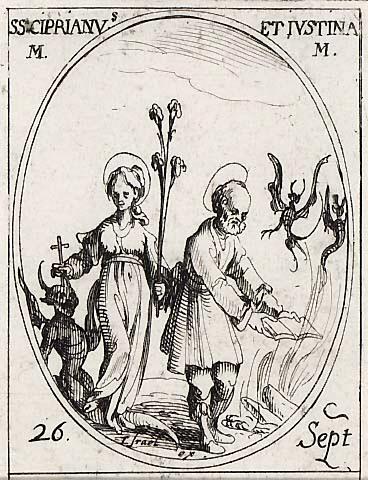
26/09 St Cyprien et Ste
Justine, martyrs
La légende de ces deux
saints était très populaire dès le IVème siècle. Leur culte a été introduit à
Rome au Moyen-âge, leur fête dès le XIIIème siècle.
Leçon des Matines (avant
1960)
Troisième leçon. Cyprien, qui, d’abord magicien, devait être Martyr, fut prié par un jeune homme épris d’un amour ardent pour Justine, vierge chrétienne, de l’amener, par des enchantements et des maléfices, à lui faire partager sa passion. Cyprien consulta le démon afin de connaître comment il pourrait y parvenir. Mais le démon lui répondit qu’aucun artifice ne réussirait contre les vrais adorateurs du Christ. Impressionné par cette réponse, il commença dès lors à regretter les égarements de sa vie passée, et, laissant de côté la magie, se convertit pleinement à la foi du Christ, notre Seigneur. Pour ce motif, on l’arrêta en même temps que la vierge Justine. Tous deux furent souffletés et accablés de coups, après quoi on les jeta en prison, dans l’espoir qu’ils renonceraient à leur résolution. Mais lorsque, plus tard, on les en fit sortir, ils se montrèrent fermement décidés à persévérer dans la religion chrétienne ; alors on les plongea dans une chaudière remplie de poix, de graisse et de cire en fusion, et on finit par les frapper de la hache, à Nicomédie. Leurs corps abandonnés sans sépulture, demeurèrent six jours dans cet état ; des matelots, durant la nuit, les placèrent secrètement sur leur navire et les portèrent à Rome. Ils furent d’abord ensevelis dans la propriété de Rufine, noble dame romaine ; puis transférés dans la Ville même et déposés dans la basilique Constantinienne, auprès du baptistère.
SOURCE : http://www.introibo.fr/26-09-St-Cyprien-et-Ste-Justine
SAINT CYPRIEN, MARTYR, ET
SAINTE JUSTINE, VIERGE ET MARTYRE.
« Qui que vous soyez que
séduisent les mystères des démons, nul de vous ne surpassera mon zèle pour ces
faux dieux, ni mes recherches à leur sujet, ni la vaine puissance qu'ils
m'avaient communiquée, moi, Cyprien, dès l'enfance au service du dragon dans la
citadelle Palladique. Apprenez de moi la tromperie de leurs illusions. Une
vierge m'a montré que leur pouvoir n'est que fumée. Le roi des démons s'est
arrêté à la porte d'une enfant, sans pouvoir la franchir. Celui qui tant
promet, n'est que menteur. Une femme se joue de celui qui se vante d'agiter la
terre et les deux. Le lion rugissant n'est qu'un, moucheron qui se dérobe,
devant Justine la chrétienne et la vierge (Confessio Cypriani Antiocheni, I,
II). »
Cyprien fut d'abord
adonné à la magie, Martyr ensuite. Justine était une vierge chrétienne, qu'il
avait entrepris d'amener par enchantements et sortilèges à consentir à la
passion d'un jeune homme. Mais le démon, consulté, ayant répondu qu'aucun
procédé ne lui réussirait contre de vrais disciples du Christ, cette réponse
frappa tellement Cyprien que, déplorant amèrement son genre de vie passé, il
dit adieu aux arts magiques et se convertit sans réserve à la foi du Seigneur
Christ. Saisi de ce chef avec la vierge Justine, ils furent tous deux
souffletés et battus de verges, puis jetés en prison pour éprouver la fermeté
de leur résolution. Mais comme, tirés de là, ils affirmaient leur inébranlable
attachement à la religion chrétienne, on les précipita dans une chaudière
remplie de poix, de graisse et de cire embrasées. Enfin ils moururent sous la
hache à Nicomédie. Leurs corps, jetés à la voirie, restèrent six jours sans
sépulture ; jusqu'à ce qu'une nuit, des matelots, les ayant enlevés secrètement
sur leur barque, les portèrent à Rome ; ils y furent d'abord ensevelis sur le
domaine d'une noble femme appelée Rufine ; transportés plus tard à l'intérieur
de la Ville, on les déposa dans la basilique Constantinienne de Latran, près du
baptistère.
O VIERGE, celui-là même
qui tentait de vous perdre est aujourd'hui votre vivant trophée de victoire. O
Cyprien, la carrière du crime est devenue pour vous l'entrée du salut.
Puissiez-vous triompher ensemble à nouveau de Satan, dans ce siècle où les
sciences occultes recommencent à séduire tant d'âmes, déséquilibrées par la
perte de la foi. Contre un danger si grand, contre tout péril, puissent les
chrétiens s'armer comme vous du signe de la Croix ; et l'ennemi sera contraint
de redire : « J'ai vu un signe terrible, et j'ai tremblé ; j'ai vu le signe du
Crucifié, et ma force a fondu comme la cire (Acta Cypriani et Justinae.). »
Dom Guéranger. L'Année liturgique
SOURCE : http://www.abbaye-saint-benoit.ch/gueranger/anneliturgique/pentecote/pentecote05/032.htm

Saint
Cyprien et le démon. Sainte Justine et le démon. Cote : Français 245, Fol.
109. Jacobus de Voragine, Legenda aurea (traduction de Jean de
Vignay), France, Paris, XVe siècle, Jacques de Besançon.
Saint
Cyprian and the demon, 14th-century manuscript of the Golden
Legend.
SAINTE JUSTINE, VIERGE
Justine est ainsi nommée
de justice; car par sa justice, elle a rendu à chacun ce qui lui appartient à
Dieu l’obéissance, à son supérieur le respect, à son égal la concorde, à son
inférieur la discipline, à ses ennemis la patience, aux misérables et aux
affligés la compassion, à elle-même de saintes oeuvres et au prochain la
charité.
Justine, vierge de la
ville d'Antioche, était la fille d'un prêtre des idoles (1). Tous les jours
étant assise à sa fenêtre, elle entendait lire l’évangile par le
diacre Proctus, qui enfin la convertit. La mère en informa son père au
lit, puis s'étant endormis tous deux, J.-C. leur apparut avec des anges et leur
dit : « Venez à moi, et je vous donnerai le royaume des cieux. » Aussitôt
éveillés, ils se firent baptiser avec leur fille. C'est
cette vierge Justine tant tourmentée par Cyprien qu'elle finit par
convertir à la foi. Cyprien s'était adonné à la marie dès son enfance ; car il
n'avait que sept ans quand il fut consacré au diable par ses parents. Comme
donc il exerçait l’art magique, il paraissait changer les matrones en bête de
somme, et faisait une infinité d'autres prestiges. Il s'éprit d'un amour brûlant
pour la vierge Justine, et il eut recours à la magie afin de la posséder soit
pour lui, soit pour un homme nommé Acladius, qui s'était également épris
d'amour pour elle. Il évoque donc le démon afin qu'il vienne à lui et qu'il
puisse par son entremise jouir de Justine. Le diable vient et lui dit : «
Pourquoi m’as-tu appelé? » Cyprien lui répondit : « J'aime une vierge du
nombre des Galiléens ; peux-tu faire que je l’aie et accomplisse avec elle ma
volonté? » Le démon lui dit : « Moi: qui ai pu chasser l’homme du paradis, qui
ai amené 'Caïn à tuer son frère, qui ai fait crucifier J.-C. parles Juifs, et
qui ai jeté le trouble parmi les hommes; je ne pourrais donc pas faire que tu
aies une jeune fille, et que tu obtiennes d'elle ce qu'il te plait ? Prends cet
onguent et épars-le autour de sa maison en dehors; puis je surviendrai,
j'embraserai son coeur de ton amour, et je la pousserai à se rendre à toi. » La
nuit suivante le démon vient auprès de Justine et s'efforce de porter son coeur
à un amour illicite. Quand elle s'en aperçut, elle se recommanda dévotement au
Seigneur et elle protégea tout son corps. du signe de la croix. Mais au signe
de la sainte Croix, le diable effrayé s'enfuit, vint trouver Cyprien et resta
debout devant luis Cyprien lui dit : « Pourquoi ne m’as-tu pas amené cette
vierge ? » Le démon lui répondit : « J'ai vu sur elle un certain signe ; j'ai
été pétrifié, et toutes les forces, m’ont manqué. » Alors Cyprien le
congédia et en appela un plus fort. Celui-ci lui dit : « J'ai entendu ton
ordre, et j'en ai saisi l’impossibilité : mais je le rectifierai, et je
remplirai ta volonté : je l’attaquerai, et je blesserai son coeur d'un amour de
débauche et tu feras d'elle ce que tu désires. » Le diable vint et s'efforça de
persuader Justine en enflammant son esprit d'un amour coupable. Mais elle se
recommanda dévotement à Dieu et par un signe de croix, elle éloigna entièrement
la tentation ; ensuite elle souffla sur 1e démon qui fut chassé aussitôt. Alors
le démon confus s'en alla, s'enfuit se tenir debout devant Cyprien. Cyprien lui
dit : « Et o est la vierge à laquelle je t'ai envoyé?
« Je m’avoue vaincu,
répondit le démon, et je tremble de dire de quelle manière : car j'ai vu un
certain signe terrible sur elle, et, aussitôt j'ai perdu toute force. » Alors
Cyprien se moqua de lui et le renvoya. Il évoqua ensuite le prince des démons.
Quand celui-ci fut arrivé, Cyprien lui dit : « Quelle est donc votre puissance?
elle est bien chétive pour qu'elle soit annihilée par une jeune fille ? » Le démon
lui dit : «J'y vais aller et je la tourmenterai par différentes fièvres,
ensuite j'enflammerai son esprit avec plus de force; je répandrai dans tout son
corps nue ardeur violente, je la rendrai frénétique, je lui présenterai divers
fantômes, et à minuit je te l’amènerai. » Alors le diable prit la figure d'une
vierge et il vint dire à Justine
« Je viens vous prouver,
parce que je désire vivre avec vous dans la chasteté : néanmoins, dites-moi, je
vous prie, quelle sera la récompense de notre combat ? » Cette sainte
vierge lui répondit: « La récompense sera grande et le labeur bien petit. » Le
démon lui dit : « Qu'est-ce donc que ce commandement de Dieu « Croissez et
multipliez et remplissez la terre »? Je crains donc, bonne compagne, que si
nous restons dans la virginité, nous ne rendions vaine la parole de Dieu et que
nous ne soyons exposées à la rigueur d'un jugement sévère comme désobéissantes
et comme contemptrices : et ensuite que nous ne soyons pressées gravement, par
le moyen sur lequel nous comptons pour obtenir une récompense. » Alors le coeur
de Justine commença à être agité de pensées étranges, par les suggestions du
démon, et à être enflammé plus fortement de l’ardeur de la concupiscence; en
sorte qu'elle voulait se lever et s'en aller. Mais cette sainte vierge revenue
à elle, et connaissant celui qui lui parlait, se munit aussitôt du signe de la
croix, puis soufflant sur le diable, elle le fit fondre comme cire : or, elle
se sentit délivrée à l’instant de toute tentation.
Peu après, le diable prit
la figure d'un très beau jeune homme; il entra dans la chambre où Justine
reposait sur un lit; il sauta avec impudence sur son lit et voulut se
jeter sur elle pour l’embrasser. Justine voyant cela et reconnaissant que
c'était l’esprit malin fit de suite 1e signe de la croix et fit fondre le
diable comme de la cire. Alors le diable, par la permission de Dieu, l’abattit
par la fièvre, causa la mort de plusieurs personnes, et, en même temps, des
troupeaux et des bêtes de trait, et fit annoncer par les démoniaques qu'il
régnerait une grande mortalité dans tout Antioche, si Justine ne consentait pas
à se marier. C'est pourquoi tous les citoyens malades se rassemblèrent à la
porte des parents de Justine, en leur criant qu'il fallait la marier et qu'ils délivreraient
par là toute la Ville d'un si grand péril. Mais comme Justine refusait
absolument de consentir et que pour ce prétexte tout le monde la menaçait de
mort, la septième almée de l’épidémie, Justine pria pour ses concitoyens et
elle éloigna toute pestilence. Le diable voyant qu'il ne gagnait rien, prit la
figure de Justine elle-même afin de salir sa réputation; puis se moquant de
Cyprien il se vantait de lui avoir amené Justine. Le diable courut donc trouver
Cyprien sous l’apparence de Justine et il voulut l’embrasser comme si elle eût
langui d'amour pour lui. Cyprien en le voyant crut que c'était Justine, et
s'écria, rempli de joie : « Soyez la bienvenue, Justine, vous qui êtes belle
entre toutes les femmes. » A l’instant que Cyprien eut prononcé le nom de
Justine, le diable ne le put endurer, mais dès que ce mot fut
proféré, il s'évanouit aussitôt comme de la fumée. C'est pourquoi Cyprien, qui
se Voyait joué, resta tout triste. Il en résulta que Cyprien fut encore plus
enflammé d'amour pour Justine ; il veilla longtemps à sa porte, et comme à
l’aide de la magie il se changeait tantôt en femme, tantôt en oiseau, selon
qu'il le voulait, dès qu'il était arrivé à la porte de Justine, ce n'était pas
une femme, ni un oiseau, mais bien Cyprien qui paraissait
aussitôt. Acladius se changea aussi par art diabolique en passereau
et vint voltiger à la fenêtre de Justine. Aussitôt que la vierge l’aperçut, ce
ne fut plus un passereau qui parut, mais Acladius lui-même qui fut
rempli alors d'angoisses extrêmes et de terreur, parce qu'il ne pouvait ni
fuir, ni sauter. Mais Justine, dans la crainte qu'il ne tombât et qu'il ne
crevât, le fit descendre avec une échelle en lui conseillant de cesser ses
folies, pour qu'il ne fût pas puni par les lois comme magicien. Tout cela se
faisait avec une certaine apparence au moyen dès illusions du diable.
Le diable, vaincu en
toutes circonstances, revint trouver Cyprien et resta plein de confusion devant
lui. Cyprien lui dit : « N'es-tu pas vaincu aussi, toi? Quelle est donc votre
force, misérable, que vous ne puissiez vaincre une jeune fille, ni l’avoir sous
votre puissance; tandis qu'au contraire elle vous vaine elle-même et vous
écrase si pitoyablement? Dis-moi cependant, je te prie, en quoi consiste la
grande force qu'elle possède? » Le démon lui répondit : « Si tu me jures que tu
ne m’abandonneras jamais, je te découvrirai la vertu qui la fait vaincre.
» « Par quoi jurerai-je, dit Cyprien? » « Jure-moi par mes grandes puissances,
dit le démon, que tu ne m’abandonneras en aucune façon. » Cyprien lui dit
: « Par tes grandes puissances, je te jure de ne jamais t'abandonner. » Alors
comme s'il eût été rassuré, le diable lui dit : « Cette fille a fait le
signe du crucifié, et à l’instant j'ai été pétrifié; j'ai perdu toute force, et
j'ai fondu comme la cire devant le feu. » Cyprien lui dit : « Donc le crucifié
est plus grand que toi?» « Oui, reprit le démon, il est plus grand que tous, et
il nous livrera au tourment d'un feu qui ne s'éteindra pas, nous et tous ceux
que nous trompons ici. » Et Cyprien reprit : « Donc et moi aussi, je dois
me faire l’ami du crucifié afin que je ne m’expose pas à un pareil
châtiment. » Le diable répartit : « Tu m’as juré, par les puissances de
mon armée, que nul ne peut parjurer, de ne jamais me quitter. » Cyprien lui dit
: « Je te méprise toi et toutes tes puissances qui se tournent en fumée : je
renonce à toi et à tous tes diables, et je me munis du signe salutaire du
crucifié. » Et à l’instant le diable se retira tout confus. Cyprien alla alors trouver
l’évêque. En le voyant, celui-ci crut qu'il venait pour induire les chrétiens
en erreur et lui dit : « Contente-toi de ceux qui sont au dehors, car tu ne
pourras rien contre l’église de Dieu; la vertu de J.-C’est en effet
invincible. » Cyprien reprit : « Je suis certain -que la vertu de J.-C. est
invincible. » Et il raconta ce qui lui était arrivé et se fit baptiser par,
l’évêque. Dans la suite il fit de grands progrès tant dans la science que dans
sa conduite, et quand l’évêque fut mort, il fut Ordonné lui-même pour le
remplacer. Quant à sainte Justine il la mit dans un monastère et l’y fit
abbesse d'un grand nombre de vierges sacrées. Or, saint Cyprien envoyait
fréquemment des lettres aux martyrs qu'il fortifiait dans leurs combats. Le
comte de ce pays aux oreilles duquel la réputation de Cyprien et de Justine
arriva, les fit amener par devant lui, et leur demanda s'ils voulaient
sacrifier. Comme ils restaient fermes dans la foi, il les fit jeter dans une
chaudière pleine de cire, de poix et de graisse; elle ne fut pour eux qu'un
admirable rafraîchissement et ne leur fit éprouver aucune douleur. Alors le
prêtre des idoles dit au préfet : « Commandez que je me tienne vis-à-vis de la
chaudière et aussitôt je vaincrai toute leur puissance. » Et quand il fut venu
auprès de la chaudière, il dit : « Vous êtes un grand Dieu, Hercule, et
vous, Jupiter, le père des dieux ! » Et voilà que tout à coup du feu sorti de
la chaudière le consuma entièrement: Alors Cyprien et Justine sont retirés de
la chaudière, et une sentence ayant été portée contre eux, ils furent
décapités. Leurs corps, étant restés l’espace de sept jours exposés aux chiens,
furent dans la suite transférés à Rome; on dit qu'ils sont maintenant à
Plaisance. Ils souffrirent le 6 des calendes d'octobre, vers l’an du Seigneur
280, sous Dioclétien.
(1) Saint Grégoire
de Nazianze et l’impératrice Eudoxie ont écrit les actes de saint
Cyprien et de sainte Justine, sur lesquels a été compilée cette légende.
La Légende dorée de
Jacques de Voragine nouvellement traduite en français avec introduction,
notices, notes et recherches sur les sources par l'abbé J.-B. M. Roze, chanoine
honoraire de la Cathédrale d'Amiens, Édouard Rouveyre, éditeur, 76, rue
de Seine, 76, Paris mdcccci
SOURCE : http://www.abbaye-saint-benoit.ch/voragine/tome03/143.htm

Saint Hiéromartyr CYPRIEN
et la vierge JUSTINE
(Nous suivons ici la
notice du Synaxaire de Constantinople, éd. Delehaye p. 98-100).
Cyprien vivait à Antioche
sous le règne de l'empereur Dèce (vers 250). Il était riche et de noble
naissance, et brillait particulièrement dans la philosophie et les pratiques
magiques. A cette époque vivait à Antioche une jeune vierge à la beauté
éblouissante, fille d'Aidesios, prêtre des idoles. Elle assista un jour à la
prédication du Diacre Praülios, venu répandre les paroles de vie éternelle dans
le peuple. Elle en fut si frappée qu'elle crut immédiatement de tout son cœur
au Christ. La foi et l'amour de Dieu la transformèrent tellement qu'elle
entraînât sa mère qui convainquit également son époux, si bien qu'ils
demandèrent tous trois le Saint Baptême à l'Evêque Optat. Par la suite, Justa
décida de consacrer sa virginité au Seigneur et de demeurer tout le reste de sa
vie dans la chasteté, le jeûne et la prière. Un jeune païen, nommé Aglaïdas,
tomba éperdument amoureux de Justa et se désespérant de voir toutes ses avances
repoussées, s'adressa à Cyprien, afin qu'il déclenchât la passion dans le corps
de la pure vierge au moyen de ses charmes2. Après avoir consulté ses livres,
Cyprien invoqua les démons dont il s'était assuré les services. Mais rien ne
pouvait parvenir à tenter la jeune fille et à déclencher en elle les assauts de
la concupiscence, tant son amour pour son céleste Epoux était puissant.
Constatant qu'à trois reprises les démons qu'il avait envoyés à Justa avaient
été vaincus par la grâce du Christ et le signe de la Croix, Cyprien reconnut
que la Foi des Chrétiens avait une puissance plus grande que tous les artifices
de son art démoniaque. Il crut lui aussi, demanda le Baptême à l'Evêque
Anthime, renonça à sa science et brûla publiquement ses livres de magie. Il
devint par la suite lui-même Evêque et consacra Justa Diaconnesse, en lui
donnant le nom de Justine. Pendant la persécution de Dèce, ils furent tous deux
capturés et emmenés à Damas pour y être torturés. On les conduisit ensuite
devant l'empereur à Nicomédie, où ils eurent, sur son ordre, la tête tranchée.
SOURCE : http://calendrier.egliseorthodoxe.com/sts/stsoctobre/oct02.html
.jpg)
The
martyrdom of Cyprian and Justina shown in the 11th century Menologion of Basil II.
Мчч.
Киприан и Иустина Константинополь. 985 г. Миниатюра Минология Василия II.
Ватиканская
библиотека. Рим.
https://digi.vatlib.it/view/MSS_Vat.gr.1613/0102?sid=a7590df9b8aca22111c8359533716419
Profile
Pagan magician.
He tried to use his dark arts to seduce Saint Justina,
who had consecrated her virginity to God. He not
only failed to overcome her faith,
he was converted to Christianity. Priest. Bishop of Antioch,
Pisidia. Martyred in
the persecutions of Diocletian.
relics in
Vatican Basilica and Saint
John Lateran, Rome, Italy
Additional
Information
Book
of Saints, by the Monks of
Ramsgate
Lives
of the Saints, by Father Alban
Butler
Lives
of the Saints, by Father Francis
Xavier Weninger
Short
Lives of the Saints, by Eleanor Cecilia Donnelly
books
Our Sunday Visitor’s Encyclopedia of Saints
other
sites in english
video
webseiten
auf deutsch
fonti
in italiano
MLA
Citation
‘Saint Cyprian of
Antioch‘. CatholicSaints.Info. 19 April 2021. Web. 29 November 2025.
<https://catholicsaints.info/saint-cyprian-of-antioch/>
SOURCE : https://catholicsaints.info/saint-cyprian-of-antioch/

Els
sants Cebrià i Justina en un manuscrit romà d'Orient del segle ix.
Священномученик
Кипріян і мучениця Юстина. Мініатюра Мінологія на жовтень, середина XI ст.
Візантія
Also
known as
Justina of Carthage
Justina of Nicomedia
Profile
Young maiden who had
consecrated her virginity to God, and
who became the target of the obsession of Saint Cyprian
of Antioch, who was a pagan magician at the time and tried to use his
“powers” to seduce her. She converted him
to Christianity. Martyred in
the persecutions of Diocletian.
relics in
Vatican Basilica and Saint
John Lateran, Rome, Italy
Additional
Information
Book
of Saints, by the Monks of
Ramsgate
Lives
of the Saints, by Father Alban
Butler
Lives
of the Saints, by Father Francis
Xavier Weninger
Short
Lives of the Saints, by Eleanor Cecilia Donnelly
books
Our Sunday Visitor’s Encyclopedia of Saints
other
sites in english
video
webseiten
auf deutsch
fonti
in italiano
MLA
Citation
‘Saint Justina of
Antioch‘. CatholicSaints.Info. 19 April 2021. Web. 29 November 2025.
<https://catholicsaints.info/saint-justina-of-antioch/>
SOURCE : https://catholicsaints.info/saint-justina-of-antioch/
Book of Saints –
Cyprian and Justina
Article
(Saints) Martyrs (September
26) (4th
century) Cyprian, from leading a life of sin and making his livelihood as a
necromancer and astrologer, was converted to Christianity by the virgin Saint
Justina, whom he had thought to lead astray. In the persecution under
Diocletian they were both arrested and taken to the Imperial residence at
Nicomedia (Asia Minor) and there condemned and beheaded on account of their
religion (A.D. 300 about). Their relics are now enshrined in Rome in the
Baptistery of the Church of Saint John Lateran.
MLA
Citation
Monks of Ramsgate.
“Cyprian and Justina”. Book of Saints, 1921. CatholicSaints.Info. 18
October 2012.
Web. 29 November 2025. http://catholicsaints.info/book-of-saints-cyprian-and-justina/
SOURCE : https://catholicsaints.info/book-of-saints-cyprian-and-justina/
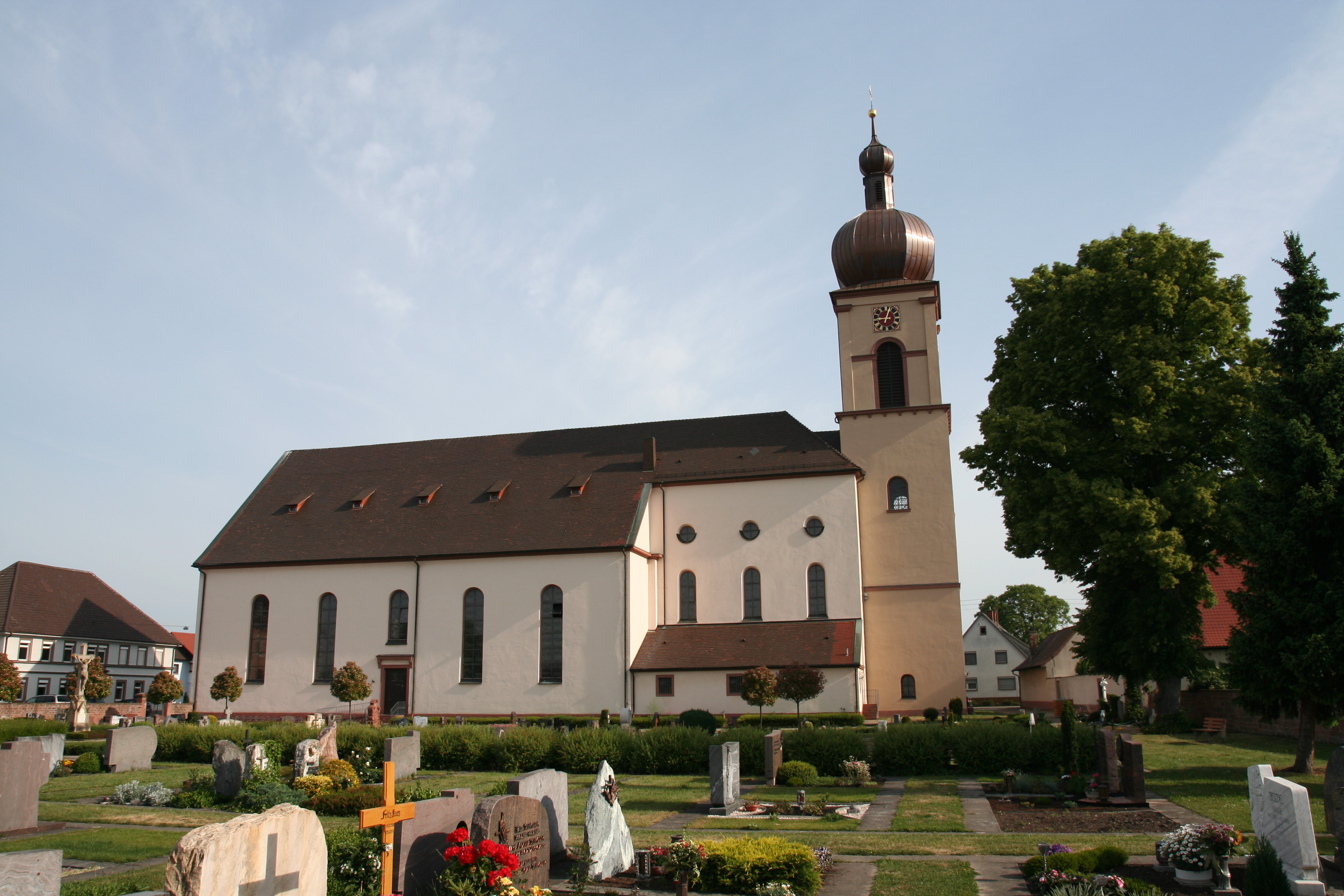
Katholische Kirche St. Cyprian in Kappel am Rhein, Baden-Württemberg,1826 bis 1828 nach Plänen von Hans Voss erbaut
New
Catholic Dictionary – Saints Cyprian and Justina
Article
Martyrs, died Nicomedia, 304.
Justina was a Christian whose
virginity was threatened by the magician Cyprian, but the grace of God was so
strong in her that she was able to resist his spells by making the sign of the
cross. Overpowered by a greater strength than his own, Cyprian became converted to
the Faith, entered the priesthood, and was made Bishop of Antioch in
Pisidia. Justina became a religious. They suffered in the persecution of Diocletian with
Theoctistus, a Christian who
had been associated with Cyprian. Relics in Vatican Basilica and Saint John
Lateran, Rome. Feast of
both saints, Roman Calendar, 26
September.
MLA
Citation
“Saints Cyprian and
Justina”. New Catholic Dictionary. CatholicSaints.Info. 16
September 2012.
Web. 29 November 2025.
<http://catholicsaints.info/new-catholic-dictionary-saints-cyprian-and-justina/>
SOURCE : https://catholicsaints.info/new-catholic-dictionary-saints-cyprian-and-justina/

Chiesa dei Santi Cipriano e Giustina, Fontanedo, Sella Giudicarie, provincia
autonoma di Trento, Trentino-Alto Adige, Italia
St. Justina of Antioch
Feastday: September 26
Death: 304
According to the
fictional morality story
that had great popularity though with no basis in fact, Cyprian was a native
of Antioch who
became a practitioner of sorcery and black magic. He traveled widely in Greece,
Egypt, Macedonia, and the Indies to broaden his knowledge of
the black arts. When Aglaides, a young pagan, fell in love with the beautiful
Justina, a Christian of
Antioch, he asked Cyprian to help him win her. Cyprian tried all his black
magic and diabolical expertise to win her for himself but was repelled by
her faith and
the aid of Mary. He called on the devil, who assailed Justina with every weapon
in his arsenal, to no avail. When Cyprian realized the overwhelming power of
the forces arrayed against him and the devil, Cyprian threatened to leave the
devil's service; whereupon the devil turned
on Cyprian, only to be repulsed by the sign of the cross made
by a repentant Cyprian, who realized the sinfulness of his past life. He then
turned to a priest named
Eusebius for instruction and was converted to Christianity. He destroyed his
magical books, gave his wealth to the poor, and was baptized, as was Aglaides.
Justina then gave away her possessions and dedicated herself to God. In time Cyprian
was ordained and later was elected bishop of
Antioch. He was arrested during Diocletian's persecution of
the Christians and tortured at Tyre by
the governor of Phoenicia, as was Justina. They were then sent to Diocletian,
who had them beheaded at Nicomedia. Feast day is September
26th.
SOURCE : https://www.catholic.org/saints/saint.php?saint_id=699

Church
of St. Cyprian and Justina in Vis
Crkva
sv. Ciprijana i Justine na Visu
arcidiocesi di Spalato-Macarsca ; Lissa, regione spalatino-dalmata, Croazia Adriatica, Croazia

Church
of St. Cyprian and Justina in Vis
Crkva
sv. Ciprijana i Justine na Visu
arcidiocesi di Spalato-Macarsca ; Lissa, regione spalatino-dalmata, Croazia Adriatica, Croazia

Church
of St. Cyprian and Justina in Vis
Crkva
sv. Ciprijana i Justine na Visu
arcidiocesi di
Spalato-Macarsca ; Lissa, regione spalatino-dalmata, Croazia
Adriatica, Croazia
Short
Lives of the Saints – Saints Cyprian and Justina, Martyrs
Entry
Saint Justina was a
virgin of Antioch (in the fourth century) and the daughter of a pagan priest.
She was converted to Christianity, and drew her idolatrous parents with her to
the feet of Christ. As she was extremely lovely, Justina had many admirers; but
one, a noble youth of Antioch, was so infatuated with her beauty and sweetness,
that he strove to win her in marriage. But Justina refused him, having
consecrated herself secretly to God. Then her noble lover had recourse for help
to an astrologer and magician named Cyprian. But no sooner had Cyprian beheld
the maiden than he became also deeply enamored of her, and all his power was
exerted to tempt and torment the innocent girl. Strong in her chastity and in
the power of God, however, Justina was victorious; so that Cyprian was
converted to the faith and lived, thenceforth, a life of most austere piety. In
the persecution of Diocletian, Saints Justina and Cyprian, after being first
cast together into a caldron of boiling pitch (whence they miraculously
escaped), were finally beheaded, a.d. 304.
Such holy love inflamed
her heart
That she abhorr’d the poisoning dart
Of worldly love, and bravely trod
The narrow way that leads to God.
– Fortem virili pectore
Favorite Practice
– To console yourself with the thought that no temptation can defile the
soul that does not consent to it.
MLA
Citation
Eleanor Cecilia Donnelly.
“Saints Cyprian and Justina, Martyrs”. Short
Lives of the Saints, 1910. CatholicSaints.Info.
19 April 2021. Web. 29 November 2025.
<https://catholicsaints.info/short-lives-of-the-saints-saints-cyprian-and-justina-martyrs/>
SOURCE : https://catholicsaints.info/short-lives-of-the-saints-saints-cyprian-and-justina-martyrs/

Pfarrkirche
St. Cyprian und Justina in Kleinkitzighofen, Lamerdingen, circondario dell'Algovia Orientale, distretto della Svevia, Baviera,
Germania
Sts. Cyprian and Justina
Christians of Antioch who
suffered martyrdom during
the persecution of Diocletian at Nicomedia,
26 September, 304, the date in September being afterwards made the
day of their feast. Cyprian was a heathen magician of Antioch who
had dealing with demons.
By their aid he sought to bring St. Justina, a Christian virgin,
to ruin; but she foiled the threefold attacks of the devils by
the sign
of the cross. Brought to despair Cyprian made the sign
of the cross himself and in this way was freed from the toils of Satan.
He was received into the Church,
was made pre-eminent by miraculous
gifts, and became in succession deacon, priest,
and finally bishop,
while Justina became the head of a convent.
During the Diocletian persecution both
were seized and taken to Damascus where they were shockingly
tortured. As their faith never
wavered they were brought before Diocletian at Nicomedia,
where at his command they were beheaded on the bank of the river Gallus. The
same fate befell a Christian,
Theoctistus, who had come to Cyprian and had embraced him. After the
bodies of the saints had
lain unburied for six days they were taken by Christian sailors
to Rome where
they were interred on
the estate of a noble lady named Rufina and later were
entombed in Constantine's basilica. This is the outline of
the legend or allegory which is found, adorned with diffuse
descriptions and dialogues, in the unreliable "Symeon
Metaphrastes", and was made the subject of a poem by the
Empress Eudocia II. The story, however, must have arisen as early as
the fourth century, for it is mentioned both by St.
Gregory Nazianzen and Prudentius; both, nevertheless, have
confounded our Cyprian with St.
Cyprian of Carthage, a mistake often repeated. It is certain that
no Bishop of Antioch bore
the name of Cyprian. The attempt has been made to find
in Cyprian a mystical prototype of the
Faust legend: Calderon took
the story as the basis of a drama: "El magico prodigioso".
The legend is given
in Greek and Latin in Acta SS. September,
VII. Ancient Syriac and Ethiopic versions
of it have been published within the last few years.
Sources
KAULES in Kirchenlex.,
s.v.; ZAHN, Cyprian von Antiochien und die deutsche Faustsage (Erlange, 1882);
RYSSEL, Urtext d. Cyprianschen Legende in Archiv f. neuere Sprachen u.
Litt. (1903), XX, 273-311; Bibl. hagiog. lat., 308; see also BUTLER, Lives
of the Saints, 25 September; and (ibid.) BARING-GOULD, Lives of the Saints.
Meier, Gabriel. "Sts.
Cyprian and Justina." The Catholic Encyclopedia. Vol.
4. New York: Robert Appleton Company, 1908. 26 Sept.
2015 <http://www.newadvent.org/cathen/04583a.htm>.
Transcription. This
article was transcribed for New Advent by Michael T. Barrett. Dedicated to
JoAnn Smull.
Ecclesiastical
approbation. Nihil Obstat. Remy Lafort, Censor. Imprimatur. +John
M. Farley, Archbishop of New York.
Copyright © 2023 by Kevin Knight. Dedicated to the Immaculate Heart of Mary.
SOURCE : http://www.newadvent.org/cathen/04583a.htm

ікона
священомученика Кипріяна і мучениці Юстини
September 26
SS. Cyprian and Justina,
Martyrs
The Empress Eudocia, wife
of Theodosius the Younger, (who chose her for his consort on account of her
learning and skill in philosophy,) wrote the history of SS. Cyprian and Justina
in a beautiful Greek poem, consisting of three books, commended by Photius, who
has given an abstract of this work; but the poem itself is lost, with many
other elegant poetical compositions of that princess. The authentic acts of
these martyrs are likewise lost. But we have still extant the confession of St.
Cyprian, written by himself, the same that was made use of by St. Gregory
Nazianzen and Eudocia; also two other genuine pieces, the one entitled, The
Conversion of Justina and Cyprian; the other, An Account of their Martyrdom.
Also Prudentius, hymn. 13, p. 215. St. Gregory Naz. Or. 18, (though they, by
mistake, confound this St. Cyprian with the bishop of Carthage,) and Photius,
Bibl. Cod. 184, give us the history of these martyrs. On their Latin acts see
Card. Baronius, &c. On the Greek of two sorts, Lambecius, Bibl. Impel.
Vindeb. t. 8, p. 247, 257, 262. Montfauc. Bibl. Coislin. p. 210. See Tillemont,
t. 5. Ceillier, t. 4, p. 89. Orsi, t. 4, p. 80. Jos. Assemani in Cal. Univ. t.
5, p. 269, ad 2 Oct.
A.D. 304.
ST. CYPRIAN, surnamed the Magician, was an illustrious instance of the divine
grace and mercy. He was a native of Antioch, (not the capital of Syria, but a
small city of that name, situated between Syria and Arabia,) which the Romans
allotted to the government of Phœnicia, to the jurisdiction of which province
this martyr was subject. The detestable superstition of his idolatrous parents
put them upon devoting him from his infancy to the devil, and he was brought up
in all the impious mysteries of idolatry, judicial astrology, and the black
art. In hopes of making great discoveries in these infernal pretended sciences,
he left his native country, when he had grown up, and travelled to Athens,
Mount Olympus in Macedon, Argos, Phrygia, Memphis in Egypt, Chaldæa, and the
Indies, places at that time famous for superstition and magical arts. When
Cyprian had filled his head with all the extravagances of these schools of
error and delusion, he stuck at no crimes, blasphemed Christ, and committed
secret murders, to offer the blood, and inspect the bowels of children, as
decisive of future events. His skill was employed in attempting the modesty of
virgins; but he found Christian women proof against his assaults and spells.
There lived at Antioch a young lady called Justina, whose birth and beauty drew
all eyes upon her. She was born of heathen parents, but was brought over to the
Christian faith, and her conversion was followed by that of her father and
mother. A pagan young nobleman fell deeply in love with her, and finding her
modesty inaccessible, and her resolution invincible, he applied to Cyprian for
the assistance of his art. Cyprian was no less smitten with the lady than his
friend, and heartily tried every secret with which he was acquainted to conquer
her resolution. Justina, perceiving herself vigorously attacked, studied to arm
herself by prayer, watchfulness, and mortification against all his artifices
and the power of his spells. “She defeated and put to flight the devils by the
sign of the holy cross,” says Photius, from Eudocia. 1 St.
Cyprian writes in his Confession: 2 “She
armed herself with the sign of Christ, and overcame the invocation of the
demons.” St. Gregory Nazianzen adds: “Suppliantly beseeching the Virgin Mary
that she would succour a virgin in danger, she fortified herself with the
antidotes of fasting, tears, and prayers.” Cyprian finding himself worsted by a
superior power, began to consider the weakness of the infernal spirits, and
resolved to quit their service. The devil, enraged to lose one by whom he had
made so many conquests of other souls, assailed Cyprian with the utmost fury,
and, having been repulsed in several other assaults, he at length overspread
the soul of the penitent sinner with a gloomy melancholy, and brought him
almost to the brink of despair at the sight of his past crimes. God inspired
him in this perplexity to address himself to a holy priest named Eusebius, who
had formerly been his school-fellow: by the advice of this priest he was
wonderfully comforted and encouraged in his conversion. Cyprian, who, in the
pressure of his heart, had been three days without eating, by the counsel of
this charitable director took some refreshment, and, on the following Sunday,
very early in the morning, was conducted by him to the assembly of the
Christians; for though it was forbidden for persons not initiated by baptism to
assist at the celebration of the divine mysteries, this did not regard other
devotions, to which such as were under instruction in the faith might be
admitted. These assemblies were then held very early in the morning, both to watch
in prayer, and for fear of the heathens. So much was Cyprian struck at the
awful reverence and heavenly devotion with which this act of the divine worship
was performed, that he writes of it: 3 “I
saw the choir of heavenly men, or of angels, singing to God, adding at the end
of every verse in the psalms the Hebrew word Alleluia, so that they seemed not
to be men.” 4 Every
one present was astonished to see Cyprian introduced by a priest among them,
and the bishop was scarcely able to believe his own eyes; or at least to be
persuaded that his conversion was sincere. But Cyprian gave him a proof the
next day by burning before his eyes all his magical books, giving his whole
substance to the poor, and entering himself among the catechumens. After due
instruction and preparation, he received the sacrament of regeneration from the
hands of the bishop. Agladius, who had been the first suitor to the holy
virgin, was likewise converted and baptized. Justina herself was so moved at
these wonderful examples of the divine mercy, that she cut off her hair in
order to dedicate her virginity to God, and disposed of her jewels and all her
possessions to the poor. St. Gregory Nazianzen beautifully describes the
astonishing change that was wrought in Cyprian, his edifying deportment, his
humility, modesty, gravity, love of God, contempt of riches, and assiduous
application to heavenly things. The same father tells us, that, out of
humility, with earnest entreaties, he prevailed to be employed as sweeper of
the church. Eudocia, quoted by Photius, says he was made door-keeper; but that,
after some time, he was promoted to the priesthood, and, after the death of
Anthimus the bishop, was placed in the episcopal chair of Antioch. Joseph
Assemani thinks, not of Antioch, but of Damascus, or some other city in Syria.
The persecution of Dioclesian breaking out, Cyprian was apprehended, and
carried before the governor of Phœnicia, who resided at Tyre. Justina had
retired to Damascus, her native country, which city at that time was subject to
the same presidial; and, falling into the hands of the persecutors, was
presented to the same judge. She was inhumanly scourged, and Cyprian was torn
with iron hooks, probably at Damascus. After this they were both sent in chains
to Dioclesian, residing at Nicomedia, who, upon reading the letter of the
governor of Phœnicia, without more ado, commanded their heads to be struck off:
which sentence was executed upon the banks of the river Gallus, which passes
not far from the city of Nicomedia. Theoctistus, also a Christian, was beheaded
with them for speaking to Cyprian as he was going to execution. Their relics
were procured by certain Christians who came from Rome, and were carried by
them thither on board their vessel. In the reign of Constantine the Great a
pious lady, named Rufina, of the family of Claudius, built a church in their
memory, near the square which bears the name of that prince. These relics were
afterwards removed into the Lateran basilic.
If the errors and disorders of St. Cyprian show the degeneracy of human nature
corrupted by sin, and enslaved to vice, his conversion displays the power of
grace and virtue to repair it. How strangely the image of God is disfigured in
man by sin appears by the disorders of his spiritual faculties, the
understanding, and will in which the divine resemblance was stamped in the
creation. Not only beasts and other creatures have revolted from his dominion,
and the shattered frame of his body is made a prey to diseases and death, but
his will is rebellious, and the passions strive to usurp the empire, and
destroy in his soul the government of reason and virtue. Also the
understanding, that should be the eye to the blind will, is itself blind, and
the light within us is become darkness. In the state of innocence it was clear,
serene, and free from the vapours of the passions: it directed the verdict of
the imagination and the senses, and gave to the soul, by intuition and without
study, a full view into all speculative natural truths, suited to man’s
condition; but its most valuable privilege was, that it taught man all the
practical rules and notions of moral virtue firm and untainted, so that he
carried this law in his bosom, and had but to look into his own conscience for
the direction of his actions in the practice of all moral virtue, which, by the
strong assistance of grace, was always easy to him. His understanding was also
enlightened by a perfect divine revelation, and his will found no obstacle in
the exercises of all theological and other supernatural virtues. The most fatal
consequence and punishment of his disobedience we deplore in the extravagances,
folly, crimes, and errors into which men are betrayed when they become once
enslaved to their passions. Religion and faith alone secure us from these
dangers, enlighten our understanding, and offer us the means to restore the
rectitude of the will.
Note 1. Cod. 181. [back]
Note 2. P. 310. [back]
Note 3. Cod. p. 329. [back]
Note 4. The ingenious Mr. Wharton, sub-preceptor of Westminster school,
who had travelled into France, in his Essay on the Writings and Genius of Mr.
Pope, among several miscellaneous anecdotes, makes the following reflection:
(p. 825,) “I believe few persons have ever been present at the celebrating a
mass in a good choir, but have been extremely affected with awe, if not with
devotion.—Lord Bolingbroke, being one day present at this solemnity, in the
chapel at Versailles, and seeing the bishop elevate the host, whispered his
companion, the marquiss de ————, ‘If I were king of France, I would always
perform this ceremony myself.’” This is the testimony of professed adversaries
and scoffers. See also Dr. Taylor, &c. [back]
Rev. Alban Butler (1711–73). Volume IX: September. The
Lives of the Saints. 1866.
SOURCE : http://www.bartleby.com/210/9/261.html

Мученики
Кипріян і Юстина. Ікона з життям, кінець XVIII ст. Росія.
Les
martyrs Cyprien et Justine. Icône russe, fin du XVIIIe siècle.
Weninger’s
Lives of the Saints – Saint Cyprian and Saint Justina, Martyrs
Article
The native place of Saint
Justina was Antioch. Her parents were pagans, and hence, educated their
daughter in the blindness of idolatry. As Justina had been gifted by the
Almighty with great intellect, she early in life recognized the nothingness of
idolatry and was easily moved to embrace Christianity. No sooner had she been
converted, than she rested not until her parents had also joined the faithful.
Her desire to serve God most perfectly in the Christian faith incited her
zealously to practise all virtues. Especially did she esteem virginal purity,
and she consecrated herself to the Almighty by a solemn vow.
In the city where she
lived, resided also a noble youth named Agiaides, who, admiring Justina,
desired to make her his wife. Justina told him, without any hesitation, that he
must give up all thought of her, not only because she was a Christian and he a
heathen, but also because she had already consecrated her virginity to a much
nobler spouse. The youth who was not so easily to be refused, sent her one
letter after another, seeking thus to win her affections. The chaste virgin
accepted neither letters nor presents, but repeated her words, adding that she
never would change. As he could not gain admittance into her house, he watched
for her when she went to Church. One day, meeting her all alone in a narrow
street, he hastened towards her. Justina, horrified at his impertinence,
defended herself with a strength which is only possessed by the virtuous when
sustained by the Most High. In her terror she called loudly for help, and
raising her eyes, thus prayed to the divine Mother: “O. Virgin, come to the
assistance of a virgin!” The neighboring people who had heard her repeated
cries, came running towards her, and driving the youth away, rescued the
innocent maiden. When Justina arrived in Church, she gave most fervent thanks
to God and the Virgin Mother, for the assistance they had vouchsafed to her.
The unchaste youth,
however, had still no peace. Blinded and hardened, he went, by the instigation
of Satan, to a magician, named Cyprian, who, at that period, had great
celebrity. Telling him that he wanted to marry Justina, he requested him to
force her by his art to consent, and promised him a large sum of money should
he succeed. The magician promised everything, and conjuring the devil,
commanded him to torment Justina until she accepted the offer of Aglaides. The
Almighty permitted the chaste virgin to be tormented by the Evil One day and
night, with the most abominable thoughts. But taking refuge in prayer, she
signed herself often with the holy cross, determined in her heart to conquer
all temptations, often renewing her vow and repeating with great trust the
words: “O Virgin, come to the assistance of a virgin!” In a word, she fought so
bravely, that the devil could gain no power over her. Aglaides going to the
magician, complained of the ill success of his art. Conjuring Satan, Cyprian
sent more evil spirits to trouble her with their temptations; but they had no
better success than the former. Cyprian, full of astonishment, asked the devils
whence it happened that they could not become masters of so weak a being. One
of them, evidently forced by God, said: “She is a Christian and calls
continually on her God, and uses against us the sign of the Cross. Therefore we
can have no power over her.” Cyprian wisely responded: “This proves clearly,
that the God of Justina is more mighty than you all together. Hence I have
acted very foolishly in serving you; and now I renounce you, and in future, will
give my service to the God of Justina.” How great a change worked by the hand
of the Almighty! Cyprian endeavored to execute his resolution without loss of
time.
He was acquainted with
Eusebius, a holy priest, who had often exhorted him to forsake his magic, and
seek Christ. To him Cyprian repaired, and having acquainted him with all that
had happened, he earnestly asked him whether the God of the Christians would
receive a magician among His servants and if He could and would forgive his
misdeeds. Eusebius assured him that the Almighty would not withhold His pardon;
and having explained to him the immeasurable mercy of God, who promises to all
sinners doing penance, grace and pardon, he went with him to the bishop, who
might give him still better instructions on the subject. Cyprian acquainted him
with his desire to do penance and become a Christian, and as a sign that he was
in earnest he brought all his magical books and burned them in presence of the
bishop. Anthimus, the bishop, was rejoiced at the conversion of so great a
sinner, and treating Cyprian most kindly, instructed him in the Christian
faith, and baptized him. Justina’s heart also was filled with inexpressible
consolation, when she heard Cyprian’s his tor}’, and giving thanks to the
Almighty, for having turned his wicked plans into good, she prayed that he
might remain constant in the true faith. There yet remained Aglaides to be won.
But by the mercy of God towards the greatest sinners, he was also converted,
gave all his possessions to the poor Christians, and having become one of their
number, led, henceforth, a pious and penitential life. Cyprian showed himself,
after his conversation, not only anxious for his own salvation, but endeavored
also to bring others to Christ He and Aglaides gave humble thanks to Saint
Justina,as she had been the means by which they had been converted; for all
three would have gone to destruction, had she not bravely resisted the evil
temptations to which they exposed her.
Eutholius, the governor
of Phoenicia, hearing what had taken place in regard to the magician Cyprian,
who had been greatly celebrated and much beloved by the pagans, reported the
whole proceedings to the Emperor Dioclesian, and in return received the order
to leave nothing undone to bring Cyprian back to paganism. He then called the
latter and Justina into his presence, and endeavored to persuade them to
renounce Christ Both, however, expounded the truth of the Christian faith so
clearly to him, that he was deeply astounded. But as he desired not to appear
too much in favor of the Christians, he commanded both to be buffeted and
scourged, and then thrown into a dungeon, thinking that this would be enough to
bring them back to idolatry. On perceiving that both remained immovable in
their faith, he had them thrown into a large cauldron, filled with boiling tar
and wax. The holy martyrs, remaining unharmed, praised God with a loud voice. A
magician, who had been a disciple of Cyprian, said that this was only a proof
of the power of that art which Cyprian had formerly practised, and offered to
prove it still more clearly by exposing himself to the same test. When his
offer had been accepted, he made some ridiculous signs, muttered some
conjurations, and went towards the cauldron standing over the fire; but he was
immediately seized by the flames and burned to ashes. This event increased the
wonder at the miracle wrought on the holy martyrs. The Governor, who knew not
what to do, sent them both to Nicomedia, where the emperor Dioclesian resided,
who immediately ordered them to be decapitated. For six days and nights, the
holy bodies remained in the open air, as the tyrant had commanded that they
should be left a prey to wild beasts. But none of these touched them; and some
Christians at last took them away by night, and having placed them on board a
ship, they brought them to Rome, where they are still honored in our days.
Practical Considerations
• Oh, that all who desire
to live chastely in their station, would learn of Saint Justina, how they ought
to conduct themselves when they are tempted to sin by Satan or by wicked
persons. To receive letters or presents; to have long, intimate and especially
secret conversations with dangerous companions; to allow themselves to be
caressed, is the sure way to great vices. “A holy love,” writes Saint Jerome,
“has nothing to do with presents, flattering letters and caresses; for, all
such things savor of the flesh and are far from a chaste love.” And again he
says: “Immodest flatteries, jesting, laughing and caresses, are the beginning,
and a certain sign of the approach of the death of purity.” Whoever detests
sins against purity, let him guard against such a beginning; otherwise he is
lost. When you are assailed by force, imitate the chaste Justina. Flee, if you
can; but if this is not possible, resist courageously; above all things, use
your voice. Call as loudly as you can to God and men for help. In this manner
you will surely conquer any wicked person who would entice you to sin. If hell
persecutes you with its temptations, let Saint Justina be your model. Be not
discouraged; the devil cannot force you, even should he call all his hellish
companions to aid him. Prayer, the sign of the holy cross, calling to God and
the Blessed Virgin, fasting, repeated resolutions not to be conquered, are such
invincible weapons, that all hell cannot overcome him who makes use of them.
Those who do not make use of them can blame themselves alone when they fall and
go to perdition.
• Cyprian and Aglaides
were converted and became Saints, because Justina had so valiantly opposed
their wicked schemes. Cyprian, to manifest how earnest he was in his
conversion, cast his books and other instruments of his magic art from him.
Both gave thanks to Justina for defending herself so bravely, as it opened
their eyes to see the brink of the precipice upon which they stood. All three
rejoice now eternally in heaven. It is a great miracle of divine mercy, when a
magician or an unchaste person reforms; and this miracle God performed on
Cyprian and Aglaides. He is ready to work it on others also, who are addicted
to vice, if they are only desirous to be converted. To be earnest, and to take
due care not to offend again against purity, it is necessary that nothing be
kept back which has reference to the vice of unchastity, as dangerous books,
immodest pictures and other objects which incite to unchastity. One must shun
all the occasions of sin, and break off all sinful acquaintances. If Justina
had shown herself weak when tempted to sin, she would not have converted
Cyprian and Aglaides. If she had consented and died with them in sin, she would
now be with them in hell. There they would now curse and execrate each other.
Learn from this, how much good we may do by resisting sin, and how much evil by
being weak. Those who would tempt you to sin, will one day thank you if you
resist them fearlessly; but they will curse and execrate you for consenting to
their wickedness. Battle, therefore, bravely against the evil spirit, and all
others who assail you. “Even unto death fight for justice.” (Eccles. 4)
MLA
Citation
Father Francis Xavier
Weninger, DD, SJ. “Saint Cyprian and Saint Justina, Martyrs”. Lives of the Saints, 1876. CatholicSaints.Info.
6 May 2018. Web. 29 November 2025.
<https://catholicsaints.info/weningers-lives-of-the-saints-saint-cyprian-and-saint-justina-martyrs/>
SOURCE : https://catholicsaints.info/weningers-lives-of-the-saints-saint-cyprian-and-saint-justina-martyrs/
_-_facciata_e_lato_nord_1_2022-06-18.jpg)
Facciata e lato nord della chiesa dei Santi Cipriano e Giustina, Stagno, Roccabianca, provincia di Parma, Emilia-Romagna
Pictorial
Lives of the Saints – Saint Cyprian and Saint Justina, Martyrs
The detestable
superstition of Saint Cyprian’s idolatrous parents devoted him from his infancy
to the devil, and he was brought up in all the impious mysteries of idolatry,
astrology, and the black art. When Cyprian had learned all the extravagances of
these schools of error and delusion, he hesitated at no crimes, blasphemed
Christ, and committed secret murders. There lived at Antioch a young Christian
lady called Justina, of high birth and great beauty. A pagan nobleman fell
deeply in love with her, and finding her modesty inaccessible, and her
resolution invincible, he applied to Cyprian for assistance. Cyprian, no less
smitten with the lady, tried every secret with which he was acquainted to
conquer her resolution. Justina, perceiving herself vigorously attacked,
studied to arm herself by prayer, watchfulness, and mortification against all
his artifices and the power of his spells. Cyprian finding himself worsted by a
superior power, began to consider the weakness of the infernal spirits, and
resolved to quit their service and become a Christian. Agladius, who had been the
first suitor to the holy virgin, was likewise converted and baptized. The
persecution of Diocletian breaking out, Cyprian and Justina were seized, and
presented to the same judge. She was inhumanly scourged, and Cyprian was torn
with iron hooks. After this they were both sent in chains to Diocletian, who
commanded their heads to be struck off, which sentence was executed.
Reflection – If the
errors and disorders of Saint Cyprian show the degeneracy of human nature
corrupted by sin, and enslaved to vice, his conversion displays the power of
grace and virtue to repair it. Let us beg of God to send us grace to resist
temptation, and to do His holy will in all things.
SOURCE : https://catholicsaints.info/pictorial-lives-of-the-saints-saint-cyprian-and-saint-justina-martyrs/
_-_BEIC_IE4411197.jpg)
Cyprien
et Justine dans La Légende dorée (1497).
Legendari
di sancti istoriado uulgar - Legenda
aurea, 1497 - Cipriano e Giustina, Biblioteca Europea di
Informazione e Cultura
Golden Legend –
Life of Saint Justina
Here
followeth the Life of Saint Justina, and first of her name.
Justina is said of
justice, for by justice she rendered to every each that was his: that is to
wit, to God obedience; unto her superior prelate, reverence; to her like and
semblable, concord; to them that were beneath and inferior, discipline; to her
enemies, patience; unto wretches and to them in distress, compassion and works
of pity; and to herself, holiness.
Of Saint Justina.
Justina the virgin was of
the city of Antioch, daughter of a priest of
the idols. And every day she sat at a window by a priest which
read the gospel, of whom at the last she was converted. And when the mother of
her had told it unto her father in his bed, Jesu Christ appeared to them with
his angels, saying: Come to me, I shall give to you the kingdom of heaven. And
when he awoke, anon they did them to be baptized with their daughter. And this
virgin was strongly grieved and vexed of Cyprian, and at the last she converted
him to the faith of Jesu Christ. And Cyprian from his childhood had been an
enchanter, for from the time that he was seven years old he was consecrated by
his parents to the devil. And he used the craft of necromancy, and made women
to turn into juments and beasts as them seemed, and many other things
semblable. And he was covetous of the love of Justina, and burnt in the
concupiscence of her, and resorted to his art magic that he might have her for himself,
or for a man named Acladius, which also burnt in her love. Then he called a
devil to him, to the end that he might by him have Justina, and when the devil
came he said to him: Why hast thou called me? And Cyprian said to him: I love a
virgin, canst thou not so much that I may have my pleasure of her? And the
devil answered: I that might cast man out of Paradise, and procured that Cain
slew his brother, and made the Jews to slay Christ, and have troubled the men,
trowest thou I may not do that thou have a maid with thee, and use her at thy
pleasure? Take this ointment and anoint withal her house withoutforth, and I
shall come and kindle her heart in thy love, that I shall compel her to assent
to thee. And the next night following the devil went and enforced him to move
her heart unto unlawful love. And when she felt it, she recommended herself
devoutly to God, and garnished her with the sign of the cross, and the devil,
all afraid of the sign of the cross, fled away from her, and came again to
Cyprian and stood before him. And Cyprian said to him: Why hast thou not
brought to me this virgin? And the devil said: I see in her a sign which feared
me, that all strength is failed in me. Then Cyprian left him, and called
another devil more stronger than he was. And he said: I have heard thy
commandment and have seen the non-power of him, but I shall amend it and
accomplish thy will. Then the devil went to her, and enforced to move her heart
in love, and inflame her courage in things not honest. And she recommended her
to God devoutly, and put from her that temptation by the sign of the cross, and
blew on the devil, and threw him anon away from her. And he fled all confused
and came tofore Cyprian, and Cyprian said to him: Where is the maid that I sent
thee for? and the devil said: I acknowledge that I am overcome and am rebutted,
and I shall say how, for I saw in her a sign horrible, and lost anon all my
virtue. Then Cyprian left him, and blamed him, and called the prince of the
devils. And when he was come he said: Wherefore is your strength so little,
which is overcome of a maid ? Then the prince said to him: I shall go and vex
her with great fevers, and I shall inflame more ardently her heart, and I shall
arouse and bedew her body with so ardent desire of thee that she shall be all
frantic: and I shall offer to her so many things that I shall bring her to thee
at midnight. Then the devil transfigured himself in the likeness of a maid, and
came to this holy virgin, and said: I am come to thee for to live with thee in
chastity, and I pray thee that thou say what reward shall we have for to keep
us so. And the virgin answered: The reward is great, and the labour is small.
And the devil said to her: What is that then that God commanded when he said:
Grow and multiply and replenish the earth? Then, fair sister, I doubt that if
we abide in virginity that we shall make the word of God vain, and be also
despising and inobedient, by which we shall fall into a grievous judgment,
where we shall have no hope of reward, but shall run in great torment and pain.
Then by the enticement of the devil the heart of the virgin was smitten with
evil thoughts, and was greatly inflamed in desire of the sin of the flesh, so
that she would have gone thereto, but then the virgin came to herself, and
considered who that it was that spake to her. And anon she blessed her with the
sign of the cross, and blew against the devil, and anon he vanished away and
melted like wax, and incontinent she was delivered from all temptation. A
little while after, the devil transfigured him in the likeness of a fair young
man, and entered into her chamber, and found her alone in her bed, and without
shame sprang into her bed and embraced her, and would have had a done with her.
And when she saw this she knew well that it was a wicked spirit, and blessed
her as she had done tofore, and he melted away like wax. And then by the
sufferance of God she was vexed with axes and fevers. And the devil slew many
men and beasts, and made to be said by them that were demoniacs that, a right
great mortality should be throughout all Antioch, but if Justina would consent
unto wedlock and have Cyprian. Wherefore all they that were sick and
languishing in maladies lay at the gate of Justina’s father and friends, crying
that they should marry her and deliver the city of that right great peril.
Justina then would not consent in no wise, and therefore everybody menaced her.
And in the sixth year of that mortality she prayed for them, and chased and
drove thence all that pestilence. And when the devil saw that he profited
nothing, he transumed and transfigured him in the form of Justina for to defoul
the fame of Justina, and in mocking Cyprian he advanced him that he had brought
to him Justina. And came to him in likeness of her, and would have kissed him
as if she had languished for his love. And when Cyprian saw him and supposed
that it had been Justina, he was all replenished with joy, and said: Thou art
welcome, Justina, the fairest of all women; and anon as Cyprian named Justina,
the devil might not suffer the name, but as soon as he heard it he vanished
away as a fume or smoke. And when Cyprian saw him deceived, he was all heavy
and sorrowful, and was then more burning and desirous in the love of Justina,
and woke long at the door of the virgin, and as him seemed he changed him
sometimes into a bird by his art magic, and sometimes into a woman, but when he
came to the door of the virgin he was neither like woman nor bird, but appeared
Cyprian as he was. Acladius, by the devil’s craft, was anon turned into a
sparrow, and when he came to the window of Justina, as soon as the virgin
beheld him, he was not a sparrow, but showed himself as Acladius, and began to
have anguish and dread, for he might neither fly ne leap, and Justina dreading lest
he should fall and break himself, did do set a ladder by which he went down,
warning him to cease of his woodness, lest he should be punished as a
malefactor by the law. Then the devil, being vanquished in all things, returned
to Cyprian, and held him all confused tofore him, and Cyprian said to him: And
how art not thou overcome, what unhappy is your virtue that ye may not overcome
a maid, have ye no might over her, but she overcometh you and breaketh you all
to pieces? Tell me, I pray thee, in whom she hath all this great might and
strength. And the devil said: If thou wilt swear to me that thou wilt not
depart from me ne forsake me, I shall show to thee her strength and her
victory; to whom Cyprian said: By what oath shall I swear? And the devil said:
Swear thou by my great virtues that thou shalt never depart from me. And
Cyprian said: I swear to thee by thy great virtues that I shall never depart
from thee. Then the devil said to him, weeping to be sure of him: This maid
maketh the sign of the cross, and anon then we wax feeble and lose all our
might and virtue, and flee from her, like as wax fleeth from the face of the
fire. And Cyprian said then to him: The crucified God is then greater than
thou? And the devil said: Yea, certainly he is greater than all others, and all
them that we here deceive, he judgeth them to be tormented with fire
inextinguishable. And Cyprian said: Then ought I to be made friend of him that
was crucified, lest I fall hereafter into such pains. To whom the devil said:
Thou hast sworn by the might and virtues of my strengths, the which no man may
forswear, that thou shalt never depart from me. To whom Cyprian said: I despise
thee, and forsake thee and all thy power, and renounce thee and all thy devils,
and garnish and mark me with the sign of the cross, and anon the devil departed
all confused.
Then Cyprian went to the
bishop, and when the bishop saw him he weened that he were come to put the
christian men in error, and said: Let it suffice unto thee, Cyprian, them that
be without forth, for thou mayst nothing prevail against the church of God, for
the virtue of Jesu Christ is joined thereto, and is not overcome. And Cyprian
said: I am certain that the virtue of our Lord Jesu Christ is not overcome, and
then he recounted all that was happened, and did him to be baptized of him. And
after, he profited much, as well in science as in life. And when the bishop was
dead, Cyprian was ordained bishop, and placed the blessed virgin Justina with
many virgins in a monastery, and made her abbess over many holy virgins. Saint
Cyprian sent then epistles to martyrs and comforted them in their martyrdom.
The earl of that country
heard of the fame and renomee of Cyprian and Justina, and he made them to be
presented tofore him and demanded them if they would do sacrifice. And when he
saw that they abode steadfastly in the faith of Jesu Christ, he commanded that
he should be put in a caldron full of wax, pitch, and grease, burning and
boiling. And all this gave to them marvellous refreshing, and did to them no
grief ne pain. And the priest of
the idols said to the provost of that place: Command me, sire, to stand and to
be tofore the caldron, and I shall anon overcome all their virtue. And then he
came tofore the caldron and said: Great is the god Hercules, and Jupiter the
father of gods. And anon the great fire issued from under the caldron and anon
consumed and burnt him. Then Cyprian and Justina were taken out of the caldron
and sentence was given against them, and they were both beheaded together. And
their bodies were thrown to hounds and were there seven days, and after they
were taken up and translated to Rome, and as it is said, now they rest at Placentia.
And they suffered death in the seventh calends of October, about the year of
our Lord two hundred and eighty, under Diocletian.
SOURCE : https://catholicsaints.info/golden-legend-life-of-saint-justina/ et The Golden Legend or Lives Of The Saints Compiled by Jacobus de Voragine, Archbishop of Genoa, 1275 Englished by William Caxton, First Edition 1483 From the Temple Classics Edited by F.S. Ellis Also available in Adobe Acrobat (.pdf) format : http://www.christianiconography.info/goldenLegend/justina.htm

Sant
Cebrià i Santa Justina en una icona del cristianisme oriental.
Ікона
священомученика Кипріяна і мучениці Юстини
San
Cipriano y Santa Justina en un icono del cristianismo oriental.
The Lives of Sts. Cyprian
and Justina
Christianity vs. Sorcery.
THE TWENTIETH CENTURY, which began with the presumption of imagining itself the
most enlightened of all ages, has in reality proceeded of imagining some of the
blackest years of all human history. Symptomatic of this truly dark age is the
revival in recent decades of interest and active participation in witchcraft
and sorcery. Much of this interest is on the level of dilettantism and crude
amateurism, but more and more often it produces real results, leads to an
actual contact with demonic powers, and causes the eternal damnation of souls
caught in the web of nets far more subtle and deadly than the beginning
occultist imagines.
All this is not new to
Orthodox Christians. In the history of the world's religions there is a whole
tradition of sorcery—the service of the pagan gods, which are demons (Psalm
95:5). This is the religious tradition which Christianity replaced in all lands
that accepted the Gospel, and which now comes back in power to destroy
Christianity and to conduct mankind to Antichrist.
The Life of Sts. Cyprian
and Justina gives one of the fullest accounts in Christian literature of
sorcery and its power over men—and its final defeat by the power of Christ. It
is not the product of someone's imagination, but is based on the first-hand
testimony of one who was a leading servant of the demons himself.
Let Orthodox Christians
read and become sober, and resolve with the more firmness and determination to
work out their salvation against the powers of darkness in fear and trembling. And
let him who has in his heart even a spark of repentance take courage and hope,
for this Life is also the surest proof that God's mercy is stretched out even
to the most lost of souls. If the sorcerer Cyprian could be saved and become a
mighty intercessor for the demon possessed, then there is hope for those also
who even now have fallen into the darkest and most unnatural sins of our dark
age.
The Life and Sufferings
of the Holy Martyrs Cyprian and Justina (Commemorated October 2/15)
Kontakion, Tone 1
Thou wast converted from
the art of sorcery, O divinely wise one,*
to the knowledge of God,* and wast manifested to the world as a
most wise physician,* granting healing to those who honor thee, O
Cyprian together with Justina.* With her, then, entreat
the Master, the Lover of mankind,* that He may save our souls.
IN THE REIGN of Decius
(249-251) there lived in Antioch (of Pisidia) a certain philosopher and
renowned sorcerer whose name was Cyprian, a native of Carthage. Springing from
impious parents, in his very childhood he was dedicated by them to the service
of the pagan god Apollo. At the age of seven he was given over to magicians for
the study of sorcery and demonic wisdom. At the age of ten he was sent by his
parents, as a preparation for a sorcerer's career, to Mount Olympus, which the
pagans called the dwelling of the gods. Here there were a numerous multitude of
idols, in which demons dwelled.
On this mountain Cyprian
studied all manner of diabolical arts: he mastered various demonic transformations,
learned how to change the nature of the air, to bring up winds, produce thunder
and rain, disturb the waves of the sea, cause damage to gardens, vineyards and
fields, to send diseases and plagues upon people; and in general he learned a
ruinous wisdom and diabolical activity filled with evil. In this place he saw a
numberless legion of demons, with the prince of darkness at their head; some
stood before him, others served him, still others cried out in praise of their
prince, and some were sent into the world in order to corrupt people. Here he
likewise saw in their false forms the pagan gods and goddesses, and also
diverse phantoms and specters, the invocation of which he learned in a strict
forty-day fast. He ate only after the setting of the sun, and not bread or
anything else, but only acorns from oak trees.
When he was fifteen years
old he began to receive lessons from seven great sorcerers; from them he
learned many demonic secrets. Then he went to the city of Argos, where, having
served the goddess Juno for a time, he learned many practices of deception from
her priests. He lived also in Taurapolis (on the island of Icara) in the
service of the goddess Diana; and from there he went to Sparta, where he
learned how to call forth the dead from the graves and to force them to speak
by means of various incantations and spells. At the age of twenty, Cyprian came
to Egypt, and in the city of Memphis he learned yet greater charms and
incantations. In his thirtieth year he went to the Chaldeans, and having
learned astrology there, he finished his studies. After this he returned to
Antioch, being perfect in all evil-doing. Thus he became a sorcerer, magician,
and destroyer of souls, a great friend and faithful slave of the prince of
hell, with whom he conversed face to face, being vouchsafed to receive from him
great honor, as he himself testified.
"Believe me,"
he said; "I have seen the prince of darkness himself, for I propitiated
him by sacrifices. I greeted him and spoke with him and his ancients; he liked
me, praised my understanding, and before everyone said: 'Here is a new Jambres,
always ready for obedience and worthy of communion with us!' And he promised to
make me a prince after my departure from the body, and for the course of
earthly life to help me in everything. And he gave me a legion of demons to
serve me. When I departed from him, he addressed me with these words: 'Take
courage, fervent Cyprian; arise and accompany me; let all the demonic ancients
marvel at you.' Consequently, all of his princes also were attentive to me,
seeing the honor shown to me. The outward appearance of the prince of darkness
was like a flower. His head was crowned by a crown (not an actual, but a
phantom one) made of gold and brilliant stones, as a result of which the whole
space around him was illuminated; and his clothing was astonishing. When he
would turn to one or the other side, that whole place would tremble; a
multitude of evil spirits of various degrees stood obediently at his throne. I
gave myself over entirely into his service at that time, obeying his every
command." Thus did St. Cyprian relate of himself after his conversion.
From this it is evident
what kind of man Cyprian was: as a friend of the demons, he performed all their
works, causing evil to people and deceiving them. Living in Antioch, he turned
many people away to every kind of lawless deed; he killed many with poisons and
magic, and slaughtered young men and maidens as sacrifices for the demons. He
instructed many in his ruinous sorcery: some he taught to fly in the air,
others to sail in boats on the clouds, still others to walk on water. By all
the pagans he was revered and glorified as a chief priest and most wise servant
of their vile gods. Many turned to him in their needs, and he helped them by
means of the demonic power with which he was filled: with some he cooperated in
their adulteries, with others in anger, enmity, revenge, jealousy. Already he
was entirely in the depths of hell and in the jaws of the devil; he was a son
of gehenna, a partaker of the demonic inheritance and of their eternal perdition.
But the Lord, who does not desire the death of a sinner, in His unutterable
goodness and His mercy which is not conquered by the sins of men, deigned to
seek out this lost man, to draw out of the abyss one who was mired in the filth
of the depths of hell, and to save him in order to show to all men His mercy;
for there is no sin which can conquer His love of mankind.
He saved Cyprian from
perdition in the following way.
THERE LIVED AT THAT TIME
in Antioch a certain maiden whose name was Justina. She came from pagan
parents; her father was a priest of the idols, Aedesius by name, and her mother
was called Cledonia. Once, sitting at the window of her house, this maiden, who
had then already reached womanhood, by chance heard the words of salvation out
of the mouth of a deacon who was passing by, whose name was Praylius. He spoke
of our Lord Jesus Christ's becoming man, that He had been born of the Most Pure
Virgin and, having performed many miracles, had deigned to suffer for the sake
of our salvation, had risen from the dead with glory, ascended into the
heavens, and sits at the right hand of the Father and reigns eternally. This
preaching of the deacon fell on good soil, into the heart of Justina, and began
quickly to bring forth fruit, uprooting in her the thorns of unbelief. Justina
wished to be instructed in the Faith by this deacon better and more completely,
but she did not dare to seek him out, being restrained by a maiden's modesty.
However, she secretly went to the church of Christ, and often hearing the word
of God, with the Holy Spirit acting in her heart, she came to believe in
Christ.
Soon she convinced her
mother of this also, and then brought to the faith her aged father as well.
Seeing the understanding of his daughter and hearing her wise words, Aedesius
reflected within himself thus: "The idols are made by the hands of men and
have neither soul nor breath, and therefore how can they be gods?" While
he was reflecting on this, once at night he saw during sleep, by Divine consent,
a wondrous vision: he saw a great multitude of light-bearing Angels, and in
their midst was the Saviour of the world, Christ, Who said to him: "Come
to Me, and I will give you the Kingdom of Heaven."
After rising in the
morning, Aedesius went with his wife and daughter to the Christian Bishop,
whose name was Optatus, begging him to instruct them in the Faith of Christ and
to perform upon them holy Baptism. At the same time he informed him of the
words of his daughter and of the angelic vision which he had seen himself.
Hearing this, the Bishop rejoiced at their conversion, and having instructed
them in the Faith of Christ, he baptized Aedesius, his wife Cledonia, and their
daughter Justina; and then, having given them communion of the Holy Mysteries,
he let them go in peace.
When Aedesius had become
strengthened in the Faith of Christ, the Bishop, seeing his piety, made him a
presbyter. After this, having lived virtuously and in the fear of God for a
year and six months, Aedesius in holy faith came to the end of his life. As for
Justina, she valiantly struggled in the keeping of the Lord's commandments, and
having come to love her Bridegroom Christ, she served Him with fervent prayers,
in virginity and chastity, in fasting and great abstinence. But the enemy, the
hater of the human race, seeing such a life, envied her virtues and began to do
harm to her, causing various misfortunes and sorrows.
AT THAT TIME there lived
in Antioch a certain youth named Aglaias, the son of wealthy and renowned
parents. He lived luxuriously, giving himself entirely over to the vanity of
this world. Once he saw Justina as she was going to church, and he was struck
by her beauty. The devil instilled shameful intentions into his heart. Being
inflamed with lust, Aglaias by all means strove to gain the good disposition
and love of Justina and by means of deception to bring the pure lamb of Christ
to the defilement which he planned. He observed all the paths by which the
maiden would walk, and, meeting her, would speak to her cunning words, praising
her beauty and glorifying her; showing his love for her, he strove to draw her
into fornication by a cunningly-woven net of deceptions. The maiden, however,
turned away from him and fled from him, despising him and not desiring even to
hear his deceptive and cunning speeches. But the youth did not grow cool in his
desire of her beauty, and he sent to her the request that she should agree to
become his wife.
She, however, replied to
him: "My Bridegroom is Christ; Him I serve, and for His sake I preserve my
purity. He preserves both my soul and my body from every defilement."
Hearing such a reply from
the chaste maiden, Aglaias, being instigated by the devil, became yet more
inflamed with passion. Not being able to deceive her, he intended to seize her
by force. Having gathered to his aid some foolish youths like himself, he
waylaid the maiden in the path along which she usually walked to church for
prayer; there he met her and, seizing her, began dragging her by force to his
house. But she began loudly to scream, beat him in the face, and spat on him.
The neighbors, hearing her wails, ran out of their houses and took the
immaculate lamb, St. Justina, from the hands of the impious youth as from the
jaws of a wolf. The disorderly youths scattered, and Aglaias returned with
shame to his house. Not knowing what more to do, he decided, with the increase
of impure lust in him, upon a new evil deed: he went to the great sorcerer and
magician Cyprian, the priest of the idols, and having informed him of his
sorrow, begged his help, promising to give him much gold and silver. Having
heard out Aglaias, Cyprian comforted him, promising to fulfill his desire.
"I will so manage," he said, "that the maiden herself will seek
your love and will feel passion for you even stronger than that which you have
for her."
Having thus consoled the
youth, Cyprian let him go, full of hope. Then, taking the books of his secret
art, he invoked one of the impious spirits who, he was sure, could soon inflame
the heart of Justina with passion for this youth. The demon willingly promised
to fulfill this and proudly said: "This deed is not difficult for me,
because many times I have shaken cities, crumbled walls, destroyed houses,
caused the shedding of blood and patricide, instilled hatred and great anger
between brothers and spouses, and have brought to sin many who have given a vow
of virginity. In monks who have settled in mountains and were accustomed to
strict fasting and have never even thought about the flesh, I have instilled
adulterous lust and instructed them to serve fleshly passions; people who have
repented and turned away from sin, I have converted back to evil deeds; many
chaste people I have thrown into fornication. Will I really be unable to
incline this maiden to the love of Aglaias? Indeed, why do I speak? I will
swiftly show my powers in very deed. Take this powder" (here he gave him a
vessel full of something) "and give it to this youth; let him sprinkle the
house of Justina with it, and you will see that what I have said will come to
pass."
Having said this, the
demon vanished. Cyprian called Aglaias and sent him to sprinkle the house of
Justina secretly with the contents of the demon's vessel. When this had been
done, the demon of fornication entered the house with the flaming arrows of
fleshly lust in order to wound the heart of the maiden with fornication, and to
ignite her flesh with impure lust.
Justina had the custom
every night to offer up prayers to the Lord. And behold, when, according to
custom, she arose at the third hour of the night and was praying to God, she
suddenly felt an agitation in her body, a storm of bodily lust and the flame of
the fire of gehenna. In such agitation and inward battle she remained for quite
a long time; the youth Aglaias came to her mind, and shameful thoughts arose in
her. The maiden marveled and was ashamed of herself, feeling that her blood was
boiling as in a kettle; now she thought about that which she had always
despised as vile. But in her good sense Justina understood that this battle had
arisen in her from the devil; immediately she turned to the weapon of the sign
of the cross, hastened to God with fervent prayer, and from the depths of her
heart cried out to Christ her Bridegroom: "O Lord, my God, Jesus Christ!
Behold how many enemies have risen up against me and have prepared a net in
order to catch me and take away my soul. But I have remembered Thy name in the
night and have rejoiced, and now when they are close about me I hasten to Thee
and have hope that my enemy will not triumph over me. For thou knowest, O Lord
my God, that I, Thy slave, have preserved for Thee the purity of my body and
have entrusted my soul to Thee. Preserve Thy sheep, O good Shepherd; do not
give it over to be eaten by the beast who seeks to devour me; grant me victory
over the evil desire of my flesh."
Having prayed long and
fervently, the holy virgin put the enemy to shame. Being conquered by her
prayer, he fled from her with shame, and again there came a calm in Justina's
body and heart; the flame of desire was quenched, the battle ceased, the boiling
blood was stilled. Justina glorified God and sang a song of victory.
The demon, on the other
hand, returned to Cyprian with the sad news that he had accomplished nothing.
Cyprian asked him why he had not been able to conquer the maiden. The demon,
even against his will, revealed the truth: "I could not conquer her
because I saw on her a certain sign of which I was afraid."
Then Cyprian called a yet
more malicious demon and sent film to tempt Justina. He went and did much more
than the first one, falling upon the maiden with great rage. But she armed
herself with fervent prayer and laid upon herself yet a more powerful labor:
she clothed herself in a hair shirt and mortified her flesh with abstinence and
fasting, eating only bread and water. Having thus tamed the passions of her
flesh, Justina conquered the devil and banished him with shame. And he, like
the first one, returned to Cyprian without accomplishing anything.
Then Cyprian called one
of the princes of the demons, informed him about the weakness of the demons he
had sent, who could not conquer a single maiden, and asked help from him. This
prince of demons severely reproached the other demons for their lack of skill
in this matter and for their inability to arouse passion in the heart of the
maiden. Having given hope to Cyprian and promised to seduce the maiden by other
means, he took on the appearance of a woman and went to Justina. And he began
to converse piously with her, as if desiring to follow the example of her
virtuous life and her chastity. Conversing in this way, he asked the maiden
what kind of reward there might be for such a strict life and for the preservation
of purity.
Justina replied that the
reward for those who live in chastity is great and beyond words, and that it is
very remarkable that people do not in the least concern themselves for such a
great treasure as angelic purity. Then the devil, revealing his shamelessness,
began with cunning words to tempt her, saying: "But then how could the
world exist? How would people be born? After all, if Eve had preserved her
purity, how would the human race have increased? In truth marriage is a good thing,
being established by God Himself; the Sacred Scripture also praises it,
saying: Let marriage be had in honor among all, and the bed
undefiled (Heb. 13:4). And many saints of God also did they not enter
into marriage, which God gave them as a consolation, so that they might rejoice
in their children and praise God?"
Hearing these words,
Justina recognized the cunning deceiver, the devil, and, more skillful than
Eve, conquered him. Without continuing this conversation, she immediately fled
to the defense of the Cross of the Lord and placed its honorable sign on her
forehead; and her heart she turned to Christ her Bridegroom. And the devil
immediately vanished with yet greater shame than the first two demons.
In great disturbance, the
proud prince of the demons returned to Cyprian, who, finding out that he had
not managed to do anything, said to him: "Can it be that even you, a
prince powerful and more skillful than others in such matters, could not
conquer the maiden? Who then among you can do anything with this unconquerable
maiden's heart? Tell me by what weapon she battles with you, and how she makes
powerless your mighty power?"
Being conquered by the
power of God, the devil unwillingly acknowledged: "We cannot behold the
sign of the Cross, but flee from it, because it scorches us like fire and
banishes us far away."
Cyprian became angry at
the devil because he had put him to shame, and reproaching the demon, he said:
"Such is your power that even a weak virgin conquers you!"
Then the devil, desiring
to console Cyprian, attempted yet another undertaking: he took on the form of
Justina and went to Aglaias with the hope that, having taken him for the real
Justina, the youth might satisfy his desire, and thus neither would the
weakness of the demons be revealed, nor would Cyprian be put to shame. And
behold, when the demon went to Aglaias in the form of Justina, the youth leaped
up in unspeakable joy, ran to the false maiden, embraced her and began kissing
her, saying: "How good it is that you have come to me, fair Justina!"
But no sooner had the
youth pronounced the word "Justina" than the demon immediately
disappeared, being unable to bear even the name of Justina. The youth became
greatly afraid and, running to Cyprian, told him what had happened. Then
Cyprian by his sorcery gave him the form of a bird and, having enabled him to
fly in the air, he sent him to the house of Justina, advising him to fly into
her room through the window. Being carried by a demon in the air, Aglaias flew
on the roof. At this time Justina happened to look through the window of her
room. Seeing her, the demon left Aglaias and fled. At the same time, the
phantom appearance of Aglaias also vanished, and the youth, falling down, was
all but dashed to pieces. He grasped the edge of the roof with his hands and,
holding on to it, hung there; and if he had not been let down to the ground by
the prayer of St. Justina, the impious one would have fallen down and been
killed.
Thus, having achieved
nothing, the youth returned to Cyprian and told him of his woe. Seeing himself
put to shame, Cyprian was greatly grieved and thought himself of going to
Justina, trusting in the power of his sorcery. He turned himself into a woman
and into a bird, but he did mpt manage to reach as far as the door of the house
of Justina before his false appearances disappeared, and he returned with
sorrow.
AFTER THIS CYPRIAN began
to gain revenge for his shame, and by his sorcery he brought diverse
misfortunes on the house of Justina and on the houses of all her relatives,
neighbors and friends, as once the devil had done to righteous Job (Job
1:15-19, 2:7). He killed their animals, he struck down their slaves with
plagues, and in this way he brought them to extreme grief. Finally, he struck
with illness Justina herself, so that she lay in bed and her mother wept over
her. Justina, however, comforted her mother with the words of the Prophet
David: I shall not die, but live, and I shall tell of the works of
the Lord (Psalm 117:17).
Not only on Justina and
her relatives, but also on the whole city, by God's allowance, did Cyprian
bring misfortune as a result of his untamable rage and his great shame. Plagues
appeared in the animals and various diseases among men; and the rumor spread,
through the activity of the demons, that the great sorcerer Cyprian was
punishing the city for Justina's opposition to him. Then the most honorable
citizens went to Justina and with anger tried to persuade her not to grieve
Cyprian any longer, and to become the wife of Aglaias, in order to escape yet
greater misfortunes for the whole city because of her. But she calmed them by
saying that soon all the misfortunes which had been brought about with the help
of Cyprian's demons would cease. And so it happened. When St. Justina prayed fervently
to God, immediately all the demonic attacks ceased; all were healed from the
plagues and recovered from their diseases. When such a change occurred, the
people glorified Christ and mocked Cyprian and his sorcerer's cunning, so that
from shame he could not show himself among men and he avoided meeting even
friends.
Having become convinced
that nothing could conquer the power of the sign of the cross and the name of
Christ, Cyprian came to his senses and said to the devil: "O destroyer and
deceiver of all, source of every impurity and defilement! Now I have discovered
your infirmity. For if you fear even the shadow of the cross and tremble at the
name of Christ, then what will you do when Christ Himself comes to you? If you
cannot conquer those who sign themselves with the sign of the cross, then whom
will you tear away from the hands of Christ? Now I have understood what a
non-entity you are; you are not even able to take revenge! Listening to you, 1,
wretched one, have been deceived, and I believed your tricks. Depart from me,
accursed one, depart! For I must entreat the Christians that they might have
mercy on me. I must appeal to pious people, that they might deliver me from
perdition and be concerned over my salvation. Depart, depart from me, lawless
one, enemy of truth, adversary and hater of every good thing!"
Having heard this, the
devil threw himself on Cyprian in order to kill him; attacking him, he began to
beat and strangle him. Finding no defense anywhere, and not knowing how to help
himself and be delivered from the fierce hands of the demon, Cyprian, already
scarcely alive, remembered the sign of the cross, by the power of which Justina
had opposed all the demons' power, and he cried out: "O God of Justina,
help me!"
Then, raising his hand,
he made the sign of the cross, and the devil immediately leaped away from him
like an arrow shot from a bow. Gaining courage, Cyprian became bolder, and
calling on the name of Christ, he signed himself with the sign of the cross and
stubbornly opposed the demon, cursing and reproaching him. As for the devil,
standing far away from him and not daring to draw near to him out of fear of
the sign of the cross and the name of Christ, he threatened Cyprian in every
manner, saying: "Christ will not deliver you out of my hands!" Then,
after long and fierce attacks on Cyprian, the demon roared like a lion and went
away.
THEN CYPRIAN took all his
books of magic and went to the Christian Bishop Anthimus. Falling to the feet
of the Bishop, he entreated him to have mercy on him and to give him holy
Baptism. Knowing that Cyprian was a great sorcerer, feared by all, the Bishop
thought that he had come to him with some kind of trick, and therefore he
refused him, saying: "You do much evil among the pagans; leave the
Christians in peace, lest you speedily perish." Then Cyprian with tears
confessed everything to the Bishop and gave him his books to be burned. Seeing
his humility, the Bishop instructed him and taught him the holy faith, and then
commanded him to prepare for Baptism; and his books he burned before all the
believing citizens.
Leaving the Bishop with a
contrite heart, Cyprian wept over his sins, sprinkled ashes on his head, and
sincerely repented, calling out to the true God for the cleansing of his
iniquities. Coming the next day to church, he heard the word of God with joyful
emotion, standing among the believers. And when the deacon commanded the
catechumens to go out, declaring: "Ye catechumens depart," and
certain ones were already going out, Cyprian did not wish to go out, saying to
the deacon: "I am a slave of Christ; do not chase me out of here."
But the deacon said to him: "Since you have not yet been given holy
Baptism, you must go out of the church."
To this Cyprian replied:
"As Christ my God I liveth, Who has delivered me from the devil, Who has
preserved the maiden Justina pure, and has had mercy on me—you will not chase
me out of the church until I become a complete Christian."
The deacon related this
to the Bishop, and the Bishop, seeing the fervor of Cyprian and his devotion to
the faith of Christ, called him up and immediately baptized him in the name of
the Father and the Son and the Holy Spirit.
Finding out about this,
St. Justina gave thanks to God, distributed much alms to the poor, and made an
offering in church. And Cyprian, on the eighth day after his Baptism, was made
a reader by the Bishop; on the twentieth day he was made subdeacon, and on the
thirtieth day a deacon; and in a year he was ordained priest. Cyprian
completely changed his life; with every day he increased his struggles, and
constantly weeping over his previous evil deeds, he perfected himself and
ascended from virtue to virtue. Soon he was made Bishop, and in this rank he
led such a holy life that he equaled many great saints. At the same time he
zealously took care of the flock of Christ which had been entrusted to him. St.
Justina the maiden he made a deaconess, and then entrusted to her a convent,
making her abbess over other Christian maidens. By his conduct and instruction
he converted many pagans and acquired them for the Church of Christ. Thus, idol
worship began to die out in that land, and the glory of Christ increased.
Seeing the strict life of
St. Cyprian, his concern for the faith of Christ and for the salvation of human
souls, the devil ground his teeth against him And inspired the pagans to
slander him before the governor of the eastern region, saying that he had put
the gods to shame, had converted many people away from them, and was glorifying
Christ, Who was hostile to their gods. And so, many impious ones came to the
governor Eutolmius, who was then governing those regions, and made slanders
against Cyprian and Justina, accusing them ,of being hostile to their gods and
to the emperor and to all authorities, saying that they were disturbing the people,
deceiving them, and leading them in their footsteps, disposing them to worship
the crucified Christ. At the same time they asked the governor to give Cyprian
and Justina over to death for this. Having heard their request, Eutolmius
commanded that Cyprian and Justina be seized and placed in prison. Then,
setting out for Damascus, he took them with him in order to make judgment upon
them.
And when they had brought
the prisoners of Christ, Cyprian and Justina, to him, he asked Cyprian:
"Why have you changed your earlier glorious way of life, when you were a
renowned servant of the gods and brought many people to them?"
St. Cyprian related to
the governor how he had found out the infirmity and the deception of the demons
and come to understand the power of Christ, which the demons feared and before
which they trembled, disappearing from before the sign of the precious cross;
and likewise he explained the reason for his conversion to Christ, for Whom he
declared his readiness to die. The torturer did not accept the words of Cyprian
in his heart, but being unable to reply to them, he commanded that the Saint be
hung up and his body scraped, and that St. Justina be beaten on the mouth and
eyes. For the whole time of the long torments they ceaselessly confessed Christ
and endured everything with thanksgiving. Then the torturer imprisoned them and
strove by kind exhortation to return them to idol worship. When he was unable
to convince them, he commanded that they be thrown into a cauldron; but the
boiling cauldron did not cause them any harm, and they glorified God as if they
were in some cool place. Seeing this, one priest of the idols, by name
Athanasius, said: "In the name of the god Aesculapius, I also will throw
myself into this fire and put to shame those sorcerers." But hardly had
the fire touched him than he immediately died.
Seeing this, the torturer
became frightened, and not desiring to judge them further, he sent the martyrs
to the governor Claudius in Nicomedia, describing all that had happened to them.
This governor condemned them to be beheaded with the sword. When they were
brought to the place of execution, Cyprian asked a little time for prayer, so
that Justina might be executed first; he feared that Justina would become
frightened at the sight of his death. But she joyfully bent her head under the
sword and departed unto her Bridegroom Christ. Seeing the innocent death of
these martyrs, a certain Theoctistus, who was present there, greatly pitied
them and, being inflamed in his heart towards God, he fell down to St. Cyprian
and, kissing him, declared himself a Christian. Together with Cyprian he also
was immediately condemned to be beheaded.
Thus they gave over their
souls into the hands of God; their bodies, however, lay for six days unburied.
Certain of the strangers who were there secretly took them and brought them to
Rome, where they gave them to a certain virtuous and holy woman whose name was
Rufina, a relative of Claudius Caesar. She buried with honor the bodies of the
holy martyrs of Christ: Cyprian, Justina, and Theoctistus. At their graves many
healings occurred for those who came to them with faith. (Their martyrdoms
occurred toward the end of the third century—according to some, in about the
year 268, but according to others, in 304.)
By their prayers may the
Lord heal also our afflictions of body and soul! Amen.
Translated from the
Russian Lives of Saints, Moscow, 1904.
-chiesa_santi_Giustina_e_Cipriano.jpg)
Chiesa
di Santa Giustina, Panesi, Cogorno, città metropolitana di Genova, Liguria,
Italia
SOME MIRACLES OF SAINTS
CYPRIAN AND JUSTINA
In 19th-Century Russia
The devout maiden R. was
subjected to the same temptation as was once the holy Martyr Justina: she was
pursued by a certain man who, seeing that all his efforts to arouse in her a
mutual love for him remained futile, turned to a sorcerer, and with his help
began to direct magic spells against her. Being forewarned about this through a
faithful servant-woman, and beginning to feel in herself the action of the
enemy's power, this maiden had no one from whom to seek help except God, for
she had no acquaintance with anyone of spiritual life. One night the
above-mentioned servant-woman saw a dream wherein a tall monk entered her
lady's room and led her out in a monastic garment. Soon after this, Elder
Anthony of Optina visited this family, although he had not known them before.
In this important visit was clearly expressed the providence of God for this
family, as well as the manifest activity of demons ... When he entered the
house (as he later wrote this maiden), "at first I encountered a whole
crowd of demons who with abusive language forbade me to enter, but the Lord
drove them away ... Even though I did not know the history of your last two
years, it was not for nothing that I advised you to pray to the holy Martyr
Justina the virgin, for your situation then was very similar to hers, as I
recently found out, and with my whole soul I thank God with tears that your
holy soul has been delivered from the nets which had caught it!" The
servant-woman, when she saw Father Anthony, recognized that it was precisely he
that she had seen in her dream.
The Elder understood that
the only salvation for this maiden was to go to a convent. But her relatives
did not wish even to hear of this, and Father Anthony did not find it possible
or profitable to persuade them; and therefore he only prayed for her
deliverance from the enemy's nets that surrounded her, and by his letters
strengthened her in her torment from the invisible power of demons, which had
been brought against her by the sorcerer ... By the prayers of Father Anthony,
R's mother unexpectedly gave her consent for her to enter a convent ...
However, the sorcerer boasted that he would drag her even out of the convent.
And indeed, the young novice continued to feel within herself the action of the
enemy's power, having repose neither day nor night; and again she found
strength in the prayers and counsel of Father Anthony. The young sufferer
received final deliverance from the temptation of the enemy that tormented her
through the prayers of the great contemporary hierarch, now reposed,
Metropolitan Philaret of Moscow. Once he appeared to her in a dream, read the
60th Psalm, ordered her to repeat after him all the verses of it, and then gave
her the command to read this Psalm daily. On awakening, she felt that the
temptation which had been tormenting her for many years had completely departed
from her.
(Elder Anthony concludes
his letter to this maiden, who was then still suffering the effects of her
experience:) "Be full of hope. You and I, even lying flat in bed, will be
saved by the prayers of the saints for us; for if the prayer of even a single
saint can give much help, then when all the saints start to pray for us,
without any doubt the Kingdom of Heaven will be ours!" (Translated from
Hieromonk Clement Sederholm, Optina Elder Anthony, St. Herman of
Alaska Brotherhood, 1973, pp. 100-103, and The Letters of Abbot
Anthony, Optina edition, 1869, pp. 381-2.)
In 20th-century Greece
From the time when, by
the grace of God, our monastery was founded in 1961, our protectors, Saints
Cyprian and Justina, have worked many miracles through their intercession,
especially for those suffering from satanic influence or the effects of black
magic.
A few years ago, after
the Sunday Liturgy, while the abbot was still in the altar taking off his
vestments, a young man, about 30 years old, came to one of the side doors of
the iconostasis and in tears said: "Father, save me, help, my home is
falling apart. I have been married 25 days now, but they have done something to
me and I can't get close to my wife. We live as brother and sister, and now
we're so much in the hold of nerves and quarrelling, that if it continues, we
will separate."
The abbot tried to calm
him, and advised him that when he and his wife had repented of their sins, they
should confess, and after fasting three days, they should come to the monastery
so that a Vigil and Divine Liturgy could be served in their name.
They did as instructed,
prepared and came; the Vigil was celebrated and prayers of exorcism were read
over them, and in the morning they left for home. Next Sunday the young man
came to the monastery again, but this time full of joy, and he told with great
emotion what had happened. "When we left here on Thursday morning, we
returned home and found my father very disturbed. When I asked him what was
wrong, he said: 'Something fearful happened last night. While I was sleeping,
there appeared before me a tall old man with gray hair and beard, who woke me
up and said: "Get up, my child, and dig there (he showed me the exact
place) to find your son's magic charm." After that he disappeared. I was
so frightened that I stayed in bed waiting for it to get light.'" (It is
evident that the tall old man who appeared was St. Cyprian, who went, while the
Vigil was being celebrated and the prayers being read, to the couple's house to
reveal to his father this demonic business.)
The young man continued:
"I asked my father where the old man told him to dig. He showed me, and
forty centimeters down I found these strange things." He gave the abbot a
white handkerchief with a large knot, which proved when opened to contain the
dust of a dead body and the couple's initials. Exorcisms were read over it, and
the young man left again. Two days later the abbot saw an old woman kneeling
and weeping before the icon of St. Cyprian and St. Justina. When asked what had
happened, she replied that she was the mother of the young man from Aspopyrgo,
and from the day they had come to the monastery, they had been completely well,
and were living in great happiness. She had come to thank the Saints, full of
gratitude for the great gift they had given. (By Archimandrite [now
Metropolitan] Cyprian of the Monastery of Sts. Cyprian and Justina; translation
first published in The Old Calendarist, monthly publication of the
St. George Information Service, London, England, June, 1975.)
From The Orthodox Word, Vol. 12, No. 5 (70) (September-October, 1976), pp. 135-142, 167-176.
SOURCE : http://orthodoxinfo.com/death/cyprian_justina.aspx

Cassettina
dei santi Cipriano e Giustina (XI secolo). Civiche Raccolte d'Arte Applicata di
Milano
Santi Cipriano, Giustina
e Tectisto Martiri
Patronato: Santa
Giustina è Patrona di Piacenza
Il legame tra la città di Piacenza e santa Giustina affonda le sue radici nella notte dei tempi. Già anticamente si venerava in città una santa con questo nome, individuata con santa Giustina da Padova.
Eppure la santa le cui ossa riposano ancora oggi a Piacenza nella Cattedrale a lei intitolata, pare avere nulla a che fare con quella di Padova. Di quale santa Giustina si tratta allora?
La Chiesa riconosce diverse sante chiamate Giustina. Di queste le uniche ad avere un qualche legame con Piacenza, sono santa Giustina da Padova e santa Giustina di Antiochia.
La santa Giustina di Piacenza pare che si debba riconoscere solo inizialmente in quella di Padova. A partire invece dal ritrovamento casuale ad opera dell’antipapa Giovanni Filagato nell’anno 1000 delle reliquie di santa Giustina di Antiochia nella Basilica di santa Rufina a Roma, il culto a Piacenza si sarebbe spostato su quest’ultima. Dette reliquie furono infatti portate in trionfo a Piacenza il 17 agosto del 1001, affinché potessero riposare nella Cattedrale intitolata alla santa e da allora in poi la santa Giustina venerata a Piacenza fu identificata con quella antiochena.
Figlia di un sacerdote pagano, Giustina aveva davanti a sé un futuro ricco e tranquillo. La tradizione la vuole gentile d’animo e di modi, bella d’aspetto e nobile di carattere. Una giovnae che dalla vita avrebbe potuto avere tutto quello che una ragazza della sua età avrebbe sognato: uno sposo all’altezza, dei figli e un futuro tranquillo tra gli agi di quei tempi. A tutto volle rinunciare in nome del suo amore per Cristo. Convertitasi dopo aver ascoltato la predica di un diacono, scelse la verginità e in nome di questo suo altissimo ideale rifiutò le insistenti avances di uno spasimante sfortunato che per convincerla ad innamorarsi di lui, non esitò a ricorrere ai sortilegi del noto mago Cipriano. Questi le inviava i demoni, ma la tradizione racconta che Giustina li cacciava con un semplice soffio della sua bocca e con il segno della Croce. La potenza straordinaria di questa fragile creatura stupì il mago, che finì a sua volta per convertirsi a Colui che è il più potente di tutti: il Cristo. Cipriano comprese che la magia e i suoi sortilegi non potevano nulla sull’Onnipotente. Si lasciò allora conquistare dall’amore per Gesù, il Signore. Uniti dallo stesso amore travolgente per il Crocifisso, Giustina e Cipriano condussero due esistenze esemplari finché furono catturati nel corso delle feroci persecuzioni degli Imperatori Diocleziano e Massimiano. Morirono entrambi martiri per decapitazione sulle sponde del fiume Gallo presso Nicomedia. Correva l’anno 302.
Fin qui la tradizione. Se le cose siano andate esattamente come ce le riporta la storia, non lo sapremo mai. E non ha molta importanza: fatto sta che la figura di Giustina ha attraversato i secoli senza nulla perdere della sua freschezza. La testimonianza di vita di una giovinetta innamorata del Vangelo di Cristo, la coerenza senza tentennamenti nella scelta della verginità, la serenità nell’affrontare il martirio, sono un esempio ancora attuale della radicalità della chiamata di ciascun cristiano. L’esempio di Giustina brilla oggi più che mai come monito al cristiano del Terzo Millennio a prendere sul serio la vocazione alla santità, che è per tutti e per ciascuno.
Così fragile e così potente, verrebbe da dire, pensando a questa ragazza che
col solo segno della Croce ricacciava nelle tenebre i demoni inferociti. In
fondo Giustina rappresenta la bellezza della vocazione cristiana, unica capace
di trasformare per effetto della grazia delle umili creature in colossi di
fede, speranza, carità. Giustina vergine, Giustina martire, Giustina giovane e
fragile come tante altre, resa tuttavia invincibile dalla potenza di quel
Crocifisso nel cui nome spese la sua vita e accettò di buon grado di
sacrificarla. Dietro all’apparente sconfitta dei martiri, si cela invece
l’eterna vittoria della vita che non muore.
Autore: Gaia Corrao

Chiesa
dei Santi Cipriano e Giustina e la Piazza del Popolo,
Sconosciuti alle antiche fonti agiografiche e ignorati dagli antichi martirologi orientali e occidentali, furono introdotti per la prima volta da Beda nel suo Martirologio e, attraverso i martirologi storici, passarono nel Romano, dove sono commemorati il 26 sett.; i Greci, invece, li venerano il 2 ott.
Sulla personalità e l'esistenza storica di questi santi gli studiosi non sono di egual parere: mentre alcuni tra i più antichi, seguiti da qualche moderno, non dubitarono di asserire che Cipriano fu un autentico vescovo e martire di Antiochia, altri, invece, pensano che egli non sia mai esistito come personaggio storico, ma sia stato creato dalla confusione coll'omonimo famoso vescovo di Cartagine. In verità le fonti, sebbene antiche e interessanti dal lato letterario, non sono troppo chiare dal punto di vista agiografico, anzi, contengono evidenti contraddizioni.
Da un sermone di s. Gregorio Nazianzeno pronunziato probabilmente il 3 ott. 379 in onore di Cipriano, si ricava che questi, dopo essere stato un mago, dotto in filosofìa, si convertì al cristianesimo e, fatto vescovo di Cartagine, illustrò la sua Chiesa e tutto l'Occidente con le sue virtù e gli scritti; durante la persecuzione di Decio fu prima esiliato e quindi decapitato; il suo corpo fu nascosto da una donna, ma in seguito ad una rivelazione, fu recuperato ed esposto alla venerazione dei fedeli. Questa tradizione fu conosciuta anche da Prudenzio che vi accenna nel suo carme in onore di s. Cipriano di Cartagine (Peristephanon, XIII, 21-34).
Secondo un componimento poetico dell'imperatrice Eudossia scritto verso la metà del sec. V, invece, Cipriano, già mago e convertito come vuole la tradizione gregoriana, non fu vescovo di Cartagine ma di Antiochia; al tempo della persecuzione di Diocleziano fu arrestato insieme con la vergine Giustina dal prefetto Entolmio che, dopo averli fatti tormentare, li inviò a Nicomedia dall'imperatore; questi li fece decapitare presso il fiume Gallo e insieme con loro fu ucciso anche Teoctisto; i corpi di tutti e tre furono portati a Roma da alcuni marinai e in loro onore la matrona Rufina edificò una basilica presso il foro di Claudio. Il componimento eudossiano ebbe larghissima diffusione nell'antichità e nel Medioevo tanto che, oltre all'originale greco, ne sono rimaste versioni in lingua latina, siriaca, araba, etiopica, slava, ecc.
Ma se la personalità storica di Cipriano, vescovo di Cartagine, è fuori ogni discussione, non altrettanto può dirsi per quella di Cipriano di Antiochia. Il Martirologio Siriaco lo ignora; nel Geronimiano non appare; a Roma una chiesa a lui dedicata non è mai esistita e nei sinassari greci fu introdotto certamente dopo la divulgazione dello scritto eudossiano. Sembra quindi più fondata l'opinione di coloro che negano la sua esistenza storica.
Per spiegare, poi, la doppia e contrastante tradizione di s. Gregorio ed Eudossia nei riguardi di Cipriano, gli studiosi ammettono che già nel sec. IV dovette esistere una leggenda agiografica di cui Cipriano e Giustina erano i protagonisti. Tale racconto, riferito fedelmente da Eudossia e confusamente da s. Gregorio, o per negligenza, data l'improvvisazione del suo discorso, o a ragion veduta per i suoi scopi particolari, ci è pervenuto : consta di tre parti, due delle quali esistevano certamente prima del 379, perché s. Gregorio vi allude espressamente, mentre la terza dovette essere composta tra la fine del sec. IV e l'inizio del V perché è sfruttata da Eudossia. Dalla lettura di questa leggenda appare evidente come l'autore (o gli autori) abbia avuto l'intenzione di mettere in risalto l'impotenza del diavolo contro i veri cristiani, la potenza del Cristo a favore dei suoi fedeli e l'efficacia salutare del pentimento.
Il più antico dei pezzi è intitolato Conversione di Cipriano. Ad Antiochia, Giusta, ascoltando le prediche del diacono Paralio, si converte al cristianesimo e, insieme con i genitori Edesio e Cledonia, riceve il Battesimo dal vescovo Ottato, mentre il padre, poco dopo, è ordinato presbitero. Per istruirsi meglio nella nuova religione, Giusta frequenta assiduamente la scuola catechetica della città, ma, nel tragitto dalla casa alla scuola, è osservata da un certo pagano Aglaide che se ne innamora e la chiede in sposa. Ella rifiuta perché ha deciso di restare vergine e Aglaide tenta di rapirla; ma, poiché il suo tentativo è frustrato, si rivolge al mago Cipriano che, dietro un forte compenso, prepara, aiutato dal demonio, un filtro amoroso da spargere intorno alla casa della fanciulla. Questa, accortasi dell'inganno, prega e, segnandosi con la croce, mette in fuga il demonio. Cipriano tenta ancora, evocando il padre dei demoni che promette di indurre Giusta alle nozze ingannandola sulla vera santità, ma la cristiana scopre il tranello e lo scaccia col segno della croce. Egli allora vuole conoscere il motivo del suo insuccesso e il demonio confessa che il segno di croce è più potente di lui. Cipriano ne è turbato, rinunzia ai suoi incantesimi, scaccia il demonio, consegna al vescovo Antimo tutti i suoi libri di magia e si dichiara cristiano. Il giorno dopo, sabato santo, riceve il Battesimo; l'anno successivo il vescovo gli conferisce gli ordini sacri fino al sacerdozio e dopo sedici anni, sentendosi vicino a morire, lo designa come suo successore sulla cattedra episcopale di Antiochia. Durante il suo episcopato Cipriano si adopera soprattutto a combattere gli eretici, mentre Giusta, che assume il nome di Giustina, è fatta diaconessa e messa a capo di un monastero. In tale vicenda si riconosce agevolmente il tema del mago che vende l'anima al diavolo e della ragazza che trionfa del suo seduttore, caro alle leggende popolari e immortalato nel Faust di Goethe.
Ma il racconto del mago Cipriano ebbe già, come si è detto, un doppio complemento; letterario il primo, sulla falsariga degli apocrifi scritturistici, agiografico il secondo, ad imitazione delle passiones dei martiri. Nel primo, intitolato Confessione di Cipriano, il mago Cipriano racconta la sua vita precedente alla conversione, piena di sortilegi, incantesimi, rapporti col diavolo, per esaltare la misericordia di Dio ed esortare i peccatori ad aver fiducia in essa. Consacrato fin da bambino ad Apollo, a sette anni fu iniziato ai misteri di Mitra e Demetra; a quindici conosceva le « virtù » dei frutti, degli alberi, delle erbe e di tutto ciò che esiste in terra, in cielo e in mare. Educato ad Argo, Elide e Sparta, imparò l'arte della divinazione in Frigia e a vent'anni si recò a Menfi in Egitto, dove apprese la magia e i rapporti col demonio; a trent'anni, per apprendere l'astrologia, si recò in Caldea e conobbe un diavolo che gli mise a disposizione una falange di demoni. Tornato ad Antiochia, ebbe presto gran rinomanza come filosofo e mago e fu visitato da Aglaide che gli confidò il suo amore per Giustina; tutti gli sforzi per conquistare questa, della quale anche lui si era innamorato, furono vani. Allora, constatando l'invincibilità del Cristo, Cipriano rientrò in se stesso, scacciò i demoni dei quali si era servito e, persuaso da un certo Timoteo che gli fece conoscere la misericordia di Dio, confessò pubblicamente tutti i suoi delitti e misfatti. L'amico Eusebio lo confortò ancora dicendogli che egli era vissuto nell'ignoranza, ma che i suoi delitti potevano essere perdonati se faceva penitenza. Cipriano si convinse, si fece condurre nella chiesa cristiana, bruciò pubblicamente i suoi libri, ricevette il Battesimo e si mise a predicare la dottrina di Cristo.
Il secondo complemento è intitolato Passione di Cipriano e narra la fine gloriosa di Cipriano e Giustina. Arrestati dal comes di Oriente, Entolmio, essi sono condotti a Damasco; durante l'interrogatorio Cipriano racconta il suo incontro con Giustina e la sua conversione ed esorta Entolmio a convertirsi anche lui, ma questi lo fa scarnificare, mentre Giustina è flagellata. Il giorno dopo ambedue sono immersi in una caldaia di pece bollente, ma ne escono illesi. Allora Entolmio li spedisce a Nicomedia da Diocleziano che li fa decapitare insieme con Teoctisto. I loro corpi sono gettati in pasto alle fiere, ma queste non li toccano; sei giorni dopo alcuni marinai li prendono e li portano a Roma, dove una certa Rufina dà loro onesta sepoltura.
Nel Medioevo, infine, si pretese trovare quei corpi presso il Battistero Lateranense e allora la festa di Cipriano e Giustina fu introdotta nel Breviario Romano.
Autore: Agostino Amore
SOURCE : http://www.santiebeati.it/dettaglio/94975

Saint
Cyprian and Saint Justina. Colour photogravure, 1898.
SS. Cipriano e Giustina
Sei in: Home --> Storia & Luoghi --> Germanedo --> SS. Cipriano e Giustina
Durante il regno dell’imperatore romano Decio viveva ad Antiochia un filosofo e mago famoso di nome Cipriano. Essendo discendente da genitori pagani, già dall’infanzia era stato consacrato al servizio del dio pagano Apollo.
A sette anni d’età cominciò ad essere istruito nella stregoneria sotto l’insegnamento di maghi e streghe. Con il tempo Cipriano imparò tutte le arti diaboliche, a cambiare la direzione dei venti, a procurare cicloni, tempeste, tuoni e piogge, a fare agitare il mare, a danneggiare boschi e orti, a danneggiare i giardini e a procurare malattie agli uomini, e imparò le furberie dei diavoli e progredì nella malvagità. Per molti anni egli si dedicò ad imparare la magia e la stregoneria e a 30 anni ritornò ad Antiochia già completo in ogni opera malvagia.
«Credete a me – disse dopo il suo rientro –, perché io ho visto lo stesso re
delle tenebre, anzi me lo sono reso favorevole con i miei sacrifici. Io l’ho
visitato ed ho parlato con lui e lui mi ha amato e lodato. Lui mi ha promesso
di mettermi come capo, dopo la mia separazione dal corpo, e durante la vita
terrena di aiutarmi in ogni opera mia. Esso mi ha dato perfino una legione di
diavoli per servirmi e aiutarmi».
Vedendo la sua competenza nella stregoneria e nella magia, tutti i pagani lo stimavano
come un grande mago e stregone ed ecco che un giorno si presentò a lui un
giovane dal nome Aglaide, figlio di genitori ricchi e famosi e domandò a
Cipriano aiuto promettendogli di dargli molto oro e argento. Ed ecco cosa
voleva: viveva ad Antiochia una fanciulla cristiana di nome Giustina, essa si
dedicava con fervore a tutte le opere buone cristiane, poiché con tutto il suo
cuore, amava Cristo come suo sposo, lo serviva con le preghiere, con il
digiuno, con tutte le sue opere e con grande sapienza spirituale. Aveva deciso
di dedicare tutta la vita al Signore, ma il nemico dei cristiani, il diavolo,
cominciò a tormentarla usando diverse sofferenze e tormenti.
Un giorno Aglaide passando presso la casa di Giustina fu colpito dalla sua
straordinaria bellezza e desiderò di impadronirsi di questa ragazza. Però
Giustina gli replicò: «Io ho come sposo Cristo, io servo Lui e per Lui voglio
mantenere la mia purezza. Lui è il protettore della mia anima e del mio corpo
da qualsiasi impurità». Infiammato dal desiderio carnale, Aglaide con ogni
mezzo cercò di impadronirsi di Giustina e di dominarla. Non disdegnò nemmeno
l’inganno e persino la violenza, ma il Signore proteggeva la sua serva fedele.
Ed ecco che ora Aglaide chiedeva all’indovino e mago Cipriano che usasse le sue
arti demoniache e che influenzasse Giustina al fine di farla cadere sotto il
suo dominio.
Cipriano gli rispose: «Io farò in modo che la stessa ragazza senta per te una
passione molto più forte di quella che hai tu e lei stessa cercherà il tuo amore».
Il giovane speranzoso lasciò Cipriano e questi evocò il demonio e gli comandò
di infiammare di passione il cuore di Giustina. Il demonio gli promise di
soddisfare questa opera anche perché molte volte prima egli aveva percorso la
città, aveva scosso le mura delle case, aveva provocato risse sanguinose e
uccisioni, aveva seminato inimicizia e odio tra le persone, aveva portato molti
al peccato, ingannando persino monaci e abitanti del deserto, la sua azione si
era spinta fino a città, boschi e deserti lontani.
«Prendi questa pozione e dalla ad Aglaide, affinché con essa asperga la casa di
Giustina e vedrai cosa succede!». Aglaide compì quello che gli era stato
ordinato.
Di notte Giustina, mentre stava pregando il Signore sentì l’opera delle forze
maligne che l’attiravano verso la caduta nel peccato, allora essa ricorse
all’arma del segno della croce e pronunziò una fervida preghiera al Signore:
«Signore Dio mio Gesù Cristo! Ecco i miei nemici si sono levati contro di me,
hanno teso una rete per prendermi e soffocare la mia anima, ma io ho ricordato
nella notte il tuo nome e mi sono in esso rallegrata ed ecco che adesso che
m’incalzano io ricorro a te e credo fermamente che il mio nemico non prevarrà
su di me. Tu sai Signore Dio mio che io sono la tua serva, che per te ho
conservato la mia purezza e che ho dedicato a te il mio corpo e la mia anima. O
buon pastore, proteggi la tua pecorella, non darmi in preda alla bestia feroce
che cerca di sbranarmi, dammi la vittoria sulle tendenze cattive del mio corpo».
Il Signore ascoltò la preghiera della sua
serva ed esaudì quello che gli domandava. Essa vinse con la forza della
preghiera e del segno e della croce e il demonio che l’aveva assalita se ne
scappò con timore. Cipriano, molto meravigliato mandò di nuovo il demonio, ora
più incattivito di prima, per impadronirsi di Giustina. Questo demonio si
scagliò sulla fanciulla con ancora maggior veemenza, ma essa ricorrendo ad una
preghiera molto intensa intraprese un ascesi maggiore e sottomise il suo corpo
alla mortificazione, rafforzandolo con il digiuno, mangiando solo pane e acqua,
e così di nuovo scacciò la forza del maligno.
Quando Cipriano lo seppe ricorse ad uno dei principi dei demoni affinché con la
sua potenza vincesse la fanciulla. Prese la forma di una donna e il principe
dei demoni apparse a Giustina e cominciò a tentarla con i suoi discorsi, ma
essa capì presto chi c’era davanti a lei e ricorse alla protezione della Croce
del Signore e pose il suo segno glorioso su di sé. Il principe dei demoni di
nuovo fuggì con timore e tremore.
«Anche tu il principe delle forze, e il più grande tentatore, non sei riuscito a vincere con la tua forza questa stupida fanciulla?», domandò Cipriano, trovandosi questo diavolo fortemente rattristato.
Vinto dalla forza Divina il diavolo dovette a malincuore riconoscere che i servi del demonio tremano e fuggono di fronte alla potenza della croce del Signore e hanno paura dell’ardente sua potenza.
«Allora la vostra potenza è tale – obiettò Cipriano – che vi fate vincere perfino da una ragazzina così debole». Allora il diavolo desiderando di calmare Cipriano prese lo stesso le sembianze di Giustina e andò da Aglaide per soddisfare i suoi desideri peccaminosi.
«Sono contento che sei venuto da me, o bella Giustina», quando Aglaide vide le sue sembianze, ma il diavolo non poteva nemmeno sopportare di sentir pronunciare il nome di Giustina e in quel momento sparì.
Il giovane si adirò e corse a raccontare tutto a Cipriano. Questi con i suoi
incantesimi diede ad Aglaide le sembianze di un uccello con la possibilità di
volare nell’aria e di visitare la casa di Giustina entrando nella sua camera
attraverso la finestra. Portato dal diavolo nell’aria Aglaide volò fino alla
casa di Giustina e voleva sedersi sul tetto. Guardò dalla finestra della sua
stanza e vedendola il diavolo lasciò Aglaide e se ne fuggì con timore. Il
povero giovane perse l’apparenza di uccello e si aggrappò all’orlo del tetto,
cadde vicino a lei e per poco non si sfracellò in terra. Non avendo ottenuto
niente di buono tornò da Cipriano.
Non potendo vincere Giustina lo stesso Cipriano domandò di presentarsi a lei
sotto varie forme e cominciò anche a tormentare la fanciulla scagliando forze
contro di lei e la sua casa e i suoi parenti con tutte le pene e malattie
possibili, ma la fanciulla non perse il suo spirito e ricorse sempre alla
potenza divina. Cipriano adirato cominciò a diffondere miseria in tutta la
città, tormentò gli abitanti con diverse disgrazie e sofferenze, suscitò
delitti, fece accadere degli incendi, lotte intestine e altre simili miserie.
Questa opera del demonio fece diffondere nella città la diceria che il grande
indovino Cipriano castiga la città per l’opposizione di Giustina. Gli anziani e
i capi del popolo andarono da Giustina per chiederle di accontentare i desideri
di Aglaide. Essa li pregò di pazientare dicendo che presto tutte le pene che
erano procurate da Cipriano sarebbero scomparse. Così infatti accadde. Per le
preghiere della santa Giustina il Signore protesse la città e i suoi abitanti
da ogni male.
Meravigliato dall’impotenza del diavolo contro le forze del Signore Cipriano
disse a Satana: «Adesso io ho visto la tua impotenza, adesso ho capito la tua
debolezza, per averti ascoltato me infelice, mi sono prestato ed ho creduto
alla tua malizia. Vattene da me, o ingannatore, o trasgressore nemico della
verità, oppositore, tu che non sopporti nessun bene». Il diavolo si arrabbiò e
si scagliò contro Cipriano per ucciderlo. Oppresso dalla forza satanica egli si
ricordò della potenza del segno della croce e pregò: «O Dio di Giustina,
aiutami», e dicendo questo alzò la mano facendo su di sé il segno della croce e
il diavolo fuggì da lui. Cipriano mezzo morto, cominciò ad invocare il nome di
Dio.
Il demonio tuonò a Cipriano: «Cristo non ti aiuterà!» ma dopo essersi scagliato
con veemenza e a lungo si allontanò impotente. Allora Cipriano prese tutti i
suoi libri di magia e andò dal vescovo cristiano Antimo, chiedendo a lui il
battesimo. Conoscendolo come un indovino potente il vescovo lo rifiutò. Allora
lui con pianti raccontò tutto quello che era avvenuto al vescovo e gli diede
tutti i suoi libri perché fossero bruciati. Vedendo una tale umiltà il vescovo
insegnò a lui la fede cristiana e lo preparò al battesimo.
Cipriano pianse per i suoi peccati e si pentì, pregò Dio di perdonare le sue
colpe. Cosicché una volta egli andò in Chiesa per la Divina Liturgia, ma al
momento del rinvio dei catecumeni, quando già alcuni se ne stavano uscendo,
Cipriano si rifiutò di uscire e chiese il battesimo. Vedendo la sua fermezza il
diacono chiamò il vescovo e questi subito battezzò l’antico stregone, nel nome
del Padre, del Figlio e del Santo Spirito.
Da quel momento Cipriano cambiò completamente la sua vita, tanto che dopo un
anno il vescovo lo ordinò presbitero. In seguito egli divenne anche vescovo e
condusse una vita così santa e penitente che lo rese simile a molti grandi
santi. Egli collocò Giustina in un monastero come Madre, affidando a lei la
salvezza delle sue pie monache. Ma il demonio non dimenticò la vergogna subita
e risvegliò tra i pagani una opposizione contro Cipriano ed essi lo condussero
presso l’autorità del paese.
Il capo Eutolmio, con molti inganni cercò di fare deviare Cipriano e Giustina,
scongiurandoli di ritornare agli dei e di ubbidire alle autorità della terra. I
pagani chiesero invano al capo di condannare a morte Cipriano e Giustina.
Arrestati e tradotti nel buio della prigione, Cipriano e Giustina soffrirono
molte offese e sofferenze, furono picchiati, feriti, ma essi confessavano con
riconoscenza Cristo e sopportarono ogni cosa. Non raggiunto lo scopo con la
furbizia, le minacce e le percosse, i tormentatori tagliarono la testa dei
santi con la spada. Alla vista di questa morte d’innocenti un certo Teoctisto
confessò Cristo e fu decapitato insieme ai santi martiri. Tutti e tre si
presentarono al trono del Signore e i loro corpi rimasero per sei giorni
insepolti.
Alcuni dei passanti li raccolsero di nascosto e li trasportarono fino a Roma dove una donna di nome Rufina, si occupò della loro sepoltura e sulle tombe di questi protettori avvennero molte guarigioni e miracoli.
Per le loro preghiere che il Signore guarisca anche le nostre infermità
spirituali e corporali! Amen!
SOURCE : https://web.archive.org/web/20161101165128/http://www.madonnaallarovinata.it/st_germa_patroni.html
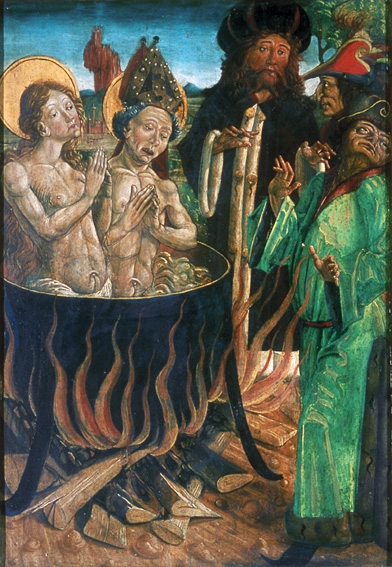
The
Martyrdom of Cyprian and Justina
O
martírio de Cipriano e Justina
Ökumenischer Namenkalender
Cyprian und Justina von Antiochien
Orthodoxe Kirche: 2. Oktober
Katholische Kirche: 26. September
Cyprian und Justina
lebten Ende des 2. Jahrhunderts in Antiochien. Ihre Legende entstand im 4.
Jahrhundert, bereits Gregor von Nazianz hat
in einer Predigt die Geschichte der beiden erzählt (dabei aber Cyprian
mit Cyprian
von Karthago gleichgesetzt). Cyprian soll von seinen heidnischen
Eltern in die Geheimnisse der Zauberkunst eingeführt worden sein und seine
Kenntnisse auf Reisen in Griechenland erweitert haben. Cyprian der Magier, wie
er genannt wurde, verwandte seine Kenntnisse vor allem, um schöne Mädchen zu
verführen. Ein junger Mann, Aglaides, der sich in die schöne Justina verliebt
hatte, bat Cyprian um einen Liebeszauber. Denn Justina war Christin und lehnte
alle Anträge ab. Auch Cyprians Kunst versagte an ihr und Cyprian wollte Justina
nunmehr für sich selber gewinnen. Justina aber blieb standhaft, so daß Cyprian
begann, an der Macht der bösen Geister zu zweifeln. Er wandte sich an einen
Priester namens Eusebius und wurde von diesem schließlich zum Christentum
bekehrt. Auch Aglaides wurde Christ. Cyprian wurde Kirchendiener, soll dann
aber - so Gregor von Nazianz - Priester und schließlich Bischof von Antiochia
geworden sein. In der diokletianischen Verfolgung wurden Cyprian und Justina
verhaftet, schwer gefoltert und schließlich 304 enthauptet. Ihre Leiber wurden
von Christen heimlich nach Rom geschafft und hier in der Lateranbasilika
bestattet. In einigen Berichten wird noch Theoktist erwähnt, ein Soldat, der
sich angesichts des Todes der Märtyrer zum Christentum bekannte und ebenfalls
hingerichtet wurde
SOURCE : http://www.glaubenszeugen.de/kalender/c/kalc048.htm

Saints Cyprian and
Justina: The Iconography : https://www.christianiconography.info/justinaAntioch.html
Camps Gaset,
Montserrat «La
tradició grega del culte de Cebrià d'Antioquia i santa Justina a Catalunya». Anuari
de Filologia. Antiqva et medievalia, 09-02-2019, pp. 3-16. DOI: 10.1344. ISSN: 2014-1386 : https://revistes.ub.edu/index.php/AFAM/article/view/30083/31142
