
Saint Jacques l'Intercis
Officier supérieur perse martyr (+ v. 421)
Officier supérieur perse, il apostasia pour garder les faveurs du roi Yesdegird. Repenti, il fut martyrisé par le roi Varanès V qui le fit découper en vingt-huit morceaux, membres après membre pour que la mort soit lente, d'où le surnom qui signifie taillé en pièces. Beaucoup d'autres chrétiens souffrirent avec lui.
En Perse, vers 420, saint Jacques, surnommé
l’Intercis, martyr. Au temps de l’empereur Théodose le Jeune, il aurait,
dit-on, renié le Christ pour plaire au roi perse Isdeberge, mais sa mère et sa
femme lui ayant fait de vifs reproches, il rentra alors en lui-même et alla
trouver Varane, fils et successeur d’Isdeberge, et sans peur lui déclara qu’il
était chrétien. Le roi irrité prononça contre lui une sentence de mort et
commanda qu’on lui coupât les membres par morceaux et qu’on lui tranchât la
tête.
Martyrologe romain
SOURCE : http://nominis.cef.fr/contenus/saint/200/Saint-Jacques-l-Intercis.html
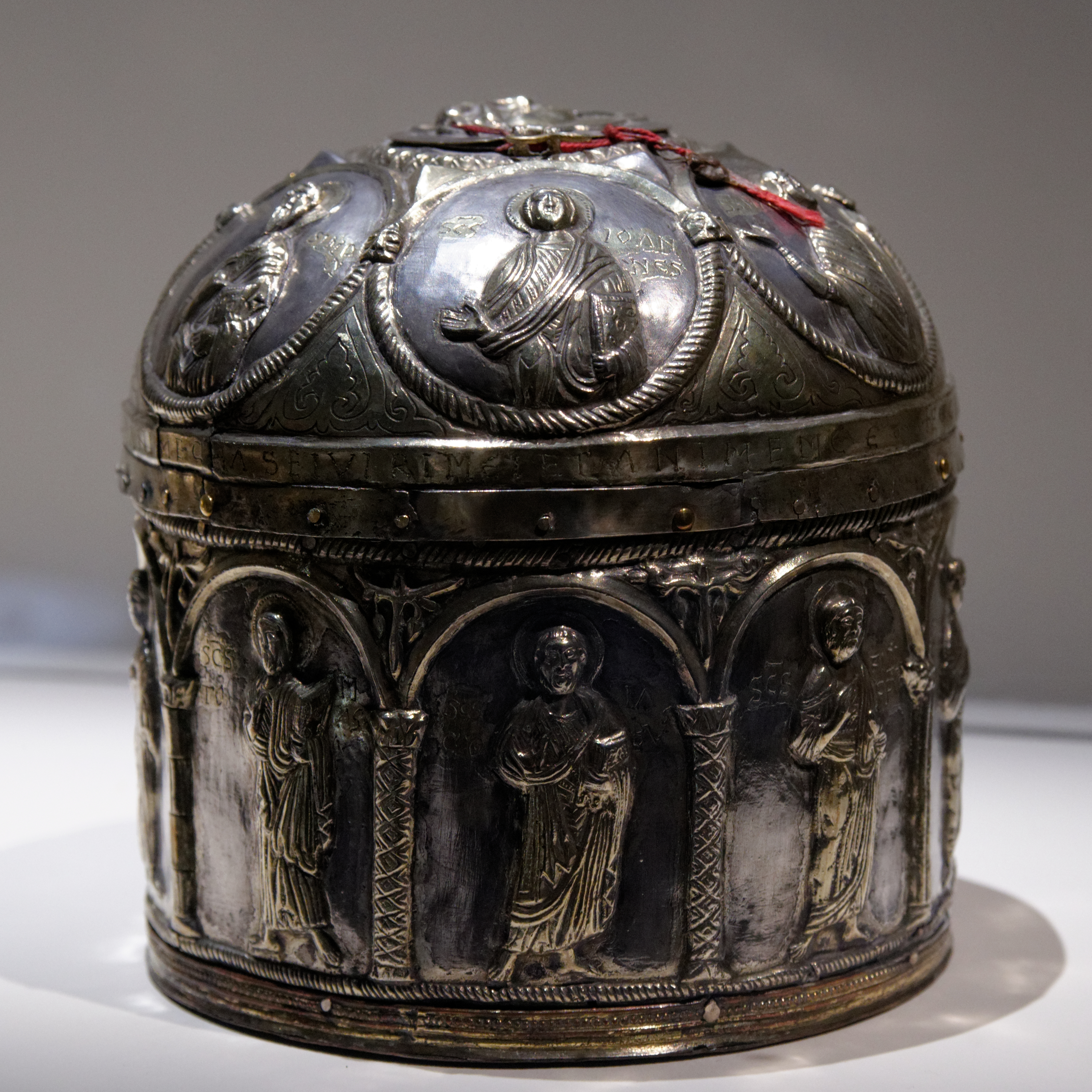
Reliquaire du chef de saint Jacques l'Intercis.
Saint Jacques L'Intercis
(Mar Yaacoub al-Mouqata')
Résumé : Nous
ne connaissons rien de plus émouvant que les actes de saint Jacques, surnommé
l'Intercis, c'est-à-dire mis en morceaux. On lui coupa successivement les
doigts des mains et des pieds, puis les pieds, puis les bras, puis les jambes
jusqu'aux genoux, puis les cuisses et enfin la tête. L'horreur que devrait
inspirer l'atrocité de ce supplice fait place à la plus douce émotion quand on
voit le martyr sourire et chanter avec amour à chaque membre qu'on lui coupe.
Les actes se terminent par un tableau sublime. Le martyr est là, gisant au
milieu de ses membres semés autour de lui, semblable au tronc odorant d'un pin
dont le fer a coupé les branches, et on l'entend prononcer cette prière: « Mon
Dieu, me voilà par terre, au milieu de mes membres semés de toutes parts; je
n'ai plus mes doigts pour les joindre en suppliant, je n'ai plus mes mains pour
les élever vers vous; je n'ai plus mes pieds, ni mes jambes, ni mes bras. Ô
Seigneur! que votre colère s'arrête sur moi, et se détourne de votre peuple, et
je vous bénirai, moi le dernier de vos serviteurs, avec tous les martyrs et
tous les confesseurs de l'Orient et de l'Occident, du Nord et du Midi ... »
Quelle scène émouvante!
Saint Jacques l'Intercis,
dénommé ainsi parce qu'il fut coupé en morceaux. il fut martyrisé sous
"Vararanne" en l'an 421 après le Christ.
En effet, le martyre de
saint Jacques fut consommé 733 ans après la mort d'Alexandre le Grand, la
seconde année du règne de Vararanne V, roi des Perses.
Saint Jacques était né
dans la ville royale de Beth-Lapeta, d'une famille illustre: à la noblesse du
sang, il joignit celle de la vertu et de la piété. A l'exemple de sa famille,
il embrassa le christianisme et épousa une femme chrétienne. Cependant, attaché
à la cour du roi de Perse, il s'éleva aux premiers honneurs et y jouit de la
plus haute considération. Isdegerdès en fit son favori, et le combla de toutes
sortes de faveurs. Aussi Jacques, pour répondre aux bontés du roi, ne
craignit-il pas d'abjurer la foi chrétienne. Sa mère et sa femme apprirent avec
douleur son apostasie et lui envoyèrent au camp où il se trouvait alors, la
lettre suivante: « On nous annonce que la faveur d'un roi de la terre, et
l'amour des richesses périssables de ce siècle, vous ont fait abandonner le
Dieu éternel. Nous vous faisons une seule question, daignez nous répondre. Où
est-il maintenant ce roi, pour qui vous avez fait un si grand sacrifice? Il est
mort, comme le dernier des hommes, et il est tombé en poussière; qu'en
pouvez-vous attendre maintenant, et est-ce lui qui vous offrira un refuge
contre l'éternel supplice ? Si vous persévérez dans votre apostasie, vous
tomberez comme lui entre les mains du Dieu vengeur; et quant à nous, nous nous
retirons de vous, comme vous vous êtes retiré de Dieu, nous ne voulons avoir
rien de commun avec un apostat. C'en est fait, nous n'existons plus pour vous.
»
Cette lettre fit une
impression profonde sur le courtisan; elle lui ouvrit les yeux, il rentra
sérieusement en lui-même et se dit: « Voilà ma femme qui s'était donnée à moi
par les serments les plus sacrés, voilà ma mère qui m'abandonnent: que fera
Dieu, à qui j'avais aussi donné ma foi et que j'ai honteusement abandonné ? Au
dernier jour comment soutiendrai-je la vue de ce juge suprême, de ce vengeur
inexorable? Et même ici-bas, sa justice ne peut-elle pas m'atteindre et me
frapper? » Plein de ces pensées, il rentre dans sa tente, il y trouve une
Bible, il l'ouvre. Pendant qu'il lit, peu à peu la lumière se fait dans son
âme, la grâce divine touche son cœur; le voilà soudain changé en un autre
homme. Son âme engourdie, comme rappelée du tombeau par une voix puissante, se
réveille: le remords l'agite et le déchire, il s'adresse à lui-même ces
paroles: « Âme brisée chair frémissante, écoutez. Ma mère qui m'a porté dans
son sein, mon épouse compagne de ma jeunesse, sont affligées et indignées de ma
lâche action; tout ce qu'il y a d'hommes sages et sensés dans ma famille sont
plongés dans le deuil par mon apostasie; que sera-ce donc au dernier jour,
quand Je paraîtrai devant Celui qui nous ressuscitera tous pour nous juger,
pour récompenser les justes et punir les coupables! Qui sera mon juge, à moi
qui suis parjure? Mon refuge! ah! je sais où il est! La porte par laquelle je
suis sorti, je puis y rentrer: je ne cesserai d'y frapper qu'elle ne s'ouvre. »
Ces accents du remords et
du repentir avaient été entendus des tentes voisines; on avait vu Jacques
s'arrêter en lisant la Bible, se parler à lui-même, comme un homme qu'une
profonde émotion agite. Ses ennemis, - les courtisans en ont toujours, - se
hâtèrent d'aller dire au roi que Jacques paraissait regretter amèrement d'avoir
changé de religion. Le prince irrité le fait appeler sur-le-champ, et lui parle
ainsi: « Dis-moi, Jacques, est-ce que tu es toujours Nazaréen1?
- Oui, je le suis, répondit Jacques.
- Hier, reprit le roi, tu étais mage.
- Nullement, répliqua Jacques.
- Comment, dit le roi, n'est-ce pas pour cela même que tu tu as reçu du roi mon
père tant de faveurs?
- Où est-il maintenant, répondit Jacques, ce roi dont vous me rappelez les
bienfaits? »
Cette réponse exaspéra le
roi, et comme il était manifeste que Jacques abandonnait la religion des
Perses, il se mit à chercher dans son esprit par quel supplice il allait le lui
faire expier.
« Si tu persévères, lui dit-il, ce sera trop peu de ta tête pour un tel forfait.
- Les menaces, répondit Jacques, sont inutiles, essayez plutôt les supplices, si bon vous semble; tout ce que vous pourriez me dire pour me persuader ne fera pas plus sur moi que le vent qui souffle contre un roc immobile. »
Le roi: « Déjà, sous mes prédécesseurs, les sectateurs de ta religion ont essayé de professer et de répandre leurs erreurs; tu sais qu'on les a traités comme des rebelles, et que ceux qui résistèrent perdirent la vie dans les plus affreux supplices. »
Le martyr: « Mon plus grand désir, c'est que je meure de la mort des justes, et que ma fin ressemble à leur fin. »
Le roi: « Apprends au moins à obéir et à respecter les édits des rois. »
Le martyr: « La mort des justes n'est pas une mort, un court et léger sommeil. »
Le roi: « Voilà comme les Nazaréens t'ont séduit, il t'ont dit que dit que la mort n'était pas la mort, mais le sommeil; cependant les puissants, les rois eux-mêmes redoutent la mort. »
Le martyr: « Les puissants et les rois et tous les contempteurs de Dieu craignent la mort, je ne m'en étonne pas; ils ont conscience de leurs crimes. Aussi les saintes lettres disent-elles : L'impie est mort, et son espérance avec lui; l'espérance des impies périra. »
Le roi: « Ainsi donc, vous nous traitez d'impies, vous qui n'adorez ni le soleil, ni la lune, ni l'eau, ces émanations divines. »
Le martyr: « Loin de moi la pensée de vous accuser, ô roi: car à ceux qu'il a jugés dignes de souffrir pour lui, le Christ, auteur de nos saintes lettres, a dit: L'heure Vient où ceux qui tueront quelqu'un d'entre vous croiront rendre gloire à Dieu. Je suis loin de dire aussi qu'en nous tuant vous ne rendez aucune gloire à Dieu: je dis seulement que vous, qui vous vantez de mieux connaître la Divinité que les autres peuples, vous êtes dans une erreur grossière, en adorant des êtres inanimés et insensibles, et en donnant le nom incommunicable de Dieu à des créatures: le vrai Dieu s'en offense, et vos vaines divinités sont aussi incapables de vous protéger que de vous nuire. »
Cette abjuration solennelle de l'idolâtrie mit le roi en fureur. Il convoque sur-le-champ les docteurs et les sages, exhale en leur présence toute sa douleur et tout son courroux, et leur ordonne de se consulter entre eux sur le genre de supplice à faire subir à cet audacieux rebelle, à ce contempteur de la majesté des rois. Les magistrats et les sages se retirèrent en conseil pour délibérer, et l'un d'eux, qui avait, pour ainsi dire, le génie de la cruauté, après un instant de réflexion, ouvrit l'avis suivant: qu'il ne fallait pas le tuer en une fois; en cinq fois, en dix fois, mais l'étendre sur un chevalet, et lui couper successivement les doigts des pieds et des mains, puis les mains elles - mêmes et les pieds ; ensuite les bras, les genoux, les jambes, et en dernier lieu la tête. Cette proposition barbare fut adoptée, et aussitôt Jacques fut traîné au supplice. Toute la ville, ému à cette nouvelle, et toute l'armée, suivirent le martyr. Les chrétiens, en apprenant l'affreuse sentence prononcée contre lui, se jetèrent la face contre terre, et, fondant en larmes, firent à Dieu cette prière : « 0 Seigneur, ô Dieu fort, qui donnez la force aux faibles et la santé aux malades, ô vous qui ravivez les infirmes et les mourants, qui sauvez ceux qui périssent, venez en aide à votre serviteur et faites-le sortir vainqueur de cet affreux combat. Pour votre gloire, Seigneur, qu'il triomphe, ô Christ, prince des vainqueurs, roi des martyrs! »
Pendant qu'on le conduisait au supplice, il pria les soldats de s'arrêter un moment, afin, disait-il, que je me rende propice le Dieu pour qui je vais mourir. Les soldats s’arrêtèrent, et le martyr, se tournant vers l'orient, fléchit le genou et, les yeux de l'âme fixés sur Celui qui habite dans les cieux, il fit cette prière : « Recevez,. Seigneur, les prières de votre humble serviteur; donnez la force et le courage au au fils de votre servante, qui vous invoque à cette heure ; placez-moi comme un signe sous les yeux de ceux qui vous aiment, qui ont souffert et qui souffrent encore persécution pour votre nom; et quand j'aurai vaincu par votre grâce toute-puissante, et que j'aurai reçu la couronne des élus que mes ennemis le voient et soient confondus, parce que vous avez été, Seigneur, ma consolation et mon soutien. »
Quand il eut fini cette prière, les soldats le saisirent, lui étendirent les
bras avec violence, et préparèrent le fer, en lui disant : « Il ne vous reste
plus qu'un moment, voyez ce que avez à faire; nous voilà prêts à vous couper
tous les membres les uns après les autres, d'abord les doigts des pieds, des
mains, puis les bras, puis les jambes et les cuisses, et enfin la tête. Voyez,
une parole peut vous sauver, tandis que l'obstination vous attire le plus
affreux supplice qui fut jamais. » Et, en lui parlant de la sorte, ils ne
pouvaient s'empêcher de verser des larmes, à la vue de ce visage tout brillant
de jeunesse, de cet extérieur noble et gracieux, et ils entouraient le martyr,
et le pressaient de feindre au moins pour un moment. « Détournez, lui disaient-
ils, une si horrible mort : faites semblant de vous soumettre, et vous
retournerez après à votre religion si vous voulez. »
Le martyr, au contraire, adressait à la foule ces paroles : « Ne pleurez pas sur moi ; non, non, ne pleurez pas sur moi ; pleurez plutôt, pleurez sur vous-mêmes, vous qui, épris des charmes trompeurs des choses périssables, vous préparez une éternité de malheurs et de tourments. Mais moi, par cette horrible mort, j'entrerai dans la vie éternelle; pour prix de mes membres dispersés, je recevrai d'immortelles récompenses; car il y a un Dieu, rémunérateur fidèle, qui rendra à chacun selon ses œuvres, » Et, voyant approcher l'heure fixée pour son supplice, il activait ainsi la lenteur des bourreaux : « Que faites-vous donc ? Qu'attendez-vous ? Voici, je vous tends les mains, mettez-¬vous à l'œuvre. »
L'affreuse exécution commença donc, et on lui coupa d'abord le pouce de la main droite. Alors le martyr fit cette prière : « Ô Sauveur, ô Jésus, recevez, je vous en conjure, ce rameau qui vient de tomber de l'arbre. Cet arbre lui• même doit tomber en poussière un jour ; mais au printemps, je l'espère, il reverdira encore et se couronnera de feuillage. » Le juge qui procédait à l'exécution, ému jusqu'aux larmes, supplia le martyr de se laisser fléchir. « C'est bien assez, lui disait-il ; cette plaie peut encore se guérir; mais, je vous en conjure, ne laissez pas mutiler tout entier ce corps si tendre et si beau. Mettez-vous d'abord hors de péril ; ensuite, vous êtes riche, vous donnerez aux pauvres, et assurerez par vos aumônes le salut de votre âme.
- Eh Quoi ! lui répondit le martyr, n'avez -vous jamais considéré ce qui advient à la vigne ? Purgée de son bois inutile, elle reste engourdie tout l'hiver; mais au soleil du printemps la sève circule et fait fleurir une riche végétation. S’il est ainsi d'une plante fragile, l'homme planté dans les vigne du Seigneur, et cultivé par la main même de l'Ouvrier céleste, ne doit-il pas aussi germer et s'épanouir ? » Alors on lui coupa l'index, et quand il fut coupé, le martyr s'écria : « Mon cœur se réjouit dans le Seigneur, et mon âme tressaille en Dieu son salut. » Et il ajouta : « Recevez, Seigneur, cet autre rameau de l'arbre que vous avez planté. » Et, la joie l'emportant sur la douleur, son visage parut tout rayonant, comme s'il eût entrevu déjà la gloire céleste. Cependant les bourreaux lui coupèrent encore un autre doigt, il s'écria dans un saint transport: « Avec les trois enfants de la fournaise, je vous confesserai, Seigneur, de tout mon cœur et au milieu de vos martyrs je chanterai des hymnes à votre nom, Ô Très-Haut. » Quand on lui eut coupé le quatrième doigt, il s'écria: « Parmi les douze patriarches fils de Jacob, c'est sur le quatrième que se reposa la bénédiction qui promettait et prophétisait le Christ : c'est pourquoi j'offre encore ce quatrième rameau de mon corps à celui qui par sa bénédiction a été le salut de tous les peuples. » Au cinquième doigt qu'on lui coupa il dit; « Ces cinq doigts, cette main, seront de beaux fruits à présenter à celui qui a planté l'arbre que vous taillez. »
Avant de passer à sa main gauche, les juges le pressèrent d nouveau, et lui
demandèrent : « A quoi allez-vous vous résoudre? Vous pouvez encore sauver
votre vie, si voulez vous soumettre au roi ; car combien qui vivent robustes et
vigoureux mutilés comme vous l'êtes ! Si vous n'avez pitié de vous-même, vous
allez voir tous vos membres tomber sous vos yeux les uns après les autres, et
ce sera pour ainsi dire, à chaque fois une nouvelle mort. » Le martyr leur fit
cette réponse: « Lorsqu'on tond les brebis, on ne leur enlève pas d'abord toute
leur laine, on leur en laisse la moitié : ainsi dois-je rendre grâces à Dieu,
qui me met au nombre de ses brebis, et qui m'offre aux ciseaux de ceux qui me
tondent, comme il offrit à ceux qui l'attachèrent sur la croix l'Agneau divin,
pour qui je meurs de cette mort cruelle. »
On se mit donc à lui couper les doigts de la main gauche ; on commença par le doigt auriculaire. Le martyr, les yeux levés au ciel, disait avec une constance magnanime : « Je suis bien petit devant vous, ô grand Dieu, qui vous êtes fait petit pour nous, et qui nous avez élevés jusqu'à vous par la vertu de votre sacrifice. C'est avec joie, ô Dieu, c'est avec bonheur que je vous remets mon âme, et aussi mon corps; je sais que vous me le rendrez un jour, immortel et glorieux à la vie. » Alors on lui coupa l'annulaire et, transporté du plus brûlant amour, il s'écria : « Pour une septième mutilation, une septième louange, ô Dieu, Père, Fils et Saint-Esprit ! » Et quand tomba le huitième doigt, il dit : « C'est le huitième jour que l'enfant hébreu est circoncis et distingué des infidèles ; eh bien, moi aussi, par la pureté de mon cœur, je me sépare de ces incirconcis et de ces impies car mon âme a soif de vous seul, ô mon Dieu! Quand pourrais-je voir votre face ? Au neuvième, il dit : « C'est à la neuvième lune que mon Sauveur est mort sur la croix pour mes péchés : je lui offre donc avec bonheur ce neuvième doigt de ma main. » Au dixième enfin, saisi d'un plus vif transport, il s'écria: « Par la lettre iod1 sont multipliés les mille et les myriades ; de même par le nom sacré de Jésus2 le monde entier a été sauvé. Je chanterai donc des hymnes en son nom sur la harpe à dix cordes, comme dit le Psalmiste, et les cordes de ma harpe seront mes doigts eux-mêmes mutilés pour mon Sauveur. » Ayant dit cela, le martyr entonna un chant pieux d’une voix douce.
Alors les juges renouvelèrent leurs instances auprès de lui, lui faisant entendre que ses plaies n'étaient pas mortelles, qu’il était encore temps de sauver sa vie: « Pourquoi cette cruauté contre vous - même? Pourquoi renoncer à la douce lumière du jour? La vie pour vous est• si riante. Vous avez avec l'opulence tous les plaisirs. A la bonne heure si, désormais privé de vos mains, et incapable de pourvoir à vos besoins, vous deviez vivre dans la misère; mais avec une fortune aussi belle, la vie sera toujours pour vous honorable et douce. Ne pensez plus à votre épouse : depuis longtemps vous viviez séparés, elle est dans la province des Huzites, et vous à Babylone. Songez donc qu'il suffit d'un mot pour vous sauver ou pour vous perdre. »
Le martyr, les regardant d'un air sévère, leur répondit : « Vous croyez, après
que j'ai mis la main à la charrue, que je vais regarder en arrière et me rendre
indigne du royaume des cieux? Vous croyez que je vais préférer ou mon épouse ou
ma mère au Dieu qui a dit ces paroles : Quiconque perdra sa vie pour moi
la trouvera ; et encore : Quiconque laissera son père, et sa mère, et ses
frères, je lui donnerai la vie et le repos éternel. Cessez donc de me
presser, et faites votre œuvre ; je serais désolé que vous en adoucissiez tant
soit peu les rigueurs. » Voyant donc qu'il était inflexible, les juges
ordonnèrent aux bourreaux de poursuivre. Ceux-ci lui saisissent le pied droit
et en coupent le gros doigt, tandis que le martyr s'écriait : « Grâces à vous,
Seigneur, qui vous êtes revêtu de notre humanité, et qui, sur la croix, percé
de la lance, avez teint vos pieds du sang et de l'eau qui sortirent de votre
côté. Je suis heureux de livrer comme vous au fer des bourreaux ce corps qui
est la prison de mon âme ; je suis heureux de voir couler pour vous mon sang.
On lui coupa ensuite un autre doigt, et il s'écria : « Ce jour est le plus beau
de mes jours ! Auparavant, engagé dans les liens du siècle, esclave des richesses
et des plaisirs, j'étais faible et lâche dans le service de Dieu, et mon âme,
emportée par mille soins divers, ne pouvait plus se retrouver en sa présence et
s'entretenir avec lui.
Maintenant, dégagé de mes entraves, et les yeux fixés sur le siècle à venir, j'y marche avec constance ; aussi, heureux et triomphant, j'ai chanté, tout le temps de mon supplice, d'une voix que n'a pu affaiblir la douleur, des hymnes à celui qui m'a jugé digne de souffrir pour lui. » On lui coupa alors le troisième doigt et on le lui présenta ; il s'écria alors en souriant : « Le grain d blé, jeté dans la terre, germe et retrouve au printemps 1es grains semés avec lui : ainsi, au jour suprême de la résurrection des corps, ce doigt se retrouvera avec les autres. » Au quatrième, le martyr, se parlant à lui-même : « Mon âme, dit- il, pourquoi es-tu triste et tremblante? Espère en Dieu, car je le confesserai encore, ce Dieu, mon Sauveur. » Au cinquième, il dit : « Grâces à vous, Seigneur, qui m'avez choisi pour un martyre inouï jusqu'à présent, et qui me donnez la force de le souffrir. » Les bourreaux passent au pied gauche, et commencent par couper le petit doigt : « Ce doigt, dit le martyr, ne' sera plus désormais appelé petit, puisqu'il est offert au Seigneur comme le plus grand ; et si le moindre cheveu de notre tête ne périt pas, ce doigt non plus ne peut périr. » A l'autre doigt, il cria aux bourreaux : « Allons, courage, abattez cette maison qui tombe en ruines, afin que Dieu m'en rebâtisse une plus belle. Au troisième, il dit: « Vous savez bien que plus on pousse une roue, plus elle tourne, et cela sans douleur.» Au quatrième, il fit à Dieu cette prière : « Secourez-moi, mon Dieu, parce que j'ai confiance en vous.» Au cinquième enfin, comme éveillé d'un profond sommeil, il s'écria : « Jugez-moi, Seigneur, et vengez-moi de ce peuple barbare: voilà la vingtième mort que j'endure, et ces loups altérés de sang s'acharnent encore sur moi. »
La foule, témoin de cette exécution terrible, poussa un cri, et les jeunes gens demandaient aux vieillards s’ils avaient jamais rien vu de pareil, tant de barbarie d'un côté et tant de courage de l'autre. Le martyr activait lui-même les bourreaux. « Ne vous arrêtez pas, leur criait-il ; vous avez abattu les branches de l'arbre, attaquez maintenant le tronc. Pour moi, mon cœur tressaille dans le Seigneur, et mon âme invoque le Dieu soutien des humbles. » Les bourreaux tout frémissant de rage, s'arment de nouveau du fer et lui coupent le pied droit, et le martyr s'écrie tout triomphant : « Chaque membre que vous faites tomber, je l'offre en sacrifice au Roi du ciel. ». Ils lui coupent ensuite le pied gauche, et lui s'écrie : « Exaucez-moi, Seigneur, parce que vous êtes bon, et que votre miséricorde est grande pour tout ceux qui vous invoquent. » Puis on lui coupe la main droite et le martyr exalte encore la bonté de Dieu. « Votre miséricorde, Seigneur, s'est multipliée sur moi ; délivrez-moi de l'enfer. » La main gauche est coupée à son tour, et le martyr s'écrie : « Vos merveilles, Seigneur, éclatent sur la mort. » Alors on s'attaque à ses bras. En tendant le bras droit il s'écria:. « Je louerai le Seigneur sans cesse ; tant que je vivrai, je chanterai des hymnes à son nom : sa louange me sera douce, je me réjouirai dans le Seigneur. » Ensuite il présenta le bras gauche et dit : « Ma tête s'élèvera au dessus des ennemis qui m'ont environné ; le Seigneur est ma force, ma gloire et mon salut. » Restaient encore les jambes : les bourreaux aussitôt lui coupent la droite à la jointure du genou. A ce coup, le martyr parut ressentir une douleur extrême; il poussa un cri et invoqua le Sauveur : « Seigneur Jésus-Christ, dit-il, secourez-moi, délivrez-moi, je suis en proie aux douleurs de la mort. »
« Nous vous l'avions bien dit, reprirent les bourreaux, que vous alliez souffrir d'affreux supplices.
- Dieu, répondit le martyr, a permis le cri involontaire qui vient de m'échapper, pour que vous ne pensiez pas que je n'aie qu'une apparence du corps. Au reste, je suis prêt à endurer pour l'amour de Dieu des tourments plus grands encore. Ne croyez pas que j'aie souffert pendant que vous m'avez torturé : la pensée de mon Sauveur, son saint amour qui embrasait mon cœur, dominaient tout sentiment. Ache¬vez donc, et hâtez-vous. » Mais les bourreaux, fatigués, s'arrêtaient : le martyr, au contraire, rayonnait de plus de joie et d'amour. Les bourreaux enfin à grande peine lui coupèrent l'autre jambe : alors le martyr parut semblable à un pin odorant dont il ne reste plus que la moitié. Après un moment de silence, on l'entendit prononcer à haute voix cette prière : « Mon Dieu, me voilà par terre, au milieu de mes membres, semés de toutes parts : je n'ai plus mes doigts pour les joindre en suppliant ; je n'ai plus mes mains, pour les élever vers vous ; je n'ai plus mes pieds, ni mes jambes, ni mes bras : je ressemble à une maison en ruines dont il ne reste plus que les murs. Ô Seigneur ! que votre colère s'arrête sur moi, et qu’elle se détourne de votre peuple : donnez à ce peuple persécuté, dispersé par les tyrans, la paix et le repos ; rassemblez-le des bouts de l'univers. Alors, moi, le dernier de vos serviteurs, je vous louerai, je vous bénirai avec tous les martyrs et tous les confesseurs, ceux de l'Orient cl de l'Occident, ceux du Nord et du Midi, vous, votre Fils, et le Saint-Esprit, dans les siècles des siècles. Amen. » Quand il eut dit : Amen, on lui coupa la tête. Ainsi le saint martyr, après le plus affreux supplice qui fut jamais, rendit doucement son âme à Dieu. Son corps resta étendu sur la place. Les chrétiens se cotisèrent et offrirent aux gardes, pour le racheter, une somme considérable : ce fut en vain. Mais vers la neuvième heure du soir, les gardes s'étant retirés, les fidèles dérobèrent le corps, puis se mirent à en chercher les membres ; semés de toutes parts. Ils en trouvèrent vingt-huit et les enfermèrent dans une urne sur le tronc ; puis ils recueillirent comme ils purent tout le sang que le martyr avait perdu pendant son long supplice.
Cependant, tandis que nous chantions le psaume Miserere Mei, Deus secundum
magnam miséricordiam tuam, le feu du ciel tomba sur l'urne et consuma le sang
du martyr, tant dans le vase que sur les linges où on l'avait reçu et sur la
terre qu'il avait trempée ; cette flamme colorait les membres du martyr d'une
teinte de pourpre et de rose. Effrayés de ce prodige, nous tombons tous la face
contre terre, et nous implorons en tremblant la protection du martyr, pour
n'être pas consumés par ce feu céleste; puis secrètement, non sans péril, nous
inhumons les saintes reliques avec l'aide et la grâce du Christ, qui couronne
les martyrs, et à qui soient, avec le Père, et le Saint-Esprit, louange,
honneur et gloire maintenant et toujours et dans les siècles des siècles. Amen1.
(1) Le supplice de saint
Jacques est un des plus affreux dont fasse mention l'histoire des martyrs ; sa
gloire fut aussi des plus éclatantes. Les Orientaux bâtirent en son honneur un
grand nombre d'églises et de monastères ; et tous les martyrologes grecs,
latins et syriens, célèbrent sa mémoire. Le Martyrologe romain en
faisait mention, au 27 novembre en ces termes : En Perse, naissance de saint
Jacques l'Intercis, qui du temps de Théodose le Jeune, renia le Christ, pour
conserver la faveur du roi Isdegerdès. Mais sa mère et son épouse ayant rompu
tout commerce avec lui, il rentra en lui-même, et confessa Jésus-Christ devant
le roi Vararanne, qui ordonna de le couper par morceaux, et enfin de lui
trancher la tête. Dans le même temps, d'innombrables martyrs souffrirent en
Perse.
1) C'est la dixième
lettre de l'alphabet des langues sémitiques, et sa valeur numérique est 10.
2) La lettre « iod » est l'initiale du nom de Jésus.
Source : Les Actes
des Martyrs d'Orient, traduits pour la première fois en français sur la
traduction latine des manuscrits syriaques de Etienne-Evode Assemani, par
l'Abbé F. Lagrange. Tours, Alfred Mame et Fils, Editeurs, MDCCCLXXIX.
La Prière de
Saint-Jacques l'Intercis pour les Chrétiens de Syrie
publié le 10 avr.
2013 10:45 par Jean-Pierre Fattal sur le site de la Fraternité
Chrétienne Sarthe-Orient:
Cette prière de
Saint-Jacques l'Intercis * (Mar Yaacoub al Mouqattaa) fait étrangement penser à
la situation de certains chrétiens en Syrie; disons-la en communion avec toutes
les victimes et les martyrs de Syrie :
Mon Dieu, me voilà par
terre au milieu de mes membres serrés de toutes parts.
Je n'ai plus mes doigts
pour les joindre en suppliant,
Je n'ai plus mes mains
pour les élever vers Toi,
Je n'ai plus mes pieds,
ni mes jambes, ni mes bras.
Je ressemble à une maison
en ruine dont il ne reste plus que les murs.
Ô Seigneur, que Ta colère
s'arrête sur moi et se détourne de Ton peuple.
Donne à ce peuple
persécuté, dispersé par les tyrans, la paix et le repos.
Rassemble-le des bouts de
l'univers.
Alors je Te bénirai, moi
le dernier de Tes serviteurs, avec tous les martyrs
et tous les confesseurs
de l'Orient et de l'Occident, du Nord et du Midi, Toi,
Ton Fils et le
Saint-Esprit dans les siècles des siècles.
Saint Jacques l'intercis (Mar-Ya'koub al-Mouqqata') est né à la fin du IVe siècle en Perse. Intercis signifie littéralement "coupé en deux".
Ce surnom lui a été donné
à la suite de son martyr qui lui a valu de perdre successivement ses
doigts
des mains, des pieds, les
poignets, les chevilles, les coudes, les genoux, les oreilles, le nez et enfin
le cou.
Pour en savoir plus sur
Saint-Jacques l'Intercis, suivez
le lien : http://www.fcsartheorient.com/les-chretiens-d-orient/saints-syro-antiochiens/martyrs/jacques-l-intercis

Günther Zainer. Martyre de Saint Jacques l’Intercis, XVe siècle, Cleveland Museum of Art. Gift of Claude Cassirer
SAINT JACQUES L'INTERCIS
* Jacques, martyr, surnommé
l’intercis, noble d'origine, mais plus noble encore par sa foi, était
originaire du pays des Perses et de la ville d'Elape. Il naquit de parents très
chrétiens, et il eut une femme aussi chrétienne que lui. Il était fort connu du
roi des Perses et le premier parmi les grands. Or, il se laissa séduire, par la
faveur singulière de ce prince, et adora les idoles. Quand sa mère et son
épouse l’apprirent, elles lui écrivirent aussitôt ainsi : « En obéissant à un
mortel, vous avez abandonné celui avec lequel est la vie; en voulant plaire à
qui sera bientôt pourriture, vous avez abandonné celui qui est le parfum
éternel ; vous avez échangé la vérité pour le mensonge, et en cédant à un
mortel, vous avez délaissé le juge des vivants et des morts. Vous saurez donc
qu'a partir de ce jour, nous vous serons étrangères, et que dorénavant nous
n'habiterons plus avec vous.» Quand Jacques eut lu cette lettre, il dit en
versant tics larmes amères: « Si ma mère qui m’a engendré, si mon épouse
sont devenues pour moi des étrangères, combien plus étranger devra être mon
Dieu pour moi! » Or, tandis qu'il s'affligeait extrêmement de son erreur, un
messager vint dire au prince que Jacques était chrétien. Le prince le manda et
lui dit : « Dis-moi si tu es, Nazaréen ? » « Oui, lui répondit Jacques, je
suis Nazaréen. » Le prince : « Alors, tu es magicien? » Jacques: « A Dieu ne
plaise que je sois magicien ! » Et comme le roi le menaçait de lui faire subir
de nombreuses tortures, Jacques lui dit : « Je ne suis pas effrayé de tes
menaces, car ta fureur passe aussi vite sur mes oreilles que le vent qui
souffle sur la pierre. » Le prince : « Ne commets pas d'imprudence, de peur de
périr d'une mort cruelle. » Jacques : « Ce n'est pas mort qu'il faut dire,
mais bien plutôt sommeil, puisque peu, de temps après est accordée la
résurrection. » Le prince : « Que les Nazaréens ne te séduisent point en disant
que la mort est un sommeil, quand les plus grands empereurs la craignent. »
Jacques : « Nous, nous ne craignons pas la mort, puisque nous espérons passer
de la mort à la vie. » Alors le prince, de l’avis de ses amis, porta cette
sentence contre Jacques, savoir que, pour imprimer la terreur dans le
coeur des autres, il fût condamné à être coupé par morceaux. Or, comme il se
trouvait plusieurs personnes qui, par compassion, pleuraient sur lui : « Ne
pleurez pas sur moi, dit-il, mais pleurez sur vous-mêmes, parce que je vais à
la vie, et que des supplices éternels vous sont réservés. ».Alors, les
bourreaux lui coupèrent le pouce de là main droite; et Jacques s'écria : «
Jésus de Nazareth, mon libérateur, recevez ce rameau de l’arbre de votre
miséricorde; car, celui qui cultive la vigne en coupe le sarment, afin qu'elle
pousse de plus beaux jets et qu'elle produise avec plus d'abondance. » Le
bourreau lui dit : « Si tu veux obéir, je puis encore t'épargner, et je te
donnerai des médicaments. » Jacques répondit: « N'as-tu pas vu un cep de vigne?
Quand on coupe les sarments, le noeud qui reste produit de nouvelles branches,
à chaque taille, quand le temps est venu et que la terre commence à
s'échauffer; si donc on taille la vigne à différentes époques, pour qu'elle
produise des jets, à combien plus forte raison le chrétien fidèle en
donnera-t-il, lui qui est enté sur la véritable vigne qui est le Christ? » Alors,
le bourreau vint lui couper le second doigt. Et le bienheureux. Jacques dit : «
Recevez, Seigneur; ces deux rameaux qu'a plantés votre droite. » Il coupa
encore le troisième, et saint Jacques dit : « Délivré d'une triple tentation,
je bénirai le Père, le Fils et le Saint-Esprit, et avec les trois enfants
préservés dans la fournaise, je vous confesserai, Seigneur, et en union avec le
choeur des martyrs, je chanterai des cantiques à votre nom, ô
Jésus-Christ ! » Le quatrième doigt fut coupé aussi, et Jacques dit: «
Protecteur des enfants d'Israël, qui avez béni jusqu'à la quatrième génération,
recevez de votre serviteur le témoignage de ce quatrième doigt, comme ayant été
béni en Juda. » Quand le cinquième doigt fut coupé, il dit : « Ma joie est,
complète. » Alors, les bourreaux lui dirent : « Epargne maintenant ta vie ne
meurs as, ni ne te contriste point d'avoir perdu une main ; car il y en a
beaucoup qui n'en ont plus qu'une, et qui possèdent beaucoup de richesses et
d'honneurs. » Le bienheureux Jacques répondit-: « Quand les bergers se mettent
à tondre leurs troupeaux, enlèvent-ils seulement la toison de droite, et
laissent-ils celle qui est à gauche? Et moi qui suis un homme raisonnable,
dois-je moins dédaigner d'être tué pour Dieu ? » Alors ces impies
s'approchèrent et coupèrent le petit doigt de la main gauche, et Jacques dit :
« Vous, Seigneur, vous étiez grand, et vous avez voulu vous faire tout petit et
chétif pour nous; c'est pour cela. que je vous rends le corps et l’âme, que
vous avez créés et rachetés de votre propre sang. » On coupe ensuite le
septième doigt, et il dit : « Sept fois le jour, j'ai célébré les louanges
du Seigneur. » On coupe le huitième, et il dit : « Le huitième jour, fut
circoncis Jésus, et le huitième jour, on circoncit l’hébreu, afin de l’admettre
aux cérémonies légales; faites donc, Seigneur, que l’esprit de votre serviteur
se sépare de ces incirconcis qui conservent leur souillure, afin que je vienne
à vous et que je voie votre face, Seigneur. » On coupe ensuite le neuvième
doigt, et il dit : « A la neuvième heure, le Christ rendit l’esprit sur la
croix; ce qui me fait confesser votre nom et vous rendre grâces par la douleur
de ce neuvième doigt. » On coupe le dixième; et il dit : Le nombre dix est
celui des commandements, et l’Iota (En grec, l’I représente le nombre 10)
est la première lettré du nom de Jésus. Alors, quelques-uns de ceux qui étaient
là lui dirent : « O vous, qui avez été autrefois notre ami intime, faites votre
déclaration seulement devant le consul, et vous vivrez ; car, quoique vos mains
soient coupées, il y a cependant de très habiles médecins qui pourront guérir
vos douleurs. » Jacques leur dit : « Loin de moi une si infâme dissimulation !
car quiconque, ayant mis sa main à la charrue, regarde derrière soi, n'est
point propre au royaume de Dieu. » (Luc, IX.) Alors, les bourreaux indignés
s'approchèrent et lui coupèrent le pouce, du pied droit, et Jacques dit : « Le
pied du Christ a été percé, et il en est sorti du sang. » On coupe le second
doigt du pied, et il dit: « Ce jour est grand pour moi, en comparaison de tous
les autres de ma vie ; car aujourd'hui, j'irai vers le Dieu fort. » Ils
coupèrent aussi le troisième, qu'ils jetèrent devant lui ; alors. Jacques dit
en souriant : « Va, troisième doigt, rejoindre tes compagnons,; et de même
qu'un grain de froment rapporte beaucoup de fruits, de même aussi, au dernier
jour, tu reposeras avec tes compagnons. » On coupe le quatrième, et il
dit : «Pourquoi es-tu triste, ô mon âme, et pourquoi te troubles-tu ?
Espère en Dieu, car je lui rendrai encore des actions de grâce; il est mon
Sauveur et mon Dieu.» (Ps. XLII.) On coupe le cinquième, et il dit « Je puis
dire maintenant au Seigneur qu'il m’a rendu digne d'être associé à ses
serviteurs. » Alors ils prirent le pied gauche, et en coupèrent le petit doigt,
et Jacques dit : « Petit doigt, console-toi, car le petit et le grand
ressusciteront également; si un petit cheveu de la tête ne périra pas, pourquoi
serais-tu séparé de tes compagnons ? » On coupe le second, et Jacques dit : «
Détruisez cette vieille maison, car on m’en prépare une plus belle. » On
coupe le troisième, et, Jacques dit: « L'enclume s'endurcit sous les coups. »
On coupe encore le quatrième, et il dit : « Fortifiez-moi, Dieu de vérité,
parce que mon âme se fie en vous et que j'espérerai à l’ombre de vos ailés,
jusqu'à ce que l’iniquité soit passée. » (Ps. LVI.) On coupe aussi le
cinquième, et il dit : « Voici, Seigneur, que je, m’immole pour vous
vingt fois. » Alors ils lui prirent le pied droit et le coupèrent ; Jacques
dit : « J'offre ce présent au roi du ciel, pour l’amour de qui j'endure
ces tourments. » Ils coupèrent ensuite le pied gauche, et le bienheureux
Jacques dit : « C'est vous, Seigneur, qui faites des merveilles ; exaucez-moi
et me sauvez. » Ils coupèrent la main droite, et il dit : « Que vos
miséricordes me viennent en aide, Seigneur! » A la gauche, il dit : « C'est
vous, Seigneur, qui opérez des merveilles. » Ils coupèrent le bras droit, et il
dit : « O mon âme, louez le Seigneur. Je louerai le Seigneur pendant ma vie; je
célébrerai la gloire de mon Dieu, tant que je vivrai. » (Ps. CXLV.) Après quoi,
ils coupèrent le bras gauche, et il dit « Les douleurs de la mort m’ont
environné ; au nom du Seigneur, j'en serai vengé. » Alors ils s'approchèrent,
et coupèrent la jambe droite en la sciant jusqu'aux reins. Le bienheureux
Jacques, accablé par une douleur inexprimable, s'écria : « Seigneur
Jésus-Christ, aidez-moi, car les gémissements de la mort m’ont
environné. » Puis, il dit aux bourreaux : « Le Seigneur me recouvrira
d'une nouvelle chair, que vos blessures ne sauront souiller.» Les bourreaux
étaient épuisés, parce que, depuis la première heure du jour, jusqu'à la
neuvième, ils avaient sué à le trancher. Enfin ils prirent sa jambe gauche, et
la coupèrent jusqu'aux reins. Alors saint Jacques s'écria : « Souverain
Seigneur, exaucez un homme à demi mort ; vous êtes le maître des vivants
et des morts. Des doigts, Seigneur, je n'en ai plus pour les lever à vous; des
mains non plus, pour les étendre vers vous ; mes pieds sont coupés et rues
genoux sont abattus, je ne puis plus les fléchir devant vous ; je suis comme
une maison qui a perdu ses colonnes et qui va crouler. Exaucez-moi, Seigneur
J.-C., et ôtez mon âme de prison. » Après ces mots, un des bourreaux s'approcha
et lui coupa la tète. Les chrétiens vinrent en cachette pour ravir son corps,
auquel ils donnèrent une sépulture honorable. Or, il souffrit le 5 des calendes
de décembre (27 novembre). * Nicéphore Calliste,
Histoire; ecclésiastique, l. XIV, c. XX. SOURCE : http://www.abbaye-saint-benoit.ch/voragine/tome03/174.htm
Saint
James of Persia, Fresco, 1663, Saint Nicholas of Theologina Church, Kastoria |

Also
known as
Jakob Intercisus
James the Mutilated
Profile
Military officer
and courtier to King Jezdigerd
I. During Jezdigerd’s persecution of
Christians, James apostacized.
Following Jezdigerd’s death,
he was contacted by family members who had never renounced their faith. James
experienced a crisis of faith and conscience, and openly expressed his faith to
the new king Bahram.
He was condemned, tortured and martyred.
Born
Beth Laphat, Persia
slowly cut into 28
pieces, finally dying from beheading in 421
Additional
Information
Book
of Saints, by the Monks of
Ramsgate
Lives
of the Saints, by Father Alban
Butler
Lives
of the Saints, by Father Francis
Xavier Weninger
Saints
and Festivals of the Christian Church
Saints
of the Day, by Katherine Rabenstein
Victories
of the Martyrs, by Saint Alphonsus
de Liguori
books
Our Sunday Visitor’s Encyclopedia of Saints
other
sites in english
images
video
sitios
en español
Martirologio Romano, 2001 edición
fonti
in italiano
Martirologio Romano, 2005 edition
websites
in nederlandse
nettsteder
i norsk
MLA
Citation
‘Saint James
Intercisus‘. CatholicSaints.Info. 16 December 2022. Web. 20 February 2026.
<https://catholicsaints.info/saint-james-intercisus/>
SOURCE : https://catholicsaints.info/saint-james-intercisus/
Book of Saints –
James Intercisus
Article
(Saint) Martyr (November
27) (5th century) A Persian nobleman of high rank, who having weakly
apostatised to keep the favour of King Yezdegird, but being afterwards
converted anew by the prayers of his mother and wife, bravely atoned for his
guilty weakness by undergoing a fearful martyrdom (A.D. 421) in defense of the
Christian Religion, under Varanes V, successor of Yezdegird. The Roman
Martyrology adds that with him there suffered also in Persia a vast multitude
of Christians. Saint James is surnamed “Intercisus” (cut to pieces), because
fingers, toes, then feet and hands, legs and arms, were successively cut off
his still living body. He is greatly honoured throughout the East, but less
known in the West.
MLA
Citation
Monks of Ramsgate. “James
Intercisus”. Book of Saints, 1921. CatholicSaints.Info.
20 October 2013. Web. 20 February 2026.
<https://catholicsaints.info/book-of-saints-james-intercisus/>
SOURCE : https://catholicsaints.info/book-of-saints-james-intercisus/
St. James Intercisus
Feastday: November 27
James was a favorite of
King Yezdigerd I of Persia and
a Christian. He abandoned his religion when
Yesdigerd launched a persecution of
the Christians. When the king died, James repented of
his apostasy and
declared himself to be a Christian to
the new king, Bahram. When James refused to
apostasize, he was executed by having his body cut apart piece by piece,
beginning with his fingers (hence his surname Intercisus - cut to pieces), and
then beheaded. His feast
day is November 27.
SOURCE : https://www.catholic.org/saints/saint.php?saint_id=679
St. James Intercisus was a Persian who lived in
the fifth century. He was a great favorite of King Yezdigerd I. When this king
began to persecute Christians, James did not have the courage to confess his
faith. He was afraid of losing the king’s friendship. So he gave up his faith
or at least pretended to. James’ wife and mother were broken-hearted. When the
king died, they wrote a strong letter to him to change his ways. This letter
had its effect on James. He had been a coward, but at heart, he was still good.
Now he began to stay away from court. He blamed himself openly for having given
up his faith.
The new king sent for him, but this time, James hid nothing. “I am a Christian,” he said. The king accused him of being ungrateful for all the honors his father, King Yezdigerd, had given him. “And where is your father now?” St. James calmly answered. The angry king threatened to put the saint to a terrible death. James replied, “May I die the death of the just.”
The king and his council condemned James to torture and death. But his fears had gone. He said, “This death which appears so dreadful is very little for the purchase of eternal life.” Then he told the executioners, “Begin your work.” He was executed by having his body cut apart into 28 pieces, beginning with his fingers (hence his surname “Intercisus” – meaning “cut to pieces”), and then beheaded. All the while, he kept declaring his faith that his body would one day rise in glory. St. James Intercisus died in 421.
The Church of St. James Intercisus situated in the
Armenian Quarter of Jerusalem is dedicated to him
SOURCE : http://www.ucatholic.com/saints/saint-james-intercisus/
James Intercisus M (RM)
Died 421. 'Intercisus' means 'cut to pieces,' which is precisely what happened
to James, a courtier of the Persian King Yezdigerd I in 421. How much of the
legend is true, we're not sure. It seems that it is comprised of the stories of
three martyrs who died about the same time: James Intercisus, Mar Peros, and
James the Notary. Once again we are reminded of the opening line of H. P. Van
der Speeten's The Life of Saint Catherine of Alexandria: "Legend knows
what history doesn't."
King Yezdigerd began to persecute
Christians in 420. To his later shame, James of Beit decided it was politically
expedient to apostatize from Christianity. When Yezdigerd died, the parents (or
mother and wife) of the faithless courtier wrote to their son:
"We have been told
that you have abandoned the eternal God so that you might win the favor of an
earthly king and the possession of the perishable riches of this world. We have
only one question to ask you, and please answer it. This king, for whom you
made so great a sacrifice, where is he now? He is dead, like any other man. He
is dust. What can you expect to receive from him now? Can he save you from
eternal torture? If you persevere in your apostasy, you will, like him, fall
into the hands of an avenging God, and we will withdraw from you just as you
have withdrawn from God. We ourselves want nothing more to do with you. It is
all over. We no longer exist for you."
Ashamed, James quit the
court of Yezdigerd's successor, King Bahram. Learning the James had become a
Christian again, Bahram debated with his counsellors what to do with James, and
they decreed that unless he once again denied his faith, the saint should be
hung from a beam and his body slowly cut to pieces. Those commissioned to
perform this cruel deed tried to make him give way. "This supposedly
painful death is but little to pay for eternal life," replied James.
In 448, when the
Christian Mar Peros apostatized to save his skin, he was treated by his family
in the same way. Filled with remorse, he loudly proclaimed his Christian faith,
was denounced, and executed.
Those are the principal
variants of the great legend of James Intercisus, though, he never really had
to repent because he never denied his faith.
James of Karka was a
good-looking, 20-year-old notary to king Bahram V. His heart was dedicated to
God and he remarked, off-handedly as people do, that he would rather be cut
into small pieces than to say "yes" to men and "no" to God.
One day he and 15 others were imprisoned for the faith, interrogated and
tortured. But James stood his ground and so did the others thanks to his
example.
All winter they had to
care for the king's elephants--quite a change from court life. In the spring,
after celebrating Lent and Easter in the silence of their prison cells, they
were sent to work on the new road that was being built to the king's summer
residence. They worked like slaves, cutting rocks and breaking stones, whipped
and harassed by the overseers. "I would rather be cut up into small
pieces. . . ." James would remind himself.
When the king ordered
them to apostatize, they bowed down with oriental politeness, but refused.
After this, their punishments were increased. They were made to work barefoot
and given less to eat. But the crew of Christians stood firm. Then they were
handed over to Mihrschabur, who boasted that he would make them renounce their
faith without the help of blows or executions.
One night he stripped
them naked, bound them hand and foot, and left them on a mountain. After a week
many had lost consciousness and their resolve was weakened. Mihrschabur
repeated, "Worship the sun, or you will be dragged by your feet through
the mountains, and your bodies will be torn to pieces on the stones until only
your bones will be left at the end of the rope."
"But what does that
matter?" thought James. "Christ died for us, and he lives in us. Some
of his companions relented and worshipped the sun (though they later repented).
Soon only James was left resolute in his faith.
He, however, was released
with the apostates and with energized zeal went to comfort the bishops who had
suffered in the persecutions. His house was used as a secret church until the
day when a spy among his friends told the king that James had not abjured the
faith.
And so one day the police
knocked on James' door. "So you still have not given up your faith?"
"God preserve me from doing so! I never denied it, and never will. My
faith is my life, just as it was the life of my fathers." And so James was
again arrested.
In prison he was beaten
unmercifully and tortured in other ways, but he still refused to deny Christ.
According to the Syrian text this took place during the winter, when the skies
were heavy with rain. When ordered by the judge to worship the sun, he
responded, "Are you blind? Show me the sun that you want me to
worship."
"And where is the
God that you worship," asked the judge.
"You are not worthy
to know it. But so that you won't think me a fool, let me tell you that my God
is invisible in his nature and divinity. He shows himself to his people by his
grace, providence, and aid. He lives in the souls of those who believe in him."
"Silence!"
shouted the judge. "Do you refuse to worship the fire which you can see
before you?"
"Order your people
to carry the fire out into the rain. If it continues to burn, and is not put
out by the rain, then I will admit that you are right. But if the clouds hide
the sun and the rain puts out the fire, then the sun and the rain are not God,
they are only our servants."
Furious the judge
replied, "You are insulting the king who worships and serves fire!"
James answered calmly,
"Let the king worship the God who gave him his life, his crown, and his
power."
When King Bahram heard of
this, he had James brought before him and said: "Haven't you abjured the
faith of the Nazarene?"
"No," replied
James, calmly and resolutely, "I have not, and I never will. I would
rather be cut up into small pieces. . . ." Then the king interrupted with
authority, "Very well, you shall be delivered to the torture of the nine
deaths."
James didn't flinch for
he had been preparing himself to bear witness to Jesus. He humbly reminded the
king that his father, Jezdgerd, had also persecuted the Christians and that he
had died abandoned by everyone and without burial, a terrible fate.
The writ was signed--it
had been prepared a long time ago. James, the rebel against Mazdaism, was
handed over to a eunuch assisted by two high priests and a secretary. Along the
road that led to the place of torture (the road of Slik-Charobta) the crowd
called out for him to obey the king and save his life.
Their efforts were futile
for James had long preferred the eternal life of Jesus Christ to the pleasures
of short-lived youth. The little group of Christian brothers followed the
turbulent crowd in silence. When they arrived at the place of torture, a song
rose up, like a choir of old, the song of the Church at prayer:
"O Lord, mighty God,
you who give strength to the weak and health to the sick, you who give life to
the infirm and the dying, you who save those who are perishing, come to the aid
of your servant and make him emerge the victor of this fearful fight. May he
triumph for your glory, O Christ, Prince of victors, King of martyrs!"
James prayed in silence
and then offered his body to the executioner. So they began slowly to cut
pieces from his body. When they cut off his thumb, he began to pray: "O
Savior, receive a branch of this tree. Let it die, corrupt in the grave and bud
again, before being covered in glory."
His fingers were cut
off--the first death. Many Christians and others in the crowd begged James to
give way. But the saint said, "When I had all my fingers and could write
and work I did not abjure my faith. Why should I now?"
They cut off his
toes--the second death; and his hands, the third. Still James continued to
pray, offering each hacked off piece of his body to God. Raising his amputated
wrists to heaven, he offered to God everything that was good that this divine
gift of human hands could perform--the hands of artists, workers, doctors,
priests, mothers--and united with Christ expiated all the evil done by human
hands, including thief and murder. He saw two hands lying on the ground and
thought of Christ's hands pierced for the salvation of the world.
The fourth death entailed
the severing of his feet. He thought of the blessedness of those who bring the
Gospel, and the evil of the feet of conquerors and invaders. Then his arms were
cut off at the elbow--the fifth death--and his legs at the knees, the sixth
death. The martyr, full of pain and the love of God, did not utter a cry. He
looked at his bleeding limbs, then at the crowd of fainting women, crying
children, laughing youths, and praying Christians. And as the Christians
prayed, they thought that tomorrow it might be their turn, but that the way of
the Cross was always firmly fixed in the life of a saint, in his heart and in
his flesh, and that nothing was spared those who followed in the footsteps of
our crucified Master.
The seventh death took
his ears; the eighth, his nose. Yet the saint refused mercy and continued to
pray:
"O God, you see me
here with my limbs scattered. I have no fingers to clasp in prayer to you; I
have no hands to stretch towards you; I have no feet nor legs nor arms. I am
like a ruined house, whose walls are all that remain. O Lord, turn your anger
from me and from your people! Give peace and rest to your flock that are
persecuted and scattered by tyrants. Gather them together from the ends of the
earth. Then I, the least of your servants, will bless and praise you with all
the martyrs and confessors, from the East and from the West, from the North and
from the South. Praise be to God, the Son, and Holy Spirit, world without end.
Amen!"
As he said
"Amen!" his head was cut off--the ninth and last death. His dead body
lay in no fewer than 28 pieces, but his soul was then born into heaven. He was
dead to all the sweet sights, sounds and smells of the world that give joy to
life, but he was alive in God.
After his death, the
Christians offered a considerable sum to obtain the martyr's relics, but were
not allowed to redeem them. Nevertheless, they waited for an opportunity and
carried them off by stealth. They placed all 28 pieces with the trunk and linen
covered with his congealed blood into a chest or urn. The faithful buried his
remains in a place unknown to the heathens.
The price of love is
high. It costs little to love a little. It costs a lot more to love a lot; it
costs everything to love God above all. May we all come to know this and
willingly give up everything for the love of our Redeemer (Attwater 2,
Benedictines, Bentley, Coulson, Encyclopedia, Husenbeth).
Saint James is portrayed
as a young man cut to pieces before the Persian king; at times he is bearded and
wears a Persian cap (Roeder).
SOURCE : http://www.saintpatrickdc.org/ss/1127.shtml
Golden
Legend – Life of Saint James the Martyr
Of Saint James the martyr.
James the martyr had
to surname Intercisus, and was of noble lineage, but more noble by his faith.
He was born in the region of Persia in the city of Elapis, he was come of
christian people and had a good christian wife, and was well known with the
king of Persia and was chief among the princes. And it happed, for the great
love that he had to the king, he was deceived and brought to adore the idols,
to whom he kneeled, and when his mother and his wife heard that, anon they
wrote to him a letter in this wise: Thou hast forsaken him that is life in
obeying to him that is mortal, and in pleasing him that is but dust, thou hast
left the odour perdurable, thou hast changed truth into leasing in obeying him
that is mortal, and hast forsaken the judge of them that be dead and of them
alive, and know thou that from henceforth we shall be to thee strange, ne we
shall not dwell with thee in no manner hereafter. And when James had heard this
letter he wept bitterly, and said: If my mother that bare me, and my wife, be
made so strange to me, then how much more shall I be estranged from God. Aud
when he had sore tormented himself for this error, there came a messenger to
the prince that said that James was christian, and then the prince called him
and said: Say to me if thou be Nazarene. And James said: Yea, verily, I am
Nazarene. And the prince said: Then art thou an enchanter; and James said: I am
none. And when the prince menaced him with many torments, James said to him:
Thy menaces trouble me nothing, for it ne is but wind blowing upon a stone, thy
woodness passeth lightly through mine ears. To whom the prince said: Demean
thee not disordinately, lest thou perish by grievous death. To whom James said:
This ought not to be called a death, but a sleep, for anon after we shall rise
again. And the prince said: Let not the Nazarene deceive thee saying death is
nothing but a sleep, for the great emperors doubt it. And James said: We doubt
nothing the death, for we hope to go from death to life. And then the prince,
by counsel of his friends, gave this sentence upon James, that he should be cut
every member from other, for to fear the others. And then some had pity on him
and wept, and he said to them: Weep not for me, for I go to life, but weep on
yourselves, whom torments perdurable be due unto. And the butchers cut off the
thumb of his right hand, and he cried and said: O thou deliverer of Nazarenes,
receive the branch of the tree of thy mercy, for the overplus is cut off, of
him that tilleth the vine, for to burgeon and bring forth fruit more
plenteously. And the butcher said to him: If thou wilt consent to the prince, I
shall spare thee and give to thee medicine. To whom James said: Hast not thou
seen the stock of the vine, that when the branches be cut off, the knot that
remaineth, in his time when the earth achauffeth it, germeth and bringeth forth
new buds in all the places of the cutting? Then if the vine be cut because he
should burgeon and bring forth fruit in his time, how much more ought a man
burgeon more plenteously in the faith that he suffereth for the love of Jesu
Christ which is the very vine? And then the butcher cut of the forefinger. Then
said Saint James: Lord, receive two branches which thy right hand hath planted,
he cut off the third, and James said: I am delivered from three temptations: I
shall bless the Father, the Son, and the Holy Ghost, and, Lord, I shall confess
thee with the three children that thou savedst from the chimney of fire, and
Jesu Christ, I shall sing to thy name in the quire of martyrs. And then the
fourth was cut off, and Saint James said: O protector of the children of
Israel, which in the fourth blessing were pronounced, receive of thy servant
the confession of the fourth finger, like as the benediction was Judah. And
then the fifth finger was cut off, and he said: My joy is accomplished. And
then the butchers said to him: Spare thy life that thou perish not, and anger
thee not though thou hast lost one hand, for there be many that have but one
hand that have much honour and riches. And the blessed James said to them: When
the shepherds shear their sheep, they take not only the right side, but also
the left side, then if the lamb, which is but a brute beast, will lose his
fleece for his master, how much more then I, that am a man reasonable, ought to
be smitten in pieces for the love of God. And then the felon butchers went to
that other hand, and cut off first the little finger, and Saint James said:
Lord, when thou wert great thou wouldst be made little for us, and therefore I
yield to thee body and soul, which thou madest, and redeemedst with thy proper
blood. Then the seventh finger was cut off, and he said: Lord, I have said to
thee seven times in the day praisings. Then they cut the eighth finger, and he
said: Jesu Christ was circumcised the eighth day for to accomplish the
commandments ceremonial of the faith, and, Lord, let the mind of thy servant go
from these uncircumcised, and that I may have the prepuce undefiled that I may
come and behold thy face Lord. Then the ninth finger was cut off, and he said:
The ninth hour Jesu Christ rendered his spirit in the cross to his father, and
therefore, Lord, I confess me to thee in the sorrow of the ninth finger, and
thank thee. Then the tenth finger was cut off, and he said: The tenth number is
in the commandments of the law. Then some of them that were there said: Right
dear friend, confess thou our gods tofore our prince so that thou mayst live,
howbeit that thy hands be cut off, there be right wise leeches that shall well
heal thee and ease thee of thy pain. To whom Saint James said: God forbid that
in me should be any false dissimulation; no man that put his hand to the plough
and looketh backward, is not convenable to come to the kingdom of heaven. Then
the butchers having despite, cut off the great toe of the right foot, and Saint
.James said: The foot of Jesu Christ was pierced and blood issued out. The
second was cut off, and he said: This day is great to me tofore all other days;
this day I converted, shall go soothly to the strong God. Then they cut the
third and threw it tofore him, and Saint James said, smiling: Go, thou third
toe. to thy fellows, for like as the grain of wheat rendereth much fruit so
shalt thou do with thy fellows, and shalt rest in the last day. The fourth was
then cut off, and he said: My soul, wherefore art thou sorrowful, and why
troublest me? Hope in God, for I shall confess to him that is the health of my
cheer, and my God. The fifth was cut off, and he said: I shall now begin to say
to our Lord digne praising, for he hath made me worthy fellow to his servants.
Then they came to his left foot and cut off the little toe, and Saint James
said: Little toe be comforted, for the great and little shall have one
resurrection, a hair of the head shall not perish, and thou shalt not depart
from thy fellows. And after they cut off the second toe, and he said: Destroy
ye the old house for a more noble is made ready. The third was cut off, and he
said: By such cuttings shall I be purged from vices. And they cut off the
fourth toe, and he said: Comfort me, God of truth, for my soul trusteth in
thee. Then the fifth was cut off, and he said: O Lord, Lo! I offer and
sacrifice to thee twenty times. And then they cut off his right foot, and Saint
James said: Now I shall offer a gift to God for whose love I suffer this. Then
they cut off the left foot, and he said: Thou art he, Lord, that makest
marvels; hear thou me, Lord, and save me. They cut off, after, his right hand,
and he said: Lord, thy mercies help me. They cut off his left hand, and he
said: Lord, thou art he that lovest the rightful. And they cut off the right
arm, and he said: My soul, praise thee our Lord: I shall give laud to our Lord
in my life, and shall sing to him as long as I shall live. And then they cut
off the left arm, and he said: The sorrows of death have environed me, and I
shall think against them. Then they cut off the right leg to the thigh, then
Saint James was grieved in great pain, and said: Lord Jesu Christ help me, for
the wailings of death come about me, and he said to the butchers: Our Lord
shall clothe me with new flesh so that your wounds shall never appear in me.
And then the butchers began to fail and were weary. From the first hour of the
day unto the ninth they had sweated in cutting his members. And after they came
to themselves, and cut off the left leg unto the thigh, and then the blessed
James cried and said: O good Lord, hear me half alive, thou Lord of living men
and dead; Lord, I have no fingers to lift up to thee, ne hands that I may
enhance to thee; my feet be cut off, and my knees so that I may not kneel to
thee, and am like to a house fallen, of whom the pillars be taken away by which
the house was borne up and sustained; hear me, Lord Jesu Christ, and take out
my soul from this prison. And when he had said this, one of the butchers smote
off his head. Then the christian men came privily and took away the body and
buried it honourably. And he suffered death the fifth kalends of December.
SOURCE : https://catholicsaints.info/golden-legend-life-of-saint-james-the-martyr/
St. James, Surnamed Intercisus, Martyr
ST. JAMES was a native of Beth-Lapeta, a royal city in Persia; a nobleman of
the first rank, and of the highest reputation in that kingdom for his birth and
great qualifications, both natural and acquired, and for the extraordinary
honours and marks of favour which the king conferred upon him, and which were
his most dangerous temptation. For when his prince declared war against the
Christian religion, 1 this
courtier had not the courage to renounce his royal master and benefactor’s
friendship; and, rather than forfeit his favour, abandoned the worship of the
true God, which he before professed. His mother and his wife were extremely
afflicted at his fall, which they ceased not every day bitterly to deplore
before God, and earnestly to recommend his unhappy soul to the divine mercy.
Upon the death of King Isdegerdes they wrote to him the following letter: “We
were informed long ago that, for the sake of the king’s favour, and for worldly
riches, you have forsaken the love of the immortal God. Think where that king
now lies, on whose favour you set so high a value. Unhappy man! behold he is
fallen to dust, which is the fate of all mortals; nor can you any longer hope
to receive the least succour from him, much less to be protected by him from
eternal torments. And know that if you persevere in your crimes, you yourself,
by the divine justice, will fall under that punishment, together with the king
your friend. As for our parts, we will have no more commerce with you.” James
was strongly affected by reading this letter, and began to reflect with himself
what just reproaches his apostacy would deserve at the last day from the mouth
of the great Judge. He appeared no more at court, shunned the company of those
who would have endeavoured to seduce him, and renounced honours, pomp, and
pleasures, the fatal lure which had occasioned his ruin. We see every day
pretended penitents forget the danger they have just been rescued from; lay their
hands again upon the hole of the aspic which stung them before, and unadvisedly
put their foot into the snare out of which they had just escaped. The very
beasts which have been once taken in a gin, if they have broken it and
recovered their liberty, by bare instinct never venture themselves again in
that place. Infinitely more will every man who governs himself by reason or
religion, or who sincerely abhors sin above all evils, fly all the approaches
of his mortal enemy. This was the disposition of our true penitent: nor did he
scruple, in the bitterness of his grief for his crime, openly to condemn
himself. His words were soon carried to the new king, who immediately sent for
him. The saint boldly confessed himself a Christian. Veraranes, with indignation
and fury, reproached him with ingratitude, enumerating the many high favours
and honours he had received from his royal father. St. James calmly said:
“Where is he at present? What is now become of him?” These words exceedingly
exasperated the tyrant, who threatened that his punishment should not be a
speedy death, but lingering torments. Saint James said: “Any kind of death is
no more than a sleep. May my soul die the death of the just.” 2 “Death,”
said the tyrant, “is not a sleep; it is a terror to lords and kings.” The
martyr answered: “It indeed terrifies kings, and all others who contemn God;
because the hope of the wicked shall perish.” 3 The
king took him up at these words, and sharply said: “Do you then call us wicked
men, O idle race, who neither worship God, nor the sun, moon, fire, or water,
the illustrious offspring of the gods?” “I accuse you not,” replied St. James,
“but I say that you give the incommunicable name of God to creatures.”
The king, whose wrath was more and more kindled, called together his ministers
and the judges of his empire, in order to deliberate what new cruel death could
be invented for the chastisement of so notorious an offender. After a long
consultation the council came to a resolution, that, unless the pretended
criminal renounced Christ, he should be hung on the rack, and his limbs cut off
one after another, joint by joint. The sentence was no sooner made public but
the whole city flocked to see this uncommon execution, and the Christians,
falling prostrate on the ground, poured forth their prayers to God for the
martyr’s perseverance, who had been carried out from the court without delay to
the place of execution. When he was arrived there, he begged a moment’s
respite, and turning his face towards the east, fell on his knees, and, lifting
up his eyes to heaven, prayed with great fervour. After waiting some time, the
executioners approached the intrepid servant of Christ, and displayed their
naked scimetars and other frightful weapons and instruments before his eyes;
then they took hold of his hand, and violently stretched out his arm: and in
that posture explained to him the cruel death he was just going to suffer, and
pressed him to avert so terrible a punishment by obeying the king. His birth,
and the high rank which he had held in the empire, the flower of his age, and
the comeliness and majesty of his person, moved the whole multitude of
spectators to tears at the sight. The heathens conjured him with the most
passionate and moving expressions and gestures to dissemble his religion only
for the present time, saying he might immediately return to it again. The
martyr answered them: “This death, which appeared to them to wear so dreadful a
face, was very little for the purchase of eternal life.” Then, turning to the
executioners, he said: “Why stand ye idle looking on? Why begin ye not your
work?” They therefore cut off his right thumb. Upon which he prayed thus aloud:
“O Saviour of Christians, receive a branch of the tree. It will putrify, but
will bud again, and, as I am assured, will be clothed with glory.” The judge,
who had been appointed by the king to oversee the execution, burst into tears
at this spectacle, and all the people that were present did the same, and many
cried out to the martyr: “It is enough that you have lost thus much for the
sake of religion. Suffer not your most tender body thus to be cut piecemeal,
and destroyed. You have riches; bestow part of them on the poor for the good of
your soul: but die not in this manner.” St. James answered: “The vine dies in
winter, yet revives in spring: and shall not the body when cut down sprout up
again?” When his first finger was cut off, he cried out: “My heart hath
rejoiced in the Lord; and my soul hath exulted in his salvation. 4 Receive,
O Lord, another branch.” Here the joy of his heart seemed sensibly to overcome
the pain he suffered, and appeared visibly in his countenance. At the lopping
off every finger he exulted and thanked God afresh. After the loss of the
fingers of his right hand, and again after those of his left, he was conjured
by the judges to conform, and save himself. To whom he meekly answered: “He is
not worthy of God, who, after putting his hand to the plough, shall look back.”
The great toe of his right foot was next cut off, and followed by the rest;
then the little toe of the left foot, and all the others after it. At the loss
of each part the martyr repeated the praises of God, exulting as at a subject
of fresh joy. When his fingers and toes were lopped off, he cheerfully said to
the executioners: “Now the boughs are gone, cut down the trunk. Do not pity me;
for my heart hath rejoiced in the Lord, and my soul is lifted up to him who
loveth the humble and the little ones.” Then his right foot, after that his
left foot: next the right, then the left hand were cut off. The right arm, and
the left: then the right, and after that the left leg felt the knife. Whilst he
lay weltering in his own blood, his thighs were torn from the hips. Lying a
naked trunk, and having already lost half his body, he still continued to pray,
and praise God with cheerfulness, till a guard, by severing his head from his
body, completed his martyrdom. This was executed on the 27th of November, in
the year of our Lord 421, the second of King Vararanes. The Christians offered
a considerable sum of money for the martyr’s relics, but were not allowed to
redeem them. However, they afterwards watched an opportunity, and carried them
off by stealth. They found them in twenty-eight different pieces, and put them
with the trunk into a chest or urn, together with the congealed blood, and that
which had been received in linen cloths. But part of the blood had been sucked
up by the sun and its rays were so strongly died therewith as to tinge the
sacred limbs of the martyr, upon which they darted, with a red colour. The
author of these acts, who was an eye-witness, adds: “We all, suppliant, implored
the aid of the blessed James.” The faithful buried his remains in a place
unknown to the heathens. The triumph of this illustrious penitent and martyr
has, in all succeeding ages, been most renowned in the churches of the
Persians, Syrians, Coptes, Greeks, and Latins. See his genuine Chaldaic Acts in
Steph. Assemani, Acta. Mart. Orient. t. 1. p. 237. The Greek translation copied
by Metaphrastes, &c., has been interpolated. See likewise the learned Jos.
Assemani, Bibl. Orient, p. 181 and 402. Also in Calendaria Univ. t. 5, p. 387,
and Orsi, l. 27, n. 6, t. 12, p. 9.
Note 1. The death of Sapor II. in 380, put an end to the great persecution
in Persia, which had raged forty years; and the church there enjoyed a kind of
peace under the following reigns of Artaxerxes II. for four years, Sapor III.
five years, Varanes or Vararanes IV. eleven years, and Isdegerdes I. twenty-one
years. This last prince was particularly favourable to the Christians, and in
the government of his empire often paid great deference to the councils of St.
Maruthas of Mesopotamia, and Abdas, bishop of the royal city, (as Theodoret and
Theophanes mention,) till, towards the close of his reign, Abdas the bishop, by
an indiscreet and unjustifiable zeal, set fire to a pagan temple; and, because
he refused to rebuild it at the expense of the Christians, (which would have
been positively to concur to idolatry and superstition,) he gave occasion not
only to his own death, but also to a cruel persecution begun by Isdegerdes, and
carried on by his son and successor, Vararanes V. from the first year of his
reign, in 421, to 427, when, being defeated by the troops of Theodosius the
Younger, he was compelled to restore peace to the Church of Persia, as
Barebræus, commonly called Albupharagius, and other Syrian writers relate:
which account agrees with Theodoret and Cyril, the author of the life of St.
Euthymius, contemporary and neighbouring Greek historians. Stephen Assemani
assures us, that he saw in the East several valuable acts of martyrs who suffered
in the persecution of Vararanes V., but could only procure those of St.
Maharsapor, and of St. James Intercisus. [back]
Note 2. Num. xxiii.
10. [back]
Note 3. Prov. x.
28. [back]
Note 4. Ps. xv. 9. [back]
Rev. Alban Butler (1711–73). Volume XI: November. The
Lives of the Saints. 1866.
SOURCE : http://www.bartleby.com/210/11/272.html
Weninger’s
Lives of the Saints – Saint James, surnamed Intercisus
Article
Saint James, who received
the surname Intercisus because he was cut to pieces for his faith, was by birth
a Persian, but by faith a Christian, born of Christian parents. On account of
his extraordinary talent and amiability, he was a great favorite of King
Isdegerdes. The only thing that displeased the king, who was a heathen, and an
enemy of the Christians, was that James professed Christianity and did not
recognize the false gods. Hence the king endeavored to make him faithless to
his religion, and by -flatteries and promises at length conquered James, so
that he went to the idolatrous temple, and, by sacrificing to the idols, denied
the Christian faith. The pious mother and the wife of James were horrified at
this unexpected and wicked apostasy; they wept bitterly, and prayed incessantly
to the Almighty to enlighten the unhappy man, and move him to do penance. To
leave nothing undone to make him return to the true Church, they also sent him
a letter in which they represented to him the enormity of his crime, and the
blindness that must have fallen upon him, when, in order not to lose the favor
of a mortal monarch, he voluntarily forfeited the grace of the King of Kings,
and feared the displeasure of a man more than that of the Almighty. In
conclusion they said: “As you hast faithlessly forsaken the true God, we
renounce thee and all conversation with thee for ever. Say no more that you
belong to us; for we do not wish either to hear of thee or ever again to see
thee.” While reading this letter, James was deeply touched, and tears rolled
down his cheeks. “If my mother and my wife thus cast me from them, and will
acknowledge me no longer,” said he, with great emotion, “how then will God act,
whom I have so greatly offended? And what will the grace of the king avail me,
if I have an enemy in the Almighty?” Hardly had these words passed his lips,
when such remorse for his sin oppressed his heart, that he cursed the hour in
which he became faithless to his God. Having, on his knees, begged pardon of
the Almighty, with streaming eyes, he declared publicly that he would rather
lose the king’s grace, his honors, and his possessions, nay, even his own life,
than remain one moment longer in the guilt of idolatry. To all who came to him
he confessed, without any hesitation, that he had done wrong, and desired now
to live and die as a Christian. The king, who had been informed of the change
that had taken place in James, called him into his presence, and asked him if
what had been reported was true. “Yes,” answered the penitent man, “it is true;
I did great wrong, when, to please you, I denied my God and abandoned the true
faith. I repent of it from the depth of my heart, and detest my fault. I am a
Christian, and desire to live and die as such.” The king said everything that
he thought would influence James not to return to the Christian religion, but
when he saw that all was in vain, he threatened to torture him in an
unprecedented manner. James, strengthened by the grace of God, said fearlessly:
“No martyrdom can be thought of or invented that I am not willing to suffer, as
well to atone for the sin of which I have been guilty, as also to manifest the
love I bear in my heart towards the true God.” Immediately was the order issued
to cut one limb after the other from the dauntless confessor of Christ, in
order that he might die a slow and painful death. The executioners fulfilled
the order with indescribable cruelty. They first cut off one finger of his
right hand, then the others one after another. Then they did the same with his
left hand and with the toes of his feet. This done, they cut off one hand after
the other; next, the arms and feet, and to make the torture still more
unendurable, they were very slow and paused several times. The holy martyr was,
however, undaunted, and raising his eyes towards heaven, prayed for the pardon
of his sin and for strength to endure his suffering. He also exclaimed many
times, with a loud voice, that he lived and died a Christian; until at last the
sword ended his life and his terrible martyrdom. Many present were so deeply
moved by the heroism of this follower of the Saviour, that they embraced the
Christian faith.
Practical Considerations
Although Saint James had
long been a faithful follower of the true faith, and had not thought of leaving
it, he nevertheless became an apostate to please the king. The same has been
the case with many others. There are persons who, when they have refrained from
sin for some time and have tried to serve God, imagine that they are steeled
against all temptations, no longer in danger of offending God, and sure of
salvation. The result of this is frequently that they venture too far into
danger and most disgracefully fall. May you, my reader, learn from the life of
Saint James, that no one should trust too much in himself or in his own
strength, though he may have served God many years and avoided sin. So long as
life lasts, we may daily fall and daily sin. “Though a man be ever so holy, he
must never think himself sure of not falling,” says Saint Ephrem. Saint
Theodoret writes: “Say not to me: I have grown old in virtue, I fear not; for a
fall must ever be feared.” Satan has drawn many who had grown gray in virtue,
into the abyss of vice and damnation. Saint Augustine writes that he had seen
men who in their holiness seemed to have reached the stars, and yet fell so
deeply into vice that they perished in it. Hence man should not trust too much
in his own strength; but mindful of his weakness, he ought daily to pray to God
for grace and help. Mistrust of one’s self, trust in God, and daily prayer, are
three things necessary to every human being. It was fortunate that Saint James
so soon came to the knowledge of his fault, that he repented of it, and atoned
for it by a public confession, and by so heroically bearing his dreadful
martyrdom. Oh! that all those would follow his example, who have come to a
disgraceful fall, either by the temptation of Satan or by that of wicked men.
MLA
Citation
Father Francis Xavier
Weninger, DD, SJ. “Saint James, surnamed Intercisus”. Lives
of the Saints, 1876. CatholicSaints.Info.
31 May 2018. Web. 27 November 2020.
<https://catholicsaints.info/weningers-lives-of-the-saints-saint-james-surnamed-intercisus/>
SOURCE : https://catholicsaints.info/weningers-lives-of-the-saints-saint-james-surnamed-intercisus/
Martyrs
of the First Ages – Saint James, surnamed Intercisus, by Saint Alphonsus de
Liguori
The Christian religion
had been for a long time persecuted in Persia, but during the reign of King
Isdegerdes it had enjoyed a peace of twenty years. A certain bishop, named
Abdas, set fire to a temple, in which was an idol worshipped by the Persians;
and this circumstance gave rise to a fierce persecution of the Christians,
since Isdegerdes, infuriated by the fact, gave orders that all Christian
churches should be levelled with the earth, and that all his subjects should
profess only the Persian religion.
James, overcome by the
fear of losing his property and the honors he enjoyed at court, obeyed the
iniqui tous decree. But his mother and his wife, most exemplary Christians, who
were then absent, having heard of his fall, wrote to him a letter, in which, after
exhorting him to repair his grievous error, they said: “If thou wilt not return
to the good path from which thou hast departed, we shall treat thee as a
stranger, and separate from thee; it behooveth us not to have any communication
with one who hath abandoned his God to please men, and to secure to himself the
perishable things of this life, which will cause him to perish everlastingly.”
James, whose conscience
continually upbraided him with his apostasy, was strongly affected by the
letter; and he began to reflect that if his nearest relatives thus reproached
him, how much more would he have to fear the censure of the Eternal Judge.
While he bewailed the publicity of his sin, lie resolved that his repentance
should be equally notorious, and took frequent occasion to express himself in
the following terms: “I am a Christian, and I repent that I have abandoned the
faith of Jesus Christ.”
The king upon hearing
this was much enraged, and considering himself personally offended by the
insult offered to the gods whom he adored, ordered him to be conducted to his
presence. The saint appeared before the tyrant, who reproached him with
fickleness, and threatened him with the most cruel death unless he immediately
sacrificed to the gods of the Persians. But the saint replied that he was a
Christian, that he sincerely repented of his apostasy, and that he wished to
continue no longer unfaithful to his God. The tyrant, in transports of rage,
commanded that his body should be chopped to pieces, limb by limb, in order, as
he said, that others might be deterred from following his example.
The saint intrepidly
offered himself to this horrible torture. The executioner first cut off the
thumb of his right hand, telling him that if he would obey the king his
torments should cease there. But James was anxious to give his life for Jesus
Christ, and to repair the scandal he had given by having denied him;
presenting, there fore, each limb to the executioners, he suffered them to be
cut off, joint by joint, without a moan. The faithful witnessed his martyrdom
with great edification, until, his body being reduced to a mere trunk, his head
was struck off. This happened on the 27th of November, in the year 420, and
from the nature of his martyrdom he was called Intercisus, that is, cut
into pieces.
The constancy of this
martyr makes us better under stand the efficacy of the grace of Jesus Christ,
since by it he was enabled to suffer this cruel butchery not only with
resignation, but with great spiritual joy. All the martyrs were, of themselves
and as men, vile and wreak, but they were enabled by Jesus Christ, who
strengthened them, to suffer their trials with fortitude, and to obtain the
victory. Let us also have confidence in the assistance of Jesus Christ, and
whenever we find our strength or courage to falter under trial or temptation,
let us instantly have recourse to him, praying him to succor us by the merits
of his precious blood. If we but do this with fervent faith we also may be sure
of triumph. The martyrdom of Saint James the Intercisus is related by Father
Massini, who collected the particulars from his Acts in Surius, November 27.
Saints
and Festivals of the Christian Church – Saint James Intercisus
Article
I must not omit mention
of another saint whose festival is held this day (27
November), Saint James, surnamed “Intercisus,” a Persian, though I have not
space for details in regard to this distinguished martyr of the time when
Theodosius the Younger apostatized to win favour from King Isdegerdes. In many
respects it is the old story of refusal by Saint James to abjure the Christian
faith; but the manner of his execution was brutal, being literally cut to
pieces. When his fingers and toes had been chopped off he calmly said: “Now the
boughs are gone, cut down the trunk.” But instead of this, one by one, his
feet, hands, arms and legs were cut off and at last his head. The high rank
borne by Saint James as a noble of the first class added to his reputation for
probity and justice made this vindictive exhibition of wrath against the
Christians a most impressive object lesson for the moment, but it has served
also to render the name of the faithful prince an immortal one in the Kalendar
of the Church.
MLA
Citation
H Pomeroy Brewster.
“Saint James Intercisus”. Saints and Festivals of the
Christian Church, 1902. CatholicSaints.Info.
24 February 2019. Web. 27 November 2020. <https://catholicsaints.info/saints-and-festivals-of-the-christian-church-saint-james-intercisus/>
SOURCE : https://catholicsaints.info/saints-and-festivals-of-the-christian-church-saint-james-intercisus/

San Giacomo l'Interciso
(il Solitario) Martire in Persia
Originario di Beth Lapat,
nel Beth Huzaye (Huzistan), Giacomo occupava un posto ragguardevole alla corte
di Yazdegerd I. Per non aver guai apostatò dalle fede cristiana che condivideva
con sua madre e la sua sposa. Non appena queste lo seppero, gli inviarono una
lettera e questo bastò a farlo ritornare alla fede. Sorpreso un giorno a
leggere le Sacre Scritture, fu denunciato al re. Sottoposto a un lungo
interrogatorio, confessò coraggiosamente la sua fede. Irritato da tale
ostinazione, il re lo condannò al supplizio che gli meritò il soprannome di interciso,
cioè a quello dell'amputazione successiva delle dita delle mani e dei piedi,
quindi dei piedi, delle mani, delle braccia e delle gambe. Il martirio si
concluse con la decapitazione. Il re di Persia, poi, ordinò di bruciare le
reliquie del martire e di disperderle ma alcuni cristiani riuscirono a
impadronirsene e le trasportarono a Gerusalemme. (Avvenire)
Martirologio
Romano: In Persia, san Giacomo, detto l’Interciso, martire, che, al tempo
dell’imperatore Teodosio il Giovane, aveva rinnegato Cristo in ossequio al re
Iasdigerd, ma, aspramente rimproverato da sua madre e dalla moglie, si pentì e
professò coraggiosamente la sua fede cristiana davanti a Varam, figlio e
successore del sovrano di Persia, che, adirato, pronunciò contro di lui la
sentenza di morte ordinando che fosse tagliato a pezzi e infine
decapitato.
Originario di Beth Lapat, nel Beth Huzaye (Huzistan), Giacomo occupava un posto ragguardevole alla corte di Yazdegerd I. Per non aver guai apostatò dalle fede cristiana che condivideva con sua madre e la sua sposa. Non appena queste lo seppero ,gli inviarono una lettera per farlo rinsavire e questo bastò a farlo ritornare ,e con più fervore, alla fede primitiva. Sorpreso un giorno a leggere le Sacre Scritture, fu denunciato al re. Sottoposto a un lungo interrogatorio, confessò coraggiosamente la sua fede. Irritato da tale ostinazione, il re lo condannò al terribile supplizio che gli meritò il soprannome di interciso , cioè a quello dell’amputazione successiva delle dita delle mani e dei piedi ,quindi dei piedi, delle mani, delle braccia e delle gambe. Ogni nuovo supplizio fu accompagnato da un’invocazione di Giacomo al Signore attinta da un versetto biblico! Il martirio si concluse con la decapitazione, Avendo poi il re di Persia scoperto che i cristiani rendevano culto alle reliquie dei martiri, ordinò di bruciare i resti di Giacomo e di disperderli ma alcuni cristiani riuscirono a impadronirsene e li trasportarono a Gerusalemme dove arrivarono dopo 40 giorni di cammino e furono poste nel monastero degli Ibèri ( presso la cittadella o “Torre di Davide” ), fondato da Pietro l’Iberico, monofisita. Quando questi,in seguito al Concilio di Calcedonia, fu espulso da Gerusalemme, portò con sé in Egitto le reliquie di Giacomo.
E’ commemorato il 27 novembre.
Autore: Paola Cristofari
SOURCE : http://www.santiebeati.it/dettaglio/91626
.jpg)
Константинополь. 985 г. Миниатюра Минология Василия II. Ватиканская
библиотека. Рим.
The
martydom of James, from the Menologion of Basil II.
Den hellige Jakob
Intercisus («den Oppdelte») (d. 421)
Minnedag:
27. november
Ifølge Jakobs passio (lidelseshistorie),
som åpenbart inneholder mye legendarisk stoff, var han embetsmann ved hoffet
til den persiske kong Yazdigerd I (Yezdigerd, Jezdegerd, Isdegerd, Isdegerdes)
(399-420), sønn av kong Shapur III (Sapor) (383-88). Hans latinske
tilnavn (Jacobus Intercisus) betyr «hakket i biter» eller «den
Oppdelte», noe som viser til måten han led martyrdøden på. Han kalles også
«Jakob den lemlestede». Han er det mest kjente offeret for den andre store
forfølgelsen i Persia, som begynte i 420. Dette var mens Theodosius II var
keiser av Konstantinopel (408-50).
Da kong Shapur II (Sapor
II) (309-79) døde i 379, betydde det slutten på den store forfølgelsen i
Persia, som hadde herjet i førti år. Kirken opplevde en slags fred under de
påfølgende kongene, Artaxerxes II i fire år, Shapur III (383-88) i fem år,
Bahram IV i elleve år og Yazdigerd I (399-420) i 21 år. I begynnelsen av sin
regjeringstid tolererte kong Yazdigerd kristendommen i sitt maktområde, og han
lyttet til råd fra de hellige biskopene Maruthas av Maiferkat i
Mesopotamia (d. ca 415) og Abdias av Susa (d.
420).
Men i 420 begynte kongen
å forfølge kristne, provosert av den hellige, men overivrige biskopen Abdias av
Susa, som ifølge kildene «mistet vettet». I 420 var han i en disputt med de
lokale zoroasterne, og i sin «uhemmede nidkjærhet» var han overivrig og
ubetenksom nok til å brenne ned persernes store helligdom Pyraeum eller
«Ildens Tempel», et tempel for mazdaismen, den gamle persiske religionen
etter Zarathustras lære. Det ble rettet klager til kong Yazdigerd, som ble
rasende og ga biskopen ordre om å gjenoppbygge tempelet og reparere all skade
han hadde gjort. Abdas nektet å bygge opp et hedensk tempel for egen bekostning.
Fordi biskop Abdas nektet, ga kongen ordre om at alle de kristne kirkene i
Persia skulle ødelegges. Hendelsen ødela forholdet mellom de kristne og de
persiske myndighetene, og innen kort tid utviklet ødeleggelsen av kirkene seg
til en generell forfølgelse, hvor Abdas ble et av de første ofrene. Denne
omfattende kristenforfølgelsen varte i førti år.
Til sin senere store skam
bestemte Jakob seg for å avsverge den kristne tro heller enn å miste kongens
gunst. Kong Yazdigerd ble myrdet av persiske aristokrater like etter, den 21.
januar 420, men hans sønn og etterfølger Bahram V (Bahrêm, Varanes, Varadanes,
Vaharan, Gororanes; også kalt Bahram Gōr eller Bahram Gūr) (420-38), lot
forfølgelsene fortsette med uforminsket kraft. Da kong Yazdigerd døde, skrev
foreldrene og hustruen til den troløse hofftjenestemannen til ham:
«Vi er blitt fortalt at
du har forlatt den evige Gud slik at du kunne vinne en jordisk konges gunst og
denne verdens forgjengelige rikdom. Vi har bare ett spørsmål som vi ber deg
svare på: Denne kongen, som du har gjort et så stort offer for, hvor er han nå?
Han er død, som enhver annen mann. Han er støv. Hva kan du vente å oppnå fra
ham nå? Kan han frelse deg fra den evige pine? Hvis du står fast ved ditt
frafall, vil du som ham falle i hendene på den hevnende Gud, og han vil trekke
seg bort fra deg som du har trukket deg bort fra ham. Selv vil vi ikke ha noe
mer med deg å gjøre. Alt er forbi. Vi eksisterer ikke lenger for deg».
Jakob ble dypt grepet av
brevet, og dypt skamfull begynte han å angre på det han hadde gjort. Han
begynte å reflektere over hvilke rettferdige bebreidelser hans apostasi ville
fortjene fra den store Dommerens munn på den ytterste dag. Han forlot kong
Bahrams hoff, sa fra seg sine æresbevisninger og refset seg selv offentlig.
Dermed ble det kjent at Jakob var blitt kristen igjen, og da kongen fikk vite
dette, diskuterte han med sine rådgivere hva han skulle gjøre med ham. De
bestemte at dersom han ikke straks fornektet sin tro igjen, skulle han
henrettes ved å henges opp i en bjelke og langsomt bli skåret i biter.
En dag ble han og femten
andre kastet i fengsel for sin tros skyld, forhørt og torturert. Men Jakob lot
seg ikke rokke, og takket være hans eksempel ga heller ikke de andre etter.
Hele vinteren måtte de stelle kongens elefanter. Etter å ha feiret faste og
påske i det stille i fengselscellene, ble de om våren sendt for å bygge en ny
vei til kongens sommerresidens. De arbeidet som slaver mens de ble pisket og
plaget av vokterne. Da kongen ga dem ordre om å avsverge troen, bøyde de seg
høflig for ham på orientalsk vis, men de nektet å følge hans ordre. Etter det
ble straffen skjerpet ved at de ble sendt ut for å arbeide barføtt og fikk
mindre mat. Men de var urokkelige i troen. Da ble de overlatt til garnisonens kommandant
Mihrschabur, som skrøt at han kunne få dem til å avsverge troen uten å ty til
slag og henrettelser.
En natt kledde ham dem
nakne, bandt dem på hender og føtter og etterlot dem på et fjell. Etter en uke
hadde mange av dem mistet bevisstheten, og deres besluttsomhet var svekket.
Mihrschabur gjentok: «Tilbe solen, eller så vil dere ble slept etter føttene
gjennom fjellene, og deres legemer vil bli revet i stykker av steinene inntil
bare deres bein vil være igjen i enden av tauene». Jakob tenkte: «Men hva gjør
det? Kristus døde for oss, og han lever for oss». Noen av hans ledsagere ga
etter og tilba solen, noe de senere angret dypt. Det tok ikke lang tid før det
bare var Jakob som sto fast i troen. Men han ble likevel løslatt sammen med de
andre, og med fornyet iver dro han for å trøste de biskopene som hadde lidd
under forfølgelsene. Hans hus var en hemmelig kirke, helt til en spion i
flokken fortalte kongen at Jakob ikke hadde avsverget troen.
En dag kom politiet og
banket på hans dør. «Så du har ennå ikke gitt opp din tro?». Han svarte: «Måtte
Gud bevare meg fra det! Jeg har aldri fornektet min tro, og jeg vil aldri gjøre
det». Og dermed ble Jakob arrestert på nytt. I fengselet ble han nådeløst slått
og torturert på andre måter, men han avslo fortsatt å fornekte Kristus. Ifølge
den syriske teksten skjedde dette om vinteren, da himmelen var tung av regn. Da
dommeren ga ham ordre om å tilbe solen, svarte han: «Er du blind? Vis meg den
solen du vil jeg skal tilbe». «Og hvor er den Gud som du tilber?» spurte
dommeren. «Det er du ikke verdig til å vite. Men bare så du ikke tror at jeg er
en dåre, la meg fortelle deg at min Gud er usynlig i sin natur og guddom. Han
viser seg selv for sitt folk ved sin nåde, sitt forsyn og sitt vern. Han bor i
sjelene til dem som tror på Ham».
«Stille!» ropte dommeren.
«Nekter du å tilbe den ild du kan se foran deg?» Jakob svarte: «Be dine folk om
å bære ilden ut i regnet. Hvis den fortsetter å brenne, og regnet ikke slukker
den, må jeg medgi at du har rett. Men hvis skyene skjuler solen og regnet
slukker ilden, da er ikke sol og regn Gud, men bare våre tjenere». Rasende
svarte dommeren: «Du krenker den kongen som tilber og tjener ilden!» Jakob
svarte rolig: «La kongen tilbe den Gud som ga ham livet, kronen og makten». Da
kong Bahram hørte dette, lot han hente Jakob, og sa: «Har du ikke avsverget din
tro på nasareeren?» Jakob svarte rolig og fast: «Nei, det har jeg ikke, og det
vil jeg heller aldri. Jeg vil heller bli kuttet i småbiter ...» Da avbrøt
kongen ham og sa: «Som du vil, du skal bli overlevert til de ni døders tortur».
Jakob vek ikke tilbake, for han hadde forberedt seg på å bære vitnesbyrd om
Jesus. Ydmykt minnet han kongen om at hans far Yazdigerd også hadde forfulgt de
kristne, og at han døde forlatt av alle og uten begravelse, en forferdelig
skjebne.
Jakob sa rolig: «Hvor er
han nå? Hva har det nå blitt av ham?» Disse ordene gjorde tyrannen rasende, og
han truet med at hans straff ikke skulle bli en rask død, men langvarige
lidelser. Jakob sa: «Enhver slags død er ikke annet enn en søvn. Måtte min sjel
dø de rettferdiges død» (4.Mos 23,10). Tyrannen sa: «Døden er ingen søvn, den
er en skrekk for herrer og konger». Martyren svarte: «Den skremmer sannelig
konger og alle andre som ringeakter God, fordi de urettferdiges håp skal svinne
bort» (Ordsp 10,28). Kongen sa skarpt: «Kaller du oss da for onde menn, som
verken tilber Gud eller solen, månen, ilden eller vannet, gudenes strålende
avkom?» Jakob svarte: «Jeg anklager dere ikke, men jeg sier at dere gir Guds
unevnelige navn til skapninger».
Dekretet som foreskrev
hans henrettelse, ble undertegnet – det var for lengst blitt gjort klart.
Jakob, opprøreren mot mazdaismen, ble overlatt til en evnukk som ble assistert
av to yppersteprester og en sekretær. På veien til det stedet hvor han skulle
tortureres (Slik-Charobta) ropte mengden til ham at han måtte adlyde kongen og
dermed berge livet. Men deres anstrengelser var forgjeves, for Jakob hadde
lenge foretrukket det evige liv i Jesus Kristus fremfor en kort ungdomstids
fornøyelser.
«De ni døders tortur» var
en henrettelsesmetode som sjelden ble brukt, og nysgjerrige mennesker strømmet
til i store mengder for å være vitne til den, mens den kristne minoriteten ba
innstendig for at Jakob måtte holde fast ved sin tro. En liten gruppe kristne
fulgte den støyende mengden i stillhet. Da de kom frem til stedet for torturen,
begynte de å synge en av kirkens gamle bønner:
«Herre, allmektige Gud,
du som gir styrke til de svake, helse til de syke, du som gir liv til de
svekkede og døende, du som frelser dem som er ved å forgå, kom din tjener til
unnsetning og la ham gå seirende ut av denne fryktelige kampen. Måtte han
triumfere for din herlighet, du Kristus, seierherrenes fyrste og martyrenes
konge!»
De som hadde fått i
oppdrag å utføre den grusomme henrettelsen, prøvde å få Jakob til å gi etter.
Men han svarte: «Denne angivelig smertefulle døden er en liten pris å betale
for evig liv». Deretter ba Jakob i stillhet, og så bød han frem sitt legeme til
bødlene. Dermed begynte torturistene langsomt å skjære kroppen hans i biter.
Den andre død var at de
skar av ham tærne, og den tredje at de skar av hans hender. Jakob fortsatte å
be, og han ofret hver avkuttet del av sitt legeme til Gud. Han løftet sine
amputerte håndledd mot himmelen og ofret til Gud alt godt som menneskehender, denne
guddommelige gave, kan utføre: hendene til kunstnere, arbeidere, leger, prester
og mødre, og forent med Kristus sonte han alt det onde som var gjort av
menneskehender, inkludert tyveri og mord. Han så to hender liggende på bakken
og tenkte på Kristi hender gjennomboret for verdens frelses skyld.
Den fjerde død innebar at
hans føtter ble skåret av. Han tenkte på de velsignelser som de som bringer
evangeliet tar med seg, og til de onder som erobreres føtter bringer med seg.
Den femte død var at hans armer ble skåret av ved albuene, og den sjette at
beina ble skåret av ved knærne. Men martyren, fylt av smerte og av kjærlighet
til Gud, ynket seg ikke. Han så på sine blødende lemmer, deretter på mengden av
besvimende kvinner, gråtende barn, leende ungdommer og bedende kristne. Og mens
de kristne ba, tenkte de at det i morgen kunne bli deres tur, men at Korsets
vei alltid var der i de helliges liv, plantet i deres hjerte og legeme, og at
de som følger i den korsfestede mesters fotspor, ikke skånes for noe.
Den syvende død tok hans
ører, den åttende hans nese. Men Jakob nektet å be om nåde og fortsatte å be:
«O Gud, du ser meg her med mine lemmer spredt. Jeg har ingen fingre som jeg kan
folde i bønn til deg, jeg har ingen hender å rekke ut mot deg. Jeg har ingen føtter
eller bein eller armer. Jeg er som et ødelagt hus hvor bare veggene står igjen.
O Herre, vend din vrede bort fra meg og ditt folk! Gi fred og hvile til din
flokk som er forfulgt og spredt av tyrannene. Samle dem sammen fra jordens
ender. Da skal jeg, den minste av dine tjenere, velsigne og prise deg med alle
martyrer og bekjennere, fra øst til vest, fra nord til sør. Lovet være Faderen
og Sønnen og Den Hellige Ånd, i all evighet. Amen!» Idet han sa Amen ble hans
hode hogd av – den niende og siste død.
Hans døde legeme lå der i
ikke mindre enn 28 deler, men hans sjel ble båret inn i himmelen. Han var død
for alle verdens vakre syn, lyder og lukter som gir livet glede, men han levde
i Gud. Mange andre kristne led martyrdøden sammen med ham.
Etter hans død samlet de
kristne sammen en betydelig pengesum for å få utlevert martyrens relikvier, men
de fikk ikke lov til å kjøpe dem fri. Etter at kongen av Persia hadde oppdaget
at de kristne hadde startet en kult for martyrenes relikvier, beordret han at
Jakobs jordiske rester skulle brennes og spres. Men de kristne ventet de på en
mulighet og fikk stjålet dem. De la alle 28 delene i et skrin sammen med
linklærne som var dekket av hans koagulerte blod, og de fraktet dem til
Jerusalem, hvor de kom etter førti dager på veien. Der ble de plassert i det
iberiske klosteret ved citadellet eller «Davids tårn», grunnlagt av Peter
Ibereren, som var monofysitt. Etter at disse monofysittene ble utvist fra
Jerusalem etter konsilet i Kalkedon i 451, brakte de med seg Jakobs relikvier
til Egypt. Senere skal hans relikvier ha kommet til Braga (Bracara) i Portugal,
hvor translasjonen feires den 22. mai. Rundt 1440 kom hans hode via Tours til
Roma, og det blir oppbevart i Vatikanet.
Jakob døde ifølge
tradisjonen den 27. november 421. Hans minnedag er dødsdagen 27. november og
hans navn står i Martyrologium Romanum. Han fremstilles i kunsten som en ung
mann som stykkes i biter foran perserkongen; noen ganger bærer han en persisk
lue. Henrettelsen avbildes i en miniatyr i Basilios IIs menologium
(helgenkalender) i Vatikanbiblioteket og i flere kirker, spesielt i Øst-Europa.
Jakobs historie gjenfortelles i Legenda aurea. En kirke er viet til ham i
det armenske kvartalet i Jerusalem. Klostre bærer hans navn i Sireţi i Străşeni
i Moldova, i Deddeh i Libanon og i Qara i Syria.
I 427 ble perserkongen
Bahram V beseiret av troppene til keiser Theodosius II, og han ble da tvunget
til å gjenskape freden for Kirken i Persia. Dette fortelles av Barebraeus,
vanligvis kalt Albufaragius, og andre syriske forfattere, og opplysningene
stemmer med historikeren Theodoret og Kyrillos, forfatter av biografien om den
hellige Euthymius, og samtidige greske historikere. Stefano Evodio Assemani
(1707-82), orientalist og titularerkebiskop av Apamea i Syria, forsikrer oss i
sin Acta Sanctorum Martyrum Orientalium at han i øst så flere
verdifulle akter om martyrer som døde i kong Bahram Vs forfølgelser, men han
kunne bare sikre seg dem til de hellige Maharsapor og
Jakob Intercisus.
Kilder: MR2004,
Attwater/Cumming, Bentley, Butler (XI), Benedictines, Bunson, Delaney (1),
Schauber/Schindler, KIR, CSO, Patron Saints SQPN, Infocatho, Bautz,
Heiligenlexikon, santibeati.it, en.wikipedia.org, Butler 1866, oca.org,
zeno.org, heiligen-3s.nl - Kompilasjon og oversettelse: p. Per Einar Odden
Opprettet: 6. november
1999
SOURCE : https://www.katolsk.no/biografier/historisk/jinterci

James Intercisus (detail of Russian icon)
Icona
orientale di San Giacomo l'Interciso
Jacobus Intercisus (ook de
Overledene, de Verhakte of van Perzië), Perzië; martelaar; † 421.
Feest 23 & 27
november.
Jacobus was afkomstig uit
de Perzische stad Beth Laphat (later Gondischapur) en diende als
opperbevelhebber in het leger onder koning Jezdegerd I van Perzië (399-420).
Aanvankelijk stond deze vorst niet onwelwillend tegenover de nieuwe godsdienst
van de christenen. Maar toen een heethoofd tegen het eind van zijn regering een
heidense tempel in brand stak, sloeg zijn waardering om in haat. Er braken
fanatieke christenvervolgingen uit. Om zijn mooie positie aan het hof niet te
verliezen, viel Jacobus van zijn geloof af. Daarop lieten zijn moeder en zijn
vrouw weten dat ze niets meer met hem te maken wilden hebben, omdat ze niet in
verband gebracht wilden worden met iemand die zo laf en onstandvastig was. Dat
maakte zoveel indruk op hem dat hij tot inkeer kwam. Van toen af meed hij het
paleis van de koning om niet in moeilijkheden te geraken.
Intussen was Jizdegerd
opgevolgd door Varanes V; deze zette de christenvijandelijke politiek van zijn
voorganger krachtig voort. Toen hij dan ook begreep dat Jacobus op zijn besluit
was teruggekomen, ontbood hij hem op zijn paleis. Desgevraagd verkondigde
Jacobus luid en duidelijk dat hij christen was en bleef en dat niets ter wereld
hem nog zou kunnen scheiden van zijn God en Heer. In zijn woede riep de koning
al zijn adviseurs en rechters bij elkaar. Hij gaf hun de opdracht een straf te
verzinnen die in overeenstemming was met de hoge positie van Jacobus. Zij
besloten dat hem lidmaat voor lidmaat afgehakt zou worden, en wel zo dat hij
menselijkerwijs gesproken zo lang mogelijk tijdens de folteringen in leven zou
blijven. Zo begonnen zijn beulen zijn vingers en zijn tenen af te hakken.
Volgens een ooggetuigeverslag moet hij op dat moment geroepen hebben: "Zo,
de takken zijn er af. Tijd om de stam om te hakken!"
Nu waren zijn handen,
armen en voeten aan de beurt. De christen die van dit alles verslag doet
benadrukt dat het slachtoffer bij dit alles niet ophield God te loven en te
prijzen. Zelfs na deze gruwelijke behandeling bleek de romp nog altijd in leven
te zijn. Nadat ook zijn neus en oren afgesneden waren, kwam er een einde aan
zijn martelgang doordat men tenslotte hem het hoofd afsloeg. De ooggetuige weet
te vermelden dat hij in 28 stukjes was opgesneden; vandaar zijn bijnaam
'Intercisus' (= 'in stukken gesnedene', in het Nederlands soms vertaald met 'de
Verhakte'). De aanwezige christenen verzamelden vol eerbied al zijn
lichaamsdelen en - zo schrijft hij: "Terwijl we daarmee bezig waren,
riepen we onafgebroken de voorspraak in van onze heilige martelaar Jacobus."
Met hem stierven nog vele anderen de marteldood.
Verering & Cultuur
Rond 1440 werd zijn hoofd via Tours naar Rome overgebracht. Zijn levensverhaal
komt deels overeen met dat van Peroz van Perzië († 421; feest 05 september).
[183»11.27; 191p:158.159; 200/2»11.27; 268p:172; 293p:228; 500; Dries van den
Akker s.j./2007.11.15]
© A. van den Akker
s.j. / A.W. Gerritsen
SIOURCE : https://www.heiligen-3s.nl/heiligen/11/27/11-27-0421-jacobus.php
