dimanche 7 novembre 2021

Bienheureux ANTONIO BALDINUCCI, prêtre jésuite et missionnaire


Il beato Antonio Baldinucci con l'immagine di Maria Refugium peccatorum


Bienheureux Antoine Baldinucci

Jésuite à Pofi, au diocèse de Veroli (+ 1717)

Il naquit à Florence en 1665 et entra dans la Compagnie de Jésus. Missionnaire dans la région des Monts Albains près de Rome, il avait un don tout particulier pour inciter les gens à faire pénitence, grâce à sa parole chaleureuse et imagée. Sa prédication, nourrie de l'Évangile, les bouleversait.

Il est mort le 7 novembre 1717.

Il fut béatifié en 1893 par Léon XIII.

Voir aussi sur le site de la province de France des Jésuites où il est fêté le 2 juillet.

Il se donna entièrement à la prédication de missions populaires.

Martyrologe romain

SOURCE : https://nominis.cef.fr/contenus/saint/57/Bienheureux-Antoine-Baldinucci.html

Bienheureux Antoine Baldinucci

Antoine Baldinucci, italien, est né en 1665 près de Florence. Malgré sa mauvaise santé qui l’empêchait d’aller comme missionnaire en Inde, en Chine ou au Japon, le père Antonio Baldinucci (1665-1717) mena une vie dure de missionnaire dans son propre pays. Mort le 7 novembre 1717, il a été béatifié par Léon XIII en 1893.

Antoine Baldinucci est né près de Florence et entra au noviciat jésuite de Sant Andréa près de Rome en 1681.

Pendant ses études de théologie à Rome le père Baldinucci se rendait souvent sur les places publiques pour engager ceux qui venaient l’écouter à suivre les missions qui se donnaient dans différentes paroisses des environs. Il continua cette façon de faire pendant le reste de sa vie. Entre 1697 et 1717 il travailla dans 30 diocèses et donna en moyenne 22 missions par ans. Sa prédication était simple et vivante, parfois dramatique et toujours efficace. Les gens reconnaissaient en lui un homme de prière et de pénitence extraordinaire.

En 1697 il reçut sa première affectation : travailler dans la paroisse jésuite à Frascati, près de Rome. Pendant 4 mois de l’année il parcourait les villes et les villages des environs, en prêchant des missions. Il continua ce travail pendant encore 20 ans, près de Frascati ou de Viterbo, une ville au nord de Rome. Il marchait pieds nus pour accomplir ses missions, quel que soit le temps; il portait un bâton de pèlerin en main et, dans un sac à dos, ses notes et quelques objets pour le voyage. Ses missions duraient de 8 à 14 jours et portaient sur des sujets tirés des Exercices Spirituels de St Ignace. Régulièrement il organisait des processions de pénitences qui préparaient les fidèles au sacrement de réconciliation. Il terminait toujours ses missions par un service de communion, où chacun recevait la communion. Pendant les heures où il ne prêchait pas, il entendait des confessions ou enseignait le catéchisme. A la fin de chaque mission il organisait un grand feu près de l’église où on jetait des cartes à jouer, des dés, des chansons et des livres mondains. D’autres fidèles déposaient des poignards et des pistolets aux pieds du prêtre.

Sa dernière mission eut lieu à Pofi, où il arriva le 18 octobre 1717, déjà en très mauvaise santé. Le 26 octobre il devint tellement faible qu’on l’obligea à se mettre au lit où il resta jusqu’au 7 novembre, date de sa mort.

SOURCE : https://www.jesuites.com/antoine-baldinucci-sj/

Baldassare Franceschini  (1611–1690), Ritratto di Antonio Baldinucci (Antonio Baldinucci (1665-1717) was a son of Filippo Baldinucci, a painter and author about arts in Florence. Antonio later became a Jesuit. He was beatified in 1893), circa 1681, pastel on cardboard, 43 x 38, Galería Palatina. Palazzo Pitti , Pitti Palace  


Blessed Anthony Baldinucci

Memorial

7 November

Profile

Joined the Jesuits on 21 April 1681. He taught in Rome and TerniItalyOrdained on 28 October 1695Parish missioner in the area of Colli Albani, Frascati and ViterboItalypreaching 448 missions. Noted for organizing processions during which Anthony and many of his flock wore crowns of thorns, and scourged themselves. His missions were popular, drawing crowds so large that they had to be conducted outdoors; Anthony employed a crowd control gang of thugs – and then converted them all to the faith. Also noted for his spread of devotion to the Blessed Virgin Mary whose image was always carried on his missions.

Born

19 June 1665 in FlorenceItaly

Died

6 November 1717 of natural causes

Venerated

28 January 1873 by Pope Blessed Pius IX

Beatified

23 April 1893 by Pope Leo XIII

Additional Information

Book of Saints, by the Monks of Ramsgate

Catholic Encyclopedia, by T J Campbell

New Catholic Dictionary

Saints of the Society of Jesus

books

Our Sunday Visitor’s Encyclopedia of Saints

other sites in english

Catholic Online

Catholic Online

Katherine Rabenstein

Hagiography Circle

Tom Rochford, SJ

sitios en español

Martirologio Romano2001 edición

Santos Martirologio

fonti in italiano

Cathopedia

Santi e Beati

MLA Citation

“Blessed Anthony Baldinucci“. CatholicSaints.Info. 4 May 2020. Web. 6 November 2021. <https://catholicsaints.info/blessed-anthony-baldinucci/>

SOURCE : https://catholicsaints.info/blessed-anthony-baldinucci/

Blessed Antony Baldinucci, SJ (AC)

Born in Florence, Italy, 1665; died 1717; beatified in 1893. After becoming a Jesuit in 1681, Antony evangelized the area of Colli Albani near Rome. He used very unconventional methods of preaching and calling people to penance (Benedictines).

SOURCE : https://web.archive.org/web/20191030064240/http://www.saintpatrickdc.org/ss/1107.shtml
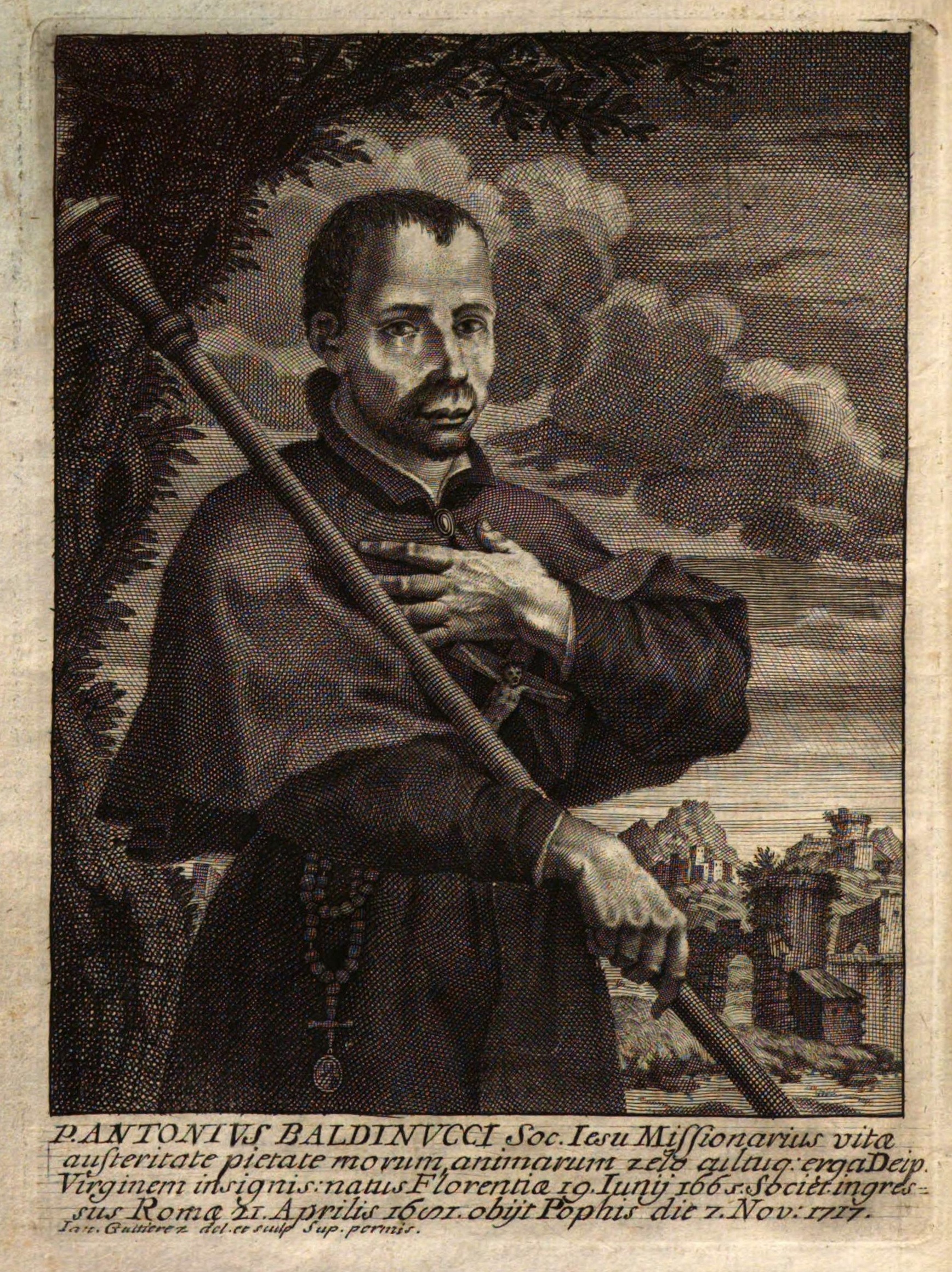
Francesco Galluzzi: Vita del P. Antonio Baldinucci della Compagnia di Giesù, missionario, Roma 1720


Bl. Anthony Baldinucci

Born 19 June, 1665, at Florence, died 6 November, 1717. He entered the Society of Jesus 21 April, 1681, and was ordained priest 28 October, 1695. After his third year of probation, he began his missionary career at Monte Santo. The field of his labors were the towns of Frascati and Viterbo, in which, with the exception of some more distant places, he labored for the rest of his life. His methods of preaching were of the most unusual and startling character. Splendid processions were organized which proceeded from various parts of the country to the place where the mission was being given. Many of the people wore crowns of thorns and scourged themselves as they went along. When Baldinucci preached he frequently carried a cross, and was loaded down with heavy chains. He often walked up and down among the people scourging himself to blood. The exercises were usually brought to a close by the burning in the public square of cards, dice, musical instruments, etc. He always carried with him a miraculous picture of the Madonna which was borne before him as he proceeded from place to place. The propaganda of devotion to the Blessed Virgin was one of his special aims. To keep order among the vast throngs who flocked to hear him, he always employed a number of laymen whom he called deputati. They were not infrequently men of very bad lives whom he chose purposely in order to conciliate and convert them. His work among the clergy was marked by great prudence and success. Though his preaching was incessant, he found time to write two courses of Lenten Sermons, to gather materials for many more, compose hundreds of discourses, and carry on an immense correspondence. The effect of his apostolic work upon the excitable people among whom he worked was stupendous. At times, when approaching a city, he found crowds covering the walls awaiting his arrival. His particular methods are explainable as those best adapted to his surroundings and times. After twenty years of labor, he died at the age of fifty-two. He was already canonized in public estimation, but, although the official ecclesiastical process was begun in 1753, the decree of his beatification was issued only on 23 April, 1893.

Sources

Goldie, Life of B. Anthony Baldinucci (London, 1894); Vanucci, Vita del Beato A. Baldinucci (Rome, 1893); Galuzzi, Life of Baldinucci (Rome, 1720); Budrioli, Summarium (Florence); Bartholomew Pace, S. J. (Baldinucci's companion), Evidence, Sermon, p. 116.

Campbell, Thomas. "Bl. Anthony Baldinucci." The Catholic Encyclopedia. Vol. 2. New York: Robert Appleton Company, 1907. 6 Nov. 2021 <http://www.newadvent.org/cathen/02219b.htm>.

Ecclesiastical approbation. Nihil Obstat. 1907. Remy Lafort, S.T.D., Censor. Imprimatur. +John M. Farley, Archbishop of New York.

SOURCE : https://www.newadvent.org/cathen/02219b.htm

Saints of the Society of Jesus: Blessed Anthony Baldinucci

Article

7 November

Father Anthony Baldinucci was born in Florence. By his father’s advice he entered the Society of Jesus, in preference to the order of Friars Preachers in imitation of his older brother. For more than twenty years he evangelized as many as thirty dioceses of Italy, doing all that a zealous apostle could accomplish for the salvation of souls, by preaching, instituting pious sodalities, visiting the sick, and, when at home, passing his time between the altar and confessional. Father Baldinucci was distinctively one of the amiable saints, and seems to have resembled in character the good Saint Francis Hieronymo. But, worn out by his labors, he expired before the close of his fifty-second year, and was beatified by Pope Leo XIII.

MLA Citation

Father D A Merrick, SJ. “Blessed Anthony Baldinucci”. Saints of the Society of Jesus1891. CatholicSaints.Info. 28 December 2018. Web. 6 November 2021. <https://catholicsaints.info/saints-of-the-society-of-jesus-blessed-anthony-baldinucci/>

SOURCE : https://catholicsaints.info/saints-of-the-society-of-jesus-blessed-anthony-baldinucci/

Blessed Anthony Baldinucci, SJ

Born : June 19, 1665

Died : November 7, 1717

Beatified: March 25, 1893

Anthony Baldinucci was born in Florence, Italy and at the age of eleven, began his studies at the Jesuit school, San Giovannino. He thought of joining the Dominicans in the footsteps of his older brother Philip, but because of his delicate health, his father advised him to discern God’s will for himself and recommended Anthony to make the Spiritual Exercises under a Jesuit’s direction. The outcome of this retreat led Anthony to choose to follow St Ignatius and he entered the novitiate of Sant Andrea on April 21, 1681.

Anthony spent the next fourteen years in Jesuit training. He began his study of humanities at the Roman College in 1684 after he pronounced his three simple vows. Then he taught at Terni and Rome between 1687 and 1690. After being in the Society for nine years, he had requested on three occasions to serve foreign missions in India, China or Japan but each request was turned down due to his uncertain health. In God’s wisdom, Anthony was to be a missionary, not in any foreign country but in his own native land. God was already preparing him for this role during his years studying theology in Rome. During the three years, Anthony frequently spent Sunday afternoons in the Roman public squares encouraging those gathered round to hear him, to attend the missions then being held in the local Roman parishes. Little did he know that such missions would one day be his main preoccupation. He was ordained on October 28, 1695 and spent two more years completing his tertianship.

Fr Baldinucci’s first assignment in 1697 was as assistant parish priest in Frascati which was about twelve miles south of Rome and part of his work involved spending four months of the year giving missions in the surrounding cities, towns and villages. He did this for the next twenty years traveling between Frascati and Viterbo in the north of Rome. He walked barefoot regardless of the weather to each mission assignment, carrying his bag with notes and personal belongings over his back and a pilgrim’s staff in his hand. When asked why he walked barefoot, he replied:” That God may be moved by my sufferings to touch the hearts of my hearers.”

His missions lasted from eight to fourteen days depending on the needs of the parish and his sermons were always based on the meditations in St Ignatius’ Spiritual Exercises.

At every mission, Fr Baldinucci would include a penitential procession to help prepare the parishioners for confession and he would end each mission with a General Communion service when everyone would receive the Eucharist. When he was not preaching, Fr Baldinucci would be in the confessional or teaching catechism to children or visiting the sick. At the end of each mission, he would build a big bonfire outside the church in which playing cards, dice, worldly books and songs were fed to the flames. On one such occasion, he counted 240 daggers and small arms and 21 pistols laid at his feet. Fr Baldinucci’s preaching was simple, vivid and dramatic at times but always effective. During the twenty years between 1697 and 1717, he visited 30 dioceses and gave 448 missions, an average of 22 missions a year. He was a man of deep prayer and extraordinary penance and many of the people claimed to witness miracles from his intercession.

On Oct 18, 1717, Fr Baldinucci’s health started to deteriorate when he arrived at Pofi to begin another mission and he had to be confined to bed and although it improved after a few days, Fr Baldinucci knew that death was imminent. On Nov 5 he received Viaticum and the last anointing. The following day he grew more feeble and his speech became difficult in the afternoon but those near him could still make out his constant prayer: “Jesus and Mary, my hope.” He began to convulse through the night until the following morning and finally at 11.00 am on the morning of Nov 7, 1717, Fr Baldinucci who was only fifty-two surrendered his soul to his Saviour. The indefatigable priest at his death had served the Society for thirty-five years and spent twenty years as an active preacher in the Italian countryside.

Fr Baldinucci was beatified by Pope Leo XIII on March 25, 1893 and his memorial is liturgically celebrated on July 2.

SOURCE : https://www.jesuit.org.sg/nov-anthony-baldinucci-sj/

November 7: Blessed Antonio Baldinucci

Died Nov 7, 1717

In the village of Pofi in Lazio, blessed Baldinucci Antonio, a priest of the Society of Jesus, devoted himself entirely to preaching missions to the people.

He never despaired, even when he has big wishes adverse and his heart and health are inversely proportional; that we have touched in fate. God can do great things with the little that we have. He, for example, is below the average stature, has frail health, falls ill more often than not. Just a little mental effort for him to tilt, and even greater commitment in teaching is enough to put him to bed for days and days. His father, the famous Academic Bran, does not seem to skimp in Christian of his five sons and even proves stingy with the Lord, when he asks these three: one enters the Dominicans, the other becomes a secular priest, while the smaller and sickly is Jesuit, dreaming of going missionary in China, Japan or India. This dream never came to fruition, since health is found and the many who persecute indisposition. Incredible to say, he was treated with tobacco, which was best medicine the time could provide, even when used more for its medicinal virtues, smoking was a pleasure.

Thus restored, but still unsuitable for the missions, he was called to do missionary at home and become anitinerant preacher, which is not a task of absolute rest, but that no longer needs the Jesuit frail, just a high penny of cheese, who has acquired a momentum unexpected and astonishing vitality, becoming even able to travel 70 kilometers a day. Begins to turn the countries of central Italy as a Saltimbanco, equipped with an arsenal of shells and disturbing: a skull under his arm to call everyone the ultimate destiny, happiness or eternal damnation; a wake, that is a poetic composition that he has composed music and a brother, to call his listeners to conversion; simple words that go straight to the heart and awaken the faith. Certainly, he is a child of his preaching time (we are in the early eighteenth century), which brought us public flagellation, exhausting penance and terrifying presentations of eternal damnation. Even nature seems to give strength to his preaching, as that summer day when, wanting to explain that the number of souls who fall in hell is equal to that of autumn leaves fall from trees, he invited his audience to observe l ‘Shade tree which is preaching. Just at that moment arrives folata a wind that strips the tree almost completely, so that the leaves remained attached to the branches can easily count. Some of his recommendations are still good for today: “Of all that happens, take the good and let go of the bad …. You live with a big heart and free from any tightness … .. I do not think at all possible evils, but only to those who need an immediate remedy …. ” “Heaven, or Heaven, or beautiful homeland” is the exhortation that never fails in his sermons, even in that of 7 November 1717, delivered a Pofi (Frosinone). These are the last words of Father Antonio Baldinucci, after which accascia: stroncato from a heart attack, but mainly consumed by hard work, just 52 years. Leo XIII has proclaimed blessed in 1893.

Author: Gianpiero Pettiti

SOURCE : https://theblackcordelias.wordpress.com/2008/11/07/blessed-antonio-baldinucci/

BALDINUCCI, ANTONIO, BL.

Jesuit and preacher of popular missions; b. Florence, Italy, June 19, 1665; d. Pofio, Nov. 7, 1717. Baldinucci entered the famous Jesuit novitiate of Sant' Andrea, Rome, on April 21, 1681. He was ordained on Oct. 28, 1695. His precarious health led his superiors to refuse his repeated requests to labor as a missionary in India. Instead he was assigned in 1697 to mission work in the Italian provinces of Abruzzi and Romagna. During his remaining 20 years Baldinucci preached 448 popular missions, one to two weeks in length, traveling on foot (usually barefoot) from town to town. His preaching manner was dramatic, impassioned, and extraordinarily successful. He always carried with him a miraculous picture of the Madonna, and frequently preached laden with chains or bearing a heavy cross. At times he scourged himself publicly until blood flowed to obtain the conversion of hardened sinners. His techniques, while startling, were effective for the audiences of his day. He collapsed in October 1717 while serving the sick of his famine-stricken area. Leo XIII beatified him in 1893.

Feast: July 2 (Jesuits).

Bibliography: F. J. Corley and R. J. Willmes, Wings of Eagles : The Jesuit Saints and Blessed (Milwaukee, WI 1941). F. M. Galluzzi, Vida del venerable padre Antonio Baldinucci, missionero apostolico de la Compañia de Jesus (Mexico City 1760). J. N. Tylenda, Jesuit Saints and Martyrs (Chicago 1998) 378–80. E. Lamalle, Dictionnaire d'histoire et de géographie ecclésiastiques, ed. A. Baudrillart (Paris 1912–) 6:337–339. C. Sommervogel, Bibliothèque de la Compagnie de Jésus, 11 v. (Brussels-Paris 1890–1932) 1:828–829; 8:1733. Acta Sanctorum Nov. 3:723–742.

[F. A. Small]

SOURCE : https://www.encyclopedia.com/religion/encyclopedias-almanacs-transcripts-and-maps/baldinucci-antonio-bl

Неизвестный автор. Антонио Бальдинуччи (XIX век).


Beato Antonio Baldinucci Sacerdote gesuita

7 novembre

Sec. XVII

Martirologio Romano: Nel villaggio di Pofì nel Lazio, beato Antonio Baldinucci, sacerdote della Compagnia di Gesù, che si dedicò interamente alla predicazione delle missioni al popolo.

Mai disperare, anche quando le circostanze della vita ci sono avverse e i grandi desideri che portiamo in cuore sono inversamente proporzionali alla salute che ci è toccata in sorte. Perché per Dio si possono fare cose grandi anche con quel poco di cui siamo dotati. Lui, per esempio, è di statura inferiore alla media, è gracile di salute, si ammala spesso e volentieri. Basta un piccolo sforzo mentale per mandarlo in tilt, e anche solo un maggior impegno nell’insegnamento è sufficiente a metterlo a letto per giorni e giorni. Suo padre, famoso Accademico della Crusca, non sembra lesinare nell’educazione cristiana dei suoi cinque figli e neppure si dimostra avaro con il Signore, quando di questi gliene chiede ben tre: uno entra nei Domenicani, l’altro diventa sacerdote secolare, mentre il più piccolo e malaticcio si fa Gesuita, sognando di andare missionario in Cina, in Giappone o nelle Indie. Sogni proibiti, visto la salute che si ritrova e le tante indisposizioni che lo perseguitano. Incredibile a dirsi, riescono a curarlo con il tabacco, che era il massimo che potesse offrire la medicina del tempo, quando ancora lo si utilizzava più per le sue virtù medicamentose che per il piacere di una fumata. Così ristabilito, ma pur sempre inadatto per le missioni, gli chiedono di fare il missionario in patria e di trasformarsi in predicatore itinerante, che non è propriamente un incarico di assoluto riposo, ma di cui non ha più bisogno il gracile gesuita, alto appena un soldo di cacio, che ha acquistato uno slancio inaspettato e una vitalità strabiliante, diventando capace di percorrere anche 70 chilometri al giorno. Comincia a girare i paesi dell’Italia centrale come un saltimbanco, dotato di un armamentario rustico e inquietante: un teschio sotto il braccio per richiamare a tutti il destino ultimo, la felicità o la dannazione eterna; uno “svegliarono”, cioè una composizione poetica che lui stesso ha composto e un confratello musicato, per richiamare i suoi ascoltatori alla conversione; parole semplici che vanno dritto al cuore e che risvegliano la fede. Certamente, la sua, è una predicazione figlia del suo tempo (siamo agli inizi del Settecento), che ha come contorno pubbliche flagellazioni, penitenze estenuanti, terrificanti presentazioni della dannazione eterna. Perfino la natura sembra dare forza alla sua predicazione, come quel giorno d’estate in cui, volendo spiegare che il numero delle anime che cadono nell’inferno è pari alle foglie che d’autunno cadono dagli alberi, invita il suo uditorio ad osservare l’albero all’ombra del quale sta predicando. Proprio in quel momento arriva una folata di vento che spoglia quasi completamente l’albero, al punto che le foglie rimaste attaccate ai rami si possono facilmente contare. Alcuni suoi consigli sono tuttavia ancora buoni per oggi: “Di tutto ciò che capita, prendete il buono e lasciate andare il cattivo….Vivete con un cuore grande e libero da ogni strettezza…..Non pensate a tutti i mali possibili, ma solo a quelli che hanno bisogno di un rimedio immediato…”. ”Paradiso, o paradiso, o bella patria” è l’esortazione che non manca mai nelle sue prediche, neanche in quella del 7 novembre 1717, pronunciata a Pofi (Frosinone). Sono le ultime parole di Padre Antonio Baldinucci, dopo le quali si accascia: stroncato da un infarto, ma soprattutto consumato dalle fatiche, ad appena 52 anni. Leone XIII lo ha proclamato beato nel 1893.

Autore: Gianpiero Pettiti

SOURCE : http://www.santiebeati.it/dettaglio/90402

BALDINUCCI, Antonio

di Alberto Merola - Dizionario Biografico degli Italiani - Volume 5 (1963)

BALDINUCCI, Antonio. - Figlio del celebre letterato e studioso d'arte Filippo e di Caterina Scalari, nacque a Firenze il 19 giugno 1665. Educato ad una fervida vita religiosa nel collegio gesuitico di Firenze, il B. avrebbe voluto diventare domenicano, come il fratello maggiore Giovan Filippo, ma il padre, che lo sconsigliava soprattutto per la sua malferma salute a sottoporsi alla vita rigorosa dell'Ordine dei predicatori, lo indusse ad entrare nella Compagnìa di Gesù. Il B. si recò dunque a Roma, dove nell'apr. 1681 fu ammesso al noviziato nel collegio di S. Andrea al Quirinale. Domandò varie volte, nel 1684, nel 1687 e nel 1690, di essere inviato nelle missioni in Oriente, ma il generale della Compagnia lo esonerò sempre da tali incarichi a causa delle precarie condizioni fisiche. Fu pertanto destinato all'insegnamento della grammatica nel Collegio di Temi e quindi, dal 1690, in quello Romano. Nel 1692, mentre stava preparando un corso di teologia, fu colto da una misteriosa malattia che lo costrinse a lunghi soggiorni in campagna, per cui-iniziò la sua attività sacerdotale a Frascati e, il 15 ag. 1698, veniva ammesso alla solenne professione dei quattro voti. Dai forzati soggiorni in campagna trasse però la sollecitazione per dedicarsi a quelle missioni popolari nelle campagne dell'Italia centrale che tenne con notevole successo in numero di quattrocentoquarantotto, durante l'ultima delle quali a Pofi, nella diocesi di Veroli, egli morì il 7 nov. 1717.

Lo stile delle missioni di campagna del B., che trovava precedenti nell'oratoria spirituale e nella pratica religiosa fortemente emotiva della tradizione gesuitica del '600 (e il B. si riferiva esplicitamente alla tradizione di Paolo Segneri), si basava, oltre che sulla diffusione degli esercizi spirituali per il clero contadino e delle congregazioni mariane (tra l'altro il B. diffuse il culto della Madonna "refugium peccatorum", della quale portava con sé sempre un'immagine che è conservata attualmente nella chiesa del Gesù di Frascati), soprattutto sulle processioni penitenziali. Su tali processioni ci restano numerose testimonianze, cosi come dell'utilità missionaria presso le popolazioni contadine, molto colpite anche dalla forza oratoria della predicazione del B., testimonianze raccolte per il processo di beatificazione conclusosi positivamente nel 1893 sotto il pontificato di Leone XIII.

Fonti e Bibl.: Sacra rituum: congreg.... Beatificationis et canonizationis Ven. servi Dei P. A. B. Positio super dubio an sit signanda commissio introductionis causae in casu…, Romae 1726; F. M. Galluzzi, Vita del P. A. B., Roma 1720; Beatificazionis et canonizationis ven. servi Dei A. B., Romae 1869; P. Vannucci, Vita del beato A. B., Roma 1893; Lettere inedite del B. A. B., a cura di L. Rosa, Prato 1899; G. De Guibert, La spiritualité de la Compagnie de Jésus, Rome 1953, pp. 279, 282.

SOURCE : https://www.treccani.it/enciclopedia/antonio-baldinucci_%28Dizionario-Biografico%29/

mercredi 13 octobre 2021

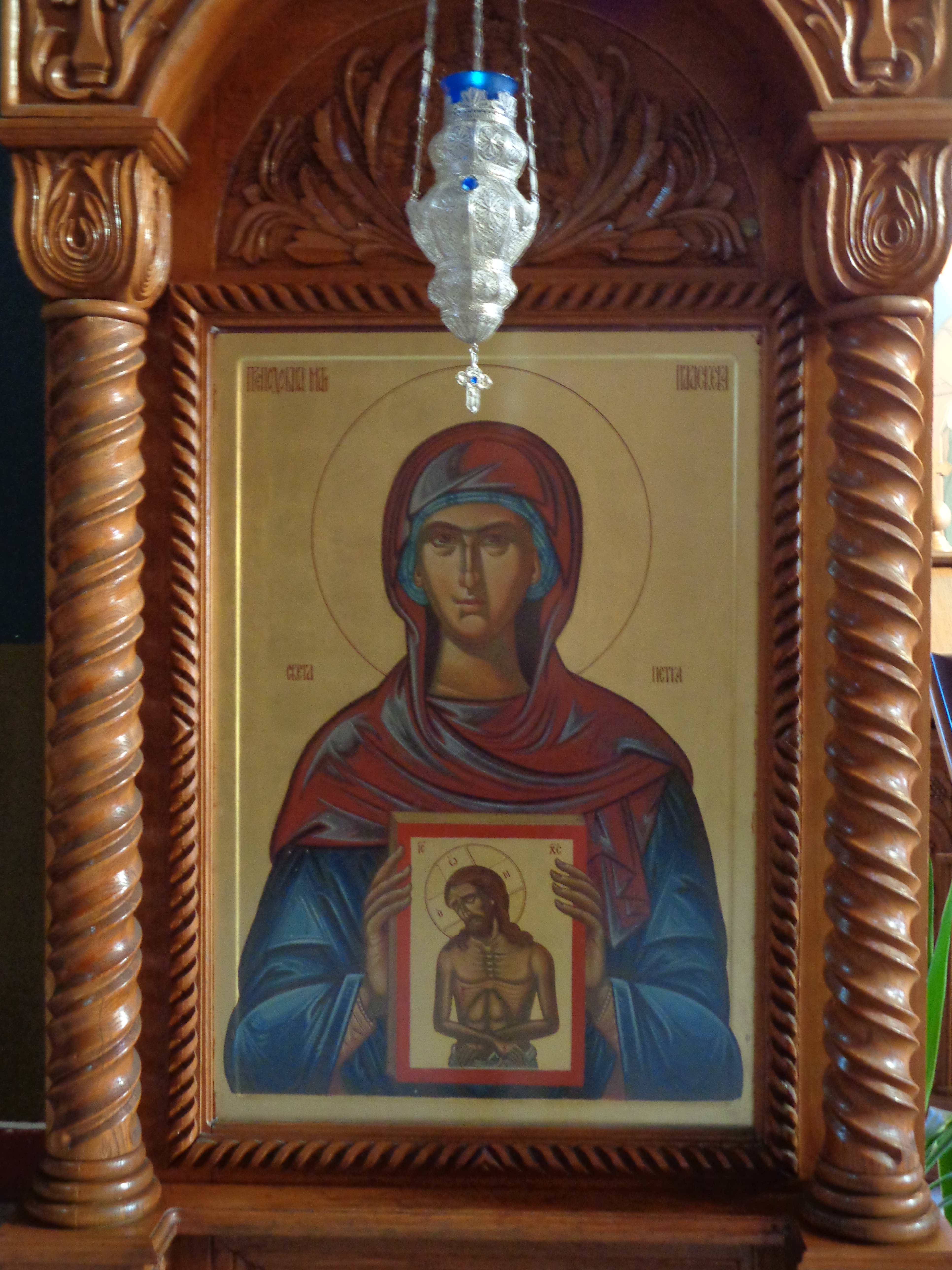
Sainte PARASCEVE la Jeune (PARASCEVA, PARASKEVA, PARASCHEVA), ermite


Icon of St Petka from Klisura Monastery, Bulgaria

Икона на Света Петка от Клисурския манастир над Банкя


Sainte Parascève

(+ 1050)

Une des saintes les plus populaires en Roumanie et en Bulgarie. Elle s'était enfuie de la Thrace, son pays, en désaccord avec ses parents. Elle donnait aux pauvres les jolies robes que ses parents lui achetaient, les échangeant contre les haillons des mendiants. Son père courut après elle pendant dix ans. Il la retrouva enfin à Jérusalem, mais elle venait de partir la veille. Elle retourna à Constantinople et gagna enfin Caricatia en Turquie. Son père découvrit son refuge deux ans après. Elle venait de mourir et déjà les pèlerins accouraient sur son tombeau.

SOURCE : https://nominis.cef.fr/contenus/saint/8588/Sainte-Parasceve.html

Црквата „Св. Петка“ во кумановско Живиње

St. Petka Church in Živinje, Macedonia


LA VIE DE SAINTE PARASCÈVE

La Bienheureuse et Pieuse sainte Parascève naquit dans un village de la région de Thrace, nommé Epibata. Les parents de la sainte étaient aisés et de condition noble. Plus noble encore était leur dévotion et la droiture de leur vie. Ainsi, sainte Parascève naquit de parents chrétiens orthodoxes, renaquit ensuite en Christ des fonts baptismaux et reçut de ses parents les enseignements pour une vie agréable à Dieu.

Elle accompagnait souvent sa mère à l’église de Notre Dame la Très Sainte Mère de Dieu et, une fois, lorsqu’elle avait dix ans, elle entendit ces divines paroles : « Si quelqu’un veut venir à ma suite, qu’il se renie lui-même et prenne sa croix, et qu’il Me suive ». Elle se sentit transfigurée par ces paroles et, en sortant de l’église, elle échangea, à l’insu de sa mère, ses beaux habits avec ceux d’un nécessiteux qu’elle rencontra.  De retour à la maison, ses parents, effrayés de la voir vêtue des habits du pauvre homme auquel elle avait donné les siens, lui donnèrent une correction. Mais elle continua à montrer la même générosité aux pauvres en leur donnant ses habits à maintes et maintes reprises, malgré les disputes et les punitions que ses parents lui infligeaient. Ces épreuves, qu’elle vivait dans la maison de ses parents étaient le préambule d’une vie et d’une voie qui dépassent la simple condition humaine. Le désir grandissant de suivre le Christ la poussa à quitter la maison familiale pour aller à Constantinople où elle écouta pieusement les enseignements des moines et des moniales. Suivant leurs conseils, elle quitta la capitale pour se diriger vers l’Héraclée Pontique. Ses pas furent guidés vers un couvent dédié à la Très Sainte Mère de Dieu où elle vécut pendant cinq ans dans la prière l’humilité et en s’imposant de grandes austérités. Elle obtint ainsi la paix de l’âme et la pureté du cœur.

Un des ses vœux les plus chers était de partir en Terre Sainte et elle priait souvent le Seigneur et Sa Très Sainte Mère pour le lui exaucer. Ses prières furent entendues et elle arriva à Jérusalem, ses pieds foulant le même sol qu’avait foulé le Seigneur Jésus Christ notre Sauveur. Après avoir vu Jérusalem, elle se retira dans un monastère de sœurs vivant en ermites où elle continua sa vie ascétique. Les mots ne suffisent pas pour décrire les austérités qu’elle entreprit et qui lui donnèrent la pureté d’âme pour vaincre les tentations que le Malin lui envoyait ; elle ne buvait qu’un peu d’eau de source, elle dormait sur natte, elle portait des haillons, mais ses lèvres chantaient toujours louange, ses yeux étaient toujours remplis de larmes et sa pensée s’élevait toujours vers les cieux.

Lorsqu’elle eut 25 ans, un ange lui dit en rêve de quitter le monastère pour retourner dans sa patrie. Elle obéit et quitta le désert le cœur lourd. Pour son retour dans le monde elle demanda réconfort en priant devant l’icône de la Très Sainte Mère de Dieu dans l’église de Vlacherna. Elle alla d’abord à Constantinople, puis à Epibata, la ville qui la vit naître. Ici, deux ans durant elle nourrit son âme de prières incessantes, puis elle la remit à Dieu. On l’enterra sans savoir qui elle était, mais le Seigneur voulait la glorifier et révéla miraculeusement celle qui avait vécu si agréablement à Ses yeux.

Un certain temps après, un homme qui avait gaspillé sa vie en assouvissant des plaisirs passagers, mourut et fut enterré à côté de la Sainte. Mais, ne pouvant pas sentir l’odeur du péché qui dégageait de cet homme, elle se montra en rêve à deux chrétiens leur demandant de l’en éloigner. Alors, le peuple chrétien, comprenant qu’un trésor céleste gisait enterré non loin d’eux, se mirent à creuser.  Au fur et à mesure qu’ils creusaient, l’air s’embaumait de célestes senteurs. Ils découvrirent son corps intact. S’émerveillant du miracle qui leur avait été donné de voir, ils se mirent à chanter à la gloire de Dieu et l’emmenèrent dans l’église des Saints-Apôtres.

Les mots sont faibles et insuffisants pour décrire tous les miracles qu’elle a faits par la grâce de Dieu. Des estropiés, des sourds, des mutilés et toutes sortes de malades furent guéris après avoir touché la châsse avec ses saintes reliques. Par la grâce de Jésus Christ, notre Seigneur qui l’a glorifiée, elle octroie ses bienfaits à tout le peuple des fidèles qui demandent avec foi, humilité et sincérité un remède à leurs douleurs.

Les saintes reliques de la bienheureuse sainte Parascève furent gardées environ deux cents ans dans l’église des Saints-Apôtres d’Épibata accomplissant beaucoup de miracles, mais, à cause des événements qui furent source de beaucoup de tourments et de chagrins dans les pays balkaniques, elles furent déplacées à plusieurs reprises. D’après ce que nous racontent les saints Euthyme et Raphael, saint Mélèce d’Athènes, et saint Dosithée, le patriarche de Jérusalem, elles furent d’abord emmenées d’Epibata à Târnovo, l’ancienne capitale des tsars bulgares, puis à Belgrade et ensuite à Constantinople.

Par la bienveillance du Seigneur, les reliques de la sainte furent ensuite déplacées de Constantinople à Iassy en Roumanie. En 1641, le Patriarcat de Constantinople se trouvant face à de grandes difficultés financières accepta l’aide de Vasile Lupu, le pieux prince régnant de la Moldavie et lui donna en échange la châsse avec les reliques de la sainte « afin qu’elle sanctifie et qu’elle bénisse ce pays (la Moldavie) ». Les reliques furent transportées par bateau jusqu’à Galati, puis à Iassy, où elles furent accueillies par le prince régnant en personne, par les métropolites et les archevêques de l’époque et par tout le peuple réuni. Elles furent déposées dans l’église du Monastère les Trois Saints Hiérarques  où elles y restèrent jusqu’en 1884  où on entreprit à rénover l’église. La châsse fut donc déplacée dans une chapelle en attendant d’être remise à sa place à la fin des travaux. Le 26 décembre, à la fin des vêpres, un cierge resté allumé provoqua un incendie. La châsse fut consumée par le feu, mais les saintes reliques restèrent intactes. Voilà un autre miracle de la sainte !  Ce miracle fut consigné dans les procès verbaux établis par les autorités de la ville de Iassy : le préfet Léon Negruzzi et le procureur général de l’époque. Les reliques de la sainte, récupérées des débris calcinés, on été placées dans la Cathédrale Métropolitaine de Iassy, où elles se trouvent encore aujourd’hui accomplissant miracle après miracle pour les fidèles qui courent demander l’intercession de la sainte.

La fête de la bienheureuse Parascève est célébrée le 14 octobre. Une multitude de croyants vont en pèlerinage à Iassy pour demander l’aide de la sainte ou pour la remercier pour les bienfaits qu’elle leur octroie par la grâce de Dieu. Notre paroisse de Paris (crypte de Saint-Sulpice), dont la bienheureuse sainte est la patronne avec sa sœur en Christ, la bienheureuse sainte Geneviève de Paris, célèbre sa fête avec beaucoup de piété et de joie à la fois. Nous nous rassemblons tous, prier ensemble et partager des moments bénis pendant la traditionnelle agape préparée par tous les membres qui souhaitent s’y impliquer et pendant les spectacles à caractère spirituel qui se suivent (chorale des adultes, chorale des enfants, projections de film etc.) Nous profitons pleinement et nous rendons grâce au Seigneur et à la Bienheureuse sainte pour le bonheur d’être chrétiens.

SOURCE : https://mail.sagesse-orthodoxe.fr/jaimerais-savoir/culture/education/la-vie-de-sainte-parasceve/

Mozaika z postacią św. Paraskiewy, katedra prawosławna w Jassach


SAINTE PARASCÈVE LA JEUNE, FÊTÉE LE 14 OCTOBRE

L’amour des pauvres –

Sainte Parascève naquit dans un village de la région de Thrace, nommé Epibata. Ses parents étaient de condition aisée et menaient une vie chrétienne exemplaire. Sainte Parascève naquit une deuxième fois en Christ dans les fonts baptismaux pour être élevée par ses parents dans une vie agréable à Dieu. Elle accompagnait souvent sa mère à l’église de la Mère de Dieu. Un jour, lorsqu’elle avait dix ans, elle entendit ces divines paroles : « Si quelqu’un veut venir à ma suite, qu’il renonce à soi, qu’il prenne sa croix, et qu’il me suive ». Elle se sentit transfigurée par ces paroles et, en sortant de l’église, elle échangea, à l’insu de sa mère, ses beaux habits pour ceux d’un nécessiteux qu’elle rencontra. Une fois à la maison, ses parents, effrayés de la voir vêtue des habits du pauvre homme auquel elle avait donné les siens, lui donnèrent une correction. Mais elle continua à montrer la même générosité à l’égard des pauvres, leur donnant ses habits à mainte reprise, malgré les remontrances de ses parents. Les épreuves qu’elle connaissait dans la maison de ses parents étaient le préambule d’une vie et d’une voie qui dépassent la simple condition humaine.

Constantinople et Jérusalem

Le désir grandissant de suivre le Christ la poussa à quitter la maison familiale pour aller à Constantinople où elle écouta attentivement les enseignements des moines et des moniales. Sur leur conseil, elle quitta la capitale pour se diriger vers l’Héraclée Pontique. Ses pas furent guidés vers un couvent dédié à la très sainte Mère de Dieu où elle vécut pendant cinq ans dans la prière et l’humilité, et une grande austérité. Elle connut alors la paix de l’âme et la pureté du cœur.

Un de ses vœux les plus chers était de partir en Terre Sainte et elle priait souvent le Seigneur et sa très sainte Mère de l’exaucer. Ses prières furent entendues : elle arriva à Jérusalem, ses pieds foulant le même sol qu’avait foulé le Seigneur Jésus Christ notre Sauveur. Après avoir vu Jérusalem, elle se retira dans un monastère de sœurs vivant en ermites où elle continua sa vie ascétique. Elle vivait dans une grande austérité et dans la pureté de l’âme, victorieuse des tentations du Malin : elle ne buvait qu’un peu d’eau de source, elle dormait sur une natte, elle portait des haillons, ses lèvres chantaient toujours des louanges, ses yeux étaient toujours remplis de larmes et sa pensée s’élevait sans cesse vers les cieux.

L’invention de ses reliques

Lorsqu’elle eut vingt-cinq ans, un ange lui dit en rêve de quitter le monastère pour retourner dans sa patrie. Elle obéit et, le cœur lourd, quitta le désert. Pour son retour dans le monde elle demanda réconfort en priant devant l’icône de la très sainte Mère de Dieu dans l’église des Blachernes. De Constantinople, elle se rendit à Epibata, la ville qui l’avait vue naître. Pendant deux ans elle y nourrit son âme de prières incessantes, puis elle s’endormit en Dieu. On l’enterra sans savoir qui elle était, mais le Seigneur voulait la glorifier et révéla miraculeusement celle qui avait vécu de façon si agréable à ses yeux. Peu de temps après son repos, un homme qui avait gaspillé sa vie en assouvissant des plaisirs passagers, mourut et fut enterré à côté d’elle. Celle-ci se montra en rêve à deux chrétiens et leur demanda de l’en éloigner. Alors, le peuple chrétien, comprenant qu’un trésor céleste gisait enterré non loin d’eux, se mit à creuser le sol. Au fur et à mesure qu’on creusait, l’air s’embaumait de célestes senteurs. On découvrit son corps intact. Les hommes s’émerveillèrent du miracle qui leur avait été donné de voir, et se mirent à chanter la gloire de Dieu : ils portèrent sainte Parascève dans l’église des Saints-Apôtres.

Les miracles de la sainte

Les mots ne suffisent pas pour décrire tous les miracles que sainte Parascève a accomplis par la grâce de Dieu. Des estropiés, des sourds, des mutilés et toutes sortes de malades furent guéris après avoir touché la châsse de ses saintes reliques. Par la grâce de notre Seigneur Jésus Christ qui l’a glorifiée, elle octroie ses bienfaits à tout le peuple des fidèles qui demandent avec foi, humilité et sincérité un remède à leurs douleurs. Les saintes reliques de la bienheureuse Parascève furent gardées environ deux cents ans dans l’église des Saints-Apôtres d’Épibata et accomplirent beaucoup de miracles. Mais, en raison d’événements très éprouvants dans les pays balkaniques, elles furent déplacées à plusieurs reprises.

Le transfert de la châsse

D’après le témoignage des saints Euthyme et Raphael, de saint Mélèce d’Athènes, et de saint Dosithée, patriarche de Jérusalem, elles furent d’abord transférées d’Epibata à Târnovo, l’ancienne capitale des tsars bulgares, puis à Belgrade et ensuite à Constantinople. Par la bienveillance du Seigneur, les reliques de la sainte furent ensuite déplacées de Constantinople à Iassy en Roumanie. En effet, en 1641, le patriarcat de Constantinople, qui se trouvait face à de grandes difficultés financières, accepta l’aide de Vasile Lupu, Prince de Moldavie, et lui donna en échange la châsse contenant les reliques de la sainte « afin qu’elle sanctifie et qu’elle bénisse ce pays (la Moldavie) ».

Sainte Parascève de Iassy

Les reliques furent transportées par bateau jusqu’à Galati, puis à Iassy, où elles furent accueillies par le prince régnant en personne, par les métropolites et les archevêques de l’époque et par tout le peuple réuni. Elles furent déposées dans l’église du monastère des Trois-saints-Hiérarques où elles restèrent jusqu’en 1884, quand on entreprit de rénover l’église. La châsse fut donc déplacée dans une chapelle en attendant d’être remise à sa place à la fin des travaux. Le 26 décembre, à la fin des vêpres, un cierge resté allumé provoqua un incendie. La châsse fut consumée par le feu, mais les saintes reliques restèrent intactes. Encore un miracle de la sainte ! L’évènement fut consigné dans les procès-verbaux établis par les autorités de la ville de Iassy : le préfet Léon Negruzzi et le procureur général de l’époque.

Les reliques de la sainte, retrouvées dans les débris calcinés, furent placées dans la Cathédrale Métropolitaine de Iassy, où elles se trouvent encore aujourd’hui et accomplissent miracle sur miracle pour les fidèles qui courent demander l’intercession de la sainte. La fête de la bienheureuse Parascève est célébrée le 14 octobre. Une multitude de croyants se rend près d’elle en pèlerinage pour demander son aide ou pour la remercier.

SOURCE : https://mail.sagesse-orthodoxe.fr/jaimerais-savoir/culture/education/sainte-parasceve-la-jeune-fetee-le-14-octobre/


Saint Petca Parasceva

Also known as

Petca Parasceva the New of Bulgaria

Parasceva

Paraskeva the Younger

Paraskeva Pyatnitsa

Memorial

14 October

Profile

Born to wealthy, noble, pious landowners. During services at age ten, at the Church of the Holy Theotokos, she heard the words, Whosoever will come after Me, let him deny himself and take up his cross, and follow me. They had a profound effect on the girl, and became the subject of her meditations.

Petca started dressing poor people in her expensive clothes; this led to her patronage of people involved in spinner, sewing, etc. Her parents objected, finding the girl‘s charity more than they could understand or support, and tried to get her to stop. To follow her calling, Petca left her parents, her wealth, and status, and ran away to Constantinople. There she spent her time in prayer, meditating on the words of Christ and the relics of the saints.

Her parents travelled from city to city, unsuccessfully searching for the girl. To elude them she travelled to Chalcedon, then lived for five years at the church of the Most Holy Theotokos in Heraclea Pontica near the Black Sea. She spent her days and nights in prayer, living a severely austere life. She received visions of the Virgin Mary during her prayers.

In one of the visions, she received the message that she should go to Jerusalem. After some time in the city, she joined a covent in the Jordanian desert. A few years later, she returned to Constantinople, then at age 25 moved the village of Katikratia where she lived her remaining two years at the church of the Holy Apostles.

Legend says that many years later an old sinner was buried near her grave. Petca appeared in a dream to a local monk, showed him the place of her burial, and demanded,

Take that stinky corpse away from me. I am light and sun, and I cannot bear to have near me darkness and stench.

The monk obtained some local help, and began to dig at the place he had seen in his dream. When they found the remains of the Saint, they found her body incorrupt and emitting a spiritual fragrance. They were then interred in the church where she had spent her last years on earth.

Born

in the village of Thrace, north shore of the Sea of Marmara

Died

at Katikratia of natural causes

relics enshrined at the church of the Holy Apostles at Katikratia

relics taken to Belgrade

relics transferred to Constantinople when Belgrade fell to Muslim Turks

relics taken to the monastery of the Three Hierarchs, Jassy, Romania in 1641

her chapel became a place of pilgimage and site of healing miracles

since 1888 her relics have been at the Serbian Orthodox Catedrala Mitropolitana in Iasi, Romania

Canonized

Pre-Congregation

Patronage

embroiderers

needle workers

spinners

weavers

Additional Information

books

Book of Saints, by the Monks of Ramsgate

Our Sunday Visitor’s Encyclopedia of Saints

other sites in english

Masha Goepel

MLA Citation

“Saint Petca Parasceva“. CatholicSaints.Info. 20 October 2019. Web. 13 October 2021. <http://catholicsaints.info/saint-petca-parasceva/>

SOURCE : http://catholicsaints.info/saint-petca-parasceva/


Мозаик Свете Петке на цркви Ружици у Београду на Калемегдану.


St. Petca-Parasceva

October 14

        Saint Petca Parasceva the New of Bulgaria, a truly great and famous saint among women, was born in a village of Thrace (on the north shore of the Sea of Marmara). Her parents were wealthy landowners of the nobility, whose rank in society was equalled by their devotion tothe Church. After baptizing their daughter, the parents taught her every virtue and conduct after God's laws.

       When the girl was ten years of age she went with her mother into the Church of the Holy Theotokos where she heard these words from the Gospel: "Whosoever will come after Me, let him deny himself and take up his cross, and follow Me." The words became imprinted on her heart, and she was inspired to make a habit of dressing poor people in her expensive clothes. Although her parents were Christian, they were aggravated by such behavior; perhaps they found their daughter's generosity extreme and beyond their comprehension. They tried to discourage her practice and went so far as to use threats and even beat her. Then, still quite young, Petca left everything-- parents, relatives, servants--and went to Constantinople where her soul delighted in the spiritual treasures of the capital: its beautiful churches, precious relics of numerous saints, and the prayers and blessings of the hermits.

       From there she journeyed to Chalcedon and then to Heraclea Pontica on the Black Sea. Her parents went from place to place, from city to city in search of her, but they were unable to locate her and returned home alone in great sorrow. Meanwhile, the Saint lived at the church of the Most Holy Theotokos in Heraclea Pontica and rejoiced spiritually, prostrating herself to the ground and wetting it with her tears.

      There she remained for five years, practicing every kind of virtue: prayers, vigils, all-night standings, prolonged fasting, sighs, tears and lying on the naked ground. And who could tell the purity of her heart? Or who could imagine the humility of her character and mind? In her prayers she would often see the Mother of God to aid her in making the journey to Jerusalem, for she desired to behold the sacred sites, and leaving the temple, she departed for the Holy City.

     After delighting herself in the sanctity of the holy places where the most pure feet of the Lord had stepped, she flew from there like a bird and came to the Jordanian desert where she found a convent which she joined. And how many valiant spiritual deeds she performed there, by which she completely defeated the devil who fought against her using all sorts of strategies and temptations.

    While in the convent the Blessed One had very little spring water for drink, a mat for a bed, and a very poor cassock. Her tears flowed continuously while in her heart there bloomed the love for God and her fellowmen. The crown of her virtues was humility. She remained in this convent for several years.

     At the age of 25 she left the desert and, after considerable journeying, during which she again visited Constantinople, she settled in a village called Katikratia. There she stayed for two years at the church of the Holy Apostles. And here the Blessed One gave up her holy soul into the arms of the angels and made a final journey--to her eternal home.

    Many years passed. A Christian who spent his whole life in vice died and was buried near the grave of the Saint. She appeared in a dream to a God-loving monk and said to him: "Take that stinky corpse away from me. I am light and sun, and I cannot bear to have near me darkness and stench." She repeated this three times, strictly instructing the monk and pointing out to him the place with her finger. When the monk got up, he told his dream to the Christians nearby, and they started digging at the place indicated by the Saint. When they approached the remains of the Saint, they discovered that they were filled with a spiritual fragrance. Her relies, whole and incorrupt, were lifted out and reverently transferred into the divine church of the Holy Apostles with much incense and chanting of psalms.

      It is difficult to describe how many miracles the wonderful God performed and continues to perform through these relics; they heal the lame, the dumb, the paralyzed, invalids and anyone who is suffering from any kind of deadly disease.

       At first her holy and miraculous relics were in Belgrade, as long as it was under Serbian rule. But after the infidels [Turks] took Belgrade, the relics were transferred to Constantinople, from where they were transferred to Yassyin Moldavia [Romania] in the following way:

      In 1641 , during the time of Patriarch Parthenius the Old of Constantinople (1639-1644 and of the Moldavian Prince Vasily Voevod, the Patriarchate of Constantinople found itself in great financial need. The Patriarch arranged with Prince Basil to give him the relics of St. Petca in return for a sum of money. He lowered the holy relics over the fortified wall of Phanar  and they were secretly transported to Jassy. There they were placed in the monastery of the Three Hierarchs where they are tothisday, and where they work a multitude of miracles to the glory of God and to the honor of His Saint. 

 [1]. St. Nicodemos the Naziafire omits the time when the relics were transferred from Kalikratia to the capital of Tirnovsky in BuIgaria, where they lay for 155 years before they were transferred to Serbia.

[2]        Phanar is a district in Constantinople where the Patriarchate is located.     

(Prom a translation by Boris Svrakov of Zhtia na Bulgarski Svetsi by Bishop Parthenii, Synodal Publications, Sofia, 1979

SOURCE : https://web.archive.org/web/20010111061900/http://www.roca.org/oa/53-54/53k.htm


Crkva svete Petke na Čukaričkoj padini, Beograd


Saint Paraskeva Pyatnitsa

By Masha Goepel

20 October AD 2019

Saint Paraskeva is a mystery. There are at least three saints named Paraskeva (or Paraskevi) in the Catholic Church; and though they have distinct feast days and devotions, oftentimes, these Paraskeva meld together in our minds as Mother Friday, patroness of marriage, home, and spinning. The primary Paraskevas are often viewed as a collective. With shared icons, devotions, and feasts, they weave in and out of the church year, often neglected in the west. 

Long ago and far away, in the sacramental imaginations of Eastern European Christians: both Catholic and Orthodox; one Paraskeva loomed especially large in devotional life. Her name means “Friday” in Greek and represents her devotion to the anticipation of Joy during seasons of sorrow. Named by Christian parents for the day of Christ’s Passion, Paraskeva was martyred during the persecution of Diocletian.

That is really all we know about Paraskeva Pyatnitsa, Paraskeva-Friday but her legend and cult were never limited by lack of information. Indeed, it’s always problematic to limit a saint to the mere facts of their lives and deaths. The rich, often unfounded devotions that spring up around saints present a fantastic introduction to the nature and heavenly interests of these holy people. Paraskeva, Virgin-martyr quickly became, in the hearts of her devotees, Mother Friday. 

Mother Friday, the Woman’s Saint

Just as Therese, the cloistered Little Flower is pouring her heavenly help down upon missionaries; Paraskeva, the virgin martyr pursues her maternity throughout eternity. Patroness of marriages, fertility, weaving, spinning, sewing, eye health and as a last resort in extreme circumstances, Paraskeva acts as a matriarch, dispensing wisdom, help, healing, and occasionally correction.

Named for the day on which is Blood of Christ dripped down to heal the earth, Paraskeva’s patronage is deeply rooted in the earth and the nourishment of the fields. Her feast day, October 28th places her in the harvest season; when we pile the fruits of the land up in preparation for winter.

But Mother Friday’s feast day wasn’t the only day of devotion to her. Traditionally, the cult of Paraskeva spread throughout the year. There were twelve specific Fridays, entrusted particularly to Paraskeva. They took place on the Friday prior to major feasts. On the Paraskeva Fridays, everyone fasted and abstained’ from spinning, cleaning the house, and doing laundry. 

The Friday devotions were particularly popular among women in desperate situations: women who longed for a spouse or a child became particularly devoted to Mother Friday and often kept “the Paraskeva Fast” every Friday in her honor.

Particular Devotions for Particular Needs

The instructions for honoring the 12 Fridays of Paraskeva Pyatnitsa have never been recorded. They lived in the hearts and traditions of a rural and marginally literate population. Those of us who have been fortunate enough to be introduced to St. Paraskeva have been blessed by continuing these devotions. 

Like the unfailing prayer to St. Joseph, the Memorare, and St. Jude’s Novena, the 12 Fridays of Paraskeva are often a last resort for the suffering faithful. As we wait in joyful hope for our longing to come to fruition, we can reach out to the saints who love to nurture us. 

Mother Friday is rarely called up to help her children these days, but when we invite her into our struggles, she steps in quickly at takes control. Truly the matriarch, Paraskeva is quick to share her wisdom with her children. 

A Saint for the Single Life

If you’re praying and searching for a spouse, Paraskeva – patroness of marriages appears like an old-world matchmaker. Ask her for awareness and the readiness to step into a relationship when the right one comes along. 

The Domestic Saint

Guiding spinning, weaving, sewing, and cleaning, Paraskeva is an ideal ally. No one knows how or why she stepped into the domestic sphere so readily, but her patronage is such a joy. She, “whose name embodies preparedness” is a homemaker’s closest friend. I entrust all my housekeeping to Paraskeva, and she continually helps me. 

Pursuing Motherhood

It may seem strange that an ancient virgin martyr is so helpful to women hoping to conceive, but then, so many of our other “maternity” saints are in a similar position. St. Gerard, St. Anthony of Padua, and St. Casilda of Toledo are other saints who have stepped into the role despite not having been parents in life. 

The Saint of Eye Troubles

One of Paraskeva’s chief areas of care is for the eyes of her children. This may be why she’s such a patron of sewing and spinning: domestic tasks that depend so much on eyesight. Paraskeva of Rome is often shown with the eyes of her executioner, which she healed despite his persecutions. St. Paraskeva’s oil, blessed before the relics of the saint, is often used to heal and bless sickly eyes.

Rejoicing with good cheer, you entered the Bridal Chamber above, O Sacred Martyr,

and fell at the feet of Christ, which you embraced fervently, O all-precious Paraskeva.

He placed a crown upon your head and you cried out: Alleluia. 

Feasting with Mother Friday

October 28th is the feast of Paraskeva Pyatnitsa. On her feast day, we rejoice with her over her martyrdom and thank her for her intercession. The Friday before her feast day, we observe the Paraskeva fast and avoid tidying up the house, sewing, or laundry. 

My daughter is named for Paraskeva, and on her name day, we fling ourselves into celebrations. Bonfires, cakes, prayers, and liturgy. Mother Friday is an ideal patron for children, it’s one reason there are so many Saints with her name. Paraskeva the New, Paraskeva the Fool for Christ, and other holy women look to Saint Friday as their patron and inspiration. 

Unlike sweet Therese and the Ever-Gentle Mother of God, Mother Friday can be stern. Folklore is full of tales of her punishing those who neglect their devotions. Like Padre Pio or St. Jerome, Paraskeva is sternly loving. 

We need that sort of strength today. The gentle saints and the severe ones. It’s good for our beloved saints to stand in as abbots and abbesses in our lives, and St. Paraskeva fills that role perfectly. She whose name embodies preparedness prepares us to enter the Bridal Chamber and fall at the feet of Christ. Holy Martyr, Paraskeva Pyatnista – pray for us who pray to you!

You whose name embodies preparedness, O Holy Paraskeva, you worshipped with the readiness of your Name. For an abode you obtained faith, which is your namesake. Pour forth healing and intercede for our souls, O Holy Paraskeva.

SOURCE : https://catholicstand.com/saint-paraskeva-pyatnitsa/


Fresco in St. Petka Church in Velgošti Monastery, Macedonia


Santa Parasceve la Giovane Eremita

13 ottobre

Epibatai (Costantinopoli), secolo X

Parasceve è una santa dell'Oriente cristiano. Originaria di Epibatai, nei pressi di Costantinopoli, visse e morì nel X secolo. Nobili di famgilia, lei e il fratello Eutimio rimasero orfani e decisero di abbracciare la vita religiosa. Dopo un periodo in monastero Parasceve si sentì chiamata alla vita eremitica nel deserto dove visse in tutta la sua durezza l'ideale ascetico. Ma un giorno ebbe una visione: un angelo le chiese di ritornare tra la gente dove era nata. Così, dopo un pellegrinaggio a Costantinopoli, tornò a Epibatai dove continuò a vivere da penitente. Morì quasi sconosciuta. Ma alcuni anni più tardi la si riscoprì per via di un miracolo: durante una pestilenza, mentre scavavno la fossa a un cadavere, un gruppo di uomini si imbatté nel corpo di Parasceve che emanava un misterioso profumo. Fu l'inizio di una fama di santità che si diffuse soprattutto fra i popoli slavi dei Balcani, che la venerano col nome di Petka. (Avvenire)

Emblema: Palma

La ‘Vita’ di santa Parasceve la Giovane, fu scritta dal metropolita di Mira, Matteo nel XVII secolo, dopo l’ultimo trasferimento delle reliquie in Moldavia nel 1641, sei secoli dopo la morte della santa eremita, quindi bisogna darne il valore relativo a questo lasso di tempo.

Parasceve nacque ad Epibatai, centro marittimo, distante un giorno di cammino da Costantinopoli; visse e morì molto probabilmente nel secolo X.

Appartenenti a nobile famiglia, lei e il fratello Eutimio, rimasero presto orfani e decisero ambedue di abbracciare la vita religiosa; Eutimio per le sue virtù, fu fatto vescovo di Madito e Parasceve, dopo un certo numero di anni trascorsi in un monastero, si ritirò come eremita in una zona desertica, emulando la santa vita delle antiche monache-eremite d’Egitto e della Siria: lunghe preghiere, veglie notturne e frequenti digiuni.

Mangiava qualcosa solo il sabato e la domenica e dormiva sulla nuda terra; ebbe una notte la visione di un angelo, il quale esortandola a perseverare nel suo sforzo di vita penitente, le raccomandò comunque di ritornare nel suo luogo natio.

Parasceve allora lasciò l’eremo e si recò a Costantinopoli e da pellegrina visitò i santuari, mettendosi sotto la protezione della Vergine nella chiesa di Blacherne; poi si ritirò ad Epibatai, dove continuò nelle pratiche di penitenza, mortificazione e preghiera, per il resto della sua vita; quando morì fu sepolta da gente che nemmeno la conosceva e il suo ricordo si spense.

Ma in epoca successiva, un miracolo riportò a fiorire il suo ricordo; nelle vicinanze di Epibatai, viveva uno stilita, un giorno alcuni marinai, gettarono ai piedi della sua colonna, il corpo di un loro compagno morto di peste. Il cadavere andò in putrefazione, emanando un lezzo così forte, che lo stilita pregò che qualcuno venisse a dargli sepoltura, alcuni uomini scavando la fossa, trovarono un corpo sotterrato che emanava un profumo così delicato da superare il puzzo del cadavere dell’appestato.

Un certo Giorgio facente parte del gruppo dei seppellitori, la notte ebbe un sogno, in cui gli veniva chiesto di deporre il corpo ritrovato in una bara, rivelandogli anche il nome di Parasceve, nata e cresciuta ad Epibatai.

Essa diventò la patrona della cittadina, anche perché in un altro sogno, avuto da una vicina di Giorgio, nella stessa notte, prometteva che avrebbe aiutato tutti coloro che con fede, sarebbero ricorsi a lei.

Le reliquie furono portate nella chiesa dei Ss. Apostoli, dove avvennero molti miracoli; esse superarono la sottrazione di numerose reliquie da Costantinopoli, da parte dei conquistatori Franchi, che nel 1204 le portavano in Occidente.

Ma nel 1230-31 il corpo di santa Parasceve fu ceduto dall’imperatore latino di Costantinopoli al re conquistatore bulgaro Giovanni II Asen (1218-1241) che lo trasportò a Turnovo in Bulgaria, dove accolto con solennità dal patriarca Basilio, fu deposto nella basilica del palazzo imperiale.

Quando nel 1393 i Turchi s’impadronirono di Turnovo, allora capitale della Bulgaria, le reliquie furono trasferite a Belgrado, dove rimasero fino al 1521, quando la città venne conquistata da Solimano il Magnifico. Saputo della grande venerazione che i cristiani portavano a quelle reliquie, il sultano le inviò a Costantinopoli, dove il patriarca le fece deporre nella chiesa della Pammacaristos.

Ma anche qui non durò a lungo il riposo delle reliquie, quando nel 1586 Murad III tolse ai cristiani il santuario, esse con altre reliquie furono portate nella chiesa di S. Demetrio Kanabu e poi a S. Giorgio del Phanar nel 1612 e finalmente nel 1641 giunsero a Jasi in Moldavia, dove si trovano tuttora.

Dopo la traslazione a Turnovo la santa con il nome di Petka o Petnica ebbe grande popolarità tra il popolo bulgaro e ben presto divenne Patrona nazionale; del resto ella ha avuto sempre un culto particolare presso i popoli slavi balcanici, anche perché si credeva che i suoi genitori fossero slavi.

La sua festa ricorre il 13 ottobre.

Autore: Antonio Borrelli

SOURCE : http://www.santiebeati.it/dettaglio/74125