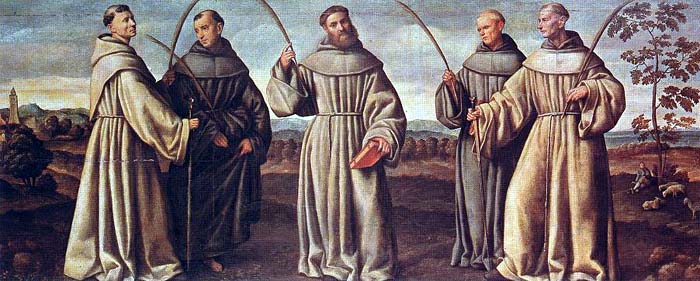
Bernardino Licinio, Martiri di Marrakesch o Protomartiri Francescani (1524); Venezia, Basilica di Santa Maria Gloriosa dei Frari
Bernardino Licinio (1489–1565), The Martyrs of Marrakesch, Franciscan friars, 1524, Santa Maria Gloriosa dei Frari, San Polo district of Venice, Italy.
Saint Bérard
Et ses compagnons,
martyrs franciscains au Maroc (+ 1220)
ou Beraldus et ses compagnons les saints Othon, Pierre, Adjutus et Accurse, franciscains.
Originaires de la noblesse italienne, ils quittèrent Assise avec la bénédiction
de saint
François et gagnèrent Séville en Espagne qui était encore ville
musulmane. Puis ils se rendirent à Marrakech au Maroc. Là ils entrèrent dans
une mosquée pour y prêcher contre le Coran. Roués de coups et jetés dehors, ils
ne se tinrent pas pour vaincus. Ils allèrent chez le calife pour lui annoncer
Jésus-Christ. Arrêtés, mis en prison, ils criaient que Mahomet était le fils du
diable. Quand ils ont continué à prêcher et qu'ils ont refusé de renier le
Christ, le sultan les a décapités le 16 janvier 1220.
On pense qu'ils sont les premiers martyrs franciscains.
Ils ont été canonisés par Sixte V en 1481.
À Marrakech dans le royaume des Maures, en 1220, la passion des cinq premiers
martyrs de l'Ordre des Mineurs : les saints Bérard, Othon, Pierre, prêtres,
Accurse et Adjoint, religieux. Envoyés par saint François annoncer l'Évangile
du Christ aux musulmans, ils furent saisis à Séville et bientôt conduits à
Marrakech, où le prince des Maures, furieux, leur fendit la tête de son
cimeterre.
Martyrologe romain
SOURCE : https://nominis.cef.fr/contenus/saint/441/Saint-B%C3%A9rard.html
Bérard de Carbio, st,
mort martyr au Maroc, le 16 janvier 1220, avec quatre compagnons.
Bérard est né à Carbio,
en Ombrie (Italie), de la famille noble des Leopardi. On pense que François lui-même
l'accueillit dans la fraternité franciscaine, en 1213.
Le Chapitre général de
1219 décida d'envoyer des frères en diverses régions, hors d'Italie, pour
évangéliser à la manière des apôtres. Tandis que des frères partaient pour
l'Allemagne, d'autres pour les pays scandinaves, saint François choisit de
partir en Syrie-Palestine. Le Chapitre désigna cinq frères, sous la conduite de
Bérard, pour évangéliser le Maroc : c'étaient les frères prêtres Bérard, Pierre et Othon,
et les frèrs laïcs Accurse et Adjute.
Les cinq frères
s'embarquèrent pour l'Espagne et le Portugal et débarquant à Coïmbre se
rendirent à Séville, où ils expérimentèrent la prédication auprès des
musulmans, (les Almohades occupaient la ville). Arrêtés et roués de
coups, on voulut les réexpédier en Italie, mais ils réussirent à partir pour le
Maroc où ils furent accueillis tout d'abord par Don Pedro, frère du roi du
Portugal, qui résidait à Marrakech, comme une sorte de consul. Celui-ci qui ne
voulait pas voir compromise sa mission diplomatique leur conseilla la prudence.
Mais, voyant que ses conseils ne diminuaient pas l'ardeur des frères, il les
enferma dans sa maison. Ils réussirent cependant à en sortir et se rendirent
dans une mosquée pour y annoncer l'Evangile et dénoncer la religion islamique
comme impropre au salut. Arrêtés et conduits devant le Sultan, ils refusèrent
de se taire, provoquant la colère du Sultan qui les fit décapiter. C'était le
16 janvier 1220.
Don Pedro réussit à
obtenir la restitution de leurs corps et à envoyer leurs dépouilles au
Portugal, avec le récit de leur martyre. C'est en vénérant ces reliques que le
jeune Fernando de Buglione, chanoine de Saint-Augustin de Lisbonne,
résolut d'entrer chez les frèrs mineurs où il prit le nom d'Antoine, vénéré
comme saint Antoine de Padoue. Lorsque François
d'Assise, se trouvant en Terre Sainte, apprit leur martyre, il s'écria :
" maintenant je puis dire que j'ai cinq vrais frères mineurs ! "
Bérard et ses compagnons
ont été canonisés par le pape Sixte IV, en 1481. Leur fête est fixée au 16
janvier.
SOURCE : http://www.franciscains-nantes.org/articles.php?lng=fr&pg=2507&mnuid=2334&tconfig=0
Bérard de Carbio
Frère mineur, mort martyr
au Maroc, le 16 janvier 1220, avec quatre compagnons
Bérard était né à Carbio,
en Ombrie (Italie), de la famille noble des Leopardi. On pense que
François lui-même l’accueillit dans la fraternité franciscaine, en 1213.
Le Chapitre général de
1219 décida d’envoyer des frères en diverses régions, hors d’Italie, pour
évangéliser à la manière des apôtres. Tandis que des frères partaient pour
l’Allemagne, d’autres pour les pays scandinaves, saint François choisit de
partir en Syrie-Palestine. Le Chapitre désigna cinq frères, sous la conduite de
Bérard, pour évangéliser le Maroc : c’était les frères prêtres Bérard,
Pierre et Othon, et les frères laïcs Accurse et Adjute.
Les cinq frères
s’embarquèrent pour l’Espagne et le Portugal et débarquant à Coïmbre se
rendirent à Séville, où ils expérimentèrent la prédication auprès des
musulmans, (les Almohades occupaient la ville). Arrêtés et roués de coups, on
voulut les réexpédier en Italie, mais ils réussirent à partir pour le Maroc où
ils furent accueillis tout d’abord par Don Pedro, frère du roi de Portugal, qui
résidait à Marrakech, comme une sorte de consul. Celui-ci, ne voulant pas voir
compromise sa mission diplomatique, leur conseilla la prudence. Mais, voyant
que ses conseils ne diminuaient pas l’ardeur des frères, il les enferma dans sa
maison. Ils réussirent cependant à en sortir et se rendirent dans une mosquée
pour y annoncer l’Évangile et dénoncer la religion islamique comme impropre au
salut. Arrêtés et conduits devant le Sultan, ils refusèrent de se taire,
provoquant la colère du Sultan qui les fit aussitôt décapiter. C’était le 16
janvier 1220.
Don Pedro réussit à
obtenir la restitution de leurs corps et à envoyer leurs dépouilles au
Portugal, avec le récit de leur martyre. C’est en vénérant ces reliques que le
jeune Fernando de Buglione, chanoine de Saint Augustin de Lisbonne, résolut
d’entrer chez les frères mineurs où il prit le nom d’Antoine, vénéré comme st Antoine
de Padoue. Lorsque François d’Assise, se trouvant en Terre-Sainte, apprit leur
martyre, il s’écria : « maintenant je puis dire que j’ai cinq vrais
frères mineurs ! ».
Bérard et ses compagnons
furent canonisés par le Pape Sixte IV, en 1481. Leur fête est fixée au 16
janvier.
SOURCE : http://musique.arabe.over-blog.com/article-eglise-catholique-romaine-au-maroc-106526050.html

Franciso Henriques. Saint Martyrs du Maroc, 1508
Francisco Henriques (fl. between circa 1500 and
circa 1518), Holy Martyrs of Morocco, circa 1508, Museu Nacional de Arte Antiga
/ National Museum of Ancient Art, Lisbon
Also
known as
Berardes of Carbio
Berard of….
Berardo of….
Beraldus of….
Profile
Born to the Italian nobility. Franciscan monk accepted
into the order by Saint Francis
of Assisi himself in 1213. Priest. Preacher.
Spoke Arabic. Leader of a party (with Peter, Otho, Accursius,
and Adjutus)
sent by Saint Francis to preach to
Muslims in Morocco.
Upon arrival, they began preaching in
the market place. They were immediately arrested and
ordered to stop. When the group continued to preach,
they were beaten. When they refused to renouce Christ, the sultan beheaded them.
They are believed to be the first Franciscan martyrs.
Upon viewing their relics,
young Anthony
of Padua was moved to join the Franciscans and
set off to preach in Morocco.
Born
beheaded on 16
January 1220 in Morocco
relics were
ransomed, and are now in the monastery of
the Holy Cross in Coimbra, Portugal
Additional
Information
Book
of Saints, by the Monks of
Ramsgate
Lives
of the Saints, by Father Alban
Butler
Roman
Martyrology, 1914 edition
Saints
of the Day, by Katherine Rabenstein
books
Our Sunday Visitor’s Encyclopedia of Saints
other
sites in english
images
video
sitios
en español
Martirologio Romano, 2001 edición
fonti
in italiano
Martirologio Romano, 2005 edition
nettsteder
i norsk
spletne
strani v slovenšcini
MLA
Citation
“Saint Berardes of
Morocco“. CatholicSaints.Info. 5 October 2022. Web. 24 February 2026.
<https://catholicsaints.info/saint-berardes-of-morocco/>
SOURCE : https://catholicsaints.info/saint-berardes-of-morocco/
New
Catholic Dictionary – Saint Berard of Carbio
Article
(Beraldus) Martyr,
born Calvi, Italy; died Morocco, 1220.
He joined the Franciscans, 1213.
Proficient in Arabic, and an eloquent preacher, he was sent by Saint Francis
with four companions to preach Christianity in Morocco, 1219.
They were imprisoned and martyred for
the Faith, their heads being split open. Emblem:
a sword. Canonized, 1481.
Relics in the monastery at
Coimbra. Feast, 16
January
MLA
Citation
“Saint Berard of
Carbio”. New Catholic Dictionary. CatholicSaints.Info. 17
August 2012.
Web. 24 February 2026.
<http://catholicsaints.info/saint-berard-of-carbio/>
SOURCE : https://catholicsaints.info/new-catholic-dictionary-saint-berard-of-carbio/
BERARD OF CARBIO AND
COMPANIONS, SS.
Franciscan protomartyrs;
d. Morocco, Jan. 16, 1220. At the Franciscan General Chapter of 1219, francis
of assisi decided to send friars to the missions and six were chosen for
Morocco: Vitalis, Berard, Peter, Adjutus, Accursio, and Odo. Vitalis, who
became ill, remained in Aragon. The others went to Coimbra, then to Alenquer,
and thence to Seville. To free himself from their proselytizing, the Moorish
governor Aboul Ala banished them to Morocco into the charge of Pedro Fernandez,
a Christian. In Marrakech, the missionaries stayed at the home of Dom Pedro,
exiled brother of Alfonso
II of Portugal. Berard, who alone knew Arabic, insisted on preaching.
Sultan Aboidile (Abou Yacoub) in vain ordered the friars to leave the country;
he then imprisoned them for 20 days without food. But as soon as they were
free, they resumed their apostolate in the city. During an expedition led by
Dom Pedro against bandits, Berard, who was serving as a chaplain for the
prince, gained the good will of the prince's Moorish troops. Upon returning to
the capital, Berard persisted in preaching, until the sultan himself
encountered the friars on the road. During the interrogation—in which Prince
Abou Said tried to save them— Odo drew attention by his fearless answers,
and the sultan, exasperated, ordered their execution. Dom Pedro collected the
relics of the martyrs in two silver reliquaries and, upon his return to
Portugal, brought them to Ceuta, to Seville, and then to Coimbra, where they
were deposited at Santa
Cruz. The career of these martyrs and the presence of their relics in the
church of the canons reg ular of St.
Augustine in Coimbra determined the Franciscan vocation of anthony of
padua. The cult of Berard and his companions was approved by Sixtus IV on Aug.
4, 1481.
Feast: Jan. 16.
Bibliography: Chronica
XXIV Generalium Ordinis Minorum, Analecta Franciscana 3 (1897) 579–596. Jordan of Giano, Chronica fratris Jordani, ed. H. Boehmer (Paris
1908) 7,n. L. Giles of Assisi, Dicta (Quarracchi-Florence 1905). Léon
de Clary, Lives of the Saints and Blessed of the Three Orders of St.
Francis, 4 v. (Taunton, Eng. 1885–87) 1:99–111. H. Koehler, L'Église
chrétienne du Maroc … (Paris 1935). E. Longpré, Catholicisme 1:1457–58. Bibliotheca
Sanctorum 2:1271–72.
[J. Cambell]
New Catholic Encyclopedia
St. Berard and Companions
Six Franciscan friars
accepted from St. Francis of Assisi an assignment to go to Morocco. They were
to announce Christianity to the Muslims. Friars Berard, Peter, Adjutus,
Accursio and Odo traveled by ship in 1219. Morocco is in the northwest corner
of Africa and the journey was long and dangerous. The group arrived at Seville,
Spain. They started preaching immediately, on streets and in public squares.
People treated them as if they were crazy and had them arrested. To save
themselves from being sent back home, the friars declared they wanted to see
the sultan. So the governor of Seville sent them to Morocco.
The sultan received the
friars and gave them freedom to preach in the city. But some of the people did
not like this. They complained to the authorities. The sultan tried to save the
friars by sending them to live in Marrakesh, on the west coast of Morocco. A
Christian prince and friend of the sultan, Dom Pedro Fernandez, took them into
his home. But the friars knew that their mission was to preach the faith. They
returned to the city as often as they could. This angered some people who did
not want to hear the friars’ message. These complaints angered the sultan so
much that one day when he saw the friars preaching, he ordered them to stop or
leave the country. Since they did not feel justified about doing either one,
they were beheaded right then and there. It was January 16, 1220.
Dom Pedro went to claim
the bodies of the martyrs. Eventually he brought their relics to Holy Cross
Church in Coimbra, Portugal. The friars’ mission to Morocco had been brief and
an apparent failure. But the results were surprising. The story of these heroes
fired the first Franciscans with the desire to be missionaries and martyrs too.
It was their particular witness that inspired a young man to dedicate his life
to God as a Franciscan priest. We know him as St. Anthony of Padua.
SOURCE : http://www.ucatholic.com/saints/saint-berard-and-companions/
Berard of Carbio, Saint
Franciscan martyr (d.
1220)
Berard of Carbio (or
BERALDUS), Saint, Friar Minor and martyr;
d. January 16, 1220. Of the noble family of Leopardi, and a native of Carbio in
Umbria, Berard was received into the Franciscan Order by
the Seraphic Patriarch himself,
in 1213. He was well versed in Arabic, an eloquent preacher, and was chosen by
St. Francis, together with two other priests, Peter and Otho, and two
lay-brothers, Accursius and Adjutus, to evangelize the infidels of the East. On
the conclusion of the Second General Chapter in
1219, St. Francis believed that the time had then come for the religious of his
order to extend their apostolic labors beyond the Italian peninsula and
Northern Europe;
and, choosing for himself and twelve other religious the greater part of Syria and Egypt, he allotted to
Berard and his companions the missions of Morocco. The five
missionaries set sail from Italy, and after
sojourning some time in Spain and Portugal finally
arrived in the Kingdom of Morocco. Their open
preaching of the Gospel there and their bold denunciation of the religion of
Mahomet soon caused them to be apprehended and cast into prison. Having vainly
endeavored to persuade them to abandon the true religion, the Moorish king in a
fit of rage opened their heads with his scimitar, and thus were offered
to God the
first fruits of the blood of the Friars Minor. Berard and his
companions were canonized by Sixtus V, in 1481. The feast of the martyrs
of Morocco is
kept in the order on the 16th of January.
STEPHEN M. DONOVAN
Catholic Answers is
pleased to provide this unabridged entry from the original Catholic
Encyclopedia, published between 1907 and 1912. It is a valuable resource for
subjects related to theology, philosophy, history, culture, and more. Like most
works that are more than a century old, though, it may occasionally use
anachronistic language or present outdated scientific information. Accordingly,
in offering this resource Catholic Answers does not thereby endorse every
assertion or phrase in it.
SOURCE : https://www.catholic.com/encyclopedia/berard-of-carbio-saint
Saints
of the Day – Berard, Peter, Otto, Accursius and Adjutus
Article
Died in Morocco 1220;
canonized 1481. In 1219, Saint Francis of Assisi sent Berard and four other
friars – Otto, Peter, Accursio, and Aiuto – to preach the Gospel to the Islamics
in western North Africa. They travelled from Italy to Aragon, then to Coimbra,
Portugal and began their mission with the Moors in Seville, Spain; they were
imprisoned immediately and then banished. They then made their was to
Marrakesh, where they preached in the streets, though Berard was the only one
who spoke any Arabic.
At first the Moors were
forebearing, thinking that they were mad; but when they would not go away, and
continued openly to denounce the teachings of the Prophet, the three priests
and two lay brothers (Accursio and Aiuto) were beaten and put to death by the
hand of the sultan himself, becoming the first martyrs of the Franciscan order
(Attwater, Benedictines).
MLA
Citation
Katherine I
Rabenstein. Saints of the Day, 1998. CatholicSaints.Info.
23 May 2020. Web. 24 February 2026.
<https://catholicsaints.info/saints-of-the-day-berard-peter-otto-accursius-and-adjutus/>
SOURCE : https://catholicsaints.info/saints-of-the-day-berard-peter-otto-accursius-and-adjutus/
St. Berard of Carbio
(Or BERALDUS). Friar
Minor and martyr;
d. 16 January, 1220. Of the noble family of
Leopardi, and a native of Carbio in Umbria, Berard was received into the Franciscan
Order by the Seraphic Patriarch himself, in 1213. He was well versed
in Arabic, an eloquent preacher, and was chosen by St. Francis, together with
two other priests,
Peter and Otho, and two lay-brothers, Accursius and Adjutus, to evangelize
the infidels of
the East. On the conclusion of the Second General Chapter in 1219, St. Francis
believed that the time had then come for the religious of his order to extend
their apostolic labours beyond the Italian peninsula and Northern Europe;
and, choosing for himself and twelve other religious the greater part of Syria and Egypt,
he allotted to Berard and his companions the missions of Morocco.
The five missionaries set sail from Italy,
and after sojourning some time in Spain and Portugal finally
arrived in the Kingdom of Morocco.
Their open preaching of the Gospel there and their bold denunciation of
the religion
of Mahomet soon caused them to be apprehended and cast into prison.
Having vainly endeavoured to persuade them to abandon the true religion,
the Moorish king
in a fit of rage opened their heads with his scimitar, and thus were offered
to God the first
fruits of the blood of the Friars
Minor. Berard and his companions were canonized by Sixtus
V, in 1481. The feast of
the martyrs of Morocco is
kept in the order on the 16th of January.
Sources
LEO, Lives of the
Saints and Blessed of the Three Orders of St. Francis (Taunton, 1883), I,
99-111; WADDING, Annales Minorum, I, 155, 318, 320 et passim; Analecta
Franciscana (Quaracchi, 1885), II, 13; Passio Sanctorum Martyrum,
Frairum Beraldi, etc., in Anal. Francis, (Quaracchi, 1897), III, 579-596;
also Anal. Francis, (Quaracchi, 1906), IV, 322-323; Acta SS.,
January, II, 426-435; Catalogus SS. Frat. Min., ed. LEMMENS (Rome, 1903).
Donovan,
Stephen. "St. Berard of Carbio." The Catholic Encyclopedia. Vol.
2. New York: Robert Appleton Company, 1907.14 Feb.
2016 <http://www.newadvent.org/cathen/02485b.htm>.
MLA citation. Donovan,
Stephen. "St. Berard of Carbio." The Catholic Encyclopedia. Vol.
2. New York: Robert Appleton
Company, 1907. <http://www.newadvent.org/cathen/02485b.htm>.
Ecclesiastical
approbation. Nihil Obstat. 1907. Remy Lafort, S.T.D., Censor. Imprimatur. +John
M. Farley, Archbishop of New York.
Copyright © 2023 by Kevin Knight.
Dedicated to the Immaculate Heart of Mary.
SOURCE : http://www.newadvent.org/cathen/02485b.htm
January 16
SS. Five Friars, Minors, Martyrs
BERARDUS, Peter, Acursius, Adjutus, and Otto, were sent by St.
Francis, to preach to the Mahometans of the West, whilst he went in person to
those of the East. They preached first to the Moors of Seville, where they
suffered much for their zeal, and were banished, Passing thence into Morocco,
they began there to preach Christ, and being banished, returned again. The
infidel judge caused them twice to be scourged till their ribs appeared bare;
he then ordered burning oil and vinegar to be poured into their wounds, and
their bodies to be rolled over sharp stones and potsherds. At length the king
caused them to be brought before him, and taking his scimitar, clove their
heads asunder in the middle of their foreheads, on the 16th of January, 1220.
Their relics were ransomed, and are preserved in the monastery of the holy
cross in Coimbra. Their names stand in the Roman Martyrology, and they were
canonized by Sixtus IV. in 1481. See their acts in Bollandus and Wadding; also
Chalippe, Vie de S. François, l. 3. t. 1. p. 275.
Rev. Alban Butler
(1711–73). Volume I: January. The Lives of the Saints. 1866.
SOURCE : https://www.bartleby.com/lit-hub/lives-of-the-saints/volume-i-january/ss-five-friars-minors-martyrs
Saint
Berard and His Companions, First Martyrs of the Seraphic Order
Article
When the Seraphic Father,
Saint Francis, learned by divine inspiration that God had called him and his
brethren not only for their own sanctification, but also for the welfare and
salvation of all men; that they were therefore to go “not only to the nations
of Christendom, but also to the infidel and the heathen,” he joyfully
exclaimed, “Let us go in the name of the Lord,” and at once set out to preach
penance to the people of Emilia, the marches of Ancona, and Umbria. Later, when
the number of his brethren had increased, he sent them to Greece, Spain,
France, Germany, and England. In 1219, he himself with twelve companions set
out to preach the Gospel to the Saracens of Syria and Egypt, while he
commissioned six of his brethren to preach to the infidels of Morocco.
The brethren destined for
this difficult field of labor were the priests Vitalis, who was also appointed
superior of the little band, Berard, Peter, and Otto, and the lay-brothers
Accursius, and Adjutus. Calling them to his presence, Saint Francis, with words
breathing love and solicitude for their temporal and eternal welfare,
instructed and encouraged them, and finally dismissed them with his blessing,
“May the blessing of God the Father descend upon you, as it did of old upon the
Apostles. He who sends you, will himself watch over you. To his holy keeping I
commit you, he will endow you with strength from above, he will put his words
on your lips and teach you what you are to say. Fear not, for God is with you.
Go, then, in the name of the Lord who sends you.”
Consoled and strengthened
by these words of the Seraphic Father, the six brethren at once set out for
their field of labor. When they arrived in Aragon, Spain, Father Vitalis fell
seriously ill, and was unable to proceed farther. Submitting to the will of
God, he allowed his companions to continue their journey with Father Berard as
their superior. After passing through Portugal, to whose queen they foretold
their martyrdom and the translation of their bodies to Coimbra, Portugal, they
proceeded to Seville, one of the most important cities in the possession of the
Mohammedans in Spain. Here they spent eight days in retirement, in the house of
a rich merchant, begging God in humble prayer for light and strength to carry
out a work undertaken solely for his honor and glory.
Filled with the spirit of
God, and, like the Apostles of old, entirely indifferent to danger, Berard and
his companions at length left their retirement, and went straight to the
principal mosque of the city to preach the Gospel of Christ. Driven away with insults
and blows by the infuriated Mohammedans, the holy missionaries went to the
palace of the king, where they fearlessly proclaimed the truth of the Christian
religion and the falsity of the teachings of Mohammed. The king was so
exasperated by their fearless words, that he ordered them to be executed; and
the sentence would have been carried out at once, if the king’s son had not
called attention to the resentment which the execution would cause among the
Christian princes, and to the dissatisfaction and spirit of rebellion it would
arouse in his own state. The king, thereupon, ordered the confessors of Christ
to be imprisoned. When it became evident that all attempts to shake their
constancy were in vain, they were placed on board a ship which brought them to
Morocco, in Africa.
On their arrival in
Morocco, Berard and his companions were hospitably received by the Infante Don
Pedro, who had taken refuge there on account of a disagreement with his
brother, the king of Portugal. The holy missionaries, whose greatest desire was
to gain souls for Christ and to suffer for his holy name, left the palace of
Don Pedro the next day, and began to preach in the streets and squares of the
city. King Miramolin, happening to pass by when Berard was preaching and
inveighing against the teachings of Mohammed, became so enraged at his words
that he commanded the holy preacher and his companions to be expelled from the
country. They, however succeeded in escaping from their guards, and returned to
Morocco. When this was reported to the king, he commanded them to be cast into
a dark and moist dungeon, where they remained for twenty days without food and
drink; but at the end of this period they appeared healthier and stronger than
before. In the meantime, the country was visited by a drought and other afflictions.
The king, listening to the appeals of his people, who declared the afflictions
to be marks of the divine vengeance, once more set the missionaries free, and
ordered them to be sent to a Christian country. But they again eluded their
guards, and returned to Morocco.
After remaining for some
time in the palace of Don Pedro, they accompanied him on a military expedition
against some tribes that had rebelled against King Miramolm. On this
expedition, God glorified his servants by a miracle in behalf of the army. The
troops, obliged to cross a desert, were soon reduced to the last extremity for
lack of water. At the prayer of Berard, a clear spring of water gushed forth
from the sand, and did not cease to flow until all had quenched their thirst.
Returning from the
expedition, the holy missionaries began to preach with even greater zeal than
before. They were again seized and cast into prison, where they had to undergo
the most cruel torments. They were bound hand and foot, dragged on the ground,
and scourged until their bones and entrails were almost laid bare. They were
next rolled over fragments of broken glass, while the executioners poured
vinegar and boiling oil into their bleeding wounds. The confessors of Christ
bore all this not only with patience, but even with joy, giving thanks to God
that they were found worthy to suffer for his holy name.
After spending the night
in prayer, during which they received extraordinary heavenly consolations,
Berard and his companions were brought before the King. He endeavored by
threats and by promises of riches and sensual pleasures to shake their
constancy, but they rejected his proposals with horror and indignation. “We
seek only Jesus Christ,” they exclaimed. “Thou canst invent all sorts of
tortures; thou canst take away our lives; every pain seems light to us when we
think of the glory of heaven.” The courage and firmness of the holy confessors
enraged the king, and drawing his scimitar, he split open their heads. Thus
died the first martyrs of the Seraphic Order on January 16, 1220.
Their mutilated bodies
were dragged through the streets and exposed to many indignities, but were
finally recovered by the Christians. Don Pedro had the remains encased in
costly shrines, and brought them to Coimbra, in Portugal, where they were
solemnly interred in the church of the monastery of the Holy Cross of the
Canons Regular of Saint Augustine. It was on this occasion that Ferdinand, a
young religious of the monastery, who afterwards was known as Antony of Padua,
inspired by the zeal and glorious death of the martyrs, determined to become a
son of Saint Francis.
Many miracles were
wrought at the tomb of the martyrs, and they were canonized by Sixtus IV in
1481.
Reflection
How does not the holy
example of the martyrs put to shame the weakness and cowardice of Christians
who find it difficult to make sacrifices for the faith, to bear the yoke of the
gospel – who for the sake of some temporal advantage are ready to make a
compromise with the world and its principles, to the detriment of their
immortal souls and to the scandal of others? O, how will such Christians one
day regret their half-heartedness and cowardice! On the other hand, how richly
will God reward the smallest sacrifice we make in his service! “The sufferings
of this time are riot worthy to be compared with the glory to come, that shall
be revealed in us.” (Romans 8:18)
MLA
Citation
Franciscan
Herald, 1913. CatholicSaints.Info.
8 February 2023. Web. 24 February 2026. <https://catholicsaints.info/saint-berard-and-his-companions-first-martyrs-of-the-seraphic-order/>
SOURCE : https://catholicsaints.info/saint-berard-and-his-companions-first-martyrs-of-the-seraphic-order/
Santi Berardo,
Otone, Pietro, Accursio e Adiuto Protomartiri dell’Ordine dei Frati Minori
Festa: 16 gennaio
† Marrakech, Marocco, 16
gennaio 1220
Berardo, Otone, Pietro,
Accursio e Adiuto furono i primi missionari inviati da San Francesco nelle
terre dei Saraceni. Giunti nella Spagna, sprezzanti del pericolo, cominciarono
a predicare la fede di Cristo nelle Moschee. Condotti dinanzi al Sultano e
imprigionati, e poi trasferiti nel Marocco con l’ordine di non predicare più il
nome di Cristo, continuarono con estremo coraggio ad annunciare il Vangelo. Per
questo furono crudelmente torturati e, infine, decapitati il 16 gennaio 1220
per ordine del principe dei Mori. All’annuncio del glorioso martirio, san
Francesco esclamò: “Ora posso dire con sicurezza di avere cinque Frati Minori”.
Furono canonizzati dal papa francescano Sisto IV nel 1481.
Martirologio
Romano: Presso la città di Marrakesch in Mauritania nell’odierno Marocco,
passione dei santi martiri Berardo, Ottone, Pietro, sacerdoti, Accorsio e
Adiuto, religiosi, dell’Ordine dei Minori: mandati da san Francesco ad
annunciare il Vangelo di Cristo ai musulmani, catturati a Siviglia e condotti a
Marrakesch, per ordine del capo dei Mori furono trafitti con la spada.
La Chiesa universale venera il diacono Santo Stefano quale primo martire della cristianità, ma anche le Chiese locali, nonché le congregazioni religiose, hanno da sempre prestato da sempre particolare venerazione ai loro protomartiri. In data odierna è l’Ordine dei Frati Minori a festeggiare quei confratelli che per primi hanno versato il loro sangue a perenne testimonianza della loro fede cristiana: Berardo, Otone, Pietro, Accursio e Adiuto, questi i loro nomi, furono i primi missionari inviati da San Francesco nelle terre dei Saraceni.
Sei anni dopo la sua conversione, fondato l’Ordine dei Frati Minori, San Francesco si sentì acceso dal desiderio di martirio e decise di recarsi in Siria per predicare la fede e la penitenza agli infedeli. La nave su cui viaggiava finì però a causa del vento sulle rive della Dalmazia ed egli fu costretto a ritornare ad Assisi. Il desiderio di ottenere la corona del martirio continuò comunque a pervadere il cuore di Francesco e pensò allora di mettersi in viaggio verso il Marocco per predicare il Vangelo di Cristo al Miramolino, capo dei musulmani, ed ai suoi sudditi. Giuntò in Spagna, fu però costretto nuovamente a fare ritorno alla Porziuncola da un’improvvisa malattia.
Nonostante i due insuccessi subiti, organizzò l’Ordine in province e provvide a mandare missionari in tutte le principali nazioni europee. Nella Pentecoste del 1219 diede inoltre licenza al sacerdote Otone, al suddiacono Berardo ed ai conversi Vitale, Pietro, Accursio, Adiuto, di recarsi a predicare il Vangelo ai saraceni marocchini, mentre egli optò per aggregarsi ai crociati diretti in Palestina, al fine di visitare i luoghi santi e convertire gli infedeli indigeni.Ricevuta la benedizione del fondatore, i sei missionari raggiunsero a piedi la Spagna. Giunti nel regno di Aragona, Vitale, capo della spedizione, si ammalò, ma ciò non impedì agli altri cinque confratelli di proseguire il loro cammino sotto la guida di Berardo. A Coimbra, in Portogallo, la regina Orraca, moglie di Alfonso II, li ricevette in udienza. Si riposarono alcuni giorni nel convento di Alemquer, beneficiando dell’aiuto dell’infanta Sancha, sorella del re, che fornì loro degli abiti civili per facilitare la loro opera di apostolato tra i mussulmani. Così abbigliati, si imbarcarono alla volta della sontuosa città di Siviglia, a quel tempo capitale dei re mori. Non propriamente prudenti, si precipitarono frettolosamente alla principale moschea ed ivi si misero a predicare il Vangelo contro l’islamismo. Furono naturalmente presi per folli e malmenati, ma essi non si scomposero e, recatisi al palazzo del re, chiesero di potergli parlare. Miramolino li ascoltò di malavoglia e, non appena udì qualificare Maometto quale falso profeta, andò su tutte le furie ed ordinò di rinchiuderli in un’oscura prigione. Suo figlio gli fece notare che farli decapitare subito sarebbe stata una sentenza troppo rigirosa, quanto sommaria, ed era dunque preferibile osservare perlomeno qualche formalità. Dopo alcuni giorni il sovrano li fece chiamare davanti al suo tribunale e, avendo saputo che desideravano trasferirsi in Africa, anziché rimandarli in Italia li accontentò imbarcandoli su un vascello pronto a salpare per il Marocco.Compagno di viaggio dei cinque missionari fu l’infante portoghese Don Pietro Fernando, fratello del re, assai desideroso di ammirare la corte di Miramolino. Sin dal loro arrivo nel paese africano, Berardo, conoscitore la lingua locale, prese subito a predicare la fede cristiana dinnanzi al re ed a criticare Maometto ed il Corano, libro sacro dei musulmani. Miramolino li fece allora cacciare dalla città, ordinando inoltre che fossero rimandati nelle terre cristiane. Ma i frati, non appena furono liberati, rientrarono prontamente in città e ripresero a predicare sulla pubblica piazza. Il re infuriato li fece allora gettare in una fossa per farveli perire di fame e di stenti, ma essi, dopo tre settimane di digiuno, ne furono estratti in migliori condizioni rispetto a quando vi erano stati rinchiusi. Lo stesso Miramolino ne restò alquanto meravigliato. Ciò nonostante dispose per una seconda volta che fossero fatti ripartire per la Spagna, ma nuovamente essi riuscirono a fuggire e tornarono a predicare, finché l’infante di Portogallo non li bloccò nella sua residenza sotto sorveglianza, temendo che il loro eccessivo zelo potesse pregiudicare anche i cristiani componenti il suo seguito.
Un giorno Miramolino, per sedare alcuni ribelli, fu costretto a marciare con il suo esercito, richiedendo anche l’aiuto del principe portoghese. Quest’ultimo vi erano però anche i cinque francescani ed un giorno, in cui venne a mancare l’acqua all’esercito, Berardo prese una vanga e scavò una fossa, facendone scaturire un’abbondante sorgente di acqua fresca con innegabile grande meraviglia da parte dei mori. Continuando però a predicare malgrado la proibizione del re, furono nuovamente fatti arrestare, sottoposti a flagellazione e gettati in prigione. Furono poi allora consegnati alla plebe, perché facesse vendicasse le ingiurie da loro proferite contro Maometto: furono così flagellati ai crocicchi delle strade e trascinati sopra pezzi di vetro e cocci di vasi rotti. Sulle loro piaghe vennero versati sale e aceto misti ad olio bollente, ma essi sopportarono tutti questi dolori con tale fortezza d’animo tanto da sembrare impassibili. Miramolino non poté che rimanere ammirato per tanta pazienza e rassegnazione e cercò dunque di convincerli ad abbracciare l’Islam promettendo loro ricchezze, onori e piaceri. I cinque frati però respinsero anche le cinque giovani loro offerte in mogli e perseverarono imperterriti nell’esaltare la religione cristiana.
A tal punto il Miramolino non resistette più a cotante avversioni e, preso dalla collera, impugnò la sua scimitarra e decapitò i cinque intrepidi confessori della fede: era il 16 gennaio 1220, presso Marrakech. In tale istante le loro anime, mentre spiccavano il volo per il cielo, apparvero all’infanta Sancha, la loro benefattrice, che in quel momento era raccolta in preghiera nella sua stanza.
I corpi e le teste dei martiri furono subito fuori del recinto del palazzo reale. Il popolo se ne impadronì, tra urla e oltraggi di ogni genere li trascinò per le vie della città ed infine li espose sopra un letamaio, in preda ai cani ed agli uccelli. Un provvidenziale temporale mise però in fuga gli animali e permise così ai cristiani di recuperare i resti dei frati e trasportarli nella residenza dell’infante. Questi fece costruire due casse d’argento di differente grandezza. Nella più piccola vi depose le teste, mentre nella più grande i corpi martiri. Tornando in Portogallo, portò infine con sé le preziose reliquie, che destinò alla chiesa di Santa Croce di Coimbra, ove sono ancora oggi sono oggetto di venerazione. Tale esperienza fece maturare in Sant’Antonio da Lisbona (da noi conosciuto come Antonio di Padova) l’idea di passare dall’Ordine dei Canonici Regolari ai Frati Minori. Appresa la notizia del martirio dei cinque suoi figli, San Francesco esclamò: “Ora posso dire che ho veramente cinque Frati Minori”. Furono canonizzati dal pontefice francescano Sisto IV nel 1481 ed il Martyrologium Romanum li commemora al 16 gennaio, anniversario del loro glorioso martirio.
Autore: Fabio Arduino
SOURCE : https://www.santiebeati.it/dettaglio/90365
Den hellige Berard av
Marrakesh og hans fire ledsagere (d. 1220)
Minnedag:
16. januar
Den hellige Berard (it:
Berardo; lat: Berardus, Beraldus) ble født på slutten av 1100-tallet i Carbio i
regionen Umbria i Midt-Italia. Han tilhørte den fornemme familien Leopardi. Han
sluttet seg i 1213 til fransiskanerordenen (Ordo Fratrum Minorum –
OFM) og ble opptatt av den hellige Frans av Assisi selv.
Han var dyktig i arabisk og en veltalende predikant.
Frans var blitt mer og
mer klar over fransiskanerbrødrenes misjonskall, og han var overbevist om at
det måtte finnes en bedre måte enn korstogene for å omvende muslimene. Ved
avslutningen av kapitlet i 1219 mente Frans at tiden var kommet for ordenen til
å utvide sitt apostoliske arbeid ut over Italia og Nord-Europa. For seg selv og
tolv andre brødre valgte han størstedelen av Syria og Egypt.
Han ga Berard i oppdrag å
dra sammen med fem medbrødre for å forkynne evangeliet blant de vestlige
muslimene. De fem var Vitalis (Vitale) og de hellige Accursius (Accursio),
Adjutus (Aiuto), Odo (Otto, Otho, Otone) og Peter (Pietro). Vitalis, Berard,
Peter og Odo var prester, mens Accursius og Adjutus var legbrødre. Vitalis var
gruppens leder.
De dro ut til fots, først
til Aragón i Spania. Der ble gruppens leder Vitalis syk, men det hindret ikke
de andre fem i å fortsette, nå under ledelse av Berard. De dro til Coîmbra i
Portugal, hvor de ble mottatt i audiens av dronning Orraca, hustru til kong
Alfons II. De bodde noen dager i klosteret i Alemquer, hvor kongens søster,
infanta Sancha, ga dem sivile klær for å lette deres misjon blant muslimene.
Deretter dro de for å
begynne sin misjon hos maurerne i Sevilla, som da var en muslimsk by. Men der
ble de straks fengslet på grunn av sin glødende forkynnelse, og i fengselet
ropte de at Muhammed var sønn av djevelen. Den tilbakeholdne kalifen ønsket
ikke å henrette dem, og da han hørte at de heller ville til Marokko enn tilbake
til Italia, sendte han dem til Marrakesh i Marokko. Der benyttet sultanen seg
av kristne leiesoldater, som de prøvde å opptre som kapellaner for. De forkynte
også i gatene, selv om Berard var den eneste som kunne noe arabisk.
I begynnelsen var
maurerne overbærende, fordi de trodde misjonærene var gale. Men da de modige
fransiskanerne nektet å dra sin vei og åpent avviste Muhammeds lære, ble de
slått og ført til sultanen. Han ga dem ordre til enten å holde munn eller dra
tilbake til Spania. Da de nektet å gjøre noen av delene, grep sultanen
krumsabelen og drepte dem ved å slå dem så hodene sprakk. Det var den 16.
januar 1220 i Marrakesh.
Martyrenes levninger ble
brakt til Coîmbra av Don Pedro av Portugal, som hadde reist sammen med
misjonærene for å besøke hoffet i Marokko. Til stede i begravelsen var den hellige Antonius av Padova,
som dypt grepet følte seg kalt til et lignende misjonsliv og kanskje martyrium
og sluttet seg til fransiskanerordenen. Deres relikvier er nå i klosteret Det
hellige Kors i Coîmbra.
Dette var de første
martyrer i Fransiskanerordenen. Da Frans fikk høre om deres død, skal han ha
utbrutt: «Nå kan jeg sannelig si at jeg har fem mindre brødre». Selv forkynte
han i Egypt omtrent på den tiden han sendte de første brødrene vestover. Som et
resultat av martyrenes død og Frans' egen reise til Egypt, kom kapittelet De
euntibus inter saracenos et alios infideles i fransiskanernes regel av
1221. Martyrium for Kristus ble den øverste aspirasjon for fransiskanernes
misjon, sett på som «toppen av perfeksjon».
I ordenens første dager
var det tre ekspedisjoner av munker som led martyrdøden mens de forkynte for
sarasenerne. De første var Berard og hans ledsagere, mens den andre var den
hellige Daniel og
hans seks ledsagere, som led martyrdøden den 10. eller 13. oktober 1227 i
Ceuta, som nå er en spansk enklave i Marokko, etter at de hadde nektet å gå
over til islam. Den tredje gruppen var de salige Johannes av Perugia
og Peter av Sassoferrato, som led martyrdøden den 29. august 1228 i
Valencia i Spania.
De fem martyrene fra
Marrakesh ble helligkåret i 1481 av fransiskanerpaven Sixtus IV (1471-84).
Deres minnedag er 16. januar og deres navn står i Martyrologium Romanum.
Kilder:
Attwater/John, Attwater/Cumming, Butler (I), Benedictines, Bunson,
Schauber/Schindler, KIR, CE, Patron Saints SQPN, Infocatho, Bautz,
Heiligenlexikon, santiebeati.it - Kompilasjon og oversettelse: p. Per Einar Odden -
Sist oppdatert: 2006-12-18 20:35
