
Bartolomé Esteban Murillo (1617–1682), La Trinité,1681, huile sur toile , 293 x 207, National Gallery, Londres
SYMBOLE
DES APÔTRES
Je
crois en Dieu le Père tout-puissant,
Créateur
du ciel et de la terre,
Et
en Jésus-Christ son Fils unique Notre-Seigneur,
Qui
a été conçu du Saint-Esprit,
est
né de la Vierge Marie,
A
souffert sous Ponce Pilate,
a
été crucifié, est mort et a été enseveli,
Est
descendu aux enfers,
le
troisième jour est ressuscité d’entre les morts,
Est
monté aux cieux, Est assis à la droite de Dieu le Père tout-puissant,
D’où
il viendra juger les vivants et les morts.
Je
crois au Saint-Esprit,
la
sainte Eglise catholique,
la
communion des saints,
la
rémission des péchés,
la
résurrection de la chair,
la
vie éternelle.
Amen.
CREDO
- SYMBOLE DE NICÉE-CONSTANTINOPLE
Je
crois en un seul Dieu, le Père tout-puissant,
Créateur
du ciel et de la terre,
de
l’univers visible et invisible.
Je
crois en un seul Seigneur,
Jésus
Christ, le Fils unique de Dieu,
né
du Père avant tous les siècles :
Il
est Dieu, né de Dieu, lumière, née de la lumière,
vrai
Dieu, né du vrai Dieu,
engendré,
non pas créé, consubstantiel au Père,
et
par lui tout a été fait.
Pour
nous les hommes, et pour notre salut,
il
descendit du ciel ;
par
l’Esprit Saint,
il
a pris chair de la Vierge Marie,
et
s’est fait homme.
Crucifié
pour nous sous Ponce Pilate,
il
souffrit sa passion et fut mis au tombeau.
Il
ressuscita le troisème jour,
comformément
aux Ecritures,
et
il monta au ciel ;
il
est assis à la droite du Père.
Il
reviendra dans la gloire,
pour
juger les vivants et les morts ;
et
son règne n’aura pas de fin.
Je
crois en l’Esprit Saint,
qui
est Seigneur et qui donne la vie ;
il
procède du Père et du Fils ;
avec
le Père et le Fils,
il
reçoit même adoration et même gloire ;
il
a parlé par les prophètes.
Je
crois en l’Eglise,
une,
sainte, catholique et apostolique.
Je
reconnais un seul baptême pour le pardon des péchés.
J’attends
la résurrection des morts
et
la vie du monde à venir.
Amen.
.jpg)
Bartolo di Fredi (1330–1410) Le
retable de la Trinité. 1397, Quatre panneaux, 317 x 217), Tempera sur
bois : La Sainte Trinité (160 x 228) ; La Visitation (156 x
112) ; Saint Dominique (156 x 56) ; Saint Christophe (156 x
56), musée des Beaux-Arts de Chambéry
Altarpiece
of the Trinity (upper panel). The upper panel, depicting the Holy Trinity,
of an altarpiece made up of four tableaux. The other
three tableaux depict the Visitation (lower centre panel), Saint
Dominic (lower left panel), and Saint Christopher (lower right panel).
Fête
de la Sainte Trinité
Année
A
Première
lecture
Lecture du livre de
l'Exode (XXXIV 4b-6 & 8-9)[1]
Moïse se leva de bon
matin, et il gravit la montagne du Sinaï comme le Seigneur le lui avait
ordonné. Le Seigneur descendit dans la nuée et vint se placer auprès de Moïse.
Il proclama lui-même son nom ; il passa devant Moïse et proclama :
« Je suis Yahvé, le Seigneur, le Dieu tendre et miséricordieux, lent à la
colère, plein d'amour et de fidélité. » Aussitôt Moïse se prosterna
jusqu'à terre, et il dit : « S'il est vrai, Seigneur, que j'ai trouvé
grâce devant toi, daigne marcher au milieu de nous. Oui, c'est un peuple à la
tête dure ; mais tu pardonneras nos fautes et nos péchés, et tu feras de
nous un peuple qui t'appartienne. »
Textes liturgiques ©
AELF, Paris
[1] Moïse
est convoqué par Dieu sur la montagne pour y recevoir la charte de l'Alliance.
Le Seigneur descend : la nuée qui lui sert de véhicule, manifeste surtout
le clair-obscur de la présence divine. Dieu s'approche de Moïse, il passe même
devant lui. Le narrateur ne dit pas que Moise voit Dieu, car « l’homme ne
peut voir Dieu et vivre »; tout au plus, voit-il son dos « car sa
face il ne peut la voir » (XXXIII 20-23). Dieu ne proclame plus son nom
pour se faire connaître, comme à la première rencontre (III 13), mais pour se
faire reconnaître par Moïse. Cette proclamation contient le nom propre de Dieu
(Yahvé) révélé en III 14, mais aussi des qualificatifs qui le définissent et
justifient son intervention présente. Tendresse et miséricorde, grâce et
fidélité en disent, en termes presque synonymes, l’essentiel : le
vocabulaire de l'amour humain, transposé en Dieu, dévoile l'insondable richesse
de l'amour qui est en Dieu comme en sa source. Quant à la colère, elle existe
en Dieu, de même que sa jalousie (XX 5), car il ne peut tolérer le mal, pèse
moins dans la balance que la miséricorde : car si Dieu châtie jusqu'à la
troisième et quatrième génération, il fait grâce jusqu'à la millième (verset 7,
ici omis). A cette présentation de Dieu, Moïse répond par un geste de foi, la
prosternation ; et par une prière suppliante: puisque Dieu a daigné le
choisir comme médiateur, que Dieu prenne à nouveau la tête de son peuple, qu'il
lui pardonne ses égarements et qu'il fasse alliance à nouveau avec lui. A cette
requête, Dieu va redonner au peuple ses promesses et ses commandements, le
Décalogue.
Cantique (Dn
3, 52, 53, 54, 55, 56)
R/ À toi, louange et
gloire éternellement ! (Dn 3, 52)
Béni sois-tu, Seigneur, Dieu
de nos pères,
R/ A toi louange et
gloire éternellement !
Béni soit ton nom de
gloire et de sainteté,
R/ A toi louange et
gloire éternellement !
Béni sois-tu au temple
saint de ta gloire,
R/ A toi louange et
gloire éternellement !
Béni sois-tu sur le trône
de ton règne
R/ A toi louange et
gloire éternellement !
Béni sois-tu qui siège
au-dessus des Chérubins,
R/ A toi louange et
gloire éternellement !
Béni sois-tu dans le
ciel, au firmament,
R/ A toi louange et
gloire éternellement !
Textes liturgiques ©
AELF, Paris
Épître
Lecture de la lettre
de saint Paul Apôtre aux Corinthiens (XIII 11-13)[1]
Frères, soyez dans la
joie, cherchez la perfection, encouragez-vous, soyez d'accord entre vous, vivez
en paix, et le Dieu d'amour et de paix sera avec vous. Exprimez votre amitié en
échangeant le baiser de paix. Tous les fidèles vous disent leur amitié. Que la grâce
du Seigneur Jésus Christ, l'amour de Dieu et la communion de l'Esprit Saint
soient avec vous tous.
Textes liturgiques ©
AELF, Paris
[1]C'est
ici la conclusion de la deuxième épître de saint Paul à l’Eglise de Corinthe
dont tout le monde sait aujourd'hui les dissensions et les contestations ;
aussi, ces petites phrases, en conclusion de larges développements, résument
ce que saint Paul souhaite à ces chrétiens qu'il aime mais qui lui donnent tant
de soucis et le font tant souffrir. Rien ne fait plus souffrir un pasteur que
de présider à une communauté agitée de contestations et divisée de toutes
sortes d'inimitiés sordidement entretenues. Saint Paul leur souhaite la joie,
fruit de la foi en Jésus ressuscité : « réjouissez-vous dans le
Seigneur » (Philippiens, III 1 & IV 4). La joie, signe distinctif des
chrétiens dans un monde perturbé. Il leur souhaite aussi la recherche de la
perfection, non à la manière stoïcienne, mais l'aboutissement,
l’accomplissement dans une vie de fidélité du germe de sainteté déposé par Dieu
en chacun par le baptême : « voilà le but de nos prières: votre
perfectionnement » (II Corinthiens, XIII 9). L'encouragement est le
mot qui sert à désigner le « Paraclet » ; il comporte le soutien
mutuel, l’exhortation, l’émulation pour tenir dans l'épreuve et marcher vers
le but, et aussi la consolation (II Corinthiens, I 3-7). La concorde et la
paix, dans l’acceptation des diversités normales mais dans une soumission
commune à l'unique vérité : pas seulement dans le cœur, mais dans la
pensée. Le baiser de paix, dans l'assemblée liturgique, en sera le signe. La
salutation finale est l'amplification trinitaire du.salut biblique « Le Seigneur
soit avec vous ». Jésus est nommé le premier, car il est appelé le Seigneur,
et son attribut est la grâce, c'est-à-dire le don gratuit de sa vie qu'il fait
à ses disciples. A Dieu (le Père) revient l’agapé, l’amour dont il est la
source. A l’Esprit Saint est attribuée la mission de réaliser entre les fidèles
la communion, de même qu'il est entre le Père et le Fils le lien d'unité.
Évangile
Suite du saint
Évangile de notre Seigneur Jésus-Christ selon Saint Jean (III, 16-18).
Dieu a tant aimé le monde
qu'il a donné son Fils unique[1] :
ainsi tout homme qui croit en lui ne périra pas, mais il obtiendra la vie
éternelle[2].
Car Dieu a envoyé son Fils dans le monde, non pas pour condamner le monde, mais
pour que, par lui, le monde soit sauvé. Celui qui croit en lui échappe au
jugement, celui qui ne veut pas croire est déjà condamné, parce qu'il n'a pas
cru au nom du Fils unique de Dieu[3].
Textes liturgiques ©
AELF, Paris
[1] L'amour
se mesure par ses dons ; l'amour de Dieu a été jusqu'au don de son Fils, de son
propre Fils, de son Fils unique (saint Hilaire de Poitiers :
« De Trinitate », VI).
Il a donné non un
serviteur, ni un ange, il a donné son Fils. Aussi Jésus ne dit-il plus ici le
Fils de l'homme, mais le Fils unique de Dieu (saint Jean
Chrysostome : homélie XXVII sur l'évangile selon saint Jean).
Dieu entre avec l'homme
dans un magnifique combat de générosité : Abraham lui offre son fils et Dieu
doit lui-même arracher ce fils à la mort ; mais Dieu donnant son Fils aux
hommes, ce Fils qui était immortel par nature, le livre pour eux à la mort. Que
dirons-nous à ces choses ? (Origène : homélie VIII sur la Genèse).
[2] Toutefois
il ne faut pas que devant cette révélation de l'amour du Sauveur, la
présomption et l'audace au péché naissent dans le coeur de l'homme. Il y a deux
avènements du Christ, l'un où il viendra juger et où il jugera chacun selon ses
oeuvres ; et plus les miséricordes auront été grandes et plus sévère sera la
justice ; et il y a un autre avènement, le premier, où il vient non pour
examiner nos fautes, mais pour les pardonner (saint Jean
Chrysostome : homélie XXVIII sur l'évangile selon saint Jean).
[3] Vous
ne voulez pas être sauvé, vous serez jugé par vous-même. Que dis-je, vous serez
jugé ? le Sauveur a dit : il est jugé. Le jugement n'a pas été manifesté,
mais il est déjà fait. Le Seigneur connaît ceux qui sont à lui : il connaît
ceux qui sont réservés pour la couronne, et ceux qui sont réservés pour le feu
; il connaît dans son aire le froment et la paille, le bon grain et
l'ivraie. Celui qui ne croit pas est déjà jugé, parce qu'il ne croit pas
aun nom du Fils unique de Dieu (saint Augustin : Tractatus in
Johannis evangelium, XII 12).
SOURCE : http://missel.free.fr/Annee_A/paques/trinite.html
_God%2C_The_Holy_Spirit%2C_and_Christ_Crucified.jpg)
Llanbeblig
Hours (f. 4v.) God, The Holy Spirit, and Christ Crucified, circa 1390, Ink
and Illuminations on parchment, 17.5 x 12.1, bibliothèque nationale du
pays de Galles, 'Aberystwyth, comté de Ceredigion.
Fête de la Sainte Trinité
Année B
Première lecture
Lecture du livre du Deutéronome (IV
32-34 ; 39-40)[1]
Moïse disait au peuple d'Israël : « Interroge
les temps anciens qui t'ont précédé, depuis le jour où Dieu créa l'homme sur la
terre : d'un bout du monde à l'autre, est-il arrivé quelque chose d'aussi
grand, a-t-on jamais connu rien de pareil ? Est-il un peuple qui ait
entendu comme toi la voix de Dieu parlant du milieu de la flamme, et qui soit
resté en vie ? Est-il un Dieu qui ait entrepris de se choisir une nation,
de venir la prendre au milieu d'une autre, à travers des épreuves, des signes,
des prodiges et des combats, par la force de sa main et la vigueur de son bras,
et par des exploits terrifiants - comme tu as vu le Seigneur ton Dieu, le
faire pour toi en Égypte ?
Sache donc aujourd'hui, et médite cela dans ton
cœur : le Seigneur est Dieu, là-haut dans le ciel comme ici-bas sur la
terre, et il n'y en a pas d'autre. Tu garderas tous les jours les commandements
et les ordres du Seigneur que je te donne aujourd'hui, afin d'avoir, toi et tes
fils, bonheur et longue vie sur la terre que te donne le Seigneur ton Dieu. »
Textes liturgiques © AELF, Paris
[1] Sous
le mode exhortatif (« Reconnais-le aujourd'hui »), à l'aide de
questions (« Est-il rien d'arrivé d'aussi grand ? ») et à grand
renforts d'images (« Par sa main forte et son bras étendu »), le
Deutéronome veut exprimer la grandeur et l'unicité de Dieu. Israël a d'abord
reconnu l'action de Dieu dans l'événement fondateur de la libération d’Egypte
qui est ici rappelée au verset 34 : « Est-ce qu'un Dieu a tenté de venir
prendre pour lui une nation au milieu d'une autre », et aux versets
37-38 : « Il t'a fait sortir d'Egypte. » Le thème est celui de
l'élection par Dieu de ce peuple, et l’amour de Dieu pour ce peuple est
fortement souligné. Cependant, la foi s'approfondissant, le peuple découvre
dans le Dieu libérateur et sauveur, le Créateur qui est à la source de l'humanité
et de toutes choses (verset 32) : « Depuis le jour où Dieu créa l'humanité
sur la terre. » A travers l'œuvre de la création et l'œuvre de libération,
de salut dans l'histoire, le peuple d'Israël est invité à reconnaître
Dieu : « C'est le Seigneur qui est Dieu, il n'y en a pas d'autre. »
Ce verset 39, déjà annoncé au verset 35, constitue le sommet de ce texte. Cette
reconnaissance du Dieu unique comme dans tout le Deutéronome entraîne une
attitude du cœur, le cœur désignant dans la Bible non seulement le lieu de la
vie affective, mais aussi le centre des choix décisifs, de la conscience
morale. Cette attitude du cœur se manifeste par des actes concrets :
garder les lois et les commandements, ceux-ci étant donnés par Dieu pour le
bonheur et l'épanouissement de l'homme.
Psaume 32
Oui, elle est droite, la parole du Seigneur ;
il est fidèle en tout ce qu'il fait.
Il aime le bon droit et la justice ;
la terre est remplie de son amour.
Le Seigneur a fait les cieux par sa parole,
l'univers, par le souffle de sa bouche.
Il parla, et ce qu'il dit exista ;
il commanda et ce qu'il dit survint.
Dieu veille sur ceux qui le craignent,
qui mettent leur espoir en son amour.
Nous attendons notre vie du Seigneur :
il est pour nous un appui, un bouclier.
La joie de notre cœur vient de lui,
notre confiance est dans son nom très saint.
Que ton amour, Seigneur, soit sur nous,
comme notre espoir est en toi !
Textes liturgiques © AELF, Paris
Épître
Lecture de la première lettre de saint Paul
Apôtre aux Romains (VIII[1] (14-17).
Frères, tous ceux qui se laissent conduire par
l'Esprit de Dieu, ceux-là sont fils de Dieu. L'Esprit que vous avez reçu ne
fait pas de vous des esclaves, des gens qui ont encore peur ; c'est un
Esprit qui fait de vous des fils ; poussés par cet Esprit, nous crions
vers le Père en l'appelant : « Abba[2] ! »
C'est donc l'Esprit Saint lui-même qui affirme à notre esprit que nous sommes
enfants de Dieu. Puisque nous sommes ses enfants, nous sommes aussi ses
héritiers ; héritiers de Dieu, héritiers avec le Christ, à condition de
souffrir avec lui pour être avec lui dans la gloire.
Textes liturgiques © AELF, Paris
[1] Dans
la sombre description du chapitre VII de cette épître, saint Paul a montré
l'humanité sous le pouvoir du péché ; dans le chapitre VIII, il décrit la
vie du chrétien qui se laisse conduire par le Saint-Esprit. Dans ce passage, on
remarque la répétition des mots « fils », « enfants »,
« héritiers » qui sont en relation avec les mots « esclaves »
et « peur. » Le Fils est en relation avec le Père, la vie du baptisé
est une vie relationnelle, une vie trinitaire, une vie de liberté. Par l'Esprit
qui habite en lui, le baptisé peut prier la prière du Fils et oser appeler Dieu
« Père », Abba. Cette révélation transforme l'image de Dieu
que nous nous faisons, elle chasse la peur et nous invite à entrer dans une
relation de confiance, une relation filiale. Cette relation ne suppose pas
l'évasion des réalités de ce monde, car Jésus a prononcé cette prière dans son agonie
à Gethsémani (évangile selon saint Marc, XIV 36). Le chrétien, pour
participer à cette prière du Fils unique, passe aussi par la souffrance et la
croix du Fils avant de participer à la gloire.
[2] « Abba »,
mot araméen que l’on traduit par Père, est une expression
respectueuse d’affection filiale que l’on pourrait traduire par Papa.
Évangile
Suite du saint Évangile de notre Seigneur Jésus-Christ
selon Saint Matthieu (XXVIII 16-20).
Au temps de Pâques, les onze disciples s'en allèrent
en Galilée, à la montagne[1] où
Jésus leur avait ordonné de se rendre. Quand ils le virent, ils se
prosternèrent, mais certains eurent des doutes. Jésus s'approcha d'eux et leur
adressa ces paroles : « Tout pouvoir m'a été donné au ciel et sur la
terre[2].
Allez donc ! De toutes les nations faites des disciples[3],
baptisez-les au nom du Père, et du Fils, et du Saint-Esprit[4] ;
et apprenez-leur à garder tous les commandements que je vous ai donnés[5].
Et moi, je suis avec vous[6],
tous les jours jusqu'à la fin du monde[7]. »
Textes liturgiques © AELF, Paris
[1] Il
veut nous apprendre que pas sa résurrection, il a revêtu d’une vertu céleste ce
corps qu’il a pris de la famille humaine, et qu’il est déjà au dessus de la
terre. Il veut avertir ses fidèles que, s’ils veulent contempler les grandeurs
de la Résurrection, ils doivent s’élever au dessus des pensées terrestres, et
n’avoir plus que le désir des choses d’en-haut (Raban Maur).
[2] Le
démon devait être vaincu par la justice plus encore que par la puissance (…) Car
il avait péché, par son amour excessif de la puissance, en attaquant la
justice ; et les hommes le suivent, quand négligeant ou haïssant la
justice, ils recherchent la puissance. Pour arracher l’homme à la puissance du
démon, Dieu voulut donc que le démon fût vaincu non par la puissance mais par
la justice (saint Augustin : « De Trinitate », XIII
17).
[3] « Faites
des disciples » : cette mission répond tout à fait à la place
importante que ce mot occupe dans tout le premier évangile. L'emploi de ce mot
après la résurrection de Jésus signifie que la condition du disciple décrite
dans l'évangile n'est pas réservée aux seuls compagnons de Jésus durant sa vie,
mais elle est la condition dans laquelle tout homme est invité à rentrer.
Devenir chrétien signifie devenir disciple.
[4] « Baptisez-les
au nom du Père, et du Fils, et du Saint-Esprit » : l'expression
« au nom de » indique que le baptisé se trouve mis en relation
étroite avec le Nom, c'est-à-dire avec les personnes mêmes du Père, du fils et
de l'Esprit. Cette expérience du Dieu trinité, l'Eglise du temps de saint
Matthieu la fait à travers la célébration du Christ ressuscité le premier jour
de la semaine, et à travers le sacrement du baptême.
[5] « Apprenez-leur
à garder tous les commandements que je vous ai donnés » : ce passage
signale l'importance, dans la communauté chrétienne, de la nécessité pour les
croyants de comprendre ce qu'ils croient, de la nécessité de l'intelligence de
la foi, une foi qui est vivante et agissante. Cet enseignement consiste à
rappeler les commandements du Seigneur, ceux qu'il a donnés dans le Sermon sur
la Montagne. Par ses commandements, Jésus accomplit en les dépassant les lois
de Moïse : « il a été dit... moi je vous dis. » (évangile selon
saint Matthieu, V 22 ss). Au commandement de l'amour sont suspendus la
loi et les prophètes, car pour Matthieu la véritable adoration de Dieu ne
consiste pas seulement à prononcer son nom du bout des lèvres, mais à faire sa
volonté (évangile selon saint Matthieu, VII 21).
[6] Il
s'en allait en tant qu'homme, et il demeurait en tant que Dieu. Ils allaient
être privés de cette présence qui est restreinte à un lieu particulier, mais il
devait demeurer avec eux par cette présence qui remplit le monde entier.
Devaient-ils se troubler quand il se dérobait à leurs yeux, mais sans
s'éloigner de leur cœur ? (saint Augustin : Tractatus in
Johannis evangelium, LXVIII 1).
[7] Comme
les apôtres à qui il parle en ce moment doivent mourir un jour, il promet donc
cette assistance à tous les fidèles qui doivent croire en eux, et qui formeront
un seul corps avec eux (saint Jean Chrysostome : homélie XC sur
l’évangile selon saint Matthieu, 2).
SOURCE : http://missel.free.fr/Annee_B/paques/trinite.html
.jpg)
La
Trinité, Le Roman de la Rose, manuscript f. 138r, Illumination on
parchment, XIVe siècle, bibliothèque nationale du
pays de Galles, 'Aberystwyth, comté de Ceredigion
Fête de la Sainte Trinité
Année C
Première lecture
Lecture du livre des Proverbes (VIII 22-31)[1]
Ecoutez ce que déclare la Sagesse :
Textes liturgiques © AELF, Paris
[1] Des
sages d’Israël ayant glané, dans les cultures et les civilisations, les paroles
de sagesse compatibles avec leur foi, composèrent le Livre des Proverbes.
L’originalité de ce passage qui présente Yahvé comme le véritable maître de
sagesse, tient en ce que la Sagesse y est une personne qui d'une certaine
manière remplace le roi et le prophète ; elle parle comme quelqu'un qui
partage l'intimité divine. Antérieure à la Création, elle est le premier enfant
de Dieu. Les créatures sont la manifestation de la présence de cette Sagesse de
Dieu personnifiée. Elle ne se contente pas de partager l'activité de Dieu dont
elle est la première née, elle partage la condition humaine et trouve ses
délices parmi les enfants des hommes qui sont le couronnement et l'achèvement
de la création. La Sagesse est la figure du Messie. Comme l’Ecclésiastique (XXIV
3-10), ce texte, exprime que la Parole, la Sagesse de Dieu, a planté sa tente
au milieu des hommes. Elle est déjà le Verbe. Comme le prologue de saint Jean (I
14), saint Luc avait déjà dit en parlant du Fils de l'homme :
« La sagesse de Dieu se révèle juste auprès de tous ses enfants »
(VII 34-35). On comprend ainsi le choix de ce passage des Proverbes en la fête
de la Sainte Trinité. La théologie de saint Paul souligne à quel point cette
Sagesse éclate dans la création : les hommes sont inexcusables de n'être
pas remontés du créé au Créateur (épître aux Romains, I 18-32). De la même
manière, l’hymne aux Colossiens développe jusqu'au bout ce qui est
contenu en germe dans les Proverbes : le Fils est « l’image du Dieu
invisible, Premier-né de toute créature, car en lui tout a été créé, dans les
cieux et sur la terre, les êtres visibles comme les invisibles: tout est créé
par lui et pour lui » (I 15-16).
Psaume 8
À voir ton ciel, ouvrage de tes doigts,
la lune et les étoiles que tu fixas,
qu'est-ce que l'homme pour que tu penses à lui,
le fils d'un homme, que tu en prennes souci ?
Tu l'as voulu un peu moindre qu'un dieu,
le couronnant de gloire et d'honneur.
tu l'établis sur les œuvres de tes mains,
tu mets toute chose à ses pieds.
Les troupeaux de bœufs et de brebis,
et même les bêtes sauvages,
les oiseaux du ciel et les poissons de la mer,
tout ce qui va son chemin dans les eaux.
Textes liturgiques © AELF, Paris
Épître
Lecture de la lettre de saint Paul Apôtre aux
Romains (II 1-5) [1].
Frères, Dieu a fait de nous des justes par la
foi ; nous sommes ainsi en paix avec Dieu par notre Seigneur Jésus-Christ,
qui nous a donné, par la foi, l'accès au monde de la grâce dans lequel nous
sommes établis ; et notre orgueil à nous, c'est d'espérer avoir part à la
gloire de Dieu. Mais ce n'est pas tout : la détresse elle-même fait notre
orgueil, puisque la détresse, nous le savons, produit la persévérance ; la
persévérance produit la valeur éprouvée ; la valeur éprouvée produit
l'espérance ; et l'espérance ne trompe pas, puisque l'amour de Dieu a été
répandu dans nos cœurs par l'Esprit Saint qui nous a été donné[2].
Textes liturgiques © AELF, Paris
[1] Ce
passage est un des plus anciens textes exprimant l'action commune du Père, du
Fils et de l'Esprit au cœur des hommes. Par le Christ les hommes sont en paix
avec Dieu qui fait d'eux des justes par la foi. Au milieu de la détresse,
malgré le péché, ils persévèrent et tiennent bon parce que l'Esprit répand dans
le fond de leur être l'amour de Dieu. Est en germe dans ce texte la théologie
des vertus théologales : la foi, l'espérance et la charité. La
participation à la gloire de Dieu, l’accès au monde de la grâce, la valeur
éprouvée, la persévérance peuvent être sources d'orgueil et de fierté parce
qu'elles sont l'œuvre du Père, de Jésus Christ et de l'Esprit : foi,
espérance, amour sont dons de Dieu. La vie spirituelle est partage de la vie
divine. La souffrance, les épreuves prennent un sens nouveau. Elles redonnent
énergie et espérance au chrétien qui avec sagesse y discerne le travail
d'enfantement d'un monde neuf (épître de saint Paul aux Romains, VIII 21),
Cette espérance authentique ne peut être déçue car l'amour de Dieu ne trompe
pas.
[2] L’espérance est
la vertu théologale par laquelle nous désirons comme notre bonheur le Royaume
des cieux et la vie étemelle, en mettant notre confiance dans les promesses du
Christ et en prenant appui, non sur nos forces, mais sur le secours de la grâce
du Saint-Esprit. « Gardons indéffectible la confession de l'espérance, car
celui qui a promis est fidèle » (Hébreux, X 23). « Cet Esprit, il l'a
répandu sur nous à profusion, par Jésus-Christ notre Sauveur, afin que,
justifiés par la grâce du Christ, nous obtenions en espérance l'héritage de la
vie éternelle » (Tite, III 6-7). La vertu d'espérance répond à
l'aspiration au bonheur placée par Dieu dans le cœur de tout homme ; elle
assume les espoirs qui inspirent les activités des hommes ; elle les
purifie pour les ordonner au Royaume des cieux ; elle protège du
découragement ; elle soutient en tout délaissement ; elle dilate le
cœur dans l'attente de la béatitude éternelle. L'élan de l'espérance préserve
de l'égoïsme et conduit au bonheur de la charité. L'espérance chrétienne
reprend et accomplit l'espérance du peuple élu qui trouve son origine et son
modèle dans l'espérance d'Abraham comblé en Isaac des promesses de Dieu et purifiée
par l’épreuve du sacrifice. « Espérant contre toute espérance, il crut et
devint ainsi père d’une multitude de peuples » (Romains, IV 18).
L'espérance chrétienne se déploie dès le début de la prédication de Jésus dans
l'annonce des béatitudes. Les Béatitudes élèvent notre espérance comme vers le
ciel la nouvelle Terre promise ; elles en tracent le chemin à travers les
épreuves qui attendent les disciples de Jésus. Mais par les mérites de
Jésus-Christ et de sa passion, Dieu nous garde dans « l'espérance qui ne
déçoit pas » (Romains, V 5). L'espérance est « l'ancre de l'âme »,
sûre et ferme, « qui pénétre... là où est entré pour nous, en
précurseur, Jésus » (Hébreux, VI 19-20). Elle est aussi une arme qui nous
protège dans le combat du salut : « Revêtons la cuirasse de la foi et
de la charité, avec le casque de l'espérance du salut » (I Timothée,
V 8). Elle nous procure la joie dans l'épreuve même : « Avec la joie
de l'espérance, constants dans la tribulations » (Romains, XII 12). Elle
s'exprime et se nourrit dans la prière, tout particulièrement dans celle
du Pater, résumé de tout ce que l'espérance nous fait désirer. (« Catéchisme
de l’Eglise universelle » : 3° partie, 1° section, chapitre I°,
article 7, II)
Évangile
Suite du saint Évangile de notre Seigneur
Jésus-Christ selon Saint Jean (XVI 12-15).
À l'heure où Jésus passait de ce monde à son Père, il
disait à ses disciples : « J'aurais encore beaucoup de choses à vous
dire, mais pour l'instant vous n'avez pas la force de les porter. Quand il
viendra, lui, l'Esprit de vérité, il vous guidera vers la vérité tout entière.
En effet, ce qu'il dira ne viendra pas de lui-même : il redira tout ce
qu'il aura entendu ; et ce qui va venir, il vous le fera connaître. Il me
glorifiera, car il reprendra ce qui vient de moi pour vous le faire connaître.
Tout ce qui appartient au Père est à moi ; voilà pourquoi je vous ai
dit : Il reprend ce qui vient de moi pour vous le faire connaître. »
Textes liturgiques © AELF, Paris
SOURCE : http://missel.free.fr/Annee_C/paques/trinite.html
La Trinité
La façon la plus simple d'expliquer la Trinité est
de considérer qu'elle s'est développée à partir d'une question fondamentale :
Qui est Jésus Christ ? Juste un homme… Plus qu'un homme, moins qu'un dieu… Dieu
lui-même…? C'est cette dernière réponse qui a prévalu, mais elle a pris
beaucoup de temps à se formuler. Et à partir du moment où l'on conçoit que Jésus
est Dieu, alors comment penser sa relation au Père ? Comment interpréter
l'expérience de foi toujours renouvelée des communautés chrétiennes et la
fulgurante expansion de cette expérience aux premiers siècles de notre ère,
sinon que l'Esprit de Jésus était toujours vivant et que, même s'il est vrai
que pendant sa vie terrestre, il n'a jamais fondé de religion, il conduisait ce
qu'on appellera l'Église. La Trinité est donc la relation d'amour qui subsiste
entre le Père, le Fils et l'Esprit. Comme cet Esprit est celui de Jésus Christ,
c'est Lui qui nous fait entrer dans cet espace de communion des trois personnes
divines.
Yolande Girard, bibliste
SOURCE : http://www.interbible.org/interBible/source/lampe/2004/lampe_040416.htm
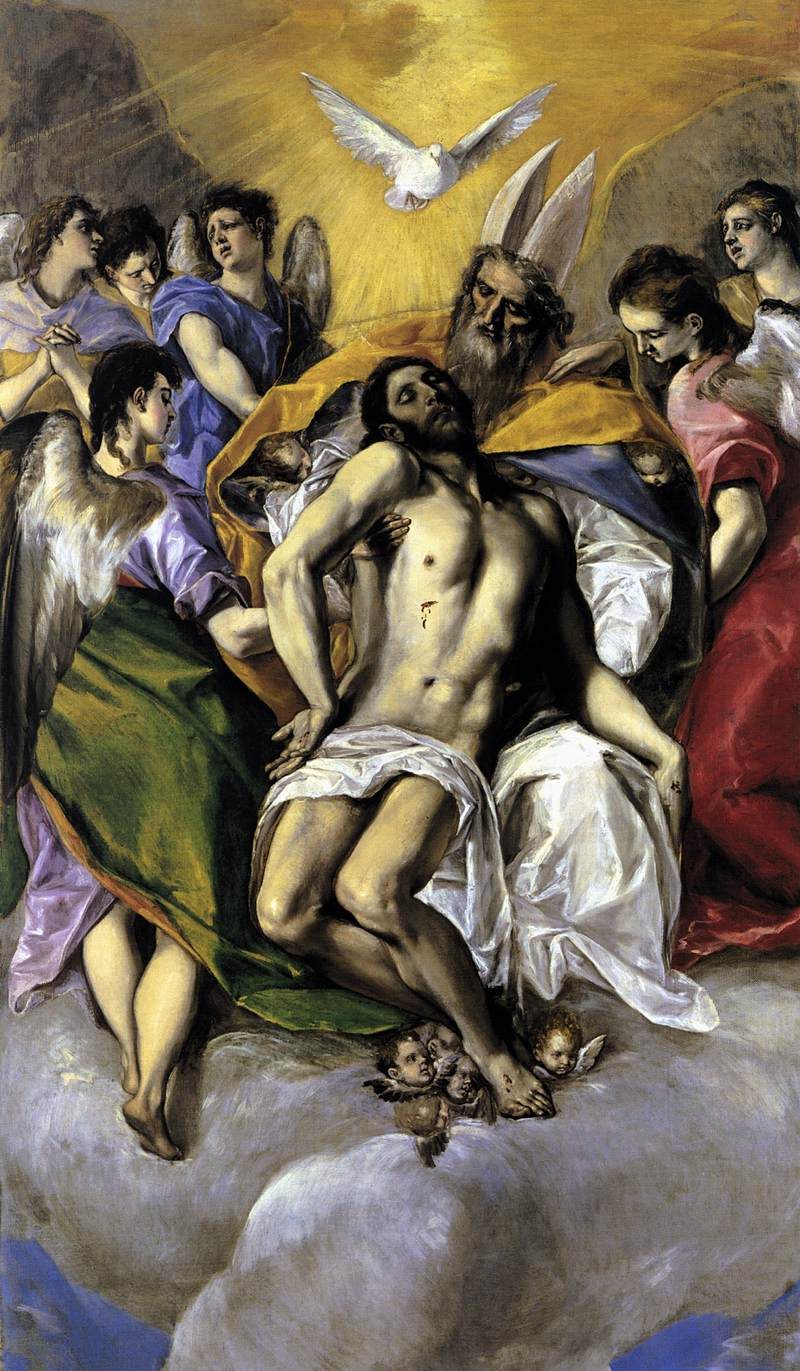
Le Greco. La Santísima Trinidad, 1577, 300 x 177, musée du Prado, Madrid. (https://fr.wikipedia.org/wiki/La_Trinit%C3%A9_(Le_Greco)
Augustin, Sermons 52
SERMON LII. LA
SAINTE TRINITÉ (1). (Ps 26,9 )
1. Mt 3,13
ANALYSE. - On venait de lire dans l'Évangile l'histoire du Baptême de
Notre-Seigneur Jésus-Christ. Saint Augustin saisit cette occasion, qu'il
regarde comme toute providentielle, pour démontrer comment les trois personnes
divines sont inséparables. Au Baptême du Sauveur on les croirait séparées; mais
en réalité elles sont inséparables dans toutes leurs opérations, comme
l'Écriture le prouve et comme on peut s'en faire une idée en interrogeant les
opérations de l'âme humaine. - 1. L'Écriture nous montre en effet que la
création et le gouvernement de l'univers sont dus au Père, au Fils et par
conséquent au Saint-Esprit. Si le Fils seul est né, si seul il a souffert, s'il
est seul ressuscité et monté aux cieux; sa naissance et sa passion, sa
résurrection et son ascension sont l'oeuvre de son Père comme la sienne. Ainsi
en est-il de ses miracles et de tout ce qu'il a fait. - 2. on peut se former
une idée de ce mystère en considérant, non pas la nature matérielle, mais l'âme
spirituelle de l'homme. N'y a-t-il pas dans cette âme trois facultés
distinctes: la mémoire, l'entendement et la volonté? Ces facultés sont
toutefois si inséparables dans leurs actes, qu'on ne peut nommer une seule
d'entre, elles sans le concours des trois ensemble. Saint Augustin proteste qu'il
ne veut pas établir ici de comparaison entre ces trois facultés et les trois
divines Personnes. Mais si la créature nous présente une telle simultanéité
d'action, pourquoi nous étonner de rencontrer ce phénomène dans la Trinité
créatrice?
1. La lecture de l'Évangile vient de nous faire connaître, en quelque sorte par
l'ordre du Seigneur, ou plutôt et véritablement par son ordre, de quel sujet
nous devons entretenir votre Charité. Mon coeur attendait de lui le mot
d'ordre; je sentais qu'il me commandait de parler de ce qu'il voudrait qu'on
récitât. Que votre zèle et votre piété se montrent donc attentifs; aidez auprès
du Seigneur notre Dieu le travail de mon esprit.
Voici sous nos yeux comme un divin spectacle; sur les rives du Jourdain notre
Dieu se révèle à nous dans sa Trinité sainte.
Jésus vient et il est baptisé par saint Jean; le Seigneur reçoit le baptême du
serviteur afin de nous donner un exemple d'humilité, car l'humilité est la
plénitude de la justice; lui-même l'a enseigné, quand à ces paroles de Jean:
«C'est moi qui dois être baptisé par vous, et c'est vous qui venez à moi!» il
répondit: «Laisse maintenant, afin d'accomplir toute justice.» Lors donc que
Jésus fut baptisé, les cieux s'ouvrirent, et l'Esprit-Saint descendit sur lui
en forme de colombe. On entendit ensuite cette voix d'en haut: «Celui-ci est
mon Fils bien-aimé, en qui j'ai mis mes affections.» Ne voyons-nous pas ici la
Trinité distinctement? Dans la voix nous entendons le Père, nous adorons le
Fils dans l'homme qui reçoit le baptême, et l'Esprit-Saint dans la colombe. Il
suffit de le rappeler; rien n'est plus facile à saisir. Quoi de plus évident?
Quoi de plus indubitable? C'est bien ici la Trinité. En effet, celui qui vient
vers Jean sous la forme de serviteur, Jésus-Christ Notre-Seigneur est sûrement
le Fils de Dieu; on ne peut dire qu'il soit ni le Père ni l'Esprit-Saint.
«Jésus vint, u dit le texte sacré; c'est sans aucun doute le Fils de Dieu. D'un
autre côté, qui peut hésiter à propos de la colombe? Qui peut demander ce qu'elle
est, quand l'Évangile dit expressément: «L'Esprit-Saint descendit sur lui en
forme de colombe?» On ne saurait douter non plus que la voix ne fût celle du
Père, puisqu'elle dit: «Vous êtes mon Fils (Mc 1,11).»
La Trinité est donc ici distincte.
2. J'ose même dire, en considérant espace, j'ose dire, quoique je le fasse en
tremblant, que cette auguste Trinité est en quelque sorte séparable. Jésus en
venant vers le fleuve se transportait d'un lieu dans un autre; la colombe en
descendant du ciel sur la terre allait aussi d'un lieu à l'autre; et la voix du
Père ne se faisait entendre ni de dessus la terre, ni du sein des eaux, mais du
haut du ciel. Il y a donc ici comme une triple séparation de lieux, de
fonctions et d'oeuvres.
Mais, me dira-t-on, montre plutôt que la Trinité est inséparable. Souviens-toi
que tu es catholique et que tu parles à des catholiques. Tel est en effet
l'enseignement de notre foi, c'est-à - 247 - dire de la foi véritable, de la
foi droite, de la foi catholique, de la foi qui ne repose pas sur les
présomptions de l'esprit mais sur les témoignages de l'autorité, de la foi qui
ne flotte pas incertaine au souffle téméraire des hérétiques, mais qui demeure
fortement établie sur la vérité apostolique. Voilà donc ce qu'elle nous fait
connaître, ce qu'elle nous donne à croire. Tant que la foi nous purifie encore,
nous ne voyons cette vérité ni des yeux du corps ni des yeux du coeur. Cette
même foi cependant nous assure avec une exactitude et une force incomparables
que le Père, le Fils et le Saint-Esprit forment une inséparable trinité, un
seul Dieu et non pas trois Dieux: un seul Dieu, sans que, toutefois, le Fils
soit le Père et sans que le Père soit le Fils, sans que le Saint-Esprit soit le
Père ou le Fils, car il est l'Esprit et du Père et du Fils. Cette ineffable
Divinité, cette Trinité ineffable, qui demeure en elle-même et qui néanmoins
renouvelle toutes choses; qui crée et répare, qui envoie et rappelle, qui juge et
absout, nous la savons non moins inséparable qu'elle est ineffable.
3. Mais quoi? Le Fils vient séparément avec son humanité; séparément
l'Esprit-Saint descend du ciel sous forme de colombe, et séparément encore la
voix du Père crie du haut du ciel: «Celui-ci est mon Fils bien-aimé.» Comment
donc la Trinité est-elle inséparable
Dieu vient par moi de vous rendre attentifs. Priez pour nous, conjurez-le, en
ouvrant votre coeur, de nous donner de quoi le remplir. Appliquons-nous
ensemble. Vous voyez quelle est notre entreprise; vous connaissez et ce que
nous projetons, et ce que nous sommes, de quoi nous voulons vous parler et où
nous sommes placé; placé hélas! dans ce corps qui se corrompt et appesantit
l'âme, dans cette maison de boue qui abat l'esprit, malgré tous ses efforts
pour s'élever (Sg
9,15). Je rappelle cet esprit répandu sur tant d'objets, je veux
l'appliquer au Dieu unique, à l'inséparable Trinité, pour chercher à vous en
parler, pour essayer de vous entretenir convenablement d'un si grand sujet;
mais pensez-vous que sous le lourd fardeau de ce corps je pourrai m'écrier:
«C'est vers vous, Seigneur, que j'ai élevé mon âme (Ps 75,4)?»
Ah! qu'il me vienne en aide et l'élève avec moi. Je suis trop faible et c'est
un poids trop lourd pour moi.
4. Les frères les plus studieux proposent souvent la question suivante, les
amis de la parole de Dieu se demandent souvent et souvent on frappe au coeur de
Dieu en disant: Le Père fait-il quelque chose sans le Fils et le Fils agit-il
quelquefois sans le Père? Restreignons-nous pour le moment au Père et au Fils,
et lorsque nous serons tirés de cette difficulté par Celui à qui nous disons:
«Soyez mon aide, ne me délaissez pas;» nous comprendrons que l'Esprit-Saint
agit toujours aussi avec le Fils et le Père. Appliquez donc, mes frères, votre
attention au Père et au Fils.
Le Père fait-il quelque chose sans le Fils? Nous répondons que non. En
doutez-vous? Mais que fait-il sans Celui par qui tout a été fait? «Tout, dit
l'Écriture, a été fait par lui.» Et pour ne rien laisser à désirer aux esprits
lourds, aux intelligences lentes et difficiles, elle ajoute: «Et sans lui rien
n'a été fait ( Jn 1,3)».
5. Mais quoi, mes frères, tout en voyant dans ces paroles: «Tout a été fait par
lui,» la preuve que le Père a fait par son Verbe, que Dieu a fait par sa Vertu
et par sa Sagesse toutes les créatures qui ont été faites par le Fils;
dirons-nous que tout a été fait par lui au moment de la création, mais que le
Père aujourd'hui ne fait plus tout par lui? Non: que cette pensée s'éloigne du
coeur des fidèles, qu'elle n'entre point dans l'esprit des hommes religieux,
dans l'entendement des âmes pieuses. On ne saurait admettre que Dieu ait créé
et ne gouverne point par son Fils. Comment ce qui a l'être serait-il dirigé
sans lui, puisque c'est lui qui a donné cet être? Mais recourons au témoignage
de l'Écriture. Elle enseigne, non-seulement que tout a été fait et créé par
lui, comme nous l'avons rappelé en citant ces paroles de l'Évangile. «Tout a
été fait par lui et sans lui rien n'a été fait;» mais encore que tout ce qu'il
a fait est régi et gouverné par lui. Le Christ, vous venez de le reconnaître,
est la Vertu de Dieu, la Sagesse de Dieu. Mais n'est-ce pas de la Sagesse qu'il
est dit: «Elle atteint avec force d'une extrémité à l'autre et dispose tout
avec douceur (Sg
8,1)?» Ainsi donc, gardons-nous d'en douter: Celui par qui tout a été fait,
gouverne également tout, et conséquemment le Père ne fait rien sans le Fils ni
le Fils sans le Père.
6. Ici se présente une question et nous entreprenons de la résoudre au nom du
Seigneur et par sa volonté. - Si le Père ne fait rien sans le Fils, ni le Fils
rien sans le Père, n'en devons- 248 - nous pas conclure que c'est le Père aussi
qui est né de la Vierge Marie, le Père qui a souffert sous Ponce-Pilate, le
Père qui est ressuscité et monté au ciel? - Non. Nous ne tenons pas ce langage,
parée qu'il n'est pas conforme à notre foi. «J'ai cru, est-il dit; c'est
pourquoi j'ai parlé; nous aussi nous croyons et c'est pourquoi nous parlons (2Co 4,13).»
Que nous dit la foi? Que le Fils, et non le Père, est né de la Vierge. Que
dit-elle encore? Que le Fils, et non le Père, a souffert et est mort sous
Ponce-Pilate.
J'oubliais de remarquer qu'il est des hommes, peu intelligents, connus sous le
nom de Patripassiens. Ils affirment que c'est le Père qui est né d'une femme et
qui a souffert, que le Fils n'est autre chose que le Père; deux noms, mais une
seule personne. Or pour les empêcher de séduire qui que ce soit, pour qu'ils ne
pussent contester que hors de son sein, l'Eglise catholique les a retranchés de
la communion des fidèles.
7. Rappelons maintenant à votre souvenir la difficulté de la question. Vous
avez avancé, peut-on me dire, que le Père ne fait rien saris le Fils, ni le
Fils sans le Père; vous avez cité l'Ecriture; le Père ne fait rien sans le
Fils, avez-vous dit, car c'est par le Fils que tout a été fait; et rien n'est
gouverné sans le Fils, car il est la Sagesse du Père, atteignant avec force
d'une extrémité à l'autre et disposant tout avec douceur. Mais n'êtes-vous pas
maintenant en contradiction avec vous-même? Le Fils, dites-vous, est né d'une
vierge, et non le Père; le Fils a souffert, le Fils est ressuscité, mais non le
Père. Ainsi le Fils fait quelque chose que ne fait pas le Père. De deux choses
l'une: avouez que le Fils agit quelquefois sans le Père, ou bien avouez que le
Père est né aussi, qu'il a souffert, qu'il est mort et qu'il est ressuscité. Il
n'y a point de milieu, il faut l'un ou l'autre: - Eh bien! je neveux ni l'un ni
l'autre. Je n'avouerai pas que le Fils fait quelque chose sans le Père, car ce
serait mentir; je n'avouerai par non plus que le Père est né, qu'il a souffert,
qu'il est mort et qu'il est ressuscité: ce serait mentir également. Comment,
dira-t-on, vous tirer de cet embarras?
8. Vous aimez cette question telle qu'elle est proposée; que Dieu m'accorde la
grâce que vous l'aimiez aussi telle qu'elle sera résolue. C'est-à-dire, qu'il
nous tire de peine, vous et moi; car sous l'étendard du Christ nous avons la
même foi, nous vivons sous le même Seigneur dans la même maison; membres du
même corps nous dépendons du même Chef et nous sommes animes du même souffle.
Afin donc que le Seigneur délivre des embarras de cette difficile question,
soit vous qui m'entendez, soit moi qui vous parle; voici ce que je dis: Le
Fils, et non le Père, est né de la Vierge Marie; mais cette naissance est
l'oeuvre du Père et du Fils. Le Père n'a point enduré la passion, c'est le
Fils; mais cette passion est l'oeuvre du Père et du Fils. Le Père n'est pas
ressuscité, c'est le Fils; relais la résurrection aussi est l'oeuvre du Père et
du Fils. Il semble donc que la question soit résolue. Cependant l'est-elle dans
l'Ecriture autant que dans mes paroles? Je dois donc démontrer, par le
témoignage des livres saints, que la naissance du Fils, que sa passion et sa
résurrection sont l'oeuvre du Père et du Fils; que si le Fils seul a été le
sujet de ces trois évènements, la cause en est, non pas uniquement dans le
Père, ou dans le Fils uniquement, mais dans le Père et le Fils tout ensemble.
Prouvons chacune de ces assertions, vous êtes juges, la cause dont il s'agit
est expliquée, faisons paraître les témoins. Que votre tribunal me dise
maintenant comme on dit aux plaideurs: Prouve ce que tu avances. Avec l'aide du
Seigneur je le prouve clairement, je vais produire des passages du coite
céleste; et si vous vous êtes montrés attentifs à la proposition, soyez plus
attentifs encore à ce qui en fait voir la vérité.
9. Je dois m'arrêter d'abord à la naissance du Fils et démontrer qu'elle est
l'oeuvre du Père et du Fils, quoique le Fils seul en soit le sujet. Je produis
ici l'autorité de Paul, cet habile docteur en droit divin. Il est aujourd'hui
des avocats qui citent ce grand homme pour envenimer les disputes et non pour
mettre fin aux contestations; je le cite, moi, pour établir la paix et non pour
exciter la guerre. Montrez-nous, saint Apôtre, comment la naissance du Fils est
l'oeuvre du Père. «Lorsqu'est venue la plénitude du temps, dit-il, Dieu a
envoyé son Fils, formé d'une femme, soumis à la loi, pour racheter ceux qui
étaient sous la loi (Ga 4,4-5).»
Vous avez entendu et vous avez compris, rien de plus clair, de plus évident.
C'est le Père qui a fait naître son Fils d'une vierge. La plénitude du temps
étant venue, «Dieu a envoyé son Fils,» le Père a envoyé le Christ. Comment
l'a-t-il envoyé? Il l'a envoyé «formé d'une femme, soumis à la Loi.» C'est -
249 - donc le Père qui l'a formé d'une femme et soumis à la loi.
10. Etes-vous surpris que j'aie dit: d'une vierge, et que Paul dise: d'une
femme? Ne vous en étonnez point, ne nous arrêtons pas à cela; je ne parle pas à
des ignorants. L'Écriture emploie les deux expressions; elle dit: d'une vierge,
et: d'une femme. D'une vierge: «Voici qu'une, Vierge concevra et enfantera un
Fils (Is 7,14).»
D'une femme; vous venez de l'entendre. Mais il n'y a aucune contradiction, car
la langue hébraïque appelle femmes, non pas celles qui ont perdu leur
virginité, mais toutes les personnes du sexe. La Genèse en présente un exemple
frappant, au moment même de la création d'Eve: de cette côte, dit-elle, «Dieu
forma la femme (Gn 2,22).»
Ailleurs encore l'Écriture rappelle que Dieu ordonna de séparer les femmes qui
n'avaient point connu d'homme (Nb 31,17-18 Jg 21,11).
Assez d'explication sur ce point; ne nous y arrêtons pas davantage, cherchons
plutôt à expliquer avec la grâce de Dieu ce qui présente plus de difficultés.
11. Nous avons prouvé que la naissance du Fils est l'oeuvre du Père; démontrons
aussi qu'elle est l'oeuvre du Fils. Le Fils est né de la Vierge Marie,
qu'est-ce à dire? C'est-à-dire que dans le sein de cette vierge il a pris la
nature de serviteur: la naissance dit Fils est-elle autre chose que cela? Mais
le Fils en est l'auteur comme le Père; écoutez: «Il avait la nature de Dieu,
dit l'Apôtre, et il ne croyait par usurper en s'égarant à Dieu; mais il s'est
anéanti lui-même en prenant la nature de serviteur (Ph 2,6-7).»
- «Lorsqu'est venue la plénitude du temps, Dieu a envoyé son Fils, formé d'une
femme; son fils qui lui est né selon la chair, de la race de David (Rm 1,3).»
Voilà la naissance du Fils produite par le Père; mais comme le Fils «s'est
anéanti lui-même en prenant la nature de serviteur,» sa naissance est aussi son
oeuvre. La preuve est faite, passons, appliquez-vous à ce qui suit.
12. Démontrons que la passion du Fils est également l'ouvrage et du Père et du
Fils. L'ouvrage du Père: «Il n'a point épargné son propre Fils, mais il l'a
livré pour nous tous (Rm 8,32).»
L'oeuvre du Fils: «Il m'a aimé et s'est livré lui-même pour moi (Ga 2,20).»
Le Père a livré son Fils, le Fils s'est livré lui-même; cette passion n'a pesé
que sur l'un des deux, mais elle est l'oeuvre de l'un et de l'autre; et, comme
la naissance, elle n'a pas été produite par le Père sans le Fils, ni par le
Fils sans le Père. Le Père a livré son Fils, le Fils s'est livré lui-même. Qu'a
fait ici Judas sinon le péché? Passons et arrivons à la résurrection.
13. C'est le Fils, et non le Père, qui ressuscite; mais la résurrection du Fils
est l'oeuvre du Père et du Fils. L'oeuvre du Père: «C'est pourquoi il l'a
exalté et lui a donné un nom qui est au-dessus de tout nom (Ph 2,19).»
En exaltant son Fils et en le tirant d'entre les morts, le Père l'a donc ressuscité.
Le Fils aussi ne s'est-il pas ressuscité? Sans aucun doute, car il a dit de son
corps, en style figuré: «Renversez ce temple, et je le relèverai en trois jours
(Jn 2,19).»
Autre preuve: Si la passion consiste à donner son âme, la résurrection consiste
à la reprendre. Voyons donc si le Fils a bien pu donner son âme et s'il a fallu
que le Père la lui rendit. Il est certain que le Père la lui a rendue, car il
est dit dans un psaume: «Ressuscitez-moi et je les châtierai (Ps 40,11)»
Mais pourquoi attendez-vous que nous vous montrions le Fils la reprenant de son
coté? N'a-t-il pas dit lui-même: «J'ai le pouvoir de donner mon âme?» - Mais ce
n'est pas encore ce que je vous ai promis; j'ai dit seulement: «Le pouvoir de
la donner;» et vous applaudissez, parce que vous devancez mes paroles. Formés à
l'école du Maître du ciel, vous écoutez attentivement ses leçons, vous les
reproduisez avec piété; aussi vous n'ignorez pas ce qui suit: «J'ai le pouvoir,
dit-il, de donner mon âme, et j'ai le pouvoir de la reprendre. Personne ne me
la ravit; mais je la donne et la reprends de moi-même (Jn 10,18).»
14. Nous avons rempli nos promesses; nous avons, je crois, prouvé nos
propositions par les plus sûrs témoignages. Retenez ce que vous venez
d'entendre. Je répète en peu de mots et je vous recommande de conserver dans
vos esprits une vérité que je crois fort importante. Le Père n'est pas né de la
Vierge, c'est le Fils; mais cette naissance est l'oeuvre du Père et du Fils. Le
Père n'a point souffert sur la croix; mais la passion du Fils est l'oeuvre du
Père et du Fils. Le Père n'est point ressuscité d'entre les morts; mais la
résurrection du Fils est l'oeuvre du Père et du Fils. Voilà la distinction des
personnes et l'unité des opérations. Gardons-nous donc de dire que le Père fait
quelque chose sans le Fils ou le Fils quelque chose sans le Père.
Demanderez-vous si parmi ses miracles Jésus n'en a pas fait quelques-uns sans
le Père? Eh! que - 250 - deviendraient alors ces mots: «Mon Père, qui demeure
en moi, fait lui-même mes oeuvres (Jn 14,10)?»
Ce que nous venons de dire était clair, il n'y avait qu'à l'énoncer; aucun
effort n'était nécessaire pour le comprendre, il suffisait de le rappeler.
15. Je veux vous dire encore quelque chose; et ici je vous demande
véritablement l'attention la plus active et l'union de vos coeurs avec Dieu.
L'espace ne contient que des corps, au delà de l'espace est la divinité, il ne
faut donc pas la chercher comme si elle était un corps. Elle est partout
invisible et inséparable, sans avoir ici ou là plus ou moins d'étendue; car
elle est partout tout entière, indivisible partout. Qui voit ce mystère? Qui le
comprend? Modérons-nous; rappelons-nous qui nous sommes et de quoi nous
parlons. Quelles que soient les perfections divines, croyons-les avec piété,
méditons-les avec respect, et comprenons autant que nous en sommes capables,
autant qu'il nous est donné, ce qui est ineffable. Ici point de paroles, point
de discours; c'est le coeur qu'il faut exciter et élever vers Dieu. Ce n'est
pas à Dieu de monter dans le coeur de l'homme, mais au coeur de l'homme de
monter en Dieu.
Étudions la créature: «Les invisibles perfections de Dieu, rendues
compréhensibles par les choses qui ont été faites, sont devenues visibles (Rm 1,20).»
Dans ces oeuvres de Dieu au milieu desquelles nous vivons, ne pourrait-on
découvrir quelque ressemblance, quelque objet qui nous montre trois choses bien
distinctes, mais dont les opérations sont inséparables?
16. Allons, mes frères, appliquez-vous de tout votre coeur. Rappelez-vous
d'abord quel est mon dessein; comme le Créateur est infiniment élevé au dessus
de nous, je veux savoir si dans la créature je ne trouverai pas quelque
similitude.
Au moment où la vérité brille comme un éclair dans son esprit, quelqu'un
d'entre nous pourrait peut-être s'approprier ces paroles: «J'ai dit dans le
transport de mon âme,» Et qu'as-tu dit dans ce transport de ton âme? «J'ai été
rejeté de devant vos yeux (Ps 30,23).»
Il me semble en effet que celui qui parlait ainsi avait élevé son âme vers
Dieu, qu'en s'entendant demander chaque jour «Où est ton Dieu (Ps 41,4-11)?»
il avait répandu son âme au dessus d'elle-même, que d'une manière toute
spirituelle il avait atteint à la Lumière immuable, sans que sa faiblesse en
pût supporter la vue; il retombe alors de tout son poids sur son infirmité, et
se mesurant avec cette vive splendeur de la sagesse divine, il sent que le
regard de son esprit ne peut la supporter encore. C'est dans le transport de
l'âme qu'il a vu tout cela, quand élevé au dessus de la vie des sens il était
ravi en Dieu. Mais quand il quitte Dieu en quelque sorte pour rentrer en
lui-même, il s'écrie: «J'ai dit dans le transport de mon âme;» j'ai vu alors je
ne sais quoi; il m'a été impossible de le supporter longtemps; et revenu à ce
corps mortel qui appesantit l'âme et aux mille soucis des choses périssables
qui naissent de lui, j'ai dit. Quoi? «Je suis rejeté de devant vos yeux;» vous
êtes trop haut et je suis trop bas.
Que pouvons-nous donc dire de Dieu, mes frères? Si l'on comprend ce que l'on
veut dire de lui, ce n'est pas lui; ce n'est pas lui que l'on peut comprendre,
c'est autre chose en place de lui; et si l'on croit l'avoir saisi lui-même, on
est le jouet de son imagination. Il n'est pas ce que l'on comprend; il est ce
que l'on ne comprend pas; et comment vouloir parler de ce que l'on ne saurait comprendre?
17. Cherchons par conséquent si nous ne découvrirons pas dans la créature trois
choses qui s'énoncent séparément et qui agissent d'une manière inséparable.
Mais où aller? Au ciel pour y considérer le soleil, la lune et les autres
astres? Sur terre pour y étudier les végétaux, les plantes et les animaux qui
la remplissent? Faut-il envisager le ciel même et la terre qui comprennent tout
ce que nous y voyons? Mais pourquoi, ô homme, chercher ainsi dans la créature?
Rentre en toi-même, considère-toi, étudie-toi, examine-toi en personne. Tu veux
trouver dans la créature trois choses qui s'énoncent séparément, tout eu
agissant d'une manière inséparable; s'il en est ainsi, contemple-toi d'abord.
N'es-tu pas une créature? Tu veux une comparaison, la chercheras-tu parmi les
bestiaux? C'est de Dieu qu'il est question, lorsque tu cherches cette
similitude; c'est de l'ineffable Trinité de la Majesté suprême; et parce que tu
es trop au dessous de ce qui est divin, parce que tu as dû avouer humblement
ton impuissance, tu t'es rabattu sur ce qui est humain; c'est donc sur ceci que
tu dois arrêter ta pensée.
Pourquoi chercher parmi les troupeaux, dans le soleil ou les étoiles? Lequel de
ces êtres est formé à l'image et à la ressemblance de Dieu? Il y a en toi quelque
chose de bien préférable (251) de plus rapproché de ton Créateur. Dieu en effet
n'a-t-il point formé l'homme à son image et à ski ressemblance? Inspecte ton
âme; vois si l'image de la Trinité ne t'offrira point quelque vestige de la
Trinité? Mais quelle image es-tu? C'est une image bien distante du modèle;
c'est une ressemblance et une image bien imparfaite, et qui n'est pas égale à
Dieu comme le Fils est égal au Père, dont il est l'image. Quelle différence
entre l'image reproduite dans un fils, et l'image représentée par le miroir? Tu
te vois toi-même en voyant ton image dans ton fils, car ton fils a la même
nature que toi; et s'il est autre par sa personne, par sa nature il est le
même. Ainsi clone l'homme n'est pas l'image de Dieu comme l'est le Fils unique
du Père; il est plutôt formé à son image et à une certaine ressemblance avec
lui. Examine donc si tu ne pourras découvrir en toi trois choses qui s'énoncent
séparément et qui agissent toujours ensemble. Examinons ensemble, chacun de
nous en soi-même; examinons en commun et en commun étudions notre commune
nature, notre commune substance.
18. Ouvre les yeux, ô homme, reconnais si je dis vrai. As-tu un corps, as-tu un
corps de chair? - Oui, réponds-tu. Comment, sans cela, pourrais-je occuper une
place ici, me transporter d'un lieu dans un autre? Ne me faut-il pas, pour
entendre ce qu'on me dit, des oreilles de chair, et des yeux de chair pour voir
qui me parle?- C'est une chose sûre, tuas un corps; il ne faut pas chercher
longtemps ce qui est sous nos yeux. Autre chose: Qu'est-ce qui agit par le
corps? L'oreille entend, mais elle ne te fait pas entendre; il y a au dedans
quelqu'un qui entend par elle. Tu vois par l'oeil; mais regarde l'oeil
lui-même. Te contenteras-tu de considérer la maison sans t'occuper de celui qui
l'habite? L'oeil voit-il par lui-même? N'y a-t-il pas en lui quelqu'un qui voit
par lui? Je ne dis pas L'oeil d'un mort ne voit point, quand il est sûr que
l'âme a quitté le corps; je dis que l'oeil d'un homme occupé d'autre chose ne
voit pas ce qui est devant lui. C'est donc l'homme intérieur qu'il faut
considérer en toi. C'est là surtout qu'il faut chercher l'idée de trois choses
qui s'énoncent séparément et qui agissent ensemble.
Qu'y a-t-il dans ton âme? Il est possible qu'en scrutant j'y découvre beaucoup
de choses; mais tout d'abord il s'en présente une qui est facile à saisir. Qu'y
a-t-il dans ton âme? Rappelle tes idées, réveille tes souvenirs. Je ne demande
pas que tu me croies sur parole; n'accepte ce que je vais dire qu'autant que tu
le reconnaîtras en toi. Regarde donc.
Mais, ce qui nous a échappé, voyons d'abord si l'homme est l'image du Fils
seulement, ou du Père, ou bien s'il l'est à la fois du Père, et du Fils, et
conséquemment du Saint-Esprit. Il est dit dans la Genèse: «Faisons l'homme à
notre image et à notre ressemblance (Gn 1,36).»
Ainsi le Père ne l'a point fait sans le Fils ni le Fils sans le Père. «Faisons
l'homme à notre ressemblance. - Faisons;» et non pas: je ferai, fais, qu'il
fasse, mais «faisons à l'image,» non pas à ton image ou à la mienne, mais «à la
nôtre.»
19. Je questionne donc et j'interroge ce qui est bien dissemblable. Ne dites
pas: Comment! c'est ce qu'il compare à Dieu! Je l'ai dit et redit, je vous ai
prévenus et j'ai pris mes, précautions les termes de comparaison sont à une
distance infinie; il y a entre eux la distance du ciel à la terre, de
l'immuable au muable, du Créateur à la créature, du divin à l'humain. Retenez
avant tout cette observation, et que personne ne m'accuse s'il y a tant
d'éloignement entre les deux termes; que nul ne-me montre les dents au lieu de
m'ouvrir l'oreille; tout ce que j'ai promis de faire voir c'est trois choses
qui s'énoncent séparément et qui agissent inséparablement. Quant à leur
dissemblance plus ou moins considérable avec la Trinité toute puissante, il
n'en est pas question pour le moment; ce que j'entreprends, c'est de montrer
que dans cette créature infirme et muable il y a trois facultés qui se peuvent
considérer séparément et qui agissent indivisiblement: O pensée charnelle! ô
conscience opiniâtre et infidèle! pourquoi douter que cette ineffable Majesté
possède ce que tu peux discerner en toi-même?
Voyons, ô homme, réponds-moi: As-tu de la mémoire? Mais si tu n'en as point,
comment as-tu retenu ce que j'ai dit? Peut-être as-tu oublié ce que tu viens
d'entendre; mais cette parole: J'ai dit; mais ces deux syllabes, tu ne les
retiens que par la mémoire. Comment saurais-tu qu'il y a en deux, si tu avais
oublié la première quand je prononce la seconde? Pourquoi d'ailleurs m'arrêter
plus longtemps? Pourquoi me presser, me forcer de prouver cela? Il est clair
que tu as de la mémoire.
Autre question: As-tu de l'entendement? Oui, réponds-tu. - De fait, si tu ne
pouvais, sans la mémoire, retenir ce que j'ai dit; tu ne saurais le comprendre
sans l'entendement. Tu as donc de l'entendement; cet entendement, tu
l'appliques à ce que garde ta mémoire, tu comprends alors, et comprendre c'est
savoir.
Troisième question: Tu as de la mémoire pour retenir ce qu'on te dit; tu as de
l'entendement pour comprendre ce que tu retiens; mais dis-moi: Est-ce
volontairement que tu retiens et que tu comprends? Sans aucun doute,
reprends-tu. - Donc aussi de la volonté.
Voilà les trois choses que j'avais promis de faire entendre à vos oreilles et à
votre esprit. Elles sont toutes trois en toi, tu peux les compter sans pouvoir
les séparer. Les voilà toutes trois mémoire, intelligence et volonté, remarque
bien; on les énonce séparément et elles agissent inséparablement.
20. Le Seigneur nous viendra en aide et déjà il y est venu: je le vois à la
manière dont vous saisissez; car ces acclamations me font sentir que vous
comprenez, et j'espère qu'avec sa grâce vous comprendrez également tout le
reste. J'ai promis de montrer trois choses qui s'énoncent séparément et qui
agissent inséparablement. J'ignorais ce qu'il y a dans ton âme; tu me l'as fait
connaître en disant: la mémoire. Cette parole, ce son, ce trot a jailli de ton
coeur à mes oreilles. Car avant de parler tu réfléchissais silencieusement à ce
qu'on nomme- la mémoire. Tu le savais et tu ne me l'avais pas dit encore. Or
afin de me le faire entendre, tu as prononcé ce mot, la mémoire. J'ai entendu,
j'ai distingué les trois syllabes dont est composé ce terme, la mémoire. C'est
en effet un mot de trois syllabes; ce mot a été prononcé, il a frappé mes
oreilles et a révélé quelque chose à mon esprit. Le son s'est évanoui; la cause
et l'effet du son demeurent.
Dis-moi cependant: lorsque tu prononces ce mot: mémoire? remarques-tu qu'il n'y
est question effectivement que de la mémoire? Les deux autres facultés ont
leurs noms propres; l'une s'appelle l'intelligence, l'autre la volonté et
aucune j'a mémoire. Et pourtant afin de prononcer ce dernier mot, afin de
produire ces trois syllabes, quel moyen as-tu employé? Ce mot qui ne désigne
que la mémoire a été formé en toi par la mémoire, qui te faisait retenir ce que
tu disais; par l'intelligence, qui te faisait comprendre ce que tu retenais;
enfin par la volonté, qui te portait à proférer ce que tu comprenais. Grâces au
Seigneur notre Dieu! Il a donné son secours à vous et à nous. Je le dis
franchement à votre charité, je tremblais en commençant à discuter et à vous
expliquer ce sujet. Je craignais qu'en faisant plaisir aux esprits plus
avances, je ne vinsse à ennuyer fortement les intelligences plus lentes. Mais à
votre attention et à l'activité de votre intelligence; je vois que votas avez
compris et que même avant moi vous preniez votre essor pour vous écrier: Grâces
au Seigneur.
21. Voyez encore: je reviens sans inquiétude sur ce que vous avez compris; je
ne dis rien ale nouveau, je répète seulement, pour mieux Ici graver en vous, ce
que vous avez parfaitement saisi.
De ces trois facultés nous en avons nommé une, nous avons prononcé seulement le
nom de la Mémoire, et ce nom qui n'appartient qu'à la mémoire, a été formé par
les trois facultés réunies, On n'a pu nommer la mémoire qu'avec le concours (le
la volonté, de l'intelligence et de la mémoire. On ne saurait non plus nommer
l'intelligence qu'avec le concours de la mémoire, de la volonté et de
l'intelligence; ni nommer la volonté qu'avec le concours de la mémoire, de
l'intelligence et de la volonté.
Je crois donc avoir expliqué ce que j'ai promis d'expliquer; j'ai vu réuni dans
ma pensée ce que j'ai énoncé séparément. Il a fallu les trois facultés pour
former le nom de l'une d'entre elles, et ce nom formé par les trois
n'appartient qu'à une seule. Les trois ont formé le nom de la mémoire; et ce
nom n'appartient qu'à la mémoire. Les trois ont formé le nom de l'intelligence;
et ce nom ne désigne que l'intelligence. Les trois ont formé le nom de la
volonté; et ce nom n'appartient qu'à la volonté. Ainsi la Trinité a formé la
chair du Christ; et cette chair n'est qu'au Christ. Ainsi la Trinité a formé la
colombe descendue du ciel; et cette colombe ne désigne que l'Esprit-Saint.
Ainsi la Trinité a fait entendre la voit d'en haut; et cette voix n'appartient
qu'au Père.
22. Que nul maintenant ne me dise, que nul n'essaie de tourmenter tua faiblesse
en s'écriant: De ces trois facultés que tu as montrées dans notre esprit ou
plutôt clans notre âme, laquelle désigne le Père, c'est-à-dire la ressemblance
du Père, laquelle désigne le Fils et laquelle le (253) Saint-Esprit? Je ne
saurais le dire, je ne saurais l'expliquer. Laissons quelque chose à la
méditation, laissons aussi quelque chose au silence. Rentre en toi, et te
soustrais au bruit. Lis en toi-même, si toutefois tu as su te faire dans ta
conscience connue un doux sanctuaire; ou tu ne produises ni bruit ni querelle,
où tu tic cherches ni à disputer ni à contredire avec opiniâtreté. «Sois docile
à écouter la parole, afin de la comprendre (Si 5,13).»
Peut-être diras-tu bientôt: «Vous ferez entendre à mon oreille la joie et
l'allégresse, et mes os tressailleront dans l'humilité, (Ps 50,10)»
et non dans l'orgueil.
23. C'est donc assez d'avoir montré ces trois facultés qui s'énoncent
séparément et qui agissent inséparablement. Si tu as pu reconnaître ce
phénomène dans ta personne, dans un homme, dans un homme qui marche sur la
terre et qui porte un corps fragile dont le poids appesantit l'ante; crois donc
que le Père, le Fils et le Saint-Esprit peuvent se montrer séparément sous des
symboles visibles, sous des formes empruntées à la créature, et néanmoins agir
inséparablement. C'est assez.
Je ne dis pas que la mémoire représente le Père, l'intelligence le Fils et la
volonté l'Esprit Saint; je ne dis pas cela, quelque sens que l'on y donne, je
ne l'ose. Réservons ces mystères pour de plus grands esprits, et faibles
expliquons aux faibles ce que nous pouvons. Je ne dis donc pas qu'entre ces
trois facultés et la Trinité il y ait analogie, c'est-à-dire des rapports qui
permettent une comparaison véritable; je ne dis pas cela non plus. Que dis-je,
alors? Je dis qu'en toi j'ai découvert trois facultés qui s'énoncent séparément
et qui agissent inséparablement car le nom de chacune est formé par les trois,
sans toutefois convenir aux trois mais à une seule d'entre elles. Et si tu as
entendu, si tu as saisi, si tu as retenu cela, crois en Dieu ce que tu ne
saurais voir en lui. Tu peux connaître en toi ce que tu es; mais dans Celui qui
t'a fait, comment, quoi qu'il soit, connaître ce qu'il est? Si tu le peux un
jour, tu n'en es pas capable aujourd'hui; et lors-même que tu le pourras, te
sera-t-il possible de connaître Dieu comme Dieu se connaît?
Que votre charité se contente de ce peu. Nous avons dit ce que nous avons pu;
nous avons, à votre demande, acquitté nos promesses; ce qu'il faudrait ajouter
encore pour élever plus haut votre entendement, demandez-le au Seigneur.
SOURCE : https://www.clerus.org/bibliaclerusonline/es/dnd.htm

Albrecht
Dürer, Adoration de la Sainte Trinité, 1511, retable, 135 x
123.4, musée d'Histoire de l'art de Vienne.
(https://fr.wikipedia.org/wiki/L%27Adoration_de_la_Sainte_Trinit%C3%A9)
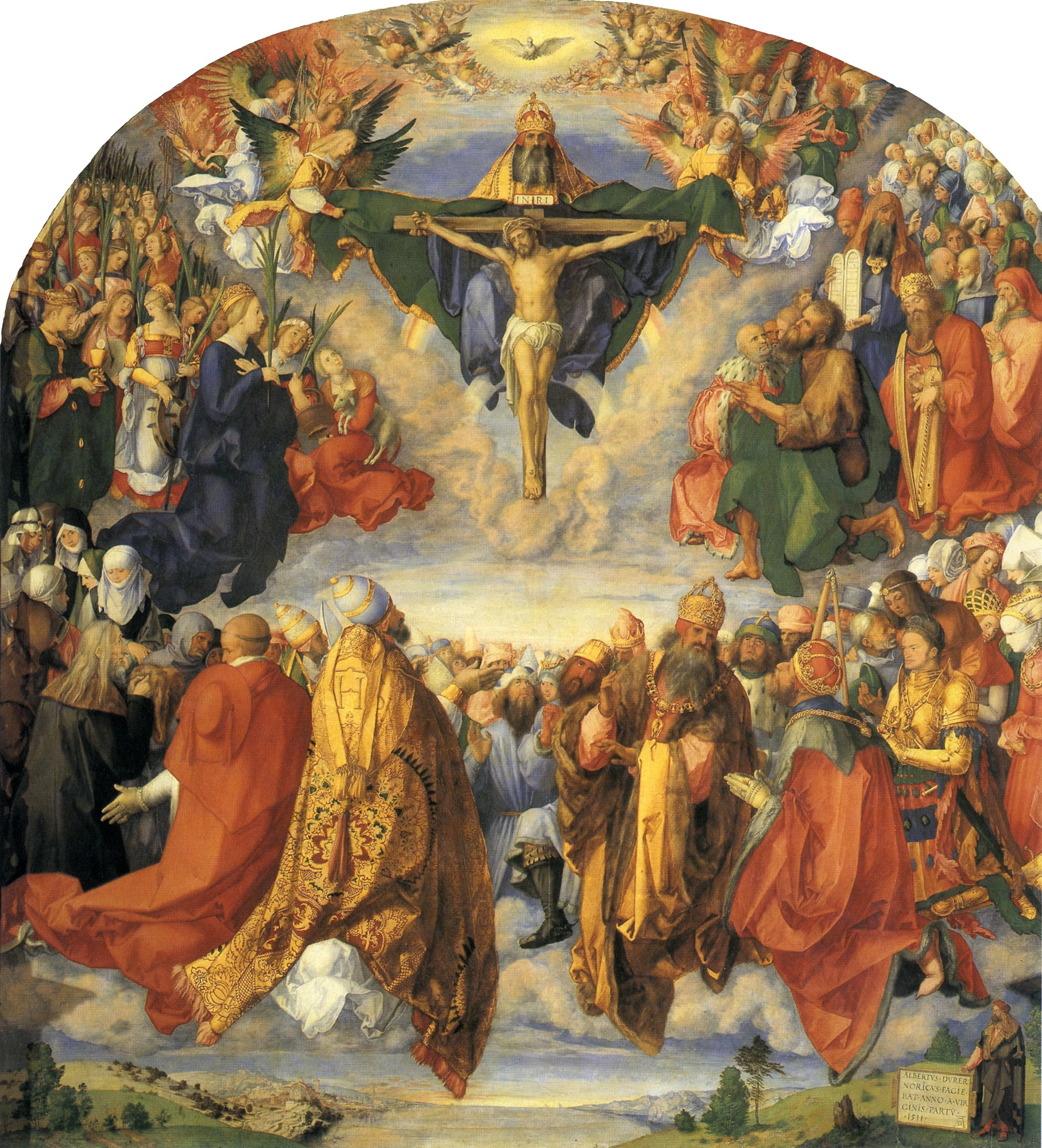
Albrecht
Dürer, Adoration de la Sainte Trinité, 1511, retable, 135 x
123.4, musée d'Histoire de l'art de Vienne.
(https://fr.wikipedia.org/wiki/L%27Adoration_de_la_Sainte_Trinit%C3%A9)
THE
CREDO
THE
APOSTLES CREED
I believe in God the Father almighty, creator of heaven and earth.
I believe in Jesus Christ, his only Son, our Lord. He was conceived by the power of the Holy Spirit and born of the Virgin Mary Under Pontius Pilate He was crucified, died, and was buried. He descended to the dead. On the third day he rose again. He ascended into heaven and is seated at the right hand of the Father. He will come again to judge the living and the dead.
I believe in the Holy Spirit, the holy catholic Church, the communion of saints, the forgiveness of sins, the resurrection of the body, and the life everlasting.
Amen.
THE
NICENE CREED
We believe in one God, the Father,
the Almighty, maker of heaven and earth, of all that is, seen and unseen.
We believe in one Lord, Jesus Christ, the only Son of God, eternally begotten of the Father, God from God, Light from Light, true God from true God, begotten, not made, of one Being with the Father. Through him all things were made. For us men and for our salvation, he came down from heaven: by the power of the Holy Spirit he was born of the Virgin Mary, and became man. For our sake he was crucified under Pontius Pilate; he suffered died and was buried. On the third day he rose again in fulfillment of the Scriptures; he ascended into heaven and is seated at the right hand of the Father. He will come again in glory to judge the living and the dead, and his kingdom will have no end.
We believe in the Holy Spirit, the Lord, the giver of life, who proceeds from the Father and the Son. With the Father and the Son he is worshipped and glorified. He has spoken through the Prophets. We believe in one holy catholic and apostolic Church. We acknowledge one baptism for the forgiveness of sins. We look for the resurrection of the dead, and the life of the world to come.
Amen.

Detail
of the earliest known artwork of
the Trinity, the Dogmatic or Trinity Sarcophagus, c. 350 (Vatican
Museums). Three similar figures, representing the Trinity, are involved in
the creation of Eve,
whose much smaller figure is cut off at lower right; to her right, Adam lies on the
ground.
The Blessed Trinity
This article is divided
as follows:
Proof
of the doctrine from Scripture
Proof
of the doctrine from Tradition
The
doctrine as interpreted in Greek theology
The
doctrine as interpreted in Latin theology
The dogma of the Trinity
The Trinity is the term
employed to signify the central doctrine of
the Christian
religion — the truth that
in the unity of the Godhead there
are Three Persons,
the Father, the Son,
and the Holy
Spirit, these Three Persons being
truly distinct one from another.
Thus, in the words of
the Athanasian
Creed: "the Father is God,
the Son is God,
and the Holy
Spirit is God,
and yet there are not three Gods but
one God."
In this Trinity of Persons the Son is
begotten of the Father by an eternal generation,
and the Holy
Spirit proceeds by an eternal procession
from the Father and the Son.
Yet, notwithstanding this difference as to origin, the Persons are
co-eternal and co-equal: all alike are uncreated and omnipotent.
This, the Church teaches,
is the revelation regarding God's
nature which Jesus
Christ, the Son
of God, came upon earth to deliver to the world: and which she proposes
to man as
the foundation of her whole dogmatic system.
In Scripture there
is as yet no single term by which the Three Divine Persons are
denoted together. The word trias (of which the Latin trinitas is
a translation) is first found in Theophilus
of Antioch about A.D. 180. He speaks of "the Trinity of God [the
Father], His Word and
His Wisdom (To
Autolycus II.15). The term may, of course, have been in use before
his time.
Afterwards it appears in its Latin form of trinitas in Tertullian (On
Pudicity 21). In the next century the word is in general use. It is
found in many passages of Origen ("In
Ps. xvii", 15). The first creed in
which it appears is that of Origen's pupil, Gregory
Thaumaturgus. In his Ekthesis
tes pisteos composed between 260 and 270, he writes:
There is therefore
nothing created,
nothing subject to another in the Trinity: nor is there anything that has been
added as though it once had not existed, but had entered afterwards: therefore
the Father has never been without the Son,
nor the Son without
the Spirit:
and this same Trinity is immutable and unalterable forever (P.G., X, 986).
It is manifest that
a dogma so mysterious presupposes
a Divine
revelation. When the fact of revelation,
understood in its full sense as the speech of God to man,
is no longer admitted, the rejection of the doctrine follows
as a necessary consequence.
For this reason it has no place in the Liberal Protestantism of
today. The writers of this school contend that the doctrine of
the Trinity, as professed by the Church,
is not contained in the New
Testament, but that it was first formulated in the second century and
received final approbation in the fourth, as the result of the Arian and Macedonian controversies.
In view of this assertion it is necessary to
consider in some detail the evidence afforded by Holy
Scripture. Attempts have been made recently to apply the more extreme
theories of comparative religion to
the doctrine of
the Trinity, and to account for it by an imaginary law of nature
compelling men to
group the objects of their worship in threes. It seems needless to give more
than a reference to these extravagant views, which serious thinkers of every
school reject as destitute of foundation.
Proof of doctrine from
Scripture
New Testament
The evidence from
the Gospels culminates
in the baptismal commission
of Matthew
28:20. It is manifest from the narratives of the Evangelists that Christ only
made the great truth known to
the Twelve step
by step.
First He taught them to
recognize in Himself the Eternal
Son of God. When His ministry was drawing to a close, He promised that the
Father would send another Divine Person,
the Holy
Spirit, in His place. Finally after His resurrection,
He revealed the doctrine in
explicit terms, bidding them "go and teach all nations, baptizing them
in the name of the Father, and of the Son,
and of the Holy
Ghost" (Matthew
28:18). The force of this passage is decisive. That "the Father"
and "the
Son" are distinct Persons follows
from the terms themselves, which are mutually exclusive. The mention of
the Holy
Spirit in the same series, the names being connected one with the
other by the conjunctions "and . . . and" is evidence that we have
here a Third Person co-ordinate
with the Father and the Son,
and excludes altogether the supposition that the Apostles understood
the Holy
Spirit not as a distinct Person,
but as God viewed
in His action on creatures.
The phrase "in the
name" (eis to onoma) affirms alike the Godhead of
the Persons and
their unity of nature.
Among the Jews and
in the Apostolic
Church the Divine name was representative of God.
He who had a right to
use it was invested with vast authority: for he wielded the supernatural powers
of Him whose name he employed. It is incredible that the phrase "in the
name" should be here employed, were not all the Persons mentioned
equally Divine. Moreover, the use of the singular, "name," and not
the plural, shows that these Three Persons are
that One
Omnipotent God in whom the Apostles believed.
Indeed the unity of God is
so fundamental a tenet alike of the Hebrew and
of the Christian
religion, and is affirmed in such countless passages of the Old and New
Testaments, that any explanation inconsistent with this doctrine would
be altogether inadmissible.
The supernatural appearance
at the baptism of Christ is
often cited as an explicit revelation of
Trinitarian doctrine,
given at the very commencement of the Ministry. This, it seems to us, is a
mistake. The Evangelists,
it is true,
see in it a manifestation of the Three Divine Persons.
Yet, apart from Christ's subsequent
teaching, the dogmatic meaning
of the scene would hardly have been understood. Moreover,
the Gospel narratives appear to signify that none but Christ and
the Baptist were privileged to see the Mystic
Dove, and hear the words attesting the Divine sonship of
the Messias.
Besides these passages
there are many others in the Gospels which
refer to one or other of the Three Persons in
particular and clearly express the separate personality and
Divinity of each. In regard to the First Person it
will not be necessary to
give special citations: those which declare that Jesus
Christ is God
the Son, affirm thereby
also the separate personality of
the Father. The Divinity of Christ is
amply attested not merely by St. John, but by the Synoptists.
As this point is treated elsewhere (see JESUS
CHRIST), it will be sufficient here to enumerate a few of the more
important messages from the Synoptists,
in which Christ bears witness to
His Divine Nature.
He declares that He will
come to be the judge of all men (Matthew
25:31). In Jewish theology the
judgment of the world was a distinctively Divine, and not a Messianic,
prerogative.
In the parable of
the wicked husbandmen, He describes Himself as the son of the
householder, while the Prophets,
one and all, are represented as the servants (Matthew
21:33 sqq.).
He is the Lord of Angels,
who execute His command (Matthew
24:31).
He approves the
confession of Peter when he recognizes Him, not as Messias —
a step long since taken by all the Apostles —
but explicitly as the Son
of God: and He declares the knowledge due
to a special revelation from
the Father (Matthew
16:16-17).
Finally, before Caiphas He
not merely declares Himself to be the Messias,
but in reply to a second and distinct question affirms His claim to be
the Son
of God. He is instantly declared by the high
priest to be guilty of blasphemy,
an offense which could not have been attached to the claim to be simply
the Messias (Luke
22:66-71).
St.
John's testimony is yet more explicit than that of the Synoptists.
He expressly asserts that the very purpose of his Gospel is to
establish the Divinity of Jesus
Christ (John
20:31). In the prologue he identifies Him with the Word,
the only-begotten of the Father, Who from all eternity exists
with God,
Who is God (John
1:1-18). The immanence of
the Son in
the Father and of the Father in the Son is
declared in Christ's words
to St. Philip: "Do you not believe,
that I am in the Father, and the Father in Me?" (14:10),
and in other passages no less explicit (14:7; 16:15; 17:21).
The oneness of Their power and Their action is affirmed: "Whatever he [the
Father] does, the Son also
does in like manner" (5:19,
cf. 10:38);
and to the Son no
less than to the Father belongs the Divine
attribute of conferring life on
whom He will (5:21).
In 10:29, Christ expressly
teaches His unity
of essence with the Father: "That which my Father hath given me,
is greater than all . . . I and the Father are one." The words, "That
which my Father hath given me," can, having regard to the context, have no
other meaning than the Divine Name, possessed in its fullness by the Son as
by the Father.
Rationalist critics
lay great stress upon the text: "The Father is greater than I" (14:28).
They argue that this suffices to establish that the author of
the Gospel held subordinationist views, and they expound in
this sense certain texts in which the Son declares
His dependence on the Father (5:19; 8:28).
In point of fact the doctrine of
the Incarnation involves
that, in regard of His Human Nature,
the Son should
be less than the Father. No argument against Catholic
doctrine can, therefore, be drawn from this text. So too, the passages
referring to the dependence of the Son upon
the Father do but express what is essential to Trinitarian dogma,
namely, that the Father is the supreme source from Whom the Divine
Nature and perfections flow to the Son.
(On the essential difference between St.
John's doctrine as
to the Person of Christ and
the Logos doctrine of
the Alexandrine Philo, to which many Rationalists have
attempted to trace it, see LOGOS.)
In regard to the Third
Person of the Blessed Trinity, the passages which can be cited from
the Synoptists as
attesting His distinct personality are
few. The words of Gabriel (Luke
1:35), having regard to the use of the term, "the Spirit," in
the Old
Testament, to signify God as
operative in His creatures, can hardly be said to contain a definite revelation of
the doctrine.
For the same reason it is dubious whether Christ's warning
to the Pharisees as
regards blasphemy against
the Holy
Spirit (Matthew
12:31) can be brought forward as proof.
But in Luke
12:12, "The Holy
Ghost shall teach you in the same hour what you must say" (Matthew
10:20, and Luke
24:49), His personality is
clearly implied. These passages, taken in connection with Matthew
28:19, postulate the existence of
such teaching as we find in the discourses in the Cenacle reported by St.
John (14, 15, 16).
We have in these chapters the necessary preparation
for the baptismal commission.
In them the Apostles are
instructed not only as the personality of
the Spirit,
but as to His office towards the Church.
His work is to teach whatsoever He shall hear (16:13)
to bring back their minds the
teaching of Christ (14:26),
to convince the world of sin (16:8).
It is evident that, were the Spirit not
a Person, Christ could
not have spoken of His presence with the Apostles as
comparable to His own presence with them (14:16).
Again, were He not a Divine Person it
could not have been expedient for the Apostles that Christ should
leave them, and the Paraclete take
His place (16:7).
Moreover, notwithstanding the neuter form of the word (pneuma), the pronoun
used in His regard is the masculine ekeinos. The distinction of the Holy
Spirit from the Father and from the Son is
involved in the express statements that He proceeds from the Father and is sent
by the Son (15:26;
cf. 14:16, 14:26).
Nevertheless, He is one with Them: His presence with the Disciples is
at the same time the presence of the Son (14:17-18),
while the presence of the Son is
the presence of the Father (14:23).
In the remaining New
Testament writings numerous passages attest how clear and definite was
the belief of
the Apostolic
Church in the three Divine Persons.
In certain texts the coordination of Father, Son,
and Spirit leaves
no possible doubt as
to the meaning of the writer. Thus in 2
Corinthians 13:13, St.
Paul writes: "The grace of our Lord
Jesus Christ, and the charity of God,
and the communication of the Holy
Ghost be with you all." Here the construction shows that
the Apostle is
speaking of three distinct Persons.
Moreover, since the names God and Holy
Ghost are alike Divine names, it follows that Jesus
Christ is also regarded as a Divine Person.
So also, in 1
Corinthians 12:4-11: "There are diversities of graces,
but the same Spirit;
and there are diversities of ministries, but the same Lord: and there are
diversities of operations, but the same God,
who worketh all [of them] in all [persons]."
(Cf. also Ephesians
4:4-6; 1
Peter 1:2-3)
But apart from passages
such as these, where there is express mention of the Three Persons,
the teaching of the New
Testament regarding Christ and
the Holy
Spirit is free from all ambiguity. In regard to Christ,
the Apostles employ
modes of speech which, to men brought up in the Hebrew faith, necessarily
signified belief in
His Divinity. Such, for instance, is the use of the Doxology in
reference to Him. The Doxology,
"To Him be glory for
ever and ever" (cf. 1
Chronicles 16:38; 29:11; Psalm
103:31; 28:2),
is an expression of praise offered to God alone.
In the New
Testament we find it addressed not alone to God
the Father, but to Jesus
Christ (2
Timothy 4:18; 2
Peter 3:18; Revelation
1:6; Hebrews
13:20-21), and to God the
Father and Christ in
conjunction (Revelations
5:13, 7:10).
Not less convincing is
the use of the title Lord (Kyrios). This term represents the Hebrew Adonai,
just as God (Theos)
represents Elohim.
The two are equally Divine names (cf. 1
Corinthians 8:4). In the Apostolic writings Theos may
almost be said to be treated as a proper name of God
the Father, and Kyrios of the Son (see,
for example, 1
Corinthians 12:5-6); in only a few passages do we find Kyrios used
of the Father (1
Corinthians 3:5; 7:17)
or Theos of Christ.
The Apostles from
time to time apply to Christ passages
of the Old
Testament in which Kyrios is used, for example, 1
Corinthians 10:9 (Numbers
21:7), Hebrews
1:10-12 (Psalm
101:26-28); and they use such expressions as "the fear of the
Lord" (Acts
9:31; 2
Corinthians 5:11; Ephesians
5:21), "call upon the name of the Lord," indifferently of God
the Father and of Christ (Acts
2:21; 9:14; Romans
10:13). The profession that "Jesus is
the Lord" (Kyrion Iesoun, Romans
10:9; Kyrios Iesous, 1
Corinthians 12:3) is the acknowledgment of Jesus as Jahweh.
The texts in which St.
Paul affirms that in Christ dwells
the plenitude of the Godhead (Colossians
2:9), that before His Incarnation He
possessed the essential
nature of God (Philippians
2:6), that He "is over all things, God blessed for
ever" (Romans
9:5) tell us nothing that is not implied in many other passages of
his Epistles.
The doctrine as
to the Holy
Spirit is equally clear. That His distinct personality was fully
recognized is shown by many passages. Thus He reveals His commands to the Church's ministers:
"As they were ministering to the Lord and fasting,
the Holy
Ghost said to them: Separate me Saul and Barnabas .
. ." (Acts
13:2). He directs the missionary journey of the Apostles:
"They attempted to go into Bithynia, and the Spirit of
Jesus suffered them not" (Acts
16:7; cf. Acts
5:3; 15:28; Romans
15:30). Divine
attributes are affirmed of Him.
He possesses omniscience
and reveals to
the Church mysteries known only
to God (1
Corinthians 2:10);
it is He who
distributes charismata (1
Corinthians 12:11);
He is the giver of supernatural
life (2
Corinthians 3:8);
He dwells in the Church and
in the souls of individual men,
as in His temple (Romans
8:9-11; 1
Corinthians 3:16, 6:19).
The work of justification and
sanctification is attributed to Him (1
Corinthians 6:11; Romans
15:16), just as in other passages the same operations are attributed
to Christ (1
Corinthians 1:2; Galatians
2:17).
To sum up: the various
elements of the Trinitarian doctrine are
all expressly taught in the New
Testament. The Divinity of the Three Persons is
asserted or implied in passages too numerous to count. The unity of essence is
not merely postulated by the strict monotheism of
men nurtured in the religion
of Israel, to whom "subordinate deities" would have been
unthinkable; but it is, as we have seen, involved in the baptismal commission
of Matthew
28:19, and, in regard to the Father and the Son,
expressly asserted in John
10:38. That the Persons are
co-eternal and coequal is a mere corollary from this. In regard to the Divine
processions, the doctrine of
the first procession is contained in the very terms Father and Son:
the procession of the Holy
Spirit from the Father and
Son is taught in the discourse of the Lord reported
by St. John (14-17)
(see HOLY
GHOST).
Old Testament
The
early Fathers were persuaded that indications of the doctrine of
the Trinity must exist in the Old
Testament and they found such indications in not a few passages. Many
of them not merely believed that
the Prophets had
testified of it, they held that it had been made known even
to the Patriarchs.
They regarded it as certain that
the Divine messenger of Genesis
16:7, 16:18, 21:17, 31:11; Exodus
3:2, was God
the Son; for reasons to be mentioned below (III. B.) they considered it
evident that God the Father could not have thus manifested Himself (cf. Justin, Dialogue
with Trypho 60; Irenaeus, Against
Heresies IV.20.7-11; Tertullian, Against
Praxeas 15-16; Theophilus, To
Autolycus II.22; Novatian, On
the Trinity 18, 25, etc.). They held that, when the inspired writers
speak of "the Spirit of the Lord", the reference was to
the Third Person of the Trinity; and one or two (Irenaeus, Against
Heresies II.30.9; Theophilus, To
Autolycus II.15; Hippolytus, Against
Noetus 10) interpret the hypostatic Wisdom of the Sapiential books,
not, with St.
Paul, of the Son (Hebrews
1:3; cf. Wisdom
7:25-26), but of the Holy
Spirit. But in others of the Fathers is found what would appear
to be the sounder view, that no distinct intimation of the doctrine was
given under the Old Covenant. (Cf. Gregory
Nazianzen, Fifth
Theological Oration 31; Epiphanius, "Ancor." 73, "Haer.",
74; Basil, Against
Eunomius II.22; Cyril
of Alexandria, "In Joan.", xii, 20.)
Some of these, however,
admitted that a knowledge of
the mystery was
granted to the Prophets and saints of
the Old
Dispensation (Epiphanius, "Haer.", viii, 5; Cyril
of Alexandria, "Con. Julian., " I). It may be readily conceded
that the way is prepared for the revelation in
some of the prophecies.
The names Emmanuel (Isaiah
7:14) and God the Mighty (Isaiah
9:6) affirmed of the Messias make
mention of the Divine Nature of
the promised deliverer. Yet it seems that the Gospel revelation was
needed to render the full meaning of the passages clear. Even these exalted
titles did not lead the Jews to
recognize that the Saviour
to come was to be none other than God Himself.
The Septuagint translators
do not even venture to render the words God the Mighty literally, but
give us, in their place, "the angel of
great counsel."
A still higher stage of
preparation is found in the doctrine of
the Sapiential books regarding the Divine Wisdom. In Proverbs
8, Wisdom appears personified, and in a manner which suggests that the
sacred author was not employing a mere metaphor, but had before his mind a
real person (cf. verses
22, 23). Similar teaching occurs in Ecclesiasticus
24, in a discourse which Wisdom is declared to utter in "the assembly
of the Most High", i.e. in the presence of the angels.
This phrase certainly supposes Wisdom to be conceived as person.
The nature of
the personality is
left obscure; but we are told that the whole earth is Wisdom's Kingdom, that
she finds her delight in all the works of God,
but that Israel is
in a special manner her portion and her inheritance (Ecclesiasticus
24:8-13).
In the Book
of the Wisdom of Solomon we find a still further advance. Here Wisdom
is clearly distinguished from Jehovah:
"She is . . . a certain pure emanation of the glory of
the almighty
God. . .the brightness of eternal light,
and the unspotted mirror of God's majesty,
and the image of his goodness"
(Wisdom
7:25-26. Cf. Hebrews
1:3). She is, moreover, described as "the worker of all things" (panton
technitis, 7:21), an expression indicating that the creation is
in some manner attributable to her. Yet in later Judaism this
exalted doctrine suffered
eclipse, and seems to have passed into oblivion. Nor indeed can it be said that
the passage, even though it manifests some knowledge of
a second personality in
the Godhead,
constitutes a revelation of
the Trinity. For nowhere in the Old
Testament do we find any clear indication of a Third Person.
Mention is often made of the Spirit
of the Lord, but there is nothing to show that the Spirit was
viewed as distinct from Jahweh Himself. The term is always employed
to signify God considered
in His working, whether in the universe or
in the soul of man.
The matter seems to be correctly summed up by Epiphanius, when he says:
"The One Godhead is
above all declared by Moses,
and the twofold personality (of
Father and Son)
is strenuously asserted by the Prophets.
The Trinity is made known by
the Gospel" ("Haer.", lxxiv).
Proof of the doctrine
from tradition
The Church Fathers
In this section we shall
show that the doctrine of
the Blessed Trinity has from the earliest times been taught by the Catholic Church and
professed by her members. As none deny this for any period subsequent to
the Arian and Macedonian controversies,
it will be sufficient if we here consider the faith of
the first four centuries only. An argument of very great weight is provided in
the liturgical forms
of the Church.
The highest probative force
must necessarily attach to these, since they express not the private opinion of
a single individual,
but the public belief of
the whole body of the faithful.
Nor can it be objected that the notions of Christians on
the subject were vague and confused, and that their liturgical forms
reflect this frame of mind.
On such a point vagueness was impossible. Any Christian might
be called on to seal with his blood his belief that
there is but One
God. The answer of Saint Maximus (c. A.D. 250) to the command of
the proconsul that he should sacrifice to the gods, "I offer
no sacrifice save to the One
True God," is typical of many such replies in the Acts
of the martyrs. It is out of the question to suppose that men who were
prepared to give their lives on behalf of this fundamental truth were
in point of fact in so great confusion in regard to it that they were unaware
whether their creed was monotheistic,
ditheistic, or tritheistic.
Moreover, we know that
their instruction regarding the doctrines of
their religion was solid. The writers
of that age bear witness that
even the unlettered were thoroughly familiar with the truths of faith (cf. Justin, First
Apology 60; Irenaeus, Against
Heresies III.4.2).
(1) Baptismal formulas
We may notice first
the baptismal formula,
which all acknowledge to be primitive. It has already been shown that the words
as prescribed by Christ (Matthew
28:19) clearly express the Godhead of
the Three Persons as
well as their distinction, but another consideration may here be added. Baptism,
with its formal renunciation of Satan and
his works, was understood to be the rejection of the idolatry of paganism and
the solemn consecration of
the baptised to
the one
true God (Tertullian, De
Spectaculis 4; Justin, First
Apology 4). The act of consecration was
the invocation over them of the Father, Son,
and Holy
Spirit. The supposition that they regarded the Second and Third Persons as created beings,
and were in fact consecrating themselves to the service of creatures, is
manifestly absurd. St.
Hippolytus has expressed the faith of
the Church in
the clearest terms: "He who descends into this laver of regeneration with faith forsakes
the Evil
One and engages himself to Christ,
renounces the enemy and confesses that Christ is God .
. . he returns from the font a son
of God and a coheir of Christ.
To Whom with the all holy,
the good and
lifegiving Spirit be glory now
and always, forever and ever. Amen"
(Sermon
on Theophany 10).
(2) The doxologies
The witness of
the doxologies is
no less striking. The form now universal, "Glory
be to the Father, and to the Son,
and to the Holy
Ghost," so clearly expresses the Trinitarian dogma that
the Arians found
it necessary to
deny that it had been in use previous to the time of
Flavian of Antioch (Philostorgius, "Hist. eccl.", III, xiii).
It is true that
up to the period of the Arian controversy
another form, "Glory to
the Father, through the Son,
in the Holy
Spirit," had been more common (cf. Clement's
Epistle to the Corinthians 58-59; Justin, First
Apology 67). This latter form is indeed perfectly consistent with
Trinitarian belief:
it, however, expresses not the coequality of the Three Persons,
but their operation in regard to man.
We live in the Spirit,
and through Him we are made partakers in Christ (Galatians
5:25; Romans
8:9); and it is through Christ,
as His members, that we are worthy to offer praise to God (Hebrews
13:15).
But there are many
passages in the ante-Nicene Fathers which show that the form, "Glory
be to the Father and to the Son,
and to [with] the Holy
Spirit," was also in use.
In the narrative of St.
Polycarp's martyrdom we
read: "With Whom to Thee and the Holy
Spirit be glory now
and for the ages to come" (Martyrdom
of Polycarp 14; cf. 22).
Clement
of Alexandria bids men "give thanks and praise to the only Father
and Son,
to the Son and
Father with the Holy
Spirit" (The
Pedagogue III.12).
St.
Hippolytus closes his work against Noetus with the words: "To Him
be glory and
power with the Father and the Holy
Spirit in Holy
Church now and always for ever and ever. Amen"
(Against
Noetus 18).
Denis
of Alexandria uses almost the same words: "To God
the Father and to His Son Jesus
Christ with the Holy
Spirit be honour and glory forever
and ever, Amen"
(in St.
Basil, On
the Holy Spirit 29.72).
St.
Basil further tells us that it was an immemorial custom among Christians when
they lit the evening lamp to
give thanks to God with prayer: Ainoumen
Patera kai Gion kai Hagion Pneuma Theou ("We praise the Father, and
the Son,
and the Holy
Spirit of God").
(3) Other patristic
writings
The doctrine of
the Trinity is formally taught in every class of ecclesiastical writing. From
among the apologists we
may note Justin, First
Apology 6; Athenagoras, A
Plea for the Christians 12. The latter tells us that Christians "are
conducted to the future life by this one thing alone, that they know God and
His Logos,
what is the oneness of the Son with
the Father, what the communion of the Father with the Son,
what is the Spirit,
what is the unity of these three, the Spirit,
the Son,
and the Father, and their distinction in unity." It would be impossible to
be more explicit. And we may be sure that an apologist,
writing for pagans,
would weigh well the words in which he dealt with this doctrine.
Amongst polemical writers
we may refer to Irenaeus (Against
Heresies I.22 and IV.20.1-6).
In these passages he rejects the Gnostic figment
that the world was created by aeons who
had emanated from God,
but were not consubstantial with Him, and teaches the consubstantiality of
the Word and
the Spirit by
Whom God created all
things.
Clement
of Alexandria professes the doctrine in The
Pedagogue I.6, and somewhat later Gregory
Thaumaturgus, as we have already seen, lays it down in the most express
terms in his Creed.
(4) As contrasted with
heretical teachings
Yet further evidence
regarding the Church's doctrine is
furnished by a comparison of her teaching with that of heretical sects.
The controversy with
the Sabellians in the third century proves conclusively
that she would tolerate no deviation from Trinitarian doctrine.
Noetus of Smyrna, the originator of the error,
was condemned by a local synod,
about A.D. 200. Sabellius, who propagated the same heresy at Rome c.
A.D. 220, was excommunicated by St.
Callistus.
It is notorious that
the sect made
no appeal to tradition:
it found Trinitarianism in possession wherever it appeared — at Smyrna,
at Rome,
in Africa,
in Egypt.
On the other hand, St.
Hippolytus, who combats it in the "Contra
Noetum", claims Apostolic
tradition for the doctrine of
the Catholic Church:
"Let us believe,
beloved brethren, in accordance with the tradition of
the Apostles,
that God
the Word came down from heaven to
the holy
Virgin Mary to save man."
Somewhat later (c. A.D.
260) Denis
of Alexandria found that the error was
widespread in the Libyan Pentapolis, and he addressed a dogmatic letter against
it to two bishops,
Euphranor and Ammonius. In this, in order to emphasize the distinction between
the Persons,
he termed the Son poiema
tou Theou and used other expressions capable of suggesting that the Son is
to be reckoned among creatures. He was accused of heterodoxy to St.
Dionysius of Rome, who held a council and addressed to him a
letter dealing with the true Catholic
doctrine on the point in question. The Bishop
of Alexandria replied with a defense of his orthodoxy entitled "Elegxhos
kai apologia," in which he corrected whatever had been erroneous.
He expressly professes his belief in
the consubstantiality of the Son,
using the very term, homoousios,
which afterwards became the touchstone of orthodoxy at Nicaea (P.G.,
XXV, 505). The story of the controversy is conclusive as to the doctrinal standard
of the Church.
It shows us that she was firm in rejecting on the one hand any confusion of
the Persons and
on the other hand any denial of their consubstantiality.
The information we
possess regarding another heresy —
that of Montanus —
supplies us with further proof that
the doctrine of
the Trinity was the Church's teaching
in A.D. 150. Tertullian affirms
in the clearest terms that what he held as to the Trinity when a Catholic he
still holds as a Montanist (Against
Praxeas 2); and in the same work he explicitly teaches the Divinity of
the Three Persons,
their distinction, the eternity of God
the Son (Against
Praxeas 27). Epiphanius in the same way asserts the orthodoxy of
the Montanists on
this subject (Haer., lxviii). Now it is not to be supposed that the Montanists had
accepted any novel teaching from the Catholic Church since
their secession in the middle of the second century. Hence, inasmuch as there
was full agreement between the two bodies in regard to the Trinity, we have
here again a clear proof that
Trinitarianism was an article
of faith at a time when
the Apostolic
tradition was far too recent for any error to
have arisen on a point so vital.
Later controversy
Notwithstanding the force
of the arguments we have just summarised, a vigorous controversy has been
carried on from the end of the seventeenth century to the present day regarding
the Trinitarian doctrine of
the ante-Nicene Fathers. The Socinian writers
of the seventeenth century (e.g. Sand, "Nucleus historiae
ecclesiastic", Amsterdam, 1668) asserted that the language of the
early Fathers in many passages of their works shows that they agreed
not with Athanasius,
but with Arius. Petavius,
who was at that period engaged on his great theological work,
was convinced by their arguments, and allowed that at least some of
these Fathers had fallen into grave errors.
On the other hand, their orthodoxy was
vigorously defended by the Anglican divine
Dr. George Bull ("Defensio Fidei Nicaean", Oxford, 1685) and
subsequently by Bossuet, Thomassinus,
and other Catholic theologians.
Those who take the less favourable view assert that they teach the following
points inconsistent with the post-Nicene belief of
the Church:
That the Son even
as regards His Divine Nature is
inferior and not equal to the Father;
that the Son alone
appeared in the theophanies of the Old
Testament, inasmuchas the Father is essentially invisible, the Son,
however, not so;
that the Son is
a created being;
that the generation of
the Son is
not eternal,
but took place in time.
We shall examine these
four points in order.
(1) In proof of
the assertion that many of the Fathers deny the equality of the Son with
the Father, passages are cited from Justin (First
Apology 13, 32), Irenaeus (Against
Heresies III.8.3), Clement
of Alexandria (Stromata VII.2), Hippolytus (Against
Noetus 14), Origen (Against
Celsus VIII.15). Thus Irenaeus (Against
Heresies III.8.3) says: "He commanded, and they were created .
. . Whom did He command? His Word,
by whom, says the Scripture,
the heavens were established. And Origen (Against
Celsus VIII.15) says: "We declare that the Son is
not mightier than the Father, but inferior to Him. And this belief we
ground on the saying of Jesus Himself:
"The Father who sent me is greater than I."
Now in regard to these
passages it must be borne in mind that there are two ways of considering the
Trinity. We may view the Three Persons insofar
as they are equally possessed of the Divine Nature or
we may consider the Son and
the Spirit as
deriving from the Father, Who is the sole source of Godhead,
and from Whom They receive all They have and are. The former mode of
considering them has been the more common since the Arian
heresy. The latter, however, was more frequent previously to that period.
Under this aspect, the Father, as being the sole source of all, may be termed
greater than the Son.
Thus Athanasius, Basil, Gregory
Nazianzen, Gregory
of Nyssa, and the Fathers of the Council
of Sardica, in their synodical letter, all treat our Lord's words,
teaches "The Father is greater than I" as having reference to
His Godhead (cf. Petavius,
"De Trin.", II, ii, 7, vi, 11). From this point of view it may be
said that in the creation of
the world the Father commanded, the Son obeyed.
The expression is not one which would have been employed by Latin writers
who insist that creation and
all God's works
proceed from Him as One and not from the Persons as
distinct from each other. But this truth was
unfamiliar to the early Fathers.
(2) Justin (Dialogue
with Trypho 60) Irenaeus (Against
Heresies IV.20.7-11), Tertullian ("C.
Marc.", II, 27; Against
Praxeas 15-16), Novatian (On
the Trinity 18.25), Theophilus (To
Autolycus II.22), are accused of teaching that the theophanies were
incompatible with the essential nature of
the Father, yet not incompatible with that of the Son.
In this case also the difficulty is largely removed if it be remembered that
these writers regarded all the Divine operations as proceeding from the
Three Persons as
such, and not from the Godhead viewed
as one. Now Revelation teaches
us that in the work of the creation and redemption of
the world the Father effects His purpose through the Son.
Through Him He made the
world; through Him He redeemed it;
through Him He will judge it. Hence it was believed by
these writers that, having regard to the present disposition
of Providence, the theophanies could only have been the work of the Son.
Moreover, in Colossians
1:15, the Son is
expressly termed "the image of the invisible God"
(eikon tou Theou rou aoratou). This expression they seem to have taken with
strict literalness. The function of an eikon is to manifest what is
itself hidden (cf. St.
John Damascene, "De imagin.", III, n. 17). Hence they held that
the work of revealing the
Father belongs by nature to
the Second Person of the Trinity, and concluded that the theophanies were
His work.
(3) Expressions which
appear to contain the statement that the Son was created are
found in Clement
of Alexandria (Stromata V.14 and VI.7), Tatian (Address
to the Greeks 5), Tertullian (Against
Praxeas 6; Against
Hermogenes 18-20), Origen (Commentary
on John I.22). Clement speaks of Wisdom as "created
before all things" (protoktistos), and Tatian terms
the Word the
"first-begotten work of (ergon prototokon) the Father."
Yet the meaning of these
authors is clear. In Colossians
1:16, St.
Paul says that all things were created in
the Son.
This was understood to signify that creation took
place according to exemplar ideas predetermined
by God and
existing in the Word.
In view of this, it might be said that the Father created the Word,
this term being used in place of the more accurate generated, inasmuch as
the exemplar ideas of creation were
communicated by the Father to the Son.
Or, again, the actual Creation of
the world might be termed the creation of
the Word,
since it takes place according to the ideas which
exist in the Word.
The context invariably shows that the passage is to be understood in one or
another of these senses.
The expression is
undoubtedly very harsh, and it certainly would never have been employed but for
the verse, Proverbs
8:22, which is rendered in the Septuagint and
the old Latin versions,
"The Lord created (ektise)
me, who am the beginning of His ways." As the passage was understood as
having reference to the Son,
it gave rise to the question how it could be said that Wisdom was created (Origen, De
Principiis I.2.3). It is further to be remembered that accurate
terminology in regard to the relations between the Three Persons was
the fruit of the controversies which sprang up in the fourth century. The
writers of an earlier period were not concerned with Arianism,
and employed expressions which in the light of subsequent errors are
seen to be not merely inaccurate, but dangerous.
(4) Greater difficulty is
perhaps presented by a series of passages which appear to assert that prior to
the Creation of
the world the Word was
not a distinct hypostasis from
the Father. These are found in Justin (Dialogue
with Trypho 61), Tatian (Address
to the Greeks 5), Athenagoras (A
Plea for the Christians 10), Theophilus (To
Autolycus II.10); Hippolytus (Against
Noetus 10); Tertullian (Against
Praxeas 5-7; Against
Hermogenes 18). Thus Theophilus writes (To
Autolycus II.22):
What else is this voice
[heard in Paradise]
but the Word
of God Who is also His Son?
. . . For before anything came into being, He had Him as a counsellor, being
His own mind and
thought [i.e. as the logos endiathetos, c. x]). But when God wished
to make all that He had determined on, then did He beget Him as the
uttered Word [logos
prophorikos], the firstborn of
all creation,
not, however, Himself being left without Reason (logos),
but having begotten Reason,
and ever holding converse with Reason.
Expressions such as these
are undoubtedly due to the influence of the Stoic philosophy:
the logos endiathetos and logos prophorikos were current
conceptions of that school. It is evident that these apologists were
seeking to explain the Christian
Faith to their pagan readers
in terms with which the latter were familiar. Some Catholic writers
have indeed thought that the influence of their previous training did lead some
of them into Subordinationism, although the Church herself
was never involved in the error (see LOGOS).
Yet it does not seem necessary to
adopt this conclusion. If the point of view of the writers be borne in mind,
the expressions, strange as they are, will be seen not to be incompatible
with orthodox belief.
The early Fathers, as we have said, regarded Proverbs
8:22, and Colossians
1:15, as distinctly teaching that there is a sense in which the Word,
begotten before all worlds, may rightly be said to have been begotten also
in time.
This temporal generation
they conceived to be none other than the act of creation.
They viewed this as the complement of the eternal generation,
inasmuch as it is the external manifestation of those creative ideas which
from all eternity the
Father has communicated to the Eternal
Word. Since, in the very same works which contain these perplexing
expressions, other passages are found teaching explicitly the eternity of
the Son,
it appears most natural to interpret them in this sense.
It should further
be remembered that
throughout this period theologians,
when treating of the relation of the Divine Persons to
each other, invariably regard them in connection with the cosmogony.
Only later, in the Nicene epoch, did they learn to prescind from the
question of creation and
deal with the threefold Personality exclusively
from the point of view of the Divine life of the Godhead.
When that stage was reached expressions such as these became impossible.
The trinity as a mystery
The Vatican
Council has explained the meaning to be attributed to the term mystery in theology.
It lays down that a mystery is
a truth which
we are not merely incapable of discovering apart from Divine
Revelation, but which, even when revealed, remains "hidden by the
veil of faith and
enveloped, so to speak, by a kind of darkness" (Constitution, "De
fide. cath.", iv). In other words, our understanding of it remains only
partial, even after we have accepted it as part of the Divine
message. Through analogies and
types we can form a representative concept expressive of what is revealed,
but we cannot attain that fuller knowledge which
supposes that the various elements of the concept are clearly grasped and their
reciprocal compatibility manifest. As regards the vindication of a mystery,
the office of the natural reason is
solely to show that it contains no intrinsic impossibility, that any objection
urged against it on Reason.
"Expressions such as these are undoubtedly the score that it violates
the laws of
thought is invalid. More than this it cannot do.
The Vatican
Council further defined that
the Christian
Faith contains mysteries strictly
so called (can. 4). All theologians admit
that the doctrine of
the Trinity is of the number of these. Indeed, of all revealed truths this
is the most impenetrable to reason.
Hence, to declare this to be no mystery would
be a virtual denial of the canon in question. Moreover, our Lord's words, Matthew
11:27, "No one knoweth the Son,
but the Father," seem to declare expressly that the plurality of Persons in
the Godhead is
a truth entirely
beyond the scope of any created intellect.
The Fathers supply many passages in which the incomprehensibility of
the Divine Nature is
affirmed. St.
Jerome says, in a well-known phrase: "The true profession
of the mystery of
the Trinity is to own that we do not comprehend it" (De mysterio
Trinitatus recta confessio est ignoratio scientiae — "Proem ad 1. xviii in
Isai."). The controversy with the Eunomians,
who declared that the Divine Essence was
fully expressed in the absolutely simple notion of "the Innascible" (agennetos),
and that this was fully comprehensible by the human mind,
led many of the Greek Fathers to
insist on the incomprehensibility of the Divine Nature,
more especially in regard to the internal processions. St.
Basil, Against
Eunomius I.14; St.
Cyril of Jerusalem, Catechetical
Lectures VI; St.
John Damascene, Of
the Orthodox Faith I.2, etc.).
At a later date,
however, some famous names are to be found defending a contrary
opinion. Anselm ("Monol.", 64), Abelard ("ln
Ep. ad Rom."), Hugo
of St. Victor ("De sacram." III, xi), and Richard
of St. Victor ("De Trin.", III, v) all declare that it is
possible to assign peremptory reasons why God should
be both One and Three. In explanation of this it should be noted that at that
period the relation of philosophy to revealed doctrine was
but obscurely understood. Only after the Aristotelean system
had obtained recognition from theologians was
this question thoroughly treated. In the intellectual ferment
of the time Abelard initiated
a Rationalistic tendency:
not merely did he claim a knowledge of
the Trinity for the pagan philosophers,
but his own Trinitarian doctrine was
practically Sabellian. Anselm's error was
due not to Rationalism,
but to too wide an application of the Augustinian principle
"Crede ut intelligas". Hugh and Richard
of St. Victor were, however, certainly influenced by Abelard's teaching. Raymond
Lully's (1235-1315) errors in
this regard were even more extreme. They were expressly condemned by Gregory
XI in 1376. In the nineteenth century the influence of the
prevailing Rationalism manifested
itself in several Catholic writers.
Frohschammer and Günther both
asserted that the dogma of
the Trinity was capable of proof. Pius
IX reprobated their opinions on more than one occasion (Denzinger,
1655 sq., 1666 sq., 1709 sq.), and it was to guard against this tendency that
the Vatican
Council issued the decrees to
which reference has been made. A somewhat similar, though less
aggravated, error on
the part of Rosmini was
condemned, 14 December, 1887 (Denz., 1915).
The doctrine as
interpreted in Greek theology
Nature and personality
The Greek Fathers approached
the problem of Trinitarian doctrine in
a way which differs in an important particular from that which, since the days
of St.
Augustine, has become traditional in Latin theology.
In Latin theology thought
fixed first on the Nature and
only subsequently on the Persons. Personality is
viewed as being, so to speak, the final complement of the Nature:
the Nature is
regarded as logically prior
to the Personality.
Hence, because God's
Nature is one, He is known to
us as One God before
He can be known as
Three Persons.
And when theologians speak
of God without
special mention of a Person,
conceive Him under this aspect.
This is entirely
different from the Greek point of view. Greek thought fixed
primarily on the Three distinct Persons:
the Father, to Whom, as the source and origin of all, the name of God (Theos)
more especially belongs; the Son,
proceeding from the Father by an eternal generation,
and therefore rightly termed God also;
and the Divine
Spirit, proceeding from the Father through the Son.
The Personality is
treated as logically prior
to the Nature.
Just as human nature is
something which the individual men
possesses, and which can only be conceived as belonging to and dependent on
the individual,
so the Divine Nature is
something which belongs to the Persons and
cannot be conceived independently of Them.
The contrast appears
strikingly in regard to the question of creation.
All Western theologians teach
that creation,
like all God's external
works, proceeds from Him as One: the separate Personalities do
not enter into consideration. The Greeks invariably speak as though,
in all the Divine works, each Person exercises
a separate office. Irenaeus replies
to the Gnostics,
who held that the world was created by
a demiurge other
than the supreme
God, by affirming that God is
the one Creator, and that He made all things by His Word and
His Wisdom, the Son and
the Spirit (Against
Heresies I.22, II.4.4-5, II.30.9 and IV.20.1).
A formula often found among the Greek Fathers is
that all things are from the Father and are effected by the Son in
the Spirit (Athanasius,
"Ad Serap.", I, xxxi; Basil, On
the Holy Spirit 38; Cyril
of Alexandria, "De Trin. dial.", VI). Thus, too, Hippolytus (Against
Noetus 10) says that God has
fashioned all things by His Word and
His Wisdom creating them by His Word,
adorning them by His Wisdom (gar ta genomena dia Logou kai Sophias technazetai,
Logo men ktizon Sophia de kosmon). The Nicene
Creed still preserves for us this point of view. In it we still
profess our belief "in
one God
the Father Almighty, Creator of heaven and
earth . . . and in one Lord
Jesus Christ . . . by Whom all things were made . . . and in the Holy
Ghost."
The divine unity
The Greek Fathers did
not neglect to safeguard the doctrine of
the Divine Unity, though manifestly their standpoint requires a different
treatment from that employed in the West.
The consubstantiality of
the Persons is
asserted by St.
Irenæus when he tells us that God created the
world by His Son and
His Spirit,
"His two hands" (Against
Heresies IV.20.1). The purport of the phrase is evidently to indicate
that the Second and Third Persons are
not substantially distinct from the First. A more philosophical description
is the doctrine of
the Recapitulation (sygkephalaiosis). This seems to be first found in the
correspondence between St.
Denis of Alexandria and St.
Dionysius of Rome. The former writes: "We thus [i.e., by the twofold
procession] extend the Monad [the
First Person]
to the Trinity, without causing any division, and were capitulate the Trinity
in the Monad without
causing diminution" (outo men emeis eis te ten Triada ten Monada,
platynomen adiaireton, kai ten Triada palin ameioton eis ten Monada
sygkephalaioumetha — P.G., XXV, 504). Here the consubstantiality is
affirmed on the ground that the Son and Spirit,
proceeding from the Father, are nevertheless not separated from Him; while they
again, with all their perfections, can be regarded as contained within Him.
This doctrine supposes
a point of view very different from that with which we are now familiar.
The Greek Fathers regarded
the Son as
the Wisdom and power of the Father (1
Corinthians 1:24) in a formal sense, and in like manner, the Spirit as
His Sanctity. Apart from the Son the
Father would be without His Wisdom; apart from the Spirit He
would be without His Sanctity. Thus the Son and
the Spirit are
termed "Powers" (Dynameis) of the Father. But while in creatures the
powers and faculties are
mere accidental perfections,
in the Godhead they
are subsistent hypostases. Denis
of Alexandria regarding the Second and Third Persons as
the Father's "Powers", speaks of the First Person as
being "extended" to them, and not divided from them. And, since
whatever they have and are flows from Him, this writer asserts that if we fix
our thoughts on the sole source of Deity alone,
we find in Him undiminished all that is contained in them.
The Arian
controversy led to insistence on the Homoüsia.
But with the Greeks this is not a starting point, but a conclusion,
the result of reflective analysis.
The sonship of the Second
Person implies that He has received the Divine Nature in
its fullness, for all generation implies the origination of one who is like
in nature to
the originating principle. But here, mere specific unity is out of the question.
The Divine Essence is
not capable of numerical multiplication; it is therefore, they reasoned,
identically the same nature which
both possess. A similar line of argument establishes that the Divine Nature as
communicated to the Holy
Spirit is not specifically, but numerically, one with that of the
Father and the Son.
Unity of nature was
understood by the Greek Fathers as
involving unity of will and unity of action (energeia). This they
declared the Three Persons to
possess (Athanasius,
"Adv. Sabell.", xii, 13; Basil, Epistle
189, no. 7; Gregory
of Nyssa, "De orat. dom., " John
Damascene, Of
the Orthodox Faith III.14). Here we see an important advance in
the theology of
the Godhead.
For, as we have noted, the earlier Fathers invariably conceive the
Three Persons as
each exercising a distinct and separate function.
Finally we have the doctrine of
Circuminsession (perichoresis). By this is signified the reciprocal inexistence
and compenetration of the Three Persons.
The term perichoresis is first used by St.
John Damascene. Yet the doctrine is
found much earlier. Thus St.
Cyril of Alexandria says that the Son is
called the Word and
Wisdom of the Father "because of the reciprocal inherence of these and
the mind"
(dia ten eis allela . . . ., hos an eipoi tis, antembolen). St.
John Damascene assigns a twofold basis for this inexistence of
the Persons.
In some passages he explains it by the doctrine already
mentioned, that the Son and
the Spirit are dynameis of
the Father (cf. "De recta sententia"). Thus understood, the
Circuminsession is a corollary of the doctrine of
Recapitulation. He also understands it as signifying the identity of essence, will,
and action in the Persons.
Wherever these are peculiar to the individual,
as is the case in all creatures, there, he tells us, we have separate existence (kechorismenos
einai). In the Godhead the essence, will,
and action are but one. Hence we have not separate existence,
but Circuminsession (perichoresis) (Of
the Orthodox Faith I.8). Here, then, the Circuminsession has its basis
in the Homoüsia.
It is easy to see that
the Greek system was less well adapted to meet the cavils of
the Arian and Macedonian heretics than
was that subsequently developed by St.
Augustine. Indeed the controversies of the fourth century brought some of
the Greek Fathers notably
nearer to the positions of Latin theology.
We have seen that they were led to affirm the action of the Three Persons to
be but one. Didymus even
employs expressions which seem to show that he, like the Latins,
conceived the Nature as logically antecedent
to the Persons.
He understands the term God as signifying the whole Trinity, and not,
as do the other Greeks, the Father alone: "When we pray,
whether we say 'Kyrie
eleison', or 'O God aid
us', we do not miss our mark: for we include the whole of the Blessed
Trinity in one Godhead"
(De Trin., II, xix).
Mediate and immediate
procession
The doctrine that
the Spirit is
the image of the Son,
as the Son is
the image of the Father, is characteristic of Greek theology.
It is asserted by St.
Gregory Thaumaturgus in his Creed.
It is assumed by St.
Athanasius as an indisputable premise in his controversy with
the Macedonians (Ad
Serap., I, xx, xxi, xxiv; II, i, iv). It is implied in the comparisons employed
both by him (Ad Serap. I, xix) and by St.
Gregory Nazianzen (Orations 31.31-32),
of the Three Divine Persons to
the sun, the ray, the light; and to the source, the spring, and the stream. We
find it also in St.
Cyril of Alexandria ("Thesaurus assert.", 33), St.
John Damascene (Of
the Orthodox Faith I.13), etc. This supposes that the procession of
the Son from
the Father is immediate; that of the Spirit from
the Father is mediate. He proceeds from the Father through the Son.
Bessarion rightly
observes that the Fathers who used these expressions conceived the
Divine Procession as
taking place, so to speak, along a straight line (P.G., CLXI, 224). On the
other hand, in Western theology the symbolic diagram
of the Trinity has ever been the triangle, the relations of the Three Persons one
to another being precisely similar. The point is worth noting, for this
diversity of symbolic representation leads inevitably to very
different expressions of the same dogmatic truth.
It is plain that these Fathers would have rejected no less firmly than the
Latins the later Photian heresy that
the Holy
Spirit proceeds from the Father alone. (For this question the reader
is referred to HOLY
GHOST.)
The Son
The Greek theology of
the Divine Generation differs in certain particulars from the Latin.
Most Western theologians base
their theory on the name, Logos, given by St. John to the
Second Person.
This they understand in the sense of "concept" (verbum mentale), and
hold that the Divine Generation is analogous to the act by which the created intellect produces
its concept. Among Greek writers this explanation is unknown. They
declare the manner of the Divine Generation to be altogether beyond our
comprehension. We know by revelation that God has
a Son;
and various other terms besides Son employed regarding Him in Scripture,
such as Word, Brightness of His glory, etc., show us that His sonship
must be conceived as free from any relation. More we know not
(cf. Gregory
Nazianzen, Oration
29.8, Cyril
of Jerusalem, Catechetical
Lectures XI.19; John
Damascene, Of
the Orthodox Faith I.8). One explanation only can be given, namely,
that the perfection we call fecundity must needs be found in God the
Absolutely Perfect (St.
John Damascene, Of
the Orthodox Faith I.8). Indeed it would seem that the great majority
of the Greek Fathers understood logos not
of the mental thought;
but of the uttered word (Athanasius, Dionysius
of Alexandria, ibid.; Cyril
of Alexandria, "De Trin.", II). They did not see in the term
a revelation that
the Son is
begotten by way of intellectual procession,
but viewed it as a metaphor intended to exclude the material associations
of human sonship
(Gregory
of Nyssa, Against
Eunomius IV; Gregory
Nazianzen, Oration
30; Basil, "Hom. xvi"; Cyril
of Alexandria, "Thesaurus assert.", vi).
We have already adverted
to the view that the Son is
the Wisdom and Power of the Father in the full and formal sense. This teaching
constantly recurs from the time of Origen to
that of St.
John Damascene (Origen apud Athanasius, De
decr. Nic.; Athanasius, Against
the Arians I; Cyril
of Alexandria, "Thesaurus"; John
Damascene, Of
the Orthodox Faith I.12). It is based on the Platonic philosophy accepted
by the Alexandrine School. This differs in a fundamental point from
the Aristoteleanism of
the Scholastic theologians.
In Aristotelean philosophy perfection
is always conceived statically. No action, transient or immanent,
can proceed from any agent unless that agent, as statically conceived,
possesses whatever perfection is contained in the action.
The Alexandrine standpoint was other than this. To them perfection
must be sought in dynamic activity. God,
as the supreme perfection, is from all eternity self-moving,
ever adorning Himself with His own attributes: they issue from Him and,
being Divine, are not accidents,
but subsistent realities. To these thinkers, therefore, there was no
impossibility in the supposition that God is
wise with the Wisdom which is the result of His own immanent action,
powerful with the Power which proceeds from Him. The arguments of the Greek Fathers frequently
presuppose this philosophy as
their basis; and unless it be clearly grasped, reasoning which on their
premises is conclusive will appear to us invalid and fallacious. Thus it is
sometimes urged as a reason for rejecting Arianism that,
if there were a time when
the Son was
not, it follows that God must
then have been devoid of Wisdom and of Power — a conclusion from which
even Arians would
shrink.
The Holy Spirit
A point which in Western theology gives
occasion for some discussion is the question as to why the Third
Person of the Blessed Trinity is termed the Holy
Spirit. St.
Augustine suggests that it is because He proceeds from both the Father
and the Son,
and hence He rightly receives a name applicable to both (On
the Trinity XV.37). To the Greek Fathers,
who developed the theology of
the Spirit in
the light of the philosophical principles
which we have just noticed, the question presented no difficulty. His name,
they held, reveals to
us His distinctive character as
the Third Person,
just as the names Father and Son manifest the distinctive
characters of the First and Second Persons (cf. Gregory
Thaumaturgus, Declaration
of Faith; Basil, Epistle
214.4; Gregory
Nazianzen, Oration
25.16). He is autoagiotes, the hypostatic holiness of God,
the holiness by
which God is holy.
Just as the Son is
the Wisdom and Power by which God is
wise and powerful, so the Spirit is
the Holiness by which He is holy.
Had there ever been a time,
as the Macedonians dared
to say, when the Holy
Spirit was not, then at that time God would
have not been holy (St.
Gregory Nazianzen, Oration
31.4).
On the other hand, pneuma was
often understood in the light of John
10:22 where Christ,
appearing to the Apostles,
breathed on them and conferred on them the Holy
Spirit. He is the breath of Christ (John
Damascene, Of
the Orthodox Faith I.8), breathed by Him into us, and dwelling in us
as the breath of life by
which we enjoy the supernatural life of God's children
(Cyril
of Alexandria, "Thesaurus"; cf. Petav., "De Trin", V,
viii). The office of the Holy
Spirit in thus elevating us to the supernatural
order is, however, conceived in a manner somewhat different from that
of Western theologians.
According to Western doctrine, God bestows
on man sanctifying
grace, and consequent on that gift the
Three Persons come
to his soul.
In Greek theology the
order is reversed: the Holy
Spirit does not come to us because we have received sanctifying
grace; but it is through His presence we receive the gift.
He is the seal, Himself impressing on us the Divine image. That Divine image is
indeed realized in us, but the seal must be present to secure the continued existence of
the impression. Apart from Him it is not found (Origen, Commentary
on John II.6; Didymus,
"De Spiritu Sancto", x, 11; Athanasius,
"Ep. ad. Serap.", III, iii). This Union with the Holy
Spirit constitutes our deification (theopoiesis). Inasmuch
as He is the image of Christ,
He imprints the likeness of Christ upon
us; since Christ is
the image of the Father, we too receive the true character of God's children
(Athanasius,
loc. cit.; Gregory
Nazianzen, Oration
31.4). It is in reference to this work in our regard that in
the Nicaeno-Constantinopolitan Creed the Holy
Spirit is termed the Giver of life (zoopoios).
In the West we
more naturally speak of grace as the life of
the soul.
But to the Greeks it was the Spirit through
whose personal presence we live. Just as God gave
natural life to Adam by
breathing into his inanimate frame the breath of life,
so did Christ give
spiritual life to
us when He bestowed on us the gift of
the Holy
Ghost.
The doctrine as
interpreted in Latin theology
The transition to
the Latin theology of
the Trinity was the work of St.
Augustine. Western theologians have
never departed from the main lines which he laid down, although in the Golden
Age of Scholasticism his
system was developed, its details completed, and its terminology perfected.
It received its final and
classical form from St.
Thomas Aquinas. But it is necessary first
to indicate in what consisted the transition effected by St.
Augustine. This may be summed up in three points:
He views the Divine Nature as
prior to the Personalities. Deus is for him not God
the Father, but the Trinity. This was a step of the first importance,
safeguarding as it did alike the unity of God and
the equality of the Persons in
a manner which the Greek system could never do. As we have seen, one
at least of the Greeks, Didymus,
had adopted this standpoint and it is possible that Augustine may
have derived this method of viewing the mystery from
him. But to make it the basis for the whole treatment of the doctrine was
the work of Augustine's genius.
He insists that every
external operation of God is
due to the whole Trinity, and cannot be attributed to one Person alone,
save by appropriation (see HOLY
GHOST). The Greek Fathers had,
as we have seen, been led to affirm that the action (energeia) of the
Three Persons was
one, and one alone. But the doctrine of appropriation was
unknown to them, and thus the value of this conclusion was obscured by a traditional theology implying
the distinct activities of Father, Son,
and Holy
Spirit.
By indicating the analogy between
the two processions within the Godhead and
the internal acts of thought and will in the human mind (On
the Trinity IX.3.3 and X.11.17),
he became the founder of the psychological theory of the Trinity, which, with a
very few exceptions, was accepted by every subsequent Latin writer.
In the following
exposition of the Latin doctrines,
we shall follow St.
Thomas Aquinas, whose treatment of the doctrine is
now universally accepted by Catholic theologians.
It should be observed, however, that this is not the only form in which the
psychological theory has been proposed. Thus Richard
of St. Victor, Alexander
of Hales, and St.
Bonaventure, while adhering in the main to Western tradition,
were more influenced by Greek thought, and give us a system differing
somewhat from that of St.
Thomas.
The Son
Among the terms employed
in Scripture to
designate the Second Person of
the Blessed Trinity is the Word (John
1:1). This is understood by St.
Thomas of the Verbum mentale, or intellectual concept.
As applied to the Son,
the name, he holds, signifies that He proceeds from the Father as the term of
an intellectual procession,
in a manner analogous to that in which a concept is generated by the human mind in
all acts of natural knowledge.
It is, indeed, of faith that
the Son proceeds
from the Father by a veritable generation. He is, says the Nicaeno-Constantinopolitan
Creed, begotten before all worlds". But the Procession of a Divine Person as
the term of the act by which God knows His
own nature is
rightly called generation. This may be readily shown. As an act of intellectual conception,
it necessarily produces the likeness of the object known.
And further, being Divine action, it is not an accidental act
resulting in a term, itself a mere accident,
but the act is the very substance of
the Divinity, and the term is likewise substantial.
A process tending necessarily to the production of a substantial term
like in nature to
the Person from
Whom it proceeds is a process of generation. In regard to this view as to the
procession of the Son,
a difficulty was felt by St.
Anselm (Monol., lxiv) on the score that it would seem to involve that
each of the Three Persons must
needs generate a subsistent Word.
Since all the Powers possess the same mind,
does it not follow, he asked, that in each case thought produces a similar
term? This difficulty St.
Thomas succeeds in removing. According to his psychology the
formation of a concept is not essential to
thought as such, though absolutely requisite to all natural human knowledge.
There is, therefore, no ground in reason,
apart from revelation,
for holding that the Divine intellect produces
a Verbum mentale. It is the testimony of Scripture alone
which tells us that the Father has from all eternity begotten
His consubstantial Word.
But neither reason nor revelation suggests
it in the case of the Second and Third Persons (I:34:1,
ad 3).
Not a few writers of great
weight hold that there is sufficient consensus among
the Fathers and Scholastic theologians as
to the meaning of the names Word and Wisdom (Proverbs
8), applied to the Son,
for us to regard the intellectual procession
of the Second
Person as at least theologically certain,
if not a revealed truth (cf. Francisco
Suárez, "De Trin.", I, v, p. 4; Petavius,
VI, i, 7; Franzelin,
"De Trin.", Thesis xxvi). This, however, seems to be an exaggeration.
The immense majority of the Greek Fathers,
as we have already noticed, interpret logos of the spoken word, and
consider the significance of the name to lie not in any teaching as to intellectual procession,
but in the fact that it implies a mode of generation devoid of all passion. Nor
is the tradition as to the interpretation of Proverbs
8, in any sense unanimous. In view of these facts the opinion of
those theologians seems
the sounder who regard this explanation of the procession simply as a theological opinion
of great probability and harmonizing well with revealed truth.
The Holy Spirit
Just as the Son proceeds
as the term of the immanent act
of the intellect,
so does the Holy
Spirit proceed as the term of the act of the Divine will.
In human love,
as St.
Thomas teaches (I:27:3),
even though the object be external to us, yet the immanent act
of love arouses
in the soul a
state of ardour which is, as it were, an impression of the thing loved.
In virtue of this the object of love is
present to our affections, much as, by means of the concept, the object of
thought is present to our intellect.
This experience is the term of the internal act. The Holy
Spirit, it is contended, proceeds from the Father and the Son as
the term of the love by
which God loves Himself.
He is not the love of God in
the sense of being Himself formally the love by
which God loves;
but in loving Himself God breathes
forth this subsistent term. He is Hypostatic Love.
Here, however, it is necessary to
safeguard a point of revealed doctrine.
It is of faith that
the procession of the Holy
Spirit is not generation. The Son is
"the only begotten of the Father" (John
1:14). And the Athanasian
Creed expressly lays it down that the Holy
Ghost is "from the Father and the Son,
neither made, nor created,
nor begotten, but proceeding."
If the immanent act
of the intellect is
rightly termed generation, on what grounds can that name be denied to the
act of the will? The answers given in reply to this difficulty by St.
Thomas, Richard
of St. Victor, and Alexander
of Hales are very different. It will be sufficient here to note St.
Thomas's solution. Intellectual procession, he says, is of
its very nature the production of a term in the likeness of the thing
conceived. This is not so in regard to the act of the will. Here the
primary result is simply to attract the subject to the object of his love.
This difference in the acts explains why the name generation is
applicable only to the act of the intellect.
Generation is essentially the production of like by like. And no
process which is not essentially of that character can claim the
name.
The doctrine of
the procession of the Holy
Spirit by means of the act of the Divine will is due
entirely to Augustine. It is nowhere found among the Greeks, who
simply declare the procession of the Spirit to
be beyond our comprehension, nor is it found in the Latins before
his time.
He mentions the opinion with favour in the "De
fide et symbolo" (A.D. 393); and in the "De
Trinitate" (A.D. 415) develops it at length. His teaching was
accepted by the West.
The Scholastics seek
for Scriptural support
for it in the name Holy Spirit. This must, they argue, be, like the
names Father and Son, a name expressive of a relation within
the Godhead proper
to the Person who
bears it. Now the attribute holy, as applied to person or
thing, signifies that the being of which it is affirmed is devoted to God.
It follows therefore that, when applied to a Divine Person as
designating the relation uniting Him to the other Persons,
it must signify that the procession determining His origin is one which of its
nature involves devotion to God.
But that by which any person is
devoted to God is love.
The argument is ingenious, but hardly convincing; and the same may be said of a
somewhat similar piece of reasoning regarding the name Spirit (I:36:1).
The Latin theory
is a noble effort of the human reason to
penetrate the verities which revelation has
left veiled in mystery.
It harmonizes, as we have said, with all the truths of faith.
It is admirably adapted to assist us to a fuller comprehension of the
fundamental doctrine of
the Christian
religion. But more than this must not be claimed. It does not possess the
sanction of revelation.
The divine relations
The existence of
relations in the Godhead may
be immediately inferred from the doctrine of
processions, and as such is a truth of Revelation.
Where there is a real procession the principle and the term are really related.
Hence, both the generation of the Son and
the procession of the Holy
Spirit must involve the existence of real and objective relations.
This part of Trinitarian doctrine was
familiar to the Greek Fathers.
In answer to the Eunomian objection,
that consubstantiality rendered
any distinction between the Persons impossible, Gregory
of Nyssa replies: "Though we hold that the nature [in
the Three Persons]
is not different, we do not deny the difference arising in regard of the source
and that which proceeds from the source [ten katato aition kai to aitiaton
diaphoran]; but in this alone do we admit that one Person differs
from another" ("Quod non sunt tres dii"; cf. Gregory
Nazianzen, Fifth
Theological Oration 9; John
Damascene, Of
the Orthodox Faith I.8). Augustine insists that of the
ten Aristotelean categories
two, stance and relation, are found in God (On
the Trinity V.5). But it was at the hands the Scholastic theologians that
the question received its full development. The results to which they led,
though not to be reckoned as part of the dogma,
were found to throw great light upon the mystery,
and to be of vast service in the objections urged against it.
From the fact that there
are two processions in Godhead,
each involving both a principle and term, it follows that there must be four
relations, two origination (paternitas and spiratio) and two of
procession (filiatio and processio). These relations are what
constitute the distinction between the Persons.
They cannot be distinguished by any absolute attribute, for every absolute
attribute must belong to the infinite Divine Nature and
this is common to the Three Persons.
Whatever distinction there is must be in the relations alone. This conclusion
is held as absolutely certain by
all theologians.
Equivalently contained in the words of St.
Gregory of Nyssa, it was clearly enunciated by St.
Anselm ("De process. Sp. S.", ii) and received ecclesiastical sanction in
the "Decretum pro Jacobitis" in the form: "[In divinis] omnia
sunt unum ubi non obviat relationis oppositio." Since this is so, it is
manifest that the four relations suppose but Three Persons.
For there is no relative opposition between spiration on the one hand and
either paternity or filiation on the other. Hence the attribute of spiration is
found in conjunction with each of these, and in virtue of it they are each
distinguished from procession. As they share one and the same Divine Nature,
so they possess the same virtus spirationis, and thus constitute a single
originating principle of the Holy
Spirit.
Inasmuch as the
relations, and they alone, are distinct realities in the Godhead,
it follows that the Divine Persons are
none other than these relations. The Father is the Divine Paternity, the Son the
Divine Filiation, the Holy
Spirit the Divine Procession. Here it must be borne in mind that the
relations are not mere accidental determinations
as these abstract terms might suggest. Whatever is in God must
needs be subsistent. He is the Supreme Substance,
transcending the divisions of the Aristotelean categories.
Hence, at one and the same time He is both substance and
relation. (How it is that there should be in God real
relations, though it is altogether impossible that quantity or quality should
be found in Him, is a question involving a discussion regarding the metaphysics of
relations, which would be out of place in an article such as the present.)
It will be seen that
the doctrine of
the Divine relations provides an answer to the objection that the dogma of
the Trinity involves the falsity of
the axiom that things which are identical with the same thing are identical one
with another. We reply that the axiom is perfectly true in
regard to absolute entities, to which alone it refers. But in the dogma of
the Trinity when we affirm that the Father and Son are
alike identical with the Divine Essence,
we are affirming that the Supreme Infinite Substance is
identical not with two absolute entities, but with each of two relations. These
relations, in virtue of their nature as
correlatives, are necessarily opposed the one to the other and therefore different.
Again it is said that if there are Three Persons in
the Godhead none
can be infinite,
for each must lack something which the others possess. We reply that a
relation, viewed precisely as such, is not, like quantity or quality,
an intrinsic perfection. When we affirm again it is relation of anything, we
affirm that it regards something other than itself. The whole perfection of
the Godhead is
contained in the one infinite Divine Essence.
The Father is that Essence as
it eternally regards
the Son and
the Spirit;
the Son is
that Essence as
it eternally regards
the Father and the Spirit;
the Holy
Spirit is that Essence as
it eternally regards
the Father and the Son.
But the eternal regard
by which each of the Three Persons is
constituted is not an addition to the infinite perfection
of the Godhead.
The theory of relations
also indicates the solution to the difficulty now most frequently proposed by
anti-Trinitarians. It is urged that since there are Three Persons there
must be three self-consciousnesses: but the Divine mind ex
hypothesi is one, and therefore can possess but one self-consciousness; in
other words, the dogma contains
an irreconcilable contradiction. This whole objection rests on a petitio
principii: for it takes for granted the identification of person and
of mind with
self-consciousness. This identification is rejected by Catholic philosophers as
altogether misleading. Neither person nor mind is
self-consciousness; though a person must
needs possess self-consciousness, and consciousness attests
the existence of mind (see PERSONALITY).
Granted that in the infinite mind,
in which the categories are transcended, there are three relations which are
subsistent realities, distinguished one from another in virtue of their
relative opposition then it will follow that the same mind will
have a three-fold consciousness,
knowing itself in three ways in accordance with its three modes of existence.
It is impossible to establish that, in regard of the infinite mind,
such a supposition involves a contradiction.
The question was raised
by the Scholastics:
In what sense are we to understand the Divine act of generation? As we conceive
things, the relations of paternity and filiation are due to an act by which the
Father generates the Son;
the relations of spiration and procession, to an act by which Father and Son breathe
forth the Holy
Spirit. St.
Thomas replies that the acts are identical with the relations of
generation and spiration; only the mode of expression on our part is different
(I:41:3,
ad 2). This is due to the fact that the forms alike of our thought and our
language are moulded upon the material world in which we live. In this world
origination is in every case due to the effecting of a change. We call the
effecting of the change action, and its reception passion. Thus,
action and passion are different from the permanent relations consequent on
them. But in the Godhead origination
is eternal:
it is not the result of change. Hence the term signifying action denotes not
the production of the relation, but purely the relation of the Originator to
the Originated. The terminology is unavoidable because the limitations of our
experience force us to represent this relation as due to an act. Indeed
throughout this whole subject we are hampered by the imperfection of human
language as an instrument wherewith to express verities higher than the facts
of the world. When, for instance, we say that the Son possesses
filiation and spiration the terms seem to suggest that these
are forms inherent in Him as in a subject. We know,
indeed, that in the Divine Persons there
can be no composition: they are absolutely simple. Yet we are forced to speak
thus: for the one Personality,
not withstanding its simplicity, is related to both the others, and by
different relations. We cannot express this save by attributing to
Him filiation and spiration (I:32:2).
Divine mission
It has been seen that
every action of God in
regard of the created world
proceeds from the Three Persons indifferently.
In what sense, then, are we to understand such texts as "God sent
. . . his Son into
the world" (John
3:17), and "the Paraclete cometh,
whom I will send you from the Father" (John
15:26)? What is meant by the mission of the Son and
of the Holy
Spirit? To this it is answered that mission supposes two conditions:
That the person sent
should in some way proceed from the sender and
that the person sent
should come to be at the place indicated.
The procession, however,
may take place in various ways — by command, or counsel, or even origination.
Thus we say that a king sends a messenger, and that a tree sends forth buds.
The second condition,
too, is satisfied either if the person sent
comes to be somewhere where previously he was not, or if, although he was
already there, he comes to be there in a new manner. Though God
the Son was already present in the world by reason of His Godhead,
His Incarnation made
Him present there in a new way. In virtue of this new presence and of His
procession from the Father, He is rightly said to have been sent into the
world. So, too, in regard to the mission of the Holy
Spirit. The gift of grace renders the Blessed Trinity
present to the soul in
a new manner: that is, as the object of direct, though inchoative, knowledge and
as the object of experimental love.
By reason of this new mode of presence common to the whole Trinity, the Second and
the Third Persons, inasmuch as each receives the Divine Nature by
means of a procession,
may be said to be sent into the soul. (See
also HOLY
GHOST; LOGOS; MONOTHEISTS; UNITARIANS.)
Sources
Among the numerous
patristic works on this subject, the following call for special mention:
ST. ATHANASIUS, Orationes quatuor contra Arianos; IDEM, Liber de
Trinitate et Spiritu Sancto; ST. GREGORY NAZIANZEN, Orationes V de
theologia; DIDYMUS ALEX., Libri III de Trinitate; IDEM, Liber de
Spir. Sancto; ST. HILARY OF POITIERS, Libri XII de Trinitate;
ST. AUGUSTINE, Libri XV de Trinitate; ST. JOHN DAMASCENE, Liber
de Trinitate; IDEM, De fide orthodoxa, I.
Among the medieval theologians: ST. ANSELM, Lib. I. de fide Trinitatis;
RICHARD OF ST. VICTOR, Libri VI de Trinitate; ST.THOMAS, Summa, I,
xxvii-xliii; BESSARION, Liber de Spiritu Saneto contra Marcum Ephesinum.
Among more recent writers: PETAVIUS, De Trinitate; NEWMAN. Causes of
the Rise and Success of Arianism in Theol. Tracts. (London, 1864).
Joyce, George. "The
Blessed Trinity." The Catholic Encyclopedia. Vol. 15. New York: Robert
Appleton Company, 1912. 11 Jun. 2017
<http://www.newadvent.org/cathen/15047a.htm>.
Ecclesiastical
approbation. Nihil Obstat. October 1, 1912. Remy Lafort, S.T.D.,
Censor. Imprimatur. +John Cardinal Farley, Archbishop of New York.
Copyright © 2023 by Kevin Knight. Dedicated to the Immaculate Heart of Mary.
SOURCE : http://www.newadvent.org/cathen/15047a.htm

Lucas Cranach the Elder (1472–1553),
The Holy Trinity in an angelic glory over a landscape (Throne of Mercy), circa 1515, oil and linden wood, 42.2
x 28.5, Kunsthalle Bremen, Bremen
APOSTLES'
CREED
A formula containing in
brief statements, or "articles," the fundamental tenets of Christian belief, and having for
its authors, according to tradition, the Twelve Apostles.
Origin of the creed
Throughout the Middle Ages it was
generally believed that
the Apostles, on
the day of Pentecost, while still under the direct inspiration of the Holy Ghost, composed our
present Creed between
them, each of the Apostles contributing
one of the twelve articles. This legend dates back to the sixth century (see
Pseudo-Augustine in Migne,
P.L., XXXIX, 2189, and Pirminius, ibid., LXXXIX, 1034), and it is foreshadowed
still earlier in a sermon attributed
to St. Ambrose (Migne, P.L., XVII, 671;
Kattenbusch, I, 81), which takes notice that the Creed was
"pieced together by twelve separate workmen". About the same date (c.
400) Rufinus (Migne, P.L., XXI, 337)
gives a detailed account of the composition of the Creed, which account he
professes to have received from earlier ages (tradunt majores nostri). Although
he does not explicitly assign each article to the authorship of a
separate Apostle,
he states that it was the joint work of all, and implies that the deliberation
took place on the day of Pentecost. Moreover, he declares that "they for
many just reasons decided that this rule of faith should
be called the Symbol",
which Greek word he explains to mean both indicium, i.e. a token or
password by which Christians might
recognize each other, and collatio, that is to say an offering made up of
separate contributions. A few years before this (c. 390), the letter addressed
to Pope Siricius by
the Council of Milan (Migne, P.L., XVI, 1213)
supplies the earliest known instance
of the combination Symbolum Apostolorum ("Creed of the
Apostles") in these striking words: "If you credit not the teachings
of the priests .
. . let credit at least be given to the Symbol of the Apostles which the Roman Church always
preserves and maintains inviolate." The word Symbolum in this
sense, standing alone, meets us first about the middle of the third century in
the correspondence of St.
Cyprian and St.
Firmilia, the latter in particular speaking of the Creed as the
"Symbol of the Trinity", and recognizing it as an integral part of
the rite of baptism (Migne, P.L., III, 1165,
1143). It should be added, moreover, that Kattenbusch (II, p. 80, note) believes that the
same use of the words can be traced as far back as Tertullian. Still, in
the first two centuries after Christ, though we often find mention of the Creed under other designations
(e.g. regula fidei, doctrina, traditio), the name symbolum does
not occur. Rufinus was
therefore wrong when he declared that the Apostles themselves
had "for many just reasons" selected this very term. This fact,
joined with the intrinsic improbability of the story, and the surprising
silence of the New
Testament and of the Ante-Nicene Fathers, leaves us no choice but to
regard the circumstantial narrative of Rufinus as
unhistorical.
Among recent critics,
some have assigned to the Creed an origin
much later than the Apostolic Age.
Harnack, e.g., asserts that in its present form it represents only the baptismal confession
of the Church of
Southern Gaul, dating at
earliest from the second half of the fifth century (Das apostolische
Glaubensbekenntniss, 1892, p. 3). Strictly construed, the terms of this
statement are accurate enough; though it seems probable that it was not
in Gaul, but
in Rome, that
the Creed really
assumed its final shape (see Burn in the "Journal of Theol. Studies",
July, 1902). But the stress laid by Harnack on the lateness of our received
text (T) is, to say the least, somewhat misleading. It is certain, as Harnack
allows, that another and older form of the Creed (R) had come
into existence, in Rome itself,
before the middle of the second century. Moreover, as we shall see, the
differences between R and T are not very important and it is also probable that
R, if not itself drawn up by the Apostles, is at least
based upon an outline which dates back to the Apostolic age.
Thus, taking the document as a whole, we may say confidently, in the words of a
modern Protestant authority,
that "in and with our Creed we confess that
which since the days of the Apostles has been
the faith of
united Christendom"
(Zahn, Apostles' Creed, tr., p, 222). The question of the apostolicity of
the Creed ought
not to be dismissed without due attention being paid to the following five
considerations:
(1) There are very
suggestive traces in the New Testament of
the recognition of a certain "form of doctrine" (typos
didaches, Romans
6:17) which moulded, as it were, the faith of new converts to Christ's law, and which involved
not only the word of faith believed in the
heart, but "with the mouth confession made unto salvation" (Romans 10:8-10). In
close connection with this we must recall the profession of faith in Jesus Christ exacted
of the eunuch (Acts
8:37) as a preliminary to baptism (Augustine,
"De Fide et Operibus", cap. ix; Migne, P.L., LVII, 205)
and the formula of baptism itself
in the name of the Three Persons of the Blessed Trinity (Matthew 28:19; and
cf. the Didache 7:2,
and 9:5).
Moreover, as soon as we begin to obtain any sort of detailed description of
the ceremonial of baptism we find
that, as a preliminary to the actual immersion, a profession of faith was exacted
of the convert,
which exhibits from the earliest times a clearly divided and separate
confession of Father, Son, and Holy Ghost,
corresponding to the Divine Persons invoked in the formula of baptism. As we do not
find in any earlier document the full form of the profession of faith, we cannot be sure
that it is identical with our Creed, but, on the other
hand, it is certain that
nothing has yet been discovered which is inconsistent with such a supposition.
See, for example, the "Canons of Hippolytus" (c. 220) or the
"Didascalia" (c. 250) in Hahn's "Bibliothek der Symbole"
(8, 14, 35); together with the slighter allusions in Justin Martyr and Cyprian.
(2) Whatever difficulties
may be raised regarding the existence of
the Disciplina
Arcani in early times (Kattenbusch, II, 97 sqq.), there can be no
question that in Cyril
of Jerusalem, Hilary, Augustine, Leo, the Gelasian Sacramentary, and many
other sources of the fourth and fifth centuries the idea is greatly
insisted upon; that according to ancient tradition the Creed was to be
learned by heart, and never to be consigned to writing. This undoubtedly
provides a plausible explanation of the fact that in the case of no
primitive creed is
the text preserved to us complete or in a continuous form. What we know of
these formulae in their earliest state is derived from what we can piece
together from the quotations, more or less scattered, which are found in such
writers, for example, as Irenaeus and Tertullian.
(3) Though no uniform
type of Creed can
be surely recognized among the earlier Eastern writers
before the Council
of Nicaea, an argument which has been considered by many to disprove
the existence of
any Apostolic formula,
it is a striking fact that the Eastern Churches in
the fourth century are found in possession of a Creed which
reproduces with variations the old Roman type. This fact is full admitted by
such Protestant authorities
as Harnack (in Hauck's Realencyclopädie, I, 747) and Kattenbusch (I, 380 sq.;
II, 194 sqq., and 737 sq.). It is obvious that these data would harmonize very
well with the theory that a primitive Creed had been delivered
to the Christian community
of Rome, either
by Sts. Peter and Paul themselves or by their immediate successors, and in the
course of time had
spread throughout the world.
(4) Furthermore note that
towards the end of the second century we can extract from the writings of St. Irenæus in
southern Gaul and of Tertullian in
far-off Africa two
almost complete Creeds agreeing
closely both with the old Roman Creed (R), as
we know it
from Rufinus,
and with one another. It will be useful to translate from Burn (Introduction to
the Creeds, pp. 50, 51) his tabular presentation of the evidence in the case
of Tertullian.
(Cf. MacDonald in "Ecclesiastical Review", February, 1903):
THE OLD ROMAN CREED AS
QUOTED BY TERTULLIAN (c. 200)
|
De Virg. Vel., 1 |
De Praecept., 13 and 26 |
|
|
(1) Believing in one God Almighty,
maker of the world, |
(1) We believe one only God, |
|
|
(2) and His Son, Jesus Christ, |
(2) and the son of God Jesus Christ, |
(2) the Word, called His Son, Jesus Christ, |
|
(3) born of the Virgin
Mary, |
(3) born of the Virgin, |
(3) by the Spirit and
power of God the
Father made flesh in Mary's womb, and born of her |
|
(4) crucified
under Pontius
Pilate, |
(4) Him suffered died,
and buried, |
(4) fastened to a
cross. |
|
(5) on the third day
brought to life from the dead, |
(5) brought back to
life, |
(5) He rose the third
day, |
|
(6) received in heaven, |
(6) taken again
into heaven, |
(6) was caught up
into heaven, |
|
(7) sitting now at the
right hand of the Father, |
(7) sits at the right
hand of the Father, |
(7) set at the right
hand of the Father, |
|
(8) will come to judge
the living and the dead |
(8) will come to judge
the living and the dead |
(8) will come
with glory to
take the good into life eternal, and condemn
the wicked to perpetual fire, |
|
(9) who has sent from
the Father the Holy
Ghost. |
(9) sent the vicarious
power of His Holy
Spirit, |
|
|
(10) to govern
believers (In this passage articles 9 and 10 precede 8) |
||
|
(12) through resurrection of the flesh. |
(12) restoration of the flesh. |
Such a table serves
admirably to show how incomplete is the evidence provided by mere quotations of
the Creed, and
how cautiously it must be dealt with. Had we possessed only the "De Virginibus
Velandis", we might have said that the article concerning the Holy Ghost did not
form part of Tertullian's Creed. Had the "De Virginibus
Velandis" been destroyed, we should have declared that Tertullian knew nothing of the
clause "suffered under Pontius Pilate".
And so forth.
(5) It must not be forgotten that while no
explicit statement of the composition of a formula of faith by the Apostles is
forthcoming before the close of the fourth century, earlier Fathers such
as Tertullian and St. Irenæus insist
in a very emphatic way that the "rule of faith" is
part of the apostolic
tradition. Tertullian in
particular in his "De
Praescriptione", after showing that by this rule (regula doctrinoe) he
understands something practically identical with our Creed, insists that the
rule was instituted by Christ and
delivered to us (tradita) as from Christ by the Apostles (Migne. P.L., II, 26, 27,
33, 50). As a conclusion from this evidence the present writer, agreeing on the
whole with such authorities as Semeria and Batiffol that we cannot safely
affirm the Apostolic composition
of the Creed,
considers at the same time that to deny the possibility of such origin is to go
further than our data at present warrant. A more pronouncedly conservative view
is urged by MacDonald in the "Ecclesiastical Review", January to
July, 1903.
The old Roman creed
The Catechism of the Council of
Trent apparently assumes the Apostolic origin of
our existing Creed,
but such a pronouncement has no dogmatic force and
leaves opinion free. Modern apologists, in defending
the claim to apostolicity,
extend it only to the old Roman form (R), and are somewhat hampered by the
objection that if R had been really held to be the inspired utterance of
the Apostles, it
would not have been modified at pleasure by various local churches (Rufinus, for example,
testifies to such expansion in the case of the Church of Aquileia), and in
particular would never have been entirely supplanted by T, our existing form.
The difference between the two will best be seen by printing them side by side
(Creeds R and T):
|
R. |
T. |
|
(1) I believe in God the Father Almighty; |
(1) I believe in God the Father Almighty Creator
of Heaven and
earth |
|
(2) And in Jesus Christ, His only
Son, our Lord; |
(2) And in Jesus Christ, His only
Son, our Lord; |
|
(3) Who was born of
(de) the Holy
Ghost and of (ex) the Virgin Mary; |
(3) Who
was conceived by the Holy Ghost, born of
the Virgin Mary, |
|
(4) Crucified
under Pontius
Pilate and buried; |
(4) Suffered under Pontius Pilate, was
crucified, dead, and buried; |
|
(5) The third day
He rose again from
the dead, |
(5) He descended
into hell; the
third day He rose
again from the dead; |
|
(6) He ascended into Heaven, |
(6) He ascended into Heaven,
sitteth at the right hand of God the
Father Almighty; |
|
(7) Sitteth at the
right hand of the Father, |
(7) From thence He
shall come to judge the living and the dead. |
|
(8) Whence He shall
come to judge the living and the dead. |
(8) I believe in
the Holy Ghost, |
|
(9) And in the Holy Ghost, |
(9) The Holy Catholic Church, the communion of saints |
|
(10) The forgiveness
of sins, |
|
|
(11) The forgiveness
of sins; |
(11) The resurrection of the body,
and |
|
(12) The resurrection of the body. |
(12) life
everlasting. |
Neglecting minor points
of difference, which indeed for their adequate discussion would require a study
of the Latin text, we may note that R does not contain the clauses
"Creator of heaven and earth", "descended into hell",
"the communion
of saints", "life everlasting", nor the words
"conceived", "suffered", "died", and
"Catholic". Many of these additions, but not quite all, were
probably known to St. Jerome in Palestine
(c. 380.--See Morin in Revue Benedictine, January, 1904) and about the
same date to
the Dalmatian,
Niceta (Burn, Niceta of Remesiana, 1905). Further additions appear in the creeds of southern
Gaul at the beginning of the next century, but T probably assumed its final
shape in Rome itself
some time before A.D. 700 (Burn, Introduction, 239; and Journal of Theol.
Studies, July, 1902). We know nothing certain as to the
reasons which led to the adoption of T in preference to R.
Articles of the creed
Although T really
contains more than twelve articles, it has always been customary to maintain
the twelvefold division which originated with, and more strictly applies to, R.
A few of the more debated items call for some brief comment. The first article
of R presents a difficulty. From the language of Tertullian it is
contended that R originally omitted the word Father and added the
word one; thus, "I believe in
one God Almighty".
Hence Zahn infers an underlying Greek original still partly surviving in
the Nicene Creed,
and holds that the first article of the Creed suffered
modification to counteract the teachings of the Monarchian heresy. It must suffice
to say here that although the original language of R may possibly be Greek,
Zahn's premises regarding the wording of the first article are not accepted by
such authorities as Kattenbusch and Harnack.
Another textual
difficulty turns upon the inclusion of the word only in the second
article; but a more serious question is raised by Harnack's refusal to
recognize, either in the first or second article of R, any acknowledgment of a
pre-existent or eternal relation
of Sonship and Fatherhood of the Divine Persons. The Trinitarian theology of later
ages, he declares, has read into the text a meaning which it did not possess
for its framers. And he says, again, with regard to the ninth article, that the
writer of the Creed did
not conceive the Holy
Ghost as a Person,
but as a power and gift.
"No proof can
be shown that about the middle of the second century the Holy Ghost was believed in as
a Person."
It is impossible to do more here than direct the reader to such Catholic answers as
those of Baumer and Blume; and among Anglicans to the
very convenient volume of Swete. To quote but one illustration of early patristic teaching,
St. Ignatius at the end of the first century repeatedly refers to a Sonship
which lies beyond the limits of time: "Jesus Christ . . .
came forth from one Father", "was with the Father before the world
was" (Letter to the
Magnesians 6-7). While, with regard to the Holy Ghost, St. Clement of Rome at
a still earlier date writes:
"As God lives,
and the Lord Jesus
Christ lives, and the Holy Spirit, the faith and hope of the elect" (cap.
lviii). This and other like passages clearly indicate the consciousness of a
distinction between God and
the Spirit of God analogous
to that recognized to exist between God and the Logos. A similar appeal
to early writers must be made in connection with the third article, that
affirming the Virgin
Birth. Harnack admits that the words "conceived of the Holy Ghost" (T),
really add nothing to the "born of the Holy Ghost" (R). He
admits consequently that "at the beginning of the second century the belief in the miraculous conception had
become an established part of Church tradition". But he denies that
the doctrine formed
part of the earliest Gospel preaching, and he thinks it consequently impossible
that the article could have been formulated in the first century. We can only
answer here that the burden of proof rests with
him, and that the teaching of the Apostolic Fathers, as
quoted by Swete and others, points to a very different conclusion.
Rufinus (c. 400)
explicitly states that the words descended into hell were not in
the Roman Creed,
but existed in that of Aquileia. They are also
in some Greek Creeds and
in that of St.
Jerome, lately recovered by Morin. It was no doubt a remembrance of 1 Peter 3:19, as
interpreted by Irenaeus and
others, which caused their
insertion. The clause, "communion of
saints", which appears first in Niceta and St. Jerome, should
unquestionably be regarded as a mere expansion of the article "holy Church". Saints,
as used here, originally meant no more than the living members of the Church (see the
article by Morin in Revue d'histoire et de litterature ecclesiastique. May,
1904, and the monograph of J.P. Kirsch, Die Lehre von der Gemeinschaft der
Heiligen, 1900). For the rest we can only note that the word
"Catholic", which appears first in Niceta, is dealt with separately;
and that "forgiveness of sins" is probably
to be understood primarily of baptism and should
be compared with the "one baptism for the
forgiveness of sins"
of the Nicene Creed.
Use and authority of the
creed
As already indicated, we must
turn to the ritual of Baptism for the
most primitive and important use of the Apostles' Creed. It is highly probable
that the Creed was
originally nothing else than a profession of faith in the
Father, Son, and Holy
Ghost of the baptismal formula.
The fully developed ceremonial which
we find in the seventh Roman Ordo, and the Gelasian Sacramentary, and which
probably represented the practice of the fifth century, assigns a special day
of "scrutiny", for the imparting of the Creed (traditio
symboli), and another, immediately before the actual administration of
the Sacrament,
for the redditio symboli, when the neophyte gave proof of his
proficiency by reciting the Creed aloud. An
imposing address accompanied the traditio and in an important
article, Dom de Puniet (Revue d'Histoire Ecclesiastique, October, 1904) has
recently shown that this address is almost certainly the composition of St. Leo the Great.
Further, three questions (interrogationes) were put to the candidate in the
very act of baptism, which questions
are themselves only a summary of the oldest form of the Creed. Both the
recitation of the Creed and
the questions are still retained in the Ordo baptizandi of our
actual Roman ritual;
while the Creed in
an interrogative form appears also in the Baptismal Service of the Anglican "Book of
Common Prayer". Outside of the administration of baptism the
Apostles' Creed is recited daily in the Church, not only at the
beginning of Matins and Prime and the end
of Compline, but
also ferially in the course of Prime and Compline. Many medieval synods enjoin that
it must be learnt by all the faithful, and there is a
great deal of evidence to show that, even in such countries as England and France, it was formerly
learnt in Latin. As a result of this intimate association with the liturgy and
teaching of the Church,
the Apostles' Creed has always been held to have the authority of an ex cathedra utterance.
It is commonly taught that all points of doctrine contained
in it are part of the Catholic Faith, and cannot be
called in question under pain of heresy (St. Thomas, Summa Theologica,
II-II:1:9). Hence Catholics have
generally been content to accept the Creed in the form,
and in the sense, in which it has been authoritatively expounded by the living voice of
the Church. For
the Protestants who
accept it only in so far as it represents the evangelical teaching of the Apostolic Age, it
became a matter of supreme importance to investigate its original form and
meaning. This explains the preponderating amount of research devoted to this
subject by Protestant scholars
as compared with the contributions of their Catholic rivals.
About this page
APA
citation. Thurston, H. (1907). Apostles' Creed. In The
Catholic Encyclopedia. New York: Robert Appleton
Company. http://www.newadvent.org/cathen/01629a.htm
MLA
citation. Thurston, Herbert. "Apostles' Creed." The
Catholic Encyclopedia. Vol. 1. New York: Robert Appleton
Company, 1907. <http://www.newadvent.org/cathen/01629a.htm>.
Transcription. This
article was transcribed for New Advent by Donald J. Boon. Dedicated to
Jack and Kathy Graham, faithful friends in the Church Universal.
Ecclesiastical approbation. Nihil
Obstat. March 1, 1907. Remy Lafort, S.T.D.,
Censor. Imprimatur. +John Cardinal Farley, Archbishop of New York.
Copyright © 2023 by Kevin Knight.
Dedicated to the Immaculate Heart of Mary.
SOURCE : https://www.newadvent.org/cathen/01629a.htm
.jpg)
Raphaël, La Dispute du Saint Sacrement ou Le
Triomphe de l’Église, 1509-1510, Fresque, 500 x 770, Palais
du Vatican, Rome (https://fr.wikipedia.org/wiki/La_Dispute_du_Saint-Sacrement)
CREDO
CREDO APOSTOLICO
CREDO NICENO-COSTANTINOPOLITANO
SOURCE : https://www.vaticannews.va/it/preghiere/credo.html

Giambattista Tiepolo (1696–1770), Die
Verehrung der Trinität durch den hl. Papst Clemens / Pope St Clement
Adoring the Trinity, circa 1737, 488 x 256, Alte Pinakothek, Munich
Santissima Trinità
sta: Domenica dopo Pentecoste (celebrazione mobile) - Solennità
La solennità della Santissima Trinità ricorre ogni anno la domenica dopo Pentecoste, quindi come festa del Signore. Si colloca pertanto come riflessione su tutto il mistero che negli altri tempi è celebrato nei suoi diversi momenti e aspetti. Fu introdotta soltanto nel 1334 da papa Giovanni XXII, mentre l'antica liturgia romana non la conosceva.
Propone uno sguardo riconoscente al compimento del mistero della salvezza
realizzato dal Padre, per mezzo del Figlio, nello Spirito Santo. La messa
inizia con l'esaltazione del Dio Trinità "perché grande è il suo amore per
noi".
Martirologio Romano:
Solennità della santissima e indivisa Trinità, in cui professiamo e veneriamo
Dio uno e trino e la Trinità nell’unità.
Un Mistero non contro la
ragione
Il mistero della Santissima Trinità è un mistero e come tale non può essere
compreso. Ma non per questo è qualcosa d’irragionevole. Nella dottrina
cattolica ciò che è mistero è sì indimostrabile con la ragione, ma non è
irrazionale, cioè non è in contraddizione con la ragione.
La ragione conduce all’unicità di Dio: Dio è assoluto e logicamente non possono
esistere più assoluti. Ebbene, la ragionevolezza del mistero della Trinità sta
nel fatto che esso non afferma l’esistenza di tre dei, bensì di un solo Dio che
però è in tre Persone uguali e distinte. Nel Credo si afferma: «Credo in un
solo Dio in tre Persone uguali e distinte, Padre, Figlio e Spirito
Santo». Quale è il Padre, tale è il Figlio e tale è lo Spirito Santo.
Increato è il Padre, increato è il Figlio, increato è lo Spirito Santo.
Onnipotente è il Padre, onnipotente è il Figlio, onnipotente è lo Spirito Santo.
Tuttavia non vi sono tre increati, tre assoluti, tre onnipotenti, ma un
increato, un assoluto e un onnipotente. Dio e Signore è il Padre, Dio e Signore
è il Figlio, Dio e Signore è lo Spirito Santo; tuttavia non vi sono tre dei e
signori, ma un solo Dio, un solo Signore (Simbolo atanasiano).
Una possibile analogia
Per capire qualcosa della Trinità, ma senza la possibilità di esaurirne il
mistero, si può utilizzare questa analogia. La Sacra Scrittura dice che quando
Dio creò l’uomo, lo creò a sua “immagine” (Genesi 1,27). Dunque, nell’uomo si
trova una lontana ma comunque presente immagine della Santissima Trinità.
L’uomo possiede la mente e la mente genera il pensiero. Il pensiero, contemplato dalla mente, è amato, e così dal pensiero e dalla mente procede l’amore. Ora mente, pensiero, amore, sono tre cose ben distinte fra loro, ma assolutamente inseparabili l’una dall’altra, tanto che si può dire che siano nell’uomo una cosa sola.
Nella Trinità il Padre è mente, che da tutta l’eternità genera il suo Pensiero perfettissimo (il Logos). Il Pensiero, generato eternamente dal Padre, sussiste, come persona distinta, ed è lo Spirito Santo.
Ma come la mente, il pensiero e l’amore sono nell’uomo tre cose distinte, ma
assolutamente inseparabili, così il Padre, il Figlio e lo Spirito Santo,
sebbene sussistano come persone distinte, sono però un Dio solo.
Un grande insegnamento sull’amore vero
Fin qui cose che solitamente si conoscono. Invece ciò di cui solitamente non si
parla è il fatto che il mistero della Trinità esprime chiaramente quanto
l’amore debba essere giudicato dalla verità. Vediamo in che senso.
Come abbiamo già avuto modo di dire, la Trinità è costituita dal Padre, dal Figlio e dallo Spirito Santo. Non si dice: dallo Spirito Santo, dal Figlio e dal Padre o dal Figlio, dal Padre e dallo Spirito Santo, ma: dal Padre, dal Figlio e dallo Spirito Santo. Il tutto in una successione logica ma non cronologica. Ciò vuol dire che senza il Figlio non ci sarebbe lo Spirito Santo e senza il Padre non ci sarebbe il Figlio. Ma – e anche questo lo abbiamo detto – non è che il Padre abbia creato il Figlio e il Figlio abbia creato lo Spirito Santo. Perché, se così fosse, il Figlio e lo Spirito Santo sarebbero delle creature e ciò non è.
Dunque una successione logica ma non nel tempo (cronologica). Il Cristianesimo ortodosso (quello dei Russi, dei Serbi, dei Greci, per intenderci) è lontano dal Cattolicesimo non solo perché non riconosce il Primato del Vescovo di Roma (il Papa), ma anche perché, a proposito della Trinità, non riconosce la dottrina cosiddetta del Filioque, cioè che lo Spirito Santo procede dal Padre e dal Figlio. Lo Spirito Santo – secondo gli ortodossi – procederebbe solo dal Padre.
Questione di lana caprina, direbbe qualcuno. Inutili pignolerie, direbbero altri. E invece no, la questione è importante, per non dire importantissima.
Didatticamente si attribuisce al Padre l’azione della creazione, al Figlio quella della redenzione, allo Spirito Santo quella della santificazione. Questo non vuol dire che nel momento della creazione il Padre agiva e il Figlio e lo Spirito Santo non partecipavano, oppure nella redenzione il Figlio agiva e il Padre e lo Spirito Santo erano assenti... Nella creazione ha agito tanto il Padre, quanto il Figlio, quanto lo Spirito Santo e così nella redenzione... ma metodologicamente si dice così: il Padre crea, il Figlio redime, lo Spirito Santo santifica.
Il Figlio è chiamato anche Verbo (Parola) per indicare il fatto che è il Dio che si manifesta, che si comunica. Il Figlio è anche il Logos, la Verità, mentre lo Spirito Santo è l’Amore. Ed ecco il punto nodale. Già in Dio è pienamente rispettata la processione logica verità-amore. L’amore deve essere sempre giudicato dalla verità, altrimenti può diventare anche la cosa più terribile.
Facciamo un esempio. Un padre di figli lascia la famiglia perché “s’innamora” di un’altra donna: fa bene? Oggi molti risponderebbero di sì e direbbero: se lo ha fatto per amore... Due uomini o due donne s’innamorano e decidono di vivere insieme: fanno bene? Se lo fanno per amore… Ma questo è il punto. L’amore se non è giudicato dalla verità diventa il contrario di sé. Facciamo un altro esempio. Perché Hitler e i suoi decisero di perseguitare gli Ebrei? La risposta può sembrare paradossale ma non lo è: per troppo “amore” nei confronti della razza ariana. Perché Stalin decise di sterminare milioni e milioni di piccoli proprietari? Per troppo “amore” nei confronti dello Stato socialista. Perché Robespierre decise di tagliare teste su teste? Per troppo “amore” nei confronti della Rivoluzione che sentiva minacciata. Ecco cos’è l’amore sganciato dalla verità. E, se si riflette bene, questo è uno degli errori più tipici dei nostri tempi. C’è chi si lamenta che oggi c’è poco amore. Verrebbe da dire: no, non è così, oggi ciò che manca non è l’amore, ma la consapevolezza della Verità, che è un’altra cosa! Oggi ciò che manca è la convinzione che l’amore – perché sia vero – deve essere giudicato dalla verità.
Bisognerebbe ritornare a meditare sulla natura di Dio per capire come già nella
Sua intima natura è presente questa verità, e cioè che l’amore è vero se è
conforme al Vero. Solo così si potrà anche capire perché mai la Chiesa
Cattolica ha tenuto fermo sul punto del Filioque.
Autore: Corrado Gnerre
Si afferma, con facilità,
che tutti i popoli - anche i non cristiani - sanno che Dio esiste e che anche i
'pagani' credono in Dio. Questa verità condivisa – pur con alcune differenze,
riserve e la necessità di purificare immagini e rapporti - è la base che rende
possibile il dialogo fra le religioni, e in particolare il dialogo fra i
cristiani e i seguaci di altre religioni. Sulla base di un Dio unico comune a
tutti, è possibile tessere un'intesa fra i popoli in vista di azioni concertate
a favore della pace, in difesa di diritti umani, per la realizzazione di
progetti di sviluppo e crescita umana e sociale. Su questo fronte abbiamo visto
gesti coraggiosi e positivi di intesa e collaborazione, promossi anche da
grandi Papi, come Giovanni XXIII, Paolo VI, Giovanni Paolo II; ma sempre nella
chiara consapevolezza che tutto questo è soltanto una parte dell'azione
evangelizzatrice della Chiesa nel mondo.
Per un cattolico l'orizzonte di relazioni fondate sull'esistenza di un Dio
unico non è sufficiente, e tanto meno lo è per un missionario cosciente della
straordinaria rivelazione ricevuta per mezzo di Gesù Cristo, rivelazione che
abbraccia tutto il mistero di Dio, nella sua unità e trinità. Il Vangelo che il
missionario porta al mondo, oltre a rafforzare e perfezionare la comprensione
del monoteismo, apre all'immenso, sorprendente mistero del Dio-comunione di
Persone. La parola 'mistero' è da intendersi più per ciò che rivela che per
quello che nasconde. In questa materia è meglio lasciare la parola ai mistici.
Per S. Giovanni della Croce "c'è ancora molto da approfondire in Cristo.
Questi infatti è come una miniera ricca di immense vene di tesori, dei quali,
per quanto si vada a fondo, non si trova la fine; anzi in ciascuna cavità si
scoprono nuovi filoni di ricchezze". Rivolgendosi alla Trinità, S.
Caterina da Siena esclama: "Tu, Trinità eterna, sei come un mare profondo,
in cui più cerco e più trovo, e quanto più trovo, più cresce la sete di
cercarti. Tu sei insaziabile; e l'anima, saziandosi nel tuo abisso, non si sazia,
perché permane nella fame di te, sempre più te brama, o Trinità eterna".
La rivelazione cristiana del Dio trino offre parametri nuovi sul mistero di
Dio. Sia in se stesso, sia nei suoi rapporti con l'uomo e il creato, come pure
per le relazioni fra le persone umane. Un anonimo ha trasmesso il seguente
dialogo, scarno ma essenziale, tra un musulmano e un cristiano.
- Diceva un musulmano: "Dio, per noi, è uno; come potrebbe avere un figlio?"
- Rispose un cristiano: "Dio, per noi, è amore; come potrebbe essere solo?"
Si tratta di una forma stilizzata di 'dialogo interreligioso', che manifesta
una verità fondamentale del Dio cristiano, capace di arricchire anche il
monoteismo ebraico, musulmano e delle altre religioni. Infatti, il Dio
rivelato da Gesù (Vangelo) è soprattutto Dio-amore (cf. Gv 3,16; 1Gv 4,8). È un
Dio unico, in una piena comunione di Persone. Egli si rivela a noi soprattutto
come un "Dio misericordioso e pietoso" (I lettura); "Dio ricco
di misericordia" (Ef 2,4).
È questo il vero volto di Dio che tutti i popoli hanno il diritto e il bisogno
di conoscere * dai missionari della Chiesa. Per questo, afferma il Concilio,
"la Chiesa pellegrinante è missionaria per sua natura, in quanto essa trae
origine dalla missione del Figlio e dalla missione dello Spirito Santo, secondo
il progetto di Dio Padre" (Ad Gentes 2). Nei primi numeri dello stesso
Decreto il Concilio spiega l'origine e il fondamento trinitario della missione
universale della Chiesa, offrendo, tra l'altro, una delle più alte sintesi
teologiche di tutto il Concilio.
Autore: Padre Romeo Ballan
SOURCE : http://www.santiebeati.it/dettaglio/20270
La prière du “Credo” en
latin
La rédaction d'Aleteia - publié
le 22/10/23
Parmi tous les symboles
de la foi, deux tiennent une place toute particulière dans la vie de l’Église :
le Symbole des apôtres et le Symbole de Nicée-Constantinople. Les voici en
latin.
Très tôt, l’Église a
voulu recueillir l’essentiel de sa foi dans des prières synthétiques.
"Cette synthèse de la foi n’a pas été faite selon les opinions
humaines ; mais de toute l’Écriture a été recueilli ce qu’il y a de plus
important, pour donner au complet l’unique enseignement de la foi",
explique saint Cyrille de Jérusalem cité dans le Catéchisme de l'Eglise catholique (186).
"La communion dans
la foi a besoin d’un langage commun de la foi, normatif pour tous et unissant
dans la même confession de foi", précise le Catéchisme. On appelle
ces synthèses de la foi des "professions de foi" puisqu’elles
résument la foi que professent les chrétiens. La parole "je
crois", credo en latin, a donné son nom à ces prières, appelées
également "Symboles de la foi".
Parmi tous les symboles de
la foi, deux tiennent une place toute particulière dans la vie de
l’Église : le Symbole des apôtres, appelé ainsi parce qu’il est
considéré comme le résumé fidèle de la foi des apôtres, et le Symbole de
Nicée-Constantinople qui tient sa grande autorité du fait qu’il est issu
des deux premiers Conciles œcuméniques (325 et 381).
Symbole des apôtres en
latin :
Credo in Deum, Patrem
omnipotentem, Creatorem caeli et terrae.
Et in Iesum Christum, Filium eius unicum, Dominum nostrum:
qui conceptus est de Spiritu Sancto, natus ex Maria Virgine,
passus sub Pontio Pilato, crucifixus, mortuus, et sepultus,
descendit ad inferos,
tertia die resurrexit a mortuis,
ascendit ad caelos,sedet ad dexteram Dei Patris omnipotentis,
inde venturus est iudicare vivos et mortuos.
Credo in Spiritum Sanctum,
sanctam Ecclesiam catholicam,
sanctorum communionem, remissionem peccatorum,
carnis resurrectionem,
vitam aeternam.
Amen.
Symbole des apôtres en
français :
Je crois en Dieu, le Père
tout-puissant,
Créateur du ciel et de la terre.
Et en Jésus Christ, son Fils unique, notre Seigneur ;
qui a été conçu du Saint Esprit, est né de la Vierge Marie,
a souffert sous Ponce Pilate, a été crucifié,
est mort et a été enseveli, est descendu aux enfers ;
le troisième jour est ressuscité des morts,
est monté aux cieux, est assis à la droite de Dieu le Père tout-puissant,
d’où il viendra juger les vivants et les morts.
Je crois en l’Esprit Saint, à la sainte Église catholique, à la communion des
saints,
à la rémission des péchés, à la résurrection de la chair, à la vie
éternelle.
Amen
Symbole de
Nicée-Constantinople en latin :
Credo in unum Deum, Patrem omnipotentem, factorem caeli et terrae, visibilium omnium et invisibilium.
Et in unum Dominum Jesum Christum Filium Dei unigenitum.
Et ex Patre natum ante omnia saecula.
Deum de Deo, lumen de lumine, Deum verum de Deo vero.
Genitum, non factum, consubstantialem Patri : per quem omnia facta sunt.
Qui propter nos homines, et propter nostram salutem decendit de caelis.
Et incarnatus est de Spiritu sancto ex Maria Virgine : Et homo factus est.
Crucifixus etiam pro nobis : sub Pontio Pilato passus, et sepultus est.
Et resurrexit tertia die, secundum Scripturas.
Et ascendit in caelum : sedet ad dexteram Patris.
Et iterum venturus est cum gloria, judicare vivos et mortuos : cujus regni non erit finis.
Et in Spiritum sanctum, Dominum, et vivificantem : qui ex Patre Filioque
procedit.
Qui cum Patre et Filio simul adoratur, et conglorificatur : qui locutus est per Prophetas.
Et unam, sanctam, catholicam, et apostolicam Ecclesiam.
Confiteor unum baptisma in remissionem peccatorum.
Et expecto resurrectionem mortuorum. Et vitam venturi saeculi.
Amen.
Symbole de
Nicée-Constantinople en français :
Je crois en un seul Dieu,
le Père tout puissant,
créateur du ciel et de la terre, de l’univers visible et invisible,
Je crois en un seul Seigneur, Jésus Christ,
le Fils unique de Dieu, né du Père avant tous les siècles :
Il est Dieu, né de Dieu,
lumière, née de la lumière,
vrai Dieu, né du vrai Dieu
Engendré non pas créé,
consubstantiel au Père ;
et par lui tout a été fait.
Pour nous les hommes, et pour notre salut,
il descendit du ciel;
Par l’Esprit Saint, il a pris chair de la Vierge Marie, et s’est fait homme.
Crucifié pour nous sous Ponce Pilate,
Il souffrit sa passion et fut mis au tombeau.
Il ressuscita le troisième jour,
conformément aux Ecritures, et il monta au ciel;
il est assis à la droite du Père.
Il reviendra dans la gloire, pour juger les vivants et les morts
et son règne n’aura pas de fin.
Je crois en l’Esprit Saint, qui est Seigneur et qui donne la vie;
il procède du Père et du Fils.
Avec le Père et le Fils, il reçoit même adoration et même gloire;
il a parlé par les prophètes.
Je crois en l’Eglise,
une, sainte, catholique et apostolique.
Je reconnais un seul baptême pour le pardon des péchés.
J’attends la résurrection des morts, et la vie du monde à venir.
Amen
SOURCE : https://fr.aleteia.org/2023/10/22/la-priere-du-credo-en-latin/
Sermon 52 (1) de Saint
Augustin: La Sainte Trinité. Matthieu 3, 13-17 : https://www.youtube.com/watch?v=bJ7eiaduvCQ
Historique du symbole des
apôtres : https://www.patristique.org/Historique-du-symbole-des-apotres.html
